US11316094B2 - Paste composition and preparation method therefor - Google Patents
Paste composition and preparation method therefor Download PDFInfo
- Publication number
- US11316094B2 US11316094B2 US16/237,252 US201816237252A US11316094B2 US 11316094 B2 US11316094 B2 US 11316094B2 US 201816237252 A US201816237252 A US 201816237252A US 11316094 B2 US11316094 B2 US 11316094B2
- Authority
- US
- United States
- Prior art keywords
- ceramic particles
- maleic anhydride
- styrene
- bis
- paste composition
- Prior art date
- Legal status (The legal status is an assumption and is not a legal conclusion. Google has not performed a legal analysis and makes no representation as to the accuracy of the status listed.)
- Active
Links
Images


Classifications
-
- H—ELECTRICITY
- H10—SEMICONDUCTOR DEVICES; ELECTRIC SOLID-STATE DEVICES NOT OTHERWISE PROVIDED FOR
- H10N—ELECTRIC SOLID-STATE DEVICES NOT OTHERWISE PROVIDED FOR
- H10N30/00—Piezoelectric or electrostrictive devices
- H10N30/30—Piezoelectric or electrostrictive devices with mechanical input and electrical output, e.g. functioning as generators or sensors
-
- H01L41/187—
-
- H—ELECTRICITY
- H10—SEMICONDUCTOR DEVICES; ELECTRIC SOLID-STATE DEVICES NOT OTHERWISE PROVIDED FOR
- H10N—ELECTRIC SOLID-STATE DEVICES NOT OTHERWISE PROVIDED FOR
- H10N30/00—Piezoelectric or electrostrictive devices
- H10N30/01—Manufacture or treatment
- H10N30/09—Forming piezoelectric or electrostrictive materials
- H10N30/092—Forming composite materials
-
- H01L41/18—
-
- H01L41/193—
-
- H01L41/37—
-
- H—ELECTRICITY
- H10—SEMICONDUCTOR DEVICES; ELECTRIC SOLID-STATE DEVICES NOT OTHERWISE PROVIDED FOR
- H10N—ELECTRIC SOLID-STATE DEVICES NOT OTHERWISE PROVIDED FOR
- H10N30/00—Piezoelectric or electrostrictive devices
- H10N30/80—Constructional details
- H10N30/85—Piezoelectric or electrostrictive active materials
- H10N30/852—Composite materials, e.g. having 1-3 or 2-2 type connectivity
-
- H—ELECTRICITY
- H10—SEMICONDUCTOR DEVICES; ELECTRIC SOLID-STATE DEVICES NOT OTHERWISE PROVIDED FOR
- H10N—ELECTRIC SOLID-STATE DEVICES NOT OTHERWISE PROVIDED FOR
- H10N30/00—Piezoelectric or electrostrictive devices
- H10N30/80—Constructional details
- H10N30/85—Piezoelectric or electrostrictive active materials
- H10N30/853—Ceramic compositions
-
- H—ELECTRICITY
- H10—SEMICONDUCTOR DEVICES; ELECTRIC SOLID-STATE DEVICES NOT OTHERWISE PROVIDED FOR
- H10N—ELECTRIC SOLID-STATE DEVICES NOT OTHERWISE PROVIDED FOR
- H10N30/00—Piezoelectric or electrostrictive devices
- H10N30/80—Constructional details
- H10N30/85—Piezoelectric or electrostrictive active materials
- H10N30/857—Macromolecular compositions
Definitions
- the following disclosure relates to a paste composition, and a preparation method therefor, and more particularly, to a paste composition enabling ceramic particles to have a high content and be highly dispersed, thereby achieving the composition to have a high power generation capacity when a device is manufactured, and a preparation method therefor.
- piezoelectric power generation employing a piezoelectric material among the energy harvesting technologies is particularly attracting attention due to advantages that unlike other existing eco-friendly new and renewable energy, there is no limitation of climate and topography change, an energy conversion efficiency is high, and miniaturization and weight reduction are achieved to provide application possibilities in various areas.
- Piezoelectric power generation which uses piezoelectric effects, is a technology capable of converting mechanical energy such as external pressure and vibration into electric energy using a piezoelectric material, storing the electric energy in an energy storage device, and employing the energy.
- Materials that are currently applied as piezoelectric materials may be divided into single crystal materials such as ⁇ -AlPO 4 (Berlnite), ⁇ -SiO 2 (Quartz), LiTaO 3 , LiNbO 3 , SrxBayNb 2 O 8 , Pb 5 —Ge 3 O 11 , Tb 2 (MoO 4 ) 3 , Li 2 B 4 O 7 , CdS, ZnO, Bi 12 SiO 20 , and Bi 12 GeO 20 , and the like, polycrystalline ceramics such as lead zirconate titanate (PZT)-based, lead titanate (PT)-based, PZT-complex perovskite-based, and BaTiO 3 , and the like, polymer materials such as polyvinylidene difluoride (PVDF), poly(vinylidene fluoride-co-trifluoroethylene) [P(VDF-TrFE)], and poly(vinylidene fluoride-co-te
- the existing energy harvesting device has problems in that the polycrystalline ceramics and the polymer are simply mixed to produce the composite material, and thus it is difficult to mix the polycrystalline ceramics over a predetermined amount, thereby having a limitation in improving power generation capacity, and in that the material is non-uniformly produced due to low dispersibility (Korean Patent Laid-Open Publication No. 10-2013-0139603).
- An object of the present invention is to provide a paste composition enabling ceramic particles to have a high content and be highly dispersed, thereby achieving the composition to have a high power generation capacity when a device is manufactured, and a preparation method therefor.
- a paste composition includes ceramic particles surface-functionalized with an amine group, and a maleic anhydride-grafted elastomer.
- a thin film in another general aspect, includes ceramic particles surface-functionalized with an amine group, and a maleic anhydride-grafted elastomer.
- a device in still another general aspect, includes: a thin film including ceramic particles surface-functionalized with an amine group and a maleic anhydride-grafted elastomer.
- a preparation method of a paste composition including: a) stirring a reaction solution including ceramic particles and a polyamine-based compound to produce ceramic particles surface-functionalized with an amine group; and b) preparing a paste composition including the ceramic particles surface-functionalized with an amine group, and a maleic anhydride-grafted elastomer.
- an energy harvesting method in which power energy, pressure energy or vibration energy is converted into electrical energy through a device including a thin film produced by applying and drying a paste composition into a mold, the paste composition including ceramic particles surface-functionalized with an amine group, and a maleic anhydride-grafted elastomer.
- FIG. 1 is a power generation voltage of an energy harvesting device manufactured by using an energy harvesting paste composition of Example 1.
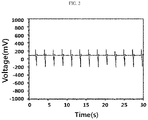
- FIG. 2 is a power generation voltage of an energy harvesting device manufactured by using an energy harvesting paste composition of Comparative Example 2.
- FIG. 3 is a scanning electron microscope (SEM) of an energy harvesting thin film manufactured by using the energy harvesting paste composition of Example 1.
- FIG. 4 is a scanning electron microscope (SEM) of an energy harvesting thin film manufactured by using an energy harvesting paste composition of Comparative Example 2.
- the conventional energy harvesting device has problems in that the polycrystalline ceramics and the polymer are simply mixed to produce the composite material, and thus it is difficult to mix the polycrystalline ceramics over a predetermined amount, thereby having a limitation in improving the power generation capacity, and in that the material is non-uniformly produced due to low dispersibility.
- the present applicant conducted intensive research in order to produce the composite material enabling the ceramic particles to have a high content and be highly dispersed, and as a result, found that when the surface of the ceramic particles was functionalized with an amine group, dispersibility of the ceramic particles was remarkably improved.
- the present applicant found that when the maleic anhydride-grafted elastomer was used as the polymer, it was possible for the ceramic particles to have high content together with high dispersibility, thus achieving high power generation capacity when an energy harvesting device is manufactured, and completed the present invention.
- the present invention provides a paste composition including ceramic particles surface-functionalized with an amine group, and a maleic anhydride-grafted elastomer.
- the present invention provides an energy harvesting paste composition, wherein the ceramic particles having a negative charge and a polyamine-based compound having a positive charge may be mixed to functionalize a surface of the ceramic particles with an amine group by electrostatic interaction.
- the ceramic particles in the polymer may be uniformly dispersed by using the ceramic particles surface-functionalized with an amine group.
- compatibility between the elastomer and the ceramic particles may increase, and thus the content of the ceramic particles in the composition may significantly increase. Therefore, it is possible to manufacture a device in which the ceramic particles having a high content are uniformly dispersed, and the power generation capacity is capable of being improved.
- the ceramic particles surface-functionalized with an amine group may be ceramic particles surface-coated with a polyamine-based compound.
- the ceramic particles may have a polyamine-based compound coating layer.
- the surface of the ceramic particles may be easily functionalized with an amine group, and the ceramic particles may have improved dispersibility when the ceramic particles are mixed with the maleic anhydride-grafted elastomer.
- the polyamine-based compound may be a polyamine-based polymer, a polyamine-based monomer, or a mixture thereof, which contains two or more amine groups.
- the ceramic particles may be uniformly and densely functionalized with amine groups throughout the entire surface thereof, and may have further improved dispersibility when the ceramic particles are mixed with the maleic anhydride-grafted elastomer.
- the polyamine-based polymer may be any one or two or more selected from the group consisting of polyalkyleneimine, polyvinylamine, polyamidoamine, polyallylamine, and polyetheramine, and the like.
- the polyamine-based monomer may be any one or two or more selected from the group consisting of alkylenediamine, dialkylenetriamine, trialkylenetetramine, p-phenylenediamine, m-phenylenediamine.
- 2,2′-diaminodiphenyl propane bis(3,5-diethyl-4-aminophenyl)methane, diaminodiphenylsulfone, diaminobenzophenone, diaminonaphthalene, 1,4-bis(4-aminophenoxy)benzene, 1,4-bis(4-aminophenyl)benzene, 9,10-bis(4-aminophenyl)anthracene, 1,3-bis(4-aminophenoxy)benzene, 4,4′-bis(4-aminophenoxy)diphenyl sulfone, 2,2-bis[4-(4-aminophenoxy)phenyl]propane, 2,2′-trifluoromethyl-4,4′-diaminobiphenyl, 1,4-diaminocyclohexane, 1,2-diaminocyclohexane, 1,4-cyclohexane-bis(methylamine), and
- the polyamine-based polymer may be effective to use in improving a thickness of the polyamine-based compound coating layer.
- improve the thickness of the polyamine-based compound coating layer it is possible to improve compatibility with the maleic anhydride-grafted elastomer, and thus the content of the ceramic particles in the composition may significantly increase. Therefore, it is possible to manufacture a device in which the ceramic particles having a high content are uniformly dispersed, and energy generation properties such as power generation capacity, and the like, are capable of being improved.
- a polyamine-based polymer having a number average molecular weight (Mn) of 10,000 to 80.000 g/mol particularly preferably a polyamine-based polymer having a number average molecular weight (Mn) of 50.000 to 80.000 g/mol in improving the thickness of the polyamine-based compound coating layer.
- the ceramic particles coated with the polyamine-based compound may have a coating layer having a thickness of 1 to 20 nm. Within the range as described above, the compatibility with the maleic anhydride-grafted elastomer may be remarkably improved.
- the ceramic particles are not specifically limited as long as they are ceramic particles for a piezoelectric material that are generally used in the art, and have an excellent piezoelectric effect.
- the ceramic particles may be any one or two or more selected from the group consisting of lead zirconate titanate (PZT), lead titanate, barium titanate, zinc oxide, aluminum nitride, cadmium sulfide, bismuth iron oxide, and silicon carbide, and the like.
- PZT lead zirconate titanate
- lead titanate barium titanate
- zinc oxide aluminum nitride
- cadmium sulfide bismuth iron oxide
- silicon carbide silicon carbide
- the ceramic particles may have an average particle size of 100 to 1,000 nm. Within the range as described above, the dispersibility of the ceramic particles may be improved. If a size of the ceramic particles is excessively large, the dispersibility may be lowered, resulting in deterioration of energy generation properties.
- the maleic anhydride-grafted elastomer having excellent elasticity and being easily deformed by mechanical force such as pressure, tension, vibration, or the like.
- the elastomer may be any one or two or more selected from the group consisting of a polystyrene-based block copolymer-graft-maleic anhydride block copolymer, a polyolefin-based-graft-maleic anhydride elastomer, a polyamide-based-graft-maleic anhydride elastomer, and a polyester-based-graft-maleic anhydride elastomer, and the like.
- polystyrene-based block copolymer-graft-maleic anhydride block copolymer in uniformly dispersing ceramic particles surface-functionalized with an amine group and improving a mixed content of the ceramic particles to improve the power generation capacity.
- the polystyrene-based block copolymer-graft-maleic anhydride block copolymer may be a styrene-ethylene-butylene-styrene-graft-maleic anhydride (SEBSm)-based block copolymer (polystyrene-block-poly(ethylene-ran-butylene)-block-polystyrene-graft-maleic anhydride: SEBSm).
- SEBSm styrene-ethylene-butylene-styrene-graft-maleic anhydride
- a styrene-based block copolymer may be further used together with the maleic anhydride-grafted elastomer.
- the paste composition according to an embodiment of the present invention may further include any one or two or more second elastomers selected from the group consisting of a styrene-butylene-styrene (SBS)-based block copolymer, a styrene-isoprene-styrene (SIS)-based block copolymer, a styrene-ethylene-butylene-styrene (SEBS)-based block copolymer, and a styrene-ethylene-propylene-styrene (SEPS)-based block copolymer, and the like.
- SBS styrene-butylene-styrene
- SIS styrene-isoprene-styrene
- SEBS styrene-
- the energy generation properties may be more remarkably improved.
- the maleic anhydride-grafted elastomer and the second elastomer may be mixed in a weight ratio of 3:7 to 7:3, and more preferably in a weight ratio of 4:6 to 6:4. Within the range as described above, a high dispersibility and a high content of the ceramic particles may not be inhibited.
- the paste composition may be prepared by mixing the ceramic particles surface-functionalized with an amine group and the maleic anhydride-grafted elastomer described above. More specifically, the ceramic particles surface-functionalized with an amine group and the maleic anhydride-grafted elastomer may be mixed to prepare an energy harvesting paste composition.
- the ceramic particles surface-functionalized with an amine group and the maleic anhydride-grafted elastomer may have a weight ratio of 1:0.01 to 10, and within the range as described above, a high power generation capacity may be secured. More preferably, the ceramic particles surface-functionalized with an amine group and the maleic anhydride-grafted elastomer may have a weight ratio of 1:0.05 to 5, and more preferably 1:0.1 to 3. By mixing a high content of the ceramic particles, the power generation capacity of the energy harvesting device may be further improved.
- the paste composition according to an exemplary embodiment of the present invention may further include an organic solvent.
- the organic solvent may allow the ceramic particles surface-functionalized with an amine group and the maleic anhydride-grafted elastomer to be dispersed and mixed uniformly, and may be used without specific limitation as long as it is possible to control a viscosity.
- the organic solvent may be any one or two or more selected from the group consisting of chloroform, chlorobenzene, dichlorobenzene, trichlorobenzene, tetrahydrofuran (THF), formamide, dimethyl formamide (DMF), dimethylacetamide (DMAc), dimethyl sulfoxide (DMSO), toluene, gamma-butyrolactone, acetonitrile, diethylene glycol, 1-methyl-2-pyrrolidone, acetone, acetylacetone, alcohol-based solvents such as ⁇ -terpineol, ⁇ -terpineol, dihydro terpineol, 2-methoxyethanol, methanol, ethanol, propanol, butanol, pentanol, and hexanol, and the like, ketone and methyl isobutyl ketone, and the like.
- a content of the organic solvent may be adjusted so that the paste composition has suitable fluidity for coating or printing.
- the ceramic particles surface-functionalized with an amine group and the organic solvent may have a weight ratio of 1:1 to 10, but the weight ratio thereof is not necessarily limited thereto.
- the preparation method of a paste composition may include: a) stirring a reaction solution including ceramic particles and a polyamine-based compound to produce ceramic particles surface-functionalized with an amine group; and b) preparing a paste composition including the ceramic particles surface-functionalized with an amine group, and a maleic anhydride-grafted elastomer.
- the paste composition is the energy harvesting paste composition
- a preparation method of an energy harvesting paste composition may include: a) stirring a reaction solution including ceramic particles and a polyamine-based compound to produce ceramic particles surface-functionalized with an amine group; and b) preparing an energy harvesting paste composition including the ceramic particles surface-functionalized with an amine group, and a maleic anhydride-grafted elastomer.
- step a) is to functionalize the surface of the ceramic particles with an amine group, wherein the ceramic particles surface-functionalized with an amine group may be produced by mixing the ceramic particles and the polyamine-based compound.
- the ceramic particles surface-functionalized with an amine group it is possible to uniformly disperse the ceramic particles in the elastomer.
- ceramic particles and a polyamine-based compound may be added to distilled water, respectively, to prepare two dispersions, and the dispersion in which the polyamine-based compound is dispersed may be dropped and stirred in the ceramic particle dispersion to produce the ceramic particles surface-functionalized with an amine group. After the reaction is completed, subsequent processes, such as centrifugation, drying, and the like, may be performed.
- the respective dispersions may be controlled to have an acidity of pH of 8 to 14, and more preferably, an acidity of pH of 9 to 11.
- the surface of the ceramic particles may be coated well with the polyamine-based compound.
- the acidity is not specifically limited as long as it is a basic compound, and may be controlled.
- the acidity may be controlled by using, for example, ammonium hydroxide, sodium hydroxide, potassium hydroxide, or the like.
- the ceramic particles and the polyamine-based compound may be mixed in a weight ratio of 1:0.1 to 20, and within the range as described above, the surface of the ceramic particles may be effectively functionalized. More preferably, the ceramic particles and the polyamine-based compound are preferably mixed in a weight ratio of 1:0.5 to 10, and more preferably 1:1 to 5. Within the range as described above, the ceramic particles may be functionalized with the amine groups throughout the entire surface thereof, and may have further improved dispersibility when the ceramic particles are mixed with the elastomer.
- the polyamine-based compound may be a polyamine-based polymer.
- the ceramic particles may be uniformly and densely functionalized with the amine groups throughout the entire surface thereof, and may have further improved dispersibility when the ceramic particles are mixed with the maleic anhydride-grafted elastomer.
- the polyamine-based polymer may be any one or two or more selected from the group consisting of polyalkyleneimine, polyvinylamine, polyamidoamine, polyallylamine, and polyetheramine, and the like.
- the polyamine-based monomer may be any one or two or more selected from the group consisting of alkylenediamine, dialkylenetriamine, trialkylenetetramine, p-phenylenediamine, m-phenylenediamine, 2,5-diaminotoluene.
- the polyamine-based compound may be preferably polyalkyleneimine such as polyethyleneimine or polypropyleneimine, or the like, containing an alkylene group having 2 to 5 carbon atoms.
- the polyamine-based polymer may be effective to use in improving a thickness of the polyamine-based compound coating layer.
- improve the thickness of the polyamine-based compound coating layer it is possible to improve compatibility with the maleic anhydride-grafted elastomer, and thus the content of the ceramic particles in the composition may significantly increase. Therefore, it is possible to manufacture a device in which the ceramic particles having a high content are uniformly dispersed, and the energy generation properties such as the power generation capacity, and the like, are capable of being improved.
- a polyamine-based polymer having a number average molecular weight (Mn) of 10,000 to 80,000 g/mol particularly preferably a polyamine-based polymer having a number average molecular weight (Mn) of 50,000 to 80,000 g/mol to improve the thickness of the polyamine-based compound coating layer.
- the ceramic particles coated with the polyamine-based compound may have a coating layer having a thickness of 1 to 20 nm. Within the range as described above, the compatibility with the maleic anhydride-grafted elastomer may be remarkably improved.
- the ceramic particles are not specifically limited as long as they are ceramic particles for a piezoelectric material that are generally used in the art, and have excellent piezoelectric effect.
- the ceramic particles may be any one or two or more selected from the group consisting of lead zirconate titanate (PZT), lead titanate, barium titanate, zinc oxide, aluminum nitride, cadmium sulfide, bismuth iron oxide, and silicon carbide, and the like.
- PZT lead zirconate titanate
- lead titanate barium titanate
- zinc oxide aluminum nitride
- cadmium sulfide bismuth iron oxide
- silicon carbide silicon carbide
- the ceramic particles may have an average particle size of 100 to 1,000 nm. Within the range as described above, the dispersibility of the ceramic particles may be improved. If a size of the ceramic particles is excessively large, the dispersibility may be lowered, resulting in deterioration of energy generation properties.
- step b) is to prepare the paste composition, wherein the paste composition may be prepared by mixing the ceramic particles surface-functionalized with an amine group and the maleic anhydride-grafted elastomer.
- the paste composition according to the present invention may uniformly disperse the ceramic particles in the polymer by using the ceramic particles surface-functionalized with an amine group.
- compatibility between the elastomer and the ceramic particles may increase, and thus the content of the ceramic particles in the composition may significantly increase. Therefore, it is possible to manufacture a device in which the ceramic particles having a high content are uniformly dispersed, and the power generation capacity is capable of being improved.
- the ceramic particles surface-functionalized with an amine group and the maleic anhydride-grafted elastomer may have a weight ratio of 1:0.01 to 10, and within the range as described above, a high power generation capacity may be secured. More preferably, the ceramic particles surface-functionalized with an amine group and the maleic anhydride-grafted elastomer may have a weight ratio of 1:0.05 to 5, and more preferably 1:0.1 to 3. By mixing a high content of the ceramic particles, the power generation capacity of the device may be further improved.
- the maleic anhydride-grafted elastomer having excellent elasticity and being easily deformed by mechanical force such as pressure, tension, vibration, or the like.
- the elastomer may be any one or two or more selected from the group consisting of a polystyrene-based block copolymer-graft-maleic anhydride block copolymer, a polyolefin-based-graft-maleic anhydride elastomer, a polyamide-based-graft-maleic anhydride elastomer, and a polyester-based-graft-maleic anhydride elastomer, and the like.
- polystyrene-based block copolymer-graft-maleic anhydride block copolymer in uniformly dispersing ceramic particles surface-functionalized with an amine group and improving a mixed content of the ceramic particles to improve the power generation capacity.
- the polystyrene-based block copolymer-graft-maleic anhydride block copolymer may be a styrene-ethylene-butylene-styrene-graft-maleic anhydride (SEBSm)-based block copolymer (polystyrene-block-poly(ethylene-ran-butylene)-block-polystyrene-graft-maleic anhydride: SEBSm).
- SEBSm styrene-ethylene-butylene-styrene-graft-maleic anhydride
- a styrene-based block copolymer may be further used together with the maleic anhydride-grafted elastomer.
- the energy harvesting paste composition according to an embodiment of the present invention may further include any one or two or more second elastomers selected from the group consisting of a styrene-butylene-styrene (SBS)-based block copolymer, a styrene-isoprene-styrene (SIS)-based block copolymer, a styrene-ethylene-butylene-styrene (SEBS)-based block copolymer, and a styrene-ethylene-propylene-styrene (SEPS)-based block copolymer, and the like.
- SBS styrene-butylene-styrene
- SIS styrene-isoprene-styrene
- SEBS sty
- the energy generation properties may be more remarkably improved.
- the maleic anhydride-grafted elastomer and the second elastomer may be mixed in a weight ratio of 3:7 to 7:3, and more preferably in a weight ratio of 4:6 to 6:4. Within the range as described above, a high dispersibility and a high content of the ceramic particles may not be inhibited.
- the paste composition according to an exemplary embodiment of the present invention may further include an organic solvent.
- the organic solvent may allow the ceramic particles surface-functionalized with an amine group and the maleic anhydride-grafted elastomer to be dispersed and mixed uniformly, and may be used without specific limitation as long as it is possible to control a viscosity.
- the organic solvent may be any one or two or more selected from the group consisting of chloroform, chlorobenzene, dichlorobenzene, trichlorobenzene, tetrahydrofuran (THF), formamide, dimethyl formamide (DMF), dimethylacetamide (DMAc), dimethyl sulfoxide (DMSO), toluene, gamma-butyrolactone, acetonitrile, diethylene glycol.
- alcohol-based solvents such as ⁇ -terpineol, ⁇ -terpineol, dihydro terpineol, 2-methoxyethanol, methanol, ethanol, propanol, butanol, pentanol, and hexanol, and the like, ketone and methyl isobutyl ketone, and the like.
- a content of the organic solvent may be adjusted so that the paste composition has suitable fluidity for coating or printing.
- the ceramic particles surface-functionalized with an amine group and the organic solvent may have a weight ratio of 1:1 to 10, but the weight ratio thereof is not necessarily limited thereto.
- the present invention provides a thin film including ceramic particles surface-functionalized with an amine group, and a maleic anhydride-grafted elastomer. More specifically, the present invention provides an energy harvesting thin film including ceramic particles surface-functionalized with an amine group, and a maleic anhydride-grafted elastomer.
- the ceramic particles surface-functionalized with an amine group, and the maleic anhydride-grafted elastomer are the same as those described above in the paste composition, and thus repeated descriptions thereof are omitted.
- the thin film may be produced from the paste composition. More specifically, in an example of the present invention, the energy harvesting thin film may be produced from the energy harvesting paste composition.
- the thin film may be produced by applying the paste composition to a preformed mold, followed by heat-treating at 50 to 100° C. for 30 minutes to 5 hours.
- the device according to an exemplary embodiment may include a thin film including ceramic particles surface-functionalized with an amine group, and a maleic anhydride-grafted elastomer.
- an energy harvesting device may be manufactured using the same. That is, the energy harvesting device according to an exemplary embodiment may include an energy harvesting thin film including ceramic particles surface-functionalized with an amine group, and a maleic anhydride-grafted elastomer.
- the ceramic particles surface-functionalized with an amine group, and the maleic anhydride-grafted elastomer are the same as those described above in the paste composition, and thus repeated descriptions thereof are omitted.
- Another embodiment of the present invention is to provide an energy harvesting method in which power energy, pressure energy or vibration energy is converted into electrical energy through a device including a thin film produced by applying and drying a paste composition into a mold, the paste composition including ceramic particles surface-functionalized with an amine group, and a maleic anhydride-grafted elastomer.
- the above-described energy harvesting method may implement excellent effects due to remarkably excellent power generation capacity.
- the ceramic particles surface-functionalized with an amine group, and the maleic anhydride-grafted elastomer are the same as those described above in the paste composition, and thus repeated descriptions thereof are omitted.
- additives that are not specifically described in the specification may have a unit of % by weight.
- An output voltage generated from the manufactured device when a predetermined pressure or bending stress was applied to the device was measured.
- the generated voltage was measured by applying a pressure of 10 to 50 N/m 2 to the device at a rate of 1 to 5 cm/s, or bending the device with a bending stress at a rate of 10 to 50 cm/s at a travel distance of 4 to 10 mm. Both ends of the electrodes of the device were connected to a voltage measuring device and an open circuit voltage was measured.
- PZT lead zirconate titanate
- polyethyleneimine manufactured by Aldrich with the number average molecular weight (Mn) of about 60,000 by LS, 50 wt % in H 2 O
- the PZT particles surface-functionalized with an amine group a mixed elastomer in which polystyrene-block-poly(ethylene-ran-butylene)-block-polystyrene-graft-maleic anhydride (SEBSm. Aldrich) and polystyrene-block-poly(ethylene-ran-butylene)-block-polystyrene (SEBS, Aldrich) were mixed at a weight ratio of 1:1, and 1,3-dichlorobenzene were mixed at a weight ratio of 2.3:1:4 to prepare an energy harvesting paste composition.
- SEBSm. Aldrich polystyrene-block-poly(ethylene-ran-butylene)-block-polystyrene-graft-maleic anhydride
- SEBS polystyrene-block-poly(ethylene-ran-butylene)-block-polystyrene
- the prepared energy harvesting paste composition was applied to a preformed mold and dried at 80° C. for 2 hours to produce a thin film.
- An aluminum-polyimide (PI) electrode was sequentially attached to both sides of the thin film to manufacture an energy harvesting device.
- Example 2 was performed in the same manner as in Example 1 except that PZT particles surface-functionalized with an amine group, a mixed elastomer in which SEBSm and SEBS were mixed at a weight ratio of 1:1, and 1,3-dichlorobenzene were mixed at a weight ratio of 1:1:4.
- Example 3 was performed in the same manner as in Example 1 except that PZT particles surface-functionalized with an amine group, a mixed elastomer in which SEBSm and SEBS were mixed at a weight ratio of 7:3, and 1,3-dichlorobenzene were mixed at a weight ratio of 2.3:1:4.
- Example 4 was performed in the same manner as in Example 3 except that PZT particles surface-functionalized with an amine group, a mixed elastomer in which SEBSm and SEBS were mixed at a weight ratio of 3:7, and 1,3-dichlorobenzene were mixed at a weight ratio of 2.3:1:4.
- Example 5 was performed in the same manner as in Example 1 except that a poly(ethyleneimine)(manufactured by Aldrich with the number average molecular weight (Mn) of about 1,800 by LS. 50 wt % in H 2 O) having a number average molecular weight (Mn) of 1,800 g/mol was used.
- a poly(ethyleneimine)(manufactured by Aldrich with the number average molecular weight (Mn) of about 1,800 by LS. 50 wt % in H 2 O) having a number average molecular weight (Mn) of 1,800 g/mol was used.
- Example 6 was performed in the same manner as in Example 1 except that PZT particles surface-functionalized with an amine group, a single SEBSm elastomer, and 1,3-dichlorobenzene were mixed at a weight ratio of 2.3:1:4.
- Comparative Example 1 was performed in the same manner as in Example 1 except that ceramic particles that were not functionalized with an amine group were used.
- Comparative Example 2 was performed in the same manner as in Example 1 except that a styrene-butadiene elastomer (poly(styrene-co-butadiene) with styrene 45 wt % manufactured by Aldrich) was used instead of the mixed elastomer of SEBSm and SEBS.
- a styrene-butadiene elastomer poly(styrene-co-butadiene) with styrene 45 wt % manufactured by Aldrich
- Examples 1 to 6 in which the energy harvesting devices were manufactured by using the paste compositions prepared by mixing the ceramic particles surface-functionalized with an amine group and the maleic anhydride-grafted elastomer, it could be confirmed that the power generation voltage thereof was as high as 420 mV or more, and thus Examples 1 to 6 had excellent power generation voltage two times or higher than those of Comparative Examples 1 and 2.
- Example 1 in which the mixed elastomer of SEBSm and SEBS was used and the ceramic particles surface-treated with polyethyleneimine satisfying the number average molecular weight of 50,000 to 80,000 were used, it could be confirmed that the power generation voltage was very high as 56 V as shown in FIG. 1 , and thus Example 1 had very remarkable power generation voltage 250 times or higher than those of Comparative Examples 1 and 2 as shown in FIG. 2 , and it could be confirmed that the ceramic particles were dispersed very uniformly as shown in FIG. 3 .
- This confirmation is considered to have occurred because the coating layer of about 3 to 5 nm was formed by treating the surface of the ceramic particles with polyethyleneimine satisfying a number average molecular weight of 50,000 to 80,000 g/mol, and thus the amine group of the coating layer and the maleic acid group of the maleic anhydride-grafted elastomer were more effectively compatible with each other, thus achieving high dispersion and high content of the ceramic particles.
- Comparative Example 1 in which the mixed elastomer of SEBSm and SEBS was used but the ceramic particles surface-functionalized with an amine group were not used, it could be confirmed that the power generation voltage was as low as 220 mV, and the ceramic particles were dispersed non-uniformly as shown in FIG. 4 .
- the paste composition according to the present invention may uniformly disperse ceramic particles in a polymer by using ceramic particles surface-functionalized with an amine group.
- a maleic anhydride-grafted elastomer as the polymer, compatibility between the elastomer and the ceramic particles may increase, and thus the content of the ceramic particles in the composition may significantly increase. Therefore, it is possible to manufacture a device in which the ceramic particles having a high content are uniformly dispersed, and the power generation capacity is capable of being improved.
Landscapes
- Engineering & Computer Science (AREA)
- Chemical & Material Sciences (AREA)
- Composite Materials (AREA)
- Materials Engineering (AREA)
- Manufacturing & Machinery (AREA)
- Ceramic Engineering (AREA)
- Physics & Mathematics (AREA)
- Spectroscopy & Molecular Physics (AREA)
- Compositions Of Macromolecular Compounds (AREA)
Abstract
Description
| TABLE 1 | ||
| Power generation voltage (mV) | ||
| Example 1 | 56000 | ||
| Example 2 | 3500 | ||
| Example 3 | 750 | ||
| Example 4 | 600 | ||
| Example 5 | 420 | ||
| Example 6 | 800 | ||
| Comparative Example 1 | 220 | ||
| Comparative Example 2 | 200 | ||
Claims (18)
Applications Claiming Priority (3)
| Application Number | Priority Date | Filing Date | Title |
|---|---|---|---|
| KR1020160083502A KR101773594B1 (en) | 2016-07-01 | 2016-07-01 | Paste composition for energy harvesting, and method for manufacturing the same |
| KR10-2016-0083502 | 2016-07-01 | ||
| PCT/KR2017/007026 WO2018004316A1 (en) | 2016-07-01 | 2017-07-03 | Energy harvesting paste composition and preparation method therefor |
Related Parent Applications (1)
| Application Number | Title | Priority Date | Filing Date |
|---|---|---|---|
| PCT/KR2017/007026 Continuation-In-Part WO2018004316A1 (en) | 2016-07-01 | 2017-07-03 | Energy harvesting paste composition and preparation method therefor |
Publications (2)
| Publication Number | Publication Date |
|---|---|
| US20190181331A1 US20190181331A1 (en) | 2019-06-13 |
| US11316094B2 true US11316094B2 (en) | 2022-04-26 |
Family
ID=59761246
Family Applications (1)
| Application Number | Title | Priority Date | Filing Date |
|---|---|---|---|
| US16/237,252 Active US11316094B2 (en) | 2016-07-01 | 2018-12-31 | Paste composition and preparation method therefor |
Country Status (3)
| Country | Link |
|---|---|
| US (1) | US11316094B2 (en) |
| KR (1) | KR101773594B1 (en) |
| WO (1) | WO2018004316A1 (en) |
Families Citing this family (2)
| Publication number | Priority date | Publication date | Assignee | Title |
|---|---|---|---|---|
| KR102188942B1 (en) * | 2019-05-07 | 2020-12-09 | 한국화학연구원 | Paste composition and method for producing the same, and piezoelectric pressure sensor manufactured therefrom and method for producing the same |
| US12521937B2 (en) | 2021-03-23 | 2026-01-13 | Xerox Corporation | Piezoelectric composite filaments and use thereof in additive manufacturing |
Citations (6)
| Publication number | Priority date | Publication date | Assignee | Title |
|---|---|---|---|---|
| KR20060111283A (en) | 2005-04-22 | 2006-10-27 | 삼성전기주식회사 | Method of stabilizing ceramic powders and slurries by introducing chemical functional groups |
| KR20110119278A (en) | 2010-04-27 | 2011-11-02 | 한국과학기술연구원 | Polymer Composite Actuator |
| KR20130139603A (en) | 2012-06-13 | 2013-12-23 | 한국과학기술연구원 | Method for manufacturing flexible piezoelectric energy harvester using piezoelectric composite and flexible piezoelectric energy harvester manufactured by the same |
| KR20140105136A (en) | 2013-02-22 | 2014-09-01 | 한국세라믹기술원 | Magnetic ceramic phosphor and manufacturing method of the same |
| KR20150091400A (en) | 2012-12-05 | 2015-08-10 | 덴마크스 텍니스케 유니버시테트 | Dielectric electroactive polymers comprising an ionic supramolecular structure |
| US20180151278A1 (en) * | 2014-10-23 | 2018-05-31 | Corning Incorporated | Polymer-encapsulated magnetic nanoparticles |
-
2016
- 2016-07-01 KR KR1020160083502A patent/KR101773594B1/en active Active
-
2017
- 2017-07-03 WO PCT/KR2017/007026 patent/WO2018004316A1/en not_active Ceased
-
2018
- 2018-12-31 US US16/237,252 patent/US11316094B2/en active Active
Patent Citations (7)
| Publication number | Priority date | Publication date | Assignee | Title |
|---|---|---|---|---|
| KR20060111283A (en) | 2005-04-22 | 2006-10-27 | 삼성전기주식회사 | Method of stabilizing ceramic powders and slurries by introducing chemical functional groups |
| KR20110119278A (en) | 2010-04-27 | 2011-11-02 | 한국과학기술연구원 | Polymer Composite Actuator |
| US20130049530A1 (en) * | 2010-04-27 | 2013-02-28 | Korea Institute Of Science And Technology | Dielectric elastomer composites and actuators using the same |
| KR20130139603A (en) | 2012-06-13 | 2013-12-23 | 한국과학기술연구원 | Method for manufacturing flexible piezoelectric energy harvester using piezoelectric composite and flexible piezoelectric energy harvester manufactured by the same |
| KR20150091400A (en) | 2012-12-05 | 2015-08-10 | 덴마크스 텍니스케 유니버시테트 | Dielectric electroactive polymers comprising an ionic supramolecular structure |
| KR20140105136A (en) | 2013-02-22 | 2014-09-01 | 한국세라믹기술원 | Magnetic ceramic phosphor and manufacturing method of the same |
| US20180151278A1 (en) * | 2014-10-23 | 2018-05-31 | Corning Incorporated | Polymer-encapsulated magnetic nanoparticles |
Non-Patent Citations (4)
| Title |
|---|
| Chakraborti, S. et al., "Interaction of Polyethyleneimine-Functionalized ZnO Nanoparticles with Bovine Serum Albumin," Langmuir, vol. 28, No. 30, Jul. 2, 2012, 11 pages. |
| ISA Korean Intellectual Property Office, International Search Report Issued in Application No. PCT/KR2017/007026, dated Oct. 10, 2017, WIPO, 4 pages. |
| Machine Translation of Su et al. KR20060111283 (Year: 2006). * |
| Technical Report: Guidance To Operation of Water Quality Laboratories (Year: 2002). * |
Also Published As
| Publication number | Publication date |
|---|---|
| US20190181331A1 (en) | 2019-06-13 |
| WO2018004316A1 (en) | 2018-01-04 |
| KR101773594B1 (en) | 2017-08-31 |
Similar Documents
| Publication | Publication Date | Title |
|---|---|---|
| CN109526241B (en) | Solid electrolyte composition, sheet and battery, and related manufacturing method and polymer | |
| CN110268571B (en) | Solid electrolyte composition, solid electrolyte-containing sheet and method for producing same, all-solid-state secondary battery and method for producing same, and polymer and nonaqueous solvent dispersion thereof | |
| US20190372160A1 (en) | Solid electrolyte composition, solid electrolyte-containing sheet and manufacturing method therefor, all-solid state secondary battery and manufacturing method therefor, and polymer and non-aqueous solvent dispersion thereof | |
| US20190319303A1 (en) | Solid electrolyte composition, solid electrolyte-containing sheet, all-solid state secondary battery, and methods for manufacturing solid electrolyte-containing sheet and all-solid state secondary battery | |
| JP7234400B2 (en) | Composition containing inorganic solid electrolyte, sheet for all-solid secondary battery, all-solid secondary battery, and method for producing composition containing inorganic solid electrolyte, sheet for all-solid secondary battery, and all-solid secondary battery | |
| CN102106023B (en) | Positive mix paste for lithium secondary battery | |
| KR102244412B1 (en) | Solid electrolyte composition, solid electrolyte-containing sheet and its manufacturing method, all-solid secondary battery and its manufacturing method, and polymer and its non-aqueous solvent dispersion and diol compound | |
| US20190181331A1 (en) | Paste composition and preparation method therefor | |
| JP7373577B2 (en) | Inorganic solid electrolyte-containing composition, sheet for all-solid secondary battery, electrode sheet for all-solid secondary battery, and all-solid secondary battery, and manufacturing method of sheet for all-solid secondary battery and all-solid secondary battery | |
| JP7177944B2 (en) | Method for producing electrode composition, method for producing electrode sheet for all-solid secondary battery, and method for producing all-solid secondary battery | |
| JP7320062B2 (en) | Composition containing inorganic solid electrolyte, sheet for all-solid secondary battery, electrode sheet for all-solid secondary battery and all-solid secondary battery, and method for producing sheet for all-solid secondary battery and all-solid secondary battery | |
| KR101601949B1 (en) | Conducting material composition, slurry composition for forming electrode of lithium rechargeable battery and lithium rechargeable battery using the same | |
| US20230275259A1 (en) | Inorganic solid electrolyte-containing composition, sheet for all-solid state secondary battery, and all-solid state secondary battery, and manufacturing methods for sheet for all-solid state secondary battery and all-solid state secondary battery | |
| US20120286627A1 (en) | Polymer blend composition and actuators using the same | |
| JP2022116646A (en) | Composition for power storage device, slurry for power storage device electrode, power storage device electrode, and power storage device | |
| CN114175339B (en) | Composition containing inorganic solid electrolyte, sheet for all-solid-state secondary battery and all-solid-state secondary battery, and method for producing sheet for all-solid-state secondary battery and all-solid-state secondary battery | |
| JP7263524B2 (en) | Composition containing inorganic solid electrolyte, sheet for all-solid secondary battery and all-solid secondary battery, method for producing sheet for all-solid secondary battery and all-solid secondary battery, and composite polymer particles | |
| WO2023282312A1 (en) | Inorganic solid electrolyte-containing composition, sheet for all-solid-state secondary batteries, all-solid-state secondary battery, method for producing sheet for all-solid-state secondary batteries, and method for producing all-solid-state secondary battery | |
| CN116525779B (en) | A composite-coated conversion cathode material, its preparation method, and a battery thereof. | |
| KR20170083831A (en) | An anode material for aqueous rechargeable lithium-ion battery and a method for manufacturing the same | |
| JP7301141B2 (en) | Composition containing inorganic solid electrolyte, sheet for all-solid secondary battery, electrode sheet for all-solid secondary battery and all-solid secondary battery, and method for producing sheet for all-solid secondary battery and all-solid secondary battery | |
| CN116606136A (en) | A kind of piezoelectric ceramic material and its preparation method and piezoelectric device | |
| KR102188942B1 (en) | Paste composition and method for producing the same, and piezoelectric pressure sensor manufactured therefrom and method for producing the same | |
| KR101850006B1 (en) | An anode material for aqueous rechargeable natrium-ion battery and a method for manufacturing the same | |
| WO2025116625A1 (en) | Negative electrode active material for secondary battery, method for manufacturing same, and negative electrode comprising same for secondary battery |
Legal Events
| Date | Code | Title | Description |
|---|---|---|---|
| AS | Assignment |
Owner name: KOREA RESEARCH INSTITUTE OF CHEMICAL TECHNOLOGY, KOREA, REPUBLIC OF Free format text: ASSIGNMENT OF ASSIGNORS INTEREST;ASSIGNORS:LEE, SU YEON;CHOI, YOUNG MIN;JEONG, SUN HO;AND OTHERS;REEL/FRAME:047876/0973 Effective date: 20181227 Owner name: KOREA RESEARCH INSTITUTE OF CHEMICAL TECHNOLOGY, K Free format text: ASSIGNMENT OF ASSIGNORS INTEREST;ASSIGNORS:LEE, SU YEON;CHOI, YOUNG MIN;JEONG, SUN HO;AND OTHERS;REEL/FRAME:047876/0973 Effective date: 20181227 |
|
| FEPP | Fee payment procedure |
Free format text: ENTITY STATUS SET TO UNDISCOUNTED (ORIGINAL EVENT CODE: BIG.); ENTITY STATUS OF PATENT OWNER: SMALL ENTITY |
|
| FEPP | Fee payment procedure |
Free format text: ENTITY STATUS SET TO SMALL (ORIGINAL EVENT CODE: SMAL); ENTITY STATUS OF PATENT OWNER: SMALL ENTITY |
|
| STPP | Information on status: patent application and granting procedure in general |
Free format text: DOCKETED NEW CASE - READY FOR EXAMINATION |
|
| STPP | Information on status: patent application and granting procedure in general |
Free format text: NON FINAL ACTION MAILED |
|
| STPP | Information on status: patent application and granting procedure in general |
Free format text: RESPONSE TO NON-FINAL OFFICE ACTION ENTERED AND FORWARDED TO EXAMINER |
|
| STPP | Information on status: patent application and granting procedure in general |
Free format text: NON FINAL ACTION MAILED |
|
| STPP | Information on status: patent application and granting procedure in general |
Free format text: RESPONSE TO NON-FINAL OFFICE ACTION ENTERED AND FORWARDED TO EXAMINER |
|
| STPP | Information on status: patent application and granting procedure in general |
Free format text: FINAL REJECTION MAILED |
|
| STPP | Information on status: patent application and granting procedure in general |
Free format text: DOCKETED NEW CASE - READY FOR EXAMINATION |
|
| STPP | Information on status: patent application and granting procedure in general |
Free format text: NON FINAL ACTION MAILED |
|
| STPP | Information on status: patent application and granting procedure in general |
Free format text: RESPONSE TO NON-FINAL OFFICE ACTION ENTERED AND FORWARDED TO EXAMINER |
|
| STPP | Information on status: patent application and granting procedure in general |
Free format text: NOTICE OF ALLOWANCE MAILED -- APPLICATION RECEIVED IN OFFICE OF PUBLICATIONS |
|
| STPP | Information on status: patent application and granting procedure in general |
Free format text: PUBLICATIONS -- ISSUE FEE PAYMENT VERIFIED |
|
| STCF | Information on status: patent grant |
Free format text: PATENTED CASE |
|
| MAFP | Maintenance fee payment |
Free format text: PAYMENT OF MAINTENANCE FEE, 4TH YR, SMALL ENTITY (ORIGINAL EVENT CODE: M2551); ENTITY STATUS OF PATENT OWNER: SMALL ENTITY Year of fee payment: 4 |