US11307398B2 - Method for generating and analyzing an overview contrast image - Google Patents
Method for generating and analyzing an overview contrast image Download PDFInfo
- Publication number
- US11307398B2 US11307398B2 US16/618,773 US201816618773A US11307398B2 US 11307398 B2 US11307398 B2 US 11307398B2 US 201816618773 A US201816618773 A US 201816618773A US 11307398 B2 US11307398 B2 US 11307398B2
- Authority
- US
- United States
- Prior art keywords
- overview
- illumination
- image
- different
- sample carrier
- Prior art date
- Legal status (The legal status is an assumption and is not a legal conclusion. Google has not performed a legal analysis and makes no representation as to the accuracy of the status listed.)
- Active, expires
Links
Images


Classifications
-
- G—PHYSICS
- G02—OPTICS
- G02B—OPTICAL ELEMENTS, SYSTEMS OR APPARATUS
- G02B21/00—Microscopes
- G02B21/36—Microscopes arranged for photographic purposes or projection purposes or digital imaging or video purposes including associated control and data processing arrangements
- G02B21/365—Control or image processing arrangements for digital or video microscopes
- G02B21/367—Control or image processing arrangements for digital or video microscopes providing an output produced by processing a plurality of individual source images, e.g. image tiling, montage, composite images, depth sectioning, image comparison
-
- G—PHYSICS
- G02—OPTICS
- G02B—OPTICAL ELEMENTS, SYSTEMS OR APPARATUS
- G02B21/00—Microscopes
- G02B21/06—Means for illuminating specimens
- G02B21/08—Condensers
- G02B21/086—Condensers for transillumination only
-
- G—PHYSICS
- G02—OPTICS
- G02B—OPTICAL ELEMENTS, SYSTEMS OR APPARATUS
- G02B21/00—Microscopes
- G02B21/06—Means for illuminating specimens
- G02B21/08—Condensers
- G02B21/12—Condensers affording bright-field illumination
- G02B21/125—Condensers affording bright-field illumination affording both dark- and bright-field illumination
Definitions
- the invention relates to a method for producing and analyzing an overview contrast image of a sample carrier and/or of samples arranged on a sample carrier.
- the sample on the sample carrier must be moved into the field of view of the objective, a sample region must be chosen, an adjustment to the position of said sample region must be performed, and, finally, the sample must be brought into focus.
- the workflow when using modern, complex microscope systems is therefore associated with two working spaces that represent different steps in the workflow and are spatially separate from one another—first, the microscope stand with the eyepiece for direct observation, and then the screen of a connected computer.
- the direct view onto the sample that is to say the position of the objective field of view in the sample, is greatly limited. If moreover larger sample carriers—for example multiwell plates—are used so that a multiplicity of samples can be examined in succession, the orientation on the sample is likewise obstructed.
- sample carriers here typically carry an inscription, for example in the form of a barcode or a QR code, that must be assigned to the samples.
- Such examinations proceed semi-automatically; for example, a user only intervenes to change the sample carriers, to set an overview image, or to register the sample carrier number.
- some of the wells may contain no samples or may contain incorrectly embedded, contaminated or defective samples. Said wells are likewise examined in the semi-automatic method, even though the results cannot be used, which means that the process takes more time than is actually necessary.
- an image can be recorded with the microscope optical unit and a weakly magnifying objective and a camera that is arranged downstream of the objective.
- this allows the recording of merely a small object field as compared to the size of the sample or of the sample carrier, in particular if sample carriers for a plurality of samples are used.
- sample carriers for a plurality of samples are used.
- it is therefore necessary to record a plurality of images of sections of the sample or of the sample carrier that are located next to one another and to subsequently combine them. This procedure is quite lengthy and not suitable for example for examining living samples.
- An overview image can also be recorded if, instead of the microscope optical unit, a camera with a camera objective lens with which a relatively large object field can be imaged is used; the camera objective lens is generally not telecentric.
- This solution is implemented for example in the AxioScan series by the applicant, but can be used only with bright field illumination and incident light. Coverslips and undyed samples can be detected only with difficulty in this method.
- the overview image is intended to have increased contrast or an improved signal-to-noise ratio of the particular structures of interest, which is why the overview image will be referred to as an overview contrast image below.
- the overview contrast image can be made available to the user for the purposes of navigation, or it can be used to improve the automated analysis of samples and to reduce the susceptibility to errors, for example by detecting sample errors.
- a sample carrier generally carrying at least one sample—is arranged at least partially in the focus of a detection optical unit and is illuminated in transmitted light with a two-dimensional, preferably array-type, illumination pattern. At least partially here means that the sample carrier or the sample does not need to be completely visible, but means in particular that the sample carrier and/or the samples can also have an extent along the optical axis that is greater than the depth of field of the detection optical unit used.
- a detection optical unit that can be used can be the optical unit of a microscope, although it is preferably a camera having a camera objective lens, which makes it possible to image a large object field onto a surface detector, preferably with a sufficiently high depth of field.
- the overview raw images that is to say unprocessed images, are then detected for example by the camera by way of a surface detector—for example a CMOS chip—registering the intensity pixel by pixel.
- a surface detector for example a CMOS chip
- the overview raw images can be recorded successively or simultaneously, for example using a single camera.
- a calculation algorithm that is used to calculate an overview contrast image from the at least two overview raw images is chosen in dependence on the type of the illumination and information that is to be extracted from the overview contrast image.
- the information can be, for example, the already mentioned structures of the sample carrier, of the sample etc., and of the inscription on the sample carrier.
- an image evaluation calculation algorithm is chosen that is used to extract the information from the overview contrast image.
- Said information can then be used for example by the user on the screen of a connected computer to initiate further steps as part of the observation and analysis, for example to navigate on the sample, which is accomplished by the image being represented on a screen and the user choosing the sample region of interest for example by way of a mouse click.
- the microscope system can then be automatically adjusted to that position.
- the information can also be used as part of an automated examination, for example in high-throughput examinations, to exclude incorrectly filled wells of a multiwell carrier, such as a microtiter plate, with the result that the microscope is not even adjusted to their positions.
- Two-dimensional illumination can be obtained in different ways, wherein preferably an array of illumination elements of the same size is used to produce illumination patterns.
- the individual illumination elements must be distinguishable from one another in the at least two overview raw images, that is to say they must be able to be represented separately from one another in the image, even though they were not arranged at the focus.
- the illumination elements can be LEDs, OLEDs, the ends of optical fibers, elements of an illuminated DMD (digital micromirror device) or of a different spatial light modulator. They can be elements that actively or passively emit light.
- the illumination elements can also be produced for example with a light source that emits light over a surface and upstream of which for example a switchable filter structure is arranged, with which one or more properties of the illumination elements—for example color, intensity or polarization—can be manipulated.
- a light source that emits light over a surface and upstream of which for example a switchable filter structure is arranged, with which one or more properties of the illumination elements—for example color, intensity or polarization—can be manipulated.
- LEDs light-emitting diodes
- microscopes that use an LED array that is to say LEDs arranged in the manner of a matrix or a grid (LED array microscopes, angular illumination microscopes—AIM), for illumination are already available.
- the LED arrays of such microscopes can be likewise used to produce two-dimensional illumination patterns.
- the different illuminations with which the at least two overview raw images are recorded can be realized in different ways.
- One simple possibility is to use a static two-dimensional illumination pattern and to move the sample carrier laterally, that is to say perpendicularly to the optical axis of the detection optical unit, relative to the illumination pattern between two recordings. This can be accomplished either by moving the illumination pattern itself—likewise arranged in a plane with the optical axis as a normal—or by moving the sample carrier.
- the sample carrier or the sample is here illuminated in transmitted light, that is to say the sample carrier is located between the illumination elements of the illumination pattern and the detection optical unit, for example the camera.
- an overview contrast image can be calculated from said overview raw images.
- illumination patterns are preferably chosen in dependence on the information that is to be extracted.
- a multiplicity of illumination patterns that can be impressed on the array of illumination elements are suitable.
- different illumination patterns can be produced by driving the illumination elements individually or in groups and switching them to produce different illumination patterns, wherein a first portion of the illumination elements is switched to emit light and at least a second portion of the illumination elements is switched to emit no light or to emit light of a different color or light of a different polarization. If the at least second portion of the illumination elements does not emit light, each pattern includes exactly two parts, and the overview raw images are detected successively.
- the illumination elements can also be divided into more than two groups and comprise a third or further parts that emit light of respectively different colors, wherein the colors differ from one another in pairs.
- a corresponding statement applies to the polarizations.
- the overview raw images can be recorded simultaneously, provided that, on the detection side, separation into the different color channels is effected.
- the array of illumination elements comprises LEDs in the three RGB primary colors red (R), green (G) and blue (B), and if the sensor of the camera has corresponding sensors assigned to said color channels, a separation is readily possible, and three overview raw images can be recorded at the same time. Similar is true for polarized illumination, for example if an LED array is provided with polarization filters of different polarizations and the polarization directions are likewise detected and used for separating the channels.
- the illumination elements are in the form of LEDs, and an LED is formed from three individual mutually adjacent sub-LEDs that each emit light in different primary colors red, green and blue, the different illuminations can also be set by illumination from different angles in the primary colors.
- the overview raw images can be detected simultaneously.
- Another possibility is to produce explicitly different illumination patterns and to record the overview raw images successively with different illumination patterns.
- This can be done in a first variant for example by stochastically choosing the first portion of the illumination elements for each illumination pattern, wherein the individual illumination elements can randomly be driven and switched to emit light or to emit no light, wherein care should be taken to ensure by way of boundary conditions the best possible equal distribution of illumination elements that emit light and those that do not emit light.
- pulse-width-modulated illumination elements are used—this can be realized particularly well with LEDs or OLEDs—wherein the pulse width is selected to be longer than the integration time of a detector unit for recording the overview raw images. In this case, the illumination elements do not need to be driven individually.
- illumination patterns in which the illumination elements exhibit a regular distribution.
- chessboard-type, cross-shaped or half pupil distributions can be used for the light-emitting illumination elements.
- the second portion of the illumination elements may emit no light, in which case two overview raw images are recorded successively with mutually complementary illumination patterns. If the illumination is in the manner of a chessboard, the patterns are inverted with respect to one another.
- the two parts of the illumination elements can also emit light of different colors or polarizations, in which case the overview raw images can be recorded simultaneously in one image and subsequently be separated into color channels or polarizations.
- the two patterns are not only complementary, but also inverted with respect to one another. If a plurality of patterns—for example a single light-emitting illumination element that scans the array—are used, all patterns together behave in a mutually complementary fashion, that is to say, overall, they produce an array of only light-emitting illumination elements. In the case of half pupil illumination, in each case two out of the four necessary illumination patterns are mutually complementary.
- illuminations by selecting from the array of illumination elements at least one section and producing the illumination pattern only in said section.
- the different illuminations are achieved by a scanning movement of the at least one section on the array, wherein the illumination elements outside of the at least one section are switched to emit no light.
- illumination with an individual LED can be used here, or a section of a chessboard-type illumination. If a sample carrier is large, it is possible here to choose a plurality of sections that are moved in parallel fashion; a combination with differently colored illumination elements is likewise possible to produce a plurality of sections at the same time.
- a calculation algorithm that is used to calculate the overview contrast image from the at least two overview raw images is chosen in dependence on the information that is to be extracted from the overview contrast image.
- the choice of the calculation algorithm is preferably also made in dependence on the previous choice of the illumination method, i.e. is adapted thereto.
- the overview contrast image is preferably produced either in dark-field mode or in bright-field mode, because these permit the best contrast, but mixed modes are also possible. It is necessary here to ensure that the contrast is optimum for the structures of interest, for example depending on whether the cover slips, the sample itself, or the inscription is/are to be represented with the highest possible contrast.
- overview contrast images can be produced from the overview raw images both in bright-field and in dark-field mode, depending on the desired information.
- other types of contrast can also be produced, for example overview contrast images in a HDR mode, which contain dark-field and bright-field components.
- the calculation algorithm is based on a pixel-wise projection, preferably a ranking projection or a projection of statistical moments.
- the overview raw images are compared pixel by pixel, and the intensity value of one of the pixels for the corresponding position in the overview contrast image is chosen in accordance with a projection condition.
- the recorded image stack is consequently subjected to calculation pixel by pixel, that is to say each pixel in the overview contrast image is influenced only by the pixels in the image stack that are located at the same image position in the overview raw images.
- the corresponding pixel values of the overview raw images for an image position are sorted by intensities, and the value corresponding to the p-quantile is used for the overview contrast image, with p being a parameter that is to be specified by the user or is specified by the calculation method.
- p being a parameter that is to be specified by the user or is specified by the calculation method.
- overview contrast images can be produced in dark-field contrast or in bright-field contrast with this type of calculation.
- the overview contrast image can be also produced in dark-field mode, for example if the brightest possible overview contrast image is produced with the greatest possible p, wherein only pixels that have not been directly illuminated by an illumination element will be taken into account in the calculation.
- each pixel in the overview contrast image corresponds to a statistical moment, such as for example the standard deviation of the intensity over the corresponding pixels of the overview raw images.
- this calculation algorithm is particularly suitable for example for detecting multiwell sample carriers or chamber-slide sample carriers.
- the calculation algorithm is based on morphological operations with subsequent pixel-wise projection, preferably on a top-hat or black-hat transform with subsequent pixel-wise maximum projection. It is possible using the top-hat transform to highlight bright structures on a dark background, and the black-hat transform can be used to highlight dark structures on a bright background. These calculation algorithms can be used to make in particular glass edges, that is to say edges of sample carriers or cover slips, visible. Next, a pixel-wise maximum projection over the overview raw images thus transformed is formed and the overview contrast image is produced in this way.
- the advantages of this calculation algorithm are that the information is acquired at the same time from bright-field and dark-field contrasts, and that it is likewise efficiently subjected to a calculation. However, as compared to a ranking projection, the contrast in the images that have been subjected to calculation is mostly lower and is frequently visible only in the case of glass edges. In addition, strong background artefacts can be produced that must then be redressed.
- a calculation algorithm based on segmentation in which initially a determination is made for each pixel of an overview raw image as to whether said pixel has been directly irradiated with light by an illumination element. These pixels are then not taken into account for the production of an overview contrast image in the dark-field contrast mode.
- the overview contrast image is produced using a projection method in this case, too.
- the advantage of this calculation algorithm as compared to the ranking projection is that an explicit determination is made here as to which pixel information from the overview raw images can be used.
- a disadvantage is that, on account of the segmentation and the resulting unequal treatment of pixels, seams can form in the calculated contrast image. In addition, the calculation cannot be performed as efficiently as in the previously described calculation algorithms.
- the overview contrast image is not produced by calculation but is detected directly, that is to say no overview raw images are detected, or, in other words, the overview raw image in this case is identical to the overview contrast image.
- a diffusion screen is inserted into the beam path between the array-type illumination pattern—which can be made up of an array of illumination elements of preferably equal size in this case, too—and the sample carrier.
- the diffusion screen which produces diffuse illumination, which is advantageous for bright-field illumination, can also permanently remain in the beam path, provided it is switchable, and it is then switched on, i.e. switched to diffusion, only for the production of an overview contrast image in bright-field mode.
- the camera is calibrated relative to the sample carrier or the illumination pattern in order to be able to map—in the case of a movement of the sample carrier—the coordinates of a stage, on which the sample carrier is held and which can be displaced to move the sample carrier, onto image coordinates.
- map in the case of a movement of the sample carrier—the coordinates of a stage, on which the sample carrier is held and which can be displaced to move the sample carrier, onto image coordinates.
- a similar procedure can be used for movable illumination patterns.
- a calibration pattern for example a chessboard, is placed in the stage concretely for calibration purposes, as a result of which the coordinate mapping can be estimated with sufficient accuracy.
- such calibration can also be dispensed with in the calculation and the movement of the sample can be ascertained by way of image analysis or using a different measurement system.
- an overview contrast image can be generated after calibration, that is to say after a quantification of the actual movement of the sample carrier in relation to the image, even for larger sample carriers that do not entirely fit into the object field that is capturable by the camera or the detection optical unit, by initially producing individual contrast images that each show different regions of the sample carrier—and/or of the sample—and are produced from corresponding individual overview raw images. Said individual contrast images are subsequently combined to form the overview contrast image, wherein the calibration is used to correctly locate connecting points for joining them.
- a calibration is also advantageously performed using the recording and evaluation of a calibration pattern for correcting geometric distortions before the recording of overview raw images.
- the calibration pattern is an object of known geometry and clearly detectable structure—for example the aforementioned chessboard pattern—which is placed at different positions in the image field of the camera and is recorded with the camera.
- the array of illumination elements in particular if these are in the form of LEDs, as a calibration pattern.
- Such calibrations are known from the prior art.
- background artefacts may occur in the produced overview contrast image depending on the calculation algorithm used. Such disturbing background signals are removed, i.e. by calculation, preferably after the production of the overview contrast image yet before the evaluation thereof using corresponding correction algorithms. If there is no lateral movement of the illumination pattern or the sample carrier, the artefacts typically form a periodic structure that follows the positions of the individual illumination elements. These can then be removed using what is known as self-filtering. Additional correction methods are known in the prior art that can be used to remove the occurring background artefacts or at least to reduce them, in particular by recording or calculating a background image, which is then subtracted from the overview contrast image, i.e. removed therefrom by calculation.
- a background image can be determined from the calculation of the overview raw images by averaging out the foreground.
- a background image can also be determined from a recording without the sample carrier or with an empty sample carrier.
- a background image can be determined for example by calculating the average pixel values in local regions around an illumination element that does not emit light by way of analyzing all illumination elements in the overview contrast image. This is because the foreground structure is independent of the position relative to the illumination element and is averaged out, but the background structure is dependent on said position and is consequently intensified. This produces a background image via the position of the illumination elements that can subsequently be calculated out of the overview contrast image.
- Another possibility for calculating out background artefacts is the use of a bandpass filter, possibly also in combination with non-linear filters.
- the background contrast images are finally automatically analyzed using an image processing algorithm that is to be chosen and the required information is extracted.
- the information that is to be extracted comprises one or more of the following data: type of the sample carrier, inscription in the sample carrier, locations of samples or sample regions, cover slips, wells of a multiwell plate in the image, information relating to an immersion liquid such as position, volume, shape, positions of artefacts, defective samples, air bubbles etc. This information can be reliably extracted only on account of the high contrast in the overview contrast images.
- An image processing algorithm that can be chosen is for example an algorithm based on the principle of machine learning, in particular a deep learning algorithm, which is preferably trained on the basis of overview contrast images with known information.
- an annotated training sample comprising a quantity of contrast images that are to be analyzed is provided for the respective task, including for example image classification, segmentation, localization, detection.
- Each contrast image is here assigned a desirable output corresponding to the task, as will also be explained below with reference to examples.
- a model it is then possible for a model to be automatically adapted in a learning step such that the desirable and correct outputs are produced even for non-viewed, i.e. new images.
- a deep learning algorithm based on a convolutional neural network can be advantageously used to identify the type of a sample carrier, for example whether it is for example a multiwell sample carrier, a Petri dish, a chamber slide etc.
- the task is thus one from the field of image classification, and the algorithm uses an image as input and outputs a class.
- the training sample in this case comprises contrast images, and each contrast image is assigned one of the suitable sample carrier types, a first contrast image is assigned the type “Petri dish,” a second contrast image is assigned the type “multiwell plate,” a third contrast image is assigned the type “chamber slide,” a fourth contrast image is assigned the type “slide,” and so on.
- a convolutional neural network consists of different layers, for example convolutional layers, pooling layers, non-linear layers, etc., the arrangement of which is specified in the network architecture.
- the architecture used for the image classification follows a certain basic structure, but is in principle flexible.
- Each element of the network receives an input and calculates an output.
- some elements of the network have free parameters that determine the calculation of the output from the input.
- a three-dimensional number array i.e. a color image having in each case three color values per pixel, is input to the first layer as an input of the network.
- the last layer then outputs a probability distribution over all possible sample carrier types as the output of the network—for example the output for an overview contrast image is thus: “slide” 87%, “multiwell plate” 1%, “Petri dish” 2%, “chamber slide” 10%.
- a rejection class which provides for example the values “unknown”/“invalid”/“empty”—can also be integrated.
- the free parameters of the network are adapted on the basis of the provided training data such that the outputs of the model match the expected outputs as closely as possible.
- the training can also use a model that has already been trained for other data as a starting point in the sense of a fine adjustment, which offers advantages in terms of quality, time requirements, and data expenditure.
- the image classification can also be performed using traditional methods of machine learning, which typically comprise two steps: (I) feature extraction, and (ii) classification.
- feature extraction of step (i) the overview contrast image is transformed, using a predefined algorithm, into an alternative representation—typically into a compact or sparse vector. Simple examples here are for example local gradient histograms (histograms of oriented gradients, HoG).
- HoG local gradient histograms
- each of these feature vectors is then assigned a class using a classifier.
- a classifier is a support vector machine (SVM).
- SVM support vector machine
- the free parameters of the classifier are here likewise adapted in the training step such that the actual outputs match the desirable outputs as closely as possible.
- a hybrid approach between traditional machine learning and deep learning is based on the use of a CNN for the feature extraction in step (i).
- a CNN that has been trained for different data is cut off at a specific layer, and the activation of the network is used as a feature vector.
- the localization of structures of the sample carrier for example cover slips in the case of slides and Petri dishes or chambers of chamber slides or multiwell plates, on the one hand, and of structures of the sample or sample regions on the other can be considered a problem of semantic segmentation, that is to say, for an overview contrast image as the input image, an image in which each pixel of the input image is assigned a class (e.g. “background,” “cover slip,” “dirt,” “sample,” . . . ) is to be returned.
- This can preferably likewise be implemented with networks from the field deep learning, for example using fully convolutional networks (FCNs) that are based on CNNs.
- FCNs fully convolutional networks
- FCNs Like CNNs, FCNs typically expect as an input a three-dimensional number array, i.e. a colored overview contrast image, but output an array in which each pixel of the input image is assigned a probability relating to it being part of each of the occurring classes.
- the training sample in this case comprises contrast images, and each contrast image is assigned an array (graylevel image) of the same size, in which each pixel is in turn assigned a class—coded via a gray level. Training proceeds similar to in the case of CNNs. It is possible here to use different FCNs for the localization of sample carriers and for the localization of sample regions, but the evaluation is in particular possible using a single FCN, which images or contains for example both “coverslip” and “sample” as classes.
- FIG. 1 shows an arrangement for performing a method for producing and analyzing an overview contrast image
- FIG. 2 shows the construction of a microscope that is suitable therefor
- FIG. 3 shows a detail of an illumination
- FIG. 4 shows the production of stochastic illumination patterns
- FIG. 5 shows two complementary chessboard-type illuminations
- FIG. 6 shows a chessboard-type illumination with different colors
- FIG. 7 shows a cross-shaped distribution of the illumination elements
- FIG. 8 shows a half pupil distribution of the illumination elements
- FIG. 9 shows the scanning movement of a section with an illumination pattern
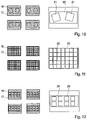
- FIGS. 10-12 show the production of overview contrast images from overview raw images with static illumination patterns.
- FIG. 1 outlines an arrangement with which an overview contrast image of a sample carrier 1 and/or samples arranged on the sample carrier 1 can be produced.
- the sample carrier 1 is here arranged at least partially in the focus of a detection optical unit 2 and is illuminated in transmitted light with a two-dimensional, array-type illumination pattern 3 .
- a detection optical unit 2 In order to produce the overview contrast image, at least two overview raw images are initially detected with different illuminations of the sample carrier 1 .
- a surface detector 4 is used here, onto which the detection optical unit 2 images.
- the detection optical unit 2 can be a microscope objective having a small magnification, although it is preferably the objective lens of a camera, which is able to image a larger region of an object field, which then ideally covers the entire sample carrier 1 in an overview.
- the surface detector 4 in this case is the sensor of the camera, for example a CMOS chip.
- the surface detector 4 registers only the intensities—for example in the case of white illumination—or the intensities are separated into different color channels, for example red (R), green (G) and blue (B). Similar to different colors, it is also possible to take into account different polarizations in the illumination using appropriate sensors that also register the polarization and to use said polarizations for separation into different channels.
- the overview raw images are recorded either at the same time or in succession, wherein for each pixel the corresponding intensity values are registered.
- the overview raw images are then supplied to a calculation unit 5 for subjecting them to a calculation to obtain an overview contrast image.
- a calculation algorithm that is used to calculate an overview contrast image from the at least two overview raw images is chosen in dependence on information that is to be extracted from the overview contrast image, and optionally also in dependence on the illumination.
- the overview contrast image is then supplied to an image evaluation unit 6 , in which an image evaluation algorithm that is used to finally extract the information is selected in dependence on the information that is to be extracted from the overview contrast image.
- the information is transmitted to a control unit 7 , which correspondingly processes it further and excludes from the microscopic analysis, for example in a high throughput method, such multiwells in which the evaluation of the overview contrast image has indicated that said multi-wells have not been correctly filled, for example contain defective samples or air bubbles, etc.
- the overview contrast image can of course also be represented to a user on a screen, which is connected to the image evaluation unit 6 or the control unit 7 and can be part of said units, with the result that a user can manually perform corresponding settings.
- the calculation unit 5 , image evaluation unit 6 and control unit 7 can together be integrated in a PC as hardware and/or software.
- the method can also be readily performed with existing microscopes.
- microscopes that use an LED array for the illumination, in which case the illumination pattern 3 is produced by the LED of said array.
- Such a microscope which uses for example angular illumination microscopy (AIM), is illustrated by way of example in FIG. 2 .
- the sample carrier 1 is illuminated here via an LED array 8
- the detection optical unit 2 here comprises by way of example two lens elements, between which a deflection mirror 9 for folding the optical axis is arranged.
- a beam splitter 10 is used to guide some of the light onto a surface detector 4 , while a different part of the light is directed, via a lens element 11 , onto an eyepiece 12 , such that the overview raw image can also be viewed by an observer.
- the camera and illumination can be positioned particularly well on an inverse microscope stand, for example by way of the LED array 8 , with which the illumination pattern 3 is produced, being arranged above an arm, which is prepared for the transmitted-light illumination, and the camera being placed below the sample for example on the objective turret.
- Illumination elements that can be used are for example LEDs, OLEDs, optical fibers, i.e. the ends or exit faces thereof as active light sources, or elements of an illuminated DMD (digital micromirror device) or of a different spatial light modulator as passive illumination elements. If the following text refers to LEDs for example as light sources, this is done only for illustrative purposes and does not explicitly exclude the use of the other possible arrays of illumination elements.
- the overview raw images are recorded by way of a camera with the surface detector 4 ; the objective lens of the camera is focused, as shown in FIG. 1 , at the sample carrier 1 and directed at the illumination pattern 3 or the illumination behind the sample carrier 1 , which is not situated in the focus. It is possible here to use a camera having an objective lens that has a large object field and is not telecentric. No additional optical elements need to be placed between the sample carrier 1 and the illumination pattern 3 , which can be configured for example as an LED array, to manipulate the illumination.
- the distances between the detection optical unit 2 or the surface detector 4 and the sample carrier 1 and between the sample carrier 1 and the illumination pattern 3 can in each case be selected to range between 0.5 cm and 10 cm, but they can in particular be even larger, possibly to capture the entire sample carrier 1 .
- the distances can also be selected freely, as long as various conditions have been met: (i) the sample carrier 1 must be located in the focal plane of the detection optical unit 2 ; (ii) the structures of the sample carrier 1 to be analyzed—for example edges of cover slips—can still be resolved by the camera; (iii) the structures produced by the illumination pattern 3 must be discernible on the image that is registered by the surface detector 4 , i.e. individual illumination elements must be distinguishable and advantageously cover the entire structure that is to be analyzed, which can be influenced by a corresponding choice of the size of the array of illumination elements, the size of the illumination elements, and the spacing thereof, which is why for example an array of LEDs is highly suitable for larger structures such as sample carriers. If they do not completely cover the structure, a combined overview contrast image can be produced with corresponding calibration.
- the illumination will be explained in more detail below with reference to FIG. 3 , in which LEDs are used as examples of illumination elements.
- LEDs are used as examples of illumination elements.
- the illumination pattern 3 only one LED 13 , which is arranged behind the sample carrier 1 , was depicted here as an example. The distances are chosen at random, and the illumination pattern 3 can in fact be arranged at an even greater distance. However, arranging it directly behind the sample carrier 1 permits arrangement in the vicinity of the focal plane, which means that the resolution of the individual illumination elements is improved.
- Each switched-on LED 13 acts either as bright-field or dark-field illumination, depending on the field region of the sample.
- the LED 13 is arranged directly behind the sample or the sample carrier, where a transmitted-light component dominates, such that the LED 13 acts as bright-field illumination for this first field region 14 and produces a corresponding bright-field contrast.
- the LED 13 acts as dark-field illumination and can be used to produce a dark-field contrast.
- the intention is to produce an overview contrast image in bright-field mode, it is possible to optionally insert a diffusion screen between the array of illumination elements and the sample carrier 1 , because diffuse light sources are advantageous for bright-field contrasts, although not for dark-field contrasts.
- the diffusion screen can be inserted in each case, but can also be permanently positioned in the beam path, and can be switchable, with the result that light diffusion occurs only if the diffusion screen is switched on.
- the different illuminations are selected in dependence on the information that is to be extracted.
- This information generally includes the type of the sample carrier, for example whether the latter is a normal slide in the sense of a small glass plate, or a simple Petri dish, or a multiwell sample carrier having a multiplicity of open wells, or a sample carrier having different, closed sample chambers (chamber slide), which are therefore covered by a cover slip.
- a sample number is indicated on the sample carrier 1 , for example by way of a handwritten inscription, but more frequently as a code with a barcode or QR code, which can be interpreted in conjunction with a corresponding database.
- the intention is to determine possible sample regions.
- the samples must be able to be identified and errors or faults, such as air bubbles, contamination or empty sample chambers, must be able to be detected. It is furthermore the intention to be able to detect the presence of immersion liquid and the form, volume, and position thereof.
- the following steps can be performed automatically or semiautomatically, depending on the task.
- An example to be mentioned is the choice of which well in a multiwell plate is to be examined, which can be done either automatically or only by the PC, without a user being required to once again look through the eyepiece, but in which it is likewise possible to represent an overview image of the complete sample carrier 1 .
- a first possibility is to produce the different illuminations using different illumination patterns 3 , which are chosen in dependence on the information that is to be extracted. Such illumination patterns are illustrated in FIGS. 4-9 .
- different illumination patterns 3 can be produced stochastically. This is illustrated in FIG. 4 , where the six frames show different illumination patterns, in which the LEDs 16 of an LED array 17 emit white light and are stochastically switched on or off. In the switched-on state, they are shown as small circles, and in the switched-off state, they have been omitted to clearly mark the different illumination patterns.
- a simple possibility for producing stochastic illumination patterns 3 is to use pulse-width-modulated illumination elements having a pulse width that is selected to be longer than the integration time of a detector unit for recording the overview raw images, wherein this selection can also be made by way of specifying an integration time.
- this selection can also be made by way of specifying an integration time.
- some of the LEDs are then switched on and others are switched off, because the pulse-width modulation between the LEDs 16 is not synchronized.
- the LEDs 16 of the LED array 17 in this case do not need to be individually drivable or switchable.
- the illumination elements can be driven and switched as different illumination patterns individually or in groups.
- a first portion of the illumination elements are here switched to emit light and at least one second portion of the illumination elements is switched to emit no light or to emit light of a different color or to emit light of a different polarization.
- the first portion of the illumination elements is stochastically chosen for each illumination pattern 3 .
- the second portion of the illumination elements does not emit light.
- relatively many overview raw images are required, with the result that generally several seconds are required to record the overview raw images. This period can be shortened if, instead of switching off the second portion of the illumination elements, it emits light of a different color, with the result that two overview raw images are recorded at the same time, which are subsequently separated by color.
- Overview contrast images can be produced both in a dark-field mode and in a bright-field mode, depending on the calculation algorithm, which in this case can be based for example on a top-hat transform for a bright-field contrast image or on a black-hat transform for a dark-field contrast image, in each case with subsequent, pixel-wise maximum projection, wherein both transforms can be applied equally to the overview raw images such that it is possible to produce an overview contrast image both in bright-field mode and in dark-field mode.
- glass edges that is to say the peripheries of the sample carriers 1 , or cover slips can be rendered very visible, they exhibit high contrast as compared to the actual sample.
- FIGS. 5 and 6 are chessboard-type patterns.
- Illumination elements that are switched on and off—LEDs 16 here have a chessboard-type distribution, in which case the first portion of the illumination elements which are switched on for example corresponds to the white fields of the chessboard, and the switched-off second portion of the LEDs 16 corresponds to the black fields.
- Two overview raw images are required, which are produced with mutually complementary, i.e. inverted illumination patterns. These two chessboard patterns are illustrated in FIG. 5 .
- the first portion of the illumination elements is formed by the switched-on LEDs 16 , and only every other LED 16 in every row and every column is switched on.
- the illumination pattern can here extend over the entire LED array 17 or over only a region of interest of the sample carrier 1 to reduce the overall quantity of light and so as not to unnecessarily load the sample.
- the chessboard-type illumination can be used in particular for using an overview contrast image in dark-field mode; the calculation algorithm used here is in particular a ranking projection algorithm, based on pixel-wise projection, in the minimum projection. Only two overview raw images are required, and the method offers very good contrast, both for the sample carrier 1 and sample regions—for example the glass edges of cover slips and for the sample itself.
- LED arrays 17 with single-color LEDs can be used, which emit for example white light or light in one of the primary colors R, G, B; for the detection, a surface detector that registers multi-colored or monochromatic light can be used.
- the first portion of the illumination elements emits light and the second portion of the illumination elements does not emit light
- two overview raw images that must be recorded successively are required, in the case shown in FIG. 5 , to produce an overview contrast image.
- the overview raw images can also be recorded simultaneously with a camera and subsequently separated when all portions of the illumination elements emit light of polarizations that differ from one another in pairs.
- an LED array 17 which is provided with complementary polarization filters, which alternate in rows and columns, depending on the pattern, can be used here.
- the polarization filters can also be switchable. In this way, the two overview raw images can be produced with one recording and only need to be separated subsequently, to which end the polarization must likewise be detected.
- a further possibility is that all portions of the illumination elements emit light of colors that differ from one another in pairs, that is to say, for example in the case of four portions of illumination elements, that each of the portions emits light of a different color.
- the first portion of the illumination elements here comprises blue LEDs 18 , that is to say LEDs that emit light in the blue wavelength range, while the second portion of the illumination elements comprises red LEDs 19 , that is to say LEDs emitting light in the red wavelength range.
- the two grids are nested within one another, with the result that a red/blue chessboard is presented on the LED array 17 .
- the sample carrier 1 is illuminated with this illumination pattern, and a recording that already comprises both necessary overview raw images is taken.
- the individual overview raw images are obtained by separating the recording by color channels.
- the LEDs 16 of the LED array 17 and the color channels of the camera that is used for the recording are matched to one another; without further measures, generally the three primary color channels red, green and blue are available, because even LEDs emitting white light are made up of red, green and blue sub-LEDs.
- FIG. 7 shows such an example, a cross pattern, as it is called, in which four different illumination patterns are produced and correspondingly four overview raw images are required.
- the contrast is here slightly greater than in chessboard-type illumination patterns.
- Four individual overview raw images are likewise needed when using half pupil patterns, as are shown in FIG. 8 .
- the LED array 17 is divided into two halves, in which case the first portion of the illumination elements is located in one half and the second portion of the illumination elements, which is switched-off, is located in the other half.
- the second overview raw image is recorded with a distribution that is complementary thereto, that is to say if first the first portion of the illumination elements fills out the left half on the LED array 17 , then it will fill out the right half for the second overview raw image.
- Two further overview raw images are produced by dividing the LED array into an upper and a lower half, that is to say with a direction of division that is perpendicular to the first direction of division.
- the overview contrast image is preferably produced in dark-field mode, to which end a calculation algorithm that is based on pixel-wise projection is used, preferably a ranking projection algorithm.
- the overview raw images are compared pixel by pixel, and the intensity value of one of the pixels is selected for the corresponding position in the overview contrast image in accordance with a projection condition.
- each LED that emits white light is formed from three individual, mutually adjacent sub-LEDs, which in each case emit light in the different primary colors red, green and blue. It is possible in this case to set different illuminations—the illumination patterns can here be identical—by the illumination from different angles in the primary colors. In this case, a calculation algorithm with which an overview contrast image in the bright-field mode is produced is chosen.
- a further configuration of the method involves producing the illumination pattern 3 only in at least one section of the array of illumination elements.
- the different illuminations are then produced by scanning movement of the at least one section on the array.
- Illumination elements outside the at least one section are switched here such that they do not emit light.
- FIG. 9 illustrates the example of the chessboard pattern, of which a small section of four LEDs 16 was chosen here, which scans one row in a sequence of images or illumination patterns and is then moved, row by row, over the LED array 17 .
- a greater number of overview raw images are required here, and the contrast is comparable in terms of quality.
- the quantity of light per time that is emitted by the LED array 17 is advantageously significantly lower than when using both full patterns.
- the background brightness is therefore reduced, and fewer disturbing reflections occur in the overview raw images.
- the time required for the recording of the overview raw images can be reduced by, for example, moving regions which are spatially remote in the image of the sample carrier 1 sections with illumination patterns at the same time, and/or by producing illumination patterns in different colors, which are registered separately, in the section that is to be moved.
- the section that is moved over the LED array 17 it is also possible for other patterns to be produced, for example it is possible for all LEDs except for one to be switched on, with the result that the section comprises only one—switched-off—LED, and this section is then moved. Another possibility is to switch on only one LED and to leave all the others switched-off, and to move this section over the array and in the process record the overview raw images.
- a suitable calculation algorithm here is in particular a ranking projection algorithm, in particular also in the minimum projection, with the result that an overview contrast image in dark-field mode is obtained.
- FIGS. 10-12 Another configuration of the method is lastly explained below with reference to FIGS. 10-12 .
- different illuminations are not produced by way of different illumination patterns, but by way of a lateral movement of the sample carrier 1 relative to the illumination pattern 3 between two recordings. With respect to FIG. 1 , this corresponds to a movement that is perpendicular to the optical axis. It is possible here either to move the sample carrier 1 relative to the illumination pattern 3 or the other way round, but it is also possible for both to be moved in relation to one another.
- movement of the sample carrier 1 alone is easier to realize because the sample carrier is typically mounted on a stage that is displaceable in all three spatial directions.
- the LEDs 16 of the LED array 17 are switched in a fixed pattern, for example in a regular grid.
- the illumination pattern 3 and/or the sample carrier 1 is moved between two overview raw images in a plane that is orthogonal to the optical axis of the camera.
- FIGS. 10-12 different sample carriers are illustrated in each case in four different positions of the illumination pattern 3 relative to the sample carrier 1 , which is realized with the LED array 17 and the LEDs 16 .
- the sample carrier in FIG. 10 used is a slide 20 with cover slips 21 , which are to be made visible; in FIG. 11 , it is a multiwell plate 22 , the wells 23 of which are to be made visible; and in FIG. 12 , the sample carrier is a chamber slide 24 , the chambers 25 of which are to be made visible.
- the overview contrast images in all cases are illustrated on the right-hand side of the figures.
- Overview contrast images can here be produced both in bright-field mode and in dark-field mode.
- the calculation algorithm used is the minimum projection as a special case of the ranking projection, and in the case of an overview contrast image in the bright-field mode, a maximum projection can be used.
- a shading correction after the calculation.
- the shading correction can also be performed before the overview raw images are subjected to the calculation.
- the overview contrast images that have been determined with statistical illumination patterns provide the best contrast in terms of quality, in particular when using LEDs, because the switched-off LEDs in the case of the dynamic patterns, that is to say in which the patterns change, can provide quite a strong background signal on account of back-reflections at the sample carrier.
- image processing algorithms for example with deep learning algorithms, these artefacts can, however, be eliminated in the evaluation, that is to say they will not be taken into account.
- One further possibility for using statistical patterns to produce different illuminations, without laterally moving the sample or the sample carrier 1 relative to the illumination pattern, is to combine an overview contrast image from a plurality of recordings that were taken with different exposures, in the manner of a HDR (high dynamic range) recording. It is possible to combine an overview contrast image as a HDR image from for example three overview raw images which are recorded with different exposures.
- a HDR high dynamic range
- the overview contrast image is a mixture of bright-field and dark-field contrasts.
- the calibration pattern described above in connection with the calibration of the relative movement can additionally be used to effect a correction of geometric distortions in the image, applied to each overview contrast image.
- the sample carrier can also be located in the image. If the sample carrier carries an inscription, said inscription can likewise be determined from the contrast image. The same is true for the sample or regions on the carrier, such as wells that can contain samples.
- image evaluation algorithms it is possible in particular in the case of sample carriers that include a plurality of samples in separate containers to reduce the examination time taken for the sample carrier if such artefacts are present there.
- image evaluation of the overview contrast image in the case of an immersion liquid to also detect the volume and the form of an immersion drop, and it is also possible to draw conclusions relating to contamination of the immersion liquid.
- This information can preferably be displayed to an observer or user on the PC by way of graphic means, such that the user can adapt his further procedure to the results of the analysis of the overview contrast image.
- graphic means such that the user can adapt his further procedure to the results of the analysis of the overview contrast image.
- the information of the overview contrast image that is extracted using the image processing algorithms can, however, also make possible a robust subsequent processing which identifies and localizes for example automatically relevant structures of the sample carrier—such as the glass slides—or relevant structures of the samples on the sample carrier—such as tissue sections, organisms, or cells—for example to set a fully automated coarse positioning of the sample in all three spatial directions.
- the extracted image information also permits a more robust, faster and more efficient automated microscopy—such as high-throughput microscopy—with smaller data volumes and shorter recording times with automatic exclusion of error sources.
Landscapes
- Physics & Mathematics (AREA)
- Chemical & Material Sciences (AREA)
- Analytical Chemistry (AREA)
- General Physics & Mathematics (AREA)
- Optics & Photonics (AREA)
- Engineering & Computer Science (AREA)
- Multimedia (AREA)
- Computer Vision & Pattern Recognition (AREA)
- Microscoopes, Condenser (AREA)
- Investigating Or Analysing Materials By Optical Means (AREA)
Abstract
Description
-
- 1 Sample carrier
- 2 Detection optics
- 3 Illumination pattern
- 4 Surface detector
- 5 Calculation unit
- 6 Image evaluation unit
- 7 Control unit
- 8 LED array
- 9 Deflection mirror
- 10 Beam splitter
- 11 Lens element
- 12 Eyepiece
- 13 LED
- 14 First field region
- 15 Second field region
- 16 LED
- 17 LED array
- 18 Blue LED
- 19 Red LED
- 20 Slide
- 21 Cover slip
- 22 Multiwell plate
- 23 Well
- 24 Chamber slide
- 25 Chamber
Claims (20)
Applications Claiming Priority (3)
| Application Number | Priority Date | Filing Date | Title |
|---|---|---|---|
| DE102017111718.0A DE102017111718A1 (en) | 2017-05-30 | 2017-05-30 | Method for generating and analyzing an overview contrast image |
| DE102017111718.0 | 2017-05-30 | ||
| PCT/EP2018/062483 WO2018219632A1 (en) | 2017-05-30 | 2018-05-15 | Method for generating and analysing an overview contrast image |
Publications (2)
| Publication Number | Publication Date |
|---|---|
| US20200088984A1 US20200088984A1 (en) | 2020-03-19 |
| US11307398B2 true US11307398B2 (en) | 2022-04-19 |
Family
ID=62455436
Family Applications (1)
| Application Number | Title | Priority Date | Filing Date |
|---|---|---|---|
| US16/618,773 Active 2038-11-05 US11307398B2 (en) | 2017-05-30 | 2018-05-15 | Method for generating and analyzing an overview contrast image |
Country Status (5)
| Country | Link |
|---|---|
| US (1) | US11307398B2 (en) |
| JP (1) | JP7153418B2 (en) |
| CN (1) | CN110692006A (en) |
| DE (1) | DE102017111718A1 (en) |
| WO (1) | WO2018219632A1 (en) |
Cited By (5)
| Publication number | Priority date | Publication date | Assignee | Title |
|---|---|---|---|---|
| US20210132357A1 (en) * | 2019-11-06 | 2021-05-06 | Technische Universität Braunschweig | Optical Detection Device and Method for Operating an Optical Detection Device |
| US20220046169A1 (en) * | 2020-08-07 | 2022-02-10 | The Government Of The United States Of America, As Represented By The Secretary Of The Navy | Incoherent Fourier Ptychographic Super-Resolution Imaging System with Priors |
| US20220113533A1 (en) * | 2020-10-09 | 2022-04-14 | Carl Zeiss Microscopy Gmbh | Microscopy System and Method for Analyzing an Overview Image |
| US20220114732A1 (en) * | 2020-10-09 | 2022-04-14 | Carl Zeiss Microscopy Gmbh | Microscopy System and Method for Image Segmentation |
| US12437027B2 (en) | 2020-10-09 | 2025-10-07 | Carl Zeiss Microscopy Gmbh | Microscopy system and method for generating training data |
Families Citing this family (31)
| Publication number | Priority date | Publication date | Assignee | Title |
|---|---|---|---|---|
| TWI699816B (en) * | 2017-12-26 | 2020-07-21 | 雲象科技股份有限公司 | Method for controlling autonomous microscope system, microscope system, and computer readable storage medium |
| DE102018133188A1 (en) * | 2018-12-20 | 2020-06-25 | Carl Zeiss Microscopy Gmbh | DISTANCE DETERMINATION OF A SAMPLE LEVEL IN A MICROSCOPE SYSTEM |
| US10694113B1 (en) * | 2019-05-01 | 2020-06-23 | Xiris Automation Inc. | Dark field illumination for laser beam delivery system |
| DE102019114117B3 (en) * | 2019-05-27 | 2020-08-20 | Carl Zeiss Microscopy Gmbh | Automatic workflows based on recognition of calibration samples |
| DE102020101191B4 (en) * | 2020-01-20 | 2024-07-18 | Carl Zeiss Microscopy Gmbh | Microscope and method for determining a measuring location of a microscope |
| DE102020101571A1 (en) | 2020-01-23 | 2021-07-29 | Carl Zeiss Meditec Ag | microscope |
| DE102020101572A1 (en) | 2020-01-23 | 2021-07-29 | Carl Zeiss Meditec Ag | microscope |
| GB2593194B (en) * | 2020-03-18 | 2022-09-07 | Refeyn Ltd | Methods and apparatus for optimised interferometric scattering microscopy |
| CN113570650B (en) * | 2020-04-28 | 2024-02-02 | 合肥美亚光电技术股份有限公司 | Depth of field judging method, device, electronic equipment and storage medium |
| DE102020210592A1 (en) * | 2020-08-20 | 2022-02-24 | Carl Zeiss Microscopy Gmbh | Method and microscope for generating an artifact-reduced overview recording of a sample carrier |
| EP3958036B1 (en) | 2020-08-20 | 2025-01-15 | Carl Zeiss Microscopy GmbH | Method and device for creating an overview contrast image of a sample holder in a microscope |
| DE102020123505A1 (en) | 2020-09-09 | 2022-03-10 | Carl Zeiss Microscopy Gmbh | MICROSCOPY SYSTEM AND METHOD OF GENERATING AN OVERVIEW IMAGE |
| DE102020123504A1 (en) | 2020-09-09 | 2022-03-10 | Carl Zeiss Microscopy Gmbh | MICROSCOPY SYSTEM AND METHOD OF GENERATING AN HDR IMAGE |
| DE102020124416A1 (en) * | 2020-09-18 | 2022-03-24 | Carl Zeiss Microscopy Gmbh | MICROSCOPY SYSTEM, METHOD AND COMPUTER PROGRAM FOR ALIGNING A SPECIMEN SLIDE |
| DE102020126598A1 (en) | 2020-10-09 | 2022-04-14 | Carl Zeiss Microscopy Gmbh | MICROSCOPY SYSTEM AND METHOD OF VERIFICATION OF A TRAINED IMAGE PROCESSING MODEL |
| DE202020005560U1 (en) | 2020-10-12 | 2021-09-02 | Carl Zeiss Microscopy Gmbh | Calibration plate and microscope for generating an overview image of a sample |
| DE102020126737A1 (en) | 2020-10-12 | 2022-04-14 | Carl Zeiss Microscopy Gmbh | Method and microscope for generating an overview image of a sample |
| US11610404B2 (en) * | 2020-10-15 | 2023-03-21 | Airamatrix Private Limited | Methods and systems for tracking the location of a petri-dish |
| DE102021114038A1 (en) | 2021-05-31 | 2022-12-01 | Carl Zeiss Microscopy Gmbh | Microscopy system and method for monitoring microscopy operations |
| EP4116755A1 (en) * | 2021-07-06 | 2023-01-11 | Universitat de Barcelona | Method and device for obtaining microscopic digital images |
| CN113554632A (en) * | 2021-07-30 | 2021-10-26 | 沭阳天勤工具有限公司 | Artificial intelligence-based workpiece detection optimization method in turbid water body |
| CN113850274B (en) * | 2021-09-16 | 2024-07-26 | 北京理工大学 | An image classification method based on HOG features and DMD |
| WO2023053540A1 (en) * | 2021-09-30 | 2023-04-06 | シスメックス株式会社 | Imaging method, focus position adjustment method, and microscope system |
| DE102022102219A1 (en) | 2022-01-31 | 2023-08-03 | Carl Zeiss Microscopy Gmbh | Microscopy system and method for processing overview images |
| DE102022201258A1 (en) | 2022-02-07 | 2023-08-10 | Carl Zeiss Microscopy Gmbh | Process for separating objects |
| DE102022106435A1 (en) | 2022-03-18 | 2023-09-21 | Carl Zeiss Microscopy Gmbh | Microscopy system and method for determining an orientation of a sample carrier |
| DE102022206025A1 (en) | 2022-06-14 | 2023-12-14 | Carl Zeiss Microscopy Gmbh | Population classification using point cloud features |
| DE102022115989A1 (en) | 2022-06-27 | 2023-12-28 | Carl Zeiss Microscopy Gmbh | Microscopy system and method for color correction of microscope images |
| DE102022209113A1 (en) | 2022-09-01 | 2024-03-07 | Carl Zeiss Microscopy Gmbh | TRAINING INSTANCE SEGMENTATION ALGORITHMS WITH PARTIALLY ANNOTATED IMAGES |
| DE102023119849A1 (en) | 2023-07-26 | 2025-01-30 | Carl Zeiss Microscopy Gmbh | Microscopy system and method for removing image artifacts |
| EP4550257A1 (en) * | 2023-10-31 | 2025-05-07 | F. Hoffmann-La Roche AG | Systems and methods for analyzing a multi-well plate field |
Citations (13)
| Publication number | Priority date | Publication date | Assignee | Title |
|---|---|---|---|---|
| JP2011004638A (en) | 2009-06-24 | 2011-01-13 | Nikon Corp | Mthod, program, and apparatus for processing images of observed fertilized egg |
| US20120154571A1 (en) * | 2010-12-17 | 2012-06-21 | Mitutoyo Corporation | Edge detection using structured illumination |
| DE102011114336A1 (en) | 2011-09-23 | 2013-03-28 | Carl Zeiss Microscopy Gmbh | Apparatus and method for transmitted light illumination for light microscopes and microscope system |
| US20130155499A1 (en) | 2010-12-24 | 2013-06-20 | Arthur Edward Dixon | Pathology Slide Scanner |
| JP2015194544A (en) | 2014-03-31 | 2015-11-05 | 富士フイルム株式会社 | Cell imaging control apparatus and method, and program |
| WO2015179452A1 (en) | 2014-05-19 | 2015-11-26 | The Regents Of The University Of California | Fourier ptychographic microscopy with multiplexed illumination |
| WO2016012391A1 (en) | 2014-07-22 | 2016-01-28 | Carl Zeiss Ag | Method and device for imaging an object |
| WO2016063322A1 (en) | 2014-10-20 | 2016-04-28 | 株式会社日立製作所 | Optical analysis device and biomolecular analysis device |
| WO2016090331A1 (en) | 2014-12-04 | 2016-06-09 | California Institute Of Technology | Multiplexed fourier ptychography imaging systems and methods |
| US20160202460A1 (en) | 2015-01-13 | 2016-07-14 | University Of Connecticut | 3D Microscopy With Illumination Engineering |
| US20160216208A1 (en) | 2015-01-26 | 2016-07-28 | California Institute Of Technology | Multi-well fourier ptychographic and fluorescence imaging |
| US20190384962A1 (en) * | 2016-10-27 | 2019-12-19 | Scopio Labs Ltd. | Methods and systems for diagnostic platform |
| US20210149169A1 (en) * | 2019-11-15 | 2021-05-20 | Scopio Labs Ltd. | Method for computational microscopic layer separation |
Family Cites Families (2)
| Publication number | Priority date | Publication date | Assignee | Title |
|---|---|---|---|---|
| US7438423B2 (en) * | 2005-08-29 | 2008-10-21 | 3M Innovative Properties Company | Illumination system and projection system incorporating same |
| WO2017081542A2 (en) * | 2015-11-11 | 2017-05-18 | Scopio Lab Ltd. | Computational microscopes and methods for generating an image under different illumination conditions |
-
2017
- 2017-05-30 DE DE102017111718.0A patent/DE102017111718A1/en active Pending
-
2018
- 2018-05-15 WO PCT/EP2018/062483 patent/WO2018219632A1/en not_active Ceased
- 2018-05-15 CN CN201880036369.4A patent/CN110692006A/en active Pending
- 2018-05-15 JP JP2019565510A patent/JP7153418B2/en active Active
- 2018-05-15 US US16/618,773 patent/US11307398B2/en active Active
Patent Citations (18)
| Publication number | Priority date | Publication date | Assignee | Title |
|---|---|---|---|---|
| JP2011004638A (en) | 2009-06-24 | 2011-01-13 | Nikon Corp | Mthod, program, and apparatus for processing images of observed fertilized egg |
| US20120154571A1 (en) * | 2010-12-17 | 2012-06-21 | Mitutoyo Corporation | Edge detection using structured illumination |
| US20130155499A1 (en) | 2010-12-24 | 2013-06-20 | Arthur Edward Dixon | Pathology Slide Scanner |
| DE102011114336A1 (en) | 2011-09-23 | 2013-03-28 | Carl Zeiss Microscopy Gmbh | Apparatus and method for transmitted light illumination for light microscopes and microscope system |
| US20140354796A1 (en) | 2011-09-23 | 2014-12-04 | Carl Zeiss Microscopy Gmbh | Apparatus And Method For Transmitted Light Illumination For Light Microscopes And Microscope System |
| US9835839B2 (en) | 2011-09-23 | 2017-12-05 | Carl Zeiss Microscopy Gmbh | Apparatus and method for transmitted light illumination for light microscopes and microscope system |
| US20170010455A1 (en) | 2014-03-31 | 2017-01-12 | Fujifilm Corporation | Cell imaging control device, method, and program |
| JP2015194544A (en) | 2014-03-31 | 2015-11-05 | 富士フイルム株式会社 | Cell imaging control apparatus and method, and program |
| WO2015179452A1 (en) | 2014-05-19 | 2015-11-26 | The Regents Of The University Of California | Fourier ptychographic microscopy with multiplexed illumination |
| WO2016012391A1 (en) | 2014-07-22 | 2016-01-28 | Carl Zeiss Ag | Method and device for imaging an object |
| US20170205617A1 (en) | 2014-07-22 | 2017-07-20 | Carl Zeiss Microscopy Gmbh | Method and Device for Imaging an Object |
| WO2016063322A1 (en) | 2014-10-20 | 2016-04-28 | 株式会社日立製作所 | Optical analysis device and biomolecular analysis device |
| US20170307530A1 (en) | 2014-10-20 | 2017-10-26 | Hitachi, Ltd. | Optical analysis device and biomolecular analysis device |
| WO2016090331A1 (en) | 2014-12-04 | 2016-06-09 | California Institute Of Technology | Multiplexed fourier ptychography imaging systems and methods |
| US20160202460A1 (en) | 2015-01-13 | 2016-07-14 | University Of Connecticut | 3D Microscopy With Illumination Engineering |
| US20160216208A1 (en) | 2015-01-26 | 2016-07-28 | California Institute Of Technology | Multi-well fourier ptychographic and fluorescence imaging |
| US20190384962A1 (en) * | 2016-10-27 | 2019-12-19 | Scopio Labs Ltd. | Methods and systems for diagnostic platform |
| US20210149169A1 (en) * | 2019-11-15 | 2021-05-20 | Scopio Labs Ltd. | Method for computational microscopic layer separation |
Non-Patent Citations (7)
| Title |
|---|
| Cruz-Roa, Angel Alfonso, et al., "A Deep Learning Architecture for Image Representation, Visual Interpretability and Automated Basal-Cell Carcinoma Cancer Detection," MICCA 2013. Part II. LNCS 8150, pp. 403-410. |
| D' Ambrosio, Michael V., et al., "Point-of-care quantification of bloodborne filarial parasites with a mobile phone microscope," Science Translation Medicine, vol. 7, Issue 286, 10 pages (May 6, 2015). |
| Guo, Kaikai, et al., "Fourier Ptychography for Brightfield, Phase, Darkfield, Reflective, Multi-Slice, and Fluorescence Imaging," IEEE Journal of Selected Topics in Quantum Electronics, vol. 22, No. 4, 12 pages (Jul./Aug. 2016). |
| Kappeler, Armin, "Deep Neural Networks with Applications in Image and Video Classification and Recovery," Ph.D Thesis, Northwestern University (Oct. 4, 2016). |
| Solomon, Chris, "The top-hat transformation," Fundamentals of Digital Image Processing: A Practical Approach with Examples in MATLAB. John Wiley & Sons, pp. 230-233 (Jul. 5, 2011). |
| Sun, Jiasong, et al., "Efficient positional misalignment correction method for Fourier ptychographic microscopy," Biomedical Optics Express. vol. 7, No. 4, pp. 1336-1350 (Apr. 1, 2016). |
| Tanaka, Kenichiro, et al., "Descattering of Transmissive Observation using Parallel High-Frequency Illumination," IEEE International Conference on Computational Photography (ICCP). 8 pages (Apr. 19, 2013). |
Cited By (9)
| Publication number | Priority date | Publication date | Assignee | Title |
|---|---|---|---|---|
| US20210132357A1 (en) * | 2019-11-06 | 2021-05-06 | Technische Universität Braunschweig | Optical Detection Device and Method for Operating an Optical Detection Device |
| US11789250B2 (en) * | 2019-11-06 | 2023-10-17 | Technische Universität Braunschweig | Optical detection device and method for operating an optical detection device |
| US20220046169A1 (en) * | 2020-08-07 | 2022-02-10 | The Government Of The United States Of America, As Represented By The Secretary Of The Navy | Incoherent Fourier Ptychographic Super-Resolution Imaging System with Priors |
| US11689821B2 (en) * | 2020-08-07 | 2023-06-27 | The Government Of The United States Of America, As Represented By The Secretary Of The Navy | Incoherent Fourier ptychographic super-resolution imaging system with priors |
| US20220113533A1 (en) * | 2020-10-09 | 2022-04-14 | Carl Zeiss Microscopy Gmbh | Microscopy System and Method for Analyzing an Overview Image |
| US20220114732A1 (en) * | 2020-10-09 | 2022-04-14 | Carl Zeiss Microscopy Gmbh | Microscopy System and Method for Image Segmentation |
| US12332420B2 (en) * | 2020-10-09 | 2025-06-17 | Carl Zeiss Microscopy Gmbh | Microscopy system and method for analyzing an overview image |
| US12437027B2 (en) | 2020-10-09 | 2025-10-07 | Carl Zeiss Microscopy Gmbh | Microscopy system and method for generating training data |
| US12555239B2 (en) * | 2020-10-09 | 2026-02-17 | Carl Zeiss Microscopy Gmbh | Microscopy system and method for image segmentation |
Also Published As
| Publication number | Publication date |
|---|---|
| JP7153418B2 (en) | 2022-10-14 |
| WO2018219632A1 (en) | 2018-12-06 |
| JP2020522016A (en) | 2020-07-27 |
| US20200088984A1 (en) | 2020-03-19 |
| CN110692006A (en) | 2020-01-14 |
| DE102017111718A1 (en) | 2018-12-06 |
Similar Documents
| Publication | Publication Date | Title |
|---|---|---|
| US20200088984A1 (en) | Method for generating and analyzing an overview contrast image | |
| US11002678B2 (en) | Data creation method and data use method | |
| US11614363B2 (en) | Digital pathology color calibration and validation | |
| US11086118B2 (en) | Self-calibrating and directional focusing systems and methods for infinity corrected microscopes | |
| EP3446170B1 (en) | lMAGING SYSTEM WITH ANCILLARY lMAGE DETECTOR FOR SAMPLE LOCATION | |
| JP7167276B2 (en) | Low-Resolution Slide Imaging, Slide Label Imaging and High-Resolution Slide Imaging Using Dual Optical Paths and Single Imaging Sensor | |
| EP2976747B1 (en) | Image quality assessment of microscopy images | |
| EP3625601B1 (en) | Two pass macro image | |
| JP2018511815A (en) | Array-level Fourier typography imaging | |
| KR20200041983A (en) | Real-time autofocus focusing algorithm | |
| AU2014236055A1 (en) | Referencing in multi-acquisition slide imaging | |
| US20240205546A1 (en) | Impulse rescan system | |
| JP2015227940A (en) | Optical microscope system and screening device | |
| CN105278090B (en) | The method that fluid for being adhered to microtiter plate fills the microscope imaging of the sample on the bottom of well | |
| US20190195777A1 (en) | Captured image evaluation apparatus, captured image evaluation method, and captured image evaluation program | |
| CN223808344U (en) | A multi-level imaging system and detection device | |
| JP2026508022A (en) | Systems, devices, and methods for the analysis of biological samples | |
| Sinkó | Studying and correcting the optical aberrations and reconstruction errors in localization based super-resolution microscopy |
Legal Events
| Date | Code | Title | Description |
|---|---|---|---|
| FEPP | Fee payment procedure |
Free format text: ENTITY STATUS SET TO UNDISCOUNTED (ORIGINAL EVENT CODE: BIG.); ENTITY STATUS OF PATENT OWNER: LARGE ENTITY |
|
| AS | Assignment |
Owner name: CARL ZEISS MICROSCOPY GMBH, GERMANY Free format text: ASSIGNMENT OF ASSIGNORS INTEREST;ASSIGNORS:HAASE, DANIEL;OHRT, THOMAS;STICKER, MARKUS;REEL/FRAME:051247/0634 Effective date: 20191118 |
|
| STPP | Information on status: patent application and granting procedure in general |
Free format text: DOCKETED NEW CASE - READY FOR EXAMINATION |
|
| STPP | Information on status: patent application and granting procedure in general |
Free format text: NON FINAL ACTION MAILED |
|
| STPP | Information on status: patent application and granting procedure in general |
Free format text: RESPONSE TO NON-FINAL OFFICE ACTION ENTERED AND FORWARDED TO EXAMINER |
|
| STPP | Information on status: patent application and granting procedure in general |
Free format text: NON FINAL ACTION MAILED |
|
| STPP | Information on status: patent application and granting procedure in general |
Free format text: RESPONSE TO NON-FINAL OFFICE ACTION ENTERED AND FORWARDED TO EXAMINER |
|
| STPP | Information on status: patent application and granting procedure in general |
Free format text: NOTICE OF ALLOWANCE MAILED -- APPLICATION RECEIVED IN OFFICE OF PUBLICATIONS |
|
| STPP | Information on status: patent application and granting procedure in general |
Free format text: PUBLICATIONS -- ISSUE FEE PAYMENT VERIFIED |
|
| STCF | Information on status: patent grant |
Free format text: PATENTED CASE |
|
| CC | Certificate of correction | ||
| MAFP | Maintenance fee payment |
Free format text: PAYMENT OF MAINTENANCE FEE, 4TH YEAR, LARGE ENTITY (ORIGINAL EVENT CODE: M1551); ENTITY STATUS OF PATENT OWNER: LARGE ENTITY Year of fee payment: 4 |