US11306449B2 - Spool-less system for deployment, recovery, and manipulation of a traversable road covering track - Google Patents

Spool-less system for deployment, recovery, and manipulation of a traversable road covering track Download PDF

Info

Publication number
US11306449B2
US11306449B2 US17/017,659 US202017017659A US11306449B2 US 11306449 B2 US11306449 B2 US 11306449B2 US 202017017659 A US202017017659 A US 202017017659A US 11306449 B2 US11306449 B2 US 11306449B2
Authority
US
United States
Prior art keywords
roll
road covering
retaining means
guide member
host machine
Prior art date
Legal status (The legal status is an assumption and is not a legal conclusion. Google has not performed a legal analysis and makes no representation as to the accuracy of the status listed.)
Active
Application number
US17/017,659
Other versions
US20210079602A1 (en
Inventor
Neil Wigley
Paul Godridge
Dafydd Roberts
Current Assignee (The listed assignees may be inaccurate. Google has not performed a legal analysis and makes no representation or warranty as to the accuracy of the list.)
Faun Trackway Ltd
Original Assignee
Faun Trackway Ltd
Priority date (The priority date is an assumption and is not a legal conclusion. Google has not performed a legal analysis and makes no representation as to the accuracy of the date listed.)
Filing date
Publication date
Application filed by Faun Trackway Ltd filed Critical Faun Trackway Ltd
Publication of US20210079602A1 publication Critical patent/US20210079602A1/en
Assigned to FAUN TRACKWAY LIMITED reassignment FAUN TRACKWAY LIMITED ASSIGNMENT OF ASSIGNORS INTEREST (SEE DOCUMENT FOR DETAILS). Assignors: ROBERTS, DAFYDD, Godridge, Paul, Wigley, Neil
Application granted granted Critical
Publication of US11306449B2 publication Critical patent/US11306449B2/en
Active legal-status Critical Current
Anticipated expiration legal-status Critical

Links

Images

Classifications

    • EFIXED CONSTRUCTIONS
    • E01CONSTRUCTION OF ROADS, RAILWAYS, OR BRIDGES
    • E01CCONSTRUCTION OF, OR SURFACES FOR, ROADS, SPORTS GROUNDS, OR THE LIKE; MACHINES OR AUXILIARY TOOLS FOR CONSTRUCTION OR REPAIR
    • E01C19/00Machines, tools or auxiliary devices for preparing or distributing paving materials, for working the placed materials, or for forming, consolidating, or finishing the paving
    • E01C19/52Apparatus for laying individual preformed surfacing elements, e.g. kerbstones
    • E01C19/522Apparatus for laying the elements by rolling or unfolding, e.g. for temporary pavings
    • BPERFORMING OPERATIONS; TRANSPORTING
    • B65CONVEYING; PACKING; STORING; HANDLING THIN OR FILAMENTARY MATERIAL
    • B65HHANDLING THIN OR FILAMENTARY MATERIAL, e.g. SHEETS, WEBS, CABLES
    • B65H16/00Unwinding, paying-out webs
    • B65H16/005Dispensers, i.e. machines for unwinding only parts of web roll
    • BPERFORMING OPERATIONS; TRANSPORTING
    • B65CONVEYING; PACKING; STORING; HANDLING THIN OR FILAMENTARY MATERIAL
    • B65HHANDLING THIN OR FILAMENTARY MATERIAL, e.g. SHEETS, WEBS, CABLES
    • B65H16/00Unwinding, paying-out webs
    • B65H16/02Supporting web roll
    • B65H16/028Supporting web roll on its outer circumference
    • BPERFORMING OPERATIONS; TRANSPORTING
    • B65CONVEYING; PACKING; STORING; HANDLING THIN OR FILAMENTARY MATERIAL
    • B65HHANDLING THIN OR FILAMENTARY MATERIAL, e.g. SHEETS, WEBS, CABLES
    • B65H16/00Unwinding, paying-out webs
    • B65H16/02Supporting web roll
    • B65H16/08Supporting web roll parallel rollers type
    • BPERFORMING OPERATIONS; TRANSPORTING
    • B66HOISTING; LIFTING; HAULING
    • B66FHOISTING, LIFTING, HAULING OR PUSHING, NOT OTHERWISE PROVIDED FOR, e.g. DEVICES WHICH APPLY A LIFTING OR PUSHING FORCE DIRECTLY TO THE SURFACE OF A LOAD
    • B66F9/00Devices for lifting or lowering bulky or heavy goods for loading or unloading purposes
    • B66F9/06Devices for lifting or lowering bulky or heavy goods for loading or unloading purposes movable, with their loads, on wheels or the like, e.g. fork-lift trucks
    • B66F9/075Constructional features or details
    • B66F9/12Platforms; Forks; Other load supporting or gripping members
    • B66F9/18Load gripping or retaining means
    • B66F9/184Roll clamps
    • EFIXED CONSTRUCTIONS
    • E02HYDRAULIC ENGINEERING; FOUNDATIONS; SOIL SHIFTING
    • E02FDREDGING; SOIL-SHIFTING
    • E02F3/00Dredgers; Soil-shifting machines
    • E02F3/04Dredgers; Soil-shifting machines mechanically-driven
    • E02F3/96Dredgers; Soil-shifting machines mechanically-driven with arrangements for alternate or simultaneous use of different digging elements
    • BPERFORMING OPERATIONS; TRANSPORTING
    • B65CONVEYING; PACKING; STORING; HANDLING THIN OR FILAMENTARY MATERIAL
    • B65HHANDLING THIN OR FILAMENTARY MATERIAL, e.g. SHEETS, WEBS, CABLES
    • B65H2301/00Handling processes for sheets or webs
    • B65H2301/40Type of handling process
    • B65H2301/41Winding, unwinding
    • B65H2301/413Supporting web roll
    • B65H2301/4137Supporting web roll on its outer circumference
    • BPERFORMING OPERATIONS; TRANSPORTING
    • B65CONVEYING; PACKING; STORING; HANDLING THIN OR FILAMENTARY MATERIAL
    • B65HHANDLING THIN OR FILAMENTARY MATERIAL, e.g. SHEETS, WEBS, CABLES
    • B65H2301/00Handling processes for sheets or webs
    • B65H2301/40Type of handling process
    • B65H2301/41Winding, unwinding
    • B65H2301/414Winding
    • B65H2301/41419Starting winding process
    • B65H2301/41429Starting winding process in coreless applications
    • BPERFORMING OPERATIONS; TRANSPORTING
    • B65CONVEYING; PACKING; STORING; HANDLING THIN OR FILAMENTARY MATERIAL
    • B65HHANDLING THIN OR FILAMENTARY MATERIAL, e.g. SHEETS, WEBS, CABLES
    • B65H2301/00Handling processes for sheets or webs
    • B65H2301/40Type of handling process
    • B65H2301/41Winding, unwinding
    • B65H2301/417Handling or changing web rolls
    • B65H2301/4171Handling web roll
    • B65H2301/4172Handling web roll by circumferential portion, e.g. rolling on circumference
    • B65H2301/41722Handling web roll by circumferential portion, e.g. rolling on circumference by acting on outer surface, e.g. gripping or clamping
    • BPERFORMING OPERATIONS; TRANSPORTING
    • B65CONVEYING; PACKING; STORING; HANDLING THIN OR FILAMENTARY MATERIAL
    • B65HHANDLING THIN OR FILAMENTARY MATERIAL, e.g. SHEETS, WEBS, CABLES
    • B65H2701/00Handled material; Storage means
    • B65H2701/10Handled articles or webs
    • B65H2701/18Form of handled article or web
    • B65H2701/184Wound packages
    • B65H2701/1842Wound packages of webs
    • B65H2701/18422Coreless
    • BPERFORMING OPERATIONS; TRANSPORTING
    • B65CONVEYING; PACKING; STORING; HANDLING THIN OR FILAMENTARY MATERIAL
    • B65HHANDLING THIN OR FILAMENTARY MATERIAL, e.g. SHEETS, WEBS, CABLES
    • B65H2701/00Handled material; Storage means
    • B65H2701/10Handled articles or webs
    • B65H2701/19Specific article or web
    • B65H2701/1922Specific article or web for covering surfaces such as carpets, roads, roofs or walls
    • EFIXED CONSTRUCTIONS
    • E01CONSTRUCTION OF ROADS, RAILWAYS, OR BRIDGES
    • E01CCONSTRUCTION OF, OR SURFACES FOR, ROADS, SPORTS GROUNDS, OR THE LIKE; MACHINES OR AUXILIARY TOOLS FOR CONSTRUCTION OR REPAIR
    • E01C5/00Pavings made of prefabricated single units
    • EFIXED CONSTRUCTIONS
    • E01CONSTRUCTION OF ROADS, RAILWAYS, OR BRIDGES
    • E01CCONSTRUCTION OF, OR SURFACES FOR, ROADS, SPORTS GROUNDS, OR THE LIKE; MACHINES OR AUXILIARY TOOLS FOR CONSTRUCTION OR REPAIR
    • E01C9/00Special pavings; Pavings for special parts of roads or airfields
    • E01C9/08Temporary pavings

Definitions

  • the present invention relates to apparatus, systems and methods of spool-less deployment, recovery and manipulation of rollable roadway panels.
  • Expedient roadway surfacing provides the ability to move into and out of areas of opportunity by providing logistics routes for vehicles which could not otherwise cross problematic ground conditions. Many industries—such as construction and energy, require ad hoc access for machinery under such situations.
  • One method of providing this capability is via a rollable system of interconnected panels which can be rolled out over a required traffic route, as well as rolled up for recovery and transport.
  • the present invention is a system that provides a method for both deployment and recovery of the roll up road surfacing without the need for these auxiliary components. In addition, it also provides the ability to lift and manipulate these rolls—current systems known to the art do not permit this function, which must be provided by a second system such as a loader or crane.
  • the system allows for simpler, safer and more economic use of the roll up roadway and the host plant vehicle while also providing a much greater operational flexibility which is of value during civilian and military operations.
  • a spool-less system for deployment, recovery and manipulation of a traversable road covering track the system being detachably coupleable to a host machine for providing operating power and transportation, the system comprising: an arcuate guide member detachably coupled to a retaining means; the guide member and retaining means defining a volume for receiving a roll of traversable road covering; the guide member arranged to contact the roll along a first arcuate range and the retaining means configured to contact the roll along a second arcuate range; and wherein the guide member and retaining means are detachably coupleable having, a first position in which, the guide member and retaining means are separated at a first diameter whereby the roll of traversable road covering may be deployed or recovered when the host machine is in motion, and a second position in which, the guide member and retaining means are separated at a second diameter in which the roll of traversable road covering is retained.
  • the system can provide the functions of deployment, recovery and manipulation without the need for a central spool/winding unit. This both increases the logistical efficiency of using rollable road panels as well as decreases costs and payload weight significantly.
  • the system allows recovery via ‘pulling’, allowing the rollable road panels to be recovered while the host vehicle is on the mat itself. This allows recovery of the mat without putting the host vehicle on the subgrade itself.
  • the system provides for the deployment and recovery (rolling) function without any rotational effort being applied to the rollable road panels themselves (i.e. no motors, chains and straps).
  • the system can provide a controlled deployment whereby the roll can be laid on inclines—the overreaching arms providing a stop to negate a wound up spool rolling away downhill. This improves safety and overall functionality.
  • the system can provide a grab function. Not only does this allow manipulation of a roll, but also negates the need for dedicated dispensers for different panels. As such the system can provide universal functionality across a broader range of rollable and general materials.
  • rollable road panels can be used by more (and lighter duty) host vehicles which potentially opens up otherwise restricted markets.
  • the guide member comprises a plurality of rollers configured into an arcuate array.
  • the plurality of rollers are disposed on a body, the plurality of rollers and body defining an arm.
  • system further comprises a mounting frame detachably coupleable to the host machine and the arm detachably coupleable to the mounting frame.
  • the system can be constructed modularly to fold down into a smaller space when not in use, requiring less space for transportation and greater options for logistics.
  • the mounting frame comprises a substantially horizontal elongate member.
  • system further comprises a second arm.
  • first arm and second arm are located towards opposite horizontal ends of the mounting frame.
  • the retaining means comprises a second plurality of rollers configured into an arcuate array, the second plurality of rollers are disposed on a body defining a distal portion of an arm.
  • system comprises a connection means, connecting the guide member with the retaining means.
  • connection means comprises a pivot point around which the second arcuate member rotates, thereby varying the diameter of the volume.
  • system further comprising an arm actuator to actuate the retaining means and thereby the system into the first position and the second position.
  • the distal portion of the arm further comprises a diameter limiting member configured to contact the roll of traversable road covering until it is fully deployed.
  • the limiting member aids in achieving a consistent roll diameter for a given length when recovering.
  • the system can optionally be fitted with a constant tension star wheel which keeps the rollable road panels under tension when deploying.
  • the diameter limiting member is pivotally attached to an inner surface of the distal portion the arm.
  • the diameter limiting member further comprises a limiting member actuator to actuate the pivoting motion.
  • the diameter limiting member is resiliently biased to provide a consistent pressure against the roll of traversable road covering.
  • the retaining means comprises a length of strap detachably coupleable to the roll of traversable road covering.
  • the guide member further comprises strap guides for locating the strap.
  • system further comprises a drum connectable to the strap and around which the strap may be wound.
  • the drum comprises a motor to drive a winding motion of the drum.
  • system further comprises a locking means for retaining a recovered/undeployed roll of traverasable road covering in the volume.
  • a host machine having mounted thereon a spool-less system as described according to the previous embodiment, the spool less system being arranged to deploy a traversable road covering track while the host machine travels in a first direction upon the deployed traversable road covering track, and to recover the traversable road covering track while the host machine travels in a second direction upon the deployed traversable road covering.
  • a method of deployment, recovery and manipulation of a traversable road covering track comprising the steps: detachably coupling a spool-less system as described according to the previous embodiment to a host machine; and operating the host machine to recover and deploy the traversable road covering track while the host machine travels upon at least a portion of the traversable road covering.
  • FIG. 1 is an isometric view of the system according to one embodiment of the present invention.
  • FIG. 2 is a side view of the system as shown in FIG. 1 ;
  • FIG. 3 is a close up view of the rollers of the system as shown in FIG. 1 ;
  • FIG. 4 is a close up view of the actuator for the retaining means of the system as shown in FIG. 1 ;
  • FIG. 5 is a close up view of the diameter limiting member of the system as shown in FIG. 1 ;
  • FIG. 6 is an illustration of the system according to one embodiment of the present invention in use at the beginning of a recovery phase or end of a deployment phase;
  • FIG. 7 is an illustration of the system as shown in FIG. 6 in use at an intermediate position of a recovery phase or a deployment phase;
  • FIG. 8 is an isometric view illustration of the system as shown in FIG. 7 ;
  • FIG. 9 is an illustration of the system as shown in FIG. 6 in use at an intermediate position of a recovery phase or a deployment phase;
  • FIG. 10 is an illustration of the system as shown in FIG. 6 in use at a recovered phase or an un-deployed phase;
  • FIG. 11 is an isometric view illustration of the system as shown in FIG. 10 ;
  • FIG. 12 is an illustration of the system as shown in FIG. 6 in use at a lifted phase
  • FIG. 13 is an isometric view of the system according to an alternative embodiment of the present invention.
  • FIG. 14 is a side view of the system as shown in FIG. 13 ;
  • FIG. 15 is a view of the system as shown in FIG. 13 with the retaining means removed;
  • FIG. 16 is a side view of the system as shown in FIG. 15 ;
  • FIG. 17 is an illustration of the system according to an alternative embodiment of the present invention in use at the beginning of a recovery phase or end of a deployment phase;
  • FIG. 18 is an isometric view illustration of the system as shown in FIG. 17 ;
  • FIG. 19 is an illustration of the system as shown in FIG. 17 in use at a recovered phase or an un-deployed phase.
  • FIG. 20 is an isometric view illustration of the system as shown in FIG. 19 .
  • a spool-less system 100 according to one embodiment of the present invention.
  • the system comprises a mounting frame ( 130 ) and two sets of jaws.
  • Each jaw comprising an arm ( 111 L/ 111 R) and a distal arm portion ( 121 ). Between each jaw is defined a volume (V) to receive a roll of track (not shown).
  • the arms comprise a guide member ( 110 ), having a body ( 113 ) and a plurality of roller ( 112 ) disposed within the body in a substantially arcuate arrangement.
  • the construction of the distal arm portion ( 121 ) in this embodiment is near identical to the arm ( 111 ).
  • the distal arm portions ( 121 ) comprises a retaining means ( 120 ), having a body ( 123 ) and a plurality of roller ( 122 ) disposed within the body in a substantially arcuate arrangement.
  • the arm ( 111 ) and distal arm portion ( 121 ) are connected by a connection means ( 140 ), in the embodiment shown as a bracket, the connection means includes a pivot ( 141 ) point about which the distal arm portion rotates with respect to the arm ( 111 ) thereby varying the diameter of the volume (V).
  • Arm actuators ( 150 ) are shown, which are powered by the host machine, and shown as linear hydraulic pumps/cylinders.
  • the distal arm portions further comprise diameter limiting members ( 160 ), these extend inward into the volume to contact the track roll.
  • the diameter limiting members ( 160 ) comprise an arcuate body, connected to the distal arm portion ( 121 ) at a connection point and by a diameter limiting member actuator ( 161 ). There are additional manufacturing features shown on the embodiment, such as apertures, securing and location means.
  • the mounting frame comprises a substantially horizontal elongate member.
  • multiple additional reinforcement bars forming part of the mounting frame and a connection point for attaching to a host vehicle (not shown).
  • Various shapes of mounting frame are envisaged suitable for multiple vehicles.
  • the connection point/(s) can be any suitable means.
  • the host machine may provided power and transportation for the system, however, it could be conceived that power is supplied on the system itself or a system unpowered using resilient bias. Additionally reinforcing crossbars are shown between the sets of jaws, between the connection means ( 140 ) and diameter limiting members ( 160 ) on the distal arm portions ( 121 ).
  • FIG. 3 shows a close up view of the rollers ( 112 ) of the guide member ( 110 ).
  • the push rollers ( 112 / 122 ) shown in the embodiment are cylindrical, they provide a force while minimising roll resistance. Alternative shapes with curved surfaces could be used.
  • the rollers are disposed within the body ( 113 ) of the guide at fixed positions, such that only a portion of the roller protrudes from the body. Alternative embodiments are envisage where the rollers can help minimise roll resistance depending on the construction of the arm ( 111 / 121 ), for example the rollers may be placed on an internal or external surface of the body, as long as they provide the push force and reduce resistance to the track roll ( 70 ).
  • FIG. 4 shows a close up view of the actuator ( 150 ) for the retaining means ( 120 ).
  • FIG. 5 shows a close up view of the limiting member actuator ( 161 ) of the diameter limiting member ( 160 ), disposed on the retaining means ( 120 ).
  • Both the arm actuator and diameter limiting actuator are shown as linear hydraulic pumps/cylinders, however different actuator means such as electrically driven or resilient biasing mechanisms are envisaged.
  • FIGS. 6 to 12 Shown in FIGS. 6 to 12 are views of the system ( 100 ) attached to a host machine ( 80 ) and loaded with a track roll ( 70 ), in different stages of deployment, recovery, manipulation and transportation.
  • the system ( 100 ) accommodates four main uses; deployment, recovery, manipulation and transportation.
  • the host machine ( 80 ) provides hydraulic power to various actuators ( 150 / 160 ) located on the system ( 100 ) that allow changes in orientation and angle of the mounting frame ( 130 ) and arms ( 111 / 121 ).
  • the system is oriented so as to entrap the roll ( 70 ) inside the volume of influence (V).
  • the host machine drives forward, allowing the push-rollers ( 112 ) to apply a pushing force to the roll.
  • the rollers provide a force while minimising roll resistance as would be present if using a simple beam or pad.
  • the host machine then drives out the roll, with braking/stop functionality provided by the opposite pull arms ( 121 ) and optionally the diameter limiting member ( 160 ).
  • the system ( 100 ) is initially positioned at an angle where the pull arms ( 121 ) may be presented below the road panel mat ( 70 ) level to promote rolling. This is mostly applicable on deformable subgrades such as marshes, bogs or un-prepared soils and sands. On concrete or asphalt, an operator may present the first panel of the roll at an angle which will achieve the same effect.
  • the host machine being on the road panel mat itself, reverses.
  • the pull arms ( 121 L/ 121 R) translate this movement into a force, which in turn rolls the rollable road panels ( 70 ) along the path of the arm curvature.
  • the volume (V) is collapsed inwardly, the arms rotating inwardly around the pivot ( 141 ) reducing the distance between the guide member ( 110 ) and retaining means ( 120 ) which in effect grabs the roll in its entirety.
  • This grab function provides the ability to lift and move the roll as needed, including for storage or loading onto flatbeds, frames, stillages etc. This greatly improves the flexibility of deployment options open to the user.
  • the system ( 100 ) when the system ( 100 ) is required independently of the host machine ( 80 ), the system can be constructed to be foldable so as to reduce the volume and footprint required to move the system. This is achieved whereby the boom and pull arms which are integral to creating the volume of influence can be unlocked and rotated to a park position. This effectively allows the whole assembly to concertina down to a flat package, allowing the dimensions to be configured to standard modes of transport (ISO containers, 463L air freight, etc.)
  • FIGS. 13 and 14 there is shown a spool-less system ( 100 ) according to an alternative embodiment of the present invention.
  • the system comprises two guide members ( 210 ) either side of a mounting frame ( 230 ).
  • the retaining means ( 120 ) is provided as straps ( 220 ). Between the straps ( 220 ) and guide member is defined a volume to receive a roll of track (not shown).
  • the guide member ( 110 ) comprise, an arcuate body and a plurality of roller ( 212 ) disposed on the body in a substantially arcuate arrangement.
  • the guide member further comprise strap guides ( 214 ) for locating the retaining means straps ( 220 ) and a drum ( 215 ) to which the straps can be wound when the roll is undeployed.
  • the straps ( 220 ) may be any length of flexible material which can be coupled to the guide member and/or the track roll. There are additional manufacturing features shown on the embodiment, such as apertures, securing and location means.
  • FIGS. 15 and 16 show the spool-less system ( 100 ) shown in FIGS. 13 and 14 without the strap ( 220 ).
  • FIGS. 17 to 20 Shown in FIGS. 17 to 20 are views of an alternative embodiment of the system ( 100 ) including straps ( 220 ) attached to a host machine ( 80 ) and loaded with a track roll ( 70 ), in different stages of deployment, recovery, manipulation and transportation.
  • the system ( 100 ) accommodates four main uses; deployment, recovery, manipulation and transportation.
  • the system is oriented so as to entrap the roll ( 70 ) inside the volume of influence (V).
  • the host machine drives forward, allowing the push-rollers ( 212 ) to apply a pushing force to the roll, while the straps ( 220 ) are partially unwound to release the roll.
  • the rollers provide a force while minimising roll resistance as would be present if using a simple beam or pad.
  • the host machine then drives out the roll, with braking/stop functionality provided by the straps ( 220 ).
  • the straps are wound back in, while the host machine, being on the road panel mat itself also reverses.
  • the straps act in a parbuckle arrangement to recover the roll.
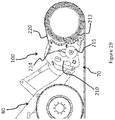
  • the strap winds in such that the track panel ( 70 ) contact the guide member ( 210 ), which follows the curvature of the member downward supported by the rollers ( 212 ).
  • the host vehicle needs only reverse and continue to wind in the strap to recover the rollable road panel mat.
  • the volume (V) is collapsed inwardly, the straps ( 220 ) are wound around the drums ( 215 ) reducing the distance between the guide member ( 110 ) and retaining means ( 120 ) which in effect grabs the roll in its entirety.
  • a further locking means such as fold over forks or knots, can be used to secure the roll.
  • This grab function provides the ability to lift and move the roll as needed, including for storage or loading onto flatbeds, frames, stillages etc. This greatly improves the flexibility of deployment options open to the user.
  • the system can be constructed to be foldable so as to reduce the volume and footprint required to move the system. This is achieved whereby the mounting frame, guide members and straps, which are integral to creating the volume of influence can be unlocked and rotated to a park position. This effectively allows the whole assembly to concertina down to a flat package, allowing the dimensions to be configured to standard modes of transport (ISO containers, 463L air freight, etc.)
  • the host machine may recover and deploy the track roll while the machine is located on a portion of the track.
  • the track can be deployed as the host machine travels in a first direction, such as forwardly, with the host machine traveling upon the deployed track, thereby avoiding the need for the machine to traverse uneven terrain during the deployment.
  • the system allows the track to be recovered as the host machine travels in a second direction such as by reversing upon the deployed track, again avoiding the need for the machine to traverse uneven terrain during the recovery.
  • the system may also be located at a rear of the machine, such that the track may be deployed as the machine reverses and recovered as the machine moves forwardly. In this situation, the machine again travels upon the track during the deployment and recovery of the track.
  • the apparatus of the invention may be varied according to requirements, including but not limited to physical dimensions or construction materials, having as its objective the provision of system for spool-less deployment, recovery and manipulation of rollable roadway panels.
  • connection means

Landscapes

  • Engineering & Computer Science (AREA)
  • Structural Engineering (AREA)
  • Civil Engineering (AREA)
  • Architecture (AREA)
  • Mechanical Engineering (AREA)
  • Transportation (AREA)
  • Mining & Mineral Resources (AREA)
  • General Engineering & Computer Science (AREA)
  • Life Sciences & Earth Sciences (AREA)
  • Geology (AREA)
  • Road Paving Machines (AREA)

Abstract

A spool-less system for deployment, recovery and manipulation of a traversable road covering track. The system includes an arcuate guide member detachably coupled to a retaining member; the guide member and retaining member defining a volume for receiving a roll of traversable road covering; the guide member arranged to contact the roll along a first arcuate range and the retaining member configured to contact the roll along a second arcuate range; and wherein the guide member and retaining member are detachably coupleable having, a first position in which, the guide member and retaining member are separated at a first diameter whereby the roll of traversable road covering may be deployed or recovered when the host machine is in motion, and a second position in which, the guide member and retaining member are separated at a second diameter in which the roll of traversable road covering is retained.

Description

The present application is based on, claims priority to, and incorporates herein by reference in its entirety GB 1913238.0 filed Sep. 13, 2019, entitled “Traversable Road Covering Track.”
TECHNICAL FIELD
The present invention relates to apparatus, systems and methods of spool-less deployment, recovery and manipulation of rollable roadway panels.
BACKGROUND
Expedient roadway surfacing provides the ability to move into and out of areas of opportunity by providing logistics routes for vehicles which could not otherwise cross problematic ground conditions. Many industries—such as construction and energy, require ad hoc access for machinery under such situations. One method of providing this capability is via a rollable system of interconnected panels which can be rolled out over a required traffic route, as well as rolled up for recovery and transport.
However, current modes of dispensing suitable rollable road panels are either expensive and a logistical burden, or inefficient and require appreciable manual effort to deploy and recover. In addition, for the mechanical systems to operate require auxiliary components such as spools, chains etc. which add both weight and complexity to the system as well as added secondary considerations such as higher maintenance planning and cost, the requirement to move and store these auxiliary components when not in use, etc.
SUMMARY
The present invention is a system that provides a method for both deployment and recovery of the roll up road surfacing without the need for these auxiliary components. In addition, it also provides the ability to lift and manipulate these rolls—current systems known to the art do not permit this function, which must be provided by a second system such as a loader or crane.
By addressing the issues identified above, the system allows for simpler, safer and more economic use of the roll up roadway and the host plant vehicle while also providing a much greater operational flexibility which is of value during civilian and military operations.
According to an embodiment of the invention there is provided a spool-less system for deployment, recovery and manipulation of a traversable road covering track, the system being detachably coupleable to a host machine for providing operating power and transportation, the system comprising: an arcuate guide member detachably coupled to a retaining means; the guide member and retaining means defining a volume for receiving a roll of traversable road covering; the guide member arranged to contact the roll along a first arcuate range and the retaining means configured to contact the roll along a second arcuate range; and wherein the guide member and retaining means are detachably coupleable having, a first position in which, the guide member and retaining means are separated at a first diameter whereby the roll of traversable road covering may be deployed or recovered when the host machine is in motion, and a second position in which, the guide member and retaining means are separated at a second diameter in which the roll of traversable road covering is retained.
Advantageously, the system can provide the functions of deployment, recovery and manipulation without the need for a central spool/winding unit. This both increases the logistical efficiency of using rollable road panels as well as decreases costs and payload weight significantly.
Additionally, as an alternative to the ability to ‘push’ out a roll of rollable road panels and recovering the panels by pushing from the opposite direction, the system allows recovery via ‘pulling’, allowing the rollable road panels to be recovered while the host vehicle is on the mat itself. This allows recovery of the mat without putting the host vehicle on the subgrade itself.
The system provides for the deployment and recovery (rolling) function without any rotational effort being applied to the rollable road panels themselves (i.e. no motors, chains and straps).
The system can provide a controlled deployment whereby the roll can be laid on inclines—the overreaching arms providing a stop to negate a wound up spool rolling away downhill. This improves safety and overall functionality.
The system can provide a grab function. Not only does this allow manipulation of a roll, but also negates the need for dedicated dispensers for different panels. As such the system can provide universal functionality across a broader range of rollable and general materials.
Due to the serious weight savings possible by the system, rollable road panels can be used by more (and lighter duty) host vehicles which potentially opens up otherwise restricted markets.
In an embodiment the guide member comprises a plurality of rollers configured into an arcuate array.
In an embodiment the plurality of rollers are disposed on a body, the plurality of rollers and body defining an arm.
In an embodiment the system further comprises a mounting frame detachably coupleable to the host machine and the arm detachably coupleable to the mounting frame. The system can be constructed modularly to fold down into a smaller space when not in use, requiring less space for transportation and greater options for logistics.
In an embodiment the mounting frame comprises a substantially horizontal elongate member.
In an embodiment the system further comprises a second arm.
In an embodiment the first arm and second arm are located towards opposite horizontal ends of the mounting frame.
In one embodiment the retaining means comprises a second plurality of rollers configured into an arcuate array, the second plurality of rollers are disposed on a body defining a distal portion of an arm.
In an embodiment the system comprises a connection means, connecting the guide member with the retaining means.
In an embodiment the connection means, comprises a pivot point around which the second arcuate member rotates, thereby varying the diameter of the volume.
In an embodiment the system further comprising an arm actuator to actuate the retaining means and thereby the system into the first position and the second position.
In an embodiment the distal portion of the arm further comprises a diameter limiting member configured to contact the roll of traversable road covering until it is fully deployed. The limiting member aids in achieving a consistent roll diameter for a given length when recovering. The system can optionally be fitted with a constant tension star wheel which keeps the rollable road panels under tension when deploying.
In an embodiment the diameter limiting member is pivotally attached to an inner surface of the distal portion the arm.
In an embodiment the diameter limiting member further comprises a limiting member actuator to actuate the pivoting motion.
In an embodiment the diameter limiting member is resiliently biased to provide a consistent pressure against the roll of traversable road covering.
In an alternative embodiment the retaining means comprises a length of strap detachably coupleable to the roll of traversable road covering.
In an embodiment the guide member further comprises strap guides for locating the strap.
In an embodiment the system further comprises a drum connectable to the strap and around which the strap may be wound.
In an embodiment the drum comprises a motor to drive a winding motion of the drum.
In an embodiment the system further comprises a locking means for retaining a recovered/undeployed roll of traverasable road covering in the volume.
According to a further embodiment there is provided a host machine having mounted thereon a spool-less system as described according to the previous embodiment, the spool less system being arranged to deploy a traversable road covering track while the host machine travels in a first direction upon the deployed traversable road covering track, and to recover the traversable road covering track while the host machine travels in a second direction upon the deployed traversable road covering.
According to a further embodiment there is provided a method of deployment, recovery and manipulation of a traversable road covering track comprising the steps: detachably coupling a spool-less system as described according to the previous embodiment to a host machine; and operating the host machine to recover and deploy the traversable road covering track while the host machine travels upon at least a portion of the traversable road covering.
BRIEF DESCRIPTION OF THE DRAWINGS
The invention may be performed in various ways and an embodiment thereof will now be described, by way of example only, reference being made to the accompanying drawings, in which:—
FIG. 1 is an isometric view of the system according to one embodiment of the present invention;
FIG. 2 is a side view of the system as shown in FIG. 1;
FIG. 3 is a close up view of the rollers of the system as shown in FIG. 1;
FIG. 4 is a close up view of the actuator for the retaining means of the system as shown in FIG. 1;
FIG. 5 is a close up view of the diameter limiting member of the system as shown in FIG. 1;
FIG. 6 is an illustration of the system according to one embodiment of the present invention in use at the beginning of a recovery phase or end of a deployment phase;
FIG. 7 is an illustration of the system as shown in FIG. 6 in use at an intermediate position of a recovery phase or a deployment phase;
FIG. 8 is an isometric view illustration of the system as shown in FIG. 7;
FIG. 9 is an illustration of the system as shown in FIG. 6 in use at an intermediate position of a recovery phase or a deployment phase;
FIG. 10 is an illustration of the system as shown in FIG. 6 in use at a recovered phase or an un-deployed phase;
FIG. 11 is an isometric view illustration of the system as shown in FIG. 10;
FIG. 12 is an illustration of the system as shown in FIG. 6 in use at a lifted phase;
FIG. 13 is an isometric view of the system according to an alternative embodiment of the present invention;
FIG. 14 is a side view of the system as shown in FIG. 13;
FIG. 15 is a view of the system as shown in FIG. 13 with the retaining means removed;
FIG. 16 is a side view of the system as shown in FIG. 15;
FIG. 17 is an illustration of the system according to an alternative embodiment of the present invention in use at the beginning of a recovery phase or end of a deployment phase;
FIG. 18 is an isometric view illustration of the system as shown in FIG. 17;
FIG. 19 is an illustration of the system as shown in FIG. 17 in use at a recovered phase or an un-deployed phase; and,
FIG. 20 is an isometric view illustration of the system as shown in FIG. 19.
DETAILED DESCRIPTION
Referring to FIGS. 1 and 2 of the drawings, there is shown a spool-less system (100) according to one embodiment of the present invention. In this embodiment the system comprises a mounting frame (130) and two sets of jaws. Each jaw comprising an arm (111L/111R) and a distal arm portion (121). Between each jaw is defined a volume (V) to receive a roll of track (not shown). The arms comprise a guide member (110), having a body (113) and a plurality of roller (112) disposed within the body in a substantially arcuate arrangement. The construction of the distal arm portion (121) in this embodiment is near identical to the arm (111). The distal arm portions (121) comprises a retaining means (120), having a body (123) and a plurality of roller (122) disposed within the body in a substantially arcuate arrangement. The arm (111) and distal arm portion (121) are connected by a connection means (140), in the embodiment shown as a bracket, the connection means includes a pivot (141) point about which the distal arm portion rotates with respect to the arm (111) thereby varying the diameter of the volume (V). Arm actuators (150) are shown, which are powered by the host machine, and shown as linear hydraulic pumps/cylinders. The distal arm portions further comprise diameter limiting members (160), these extend inward into the volume to contact the track roll. The diameter limiting members (160) comprise an arcuate body, connected to the distal arm portion (121) at a connection point and by a diameter limiting member actuator (161). There are additional manufacturing features shown on the embodiment, such as apertures, securing and location means.
The mounting frame comprises a substantially horizontal elongate member. In the embodiment shown there are multiple additional reinforcement bars forming part of the mounting frame and a connection point for attaching to a host vehicle (not shown). Various shapes of mounting frame are envisaged suitable for multiple vehicles. The connection point/(s) can be any suitable means. The host machine may provided power and transportation for the system, however, it could be conceived that power is supplied on the system itself or a system unpowered using resilient bias. Additionally reinforcing crossbars are shown between the sets of jaws, between the connection means (140) and diameter limiting members (160) on the distal arm portions (121).
FIG. 3 shows a close up view of the rollers (112) of the guide member (110). The push rollers (112/122) shown in the embodiment are cylindrical, they provide a force while minimising roll resistance. Alternative shapes with curved surfaces could be used. The rollers are disposed within the body (113) of the guide at fixed positions, such that only a portion of the roller protrudes from the body. Alternative embodiments are envisage where the rollers can help minimise roll resistance depending on the construction of the arm (111/121), for example the rollers may be placed on an internal or external surface of the body, as long as they provide the push force and reduce resistance to the track roll (70).
FIG. 4 shows a close up view of the actuator (150) for the retaining means (120). FIG. 5 shows a close up view of the limiting member actuator (161) of the diameter limiting member (160), disposed on the retaining means (120). Both the arm actuator and diameter limiting actuator are shown as linear hydraulic pumps/cylinders, however different actuator means such as electrically driven or resilient biasing mechanisms are envisaged.
All the features in this embodiment are detachably coupleable allowing for easy disassembly, storage and transport. It is envisaged that there may be embodiment were certain features are formed integrally.
Shown in FIGS. 6 to 12 are views of the system (100) attached to a host machine (80) and loaded with a track roll (70), in different stages of deployment, recovery, manipulation and transportation.
In an example of use of the embodiment, the system (100) accommodates four main uses; deployment, recovery, manipulation and transportation. During deployment the host machine (80) provides hydraulic power to various actuators (150/160) located on the system (100) that allow changes in orientation and angle of the mounting frame (130) and arms (111/121). During deployment, the system is oriented so as to entrap the roll (70) inside the volume of influence (V). At this point the host machine drives forward, allowing the push-rollers (112) to apply a pushing force to the roll. Importantly, the rollers provide a force while minimising roll resistance as would be present if using a simple beam or pad. The host machine then drives out the roll, with braking/stop functionality provided by the opposite pull arms (121) and optionally the diameter limiting member (160). During recovery: the system (100) is initially positioned at an angle where the pull arms (121) may be presented below the road panel mat (70) level to promote rolling. This is mostly applicable on deformable subgrades such as marshes, bogs or un-prepared soils and sands. On concrete or asphalt, an operator may present the first panel of the roll at an angle which will achieve the same effect. The host machine, being on the road panel mat itself, reverses. The pull arms (121L/121R) translate this movement into a force, which in turn rolls the rollable road panels (70) along the path of the arm curvature. The optional roll tension device (160) assistance while the roll begins to roll down the push-side/arm (112) of the volume. As such it provides a controlled force at the downward roll end of the regardless of the position of the push-side rollers. Once the first wrap has been established, the host vehicle needs only reverse and control the position of various arms to control the volume to recover the rollable road panel mat. During manipulation: the volume (V) is collapsed inwardly, the arms rotating inwardly around the pivot (141) reducing the distance between the guide member (110) and retaining means (120) which in effect grabs the roll in its entirety. This grab function provides the ability to lift and move the roll as needed, including for storage or loading onto flatbeds, frames, stillages etc. This greatly improves the flexibility of deployment options open to the user. During transportation: when the system (100) is required independently of the host machine (80), the system can be constructed to be foldable so as to reduce the volume and footprint required to move the system. This is achieved whereby the boom and pull arms which are integral to creating the volume of influence can be unlocked and rotated to a park position. This effectively allows the whole assembly to concertina down to a flat package, allowing the dimensions to be configured to standard modes of transport (ISO containers, 463L air freight, etc.)
Referring to FIGS. 13 and 14 there is shown a spool-less system (100) according to an alternative embodiment of the present invention. In this embodiment the system comprises two guide members (210) either side of a mounting frame (230). Further more the retaining means (120) is provided as straps (220). Between the straps (220) and guide member is defined a volume to receive a roll of track (not shown). The guide member (110) comprise, an arcuate body and a plurality of roller (212) disposed on the body in a substantially arcuate arrangement. The guide member further comprise strap guides (214) for locating the retaining means straps (220) and a drum (215) to which the straps can be wound when the roll is undeployed. The straps (220) may be any length of flexible material which can be coupled to the guide member and/or the track roll. There are additional manufacturing features shown on the embodiment, such as apertures, securing and location means.
FIGS. 15 and 16 show the spool-less system (100) shown in FIGS. 13 and 14 without the strap (220).
Shown in FIGS. 17 to 20 are views of an alternative embodiment of the system (100) including straps (220) attached to a host machine (80) and loaded with a track roll (70), in different stages of deployment, recovery, manipulation and transportation.
In an example of use of the alternative embodiment, the system (100) accommodates four main uses; deployment, recovery, manipulation and transportation. During deployment, the system is oriented so as to entrap the roll (70) inside the volume of influence (V). At this point the host machine drives forward, allowing the push-rollers (212) to apply a pushing force to the roll, while the straps (220) are partially unwound to release the roll. Importantly, the rollers provide a force while minimising roll resistance as would be present if using a simple beam or pad. The host machine then drives out the roll, with braking/stop functionality provided by the straps (220). During recovery: the straps are wound back in, while the host machine, being on the road panel mat itself also reverses. The straps act in a parbuckle arrangement to recover the roll. The strap winds in such that the track panel (70) contact the guide member (210), which follows the curvature of the member downward supported by the rollers (212). Once the first wrap has been established, the host vehicle needs only reverse and continue to wind in the strap to recover the rollable road panel mat. During manipulation: the volume (V) is collapsed inwardly, the straps (220) are wound around the drums (215) reducing the distance between the guide member (110) and retaining means (120) which in effect grabs the roll in its entirety. Additionally a further locking means (not shown) such as fold over forks or knots, can be used to secure the roll. This grab function provides the ability to lift and move the roll as needed, including for storage or loading onto flatbeds, frames, stillages etc. This greatly improves the flexibility of deployment options open to the user. During transportation: when the system (100) is required independently of the host machine (80), the system can be constructed to be foldable so as to reduce the volume and footprint required to move the system. This is achieved whereby the mounting frame, guide members and straps, which are integral to creating the volume of influence can be unlocked and rotated to a park position. This effectively allows the whole assembly to concertina down to a flat package, allowing the dimensions to be configured to standard modes of transport (ISO containers, 463L air freight, etc.)
Importantly, as shown in the embodiments, while the system is coupled to a host machine, the host machine may recover and deploy the track roll while the machine is located on a portion of the track. For example, the track can be deployed as the host machine travels in a first direction, such as forwardly, with the host machine traveling upon the deployed track, thereby avoiding the need for the machine to traverse uneven terrain during the deployment. Similarly, the system allows the track to be recovered as the host machine travels in a second direction such as by reversing upon the deployed track, again avoiding the need for the machine to traverse uneven terrain during the recovery. It is to be appreciated however, that the system may also be located at a rear of the machine, such that the track may be deployed as the machine reverses and recovered as the machine moves forwardly. In this situation, the machine again travels upon the track during the deployment and recovery of the track.
Select embodiments of the invention only have been described and illustrated, and it will be readily apparent that other embodiments, modifications, additions and omissions are possible within the scope of the invention.
The apparatus of the invention may be varied according to requirements, including but not limited to physical dimensions or construction materials, having as its objective the provision of system for spool-less deployment, recovery and manipulation of rollable roadway panels.
INDEX
100. system
110. guide member
111. guide arm
112. rollers
113. body
120. retaining means
121. distal arm portion
122. rollers
123. body
130. mounting frame
140. connection means
150. arm actuator
160. diameter limiting member
161. diameter limiting actuator
200. alternative embodiment
220. strap
214. strap guide
215. drum
80. host machine
70. track roll
V. volume
L. first
R. second

Claims (16)

The invention claimed is:
1. A spool-less system (100) for deployment, recovery and manipulation of a traversable road covering track, the system being detachably coupleable to a host machine (80) for providing operating power and transportation, the system comprising:
a retaining means (120); and
an arcuate guide member (110) detachably couplable to the retaining means (120);
the guide member and retaining means defining a volume (V) for receiving a roll of traversable road covering track (70); the guide member being arranged to contact the roll along a first arcuate range and the retaining means configured to contact the roll along a second arcuate range; and
wherein the guide member (110) and retaining means (120) have a first position in which the guide member and retaining means are separated by a first diameter, whereby the roll of traversable road covering track may be deployed or recovered when the host machine is in motion, and a second position in which the guide member and retaining means are separated by a second diameter in which the roll of traversable road covering is retained;
wherein the retaining means (120) comprises a plurality of rollers (122) configured into an arcuate array, the plurality of rollers disposed on a body (123) defining a distal arm portion (121); and
wherein the distal arm portion (121) further comprises a diameter limiting member (160) configured to contact the roll of traversable road covering until the roll of traversable road covering is fully deployed.
2. The system of claim 1 wherein, the system further comprises a mounting frame (130) detachably coupleable to the host machine (80) and detachably coupleable to the arm (111).
3. The system of claim 2 wherein, the mounting frame (130) comprises a substantially horizontal elongate member.
4. The system of claim 3 further comprising a second arm (111R).
5. The system of claim 4 wherein, the first arm (111L) and second arm (111R) are located towards opposite horizontal ends of the mounting frame (130).
6. The system of claim 1, further comprising a connection means (140), connecting the guide member (110) with the retaining means (120).
7. The system of claim 6, wherein the connection means (140), comprises a pivot point (141) around which the second arcuate member rotates, thereby varying the diameter of the volume.
8. The system of claim 6, further comprising an arm actuator (150) to actuate the retaining means (120) and thereby the system into the first position and the second position.
9. The system of claim 7, wherein the diameter limiting member (160) is pivotally attached to an inner surface of the distal arm portion.
10. The system of claim 8, wherein the diameter limiting member (160) further comprises a limiting member actuator (161) to actuate the pivoting motion.
11. The system of claim 8, wherein the diameter limiting member (160) is resiliently biased to provide a consistent pressure against the roll of traversable road covering.
12. The system of claim 1 wherein, the retaining means (120) comprises a length of strap (220) detachably coupleable to the roll of traversable road covering.
13. The system of claim 10 wherein, the guide member (110) further comprises strap guides (224) for locating the strap.
14. The system of claim 11 further comprising a drum (215) connectable to the strap (220) and around which the strap may be wound.
15. A host machine (80) having mounted thereon the spool-less system (100) according to claim 1, the spool-less system being arranged to deploy a traversable road covering track (70) while the host machine travels in a first direction upon the deployed traversable road covering track, and to recover the traversable road covering track while the host machine travels in a second direction upon the deployed traversable road covering.
16. A method of deployment, recovery and manipulation of a traversable road covering track comprising the steps:
detachably coupling the spool-less system (100) as claimed in claim 1 to a host machine (80); and
operating the host machine to recover and deploy the traversable road covering track (70) while the host machine (80) travels upon at least a portion of the traversable road covering (70).
US17/017,659 2019-09-13 2020-09-10 Spool-less system for deployment, recovery, and manipulation of a traversable road covering track Active US11306449B2 (en)

Applications Claiming Priority (3)

Application Number Priority Date Filing Date Title
GB1913238 2019-09-13
GB1913238.0A GB2589292A (en) 2019-09-13 2019-09-13 Traversable road covering track
GB1913238.0 2019-09-13

Publications (2)

Publication Number Publication Date
US20210079602A1 US20210079602A1 (en) 2021-03-18
US11306449B2 true US11306449B2 (en) 2022-04-19

Family

ID=68315415

Family Applications (1)

Application Number Title Priority Date Filing Date
US17/017,659 Active US11306449B2 (en) 2019-09-13 2020-09-10 Spool-less system for deployment, recovery, and manipulation of a traversable road covering track

Country Status (4)

Country Link
US (1) US11306449B2 (en)
EP (1) EP3792400B1 (en)
GB (1) GB2589292A (en)
PL (1) PL3792400T3 (en)

Cited By (1)

* Cited by examiner, † Cited by third party
Publication number Priority date Publication date Assignee Title
US20240132317A1 (en) * 2019-04-04 2024-04-25 Reynolds Consumer Products LLC Assembly system and method for packaging web material in a roll

Families Citing this family (1)

* Cited by examiner, † Cited by third party
Publication number Priority date Publication date Assignee Title
WO2026005626A1 (en) 2024-06-23 2026-01-02 Rekord Hale Namiotowe Spółka Z Ograniczoną Odpowiedzialnością Temporary road

Citations (11)

* Cited by examiner, † Cited by third party
Publication number Priority date Publication date Assignee Title
US908954A (en) * 1908-01-31 1909-01-05 James H Channon Intermediate support for awning-rollers and the like.
US997491A (en) * 1909-09-24 1911-07-11 Louis A Daus Support for awning-rollers.
US1020246A (en) * 1911-10-12 1912-03-12 Jackson Bernard Baker Intermediate awning-roller support.
US1111590A (en) * 1914-03-21 1914-09-22 Willis K Jacobs Center support for awning-rollers.
US2134656A (en) * 1937-10-22 1938-10-25 Breth Maximilian Cloth unwinder
US3643885A (en) 1969-12-01 1972-02-22 Functional Systems Corp Carpet supply cradle and feeder mechanism for a carpet measuring and cutting machine
US4044907A (en) 1976-04-26 1977-08-30 Craft Carl R Hay handler
US5129462A (en) * 1989-09-29 1992-07-14 Mail Stuart P Turf handling machine
US7182287B2 (en) * 2001-11-29 2007-02-27 Sms Demag Ag Gripper for residual windings which may be wound from residual strip running from strip plants at the roll end
US20090107348A1 (en) 2007-10-30 2009-04-30 James Thomas Noonan Handling And Orienting Cotton Modules Wrapped With Material Including RFID Tag
US20140291433A1 (en) 2013-03-27 2014-10-02 Smg Sportplatzmaschinenbau Gmbh Device for winding and unwinding two-dimensional roll material

Patent Citations (11)

* Cited by examiner, † Cited by third party
Publication number Priority date Publication date Assignee Title
US908954A (en) * 1908-01-31 1909-01-05 James H Channon Intermediate support for awning-rollers and the like.
US997491A (en) * 1909-09-24 1911-07-11 Louis A Daus Support for awning-rollers.
US1020246A (en) * 1911-10-12 1912-03-12 Jackson Bernard Baker Intermediate awning-roller support.
US1111590A (en) * 1914-03-21 1914-09-22 Willis K Jacobs Center support for awning-rollers.
US2134656A (en) * 1937-10-22 1938-10-25 Breth Maximilian Cloth unwinder
US3643885A (en) 1969-12-01 1972-02-22 Functional Systems Corp Carpet supply cradle and feeder mechanism for a carpet measuring and cutting machine
US4044907A (en) 1976-04-26 1977-08-30 Craft Carl R Hay handler
US5129462A (en) * 1989-09-29 1992-07-14 Mail Stuart P Turf handling machine
US7182287B2 (en) * 2001-11-29 2007-02-27 Sms Demag Ag Gripper for residual windings which may be wound from residual strip running from strip plants at the roll end
US20090107348A1 (en) 2007-10-30 2009-04-30 James Thomas Noonan Handling And Orienting Cotton Modules Wrapped With Material Including RFID Tag
US20140291433A1 (en) 2013-03-27 2014-10-02 Smg Sportplatzmaschinenbau Gmbh Device for winding and unwinding two-dimensional roll material

Non-Patent Citations (1)

* Cited by examiner, † Cited by third party
Title
UK Search Report under Section 17, dated Dec. 12, 2019 in connection with GB1913238.0.

Cited By (2)

* Cited by examiner, † Cited by third party
Publication number Priority date Publication date Assignee Title
US20240132317A1 (en) * 2019-04-04 2024-04-25 Reynolds Consumer Products LLC Assembly system and method for packaging web material in a roll
US12410028B2 (en) * 2019-04-04 2025-09-09 Reynolds Consumer Products LLC Assembly system and method for packaging web material in a roll

Also Published As

Publication number Publication date
US20210079602A1 (en) 2021-03-18
PL3792400T3 (en) 2022-09-12
EP3792400B1 (en) 2022-04-13
GB201913238D0 (en) 2019-10-30
EP3792400A1 (en) 2021-03-17
GB2589292A (en) 2021-06-02

Similar Documents

Publication Publication Date Title
EP2328795B1 (en) Telescopic vehicle and method for transporting a long object
US7566024B2 (en) Systems and methods for the rapid deployment of piping
US11306449B2 (en) Spool-less system for deployment, recovery, and manipulation of a traversable road covering track
FI64254C (en) CABLE PROCEDURE FOR EL-DRIVEN GRUVFORDON OCH ARBETSMASKINER
JP2011184204A (en) Vehicle mounted crane
CN107254815B (en) Suspension type erecting machine
CN112714706B (en) Openable structure
US20060056949A1 (en) Transport vehicle for aircraft
US7494087B2 (en) Reel handler
FI83122B (en) VAEDERSKYDDSTAK FOER LAETTFLYGPLAN.
EP1003936B1 (en) Vehicle for the laying of a traversable temporary roadway system
CN102211539A (en) Mini road dragging wrecker
US20090279948A1 (en) Vehicle control barrier
JP6718545B2 (en) Cargo covering device for trailer and method of operating the same
KR102040852B1 (en) Apparatus for unwinding cover membrane
WO2013153410A1 (en) Wagon for transport and controlled silting of hygroscopic material
CN206752225U (en) Suspension type erecting machine
US20250214385A1 (en) Rail vehicle, in particular road-rail vehicle, which is designed to change tracks, and corresponding system and method
CN206968523U (en) Storehouse grating transport vehicle carriage
AU2020102688A4 (en) System and method for storing and deploying a cover
JP7523340B2 (en) Work vehicle
EP2431206B1 (en) Arrangement for laying out a covering over a container
JPS6337037B2 (en)
BR202017021770Y1 (en) retractable tarpaulin against falling solid bulk, to avoid wasting material during loading and unloading of ships
JPH07107633A (en) High ground working truck with mounted cable hauling unit

Legal Events

Date Code Title Description
FEPP Fee payment procedure

Free format text: ENTITY STATUS SET TO UNDISCOUNTED (ORIGINAL EVENT CODE: BIG.); ENTITY STATUS OF PATENT OWNER: SMALL ENTITY

FEPP Fee payment procedure

Free format text: ENTITY STATUS SET TO SMALL (ORIGINAL EVENT CODE: SMAL); ENTITY STATUS OF PATENT OWNER: SMALL ENTITY

STPP Information on status: patent application and granting procedure in general

Free format text: APPLICATION DISPATCHED FROM PREEXAM, NOT YET DOCKETED

STPP Information on status: patent application and granting procedure in general

Free format text: DOCKETED NEW CASE - READY FOR EXAMINATION

STPP Information on status: patent application and granting procedure in general

Free format text: NON FINAL ACTION MAILED

AS Assignment

Owner name: FAUN TRACKWAY LIMITED, UNITED KINGDOM

Free format text: ASSIGNMENT OF ASSIGNORS INTEREST;ASSIGNORS:WIGLEY, NEIL;GODRIDGE, PAUL;ROBERTS, DAFYDD;SIGNING DATES FROM 20211202 TO 20211222;REEL/FRAME:058604/0547

STPP Information on status: patent application and granting procedure in general

Free format text: NOTICE OF ALLOWANCE MAILED -- APPLICATION RECEIVED IN OFFICE OF PUBLICATIONS

STPP Information on status: patent application and granting procedure in general

Free format text: PUBLICATIONS -- ISSUE FEE PAYMENT VERIFIED

STCF Information on status: patent grant

Free format text: PATENTED CASE

MAFP Maintenance fee payment

Free format text: PAYMENT OF MAINTENANCE FEE, 4TH YR, SMALL ENTITY (ORIGINAL EVENT CODE: M2551); ENTITY STATUS OF PATENT OWNER: SMALL ENTITY

Year of fee payment: 4