US11306093B2 - Process for preparation of 2-(6-nitropyridin-3-yl)-9H-dipyrido[2,3-b;3′,4′-d]pyrrole - Google Patents
Process for preparation of 2-(6-nitropyridin-3-yl)-9H-dipyrido[2,3-b;3′,4′-d]pyrrole Download PDFInfo
- Publication number
- US11306093B2 US11306093B2 US16/294,627 US201916294627A US11306093B2 US 11306093 B2 US11306093 B2 US 11306093B2 US 201916294627 A US201916294627 A US 201916294627A US 11306093 B2 US11306093 B2 US 11306093B2
- Authority
- US
- United States
- Prior art keywords
- acid
- formula
- compound
- base
- group
- Prior art date
- Legal status (The legal status is an assumption and is not a legal conclusion. Google has not performed a legal analysis and makes no representation as to the accuracy of the status listed.)
- Active
Links
- HBXFGUOYZSAQNI-UHFFFAOYSA-N O.[O-][NH2+]c1ccc(-c2ccc3c(n2)[nH]c2ccncc23)cn1 Chemical compound O.[O-][NH2+]c1ccc(-c2ccc3c(n2)[nH]c2ccncc23)cn1 HBXFGUOYZSAQNI-UHFFFAOYSA-N 0.000 description 10
- FRCQINQYHQKRNK-UHFFFAOYSA-N O=[N+]([O-])c1ccc(-c2ccc3c(n2)[nH]c2ccncc23)cn1 Chemical compound O=[N+]([O-])c1ccc(-c2ccc3c(n2)[nH]c2ccncc23)cn1 FRCQINQYHQKRNK-UHFFFAOYSA-N 0.000 description 3
- NQXWHLFJDTULDA-UHFFFAOYSA-N COc1ccc2c(n1)[nH]c1ccncc12 Chemical compound COc1ccc2c(n1)[nH]c1ccncc12 NQXWHLFJDTULDA-UHFFFAOYSA-N 0.000 description 2
- NQHRUTKNRVYHGR-UHFFFAOYSA-N O=c1ccc2c([nH]1)[nH]c1ccncc12 Chemical compound O=c1ccc2c([nH]1)[nH]c1ccncc12 NQHRUTKNRVYHGR-UHFFFAOYSA-N 0.000 description 2
- 0 *S(=O)(=O)Oc1ccc2c(n1)[nH]c1ccncc12.CC1(C)OB(c2ccc([N+](=O)[O-])nc2)OC1(C)C.COc1ccc2c(n1)[nH]c1ccncc12.COc1cccc(C)n1.COc1cccc(Nc2ccncc2C)n1.Cc1cnccc1N.FB(F)F.I.O=[N+]([O-])c1ccc(-c2ccc3c(n2)[nH]c2ccncc23)cn1.O=[N+]([O-])c1ccc(-c2ccc3c(n2)[nH]c2ccncc23)cn1.O=[N+]([O-])c1ccc(B(O)O)cn1.O=[N+]([O-])c1ccc([K])cn1.O=c1ccc2c([nH]1)[nH]c1ccncc12 Chemical compound *S(=O)(=O)Oc1ccc2c(n1)[nH]c1ccncc12.CC1(C)OB(c2ccc([N+](=O)[O-])nc2)OC1(C)C.COc1ccc2c(n1)[nH]c1ccncc12.COc1cccc(C)n1.COc1cccc(Nc2ccncc2C)n1.Cc1cnccc1N.FB(F)F.I.O=[N+]([O-])c1ccc(-c2ccc3c(n2)[nH]c2ccncc23)cn1.O=[N+]([O-])c1ccc(-c2ccc3c(n2)[nH]c2ccncc23)cn1.O=[N+]([O-])c1ccc(B(O)O)cn1.O=[N+]([O-])c1ccc([K])cn1.O=c1ccc2c([nH]1)[nH]c1ccncc12 0.000 description 1
- GXELHYKVAGQRNG-UHFFFAOYSA-N C.[O-][NH2+]c1ccc(-c2ccc3c(n2)[nH]c2ccncc23)cn1 Chemical compound C.[O-][NH2+]c1ccc(-c2ccc3c(n2)[nH]c2ccncc23)cn1 GXELHYKVAGQRNG-UHFFFAOYSA-N 0.000 description 1
- IHDUNYPPHYFNGR-UHFFFAOYSA-N CC(C)(C)OC(=O)n1c2ccncc2c2ccc(Cl)nc21 Chemical compound CC(C)(C)OC(=O)n1c2ccncc2c2ccc(Cl)nc21 IHDUNYPPHYFNGR-UHFFFAOYSA-N 0.000 description 1
- VRHXOXSNCXTZCT-UHFFFAOYSA-N CC(C)(O)C(C)(C)OBc1ccc([N+](=O)[O-])nc1 Chemical compound CC(C)(O)C(C)(C)OBc1ccc([N+](=O)[O-])nc1 VRHXOXSNCXTZCT-UHFFFAOYSA-N 0.000 description 1
- GKZRIMHUEXMPEX-UHFFFAOYSA-N COc1cccc(C)n1.COc1cccc(Nc2ccncc2C)n1.Cc1ncccc1N Chemical compound COc1cccc(C)n1.COc1cccc(Nc2ccncc2C)n1.Cc1ncccc1N GKZRIMHUEXMPEX-UHFFFAOYSA-N 0.000 description 1
- WBQWOKAPVJYVSS-UHFFFAOYSA-N COc1cccc(Nc2ccncc2Cl)n1 Chemical compound COc1cccc(Nc2ccncc2Cl)n1 WBQWOKAPVJYVSS-UHFFFAOYSA-N 0.000 description 1
- NJDLVDXMYRQPJQ-UHFFFAOYSA-N Cc1ccc(B2OC(C)(C)C(C)(C)O2)cn1.FB(F)F.O=[N+]([O-])c1ccc(B(O)O)cn1.O=[N+]([O-])c1ccc([K])cn1 Chemical compound Cc1ccc(B2OC(C)(C)C(C)(C)O2)cn1.FB(F)F.O=[N+]([O-])c1ccc(B(O)O)cn1.O=[N+]([O-])c1ccc([K])cn1 NJDLVDXMYRQPJQ-UHFFFAOYSA-N 0.000 description 1
- MZCVOSWZWMJTQS-UHFFFAOYSA-N O=S(=O)(Oc1ccc2c(n1)[nH]c1ccncc12)C(F)(F)F Chemical compound O=S(=O)(Oc1ccc2c(n1)[nH]c1ccncc12)C(F)(F)F MZCVOSWZWMJTQS-UHFFFAOYSA-N 0.000 description 1
- FDMOHTOITMTGNG-GKTGUEEDSA-N [18F]c1ccc(-c2ccc3c(n2)[nH]c2ccncc23)cn1 Chemical compound [18F]c1ccc(-c2ccc3c(n2)[nH]c2ccncc23)cn1 FDMOHTOITMTGNG-GKTGUEEDSA-N 0.000 description 1
Classifications
-
- C—CHEMISTRY; METALLURGY
- C07—ORGANIC CHEMISTRY
- C07D—HETEROCYCLIC COMPOUNDS
- C07D471/00—Heterocyclic compounds containing nitrogen atoms as the only ring hetero atoms in the condensed system, at least one ring being a six-membered ring with one nitrogen atom, not provided for by groups C07D451/00 - C07D463/00
- C07D471/02—Heterocyclic compounds containing nitrogen atoms as the only ring hetero atoms in the condensed system, at least one ring being a six-membered ring with one nitrogen atom, not provided for by groups C07D451/00 - C07D463/00 in which the condensed system contains two hetero rings
- C07D471/04—Ortho-condensed systems
-
- C—CHEMISTRY; METALLURGY
- C07—ORGANIC CHEMISTRY
- C07D—HETEROCYCLIC COMPOUNDS
- C07D471/00—Heterocyclic compounds containing nitrogen atoms as the only ring hetero atoms in the condensed system, at least one ring being a six-membered ring with one nitrogen atom, not provided for by groups C07D451/00 - C07D463/00
- C07D471/12—Heterocyclic compounds containing nitrogen atoms as the only ring hetero atoms in the condensed system, at least one ring being a six-membered ring with one nitrogen atom, not provided for by groups C07D451/00 - C07D463/00 in which the condensed system contains three hetero rings
- C07D471/14—Ortho-condensed systems
-
- C—CHEMISTRY; METALLURGY
- C07—ORGANIC CHEMISTRY
- C07B—GENERAL METHODS OF ORGANIC CHEMISTRY; APPARATUS THEREFOR
- C07B2200/00—Indexing scheme relating to specific properties of organic compounds
- C07B2200/13—Crystalline forms, e.g. polymorphs
Definitions
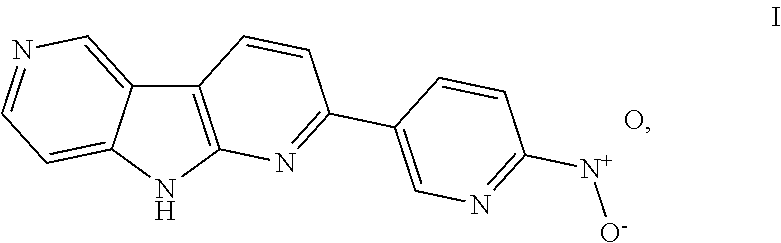
- the present invention relates to a process for preparation of 2-(6-nitropyridin-3-yl)-9H-dipyrido[2,3-b;3′,4′-d]pyrrole
- [ 18 F]-2-(6-Fluoro-pyridin-3-yl)-9H-dipyrido[2,3-b;3′,4′-d]pyrrole its processes for preparation and its use in binding and imaging of tau aggregates and related beta-sheet aggregates including besides other beta-amyloid aggregates or alpha-synuclein aggregates, especially for its use in binding and imaging of tau aggregates in Alzheimer's patients are described in WO2015/052105.
- TO triflyl group
- Ts tosyl group
- Ms mesyl group
- Bs brosyl group
- 9H-pyrrolo[2,3-b:4,5-c′]dipyridin-2-yl trifluoromethanesulfonate with a suitable boronic acid, a trifluoroborate or a boronic acid ester, such as 2-nitropyridine-5-boronic acid pinacol ester, under argon conditions and in the presence of catalytic amounts of a suitable transition metal complex, e.g.
- a palladium complex such as PdCl 2 (xantphos) or Pd 2 (dba) 3
- a suitable base such as potassium fluoride
- a polar solvent such as THF, 2-Me-THF or dioxane
- isolating the product as acid addition salt by treatment with any suitable acids such as acetic acid, trifluoroacetic acid, cinnamic acid, oxalic acid, tartaric acid, hydrochloric acid, hydrobromic acid, sulfuric acid or phosphoric acid, to afford the compound of formula Ia
- the acid HX comprises any suitable organic or inorganic acids, such as acetic acid, trifluoroacetic acid, cinnamic acid, oxalic acid, tartaric acid, hydrochloric acid, hydrobromic acid, sulfuric acid, phosphoric acid and the like, and x indicates that a stoichiometric equivalent of HX other than 1 may be present, into the compound of formula I
- a suitable base such as sodium or potassium hydroxide, trimethylamine, potassium carbonate, sodium bicarbonate, ammonia, triethylamine and the like.
- the compound of formula I can be manufactured by the methods given below, by the methods given in the examples or by analogous methods.
- Appropriate reaction conditions for the individual reaction steps are known to a person skilled in the art.
- the reaction sequence is not limited to the one displayed in scheme 1, however, depending on the starting materials and their respective reactivity the sequence of reaction steps can be freely altered.
- Starting materials are either commercially available or can be prepared by methods analogous to the methods given below, by methods described in references cited in the description or in the examples, or by methods known in the art.
- Tf Triflyl group, —SO 2 CF 3
- Ms Mesyl group, —SO 2 CH 3
- Ns Nosyl group, —SO 2 C 6 H 4 -o-NO 2
- PdCl 2 (xantphos) Dichloro[9,9-dimethyl-4,5-bis(diphenylphosphino)xanthene]palladium(II)
- Intramolecular cyclisation can be performed using a catalyst system like e.g.
- Final transformation into the compound of formula I can be done by a direct transition metal-catalyzed cross-coupling reaction using a suitable boronic acid, a trifluoroborate or a boronic acid ester such as 2-nitropyridine-5-boronic acid pinacol ester, a catalyst system such as PdCl 2 (xantphos) and a base such as potassium fluoride in a suitable solvent such as THF, 2-Me-THF or 1,4-dioxane at ambient or elevated temperature. Treatment with an acid such as acetic acid enables isolation of the product as salt such as acetate Ia.
- bases such as triethylamine in a solvent such as methanol or DMSO eventually liberates the compound of formula I as free base.
- bases such as sodium or potassium hydroxide, trimethylamine, potassium carbonate, sodium bicarbonate, ammonia, and the like.
- the above described 6-step synthesis route is based on readily available starting materials and reagents. It can be performed free of any chromatographic purification which is an important advantage for poorly soluble compounds as the intermediates and the final product described in scheme 1.
- the compound of formula I is obtained in >10% total isolated yield which corresponds to ⁇ 70% isolated yield for each reaction step. Further details can be found by reference to the preparations and examples herein below.
- Isolation and purification of the compounds and intermediates described herein can be performed, if desired, by any suitable separation or purification procedure such as, for example, filtration, extraction, crystallization, column chromatography, thin-layer chromatography, thick-layer chromatography, preparative low or high-pressure liquid chromatography or a combination of these procedures.
- suitable separation and isolation procedures can be found by reference to the preparations and examples herein below. However, other equivalent separation or isolation procedures could, of course, also be used.
- the compound of formula I is basic and may be converted to a corresponding acid addition salt.
- the conversion is accomplished by treatment with at least a stoichiometric amount of an appropriate acid, such as hydrochloric acid, hydrobromic acid, sulfuric acid, phosphoric acid and the like, and organic acids such as acetic acid, propionic acid, pyruvic acid, oxalic acid, malic acid, malonic acid, succinic acid, maleic acid, fumaric acid, tartaric acid, citric acid, benzoic acid, cinnamic acid, methanesulfonic acid, p-toluenesulfonic acid, salicylic acid and the like.
- an appropriate acid such as hydrochloric acid, hydrobromic acid, sulfuric acid, phosphoric acid and the like
- organic acids such as acetic acid, propionic acid, pyruvic acid, oxalic acid, malic acid, malonic acid, succinic acid, maleic acid, fumaric acid,
- the free base is dissolved in an organic solvent such as diethyl ether, ethyl acetate, chloroform, ethanol or methanol and the like, and the acid added in a similar solvent.
- organic solvent such as diethyl ether, ethyl acetate, chloroform, ethanol or methanol and the like.
- the temperature is maintained between 0° C. and 50° C.
- the resulting salt precipitates spontaneously or may be precipitated by addition of a less polar solvent.
- the acid addition salts of the compound of formula I may be converted to the corresponding free base by treatment with at least a stoichiometric equivalent of a suitable base such as sodium or potassium hydroxide, potassium carbonate, sodium bicarbonate, ammonia, triethylamine and the like.
- a suitable base such as sodium or potassium hydroxide, potassium carbonate, sodium bicarbonate, ammonia, triethylamine and the like.
- Dichloro[9,9-dimethyl-4,5-bis(diphenylphosphino)xanthene]palladium(II) (6.9 g, 9.13 mmol) in 1,4-dioxane (65 mL) was added and the reaction mixture was heated to 100° C. for 65 h.
- a second portion of cesium carbonate (20 g, 61 mmol) and dichloro[9,9-dimethyl-4,5-bis(diphenylphosphino)-xanthene]palladium(II) (2.0 g, 2.65 mmol) in 1,4-dioxane (20 mL) were added and stirring at 100° C. was continued for another 3 h.
- the formed crystalline material was filtered off, washed with a methanol/water mixture 1:2 (v/v) (180 mL) and subsequently dried at 65° C./5 mbar to obtain the desired product as light yellow solid (34.1 g, 80.6%).
- the white residue was washed consecutively with little ethyl acetate and n-heptane and subsequently dried at 60° C./5 mbar to obtain the desired product as white solid (7.6 g, 87.3%) which was used in the next step without further purification.
- the precipitate was filtered off and washed with water (50 mL) and n-heptane (50 mL) and was dried at 60° C./5 mbar to obtain the desired product as beige solid (7.4 g, 97.5%).
- the crude acetate (27 g) was suspended in acetic acid (540 mL) and water (27 mL) and heated to reflux.
- the hot and slightly turbid solution was hot (100° C.) filtrated particle-free under vacuo using a microfiber filter and the brown residue was washed with acetic acid (20 mL).
- the filtrate was warmed up again until a clear brown solution was present which was cooled to ambient temperature and stirred at that temperature for 18 h.
- the voluminous suspension was filtrated and the crystalline residue was washed consecutively with acetic acid/ethyl acetate 1:1 (150 mL), ethyl acetate (500 mL) and n-pentane (500 mL) and dried at 60° C./5 mbar to obtain 19.6 g of a dark yellow crude product (HPLC (260 nM) 99.5 area-%).
- the crude product was suspended in acetic acid (390 mL) and water (19.5 mL) and heated to reflux. The clear red solution was cooled to 80-90° C. and charged with charcoal (5 g).
- the crude product was treated with water (60 mL) and ultrasonicated until a homogeneous suspension was obtained. Water and residual methanol were evaporated at 22-25° C. (100-20 mbar) over a period of 16 h. The wet residue was dried at 60° C./5 mbar until constant weight and the product was obtained as yellow solid (12.5 g, 96.3%).
Landscapes
- Chemical & Material Sciences (AREA)
- Organic Chemistry (AREA)
- Nitrogen Condensed Heterocyclic Rings (AREA)
- Low-Molecular Organic Synthesis Reactions Using Catalysts (AREA)
- Pharmaceuticals Containing Other Organic And Inorganic Compounds (AREA)
- Polyoxymethylene Polymers And Polymers With Carbon-To-Carbon Bonds (AREA)
Abstract
Description

with 2-nitropyridine-5-boronic acid pinacol ester

with a combination of 1,1′-bis(diphenylphosphino)ferrocene-palladium(II)dichloride dichloromethane complex and K2CO3 in DMF.
-
- The present compound of formula I

can be prepared by processes described below, which processes comprise

for example

and

wherein the acid HX comprises any suitable organic or inorganic acids, such as acetic acid, trifluoroacetic acid, cinnamic acid, oxalic acid, tartaric acid, hydrochloric acid, hydrobromic acid, sulfuric acid, phosphoric acid and the like, and x indicates that a stoichiometric equivalent of HX other than 1 may be present,
into the compound of formula I

by treatment with at least a stoichiometric equivalent of a suitable base, such as sodium or potassium hydroxide, trimethylamine, potassium carbonate, sodium bicarbonate, ammonia, triethylamine and the like.

may then be obtained as described in WO2015/052105 by dissolving a compound of formula I

in dimethylsulfoxide and treating it with [18F]fluoride/K[2,2,2]/K2CO3.


Claims (15)


Applications Claiming Priority (4)
| Application Number | Priority Date | Filing Date | Title |
|---|---|---|---|
| EP16187960 | 2016-09-09 | ||
| EP16187960.6 | 2016-09-09 | ||
| EP16187960 | 2016-09-09 | ||
| PCT/EP2017/072062 WO2018046428A1 (en) | 2016-09-09 | 2017-09-04 | Process for preparation of 2-(6-nitropyridin-3-yl)-9h-dipyrido[2,3-b;3',4'-d]pyrrole |
Related Parent Applications (1)
| Application Number | Title | Priority Date | Filing Date |
|---|---|---|---|
| PCT/EP2017/072062 Continuation WO2018046428A1 (en) | 2016-09-09 | 2017-09-04 | Process for preparation of 2-(6-nitropyridin-3-yl)-9h-dipyrido[2,3-b;3',4'-d]pyrrole |
Publications (2)
| Publication Number | Publication Date |
|---|---|
| US20190300529A1 US20190300529A1 (en) | 2019-10-03 |
| US11306093B2 true US11306093B2 (en) | 2022-04-19 |
Family
ID=56936288
Family Applications (1)
| Application Number | Title | Priority Date | Filing Date |
|---|---|---|---|
| US16/294,627 Active US11306093B2 (en) | 2016-09-09 | 2019-03-06 | Process for preparation of 2-(6-nitropyridin-3-yl)-9H-dipyrido[2,3-b;3′,4′-d]pyrrole |
Country Status (17)
| Country | Link |
|---|---|
| US (1) | US11306093B2 (en) |
| EP (1) | EP3510031B1 (en) |
| JP (1) | JP6997769B2 (en) |
| KR (1) | KR102502701B1 (en) |
| CN (1) | CN109689653B (en) |
| AR (1) | AR109586A1 (en) |
| AU (1) | AU2017324297B2 (en) |
| BR (1) | BR112019004091B1 (en) |
| ES (1) | ES2847903T3 (en) |
| HR (1) | HRP20210145T1 (en) |
| IL (1) | IL265013B (en) |
| MX (1) | MX375720B (en) |
| PL (1) | PL3510031T3 (en) |
| SG (1) | SG11201901983PA (en) |
| SI (1) | SI3510031T1 (en) |
| TW (1) | TWI753009B (en) |
| WO (1) | WO2018046428A1 (en) |
Citations (14)
| Publication number | Priority date | Publication date | Assignee | Title |
|---|---|---|---|---|
| US20040224997A1 (en) | 2003-05-09 | 2004-11-11 | Bayer Pharmaceuticals Corporation | Preparation and use of aryl alkyl acid derivatives for the treatment of obesity |
| WO2006040451A2 (en) | 2004-10-11 | 2006-04-20 | Universite Claude Bernard Lyon I | Novel 9h-pyrido[2,3-b]indole derivatives serving as cdk and gsk3 inhibitors, method for the preparation thereof, and the pharmaceutical compositions containing such compounds |
| WO2009102498A1 (en) | 2008-02-14 | 2009-08-20 | Siemens Medical Solutions Usa, Inc. | Novel imaging agents for detecting neurological dysfunction |
| WO2009151589A1 (en) | 2008-06-11 | 2009-12-17 | Genentech, Inc. | Diazacarbazoles and methods of use |
| WO2010011964A2 (en) | 2008-07-24 | 2010-01-28 | Siemens Medical Solutions Usa, Inc. | Imaging agents useful for identifying ad pathology |
| US20100056491A1 (en) * | 2008-08-29 | 2010-03-04 | Memory Pharmaceuticals Corporation | 4'-amino cyclic compounds having 5-ht6 receptor affinity |
| US20100239496A1 (en) | 2009-03-23 | 2010-09-23 | Siemens Medical Solutions Usa, Inc. | Imaging agents for detecting neurological disorders |
| WO2011073263A1 (en) | 2009-12-16 | 2011-06-23 | F. Hoffmann-La Roche Ag | 1, 7 - diazacarbazoles and their use in the treatment of cancer |
| US20110182812A1 (en) | 2009-03-23 | 2011-07-28 | Siemens Medical Solutions Usa, Inc. | Imaging Agents for Detecting Neurological Disorders |
| US20120302755A1 (en) | 2008-02-14 | 2012-11-29 | Siemens Medical Solutions Usa, Inc. | Imaging Agents for Detecting Neurological Dysfunction |
| WO2013006634A2 (en) | 2011-07-05 | 2013-01-10 | Vertex Pharmaceuticals Incorporated | Processes and intermediates for producing azaindoles |
| WO2015052105A1 (en) | 2013-10-08 | 2015-04-16 | F. Hoffmann-La Roche Ag | Diazacarbazole derivatives as tau-pet-ligands |
| US20150368244A1 (en) | 2011-01-31 | 2015-12-24 | Genentech, Inc. | Diazacarbazoles and methods of use |
| WO2017042114A1 (en) | 2015-09-09 | 2017-03-16 | F. Hoffmann-La Roche Ag | Bridged piperidine derivatives |
Family Cites Families (2)
| Publication number | Priority date | Publication date | Assignee | Title |
|---|---|---|---|---|
| JP6034005B2 (en) * | 2011-08-03 | 2016-11-30 | 出光興産株式会社 | Biscarbazole derivative and organic electroluminescence device using the same |
| CN107207508B (en) * | 2015-02-02 | 2020-02-28 | Ucb生物制药私人有限公司 | 9H-pyrrolo-bipyridine derivatives |
-
2017
- 2017-09-04 MX MX2019002362A patent/MX375720B/en active IP Right Grant
- 2017-09-04 WO PCT/EP2017/072062 patent/WO2018046428A1/en not_active Ceased
- 2017-09-04 BR BR112019004091-9A patent/BR112019004091B1/en active IP Right Grant
- 2017-09-04 EP EP17768700.1A patent/EP3510031B1/en active Active
- 2017-09-04 PL PL17768700T patent/PL3510031T3/en unknown
- 2017-09-04 SI SI201730610T patent/SI3510031T1/en unknown
- 2017-09-04 ES ES17768700T patent/ES2847903T3/en active Active
- 2017-09-04 CN CN201780054464.2A patent/CN109689653B/en active Active
- 2017-09-04 SG SG11201901983PA patent/SG11201901983PA/en unknown
- 2017-09-04 HR HRP20210145TT patent/HRP20210145T1/en unknown
- 2017-09-04 KR KR1020197008785A patent/KR102502701B1/en active Active
- 2017-09-04 AU AU2017324297A patent/AU2017324297B2/en active Active
- 2017-09-04 JP JP2019513417A patent/JP6997769B2/en active Active
- 2017-09-08 AR ARP170102478A patent/AR109586A1/en active IP Right Grant
- 2017-09-08 TW TW106130720A patent/TWI753009B/en active
-
2019
- 2019-02-24 IL IL265013A patent/IL265013B/en unknown
- 2019-03-06 US US16/294,627 patent/US11306093B2/en active Active
Patent Citations (18)
| Publication number | Priority date | Publication date | Assignee | Title |
|---|---|---|---|---|
| US20040224997A1 (en) | 2003-05-09 | 2004-11-11 | Bayer Pharmaceuticals Corporation | Preparation and use of aryl alkyl acid derivatives for the treatment of obesity |
| WO2006040451A2 (en) | 2004-10-11 | 2006-04-20 | Universite Claude Bernard Lyon I | Novel 9h-pyrido[2,3-b]indole derivatives serving as cdk and gsk3 inhibitors, method for the preparation thereof, and the pharmaceutical compositions containing such compounds |
| US20110046378A1 (en) | 2008-02-14 | 2011-02-24 | Siemens Medical Solutions Usa, Inc. | Novel Imaging Agents for Detecting Neurological Dysfunction |
| WO2009102498A1 (en) | 2008-02-14 | 2009-08-20 | Siemens Medical Solutions Usa, Inc. | Novel imaging agents for detecting neurological dysfunction |
| US20120302755A1 (en) | 2008-02-14 | 2012-11-29 | Siemens Medical Solutions Usa, Inc. | Imaging Agents for Detecting Neurological Dysfunction |
| WO2009151589A1 (en) | 2008-06-11 | 2009-12-17 | Genentech, Inc. | Diazacarbazoles and methods of use |
| WO2010011964A2 (en) | 2008-07-24 | 2010-01-28 | Siemens Medical Solutions Usa, Inc. | Imaging agents useful for identifying ad pathology |
| US20100056491A1 (en) * | 2008-08-29 | 2010-03-04 | Memory Pharmaceuticals Corporation | 4'-amino cyclic compounds having 5-ht6 receptor affinity |
| WO2010111303A2 (en) | 2009-03-23 | 2010-09-30 | Siemens Medical Solutions Usa, Inc. | Imaging agents for detecting neurological disorders |
| US20100239496A1 (en) | 2009-03-23 | 2010-09-23 | Siemens Medical Solutions Usa, Inc. | Imaging agents for detecting neurological disorders |
| US20110182812A1 (en) | 2009-03-23 | 2011-07-28 | Siemens Medical Solutions Usa, Inc. | Imaging Agents for Detecting Neurological Disorders |
| WO2011073263A1 (en) | 2009-12-16 | 2011-06-23 | F. Hoffmann-La Roche Ag | 1, 7 - diazacarbazoles and their use in the treatment of cancer |
| US20150368244A1 (en) | 2011-01-31 | 2015-12-24 | Genentech, Inc. | Diazacarbazoles and methods of use |
| WO2013006634A2 (en) | 2011-07-05 | 2013-01-10 | Vertex Pharmaceuticals Incorporated | Processes and intermediates for producing azaindoles |
| WO2015052105A1 (en) | 2013-10-08 | 2015-04-16 | F. Hoffmann-La Roche Ag | Diazacarbazole derivatives as tau-pet-ligands |
| US10004817B2 (en) | 2013-10-08 | 2018-06-26 | Hoffmann-La Roche Inc. | Diazacarbazole derivatives as tau-PET-ligands |
| US11058781B2 (en) | 2013-10-08 | 2021-07-13 | Hoffmann-La Roche Inc. | Diazacarbazole derivatives as tau-PET-ligands |
| WO2017042114A1 (en) | 2015-09-09 | 2017-03-16 | F. Hoffmann-La Roche Ag | Bridged piperidine derivatives |
Non-Patent Citations (11)
| Title |
|---|
| "International Preliminary Report on Patentability—PCT/EP2017/072062":pp. 1-7 (dated Mar. 21, 2019). |
| "International Search Report—PCT/EP2017/072062":pp. 1-13 (dated Nov. 7, 2017). |
| Alonso, Tetrahedron, 2008, 64, 3047-3301. * |
| Bartels, B. et al., Development of a safe and scalable route towards a tau PET tracer precursor, Bioorg. Med. Chem. 26:970-976 (Jan. 1, 2018). |
| Beletskaya, Coordination Chemistry Reviews 385 (201 9) 137-173. * |
| Beletskaya, I., et al., "Review: the Suzuki-Miyaura reaction after the Nobel prize" Coord Chem Reviews 385:137-173 (Apr. 15, 2019). |
| Gobbi, L., et al., "Identification of Three Novel Radiotracers for Imaging Aggregated Tau in Alzheimer's Disease with Positron Emission Tomography" J Med Chem 60:7350-7370 (Jun. 27, 2017). |
| Honer, M., et al., "Preclinical Evaluation of 18F-RO6958948, 11C-RO6931643, and 11C-RO6924963 as Novel PET Radiotracers for Imaging Tau Aggregates in Alzheimer Disease" J Nucl Med 59:675-681 (Jun. 6, 2017). |
| Kassanova Russian Chemical Bulletin, International Edition, vol. 65, No. 11, pp. 2559-2567, Nov. 2016. * |
| Kassanova, A., et al., "Pyridinyl trifluoromethanesulfonates: preparation methods and use in organic synthesis" Russian Chem Bulletin 65(11):2559-2567 (Nov. 1, 2016). |
| Quan, Eur. J. Org. Chem. 2013, 7175-7183. * |
Also Published As
| Publication number | Publication date |
|---|---|
| SI3510031T1 (en) | 2021-03-31 |
| TWI753009B (en) | 2022-01-21 |
| AR109586A1 (en) | 2018-12-26 |
| EP3510031A1 (en) | 2019-07-17 |
| AU2017324297B2 (en) | 2021-08-05 |
| JP6997769B2 (en) | 2022-02-10 |
| CA3035624A1 (en) | 2018-03-15 |
| MX2019002362A (en) | 2019-06-17 |
| HRP20210145T1 (en) | 2021-03-05 |
| BR112019004091B1 (en) | 2023-02-14 |
| IL265013B (en) | 2021-09-30 |
| CN109689653B (en) | 2022-04-12 |
| SG11201901983PA (en) | 2019-04-29 |
| US20190300529A1 (en) | 2019-10-03 |
| WO2018046428A1 (en) | 2018-03-15 |
| MX375720B (en) | 2025-03-04 |
| TW201811787A (en) | 2018-04-01 |
| PL3510031T3 (en) | 2021-05-31 |
| KR102502701B1 (en) | 2023-02-23 |
| EP3510031B1 (en) | 2020-12-02 |
| KR20190044648A (en) | 2019-04-30 |
| CN109689653A (en) | 2019-04-26 |
| JP2019529401A (en) | 2019-10-17 |
| ES2847903T3 (en) | 2021-08-04 |
| BR112019004091A2 (en) | 2019-05-28 |
| AU2017324297A1 (en) | 2019-03-14 |
Similar Documents
| Publication | Publication Date | Title |
|---|---|---|
| DK2641897T3 (en) | A process for the preparation of 6- (7 - ((1-aminocyclopropyl) methoxy) -6-methoxy-quinolin-4-yloxy) -N-methyl-1-naphthamide and synthetic intermediates thereof | |
| US20090306388A1 (en) | Method for substituted ih-imidazo[4,5-c] pyridines | |
| CA2602853A1 (en) | Ring closing and related methods and intermediates | |
| CA3009669A1 (en) | Bruton's tyrosine kinase inhibitors | |
| WO2016110224A1 (en) | Preparation method for bemaciclib | |
| US20090247755A1 (en) | Process for Preparing a Substituted Imidazopyridine Compound | |
| US20230278960A1 (en) | Novel acridinium salt and method for producing same | |
| US11306093B2 (en) | Process for preparation of 2-(6-nitropyridin-3-yl)-9H-dipyrido[2,3-b;3′,4′-d]pyrrole | |
| CN102149706A (en) | Antineoplastic derivatives of 4-oxo-L,4-dihydro-quinolines, their preparation and their therapeutic use | |
| CA3035624C (en) | Process for preparation of 2-(6-nitropyridin-3-yl)-9h-dipyrido[2,3-b;3',4'-d]pyrrole | |
| EP1791539A1 (en) | Process to prepare camptothecin derivatives | |
| JPH0641135A (en) | Imidazopteridine derivative and its production | |
| CN117062809B (en) | Bicyclic heterocyclic FGFR4 inhibitors, pharmaceutical compositions and formulations containing them, and their applications. | |
| WO2016150396A1 (en) | Process of synthesizing substituted pyridine and pyrimidine compound | |
| CN104592222A (en) | Preparation method for antiplatelet medicine AZD6482 | |
| US6706885B2 (en) | Process for preparing integrin antagonist intermediates | |
| HK40002501A (en) | Process for preparation of 2-(6-nitropyridin-3-yl)-9h-dipyrido[2,3-b;3',4'-d]pyrrole | |
| HK40002501B (en) | Process for preparation of 2-(6-nitropyridin-3-yl)-9h-dipyrido[2,3-b;3',4'-d]pyrrole | |
| US6774231B2 (en) | Method for the preparation of oxazolidinones | |
| US6900324B2 (en) | Process for preparing a substituted imidazopyridine compound | |
| CN117003734A (en) | Pyrimidinocyclic derivatives and their preparation methods and uses | |
| WO2022091001A1 (en) | Process for preparation of palbociclib | |
| HK1167136B (en) | A process for the preparation of 6-(7-((1-aminocyclopropyl)methoxy)-6-methoxyquinolin-4-yloxy)-n-methyl-1-naphthamide and synthetic intermediates thereof |
Legal Events
| Date | Code | Title | Description |
|---|---|---|---|
| FEPP | Fee payment procedure |
Free format text: ENTITY STATUS SET TO UNDISCOUNTED (ORIGINAL EVENT CODE: BIG.); ENTITY STATUS OF PATENT OWNER: LARGE ENTITY |
|
| AS | Assignment |
Owner name: HOFFMANN-LA ROCHE INC., NEW JERSEY Free format text: ASSIGNMENT OF ASSIGNORS INTEREST;ASSIGNOR:F. HOFFMANN-LA ROCHE AG;REEL/FRAME:049017/0363 Effective date: 20190225 Owner name: F. HOFFMANN-LA ROCHE AG, SWITZERLAND Free format text: ASSIGNMENT OF ASSIGNORS INTEREST;ASSIGNORS:BARTELS, BJOERN;CUENI, PHILIPP;KOERNER, MATTHIAS;AND OTHERS;SIGNING DATES FROM 20170105 TO 20170111;REEL/FRAME:049017/0334 |
|
| STPP | Information on status: patent application and granting procedure in general |
Free format text: NON FINAL ACTION MAILED |
|
| STPP | Information on status: patent application and granting procedure in general |
Free format text: RESPONSE TO NON-FINAL OFFICE ACTION ENTERED AND FORWARDED TO EXAMINER |
|
| STPP | Information on status: patent application and granting procedure in general |
Free format text: FINAL REJECTION MAILED |
|
| STPP | Information on status: patent application and granting procedure in general |
Free format text: DOCKETED NEW CASE - READY FOR EXAMINATION |
|
| STPP | Information on status: patent application and granting procedure in general |
Free format text: NON FINAL ACTION MAILED |
|
| STPP | Information on status: patent application and granting procedure in general |
Free format text: RESPONSE TO NON-FINAL OFFICE ACTION ENTERED AND FORWARDED TO EXAMINER |
|
| STPP | Information on status: patent application and granting procedure in general |
Free format text: NOTICE OF ALLOWANCE MAILED -- APPLICATION RECEIVED IN OFFICE OF PUBLICATIONS |
|
| STPP | Information on status: patent application and granting procedure in general |
Free format text: DOCKETED NEW CASE - READY FOR EXAMINATION |
|
| STPP | Information on status: patent application and granting procedure in general |
Free format text: NOTICE OF ALLOWANCE MAILED -- APPLICATION RECEIVED IN OFFICE OF PUBLICATIONS |
|
| STPP | Information on status: patent application and granting procedure in general |
Free format text: PUBLICATIONS -- ISSUE FEE PAYMENT VERIFIED |
|
| STCF | Information on status: patent grant |
Free format text: PATENTED CASE |
|
| MAFP | Maintenance fee payment |
Free format text: PAYMENT OF MAINTENANCE FEE, 4TH YEAR, LARGE ENTITY (ORIGINAL EVENT CODE: M1551); ENTITY STATUS OF PATENT OWNER: LARGE ENTITY Year of fee payment: 4 |