US11304954B2 - Lipid prodrugs of mycophenolic acid and uses thereof - Google Patents
Lipid prodrugs of mycophenolic acid and uses thereof Download PDFInfo
- Publication number
- US11304954B2 US11304954B2 US16/955,162 US201816955162A US11304954B2 US 11304954 B2 US11304954 B2 US 11304954B2 US 201816955162 A US201816955162 A US 201816955162A US 11304954 B2 US11304954 B2 US 11304954B2
- Authority
- US
- United States
- Prior art keywords
- disease
- acid
- syndrome
- independently selected
- sulfur
- Prior art date
- Legal status (The legal status is an assumption and is not a legal conclusion. Google has not performed a legal analysis and makes no representation as to the accuracy of the status listed.)
- Active
Links
- 0 *.[1*]OCC(CO[2*])C[Y]*C Chemical compound *.[1*]OCC(CO[2*])C[Y]*C 0.000 description 83
- RBTLXSZOCRPICY-GGGSGSEDSA-N CCCCCCCCCCCCCCCC(=O)OCC(COC(=O)CCCCCCCCCCCCCCC)OC(=O)COC(=O)CC/C(C)=C/Cc1c(O)c2c(c(C)c1OC)COC2=O Chemical compound CCCCCCCCCCCCCCCC(=O)OCC(COC(=O)CCCCCCCCCCCCCCC)OC(=O)COC(=O)CC/C(C)=C/Cc1c(O)c2c(c(C)c1OC)COC2=O RBTLXSZOCRPICY-GGGSGSEDSA-N 0.000 description 10
- KTMHDXCGJCAEMW-XUVIPLOZSA-N CCCCCCCCCCCCCCCC(=O)OCC(COC(=O)CCCCCCCCCCCCCCC)OC(=O)CC(C)CCCC(=O)Oc1c(C/C=C(\C)CCC(=O)OC)c(OC)c(C)c2c1C(=O)OC2 Chemical compound CCCCCCCCCCCCCCCC(=O)OCC(COC(=O)CCCCCCCCCCCCCCC)OC(=O)CC(C)CCCC(=O)Oc1c(C/C=C(\C)CCC(=O)OC)c(OC)c(C)c2c1C(=O)OC2 KTMHDXCGJCAEMW-XUVIPLOZSA-N 0.000 description 6
- OKAJITUFRWHTRL-AESNPLDJSA-N C=CCOc1c(C/C=C(\C)CCC(=O)OCC(=O)OC(COC(=O)CCCCCCCCCCCCCCC)COC(=O)CCCCCCCCCCCCCCC)c(OC)c(C)c2c1C(=O)OC2 Chemical compound C=CCOc1c(C/C=C(\C)CCC(=O)OCC(=O)OC(COC(=O)CCCCCCCCCCCCCCC)COC(=O)CCCCCCCCCCCCCCC)c(OC)c(C)c2c1C(=O)OC2 OKAJITUFRWHTRL-AESNPLDJSA-N 0.000 description 4
- HGRSSHYAOHSPSM-CABCVRRESA-N CC(C)C[C@@H](CCCNC(N)=O)C(=O)N[C@H](C(=O)C(C)C)C(C)C Chemical compound CC(C)C[C@@H](CCCNC(N)=O)C(=O)N[C@H](C(=O)C(C)C)C(C)C HGRSSHYAOHSPSM-CABCVRRESA-N 0.000 description 4
- XRVZOHABFBUZLX-GJZGRUSLSA-N CC(C)C[C@H](C(=O)N[C@@H](CCCNC(N)=O)C(=O)C(C)C)C(C)C Chemical compound CC(C)C[C@H](C(=O)N[C@@H](CCCNC(N)=O)C(=O)C(C)C)C(C)C XRVZOHABFBUZLX-GJZGRUSLSA-N 0.000 description 4
- XSGWYISHISJAGS-XPDNMOIQSA-N CC(C)N[C@@H](C)C(=O)C(C)C.CC(C)N[C@@H](CC1=CCc2ccccc21)C(=O)C(C)C.CC(C)N[C@@H](CCCNC(N)=O)C(=O)C(C)C.CC(C)N[C@@H](CCCNC(N)=O)C(=O)C(C)C.CC(C)N[C@@H](Cc1c[nH]c2ccccc12)C(=O)C(C)C.CC(C)N[C@H](C(=O)C(C)C)C(C)C.CC(C)N[C@H](C(=O)C(C)C)C(C)C.CC(C)N[C@H](C)C(=O)C(C)C Chemical compound CC(C)N[C@@H](C)C(=O)C(C)C.CC(C)N[C@@H](CC1=CCc2ccccc21)C(=O)C(C)C.CC(C)N[C@@H](CCCNC(N)=O)C(=O)C(C)C.CC(C)N[C@@H](CCCNC(N)=O)C(=O)C(C)C.CC(C)N[C@@H](Cc1c[nH]c2ccccc12)C(=O)C(C)C.CC(C)N[C@H](C(=O)C(C)C)C(C)C.CC(C)N[C@H](C(=O)C(C)C)C(C)C.CC(C)N[C@H](C)C(=O)C(C)C XSGWYISHISJAGS-XPDNMOIQSA-N 0.000 description 4
- QFZFGJMXPJQJGC-MYGQCYSGSA-N CCCCCCCCCCCCCCCC(=O)OCC(COC(=O)CCCCCCCCCCCCCCC)OC(=O)CC/C(C)=C/Cc1c(O)c2c(c(C)c1OC)COC2=O Chemical compound CCCCCCCCCCCCCCCC(=O)OCC(COC(=O)CCCCCCCCCCCCCCC)OC(=O)CC/C(C)=C/Cc1c(O)c2c(c(C)c1OC)COC2=O QFZFGJMXPJQJGC-MYGQCYSGSA-N 0.000 description 4
- KTRDQJAXAGSTIB-VQTQHTQLSA-N CCCCCCCCCCCCCCCC(=O)OCC(COC(=O)CCCCCCCCCCCCCCC)OC(=O)CCCCCC(=O)Oc1c(C/C=C(\C)CCC(=O)OC)c(OC)c(C)c2c1C(=O)OC2 Chemical compound CCCCCCCCCCCCCCCC(=O)OCC(COC(=O)CCCCCCCCCCCCCCC)OC(=O)CCCCCC(=O)Oc1c(C/C=C(\C)CCC(=O)OC)c(OC)c(C)c2c1C(=O)OC2 KTRDQJAXAGSTIB-VQTQHTQLSA-N 0.000 description 4
- NNNQTEBPZYCPTL-GGGSGSEDSA-N CCCCCCCCCCCCCCCC(=O)OCC(COC(=O)CCCCCCCCCCCCCCC)OCOC(=O)CC/C(C)=C/Cc1c(O)c2c(c(C)c1OC)COC2=O Chemical compound CCCCCCCCCCCCCCCC(=O)OCC(COC(=O)CCCCCCCCCCCCCCC)OCOC(=O)CC/C(C)=C/Cc1c(O)c2c(c(C)c1OC)COC2=O NNNQTEBPZYCPTL-GGGSGSEDSA-N 0.000 description 4
- JKTVATCWKCGRGC-JSBYTUSLSA-N CCCCCCCCCCCCCCCC(=O)OCC(COC(=O)CCCCCCCCCCCCCCC)OC(=O)C(C)(C)CCCCCCCC(=O)Oc1c(C/C=C(\C)CCC(=O)OC)c(OC)c(C)c2c1C(=O)OC2 Chemical compound CCCCCCCCCCCCCCCC(=O)OCC(COC(=O)CCCCCCCCCCCCCCC)OC(=O)C(C)(C)CCCCCCCC(=O)Oc1c(C/C=C(\C)CCC(=O)OC)c(OC)c(C)c2c1C(=O)OC2 JKTVATCWKCGRGC-JSBYTUSLSA-N 0.000 description 3
- WAYKDTXULLOBCW-KZMWYPEZSA-N CCCCCCCCCCCCCCCC(=O)OCC(COC(=O)CCCCCCCCCCCCCCC)OC(=O)C(C)CCCCCCC(C)C(=O)Oc1c(C/C=C(\C)CCC(=O)OC)c(OC)c(C)c2c1C(=O)OC2 Chemical compound CCCCCCCCCCCCCCCC(=O)OCC(COC(=O)CCCCCCCCCCCCCCC)OC(=O)C(C)CCCCCCC(C)C(=O)Oc1c(C/C=C(\C)CCC(=O)OC)c(OC)c(C)c2c1C(=O)OC2 WAYKDTXULLOBCW-KZMWYPEZSA-N 0.000 description 3
- BWZGGTSIRJFBSH-KZMWYPEZSA-N CCCCCCCCCCCCCCCC(=O)OCC(COC(=O)CCCCCCCCCCCCCCC)OC(=O)C(C)CCCCCCCC(=O)Oc1c(C/C=C(\C)CCC(=O)OC)c(OC)c(C)c2c1C(=O)OC2 Chemical compound CCCCCCCCCCCCCCCC(=O)OCC(COC(=O)CCCCCCCCCCCCCCC)OC(=O)C(C)CCCCCCCC(=O)Oc1c(C/C=C(\C)CCC(=O)OC)c(OC)c(C)c2c1C(=O)OC2 BWZGGTSIRJFBSH-KZMWYPEZSA-N 0.000 description 3
- LFEKAFGSPLGHSG-NTPVXQSTSA-N CCCCCCCCCCCCCCCC(=O)OCC(COC(=O)CCCCCCCCCCCCCCC)OC(=O)C(C)CCCCCCCCCC(=O)Oc1c(C/C=C(\C)CCC(=O)OC)c(OC)c(C)c2c1C(=O)OC2 Chemical compound CCCCCCCCCCCCCCCC(=O)OCC(COC(=O)CCCCCCCCCCCCCCC)OC(=O)C(C)CCCCCCCCCC(=O)Oc1c(C/C=C(\C)CCC(=O)OC)c(OC)c(C)c2c1C(=O)OC2 LFEKAFGSPLGHSG-NTPVXQSTSA-N 0.000 description 3
- BETONKXFSXDBNA-KATVXPOZSA-N CCCCCCCCCCCCCCCC(=O)OCC(COC(=O)CCCCCCCCCCCCCCC)OC(=O)CC(C)CCCCCCCC(C)C(=O)OC(C)Oc1c(C/C=C(\C)CCC(=O)OC)c(OC)c(C)c2c1C(=O)OC2 Chemical compound CCCCCCCCCCCCCCCC(=O)OCC(COC(=O)CCCCCCCCCCCCCCC)OC(=O)CC(C)CCCCCCCC(C)C(=O)OC(C)Oc1c(C/C=C(\C)CCC(=O)OC)c(OC)c(C)c2c1C(=O)OC2 BETONKXFSXDBNA-KATVXPOZSA-N 0.000 description 3
- OHEBDXVNWJUMCJ-COQZMCHFSA-N CCCCCCCCCCCCCCCC(=O)OCC(COC(=O)CCCCCCCCCCCCCCC)OC(=O)CC(C)CCCCCCCC(C)C(=O)OCCCC(=O)Oc1c(C/C=C(\C)CCC(=O)OC)c(OC)c(C)c2c1C(=O)OC2 Chemical compound CCCCCCCCCCCCCCCC(=O)OCC(COC(=O)CCCCCCCCCCCCCCC)OC(=O)CC(C)CCCCCCCC(C)C(=O)OCCCC(=O)Oc1c(C/C=C(\C)CCC(=O)OC)c(OC)c(C)c2c1C(=O)OC2 OHEBDXVNWJUMCJ-COQZMCHFSA-N 0.000 description 3
- PBYRBSVUEBXRHX-FVHAFUQPSA-N CCCCCCCCCCCCCCCC(=O)OCC(COC(=O)CCCCCCCCCCCCCCC)OC(=O)CC(C)CCCCCCCC(C)C(=O)OCOc1c(C/C=C(\C)CCC(=O)OC)c(OC)c(C)c2c1C(=O)OC2 Chemical compound CCCCCCCCCCCCCCCC(=O)OCC(COC(=O)CCCCCCCCCCCCCCC)OC(=O)CC(C)CCCCCCCC(C)C(=O)OCOc1c(C/C=C(\C)CCC(=O)OC)c(OC)c(C)c2c1C(=O)OC2 PBYRBSVUEBXRHX-FVHAFUQPSA-N 0.000 description 3
- HCMBTNUFKIHJGE-CCHJLRPZSA-N CCCCCCCCCCCCCCCC(=O)OCC(COC(=O)CCCCCCCCCCCCCCC)OC(=O)CC(C)CCCCCCCC(C)C(=O)Oc1ccc(COc2c(C/C=C(\C)CCC(=O)OC)c(OC)c(C)c3c2C(=O)OC3)cc1 Chemical compound CCCCCCCCCCCCCCCC(=O)OCC(COC(=O)CCCCCCCCCCCCCCC)OC(=O)CC(C)CCCCCCCC(C)C(=O)Oc1ccc(COc2c(C/C=C(\C)CCC(=O)OC)c(OC)c(C)c3c2C(=O)OC3)cc1 HCMBTNUFKIHJGE-CCHJLRPZSA-N 0.000 description 3
- PQDWTIIULHZBNW-HJZXASKDSA-N CCCCCCCCCCCCCCCC(=O)OCC(COC(=O)CCCCCCCCCCCCCCC)OC(=O)CC(C)COC(=O)CC/C(C)=C/Cc1c(O)c2c(c(C)c1OC)COC2=O Chemical compound CCCCCCCCCCCCCCCC(=O)OCC(COC(=O)CCCCCCCCCCCCCCC)OC(=O)CC(C)COC(=O)CC/C(C)=C/Cc1c(O)c2c(c(C)c1OC)COC2=O PQDWTIIULHZBNW-HJZXASKDSA-N 0.000 description 3
- FDCJKCSUSBSKQE-HJZXASKDSA-N CCCCCCCCCCCCCCCC(=O)OCC(COC(=O)CCCCCCCCCCCCCCC)OC(=O)CCC(=O)Oc1c(C/C=C(\C)CCC(=O)OC)c(OC)c(C)c2c1C(=O)OC2 Chemical compound CCCCCCCCCCCCCCCC(=O)OCC(COC(=O)CCCCCCCCCCCCCCC)OC(=O)CCC(=O)Oc1c(C/C=C(\C)CCC(=O)OC)c(OC)c(C)c2c1C(=O)OC2 FDCJKCSUSBSKQE-HJZXASKDSA-N 0.000 description 3
- AIIULHBAHXATTE-DMRQBMQDSA-N CCCCCCCCCCCCCCCC(=O)OCC(COC(=O)CCCCCCCCCCCCCCC)OC(=O)CCC(=O)Oc1cc(C)cc(C)c1C(C)(C)CC(=O)Oc1c(C/C=C(\C)CCC(=O)OC)c(OC)c(C)c2c1C(=O)OC2 Chemical compound CCCCCCCCCCCCCCCC(=O)OCC(COC(=O)CCCCCCCCCCCCCCC)OC(=O)CCC(=O)Oc1cc(C)cc(C)c1C(C)(C)CC(=O)Oc1c(C/C=C(\C)CCC(=O)OC)c(OC)c(C)c2c1C(=O)OC2 AIIULHBAHXATTE-DMRQBMQDSA-N 0.000 description 3
- CXLJTUGVYDHHMS-MRRCHDRASA-N CCCCCCCCCCCCCCCC(=O)OCC(COC(=O)CCCCCCCCCCCCCCC)OC(=O)CCCCC(=O)Oc1c(C/C=C(\C)CCC(=O)OC)c(OC)c(C)c2c1C(=O)OC2 Chemical compound CCCCCCCCCCCCCCCC(=O)OCC(COC(=O)CCCCCCCCCCCCCCC)OC(=O)CCCCC(=O)Oc1c(C/C=C(\C)CCC(=O)OC)c(OC)c(C)c2c1C(=O)OC2 CXLJTUGVYDHHMS-MRRCHDRASA-N 0.000 description 3
- DZCASHSRMIIZFU-JGWAKSOCSA-N CCCCCCCCCCCCCCCC(=O)OCC(COC(=O)CCCCCCCCCCCCCCC)OC(=O)CCCCCCCCCCCCCC(=O)Oc1c(C/C=C(\C)CCC(=O)OC)c(OC)c(C)c2c1C(=O)OC2 Chemical compound CCCCCCCCCCCCCCCC(=O)OCC(COC(=O)CCCCCCCCCCCCCCC)OC(=O)CCCCCCCCCCCCCC(=O)Oc1c(C/C=C(\C)CCC(=O)OC)c(OC)c(C)c2c1C(=O)OC2 DZCASHSRMIIZFU-JGWAKSOCSA-N 0.000 description 3
- NNPPMTNAJDCUHE-UHFFFAOYSA-N *.CC(C)C Chemical compound *.CC(C)C NNPPMTNAJDCUHE-UHFFFAOYSA-N 0.000 description 2
- RRMFEWMHDGMXGT-UNMCSNQZSA-N CC(C)C[C@@H](CC1=CCc2ccccc21)C(=O)N[C@@H](CCCNC(N)=O)C(=O)C(C)C Chemical compound CC(C)C[C@@H](CC1=CCc2ccccc21)C(=O)N[C@@H](CCCNC(N)=O)C(=O)C(C)C RRMFEWMHDGMXGT-UNMCSNQZSA-N 0.000 description 2
- SGXPZVPRSLGYTP-UTKZUKDTSA-N CC(C)C[C@@H](CCCNC(N)=O)C(=O)N[C@@H](Cc1c[nH]c2ccccc12)C(=O)C(C)C Chemical compound CC(C)C[C@@H](CCCNC(N)=O)C(=O)N[C@@H](Cc1c[nH]c2ccccc12)C(=O)C(C)C SGXPZVPRSLGYTP-UTKZUKDTSA-N 0.000 description 2
- ORXXYMFNHUIXEM-UWJYYQICSA-N CC(C)C[C@@H](Cc1c[nH]c2ccccc12)C(=O)N[C@@H](CCCNC(N)=O)C(=O)C(C)C Chemical compound CC(C)C[C@@H](Cc1c[nH]c2ccccc12)C(=O)N[C@@H](CCCNC(N)=O)C(=O)C(C)C ORXXYMFNHUIXEM-UWJYYQICSA-N 0.000 description 2
- QYSYKNPYCWWIJP-ZMHLFUDKSA-N CC(C)N[C@@H](CC1=CCc2ccccc21)C(=O)C(C)C.CC(C)N[C@@H](CCCNC(N)=O)C(=O)C(C)C.CC(C)N[C@@H](CCCNC(N)=O)C(=O)C(C)C.CC(C)N[C@@H](Cc1c[nH]c2ccccc12)C(=O)C(C)C.CC(C)N[C@H](C(=O)C(C)C)C(C)C.CC(C)N[C@H](C(=O)C(C)C)C(C)C Chemical compound CC(C)N[C@@H](CC1=CCc2ccccc21)C(=O)C(C)C.CC(C)N[C@@H](CCCNC(N)=O)C(=O)C(C)C.CC(C)N[C@@H](CCCNC(N)=O)C(=O)C(C)C.CC(C)N[C@@H](Cc1c[nH]c2ccccc12)C(=O)C(C)C.CC(C)N[C@H](C(=O)C(C)C)C(C)C.CC(C)N[C@H](C(=O)C(C)C)C(C)C QYSYKNPYCWWIJP-ZMHLFUDKSA-N 0.000 description 2
- FSGZJGKGTKRVNS-DFKUXCBWSA-N CCCC(=O)OCC(COC(=O)CCC)OC(=O)CC(C)CCCCCCCCCCCCOC(=O)CC/C(C)=C/Cc1c(O)c2c(c(C)c1OC)COC2=O Chemical compound CCCC(=O)OCC(COC(=O)CCC)OC(=O)CC(C)CCCCCCCCCCCCOC(=O)CC/C(C)=C/Cc1c(O)c2c(c(C)c1OC)COC2=O FSGZJGKGTKRVNS-DFKUXCBWSA-N 0.000 description 2
- IAVXSVWWDKPTPH-SKBMRRIZSA-N CCCCCCCC/C=C\CCCCCCCC(=O)OCC(COC(=O)CCCCCCC/C=C\CCCCCCCC)OC(=O)CCCCCCCCC(=O)Oc1c(C/C=C(\C)CCC(=O)OC)c(OC)c(C)c2c1C(=O)OC2 Chemical compound CCCCCCCC/C=C\CCCCCCCC(=O)OCC(COC(=O)CCCCCCC/C=C\CCCCCCCC)OC(=O)CCCCCCCCC(=O)Oc1c(C/C=C(\C)CCC(=O)OC)c(OC)c(C)c2c1C(=O)OC2 IAVXSVWWDKPTPH-SKBMRRIZSA-N 0.000 description 2
- WTCPRINLDXVWGM-WMDVDSBJSA-N CCCCCCCCCCCCCCCC(=O)OCC(COC(=O)CCCCCCCCCCCCCCC)OC(=O)C(C)CCC(C)C(=O)Oc1cc(C)cc(C)c1C(C)(C)CC(=O)Oc1c(C/C=C(\C)CCC(=O)OC)c(OC)c(C)c2c1C(=O)OC2 Chemical compound CCCCCCCCCCCCCCCC(=O)OCC(COC(=O)CCCCCCCCCCCCCCC)OC(=O)C(C)CCC(C)C(=O)Oc1cc(C)cc(C)c1C(C)(C)CC(=O)Oc1c(C/C=C(\C)CCC(=O)OC)c(OC)c(C)c2c1C(=O)OC2 WTCPRINLDXVWGM-WMDVDSBJSA-N 0.000 description 2
- SCNNFMVRGAGBCR-SPFZYFMVSA-N CCCCCCCCCCCCCCCC(=O)OCC(COC(=O)CCCCCCCCCCCCCCC)OC(=O)C(C)CCCCCCCCC(=O)Oc1c(C/C=C(\C)CCC(=O)OC)c(OC)c(C)c2c1C(=O)OC2 Chemical compound CCCCCCCCCCCCCCCC(=O)OCC(COC(=O)CCCCCCCCCCCCCCC)OC(=O)C(C)CCCCCCCCC(=O)Oc1c(C/C=C(\C)CCC(=O)OC)c(OC)c(C)c2c1C(=O)OC2 SCNNFMVRGAGBCR-SPFZYFMVSA-N 0.000 description 2
- AQNAOSPFIQLWKF-YVUJEYQCSA-N CCCCCCCCCCCCCCCC(=O)OCC(COC(=O)CCCCCCCCCCCCCCC)OC(=O)C(C)CCCCCCCCC(C)C(=O)OC(C)Oc1c(C/C=C(\C)CCC(=O)OC)c(OC)c(C)c2c1C(=O)OC2 Chemical compound CCCCCCCCCCCCCCCC(=O)OCC(COC(=O)CCCCCCCCCCCCCCC)OC(=O)C(C)CCCCCCCCC(C)C(=O)OC(C)Oc1c(C/C=C(\C)CCC(=O)OC)c(OC)c(C)c2c1C(=O)OC2 AQNAOSPFIQLWKF-YVUJEYQCSA-N 0.000 description 2
- ZIPHKBIBSGAACC-KATVXPOZSA-N CCCCCCCCCCCCCCCC(=O)OCC(COC(=O)CCCCCCCCCCCCCCC)OC(=O)C(C)CCCCCCCCC(C)C(=O)OCOc1c(C/C=C(\C)CCC(=O)OC)c(OC)c(C)c2c1C(=O)OC2 Chemical compound CCCCCCCCCCCCCCCC(=O)OCC(COC(=O)CCCCCCCCCCCCCCC)OC(=O)C(C)CCCCCCCCC(C)C(=O)OCOc1c(C/C=C(\C)CCC(=O)OC)c(OC)c(C)c2c1C(=O)OC2 ZIPHKBIBSGAACC-KATVXPOZSA-N 0.000 description 2
- INGIPKYKWRVPEE-NTPVXQSTSA-N CCCCCCCCCCCCCCCC(=O)OCC(COC(=O)CCCCCCCCCCCCCCC)OC(=O)C(C)CCCCCCCCC(C)C(=O)Oc1c(C/C=C(\C)CCC(=O)OC)c(OC)c(C)c2c1C(=O)OC2 Chemical compound CCCCCCCCCCCCCCCC(=O)OCC(COC(=O)CCCCCCCCCCCCCCC)OC(=O)C(C)CCCCCCCCC(C)C(=O)Oc1c(C/C=C(\C)CCC(=O)OC)c(OC)c(C)c2c1C(=O)OC2 INGIPKYKWRVPEE-NTPVXQSTSA-N 0.000 description 2
- FYZXNHASTFPZJV-UHFFFAOYSA-N CCCCCCCCCCCCCCCC(=O)OCC(COC(=O)CCCCCCCCCCCCCCC)OC(=O)CBr.CCCCCCCCCCCCCCCC(=O)OCC(O)COC(=O)CCCCCCCCCCCCCCC.O=C(O)CBr Chemical compound CCCCCCCCCCCCCCCC(=O)OCC(COC(=O)CCCCCCCCCCCCCCC)OC(=O)CBr.CCCCCCCCCCCCCCCC(=O)OCC(O)COC(=O)CCCCCCCCCCCCCCC.O=C(O)CBr FYZXNHASTFPZJV-UHFFFAOYSA-N 0.000 description 2
- SCEJMLXAAHVQAJ-UHFFFAOYSA-N CCCCCCCCCCCCCCCC(=O)OCC(COC(=O)CCCCCCCCCCCCCCC)OC(=O)CC(=O)O.CCCCCCCCCCCCCCCC(=O)OCC(O)COC(=O)CCCCCCCCCCCCCCC.O=C(Cl)CC(=O)Cl Chemical compound CCCCCCCCCCCCCCCC(=O)OCC(COC(=O)CCCCCCCCCCCCCCC)OC(=O)CC(=O)O.CCCCCCCCCCCCCCCC(=O)OCC(O)COC(=O)CCCCCCCCCCCCCCC.O=C(Cl)CC(=O)Cl SCEJMLXAAHVQAJ-UHFFFAOYSA-N 0.000 description 2
- OYXMDCPXWDDOIC-OFHZLOOGSA-N CCCCCCCCCCCCCCCC(=O)OCC(COC(=O)CCCCCCCCCCCCCCC)OC(=O)CC(C)CCC(C)C(=O)OCCCCC(=O)Oc1c(C/C=C(\C)CCC(=O)OC)c(OC)c(C)c2c1C(=O)OC2 Chemical compound CCCCCCCCCCCCCCCC(=O)OCC(COC(=O)CCCCCCCCCCCCCCC)OC(=O)CC(C)CCC(C)C(=O)OCCCCC(=O)Oc1c(C/C=C(\C)CCC(=O)OC)c(OC)c(C)c2c1C(=O)OC2 OYXMDCPXWDDOIC-OFHZLOOGSA-N 0.000 description 2
- WSECNEACOLTTFA-GFHDNMDDSA-N CCCCCCCCCCCCCCCC(=O)OCC(COC(=O)CCCCCCCCCCCCCCC)OC(=O)CC(C)CCC(C)C(=O)Oc1c(C/C=C(\C)CCC(=O)OCCN2CCOCC2)c(OC)c(C)c2c1C(=O)OC2 Chemical compound CCCCCCCCCCCCCCCC(=O)OCC(COC(=O)CCCCCCCCCCCCCCC)OC(=O)CC(C)CCC(C)C(=O)Oc1c(C/C=C(\C)CCC(=O)OCCN2CCOCC2)c(OC)c(C)c2c1C(=O)OC2 WSECNEACOLTTFA-GFHDNMDDSA-N 0.000 description 2
- XBXCTNREPHTGHV-XWRQWWGJSA-N CCCCCCCCCCCCCCCC(=O)OCC(COC(=O)CCCCCCCCCCCCCCC)OC(=O)CC(C)CCCCCCC(=O)Oc1c(C)cc(COc2c(C/C=C(\C)CCC(=O)OC)c(OC)c(C)c3c2C(=O)OC3)cc1C Chemical compound CCCCCCCCCCCCCCCC(=O)OCC(COC(=O)CCCCCCCCCCCCCCC)OC(=O)CC(C)CCCCCCC(=O)Oc1c(C)cc(COc2c(C/C=C(\C)CCC(=O)OC)c(OC)c(C)c3c2C(=O)OC3)cc1C XBXCTNREPHTGHV-XWRQWWGJSA-N 0.000 description 2
- QWOFZSUPCSYRJS-FVHAFUQPSA-N CCCCCCCCCCCCCCCC(=O)OCC(COC(=O)CCCCCCCCCCCCCCC)OC(=O)CC(C)CCCCCCCC(C)C(=O)OCOC(=O)Oc1c(C/C=C(\C)CCC(=O)OC)c(OC)c(C)c2c1C(=O)OC2 Chemical compound CCCCCCCCCCCCCCCC(=O)OCC(COC(=O)CCCCCCCCCCCCCCC)OC(=O)CC(C)CCCCCCCC(C)C(=O)OCOC(=O)Oc1c(C/C=C(\C)CCC(=O)OC)c(OC)c(C)c2c1C(=O)OC2 QWOFZSUPCSYRJS-FVHAFUQPSA-N 0.000 description 2
- YEBZBQZOPROPQH-BVNBSJSXSA-N CCCCCCCCCCCCCCCC(=O)OCC(COC(=O)CCCCCCCCCCCCCCC)OC(=O)CC(C)CCCCCCCC(C)COC(=O)CC/C(C)=C/Cc1c(O)c2c(c(C)c1OC)COC2=O Chemical compound CCCCCCCCCCCCCCCC(=O)OCC(COC(=O)CCCCCCCCCCCCCCC)OC(=O)CC(C)CCCCCCCC(C)COC(=O)CC/C(C)=C/Cc1c(O)c2c(c(C)c1OC)COC2=O YEBZBQZOPROPQH-BVNBSJSXSA-N 0.000 description 2
- WGCKULOHUFCPOT-UPNCYNAGSA-N CCCCCCCCCCCCCCCC(=O)OCC(COC(=O)CCCCCCCCCCCCCCC)OC(=O)CC(C)CCCCCCCCC(=O)Oc1c(C)cc(COC(=O)CC/C(C)=C/Cc2c(O)c3c(c(C)c2OC)COC3=O)cc1C Chemical compound CCCCCCCCCCCCCCCC(=O)OCC(COC(=O)CCCCCCCCCCCCCCC)OC(=O)CC(C)CCCCCCCCC(=O)Oc1c(C)cc(COC(=O)CC/C(C)=C/Cc2c(O)c3c(c(C)c2OC)COC3=O)cc1C WGCKULOHUFCPOT-UPNCYNAGSA-N 0.000 description 2
- UBIMKTYDJNNQLP-DVELHOQESA-N CCCCCCCCCCCCCCCC(=O)OCC(COC(=O)CCCCCCCCCCCCCCC)OC(=O)CC(C)CCCCCCCCC(C)OC(=O)CC/C(C)=C/Cc1c(O)c2c(c(C)c1OC)COC2=O Chemical compound CCCCCCCCCCCCCCCC(=O)OCC(COC(=O)CCCCCCCCCCCCCCC)OC(=O)CC(C)CCCCCCCCC(C)OC(=O)CC/C(C)=C/Cc1c(O)c2c(c(C)c1OC)COC2=O UBIMKTYDJNNQLP-DVELHOQESA-N 0.000 description 2
- OWAJOWFCUCHQGV-NTPVXQSTSA-N CCCCCCCCCCCCCCCC(=O)OCC(COC(=O)CCCCCCCCCCCCCCC)OC(=O)CCCCCCCCCCC(=O)Oc1c(C/C=C(\C)CCC(=O)OC)c(OC)c(C)c2c1C(=O)OC2 Chemical compound CCCCCCCCCCCCCCCC(=O)OCC(COC(=O)CCCCCCCCCCCCCCC)OC(=O)CCCCCCCCCCC(=O)Oc1c(C/C=C(\C)CCC(=O)OC)c(OC)c(C)c2c1C(=O)OC2 OWAJOWFCUCHQGV-NTPVXQSTSA-N 0.000 description 2
- XYKZZEAOSSXFHQ-GGGSGSEDSA-N CCCCCCCCCCCCCCCC(=O)OCC(COC(=O)CCCCCCCCCCCCCCC)OC(=O)OCOC(=O)CC/C(C)=C/Cc1c(O)c2c(c(C)c1OC)COC2=O Chemical compound CCCCCCCCCCCCCCCC(=O)OCC(COC(=O)CCCCCCCCCCCCCCC)OC(=O)OCOC(=O)CC/C(C)=C/Cc1c(O)c2c(c(C)c1OC)COC2=O XYKZZEAOSSXFHQ-GGGSGSEDSA-N 0.000 description 2
- DMDDWVMJJQETOE-XUVIPLOZSA-N CCCCCCCCCCCCCCCC(=O)OCC(COC(=O)CCCCCCCCCCCCCCC)OCOC(=O)CC/C(C)=C/Cc1c(OC)c(C)c2c(c1O[Si](C)(C)C(C)(C)C)C(=O)OC2 Chemical compound CCCCCCCCCCCCCCCC(=O)OCC(COC(=O)CCCCCCCCCCCCCCC)OCOC(=O)CC/C(C)=C/Cc1c(OC)c(C)c2c(c1O[Si](C)(C)C(C)(C)C)C(=O)OC2 DMDDWVMJJQETOE-XUVIPLOZSA-N 0.000 description 2
- HPNSFSBZBAHARI-RUDMXATFSA-N COc1c(C)c2c(c(O)c1C/C=C(\C)CCC(=O)O)C(=O)OC2 Chemical compound COc1c(C)c2c(c(O)c1C/C=C(\C)CCC(=O)O)C(=O)OC2 HPNSFSBZBAHARI-RUDMXATFSA-N 0.000 description 2
- FALBFVDRJOGXMS-UHFFFAOYSA-N *.*.*.CCC.CCCCCCCCCCCCCCCC(=O)OCC(COC(=O)CCCCCCCCCCCCCCC)OC(=O)CCC(=O)O.CCCCCCCCCCCCCCCC(=O)OCC(COC(=O)CCCCCCCCCCCCCCC)OC(=O)CCC(=O)OCOC.CO.COCSC Chemical compound *.*.*.CCC.CCCCCCCCCCCCCCCC(=O)OCC(COC(=O)CCCCCCCCCCCCCCC)OC(=O)CCC(=O)O.CCCCCCCCCCCCCCCC(=O)OCC(COC(=O)CCCCCCCCCCCCCCC)OC(=O)CCC(=O)OCOC.CO.COCSC FALBFVDRJOGXMS-UHFFFAOYSA-N 0.000 description 1
- ZYPIJYMCQRLJCO-AIVFKKEVSA-N B.CCCCCCCC/C=C\CCCCCCCC(=O)OCC(=O)COC(=O)CCCCCCC/C=C\CCCCCCCC.CCCCCCCC/C=C\CCCCCCCC(=O)OCC(O)COC(=O)CCCCCCC/C=C\CCCCCCCC.OCC1(O)COC(O)(CO)CO1.[NaH] Chemical compound B.CCCCCCCC/C=C\CCCCCCCC(=O)OCC(=O)COC(=O)CCCCCCC/C=C\CCCCCCCC.CCCCCCCC/C=C\CCCCCCCC(=O)OCC(O)COC(=O)CCCCCCC/C=C\CCCCCCCC.OCC1(O)COC(O)(CO)CO1.[NaH] ZYPIJYMCQRLJCO-AIVFKKEVSA-N 0.000 description 1
- LOQZTDOZIQSAQE-UHFFFAOYSA-N B.CCCCCCCCCCCCCCCC(=O)Cl.CCCCCCCCCCCCCCCC(=O)O.CCCCCCCCCCCCCCCC(=O)OCC(=O)COC(=O)CCCCCCCCCCCCCCC.CCCCCCCCCCCCCCCC(=O)OCC(O)COC(=O)CCCCCCCCCCCCCCC.O=C(CO)CO.O=S(Cl)Cl.[NaH] Chemical compound B.CCCCCCCCCCCCCCCC(=O)Cl.CCCCCCCCCCCCCCCC(=O)O.CCCCCCCCCCCCCCCC(=O)OCC(=O)COC(=O)CCCCCCCCCCCCCCC.CCCCCCCCCCCCCCCC(=O)OCC(O)COC(=O)CCCCCCCCCCCCCCC.O=C(CO)CO.O=S(Cl)Cl.[NaH] LOQZTDOZIQSAQE-UHFFFAOYSA-N 0.000 description 1
- KBWSBRURAGMYTF-UHFFFAOYSA-N BrCCCCCCCCBr.CC(CCCCCCCCC(C)C(=O)O)C(=O)O.CCC(=O)O.CCCCCCCCCCCCCCCC(=O)OCC(COC(=O)CCCCCCCCCCCCCCC)OC(=O)C(C)CCCCCCCCC(C)C(=O)O.CCCCCCCCCCCCCCCC(=O)OCC(O)COC(=O)CCCCCCCCCCCCCCC Chemical compound BrCCCCCCCCBr.CC(CCCCCCCCC(C)C(=O)O)C(=O)O.CCC(=O)O.CCCCCCCCCCCCCCCC(=O)OCC(COC(=O)CCCCCCCCCCCCCCC)OC(=O)C(C)CCCCCCCCC(C)C(=O)O.CCCCCCCCCCCCCCCC(=O)OCC(O)COC(=O)CCCCCCCCCCCCCCC KBWSBRURAGMYTF-UHFFFAOYSA-N 0.000 description 1
- FIKNZIUMKMZBQB-UHFFFAOYSA-N BrCCCCCCCCOCc1ccccc1.CC(C)(CCCCCCCCOCc1ccccc1)C(=O)O.CC(C)C(=O)O.CCCCCCCCCCCCCCCC(=O)OCC(COC(=O)CCCCCCCCCCCCCCC)OC(=O)C(C)(C)CCCCCCCC(=O)O.CCCCCCCCCCCCCCCC(=O)OCC(COC(=O)CCCCCCCCCCCCCCC)OC(=O)C(C)(C)CCCCCCCC=O.CCCCCCCCCCCCCCCC(=O)OCC(COC(=O)CCCCCCCCCCCCCCC)OC(=O)C(C)(C)CCCCCCCCO.CCCCCCCCCCCCCCCC(=O)OCC(COC(=O)CCCCCCCCCCCCCCC)OC(=O)C(C)(C)CCCCCCCCOCc1ccccc1.OCCCCCCCCO.OCCCCCCCCOCc1ccccc1 Chemical compound BrCCCCCCCCOCc1ccccc1.CC(C)(CCCCCCCCOCc1ccccc1)C(=O)O.CC(C)C(=O)O.CCCCCCCCCCCCCCCC(=O)OCC(COC(=O)CCCCCCCCCCCCCCC)OC(=O)C(C)(C)CCCCCCCC(=O)O.CCCCCCCCCCCCCCCC(=O)OCC(COC(=O)CCCCCCCCCCCCCCC)OC(=O)C(C)(C)CCCCCCCC=O.CCCCCCCCCCCCCCCC(=O)OCC(COC(=O)CCCCCCCCCCCCCCC)OC(=O)C(C)(C)CCCCCCCCO.CCCCCCCCCCCCCCCC(=O)OCC(COC(=O)CCCCCCCCCCCCCCC)OC(=O)C(C)(C)CCCCCCCCOCc1ccccc1.OCCCCCCCCO.OCCCCCCCCOCc1ccccc1 FIKNZIUMKMZBQB-UHFFFAOYSA-N 0.000 description 1
- USCSRAJGJYMJFZ-UHFFFAOYSA-N C#CC(C)C Chemical compound C#CC(C)C USCSRAJGJYMJFZ-UHFFFAOYSA-N 0.000 description 1
- PVHSLWSJYLGTGZ-UHFFFAOYSA-N C.C.C.C.C.C.CC(C)COC(C)C.CC(C)Cc1ccc(OC(C)C)cc1.CC(C)OC(C)(C)C(C)C.CC(C)OC(C)(C)OC(C)C.CC(C)OC(C)C(C)C.CC(C)OC(C)OC(=O)C(C)C.CC(C)OC(C)OC(C)C.CC(C)OCOC(=O)C(C)C.CC(C)OCOC(C)C.CC(C)OCc1ccc(OC(C)C)cc1.CC(C)Oc1ccc(COC(=O)C(C)C)cc1.Cc1cc(C)c(C(C)(C)CC(=O)C(C)C)c(OC(C)C)c1.Cc1cc(CC(C)C)cc(C)c1OC(C)C.Cc1cc(COC(=O)C(C)C)cc(C)c1OC(C)C.Cc1cc(COC(C)C)cc(C)c1OC(C)C Chemical compound C.C.C.C.C.C.CC(C)COC(C)C.CC(C)Cc1ccc(OC(C)C)cc1.CC(C)OC(C)(C)C(C)C.CC(C)OC(C)(C)OC(C)C.CC(C)OC(C)C(C)C.CC(C)OC(C)OC(=O)C(C)C.CC(C)OC(C)OC(C)C.CC(C)OCOC(=O)C(C)C.CC(C)OCOC(C)C.CC(C)OCc1ccc(OC(C)C)cc1.CC(C)Oc1ccc(COC(=O)C(C)C)cc1.Cc1cc(C)c(C(C)(C)CC(=O)C(C)C)c(OC(C)C)c1.Cc1cc(CC(C)C)cc(C)c1OC(C)C.Cc1cc(COC(=O)C(C)C)cc(C)c1OC(C)C.Cc1cc(COC(C)C)cc(C)c1OC(C)C PVHSLWSJYLGTGZ-UHFFFAOYSA-N 0.000 description 1
- WVRZMYORDWPHLJ-UHFFFAOYSA-N C.C.CC(CC(=O)Cl)CC(=O)Cl.CCCCCCCCCCCCCCCC(=O)OCC(COC(=O)CCCCCCCCCCCCCCC)OC(=O)CC(C)CC(=O)O.CCCCCCCCCCCCCCCC(=O)OCC(O)COC(=O)CCCCCCCCCCCCCCC Chemical compound C.C.CC(CC(=O)Cl)CC(=O)Cl.CCCCCCCCCCCCCCCC(=O)OCC(COC(=O)CCCCCCCCCCCCCCC)OC(=O)CC(C)CC(=O)O.CCCCCCCCCCCCCCCC(=O)OCC(O)COC(=O)CCCCCCCCCCCCCCC WVRZMYORDWPHLJ-UHFFFAOYSA-N 0.000 description 1
- VAWNPOQIKNENDZ-UHFFFAOYSA-N C.C.CCCCCCCCCCCCCCCC(=O)OCC(COC(=O)CCCCCCCCCCCCCCC)OC(=O)CC(=O)O.CCCCCCCCCCCCCCCC(=O)OCC(O)COC(=O)CCCCCCCCCCCCCCC.O=C(Cl)CC(=O)Cl Chemical compound C.C.CCCCCCCCCCCCCCCC(=O)OCC(COC(=O)CCCCCCCCCCCCCCC)OC(=O)CC(=O)O.CCCCCCCCCCCCCCCC(=O)OCC(O)COC(=O)CCCCCCCCCCCCCCC.O=C(Cl)CC(=O)Cl VAWNPOQIKNENDZ-UHFFFAOYSA-N 0.000 description 1
- QRMBHTSROPSVEP-UHFFFAOYSA-N C.CC(=O)Cl.CC(CC(=O)O)CC(=O)O.CC(CC(=O)O)CC(=O)OCc1ccccc1.CC1CC(=O)OC(=O)C1.CCCCCCCCCCCCCCCC(=O)OCC(COC(=O)CCCCCCCCCCCCCCC)OC(=O)CC(C)CC(=O)O.CCCCCCCCCCCCCCCC(=O)OCC(COC(=O)CCCCCCCCCCCCCCC)OC(=O)CC(C)CC(=O)OCc1ccccc1.CCCCCCCCCCCCCCCC(=O)OCC(O)COC(=O)CCCCCCCCCCCCCCC.OCc1ccccc1 Chemical compound C.CC(=O)Cl.CC(CC(=O)O)CC(=O)O.CC(CC(=O)O)CC(=O)OCc1ccccc1.CC1CC(=O)OC(=O)C1.CCCCCCCCCCCCCCCC(=O)OCC(COC(=O)CCCCCCCCCCCCCCC)OC(=O)CC(C)CC(=O)O.CCCCCCCCCCCCCCCC(=O)OCC(COC(=O)CCCCCCCCCCCCCCC)OC(=O)CC(C)CC(=O)OCc1ccccc1.CCCCCCCCCCCCCCCC(=O)OCC(O)COC(=O)CCCCCCCCCCCCCCC.OCc1ccccc1 QRMBHTSROPSVEP-UHFFFAOYSA-N 0.000 description 1
- QAOXFYUCJWYQJN-UHFFFAOYSA-N C.CC(=O)Cl.CCCCCCCCCCCCCCCC(=O)OCC(COC(=O)CCCCCCCCCCCCCCC)OC(=O)CCCCCCCCC(=O)O.CCCCCCCCCCCCCCCC(=O)OCC(COC(=O)CCCCCCCCCCCCCCC)OC(=O)CCCCCCCCC(=O)OCc1ccccc1.CCCCCCCCCCCCCCCC(=O)OCC(O)COC(=O)CCCCCCCCCCCCCCC.O=C(O)CCCCCCCCC(=O)O.O=C(O)CCCCCCCCC(=O)OCc1ccccc1.O=C1CCCCCCCCC(=O)O1.OCc1ccccc1 Chemical compound C.CC(=O)Cl.CCCCCCCCCCCCCCCC(=O)OCC(COC(=O)CCCCCCCCCCCCCCC)OC(=O)CCCCCCCCC(=O)O.CCCCCCCCCCCCCCCC(=O)OCC(COC(=O)CCCCCCCCCCCCCCC)OC(=O)CCCCCCCCC(=O)OCc1ccccc1.CCCCCCCCCCCCCCCC(=O)OCC(O)COC(=O)CCCCCCCCCCCCCCC.O=C(O)CCCCCCCCC(=O)O.O=C(O)CCCCCCCCC(=O)OCc1ccccc1.O=C1CCCCCCCCC(=O)O1.OCc1ccccc1 QAOXFYUCJWYQJN-UHFFFAOYSA-N 0.000 description 1
- XUUIEFPISKMSKK-UHFFFAOYSA-N C.CCCCCCCCCCCCCCCC(=O)OCC(COC(=O)CCCCCCCCCCCCCCC)OC(=O)CCC(=O)O.CCCCCCCCCCCCCCCC(=O)OCC(O)COC(=O)CCCCCCCCCCCCCCC.O=C1CCC(=O)O1 Chemical compound C.CCCCCCCCCCCCCCCC(=O)OCC(COC(=O)CCCCCCCCCCCCCCC)OC(=O)CCC(=O)O.CCCCCCCCCCCCCCCC(=O)OCC(O)COC(=O)CCCCCCCCCCCCCCC.O=C1CCC(=O)O1 XUUIEFPISKMSKK-UHFFFAOYSA-N 0.000 description 1
- RYNPOQOHLFSMNX-RDICSIINSA-N C/C(=C\CCCCCCCCOCc1ccccc1)C(=O)O.CCCCCCCCCCCCCCCC(=O)OCC(COC(=O)CCCCCCCCCCCCCCC)OC(=O)/C(C)=C/CCCCCCCCOCc1ccccc1.CCCCCCCCCCCCCCCC(=O)OCC(COC(=O)CCCCCCCCCCCCCCC)OC(=O)C(C)CCCCCCCCC(=O)O.CCCCCCCCCCCCCCCC(=O)OCC(COC(=O)CCCCCCCCCCCCCCC)OC(=O)C(C)CCCCCCCCC=O.CCCCCCCCCCCCCCCC(=O)OCC(COC(=O)CCCCCCCCCCCCCCC)OC(=O)C(C)CCCCCCCCCO.CCOC(=O)/C(C)=C/CCCCCCCCOCc1ccccc1.CCOC(=O)/C(C)=P/P.O=CCCCCCCCCOCc1ccccc1.OCCCCCCCCCO.OCCCCCCCCCOCc1ccccc1 Chemical compound C/C(=C\CCCCCCCCOCc1ccccc1)C(=O)O.CCCCCCCCCCCCCCCC(=O)OCC(COC(=O)CCCCCCCCCCCCCCC)OC(=O)/C(C)=C/CCCCCCCCOCc1ccccc1.CCCCCCCCCCCCCCCC(=O)OCC(COC(=O)CCCCCCCCCCCCCCC)OC(=O)C(C)CCCCCCCCC(=O)O.CCCCCCCCCCCCCCCC(=O)OCC(COC(=O)CCCCCCCCCCCCCCC)OC(=O)C(C)CCCCCCCCC=O.CCCCCCCCCCCCCCCC(=O)OCC(COC(=O)CCCCCCCCCCCCCCC)OC(=O)C(C)CCCCCCCCCO.CCOC(=O)/C(C)=C/CCCCCCCCOCc1ccccc1.CCOC(=O)/C(C)=P/P.O=CCCCCCCCCOCc1ccccc1.OCCCCCCCCCO.OCCCCCCCCCOCc1ccccc1 RYNPOQOHLFSMNX-RDICSIINSA-N 0.000 description 1
- FERJLQPLVASNSO-UHFFFAOYSA-N C1=CCC2CCCC2C1.C1CC2(CCN1)COC2.C1CC2CCCC2C1.C1CC2CNCCN2C1.C1CCC2(C1)CCNC2.C1CCC2(CC1)CCCC2.C1CCC2CC2C1.C1CCC2CCCCC2CC1 Chemical compound C1=CCC2CCCC2C1.C1CC2(CCN1)COC2.C1CC2CCCC2C1.C1CC2CNCCN2C1.C1CCC2(C1)CCNC2.C1CCC2(CC1)CCCC2.C1CCC2CC2C1.C1CCC2CCCCC2CC1 FERJLQPLVASNSO-UHFFFAOYSA-N 0.000 description 1
- ALRXVVNADZTQMD-UHFFFAOYSA-N C1CC2CC1CN2.C1CC2CCC(C1)C2.C1CC2CCC(C1)N2.C1CC2CCC(C2)N1.C1CC2CCC1C2.C1CC2CCC1CC2.C1CC2CCC1CN2.C1CC2CCC1CO2.C1CC2CCC1CS2.C1CC2CCC1N2.C1CC2CCC1O2.C1CC2CCN(C1)C2.C1CC2CNC(C1)C2.C1CC2CNCC1C2.C1CC2CNCC1N2.C1CC2CNCC1O2.C1CC2COCC1N2.C1CC2OCC1O2.C1CN2CCC(C2)O1.C1CN2CCC1CC2.C1NC2CNC1C2.C1OC2CNC1C2.c1ccc2c(c1)C1CCC2CC1.c1ccc2c(c1)C1CCC2NC1.c1ccc2c(c1)C1CCC2OC1.c1ccc2c(c1)C1CCC2SC1 Chemical compound C1CC2CC1CN2.C1CC2CCC(C1)C2.C1CC2CCC(C1)N2.C1CC2CCC(C2)N1.C1CC2CCC1C2.C1CC2CCC1CC2.C1CC2CCC1CN2.C1CC2CCC1CO2.C1CC2CCC1CS2.C1CC2CCC1N2.C1CC2CCC1O2.C1CC2CCN(C1)C2.C1CC2CNC(C1)C2.C1CC2CNCC1C2.C1CC2CNCC1N2.C1CC2CNCC1O2.C1CC2COCC1N2.C1CC2OCC1O2.C1CN2CCC(C2)O1.C1CN2CCC1CC2.C1NC2CNC1C2.C1OC2CNC1C2.c1ccc2c(c1)C1CCC2CC1.c1ccc2c(c1)C1CCC2NC1.c1ccc2c(c1)C1CCC2OC1.c1ccc2c(c1)C1CCC2SC1 ALRXVVNADZTQMD-UHFFFAOYSA-N 0.000 description 1
- MWDKIYQHFVFZRY-BNBLSSFOSA-N C=C(C)C(=O)OCC.CC(CCCCCCC(C)C(=O)O)C(=O)O.CCCCCCCCCCCCCCCC(=O)OCC(COC(=O)CCCCCCCCCCCCCCC)OC(=O)C(C)CCCCCCC(C)C(=O)O.CCOC(=O)/C(C)=C/CCCC/C=C(\C)C(=O)OCC.CCOC(=O)C(C)CCCCCCC(C)C(=O)OCC.O=CCCCCC=O.OCCCCCCO Chemical compound C=C(C)C(=O)OCC.CC(CCCCCCC(C)C(=O)O)C(=O)O.CCCCCCCCCCCCCCCC(=O)OCC(COC(=O)CCCCCCCCCCCCCCC)OC(=O)C(C)CCCCCCC(C)C(=O)O.CCOC(=O)/C(C)=C/CCCC/C=C(\C)C(=O)OCC.CCOC(=O)C(C)CCCCCCC(C)C(=O)OCC.O=CCCCCC=O.OCCCCCCO MWDKIYQHFVFZRY-BNBLSSFOSA-N 0.000 description 1
- LXETVFHRQLKDBU-WMDAMAIOSA-N C=CCOc1c(C/C=C(\C)CCC(=O)OC(C)CCC(C)CC(=O)OC(COC(=O)CCCCCCCCCCCCCCC)COC(=O)CCCCCCCCCCCCCCC)c(OC)c(C)c2c1C(=O)OC2 Chemical compound C=CCOc1c(C/C=C(\C)CCC(=O)OC(C)CCC(C)CC(=O)OC(COC(=O)CCCCCCCCCCCCCCC)COC(=O)CCCCCCCCCCCCCCC)c(OC)c(C)c2c1C(=O)OC2 LXETVFHRQLKDBU-WMDAMAIOSA-N 0.000 description 1
- FUYDNNQXFAHGAS-XKKMXDRASA-N C=CCOc1c(C/C=C(\C)CCC(=O)OC(COC(=O)CCCCCCCCCCCCCCC)COC(=O)CCCCCCCCCCCCCCC)c(OC)c(C)c2c1C(=O)OC2 Chemical compound C=CCOc1c(C/C=C(\C)CCC(=O)OC(COC(=O)CCCCCCCCCCCCCCC)COC(=O)CCCCCCCCCCCCCCC)c(OC)c(C)c2c1C(=O)OC2 FUYDNNQXFAHGAS-XKKMXDRASA-N 0.000 description 1
- MXHJYFKORRASKE-YDZHTSKRSA-N C=CCOc1c(C/C=C(\C)CCC(=O)OCC(C)CC(=O)OC(COC(=O)CCC)COC(=O)CCC)c(OC)c(C)c2c1C(=O)OC2 Chemical compound C=CCOc1c(C/C=C(\C)CCC(=O)OCC(C)CC(=O)OC(COC(=O)CCC)COC(=O)CCC)c(OC)c(C)c2c1C(=O)OC2 MXHJYFKORRASKE-YDZHTSKRSA-N 0.000 description 1
- SXVALVCDSQBLKU-XDRPERJMSA-N C=CCOc1c(C/C=C(\C)CCC(=O)OCC(C)CC(=O)OC(COC(=O)CCCCCCCCCCCCCCC)COC(=O)CCCCCCCCCCCCCCC)c(OC)c(C)c2c1C(=O)OC2 Chemical compound C=CCOc1c(C/C=C(\C)CCC(=O)OCC(C)CC(=O)OC(COC(=O)CCCCCCCCCCCCCCC)COC(=O)CCCCCCCCCCCCCCC)c(OC)c(C)c2c1C(=O)OC2 SXVALVCDSQBLKU-XDRPERJMSA-N 0.000 description 1
- OGEHSUNUDGZJOL-INDKFCKRSA-N C=CCOc1c(C/C=C(\C)CCC(=O)OCC(C)CCCCCCCC(C)CC(=O)OC(COC(=O)CCCCCCCCCCCCCCC)COC(=O)CCCCCCCCCCCCCCC)c(OC)c(C)c2c1C(=O)OC2 Chemical compound C=CCOc1c(C/C=C(\C)CCC(=O)OCC(C)CCCCCCCC(C)CC(=O)OC(COC(=O)CCCCCCCCCCCCCCC)COC(=O)CCCCCCCCCCCCCCC)c(OC)c(C)c2c1C(=O)OC2 OGEHSUNUDGZJOL-INDKFCKRSA-N 0.000 description 1
- FVFBHMHLQNCMIJ-UHFFFAOYSA-N CC(C)(CC(=O)O)CC(=O)O.CCCCCCCCCCCCCCCC(=O)OCC(COC(=O)CCCCCCCCCCCCCCC)OC(=O)CC(C)(C)CC(=O)O.CCCCCCCCCCCCCCCC(=O)OCC(O)COC(=O)CCCCCCCCCCCCCCC Chemical compound CC(C)(CC(=O)O)CC(=O)O.CCCCCCCCCCCCCCCC(=O)OCC(COC(=O)CCCCCCCCCCCCCCC)OC(=O)CC(C)(C)CC(=O)O.CCCCCCCCCCCCCCCC(=O)OCC(O)COC(=O)CCCCCCCCCCCCCCC FVFBHMHLQNCMIJ-UHFFFAOYSA-N 0.000 description 1
- VHZDKZFLZQOMMS-CRUCKEOJSA-N CC(C)C(=O)[C@@H]1CCCN1C(C)C.CC(C)C(=O)[C@H]1CCCN1C(C)C.CC(C)C[C@@H](NC(C)C)C(=O)C(C)C.CC(C)C[C@H](NC(C)C)C(=O)C(C)C.CC(C)NC(C)(C)C(=O)C(C)C.CC(C)NCC(=O)C(C)C.CC(C)N[C@@H](C(=O)C(C)C)C(C)C.CC(C)N[C@@H](C(=O)C(C)C)C(C)O.CC(C)N[C@@H](C)C(=O)C(C)C.CC(C)N[C@@H](CC1=CCc2ccccc21)C(=O)C(C)C.CC(C)N[C@@H](Cc1c[nH]c2ccccc12)C(=O)C(C)C.CC(C)N[C@@H](Cc1ccccc1)C(=O)C(C)C.CC(C)N[C@H](C(=O)C(C)C)C(C)C.CC(C)N[C@H](C(=O)C(C)C)C(C)O.CC(C)N[C@H](C)C(=O)C(C)C.CC(C)N[C@H](Cc1ccccc1)C(=O)C(C)C.CCC(C)[C@@H](NC(C)C)C(=O)C(C)C.CCC(C)[C@H](NC(C)C)C(=O)C(C)C.CSCC[C@@H](NC(C)C)C(=O)C(C)C.CSCC[C@H](NC(C)C)C(=O)C(C)C Chemical compound CC(C)C(=O)[C@@H]1CCCN1C(C)C.CC(C)C(=O)[C@H]1CCCN1C(C)C.CC(C)C[C@@H](NC(C)C)C(=O)C(C)C.CC(C)C[C@H](NC(C)C)C(=O)C(C)C.CC(C)NC(C)(C)C(=O)C(C)C.CC(C)NCC(=O)C(C)C.CC(C)N[C@@H](C(=O)C(C)C)C(C)C.CC(C)N[C@@H](C(=O)C(C)C)C(C)O.CC(C)N[C@@H](C)C(=O)C(C)C.CC(C)N[C@@H](CC1=CCc2ccccc21)C(=O)C(C)C.CC(C)N[C@@H](Cc1c[nH]c2ccccc12)C(=O)C(C)C.CC(C)N[C@@H](Cc1ccccc1)C(=O)C(C)C.CC(C)N[C@H](C(=O)C(C)C)C(C)C.CC(C)N[C@H](C(=O)C(C)C)C(C)O.CC(C)N[C@H](C)C(=O)C(C)C.CC(C)N[C@H](Cc1ccccc1)C(=O)C(C)C.CCC(C)[C@@H](NC(C)C)C(=O)C(C)C.CCC(C)[C@H](NC(C)C)C(=O)C(C)C.CSCC[C@@H](NC(C)C)C(=O)C(C)C.CSCC[C@H](NC(C)C)C(=O)C(C)C VHZDKZFLZQOMMS-CRUCKEOJSA-N 0.000 description 1
- AMMVCGPKQPOBHL-RHRLKUHASA-N CC(C)C(=O)[C@@H]1CCCN1C(C)C.CC(C)C(=O)[C@H]1CCCN1C(C)C.CC(C)C[C@@H](NC(C)C)C(=O)C(C)C.CC(C)C[C@H](NC(C)C)C(=O)C(C)C.CC(C)NC(C)(C)C(=O)C(C)C.CC(C)NCC(=O)C(C)C.CC(C)N[C@@H](C(=O)C(C)C)C(C)C.CC(C)N[C@@H](C(=O)C(C)C)C(C)O.CC(C)N[C@@H](C)C(=O)C(C)C.CC(C)N[C@@H](Cc1ccccc1)C(=O)C(C)C.CC(C)N[C@H](C(=O)C(C)C)C(C)C.CC(C)N[C@H](C(=O)C(C)C)C(C)O.CC(C)N[C@H](C)C(=O)C(C)C.CC(C)N[C@H](Cc1ccccc1)C(=O)C(C)C.CCC(C)[C@@H](NC(C)C)C(=O)C(C)C.CCC(C)[C@H](NC(C)C)C(=O)C(C)C.CSCC[C@@H](NC(C)C)C(=O)C(C)C.CSCC[C@H](NC(C)C)C(=O)C(C)C Chemical compound CC(C)C(=O)[C@@H]1CCCN1C(C)C.CC(C)C(=O)[C@H]1CCCN1C(C)C.CC(C)C[C@@H](NC(C)C)C(=O)C(C)C.CC(C)C[C@H](NC(C)C)C(=O)C(C)C.CC(C)NC(C)(C)C(=O)C(C)C.CC(C)NCC(=O)C(C)C.CC(C)N[C@@H](C(=O)C(C)C)C(C)C.CC(C)N[C@@H](C(=O)C(C)C)C(C)O.CC(C)N[C@@H](C)C(=O)C(C)C.CC(C)N[C@@H](Cc1ccccc1)C(=O)C(C)C.CC(C)N[C@H](C(=O)C(C)C)C(C)C.CC(C)N[C@H](C(=O)C(C)C)C(C)O.CC(C)N[C@H](C)C(=O)C(C)C.CC(C)N[C@H](Cc1ccccc1)C(=O)C(C)C.CCC(C)[C@@H](NC(C)C)C(=O)C(C)C.CCC(C)[C@H](NC(C)C)C(=O)C(C)C.CSCC[C@@H](NC(C)C)C(=O)C(C)C.CSCC[C@H](NC(C)C)C(=O)C(C)C AMMVCGPKQPOBHL-RHRLKUHASA-N 0.000 description 1
- SBORUYCVEYZEIZ-XXCDMQRMSA-N CC(C)C(=O)[C@@H]1CCCN1C(C)C.CC(C)C(=O)[C@H]1CCCN1C(C)C.CC(C)N[C@@H](C(=O)C(C)C)C(C)C.CC(C)N[C@@H](C)C(=O)C(C)C.CC(C)N[C@@H](CC1=CCc2ccccc21)C(=O)C(C)C.CC(C)N[C@@H](CCCNC(N)=O)C(=O)C(C)C.CC(C)N[C@@H](CCCNC(N)=O)C(=O)C(C)C.CC(C)N[C@@H](Cc1c[nH]c2ccccc12)C(=O)C(C)C.CC(C)N[C@H](C(=O)C(C)C)C(C)C.CC(C)N[C@H](C)C(=O)C(C)C Chemical compound CC(C)C(=O)[C@@H]1CCCN1C(C)C.CC(C)C(=O)[C@H]1CCCN1C(C)C.CC(C)N[C@@H](C(=O)C(C)C)C(C)C.CC(C)N[C@@H](C)C(=O)C(C)C.CC(C)N[C@@H](CC1=CCc2ccccc21)C(=O)C(C)C.CC(C)N[C@@H](CCCNC(N)=O)C(=O)C(C)C.CC(C)N[C@@H](CCCNC(N)=O)C(=O)C(C)C.CC(C)N[C@@H](Cc1c[nH]c2ccccc12)C(=O)C(C)C.CC(C)N[C@H](C(=O)C(C)C)C(C)C.CC(C)N[C@H](C)C(=O)C(C)C SBORUYCVEYZEIZ-XXCDMQRMSA-N 0.000 description 1
- WNQLITUQXSZBHS-UHFFFAOYSA-N CC(C)CC(=O)C1(C)C=C1 Chemical compound CC(C)CC(=O)C1(C)C=C1 WNQLITUQXSZBHS-UHFFFAOYSA-N 0.000 description 1
- HIIBZFKVMXEQMR-UHFFFAOYSA-N CC(C)COC(C)C Chemical compound CC(C)COC(C)C HIIBZFKVMXEQMR-UHFFFAOYSA-N 0.000 description 1
- QTUBPZHYMVUQLR-UHFFFAOYSA-N CC(C)COC(C)C.CC(C)Cc1ccc(OC(C)C)cc1.CC(C)OC(C)(C)C(C)C.CC(C)OC(C)(C)OC(C)C.CC(C)OC(C)C(C)C.CC(C)OC(C)OC(=O)C(C)C.CC(C)OC(C)OC(C)C.CC(C)OCCCC(=O)C(C)C.CC(C)OCCCCC(=O)C(C)C.CC(C)OCOC(=O)C(C)C.CC(C)OCOC(C)C.CC(C)OCc1ccc(OC(C)C)cc1.CC(C)Oc1ccc(COC(=O)C(C)C)cc1.CC(C)SSCCCC(=O)C(C)C.CC(C)SSCCCCC(=O)C(C)C.Cc1cc(C)c(C(C)(C)CC(=O)C(C)C)c(OC(C)C)c1.Cc1cc(CC(C)C)cc(C)c1OC(C)C.Cc1cc(COC(=O)C(C)C)cc(C)c1OC(C)C.Cc1cc(COC(C)C)cc(C)c1OC(C)C Chemical compound CC(C)COC(C)C.CC(C)Cc1ccc(OC(C)C)cc1.CC(C)OC(C)(C)C(C)C.CC(C)OC(C)(C)OC(C)C.CC(C)OC(C)C(C)C.CC(C)OC(C)OC(=O)C(C)C.CC(C)OC(C)OC(C)C.CC(C)OCCCC(=O)C(C)C.CC(C)OCCCCC(=O)C(C)C.CC(C)OCOC(=O)C(C)C.CC(C)OCOC(C)C.CC(C)OCc1ccc(OC(C)C)cc1.CC(C)Oc1ccc(COC(=O)C(C)C)cc1.CC(C)SSCCCC(=O)C(C)C.CC(C)SSCCCCC(=O)C(C)C.Cc1cc(C)c(C(C)(C)CC(=O)C(C)C)c(OC(C)C)c1.Cc1cc(CC(C)C)cc(C)c1OC(C)C.Cc1cc(COC(=O)C(C)C)cc(C)c1OC(C)C.Cc1cc(COC(C)C)cc(C)c1OC(C)C QTUBPZHYMVUQLR-UHFFFAOYSA-N 0.000 description 1
- SHZULKWHCFAURW-UHFFFAOYSA-N CC(C)COC(C)C.CC(C)OC(C)(C)C(C)C.CC(C)OC(C)(C)OC(C)C.CC(C)OC(C)C(C)C.CC(C)OC(C)OC(=O)C(C)C.CC(C)OC(C)OC(C)C.CC(C)OCCCC(=O)C(C)C.CC(C)OCCCCC(=O)C(C)C.CC(C)OCOC(=O)C(C)C.CC(C)OCOC(C)C.CC(C)OCc1ccc(OC(C)C)cc1.CC(C)Oc1ccc(COC(=O)C(C)C)cc1.CC(C)SSCCCC(=O)C(C)C.CC(C)SSCCCCC(=O)C(C)C.Cc1cc(C)c(C(C)(C)CC(=O)C(C)C)c(OC(C)C)c1.Cc1cc(CC(C)C)cc(C)c1OC(C)C Chemical compound CC(C)COC(C)C.CC(C)OC(C)(C)C(C)C.CC(C)OC(C)(C)OC(C)C.CC(C)OC(C)C(C)C.CC(C)OC(C)OC(=O)C(C)C.CC(C)OC(C)OC(C)C.CC(C)OCCCC(=O)C(C)C.CC(C)OCCCCC(=O)C(C)C.CC(C)OCOC(=O)C(C)C.CC(C)OCOC(C)C.CC(C)OCc1ccc(OC(C)C)cc1.CC(C)Oc1ccc(COC(=O)C(C)C)cc1.CC(C)SSCCCC(=O)C(C)C.CC(C)SSCCCCC(=O)C(C)C.Cc1cc(C)c(C(C)(C)CC(=O)C(C)C)c(OC(C)C)c1.Cc1cc(CC(C)C)cc(C)c1OC(C)C SHZULKWHCFAURW-UHFFFAOYSA-N 0.000 description 1
- WJUJUECOZZQWNZ-UHFFFAOYSA-N CC(C)COC(C)C.CC(C)OC(C)(C)C(C)C.CC(C)OC(C)(C)OC(C)C.CC(C)OC(C)C(C)C.CC(C)OC(C)OC(=O)C(C)C.CC(C)OC(C)OC(C)C.CC(C)OCCCC(=O)C(C)C.CC(C)OCCCCC(=O)C(C)C.CC(C)OCOC(=O)C(C)C.CC(C)OCOC(C)C.CC(C)Oc1ccc(COC(=O)C(C)C)cc1.CC(C)SSCCCC(=O)C(C)C.CC(C)SSCCCCC(=O)C(C)C.Cc1cc(C)c(C(C)(C)CC(=O)C(C)C)c(OC(C)C)c1 Chemical compound CC(C)COC(C)C.CC(C)OC(C)(C)C(C)C.CC(C)OC(C)(C)OC(C)C.CC(C)OC(C)C(C)C.CC(C)OC(C)OC(=O)C(C)C.CC(C)OC(C)OC(C)C.CC(C)OCCCC(=O)C(C)C.CC(C)OCCCCC(=O)C(C)C.CC(C)OCOC(=O)C(C)C.CC(C)OCOC(C)C.CC(C)Oc1ccc(COC(=O)C(C)C)cc1.CC(C)SSCCCC(=O)C(C)C.CC(C)SSCCCCC(=O)C(C)C.Cc1cc(C)c(C(C)(C)CC(=O)C(C)C)c(OC(C)C)c1 WJUJUECOZZQWNZ-UHFFFAOYSA-N 0.000 description 1
- IURPHOMIYQZNAE-UHFFFAOYSA-N CC(C)COC(C)C.CC(C)OC(C)C(C)C Chemical compound CC(C)COC(C)C.CC(C)OC(C)C(C)C IURPHOMIYQZNAE-UHFFFAOYSA-N 0.000 description 1
- WPOGDJFFVAJKFV-IRLDBZIGSA-N CC(C)C[C@@H](CCCNC(N)=O)C(=O)N[C@@H](CC1=CCc2ccccc21)C(=O)C(C)C Chemical compound CC(C)C[C@@H](CCCNC(N)=O)C(=O)N[C@@H](CC1=CCc2ccccc21)C(=O)C(C)C WPOGDJFFVAJKFV-IRLDBZIGSA-N 0.000 description 1
- AIGKCYVCQKEBIZ-UHFFFAOYSA-N CC(C)N1C(=O)c2ccccc2C#Cc2ccccc21 Chemical compound CC(C)N1C(=O)c2ccccc2C#Cc2ccccc21 AIGKCYVCQKEBIZ-UHFFFAOYSA-N 0.000 description 1
- DEVRXUULGHKEEW-UHFFFAOYSA-N CC(C)N1Cc2ccccc2C#Cc2ccccc21 Chemical compound CC(C)N1Cc2ccccc2C#Cc2ccccc21 DEVRXUULGHKEEW-UHFFFAOYSA-N 0.000 description 1
- XTVHGEDSVMCLCW-LARVRRBISA-N CC(C)N[C@@H](CCCNC(N)=O)C(=O)C(C)C.CC(C)N[C@@H](CCCNC(N)=O)C(=O)C(C)C Chemical compound CC(C)N[C@@H](CCCNC(N)=O)C(=O)C(C)C.CC(C)N[C@@H](CCCNC(N)=O)C(=O)C(C)C XTVHGEDSVMCLCW-LARVRRBISA-N 0.000 description 1
- ORKBZHMERPKFAG-SSWDAFEGSA-N CC(C)N[C@@H](CCCNC(N)=O)C(=O)C(C)C.CC(C)N[C@@H](CCCNC(N)=O)C(=O)C(C)C.CC(C)N[C@@H](Cc1c[nH]c2ccccc12)C(=O)C(C)C.CC(C)N[C@@H](Cc1c[nH]c2ccccc12)C(=O)C(C)C Chemical compound CC(C)N[C@@H](CCCNC(N)=O)C(=O)C(C)C.CC(C)N[C@@H](CCCNC(N)=O)C(=O)C(C)C.CC(C)N[C@@H](Cc1c[nH]c2ccccc12)C(=O)C(C)C.CC(C)N[C@@H](Cc1c[nH]c2ccccc12)C(=O)C(C)C ORKBZHMERPKFAG-SSWDAFEGSA-N 0.000 description 1
- BEGUBGMPMQVVCD-WHMWZBAJSA-N CC(C)N[C@@H](CCCNC(N)=O)C(=O)C(C)C.CC(C)N[C@@H](CCCNC(N)=O)C(=O)C(C)C.CC(C)N[C@@H](Cc1c[nH]c2ccccc12)C(=O)C(C)C.CC(C)N[C@@H](Cc1c[nH]c2ccccc12)C(=O)C(C)C.CC(C)N[C@H](C(=O)C(C)C)C(C)C.CC(C)N[C@H](C(=O)C(C)C)C(C)C Chemical compound CC(C)N[C@@H](CCCNC(N)=O)C(=O)C(C)C.CC(C)N[C@@H](CCCNC(N)=O)C(=O)C(C)C.CC(C)N[C@@H](Cc1c[nH]c2ccccc12)C(=O)C(C)C.CC(C)N[C@@H](Cc1c[nH]c2ccccc12)C(=O)C(C)C.CC(C)N[C@H](C(=O)C(C)C)C(C)C.CC(C)N[C@H](C(=O)C(C)C)C(C)C BEGUBGMPMQVVCD-WHMWZBAJSA-N 0.000 description 1
- ASFADLCNZCTIPX-SFTDATJTSA-N CC(C)N[C@@H](CCCNC(N)=O)C(=O)N[C@@H](CC1=CCc2ccccc21)C(=O)C(C)C Chemical compound CC(C)N[C@@H](CCCNC(N)=O)C(=O)N[C@@H](CC1=CCc2ccccc21)C(=O)C(C)C ASFADLCNZCTIPX-SFTDATJTSA-N 0.000 description 1
- KSVNOJJJQCYWMY-UHFFFAOYSA-N CC(C)OC(C)OC(=O)C(C)C Chemical compound CC(C)OC(C)OC(=O)C(C)C KSVNOJJJQCYWMY-UHFFFAOYSA-N 0.000 description 1
- XSLOYKHVUHTNKN-ONEGZZNKSA-N CC(C)OC1CC/C=C/CCC1 Chemical compound CC(C)OC1CC/C=C/CCC1 XSLOYKHVUHTNKN-ONEGZZNKSA-N 0.000 description 1
- WKIPHIHPPDYIAT-UHFFFAOYSA-N CC(C)OC1CC2C=CC1C2 Chemical compound CC(C)OC1CC2C=CC1C2 WKIPHIHPPDYIAT-UHFFFAOYSA-N 0.000 description 1
- QCHXODODTCLEBA-UHFFFAOYSA-N CC(C)OC1CCC#CCCC1 Chemical compound CC(C)OC1CCC#CCCC1 QCHXODODTCLEBA-UHFFFAOYSA-N 0.000 description 1
- KXMCCXCQLWNFHR-UHFFFAOYSA-N CC(C)OC1Cc2ccccc2C#Cc2ccccc21 Chemical compound CC(C)OC1Cc2ccccc2C#Cc2ccccc21 KXMCCXCQLWNFHR-UHFFFAOYSA-N 0.000 description 1
- QJXZKNLYMURMMM-UHFFFAOYSA-N CC(C)OCC1C2CCC#CCCC21 Chemical compound CC(C)OCC1C2CCC#CCCC21 QJXZKNLYMURMMM-UHFFFAOYSA-N 0.000 description 1
- PHMXDAQRLIVZBL-UHFFFAOYSA-N CC(C)OCCCC(=O)C(C)C Chemical compound CC(C)OCCCC(=O)C(C)C PHMXDAQRLIVZBL-UHFFFAOYSA-N 0.000 description 1
- KIICQSGALPOTGT-UHFFFAOYSA-N CC(C)OCCCC(=O)C(C)C.CC(C)OCCCCC(=O)C(C)C.CC(C)SSCCCC(=O)C(C)C.CC(C)SSCCCCC(=O)C(C)C Chemical compound CC(C)OCCCC(=O)C(C)C.CC(C)OCCCCC(=O)C(C)C.CC(C)SSCCCC(=O)C(C)C.CC(C)SSCCCCC(=O)C(C)C KIICQSGALPOTGT-UHFFFAOYSA-N 0.000 description 1
- PZLFGLKLCHWPJP-UHFFFAOYSA-N CC(C)OCOC(=O)C(C)C Chemical compound CC(C)OCOC(=O)C(C)C PZLFGLKLCHWPJP-UHFFFAOYSA-N 0.000 description 1
- FYMMMEZEAUXIOX-UHFFFAOYSA-N CC(C)Oc1ccc(COC(=O)C(C)C)cc1 Chemical compound CC(C)Oc1ccc(COC(=O)C(C)C)cc1 FYMMMEZEAUXIOX-UHFFFAOYSA-N 0.000 description 1
- IHHOXZDRWWTMBN-AGZRZSJHSA-N CC(CCCI)C(=O)O.CCCCCCCCCCCCCCCC(=O)OCC(COC(=O)CCCCCCCCCCCCCCC)OC(=O)CC(C)CCCC(=O)O.CCCCCCCCCCCCCCCC(=O)OCC(COC(=O)CCCCCCCCCCCCCCC)OC(=O)CC(C)CCCC(=O)OCCCC(C)C(=O)Oc1c(C/C=C(\C)CCC(=O)OC)c(OC)c(C)c2c1C(=O)OC2.COC(=O)CC/C(C)=C/Cc1c(O)c2c(c(C)c1OC)COC2=O.COC(=O)CC/C(C)=C/Cc1c(OC)c(C)c2c(c1OC(=O)C(C)CCCI)C(=O)OC2.[I-33] Chemical compound CC(CCCI)C(=O)O.CCCCCCCCCCCCCCCC(=O)OCC(COC(=O)CCCCCCCCCCCCCCC)OC(=O)CC(C)CCCC(=O)O.CCCCCCCCCCCCCCCC(=O)OCC(COC(=O)CCCCCCCCCCCCCCC)OC(=O)CC(C)CCCC(=O)OCCCC(C)C(=O)Oc1c(C/C=C(\C)CCC(=O)OC)c(OC)c(C)c2c1C(=O)OC2.COC(=O)CC/C(C)=C/Cc1c(O)c2c(c(C)c1OC)COC2=O.COC(=O)CC/C(C)=C/Cc1c(OC)c(C)c2c(c1OC(=O)C(C)CCCI)C(=O)OC2.[I-33] IHHOXZDRWWTMBN-AGZRZSJHSA-N 0.000 description 1
- QINSFLREAWDFNY-MMVDMTEVSA-N CC(Cl)OC(=O)Cl.CCCCCCCCCCCCCCCC(=O)OCC(COC(=O)CCCCCCCCCCCCCCC)OC(=O)C(C)C(C)CC(C)C(C)C(=O)O.CCCCCCCCCCCCCCCC(=O)OCC(COC(=O)CCCCCCCCCCCCCCC)OC(=O)C(C)C(C)CC(C)C(C)C(=O)OC(C)OC(=O)Oc1c(C/C=C(\C)CCC(=O)OC)c(OC)c(C)c2c1C(=O)OC2.COC(=O)CC/C(C)=C/Cc1c(O)c2c(c(C)c1OC)COC2=O.COC(=O)CC/C(C)=C/Cc1c(OC)c(C)c2c(c1OC(=O)OC(C)Cl)C(=O)OC2 Chemical compound CC(Cl)OC(=O)Cl.CCCCCCCCCCCCCCCC(=O)OCC(COC(=O)CCCCCCCCCCCCCCC)OC(=O)C(C)C(C)CC(C)C(C)C(=O)O.CCCCCCCCCCCCCCCC(=O)OCC(COC(=O)CCCCCCCCCCCCCCC)OC(=O)C(C)C(C)CC(C)C(C)C(=O)OC(C)OC(=O)Oc1c(C/C=C(\C)CCC(=O)OC)c(OC)c(C)c2c1C(=O)OC2.COC(=O)CC/C(C)=C/Cc1c(O)c2c(c(C)c1OC)COC2=O.COC(=O)CC/C(C)=C/Cc1c(OC)c(C)c2c(c1OC(=O)OC(C)Cl)C(=O)OC2 QINSFLREAWDFNY-MMVDMTEVSA-N 0.000 description 1
- BATISSDUKIBFLI-UHFFFAOYSA-N CCCC(=O)OCC(=O)COC(=O)CCC.CCCC(=O)OCC(O)COC(=O)CCC.OCC1(O)COC(O)(CO)CO1 Chemical compound CCCC(=O)OCC(=O)COC(=O)CCC.CCCC(=O)OCC(O)COC(=O)CCC.OCC1(O)COC(O)(CO)CO1 BATISSDUKIBFLI-UHFFFAOYSA-N 0.000 description 1
- FNSSPDSBNJQPLF-UHFFFAOYSA-N CCCC(=O)OCC(COC(=O)CCC)OC(=O)CBr Chemical compound CCCC(=O)OCC(COC(=O)CCC)OC(=O)CBr FNSSPDSBNJQPLF-UHFFFAOYSA-N 0.000 description 1
- PANZAFPPYSGXHM-QSUMOSQTSA-N CCCC(=O)OCC(COC(=O)CCC)OC(=O)CC(C)CCCCCCCCCCCCOC(=O)CC/C(C)=C/Cc1c(O)c2c(c(C)c1OC)COC2=O.CCCCCCCCCCCCCCCC(=O)OCC(COC(=O)CCCCCCCCCCCCCCC)OC(=O)C(C)CCCCCCCC(=O)Oc1c(C/C=C(\C)CCC(=O)OC)c(OC)c(C)c2c1C(=O)OC2.CCCCCCCCCCCCCCCC(=O)OCC(COC(=O)CCCCCCCCCCCCCCC)OC(=O)C(C)CCCCCCCCC(C)C(=O)Oc1c(C/C=C(\C)CCC(=O)OC)c(OC)c(C)c2c1C(=O)OC2.CCCCCCCCCCCCCCCC(=O)OCC(COC(=O)CCCCCCCCCCCCCCC)OC(=O)CC(C)CCCCCCCC(C)C(=O)OCOc1c(C/C=C(\C)CCC(=O)OC)c(OC)c(C)c2c1C(=O)OC2.CCCCCCCCCCCCCCCC(=O)OCC(COC(=O)CCCCCCCCCCCCCCC)OC(=O)COC(=O)CC/C(C)=C/Cc1c(O)c2c(c(C)c1OC)COC2=O Chemical compound CCCC(=O)OCC(COC(=O)CCC)OC(=O)CC(C)CCCCCCCCCCCCOC(=O)CC/C(C)=C/Cc1c(O)c2c(c(C)c1OC)COC2=O.CCCCCCCCCCCCCCCC(=O)OCC(COC(=O)CCCCCCCCCCCCCCC)OC(=O)C(C)CCCCCCCC(=O)Oc1c(C/C=C(\C)CCC(=O)OC)c(OC)c(C)c2c1C(=O)OC2.CCCCCCCCCCCCCCCC(=O)OCC(COC(=O)CCCCCCCCCCCCCCC)OC(=O)C(C)CCCCCCCCC(C)C(=O)Oc1c(C/C=C(\C)CCC(=O)OC)c(OC)c(C)c2c1C(=O)OC2.CCCCCCCCCCCCCCCC(=O)OCC(COC(=O)CCCCCCCCCCCCCCC)OC(=O)CC(C)CCCCCCCC(C)C(=O)OCOc1c(C/C=C(\C)CCC(=O)OC)c(OC)c(C)c2c1C(=O)OC2.CCCCCCCCCCCCCCCC(=O)OCC(COC(=O)CCCCCCCCCCCCCCC)OC(=O)COC(=O)CC/C(C)=C/Cc1c(O)c2c(c(C)c1OC)COC2=O PANZAFPPYSGXHM-QSUMOSQTSA-N 0.000 description 1
- BQIWSXWYAYSHFT-RGVLZGJSSA-N CCCC(=O)OCC(COC(=O)CCC)OC(=O)CC(C)COC(=O)CC/C(C)=C/Cc1c(O)c2c(c(C)c1OC)COC2=O Chemical compound CCCC(=O)OCC(COC(=O)CCC)OC(=O)CC(C)COC(=O)CC/C(C)=C/Cc1c(O)c2c(c(C)c1OC)COC2=O BQIWSXWYAYSHFT-RGVLZGJSSA-N 0.000 description 1
- IXXDYGVZSHEUIW-VFCFBJKWSA-N CCCC(=O)OCC(COC(=O)CCC)OC(=O)CCCCCCCCCCCOC(=O)CC/C(C)=C/Cc1c(O)c2c(c(C)c1OC)COC2=O Chemical compound CCCC(=O)OCC(COC(=O)CCC)OC(=O)CCCCCCCCCCCOC(=O)CC/C(C)=C/Cc1c(O)c2c(c(C)c1OC)COC2=O IXXDYGVZSHEUIW-VFCFBJKWSA-N 0.000 description 1
- RMCHEGAQAODZDA-VCHYOVAHSA-N CCCC(=O)OCC(COC(=O)CCC)OC(=O)COC(=O)CC/C(C)=C/Cc1c(O)c2c(c(C)c1OC)COC2=O Chemical compound CCCC(=O)OCC(COC(=O)CCC)OC(=O)COC(=O)CC/C(C)=C/Cc1c(O)c2c(c(C)c1OC)COC2=O RMCHEGAQAODZDA-VCHYOVAHSA-N 0.000 description 1
- YHSBZYIFRQCEEP-DLBPBXIJSA-N CCCC(=O)OCC(COC(=O)CCC)OC(=O)COC(=O)CC/C(C)=C/Cc1c(O)c2c(c(C)c1OC)COC2=O.CCCCCCCCCCCCCCCC(=O)OCC(COC(=O)CCCCCCCCCCCCCCC)OC(=O)CC(C)COC(=O)CC/C(C)=C/Cc1c(O)c2c(c(C)c1OC)COC2=O.CCCCCCCCCCCCCCCC(=O)OCC(COC(=O)CCCCCCCCCCCCCCC)OC(=O)CCC(=O)Oc1cc(C)cc(C)c1C(C)(C)CC(=O)Oc1c(C/C=C(\C)CCC(=O)OC)c(OC)c(C)c2c1C(=O)OC2.CCCCCCCCCCCCCCCC(=O)OCC(COC(=O)CCCCCCCCCCCCCCC)OC(=O)CCCCCC(=O)Oc1c(C/C=C(\C)CCC(=O)OC)c(OC)c(C)c2c1C(=O)OC2 Chemical compound CCCC(=O)OCC(COC(=O)CCC)OC(=O)COC(=O)CC/C(C)=C/Cc1c(O)c2c(c(C)c1OC)COC2=O.CCCCCCCCCCCCCCCC(=O)OCC(COC(=O)CCCCCCCCCCCCCCC)OC(=O)CC(C)COC(=O)CC/C(C)=C/Cc1c(O)c2c(c(C)c1OC)COC2=O.CCCCCCCCCCCCCCCC(=O)OCC(COC(=O)CCCCCCCCCCCCCCC)OC(=O)CCC(=O)Oc1cc(C)cc(C)c1C(C)(C)CC(=O)Oc1c(C/C=C(\C)CCC(=O)OC)c(OC)c(C)c2c1C(=O)OC2.CCCCCCCCCCCCCCCC(=O)OCC(COC(=O)CCCCCCCCCCCCCCC)OC(=O)CCCCCC(=O)Oc1c(C/C=C(\C)CCC(=O)OC)c(OC)c(C)c2c1C(=O)OC2 YHSBZYIFRQCEEP-DLBPBXIJSA-N 0.000 description 1
- DVBZSNUIRXVEHK-JHJRIVEUSA-N CCCCCCCC/C=C\CCCCCCCC(=O)OCC(COC(=O)CCCCCCC/C=C\CCCCCCCC)OC(=O)CCCCCCCCC(=O)O.CCCCCCCC/C=C\CCCCCCCC(=O)OCC(O)COC(=O)CCCCCCC/C=C\CCCCCCCC Chemical compound CCCCCCCC/C=C\CCCCCCCC(=O)OCC(COC(=O)CCCCCCC/C=C\CCCCCCCC)OC(=O)CCCCCCCCC(=O)O.CCCCCCCC/C=C\CCCCCCCC(=O)OCC(O)COC(=O)CCCCCCC/C=C\CCCCCCCC DVBZSNUIRXVEHK-JHJRIVEUSA-N 0.000 description 1
- BRADBKJFZUSDEJ-WSJJMVLOSA-N CCCCCCCC/C=C\CCCCCCCC(=O)OCC(COC(=O)CCCCCCC/C=C\CCCCCCCC)OC(=O)CCCCCCCCC(=O)Oc1c(C/C=C(\C)CCC(=O)OC)c(OC)c(C)c2c1C(=O)OC2.CCCCCCCCCCCCCCCC(=O)OCC(COC(=O)CCCCCCCCCCCCCCC)OC(=O)CC(C)CCCCCCC(C)CC(=O)Oc1c(C)cc(COc2c(C/C=C(\C)CCC(=O)OC)c(OC)c(C)c3c2C(=O)OC3)cc1C Chemical compound CCCCCCCC/C=C\CCCCCCCC(=O)OCC(COC(=O)CCCCCCC/C=C\CCCCCCCC)OC(=O)CCCCCCCCC(=O)Oc1c(C/C=C(\C)CCC(=O)OC)c(OC)c(C)c2c1C(=O)OC2.CCCCCCCCCCCCCCCC(=O)OCC(COC(=O)CCCCCCCCCCCCCCC)OC(=O)CC(C)CCCCCCC(C)CC(=O)Oc1c(C)cc(COc2c(C/C=C(\C)CCC(=O)OC)c(OC)c(C)c3c2C(=O)OC3)cc1C BRADBKJFZUSDEJ-WSJJMVLOSA-N 0.000 description 1
- XGJQTPJWWQPGEE-UHFFFAOYSA-N CCCCCCCCCC(=O)OCC(=O)COC(=O)CCCCCCCCC.CCCCCCCCCC(=O)OCC(O)COC(=O)CCCCCCCCC.OCC1(O)COC(O)(CO)CO1 Chemical compound CCCCCCCCCC(=O)OCC(=O)COC(=O)CCCCCCCCC.CCCCCCCCCC(=O)OCC(O)COC(=O)CCCCCCCCC.OCC1(O)COC(O)(CO)CO1 XGJQTPJWWQPGEE-UHFFFAOYSA-N 0.000 description 1
- OSMIWXGVKZPPQR-XGIVXZDLSA-N CCCCCCCCCCCCCCCC(=O)OCC(COC(=O)CCCCCCCCCCCCCCC)OC(=O)C(C)(C)CCCCCCCC(=O)Oc1c(C/C=C(\C)CCC(=O)OC)c(OC)c(C)c2c1C(=O)OC2.CCCCCCCCCCCCCCCC(=O)OCC(COC(=O)CCCCCCCCCCCCCCC)OC(=O)C(C)(C)CCCCCCCCCC(=O)Oc1c(C/C=C(\C)CCC(=O)OC)c(OC)c(C)c2c1C(=O)OC2.CCCCCCCCCCCCCCCC(=O)OCC(COC(=O)CCCCCCCCCCCCCCC)OC(=O)C(C)CCCCCCCCC(=O)Oc1c(C/C=C(\C)CCC(=O)OC)c(OC)c(C)c2c1C(=O)OC2 Chemical compound CCCCCCCCCCCCCCCC(=O)OCC(COC(=O)CCCCCCCCCCCCCCC)OC(=O)C(C)(C)CCCCCCCC(=O)Oc1c(C/C=C(\C)CCC(=O)OC)c(OC)c(C)c2c1C(=O)OC2.CCCCCCCCCCCCCCCC(=O)OCC(COC(=O)CCCCCCCCCCCCCCC)OC(=O)C(C)(C)CCCCCCCCCC(=O)Oc1c(C/C=C(\C)CCC(=O)OC)c(OC)c(C)c2c1C(=O)OC2.CCCCCCCCCCCCCCCC(=O)OCC(COC(=O)CCCCCCCCCCCCCCC)OC(=O)C(C)CCCCCCCCC(=O)Oc1c(C/C=C(\C)CCC(=O)OC)c(OC)c(C)c2c1C(=O)OC2 OSMIWXGVKZPPQR-XGIVXZDLSA-N 0.000 description 1
- CZJICNZPWDULFV-PNKSQEFGSA-N CCCCCCCCCCCCCCCC(=O)OCC(COC(=O)CCCCCCCCCCCCCCC)OC(=O)C(C)(C)CCCCCCCC(=O)Oc1c(C/C=C(\C)CCC(=O)OC)c(OC)c(C)c2c1C(=O)OC2.CCCCCCCCCCCCCCCC(=O)OCC(COC(=O)CCCCCCCCCCCCCCC)OC(=O)C(C)CCCCCCCCC(C)C(=O)OCOc1c(C/C=C(\C)CCC(=O)OC)c(OC)c(C)c2c1C(=O)OC2.CCCCCCCCCCCCCCCC(=O)OCC(COC(=O)CCCCCCCCCCCCCCC)OC(=O)COC(=O)CC/C(C)=C/Cc1c(O)c2c(c(C)c1OC)COC2=O.CCCCCCCCCCCCCCCC(=O)OCC(COC(=O)CCCCCCCCCCCCCCC)OC(=O)COC(=O)CC/C(C)=C/Cc1c(O)c2c(c(C)c1OC)COC2=O.CCCCCCCCCCCCCCCC(=O)OCC(COC(=O)CCCCCCCCCCCCCCC)OC(=O)COC(=O)CC/C(C)=C/Cc1c(O)c2c(c(C)c1OC)COC2=O.CCCCCCCCCCCCCCCC(=O)OCC(COP(=O)([O-])OCC[N+](C)(C)C)OC(=O)CC/C(C)=C/Cc1c(O)c2c(c(C)c1OC)COC2=O Chemical compound CCCCCCCCCCCCCCCC(=O)OCC(COC(=O)CCCCCCCCCCCCCCC)OC(=O)C(C)(C)CCCCCCCC(=O)Oc1c(C/C=C(\C)CCC(=O)OC)c(OC)c(C)c2c1C(=O)OC2.CCCCCCCCCCCCCCCC(=O)OCC(COC(=O)CCCCCCCCCCCCCCC)OC(=O)C(C)CCCCCCCCC(C)C(=O)OCOc1c(C/C=C(\C)CCC(=O)OC)c(OC)c(C)c2c1C(=O)OC2.CCCCCCCCCCCCCCCC(=O)OCC(COC(=O)CCCCCCCCCCCCCCC)OC(=O)COC(=O)CC/C(C)=C/Cc1c(O)c2c(c(C)c1OC)COC2=O.CCCCCCCCCCCCCCCC(=O)OCC(COC(=O)CCCCCCCCCCCCCCC)OC(=O)COC(=O)CC/C(C)=C/Cc1c(O)c2c(c(C)c1OC)COC2=O.CCCCCCCCCCCCCCCC(=O)OCC(COC(=O)CCCCCCCCCCCCCCC)OC(=O)COC(=O)CC/C(C)=C/Cc1c(O)c2c(c(C)c1OC)COC2=O.CCCCCCCCCCCCCCCC(=O)OCC(COP(=O)([O-])OCC[N+](C)(C)C)OC(=O)CC/C(C)=C/Cc1c(O)c2c(c(C)c1OC)COC2=O CZJICNZPWDULFV-PNKSQEFGSA-N 0.000 description 1
- ODWTWFRLICBZHL-KATVXPOZSA-N CCCCCCCCCCCCCCCC(=O)OCC(COC(=O)CCCCCCCCCCCCCCC)OC(=O)C(C)(C)CCCCCCCCCC(=O)Oc1c(C/C=C(\C)CCC(=O)OC)c(OC)c(C)c2c1C(=O)OC2 Chemical compound CCCCCCCCCCCCCCCC(=O)OCC(COC(=O)CCCCCCCCCCCCCCC)OC(=O)C(C)(C)CCCCCCCCCC(=O)Oc1c(C/C=C(\C)CCC(=O)OC)c(OC)c(C)c2c1C(=O)OC2 ODWTWFRLICBZHL-KATVXPOZSA-N 0.000 description 1
- UOSPTYLYIWZXCJ-AGZRZSJHSA-N CCCCCCCCCCCCCCCC(=O)OCC(COC(=O)CCCCCCCCCCCCCCC)OC(=O)C(C)C(C)CC(C)C(C)C(=O)O.CCCCCCCCCCCCCCCC(=O)OCC(COC(=O)CCCCCCCCCCCCCCC)OC(=O)C(C)C(C)CC(C)C(C)C(=O)OCCCCC(=O)Oc1c(C/C=C(\C)CCC(=O)OC)c(OC)c(C)c2c1C(=O)OC2.COC(=O)CC/C(C)=C/Cc1c(O)c2c(c(C)c1OC)COC2=O.COC(=O)CC/C(C)=C/Cc1c(OC)c(C)c2c(c1OC(=O)CCCCBr)C(=O)OC2.O=C(O)CCCCBr Chemical compound CCCCCCCCCCCCCCCC(=O)OCC(COC(=O)CCCCCCCCCCCCCCC)OC(=O)C(C)C(C)CC(C)C(C)C(=O)O.CCCCCCCCCCCCCCCC(=O)OCC(COC(=O)CCCCCCCCCCCCCCC)OC(=O)C(C)C(C)CC(C)C(C)C(=O)OCCCCC(=O)Oc1c(C/C=C(\C)CCC(=O)OC)c(OC)c(C)c2c1C(=O)OC2.COC(=O)CC/C(C)=C/Cc1c(O)c2c(c(C)c1OC)COC2=O.COC(=O)CC/C(C)=C/Cc1c(OC)c(C)c2c(c1OC(=O)CCCCBr)C(=O)OC2.O=C(O)CCCCBr UOSPTYLYIWZXCJ-AGZRZSJHSA-N 0.000 description 1
- WIRDYXLBUFRYGN-NMLRMRFGSA-N CCCCCCCCCCCCCCCC(=O)OCC(COC(=O)CCCCCCCCCCCCCCC)OC(=O)C(C)CCC(C)C(=O)Oc1cc(C)cc(C)c1C(C)(C)CC(=O)Oc1c(C/C=C(\C)CCC(=O)OC)c(OC)c(C)c2c1C(=O)OC2.CCCCCCCCCCCCCCCC(=O)OCC(COC(=O)CCCCCCCCCCCCCCC)OC(=O)CC(C)CCCC(=O)Oc1c(C/C=C(\C)CCC(=O)OC)c(OC)c(C)c2c1C(=O)OC2.CCCCCCCCCCCCCCCC(=O)OCC(COC(=O)CCCCCCCCCCCCCCC)OC(=O)CC(C)CCCCCCCC(C)C(=O)Oc1ccc(COc2c(C/C=C(\C)CCC(=O)OC)c(OC)c(C)c3c2C(=O)CC3)cc1.CCCCCCCCCCCCCCCC(=O)OCC(COC(=O)CCCCCCCCCCCCCCC)OC(=O)CC(C)COC(=O)CC/C(C)=C/Cc1c(O)c2c(c(C)c1OC)COC2=O Chemical compound CCCCCCCCCCCCCCCC(=O)OCC(COC(=O)CCCCCCCCCCCCCCC)OC(=O)C(C)CCC(C)C(=O)Oc1cc(C)cc(C)c1C(C)(C)CC(=O)Oc1c(C/C=C(\C)CCC(=O)OC)c(OC)c(C)c2c1C(=O)OC2.CCCCCCCCCCCCCCCC(=O)OCC(COC(=O)CCCCCCCCCCCCCCC)OC(=O)CC(C)CCCC(=O)Oc1c(C/C=C(\C)CCC(=O)OC)c(OC)c(C)c2c1C(=O)OC2.CCCCCCCCCCCCCCCC(=O)OCC(COC(=O)CCCCCCCCCCCCCCC)OC(=O)CC(C)CCCCCCCC(C)C(=O)Oc1ccc(COc2c(C/C=C(\C)CCC(=O)OC)c(OC)c(C)c3c2C(=O)CC3)cc1.CCCCCCCCCCCCCCCC(=O)OCC(COC(=O)CCCCCCCCCCCCCCC)OC(=O)CC(C)COC(=O)CC/C(C)=C/Cc1c(O)c2c(c(C)c1OC)COC2=O WIRDYXLBUFRYGN-NMLRMRFGSA-N 0.000 description 1
- UYJAIBDTRXDSGV-DXACHVFPSA-N CCCCCCCCCCCCCCCC(=O)OCC(COC(=O)CCCCCCCCCCCCCCC)OC(=O)C(C)CCCCCCC(C)C(=O)Oc1c(C/C=C(\C)CCC(=O)OC)c(OC)c(C)c2c1C(=O)OC2.CCCCCCCCCCCCCCCC(=O)OCC(COC(=O)CCCCCCCCCCCCCCC)OC(=O)CC(C)CCCCCCC(=O)Oc1c(C)cc(COc2c(C/C=C(\C)CCC(=O)OC)c(OC)c(C)c3c2C(=O)OC3)cc1C.CCCCCCCCCCCCCCCC(=O)OCC(COC(=O)CCCCCCCCCCCCCCC)OC(=O)CC(C)CCCCCCCC(C)C(=O)OCCCC(=O)Oc1c(C/C=C(\C)CCC(=O)OC)c(OC)c(C)c2c1C(=O)OC2 Chemical compound CCCCCCCCCCCCCCCC(=O)OCC(COC(=O)CCCCCCCCCCCCCCC)OC(=O)C(C)CCCCCCC(C)C(=O)Oc1c(C/C=C(\C)CCC(=O)OC)c(OC)c(C)c2c1C(=O)OC2.CCCCCCCCCCCCCCCC(=O)OCC(COC(=O)CCCCCCCCCCCCCCC)OC(=O)CC(C)CCCCCCC(=O)Oc1c(C)cc(COc2c(C/C=C(\C)CCC(=O)OC)c(OC)c(C)c3c2C(=O)OC3)cc1C.CCCCCCCCCCCCCCCC(=O)OCC(COC(=O)CCCCCCCCCCCCCCC)OC(=O)CC(C)CCCCCCCC(C)C(=O)OCCCC(=O)Oc1c(C/C=C(\C)CCC(=O)OC)c(OC)c(C)c2c1C(=O)OC2 UYJAIBDTRXDSGV-DXACHVFPSA-N 0.000 description 1
- UPUPHBFNXZMGIW-UHFFFAOYSA-N CCCCCCCCCCCCCCCC(=O)OCC(COC(=O)CCCCCCCCCCCCCCC)OC(=O)C(C)CCCCCCCC(=O)O Chemical compound CCCCCCCCCCCCCCCC(=O)OCC(COC(=O)CCCCCCCCCCCCCCC)OC(=O)C(C)CCCCCCCC(=O)O UPUPHBFNXZMGIW-UHFFFAOYSA-N 0.000 description 1
- LTLVRSJEMCYPST-UHFFFAOYSA-N CCCCCCCCCCCCCCCC(=O)OCC(COC(=O)CCCCCCCCCCCCCCC)OC(=O)C(C)CCCCCCCCC(C)C(=O)O.CCCCCCCCCCCCCCCC(=O)OCC(COC(=O)CCCCCCCCCCCCCCC)OC(=O)C(C)CCCCCCCCC(C)C(=O)OCCl Chemical compound CCCCCCCCCCCCCCCC(=O)OCC(COC(=O)CCCCCCCCCCCCCCC)OC(=O)C(C)CCCCCCCCC(C)C(=O)O.CCCCCCCCCCCCCCCC(=O)OCC(COC(=O)CCCCCCCCCCCCCCC)OC(=O)C(C)CCCCCCCCC(C)C(=O)OCCl LTLVRSJEMCYPST-UHFFFAOYSA-N 0.000 description 1
- YBFMPLNGDFUHGJ-UHFFFAOYSA-N CCCCCCCCCCCCCCCC(=O)OCC(COC(=O)CCCCCCCCCCCCCCC)OC(=O)C(C)CCCCCCCCC(C)C(=O)OC(C)Cl Chemical compound CCCCCCCCCCCCCCCC(=O)OCC(COC(=O)CCCCCCCCCCCCCCC)OC(=O)C(C)CCCCCCCCC(C)C(=O)OC(C)Cl YBFMPLNGDFUHGJ-UHFFFAOYSA-N 0.000 description 1
- SQEXIETXOKZPJN-YOUZXQMTSA-N CCCCCCCCCCCCCCCC(=O)OCC(COC(=O)CCCCCCCCCCCCCCC)OC(=O)C(C)CCCCCCCCC(C)C(=O)OC(C)Oc1c(C/C=C(\C)CCC(=O)OC)c(OC)c(C)c2c1C(=O)OC2.CCCCCCCCCCCCCCCC(=O)OCC(COC(=O)CCCCCCCCCCCCCCC)OC(=O)C(C)CCCCCCCCCC(=O)Oc1c(C/C=C(\C)CCC(=O)OC)c(OC)c(C)c2c1C(=O)OC2.CCCCCCCCCCCCCCCC(=O)OCC(COC(=O)CCCCCCCCCCCCCCC)OC(=O)CC(C)CCCCCCCC(C)C(=O)OC(C)Oc1c(C/C=C(\C)CCC(=O)OC)c(OC)c(C)c2c1C(=O)OC2 Chemical compound CCCCCCCCCCCCCCCC(=O)OCC(COC(=O)CCCCCCCCCCCCCCC)OC(=O)C(C)CCCCCCCCC(C)C(=O)OC(C)Oc1c(C/C=C(\C)CCC(=O)OC)c(OC)c(C)c2c1C(=O)OC2.CCCCCCCCCCCCCCCC(=O)OCC(COC(=O)CCCCCCCCCCCCCCC)OC(=O)C(C)CCCCCCCCCC(=O)Oc1c(C/C=C(\C)CCC(=O)OC)c(OC)c(C)c2c1C(=O)OC2.CCCCCCCCCCCCCCCC(=O)OCC(COC(=O)CCCCCCCCCCCCCCC)OC(=O)CC(C)CCCCCCCC(C)C(=O)OC(C)Oc1c(C/C=C(\C)CCC(=O)OC)c(OC)c(C)c2c1C(=O)OC2 SQEXIETXOKZPJN-YOUZXQMTSA-N 0.000 description 1
- BGBOUNSXWFIUFP-HZOGMUKSSA-N CCCCCCCCCCCCCCCC(=O)OCC(COC(=O)CCCCCCCCCCCCCCC)OC(=O)C(C)CCCCCCCCC(C)C(=O)OCOc1c(C/C=C(\C)CCC(=O)OC)c(OC)c(C)c2c1C(=O)OC2.COC(=O)CC/C(C)=C/Cc1c(O)c2c(c(C)c1OC)COC2=O Chemical compound CCCCCCCCCCCCCCCC(=O)OCC(COC(=O)CCCCCCCCCCCCCCC)OC(=O)C(C)CCCCCCCCC(C)C(=O)OCOc1c(C/C=C(\C)CCC(=O)OC)c(OC)c(C)c2c1C(=O)OC2.COC(=O)CC/C(C)=C/Cc1c(O)c2c(c(C)c1OC)COC2=O BGBOUNSXWFIUFP-HZOGMUKSSA-N 0.000 description 1
- YHBUGFZFCBJPIE-GFMIBYEQSA-N CCCCCCCCCCCCCCCC(=O)OCC(COC(=O)CCCCCCCCCCCCCCC)OC(=O)C(C)CCCCCCCCC(C)C(=O)Oc1cc(C)cc(C)c1C(C)(C)CC(=O)Oc1c(C/C=C(\C)CCC(=O)OC)c(OC)c(C)c2c1C(=O)OC2 Chemical compound CCCCCCCCCCCCCCCC(=O)OCC(COC(=O)CCCCCCCCCCCCCCC)OC(=O)C(C)CCCCCCCCC(C)C(=O)Oc1cc(C)cc(C)c1C(C)(C)CC(=O)Oc1c(C/C=C(\C)CCC(=O)OC)c(OC)c(C)c2c1C(=O)OC2 YHBUGFZFCBJPIE-GFMIBYEQSA-N 0.000 description 1
- HOQSMUSOYAVNHI-UHFFFAOYSA-N CCCCCCCCCCCCCCCC(=O)OCC(COC(=O)CCCCCCCCCCCCCCC)OC(=O)C(C)CCCCCCCCCC(=O)O Chemical compound CCCCCCCCCCCCCCCC(=O)OCC(COC(=O)CCCCCCCCCCCCCCC)OC(=O)C(C)CCCCCCCCCC(=O)O HOQSMUSOYAVNHI-UHFFFAOYSA-N 0.000 description 1
- MSDHRTCMXKMDPC-SAAUAHLASA-N CCCCCCCCCCCCCCCC(=O)OCC(COC(=O)CCCCCCCCCCCCCCC)OC(=O)CBr.CCCCCCCCCCCCCCCC(=O)OCC(COC(=O)CCCCCCCCCCCCCCC)OC(=O)COc1c(C/C=C(\C)CCC(=O)OC)c(OC)c(C)c2c1C(=O)OC2.COC(=O)CC/C(C)=C/Cc1c(O)c2c(c(C)c1OC)COC2=O.[I-23] Chemical compound CCCCCCCCCCCCCCCC(=O)OCC(COC(=O)CCCCCCCCCCCCCCC)OC(=O)CBr.CCCCCCCCCCCCCCCC(=O)OCC(COC(=O)CCCCCCCCCCCCCCC)OC(=O)COc1c(C/C=C(\C)CCC(=O)OC)c(OC)c(C)c2c1C(=O)OC2.COC(=O)CC/C(C)=C/Cc1c(O)c2c(c(C)c1OC)COC2=O.[I-23] MSDHRTCMXKMDPC-SAAUAHLASA-N 0.000 description 1
- XDEPFSKJBAREDK-UHFFFAOYSA-N CCCCCCCCCCCCCCCC(=O)OCC(COC(=O)CCCCCCCCCCCCCCC)OC(=O)CC(=O)O Chemical compound CCCCCCCCCCCCCCCC(=O)OCC(COC(=O)CCCCCCCCCCCCCCC)OC(=O)CC(=O)O XDEPFSKJBAREDK-UHFFFAOYSA-N 0.000 description 1
- LEPGQFGRXMFWMM-UHFFFAOYSA-N CCCCCCCCCCCCCCCC(=O)OCC(COC(=O)CCCCCCCCCCCCCCC)OC(=O)CC(=O)O.CCCCCCCCCCCCCCCC(=O)OCC(O)COC(=O)CCCCCCCCCCCCCCC.O=C(O)CC(=O)O Chemical compound CCCCCCCCCCCCCCCC(=O)OCC(COC(=O)CCCCCCCCCCCCCCC)OC(=O)CC(=O)O.CCCCCCCCCCCCCCCC(=O)OCC(O)COC(=O)CCCCCCCCCCCCCCC.O=C(O)CC(=O)O LEPGQFGRXMFWMM-UHFFFAOYSA-N 0.000 description 1
- FRLOVGGRKCTFFM-UHFFFAOYSA-N CCCCCCCCCCCCCCCC(=O)OCC(COC(=O)CCCCCCCCCCCCCCC)OC(=O)CC(C)CC(=O)O.CCCCCCCCCCCCCCCC(=O)OCC(COC(=O)CCCCCCCCCCCCCCC)OC(=O)CC(C)CC(=O)OCCl Chemical compound CCCCCCCCCCCCCCCC(=O)OCC(COC(=O)CCCCCCCCCCCCCCC)OC(=O)CC(C)CC(=O)O.CCCCCCCCCCCCCCCC(=O)OCC(COC(=O)CCCCCCCCCCCCCCC)OC(=O)CC(C)CC(=O)OCCl FRLOVGGRKCTFFM-UHFFFAOYSA-N 0.000 description 1
- VNBFWMKXGHTUPT-UHFFFAOYSA-N CCCCCCCCCCCCCCCC(=O)OCC(COC(=O)CCCCCCCCCCCCCCC)OC(=O)CC(C)CC(=O)O.CCCCCCCCCCCCCCCC(=O)OCC(COC(=O)CCCCCCCCCCCCCCC)OC(=O)CC(C)CC=O Chemical compound CCCCCCCCCCCCCCCC(=O)OCC(COC(=O)CCCCCCCCCCCCCCC)OC(=O)CC(C)CC(=O)O.CCCCCCCCCCCCCCCC(=O)OCC(COC(=O)CCCCCCCCCCCCCCC)OC(=O)CC(C)CC=O VNBFWMKXGHTUPT-UHFFFAOYSA-N 0.000 description 1
- OYBCGINSDFPQMT-UHFFFAOYSA-N CCCCCCCCCCCCCCCC(=O)OCC(COC(=O)CCCCCCCCCCCCCCC)OC(=O)CC(C)CC(=O)Oc1cc(C)cc(C)c1C(C)(C)CC(=O)O Chemical compound CCCCCCCCCCCCCCCC(=O)OCC(COC(=O)CCCCCCCCCCCCCCC)OC(=O)CC(C)CC(=O)Oc1cc(C)cc(C)c1C(C)(C)CC(=O)O OYBCGINSDFPQMT-UHFFFAOYSA-N 0.000 description 1
- FSRBFHNVUGOBFN-UHFFFAOYSA-N CCCCCCCCCCCCCCCC(=O)OCC(COC(=O)CCCCCCCCCCCCCCC)OC(=O)CC(C)CC(C)CO Chemical compound CCCCCCCCCCCCCCCC(=O)OCC(COC(=O)CCCCCCCCCCCCCCC)OC(=O)CC(C)CC(C)CO FSRBFHNVUGOBFN-UHFFFAOYSA-N 0.000 description 1
- HXOUFHHLHCDQCY-YGKKXHINSA-N CCCCCCCCCCCCCCCC(=O)OCC(COC(=O)CCCCCCCCCCCCCCC)OC(=O)CC(C)CCC(C)C(=O)OCCCCC(=O)Oc1c(C/C=C(\C)CCC(=O)OC)c(OC)c(C)c2c1C(=O)OC2.CCCCCCCCCCCCCCCC(=O)OCC(COC(=O)CCCCCCCCCCCCCCC)OC(=O)CC(C)CCC(C)C(=O)OCOC(=O)Oc1c(C/C=C(\C)CCC(=O)OC)c(OC)c(C)c2c1C(=O)OC2.CCCCCCCCCCCCCCCC(=O)OCC(COC(=O)CCCCCCCCCCCCCCC)OC(=O)CC(C)CCC(C)C(=O)Oc1c(C/C=C(\C)CCC(=O)OC)c(OC)c(C)c2c1C(=O)OC2.CCCCCCCCCCCCCCCC(=O)OCC(COC(=O)CCCCCCCCCCCCCCC)OC(=O)CCCCC(=O)Oc1c(C/C=C(\C)CCC(=O)OC)c(OC)c(C)c2c1C(=O)OC2.CCCCCCCCCCCCCCCC(=O)OCC(COC(=O)CCCCCCCCCCCCCCC)OC(=O)CCCCCC(=O)Oc1c(C/C=C(\C)CCC(=O)OC)c(OC)c(C)c2c1C(=O)OC2.CCCCCCCCCCCCCCCC(=O)OCC(COC(=O)CCCCCCCCCCCCCCC)OC(=O)COc1c(C/C=C(\C)CCC(=O)OC)c(OC)c(C)c2c1C(=O)OC2 Chemical compound CCCCCCCCCCCCCCCC(=O)OCC(COC(=O)CCCCCCCCCCCCCCC)OC(=O)CC(C)CCC(C)C(=O)OCCCCC(=O)Oc1c(C/C=C(\C)CCC(=O)OC)c(OC)c(C)c2c1C(=O)OC2.CCCCCCCCCCCCCCCC(=O)OCC(COC(=O)CCCCCCCCCCCCCCC)OC(=O)CC(C)CCC(C)C(=O)OCOC(=O)Oc1c(C/C=C(\C)CCC(=O)OC)c(OC)c(C)c2c1C(=O)OC2.CCCCCCCCCCCCCCCC(=O)OCC(COC(=O)CCCCCCCCCCCCCCC)OC(=O)CC(C)CCC(C)C(=O)Oc1c(C/C=C(\C)CCC(=O)OC)c(OC)c(C)c2c1C(=O)OC2.CCCCCCCCCCCCCCCC(=O)OCC(COC(=O)CCCCCCCCCCCCCCC)OC(=O)CCCCC(=O)Oc1c(C/C=C(\C)CCC(=O)OC)c(OC)c(C)c2c1C(=O)OC2.CCCCCCCCCCCCCCCC(=O)OCC(COC(=O)CCCCCCCCCCCCCCC)OC(=O)CCCCCC(=O)Oc1c(C/C=C(\C)CCC(=O)OC)c(OC)c(C)c2c1C(=O)OC2.CCCCCCCCCCCCCCCC(=O)OCC(COC(=O)CCCCCCCCCCCCCCC)OC(=O)COc1c(C/C=C(\C)CCC(=O)OC)c(OC)c(C)c2c1C(=O)OC2 HXOUFHHLHCDQCY-YGKKXHINSA-N 0.000 description 1
- KMLDYBFDCPGEIP-VRPJDWIJSA-N CCCCCCCCCCCCCCCC(=O)OCC(COC(=O)CCCCCCCCCCCCCCC)OC(=O)CC(C)CCC(C)C(=O)OCOC(=O)Oc1c(C/C=C(\C)CCC(=O)OC)c(OC)c(C)c2c1C(=O)OC2 Chemical compound CCCCCCCCCCCCCCCC(=O)OCC(COC(=O)CCCCCCCCCCCCCCC)OC(=O)CC(C)CCC(C)C(=O)OCOC(=O)Oc1c(C/C=C(\C)CCC(=O)OC)c(OC)c(C)c2c1C(=O)OC2 KMLDYBFDCPGEIP-VRPJDWIJSA-N 0.000 description 1
- DCRQRGUKKVKQRP-GSZZHRNKSA-N CCCCCCCCCCCCCCCC(=O)OCC(COC(=O)CCCCCCCCCCCCCCC)OC(=O)CC(C)CCC(C)C(=O)Oc1c(C/C=C(\C)CCC(=O)OC)c(OC)c(C)c2c1C(=O)OC2 Chemical compound CCCCCCCCCCCCCCCC(=O)OCC(COC(=O)CCCCCCCCCCCCCCC)OC(=O)CC(C)CCC(C)C(=O)Oc1c(C/C=C(\C)CCC(=O)OC)c(OC)c(C)c2c1C(=O)OC2 DCRQRGUKKVKQRP-GSZZHRNKSA-N 0.000 description 1
- BDTVLYHVDAXLLF-WBIBMVEOSA-N CCCCCCCCCCCCCCCC(=O)OCC(COC(=O)CCCCCCCCCCCCCCC)OC(=O)CC(C)CCC(C)C(=O)Oc1c(C/C=C(\C)CCC(=O)OCCN2CCOCC2)c(OC)c(C)c2c1C(=O)OC2.CCCCCCCCCCCCCCCC(=O)OCC(COC(=O)CCCCCCCCCCCCCCC)OC(=O)CC(C)CCCC(=O)OCCCC(C)C(=O)Oc1c(C/C=C(\C)CCC(=O)OC)c(OC)c(C)c2c1C(=O)OC2.CCCCCCCCCCCCCCCC(=O)OCC(COC(=O)CCCCCCCCCCCCCCC)OC(=O)CC(C)CCCC(=O)Oc1c(C/C=C(\C)CCC(=O)OC)c(OC)c(C)c2c1C(=O)OC2.CCCCCCCCCCCCCCCC(=O)OCC(COC(=O)CCCCCCCCCCCCCCC)OC(=O)CC/C(C)=C/Cc1c(O)c2c(c(C)c1OC)COC2=O.CCCCCCCCCCCCCCCC(=O)OCC(COC(=O)CCCCCCCCCCCCCCC)OC(=O)COC(=O)CC/C(C)=C/Cc1c(O)c2c(c(C)c1OC)COC2=O Chemical compound CCCCCCCCCCCCCCCC(=O)OCC(COC(=O)CCCCCCCCCCCCCCC)OC(=O)CC(C)CCC(C)C(=O)Oc1c(C/C=C(\C)CCC(=O)OCCN2CCOCC2)c(OC)c(C)c2c1C(=O)OC2.CCCCCCCCCCCCCCCC(=O)OCC(COC(=O)CCCCCCCCCCCCCCC)OC(=O)CC(C)CCCC(=O)OCCCC(C)C(=O)Oc1c(C/C=C(\C)CCC(=O)OC)c(OC)c(C)c2c1C(=O)OC2.CCCCCCCCCCCCCCCC(=O)OCC(COC(=O)CCCCCCCCCCCCCCC)OC(=O)CC(C)CCCC(=O)Oc1c(C/C=C(\C)CCC(=O)OC)c(OC)c(C)c2c1C(=O)OC2.CCCCCCCCCCCCCCCC(=O)OCC(COC(=O)CCCCCCCCCCCCCCC)OC(=O)CC/C(C)=C/Cc1c(O)c2c(c(C)c1OC)COC2=O.CCCCCCCCCCCCCCCC(=O)OCC(COC(=O)CCCCCCCCCCCCCCC)OC(=O)COC(=O)CC/C(C)=C/Cc1c(O)c2c(c(C)c1OC)COC2=O BDTVLYHVDAXLLF-WBIBMVEOSA-N 0.000 description 1
- HVBUNMLKDBXAIO-UHFFFAOYSA-N CCCCCCCCCCCCCCCC(=O)OCC(COC(=O)CCCCCCCCCCCCCCC)OC(=O)CC(C)CCC(C)C(=O)Oc1ccc(CC)cc1 Chemical compound CCCCCCCCCCCCCCCC(=O)OCC(COC(=O)CCCCCCCCCCCCCCC)OC(=O)CC(C)CCC(C)C(=O)Oc1ccc(CC)cc1 HVBUNMLKDBXAIO-UHFFFAOYSA-N 0.000 description 1
- JDZCPKWNZLCJID-UHFFFAOYSA-N CCCCCCCCCCCCCCCC(=O)OCC(COC(=O)CCCCCCCCCCCCCCC)OC(=O)CC(C)CCC(C)O Chemical compound CCCCCCCCCCCCCCCC(=O)OCC(COC(=O)CCCCCCCCCCCCCCC)OC(=O)CC(C)CCC(C)O JDZCPKWNZLCJID-UHFFFAOYSA-N 0.000 description 1
- HIJHVRYJZDQECP-AKESWDMGSA-N CCCCCCCCCCCCCCCC(=O)OCC(COC(=O)CCCCCCCCCCCCCCC)OC(=O)CC(C)CCC(C)OC(=O)CC/C(C)=C/Cc1c(O)c2c(c(C)c1OC)COC2=O Chemical compound CCCCCCCCCCCCCCCC(=O)OCC(COC(=O)CCCCCCCCCCCCCCC)OC(=O)CC(C)CCC(C)OC(=O)CC/C(C)=C/Cc1c(O)c2c(c(C)c1OC)COC2=O HIJHVRYJZDQECP-AKESWDMGSA-N 0.000 description 1
- PHBWJKQGUOHSMI-CFIUJQQCSA-N CCCCCCCCCCCCCCCC(=O)OCC(COC(=O)CCCCCCCCCCCCCCC)OC(=O)CC(C)CCCC(=O)OCCCC(C)C(=O)Oc1c(C/C=C(\C)CCC(=O)OC)c(OC)c(C)c2c1C(=O)OC2 Chemical compound CCCCCCCCCCCCCCCC(=O)OCC(COC(=O)CCCCCCCCCCCCCCC)OC(=O)CC(C)CCCC(=O)OCCCC(C)C(=O)Oc1c(C/C=C(\C)CCC(=O)OC)c(OC)c(C)c2c1C(=O)OC2 PHBWJKQGUOHSMI-CFIUJQQCSA-N 0.000 description 1
- BYROGKHWYUXPID-UHFFFAOYSA-N CCCCCCCCCCCCCCCC(=O)OCC(COC(=O)CCCCCCCCCCCCCCC)OC(=O)CC(C)CCCC(=O)Oc1c(C)cc(CC)cc1C Chemical compound CCCCCCCCCCCCCCCC(=O)OCC(COC(=O)CCCCCCCCCCCCCCC)OC(=O)CC(C)CCCC(=O)Oc1c(C)cc(CC)cc1C BYROGKHWYUXPID-UHFFFAOYSA-N 0.000 description 1
- MVLFQJVMOZFYHL-NVSOXHETSA-N CCCCCCCCCCCCCCCC(=O)OCC(COC(=O)CCCCCCCCCCCCCCC)OC(=O)CC(C)CCCC(=O)Oc1c(C/C=C(\C)CCC(=O)OC)c(OC)c(C)c2c1C(=O)OC2.CCCCCCCCCCCCCCCC(=O)OCC(COC(=O)CCCCCCCCCCCCCCC)OC(=O)CCC(=O)OCCCC(=O)Oc1c(C/C=C(\C)CCC(=O)OCCN2CCOCC2)c(OC)c(C)c2c1C(=O)OC2.CCCCCCCCCCCCCCCC(=O)OCC(COC(=O)CCCCCCCCCCCCCCC)OC(=O)CCC(=O)Oc1c(C/C=C(\C)CCC(=O)OC)c(OC)c(C)c2c1C(=O)OC2.CCCCCCCCCCCCCCCC(=O)OCC(COC(=O)CCCCCCCCCCCCCCC)OC(=O)CCC(=O)Oc1cc(C)cc(C)c1C(C)(C)CC(=O)Oc1c(C/C=C(\C)CCC(=O)OCCN2CCOCC2)c(OC)c(C)c2c1C(=O)OC2.CCCCCCCCCCCCCCCC(=O)OCC(COC(=O)CCCCCCCCCCCCCCC)OC(=O)CCC(=O)Oc1ccc(COC(=O)Oc2c(C/C=C(\C)CCC(=O)OCCN3CCOCC3)c(OC)c(C)c3c2C(=O)OC3)cc1 Chemical compound CCCCCCCCCCCCCCCC(=O)OCC(COC(=O)CCCCCCCCCCCCCCC)OC(=O)CC(C)CCCC(=O)Oc1c(C/C=C(\C)CCC(=O)OC)c(OC)c(C)c2c1C(=O)OC2.CCCCCCCCCCCCCCCC(=O)OCC(COC(=O)CCCCCCCCCCCCCCC)OC(=O)CCC(=O)OCCCC(=O)Oc1c(C/C=C(\C)CCC(=O)OCCN2CCOCC2)c(OC)c(C)c2c1C(=O)OC2.CCCCCCCCCCCCCCCC(=O)OCC(COC(=O)CCCCCCCCCCCCCCC)OC(=O)CCC(=O)Oc1c(C/C=C(\C)CCC(=O)OC)c(OC)c(C)c2c1C(=O)OC2.CCCCCCCCCCCCCCCC(=O)OCC(COC(=O)CCCCCCCCCCCCCCC)OC(=O)CCC(=O)Oc1cc(C)cc(C)c1C(C)(C)CC(=O)Oc1c(C/C=C(\C)CCC(=O)OCCN2CCOCC2)c(OC)c(C)c2c1C(=O)OC2.CCCCCCCCCCCCCCCC(=O)OCC(COC(=O)CCCCCCCCCCCCCCC)OC(=O)CCC(=O)Oc1ccc(COC(=O)Oc2c(C/C=C(\C)CCC(=O)OCCN3CCOCC3)c(OC)c(C)c3c2C(=O)OC3)cc1 MVLFQJVMOZFYHL-NVSOXHETSA-N 0.000 description 1
- AIUNEZKLNDVNSW-RXMXZGMVSA-N CCCCCCCCCCCCCCCC(=O)OCC(COC(=O)CCCCCCCCCCCCCCC)OC(=O)CC(C)CCCCC(C)C(=O)Oc1c(C/C=C(\C)CCC(=O)OC)c(OC)c(C)c2c1C(=O)OC2 Chemical compound CCCCCCCCCCCCCCCC(=O)OCC(COC(=O)CCCCCCCCCCCCCCC)OC(=O)CC(C)CCCCC(C)C(=O)Oc1c(C/C=C(\C)CCC(=O)OC)c(OC)c(C)c2c1C(=O)OC2 AIUNEZKLNDVNSW-RXMXZGMVSA-N 0.000 description 1
- JZENLHHUROHWOV-ASLPHMCTSA-N CCCCCCCCCCCCCCCC(=O)OCC(COC(=O)CCCCCCCCCCCCCCC)OC(=O)CC(C)CCCCC(C)C(=O)Oc1c(C/C=C(\C)CCC(=O)OC)c(OC)c(C)c2c1C(=O)OC2.CCCCCCCCCCCCCCCC(=O)OCC(COC(=O)CCCCCCCCCCCCCCC)OC(=O)CCCCCC(=O)Oc1c(C/C=C(\C)CCC(=O)OC)c(OC)c(C)c2c1C(=O)OC2.CCCCCCCCCCCCCCCC(=O)OCC(COC(=O)CCCCCCCCCCCCCCC)OC(=O)CCCCOc1c(C/C=C(\C)CCC(=O)OC)c(OC)c(C)c2c1C(=O)OC2.CCCCCCCCCCCCCCCC(=O)OCC(COC(=O)CCCCCCCCCCCCCCC)OC(=O)CCc1ccc(OC(=O)CC/C(C)=C/Cc2c(O)c3c(c(C)c2OC)COC3=O)cc1.CCCCCCCCCCCCCCCC(=O)OCC(COC(=O)CCCCCCCCCCCCCCC)OC(=O)OCOC(=O)CC/C(C)=C/Cc1c(O)c2c(c(C)c1OC)COC2=O.CCCCCCCCCCCCCCCC(=O)OCC(COC(=O)CCCCCCCCCCCCCCC)OCOC(=O)CC/C(C)=C/Cc1c(O)c2c(c(C)c1OC)COC2=O.CCCCCCCCCCCCCCCC(=O)OCC(COC(=O)CCCCCCCCCCCCCCC)OCOC(=O)CC/C(C)=C/Cc1c(O)c2c(c(C)c1OC)COC2=O Chemical compound CCCCCCCCCCCCCCCC(=O)OCC(COC(=O)CCCCCCCCCCCCCCC)OC(=O)CC(C)CCCCC(C)C(=O)Oc1c(C/C=C(\C)CCC(=O)OC)c(OC)c(C)c2c1C(=O)OC2.CCCCCCCCCCCCCCCC(=O)OCC(COC(=O)CCCCCCCCCCCCCCC)OC(=O)CCCCCC(=O)Oc1c(C/C=C(\C)CCC(=O)OC)c(OC)c(C)c2c1C(=O)OC2.CCCCCCCCCCCCCCCC(=O)OCC(COC(=O)CCCCCCCCCCCCCCC)OC(=O)CCCCOc1c(C/C=C(\C)CCC(=O)OC)c(OC)c(C)c2c1C(=O)OC2.CCCCCCCCCCCCCCCC(=O)OCC(COC(=O)CCCCCCCCCCCCCCC)OC(=O)CCc1ccc(OC(=O)CC/C(C)=C/Cc2c(O)c3c(c(C)c2OC)COC3=O)cc1.CCCCCCCCCCCCCCCC(=O)OCC(COC(=O)CCCCCCCCCCCCCCC)OC(=O)OCOC(=O)CC/C(C)=C/Cc1c(O)c2c(c(C)c1OC)COC2=O.CCCCCCCCCCCCCCCC(=O)OCC(COC(=O)CCCCCCCCCCCCCCC)OCOC(=O)CC/C(C)=C/Cc1c(O)c2c(c(C)c1OC)COC2=O.CCCCCCCCCCCCCCCC(=O)OCC(COC(=O)CCCCCCCCCCCCCCC)OCOC(=O)CC/C(C)=C/Cc1c(O)c2c(c(C)c1OC)COC2=O JZENLHHUROHWOV-ASLPHMCTSA-N 0.000 description 1
- WXDOXZGVKRFWTN-FTSBHPOTSA-N CCCCCCCCCCCCCCCC(=O)OCC(COC(=O)CCCCCCCCCCCCCCC)OC(=O)CC(C)CCCCCCC(=O)OC(C)Oc1c(C/C=C(\C)CCC(=O)OC)c(OC)c(C)c2c1C(=O)OC2.CCCCCCCCCCCCCCCC(=O)OCC(COC(=O)CCCCCCCCCCCCCCC)OC(=O)CC(C)CCCCCCCCC(=O)OC(C)Oc1c(C/C=C(\C)CCC(=O)OC)c(OC)c(C)c2c1C(=O)OC2.CCCCCCCCCCCCCCCC(=O)OCC(COC(=O)CCCCCCCCCCCCCCC)OC(=O)CCCCCCCCCCCCCC(=O)Oc1c(C/C=C(\C)CCC(=O)OC)c(OC)c(C)c2c1C(=O)OC2 Chemical compound CCCCCCCCCCCCCCCC(=O)OCC(COC(=O)CCCCCCCCCCCCCCC)OC(=O)CC(C)CCCCCCC(=O)OC(C)Oc1c(C/C=C(\C)CCC(=O)OC)c(OC)c(C)c2c1C(=O)OC2.CCCCCCCCCCCCCCCC(=O)OCC(COC(=O)CCCCCCCCCCCCCCC)OC(=O)CC(C)CCCCCCCCC(=O)OC(C)Oc1c(C/C=C(\C)CCC(=O)OC)c(OC)c(C)c2c1C(=O)OC2.CCCCCCCCCCCCCCCC(=O)OCC(COC(=O)CCCCCCCCCCCCCCC)OC(=O)CCCCCCCCCCCCCC(=O)Oc1c(C/C=C(\C)CCC(=O)OC)c(OC)c(C)c2c1C(=O)OC2 WXDOXZGVKRFWTN-FTSBHPOTSA-N 0.000 description 1
- PPBBJJKBKZKFET-RNFSOHMYSA-N CCCCCCCCCCCCCCCC(=O)OCC(COC(=O)CCCCCCCCCCCCCCC)OC(=O)CC(C)CCCCCCC(=O)OCCCC(C)C(=O)Oc1c(C/C=C(\C)CCC(=O)OC)c(OC)c(C)c2c1C(=O)OC2 Chemical compound CCCCCCCCCCCCCCCC(=O)OCC(COC(=O)CCCCCCCCCCCCCCC)OC(=O)CC(C)CCCCCCC(=O)OCCCC(C)C(=O)Oc1c(C/C=C(\C)CCC(=O)OC)c(OC)c(C)c2c1C(=O)OC2 PPBBJJKBKZKFET-RNFSOHMYSA-N 0.000 description 1
- KKCPBXIKVHOSGH-WPSPPNLCSA-N CCCCCCCCCCCCCCCC(=O)OCC(COC(=O)CCCCCCCCCCCCCCC)OC(=O)CC(C)CCCCCCC(=O)Oc1c(C)cc(COC(=O)CC/C(C)=C/Cc2c(O)c3c(c(C)c2OC)COC3=O)cc1C Chemical compound CCCCCCCCCCCCCCCC(=O)OCC(COC(=O)CCCCCCCCCCCCCCC)OC(=O)CC(C)CCCCCCC(=O)Oc1c(C)cc(COC(=O)CC/C(C)=C/Cc2c(O)c3c(c(C)c2OC)COC3=O)cc1C KKCPBXIKVHOSGH-WPSPPNLCSA-N 0.000 description 1
- UKCNLEJHUPCEMA-WTUKSSTESA-N CCCCCCCCCCCCCCCC(=O)OCC(COC(=O)CCCCCCCCCCCCCCC)OC(=O)CC(C)CCCCCCC(=O)Oc1c(C)cc(COC(=O)CC/C(C)=C/Cc2c(O)c3c(c(C)c2OC)COC3=O)cc1C.CCCCCCCCCCCCCCCC(=O)OCC(COC(=O)CCCCCCCCCCCCCCC)OC(=O)CC(C)CCCCCCCC(C)C(=O)Oc1c(C)cc(COC(=O)CC/C(C)=C/Cc2c(O)c3c(c(C)c2OC)COC3=O)cc1C.CCCCCCCCCCCCCCCC(=O)OCC(COC(=O)CCCCCCCCCCCCCCC)OC(=O)CC(C)CCCCCCCCC(=O)Oc1c(C)cc(COC(=O)Oc2c(C/C=C(\C)CCC(=O)OC)c(OC)c(C)c3c2C(=O)OC3)cc1C Chemical compound CCCCCCCCCCCCCCCC(=O)OCC(COC(=O)CCCCCCCCCCCCCCC)OC(=O)CC(C)CCCCCCC(=O)Oc1c(C)cc(COC(=O)CC/C(C)=C/Cc2c(O)c3c(c(C)c2OC)COC3=O)cc1C.CCCCCCCCCCCCCCCC(=O)OCC(COC(=O)CCCCCCCCCCCCCCC)OC(=O)CC(C)CCCCCCCC(C)C(=O)Oc1c(C)cc(COC(=O)CC/C(C)=C/Cc2c(O)c3c(c(C)c2OC)COC3=O)cc1C.CCCCCCCCCCCCCCCC(=O)OCC(COC(=O)CCCCCCCCCCCCCCC)OC(=O)CC(C)CCCCCCCCC(=O)Oc1c(C)cc(COC(=O)Oc2c(C/C=C(\C)CCC(=O)OC)c(OC)c(C)c3c2C(=O)OC3)cc1C UKCNLEJHUPCEMA-WTUKSSTESA-N 0.000 description 1
- UDUMCRDSLJOQCD-XWRQWWGJSA-N CCCCCCCCCCCCCCCC(=O)OCC(COC(=O)CCCCCCCCCCCCCCC)OC(=O)CC(C)CCCCCCC(=O)Oc1c(C)cc(COC(=O)Oc2c(C/C=C(\C)CCC(=O)OC)c(OC)c(C)c3c2C(=O)OC3)cc1C Chemical compound CCCCCCCCCCCCCCCC(=O)OCC(COC(=O)CCCCCCCCCCCCCCC)OC(=O)CC(C)CCCCCCC(=O)Oc1c(C)cc(COC(=O)Oc2c(C/C=C(\C)CCC(=O)OC)c(OC)c(C)c3c2C(=O)OC3)cc1C UDUMCRDSLJOQCD-XWRQWWGJSA-N 0.000 description 1
- KTWWQMLQOWSJTL-LVKJVGSDSA-N CCCCCCCCCCCCCCCC(=O)OCC(COC(=O)CCCCCCCCCCCCCCC)OC(=O)CC(C)CCCCCCC(=O)Oc1c(C)cc(COC(=O)Oc2c(C/C=C(\C)CCC(=O)OC)c(OC)c(C)c3c2C(=O)OC3)cc1C.CCCCCCCCCCCCCCCC(=O)OCC(COC(=O)CCCCCCCCCCCCCCC)OC(=O)CC(C)CCCCCCCC(C)C(=O)Oc1c(C)cc(COC(=O)Oc2c(C/C=C(\C)CCC(=O)OC)c(OC)c(C)c3c2C(=O)OC3)cc1C Chemical compound CCCCCCCCCCCCCCCC(=O)OCC(COC(=O)CCCCCCCCCCCCCCC)OC(=O)CC(C)CCCCCCC(=O)Oc1c(C)cc(COC(=O)Oc2c(C/C=C(\C)CCC(=O)OC)c(OC)c(C)c3c2C(=O)OC3)cc1C.CCCCCCCCCCCCCCCC(=O)OCC(COC(=O)CCCCCCCCCCCCCCC)OC(=O)CC(C)CCCCCCCC(C)C(=O)Oc1c(C)cc(COC(=O)Oc2c(C/C=C(\C)CCC(=O)OC)c(OC)c(C)c3c2C(=O)OC3)cc1C KTWWQMLQOWSJTL-LVKJVGSDSA-N 0.000 description 1
- VJBLVMGKRSNQLY-FVHAFUQPSA-N CCCCCCCCCCCCCCCC(=O)OCC(COC(=O)CCCCCCCCCCCCCCC)OC(=O)CC(C)CCCCCCC(C)CC(=O)OC(C)Oc1c(C/C=C(\C)CCC(=O)OC)c(OC)c(C)c2c1C(=O)OC2 Chemical compound CCCCCCCCCCCCCCCC(=O)OCC(COC(=O)CCCCCCCCCCCCCCC)OC(=O)CC(C)CCCCCCC(C)CC(=O)OC(C)Oc1c(C/C=C(\C)CCC(=O)OC)c(OC)c(C)c2c1C(=O)OC2 VJBLVMGKRSNQLY-FVHAFUQPSA-N 0.000 description 1
- SWQJZWLUKLDWPX-CCXCUGANSA-N CCCCCCCCCCCCCCCC(=O)OCC(COC(=O)CCCCCCCCCCCCCCC)OC(=O)CC(C)CCCCCCC(C)CC(=O)OC(C)Oc1c(C/C=C(\C)CCC(=O)OC)c(OC)c(C)c2c1C(=O)OC2.CCCCCCCCCCCCCCCC(=O)OCC(COC(=O)CCCCCCCCCCCCCCC)OC(=O)CC(C)CCCCCCC(C)CC(=O)OCOc1c(C/C=C(\C)CCC(=O)OC)c(OC)c(C)c2c1C(=O)OC2.CCCCCCCCCCCCCCCC(=O)OCC(COC(=O)CCCCCCCCCCCCCCC)OC(=O)CC(C)CCCCCCC(C)CC(=O)Oc1c(C/C=C(\C)CCC(=O)OC)c(OC)c(C)c2c1C(=O)OC2.CCCCCCCCCCCCCCCC(=O)OCC(COC(=O)CCCCCCCCCCCCCCC)OC(=O)CC(C)CCCCCCCCC(=O)Oc1c(C)cc(COc2c(C/C=C(\C)CCC(=O)OC)c(OC)c(C)c3c2C(=O)OC3)cc1C Chemical compound CCCCCCCCCCCCCCCC(=O)OCC(COC(=O)CCCCCCCCCCCCCCC)OC(=O)CC(C)CCCCCCC(C)CC(=O)OC(C)Oc1c(C/C=C(\C)CCC(=O)OC)c(OC)c(C)c2c1C(=O)OC2.CCCCCCCCCCCCCCCC(=O)OCC(COC(=O)CCCCCCCCCCCCCCC)OC(=O)CC(C)CCCCCCC(C)CC(=O)OCOc1c(C/C=C(\C)CCC(=O)OC)c(OC)c(C)c2c1C(=O)OC2.CCCCCCCCCCCCCCCC(=O)OCC(COC(=O)CCCCCCCCCCCCCCC)OC(=O)CC(C)CCCCCCC(C)CC(=O)Oc1c(C/C=C(\C)CCC(=O)OC)c(OC)c(C)c2c1C(=O)OC2.CCCCCCCCCCCCCCCC(=O)OCC(COC(=O)CCCCCCCCCCCCCCC)OC(=O)CC(C)CCCCCCCCC(=O)Oc1c(C)cc(COc2c(C/C=C(\C)CCC(=O)OC)c(OC)c(C)c3c2C(=O)OC3)cc1C SWQJZWLUKLDWPX-CCXCUGANSA-N 0.000 description 1
- WVBQTPIURPSBKL-HHOMZDCWSA-N CCCCCCCCCCCCCCCC(=O)OCC(COC(=O)CCCCCCCCCCCCCCC)OC(=O)CC(C)CCCCCCC(C)CC(=O)OCOc1c(C/C=C(\C)CCC(=O)OC)c(OC)c(C)c2c1C(=O)OC2 Chemical compound CCCCCCCCCCCCCCCC(=O)OCC(COC(=O)CCCCCCCCCCCCCCC)OC(=O)CC(C)CCCCCCC(C)CC(=O)OCOc1c(C/C=C(\C)CCC(=O)OC)c(OC)c(C)c2c1C(=O)OC2 WVBQTPIURPSBKL-HHOMZDCWSA-N 0.000 description 1
- CJTNIJPHQRYVRR-YPHQWWCZSA-N CCCCCCCCCCCCCCCC(=O)OCC(COC(=O)CCCCCCCCCCCCCCC)OC(=O)CC(C)CCCCCCC(C)CC(=O)Oc1c(C)cc(COc2c(C/C=C(\C)CCC(=O)OC)c(OC)c(C)c3c2C(=O)OC3)cc1C Chemical compound CCCCCCCCCCCCCCCC(=O)OCC(COC(=O)CCCCCCCCCCCCCCC)OC(=O)CC(C)CCCCCCC(C)CC(=O)Oc1c(C)cc(COc2c(C/C=C(\C)CCC(=O)OC)c(OC)c(C)c3c2C(=O)OC3)cc1C CJTNIJPHQRYVRR-YPHQWWCZSA-N 0.000 description 1
- JBMLPAMBMFXCBG-BVNBSJSXSA-N CCCCCCCCCCCCCCCC(=O)OCC(COC(=O)CCCCCCCCCCCCCCC)OC(=O)CC(C)CCCCCCC(C)CC(=O)Oc1c(C/C=C(\C)CCC(=O)OC)c(OC)c(C)c2c1C(=O)OC2 Chemical compound CCCCCCCCCCCCCCCC(=O)OCC(COC(=O)CCCCCCCCCCCCCCC)OC(=O)CC(C)CCCCCCC(C)CC(=O)Oc1c(C/C=C(\C)CCC(=O)OC)c(OC)c(C)c2c1C(=O)OC2 JBMLPAMBMFXCBG-BVNBSJSXSA-N 0.000 description 1
- SFBBWOQENBQNDK-CVPSWDAYSA-N CCCCCCCCCCCCCCCC(=O)OCC(COC(=O)CCCCCCCCCCCCCCC)OC(=O)CC(C)CCCCCCCC(C)C(=O)O.CCCCCCCCCCCCCCCC(=O)OCC(COC(=O)CCCCCCCCCCCCCCC)OC(=O)CC(C)CCCCCCCC(C)C(=O)OC(C)Cl.CCCCCCCCCCCCCCCC(=O)OCC(COC(=O)CCCCCCCCCCCCCCC)OC(=O)CC(C)CCCCCCCC(C)C(=O)OC(C)Oc1c(C/C=C(\C)CCC(=O)OC)c(OC)c(C)c2c1C(=O)OC2.COC(=O)CC/C(C)=C/Cc1c(O)c2c(c(C)c1OC)COC2=O.[I-58] Chemical compound CCCCCCCCCCCCCCCC(=O)OCC(COC(=O)CCCCCCCCCCCCCCC)OC(=O)CC(C)CCCCCCCC(C)C(=O)O.CCCCCCCCCCCCCCCC(=O)OCC(COC(=O)CCCCCCCCCCCCCCC)OC(=O)CC(C)CCCCCCCC(C)C(=O)OC(C)Cl.CCCCCCCCCCCCCCCC(=O)OCC(COC(=O)CCCCCCCCCCCCCCC)OC(=O)CC(C)CCCCCCCC(C)C(=O)OC(C)Oc1c(C/C=C(\C)CCC(=O)OC)c(OC)c(C)c2c1C(=O)OC2.COC(=O)CC/C(C)=C/Cc1c(O)c2c(c(C)c1OC)COC2=O.[I-58] SFBBWOQENBQNDK-CVPSWDAYSA-N 0.000 description 1
- QMEOGLLCJLABFB-UHFFFAOYSA-N CCCCCCCCCCCCCCCC(=O)OCC(COC(=O)CCCCCCCCCCCCCCC)OC(=O)CC(C)CCCCCCCC(C)C(=O)OC(C)Cl Chemical compound CCCCCCCCCCCCCCCC(=O)OCC(COC(=O)CCCCCCCCCCCCCCC)OC(=O)CC(C)CCCCCCCC(C)C(=O)OC(C)Cl QMEOGLLCJLABFB-UHFFFAOYSA-N 0.000 description 1
- QWHDTZCRZOXFNR-CZGNYUOKSA-N CCCCCCCCCCCCCCCC(=O)OCC(COC(=O)CCCCCCCCCCCCCCC)OC(=O)CC(C)CCCCCCCC(C)C(=O)OCCCCC(=O)Oc1c(C/C=C(\C)CCC(=O)OC)c(OC)c(C)c2c1C(=O)OC2 Chemical compound CCCCCCCCCCCCCCCC(=O)OCC(COC(=O)CCCCCCCCCCCCCCC)OC(=O)CC(C)CCCCCCCC(C)C(=O)OCCCCC(=O)Oc1c(C/C=C(\C)CCC(=O)OC)c(OC)c(C)c2c1C(=O)OC2 QWHDTZCRZOXFNR-CZGNYUOKSA-N 0.000 description 1
- BFXQQLNLLCEQSW-WFYRFIFLSA-N CCCCCCCCCCCCCCCC(=O)OCC(COC(=O)CCCCCCCCCCCCCCC)OC(=O)CC(C)CCCCCCCC(C)C(=O)Oc1c(C)cc(CCc2c(C/C=C(\C)CCC(=O)OC)c(OC)c(C)c3c2C(=O)OC3)cc1C Chemical compound CCCCCCCCCCCCCCCC(=O)OCC(COC(=O)CCCCCCCCCCCCCCC)OC(=O)CC(C)CCCCCCCC(C)C(=O)Oc1c(C)cc(CCc2c(C/C=C(\C)CCC(=O)OC)c(OC)c(C)c3c2C(=O)OC3)cc1C BFXQQLNLLCEQSW-WFYRFIFLSA-N 0.000 description 1
- UPOFADTVRYEEAU-UPNCYNAGSA-N CCCCCCCCCCCCCCCC(=O)OCC(COC(=O)CCCCCCCCCCCCCCC)OC(=O)CC(C)CCCCCCCC(C)C(=O)Oc1c(C)cc(COC(=O)CC/C(C)=C/Cc2c(O)c3c(c(C)c2OC)COC3=O)cc1C Chemical compound CCCCCCCCCCCCCCCC(=O)OCC(COC(=O)CCCCCCCCCCCCCCC)OC(=O)CC(C)CCCCCCCC(C)C(=O)Oc1c(C)cc(COC(=O)CC/C(C)=C/Cc2c(O)c3c(c(C)c2OC)COC3=O)cc1C UPOFADTVRYEEAU-UPNCYNAGSA-N 0.000 description 1
- XBXSFYYTEUUQDB-XZOUYUGQSA-N CCCCCCCCCCCCCCCC(=O)OCC(COC(=O)CCCCCCCCCCCCCCC)OC(=O)CC(C)CCCCCCCC(C)C(=O)Oc1c(C)cc(COC(=O)Oc2c(C/C=C(\C)CCC(=O)OC)c(OC)c(C)c3c2C(=O)OC3)cc1C Chemical compound CCCCCCCCCCCCCCCC(=O)OCC(COC(=O)CCCCCCCCCCCCCCC)OC(=O)CC(C)CCCCCCCC(C)C(=O)Oc1c(C)cc(COC(=O)Oc2c(C/C=C(\C)CCC(=O)OC)c(OC)c(C)c3c2C(=O)OC3)cc1C XBXSFYYTEUUQDB-XZOUYUGQSA-N 0.000 description 1
- GIPNXYPKXFWOGT-XZOUYUGQSA-N CCCCCCCCCCCCCCCC(=O)OCC(COC(=O)CCCCCCCCCCCCCCC)OC(=O)CC(C)CCCCCCCC(C)C(=O)Oc1c(C)cc(COc2c(C/C=C(\C)CCC(=O)OC)c(OC)c(C)c3c2C(=O)OC3)cc1C Chemical compound CCCCCCCCCCCCCCCC(=O)OCC(COC(=O)CCCCCCCCCCCCCCC)OC(=O)CC(C)CCCCCCCC(C)C(=O)Oc1c(C)cc(COc2c(C/C=C(\C)CCC(=O)OC)c(OC)c(C)c3c2C(=O)OC3)cc1C GIPNXYPKXFWOGT-XZOUYUGQSA-N 0.000 description 1
- MJTBBOYIFTUBKV-KGDMCSNBSA-N CCCCCCCCCCCCCCCC(=O)OCC(COC(=O)CCCCCCCCCCCCCCC)OC(=O)CC(C)CCCCCCCC(C)C(=O)Oc1c(C)cc(COc2c(C/C=C(\C)CCC(=O)OC)c(OC)c(C)c3c2C(=O)OC3)cc1C.CCCCCCCCCCCCCCCC(=O)OCC(COC(=O)CCCCCCCCCCCCCCC)OC(=O)CC(C)CCCCCCCCC(C)OC(=O)CC/C(C)=C/Cc1c(O)c2c(c(C)c1OC)COC2=O.CCCCCCCCCCCCCCCC(=O)OCC(COC(=O)CCCCCCCCCCCCCCC)OC(=O)CCCCCCCCCCCCCC(=O)Oc1c(C/C=C(\C)CCC(=O)OC)c(OC)c(C)c2c1C(=O)OC2 Chemical compound CCCCCCCCCCCCCCCC(=O)OCC(COC(=O)CCCCCCCCCCCCCCC)OC(=O)CC(C)CCCCCCCC(C)C(=O)Oc1c(C)cc(COc2c(C/C=C(\C)CCC(=O)OC)c(OC)c(C)c3c2C(=O)OC3)cc1C.CCCCCCCCCCCCCCCC(=O)OCC(COC(=O)CCCCCCCCCCCCCCC)OC(=O)CC(C)CCCCCCCCC(C)OC(=O)CC/C(C)=C/Cc1c(O)c2c(c(C)c1OC)COC2=O.CCCCCCCCCCCCCCCC(=O)OCC(COC(=O)CCCCCCCCCCCCCCC)OC(=O)CCCCCCCCCCCCCC(=O)Oc1c(C/C=C(\C)CCC(=O)OC)c(OC)c(C)c2c1C(=O)OC2 MJTBBOYIFTUBKV-KGDMCSNBSA-N 0.000 description 1
- UUXUNWKVRMEWCL-DVELHOQESA-N CCCCCCCCCCCCCCCC(=O)OCC(COC(=O)CCCCCCCCCCCCCCC)OC(=O)CC(C)CCCCCCCC(C)C(=O)Oc1c(C/C=C(\C)CCC(=O)OC)c(OC)c(C)c2c1C(=O)OC2 Chemical compound CCCCCCCCCCCCCCCC(=O)OCC(COC(=O)CCCCCCCCCCCCCCC)OC(=O)CC(C)CCCCCCCC(C)C(=O)Oc1c(C/C=C(\C)CCC(=O)OC)c(OC)c(C)c2c1C(=O)OC2 UUXUNWKVRMEWCL-DVELHOQESA-N 0.000 description 1
- VNIXVUAFNOGSCM-HJTIVPFVSA-N CCCCCCCCCCCCCCCC(=O)OCC(COC(=O)CCCCCCCCCCCCCCC)OC(=O)CC(C)CCCCCCCC(C)C(=O)Oc1c(C/C=C(\C)CCC(=O)OCCN2CCOCC2)c(OC)c(C)c2c1C(=O)OC2 Chemical compound CCCCCCCCCCCCCCCC(=O)OCC(COC(=O)CCCCCCCCCCCCCCC)OC(=O)CC(C)CCCCCCCC(C)C(=O)Oc1c(C/C=C(\C)CCC(=O)OCCN2CCOCC2)c(OC)c(C)c2c1C(=O)OC2 VNIXVUAFNOGSCM-HJTIVPFVSA-N 0.000 description 1
- CLAYZAPCJDUFIW-CCHJLRPZSA-N CCCCCCCCCCCCCCCC(=O)OCC(COC(=O)CCCCCCCCCCCCCCC)OC(=O)CC(C)CCCCCCCC(C)C(=O)Oc1ccc(COC(=O)Oc2c(C/C=C(\C)CCC(=O)OC)c(OC)c(C)c3c2C(=O)OC3)cc1 Chemical compound CCCCCCCCCCCCCCCC(=O)OCC(COC(=O)CCCCCCCCCCCCCCC)OC(=O)CC(C)CCCCCCCC(C)C(=O)Oc1ccc(COC(=O)Oc2c(C/C=C(\C)CCC(=O)OC)c(OC)c(C)c3c2C(=O)OC3)cc1 CLAYZAPCJDUFIW-CCHJLRPZSA-N 0.000 description 1
- MGNPOHJNHHKCNG-ZBLHKOGFSA-N CCCCCCCCCCCCCCCC(=O)OCC(COC(=O)CCCCCCCCCCCCCCC)OC(=O)CC(C)CCCCCCCC(C)C(=O)Oc1ccc(COC(=O)Oc2c(C/C=C(\C)CCC(=O)OC)c(OC)c(C)c3c2C(=O)OC3)cc1.CCCCCCCCCCCCCCCC(=O)OCC(COC(=O)CCCCCCCCCCCCCCC)OC(=O)CC(C)CCCCCCCC(C)COC(=O)CC/C(C)=C/Cc1c(O)c2c(c(C)c1OC)COC2=O.CCCCCCCCCCCCCCCC(=O)OCC(COC(=O)CCCCCCCCCCCCCCC)OC(=O)CC(C)CCCCCCCCC(C)OC(=O)CC/C(C)=C/Cc1c(O)c2c(c(C)c1OC)COC2=O Chemical compound CCCCCCCCCCCCCCCC(=O)OCC(COC(=O)CCCCCCCCCCCCCCC)OC(=O)CC(C)CCCCCCCC(C)C(=O)Oc1ccc(COC(=O)Oc2c(C/C=C(\C)CCC(=O)OC)c(OC)c(C)c3c2C(=O)OC3)cc1.CCCCCCCCCCCCCCCC(=O)OCC(COC(=O)CCCCCCCCCCCCCCC)OC(=O)CC(C)CCCCCCCC(C)COC(=O)CC/C(C)=C/Cc1c(O)c2c(c(C)c1OC)COC2=O.CCCCCCCCCCCCCCCC(=O)OCC(COC(=O)CCCCCCCCCCCCCCC)OC(=O)CC(C)CCCCCCCCC(C)OC(=O)CC/C(C)=C/Cc1c(O)c2c(c(C)c1OC)COC2=O MGNPOHJNHHKCNG-ZBLHKOGFSA-N 0.000 description 1
- OIDDEXIJNFAQPM-KATVXPOZSA-N CCCCCCCCCCCCCCCC(=O)OCC(COC(=O)CCCCCCCCCCCCCCC)OC(=O)CC(C)CCCCCCCCC(=O)OC(C)Oc1c(C/C=C(\C)CCC(=O)OC)c(OC)c(C)c2c1C(=O)OC2 Chemical compound CCCCCCCCCCCCCCCC(=O)OCC(COC(=O)CCCCCCCCCCCCCCC)OC(=O)CC(C)CCCCCCCCC(=O)OC(C)Oc1c(C/C=C(\C)CCC(=O)OC)c(OC)c(C)c2c1C(=O)OC2 OIDDEXIJNFAQPM-KATVXPOZSA-N 0.000 description 1
- ZFKQMEJZIOKYSG-XZOUYUGQSA-N CCCCCCCCCCCCCCCC(=O)OCC(COC(=O)CCCCCCCCCCCCCCC)OC(=O)CC(C)CCCCCCCCC(=O)Oc1c(C)cc(COC(=O)Oc2c(C/C=C(\C)CCC(=O)OC)c(OC)c(C)c3c2C(=O)OC3)cc1C Chemical compound CCCCCCCCCCCCCCCC(=O)OCC(COC(=O)CCCCCCCCCCCCCCC)OC(=O)CC(C)CCCCCCCCC(=O)Oc1c(C)cc(COC(=O)Oc2c(C/C=C(\C)CCC(=O)OC)c(OC)c(C)c3c2C(=O)OC3)cc1C ZFKQMEJZIOKYSG-XZOUYUGQSA-N 0.000 description 1
- DAEZBXZYJSQBMV-XZOUYUGQSA-N CCCCCCCCCCCCCCCC(=O)OCC(COC(=O)CCCCCCCCCCCCCCC)OC(=O)CC(C)CCCCCCCCC(=O)Oc1c(C)cc(COc2c(C/C=C(\C)CCC(=O)OC)c(OC)c(C)c3c2C(=O)OC3)cc1C Chemical compound CCCCCCCCCCCCCCCC(=O)OCC(COC(=O)CCCCCCCCCCCCCCC)OC(=O)CC(C)CCCCCCCCC(=O)Oc1c(C)cc(COc2c(C/C=C(\C)CCC(=O)OC)c(OC)c(C)c3c2C(=O)OC3)cc1C DAEZBXZYJSQBMV-XZOUYUGQSA-N 0.000 description 1
- PACKHKOWXOTRGO-ZBELMLOASA-N CCCCCCCCCCCCCCCC(=O)OCC(COC(=O)CCCCCCCCCCCCCCC)OC(=O)CC(C)CCCCCCCCCCC(C)C(=O)Oc1c(C/C=C(\C)CCC(=O)OC)c(OC)c(C)c2c1C(=O)OC2 Chemical compound CCCCCCCCCCCCCCCC(=O)OCC(COC(=O)CCCCCCCCCCCCCCC)OC(=O)CC(C)CCCCCCCCCCC(C)C(=O)Oc1c(C/C=C(\C)CCC(=O)OC)c(OC)c(C)c2c1C(=O)OC2 PACKHKOWXOTRGO-ZBELMLOASA-N 0.000 description 1
- NKVPLUNFQKQYBV-BVNBSJSXSA-N CCCCCCCCCCCCCCCC(=O)OCC(COC(=O)CCCCCCCCCCCCCCC)OC(=O)CC(C)CCCCCCCCCOC(=O)CC/C(C)=C/Cc1c(O)c2c(c(C)c1OC)COC2=O Chemical compound CCCCCCCCCCCCCCCC(=O)OCC(COC(=O)CCCCCCCCCCCCCCC)OC(=O)CC(C)CCCCCCCCCOC(=O)CC/C(C)=C/Cc1c(O)c2c(c(C)c1OC)COC2=O NKVPLUNFQKQYBV-BVNBSJSXSA-N 0.000 description 1
- WAONAXBFMOHTPW-HEEGGEDNSA-N CCCCCCCCCCCCCCCC(=O)OCC(COC(=O)CCCCCCCCCCCCCCC)OC(=O)CC(C)CCCCCCCOC(=O)CC/C(C)=C/Cc1c(O)c2c(c(C)c1OC)COC2=O Chemical compound CCCCCCCCCCCCCCCC(=O)OCC(COC(=O)CCCCCCCCCCCCCCC)OC(=O)CC(C)CCCCCCCOC(=O)CC/C(C)=C/Cc1c(O)c2c(c(C)c1OC)COC2=O WAONAXBFMOHTPW-HEEGGEDNSA-N 0.000 description 1
- WGIWJFHMRKNEJX-UHFFFAOYSA-N CCCCCCCCCCCCCCCC(=O)OCC(COC(=O)CCCCCCCCCCCCCCC)OC(=O)CC(C)CCO Chemical compound CCCCCCCCCCCCCCCC(=O)OCC(COC(=O)CCCCCCCCCCCCCCC)OC(=O)CC(C)CCO WGIWJFHMRKNEJX-UHFFFAOYSA-N 0.000 description 1
- XUDSUIXFYNYRTL-ZLUQRUPVSA-N CCCCCCCCCCCCCCCC(=O)OCC(COC(=O)CCCCCCCCCCCCCCC)OC(=O)CCC(=O)O.CCCCCCCCCCCCCCCC(=O)OCC(COC(=O)CCCCCCCCCCCCCCC)OC(=O)CCC(=O)OCCCC(=O)Oc1c(C/C=C(\C)CCC(=O)O)c(OC)c(C)c2c1C(=O)OC2.CCCCCCCCCCCCCCCC(=O)OCC(COC(=O)CCCCCCCCCCCCCCC)OC(=O)CCC(=O)OCCCC(=O)Oc1c(C/C=C(\C)CCC(=O)P=O)c(OC)c(C)c2c1C(=O)OC2.COc1c(C)c2c(c(O)c1C/C=C(\C)CCC(=O)P=O)C(=O)OC2.COc1c(C)c2c(c(OC(=O)CCCBr)c1C/C=C(\C)CCC(=O)P=O)C(=O)OC2.[I-10] Chemical compound CCCCCCCCCCCCCCCC(=O)OCC(COC(=O)CCCCCCCCCCCCCCC)OC(=O)CCC(=O)O.CCCCCCCCCCCCCCCC(=O)OCC(COC(=O)CCCCCCCCCCCCCCC)OC(=O)CCC(=O)OCCCC(=O)Oc1c(C/C=C(\C)CCC(=O)O)c(OC)c(C)c2c1C(=O)OC2.CCCCCCCCCCCCCCCC(=O)OCC(COC(=O)CCCCCCCCCCCCCCC)OC(=O)CCC(=O)OCCCC(=O)Oc1c(C/C=C(\C)CCC(=O)P=O)c(OC)c(C)c2c1C(=O)OC2.COc1c(C)c2c(c(O)c1C/C=C(\C)CCC(=O)P=O)C(=O)OC2.COc1c(C)c2c(c(OC(=O)CCCBr)c1C/C=C(\C)CCC(=O)P=O)C(=O)OC2.[I-10] XUDSUIXFYNYRTL-ZLUQRUPVSA-N 0.000 description 1
- OPNQVFHQBMRABM-JLIPMHDASA-N CCCCCCCCCCCCCCCC(=O)OCC(COC(=O)CCCCCCCCCCCCCCC)OC(=O)CCC(=O)O.CCCCCCCCCCCCCCCC(=O)OCC(COC(=O)CCCCCCCCCCCCCCC)OC(=O)CCC(=O)OCOC(=O)Oc1c(C/C=C(\C)CCC(=O)O)c(OC)c(C)c2c1C(=O)OC2.CCCCCCCCCCCCCCCC(=O)OCC(COC(=O)CCCCCCCCCCCCCCC)OC(=O)CCC(=O)OCOC(=O)Oc1c(C/C=C(\C)CCC(=O)P=O)c(OC)c(C)c2c1C(=O)OC2.COc1c(C)c2c(c(O)c1C/C=C(\C)CCC(=O)P=O)C(=O)OC2.COc1c(C)c2c(c(OC(=O)OCCl)c1C/C=C(\C)CCC(=O)P=O)C(=O)OC2.[I-7] Chemical compound CCCCCCCCCCCCCCCC(=O)OCC(COC(=O)CCCCCCCCCCCCCCC)OC(=O)CCC(=O)O.CCCCCCCCCCCCCCCC(=O)OCC(COC(=O)CCCCCCCCCCCCCCC)OC(=O)CCC(=O)OCOC(=O)Oc1c(C/C=C(\C)CCC(=O)O)c(OC)c(C)c2c1C(=O)OC2.CCCCCCCCCCCCCCCC(=O)OCC(COC(=O)CCCCCCCCCCCCCCC)OC(=O)CCC(=O)OCOC(=O)Oc1c(C/C=C(\C)CCC(=O)P=O)c(OC)c(C)c2c1C(=O)OC2.COc1c(C)c2c(c(O)c1C/C=C(\C)CCC(=O)P=O)C(=O)OC2.COc1c(C)c2c(c(OC(=O)OCCl)c1C/C=C(\C)CCC(=O)P=O)C(=O)OC2.[I-7] OPNQVFHQBMRABM-JLIPMHDASA-N 0.000 description 1
- KJXRSKHRZZDZAW-GTAVGKTOSA-N CCCCCCCCCCCCCCCC(=O)OCC(COC(=O)CCCCCCCCCCCCCCC)OC(=O)CCC(=O)O.CCCCCCCCCCCCCCCC(=O)OCC(COC(=O)CCCCCCCCCCCCCCC)OC(=O)CCC(=O)OCOc1c(C/C=C(\C)CCC(=O)O)c(OC)c(C)c2c1C(=O)OC2.CCCCCCCCCCCCCCCC(=O)OCC(COC(=O)CCCCCCCCCCCCCCC)OC(=O)CCC(=O)OCOc1c(C/C=C(\C)CCC(=O)P=O)c(OC)c(C)c2c1C(=O)OC2.COc1c(C)c2c(c(OCSC)c1C/C=C(\C)CCC(=O)P=O)C(=O)OC2.[I-6] Chemical compound CCCCCCCCCCCCCCCC(=O)OCC(COC(=O)CCCCCCCCCCCCCCC)OC(=O)CCC(=O)O.CCCCCCCCCCCCCCCC(=O)OCC(COC(=O)CCCCCCCCCCCCCCC)OC(=O)CCC(=O)OCOc1c(C/C=C(\C)CCC(=O)O)c(OC)c(C)c2c1C(=O)OC2.CCCCCCCCCCCCCCCC(=O)OCC(COC(=O)CCCCCCCCCCCCCCC)OC(=O)CCC(=O)OCOc1c(C/C=C(\C)CCC(=O)P=O)c(OC)c(C)c2c1C(=O)OC2.COc1c(C)c2c(c(OCSC)c1C/C=C(\C)CCC(=O)P=O)C(=O)OC2.[I-6] KJXRSKHRZZDZAW-GTAVGKTOSA-N 0.000 description 1
- GGHIKCBNEANAMO-YSYMSCJYSA-N CCCCCCCCCCCCCCCC(=O)OCC(COC(=O)CCCCCCCCCCCCCCC)OC(=O)CCC(=O)OCCCC(=O)OC(=O)CC/C(C)=C/Cc1c(O)c2c(c(C)c1OC)COC2=O Chemical compound CCCCCCCCCCCCCCCC(=O)OCC(COC(=O)CCCCCCCCCCCCCCC)OC(=O)CCC(=O)OCCCC(=O)OC(=O)CC/C(C)=C/Cc1c(O)c2c(c(C)c1OC)COC2=O GGHIKCBNEANAMO-YSYMSCJYSA-N 0.000 description 1
- YIAOXCIYUHXVQU-VOMWUPOKSA-N CCCCCCCCCCCCCCCC(=O)OCC(COC(=O)CCCCCCCCCCCCCCC)OC(=O)CCC(=O)OCCCC(=O)OC(=O)CC/C(C)=C/Cc1c(O)c2c(c(C)c1OC)COC2=O.CCCCCCCCCCCCCCCC(=O)OCC(COC(=O)CCCCCCCCCCCCCCC)OC(=O)CCC(=O)OCOC(=O)CC/C(C)=C/Cc1c(O)c2c(c(C)c1OC)COC2=O.CCCCCCCCCCCCCCCC(=O)OCC(COC(=O)CCCCCCCCCCCCCCC)OC(=O)CCC(=O)OCOC(=O)OC(=O)CC/C(C)=C/Cc1c(O)c2c(c(C)c1OC)COC2=O.CCCCCCCCCCCCCCCC(=O)OCC(COC(=O)CCCCCCCCCCCCCCC)OC(=O)CCC(=O)Oc1cc(C)cc(C)c1C(C)(C)CC(=O)OC(=O)CC/C(C)=C/Cc1c(O)c2c(c(C)c1OC)COC2=O.CCCCCCCCCCCCCCCC(=O)OCC(COC(=O)CCCCCCCCCCCCCCC)OC(=O)CCC(=O)Oc1ccc(COC(=O)OC(=O)CC/C(C)=C/Cc2c(O)c3c(c(C)c2OC)COC3=O)cc1 Chemical compound CCCCCCCCCCCCCCCC(=O)OCC(COC(=O)CCCCCCCCCCCCCCC)OC(=O)CCC(=O)OCCCC(=O)OC(=O)CC/C(C)=C/Cc1c(O)c2c(c(C)c1OC)COC2=O.CCCCCCCCCCCCCCCC(=O)OCC(COC(=O)CCCCCCCCCCCCCCC)OC(=O)CCC(=O)OCOC(=O)CC/C(C)=C/Cc1c(O)c2c(c(C)c1OC)COC2=O.CCCCCCCCCCCCCCCC(=O)OCC(COC(=O)CCCCCCCCCCCCCCC)OC(=O)CCC(=O)OCOC(=O)OC(=O)CC/C(C)=C/Cc1c(O)c2c(c(C)c1OC)COC2=O.CCCCCCCCCCCCCCCC(=O)OCC(COC(=O)CCCCCCCCCCCCCCC)OC(=O)CCC(=O)Oc1cc(C)cc(C)c1C(C)(C)CC(=O)OC(=O)CC/C(C)=C/Cc1c(O)c2c(c(C)c1OC)COC2=O.CCCCCCCCCCCCCCCC(=O)OCC(COC(=O)CCCCCCCCCCCCCCC)OC(=O)CCC(=O)Oc1ccc(COC(=O)OC(=O)CC/C(C)=C/Cc2c(O)c3c(c(C)c2OC)COC3=O)cc1 YIAOXCIYUHXVQU-VOMWUPOKSA-N 0.000 description 1
- SFNVPEKEAWJQSE-YSYMSCJYSA-N CCCCCCCCCCCCCCCC(=O)OCC(COC(=O)CCCCCCCCCCCCCCC)OC(=O)CCC(=O)OCCCC(=O)Oc1c(C/C=C(\C)CCC(=O)O)c(OC)c(C)c2c1C(=O)OC2 Chemical compound CCCCCCCCCCCCCCCC(=O)OCC(COC(=O)CCCCCCCCCCCCCCC)OC(=O)CCC(=O)OCCCC(=O)Oc1c(C/C=C(\C)CCC(=O)O)c(OC)c(C)c2c1C(=O)OC2 SFNVPEKEAWJQSE-YSYMSCJYSA-N 0.000 description 1
- IZBBQYMWESUYSL-BUAMOQFDSA-N CCCCCCCCCCCCCCCC(=O)OCC(COC(=O)CCCCCCCCCCCCCCC)OC(=O)CCC(=O)OCCCC(=O)Oc1c(C/C=C(\C)CCC(=O)O)c(OC)c(C)c2c1C(=O)OC2.CCCCCCCCCCCCCCCC(=O)OCC(COC(=O)CCCCCCCCCCCCCCC)OC(=O)CCC(=O)OCOC(=O)Oc1c(C/C=C(\C)CCC(=O)OCCN2CCOCC2)c(OC)c(C)c2c1C(=O)OC2.CCCCCCCCCCCCCCCC(=O)OCC(COC(=O)CCCCCCCCCCCCCCC)OC(=O)CCC(=O)OCOc1c(C/C=C(\C)CCC(=O)OCCN2CCOCC2)c(OC)c(C)c2c1C(=O)OC2.CCCCCCCCCCCCCCCC(=O)OCC(COC(=O)CCCCCCCCCCCCCCC)OC(=O)CCC(=O)Oc1ccc(COC(=O)Oc2c(C/C=C(\C)CCC(=O)O)c(OC)c(C)c3c2C(=O)OC3)cc1 Chemical compound CCCCCCCCCCCCCCCC(=O)OCC(COC(=O)CCCCCCCCCCCCCCC)OC(=O)CCC(=O)OCCCC(=O)Oc1c(C/C=C(\C)CCC(=O)O)c(OC)c(C)c2c1C(=O)OC2.CCCCCCCCCCCCCCCC(=O)OCC(COC(=O)CCCCCCCCCCCCCCC)OC(=O)CCC(=O)OCOC(=O)Oc1c(C/C=C(\C)CCC(=O)OCCN2CCOCC2)c(OC)c(C)c2c1C(=O)OC2.CCCCCCCCCCCCCCCC(=O)OCC(COC(=O)CCCCCCCCCCCCCCC)OC(=O)CCC(=O)OCOc1c(C/C=C(\C)CCC(=O)OCCN2CCOCC2)c(OC)c(C)c2c1C(=O)OC2.CCCCCCCCCCCCCCCC(=O)OCC(COC(=O)CCCCCCCCCCCCCCC)OC(=O)CCC(=O)Oc1ccc(COC(=O)Oc2c(C/C=C(\C)CCC(=O)O)c(OC)c(C)c3c2C(=O)OC3)cc1 IZBBQYMWESUYSL-BUAMOQFDSA-N 0.000 description 1
- RWWKQHKLFWTREC-MGNGMBGNSA-N CCCCCCCCCCCCCCCC(=O)OCC(COC(=O)CCCCCCCCCCCCCCC)OC(=O)CCC(=O)OCCCC(=O)Oc1c(C/C=C(\C)CCC(=O)OCCN2CCOCC2)c(OC)c(C)c2c1C(=O)OC2 Chemical compound CCCCCCCCCCCCCCCC(=O)OCC(COC(=O)CCCCCCCCCCCCCCC)OC(=O)CCC(=O)OCCCC(=O)Oc1c(C/C=C(\C)CCC(=O)OCCN2CCOCC2)c(OC)c(C)c2c1C(=O)OC2 RWWKQHKLFWTREC-MGNGMBGNSA-N 0.000 description 1
- LBFFOQSFCGAQKI-WTCPEQCQSA-N CCCCCCCCCCCCCCCC(=O)OCC(COC(=O)CCCCCCCCCCCCCCC)OC(=O)CCC(=O)OCOC(=O)CC/C(C)=C/Cc1c(O)c2c(c(C)c1OC)COC2=O Chemical compound CCCCCCCCCCCCCCCC(=O)OCC(COC(=O)CCCCCCCCCCCCCCC)OC(=O)CCC(=O)OCOC(=O)CC/C(C)=C/Cc1c(O)c2c(c(C)c1OC)COC2=O LBFFOQSFCGAQKI-WTCPEQCQSA-N 0.000 description 1
- MBVAAXOJHXKDNK-WTCPEQCQSA-N CCCCCCCCCCCCCCCC(=O)OCC(COC(=O)CCCCCCCCCCCCCCC)OC(=O)CCC(=O)OCOC(=O)OC(=O)CC/C(C)=C/Cc1c(O)c2c(c(C)c1OC)COC2=O Chemical compound CCCCCCCCCCCCCCCC(=O)OCC(COC(=O)CCCCCCCCCCCCCCC)OC(=O)CCC(=O)OCOC(=O)OC(=O)CC/C(C)=C/Cc1c(O)c2c(c(C)c1OC)COC2=O MBVAAXOJHXKDNK-WTCPEQCQSA-N 0.000 description 1
- NEZCIHCKWKUQJW-WTCPEQCQSA-N CCCCCCCCCCCCCCCC(=O)OCC(COC(=O)CCCCCCCCCCCCCCC)OC(=O)CCC(=O)OCOC(=O)Oc1c(C/C=C(\C)CCC(=O)O)c(OC)c(C)c2c1C(=O)OC2 Chemical compound CCCCCCCCCCCCCCCC(=O)OCC(COC(=O)CCCCCCCCCCCCCCC)OC(=O)CCC(=O)OCOC(=O)Oc1c(C/C=C(\C)CCC(=O)O)c(OC)c(C)c2c1C(=O)OC2 NEZCIHCKWKUQJW-WTCPEQCQSA-N 0.000 description 1
- KFPRNLXUWNAZML-NUTQFTLSSA-N CCCCCCCCCCCCCCCC(=O)OCC(COC(=O)CCCCCCCCCCCCCCC)OC(=O)CCC(=O)OCOC(=O)Oc1c(C/C=C(\C)CCC(=O)O)c(OC)c(C)c2c1C(=O)OC2.CCCCCCCCCCCCCCCC(=O)OCC(COC(=O)CCCCCCCCCCCCCCC)OC(=O)CCC(=O)OCOc1c(C/C=C(\C)CCC(=O)O)c(OC)c(C)c2c1C(=O)OC2.CCCCCCCCCCCCCCCC(=O)OCC(COC(=O)CCCCCCCCCCCCCCC)OC(=O)CCC(=O)Oc1cc(C)cc(C)c1C(C)(C)CC(=O)Oc1c(C/C=C(\C)CCC(=O)O)c(OC)c(C)c2c1C(=O)OC2.CCCCCCCCCCCCCCCC(=O)OCC(COC(=O)CCCCCCCCCCCCCCC)OC(=O)CCC(=O)Oc1cc(C)cc(C)c1C(C)(C)CC(=O)Oc1c(C/C=C(\C)CCC(C)=O)c(OC)c(C)c2c1C(=O)OC2 Chemical compound CCCCCCCCCCCCCCCC(=O)OCC(COC(=O)CCCCCCCCCCCCCCC)OC(=O)CCC(=O)OCOC(=O)Oc1c(C/C=C(\C)CCC(=O)O)c(OC)c(C)c2c1C(=O)OC2.CCCCCCCCCCCCCCCC(=O)OCC(COC(=O)CCCCCCCCCCCCCCC)OC(=O)CCC(=O)OCOc1c(C/C=C(\C)CCC(=O)O)c(OC)c(C)c2c1C(=O)OC2.CCCCCCCCCCCCCCCC(=O)OCC(COC(=O)CCCCCCCCCCCCCCC)OC(=O)CCC(=O)Oc1cc(C)cc(C)c1C(C)(C)CC(=O)Oc1c(C/C=C(\C)CCC(=O)O)c(OC)c(C)c2c1C(=O)OC2.CCCCCCCCCCCCCCCC(=O)OCC(COC(=O)CCCCCCCCCCCCCCC)OC(=O)CCC(=O)Oc1cc(C)cc(C)c1C(C)(C)CC(=O)Oc1c(C/C=C(\C)CCC(C)=O)c(OC)c(C)c2c1C(=O)OC2 KFPRNLXUWNAZML-NUTQFTLSSA-N 0.000 description 1
- IXTLLOYEYCNFIZ-VZIFVVPESA-N CCCCCCCCCCCCCCCC(=O)OCC(COC(=O)CCCCCCCCCCCCCCC)OC(=O)CCC(=O)OCOC(=O)Oc1c(C/C=C(\C)CCC(=O)OCCN2CCOCC2)c(OC)c(C)c2c1C(=O)OC2 Chemical compound CCCCCCCCCCCCCCCC(=O)OCC(COC(=O)CCCCCCCCCCCCCCC)OC(=O)CCC(=O)OCOC(=O)Oc1c(C/C=C(\C)CCC(=O)OCCN2CCOCC2)c(OC)c(C)c2c1C(=O)OC2 IXTLLOYEYCNFIZ-VZIFVVPESA-N 0.000 description 1
- JSBYAZJFRYCFQU-WTCPEQCQSA-N CCCCCCCCCCCCCCCC(=O)OCC(COC(=O)CCCCCCCCCCCCCCC)OC(=O)CCC(=O)OCOc1c(C/C=C(\C)CCC(=O)O)c(OC)c(C)c2c1C(=O)OC2 Chemical compound CCCCCCCCCCCCCCCC(=O)OCC(COC(=O)CCCCCCCCCCCCCCC)OC(=O)CCC(=O)OCOc1c(C/C=C(\C)CCC(=O)O)c(OC)c(C)c2c1C(=O)OC2 JSBYAZJFRYCFQU-WTCPEQCQSA-N 0.000 description 1
- OCWTWFUSOWTXFN-VZIFVVPESA-N CCCCCCCCCCCCCCCC(=O)OCC(COC(=O)CCCCCCCCCCCCCCC)OC(=O)CCC(=O)OCOc1c(C/C=C(\C)CCC(=O)OCCN2CCOCC2)c(OC)c(C)c2c1C(=O)OC2 Chemical compound CCCCCCCCCCCCCCCC(=O)OCC(COC(=O)CCCCCCCCCCCCCCC)OC(=O)CCC(=O)OCOc1c(C/C=C(\C)CCC(=O)OCCN2CCOCC2)c(OC)c(C)c2c1C(=O)OC2 OCWTWFUSOWTXFN-VZIFVVPESA-N 0.000 description 1
- PRKDARIMBCRLEE-CHNJESPOSA-N CCCCCCCCCCCCCCCC(=O)OCC(COC(=O)CCCCCCCCCCCCCCC)OC(=O)CCC(=O)Oc1cc(C)cc(C)c1C(C)(C)CC(=O)O.CCCCCCCCCCCCCCCC(=O)OCC(COC(=O)CCCCCCCCCCCCCCC)OC(=O)CCC(=O)Oc1cc(C)cc(C)c1C(C)(C)CC(=O)Oc1c(C/C=C(\C)CCC(=O)O)c(OC)c(C)c2c1C(=O)OC2.CCCCCCCCCCCCCCCC(=O)OCC(COC(=O)CCCCCCCCCCCCCCC)OC(=O)CCC(=O)Oc1cc(C)cc(C)c1C(C)(C)CC(=O)Oc1c(C/C=C(\C)CCC(=O)P=O)c(OC)c(C)c2c1C(=O)OC2.COc1c(C)c2c(c(O)c1C/C=C(\C)CCC(=O)P=O)C(=O)OC2.[I-8] Chemical compound CCCCCCCCCCCCCCCC(=O)OCC(COC(=O)CCCCCCCCCCCCCCC)OC(=O)CCC(=O)Oc1cc(C)cc(C)c1C(C)(C)CC(=O)O.CCCCCCCCCCCCCCCC(=O)OCC(COC(=O)CCCCCCCCCCCCCCC)OC(=O)CCC(=O)Oc1cc(C)cc(C)c1C(C)(C)CC(=O)Oc1c(C/C=C(\C)CCC(=O)O)c(OC)c(C)c2c1C(=O)OC2.CCCCCCCCCCCCCCCC(=O)OCC(COC(=O)CCCCCCCCCCCCCCC)OC(=O)CCC(=O)Oc1cc(C)cc(C)c1C(C)(C)CC(=O)Oc1c(C/C=C(\C)CCC(=O)P=O)c(OC)c(C)c2c1C(=O)OC2.COc1c(C)c2c(c(O)c1C/C=C(\C)CCC(=O)P=O)C(=O)OC2.[I-8] PRKDARIMBCRLEE-CHNJESPOSA-N 0.000 description 1
- XWNHIGTVJATKTM-BCZVVECHSA-N CCCCCCCCCCCCCCCC(=O)OCC(COC(=O)CCCCCCCCCCCCCCC)OC(=O)CCC(=O)Oc1cc(C)cc(C)c1C(C)(C)CC(=O)OC(=O)CC/C(C)=C/Cc1c(O)c2c(c(C)c1OC)COC2=O Chemical compound CCCCCCCCCCCCCCCC(=O)OCC(COC(=O)CCCCCCCCCCCCCCC)OC(=O)CCC(=O)Oc1cc(C)cc(C)c1C(C)(C)CC(=O)OC(=O)CC/C(C)=C/Cc1c(O)c2c(c(C)c1OC)COC2=O XWNHIGTVJATKTM-BCZVVECHSA-N 0.000 description 1
- UZLXNLVABYHUPP-BCZVVECHSA-N CCCCCCCCCCCCCCCC(=O)OCC(COC(=O)CCCCCCCCCCCCCCC)OC(=O)CCC(=O)Oc1cc(C)cc(C)c1C(C)(C)CC(=O)Oc1c(C/C=C(\C)CCC(=O)O)c(OC)c(C)c2c1C(=O)OC2 Chemical compound CCCCCCCCCCCCCCCC(=O)OCC(COC(=O)CCCCCCCCCCCCCCC)OC(=O)CCC(=O)Oc1cc(C)cc(C)c1C(C)(C)CC(=O)Oc1c(C/C=C(\C)CCC(=O)O)c(OC)c(C)c2c1C(=O)OC2 UZLXNLVABYHUPP-BCZVVECHSA-N 0.000 description 1
- BVIYERIJSUYMJB-FZGPZKRNSA-N CCCCCCCCCCCCCCCC(=O)OCC(COC(=O)CCCCCCCCCCCCCCC)OC(=O)CCC(=O)Oc1cc(C)cc(C)c1C(C)(C)CC(=O)Oc1c(C/C=C(\C)CCC(=O)OCCN2CCOCC2)c(OC)c(C)c2c1C(=O)OC2 Chemical compound CCCCCCCCCCCCCCCC(=O)OCC(COC(=O)CCCCCCCCCCCCCCC)OC(=O)CCC(=O)Oc1cc(C)cc(C)c1C(C)(C)CC(=O)Oc1c(C/C=C(\C)CCC(=O)OCCN2CCOCC2)c(OC)c(C)c2c1C(=O)OC2 BVIYERIJSUYMJB-FZGPZKRNSA-N 0.000 description 1
- HLJUOSIEXQBBJA-VYDFKPOASA-N CCCCCCCCCCCCCCCC(=O)OCC(COC(=O)CCCCCCCCCCCCCCC)OC(=O)CCC(=O)Oc1cc(C)cc(C)c1C(C)(C)CC(=O)Oc1c(C/C=C(\C)CCC(C)=O)c(OC)c(C)c2c1C(=O)OC2 Chemical compound CCCCCCCCCCCCCCCC(=O)OCC(COC(=O)CCCCCCCCCCCCCCC)OC(=O)CCC(=O)Oc1cc(C)cc(C)c1C(C)(C)CC(=O)Oc1c(C/C=C(\C)CCC(C)=O)c(OC)c(C)c2c1C(=O)OC2 HLJUOSIEXQBBJA-VYDFKPOASA-N 0.000 description 1
- DWUADQNFWZFSGA-NDAHQLQXSA-N CCCCCCCCCCCCCCCC(=O)OCC(COC(=O)CCCCCCCCCCCCCCC)OC(=O)CCC(=O)Oc1ccc(COC(=O)OC(=O)CC/C(C)=C/Cc2c(O)c3c(c(C)c2OC)COC3=O)cc1 Chemical compound CCCCCCCCCCCCCCCC(=O)OCC(COC(=O)CCCCCCCCCCCCCCC)OC(=O)CCC(=O)Oc1ccc(COC(=O)OC(=O)CC/C(C)=C/Cc2c(O)c3c(c(C)c2OC)COC3=O)cc1 DWUADQNFWZFSGA-NDAHQLQXSA-N 0.000 description 1
- WXAJGYABDWPYGH-NDAHQLQXSA-N CCCCCCCCCCCCCCCC(=O)OCC(COC(=O)CCCCCCCCCCCCCCC)OC(=O)CCC(=O)Oc1ccc(COC(=O)Oc2c(C/C=C(\C)CCC(=O)O)c(OC)c(C)c3c2C(=O)OC3)cc1 Chemical compound CCCCCCCCCCCCCCCC(=O)OCC(COC(=O)CCCCCCCCCCCCCCC)OC(=O)CCC(=O)Oc1ccc(COC(=O)Oc2c(C/C=C(\C)CCC(=O)O)c(OC)c(C)c3c2C(=O)OC3)cc1 WXAJGYABDWPYGH-NDAHQLQXSA-N 0.000 description 1
- INBDCQKILSEYAA-YCIKLRSISA-N CCCCCCCCCCCCCCCC(=O)OCC(COC(=O)CCCCCCCCCCCCCCC)OC(=O)CCC(=O)Oc1ccc(COC(=O)Oc2c(C/C=C(\C)CCC(=O)O)c(OC)c(C)c3c2C(=O)OC3)cc1.CCCCCCCCCCCCCCCC(=O)OCC(COC(=O)CCCCCCCCCCCCCCC)OC(=O)CCC(=O)Oc1ccc(COC(=O)Oc2c(C/C=C(\C)CCC(=O)P=O)c(OC)c(C)c3c2C(=O)OC3)cc1.CCCCCCCCCCCCCCCC(=O)OCC(COC(=O)CCCCCCCCCCCCCCC)OC(=O)CCC(=O)Oc1ccc(COC(=O)Oc2ccc([N+](=O)[O-])cc2)cc1.COc1c(C)c2c(c(O)c1C/C=C(\C)CCC(=O)P=O)C(=O)OC2.[I-9] Chemical compound CCCCCCCCCCCCCCCC(=O)OCC(COC(=O)CCCCCCCCCCCCCCC)OC(=O)CCC(=O)Oc1ccc(COC(=O)Oc2c(C/C=C(\C)CCC(=O)O)c(OC)c(C)c3c2C(=O)OC3)cc1.CCCCCCCCCCCCCCCC(=O)OCC(COC(=O)CCCCCCCCCCCCCCC)OC(=O)CCC(=O)Oc1ccc(COC(=O)Oc2c(C/C=C(\C)CCC(=O)P=O)c(OC)c(C)c3c2C(=O)OC3)cc1.CCCCCCCCCCCCCCCC(=O)OCC(COC(=O)CCCCCCCCCCCCCCC)OC(=O)CCC(=O)Oc1ccc(COC(=O)Oc2ccc([N+](=O)[O-])cc2)cc1.COc1c(C)c2c(c(O)c1C/C=C(\C)CCC(=O)P=O)C(=O)OC2.[I-9] INBDCQKILSEYAA-YCIKLRSISA-N 0.000 description 1
- MLRRUJPAQPUBFC-HIMFANAOSA-N CCCCCCCCCCCCCCCC(=O)OCC(COC(=O)CCCCCCCCCCCCCCC)OC(=O)CCC(=O)Oc1ccc(COC(=O)Oc2c(C/C=C(\C)CCC(=O)OCCN3CCOCC3)c(OC)c(C)c3c2C(=O)OC3)cc1 Chemical compound CCCCCCCCCCCCCCCC(=O)OCC(COC(=O)CCCCCCCCCCCCCCC)OC(=O)CCC(=O)Oc1ccc(COC(=O)Oc2c(C/C=C(\C)CCC(=O)OCCN3CCOCC3)c(OC)c(C)c3c2C(=O)OC3)cc1 MLRRUJPAQPUBFC-HIMFANAOSA-N 0.000 description 1
- HWRMDXJYXWBAJQ-XLDZHHEVSA-N CCCCCCCCCCCCCCCC(=O)OCC(COC(=O)CCCCCCCCCCCCCCC)OC(=O)CCCC(=O)Oc1c(C/C=C(\C)CCC(=O)OC)c(OC)c(C)c2c1C(=O)OC2 Chemical compound CCCCCCCCCCCCCCCC(=O)OCC(COC(=O)CCCCCCCCCCCCCCC)OC(=O)CCCC(=O)Oc1c(C/C=C(\C)CCC(=O)OC)c(OC)c(C)c2c1C(=O)OC2 HWRMDXJYXWBAJQ-XLDZHHEVSA-N 0.000 description 1
- BPIRTZJVBLAMSJ-DIVVXCFHSA-N CCCCCCCCCCCCCCCC(=O)OCC(COC(=O)CCCCCCCCCCCCCCC)OC(=O)CCCCBr.CCCCCCCCCCCCCCCC(=O)OCC(COC(=O)CCCCCCCCCCCCCCC)OC(=O)CCCCOc1c(C/C=C(\C)CCC(=O)OC)c(OC)c(C)c2c1C(=O)OC2.COC(=O)CC/C(C)=C/Cc1c(O)c2c(c(C)c1OC)COC2=O.[2H]B[U].[I-24] Chemical compound CCCCCCCCCCCCCCCC(=O)OCC(COC(=O)CCCCCCCCCCCCCCC)OC(=O)CCCCBr.CCCCCCCCCCCCCCCC(=O)OCC(COC(=O)CCCCCCCCCCCCCCC)OC(=O)CCCCOc1c(C/C=C(\C)CCC(=O)OC)c(OC)c(C)c2c1C(=O)OC2.COC(=O)CC/C(C)=C/Cc1c(O)c2c(c(C)c1OC)COC2=O.[2H]B[U].[I-24] BPIRTZJVBLAMSJ-DIVVXCFHSA-N 0.000 description 1
- GOUBMYHEZXDZOL-SPFZYFMVSA-N CCCCCCCCCCCCCCCC(=O)OCC(COC(=O)CCCCCCCCCCCCCCC)OC(=O)CCCCCCCCCC(=O)Oc1c(C/C=C(\C)CCC(=O)OC)c(OC)c(C)c2c1C(=O)OC2 Chemical compound CCCCCCCCCCCCCCCC(=O)OCC(COC(=O)CCCCCCCCCCCCCCC)OC(=O)CCCCCCCCCC(=O)Oc1c(C/C=C(\C)CCC(=O)OC)c(OC)c(C)c2c1C(=O)OC2 GOUBMYHEZXDZOL-SPFZYFMVSA-N 0.000 description 1
- YCDYRKHXEBVFEX-GFMIBYEQSA-N CCCCCCCCCCCCCCCC(=O)OCC(COC(=O)CCCCCCCCCCCCCCC)OC(=O)CCCCCCCCCCC(=O)Oc1cc(C)cc(C)c1C(C)(C)CC(=O)Oc1c(C/C=C(\C)CCC(=O)OC)c(OC)c(C)c2c1C(=O)OC2 Chemical compound CCCCCCCCCCCCCCCC(=O)OCC(COC(=O)CCCCCCCCCCCCCCC)OC(=O)CCCCCCCCCCC(=O)Oc1cc(C)cc(C)c1C(C)(C)CC(=O)Oc1c(C/C=C(\C)CCC(=O)OC)c(OC)c(C)c2c1C(=O)OC2 YCDYRKHXEBVFEX-GFMIBYEQSA-N 0.000 description 1
- CICNDBLBFOCYIX-SWYCWMJASA-N CCCCCCCCCCCCCCCC(=O)OCC(COC(=O)CCCCCCCCCCCCCCC)OC(=O)CCCCCCCCCCCCCCCCCCCC(=O)Oc1c(C/C=C(\C)CCC(=O)OC)c(OC)c(C)c2c1C(=O)OC2 Chemical compound CCCCCCCCCCCCCCCC(=O)OCC(COC(=O)CCCCCCCCCCCCCCC)OC(=O)CCCCCCCCCCCCCCCCCCCC(=O)Oc1c(C/C=C(\C)CCC(=O)OC)c(OC)c(C)c2c1C(=O)OC2 CICNDBLBFOCYIX-SWYCWMJASA-N 0.000 description 1
- MIYOERHCJJFLEJ-ZIVFOPAVSA-N CCCCCCCCCCCCCCCC(=O)OCC(COC(=O)CCCCCCCCCCCCCCC)OC(=O)CCCCCCCCCCCCCCCCCOC(=O)CC/C(C)=C/Cc1c(O)c2c(c(C)c1OC)COC2=O Chemical compound CCCCCCCCCCCCCCCC(=O)OCC(COC(=O)CCCCCCCCCCCCCCC)OC(=O)CCCCCCCCCCCCCCCCCOC(=O)CC/C(C)=C/Cc1c(O)c2c(c(C)c1OC)COC2=O MIYOERHCJJFLEJ-ZIVFOPAVSA-N 0.000 description 1
- QNBGDOVMOIFKBO-DVELHOQESA-N CCCCCCCCCCCCCCCC(=O)OCC(COC(=O)CCCCCCCCCCCCCCC)OC(=O)CCCCCCCCCCCOC(=O)CC/C(C)=C/Cc1c(O)c2c(c(C)c1OC)COC2=O Chemical compound CCCCCCCCCCCCCCCC(=O)OCC(COC(=O)CCCCCCCCCCCCCCC)OC(=O)CCCCCCCCCCCOC(=O)CC/C(C)=C/Cc1c(O)c2c(c(C)c1OC)COC2=O QNBGDOVMOIFKBO-DVELHOQESA-N 0.000 description 1
- OKIYPRLJMBYHMQ-XYFSSADUSA-N CCCCCCCCCCCCCCCC(=O)OCC(COC(=O)CCCCCCCCCCCCCCC)OC(=O)CCCCCCCCCOC(=O)CC/C(C)=C/Cc1c(O)c2c(c(C)c1OC)COC2=O Chemical compound CCCCCCCCCCCCCCCC(=O)OCC(COC(=O)CCCCCCCCCCCCCCC)OC(=O)CCCCCCCCCOC(=O)CC/C(C)=C/Cc1c(O)c2c(c(C)c1OC)COC2=O OKIYPRLJMBYHMQ-XYFSSADUSA-N 0.000 description 1
- ZAPFHVZYZIFHDR-XUVIPLOZSA-N CCCCCCCCCCCCCCCC(=O)OCC(COC(=O)CCCCCCCCCCCCCCC)OC(=O)CCCCCCOC(=O)CC/C(C)=C/Cc1c(O)c2c(c(C)c1OC)COC2=O Chemical compound CCCCCCCCCCCCCCCC(=O)OCC(COC(=O)CCCCCCCCCCCCCCC)OC(=O)CCCCCCOC(=O)CC/C(C)=C/Cc1c(O)c2c(c(C)c1OC)COC2=O ZAPFHVZYZIFHDR-XUVIPLOZSA-N 0.000 description 1
- VAFGPYMWAARIFS-FEPYQSGSSA-N CCCCCCCCCCCCCCCC(=O)OCC(COC(=O)CCCCCCCCCCCCCCC)OC(=O)CCCCOc1c(C/C=C(\C)CCC(=O)OC)c(OC)c(C)c2c1C(=O)OC2 Chemical compound CCCCCCCCCCCCCCCC(=O)OCC(COC(=O)CCCCCCCCCCCCCCC)OC(=O)CCCCOc1c(C/C=C(\C)CCC(=O)OC)c(OC)c(C)c2c1C(=O)OC2 VAFGPYMWAARIFS-FEPYQSGSSA-N 0.000 description 1
- DHUISIPROCGSMH-SATDTQGDSA-O CCCCCCCCCCCCCCCC(=O)OCC(COC(=O)CCCCCCCCCCCCCCC)OC(=O)CCc1ccc(/C=C2/C=CC(c3cccs3)=[NH+]2)n1[BH-](F)F Chemical compound CCCCCCCCCCCCCCCC(=O)OCC(COC(=O)CCCCCCCCCCCCCCC)OC(=O)CCc1ccc(/C=C2/C=CC(c3cccs3)=[NH+]2)n1[BH-](F)F DHUISIPROCGSMH-SATDTQGDSA-O 0.000 description 1
- RPCYWEUWAKTUOJ-BKFSTLNTSA-N CCCCCCCCCCCCCCCC(=O)OCC(COC(=O)CCCCCCCCCCCCCCC)OC(=O)CCc1ccc(OC(=O)CC/C(C)=C/Cc2c(O)c3c(c(C)c2OC)COC3=O)cc1 Chemical compound CCCCCCCCCCCCCCCC(=O)OCC(COC(=O)CCCCCCCCCCCCCCC)OC(=O)CCc1ccc(OC(=O)CC/C(C)=C/Cc2c(O)c3c(c(C)c2OC)COC3=O)cc1 RPCYWEUWAKTUOJ-BKFSTLNTSA-N 0.000 description 1
- GSBHKPMECLZNPH-UHFFFAOYSA-N CCCCCCCCCCCCCCCC(=O)OCC(COC(=O)CCCCCCCCCCCCCCC)OC(=O)CI.CCCCCCCCCCCCCCCC(=O)OCC(O)COC(=O)CCCCCCCCCCCCCCC.O=C(O)CI.O=C1CCCCCC1.O=C1CCCCCCO1 Chemical compound CCCCCCCCCCCCCCCC(=O)OCC(COC(=O)CCCCCCCCCCCCCCC)OC(=O)CI.CCCCCCCCCCCCCCCC(=O)OCC(O)COC(=O)CCCCCCCCCCCCCCC.O=C(O)CI.O=C1CCCCCC1.O=C1CCCCCCO1 GSBHKPMECLZNPH-UHFFFAOYSA-N 0.000 description 1
- NLBYQKSTPSKPKA-AMOOHMQNSA-N CCCCCCCCCCCCCCCC(=O)OCC(COC(=O)CCCCCCCCCCCCCCC)OC(=O)COc1c(C/C=C(\C)CCC(=O)OC)c(OC)c(C)c2c1C(=O)OC2 Chemical compound CCCCCCCCCCCCCCCC(=O)OCC(COC(=O)CCCCCCCCCCCCCCC)OC(=O)COc1c(C/C=C(\C)CCC(=O)OC)c(OC)c(C)c2c1C(=O)OC2 NLBYQKSTPSKPKA-AMOOHMQNSA-N 0.000 description 1
- BKUDFNKOHLTAHY-MIDSPEMUSA-N CCCCCCCCCCCCCCCC(=O)OCC(COC(=O)CCCCCCCCCCCCCCC)OC(=O)Cc1ccc(OC(=O)CC/C(C)=C/Cc2c(O)c3c(c(C)c2OC)COC3=O)cc1 Chemical compound CCCCCCCCCCCCCCCC(=O)OCC(COC(=O)CCCCCCCCCCCCCCC)OC(=O)Cc1ccc(OC(=O)CC/C(C)=C/Cc2c(O)c3c(c(C)c2OC)COC3=O)cc1 BKUDFNKOHLTAHY-MIDSPEMUSA-N 0.000 description 1
- DULCJXCZOIXHAC-HJZXASKDSA-N CCCCCCCCCCCCCCCC(=O)OCC(COC(=O)CCCCCCCCCCCCCCC)OC(=O)OCCCOC(=O)CC/C(C)=C/Cc1c(O)c2c(c(C)c1OC)COC2=O Chemical compound CCCCCCCCCCCCCCCC(=O)OCC(COC(=O)CCCCCCCCCCCCCCC)OC(=O)OCCCOC(=O)CC/C(C)=C/Cc1c(O)c2c(c(C)c1OC)COC2=O DULCJXCZOIXHAC-HJZXASKDSA-N 0.000 description 1
- FFRBLTJNMDIYPC-GSZZHRNKSA-N CCCCCCCCCCCCCCCC(=O)OCC(COC(=O)CCCCCCCCCCCCCCC)OCCCCCCOC(=O)CC/C(C)=C/Cc1c(O)c2c(c(C)c1OC)COC2=O Chemical compound CCCCCCCCCCCCCCCC(=O)OCC(COC(=O)CCCCCCCCCCCCCCC)OCCCCCCOC(=O)CC/C(C)=C/Cc1c(O)c2c(c(C)c1OC)COC2=O FFRBLTJNMDIYPC-GSZZHRNKSA-N 0.000 description 1
- GOIHHBHKMRDUSO-AESNPLDJSA-N CCCCCCCCCCCCCCCC(=O)OCC(COC(=O)CCCCCCCCCCCCCCC)OCCCCOC(=O)CC/C(C)=C/Cc1c(O)c2c(c(C)c1OC)COC2=O Chemical compound CCCCCCCCCCCCCCCC(=O)OCC(COC(=O)CCCCCCCCCCCCCCC)OCCCCOC(=O)CC/C(C)=C/Cc1c(O)c2c(c(C)c1OC)COC2=O GOIHHBHKMRDUSO-AESNPLDJSA-N 0.000 description 1
- NNMUPLMHSKLRTF-BVNBSJSXSA-N CCCCCCCCCCCCCCCCOCC(COC(=O)CCCCCCCCCCCCCCC)OC(=O)CC(C)CCCCCCC(=O)OC(C)Oc1c(C/C=C(\C)CCC(=O)OC)c(OC)c(C)c2c1C(=O)OC2 Chemical compound CCCCCCCCCCCCCCCCOCC(COC(=O)CCCCCCCCCCCCCCC)OC(=O)CC(C)CCCCCCC(=O)OC(C)Oc1c(C/C=C(\C)CCC(=O)OC)c(OC)c(C)c2c1C(=O)OC2 NNMUPLMHSKLRTF-BVNBSJSXSA-N 0.000 description 1
- ZPXRQFLATDNYSS-BJMVGYQFSA-N COC(=O)CC/C(C)=C/Cc1c(O)c2c(c(C)c1OC)COC2=O Chemical compound COC(=O)CC/C(C)=C/Cc1c(O)c2c(c(C)c1OC)COC2=O ZPXRQFLATDNYSS-BJMVGYQFSA-N 0.000 description 1
- DTUKYLCUYASHQW-RIYZIHGNSA-N COC(=O)CC/C(C)=C/Cc1c(OC)c(C)c2c(c1OC(=O)C(C)CCCI)C(=O)OC2 Chemical compound COC(=O)CC/C(C)=C/Cc1c(OC)c(C)c2c(c1OC(=O)C(C)CCCI)C(=O)OC2 DTUKYLCUYASHQW-RIYZIHGNSA-N 0.000 description 1
- CBTANZMETZGQKM-NTUHNPAUSA-N COC(=O)CC/C(C)=C/Cc1c(OC)c(C)c2c(c1OC(=O)CCCBr)C(=O)OC2 Chemical compound COC(=O)CC/C(C)=C/Cc1c(OC)c(C)c2c(c1OC(=O)CCCBr)C(=O)OC2 CBTANZMETZGQKM-NTUHNPAUSA-N 0.000 description 1
- NQODFOACKVJGJI-RIYZIHGNSA-N COC(=O)CC/C(C)=C/Cc1c(OC)c(C)c2c(c1OC(=O)CCCCBr)C(=O)OC2 Chemical compound COC(=O)CC/C(C)=C/Cc1c(OC)c(C)c2c(c1OC(=O)CCCCBr)C(=O)OC2 NQODFOACKVJGJI-RIYZIHGNSA-N 0.000 description 1
- LPDBZSPQOZBDEM-RIYZIHGNSA-N COC(=O)CC/C(C)=C/Cc1c(OC)c(C)c2c(c1OC(=O)CCCCO)C(=O)OC2 Chemical compound COC(=O)CC/C(C)=C/Cc1c(OC)c(C)c2c(c1OC(=O)CCCCO)C(=O)OC2 LPDBZSPQOZBDEM-RIYZIHGNSA-N 0.000 description 1
- VYQXTKGXXZYOJG-JJIBRWJFSA-N COC(=O)CC/C(C)=C/Cc1c(OC)c(C)c2c(c1OC(=O)CCCCOC(=O)C(C)CCCCCCCC(C)CC(=O)O)C(=O)OC2 Chemical compound COC(=O)CC/C(C)=C/Cc1c(OC)c(C)c2c(c1OC(=O)CCCCOC(=O)C(C)CCCCCCCC(C)CC(=O)O)C(=O)OC2 VYQXTKGXXZYOJG-JJIBRWJFSA-N 0.000 description 1
- MISTXKGMSRERHH-IZZDOVSWSA-N COC(=O)CC/C(C)=C/Cc1c(OC)c(C)c2c(c1OC(=O)OC(C)Cl)C(=O)OC2 Chemical compound COC(=O)CC/C(C)=C/Cc1c(OC)c(C)c2c(c1OC(=O)OC(C)Cl)C(=O)OC2 MISTXKGMSRERHH-IZZDOVSWSA-N 0.000 description 1
- OBMNBGKHRAKHGI-VZUCSPMQSA-N COC(=O)CC/C(C)=C/Cc1c(OC)c(C)c2c(c1OC(=O)OCCl)C(=O)OC2 Chemical compound COC(=O)CC/C(C)=C/Cc1c(OC)c(C)c2c(c1OC(=O)OCCl)C(=O)OC2 OBMNBGKHRAKHGI-VZUCSPMQSA-N 0.000 description 1
- DQQDDXCFLGISST-AWNIVKPZSA-N COc1c(C)c2c(c(O)c1C/C=C(\C)CCC(=O)OC(C)C)C(=O)CC2 Chemical compound COc1c(C)c2c(c(O)c1C/C=C(\C)CCC(=O)OC(C)C)C(=O)CC2 DQQDDXCFLGISST-AWNIVKPZSA-N 0.000 description 1
- KGTVCXAULYXVFC-AYSLTRBKSA-N COc1c(C)c2c(c(O)c1C/C=C(\C)CCC(=O)OCCN1CCOCC1)C(=O)CC2 Chemical compound COc1c(C)c2c(c(O)c1C/C=C(\C)CCC(=O)OCCN1CCOCC1)C(=O)CC2 KGTVCXAULYXVFC-AYSLTRBKSA-N 0.000 description 1
- RTGDFNSFWBGLEC-SYZQJQIISA-N COc1c(C)c2c(c(O)c1C/C=C(\C)CCC(=O)OCCN1CCOCC1)C(=O)OC2 Chemical compound COc1c(C)c2c(c(O)c1C/C=C(\C)CCC(=O)OCCN1CCOCC1)C(=O)OC2 RTGDFNSFWBGLEC-SYZQJQIISA-N 0.000 description 1
- ZMTFSZLFEGAGIR-NTEUORMPSA-N COc1c(C)c2c(c(O[Si](C)(C)C(C)(C)C)c1C/C=C(\C)CCC(=O)O)C(=O)OC2 Chemical compound COc1c(C)c2c(c(O[Si](C)(C)C(C)(C)C)c1C/C=C(\C)CCC(=O)O)C(=O)OC2 ZMTFSZLFEGAGIR-NTEUORMPSA-N 0.000 description 1
- QWCCQYCXQOSHCP-UHFFFAOYSA-N Cc1cc(C)c(C(C)(C)CC(=O)C(C)C)c(OC(C)C)c1 Chemical compound Cc1cc(C)c(C(C)(C)CC(=O)C(C)C)c(OC(C)C)c1 QWCCQYCXQOSHCP-UHFFFAOYSA-N 0.000 description 1
- LEWLJUJLDRGYQR-UHFFFAOYSA-N Cc1nnc(C(C)C)nn1 Chemical compound Cc1nnc(C(C)C)nn1 LEWLJUJLDRGYQR-UHFFFAOYSA-N 0.000 description 1
- ZQBDEHGCFZAOEO-UHFFFAOYSA-N O=C=O.[H]CC(C)(C)c1c(C)cc(C)cc1OC(=O)C(C)CCC(C)C(=O)OC(COC(=O)CCCCCCCCCCCCCCC)COC(=O)CCCCCCCCCCCCCCC Chemical compound O=C=O.[H]CC(C)(C)c1c(C)cc(C)cc1OC(=O)C(C)CCC(C)C(=O)OC(COC(=O)CCCCCCCCCCCCCCC)COC(=O)CCCCCCCCCCCCCCC ZQBDEHGCFZAOEO-UHFFFAOYSA-N 0.000 description 1
- LMHDWXBBAWQWHS-UHFFFAOYSA-N O=C=O.[H]CC(C)(C)c1c(C)cc(C)cc1OC(=O)CCC(=O)OC(COC(=O)CCCCCCCCCCCCCCC)COC(=O)CCCCCCCCCCCCCCC Chemical compound O=C=O.[H]CC(C)(C)c1c(C)cc(C)cc1OC(=O)CCC(=O)OC(COC(=O)CCCCCCCCCCCCCCC)COC(=O)CCCCCCCCCCCCCCC LMHDWXBBAWQWHS-UHFFFAOYSA-N 0.000 description 1
- VEKJQXKBHZVGBK-UHFFFAOYSA-N OC1Cc2ccccc2C#Cc2ccccc21 Chemical compound OC1Cc2ccccc2C#Cc2ccccc21 VEKJQXKBHZVGBK-UHFFFAOYSA-N 0.000 description 1
Images


Classifications
-
- A—HUMAN NECESSITIES
- A61—MEDICAL OR VETERINARY SCIENCE; HYGIENE
- A61K—PREPARATIONS FOR MEDICAL, DENTAL OR TOILETRY PURPOSES
- A61K45/00—Medicinal preparations containing active ingredients not provided for in groups A61K31/00 - A61K41/00
- A61K45/06—Mixtures of active ingredients without chemical characterisation, e.g. antiphlogistics and cardiaca
-
- A—HUMAN NECESSITIES
- A61—MEDICAL OR VETERINARY SCIENCE; HYGIENE
- A61K—PREPARATIONS FOR MEDICAL, DENTAL OR TOILETRY PURPOSES
- A61K31/00—Medicinal preparations containing organic active ingredients
- A61K31/33—Heterocyclic compounds
- A61K31/395—Heterocyclic compounds having nitrogen as a ring hetero atom, e.g. guanethidine or rifamycins
- A61K31/535—Heterocyclic compounds having nitrogen as a ring hetero atom, e.g. guanethidine or rifamycins having six-membered rings with at least one nitrogen and one oxygen as the ring hetero atoms, e.g. 1,2-oxazines
- A61K31/5375—1,4-Oxazines, e.g. morpholine
- A61K31/5377—1,4-Oxazines, e.g. morpholine not condensed and containing further heterocyclic rings, e.g. timolol
-
- A—HUMAN NECESSITIES
- A61—MEDICAL OR VETERINARY SCIENCE; HYGIENE
- A61K—PREPARATIONS FOR MEDICAL, DENTAL OR TOILETRY PURPOSES
- A61K47/00—Medicinal preparations characterised by the non-active ingredients used, e.g. carriers or inert additives; Targeting or modifying agents chemically bound to the active ingredient
- A61K47/50—Medicinal preparations characterised by the non-active ingredients used, e.g. carriers or inert additives; Targeting or modifying agents chemically bound to the active ingredient the non-active ingredient being chemically bound to the active ingredient, e.g. polymer-drug conjugates
- A61K47/51—Medicinal preparations characterised by the non-active ingredients used, e.g. carriers or inert additives; Targeting or modifying agents chemically bound to the active ingredient the non-active ingredient being chemically bound to the active ingredient, e.g. polymer-drug conjugates the non-active ingredient being a modifying agent
- A61K47/54—Medicinal preparations characterised by the non-active ingredients used, e.g. carriers or inert additives; Targeting or modifying agents chemically bound to the active ingredient the non-active ingredient being chemically bound to the active ingredient, e.g. polymer-drug conjugates the non-active ingredient being a modifying agent the modifying agent being an organic compound
- A61K47/542—Carboxylic acids, e.g. a fatty acid or an amino acid
-
- A—HUMAN NECESSITIES
- A61—MEDICAL OR VETERINARY SCIENCE; HYGIENE
- A61P—SPECIFIC THERAPEUTIC ACTIVITY OF CHEMICAL COMPOUNDS OR MEDICINAL PREPARATIONS
- A61P37/00—Drugs for immunological or allergic disorders
- A61P37/02—Immunomodulators
- A61P37/06—Immunosuppressants, e.g. drugs for graft rejection
-
- C—CHEMISTRY; METALLURGY
- C07—ORGANIC CHEMISTRY
- C07D—HETEROCYCLIC COMPOUNDS
- C07D307/00—Heterocyclic compounds containing five-membered rings having one oxygen atom as the only ring hetero atom
- C07D307/77—Heterocyclic compounds containing five-membered rings having one oxygen atom as the only ring hetero atom ortho- or peri-condensed with carbocyclic rings or ring systems
- C07D307/87—Benzo [c] furans; Hydrogenated benzo [c] furans
- C07D307/88—Benzo [c] furans; Hydrogenated benzo [c] furans with one oxygen atom directly attached in position 1 or 3
-
- C—CHEMISTRY; METALLURGY
- C07—ORGANIC CHEMISTRY
- C07D—HETEROCYCLIC COMPOUNDS
- C07D413/00—Heterocyclic compounds containing two or more hetero rings, at least one ring having nitrogen and oxygen atoms as the only ring hetero atoms
- C07D413/02—Heterocyclic compounds containing two or more hetero rings, at least one ring having nitrogen and oxygen atoms as the only ring hetero atoms containing two hetero rings
- C07D413/12—Heterocyclic compounds containing two or more hetero rings, at least one ring having nitrogen and oxygen atoms as the only ring hetero atoms containing two hetero rings linked by a chain containing hetero atoms as chain links
-
- Y—GENERAL TAGGING OF NEW TECHNOLOGICAL DEVELOPMENTS; GENERAL TAGGING OF CROSS-SECTIONAL TECHNOLOGIES SPANNING OVER SEVERAL SECTIONS OF THE IPC; TECHNICAL SUBJECTS COVERED BY FORMER USPC CROSS-REFERENCE ART COLLECTIONS [XRACs] AND DIGESTS
- Y02—TECHNOLOGIES OR APPLICATIONS FOR MITIGATION OR ADAPTATION AGAINST CLIMATE CHANGE
- Y02A—TECHNOLOGIES FOR ADAPTATION TO CLIMATE CHANGE
- Y02A50/00—TECHNOLOGIES FOR ADAPTATION TO CLIMATE CHANGE in human health protection, e.g. against extreme weather
- Y02A50/30—Against vector-borne diseases, e.g. mosquito-borne, fly-borne, tick-borne or waterborne diseases whose impact is exacerbated by climate change
Definitions
- the present invention relates to compounds in the form of prodrugs, in particular, compounds that promote transport of a pharmaceutical agent to the lymphatic system and subsequently enhance release of the parent drug.
- the present invention also relates to compositions and methods of using such prodrugs.
- MPA Mycophenolic acid
- MPA is an antibiotic agent with immunosuppressive and antiproliferative properties, selectively active on immune cells.
- MPA is a potent inhibitor of inosine-5′-monophosphate dehydrogenase (IMPDH), an enzyme essential to the de novo synthesis of guanosine-5′-monophosphate (GMP) from inosine-5′-monophosphate (IMP).
- IMPDH inhibition particularly affects lymphocytes, since they rely almost exclusively on de novo purine synthesis of purines, as opposed to salvage pathways employed by other cell types.
- use of mycophenolic acid leads to a relatively selective inhibition of DNA replication in T- and B-lymphocytes, consequently suppressing proliferation, priming and activation.
- Mycophenolic acid has also been shown to inhibit antibody formation by B-lymphocytes and is thought to prevent the glycosylation of lymphocyte and monocyte glycoproteins important for adhesion to endothelial cells, and as such may inhibit recruitment of lymphocytes and monocytes to inflammation sites and to sites of graft rejection.
- MPA is widely used as an immunosuppressive drug for the prevention of acute and chronic transplant rejection, often in combination with calcineurin inhibitors such as tacrolimus. It is also used off label in inflammatory autoimmune disorders, such as lupus erythematosus and lupus nephritis. Moreover, MPA has the potential to be applied to other disorders characterized by excessive inflammation. However, MPA and its derivatives, mycophenolate mofetil and mycophenolate sodium, have significant side effects (Siebert et al., New Analogues of Mycophenolic Acid; Mini-Reviews in Medicinal Chemistry, 2017, 17, 734-745).
- the lymphatic system consists of a specialized network of vessels, nodes and lymphoid tissues that are distributed throughout the body in close proximity to the vascular system.
- the lymphatic system plays a number of key roles in immune response, fluid balance, nutrient absorption, lipid homeostasis, and tumor metastasis. Due to the unique anatomical and physiological characteristics of the lymphatic system, targeted drug delivery to and through the lymphatic system has been suggested as a means to improve both pharmacokinetic and pharmacodynamic profiles.
- Lymphatic drug transport has the potential to enhance oral bioavailability through avoidance of first pass metabolism, to alter systemic drug disposition, and to enhance efficacy against lymph or lymphocyte mediated pathologies such as lymphoma, leukemia, lymphatic tumor metastasis, autoimmune disease, lymph resident infections and transplant rejection.
- lymph or lymphocyte mediated pathologies such as lymphoma, leukemia, lymphatic tumor metastasis, autoimmune disease, lymph resident infections and transplant rejection.
- enters into the lymph since their size precludes ready diffusion across the vascular endothelium lining the blood capillaries that drain the small intestine. Instead, these large colloidal structures enter the lymphatic capillaries since the lymphatic endothelium is considerably more permeable than that of the vascular endothelium.
- drugs with high lymphatic transport have been highly lipophilic in order to promote physical association with lipoproteins (usually, but not exclusively, log D>5 and solubility in long chain triglyceride of >50 mg/g). Therefore, highly lipophilic analogues of drugs have been envisaged as one way to promote lymphatic drug transport.
- chemical modification of a parent drug can result in a reduction in potency and, in many cases, significant increases in lipophilicity have been correlated with increases in toxicity.
- Lipophilic prodrugs provide a means to temporarily increase lipophilicity and lipoprotein affinity of a pharmaceutical compound, thereby increasing lymphatic targeting. Having been transported via the lymphatic system, the prodrug is cleaved, thereby releasing the parent drug in order to be active at its target site.
- testosterone undecanoate is a marketed drug for hypogonadism and other conditions.
- Oral administration of testosterone itself is problematic because of its extensive first pass metabolism in the liver and resulting very low bioavailability.
- the undecanoate ester of testosterone redirects a small proportion of the absorbed dose into the lymphatic system, thereby avoiding hepatic first pass metabolism and increasing the oral bioavailability of testosterone.
- this process is still very inefficient, and the bioavailability of testosterone after oral administration of the undecanoate ester is thought to be ⁇ 5%.
- the present invention provides a compound of Formula VI:
- the present invention provides a method of treating a disease, disorder, or condition such as one of those disclosed herein, comprising administering to a patient in need thereof an effective amount of a disclosed compound, such as a compound of Formula VI, or a pharmaceutically acceptable salt thereof.
- FIG. 1 shows lymphatic transport data for mycophenolic acid prodrug I-17 in rats.
- FIG. 2 shows lymphatic transport data for mycophenolic acid prodrug I-18 in rats.
- FIG. 3 shows lymphatic transport data for mycophenolic acid prodrug I-19 in rats.
- FIG. 4 shows lymphatic transport data for mycophenolic acid prodrug I-20 in rats.
- FIG. 5 shows lymphatic transport data for mycophenolic acid prodrug I-21 in rats.
- FIG. 7 shows lymphatic transport of mycophenolic acid (MPA) and mycophenolate mofetil (MMF) (mean ⁇ SD). MPA (0.13%) and MMF (0.17%) had similar, very low lymphatic transport values in rats. Both compounds were administered as an intraduodenal infusion of 2 mg compound in 5.6 mL of a lipid formulation.
- MPA mycophenolic acid
- MMF mycophenolate mofetil
- FIG. 8A and FIG. 8B show measured concentrations of free mycophenolic acid (MPA) in mouse mesenteric and peripheral lymph nodes after oral administration of I-34 or MPA.
- MPA free mycophenolic acid
- FIG. 9 shows measured concentrations of the monoglyceride form of I-20 (in which both palmitic acid groups are cleaved) and free MPA released from the monoglyceride over time in rat plasma supplemented with LPL.
- FIG. 10 shows conversion of I-22 into its monoglyceride form (in which both palmitic acid groups are cleaved) and release of MPA from the monoglyceride followed over time in rat plasma supplemented with LPL.
- FIG. 11 shows lymphatic transport data for MMF prodrug compound I-32.
- the compound was administered as an intraduodenal infusion of 2 mg compound in 5.6 mL of a lipid formulation. Lymphatic transport of approximately 40% was observed.
- FIG. 12 shows lymphatic transport data for mycophenolic acid prodrug I-43 in rats (plot of cumulative dose into lymph vs. time for each rat).
- FIG. 13 shows lymphatic transport data for mycophenolic acid prodrug I-44 in rats.
- FIG. 14 shows lymphatic transport data for mycophenolic acid prodrug I-46 in rats.
- FIG. 15 shows lymphatic transport data for mycophenolic acid prodrug I-47 in rats.
- FIG. 16 shows lymphatic transport data for mycophenolic acid prodrug I-48 in rats.
- FIG. 17 shows lymphatic transport data for mycophenolic acid prodrug I-50 in rats.
- FIG. 18 shows lymphatic transport data for several mycophenolic acid prodrugs (mycophenolic acid (MPA) and mycophenolate mofetil (MMF) shown for comparison).
- MPA mycophenolic acid
- MMF mycophenolate mofetil
- a prodrug tailored to more specifically target MPA to its site of action is administration of a prodrug tailored to more specifically target MPA to its site of action.
- Lymphatic vessels are critical to host immune function.
- Antigens foreign or autoantigens
- dendritic cells presenting such antigens, migrate through afferent lymphatic vessels and reach the draining lymph nodes.
- Antigen presentation in the draining lymph nodes results in priming, activation, polarization, and expansion to activate T cells, initiating an inflammatory response, e.g., against the foreign or self antigen.
- B cells are also activated, leading to antibody production against the foreign or self-antigen.
- targeting MPA to the lymphatic system allows localized immune suppression at the initiation site of the immune response, consequently allowing improved delivery, greater efficacy, and/or administration of the drug effectively at lower doses.
- Targeting the lymphatics has the potential to decrease the levels of MPA in the blood stream, and as such, has the potential to reduce off-target side effects.
- targeting MPA directly to the lymph provides a strategy to allow new treatment options for diseases currently being treated with MPA and/or permits the application of MPA to additional diseases, for which limited treatment options currently exist.
- the therapeutic agent is mycophenolic acid or a derivative, analogue, or prodrug thereof, e.g. a C 1-6 aliphatic ester thereof or mycophenolate mofetil.
- the present invention provides a compound of Formula I:
- the present invention provides a compound of Formula VI:
- the present invention provides a method of treating a disease, disorder, or condition in a patient in need thereof, comprising administering to the patient a disclosed lipid prodrug, such as a compound of Formula I or VI, or a pharmaceutically acceptable salt thereof.
- lipid prodrug may exist in the form of a pharmaceutically acceptable salt.
- a reference to a “lipid prodrug” is also a disclosure of “lipid prodrug or a pharmaceutically acceptable salt thereof.” It follows that such a lipid prodrug or pharmaceutically acceptable salt thereof may be used in a pharmaceutical composition and a method of use, such as those disclosed herein.
- the present invention provides a lipid prodrug comprising a therapeutic agent conjugated to a glycerol-based moiety comprising two fatty acids or other lipids.
- a prodrug mimics a dietary triglyercide, such that it participates in triglyceride processing and metabolism in the GI tract.
- certain lipid prodrug scaffolds may be modified from the literature for use in accordance with the present disclosure.
- lipid prodrug scaffolds are disclosed in WO 2017/041139 and WO 2016/023082, each of which is hereby incorporated by reference in its entirety.
- Further examples of drug-lipid conjugates where the parent drug contains an available carboxylic acid group and has been directly conjugated to a glyceride backbone are described in Paris, G. Y. et al., J. Med. Chem. 1979, 22, (6), 683-687; Garzon Aburbeh, A. et al., J. Med. Chem. 1983, 26, (8), 1200-1203; Deverre, J. R; et al., J. Pharm. Pharmacol. 1989, 41, (3), 191-193; Mergen, F.
- Typical use of prodrug strategies to improve a therapeutic agent's (active pharmaceutical agent's) pharmacokinetic properties relies on cleavage in vivo of the parent agent via non-specific degradation or enzymatic cleavage, thus allowing the agent to exert its biological activity.
- the present invention in one aspect, provides modified glyceride-based compounds (lipid prodrugs) that direct lymphatic transport of a therapeutic agent and improve cleavage of the lipid prodrug to the therapeutic agent.
- dietary triglycerides are hydrolyzed by lipases in the lumen to release one monoglyceride and two fatty acids for each molecule of triglyceride. The monoglyceride and two fatty acids are subsequently absorbed into enterocytes and re-esterified to triglycerides.
- triglycerides are assembled into intestinal lipoproteins, primarily chylomicrons. After formation, chylomicrons are exocytosed from enterocytes and subsequently gain preferential access to the intestinal lymphatics. Once within the lymphatic system, chylomicrons containing packaged triglycerides drain through a series of capillaries, nodes and ducts to join the systemic circulation at the junction of the left subclavian vein and internal jugular vein. Following entry into blood circulation, triglycerides in chylomicrons are preferentially and efficiently taken up by tissues with high expression levels of lipoprotein lipases, such as adipose tissue, the liver, and potentially certain types of tumor tissues.
- lipoprotein lipases such as adipose tissue, the liver, and potentially certain types of tumor tissues.
- Lipid prodrugs are expected to behave similarly to natural triglycerides and to be transported to and through the lymphatic system to reach the systemic circulation without interacting with the liver.
- the lipid prodrugs are cleaved, releasing the therapeutic agent, after the prodrugs have reached the systemic circulation, or after reaching a target tissue.
- the lipid prodrugs release the therapeutic agent by destruction of a self-immolative linker that attaches the therapeutic agent to the glyercol-derived group, or by enzymatic cleavage of a linker.
- the disclosed lipid prodrug has improved oral bioavailability, reduced first-pass metabolism, reduced liver toxicity, or improved other pharmacokinetic properties as compared with the parent therapeutic agent.
- the disclosed lipid prodrug has increased drug targeting (as compared with the parent therapeutic agent) to sites within the lymph, lymph nodes and lymphoid tissues, and to sites of high lipid utilization and lipoprotein lipase expression such as adipose tissue, liver and some tumors.
- a disclosed lipid prodrug is delivered to the central nervous system (CNS) or crosses the blood-brain barrier (BBB) via the lymphatic system.
- the present invention provides methods of modulating the delivery, distribution, or other properties of a therapeutic agent.
- the present invention provides a method of delivering a therapeutic agent to the systemic circulation of a patient in need thereof, wherein the therapeutic agent partially, substantially, or completely bypasses first-pass liver metabolism in the patient, comprising the step of administering to the patient a disclosed lipid prodrug of the therapeutic agent.
- the present invention provides a method of modifying a therapeutic agent to partially, substantially, or completely bypass first-pass liver metabolism in a patient after administration of the therapeutic agent, comprising the step of preparing a disclosed lipid prodrug of the therapeutic agent.
- the lipid prodrug is administered orally.
- preparing the lipid prodrug comprises the step of conjugating a therapeutic agent to a glycerol-based scaffold comprising two fatty acids or other lipids, thereby providing the lipid prodrug.
- the present invention provides a method of improving oral bioavailability of a therapeutic agent, enhancing gut absorption of a therapeutic agent, or decreasing metabolism, decomposition, or efflux in the gut of a therapeutic agent, comprising the step of preparing a disclosed lipid prodrug of the therapeutic agent.
- the present invention provides a method of modifying, e.g., improving, delivery of a therapeutic agent to a target tissue, comprising the step of preparing a disclosed lipid prodrug of the therapeutic agent.
- the target tissue is the lymph, a lymph node (such as a mesenteric lymph node), adipose tissue, liver, or a tumor, such as a lymph node site of metastasis.
- the target tissue is the brain or CNS.
- Lipid prodrugs that readily convert to parent therapeutic agent after transport via the systemic circulation have reduced free drug concentrations in the gastrointestinal (GI) tract, which may provide benefits in reducing gastrointestinal irritation or toxicity, and/or in increased drug solubility in intestinal bile salt micelles (due to similarities to endogenous monoglycerides).
- GI gastrointestinal
- Disclosed lipid prodrugs may also in certain embodiments have increased passive membrane permeability (due to greater lipophilicity compared with the parent therapeutic agent).
- the lipid prodrug has greater solubility in lipid formulations or vehicles comprising either lipids alone or mixtures of lipids with surfactants and/or cosolvents, allowing for the use of lipophilic formulations for otherwise highly hydrophilic therapeutic agents.
- the present invention provides a compound of Formula I:
- R 1 and R 2 are each independently hydrogen, a lipid such as a fatty acid, or —C(O)R 3 .
- R 2 is hydrogen. In some embodiments, R 2 is a lipid. In some embodiments, R 2 is a fatty acid. In some embodiments, R 2 is —C(O)R 3 . In some embodiments, R 2 is selected from those depicted in Table 1, below.
- each R 3 is independently a saturated or unsaturated, straight or branched, optionally substituted C 2-37 hydrocarbon chain.
- X is —O—, —NR—, or —S—.
- X is —O—. In some embodiments, X is —NR—. In some embodiments, X is —S—. In some embodiments, X is selected from those depicted in Table 1, below.
- each R is independently hydrogen or an optionally substituted C 1-4 aliphatic.
- R is hydrogen. In some embodiments, R is an optionally substituted C 1-4 aliphatic. In some embodiments, R is selected from those depicted in Table 1, below.
- L is a covalent bond or a bivalent, saturated or unsaturated, straight or branched, optionally substituted C 1-20 hydrocarbon chain, wherein 0-6 methylene units of L are independently replaced by -Cy-, —O—, —NR—, —S—, —OC(O)—, —C(O)O—, —C(O)—, —S(O)—, —S(O) 2 —, —NRS(O) 2 —, —S(O) 2 NR—, —NRC(O)—, —C(O)NR—, —OC(O)NR—, —NRC(O)O—,
- L is a covalent bond.
- L is a bivalent, saturated or unsaturated, straight or branched, optionally substituted C 1-20 hydrocarbon chain, wherein 0-6 methylene units of L are independently replaced by -Cy-, —O—, —NR—, —S—, —OC(O)—, —C(O)O—, —C(O)—, —S(O)—, —S(O) 2 —, —NRS(O) 2 —, —S(O) 2 NR—, —NRC(O)—, —C(O)NR—, —OC(O)NR—, —NRC(O)O—, —NRC(O)O—,
- L is a bivalent, saturated, branched C 1-20 hydrocarbon chain, wherein 0-6 methylene units of L are independently replaced by -Cy-, —O—, —NR—, —S—, —OC(O)—, —C(O)O—, —C(O)—, —S(O)—, —S(O) 2 —, —NRS(O) 2 —, —S(O) 2 NR—, —NRC(O)—, —C(O)NR—, —OC(O)NR—, —NRC(O)O—,
- L is a bivalent, unsaturated, straight C 1-20 , C 1-16 , C 1-12 , C 1-10 or C 1-8 hydrocarbon chain, wherein 0-6, 0-4, 0-3, or 0-1 methylene units of L are independently replaced by -Cy-, —O—, —NR—, —S—, —OC(O)—, —C(O)O—, —C(O)—, —S(O)—, —S(O) 2 —, —NRS(O) 2 —, —S(O) 2 NR—, —NRC(O)—, —C(O)NR—, —OC(O)NR—, —NRC(O)O—, —NRC(O)O—, —NRC(O)O—, —NRC(O)O—, —NRC(O)O—, —NRC(O)O—, —NRC(O)O—, —NRC(O)O
- L comprises
- L comprises
- L comprises
- L comprises
- L comprises
- L comprises
- L comprises
- L comprises
- 1 methylene unit of L is replaced with -M-.
- L is selected from those depicted in Table 1, below.
- L may also be selected from
- L is N
- L is N
- L is N
- each -Cy- is independently an optionally substituted 5-6 membered bivalent saturated, partially unsaturated, or aromatic ring having 0-4 heteroatoms independently selected from nitrogen, oxygen, or sulfur.
- -Cy- is an optionally substituted 5-6 membered bivalent saturated ring having 0-4 heteroatoms independently selected from nitrogen, oxygen, or sulfur. In some embodiments, -Cy- is an optionally substituted 5-membered bivalent saturated, partially unsaturated, or aromatic ring having 0-4 heteroatoms independently selected from nitrogen, oxygen, or sulfur. In some embodiments, -Cy- is an optionally substituted 6-membered bivalent saturated, partially unsaturated, or aromatic ring having 0-4 heteroatoms independently selected from nitrogen, oxygen, or sulfur. In some embodiments, -Cy- is selected from those depicted in Table 1, below.
- R 4 and R 5 are each independently hydrogen or C 1-4 aliphatic optionally substituted with 1, 2, 3, 4, 5, or 6 deuterium or halogen atoms.
- R 4 is hydrogen. In some embodiments, R 4 is C 1-4 aliphatic. In some embodiments, R 4 is methyl. In some embodiments, R 4 is ethyl. In some embodiments, R 4 is n-propyl. In some embodiments, R 4 is isopropyl. In some embodiments, R 4 is cyclopropyl or cyclobutyl. In some embodiments, R 4 is n-butyl. In some embodiments, R 4 is sec-butyl. In some embodiments, R 4 is isobutyl. In some embodiments, R 4 is tert-butyl. In some embodiments, R 4 is selected from those depicted in Table 1, below.
- R 5 is hydrogen. In some embodiments, R 5 is C 1-4 aliphatic. In some embodiments, R 5 is methyl. In some embodiments, R 5 is ethyl. In some embodiments, R 5 is n-propyl. In some embodiments, R 5 is isopropyl. In some embodiments, R 4 is cyclopropyl or cyclobutyl. In some embodiments, R 5 is n-butyl. In some embodiments, R 5 is sec-butyl. In some embodiments, R 5 is isobutyl. In some embodiments, R 5 is tert-butyl. In some embodiments, R 4 is selected from those depicted in Table 1, below.
- -M- is a self-immolative group.
- -M- is
- -M- is
- -M- is
- -M- is
- -M- is
- -M- is
- -M- is selected from those depicted in Table 1, below.
- n 1-18.
- n is 1. In some embodiments, n is 2. In some embodiments, n is 3. In some embodiments, n is 4. In some embodiments, n is 5. In some embodiments, n is 6. In some embodiments, n is 7. In some embodiments, n is 8. In some embodiments, n is 9. In some embodiments, n is 10. In some embodiments, n is 11. In some embodiments, n is 12. In some embodiments, n is 13. In some embodiments, n is 14. In some embodiments, n is 15. In some embodiments, n is 16. In some embodiments, n is 17. In some embodiments, n is 18.
- n is 1-16, 1-14, 1-12, 1-10, 1-8, 1-6, 1-3, 2-16, 2-14, 2-12, 2-10, 2-8, 2-6, 3-12, 3-8, 3-6, 4-10, 4-8, 4-6, 5-10, 5-8, 5-6, 6-10, 6-8, or 8-12.
- R 6 is hydrogen or C 1-4 aliphatic.
- R 6 is hydrogen. In some embodiments, R 6 is C 1-4 aliphatic. In some embodiments, R 6 is methyl. In some embodiments, R 6 is ethyl. In some embodiments, R 6 is n-propyl. In some embodiments, R 6 is isopropyl. In some embodiments, R 6 is n-butyl. In some embodiments, R 6 is isobutyl. In some embodiments, R 6 is tert-butyl.
- R 6 is selected from those depicted in Table 1, below.
- A is mycophenolic acid, or a prodrug thereof.
- A is mycophenolic acid, or a pharmaceutically acceptable salt thereof.
- A is a derivative or analogue of mycophenolic acid (MPA).
- MPA derivatives include, without limitation, MPAs with modified side chains, MPA substituted at the phenolic OH group, MPA prodrugs (e.g., mycophenolate mofetil), and the like.
- MPA derivatives may include, without limitation, euparvic acid, RS-97613, F01 1358B, F01 1358A, F13459, mycophenolic acid-amino acid conjugates (see, e.g., Iwaszkiewicz-Grzes, D.
- A is a prodrug of mycophenolic acid.
- A is mycophenolate mofetil.
- A is a pharmaceutically acceptable salt of mycophenolic acid, such as the sodium salt.
- A is an ester of mycophenolic acid, such as a methyl, ethyl, phenyl, isopropyl, or C 1-6 aliphatic ester.
- the therapeutic agent mycophenolic acid may be in the form of a prodrug.
- mycophenolate mofetil is a prodrug of a mycophenolic acid.
- a lipid prodrug moiety of the present invention is attached to the mycophenolic acid prodrug (e.g. mycophenolate mofetil) or the active form thereof.
- mycophenolic acid prodrug e.g. mycophenolate mofetil
- a provided lipid prodrug moiety is attached at any modifiable oxygen, sulfur, or nitrogen atom of either mycophenolate mofetil or its active agent mycophenolic acid, or a derivative or prodrug of mycophenolic acid.
- A is covalently attached to A at any available modifiable nitrogen, oxygen, or sulfur atom of A.
- the present invention provides a compound of any of Formula I-a, I-b, or I-c:
- the present invention provides a compound of formula I, wherein L is
- R 1 , R 2 , R 4 , X, M and A is as defined above and described in embodiments herein, both singly and in combination.
- the present invention provides a compound of Formula I, wherein L is
- R 1 , R 2 , R 4 , R 5 , X, M and A is as defined above and described in embodiments herein, both singly and in combination.
- the present invention provides a compound of Formula I, wherein L is
- R 1 , R 2 , R 4 , R 5 , R 6 , X, and A is as defined above and described in embodiments herein, both singly and in combination.
- the present invention provides a compound of Formula V:
- R 1 , R 2 , R 3 , X, R, and -Cy- are as defined above and described herein.
- L 1 is a covalent bond or a bivalent, saturated or unsaturated, straight or branched C 1-20 hydrocarbon chain, wherein 0-6 methylene units of L 1 are independently replaced by -Cy-, —O—, —NR—, —S—, —OC(O)—, —C(O)O—, —C(O)—, —S(O)—, —S(O) 2 —, —NRS(O) 2 —, —S(O) 2 NR—, —NRC(O)—, —C(O)NR—, —OC(O)NR—, or —NRC(O)O—.
- L 1 is a covalent bond.
- L 1 is a bivalent, saturated, straight C 1-20 hydrocarbon chain, wherein 0-6 methylene units of L 1 are independently replaced by -Cy-, —O—, —NR—, —S—, —OC(O)—, —C(O)O—, —C(O)—, —S(O)—, —S(O) 2 —, —NRS(O) 2 —, —S(O) 2 NR—, —NRC(O)—, —C(O)NR—, —OC(O)NR—, or —NRC(O)O—.
- L 1 is a bivalent, saturated, branched C 1-20 hydrocarbon chain, wherein 0-6 methylene units of L 1 are independently replaced by -Cy-, —O—, —NR—, —S—, —OC(O)—, —C(O)O—, —C(O)—, —S(O)—, —S(O) 2 —, —NRS(O) 2 —, —S(O) 2 NR—, —NRC(O)—, —C(O)NR—, —OC(O)NR—, or —NRC(O)O—.
- L 1 is a bivalent, unsaturated, straight C 1-20 hydrocarbon chain, wherein 0-6 methylene units of L 1 are independently replaced by -Cy-, —O—, —NR—, —S—, —OC(O)—, —C(O)O—, —C(O)—, —S(O)—, —S(O) 2 —, —NRS(O) 2 —, —S(O) 2 NR—, —NRC(O)—, —C(O)NR—, —OC(O)NR—, or —NRC(O)O—.
- L 1 is a bivalent, unsaturated, branched C 1-20 hydrocarbon chain, wherein 0-6 methylene units of L 1 are independently replaced by -Cy-, —O—, —NR—, —S—, —OC(O)—, —C(O)O—, —C(O)—, —S(O)—, —S(O) 2 —, —NRS(O) 2 —, —S(O) 2 NR—, —NRC(O)—, —C(O)NR—, —OC(O)NR—, or —NRC(O)O—.
- R 7 is a moiety suitable for click chemistry or metal-free click chemistry.
- R 7 is a moiety suitable for click chemistry.
- Click reactions tend to involve high-energy (“spring-loaded”) reagents with well-defined reaction coordinates, giving rise to selective bond-forming events of wide scope. Examples include the nucleophilic trapping of strained-ring electrophiles (epoxide, aziridines, aziridinium ions, episulfonium ions), certain forms of carbonyl reactivity (aldehydes and hydrazines or hydroxylamines, for example), and several types of cycloaddition reactions. The azide-alkyne 1,3-dipolar cycloaddition is one such reaction.
- R 7 is a moiety suitable for metal-free click chemistry.
- a moiety suitable for metal-free click chemistry refers to a functional group capable of dipolar cycloaddition without use of a metal catalyst.
- moieties include an activated alkyne (such as a strained cyclooctyne), an oxime (such as a nitrile oxide precursor), or oxanorbornadiene, for coupling to an azide to form a cycloaddition product (e.g., triazole or isoxazole).
- R 7 is —N 3 . In some embodiments, R 7 is
- R 7 is
- R 7 is
- R 7 is
- R 7 is
- R 7 is
- R 7 is
- R 7 is
- R 7 is
- R 7 is
- R 7 is
- R 7 is
- R 7 is
- compounds of formula V are suitable for covalently modifying the therapeutic agent, mycophenolic acid, or a prodrug thereof (e.g. mycophenolate mofetil), via click chemistry.
- the present invention further contemplates derivatives of mycophenolic acid, or a prodrug thereof (e.g. mycophenolate mofetil), that are suitable for reacting with a provided compound of formula V via a click reaction.
- A is covalently attached to the remainder of the formula at any chemically feasible attachment point of A, such as a chemically modifiable oxygen, nitrogen, or sulfur atom.
- A is attached to the remainder of the formula as shown below:
- the present invention provides a compound of Formula VI:
- R 1 and R 2 are each independently hydrogen, an acid-labile group, a lipid such as a fatty acid, or —C(O)R 3 .
- R 1 is hydrogen. In some embodiments, R 1 is an acid-labile group. In some embodiments, R 1 is a lipid. In some embodiments, R 1 is a fatty acid. In some embodiments, R 1 is —C(O)R 3 . In some embodiments, R 1 is selected from those depicted in Table 1, below.
- R 2 is hydrogen. In some embodiments, R 2 is an acid-labile group. In some embodiments, R 2 is a lipid. In some embodiments, R 2 is a fatty acid. In some embodiments, R 2 is —C(O)R 3 . In some embodiments, R 2 is selected from those depicted in Table 1, below.
- each of R 1 and R 2 is independently a fatty acid, phosphatide, phospholipid, or analogue thereof, such as those described in detail below.
- each fatty acid is independently a saturated or unsaturated medium-chain or long-chain fatty acid.
- each fatty acid independently has a C 2 -C 40 chain. In some embodiments, each fatty acid independently has a C 6 -C 20 , C 8 -C 20 , C 10 -C 20 , C 10 -C 18 , C 12 -C 18 , C 14 -C 18 , C 16 -C 18 , or C 10 -C 16 chain. In some embodiments, each fatty acid is independently selected from oleic acid, palmitic acid, EPA, or DHA.
- R 1 and R 2 are each independently selected from an acid labile group such as tert-butoxycarbonyl (Boc), an amino acid, PEG group, —C(O)OR, —C(O)NR 2 , —CH 2 OR, —C(NR)R, or —P(O) 2 OR.
- an acid labile group such as tert-butoxycarbonyl (Boc)
- an amino acid PEG group
- —C(O)OR —C(O)NR 2
- —CH 2 OR —C(NR)R
- P(O) 2 OR —P(O) 2 OR
- each R 3 is independently a saturated or unsaturated, straight or branched, optionally substituted C 1-37 hydrocarbon chain.
- R 3 is a saturated, straight, optionally substituted C 1-37 hydrocarbon chain. In some embodiments, R 3 is an unsaturated, straight, optionally substituted C 1-37 hydrocarbon chain. In some embodiments, R 3 is a saturated, branched, optionally substituted C 1-37 hydrocarbon chain. In some embodiments, R 3 is an unsaturated, branched, optionally substituted C 1-37 hydrocarbon chain. In some embodiments, R 3 is selected from those depicted in Table 1, below.
- X is —O—, —NR—, —S—, —O(C 1-6 aliphatic)-O—, —O(C 1-6 aliphatic)-S—, —O(C 1-6 aliphatic)-NR—, —S(C 1-6 aliphatic)-O—, —S(C 1-6 aliphatic)-S—, —S(C 1-6 aliphatic)-NR—, —NR(C 1-6 aliphatic)-O—, —NR(C 1-6 aliphatic)-S—, or —NR(C 1-6 aliphatic)-NR—, wherein 0-2 methylene units of the C 1-6 aliphatic group are independently and optionally replaced with —O—, —NR—, or —S— and the C 1-6 aliphatic group is independently and optionally substituted with 1, 2, or 3 deuterium or halogen atoms.
- X is —O—. In some embodiments, X is —NR—. In some embodiments, X is —S—. In some embodiments, X is —O(C 1-6 aliphatic)-O—. In some embodiments, X is —O(C 1-6 aliphatic)-S—. In some embodiments, X is —O(C 1-6 aliphatic)-NR—. In some embodiments, X is —S(C 1-6 aliphatic)-O—. In some embodiments, X is —S(C 1-6 aliphatic)-S—. In some embodiments, X is —S(C 1-6 aliphatic)-NR—.
- X is —NR(C 1-6 aliphatic)-O—. In some embodiments, X is —NR(C 1-6 aliphatic)-S—. In some embodiments, X is —NR(C 1-6 aliphatic)-NR—. In any of the foregoing embodiments, 0-2 methylene units of the bivalent C 1-6 aliphatic group are independently and optionally replaced with —O—, —NR—, or —S— and the bivalent C 1-6 aliphatic group is independently and optionally substituted with 1, 2, or 3 deuterium or halogen atoms. In some embodiments, X is selected from those depicted in Table 1, below.
- Y is absent or is —C(O)—, —C(NR)—, or —C(S)—.
- Y is absent. In some embodiments, Y is —C(O)—. In some embodiments, Y is —C(NR)—. In some embodiments, Y is —C(S)—. In some embodiments, Y is selected from those depicted in Table 1, below.
- L is a covalent bond or a bivalent, saturated or unsaturated, straight or branched, optionally substituted bivalent C 1-30 hydrocarbon chain, wherein 0-8 methylene units of L are independently replaced by -Cy-, —O—, —NR—, —S—, —OC(O)—, —C(O)O—, —C(O)—, —S(O)—, —S(O) 2 —, —C(S)—, —NRS(O) 2 —, —S(O) 2 NR—, —NRC(O)—, —C(O)NR—, —OC(O)NR—, —NRC(O)O—, or an amino acid; and wherein 1 methylene unit of L is optionally replaced with -M-; or L is
- L is a covalent bond.
- L is a bivalent, saturated or unsaturated, straight or branched, optionally substituted bivalent C 1-30 (e.g., C 3-30 , C 5-30 , C 7-30 , C 3-25 , C 5-25 , C 7-25 , C 3-20 , C 5-20 , C 7-20 , C 8-18 , C 6-18 , C 7-17 , C 5-16 , C 5-15 , C 8-14 , C 7-13 , C 6-12 , etc.) hydrocarbon chain, wherein 0-8 (i.e., 0, 1, 2, 3, 4, 5, 6, 7, or 8) methylene units of L are independently replaced by -Cy-, —O—, —NR—, —S—, —OC(O)—, —C(O)O—, —C(O)—, —S(O)—, —S(O) 2 —, —C(S)—, —NRS(O)
- L is a covalent bond or a bivalent, saturated or unsaturated, straight or branched, optionally substituted bivalent C 1-30 (e.g., C 3-30 , C 5-30 , C 7-30 , C 3-25 , C 5-25 , C 7-25 , C 3-20 , C 5-20 , C 7-20 , C 8-18 , C 6-18 , C 7-17 , C 5-16 , C 5-15 , C 5-14 , C 7-13 , C 6-12 , etc.) hydrocarbon chain, wherein 0-8 (i.e., 0, 1, 2, 3, 4, 5, 6, 7, or 8) methylene units of L are independently replaced by -Cy-, —O—, —NR—, —S—, —OC(O)—, —C(O)O—, —C(O)—, —S(O)—, —S(O) 2 —, —C(S)—, —NRS(O) 2 —, —S 1-30 (e
- L is a bivalent, saturated or unsaturated, straight or branched, optionally substituted bivalent C 1-20 (e.g., C 3-20 , C 5-20 , C 7-20 , C 8-18 , C 6-18 , C 7-17 , C 8-16 , C 8-15 , C 8-14 , C 7-13 , C 6-12 , etc.) hydrocarbon chain, wherein 0-8 (i.e., 0, 1, 2, 3, 4, 5, 6, 7, or 8) methylene units of L are independently replaced by -Cy-, —O—, —NR—, —S—, —OC(O)—, —C(O)O—, —C(O)—, —S(O)—, —S(O) 2 —, —C(S)—, —NRS(O) 2 —, —S(O) 2 NR—, —NRC(O)—, —C(O)NR—, —OC(O)NR—,
- C 1-20
- L is a covalent bond or a bivalent, saturated or unsaturated, straight or branched C 3-16 , C 5-12 , C 8-16 or C 6-16 hydrocarbon chain, wherein 0-6, 0-4, 0-3, or 0-1 methylene units of L are independently replaced by -Cy-, —O—, —NR—, —S—, —OC(O)—, —C(O)O—, —C(O)—, —S(O)—, —S(O) 2 —, —C(S)—, —NRS(O) 2 —, —S(O) 2 NR—, —NRC(O)—, —C(O)NR—, —OC(O)NR—, —NRC(O)O—, —NRC(O)O—, —NRC(O)O—, —NRC(O)O—, —OC(O)NR—, —NRC(O)O—, —NRC
- L is a bivalent, saturated, straight C 3-20 , C 5-16 , C 6-12 , C 7-20 , C 5-20 , C 8-18 , C 6-18 , C 7-17 , C 8-16 , C 8-15 , C 8-14 , C 7-13 , or C 6-12 hydrocarbon chain, wherein 0-6, 0-4, 0-3, or 0-1 methylene units of L are independently replaced by -Cy-, —O—, —NR—, —S—, —OC(O)—, —C(O)O—, —C(O)—, —S(O)—, —S(O) 2 —, —NRS(O) 2 —, —S(O) 2 NR—, —NRC(O)—, —C(O)NR—, —OC(O)NR—, or —NRC(O)O—; and 1 methylene
- L is a bivalent, saturated, straight C 3-20 , C 5-16 , C 6-12 , C 5-20 , C 7-20 , C 8-18 , C 6-18 , C 7-17 , C 8-16 , C 8-15 , C 8-14 , C 7-13 , or C 6-12 hydrocarbon chain, wherein 0-6, 0-4, 0-3, or 0-1 methylene units of L are independently replaced by —O—, —NR—, —S—, —OC(O)—, —C(O)O—, —C(O)—, —S(O)—, —S(O) 2 —, or —C(S)—; and 1 methylene unit of L is optionally replaced with -M-.
- L is a bivalent, saturated C 3-30 , C 5-25 , C 6-20 , C 8-20 , C 10-18 , C 5-20 , C 7-20 , C 8-18 , C 6-18 , C 7-17 , C 8-16 , C 8-15 , C 8-14 , C 7-13 , or C 6-12 hydrocarbon chain optionally substituted with 1, 2, 3, or 4 R 4 groups, wherein 0-4 methylene units of L are independently replaced by —O—, —OC(O)—, —C(O)O—, or —C(O)—; and 1 methylene unit of L is optionally replaced with -M-.
- L is a bivalent, saturated C 1-25 , C 5-25 , C 5-20 , C 7-20 , C 8-18 , C 6-18 , C 7-17 , C 8-16 , C 8-15 , C 8-14 , C 7-13 , or C 6-12 hydrocarbon chain optionally substituted with 1, 2, 3, or 4 groups each independently selected from deuterium, halogen, —CN, a 3-6 membered saturated or partially unsaturated monocyclic carbocyclic ring, phenyl, a 4-6 membered saturated or partially unsaturated monocyclic heterocyclic ring having 1-2 heteroatoms independently selected from nitrogen, oxygen, or sulfur, a 5-6 membered monocyclic heteroaromatic ring having 1-4 heteroatoms independently selected from nitrogen, oxygen, or sulfur, or a C 1-6 aliphatic group optionally substituted with 1, 2, 3, 4, 5, or 6 deuterium or halogen atoms; wherein 0-4 methylene units of L are independently replaced by —O—, —
- L comprises (—OCH 2 CH 2 -) 1-8 (i.e., 1-8 polyethylene glycol (PEG) units). In some embodiments, L comprises 1, 2, 3, 4, 5, 6, 7, or 8 PEG units.
- 0-6 units of L are independently replaced by —O—, —S—, —OC(O)—, —C(O)O—, —C(O)—, or —C(S)—; and 1 methylene unit of L is optionally replaced with -M-.
- L comprises
- L comprises
- L comprises
- L comprises
- L comprises
- L comprises
- L comprises
- L comprises
- 1 methylene unit of L is replaced with -M-.
- 1, 2, 3, or 4 available hydrogen atoms of L are replaced with an R 4 group, i.e., L is optionally substituted with 1, 2, 3, or 4 R 4 groups.
- a methylene unit of L is replaced with an amino acid.
- the amino acid may be naturally-occurring or non-naturally occurring.
- the amino acid is selected from a non-polar or branched chain amino acid (BCAA).
- the amino acid is selected from valine, isoleucine, leucine, methionine, alanine, proline, glycine, phenylalanine, tyrosine, tryptophan, histidine, asparagine, glutamine, serine threonine, lysine, arginine, histidine, aspartic acid, glutamic acid, cysteine, selenocysteine, or tyrosine.
- the amino acid is an L-amino acid.
- the amino acid is a D-amino acid.
- L is selected from those depicted in Table 1, below.
- each -Cy- is independently an optionally substituted 3-6 membered bivalent saturated, partially unsaturated, or aromatic ring having 0-4 heteroatoms independently selected from nitrogen, oxygen, or sulfur.
- -Cy- is an optionally substituted 3-6 membered bivalent saturated ring having 0-4 heteroatoms independently selected from nitrogen, oxygen, or sulfur. In some embodiments, -Cy- is an optionally substituted 5-membered bivalent saturated, partially unsaturated, or aromatic ring having 0-4 heteroatoms independently selected from nitrogen, oxygen, or sulfur. In some embodiments, -Cy- is an optionally substituted 6-membered bivalent saturated, partially unsaturated, or aromatic ring having 0-4 heteroatoms independently selected from nitrogen, oxygen, or sulfur. In some embodiments, -Cy- is selected from those depicted in Table 1, below.
- each R 4 and R 5 is independently hydrogen, deuterium, halogen, —CN, —OR, —NR 2 , —SR, a 3-8 membered saturated or partially unsaturated monocyclic carbocyclic ring, phenyl, an 8-10 membered bicyclic aromatic carbocyclic ring, a 4-8 membered saturated or partially unsaturated monocyclic heterocyclic ring having 1-2 heteroatoms independently selected from nitrogen, oxygen, or sulfur, a 5-6 membered monocyclic heteroaromatic ring having 1-4 heteroatoms independently selected from nitrogen, oxygen, or sulfur, or an 8-10 membered bicyclic heteroaromatic ring having 1-5 heteroatoms independently selected from nitrogen, oxygen, or sulfur, or a C 1-6 aliphatic group optionally substituted with —CN, —OR, —NR 2 , —SR, a 3-8 membered saturated or partially unsaturated monocyclic carbocyclic ring, phenyl, an 8-10
- R 4 is hydrogen. In some embodiments, R 4 is deuterium. In some embodiments, R 4 is halogen. In some embodiments, R 4 is —CN. In some embodiments, R 4 is —OR. In some embodiments, R 4 is —NR 2 . In some embodiments, R 4 is —SR. In some embodiments, R 4 is a 3-8 membered saturated or partially unsaturated monocyclic carbocyclic ring. In some embodiments, R 4 is phenyl. In some embodiments, R 4 is an 8-10 membered bicyclic aromatic carbocyclic ring.
- R 4 is a 4-8 membered saturated or partially unsaturated monocyclic heterocyclic ring having 1-2 heteroatoms independently selected from nitrogen, oxygen, or sulfur. In some embodiments, R 4 is a 5-6 membered monocyclic heteroaromatic ring having 1-4 heteroatoms independently selected from nitrogen, oxygen, or sulfur. In some embodiments, R 4 is an 8-10 membered bicyclic heteroaromatic ring having 1-5 heteroatoms independently selected from nitrogen, oxygen, or sulfur.
- R 4 is a C 1-6 aliphatic group optionally substituted with —CN, —OR, —NR 2 , —SR, a 3-8 membered saturated or partially unsaturated monocyclic carbocyclic ring, phenyl, an 8-10 membered bicyclic aromatic carbocyclic ring, a 4-8 membered saturated or partially unsaturated monocyclic heterocyclic ring having 1-2 heteroatoms independently selected from nitrogen, oxygen, or sulfur, a 5-6 membered monocyclic heteroaromatic ring having 1-4 heteroatoms independently selected from nitrogen, oxygen, or sulfur, or an 8-10 membered bicyclic heteroaromatic ring having 1-5 heteroatoms independently selected from nitrogen, oxygen, or sulfur.
- R 4 is a C 1-6 aliphatic group optionally substituted with 1, 2, 3, 4, 5, or 6 deuterium or halogen atoms.
- each R 4 is independently hydrogen, deuterium, halogen, —CN, or C 1-4 aliphatic optionally substituted with 1, 2, 3, 4, 5, or 6 deuterium or halogen atoms; or two instances of R 4 attached to the same carbon atom, taken together with the carbon atom to which they are attached, form a 3-6 membered saturated monocyclic carbocyclic ring or 3-6 membered saturated heterocyclic ring having 1-2 heteroatoms independently selected from nitrogen, oxygen, or sulfur.
- At least one instance of R 4 is not hydrogen.
- R 4 is C 1-4 aliphatic optionally substituted with 1, 2, 3, 4, 5, or 6 deuterium or halogen atoms. In some embodiments, R 4 is C 1-4 alkyl optionally substituted with 1, 2, or 3 deuterium or halogen atoms. In some embodiments, R 4 is methyl optionally substituted with 1, 2, or 3 deuterium or halogen atoms. In some embodiments, R 4 is ethyl. In some embodiments, R 4 is n-propyl. In some embodiments, R 4 is isopropyl. In some embodiments, R 4 is n-butyl. In some embodiments, R 4 is isobutyl. In some embodiments, R 4 is tert-butyl. In some embodiments, R 4 is selected from those depicted in Table 1, below.
- R 5 is hydrogen. In some embodiments, R 5 is deuterium. In some embodiments, R 5 is halogen. In some embodiments, R 5 is —CN. In some embodiments, R 5 is —OR. In some embodiments, R 5 is —NR 2 . In some embodiments, R 5 is —SR. In some embodiments, R 5 is a 3-8 membered saturated or partially unsaturated monocyclic carbocyclic ring. In some embodiments, R 5 is phenyl. In some embodiments, R 5 is an 8-10 membered bicyclic aromatic carbocyclic ring.
- R 5 is a 4-8 membered saturated or partially unsaturated monocyclic heterocyclic ring having 1-2 heteroatoms independently selected from nitrogen, oxygen, or sulfur. In some embodiments, R 5 is a 5-6 membered monocyclic heteroaromatic ring having 1-4 heteroatoms independently selected from nitrogen, oxygen, or sulfur. In some embodiments, R 5 is an 8-10 membered bicyclic heteroaromatic ring having 1-5 heteroatoms independently selected from nitrogen, oxygen, or sulfur.
- R 5 is a C 1-6 aliphatic group optionally substituted with —CN, —OR, —NR 2 , —SR, a 3-8 membered saturated or partially unsaturated monocyclic carbocyclic ring, phenyl, an 8-10 membered bicyclic aromatic carbocyclic ring, a 4-8 membered saturated or partially unsaturated monocyclic heterocyclic ring having 1-2 heteroatoms independently selected from nitrogen, oxygen, or sulfur, a 5-6 membered monocyclic heteroaromatic ring having 1-4 heteroatoms independently selected from nitrogen, oxygen, or sulfur, or an 8-10 membered bicyclic heteroaromatic ring having 1-5 heteroatoms independently selected from nitrogen, oxygen, or sulfur.
- R 5 is a C 1-6 aliphatic group optionally substituted with 1, 2, 3, 4, 5, or 6 deuterium or halogen atoms.
- each R 5 is independently hydrogen, deuterium, halogen, —CN, or C 1-4 aliphatic optionally substituted with 1, 2, 3, 4, 5, or 6 deuterium or halogen atoms; or two instances of R 5 attached to the same carbon atom, taken together with the carbon atom to which they are attached, form a 3-6 membered saturated monocyclic carbocyclic ring or 3-6 membered saturated heterocyclic ring having 1-2 heteroatoms independently selected from nitrogen, oxygen, or sulfur.
- At least one instance of R 5 is not hydrogen.
- R 5 is C 1-4 aliphatic optionally substituted with 1, 2, 3, 4, 5, or 6 deuterium or halogen atoms. In some embodiments, R 5 is methyl optionally substituted with 1, 2, or 3 deuterium or halogen atoms. In some embodiments, R 5 is ethyl. In some embodiments, R 5 is n-propyl. In some embodiments, R 5 is isopropyl. In some embodiments, R 5 is n-butyl. In some embodiments, R 5 is isobutyl. In some embodiments, R 5 is tert-butyl. In some embodiments, R 5 is selected from those depicted in Table 1, below.
- -M- is a self-immolative group.
- -M- is an acetal, an Beingzylalcohol, a p-benzylalcohol, a styryl group, a coumarin, or a group that self-immolates via a cyclization reaction.
- -M- is selected from a disulfide, hydrazone, acetal self-immolative group, carboxyacetal self-immolative group, carboxy(methylacetal) self-immolative group, p-hydroxybenzyl self-immolative group, para-hydroxybenzyl carbonyl self-immolative group, flipped ester self-immolative group, trimethyl lock, or 2-hydroxyphenyl carbamate (2-HPC) self-immolative group.
- -M- is:
- -M- is selected from one of the following:
- each R 6 is independently selected from hydrogen, deuterium, C 1-10 aliphatic, halogen, or —CN.
- R 6 is hydrogen.
- R 6 is deuterium.
- R 6 is C 1-5 aliphatic.
- R 6 is halogen.
- R 6 is —CN.
- R 6 is hydrogen, C 1-5 alkyl, halogen, or —CN. In some embodiments, R 6 is hydrogen or C 1-3 alkyl. In some embodiments, R 6 is hydrogen or methyl.
- each instance of R 6 in the above formulae is the same. In some embodiments, each R 6 is different. In some embodiments, one R 6 is hydrogen. In some embodiments, one R 6 is C 1-5 aliphatic. In some embodiments, each R 6 is hydrogen. In some embodiments, each R 6 is C 1-5 aliphatic. In some embodiments, R 6 is selected from those depicted in Table 1, below.
- each R 7 is independently selected from hydrogen, deuterium, halogen, —CN, —OR, —NR 2 , —NO 2 , —SR, a 3-8 membered saturated or partially unsaturated monocyclic carbocyclic ring, phenyl, an 8-10 membered bicyclic aromatic carbocyclic ring, a 4-8 membered saturated or partially unsaturated monocyclic heterocyclic ring having 1-2 heteroatoms independently selected from nitrogen, oxygen, or sulfur, a 5-6 membered monocyclic heteroaromatic ring having 1-4 heteroatoms independently selected from nitrogen, oxygen, or sulfur, or an 8-10 membered bicyclic heteroaromatic ring having 1-5 heteroatoms independently selected from nitrogen, oxygen, or sulfur, or a C 1-6 aliphatic group optionally substituted with —CN, —OR, —NR 2 , —SR, a 3-8 membered saturated or partially unsaturated monocyclic carbocyclic ring, phen
- R 7 is hydrogen. In some embodiments, R 7 is deuterium. In some embodiments, R 7 is halogen. In some embodiments, R 7 is —CN. In some embodiments, R 7 is —OR. In some embodiments, R 7 is —NR 2 . In some embodiments, R 7 is —NO 2 . In some embodiments, R 7 is —SR. In some embodiments, R 7 is a 3-8 membered saturated or partially unsaturated monocyclic carbocyclic ring. In some embodiments, R 7 is phenyl. In some embodiments, R 7 is an 8-10 membered bicyclic aromatic carbocyclic ring.
- R 7 is a 4-8 membered saturated or partially unsaturated monocyclic heterocyclic ring having 1-2 heteroatoms independently selected from nitrogen, oxygen, or sulfur. In some embodiments, R 7 is a 5-6 membered monocyclic heteroaromatic ring having 1-4 heteroatoms independently selected from nitrogen, oxygen, or sulfur. In some embodiments, R 7 is or an 8-10 membered bicyclic heteroaromatic ring having 1-5 heteroatoms independently selected from nitrogen, oxygen, or sulfur.
- R 7 is or a C 1-6 aliphatic group optionally substituted with —CN, —OR, —NR 2 , —SR, a 3-8 membered saturated or partially unsaturated monocyclic carbocyclic ring, phenyl, an 8-10 membered bicyclic aromatic carbocyclic ring, a 4-8 membered saturated or partially unsaturated monocyclic heterocyclic ring having 1-2 heteroatoms independently selected from nitrogen, oxygen, or sulfur, a 5-6 membered monocyclic heteroaromatic ring having 1-4 heteroatoms independently selected from nitrogen, oxygen, or sulfur, or an 8-10 membered bicyclic heteroaromatic ring having 1-5 heteroatoms independently selected from nitrogen, oxygen, or sulfur.
- R 7 is a C 1-6 aliphatic group optionally substituted with 1, 2, 3, 4, 5, or 6 deuterium or halogen atoms.
- R 7 is hydrogen, deuterium, halogen, —CN, —OR, —NR 2 , —NO 2 , —SR, a 3-6 membered saturated or partially unsaturated monocyclic carbocyclic ring, phenyl, a 4-6 membered saturated or partially unsaturated monocyclic heterocyclic ring having 1-2 heteroatoms independently selected from nitrogen, oxygen, or sulfur, a 5-6 membered monocyclic heteroaromatic ring having 1-4 heteroatoms independently selected from nitrogen, oxygen, or sulfur, or a C 1-6 aliphatic group optionally substituted with —CN, —OR, —NR 2 , —SR, a 3-6 membered saturated or partially unsaturated monocyclic carbocyclic ring, phenyl, or a 5-6 membered monocyclic heteroaromatic ring having 1-4 heteroatoms independently selected from nitrogen, oxygen, or sulfur, or the C 1-6 aliphatic group is optionally substituted with 1, 2, 3, 4, 5,
- R 7 is hydrogen, deuterium, halogen, —CN, a 3-6 membered saturated or partially unsaturated monocyclic carbocyclic ring, phenyl, a 5-6 membered monocyclic heteroaromatic ring having 1-4 heteroatoms independently selected from nitrogen, oxygen, or sulfur, or a C 1-4 alkyl group optionally substituted with —CN, a 3-6 membered saturated or partially unsaturated monocyclic carbocyclic ring, phenyl, or a 5-6 membered monocyclic heteroaromatic ring having 1-4 heteroatoms independently selected from nitrogen, oxygen, or sulfur, or the C 1-4 alkyl group is optionally substituted with 1, 2, 3, 4, 5, or 6 deuterium or halogen atoms.
- R 7 is hydrogen, halogen, —CN, —OR, or C 1-4 alkyl.
- R is hydrogen or C 1-4 alkyl.
- R 7 is selected from those depicted in Table 1, below.
- each Z 1 is independently selected from —O—, —NR—, or —S—. In some embodiments, Z 1 is —O—. In some embodiments, Z 1 is —NR—. In some embodiments, Z 1 is —S. In some embodiments, Z 1 is —NH— or —NMe-.
- Z 1 is selected from those depicted in Table 1, below.
- each Z 2 is independently selected from —O—, —NR—, —S—, —OC(O)—, —NRC(O)O—, or —OC(O)NR—.
- Z 2 is —O—. In some embodiments, Z 2 is —NR—. In some embodiments, Z 2 is —S—. In some embodiments, Z 2 is —OC(O)—. In some embodiments, Z 2 is —NRC(O)O—. In some embodiments, Z 2 is —OC(O)NR—.
- each Z 2 is independently selected from —O—, —NH—, —NMe-, —S—, —OC(O)—, —NHC(O)O—, —NMeC(O)O—, —OC(O)NH—, or —OC(O)NMe-.
- Z 2 is covalently bound to A. In some embodiments, Z 2 is —O— or —OC(O)O—.
- Z 2 is selected from those depicted in Table 1, below.
- Z 1 is —O— and Z 2 is —O— or —OC(O)O—.
- each Z 3 is independently selected from ⁇ N— or ⁇ C(R 7 )—. In some embodiments, Z 3 is ⁇ N—. In some embodiments, Z 3 is ⁇ C(R 7 )—.
- Z 3 is selected from those depicted in Table 1, below.
- each Z 4 is independently selected from —O—, —NR—, —S—, —C(R 6 ) 2 —, or a covalent bond.
- Z 4 is —O—.
- Z 4 is —NR—.
- Z 4 is —S—.
- Z 4 is —C(R 6 ) 2 —.
- Z 4 is a covalent bond.
- Z 4 is selected from those depicted in Table 1, below.
- -M- is
- -M- is selected from one of the following:
- -M- is
- -M- is selected from
- -M- is
- -M- is selected from
- -M- is selected from
- -M- is selected from those depicted in Table 1, below.
- n is 0-18.
- n is 0. In some embodiments, n is 1. In some embodiments, n is 2. In some embodiments, n is 3. In some embodiments, n is 4. In some embodiments, n is 5. In some embodiments, n is 6. In some embodiments, n is 7. In some embodiments, n is 8. In some embodiments, n is 9. In some embodiments, n is 10. In some embodiments, n is 11. In some embodiments, n is 12. In some embodiments, n is 13. In some embodiments, n is 14. In some embodiments, n is 15. In some embodiments, n is 16. In some embodiments, n is 17. In some embodiments, n is 18.
- n is 1-16, 1-14, 1-12, 1-10, 1-8, 1-6, 1-3, 2-16, 2-14, 2-12, 2-10, 2-8, 2-6, 3-12, 3-8, 3-6, 4-10, 4-8, 4-6, 5-10, 5-8, 5-6, 6-18, 6-10, 6-8, 8-12, 5-18, 5-13, 8-18, 8-17, 8-16, 8-15, 8-16, or 6-16.
- each m is independently 0-6. In some embodiments, m is 0. In some embodiments, m is 1. In some embodiments, m is 2. In some embodiments, m is 3. In some embodiments, m is 4. In some embodiments, m is 5. In some embodiments, m is 6. In some embodiments, each m is independently 0, 1, or 2. In some embodiments, each m is independently 1, 2, 3, or 4.
- A is mycophenolic acid or a derivative, analogue, or prodrug thereof.
- A is mycophenolic acid, or a pharmaceutically acceptable salt thereof.
- Mycophenolic acid has the following structure:
- A is a derivative or analogue of mycophenolic acid (MPA).
- MPA “derivative” as used herein generally refers to an MPA molecule that has been functionalized or chemically altered.
- Exemplary MPA derivatives include, without limitation, MPA with a modified side chain, MPA substituted at the phenolic OH group, and the like. More specific examples of MPA derivatives include, without limitation, euparvic acid, RS-97613, F01 1358B, F01 1358A, F13459, mycophenolic acid-amino acid conjugates (see, e.g., Iwaszkiewicz-Grzes, D.
- mycophenolic acid modified with an adenine dinucleotide C2-mycophenolic adenine dinucleotide, C4-mycophenolic adenine dinucleotide, C6-mycophenolic adenine dinucleotide, mycophenolic acid glucuronide, beta-methylene-mycophenolic adenine dinucleotide, mycophenolic adenine dinucleotide, mycophenolate mofetil, dextran T70-mycophenolic acid conjugate, ethyl 0-(N-(4 carboxyphenyl)carbamoyl) mycophenolate, carbamoyl mycophenolic acid ethyl ester, an ester of MPA, and combinations thereof.
- A is a prodrug of mycophenolic acid.
- A is mycophenolate mofetil (MMF).
- MMF mycophenolate mofetil
- A is a pharmaceutically acceptable salt of mycophenolic acid, such as the sodium salt.
- A is an ester of mycophenolic acid, such as a methyl, ethyl, phenyl, isopropyl, allyl, C 1-6 alkyl, or C 1-12 aliphatic ester.
- A is covalently attached to A at any available modifiable nitrogen, oxygen, or sulfur atom.
- A is N-(2-aminoethyl)-2-aminoethyl-N-(2-aminoethyl)-2-aminoethyl-N-(2-aminoethyl)-2-aminoethyl-N-(2-aminoethyl)-2-aminoethyl-N-(2-aminoethyl)-2-aminoethyl-N-phenyl
- the present invention provides a compound of Formula VI-a, VI-b, or VI-c:
- the present invention provides a compound of Formula VII-a or VII-b:
- R 1 , R 2 , R 4 , R 5 , X, M, and A is as defined above and described in embodiments herein, both singly and in combination.
- the present invention provides a compound of Formula VIII-a or VIII-b:
- R 1 , R 2 , R 4 , R 5 , X, n, and A is as defined above and described in embodiments herein, both singly and in combination.
- the present invention provides a compound of Formula IX:
- R 1 , R 2 , R, X, and -M- is as defined above and described in embodiments herein, both singly and in combination.
- the present invention provides a compound of Formula X:
- R 1 , R 2 , R 4 , R, and -M- is as defined above and described in embodiments herein, both singly and in combination.
- the present invention provides a compound of Formula XI-a, XI-b, XI-c, XI-d, XI-e, XI-f, or XI-g:
- R 1 , R 2 , R 4 , R 5 , R, and -M- is as defined above and described in embodiments herein, both singly and in combination.
- the present invention provides a compound of Formula XII-a or XII-b:
- R 1 , R 2 , R 4 , R 5 , R, and -M- is as defined above and described in embodiments herein, both singly and in combination.
- each 0-4 and 0-1 range is varied independently of the others.
- the present invention provides a lipid prodrug compound, shown in Table 1, or a pharmaceutically acceptable salt thereof:
- the present invention provides a compound as depicted in Table 1, above, or a pharmaceutically acceptable salt thereof.
- Lipids Including Fatty Acids, Phospholipids, Lipid-Processing Mimetics, and Mixtures Thereof, for Use in Disclosed Livid Prodrugs
- Lipid prodrugs according to the present disclosure mimic the lipid-processing that takes place in the human body.
- the lipid prodrug comprises a fatty acid, phosphatide, phospholipid, or analogue thereof (e.g. phophatidylcholine, lecithin, phosphatidylethanolamine, cephalin, or phosphatidylserine or analogue or portion thereof, such as a partially hydrolyzed portion thereof), or other lipid-processing mimetic (e.g., a group cleaved by lipases, other digestive enzymes, or other mechanisms in the GI tract that enables the lipid prodrug to mimic dietary lipid processing).
- a fatty acid phosphatide, phospholipid, or analogue thereof
- lipid-processing mimetic e.g., a group cleaved by lipases, other digestive enzymes, or other mechanisms in the GI tract that enables the lipid prodrug to mimic dietary lipid processing.
- the fatty acid is a short-chain, medium-chain, or long-chain fatty acid. In some embodiments, the fatty acid is a saturated fatty acid. In some embodiments, the fatty acid is an unsaturated fatty acid. In some embodiments, the fatty acid is a monounsaturated fatty acid. In some embodiments, the fatty acid is a polyunsaturated fatty acid, such as an ⁇ -3 (omega-3) or ⁇ -6 (omega-6) fatty acid. In some embodiments, the lipid, e.g., fatty acid, has a C 2 -C 60 chain. In some embodiments, the lipid, e.g., fatty acid, has a C 2 -C 28 chain.
- the lipid, e.g., fatty acid has a C 2 -C 40 chain. In some embodiments, the lipid, e.g., fatty acid, has a C 2 -C 12 or C 4 -C 12 chain. In some embodiments, the lipid, e.g., fatty acid, has a C 4 -C 40 chain.
- the lipid e.g., fatty acid
- the lipid e.g., fatty acid
- the lipid has a C 2 , C 3 , C 4 , C 5 , C 6 , C 7 , C 8 , C 9 , C 10 , C 11 , C 12 , CD, C 14 , C 15 , C 16 , C 17 , C 18 , C 19 , C 20 , C 21 , C 22 , C 23 , C 24 , C 25 , C 26 , C 27 , C 28 , C 29 , C 30 , C 31 , C 32 , C 33 , C 34 , C 35 , C 36 , C 37 , C 38 , C 39 , C 40 , C 41 , C 42 , C 43 , C 44 , C 45 , C 46 , C 47 , C 48 , C 49 , C 50 , C 51 , C 52 , C 53 , C 54 , C 55 , C 56 , C 57 , C 58 , C 59 ,
- the lipid prodrug comprises two fatty acids, each of which is independently selected from a fatty acid having a chain with any one of the foregoing ranges or numbers of carbon atoms.
- one of the fatty acids is independently a fatty acid with a C 6 -C 12 chain and one is independently a fatty acid with a C 12 -C 36 chain.
- each fatty acid independently has a chain of 11, 12, 13, 14, 15, 16, or 17 carbon atoms.
- the lipid prodrug comprises two lipids.
- the two lipids, e.g. fatty acids, taken together have 6-80 carbon atoms (an equivalent carbon number (ECN) of 6-80).
- the lipids, e.g., fatty acids have an ECN of 6-80, 8-80, 10-80, 12-80, 14-80, 16-80, 18-80, 20-80, 22-80, 24-80, 26-80, 28-80, 30-80, 4-76, 6-76, 8-76, 10-76, 12-76, 14-76, 16-76, 18-76, 20-76, 22-76, 24-76, 26-76, 28-76, 30-76, 6-72, 8-72, 10-72, 12-72, 14-72, 16-72, 18-72, 20-72, 22-72, 24-72, 26-72, 28-72, 30-72, 6-68, 8-68, 10-68, 12-68, 14-68, 16-68, 18-68, 20-68, 18-68, 20-68, 14
- Suitable fatty acids include saturated straight-chain fatty acids, saturated branched fatty acids, unsaturated fatty acids, hydroxy fatty acids, and polycarboxylic acids. In some embodiments, such fatty acids have up to 32 carbon atoms.
- Examples of useful saturated straight-chain fatty acids include those having an even number of carbon atoms, such as butyric acid, caproic acid, caprylic acid, capric acid, lauric acid, myristic acid, palmitic acid, stearic acid, arachic acid, behenic acid, lignoceric acid, hexacosanoic acid, octacosanoic acid, triacontanoic acid and n-dotriacontanoic acid, and those having an odd number of carbon atoms, such as propionic acid, n-valeric acid, enanthic acid, pelargonic acid, hendecanoic acid, tridecanoic acid, pentadecanoic acid, heptadecanoic acid, nonadecanoic acid, heneicosanoic acid, tricosanoic acid, pentacosanoic acid, and heptacosanoic acid.
- saturated branched fatty acids examples include isobutyric acid, isocaproic acid, isocaprylic acid, isocapric acid, isolauric acid, 11-methyldodecanoic acid, isomyristic acid, 13-methyl-tetradecanoic acid, isopalmitic acid, 15-methyl-hexadecanoic acid, isostearic acid, 17-methyloctadecanoic acid, isoarachic acid, 19-methyl-eicosanoic acid, ⁇ -ethyl-hexanoic acid, ⁇ -hexyldecanoic acid, ⁇ -heptylundecanoic acid, 2-decyltetradecanoic acid, 2-undecyltetradecanoic acid, 2-decylpentadecanoic acid, 2-undecylpentadecanoic acid, and Fine oxocol 1800 acid (product of Nissan Chemical Industries, Ltd.).
- Suitable saturated odd-carbon branched fatty acids include anteiso fatty acids terminating with an isobutyl group, such as 6-methyl-octanoic acid, 8-methyl-decanoic acid, 10-methyl-dodecanoic acid, 12-methyl-tetradecanoic acid, 14-methyl-hexadecanoic acid, 16-methyl-octadecanoic acid, 18-methyl-eicosanoic acid, 20-methyl-docosanoic acid, 22-methyl-tetracosanoic acid, 24-methyl-hexacosanoic acid, and 26-methyloctacosanoic acid.
- an isobutyl group such as 6-methyl-octanoic acid, 8-methyl-decanoic acid, 10-methyl-dodecanoic acid, 12-methyl-tetradecanoic acid, 14-methyl-hexadecanoic acid, 16-methyl-octadecanoic acid, 18-methyl-
- Suitable unsaturated fatty acids include 4-decenoic acid, caproleic acid, 4-dodecenoic acid, 5-dodecenoic acid, lauroleic acid, 4-tetradecenoic acid, 5-tetradecenoic acid, 9-tetradecenoic acid, palmitoleic acid, 6-octadecenoic acid, oleic acid, 9-octadecenoic acid, 11-octadecenoic acid, 9-eicosenoic acid, cis-11-eicosenoic acid, cetoleic acid, 13-docosenoic acid, 15-tetracosenoic acid, 17-hexacosenoic acid, 6,9,12,15-hexadecatetraenoic acid, linoleic acid, linolenic acid, ⁇ -eleostearic acid, ⁇ -eleostearic acid, punicic acid, 6,9,12,15-oc
- Suitable hydroxy fatty acids include ⁇ -hydroxylauric acid, ⁇ -hydroxymyristic acid, ⁇ -hydroxypalmitic acid, ⁇ -hydroxystearic acid, ⁇ -hydroxylauric acid, ⁇ -hydroxyarachic acid, 9-hydroxy-12-octadecenoic acid, ricinoleic acid, ⁇ -hydroxybehenic acid, 9-hydroxy-trans-10,12-octadecadienic acid, kamolenic acid, ipurolic acid, 9,10-dihydroxystearic acid, 12-hydroxystearic acid and the like.
- poly carboxylic acids examples include oxalic acid, malonic acid, succinic acid, glutaric acid, adipic acid, pimelic acid, suberic acid, azelaic acid, sebacic acid, D,L-malic acid, and the like.
- each fatty acid is independently selected from Propionic acid, Butyric acid, Valeric acid, Caproic acid, Enanthic acid, Caprylic acid, Pelargonic acid, Capric acid, Undecylic acid, Why acid, Tridecylic acid, Myristic acid, Pentadecylic acid, Palmitic acid, Margaric acid, Stearic acid, Nonadecylic acid, arachidic acid, Heneicosylic acid, Behenic acid, Tricosylic acid, Lignoceric acid, Pentacosylic acid, Cerotic acid, Heptacosylic acid, Montanic acid, Nonacosylic acid, Melissic acid, Henatriacontylic acid, Lacceroic acid, Psyllic acid, geddic acid, ceroplastic acid, hexatriacontylic acid, heptatriacontanoic acid, or octatriacontanoic acid.
- each fatty acid is independently selected from ⁇ -linolenic acid, stearidonic acid, eicosapentaenoic acid, docosahexaenoic acid, linoleic acid, gamma-linoleic acid, dihomo-gamma-linoleic acid, arachidonic acid, docosatetraenoic acid, palmitoleic acid, vaccenic acid, paullinic acid, oleic acid, elaidic acid, gondoic acid, eurcic acid, nervonic acid, mead acid, adrenic acid, bosseopentaenoic acid, ozubondo acid, sardine acid, herring acid, docosahexaenoic acid, or tetracosanolpentaenoic acid, or another monounsaturated or polyunsaturated fatty acid.
- the fatty acids is an essential fatty acid.
- the therapeutic benefits of disclosed lipid prodrugs may be increased by including such fatty acids in the lipid prodrug.
- the essential fatty acid is an n-6 or n-3 essential fatty acid selected from the group consisting of linolenic acid, gamma-linolenic acid, dihomo-gamma-linolenic acid, arachidonic acid, adrenic acid, docosapentaenoic n-6 acid, alpha-linolenic acid, stearidonic acid, the 20:4n-3 acid, eicosapentaenoic acid, docosapentaenoic n-3 acid, or docosahexaenoic acid.
- each fatty acid is independently selected from all-cis-7,10,13-hexadecatrienoic acid, ⁇ -linolenic acid, stearidonic acid, eicosatrienoic acid, eicosatetraenoic acid, eicosapentaenoic acid (EPA), docosapentaenoic acid, docosahexaenoic acid (DHA), tetracosapentaenoic acid, tetracosahexaenoic acid, or lipoic acid.
- the fatty acid is selected from eicosapentaenoic acid, docosahexaenoic acid, or lipoic acid.
- fatty acids include all-cis-7,10,13-hexadecatrienoic acid, ⁇ -linolenic acid (ALA or all-cis-9,12,15-octadecatrienoic acid), stearidonic acid (STD or all-cis-6,9,12,15-octadecatetraenoic acid), eicosatrienoic acid (ETE or all-cis-11,14,17-eicosatrienoic acid), eicosatetraenoic acid (ETA or all-cis-8,11,14,17-eicosatetraenoic acid), eicosapentaenoic acid (EPA), docosapentaenoic acid (DPA, clupanodonic acid or all-cis-7,10,13,16,19-docosapentaenoic acid), docosahexaenoic acid (DHA or all-cis-4,7,10,13,16,19-doc
- Fatty acid chains differ greatly in the length of their chains and may be categorized according to chain length, e.g. as short to very long.
- Short-chain fatty acids are fatty acids with chains of about five or less carbons (e.g. butyric acid).
- each of the fatty acids is independently a SCFA.
- one of the fatty acids is independently a SCFA.
- Medium-chain fatty acids include fatty acids with chains of about 6-12 carbons, which can form medium-chain triglycerides.
- each of the fatty acids is independently a MCFA.
- one of the fatty acids is independently a MCFA.
- Long-chain fatty acids include fatty acids with chains of 13-21 carbons.
- each of the fatty acids is independently a LCFA.
- one of the fatty acids is independently a LCFA.
- VLCFA Very long chain fatty acids
- fatty acids with chains of 22 or more carbons such as 22-60, 22-50, or 22-40 carbons.
- each of the fatty acids is independently a VLCFA.
- one of the fatty acids is independently a VLCFA.
- one of the fatty acids is independently a MCFA and one is independently a LCFA.
- a variety of therapeutic agents may be covalently conjugated to the lymphatic system-directing lipids, e.g. triglyceride scaffolds, described herein.
- the present invention provides enhanced desirable properties of the therapeutic agent such as improving oral bioavailability, minimizing destruction of the agent in the gut, avoiding liver first-pass effect, improving therapeutic agent delivery to a target tissue, or increasing the solubility and stability of the therapeutic agents, including the solubility and stability of the agents in vivo.
- Mycophenolic acid and related derivatives, analogues, prodrugs, and pharmaceutically acceptable salts such as those described herein are broad-spectrum acting drugs having antiviral, antifungal, antibacterial, anti cancer, and antiinflammatory properties. Such compounds are also used to treat autoimmune disorders, as well as other disorders described herein such as transplant rejection and graft-versus-host disease.
- Mycophenolic acid (sold, e.g., under the trade name Myfortic®) and prodrugs thereof (e.g., mycophenolate mofetil, sold under the trade name CellCept®) are indicated for the prevention of organ transplant rejection and treatment of autoimmune diseases, disorders, or conditions.
- Disclosed lipid prodrugs are therefore useful in treating the foregoing and other diseases, disorders, or conditions, such as those disclosed herein.
- a disclosed lipid prodrug e.g., an MPA lipid prodrug disclosed herein, modulates the immune system of a patient after administration.
- mycophenolic acid effects immunosuppression by inhibiting purine synthesis.
- Purines can either be synthesized de novo using ribose 5-phosphate or they can be salvaged from free nucleotides.
- Mycophenolic acid is a potent, reversible, non-competitive inhibitor of inosine-5′-monophosphate dehydrogenase (IMPDH), an enzyme essential to the de novo synthesis of guanosine-5′-monophosphate (GMP) from inosine-5′-monophosphate (IMP).
- IMPDH inhibition particularly affects lymphocytes since they rely almost exclusively de novo purine synthesis.
- many other cell types use both pathways, and some cells, such as terminally differentiated neurons, depend completely on purine nucleotide salvage.
- mycophenolic acid leads to a relatively selective inhibition of DNA replication in T cells and B cells.
- a disclosed lipid prodrug e.g., an MPA lipid prodrug disclosed herein, is taken up selectively into the lymphatic system of a patient after oral administration. In some embodiments, once in the lymphatic system, the lipid prodrug interacts with immune cells in the lymphatic system. In some embodiments, a disclosed lipid prodrug is delivered selectively to B or T lymphocytes. In some embodiments, a disclosed lipid prodrug modulates the activity of B or T lymphocytes.
- a disclosed lipid prodrug modulates the activity of one or more of B cells, dendritic cells, granulocytes, innate lymphoid cells (ILCs), megakaryocytes, monocytes/macrophages, myeloid-derived suppressor cells (MDSC), natural killer (NK) cells, platelets, red blood cells (RBCs), T cells, or thymocytes.
- a disclosed lipid prodrug e.g., an MPA lipid prodrug disclosed herein, exhibits increased delivery at a given dose or more selective delivery at a given dose to B or T lymphocytes as compared with a corresponding dose of a non-lipid prodrug form of mycophenolic acid, or a derivative, analogue, or prodrug thereof.
- a given dose of a disclosed lipid prodrug more effectively modulates the activity of one or more of B cells, dendritic cells, granulocytes, innate lymphoid cells (ILCs), megakaryocytes, monocytes/macrophages, myeloid-derived suppressor cells (MDSC), natural killer (NK) cells, platelets, red blood cells (RBCs), T cells, or thymocytes, as compared with a corresponding dose of a non-lipid prodrug form of mycophenolic acid, or a derivative, analogue, or prodrug thereof.
- B cells dendritic cells
- granulocytes granulocytes
- ILCs innate lymphoid cells
- MSC myeloid-derived suppressor cells
- NK natural killer cells
- RBCs red blood cells
- T cells or thymocytes
- the present invention provides a method of treating an autoimmune disease, disorder, or condition in a patient in need thereof, comprising administering to the patient an effective amount of a disclosed lipid prodrug. In some embodiments, the present invention provides a method of treating an autoimmune disease, disorder, or condition in a patient in need thereof, comprising administering to the patient an effective amount of a disclosed lipid prodrug, e.g., an MPA lipid prodrug. In some embodiments, the MPA lipid prodrug is a compound of formula I or VI, or a pharmaceutically acceptable salt thereof. In some embodiments, the MPA lipid prodrug is a compound depicted in Table 1, or a pharmaceutically acceptable salt thereof.
- the autoimmune disease, disorder, or condition is selected from Behget's disease, pemphigus vulgaris, refractory incomplete systemic lupus erythematosus, retroperitoneal fibrosis, idiopathic thrombocytopenic purpura (ITP), scleroderma (systemic sclerosis or SSc), pemphigus vulgaris, granulomatosis with polyangiitis, immunoglobulin A nephropathy, small vessel vasculitis, retroperitoneal fibrosis, and psoriasis.
- Behget's disease pemphigus vulgaris, refractory incomplete systemic lupus erythematosus, retroperitoneal fibrosis, idiopathic thrombocytopenic purpura (ITP), scleroderma (systemic sclerosis or SSc), pemphigus vulgaris, granulomatosis with polyangiitis, immunoglobulin A n
- the autoimmune disease is systemic lupus erythematosus (SLE) and/or lupus nephritis (LN).
- the autoimmune disease is celiac disease.
- the autoimmune disease is inflammatory bowel disease (IBD; e.g. Crohn's disease, ulcerative colitis).
- the autoimmune disease is a neurodegenerative disorder.
- the neurodegenerative disorder is multiple sclerosis.
- the present invention provides a method of treating or preventing organ transplant rejection, graft-versus-host disease, or implant rejection, comprising administering to a patient in need thereof an effective amount of a disclosed lipid prodrug.
- the present invention provides a method of treating or preventing organ transplant rejection, graft-versus-host disease, or implant rejection, comprising administering to a patient in need thereof an effective amount of a disclosed lipid prodrug e.g., an MPA lipid prodrug.
- the MPA lipid prodrug is a compound of formula I or VI, or a pharmaceutically acceptable salt thereof.
- the MPA lipid prodrug is a compound depicted in Table 1, or a pharmaceutically acceptable salt thereof.
- the organ transplant is selected from a skin, liver, heart, kidney, pancreas, thymus, small intestine, large intestine, uterus, a vascularized composite allograft (VCA) such as face or hand, bone marrow, allogenic blood and marrow transplant (BMT), cornea, and lung transplant.
- VCA vascularized composite allograft
- BMT allogenic blood and marrow transplant
- cornea and lung transplant.
- the organ transplant rejection is acute or chronic transplant rejection.
- the present invention provides a method of treating a disease, disorder, or condition in a patient in need thereof, comprising administering to the patient a disclosed lipid prodrug such as a compound of formula I or VI, or a pharmaceutically acceptable salt thereof, wherein the disease, disorder, or condition is selected from retroperitoneal fibrosis, idiopathic thrombocytopenic purpura (ITP), scleroderma (systemic sclerosis or SSc), pemphigus vulgaris, granulomatosis with polyangiitis, refractory incomplete systemic lupus erythematosus, inflammatory disease, Abdominal cavity inflammation, Peritonitis, Mesenteritis, Perihepatitis, Salpingoperitonitis, Auto inflammatory disease, Cryopyrin associated periodic syndrome, CINCA syndrome, Familial cold auto inflammatory syndrome, Muckle Wells syndrome, Cardiovascular inflammation, Carditis, Endocarditis, Bacterial endocarditis
- idiopathic nephrotic syndrome or minimal change nephropathy including idiopathic nephrotic syndrome or minimal change nephropathy), idiopathic membranous nephropathy, congenital urological abnormality, chronic inflammatory demyelinating polyradiculopathy, immune thrombocytopenia, microscopic polyangiitis, MPO-ANCA vasculitis, Takayasu arteritis, hyperkalemia, Bronchiolitis Obliterans, polycystic liver disease, polyomavirus infection, amyotrophic lateral sclerosis (AES), familial lipoprotein lipase deficiency, Hurler Syndrome, Fanconi Anemia, Glanzmann Thrombasthenia, severe congenital neutropenia, leukocyte adhesion deficiency, Shwachman-Diamond Syndrome, Diamond-Blackfan Anemia, Dyskeratosis-congenita, Chediak-Higashi Syndrome, histiocytosis
- the present invention provides a method of treating a disease, disorder, or condition in a patient in need thereof, comprising administering to the patient a disclosed lipid prodrug such as a compound of formula I or VI, or a pharmaceutically acceptable salt thereof, wherein the disease, disorder, or condition is selected from end stage renal disease (ESRD), allogeneic peripheral haematopoietic stem cell transplant, neuroepithelial tumor, multiple myeloma, agnogenic myeloid metaplasia, leukemia, malignant lymphoma, Smith-Magenis Syndrome, a congenital haemoglobinopathy, a sickle cell disorder, a thalassemic disorder such as beta-thalassemia, type 1 diabetes, severe systemic sclerosis, a myelodysplastic syndrome or neoplasm, antibody-mediated rejection, accelerated phase chronic myelogenous leukemia, adult acute lymphoblastic leukemia, adult acute myeloid leukemia with 11q23 (MEL) abnormal
- the lipid prodrug is administered in combination with one or more additional immunomodulatory (e.g., immunosuppressive) agents or other co-administered agents such as tacrolimus, everolimus, sirolimus, a steroid such as prednisone, prednisolone, or dexamethasone, cyclophosphamide, azathioprine, methotrexate, or the like.
- additional immunomodulatory e.g., immunosuppressive
- agents such as tacrolimus, everolimus, sirolimus, a steroid such as prednisone, prednisolone, or dexamethasone, cyclophosphamide, azathioprine, methotrexate, or the like.
- the lipid prodrug e.g., a MPA lipid prodrug disclosed herein
- one or more additional immunomodulatory (e.g., immunosuppressive) agents or other co-administered agents such as tacrolimus, everolimus, sirolimus, a steroid such as prednisone, prednisolone, or dexamethasone, cyclophosphamide, azathioprine, methotrexate, or the like.
- the one or more immunomodulatory (e.g., immunosuppressive) agents or other co-administered agents such as tacrolimus, everolimus, sirolimus, a steroid such as prednisone, prednisolone, or dexamethasone, cyclophosphamide, azathioprine, methotrexate, or the like are administered as a lipid prodrug form.
- the lipid prodrug form is prepared according to a method described herein.
- the lipid prodrug is administered in combination with a calcineurin inhibitor (such as ciclosporin or tacrolimus) and/or prednisolone.
- the calcineurin inhibitor (such as ciclosporin or tacrolimus) and/or prednisolone are administered as a lipid prodrug form.
- the lipid prodrug form is prepared according to a method described herein.
- the lipid prodrug is administered in combination with an antibacterial, antifungal, or antiviral agent, such as ribavirin.
- the antibacterial, antifungal, or antiviral agent, such as ribavirin are administered as a lipid prodrug form.
- the lipid prodrug form is prepared according to a method described herein.
- the term “about,” when referring to a numerical value or range of a parameter such as mass, weight, volume, time, concentration, biological activity, clogP, or percentage, is meant to encompass variations of, e.g., ⁇ 20%, in some embodiments ⁇ 10%, in some embodiments ⁇ 5%, in some embodiments ⁇ 1%, in some embodiments ⁇ 0.5%, and in some embodiments ⁇ 0.1% from the specified value or range.
- treatment refers to reversing, alleviating, delaying the onset of, or inhibiting the progress of a disease or disorder, or one or more symptoms thereof, as described herein.
- treatment may be administered after one or more symptoms have developed.
- treatment may be administered in the absence of symptoms.
- treatment may be administered to a susceptible individual prior to the onset of symptoms (e.g., in light of a history of symptoms and/or in light of genetic or other susceptibility factors). Treatment may also be continued after symptoms have resolved, for example to prevent or delay their recurrence.
- lipid refers to natural and non-natural hydrophobic and/or lipophilic fats, oils, polymers, hydrocarbons, and other such materials.
- suitable lipids when incorporated into a lipid prodrug, are processed or metabolized similarly to triglyercides in the GI tract or mimic such processing or metabolism.
- glycolide refers to an ester of glycerol (1,2,3-propanetriol) with acyl radicals of fatty acids or other lipids and is also known as an acylglycerol.
- a “monoglyceride” is produced; if two positions are esterified, a “diglyceride” is produced; and if all three positions of the glycerol are esterified with fatty acid a “triglyceride” or “triacylglycerol” is produced.
- a glyceride is called “simple” if all esterified positions contain the same fatty acid; or “mixed” if different fatty acids are involved.
- the carbons of the glycerol backbone are designated sn-1, sn-2 and sn-3, with sn-2 being in the middle and sn-1 and sn-3 being the ends of the glycerol.
- Naturally occurring oils and fats consist largely of triglycerides wherein the 3 fatty acyl residues may or may not be identical.
- long chain triglycerides or “LCT” means both a simple and mixed triglyceride containing fatty acids with more than 12 carbon atoms (long chain fatty acids, “LCFA”)
- MCT medium chain triglycerides
- ECN equivalent carbon number
- tripalmitin tripalmitic glycerol
- ECN acyl chain lengths of 8, 16 and 16; 10, 14 and 16; 8, 14 and 18, etc.
- Naturally occurring oils are frequently “mixed” with respect to specific fatty acids, but tend not to contain LCFAs and MCFAs on the same glycerol backbone.
- triacylglycerols with ECNs of 24-30 typically contain predominately medium chain fatty acids, while triacylglycerols with ECNs of greater than 43 typically contain predominantly long chain fatty acids.
- Triacylglycerols having an ECNs of 32-42 typically contain one or two MCFA in combination with one or two LCFAs to “fill” the triglyceride.
- Triacylglycerols with ECNs in the range of greater than 30 to less than 48 typically represent mixed triacylglycerol species that are absent from or are present in significantly lower concentrations in physical mixtures.
- the fatty acids that occur in foods usually contain an even number of carbon atoms in an unbranched chain, e.g., lauric or dodecanoic acid.
- self-immolative group refers to a bivalent chemical moiety that comprises a covalent, scissile bond as one of its bivalent bonds and a stable, covalent bond with a therapeutic agent as its other bivalent bond, wherein the bond with the therapeutic agent becomes labile upon cleavage of the scissile bond.
- self-immolative groups include, but are not limited to, disulfide groups, hydrazones, acetal self-immolative groups, carboxyacetal self-immolative groups, carboxy(methylacetal) self-immolative groups, p-hydroxybenzyl self-immolative groups, para-hydroxybenzyl carbonyl self-immolative groups, flipped ester self-immolative groups, and trimethyl lock, or 2-hydroxyphenyl carbamate (2-HPC) self-immolative groups.
- a number of other suitable self-immolative groups are known in the art as described, for example, in C. A. Blencowe et al., Polym. Chem. 2011, 2, 773-790 and F.
- the therapeutic agent is covalently attached to the lymphatic drug-release moiety (i.e., the remaining portion of the lipid prodrug besides the therapeutic agent) by the use of “click” chemistry.
- click-ready group refers to a chemical moiety capable of undergoing a click reaction, such as an azide or alkyne.
- Click reactions tend to involve high-energy (“spring-loaded”) reagents with well-defined reaction coordinates that give rise to selective bond-forming events of wide scope.
- Examples include nucleophilic trapping of strained-ring electrophiles (epoxide, aziridines, aziridinium ions, episulfonium ions), certain carbonyl reactivity (e.g., the reaction between aldehydes and hydrazines or hydroxylamines), and several cycloaddition reactions.
- the azide-alkyne 1,3-dipolar cycloaddition and the Diels-Alder cycloaddition are two such reactions.
- click reactions i.e., dipolar cycloadditions
- a copper catalyst is routinely employed in click reactions.
- the presence of copper can be detrimental (See Wolbers, F. et al.; Electrophoresis 2006, 27, 5073).
- methods of performing dipolar cycloaddition reactions were developed without the use of metal catalysis.
- Such “metal free” click reactions utilize activated moieties in order to facilitate cycloaddition. Therefore, the present invention provides click-ready groups suitable for metal-free click chemistry.
- a moiety suitable for metal-free click chemistry refers to a functional group capable of dipolar cycloaddition without use of a metal catalyst.
- moieties include an activated alkyne (such as a strained cyclooctyne), an oxime (such as a nitrile oxide precursor), or oxanorbornadiene, for coupling to an azide to form a cycloaddition product (e.g., triazole or isoxazole).
- therapeutic agent includes any therapeutic agent or imaging (contrasting) agent which would benefit from transport via the intestinal lymphatic system, for example, to enable oral administration (e.g. of an intravenously administered therapeutic agent), to avoid first pass metabolism, avoid liver toxicity or other toxicity, or for targeted delivery within the lymphatic system.
- Lipid prodrug compounds of the present invention include those described generally herein, and are further illustrated by the classes, subclasses, and species disclosed herein. As used herein, the following definitions shall apply unless otherwise indicated.
- the chemical elements are identified in accordance with the Periodic Table of the Elements, Handbook of Chemistry and Physics, 98 th Ed. Additionally, general principles of organic chemistry are described in “Organic Chemistry,” Thomas Sorrell, University Science Books, Sausalito: 1999, and March's Advanced Organic Chemistry: Reactions, Mechanisms, and Structure , M. B. Smith and J. March, 7 th Edition, John Wiley & Sons, 2013, the entire contents of which are hereby incorporated by reference.
- aliphatic or “aliphatic group,” as used herein, means a straight-chain (i.e., unbranched) or branched, substituted or unsubstituted hydrocarbon chain that is completely saturated or that contains one or more units of unsaturation, or a monocyclic hydrocarbon or bicyclic hydrocarbon that is completely saturated or that contains one or more units of unsaturation, but which is not aromatic (also referred to herein as “carbocycle,” “cycloaliphatic” or “cycloalkyl”), that has a single point of attachment to the rest of the molecule.
- aliphatic groups contain 1-6 aliphatic carbon atoms.
- aliphatic groups contain 1-5 aliphatic carbon atoms. In other embodiments, aliphatic groups contain 1-4 aliphatic carbon atoms. In still other embodiments, aliphatic groups contain 1-3 aliphatic carbon atoms, and in yet other embodiments, aliphatic groups contain 1-2 aliphatic carbon atoms.
- “cycloaliphatic” (or “carbocycle” or “cycloalkyl”) refers to a monocyclic C 3 -C 6 hydrocarbon that is completely saturated or that contains one or more units of unsaturation, but which is not aromatic, that has a single point of attachment to the rest of the molecule.
- Suitable aliphatic groups include, but are not limited to, linear or branched, substituted or unsubstituted alkyl, alkenyl, alkynyl groups and hybrids thereof such as (cycloalkyl)alkyl, (cycloalkenyl)alkyl or (cycloalkyl)alkenyl.
- bicyclic ring or “bicyclic ring system” refers to any bicyclic ring system, i.e. carbocyclic or heterocyclic, saturated or having one or more units of unsaturation, having one or more atoms in common between the two rings of the ring system.
- the term includes any permissible ring fusion, such as ortho-fused or spirocyclic.
- heterocyclic is a subset of “bicyclic” that requires that one or more heteroatoms are present in one or both rings of the bicycle.
- Such heteroatoms may be present at ring junctions and are optionally substituted, and may be selected from nitrogen (including N-oxides), oxygen, sulfur (including oxidized forms such as sulfones and sulfonates), phosphorus (including oxidized forms such as phosphonates and phosphates), boron, etc.
- a bicyclic group has 7-12 ring members and 0-4 heteroatoms independently selected from nitrogen, oxygen, or sulfur.
- the term “bridged bicyclic” refers to any bicyclic ring system, i.e. carbocyclic or heterocyclic, saturated or partially unsaturated, having at least one bridge.
- a “bridge” is an unbranched chain of atoms or an atom or a valence bond connecting two bridgeheads, where a “bridgehead” is any skeletal atom of the ring system which is bonded to three or more skeletal atoms (excluding hydrogen).
- a bridged bicyclic group has 7-12 ring members and 0-4 heteroatoms independently selected from nitrogen, oxygen, or sulfur.
- Such bridged bicyclic groups are well known in the art and include those groups set forth below where each group is attached to the rest of the molecule at any substitutable carbon or nitrogen atom.
- a bridged bicyclic group is optionally substituted with one or more substituents as set forth for aliphatic groups. Additionally or alternatively, any substitutable nitrogen of a bridged bicyclic group is optionally substituted.
- Exemplary bicyclic rings include:
- Exemplary bridged bicyclics include:
- lower alkyl refers to a C 1-4 straight or branched alkyl group.
- exemplary lower alkyl groups are methyl, ethyl, propyl, isopropyl, butyl, isobutyl, and tert-butyl.
- lower haloalkyl refers to a C 1-4 straight or branched alkyl group that is substituted with one or more halogen atoms.
- heteroatom means one or more of boron, oxygen, sulfur, nitrogen, phosphorus, or silicon (including, any oxidized form of nitrogen, sulfur, phosphorus, or silicon; the quaternized form of any basic nitrogen or; a substitutable nitrogen of a heterocyclic ring, for example N (as in 3,4-dihydro-2H-pyrrolyl), NH (as in pyrrolidinyl) or NR + (as in N-substituted pyrrolidinyl)).
- unsaturated means that a moiety has one or more units of unsaturation.
- bivalent C 1-8 (or C 1-6 ) saturated or unsaturated, straight or branched, hydrocarbon chain refers to bivalent alkylene, alkenylene, and alkynylene chains that are straight or branched as defined herein.
- alkylene refers to a bivalent alkyl group.
- An “alkylene chain” is a polymethylene group, i.e., —(CH 2 ) n —, wherein n is a positive integer, preferably from 1 to 6, from 1 to 4, from 1 to 3, from 1 to 2, or from 2 to 3.
- a substituted alkylene chain is a polymethylene group in which one or more methylene hydrogen atoms are replaced with a substituent. Suitable substituents include those described below for a substituted aliphatic group.
- alkenylene refers to a bivalent alkenyl group.
- a substituted alkenylene chain is a polymethylene group containing at least one double bond in which one or more hydrogen atoms are replaced with a substituent. Suitable substituents include those described below for a substituted aliphatic group.
- halogen means F, Cl, Br, or I.
- aryl used alone or as part of a larger moiety as in “aralkyl,” “aralkoxy,” or “aryloxyalkyl,” refers to monocyclic or bicyclic ring systems having a total of five to fourteen ring members, wherein at least one ring in the system is aromatic and wherein each ring in the system contains 3 to 7 ring members.
- aryl may be used interchangeably with the term “aryl ring.”
- aryl refers to an aromatic ring system which includes, but not limited to, phenyl, biphenyl, naphthyl, anthracyl and the like, which may bear one or more substituents.
- aryl is a group in which an aromatic ring is fused to one or more non-aromatic rings, such as indanyl, phthalimidyl, naphthimidyl, phenanthridinyl, or tetrahydronaphthyl, and the like.
- heteroaryl and “heteroar-,” used alone or as part of a larger moiety, e.g., “heteroaralkyl,” or “heteroaralkoxy,” refer to groups having 5 to 10 ring atoms, preferably 5, 6, or 9 ring atoms; having 6, 10, or 14 ⁇ electrons shared in a cyclic array; and having, in addition to carbon atoms, from one to five heteroatoms.
- heteroatom refers to nitrogen, oxygen, or sulfur, and includes any oxidized form of nitrogen or sulfur, and any quaternized form of a basic nitrogen.
- Heteroaryl groups include, without limitation, thienyl, furanyl, pyrrolyl, imidazolyl, pyrazolyl, triazolyl, tetrazolyl, oxazolyl, isoxazolyl, oxadiazolyl, thiazolyl, isothiazolyl, thiadiazolyl, pyridyl, pyridazinyl, pyrimidinyl, pyrazinyl, indolizinyl, purinyl, naphthyridinyl, and pteridinyl.
- heteroaryl and “heteroar-”, as used herein, also include groups in which a heteroaromatic ring is fused to one or more aryl, cycloaliphatic, or heterocyclyl rings, where the radical or point of attachment is on the heteroaromatic ring.
- Nonlimiting examples include indolyl, isoindolyl, benzothienyl, benzofuranyl, dibenzofuranyl, indazolyl, benzimidazolyl, benzthiazolyl, quinolyl, isoquinolyl, cinnolinyl, phthalazinyl, quinazolinyl, quinoxalinyl, 4H-quinolizinvl, carbazolyl, acridinyl, phenazinyl, phenothiazinyl, phenoxazinyl, tetrahydroquinolinyl, tetrahydroisoquinolinyl, and pyrido[2,3-b]-1,4-oxazin-3 (4H)-one.
- heteroaryl group may be mono- or bicyclic.
- heteroaryl may be used interchangeably with the terms “heteroaryl ring,” “heteroaryl group,” or “heteroaromatic,” any of which terms include rings that are optionally substituted.
- heteroarylkyl refers to an alkyl group substituted by a heteroaryl, wherein the alkyl and heteroaryl portions independently are optionally substituted.
- heterocycle As used herein, the terms “heterocycle,” “heterocyclyl,” “heterocyclic radical,” and “heterocyclic ring” are used interchangeably and refer to a stable 5- to 7-membered monocyclic or 7-10-membered bicyclic heterocyclic moiety that is either saturated or partially unsaturated, and having, in addition to carbon atoms, one or more, preferably one to four, heteroatoms, as defined above.
- nitrogen includes a substituted nitrogen.
- the nitrogen may be N (as in 3,4-dihydro-2H-pyrrolyl), NH (as in pyrrolidinyl), or + NR (as in TV-substituted pyrrolidinyl).
- a heterocyclic ring can be attached to its pendant group at any heteroatom or carbon atom that results in a stable structure and any of the ring atoms can be optionally substituted.
- saturated or partially unsaturated heterocyclic radicals include, without limitation, tetrahydrofuranyl, tetrahydrothiophenyl, pyrrolidinyl, piperidinyl, pyrrolinyl, tetrahydroquinolinyl, tetrahydroisoquinolinyl, decahydroquinolinyl, oxazolidinyl, piperazinyl, dioxanyl, dioxolanyl, diazepinyl, oxazepinyl, thiazepinyl, morpholinyl, and quinuclidinyl.
- heterocycle refers to an alkyl group substituted by a heterocyclyl, wherein the alkyl and heterocyclyl portions independently are optionally substituted.
- partially unsaturated refers to a ring moiety that includes at least one double or triple bond.
- partially unsaturated is intended to encompass rings having multiple sites of unsaturation, but is not intended to include aryl or heteroaryl moieties, as herein defined.
- compounds of the invention may contain “optionally substituted” moieties.
- substituted whether preceded by the term “optionally” or not, means that one or more hydrogens of the designated moiety are replaced with a suitable substituent.
- an “optionally substituted” group may have a suitable substituent at each substitutable position of the group, and when more than one position in any given structure may be substituted with more than one substituent selected from a specified group, the substituent may be either the same or different at every position.
- Combinations of substituents envisioned by this invention are preferably those that result in the formation of stable or chemically feasible compounds.
- stable refers to compounds that are not substantially altered when subjected to conditions to allow for their production, detection, and, in certain embodiments, their recovery, purification, and use for one or more of the purposes disclosed herein.
- Each optional substituent on a substitutable carbon is a monovalent substituent independently selected from halogen; —(CH 2 ) 0-4 R ⁇ ; —(CH 2 ) 0-4 OR ⁇ ; —O(CH 2 ) 0-4 R ⁇ , —O—(CH 2 ) 0-4 C(O)OR ⁇ ; —(CH 2 ) 0-4 CH(OR ⁇ ) 2 ; —(CH 2 ) 0-4 SR ⁇ ; —(CH 2 ) 0-4 Ph, which may be substituted with R ⁇ ; —(CH 2 ) 0-4 O(CH 2 ) 0-1 Ph which may be substituted with R ⁇ ; —CH ⁇ CHPh, which may be substituted with R ⁇ ; —(CH 2 ) 0-4 O(CH 2 ) 0-1 -pyridyl which may be substituted with R ⁇ ; —NO 2 ; —CN; —N 3 ;
- Each R ⁇ is independently hydrogen, C 1-6 aliphatic, —CH 2 Ph, —O(CH 2 ) 0-1 Ph, —CH 2 -(5-6 membered heteroaryl ring), or a 5-6-membered saturated, partially unsaturated, or aryl ring having 0-4 heteroatoms independently selected from nitrogen, oxygen, or sulfur, or, notwithstanding the definition above, two independent occurrences of R ⁇ , taken together with their intervening atom(s), form a 3-12-membered saturated, partially unsaturated, or aryl mono- or bicyclic ring having 0-4 heteroatoms independently selected from nitrogen, oxygen, or sulfur, which may be substituted by a divalent substituent on a saturated carbon atom of R ⁇ selected from ⁇ O and ⁇ S; or each R ⁇ is optionally substituted with a monovalent substituent independently selected from halogen, —(CH 2 ) 0-2 R ⁇ , -(haloR ⁇ ), —(CH
- Each R ⁇ is independently selected from C 1-4 aliphatic, —CH 2 Ph, —O(CH 2 ) 0-1 Ph, or a 5-6-membered saturated, partially unsaturated, or aryl ring having 0-4 heteroatoms independently selected from nitrogen, oxygen, or sulfur, and wherein each R ⁇ is unsubstituted or where preceded by halo is substituted only with one or more halogens; or wherein an optional substituent on a saturated carbon is a divalent substituent independently selected from ⁇ O, ⁇ S, ⁇ NNR* 2 , ⁇ NNHC(O)R*, ⁇ NNHC(O)OR*, ⁇ NNHS(O) 2 R*, ⁇ NR*, ⁇ NOR*, —O(C(R* 2 )) 2-3 O—, or —S(C(R* 2 )) 2-3 S—, or a divalent substituent bound to vicinal substitutable carbons of an “optionally substituted” group is —O(CR* 2
- R* is C 1-6 aliphatic
- R* is optionally substituted with halogen, —R ⁇ , -(haloR ⁇ ), —OH, —OR ⁇ , —O(haloR ⁇ ), —CN, —C(O)OH, —C(O)OR ⁇ , —NH 2 , —NHR ⁇ , NR ⁇ 2 , or —NO 2
- each R ⁇ is independently selected from C 1-4 aliphatic, —CH 2 Ph, —O(CH 2 ) 0-1 Ph, or a 5-6-membered saturated, partially unsaturated, or aryl ring having 0-4 heteroatoms independently selected from nitrogen, oxygen, or sulfur, and wherein each R e is unsubstituted or where preceded by halo is substituted only with one or more halogens.
- An optional substituent on a substitutable nitrogen is independently —R ⁇ , —NR ⁇ 2 , —C(O)R ⁇ , —C(O)OR ⁇ , —C(O)C(O)R ⁇ , —C(O)CH 2 C(O)R ⁇ , —S(O) 2 R ⁇ , —S(O) 2 NR ⁇ 2 , —C(S)NR ⁇ 2 , —C(NH)NR ⁇ 2 , or —N(R ⁇ )S(O) 2 R ⁇ ; wherein each R ⁇ is independently hydrogen, C 1-6 aliphatic, unsubstituted —OPh, or an unsubstituted 5-6-membered saturated, partially unsaturated, or aryl ring having 0-4 heteroatoms independently selected from nitrogen, oxygen, or sulfur, or, two independent occurrences of R ⁇ , taken together with their intervening atom(s) form an unsubstit
- the term “pharmaceutically acceptable salt” refers to those salts which are, within the scope of sound medical judgment, suitable for use in contact with the tissues of humans and lower animals without undue toxicity, irritation, allergic response and the like, and are commensurate with a reasonable benefit/risk ratio.
- Pharmaceutically acceptable salts are well known in the art. For example, S. M. Berge et al., describe pharmaceutically acceptable salts in detail in J. Pharmaceutical Sciences, 1977, 66, 1-19, incorporated herein by reference.
- Pharmaceutically acceptable salts of the compounds of this invention include those derived from suitable inorganic and organic acids and bases.
- Examples of pharmaceutically acceptable, nontoxic acid addition salts include salts of an amino group (or other basic group) formed with inorganic acids such as hydrochloric acid, hydrobromic acid, phosphoric acid, sulfuric acid, and perchloric acid or with organic acids such as acetic acid, oxalic acid, maleic acid, tartaric acid, citric acid, succinic acid, or malonic acid, or by using other methods used in the art such as ion exchange.
- inorganic acids such as hydrochloric acid, hydrobromic acid, phosphoric acid, sulfuric acid, and perchloric acid
- organic acids such as acetic acid, oxalic acid, maleic acid, tartaric acid, citric acid, succinic acid, or malonic acid, or by using other methods used in the art such as ion exchange.
- salts include adipate, alginate, ascorbate, aspartate, benzenesulfonate, benzoate, besylate, bisulfate, borate, butyrate, camphorate, camphorsulfonate, citrate, cyclopentanepropionate, digluconate, dodecylsulfate, ethanesulfonate, formate, fumarate, glucoheptonate, glycerophosphate, gluconate, hemisulfate, heptanoate, hexanoate, hydroiodide, 2-hydroxy-ethanesulfonate, lactobionate, lactate, laurate, lauryl sulfate, malate, maleate, malonate, methanesulfonate, 2-naphthalenesulfonate, nicotinate, nitrate, oleate, oxalate, palmitate, pamoate,
- Salts derived from appropriate bases include alkali metal, alkaline earth metal, ammonium and N + (C 1-4 alkyl) 4 salts.
- Representative alkali or alkaline earth metal salts include sodium, lithium, potassium, calcium, magnesium, and the like.
- Further pharmaceutically acceptable salts include, when appropriate, nontoxic ammonium, quaternary ammonium, and amine cations formed using counterions such as halide, hydroxide, carboxylate, sulfate, phosphate, nitrate, loweralkyl sulfonate and aryl sulfonate.
- structures depicted herein are also meant to include all isomeric (e.g., enantiomeric, diastereomeric, and geometric (or conformational)) forms of the structure; for example, the R and S configurations for each asymmetric center, Z and E double bond isomers, and Z and E conformational isomers. Therefore, single stereochemical isomers as well as enantiomeric, diastereomeric, and geometric (or conformational) mixtures of the present compounds are within the scope of the invention. Unless otherwise stated, all tautomeric forms of the compounds of the invention are within the scope of the invention.
- structures depicted herein are also meant to include compounds that differ only in the presence of one or more isotopically enriched atoms.
- compounds having the present structures including the replacement of hydrogen by deuterium or tritium, or the replacement of a carbon by a 13 C- or 14 C-enriched carbon are within the scope of this invention.
- Such compounds are useful, for example, as analytical tools, as probes in biological assays, or as therapeutic agents in accordance with the present invention.
- lymphatic-directing lipid prodrugs as well as pharmaceutically acceptable compositions comprising a disclosed lipid prodrug, and a pharmaceutically acceptable excipient, diluent, or carrier, are useful for treating a variety of diseases, disorders or conditions.
- diseases, disorders, or conditions include those described herein.
- the present invention provides a method of treating a disease, disorder, or condition in a patient in need thereof comprising administering to said patient a disclosed lipid prodrug.
- the present invention provides a method of treating a disease, disorder, or condition in a patient in need thereof comprising administering to said patient a disclosed lipid prodrug, e.g., a lipid prodrug form of MPA.
- lipid prodrugs e.g., lipid prodrug forms of MPA
- Disclosed lipid prodrugs, e.g., lipid prodrug forms of MPA are particularity useful for the transport and release of pharmaceutical agents that benefit from avoidance of first pass metabolism, for example, therapeutic agents that exhibit greater than about 50% first pass metabolism when administered orally. In some embodiments, the therapeutic agent exhibits greater than about 60% first pass metabolism when administered orally. In some embodiments, the therapeutic agent exhibits greater than about 20%, 25%, 30%, 40%, 50%, 60%, 70%, 80%, or 90% first pass metabolism when administered orally.
- the presently disclosed lipid prodrugs are also useful for the targeted release of the therapeutic agent within the lymphatic system, for example, in the lymph, lymphocytes and lymphoid tissues, as well as in tissues with high lipase activity such as adipose tissue, certain cancers, or the liver.
- the therapeutic agent exhibits poor lymphatic transport when administered orally.
- the therapeutic exhibits less than 70%, 60%, 50%, 40%, 30%, 20%, 15%, 10%, 8%, 5%, 4%, 3%, 2%, 1%, 0.5%, 0.25%, 0.2%, 0.15%, or 0.1% lymphatic transport when administered orally.
- the present invention provides for improved lymphatic transport of such therapeutic agents.
- a disclosed lipid prodrug exhibits at least 1%, 5%, 7.5%, 10%, 12.5%, 15%, 20%, 25%, 30%, 35%, 40%, or 50% lymphatic transport when administered orally. In some embodiments, a disclosed lipid prodrug exhibits about 1-50%, 5-40%, 10-30%, 15-25%, or about 50%, 40%, 30%, 25%, 20%, 15%, 12.5%, 10%, 7.5%, 5%, 2.5%, or 1% lymphatic transport when administered orally, as measured by either w/w % of the lipid prodrug administered or w/w % of the therapeutic agent in its lipid prodrug form vs. the unmodified therapeutic agent.
- a disclosed lipid prodrug e.g., the MPA lipid prodrug, is delivered to the central nervous system (CNS) or crosses the blood-brain barrier (BBB) via the lymphatic system.
- CNS central nervous system
- BBB blood-brain barrier
- the present disclosure provides a method of modulating an immune response, comprising administering to a patient in need thereof an effective amount of a disclosed lipid prodrug that comprises an immunomodulatory therapeutic agent.
- the immunomodulatory therapeutic agent is MPA.
- the immune response includes one or more immune responses mediated by the lymphatic system, or mediated by immune cells in the lymphatic system.
- the present disclosure provides a method of modulating an immune response, e.g., modulating, e.g., inhibiting or reducing the activation of B and/or T lymphocytes, or eliminating or reducing the production of activated B and/or T lymphocytes, comprising administering to a patient in need thereof an effective amount of a disclosed lipid prodrug form of MPA.
- the present disclosure provides a method of increasing transport of an immune suppressant, e.g., of MPA, to the lymph, the method comprising administering to a patient in need thereof an effective amount of a disclosed lipid prodrug form of MPA.
- the compositions described herein comprising a prodrug form of MPA are useful for increasing transport of an immune suppressant, e.g., of MPA, to the lymph.
- the present disclosure provides a method of reducing the first pass metabolism observed with MPA, the method comprising administering to a patient in need thereof an effective amount of a disclosed lipid prodrug form of MPA.
- the compositions described herein comprising a prodrug form of MPA are useful for reducing the first pass metabolism observed with MPA.
- the present disclosure provides a method of administering MPA, wherein the adverse side effects observed with MPA are reduced, the method comprising administering to a patient in need thereof an effective amount of a disclosed lipid prodrug form of MPA.
- the compositions described herein comprising a prodrug form of MPA are useful for reducing the adverse side effects observed with administration of MPA
- the present disclosure provides a method of reducing the activation of macrophages, or eliminating or reducing the production of activated macrophages, the method comprising administering to a patient in need thereof an effective amount of a disclosed lipid prodrug form of MPA.
- the present disclosure provides a method of suppressing antibody formation by E-lymphocytes, the method comprising administering to a patient in need thereof an effective amount of a disclosed lipid prodrug form of MPA.
- the present disclosure provides a method for reducing infiltration of circulating monocytes and lymphocytes to a site of inflammation, the method comprising administering to a patient in need thereof an effective amount of a disclosed lipid prodrug form of MPA.
- the MPA lipid prodrug is a compound of formula I or VI, or a pharmaceutically acceptable salt thereof, or combinations thereof.
- the MPA lipid prodrug is selected from the compounds depicted in Table 1 or a pharmaceutically acceptable salt thereof, or combinations thereof.
- Non-limiting examples of such MPA lipid prodrugs include, for example, MPA-2-TG (I-34) or MPA-(O-C10bMe-2-TG)-OMe (I-16) or a pharmaceutically acceptable salt thereof.
- Such lipid prodrugs can be used for treating diseases associated with hyperinflammation.
- the patient is suffering from a hyperproliferative disease, disorder, or condition such as cancer. In some embodiments, the patient is suffering from an autoimmune disease, disorder, or condition.
- compositions comprising at least one lipid prodrug form of MPA, e.g., as described herein, and uses of such for inhibiting or reducing the activation of B and/or T lymphocytes, or eliminating or reducing the production of activated B and/or T lymphocytes.
- the compositions described herein comprising a prodrug form of MPA are useful for reducing the activation of macrophages, or eliminating or reducing the production of activated macrophages.
- the compositions described herein are useful for suppressing antibody formation by B-lymphocytes.
- the compositions comprising at least on lipid prodrug form of MPA are capable of reducing infiltration of circulating monocytes and lymphocytes to a site of inflammation.
- Any of the MPA lipid prodrugs described herein are used in any of the methods described herein.
- the MPA lipid prodrug is a compound of formula I or VI, or a pharmaceutically acceptable salt thereof, or combinations thereof.
- the MPA lipid prodrug is selected from the compounds depicted in Table 1, or a pharmaceutically acceptable salt thereof, or combinations thereof.
- Non-limiting examples of such MPA lipid prodrugs include for example MPA-2-TG (I-34) or MPA-(O-C10bMe-2-TG)-OMe (I-16) or a pharmaceutically acceptable salt thereof.
- the invention provides a method of treating a disease, disorder, or condition selected from inflammatory disorders, autoimmune disorders, auto inflammatory diseases (such as IBD), metabolic disease, neurological disorders, transplant rejection and/or graft-versus-host disease and others described herein, comprising administering to a patient in need thereof an effective amount of a disclosed lipid prodrug.
- a disease, disorder, or condition selected from inflammatory disorders, autoimmune disorders, auto inflammatory diseases (such as IBD), metabolic disease, neurological disorders, transplant rejection and/or graft-versus-host disease and others described herein, comprising administering to a patient in need thereof an effective amount of a disclosed lipid prodrug.
- the disclosure provides a method for treating, reducing, ameliorating, or eliminating one or more symptom(s) associated with inflammatory disorders, autoimmune disorders, autoinflammatory diseases (such as IBD), metabolic disease, neurological disorders, transplant rejection and/or graft-versus-host disease, and others described herein in a patient, comprising administering to a patient in need thereof an effective amount of a disclosed lipid prodrug.
- the disclosure provides a method for treating inflammatory disorders, including autoimmune disorders, autoinflammatory diseases (such as IBD), metabolic disease, neurological disorders, transplant rejection and/or graft-versus-host disease, and others described herein in a patient, comprising administering to a patient in need thereof an effective amount of a disclosed lipid prodrug.
- compositions comprising at least one lipid prodrug form of MPA, e.g., as described herein and uses of such for treating, reducing, ameliorating, or eliminating one or more symptom(s) associated with inflammatory disorders, autoimmune disorders, autoinflammatory diseases (such as IBD), metabolic disease, neurological disorders, transplant rejection and/or graft-versus-host disease, and others described herein in a patient.
- the MPA lipid prodrug is selected from a compound of formula I or VI, or a pharmaceutically acceptable salt thereof.
- the MPA lipid prodrug is selected from a compound depicted in Table 1 or a pharmaceutically acceptable salt thereof.
- the inflammatory disorder is selected from one or more diseases listed herein under “Therapeutic Agents and Exemplary Associated Diseases.”
- the disease is an autoimmune disease.
- the inflammatory disorder is, or is related to, transplant rejection and/or graft-versus-host disease.
- the disorder is a metabolic, and/or a neurological disorder, and/or viral infection.
- the disease or disorder is an auto inflammatory disorder.
- the method may comprise preparing a pharmaceutical composition with an MPA lipid prodrug described herein, and administering the pharmaceutical composition to a subject in a therapeutically effective amount.
- the inflammatory bowel diseases are chronic idiopathic intestinal inflammatory disorders.
- Symptoms associated with the aforementioned diseases and conditions include, but are not limited to, one or more of diarrhea, bloody stool, mouth sores, perianal disease, abdominal pain, abdominal cramping, fever, fatigue, weight loss, iron deficiency, anemia, appetite loss, weight loss, anorexia, delayed growth, delayed pubertal development, inflammation of the skin, inflammation of the eyes, inflammation of the joints, inflammation of the liver, and inflammation of the bile ducts.
- Such diseases and conditions associated with gut inflammation include, but are not limited to, auto inflammatory diseases, inflammatory bowel diseases, diarrheal diseases, and related diseases.
- IBD Inflammatory bowel diseases
- IBD inflammatory bowel diseases
- diseases associated with gut inflammation include, but are not limited to, Crohn's disease, ulcerative colitis, collagenous colitis, lymphocytic colitis, diversion colitis, Behcet's disease, and indeterminate colitis.
- diarrheal diseases include, but are not limited to, acute watery diarrhea, e.g., cholera; acute bloody diarrhea, e.g., dysentery; and persistent diarrhea.
- related diseases include, but are not limited to, short bowel syndrome, ulcerative proctitis, proctosigmoiditis, left-sided colitis, pancolitis, and fulminant colitis.
- IBD is characterized by dysregulated immune responses, leading to abnormal cytokine production and cellular inflammation, and consequently injury to the distal small intestine and the colonic mucosa.
- a large amount of evidence points to involvement of T cell and T cell trafficking to the gut and associated lymphoid tissue as a key part in disease pathogenesis.
- Chronic gut inflammation in IBD is a consequence of dysregulated immune response to commensal gut bacteria.
- intravascular naive T cells To mount a protective immune response to pathogenic bacteria in the gut, intravascular naive T cells must home to the inductive sites of the intestinal tract, the gut-associated lymphoid tissue (GALT) and the gut-draining MLNs, where they undergo antigen-driven priming, activation, polarization, and expansion to yield Th1 and/or Th17 effector cells.
- GALT gut-associated lymphoid tissue
- the effector cells leave the lymphoid tissue through the efferent lymphatics, enter the systemic circulation, and then arrive at the gut, where they help to destroy the pathogenic bacteria.
- MPA derivative mycophenolate mofetil improves experimental colitis and induced inflammatory response remission of Crohn's disease and have demonstrated efficacy in the management of difficult IBD (Lv, et al., Mycophenolate Mofetil Modulates Differentiation of Th1/Th2 and the Secretion of Cytokines in an Active Crohn's Disease Mouse Model; Int J Mol Sci. 2015 November; 16(11): 26654-26666).
- mycophenolate mofetil may represent a promising treatment for inducing and maintaining remission in IBD patients, including ulcerative colitis in particular, where few alternative therapies are available (Smith and Cooper, Mycophenolate mofetil therapy in the management of inflammatory bowel disease—a retrospective case series and review; J Crohns Colitis. 2014 August; 8(8): 890-7; Tan and Lawrence, Use of mycophenolate mofetil in inflammatory bowel disease; World J Gastroenterol. 2009 Apr. 7; 15(13): 1594-9).
- targeting MPA to the MEN may provide benefit in the treatment of IBD and other autoinflammatory diseases of the gut, by allowing proximity to the site of T cell activation, e.g., may allow greater efficacy of the treatment and/or alternate, lower MPA dosing regimens helping to reduce negative side effects of MPA, and increase patient compliance.
- the disclosure provides a method for treating or reducing, ameliorating, or eliminating symptoms for diseases and conditions associated with gut inflammation in a subject.
- the disclosure provides a method for treating a disease associated with gut inflammation in a subject, the method comprising administering to a subject in need thereof an effective amount of an MPA lipid prodrug described herein, e.g., a compound of formula I or VI, or a pharmaceutically acceptable salt thereof, including but not limited to, a compound depicted in Table 1 or a pharmaceutically acceptable salt thereof.
- the disease associated with gut inflammation is ulcerative colitis.
- the disclosure provides the use of an MPA lipid prodrug as a medicament for the treatment of diseases and conditions associated with gut inflammation, wherein the MPA lipid prodrug is any of the compounds described herein, e.g., a compound of formula I or VI, or a pharmaceutically acceptable salt thereof, including but not limited to, a compound depicted in Table 1 or a pharmaceutically acceptable salt thereof.
- the disclosure provides the use of an MPA lipid prodrug as a medicament for the treatment of diseases and conditions associated with gut inflammation, wherein the MPA lipid prodrug is MPA-2-TG (I-34) or MPA-(O-C10bMe-2-TG)-OMe (I-16).
- administering a disclosed lipid prodrug or pharmaceutically acceptable salt or pharmaceutical composition thereof to the subject reduces inflammation, e.g., in the lining of the gut. In some embodiments, symptoms are ameliorated. In some embodiments, administering the lipid prodrug or composition results in complete response, partial response, reduced severity, or stable disease.
- Disease severity may be assessed as follows: (1) impact of the disease on the patient (clinical symptoms, quality of life, fatigue, and disability); (2) measurable inflammatory burden (C-reactive protein, other inflammatory markers known in the art, mucosal lesions, upper gastrointestinal involvement, and disease extent), and disease course (including structural damage, history/extension of intestinal resection, perianal disease, number of flares, and extraintestinal manifestations).
- C-reactive protein other inflammatory markers known in the art, mucosal lesions, upper gastrointestinal involvement, and disease extent
- disease course including structural damage, history/extension of intestinal resection, perianal disease, number of flares, and extraintestinal manifestations.
- the disease associated with gut inflammation is Crohn's disease.
- the disease associated with gut inflammation is ulcerative colitis.
- CD Celiac disease
- oral gluten the storage proteins of wheat and related cereals
- Adaptive immunity plays a key role in CD pathogenesis.
- Celiac patients have gluten-specific intestinal CD4+ T cells and there is a strong correlation between human leukocyte antigen (HLA)-DQ2 and HLA-DQ8 genes and celiac disease.
- HLA human leukocyte antigen
- Small intestinal lesions in CD are defined by mucosal infiltration with lymphocytes, crypt hyperplasia and villus atrophy and are thought to be induced by the secretion of interferon (IFN)- ⁇ from these gluten-specific T cells (Freitag et al., Gliadin-primed CD4+CD45RBlowCD25 ⁇ T cells drive gluten dependent small intestinal damage after adoptive transfer into lymphopenic mice; Gut. 2009 December; 58(12): 1597-1605).
- IFN interferon
- celiac is an inflammatory disorder of the gut involving priming and activation of gliadin-specific T cells in the GALT and/or MSN
- treatment with MPA or a lymph targeting lipid prodrug thereof may provide a means to ameliorate or reduce inflammation.
- lipid prodrugs of MPA described herein which are predominantly targeted to the lymphatic system, may provide further benefit in the treatment of celiac disease over MPA alone, e.g., by reducing side effects and increasing efficacy, as described herein.
- the disclosure provides a method for the treatment of celiac disease in a subject, the method comprising administering to a subject in need thereof an effective amount of an MPA lipid prodrug described herein.
- the disclosure provides the use of an MPA lipid prodrug as a medicament for the treatment of an autoimmune disorder, wherein the MPA lipid prodrug is any of the compounds described herein and wherein the autoimmune disorder is celiac disease.
- SLE Systemic lupus erythematosus
- LN Lupus nephritis
- B cells, defects in the na ⁇ ve B cell tolerance, and the production of autoantibodies have long been known to play a critical part in the pathogenesis of SLE.
- T cells are also major contributors to the disease processes-SLE T cells are abnormal in several ways.
- CD4 T cells from active SLE patients T cell calcium flux is faster and cellular signaling is altered (Maria and Davidson, Emerging areas for therapeutic discovery in SLE; Current Opinion in Immunology 2018, 55:1-8, and references therein). More recently, a role for CD8+ T cells is also described (Ling et al., C1q restrains autoimmunity and viral infection by regulating CD8+ T cell metabolism; Science. 2018 May 4; 360(6388): 558-563).
- Immunosuppressive agents are used to treat the renal-immune-complex-mediated injuries responsible for the occurrence of immune complex-mediated glomerulonephritis, lupus nephritis flares (LN), (characterized by reduced renal function, hematuria, and proteinuria; Meliambro et al., Therapy for Proliferative Lupus Nephritis; Rheum Dis Clin N Am 44 (2016) 545-560).
- MMF has been shown to be safe and effective in treatment of lupus nephritis.
- Several clinical trials have been conducted in which MMF is compared to other immunosuppressants, including cyclophosphamide, as induction agents.
- the results have shown that MMF is at least as effective as cyclophosphamide and may be advantageous over cyclophosphamide (Li et al., Mycophenolate mofetil or tacrolimus compared with intravenous cyclophosphamide in the induction treatment for active lupus nephritis; Nephrology Dialysis Transplantation, Volume 27, Issue 4, 1 Apr. 2012, Pages 1467-1472, and references therein).
- targeting MPA to the lymphatic system e.g., by using a lipid prodrugs of MPA as described herein, may provide further benefit in the treatment of SLE and LN over MPA alone.
- the disclosure provides the use of an MPA lipid prodrug as a medicament for the treatment of SLE and/or LN, wherein the MPA lipid prodrug is any of the compounds described herein, and wherein the autoimmune disorder is SLE and/or LN.
- MS Multiple sclerosis
- CNS chronic inflammation, primary demyelination, axonal damage, perivascular infiltration of lymphocytes, and plasma cells in the white substance of the brain and spinal cord, loss of blood brain barrier integrity as well as astrocyte and microglia activation (Negi and Das, CNS: Not an immunoprivilaged site anymore but a virtual secondary lymphoid Organ; International Reviews Of Immunology 2017, Vol. 0, No. 0, 1-12, and references therein).
- the DCs and macrophages presenting myelin antigens leave the CNS and reach the cervical lymph nodes (LNs) where they present the myelin antigen to auto-reactive T and B lymphocytes, which then differentiate into effector cells. Once activated, these auto-reactive lymphocytes home in the CNS and begin the inflammatory process.
- LNs cervical lymph nodes
- Immunosuppressive therapy such as cyclophosphamide
- MS Immunosuppressive therapy
- cyclophosphamide is commonly used in the treatment of MS.
- MPA could find an application as a first line disease modifying drug in MS (Michel et al., Mycophenolate mofetil in multiple sclerosis: a multicentre retrospective study on 344 patients. J Neurol Neurosurg Psychiatry. 2014 March; 85(3):279-83). Accordingly, targeting MPA to the lymphatic system using a lipid prodrug form of MPA described herein may provide further benefit in the treatment of MS over MPA alone.
- the disclosure provides a method for treating a neurodegenerative disease in a subject, the method comprising administering to a subject in need thereof an effective amount of an MPA lipid prodrug described herein or antigen binding fragment thereof.
- the neurodegenerative disease is multiple sclerosis.
- the disclosure provides the use of an MPA lipid prodrug as a medicament for the treatment of a neurodegenerative disorder, wherein the MPA lipid prodrug is any of the compounds described herein, and wherein the neurodegenerative disease is multiple sclerosis.
- Rheumatoid arthritis is an immune-inflammatory disorder that mainly targets the synovium of diarthrodial joints.
- Cell-cell and cytokine networks established within the inflamed RA synovium promote disease chronicity, amplify autoimmune responses and cause cartilage and bone destruction (Guo et al., Rheumatoid arthritis: pathological mechanisms and modern pharmacologic therapies Bone Res. 2018; 6: 15).
- RA Several clinical observations implicate the lymphatic system in RA pathogenesis. RA takes several years to develop, and the early steps of the disease process in RA occur in lymphoid organs, where lymphocytes are primed and differentiate into effector and memory cells.
- T cells and B cells are continuously activated and proliferate, resulting in the production of cytokines and autoantibodies.
- the T cells and B cells invade the synovium, by forming novel lymphoid structures and producing defective repair mechanisms. New blood vessels formed as a result of inflammation allow the immune cells to easily migrate into the synovial lesion.
- the longevity of the pathologic immune response depends on the specific interactions between the immune cells and the non-lymphoid cells, and determines the level of tissue damage associated with RA (as reviewed in Weyand and Goronzy, “Immunometabolism in early and late stages of rheumatoid arthritis,” Nature Reviews Rheumatology, 13(5), 291-301 (2017)).
- targeting the lymphoid organs with an agent that can suppress the activation of immune cells within the lymphoid tissue, such as the lipid prodrugs described herein may be useful for the treatment of RA, in particular in the early stages of RA.
- the disclosure provides a method for treating rheumatoid arthritis in a subject, the method comprising administering to a subject in need thereof an effective amount of an MPA lipid prodrug described herein.
- the disclosure provides the use of an MPA lipid prodrug as a medicament for the treatment of an immune-inflammatory disorder, wherein the MPA lipid prodrug is any of the compounds described herein and wherein the immune-inflammatory disorder is rheumatoid arthritis.
- Asthma is an inflammatory disease characterized by reversible, and at times irreversible, airflow obstruction and pulmonary symptoms of variable severity.
- Chronic inflammation in patients with asthma leads to mucosal edema, subepithelial fibrosis, and alterations in the extracellular matrix (Stump et al., Lymphatic Changes in Respiratory Diseases: More than Just Remodeling of the Lung?; Am J Respir Cell Mol Biol. 2017 September; 57(3): 272-279.).
- Allergen-specific CD4+ T cells play a key role in asthma (reviewed in Ling and Luster, Allergen-Specific CD4+ T Cells in Human Asthma; Ann Am Thorac Soc.
- MMF has ben proposed as a potential treatment option for asthma in a number of studies.
- MMF reduced IL-5 generation in animal models of asthma and also in peripheral blood mononuclear cells from asthmatics in vitro (Powell et al.
- the immunomodulatory drugs cyclosporin A, mycophenolate mofetil, and sirolimus (rapamycin) inhibit allergen-induced proliferation and IL-5 production by PBMCs from atopic asthmatic patients. J Allergy Clin Immunol 2001; 108: 915-917).
- MMF improved many measures of asthma control, including ACQ6, FEV1 and exacerbation rates in a clinical trial in patients with long-standing asthma (Grainge, et al. Case series reporting the effectiveness of mycophenolate mofetil in treatment-resistant asthma; Eur Respir J. 2013 October; 42(4):1134-7).
- the disclosure provides a method for treating asthma in a subject, the method comprising administering to a subject in need thereof an effective amount of an MPA lipid prodrug described herein.
- the disclosure provides the use of an MPA lipid prodrug as a medicament for the treatment of an immune-inflammatory disorder, wherein the MPA lipid prodrug is any of the compounds described herein and wherein the immune-inflammatory disorder is asthma.
- Alloimmune T cells are the key component of the human adaptive immune response to transplants of organs, cells, and tissues from other humans, which are referred to as allogeneic.
- This alloimmune response is the central immune response in solid organ transplantation and hematopoietic stem cell transplantation (HSCT), in both host-versus-graft and graft-versus-host responses (DeWolf and Sykes Alloimmune T cells in transplantation; J Clin Invest. 2017 Jun. 30; 127(7): 2473-2481).
- HSCT hematopoietic stem cell transplantation
- the success of HSCT is dependent on potent nonspecific immunosuppressive therapy to prevent graft rejection and graft-versus-host disease (GVHD).
- mycophenolate is used in combination with other immunosuppressant medications, especially with the calcineurin inhibitors cyclosporine and tacrolimus. It is also used as an adjunct therapy in patients receiving bone marrow transplant, for graft versus host disease (GVHD).
- GVHD graft versus host disease
- the disclosure provides a method for providing immunosuppressive therapy to prevent transplant rejection in a subject, the method comprising administering to a subject in need thereof an effective amount of an MPA lipid prodrug described herein.
- the transplant is a heart, lung, heart-lung, or liver transplant.
- the disclosure provides a method for providing immunosuppressive therapy to prevent graft-versus-host disease in a subject, the method comprising administering to a subject in need thereof an effective amount of an MPA lipid prodrug described herein or antigen binding fragment thereof.
- the disclosure provides a method for providing immunosuppressive therapy to prevent host-versus-graft-disease in a subject, the method comprising administering to a subject in need thereof an effective amount of an MPA lipid prodrug described herein or antigen binding fragment thereof.
- the transplant is a heart, lung, heart-lung or liver transplant.
- the transplant is a hematopoietic stem cell transplant.
- the disclosure provides the use of an MPA lipid prodrug as a medicament to prevent transplant rejection in a subject, wherein the MPA lipid prodrug is any of the compounds described herein, and wherein the transplant is selected from a heart, lung, heart-lung or liver transplant.
- the disclosure provides the use of an MPA lipid prodrug as a medicament to prevent graft-versus-host disease in a subject, wherein the MPA lipid prodrug is any of the compounds described herein, and wherein the transplant is a hematopoietic stem cell transplant.
- the disclosure provides the use of an MPA lipid prodrug as a medicament to prevent host-versus-graft disease in a subject, wherein the MPA lipid prodrug is any of the compounds described herein, and wherein the transplant is a hematopoietic stem cell transplant.
- the MPA lipid prodrug is a compound of formula I or VI, or a pharmaceutically acceptable salt thereof, or wherein the MPA lipid prodrug is selected from the compounds depicted in Table 1, or a pharmaceutically acceptable salt thereof.
- the MPA lipid prodrug is MPA-2-TG (I-34) or MPA-(O-C10bMe-2-TG)-OMe (I-16).
- Activated T cells express surface receptors or co-stimulatory molecules, such as CD25+(IL2RA), CD69+, CD95+(FasR), CD 134+(OX40), CD137+(4-1BB), CD 154+(CD40L), Ki-67+, and/or KLRG1+. Both surface marker expression and cell proliferation are assessed by flow cytometry.
- Inflammatory status can be measured by determining levels of cytokines such as IFN-gamma and/or TNF-alpha, CD44, ICOS granzymeB, Perforin, IL2 (upregulation); CD26L and IL-10 (downregulation)).
- cytokines such as IFN-gamma and/or TNF-alpha, CD44, ICOS granzymeB, Perforin, IL2 (upregulation); CD26L and IL-10 (downregulation)
- inflammatory markers may be measured in plasma or blood.
- inflammatory markers are measured in lymphoid fluid.
- Inflammatory markers include measurement of CD8+ and CD4+(conventional) T-cell activation (in an in vitro or in vivo assay, e.g., by measuring inflammatory cytokine levels, e.g., IFNgamma, TNFalpha, CD44, ICOS granzymeB, Perforin, IL2 (upregulation); CD26L and IL-10 (downregulation))
- inflammatory cytokine levels e.g., IFNgamma, TNFalpha, CD44, ICOS granzymeB, Perforin, IL2 (upregulation); CD26L and IL-10 (downregulation)
- the present invention provides a composition
- a composition comprising a lipid prodrug of the present disclosure and a pharmaceutically acceptable carrier, adjuvant, or vehicle.
- the amount of lipid prodrug in the composition is an amount effective to treat the relevant disease, disorder, or condition in a patient in need thereof (an “effective amount”).
- a composition of the present disclosure is formulated for oral administration to a patient.
- pharmaceutically acceptable carrier, adjuvant, or vehicle refers to a nontoxic carrier, adjuvant, or vehicle that does not destroy the pharmacological activity of the agent with which it is formulated.
- Pharmaceutically acceptable carriers, adjuvants or vehicles that may be used in the disclosed compositions include, but are not limited to, ion exchangers, alumina, stearates such as aluminum stearate, lecithin, serum proteins such as human serum albumin, buffer substances such as phosphates, glycine, sorbic acid, potassium sorbate, partial glyceride mixtures of saturated vegetable fatty acids, water, salts or electrolytes, such as protamine sulfate, disodium hydrogen phosphate, potassium hydrogen phosphate, sodium chloride, zinc salts, colloidal silica, magnesium trisilicate, polyvinyl pyrrolidone, cellulose-based substances, polyethylene glycol, sodium carboxymethylcellulose, polyacrylates, waxes, polyethylene-polyoxypropy
- compositions of the present invention may be administered orally, parenterally, enterally, intracisternally, intraperitoneally, by inhalation spray, topically, rectally, nasally, buccally, vaginally or via an implanted reservoir.
- parenteral as used herein includes subcutaneous, intravenous, intramuscular, intra-articular, intra-synovial, intrasternal, intrathecal, intrahepatic, intralesional and intracranial injection or infusion techniques.
- the composition is administered orally, intraperitoneally, or intravenously.
- the composition is a transmucosal formulation.
- the composition is injected directly into the lymphatic system.
- Sterile injectable forms of the compositions of this invention may be aqueous or oleaginous suspension. These suspensions may be formulated according to techniques known in the art using suitable dispersing or wetting agents and suspending agents.
- the sterile injectable preparation may also be a sterile injectable solution or suspension in a nontoxic parenterally acceptable diluent or solvent, for example as a solution in 1,3-butanediol.
- acceptable vehicles and solvents that may be employed are water, Ringer's solution and isotonic sodium chloride solution.
- sterile, fixed oils are conventionally employed as a solvent or suspending medium.
- any bland fixed oil may be employed including synthetic mono- or di-glycerides.
- Fatty acids such as oleic acid and its glyceride derivatives are useful in the preparation of injectables, as are natural pharmaceutically-acceptable oils, such as olive oil or castor oil, especially in their polyoxyethylated versions.
- These oil solutions or suspensions may also contain a long-chain alcohol diluent or dispersant, such as carboxymethyl cellulose or similar dispersing agents that are commonly used in the formulation of pharmaceutically acceptable dosage forms including emulsions and suspensions.
- Other commonly used surfactants such as Tweens, Spans and other emulsifying agents or bioavailability enhancers which are commonly used in the manufacture of pharmaceutically acceptable solid, liquid, or other dosage forms may also be used for the purposes of formulation.
- compositions may be orally administered in any orally acceptable dosage form including, but not limited to, capsules, tablets, aqueous suspensions or solutions.
- carriers commonly used include lactose and corn starch.
- Lubricating agents such as magnesium stearate, may also be added.
- useful diluents include lactose and dried corn starch.
- aqueous suspensions are required for oral use, the active ingredient is combined with emulsifying and suspending agents. If desired, certain sweetening, flavoring or coloring agents may also be added.
- compositions may be administered in the form of suppositories for rectal administration.
- suppositories can be prepared by mixing the agent with a suitable non-irritating excipient that is solid at room temperature but liquid at rectal temperature and therefore will melt in the rectum to release the drug.
- suitable non-irritating excipient include cocoa butter, beeswax and polyethylene glycols.
- the pharmaceutically acceptable composition is formulated for oral administration. Such formulations may be administered with or without food. In some embodiments, the pharmaceutically acceptable composition is administered without food. In other embodiments, the pharmaceutically acceptable composition is administered with food.
- a specific dosage and treatment regimen for any particular patient will depend upon a variety of factors, including the activity of the specific compound employed, the age, body weight, general health, sex, diet, time of administration, rate of excretion, drug combination, and the judgment of the treating physician and the severity of the particular disease being treated.
- Liquid dosage forms for oral administration include, but are not limited to, pharmaceutically acceptable emulsions, microemulsions, solutions, suspensions, syrups and elixirs.
- the liquid dosage forms may contain inert diluents commonly used in the art such as, for example, water or other solvents, solubilizing agents and emulsifiers such as ethyl alcohol, isopropyl alcohol, ethyl carbonate, ethyl acetate, benzyl alcohol, benzyl benzoate, propylene glycol, 1,3-butylene glycol, dimethylformamide, oils (in particular, cottonseed, groundnut, corn, germ, olive, castor, and sesame oils), glycerol, tetrahydrofurfuryl alcohol, polyethylene glycols and fatty acid esters of sorbitan, and mixtures thereof.
- the oral compositions can also include adjuvants such as, for example, water or other solvents, solubil
- sterile injectable aqueous or oleaginous suspensions may be formulated according to the known art using suitable dispersing or wetting agents and suspending agents.
- the sterile injectable preparation may also be a sterile injectable solution, suspension or emulsion in a nontoxic parenterally acceptable diluent or solvent, for example, as a solution in 1,3-butanediol.
- acceptable vehicles and solvents that may be employed are water, Ringer's solution, U.S.P. and isotonic sodium chloride solution.
- sterile, fixed oils are conventionally employed as a solvent or suspending medium.
- any bland fixed oil can be employed including synthetic mono- or diglycerides.
- fatty acids such as oleic acid are used in the preparation of injectables.
- Injectable formulations can be sterilized, for example, by filtration through a bacterial-retaining filter, or by incorporating sterilizing agents in the form of sterile solid compositions which can be dissolved or dispersed in sterile water or other sterile injectable medium prior to use.
- the rate of compound release can be controlled.
- biodegradable polymers include poly(orthoesters) and poly(anhydrides).
- Depot injectable formulations are also prepared by entrapping the compound in liposomes or microemulsions that are compatible with body tissues.
- compositions for rectal or vaginal administration are preferably suppositories which can be prepared by mixing the compounds of this invention with suitable non-irritating excipients or carriers such as cocoa butter, polyethylene glycol or a suppository wax which are solid at ambient temperature but liquid at body temperature and therefore melt in the rectum or vaginal cavity and release the active compound.
- suitable non-irritating excipients or carriers such as cocoa butter, polyethylene glycol or a suppository wax which are solid at ambient temperature but liquid at body temperature and therefore melt in the rectum or vaginal cavity and release the active compound.
- Solid dosage forms for oral administration include capsules, tablets, pills, powders, and granules.
- the active compound is mixed with at least one inert, pharmaceutically acceptable excipient or carrier such as sodium citrate or dicalcium phosphate and/or a) fillers or extenders such as starches, lactose, sucrose, glucose, mannitol, and silicic acid, b) binders such as, for example, carboxymethylcellulose, alginates, gelatin, polyvinylpyrrolidinone, sucrose, and acacia, c) humectants such as glycerol, d) disintegrating agents such as agar-agar, calcium carbonate, potato or tapioca starch, alginic acid, certain silicates, and sodium carbonate, e) solution retarding agents such as paraffin, f) absorption accelerators such as quaternary ammonium compounds, g) wetting agents such as, for example, cetyl alcohol and gly
- Solid compositions of a similar type may also be employed as fillers in soft and hard-filled gelatin capsules using such excipients as lactose or milk sugar as well as high molecular weight polyethylene glycols and the like.
- the solid dosage forms of tablets, dragees, capsules, pills, and granules can be prepared with coatings and shells such as enteric coatings and other coatings well known in the pharmaceutical formulating art. They may optionally contain opacifying agents and can also be of a composition that they release the active ingredient(s) only, or preferentially, in a certain part of the intestinal tract, optionally, in a delayed manner. Examples of embedding compositions that can be used include polymeric substances and waxes. Solid compositions of a similar type may also be employed as fillers in soft and hard-filled gelatin capsules using such excipients as lactose or milk sugar as well as high molecular weight polethylene glycols and the like.
- the dosage forms may also comprise buffering agents. They may optionally contain opacifying agents and can also be of a composition that they release the active ingredient(s) only, or preferentially, in a certain part of the intestinal tract, optionally, in a delayed manner.
- buffering agents include polymeric substances and waxes.
- Dosage forms for topical or transdermal administration of a compound of this invention include ointments, pastes, creams, lotions, gels, powders, solutions, sprays, inhalants or patches.
- the active component is admixed under sterile conditions with a pharmaceutically acceptable carrier and any needed preservatives or buffers as may be required.
- Ophthalmic formulation, ear drops, and eye drops are also contemplated as being within the scope of this invention.
- the present invention contemplates the use of transdermal patches, which have the added advantage of providing controlled delivery of a compound to the body.
- Such dosage forms can be made by dissolving or dispensing the compound in the proper medium.
- Absorption enhancers can also be used to increase the flux of the compound across the skin. The rate can be controlled by either providing a rate controlling membrane or by dispersing the compound in a polymer matrix or gel.
- the lipid prodrug is formulated as an orally administerable, lipid-based formulation.
- Lipid-based formulations for oral delivery are known in the art and may include, for example, substantially non-aqueous vehicles which typically contain one or more lipid components.
- the lipid vehicles and resulting lipid formulations may be usefully classified as described below according to their shared common features according to the lipid formulation classification system (LEGS) (Pouton, C. W., Eur. J. Phann. Sci. 11 (Supp 2), S93-S98, 2000; Pouton, C. W., Eur. J. Pharm. Sci. 29 278-287, 2006).
- LGS lipid formulation classification system
- Lipid vehicles, and the resulting lipid formulations may contain oil/lipids and/or surfactants, optionally with co-solvents.
- Type I formulations include oils or lipids which require digestion, such as mono, di and tri-glycerides and combinations thereof.
- Type II formulations are water-insoluble self emulsifying drug delivery systems (SEDDS) which contain lipids and oils used in Type I formulations, with additional water insoluble surfactants.
- Type III formulations are SEDDS or self-microemulsifying drug delivery systems (SMEDDS) which contain lipids and oils used in Type I formulations, with additional water-soluble surfactants and/or co-solvents (Type IIIa) or a greater proportion of water-soluble components (Type IIIb).
- Type IV formulations contain predominantly hydrophilic surfactants and co-solvents (e.g. PEG, propylene glycol and diethylene glycol monoethyl ether) and are useful for drugs which are poorly water soluble but not lipophilic. Any such lipid formulation (Type I-IV) is contemplated herein for use with a disclosed lipid prodrug or pharmaceutical composition thereof.
- hydrophilic surfactants and co-solvents e.g. PEG, propylene glycol and diethylene glycol monoethyl ether
- the lipid vehicle contains one or more oils or lipids, without additional surfactants, co-surfactants or co-emulsifiers, or co-solvents, i.e. it consists essentially of one or more oils or lipids. In some further embodiments, the lipid vehicle contains one or more oils or lipids together with one or more water-insoluble surfactants, optionally together with one or more co-solvents. In some embodiments, the lipid vehicle contains one or more oils or lipids together with one or more water-soluble surfactants, optionally together with one or more co-solvents. In some embodiments, the lipid vehicle contains a mixture of oil/lipid, surfactant and co-solvent. In some embodiments, the lipid vehicle consists essentially of one or more surfactants/co-surfactants/co-emulsifiers, and/or solvents/co-solvents.
- Examples of mono and diglycerides which may be used in such formulations include glycerol mono- and diesters having fatty acid chains from 8 to 40 carbon atoms, including hydrolysed coconut oils (e.g. Capmul® MCM), hydrolysed corn oil (e.g. MaisineTM35-1).
- the monoglycerides and diglycerides are mono- or di- saturated fatty acid esters of glycerol having fatty acid chains of 8 to 18 carbon chain length (e.g. glyceryl monostearate, glyceryl distearate, glyceryl monocaprylate, glyceryl dicaprylate, glyceryl monocaprate and glyceryl dicaprate).
- Mixtures of fatty acids (“structured glycerides”) adapted for enhancing the absorption and transport of lipid soluble compounds are disclosed in, e.g., U.S. Pat. No. 6,013,665, which is hereby incorporated by reference.
- Suitable surfactants for use in the lipid formulations include propylene glycol mono- and di-esters of C 8-22 fatty acids, such as, but not limited to, propylene glycol monocaprylate, propylene glycol dicaprylate, propylene glycol monolaurate, sold under trade names such as Capryol® 90, Labrafac® PG, Lauroglycol® FCC, sugar fatty acid esters, such as, but not limited to, sucrose palmitate, sucrose laurate, and sucrose stearate; sorbitan fatty acid esters such as, but not limited to, sorbitan laurate, sorbitan palmitate, and sorbitan oleate; polyoxyethylene sorbitan fatty acid esters such as, but not limited to, polysorbate 20, polysorbate 40, polysorbate 60, polysorbate 80, and polysorbate 85; polyoxyethylene mono- and di-fatty acid esters including, but not limited to, polyoxyl 40 stearate and polyoxyl
- a co-emulsifier, or co-surfactant may be used in the formulation.
- a suitable ⁇ -emulsifier or co-surfactant may be a phosphoglyceride; a phospholipid, for example lecithin, or a free fatty acid that is liquid at room temperature, for example, iso-stearic acid, oleic acid, linoelic acid, linolenic acid, palmitic acid, stearic acid, lauric acid, capric acid, caprylic acid, and caproic acid.
- Suitable solvents/co-solvents include ethanol, propylene glycol, polyethylene glycol, diethylene glycol monoethyl ether, and glycerol.
- a polymer may also be used in the formulation to inhibit drug precipitation or to alter the rate of drug release.
- a range of polymers have been shown to impart these properties and are well known to those skilled in the art.
- Suitable polymers include hydroxypropylmethylcellulose, hydroxypropylmethylcellulose acetyl succinate, other cellulose-derived polymers such as methylcellulose; poly(meth)acrylates, such as the Eudragit series of polymers, including Eudragit E100, polyvinylpyrrolidone, or others as described in, e.g. Warren et al., Mol. Pharmaceutics 2013, 10, 2823-2848.
- Formulations may be chosen specifically to provide for sustained release of the active in the gastrointestinal (GI) tract in order to control the rate of absorption.
- GI gastrointestinal
- Many different approaches may be used to achieve these ends including the use of high melting point lipids that disperse/erode slowly in the GI tract, or polymers that form a matrix that slowly erodes.
- formulations may take the form of large monolithic dose forms or may be present as micro or nano-particulate matrices as described in, for example, in Mishra, Handbook of Encapsulation and Controlled Release , CRC Press, Boca Raton, (2016) ISBN 978-1-4822-3234-9, Wilson and Crowley, Controlled Release in Oral Drug Delivery , Springer, NY, ISBN 978-1-4614-1004-1 (2011) or Wise, Handbook of Pharmaceutical Controlled Release Technology , Marcel Dekker, NY, ISBN 0-82467-0369-3 (2000).
- Formulations may also contain materials commonly known to those skilled in the art to be included in lipid based formulations, including antioxidants, for example, butylated hydroxyanisole (BHA) or butylated hydroxytoluene (BHT) and solidifying agents such as microporous silica, for example magnesium alumino-metasilicate (Neusilin).
- antioxidants for example, butylated hydroxyanisole (BHA) or butylated hydroxytoluene (BHT)
- solidifying agents such as microporous silica, for example magnesium alumino-metasilicate (Neusilin).
- the lipid prodrug may be co-administered orally with an enzyme inhibitor to increase stability of the prodrug in the gastrointestinal tract or enterocyte.
- the enzyme inhibitor inhibits pancreatic lipases, examples of which include, but are not limited to, Alii® (orlistat).
- the enzyme inhibitor will inhibit cellular lipase enzymes such as monoacylglycerol lipase, an example of which includes, but is not limited to, JZL184 (4-nitrophenyl-4- [bis(l, 3-benzodioxol-5-yl)(hydroxy)methyl]piperidine-1-carboxylate).
- a provided lipid prodrug, or pharmaceutically acceptable composition thereof may be administered to a patient in need thereof in combination with one or more additional therapeutic agents and/or therapeutic processes.
- a provided lipid prodrug, e.g., any MPA lipid prodrug described herein, or pharmaceutically acceptable composition thereof may be administered to a patient in need thereof in combination with one or more additional therapeutic agents and/or therapeutic processes.
- the therapy maintains disease severity after a treatment, e.g., in patients with an inflammatory and/or autoimmune disorder described herein.
- Such additional agents may be administered separately from a provided lipid prodrug or composition, as part of a multiple dosage regimen.
- those agents may be part of a single dosage form, mixed together with a disclosed lipid prodrug in a single composition. If administered as part of a multiple dosage regime, the two active agents may be submitted simultaneously, sequentially or within a period of time from one another.
- the term “combination,” “combined,” and related terms refers to the simultaneous or sequential administration of therapeutic agents in accordance with the present disclosure.
- a disclosed lipid prodrug may be administered with another therapeutic agent simultaneously or sequentially in separate unit dosage forms or together in a single unit dosage form.
- the present disclosure provides a single unit dosage form comprising a disclosed lipid prodrug, an additional therapeutic agent, and a pharmaceutically acceptable carrier, adjuvant, or vehicle.
- the additional agent is formulated in a separate composition from the lipid prodrug.
- compositions of this invention should be formulated so that a dosage of between 0.01-100 mg/kg body weight/day of a disclosed lipid prodrug can be administered.
- compositions which comprise an additional therapeutic agent that additional therapeutic agent and the disclosed lipid prodrug may act synergistically. Therefore, the amount of additional therapeutic agent in such compositions will be less than that required in a monotherapy utilizing only that therapeutic agent. In such compositions, a dosage of between 0.01-100 mg/kg body weight/day of the additional therapeutic agent can be administered.
- the amount of additional therapeutic agent present in the compositions of this invention will be no more than the amount that would normally be administered in a composition comprising that therapeutic agent as the only active agent.
- the amount of additional therapeutic agent in the presently disclosed compositions will range from about 50% to 100% of the amount normally present in a composition comprising that agent as the only therapeutically active agent.
- agents with which the lipid prodrugs of this invention may be combined include, without limitation: treatments for Alzheimer's Disease such as Aricept® and Excelon®; treatments for HIV such as ritonavir; treatments for Parkinson's Disease such as L-DOPA/carbidopa, entacapone, ropinirole, pramipexole, bromocriptine, pergolide, trihexyphendyl, and amantadine; agents for treating multiple sclerosis (MS) such as beta interferon (e.g., Avonex® and Rebif®), Copaxone®, and mitoxantrone; treatments for asthma such as albuterol and Singulair®; agents for treating schizophrenia such as zyprexa, risperdal, seroquel, and haloperidol; anti-inflammatory agents such as corticosteroids, TNF blockers, IL-1 RA, azathioprine, cyclophosphamide, and sulfasalazine
- combination therapies of the present invention include a monoclonal antibody or a siRNA therapeutic.
- the present invention provides a method of treating an inflammatory disease, disorder or condition by administering to a patient in need thereof a disclosed lipid prodrug and one or more additional therapeutic agents.
- additional therapeutic agents may be small molecules or a biologic and include, for example, acetaminophen, non-steroidal anti-inflammatory drugs (NSAIDS) such as aspirin, ibuprofen, naproxen, etodolac (Lodine®) and celecoxib, colchicine (Colcrys®), corticosteroids such as prednisone, prednisolone, methylprednisolone, hydrocortisone, and the like, probenecid, allopurinol, febuxostat (Uloric®), sulfasalazine (Azulfidine®), antimalarials such as hydroxychloroquine (Plaquenil®) and chloroquine (Aralen®), methotrexate (Rheuma
- the present invention provides a method of treating gout comprising administering to a patient in need thereof a disclosed lipid prodrug and one or more additional therapeutic agents selected from non-steroidal anti-inflammatory drugs (NSAIDS) such as aspirin, ibuprofen, naproxen, etodolac (Lodine®) and celecoxib, colchicine (Colcrys®), corticosteroids such as prednisone, prednisolone, methylprednisolone, hydrocortisone, and the like, probenecid, allopurinol and febuxostat (Uloric®).
- NSAIDS non-steroidal anti-inflammatory drugs
- ibuprofen such as aspirin, ibuprofen, naproxen, etodolac (Lodine®) and celecoxib
- colchicine Coldertisone
- corticosteroids such as prednisone, prednisolone, methylpredn
- the present invention provides a method of treating an autoimmune disease such as rheumatoid arthritis comprising administering to a patient in need thereof a disclosed lipid prodrug and one or more additional therapeutic agents selected from non-steroidal anti-inflammatory drugs (NSAIDS) such as aspirin, ibuprofen, naproxen, etodolac (Lodine®) and celecoxib, corticosteroids such as prednisone, prednisolone, methylprednisolone, hydrocortisone, and the like, sulfasalazine (Azulfidine®), antimalarials such as hydroxychloroquine (Plaquenil®) and chloroquine (Aralen®), methotrexate (Rheumatrex®), gold salts such as gold thioglucose (Solganal®), gold thiomalate (Myochrysine®) and auranofin (Ridaura®),
- the present invention provides a method of treating osteoarthritis comprising administering to a patient in need thereof a disclosed lipid prodrug and one or more additional therapeutic agents selected from acetaminophen, non-steroidal anti-inflammatory drugs (NSAIDS) such as aspirin, ibuprofen, naproxen, etodolac (Lodine®) and celecoxib, diclofenac, cortisone, hyaluronic acid (Synvisc® or Hyalgan®) and monoclonal antibodies such as tanezumab.
- NSAIDS non-steroidal anti-inflammatory drugs
- the present invention provides a method of treating lupus comprising administering to a patient in need thereof a disclosed lipid prodrug and one or more additional therapeutic agents selected from acetaminophen, non-steroidal anti-inflammatory drugs (NSAIDS) such as aspirin, ibuprofen, naproxen, etodolac (Lodine®) and celecoxib, corticosteroids such as prednisone, prednisolone, methylprednisolone, hydrocortisone, and the like, antimalarials such as hydroxychloroquine (Plaquenil®) and chloroquine (Aralen®), cyclophosphamide (Cytoxan®), methotrexate (Rheumatrex®), azathioprine (Imuran®) and anticoagulants such as heparin (Calcinparine® or Liquaemin®) and warfarin (Coumadin®).
- NSAIDS non-ster
- the present invention provides a method of treating inflammatory bowel disease comprising administering to a patient in need thereof a disclosed lipid prodrug and one or more additional therapeutic agents selected from mesalamine (Asacol®) sulfasalazine (Azulfidine®), antidiarrheals such as diphenoxylate (Lomotil®) and loperamide (Imodium®), bile acid binding agents such as cholestyramine, alosetron (Lotronex®), lubiprostone (Amitiza®), laxatives such as Milk of Magnesia, polyethylene glycol (MiraLax®), Dulcolax®, Correctol® and Senokot® and anticholinergics or antispasmodics such as dicyclomine (Bentyl®), anti-TNF therapies, steroids, and antibiotics such as Flagyl or ciprofloxacin.
- mesalamine Asacol®
- Amulfidine® antidiarr
- the present invention provides a method of treating asthma comprising administering to a patient in need thereof a disclosed lipid prodrug and one or more additional therapeutic agents selected from Singulair®, beta-2 agonists such as albuterol (Ventolin® HFA, Proventil® UFA), levalbuterol (Xopenex®), metaproterenol (Alupent®), pirbuterol acetate (Maxair®), terbutaline sulfate (Brethaire®), salmeterol xinafoate (Serevent®) and formoterol (Foradil®), anticholinergic agents such as ipratropium bromide (Atrovent®) and tiotropium (Spiriva®), inhaled corticosteroids such as prednisone, prednisolone, beclomethasone dipropionate (Beclovent®, Qvar®, and Vanceril®), triamcinolone acetonide (Azmac), a
- the present invention provides a method of treating COPD comprising administering to a patient in need thereof a disclosed lipid prodrug and one or more additional therapeutic agents selected from beta-2 agonists such as albuterol (Ventolin® HFA, Proventil® HFA), levalbuterol (Xopenex®), metaproterenol (Alupent®), pirbuterol acetate (Maxair®), terbutaline sulfate (Brethaire®), salmeterol xinafoate (Serevent®) and formoterol (Foradil®), anticholinergic agents such as ipratropium bromide (Atrovent®) and tiotropium (Spiriva®), methylxanthines such as theophylline (Theo-Dur®, Theolair®, Slo-bid®, Uniphyl®, Theo-24®) and aminophylline, inhaled corticosteroids such as prednisone, predn
- the present invention provides a method of treating HIV comprising administering to a patient in need thereof a disclosed lipid prodrug and one or more additional therapeutic agents selected from nucleoside reverse transcriptase inhibitors such as zidovudine (Retrovir®), abacavir (Ziagen®), abacavir/lamivudine (Epzicom®), abacavir/lamivudine/zidovudine (Trizivir®), didanosine (Videx®), emtricitabine (Emtriva®), lamivudine (Epivir®), lamivudine/zidovudine (Combivir®), stavudine (Zerit®), and zalcitabine (Hivid®), non-nucleoside reverse transcriptase inhibitors such as delavirdine (Rescriptor®), efavirenz (Sustiva®), nevirapine (Viramune®) and etra
- the present invention provides a method of treating a hematological malignancy comprising administering to a patient in need thereof a disclosed lipid prodrug and one or more additional therapeutic agents selected from rituximab (Rituxan®), cyclophosphamide (Cytoxan®), doxorubicin (Hydrodaunorubicin®), vincristine (Oncovin®), prednisone, a hedgehog signaling inhibitor, a Bcl-2 inhibitor, a BTK inhibitor, a JAK/pan-JAK inhibitor, a TYK2 inhibitor, a PI3K inhibitor, a SYK inhibitor, and combinations thereof.
- the present invention provides a method of treating a solid tumor comprising administering to a patient in need thereof a disclosed lipid prodrug and one or more additional therapeutic agents selected from rituximab (Rituxan®), cyclophosphamide (Cytoxan®), doxorubicin (Hydrodaunorubicin®), vincristine (Oncovin®), prednisone, a hedgehog signaling inhibitor, a Bcl-2 inhibitor, a BTK inhibitor, a JAK/pan-JAK inhibitor, a TYK2 inhibitor, a PI3K inhibitor, a SYK inhibitor, and combinations thereof.
- the present invention provides a method of treating a hematological malignancy comprising administering to a patient in need thereof a disclosed lipid prodrug and a Hedgehog (Hh) signaling pathway inhibitor.
- a hematological malignancy is DLBCL.
- the present invention provides a method of treating diffuse large B-cell lymphoma (DLBCL) comprising administering to a patient in need thereof a disclosed lipid prodrug and one or more additional therapeutic agents selected from rituximab (Rituxan®), cyclophosphamide (Cytoxan®), doxorubicin (Hydrodaunorubicin®), vincristine (Oncovin®), prednisone, a hedgehog signaling inhibitor, and combinations thereof.
- rituximab Renuxan®
- Cytoxan® cyclophosphamide
- doxorubicin Hydrodaunorubicin®
- vincristine Oncovin®
- prednisone a hedgehog signaling inhibitor
- the present invention provides a method of treating multiple myeloma comprising administering to a patient in need thereof a disclosed lipid prodrug and one or more additional therapeutic agents selected from bortezomib (Velcade®), and dexamethasone (Decadron®), a hedgehog signaling inhibitor, a Bcl-2 inhibitor, a BTK inhibitor, a JAK/pan-JAK inhibitor, a TYK2 inhibitor, a PI3K inhibitor, a SYK inhibitor in combination with lenalidomide (Revlimid®).
- additional therapeutic agents selected from bortezomib (Velcade®), and dexamethasone (Decadron®)
- a hedgehog signaling inhibitor a Bcl-2 inhibitor
- BTK inhibitor a BTK inhibitor
- JAK/pan-JAK inhibitor a JAK/pan-JAK inhibitor
- TYK2 inhibitor a TYK2 inhibitor
- PI3K inhibitor a SYK inhibitor in combination with
- the present invention provides a method of treating Waldenstrom's macroglobulinemia comprising administering to a patient in need thereof a disclosed lipid prodrug and one or more additional therapeutic agents selected from chlorambucil (Leukeran®), cyclophosphamide (Cytoxan®, Neosar®), fludarabine (Fludara®), cladribine (Leustatin®), rituximab (Rituxan®), a hedgehog signaling inhibitor, a Bcl-2 inhibitor, a BTK inhibitor, a JAK/pan-JAK inhibitor, a TYK2 inhibitor, a PI3K inhibitor, and a SYK inhibitor.
- additional therapeutic agents selected from chlorambucil (Leukeran®), cyclophosphamide (Cytoxan®, Neosar®), fludarabine (Fludara®), cladribine (Leustatin®), rituximab (Rituxan®),
- the present invention provides a method of treating Alzheimer's disease comprising administering to a patient in need thereof a disclosed lipid prodrug and one or more additional therapeutic agents selected from donepezil (Aricept®), rivastigmine (Excelon®), galantamine (Razadyne®), tacrine (Cognex®), and memantine (Namenda®).
- a disclosed lipid prodrug selected from donepezil (Aricept®), rivastigmine (Excelon®), galantamine (Razadyne®), tacrine (Cognex®), and memantine (Namenda®).
- the present invention provides a method of treating organ transplant rejection or graft vs. host disease comprising administering to a patient in need thereof a disclosed lipid prodrug and one or more additional therapeutic agents selected from a steroid, cyclosporin, FK506, rapamycin, a hedgehog signaling inhibitor, a Bcl-2 inhibitor, a BTK inhibitor, a JAK/pan-JAK inhibitor, a TYK2 inhibitor, a PI3K inhibitor, and a SYK inhibitor.
- additional therapeutic agents selected from a steroid, cyclosporin, FK506, rapamycin, a hedgehog signaling inhibitor, a Bcl-2 inhibitor, a BTK inhibitor, a JAK/pan-JAK inhibitor, a TYK2 inhibitor, a PI3K inhibitor, and a SYK inhibitor.
- the present invention provides a method of treating or lessening the severity of a disease comprising administering to a patient in need thereof a disclosed lipid prodrug and a BTK inhibitor, wherein the disease is selected from inflammatory bowel disease, arthritis, systemic lupus erythematosus (SLE), vasculitis, idiopathic thrombocytopenic purpura (ITP), rheumatoid arthritis, psoriatic arthritis, osteoarthritis, Still's disease, juvenile arthritis, myasthenia gravis, Hashimoto's thyroiditis, Ord's thyroiditis, Graves' disease, autoimmune thyroiditis, Sjögren's syndrome, multiple sclerosis, systemic sclerosis, Lyme neuroborreliosis, Guillain-Barre syndrome, acute disseminated encephalomyelitis, Addison's disease, opsoclonus-myoclonus syndrome, ankylosing spondylosis, anti
- the present invention provides a method of treating or lessening the severity of a disease comprising administering to a patient in need thereof a disclosed lipid prodrug and a Bcl-2 inhibitor, wherein the disease is an inflammatory disorder, an autoimmune disorder, a proliferative disorder, an endocrine disorder, a neurological disorder, or a disorder associated with transplantation.
- the disorder is a proliferative disorder, lupus, or lupus nephritis.
- the proliferative disorder is chronic lymphocytic leukemia, diffuse large B-cell lymphoma, Hodgkin's disease, small-cell lung cancer, non-small-cell lung cancer, myelodysplastic syndrome, lymphoma, a hematological neoplasm, or a solid tumor.
- the present invention provides a method of treating or lessening the severity of a disease comprising administering to a patient in need thereof a disclosed lipid prodrug and a PI3K inhibitor, wherein the disease is selected from a cancer, a neurodegenative disorder, an angiogenic disorder, a viral disease, an autoimmune disease, an inflammatory disorder, a hormone-related disease, conditions associated with organ transplantation, immunodeficiency disorders, a destructive bone disorder, a proliferative disorder, an infectious disease, a condition associated with cell death, thrombin-induced platelet aggregation, chronic myelogenous leukemia (CML), chronic lymphocytic leukemia (CLL), liver disease, pathologic immune conditions involving T cell activation, a cardiovascular disorder, and a CNS disorder.
- the disease is selected from a cancer, a neurodegenative disorder, an angiogenic disorder, a viral disease, an autoimmune disease, an inflammatory disorder, a hormone-related disease, conditions associated with organ transplantation
- the present invention provides a method of treating or lessening the severity of a disease comprising administering to a patient in need thereof a disclosed lipid prodrug and a PI3K inhibitor, wherein the disease is selected from benign or malignant tumor, carcinoma or solid tumor of the brain, kidney (e.g., renal cell carcinoma (RCC)), liver, adrenal gland, bladder, breast, stomach, gastric tumors, ovaries, colon, rectum, prostate, pancreas, lung, vagina, endometrium, cervix, testis, genitourinary tract, esophagus, larynx, skin, bone or thyroid, sarcoma, glioblastomas, neuroblastomas, multiple myeloma or gastrointestinal cancer, especially colon carcinoma or colorectal adenoma or a tumor of the neck and head, an epidermal hyperproliferation, psoriasis, prostate hyperplasia, a neoplasia, a ne
- hemolytic anemia aplastic anemia, pure red cell anemia and idiopathic thrombocytopenia
- systemic lupus erythematosus rheumatoid arthritis, polychondritis, sclerodoma, Wegener granulamatosis, dermatomyositis, chronic active hepatitis, myasthenia gravis, Steven-Johnson syndrome, idiopathic sprue, autoimmune inflammatory bowel disease (e.g.
- ulcerative colitis and Crohn's disease endocrine opthalmopathy
- Grave's disease sarcoidosis, alveolitis, chronic hypersensitivity pneumonitis, multiple sclerosis, primary biliary cirrhosis, uveitis (anterior and posterior), keratoconjunctivitis sicca and vernal keratoconjunctivitis, interstitial lung fibrosis, psoriatic arthritis and glomerulonephritis (with and without nephrotic syndrome, e.g.
- idiopathic nephrotic syndrome or minimal change nephropathy including idiopathic nephrotic syndrome or minimal change nephropathy, restenosis, cardiomegaly, atherosclerosis, myocardial infarction, ischemic stroke and congestive heart failure, Alzheimer's disease, Parkinson's disease, amyotrophic lateral sclerosis, Huntington's disease, and cerebral ischemia, and neurodegenerative disease caused by traumatic injury, glutamate neurotoxicity and hypoxia.
- a disclosed lipid prodrug of the current invention may also be used to advantage in combination with an antiproliferative compound.
- antiproliferative compounds include, but are not limited to, aromatase inhibitors; anti estrogens; topoisomerase I inhibitors; topoisomerase II inhibitors; microtubule active compounds; alkylating compounds; histone deacetylase inhibitors; compounds which induce cell differentiation processes; cyclooxygenase inhibitors; MMP inhibitors; mTOR inhibitors; antineoplastic antimetabolites; platin compounds; compounds targeting/decreasing a protein or lipid kinase activity and further anti-angiogenic compounds; compounds which target, decrease or inhibit the activity of a protein or lipid phosphatase; gonadorelin agonists; anti-androgens; methionine aminopeptidase inhibitors; matrix metalloproteinase inhibitors; bisphosphonates; biological response modifiers; antiproliferative antibodies; heparanase inhibitors
- aromatase inhibitor as used herein relates to a compound which inhibits estrogen production, for instance, the conversion of the substrates androstenedione and testosterone to estrone and estradiol, respectively.
- the term includes, but is not limited to steroids, especially atamestane, exemestane and formestane and, in particular, non-steroids, especially aminoglutethimide, roglethimide, pyridoglutethimide, trilostane, testolactone, ketokonazole, vorozole, fadrozole, anastrozole and letrozole.
- Exemestane is marketed under the trade name AromasinTM.
- Formestane is marketed under the trade name LentaronTM.
- Fadrozole is marketed under the trade name AfemaTM.
- Anastrozole is marketed under the trade name ArimidexTM.
- Fetrozole is marketed under the trade names FemaraTM or FemarTM.
- Aminoglutethimide is marketed under the trade name OrimetenTM.
- a combination of the invention comprising a chemotherapeutic agent which is an aromatase inhibitor is particularly useful for the treatment of hormone receptor positive tumors, such as breast tumors.
- antiestrogen as used herein relates to a compound which antagonizes the effect of estrogens at the estrogen receptor level.
- the term includes, but is not limited to tamoxifen, fulvestrant, raloxifene and raloxifene hydrochloride.
- Tamoxifen is marketed under the trade name NolvadexTM.
- Raloxifene hydrochloride is marketed under the trade name EvistaTM.
- Fulvestrant can be administered under the trade name FaslodexTM.
- a combination of the invention comprising a chemotherapeutic agent which is an antiestrogen is particularly useful for the treatment of estrogen receptor positive tumors, such as breast tumors.
- anti-androgen as used herein relates to any substance which is capable of inhibiting the biological effects of androgenic hormones and includes, but is not limited to, bicalutamide (CasodexTM).
- gonadorelin agonist as used herein includes, but is not limited to abarelix, goserelin and goserelin acetate. Goserelin can be administered under the trade name ZoladexTM.
- topoisomerase I inhibitor includes, but is not limited to topotecan, gimatecan, irinotecan, camptothecian and its analogues, 9-nitrocamptothecin and the macromolecular camptothecin conjugate PNU-166148.
- Irinotecan can be administered, e.g. in the form as it is marketed, e.g. under the trademark CamptosarTM.
- Topotecan is marketed under the trade name HycamptinTM.
- topoisomerase II inhibitor includes, but is not limited to the anthracyclines such as doxorubicin (including liposomal formulation, such as CaelyxTM), daunorubicin, epirubicin, idarubicin and nemorubicin, the anthraquinones mitoxantrone and losoxantrone, and the podophillotoxines etoposide and teniposide.
- Etoposide is marketed under the trade name EtopophosTM.
- Teniposide is marketed under the trade name VM 26-Bristol
- Doxorubicin is marketed under the trade name AcriblastinTM or AdriamycinTM.
- Epirubicin is marketed under the trade name FarmorubicinTM.
- Idarubicin is marketed under the trade name ZavedosTM.
- Mitoxantrone is marketed under the trade name Novantron.
- microtubule active agent relates to microtubule stabilizing, microtubule destabilizing compounds and microtublin polymerization inhibitors including, but not limited to taxanes, such as paclitaxel and docetaxel; vinca alkaloids, such as vinblastine or vinblastine sulfate, vincristine or vincristine sulfate, and vinorelbine; discodermolides; cochicine and epothilones and derivatives thereof.
- Paclitaxel is marketed under the trade name TaxolTM.
- Docetaxel is marketed under the trade name TaxotereTM.
- Vincristine sulfate is marketed under the trade name FarmistinTM.
- alkylating agent includes, but is not limited to, cyclophosphamide, ifosfamide, melphalan or nitrosourea (BCNU or Gliadel). Cyclophosphamide is marketed under the trade name CyclostinTM. Ifosfamide is marketed under the trade name HoloxanTM.
- histone deacetylase inhibitors or “HDAC inhibitors” relates to compounds which inhibit the histone deacetylase and which possess antiproliferative activity. This includes, but is not limited to, suberoylanilide hydroxamic acid (SAHA).
- SAHA suberoylanilide hydroxamic acid
- antimetabolite includes, but is not limited to, 5-fluorouracil or 5-FU, capecitabine, gemcitabine, DNA demethylating compounds, such as 5-azacytidine and decitabine, methotrexate and edatrexate, and folic acid antagonists such as pemetrexed.
- Capecitabine is marketed under the trade name XelodaTM.
- Gemcitabine is marketed under the trade name GemzarTM.
- platinum compound as used herein includes, but is not limited to, carboplatin, cis-platin, cisplatinum and oxaliplatin.
- Carboplatin can be administered, e.g., in the form as it is marketed, e.g. under the trademark CarboplatTM.
- Oxaliplatin can be administered, e.g., in the form as it is marketed, e.g. under the trademark EloxatinTM.
- the term “compounds targeting/decreasing a protein or lipid kinase activity; or a protein or lipid phosphatase activity; or further anti-angiogenic compounds” as used herein includes, but is not limited to, protein tyrosine kinase and/or serine and/or threonine kinase inhibitors or lipid kinase inhibitors, such as a) compounds targeting, decreasing or inhibiting the activity of the platelet-derived growth factor-receptors (PDGFR), such as compounds which target, decrease or inhibit the activity of PDGFR, especially compounds which inhibit the PDGF receptor, such as an N-phenyl-2-pyrimidine-amine derivative, such as imatinib, SU101, SU6668 and GFB-111; b) compounds targeting, decreasing or inhibiting the activity of the fibroblast growth factor-receptors (FGFR); c) compounds targeting, decreasing or inhibiting the activity of the insulin-like growth factor receptor I (IGF-IR
- BCR-Abl kinase and mutants, such as compounds which target decrease or inhibit the activity of c-Abl family members and their gene fusion products, such as an N-phenyl-2-pyrimidine-amine derivative, such as imatinib or nilotinib (AMN107); PD180970; AG957; NSC 680410; PD173955 from ParkeDavis; or dasatinib (BMS-354825); j) compounds targeting, decreasing or inhibiting the activity of members of the protein kinase C (PKC) and Raf family of serine/threonine kinases, members of the MEK, SRC, JAK/pan-JAK, FAK, PDK1, PKB/Akt, Ras/MAPK, PI3K, SYK, TYK2, BTK and TEC family, and/or members of the cyclin-dependent kinase family (CDK) including staurosporine derivatives, such as midostaurin;
- PI3K inhibitor includes, but is not limited to compounds having inhibitory activity against one or more enzymes in the phosphatidylinositol-3-kinase family, including, but not limited to PI3K ⁇ , PI3K ⁇ , PI3K ⁇ , PI3K ⁇ , PI3K-C2 ⁇ , PI3K-C2 ⁇ , PI3K-C2 ⁇ , Vps34, p110- ⁇ , p110- ⁇ , p110- ⁇ , p110- ⁇ , p110- ⁇ , p85- ⁇ , p85- ⁇ , p55- ⁇ , p150, p101, and p87.
- PI3K inhibitors useful in this invention include but are not limited to ATU-027, SF-1126, DS-7423, PBI-05204, GSK-2126458, ZSTK-474, buparlisib, pictrelisib, PF-4691502, BYE-719, dactolisib, XL-147, XL-765, and idelalisib.
- Bcl-2 inhibitor includes, but is not limited to compounds having inhibitory activity against B-cell lymphoma 2 protein (Bcl-2), including but not limited to ABT-199, ABT-731, ABT-737, apogossypol, Ascenta's pan-Bcl-2 inhibitors, curcumin (and analogues thereof), dual Bcl-2/Bcl-xL inhibitors (Infinity Pharmaceuticals/N ovartis Pharmaceuticals), Genasense (G3139), HA14-1 (and analogues thereof; see WO2008118802), navitoclax (and analogues thereof, see U.S. Pat. No.
- the Bcl-2 inhibitor is a small molecule therapeutic. In some embodiments the Bcl-2 inhibitor is a peptidomimetic.
- BTK inhibitor includes, but is not limited to compounds having inhibitory activity against Bruton's Tyrosine Kinase (BTK), including, but not limited to AVL-292 and ibrutinib.
- SYK inhibitor includes, but is not limited to compounds having inhibitory activity against spleen tyrosine kinase (SYK), including but not limited to PRT-062070, R-343, R-333, Excellair, PRT-062607, and fostamatinib.
- BTK inhibitory compounds and conditions treatable by such compounds in combination with compounds of this invention can be found in WO 2008/039218 and WO 2011/090760, the entirety of which are incorporated herein by reference.
- SYK inhibitory compounds and conditions treatable by such compounds in combination with compounds of this invention can be found in WO 2003/063794, WO 2005/007623, and WO 2006/078846, the entirety of which are incorporated herein by reference.
- PI3K inhibitory compounds and conditions treatable by such compounds in combination with compounds of this invention can be found in WO 2004/019973, WO 2004/089925, WO 2007/016176, U.S. Pat. No. 8,138,347, WO 2002/088112, WO 2007/084786, WO 2007/129161, WO 2006/122806, WO 2005/113554, and WO 2007/044729 the entirety of which are incorporated herein by reference.
- JAK inhibitory compounds and conditions treatable by such compounds in combination with compounds of this invention can be found in WO 2009/114512, WO 2008/109943, WO 2007/053452, WO 2000/142246, and WO 2007/070514, the entirety of which are incorporated herein by reference.
- anti-angiogenic compounds include compounds having another mechanism for their activity, e.g. unrelated to protein or lipid kinase inhibition e.g. thalidomide (ThalomidTM) and TNP-470.
- thalidomide ThalomidTM
- TNP-470 thalidomide
- proteasome inhibitors useful for use in combination with a disclosed lipid prodrug include, but are not limited to, bortezomib, disulfiram, epigallocatechin-3-gallate (EGCG), salinosporamide A, carfilzomib, ONX-0912, CEP-18770, and MLN9708.
- Compounds which target, decrease or inhibit the activity of a protein or lipid phosphatase are e.g. inhibitors of phosphatase 1, phosphatase 2A, or CDC25, such as okadaic acid or a derivative thereof.
- Compounds which induce cell differentiation processes include, but are not limited to, retinoic acid, ⁇ - ⁇ - or ⁇ - tocopherol or ⁇ - ⁇ - or ⁇ -tocotrienol.
- cyclooxygenase inhibitor includes, but is not limited to, Cox-2 inhibitors, 5-alkyl substituted 2-arylaminophenylacetic acid and derivatives, such as celecoxib (CelebrexTM), etoricoxib, valdecoxib or a 5-alkyl-2- arylaminophenylacetic acid, such as 5-methyl-2-(2′-chloro-6′-fluoroanilino)phenyl acetic acid, lumiracoxib.
- Cox-2 inhibitors 5-alkyl substituted 2-arylaminophenylacetic acid and derivatives, such as celecoxib (CelebrexTM), etoricoxib, valdecoxib or a 5-alkyl-2- arylaminophenylacetic acid, such as 5-methyl-2-(2′-chloro-6′-fluoroanilino)phenyl acetic acid, lumiracoxib.
- bisphosphonates as used herein includes, but is not limited to, etridonic, clodronic, tiludronic, pamidronic, alendronic, ibandronic, risedronic and zoledronic acid.
- Etridonic acid is marketed under the trade name DidronelTM.
- Clodronic acid is marketed under the trade name BonefosTM.
- Tiludronic acid is marketed under the trade name SkelidTM.
- Pamidronic acid is marketed under the trade name ArediaTM.
- Alendronic acid is marketed under the trade name FosamaxTM.
- Ibandronic acid is marketed under the trade name BondranatTM.
- Risedronic acid is marketed under the trade name ActonelTM.
- Zoledronic acid is marketed under the trade name ZometaTM.
- mTOR inhibitors relates to compounds which inhibit the mammalian target of rapamycin (mTOR) and which possess antiproliferative activity such as sirolimus (Rapamune®), everolimus (CerticanTM), CCI-779 and ABT578.
- heparanase inhibitor refers to compounds which target, decrease or inhibit heparin sulfate degradation.
- the term includes, but is not limited to, PI-88.
- biological response modifier refers to a lymphokine or interferons.
- inhibitor of Ras oncogenic isoforms such as H-Ras, K-Ras, or N-Ras, as used herein refers to compounds which target, decrease or inhibit the oncogenic activity of Ras; for example, a “farnesyl transferase inhibitor” such as L-744832, DK8G557 or R115777 (ZarnestraTM).
- telomerase inhibitor refers to compounds which target, decrease or inhibit the activity of telomerase. Compounds which target, decrease or inhibit the activity of telomerase are especially compounds which inhibit the telomerase enzyme, such as telomestatin.
- methionine aminopeptidase inhibitor refers to compounds which target, decrease or inhibit the activity of methionine aminopeptidase.
- Compounds which target, decrease or inhibit the activity of methionine aminopeptidase include, but are not limited to, bengamide or a derivative thereof.
- proteasome inhibitor refers to compounds which target, decrease or inhibit the activity of the proteasome.
- Compounds which target, decrease or inhibit the activity of the proteasome include, but are not limited to, Bortezomib (VelcadeTM) and MLN 341.
- matrix metalloproteinase inhibitor or (“MMP” inhibitor) as used herein includes, but is not limited to, collagen peptidomimetic and nonpeptidomimetic inhibitors, tetracycline derivatives, e.g. hydroxamate peptidomimetic inhibitor batimastat and its orally bioavailable analogue marimastat (BB-2516), prinomastat (AGS340), metastat (NSC 683551) BMS-279251, BAY 12-9566, TAA211, MMI270B or AAJ996.
- MMP matrix metalloproteinase inhibitor
- FMS-like tyrosine kinase inhibitors which are compounds targeting, decreasing or inhibiting the activity of FMS-like tyrosine kinase receptors (Flt-3R); interferon, l- ⁇ -D-arabinofuransylcytosine (ara-c) and bisulfan; and ALK inhibitors, which are compounds which target, decrease or inhibit anaplastic lymphoma kinase.
- FMS-like tyrosine kinase receptors are especially compounds, proteins or antibodies which inhibit members of the Flt-3R receptor kinase family, such as PKC412, midostaurin, a staurosporine derivative, SU11248 and MLN518.
- HSP90 inhibitors includes, but is not limited to, compounds targeting, decreasing or inhibiting the intrinsic ATPase activity of HSP90; degrading, targeting, decreasing or inhibiting the HSP90 client proteins via the ubiquitin proteosome pathway.
- Compounds targeting, decreasing or inhibiting the intrinsic ATPase activity of HSP90 are especially compounds, proteins or antibodies which inhibit the ATPase activity of HSP90, such as 17-allylamino, 17-demethoxygeldanamycin (17AAG), a geldanamycin derivative; other geldanamycin related compounds; radicicol and HD AC inhibitors.
- antiproliferative antibodies includes, but is not limited to, trastuzumab (HerceptinTM), Trastuzumab-DM1, erbitux, bevacizumab (AvastinTM), rituximab (Rituxan®), PR064553 (anti-CD40) and 2C4 Antibody.
- antibodies is meant intact monoclonal antibodies, polyclonal antibodies, multispecific antibodies formed from at least 2 intact antibodies, and antibodies fragments so long as they exhibit the desired biological activity.
- a disclosed lipid prodrug can be used in combination with standard leukemia therapies, especially in combination with therapies used for the treatment of AML.
- a disclosed lipid prodrug can be administered in combination with, for example, farnesyl transferase inhibitors and/or other drugs useful for the treatment of AML, such as Daunorubicin, Adriamycin, Ara-C, VP-16, Teniposide, Mitoxantrone, Idarubicin, Carboplatinum and PKC412.
- anti-leukemic compounds include, for example, Ara-C, a pyrimidine analogue, which is the 2′-alpha-hydroxy ribose (arabinoside) derivative of deoxycytidine. Also included is the purine analogue of hypoxanthine, 6-mercaptopurine (6-MP) and fludarabine phosphate.
- HDAC histone deacetylase
- SAHA suberoylanilide hydroxamic acid
- HDAC inhibitors include MS275, SAHA, FK228 (formerly FR901228), Trichostatin A and compounds disclosed in U.S. Pat. No. 6,552,065 including, but not limited to, N-hydroxy-3-[4-[[[2-(2-methyl-1H-indol-3-yl)-ethyl]-amino]methyl]phenyl]-2E-2-propenamide, or a pharmaceutically acceptable salt thereof and N-hydroxy-3-[4-[(2-hydroxyethyl) ⁇ 2-(1H-indol-3-yl)ethyl]-amino]methyl]phenyl]-2E-2- propenamide, or a pharmaceutically acceptable salt thereof, especially the lactate salt.
- Somatostatin receptor antagonists as used herein refer to compounds which target, treat or inhibit the somatostatin receptor such as octreotide, and SOM230.
- Tumor cell damaging approaches refer to approaches such as ionizing radiation.
- ionizing radiation means ionizing radiation that occurs as either electromagnetic rays (such as X-rays and gamma rays) or particles (such as alpha and beta particles). Ionizing radiation is provided in, but not limited to, radiation therapy and is known in the art. See Heilman, Principles of Radiation Therapy, Cancer, in Principles and Practice of Oncology, Devita et al., Eds., 4 th Edition, Vol. 1, pp. 248-275 (1993).
- EDG binders and ribonucleotide reductase inhibitors.
- EDG binders refers to a class of immunosuppressants that modulates lymphocyte recirculation, such as FTY720.
- ribonucleotide reductase inhibitors refers to pyrimidine or purine nucleoside analogues including, but not limited to, fludarabine and/or cytosine arabinoside (ara-C), 6-thioguanine, 5-fluorouracil, cladribine, 6-mercaptopurine (especially in combination with ara-C against ALL) and/or pentostatin.
- Ribonucleotide reductase inhibitors are especially hydroxyurea or 2-hydroxy-1H-isoindole-1,3-dione derivatives.
- VEGF vascular endothelial growth factor
- compounds, proteins or monoclonal antibodies of VEGF such as 1-(4-chloroanilino)-4-(4-pyridylmethyl)phthalazine or a pharmaceutically acceptable salt thereof, 1-(4-chloroanilino)-4-(4-pyridylmethyl)phthalazine succinate; AngiostatinTM; EndostatinTM; anthranilic acid amides; ZD4190; ZD6474; SU5416; SU6668; bevacizumab; or anti-VEGF antibodies or anti-VEGF receptor antibodies, such as rhuMAb and RETUFab, VEGF aptamer such as Macugon; FLT-4 inhibitors, FLT-3 inhibitors, VEGFR-2 IgGI antibody, Angiozyme (RPI 4610) and Bevacizumab (AvastinTM).
- VEGF aptamer such as Macugon
- Photodynamic therapy refers to therapy which uses certain chemicals known as photosensitizing compounds to treat or prevent cancers.
- Examples of photodynamic therapy include treatment with compounds, such as VisudyneTM and porfimer sodium.
- Angiostatic steroids refers to compounds which block or inhibit angiogenesis, such as, e.g., anecortave, triamcinolone, hydrocortisone, 11- ⁇ -epihydrocotisol, cortexolone, 17 ⁇ -hydroxyprogesterone, corticosterone, desoxy corticosterone, testosterone, estrone and dexamethasone.
- angiogenesis such as, e.g., anecortave, triamcinolone, hydrocortisone, 11- ⁇ -epihydrocotisol, cortexolone, 17 ⁇ -hydroxyprogesterone, corticosterone, desoxy corticosterone, testosterone, estrone and dexamethasone.
- chemotherapeutic compounds include, but are not limited to, plant alkaloids, hormonal compounds and antagonists; biological response modifiers, preferably lymphokines or interferons; antisense oligonucleotides or oligonucleotide derivatives; shRNA or siRNA; or miscellaneous compounds or compounds with other or unknown mechanism of action.
- Disclosed lipid prodrugs are also useful as co-therapeutic compounds for use in combination with other drug substances such as anti-inflammatory, bronchodilatory or antihistamine drug substances, particularly in the treatment of obstructive or inflammatory airways diseases such as those mentioned hereinbefore, for example as potentiators of therapeutic activity of such drugs or as a means of reducing required dosaging or potential side effects of such drugs.
- a disclosed lipid prodrug may be mixed with the other drug substance in a fixed pharmaceutical composition or it may be administered separately, before, simultaneously with or after the other drug substance.
- the invention includes a combination of a disclosed lipid prodrug as hereinbefore described with an anti-inflammatory, bronchodilatory, antihistamine or anti-tussive drug substance, said disclosed lipid prodrug and said drug substance being in the same or different pharmaceutical composition.
- Suitable anti-inflammatory drugs include steroids, in particular glucocorticosteroids such as budesonide, beclamethasone dipropionate, fluticasone propionate, ciclesonide or mometasone furoate; non-steroidal glucocorticoid receptor agonists; LTB4 antagonists such LY293111, CGS025019C, CP-195543, SC-53228, BIIL 284, ONO 4057, SB 209247; LTD4 antagonists such as montelukast and zafirlukast; PDE4 inhibitors such cilomilast (Ariflo® GlaxoSmithKline), Roflumilast (Byk Gulden), V-11294A (Napp), BAY19-8004 (Bayer), SCH-351591 (Schering-Plough), Arofylline (Almirall Prodesfarma), PD189659/PD168787 (Parke-Davis), AWD
- Suitable bronchodilatory drugs include anticholinergic or antimuscarinic compounds, in particular ipratropium bromide, oxitropium bromide, tiotropium salts and CHF 4226 (Chiesi), and glycopyrrolate.
- Suitable antihistamine drug substances include cetirizine hydrochloride, acetaminophen, clemastine fumarate, promethazine, loratidine, desloratidine, diphenhydramine and fexofenadine hydrochloride, activastine, astemizole, azelastine, ebastine, epinastine, mizolastine and tefenadine.
- lipid prodrugs with anti-inflammatory drugs are those with antagonists of chemokine receptors, e.g. CCR-1, CCR-2, CCR-3, CCR-4, CCR-5, CCR-6, CCR-7, CCR-8, CCR-9 and CCR10, CXCR1, CXCR2, CXCR3, CXCR4, CXCR5, particularly CCR-5 antagonists such as Schering-Plough antagonists SC-351125, SCH-55700 and SCH-D, and Takeda antagonists such as N-[[4-[[[[6,7-dihydro-2-(4-methylphenyl)-5H-benzo-cyclohepten-8-yl]carbonyl]amino]phenyl]-methyl]tetrahydro-N,N-dimethyl-2H-pyran-4-aminium chloride (TAK-770).
- chemokine receptors e.g. CCR-1, CCR-2, CCR-3, CCR-4, CCR-5, CCR-6,
- the additional therapeutic agent is selected from Abacavir, Abiraterone, Acetylcysteine, acyclovir, adefovir dipivoxil, Alatrofloxacin, Albendazole, albuterol, Alendronic acid, Altropane, Amifostine, Aminolevulinic acid, amiodarone (e.g.
- Amisulpride amitriptyline, amprenavir, anastrozole, Apomorphine, apremilast, Arbutamine, Argatroban, Arsenic trioxide, aspirin, Atazanavir/cobicistat, Atorvastatin, Avibactam/ceftazidime, Azacitidine, azathioprine, Azithromycin, Belinostat, bendamustine, Bexarotene, Biapenem, Bicalutamide, Bortezomib, Bosentan, bosutinib, Bromfenac, Buprenorphine, Bupropion, Busulfan, C1 esterase inhibitor, Caffeine, calcium levofolinate, Cangrelor, capecitabine, capsaicin, Carfilzomib, Carvedilol, Cefepime, Ceftaroline fosamil, Ceftazidime, Ceftibuten,
- the structure of the active compounds identified by code numbers, generic or trade names may be taken from the actual edition of the standard compendium “The Merck Index” or from databases, e.g. Patents International (e.g. IMS World Publications).
- a disclosed lipid prodrug may also be used in combination with known therapeutic processes, for example, the administration of hormones or radiation.
- a disclosed lipid prodrug is used as a radiosensitizer, especially for the treatment of tumors which exhibit poor sensitivity to radiotherapy.
- the disclosed lipid prodrugs and compositions, and any co-administered additional therapeutic agents, according to the method of the present invention, may be administered using any amount and any route of administration effective for treating or lessening the severity of a disease, disorder, or condition such as cancer, an autoimmune disorder, a proliferative disorder, an inflammatory disorder, a neurodegenerative or neurological disorder, schizophrenia, a bone-related disorder, liver disease, or a cardiac disorder.
- a disease, disorder, or condition such as cancer, an autoimmune disorder, a proliferative disorder, an inflammatory disorder, a neurodegenerative or neurological disorder, schizophrenia, a bone-related disorder, liver disease, or a cardiac disorder.
- the exact amount required will vary from subject to subject, depending on the species, age, and general condition of the subject, the severity of the infection, the particular agent, its mode of administration, and the like.
- Disclosed lipid prodrugs are preferably formulated in dosage unit form for ease of administration and uniformity of dosage.
- drug unit form refers to a physically discrete unit of agent appropriate for the patient to be treated. It will be understood, however, that the total daily usage of a disclosed lipid prodrug or composition thereof and any co-administered additional therapeutic agents will be decided by the attending physician within the scope of sound medical judgment.
- the specific effective dose level for any particular patient or organism will depend upon a variety of factors including the disorder being treated and the severity of the disorder; the activity of the specific lipid prodrug employed; the specific composition employed; the age, body weight, general health, sex and diet of the patient; the time of administration, route of administration, and rate of excretion of the specific lipid prodrug or composition; the duration of the treatment; drugs used in combination or coincidental with the specific lipid prodrug or composition employed, and like factors well known in the medical arts.
- subject or “patient,” as used herein, means an animal, preferably a mammal, and most preferably a human.
- lipid prodrug compounds of this invention may be prepared or isolated in general by synthetic and/or semi-synthetic methods known to those skilled in the art for analogous compounds and by methods described in detail in the Examples, herein.
- the therapeutic agents comprised in disclosed lipid prodrugs may be purchased commercially or prepared by organic synthesis, semi-synthesis, fermentation (e.g. with viral vectors), and like methods known in the art.
- protecting groups can be used to manipulate therapeutic agents in preparation for conjugation to the remainder of the lipid prodrug structure, for example, to prevent undesired side reactions from taking place.
- LG includes, but is not limited to, halogens (e.g., fluoride, chloride, bromide, iodide), sulfonates (e.g., mesylate, tosylate, benzenesulfonate, brosylate, nosylate, triflate), diazonium, and the like.
- halogens e.g., fluoride, chloride, bromide, iodide
- sulfonates e.g., mesylate, tosylate, benzenesulfonate, brosylate, nosylate, triflate
- diazonium and the like.
- oxygen protecting group includes, for example, carbonyl protecting groups, hydroxyl protecting groups, etc.
- Hydroxyl protecting groups are well known in the art and include those described in detail in Protective Groups in Organic Synthesis , P. G. M. Wuts, 5 th edition, John Wiley & Sons, 2014, and Philip Kocienski, in Protecting Groups , Georg Thieme Verlag Stuttgart, New York, 1994, the entireties of which are incorporated herein by reference.
- suitable hydroxyl protecting groups include, but are not limited to, esters, allyl ethers, ethers, silyl ethers, alkyl ethers, arylalkyl ethers, and alkoxyalkyl ethers.
- esters include formates, acetates, carbonates, and sulfonates.
- Specific examples include formate, benzoyl formate, chloroacetate, trifluoroacetate, methoxyacetate, triphenylmethoxyacetate, p-chlorophenoxyacetate, 3-phenylpropionate, 4-oxopentanoate, 4,4-(ethylenedithio)pentanoate, pivaloate (trimethylacetyl), crotonate, 4-methoxy-crotonate, benzoate, p-benzylbenzoate, 2,4,6-trimethylbenzoate, carbonates such as methyl, 9-fluorenylmethyl, ethyl, 2,2,2-trichloroethyl, 2-(trimethylsilyl)ethyl, 2-(phenylsulfonyl)ethyl, vinyl, allyl, and p-nitrobenzyl.
- silyl ethers examples include trimethylsilyl, triethylsilyl, t-butyldimethylsilyl, t-butyldiphenylsilyl, triisopropylsilyl, and other trialkylsilyl ethers.
- Alkyl ethers include methyl, benzyl, p-methoxybenzyl, 3,4-dimethoxybenzyl, trityl, t-butyl, allyl, and allyloxycarbonyl ethers or derivatives.
- Alkoxyalkyl ethers include acetals such as methoxymethyl, methylthiomethyl, (2-methoxyethoxy)methyl, benzyloxymethyl, beta-(trimethylsilyl)ethoxymethyl, and tetrahydropyranyl ethers.
- arylalkyl ethers include benzyl, p-methoxybenzyl (MPM), 3,4-dimethoxybenzyl, O-nitrobenzyl, p-nitrobenzyl, p-halobenzyl, 2,6-dichlorobenzyl, p-cyanobenzyl, and 2- and 4-picolyl.
- Amino protecting groups are well known in the art and include those described in detail in Protective Groups in Organic Synthesis , P. G. M. Wuts, 5 th edition, John Wiley & Sons, 2014, and Philip Kocienski, in Protecting Groups, Georg Thieme Verlag Stuttgart, New York, 1994, the entireties of which are incorporated herein by reference.
- Suitable amino protecting groups include, but are not limited to, aralkylamines, carbamates, cyclic imides, allyl amines, amides, and the like.
- Examples of such groups include t-butyloxycarbonyl (Boc), ethyloxy carbonyl, methyloxycarbonyl, trichloroethyloxycarbonyl, allyloxycarbonyl (Alloc), benzyloxocarbonyl (Cbz), allyl, phthalimide, benzyl (Bn), fluorenylmethylcarbonyl (Fmoc), formyl, acetyl, chloroacetyl, dichloroacetyl, trichloroacetyl, phenylacetyl, trifluoroacetyl, benzoyl, and the like.
- compounds of the present invention may be synthesized via one of the following routes:
- Diacid chlorides i which are readily available from the corresponding malonic acids, can be reacted with a diglyceride such as ii in the presence of pyridine or another appropriate base to give acid-triglyceride (acid-TG) iii (see Scheme 1).
- acid-TG acid-triglyceride
- Formula iii is shown with C 15 H 31 fatty acid side chains, but other fatty acids (such as those described above) can be substituted in this and other Formulas described below.
- acid-TG iii can be generated by ring-opening with diglyceride ii in the presence of pyridine or another appropriate base (Scheme 2).
- This method works best when R 4 and R 5 of acid anhydride i-a are identical, e.g. both Me, but will result in a regioisomeric mixture of acid-TG products iv when R 4 and R 5 differ from each other. Consequently, other methods, such as that outlined in Scheme 3, can advantageously be employed in this circumstance.
- acetal self-immolative group can be used where an additional carboxy group is included.
- Reaction of the parent drug with a chloroalkyl chloroformate gives chloroalkyl carbonates (shown) or carbamates xi (see Scheme 5).
- Displacement of the halide leaving group is then accomplished by treatment with the carboxylate derived from acid-TG iv in an appropriate solvent such as refluxing toluene to afford the target compound xii.
- the acid- triglyceride iv must be functionalized with the TML moiety prior to conjugation with a pharmaceutical agent as outlined in Scheme 6. Coupling of acid-TG iv with TML phenol xiii under standard conditions gives triglyceride xiv, which can be deprotected under acidic conditions (10-camphorsulfonic acid) to give alcohol xv.
- TML trimethyl lock
- UV ultraviolet
- DIPEA diisopropylethylamine
- EDCI, EDC, or ED AC l-Ethyl-3-(3-dimethylaminopropyl)carbodiimide
- TBS tert-butyldimethylsilyl
- PCC Pyridinium chlorochromate
- PE petroleum ether
- Int-1 (220 g, 388 mmol) was dissolved in a solution of THF (3000 mL) and water (200 mL) at 0° C. Sodium borohydride (22 g, 579 mmol) was added portion wise. After addition, the mixture was filtered to afford a cake, which was dried to afford compound Int-2 (1,3-DG) (177 g, 311 mmol, 80% yield) as a white solid.
- Int-7 (68 g, 86.5 mmol) and palladium on carbon (3 g) were suspended in THF (400 mL). The mixture was hydrogenated under hydrogen atmosphere at 30° C. for 16 h, then filtered and concentrated to dryness. The residue was further purified by trituration with hexane to afford Int-4 (C5 ⁇ Me-acid-2-TG) (51 g, 73.2 mmol, 84% yield) as a white solid.
- Int-12 (65 g, 77 mmol) and palladium on carbon (3 g) were suspended in THF (400 mL). The mixture was hydrogenated under hydrogen atmosphere at 30° C. for 16 h, then it was filtered and the filtrate concentrated to dryness and then further purified by trituration with hexane to afford Int-9 (C10-acid-2-TG) (50 g, 66.4 mmol, 86% yield) as a white solid.
- Int-120 was prepared using similar methods:
- Int-13 prepared according to: Young, I. S.; Kerr, M. A. J. Am. Chem. Soc. 2007, 129, 1465-1469.
- Int-14 prepared according to: Chowdhury, R; Ghosh, S. K. Org. Lett. 2009, II, 3270-3273.
- n-Butyllithium (n-BuLi, 1.6 M in hexanes, 765 ⁇ L, 1.23 mmol) was added slowly to a solution of TMS-acetylene (198 ⁇ L, 1.40 mmol) in THF (1.5 mL) at ⁇ 78° C. and the mixture stirred at ⁇ 78° C. for five minutes then warmed to rt and stirred for a further 15 minutes. The reaction was re-cooled to ⁇ 50° C., a solution of bromide Int-14 (90.0 mg, 0.350 mmol) in THF (1 mL) was added dropwise and the mixture stirred at ⁇ 50° C. for 15 minutes and then at room temperature for 17 hours.
- Tetrabutylammonium fluoride (TBAF, 1.0 M in THF, 201 ⁇ L, 0.201 mmol) was added dropwise to a 7:2 mixture of silylalkyne Int-15 and alkyne Int-16 (55.6 mg combined, 0.215 mmol) in THF (1 mL) at 0° C. and the mixture stirred at room temperature for one hour.
- the reaction was diluted with water (5 mL) and sat. aq. NH 4 Cl (3 mL) and the aqueous phase extracted with ethyl acetate (3 ⁇ 10 mL). The combined organic extracts were washed with brine (20 mL), dried (MgSO 4 ) and concentrated under reduced pressure to give the crude product.
- Tetrabutylammonium fluoride (TBAF, 1.0 M in THF, 98.3 ⁇ L, 98.3 ⁇ mol) was added to a solution of TBDPS ether Int-22 (39.0 mg, 39.3 ⁇ mol) in THF (2.5 mL) at 0° C. and the mixture stirred at room temperature for three hours. The reaction was diluted with water (10 mL), extracted with ethyl acetate (3 ⁇ 15 mL), and the organic extracts washed with brine (30 mL), dried (MgSO 4 ) and concentrated under reduced pressure to give the crude product.
- TBDPS ether Int-22 39.0 mg, 39.3 ⁇ mol
- n-Butyllithium (n-BuLi, 1.6 M in hexanes, 4.01 mL, 6.42 mmol) was added slowly to a solution of TMS-acetylene (1.02 mL, 7.22 mmol) in THF (9 mL) at ⁇ 78° C. and the mixture stirred at ⁇ 78° C. for five minutes then warmed to room temperature and stirred for a further 15 minutes.
- the reaction was re-cooled to ⁇ 50° C., a solution of bromide Int-39 (525 mg, 1.60 mmol) and DMPU (1.06 mL, 8.82 mmol) in THF (6 mL) was added dropwise and the mixture stirred at ⁇ 50° C.
- Tetrabutylammonium fluoride (TBAF, 1.0 Min THF, 1.61 mL, 1.61 mmol) was added dropwise to silylalkyne Int-40 (463 mg, 1.34 mmol) in THF (12 mL) at 0° C. and the mixture stirred at room temperature for 40 minutes.
- the reaction was diluted with water (10 mL) and the aqueous phase extracted with ethyl acetate (3 ⁇ 20 mL). The combined organic extracts were washed with brine (40 mL), dried (MgSO 4 ) and concentrated under reduced pressure to give the crude product.
- a suspension of PdCl 2 (PPh 3 ) 2 (32.2 mg, 0.0459 mmol) in DMF (4 mL) was degassed using a stream of N 2 gas for five minutes, and then CuI (35.0 mg, 0.184 mmol), Et 3 N (256 ⁇ L, 1.84 mmol) and a degassed solution of alkyne Int-41 (250 mg, 0.918 mmol) and enol triflate Int-17 (313 mg, 1.19 mmol) in DMF (6 mL) were added.
- the mixture was degassed using a stream of N 2 for a further five minutes and then heated at 70° C. for one hour.
- Tetrabutylammonium fluoride (TBAF, 1.0 M in THF, 186 ⁇ L, 0.186 mmol) and acetic acid (10.6 ⁇ L, 0.186 mmol) were added dropwise to TBDPS ether Int-46 (65.7 mg, 0.0619 mmol) in THF (3 mL) at 0° C. and the mixture stirred at room temperature for 19 hours.
- the reaction was diluted with water (10 mL) and the aqueous phase extracted with ethyl acetate (3 ⁇ 15 mL). The combined organic extracts were washed with sat. aq. NaHCO 3 and brine (30 mL each), dried (MgSO 4 ) and concentrated under reduced pressure to give the crude product.
- Int-50 prepared according to: Subba Reddy, B. V. et al. Helv. Chim. Acta. 2013, 96, 1983-1990.
- Int-51 known compound that may be prepared as disclosed in Takagi, Y. et al. Tetrahedron: Asymm. 2004, 15, 2591-2594).
- n-Butyllithium (n-BuLi, 2.0 M in cyclohexane, 18.1 mL, 36.3 mmol) was added slowly to a solution of TMS-acetylene (5.7 mL, 41.5 mmol) in THF (45 mL) at ⁇ 78° C. and the mixture stirred at ⁇ 78° C. for five minutes then warmed to room temperature and stirred for a further 15 minutes. The reaction was re-cooled to ⁇ 78° C., a solution of bromide Int-51 (3.10 g, 10.4 mmol) and DMPU (6.3 mL, 51.8 mmol) in THF (30 mL) was added slowly and the mixture stirred at -78° C.
- Tetrabutylammonium fluoride (TBAF, 1.0 M in THF, 9.7 mL, 9.70 mmol) was added dropwise to silylalkyne Int-52 (3.05 g, 9.62 mmol) in THF (40 mL) at 0° C. and the mixture stirred at room temperature for one hour.
- the reaction was diluted with water (25 mL) and the organic solvent removed under reduced pressure.
- the resulting solution was diluted with brine (100 mL) and the aqueous phase extracted with ethyl acetate (3 ⁇ 50 mL).
- the combined organic extracts were washed with brine (3 ⁇ 50 mL), dried (MgSO 4 ) and concentrated under reduced pressure to give the crude product.
- Int-17 was prepared as described above.
- Tetrabutylammonium fluoride (TBAF, 1.0 M in THF, 574 ⁇ L, 0.574 mmol) and acetic acid (32.8 ⁇ L, 0.574 mmol) were added to a solution of TBDPS ether Int-58 (395 mg, 0.383 mmol) in THF (15 mL) at 0° C. and the mixture stirred at room temperature for 17 hours. The reaction was concentrated under reduced pressure and the residue diluted with ethyl acetate (30 mL), washed with water (2 ⁇ 20 mL) and brine (30 mL), dried (MgSO 4 ) and concentrated under reduced pressure to give the crude product.
- TBDPS ether Int-58 395 mg, 0.383 mmol
- Int-25 was prepared as described above.
- Int-69 is a known compound that may be prepared as described in, e.g., Sang-sup, J. et al. Tetrahedron: Asymmetry 1997, 8, 1187-1192).
- Alcohol Int-68 (commercially available; 90.0 mg, 0.499 mmol) was added in a single portion to a suspension of t-BuOK (84.1 mg, 0.749 mmol) in THF (2 mL) and the mixture stirred at room temperature for one hour.
- a solution of bromide Int-69 (190 mg, 0.699 mmol) in THF (1 mL) and TBAI (36.9 mg, 0.100 mmol) were then added and the resulting mixture heated at reflux for 20 hours.
- the reaction was cooled to room temperature and diluted with ethyl acetate (10 mL), quenched with water (15 mL) and the aqueous phase extracted with ethyl acetate (3 ⁇ 20 mL).
- Int-74 is a known compound that may be prepared as described in Charette, A. B. et al. J. Am. Chem. Soc. 2001, 123, 11829-11830.
- Alcohol Int-68 (commercially available; 135 mg, 0.749 mmol) was added in a single portion to a suspension of t-BuOK (118 mg, 1.05 mmol) in THF (2.5 mL) and the mixture stirred at RT for one hour.
- the reaction was cooled to room temperature and diluted with ethyl acetate (10 mL), quenched with water (20 mL) and the aqueous phase extracted with ethyl acetate (3 ⁇ 25 mL).
- Int-93 is a known compound prepared from cycloheptanone as shown above (see Kai, K. et al. Tetrahedron 2008, 64, 6760-6769).
- TMSCl chlorotrimethylsilane
- TMSCl chlorotrimethylsilane
- acetonitrile 1.5 mL
- the reaction was cooled to RT, diluted with ethyl acetate and water (10 mL each), and extracted with ethyl acetate (3 ⁇ 15 ml).
- TBDPSCl (221 ⁇ L, 0.851 mmol) was added and the mixture stirred at rt for 17 hours.
- Tetrabutylammonium fluoride (TBAF, 1.0 M in THF, 154 ⁇ L, 0.154 mmol) and acetic acid (8.8 ⁇ L, 0.154 mmol) were added to a solution of TBDPS ether Int-104 (84.0 mg, 0.0771 mmol) in THF (3 mL) at 0° C. and the mixture stirred at 0° C. for 15 minutes and then at rt for seven hours. The reaction was diluted with ethyl acetate (40 mL), washed with water (30 mL) and brine (2 ⁇ 30 mL), dried (MgSO 4 ) and concentrated under reduced pressure to give the crude product.
- TBDPS ether Int-104 84.0 mg, 0.0771 mmol
- Int-106 prepared according to: Amsberry, K. L. et al. Pharm Res. 1991, 8, 455-461.
- Int-122 was also prepared using similar methods:
- Int-154 was also prepared using similar methods:
- Int-45 was prepared as described above and coupled with Int-115 using EDC and DMAP similarly to methods described above to provide Int-124.
- Tetrabutylammonium fluoride (TBAF, 1.0 M in THF, 243 ⁇ L, 0.243 mmol) and AcOH (13.9 L, 0.243 mmol) were added dropwise to TBDPS ether 3 (58.7 mg, 0.0809 mmol) in THF (4 mL) at 0° C. and the mixture stirred at rt for 19 hours.
- the reaction was diluted with water (10 mL) and the aqueous phase extracted with ethyl acetate (3 ⁇ 15 mL). The combined organic extracts were washed with sat. aq. NaHCO 3 and brine (30 mL each), dried (MgSO 4 ) and concentrated under reduced pressure to give the crude product.
- Tetra-n-butyl ammonium hydrogen sulfate (0.034 g, 0.098 mmol) and potassium bicarbonate (0.198 g, 1.977 mmol) in distilled water (10 ml) was added to a stirred solution of Int-81 (0.4 g, 0.494 mmol) and tetra-n-butyl ammonium hydrogen sulfate (0.034 g, 0.098 mmol) in dichloromethane (10 ml) at rt and stirred for 0.5 h. Then chloromethyl chlorosulfate (0.062 ml, 0.618 mmol) was added dropwise at rt and stirred vigorously at rt for 18 h.
- reaction was monitored by TLC, and after completion of reaction, the reaction mixture was diluted with DCM (25 ml). The organic phase was separated and the aqueous phase extracted with DCM (2 ⁇ 50 ml). Combined organic layers were washed with water (50 ml), brine (50 mL), dried over sodium sulphate, filtered and concentrated at reduced pressure to get crude material. Crude material was purified by column chromatography over silica 100-200 mesh; compound eluted at 20% ethyl acetate/hexane as a mobile phase; visualization was with KMnO 4 solution. Int-123 (0.250 g, 59%) was obtained as a viscous liquid.
Landscapes
- Health & Medical Sciences (AREA)
- Chemical & Material Sciences (AREA)
- Organic Chemistry (AREA)
- Pharmacology & Pharmacy (AREA)
- Veterinary Medicine (AREA)
- Public Health (AREA)
- General Health & Medical Sciences (AREA)
- Animal Behavior & Ethology (AREA)
- Life Sciences & Earth Sciences (AREA)
- Medicinal Chemistry (AREA)
- Bioinformatics & Cheminformatics (AREA)
- Immunology (AREA)
- Engineering & Computer Science (AREA)
- Epidemiology (AREA)
- Nuclear Medicine, Radiotherapy & Molecular Imaging (AREA)
- General Chemical & Material Sciences (AREA)
- Chemical Kinetics & Catalysis (AREA)
- Transplantation (AREA)
- Pharmaceuticals Containing Other Organic And Inorganic Compounds (AREA)
Abstract
Description

or a pharmaceutically acceptable salt thereof, wherein each variable is as defined herein.

-
- or a pharmaceutically acceptable salt thereof, wherein:
- R1 and R2 are each independently hydrogen, a lipid, or —C(O)R3;
- each R3 is independently a saturated or unsaturated, straight or branched, optionally substituted C2-37 hydrocarbon chain;
- X is —O—, —NR—, or —S—;
- each R is independently hydrogen or an optionally substituted C1-4 aliphatic;
- L is a covalent bond or a saturated or unsaturated, straight or branched, optionally substituted bivalent C1-20 hydrocarbon chain, wherein 0-6 methylene units of L are independently replaced by -Cy-, —O—, —NR—, —S—, —OC(O)—, —C(O)O—, —C(O)—, —S(O)—, —S(O)2—, —NRS(O)2—, —S(O)2NR—, —NRC(O)—, —C(O)NR—, —OC(O)NR—, —NRC(O)O—,

and wherein 1 methylene unit of L is optionally replaced with -M-; or
-
- L is

-
- each -Cy- is independently an optionally substituted 5-6 membered bivalent saturated, partially unsaturated, or aromatic ring having 0-4 heteroatoms independently selected from nitrogen, oxygen, or sulfur;
- R4 and R5 are each independently hydrogen or C1-4 aliphatic optionally substituted with 1, 2, 3, 4, 5, or 6 deuterium or halogen atoms;
- -M- is a self-immolative group;
- n is 1-18; and
- A is mycophenolic acid or a prodrug thereof.

or a pharmaceutically acceptable salt thereof, wherein:
-
- R1 and R2 are each independently hydrogen, an acid-labile group, a lipid, or —C(O)R3;
- each R3 is independently a saturated or unsaturated, straight or branched, optionally substituted C1-37 hydrocarbon chain;
- X is —O—, —NR—, —S—, —O(C1-6 aliphatic)-O—, —O(C1-6 aliphatic)-S—, —O(C1-6 aliphatic)-NR—, —S(C1-6 aliphatic)-O—, —S(C1-6 aliphatic)-S—, —S(C1-6 aliphatic)-NR—, —NR(C1-6 aliphatic)-O—, —NR(C1-6 aliphatic)-S—, or —NR(C1-6 aliphatic)-NR—, wherein 0-2 methylene units of the C1-6 aliphatic group are independently and optionally replaced with —O—, —NR—, or —S— and the C1-6 aliphatic group is independently and optionally substituted with 1, 2, or 3 deuterium or halogen atoms;
- each R is independently hydrogen or an optionally substituted group selected from C1-6 aliphatic, a 3-8 membered saturated or partially unsaturated monocyclic carbocyclic ring, phenyl, an 8-10 membered bicyclic aromatic carbocyclic ring, a 4-8 membered saturated or partially unsaturated monocyclic heterocyclic ring having 1-2 heteroatoms independently selected from nitrogen, oxygen, or sulfur, a 5-6 membered monocyclic heteroaromatic ring having 1-4 heteroatoms independently selected from nitrogen, oxygen, or sulfur, or an 8-10 membered bicyclic heteroaromatic ring having 1-5 heteroatoms independently selected from nitrogen, oxygen, or sulfur;
- Y is absent or is —C(O)—, —C(NR)—, or —C(S)—;
- L is a covalent bond or a saturated or unsaturated, straight or branched, optionally substituted bivalent C1-30 hydrocarbon chain, wherein 0-8 methylene units of L are independently replaced by -Cy-, —O—, —NR—, —S—, —OC(O)—, —C(O)O—, —C(O)—, —S(O)—, —S(O)2—, —C(S)—, —NRS(O)2—, —S(O)2NR—, —NRC(O)—, —C(O)NR—, —OC(O)NR—, —NRC(O)O—, or an amino acid; and wherein 1 methylene unit of L is optionally replaced with -M-; or
- L is

wherein either the right-hand side or left-hand side of L is attached to A;
-
- each -Cy- is independently an optionally substituted 3-6 membered bivalent saturated, partially unsaturated, or aromatic ring having 0-4 heteroatoms independently selected from nitrogen, oxygen, or sulfur;
- each R4 and R5 is independently hydrogen, deuterium, halogen, —CN, —OR, —NR2, —SR, a 3-8 membered saturated or partially unsaturated monocyclic carbocyclic ring, phenyl, an 8-10 membered bicyclic aromatic carbocyclic ring, a 4-8 membered saturated or partially unsaturated monocyclic heterocyclic ring having 1-2 heteroatoms independently selected from nitrogen, oxygen, or sulfur, a 5-6 membered monocyclic heteroaromatic ring having 1-4 heteroatoms independently selected from nitrogen, oxygen, or sulfur, or an 8-10 membered bicyclic heteroaromatic ring having 1-5 heteroatoms independently selected from nitrogen, oxygen, or sulfur, or a C1-6 aliphatic group optionally substituted with —CN, —OR, —NR2, —SR, a 3-8 membered saturated or partially unsaturated monocyclic carbocyclic ring, phenyl, an 8-10 membered bicyclic aromatic carbocyclic ring, a 4-8 membered saturated or partially unsaturated monocyclic heterocyclic ring having 1-2 heteroatoms independently selected from nitrogen, oxygen, or sulfur, a 5-6 membered monocyclic heteroaromatic ring having 1-4 heteroatoms independently selected from nitrogen, oxygen, or sulfur, or an 8-10 membered bicyclic heteroaromatic ring having 1-5 heteroatoms independently selected from nitrogen, oxygen, or sulfur, or the C1-6 aliphatic is optionally substituted with 1, 2, 3, 4, 5, or 6 deuterium or halogen atoms; or two instances of R4 or R5 attached to the same carbon atom, taken together with the carbon atom to which they are attached, form a 3-6 membered saturated monocyclic carbocyclic ring or 3-6 membered saturated heterocyclic ring having 1-2 heteroatoms independently selected from nitrogen, oxygen, or sulfur;
- -M- is a self-immolative group;
- n is 0-18;
- each m is independently 0-6; and
- A is a therapeutic agent selected from mycophenolic acid or a derivative, analogue, or prodrug thereof.

- or a pharmaceutically acceptable salt thereof, wherein:
- R1 and R2 are each independently hydrogen, a lipid, or —C(O)R3;
- each R3 is independently a saturated or unsaturated, straight or branched, optionally substituted C2-37 hydrocarbon chain;
- X is —O—, —NR—, or —S—;
- each R is independently hydrogen or an optionally substituted C1-4 aliphatic;
- L is a covalent bond or a bivalent, saturated or unsaturated, straight or branched, optionally substituted C1-20 hydrocarbon chain, wherein 0-6 methylene units of L are independently replaced by -Cy-, —O—, —NR—, —S—, —OC(O)—, —C(O)O—, —C(O)—, —S(O)—, —S(O)2—, —NRS(O)2—, —S(O)2NR—, —NRC(O)—, —C(O)NR—, —OC(O)NR—, —NRC(O)O—,

and wherein 1 methylene unit of L is optionally replaced with -M-; or
- L is

- each -Cy- is independently an optionally substituted 5-6 membered bivalent saturated, partially unsaturated, or aromatic ring having 0-4 heteroatoms independently selected from nitrogen, oxygen, or sulfur;
- R4 and R5 are each independently hydrogen or C1-4 aliphatic optionally substituted with 1, 2, 3, 4, 5, or 6 deuterium or halogen atoms;
- M- is a self-immolative group;
- n is 1-18; and A is mycophenolic acid, or a prodrug thereof.

wherein 1 methylene unit of L is optionally replaced with -M-.

and 1 methylene unit of L is optionally replaced with -M-. In some embodiments, L is a bivalent, saturated, branched C1-20 hydrocarbon chain, wherein 0-6 methylene units of L are independently replaced by -Cy-, —O—, —NR—, —S—, —OC(O)—, —C(O)O—, —C(O)—, —S(O)—, —S(O)2—, —NRS(O)2—, —S(O)2NR—, —NRC(O)—, —C(O)NR—, —OC(O)NR—, —NRC(O)O—,

and 1 methylene unit of L is optionally replaced with -M-. In some embodiments, L is a bivalent, unsaturated, straight C1-20, C1-16, C1-12, C1-10 or C1-8 hydrocarbon chain, wherein 0-6, 0-4, 0-3, or 0-1 methylene units of L are independently replaced by -Cy-, —O—, —NR—, —S—, —OC(O)—, —C(O)O—, —C(O)—, —S(O)—, —S(O)2—, —NRS(O)2—, —S(O)2NR—, —NRC(O)—, —C(O)NR—, —OC(O)NR—, —NRC(O)O—,

and 1 methylene unit of L is optionally replaced with -M-. In some embodiments, L is a bivalent, unsaturated, branched C1-20, C1-16, C1-12, C1-10 or C1-6 hydrocarbon chain, wherein 0-6, 0-4, 0-3, or 0-1 methylene units of L are independently replaced by -Cy-, —O—, —NR—, —S—, —OC(O)—, —C(O)O—, —C(O)—, —S(O)—, —S(O)2—, —NRS(O)2—, —S(O)2NR—, —NRC(O)—, —C(O)NR—, —OC(O)NR—, or —NRC(O)O—; and 1 methylene unit of L is optionally replaced with -M-.

In some embodiments, L comprises

In some embodiments, L comprises

In some embodiments, L comprises


In some embodiments, L comprises

In some embodiments, L comprises

In some embodiments, L comprises

In some embodiments, 1 methylene unit of L is replaced with -M-. In some embodiments, L is selected from those depicted in Table 1, below.


In some embodiments, L is

In some embodiments, L is


or another self-immolative group.

In some embodiments, -M- is


In some embodiments, -M- is


In some embodiments, -M- is

In some embodiments, -M- is selected from those depicted in Table 1, below.

means that the

moiety is covalently attached to A at any available modifiable nitrogen, oxygen, or sulfur atom of A.

or a pharmaceutically acceptable salt thereof, wherein each variable is as defined above and described herein in embodiments, both singly and in combination.

thereby forming a compound of Formula II:

or a pharmaceutically acceptable salt thereof, wherein each of R1, R2, R4, X, M and A is as defined above and described in embodiments herein, both singly and in combination.

thereby forming a compound of formula III:

or a pharmaceutically acceptable salt thereof, wherein each of R1, R2, R4, R5, X, M and A is as defined above and described in embodiments herein, both singly and in combination.

and -M- is

thereby forming a compound of Formula IV:

or a pharmaceutically acceptable salt thereof, wherein each of R1, R2, R4, R5, R6, X, and A is as defined above and described in embodiments herein, both singly and in combination.

or a pharmaceutically acceptable salt thereof, wherein:
- R1 and R2 are each independently hydrogen or —C(O)R3;
- each R3 is independently a saturated or unsaturated, straight or branched C2-37 hydrocarbon chain;
- X is —O—, —NR—, or —S—;
- each R is independently hydrogen or an optionally substituted C1-4 aliphatic;
- L1 is a covalent bond or a bivalent, saturated or unsaturated, straight or branched C1-20 hydrocarbon chain, wherein 0-6 methylene units of L1 are independently replaced by -Cy-, —O—, —NR—, —S—, —OC(O)—, —C(O)O—, —C(O)—, —S(O)—, —S(O)2—, —NRS(O)2—, —S(O)2NR—, —NRC(O)—, —C(O)NR—, —OC(O)NR—, or —NRC(O)O—, wherein:
- each -Cy- is independently an optionally substituted 5-6 membered bivalent aryl ring having 0-4 heteroatoms independently selected from nitrogen, oxygen, or sulfur; and
- R7 is a moiety suitable for click chemistry or metal-free click chemistry.


In some embodiments, R7 is

In some embodiments, R7 is

In some embodiments, R7 is


In some embodiments, R7 is

In some embodiments, R7 is

In some embodiments, R7 is


In some embodiments, R7 is


In some embodiments, R7 is

In some embodiments, R7 is


or a pharmaceutically acceptable salt thereof, wherein:
-
- R1 and R2 are each independently hydrogen, an acid-labile group, a lipid, or —C(O)R3;
- each R3 is independently a saturated or unsaturated, straight or branched, optionally substituted C1-37 hydrocarbon chain;
- X is —O—, —NR—, —S—, —O(C1-6 aliphatic)-O—, —O(C1-6 aliphatic)-S—, —O(C1-6 aliphatic)-NR—, —S(C1-6 aliphatic)-O—, —S(C1-6 aliphatic)-S—, —S(C1-6 aliphatic)-NR—, —NR(C1-6 aliphatic)-O—, —NR(C1-6 aliphatic)-S—, or —NR(C1-6 aliphatic)-NR—, wherein 0-2 methylene units of the C1-6 aliphatic group are independently and optionally replaced with —O—, —NR—, or —S— and the C1-6 aliphatic group is independently and optionally substituted with 1, 2, or 3 deuterium or halogen atoms;
- each R is independently hydrogen or an optionally substituted group selected from C1-6 aliphatic, a 3-8 membered saturated or partially unsaturated monocyclic carbocyclic ring, phenyl, an 8-10 membered bicyclic aromatic carbocyclic ring, a 4-8 membered saturated or partially unsaturated monocyclic heterocyclic ring having 1-2 heteroatoms independently selected from nitrogen, oxygen, or sulfur, a 5-6 membered monocyclic heteroaromatic ring having 1-4 heteroatoms independently selected from nitrogen, oxygen, or sulfur, or an 8-10 membered bicyclic heteroaromatic ring having 1-5 heteroatoms independently selected from nitrogen, oxygen, or sulfur;
- Y is absent or is —C(O)—, —C(NR)—, or —C(S)—;
- L is a covalent bond or a bivalent, saturated or unsaturated, straight or branched, optionally substituted bivalent C1-30 hydrocarbon chain, wherein 0-8 methylene units of L are independently replaced by -Cy-, —O—, —NR—, —S—, —OC(O)—, —C(O)O—, —C(O)—, —S(O)—, —S(O)2—, —C(S)—, —NRS(O)2—, —S(O)2NR—, —NRC(O)—, —C(O)NR—, —OC(O)NR—, —NRC(O)O—, or an amino acid; and wherein 1 methylene unit of L is optionally replaced with -M-; or
- L is

wherein either the right-hand side or left-hand side of L is attached to A;
-
- each -Cy- is independently an optionally substituted 3-6 membered bivalent saturated, partially unsaturated, or aromatic ring having 0-4 heteroatoms independently selected from nitrogen, oxygen, or sulfur;
- each R4 and R5 is independently hydrogen, deuterium, halogen, —CN, —OR, —NR2, —SR, a 3-8 membered saturated or partially unsaturated monocyclic carbocyclic ring, phenyl, an 8-10 membered bicyclic aromatic carbocyclic ring, a 4-8 membered saturated or partially unsaturated monocyclic heterocyclic ring having 1-2 heteroatoms independently selected from nitrogen, oxygen, or sulfur, a 5-6 membered monocyclic heteroaromatic ring having 1-4 heteroatoms independently selected from nitrogen, oxygen, or sulfur, or an 8-10 membered bicyclic heteroaromatic ring having 1-5 heteroatoms independently selected from nitrogen, oxygen, or sulfur, or a C1-6 aliphatic group optionally substituted with —CN, —OR, —NR2, —SR, a 3-8 membered saturated or partially unsaturated monocyclic carbocyclic ring, phenyl, an 8-10 membered bicyclic aromatic carbocyclic ring, a 4-8 membered saturated or partially unsaturated monocyclic heterocyclic ring having 1-2 heteroatoms independently selected from nitrogen, oxygen, or sulfur, a 5-6 membered monocyclic heteroaromatic ring having 1-4 heteroatoms independently selected from nitrogen, oxygen, or sulfur, or an 8-10 membered bicyclic heteroaromatic ring having 1-5 heteroatoms independently selected from nitrogen, oxygen, or sulfur, or the C1-6 aliphatic is optionally substituted with 1, 2, 3, 4, 5, or 6 deuterium or halogen atoms; or two instances of R4 or R5 attached to the same carbon atom, taken together with the carbon atom to which they are attached, form a 3-6 membered saturated monocyclic carbocyclic ring or 3-6 membered saturated heterocyclic ring having 1-2 heteroatoms independently selected from nitrogen, oxygen, or sulfur;
- -M- is a self-immolative group;
- n is 0-18;
- each m is independently 0-6; and
- A is a therapeutic agent selected from mycophenolic acid or a derivative, analogue, or prodrug thereof.

wherein either the right-hand side or left-hand side of L is attached to A.

wherein either the right-hand side or left-hand side of L is attached to A.


and wherein 1 methylene unit of L is optionally replaced with -M-; or
-
- L is

wherein either the right-hand side or left-hand side of L is attached to A.

and wherein 1 methylene unit of L is optionally replaced with -M-. In some embodiments, L is a covalent bond or a bivalent, saturated or unsaturated, straight or branched C3-16, C5-12, C8-16 or C6-16 hydrocarbon chain, wherein 0-6, 0-4, 0-3, or 0-1 methylene units of L are independently replaced by -Cy-, —O—, —NR—, —S—, —OC(O)—, —C(O)O—, —C(O)—, —S(O)—, —S(O)2—, —C(S)—, —NRS(O)2—, —S(O)2NR—, —NRC(O)—, —C(O)NR—, —OC(O)NR—, —NRC(O)O—,

and 1 methylene unit of L is optionally replaced with -M-. In some embodiments, L is a bivalent, saturated, straight C3-20, C5-16, C6-12, C7-20, C5-20, C8-18, C6-18, C7-17, C8-16, C8-15, C8-14, C7-13, or C6-12 hydrocarbon chain, wherein 0-6, 0-4, 0-3, or 0-1 methylene units of L are independently replaced by -Cy-, —O—, —NR—, —S—, —OC(O)—, —C(O)O—, —C(O)—, —S(O)—, —S(O)2—, —NRS(O)2—, —S(O)2NR—, —NRC(O)—, —C(O)NR—, —OC(O)NR—, or —NRC(O)O—; and 1 methylene unit of L is optionally replaced with -M-. In some embodiments, L is a bivalent, saturated, straight C3-20, C5-16, C6-12, C5-20, C7-20, C8-18, C6-18, C7-17, C8-16, C8-15, C8-14, C7-13, or C6-12 hydrocarbon chain, wherein 0-6, 0-4, 0-3, or 0-1 methylene units of L are independently replaced by —O—, —NR—, —S—, —OC(O)—, —C(O)O—, —C(O)—, —S(O)—, —S(O)2—, or —C(S)—; and 1 methylene unit of L is optionally replaced with -M-.

In some embodiments, L comprises

In some embodiments, L comprises

In some embodiments, L comprises


In some embodiments, L comprises

In some embodiments, L comprises

In some embodiments, L comprises

In some embodiments, 1 methylene unit of L is replaced with -M-.

-
- wherein each R6 is independently selected from hydrogen, deuterium, C1-10 aliphatic, halogen, or —CN;
- each R7 is independently selected from hydrogen, deuterium, halogen, —CN, —OR, —NR2, —NO2, —SR, a 3-8 membered saturated or partially unsaturated monocyclic carbocyclic ring, phenyl, an 8-10 membered bicyclic aromatic carbocyclic ring, a 4-8 membered saturated or partially unsaturated monocyclic heterocyclic ring having 1-2 heteroatoms independently selected from nitrogen, oxygen, or sulfur, a 5-6 membered monocyclic heteroaromatic ring having 1-4 heteroatoms independently selected from nitrogen, oxygen, or sulfur, or an 8-10 membered bicyclic heteroaromatic ring having 1-5 heteroatoms independently selected from nitrogen, oxygen, or sulfur, or a C1-6 aliphatic group optionally substituted with —CN, —OR, —NR2, —SR, a 3-8 membered saturated or partially unsaturated monocyclic carbocyclic ring, phenyl, an 8-10 membered bicyclic aromatic carbocyclic ring, a 4-8 membered saturated or partially unsaturated monocyclic heterocyclic ring having 1-2 heteroatoms independently selected from nitrogen, oxygen, or sulfur, a 5-6 membered monocyclic heteroaromatic ring having 1-4 heteroatoms independently selected from nitrogen, oxygen, or sulfur, or an 8-10 membered bicyclic heteroaromatic ring having 1-5 heteroatoms independently selected from nitrogen, oxygen, or sulfur, or the C1-6 aliphatic is optionally substituted with 1, 2, 3, 4, 5, or 6 deuterium or halogen atoms;
- each Z1 is independently selected from —O—, —NR—, or —S—;
- each Z2 is independently selected from —O—, —NR—, —S—, —OC(O)—, —NRC(O)O—, or —OC(O)NR—;
- each Z3 is independently selected from ═N— or ═C(R7)—; and
- each Z4 is independently selected from —O—, —NR—, —S—, —C(R6)2—, or a covalent bond.

-
- wherein each R6 is independently selected from hydrogen, deuterium, C1-10 aliphatic, halogen, or —CN;
- each R7 is independently selected from hydrogen, deuterium, halogen, —CN, —OR, —NR2, —NO2, —SR, a 3-8 membered saturated or partially unsaturated monocyclic carbocyclic ring, phenyl, an 8-10 membered bicyclic aromatic carbocyclic ring, a 4-8 membered saturated or partially unsaturated monocyclic heterocyclic ring having 1-2 heteroatoms independently selected from nitrogen, oxygen, or sulfur, a 5-6 membered monocyclic heteroaromatic ring having 1-4 heteroatoms independently selected from nitrogen, oxygen, or sulfur, or an 8-10 membered bicyclic heteroaromatic ring having 1-5 heteroatoms independently selected from nitrogen, oxygen, or sulfur, or a C1-6 aliphatic group optionally substituted with —CN, —OR, —NR2, —SR, a 3-8 membered saturated or partially unsaturated monocyclic carbocyclic ring, phenyl, an 8-10 membered bicyclic aromatic carbocyclic ring, a 4-8 membered saturated or partially unsaturated monocyclic heterocyclic ring having 1-2 heteroatoms independently selected from nitrogen, oxygen, or sulfur, a 5-6 membered monocyclic heteroaromatic ring having 1-4 heteroatoms independently selected from nitrogen, oxygen, or sulfur, or an 8-10 membered bicyclic heteroaromatic ring having 1-5 heteroatoms independently selected from nitrogen, oxygen, or sulfur, or the C1-6 aliphatic is optionally substituted with 1, 2, 3, 4, 5, or 6 deuterium or halogen atoms;
- each Z1 is independently selected from —O—, —NR—, or —S—;
- each Z2 is independently selected from —O—, —NR—, —S—, —OC(O)—, —NRC(O)O—, or —OC(O)NR—;
- each Z3 is independently selected from ═N— or ═C(R7)—; and
- each Z4 is independently selected from —O—, —NR—, —S—, —C(R6)2—, or a covalent bond.


means that the

moiety is covalently attached to A at any available modifiable nitrogen, oxygen, or sulfur atom.


or a pharmaceutically acceptable salt thereof, wherein each of L, R1, R2, R, X, and A is as defined above and described in embodiments herein, both singly and in combination.

or a pharmaceutically acceptable salt thereof, wherein each of R1, R2, R4, R5, X, M, and A is as defined above and described in embodiments herein, both singly and in combination.

or a pharmaceutically acceptable salt thereof, wherein each of R1, R2, R4, R5, X, n, and A is as defined above and described in embodiments herein, both singly and in combination.

or a pharmaceutically acceptable salt thereof, wherein each of R1, R2, R, X, and -M- is as defined above and described in embodiments herein, both singly and in combination.

or a pharmaceutically acceptable salt thereof, wherein each of R1, R2, R4, R, and -M- is as defined above and described in embodiments herein, both singly and in combination.


or a pharmaceutically acceptable salt thereof, wherein each of R1, R2, R4, R5, R, and -M- is as defined above and described in embodiments herein, both singly and in combination.

or a pharmaceutically acceptable salt thereof, wherein each of R1, R2, R4, R5, R, and -M- is as defined above and described in embodiments herein, both singly and in combination.
| TABLE 1 |
| Exemplary Compounds |
 |
I-1 |
 |
I-2 |
 |
I-3 |
 |
I-4 |
 |
I-5 |
 |
I-6 |
 |
I-7 |
 |
I-8 |
 |
I-8′ |
 |
I-9 |
 |
I-10 |
 |
I-11 |
 |
I-12 |
 |
I-13 |
 |
I-14 |
 |
I-15 |
 |
I-16 |
 |
I-17 |
 |
I-18 |
 |
I-19 |
 |
I-20 |
 |
I-21 |
 |
I-22 |
 |
I-23 |
 |
I-24 |
 |
I-25 |
 |
I-26 |
 |
I-27 |
 |
I-28 |
 |
I-29 |
 |
I-30 |
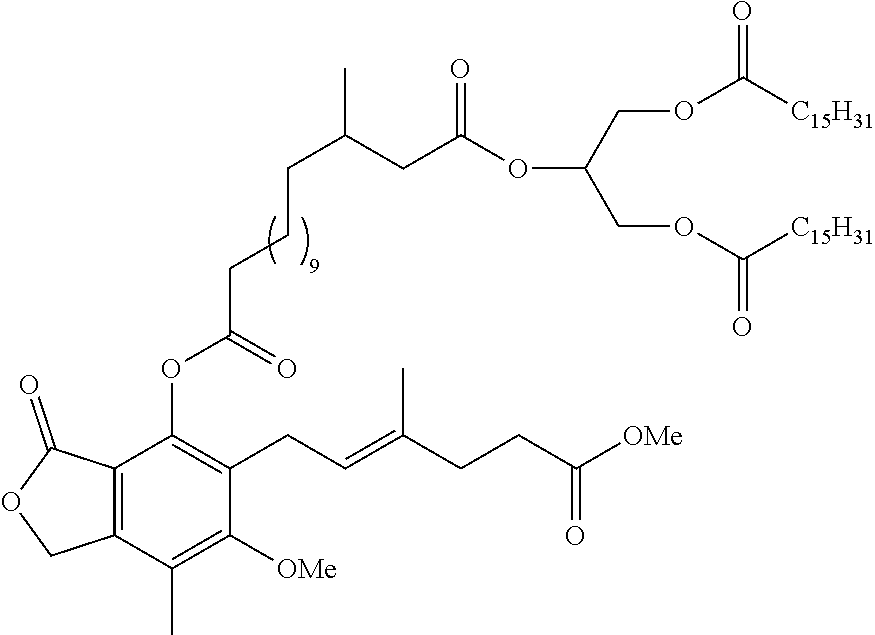 |
I-31 |
 |
I-32 |
 |
I-33 |
 |
I-34 |
 |
I-35 |
 |
I-36 |
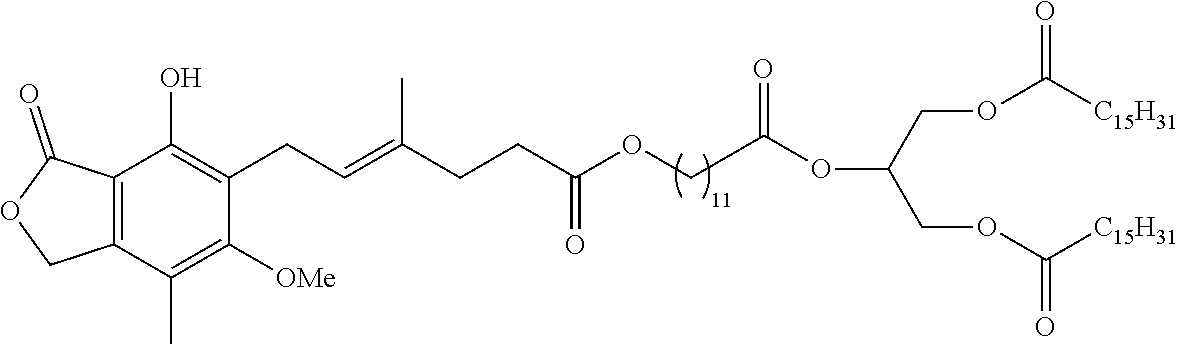 |
I-37 |
 |
I-38 |
 |
I-39 |
 |
I-40 |
 |
I-41 |
 |
I-42 |
 |
I-43 |
 |
I-44 |
 |
I-45 |
 |
I-46 |
 |
I-47 |
 |
I-48 |
 |
I-49 |
 |
I-50 |
 |
I-51 |
 |
I-52 |
 |
I-53 |
 |
I-54 |
 |
I-55 |
 |
I-56 |
 |
I-57 |
 |
I-58 |
 |
I-59 |
 |
I-60 |
 |
I-61 |
 |
I-62 |
 |
I-63 |
 |
I-64 |
 |
I-65 |
 |
I-66 |
 |
I-67 |
 |
I-68 |
 |
I-69 |
 |
I-70 |
 |
I-71 |
 |
I-72 |
 |
I-73 |
 |
I-74 |
 |
I-75 |
 |
I-76 |
 |
I-77 |
 |
I-78 |
 |
I-79 |
 |
I-80 |
 |
I-81 |
 |
I-82 |
 |
I-83 |
 |
I-84 |

(from Ning et al; Angew Chem Int Ed, 2008, 47, 2253); gem-difluorinated cyclooctynes (DIFO or DFO)

(from Codelli, et al.; J Am. Chem. Soc. 2008, 130, 11486-11493.); biarylazacyclooctynone (BARAC)

(from Jewett et al.; J. Am. Chem. Soc. 2010, 132, 3688.); or bicyclononyne (BCN) (From Dommerholt, et al.; Angew Chem Int Ed, 2010, 49, 9422-9425).


| TABLE 2 |
| Lymphatic transport of total MPA related compound (% of administered dose) following intraduodenal infusion to anesthetised, |
| mesenteric lymph-duct cannulated rats (data are presented as mean ± SD when n ≥ 3 or as mean ± range when n = 2). |
| Cumulative | |||
| lymphatic | |||
| transport % | |||
| dose | |||
| (Mean ± | |||
| SD, or | |||
| Compound | Range | ||
| Name | # | Structure | if n = 2) |
| MPA (n = 5) | — |
 |
0.17 ± 0.12 |
| MMF (n = 3) | — |
 |
0.14 ± 0.08 |
| MPA-TG (n = 5) | I-34 |
 |
A |
| MPA-Ph- C3-TG | I-28 |
 |
B |
| MPA- C4(ether)- TG (n = 3) | I-25 |
 |
C |
| MPA-C5- Carbonate- TG (n = 4) | I-27 |
 |
B |
| MPA- C6(ether)- TG (n = 4) | I-26 |
 |
C |
| MPA-C7- TG (n = 2) | I-36 |
 |
B |
| MPA-C12- TG (n = 2) ( |
I-37 |
 |
A |
| MPA-C18- TG (n = 3) ( |
I-38 |
 |
B |
| MPA-O-C4- TG(OMe) (n = 2) | I-17 |
 |
C |
| MPA-O-C6- TG(OMe) (n = 2) | I-18 |
 |
B |
| MPA-O- C10- TG(OMe) (n = 3) | I-19 |
 |
A |
| MPA-O- C12- TG(OMe) (n = 3) | I-30 |
 |
A |
| MPA-O- C12α′MeβMe- TG(OMe) (n = 5) | I-20 |
 |
A |
| MPA-O- CASI- C12α′MeβMe- TG(OMe) (n = 3) | I-21 |
 |
B |
| MPA-O- C12α′βMe- TG(OMF) (n = 3) | I-32 |
 |
A |
| MPA-O- FSI(5)- C12α′MeβMe- TG (OMe) (n = 5) | I-22 |
 |
A |
| MPA-2-PL (n = 4) | I-39 |
 |
C |
| MPA-O- TML-C12-TG (n = 3) | I-47 |
 |
B |
| MPA-O- ASI- C12α′βMe- TG (n = 3) | I-44 |
 |
A |
| MPA-O- C15β-TG (n = 2) | I-31 |
 |
A |
| MPA-C10- TG (n = 3) | I-46 |
 |
A |
| MPA(O- C11-2-TG)- OMe (n = 3) | I-48 |
 |
A |
| MPA-C10β- TG (n = 3) | I-50 |
 |
A |
| MPA-C15β- TG- butyrate (n = 2) | I-43 |
 |
A |
| MPA-(O- ASI- C12α′αMe- 2-TG)-OMe (n = 1) | I-41 |
 |
A |
| MPA-(O- C10αMe-2- TG)-OMe (n = 2) | I-45 |
 |
A |
| MPA- C12βMe-2- TG (n = 3) | I-51 |
 |
A |
| MPA(O- TML- C12α′αMe- 2-TG)-OMe (n = 3) | I-52 |
 |
B |
| MPA(O- C12βMe-2- TG)-OMe (n = 3) | I-53 |
 |
A |
| MPA(O- PHB- C12α′βMe- 2-TG)-OMe (n = 3) | I-54 |
 |
B |
| MPA-(O- C12αMe-2- TG)-OMe (n = 2) | I-60 |
 |
A |
| MPA-(O- C10α′αMe- 2-TG)-OMe (n = 3) | I-61 |
 |
A |
| MPA(O- FSI(4)- C12α′βMe- 2-TG)-OMe (n = 2) | I-62 |
 |
A |
| MPA(O- C10βMe-2- TG)-OMe (n = 3) | I-16 |
 |
A |
| MPA(O- C15-2-TG)- OMe (n = 2) | I-57 |
 |
A |
| MPA(O- MASI- C12α′βMe- 2-TG)-OMe (n = 4) | I-58 |
 |
A |
| TABLE 3 |
| Stability of the Monoglyceride (MG) Intermediates of |
| Lipid Prodrugs in Rat Plasma, Bile, and Pancreatic Fluid. |
| Percentage | |||||
| MPA release at | |||||
| Half-life of |
60 min in LPL | ||||
| intermediates in | supplemented | ||||
| rat bile and | rat plasma | ||||
| pancreatic fluid | (n = 3 | ||||
| (min) (n = 3 | unless | ||||
| Compound | unless specified | specified | |||
| Name | # | otherwise) | otherwise) | ||
| MPA-TG | I-34 | C | *** | ||
| (n = 5) | |||||
| MPA- | I-25 | C | |||
| C4(ether)- | |||||
| TG (n = 3) | |||||
| MPA-C5- | I-27 | A | |||
| Carbonate- | |||||
| TG (n = 4) | |||||
| MPA- | I-26 | B | |||
| C6(ether)- | |||||
| TG (n = 4) | |||||
| MPA-C7- | I-36 | A | |||
| TG (n = 2) | |||||
| MPA-O- | I-19 | **** | |||
| C10- | |||||
| TG(OMe) | |||||
| (n = 3) | |||||
| MPA-O- | I-20 | *** | |||
| C12α′Meβ | |||||
| Me- | |||||
| TG(OMe) | |||||
| (n = 3) | |||||
| MPA-O- | I-22 | *** | |||
| FSI(5)- | |||||
| C12α′Meβ | |||||
| Me- | |||||
| TG(OMe) | |||||
| (n = 2) | |||||
| MPA-2-PL | I-39 | D | |||
| (n = 4) | |||||


- Reference: Zgair, A. et al., Scientific Reports 2017, 7: 14542, 1-12.
- Reference: Zgair, A. et al., Scientific Reports 2017, 7: 14542, 1-12.
- Reference: Zgair, A. et al., Scientific Reports 2017, 7: 14542, 1-12 and Han, S. et al., Journal of Controlled Release 2014, 177, 1-10.

| TABLE 4 |
| Study Group Designations |
| Dose | Dose | Dose | |||||||
| Level | Dose | Dosing | Vol | Conc | |||||
| Group | N | Disease | Treatment | (mg/kg) | Route | Regimen1 | Days | (ml/kg)2 | (mg/ml) |
| 1 | 5 | N | Normal | N/A | PO | QD | D0-3 | 5 | N/ |
|
| 2 | 10 | Y | Vehicle | N/A | PO | QD | D0-3 | 5 | N/ |
|
| 3 | 10 | Y | Dexamethasone | 0.1 | PO | QD | D0-3 | 5 | 0.02 | |
| 4 | 10 | | MPA | 1 | PO | QD | D0-3 | 5 | 0.2 | |
| 5 | 10 | Y | MPA | 0.33 | PO | QD | D0-3 | 5 | 0.066 | |
| 6 | 10 | Y | MPA | 0.11 | PO | QD | D0-3 | 5 | 0.022 | |
| 7 | 10 | Y | MPA-2-TG | 0.66 | PO | QD | D0-3 | 5 | 0.132 | |
| (I-34) | ||||||||||
| 8 | 10 | Y | MPA—(O— | 0.99 | PO | QD | D0-3 | 5 | 0.198 | |
| C10bMe-2-TG)— | ||||||||||
| OMe (I-16) | ||||||||||
| 9 | 10 | Y | MPA-2-TG | 0.66 | PO | BID | D0-3 | 5 | 0.132 | |
| (I-34) | ||||||||||
| 10 | 10 | Y | MPA—(O— | 0.99 | PO | BID | D0-3 | 5 | 0.198 | |
| C10bMe-2-TG)— | ||||||||||
| OMe (I-16) | ||||||||||
| 1QD dosing to occur at approximately 24 hr intervals. | ||||||||||
| BID dosing to occur at approximately 10-12 hr intervals. | ||||||||||
| 2The doses of test item to be administered is calculated daily in mg/kg based on the latest body weight of the animal | ||||||||||
| TABLE 5 |
| Study Dosing Outline |
| No. | T Cell | Dose and | Dose | |||
| Group | Animals | Transfer | | Route | Schedule | |
| 1 | 6 | — | — | — | — | |
| 2 | 8 | 0.5 × 10⁶ | — | — | — | |
| memory | ||||||
| TH cells | ||||||
| 3 | 13 | 0.5 × 10⁶ | Vehicle | — | QD | |
| naïve TH | PO | Days 0-42 | ||||
| 4 | 13 | | MPA | 1 mg/kg | QD | |
| PO | Days 0-42 | |||||
| 5 | 13 | MPA | 0.33 mg/kg | QD | ||
| PO | Days 0-42 | |||||
| 6 | 13 | MPA | 0.33 mg/kg | QD | ||
| PO | Days 13-42 | |||||
| 7 | 13 | MPA | 0.11 mg/kg | QD | ||
| PO | Days 0-42 | |||||
| 8 | 13 | MPA-2-TG | 0.66 mg/kg | QD | ||
| (I-34) | PO | Days 0-42 | ||||
| 9 | 13 | MPA-(O- | 0.99 mg/kg | QD | ||
| C10bMe- | PO | Days 0-42 | ||||
| 2-TG)- | ||||||
| OMe (I-16) | ||||||
| 10 | 13 | MPA-2-TG | 0.66 mg/kg | BID | ||
| (I-34) | PO | Days 0-42 | ||||
| 11 | 13 | MPA-(O- | 0.99 mg/kg | BID | ||
| C10bMe- | PO | Days 0-42 | ||||
| 2-TG)- | ||||||
| OMe (I-16) | ||||||
| TABLE 6 |
| Study Dosing Regimen |
| MOG | PTX IP | ||||||||
| No. | | Days | 0 | EAE | Schedule | ||||
| | Animals | Day | 0 | and 2 | Scoring | Treatment | Dose | (QD or BID) | |
| 1 | 5 | — | — | Days | — | — | — |
| 4-35 | |||||||
| 2 | 15 | 400 μg | 200 ng | vehicle | — | Days 0-31 | |
| 3 | 10 | |
1 mg/kg | Days 0-31 |
|||
| 4 | 10 | 0.33 | Days 14-31 QD | ||||
| mg/ |
|||||||
| 5 | 10 | Days 0-31 |
|||||
| 6 | 10 | 0.11 | Days 0-31 QD | ||||
| mg/ |
|||||||
| 7 | 10 | MPA-2-TG | 0.66 | Days 0-31 QD | |||
| (I-34) | mg/ |
||||||
| 8 | 10 | MPA—(O— | 0.99 | Days 0-31 QD | |||
| C10bMe-2-TG)— | mg/animal | ||||||
| OMe (I-16) | |||||||
| (I-16) | |||||||
| 9 | 10 | FTY720* | 3 mg/kg | Days 0-31 QD | |||
| *Fingolimod, a positive control that shows efficacy in multiμle sclerosis. | |||||||
| TABLE 7 |
| Study Dosing Outline |
| No. | Dose and | Dose | ||||
| Group | Animals | Injection | Aerosol | Treatment | Route | Schedule |
| 1 | 8 | Day 0 PBS | PBS on | — | — | — |
| in in 100 | days 20, 21 | |||||
| μL of | and 22 | |||||
| aluminum | ||||||
| hydroxide | ||||||
| 2 | 16 | Day 0 | OVA [2% in | Vehicle | — PO | QD |
| 20 ug OVA | Phosphate | Days 19-24 | ||||
| 3 | 16 | in 100 ul of | Buffer | MPA | 1 mg/kg | QD |
| aluminum | Saline | PO | Days 1-24 | |||
| 4 | 16 | hydroxide | (PBS)] on | MPA | 0.33 mg/kg | QD |
| days 20, 21 | Days 1-24 | |||||
| 5 | 16 | and 22 | 0.33 mg/kg | BID | ||
| Days 1-24 | ||||||
| 6 | 16 | MPA | 0.11mg/kg | QD | ||
| Days 1-24 | ||||||
| 7 | 16 | MPA-2-TG | 2 mg/kg | QD | ||
| (I-34) | PO | Days 1-24 | ||||
| 8 | 16 | MPA-2-TG | 0.66 mg/kg | QD | ||
| (I-34) | PO | Days 1-24 | ||||
| 9 | 16 | MPA-2-TG | 0.22 mg/kg | QD | ||
| (I-34) | PO | Days 1-24 | ||||
| 10 | 16 | MPA—(O— | 2 mg/kg | QD | ||
| C10bMe-2- | PO | Days 1-24 | ||||
| TG)—OMe | ||||||
| (I-16) | ||||||
| 11 | 16 | MPA—(O— | 0.66 mg/kg | QD | ||
| C10bMe-2- | PO | Days 1-24 | ||||
| TG)—OMe | ||||||
| (I-16) | ||||||
| 12 | 16 | MPA—(O— | 0.22 mg/kg | QD | ||
| C10bMe-2- | PO | Days 1-24 | ||||
| TG)—OMe | ||||||
| (I-16) | ||||||
| TABLE 8 |
| Study Design |
| No. | T Cell | Dose and | Dose | |||
| Group | RAG−/− | Transfer | | Route | Schedule | |
| 1 | 5 | None | — | — | QD |
| PO | Days | ||||
| 1-56 | |||||
| 2 | 10 | 0.45 × 10⁶ | Gluten- |
1 mg/kg | QD |
| donor TH | PO | Days | |||
| cells | 1-56 | ||||
| 3 | 10 | Vehicle | 0.33 mg/kg | QD | |
| PO | Days | ||||
| 1-56 | |||||
| 4 | 10 | MPA | 0.33 mg/kg | QD | |
| PO | Days | ||||
| 30-56 | |||||
| 5 | 10 | MPA | 0.11 mg/kg | QD | |
| PO | Days | ||||
| 1-56 | |||||
| 6 | 10 | MPA | 0.66 mg/kg | QD | |
| PO | Days | ||||
| 1-56 | |||||
| 7 | 10 | MPA | 0.66 mg/kg | BID | |
| PO | Days | ||||
| 1-56 | |||||
| 8 | 10 | MPA-2-TG | 0.99 mg/kg | QD | |
| (I-34) | PO | days | |||
| 1-56 | |||||
| 9 | 10 | MPA-2-TG | — | QD | |
| (I-34) | PO | Days | |||
| 1-56 | |||||
| 10 | 10 | MPA-(O- | 1 mg/kg | QD | |
| C10bMe-2-TG)- | PO | Days | |||
| OMe (I-16) | 1-56 | ||||
| TABLE 9 |
| Study Design |
| No. | Immunization | Dose and | Dose | |||
| Group | DBA/1 | and booster | | Route | Schedule | |
| 1 | 5 | CFA |
— | — | — | ||
| IFA day 14 | |||||||
| 2 | 10 | CFA plus CII day | — | — | |||
| 0 and IFA plus | |||||||
| CII day 14 | |||||||
| 3 | 10 | CFA plus CII day | Vehicle | — | |
||
| 0 and IFA plus | PO | Days | |||||
| CII day 14 | 1-56 | ||||||
| 4 | 10 | CFA plus | MPA | 1 mg/ | QD | ||
| 0 and IFA plus | PO | Days | |||||
| CII day 14 | 1-56 | ||||||
| 5 | 10 | CFA plus CII day | MPA | 0.33 mg/ | QD | ||
| 0 and IFA plus | PO | Days | |||||
| CII day 14 | 1-56 | ||||||
| 6 | 10 | CFA plus CII day | MPA | 0.11 mg/ | QD | ||
| 0 and IFA plus | PO | Days | |||||
| CII day 14 | 1-56 | ||||||
| 7 | 10 | CFA plus CII day | MPA | 0.33 mg/ | QD | ||
| 0 and IFA plus | PO | Days | |||||
| CII day 14 | 30-56 | ||||||
| 8 | 10 | CFA plus CII day | MPA-2-TG | 0.66 mg per | |
||
| 0 and IFA plus | (I-34) | dose PO | Days | ||||
| CII day 14 | 1-56 | ||||||
| 9 | 10 | CFA plus CII day | MPA-2-TG | 0.66 mg per | |
||
| 0 and IFA plus | (I-34) | dose PO | Days | ||||
| CII day 14 | 1-56 | ||||||
| 10 | 10 | CFA |
MPA-(O- | 0.99 mg per | QD | ||
| IFA day 14 | C10bMe-2- | dose PO | days | ||||
| TG)-OMe | 1-56 | ||||||
| (I-16) | |||||||
| TABLE 10 |
| Study Design |
| Colitis | Dose and | Dose | |||||
| Group | BALB/c | Presensitization | induction | | Route | Schedule | |
| 1 | 3 | 150 μl of 1% | None | — | — | — |
| (wt/vol) TNBS | ||||||
| presensitization | ||||||
| solution without | ||||||
| |
||||||
| 2 | 10 | 150 μl of 1% | 100 ul 2.5% | Vehicle | — | — |
| (wt/vol) TNBS | (wt/vol) | |||||
| | TNBS | |||||
| solution | ||||||
| 3 | 10 | 150 μl of 1% | 100 ul 2.5% | |
1 mg | QD |
| (wt/vol) TNBS | (wt/vol) | per kg PO | Days 1-12 | |||
| | TNBS | |||||
| solution | ||||||
| 4 | 10 | 150 μl of 1% | 100 ul 2.5% | MPA | 0.33 mg | QD |
| (wt/vol) TNBS | (wt/vol) | per kg PO | Days 1-12 | |||
| | TNBS | |||||
| solution | ||||||
| 5 | 10 | 150 μl of 1% | 100 ul 2.5% | MPA | 0.11 mg | QD |
| (wt/vol) TNBS | (wt/vol) | per kg PO | Days 1-12 | |||
| | TNBS | |||||
| solution | ||||||
| 6 | 150 μl of 1% | 100 ul 2.5% | MPA-2- | 2 mg | QD | |
| (wt/vol) TNBS | (wt/vol) | TG (I-34) | per kg PO | Days 1-12 | ||
| | TNBS | |||||
| solution | ||||||
| 7 | 150 μl of 1% | 100 ul 2.5% | MPA-2- | 0.66 mg | QD | |
| (wt/vol) TNBS | (wt/vol) | TG (I-34) | per kg PO | Days 1-12 | ||
| | TNBS | |||||
| solution | ||||||
| 8 | 10 | 150 μl of 1% | 100 ul 2.5% | MPA-2- | 0.22 mg | QD |
| (wt/vol) TNBS | (wt/vol) | TG (I-34) | per kg PO | Days 1-12 | ||
| presensitization | TNBS | |||||
| solution | ||||||
| 9 | 10 | 150 μl of 1% | 100 ul 2.5% | MPA-2- | 0.66 mg | BIG |
| (wt/vol) TNBS | (wt/vol) | TG (I-34) | per kg PO | Days 1-12 | ||
| | TNBS | |||||
| solution | ||||||
| 10 | 10 | 150 μl of 1% | 100 ul 2.5% | MPA—(O— | 3 mg | QD |
| (wt/vol) TNBS | (wt/vol) | C10bMe-2- | per kg PO | Days 1-12 | ||
| presensitization | TNBS | TG)—OMe | ||||
| solution | (I-16) | |||||
| 11 | 10 | 150 μl of 1% | 100 ul 2.5% | MPA—(O— | 0.99 mg | QD |
| (wt/vol) TNBS | (wt/vol) | C10bMe-2- | per kg PO | Days 1-12 | ||
| presensitization | TNBS | TG)—OMe | ||||
| solution | (I-16) | |||||
| 12 | 10 | 150 μl of 1% | 100 ul 2.5% | MPA—(O— | 0.33 mg | QD |
| (wt/vol) TNBS | (wt/vol) | C10bMe-2- | per kg PO | Days 1-12 | ||
| presensitization | TNBS | TG)—OMe | ||||
| solution | (I-16) | |||||
| 13 | 10 | 150 μl of 1% | 100 ul 2.5% | MPA—(O— | 0.99 mg | BID |
| (wt/vol) TNBS | (wt/vol) | C10bMe-2- | per kg PO | Days 1-12 | ||
| presensitization | TNBS | TG)—OMe | ||||
| solution | (I-16) | |||||
| TABLE 11 |
| Study Design |
| Colitis | Dose and | Dose | |||||
| Group | BALB/c | Presensitization | induction | | Route | Schedule | |
| 1 | 6 | 150 μl of 1% | None | — | — | — |
| (wt/vol) TNBS | ||||||
| solution without | ||||||
| |
||||||
| 2 | 6 | 150 μl of 1% | 100 ul 2.5% | Vehicle | — | — |
| (wt/vol) TNBS | (wt/vol) TNBS | |||||
| presensitization | on |
|||||
| solution | 29, 36, and 43 | |||||
| 3 | 6 | 150 μl of 1% | 100 ul 2.5% | |
6 mg per | QD |
| (wt/vol) TNBS | (wt/vol) TNBS | dose PO | Days 8-12 | |||
| presensitization | on |
|||||
| solution | 29, 36, and 43 | |||||
| 4 | 6 | 150 μl of 1% | 100 ul 2.5% | |
2 mg per | QD |
| (wt/vol) TNBS | (wt/vol) TNBS | dose PO | Days 8-12 | |||
| presensitization | on |
|||||
| solution | 29, 36, and 43 | |||||
| 5 | 6 | 150 μl of 1% | 100 ul 2.5% | |
1 mg per | QD |
| (wt/vol) TNBS | (wt/vol) TNBS | dose PO | Days 8-12 | |||
| presensitization | on |
|||||
| solution | 29, 36, and 43 | |||||
| 6 | 6 | 150 μl of 1% | 100 ul 2.5% | MPA | 0.66 mg per | QD |
| (wt/vol) TNBS | (wt/vol) TNBS | dose PO | Days 8-12 | |||
| presensitization | on |
|||||
| solution | 29, 36, and 43 | |||||
| 7 | 6 | 150 μl of 1% | 100 ul 2.5% | MPA-2- | 6 mg per | QD |
| (wt/vol) TNBS | (wt/vol) TNBS | TG (I-34) | dose PO | Days 8-12 | ||
| presensitization | on |
|||||
| solution | 29, 36, and 43 | |||||
| 8 | 6 | 150 μl of 1% | 100 ul 2.5% | MPA-2- | 2 mg per | QD |
| (wt/vol) TNBS | (wt/vol) TNBS | TG (I-34) | dose PO | Days 8-12 | ||
| presensitization | on |
|||||
| solution | 29, 36, and 43 | |||||
| 9 | 6 | 150 μl of 1% | 100 ul 2.5% | MPA-2- | 1 mg per | QD |
| (wt/vol) TNBS | (wt/vol) TNBS | TG (I-34) | dose PO | Days 8-12 | ||
| presensitization | on |
|||||
| solution | 29, 36, and 43 | |||||
| 10 | 6 | 150 μl of 1% | 100 ul 2.5% | MPA-2- | 0.66 mg per | QD |
| (wt/vol) TNBS | (wt/vol) TNBS | TG (I-34) | dose PO | Days 8-12 | ||
| presensitization | on |
|||||
| solution | 29, 36, and 43 | |||||
| 11 | 6 | 150 μl of 1% | 100 ul 2.5% | MPA—(O— | 6 mg per | QD |
| (wt/vol) TNBS | (wt/vol) TNBS | C10bMe-2- | dose PO | Days 8-12 | ||
| presensitization | on |
TG)—OMe | ||||
| solution | 29, 36, and 43 | (I-16) | ||||
| 12 | 6 | 150 μl of 1% | 100 ul 2.5% | MPA—(O— | 2 mg per | QD |
| (wt/vol) TNBS | (wt/vol) TNBS | C10bMe-2- | dose PO | Days 8-12 | ||
| presensitization | on |
TG)—OMe | ||||
| solution | 29, 36, and 43 | (I-16) | ||||
| 13 | 6 | 150 μl of 1% | 100 ul 2.5% | MPA—(O— | 1 mg per | QD |
| (wt/vol) TNBS | (wt/vol) TNBS | C10bMe-2- | dose PO | Days 8-12 | ||
| presensitization | on |
TG)—OMe | ||||
| solution | 29, 36, and 43 | (I-16) | ||||
| 14 | 6 | 150 μl of 1% | 100 ul 2.5% | MPA—(O— | 0.66 mg per | QD |
| (wt/vol) TNBS | (wt/vol) TNBS | C10bMe-2- | dose PO | Days 8-12 | ||
| presensitization | on |
TG)—OMe | ||||
| solution | 29, 36, and 43 | (I-16) | ||||
| TABLE 12 |
| Colitis Scoring |
| Score | Weight loss | | Blood | |
| 0 | None | Normal | |
|
| 1 | 1-5% | Soft but still formed | |
|
| 2 | 6-10% | Soft | |
|
| 3 | 11-18% | Very soft; wet | Blood traces in | |
| stool visible | ||||
| 4 | >18% | Watery diarrhea | Gross rectal | |
| bleeding | ||||
| TABLE 13 |
| Study Design |
| No. | Dose | Dose | |||
| Group | MRL/Ipc | Treatment | and | Schedule | |
| 1 | 6 | — | — | — |
| 2 | 6 | Vehicle | — | — |
| 3 | 6 | |
1 mg per kg | QD |
| PO | Days 1-84 | |||
| 4 | 6 | MPA | 0.33 mg per kg | QD |
| PO | Days 1-84 | |||
| 5 | 6 | MPA | 0.11 mg per kg | QD |
| PO | Days 1-84 | |||
| 6 | 6 | |
2 mg per kg | QD |
| PO | Days 1-84 | |||
| 7 | 6 | MPA-2-TG (I-34) | 0.66 mg per kg | QD |
| PO | Days 1-84 | |||
| 8 | 6 | MPA-2-TG (I-34) | 0.22 mg per kg | QD |
| PO | Days 1-84 | |||
| 9 | 6 | MPA-2-TG (I-34) | 0.66 mg per kg | BID |
| PO | Days 1-84 | |||
| 10 | 6 | MPA-2-TG (I-34) | 3 mg per kg | QD |
| PO | Days 1-84 | |||
| 11 | 6 | MPA-(O-C10bMe-2- | 0.99 mg per kg | QD |
| TG)-OMe (I-16) | PO | Days 1-84 | ||
| 12 | 6 | MPA-(O-C10bMe-2- | 0.33 mg per kg | QD |
| TG)-OMe (I-16) | PO | Days 1-84 | ||
| 13 | 6 | MPA-(O-C10bMe-2- | 0.99 mg per kg | BID |
| TG)-OMe (I-16) | PO | Days 1-84 | ||
Claims (20)


Priority Applications (1)
| Application Number | Priority Date | Filing Date | Title |
|---|---|---|---|
| US16/955,162 US11304954B2 (en) | 2017-12-19 | 2018-12-19 | Lipid prodrugs of mycophenolic acid and uses thereof |
Applications Claiming Priority (5)
| Application Number | Priority Date | Filing Date | Title |
|---|---|---|---|
| US201762607749P | 2017-12-19 | 2017-12-19 | |
| US201862724274P | 2018-08-29 | 2018-08-29 | |
| US201862768583P | 2018-11-16 | 2018-11-16 | |
| PCT/US2018/066585 WO2019126378A1 (en) | 2017-12-19 | 2018-12-19 | Lipid prodrugs of mycophenolic acid and uses thereof |
| US16/955,162 US11304954B2 (en) | 2017-12-19 | 2018-12-19 | Lipid prodrugs of mycophenolic acid and uses thereof |
Related Parent Applications (1)
| Application Number | Title | Priority Date | Filing Date |
|---|---|---|---|
| PCT/US2018/066585 A-371-Of-International WO2019126378A1 (en) | 2017-12-19 | 2018-12-19 | Lipid prodrugs of mycophenolic acid and uses thereof |
Related Child Applications (1)
| Application Number | Title | Priority Date | Filing Date |
|---|---|---|---|
| US17/586,515 Continuation US11938137B2 (en) | 2017-12-19 | 2022-01-27 | Lipid prodrugs of mycophenolic acid and uses thereof |
Publications (2)
| Publication Number | Publication Date |
|---|---|
| US20200390777A1 US20200390777A1 (en) | 2020-12-17 |
| US11304954B2 true US11304954B2 (en) | 2022-04-19 |
Family
ID=81127217
Family Applications (2)
| Application Number | Title | Priority Date | Filing Date |
|---|---|---|---|
| US16/955,162 Active US11304954B2 (en) | 2017-12-19 | 2018-12-19 | Lipid prodrugs of mycophenolic acid and uses thereof |
| US17/586,515 Active 2039-02-07 US11938137B2 (en) | 2017-12-19 | 2022-01-27 | Lipid prodrugs of mycophenolic acid and uses thereof |
Family Applications After (1)
| Application Number | Title | Priority Date | Filing Date |
|---|---|---|---|
| US17/586,515 Active 2039-02-07 US11938137B2 (en) | 2017-12-19 | 2022-01-27 | Lipid prodrugs of mycophenolic acid and uses thereof |
Country Status (1)
| Country | Link |
|---|---|
| US (2) | US11304954B2 (en) |
Cited By (1)
| Publication number | Priority date | Publication date | Assignee | Title |
|---|---|---|---|---|
| US11938137B2 (en) * | 2017-12-19 | 2024-03-26 | Puretech Lyt, Inc. | Lipid prodrugs of mycophenolic acid and uses thereof |
Families Citing this family (3)
| Publication number | Priority date | Publication date | Assignee | Title |
|---|---|---|---|---|
| CN113655143A (en) * | 2021-08-09 | 2021-11-16 | 大连医科大学附属第一医院 | A molecular prediction model and application of serum organic acids for early warning of severe acute pancreatitis |
| WO2025049843A1 (en) * | 2023-09-01 | 2025-03-06 | Klee Trevor | Compositions for achieving effective dose levels of mtor inhibitors |
| WO2025080689A1 (en) * | 2023-10-10 | 2025-04-17 | Seaport Therapeutics, Inc. | Lipid prodrugs of bromolysergide and uses thereof |
Citations (55)
| Publication number | Priority date | Publication date | Assignee | Title |
|---|---|---|---|---|
| US4958046A (en) | 1988-10-07 | 1990-09-18 | Knoll Ag | Hydroxypropafenone glycerides |
| WO1994009010A1 (en) | 1992-10-09 | 1994-04-28 | Sandoz Ltd. | O-alkylated rapamycin derivatives and their use, particularly as immunosuppressants |
| US5962440A (en) | 1996-05-09 | 1999-10-05 | Bristol-Myers Squibb Company | Cyclic phosphonate ester inhibitors of microsomal triglyceride transfer protein and method |
| US6013665A (en) | 1997-12-16 | 2000-01-11 | Abbott Laboratories | Method for enhancing the absorption and transport of lipid soluble compounds using structured glycerides |
| US6054591A (en) | 1996-03-28 | 2000-04-25 | Shionogi & Co., Ltd. | Lymph-absorbable aryl substituted imidazole derivatives |
| WO2001042246A2 (en) | 1999-12-10 | 2001-06-14 | Pfizer Products Inc. | PYRROLO[2,3-d]PYRIMIDINE COMPOUNDS |
| US6417191B1 (en) | 1995-03-30 | 2002-07-09 | Glaxosmithkline | Synergistic combinations of zidovudine, 1592U89 and 3TC |
| WO2002088112A1 (en) | 2001-04-27 | 2002-11-07 | Zenyaku Kogyo Kabushiki Kaisha | Heterocyclic compound and antitumor agent containing the same as active ingredient |
| JP2003012691A (en) | 2001-04-24 | 2003-01-15 | Fuji Photo Film Co Ltd | Compound bearing triiodophenyl group and steroid residual group |
| US6552065B2 (en) | 2000-09-01 | 2003-04-22 | Novartis Ag | Deacetylase inhibitors |
| WO2003063794A2 (en) | 2002-02-01 | 2003-08-07 | Rigel Pharmaceuticals, Inc. | 2,4-pyrimidinediamine compounds and their uses |
| WO2004019973A1 (en) | 2002-08-14 | 2004-03-11 | Atugen Ag | Use of protein kinase n beta |
| WO2004089925A1 (en) | 2003-04-03 | 2004-10-21 | Semafore Pharmaceuticals, Inc. | Pi-3 kinase inhibitor prodrugs |
| WO2004106328A1 (en) | 2003-05-30 | 2004-12-09 | Gemin X Biotechnologies Inc. | Triheterocyclic compounds, compositions, and methods for treating cancer or viral diseases |
| WO2005007623A2 (en) | 2003-07-03 | 2005-01-27 | The Trustees Of The University Of Pennsylvania | Inhibition of syk kinase expression |
| WO2005113554A2 (en) | 2004-05-13 | 2005-12-01 | Icos Corporation | Method of preparing 3-phenyl-2-[9h-purin-6-ylamino)-methyl]-3h-quinazolin-4-one and substituted and related compounds |
| WO2005112919A2 (en) | 2004-05-19 | 2005-12-01 | Medarex, Inc. | Self-immolative linkers and drug conjugates |
| WO2006078846A1 (en) | 2005-01-19 | 2006-07-27 | Rigel Pharmaceuticals, Inc. | Prodrugs of 2,4-pyrimidinediamine compounds and their uses |
| WO2006122806A2 (en) | 2005-05-20 | 2006-11-23 | Novartis Ag | 1,3-dihydro-imidazo [4,5-c] quinolin-2-ones as lipid kinase inhibitors |
| WO2007016176A2 (en) | 2005-07-28 | 2007-02-08 | Phoenix Biotechnology Inc. | Scf extract containing cardiac glycoside |
| WO2007044729A2 (en) | 2005-10-07 | 2007-04-19 | Exelixis, Inc. | N- (3-amino-quinoxalin-2-yl) -sulfonamide derivatives and their use as phosphatidylinositol 3-kinase inhibitors |
| WO2007053452A1 (en) | 2005-11-01 | 2007-05-10 | Targegen, Inc. | Bi-aryl meta-pyrimidine inhibitors of kinases |
| WO2007070514A1 (en) | 2005-12-13 | 2007-06-21 | Incyte Corporation | Heteroaryl substituted pyrrolo[2,3-b]pyridines and pyrrolo[2,3-b]pyrimidines as janus kinase inhibitors |
| WO2007084786A1 (en) | 2006-01-20 | 2007-07-26 | Novartis Ag | Pyrimidine derivatives used as pi-3 kinase inhibitors |
| US20070191415A1 (en) | 2003-10-17 | 2007-08-16 | Ranbaxy Laboratories Limited | Production of tacrolimus (fk-506) using new streptomyces species |
| WO2007129161A2 (en) | 2006-04-26 | 2007-11-15 | F. Hoffmann-La Roche Ag | Thieno [3, 2-d] pyrimidine derivative useful as pi3k inhibitor |
| WO2008039218A2 (en) | 2006-09-22 | 2008-04-03 | Pharmacyclics, Inc. | Inhibitors of bruton's tyrosine kinase |
| WO2008048611A1 (en) | 2006-10-18 | 2008-04-24 | Wyeth | Process for the synthesis of individual isomers of mono-peg cci-779 |
| US7390799B2 (en) | 2005-05-12 | 2008-06-24 | Abbott Laboratories | Apoptosis promoters |
| WO2008109943A1 (en) | 2007-03-12 | 2008-09-18 | Cytopia Research Pty Ltd | Phenyl amino pyrimidine compounds and uses thereof |
| WO2008118802A1 (en) | 2007-03-23 | 2008-10-02 | Regents Of The University Of Minnesota | Therapeutic compounds |
| US20090023805A1 (en) | 2006-02-13 | 2009-01-22 | Anne Claire Marrast | Method of administration |
| WO2009114512A1 (en) | 2008-03-11 | 2009-09-17 | Incyte Corporation | Azetidine and cyclobutane derivatives as jak inhibitors |
| WO2009143295A1 (en) | 2008-05-20 | 2009-11-26 | Neurogesx, Inc. | Water-soluble acetaminophen analogs |
| US20090297533A1 (en) | 2008-05-23 | 2009-12-03 | Otonomy, Inc. | Controlled release immunomodulator compositions and methods for the treatment of otic disorders |
| US7635690B2 (en) | 1999-01-22 | 2009-12-22 | Emory University | HIV-1 mutations selected for by β-2′,3′-didehydro-2′,3′-dideoxy-5-fluorocytidine |
| US20100298560A1 (en) | 2008-02-01 | 2010-11-25 | Ckd Bio Corp. | process for preparing mycophenolate mofetil |
| WO2011051967A2 (en) | 2009-10-23 | 2011-05-05 | Alkem Laboratories Ltd | Pharmaceutical compositions comprising mycophenolate and processes for preparing thereof |
| WO2011090760A1 (en) | 2009-12-29 | 2011-07-28 | Avila Therapeutics, Inc. | Heteroaryl compounds and uses thereof |
| US20110213028A1 (en) | 2010-02-26 | 2011-09-01 | Catabasis Pharmaceuticals, Inc. | Fatty acid mycophenolate derivatives and their uses |
| WO2011120044A1 (en) | 2010-03-26 | 2011-09-29 | Duke University | Conjugated neuroactive steroid compositions and methods of use |
| US20110243884A1 (en) | 2008-10-10 | 2011-10-06 | O'shea Michael Shane | Biodegradable polymer - bioactive moiety conjugates |
| US8138347B2 (en) | 2007-05-18 | 2012-03-20 | Glaxosmithkline Llc | Quinoline derivatives as PI3 kinase inhibitors |
| US8455510B2 (en) | 2008-09-18 | 2013-06-04 | Shanghai Institute Of Materia Medica, Chinese Academy Of Sciences | Rapamycin carbonic ester analogues, pharmaceutical compositions, preparations and uses thereof |
| US20140081016A1 (en) | 2011-04-01 | 2014-03-20 | Sandoz Ag | Regioselective acylation of rapamycin at the c-42 position |
| US20140234418A1 (en) | 2013-02-21 | 2014-08-21 | Sigmoid Pharma Limited | Method for treating intestinal fibrosis |
| US20140328793A1 (en) | 2011-11-30 | 2014-11-06 | Emory University | Antiviral jak inhibitors useful in treating or preventing retroviral and other viral infections |
| WO2015116904A1 (en) | 2014-02-03 | 2015-08-06 | Vitae Pharmaceuticals, Inc. | Dihydropyrrolopyridine inhibitors of ror-gamma |
| WO2016023082A1 (en) | 2014-08-12 | 2016-02-18 | Monash University | Lymph directing prodrugs |
| WO2017041139A1 (en) | 2015-09-08 | 2017-03-16 | Monash University | Lymph directing prodrugs |
| US20180258094A1 (en) | 2017-03-08 | 2018-09-13 | Theravance Biopharma R&D Ip, Llc | Glucuronide prodrugs of tofacitinib |
| US20180318318A1 (en) | 2015-11-12 | 2018-11-08 | Board Of Regents Of The University Of Nebraska | Polyethylene Glycol-Conjugated Glucocorticoid Prodrugs and Compositions and Methods Thereof |
| WO2018237282A1 (en) | 2017-06-23 | 2018-12-27 | The Board Of Trustees Of The University Of Illinois | TREATMENT OF NEUROPSYCHIATRIC DISORDERS USING NEUROSTEROIDS AND THE LIKE THEREOF |
| WO2019046478A1 (en) | 2017-08-29 | 2019-03-07 | Walmart Apollo, Llc | System and method for collaborative sharing of database information |
| WO2019046491A1 (en) | 2017-08-29 | 2019-03-07 | Ariya Therapeutics, Inc. | Lymphatic system-directing lipid prodrugs |
Family Cites Families (1)
| Publication number | Priority date | Publication date | Assignee | Title |
|---|---|---|---|---|
| US11304954B2 (en) * | 2017-12-19 | 2022-04-19 | Puretech Lyt, Inc. | Lipid prodrugs of mycophenolic acid and uses thereof |
-
2018
- 2018-12-19 US US16/955,162 patent/US11304954B2/en active Active
-
2022
- 2022-01-27 US US17/586,515 patent/US11938137B2/en active Active
Patent Citations (60)
| Publication number | Priority date | Publication date | Assignee | Title |
|---|---|---|---|---|
| US4958046A (en) | 1988-10-07 | 1990-09-18 | Knoll Ag | Hydroxypropafenone glycerides |
| WO1994009010A1 (en) | 1992-10-09 | 1994-04-28 | Sandoz Ltd. | O-alkylated rapamycin derivatives and their use, particularly as immunosuppressants |
| US6417191B1 (en) | 1995-03-30 | 2002-07-09 | Glaxosmithkline | Synergistic combinations of zidovudine, 1592U89 and 3TC |
| US6054591A (en) | 1996-03-28 | 2000-04-25 | Shionogi & Co., Ltd. | Lymph-absorbable aryl substituted imidazole derivatives |
| US5962440A (en) | 1996-05-09 | 1999-10-05 | Bristol-Myers Squibb Company | Cyclic phosphonate ester inhibitors of microsomal triglyceride transfer protein and method |
| US6013665A (en) | 1997-12-16 | 2000-01-11 | Abbott Laboratories | Method for enhancing the absorption and transport of lipid soluble compounds using structured glycerides |
| US7635690B2 (en) | 1999-01-22 | 2009-12-22 | Emory University | HIV-1 mutations selected for by β-2′,3′-didehydro-2′,3′-dideoxy-5-fluorocytidine |
| WO2001042246A2 (en) | 1999-12-10 | 2001-06-14 | Pfizer Products Inc. | PYRROLO[2,3-d]PYRIMIDINE COMPOUNDS |
| US6552065B2 (en) | 2000-09-01 | 2003-04-22 | Novartis Ag | Deacetylase inhibitors |
| JP2003012691A (en) | 2001-04-24 | 2003-01-15 | Fuji Photo Film Co Ltd | Compound bearing triiodophenyl group and steroid residual group |
| WO2002088112A1 (en) | 2001-04-27 | 2002-11-07 | Zenyaku Kogyo Kabushiki Kaisha | Heterocyclic compound and antitumor agent containing the same as active ingredient |
| WO2003063794A2 (en) | 2002-02-01 | 2003-08-07 | Rigel Pharmaceuticals, Inc. | 2,4-pyrimidinediamine compounds and their uses |
| US7557210B2 (en) | 2002-02-01 | 2009-07-07 | Rigel Pharmaceuticals, Inc. | 2,4-pyrimidinediamine compounds and their uses |
| WO2004019973A1 (en) | 2002-08-14 | 2004-03-11 | Atugen Ag | Use of protein kinase n beta |
| WO2004089925A1 (en) | 2003-04-03 | 2004-10-21 | Semafore Pharmaceuticals, Inc. | Pi-3 kinase inhibitor prodrugs |
| WO2004106328A1 (en) | 2003-05-30 | 2004-12-09 | Gemin X Biotechnologies Inc. | Triheterocyclic compounds, compositions, and methods for treating cancer or viral diseases |
| WO2005007623A2 (en) | 2003-07-03 | 2005-01-27 | The Trustees Of The University Of Pennsylvania | Inhibition of syk kinase expression |
| US20070191415A1 (en) | 2003-10-17 | 2007-08-16 | Ranbaxy Laboratories Limited | Production of tacrolimus (fk-506) using new streptomyces species |
| WO2005113554A2 (en) | 2004-05-13 | 2005-12-01 | Icos Corporation | Method of preparing 3-phenyl-2-[9h-purin-6-ylamino)-methyl]-3h-quinazolin-4-one and substituted and related compounds |
| WO2005112919A2 (en) | 2004-05-19 | 2005-12-01 | Medarex, Inc. | Self-immolative linkers and drug conjugates |
| WO2006078846A1 (en) | 2005-01-19 | 2006-07-27 | Rigel Pharmaceuticals, Inc. | Prodrugs of 2,4-pyrimidinediamine compounds and their uses |
| US7390799B2 (en) | 2005-05-12 | 2008-06-24 | Abbott Laboratories | Apoptosis promoters |
| WO2006122806A2 (en) | 2005-05-20 | 2006-11-23 | Novartis Ag | 1,3-dihydro-imidazo [4,5-c] quinolin-2-ones as lipid kinase inhibitors |
| WO2007016176A2 (en) | 2005-07-28 | 2007-02-08 | Phoenix Biotechnology Inc. | Scf extract containing cardiac glycoside |
| WO2007044729A2 (en) | 2005-10-07 | 2007-04-19 | Exelixis, Inc. | N- (3-amino-quinoxalin-2-yl) -sulfonamide derivatives and their use as phosphatidylinositol 3-kinase inhibitors |
| WO2007053452A1 (en) | 2005-11-01 | 2007-05-10 | Targegen, Inc. | Bi-aryl meta-pyrimidine inhibitors of kinases |
| WO2007070514A1 (en) | 2005-12-13 | 2007-06-21 | Incyte Corporation | Heteroaryl substituted pyrrolo[2,3-b]pyridines and pyrrolo[2,3-b]pyrimidines as janus kinase inhibitors |
| WO2007084786A1 (en) | 2006-01-20 | 2007-07-26 | Novartis Ag | Pyrimidine derivatives used as pi-3 kinase inhibitors |
| US20090023805A1 (en) | 2006-02-13 | 2009-01-22 | Anne Claire Marrast | Method of administration |
| WO2007129161A2 (en) | 2006-04-26 | 2007-11-15 | F. Hoffmann-La Roche Ag | Thieno [3, 2-d] pyrimidine derivative useful as pi3k inhibitor |
| WO2008039218A2 (en) | 2006-09-22 | 2008-04-03 | Pharmacyclics, Inc. | Inhibitors of bruton's tyrosine kinase |
| WO2008048611A1 (en) | 2006-10-18 | 2008-04-24 | Wyeth | Process for the synthesis of individual isomers of mono-peg cci-779 |
| WO2008109943A1 (en) | 2007-03-12 | 2008-09-18 | Cytopia Research Pty Ltd | Phenyl amino pyrimidine compounds and uses thereof |
| WO2008118802A1 (en) | 2007-03-23 | 2008-10-02 | Regents Of The University Of Minnesota | Therapeutic compounds |
| US8138347B2 (en) | 2007-05-18 | 2012-03-20 | Glaxosmithkline Llc | Quinoline derivatives as PI3 kinase inhibitors |
| US20100298560A1 (en) | 2008-02-01 | 2010-11-25 | Ckd Bio Corp. | process for preparing mycophenolate mofetil |
| WO2009114512A1 (en) | 2008-03-11 | 2009-09-17 | Incyte Corporation | Azetidine and cyclobutane derivatives as jak inhibitors |
| WO2009143295A1 (en) | 2008-05-20 | 2009-11-26 | Neurogesx, Inc. | Water-soluble acetaminophen analogs |
| US20090297533A1 (en) | 2008-05-23 | 2009-12-03 | Otonomy, Inc. | Controlled release immunomodulator compositions and methods for the treatment of otic disorders |
| US8338439B2 (en) | 2008-06-27 | 2012-12-25 | Celgene Avilomics Research, Inc. | 2,4-disubstituted pyrimidines useful as kinase inhibitors |
| US8455510B2 (en) | 2008-09-18 | 2013-06-04 | Shanghai Institute Of Materia Medica, Chinese Academy Of Sciences | Rapamycin carbonic ester analogues, pharmaceutical compositions, preparations and uses thereof |
| US20110243884A1 (en) | 2008-10-10 | 2011-10-06 | O'shea Michael Shane | Biodegradable polymer - bioactive moiety conjugates |
| WO2011051967A2 (en) | 2009-10-23 | 2011-05-05 | Alkem Laboratories Ltd | Pharmaceutical compositions comprising mycophenolate and processes for preparing thereof |
| WO2011090760A1 (en) | 2009-12-29 | 2011-07-28 | Avila Therapeutics, Inc. | Heteroaryl compounds and uses thereof |
| US20110213028A1 (en) | 2010-02-26 | 2011-09-01 | Catabasis Pharmaceuticals, Inc. | Fatty acid mycophenolate derivatives and their uses |
| WO2011120044A1 (en) | 2010-03-26 | 2011-09-29 | Duke University | Conjugated neuroactive steroid compositions and methods of use |
| US20140081016A1 (en) | 2011-04-01 | 2014-03-20 | Sandoz Ag | Regioselective acylation of rapamycin at the c-42 position |
| US20140328793A1 (en) | 2011-11-30 | 2014-11-06 | Emory University | Antiviral jak inhibitors useful in treating or preventing retroviral and other viral infections |
| US20140234418A1 (en) | 2013-02-21 | 2014-08-21 | Sigmoid Pharma Limited | Method for treating intestinal fibrosis |
| WO2015116904A1 (en) | 2014-02-03 | 2015-08-06 | Vitae Pharmaceuticals, Inc. | Dihydropyrrolopyridine inhibitors of ror-gamma |
| US20170326103A1 (en) | 2014-08-12 | 2017-11-16 | Monash University | Lymph directing prodrugs |
| WO2016023082A1 (en) | 2014-08-12 | 2016-02-18 | Monash University | Lymph directing prodrugs |
| US20190105299A1 (en) | 2014-08-12 | 2019-04-11 | Monash University | Lymph directing prodrugs |
| WO2017041139A1 (en) | 2015-09-08 | 2017-03-16 | Monash University | Lymph directing prodrugs |
| US20180243425A1 (en) | 2015-09-08 | 2018-08-30 | Monash University | Lymph directing prodrugs |
| US20180318318A1 (en) | 2015-11-12 | 2018-11-08 | Board Of Regents Of The University Of Nebraska | Polyethylene Glycol-Conjugated Glucocorticoid Prodrugs and Compositions and Methods Thereof |
| US20180258094A1 (en) | 2017-03-08 | 2018-09-13 | Theravance Biopharma R&D Ip, Llc | Glucuronide prodrugs of tofacitinib |
| WO2018237282A1 (en) | 2017-06-23 | 2018-12-27 | The Board Of Trustees Of The University Of Illinois | TREATMENT OF NEUROPSYCHIATRIC DISORDERS USING NEUROSTEROIDS AND THE LIKE THEREOF |
| WO2019046478A1 (en) | 2017-08-29 | 2019-03-07 | Walmart Apollo, Llc | System and method for collaborative sharing of database information |
| WO2019046491A1 (en) | 2017-08-29 | 2019-03-07 | Ariya Therapeutics, Inc. | Lymphatic system-directing lipid prodrugs |
Non-Patent Citations (139)
Cited By (1)
| Publication number | Priority date | Publication date | Assignee | Title |
|---|---|---|---|---|
| US11938137B2 (en) * | 2017-12-19 | 2024-03-26 | Puretech Lyt, Inc. | Lipid prodrugs of mycophenolic acid and uses thereof |
Also Published As
| Publication number | Publication date |
|---|---|
| US20220143038A1 (en) | 2022-05-12 |
| US11938137B2 (en) | 2024-03-26 |
| US20200390777A1 (en) | 2020-12-17 |
Similar Documents
| Publication | Publication Date | Title |
|---|---|---|
| US12178875B2 (en) | Lymphatic system-directing lipid prodrugs | |
| US20220125933A1 (en) | Lipid prodrugs of jak inhibitors and uses thereof | |
| US11938137B2 (en) | Lipid prodrugs of mycophenolic acid and uses thereof | |
| US11883497B2 (en) | Lymphatic system-directing lipid prodrugs | |
| WO2020176868A1 (en) | Lipid prodrugs of btk inhibitors and uses thereof | |
| WO2020176856A1 (en) | Lipid prodrugs of glucocorticoids and uses thereof | |
| US12539295B2 (en) | IRAK degraders and uses thereof | |
| WO2019126378A1 (en) | Lipid prodrugs of mycophenolic acid and uses thereof | |
| US20260042762A1 (en) | Mertk degraders and uses thereof | |
| US20210300962A1 (en) | Lipid prodrugs of pregnane neurosteroids and uses thereof | |
| US20240025878A1 (en) | Mdm2 degraders and uses thereof | |
| US20240016942A1 (en) | Stat degraders and uses thereof | |
| TW202237601A (en) | Irak degraders and uses thereof | |
| TW202408538A (en) | Stat degraders and uses thereof | |
| WO2019126374A1 (en) | Lipid prodrugs of rapamycin and its analogs and uses thereof | |
| US11608345B1 (en) | Lipid prodrugs of rapamycin and its analogs and uses thereof | |
| CN116490069A (en) | STAT degradation agent and its use | |
| WO2023220425A1 (en) | Bcl-xl/bcl-2 degraders and uses thereof | |
| TW202415650A (en) | Aryl-triazolyl and related gpr84 antagonists and uses thereof | |
| HK40105719A (en) | Lymphatic system-directing lipid prodrugs | |
| CN118451061A (en) | OXER1 antagonists and uses thereof |
Legal Events
| Date | Code | Title | Description |
|---|---|---|---|
| AS | Assignment |
Owner name: PURETECH HEALTH LLC, MASSACHUSETTS Free format text: ASSIGNMENT OF ASSIGNORS INTEREST;ASSIGNOR:SHYAM, RISHAB R.;REEL/FRAME:052973/0964 Effective date: 20190110 Owner name: ARIYA THERAPEUTICS, INC., MASSACHUSETTS Free format text: ASSIGNMENT OF ASSIGNORS INTEREST;ASSIGNOR:BONNER, DANIEL KENNETH;REEL/FRAME:052973/0892 Effective date: 20190111 Owner name: PURETECH MANAGEMENT, INC., MASSACHUSETTS Free format text: ASSIGNMENT OF ASSIGNORS INTEREST;ASSIGNOR:KARANAM, KETKI;REEL/FRAME:052973/0947 Effective date: 20190110 Owner name: ARIYA THERAPEUTICS, INC., MASSACHUSETTS Free format text: ASSIGNMENT OF ASSIGNORS INTEREST;ASSIGNOR:SIMPSON, JAMIE;REEL/FRAME:052974/0051 Effective date: 20190131 Owner name: ARIYA THERAPEUTICS, INC., MASSACHUSETTS Free format text: ASSIGNMENT OF ASSIGNORS INTEREST;ASSIGNOR:PURETECH HEALTH LLC;REEL/FRAME:052975/0111 Effective date: 20190125 Owner name: MONASH UNIVERSITY, AUSTRALIA Free format text: ASSIGNMENT OF ASSIGNORS INTEREST;ASSIGNORS:HAN, SIFEI;HU, LUOJUAN;PORTER, CHRISTOPHER JOHN HAMILTON;AND OTHERS;SIGNING DATES FROM 20190114 TO 20190115;REEL/FRAME:052975/0070 Owner name: PURETECH LYT, INC., MASSACHUSETTS Free format text: CHANGE OF NAME;ASSIGNOR:ARIYA THERAPEUTICS, INC.;REEL/FRAME:052975/0220 Effective date: 20191001 Owner name: ARIYA THERAPEUTICS, INC., MASSACHUSETTS Free format text: ASSIGNMENT OF ASSIGNORS INTEREST;ASSIGNOR:PURETECH MANAGEMENT, INC.;REEL/FRAME:052975/0163 Effective date: 20190125 |
|
| FEPP | Fee payment procedure |
Free format text: ENTITY STATUS SET TO UNDISCOUNTED (ORIGINAL EVENT CODE: BIG.); ENTITY STATUS OF PATENT OWNER: LARGE ENTITY |
|
| STPP | Information on status: patent application and granting procedure in general |
Free format text: APPLICATION DISPATCHED FROM PREEXAM, NOT YET DOCKETED |
|
| STPP | Information on status: patent application and granting procedure in general |
Free format text: DOCKETED NEW CASE - READY FOR EXAMINATION |
|
| STPP | Information on status: patent application and granting procedure in general |
Free format text: NOTICE OF ALLOWANCE MAILED -- APPLICATION RECEIVED IN OFFICE OF PUBLICATIONS |
|
| STPP | Information on status: patent application and granting procedure in general |
Free format text: PUBLICATIONS -- ISSUE FEE PAYMENT VERIFIED |
|
| STCF | Information on status: patent grant |
Free format text: PATENTED CASE |
|
| AS | Assignment |
Owner name: SEAPORT THERAPEUTICS, INC., MASSACHUSETTS Free format text: ASSIGNMENT OF ASSIGNORS INTEREST;ASSIGNOR:PURETECH LYT, INC.;REEL/FRAME:068585/0942 Effective date: 20240408 |
|
| MAFP | Maintenance fee payment |
Free format text: PAYMENT OF MAINTENANCE FEE, 4TH YEAR, LARGE ENTITY (ORIGINAL EVENT CODE: M1551); ENTITY STATUS OF PATENT OWNER: LARGE ENTITY Year of fee payment: 4 |