US11299516B2 - DAGRS: directed antigonists to cancer cell growth signals - Google Patents
DAGRS: directed antigonists to cancer cell growth signals Download PDFInfo
- Publication number
- US11299516B2 US11299516B2 US15/649,515 US201715649515A US11299516B2 US 11299516 B2 US11299516 B2 US 11299516B2 US 201715649515 A US201715649515 A US 201715649515A US 11299516 B2 US11299516 B2 US 11299516B2
- Authority
- US
- United States
- Prior art keywords
- dagrs
- peptide
- seq
- terminal
- human
- Prior art date
- Legal status (The legal status is an assumption and is not a legal conclusion. Google has not performed a legal analysis and makes no representation as to the accuracy of the status listed.)
- Active, expires
Links
Images




Classifications
-
- C—CHEMISTRY; METALLURGY
- C07—ORGANIC CHEMISTRY
- C07K—PEPTIDES
- C07K14/00—Peptides having more than 20 amino acids; Gastrins; Somatostatins; Melanotropins; Derivatives thereof
- C07K14/005—Peptides having more than 20 amino acids; Gastrins; Somatostatins; Melanotropins; Derivatives thereof from viruses
-
- C—CHEMISTRY; METALLURGY
- C12—BIOCHEMISTRY; BEER; SPIRITS; WINE; VINEGAR; MICROBIOLOGY; ENZYMOLOGY; MUTATION OR GENETIC ENGINEERING
- C12N—MICROORGANISMS OR ENZYMES; COMPOSITIONS THEREOF; PROPAGATING, PRESERVING, OR MAINTAINING MICROORGANISMS; MUTATION OR GENETIC ENGINEERING; CULTURE MEDIA
- C12N9/00—Enzymes; Proenzymes; Compositions thereof; Processes for preparing, activating, inhibiting, separating or purifying enzymes
- C12N9/10—Transferases (2.)
- C12N9/12—Transferases (2.) transferring phosphorus containing groups, e.g. kinases (2.7)
-
- C—CHEMISTRY; METALLURGY
- C12—BIOCHEMISTRY; BEER; SPIRITS; WINE; VINEGAR; MICROBIOLOGY; ENZYMOLOGY; MUTATION OR GENETIC ENGINEERING
- C12Y—ENZYMES
- C12Y207/00—Transferases transferring phosphorus-containing groups (2.7)
- C12Y207/11—Protein-serine/threonine kinases (2.7.11)
- C12Y207/11001—Non-specific serine/threonine protein kinase (2.7.11.1), i.e. casein kinase or checkpoint kinase
-
- G—PHYSICS
- G16—INFORMATION AND COMMUNICATION TECHNOLOGY [ICT] SPECIALLY ADAPTED FOR SPECIFIC APPLICATION FIELDS
- G16B—BIOINFORMATICS, i.e. INFORMATION AND COMMUNICATION TECHNOLOGY [ICT] SPECIALLY ADAPTED FOR GENETIC OR PROTEIN-RELATED DATA PROCESSING IN COMPUTATIONAL MOLECULAR BIOLOGY
- G16B20/00—ICT specially adapted for functional genomics or proteomics, e.g. genotype-phenotype associations
- G16B20/30—Detection of binding sites or motifs
-
- G—PHYSICS
- G16—INFORMATION AND COMMUNICATION TECHNOLOGY [ICT] SPECIALLY ADAPTED FOR SPECIFIC APPLICATION FIELDS
- G16B—BIOINFORMATICS, i.e. INFORMATION AND COMMUNICATION TECHNOLOGY [ICT] SPECIALLY ADAPTED FOR GENETIC OR PROTEIN-RELATED DATA PROCESSING IN COMPUTATIONAL MOLECULAR BIOLOGY
- G16B30/00—ICT specially adapted for sequence analysis involving nucleotides or amino acids
-
- G—PHYSICS
- G16—INFORMATION AND COMMUNICATION TECHNOLOGY [ICT] SPECIALLY ADAPTED FOR SPECIFIC APPLICATION FIELDS
- G16B—BIOINFORMATICS, i.e. INFORMATION AND COMMUNICATION TECHNOLOGY [ICT] SPECIALLY ADAPTED FOR GENETIC OR PROTEIN-RELATED DATA PROCESSING IN COMPUTATIONAL MOLECULAR BIOLOGY
- G16B30/00—ICT specially adapted for sequence analysis involving nucleotides or amino acids
- G16B30/10—Sequence alignment; Homology search
-
- A—HUMAN NECESSITIES
- A61—MEDICAL OR VETERINARY SCIENCE; HYGIENE
- A61K—PREPARATIONS FOR MEDICAL, DENTAL OR TOILETRY PURPOSES
- A61K38/00—Medicinal preparations containing peptides
-
- C—CHEMISTRY; METALLURGY
- C07—ORGANIC CHEMISTRY
- C07K—PEPTIDES
- C07K2319/00—Fusion polypeptide
- C07K2319/01—Fusion polypeptide containing a localisation/targetting motif
- C07K2319/09—Fusion polypeptide containing a localisation/targetting motif containing a nuclear localisation signal
-
- C—CHEMISTRY; METALLURGY
- C12—BIOCHEMISTRY; BEER; SPIRITS; WINE; VINEGAR; MICROBIOLOGY; ENZYMOLOGY; MUTATION OR GENETIC ENGINEERING
- C12N—MICROORGANISMS OR ENZYMES; COMPOSITIONS THEREOF; PROPAGATING, PRESERVING, OR MAINTAINING MICROORGANISMS; MUTATION OR GENETIC ENGINEERING; CULTURE MEDIA
- C12N2740/00—Reverse transcribing RNA viruses
- C12N2740/00011—Details
- C12N2740/10011—Retroviridae
- C12N2740/15011—Lentivirus, not HIV, e.g. FIV, SIV
- C12N2740/15022—New viral proteins or individual genes, new structural or functional aspects of known viral proteins or genes
-
- C—CHEMISTRY; METALLURGY
- C12—BIOCHEMISTRY; BEER; SPIRITS; WINE; VINEGAR; MICROBIOLOGY; ENZYMOLOGY; MUTATION OR GENETIC ENGINEERING
- C12N—MICROORGANISMS OR ENZYMES; COMPOSITIONS THEREOF; PROPAGATING, PRESERVING, OR MAINTAINING MICROORGANISMS; MUTATION OR GENETIC ENGINEERING; CULTURE MEDIA
- C12N2740/00—Reverse transcribing RNA viruses
- C12N2740/00011—Details
- C12N2740/10011—Retroviridae
- C12N2740/15011—Lentivirus, not HIV, e.g. FIV, SIV
- C12N2740/15033—Use of viral protein as therapeutic agent other than vaccine, e.g. apoptosis inducing or anti-inflammatory
-
- C—CHEMISTRY; METALLURGY
- C12—BIOCHEMISTRY; BEER; SPIRITS; WINE; VINEGAR; MICROBIOLOGY; ENZYMOLOGY; MUTATION OR GENETIC ENGINEERING
- C12N—MICROORGANISMS OR ENZYMES; COMPOSITIONS THEREOF; PROPAGATING, PRESERVING, OR MAINTAINING MICROORGANISMS; MUTATION OR GENETIC ENGINEERING; CULTURE MEDIA
- C12N2740/00—Reverse transcribing RNA viruses
- C12N2740/00011—Details
- C12N2740/10011—Retroviridae
- C12N2740/15011—Lentivirus, not HIV, e.g. FIV, SIV
- C12N2740/15051—Methods of production or purification of viral material
-
- C—CHEMISTRY; METALLURGY
- C12—BIOCHEMISTRY; BEER; SPIRITS; WINE; VINEGAR; MICROBIOLOGY; ENZYMOLOGY; MUTATION OR GENETIC ENGINEERING
- C12N—MICROORGANISMS OR ENZYMES; COMPOSITIONS THEREOF; PROPAGATING, PRESERVING, OR MAINTAINING MICROORGANISMS; MUTATION OR GENETIC ENGINEERING; CULTURE MEDIA
- C12N2740/00—Reverse transcribing RNA viruses
- C12N2740/00011—Details
- C12N2740/10011—Retroviridae
- C12N2740/16011—Human Immunodeficiency Virus, HIV
- C12N2740/16022—New viral proteins or individual genes, new structural or functional aspects of known viral proteins or genes
-
- C—CHEMISTRY; METALLURGY
- C12—BIOCHEMISTRY; BEER; SPIRITS; WINE; VINEGAR; MICROBIOLOGY; ENZYMOLOGY; MUTATION OR GENETIC ENGINEERING
- C12N—MICROORGANISMS OR ENZYMES; COMPOSITIONS THEREOF; PROPAGATING, PRESERVING, OR MAINTAINING MICROORGANISMS; MUTATION OR GENETIC ENGINEERING; CULTURE MEDIA
- C12N2740/00—Reverse transcribing RNA viruses
- C12N2740/00011—Details
- C12N2740/10011—Retroviridae
- C12N2740/16011—Human Immunodeficiency Virus, HIV
- C12N2740/16033—Use of viral protein as therapeutic agent other than vaccine, e.g. apoptosis inducing or anti-inflammatory
-
- C—CHEMISTRY; METALLURGY
- C12—BIOCHEMISTRY; BEER; SPIRITS; WINE; VINEGAR; MICROBIOLOGY; ENZYMOLOGY; MUTATION OR GENETIC ENGINEERING
- C12N—MICROORGANISMS OR ENZYMES; COMPOSITIONS THEREOF; PROPAGATING, PRESERVING, OR MAINTAINING MICROORGANISMS; MUTATION OR GENETIC ENGINEERING; CULTURE MEDIA
- C12N2740/00—Reverse transcribing RNA viruses
- C12N2740/00011—Details
- C12N2740/10011—Retroviridae
- C12N2740/16011—Human Immunodeficiency Virus, HIV
- C12N2740/16051—Methods of production or purification of viral material
-
- G—PHYSICS
- G16—INFORMATION AND COMMUNICATION TECHNOLOGY [ICT] SPECIALLY ADAPTED FOR SPECIFIC APPLICATION FIELDS
- G16B—BIOINFORMATICS, i.e. INFORMATION AND COMMUNICATION TECHNOLOGY [ICT] SPECIALLY ADAPTED FOR GENETIC OR PROTEIN-RELATED DATA PROCESSING IN COMPUTATIONAL MOLECULAR BIOLOGY
- G16B20/00—ICT specially adapted for functional genomics or proteomics, e.g. genotype-phenotype associations
-
- G—PHYSICS
- G16—INFORMATION AND COMMUNICATION TECHNOLOGY [ICT] SPECIALLY ADAPTED FOR SPECIFIC APPLICATION FIELDS
- G16B—BIOINFORMATICS, i.e. INFORMATION AND COMMUNICATION TECHNOLOGY [ICT] SPECIALLY ADAPTED FOR GENETIC OR PROTEIN-RELATED DATA PROCESSING IN COMPUTATIONAL MOLECULAR BIOLOGY
- G16B40/00—ICT specially adapted for biostatistics; ICT specially adapted for bioinformatics-related machine learning or data mining, e.g. knowledge discovery or pattern finding
Definitions
- the present invention relates to the field of oncogene-targeted therapeutics in the treatment of cancer.
- Cancer is among the leading causes of morbidity and mortality worldwide with approximately 14 million new cases and 8.2 million cancer-related deaths in 2012 (WHO, World Cancer Report. Bernard W. Stewart and Christopher P. Wild, eds. 2014). The number of new cases is expected to rise by about 75% over the next 2 decades coincident with an aging population.
- One defining feature of cancer is the rapid creation of abnormal cells that grow beyond their usual boundaries, and which can then invade adjoining parts of the body and spread to other organs.
- Oncogenesis is the result of the interaction between genetic factors and external agents such as, but not limited to, ultraviolet radiation, asbestos tobacco smoke, or viral infection.
- Cancer-causing viral infections such as HBV/HCV and HPV are responsible for up to 20% of cancer deaths in low- and middle-income countries
- the transformation from normal cells into tumor cells is a multistage process, typically a progression from a pre-cancerous lesion seeded by cancer stem cells, to malignant tumors that metastasize to distant sites.
- Metastasis is the primary cause of death for human cancers, while certain cancers that rarely metastasize (basal cell carcinoma) are almost never fatal.
- Another class are drugs like Gleevec® (Novartis) that antagonize growth pathways specific to cancer cells, such as the bcr-abl oncogene of chronic myelogenous leukemia targeted by Gleevec®.
- This is the class of agent described in this invention, with the difference that this invention describes a biologic that is a drug delivery tool with a programmable cassette such that it can be theoretically targeted against any oncogene.
- Other approaches are being designed directed against growth pathways specific to cancer stem cells, which are the seeds for cancer metastasis to distant sites.
- This stem cell strategy is a preferred realization of this invention because it has been theorized that mutational escape of cancer stem cells is rare compared to cancer tumor cells.
- Oncolytic viruses are currently approved for the treatment of certain blood dyscrasias and recurrent melanoma Kyprolis® (Amgen, Inc.) or carfilzomib for injection for multiple myeloma, see U.S. Pat. Nos. 9,315,542 and 9,309,283.
- Most recently an oncolytic poliovirus developed at Duke Medical Center gained fast track approval for the treatment of recurrent glioblastoma.
- the Chicken Anemia Virus (CAV) has been noted to mediate oncolysis through its VP3 (“Apoptin”) protein, an observation that has remained in pre-clinical development owing to bioavailability and delivery issues.
- CAV Chicken Anemia Virus
- An improved approach to treatment would be to design agents targeted to inhibiting oncogenes using Directed Antagonists to cancer Growth Signals or DAGRS, with low toxicity and good bioavailability.
- This invention captures the cancer-killing activity of certain oncolytic viruses in a simple peptide, sparing the toxicities associated with a multitude of other viral proteins that are superfluous to oncolysis but a source of toxicity.
- oncolyitc poliovirus for glioblastoma the investigators had the profound head start to safety of an attenuated poliovirus that has been used safely for 60 years as a vaccine. While its approval for use in adult glioblastoma is a major advance, glioblastoma is also a disease of children.
- the coupling of the historically higher incidence of paralytic polio in children with the global immune suppression associated with cancers raises the concern that the safety profile of the oncolytic poliovirus may not be nearly as good in children as it is in adults.
- DAGRS The treatment of diverse cancers with the power and adaptability of DAGRS is a major beneficial outcome that can derive from this invention.
- individual profiling of cancers is becoming commonplace as a strategy to better tailor therapeutics to the unique genetics of the patient.
- DAGRS can be targeted against any oncogene, a pair or even a trio of synergistic DAGRS could be administered to the cancer patient that precisely antagonize that individual's oncogene profile.
- mutations have been discovered that render some fraction of cancers particularly susceptible to specific directed oncolytics. Invariably the cancers under treatment undergo mutational escape so that, while there is a short term benefit in tumor regression, the long term benefit in survival is most frequently marginal. Because the downstream escape pathways are limited and reproducible, a DAGRS that targets and blocks the most common downstream escape mechanism(s) could be administered along with another directed oncolytic, thereby potentiating the efficacy of both.
- the present invention describes an improved composition and methods for the treatment of cancer that incorporate the administration of a synthetic, genetically engineered Directed Antagonists to cancer Growth Signals or DAGRS targeted at inhibiting an oncogene.
- DAGRS are constructed from diverse small stretches of genetic material that are tiled together in a unique arrangement, DAGRS compositions of matter have less than 50% homology to any naturally occurring biologic.
- DAGRs have the ability to deliver a biologic from outside the cell through the cytoplasm to the nucleus, and are engineered to bind to specific targets through introduction of specific peptide fragments into a cassette that locks the peptide into a high affinity configuration.
- DAGRS can in principle be targeted against any oncogene.
- Preferred oncogene targets illustrated in this invention are E2F and AKT, which are effective against many cancers in vitro.
- AKT is a particularly attractive target because it is found to be mutated in approximately 80% of human cancers, its inhibition mediates a p53 independent apoptosis, and its specific activity in G2 phase dividing (cancer) cells supports a good safety profile for normal cells.
- the CAV VP3 protein (“Apoptin”) mediates oncolysis at least in part through AKT, and Apoptin has been shown to kill a wide variety of cancer cells but not normal cells in vitro. Apoptin has been coupled to Tat monomer as an in vitro delivery tool with positive results.
- DAGRS use two inherent properties of Tat, one that locks a signal-transducing peptide into an active conformation within the first 20 amino acids of the protein, making for the cloning cassette, and the well-described TAR and RK-rich membrane translocation sequence (aa 38-60 of SF2 Tat).
- An SH3 binding domain described here naturally encoded at the amino terminus of HIV-1 Tat is removed from the cassette, and inhibitory peptides for eg AKT or E2F are swapped into the cassette.
- DAGRS are rendered much safer than Tat.
- DAGRS affinity for signal-transducing target is a property of its conformation, and that DAGRS bioavailability depends upon membrane translocation, the DAGRS described in the present invention preserves both of these functionalities.
- FIG. 1 Schematic of DAGRS constructs. Illustrated are the 3 genetic components (“tiles”) of a DAGRS construct: 1) an NH 2 terminal cassette encoding a signal transducing peptide (STP) designed to competitively inhibit an oncogene, a C-Rich spacer preferentially encoding 6 cysteine residues, that facilitates proper folding of the DAGRS, and a RK-rich membrane translocation sequence (MTS), SEQ ID NO:2) at the COOH terminus that is preceded by sequences interacting with cyclin (TAR, SEQ ID NO:1, underlined) or other proteins that translocate from the cytoplasm to the nucleus.
- STP signal transducing peptide
- TMS RK-rich membrane translocation sequence
- the entire third cassette could also be replaced by fully human sequences, such as amino acids 277 to 291 from Atx-3 that mediates interaction with human VCP with nuclear translocation of the complex. (Boeddrich et al. EMBO J 25, 1547, 2006.) Although modelled after the molecular design of Tat, either 0 or 1 of three DAGRS domains contain Tat sequences, permitting the approximation that DAGRS hold an overall homology to HIV Tat between 0-33%.
- FIG. 2 An amino acid conservative alignment in Sooty Mangabey, AGN and Wild born Manfdr of NH 2 terminal sequences of SIV Tats with homology to transcription factors. PRALINE program was used to generate the alignments.
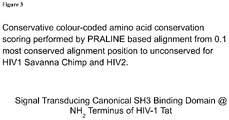
- FIG. 3 An amino acid conservative alignment of NH 2 terminal sequences of HIV and CPZ Tat containing a P-rich string with homology to SH3-binding domains.
- FIG. 4 Monomer Tat transcriptional activation of the HIV lir.
- A Graph of induced luciferase activity. HeLa cells were transfected with an HIV LTR luciferase reporter construct. 24 hours after transfection at a time when cells were approximately 75% confluent, cells were scrape-loaded with 2 ⁇ g protein in the presence of 100 ⁇ M chloroquine as described by Frankel (Frankel AD1, Pabo CO.Cell. 1988 Dec. 23; 55(6):1189-93) After an additional 24 hours luciferase activity was measured and is recorded as relative activity compared to sham-transfected HeLa cells. The average of three independent experiments is shown.
- B Graph of induced luciferase activity. HeLa cells were transfected with an HIV LTR luciferase reporter construct. 24 hours after transfection at a time when cells were approximately 75% confluent, cells were scrape-loaded with 2 ⁇ g protein in the presence of 100 ⁇ M chloroquine as described
- FIG. 5 Bioavailability of Tat after membrane translocation.
- Peripheral blood mononuclear cells PBMCs, 10 6 cells/ml
- PHA phytohemagglutinin
- PBMCs were washed, re-suspended at 10 7 cells/ml, and scrape-loaded with Tat genetically linked to Green Fluorescent Protein (Tat-GFP, 10 ⁇ M).
- Tat-GFP Green Fluorescent Protein
- FIG. 6 Compositions of Matter encoding oncogene-antagonizing peptides.
- FIG. 7 Algorithm for Humanizing a viral peptide. in silico identification of the apoptotic determinant in CAV VP3 as a peptide homologous to the SH3-binding domain of AKT. The alignment is anchored by a P-rich SH3-binding region (Orange box) at its amino end, and anchored at its carboxyl end by an S/TxY (blue and green boxes) MAP kinase phosphorylation motif.
- P-rich SH3-binding region Range box
- S/TxY blue and green boxes
- DAGRS are targeted drugs aimed to control tumor growth, and prevent or resolve metastases, while avoiding many of the side effects associated with standard chemotherapy.
- the present invention provides for improved oncogene-directed biologics which in its simplest realization locks a signal transducing peptide into an NH 2 terminal cassette in a biologically active configuration protected from degradation, and links this sequence to a carboxyl KR-rich membrane translocation sequence (MTS, SEQ ID NO:2).
- MTS carboxyl KR-rich membrane translocation sequence
- the construct is designed to facilitate bioavailability and stability of the oncogene-inhibitory peptide.
- the Tat-encoded membrane translocation sequence (SEQ ID NO:2, “penetrin”) has been screened for safety in clinical trial (Voskens et al. Head Neck 34, 1734, 2012).
- Tat contains sequences critical for its entering the nuclear transcriptome (TAR) and to its binding cyclin (SEQ ID NO:1, underlined) that are a preferred realization of this invention (SEQ ID NO:1), because they are proposed to maintain all functionalities while conserving correct domain spacing within Tat. It is not known whether TAR (aa 38-47 within Tat) contributes to Tat toxicity, so another realization of this invention preferred for safety replaces Tat TAR/MTS with a fully human sequence studied to have similar functionalities as Tat. As an example, human Atx-3 mediates the translocation of human VCP to the nucleus: the peptide sequence responsible for these functionalities is illustrated (Atx-3 amino acids 277-291, SEQ ID NO:3). Noteworthy that like Tat SEQ ID NO:3 encodes a short stretch of amino acids preceding its KR-rich MTS. A schematic of the DAGRS construct is illustrated in FIG. 1 .
- DAGRS use a molecular design evolved by the SIV/HIV Tat protein, but are humanized for safety. Overall, DAGRS composition of matter range between 0-33% identity to Tat. This is critical because HIV Tat is a toxic substance which precludes its use in clinical applications.
- DAGRS contain a signal transducing peptide (STP) at their NH 2 terminus. The natural STP of the Tat design is removed, leaving behind a cassette for inserting a peptide theoretically capable of inhibiting any oncogene dependent on the sequence of the STP.
- STP signal transducing peptide
- An important embodiment of the present invention contemplates replacement of the Tat CRD ligand combining site with a neutral human genetic spacer of relatively similar composition, and in particular containing 6 C residues to facilitate proper folding of the biologic.
- Two examples illustrating this invention are the CRD (amino acids 41-60) from human ⁇ -defensin 4 (SEQ ID NO:4) or the CRD from human wnt3 (SEQ ID NO:5), although any human CRD pairing 6 C is a preferred realization of this invention.
- the CRD region which is very autoreactive, could cause major toxicity. Therefore the present invention has redesigned (“humanized”) the region to provide for significantly less toxicity.
- FIG. 2 shows an alignment of acidic transcription factor peptides (TFP) encoded at the NH 2 terminus of SIV.
- TFP acidic transcription factor peptides
- the sequences are stapled on one side by the M initiator and move directly into a DE-rich (acidic transcription activator) segment.
- the SIV TFP are locked into configuration by a conserved P at their COOH end just before the start of the CRD, as illustrated in FIG. 2 .
- FIG. 3 demonstrates that HIV-1, HIV-2, and CPZ carry a different class of STP at their NH 2 terminus with characteristics of SH3-binding domains.
- these three Tat STP initiate with a PxxP motif canonical for SH3-binding domains.
- SIV Tat they are stapled at their COOH end by another P just prior to the C-rich domain ( FIG. 3 ).
- FIG. 4 shows the well-known property of monomeric Tat to enter into and influence cellular transcription.
- the TAR region (SEQ ID NO:1, underlined) and the MTS are critical components of this functionality.
- Tat provides the means to introduce the oncogene-inhibitory STP fragment at the site of action.
- FIG. 4 shows the activity of the monomer as a transcriptional regulator.
- the present invention further improves bioavailability by combining the membrane translocation sequences of Tat with the targeted killing effect of Apoptin, or any STP.
- the invention is not interfered with by patent filings proposing to link Apoptin to Tat for improved bioavailability (US 20020176860, US 2008/0234466) because those inventors on the Tat-Apoptin patents acknowledge that native Tat is too toxic to be administered to humans (see Los et al., Apoptin, a tumor-selective killer, Biochem Biophys Acta. 1793, (2009) 1335-1342), and because the DAGRS sequences bear ⁇ 33% identity to Tat.
- Translocation of Tat-GFP-monomer is shown in FIG. 5 . Here, cells are incubated in 10 micromolar Tat-GFP monomer and fluorescently imaged.
- FIG. 6 details specific DAGRS compositions of matter to be embedded into the STD (SEQ ID NO:6-SEQ ID NO:9).
- SEQ ID NO:6 proposes a DAGRS with an unmodified 16mer from the CAV VP3 (“Apoptin”) that contains the VP3 SH3-binding site and flanking carboxly amino acids.
- CAV VP3 (“Apoptin”)
- Apoptin is known to kill most cancers using an AKT pathway, but Apoptin is not cytotoxic for normal cells.
- Prior to the present invention nothing similar has been described that could function as an in vivo oncolytic without associated toxicity.
- SEQ ID NO:7 identifies a 16mer homologue to the VP3 SH3-binding domain and carboxyl flanking sequences in human AKT, strongly supporting the proposal that VP3 functions as a competitive inhibitor to AKT activation. Further, polio oncolytic virus, now approved for treating recurrent glioblastoma cancers, appears to work, at least in part, through an AKT mechanism.
- the present invention proposes using the human AKT SH3-binding region (SEQ ID NO:7) as an alternative to SEQ ID NO:6 under the proposition that its fully human sequence will be better tolerated and less immunogenic in the clinical setting.
- a third DAGRS derivative (SEQ ID NO:8) aligns the paired prolines at the carboxyl terminus, as in VP3, but also retains the paired amino prolines, and in so doing creates a DAGRS with a canonical SH3-binding site for the src oncogene. Interaction between Src and the SH3-binding region of AKT is requisite for AKT activation (Jiang and Qiu, Journal of Biological Chemistry 278, 15789, 2003). SEQ ID NO:8 describes a derivatization of AKT peptide that could give it higher affinity for Src than native human AKT.
- composition is extending 16mer SEQ ID NO:6-SEQ ID NO:8 with 4 or 5 COOH amino acids from their respective proteins (ie RVSEL for VP3), thereby engineering 20mers with proposed carboxyl phosphorylation site anchors more distant from their P staples ( FIG. 7 ), since the P staples are not present in either VP3 or AKT whole protein, and could be a source of steric hindrance.
- Another embodiment of the present invention is a DAGRS with a transcription factor/protein activator region such as a peptide capable of binding to E2F promoter ((SEQ ID NO:9).
- This design bears analogy to SIV Tat in encoding an acidic region, while the AKT design bears analogy to HIV Tat in encoding an SH3-binding domain
- SEQ ID NO:6-SEQ ID NO:8 it could be beneficial to distance E2F peptide (SEQ ID NO:9) by 4 or 5 amino acids from the COOH P staple.
- FIG. 7 demonstrates the functional alignment between the viral VP3 SH3-binding domain, and human AKT SH3-binding domain, and establishes an algorithm generally useful for the alignment of viral tiles with human tiles (a “humanization” algorithm).
- a “humanization” algorithm In particular other than the alignment of the proline-rich SH3-binding domains (boxed orange) there is little or no homology (and none recognized by current standard protein alignment programs) until the sequences reach a tightly evolutionarily conserved S/TxY Mitogen Activated Protein kinase phosphorylation site (Mohanta et al Biological Procedures Online 17, 13, 2015) at their COOH end, with an identical spacing of 9 amino acids between P and S/T (boxed blue).
- FIG. 7 can be generalized to an algorithm that identifies conserved functionalities among proteins (AKT and VP3 both influence G2 phase cell cycle transition and interact with identical proteins), aligns peptides from the two proteins through amino and carboxyl anchors with matched functional domains, eg an SH3-binding domain and a MAP kinase phosphorylation domain, and prioritizes equivalent spacing between the two functional domains, while at the same time totally ignoring the primary amino acid sequence of the spacer.
- the rationale supporting the algorithm is that correct amino acid spacing conserves functional interactions in three dimensions.
- the algorithm totally ignores the composition of amino acids intervening between the anchors, because the evolutionary distance between the species originally hosting the virus and humans is proposed to be too distant to conserve primary amino acid sequence of these non-essential residues. This is consistent with the vectors that transmit Zika virus and Ebola virus to humans, being respectively mosquitoes and bats. Many viral activities could be rendered safe and therapeutic via this algorithm converting viral components to human protein components.
Landscapes
- Life Sciences & Earth Sciences (AREA)
- Chemical & Material Sciences (AREA)
- Health & Medical Sciences (AREA)
- Bioinformatics & Cheminformatics (AREA)
- Engineering & Computer Science (AREA)
- Organic Chemistry (AREA)
- General Health & Medical Sciences (AREA)
- Physics & Mathematics (AREA)
- Genetics & Genomics (AREA)
- Molecular Biology (AREA)
- Biophysics (AREA)
- Proteomics, Peptides & Aminoacids (AREA)
- Biotechnology (AREA)
- Zoology (AREA)
- Wood Science & Technology (AREA)
- Biochemistry (AREA)
- Spectroscopy & Molecular Physics (AREA)
- Evolutionary Biology (AREA)
- Theoretical Computer Science (AREA)
- Medical Informatics (AREA)
- Analytical Chemistry (AREA)
- Bioinformatics & Computational Biology (AREA)
- General Engineering & Computer Science (AREA)
- Medicinal Chemistry (AREA)
- Microbiology (AREA)
- Gastroenterology & Hepatology (AREA)
- Virology (AREA)
- Biomedical Technology (AREA)
- Peptides Or Proteins (AREA)
- Medicines That Contain Protein Lipid Enzymes And Other Medicines (AREA)
Abstract
Description
| SEQ ID NO: 6 | |
| PKPPSKKRSCDPSEYR |
DAGRS peptide derived from chicken anemia virus VP3
| SEQ ID NO: 7 | |
| PPFKPQVTSETRYF |
DAGRS peptide derived from the SH3-binding region of human AKT
| SEQ ID NO: 8 | |
| PPKPPQVTSETDTRYF |
DAGRS peptide derived from AKT modified to be “right-handed” as VP3 and to contain a canonical PPxPP Src SH3-binding site. (Kay, Williamson, and Sudol, FASEB J 14, 231, 2000).
| SEQ ID NO: 9 | |
| HHHRLSH |
DAGRS encoding the E2F promoter binding peptide as described by Bertino.
Claims (10)
Priority Applications (1)
| Application Number | Priority Date | Filing Date | Title |
|---|---|---|---|
| US15/649,515 US11299516B2 (en) | 2016-07-14 | 2017-07-13 | DAGRS: directed antigonists to cancer cell growth signals |
Applications Claiming Priority (2)
| Application Number | Priority Date | Filing Date | Title |
|---|---|---|---|
| US201662362254P | 2016-07-14 | 2016-07-14 | |
| US15/649,515 US11299516B2 (en) | 2016-07-14 | 2017-07-13 | DAGRS: directed antigonists to cancer cell growth signals |
Publications (2)
| Publication Number | Publication Date |
|---|---|
| US20180016305A1 US20180016305A1 (en) | 2018-01-18 |
| US11299516B2 true US11299516B2 (en) | 2022-04-12 |
Family
ID=60941954
Family Applications (1)
| Application Number | Title | Priority Date | Filing Date |
|---|---|---|---|
| US15/649,515 Active 2037-07-17 US11299516B2 (en) | 2016-07-14 | 2017-07-13 | DAGRS: directed antigonists to cancer cell growth signals |
Country Status (1)
| Country | Link |
|---|---|
| US (1) | US11299516B2 (en) |
Families Citing this family (1)
| Publication number | Priority date | Publication date | Assignee | Title |
|---|---|---|---|---|
| WO2025154104A1 (en) * | 2024-01-20 | 2025-07-24 | Ur Advanced Therapeutics Private Limited | Non-cell penetrating, metacyclic synthetic peptides |
Citations (1)
| Publication number | Priority date | Publication date | Assignee | Title |
|---|---|---|---|---|
| WO2009148896A2 (en) * | 2008-05-29 | 2009-12-10 | Nuclea Biotechnologies, LLC | Anti-phospho-akt antibodies |
-
2017
- 2017-07-13 US US15/649,515 patent/US11299516B2/en active Active
Patent Citations (1)
| Publication number | Priority date | Publication date | Assignee | Title |
|---|---|---|---|---|
| WO2009148896A2 (en) * | 2008-05-29 | 2009-12-10 | Nuclea Biotechnologies, LLC | Anti-phospho-akt antibodies |
Non-Patent Citations (3)
| Title |
|---|
| Johnson et al. ("Targeting the RB-E2F pathway in breast cancer," Oncogene vol. 35, pp. 4829-4835(2016)) (Year: 2016). * |
| Simon et al. ("Targeting AKT with the Pro-apoptotic Peptide, TAT-CTMP: a Novel Strategy for the Treatment of Human Pancreatic Adenocarcinoma," Int J Cancer. Aug. 15, 2009; 125(4): 942-951; NIH Public Access Manuscript pp. 1-25) (Year: 2009). * |
| Testa et al. ("AKT signaling in normal and malignant cells," Oncogene vol. 24, pp. 7391-7393(2005)) (Year: 2005). * |
Also Published As
| Publication number | Publication date |
|---|---|
| US20180016305A1 (en) | 2018-01-18 |
Similar Documents
| Publication | Publication Date | Title |
|---|---|---|
| CN113498417B (en) | Polypeptide, preparation method and application thereof | |
| JP6457003B2 (en) | Generation of antibodies against tumor antigens and tumor-specific complement-dependent cytotoxicity by administration of oncolytic vaccinia virus | |
| AU2021261945B2 (en) | Compositions and methods for generating an immune response to a tumor associated antigen | |
| US20220160853A1 (en) | Cancer vaccine compositions and methods for use thereof | |
| TW201809270A (en) | Novel genetic recombinant vaccinia virus | |
| JP2023071953A (en) | A therapeutic agent comprising an isolated recombinant oncolytic vaccinia virus and NK cells, its use and a kit applying it | |
| US20250122244A1 (en) | Method for producing an antitumoral arenavirus as well as arenavirus mutants | |
| TW202600150A (en) | Recombinant rhabdovirus encoding for ccl21 | |
| WO2017120997A1 (en) | Transgenic lymphocyte co-expressing egfrviii chimeric antigen receptor and non-functional egfr and uses of the lymphocyte | |
| US20210220469A1 (en) | Immuno-Oncology Compositions and Methods for Use Thereof | |
| US20160002667A1 (en) | Pseudomonas exotoxins for cancer treatment | |
| US12351812B2 (en) | Recombinant oncolytic virus | |
| US20180016305A1 (en) | DAGRS: Directed Antigonists to Cancer Cell Growth Signals | |
| CN116917468A (en) | Novel modified reovirus and its uses | |
| Wollenberg | Tweaking reovirus T3D to boost the oncolytic potency | |
| HK40058869A (en) | Polypeptide, and preparation method therefor and use thereof | |
| CN117903281A (en) | Polypeptide for inhibiting tumor metastasis and design and preparation method thereof | |
| JP2024504540A (en) | Polypeptides for cancer treatment | |
| JP2021513843A (en) | Modified adenovirus | |
| Ding et al. | 1 Cancer Biotherapy: Progress | |
| Lohr et al. | Experimental treatment of pancreatic cancer |
Legal Events
| Date | Code | Title | Description |
|---|---|---|---|
| STCB | Information on status: application discontinuation |
Free format text: ABANDONED -- FAILURE TO RESPOND TO AN OFFICE ACTION |
|
| FEPP | Fee payment procedure |
Free format text: ENTITY STATUS SET TO MICRO (ORIGINAL EVENT CODE: MICR); ENTITY STATUS OF PATENT OWNER: SMALL ENTITY |
|
| STPP | Information on status: patent application and granting procedure in general |
Free format text: RESPONSE TO NON-FINAL OFFICE ACTION ENTERED AND FORWARDED TO EXAMINER |
|
| STPP | Information on status: patent application and granting procedure in general |
Free format text: NON FINAL ACTION MAILED |
|
| FEPP | Fee payment procedure |
Free format text: ENTITY STATUS SET TO MICRO (ORIGINAL EVENT CODE: MICR); ENTITY STATUS OF PATENT OWNER: SMALL ENTITY |
|
| STPP | Information on status: patent application and granting procedure in general |
Free format text: RESPONSE TO NON-FINAL OFFICE ACTION ENTERED AND FORWARDED TO EXAMINER |
|
| STPP | Information on status: patent application and granting procedure in general |
Free format text: FINAL REJECTION MAILED |
|
| FEPP | Fee payment procedure |
Free format text: ENTITY STATUS SET TO SMALL (ORIGINAL EVENT CODE: SMAL); ENTITY STATUS OF PATENT OWNER: SMALL ENTITY |
|
| STPP | Information on status: patent application and granting procedure in general |
Free format text: DOCKETED NEW CASE - READY FOR EXAMINATION |
|
| STPP | Information on status: patent application and granting procedure in general |
Free format text: EX PARTE QUAYLE ACTION MAILED |
|
| STPP | Information on status: patent application and granting procedure in general |
Free format text: RESPONSE TO EX PARTE QUAYLE ACTION ENTERED AND FORWARDED TO EXAMINER |
|
| STPP | Information on status: patent application and granting procedure in general |
Free format text: NOTICE OF ALLOWANCE MAILED -- APPLICATION RECEIVED IN OFFICE OF PUBLICATIONS |
|
| STPP | Information on status: patent application and granting procedure in general |
Free format text: PUBLICATIONS -- ISSUE FEE PAYMENT VERIFIED |
|
| STCF | Information on status: patent grant |
Free format text: PATENTED CASE |
|
| FEPP | Fee payment procedure |
Free format text: MAINTENANCE FEE REMINDER MAILED (ORIGINAL EVENT CODE: REM.); ENTITY STATUS OF PATENT OWNER: SMALL ENTITY |