US11298676B2 - Porous material for storing of molecules and its use - Google Patents
Porous material for storing of molecules and its use Download PDFInfo
- Publication number
- US11298676B2 US11298676B2 US16/161,215 US201816161215A US11298676B2 US 11298676 B2 US11298676 B2 US 11298676B2 US 201816161215 A US201816161215 A US 201816161215A US 11298676 B2 US11298676 B2 US 11298676B2
- Authority
- US
- United States
- Prior art keywords
- mof
- storing
- porous material
- bis
- distinguished
- Prior art date
- Legal status (The legal status is an assumption and is not a legal conclusion. Google has not performed a legal analysis and makes no representation as to the accuracy of the status listed.)
- Active, expires
Links
- 0 [1*]P(=O)(O)CP([1*])(=O)O Chemical compound [1*]P(=O)(O)CP([1*])(=O)O 0.000 description 5
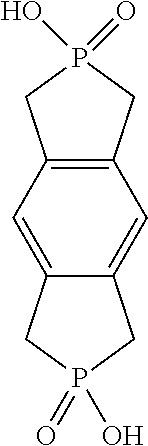
- PKTUEIXTTMDWDO-UHFFFAOYSA-N O=P1(O)Cc2cc3c(cc2C1)CP(=O)(O)C3 Chemical compound O=P1(O)Cc2cc3c(cc2C1)CP(=O)(O)C3 PKTUEIXTTMDWDO-UHFFFAOYSA-N 0.000 description 2
- IJUBWVXEYUVLNX-UHFFFAOYSA-N CP(=O)(O)c1ccc(-c2cc(-c3ccc(P(C)(=O)O)cc3)cc(-c3ccc(P(C)(=O)O)cc3)c2)cc1 Chemical compound CP(=O)(O)c1ccc(-c2cc(-c3ccc(P(C)(=O)O)cc3)cc(-c3ccc(P(C)(=O)O)cc3)c2)cc1 IJUBWVXEYUVLNX-UHFFFAOYSA-N 0.000 description 1
- PFMAXFSCYVCRFE-UHFFFAOYSA-N CP(=O)(O)c1ccc(C(c2ccc(P(C)(=O)O)cc2)(c2ccc(P(C)(=O)O)cc2)c2ccc(P(C)(=O)O)cc2)cc1 Chemical compound CP(=O)(O)c1ccc(C(c2ccc(P(C)(=O)O)cc2)(c2ccc(P(C)(=O)O)cc2)c2ccc(P(C)(=O)O)cc2)cc1 PFMAXFSCYVCRFE-UHFFFAOYSA-N 0.000 description 1
- NEEIFFCHCZEWJQ-UHFFFAOYSA-N Cc1ccc(-c2ccc(C)cc2)cc1.Cc1ccc(C)cc1 Chemical compound Cc1ccc(-c2ccc(C)cc2)cc1.Cc1ccc(C)cc1 NEEIFFCHCZEWJQ-UHFFFAOYSA-N 0.000 description 1
Images


Classifications
-
- B—PERFORMING OPERATIONS; TRANSPORTING
- B01—PHYSICAL OR CHEMICAL PROCESSES OR APPARATUS IN GENERAL
- B01J—CHEMICAL OR PHYSICAL PROCESSES, e.g. CATALYSIS OR COLLOID CHEMISTRY; THEIR RELEVANT APPARATUS
- B01J20/00—Solid sorbent compositions or filter aid compositions; Sorbents for chromatography; Processes for preparing, regenerating or reactivating thereof
- B01J20/22—Solid sorbent compositions or filter aid compositions; Sorbents for chromatography; Processes for preparing, regenerating or reactivating thereof comprising organic material
- B01J20/223—Solid sorbent compositions or filter aid compositions; Sorbents for chromatography; Processes for preparing, regenerating or reactivating thereof comprising organic material containing metals, e.g. organo-metallic compounds, coordination complexes
- B01J20/226—Coordination polymers, e.g. metal-organic frameworks [MOF], zeolitic imidazolate frameworks [ZIF]
-
- C—CHEMISTRY; METALLURGY
- C07—ORGANIC CHEMISTRY
- C07F—ACYCLIC, CARBOCYCLIC OR HETEROCYCLIC COMPOUNDS CONTAINING ELEMENTS OTHER THAN CARBON, HYDROGEN, HALOGEN, OXYGEN, NITROGEN, SULFUR, SELENIUM OR TELLURIUM
- C07F9/00—Compounds containing elements of Groups 5 or 15 of the Periodic Table
- C07F9/02—Phosphorus compounds
- C07F9/28—Phosphorus compounds with one or more P—C bonds
- C07F9/30—Phosphinic acids [R2P(=O)(OH)]; Thiophosphinic acids ; [R2P(=X1)(X2H) (X1, X2 are each independently O, S or Se)]
- C07F9/304—Aromatic acids (P-C aromatic linkage)
-
- B—PERFORMING OPERATIONS; TRANSPORTING
- B01—PHYSICAL OR CHEMICAL PROCESSES OR APPARATUS IN GENERAL
- B01J—CHEMICAL OR PHYSICAL PROCESSES, e.g. CATALYSIS OR COLLOID CHEMISTRY; THEIR RELEVANT APPARATUS
- B01J20/00—Solid sorbent compositions or filter aid compositions; Sorbents for chromatography; Processes for preparing, regenerating or reactivating thereof
- B01J20/28—Solid sorbent compositions or filter aid compositions; Sorbents for chromatography; Processes for preparing, regenerating or reactivating thereof characterised by their form or physical properties
- B01J20/28054—Solid sorbent compositions or filter aid compositions; Sorbents for chromatography; Processes for preparing, regenerating or reactivating thereof characterised by their form or physical properties characterised by their surface properties or porosity
- B01J20/28057—Surface area, e.g. B.E.T specific surface area
- B01J20/28061—Surface area, e.g. B.E.T specific surface area being in the range 100-500 m2/g
-
- B—PERFORMING OPERATIONS; TRANSPORTING
- B01—PHYSICAL OR CHEMICAL PROCESSES OR APPARATUS IN GENERAL
- B01J—CHEMICAL OR PHYSICAL PROCESSES, e.g. CATALYSIS OR COLLOID CHEMISTRY; THEIR RELEVANT APPARATUS
- B01J20/00—Solid sorbent compositions or filter aid compositions; Sorbents for chromatography; Processes for preparing, regenerating or reactivating thereof
- B01J20/28—Solid sorbent compositions or filter aid compositions; Sorbents for chromatography; Processes for preparing, regenerating or reactivating thereof characterised by their form or physical properties
- B01J20/28054—Solid sorbent compositions or filter aid compositions; Sorbents for chromatography; Processes for preparing, regenerating or reactivating thereof characterised by their form or physical properties characterised by their surface properties or porosity
- B01J20/28057—Surface area, e.g. B.E.T specific surface area
- B01J20/28064—Surface area, e.g. B.E.T specific surface area being in the range 500-1000 m2/g
-
- B—PERFORMING OPERATIONS; TRANSPORTING
- B01—PHYSICAL OR CHEMICAL PROCESSES OR APPARATUS IN GENERAL
- B01J—CHEMICAL OR PHYSICAL PROCESSES, e.g. CATALYSIS OR COLLOID CHEMISTRY; THEIR RELEVANT APPARATUS
- B01J20/00—Solid sorbent compositions or filter aid compositions; Sorbents for chromatography; Processes for preparing, regenerating or reactivating thereof
- B01J20/28—Solid sorbent compositions or filter aid compositions; Sorbents for chromatography; Processes for preparing, regenerating or reactivating thereof characterised by their form or physical properties
- B01J20/28054—Solid sorbent compositions or filter aid compositions; Sorbents for chromatography; Processes for preparing, regenerating or reactivating thereof characterised by their form or physical properties characterised by their surface properties or porosity
- B01J20/28057—Surface area, e.g. B.E.T specific surface area
- B01J20/28066—Surface area, e.g. B.E.T specific surface area being more than 1000 m2/g
-
- B—PERFORMING OPERATIONS; TRANSPORTING
- B01—PHYSICAL OR CHEMICAL PROCESSES OR APPARATUS IN GENERAL
- B01J—CHEMICAL OR PHYSICAL PROCESSES, e.g. CATALYSIS OR COLLOID CHEMISTRY; THEIR RELEVANT APPARATUS
- B01J20/00—Solid sorbent compositions or filter aid compositions; Sorbents for chromatography; Processes for preparing, regenerating or reactivating thereof
- B01J20/30—Processes for preparing, regenerating, or reactivating
- B01J20/3085—Chemical treatments not covered by groups B01J20/3007 - B01J20/3078
-
- C—CHEMISTRY; METALLURGY
- C01—INORGANIC CHEMISTRY
- C01B—NON-METALLIC ELEMENTS; COMPOUNDS THEREOF; METALLOIDS OR COMPOUNDS THEREOF NOT COVERED BY SUBCLASS C01C
- C01B21/00—Nitrogen; Compounds thereof
- C01B21/02—Preparation of nitrogen
-
- C—CHEMISTRY; METALLURGY
- C01—INORGANIC CHEMISTRY
- C01B—NON-METALLIC ELEMENTS; COMPOUNDS THEREOF; METALLOIDS OR COMPOUNDS THEREOF NOT COVERED BY SUBCLASS C01C
- C01B3/00—Hydrogen; Gaseous mixtures containing hydrogen; Separation of hydrogen from mixtures containing it; Purification of hydrogen
- C01B3/0005—Reversible uptake of hydrogen by an appropriate medium, i.e. based on physical or chemical sorption phenomena or on reversible chemical reactions, e.g. for hydrogen storage purposes ; Reversible gettering of hydrogen; Reversible uptake of hydrogen by electrodes
- C01B3/001—Reversible uptake of hydrogen by an appropriate medium, i.e. based on physical or chemical sorption phenomena or on reversible chemical reactions, e.g. for hydrogen storage purposes ; Reversible gettering of hydrogen; Reversible uptake of hydrogen by electrodes characterised by the uptaking medium; Treatment thereof
- C01B3/0015—Organic compounds; Solutions thereof
-
- C—CHEMISTRY; METALLURGY
- C01—INORGANIC CHEMISTRY
- C01B—NON-METALLIC ELEMENTS; COMPOUNDS THEREOF; METALLOIDS OR COMPOUNDS THEREOF NOT COVERED BY SUBCLASS C01C
- C01B32/00—Carbon; Compounds thereof
- C01B32/50—Carbon dioxide
-
- C—CHEMISTRY; METALLURGY
- C07—ORGANIC CHEMISTRY
- C07F—ACYCLIC, CARBOCYCLIC OR HETEROCYCLIC COMPOUNDS CONTAINING ELEMENTS OTHER THAN CARBON, HYDROGEN, HALOGEN, OXYGEN, NITROGEN, SULFUR, SELENIUM OR TELLURIUM
- C07F9/00—Compounds containing elements of Groups 5 or 15 of the Periodic Table
- C07F9/02—Phosphorus compounds
- C07F9/28—Phosphorus compounds with one or more P—C bonds
- C07F9/30—Phosphinic acids [R2P(=O)(OH)]; Thiophosphinic acids ; [R2P(=X1)(X2H) (X1, X2 are each independently O, S or Se)]
- C07F9/305—Poly(thio)phosphinic acids
-
- C—CHEMISTRY; METALLURGY
- C07—ORGANIC CHEMISTRY
- C07F—ACYCLIC, CARBOCYCLIC OR HETEROCYCLIC COMPOUNDS CONTAINING ELEMENTS OTHER THAN CARBON, HYDROGEN, HALOGEN, OXYGEN, NITROGEN, SULFUR, SELENIUM OR TELLURIUM
- C07F9/00—Compounds containing elements of Groups 5 or 15 of the Periodic Table
- C07F9/02—Phosphorus compounds
- C07F9/547—Heterocyclic compounds, e.g. containing phosphorus as a ring hetero atom
- C07F9/6564—Heterocyclic compounds, e.g. containing phosphorus as a ring hetero atom having phosphorus atoms, with or without nitrogen, oxygen, sulfur, selenium or tellurium atoms, as ring hetero atoms
- C07F9/6568—Heterocyclic compounds, e.g. containing phosphorus as a ring hetero atom having phosphorus atoms, with or without nitrogen, oxygen, sulfur, selenium or tellurium atoms, as ring hetero atoms having phosphorus atoms as the only ring hetero atoms
- C07F9/65685—Heterocyclic compounds, e.g. containing phosphorus as a ring hetero atom having phosphorus atoms, with or without nitrogen, oxygen, sulfur, selenium or tellurium atoms, as ring hetero atoms having phosphorus atoms as the only ring hetero atoms the ring phosphorus atom being part of a phosphine oxide or thioxide
-
- C—CHEMISTRY; METALLURGY
- C08—ORGANIC MACROMOLECULAR COMPOUNDS; THEIR PREPARATION OR CHEMICAL WORKING-UP; COMPOSITIONS BASED THEREON
- C08G—MACROMOLECULAR COMPOUNDS OBTAINED OTHERWISE THAN BY REACTIONS ONLY INVOLVING UNSATURATED CARBON-TO-CARBON BONDS
- C08G79/00—Macromolecular compounds obtained by reactions forming a linkage containing atoms other than silicon, sulfur, nitrogen, oxygen, and carbon with or without the latter elements in the main chain of the macromolecule
- C08G79/02—Macromolecular compounds obtained by reactions forming a linkage containing atoms other than silicon, sulfur, nitrogen, oxygen, and carbon with or without the latter elements in the main chain of the macromolecule a linkage containing phosphorus
- C08G79/04—Phosphorus linked to oxygen or to oxygen and carbon
-
- C—CHEMISTRY; METALLURGY
- C08—ORGANIC MACROMOLECULAR COMPOUNDS; THEIR PREPARATION OR CHEMICAL WORKING-UP; COMPOSITIONS BASED THEREON
- C08G—MACROMOLECULAR COMPOUNDS OBTAINED OTHERWISE THAN BY REACTIONS ONLY INVOLVING UNSATURATED CARBON-TO-CARBON BONDS
- C08G83/00—Macromolecular compounds not provided for in groups C08G2/00 - C08G81/00
- C08G83/002—Dendritic macromolecules
- C08G83/003—Dendrimers
-
- F—MECHANICAL ENGINEERING; LIGHTING; HEATING; WEAPONS; BLASTING
- F17—STORING OR DISTRIBUTING GASES OR LIQUIDS
- F17C—VESSELS FOR CONTAINING OR STORING COMPRESSED, LIQUEFIED OR SOLIDIFIED GASES; FIXED-CAPACITY GAS-HOLDERS; FILLING VESSELS WITH, OR DISCHARGING FROM VESSELS, COMPRESSED, LIQUEFIED, OR SOLIDIFIED GASES
- F17C11/00—Use of gas-solvents or gas-sorbents in vessels
-
- Y—GENERAL TAGGING OF NEW TECHNOLOGICAL DEVELOPMENTS; GENERAL TAGGING OF CROSS-SECTIONAL TECHNOLOGIES SPANNING OVER SEVERAL SECTIONS OF THE IPC; TECHNICAL SUBJECTS COVERED BY FORMER USPC CROSS-REFERENCE ART COLLECTIONS [XRACs] AND DIGESTS
- Y02—TECHNOLOGIES OR APPLICATIONS FOR MITIGATION OR ADAPTATION AGAINST CLIMATE CHANGE
- Y02C—CAPTURE, STORAGE, SEQUESTRATION OR DISPOSAL OF GREENHOUSE GASES [GHG]
- Y02C20/00—Capture or disposal of greenhouse gases
- Y02C20/40—Capture or disposal of greenhouse gases of CO2
-
- Y—GENERAL TAGGING OF NEW TECHNOLOGICAL DEVELOPMENTS; GENERAL TAGGING OF CROSS-SECTIONAL TECHNOLOGIES SPANNING OVER SEVERAL SECTIONS OF THE IPC; TECHNICAL SUBJECTS COVERED BY FORMER USPC CROSS-REFERENCE ART COLLECTIONS [XRACs] AND DIGESTS
- Y02—TECHNOLOGIES OR APPLICATIONS FOR MITIGATION OR ADAPTATION AGAINST CLIMATE CHANGE
- Y02E—REDUCTION OF GREENHOUSE GAS [GHG] EMISSIONS, RELATED TO ENERGY GENERATION, TRANSMISSION OR DISTRIBUTION
- Y02E60/00—Enabling technologies; Technologies with a potential or indirect contribution to GHG emissions mitigation
- Y02E60/30—Hydrogen technology
- Y02E60/32—Hydrogen storage
Definitions
- the presented invention applies to the method of production of stable porous coordination polymers (metal-organic framework—MOF) consisting of metal centres linked using organic ligands—linkers based on phosphinic acids that contain two or more phosphinic groups, and their resulting crystalline structure contains pores.
- MOF metal-organic framework
- These materials can be used for storing of gases or separation of gases, for preparation of membranes, heterogeneous catalysts, sorbents, lithium batteries, of proton conductors and of drug carriers and they also find application in analytical chemistry as sensors of gases, ions or organic or biologically active substances.
- MOFs thus Metal Organic Frameworks
- inorganic parts metal ion or cluster
- organic linkers which form coordination links to inorganic parts using donor groups while forming crystal structures
- inorganic parts and organic linkers a material with the most different required properties, from size and shape of pores to electric and magnetic properties of the lattice can be designed and composed.
- MOFs When compared with other porous crystalline materials, e.g. zeolites, MOFs can contain pores in the range of micropores (pore diameter ⁇ 2 nm) or mesopores (pore diameter in range 2-50 nm) and their surface can be adjusted as hydrophilic or hydrophobic according to the combination of the selected metal and the type of linker.
- the opportunities to set size and share of hydrophobicity/hydrophilicity pores of MOF, for a given metal and length and structure of organic linker have been very limited up to now.
- MOFs show low stability in aqueous medium, particularly at higher temperatures (M. Brichtová, P.
- Linkers of up to now described MOFs are mostly based on donor groups of acids, particularly of carboxyl, sulphonic or phosphonic ones, and also those based on heterocycles containing nitrogen.
- donor groups of acids particularly of carboxyl, sulphonic or phosphonic ones, and also those based on heterocycles containing nitrogen.
- direct modification of these donor groups of carboxyl, sulphonic and phosphonic acids with other organic groups, e.g. with alkyls or aryls which would allow to change the character of MOFs, is not possible. Only selection of a suitable spacer among the donor groups can have effect on size of pores of the material.
- solvothermal techniques are used most frequently for synthesis of MOFs, i.e. they are prepared using synthesis of precursor of metal and organic ligand which are mostly diluted in high-boiling polar solvent and heated in a sealed vessel. The crystallization process is the most important one for the formation of the desired structures.
- Other options are the wet electrochemical method where the source of metal is an anode submerged in solution of carboxylates. Solvent-free synthesis of MOFs is also highly preferred. This can be carried out mechanically by grinding, where precursors of metal and organic linker are ground together and the rising by-products like water or low-molecular organic products are removed under raised temperature. After the substance is synthesised postsynthetic modification can follow where MOFs are modified without changing their topology, for example adjustments or replacements of organic linkers are carried out.
- MOFs have been frequently studied particularly because of their high application potential which involves storing or separation of gases, transport of drugs, heterogeneous catalysis, preparation of membranes, heterogeneous catalysts, parts of lithium batteries and proton conductors and utilisation in analytical chemistry in function of sensors of gases, ions or biologically active substances
- MOFs metal-organic chemical and mechanical stability
- the above handicap lies in impossibility to modify the known linkers based on coordination groups of carboxyl, sulphonic or phosphonic acids.
- Linkers based on acids with phosphine groups have been used for preparation of coordination polymer only as monophosphinic acid (V. Moodley, L. Mthethwa, M. N. Pillay, B. Omondi, W. E. van Zyl, The silver(I) coordination polymer [AgO 2 PPh 2 ] n and unsupported Ag . . .
- 1,1′ferocendiyl bridge (R. Shekurov, V. Miluykov, O. Kataeva, D. Krivolapov, O. Sinyashin, T. Gerasimova, S. Katsyuba, V. Kovalenko, Y. Krupskaya, V. Kataev, B. Büchner, I. Senkovska, S. Kaskel, Reversible Water-induced Structural and Magnetic Transformations and Selective Water Adsorption Properties of Poly(manganese 1,1′-ferrocenediyl-bis(H-phosphinate)), Cryst. Growth Des. 16 (2016) 5084-5090) but in all cases, the prepared coordinating polymers have not shown porosity accessible to N 2 molecules.
- the invention concerns the new types of porous coordination polymers (MOF) which have variable prepared pores with porosity up to 1200 m 2 /g available and the method of their preparation.
- MOFs structure consists of trivalent cations of metals, represented above all by iron, aluminium, chromium or yttrium which are linked with organic linkers containing two to four phosphine groups bound to alkyl or aryl frame with general formula:
- R 1 is hydrogen, alkyl or aryl and possibly alkyl or aryl carrying a functional group, or it substitutes the second bond of phosphorus to spacer.
- spacer is formed of aromatic phosphinic acids where two, at least, of phosphinic groups of linker take part in bond to trivalent metal, and therefore they are not a free part of spacer and the remaining, one or two phosphine groups form an indivisible part of spacer, they do not take part in branched polymer bonds to the metal but they intervene in the pore space and this way they modify its space.
- spacer of TPMTPA(R) contains two free phosphine groups, other two phosphine groups are not a part of spacer but they bond to the trivalent metal.
- spacer of TPBTPA(R) contains no free phosphine groups, that are a part of spacer but all three bond to the trivalent metal.
- the MOFs have been prepared through synthesis of salts of trivalent cations of metals M 3+ , the sources of which are aluminium, chromium, iron or yttrium salts, advantageous if in the form of chlorides, nitrates or sulphates with linkers carrying two to four phosphine groups under presence of solvent.
- Typical linkers are bivalent phosphine acids, like phenylene-1,4-bis(R phosphinic acid) (PBPA) and biphenylene-4,4′-bis(R phosphinic acid), and also tris- or tetra-phosphine acids.
- linkers carrying alkyl, aryl chain or functional groups on aryl and possibly alkyl chain linking phosphine acid e.g. 2-methylphenylene-1,4-bis(R phosphinic acid)
- the above chains or functional groups can be represented by methyl, ethyl, i-propyl, phenyl, amino or nitro groups, and also by heterocycle (e.g. pyridine), thio, sulphonate or cyano groups, halogens, and the like.
- some phosphine groups of tris and tetraphosphinic acids can stay free without binding to the trivalent metal where they are used for further modelling of size and arrangement of pores.
- linker may be modified by R bonded to phosphor, where R is methyl, ethyl, i-propyl, phenyl, amino or nitro group, furthermore by a heterocycle (e.g. pyridine), thio, sulfonate or cyano group or halogens.
- R is methyl, ethyl, i-propyl, phenyl, amino or nitro group, furthermore by a heterocycle (e.g. pyridine), thio, sulfonate or cyano group or halogens.
- the optimum range of share of M 3+ and phosphinic groups is 1:2 to 1:8, and it is advantageous if 1:4, where concentration is advantageous if M 3+ being 0.001 mol to 0.02 mol/l.
- Polymerysation of phosphinic acid and M 3 salt runs in solvent during heating. After adding the solvent, the suspension is heated in an autoclave or in glass vials at temperatures from 25° C. to 250° C. for 24 hours, at least, without stirring or with stirring.
- Organic solvents or organic acids for example N,N-dialkyl formamide, formamide, acetone, hexane, acetonitrile, toluene, dimethylsulphoxide, N-methyl-2-pyrrolidone, tetrahydrofuran, formic acid and benzoic acid can be used as the solvent, and it is advantageous if it is ethanol (EtOH) and N,N-dimethyl formamide, or mixtures of these solvents. Selection of combination of solvent, share of M 3+ to phosphine acid, temperature and time for synthesis is very important, if unsuitable conditions and solvent are selected, regular structure need not appear, or can form non-porous coordination polymers.
- the resulting suspension is centrifuged, and it is advantageous if this is done under 10000 rpm for 5 minutes, at least, and the product deposit is separated through decantation.
- the product is washed first with water or ethanol, in two repeats, at least, and then the product is washed with acetone, also in two repeats, at least. Finally, the product is dried on air under laboratory temperature.
- R 1 is hydrogen, alkyl or aryl, and possibly alkyl or aryl carrying a functional group
- M is a trivalent metal
- the structure of prepared MOFs was tested using x-ray powder diffraction (XRD) using CoK ⁇ radiation.
- the measured graphs show that the prepared MOFs correspond to the MOF structure containing Fe and phenylene-1,4-bis(R phosphinic acid) or to that with biphenylene-1,4-bis(R phosphine acid).
- XRD x-ray powder diffraction
- MOFs have been characterised by adsorption isotherm of nitrogen.
- the adsorption isotherm of nitrogen has been investigated at temperature 77 K. After the equilibrium has set where the pressure of adsorbate (gas) has not changed any more, we have calculated the quantity of adsorbate that had adsorbed from the gas phase from the final pressure, capacity of the vessel with adsorbent (MOF) and size of adsorbate dose. This procedure has been repeated for further doses of adsorbate until, after the adsorption equilibrium had been established, the pressure has been very close to the saturated vapor pressure of the adsorbate at the measurement temperature.
- Porous MOFs that have contained pores with micropores with size less 2 nm or mesopores with size 2-3 nm have been prepared.
- change of substituent R 1 , R 2 or R 3 , change of length of spacer bi-phosphinic acid and change of trivalent metal cation can be used to have effect on porosity of prepared MOF.
- MOFs prepared advantageously of phenylene-1,4-bis(methylphosphinic acid) have contained pores of about 1 nm while MOFs prepared advantageously of biphenylene-4,4′-bis(methylphosphinic acid) (BBPA) (BBPA) have contained pores larger, around 2 nm, and also linking a bigger substituent to the phosphine group makes the pore size lesser.
- R alkyl or aryl group, e.g. Me, i-Pr, Ph.
- FIG. 1A Structural formula of phenylene-1,4-bis(R phosphinic acid),
- FIG. 1B Structural formula of biphenylene-4,4′-bis(R phosphinic acid),
- FIG. 2A Monomer unit of coordination polymer of phosphine acid with bis-phosphinic acid
- FIG. 2B Monomer unit of coordination polymer of phosphine acid with two metal (M) with tris or tetra-phosphinic acid, where R1 substitutes the second bond of phosphorus to spacer,
- FIG. 2C Monomer unit of coordination polymer of phosphine acid with one metal (M) with tris or tetra-phosphinic acid, where R1 substitutes the second bond of phosphorus to spacer.
- FIG. 3 Cut-off from structural formula of Fe-MOF with PBPA(Me)
- FIG. 4 Powder x-ray diffractogram (CoK ⁇ radiation) of a) Fe-MOF with PBPA(Me) compared with b) diffractogram calculated from the structure
- FIG. 5 Powder x-ray diffractogram (CoK ⁇ radiation) of Fe-MOF with BBPA(Me)
- FIG. 6 Powder x-ray diffractogram (CoK ⁇ radiation) of Fe-MOF with PBPA(Me) and Cr-MOF with PBPA(Me) and of Al-MOF with PBPA(Me) and of Y-MOF with PBPA(Me)
- FIG. 7 Powder x-ray diffractogram (CoK ⁇ radiation) of a) Al-MOF with PBPA(Ph) compared with b) diffractogram calculated from the structure
- FIG. 8 Powder x-ray diffractogram (CoK ⁇ radiation) of Fe-MOF with BBPA(Me) and of Fe-MOF with BBPA(Ph)
- FIG. 9 Powder x-ray diffractogram (CoK ⁇ radiation) of Fe-MOF with PBPA(Me) in the form of nanoparticles and of Fe-MOF with PBPA(Me)
- FIG. 10 Powder x-ray diffractogram (CoK ⁇ radiation) of Fe-MOF with BBPA(CH 2 ⁇ CH 2 Ph)
- FIG. 11 Powder x-ray diffractogram (CoK ⁇ radiation) of a) Fe-MOF with BBPA(Ph) compared with b) diffractogram calculated from the structure
- FIG. 12 Structure of MOF with PBPA(Me)
- FIG. 13 Structure of MOF with PBPA(Ph)
- FIG. 14 Structure of MOF with BBPA(Me)
- FIG. 15 Structure of MOF with BBPA(Ph)
- FIG. 16 Graph of thermogravimetric analysis of Fe-MOF with PBPA(Me)—air
- FIG. 17 Graph of thermogravimetric analysis of Al-MOF with PBPA(Ph)—air
- FIG. 18 Graph of thermogravimetric analysis of Fe-MOF with PBPA(Me)—argon
- FIG. 19 Graph of adsorption isotherm of nitrogen by Fe-MOF with PBPA(Me), 77 K
- FIG. 20 Graph of adsorption isotherm of nitrogen by Al-MOF with PBPA(Me), 77 K
- FIG. 21 Graph of adsorption isotherm of nitrogen by Y-MOF with PBPA(Me), 77 K
- FIG. 22 Graph of adsorption isotherm of nitrogen by Cr-MOF with PBPA(Me), 77 K
- FIG. 23 Graph of adsorption isotherm of nitrogen by Al-MOF with PBPA(Ph), 77 K
- FIG. 24 Graph of adsorption isotherm of nitrogen by Fe-MOF with BBPA(Me), 77 K
- FIG. 25 Graph of adsorption isotherm of nitrogen by Fe-MOF with BBPA(Ph), 77 K
- FIG. 26 Graph of adsorption isotherm of nitrogen by Fe-MOF with BBPA(CH 2 ⁇ CH 2 Ph), 77 K
- FIG. 27 Graph of pores distribution for Fe-MOF with PBPA(Me) calculated using HK-plot method
- FIG. 28 Graph of pores distribution for Al-MOF with PBPA(Me) calculated using HK-plot method
- FIG. 29 Graph of pores distribution for Y-MOF with PBPA(Me) calculated using HK-plot method
- FIG. 30 Graph of pores distribution for Cr-MOF with PBPA(Me) calculated using HK-plot method
- FIG. 31 Graph of pores distribution for Fe-MOF with BBPA(Me) calculated using NLDFT method
- FIG. 32 Graph of pores distribution for Fe-MOF with BBPA(Ph) calculated using NLDFT method
- FIG. 33 Graph of pores distribution for Fe-MOF with BBPA(CH 2 ⁇ CH 2 Ph) calculated using NLDFT method
- FIG. 34 Graph of pores distribution for Al-MOF with PBPA(Ph) calculated using HK-plot method
- FIG. 35 Graph of adsorption isotherm of hydrogen by Fe-MOF with PBPA(Me), 77 K
- FIG. 36 Graph of adsorption isotherm of hydrogen by Al-MOF with PBPA(Ph), 77 K
- FIG. 37 Photos of nanoparticles of iron (III) phenylene-1, 4-bis(methylphosphinate) from transmission electron microscope
- FIG. 38 Table of prepared MOFs with their specific surface and porosity
- FIG. 39 Adsorption isotherm of CO2 of sample of Al-PBPA(Me) at 25° C.
- FIG. 40 Structural formula of 1,3,5-triphenylbenzene-4′,4′′,4′′′-tris(R phosphinic acid)—TPBTPA(R)
- FIG. 41 Structural formula of 1,2,3,5,6,7-hexahydrophospholo[3,4-f]isophosphindole-2,6-diol 2,6-dioxide
- FIG. 42 Structural formula of Tetraphenylmethane-4′,4′′,4′′′,4′′′′-tetrakis(R phosphine acid)—TPMTPA(R)
- FIG. 43 Structural formula of 1,3,5-triphenylbenzene-4′,4′′,4′′′-tris(methylphosphinic acid)—TPBTPA(Me)
- FIG. 44 Powder x-ray diffractogram (CoK ⁇ radiation) of Fe-MOF with TPBTPA(Me)
- FIG. 45 Graph of adsorption isotherm of nitrogen by Fe-MOF with TPBTPA(Me), 77 K
- FIG. 46 Graph of pores distribution for Fe-MOF with TPBTPA(Me) calculated using HK-plot method
- FIG. 47 Tetraphenylmethane-4′,4′′,4′′′,4′′′′-tetrakis(methylphosphinic acid)—TPMTPA(Me)
- FIG. 48 Powder x-ray diffractogram (CoK ⁇ radiation) of a) Fe-MOF with PBPA(Me) compared with b) diffractogram calculated from the structure
- FIG. 49 Structure of MOF with TPMTPA(Me) with marked area of pores (solvent excluded area—yellow and red colours)
- the initial suspension containing 18.8 mg of phenylene-1,4-bis(methylphosphinic acid)—PBPA(Me) with the amount of substance of 0.08 mmol, 10.8 mg FeCl 3 .6H 2 O with the amount of substance of 0.04 mmol and 5 ml of anhydrous EtOH was heated in an autoclave with capacity of 50 ml with teflon inlet under autogenous pressure at 250° C. for 24 hours without stirring.
- the initial suspension containing 18.8 mg of phenylene-1,4-bis(methylphosphinic acid)—PBPA(Me) with the amount of substance of 0.08 mmol, 9.7 mg AlCl 3 .6H 2 O with amount of substance of 0.04 mmol and 5 ml of anhydrous ethanol was heated in an autoclave with capacity of 50 ml with teflon inlet under autogenous pressure at 250° C. for 24 hours without stirring.
- the initial suspension containing 18.8 mg of phenylene-1,4-bis(methylphosphinic acid)—PBPA(Me) with the amount of substance of 0.08 mmol, 7.8 mg YCl 3 with the amount of substance of 0.04 mmol and 5 ml of anhydrous ethanol was heated in an autoclave with the capacity of 50 ml with teflon inlet under autogenous pressure at 250° C. for 96 hours without stirring.
- the initial suspension containing 18.8 mg of phenylene-1,4-bis(methylphosphinic acid)—PBPA(Me) with the amount of substance of 0.08 mmol, 10.6 mg CrCl 3 .6H 2 O with the amount of substance of 0.04 mmol and 6 ml of water was heated in an autoclave with capacity of 50 ml with teflon inlet under autogenous pressure at 250° C. for 48 hours without stirring.
- MOF was characterised using the adsorption isotherm of nitrogen, and from it its specific surface (using t-plot method) and porosity (using HK-plot method) were determined, and the specific surface was 811 m 2 /g and the diameter of pores was 0.8 nm.
- the initial suspension containing 14.3 mg of phenylene-1,4-bis(phenylphosphinic acid)—PBPA(Ph) with the amount of substance of 0.04 mmol, 4.8 mg AlCl 3 .6H 2 O with the amount of substance of 0.02 mmol and 5 ml of anhydrous ethanol was heated in an autoclave with the capacity of 50 ml with teflon inlet under autogenous pressure at 250° C. for 24 hours without stirring.
- MOF was characterised using the adsorption isotherm of nitrogen, and from it its specific surface (using t-plot method) and the diameter of pores (using HK-plot method) were determined, and the specific surface was 224 m 2 /g and the diameter of pores was in range 0.4-0.6 nm.
- the adsorption isotherm of nitrogen was measured and specific surface (with BET method) and porosity (with NLDFT method for cylindric silicate pores calculated using program BelmasterTM) were calculated, and the specific surface was 978 m 2 /g, the total volume of pores was 1.57 cm 3 /g and the diameter of pores was 2.4 nm.
- the initial suspension containing 34.8 mg of biphenylene-4,4′-bis(phenylphosphinic acid)—BBPA(Ph) with the amount of substance of 0.08 mmol, 10.8 mg FeCl 3 .6H 2 O with the amount of substance of 0.04 mmol and 10 ml of anhydrous ethanol was heated in an autoclave with capacity of 50 ml with teflon inlet under autogenous pressure at 250° C. for 24 hours without stirring.
- the adsorption isotherm of nitrogen was measured and specific surface (with BET method) and porosity (with NLDFT method for cylindric silicate pores calculated using program BelmasterTM) were calculated, and the specific surface was 1172 m 2 /g, the total volume of pores was 2.40 cm 3 /g and the diameter of pores was 2.2 nm.
- the adsorption isotherm of nitrogen was measured and specific surface (with BET method) and porosity (with NLDFT method for cylindric silicate pores calculated using program BelmasterTM) were calculated, and the specific surface was 569 m 2 /g, the total volume of pores was 0.88 cm 3 /g (NLDFT) and the diameter of pores was 1.9 nm.
- the initial suspension containing 14.0 mg of 1,3,5-triphenylbenzene-4′,4′′,4′′′-tris(methylphosphinic acid)—TPBTPA(Me) with the amount of substance of 0.026 mmol, 4.0 mg of FeCl 3 .6H 2 O with the amount of substance of 0.015 mmol and 10 ml of anhydrous ethanol was heated in an autoclave with capacity of 50 ml with teflon inlet under autogenous pressure at 250° C. for 24 hours without stirring. After the autoclave cooled, the resulting suspension was centrifuged at 10000 rpm for 5 minutes and the product deposit was separated through decantation.
- MOF was characterised using the adsorption isotherm of nitrogen, and from it its specific surface (using t-plot method and porosity (HK-plot) were determined, and the specific surface was 869 m 2 /g and the diameter of pores was 0.9 nm.
- the initial suspension containing 11.7 mg of tetraphenylmethane-4′,4′′,4′′′,4′′′′-tetrakis(methylphosphinic acid)—TPMTPA(Me) with the amount of substance of 0.02 mmol, 5.4 mg of FeCl 3 .6H 2 O with the amount of substance of 0.02 mmol and 10 ml of H 2 O was heated in an autoclave with capacity of 50 ml with teflon inlet under autogenous pressure at 250° C. for 24 hours without stirring. After the autoclave cooled, the resulting suspension was centrifuged at 10000 rpm for 5 minutes and the product deposit was separated through decantation.
- MOF was characterised using the powder x-ray diffraction and its structure was found using electron diffraction tomography.
- Fe-MOF with BBPA(Me) produced according to Example 5 was compared with Fe-MOF with BBPA(Ph) that was prepared according to Example 6.
- the size of pores of Fe-MOF with BBPA(Ph) was 0.2 nm less when compared with Fe-MOF with BBPA(Me). This shows that if the substituent at the R 1 position is phenyl, this will shrink size of pores when compared with substitution with methyl.
- Fe-MOF with PBPA(Me) produced according to Example 1 was compared with Al-MOF with PBPA(Me) that was prepared according to Example 2, with Y-MOF with PBPA(Me) produced according to Example 3 and with Cr-MOF with PBPA(Me) produced according to Example 4.
- the applied method of measurement could not determine porousness of Y-MOF with PBPA(Me), according to the resulting graph the porousness was over 0.5 nm.
- Fe-MOF with PBPA(Me), Al-MOF with PBPA(Me) and Cr-MOF with PBPA(Me) had pores of comparable size 0.8-0.9 nm which falls within the experimental error of the applied method and it indicates independence of size of pores on used metal.
- Al-MOF with PBPA(Ph) prepared according to Example 4 was compared with Al-MOF with PBPA(Me) prepared according to Example 2.
- the size of pores of Al-MOF with PBPA(Ph) was 1 nm less than the size of pores in the structure of Al-MOF with PBPA(Me).
- the size of pores of Al-MOF with PBPA(Ph) was almost equal to size of nitrogen atoms and thus the measurement was at the limits of the applied method.
- the size of pores of Al-MOF with PBPA(Ph) is less than in MOF with a lesser substituent and this is methyl in the structure of Al-MOF with PBPA(Me).
- MOFs with the above properties can be used for applications oriented particularly on storing of gases, separation of gases, as drug carriers, for preparation of membranes, of heterogeneous catalysts, sorbents, lithium batteries, of proton conductors and they can be used in analytical chemistry as sensors, above all, of gases, ions or biologically active substances.
Landscapes
- Chemical & Material Sciences (AREA)
- Organic Chemistry (AREA)
- Chemical Kinetics & Catalysis (AREA)
- Analytical Chemistry (AREA)
- Inorganic Chemistry (AREA)
- Health & Medical Sciences (AREA)
- General Health & Medical Sciences (AREA)
- Engineering & Computer Science (AREA)
- Life Sciences & Earth Sciences (AREA)
- Biochemistry (AREA)
- Molecular Biology (AREA)
- Polymers & Plastics (AREA)
- Combustion & Propulsion (AREA)
- Medicinal Chemistry (AREA)
- General Engineering & Computer Science (AREA)
- Mechanical Engineering (AREA)
- Polymers With Sulfur, Phosphorus Or Metals In The Main Chain (AREA)
- Solid-Sorbent Or Filter-Aiding Compositions (AREA)
Abstract
Description


Claims (11)




Applications Claiming Priority (3)
| Application Number | Priority Date | Filing Date | Title |
|---|---|---|---|
| CZCZ2017-663 | 2017-10-17 | ||
| CZPV2017-663 | 2017-10-17 | ||
| CZ2017-663A CZ2017663A3 (en) | 2017-10-17 | 2017-10-17 | Variable porosity coordinating phosphine acid polymer, how to prepare and use it. |
Publications (2)
| Publication Number | Publication Date |
|---|---|
| US20190210002A1 US20190210002A1 (en) | 2019-07-11 |
| US11298676B2 true US11298676B2 (en) | 2022-04-12 |
Family
ID=67139276
Family Applications (1)
| Application Number | Title | Priority Date | Filing Date |
|---|---|---|---|
| US16/161,215 Active 2040-08-20 US11298676B2 (en) | 2017-10-17 | 2018-10-16 | Porous material for storing of molecules and its use |
Country Status (2)
| Country | Link |
|---|---|
| US (1) | US11298676B2 (en) |
| CZ (1) | CZ2017663A3 (en) |
Families Citing this family (4)
| Publication number | Priority date | Publication date | Assignee | Title |
|---|---|---|---|---|
| CN112614975A (en) * | 2020-12-16 | 2021-04-06 | 成都理工大学 | MOFs structure lithium ion battery negative electrode material MIL-53(Al-Fe) and preparation method thereof |
| CA3204428A1 (en) * | 2021-01-26 | 2022-08-04 | Uti Limited Partnership | Chromium phosphonate metal-organic frameworks, process for preparing the same and uses thereof |
| CN114832863B (en) * | 2021-02-01 | 2023-08-29 | 中国科学技术大学 | Hierarchical pore metal organic framework material and preparation method and application thereof |
| CN116553478B (en) * | 2023-07-11 | 2023-10-20 | 长春理工大学 | Hydrogen storage material and preparation method thereof |
Citations (1)
| Publication number | Priority date | Publication date | Assignee | Title |
|---|---|---|---|---|
| US20190134602A1 (en) * | 2016-06-27 | 2019-05-09 | Lg Chem, Ltd. | Method For Producing Super Absorbent Polymer And Super Absorbent Polymer |
-
2017
- 2017-10-17 CZ CZ2017-663A patent/CZ2017663A3/en unknown
-
2018
- 2018-10-16 US US16/161,215 patent/US11298676B2/en active Active
Patent Citations (1)
| Publication number | Priority date | Publication date | Assignee | Title |
|---|---|---|---|---|
| US20190134602A1 (en) * | 2016-06-27 | 2019-05-09 | Lg Chem, Ltd. | Method For Producing Super Absorbent Polymer And Super Absorbent Polymer |
Also Published As
| Publication number | Publication date |
|---|---|
| CZ2017663A3 (en) | 2019-04-24 |
| US20190210002A1 (en) | 2019-07-11 |
Similar Documents
| Publication | Publication Date | Title |
|---|---|---|
| US11298676B2 (en) | Porous material for storing of molecules and its use | |
| Choi et al. | Hydrogen storage in water-stable metal–organic frameworks incorporating 1, 3-and 1, 4-benzenedipyrazolate | |
| Zhang et al. | Introduction of functionality, selection of topology, and enhancement of gas adsorption in multivariate metal–organic framework-177 | |
| Liu et al. | Microporous metal–organic framework based on ligand-truncation strategy with high performance for gas adsorption and separation | |
| Wen et al. | Multifunctional amino-decorated metal–organic frameworks: nonlinear-optic, ferroelectric, fluorescence sensing and photocatalytic properties | |
| Khazalpour et al. | Electrochemical synthesis of pillared layer mixed ligand metal–organic framework: DMOF-1–Zn | |
| Liu et al. | Two isoreticular metal–organic frameworks with CdSO 4-like topology: selective gas sorption and drug delivery | |
| Hashemi et al. | Microwave assisted synthesis of a new lead (II) porous three-dimensional coordination polymer: study of nanostructured size effect on high iodide adsorption affinity | |
| Liu et al. | New luminescent three-dimensional Zn (II)/cd (II)-based metal–organic frameworks showing high H2 uptake and CO2 selectivity capacity | |
| Wang et al. | Microwave-assisted solvothermal synthesis of a dynamic porous metal-carboxylate framework | |
| Jing et al. | From a novel energetic coordination polymer precursor to diverse Mn2O3 nanostructures: control of pyrolysis products morphology achieved by changing the calcination atmosphere | |
| Semitut et al. | Synthesis, Crystal Structure, and Luminescent Properties of Novel Zinc Metal–Organic Frameworks Based on 1, 3-Bis (1, 2, 4-triazol-1-yl) propane | |
| Tomar et al. | Synthesis and Characterization of Polyhedral-Based Metal–Organic Frameworks Using a Flexible Bipyrazole Ligand: Topological Analysis and Sorption Property Studies | |
| Suresh et al. | Metal–Organic Frameworks (MOFs) morphology control: recent progress and challenges | |
| Qiao et al. | Latest progress in proton-conducting hydrogen-bonded organic frameworks | |
| Li et al. | From discrete octahedral nanocages to 1D coordination polymer: Coordination-driven a single-crystal-to-single-crystal transformation via anion exchange | |
| Mondal et al. | Synthesis of a Co (II)–imidazolate framework from an anionic linker precursor: Gas-sorption and magnetic properties | |
| Boldog et al. | 1, 3, 5, 7-Tetrakis (tetrazol-5-yl)-adamantane: the smallest tetrahedral tetrazole-functionalized ligand and its complexes formed by reaction with anhydrous M (ii) Cl 2 (M= Mn, Cu, Zn, Cd) | |
| Hashemi et al. | A new lead (II) nanoporous three-dimensional coordination polymer: pore size effect on iodine adsorption affinity | |
| Liu et al. | Cu (I) 3, 5-diethyl-1, 2, 4-triazolate (MAF-2): from crystal engineering to multifunctional materials | |
| Boldog et al. | A fluorite isoreticular series of porous framework complexes with tetrahedral ligands: new opportunities for azolate PCPs | |
| Cai et al. | A NbO type microporous metal–organic framework constructed from a naphthalene derived ligand for CH 4 and C 2 H 2 storage at room temperature | |
| Balog et al. | Polymorph selection of zeolitic imidazolate frameworks via kinetic and thermodynamic control | |
| Qian et al. | Crystal structure, morphology and sorption behaviour of porous indium-tetracarboxylate framework materials | |
| Chen et al. | Hofmeister anion effect on the formation of ZIF-8 with tuneable morphologies and textural properties from stoichiometric precursors in aqueous ammonia solution |
Legal Events
| Date | Code | Title | Description |
|---|---|---|---|
| FEPP | Fee payment procedure |
Free format text: ENTITY STATUS SET TO UNDISCOUNTED (ORIGINAL EVENT CODE: BIG.); ENTITY STATUS OF PATENT OWNER: SMALL ENTITY |
|
| AS | Assignment |
Owner name: INSTITUTE OF INORGANIC CHEMISTRY, CAS, CZECH REPUBLIC Free format text: ASSIGNMENT OF ASSIGNORS INTEREST;ASSIGNORS:DEMEL, JAN;HYNEK, JAN;REEL/FRAME:047375/0807 Effective date: 20181029 Owner name: INSTITUTE OF INORGANIC CHEMISTRY, CAS, CZECH REPUB Free format text: ASSIGNMENT OF ASSIGNORS INTEREST;ASSIGNORS:DEMEL, JAN;HYNEK, JAN;REEL/FRAME:047375/0807 Effective date: 20181029 |
|
| FEPP | Fee payment procedure |
Free format text: ENTITY STATUS SET TO SMALL (ORIGINAL EVENT CODE: SMAL); ENTITY STATUS OF PATENT OWNER: SMALL ENTITY |
|
| STPP | Information on status: patent application and granting procedure in general |
Free format text: NON FINAL ACTION MAILED |
|
| STPP | Information on status: patent application and granting procedure in general |
Free format text: RESPONSE TO NON-FINAL OFFICE ACTION ENTERED AND FORWARDED TO EXAMINER |
|
| STPP | Information on status: patent application and granting procedure in general |
Free format text: NOTICE OF ALLOWANCE MAILED -- APPLICATION RECEIVED IN OFFICE OF PUBLICATIONS |
|
| STPP | Information on status: patent application and granting procedure in general |
Free format text: PUBLICATIONS -- ISSUE FEE PAYMENT VERIFIED |
|
| STCF | Information on status: patent grant |
Free format text: PATENTED CASE |
|
| FEPP | Fee payment procedure |
Free format text: MAINTENANCE FEE REMINDER MAILED (ORIGINAL EVENT CODE: REM.); ENTITY STATUS OF PATENT OWNER: SMALL ENTITY |