US11295262B2 - System for fully integrated predictive decision-making and simulation - Google Patents
System for fully integrated predictive decision-making and simulation Download PDFInfo
- Publication number
- US11295262B2 US11295262B2 US17/084,984 US202017084984A US11295262B2 US 11295262 B2 US11295262 B2 US 11295262B2 US 202017084984 A US202017084984 A US 202017084984A US 11295262 B2 US11295262 B2 US 11295262B2
- Authority
- US
- United States
- Prior art keywords
- data
- analysis
- scrape
- campaign
- configuration
- Prior art date
- Legal status (The legal status is an assumption and is not a legal conclusion. Google has not performed a legal analysis and makes no representation as to the accuracy of the status listed.)
- Active
Links
Images




Classifications
-
- G—PHYSICS
- G06—COMPUTING OR CALCULATING; COUNTING
- G06Q—INFORMATION AND COMMUNICATION TECHNOLOGY [ICT] SPECIALLY ADAPTED FOR ADMINISTRATIVE, COMMERCIAL, FINANCIAL, MANAGERIAL OR SUPERVISORY PURPOSES; SYSTEMS OR METHODS SPECIALLY ADAPTED FOR ADMINISTRATIVE, COMMERCIAL, FINANCIAL, MANAGERIAL OR SUPERVISORY PURPOSES, NOT OTHERWISE PROVIDED FOR
- G06Q10/00—Administration; Management
- G06Q10/06—Resources, workflows, human or project management; Enterprise or organisation planning; Enterprise or organisation modelling
- G06Q10/063—Operations research, analysis or management
- G06Q10/0637—Strategic management or analysis, e.g. setting a goal or target of an organisation; Planning actions based on goals; Analysis or evaluation of effectiveness of goals
Definitions
- the present invention is in the field of use of computer systems in information management, operations and predictive planning. Specifically, the development of a system that integrates the functions of process information and operating data, complex data analysis and use of that data, preprogrammed commands and parameters and machine learning to create a distributed operating system capable of predictive decision-making and action path outcome simulation.
- PALANTIRTM offers software to isolate patterns in large volumes of data
- DATABRICKSTM offers custom analytics services
- ANAPLANTM offers financial impact calculation services and there are many other software products that mitigate some aspect of data relevancy identification, analysis of that data and decision automation, but none of these solutions handle more than a single aspect of the whole task.
- What is needed is a fully-integrated system that retrieves relevant information from many diverse sources, identifies and analyzes that high-volume data, transforming it to a useful format and then uses that data to create intelligent predictive decisions and pathway simulations.
- the inventor has developed a system for fully integrated predictive decision-making and simulation.
- the system further uses results of information analytics to optimize the making of decisions and allow for alternate action pathways to be simulated using the latest data and machine mediated prediction algorithms.
- a system for fully integrated predictive decision-making and simulation having a high-volume deep web scraper system, a data retrieval engine, a directed computational graph module, and a decision and action path simulation engine.
- the system receives an analysis campaign configuration comprising analysis parameters for optimizing a decision; retrieves operations data from devices related to the analysis campaign configuration; retrieves supplemental data from deep web extraction related to the analysis campaign configuration; constructs a directed computational graph from the analysis campaign configuration; determines a set of possible prospective actions; simulates the outcome of each prospective action using the data processing pipelines of the directed computing graph as a simulation model; determines an optimal outcome from the parametric analysis by matching the outcome of each prospective action against the analysis parameters.
- FIG. 1 is a diagram of an exemplary architecture of a distributed operating system according to an embodiment of the invention.
- FIG. 2 is a process flow diagram showing an exemplary set of steps used in the function of the very high bandwidth cloud interface.
- FIG. 3 is a diagram of an exemplary architecture for a linear transformation pipeline system which introduces the concept of the transformation pipeline as a directed graph of transformation nodes and messages according to an embodiment of the invention.
- FIG. 4 is a process flow diagram of a method for an embodiment of modeling the transformation pipeline module of the invention as a directed graph using graph theory.
- FIG. 5 is a process flow diagram of a method for one embodiment of a linear transformation pipeline.
- FIG. 6 is a process flow diagram of a method for one embodiment of a transformation pipeline where one transformation node in a transformation pipeline receives data streams from two source transformation nodes.
- FIG. 7 is a process flow diagram of a method for one embodiment of a transformation pipeline where one transformation node in a transformation pipeline sends output data stream to two destination transformation nodes in potentially two separate transformation pipelines.
- FIG. 8 is a diagram showing exemplary world wide web target sites containing the type of loosely structured, large volume, data that make them candidates for search and retrieval by the invention according to an embodiment of the invention.
- FIG. 9 is a process flow diagram of a method for a high volume web crawling module.
- FIG. 10 is a listing of a very simple example Scrapy web spider configuration file.
- FIG. 11 is a method flow diagram showing an exemplary set of step used in the capture and storage of time series data from sensors with heterogeneous reporting profiles according to an embodiment of the invention.
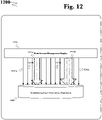
- FIG. 12 is a process flow diagram of a method for the use of metaswimlanes to transparently accommodate levels of data streaming which would overload a single swimlane according to an embodiment of the invention.
- FIG. 13 is a simplified example of the use a Kalman filter to extract and smooth estimated system state from noisy sensor data according to an embodiment of the invention.
- FIG. 14 is a block diagram illustrating an exemplary hardware architecture of a computing device used in various embodiments of the invention.
- FIG. 15 is a block diagram illustrating an exemplary logical architecture for a client device, according to various embodiments of the invention.
- FIG. 16 is a block diagram illustrating an exemplary architectural arrangement of clients, servers, and external services, according to various embodiments of the invention.
- FIG. 17 is another block diagram illustrating an exemplary hardware architecture of a computing device used in various embodiments of the invention
- FIG. 18 is a method process flow diagram showing the operation of an automated planning service module according to an embodiment of the invention.
- the inventor has conceived, and reduced to practice, various systems and methods for fully integrated predictive decision-making and simulation.
- Devices that are in communication with each other need not be in continuous communication with each other, unless expressly specified otherwise.
- devices that are in communication with each other may communicate directly or indirectly through one or more intermediaries, logical or physical.
- steps may be performed simultaneously despite being described or implied as occurring sequentially (e.g., because one step is described after the other step).
- the illustration of a process by its depiction in a drawing does not imply that the illustrated process is exclusive of other variations and modifications thereto, does not imply that the illustrated process or any of its steps are necessary to one or more of the invention(s), and does not imply that the illustrated process is preferred.
- steps are generally described once per embodiment, but this does not mean they must occur once, or that they may only occur once each time a process, method, or algorithm is carried out or executed. Some steps may be omitted in some embodiments or some occurrences, or some steps may be executed more than once in a given embodiment or occurrence.
- a “swimlane” is a communication channel between a time series sensor data reception and apportioning device and a data store meant to hold the apportioned data time series sensor data.
- a swimlane is able to move a specific, finite amount of data between the two devices. For example a single swimlane might reliably carry and have incorporated into the data store, the data equivalent of 5 seconds worth of data from 10 sensors in 5 seconds, this being its capacity. Attempts to place 5 seconds worth of data received from 6 sensors using one swimlane would result in data loss.
- a “metaswimlane” is an as-needed logical combination of transfer capacity of two or more real swimlanes that is transparent to the requesting process. Sensor studies where the amount of data received per unit time is expected to be highly heterogeneous over time may be initiated to use metaswimlanes.
- FIG. 1 is a diagram of an exemplary architecture of a distributed operating system 100 according to an embodiment of the invention.
- the directed computational graph retrieves one or more streams of data from a plurality of sources, which includes, but is in no way not limited to, a number of physical sensors, web based questionnaires and surveys, monitoring of electronic infrastructure, crowd sourcing campaigns, and human input device information.
- data may be split into two identical streams, wherein one sub-stream may be sent for batch processing and storage while the other sub-stream may be reformatted for transformation pipeline analysis.
- the data is then transferred to general transformer service 160 for linear data transformation as part of analysis or decomposable transformer service 150 for branching or iterative transformations that are part of analysis.
- the directed computational graph 155 represents all data as directed graphs where the transformations are nodes and the result messages between transformations edges of the graph. These graphs which contain considerable intermediate transformation data are stored and further analyzed within graph stack module 145 .
- High volume web crawling module 115 uses multiple server hosted preprogrammed web spiders to find and retrieve data of interest from web based sources that are not well tagged by conventional web crawling technology.
- Multiple dimension time series database module 120 receives data from a large plurality of sensors that may be of several different types.
- the module is designed to accommodate irregular and high volume surges by dynamically allotting network bandwidth and server processing channels to process the incoming data.
- Data retrieved by the multidimensional time series database 120 and the high volume web crawling module 115 may be further analyzed and transformed into task optimized results by the directed computational graph 155 and associated general transformer service 150 and decomposable transformer service 160 modules.
- Results of the transformative analysis process may then be combined with further client directives, additional business rules and practices relevant to the analysis and situational information external to the already available data in the automated planning service module 130 which also runs powerful predictive statistics functions and machine learning algorithms to allow future trends and outcomes to be rapidly forecast based upon the current system derived results and choosing each a plurality of possible decisions.
- the automated planning service module 130 may propose decisions most likely to result is the most favorable outcome with a usably high level of certainty.
- the outcome simulation module 125 coupled with the end user facing observation and state estimation service 140 allows decision makers to investigate the probable outcomes of choosing one pending course of action over another based upon analysis of the current available data.
- the pipelines operations department has reported a very small reduction in crude oil pressure in a section of pipeline in a highly remote section of territory. Many believe the issue is entirely due to a fouled, possibly failing flow sensor, others believe that it is a proximal upstream pump that may have foreign material stuck in it. Correction of both of these possibilities is to increase the output of the effected pump to hopefully clean out it or the fouled sensor.
- FIG. 2 is a process flow diagram showing an exemplary set of steps used in the function of the very high bandwidth cloud interface 200 , also depicted in FIG. 1, 110 .
- Data flowing into and out of the very high bandwidth cloud interface 200 may come from human interactions through desktop or mobile computing devices 202 , reading data sent from remote sensor arrays 203 and data retrieved from web pages 204 both of which 203 , 204 may reach a very high instantaneous volume for moderate time intervals which must be accommodated by the interface to assure reliable data capture.
- the cloud 201 may usually mean the internet, often the World Wide Web in the current context, it also extends here to data transmitted from the confines of the client business to the distributed operating system which may use a separate network topology.
- web apps constructed and supported using mostly open source resources, present graphical interfaces for end users to both submit new information 207 and to visualize the results of analyses and predictive decisions as well as simulations created by the distributed operating system 208 .
- Programming is also used to accept and properly route command line directives and parameters from analysts and programmers to the system as analyses are carried out 208 .
- Sensor data and raw webpage data being retrieved by the multiple dimension time series database module, depicted in 120 , and high volume web crawling module depicted in 115 , also may pass through the high volume interface 205 . While this embodiment represents the cloud interface as a monolithic portion of the distributed operating system architecture, the invention has no such requirement and thus in other embodiments, data, programming command and campaign parameters may enter the system from multiple portal to the cloud.
- FIG. 3 is a block diagram of a preferred architecture for a transformation pipeline within a system for predictive analysis of very large data sets using distributed computational graph 300 .
- streaming input 315 serves as input to the first transformation node 320 of the transformation pipeline. Transformation node's function is performed on input data stream and transformed output message 325 is sent to transformation node 2 330 .
- the progression of transformation nodes 320 , 330 , 340 , 350 , 360 and associated output messages from each node 325 , 335 , 345 , 355 is linear in configuration this is the simplest arrangement and, as previously noted, represents the current state of the art.
- transformation nodes are described according to various embodiments as uniform shape, such uniformity is used for presentation simplicity and clarity and does not reflect necessary operational similarity between transformations within the pipeline. It should be appreciated that one knowledgeable in the field will realize that certain transformations in a pipeline may be entirely self-contained; certain transformations may involve human interaction through a program running on a desktop or mobile device 330 , such as selection via dial or dials, positioning of switch or switches, or parameters set on control display, all of which may change during analysis; other transformations may require external aggregation or correlation services or may rely on remote procedure calls to synchronous or asynchronous analysis engines as might occur in simulations among a plurality of other possibilities. Further according to the embodiment, individual transformation nodes in one pipeline may represent function of another transformation pipeline.
- FIG. 4 is a process flow diagram of a method 400 for an embodiment of modeling the transformation pipeline module 160 of the invention as a directed graph using graph theory 155 .
- the individual transformations 402 , 404 , 406 of the transformation pipeline t 1 . . . t n such that each t i T are represented as graph nodes. Transformations belonging to T are discrete transformations over individual datasets d i , consistent with classical functions. As such, each individual transformation t j , receives a set of inputs and produces a single output. The input of an individual transformation t i , is defined with the function in: t i d 1 . . .
- FIG. 5 is a process flow diagram of a method 500 for one embodiment of a linear transformation pipeline 501 .
- This is the simplest of configurations as the input stream is acted upon by the first transformation node 502 and the remainder of the transformations within the pipeline are then performed sequentially 502 , 503 , 504 , 505 for the entire pipeline with no introduction of new data internal to the initial node or splitting output stream prior to last node of the pipeline 505 .
- This configuration is the current state of the art for transformation pipelines and is the most general form of these constructs.
- Linear transformation pipelines require no special manipulation to simplify the data pathway and are thus referred to as non-decomposable they are therefore processed by the general transformer service 160 .
- the example depicted in this diagram was chosen to convey the configuration of a linear transformation pipeline and is the simplest form of the configuration felt to show the point. It in no way implies limitation of the invention.
- FIG. 6 is a process flow diagram of a method 600 for one embodiment of a transformation pipeline where one transformation node 607 in a transformation pipeline receives data streams from two source transformation nodes 601 .
- the invention handles this transformation pipeline configuration by decomposing or serializing the input events 602 - 603 , 604 - 605 heavily relying on post transformation function continuation.
- the results of individual transformation nodes 602 , 604 just antecedent to the destination transformation node 606 and placed into a single specialized data storage transformation node 603 , 605 (shown twice as process occurs twice).
- the pipeline must be taken apart and is handled by the decomposable transformer service 150 .
- the combined results then retrieved from the data store 606 and serve as the input stream for the transformation node within the transformation pipeline backbone 607 , 608 .
- the example depicted in this diagram was chosen to convey the configuration of transformation pipelines with individual transformation nodes that receive input from two source nodes 602 , 604 and is the simplest form of the configuration felt to show the point. It in no way implies limitation of the invention. One knowledgeable in the art will realize the great number of permutations and topologies possible, especially as the invention places no design restrictions on the number of transformation nodes receiving input from greater than one sources or the number sources providing input to a destination node.
- FIG. 7 is a process flow diagram of a method 700 for one embodiment of a transformation pipeline where one transformation node 703 in a transformation pipeline sends output data stream to two destination transformation nodes 701 , 706 , 708 in potentially two separate transformation pipelines.
- the invention handles this transformation pipeline configuration by decomposing or serializing the output events 704 , 705 - 706 , 707 - 708 .
- the results of the source transformation node 703 just antecedent to the destination transformation nodes 706 and placed into a single specialized data storage transformation node 704 , 705 , 707 (shown three times as storage occurs and retrieval occurs twice).
- the results of the antecedent transformation node may then be retrieved from a data store 704 and serves as the input stream for the transformation nodes two downstream transformation pipeline 706 , 708 .
- the example depicted in this diagram was chosen to convey the configuration of transformation pipelines with individual transformation nodes that send output streams to two destination nodes 706 , 708 and is the simplest form of the configuration felt to show the point. It in no way implies limitation of the invention.
- One knowledgeable in the art will realize the great number of permutations and topologies possible, especially as the invention places no design restrictions on the number of transformation nodes sending output to greater than one destination or the number destinations receiving input from a source node.
- This example transformation pipeline is also complex and must be disassembled to process fully, it would therefore also be processed by the decomposable transformation server 150 .
- FIG. 8 is a block diagram 800 of websites on the world wide web that are example target types of a distributed system for large volume extraction of deep web data.
- www.seismi.org 810 is a website of geoseismic data which by nature is non-textual and therefore has very few tags that might be useful to conventional web crawlers. Data retrieved from this type of web site also does not fit well into a relational data store setting and might require extensive post-scrape transformation before storage in a document type data store.
- theunitedstates.io/federal_spending/ 811 is a web site that publishes raw spending data reports with are largely textual, but has extremely few, if any, web related tags and is thus poorly indexed or retrieved by conventional scraping.
- toolkitclimate.gov 812 like www.seismi.org 810 , is a site that would be expected to have large amounts of non-textual climate data that needs to be processed with few if any web related tags meaning that climate intrinsic keywords would need to be employed for meaningful retrieval of the scraped data and, again both data transformation steps and pre-storage processing may be needed prior to meaningful storage.
- http://hall-of-justice.herokuapp.com/category/correlations/ 813 , http://hall-of-justice.herokuapp.com/category/financial/ 814 , and http://www.electionpassport.com 815 are all similar in that they are sites with extremely large volumes of free form textual data with few if any web tags and high probability that data retrieved will need to be processed prior to output or storage.
- FIG. 9 is a process flow diagram of a method 900 for a high volume web crawling module 115 .
- Parameters for one or more scrape campaigns configuration data which may be comprised of, but is not limited to: web sites or web pages to be traversed, keywords or tags for web document data to be parsed, and search expansion rules for following links or other references found on the sites scraped, as well as any other spider configuration information included by the authors of the scrape campaign; and scrape campaign control directives which may include but would not be limited to: the number of spiders to be used in the campaign, relative resource usage priorities for specific web sites or pages within the intended scrape campaigns, directives for adjustments to be made to the scrape campaign upon the encounter of specific results or types of results, directives for application of specific scrape campaign result data pre-processing and post-processing steps and output format directives including persistent storage formalization rules; are received through either a command line interface 910 which may receive commands either from an interactive terminal 105 or another software application on a computing system 115 or from software applications 110
- REST and JSON within the API should not be construed to mean that the invention is dependent on use of only those protocols for this task as one knowledgeable in the art will realize that any similar protocols such as, but not limited to, MQTT-based messaging, SOAP or AJAX could be employed.
- the use of REST and JSON is only exemplary, and should not be construed as limiting.
- Scrape campaign control and spider configuration parameters received are formalized, as necessary and stored in data store for future use when the scrape campaign is initiated. In initiation may be immediate or delayed and the same scrape campaign may be repeatedly run as parameters persist until purged.
- the invention uses the control directives passed to it by the scrape campaign authors to coordinate the scrape campaign 940 .
- Directives from a list comprising the number and complexity of the web sites to be scraped, the priorities assigned to specific web sites or pages, the number different spider configurations to be employed, the speed the author desires the scrape to progress among other factors are used to determine the number of spiders that will be deployed and the number of scrape servers to be included in the scrape as per predetermined programming within the invention.
- scrape campaign controller module While the scrape is active, progress and operational information such as stuck spiders and intermediate scrape results is continuously monitored 950 by the scrape campaign controller module through the scrape controllers 115 such that the authors of the scrape campaign can determine the progress made in the scrape, have some indication of what results have been produced, know what tasks the spiders still have pending as well as any links that may have been followed and the impact on the scrape as a whole of those additions as per pre-programmed reporting parameters 980 .
- Monitoring 950 and reporting 980 aware of operational issues that have arisen, if any. Monitoring data is logged to a data store 930 for future analysis.
- Program design of the invention allows for adjustments to the scrape campaign be made, either due to the just disclosed progress and operational health reports, or other unforeseen factors, without having to shut down the running scrape and without loss of previously accrued scrape results 960 .
- Raw scrape results obtained by the individual spiders are passed through the scrape controller modules 115 of the scrape servers 115 and are aggregated and then possibly transformed in specific ways depending on the predetermined goals of the scrape campaign 970 .
- the invention offers pre-programmed algorithm toolsets for this purpose and also offers API hooks that allow the data to be passed to external processing algorithms prior to final output in a format pre-decided to be most appropriate for the needs of the scrape campaign authors.
- Result data may also be appropriately processed and formalized for persistent storage in a document based data store 990 such as MongoDB, although, depending on the needs of the authors and the type of data retrieved during the scrape, any NOSQL type data storage or even a relational database may be used.
- a document based data store 990 such as MongoDB
- NOSQL type data storage or even a relational database may be used.
- the invention has no dependency for any particular data store type for persistent storage of scrape results.
- Scrapy was chosen for several reasons some of which are: The programming, in Python, for the function of a basic web spider is already present and scrape authors therefore do not need extensive programming expertise in designing spiders to use the framework; The format and keywords for the remaining configuration parameters 900 needed to create scrape campaign specific spiders is well defined, feature robust and well documented (http://doc.scrapy.org/en/latest/index.html), and the Scrapy framework has been shown reliable and stable during use by such high data throughput web sites as CareerBuilder.com, BiteFinder.com and Data.gov.uk. While the invention currently makes integral use of the Scrapy framework for the definition of spiders used, it is not programmatically dependent on the Scrapy framework to the point that another web crawling agent framework (e.g. OXPath—http://oxpath.org) could not be substituted if a better alternative were to be found and the use of Scrapy should not be seen to strictly define the invention in that capability.
- OXPath http://oxpath.org
- FIG. 10 is a listing of a very simple example Scrapy web spider configuration file 1000 .
- This listing requires that the Scrapy framework as well as libraries on which Scrapy depends (http://doc.scrapy.org/en/1.0/intro/install.html) are present on the system running the web scrape. While highly simplified, the listing 1000 shows all of the major sections needed to create a scrape specific spider 1010 , 1020 , 1030 , 1040 At the top of the listing 1010 is found a section that declares the portions of the Scrapy framework that is to be included in the creation of the current spider.
- the next section 1020 declares a name to be used to identify this spider type as well as the world wide web domains the spider is allowed to traverse during the scrape and last, the url of the starting point of the scrape.
- the next section 1030 are any rules to apply when encountering HTML links during a scrape and also what algorithms should be used when processing the target information of the scrape, in this case the spider is scraping specific types of HTML links from the example.com domain.
- the last section 1040 has the instructions on how to process the target data, including instructions for data associated to specific web tags. While the spider created by this sample configuration would have limited capability, it is functional and would, as written complete its scrape.
- FIG. 11 is a method flow diagram showing an exemplary method 1100 used in the capture and storage of time series data from sensors with heterogeneous reporting profiles according to an embodiment of the invention.
- data is received from a set of sensors connected to a capture and analysis device as in the embodiment.
- the sensor data received might be captured and stored under two main paradigms. One is that the sensor data arrives at a defined, reliable periodicity, which may be continuously, but the amount of data per unit time is reliably homogeneous and thus the capture and storage of the sensor data is easy to perform using simple time based models. This paradigm and its resolution is prior art and is not depicted.
- the second paradigm occurs when the sensors being monitored send data at irregular intervals and the amount of data received by the capture and analysis device can vary greatly overtime.
- This heterogeneous sensor data behavior demands different processing strategies than does the homogeneous counterpart.
- Sensor data capture devices that store sensor data at strictly regular time intervals fair badly as the amounts of data per storage cycle can vary greatly.
- Two strategies that have been found to work reliably in conditions of heterogeneous data influx are event driven and stream capture.
- the event driven strategy holds data in the memory of a data stream management engine 120 until a preset number of data events have occurred 1110 - 1120 .
- Data is processed by selecting the parameters, or dimensions within it that are of importance to the administrator and then stored to the data store when a predetermined threshold of events is reached 1120 , 1130 .
- the streaming strategy uses the quantity of data accumulated in a data stream management engine 120 as the trigger 1110 - 1115 to commit the processed sensor data to storage 1115 - 1130 .
- an administrator may preselect either event driven or stream driven commitment, as well as many other parameters pertaining to analysis of sensor data using the administration device 120 .
- All sensor data, regardless of delivery circumstances are stored in a multidimensional time series data store 1130 which is designed for very low overhead, rapid data storage and minimal maintenance needs to sap resources.
- the embodiment uses a key-value pair data store examples of which are RIAKTM, REDISTM, and BERKELEY DBTM for their low overhead and speed although the invention is not specifically tied to a single data store type that is known in the art should another with better response to feature characteristics emerge. Due to factors easily surmised by those knowledgeable in the art, data store commitment reliability is dependent on data store data size under the conditions intrinsic to time series sensor data analysis. The number of data records must be kept relatively low for the herein disclosed purpose.
- one group of developers restrict the size of their multidimensional time series key-value pair data store to approximately 8.64 ⁇ 10 4 records, equivalent to 24 hours of one-second interval sensor readings or 60 days of one-minute interval readings.
- the oldest data is deleted from the data store and lost. This loss of data is acceptable under development conditions but in a production environment, the loss of the older data is almost always significant and unacceptable.
- the invention accounts for this need to retain older data by stipulating that aged data be placed in long term storage.
- the archival storage is included 1170 .
- This archival storage as shown provided by data archive 120 might be locally provided by the user, might be cloud based such as that offered by Amazon Web Services or Google or could be any other available very large capacity storage method known to those skilled in the art.
- Sensor data can be specifically retrieved, using complex query logic 1135 and transformed using such tools as mean reading of all query included sensors, variance of all readings of all sensors queried, standard deviation of queried sensors and more complex types such as standard linear interpolation, Kalman filtering and smoothing, may be applied.
- Data can then be represented in various formats such as, but not limited to text, JSON, KNIL, GEOJSON and TOPOJSON by the system depending on the ultimate use of the resultant information 1180 .
- FIG. 12 is a process flow diagram of a method for the use of metaswimlanes to transparently accommodate levels of data streaming which would overload a single swimlane according to an embodiment of the invention.
- a data stream management engine 1210 also shown in context to an entire embodiment of the invention as 120 to a multidimensional time series data store 1220 shown in context as 120 in a system embodiment of the invention 100 , will exceed the instantaneous data capacity of a single data channel, or swimlane 1211 a between the data stream management engine 1210 and the multidimensional time series data store 1220 .
- the remedy taken and shown in this embodiment is the ability of the system to, when configured, combine the transfer and commitment bandwidth of two or more real swimlanes 1215 a , 1215 b in a way that is transparent to the committing process.
- This means that the invention handles the physical transfer pathway as well as the logical details such as tracking the multiple key-value pairs, process identifications and any application specific bookkeeping involved as overhead to the process and then creating a data structure to have the data records act as a single entity in subsequent data manipulations.
- FIG. 13 is a simplified example of the use a Kalman filter to extract and smooth estimated system state from noisy sensor data according to an embodiment of the invention. Because of its ability to extract reliably accurate, interpretable data in cases of noisy input data, heavy use is made of Kalman filters in data transformation functions of various embodiments of the invention. It is useful to provide a simple demonstration of how such filters might work in one or more embodiments of the invention. For exemplary purposes, let us imagine that miners in a deep underground mine dig into a large underground repository of carbon dioxide, which rushes into the lowest level of the mine displacing a significant amount of the atmosphere in the mine's lowest level; assume the CO 2 level there stabilizes at 50%.
- a system 120 may be connected to an array of CO 2 sensors to monitor the progress of the cleanup.
- 50% CO 2 registers as 1000 on the CO 2 sensors and as a whole the manufacturer states the array will have a noise level of 400. It is believed that the efforts can remove 15.0% of the present CO 2 per hour.
- ⁇ circumflex over ( ) ⁇ k represents an estimated current result
- r is the publish noise level of the sensor or sensor array
- p k is the prediction error between the last previous expected result and the last previous observed result.
- gk is the factor by which the difference between the last expected result and the current observed result that when added to the last expected result will produce the current expected result.
- 1320 e shows calculated CO 2 values (x k ) determined by multiplying the previous CO 2 expected value by the expected reduction of 15% (a) 1330 a .
- 1320 d are the actual values reported by the CO 2 sensors 1330 b at the displayed time points 1320 f .
- the Kalman estimated values, starting at the initial reported CO 2 sensor value is shown 1320 b . When graphed, this set of estimated values is depicted in line 1330 c .
- Kalman filter smoothing can be seen by comparing the graphed actual CO 2 sensor readings 1330 b to the graphed Kalman filter data 1330 c .
- the embodiment stores data long term, users of it can also take advantage of a variant of the Kalman filter known as Kalman soothing where data from an another time period is used to better visualize current data.
- Kalman soothing where data from an another time period is used to better visualize current data.
- An example would be to use correction data from hours four through eight of the CO 2 analysis to smooth hours 12 thorough 14 , not depicted.
- FIG. 18 is a method process flow diagram showing the operation of an automated planning service module according to an embodiment of the invention.
- the analytics data results from the system are supplied to the automated planning service module 1802 as depicted in 130 .
- the analytic data results are mapped to all possible actions or decisions which are suggested by the broad findings and known within the system. Many of these actions may have been entered specifically for the current campaign 1802 . Any external source information such as existing practices that impact the decision, legal and regulatory considerations that impact the proposed action among an additional plurality of possible factors known to the art, are then incorporated into the action selection process 1803 .
- information theory statistics algorithms and machine learning principles are employed on the analytic data developed by the system 100 to reliably predict the probable outcomes of pursuing each choice and provide statistical data associated with each action 1804 .
- the data pertaining to actions with a favorable outcome value above a predetermined threshold are sent to the simulation module 125 and the observation and state estimation 140 modules for appropriate presentation to end users as dictated by the authors of the related analytical campaign 1805 .
- the techniques disclosed herein may be implemented on hardware or a combination of software and hardware. For example, they may be implemented in an operating system kernel, in a separate user process, in a library package bound into network applications, on a specially constructed machine, on an application-specific integrated circuit (ASIC), or on a network interface card.
- ASIC application-specific integrated circuit
- Software/hardware hybrid implementations of at least some of the embodiments disclosed herein may be implemented on a programmable network-resident machine (which should be understood to include intermittently connected network-aware machines) selectively activated or reconfigured by a computer program stored in memory.
- a programmable network-resident machine which should be understood to include intermittently connected network-aware machines
- Such network devices may have multiple network interfaces that may be configured or designed to utilize different types of network communication protocols.
- a general architecture for some of these machines may be described herein in order to illustrate one or more exemplary means by which a given unit of functionality may be implemented.
- At least some of the features or functionalities of the various embodiments disclosed herein may be implemented on one or more general-purpose computers associated with one or more networks, such as for example an end-user computer system, a client computer, a network server or other server system, a mobile computing device (e.g., tablet computing device, mobile phone, smartphone, laptop, or other appropriate computing device), a consumer electronic device, a music player, or any other suitable electronic device, router, switch, or other suitable device, or any combination thereof.
- at least some of the features or functionalities of the various embodiments disclosed herein may be implemented in one or more virtualized computing environments (e.g., network computing clouds, virtual machines hosted on one or more physical computing machines, or other appropriate virtual environments).
- Computing device 10 may be, for example, any one of the computing machines listed in the previous paragraph, or indeed any other electronic device capable of executing software- or hardware-based instructions according to one or more programs stored in memory.
- Computing device 10 may be configured to communicate with a plurality of other computing devices, such as clients or servers, over communications networks such as a wide area network a metropolitan area network, a local area network, a wireless network, the Internet, or any other network, using known protocols for such communication, whether wireless or wired.
- communications networks such as a wide area network a metropolitan area network, a local area network, a wireless network, the Internet, or any other network, using known protocols for such communication, whether wireless or wired.
- computing device 10 includes one or more central processing units (CPU) 12 , one or more interfaces 15 , and one or more busses 14 (such as a peripheral component interconnect (PCI) bus).
- CPU 12 may be responsible for implementing specific functions associated with the functions of a specifically configured computing device or machine.
- a computing device 10 may be configured or designed to function as a server system utilizing CPU 12 , local memory 11 and/or remote memory 16 , and interface(s) 15 .
- CPU 12 may be caused to perform one or more of the different types of functions and/or operations under the control of software modules or components, which for example, may include an operating system and any appropriate applications software, drivers, and the like.
- CPU 12 may include one or more processors 13 such as, for example, a processor from one of the Intel, ARM, Qualcomm, and AMD families of microprocessors.
- processors 13 may include specially designed hardware such as application-specific integrated circuits (ASICs), electrically erasable programmable read-only memories (EEPROMs), field-programmable gate arrays (FPGAs), and so forth, for controlling operations of computing device 10 .
- ASICs application-specific integrated circuits
- EEPROMs electrically erasable programmable read-only memories
- FPGAs field-programmable gate arrays
- a local memory 11 such as non-volatile random access memory (RAM) and/or read-only memory (ROM), including for example one or more levels of cached memory
- RAM non-volatile random access memory
- ROM read-only memory
- Memory 11 may be used for a variety of purposes such as, for example, caching and/or storing data, programming instructions, and the like. It should be further appreciated that CPU 12 may be one of a variety of system-on-a-chip (SOC) type hardware that may include additional hardware such as memory or graphics processing chips, such as a Qualcomm SNAPDRAGONTM or Samsung EXYNOSTM CPU as are becoming increasingly common in the art, such as for use in mobile devices or integrated devices.
- SOC system-on-a-chip
- processor is not limited merely to those integrated circuits referred to in the art as a processor, a mobile processor, or a microprocessor, but broadly refers to a microcontroller, a microcomputer, a programmable logic controller, an application-specific integrated circuit, and any other programmable circuit.
- interfaces 15 are provided as network interface cards (NICs).
- NICs control the sending and receiving of data packets over a computer network; other types of interfaces 15 may for example support other peripherals used with computing device 10 .
- the interfaces that may be provided are Ethernet interfaces, frame relay interfaces, cable interfaces, DSL interfaces, token ring interfaces, graphics interfaces, and the like.
- interfaces may be provided such as, for example, universal serial bus (USB), Serial, Ethernet, FIREWIRETM, THUNDERBOLTTM, PCI, parallel, radio frequency (RF), BLUETOOTHTM, near-field communications (e.g., using near-field magnetics), 802.11 (WiFi), frame relay, TCP/IP, ISDN, fast Ethernet interfaces, Gigabit Ethernet interfaces, Serial ATA (SATA) or external SATA (ESATA) interfaces, high-definition multimedia interface (HDMI), digital visual interface (DVI), analog or digital audio interfaces, asynchronous transfer mode (ATM) interfaces, high-speed serial interface (HSSI) interfaces, Point of Sale (POS) interfaces, fiber data distributed interfaces (FDDIs), and the like.
- USB universal serial bus
- RF radio frequency
- BLUETOOTHTM near-field communications
- near-field communications e.g., using near-field magnetics
- WiFi wireless FIREWIRETM
- Such interfaces 15 may include physical ports appropriate for communication with appropriate media. In some cases, they may also include an independent processor (such as a dedicated audio or video processor, as is common in the art for high-fidelity AN hardware interfaces) and, in some instances, volatile and/or non-volatile memory (e.g., RAM).
- an independent processor such as a dedicated audio or video processor, as is common in the art for high-fidelity AN hardware interfaces
- volatile and/or non-volatile memory e.g., RAM
- processors 13 may be used, and such processors 13 may be present in a single device or distributed among any number of devices.
- a single processor 13 handles communications as well as routing computations, while in other embodiments a separate dedicated communications processor may be provided.
- different types of features or functionalities may be implemented in a system according to the invention that includes a client device (such as a tablet device or smartphone running client software) and server systems (such as a server system described in more detail below).
- the system of the present invention may employ one or more memories or memory modules (such as, for example, remote memory block 16 and local memory 11 ) configured to store data, program instructions for the general-purpose network operations, or other information relating to the functionality of the embodiments described herein (or any combinations of the above).
- Program instructions may control execution of or comprise an operating system and/or one or more applications, for example.
- Memory 16 or memories 11 , 16 may also be configured to store data structures, configuration data, encryption data, historical system operations information, or any other specific or generic non-program information described herein.
- At least some network device embodiments may include nontransitory machine-readable storage media, which, for example, may be configured or designed to store program instructions, state information, and the like for performing various operations described herein.
- nontransitory machine-readable storage media include, but are not limited to, magnetic media such as hard disks, floppy disks, and magnetic tape; optical media such as CD-ROM disks; magneto-optical media such as optical disks, and hardware devices that are specially configured to store and perform program instructions, such as read-only memory devices (ROM), flash memory (as is common in mobile devices and integrated systems), solid state drives (SSD) and “hybrid SSD” storage drives that may combine physical components of solid state and hard disk drives in a single hardware device (as are becoming increasingly common in the art with regard to personal computers), memristor memory, random access memory (RAM), and the like.
- ROM read-only memory
- flash memory as is common in mobile devices and integrated systems
- SSD solid state drives
- hybrid SSD hybrid SSD
- such storage means may be integral and non-removable (such as RAM hardware modules that may be soldered onto a motherboard or otherwise integrated into an electronic device), or they may be removable such as swappable flash memory modules (such as “thumb drives” or other removable media designed for rapidly exchanging physical storage devices), “hot-swappable” hard disk drives or solid state drives, removable optical storage discs, or other such removable media, and that such integral and removable storage media may be utilized interchangeably.
- swappable flash memory modules such as “thumb drives” or other removable media designed for rapidly exchanging physical storage devices
- hot-swappable hard disk drives or solid state drives
- removable optical storage discs or other such removable media
- program instructions include both object code, such as may be produced by a compiler, machine code, such as may be produced by an assembler or a linker, byte code, such as may be generated by for example a JAVATM compiler and may be executed using a Java virtual machine or equivalent, or files containing higher level code that may be executed by the computer using an interpreter (for example, scripts written in Python, Perl, Ruby, Groovy, or any other scripting language).
- interpreter for example, scripts written in Python, Perl, Ruby, Groovy, or any other scripting language.
- systems according to the present invention may be implemented on a standalone computing system.
- FIG. 15 there is shown a block diagram depicting a typical exemplary architecture of one or more embodiments or components thereof on a standalone computing system.
- Computing device 20 includes processors 21 that may run software that carry out one or more functions or applications of embodiments of the invention, such as for example a client application 24 .
- Processors 21 may carry out computing instructions under control of an operating system 22 such as, for example, a version of Microsoft's WINDOWSTM operating system, Apple's Mac OS/X or iOS operating systems, some variety of the Linux operating system, Google's ANDROIDTM operating system, or the like.
- an operating system 22 such as, for example, a version of Microsoft's WINDOWSTM operating system, Apple's Mac OS/X or iOS operating systems, some variety of the Linux operating system, Google's ANDROIDTM operating system, or the like.
- one or more shared services 23 may be operable in system 20 , and may be useful for providing common services to client applications 24 .
- Services 23 may for example be WINDOWSTM services, user-space common services in a Linux environment, or any other type of common service architecture used with operating system 21 .
- Input devices 28 may be of any type suitable for receiving user input, including for example a keyboard, touchscreen, microphone (for example, for voice input), mouse, touchpad, trackball, or any combination thereof.
- Output devices 27 may be of any type suitable for providing output to one or more users, whether remote or local to system 20 , and may include for example one or more screens for visual output, speakers, printers, or any combination thereof.
- Memory 25 may be random-access memory having any structure and architecture known in the art, for use by processors 21 , for example to run software.
- Storage devices 26 may be any magnetic, optical, mechanical, memristor, or electrical storage device for storage of data in digital form (such as those described above). Examples of storage devices 26 include flash memory, magnetic hard drive, CD-ROM, and/or the like.
- systems of the present invention may be implemented on a distributed computing network, such as one having any number of clients and/or servers.
- FIG. 16 there is shown a block diagram depicting an exemplary architecture 30 for implementing at least a portion of a system according to an embodiment of the invention on a distributed computing network.
- any number of clients 33 may be provided.
- Each client 33 may run software for implementing client-side portions of the present invention; clients may comprise a system 20 such as that illustrated above.
- any number of servers 32 may be provided for handling requests received from one or more clients 33 .
- Clients 33 and servers 32 may communicate with one another via one or more electronic networks 31 , which may be in various embodiments any of the Internet, a wide area network, a mobile telephony network (such as CDMA or GSM cellular networks), a wireless network (such as WiFi, Wimax, LTE, and so forth), or a local area network (or indeed any network topology known in the art; the invention does not prefer any one network topology over any other).
- Networks 31 may be implemented using any known network protocols, including for example wired and/or wireless protocols.
- servers 32 may call external services 37 when needed to obtain additional information, or to refer to additional data concerning a particular call. Communications with external services 37 may take place, for example, via one or more networks 31 .
- external services 37 may comprise web-enabled services or functionality related to or installed on the hardware device itself. For example, in an embodiment where client applications 24 are implemented on a smartphone or other electronic device, client applications 24 may obtain information stored in a server system 32 in the cloud or on an external service 37 deployed on one or more of a particular enterprise's or user's premises.
- clients 33 or servers 32 may make use of one or more specialized services or appliances that may be deployed locally or remotely across one or more networks 31 .
- one or more databases 34 may be used or referred to by one or more embodiments of the invention. It should be understood by one having ordinary skill in the art that databases 34 may be arranged in a wide variety of architectures and using a wide variety of data access and manipulation means.
- one or more databases 34 may comprise a relational database system using a structured query language (SQL), while others may comprise an alternative data storage technology such as those referred to in the art as “NoSQL” (for example, Hadoop Cassandra, Google BigTable, and so forth).
- SQL structured query language
- variant database architectures such as column-oriented databases, in-memory databases, clustered databases, distributed databases, or even flat file data repositories may be used according to the invention. It will be appreciated by one having ordinary skill in the art that any combination of known or future database technologies may be used as appropriate, unless a specific database technology or a specific arrangement of components is specified for a particular embodiment herein. Moreover, it should be appreciated that the term “database” as used herein may refer to a physical database machine, a cluster of machines acting as a single database system, or a logical database within an overall database management system.
- security and configuration management are common information technology (IT) and web functions, and some amount of each are generally associated with any IT or web systems. It should be understood by one having ordinary skill in the art that any configuration or security subsystems known in the art now or in the future may be used in conjunction with embodiments of the invention without limitation, unless a specific security 36 or configuration system 35 or approach is specifically required by the description of any specific embodiment.
- FIG. 17 shows an exemplary overview of a computer system 40 as may be used in any of the various locations throughout the system. It is exemplary of any computer that may execute code to process data. Various modifications and changes may be made to computer system 40 without departing from the broader scope of the system and method disclosed herein.
- Central processor unit (CPU) 41 is connected to bus 42 , to which bus is also connected memory 43 , nonvolatile memory 44 , display 47 , input/output (I/O) unit 48 , and network interface card (NIC) 53 .
- I/O unit 48 may, typically, be connected to keyboard 49 , pointing device 50 , hard disk 52 , and real-time clock 51 .
- NIC 53 connects to network 54 , which may be the Internet or a local network, which local network may or may not have connections to the Internet. Also shown as part of system 40 is power supply unit 45 connected, in this example, to a main alternating current (AC) supply 46 . Not shown are batteries that could be present, and many other devices and modifications that are well known but are not applicable to the specific novel functions of the current system and method disclosed herein.
- AC alternating current
- functionality for implementing systems or methods of the present invention may be distributed among any number of client and/or server components.
- various software modules may be implemented for performing various functions in connection with the present invention, and such modules may be variously implemented to run on server and/or client
Landscapes
- Business, Economics & Management (AREA)
- Human Resources & Organizations (AREA)
- Engineering & Computer Science (AREA)
- Educational Administration (AREA)
- Economics (AREA)
- Entrepreneurship & Innovation (AREA)
- Strategic Management (AREA)
- Theoretical Computer Science (AREA)
- General Physics & Mathematics (AREA)
- Physics & Mathematics (AREA)
- Tourism & Hospitality (AREA)
- Operations Research (AREA)
- Marketing (AREA)
- General Business, Economics & Management (AREA)
- Game Theory and Decision Science (AREA)
- Development Economics (AREA)
- Quality & Reliability (AREA)
- Information Retrieval, Db Structures And Fs Structures Therefor (AREA)
- Artificial Intelligence (AREA)
- Data Mining & Analysis (AREA)
- Evolutionary Computation (AREA)
- Computing Systems (AREA)
- General Engineering & Computer Science (AREA)
- Mathematical Physics (AREA)
- Software Systems (AREA)
- Computational Linguistics (AREA)
Abstract
Description
| Application | ||
| Ser. No. | Date Filed | Title |
| Current | Herewith | SYSTEM FOR FULLY INTEGRATED |
| application | CAPTURE, AND ANALYSIS OF | |
| BUSINESS INFORMATION | ||
| RESULTING IN PREDICTIVE | ||
| DECISION MAKING AND | ||
| SIMULATION | ||
| Is a continuation of: | ||
| 15/141,752 | Apr. 28, 2016 | SYSTEM FOR FULLY INTEGRATED |
| CAPTURE, AND ANALYSIS OF | ||
| BUSINESS INFORMATION | ||
| RESULTING IN PREDICTIVE | ||
| DECISION MAKING AND | ||
| SIMULATION | ||
| which is a continuation-in-part of: | ||
| 15/091,563 | Apr. 5, 2016 | SYSTEM FOR CAPTURE, |
| ANALYSIS AND STORAGE OF TIME | ||
| SERIES DATA FROM SENSORS | ||
| WITH HETEROGENEOUS REPORT | ||
| INTERVAL PROFILES | ||
| and is also a continuation-in-part of: | ||
| 14/986,536 | Dec. 31, 2015 | DISTRIBUTED SYSTEM FOR |
| LARGE VOLUME DEEP WEB | ||
| DATA EXTRACTION | ||
| and is also a continuation-in-part of: | ||
| 14/925,974 | Oct. 28, 2015 | RAPID PREDICTIVE ANALYSIS OF |
| VERY LARGE DATA SETS USING | ||
| THE DISTRIBUTED | ||
| COMPUTATIONAL GRAPH | ||
| the entire specification of each of which is incorporated herein by reference. | ||
Claims (14)
Priority Applications (1)
| Application Number | Priority Date | Filing Date | Title |
|---|---|---|---|
| US17/084,984 US11295262B2 (en) | 2015-10-28 | 2020-10-30 | System for fully integrated predictive decision-making and simulation |
Applications Claiming Priority (5)
| Application Number | Priority Date | Filing Date | Title |
|---|---|---|---|
| US14/925,974 US20170124464A1 (en) | 2015-10-28 | 2015-10-28 | Rapid predictive analysis of very large data sets using the distributed computational graph |
| US14/986,536 US10210255B2 (en) | 2015-12-31 | 2015-12-31 | Distributed system for large volume deep web data extraction |
| US15/091,563 US10204147B2 (en) | 2016-04-05 | 2016-04-05 | System for capture, analysis and storage of time series data from sensors with heterogeneous report interval profiles |
| US15/141,752 US10860962B2 (en) | 2015-10-28 | 2016-04-28 | System for fully integrated capture, and analysis of business information resulting in predictive decision making and simulation |
| US17/084,984 US11295262B2 (en) | 2015-10-28 | 2020-10-30 | System for fully integrated predictive decision-making and simulation |
Related Parent Applications (1)
| Application Number | Title | Priority Date | Filing Date |
|---|---|---|---|
| US15/141,752 Continuation US10860962B2 (en) | 2015-10-28 | 2016-04-28 | System for fully integrated capture, and analysis of business information resulting in predictive decision making and simulation |
Publications (2)
| Publication Number | Publication Date |
|---|---|
| US20210166170A1 US20210166170A1 (en) | 2021-06-03 |
| US11295262B2 true US11295262B2 (en) | 2022-04-05 |
Family
ID=58637756
Family Applications (2)
| Application Number | Title | Priority Date | Filing Date |
|---|---|---|---|
| US15/141,752 Active 2038-04-03 US10860962B2 (en) | 2015-10-28 | 2016-04-28 | System for fully integrated capture, and analysis of business information resulting in predictive decision making and simulation |
| US17/084,984 Active US11295262B2 (en) | 2015-10-28 | 2020-10-30 | System for fully integrated predictive decision-making and simulation |
Family Applications Before (1)
| Application Number | Title | Priority Date | Filing Date |
|---|---|---|---|
| US15/141,752 Active 2038-04-03 US10860962B2 (en) | 2015-10-28 | 2016-04-28 | System for fully integrated capture, and analysis of business information resulting in predictive decision making and simulation |
Country Status (1)
| Country | Link |
|---|---|
| US (2) | US10860962B2 (en) |
Cited By (1)
| Publication number | Priority date | Publication date | Assignee | Title |
|---|---|---|---|---|
| US20240362498A1 (en) * | 2023-04-28 | 2024-10-31 | International Business Machines Corporation | Solver devices and methods |
Families Citing this family (17)
| Publication number | Priority date | Publication date | Assignee | Title |
|---|---|---|---|---|
| US11087403B2 (en) * | 2015-10-28 | 2021-08-10 | Qomplx, Inc. | Risk quantification for insurance process management employing an advanced decision platform |
| US11635994B2 (en) * | 2015-10-28 | 2023-04-25 | Qomplx, Inc. | System and method for optimizing and load balancing of applications using distributed computer clusters |
| US10423675B2 (en) * | 2016-01-29 | 2019-09-24 | Intuit Inc. | System and method for automated domain-extensible web scraping |
| US20170337293A1 (en) * | 2016-05-18 | 2017-11-23 | Sisense Ltd. | System and method of rendering multi-variant graphs |
| US11044269B2 (en) * | 2016-08-15 | 2021-06-22 | RiskIQ, Inc. | Techniques for determining threat intelligence for network infrastructure analysis |
| CN107908734A (en) * | 2017-11-14 | 2018-04-13 | 成都才智圣有科技有限责任公司 | A kind of visual parallel data mining system |
| FR3077663B1 (en) * | 2018-02-02 | 2020-02-28 | Alstom Transport Technologies | METHOD FOR PREPARING A COMPUTER PROGRAM AND CORRESPONDING DEVICE |
| WO2020014124A1 (en) | 2018-07-09 | 2020-01-16 | Rutgers, The State University Of New Jersey | Data exploration as search over automated pre-generated plot objects |
| DE102018214023A1 (en) * | 2018-08-20 | 2020-02-20 | Bayerische Motoren Werke Aktiengesellschaft | Scalable teleoperation of autonomous robots |
| KR102197329B1 (en) * | 2020-01-09 | 2020-12-31 | 주식회사 카카오뱅크 | Scrapping service providing method and application for the same method |
| EP3896545A1 (en) * | 2020-04-14 | 2021-10-20 | ABB Schweiz AG | Method for alarm handling in a processing system |
| CN111563034A (en) * | 2020-04-14 | 2020-08-21 | 北京明略软件系统有限公司 | Method and device for generating simulation data |
| CN114491052B (en) * | 2020-10-27 | 2024-11-26 | 中移物联网有限公司 | A method, device, equipment and readable storage medium for determining system health |
| CN115237862B (en) * | 2022-08-30 | 2022-11-22 | 四川省交通勘察设计研究院有限公司 | KML file-based map visual display method and device |
| CN116775852B (en) * | 2023-06-28 | 2025-12-16 | 中国平安财产保险股份有限公司 | Label-based data recommendation method, device, equipment and storage medium |
| CN117708350B (en) * | 2024-02-06 | 2024-05-14 | 成都草根有智创新科技有限公司 | Enterprise policy information association method and device and electronic equipment |
| CN120541310B (en) * | 2025-07-29 | 2025-12-05 | 之江实验室 | Multi-source information retrieval and fusion methods, apparatus, devices and readable storage media |
Citations (10)
| Publication number | Priority date | Publication date | Assignee | Title |
|---|---|---|---|---|
| US20050165822A1 (en) | 2004-01-22 | 2005-07-28 | Logic Sight, Inc. | Systems and methods for business process automation, analysis, and optimization |
| US7171515B2 (en) | 2001-05-22 | 2007-01-30 | Fujitsu Limited | Storage unit with improved performance by purging unnecessary data and transferring data with high probability of future hits to a segment buffer |
| US7227948B2 (en) | 2000-03-06 | 2007-06-05 | Kabushiki Kaisha Toshiba | Encryption apparatus and method, and decryption apparatus and method based on block encryption |
| US20100205588A1 (en) * | 2009-02-09 | 2010-08-12 | Microsoft Corporation | General purpose distributed data parallel computing using a high level language |
| US20110295635A1 (en) * | 2010-06-01 | 2011-12-01 | International Business Machine Corporation | Systems and methods for scheduling power sources and jobs in an integrated power system |
| US20120303396A1 (en) * | 2011-05-27 | 2012-11-29 | Sap Ag | Model-based business continuity management |
| US8346753B2 (en) | 2006-11-14 | 2013-01-01 | Paul V Hayes | System and method for searching for internet-accessible content |
| US20140149186A1 (en) * | 2012-11-29 | 2014-05-29 | David Bernard Flaxer | Method and system of using artifacts to identify elements of a component business model |
| US20140359552A1 (en) * | 2011-09-19 | 2014-12-04 | Tata Consultancy Services Limited | Computer Platform for Development and Deployment of Sensor Data Based Applications and Services |
| US20160006629A1 (en) * | 2013-07-07 | 2016-01-07 | George Ianakiev | Appliance clearinghouse with orchestrated logic fusion and data fabric - architecture, system and method |
-
2016
- 2016-04-28 US US15/141,752 patent/US10860962B2/en active Active
-
2020
- 2020-10-30 US US17/084,984 patent/US11295262B2/en active Active
Patent Citations (10)
| Publication number | Priority date | Publication date | Assignee | Title |
|---|---|---|---|---|
| US7227948B2 (en) | 2000-03-06 | 2007-06-05 | Kabushiki Kaisha Toshiba | Encryption apparatus and method, and decryption apparatus and method based on block encryption |
| US7171515B2 (en) | 2001-05-22 | 2007-01-30 | Fujitsu Limited | Storage unit with improved performance by purging unnecessary data and transferring data with high probability of future hits to a segment buffer |
| US20050165822A1 (en) | 2004-01-22 | 2005-07-28 | Logic Sight, Inc. | Systems and methods for business process automation, analysis, and optimization |
| US8346753B2 (en) | 2006-11-14 | 2013-01-01 | Paul V Hayes | System and method for searching for internet-accessible content |
| US20100205588A1 (en) * | 2009-02-09 | 2010-08-12 | Microsoft Corporation | General purpose distributed data parallel computing using a high level language |
| US20110295635A1 (en) * | 2010-06-01 | 2011-12-01 | International Business Machine Corporation | Systems and methods for scheduling power sources and jobs in an integrated power system |
| US20120303396A1 (en) * | 2011-05-27 | 2012-11-29 | Sap Ag | Model-based business continuity management |
| US20140359552A1 (en) * | 2011-09-19 | 2014-12-04 | Tata Consultancy Services Limited | Computer Platform for Development and Deployment of Sensor Data Based Applications and Services |
| US20140149186A1 (en) * | 2012-11-29 | 2014-05-29 | David Bernard Flaxer | Method and system of using artifacts to identify elements of a component business model |
| US20160006629A1 (en) * | 2013-07-07 | 2016-01-07 | George Ianakiev | Appliance clearinghouse with orchestrated logic fusion and data fabric - architecture, system and method |
Cited By (1)
| Publication number | Priority date | Publication date | Assignee | Title |
|---|---|---|---|---|
| US20240362498A1 (en) * | 2023-04-28 | 2024-10-31 | International Business Machines Corporation | Solver devices and methods |
Also Published As
| Publication number | Publication date |
|---|---|
| US20170124481A1 (en) | 2017-05-04 |
| US10860962B2 (en) | 2020-12-08 |
| US20210166170A1 (en) | 2021-06-03 |
Similar Documents
| Publication | Publication Date | Title |
|---|---|---|
| US11295262B2 (en) | System for fully integrated predictive decision-making and simulation | |
| US12155693B1 (en) | Rapid predictive analysis of very large data sets using the distributed computational graph | |
| US12238143B2 (en) | System for automated capture and analysis of business information for reliable business venture outcome prediction | |
| US11831682B2 (en) | Highly scalable distributed connection interface for data capture from multiple network service and cloud-based sources | |
| US11206199B2 (en) | Highly scalable distributed connection interface for data capture from multiple network service sources | |
| US11588793B2 (en) | System and methods for dynamic geospatially-referenced cyber-physical infrastructure inventory and asset management | |
| US20170124497A1 (en) | System for automated capture and analysis of business information for reliable business venture outcome prediction | |
| WO2017176944A1 (en) | System for fully integrated capture, and analysis of business information resulting in predictive decision making and simulation | |
| US12204921B2 (en) | System and methods for creation and use of meta-models in simulated environments | |
| US20170124501A1 (en) | System for automated capture and analysis of business information for security and client-facing infrastructure reliability | |
| US11636549B2 (en) | Cybersecurity profile generated using a simulation engine | |
| US20220043806A1 (en) | Parallel decomposition and restoration of data chunks | |
| US11714991B2 (en) | System and methods for creation of learning agents in simulated environments | |
| US20230208820A1 (en) | System and methods for predictive cyber-physical resource management | |
| WO2019104312A1 (en) | Meta-indexing, search, compliance, and test framework for software development | |
| US11755957B2 (en) | Multitemporal data analysis | |
| EP3756108A1 (en) | A system and methods for dynamic geospatially-referenced cyber-physical infrastructure inventory |
Legal Events
| Date | Code | Title | Description |
|---|---|---|---|
| FEPP | Fee payment procedure |
Free format text: ENTITY STATUS SET TO UNDISCOUNTED (ORIGINAL EVENT CODE: BIG.); ENTITY STATUS OF PATENT OWNER: SMALL ENTITY |
|
| AS | Assignment |
Owner name: QOMPLX, INC., VIRGINIA Free format text: ASSIGNMENT OF ASSIGNORS INTEREST;ASSIGNORS:CRABTREE, JASON;SELLERS, ANDREW;REEL/FRAME:054266/0957 Effective date: 20201029 |
|
| FEPP | Fee payment procedure |
Free format text: ENTITY STATUS SET TO SMALL (ORIGINAL EVENT CODE: SMAL); ENTITY STATUS OF PATENT OWNER: SMALL ENTITY |
|
| STPP | Information on status: patent application and granting procedure in general |
Free format text: APPLICATION DISPATCHED FROM PREEXAM, NOT YET DOCKETED |
|
| STPP | Information on status: patent application and granting procedure in general |
Free format text: DOCKETED NEW CASE - READY FOR EXAMINATION |
|
| STPP | Information on status: patent application and granting procedure in general |
Free format text: NON FINAL ACTION MAILED |
|
| STPP | Information on status: patent application and granting procedure in general |
Free format text: RESPONSE TO NON-FINAL OFFICE ACTION ENTERED AND FORWARDED TO EXAMINER |
|
| STPP | Information on status: patent application and granting procedure in general |
Free format text: AWAITING TC RESP., ISSUE FEE NOT PAID |
|
| STPP | Information on status: patent application and granting procedure in general |
Free format text: NOTICE OF ALLOWANCE MAILED -- APPLICATION RECEIVED IN OFFICE OF PUBLICATIONS |
|
| STPP | Information on status: patent application and granting procedure in general |
Free format text: AWAITING TC RESP, ISSUE FEE PAYMENT VERIFIED |
|
| STPP | Information on status: patent application and granting procedure in general |
Free format text: PUBLICATIONS -- ISSUE FEE PAYMENT VERIFIED |
|
| STCF | Information on status: patent grant |
Free format text: PATENTED CASE |
|
| AS | Assignment |
Owner name: QPX, LLC., NEW YORK Free format text: PATENT ASSIGNMENT AGREEMENT TO ASSET PURCHASE AGREEMENT;ASSIGNOR:QOMPLX, INC.;REEL/FRAME:064674/0407 Effective date: 20230810 |
|
| AS | Assignment |
Owner name: QPX LLC, NEW YORK Free format text: CORRECTIVE ASSIGNMENT TO CORRECT THE RECEIVING PARTY PREVIOUSLY RECORDED AT REEL: 064674 FRAME: 0408. ASSIGNOR(S) HEREBY CONFIRMS THE ASSIGNMENT;ASSIGNOR:QOMPLX, INC.;REEL/FRAME:064966/0863 Effective date: 20230810 |
|
| AS | Assignment |
Owner name: QOMPLX LLC, NEW YORK Free format text: CHANGE OF NAME;ASSIGNOR:QPX LLC;REEL/FRAME:065036/0449 Effective date: 20230824 |
|
| FEPP | Fee payment procedure |
Free format text: ENTITY STATUS SET TO UNDISCOUNTED (ORIGINAL EVENT CODE: BIG.); ENTITY STATUS OF PATENT OWNER: LARGE ENTITY |
|
| AS | Assignment |
Owner name: QOMPLX LLC, VIRGINIA Free format text: CHANGE OF ADDRESS;ASSIGNOR:QOMPLX LLC;REEL/FRAME:069083/0279 Effective date: 20241001 |
|
| MAFP | Maintenance fee payment |
Free format text: PAYMENT OF MAINTENANCE FEE, 4TH YEAR, LARGE ENTITY (ORIGINAL EVENT CODE: M1551); ENTITY STATUS OF PATENT OWNER: LARGE ENTITY Year of fee payment: 4 |