US11289098B2 - Method and apparatus with speaker recognition registration - Google Patents
Method and apparatus with speaker recognition registration Download PDFInfo
- Publication number
- US11289098B2 US11289098B2 US16/781,176 US202016781176A US11289098B2 US 11289098 B2 US11289098 B2 US 11289098B2 US 202016781176 A US202016781176 A US 202016781176A US 11289098 B2 US11289098 B2 US 11289098B2
- Authority
- US
- United States
- Prior art keywords
- feature vector
- signal
- speaker
- noise
- speech signal
- Prior art date
- Legal status (The legal status is an assumption and is not a legal conclusion. Google has not performed a legal analysis and makes no representation as to the accuracy of the status listed.)
- Active, expires
Links
Images




Classifications
-
- G—PHYSICS
- G10—MUSICAL INSTRUMENTS; ACOUSTICS
- G10L—SPEECH ANALYSIS TECHNIQUES OR SPEECH SYNTHESIS; SPEECH RECOGNITION; SPEECH OR VOICE PROCESSING TECHNIQUES; SPEECH OR AUDIO CODING OR DECODING
- G10L17/00—Speaker identification or verification techniques
- G10L17/04—Training, enrolment or model building
-
- G—PHYSICS
- G10—MUSICAL INSTRUMENTS; ACOUSTICS
- G10L—SPEECH ANALYSIS TECHNIQUES OR SPEECH SYNTHESIS; SPEECH RECOGNITION; SPEECH OR VOICE PROCESSING TECHNIQUES; SPEECH OR AUDIO CODING OR DECODING
- G10L13/00—Speech synthesis; Text to speech systems
-
- G—PHYSICS
- G10—MUSICAL INSTRUMENTS; ACOUSTICS
- G10L—SPEECH ANALYSIS TECHNIQUES OR SPEECH SYNTHESIS; SPEECH RECOGNITION; SPEECH OR VOICE PROCESSING TECHNIQUES; SPEECH OR AUDIO CODING OR DECODING
- G10L17/00—Speaker identification or verification techniques
-
- G—PHYSICS
- G10—MUSICAL INSTRUMENTS; ACOUSTICS
- G10L—SPEECH ANALYSIS TECHNIQUES OR SPEECH SYNTHESIS; SPEECH RECOGNITION; SPEECH OR VOICE PROCESSING TECHNIQUES; SPEECH OR AUDIO CODING OR DECODING
- G10L17/00—Speaker identification or verification techniques
- G10L17/02—Preprocessing operations, e.g. segment selection; Pattern representation or modelling, e.g. based on linear discriminant analysis [LDA] or principal components; Feature selection or extraction
-
- G—PHYSICS
- G10—MUSICAL INSTRUMENTS; ACOUSTICS
- G10L—SPEECH ANALYSIS TECHNIQUES OR SPEECH SYNTHESIS; SPEECH RECOGNITION; SPEECH OR VOICE PROCESSING TECHNIQUES; SPEECH OR AUDIO CODING OR DECODING
- G10L17/00—Speaker identification or verification techniques
- G10L17/06—Decision making techniques; Pattern matching strategies
-
- G—PHYSICS
- G10—MUSICAL INSTRUMENTS; ACOUSTICS
- G10L—SPEECH ANALYSIS TECHNIQUES OR SPEECH SYNTHESIS; SPEECH RECOGNITION; SPEECH OR VOICE PROCESSING TECHNIQUES; SPEECH OR AUDIO CODING OR DECODING
- G10L17/00—Speaker identification or verification techniques
- G10L17/18—Artificial neural networks; Connectionist approaches
-
- G—PHYSICS
- G10—MUSICAL INSTRUMENTS; ACOUSTICS
- G10L—SPEECH ANALYSIS TECHNIQUES OR SPEECH SYNTHESIS; SPEECH RECOGNITION; SPEECH OR VOICE PROCESSING TECHNIQUES; SPEECH OR AUDIO CODING OR DECODING
- G10L17/00—Speaker identification or verification techniques
- G10L17/20—Pattern transformations or operations aimed at increasing system robustness, e.g. against channel noise or different working conditions
-
- G—PHYSICS
- G10—MUSICAL INSTRUMENTS; ACOUSTICS
- G10L—SPEECH ANALYSIS TECHNIQUES OR SPEECH SYNTHESIS; SPEECH RECOGNITION; SPEECH OR VOICE PROCESSING TECHNIQUES; SPEECH OR AUDIO CODING OR DECODING
- G10L25/00—Speech or voice analysis techniques not restricted to a single one of groups G10L15/00 - G10L21/00
- G10L25/03—Speech or voice analysis techniques not restricted to a single one of groups G10L15/00 - G10L21/00 characterised by the type of extracted parameters
- G10L25/21—Speech or voice analysis techniques not restricted to a single one of groups G10L15/00 - G10L21/00 characterised by the type of extracted parameters the extracted parameters being power information
-
- G—PHYSICS
- G10—MUSICAL INSTRUMENTS; ACOUSTICS
- G10L—SPEECH ANALYSIS TECHNIQUES OR SPEECH SYNTHESIS; SPEECH RECOGNITION; SPEECH OR VOICE PROCESSING TECHNIQUES; SPEECH OR AUDIO CODING OR DECODING
- G10L25/00—Speech or voice analysis techniques not restricted to a single one of groups G10L15/00 - G10L21/00
- G10L25/78—Detection of presence or absence of voice signals
- G10L25/84—Detection of presence or absence of voice signals for discriminating voice from noise
-
- G—PHYSICS
- G10—MUSICAL INSTRUMENTS; ACOUSTICS
- G10L—SPEECH ANALYSIS TECHNIQUES OR SPEECH SYNTHESIS; SPEECH RECOGNITION; SPEECH OR VOICE PROCESSING TECHNIQUES; SPEECH OR AUDIO CODING OR DECODING
- G10L21/00—Speech or voice signal processing techniques to produce another audible or non-audible signal, e.g. visual or tactile, in order to modify its quality or its intelligibility
- G10L21/02—Speech enhancement, e.g. noise reduction or echo cancellation
- G10L21/0208—Noise filtering
- G10L21/0216—Noise filtering characterised by the method used for estimating noise
- G10L2021/02161—Number of inputs available containing the signal or the noise to be suppressed
- G10L2021/02166—Microphone arrays; Beamforming
Definitions
- the following description relates to a method and apparatus with speaker recognition.
- Speaker recognition is used to verify or identify a speaker based on a voice or speech of the speaker, and may be applied to various situations and fields of application, for example, meetings, conferences, and identification in a dialog or conversation.
- a speaker recognition system may be applied to vehicles, buildings, and bank accounts for access control for the purpose of security.
- a method with registration includes: receiving a speech signal of a speaker; synthesizing the received speech signal and a noise signal to generate a synthesized signal; generating a feature vector based on the synthesized signal; and constructing a registration database (DB) corresponding to the speaker based on the generated feature vector.
- DB registration database
- the method may further include: generating a second feature vector based on the received speech signal, wherein the constructing of the registration DB includes constructing the registration DB based on either one or both of the feature vector and the second feature vector.
- the constructing of the registration DB may include: clustering, into groups, a plurality of feature vectors including either one or both of the feature vector and the second feature vector; and extracting at least one representative feature vector corresponding to at least one of the groups.
- the second feature vector may be based on the received speech signal without the synthesizing.
- the generating of the feature vector may include: performing a domain transformation on the synthesized signal; and extracting the feature vector from a result of the domain transformation.
- the synthesized signal may include time-domain sound information, and the result of the domain transformation may include frequency-domain image information.
- the generating of the feature vector may include extracting the feature vector from the frequency-domain image information using a convolutional neural network (CNN).
- CNN convolutional neural network
- the synthesizing may include adding the noise signal to the received speech signal.
- the noise signal may include an additive noise signal.
- the additive noise signal may be determined based on any one or any combination of any two or more of a type of noise, a timing of noise, and a signal-to-noise ratio (SNR) indicating an energy ratio of noise to the speech signal.
- SNR signal-to-noise ratio
- the synthesizing may include performing a convolution operation on the received speech signal and the noise signal.
- the noise signal may include a channel noise signal.
- the channel noise signal may be determined based on at least one of a type of noise or an SNR indicating an energy ratio of noise to the speech signal.
- the generating of the feature vector may include: segmenting the synthesized signal into sections; and extracting at least one sectional feature vector corresponding to at least one of the sections.
- the method may further include: extracting a start point and an end point of sound information included in either one or both of the speech signal and the synthesized signal, wherein the start point and the end point are applied to either one or both of the synthesizing and the generating.
- the receiving of the speech signal may include receiving speech signals of the speaker through channels.
- the synthesizing and the generating may be performed independently for each channel among the channels.
- the constructing of the registration DB may include constructing the registration DB based on feature vectors generated through the channels.
- the method may further include: after receiving the speech signals, estimating noise based on a difference between the received speech signals; and subtracting the noise from each of the received speech signals.
- the receiving of the speech signal may include receiving speech signals of the speaker through channels.
- the method may further include determining the speech signal for the synthesizing by preprocessing the received speech signals.
- the determining of the speech signal may include selecting one speech signal from the received speech signals based on whether a recognition error due to a hardware specification is included in the received speech signals.
- the determining of the speech signal may include selecting one speech signal from the received speech signals for each section among sections of the received speech signals based on whether a recognition error due to a hardware specification is included in each section of the received speech signals.
- the method may further include recognizing the speaker by comparing an input speech signal to the generated feature vector.
- a non-transitory computer-readable storage medium stores instructions that, when executed by a processor, cause the processor to perform the method described above.
- a speaker recognition method includes: receiving a speech signal of a speaker; generating at least one input feature vector based on the received speech signal; comparing the at least one input feature vector to at least one registered feature vector of a registered user stored in a registration database (DB); and recognizing the speaker based on a result of the comparing, wherein the at least one registered feature vector is generated based on a synthesized signal of a speech signal for registering the registered user and a noise signal.
- DB registration database
- the registered user may include a plurality of registered users.
- the recognizing of the speaker may include identifying the speaker from among the plurality of registered users.
- the generating of the at least one input feature vector may include: performing a domain transformation on the received speech signal; and extracting the input feature vector from a result of the domain transformation.
- the performing of the domain transformation may include: performing a fast Fourier transform (FFT) on the received speech signal; and performing padding on a result of the FFT based on the result of the FFT.
- FFT fast Fourier transform
- the generating of the at least one input feature vector may include: performing a sliding window operation on the received speech signal such that a window size of the input feature vector is equal to a window size of the registered feature vector.
- a number of the at least one input feature vector may be determined based on a security level or a response time that is required by an application.
- the noise signal may include either one or both of an additive noise signal and a channel noise signal.
- the receiving of the speech signal may include receiving speech signals of the speaker through channels.
- the generating and the comparing may be performed independently for each of the channels.
- the registered feature vector may include registered feature vectors generated through the channels.
- the speaker recognition method may further include: after receiving the speech signals, estimating noise based on a difference between the received speech signals; and subtracting the noise from each of the received speech signals.
- the receiving of the speech signal may include receiving speech signals of the speaker through channels.
- the speaker recognition method may further include: determining the speech signal for the synthesizing by preprocessing the received speech signals.
- the determining of the speech signal may include selecting one speech signal from the received speech signals based on whether a recognition error due to a hardware specification is included in the received speech signals.
- the determining of the speech signal may include selecting one speech signal from the received speech signals for each section among sections of the received speech signals based on whether a recognition error due to a hardware specification is included in each section of the received speech signals.
- the method may further include generating the at least one registered feature vector based on the synthesized signal and storing the at least one registered feature vector in the registration DB, prior to the receiving of the speech signal.
- a non-transitory computer-readable storage medium stores instructions that, when executed by a processor, cause the processor to perform the speaker recognition method described above.
- an apparatus with registration includes: an acoustic sensor configured to receive a speech signal of a speaker; and a processor configured to synthesize the received speech signal and a noise signal to generate a synthesized signal, generate a feature vector based on the synthesized signal, and construct a registration database (DB) corresponding to the speaker based on the generated feature vector.
- a acoustic sensor configured to receive a speech signal of a speaker
- a processor configured to synthesize the received speech signal and a noise signal to generate a synthesized signal, generate a feature vector based on the synthesized signal, and construct a registration database (DB) corresponding to the speaker based on the generated feature vector.
- DB registration database
- the processor may be further configured to generate a second feature vector based on the received speech signal, and construct the registration DB based on either one or both of the feature vector and the second feature vector.
- the processor may be further configured to cluster, into groups, a plurality of feature vectors including either one or both of the feature vector and the second feature vector, and extract at least one representative feature vector corresponding to at least one of the groups.
- the second feature vector may be based on the received speech signal without the synthesizing.
- the processor may be further configured to perform a domain transformation on the synthesized signal, and extract the feature vector from a result of the domain transformation.
- the processor is may be further configured to add the noise signal to the received speech signal.
- the noise signal may include an additive noise signal.
- the processor may be further configured to perform a convolution operation on the received speech signal and the noise signal.
- the noise signal may include a channel noise signal.
- the processor may be further configured to segment the synthesized signal into sections, and extract at least one sectional feature vector corresponding to at least one of the sections.
- the processor may be further configured to recognize the speaker by comparing an input speech signal to the generated feature vector.
- an apparatus with speaker recognition includes: an acoustic sensor configured to receive a speech signal of a speaker; and a processor configured to generate at least one input feature vector based on the received speech signal, compare the at least one input feature vector to at least one registered feature vector of a registered user stored in a registration database (DB), and recognize the speaker based on a result of the comparing, wherein the at least one registered feature vector is generated based on a synthesized signal of a speech signal for registering the registered user and a noise signal.
- DB registration database
- the processor may be further configured to perform a domain transformation on the received speech signal, and extract the input feature vector from a result of the domain transformation.
- the processor may be further configured to perform a sliding window operation on the received speech signal such that a window size of the input feature vector is equal to a window size of the registered feature vector.
- the processor may be further configured to: perform a fast Fourier transform (FFT) on the received speech signal; and perform padding on a result of the FFT based on the result of the FFT.
- FFT fast Fourier transform
- the processor may be further configured to generate the at least one registered feature vector based on the synthesized signal and store the at least one registered feature vector in the registration DB, prior to the receiving of the speech signal.
- FIG. 1 illustrates an example of a speaker recognition method.
- FIG. 2 illustrates an example of a registration system for speaker recognition.
- FIG. 3 illustrates a flowchart of an example of a registration method for speaker recognition.
- FIG. 4 illustrates an example of a method of generating a feature vector by synthesizing a speech signal and additive noise.
- FIG. 5 illustrates an example of a method of generating a feature vector by synthesizing a speech signal and channel noise.
- FIG. 6 illustrates an example of a method of generating a feature vector through segmentation.
- FIG. 7 illustrates an example of a method of constructing a registration database (DB).
- FIG. 8 illustrates an example of a speaker verification method.
- FIG. 9 illustrates a flowchart of an example of a speaker recognition method.
- FIG. 10 illustrates an example of a speaker identification method.
- FIG. 11 illustrates an example of a registration apparatus for speaker recognition.
- FIG. 12 illustrates an example of a speaker verification method using a plurality of channels.
- FIG. 13 illustrates an example of a speaker verification method through channel selection.
- FIG. 14 illustrates an example of a method robust against an utterance change by a location and a direction of a registration apparatus embodiment.
- first,” “second,” and “third” may be used herein to describe various members, components, regions, layers, or sections, these members, components, regions, layers, or sections are not to be limited by these terms. Rather, these terms are only used to distinguish one member, component, region, layer, or section from another member, component, region, layer, or section. Thus, a first member, component, region, layer, or section referred to in examples described herein may also be referred to as a second member, component, region, layer, or section without departing from the teachings of the examples.
- a speaker recognition method and apparatus may be applied to vehicles, buildings, and bank accounts for access control for the purpose of security. According to the following description, a system and method to verify or authenticate a speaker from a voice of the speaker may be robust against noise, and may utilize limited voice information of a speaker.
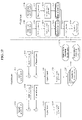
- FIG. 1 illustrates an example of a speaker recognition method.
- a speaker recognition method includes a registration process and a test process.
- the speaker recognition method may be performed by a speaker recognition apparatus, which may be embodied by one or more hardware modules, or a combination of hardware modules and software modules.
- the speaker recognition apparatus may generate a feature vector from an input voice or speech of a speaker and store the generated feature vector in a registration database (DB).
- the speaker recognition apparatus may compare the feature vector generated from the input speech to a feature vector stored in the registration DB, and determine whether to recognize the speaker.
- a speech signal 110 may be a speech signal of a speaker corresponding to a preset sentence which is a target for verification.
- the speech signal 110 is a speech signal of a speaker corresponding to a sentence to be recognized, for example, “hi, bixby” as illustrated.
- the speaker recognition apparatus receives the speech signal 110 corresponding to “hi, bixby,” which is a speech uttered by the speaker, generates a feature vector, and stores the generated feature vector in a registration DB.
- the speaker recognition apparatus when the speech signal 110 corresponding to the speech “hi, bixby” is received, the speaker recognition apparatus generates a feature vector corresponding to the speech signal 110 and compares the generated feature vector to a feature vector stored in the registration DB, and determines whether to recognize the speaker.
- the registration process may be performed in a quiet environment having relatively less noise, whereas the test process may be performed in an environment having relatively great noise.
- a feature vector may be generated based on a speech signal, for example, a speech signal 120 , in an environment with less noise.
- noise may be added to a speech signal of a speaker based on a surrounding environment and a feature vector may be generated based on a speech signal to which the noise is added, for example, a speech signal 130 and a speech signal 140 .
- the noise may include additive noise, channel noise, or a combination thereof.
- the speech signal to which the noise is added may include, for example, the speech signal 130 to which the additive noise is added and the speech signal 140 to which the channel noise is added.
- a mismatch between the feature vector generated in the registration process and the feature vector generated in the test process may occur, and thus a level of performance in recognition may be degraded.
- an error in feature vector may readily occur, and thus the recognition may not be readily performed.
- a feature vector may be registered based on a synthesized signal obtained by synthesizing a speech signal of a speaker and a preset noise signal in the registration process.
- Speaker recognition may be classified into speaker verification and speaker identification.
- the speaker verification is to verify whether a speaker is a registered user or not, and the speaker identification is to identify a speaker from among registered users.
- the speaker recognition may be implemented in various embodiments in a wide range of fields, for example, embodiments implementing management of individual electronic documents, and embodiments implementing banking and electronic commerce performed through example embodiment phones or Internet.
- a method using a voice or speech is generally used because there is a low risk of theft or imitation, compared to a physical mechanism such as a card, a seal, a signature, and an identity (ID) card.
- speaker recognition using a voice or speech may be readily performed from a long distance through an acoustic sensor such as a microphone, which is relatively low-priced compared to other methods using other biometric means, such as a fingerprint and a retina, which require relatively high-priced devices or equipment.
- FIGS. 2 through 7 A speaker verification method will be described with reference to FIGS. 8 and 9 , and a speaker recognition method will be described with reference to FIG. 10 .
- a registration apparatus with speaker recognition will be described with reference to FIG. 11 .
- FIG. 2 illustrates an example of a registration system for speaker recognition.
- a registration apparatus for speaker recognition receives a speech signal 210 of a speaker.
- the registration apparatus described herein refers to an apparatus configured to construct a registration DB corresponding to a speaker for speaker recognition, and may be embodied by, for example, a hardware module or a module including both hardware and software (e.g., a processor configured to execute instructions).
- the registration apparatus may be provided or used in various computing devices and/or systems, for example, a smartphone, a tablet computer, a laptop computer, a desktop computer, a television (TV), a wearable device, a security system, a smart home system, and the like.
- the speech signal 210 may be a signal that is not processed after being received through an acoustic sensor of the registration apparatus, or a signal from which a component corresponding to noise is removed after being received through the acoustic sensor. Even for the signal that is not processed, a registration process may be generally performed in a quiet environment having less noise, and thus the signal that is not processed may not be significantly different from the signal from which the noise is removed.
- the registration apparatus may synthesize the speech signal 210 , and an additive noise signal 220 , a channel noise signal 230 , or a combination thereof as illustrated in FIG. 2 .
- Additive noise may be generated from a source different from that of a speech signal, and may have no correlation with the speech signal.
- the additive noise may be added to a speech signal through addition.
- the additive noise may include, for example, a door closing sound, a horn sound, and ambient noise.
- channel noise may be a type of noise detected in a conversion or transformation process.
- the channel noise may include, for example, a room impulse response.
- the types of noise described in the foregoing description are provided merely as examples of the additive noise and the channel noise, and thus the additive noise and the channel noise may include other various types of noise.
- a method of synthesizing the speech signal 210 , and the additive noise signal 220 and the channel noise signal 230 , respectively, will be described in greater detail with reference to FIGS. 4 and 5 .
- the registration apparatus aligns a speech signal in stage 240 .
- the registration apparatus may determine a target section to be processed, and extract a start point and an end point of sound information included in the speech signal to improve efficiency in registration and recognition.
- the registration apparatus may measure strength of the speech signal to extract the start point and the end point of the sound information included in the speech signal, and set a section between the extracted start point and the extracted end point to be the target section to be processed.
- the speech signal to be aligned may be a synthesized signal in which the additive noise signal 220 , the channel noise signal 230 , or a combination thereof is synthesized.
- the registration apparatus may extract a start point and an end point of sound information by aligning first the speech signal 210 , and then synthesize the speech signal 210 , and the additive noise signal 220 , the channel noise signal 230 , or a combination thereof.
- the speech signal 210 may be aligned first in another device, for example, a digital signal processor, and then be input to the registration apparatus. Subsequently, the additive noise signal 220 , the channel noise signal 230 , or a combination thereof may be synthesized along with the speech signal 210 .
- the registration apparatus segments a synthesized signal of a speech signal and a noise signal into a plurality of sections in stage 250 .
- a method of segmenting a synthesized signal will be described in greater detail with reference to FIG. 6 .
- a feature vector generator 260 of the registration apparatus generates a feature vector based on the synthesized signal of the speech signal and the noise signal.
- the feature vector generator 260 recognizes the synthesized signal and outputs the feature vector corresponding to the recognized synthesized signal.
- the feature vector may include information distinguishing each recognition element, for example, time-based frequency information having compressed components in the speech signal that are needed for recognition.
- FIG. 3 illustrates a flowchart of an example of a registration method for speaker recognition.
- a registration apparatus for speaker recognition receives a speech signal of a speaker.
- the registration apparatus may receive a preset number of speech signals. For example, the registration apparatus repeatedly receives a speech signal of a speaker corresponding to a sentence to be recognized, for example, “hi, bixby,” N times.
- the registration apparatus synthesizes the received speech signal and a noise signal.
- the noise signal may be a signal preset to be similar to noise that may occur in a test process and include, for example, an additive noise signal, a channel noise signal, or a combination thereof.
- the registration apparatus generates a feature vector based on a synthesized signal of the speech signal and the noise signal.
- Various methods may be performed to extract the feature vector from the synthesized signal.
- the feature vector is generated by generating an image pattern from the synthesized signal through a fast Fourier transform (FFT), and inputting the generated image pattern to an artificial neural network that generates the feature vector.
- FFT fast Fourier transform
- Such a feature vector generating method will be described in greater detail with reference to FIGS. 4 through 6 .
- the registration apparatus generates a second feature vector based on the speech signal with which the noise signal is not synthesized.
- the registration apparatus constructs a registration DB corresponding to the speaker based on the generated feature vector.
- the registration apparatus may construct the registration DB based on at least one of the generated feature vector and the second generated feature vector.
- the speaker recognition may be performed in the test process based on the registration DB constructed by operations 310 through 340 .
- FIG. 4 illustrates an example of a method of generating a feature vector by synthesizing a speech signal and additive noise.
- a registration apparatus receives a speech signal 410 .
- the descriptions provided above with reference to FIGS. 1 through 3 are applicable to the method of FIG. 4 , and thus a more detailed and repeated description will be omitted here.
- Additive noise may occur from another source different from a source where the speech signal 410 occurs, and thus there is no correlation between the additive noise and the speech signal 410 .
- a synthesized signal is generated by adding an additive noise signal 420 to the speech signal 410 .
- the speech signal 410 is a plurality of speech signals
- the additive noise signal 420 is added to each of the speech signals, and thus a plurality of synthesized signals is generated.
- the additive noise signal 420 may be determined in various ways. For example, the additive noise signal 420 is determined based on at least one of a type of noise, a timing of noise, or an energy ratio of noise to a speech signal (i.e., signal-to-noise ratio [SNR]). For another example, the additive noise signal 420 is determined based on a repetition and/or a combination of noise signals determined based on a type of noise, a timing of noise, and an SNR.
- SNR signal-to-noise ratio
- the type of noise refers to a type of source of noise including, for example, a babbling sound occurring nearby, a door closing sound, and a horn sound.
- the type of noise may differ from one noise to another noise based on a length of noise, even though the noises are generated from a same source.
- the timing of noise refers to a start point and/or an end point at which noise is synthesized with a speech signal.
- the SNR refers to a relative volume difference between a speech signal and noise.
- the registration apparatus generates a feature vector 450 by inputting, to a feature vector generator, the synthesized signal of the speech signal 410 and the additive noise signal 420 .
- the feature vector generator transforms a domain of the synthesized signal, and extracts the feature vector 450 from a result of the transforming.
- the synthesized signal is generated by adding the additive noise signal 420 to the speech signal 410 , and thus may include time-domain sound information.
- the feature vector generator transforms a time-domain synthesized signal into a form of a frequency domain including image information, and generates the feature vector 450 based on the transformation.
- the feature vector generator includes a preprocessor 430 and a neural network 440 .
- the preprocessor 430 transforms the time-domain synthesized signal into the form of a frequency domain including the image information.
- the preprocessor 430 transforms a domain of the synthesized signal into a frequency domain using an FFT to obtain spectral size information, and extracts the image information in a form of frequency domain as illustrated in FIG. 1 , for example, by the representations of signals 120 , 130 , and 140 .
- an x axis indicates a time domain and a y axis indicates a frequency domain, and a level of brightness may be proportional to a spectral size.
- the feature vector 450 is extracted by inputting, to the neural network 440 , a result of the domain transformation including the image information.
- the neural network 440 may be embodied in various architectures and include, for example, a convolutional neural network (CNN) model.
- the CNN model includes one or more convolution layers, one or more pooling layers, and one or more fully connected layers, and may generate a feature vector from image information to be input thereto through an operation performed by each of the layers.
- the image information may indicate a pixel value of pixels included in an image, for example, a brightness value.
- the neural network 440 may include other types of models, including, a recurrent neural network (RNN) model, a deep belief network model, a fully connected network model, a bi-directional neural network model, a restricted Boltzmann machine model, or may include different or overlapping neural network portions respectively with full, convolutional, recurrent, and/or bi-directional connections.
- RNN recurrent neural network
- a deep belief network model a fully connected network model
- a bi-directional neural network model a restricted Boltzmann machine model
- the preprocessor 430 and the neural network 440 are provided as an example, and the feature vector generator may be based on other models configured to generate a feature vector in addition to the foregoing architecture of the preprocessor 430 and the neural network 440 .
- the feature vector generator may also be based on a linear predictive coding (LPC) method modeled by a human vocal tract, a filter bank method (e.g., Mel-scaled frequency cepstral coefficient [MFCC]) modeled by a human auditory organ, or a combination thereof (e.g., method of transforming a speech signal based on an MFCC and inputting a result of the transforming to a neural network).
- LPC linear predictive coding
- MFCC Mel-scaled frequency cepstral coefficient
- FIG. 5 illustrates an example of a method of generating a feature vector by synthesizing a speech signal and channel noise.
- channel noise may be noise generated based on an intrinsic characteristic of a location at which a speech signal 510 is input, dissimilar to additive noise generated from a source different from that of the speech signal 510 .
- a registration apparatus generates a synthesized signal by performing a convolution operation on the speech signal 510 and a channel noise signal 520 .
- the channel noise signal 520 may be determined based on at least one of a type of noise or an SNR.
- the channel noise signal 520 may be determined by a repetition and/or combination of noise signals determined based on a type of noise and an SNR.
- the type of noise may differ based on a type of location from which reverberation is generated, for example, a large room, a small room, and a concert hall.
- the type of noise may differ based on a characteristic of a microphone.
- the SNR refers to a relative volume difference between a speech signal and a noise signal.
- FIG. 6 illustrates an example of a method of generating a feature vector through segmentation.
- a registration apparatus receives a speech signal 610 .
- a speech signal of a speaker corresponding to a sentence to be recognized is uttered by a relatively small number of times in a registration process
- performance of a recognizer configured to recognize a start point of the utterance may become more sensitive, and thus an error in representative feature vector may easily occur and recognition may not be readily performed.
- a bias may increase in selecting an utterance point.
- the registration apparatus segments the speech signal 610 into a plurality of sections in stage 620 to register and use a limited utterance in various ways.
- the segmentation in stage 620 may be performed in time series, and window sizes of the sections may be the same.
- a feature vector generator 630 generates a feature vector 640 based on the sections.
- the feature vector generator 630 extracts at least one sectional feature vector corresponding to at least one of the sections.
- a sectional feature vector refers to a feature vector generated based on a section segmented through the segmentation in stage 620 . For example, when the registration apparatus segments one speech signal into M sections in stage 620 , M sectional feature vectors are generated. For another example, when the registration apparatus receives N speech signals 610 and segments each of the received N speech signals 610 into M sections in stage 620 , N ⁇ M sectional feature vectors are generated.
- a method of generating a feature vector is described above with reference to FIGS. 4 through 6 .
- the method may include an example method of generating a feature vector by synthesizing a speech signal and additive noise as described with reference to FIG. 4 , an example method of generating a feature vector by synthesizing a speech signal and channel noise as described with reference to FIG. 5 , an example method of generating a feature vector through segmentation as described with reference to FIG. 6 , and other various methods by combining the example methods described in the foregoing.
- the registration apparatus synthesizes N speech signals and P additive noise signals and performs segmentation to have M sections, thereby generating N ⁇ P ⁇ M feature vectors.
- the registration apparatus synthesizes N speech signals, and P1 additive noise signals and P2 channel noise signals, and performs segmentation to have M sections, thereby generating N ⁇ P1 ⁇ P2 ⁇ M feature vectors.
- the registration apparatus may store generated feature vectors in a registration DB to construct the registration DB corresponding to a speaker to be recognized in speaker recognition.
- the speaker recognition may be performed based on the constructed registration DB.
- FIG. 7 illustrates an example of a method of constructing a registration DB.
- a registration apparatus constructs a registration DB based on a feature vector.
- the registration apparatus constructs the registration DB by storing all generated feature vectors therein, the construction may be greatly affected by an outlier and performance in processing data may be degraded because comparisons need to be performed on each of all the feature vectors in a test process.
- the registration apparatus clusters a plurality of feature vectors into a plurality of groups, extracts at least one representative feature vector corresponding to at least one of the groups, and registers the extracted representative feature vector to construct the registration DB.
- the registration apparatus clusters the feature vectors into the groups based on a type of noise and a segmented section. Alternatively, the registration apparatus clusters the feature vectors into the groups based on a similarity of each of the feature vectors. For example, the registration apparatus clusters the feature vectors based on a K-means algorithm.
- the K-means algorithm refers to an algorithm for grouping given data into k clusters, which may operate to minimize a variance in distance differences between the clusters.
- the clustering is not limited to the foregoing example method, and various methods may be used for the clustering according to a design.
- the registration apparatus extracts the at least one representative feature vector corresponding to the at least one of the groups obtained by the clustering.
- a representative feature vector may be a representative value of feature vectors included in each of the groups.
- the representative vector is selected from the feature vectors included in each of the groups, or determined through a statistical operation on the feature vectors included in each of the groups.
- the representative feature vector may be a mean value of the feature values included in each of the groups, or a center value or centroid of the feature vectors. Using the representative feature vector, an influence of an outlier may be reduced, and it is thus possible to extract a robust feature value.
- the registration apparatus clusters N ⁇ M feature vectors into groups each of which includes K feature vectors and extracts, as a representative value, a mean value for each of the groups, and thus extracts a total of P representative feature vectors.
- the extracting of a representative feature vector using a representative value is not limited to the foregoing example method.
- the number of feature vectors included in each group may differ from group to group, and various methods may be used to extract a representative feature vector according to a design.
- FIG. 8 illustrates an example of a speaker verification method.
- a speech signal 810 to be registered a registered feature vector 835 , and a representative registered feature vector 840 are used to explain a registration process, and indicate the same meanings of a speech signal, a feature vector, and a representative feature vector, respectively, previously described.
- the descriptions of the speech signal 810 to be registered, the registered feature vector 835 , and the representative registered feature vector 840 are substantially the same as the descriptions of the speech signal, the feature vector, and the representative feature vector, and thus the descriptions provided above with reference to FIGS. 2 through 7 may also be applicable to the registration process to be described hereinafter with reference to FIG. 8 .
- a registration apparatus receives the speech signal 810 of a speaker, and synthesizes the speech signal 810 and additive noise 815 or channel noise 820 .
- the registration apparatus After performing segmentation in stage 825 on the synthesized signal obtained through the synthesizing, the registration apparatus generates the registered feature vector 835 by inputting a result of the segmentation to a feature vector generator 830 , and extracts the representative registered feature vector 840 to construct a registration DB. To store all the registered feature vector 835 in the registration DB, the extracting of the representative registered feature vector 840 may be omitted.
- a recognition apparatus embodiment receives an input speech signal 845 of a speaker.
- the input speech signal 845 may indicate a speech signal obtained from an utterance of the speaker for verification in a test process.
- the test process may be performed in an environment with a great amount of noise, and thus the input speech signal 845 may naturally include noise.
- the recognition apparatus may be an apparatus configured to generate a feature vector from an input speech of a speaker and compare the generated feature vector to a feature vector stored in a registration DB, and determine whether to recognize the speaker (including verification).
- the recognition apparatus may be implemented by, for example, a a hardware module or a combination of a hardware module and a software module.
- the recognition apparatus may be provided as, or in, various computing devices and/or systems, for example, a smartphone, a tablet computer, a laptop computer, a desktop computer, a TV, a wearable device, a security system, a smart home system, and the like.
- the recognition apparatus may include the registration apparatus.
- the recognition apparatus configured to perform the test process may also be referred to as a recognition apparatus without registration operations or merely relying on pre-registered information, and the recognition apparatus including the registration apparatus may also be referred to as a recognition apparatus, which may generate and thereafter rely on such registered information.
- a recognition apparatus and a registration apparatus may be separately described herein to distinguish functions of the recognition and functions of the registration.
- all the functions may be configured to be processed in a single device, for example, the broadly defined recognition apparatus.
- an acoustic sensor of the registration apparatus configured to receive the speech signal 810 may be the acoustic sensor of the recognition apparatus configured to receive the input speech signal 845 .
- the feature vector generator 830 of the registration apparatus and a feature vector generator 855 of the recognition apparatus may be the same feature vector generator.
- the recognition apparatus may indicate reference to the recognition apparatus, e.g., including or excluding the registration operations, for convenience of description.
- discussions of the registration apparatuses and methods may describe the registration operations, the referenced registration apparatuses and methods should be understood to also be inclusive of the recognition apparatus components and operations, i.e., a reference to a registration apparatus or method is not limited to only such registration components or operations.
- the recognition apparatus segments and extracts the speech signal 845 of the speaker to be recognized such that a window size of an input feature vector is equal to a window size of a registered feature vector. For example, the recognition apparatus performs center cropping on the speech signal 845 of the speaker, or performs a sliding window operation on the speech signal 845 in stage 850 . This is because comparing vectors may be enabled when a window size of an input feature vector and a window size of a registered feature vector are the same.
- the sliding window operation will be mainly described hereinafter for convenience of description, various methods may also be applied to segment and extract the speech signal 845 .
- the recognition apparatus inputs, to the feature vector generator 855 , a result obtained by performing the sliding window operation in stage 850 to generate an input feature vector 860 .
- the feature vector generator 855 may generate the input feature vector 860 using a neural network which is the same as a neural network for the feature vector generator 830 .
- the recognition apparatus compares at least one input feature vector 860 to at least one registered feature vector 835 or representative registered feature vector 840 of a registered user stored in the registration DB constructed in the registration process.
- the registered user described herein may be a speaker corresponding to a registered feature vector or a representative registered feature vector that is stored in the registration DB.
- the recognition apparatus verifies the speaker in stage 870 based on a result of the comparing obtained in stage 865 .
- the recognition apparatus verifies the speaker based on a similarity score between the input feature vector 860 and the registered feature vector 835 , or the representative registered feature vector 840 . For example, when a representative value of similarity scores is greater than or equal to a preset threshold value, the recognition apparatus determines the verifying of the speaker performed in stage 870 to be successful, or determines that the speaker is successfully verified.
- the recognition apparatus may determine the verifying of the speaker performed in stage 870 to be successful.
- conditions for the speaker verification in stage 870 are not limited to the conditions in the foregoing description, and thus various conditions may be applied to the speaker verification in stage 870 .
- a similarity score may be determined to be in a form of a matching score or a distance score, for example.
- the matching score may refer to a degree of similarity between the input feature vector 860 and the registered feature vector 835 or the representative registered feature vector 840 , or a score indicating a similarity between the feature vectors.
- a low matching score may indicate a low similarity between the feature vectors, or that the feature vectors are less similar to each other.
- a high matching score may indicate a high similarity between the feature vectors, or that the feature vectors are highly similar to each other.
- the distance score may refer to a score indicating a feature distance, for example, a Euclidean distance, between the input feature vector 860 and the registered feature vector 835 or the representative registered feature vector 840 .
- a low distance score may indicate that a feature distance between the feature vectors in a feature vector space is short, and a high distance score may indicate that the feature distance is long.
- FIG. 9 illustrates a flowchart of an example of a speaker recognition method.
- a recognition apparatus receives a speech signal of a speaker.
- the recognition apparatus generates at least one input feature vector based on the received speech signal.
- the number of input feature vectors may be determined based on a security level and a response time which are required by an application.
- the speaker recognition method described herein may be applied to perform a payment application, and unlock a smartphone, for example.
- the speaker recognition method is applied to unlock a smartphone, user convenience may be more significantly considered compared to when the speaker recognition method is used for the payment application, and thus a smaller number of input feature vectors may be sufficient compared to when the speaker recognition method is used for the payment application.
- the recognition apparatus performs a domain transformation on the speech signal of the speaker, and extracts an input feature vector from a result of the domain transformation. For example, the recognition apparatus performs an FFT on the speech signal of the speaker, and performs padding on a result of the FFT based on the result of the FFT.
- the result obtained by performing the FFT may not include data in a section thereof.
- data may be padded or filled through the padding.
- the padding may be performed based on data in a neighboring section adjacent to the section without the data. This is because a speech signal is a continuous signal, and a data value does not change rapidly during a sufficiently short period of time.
- data in a first unit loss section may be determined to be a value same as that of data in a neighboring unit section immediately adjacent to the first unit loss section and not having data lost
- data in a second unit loss section may be determined to be a value same as that of data in a neighboring unit section immediately adjacent to the padded data and not having data lost.
- the recognition apparatus compares the at least one input feature vector to at least one registered feature vector of a registered user stored in a registration DB.
- the recognition apparatus recognizes the speaker based on a result of the comparing.
- the speaker recognition may include speaker verification and speaker identification. The speaker verification is to verify whether a speaker currently speaking is a registered user or not, and the speaker identification is to identify a speaker from among various registered speakers.
- a method of the speaker identification will be described with reference to FIG. 10 .
- FIG. 10 illustrates an example of a speaker identification method.
- a speaker identification method may be used to identify a speaker who is currently speaking from among various registered users.
- the speaker identification method may be performed by performing speaker verification several times, because a plurality of registered users may be present.
- a registration process in the speaker identification method may be performed in a same way as a registration process in the speaker verification method described above with reference to FIG. 8 .
- the speaker verification method may generate a feature vector for one speaker, and, as shown in FIG. 10 , the speaker identification method may generate a feature vector for each of a plurality of speakers.
- the speaker identification method may generate and register a feature vector 1020 for registered speech signals 1010 of N speakers using a feature vector generator 1015 , and construct a registration DB for the N speakers.
- a test process in the speaker identification method may be performed in a same way as a test process in the speaker verification method described above with reference to FIG. 8 .
- the test process may generate an input feature vector 1040 for an input speech signal 1030 using a feature vector generator 1035 .
- a similarity between the input feature vector 1040 , and the registered feature vector 1020 generated for each individual speaker or a representative registered feature vector 1025 generated for each individual speaker is measured in stage 1045 to determine a numerical similarity vector 1050 .
- the numerical similarity vector 1050 may be an example of a similarity score.
- the speaker identification method may identify, as a speaker, a registered user corresponding to a registered feature vector 1020 or a representative registered feature vector 1020 which has a greatest magnitude of the numerical similarity vector 1050 with respect to the input feature vector 1040 .
- a magnitude of a numerical similarity vector may need to be greater than or equal to a threshold value.
- the speaker identification method may output that the speaker does not correspond to a registered user.
- the speaker identification method may identify, as the speaker, a registered user having a greatest number of registered feature vectors 1020 or representative registered feature vectors 1025 which have magnitudes of the numerical similarity vector 1050 greater than or equal to the threshold value.
- the speaker identification method may identify, as the speaker, a registered user having a greatest representative value of the registered feature vector 1020 or the representative registered feature vector 1025 of which a magnitude of the numerical similarity vector 1050 is greater than or equal to the threshold value.
- a condition for identifying the speaker in stage 1055 is not limited to the foregoing examples, and thus various conditions may be applied to identify the speaker in stage 1055 .
- FIG. 11 illustrates an example of a registration apparatus 1100 for speaker recognition.
- the registration apparatus 1100 includes a processor 1110 .
- the registration apparatus 1100 further includes a memory 1130 , a communication interface 1150 , and sensors 1170 .
- the processor 1110 , the memory 1130 , the communication interface 1150 , and the sensors 1170 may communicate with one another through a communication bus 1105 .
- the processor 1110 synthesizes a speech signal and a noise signal, generates a feature vector based on a synthesized signal obtained by synthesizing the speech signal and the noise signal, and constructs a registration DB corresponding to a speaker based on the generated feature vector.
- the memory 1130 includes the registration DB including feature vectors.
- the memory 1130 may be a volatile or nonvolatile memory.
- the sensors 1170 include, for example, an acoustic sensor configured to receive the speech signal of the speaker.
- the sensors 1170 may collect various sets of sound information.
- the processor 1110 may generate a second feature vector based on the speech signal (e.g., with which the noise signal is not synthesized), and construct the registration DB based on at least one of the feature vector or the second feature vector.
- the processor 1110 performs a domain transformation on the synthesized signal, and extracts the feature vector from a result of the domain transformation.
- the processor 1110 adds an additive noise signal to the speech signal.
- the processor 1110 performs a convolution operation on the speech signal and a channel noise signal.
- the processor 1110 segments the synthesized signal into a plurality of sections, and extracts at least one sectional feature vector corresponding to at least one of the sections.
- the processor 1110 clusters a plurality of feature vectors including at least one of the feature vector and the second feature vector into a plurality of groups, and extracts at least one representative feature vector corresponding to at least one of the groups.
- the processor 1110 may perform at least one of the methods described above with reference to FIGS. 2 through 7 (e.g., any one or any combination of any two or more of the methods), or an algorithm corresponding to the at least one method.
- the processor 1110 may execute a program and control the registration apparatus 1100 .
- a code of the program to be executed by the processor 1110 may be stored in the memory 1130 .
- the registration apparatus 1100 may be connected to an external device, for example, a personal computer (PC) and a network, through an input and output device (not shown), and may exchange data with the external device.
- PC personal computer
- the registration apparatus 1100 may be provided as, or in, various computing devices and/or systems, for example, a smartphone, a tablet computer, a laptop computer, a desktop computer, a TV, a wearable device, a security system, a smart home system, and the like.
- a recognition apparatus may include a processor.
- the recognition apparatus may further include a memory, a communication interface, and sensors.
- the processor, the memory, the communication interface, and the sensors may communicate with one another through a communication bus.
- the recognition apparatus may have a configuration similar to or the same as that of the registration apparatus 1100 illustrated in FIG. 11 .
- the processor may generate at least one input feature vector based on a speech signal, compare the input feature vector to at least one registered feature vector of a registered user stored in a registration DB, and recognize a speaker based on a result of the comparing.
- the memory may include the registration DB including feature vectors.
- the registration DB may include at least one registered feature vector which is generated based on a synthesized signal of a speech signal and a noise signal for registering a user.
- the memory may be a volatile or nonvolatile memory.
- the sensors may include an acoustic sensor configured to receive a speech signal of a speaker, and collect various sets of sound information.
- the processor may perform a domain transformation on a speech signal of a speaker, and extract an input feature vector from a result of the domain transformation.
- the processor may perform a sliding window operation on the speech signal of the speaker such that a window size of the speech signal is equal to a window size of a registered feature vector.
- the processor may perform an FFT on the speech signal of the speaker, and perform padding on a result of the FFT.
- the recognition apparatus may be provided as, or in, various computing devices and/or systems, for example, a smartphone, a tablet computer, a laptop computer, a desktop computer, a TV, a wearable device, a security system, a smart home system, and the like.
- FIG. 12 illustrates an example of a speaker verification method using a plurality of channels.
- a registration process and a test process may be performed through a plurality of channels.
- a registration apparatus may include a plurality of acoustic sensors each including a channel.
- a channel used herein indicates a passage through which information or signals are ensured to be transmitted, and each of channels may be independent from one another, and thus a signal of each of the channels may be independent without interference.
- an example of an environment including two channels will be mainly described for convenience of description, but the example may also be applied to other environments including three or more channels.
- the acoustic sensors of the registration apparatus receive a first speech signal 1210 to be registered and a second speech signal 1211 to be registered, respectively.
- the first speech signal 1210 and the second speech signal 1211 may be signals simultaneously generated from a same sound source.
- the first speech signal 1210 may be a signal input through a microphone located at a lower end of the registration apparatus
- the second speech signal 1211 may be a signal input through a microphone located at an upper end of the registration apparatus.
- An operation to be performed in the registration process using a plurality of channels may be performed independently through the channels, and a detailed operation to be performed in the registration process using a single channel which is described above with reference to FIG. 8 may be applied to the registration process using the plurality of channels.
- the registration apparatus generates a registered feature vector for the first speech signal by synthesizing the first speech signal 1210 received through the microphone located at the lower end of the registration apparatus, and additive noise 1215 and channel noise 1220 , performing segmentation on the synthesized signal in stage 1225 , and then inputting a result of the segmentation performed in stage 1225 to a feature vector generator 1230 .
- the registration apparatus independently generates a registered feature vector for the second speech signal 1211 received through the microphone located at the upper end of the registration apparatus. That is, the registration apparatus generates a registered feature vector for the second speech signal 1211 by synthesizing the second speech signal 1211 received through the microphone located at the upper end of the registration apparatus, and second additive noise 1216 and second channel noise 1221 , performing segmentation on the synthesized signal in stage 1226 , and then inputting a result of the segmentation performed in stage 1226 to a second feature vector generator 1231 .
- the registration apparatus extracts a representative registered feature vector 1240 based on a registered feature vector generated in each channel, and constructs a registration DB based on a result of the extracting. Since a registered feature vector is generated for each channel, more various registered feature vectors may be generated.
- a registered feature vector used herein may indicate a feature vector to be registered
- a representative registered feature vector used herein may indicate a feature vector to be registered which may represent registered feature vectors.
- the test process may be performed independently for each of the channels, for example.
- the registration apparatus generates an input feature vector independently for each channel by receiving a first input speech signal 1245 through the microphone located at the lower end of the registration apparatus and receiving a second input speech signal 1246 through the microphone located at the upper end of the registration apparatus.
- the registration apparatus since an input feature vector is generated for each channel, more various input feature vectors may be generated.
- the registration apparatus receives the first input speech signal 1245 and performs a sliding window operation on the first input speech signal 1245 in stage 1250 to generate a first input feature vector 1260 using a feature vector generator 1255 . Additionally, for example, the registration apparatus receives the second input speech signal 1246 and performs a sliding window operation on the second input speech signal 1246 in stage 1251 to generate a second input feature vector 1261 using a feature vector generator 1256 .
- stage 1265 the registration apparatus compares either one or both of the first input feature vector 1260 and the second input feature vector 1261 to the registered feature vector 1235 or the representative registered feature vector 1240 .
- stage 1270 the registration apparatus verifies the speaker based on the result of the comparing performed in stage 1265 .
- FIG. 13 illustrates an example of a speaker verification method through channel selection.
- a registration apparatus includes a plurality of acoustic sensors each including a channel.
- acoustic sensors each including a channel.
- an example of an environment including two channels be mainly described for convenience of description, the example may also be applied to other environments including three or more channels.
- the descriptions provided above with reference to FIGS. 1 through 12 may be applicable to the example of FIG. 13 , and a repeated and detailed description will be omitted for increased clarity and conciseness.
- the acoustic sensors of the registration apparatus receive a first speech signal 1310 of a speaker and a second speech signal 1311 of the speaker, respectively.
- the first speech signal 1310 and the second speech signal 1311 correspond to a registered speech signal.
- the registration apparatus preprocesses the received speech signals 1310 and 1311 in stage 1320 .
- the registration apparatus estimates noise based on a difference between the speech signals 1310 and 1311 , and obtains a signal from which the noise is removed by subtracting the noise from each of the speech signals 1310 and 1311 .
- a shared portion in the speech signals 1310 and 1311 may have a high probability of corresponding to a speech of the speaker, and the difference between the speech signals 1310 and 1311 may have a high probability of corresponding to noise.
- the noise may be estimated based on the difference between the speech signals 1310 and 1311 , and the signal from which the noise is removed may be obtained by subtracting the noise from each of the speech signals 1310 and 1311 of the speaker.
- the registration apparatus selects one from speech signals of the speaker received through a plurality of channels.
- a recognition error for example, clipping
- a speech signal may be input to an acoustic sensor of the registration apparatus having an allowable limited input
- a recognition error for example, clipping
- the registration apparatus may select one speech signal from among the speech signals of the speaker received through the channels for each section, thereby reducing such error.
- the speech signal 1310 received from the acoustic sensor at the lower end of the registration apparatus may be clipped, the speech signal 1311 received from an acoustic sensor at an upper end of the registration apparatus may be normally input.
- the speech signal 1311 received through the acoustic sensor at the upper end of the registration apparatus in which clipping does not occur in stage 1320 in which the preprocessing is performed, may be selected. Thus, a clipping issue may be resolved.
- the registration apparatus may select one speech signal from among the speech signals of the speaker received through the channels for each section of the signals. For example, the registration apparatus may select the speech signal 1310 in a first section, and the speech signal 1311 in a second section.
- FIG. 14 illustrates an example of a method robust against an utterance change by a location and a direction of a registration apparatus 10 .
- a recognition error may occur due to a change in utterance by a reverberation characteristic of the registration apparatus.
- a registration process 1400 an acoustic sensor 14 of the registration apparatus 10 is located at an open space, and thus there is no reverberation by a table 20 .
- the acoustic sensor 14 is located on the table 20 , and thus there is reverberation.
- a recognition error may occur due to a change in utterance by a reverberation characteristic of the registration apparatus 10 .
- the registration apparatus 10 may apply a change in utterance based on a direction of the registration apparatus 10 , thereby increasing a speaker recognition rate.
- the acoustic sensor 14 which is disposed at a lower end of the registration apparatus, is located at an open space and an acoustic sensor 16 , which is disposed at an upper end of the registration apparatus, is located on the table 20 , and thus the registration apparatus 10 may perform a registration in an environment the same as that in which the test process 1450 is performed.
- a change in utterance based on a reverberation characteristic of the registration apparatus may be considered and applied.
- a speaker recognition rate may be increased without an additional time delay in speaker recognition in an environment in which a plurality of channels is processed in parallel, for example, a multithreading environment, although the registration apparatus 10 uses the plurality of channels.
- the preprocessors 430 and 530 , the neural networks 440 and 540 , the feature vector generators 230 , 630 , 830 , 855 , 1015 , 1035 , 1230 , 1231 , 1255 , 1256 , and 1370 , the processor 1110 , and the memory 1130 in FIGS. 2, 4-6, 8, and 10-13 that perform the operations described in this application are implemented by hardware components configured to perform the operations described in this application that are performed by the hardware components.
- Examples of hardware components that may be used to perform the operations described in this application where appropriate include controllers, sensors, generators, drivers, memories, comparators, arithmetic logic units, adders, subtractors, multipliers, dividers, integrators, and any other electronic components configured to perform the operations described in this application.
- one or more of the hardware components that perform the operations described in this application are implemented by computing hardware, for example, by one or more processors or computers.
- a processor or computer may be implemented by one or more processing elements, such as an array of logic gates, a controller and an arithmetic logic unit, a digital signal processor, a microcomputer, a programmable logic controller, a field-programmable gate array, a programmable logic array, a microprocessor, or any other device or combination of devices that is configured to respond to and execute instructions in a defined manner to achieve a desired result.
- a processor or computer includes, or is connected to, one or more memories storing instructions or software that are executed by the processor or computer.
- Hardware components implemented by a processor or computer may execute instructions or software, such as an operating system (OS) and one or more software applications that run on the OS, to perform the operations described in this application.
- OS operating system
- the hardware components may also access, manipulate, process, create, and store data in response to execution of the instructions or software.
- processor or “computer” may be used in the description of the examples described in this application, but in other examples multiple processors or computers may be used, or a processor or computer may include multiple processing elements, or multiple types of processing elements, or both.
- a single hardware component or two or more hardware components may be implemented by a single processor, or two or more processors, or a processor and a controller.
- One or more hardware components may be implemented by one or more processors, or a processor and a controller, and one or more other hardware components may be implemented by one or more other processors, or another processor and another controller.
- One or more processors may implement a single hardware component, or two or more hardware components.
- a hardware component may have any one or more of different processing configurations, examples of which include a single processor, independent processors, parallel processors, single-instruction single-data (SISD) multiprocessing, single-instruction multiple-data (SIMD) multiprocessing, multiple-instruction single-data (MISD) multiprocessing, and multiple-instruction multiple-data (MIMD) multiprocessing.
- SISD single-instruction single-data
- SIMD single-instruction multiple-data
- MIMD multiple-instruction multiple-data
- FIGS. 1-10 and 12-14 that perform the operations described in this application are performed by computing hardware, for example, by one or more processors or computers, implemented as described above executing instructions or software to perform the operations described in this application that are performed by the methods.
- a single operation or two or more operations may be performed by a single processor, or two or more processors, or a processor and a controller.
- One or more operations may be performed by one or more processors, or a processor and a controller, and one or more other operations may be performed by one or more other processors, or another processor and another controller.
- One or more processors, or a processor and a controller may perform a single operation, or two or more operations.
- Instructions or software to control computing hardware may be written as computer programs, code segments, instructions or any combination thereof, for individually or collectively instructing or configuring the one or more processors or computers to operate as a machine or special-purpose computer to perform the operations that are performed by the hardware components and the methods as described above.
- the instructions or software include machine code that is directly executed by the one or more processors or computers, such as machine code produced by a compiler.
- the instructions or software includes higher-level code that is executed by the one or more processors or computer using an interpreter.
- the instructions or software may be written using any programming language based on the block diagrams and the flow charts illustrated in the drawings and the corresponding descriptions in the specification, which disclose algorithms for performing the operations that are performed by the hardware components and the methods as described above.
- the instructions or software to control computing hardware for example, one or more processors or computers, to implement the hardware components and perform the methods as described above, and any associated data, data files, and data structures, may be recorded, stored, or fixed in or on one or more non-transitory computer-readable storage media.
- Examples of a non-transitory computer-readable storage medium include read-only memory (ROM), random-access memory (RAM), flash memory, CD-ROMs, CD-Rs, CD+Rs, CD-RWs, CD+RWs, DVD-ROMs, DVD-Rs, DVD+Rs, DVD-RWs, DVD+RWs, DVD-RAMS, BD-ROMs, BD-Rs, BD-R LTHs, BD-REs, magnetic tapes, floppy disks, magneto-optical data storage devices, optical data storage devices, hard disks, solid-state disks, and any other device that is configured to store the instructions or software and any associated data, data files, and data structures in a non-transitory manner and provide the instructions or software and any associated data, data files, and data structures to one or more processors or computers so that the one or more processors or computers can execute the instructions.
- ROM read-only memory
- RAM random-access memory
- flash memory CD-ROMs, CD-Rs, CD
- the instructions or software and any associated data, data files, and data structures are distributed over network-coupled computer systems so that the instructions and software and any associated data, data files, and data structures are stored, accessed, and executed in a distributed fashion by the one or more processors or computers.
Landscapes
- Engineering & Computer Science (AREA)
- Multimedia (AREA)
- Acoustics & Sound (AREA)
- Health & Medical Sciences (AREA)
- Audiology, Speech & Language Pathology (AREA)
- Human Computer Interaction (AREA)
- Physics & Mathematics (AREA)
- Computer Vision & Pattern Recognition (AREA)
- Computational Linguistics (AREA)
- Signal Processing (AREA)
- Artificial Intelligence (AREA)
- Evolutionary Computation (AREA)
- Business, Economics & Management (AREA)
- Game Theory and Decision Science (AREA)
- Telephonic Communication Services (AREA)
- Circuit For Audible Band Transducer (AREA)
- Noise Elimination (AREA)
Abstract
Description
Claims (44)
Priority Applications (1)
| Application Number | Priority Date | Filing Date | Title |
|---|---|---|---|
| US16/781,176 US11289098B2 (en) | 2019-03-08 | 2020-02-04 | Method and apparatus with speaker recognition registration |
Applications Claiming Priority (5)
| Application Number | Priority Date | Filing Date | Title |
|---|---|---|---|
| KR10-2019-0026714 | 2019-03-08 | ||
| KR20190026714 | 2019-03-08 | ||
| KR10-2019-0051557 | 2019-05-02 | ||
| KR1020190051557A KR102887682B1 (en) | 2019-03-08 | 2019-05-02 | Registration method and apparatus for speaker recognition |
| US16/781,176 US11289098B2 (en) | 2019-03-08 | 2020-02-04 | Method and apparatus with speaker recognition registration |
Publications (2)
| Publication Number | Publication Date |
|---|---|
| US20200286489A1 US20200286489A1 (en) | 2020-09-10 |
| US11289098B2 true US11289098B2 (en) | 2022-03-29 |
Family
ID=69770764
Family Applications (1)
| Application Number | Title | Priority Date | Filing Date |
|---|---|---|---|
| US16/781,176 Active 2040-03-01 US11289098B2 (en) | 2019-03-08 | 2020-02-04 | Method and apparatus with speaker recognition registration |
Country Status (3)
| Country | Link |
|---|---|
| US (1) | US11289098B2 (en) |
| EP (1) | EP3706117B1 (en) |
| CN (1) | CN111667839B (en) |
Families Citing this family (9)
| Publication number | Priority date | Publication date | Assignee | Title |
|---|---|---|---|---|
| CN107527620B (en) * | 2017-07-25 | 2019-03-26 | 平安科技(深圳)有限公司 | Electronic device, the method for authentication and computer readable storage medium |
| WO2022024188A1 (en) * | 2020-07-27 | 2022-02-03 | 日本電気株式会社 | Voice registration apparatus, control method, program, and storage medium |
| CN112289298A (en) * | 2020-09-30 | 2021-01-29 | 北京大米科技有限公司 | Method, device, storage medium and electronic device for processing synthesized speech |
| CN113053395B (en) * | 2021-03-05 | 2023-11-17 | 深圳市声希科技有限公司 | Pronunciation error correction learning methods, devices, storage media and electronic equipment |
| EP4390919A3 (en) * | 2021-06-18 | 2024-09-25 | My Voice AI Limited | Methods for improving the performance of neural networks used for biometric authentication |
| WO2023278727A1 (en) * | 2021-07-02 | 2023-01-05 | Pindrop Security, Inc. | Speaker embedding conversion for backward and cross-channel compatibility |
| CN114187916B (en) * | 2021-12-14 | 2025-11-25 | 四川启睿克科技有限公司 | Registration-free voiceprint recognition method and system |
| CN116312565A (en) * | 2021-12-21 | 2023-06-23 | 顺丰科技有限公司 | Audio speaker recognition method and device |
| CN116504249A (en) * | 2022-01-19 | 2023-07-28 | 北京小米移动软件有限公司 | Voiceprint registration method, voiceprint registration device, computing equipment and medium |
Citations (27)
| Publication number | Priority date | Publication date | Assignee | Title |
|---|---|---|---|---|
| US6253179B1 (en) * | 1999-01-29 | 2001-06-26 | International Business Machines Corporation | Method and apparatus for multi-environment speaker verification |
| US20030009333A1 (en) * | 1996-11-22 | 2003-01-09 | T-Netix, Inc. | Voice print system and method |
| US20050143997A1 (en) * | 2000-10-10 | 2005-06-30 | Microsoft Corporation | Method and apparatus using spectral addition for speaker recognition |
| US7215776B1 (en) * | 1999-11-09 | 2007-05-08 | University Of New Hampshire | Method and apparatus for the compression and decompression of audio files using a chaotic system |
| US20110040561A1 (en) * | 2006-05-16 | 2011-02-17 | Claudio Vair | Intersession variability compensation for automatic extraction of information from voice |
| JP4655184B2 (en) | 2001-08-01 | 2011-03-23 | ソニー株式会社 | Voice recognition apparatus and method, recording medium, and program |
| JP4714523B2 (en) | 2005-07-27 | 2011-06-29 | 富士通東芝モバイルコミュニケーションズ株式会社 | Speaker verification device |
| US20120303369A1 (en) * | 2011-05-26 | 2012-11-29 | Microsoft Corporation | Energy-Efficient Unobtrusive Identification of a Speaker |
| US20130225128A1 (en) * | 2012-02-24 | 2013-08-29 | Agnitio Sl | System and method for speaker recognition on mobile devices |
| US20140222428A1 (en) * | 2013-02-07 | 2014-08-07 | Nuance Communications, Inc. | Method and Apparatus for Efficient I-Vector Extraction |
| US20140244257A1 (en) * | 2013-02-25 | 2014-08-28 | Nuance Communications, Inc. | Method and Apparatus for Automated Speaker Parameters Adaptation in a Deployed Speaker Verification System |
| US9230550B2 (en) | 2013-01-10 | 2016-01-05 | Sensory, Incorporated | Speaker verification and identification using artificial neural network-based sub-phonetic unit discrimination |
| US20160142579A1 (en) | 2014-11-19 | 2016-05-19 | Gopro, Inc. | Audio Signal Level Estimation in Cameras |
| US20160293167A1 (en) | 2013-10-10 | 2016-10-06 | Google Inc. | Speaker recognition using neural networks |
| US9601107B2 (en) | 2011-08-19 | 2017-03-21 | Asahi Kasei Kabushiki Kaisha | Speech recognition system, recognition dictionary registration system, and acoustic model identifier series generation apparatus |
| US20170169828A1 (en) * | 2015-12-09 | 2017-06-15 | Uniphore Software Systems | System and method for improved audio consistency |
| US20170294191A1 (en) * | 2016-04-07 | 2017-10-12 | Fujitsu Limited | Method for speaker recognition and apparatus for speaker recognition |
| US20180082692A1 (en) * | 2016-09-19 | 2018-03-22 | Pindrop Security, Inc. | Channel-Compensated Low-Level Features For Speaker Recognition |
| US20180226079A1 (en) * | 2017-02-07 | 2018-08-09 | Pindrop Security, Inc. | Age compensation in biometric systems using time-interval, gender and age |
| US20180254046A1 (en) * | 2017-03-03 | 2018-09-06 | Pindrop Security, Inc. | Method and apparatus for detecting spoofing conditions |
| US20180293990A1 (en) | 2015-12-30 | 2018-10-11 | Baidu Online Network Technology (Beijing) Co., Ltd. | Method and device for processing voiceprint authentication |
| US20180336911A1 (en) * | 2015-11-09 | 2018-11-22 | Nextlink Ipr Ab | Method of and system for noise suppression |
| US20180342250A1 (en) * | 2017-05-24 | 2018-11-29 | AffectLayer, Inc. | Automatic speaker identification in calls |
| US20190013013A1 (en) * | 2015-02-20 | 2019-01-10 | Sri International | Trial-based calibration for audio-based identification, recognition, and detection system |
| US10448151B1 (en) | 2018-05-04 | 2019-10-15 | Vocollect, Inc. | Multi-microphone system and method |
| US20200043503A1 (en) * | 2018-07-31 | 2020-02-06 | Cirrus Logic International Semiconductor Ltd. | Speaker verification |
| US20200194006A1 (en) * | 2017-09-11 | 2020-06-18 | Telefonaktiebolaget Lm Ericsson (Publ) | Voice-Controlled Management of User Profiles |
Family Cites Families (4)
| Publication number | Priority date | Publication date | Assignee | Title |
|---|---|---|---|---|
| AT504164B1 (en) * | 2006-09-15 | 2009-04-15 | Tech Universit T Graz | DEVICE FOR NOISE PRESSURE ON AN AUDIO SIGNAL |
| CN101079261B (en) * | 2007-07-02 | 2012-06-13 | 徐忠义 | Voice extraction circuit for suppressing environment noise |
| CN103632666B (en) * | 2013-11-14 | 2016-09-28 | 华为技术有限公司 | Audio recognition method, speech recognition apparatus and electronic equipment |
| US9972322B2 (en) * | 2016-03-29 | 2018-05-15 | Intel Corporation | Speaker recognition using adaptive thresholding |
-
2020
- 2020-02-04 US US16/781,176 patent/US11289098B2/en active Active
- 2020-02-24 CN CN202010111275.8A patent/CN111667839B/en active Active
- 2020-03-05 EP EP20161160.5A patent/EP3706117B1/en active Active
Patent Citations (27)
| Publication number | Priority date | Publication date | Assignee | Title |
|---|---|---|---|---|
| US20030009333A1 (en) * | 1996-11-22 | 2003-01-09 | T-Netix, Inc. | Voice print system and method |
| US6253179B1 (en) * | 1999-01-29 | 2001-06-26 | International Business Machines Corporation | Method and apparatus for multi-environment speaker verification |
| US7215776B1 (en) * | 1999-11-09 | 2007-05-08 | University Of New Hampshire | Method and apparatus for the compression and decompression of audio files using a chaotic system |
| US20050143997A1 (en) * | 2000-10-10 | 2005-06-30 | Microsoft Corporation | Method and apparatus using spectral addition for speaker recognition |
| JP4655184B2 (en) | 2001-08-01 | 2011-03-23 | ソニー株式会社 | Voice recognition apparatus and method, recording medium, and program |
| JP4714523B2 (en) | 2005-07-27 | 2011-06-29 | 富士通東芝モバイルコミュニケーションズ株式会社 | Speaker verification device |
| US20110040561A1 (en) * | 2006-05-16 | 2011-02-17 | Claudio Vair | Intersession variability compensation for automatic extraction of information from voice |
| US20120303369A1 (en) * | 2011-05-26 | 2012-11-29 | Microsoft Corporation | Energy-Efficient Unobtrusive Identification of a Speaker |
| US9601107B2 (en) | 2011-08-19 | 2017-03-21 | Asahi Kasei Kabushiki Kaisha | Speech recognition system, recognition dictionary registration system, and acoustic model identifier series generation apparatus |
| US20130225128A1 (en) * | 2012-02-24 | 2013-08-29 | Agnitio Sl | System and method for speaker recognition on mobile devices |
| US9230550B2 (en) | 2013-01-10 | 2016-01-05 | Sensory, Incorporated | Speaker verification and identification using artificial neural network-based sub-phonetic unit discrimination |
| US20140222428A1 (en) * | 2013-02-07 | 2014-08-07 | Nuance Communications, Inc. | Method and Apparatus for Efficient I-Vector Extraction |
| US20140244257A1 (en) * | 2013-02-25 | 2014-08-28 | Nuance Communications, Inc. | Method and Apparatus for Automated Speaker Parameters Adaptation in a Deployed Speaker Verification System |
| US20160293167A1 (en) | 2013-10-10 | 2016-10-06 | Google Inc. | Speaker recognition using neural networks |
| US20160142579A1 (en) | 2014-11-19 | 2016-05-19 | Gopro, Inc. | Audio Signal Level Estimation in Cameras |
| US20190013013A1 (en) * | 2015-02-20 | 2019-01-10 | Sri International | Trial-based calibration for audio-based identification, recognition, and detection system |
| US20180336911A1 (en) * | 2015-11-09 | 2018-11-22 | Nextlink Ipr Ab | Method of and system for noise suppression |
| US20170169828A1 (en) * | 2015-12-09 | 2017-06-15 | Uniphore Software Systems | System and method for improved audio consistency |
| US20180293990A1 (en) | 2015-12-30 | 2018-10-11 | Baidu Online Network Technology (Beijing) Co., Ltd. | Method and device for processing voiceprint authentication |
| US20170294191A1 (en) * | 2016-04-07 | 2017-10-12 | Fujitsu Limited | Method for speaker recognition and apparatus for speaker recognition |
| US20180082692A1 (en) * | 2016-09-19 | 2018-03-22 | Pindrop Security, Inc. | Channel-Compensated Low-Level Features For Speaker Recognition |
| US20180226079A1 (en) * | 2017-02-07 | 2018-08-09 | Pindrop Security, Inc. | Age compensation in biometric systems using time-interval, gender and age |
| US20180254046A1 (en) * | 2017-03-03 | 2018-09-06 | Pindrop Security, Inc. | Method and apparatus for detecting spoofing conditions |
| US20180342250A1 (en) * | 2017-05-24 | 2018-11-29 | AffectLayer, Inc. | Automatic speaker identification in calls |
| US20200194006A1 (en) * | 2017-09-11 | 2020-06-18 | Telefonaktiebolaget Lm Ericsson (Publ) | Voice-Controlled Management of User Profiles |
| US10448151B1 (en) | 2018-05-04 | 2019-10-15 | Vocollect, Inc. | Multi-microphone system and method |
| US20200043503A1 (en) * | 2018-07-31 | 2020-02-06 | Cirrus Logic International Semiconductor Ltd. | Speaker verification |
Non-Patent Citations (5)
| Title |
|---|
| Extended European Search Report dated Oct. 21, 2020 in counterpart European Patent Application No. 20161160.5 (14 pages in English). |
| Li, Na et al., "DNN-Driven Mixture of PLDA for Robust Speaker Verification." IEEE/ACM Transactions on Audio, Speech, and Language Processing, vol. 25, No. 6, 2017 (pp. 1371-1383). |
| Ming, Ji et al., "A Comparative Study of Methods for Handheld Speaker Verification in Realistic Noisy Conditions." 2006 IEEE Odyssey—The Speaker and Language Recognition Workshop, 2006 (pp. 1-8). |
| Partial European Search Report dated Jul. 1, 2020 for the corresponding European Patent Application No. 20161160.5 (13 pages in English). |
| Yuo, Kuo-Hwei et al., "Combination of Autocorrelation-Based Features and Projection Measure Technique for Speaker Identification." IEEE Transactions on Speech and Audio Processing, vol. 13, No. 4, 2005 (pp. 565-574). |
Also Published As
| Publication number | Publication date |
|---|---|
| EP3706117A2 (en) | 2020-09-09 |
| CN111667839A (en) | 2020-09-15 |
| EP3706117B1 (en) | 2022-05-11 |
| CN111667839B (en) | 2025-02-25 |
| EP3706117A3 (en) | 2020-11-18 |
| US20200286489A1 (en) | 2020-09-10 |
Similar Documents
| Publication | Publication Date | Title |
|---|---|---|
| US11289098B2 (en) | Method and apparatus with speaker recognition registration | |
| JP7619983B2 (en) | End-to-end speaker recognition using deep neural networks | |
| CN111091176B (en) | Data identification device and method and training device and method | |
| Jahangir et al. | Text-independent speaker identification through feature fusion and deep neural network | |
| US11545154B2 (en) | Method and apparatus with registration for speaker recognition | |
| US10607597B2 (en) | Speech signal recognition system and method | |
| Ohi et al. | Deep speaker recognition: Process, progress, and challenges | |
| Dua et al. | LSTM and CNN based ensemble approach for spoof detection task in automatic speaker verification systems | |
| Nainan et al. | Enhancement in speaker recognition for optimized speech features using GMM, SVM and 1-D CNN | |
| US9947323B2 (en) | Synthetic oversampling to enhance speaker identification or verification | |
| KR102887682B1 (en) | Registration method and apparatus for speaker recognition | |
| CN114255766A (en) | Generalized negative log-likelihood loss for speaker verification | |
| US20190051288A1 (en) | Personalized speech recognition method, and user terminal and server performing the method | |
| Esmaeilpour et al. | Class-conditional defense GAN against end-to-end speech attacks | |
| CN118212927B (en) | Identity recognition method and system based on sound characteristics, storage medium and electronic equipment | |
| Isyanto et al. | Voice biometrics for Indonesian language users using algorithm of deep learning CNN residual and hybrid of DWT-MFCC extraction features | |
| Nisa et al. | A speaker identification-verification approach for noise-corrupted and improved speech using fusion features and a convolutional neural network | |
| Efanov et al. | The BiLSTM-based synthesized speech recognition | |
| Zhang et al. | Speaker verification system based on deformable cnn and time-frequency attention | |
| US11763805B2 (en) | Speaker recognition method and apparatus | |
| Chakraborty et al. | An improved approach to open set text-independent speaker identification (OSTI-SI) | |
| US11437023B2 (en) | Apparatus and method with speech recognition and learning | |
| Schulze et al. | Performance of PSO and GWO algorithms applied in text-independent speaker identification | |
| Jahanirad et al. | Blind source computer device identification from recorded VoIP calls for forensic investigation | |
| Hassan et al. | Robust Speaker Identification System Based on Variational Bayesian Inference Gaussian Mixture Model and Feature Normalization |
Legal Events
| Date | Code | Title | Description |
|---|---|---|---|
| AS | Assignment |
Owner name: SAMSUNG ELECTRONICS CO., LTD., KOREA, REPUBLIC OF Free format text: ASSIGNMENT OF ASSIGNORS INTEREST;ASSIGNORS:PARK, SUNG-UN;KIM, KYUHONG;REEL/FRAME:051794/0279 Effective date: 20200128 |
|
| FEPP | Fee payment procedure |
Free format text: ENTITY STATUS SET TO UNDISCOUNTED (ORIGINAL EVENT CODE: BIG.); ENTITY STATUS OF PATENT OWNER: LARGE ENTITY |
|
| STPP | Information on status: patent application and granting procedure in general |
Free format text: APPLICATION DISPATCHED FROM PREEXAM, NOT YET DOCKETED |
|
| STPP | Information on status: patent application and granting procedure in general |
Free format text: DOCKETED NEW CASE - READY FOR EXAMINATION |
|
| STPP | Information on status: patent application and granting procedure in general |
Free format text: NON FINAL ACTION MAILED |
|
| STPP | Information on status: patent application and granting procedure in general |
Free format text: RESPONSE TO NON-FINAL OFFICE ACTION ENTERED AND FORWARDED TO EXAMINER |
|
| STPP | Information on status: patent application and granting procedure in general |
Free format text: FINAL REJECTION MAILED |
|
| STPP | Information on status: patent application and granting procedure in general |
Free format text: RESPONSE AFTER FINAL ACTION FORWARDED TO EXAMINER |
|
| STPP | Information on status: patent application and granting procedure in general |
Free format text: NOTICE OF ALLOWANCE MAILED -- APPLICATION RECEIVED IN OFFICE OF PUBLICATIONS |
|
| STPP | Information on status: patent application and granting procedure in general |
Free format text: PUBLICATIONS -- ISSUE FEE PAYMENT VERIFIED |
|
| STCF | Information on status: patent grant |
Free format text: PATENTED CASE |
|
| MAFP | Maintenance fee payment |
Free format text: PAYMENT OF MAINTENANCE FEE, 4TH YEAR, LARGE ENTITY (ORIGINAL EVENT CODE: M1551); ENTITY STATUS OF PATENT OWNER: LARGE ENTITY Year of fee payment: 4 |