US11278526B2 - Compounds and methods for treating lupus - Google Patents
Compounds and methods for treating lupus Download PDFInfo
- Publication number
- US11278526B2 US11278526B2 US16/337,292 US201716337292A US11278526B2 US 11278526 B2 US11278526 B2 US 11278526B2 US 201716337292 A US201716337292 A US 201716337292A US 11278526 B2 US11278526 B2 US 11278526B2
- Authority
- US
- United States
- Prior art keywords
- groups
- compound
- dihydro
- alkyl
- mice
- Prior art date
- Legal status (The legal status is an assumption and is not a legal conclusion. Google has not performed a legal analysis and makes no representation as to the accuracy of the status listed.)
- Active
Links
- CCEAKDWEXPIAPE-NRFANRHFSA-N COCCS(=O)(=O)N[C@H]1CCC2=C1C=CC=C2C1=NOC(C2=CC=C(OC(C)C)C(C#N)=C2)=N1 Chemical compound COCCS(=O)(=O)N[C@H]1CCC2=C1C=CC=C2C1=NOC(C2=CC=C(OC(C)C)C(C#N)=C2)=N1 CCEAKDWEXPIAPE-NRFANRHFSA-N 0.000 description 4
- MFDIVODWQFHCMN-UQEZSFNJSA-N *.CC(C)OC1=CC=C(C2=NC(C3=C4CC[C@@H](C)C4=CC=C3)=NO2)C=C1[Y].CC(C)OC1=CC=C(C2=NC(C3=C4CC[C@H](C)C4=CC=C3)=NO2)C=C1[Y].S Chemical compound *.CC(C)OC1=CC=C(C2=NC(C3=C4CC[C@@H](C)C4=CC=C3)=NO2)C=C1[Y].CC(C)OC1=CC=C(C2=NC(C3=C4CC[C@H](C)C4=CC=C3)=NO2)C=C1[Y].S MFDIVODWQFHCMN-UQEZSFNJSA-N 0.000 description 3
- UVIFLIWWTQZOOB-VWLOTQADSA-N CC(C)OC1=CC=C(C2=NC(C3=CC=CC4=C3CC[C@@H]4NCC3=CC=CC=C3)=NO2)C=C1C#N Chemical compound CC(C)OC1=CC=C(C2=NC(C3=CC=CC4=C3CC[C@@H]4NCC3=CC=CC=C3)=NO2)C=C1C#N UVIFLIWWTQZOOB-VWLOTQADSA-N 0.000 description 3
- DVHKZMGUWBXEBD-RDPSFJRHSA-N CC(C)OC1=CC=C(C2=NC(C3=CC=CC4=C3CC[C@@H]4NS(=O)(=O)CCN3CC[C@H](O)C3)=NO2)C=C1C#N Chemical compound CC(C)OC1=CC=C(C2=NC(C3=CC=CC4=C3CC[C@@H]4NS(=O)(=O)CCN3CC[C@H](O)C3)=NO2)C=C1C#N DVHKZMGUWBXEBD-RDPSFJRHSA-N 0.000 description 3
- FPUQUULAJDMSMB-NRFANRHFSA-N CCCN[C@H]1CCC2=C(C3=NOC(C4=CC=C(OC(C)C)C(C#N)=C4)=N3)C=CC=C21 Chemical compound CCCN[C@H]1CCC2=C(C3=NOC(C4=CC=C(OC(C)C)C(C#N)=C4)=N3)C=CC=C21 FPUQUULAJDMSMB-NRFANRHFSA-N 0.000 description 3
- CCGGKYGTRCIEJA-NRFANRHFSA-N CNCCS(=O)(=O)N[C@H]1CCC2=C(C3=NOC(C4=CC=C(OC(C)C)C(C#N)=C4)=N3)C=CC=C21 Chemical compound CNCCS(=O)(=O)N[C@H]1CCC2=C(C3=NOC(C4=CC=C(OC(C)C)C(C#N)=C4)=N3)C=CC=C21 CCGGKYGTRCIEJA-NRFANRHFSA-N 0.000 description 3
- IZZGKLYJVAKWMY-DCSCKUOQSA-N *.S.[C-]#[N+]C1=CC(C2=NC(C3=C4CC[C@@H](N(C)C)C4=CC=C3)=NO2)=CC=C1OC(C)C.[C-]#[N+]C1=CC(C2=NC(C3=C4CC[C@H](N(C)C)C4=CC=C3)=NO2)=CC=C1OC(C)C Chemical compound *.S.[C-]#[N+]C1=CC(C2=NC(C3=C4CC[C@@H](N(C)C)C4=CC=C3)=NO2)=CC=C1OC(C)C.[C-]#[N+]C1=CC(C2=NC(C3=C4CC[C@H](N(C)C)C4=CC=C3)=NO2)=CC=C1OC(C)C IZZGKLYJVAKWMY-DCSCKUOQSA-N 0.000 description 2
- RLOYMRTUJKSDRO-UHFFFAOYSA-N CC(=O)OCCNC1CCC2=C(C3=NOC(C4=CC=C(OC(C)C)C(C#N)=C4)=N3)C=CC=C21 Chemical compound CC(=O)OCCNC1CCC2=C(C3=NOC(C4=CC=C(OC(C)C)C(C#N)=C4)=N3)C=CC=C21 RLOYMRTUJKSDRO-UHFFFAOYSA-N 0.000 description 2
- SFBCFSWEKCRHLL-JOCHJYFZSA-N CC(C)CS(=O)(=O)N[C@@H]1CCC2=C1C=CC=C2C1=NOC(C2=CC=C(OC(C)C)C(C#N)=C2)=N1 Chemical compound CC(C)CS(=O)(=O)N[C@@H]1CCC2=C1C=CC=C2C1=NOC(C2=CC=C(OC(C)C)C(C#N)=C2)=N1 SFBCFSWEKCRHLL-JOCHJYFZSA-N 0.000 description 2
- CBMNBDKCPFSFOE-QGZVFWFLSA-N CC(C)OC1=C(C(F)(F)F)C=C(C2=NC(C3=CC=CC4=C3CC[C@H]4O)=NO2)C=C1 Chemical compound CC(C)OC1=C(C(F)(F)F)C=C(C2=NC(C3=CC=CC4=C3CC[C@H]4O)=NO2)C=C1 CBMNBDKCPFSFOE-QGZVFWFLSA-N 0.000 description 2
- JBLSPSZGYTUASF-GOSISDBHSA-N CC(C)OC1=C(C2=NC(C3=C4CC[C@@H](N)C4=CC=C3)=NO2)C=C(C#N)C=C1 Chemical compound CC(C)OC1=C(C2=NC(C3=C4CC[C@@H](N)C4=CC=C3)=NO2)C=C(C#N)C=C1 JBLSPSZGYTUASF-GOSISDBHSA-N 0.000 description 2
- HDOFCQRFEQVZDK-UHFFFAOYSA-N CC(C)OC1=CC=C(C2=NC(C3=C4CCC(N5CCNCC5)C4=CC=C3)=NO2)C=C1C#N Chemical compound CC(C)OC1=CC=C(C2=NC(C3=C4CCC(N5CCNCC5)C4=CC=C3)=NO2)C=C1C#N HDOFCQRFEQVZDK-UHFFFAOYSA-N 0.000 description 2
- KLLWVQBRUNAYAP-HXBUSHRASA-N CC(C)OC1=CC=C(C2=NC(C3=C4CCC(N5CC[C@H](O)C5)C4=CC=C3)=NO2)C=C1C#N Chemical compound CC(C)OC1=CC=C(C2=NC(C3=C4CCC(N5CC[C@H](O)C5)C4=CC=C3)=NO2)C=C1C#N KLLWVQBRUNAYAP-HXBUSHRASA-N 0.000 description 2
- NNXNBIIJDTWYHB-UHFFFAOYSA-N CC(C)OC1=CC=C(C2=NC(C3=C4CCC(NC(C)(C)CO)C4=CC=C3)=NO2)C=C1C#N Chemical compound CC(C)OC1=CC=C(C2=NC(C3=C4CCC(NC(C)(C)CO)C4=CC=C3)=NO2)C=C1C#N NNXNBIIJDTWYHB-UHFFFAOYSA-N 0.000 description 2
- TVPUCTSJIDGAPT-UHFFFAOYSA-N CC(C)OC1=CC=C(C2=NC(C3=C4CCC(NC5CCNCC5)C4=CC=C3)=NO2)C=C1C#N Chemical compound CC(C)OC1=CC=C(C2=NC(C3=C4CCC(NC5CCNCC5)C4=CC=C3)=NO2)C=C1C#N TVPUCTSJIDGAPT-UHFFFAOYSA-N 0.000 description 2
- WNDDDFYFTSGSEC-UHFFFAOYSA-N CC(C)OC1=CC=C(C2=NC(C3=C4CCC(NCCC(=O)O)C4=CC=C3)=NO2)C=C1C#N Chemical compound CC(C)OC1=CC=C(C2=NC(C3=C4CCC(NCCC(=O)O)C4=CC=C3)=NO2)C=C1C#N WNDDDFYFTSGSEC-UHFFFAOYSA-N 0.000 description 2
- KPMSXAXAVZVMGN-UHFFFAOYSA-N CC(C)OC1=CC=C(C2=NC(C3=C4CCC(NCCN5CCCC5)C4=CC=C3)=NO2)C=C1C#N Chemical compound CC(C)OC1=CC=C(C2=NC(C3=C4CCC(NCCN5CCCC5)C4=CC=C3)=NO2)C=C1C#N KPMSXAXAVZVMGN-UHFFFAOYSA-N 0.000 description 2
- AFFVZKJMKBGURV-UHFFFAOYSA-N CC(C)OC1=CC=C(C2=NC(C3=C4CCC(NCCN5CCCCC5)C4=CC=C3)=NO2)C=C1C#N Chemical compound CC(C)OC1=CC=C(C2=NC(C3=C4CCC(NCCN5CCCCC5)C4=CC=C3)=NO2)C=C1C#N AFFVZKJMKBGURV-UHFFFAOYSA-N 0.000 description 2
- VNDOOJDYFUXMST-JOCHJYFZSA-N CC(C)OC1=CC=C(C2=NC(C3=C4CC[C@@H](N(CCO)CCO)C4=CC=C3)=NO2)C=C1C#N Chemical compound CC(C)OC1=CC=C(C2=NC(C3=C4CC[C@@H](N(CCO)CCO)C4=CC=C3)=NO2)C=C1C#N VNDOOJDYFUXMST-JOCHJYFZSA-N 0.000 description 2
- JMMURUHUDIBOLA-AREMUKBSSA-N CC(C)OC1=CC=C(C2=NC(C3=C4CC[C@@H](N(CCO)S(=O)(=O)C5=CC=CC=C5)C4=CC=C3)=NO2)C=C1C#N Chemical compound CC(C)OC1=CC=C(C2=NC(C3=C4CC[C@@H](N(CCO)S(=O)(=O)C5=CC=CC=C5)C4=CC=C3)=NO2)C=C1C#N JMMURUHUDIBOLA-AREMUKBSSA-N 0.000 description 2
- WGUXQKIWMYYPQI-GOSISDBHSA-N CC(C)OC1=CC=C(C2=NC(C3=C4CC[C@@H](N)C4=CC=C3)=NO2)C=C1C#N Chemical compound CC(C)OC1=CC=C(C2=NC(C3=C4CC[C@@H](N)C4=CC=C3)=NO2)C=C1C#N WGUXQKIWMYYPQI-GOSISDBHSA-N 0.000 description 2
- ABJWYYWQOWBHIB-OAQYLSRUSA-N CC(C)OC1=CC=C(C2=NC(C3=C4CC[C@@H](N5CC(C(=O)O)C5)C4=CC=C3)=NO2)C=C1C#N Chemical compound CC(C)OC1=CC=C(C2=NC(C3=C4CC[C@@H](N5CC(C(=O)O)C5)C4=CC=C3)=NO2)C=C1C#N ABJWYYWQOWBHIB-OAQYLSRUSA-N 0.000 description 2
- DOFGEGUAJDTPNZ-OAQYLSRUSA-N CC(C)OC1=CC=C(C2=NC(C3=C4CC[C@@H](N5CC(O)C5)C4=CC=C3)=NO2)C=C1C#N Chemical compound CC(C)OC1=CC=C(C2=NC(C3=C4CC[C@@H](N5CC(O)C5)C4=CC=C3)=NO2)C=C1C#N DOFGEGUAJDTPNZ-OAQYLSRUSA-N 0.000 description 2
- NCNLNRARNCNSPD-XMMPIXPASA-N CC(C)OC1=CC=C(C2=NC(C3=C4CC[C@@H](NC(=O)N5CCC(CO)CC5)C4=CC=C3)=NO2)C=C1C#N Chemical compound CC(C)OC1=CC=C(C2=NC(C3=C4CC[C@@H](NC(=O)N5CCC(CO)CC5)C4=CC=C3)=NO2)C=C1C#N NCNLNRARNCNSPD-XMMPIXPASA-N 0.000 description 2
- GERMNTVMEBHJCQ-RUZDIDTESA-N CC(C)OC1=CC=C(C2=NC(C3=C4CC[C@@H](NC(=O)N5CCC(N(C)C)CC5)C4=CC=C3)=NO2)C=C1C#N Chemical compound CC(C)OC1=CC=C(C2=NC(C3=C4CC[C@@H](NC(=O)N5CCC(N(C)C)CC5)C4=CC=C3)=NO2)C=C1C#N GERMNTVMEBHJCQ-RUZDIDTESA-N 0.000 description 2
- AGXOFTPHIOIAFM-WMZHIEFXSA-N CC(C)OC1=CC=C(C2=NC(C3=C4CC[C@@H](NC(=O)N5CCC[C@H](O)C5)C4=CC=C3)=NO2)C=C1C#N Chemical compound CC(C)OC1=CC=C(C2=NC(C3=C4CC[C@@H](NC(=O)N5CCC[C@H](O)C5)C4=CC=C3)=NO2)C=C1C#N AGXOFTPHIOIAFM-WMZHIEFXSA-N 0.000 description 2
- VKEBDVQBJATLPO-GBXCKJPGSA-N CC(C)OC1=CC=C(C2=NC(C3=C4CC[C@@H](NC(=O)N5CC[C@H](N(C)C)C5)C4=CC=C3)=NO2)C=C1C#N Chemical compound CC(C)OC1=CC=C(C2=NC(C3=C4CC[C@@H](NC(=O)N5CC[C@H](N(C)C)C5)C4=CC=C3)=NO2)C=C1C#N VKEBDVQBJATLPO-GBXCKJPGSA-N 0.000 description 2
- BADAOJHCKYQRCT-HSZRJFAPSA-N CC(C)OC1=CC=C(C2=NC(C3=C4CC[C@@H](NCC(=O)N5CCCC5)C4=CC=C3)=NO2)C=C1C#N Chemical compound CC(C)OC1=CC=C(C2=NC(C3=C4CC[C@@H](NCC(=O)N5CCCC5)C4=CC=C3)=NO2)C=C1C#N BADAOJHCKYQRCT-HSZRJFAPSA-N 0.000 description 2
- KQXOGRUVHYXXAQ-AUSIDOKSSA-N CC(C)OC1=CC=C(C2=NC(C3=C4CC[C@@H](NCC(=O)N5CC[C@@H](O)C5)C4=CC=C3)=NO2)C=C1C#N Chemical compound CC(C)OC1=CC=C(C2=NC(C3=C4CC[C@@H](NCC(=O)N5CC[C@@H](O)C5)C4=CC=C3)=NO2)C=C1C#N KQXOGRUVHYXXAQ-AUSIDOKSSA-N 0.000 description 2
- WNDDDFYFTSGSEC-HXUWFJFHSA-N CC(C)OC1=CC=C(C2=NC(C3=C4CC[C@@H](NCCC(=O)O)C4=CC=C3)=NO2)C=C1C#N Chemical compound CC(C)OC1=CC=C(C2=NC(C3=C4CC[C@@H](NCCC(=O)O)C4=CC=C3)=NO2)C=C1C#N WNDDDFYFTSGSEC-HXUWFJFHSA-N 0.000 description 2
- OFKALJLHPWKVJZ-GOSISDBHSA-N CC(C)OC1=CC=C(C2=NC(C3=C4CC[C@@H](NS(N)(=O)=O)C4=CC=C3)=NO2)C=C1C#N Chemical compound CC(C)OC1=CC=C(C2=NC(C3=C4CC[C@@H](NS(N)(=O)=O)C4=CC=C3)=NO2)C=C1C#N OFKALJLHPWKVJZ-GOSISDBHSA-N 0.000 description 2
- CTTFKORTOJLIDU-NRFANRHFSA-N CC(C)OC1=CC=C(C2=NC(C3=C4CC[C@H](N(C)CCO)C4=CC=C3)=NO2)C=C1C#N Chemical compound CC(C)OC1=CC=C(C2=NC(C3=C4CC[C@H](N(C)CCO)C4=CC=C3)=NO2)C=C1C#N CTTFKORTOJLIDU-NRFANRHFSA-N 0.000 description 2
- XSYSBJURQBNRCZ-QHCPKHFHSA-N CC(C)OC1=CC=C(C2=NC(C3=C4CC[C@H](N5CC(C(=O)N(C)C)C5)C4=CC=C3)=NO2)C=C1C#N Chemical compound CC(C)OC1=CC=C(C2=NC(C3=C4CC[C@H](N5CC(C(=O)N(C)C)C5)C4=CC=C3)=NO2)C=C1C#N XSYSBJURQBNRCZ-QHCPKHFHSA-N 0.000 description 2
- WYTSPARTTKFWLO-DEOSSOPVSA-N CC(C)OC1=CC=C(C2=NC(C3=C4CC[C@H](N5CC(C(=O)N6CCC6)C5)C4=CC=C3)=NO2)C=C1C#N Chemical compound CC(C)OC1=CC=C(C2=NC(C3=C4CC[C@H](N5CC(C(=O)N6CCC6)C5)C4=CC=C3)=NO2)C=C1C#N WYTSPARTTKFWLO-DEOSSOPVSA-N 0.000 description 2
- GERMNTVMEBHJCQ-VWLOTQADSA-N CC(C)OC1=CC=C(C2=NC(C3=C4CC[C@H](NC(=O)N5CCC(N(C)C)CC5)C4=CC=C3)=NO2)C=C1C#N Chemical compound CC(C)OC1=CC=C(C2=NC(C3=C4CC[C@H](NC(=O)N5CCC(N(C)C)CC5)C4=CC=C3)=NO2)C=C1C#N GERMNTVMEBHJCQ-VWLOTQADSA-N 0.000 description 2
- KIALPTLWECVGBJ-QHCPKHFHSA-N CC(C)OC1=CC=C(C2=NC(C3=C4CC[C@H](NC(=O)N5CCC(O)CC5)C4=CC=C3)=NO2)C=C1C#N Chemical compound CC(C)OC1=CC=C(C2=NC(C3=C4CC[C@H](NC(=O)N5CCC(O)CC5)C4=CC=C3)=NO2)C=C1C#N KIALPTLWECVGBJ-QHCPKHFHSA-N 0.000 description 2
- HTSHHNZVFQDSQP-QFIPXVFZSA-N CC(C)OC1=CC=C(C2=NC(C3=C4CC[C@H](NC(=O)N5CCNCC5)C4=CC=C3)=NO2)C=C1C#N Chemical compound CC(C)OC1=CC=C(C2=NC(C3=C4CC[C@H](NC(=O)N5CCNCC5)C4=CC=C3)=NO2)C=C1C#N HTSHHNZVFQDSQP-QFIPXVFZSA-N 0.000 description 2
- PNHOKHNYJMNPRA-QFIPXVFZSA-N CC(C)OC1=CC=C(C2=NC(C3=C4CC[C@H](NC(=O)N5CCOCC5)C4=CC=C3)=NO2)C=C1C#N Chemical compound CC(C)OC1=CC=C(C2=NC(C3=C4CC[C@H](NC(=O)N5CCOCC5)C4=CC=C3)=NO2)C=C1C#N PNHOKHNYJMNPRA-QFIPXVFZSA-N 0.000 description 2
- VBIDIPCPEBRRIS-GCJKJVERSA-N CC(C)OC1=CC=C(C2=NC(C3=C4CC[C@H](NC(=O)N5CC[C@@H](N)C5)C4=CC=C3)=NO2)C=C1C#N Chemical compound CC(C)OC1=CC=C(C2=NC(C3=C4CC[C@H](NC(=O)N5CC[C@@H](N)C5)C4=CC=C3)=NO2)C=C1C#N VBIDIPCPEBRRIS-GCJKJVERSA-N 0.000 description 2
- VBIDIPCPEBRRIS-AVRDEDQJSA-N CC(C)OC1=CC=C(C2=NC(C3=C4CC[C@H](NC(=O)N5CC[C@H](N)C5)C4=CC=C3)=NO2)C=C1C#N Chemical compound CC(C)OC1=CC=C(C2=NC(C3=C4CC[C@H](NC(=O)N5CC[C@H](N)C5)C4=CC=C3)=NO2)C=C1C#N VBIDIPCPEBRRIS-AVRDEDQJSA-N 0.000 description 2
- SNZPZMRDWSNHMH-FQEVSTJZSA-N CC(C)OC1=CC=C(C2=NC(C3=C4CC[C@H](NCC(=O)N(C)C)C4=CC=C3)=NO2)C=C1C(N)=O Chemical compound CC(C)OC1=CC=C(C2=NC(C3=C4CC[C@H](NCC(=O)N(C)C)C4=CC=C3)=NO2)C=C1C(N)=O SNZPZMRDWSNHMH-FQEVSTJZSA-N 0.000 description 2
- YQNXSZVSPIMTGY-NRFANRHFSA-N CC(C)OC1=CC=C(C2=NC(C3=C4CC[C@H](NCCCC(=O)O)C4=CC=C3)=NO2)C=C1C#N Chemical compound CC(C)OC1=CC=C(C2=NC(C3=C4CC[C@H](NCCCC(=O)O)C4=CC=C3)=NO2)C=C1C#N YQNXSZVSPIMTGY-NRFANRHFSA-N 0.000 description 2
- KWBICGIAQJQQIG-VFNWGFHPSA-N CC(C)OC1=CC=C(C2=NC(C3=C4CC[C@H](N[C@H](C)CO)C4=CC=C3)=NO2)C=C1C#N Chemical compound CC(C)OC1=CC=C(C2=NC(C3=C4CC[C@H](N[C@H](C)CO)C4=CC=C3)=NO2)C=C1C#N KWBICGIAQJQQIG-VFNWGFHPSA-N 0.000 description 2
- RPDHHUCVIGBRNS-UHFFFAOYSA-N CC(C)OC1=CC=C(C2=NC(C3=CC=CC4=C3CCC4NCCS(C)(=O)=O)=NO2)C=C1C#N Chemical compound CC(C)OC1=CC=C(C2=NC(C3=CC=CC4=C3CCC4NCCS(C)(=O)=O)=NO2)C=C1C#N RPDHHUCVIGBRNS-UHFFFAOYSA-N 0.000 description 2
- ZLESCMZZGOACRY-NRFANRHFSA-N CC(C)OC1=CC=C(C2=NC(C3=CC=CC4=C3CC[C@@H]4NC(=O)CN(C)C)=NO2)C=C1C#N Chemical compound CC(C)OC1=CC=C(C2=NC(C3=CC=CC4=C3CC[C@@H]4NC(=O)CN(C)C)=NO2)C=C1C#N ZLESCMZZGOACRY-NRFANRHFSA-N 0.000 description 2
- KACHMTPJJYUMJG-DEOSSOPVSA-N CC(C)OC1=CC=C(C2=NC(C3=CC=CC4=C3CC[C@@H]4NS(=O)(=O)C3=CC=CC=C3)=NO2)C=C1C#N Chemical compound CC(C)OC1=CC=C(C2=NC(C3=CC=CC4=C3CC[C@@H]4NS(=O)(=O)C3=CC=CC=C3)=NO2)C=C1C#N KACHMTPJJYUMJG-DEOSSOPVSA-N 0.000 description 2
- AOQJMKFJCICUNO-NRFANRHFSA-N CC(C)OC1=CC=C(C2=NC(C3=CC=CC4=C3CC[C@@H]4NS(=O)(=O)C3CC3)=NO2)C=C1C#N Chemical compound CC(C)OC1=CC=C(C2=NC(C3=CC=CC4=C3CC[C@@H]4NS(=O)(=O)C3CC3)=NO2)C=C1C#N AOQJMKFJCICUNO-NRFANRHFSA-N 0.000 description 2
- GCTSOZZWWYIIEF-NRFANRHFSA-N CC(C)OC1=CC=C(C2=NC(C3=CC=CC4=C3CC[C@@H]4NS(=O)(=O)CC(=O)N(C)C)=NO2)C=C1C#N Chemical compound CC(C)OC1=CC=C(C2=NC(C3=CC=CC4=C3CC[C@@H]4NS(=O)(=O)CC(=O)N(C)C)=NO2)C=C1C#N GCTSOZZWWYIIEF-NRFANRHFSA-N 0.000 description 2
- ACTOYVGYDQNQHQ-DEOSSOPVSA-N CC(C)OC1=CC=C(C2=NC(C3=CC=CC4=C3CC[C@@H]4NS(=O)(=O)CC(=O)N3CCC(O)CC3)=NO2)C=C1C#N Chemical compound CC(C)OC1=CC=C(C2=NC(C3=CC=CC4=C3CC[C@@H]4NS(=O)(=O)CC(=O)N3CCC(O)CC3)=NO2)C=C1C#N ACTOYVGYDQNQHQ-DEOSSOPVSA-N 0.000 description 2
- CVKXXNQTZCGEJZ-QFIPXVFZSA-N CC(C)OC1=CC=C(C2=NC(C3=CC=CC4=C3CC[C@@H]4NS(=O)(=O)CCN(C)C)=NO2)C=C1C#N Chemical compound CC(C)OC1=CC=C(C2=NC(C3=CC=CC4=C3CC[C@@H]4NS(=O)(=O)CCN(C)C)=NO2)C=C1C#N CVKXXNQTZCGEJZ-QFIPXVFZSA-N 0.000 description 2
- BSDSIPGCIDSPBV-QHCPKHFHSA-N CC(C)OC1=CC=C(C2=NC(C3=CC=CC4=C3CC[C@@H]4NS(=O)(=O)CCN3CCC3)=NO2)C=C1C#N Chemical compound CC(C)OC1=CC=C(C2=NC(C3=CC=CC4=C3CC[C@@H]4NS(=O)(=O)CCN3CCC3)=NO2)C=C1C#N BSDSIPGCIDSPBV-QHCPKHFHSA-N 0.000 description 2
- XDLWHZZHADLPLV-DEOSSOPVSA-N CC(C)OC1=CC=C(C2=NC(C3=CC=CC4=C3CC[C@@H]4NS(=O)(=O)CCN3CCOCC3)=NO2)C=C1C#N Chemical compound CC(C)OC1=CC=C(C2=NC(C3=CC=CC4=C3CC[C@@H]4NS(=O)(=O)CCN3CCOCC3)=NO2)C=C1C#N XDLWHZZHADLPLV-DEOSSOPVSA-N 0.000 description 2
- DVHKZMGUWBXEBD-YKSBVNFPSA-N CC(C)OC1=CC=C(C2=NC(C3=CC=CC4=C3CC[C@@H]4NS(=O)(=O)CCN3CC[C@@H](O)C3)=NO2)C=C1C#N Chemical compound CC(C)OC1=CC=C(C2=NC(C3=CC=CC4=C3CC[C@@H]4NS(=O)(=O)CCN3CC[C@@H](O)C3)=NO2)C=C1C#N DVHKZMGUWBXEBD-YKSBVNFPSA-N 0.000 description 2
- XKRPYYFQBRCVBF-HSZRJFAPSA-N CC(C)OC1=CC=C(C2=NC(C3=CC=CC4=C3CC[C@H]4NC(=O)CN3CCCC3)=NO2)C=C1C#N Chemical compound CC(C)OC1=CC=C(C2=NC(C3=CC=CC4=C3CC[C@H]4NC(=O)CN3CCCC3)=NO2)C=C1C#N XKRPYYFQBRCVBF-HSZRJFAPSA-N 0.000 description 2
- NXJZLLLXESBWOJ-HSZRJFAPSA-N CC(C)OC1=CC=C(C2=NC(C3=CC=CC4=C3CC[C@H]4NCC(=O)N3CCOCC3)=NO2)C=C1C#N Chemical compound CC(C)OC1=CC=C(C2=NC(C3=CC=CC4=C3CC[C@H]4NCC(=O)N3CCOCC3)=NO2)C=C1C#N NXJZLLLXESBWOJ-HSZRJFAPSA-N 0.000 description 2
- YVSHJKKNMDPIAR-OAQYLSRUSA-N CC(C)OC1=CC=C(C2=NC(C3=CC=CC4=C3CC[C@H]4NCC(C)(C)O)=NO2)C=C1C#N Chemical compound CC(C)OC1=CC=C(C2=NC(C3=CC=CC4=C3CC[C@H]4NCC(C)(C)O)=NO2)C=C1C#N YVSHJKKNMDPIAR-OAQYLSRUSA-N 0.000 description 2
- DTQZHFJXDJNCKL-JOCHJYFZSA-N CC(C)OC1=CC=C(C2=NC(C3=CC=CC4=C3CC[C@H]4NS(=O)(=O)CC(=O)N3CC(O)C3)=NO2)C=C1C#N Chemical compound CC(C)OC1=CC=C(C2=NC(C3=CC=CC4=C3CC[C@H]4NS(=O)(=O)CC(=O)N3CC(O)C3)=NO2)C=C1C#N DTQZHFJXDJNCKL-JOCHJYFZSA-N 0.000 description 2
- IVCQFNXBDYXVSJ-JOCHJYFZSA-N CC(C)OC1=CC=C(C2=NC(C3=CC=CC4=C3CC[C@H]4NS(=O)(=O)CC(=O)N3CCC3)=NO2)C=C1C#N Chemical compound CC(C)OC1=CC=C(C2=NC(C3=CC=CC4=C3CC[C@H]4NS(=O)(=O)CC(=O)N3CCC3)=NO2)C=C1C#N IVCQFNXBDYXVSJ-JOCHJYFZSA-N 0.000 description 2
- AZZJUACOORMPSQ-RUZDIDTESA-N CC(C)OC1=CC=C(C2=NC(C3=CC=CC4=C3CC[C@H]4NS(=O)(=O)CC3=CC=CC=C3)=NO2)C=C1C#N Chemical compound CC(C)OC1=CC=C(C2=NC(C3=CC=CC4=C3CC[C@H]4NS(=O)(=O)CC3=CC=CC=C3)=NO2)C=C1C#N AZZJUACOORMPSQ-RUZDIDTESA-N 0.000 description 2
- AEAGOICXHIPXLU-XMMPIXPASA-N CC(C)OC1=CC=C(C2=NC(C3=CC=CC4=C3CC[C@H]4NS(=O)(=O)CCN3CCCC3)=NO2)C=C1C#N Chemical compound CC(C)OC1=CC=C(C2=NC(C3=CC=CC4=C3CC[C@H]4NS(=O)(=O)CCN3CCCC3)=NO2)C=C1C#N AEAGOICXHIPXLU-XMMPIXPASA-N 0.000 description 2
- XDLWHZZHADLPLV-XMMPIXPASA-N CC(C)OC1=CC=C(C2=NC(C3=CC=CC4=C3CC[C@H]4NS(=O)(=O)CCN3CCOCC3)=NO2)C=C1C#N Chemical compound CC(C)OC1=CC=C(C2=NC(C3=CC=CC4=C3CC[C@H]4NS(=O)(=O)CCN3CCOCC3)=NO2)C=C1C#N XDLWHZZHADLPLV-XMMPIXPASA-N 0.000 description 2
- DVHKZMGUWBXEBD-HYBUGGRVSA-N CC(C)OC1=CC=C(C2=NC(C3=CC=CC4=C3CC[C@H]4NS(=O)(=O)CCN3CC[C@@H](O)C3)=NO2)C=C1C#N Chemical compound CC(C)OC1=CC=C(C2=NC(C3=CC=CC4=C3CC[C@H]4NS(=O)(=O)CCN3CC[C@@H](O)C3)=NO2)C=C1C#N DVHKZMGUWBXEBD-HYBUGGRVSA-N 0.000 description 2
- 0 CC(C)Oc(cc1)c(*)cc1-c1nc(-c2cccc3c2CC[C@]3*)n[o]1 Chemical compound CC(C)Oc(cc1)c(*)cc1-c1nc(-c2cccc3c2CC[C@]3*)n[o]1 0.000 description 2
- REVIBPCXMWZNCJ-HSZRJFAPSA-N CCN(CC(=O)N(C)C)[C@@H]1CCC2=C(C3=NOC(C4=CC=C(OC(C)C)C(C#N)=C4)=N3)C=CC=C21 Chemical compound CCN(CC(=O)N(C)C)[C@@H]1CCC2=C(C3=NOC(C4=CC=C(OC(C)C)C(C#N)=C4)=N3)C=CC=C21 REVIBPCXMWZNCJ-HSZRJFAPSA-N 0.000 description 2
- GJWOVIPYQPVQMK-HSZRJFAPSA-N CCN(CC)C(=O)CN[C@@H]1CCC2=C1C=CC=C2C1=NOC(C2=CC=C(OC(C)C)C(C#N)=C2)=N1 Chemical compound CCN(CC)C(=O)CN[C@@H]1CCC2=C1C=CC=C2C1=NOC(C2=CC=C(OC(C)C)C(C#N)=C2)=N1 GJWOVIPYQPVQMK-HSZRJFAPSA-N 0.000 description 2
- OILOXSQTFCPYHL-UHFFFAOYSA-N CCOC(=O)CNC1CCC2=C(C3=NOC(C4=CC=C(OC(C)C)C(C#N)=C4)=N3)C=CC=C21 Chemical compound CCOC(=O)CNC1CCC2=C(C3=NOC(C4=CC=C(OC(C)C)C(C#N)=C4)=N3)C=CC=C21 OILOXSQTFCPYHL-UHFFFAOYSA-N 0.000 description 2
- POUNIPQQQNJNCO-MRXNPFEDSA-N CCOC1=C(C(F)(F)F)C=C(C2=NC(C3=CC=CC4=C3CC[C@H]4O)=NO2)C=C1 Chemical compound CCOC1=C(C(F)(F)F)C=C(C2=NC(C3=CC=CC4=C3CC[C@H]4O)=NO2)C=C1 POUNIPQQQNJNCO-MRXNPFEDSA-N 0.000 description 2
- GVXJUPVVNNATIB-QGZVFWFLSA-N CCOC1=CC=C(C2=NC(C3=C4CC[C@@H](N)C4=CC=C3)=NO2)C=C1C#N Chemical compound CCOC1=CC=C(C2=NC(C3=C4CC[C@@H](N)C4=CC=C3)=NO2)C=C1C#N GVXJUPVVNNATIB-QGZVFWFLSA-N 0.000 description 2
- RFNAOFFZMHTEFM-KRWDZBQOSA-N CCOC1=CC=C(C2=NC(C3=CC=CC4=C3CC[C@@H]4O)=NO2)C=C1OCC Chemical compound CCOC1=CC=C(C2=NC(C3=CC=CC4=C3CC[C@@H]4O)=NO2)C=C1OCC RFNAOFFZMHTEFM-KRWDZBQOSA-N 0.000 description 2
- KPJCAEQOBGNDFO-QFIPXVFZSA-N CCOCCS(=O)(=O)N[C@H]1CCC2=C1C=CC=C2C1=NOC(C2=CC=C(OC(C)C)C(C#N)=C2)=N1 Chemical compound CCOCCS(=O)(=O)N[C@H]1CCC2=C1C=CC=C2C1=NOC(C2=CC=C(OC(C)C)C(C#N)=C2)=N1 KPJCAEQOBGNDFO-QFIPXVFZSA-N 0.000 description 2
- CDXRMJFLQXBVBQ-UHFFFAOYSA-N COC(=O)C1CN(C2CCC3=C(C4=NOC(C5=CC=C(OC(C)C)C(C#N)=C5)=N4)C=CC=C32)C1 Chemical compound COC(=O)C1CN(C2CCC3=C(C4=NOC(C5=CC=C(OC(C)C)C(C#N)=C5)=N4)C=CC=C32)C1 CDXRMJFLQXBVBQ-UHFFFAOYSA-N 0.000 description 2
- LJSQHQJIHMZGIL-RUZDIDTESA-N COC(=O)CC1CCN(C(=O)N[C@@H]2CCC3=C(C4=NOC(C5=CC=C(OC(C)C)C(C#N)=C5)=N4)C=CC=C32)CC1 Chemical compound COC(=O)CC1CCN(C(=O)N[C@@H]2CCC3=C(C4=NOC(C5=CC=C(OC(C)C)C(C#N)=C5)=N4)C=CC=C32)CC1 LJSQHQJIHMZGIL-RUZDIDTESA-N 0.000 description 2
- LJSQHQJIHMZGIL-VWLOTQADSA-N COC(=O)CC1CCN(C(=O)N[C@H]2CCC3=C(C4=NOC(C5=CC=C(OC(C)C)C(C#N)=C5)=N4)C=CC=C32)CC1 Chemical compound COC(=O)CC1CCN(C(=O)N[C@H]2CCC3=C(C4=NOC(C5=CC=C(OC(C)C)C(C#N)=C5)=N4)C=CC=C32)CC1 LJSQHQJIHMZGIL-VWLOTQADSA-N 0.000 description 2
- FMXBPRYLNQJZPV-UHFFFAOYSA-N COC(=O)CCCCNC1CCC2=C(C3=NOC(C4=CC=C(OC(C)C)C(C#N)=C4)=N3)C=CC=C21 Chemical compound COC(=O)CCCCNC1CCC2=C(C3=NOC(C4=CC=C(OC(C)C)C(C#N)=C4)=N3)C=CC=C21 FMXBPRYLNQJZPV-UHFFFAOYSA-N 0.000 description 2
- KEQYTSCUNYUNLP-LJQANCHMSA-N COC(=O)N[C@@H]1CCC2=C(C3=NOC(C4=CC=C(OC(C)C)C(C#N)=C4)=N3)C=CC=C21 Chemical compound COC(=O)N[C@@H]1CCC2=C(C3=NOC(C4=CC=C(OC(C)C)C(C#N)=C4)=N3)C=CC=C21 KEQYTSCUNYUNLP-LJQANCHMSA-N 0.000 description 2
- GQRMKKNRJRWCJA-UHFFFAOYSA-N COCC(=O)NC1CCC2=C(C3=NOC(C4=CC=C(OC(C)C)C(C#N)=C4)=N3)C=CC=C21 Chemical compound COCC(=O)NC1CCC2=C(C3=NOC(C4=CC=C(OC(C)C)C(C#N)=C4)=N3)C=CC=C21 GQRMKKNRJRWCJA-UHFFFAOYSA-N 0.000 description 2
- STTUSUDGTLSJBX-JOCHJYFZSA-N CC(=O)N(CCO)[C@@H]1CCC2=C(C3=NOC(C4=CC=C(OC(C)C)C(C#N)=C4)=N3)C=CC=C21 Chemical compound CC(=O)N(CCO)[C@@H]1CCC2=C(C3=NOC(C4=CC=C(OC(C)C)C(C#N)=C4)=N3)C=CC=C21 STTUSUDGTLSJBX-JOCHJYFZSA-N 0.000 description 1
- ZDRSMUOVMULONY-SANMLTNESA-N CC(=O)NC1=CC=C(S(=O)(=O)N[C@H]2CCC3=C2C=CC=C3C2=NOC(C3=CC=C(OC(C)C)C(C#N)=C3)=N2)C=C1 Chemical compound CC(=O)NC1=CC=C(S(=O)(=O)N[C@H]2CCC3=C2C=CC=C3C2=NOC(C3=CC=C(OC(C)C)C(C#N)=C3)=N2)C=C1 ZDRSMUOVMULONY-SANMLTNESA-N 0.000 description 1
- FVWMDPLFGXHGCN-HXUWFJFHSA-N CC(=O)N[C@@H]1CCC2=C(C3=NOC(C4=CC=C(OC(C)C)C(C#N)=C4)=N3)C=CC=C21 Chemical compound CC(=O)N[C@@H]1CCC2=C(C3=NOC(C4=CC=C(OC(C)C)C(C#N)=C4)=N3)C=CC=C21 FVWMDPLFGXHGCN-HXUWFJFHSA-N 0.000 description 1
- FVWMDPLFGXHGCN-FQEVSTJZSA-N CC(=O)N[C@H]1CCC2=C(C3=NOC(C4=CC=C(OC(C)C)C(C#N)=C4)=N3)C=CC=C21 Chemical compound CC(=O)N[C@H]1CCC2=C(C3=NOC(C4=CC=C(OC(C)C)C(C#N)=C4)=N3)C=CC=C21 FVWMDPLFGXHGCN-FQEVSTJZSA-N 0.000 description 1
- AWLCYEPZJUNGKS-OAQYLSRUSA-N CC(=O)O[C@@H]1CCC2=C1C=CC=C2C1=NOC(C2=CC=C(OC(C)C)C(C#N)=C2)=N1 Chemical compound CC(=O)O[C@@H]1CCC2=C1C=CC=C2C1=NOC(C2=CC=C(OC(C)C)C(C#N)=C2)=N1 AWLCYEPZJUNGKS-OAQYLSRUSA-N 0.000 description 1
- RYNYDCPCHJGCDC-ZOKFUURZSA-N CC(C)(C)OC(=O)N(CCO[Si](C)(C)C(C)(C)C)[C@@H]1CCC2=C1C=CC=C2C#N.CC(C)(C)OC(=O)N(CCO[Si](C)(C)C(C)(C)C)[C@@H]1CCC2=C1C=CC=C2C(=N)NO Chemical compound CC(C)(C)OC(=O)N(CCO[Si](C)(C)C(C)(C)C)[C@@H]1CCC2=C1C=CC=C2C#N.CC(C)(C)OC(=O)N(CCO[Si](C)(C)C(C)(C)C)[C@@H]1CCC2=C1C=CC=C2C(=N)NO RYNYDCPCHJGCDC-ZOKFUURZSA-N 0.000 description 1
- IGWROWYGZPFNTQ-FCRIDUQTSA-N CC(C)(C)OC(=O)N(CCO[Si](C)(C)C(C)(C)C)[C@@H]1CCC2=C1C=CC=C2C#N.CC(C)(C)OC(=O)N[C@@H]1CCC2=C1C=CC=C2C#N Chemical compound CC(C)(C)OC(=O)N(CCO[Si](C)(C)C(C)(C)C)[C@@H]1CCC2=C1C=CC=C2C#N.CC(C)(C)OC(=O)N[C@@H]1CCC2=C1C=CC=C2C#N IGWROWYGZPFNTQ-FCRIDUQTSA-N 0.000 description 1
- LXNLDWGDDPIKRV-SSDUOFGYSA-N CC(C)(C)OC(=O)N(CCO[Si](C)(C)C(C)(C)C)[C@@H]1CCC2=C1C=CC=C2C(=N)NO.CC(C)OC1=CC=C(C2=NC(C3=C4CC[C@@H](N(CCO)C(=O)OC(C)(C)C)C4=CC=C3)=NO2)C=C1C#N.CC(C)OC1=CC=C(C2=NC(C3=C4CC[C@@H](N(CCO[Si](C)(C)C(C)(C)C)C(=O)OC(C)(C)C)C4=CC=C3)=NO2)C=C1C#N Chemical compound CC(C)(C)OC(=O)N(CCO[Si](C)(C)C(C)(C)C)[C@@H]1CCC2=C1C=CC=C2C(=N)NO.CC(C)OC1=CC=C(C2=NC(C3=C4CC[C@@H](N(CCO)C(=O)OC(C)(C)C)C4=CC=C3)=NO2)C=C1C#N.CC(C)OC1=CC=C(C2=NC(C3=C4CC[C@@H](N(CCO[Si](C)(C)C(C)(C)C)C(=O)OC(C)(C)C)C4=CC=C3)=NO2)C=C1C#N LXNLDWGDDPIKRV-SSDUOFGYSA-N 0.000 description 1
- AXSYJUDVOZRFIT-SEYGQARNSA-N CC(C)(C)OC(=O)N[C@@H]1CCC2=C1C=CC=C2C#N.CC(C)(C)OC(=O)N[C@@H]1CCC2=C1C=CC=C2C(=N)NO Chemical compound CC(C)(C)OC(=O)N[C@@H]1CCC2=C1C=CC=C2C#N.CC(C)(C)OC(=O)N[C@@H]1CCC2=C1C=CC=C2C(=N)NO AXSYJUDVOZRFIT-SEYGQARNSA-N 0.000 description 1
- MGEXUQZHGLGDAZ-RFSBDEKTSA-N CC(C)(C)OC(=O)N[C@@H]1CCC2=C1C=CC=C2C#N.N#CC1=CC=CC2=C1CC[C@H]2N Chemical compound CC(C)(C)OC(=O)N[C@@H]1CCC2=C1C=CC=C2C#N.N#CC1=CC=CC2=C1CC[C@H]2N MGEXUQZHGLGDAZ-RFSBDEKTSA-N 0.000 description 1
- VPRQIZWRMFMEEK-OAFLPQRXSA-N CC(C)(C)OC(=O)N[C@@H]1CCC2=C1C=CC=C2C(=N)NO.[C-]#[N+]C1=CC(C2=NC(C3=C4CC[C@@H](NC(=O)OC(C)(C)C)C4=CC=C3)=NO2)=CC=C1OC(C)C Chemical compound CC(C)(C)OC(=O)N[C@@H]1CCC2=C1C=CC=C2C(=N)NO.[C-]#[N+]C1=CC(C2=NC(C3=C4CC[C@@H](NC(=O)OC(C)(C)C)C4=CC=C3)=NO2)=CC=C1OC(C)C VPRQIZWRMFMEEK-OAFLPQRXSA-N 0.000 description 1
- YPHURAORAWVSCR-ZUTYSQTGSA-N CC(C)(C)[S@@](/N=C1\c2cccc(C#N)c2CC1)=O Chemical compound CC(C)(C)[S@@](/N=C1\c2cccc(C#N)c2CC1)=O YPHURAORAWVSCR-ZUTYSQTGSA-N 0.000 description 1
- LTUWBOPKLNLFIC-URNYHPBQSA-N CC(C)(C)[S@@](=O)/N=C1/CCC2=C1C=CC=C2C#N.CC(C)(C)[S@@](=O)N[C@@H]1CCC2=C1C=CC=C2C#N Chemical compound CC(C)(C)[S@@](=O)/N=C1/CCC2=C1C=CC=C2C#N.CC(C)(C)[S@@](=O)N[C@@H]1CCC2=C1C=CC=C2C#N LTUWBOPKLNLFIC-URNYHPBQSA-N 0.000 description 1
- BSACWKAQYSWQPY-JKJFQLKTSA-N CC(C)(C)[S@@](=O)/N=C1/CCC2=C1C=CC=C2C#N.N#CC1=CC=CC2=C1CCC2=O Chemical compound CC(C)(C)[S@@](=O)/N=C1/CCC2=C1C=CC=C2C#N.N#CC1=CC=CC2=C1CCC2=O BSACWKAQYSWQPY-JKJFQLKTSA-N 0.000 description 1
- KUPXERCWAFFASF-FZJPPLSCSA-N CC(C)(C)[S@@](=O)N[C@@H]1CCC2=C1C=CC=C2C#N.N#CC1=CC=CC2=C1CC[C@H]2N Chemical compound CC(C)(C)[S@@](=O)N[C@@H]1CCC2=C1C=CC=C2C#N.N#CC1=CC=CC2=C1CC[C@H]2N KUPXERCWAFFASF-FZJPPLSCSA-N 0.000 description 1
- IROSLYCWAUSFJX-UHFFFAOYSA-N CC(C)C(=O)OC1=CC=C(C2=NC(C3=C4CCC(NCCO)C4=CC=C3)=NO2)C=C1C#N Chemical compound CC(C)C(=O)OC1=CC=C(C2=NC(C3=C4CCC(NCCO)C4=CC=C3)=NO2)C=C1C#N IROSLYCWAUSFJX-UHFFFAOYSA-N 0.000 description 1
- ARGGUIZFDFDFQW-UHFFFAOYSA-N CC(C)COC1=CC=C(C2=NC(C3=C4CCC(NCCO)C4=CC=C3)=NO2)C=C1CN Chemical compound CC(C)COC1=CC=C(C2=NC(C3=C4CCC(NCCO)C4=CC=C3)=NO2)C=C1CN ARGGUIZFDFDFQW-UHFFFAOYSA-N 0.000 description 1
- OWSDAXGYLIGOSW-NRFANRHFSA-N CC(C)N[C@H]1CCC2=C(C3=NOC(C4=CC=C(OC(C)C)C(C#N)=C4)=N3)C=CC=C21 Chemical compound CC(C)N[C@H]1CCC2=C(C3=NOC(C4=CC=C(OC(C)C)C(C#N)=C4)=N3)C=CC=C21 OWSDAXGYLIGOSW-NRFANRHFSA-N 0.000 description 1
- QIAXGWDOCDEMJB-GOSISDBHSA-N CC(C)OC1=CC(C2=NC(C3=C4CC[C@@H](N)C4=CC=C3)=NO2)=CC=C1C#N Chemical compound CC(C)OC1=CC(C2=NC(C3=C4CC[C@@H](N)C4=CC=C3)=NO2)=CC=C1C#N QIAXGWDOCDEMJB-GOSISDBHSA-N 0.000 description 1
- VKVIGUWJPRGHLK-LJQANCHMSA-N CC(C)OC1=CC(CN)=CC(C2=NC(C3=C4CC[C@@H](N)C4=CC=C3)=NO2)=C1 Chemical compound CC(C)OC1=CC(CN)=CC(C2=NC(C3=C4CC[C@@H](N)C4=CC=C3)=NO2)=C1 VKVIGUWJPRGHLK-LJQANCHMSA-N 0.000 description 1
- NXDVZHGZQLHXCY-UHFFFAOYSA-N CC(C)OC1=CC=C(C2=NC(C3=C4CCC(C)C4=CC=C3)=NO2)C=C1[Y] Chemical compound CC(C)OC1=CC=C(C2=NC(C3=C4CCC(C)C4=CC=C3)=NO2)C=C1[Y] NXDVZHGZQLHXCY-UHFFFAOYSA-N 0.000 description 1
- WQNOYYYZSXYHHY-LRTDYKAYSA-N CC(C)OC1=CC=C(C2=NC(C3=C4CCC(CC[C@@H](O)CO)C4=CC=C3)=NO2)C=C1C#N Chemical compound CC(C)OC1=CC=C(C2=NC(C3=C4CCC(CC[C@@H](O)CO)C4=CC=C3)=NO2)C=C1C#N WQNOYYYZSXYHHY-LRTDYKAYSA-N 0.000 description 1
- ABJWYYWQOWBHIB-UHFFFAOYSA-N CC(C)OC1=CC=C(C2=NC(C3=C4CCC(N5CC(C(=O)O)C5)C4=CC=C3)=NO2)C=C1C#N Chemical compound CC(C)OC1=CC=C(C2=NC(C3=C4CCC(N5CC(C(=O)O)C5)C4=CC=C3)=NO2)C=C1C#N ABJWYYWQOWBHIB-UHFFFAOYSA-N 0.000 description 1
- FKROOZHZUQAQTP-UHFFFAOYSA-N CC(C)OC1=CC=C(C2=NC(C3=C4CCC(N5CCC(O)CC5)C4=CC=C3)=NO2)C=C1C#N Chemical compound CC(C)OC1=CC=C(C2=NC(C3=C4CCC(N5CCC(O)CC5)C4=CC=C3)=NO2)C=C1C#N FKROOZHZUQAQTP-UHFFFAOYSA-N 0.000 description 1
- AFXKYOCRULMIAP-UHFFFAOYSA-N CC(C)OC1=CC=C(C2=NC(C3=C4CCC(N5CCCCC5)C4=CC=C3)=NO2)C=C1C#N Chemical compound CC(C)OC1=CC=C(C2=NC(C3=C4CCC(N5CCCCC5)C4=CC=C3)=NO2)C=C1C#N AFXKYOCRULMIAP-UHFFFAOYSA-N 0.000 description 1
- IAUJZTQDPPCOEK-UHFFFAOYSA-N CC(C)OC1=CC=C(C2=NC(C3=C4CCC(N5CCN(CCO)CC5)C4=CC=C3)=NO2)C=C1C#N Chemical compound CC(C)OC1=CC=C(C2=NC(C3=C4CCC(N5CCN(CCO)CC5)C4=CC=C3)=NO2)C=C1C#N IAUJZTQDPPCOEK-UHFFFAOYSA-N 0.000 description 1
- ASLRUXAYTFWQCV-UHFFFAOYSA-N CC(C)OC1=CC=C(C2=NC(C3=C4CCC(N5CCOCC5)C4=CC=C3)=NO2)C=C1C#N Chemical compound CC(C)OC1=CC=C(C2=NC(C3=C4CCC(N5CCOCC5)C4=CC=C3)=NO2)C=C1C#N ASLRUXAYTFWQCV-UHFFFAOYSA-N 0.000 description 1
- AHJFTYAPMAQGIJ-ZZWBGTBQSA-N CC(C)OC1=CC=C(C2=NC(C3=C4CCC(N5CC[C@@H](N)C5)C4=CC=C3)=NO2)C=C1C#N Chemical compound CC(C)OC1=CC=C(C2=NC(C3=C4CCC(N5CC[C@@H](N)C5)C4=CC=C3)=NO2)C=C1C#N AHJFTYAPMAQGIJ-ZZWBGTBQSA-N 0.000 description 1
- KLLWVQBRUNAYAP-ZZWBGTBQSA-N CC(C)OC1=CC=C(C2=NC(C3=C4CCC(N5CC[C@@H](O)C5)C4=CC=C3)=NO2)C=C1C#N Chemical compound CC(C)OC1=CC=C(C2=NC(C3=C4CCC(N5CC[C@@H](O)C5)C4=CC=C3)=NO2)C=C1C#N KLLWVQBRUNAYAP-ZZWBGTBQSA-N 0.000 description 1
- AHJFTYAPMAQGIJ-HXBUSHRASA-N CC(C)OC1=CC=C(C2=NC(C3=C4CCC(N5CC[C@H](N)C5)C4=CC=C3)=NO2)C=C1C#N Chemical compound CC(C)OC1=CC=C(C2=NC(C3=C4CCC(N5CC[C@H](N)C5)C4=CC=C3)=NO2)C=C1C#N AHJFTYAPMAQGIJ-HXBUSHRASA-N 0.000 description 1
- IIRANIZCWRMOCP-UHFFFAOYSA-N CC(C)OC1=CC=C(C2=NC(C3=C4CCC(NC(CO)CO)C4=CC=C3)=NO2)C=C1C#N Chemical compound CC(C)OC1=CC=C(C2=NC(C3=C4CCC(NC(CO)CO)C4=CC=C3)=NO2)C=C1C#N IIRANIZCWRMOCP-UHFFFAOYSA-N 0.000 description 1
- MONDILYVTNGWHJ-UHFFFAOYSA-N CC(C)OC1=CC=C(C2=NC(C3=C4CCC(NC5CCCCC5)C4=CC=C3)=NO2)C=C1C#N Chemical compound CC(C)OC1=CC=C(C2=NC(C3=C4CCC(NC5CCCCC5)C4=CC=C3)=NO2)C=C1C#N MONDILYVTNGWHJ-UHFFFAOYSA-N 0.000 description 1
- OLBHMLKNCFJHAZ-UHFFFAOYSA-N CC(C)OC1=CC=C(C2=NC(C3=C4CCC(NC5CCOCC5)C4=CC=C3)=NO2)C=C1C#N Chemical compound CC(C)OC1=CC=C(C2=NC(C3=C4CCC(NC5CCOCC5)C4=CC=C3)=NO2)C=C1C#N OLBHMLKNCFJHAZ-UHFFFAOYSA-N 0.000 description 1
- FETKSAFOWYPZGC-UHFFFAOYSA-N CC(C)OC1=CC=C(C2=NC(C3=C4CCC(NCCN)C4=CC=C3)=NO2)C=C1C#N Chemical compound CC(C)OC1=CC=C(C2=NC(C3=C4CCC(NCCN)C4=CC=C3)=NO2)C=C1C#N FETKSAFOWYPZGC-UHFFFAOYSA-N 0.000 description 1
- UFBUAIXWXWEWDI-UHFFFAOYSA-N CC(C)OC1=CC=C(C2=NC(C3=C4CCC(NCCN5CCNCC5)C4=CC=C3)=NO2)C=C1C#N Chemical compound CC(C)OC1=CC=C(C2=NC(C3=C4CCC(NCCN5CCNCC5)C4=CC=C3)=NO2)C=C1C#N UFBUAIXWXWEWDI-UHFFFAOYSA-N 0.000 description 1
- OJGXKCPSIKZPEE-UHFFFAOYSA-N CC(C)OC1=CC=C(C2=NC(C3=C4CCC(NCCN5CCOCC5)C4=CC=C3)=NO2)C=C1C#N Chemical compound CC(C)OC1=CC=C(C2=NC(C3=C4CCC(NCCN5CCOCC5)C4=CC=C3)=NO2)C=C1C#N OJGXKCPSIKZPEE-UHFFFAOYSA-N 0.000 description 1
- FBXBFQOUAAFYCM-RBFZIWAESA-N CC(C)OC1=CC=C(C2=NC(C3=C4CCC(NC[C@@H](C)O)C4=CC=C3)=NO2)C=C1C#N Chemical compound CC(C)OC1=CC=C(C2=NC(C3=C4CCC(NC[C@@H](C)O)C4=CC=C3)=NO2)C=C1C#N FBXBFQOUAAFYCM-RBFZIWAESA-N 0.000 description 1
- FBXBFQOUAAFYCM-ZDGMYTEDSA-N CC(C)OC1=CC=C(C2=NC(C3=C4CCC(NC[C@H](C)O)C4=CC=C3)=NO2)C=C1C#N Chemical compound CC(C)OC1=CC=C(C2=NC(C3=C4CCC(NC[C@H](C)O)C4=CC=C3)=NO2)C=C1C#N FBXBFQOUAAFYCM-ZDGMYTEDSA-N 0.000 description 1
- BSLMIIQJFVWIDM-PBVYKCSPSA-N CC(C)OC1=CC=C(C2=NC(C3=C4CCC(NC[C@H](O)CO)C4=CC=C3)=NO2)C=C1C#N Chemical compound CC(C)OC1=CC=C(C2=NC(C3=C4CCC(NC[C@H](O)CO)C4=CC=C3)=NO2)C=C1C#N BSLMIIQJFVWIDM-PBVYKCSPSA-N 0.000 description 1
- QTANIOBGCFKQTP-JOCHJYFZSA-N CC(C)OC1=CC=C(C2=NC(C3=C4CC[C@@H](N(C)CC(=O)N(C)C)C4=CC=C3)=NO2)C=C1C#N Chemical compound CC(C)OC1=CC=C(C2=NC(C3=C4CC[C@@H](N(C)CC(=O)N(C)C)C4=CC=C3)=NO2)C=C1C#N QTANIOBGCFKQTP-JOCHJYFZSA-N 0.000 description 1
- CTTFKORTOJLIDU-OAQYLSRUSA-N CC(C)OC1=CC=C(C2=NC(C3=C4CC[C@@H](N(C)CCO)C4=CC=C3)=NO2)C=C1C#N Chemical compound CC(C)OC1=CC=C(C2=NC(C3=C4CC[C@@H](N(C)CCO)C4=CC=C3)=NO2)C=C1C#N CTTFKORTOJLIDU-OAQYLSRUSA-N 0.000 description 1
- MBRDBIDMZUGACK-HWLNXLQPSA-N CC(C)OC1=CC=C(C2=NC(C3=C4CC[C@@H](N(CCO)C(=O)OC(C)(C)C)C4=CC=C3)=NO2)C=C1C#N.CC(C)OC1=CC=C(C2=NC(C3=C4CC[C@@H](N(CCO[Si](C)(C)C(C)(C)C)C(=O)OC(C)(C)C)C4=CC=C3)=NO2)C=C1C#N.CC(C)OC1=CC=C(C2=NC(C3=C4CC[C@@H](NCCO)C4=CC=C3)=NO2)C=C1C#N Chemical compound CC(C)OC1=CC=C(C2=NC(C3=C4CC[C@@H](N(CCO)C(=O)OC(C)(C)C)C4=CC=C3)=NO2)C=C1C#N.CC(C)OC1=CC=C(C2=NC(C3=C4CC[C@@H](N(CCO[Si](C)(C)C(C)(C)C)C(=O)OC(C)(C)C)C4=CC=C3)=NO2)C=C1C#N.CC(C)OC1=CC=C(C2=NC(C3=C4CC[C@@H](NCCO)C4=CC=C3)=NO2)C=C1C#N MBRDBIDMZUGACK-HWLNXLQPSA-N 0.000 description 1
- JGKFRWYSHPTJGI-OAQYLSRUSA-N CC(C)OC1=CC=C(C2=NC(C3=C4CC[C@@H](N(CCO)S(C)(=O)=O)C4=CC=C3)=NO2)C=C1C#N Chemical compound CC(C)OC1=CC=C(C2=NC(C3=C4CC[C@@H](N(CCO)S(C)(=O)=O)C4=CC=C3)=NO2)C=C1C#N JGKFRWYSHPTJGI-OAQYLSRUSA-N 0.000 description 1
- KJZDCXODLYJMAX-GOSISDBHSA-N CC(C)OC1=CC=C(C2=NC(C3=C4CC[C@@H](N)C4=CC=C3)=NO2)C=C1 Chemical compound CC(C)OC1=CC=C(C2=NC(C3=C4CC[C@@H](N)C4=CC=C3)=NO2)C=C1 KJZDCXODLYJMAX-GOSISDBHSA-N 0.000 description 1
- IHZXYNHGZXBBLC-QGZVFWFLSA-N CC(C)OC1=CC=C(C2=NC(C3=C4CC[C@@H](N)C4=CC=C3)=NO2)C=C1Cl Chemical compound CC(C)OC1=CC=C(C2=NC(C3=C4CC[C@@H](N)C4=CC=C3)=NO2)C=C1Cl IHZXYNHGZXBBLC-QGZVFWFLSA-N 0.000 description 1
- ZMHXPXDYCGNCIG-QGZVFWFLSA-N CC(C)OC1=CC=C(C2=NC(C3=C4CC[C@@H](N)C4=CC=C3)=NO2)C=C1S(C)(=O)=O Chemical compound CC(C)OC1=CC=C(C2=NC(C3=C4CC[C@@H](N)C4=CC=C3)=NO2)C=C1S(C)(=O)=O ZMHXPXDYCGNCIG-QGZVFWFLSA-N 0.000 description 1
- XSYSBJURQBNRCZ-HSZRJFAPSA-N CC(C)OC1=CC=C(C2=NC(C3=C4CC[C@@H](N5CC(C(=O)N(C)C)C5)C4=CC=C3)=NO2)C=C1C#N Chemical compound CC(C)OC1=CC=C(C2=NC(C3=C4CC[C@@H](N5CC(C(=O)N(C)C)C5)C4=CC=C3)=NO2)C=C1C#N XSYSBJURQBNRCZ-HSZRJFAPSA-N 0.000 description 1
- HBYQXRMJUJILDD-HXUWFJFHSA-N CC(C)OC1=CC=C(C2=NC(C3=C4CC[C@@H](N5CCOC5=O)C4=CC=C3)=NO2)C=C1C#N Chemical compound CC(C)OC1=CC=C(C2=NC(C3=C4CC[C@@H](N5CCOC5=O)C4=CC=C3)=NO2)C=C1C#N HBYQXRMJUJILDD-HXUWFJFHSA-N 0.000 description 1
- JYWXAGQKMXPSQP-XMMPIXPASA-N CC(C)OC1=CC=C(C2=NC(C3=C4CC[C@@H](NC(=O)C5=CC=C(Br)C=C5)C4=CC=C3)=NO2)C=C1C#N Chemical compound CC(C)OC1=CC=C(C2=NC(C3=C4CC[C@@H](NC(=O)C5=CC=C(Br)C=C5)C4=CC=C3)=NO2)C=C1C#N JYWXAGQKMXPSQP-XMMPIXPASA-N 0.000 description 1
- DQPRGZKPJQQUEI-LJQANCHMSA-N CC(C)OC1=CC=C(C2=NC(C3=C4CC[C@@H](NC(=O)CO)C4=CC=C3)=NO2)C=C1C#N Chemical compound CC(C)OC1=CC=C(C2=NC(C3=C4CC[C@@H](NC(=O)CO)C4=CC=C3)=NO2)C=C1C#N DQPRGZKPJQQUEI-LJQANCHMSA-N 0.000 description 1
- PKRZAGCYDFJIFC-OAQYLSRUSA-N CC(C)OC1=CC=C(C2=NC(C3=C4CC[C@@H](NC(=O)N5CC(O)C5)C4=CC=C3)=NO2)C=C1C#N Chemical compound CC(C)OC1=CC=C(C2=NC(C3=C4CC[C@@H](NC(=O)N5CC(O)C5)C4=CC=C3)=NO2)C=C1C#N PKRZAGCYDFJIFC-OAQYLSRUSA-N 0.000 description 1
- GDZUJKIOQPUDGK-HSZRJFAPSA-N CC(C)OC1=CC=C(C2=NC(C3=C4CC[C@@H](NC(=O)N5CCC(C(=O)O)CC5)C4=CC=C3)=NO2)C=C1C#N Chemical compound CC(C)OC1=CC=C(C2=NC(C3=C4CC[C@@H](NC(=O)N5CCC(C(=O)O)CC5)C4=CC=C3)=NO2)C=C1C#N GDZUJKIOQPUDGK-HSZRJFAPSA-N 0.000 description 1
- XUETWTBYDZXSEW-XMMPIXPASA-N CC(C)OC1=CC=C(C2=NC(C3=C4CC[C@@H](NC(=O)N5CCC(CC(=O)O)CC5)C4=CC=C3)=NO2)C=C1C#N Chemical compound CC(C)OC1=CC=C(C2=NC(C3=C4CC[C@@H](NC(=O)N5CCC(CC(=O)O)CC5)C4=CC=C3)=NO2)C=C1C#N XUETWTBYDZXSEW-XMMPIXPASA-N 0.000 description 1
- KIALPTLWECVGBJ-HSZRJFAPSA-N CC(C)OC1=CC=C(C2=NC(C3=C4CC[C@@H](NC(=O)N5CCC(O)CC5)C4=CC=C3)=NO2)C=C1C#N Chemical compound CC(C)OC1=CC=C(C2=NC(C3=C4CC[C@@H](NC(=O)N5CCC(O)CC5)C4=CC=C3)=NO2)C=C1C#N KIALPTLWECVGBJ-HSZRJFAPSA-N 0.000 description 1
- AGXOFTPHIOIAFM-AUSIDOKSSA-N CC(C)OC1=CC=C(C2=NC(C3=C4CC[C@@H](NC(=O)N5CCC[C@@H](O)C5)C4=CC=C3)=NO2)C=C1C#N Chemical compound CC(C)OC1=CC=C(C2=NC(C3=C4CC[C@@H](NC(=O)N5CCC[C@@H](O)C5)C4=CC=C3)=NO2)C=C1C#N AGXOFTPHIOIAFM-AUSIDOKSSA-N 0.000 description 1
- HTSHHNZVFQDSQP-JOCHJYFZSA-N CC(C)OC1=CC=C(C2=NC(C3=C4CC[C@@H](NC(=O)N5CCNCC5)C4=CC=C3)=NO2)C=C1C#N Chemical compound CC(C)OC1=CC=C(C2=NC(C3=C4CC[C@@H](NC(=O)N5CCNCC5)C4=CC=C3)=NO2)C=C1C#N HTSHHNZVFQDSQP-JOCHJYFZSA-N 0.000 description 1
- PNHOKHNYJMNPRA-JOCHJYFZSA-N CC(C)OC1=CC=C(C2=NC(C3=C4CC[C@@H](NC(=O)N5CCOCC5)C4=CC=C3)=NO2)C=C1C#N Chemical compound CC(C)OC1=CC=C(C2=NC(C3=C4CC[C@@H](NC(=O)N5CCOCC5)C4=CC=C3)=NO2)C=C1C#N PNHOKHNYJMNPRA-JOCHJYFZSA-N 0.000 description 1
- VKEBDVQBJATLPO-HYBUGGRVSA-N CC(C)OC1=CC=C(C2=NC(C3=C4CC[C@@H](NC(=O)N5CC[C@@H](N(C)C)C5)C4=CC=C3)=NO2)C=C1C#N Chemical compound CC(C)OC1=CC=C(C2=NC(C3=C4CC[C@@H](NC(=O)N5CC[C@@H](N(C)C)C5)C4=CC=C3)=NO2)C=C1C#N VKEBDVQBJATLPO-HYBUGGRVSA-N 0.000 description 1
- VBIDIPCPEBRRIS-XMSQKQJNSA-N CC(C)OC1=CC=C(C2=NC(C3=C4CC[C@@H](NC(=O)N5CC[C@@H](N)C5)C4=CC=C3)=NO2)C=C1C#N Chemical compound CC(C)OC1=CC=C(C2=NC(C3=C4CC[C@@H](NC(=O)N5CC[C@@H](N)C5)C4=CC=C3)=NO2)C=C1C#N VBIDIPCPEBRRIS-XMSQKQJNSA-N 0.000 description 1
- GOJZZZVHJOFLJA-XMSQKQJNSA-N CC(C)OC1=CC=C(C2=NC(C3=C4CC[C@@H](NC(=O)N5CC[C@@H](O)C5)C4=CC=C3)=NO2)C=C1C#N Chemical compound CC(C)OC1=CC=C(C2=NC(C3=C4CC[C@@H](NC(=O)N5CC[C@@H](O)C5)C4=CC=C3)=NO2)C=C1C#N GOJZZZVHJOFLJA-XMSQKQJNSA-N 0.000 description 1
- VBIDIPCPEBRRIS-PGRDOPGGSA-N CC(C)OC1=CC=C(C2=NC(C3=C4CC[C@@H](NC(=O)N5CC[C@H](N)C5)C4=CC=C3)=NO2)C=C1C#N Chemical compound CC(C)OC1=CC=C(C2=NC(C3=C4CC[C@@H](NC(=O)N5CC[C@H](N)C5)C4=CC=C3)=NO2)C=C1C#N VBIDIPCPEBRRIS-PGRDOPGGSA-N 0.000 description 1
- GOJZZZVHJOFLJA-PGRDOPGGSA-N CC(C)OC1=CC=C(C2=NC(C3=C4CC[C@@H](NC(=O)N5CC[C@H](O)C5)C4=CC=C3)=NO2)C=C1C#N Chemical compound CC(C)OC1=CC=C(C2=NC(C3=C4CC[C@@H](NC(=O)N5CC[C@H](O)C5)C4=CC=C3)=NO2)C=C1C#N GOJZZZVHJOFLJA-PGRDOPGGSA-N 0.000 description 1
- OJDLWBVBHUAJAL-HXUWFJFHSA-N CC(C)OC1=CC=C(C2=NC(C3=C4CC[C@@H](NC(=O)OCCO)C4=CC=C3)=NO2)C=C1C#N Chemical compound CC(C)OC1=CC=C(C2=NC(C3=C4CC[C@@H](NC(=O)OCCO)C4=CC=C3)=NO2)C=C1C#N OJDLWBVBHUAJAL-HXUWFJFHSA-N 0.000 description 1
- KGXIOZBJFMDIID-VXNXSFHZSA-N CC(C)OC1=CC=C(C2=NC(C3=C4CC[C@@H](NC(C)C(=O)N(C)C)C4=CC=C3)=NO2)C=C1C#N Chemical compound CC(C)OC1=CC=C(C2=NC(C3=C4CC[C@@H](NC(C)C(=O)N(C)C)C4=CC=C3)=NO2)C=C1C#N KGXIOZBJFMDIID-VXNXSFHZSA-N 0.000 description 1
- KBIIEOUHFQVVDC-HSZRJFAPSA-N CC(C)OC1=CC=C(C2=NC(C3=C4CC[C@@H](NCC(=O)CCCO)C4=CC=C3)=NO2)C=C1C#N Chemical compound CC(C)OC1=CC=C(C2=NC(C3=C4CC[C@@H](NCC(=O)CCCO)C4=CC=C3)=NO2)C=C1C#N KBIIEOUHFQVVDC-HSZRJFAPSA-N 0.000 description 1
- NNJAIZIFOCFWSB-OAQYLSRUSA-N CC(C)OC1=CC=C(C2=NC(C3=C4CC[C@@H](NCC(=O)N(C)C)C4=CC=C3)=NO2)C=C1C#N Chemical compound CC(C)OC1=CC=C(C2=NC(C3=C4CC[C@@H](NCC(=O)N(C)C)C4=CC=C3)=NO2)C=C1C#N NNJAIZIFOCFWSB-OAQYLSRUSA-N 0.000 description 1
- MKHXAWNHDCTILD-OAQYLSRUSA-N CC(C)OC1=CC=C(C2=NC(C3=C4CC[C@@H](NCC(=O)N5CC5)C4=CC=C3)=NO2)C=C1C#N Chemical compound CC(C)OC1=CC=C(C2=NC(C3=C4CC[C@@H](NCC(=O)N5CC5)C4=CC=C3)=NO2)C=C1C#N MKHXAWNHDCTILD-OAQYLSRUSA-N 0.000 description 1
- PWNMLRDUNHOJDU-JOCHJYFZSA-N CC(C)OC1=CC=C(C2=NC(C3=C4CC[C@@H](NCC(=O)N5CCC5)C4=CC=C3)=NO2)C=C1C#N Chemical compound CC(C)OC1=CC=C(C2=NC(C3=C4CC[C@@H](NCC(=O)N5CCC5)C4=CC=C3)=NO2)C=C1C#N PWNMLRDUNHOJDU-JOCHJYFZSA-N 0.000 description 1
- RYRNEHIITCNTGA-XMMPIXPASA-N CC(C)OC1=CC=C(C2=NC(C3=C4CC[C@@H](NCC(=O)N5CCCCC5)C4=CC=C3)=NO2)C=C1C#N Chemical compound CC(C)OC1=CC=C(C2=NC(C3=C4CC[C@@H](NCC(=O)N5CCCCC5)C4=CC=C3)=NO2)C=C1C#N RYRNEHIITCNTGA-XMMPIXPASA-N 0.000 description 1
- LMWRPJZHMMVPKR-XMMPIXPASA-N CC(C)OC1=CC=C(C2=NC(C3=C4CC[C@@H](NCC(=O)N5CCN(C)CC5)C4=CC=C3)=NO2)C=C1C#N Chemical compound CC(C)OC1=CC=C(C2=NC(C3=C4CC[C@@H](NCC(=O)N5CCN(C)CC5)C4=CC=C3)=NO2)C=C1C#N LMWRPJZHMMVPKR-XMMPIXPASA-N 0.000 description 1
- OILQAQNPQIPOSI-HSZRJFAPSA-N CC(C)OC1=CC=C(C2=NC(C3=C4CC[C@@H](NCC(=O)N5CCNCC5)C4=CC=C3)=NO2)C=C1C#N Chemical compound CC(C)OC1=CC=C(C2=NC(C3=C4CC[C@@H](NCC(=O)N5CCNCC5)C4=CC=C3)=NO2)C=C1C#N OILQAQNPQIPOSI-HSZRJFAPSA-N 0.000 description 1
- KQXOGRUVHYXXAQ-WMZHIEFXSA-N CC(C)OC1=CC=C(C2=NC(C3=C4CC[C@@H](NCC(=O)N5CC[C@H](O)C5)C4=CC=C3)=NO2)C=C1C#N Chemical compound CC(C)OC1=CC=C(C2=NC(C3=C4CC[C@@H](NCC(=O)N5CC[C@H](O)C5)C4=CC=C3)=NO2)C=C1C#N KQXOGRUVHYXXAQ-WMZHIEFXSA-N 0.000 description 1
- HICWSCLKDYAXPD-LJQANCHMSA-N CC(C)OC1=CC=C(C2=NC(C3=C4CC[C@@H](NCC(=O)O)C4=CC=C3)=NO2)C=C1C#N Chemical compound CC(C)OC1=CC=C(C2=NC(C3=C4CC[C@@H](NCC(=O)O)C4=CC=C3)=NO2)C=C1C#N HICWSCLKDYAXPD-LJQANCHMSA-N 0.000 description 1
- ZOPVEVMPTYGITL-LJQANCHMSA-N CC(C)OC1=CC=C(C2=NC(C3=C4CC[C@@H](NCC(N)=O)C4=CC=C3)=NO2)C=C1C#N Chemical compound CC(C)OC1=CC=C(C2=NC(C3=C4CC[C@@H](NCC(N)=O)C4=CC=C3)=NO2)C=C1C#N ZOPVEVMPTYGITL-LJQANCHMSA-N 0.000 description 1
- FJOWSDOPYGNEAT-HXUWFJFHSA-N CC(C)OC1=CC=C(C2=NC(C3=C4CC[C@@H](NCCF)C4=CC=C3)=NO2)C=C1C#N Chemical compound CC(C)OC1=CC=C(C2=NC(C3=C4CC[C@@H](NCCF)C4=CC=C3)=NO2)C=C1C#N FJOWSDOPYGNEAT-HXUWFJFHSA-N 0.000 description 1
- KYFNKLFZYIYWCW-LJQANCHMSA-N CC(C)OC1=CC=C(C2=NC(C3=C4CC[C@@H](NCCO)C4=CC=C3)=NO2)C=C1Br Chemical compound CC(C)OC1=CC=C(C2=NC(C3=C4CC[C@@H](NCCO)C4=CC=C3)=NO2)C=C1Br KYFNKLFZYIYWCW-LJQANCHMSA-N 0.000 description 1
- XRVDGNKRPOAQTN-HXUWFJFHSA-N CC(C)OC1=CC=C(C2=NC(C3=C4CC[C@@H](NCCO)C4=CC=C3)=NO2)C=C1C#N Chemical compound CC(C)OC1=CC=C(C2=NC(C3=C4CC[C@@H](NCCO)C4=CC=C3)=NO2)C=C1C#N XRVDGNKRPOAQTN-HXUWFJFHSA-N 0.000 description 1
- VBBFPHILRNBNAJ-LJQANCHMSA-N CC(C)OC1=CC=C(C2=NC(C3=C4CC[C@@H](NS(=O)(=O)CC(=O)O)C4=CC=C3)=NO2)C=C1CN Chemical compound CC(C)OC1=CC=C(C2=NC(C3=C4CC[C@@H](NS(=O)(=O)CC(=O)O)C4=CC=C3)=NO2)C=C1CN VBBFPHILRNBNAJ-LJQANCHMSA-N 0.000 description 1
- YYPYNJQJYGFTJS-OAQYLSRUSA-N CC(C)OC1=CC=C(C2=NC(C3=C4CC[C@@H](NS(=O)(=O)CCCO)C4=CC=C3)=NO2)C=C1CN Chemical compound CC(C)OC1=CC=C(C2=NC(C3=C4CC[C@@H](NS(=O)(=O)CCCO)C4=CC=C3)=NO2)C=C1CN YYPYNJQJYGFTJS-OAQYLSRUSA-N 0.000 description 1
- CVKXXNQTZCGEJZ-JOCHJYFZSA-N CC(C)OC1=CC=C(C2=NC(C3=C4CC[C@@H](NS(=O)(=O)CCN(C)C)C4=CC=C3)=NO2)C=C1C#N Chemical compound CC(C)OC1=CC=C(C2=NC(C3=C4CC[C@@H](NS(=O)(=O)CCN(C)C)C4=CC=C3)=NO2)C=C1C#N CVKXXNQTZCGEJZ-JOCHJYFZSA-N 0.000 description 1
- IYWOYGVPVALNEZ-VBKZILBWSA-N CC(C)OC1=CC=C(C2=NC(C3=C4CC[C@@H](N[C@@H](C)C(=O)O)C4=CC=C3)=NO2)C=C1C#N Chemical compound CC(C)OC1=CC=C(C2=NC(C3=C4CC[C@@H](N[C@@H](C)C(=O)O)C4=CC=C3)=NO2)C=C1C#N IYWOYGVPVALNEZ-VBKZILBWSA-N 0.000 description 1
- KWBICGIAQJQQIG-YCRPNKLZSA-N CC(C)OC1=CC=C(C2=NC(C3=C4CC[C@@H](N[C@@H](C)CO)C4=CC=C3)=NO2)C=C1C#N Chemical compound CC(C)OC1=CC=C(C2=NC(C3=C4CC[C@@H](N[C@@H](C)CO)C4=CC=C3)=NO2)C=C1C#N KWBICGIAQJQQIG-YCRPNKLZSA-N 0.000 description 1
- IYWOYGVPVALNEZ-JLTOFOAXSA-N CC(C)OC1=CC=C(C2=NC(C3=C4CC[C@@H](N[C@H](C)C(=O)O)C4=CC=C3)=NO2)C=C1C#N Chemical compound CC(C)OC1=CC=C(C2=NC(C3=C4CC[C@@H](N[C@H](C)C(=O)O)C4=CC=C3)=NO2)C=C1C#N IYWOYGVPVALNEZ-JLTOFOAXSA-N 0.000 description 1
- KWBICGIAQJQQIG-QVKFZJNVSA-N CC(C)OC1=CC=C(C2=NC(C3=C4CC[C@@H](N[C@H](C)CO)C4=CC=C3)=NO2)C=C1C#N Chemical compound CC(C)OC1=CC=C(C2=NC(C3=C4CC[C@@H](N[C@H](C)CO)C4=CC=C3)=NO2)C=C1C#N KWBICGIAQJQQIG-QVKFZJNVSA-N 0.000 description 1
- ZMTHHGTXLBCOIZ-FQEVSTJZSA-N CC(C)OC1=CC=C(C2=NC(C3=C4CC[C@H](N(C)C(=O)CO)C4=CC=C3)=NO2)C=C1C#N Chemical compound CC(C)OC1=CC=C(C2=NC(C3=C4CC[C@H](N(C)C(=O)CO)C4=CC=C3)=NO2)C=C1C#N ZMTHHGTXLBCOIZ-FQEVSTJZSA-N 0.000 description 1
- FWKFLSCZXWQOLX-FQEVSTJZSA-N CC(C)OC1=CC=C(C2=NC(C3=C4CC[C@H](N(C)C)C4=CC=C3)=NO2)C=C1C#N Chemical compound CC(C)OC1=CC=C(C2=NC(C3=C4CC[C@H](N(C)C)C4=CC=C3)=NO2)C=C1C#N FWKFLSCZXWQOLX-FQEVSTJZSA-N 0.000 description 1
- SKMWQNKKZOGLAK-FQEVSTJZSA-N CC(C)OC1=CC=C(C2=NC(C3=C4CC[C@H](N(C)CC(=O)O)C4=CC=C3)=NO2)C=C1C#N Chemical compound CC(C)OC1=CC=C(C2=NC(C3=C4CC[C@H](N(C)CC(=O)O)C4=CC=C3)=NO2)C=C1C#N SKMWQNKKZOGLAK-FQEVSTJZSA-N 0.000 description 1
- WGUXQKIWMYYPQI-SFHVURJKSA-N CC(C)OC1=CC=C(C2=NC(C3=C4CC[C@H](N)C4=CC=C3)=NO2)C=C1C#N Chemical compound CC(C)OC1=CC=C(C2=NC(C3=C4CC[C@H](N)C4=CC=C3)=NO2)C=C1C#N WGUXQKIWMYYPQI-SFHVURJKSA-N 0.000 description 1
- ABJWYYWQOWBHIB-NRFANRHFSA-N CC(C)OC1=CC=C(C2=NC(C3=C4CC[C@H](N5CC(C(=O)O)C5)C4=CC=C3)=NO2)C=C1C#N Chemical compound CC(C)OC1=CC=C(C2=NC(C3=C4CC[C@H](N5CC(C(=O)O)C5)C4=CC=C3)=NO2)C=C1C#N ABJWYYWQOWBHIB-NRFANRHFSA-N 0.000 description 1
- DOFGEGUAJDTPNZ-NRFANRHFSA-N CC(C)OC1=CC=C(C2=NC(C3=C4CC[C@H](N5CC(O)C5)C4=CC=C3)=NO2)C=C1C#N Chemical compound CC(C)OC1=CC=C(C2=NC(C3=C4CC[C@H](N5CC(O)C5)C4=CC=C3)=NO2)C=C1C#N DOFGEGUAJDTPNZ-NRFANRHFSA-N 0.000 description 1
- HBYQXRMJUJILDD-FQEVSTJZSA-N CC(C)OC1=CC=C(C2=NC(C3=C4CC[C@H](N5CCOC5=O)C4=CC=C3)=NO2)C=C1C#N Chemical compound CC(C)OC1=CC=C(C2=NC(C3=C4CC[C@H](N5CCOC5=O)C4=CC=C3)=NO2)C=C1C#N HBYQXRMJUJILDD-FQEVSTJZSA-N 0.000 description 1
- VZUTVMKBGITEJL-SFHVURJKSA-N CC(C)OC1=CC=C(C2=NC(C3=C4CC[C@H](NC(=N)N)C4=CC=C3)=NO2)C=C1C#N Chemical compound CC(C)OC1=CC=C(C2=NC(C3=C4CC[C@H](NC(=N)N)C4=CC=C3)=NO2)C=C1C#N VZUTVMKBGITEJL-SFHVURJKSA-N 0.000 description 1
- DQPRGZKPJQQUEI-IBGZPJMESA-N CC(C)OC1=CC=C(C2=NC(C3=C4CC[C@H](NC(=O)CO)C4=CC=C3)=NO2)C=C1C#N Chemical compound CC(C)OC1=CC=C(C2=NC(C3=C4CC[C@H](NC(=O)CO)C4=CC=C3)=NO2)C=C1C#N DQPRGZKPJQQUEI-IBGZPJMESA-N 0.000 description 1
- IHENENYJVKKPIF-FQEVSTJZSA-N CC(C)OC1=CC=C(C2=NC(C3=C4CC[C@H](NC(=O)N(C)C)C4=CC=C3)=NO2)C=C1C#N Chemical compound CC(C)OC1=CC=C(C2=NC(C3=C4CC[C@H](NC(=O)N(C)C)C4=CC=C3)=NO2)C=C1C#N IHENENYJVKKPIF-FQEVSTJZSA-N 0.000 description 1
- PKRZAGCYDFJIFC-NRFANRHFSA-N CC(C)OC1=CC=C(C2=NC(C3=C4CC[C@H](NC(=O)N5CC(O)C5)C4=CC=C3)=NO2)C=C1C#N Chemical compound CC(C)OC1=CC=C(C2=NC(C3=C4CC[C@H](NC(=O)N5CC(O)C5)C4=CC=C3)=NO2)C=C1C#N PKRZAGCYDFJIFC-NRFANRHFSA-N 0.000 description 1
- GDZUJKIOQPUDGK-QHCPKHFHSA-N CC(C)OC1=CC=C(C2=NC(C3=C4CC[C@H](NC(=O)N5CCC(C(=O)O)CC5)C4=CC=C3)=NO2)C=C1C#N Chemical compound CC(C)OC1=CC=C(C2=NC(C3=C4CC[C@H](NC(=O)N5CCC(C(=O)O)CC5)C4=CC=C3)=NO2)C=C1C#N GDZUJKIOQPUDGK-QHCPKHFHSA-N 0.000 description 1
- XUETWTBYDZXSEW-DEOSSOPVSA-N CC(C)OC1=CC=C(C2=NC(C3=C4CC[C@H](NC(=O)N5CCC(CC(=O)O)CC5)C4=CC=C3)=NO2)C=C1C#N Chemical compound CC(C)OC1=CC=C(C2=NC(C3=C4CC[C@H](NC(=O)N5CCC(CC(=O)O)CC5)C4=CC=C3)=NO2)C=C1C#N XUETWTBYDZXSEW-DEOSSOPVSA-N 0.000 description 1
- NCNLNRARNCNSPD-DEOSSOPVSA-N CC(C)OC1=CC=C(C2=NC(C3=C4CC[C@H](NC(=O)N5CCC(CO)CC5)C4=CC=C3)=NO2)C=C1C#N Chemical compound CC(C)OC1=CC=C(C2=NC(C3=C4CC[C@H](NC(=O)N5CCC(CO)CC5)C4=CC=C3)=NO2)C=C1C#N NCNLNRARNCNSPD-DEOSSOPVSA-N 0.000 description 1
- AGXOFTPHIOIAFM-XXBNENTESA-N CC(C)OC1=CC=C(C2=NC(C3=C4CC[C@H](NC(=O)N5CCC[C@@H](O)C5)C4=CC=C3)=NO2)C=C1C#N Chemical compound CC(C)OC1=CC=C(C2=NC(C3=C4CC[C@H](NC(=O)N5CCC[C@@H](O)C5)C4=CC=C3)=NO2)C=C1C#N AGXOFTPHIOIAFM-XXBNENTESA-N 0.000 description 1
- AGXOFTPHIOIAFM-CVDCTZTESA-N CC(C)OC1=CC=C(C2=NC(C3=C4CC[C@H](NC(=O)N5CCC[C@H](O)C5)C4=CC=C3)=NO2)C=C1C#N Chemical compound CC(C)OC1=CC=C(C2=NC(C3=C4CC[C@H](NC(=O)N5CCC[C@H](O)C5)C4=CC=C3)=NO2)C=C1C#N AGXOFTPHIOIAFM-CVDCTZTESA-N 0.000 description 1
- VKEBDVQBJATLPO-YKSBVNFPSA-N CC(C)OC1=CC=C(C2=NC(C3=C4CC[C@H](NC(=O)N5CC[C@@H](N(C)C)C5)C4=CC=C3)=NO2)C=C1C#N Chemical compound CC(C)OC1=CC=C(C2=NC(C3=C4CC[C@H](NC(=O)N5CC[C@@H](N(C)C)C5)C4=CC=C3)=NO2)C=C1C#N VKEBDVQBJATLPO-YKSBVNFPSA-N 0.000 description 1
- GOJZZZVHJOFLJA-GCJKJVERSA-N CC(C)OC1=CC=C(C2=NC(C3=C4CC[C@H](NC(=O)N5CC[C@@H](O)C5)C4=CC=C3)=NO2)C=C1C#N Chemical compound CC(C)OC1=CC=C(C2=NC(C3=C4CC[C@H](NC(=O)N5CC[C@@H](O)C5)C4=CC=C3)=NO2)C=C1C#N GOJZZZVHJOFLJA-GCJKJVERSA-N 0.000 description 1
- VKEBDVQBJATLPO-RDPSFJRHSA-N CC(C)OC1=CC=C(C2=NC(C3=C4CC[C@H](NC(=O)N5CC[C@H](N(C)C)C5)C4=CC=C3)=NO2)C=C1C#N Chemical compound CC(C)OC1=CC=C(C2=NC(C3=C4CC[C@H](NC(=O)N5CC[C@H](N(C)C)C5)C4=CC=C3)=NO2)C=C1C#N VKEBDVQBJATLPO-RDPSFJRHSA-N 0.000 description 1
- GOJZZZVHJOFLJA-AVRDEDQJSA-N CC(C)OC1=CC=C(C2=NC(C3=C4CC[C@H](NC(=O)N5CC[C@H](O)C5)C4=CC=C3)=NO2)C=C1C#N Chemical compound CC(C)OC1=CC=C(C2=NC(C3=C4CC[C@H](NC(=O)N5CC[C@H](O)C5)C4=CC=C3)=NO2)C=C1C#N GOJZZZVHJOFLJA-AVRDEDQJSA-N 0.000 description 1
- OJDLWBVBHUAJAL-FQEVSTJZSA-N CC(C)OC1=CC=C(C2=NC(C3=C4CC[C@H](NC(=O)OCCO)C4=CC=C3)=NO2)C=C1C#N Chemical compound CC(C)OC1=CC=C(C2=NC(C3=C4CC[C@H](NC(=O)OCCO)C4=CC=C3)=NO2)C=C1C#N OJDLWBVBHUAJAL-FQEVSTJZSA-N 0.000 description 1
- NNJAIZIFOCFWSB-NRFANRHFSA-N CC(C)OC1=CC=C(C2=NC(C3=C4CC[C@H](NCC(=O)N(C)C)C4=CC=C3)=NO2)C=C1C#N Chemical compound CC(C)OC1=CC=C(C2=NC(C3=C4CC[C@H](NCC(=O)N(C)C)C4=CC=C3)=NO2)C=C1C#N NNJAIZIFOCFWSB-NRFANRHFSA-N 0.000 description 1
- KJYMXSCUBICDMQ-QFIPXVFZSA-N CC(C)OC1=CC=C(C2=NC(C3=C4CC[C@H](NCC5=CN=CN5)C4=CC=C3)=NO2)C=C1C#N Chemical compound CC(C)OC1=CC=C(C2=NC(C3=C4CC[C@H](NCC5=CN=CN5)C4=CC=C3)=NO2)C=C1C#N KJYMXSCUBICDMQ-QFIPXVFZSA-N 0.000 description 1
- DALBQDVGZBDVIO-QFIPXVFZSA-N CC(C)OC1=CC=C(C2=NC(C3=C4CC[C@H](NCC5=CN=CS5)C4=CC=C3)=NO2)C=C1C#N Chemical compound CC(C)OC1=CC=C(C2=NC(C3=C4CC[C@H](NCC5=CN=CS5)C4=CC=C3)=NO2)C=C1C#N DALBQDVGZBDVIO-QFIPXVFZSA-N 0.000 description 1
- GXHAHAPJXCXZTQ-MHZLTWQESA-N CC(C)OC1=CC=C(C2=NC(C3=C4CC[C@H](NCC5=NC6=C(C=CC=C6)C5)C4=CC=C3)=NO2)C=C1C#N Chemical compound CC(C)OC1=CC=C(C2=NC(C3=C4CC[C@H](NCC5=NC6=C(C=CC=C6)C5)C4=CC=C3)=NO2)C=C1C#N GXHAHAPJXCXZTQ-MHZLTWQESA-N 0.000 description 1
- ZBBATQIUENEIER-QFIPXVFZSA-N CC(C)OC1=CC=C(C2=NC(C3=C4CC[C@H](NCCCCC(=O)O)C4=CC=C3)=NO2)C=C1C#N Chemical compound CC(C)OC1=CC=C(C2=NC(C3=C4CC[C@H](NCCCCC(=O)O)C4=CC=C3)=NO2)C=C1C#N ZBBATQIUENEIER-QFIPXVFZSA-N 0.000 description 1
- ADJACRJSSZUWGT-FQEVSTJZSA-N CC(C)OC1=CC=C(C2=NC(C3=C4CC[C@H](NCCO)C4=CC=C3)=NO2)C=C1CN Chemical compound CC(C)OC1=CC=C(C2=NC(C3=C4CC[C@H](NCCO)C4=CC=C3)=NO2)C=C1CN ADJACRJSSZUWGT-FQEVSTJZSA-N 0.000 description 1
- ULQLYEYSEOSZIO-NXYDZRKXSA-N CC(C)OC1=CC=C(C2=NC(C3=C4CC[C@H](NC[C@@H](O)[C@H](O)[C@H](O)CO)C4=CC=C3)=NO2)C=C1C#N Chemical compound CC(C)OC1=CC=C(C2=NC(C3=C4CC[C@H](NC[C@@H](O)[C@H](O)[C@H](O)CO)C4=CC=C3)=NO2)C=C1C#N ULQLYEYSEOSZIO-NXYDZRKXSA-N 0.000 description 1
- WHWVBRZUGHVNRS-IBGZPJMESA-N CC(C)OC1=CC=C(C2=NC(C3=C4CC[C@H](NS(=O)(=O)CC(=O)O)C4=CC=C3)=NO2)C=C1C#N Chemical compound CC(C)OC1=CC=C(C2=NC(C3=C4CC[C@H](NS(=O)(=O)CC(=O)O)C4=CC=C3)=NO2)C=C1C#N WHWVBRZUGHVNRS-IBGZPJMESA-N 0.000 description 1
- OFKALJLHPWKVJZ-SFHVURJKSA-N CC(C)OC1=CC=C(C2=NC(C3=C4CC[C@H](NS(N)(=O)=O)C4=CC=C3)=NO2)C=C1C#N Chemical compound CC(C)OC1=CC=C(C2=NC(C3=C4CC[C@H](NS(N)(=O)=O)C4=CC=C3)=NO2)C=C1C#N OFKALJLHPWKVJZ-SFHVURJKSA-N 0.000 description 1
- KWBICGIAQJQQIG-BTYIYWSLSA-N CC(C)OC1=CC=C(C2=NC(C3=C4CC[C@H](N[C@@H](C)CO)C4=CC=C3)=NO2)C=C1C#N Chemical compound CC(C)OC1=CC=C(C2=NC(C3=C4CC[C@H](N[C@@H](C)CO)C4=CC=C3)=NO2)C=C1C#N KWBICGIAQJQQIG-BTYIYWSLSA-N 0.000 description 1
- IVXNURBUWMRJKE-IBGZPJMESA-N CC(C)OC1=CC=C(C2=NC(C3=CC=CC4=C3CC[C@@H]4NCC(F)F)=NO2)C=C1C#N Chemical compound CC(C)OC1=CC=C(C2=NC(C3=CC=CC4=C3CC[C@@H]4NCC(F)F)=NO2)C=C1C#N IVXNURBUWMRJKE-IBGZPJMESA-N 0.000 description 1
- FJOWSDOPYGNEAT-FQEVSTJZSA-N CC(C)OC1=CC=C(C2=NC(C3=CC=CC4=C3CC[C@@H]4NCCF)=NO2)C=C1C#N Chemical compound CC(C)OC1=CC=C(C2=NC(C3=CC=CC4=C3CC[C@@H]4NCCF)=NO2)C=C1C#N FJOWSDOPYGNEAT-FQEVSTJZSA-N 0.000 description 1
- RPDHHUCVIGBRNS-NRFANRHFSA-N CC(C)OC1=CC=C(C2=NC(C3=CC=CC4=C3CC[C@@H]4NCCS(C)(=O)=O)=NO2)C=C1C#N Chemical compound CC(C)OC1=CC=C(C2=NC(C3=CC=CC4=C3CC[C@@H]4NCCS(C)(=O)=O)=NO2)C=C1C#N RPDHHUCVIGBRNS-NRFANRHFSA-N 0.000 description 1
- MESILLTUHXVKAE-DEOSSOPVSA-N CC(C)OC1=CC=C(C2=NC(C3=CC=CC4=C3CC[C@@H]4NS(=O)(=O)C3=CC=C(C(=O)O)C=C3)=NO2)C=C1C#N Chemical compound CC(C)OC1=CC=C(C2=NC(C3=CC=CC4=C3CC[C@@H]4NS(=O)(=O)C3=CC=C(C(=O)O)C=C3)=NO2)C=C1C#N MESILLTUHXVKAE-DEOSSOPVSA-N 0.000 description 1
- DTQZHFJXDJNCKL-QFIPXVFZSA-N CC(C)OC1=CC=C(C2=NC(C3=CC=CC4=C3CC[C@@H]4NS(=O)(=O)CC(=O)N3CC(O)C3)=NO2)C=C1C#N Chemical compound CC(C)OC1=CC=C(C2=NC(C3=CC=CC4=C3CC[C@@H]4NS(=O)(=O)CC(=O)N3CC(O)C3)=NO2)C=C1C#N DTQZHFJXDJNCKL-QFIPXVFZSA-N 0.000 description 1
- IVCQFNXBDYXVSJ-QFIPXVFZSA-N CC(C)OC1=CC=C(C2=NC(C3=CC=CC4=C3CC[C@@H]4NS(=O)(=O)CC(=O)N3CCC3)=NO2)C=C1C#N Chemical compound CC(C)OC1=CC=C(C2=NC(C3=CC=CC4=C3CC[C@@H]4NS(=O)(=O)CC(=O)N3CCC3)=NO2)C=C1C#N IVCQFNXBDYXVSJ-QFIPXVFZSA-N 0.000 description 1
- BMLBHHSWOFBGAG-QHCPKHFHSA-N CC(C)OC1=CC=C(C2=NC(C3=CC=CC4=C3CC[C@@H]4NS(=O)(=O)CC(=O)N3CCOCC3)=NO2)C=C1C#N Chemical compound CC(C)OC1=CC=C(C2=NC(C3=CC=CC4=C3CC[C@@H]4NS(=O)(=O)CC(=O)N3CCOCC3)=NO2)C=C1C#N BMLBHHSWOFBGAG-QHCPKHFHSA-N 0.000 description 1
- FGRCGFLIPGELHG-IBGZPJMESA-N CC(C)OC1=CC=C(C2=NC(C3=CC=CC4=C3CC[C@@H]4NS(=O)(=O)CC(N)=O)=NO2)C=C1C#N Chemical compound CC(C)OC1=CC=C(C2=NC(C3=CC=CC4=C3CC[C@@H]4NS(=O)(=O)CC(N)=O)=NO2)C=C1C#N FGRCGFLIPGELHG-IBGZPJMESA-N 0.000 description 1
- DPVRGIIWMXVBIM-FQEVSTJZSA-N CC(C)OC1=CC=C(C2=NC(C3=CC=CC4=C3CC[C@@H]4NS(=O)(=O)CCC(=O)O)=NO2)C=C1C#N Chemical compound CC(C)OC1=CC=C(C2=NC(C3=CC=CC4=C3CC[C@@H]4NS(=O)(=O)CCC(=O)O)=NO2)C=C1C#N DPVRGIIWMXVBIM-FQEVSTJZSA-N 0.000 description 1
- MUPMCALCKNSBJJ-VWLOTQADSA-N CC(C)OC1=CC=C(C2=NC(C3=CC=CC4=C3CC[C@@H]4NS(=O)(=O)CCN3CCC(O)CC3)=NO2)C=C1C#N Chemical compound CC(C)OC1=CC=C(C2=NC(C3=CC=CC4=C3CC[C@@H]4NS(=O)(=O)CCN3CCC(O)CC3)=NO2)C=C1C#N MUPMCALCKNSBJJ-VWLOTQADSA-N 0.000 description 1
- VDGXDGDZGICRMF-QFIPXVFZSA-N CC(C)OC1=CC=C(C2=NC(C3=CC=CC4=C3CC[C@@H]4NS(=O)(=O)CCNCCO)=NO2)C=C1C#N Chemical compound CC(C)OC1=CC=C(C2=NC(C3=CC=CC4=C3CC[C@@H]4NS(=O)(=O)CCNCCO)=NO2)C=C1C#N VDGXDGDZGICRMF-QFIPXVFZSA-N 0.000 description 1
- LKTZGXNAMSPVAG-FQEVSTJZSA-N CC(C)OC1=CC=C(C2=NC(C3=CC=CC4=C3CC[C@@H]4NS(=O)(=O)CCO)=NO2)C=C1C#N Chemical compound CC(C)OC1=CC=C(C2=NC(C3=CC=CC4=C3CC[C@@H]4NS(=O)(=O)CCO)=NO2)C=C1C#N LKTZGXNAMSPVAG-FQEVSTJZSA-N 0.000 description 1
- OFRQMGXNQRVMGN-IBGZPJMESA-N CC(C)OC1=CC=C(C2=NC(C3=CC=CC4=C3CC[C@@H]4NS(C)(=O)=O)=NO2)C=C1C#N Chemical compound CC(C)OC1=CC=C(C2=NC(C3=CC=CC4=C3CC[C@@H]4NS(C)(=O)=O)=NO2)C=C1C#N OFRQMGXNQRVMGN-IBGZPJMESA-N 0.000 description 1
- JQMYJKHEYDAWDP-SIBVEZHUSA-N CC(C)OC1=CC=C(C2=NC(C3=CC=CC4=C3CC[C@@H]4N[C@@H](C)C3=CC=CC=C3)=NO2)C=C1C#N Chemical compound CC(C)OC1=CC=C(C2=NC(C3=CC=CC4=C3CC[C@@H]4N[C@@H](C)C3=CC=CC=C3)=NO2)C=C1C#N JQMYJKHEYDAWDP-SIBVEZHUSA-N 0.000 description 1
- KOBRJNRHIIDYMK-SFHVURJKSA-N CC(C)OC1=CC=C(C2=NC(C3=CC=CC4=C3CC[C@@H]4O)=NO2)C=C1C#N Chemical compound CC(C)OC1=CC=C(C2=NC(C3=CC=CC4=C3CC[C@@H]4O)=NO2)C=C1C#N KOBRJNRHIIDYMK-SFHVURJKSA-N 0.000 description 1
- CBMNBDKCPFSFOE-KRWDZBQOSA-N CC(C)OC1=CC=C(C2=NC(C3=CC=CC4=C3CC[C@@H]4O)=NO2)C=C1C(F)(F)F Chemical compound CC(C)OC1=CC=C(C2=NC(C3=CC=CC4=C3CC[C@@H]4O)=NO2)C=C1C(F)(F)F CBMNBDKCPFSFOE-KRWDZBQOSA-N 0.000 description 1
- ZLESCMZZGOACRY-OAQYLSRUSA-N CC(C)OC1=CC=C(C2=NC(C3=CC=CC4=C3CC[C@H]4NC(=O)CN(C)C)=NO2)C=C1C#N Chemical compound CC(C)OC1=CC=C(C2=NC(C3=CC=CC4=C3CC[C@H]4NC(=O)CN(C)C)=NO2)C=C1C#N ZLESCMZZGOACRY-OAQYLSRUSA-N 0.000 description 1
- DNQWKHDCKILESN-LJQANCHMSA-N CC(C)OC1=CC=C(C2=NC(C3=CC=CC4=C3CC[C@H]4NC(=O)CN)=NO2)C=C1C#N Chemical compound CC(C)OC1=CC=C(C2=NC(C3=CC=CC4=C3CC[C@H]4NC(=O)CN)=NO2)C=C1C#N DNQWKHDCKILESN-LJQANCHMSA-N 0.000 description 1
- IVXNURBUWMRJKE-LJQANCHMSA-N CC(C)OC1=CC=C(C2=NC(C3=CC=CC4=C3CC[C@H]4NCC(F)F)=NO2)C=C1C#N Chemical compound CC(C)OC1=CC=C(C2=NC(C3=CC=CC4=C3CC[C@H]4NCC(F)F)=NO2)C=C1C#N IVXNURBUWMRJKE-LJQANCHMSA-N 0.000 description 1
- RPDHHUCVIGBRNS-OAQYLSRUSA-N CC(C)OC1=CC=C(C2=NC(C3=CC=CC4=C3CC[C@H]4NCCS(C)(=O)=O)=NO2)C=C1C#N Chemical compound CC(C)OC1=CC=C(C2=NC(C3=CC=CC4=C3CC[C@H]4NCCS(C)(=O)=O)=NO2)C=C1C#N RPDHHUCVIGBRNS-OAQYLSRUSA-N 0.000 description 1
- GCTSOZZWWYIIEF-OAQYLSRUSA-N CC(C)OC1=CC=C(C2=NC(C3=CC=CC4=C3CC[C@H]4NS(=O)(=O)CC(=O)N(C)C)=NO2)C=C1C#N Chemical compound CC(C)OC1=CC=C(C2=NC(C3=CC=CC4=C3CC[C@H]4NS(=O)(=O)CC(=O)N(C)C)=NO2)C=C1C#N GCTSOZZWWYIIEF-OAQYLSRUSA-N 0.000 description 1
- BMLBHHSWOFBGAG-HSZRJFAPSA-N CC(C)OC1=CC=C(C2=NC(C3=CC=CC4=C3CC[C@H]4NS(=O)(=O)CC(=O)N3CCOCC3)=NO2)C=C1C#N Chemical compound CC(C)OC1=CC=C(C2=NC(C3=CC=CC4=C3CC[C@H]4NS(=O)(=O)CC(=O)N3CCOCC3)=NO2)C=C1C#N BMLBHHSWOFBGAG-HSZRJFAPSA-N 0.000 description 1
- FGRCGFLIPGELHG-LJQANCHMSA-N CC(C)OC1=CC=C(C2=NC(C3=CC=CC4=C3CC[C@H]4NS(=O)(=O)CC(N)=O)=NO2)C=C1C#N Chemical compound CC(C)OC1=CC=C(C2=NC(C3=CC=CC4=C3CC[C@H]4NS(=O)(=O)CC(N)=O)=NO2)C=C1C#N FGRCGFLIPGELHG-LJQANCHMSA-N 0.000 description 1
- VWNIUEGIWYRCKO-HSZRJFAPSA-N CC(C)OC1=CC=C(C2=NC(C3=CC=CC4=C3CC[C@H]4NS(=O)(=O)CCN3CC(O)C3)=NO2)C=C1C#N Chemical compound CC(C)OC1=CC=C(C2=NC(C3=CC=CC4=C3CC[C@H]4NS(=O)(=O)CCN3CC(O)C3)=NO2)C=C1C#N VWNIUEGIWYRCKO-HSZRJFAPSA-N 0.000 description 1
- NZCXSQHJCQYAGC-RUZDIDTESA-N CC(C)OC1=CC=C(C2=NC(C3=CC=CC4=C3CC[C@H]4NS(=O)(=O)CCN3CCCCC3)=NO2)C=C1C#N Chemical compound CC(C)OC1=CC=C(C2=NC(C3=CC=CC4=C3CC[C@H]4NS(=O)(=O)CCN3CCCCC3)=NO2)C=C1C#N NZCXSQHJCQYAGC-RUZDIDTESA-N 0.000 description 1
- MHNSLADJCCKIFB-XMMPIXPASA-N CC(C)OC1=CC=C(C2=NC(C3=CC=CC4=C3CC[C@H]4NS(=O)(=O)CCN3CCNCC3)=NO2)C=C1C#N Chemical compound CC(C)OC1=CC=C(C2=NC(C3=CC=CC4=C3CC[C@H]4NS(=O)(=O)CCN3CCNCC3)=NO2)C=C1C#N MHNSLADJCCKIFB-XMMPIXPASA-N 0.000 description 1
- LKTZGXNAMSPVAG-HXUWFJFHSA-N CC(C)OC1=CC=C(C2=NC(C3=CC=CC4=C3CC[C@H]4NS(=O)(=O)CCO)=NO2)C=C1C#N Chemical compound CC(C)OC1=CC=C(C2=NC(C3=CC=CC4=C3CC[C@H]4NS(=O)(=O)CCO)=NO2)C=C1C#N LKTZGXNAMSPVAG-HXUWFJFHSA-N 0.000 description 1
- OFRQMGXNQRVMGN-LJQANCHMSA-N CC(C)OC1=CC=C(C2=NC(C3=CC=CC4=C3CC[C@H]4NS(C)(=O)=O)=NO2)C=C1C#N Chemical compound CC(C)OC1=CC=C(C2=NC(C3=CC=CC4=C3CC[C@H]4NS(C)(=O)=O)=NO2)C=C1C#N OFRQMGXNQRVMGN-LJQANCHMSA-N 0.000 description 1
- JQMYJKHEYDAWDP-NIYFSFCBSA-N CC(C)OC1=CC=C(C2=NC(C3=CC=CC4=C3CC[C@H]4N[C@H](C)C3=CC=CC=C3)=NO2)C=C1C#N Chemical compound CC(C)OC1=CC=C(C2=NC(C3=CC=CC4=C3CC[C@H]4N[C@H](C)C3=CC=CC=C3)=NO2)C=C1C#N JQMYJKHEYDAWDP-NIYFSFCBSA-N 0.000 description 1
- KOBRJNRHIIDYMK-GOSISDBHSA-N CC(C)OC1=CC=C(C2=NC(C3=CC=CC4=C3CC[C@H]4O)=NO2)C=C1C#N Chemical compound CC(C)OC1=CC=C(C2=NC(C3=CC=CC4=C3CC[C@H]4O)=NO2)C=C1C#N KOBRJNRHIIDYMK-GOSISDBHSA-N 0.000 description 1
- PAHRYAIYMWUUFV-JOCHJYFZSA-N CC(C)OC1=CC=C(C2=NC(C3=CC=CC4=C3CC[C@H]4OC(=O)C(C)(C)C)=NO2)C=C1C#N Chemical compound CC(C)OC1=CC=C(C2=NC(C3=CC=CC4=C3CC[C@H]4OC(=O)C(C)(C)C)=NO2)C=C1C#N PAHRYAIYMWUUFV-JOCHJYFZSA-N 0.000 description 1
- MIFIFEPLPVPKQL-QFIPXVFZSA-N CC(C)Oc(c(C#N)c1)ccc1-c1nc(-c2c(CC[C@@H]3N(C4)CC4C(NC)=O)c3ccc2)n[o]1 Chemical compound CC(C)Oc(c(C#N)c1)ccc1-c1nc(-c2c(CC[C@@H]3N(C4)CC4C(NC)=O)c3ccc2)n[o]1 MIFIFEPLPVPKQL-QFIPXVFZSA-N 0.000 description 1
- RYRFCNMPRIMYFA-OAQYLSRUSA-N CC(C)Oc(c(C#N)c1)ccc1-c1nc(-c2cccc3c2CC[C@H]3NC(OC(C)(C)C)=O)n[o]1 Chemical compound CC(C)Oc(c(C#N)c1)ccc1-c1nc(-c2cccc3c2CC[C@H]3NC(OC(C)(C)C)=O)n[o]1 RYRFCNMPRIMYFA-OAQYLSRUSA-N 0.000 description 1
- RXTYXOAGRSRMRL-NRFANRHFSA-N CC(C)Oc(c(NC)c1)ccc1-c1nc(-c2c(CC[C@@H]3NCc4cnc[s]4)c3ccc2)n[o]1 Chemical compound CC(C)Oc(c(NC)c1)ccc1-c1nc(-c2c(CC[C@@H]3NCc4cnc[s]4)c3ccc2)n[o]1 RXTYXOAGRSRMRL-NRFANRHFSA-N 0.000 description 1
- NADPAPLNRBNLLB-OAQYLSRUSA-N CC(C)Oc(ccc(-c1nc(-c2c(CC[C@H]3NS(CCCO)(=O)=O)c3ccc2)n[o]1)c1)c1C#N Chemical compound CC(C)Oc(ccc(-c1nc(-c2c(CC[C@H]3NS(CCCO)(=O)=O)c3ccc2)n[o]1)c1)c1C#N NADPAPLNRBNLLB-OAQYLSRUSA-N 0.000 description 1
- SLAMJXXNDYFKIO-LJQANCHMSA-N CC(C)Oc(ccc(-c1nc(-c2cccc3c2CC[C@H]3NCCO)n[o]1)c1)c1NC Chemical compound CC(C)Oc(ccc(-c1nc(-c2cccc3c2CC[C@H]3NCCO)n[o]1)c1)c1NC SLAMJXXNDYFKIO-LJQANCHMSA-N 0.000 description 1
- RPIIHYTYUKMYRF-QFIPXVFZSA-N CC1=CNC(CN[C@H]2CCC3=C(C4=NOC(C5=CC=C(OC(C)C)C(C#N)=C5)=N4)C=CC=C32)=N1 Chemical compound CC1=CNC(CN[C@H]2CCC3=C(C4=NOC(C5=CC=C(OC(C)C)C(C#N)=C5)=N4)C=CC=C32)=N1 RPIIHYTYUKMYRF-QFIPXVFZSA-N 0.000 description 1
- KMDIGNOUHIDZPH-QHCPKHFHSA-N CC1=NNC(CN[C@H]2CCC3=C(C4=NOC(C5=CC=C(OC(C)C)C(C#N)=C5)=N4)C=CC=C32)=C1 Chemical compound CC1=NNC(CN[C@H]2CCC3=C(C4=NOC(C5=CC=C(OC(C)C)C(C#N)=C5)=N4)C=CC=C32)=C1 KMDIGNOUHIDZPH-QHCPKHFHSA-N 0.000 description 1
- MZFQQDRVGFVJJG-QHCPKHFHSA-N CCC(=O)C1CN([C@H]2CCC3=C(C4=NOC(C5=CC=C(OC(C)C)C(C#N)=C5)=N4)C=CC=C32)C1 Chemical compound CCC(=O)C1CN([C@H]2CCC3=C(C4=NOC(C5=CC=C(OC(C)C)C(C#N)=C5)=N4)C=CC=C32)C1 MZFQQDRVGFVJJG-QHCPKHFHSA-N 0.000 description 1
- CDCDZRIFQYWTHW-JOCHJYFZSA-N CCC(=O)CN[C@@H]1CCC2=C(C3=NOC(C4=CC=C(OC(C)C)C(C#N)=C4)=N3)C=CC=C21 Chemical compound CCC(=O)CN[C@@H]1CCC2=C(C3=NOC(C4=CC=C(OC(C)C)C(C#N)=C4)=N3)C=CC=C21 CDCDZRIFQYWTHW-JOCHJYFZSA-N 0.000 description 1
- DUYSYHSSBDVJSM-KRWOKUGFSA-N CCCCCCCCCCCCC/C=C/[C@@H](O)[C@@H](N)COP(=O)(O)O Chemical compound CCCCCCCCCCCCC/C=C/[C@@H](O)[C@@H](N)COP(=O)(O)O DUYSYHSSBDVJSM-KRWOKUGFSA-N 0.000 description 1
- YVIMZOISOGVISY-UHFFFAOYSA-N CCCCNC1CCC2=C(C3=NOC(C4=CC=C(OC(C)C)C(C#N)=C4)=N3)C=CC=C21 Chemical compound CCCCNC1CCC2=C(C3=NOC(C4=CC=C(OC(C)C)C(C#N)=C4)=N3)C=CC=C21 YVIMZOISOGVISY-UHFFFAOYSA-N 0.000 description 1
- TUJQCXRBGUFPAL-UHFFFAOYSA-N CCN(CC)CCNC1CCC2=C(C3=NOC(C4=CC=C(OC(C)C)C(C#N)=C4)=N3)C=CC=C21 Chemical compound CCN(CC)CCNC1CCC2=C(C3=NOC(C4=CC=C(OC(C)C)C(C#N)=C4)=N3)C=CC=C21 TUJQCXRBGUFPAL-UHFFFAOYSA-N 0.000 description 1
- FYLRNCWEWDPTCZ-JOCHJYFZSA-N CCN(CCO)[C@@H]1CCC2=C(C3=NOC(C4=CC=C(OC(C)C)C(C#N)=C4)=N3)C=CC=C21 Chemical compound CCN(CCO)[C@@H]1CCC2=C(C3=NOC(C4=CC=C(OC(C)C)C(C#N)=C4)=N3)C=CC=C21 FYLRNCWEWDPTCZ-JOCHJYFZSA-N 0.000 description 1
- SRPRXCJOSHAPFQ-FQEVSTJZSA-N CCN[C@H]1CCC2=C(C3=NOC(C4=CC=C(OC(C)C)C(C#N)=C4)=N3)C=CC=C21 Chemical compound CCN[C@H]1CCC2=C(C3=NOC(C4=CC=C(OC(C)C)C(C#N)=C4)=N3)C=CC=C21 SRPRXCJOSHAPFQ-FQEVSTJZSA-N 0.000 description 1
- BLTYJZMAFFMHBQ-HXUWFJFHSA-N CCOC(=O)N[C@@H]1CCC2=C(C3=NOC(C4=CC=C(OC(C)C)C(C#N)=C4)=N3)C=CC=C21 Chemical compound CCOC(=O)N[C@@H]1CCC2=C(C3=NOC(C4=CC=C(OC(C)C)C(C#N)=C4)=N3)C=CC=C21 BLTYJZMAFFMHBQ-HXUWFJFHSA-N 0.000 description 1
- BLTYJZMAFFMHBQ-FQEVSTJZSA-N CCOC(=O)N[C@H]1CCC2=C(C3=NOC(C4=CC=C(OC(C)C)C(C#N)=C4)=N3)C=CC=C21 Chemical compound CCOC(=O)N[C@H]1CCC2=C(C3=NOC(C4=CC=C(OC(C)C)C(C#N)=C4)=N3)C=CC=C21 BLTYJZMAFFMHBQ-FQEVSTJZSA-N 0.000 description 1
- SEWBEKWDEPMYKV-MRXNPFEDSA-N CCOC1=CC=C(C2=NC(C3=C4CC[C@@H](O)C4=CC=C3)=NO2)C=C1[N+](=O)O Chemical compound CCOC1=CC=C(C2=NC(C3=C4CC[C@@H](O)C4=CC=C3)=NO2)C=C1[N+](=O)O SEWBEKWDEPMYKV-MRXNPFEDSA-N 0.000 description 1
- SEWBEKWDEPMYKV-INIZCTEOSA-N CCOC1=CC=C(C2=NC(C3=C4CC[C@H](O)C4=CC=C3)=NO2)C=C1[N+](=O)O Chemical compound CCOC1=CC=C(C2=NC(C3=C4CC[C@H](O)C4=CC=C3)=NO2)C=C1[N+](=O)O SEWBEKWDEPMYKV-INIZCTEOSA-N 0.000 description 1
- BDLSIEXAHBHVIM-KRWDZBQOSA-N CCOC1=CC=C(C2=NC(C3=CC=CC4=C3CC[C@@H]4O)=NO2)C=C1C#N Chemical compound CCOC1=CC=C(C2=NC(C3=CC=CC4=C3CC[C@@H]4O)=NO2)C=C1C#N BDLSIEXAHBHVIM-KRWDZBQOSA-N 0.000 description 1
- POUNIPQQQNJNCO-INIZCTEOSA-N CCOC1=CC=C(C2=NC(C3=CC=CC4=C3CC[C@@H]4O)=NO2)C=C1C(F)(F)F Chemical compound CCOC1=CC=C(C2=NC(C3=CC=CC4=C3CC[C@@H]4O)=NO2)C=C1C(F)(F)F POUNIPQQQNJNCO-INIZCTEOSA-N 0.000 description 1
- BDLSIEXAHBHVIM-QGZVFWFLSA-N CCOC1=CC=C(C2=NC(C3=CC=CC4=C3CC[C@H]4O)=NO2)C=C1C#N Chemical compound CCOC1=CC=C(C2=NC(C3=CC=CC4=C3CC[C@H]4O)=NO2)C=C1C#N BDLSIEXAHBHVIM-QGZVFWFLSA-N 0.000 description 1
- RFNAOFFZMHTEFM-QGZVFWFLSA-N CCOC1=CC=C(C2=NC(C3=CC=CC4=C3CC[C@H]4O)=NO2)C=C1OCC Chemical compound CCOC1=CC=C(C2=NC(C3=CC=CC4=C3CC[C@H]4O)=NO2)C=C1OCC RFNAOFFZMHTEFM-QGZVFWFLSA-N 0.000 description 1
- HSQCNBDJGNLXJN-FQEVSTJZSA-N CCS(=O)(=O)N[C@H]1CCC2=C1C=CC=C2C1=NOC(C2=CC=C(OC(C)C)C(C#N)=C2)=N1 Chemical compound CCS(=O)(=O)N[C@H]1CCC2=C1C=CC=C2C1=NOC(C2=CC=C(OC(C)C)C(C#N)=C2)=N1 HSQCNBDJGNLXJN-FQEVSTJZSA-N 0.000 description 1
- PPODUXSCHVKELC-HXUWFJFHSA-N CNC(=O)CS(=O)(=O)N[C@@H]1CCC2=C1C=CC=C2C1=NOC(C2=CC=C(OC(C)C)C(C#N)=C2)=N1 Chemical compound CNC(=O)CS(=O)(=O)N[C@@H]1CCC2=C1C=CC=C2C1=NOC(C2=CC=C(OC(C)C)C(C#N)=C2)=N1 PPODUXSCHVKELC-HXUWFJFHSA-N 0.000 description 1
- PPODUXSCHVKELC-FQEVSTJZSA-N CNC(=O)CS(=O)(=O)N[C@H]1CCC2=C1C=CC=C2C1=NOC(C2=CC=C(OC(C)C)C(C#N)=C2)=N1 Chemical compound CNC(=O)CS(=O)(=O)N[C@H]1CCC2=C1C=CC=C2C1=NOC(C2=CC=C(OC(C)C)C(C#N)=C2)=N1 PPODUXSCHVKELC-FQEVSTJZSA-N 0.000 description 1
- RZZHJJDDKLMVJP-UHFFFAOYSA-N CNS(=O)(=O)CCNC1CCC2=C1C=CC=C2C1=NOC(C2=CC=C(OC(C)C)C(C#N)=C2)=N1 Chemical compound CNS(=O)(=O)CCNC1CCC2=C1C=CC=C2C1=NOC(C2=CC=C(OC(C)C)C(C#N)=C2)=N1 RZZHJJDDKLMVJP-UHFFFAOYSA-N 0.000 description 1
- XKQLEHAUNQHZBK-LJQANCHMSA-N CN[C@@H]1CCC2=C(C3=NOC(C4=CC=C(OC(C)C)C(C#N)=C4)=N3)C=CC=C21 Chemical compound CN[C@@H]1CCC2=C(C3=NOC(C4=CC=C(OC(C)C)C(C#N)=C4)=N3)C=CC=C21 XKQLEHAUNQHZBK-LJQANCHMSA-N 0.000 description 1
- XKQLEHAUNQHZBK-IBGZPJMESA-N CN[C@H]1CCC2=C(C3=NOC(C4=CC=C(OC(C)C)C(C#N)=C4)=N3)C=CC=C21 Chemical compound CN[C@H]1CCC2=C(C3=NOC(C4=CC=C(OC(C)C)C(C#N)=C4)=N3)C=CC=C21 XKQLEHAUNQHZBK-IBGZPJMESA-N 0.000 description 1
- AQHUAWYRDDTBDR-QFIPXVFZSA-N COC(=O)C(C)(C)CS(=O)(=O)N[C@H]1CCC2=C1C=CC=C2C1=NOC(C2=CC=C(OC(C)C)C(C#N)=C2)=N1 Chemical compound COC(=O)C(C)(C)CS(=O)(=O)N[C@H]1CCC2=C1C=CC=C2C1=NOC(C2=CC=C(OC(C)C)C(C#N)=C2)=N1 AQHUAWYRDDTBDR-QFIPXVFZSA-N 0.000 description 1
- YVDWWYHFLXIJQL-XMMPIXPASA-N COC(=O)C1CCN(C(=O)N[C@@H]2CCC3=C(C4=NOC(C5=CC=C(OC(C)C)C(C#N)=C5)=N4)C=CC=C32)CC1 Chemical compound COC(=O)C1CCN(C(=O)N[C@@H]2CCC3=C(C4=NOC(C5=CC=C(OC(C)C)C(C#N)=C5)=N4)C=CC=C32)CC1 YVDWWYHFLXIJQL-XMMPIXPASA-N 0.000 description 1
- YVDWWYHFLXIJQL-DEOSSOPVSA-N COC(=O)C1CCN(C(=O)N[C@H]2CCC3=C(C4=NOC(C5=CC=C(OC(C)C)C(C#N)=C5)=N4)C=CC=C32)CC1 Chemical compound COC(=O)C1CCN(C(=O)N[C@H]2CCC3=C(C4=NOC(C5=CC=C(OC(C)C)C(C#N)=C5)=N4)C=CC=C32)CC1 YVDWWYHFLXIJQL-DEOSSOPVSA-N 0.000 description 1
- QQUKIJGSZBGOKT-QFIPXVFZSA-N COC(=O)CCCN[C@H]1CCC2=C(C3=NOC(C4=CC=C(OC(C)C)C(C#N)=C4)=N3)C=CC=C21 Chemical compound COC(=O)CCCN[C@H]1CCC2=C(C3=NOC(C4=CC=C(OC(C)C)C(C#N)=C4)=N3)C=CC=C21 QQUKIJGSZBGOKT-QFIPXVFZSA-N 0.000 description 1
- UUWSQENZSSGIDH-UHFFFAOYSA-N COC(=O)CCNC1CCC2=C(C3=NOC(C4=CC=C(OC(C)C)C(C#N)=C4)=N3)C=CC=C21 Chemical compound COC(=O)CCNC1CCC2=C(C3=NOC(C4=CC=C(OC(C)C)C(C#N)=C4)=N3)C=CC=C21 UUWSQENZSSGIDH-UHFFFAOYSA-N 0.000 description 1
- AGQZYMFXZCISNW-NRFANRHFSA-N COC(=O)CCS(=O)(=O)N[C@H]1CCC2=C1C=CC=C2C1=NOC(C2=CC=C(OC(C)C)C(C#N)=C2)=N1 Chemical compound COC(=O)CCS(=O)(=O)N[C@H]1CCC2=C1C=CC=C2C1=NOC(C2=CC=C(OC(C)C)C(C#N)=C2)=N1 AGQZYMFXZCISNW-NRFANRHFSA-N 0.000 description 1
- CBRHSXOZFKTWOH-FQEVSTJZSA-N COC(=O)CS(=O)(=O)N[C@H]1CCC2=C(C3=NOC(C4=CC=C(OC(C)C)C(C#N)=C4)=N3)C=CC=C21 Chemical compound COC(=O)CS(=O)(=O)N[C@H]1CCC2=C(C3=NOC(C4=CC=C(OC(C)C)C(C#N)=C4)=N3)C=CC=C21 CBRHSXOZFKTWOH-FQEVSTJZSA-N 0.000 description 1
- KEQYTSCUNYUNLP-IBGZPJMESA-N COC(=O)N[C@H]1CCC2=C(C3=NOC(C4=CC=C(OC(C)C)C(C#N)=C4)=N3)C=CC=C21 Chemical compound COC(=O)N[C@H]1CCC2=C(C3=NOC(C4=CC=C(OC(C)C)C(C#N)=C4)=N3)C=CC=C21 KEQYTSCUNYUNLP-IBGZPJMESA-N 0.000 description 1
- NRWINRAYDBDNTH-OAQYLSRUSA-N COCCN[C@@H]1CCC2=C1C=CC=C2C1=NOC(C2=CC=C(OC(C)C)C(C#N)=C2)=N1 Chemical compound COCCN[C@@H]1CCC2=C1C=CC=C2C1=NOC(C2=CC=C(OC(C)C)C(C#N)=C2)=N1 NRWINRAYDBDNTH-OAQYLSRUSA-N 0.000 description 1
- NRWINRAYDBDNTH-NRFANRHFSA-N COCCN[C@H]1CCC2=C1C=CC=C2C1=NOC(C2=CC=C(OC(C)C)C(C#N)=C2)=N1 Chemical compound COCCN[C@H]1CCC2=C1C=CC=C2C1=NOC(C2=CC=C(OC(C)C)C(C#N)=C2)=N1 NRWINRAYDBDNTH-NRFANRHFSA-N 0.000 description 1
- NVIDYKGDESKLSH-UHFFFAOYSA-N COCCOC1=CC=C(C2=NC(C3=C4CCC(NCCO)C4=CC=C3)=NO2)C=C1C#N Chemical compound COCCOC1=CC=C(C2=NC(C3=C4CCC(NCCO)C4=CC=C3)=NO2)C=C1C#N NVIDYKGDESKLSH-UHFFFAOYSA-N 0.000 description 1
- PEGFQTPTBXAUSB-UHFFFAOYSA-N N#C/C1=C/C=C\C2=C1CCC2=O.O=C1CCC2=C1/C=C\C=C/2Br Chemical compound N#C/C1=C/C=C\C2=C1CCC2=O.O=C1CCC2=C1/C=C\C=C/2Br PEGFQTPTBXAUSB-UHFFFAOYSA-N 0.000 description 1
- NRBXQWFUKWQWQI-UHFFFAOYSA-N N#CC1=C2CCC(=O)C2=CC=C1.N#CC1=C2CCC(O)C2=CC=C1 Chemical compound N#CC1=C2CCC(=O)C2=CC=C1.N#CC1=C2CCC(O)C2=CC=C1 NRBXQWFUKWQWQI-UHFFFAOYSA-N 0.000 description 1
- NRBXQWFUKWQWQI-PPHPATTJSA-N N#CC1=C2CCC(=O)C2=CC=C1.N#CC1=C2CC[C@H](O)C2=CC=C1 Chemical compound N#CC1=C2CCC(=O)C2=CC=C1.N#CC1=C2CC[C@H](O)C2=CC=C1 NRBXQWFUKWQWQI-PPHPATTJSA-N 0.000 description 1
- GNIFFGHSMXTNEB-LKFRFEGDSA-N N#CC1=C2CC[C@H](O)C2=CC=C1.N=C(CO)C1=C2CC[C@H](O)C2=CC=C1 Chemical compound N#CC1=C2CC[C@H](O)C2=CC=C1.N=C(CO)C1=C2CC[C@H](O)C2=CC=C1 GNIFFGHSMXTNEB-LKFRFEGDSA-N 0.000 description 1
- UEYSRRKRVVEIKC-UHFFFAOYSA-N N#CC1=CC(C2=NC(C3=C4CCC(NCCO)C4=CC=C3)=NO2)=CC=C1O Chemical compound N#CC1=CC(C2=NC(C3=C4CCC(NCCO)C4=CC=C3)=NO2)=CC=C1O UEYSRRKRVVEIKC-UHFFFAOYSA-N 0.000 description 1
- FTPUHQGNNRJYDT-UHFFFAOYSA-N N#CC1=CC(C2=NC(C3=C4CCC(NCCO)C4=CC=C3)=NO2)=CC=C1OCC(=O)O Chemical compound N#CC1=CC(C2=NC(C3=C4CCC(NCCO)C4=CC=C3)=NO2)=CC=C1OCC(=O)O FTPUHQGNNRJYDT-UHFFFAOYSA-N 0.000 description 1
- WQSNKTBQWRFZCI-DJZRFWRSSA-N N#CC1=CC(C2=NC(C3=C4CCC(NCCO)C4=CC=C3)=NO2)=CC=C1OC[C@@H](O)CO Chemical compound N#CC1=CC(C2=NC(C3=C4CCC(NCCO)C4=CC=C3)=NO2)=CC=C1OC[C@@H](O)CO WQSNKTBQWRFZCI-DJZRFWRSSA-N 0.000 description 1
- XAERKLIJSNPEDC-MRXNPFEDSA-N N#CC1=CC(C2=NC(C3=C4CC[C@@H](N)C4=CC=C3)=NO2)=CC(OC(F)(F)F)=C1 Chemical compound N#CC1=CC(C2=NC(C3=C4CC[C@@H](N)C4=CC=C3)=NO2)=CC(OC(F)(F)F)=C1 XAERKLIJSNPEDC-MRXNPFEDSA-N 0.000 description 1
- HTRWOPUHUAKTSQ-MRXNPFEDSA-N N#CC1=CC(C2=NC(C3=C4CC[C@@H](N)C4=CC=C3)=NO2)=CC=C1 Chemical compound N#CC1=CC(C2=NC(C3=C4CC[C@@H](N)C4=CC=C3)=NO2)=CC=C1 HTRWOPUHUAKTSQ-MRXNPFEDSA-N 0.000 description 1
- AINOYXCGCCTXMC-LJQANCHMSA-N N#CC1=CC(C2=NC(C3=C4CC[C@@H](N)C4=CC=C3)=NO2)=CC=C1OCC1CC1 Chemical compound N#CC1=CC(C2=NC(C3=C4CC[C@@H](N)C4=CC=C3)=NO2)=CC=C1OCC1CC1 AINOYXCGCCTXMC-LJQANCHMSA-N 0.000 description 1
- SCTBWJINDJVNDM-UHFFFAOYSA-N N#Cc1c(CCC2=O)c2ccc1 Chemical compound N#Cc1c(CCC2=O)c2ccc1 SCTBWJINDJVNDM-UHFFFAOYSA-N 0.000 description 1
- MEFZMTYUOQFQHF-JTQLQIEISA-N N#Cc1cccc2c1CC[C@@H]2O Chemical compound N#Cc1cccc2c1CC[C@@H]2O MEFZMTYUOQFQHF-JTQLQIEISA-N 0.000 description 1
- DZCSWIQGBIAWSF-VIFPVBQESA-N N=C(c1c(CC[C@@H]2O)c2ccc1)NO Chemical compound N=C(c1c(CC[C@@H]2O)c2ccc1)NO DZCSWIQGBIAWSF-VIFPVBQESA-N 0.000 description 1
- UCSZYVCWLGXLGH-GPIYMFQDSA-N [C-]#[N+]C1=CC(C2=NC(C3=C4CC[C@@H](N)C4=CC=C3)=NO2)=CC=C1OC(C)C.[C-]#[N+]C1=CC(C2=NC(C3=C4CC[C@@H](NC(=O)OC(C)(C)C)C4=CC=C3)=NO2)=CC=C1OC(C)C Chemical compound [C-]#[N+]C1=CC(C2=NC(C3=C4CC[C@@H](N)C4=CC=C3)=NO2)=CC=C1OC(C)C.[C-]#[N+]C1=CC(C2=NC(C3=C4CC[C@@H](NC(=O)OC(C)(C)C)C4=CC=C3)=NO2)=CC=C1OC(C)C UCSZYVCWLGXLGH-GPIYMFQDSA-N 0.000 description 1
Images


Classifications
-
- A—HUMAN NECESSITIES
- A61—MEDICAL OR VETERINARY SCIENCE; HYGIENE
- A61K—PREPARATIONS FOR MEDICAL, DENTAL OR TOILETRY PURPOSES
- A61K31/00—Medicinal preparations containing organic active ingredients
- A61K31/33—Heterocyclic compounds
- A61K31/395—Heterocyclic compounds having nitrogen as a ring hetero atom, e.g. guanethidine or rifamycins
- A61K31/41—Heterocyclic compounds having nitrogen as a ring hetero atom, e.g. guanethidine or rifamycins having five-membered rings with two or more ring hetero atoms, at least one of which being nitrogen, e.g. tetrazole
- A61K31/4245—Oxadiazoles
-
- A—HUMAN NECESSITIES
- A61—MEDICAL OR VETERINARY SCIENCE; HYGIENE
- A61P—SPECIFIC THERAPEUTIC ACTIVITY OF CHEMICAL COMPOUNDS OR MEDICINAL PREPARATIONS
- A61P37/00—Drugs for immunological or allergic disorders
- A61P37/02—Immunomodulators
Definitions
- S1P1 sphingosine-1-phosphate receptor subtype 1
- SLE Systemic Lupus Erythematosus
- Lupus is a chronic autoimmune disease in which healthy “self” tissue is mistaken as antigenic. SLE manifests most severely in periodic bouts of pronounced inflammation, known as “flares”, which may manifest as joint pain, joint swelling, chest pain, fever, mouth ulcers, swollen lymph nodes, fatigue, and/or a scarlet skin rash most commonly appearing on the face.
- Indicators of SLE pathogenesis include the deposition of immune complexes in the kidneys, skin, brain, heart, and lungs, causing inflammation in those tissues. The kidneys are most often affected, and human SLE patients typically develop glomerulonephritis.
- IgG autoantibodies Although the pathogenic role of these autoantibodies in SLE, if any, remains a subject of investigation (see Isenberg et al., Rheumatology 46:1052-1056, 2007)), and, in certain subpopulations of SLE patients, increases in interferon-alpha (IFN ⁇ ) signature and expression of interferon response gene (see, e.g., Yung et al., J. Am. Soc. Nehprol. 11:1912-27, 2010; Niewold et al., J. Biomed Biotechnol . Epub 2010:948364).
- IFN ⁇ interferon-alpha
- SLE often escapes successful diagnosis because many of the related symptoms are also indicators of other diseases, such as rheumatoid arthritis. Moreover, patient subpopulations show varied expression of markers such as IFN ⁇ , and the activity and expression of such markers may further vary between quiescent and “flare” periods within a single patient. Further complicating the picture for those afflicted with SLE, although a variety of risk factors have been identified, the underlying cause of the disease remains unclear. No cure currently exists, and managing SLE is a complex, long-term endeavor that frequently requires assistance from a variety of medical and personal care specialists.
- the present disclosure is directed to methods of treating Systemic Lupus Erythematosus (also hereinafter “SLE” or “Lupus”) using S1P1 modulators, as well as to methods of decreasing the expression level of a gene, the expression of which is associated with SLE, and to related kits for the diagnosis and/or treatment of SLE.
- SLE Systemic Lupus Erythematosus
- methods are provided from treating SLE in a subject, the methods comprising administering to the subject in need thereof an effective amount of a compound having the structure of Formula I-R or I-S or a pharmaceutically acceptable salt, homolog, hydrate or solvate thereof:
- X is —NR′R′′ or —OR′′′ and Y is —CN, —Cl, or —CF 3 ;
- R′ is H, C 1-4 alkyl, n-hydroxy C 1-4 alkyl, —SO 2 —R 1 , or —CO—R 1 ;
- R′′ is H, —SO 2 —R 3 , C 1-4 alkyl optionally substituted with 1 or more R 2 , or a ring moiety optionally substituted with R 4 wherein such ring moiety is piperidinyl, cyclohexyl, morpholinyl, pyrrolidinyl, imidazolyl, or phenyl;
- R′′′ is H, C 1-4 alkyl, or —CO—R 1 ;
- R′ and R′′ taken together with the nitrogen atom to which they are bound form a 4, 5, or 6 membered saturated heterocyclic ring containing 0 or 1 additional heteroatoms where such additional heteroatom is O or N wherein such heterocycle is optionally singly or multiply substituted with substituents independently selected from —OH, oxo, —NH 2 , n-hydroxy-C 1-4 alkyl, —COOH, —(CH 2 )m-COOH, —(CH 2 )m-COOR 1 , —N(R 1 R 1 ), and —(CH 2 )m-CO—N(R 5 R 5 );
- R 1 is, at each occurrence, C 1-4 alkyl or H
- R 2 is, at each occurrence, H, halo, OH, oxo, ⁇ NH, NH 2 , —COOH, F, —NHR 1 , —N(R 5 R 5 ), —SO 2 —R 1 , —SO 2 —N(R 5 R 5 ), —N(R 1 )—SO 2 —R 1 , COOR 1 , —OCO—R 1 , —CO—N(R 5 R 5 ), —N(R 1 )—COR 1 , C 1-3 alkyl, C 1-3 alkoxy, and a ring moiety optionally substituted with R 4 wherein such ring moiety is piperazinyl, piperidinyl, morpholinyl, pyrrolidinyl, pyrazolyl, imidazolyl, benzimidazolyl, azetidinyl, cyclobutinyl, or phenyl;
- R 3 is, at each occurrence, R 2 , C 1-4 alkyl, C 3-6 cycloalkyl, or C 1-4 alkyl optionally substituted with 1 or more R 2 ;
- R 4 is, at each occurrence, halo, OH, —NH 2 , —NHR 1 , —N(R 1 R 1 ), COOH, —COOR 1 , —NHCO—R 1 ;
- R 5 is, at each occurrence, C 1-4 alkyl or H, or alternatively two R 5 taken together with the nitrogen atom to which they are bound can form a 4, 5, or 6 membered saturated heterocyclic ring containing 0 or 1 additional heteroatoms where such additional heteroatom is O or N wherein such heterocycle is optionally substituted with —OH, NH 2 , —N(R 1 R 1 ), n-hydroxy C 1-4 alkyl, —(CH 2 )m-COOH, —(CH 2 )m-COOR 1 ; and
- n is, at each occurrence, 0, 1, 2, or 3.
- methods for modulating (e.g., increasing or decreasing) an expression level of a gene associated with SLE (e.g., an immune response gene, a fibrosis-related gene, or another gene associated with SLE) in a subject having or suspected of having systemic lupus erythematosus, the methods comprising administering to the subject an effective amount of a compound having Formula I-R or I-S or a pharmaceutically acceptable salt, homolog, hydrate or solvate thereof:
- a gene associated with SLE e.g., an immune response gene, a fibrosis-related gene, or another gene associated with SLE
- X is —NR′R′′ or —OR′′′ and Y is —CN, —Cl, or —CF 3 ;
- R′ is H, C 1-4 alkyl, n-hydroxy C 1-4 alkyl, —SO 2 —R 1 , or —CO—R 1 ;
- R′′ is H, —SO 2 —R 3 , C 1-4 alkyl optionally substituted with 1 or more R 2 , or a ring moiety optionally substituted with R 4 wherein such ring moiety is piperidinyl, cyclohexyl, morpholinyl, pyrrolidinyl, imidazolyl, or phenyl;
- R′′′ is H, C 1-4 alkyl, or —CO—R 1 ;
- R′ and R′′ taken together with the nitrogen atom to which they are bound form a 4, 5, or 6 membered saturated heterocyclic ring containing 0 or 1 additional heteroatoms where such additional heteroatom is O or N wherein such heterocycle is optionally singly or multiply substituted with substituents independently selected from —OH, oxo, —NH 2 , n-hydroxy-C 1-4 alkyl, —COOH, —(CH 2 )m-COOH, —(CH 2 )m-COOR 1 , —N(R 1 R 1 ), and —(CH 2 )m-CO—N(R 5 R 5 );
- R 1 is, at each occurrence, C 1-4 alkyl or H
- R 2 is, at each occurrence, H, halo, OH, oxo, ⁇ NH, NH 2 , —COOH, F, —NHR 1 , —N(R 5 R 5 ), —SO 2 —R 1 , —SO 2 —N(R 5 R 5 ), —N(R 1 )—SO 2 —R 1 , COOR 1 , —OCO—R 1 , —CO—N(R 5 R 5 ), —N(R 1 )—COR 1 , C 1-3 alkyl, C 1-3 alkoxy, and a ring moiety optionally substituted with R 4 wherein such ring moiety is piperazinyl, piperidinyl, morpholinyl, pyrrolidinyl, pyrazolyl, imidazolyl, benzimidazolyl, azetidinyl, cyclobutinyl, or phenyl;
- R 3 is, at each occurrence, R 2 , C 1-4 alkyl, C 3-6 cycloalkyl, or C 1-4 alkyl optionally substituted with 1 or more R 2 ;
- R 4 is, at each occurrence, halo, OH, —NH 2 , —NHR 1 , —N(R 1 R 1 ), COOH, —COOR 1 , —NHCO—R 1 ;
- R 5 is, at each occurrence, C 1-4 alkyl or H, or alternatively two R 5 taken together with the nitrogen atom to which they are bound can form a 4, 5, or 6 membered saturated heterocyclic ring containing 0 or 1 additional heteroatoms where such additional heteroatom is O or N wherein such heterocycle is optionally substituted with —OH, NH 2 , —N(R 1 R 1 ), n-hydroxy C 1-4 alkyl, —(CH 2 )m-COOH, —(CH 2 )m-COOR 1 ; and
- n is, at each occurrence, 0, 1, 2, or 3.
- the gene is IL-10, IL-13, CCL5, TNFSF13b/BAFF, CXCL9, CXCL10, TGF32, LCN2/Lipocalin 2, TAGLN/Transgelin, Timpl, LOXL1, or CD88a/Girdin.
- the compounds used in the disclosed methods have the structure of Formula II-R or II-S, or a pharmaceutically acceptable salt, homolog, hydrate or solvate thereof:
- R′ is H, C 1-4 alkyl, n-hydroxy C 1-4 alkyl, —SO 2 —R 1 , or —CO—R 1 ;
- R′′ is H, —(CR a R b )n-R 2 , or —SO 2 —R 3 ;
- R′ and R′′ taken together with the nitrogen atom to which they are bound form a 4, 5, or 6 membered saturated heterocyclic ring containing 0 or 1 additional heteroatom where such additional heteroatom is O or N wherein such heterocycle is optionally singly or multiply substituted with —OH, —NH 2 , n-hydroxy-C 1-4 alkyl, —COOH, —(CH 2 )m-COOH, —(CH 2 )m-COOR 1 , N(R 1 R 1 ), —CO—N((R 1 R 1 );
- each of R a and R b is, at each occurrence, H, hydroxyl or methyl;
- R a and R b bound to the same carbon are oxo
- R 1 is, at each occurrence, C1-3 alkyl or H
- R 2 is, at each occurrence, H, OH, oxo, NH 2 , —COOH, F, NHR 1 , —N(R 1 R 1 ), —SO 2 —R 1 , —SO 2 —N(R 1 R 1 ), —COOR 1 , —OCO—R 1 , —CO—N(R 1 R 1 ), C 1-3 alkyl, C 1-3 alkoxy, piperazinyl, piperidinyl, morpholinyl, pyrrolidinyl, imidazolyl, or phenyl optionally substituted with R 4 ;
- R 3 is, at each occurrence, —(CR a R b )p-R 2 or C 1-4 alkyl;
- R 4 is, at each occurrence, halo, OH, NH 2 , —NHR 1 , —N(R 1 R 1 ), —COOH, —COOR 1 , or —NHCO—R 1 ;
- n is, at each occurrence, 1, 2, or 3;
- n is, at each occurrence, 0, 1, 2, or 3;
- p is, at each occurrence, 0, 1, 2, or 3.
- the compound for use in the disclosed methods is one or more of the compounds set forth in Table 1 hereinbelow.
- the pharmaceutically acceptable salt is a hydrochloric salt, is a maleic acid salt, tartartic acid salt, citric acid salt, glycolic acid salt, fumaric acid salt, or methanesulfonic acid salt.
- the compound is in the form of a racemic mixture.
- the compound is in the form of an isolated optical isomer.
- the isolated optical isomer is at least about 90% by weight pure relative to its corresponding optical isomer.
- the isolated optical isomer is at least about 99% by weight pure relative to its corresponding optical isomer.
- kits for use in treating systemic lupus erythematosus in a subject comprising an effective amount of one or more compound as described herein for administration to the subject and, optionally, instructions for administering the compound to the subject in order to treat the systemic lupus erythematosus.
- FIG. 1A shows mean proteinuria scores in NZBWF1 mice over the course of a 22-week study investigating the effects of an S1P1 modulator of the present disclosure (termed “compound 148”) in this SLE mouse model.
- Weekly measurements began at week 20, and mice were administered: vehicle control PO QD (filled circle); 50 mg/kg cyclophosphamide IP ix/week (open square); 0.3 mg/kg compound 148 PO QD (open “up” triangle); 1.0 mg/kg compound 148 PO QD (open “down” triangle); or 3.0 mg/kg compound 148 PO QD (open diamond).
- FIG. 1B shows area-under-curve (AUC) scores from the mean scores shown in FIG. 1A .
- FIGS. 2A-2C show the effect of compound 148 on serum lymphocyte counts, as determined by flow cytometry.
- FIG. 2A CD4 + T cells.
- FIG. 2B CD8 + T cells.
- FIG. 2C CD19 + B cells.
- FIG. 3 shows serum Blood Urea Nitrogen (BUN) levels measured at termination.
- FIGS. 4A and 4B show mean kidney weights (left kidney, 4 A; right kidney, 4 B) taken from treated mice at termination.
- FIG. 5 shows Tertiary Lymphatic Tissue (TLT) scoring from kidneys of na ⁇ ve NZBWF1 mice and NZBWF1 mice treated with vehicle, cyclophosphamide, 0.3, 1.0, or 3.0 mg/kg compound 148.
- TLT Tertiary Lymphatic Tissue
- FIG. 6 shows combined histology scoring of glomerular, tubular, and interstitial lesions in treated and na ⁇ ve NZBWF1 mice.
- Kidney sections were stained with H&E (hematoxylin and eosin for scoring tubular and interstitial lesions in test mice) or PAS (periodic acid Schiff for scoring glomerular lesions in test and na ⁇ ve mice).
- Test mice were treated with vehicle, cyclophosphamide, 0.3, 1.0, or 3.0 mg/kg compound 148. Scoring criteria are described herein.
- FIG. 7 shows anti-dsDNA antibody titers in NZBWF1 mice treated with vehicle, cyclophosphamide, 0.3 mg/kg compound 148, 1.0 mg/kg compound 148, or 3.0 mg/kg compound 148 over the course of the study. Titers were determined by measuring optical density in mouse sera taken at 22, 29, 36, and 42 weeks.
- FIG. 8A shows spleen weights taken at termination from NZBWF1 mice treated with vehicle, cyclophosphamide, 0.3 mg/kg compound 148, 1.0 mg/kg compound 148, or 3.0 mg/kg compound 148.
- FIG. 8B shows splenocyte counts following RBC lysis.
- FIG. 9 shows plasmacytoid dendritic cell (pDC) counts from spleens of NZBWF1 mice treated with vehicle, cyclophosphamide, 0.3 mg/kg compound 148, 1.0 mg/kg compound 148, or 3.0 mg/kg compound 148.
- FIGS. 10A-16B show mRNA expression data from na ⁇ ve and treated mice for several genes associated with inflammatory and/or immune response ( 10 A- 12 B) or with fibrosis ( 13 A- 16 B).
- FIG. 17 shows serum IFN ⁇ levels measured in treated mice. Levels were measured at weeks 23, 29, 36, and 42.
- FIG. 18A shows the percentage of pDC splenocytes expressing IFNAR1.
- FIG. 18B shows average MFI (mean fluorescence intensity) of IFNAR1 expression in the pDCs.
- FIGS. 19A-32 show mRNA gene expression data from na ⁇ ve and treated mice. mRNA expression of several genes known to be responsive to IFN ⁇ was determined.
- FIG. 33 shows mean body weights from the various treatment groups, taken over the course of the study.
- FIGS. 34A-38B relate to FIG. 8B and show absolute cell counts for several splenocytes in treated mice: CD19+ B cells ( FIG. 34A ); Marginal Zone B cells ( FIG. 34B ); Germinal Center B cells ( FIG. 35A ); Follicular B cells ( FIG. 35B ); plasma cells ( FIG. 36 ); CD4+ T cells ( FIG. 37A ); CD8+ T cells ( FIG. 37B ); activated CD4+ T cells ( FIG. 38A ); na ⁇ ve CD4+ T cells ( FIG. 38B ).
- FIG. 39 shows mean body weights from the various treatment groups, taken over the course of the study.
- FIGS. 40A-C shows survival rates of mice from the various treatment groups, taken over the course of the study.
- FIG. 41A shows mean proteinuria scores over the course of the study, while FIG. 41B shows mice receiving test compound demonstrated lower proteinuria scores in a dose-dependent fashion.
- FIG. 42 shows increased levels of serum blood urea nitrogen (BUN) in vehicle treated mice, with a significant reduction in serum BUN for mice treatment with the test compound.
- BUN serum blood urea nitrogen
- FIG. 43 shows left kidney weights for the various treatment groups at termination of the study (42 weeks).
- FIG. 44A shows change in severity of glomerular lesions for the various treatment groups, while FIG. 44B shows decrease in tubular and interstitial lesions for the same.
- FIG. 45 shows spleen weights for the various treatment groups at termination of the study (42 weeks).
- FIG. 46 shows the concentration of serum anti-dsDNA antibody titers for the various treatment groups at different points in the study (i.e., at 22, 30, 36, and 42 weeks).
- FIG. 47A shows S1P1R expressions on activated CD4+ T cells
- FIG. 47B shows S1P1R expressions on na ⁇ ve CD4+ T cells, for the various treatment groups.
- S1P sphingosine-1-phosphate receptor subtype 1
- S1P modulates cellular proliferation, such as of epidermal cells.
- the bioactivity of S1P is mediated by multiple receptor subtypes.
- Receptors subtypes 1 and 3, (S1P1 and S1P3 respectively) are both expressed in endothelial cells, and play a role in lung and lymphoid endothelial functions.
- Agonist stimulation of the S1P1 receptor is modulated by receptor degradation.
- Ligand stimulation induces receptor phosphorylation, internalization, polyubiquination and degradation.
- Oxadiazoles and oxazoles have been described for use as sphingosine-1-phosphate receptor ligands (see, e.g., WO2006/131336, WO2008/037476 and WO2008/074821).
- Other compounds effective for modulating S1P1 activity are disclosed in U.S. Pat. Nos. 8,481,573, 8,796,318, and 8,362,048.
- subject means both mammals and non-mammals. Mammals include, for example, humans; nonhuman primates, e.g. apes and monkeys; cattle; horses; sheep; and goats. Non mammals include, for example, fish and birds. “Subject” and “patient” are used interchangeably herein.
- S1P1 refers to subtype 1 of a sphingosine-1-phosphate receptor, while other sphingosine-1-phosphate receptor subtypes are referred to in a corresponding manner, for example, sphingosine-1-phosphate receptor subtype 3 is referred to as “S1P3”.
- a “receptor”, as is well known in the art, is a biomolecular entity usually comprising a protein that specifically binds a structural class of ligands or a single native ligand in a living organism, the binding of which causes the receptor to transduce the binding signal into another kind of biological action, such as signaling a cell that a binding event has occurred, which causes the cell to alter its function in some manner.
- An example of transduction is receptor binding of a ligand causing alteration of the activity of a “G-protein” in the cytoplasm of a living cell.
- S1P1 compound or “S1P1 agonist” or “S1P1 activator” or “S1P1 inhibitor” or “S1P1 antagonist” as the terms are used herein refer to compounds that interact in some way with the S1P receptor subtype 1. They can be agonist or activators, or they can be antagonists or inhibitors.
- S1P1 compound can be selective for action on subtype 1 of the S1P receptor family; for example a compound of the disclosure can act at a lower concentration on subtype 1 of the S1P receptor family than on other subtypes of the S1P receptor family; more specifically, an “S1P1 compound” of the disclosure can selectively act on subtype 1 receptors compared to its action on subtype 3, or “S1P3” receptors.
- “Substantially” as the term is used herein means completely or almost completely; for example, a composition that is “substantially free” of a component either has none of the component or contains such a trace amount that any relevant functional property of the composition is unaffected by the presence of the trace amount, or a compound is “substantially pure” is there are only negligible traces of impurities present.
- Substantially enantiomerically pure means a level of enantiomeric enrichment of one enantiomer with respect to the other enantiomer of at least 90%, 95%, 98%, 99%, 99.5% or 99.9%.
- Treating” or “treatment” within the meaning herein refers to an alleviation of symptoms associated with a disorder or disease, or inhibition of further progression or worsening of those symptoms, or prevention or prophylaxis of the disease or disorder.
- the expression “effective amount”, when used to describe use of a compound of the disclosure in providing therapy to a subject suffering from a disorder or malcondition mediated by a sphingosine-1-phospate receptor of subtype 1 refers to the amount of a compound of the disclosure that is effective to bind to as an agonist or as an antagonist a S1P1 receptor in the individual's tissues, wherein the S1P1 is implicated in the disorder, wherein such binding occurs to an extent sufficient to produce a beneficial therapeutic effect on the subject.
- an “effective amount” or a “therapeutically effective amount” of a compound of the disclosure refers to an amount of the compound that alleviates, in whole or in part, symptoms associated with the disorder or condition, or halts or slows further progression or worsening of those symptoms, or prevents or provides prophylaxis for the disorder or condition.
- a “therapeutically effective amount” refers to an amount effective, at dosages and for periods of time necessary, to achieve the desired therapeutic result by acting as an agonist of sphingosine-1-phosphate receptor subtype 1 (S1P1) activity.
- a therapeutically effective amount is also one in which any toxic or detrimental effects of compounds of the disclosure are outweighed by the therapeutically beneficial effects.
- a therapeutically effective amount of an S1P1 modulator of the disclosure is an amount sufficient to control the malcondition, to mitigate the progress of the malcondition, or to relieve the symptoms of the malcondition.
- examples of malconditions that can be so treated include, for example, SLE.
- isolated optical isomer means a compound which has been substantially purified from the corresponding optical isomer(s) of the same formula.
- the isolated isomer is at least about 80%, more preferably at least 90% pure, even more preferably at least 98% pure, most preferably at least about 99% pure, by weight.
- substituted refers to an organic group as defined herein in which one or more bonds to a hydrogen atom contained therein are replaced by one or more bonds to a non-hydrogen atom such as, but not limited to, a halogen (i.e., F, Cl, Br, and I); an oxygen atom in groups such as hydroxyl groups, alkoxy groups, aryloxy groups, aralkyloxy groups, oxo(carbonyl) groups, carboxyl groups including carboxylic acids, carboxylates, and carboyxlate esters; a sulfur atom in groups such as thiol groups, alkyl and aryl sulfide groups, sulfoxide groups, sulfone groups, sulfonyl groups, and sulfonamide groups; a nitrogen atom in groups such as amines, hydroxylamines, nitriles, nitro groups, N-oxides, hydrazides, azides, and enamines
- Non-limiting examples of substituents that can be bonded to a substituted carbon (or other) atom include F, Cl, Br, I, OR′, OC(O)N(R′) 2 , CN, CF 3 , OCF 3 , R′, O, S, C(O), S(O), methylenedioxy, ethylenedioxy, N(R′) 2 , SR′, SOR′, SO 2 R′, SO 2 N(R′) 2 , SO 3 R′, C(O)R′, C(O)C(O)R′, C(O)CH 2 C(O)R′, C(S)R′, C(O)OR′, OC(O)R′, C(O)N(R′) 2 , OC(O)N(R′) 2 , C(S)N(R′) 2 , (CH 2 )O— 2 NHC(O)R′, (CH 2 )0-2N(R′)N(R′) 2 , N(
- Substituted alkyl, alkenyl, alkynyl, cycloalkyl, and cycloalkenyl groups as well as other substituted groups also include groups in which one or more bonds to a hydrogen atom are replaced by one or more bonds, including double or triple bonds, to a carbon atom, or to a heteroatom such as, but not limited to, oxygen in carbonyl (oxo), carboxyl, ester, amide, imide, urethane, and urea groups; and nitrogen in imines, hydroxyimines, oximes, hydrazones, amidines, guanidines, and nitriles.
- the substituents of the substituted groups can further be substituted with alkyl, alkenyl, cycloalkyl, aryl, heteroaryl, and alkynyl groups as defined herein, which can themselves be further substituted.
- alkyl alkenyl, cycloalkyl, aryl, heteroaryl, and alkynyl groups as defined herein, which can themselves be further substituted.
- an C 1-4 alkyl group can be substituted with an amide, and the amide can further be substituted with another C 1-4 alkyl, which can further be substituted.
- Substituted ring groups such as substituted aryl, heterocyclyl and heteroaryl groups also include rings and fused ring systems in which a bond to a hydrogen atom is replaced with a bond to a carbon atom. Therefore, substituted aryl, heterocyclyl and heteroaryl groups can also be substituted with alkyl, alkenyl, cycloalkyl, aryl, heteroaryl, and alkynyl groups as defined herein, which can themselves be further substituted.
- heteroatoms refers to non-carbon and non-hydrogen atoms, capable of forming covalent bonds with carbon, and is not otherwise limited. Typical heteroatoms are N, O, and S.
- sulfur (S) When sulfur (S) is referred to, it is understood that the sulfur can be in any of the oxidation states in which it is found, thus including sulfoxides (R—S(O)—R′) and sulfones (R—S(O) 2 —R′), unless the oxidation state is specified; thus, the term “sulfone” encompasses only the sulfone form of sulfur; the term “sulfide” encompasses only the sulfide (R—S—R′) form of sulfur.
- heteroatoms selected from the group consisting of O, NH, NR′ and S,” or “[variable] is O, S . . . ” are used, they are understood to encompass all of the sulfide, sulfoxide and sulfone oxidation states of sulfur.
- Alkyl groups include straight chain and branched alkyl groups and cycloalkyl groups having from 1 to about 20 carbon atoms (C 1-20 alkyl), and typically from 1 to 12 carbons (C 1-12 alkyl) or, in some embodiments, from 1 to 8 carbon atoms (C 1-8 alkyl) or, in some embodiments, from 1 to 4 carbon atoms (C 1-4 alkyl) or, in some embodiments, from 1 to 3 carbon atoms (C 1-3 alkyl).
- straight chain alkyl groups include, but are not limited to methyl, ethyl, n-propyl, n-butyl, n-pentyl, n-hexyl, n-heptyl, and n-octyl groups.
- branched alkyl groups include, but are not limited to, isopropyl, iso-butyl, sec-butyl, t-butyl, neopentyl, isopentyl, and 2,2-dimethylpropyl groups.
- substituted alkyl groups can be substituted one or more times with any of the groups listed above, for example, amino, hydroxy, cyano, carboxy, nitro, thio, alkoxy, and halogen groups.
- the group “n-hydroxy C 1-4 alkyl” represents an C 1-4 alkyl substituted with a terminal hydroxy group.
- Cycloalkyl groups are alkyl groups forming a ring structure, which can be substituted or unsubstituted.
- Examples of cycloalkyl include, but are not limited to, cyclopropyl, cyclobutyl, cyclopentyl, cyclohexyl, cycloheptyl, and cyclooctyl groups.
- the cycloalkyl group has 3 to 8 ring members, whereas in other embodiments the number of ring carbon atoms range from 3 to 5, 3 to 6, or 3 to 7.
- Cycloalkyl groups further include polycyclic cycloalkyl groups such as, but not limited to, norbornyl, adamantyl, bornyl, camphenyl, isocamphenyl, and carenyl groups, and fused rings such as, but not limited to, decalinyl, and the like. Cycloalkyl groups also include rings that are substituted with straight or branched chain alkyl groups as defined above.
- Representative substituted cycloalkyl groups can be mono-substituted or substituted more than once, such as, but not limited to, 2,2-, 2,3-, 2,4-2,5- or 2,6-disubstituted cyclohexyl groups or mono-, di- or tri-substituted norbornyl or cycloheptyl groups, which can be substituted with, for example, amino, hydroxy, cyano, carboxy, nitro, thio, alkoxy, and halogen groups.
- carbocyclic and “carbocycle” denote a ring structure wherein the atoms of the ring are carbon.
- the carbocycle has 3 to 8 ring members, whereas in other embodiments the number of ring carbon atoms is 4, 5, 6, or 7.
- the carbocyclic ring can be substituted with as many as N substituents wherein N is the size of the carbocyclic ring with for example, amino, hydroxy, cyano, carboxy, nitro, thio, alkoxy, and halogen groups.
- (Cycloalkyl)alkyl groups are alkyl groups as defined above in which a hydrogen or carbon bond of the alkyl group is replaced with a bond to a cycloalkyl group as defined above.
- Alkenyl groups include straight and branched chain and cyclic alkyl groups as defined above, except that at least one double bond exists between two carbon atoms.
- alkenyl groups have from 2 to about 20 carbon atoms, and typically from 2 to 12 carbons or, in some embodiments, from 2 to 8 carbon atoms.
- Examples include, but are not limited to CH ⁇ CH(CH 3 ), CH ⁇ C(CH 3 ) 2 , C(CH 3 ) ⁇ CH 2 , C(CH 3 ) ⁇ CH(CH 3 ), C(CH 2 CH 3 ) ⁇ CH 2 , vinyl, cyclohexenyl, cyclopentenyl, cyclohexadienyl, butadienyl, pentadienyl, and hexadienyl among others.
- cycloalkenyl alone or in combination denotes a cyclic alkenyl group wherein at least one double bond is present in the ring structure.
- Cycloalkenyl groups include cycloalkyl groups having at least one double bond between two adjacent carbon atoms.
- cycloalkenyl groups include but are not limited to cyclohexenyl, cyclopentenyl, and cyclohexadienyl groups.
- (Cycloalkenyl)alkyl groups are alkyl groups as defined above in which a hydrogen or carbon bond of the alkyl group is replaced with a bond to a cycloalkenyl group as defined above.
- Alkynyl groups include straight and branched chain alkyl groups, except that at least one triple bond exists between two carbon atoms.
- alkynyl groups have from 2 to about 20 carbon atoms, and typically from 2 to 12 carbons or, in some embodiments, from 2 to 8 carbon atoms. Examples include, but are not limited to —C ⁇ CH, —C ⁇ C(CH 3 ), —C ⁇ C(CH 2 CH 3 ), CH 2 C ⁇ CH, CH 2 C ⁇ C(CH 3 ), and CH 2 C ⁇ C(CH 2 CH 3 ), among others.
- Aryl groups are cyclic aromatic hydrocarbons that do not contain heteroatoms.
- aryl groups include, but are not limited to, phenyl, azulenyl, heptalenyl, biphenyl, indacenyl, fluorenyl, phenanthrenyl, triphenylenyl, pyrenyl, naphthacenyl, chrysenyl, biphenylenyl, anthracenyl, and naphthyl groups.
- aryl groups contain 6-14 carbons in the ring portions of the groups.
- aryl groups includes groups containing fused rings, such as fused aromatic-aliphatic ring systems (e.g., indanyl, tetrahydronaphthyl, and the like), and also includes substituted aryl groups that have other groups, including but not limited to alkyl, halo, amino, hydroxy, cyano, carboxy, nitro, thio, or alkoxy groups, bonded to one of the ring atoms.
- Representative substituted aryl groups can be mono-substituted or substituted more than once, such as, but not limited to, 2-, 3-, 4-, 5-, or 6-substituted phenyl or naphthyl groups, which can be substituted with groups including but not limited to those listed above.
- Aralkyl groups are alkyl groups as defined above in which a hydrogen or carbon bond of an alkyl group is replaced with a bond to an aryl group as defined above.
- Representative aralkyl groups include benzyl and phenylethyl groups and fused (cycloalkylaryl)alkyl groups such as 4-ethyl-indanyl.
- the aryl moiety or the alkyl moiety or both are optionally substituted with other groups, including but not limited to alkyl, halo, amino, hydroxy, cyano, carboxy, nitro, thio, or alkoxy groups.
- Aralkenyl group are alkenyl groups as defined above in which a hydrogen or carbon bond of an alkyl group is replaced with a bond to an aryl group as defined above.
- Heterocyclyl groups include aromatic and non-aromatic ring compounds (heterocyclic rings) containing 3 or more ring members, of which one or more is a heteroatom such as, but not limited to, N, O, S, or P.
- heterocyclyl groups include 3 to 20 ring members, whereas other such groups have 3 to 15 ring members.
- At least one ring contains a heteroatom, but every ring in a polycyclic system need not contain a heteroatom.
- a dioxolanyl ring and a benzdioxolanyl ring system are both heterocyclyl groups within the meaning herein.
- a heterocyclyl group designated as a C2-heterocyclyl can be a 5-membered ring with two carbon atoms and three heteroatoms, a 6-membered ring with two carbon atoms and four heteroatoms and so forth.
- a C4-heterocyclyl can be a 5-membered ring with one heteroatom, a 6-membered ring with two heteroatoms, and so forth.
- the number of carbon atoms plus the number of heteroatoms sums up to equal the total number of ring atoms.
- a saturated heterocyclic ring refers to a heterocyclic ring containing no unsaturated carbon atoms.
- heterocyclyl group includes fused ring species including those having fused aromatic and non-aromatic groups.
- the phrase also includes polycyclic ring systems containing a heteroatom such as, but not limited to, quinuclidyl and also includes heterocyclyl groups that have substituents, including but not limited to alkyl, halo, amino, hydroxy, cyano, carboxy, nitro, thio, or alkoxy groups, bonded to one of the ring members.
- a heterocyclyl group as defined herein can be a heteroaryl group or a partially or completely saturated cyclic group including at least one ring heteroatom.
- Heterocyclyl groups include, but are not limited to, pyrrolidinyl, furanyl, tetrahydrofuranyl, dioxolanyl, piperidinyl, piperazinyl, morpholinyl, pyrrolyl, pyrazolyl, triazolyl, tetrazolyl, oxazolyl, isoxazolyl, thiazolyl, pyridinyl, thiophenyl, benzothiophenyl, benzofuranyl, dihydrobenzofuranyl, indolyl, dihydroindolyl, azaindolyl, indazolyl, benzimidazolyl, azabenzimidazolyl, benzoxazolyl, benzothiazolyl, benzothiadiazolyl, imidazopyridinyl, isoxazolopyridinyl, thianaphthalenyl, purinyl, xanthinyl,
- Heterocyclyl groups can be substituted.
- Representative substituted heterocyclyl groups can be mono-substituted or substituted more than once, including but not limited to, rings containing at least one heteroatom which are mono, di, tri, tetra, penta, hexa, or higher-substituted with substituents such as those listed above, including but not limited to alkyl, halo, amino, hydroxy, cyano, carboxy, nitro, thio, and alkoxy groups.
- Heteroaryl groups are aromatic ring compounds containing 5 or more ring members, of which, one or more is a heteroatom such as, but not limited to, N, O, and S.
- a heteroaryl group designated as a C2-heteroaryl can be a 5-membered ring with two carbon atoms and three heteroatoms, a 6-membered ring with two carbon atoms and four heteroatoms and so forth.
- a C4-heteroaryl can be a 5-membered ring with one heteroatom, a 6-membered ring with two heteroatoms, and so forth.
- the number of carbon atoms plus the number of heteroatoms sums up to equal the total number of ring atoms.
- Heteroaryl groups include, but are not limited to, groups such as pyrrolyl, pyrazolyl, triazolyl, tetrazolyl, oxazolyl, isoxazolyl, thiazolyl, pyridinyl, thiophenyl, benzothiophenyl, benzofuranyl, indolyl, azaindolyl, indazolyl, benzimidazolyl, azabenzimidazolyl, benzoxazolyl, benzothiazolyl, benzothiadiazolyl, imidazopyridinyl, isoxazolopyridinyl, thianaphthalenyl, purinyl, xanthinyl, adeninyl, guaninyl, quinolinyl, isoquinolinyl, tetrahydroquinolinyl, tetrahydroisoquinolinyl, quinoxalinyl, and quina
- heteroaryl and “heteroaryl groups” include fused ring compounds such as wherein at least one ring, but not necessarily all rings, are aromatic, including tetrahydroquinolinyl, tetrahydroisoquinolinyl, indolyl and 2,3-dihydro indolyl.
- the term also includes heteroaryl groups that have other groups bonded to one of the ring members, including but not limited to alkyl, halo, amino, hydroxy, cyano, carboxy, nitro, thio, or alkoxy groups.
- Representative substituted heteroaryl groups can be substituted one or more times with groups such as those listed above.
- aryl and heteroaryl groups include but are not limited to phenyl, biphenyl, indenyl, naphthyl (1-naphthyl, 2-naphthyl), N-hydroxytetrazolyl, N-hydroxytriazolyl, N hydroxyimidazolyl, anthracenyl (1-anthracenyl, 2-anthracenyl, 3-anthracenyl), thiophenyl (2 thienyl, 3-thienyl), furyl (2-furyl, 3-furyl), indolyl, oxadiazolyl, isoxazolyl, quinazolinyl, fluorenyl, xanthenyl, isoindanyl, benzhydryl, acridinyl, thiazolyl, pyrrolyl (2-pyrrolyl), pyrazolyl (3-pyrazolyl), imidazolyl (1-imidazolyl, 2-imidazo
- Heterocyclylalkyl groups are alkyl groups as defined above in which a hydrogen or carbon bond of an alkyl group is replaced with a bond to a heterocyclyl group as defined above.
- Representative heterocyclyl alkyl groups include, but are not limited to, furan-2-yl methyl, furan-3-yl methyl, pyridine-2-yl methyl ( ⁇ -picolyl), pyridine-3-yl methyl ( ⁇ -picolyl), pyridine-4-yl methyl ( ⁇ -picolyl), tetrahydrofuran-2-yl ethyl, and indol-2-yl propyl.
- Heterocyclylalkyl groups can be substituted on the heterocyclyl moiety, the alkyl moiety, or both.
- Heteroarylalkyl groups are alkyl groups as defined above in which a hydrogen or carbon bond of an alkyl group is replaced with a bond to a heteroaryl group as defined above. Heteroarylalkyl groups can be substituted on the heteroaryl moiety, the alkyl moiety, or both.
- ring system as the term is used herein is meant a moiety comprising one, two, three or more rings, which can be substituted with non-ring groups or with other ring systems, or both, which can be fully saturated, partially unsaturated, fully unsaturated, or aromatic, and when the ring system includes more than a single ring, the rings can be fused, bridging, or spirocyclic.
- amine includes primary, secondary, and tertiary amines having, e.g., the formula N(group)3 wherein each group can independently be H or non-H, such as alkyl, aryl, and the like.
- Amines include but are not limited to RNH 2 , for example, alkylamines, arylamines, alkylarylamines; R 2 NH wherein each R is independently selected, such as dialkylamines, diarylamines, aralkylamines, heterocyclylamines and the like; and R 3 N wherein each R is independently selected, such as trialkylamines, dialkylarylamines, alkyldiarylamines, triarylamines, and the like.
- the term “amine” also includes ammonium ions as used herein.
- amino group is a substituent of the form —NH 2 , —NHR, —NR 2 , —NR 3+ , wherein each R is independently selected, and protonated forms of each. Accordingly, any compound substituted with an amino group can be viewed as an amine.
- ammonium ion includes the unsubstituted ammonium ion NH 4 + , but unless otherwise specified, it also includes any protonated or quaternarized forms of amines. Thus, trimethylammonium hydrochloride and tetramethylammonium chloride are both ammonium ions, and amines, within the meaning herein.
- amide includes C- and N-amide groups, i.e., C(O)NR′R′′, and —NR′C(O)R′′ groups, respectively.
- the R′ and R′′ of the C-amide may join together to form a heterocyclic ring with the nitrogen atom.
- Amide groups therefore include but are not limited to carbamoyl groups (—C(O)NH 2 ) and formamide groups (—NHC(O)H).
- a “carboxamido” group is a group of the formula C(O)NR 2 , wherein R can be H, alkyl, aryl, etc.
- Halo “Halo,” “halogen,” and “halide” include fluorine, chlorine, bromine and iodine.
- a “salt” as is well known in the art includes an organic compound such as a carboxylic acid, a sulfonic acid, or an amine, in ionic form, in combination with a counterion.
- acids in their anionic form can form salts with cations such as metal cations, for example sodium, potassium, and the like; with ammonium salts such as NH 4 + or the cations of various amines, including tetraalkyl ammonium salts such as tetramethylammonium and alkyl ammonium salts such as tromethamine salts, or other cations such as trimethylsulfonium, and the like.
- a “pharmaceutically acceptable” or “pharmacologically acceptable” salt is a salt formed from an ion that has been approved for human consumption and is generally non-toxic, such as a chloride salt or a sodium salt.
- a “zwitterion” is an internal salt such as can be formed in a molecule that has at least two ionizable groups, one forming an anion and the other a cation, which serve to balance each other. For example, amino acids such as glycine can exist in a zwitterionic form.
- a “zwitterion” is a salt within the meaning herein.
- the compounds of the present disclosure may take the form of salts.
- the term “salts” embraces addition salts of free acids or free bases which are compounds of the disclosure.
- Salts can be “pharmaceutically-acceptable salts.”
- pharmaceutically acceptable salt refers to salts which possess toxicity profiles within a range that affords utility in pharmaceutical applications. Pharmaceutically unacceptable salts may nonetheless possess properties such as high crystallinity, which have utility in the practice of the present disclosure, such as for example utility in process of synthesis, purification or formulation of compounds of the disclosure.
- Suitable pharmaceutically acceptable acid addition salts may be prepared from an inorganic acid or from an organic acid.
- inorganic acids include hydrochloric, hydrobromic, hydriodic, nitric, carbonic, sulfuric, and phosphoric acids.
- Appropriate organic acids may be selected from aliphatic, cycloaliphatic, aromatic, araliphatic, heterocyclic, carboxylic and sulfonic classes of organic acids, examples of which include formic, acetic, propionic, succinic, glycolic, gluconic, lactic, malic, tartaric, citric, ascorbic, glucuronic, maleic, fumaric, pyruvic, aspartic, glutamic, benzoic, anthranilic, 4 hydroxybenzoic, phenylacetic, mandelic, embonic (pamoic), methanesulfonic, ethanesulfonic, benzenesulfonic, pantothenic, trifluoromethane
- Suitable pharmaceutically acceptable base addition salts of compounds of the disclosure include, for example, metallic salts including alkali metal, alkaline earth metal and transition metal salts such as, for example, calcium, magnesium, potassium, sodium and zinc salts.
- Pharmaceutically acceptable base addition salts also include organic salts made from basic amines such as, for example, N,N′ dibenzylethylenediamine, chloroprocaine, choline, diethanolamine, ethylenediamine, meglumine (N-methylglucamine) and procaine.
- Examples of pharmaceutically unacceptable base addition salts include lithium salts and cyanate salts.
- salts may be useful, for example as intermediates in the synthesis of compounds, for example in their purification by recrystallization. All of these salts may be prepared by conventional means from the corresponding compound by reacting, for example, the appropriate acid or base with the compound.
- pharmaceutically acceptable salts refers to nontoxic inorganic or organic acid and/or base addition salts, see, for example, Gould et al., Salt Selection for Basic Drugs (1986), Int J. Pharm., 33, 201-217, incorporated by reference herein.
- Non-limiting examples of potential salts of this disclosure include but are not limited to hydrochloride, citrate, glycolate, fumarate, malate, tartrate, mesylate, esylate, cinnamate, isethionate, sulfate, phosphate, diphosphate, nitrate, hydrobromide, hydroiodide, succinate, formate, acetate, dichloroacetate, lactate, p-toluenesulfonate, pamitate, pidolate, pamoate, salicylate, 4-aminosalicylate, benzoate, 4-acetamido benzoate, glutamate, aspartate, glycolate, adipate, alginate, ascorbate, besylate, camphorate, camphorsulfonate, camsylate, caprate, caproate, cyclamate, laurylsulfate, edisylate, gentisate, galactarate, gluceptate, glu
- a “hydrate” is a compound that exists in a composition with water molecules.
- the composition can include water in stoichiometric quantities, such as a monohydrate or a dihydrate, or can include water in random amounts.
- a “hydrate” refers to a solid form, i.e., a compound in water solution, while it may be hydrated, is not a hydrate as the term is used herein.
- a “homolog” of a compound of the disclosure is a compound having one or more atoms of the compound replaced by an isotope of such atom.
- homologs include compounds with deuterium in place of one or more hydrogen atoms of the compound such as compounds of the disclosure in which the methyl groups of the isopropoxy moiety of Formulas I-R and I-S are fully or partially deuterated (e.g., (D 3 C) 2 CHO—).
- Isotopic substitutions which may be made in the formation of homologs of the disclosure include non-radioactive (stable) atoms such as deuterium and carbon 13, as well as radioactive (unstable) atoms such as tritium, carbon 14, iodine 123, iodine 125, and the like.
- a “solvate” is a similar composition except that a solvent other that water replaces the water.
- a solvent other that water replaces the water.
- methanol or ethanol can form an “alcoholate”, which can again be stoichiometric or non-stoichiometric.
- a “solvate” refers to a solid form, i.e., a compound in solution in a solvent, while it may be solvated, is not a solvate as the term is used herein.
- a compound for use in the disclosed methods has the structure of Formula I-R or I-S or is a pharmaceutically acceptable salt, homolog, hydrate or solvate thereof:
- X is —NR′R′′ or —OR′′′ and Y is —CN, —Cl, or —CF 3 ;
- R′ is H, C 1-4 alkyl, n-hydroxy C 1-4 alkyl, —SO 2 —R 1 , or —CO—R 1 ;
- R′′ is H, —SO 2 —R 3 , C 1-4 alkyl optionally substituted with 1 or more R 2 , or a ring moiety optionally substituted with R 4 wherein such ring moiety is piperidinyl, cyclohexyl, morpholinyl, pyrrolidinyl, imidazolyl, or phenyl;
- R′′′ is H, C 1-4 alkyl, or —CO—R 1 ;
- R′ and R′′ taken together with the nitrogen atom to which they are bound form a 4, 5, or 6 membered saturated heterocyclic ring containing 0 or 1 additional heteroatoms where such additional heteroatom is O or N wherein such heterocycle is optionally singly or multiply substituted with substituents independently selected from —OH, oxo, —NH 2 , n-hydroxy-C 1-4 alkyl, —COOH, —(CH 2 )m-COOH, —(CH 2 )m-COOR 1 , —N(R 1 R 1 ), and —(CH 2 )m-CO—N(R 5 R 5 );
- R 1 is, at each occurrence, C 1-4 alkyl or H
- R 2 is, at each occurrence, H, halo, OH, oxo, ⁇ NH, NH 2 , —COOH, F, —NHR 1 , —N(R 5 R 5 ), —SO 2 —R 1 , —SO 2 —N(R 5 R 5 1), —N(R 1 )—SO 2 —R 1 , COOR 1 , —OCO—R 1 , —CO—N(R 5 R 5 ), —N(R 1 )—COR1, C 1-3 alkyl, C 1-3 alkoxy, and a ring moiety optionally substituted with R 4 wherein such ring moiety is piperazinyl, piperidinyl, morpholinyl, pyrrolidinyl, pyrazolyl, imidazolyl, benzimidazolyl, azetidinyl, cyclobutinyl, or phenyl;
- R 3 is, at each occurrence, R 2 , C 1-4 alkyl, C 3-6 cycloalkyl, or C 1-4 alkyl optionally substituted with 1 or more R 2 ;
- R 4 is, at each occurrence, halo, OH, —NH 2 , —NHR 1 , —N(R 1 R 1 ), COOH, —COOR 1 , —NHCO—R 1 ;
- R 5 is, at each occurrence, C 1-4 alkyl or H, or alternatively two R 5 taken together with the nitrogen atom to which they are bound can form a 4, 5, or 6 membered saturated heterocyclic ring containing 0 or 1 additional heteroatoms where such additional heteroatom is O or N wherein such heterocycle is optionally substituted with —OH, NH 2 , —N(R 1 R 1 ), n-hydroxy C 1-4 alkyl, —(CH 2 )m-COOH, —(CH 2 )m-COOR 1 ; and
- n is, at each occurrence, 0, 1, 2, or 3.
- the compound has the structure Formula II-R or II-S or is a pharmaceutically acceptable salt, homolog, hydrate or solvate thereof:
- R′ is H, C 1-4 alkyl, n-hydroxy C 1-4 alkyl, —SO 2 —R 1 , or —CO—R 1 ;
- R′′ is H, —(CR a R b ) n —R 2 , Or —SO 2 —R 3 ;
- R′ and R′′ taken together with the nitrogen atom to which they are bound form a 4, 5, or 6 membered saturated heterocyclic ring containing 0 or 1 additional heteroatom where such additional heteroatom is O or N wherein such heterocycle is optionally singly or multiply substituted with —OH, —NH 2 , n-hydroxy-C 1-4 alkyl, —COOH, —(CH 2 )m-COOH, —(CH 2 )m-COOR 1 , —N(R 1 R 1 ), —CO—N((R 1 R 1 );
- each of R a and R b is, at each occurrence, H, hydroxyl or methyl;
- R a and R b bound to the same carbon are oxo
- R 1 is, at each occurrence, C 1-3 alkyl or H
- R 2 is, at each occurrence, H, OH, oxo, NH 2 , —COOH, F, —NHR 1 , —N(R 1 R 1 ), —SO 2 —R 1 , —SO 2 —N(R 1 R 1 ), —COOR 1 , —OCO—R 1 , —CO—N(R 1 R 1 ), C 1-3 alkyl, C 1-3 alkoxy, piperazinyl, piperidinyl, morpholinyl, pyrrolidinyl, imidazolyl, or phenyl optionally substituted with R 4 ;
- R 3 is, at each occurrence, —(CR a R b )—R 2 or C 1-4 alkyl;
- R 4 is, at each occurrence, halo, OH, —NH 2 , —NHR 1 , —N(R 1 R 1 ), —COOH, —COOR 1 , or —NHCO—R 1 ;
- n is, at each occurrence, 1, 2, or 3;
- n is, at each occurrence, 0, 1, 2, or 3;
- p is, at each occurrence, 0, 1, 2, or 3.
- the disclosure provides compounds where Y is Cl, in other embodiments the disclosure provides compounds where Y is CF 3 and in other embodiments the disclosure provides compounds where Y is CN.
- the disclosure provides compounds where X is —NR′R′′, in other embodiments the disclosure provides compounds where X is —OR′′′.
- the disclosure provides compounds where X is —OR′′′.
- the disclosure provides compounds where X is —OH and in other embodiments the disclosure provides compounds where X is —OCO—R 1 .
- the disclosure provides compounds where R 1 is C 1-3 alkyl; in other embodiments the disclosure provides compounds where R′ is H.
- the disclosure provides compounds where R′ is —COR; in other embodiments the disclosure provides compounds where R′ is SO 2 —R 1 .
- the disclosure provides compounds where R′′ is H.
- the disclosure provides compounds where R′′ is —SO 2 —R 3 ; in other embodiments the disclosure provides compounds where R′′ is C 1-4 alkyl where the C 1-4 alkyl is optionally substituted with 1 or more substituents defined by R 2 .
- R′′ is —(CR a R b ) n —R 2 and each R a and each R b can be independently any of H, hydroxyl and methyl or where R a and R b are bound to the same carbon they can be taken together to form oxo (i.e. with the carbon to which they are bound forming a carbonyl moiety).
- n can be 0, 1, 2, or 3 and in various embodiments n is 2.
- R 2 can be —OH, —NH 2 , —NHR 1 , —N(R 5 R 5 ), or —COOH.
- the disclosure provides compounds where R 3 is C 1-4 alkyl optionally substituted with 1 or more R 2 .
- the disclosure provides compounds where R 2 is OH; in other embodiments the disclosure provides compounds where R 2 is C 1-3 alkoxy.
- the disclosure provides compounds where R 3 is (CH 2 ) 2 —OR.
- the disclosure provides compounds where Y is CN and X is —NH—SO 2 —R 3 . In various embodiments the disclosure provides compounds where R 3 is —C 2 H 5 —N((R 5 R 5 ) or —CH 2 —CO—N(R 5 R 5 ). In various embodiments the disclosure provides compounds where Y is CN and X is —NH—CO—N(R 5 R 5 ).
- X is —NH 2 and in various of such embodiments Y is CN.
- the disclosure provides compounds where Y is Cl, in other embodiments the disclosure provides compounds where Y is CF 3 and in other embodiments the disclosure provides compounds where Y is CN.
- the disclosure provides compounds where X is —NR′R′′, in other embodiments the disclosure provides compounds where X is —OR′′′.
- the disclosure provides compounds where X is —OR′′′.
- the disclosure provides compounds where X is —OH and in other embodiments the disclosure provides compounds where X is —OCO—R 1 .
- the disclosure provides compounds where R 1 is C 1-3 alkyl; in other embodiments the disclosure provides compounds where R′ is H.
- the disclosure provides compounds where R′ is —COR 1 ; in other embodiments the disclosure provides compounds where R′ is SO 2 —R 1 .
- the disclosure provides compounds where R′′ is H.
- the disclosure provides compounds where R′′ is —SO 2 —R 3 ; in other embodiments the disclosure provides compounds where R′′ is C 1-4 alkyl where the C 1-4 alkyl is optionally substituted with 1 or more substituents defined by R 2 .
- R′′ is —(CR a R b ) n —R 2 and each R a and each R b can be independently any of H, hydroxyl and methyl or where R a and R b are bound to the same carbon they can be taken together to form oxo (i.e. with the carbon to which they are bound forming a carbonyl moiety).
- n can be 0, 1, 2, or 3 and in various embodiments n is 2.
- R 2 can be —OH, —NH 2 , —NHR 1 , —N(R 5 R 5 ), or —COOH.
- the disclosure provides compounds where R 3 is C 1-4 alkyl optionally substituted with 1 or more R 2 .
- the disclosure provides compounds where R 2 is OH; in other embodiments the disclosure provides compounds where R 2 is C 1-3 alkoxy.
- the disclosure provides compounds where R 3 is (CH 2 ) 2 —OR.
- the disclosure provides compounds where Y is CN and X is —NH—SO 2 —R 3 . In various embodiments the disclosure provides compounds where R 3 is —C 2 H 5 —N((R 5 R 5 ) or —CH 2 —CO—N(R 5 R 5 ). In various embodiments the disclosure provides compounds where Y is CN and X is —NH—CO—N(R 5 R 5 ).
- X is —NH 2 and in various of such embodiments Y is CN.
- the compound is one or more compounds listed in Table 1 below, or a pharmaceutically acceptable salt, homolog, hydrate or solvate thereof.
- the present disclosure provides methods for modulating an expression level of a gene associated with an immune response, or fibrosis, or that is otherwise associated with systemic lupus erythematosus, in a subject having or suspected of having systemic lupus erythematosus, the methods comprising administering to the subject in need thereof an effective amount of a compound as disclosed herein.
- modulating the expression level of the gene results in an increased expression level of the gene.
- modulating the expression level of the gene results in a decreased expression level of the gene.
- the compound is selected from Table 1.
- the compound is compound 148.
- the gene is IL-10, IL-1 ⁇ , CCL5, TNFSF13b/BAFF, CXCL9, CXCL10, TGF ⁇ 2, LCN2/Lipocalin 2, TAGLN/Transgelin, Timpl, LOXL1, or CD88a/Girdin.
- RT-PCR reverse-transcription polymerase chain reaction
- DNA microarray DNA microarray
- Northern blot For example, RT-PCR using primers specific to the gene or genes of interest may be performed using the Qiagen OneStep RT-PCR Kit®. Genes associated with immune response, inflammation, fibrosis, and other indicia of SLE are known or will be readily identified by those of skill in the art. Primers for performing RT-PCR to determine the expression level of a gene of interest may be generated using routine primer design techniques based on gene sequences available on, for example, Ensembl, OMIM, UniProt, and other publically available genome databases.
- the present disclosure provides a kit for use in treating SLE.
- the kit comprises a compound according to the present disclosure and instructions for administering the compound to a subject in need thereof in order to treat SLE.
- the compound is selected from Table 1.
- the compound is compound 148.
- the present disclosure provides a diagnostic kit for autoimmune diseases including SLE, comprising a panel of biomarkers associated with SLE.
- the biomarkers may be, for example, the products of gene (mRNA) and/or protein expression.
- Assays for determining gene expression are well known in the art, and include, for example, reverse-transcription polymerase chain reaction (RT-PCR), DNA microarray, and Chemical Ligation Dependent Probe Amplification (CLPA) combined with either Capillary Electrophoresis (CE) or Next Generation Sequencing for clinical delivery.
- a diagnostic kit comprises RT-PCR primers suitable for reverse transcription of an RNA molecule of interest, primers suitable for amplifying a cDNA resulting from the reverse transcription, capillary electrophoresis reagents and conditions, and, optionally, other RT-PCR reagents.
- a diagnostic kit further comprises RNA extraction reagents and materials for extracting RNA from a subject sample, such as serum obtained from the subject.
- the diagnostic kit comprises one or more sets of RT-PCR primers for specifically amplifying an mRNA product of an interferon-inducible (IFI) gene.
- the IFI genes are selected from the group consisting of: IFI27, IFI44, IFI33L, RSAD2, EPSTI1, SPATS2L, and EIF2AK2.
- the kit may further comprise RT-PCR primers specific for one or more constitutively expressed (control) gene.
- the one or more control gene is selected from the group consisting of 18S, ACTB, and GAPDH.
- the kit further comprises a non-transitory computer-readable medium storing a program capable of causing a computer to (a) compare the expression levels of the one or more IFI gene and the one or more control gene in a sample and (b) determine, based on the comparison, whether a sample obtained from the subject shows a clinically relevant increase of IFI gene expression relative to control (in which case the subject is diagnosed as having or being at high risk for having SLE).
- a diagnostic kit comprises one or more antibody having specific affinity for an interferon-inducible protein, such as the protein product produced by expression of an IFI gene as described above.
- a diagnostic kit further comprises one or more antibody having specific affinityfor a control protein, such as the protein product produced by expression of a control gene as described above.
- the kit further comprises a non-transitory computer-readable medium storing a program capable of causing a computer to (a) compare the expression levels of the one or more IFI protein and the one or more control protein in a sample and (b) determine, based on the comparison, whether a sample obtained from the subject shows a clinically relevant increase of IFI protein expression relative to control (in which case the subject is diagnosed as having or being at high risk for having SLE).
- Compounds for use in the methods and kits of the present disclosure may be synthesized and evaluated in bioassays as described herein, as well as in U.S. Pat. Nos. 8,481,573, 8,362,048, and 8,796,318, the entireties of which are incorporated by reference.
- An exemplary compound for use in the methods of the present disclosure (compound 148 of Table 1) may be synthesized using the techniques described in Example 1 below. Methods for treating SLE using the compounds are exemplified in Examples 2-13.
- the gradient was 20-100% with mobile phase B over 2.5 min then held at 100% for 2.5 mins.
- the flow rate was 1 mL/min.
- Method 1 40-95% over 0.5 min, hold at 95% for 8.5 min, then return to 40% over 2 min, with a flow rate of 1 mL/min.
- Final compounds were checked for purity using Method 2: 5% for 1 min, 5-95% over 9 min, then hold at 95% for 5 min, with a flow rate of 1 mL/min.
- Enantiomeric excess was determined by integration of peaks that were separated on a Chiralpak AD-H, 250 ⁇ 4.6 mm column, 5 m particle size.
- Chiral Method 1 Chiralpak AY-H, 250 ⁇ 4.6 mm column, 5 m particle size. Flow rate of 1 mL/min and an isocratic mobile phase.
- Chiral Method 2 Chiralcel OZ-3, 250 ⁇ 4.6, 3 ⁇ m particle size at a flow rate of 0.75 ml/min.
- the pyridine, dichloromethane (DCM), tetrahydrofuran (THF), and toluene used in the procedures were from Aldrich Sure-Seal bottles kept under nitrogen (N 2 ).
- reaction mixture was placed in an ice bath and quenched with brine (100 mL) followed by saturated sodium potassium tartrate (420 mL) and the Ti salts precipitated.
- the reaction mixture was diluted with EA (1.5 L) and stirred at room temperature overnight.
- the organic layers were decanted and washed successively with saturated NH 4 Cl, water, and brine.
- the organic layers were dried over MgSO 4 and filtered through a pad of MgSO 4 .
- the filtrate was concentrated to produce 52.9 g of crude (R)—N—((R)-4-cyano-2,3-dihydro-1H-inden-1-yl)-2-methylpropane-2-sulfinamide INT-5 as a brown oil, which was used directly in the next step.
- the oxadiazole was treated with HCl (5N in dioxane, 5 eq) at 50-60° C. for 0.5-6 h.
- the reaction mixture could be extracted (DCM/NaHCO 3 ), or the resulting HCl salt concentrated, suspended in Et 2 O, and collected. Pure indane amines can be obtained by recrystallization from alcoholic solvents or by chromatography.
- NZB ⁇ NZW F1 NZB ⁇ NZW F1 mice develop an autoimmune disease closely resembling SLE. These mice spontaneously produce high levels of anti-dsDNA antibodies, an indicator of SLE, starting after 20 weeks of age. These mice develop hemolytic anemia, proteinuria, and progressive glomerulonephritis mediated by immune complex deposition in the glomerular basement membrane.
- mice Six groups of NZBWF1 mice (Jackson Laboratories, stock #100008) were used in the study and were acclimated to the research facility for 7 weeks prior to the start of the study. Weekly measurements of proteinuria (excess serum proteins present in the urine) and body weight began at 20 weeks of age. At 23 weeks of age, the mice were assigned to groups in a balanced manner in order to achieve average body weight and average proteinuria measurements across the groups. One “naive” group consisting of 10 mice was euthanized at the start of treatment and used as a source of tissue for analysis. Treatment began at 23 weeks of age.
- the five treatment groups were administered cyclophosphamide (positive control, 20 mice; introduced gradually to reduce toxicity (IP, once a week, 10 mg/kg at Week 23, 20 mg/kg Week 24; 50 mg/kg from Week 25 to Termination)), vehicle (negative control, 20 mice), or compound 148 (three groups of 20 mice), beginning at 23 weeks of age and observed over the course of 20 weeks.
- the three groups dosed with compound 148 received 0.3, 1.0, and 3.0 mg/kg PO QD, respectively (20 mice per dosage).
- Surviving animals were sacrificed at 42 weeks. See FIG. 1A .
- Treatment with cyclophosphamide increased body weights while vehicle- and treatment with compound 148-treated mice had similar body weights and minimal overall weight loss. See FIG. 34 . Disease development was evaluated as disclosed in the following examples.
- mice receiving compound 148 demonstrated lower proteinuria scores in a dose-dependent fashion compared to vehicle mice, and both the group receiving 3.0 mg/kg compound 148 and the group receiving cyclophosphamide showed significant improvement relative to vehicle (p ⁇ 0.05; one-way ANOVA with Dunnett's comparison). Treatment with 3.0 mg/kg compound 148 demonstrated efficacy similar to cyclophosphamide.
- Lymphocyte counts were measured from whole blood taken at 23, 31, and 36.5 weeks using flow cytometry. Cells were gated for CD4+ T cells, CD8+ T cells, and CD19+ B cells. As shown in FIGS. 2A-2C , all three doses of compound 148 significantly (>90%) reduced overall lymphocyte counts relative to vehicle (p ⁇ 0.05; 2-tailed student's T-test). Significant reductions in CD4 + T cells and CD8 + T cells were observed with compound 148 relative to cyclophosphamide. Serum blood urea nitrogen (BUN) was also measured at termination to assess kidney function. As shown in FIG.
- a significant reduction in serum BUN was observed for treatment with 3 mg/kg compound 148 or with cyclophosphamide (p ⁇ 0.05, one-way ANOVA with Dunnett's comparison).
- TLT Tertiary Lymphatic Tissue
- Kidney lesions are another indicator of SLE progression. Kidney slides from test mice were stained with H&E and PAS, to evaluate interstitial infiltrates, tubular atrophy, and interstitial fibrosis (collectively, “tubular and interstitial lesions”), mesangial expansion, endocapillary and extracapillary proliferation, glomerular deposits, (collectively, “glomerular lesions”).
- tubular and interstitial lesions interstitial infiltrates, tubular atrophy, and interstitial fibrosis
- mesangial expansion endocapillary and extracapillary proliferation
- glomerular deposits collectively, glomerular lesions”.
- Treatment with compound 148 resulted in a dose-dependent decrease in tubular and interstitial lesions (p ⁇ 0.05, one-way ANOVA with Dunnett's comparison) and was not statistically different from treatment with cyclophosphamide.
- Combined histology scores for each group of mice (glomerular lesion score plus tubular and interstitial lesion score) are shown in FIG. 6 .
- treatment with compound 148 showed a dose-related decrease in combined kidney lesion score for all three treatment groups as compared to vehicle.
- spleens were weighed at 42 weeks. As shown in FIG. 8A , spleen weights were significantly lower in all compound 148-treated groups relative to vehicle, indicating fewer inflammatory infiltrates in this organ (one-way ANOVA with Dunnett's comparison). Splenocyte suspensions were then prepared. RBCs were lysed and splenocytes were counted. As shown in FIG. 8B , total splenocyte counts were also reduced in all compound 148-treated groups relative to vehicle.
- FIGS. 34A-38B Cell counts of splenocyte subtypes are shown in FIGS. 34A-38B , which demonstrate that treatment with 3.0 mg/kg of compound 148 resulted in: a 67% reduction in CD19 + B cell population ( FIG. 34A ); compare to 92% reduction with cyclophosphamide; raw counts not shown); a 61% reduction in Marginal Zone (“MZ”) B cell population ( FIG. 34B ; compare to 74% reduction with cyclophosphamide; raw counts not shown); a 51% reduction in Germinal Center (“GC”) B cell population treatment ( FIG. 35A ; compare to 99% reduction with cyclophosphamide; raw counts not shown); a 79% decrease in Follicular (“FO”) B cells ( FIG.
- MZ Marginal Zone
- FIG. 35B compare to 96% reduction with cyclophosphamide; raw counts not shown); a 30% reduction in plasma cell population ( FIG. 36 ; compare to 18% reduction with cyclophosphamide; raw counts not shown); a 75% decrease in CD4 + T cell population ( FIG. 37A ; compare to 84% reduction with cyclophosphamide; raw counts not shown); a 62% reduction in CD8 + T cell population ( FIG. 37B ; compare to 46% reduction with cyclophosphamide; raw counts not shown); a 75% reduction in activated CD4 + T cell population ( FIG.
- FIG. 38A compare to 93% reduction with cyclophosphamide; raw counts not shown); and a surprising 81% reduction in na ⁇ ve CD4 + T cells ( FIG. 38B , compare to 47% reduction with cyclophosphamide; raw scores not shown).
- Plasmacytoid dendritic cells express IFNAR1 (Interferon alpha receptor 1), which amplifies the proinflammatory response to type 1 interferons (e.g., IFN ⁇ ) that are associated with lupus.
- IFNAR activity is considered to be an important modulator of signal strength and duration in pDC and subsequent activation of T and B cells in the inflammatory response.
- pDC counts were measured at termination. As shown in FIG. 9 , pDC counts were reduced in mice receiving 3.0 mg/kg compound 148 relative to vehicle in an approximately dose-dependent fashion. Notably, this represented a decrease of 62% relative to vehicle, whereas treatment with cyclophosphamide resulted in a 47% decrease relative to vehicle (raw scores not shown).
- Serum anti-dsDNA antibody titers are used as an indicator of SLE state (see, e.g., Kavanaugh et al., “Guidelines for Clinical Use of the Antinuclear Antibody Test and Tests for Specific Autoantibodies to Nuclear Antigens”, Archives of Pathology & Laboratory Medicine, 124:1, 71-81 (2000)) in most (although not all) patient populations, (see, Isenberg et al., Rheumatology 46:1052-1056, 2007). Titers were measured at 23, 31, 36.5, and 42 weeks. ELISA was performed using an anti-dsDNA ELISA kit (Shibayagi Co., Ltd., cat. no. RSHAKRDD061) following manufacturer's protocol.
- Results were expressed as optical density (OD) and as arbitrary units per mL.
- the ELISA standard curve was generated from a pool of sera from mice used a previous study with a known high concentration of anti-dsDNA antibodies. The highest concentration used in the standard curve was 1:100 of that pooled sera. All test samples were diluted 1000-fold for testing. Data was analyzed using http://www.elisaanalysis.com. As shown in FIG. 7 , all three dosages of compound 148 resulted in decreased antibody titers at week 29, but, unlike mice receiving cyclophosphamide, this decrease was not sustained over the course of the study.
- SLE is characterized by aberrant recognition of healthy “self” tissue as antigenic.
- the resulting immune response is characterized by inflammation.
- mice dosed with 3 mpk PO compound 148 showed decreased levels TGF ⁇ 2 ( FIG. 13A ), Lipocalin 2 ( FIG. 13B ), Transgelin ( FIG. 14A ), TIMP1 ( FIG. 14B ), LOXL1 ( FIG. 15 ), and Cdcd88a/Girdin ( FIG. 16B ) relative to control.
- Expression signals of MMP10, IL-2, IL-6, and TNF were also measured, but were below LLOQ (data not shown).
- IFGBP2 levels appeared to increase somewhat following administration of compound 148 ( FIG. 16A ).
- IFNAR1 Interferon alpha receptor 1
- Assay sensitivity was 7.48 pg/ml (dotted line). All treatment groups receiving compound 148 showed lower serum IFN ⁇ levels compared to vehicle over the course of treatment. However, several samples at multiple time points were below the sensitivity of the assay (data not shown), consistent with reports that the NZBWF1 model has a weak IFN ⁇ signature.
- percent surface expression and MFI expression were measured in pDC cells at termination ( FIGS. 18A and 18B , respectively). After five months of treatment, there was very little difference between the groups for either measurement.
- NZBWF1 NZB ⁇ NZW F1
- Six groups of NZBWF1 mice (Jackson Laboratories, stock #100008) were used in the study and were acclimated to the research facility for 6 weeks prior to the start of the study.
- Weekly measurements of proteinuria (excess serum proteins present in the urine) and body weight began at 20 weeks of age.
- the mice were assigned to groups in a balanced manner in order to achieve average body weight and average proteinuria measurements across the groups.
- One “naive” group consisting of 10 mice was euthanized at the start of treatment and used as a source of tissue for analysis. Treatment began at 22 weeks of age.
- the five treatment groups were administered cyclophosphamide (positive control, 20 mice; introduced gradually to reduce toxicity (IP, once a week, 10 mg/kg at Weeks 22 and 23 and 50 mg/kg from Week 24 to the end of the study)), vehicle (negative control, 20 mice), or compound 5 (three groups of 20 mice), beginning at 22 weeks of age and observed over the course of 20 weeks.
- the three groups dosed with compound 5 received 0.3, 1.0, and 3.0 mg/kg PO QD, respectively (20 mice per dosage).
- Surviving animals were sacrificed at 42 weeks. Treatment with cyclophosphamide increased body weights while vehicle- and treatment with compound 5-treated mice had similar body weights and minimal overall weight loss. See FIG. 39 .
- mice receiving compound 5 demonstrated lower proteinuria scores in a dose-dependent fashion compared to vehicle mice, and both the group receiving 3.0 mg/kg compound 5 and the group receiving cyclophosphamide showed significant improvement relative to vehicle. See FIG. 41B . (In this and the following experiments, the number of mice per group was approximately 20, and statistics were determined by one-way ANOVA with Dunnett's comparison.)
- serum blood urea nitrogen was measured at termination to assess kidney function.
- serum BUN serum blood urea nitrogen
- a significant reduction in serum BUN was observed for treatment with compound 5 at all doses or with cyclophosphamide.
- left kidneys were weighed ( FIG. 43 ) following termination at 42 weeks.
- the minimal score for untreated animals was attributed to biologic variation in the normal cellularity of the glomeruli.
- Treatment with compound 5 resulted in a dose-dependent decrease in tubular and interstitial lesions and this effect was significant at 1.0 and 3.0 mg/kg.
- the 3.0 mg/kg dose was not statistically different from treatment with cyclophosphamide ( FIG. 44B ).
- spleens were weighed at 42 weeks. As shown in FIG. 45 , spleen weights were lower, but not significant relative to vehicle for compound 5 at any dose. The 3 mg/kg dose of compound 5 trended lower indicating fewer inflammatory infiltrates in this organ. Splenocyte suspensions were prepared for all three doses. RBCs were lysed and splenocytes were counted. As shown in Table 2, total splenocyte counts were reduced in all groups treated with compound 5 relative to vehicle.
- S1P1R is expressed on T and B lymphocytes and is the target for modulation by compound 5. Following agonism of the receptor by compound 5, the receptor is internalized and degraded. To determine whether internalization is occurring in T cells following compound dosing in vivo, both na ⁇ ve and activated CD4+ T cells were examined for cell surface expression of S1P1R. At termination, spleens were harvested and splenocytes isolated and analyzed for immune cell populations by antibody staining and flow cytometry. S1P1R expression was measured on both activated CD4+ T cells (CD3+CD4+CD44+CD62L ⁇ ) and na ⁇ ve T cells (CD3+CD4+CD44 ⁇ CD62L+). As shown in FIGS. 47A and 47B , S1P1R expression was reduced in a dose-dependent manner in mice treated with compound 5 in both activated and na ⁇ ve CD4+ T cells.
Landscapes
- Health & Medical Sciences (AREA)
- Animal Behavior & Ethology (AREA)
- Public Health (AREA)
- Veterinary Medicine (AREA)
- Chemical & Material Sciences (AREA)
- Life Sciences & Earth Sciences (AREA)
- General Health & Medical Sciences (AREA)
- Medicinal Chemistry (AREA)
- Immunology (AREA)
- Pharmacology & Pharmacy (AREA)
- Engineering & Computer Science (AREA)
- Organic Chemistry (AREA)
- Nuclear Medicine, Radiotherapy & Molecular Imaging (AREA)
- General Chemical & Material Sciences (AREA)
- Chemical Kinetics & Catalysis (AREA)
- Bioinformatics & Cheminformatics (AREA)
- Epidemiology (AREA)
- Pharmaceuticals Containing Other Organic And Inorganic Compounds (AREA)
Abstract

Description

wherein

wherein

wherein

For example, S1P modulates cellular proliferation, such as of epidermal cells. The bioactivity of S1P is mediated by multiple receptor subtypes.

wherein

wherein
| TABLE 1 |
| Representative Compounds |
 |
1 |
 |
2 |
 |
3 |
 |
4 |
 |
5 |
 |
6 |
 |
7 |
 |
8 |
 |
9 |
 |
10 |
 |
11 |
 |
12 |
 |
13 |
 |
14 |
 |
15 |
 |
16 |
 |
17 |
 |
18 |
 |
19 |
 |
20 |
 |
21 |
 |
22 |
 |
23 |
 |
24 |
 |
25 |
 |
26 |
 |
27 |
 |
28 |
 |
29 |
 |
30 |
 |
31 |
 |
32 |
 |
33 |
 |
34 |
 |
35 |
 |
36 |
 |
37 |
 |
38 |
 |
39 |
 |
40 |
 |
41 |
 |
42 |
 |
43 |
 |
44 |
 |
45 |
 |
46 |
 |
47 |
 |
48 |
 |
49 |
 |
50 |
 |
51 |
 |
52 |
 |
53 |
 |
54 |
 |
55 |
 |
56 |
 |
57 |
 |
58 |
 |
59 |
 |
60 |
 |
61 |
 |
62 |
 |
63 |
 |
64 |
 |
65 |
 |
66 |
 |
67 |
 |
68 |
 |
69 |
 |
70 |
 |
71 |
 |
72 |
 |
73 |
 |
74 |
 |
75 |
 |
76 |
 |
77 |
 |
78 |
 |
79 |
 |
80 |
 |
81 |
 |
82 |
 |
83 |
 |
84 |
 |
85 |
 |
86 |
 |
87 |
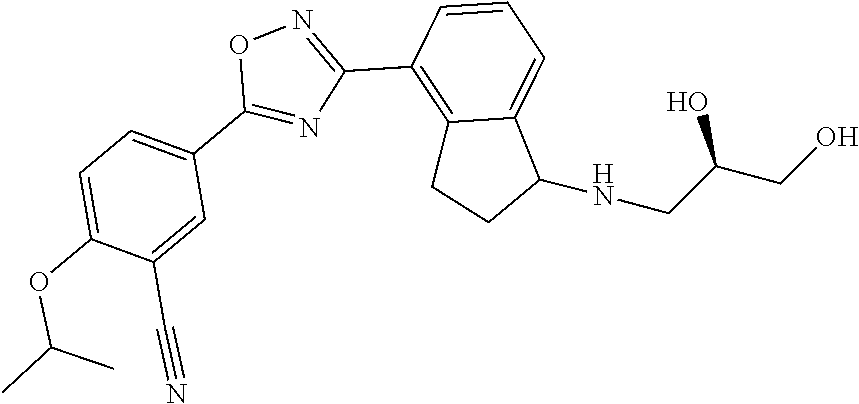 |
88 |
 |
89 |
 |
90 |
 |
91 |
 |
92 |
 |
93 |
 |
94 |
 |
95 |
 |
96 |
 |
97 |
 |
98 |
 |
99 |
 |
100 |
 |
101 |
 |
102 |
 |
103 |
 |
104 |
 |
105 |
 |
106 |
 |
107 |
 |
108 |
 |
109 |
 |
110 |
 |
111 |
 |
112 |
 |
113 |
 |
114 |
 |
115 |
 |
116 |
 |
117 |
 |
118 |
 |
119 |
 |
120 |
 |
121 |
 |
122 |
 |
123 |
 |
124 |
 |
125 |
 |
126 |
 |
127 |
 |
128 |
 |
129 |
 |
130 |
 |
131 |
 |
132 |
 |
133 |
 |
134 |
 |
135 |
 |
136 |
 |
137 |
 |
138 |
 |
139 |
 |
140 |
 |
141 |
 |
142 |
 |
143 |
 |
144 |
 |
145 |
 |
146 |
 |
147 |
 |
148 |
 |
149 |
 |
150 |
 |
151 |
 |
152 |
 |
153 |
 |
154 |
 |
155 |
 |
156 |
 |
157 |
 |
158 |
 |
159 |
 |
160 |
 |
161 |
 |
162 |
 |
163 |
 |
164 |
 |
165 |
 |
166 |
 |
167 |
 |
168 |
 |
169 |
 |
170 |
 |
171 |
 |
172 |
 |
173 |
 |
174 |
 |
175 |
 |
176 |
 |
177 |
 |
178 |
 |
179 |
 |
180 |
 |
181 |
 |
182 |
 |
183 |
 |
184 |
 |
185 |
 |
186 |
 |
187 |
 |
188 |
 |
189 |
 |
190 |
 |
191 |
 |
192 |
 |
193 |
 |
194 |
 |
195 |
 |
196 |
 |
197 |
 |
198 |
 |
199 |
 |
200 |
 |
201 |
 |
202 |
 |
203 |
 |
204 |
 |
205 |
 |
206 |
 |
207 |
 |
208 |
 |
209 |
 |
210 |
 |
211 |
 |
212 |
 |
213 |
 |
214 |
 |
215 |
 |
216 |
 |
217 |
 |
218 |
 |
219 |
 |
220 |
 |
221 |
 |
222 |
 |
223 |
 |
224 |
 |
225 |
 |
226 |
 |
227 |
 |
228 |
 |
229 |
 |
230 |
 |
231 |
 |
232 |
 |
233 |
 |
234 |
 |
235 |
 |
236 |
 |
237 |
 |
238 |
 |
239 |
 |
240 |
 |
241 |
 |
242 |
 |
243 |
 |
244 |
 |
245 |
 |
246 |
 |
247 |
 |
248 |
 |
249 |
 |
250 |
 |
251 |
 |
252 |


| TABLE 2 |
| Immunophenotyping of B cells, T cells, pDC Monocytes, |
| Tfh and Treg Cells in Spleens from NZBWF1 Mice |
| Percent Reduction vs Vehicle in Cells Treated with: |
| 0.3 mg/kg | 1.0 mg/kg | 3.0 mg/ | ||
| Cyclophosphamide | Cmp | |||
| 5 | |
|
||
| Total | 73 | 35 | 50 | 60 |
| splenocytes | ||||
| CD19 + B cells | 91 | 43 | 69 | 74 |
| Marginal Zone | 57 | 20 | 63 | 54 |
| B cells | ||||
| Marginal Zone | 78 | 75 | 88 | 85 |
| Progenitor B | ||||
| cells | ||||
| Germinal | 99 | 46 | 57 | 64 |
| Center B cells | ||||
| Follicular B | 93 | 43 | 66 | 72 |
| | ||||
| Plasma cells | ||||
| 90 | 50 | 66 | 70 | |
| CD4 + T cells | 77 | 51 | 75 | 81 |
| CD8 + T cells | 48 | 46 | 77 | 75 |
| Activated | 89 | 46 | 72 | 80 |
| CD4 + T cells | ||||
| Naive CD4 + |
45 | 73 | 91 | 88 |
| | ||||
| pDC | ||||
| 64 | 49 | 72 | 68 | |
| CD11b + | 25 | −17 | 34 | 28 |
| Ly6Chi | ||||
| monocytes | ||||
| Tfh cells | 97 | 35 | 51 | 68 |
| |
80 | 37 | 58 | 81 |
Claims (3)

Priority Applications (1)
| Application Number | Priority Date | Filing Date | Title |
|---|---|---|---|
| US16/337,292 US11278526B2 (en) | 2016-09-29 | 2017-09-28 | Compounds and methods for treating lupus |
Applications Claiming Priority (3)
| Application Number | Priority Date | Filing Date | Title |
|---|---|---|---|
| US201662401762P | 2016-09-29 | 2016-09-29 | |
| PCT/US2017/054053 WO2018064356A1 (en) | 2016-09-29 | 2017-09-28 | Compounds and methods for treating lupus |
| US16/337,292 US11278526B2 (en) | 2016-09-29 | 2017-09-28 | Compounds and methods for treating lupus |
Publications (2)
| Publication Number | Publication Date |
|---|---|
| US20190224172A1 US20190224172A1 (en) | 2019-07-25 |
| US11278526B2 true US11278526B2 (en) | 2022-03-22 |
Family
ID=60043386
Family Applications (1)
| Application Number | Title | Priority Date | Filing Date |
|---|---|---|---|
| US16/337,292 Active US11278526B2 (en) | 2016-09-29 | 2017-09-28 | Compounds and methods for treating lupus |
Country Status (7)
| Country | Link |
|---|---|
| US (1) | US11278526B2 (en) |
| EP (1) | EP3518922B1 (en) |
| JP (1) | JP7086945B2 (en) |
| KR (1) | KR102408814B1 (en) |
| CA (1) | CA3038106A1 (en) |
| ES (1) | ES3068290T3 (en) |
| WO (1) | WO2018064356A1 (en) |
Families Citing this family (7)
| Publication number | Priority date | Publication date | Assignee | Title |
|---|---|---|---|---|
| PT3630738T (en) * | 2017-05-22 | 2023-10-24 | Egyt Gyogyszervegyeszeti Gyar | Process for the production of ozanimod |
| AR116479A1 (en) | 2018-09-25 | 2021-05-12 | Quim Sintetica S A | INTERMEDIARIES FOR THE SYNTHESIS OF OZANIMOD AND PROCEDURE FOR THE PREPARATION OF THE MENTIONED SPHINGOSINE-1-PHOSPHATE RECEPTOR AGONIST AND SUCH INTERMEDIARIES |
| CN113891883A (en) * | 2019-03-29 | 2022-01-04 | 瑞塞普托斯公司 | Sphingosine 1-phosphate receptor modulators |
| CN116332794B (en) * | 2021-12-24 | 2024-10-15 | 上海合全药物研发有限公司 | Preparation method of aryl nitrile compound |
| IL319505A (en) * | 2022-09-14 | 2025-05-01 | Viatris Asia Pacific Pte Ltd | S1p 1 receptor modulators for use in the treatment of type 1 ifn mediated diseases |
| WO2026035999A1 (en) | 2024-08-09 | 2026-02-12 | Triana Biomedicines, Inc. | Anaplastic lymphoma kinase (alk) degraders and uses thereof |
| CN122301787A (en) * | 2024-12-31 | 2026-06-30 | 南京易腾药物研究院有限公司 | A quaternary ammonium salt-based locally acting sphingosine 1-phosphate receptor subtype 1 agonist |
Citations (3)
| Publication number | Priority date | Publication date | Assignee | Title |
|---|---|---|---|---|
| WO2008074821A1 (en) | 2006-12-21 | 2008-06-26 | Glaxo Group Limited | Indole derivatives as s1p1 receptor agonists |
| WO2011060392A1 (en) * | 2009-11-13 | 2011-05-19 | Receptos, Inc. | Selective sphingosine 1 phosphate receptor modulators and methods of chiral synthesis |
| WO2015066515A1 (en) | 2013-11-01 | 2015-05-07 | Receptos, Inc. | Selective sphingosine 1 phosphate receptor modulators and combination therapy therewith |
Family Cites Families (3)
| Publication number | Priority date | Publication date | Assignee | Title |
|---|---|---|---|---|
| US20080306124A1 (en) | 2005-06-08 | 2008-12-11 | Rainer Albert | Polycyclic Oxadiazoles or I Soxazoles and Their Use as Sip Receptor Ligands |
| CN101522646A (en) | 2006-09-29 | 2009-09-02 | 诺瓦提斯公司 | Oxadiazole derivatives having anti-inflammatory and immunosuppressive properties |
| PT2291080E (en) | 2008-05-14 | 2015-10-30 | Scripps Research Inst | Novel modulators of sphingosine phosphate receptors |
-
2017
- 2017-09-28 CA CA3038106A patent/CA3038106A1/en active Pending
- 2017-09-28 ES ES17781337T patent/ES3068290T3/en active Active
- 2017-09-28 JP JP2019517027A patent/JP7086945B2/en active Active
- 2017-09-28 EP EP17781337.5A patent/EP3518922B1/en active Active
- 2017-09-28 KR KR1020197011411A patent/KR102408814B1/en active Active
- 2017-09-28 US US16/337,292 patent/US11278526B2/en active Active
- 2017-09-28 WO PCT/US2017/054053 patent/WO2018064356A1/en not_active Ceased
Patent Citations (4)
| Publication number | Priority date | Publication date | Assignee | Title |
|---|---|---|---|---|
| WO2008074821A1 (en) | 2006-12-21 | 2008-06-26 | Glaxo Group Limited | Indole derivatives as s1p1 receptor agonists |
| WO2011060392A1 (en) * | 2009-11-13 | 2011-05-19 | Receptos, Inc. | Selective sphingosine 1 phosphate receptor modulators and methods of chiral synthesis |
| US20130231326A1 (en) * | 2009-11-13 | 2013-09-05 | Receptos, Inc. | Selective sphingosine 1 phosphate receptor modulators and methods of chiral synthesis |
| WO2015066515A1 (en) | 2013-11-01 | 2015-05-07 | Receptos, Inc. | Selective sphingosine 1 phosphate receptor modulators and combination therapy therewith |
Non-Patent Citations (13)
| Title |
|---|
| Alkaff et al., "Transmembrane Activator and Calcium-Modulating Cyclophtilin Ligand Interactor As a Promising Novel Targeted Therapy for Systemic Lupus Erythematosus", 2017, LUPUS, vol. 4, pp. A33. |
| Armstrong (https://www.evaluate.com/vantage/articles/news/celgene-strikes-again-receptos-acquisition, 2015) (Year: 2015). * |
| Beebe et al., Cytokine & Growth Factor Reviews, 13 2002, 403-412). (Year: 2002). * |
| Gonzalez-Cabrera et al. (F1000 Prime Reports, Dec. 2014, p. 1-7). (Year: 2014). * |
| Gonzalez-Cabrera et al. (F1000Prime Reports, 2014, 6:109). (Year: 2014). * |
| Gonzalez-Cabrera et al., "SIP signaling: new therapies and opportunities", Dec. 1, 2014, F1000Prime Reports, vol. 6, No. 109, pp. 1-7. |
| Guerrero et al. (Expert Opinion on Therapeutic Patents, 2016, vol. 26, 4, 455-470). (Year: 2016). * |
| Kegel et al. (https://lupusnewstoday.com/ 2016/01/26/s1pr1-key-to-control-autoimmune-responses-without-altering-normal-immune-reactions/) (Year: 2016). * |
| Novartis Clinical Trial Results Database, "A multi-center, double-blind, placebo controlled, proof of concept study to evaluate the efficacy and tolerability of KRP203 in patients with active subacute cutaneous lupus erythematosus.", Sep. 19, 2013, pp. 1-15. |
| Scott et al. (British J of Pharmacology, 2016, 173, 1778-92) (Year: 2016). * |
| Scott et al., "Ozanimod (RPC1063) is apotent sphingosine-1-phosphate receptor-1 (SIP1) and receptor-5(SIP5 ) agonist with autoimmune disease-modifying activity", 2016, British Journal of Pharmacology, vol. 173, pp. 1778-1792. |
| Scott, (B J of Pharmacology, 2016, 173, 1778-92). (Year: 2016). * |
| Tran et al., "Cardiac Safety of Ozanimod, a Novel Sphingosine-I-Phosphate Receptor Modulator: Results of a Thorough QT/QTc Study", 2017, Clinical Pharmacology in Drug Development, pp. 1-14. |
Also Published As
| Publication number | Publication date |
|---|---|
| CA3038106A1 (en) | 2018-04-05 |
| KR20190060791A (en) | 2019-06-03 |
| EP3518922B1 (en) | 2026-02-11 |
| ES3068290T3 (en) | 2026-05-28 |
| EP3518922A1 (en) | 2019-08-07 |
| WO2018064356A1 (en) | 2018-04-05 |
| JP7086945B2 (en) | 2022-06-20 |
| US20190224172A1 (en) | 2019-07-25 |
| JP2019529487A (en) | 2019-10-17 |
| KR102408814B1 (en) | 2022-06-14 |
Similar Documents
| Publication | Publication Date | Title |
|---|---|---|
| US20190224172A1 (en) | Compounds and methods for treating lupus | |
| US9394264B2 (en) | Sphingosine 1 phosphate receptor modulators and methods of chiral synthesis | |
| US12240840B2 (en) | Amide-substituted heterocyclic compounds for the treatment of conditions related to the modulation of IL-12, IL-23 and/or IFN-alpha | |
| US10239846B2 (en) | Selective sphingosine 1 phosphate receptor modulators and methods of chiral synthesis | |
| US11207301B2 (en) | Sphingosine 1 phosphate receptor agonists for neuroprotection | |
| US9586928B2 (en) | Modulators of the nuclear hormone receptor ROR | |
| US8796318B2 (en) | Modulators of sphingosine phosphate receptors | |
| JP6987859B2 (en) | MAGL inhibitor | |
| JP2021519794A (en) | Prodrug of condensed bicyclic C5aR antagonist | |
| US20170165236A1 (en) | Selective sphingosine 1 phosphate receptor modulators and combination therapy therewith | |
| JP2007501802A (en) | Semicarbazide-sensitive amine oxidase (SSAO) and inhibitors of VAP-1-mediated adhesion useful for the treatment of disease | |
| JP2004522710A (en) | Treatment of sexual dysfunction | |
| EP1888583A2 (en) | Hydantoin compounds | |
| Liu et al. | Novel TYK2 Inhibitors with an N-(Methyl-d3) pyridazine-3-carboxamide Skeleton for the Treatment of Autoimmune Diseases | |
| Fang et al. | Discovery of the first-in-class rorγ covalent inhibitors for treatment of castration-resistant prostate cancer | |
| CN110177775A (en) | ROR gamma modulators and application thereof |
Legal Events
| Date | Code | Title | Description |
|---|---|---|---|
| FEPP | Fee payment procedure |
Free format text: ENTITY STATUS SET TO UNDISCOUNTED (ORIGINAL EVENT CODE: BIG.); ENTITY STATUS OF PATENT OWNER: LARGE ENTITY |
|
| STPP | Information on status: patent application and granting procedure in general |
Free format text: APPLICATION UNDERGOING PREEXAM PROCESSING |
|
| STPP | Information on status: patent application and granting procedure in general |
Free format text: APPLICATION DISPATCHED FROM PREEXAM, NOT YET DOCKETED |
|
| STPP | Information on status: patent application and granting procedure in general |
Free format text: NON FINAL ACTION MAILED |
|
| AS | Assignment |
Owner name: RECEPTOS LLC, NEW YORK Free format text: ASSIGNMENT OF ASSIGNORS INTEREST;ASSIGNOR:CELGENE INTERNATIONAL II SARL;REEL/FRAME:055192/0805 Effective date: 20200622 |
|
| STPP | Information on status: patent application and granting procedure in general |
Free format text: RESPONSE TO NON-FINAL OFFICE ACTION ENTERED AND FORWARDED TO EXAMINER |
|
| STPP | Information on status: patent application and granting procedure in general |
Free format text: NON FINAL ACTION MAILED |
|
| STPP | Information on status: patent application and granting procedure in general |
Free format text: RESPONSE TO NON-FINAL OFFICE ACTION ENTERED AND FORWARDED TO EXAMINER |
|
| STPP | Information on status: patent application and granting procedure in general |
Free format text: NOTICE OF ALLOWANCE MAILED -- APPLICATION RECEIVED IN OFFICE OF PUBLICATIONS |
|
| AS | Assignment |
Owner name: CELGENE INTERNATIONAL II SARL, SWITZERLAND Free format text: ASSIGNMENT OF ASSIGNORS INTEREST;ASSIGNORS:SCOTT, FIONA LORRAINE;MEADOWS, KRISTEN R. TAYLOR;PEACH, ROBERT;SIGNING DATES FROM 20161202 TO 20161204;REEL/FRAME:058339/0609 |
|
| STPP | Information on status: patent application and granting procedure in general |
Free format text: PUBLICATIONS -- ISSUE FEE PAYMENT VERIFIED |
|
| STCB | Information on status: application discontinuation |
Free format text: ABANDONMENT FOR FAILURE TO CORRECT DRAWINGS/OATH/NONPUB REQUEST |
|
| STCF | Information on status: patent grant |
Free format text: PATENTED CASE |
|
| AS | Assignment |
Owner name: RECEPTOS LLC, NEW JERSEY Free format text: CHANGE OF ADDRESS OF ASSIGNEE;ASSIGNOR:RECEPTOS LLC;REEL/FRAME:068258/0194 Effective date: 20240422 |
|
| MAFP | Maintenance fee payment |
Free format text: PAYMENT OF MAINTENANCE FEE, 4TH YEAR, LARGE ENTITY (ORIGINAL EVENT CODE: M1551); ENTITY STATUS OF PATENT OWNER: LARGE ENTITY Year of fee payment: 4 |