US11274644B2 - Remote engine start system and method - Google Patents
Remote engine start system and method Download PDFInfo
- Publication number
- US11274644B2 US11274644B2 US16/589,533 US201916589533A US11274644B2 US 11274644 B2 US11274644 B2 US 11274644B2 US 201916589533 A US201916589533 A US 201916589533A US 11274644 B2 US11274644 B2 US 11274644B2
- Authority
- US
- United States
- Prior art keywords
- vehicle
- engine start
- timer
- remote engine
- user
- Prior art date
- Legal status (The legal status is an assumption and is not a legal conclusion. Google has not performed a legal analysis and makes no representation as to the accuracy of the status listed.)
- Active, expires
Links
Images



Classifications
-
- F—MECHANICAL ENGINEERING; LIGHTING; HEATING; WEAPONS; BLASTING
- F02—COMBUSTION ENGINES; HOT-GAS OR COMBUSTION-PRODUCT ENGINE PLANTS
- F02N—STARTING OF COMBUSTION ENGINES; STARTING AIDS FOR SUCH ENGINES, NOT OTHERWISE PROVIDED FOR
- F02N11/00—Starting of engines by means of electric motors
- F02N11/08—Circuits specially adapted for starting of engines
- F02N11/0803—Circuits specially adapted for starting of engines characterised by means for initiating engine start or stop
- F02N11/0807—Remote means
-
- F—MECHANICAL ENGINEERING; LIGHTING; HEATING; WEAPONS; BLASTING
- F02—COMBUSTION ENGINES; HOT-GAS OR COMBUSTION-PRODUCT ENGINE PLANTS
- F02N—STARTING OF COMBUSTION ENGINES; STARTING AIDS FOR SUCH ENGINES, NOT OTHERWISE PROVIDED FOR
- F02N11/00—Starting of engines by means of electric motors
- F02N11/08—Circuits specially adapted for starting of engines
- F02N11/0803—Circuits specially adapted for starting of engines characterised by means for initiating engine start or stop
- F02N11/0811—Circuits specially adapted for starting of engines characterised by means for initiating engine start or stop using a timer
-
- F—MECHANICAL ENGINEERING; LIGHTING; HEATING; WEAPONS; BLASTING
- F02—COMBUSTION ENGINES; HOT-GAS OR COMBUSTION-PRODUCT ENGINE PLANTS
- F02N—STARTING OF COMBUSTION ENGINES; STARTING AIDS FOR SUCH ENGINES, NOT OTHERWISE PROVIDED FOR
- F02N11/00—Starting of engines by means of electric motors
- F02N11/10—Safety devices
-
- F—MECHANICAL ENGINEERING; LIGHTING; HEATING; WEAPONS; BLASTING
- F02—COMBUSTION ENGINES; HOT-GAS OR COMBUSTION-PRODUCT ENGINE PLANTS
- F02N—STARTING OF COMBUSTION ENGINES; STARTING AIDS FOR SUCH ENGINES, NOT OTHERWISE PROVIDED FOR
- F02N2200/00—Parameters used for control of starting apparatus
- F02N2200/10—Parameters used for control of starting apparatus said parameters being related to driver demands or status
- F02N2200/106—Driver presence, e.g. detected by door lock, seat sensor or belt sensor
-
- F—MECHANICAL ENGINEERING; LIGHTING; HEATING; WEAPONS; BLASTING
- F02—COMBUSTION ENGINES; HOT-GAS OR COMBUSTION-PRODUCT ENGINE PLANTS
- F02N—STARTING OF COMBUSTION ENGINES; STARTING AIDS FOR SUCH ENGINES, NOT OTHERWISE PROVIDED FOR
- F02N2300/00—Control related aspects of engine starting
- F02N2300/20—Control related aspects of engine starting characterised by the control method
- F02N2300/2011—Control involving a delay; Control involving a waiting period before engine stop or engine start
Definitions
- the invention relates to a remote engine start system and to a method, in particular a method for operating a remote engine start system in a vehicle.
- Remote engine start systems are known that permit a vehicle to be started by using a remote control. In this manner, it is possible for vehicles to be started without a user being inside or in direct proximity to the vehicle.
- the remote engine start function generally permits a vehicle to be started from a distance of up to 100 m or more. Such systems are also known as RES systems.
- RES systems make it possible, for example, for a wide variety of vehicle functions to be already activated at a time at which the user is still away from the vehicle.
- the vehicle interior can be air-conditioned such that the interior, upon entry of the user, has a pleasant temperature for the user.
- the vehicle battery can be charged by starting the internal combustion engine.
- a timer is generally started during the remote start of the engine. After the timer has elapsed, the engine is deactivated again in order to avoid unnecessary continuous running of the engine if the user has not taken himself/herself to the vehicle. It is thus possible, on the one hand, for the risk of hazards, for example poisoning, to be avoided or at least minimized. On the other hand, a situation can be prevented in which the fuel tank is completely emptied.
- the RES function is generally deactivated, that is to say the vehicle returns to the normal state.
- the engine generally remains activated in order to increase the user-friendliness of the system.
- the vehicle functions can also remain activated if the user is situated in proximity to the vehicle and the RES function is deactivated.
- An aspect of the invention aims to provide an improved remote engine start system and an improved method for operating a remote engine start system which are user-friendly and at the same time (additionally) minimize the risk of hazards.
- a method comprises, in response to a triggering event, changing a remote engine start system in a vehicle from a first system state to a second system state, wherein in the first system state a remote engine start mode, a drive engine of the vehicle and a plurality of vehicle functions of the vehicle are deactivated, and wherein in the second system state the remote engine start mode, at least one of the plurality of vehicle functions and the drive engine of the vehicle are activated.
- a timer is incremented or decremented starting from a predetermined start value.
- the remote engine start system changes to a third system state, wherein in the third system state the last timer value and the current state of the remote engine start mode are stored and then the remote engine start mode and the timer are stopped, wherein the drive engine remains switched on.
- the method can further comprise, if it is detected that the user, after the presence thereof has been recognized, moves away again from the vehicle without having moved the vehicle, returning to the second system state, by continuing the remote engine start mode, re-establishing the stored timer value, and continuing the incrementing or decrementing of the timer.
- a situation can thus be prevented in which the drive engine runs over too long a time in the absence of the user.
- a situation can also be prevented in which a user knowingly or unknowingly circumvents the running time limitation of the remaining timer time and the drive engine thereby remains longer in operation than provided for the system. Risk situations, for example, can be prevented in this way. However, the user comfort is maintained.
- the method can further comprise, if it is detected that the timer has elapsed, changing to the first system state, by switching off the drive engine and deactivating the remote engine start mode.
- the at least one vehicle function can also be deactivated with the switching off of the drive engine.
- the system After the timer has elapsed, the system thus returns to its original state in which it found itself before the remote engine start system was activated.
- the method can further comprise, if, after the detection of the presence of the user, the vehicle is moved before the user moves away again from the vehicle, deactivating the remote engine start mode and erasing the stored timer value and the stored state of the remote engine start mode.
- the system can return to the original state after the vehicle has been parked.
- the method can further comprise, after the user has parked and switched off the vehicle again, switching off the drive engine and changing to the first state.
- the triggering event can comprise the reception of a signal from a portable electronic device.
- the user can thus activate the remote engine start system in a simple manner, for example by means of a remote control.
- a remote engine start system in a vehicle comprises a timer.
- the remote engine start system is designed, in response to a triggering event, to change from a first system state to a second system state, wherein in the first system state a remote engine start mode, a drive engine of the vehicle and a plurality of vehicle functions of the vehicle are deactivated, and wherein in the second system state the remote engine start mode, at least one of the plurality of vehicle functions and a drive engine of the vehicle are activated.
- the timer is incremented or decremented starting from a predetermined start value.
- the remote engine start system changes to a third system state, wherein in the third system state the last timer value and the current state of the remote engine start mode are stored and then the remote engine start mode and the timer are stopped, wherein the drive engine remains switched on.
- the remote engine start system can further comprise a detection unit which is designed to detect the presence of a user.
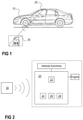
- FIG. 1 shows in a schematic illustration the principle of a remote engine start system
- FIG. 2 shows in a block diagram a remote engine start system according to one embodiment of the invention
- FIG. 3 shows in a sequence diagram an example of a method according to one embodiment
- FIG. 4 shows in a sequence diagram an example of a further method according to one embodiment
- FIG. 5 shows in a flow diagram a method for operating a remote engine start system according to one embodiment of the invention.
- FIG. 1 shows by way of example a remote engine start system 20 in a vehicle 10 .
- the remote engine start system 20 can receive signals from a portable electronic device, for example a remote control, 30 .
- a user of the vehicle 10 can carry the portable electronic device 30 with him/her. Even if the user is not inside the vehicle 10 or in the immediate surroundings of the vehicle 10 , he/she can trigger the starting of the vehicle 10 by actuating the portable electronic device 30 . This means that when the user actuates, for example, a button (not explicitly shown) on the portable electronic device 30 , a corresponding signal is sent to the vehicle 10 .
- the remote engine start system 20 in the vehicle 10 can receive and evaluate the signal and then trigger the starting of the vehicle 10 .
- the drive engine (not shown in FIG. 1 ) can comprise an internal combustion engine, such as a diesel engine or a spark ignition engine, for example.
- the remote engine start system 20 can comprise a control unit, for example.
- various vehicle functions can already be activated even though the user is not yet in proximity to the vehicle 10 .
- the air-conditioning system can begin to run.
- the interior of the vehicle 10 can thus already be cooled or heated before the user enters his/her vehicle 10 .
- Signals between the portable electronic device 30 and the vehicle 10 can be transmitted by radio or via a mobile radio network, for example.
- the portable electronic device can be, for example, a remote control, an electronic vehicle key, a smartphone, a tablet, a laptop, or the like.
- the portable electronic device 30 can have a connection to a mobile radio network, for example, as can the vehicle 10 .
- the mobile radio network can be used by the portable electronic device 30 and the vehicle 10 to communicate with one another.
- a remote engine start system 20 is illustrated by way of example.
- the remote engine start system 20 comprises an engine start unit 22 .
- the remote engine start system 20 can also comprise a timer 24 , a detection unit 26 and a memory 28 .
- the remote engine start system 20 or the engine start unit 22 , is designed to receive (engine start) signals from a portable electronic device 30 . When the remote engine start system 22 receives the signals, this results in the drive engine being started up (engine start).
- the portable electronic device 30 can comprise, for example, at least one button (not shown).
- the portable electronic device 30 can, for example, transmit signals to the vehicle 10 when a user actuates the button.
- the portable electronic device 30 can also comprise, for example, a touch display or any other input unit.
- a timer 24 is started when switching on the drive engine.
- the timer 24 can, for example, decrement a timer value beginning from a predetermined start value. However, it is also possible to increment the timer value starting from a start value. In both cases, the timer 24 has elapsed when a predetermined end value is reached. If the timer 24 is decremented, the end value is less than the start value; if the timer 24 is incremented, the end value is greater than the start value.
- the drive engine can be switched off again. This prevents the drive engine from running in an uncontrolled manner over too long a time if the user, in spite of activating the remote engine start system 20 , does not go to his/her vehicle 10 within a certain time.
- the previously activated vehicle functions are also deactivated again with the drive engine if the timer 24 has elapsed.
- the remote engine start system 20 With the activation of the remote engine start system 20 , the remote engine start system 20 thus changes from a first state, in which a remote engine start mode (remote engine control (RES) mode), the drive engine and a plurality of vehicle functions are deactivated, to a second state in which the remote engine start mode, the drive engine and at least one of the plurality of vehicle functions are activated.
- RES remote engine control
- the remote engine start system 20 changes back again from the second state to the first state. For example, the timer 24 can elapse after 10 minutes or 20 minutes.
- the previously activated remote engine start mode is deactivated while the drive engine remains switched on.
- the at least one of the plurality of vehicle functions can also remain activated. The user comfort is thereby intended to be increased.
- a user first transmits his/her request to start the remote engine start (remote engine control, RES) system to the vehicle.
- the vehicle then changes from the first state to the second state. That is to say that the RES mode is activated, the drive engine is started and at least one of the plurality of vehicle functions (for example air-conditioning system) is activated.
- the timer value is then incremented or decremented. If, as long as the timer has not yet elapsed, the presence of the user is detected in or at the vehicle, for example within the vehicle or within a certain radius around the vehicle, the timer is stopped and the current timer value is stored.
- the current state of the remote engine start mode is stored (for example store “remote engine start mode activated” state).
- the remote engine start system changes from the second state to a third state, information is stored on the fact that the remote engine start system was in the second state at the time at which the timer was stopped, that is to say that the RES mode was activated.
- the remote engine start system then changes to the third state.
- the previously activated RES mode is stopped in the third state.
- the drive engine continues to run and is not switched off.
- the at least one vehicle function can also remain activated. If, however, the user then moves away again from the vehicle without using the vehicle, the drive engine would continue to run in an uncontrolled manner in conventional systems since the RES mode and the timer have been stopped.
- the remote engine start system 20 can comprise a memory 28 (see FIG. 2 ).
- the remote engine start system 20 then no longer detects a presence of the user since the latter moves away again from the vehicle without having moved the vehicle, said system can re-establish the last stored timer value and re-adopt the stored state (continue RES mode and change back from the third state to the second state).
- the system thus re-adopts the state in which it found itself before the presence of the user was detected.
- the timer continues to run from the re-established value. If the user does not come back once more to the vehicle and the timer has elapsed, the drive engine is switched off and the at least one vehicle function is deactivated again. The RES mode is then likewise deactivated.
- the remote engine start system 20 can comprise a detection unit 26 , for example.
- the detection unit 26 can comprise cameras or other sensors which are suitable for detecting a presence of the user.
- the user presence is recognized when a vehicle door is opened.
- the user presence can also be detected in any other way.
- FIG. 4 shows by way of example a method according to one embodiment when the user approaches the vehicle and then also moves it.
- the method corresponds to the method described on the basis of FIG. 3 . That is to say that the remote engine start system changes from the first to the second state, activates the RES mode and at least one vehicle function and starts the drive engine. If the presence of the user is detected, the timer is stopped, the last timer value and the last state are stored, and the remote engine start system changes from the second state to the third state (RES mode stopped). Since the drive engine is already running, the user does not have to start it once again. However, a start button can possibly be actuated in order to indicate the request of the user to move the vehicle.
- the stored timer value and the stored state can be erased at this time. That is to say that the RES mode is completely deactivated.
- triggering events which trigger the deactivation of the RES mode are conceivable, for example also the actuation of an accelerator pedal and movement of the vehicle, in order to trigger erasing of the stored timer value and state.
- the system changes again to the first state. That is to say that the drive engine and the vehicle functions are also switched off.
- FIG. 5 shows by way of example, in a flow diagram, a method for operating a remote engine start system.
- the method substantially corresponds to the methods described in FIGS. 3 and 4 .
- the remote engine start system RES
- step 501 the remote engine start system
- step 502 the engine and at least one vehicle function are started.
- the RES running time that is to say for example a timer, can be decremented or incremented beginning from a start value (step 503 ).
- step 504 If a user presence is not detected (step 504 ) and if the RES running time has not yet elapsed (step 505 ), the RES running time (the timer) is further decremented or incremented (step 503 ). If the user presence is not detected and if the RES running time has elapsed (step 505 ), the RES mode is deactivated (step 506 ). At the same time, the engine can also be switched off and the at least one vehicle function deactivated (step 507 ).
- the RES mode is stopped (step 508 ), the RES running time is stopped (step 509 ) and the current state (RES) and timer value (remaining RES running time) are stored (step 510 ). If then the absence of the user is detected (step 511 ), the RES mode is continued (step 517 ) and the last timer value (stored remaining RES running time) is called up and re-established (step 518 ). The stored state (RES) is also called up again (step 519 ). The timer (the RES running time) is then further decremented, or incremented (step 503 ).
- step 504 the RES mode is deactivated (step 506 ) and the engine and the at least one vehicle function are switched off (step 507 ).
- step 511 If in step 511 the absence of a user is not detected (user still present), and the vehicle is moved (step 512 ), the RES mode can be completely deactivated (step 514 ). That is to say that the previously stored state (RES) and the stored remaining RES running time can be erased (states 515 and 516 ). If the vehicle is not moved (step 512 ) and the user does not leave the vehicle (step 513 ), the system can remain in this state until either the vehicle is moved or the user moves away again from the vehicle. If the vehicle is not moved and the user does not move away again from the vehicle (steps 512 and 513 ), the method is continued, as described above, with step 517 , that is to say that the RES mode is continued as described.
- step 517 that is to say that the RES mode is continued as described.
- step 504 the user can take control over the vehicle.
- the user has control over the vehicle as long as his/her presence is detected.
- FIG. 5 all steps during which the user has control over the vehicle are enclosed in the box illustrated with dashed lines.
Landscapes
- Engineering & Computer Science (AREA)
- Chemical & Material Sciences (AREA)
- Combustion & Propulsion (AREA)
- Mechanical Engineering (AREA)
- General Engineering & Computer Science (AREA)
- Control Of Vehicle Engines Or Engines For Specific Uses (AREA)
Abstract
Description
- 10 Vehicle
- 20 Remote engine start system
- 22 Engine start unit
- 24 Timer
- 26 Detection unit
- 28 Memory
- 30 Portable device
Claims (8)
Applications Claiming Priority (2)
| Application Number | Priority Date | Filing Date | Title |
|---|---|---|---|
| DE102018217113.0 | 2018-10-05 | ||
| DE102018217113.0A DE102018217113A1 (en) | 2018-10-05 | 2018-10-05 | Remote engine start system and method |
Publications (2)
| Publication Number | Publication Date |
|---|---|
| US20200109689A1 US20200109689A1 (en) | 2020-04-09 |
| US11274644B2 true US11274644B2 (en) | 2022-03-15 |
Family
ID=69886336
Family Applications (1)
| Application Number | Title | Priority Date | Filing Date |
|---|---|---|---|
| US16/589,533 Active 2040-09-15 US11274644B2 (en) | 2018-10-05 | 2019-10-01 | Remote engine start system and method |
Country Status (2)
| Country | Link |
|---|---|
| US (1) | US11274644B2 (en) |
| DE (1) | DE102018217113A1 (en) |
Families Citing this family (1)
| Publication number | Priority date | Publication date | Assignee | Title |
|---|---|---|---|---|
| WO2018179059A1 (en) * | 2017-03-27 | 2018-10-04 | 本田技研工業株式会社 | Engine start control device |
Citations (7)
| Publication number | Priority date | Publication date | Assignee | Title |
|---|---|---|---|---|
| US20110202201A1 (en) | 2010-02-12 | 2011-08-18 | Fujitsu Ten Limited | Remote starting device and remote starting method |
| US20120078443A1 (en) | 2010-09-24 | 2012-03-29 | Fujitsu Ten Limited | Vehicle control system |
| DE102011089072A1 (en) | 2011-09-21 | 2013-03-21 | Hyundai Motor Company | REMOTE CONTROL SYSTEM FOR A VEHICLE AND METHOD FOR CONTROLLING IT |
| DE102013010984A1 (en) | 2013-07-01 | 2015-01-08 | Audi Ag | Car with a remote start unit |
| DE102013019140B3 (en) | 2013-11-15 | 2015-04-02 | Audi Ag | Motor vehicle with remote start and automatic shutdown |
| US20160047348A1 (en) * | 2014-08-15 | 2016-02-18 | GM Global Technology Operations LLC | Remote start control for vehicles |
| US20180222282A1 (en) | 2017-02-03 | 2018-08-09 | Toyota Jidosha Kabushiki Kaisha | Remote air conditioning start system and center server |
-
2018
- 2018-10-05 DE DE102018217113.0A patent/DE102018217113A1/en active Pending
-
2019
- 2019-10-01 US US16/589,533 patent/US11274644B2/en active Active
Patent Citations (11)
| Publication number | Priority date | Publication date | Assignee | Title |
|---|---|---|---|---|
| US20110202201A1 (en) | 2010-02-12 | 2011-08-18 | Fujitsu Ten Limited | Remote starting device and remote starting method |
| US20120078443A1 (en) | 2010-09-24 | 2012-03-29 | Fujitsu Ten Limited | Vehicle control system |
| DE102011089072A1 (en) | 2011-09-21 | 2013-03-21 | Hyundai Motor Company | REMOTE CONTROL SYSTEM FOR A VEHICLE AND METHOD FOR CONTROLLING IT |
| US9156437B2 (en) | 2011-09-21 | 2015-10-13 | Hyundai Motor Company | Remote starting system for vehicle and control method for the same |
| DE102013010984A1 (en) | 2013-07-01 | 2015-01-08 | Audi Ag | Car with a remote start unit |
| US9604650B2 (en) | 2013-07-01 | 2017-03-28 | Audi Ag | Motor vehicle comprising a remote starter unit |
| DE102013019140B3 (en) | 2013-11-15 | 2015-04-02 | Audi Ag | Motor vehicle with remote start and automatic shutdown |
| US9744941B2 (en) | 2013-11-15 | 2017-08-29 | Audi Ag | Motor vehicle with remote start and subsequent automatic shutdown |
| US20160047348A1 (en) * | 2014-08-15 | 2016-02-18 | GM Global Technology Operations LLC | Remote start control for vehicles |
| US20180222282A1 (en) | 2017-02-03 | 2018-08-09 | Toyota Jidosha Kabushiki Kaisha | Remote air conditioning start system and center server |
| DE102018101401A1 (en) | 2017-02-03 | 2018-08-09 | Toyota Jidosha Kabushiki Kaisha | AIR CONDITIONING REMOTE CONTROL SYSTEM AND CENTRAL SERVER |
Non-Patent Citations (1)
| Title |
|---|
| German Examination Report for German Application No. 10 2018 217 113.0, with partial translation, dated May 29, 2019—7 pages. |
Also Published As
| Publication number | Publication date |
|---|---|
| US20200109689A1 (en) | 2020-04-09 |
| DE102018217113A1 (en) | 2020-04-09 |
Similar Documents
| Publication | Publication Date | Title |
|---|---|---|
| US12221944B2 (en) | Remote startup system, center server, and remote startup method | |
| US10737550B2 (en) | Remote air conditioning start system, center server and method for controlling remote air conditioning start system | |
| US10836349B2 (en) | Remote startup system, center server, vehicle, and remote startup method | |
| CN110356361A (en) | Input Signal Management for Vehicle Parking Assist | |
| US20190283737A1 (en) | Parking support apparatus | |
| US20120029729A1 (en) | Remote control system for a hybrid vehicle | |
| JP6425029B2 (en) | Electronic key system | |
| CN118514627B (en) | Power mode switching method and device, electronic equipment and storage medium | |
| US11274644B2 (en) | Remote engine start system and method | |
| GB2517577A (en) | Vehicle control system | |
| EP2769884B1 (en) | Method for controlling vehicle | |
| JP2021116052A (en) | Control device, vehicle, control system, program, and control method | |
| CN112758045A (en) | Vehicle control system | |
| CN114900380B (en) | Information processing apparatus, information processing method, and recording medium | |
| KR102829561B1 (en) | Power control system and method for electric vehicles | |
| US12491749B2 (en) | Control apparatus for vehicle, control method for, and control system for vehicle | |
| JP2004224204A (en) | Remote controller for vehicle | |
| KR101896235B1 (en) | System for Preventing Mobile Device Lost in Vehicle | |
| US12257978B2 (en) | System and method for key absence management in a vehicle | |
| JP7310765B2 (en) | Vehicle control system and vehicle | |
| US20200109690A1 (en) | Engine starter and engine starting method | |
| US11607960B2 (en) | Method and apparatus for passive power mode control for electric propulsion vehicles | |
| EP4516601A1 (en) | Antitheft system for vehicle | |
| US20240239303A1 (en) | Systems and methods for controlling access to electrical power outlets in a vehicle | |
| CN113715799B (en) | Method and device for operating a hybrid vehicle |
Legal Events
| Date | Code | Title | Description |
|---|---|---|---|
| FEPP | Fee payment procedure |
Free format text: ENTITY STATUS SET TO UNDISCOUNTED (ORIGINAL EVENT CODE: BIG.); ENTITY STATUS OF PATENT OWNER: LARGE ENTITY |
|
| AS | Assignment |
Owner name: CONTINENTAL AUTOMOTIVE GMBH, GERMANY Free format text: ASSIGNMENT OF ASSIGNORS INTEREST;ASSIGNORS:HEININGER, FRANZ;GUGGER, TIBOR;REEL/FRAME:051048/0708 Effective date: 20191030 |
|
| STPP | Information on status: patent application and granting procedure in general |
Free format text: DOCKETED NEW CASE - READY FOR EXAMINATION |
|
| STPP | Information on status: patent application and granting procedure in general |
Free format text: NOTICE OF ALLOWANCE MAILED -- APPLICATION RECEIVED IN OFFICE OF PUBLICATIONS |
|
| STCF | Information on status: patent grant |
Free format text: PATENTED CASE |
|
| AS | Assignment |
Owner name: CONTINENTAL AUTOMOTIVE TECHNOLOGIES GMBH, GERMANY Free format text: ASSIGNMENT OF ASSIGNORS INTEREST;ASSIGNOR:CONTINENTAL AUTOMOTIVE GMBH;REEL/FRAME:070441/0899 Effective date: 20241211 |
|
| MAFP | Maintenance fee payment |
Free format text: PAYMENT OF MAINTENANCE FEE, 4TH YEAR, LARGE ENTITY (ORIGINAL EVENT CODE: M1551); ENTITY STATUS OF PATENT OWNER: LARGE ENTITY Year of fee payment: 4 |