US11266673B2 - Nucleotide derivatives and methods of use thereof - Google Patents
Nucleotide derivatives and methods of use thereof Download PDFInfo
- Publication number
- US11266673B2 US11266673B2 US16/303,715 US201716303715A US11266673B2 US 11266673 B2 US11266673 B2 US 11266673B2 US 201716303715 A US201716303715 A US 201716303715A US 11266673 B2 US11266673 B2 US 11266673B2
- Authority
- US
- United States
- Prior art keywords
- substituted
- unsubstituted
- moiety
- dna
- rox
- Prior art date
- Legal status (The legal status is an assumption and is not a legal conclusion. Google has not performed a legal analysis and makes no representation as to the accuracy of the status listed.)
- Active, expires
Links
- 0 *[4*]C(C*)(C[6*])SSCOC1C(C[3*])OC(B)C1[7*] Chemical compound *[4*]C(C*)(C[6*])SSCOC1C(C[3*])OC(B)C1[7*] 0.000 description 206
- OTMSDBZUPAUEDD-UHFFFAOYSA-N CC Chemical compound CC OTMSDBZUPAUEDD-UHFFFAOYSA-N 0.000 description 12
- FPFPMLJTCZURDW-IJFBDMEVSA-N B.CC(=O)CCC(C)(C)SSCOC1C[C@H](C)O[C@@H]1CO Chemical compound B.CC(=O)CCC(C)(C)SSCOC1C[C@H](C)O[C@@H]1CO FPFPMLJTCZURDW-IJFBDMEVSA-N 0.000 description 8
- SWBYFHKWZAHOHO-WHHNYFCUSA-N B.CC(=O)CCC(C)(C)SSCOC1C[C@H](C)O[C@@H]1CO[Si](C)(C)C(C)(C)C Chemical compound B.CC(=O)CCC(C)(C)SSCOC1C[C@H](C)O[C@@H]1CO[Si](C)(C)C(C)(C)C SWBYFHKWZAHOHO-WHHNYFCUSA-N 0.000 description 8
- ZWEHNKRNPOVVGH-UHFFFAOYSA-N CCC(C)=O Chemical compound CCC(C)=O ZWEHNKRNPOVVGH-UHFFFAOYSA-N 0.000 description 8
- UYBXHOCDMSYVCM-FXJNCMGBSA-N CC(=O)CCC(C)(C)SSCOC1C[C@H](N2C=NC3=C2N=CN=C3NC(=O)C2=CC=CC=C2)O[C@@H]1CO Chemical compound CC(=O)CCC(C)(C)SSCOC1C[C@H](N2C=NC3=C2N=CN=C3NC(=O)C2=CC=CC=C2)O[C@@H]1CO UYBXHOCDMSYVCM-FXJNCMGBSA-N 0.000 description 7
- BHQOSILNFRCYLB-OPWSDZRHSA-N CC(=O)CCC(C)(C)SSCOC1C[C@H](N2C=NC3=C2N=CN=C3NC(=O)C2=CC=CC=C2)O[C@@H]1CO[Si](C)(C)C(C)(C)C Chemical compound CC(=O)CCC(C)(C)SSCOC1C[C@H](N2C=NC3=C2N=CN=C3NC(=O)C2=CC=CC=C2)O[C@@H]1CO[Si](C)(C)C(C)(C)C BHQOSILNFRCYLB-OPWSDZRHSA-N 0.000 description 7
- VNWKTOKETHGBQD-UHFFFAOYSA-N C Chemical compound C VNWKTOKETHGBQD-UHFFFAOYSA-N 0.000 description 6
- XQYAZKAGHTYKII-UHFFFAOYSA-N C.CCCCCC(=O)NCC(C)(C)SSCC.CCSSC(C)(C)CNC(=O)CCOCCCNC(C)=O.CCSSC(C)(C)CNC(C)=O Chemical compound C.CCCCCC(=O)NCC(C)(C)SSCC.CCSSC(C)(C)CNC(=O)CCOCCCNC(C)=O.CCSSC(C)(C)CNC(C)=O XQYAZKAGHTYKII-UHFFFAOYSA-N 0.000 description 6
- BKVHXAHIJFOSCO-JWKUAACMSA-N CC(C)(CNC(=O)CCOCCOCCOCCOCCNC(=O)C1=CC=C(C2=C3C=C4CCCN5=C4C(=C3OC3=C4CCCN6CCCC(=C46)C=C32)CCC5)C(C(=O)O)=C1)SSCOC1C[C@H](N2C=NC3=C2N=CN=C3N)O[C@@H]1COP(=O)(O)OP(=O)(O)OP(=O)(O)O.CC1=C(N)C=CC2=C1OC1=C(S(=O)(=O)[O-])C([NH3+])C=CC1=C2C1=CC=C(C(=O)NCCOCCOCCOCCOCCC(=O)NCC(C)(C)SSCOC2C[C@H](N3C=CC(N)=NC3=O)O[C@@H]2COP(=O)(O)OP(=O)(O)OP(=O)(O)O)C=C1C(=O)O.CCCC1=CC2=C(C=C1C)C(C1=C(C(=O)O)C=C(C(=O)NCCOCCOCCOCCOCCC(=O)NCC(C)(C)SSCOC3C[C@H](N4C=C(C)C(=O)NC4=O)O[C@@H]3COP(=O)(O)OP(=O)(O)OP(=O)(O)O)C=C1)=C1C=C(C)C(NCC)C=C1O2.CCN1C2=C(C=C(C)C=C2)C(C)(C)/C1=C\C=C\C=C\C1=N(CCCCCC(=O)NCCOCCOCCOCCOCCC(=O)NCC(C)(C)SSCOC2C[C@H](N3C=NC4=C3N=C(N)NC4=O)O[C@@H]2COP(=O)(O)OP(=O)(O)OP(=O)(O)O)C2=C(C=C(S(=O)(=O)O)C=C2)C1(C)C Chemical compound CC(C)(CNC(=O)CCOCCOCCOCCOCCNC(=O)C1=CC=C(C2=C3C=C4CCCN5=C4C(=C3OC3=C4CCCN6CCCC(=C46)C=C32)CCC5)C(C(=O)O)=C1)SSCOC1C[C@H](N2C=NC3=C2N=CN=C3N)O[C@@H]1COP(=O)(O)OP(=O)(O)OP(=O)(O)O.CC1=C(N)C=CC2=C1OC1=C(S(=O)(=O)[O-])C([NH3+])C=CC1=C2C1=CC=C(C(=O)NCCOCCOCCOCCOCCC(=O)NCC(C)(C)SSCOC2C[C@H](N3C=CC(N)=NC3=O)O[C@@H]2COP(=O)(O)OP(=O)(O)OP(=O)(O)O)C=C1C(=O)O.CCCC1=CC2=C(C=C1C)C(C1=C(C(=O)O)C=C(C(=O)NCCOCCOCCOCCOCCC(=O)NCC(C)(C)SSCOC3C[C@H](N4C=C(C)C(=O)NC4=O)O[C@@H]3COP(=O)(O)OP(=O)(O)OP(=O)(O)O)C=C1)=C1C=C(C)C(NCC)C=C1O2.CCN1C2=C(C=C(C)C=C2)C(C)(C)/C1=C\C=C\C=C\C1=N(CCCCCC(=O)NCCOCCOCCOCCOCCC(=O)NCC(C)(C)SSCOC2C[C@H](N3C=NC4=C3N=C(N)NC4=O)O[C@@H]2COP(=O)(O)OP(=O)(O)OP(=O)(O)O)C2=C(C=C(S(=O)(=O)O)C=C2)C1(C)C BKVHXAHIJFOSCO-JWKUAACMSA-N 0.000 description 6
- GBVSNWYHCMCQQC-ZQTLJVIJSA-N CCC[C@H]1O[C@@H](C)CC1OC Chemical compound CCC[C@H]1O[C@@H](C)CC1OC GBVSNWYHCMCQQC-ZQTLJVIJSA-N 0.000 description 6
- DHMCWGIORWXORQ-HXYUSBPFSA-N CN(C)/C=N\C1=NC2=C(N=CN2[C@H]2CC(OCSSC(C)(C)CCC(=O)C(F)(F)F)[C@@H](CO[Si](C)(C)C(C)(C)C)O2)C(=O)N1 Chemical compound CN(C)/C=N\C1=NC2=C(N=CN2[C@H]2CC(OCSSC(C)(C)CCC(=O)C(F)(F)F)[C@@H](CO[Si](C)(C)C(C)(C)C)O2)C(=O)N1 DHMCWGIORWXORQ-HXYUSBPFSA-N 0.000 description 6
- CKAUNTURMNKFMJ-SQEMLOEVSA-N CSCOC1C[C@H](N2C=NC3=C2N=C(/N=C\N(C)C)NC3=O)O[C@@H]1CO[Si](C)(C)C(C)(C)C Chemical compound CSCOC1C[C@H](N2C=NC3=C2N=C(/N=C\N(C)C)NC3=O)O[C@@H]1CO[Si](C)(C)C(C)(C)C CKAUNTURMNKFMJ-SQEMLOEVSA-N 0.000 description 6
- RJKVMTOXBMKIKH-NYKYFDBJSA-N CC(=O)CCC(C)(C)SSCOC1C[C@H](N2C=CC(NC(=O)C3=CC=CC=C3)=NC2=O)O[C@@H]1CO Chemical compound CC(=O)CCC(C)(C)SSCOC1C[C@H](N2C=CC(NC(=O)C3=CC=CC=C3)=NC2=O)O[C@@H]1CO RJKVMTOXBMKIKH-NYKYFDBJSA-N 0.000 description 5
- HWBDZHVRJOYTQA-VDNTZQRCSA-N CC(=O)CCC(C)(C)SSCOC1C[C@H](N2C=CC(NC(=O)C3=CC=CC=C3)=NC2=O)O[C@@H]1CO[Si](C)(C)C(C)(C)C Chemical compound CC(=O)CCC(C)(C)SSCOC1C[C@H](N2C=CC(NC(=O)C3=CC=CC=C3)=NC2=O)O[C@@H]1CO[Si](C)(C)C(C)(C)C HWBDZHVRJOYTQA-VDNTZQRCSA-N 0.000 description 5
- VJUWMAVGEVKRKY-WHEKOATQSA-N CC(C)(CCC(=O)C1=CC=C(C2=C3C=C4CCCN5=C4C(=C3OC3=C4CCCN6CCCC(=C46)C=C32)CCC5)C(C(=O)O)=C1)SSCOC1C[C@H](N2C=NC3=C2N=CN=C3N)O[C@@H]1COP(=O)(O)OP(=O)(O)OP(=O)(O)O.CC1=C(N)C=CC2=C1OC1=C(S(=O)(=O)[O-])C([NH3+])C=CC1=C2C1=CC=C(C(=O)CCC(C)(C)SSCOC2C[C@H](N3C=CC(N)=NC3=O)O[C@@H]2COP(=O)(O)OP(=O)(O)OP(=O)(O)O)C=C1C(=O)O.CCCC1=CC2=C(C=C1C)C(C1=C(C(=O)O)C=C(C(=O)CCC(C)(C)SSCOC3C[C@H](N4C=C(C)C(=O)NC4=O)O[C@@H]3COP(=O)(O)OP(=O)(O)OP(=O)(O)O)C=C1)C1C=C(C)C(NCC)C=C1O2.CCN1C2=C(C=C(C)C=C2)C(C)(C)/C1=C\C=C\C=C\C1=[N+](CCCCCC(=O)CCC(C)(C)SSCOC2C[C@H](N3C=NC4=C3N=C(N)NC4=O)O[C@@H]2COP(=O)(O)OP(=O)(O)OP(=O)(O)O)C2=C(C=C(S(=O)(=O)[O-])C=C2)C1(C)C Chemical compound CC(C)(CCC(=O)C1=CC=C(C2=C3C=C4CCCN5=C4C(=C3OC3=C4CCCN6CCCC(=C46)C=C32)CCC5)C(C(=O)O)=C1)SSCOC1C[C@H](N2C=NC3=C2N=CN=C3N)O[C@@H]1COP(=O)(O)OP(=O)(O)OP(=O)(O)O.CC1=C(N)C=CC2=C1OC1=C(S(=O)(=O)[O-])C([NH3+])C=CC1=C2C1=CC=C(C(=O)CCC(C)(C)SSCOC2C[C@H](N3C=CC(N)=NC3=O)O[C@@H]2COP(=O)(O)OP(=O)(O)OP(=O)(O)O)C=C1C(=O)O.CCCC1=CC2=C(C=C1C)C(C1=C(C(=O)O)C=C(C(=O)CCC(C)(C)SSCOC3C[C@H](N4C=C(C)C(=O)NC4=O)O[C@@H]3COP(=O)(O)OP(=O)(O)OP(=O)(O)O)C=C1)C1C=C(C)C(NCC)C=C1O2.CCN1C2=C(C=C(C)C=C2)C(C)(C)/C1=C\C=C\C=C\C1=[N+](CCCCCC(=O)CCC(C)(C)SSCOC2C[C@H](N3C=NC4=C3N=C(N)NC4=O)O[C@@H]2COP(=O)(O)OP(=O)(O)OP(=O)(O)O)C2=C(C=C(S(=O)(=O)[O-])C=C2)C1(C)C VJUWMAVGEVKRKY-WHEKOATQSA-N 0.000 description 5
- UOUIFYMMROEJFY-UHFFFAOYSA-N CC(C)CCC(=O)CCCOCCOCCOCCOCCC(=O)CCC(C)C.CC(C)CCC(=O)CCOCCOCCOCCOCCCC(=O)C(C)C.CC(C)CCC(=O)NCC(C)C.CC(C)CCCC(=O)NCC(C)C.CC(C)CCCCC(=O)NCC(C)C.CC(C)CCCCCC(=O)CCCOCCOCCOCCOCCC(=O)CCC(C)C.CC(C)CCCCCC(=O)NCC(C)C.CC(C)CNC(=O)CC(C)C.CC(C)CNC(=O)CCCCNC(C)C.CC(C)CNC(=O)OC(C)C Chemical compound CC(C)CCC(=O)CCCOCCOCCOCCOCCC(=O)CCC(C)C.CC(C)CCC(=O)CCOCCOCCOCCOCCCC(=O)C(C)C.CC(C)CCC(=O)NCC(C)C.CC(C)CCCC(=O)NCC(C)C.CC(C)CCCCC(=O)NCC(C)C.CC(C)CCCCCC(=O)CCCOCCOCCOCCOCCC(=O)CCC(C)C.CC(C)CCCCCC(=O)NCC(C)C.CC(C)CNC(=O)CC(C)C.CC(C)CNC(=O)CCCCNC(C)C.CC(C)CNC(=O)OC(C)C UOUIFYMMROEJFY-UHFFFAOYSA-N 0.000 description 5
- GYNNXHKOJHMOHS-UHFFFAOYSA-N CC1CCCCCC1 Chemical compound CC1CCCCCC1 GYNNXHKOJHMOHS-UHFFFAOYSA-N 0.000 description 5
- WFNVZZRWOARIRK-UHFFFAOYSA-N CCCCCC(=O)NCC(C)(C)SSCC.CCSSC(C)(C)CNC(=O)CCOCCCNC(C)=O.CCSSC(C)(C)CNC(C)=O Chemical compound CCCCCC(=O)NCC(C)(C)SSCC.CCSSC(C)(C)CNC(=O)CCOCCCNC(C)=O.CCSSC(C)(C)CNC(C)=O WFNVZZRWOARIRK-UHFFFAOYSA-N 0.000 description 5
- DSKUMQOCVWCHEZ-UHFFFAOYSA-N C.CC(C)C1CC2C=CC1C2 Chemical compound C.CC(C)C1CC2C=CC1C2 DSKUMQOCVWCHEZ-UHFFFAOYSA-N 0.000 description 4
- HBKHYHFAERZEPU-UHFFFAOYSA-N CB(O)C1=CC=C(C(=O)C(C)C)C=C1 Chemical compound CB(O)C1=CC=C(C(=O)C(C)C)C=C1 HBKHYHFAERZEPU-UHFFFAOYSA-N 0.000 description 4
- NFYVQSVFPOQBCH-UHFFFAOYSA-N CB(O)C1=CC=C(C(=O)NC(C)C)C=C1 Chemical compound CB(O)C1=CC=C(C(=O)NC(C)C)C=C1 NFYVQSVFPOQBCH-UHFFFAOYSA-N 0.000 description 4
- ADCYHSVCDWMCBX-UHFFFAOYSA-N CC(=O)CCCCCC(NC(C)=O)C(=O)CC(CCCCNC(=O)C(CCCCNC(C)=O)NC(C)=O)C(=O)CC(CCCCNC(=O)C(CCCCNC(=O)C(CCCCNC(C)=O)NC(C)=O)CC(=O)C(CCCCNC(C)=O)NC(C)=O)C(=O)NCC1=CC=C(C2=NN=C(C)N=N2)C=C1.CC1=NN=C(C2=CC=C(OCCOCCOCCOCCCC(=O)C3=CC=C(C4=C5C=C6CCCN7=C6C(=C5OC5=C6CCCN8CCCC(=C68)C=C54)CCC7)C(C(=O)O)=C3)C=C2)N=N1.CCCCCC(CC(=O)C(CCCCC)NC(=O)C(C)CCCCNC(=O)OCC1C2=C(C=CC=C2)C2=C1C=CC=C2)C(=O)NC(CCCCC)C(=O)CC(CCCCNC(=O)OCC1C2=C(C=CC=C2)C2=C1C=CC=C2)C(=O)O Chemical compound CC(=O)CCCCCC(NC(C)=O)C(=O)CC(CCCCNC(=O)C(CCCCNC(C)=O)NC(C)=O)C(=O)CC(CCCCNC(=O)C(CCCCNC(=O)C(CCCCNC(C)=O)NC(C)=O)CC(=O)C(CCCCNC(C)=O)NC(C)=O)C(=O)NCC1=CC=C(C2=NN=C(C)N=N2)C=C1.CC1=NN=C(C2=CC=C(OCCOCCOCCOCCCC(=O)C3=CC=C(C4=C5C=C6CCCN7=C6C(=C5OC5=C6CCCN8CCCC(=C68)C=C54)CCC7)C(C(=O)O)=C3)C=C2)N=N1.CCCCCC(CC(=O)C(CCCCC)NC(=O)C(C)CCCCNC(=O)OCC1C2=C(C=CC=C2)C2=C1C=CC=C2)C(=O)NC(CCCCC)C(=O)CC(CCCCNC(=O)OCC1C2=C(C=CC=C2)C2=C1C=CC=C2)C(=O)O ADCYHSVCDWMCBX-UHFFFAOYSA-N 0.000 description 4
- LLFINWDQOISNFU-UHFFFAOYSA-N CC(=O)NCCCNC(=O)C1=CC(O)=C(C(=O)ON)C=C1 Chemical compound CC(=O)NCCCNC(=O)C1=CC(O)=C(C(=O)ON)C=C1 LLFINWDQOISNFU-UHFFFAOYSA-N 0.000 description 4
- CDYNCNMJPWHUDJ-UHFFFAOYSA-N CC(C)(C)N(C1)c2ccccc2C#Cc2c1cccc2 Chemical compound CC(C)(C)N(C1)c2ccccc2C#Cc2c1cccc2 CDYNCNMJPWHUDJ-UHFFFAOYSA-N 0.000 description 4
- DDJIZFLGISSPQM-UHFFFAOYSA-N CCC(C)=O.CCC1SCC2NC(=O)NC21 Chemical compound CCC(C)=O.CCC1SCC2NC(=O)NC21 DDJIZFLGISSPQM-UHFFFAOYSA-N 0.000 description 4
- LYWSJQGGXDIRHR-NFXQCAHBSA-M CCCCOP(=O)(O)O[C@@H]1C[C@H](N2C=C(C)C(=O)NC2=O)O[C@@H]1COP(=O)(O)O[C@@H]1C[C@H](N2C=C(C)C(=O)NC2=O)O[C@@H]1COP(=O)(O)O[C@@H]1CCO[C@@H]1COP(=O)(O)O[C@@H]1C[C@H](N2C=C(C)C(=O)NC2=O)O[C@@H]1COP(=O)([O-])OCCCC(C)C Chemical compound CCCCOP(=O)(O)O[C@@H]1C[C@H](N2C=C(C)C(=O)NC2=O)O[C@@H]1COP(=O)(O)O[C@@H]1C[C@H](N2C=C(C)C(=O)NC2=O)O[C@@H]1COP(=O)(O)O[C@@H]1CCO[C@@H]1COP(=O)(O)O[C@@H]1C[C@H](N2C=C(C)C(=O)NC2=O)O[C@@H]1COP(=O)([O-])OCCCC(C)C LYWSJQGGXDIRHR-NFXQCAHBSA-M 0.000 description 4
- CLMXSBZIYJITQU-UHFFFAOYSA-N CCSSC(C)(C)C Chemical compound CCSSC(C)(C)C CLMXSBZIYJITQU-UHFFFAOYSA-N 0.000 description 4
- VWQWVDRBLAGBGE-HRRFVHEOSA-N CN(C)/C=N\C1=NC2=C(N=CN2[C@H]2CC(OCSSC(C)(C)CCC(=O)C(C)(F)F)[C@@H](CO)O2)C(=O)N1 Chemical compound CN(C)/C=N\C1=NC2=C(N=CN2[C@H]2CC(OCSSC(C)(C)CCC(=O)C(C)(F)F)[C@@H](CO)O2)C(=O)N1 VWQWVDRBLAGBGE-HRRFVHEOSA-N 0.000 description 4
- PUMRHBGKXZRLJD-UHFFFAOYSA-N CNC(=O)CCCCNC(=O)C1=CC=C([B-]2(O)OC3=CC(C(=O)NC)=CC=C3C(=O)N2O)C=C1 Chemical compound CNC(=O)CCCCNC(=O)C1=CC=C([B-]2(O)OC3=CC(C(=O)NC)=CC=C3C(=O)N2O)C=C1 PUMRHBGKXZRLJD-UHFFFAOYSA-N 0.000 description 4
- BXSGBLISOIJTGX-NSCUHMNNSA-N COC1CC/C=C/CCC1 Chemical compound COC1CC/C=C/CCC1 BXSGBLISOIJTGX-NSCUHMNNSA-N 0.000 description 4
- XNHQYWDWTXTCGC-UHFFFAOYSA-N COC1CCCC2=C(CC1)/C(C)=N/N=C\2C1=CC=C(OCCOCCOCCOCCCC(C)=O)C=C1 Chemical compound COC1CCCC2=C(CC1)/C(C)=N/N=C\2C1=CC=C(OCCOCCOCCOCCCC(C)=O)C=C1 XNHQYWDWTXTCGC-UHFFFAOYSA-N 0.000 description 4
- MIBHVWCYLFTSFD-UHFFFAOYSA-N COC1CCCC2=C(CC1)C(C)=NN=C2C1=CC=C(C)C=C1 Chemical compound COC1CCCC2=C(CC1)C(C)=NN=C2C1=CC=C(C)C=C1 MIBHVWCYLFTSFD-UHFFFAOYSA-N 0.000 description 4
- LFEOHXRIRXTZIJ-BJILWQEISA-N C.CC(C)C1CC/C=C/CCC1 Chemical compound C.CC(C)C1CC/C=C/CCC1 LFEOHXRIRXTZIJ-BJILWQEISA-N 0.000 description 3
- CZTPDIGZPSPUCO-SKRPBBIYSA-N C.CCCCC(=O)CCC(C)(C)SSCOC1C[C@H](C)O[C@@H]1COP(=O)(O)OP(=O)(O)OP(=O)(O)O.CCCOCCOCCOCCOCCC(=O)CCC(C)(C)SSCOC1C[C@H](C)O[C@@H]1COP(=O)(O)OP(=O)(O)OP(=O)(O)O Chemical compound C.CCCCC(=O)CCC(C)(C)SSCOC1C[C@H](C)O[C@@H]1COP(=O)(O)OP(=O)(O)OP(=O)(O)O.CCCOCCOCCOCCOCCC(=O)CCC(C)(C)SSCOC1C[C@H](C)O[C@@H]1COP(=O)(O)OP(=O)(O)OP(=O)(O)O CZTPDIGZPSPUCO-SKRPBBIYSA-N 0.000 description 3
- NLLCPEFVSDKEKI-UHFFFAOYSA-N C=C1CC2C(CSC2C(C)(C)C)N1 Chemical compound C=C1CC2C(CSC2C(C)(C)C)N1 NLLCPEFVSDKEKI-UHFFFAOYSA-N 0.000 description 3
- UYBXHOCDMSYVCM-VAMGGRTRSA-N CC(=O)CCC(C)(C)SSCO[C@@H]1C[C@H](N2C=NC3=C2N=CN=C3NC(=O)C2=CC=CC=C2)O[C@@H]1CO Chemical compound CC(=O)CCC(C)(C)SSCO[C@@H]1C[C@H](N2C=NC3=C2N=CN=C3NC(=O)C2=CC=CC=C2)O[C@@H]1CO UYBXHOCDMSYVCM-VAMGGRTRSA-N 0.000 description 3
- OYQSRHULZSVHSO-ONEGZZNKSA-N CC(C)C1CC/C=C/CCC1 Chemical compound CC(C)C1CC/C=C/CCC1 OYQSRHULZSVHSO-ONEGZZNKSA-N 0.000 description 3
- XSLOYKHVUHTNKN-ONEGZZNKSA-N CC(C)OC1CC/C=C/CCC1 Chemical compound CC(C)OC1CC/C=C/CCC1 XSLOYKHVUHTNKN-ONEGZZNKSA-N 0.000 description 3
- GQISMJOEQOZYPO-UHFFFAOYSA-N CC1=CC=C(C2=NN=C(C)N=N2)C=C1 Chemical compound CC1=CC=C(C2=NN=C(C)N=N2)C=C1 GQISMJOEQOZYPO-UHFFFAOYSA-N 0.000 description 3
- FJUZOQSFAWSFAA-QZEYYPKVSA-N CC1=NN=C(C2=CC=C(CCC(CCOCCOCCOCCOCCCC(=O)C3=CC=C(C4=C5C=C6CCCN7=C6C(=C5OC5=C6CCCN8CCCC(=C68)C=C54)CCC7)C(C(=O)O)=C3)=C3C(=O)CC(C)(C)CC3=O)C=C2)N=N1.CC1=NN=C(C2=CC=C(CNC(=O)C3=CC=C(C4=C5C=C6CCCN7=C6C(=C5CC5=C6CCCN8CCCC(=C68)C=C54)CCC7)C(C(=O)O)=C3)C=C2)N=N1.CCN1=C2C=C3C(=C(C4=C(C(=O)N(C)CCCC(=O)CCCOCCOCCOCCOCCC(CCC5=CC=C(C6=NN=C(C)N=N6)C=C5)=C5C(=O)CC(C)(C)CC5=O)C=CC=C4)C4=C(C5=C6C(=C4)CCCN6CCC5)C3(C)C)C=C2C(C)CC1(C)C.CCN1=C2C=C3C(=C(C4=C(C(=O)N(C)CCCC(=O)NCCC5=CC=C(/N=N/C6=CC=C(C(=O)NCC7=CC=C(C8=NN=C(C)N=N8)C=C7)C=C6)C(O)=C5)C=CC=C4)C4=C(C5=C6C(=C4)CCCN6CCC5)C3(C)C)C=C2C(C)CC1(C)C Chemical compound CC1=NN=C(C2=CC=C(CCC(CCOCCOCCOCCOCCCC(=O)C3=CC=C(C4=C5C=C6CCCN7=C6C(=C5OC5=C6CCCN8CCCC(=C68)C=C54)CCC7)C(C(=O)O)=C3)=C3C(=O)CC(C)(C)CC3=O)C=C2)N=N1.CC1=NN=C(C2=CC=C(CNC(=O)C3=CC=C(C4=C5C=C6CCCN7=C6C(=C5CC5=C6CCCN8CCCC(=C68)C=C54)CCC7)C(C(=O)O)=C3)C=C2)N=N1.CCN1=C2C=C3C(=C(C4=C(C(=O)N(C)CCCC(=O)CCCOCCOCCOCCOCCC(CCC5=CC=C(C6=NN=C(C)N=N6)C=C5)=C5C(=O)CC(C)(C)CC5=O)C=CC=C4)C4=C(C5=C6C(=C4)CCCN6CCC5)C3(C)C)C=C2C(C)CC1(C)C.CCN1=C2C=C3C(=C(C4=C(C(=O)N(C)CCCC(=O)NCCC5=CC=C(/N=N/C6=CC=C(C(=O)NCC7=CC=C(C8=NN=C(C)N=N8)C=C7)C=C6)C(O)=C5)C=CC=C4)C4=C(C5=C6C(=C4)CCCN6CCC5)C3(C)C)C=C2C(C)CC1(C)C FJUZOQSFAWSFAA-QZEYYPKVSA-N 0.000 description 3
- VHNOXWHOSMGVFI-UHFFFAOYSA-N CCC(=O)CCC(=O)N1CC2=CC=CC=C2C#CC2=C1C=CC=C2 Chemical compound CCC(=O)CCC(=O)N1CC2=CC=CC=C2C#CC2=C1C=CC=C2 VHNOXWHOSMGVFI-UHFFFAOYSA-N 0.000 description 3
- GBVSNWYHCMCQQC-DJLDLDEBSA-N CCC[C@H]1O[C@@H](C)C[C@H]1OC Chemical compound CCC[C@H]1O[C@@H](C)C[C@H]1OC GBVSNWYHCMCQQC-DJLDLDEBSA-N 0.000 description 3
- PERWGBSVMXOAPE-UHFFFAOYSA-N CC[N+]1=C2C=C3C(=C(C4=CC=CC=C4C(=O)N(C)CCCC(=O)C(C)C)C4=CC5=C6C(=C4C3(C)C)CCCN6CCC5)C=C2C(C)CC1(C)C Chemical compound CC[N+]1=C2C=C3C(=C(C4=CC=CC=C4C(=O)N(C)CCCC(=O)C(C)C)C4=CC5=C6C(=C4C3(C)C)CCCN6CCC5)C=C2C(C)CC1(C)C PERWGBSVMXOAPE-UHFFFAOYSA-N 0.000 description 3
- RTCHQETUJVVRGL-UHFFFAOYSA-N CNC(=O)C1=CC=C(B(C)O)C=C1 Chemical compound CNC(=O)C1=CC=C(B(C)O)C=C1 RTCHQETUJVVRGL-UHFFFAOYSA-N 0.000 description 3
- UCEKPMCDZJBEEZ-AEWQQLPBSA-N C[C@H]1CC(OCSSC(C)(C)CCC(=O)CCOCCOCCOCCOCCCC(=O)OC2CC/C=C/CCC2)[C@@H](COP(=O)(O)OP(=O)(O)OP(=O)(O)O)O1.C[C@H]1CC(OCSSC(C)(C)CCC(=O)OC2CC/C=C/CCC2)[C@@H](COP(=O)(O)OP(=O)(O)OP(=O)(O)O)O1 Chemical compound C[C@H]1CC(OCSSC(C)(C)CCC(=O)CCOCCOCCOCCOCCCC(=O)OC2CC/C=C/CCC2)[C@@H](COP(=O)(O)OP(=O)(O)OP(=O)(O)O)O1.C[C@H]1CC(OCSSC(C)(C)CCC(=O)OC2CC/C=C/CCC2)[C@@H](COP(=O)(O)OP(=O)(O)OP(=O)(O)O)O1 UCEKPMCDZJBEEZ-AEWQQLPBSA-N 0.000 description 3
- LHZCWDILRPNHEN-XHCALKFASA-N B[C@H]1CC(OCSSC(C)(C)CNC(=O)CCOCCOCCOCCOCCNC(=O)C2=CC=C(C3=C4C=C(C)/C(=N\CC)C=C4OC4=C3C=C(C)C(NCC)=C4)C(C(=O)O)=C2)[C@@H](COP(=O)(O)OP(=O)(O)OP(=O)(O)O)O1 Chemical compound B[C@H]1CC(OCSSC(C)(C)CNC(=O)CCOCCOCCOCCOCCNC(=O)C2=CC=C(C3=C4C=C(C)/C(=N\CC)C=C4OC4=C3C=C(C)C(NCC)=C4)C(C(=O)O)=C2)[C@@H](COP(=O)(O)OP(=O)(O)OP(=O)(O)O)O1 LHZCWDILRPNHEN-XHCALKFASA-N 0.000 description 2
- XDCCUXHYQLGDIE-YRJSUSKUSA-F C.C#CC(C)C.C1#CCCCCCC1.C1=C/CCCCCC/1.C1=CC2CCC1C2.C1=CC=C(C2=C(C3=CC=CC=C3)S[Ni]3(S2)SC(C2=CC=CC=C2)=C(C2=CC=CC=C2)S3)C=C1.CB(O)C1=CC(B(O)O)=CC(C(C)C)=C1.CC(=O)C1=C(O)C=CC(C(C)C)=C1.CC(C)C.CC(C)C.CC(C)C.CC(C)C.CC(C)C.CC(C)C1=CC(C2=C(C3=CC=CC=C3)S[Ni]3(SC(C4=CC=CC=C4)=C(C4=CC=CC=C4)S3)S2)=CC=C1.CC(C)C1C2C3C2C2C1C32.CC(C)C1CC/C=C/CCC1.CC(C)C1CC2C=CC1C2.CC(C)C1CC2C=CC1C2.CC(C)C1CCC#CCCC1.CC(C)CC1CC2C=CC1C2.CC(C)OC1C2C3C2C2C1C32.CCC(C)C.CN#CC(C)C.C[N+]#CC(C)C Chemical compound C.C#CC(C)C.C1#CCCCCCC1.C1=C/CCCCCC/1.C1=CC2CCC1C2.C1=CC=C(C2=C(C3=CC=CC=C3)S[Ni]3(S2)SC(C2=CC=CC=C2)=C(C2=CC=CC=C2)S3)C=C1.CB(O)C1=CC(B(O)O)=CC(C(C)C)=C1.CC(=O)C1=C(O)C=CC(C(C)C)=C1.CC(C)C.CC(C)C.CC(C)C.CC(C)C.CC(C)C.CC(C)C1=CC(C2=C(C3=CC=CC=C3)S[Ni]3(SC(C4=CC=CC=C4)=C(C4=CC=CC=C4)S3)S2)=CC=C1.CC(C)C1C2C3C2C2C1C32.CC(C)C1CC/C=C/CCC1.CC(C)C1CC2C=CC1C2.CC(C)C1CC2C=CC1C2.CC(C)C1CCC#CCCC1.CC(C)CC1CC2C=CC1C2.CC(C)OC1C2C3C2C2C1C32.CCC(C)C.CN#CC(C)C.C[N+]#CC(C)C XDCCUXHYQLGDIE-YRJSUSKUSA-F 0.000 description 2
- ZABUUQCSQBDDHX-SEPHDYHBSA-N C.C1=C/CCCCCC/1.CC(C)C Chemical compound C.C1=C/CCCCCC/1.CC(C)C ZABUUQCSQBDDHX-SEPHDYHBSA-N 0.000 description 2
- VILZYXOPIIGCNI-UHFFFAOYSA-N C.C1=CC2CCC1C2.CC(C)C Chemical compound C.C1=CC2CCC1C2.CC(C)C VILZYXOPIIGCNI-UHFFFAOYSA-N 0.000 description 2
- VGISNYQEUJPRML-LHJYRGMRSA-J C.C1=CC=C(C2=C(C3=CC=CC=C3)S[Ni]3(S2)SC(C2=CC=CC=C2)=C(C2=CC=CC=C2)S3)C=C1.CC(C)C Chemical compound C.C1=CC=C(C2=C(C3=CC=CC=C3)S[Ni]3(S2)SC(C2=CC=CC=C2)=C(C2=CC=CC=C2)S3)C=C1.CC(C)C VGISNYQEUJPRML-LHJYRGMRSA-J 0.000 description 2
- QUMCXDHYJPAVLP-UHFFFAOYSA-N C.CC(=O)NCCCNC(=O)C1=CC(O)=C(C(=O)ON)C=C1.CC1=CC=C(C2=NN=C(C)N=N2)C=C1.CCCC(=O)CCC(=O)N1CC2=CC=CC=C2C#CC2=C1C=CC=C2 Chemical compound C.CC(=O)NCCCNC(=O)C1=CC(O)=C(C(=O)ON)C=C1.CC1=CC=C(C2=NN=C(C)N=N2)C=C1.CCCC(=O)CCC(=O)N1CC2=CC=CC=C2C#CC2=C1C=CC=C2 QUMCXDHYJPAVLP-UHFFFAOYSA-N 0.000 description 2
- RBMDDHWTOYSIKT-UHFFFAOYSA-N C.CC(C)(C)N1CC2=C(C#CC3=C1C=CC=C3)C=CC=C2 Chemical compound C.CC(C)(C)N1CC2=C(C#CC3=C1C=CC=C3)C=CC=C2 RBMDDHWTOYSIKT-UHFFFAOYSA-N 0.000 description 2
- XLSRXJKMDXAACD-QVPMPDRGSA-J C.CC(C)C1=CC(C2=C(C3=CC=CC=C3)S[Ni]3(SC(C4=CC=CC=C4)=C(C4=CC=CC=C4)S3)S2)=CC=C1 Chemical compound C.CC(C)C1=CC(C2=C(C3=CC=CC=C3)S[Ni]3(SC(C4=CC=CC=C4)=C(C4=CC=CC=C4)S3)S2)=CC=C1 XLSRXJKMDXAACD-QVPMPDRGSA-J 0.000 description 2
- ZVYNUVYVXLRGBW-UHFFFAOYSA-N C.CC(C)C1C2C3C2C2C1C32 Chemical compound C.CC(C)C1C2C3C2C2C1C32 ZVYNUVYVXLRGBW-UHFFFAOYSA-N 0.000 description 2
- WRXSMNXFWQLTLY-UHFFFAOYSA-N C.CC(C)CC1CC2C=CC1C2 Chemical compound C.CC(C)CC1CC2C=CC1C2 WRXSMNXFWQLTLY-UHFFFAOYSA-N 0.000 description 2
- KPZQPBKBROUFBD-UHFFFAOYSA-N C.CC(C)CSSC(C)(C)C Chemical compound C.CC(C)CSSC(C)(C)C KPZQPBKBROUFBD-UHFFFAOYSA-N 0.000 description 2
- MWURAERRYMVYMN-UHFFFAOYSA-N C.CC(C)OC1C2C3C2C2C1C32 Chemical compound C.CC(C)OC1C2C3C2C2C1C32 MWURAERRYMVYMN-UHFFFAOYSA-N 0.000 description 2
- VMEOSOWQMZIBEB-UHFFFAOYSA-N CB(O)C1=CC(B(O)O)=CC(C(C)C)=C1 Chemical compound CB(O)C1=CC(B(O)O)=CC(C(C)C)=C1 VMEOSOWQMZIBEB-UHFFFAOYSA-N 0.000 description 2
- YZOFOUIRWRVYQX-ADFYKPTQSA-N CB(O)C1=CC=C(C(=O)NCCCCC(=O)NCC(C)(C)SSCOC2C[C@H](C)O[C@@H]2COP(=O)(O)OP(=O)(O)OP(=O)(O)O)C=C1 Chemical compound CB(O)C1=CC=C(C(=O)NCCCCC(=O)NCC(C)(C)SSCOC2C[C@H](C)O[C@@H]2COP(=O)(O)OP(=O)(O)OP(=O)(O)O)C=C1 YZOFOUIRWRVYQX-ADFYKPTQSA-N 0.000 description 2
- SGDUYSKZFFCUOU-UHFFFAOYSA-N CC(=O)C1=C(O)C=CC(C(C)C)=C1 Chemical compound CC(=O)C1=C(O)C=CC(C(C)C)=C1 SGDUYSKZFFCUOU-UHFFFAOYSA-N 0.000 description 2
- BHQOSILNFRCYLB-UBFVSLLYSA-N CC(=O)CCC(C)(C)SSCO[C@@H]1C[C@H](N2C=NC3=C2N=CN=C3NC(=O)C2=CC=CC=C2)O[C@@H]1CO[Si](C)(C)C(C)(C)C Chemical compound CC(=O)CCC(C)(C)SSCO[C@@H]1C[C@H](N2C=NC3=C2N=CN=C3NC(=O)C2=CC=CC=C2)O[C@@H]1CO[Si](C)(C)C(C)(C)C BHQOSILNFRCYLB-UBFVSLLYSA-N 0.000 description 2
- BZVKEYQYFAZUCY-ZYYFHIKCSA-O CC(C)(C)[SH+](C)(C)OC[C@H](C(C1)OCSSC(C)(C)CNC(C(F)(F)F)=O)O[C@H]1C1C=CC=C1 Chemical compound CC(C)(C)[SH+](C)(C)OC[C@H](C(C1)OCSSC(C)(C)CNC(C(F)(F)F)=O)O[C@H]1C1C=CC=C1 BZVKEYQYFAZUCY-ZYYFHIKCSA-O 0.000 description 2
- YYDQXGREQJKIGS-YHBDNWHDSA-N CC(C)(C)[Si](C)(C)OC[C@H](C(C1)OCSSC(C)(C)CNC(C(F)(F)F)=O)O[C@H]1[n]1c(N=C(NC2=O)/N=C\N(C)C)c2nc1 Chemical compound CC(C)(C)[Si](C)(C)OC[C@H](C(C1)OCSSC(C)(C)CNC(C(F)(F)F)=O)O[C@H]1[n]1c(N=C(NC2=O)/N=C\N(C)C)c2nc1 YYDQXGREQJKIGS-YHBDNWHDSA-N 0.000 description 2
- UJQYOIZKUCEEGJ-ZBGYTGACSA-N CC(C)(CCC(=O)C1=CC=C(C2=C3C=C4CCCN5=C4C(=C3OC3=C4CCCN6CCCC(=C46)C=C32)CCC5)C(C(=O)O)=C1)SSCOC1C[C@H](N2C=NC3=C2N=CN=C3N)O[C@@H]1COP(=O)(O)OP(=O)(O)OP(=O)(O)O.CC1=C(N)C=CC2=C1OC1=C(S(=O)(=O)O)C(=N)C=CC1=C2C1=CC=C(C(=O)CCC(C)(C)SSCOC2C[C@H](N3C=CC(N)=NC3=O)O[C@@H]2COP(=O)(O)OP(=O)(O)OP(=O)(O)O)C=C1C(=O)O.CCCC1=CC2=C(C=C1C)C(C1=C(C(=O)O)C=C(C(=O)CCC(C)(C)SSCOC3C[C@H](N4C=C(C)C(=O)NC4=O)O[C@@H]3COP(=O)(O)OP(=O)(O)OP(=O)(O)O)C=C1)C1C=C(C)/C(=N\CC)C=C1O2.CCN1C2=C(C=C(C)C=C2)C(C)(C)/C1=C\C=C\C=C\C1=N(CCCCCC(=O)CCC(C)(C)SSCOC2C[C@H](N3C=NC4=C3N=C(N)NC4=O)O[C@@H]2COP(=O)(O)OP(=O)(O)OP(=O)(O)O)C2=C(C=C(S(=O)(=O)O)C=C2)C1(C)C Chemical compound CC(C)(CCC(=O)C1=CC=C(C2=C3C=C4CCCN5=C4C(=C3OC3=C4CCCN6CCCC(=C46)C=C32)CCC5)C(C(=O)O)=C1)SSCOC1C[C@H](N2C=NC3=C2N=CN=C3N)O[C@@H]1COP(=O)(O)OP(=O)(O)OP(=O)(O)O.CC1=C(N)C=CC2=C1OC1=C(S(=O)(=O)O)C(=N)C=CC1=C2C1=CC=C(C(=O)CCC(C)(C)SSCOC2C[C@H](N3C=CC(N)=NC3=O)O[C@@H]2COP(=O)(O)OP(=O)(O)OP(=O)(O)O)C=C1C(=O)O.CCCC1=CC2=C(C=C1C)C(C1=C(C(=O)O)C=C(C(=O)CCC(C)(C)SSCOC3C[C@H](N4C=C(C)C(=O)NC4=O)O[C@@H]3COP(=O)(O)OP(=O)(O)OP(=O)(O)O)C=C1)C1C=C(C)/C(=N\CC)C=C1O2.CCN1C2=C(C=C(C)C=C2)C(C)(C)/C1=C\C=C\C=C\C1=N(CCCCCC(=O)CCC(C)(C)SSCOC2C[C@H](N3C=NC4=C3N=C(N)NC4=O)O[C@@H]2COP(=O)(O)OP(=O)(O)OP(=O)(O)O)C2=C(C=C(S(=O)(=O)O)C=C2)C1(C)C UJQYOIZKUCEEGJ-ZBGYTGACSA-N 0.000 description 2
- VFDBWNVKDSWFPM-AYRIUWBBSA-N CC(C)(CNC(=O)CCOCCOCCOCCOCCNC(=O)C1=CC=C(C2=C3C=C4CCCN5=C4C(=C3OC3=C4CCCN6CCCC(=C46)C=C32)CCC5)C(C(=O)O)=C1)SSCOC1C[C@H](N2C=NC3=C2N=CN=C3N)O[C@@H]1COP(=O)(O)OP(=O)(O)OP(=O)(O)O.CC1=C(N)C=CC2=C1OC1=C(S(=O)(=O)O)C(=N)C=CC1=C2C1=CC=C(CC(=O)NCCOCCOCCOCCOCCC(=O)NCC(C)(C)SSCOC2C[C@H](N3C=CC(N)=NC3=O)O[C@@H]2COP(=O)(O)OP(=O)(O)OP(=O)(O)O)C=C1C(=O)O.CCCC1=CC2=C(C=C1C)C(C1=C(C(=O)O)C=C(CC(=O)NCCOCCOCCOCCOCCC(=O)NCC(C)(C)SSCOC3C[C@H](N4C=C(C)C(=O)NC4=O)O[C@@H]3COP(=O)(O)OP(=O)(O)OP(=O)(O)O)C=C1)C1C=C(C)/C(=N\CC)C=C1O2.CCN1C2=C(C=C(C)C=C2)C(C)(C)/C1=C\C=C\C=C\C1=N(CCCCCC(=O)NCCOCCOCCOCCOCCC(=O)NCC(C)(C)SSCOC2C[C@H](N3C=NC4=C3N=C(N)NC4=O)O[C@@H]2COP(=O)(O)OP(=O)(O)OP(=O)(O)O)C2=C(C=C(S(=O)(=O)O)C=C2)C1(C)C Chemical compound CC(C)(CNC(=O)CCOCCOCCOCCOCCNC(=O)C1=CC=C(C2=C3C=C4CCCN5=C4C(=C3OC3=C4CCCN6CCCC(=C46)C=C32)CCC5)C(C(=O)O)=C1)SSCOC1C[C@H](N2C=NC3=C2N=CN=C3N)O[C@@H]1COP(=O)(O)OP(=O)(O)OP(=O)(O)O.CC1=C(N)C=CC2=C1OC1=C(S(=O)(=O)O)C(=N)C=CC1=C2C1=CC=C(CC(=O)NCCOCCOCCOCCOCCC(=O)NCC(C)(C)SSCOC2C[C@H](N3C=CC(N)=NC3=O)O[C@@H]2COP(=O)(O)OP(=O)(O)OP(=O)(O)O)C=C1C(=O)O.CCCC1=CC2=C(C=C1C)C(C1=C(C(=O)O)C=C(CC(=O)NCCOCCOCCOCCOCCC(=O)NCC(C)(C)SSCOC3C[C@H](N4C=C(C)C(=O)NC4=O)O[C@@H]3COP(=O)(O)OP(=O)(O)OP(=O)(O)O)C=C1)C1C=C(C)/C(=N\CC)C=C1O2.CCN1C2=C(C=C(C)C=C2)C(C)(C)/C1=C\C=C\C=C\C1=N(CCCCCC(=O)NCCOCCOCCOCCOCCC(=O)NCC(C)(C)SSCOC2C[C@H](N3C=NC4=C3N=C(N)NC4=O)O[C@@H]2COP(=O)(O)OP(=O)(O)OP(=O)(O)O)C2=C(C=C(S(=O)(=O)O)C=C2)C1(C)C VFDBWNVKDSWFPM-AYRIUWBBSA-N 0.000 description 2
- WNXWKCZFCXYDJJ-WYAMFQBQSA-N CC(C)(CNC(C(F)(F)F)=O)SSCOC(C1)[C@@H](CO)O[C@H]1C1C=CC=C1 Chemical compound CC(C)(CNC(C(F)(F)F)=O)SSCOC(C1)[C@@H](CO)O[C@H]1C1C=CC=C1 WNXWKCZFCXYDJJ-WYAMFQBQSA-N 0.000 description 2
- SNLHFBWYGDEBNV-YJEKIOLLSA-N CC(C)(CNC(C(F)(F)F)=O)SSCOC(C1)[C@@H](CO)O[C@H]1[n]1c(ncnc2NC(c3ccccc3)=O)c2nc1 Chemical compound CC(C)(CNC(C(F)(F)F)=O)SSCOC(C1)[C@@H](CO)O[C@H]1[n]1c(ncnc2NC(c3ccccc3)=O)c2nc1 SNLHFBWYGDEBNV-YJEKIOLLSA-N 0.000 description 2
- NNPPMTNAJDCUHE-UHFFFAOYSA-N CC(C)C Chemical compound CC(C)C NNPPMTNAJDCUHE-UHFFFAOYSA-N 0.000 description 2
- MNSJNMBOJRWIHK-UHFFFAOYSA-O CC(C)C(=O)C1=CC=C(C2=C3C=C4CCC[N+]5=C4C(=C3OC3=C4CCCN6CCCC(=C46)C=C32)CCC5)C(C(=O)O)=C1 Chemical compound CC(C)C(=O)C1=CC=C(C2=C3C=C4CCC[N+]5=C4C(=C3OC3=C4CCCN6CCCC(=C46)C=C32)CCC5)C(C(=O)O)=C1 MNSJNMBOJRWIHK-UHFFFAOYSA-O 0.000 description 2
- SLHAYQZMCCEQBS-MPNINWLASA-Q CC(C)C(=O)C1=CC=C(C2=C3C=C4CCC[N+]5=C4C(=C3OC3=C4CCCN6CCCC(=C46)C=C32)CCC5)C(C(=O)O)=C1.CC(C)OC1CC/C=C/CCC1.CC1=C(S(=O)(=O)O)C2=C(C=C1)C(C1=C(C(=O)O)C=C(C(=O)C(C)C)C=C1)=C1C=CC(=[NH2+])C(S(=O)(=O)O)=C1O2.CCCC1=CC2=C(C=C1C)C(C1=CC=C(C(=O)C(C)C)C=C1C(=O)O)C1C=C(C)/C(=[NH+]\CC)C=C1O2.CC[N+]1=C2C=C3C(=C(C4=CC=CC=C4C(=O)N(C)CCCC(=O)C(C)C)C4=CC5=C6C(=C4C3(C)C)CCCN6CCC5)C=C2C(C)CC1(C)C Chemical compound CC(C)C(=O)C1=CC=C(C2=C3C=C4CCC[N+]5=C4C(=C3OC3=C4CCCN6CCCC(=C46)C=C32)CCC5)C(C(=O)O)=C1.CC(C)OC1CC/C=C/CCC1.CC1=C(S(=O)(=O)O)C2=C(C=C1)C(C1=C(C(=O)O)C=C(C(=O)C(C)C)C=C1)=C1C=CC(=[NH2+])C(S(=O)(=O)O)=C1O2.CCCC1=CC2=C(C=C1C)C(C1=CC=C(C(=O)C(C)C)C=C1C(=O)O)C1C=C(C)/C(=[NH+]\CC)C=C1O2.CC[N+]1=C2C=C3C(=C(C4=CC=CC=C4C(=O)N(C)CCCC(=O)C(C)C)C4=CC5=C6C(=C4C3(C)C)CCCN6CCC5)C=C2C(C)CC1(C)C SLHAYQZMCCEQBS-MPNINWLASA-Q 0.000 description 2
- LQIIDCAXYXMBGT-UHFFFAOYSA-N CC(C)C(c(cc1)cc(O)c1C(NO)=O)=O Chemical compound CC(C)C(c(cc1)cc(O)c1C(NO)=O)=O LQIIDCAXYXMBGT-UHFFFAOYSA-N 0.000 description 2
- YZSOVXZJXMVKNU-UHFFFAOYSA-O CC(C)C1=CC=C(C2=C3C=C4CCC[N+]5=C4C(=C3OC3=C4CCCN6CCCC(=C46)C=C32)CCC5)C(C(=O)O)=C1 Chemical compound CC(C)C1=CC=C(C2=C3C=C4CCC[N+]5=C4C(=C3OC3=C4CCCN6CCCC(=C46)C=C32)CCC5)C(C(=O)O)=C1 YZSOVXZJXMVKNU-UHFFFAOYSA-O 0.000 description 2
- WQEJQYKLXQGTPQ-NESIWEOCSA-R CC(C)C1=CC=C(C2=C3C=C4CCC[N+]5=C4C(=C3OC3=C4CCCN6CCCC(=C46)C=C32)CCC5)C(C(=O)O)=C1.CC1=C(S(=O)(=O)O)C2=C(C=C1)C(C1=C(C(=O)O)C=C(C(C)C)C=C1)=C1C=CC(=[NH2+])C(S(=O)(=O)O)=C1O2.CCCC1=CC2=C(C=C1C)C(C1=CC=C(C(C)C)C=C1C(=O)O)C1C=C(C)/C(=[NH+]\CC)C=C1O2.CCN1C2=C(C=C(C)C=C2)C(C)(C)/C1=C/C=C/C=C/C1=[N+](CCCCCC(=O)NCC(C)(C)C(C)C)C2=C(C=C(C)C=C2)C1(C)C Chemical compound CC(C)C1=CC=C(C2=C3C=C4CCC[N+]5=C4C(=C3OC3=C4CCCN6CCCC(=C46)C=C32)CCC5)C(C(=O)O)=C1.CC1=C(S(=O)(=O)O)C2=C(C=C1)C(C1=C(C(=O)O)C=C(C(C)C)C=C1)=C1C=CC(=[NH2+])C(S(=O)(=O)O)=C1O2.CCCC1=CC2=C(C=C1C)C(C1=CC=C(C(C)C)C=C1C(=O)O)C1C=C(C)/C(=[NH+]\CC)C=C1O2.CCN1C2=C(C=C(C)C=C2)C(C)(C)/C1=C/C=C/C=C/C1=[N+](CCCCCC(=O)NCC(C)(C)C(C)C)C2=C(C=C(C)C=C2)C1(C)C WQEJQYKLXQGTPQ-NESIWEOCSA-R 0.000 description 2
- QXPLYSVIAUQUCF-UHFFFAOYSA-N CC(C)CCCC(=O)NCC(C)C Chemical compound CC(C)CCCC(=O)NCC(C)C QXPLYSVIAUQUCF-UHFFFAOYSA-N 0.000 description 2
- PVFRAHZJVJOFEF-UHFFFAOYSA-O CC(C)CCNC(=O)C1=CC=C(/C2=C3\C=C4CCC[N+]5=C4C(=C3OC3=C4CCCN6CCCC(=C46)C=C32)CCC5)C(C(=O)O)=C1 Chemical compound CC(C)CCNC(=O)C1=CC=C(/C2=C3\C=C4CCC[N+]5=C4C(=C3OC3=C4CCCN6CCCC(=C46)C=C32)CCC5)C(C(=O)O)=C1 PVFRAHZJVJOFEF-UHFFFAOYSA-O 0.000 description 2
- XZAICWVMQSHYFJ-UHFFFAOYSA-N CC(C)N(C=CC(N1)=O)C1=O Chemical compound CC(C)N(C=CC(N1)=O)C1=O XZAICWVMQSHYFJ-UHFFFAOYSA-N 0.000 description 2
- NRFKKULPHBCGGF-UHFFFAOYSA-N CC(C)N1C=CC(N)=NC1=O Chemical compound CC(C)N1C=CC(N)=NC1=O NRFKKULPHBCGGF-UHFFFAOYSA-N 0.000 description 2
- WKMBXZUGFPKPKB-UHFFFAOYSA-N CC(C)N1C=CC2=C1N=C(N)NC2=O Chemical compound CC(C)N1C=CC2=C1N=C(N)NC2=O WKMBXZUGFPKPKB-UHFFFAOYSA-N 0.000 description 2
- ROJAMLXSXQIGNP-VCGBWKKMSA-N CC1=CC(C)=[N+]2C1=CC1=CC=C(CCC(=O)NCC(C)(C)SSCOC3C[C@H](N4/C=N\C5=C(N)N=CN=C54)O[C@@H]3COP(=O)(O)OP(=O)(O)OP(=O)(O)O)N1[B-]2(F)F Chemical compound CC1=CC(C)=[N+]2C1=CC1=CC=C(CCC(=O)NCC(C)(C)SSCOC3C[C@H](N4/C=N\C5=C(N)N=CN=C54)O[C@@H]3COP(=O)(O)OP(=O)(O)OP(=O)(O)O)N1[B-]2(F)F ROJAMLXSXQIGNP-VCGBWKKMSA-N 0.000 description 2
- RETRJACLEDWWDG-YUWPFLFCSA-N CC1=CC(C)=[N+]2C1=CC1=CC=C(CCC(=O)NCC(C)(C)SSCOC3C[C@H](N4/C=N\C5=C4N=C(N)NC5=O)O[C@@H]3COP(=O)(O)OP(=O)(O)OP(=O)(O)O)N1[B-]2(F)F Chemical compound CC1=CC(C)=[N+]2C1=CC1=CC=C(CCC(=O)NCC(C)(C)SSCOC3C[C@H](N4/C=N\C5=C4N=C(N)NC5=O)O[C@@H]3COP(=O)(O)OP(=O)(O)OP(=O)(O)O)N1[B-]2(F)F RETRJACLEDWWDG-YUWPFLFCSA-N 0.000 description 2
- NIQKRHAHWGHATI-IQIYYKORSA-N CC1=CC(C)=[N+]2C1=CC1=CC=C(CCC(=O)NCC(C)(C)SSCOC3C[C@H](N4C=CC(N)=NC4=O)O[C@@H]3COP(=O)(O)OP(=O)(O)OP(=O)(O)O)N1[B-]2(F)F Chemical compound CC1=CC(C)=[N+]2C1=CC1=CC=C(CCC(=O)NCC(C)(C)SSCOC3C[C@H](N4C=CC(N)=NC4=O)O[C@@H]3COP(=O)(O)OP(=O)(O)OP(=O)(O)O)N1[B-]2(F)F NIQKRHAHWGHATI-IQIYYKORSA-N 0.000 description 2
- YTZIQTPBZHIMJC-UHFFFAOYSA-N CC1SCC2CC(=O)NC21 Chemical compound CC1SCC2CC(=O)NC21 YTZIQTPBZHIMJC-UHFFFAOYSA-N 0.000 description 2
- NXQVLCBWFIFVHJ-UHFFFAOYSA-N CC1SCC2NC(=O)NC21 Chemical compound CC1SCC2NC(=O)NC21 NXQVLCBWFIFVHJ-UHFFFAOYSA-N 0.000 description 2
- QWTDNUCVQCZILF-UHFFFAOYSA-N CCC(C)C Chemical compound CCC(C)C QWTDNUCVQCZILF-UHFFFAOYSA-N 0.000 description 2
- QBBSRVQUSJQSCD-ICLSBHNWSA-L CCCCOP(=O)(O)OC1C[C@H](N2C=C(C)C(=O)NC2=O)O[C@@H]1COP(=O)(O)OC1C[C@H](N2C=C(C)C(=O)NC2=O)O[C@@H]1COP(=O)(O)OC1CCO[C@@H]1COP(=O)(O)OC1CCO[C@@H]1COP(=O)(O)OC1CCO[C@@H]1COP(=O)(O)OC1CCO[C@@H]1COP(=O)(O)OC1CCO[C@@H]1COP(=O)(O)OC1CCO[C@@H]1COP(=O)(O)OC1CCO[C@@H]1COP(=O)(O)OC1CCO[C@@H]1COP(=O)(O)OC1C[C@H](N2C=C(C)C(=O)NC2=O)O[C@@H]1COP(=O)(O)OC1C[C@H](N2C=C(C)C(=O)NC2=O)O[C@@H]1COP(=O)([O-])OCCCC(C)C.CCCCOP(=O)(O)OC1C[C@H](N2C=C(C)C(=O)NC2=O)O[C@@H]1COP(=O)(O)OC1C[C@H](N2C=C(C)C(=O)NC2=O)O[C@@H]1COP(=O)(O)OC1CCO[C@@H]1COP(=O)(O)OC1CCO[C@@H]1COP(=O)(O)OC1CCO[C@@H]1COP(=O)(O)OC1C[C@H](N2C=C(C)C(=O)NC2=O)O[C@@H]1COP(=O)(O)OC1C[C@H](N2C=C(C)C(=O)NC2=O)O[C@@H]1COP(=O)(O)OC1C[C@H](N2C=C(C)C(=O)NC2=O)O[C@@H]1COP(=O)(O)OC1C[C@H](N2C=C(C)C(=O)NC2=O)O[C@@H]1COP(=O)([O-])OCCCC(C)C Chemical compound CCCCOP(=O)(O)OC1C[C@H](N2C=C(C)C(=O)NC2=O)O[C@@H]1COP(=O)(O)OC1C[C@H](N2C=C(C)C(=O)NC2=O)O[C@@H]1COP(=O)(O)OC1CCO[C@@H]1COP(=O)(O)OC1CCO[C@@H]1COP(=O)(O)OC1CCO[C@@H]1COP(=O)(O)OC1CCO[C@@H]1COP(=O)(O)OC1CCO[C@@H]1COP(=O)(O)OC1CCO[C@@H]1COP(=O)(O)OC1CCO[C@@H]1COP(=O)(O)OC1CCO[C@@H]1COP(=O)(O)OC1C[C@H](N2C=C(C)C(=O)NC2=O)O[C@@H]1COP(=O)(O)OC1C[C@H](N2C=C(C)C(=O)NC2=O)O[C@@H]1COP(=O)([O-])OCCCC(C)C.CCCCOP(=O)(O)OC1C[C@H](N2C=C(C)C(=O)NC2=O)O[C@@H]1COP(=O)(O)OC1C[C@H](N2C=C(C)C(=O)NC2=O)O[C@@H]1COP(=O)(O)OC1CCO[C@@H]1COP(=O)(O)OC1CCO[C@@H]1COP(=O)(O)OC1CCO[C@@H]1COP(=O)(O)OC1C[C@H](N2C=C(C)C(=O)NC2=O)O[C@@H]1COP(=O)(O)OC1C[C@H](N2C=C(C)C(=O)NC2=O)O[C@@H]1COP(=O)(O)OC1C[C@H](N2C=C(C)C(=O)NC2=O)O[C@@H]1COP(=O)(O)OC1C[C@H](N2C=C(C)C(=O)NC2=O)O[C@@H]1COP(=O)([O-])OCCCC(C)C QBBSRVQUSJQSCD-ICLSBHNWSA-L 0.000 description 2
- CWRRCYIGRGBIEA-NWWNNWEMSA-L CCCCOP(=O)(O)OC1C[C@H](N2C=C(C)C(=O)NC2=O)O[C@@H]1COP(=O)(O)OC1C[C@H](N2C=C(C)C(=O)NC2=O)O[C@@H]1COP(=O)(O)OC1C[C@H](N2C=C(C)C(=O)NC2=O)O[C@@H]1COP(=O)([O-])OCCCC(C)C.CCCCOP(=O)(O)OC1C[C@H](N2C=C(C)C(=O)NC2=O)O[C@@H]1COP(=O)(O)OC1C[C@H](N2C=C(C)C(=O)NC2=O)O[C@@H]1COP(=O)(O)OC1C[C@H](N2C=NC3=C2N=CNC3=O)O[C@@H]1COP(=O)(O)OC1C[C@H](N2C=NC3=C2N=CNC3=O)O[C@@H]1COP(=O)(O)OC1C[C@H](N2C=NC3=C2N=CNC3=O)O[C@@H]1COP(=O)(O)OC1C[C@H](N2C=NC3=C2N=CNC3=O)O[C@@H]1COP(=O)(O)OC1C[C@H](N2C=NC3=C2N=CNC3=O)O[C@@H]1COP(=O)(O)OC1C[C@H](N2C=NC3=C2N=CNC3=O)O[C@@H]1COP(=O)(O)OC1C[C@H](N2C=C(C)C(=O)NC2=O)O[C@@H]1COP(=O)(O)OC1C[C@H](N2C=C(C)C(=O)NC2=O)O[C@@H]1COP(=O)(O)OC1C[C@H](N2C=C(C)C(=O)NC2=O)O[C@@H]1COP(=O)(O)OC1C[C@H](N2C=C(C)C(=O)NC2=O)O[C@@H]1COP(=O)([O-])OCCCC(C)C Chemical compound CCCCOP(=O)(O)OC1C[C@H](N2C=C(C)C(=O)NC2=O)O[C@@H]1COP(=O)(O)OC1C[C@H](N2C=C(C)C(=O)NC2=O)O[C@@H]1COP(=O)(O)OC1C[C@H](N2C=C(C)C(=O)NC2=O)O[C@@H]1COP(=O)([O-])OCCCC(C)C.CCCCOP(=O)(O)OC1C[C@H](N2C=C(C)C(=O)NC2=O)O[C@@H]1COP(=O)(O)OC1C[C@H](N2C=C(C)C(=O)NC2=O)O[C@@H]1COP(=O)(O)OC1C[C@H](N2C=NC3=C2N=CNC3=O)O[C@@H]1COP(=O)(O)OC1C[C@H](N2C=NC3=C2N=CNC3=O)O[C@@H]1COP(=O)(O)OC1C[C@H](N2C=NC3=C2N=CNC3=O)O[C@@H]1COP(=O)(O)OC1C[C@H](N2C=NC3=C2N=CNC3=O)O[C@@H]1COP(=O)(O)OC1C[C@H](N2C=NC3=C2N=CNC3=O)O[C@@H]1COP(=O)(O)OC1C[C@H](N2C=NC3=C2N=CNC3=O)O[C@@H]1COP(=O)(O)OC1C[C@H](N2C=C(C)C(=O)NC2=O)O[C@@H]1COP(=O)(O)OC1C[C@H](N2C=C(C)C(=O)NC2=O)O[C@@H]1COP(=O)(O)OC1C[C@H](N2C=C(C)C(=O)NC2=O)O[C@@H]1COP(=O)(O)OC1C[C@H](N2C=C(C)C(=O)NC2=O)O[C@@H]1COP(=O)([O-])OCCCC(C)C CWRRCYIGRGBIEA-NWWNNWEMSA-L 0.000 description 2
- HMAWOXZKFQTKEY-QKZBEPGJSA-M CCCCOP(=O)(O)O[C@@H]1C[C@H](N2C=C(C)C(=O)NC2=O)O[C@@H]1COP(=O)(O)O[C@@H]1C[C@H](N2C=C(C)C(=O)NC2=O)O[C@@H]1COP(=O)(O)O[C@@H]1C[C@H](N2C=C(C)C(=O)NC2=O)O[C@@H]1COP(=O)(O)O[C@@H]1C[C@H](N2C=C(C)C(=O)NC2=O)O[C@@H]1COP(=O)(O)O[C@@H]1C[C@H](N2C=C(C)C(=O)NC2=O)O[C@@H]1COP(=O)(O)O[C@@H]1C[C@H](N2C=C(C)C(=O)NC2=O)O[C@@H]1COP(=O)(O)O[C@@H]1C[C@H](N2C=C(C)C(=O)NC2=O)O[C@@H]1COP(=O)(O)O[C@@H]1C[C@H](N2C=C(C)C(=O)NC2=O)O[C@@H]1COP(=O)(O)O[C@@H]1C[C@H](N2C=C(C)C(=O)NC2=O)O[C@@H]1COP(=O)(O)O[C@@H]1C[C@H](N2C=C(C)C(=O)NC2=O)O[C@@H]1COP(=O)(O)O[C@@H]1C[C@H](N2C=C(C)C(=O)NC2=O)O[C@@H]1COP(=O)(O)O[C@@H]1C[C@H](N2C=C(C)C(=O)NC2=O)O[C@@H]1COP(=O)(O)O[C@@H]1C[C@H](N2C=C(C)C(=O)NC2=O)O[C@@H]1COP(=O)(O)O[C@@H]1C[C@H](N2C=C(C)C(=O)NC2=O)O[C@@H]1COP(=O)(O)O[C@@H]1C[C@H](N2C=C(C)C(=O)NC2=O)O[C@@H]1COP(=O)(O)O[C@@H]1C[C@H](N2C=C(C)C(=O)NC2=O)O[C@@H]1COP(=O)(O)O[C@@H]1C[C@H](N2C=C(C)C(=O)NC2=O)O[C@@H]1COP(=O)(O)O[C@@H]1C[C@H](N2C=C(C)C(=O)NC2=O)O[C@@H]1COP(=O)(O)O[C@@H]1C[C@H](N2C=C(C)C(=O)NC2=O)O[C@@H]1COP(=O)(O)O[C@@H]1C[C@H](N2C=C(C)C(=O)NC2=O)O[C@@H]1COP(=O)(O)O[C@@H]1CCO[C@@H]1COP(=O)(O)O[C@@H]1CCO[C@@H]1COP(=O)(O)O[C@@H]1CCO[C@@H]1COP(=O)(O)O[C@@H]1CCO[C@@H]1COP(=O)(O)O[C@@H]1CCO[C@@H]1COP(=O)(O)O[C@@H]1CCO[C@@H]1COP(=O)(O)O[C@@H]1CCO[C@@H]1COP(=O)(O)O[C@@H]1CCO[C@@H]1COP(=O)(O)O[C@@H]1C[C@H](N2C=C(C)C(=O)NC2=O)O[C@@H]1COP(=O)(O)O[C@@H]1C[C@H](N2C=C(C)C(=O)NC2=O)O[C@@H]1COP(=O)([O-])OCCCC(C)C Chemical compound CCCCOP(=O)(O)O[C@@H]1C[C@H](N2C=C(C)C(=O)NC2=O)O[C@@H]1COP(=O)(O)O[C@@H]1C[C@H](N2C=C(C)C(=O)NC2=O)O[C@@H]1COP(=O)(O)O[C@@H]1C[C@H](N2C=C(C)C(=O)NC2=O)O[C@@H]1COP(=O)(O)O[C@@H]1C[C@H](N2C=C(C)C(=O)NC2=O)O[C@@H]1COP(=O)(O)O[C@@H]1C[C@H](N2C=C(C)C(=O)NC2=O)O[C@@H]1COP(=O)(O)O[C@@H]1C[C@H](N2C=C(C)C(=O)NC2=O)O[C@@H]1COP(=O)(O)O[C@@H]1C[C@H](N2C=C(C)C(=O)NC2=O)O[C@@H]1COP(=O)(O)O[C@@H]1C[C@H](N2C=C(C)C(=O)NC2=O)O[C@@H]1COP(=O)(O)O[C@@H]1C[C@H](N2C=C(C)C(=O)NC2=O)O[C@@H]1COP(=O)(O)O[C@@H]1C[C@H](N2C=C(C)C(=O)NC2=O)O[C@@H]1COP(=O)(O)O[C@@H]1C[C@H](N2C=C(C)C(=O)NC2=O)O[C@@H]1COP(=O)(O)O[C@@H]1C[C@H](N2C=C(C)C(=O)NC2=O)O[C@@H]1COP(=O)(O)O[C@@H]1C[C@H](N2C=C(C)C(=O)NC2=O)O[C@@H]1COP(=O)(O)O[C@@H]1C[C@H](N2C=C(C)C(=O)NC2=O)O[C@@H]1COP(=O)(O)O[C@@H]1C[C@H](N2C=C(C)C(=O)NC2=O)O[C@@H]1COP(=O)(O)O[C@@H]1C[C@H](N2C=C(C)C(=O)NC2=O)O[C@@H]1COP(=O)(O)O[C@@H]1C[C@H](N2C=C(C)C(=O)NC2=O)O[C@@H]1COP(=O)(O)O[C@@H]1C[C@H](N2C=C(C)C(=O)NC2=O)O[C@@H]1COP(=O)(O)O[C@@H]1C[C@H](N2C=C(C)C(=O)NC2=O)O[C@@H]1COP(=O)(O)O[C@@H]1C[C@H](N2C=C(C)C(=O)NC2=O)O[C@@H]1COP(=O)(O)O[C@@H]1CCO[C@@H]1COP(=O)(O)O[C@@H]1CCO[C@@H]1COP(=O)(O)O[C@@H]1CCO[C@@H]1COP(=O)(O)O[C@@H]1CCO[C@@H]1COP(=O)(O)O[C@@H]1CCO[C@@H]1COP(=O)(O)O[C@@H]1CCO[C@@H]1COP(=O)(O)O[C@@H]1CCO[C@@H]1COP(=O)(O)O[C@@H]1CCO[C@@H]1COP(=O)(O)O[C@@H]1C[C@H](N2C=C(C)C(=O)NC2=O)O[C@@H]1COP(=O)(O)O[C@@H]1C[C@H](N2C=C(C)C(=O)NC2=O)O[C@@H]1COP(=O)([O-])OCCCC(C)C HMAWOXZKFQTKEY-QKZBEPGJSA-M 0.000 description 2
- DFRKSMGTMUQYDU-LZXCHTKFSA-M CCCCOP(=O)(O)O[C@@H]1C[C@H](N2C=C(C)C(=O)NC2=O)O[C@@H]1COP(=O)(O)O[C@@H]1C[C@H](N2C=C(C)C(=O)NC2=O)O[C@@H]1COP(=O)(O)O[C@@H]1C[C@H](N2C=C(C)C(=O)NC2=O)O[C@@H]1COP(=O)(O)O[C@@H]1C[C@H](N2C=C(C)C(=O)NC2=O)O[C@@H]1COP(=O)(O)O[C@@H]1C[C@H](N2C=C(C)C(=O)NC2=O)O[C@@H]1COP(=O)(O)O[C@@H]1C[C@H](N2C=C(C)C(=O)NC2=O)O[C@@H]1COP(=O)(O)O[C@@H]1C[C@H](N2C=C(C)C(=O)NC2=O)O[C@@H]1COP(=O)(O)O[C@@H]1C[C@H](N2C=C(C)C(=O)NC2=O)O[C@@H]1COP(=O)(O)O[C@@H]1C[C@H](N2C=C(C)C(=O)NC2=O)O[C@@H]1COP(=O)(O)O[C@@H]1C[C@H](N2C=C(C)C(=O)NC2=O)O[C@@H]1COP(=O)(O)O[C@@H]1C[C@H](N2C=C(C)C(=O)NC2=O)O[C@@H]1COP(=O)(O)O[C@@H]1C[C@H](N2C=C(C)C(=O)NC2=O)O[C@@H]1COP(=O)(O)O[C@@H]1C[C@H](N2C=C(C)C(=O)NC2=O)O[C@@H]1COP(=O)(O)O[C@@H]1C[C@H](N2C=C(C)C(=O)NC2=O)O[C@@H]1COP(=O)(O)O[C@@H]1C[C@H](N2C=C(C)C(=O)NC2=O)O[C@@H]1COP(=O)(O)O[C@@H]1C[C@H](N2C=C(C)C(=O)NC2=O)O[C@@H]1COP(=O)(O)O[C@@H]1C[C@H](N2C=C(C)C(=O)NC2=O)O[C@@H]1COP(=O)(O)O[C@@H]1C[C@H](N2C=C(C)C(=O)NC2=O)O[C@@H]1COP(=O)(O)O[C@@H]1C[C@H](N2C=C(C)C(=O)NC2=O)O[C@@H]1COP(=O)(O)O[C@@H]1C[C@H](N2C=C(C)C(=O)NC2=O)O[C@@H]1COP(=O)(O)O[C@@H]1C[C@H](N2C=C(C)C(=O)NC2=O)O[C@@H]1COP(=O)(O)O[C@@H]1C[C@H](N2C=C(C)C(=O)NC2=O)O[C@@H]1COP(=O)(O)O[C@@H]1C[C@H](N2C=C(C)C(=O)NC2=O)O[C@@H]1COP(=O)(O)O[C@@H]1CCO[C@@H]1COP(=O)(O)O[C@@H]1CCO[C@@H]1COP(=O)(O)O[C@@H]1CCO[C@@H]1COP(=O)(O)O[C@@H]1C[C@H](N2C=C(C)C(=O)NC2=O)O[C@@H]1COP(=O)(O)O[C@@H]1C[C@H](N2C=C(C)C(=O)NC2=O)O[C@@H]1COP(=O)(O)O[C@@H]1C[C@H](N2C=C(C)C(=O)NC2=O)O[C@@H]1COP(=O)(O)O[C@@H]1C[C@H](N2C=C(C)C(=O)NC2=O)O[C@@H]1COP(=O)([O-])OCCCC(C)C Chemical compound CCCCOP(=O)(O)O[C@@H]1C[C@H](N2C=C(C)C(=O)NC2=O)O[C@@H]1COP(=O)(O)O[C@@H]1C[C@H](N2C=C(C)C(=O)NC2=O)O[C@@H]1COP(=O)(O)O[C@@H]1C[C@H](N2C=C(C)C(=O)NC2=O)O[C@@H]1COP(=O)(O)O[C@@H]1C[C@H](N2C=C(C)C(=O)NC2=O)O[C@@H]1COP(=O)(O)O[C@@H]1C[C@H](N2C=C(C)C(=O)NC2=O)O[C@@H]1COP(=O)(O)O[C@@H]1C[C@H](N2C=C(C)C(=O)NC2=O)O[C@@H]1COP(=O)(O)O[C@@H]1C[C@H](N2C=C(C)C(=O)NC2=O)O[C@@H]1COP(=O)(O)O[C@@H]1C[C@H](N2C=C(C)C(=O)NC2=O)O[C@@H]1COP(=O)(O)O[C@@H]1C[C@H](N2C=C(C)C(=O)NC2=O)O[C@@H]1COP(=O)(O)O[C@@H]1C[C@H](N2C=C(C)C(=O)NC2=O)O[C@@H]1COP(=O)(O)O[C@@H]1C[C@H](N2C=C(C)C(=O)NC2=O)O[C@@H]1COP(=O)(O)O[C@@H]1C[C@H](N2C=C(C)C(=O)NC2=O)O[C@@H]1COP(=O)(O)O[C@@H]1C[C@H](N2C=C(C)C(=O)NC2=O)O[C@@H]1COP(=O)(O)O[C@@H]1C[C@H](N2C=C(C)C(=O)NC2=O)O[C@@H]1COP(=O)(O)O[C@@H]1C[C@H](N2C=C(C)C(=O)NC2=O)O[C@@H]1COP(=O)(O)O[C@@H]1C[C@H](N2C=C(C)C(=O)NC2=O)O[C@@H]1COP(=O)(O)O[C@@H]1C[C@H](N2C=C(C)C(=O)NC2=O)O[C@@H]1COP(=O)(O)O[C@@H]1C[C@H](N2C=C(C)C(=O)NC2=O)O[C@@H]1COP(=O)(O)O[C@@H]1C[C@H](N2C=C(C)C(=O)NC2=O)O[C@@H]1COP(=O)(O)O[C@@H]1C[C@H](N2C=C(C)C(=O)NC2=O)O[C@@H]1COP(=O)(O)O[C@@H]1C[C@H](N2C=C(C)C(=O)NC2=O)O[C@@H]1COP(=O)(O)O[C@@H]1C[C@H](N2C=C(C)C(=O)NC2=O)O[C@@H]1COP(=O)(O)O[C@@H]1C[C@H](N2C=C(C)C(=O)NC2=O)O[C@@H]1COP(=O)(O)O[C@@H]1CCO[C@@H]1COP(=O)(O)O[C@@H]1CCO[C@@H]1COP(=O)(O)O[C@@H]1CCO[C@@H]1COP(=O)(O)O[C@@H]1C[C@H](N2C=C(C)C(=O)NC2=O)O[C@@H]1COP(=O)(O)O[C@@H]1C[C@H](N2C=C(C)C(=O)NC2=O)O[C@@H]1COP(=O)(O)O[C@@H]1C[C@H](N2C=C(C)C(=O)NC2=O)O[C@@H]1COP(=O)(O)O[C@@H]1C[C@H](N2C=C(C)C(=O)NC2=O)O[C@@H]1COP(=O)([O-])OCCCC(C)C DFRKSMGTMUQYDU-LZXCHTKFSA-M 0.000 description 2
- ZSGNCOYZPZOPAR-ATYHTTKDSA-M CCCCOP(=O)(O)O[C@@H]1C[C@H](N2C=C(C)C(=O)NC2=O)O[C@@H]1COP(=O)(O)O[C@@H]1C[C@H](N2C=C(C)C(=O)NC2=O)O[C@@H]1COP(=O)(O)O[C@@H]1C[C@H](N2C=C(C)C(=O)NC2=O)O[C@@H]1COP(=O)(O)O[C@@H]1C[C@H](N2C=C(C)C(=O)NC2=O)O[C@@H]1COP(=O)(O)O[C@@H]1C[C@H](N2C=C(C)C(=O)NC2=O)O[C@@H]1COP(=O)(O)O[C@@H]1C[C@H](N2C=C(C)C(=O)NC2=O)O[C@@H]1COP(=O)(O)O[C@@H]1C[C@H](N2C=C(C)C(=O)NC2=O)O[C@@H]1COP(=O)(O)O[C@@H]1C[C@H](N2C=C(C)C(=O)NC2=O)O[C@@H]1COP(=O)(O)O[C@@H]1C[C@H](N2C=C(C)C(=O)NC2=O)O[C@@H]1COP(=O)(O)O[C@@H]1C[C@H](N2C=C(C)C(=O)NC2=O)O[C@@H]1COP(=O)(O)O[C@@H]1C[C@H](N2C=C(C)C(=O)NC2=O)O[C@@H]1COP(=O)(O)O[C@@H]1C[C@H](N2C=C(C)C(=O)NC2=O)O[C@@H]1COP(=O)(O)O[C@@H]1C[C@H](N2C=C(C)C(=O)NC2=O)O[C@@H]1COP(=O)(O)O[C@@H]1C[C@H](N2C=C(C)C(=O)NC2=O)O[C@@H]1COP(=O)(O)O[C@@H]1C[C@H](N2C=C(C)C(=O)NC2=O)O[C@@H]1COP(=O)(O)O[C@@H]1C[C@H](N2C=C(C)C(=O)NC2=O)O[C@@H]1COP(=O)(O)O[C@@H]1C[C@H](N2C=C(C)C(=O)NC2=O)O[C@@H]1COP(=O)(O)O[C@@H]1C[C@H](N2C=C(C)C(=O)NC2=O)O[C@@H]1COP(=O)(O)O[C@@H]1C[C@H](N2C=C(C)C(=O)NC2=O)O[C@@H]1COP(=O)(O)O[C@@H]1C[C@H](N2C=C(C)C(=O)NC2=O)O[C@@H]1COP(=O)(O)O[C@@H]1C[C@H](N2C=C(C)C(=O)NC2=O)O[C@@H]1COP(=O)(O)O[C@@H]1C[C@H](N2C=C(C)C(=O)NC2=O)O[C@@H]1COP(=O)(O)O[C@@H]1C[C@H](N2C=C(C)C(=O)NC2=O)O[C@@H]1COP(=O)(O)O[C@@H]1C[C@H](N2C=C(C)C(=O)NC2=O)O[C@@H]1COP(=O)(O)O[C@@H]1C[C@H](N2C=C(C)C(=O)NC2=O)O[C@@H]1COP(=O)(O)O[C@@H]1C[C@H](N2C=C(C)C(=O)NC2=O)O[C@@H]1COP(=O)(O)O[C@@H]1C[C@H](N2C=C(C)C(=O)NC2=O)O[C@@H]1COP(=O)(O)O[C@@H]1C[C@H](N2C=C(C)C(=O)NC2=O)O[C@@H]1COP(=O)(O)O[C@@H]1C[C@H](N2C=C(C)C(=O)NC2=O)O[C@@H]1COP(=O)(O)O[C@@H]1C[C@H](N2C=C(C)C(=O)NC2=O)O[C@@H]1COP(=O)([O-])OCCCC(C)C Chemical compound CCCCOP(=O)(O)O[C@@H]1C[C@H](N2C=C(C)C(=O)NC2=O)O[C@@H]1COP(=O)(O)O[C@@H]1C[C@H](N2C=C(C)C(=O)NC2=O)O[C@@H]1COP(=O)(O)O[C@@H]1C[C@H](N2C=C(C)C(=O)NC2=O)O[C@@H]1COP(=O)(O)O[C@@H]1C[C@H](N2C=C(C)C(=O)NC2=O)O[C@@H]1COP(=O)(O)O[C@@H]1C[C@H](N2C=C(C)C(=O)NC2=O)O[C@@H]1COP(=O)(O)O[C@@H]1C[C@H](N2C=C(C)C(=O)NC2=O)O[C@@H]1COP(=O)(O)O[C@@H]1C[C@H](N2C=C(C)C(=O)NC2=O)O[C@@H]1COP(=O)(O)O[C@@H]1C[C@H](N2C=C(C)C(=O)NC2=O)O[C@@H]1COP(=O)(O)O[C@@H]1C[C@H](N2C=C(C)C(=O)NC2=O)O[C@@H]1COP(=O)(O)O[C@@H]1C[C@H](N2C=C(C)C(=O)NC2=O)O[C@@H]1COP(=O)(O)O[C@@H]1C[C@H](N2C=C(C)C(=O)NC2=O)O[C@@H]1COP(=O)(O)O[C@@H]1C[C@H](N2C=C(C)C(=O)NC2=O)O[C@@H]1COP(=O)(O)O[C@@H]1C[C@H](N2C=C(C)C(=O)NC2=O)O[C@@H]1COP(=O)(O)O[C@@H]1C[C@H](N2C=C(C)C(=O)NC2=O)O[C@@H]1COP(=O)(O)O[C@@H]1C[C@H](N2C=C(C)C(=O)NC2=O)O[C@@H]1COP(=O)(O)O[C@@H]1C[C@H](N2C=C(C)C(=O)NC2=O)O[C@@H]1COP(=O)(O)O[C@@H]1C[C@H](N2C=C(C)C(=O)NC2=O)O[C@@H]1COP(=O)(O)O[C@@H]1C[C@H](N2C=C(C)C(=O)NC2=O)O[C@@H]1COP(=O)(O)O[C@@H]1C[C@H](N2C=C(C)C(=O)NC2=O)O[C@@H]1COP(=O)(O)O[C@@H]1C[C@H](N2C=C(C)C(=O)NC2=O)O[C@@H]1COP(=O)(O)O[C@@H]1C[C@H](N2C=C(C)C(=O)NC2=O)O[C@@H]1COP(=O)(O)O[C@@H]1C[C@H](N2C=C(C)C(=O)NC2=O)O[C@@H]1COP(=O)(O)O[C@@H]1C[C@H](N2C=C(C)C(=O)NC2=O)O[C@@H]1COP(=O)(O)O[C@@H]1C[C@H](N2C=C(C)C(=O)NC2=O)O[C@@H]1COP(=O)(O)O[C@@H]1C[C@H](N2C=C(C)C(=O)NC2=O)O[C@@H]1COP(=O)(O)O[C@@H]1C[C@H](N2C=C(C)C(=O)NC2=O)O[C@@H]1COP(=O)(O)O[C@@H]1C[C@H](N2C=C(C)C(=O)NC2=O)O[C@@H]1COP(=O)(O)O[C@@H]1C[C@H](N2C=C(C)C(=O)NC2=O)O[C@@H]1COP(=O)(O)O[C@@H]1C[C@H](N2C=C(C)C(=O)NC2=O)O[C@@H]1COP(=O)(O)O[C@@H]1C[C@H](N2C=C(C)C(=O)NC2=O)O[C@@H]1COP(=O)([O-])OCCCC(C)C ZSGNCOYZPZOPAR-ATYHTTKDSA-M 0.000 description 2
- CDNQJVBZEDQMMF-SOSWDSCQSA-M CCCCOP(=O)(O)O[C@@H]1C[C@H](N2C=C(C)C(=O)NC2=O)O[C@@H]1COP(=O)(O)O[C@@H]1C[C@H](N2C=C(C)C(=O)NC2=O)O[C@@H]1COP(=O)(O)O[C@@H]1C[C@H](N2C=C(C)C(=O)NC2=O)O[C@@H]1COP(=O)(O)O[C@@H]1C[C@H](N2C=C(C)C(=O)NC2=O)O[C@@H]1COP(=O)(O)O[C@@H]1C[C@H](N2C=C(C)C(=O)NC2=O)O[C@@H]1COP(=O)(O)O[C@@H]1C[C@H](N2C=C(C)C(=O)NC2=O)O[C@@H]1COP(=O)(O)O[C@@H]1C[C@H](N2C=C(C)C(=O)NC2=O)O[C@@H]1COP(=O)(O)O[C@@H]1C[C@H](N2C=C(C)C(=O)NC2=O)O[C@@H]1COP(=O)(O)O[C@@H]1C[C@H](N2C=C(C)C(=O)NC2=O)O[C@@H]1COP(=O)(O)O[C@@H]1C[C@H](N2C=C(C)C(=O)NC2=O)O[C@@H]1COP(=O)(O)O[C@@H]1C[C@H](N2C=C(C)C(=O)NC2=O)O[C@@H]1COP(=O)(O)O[C@@H]1C[C@H](N2C=C(C)C(=O)NC2=O)O[C@@H]1COP(=O)(O)O[C@@H]1C[C@H](N2C=C(C)C(=O)NC2=O)O[C@@H]1COP(=O)(O)O[C@@H]1C[C@H](N2C=C(C)C(=O)NC2=O)O[C@@H]1COP(=O)(O)O[C@@H]1C[C@H](N2C=C(C)C(=O)NC2=O)O[C@@H]1COP(=O)(O)O[C@@H]1C[C@H](N2C=C(C)C(=O)NC2=O)O[C@@H]1COP(=O)(O)O[C@@H]1C[C@H](N2C=C(C)C(=O)NC2=O)O[C@@H]1COP(=O)(O)O[C@@H]1C[C@H](N2C=C(C)C(=O)NC2=O)O[C@@H]1COP(=O)(O)O[C@@H]1C[C@H](N2C=C(C)C(=O)NC2=O)O[C@@H]1COP(=O)(O)O[C@@H]1C[C@H](N2C=C(C)C(=O)NC2=O)O[C@@H]1COP(C)(=O)O[C@@H]1C[C@H](N2C=NC3=C2N=CNC3=O)O[C@@H]1COP(C)(=O)O[C@@H]1C[C@H](N2C=NC3=C2N=CNC3=O)O[C@@H]1COP(C)(=O)O[C@@H]1C[C@H](N2C=NC3=C2N=CNC3=O)O[C@@H]1COP(C)(=O)O[C@@H]1C[C@H](N2C=NC3=C2N=CNC3=O)O[C@@H]1COP(C)(=O)O[C@@H]1C[C@H](N2C=NC3=C2N=CNC3=O)O[C@@H]1COP(C)(=O)O[C@@H]1C[C@H](N2C=NC3=C2N=CNC3=O)O[C@@H]1COP(=O)(O)O[C@@H]1C[C@H](N2C=C(C)C(=O)NC2=O)O[C@@H]1COP(=O)(O)O[C@@H]1C[C@H](N2C=C(C)C(=O)NC2=O)O[C@@H]1COP(=O)(O)O[C@@H]1C[C@H](N2C=C(C)C(=O)NC2=O)O[C@@H]1COP(=O)(O)O[C@@H]1C[C@H](N2C=C(C)C(=O)NC2=O)O[C@@H]1COP(=O)([O-])OCCCC(C)C Chemical compound CCCCOP(=O)(O)O[C@@H]1C[C@H](N2C=C(C)C(=O)NC2=O)O[C@@H]1COP(=O)(O)O[C@@H]1C[C@H](N2C=C(C)C(=O)NC2=O)O[C@@H]1COP(=O)(O)O[C@@H]1C[C@H](N2C=C(C)C(=O)NC2=O)O[C@@H]1COP(=O)(O)O[C@@H]1C[C@H](N2C=C(C)C(=O)NC2=O)O[C@@H]1COP(=O)(O)O[C@@H]1C[C@H](N2C=C(C)C(=O)NC2=O)O[C@@H]1COP(=O)(O)O[C@@H]1C[C@H](N2C=C(C)C(=O)NC2=O)O[C@@H]1COP(=O)(O)O[C@@H]1C[C@H](N2C=C(C)C(=O)NC2=O)O[C@@H]1COP(=O)(O)O[C@@H]1C[C@H](N2C=C(C)C(=O)NC2=O)O[C@@H]1COP(=O)(O)O[C@@H]1C[C@H](N2C=C(C)C(=O)NC2=O)O[C@@H]1COP(=O)(O)O[C@@H]1C[C@H](N2C=C(C)C(=O)NC2=O)O[C@@H]1COP(=O)(O)O[C@@H]1C[C@H](N2C=C(C)C(=O)NC2=O)O[C@@H]1COP(=O)(O)O[C@@H]1C[C@H](N2C=C(C)C(=O)NC2=O)O[C@@H]1COP(=O)(O)O[C@@H]1C[C@H](N2C=C(C)C(=O)NC2=O)O[C@@H]1COP(=O)(O)O[C@@H]1C[C@H](N2C=C(C)C(=O)NC2=O)O[C@@H]1COP(=O)(O)O[C@@H]1C[C@H](N2C=C(C)C(=O)NC2=O)O[C@@H]1COP(=O)(O)O[C@@H]1C[C@H](N2C=C(C)C(=O)NC2=O)O[C@@H]1COP(=O)(O)O[C@@H]1C[C@H](N2C=C(C)C(=O)NC2=O)O[C@@H]1COP(=O)(O)O[C@@H]1C[C@H](N2C=C(C)C(=O)NC2=O)O[C@@H]1COP(=O)(O)O[C@@H]1C[C@H](N2C=C(C)C(=O)NC2=O)O[C@@H]1COP(=O)(O)O[C@@H]1C[C@H](N2C=C(C)C(=O)NC2=O)O[C@@H]1COP(C)(=O)O[C@@H]1C[C@H](N2C=NC3=C2N=CNC3=O)O[C@@H]1COP(C)(=O)O[C@@H]1C[C@H](N2C=NC3=C2N=CNC3=O)O[C@@H]1COP(C)(=O)O[C@@H]1C[C@H](N2C=NC3=C2N=CNC3=O)O[C@@H]1COP(C)(=O)O[C@@H]1C[C@H](N2C=NC3=C2N=CNC3=O)O[C@@H]1COP(C)(=O)O[C@@H]1C[C@H](N2C=NC3=C2N=CNC3=O)O[C@@H]1COP(C)(=O)O[C@@H]1C[C@H](N2C=NC3=C2N=CNC3=O)O[C@@H]1COP(=O)(O)O[C@@H]1C[C@H](N2C=C(C)C(=O)NC2=O)O[C@@H]1COP(=O)(O)O[C@@H]1C[C@H](N2C=C(C)C(=O)NC2=O)O[C@@H]1COP(=O)(O)O[C@@H]1C[C@H](N2C=C(C)C(=O)NC2=O)O[C@@H]1COP(=O)(O)O[C@@H]1C[C@H](N2C=C(C)C(=O)NC2=O)O[C@@H]1COP(=O)([O-])OCCCC(C)C CDNQJVBZEDQMMF-SOSWDSCQSA-M 0.000 description 2
- DSZYFMBKMXQKQG-UGGDQZTGSA-M CCCCOP(=O)(O)O[C@@H]1C[C@H](N2C=C(C)C(=O)NC2=O)O[C@@H]1COP(=O)(O)O[C@@H]1C[C@H](N2C=C(C)C(=O)NC2=O)O[C@@H]1COP(=O)(O)O[C@@H]1C[C@H](N2C=C(C)C(=O)NC2=O)O[C@@H]1COP(=O)([O-])OCCCC(C)C Chemical compound CCCCOP(=O)(O)O[C@@H]1C[C@H](N2C=C(C)C(=O)NC2=O)O[C@@H]1COP(=O)(O)O[C@@H]1C[C@H](N2C=C(C)C(=O)NC2=O)O[C@@H]1COP(=O)(O)O[C@@H]1C[C@H](N2C=C(C)C(=O)NC2=O)O[C@@H]1COP(=O)([O-])OCCCC(C)C DSZYFMBKMXQKQG-UGGDQZTGSA-M 0.000 description 2
- UMZKKVUJKYNGIS-QCHJHQRYSA-M CCCCOP(=O)(O)O[C@@H]1C[C@H](N2C=C(C)C(=O)NC2=O)O[C@@H]1COP(=O)(O)O[C@@H]1C[C@H](N2C=C(C)C(=O)NC2=O)O[C@@H]1COP(C)(=O)O[C@@H]1C[C@H](N2C=NC3=C2N=CNC3=O)O[C@@H]1COP(=O)(O)O[C@@H]1C[C@H](N2C=C(C)C(=O)NC2=O)O[C@@H]1COP(=O)([O-])OCCCC(C)C Chemical compound CCCCOP(=O)(O)O[C@@H]1C[C@H](N2C=C(C)C(=O)NC2=O)O[C@@H]1COP(=O)(O)O[C@@H]1C[C@H](N2C=C(C)C(=O)NC2=O)O[C@@H]1COP(C)(=O)O[C@@H]1C[C@H](N2C=NC3=C2N=CNC3=O)O[C@@H]1COP(=O)(O)O[C@@H]1C[C@H](N2C=C(C)C(=O)NC2=O)O[C@@H]1COP(=O)([O-])OCCCC(C)C UMZKKVUJKYNGIS-QCHJHQRYSA-M 0.000 description 2
- HJLJVALMYIKQSG-GIQXCWFFSA-N CCC[C@H]1O[C@@H](N2C=C(C)C(=O)NC2=O)CC1OCSSC(C)(C)C.CCC[C@H]1O[C@@H](N2C=CC(N)=NC2=O)CC1OCSSC(C)(C)C.CCC[C@H]1O[C@@H](N2C=NC3=C2N=C(C)NC3=O)CC1OCSSC(C)(C)C.CCC[C@H]1O[C@@H](N2C=NC3=C2N=CN=C3N)CC1OCSSC(C)(C)C Chemical compound CCC[C@H]1O[C@@H](N2C=C(C)C(=O)NC2=O)CC1OCSSC(C)(C)C.CCC[C@H]1O[C@@H](N2C=CC(N)=NC2=O)CC1OCSSC(C)(C)C.CCC[C@H]1O[C@@H](N2C=NC3=C2N=C(C)NC3=O)CC1OCSSC(C)(C)C.CCC[C@H]1O[C@@H](N2C=NC3=C2N=CN=C3N)CC1OCSSC(C)(C)C HJLJVALMYIKQSG-GIQXCWFFSA-N 0.000 description 2
- BYKYQGAOBNUBJK-UHFFFAOYSA-N CN#CC(C)C Chemical compound CN#CC(C)C BYKYQGAOBNUBJK-UHFFFAOYSA-N 0.000 description 2
- UJPXGJLIGQEGIF-AZIQWQCESA-N CN(C)/C=N\C1=NC2=C(N=CN2[C@H]2CC(OCSSC(C)(C)CCC(=O)C(F)(F)F)[C@@H](CO)O2)C(=O)N1 Chemical compound CN(C)/C=N\C1=NC2=C(N=CN2[C@H]2CC(OCSSC(C)(C)CCC(=O)C(F)(F)F)[C@@H](CO)O2)C(=O)N1 UJPXGJLIGQEGIF-AZIQWQCESA-N 0.000 description 2
- VWQWVDRBLAGBGE-PSLYBHEXSA-N CN(C)/C=N\C1=NC2=C(N=CN2[C@H]2C[C@@H](OCSSC(C)(C)CCC(=O)C(C)(F)F)[C@@H](CO)O2)C(=O)N1 Chemical compound CN(C)/C=N\C1=NC2=C(N=CN2[C@H]2C[C@@H](OCSSC(C)(C)CCC(=O)C(C)(F)F)[C@@H](CO)O2)C(=O)N1 VWQWVDRBLAGBGE-PSLYBHEXSA-N 0.000 description 2
- DHMCWGIORWXORQ-UJVSEVNUSA-N CN(C)/C=N\C1=NC2=C(N=CN2[C@H]2C[C@@H](OCSSC(C)(C)CCC(=O)C(F)(F)F)[C@@H](CO[Si](C)(C)C(C)(C)C)O2)C(=O)N1 Chemical compound CN(C)/C=N\C1=NC2=C(N=CN2[C@H]2C[C@@H](OCSSC(C)(C)CCC(=O)C(F)(F)F)[C@@H](CO[Si](C)(C)C(C)(C)C)O2)C(=O)N1 DHMCWGIORWXORQ-UJVSEVNUSA-N 0.000 description 2
- CKAUNTURMNKFMJ-GMDKWOSJSA-N CSCO[C@@H]1C[C@H](N2C=NC3=C2N=C(/N=C\N(C)C)NC3=O)O[C@@H]1CO[Si](C)(C)C(C)(C)C Chemical compound CSCO[C@@H]1C[C@H](N2C=NC3=C2N=C(/N=C\N(C)C)NC3=O)O[C@@H]1CO[Si](C)(C)C(C)(C)C CKAUNTURMNKFMJ-GMDKWOSJSA-N 0.000 description 2
- VUUOJKQGXAPZBO-UHFFFAOYSA-N C[N+]#CC(C)C Chemical compound C[N+]#CC(C)C VUUOJKQGXAPZBO-UHFFFAOYSA-N 0.000 description 2
- TZOYLNOZUCPDCL-UHFFFAOYSA-N NNC(c1ccc(B(O)O)cc1)=O Chemical compound NNC(c1ccc(B(O)O)cc1)=O TZOYLNOZUCPDCL-UHFFFAOYSA-N 0.000 description 2
- HTZYTUPWZJZJED-KBJZJHATSA-N *.CC(=O)CCCCCC(NC(C)=O)C(=O)CC(CCCCNC(=O)C(CCCCNC(C)=O)NC(C)=O)C(=O)CC(CCCCNC(=O)C(CCCCNC(=O)C(CCCCNC(C)=O)NC(C)=O)CC(=O)C(CCCCNC(C)=O)NC(C)=O)C(=O)NCC1=CC=C(C2=NN=C(C)N=N2)C=C1.CC1=NN=C(C2=CC=C(CN)C=C2)N=N1.CCCCCC(C)C(=O)CC(CCCCNC(=O)C(C)CCCCC)C(=O)CC(CCCCNC(=O)C(CCCCNC(=O)C(C)CCCCC)CC(=O)C(C)CCCCC)C(=O)O.CCCCCC(C)C(=O)O.[2H]C#C Chemical compound *.CC(=O)CCCCCC(NC(C)=O)C(=O)CC(CCCCNC(=O)C(CCCCNC(C)=O)NC(C)=O)C(=O)CC(CCCCNC(=O)C(CCCCNC(=O)C(CCCCNC(C)=O)NC(C)=O)CC(=O)C(CCCCNC(C)=O)NC(C)=O)C(=O)NCC1=CC=C(C2=NN=C(C)N=N2)C=C1.CC1=NN=C(C2=CC=C(CN)C=C2)N=N1.CCCCCC(C)C(=O)CC(CCCCNC(=O)C(C)CCCCC)C(=O)CC(CCCCNC(=O)C(CCCCNC(=O)C(C)CCCCC)CC(=O)C(C)CCCCC)C(=O)O.CCCCCC(C)C(=O)O.[2H]C#C HTZYTUPWZJZJED-KBJZJHATSA-N 0.000 description 1
- JHDKOXFGSACDSU-OGKIIUBNSA-N B.CC(=O)CC(CCCCNC(C)=O)C(=O)NC(CCCCNC(C)=O)C(=O)CC(CCCCNC(C)=O)C(=O)NC(CCCCNC(C)=O)C(=O)CC(CCCCNC(C)=O)C(=O)NCC1=CC=C(C2=NN=C(C)N=N2)C=C1.CC1=NN=C(C2=CC=C(CN)C=C2)N=N1.CCCCCC(C)C(=O)O.CCCCCC(C)C(=O)O.CCCCCC(CC(=O)C(CCCCC)NC(=O)C(CCCCNC(=O)OCC1C2=C(C=CC=C2)C2=C1C=CC=C2)NC(=O)OCC1C2=C(C=CC=C2)C2=C1C=CC=C2)C(=O)NC(CCCCC)C(=O)CC(CCCCNC(=O)OCC1C2=C(C=CC=C2)C2=C1C=CC=C2)C(=O)O.[2H]C#C Chemical compound B.CC(=O)CC(CCCCNC(C)=O)C(=O)NC(CCCCNC(C)=O)C(=O)CC(CCCCNC(C)=O)C(=O)NC(CCCCNC(C)=O)C(=O)CC(CCCCNC(C)=O)C(=O)NCC1=CC=C(C2=NN=C(C)N=N2)C=C1.CC1=NN=C(C2=CC=C(CN)C=C2)N=N1.CCCCCC(C)C(=O)O.CCCCCC(C)C(=O)O.CCCCCC(CC(=O)C(CCCCC)NC(=O)C(CCCCNC(=O)OCC1C2=C(C=CC=C2)C2=C1C=CC=C2)NC(=O)OCC1C2=C(C=CC=C2)C2=C1C=CC=C2)C(=O)NC(CCCCC)C(=O)CC(CCCCNC(=O)OCC1C2=C(C=CC=C2)C2=C1C=CC=C2)C(=O)O.[2H]C#C JHDKOXFGSACDSU-OGKIIUBNSA-N 0.000 description 1
- RGEYMNMJHNYRJS-OMKBGSMGSA-N B[C@@H](C1)O[C@H](COP(O)(OP(O)(O)=O)=O)C1OCSSC(C)(C)CNC(CCCCNC(c1ccc(B(O)O)cc1)=O)=O Chemical compound B[C@@H](C1)O[C@H](COP(O)(OP(O)(O)=O)=O)C1OCSSC(C)(C)CNC(CCCCNC(c1ccc(B(O)O)cc1)=O)=O RGEYMNMJHNYRJS-OMKBGSMGSA-N 0.000 description 1
- FIQFSNIGTGRHMT-OMKBGSMGSA-N B[C@@H](C1)O[C@H](COP(O)(OP(O)(OP(O)(O)=O)=O)=O)C1OCSSC(C)(C)CNC(CCCCNC(c1ccc(B(O)O)cc1)=O)=O Chemical compound B[C@@H](C1)O[C@H](COP(O)(OP(O)(OP(O)(O)=O)=O)=O)C1OCSSC(C)(C)CNC(CCCCNC(c1ccc(B(O)O)cc1)=O)=O FIQFSNIGTGRHMT-OMKBGSMGSA-N 0.000 description 1
- YWCMZTTUAAYYEE-DKDCRDSBSA-N B[C@@H](C1)O[C@H](COP(O)(OP(O)(OP(O)(O)=O)=O)=O)C1OCSSC(C)(C)CNC(CC[Re])=O Chemical compound B[C@@H](C1)O[C@H](COP(O)(OP(O)(OP(O)(O)=O)=O)=O)C1OCSSC(C)(C)CNC(CC[Re])=O YWCMZTTUAAYYEE-DKDCRDSBSA-N 0.000 description 1
- HRPDFYURNAPVQI-IRXDWMHQSA-N B[C@H]1CC(OCSS(C)(C)CNC(=O)OC2CC/C=C/CCC2)[C@@H](COP(=O)(O)OP(=O)(O)OP(=O)(O)O)O1 Chemical compound B[C@H]1CC(OCSS(C)(C)CNC(=O)OC2CC/C=C/CCC2)[C@@H](COP(=O)(O)OP(=O)(O)OP(=O)(O)O)O1 HRPDFYURNAPVQI-IRXDWMHQSA-N 0.000 description 1
- YOAPRQWOENRIIT-NODVFIEMSA-N B[C@H]1CC(OCSSC(C)(C)CCC(=O)C2=CC=C(C3=C4C=CC(=N)C(S(=O)(=O)O)=C4OC4=C3C=CC(N)=C4C)C(C(=O)O)=C2)[C@@H](COP(=O)(O)OP(=O)(O)OP(=O)(O)O)O1 Chemical compound B[C@H]1CC(OCSSC(C)(C)CCC(=O)C2=CC=C(C3=C4C=CC(=N)C(S(=O)(=O)O)=C4OC4=C3C=CC(N)=C4C)C(C(=O)O)=C2)[C@@H](COP(=O)(O)OP(=O)(O)OP(=O)(O)O)O1 YOAPRQWOENRIIT-NODVFIEMSA-N 0.000 description 1
- VJFSYMIUFSWFOP-PUZNSPBHSA-N B[C@H]1CC(OCSSC(C)(C)CCC(=O)CCOCCOCCOCCOCCCC(=O)C2=CC=C(C3=C4C=CC(=N)C(C)=C4OC4=C3C=CC(N)=C4C)C(C(=O)O)=C2)[C@@H](COP(=O)(O)OP(=O)(O)OP(=O)(O)O)O1 Chemical compound B[C@H]1CC(OCSSC(C)(C)CCC(=O)CCOCCOCCOCCOCCCC(=O)C2=CC=C(C3=C4C=CC(=N)C(C)=C4OC4=C3C=CC(N)=C4C)C(C(=O)O)=C2)[C@@H](COP(=O)(O)OP(=O)(O)OP(=O)(O)O)O1 VJFSYMIUFSWFOP-PUZNSPBHSA-N 0.000 description 1
- MUIWNLGTRXUYDR-TZISVYFFSA-M B[C@H]1CC(OCSSC(C)(C)CNC(=O)C2=CC=C(C3=C4C=C(C)/C(=N\CC)C=C4OC4=C3C=C(C)C(CCC)=C4)C(C(=O)[O-])=C2)[C@@H](COP(=O)(O)OP(=O)(O)OP(=O)(O)O)O1 Chemical compound B[C@H]1CC(OCSSC(C)(C)CNC(=O)C2=CC=C(C3=C4C=C(C)/C(=N\CC)C=C4OC4=C3C=C(C)C(CCC)=C4)C(C(=O)[O-])=C2)[C@@H](COP(=O)(O)OP(=O)(O)OP(=O)(O)O)O1 MUIWNLGTRXUYDR-TZISVYFFSA-M 0.000 description 1
- YXCODVAKGMNBHW-UWGUOLQLSA-N B[C@H]1CC(OCSSC(C)(C)CNC(=O)C2=CC=C(C3=C4C=C5CCCN6=C5C(=C4OC4=C3C=C3CCCN5CCCC4=C35)CCC6)C(C(=O)O)=C2)[C@@H](COP(=O)(O)OP(=O)(O)OP(=O)(O)O)O1 Chemical compound B[C@H]1CC(OCSSC(C)(C)CNC(=O)C2=CC=C(C3=C4C=C5CCCN6=C5C(=C4OC4=C3C=C3CCCN5CCCC4=C35)CCC6)C(C(=O)O)=C2)[C@@H](COP(=O)(O)OP(=O)(O)OP(=O)(O)O)O1 YXCODVAKGMNBHW-UWGUOLQLSA-N 0.000 description 1
- WIHNFTZUOOEZNK-HRUVVLKGSA-N B[C@H]1CC(OCSSC(C)(C)CNC(=O)CCC2=CC=C3C=C4C(C)=CC(C)=[N+]4[B-](F)(F)N32)[C@@H](COP(=O)(O)OP(=O)(O)OP(=O)(O)O)O1 Chemical compound B[C@H]1CC(OCSSC(C)(C)CNC(=O)CCC2=CC=C3C=C4C(C)=CC(C)=[N+]4[B-](F)(F)N32)[C@@H](COP(=O)(O)OP(=O)(O)OP(=O)(O)O)O1 WIHNFTZUOOEZNK-HRUVVLKGSA-N 0.000 description 1
- NPRLTSTULYSGBV-VFRRUGBOSA-N B[C@H]1CC(OCSSC(C)(C)CNC(=O)CCCC)[C@@H](COP(=O)(O)OP(=O)(O)OP(=O)(O)O)O1 Chemical compound B[C@H]1CC(OCSSC(C)(C)CNC(=O)CCCC)[C@@H](COP(=O)(O)OP(=O)(O)OP(=O)(O)O)O1 NPRLTSTULYSGBV-VFRRUGBOSA-N 0.000 description 1
- QQHABVCUYQEYNA-LPMHMPNUSA-N B[C@H]1CC(OCSSC(C)(C)CNC(=O)CCCCC2SCC3CC(=O)NC32)[C@@H](COP(=O)(O)OP(=O)(O)OP(=O)(O)O)O1 Chemical compound B[C@H]1CC(OCSSC(C)(C)CNC(=O)CCCCC2SCC3CC(=O)NC32)[C@@H](COP(=O)(O)OP(=O)(O)OP(=O)(O)O)O1 QQHABVCUYQEYNA-LPMHMPNUSA-N 0.000 description 1
- UDUKIMNBCQELNA-FXJNCMGBSA-N B[C@H]1CC(OCSSC(C)(C)CNC(=O)CCCCNC(=O)C2=CC=C(B(C)O)C=C2)[C@@H](COP(=O)(O)OP(=O)(O)O)O1 Chemical compound B[C@H]1CC(OCSSC(C)(C)CNC(=O)CCCCNC(=O)C2=CC=C(B(C)O)C=C2)[C@@H](COP(=O)(O)OP(=O)(O)O)O1 UDUKIMNBCQELNA-FXJNCMGBSA-N 0.000 description 1
- IAOUAMRSLNZSII-FXJNCMGBSA-N B[C@H]1CC(OCSSC(C)(C)CNC(=O)CCCCNC(=O)C2=CC=C(B(C)O)C=C2)[C@@H](COP(=O)(O)OP(=O)(O)OP(=O)(O)O)O1 Chemical compound B[C@H]1CC(OCSSC(C)(C)CNC(=O)CCCCNC(=O)C2=CC=C(B(C)O)C=C2)[C@@H](COP(=O)(O)OP(=O)(O)OP(=O)(O)O)O1 IAOUAMRSLNZSII-FXJNCMGBSA-N 0.000 description 1
- QOOLLLHTFKHRRO-HCMUIWFFSA-O B[C@H]1CC(OCSSC(C)(C)CNC(=O)CCOCCCCCOCCOCCNC(=O)CC/C2=C/C=C3/C=C4C(C)=CC(C)=N4[B-](F)(F)[NH+]32)[C@@H](COP(=O)(O)OP(=O)(O)OP(=O)(O)O)O1 Chemical compound B[C@H]1CC(OCSSC(C)(C)CNC(=O)CCOCCCCCOCCOCCNC(=O)CC/C2=C/C=C3/C=C4C(C)=CC(C)=N4[B-](F)(F)[NH+]32)[C@@H](COP(=O)(O)OP(=O)(O)OP(=O)(O)O)O1 QOOLLLHTFKHRRO-HCMUIWFFSA-O 0.000 description 1
- RQVOHWLLIZXULJ-KWIAZSLRSA-M B[C@H]1C[C@@H](OCSSC(C)(C)CNC(=O)CCCCC[N+]2=C(/C=C/C=C/C=C3/N(CC)C4=C(C=C(S(=O)(=O)[O-])C=C4)C3(C)C)C(C)(C)C3=C2C=CC(C)=C3)[C@@H](COP(=O)(O)OP(=O)(O)OP(=O)(O)O)O1.O=[SH](=O)[O-] Chemical compound B[C@H]1C[C@@H](OCSSC(C)(C)CNC(=O)CCCCC[N+]2=C(/C=C/C=C/C=C3/N(CC)C4=C(C=C(S(=O)(=O)[O-])C=C4)C3(C)C)C(C)(C)C3=C2C=CC(C)=C3)[C@@H](COP(=O)(O)OP(=O)(O)OP(=O)(O)O)O1.O=[SH](=O)[O-] RQVOHWLLIZXULJ-KWIAZSLRSA-M 0.000 description 1
- ZWIMFXHOEXGFDY-XIKWHFPSSA-O B[C@H]1C[C@@H](OCSSC(C)(C)CNC(=O)CCOCCOCCOCCOCCNC(=O)CCCCC[N+]2=C(/C=C/C=C/C=C3/N(CC)C4=C(C=C(C)C=C4)C3(C)C)C(C)(C)C3=C2C=CC(C)=C3)[C@@H](COP(=O)(O)OP(=O)(O)OP(=O)(O)O)O1 Chemical compound B[C@H]1C[C@@H](OCSSC(C)(C)CNC(=O)CCOCCOCCOCCOCCNC(=O)CCCCC[N+]2=C(/C=C/C=C/C=C3/N(CC)C4=C(C=C(C)C=C4)C3(C)C)C(C)(C)C3=C2C=CC(C)=C3)[C@@H](COP(=O)(O)OP(=O)(O)OP(=O)(O)O)O1 ZWIMFXHOEXGFDY-XIKWHFPSSA-O 0.000 description 1
- VVZXOUAXKRONOY-OZCYAWDOSA-N C#CC#CC#CC#CC.CC#CC#CC#CC.CC(C)(CN)SSCOC1C[C@H](N2C=CC(N)=NC2=O)O[C@@H]1COP(=O)(O)OP(=O)(O)OP(=O)(O)O.CC(C)(CNC(=O)CCCCC1SCC2NC(=O)NC21)SSCOC1C[C@H](N2C=CC(N)=NC2=O)O[C@@H]1COP(=O)(O)OP(=O)(O)OP(=O)(O)O Chemical compound C#CC#CC#CC#CC.CC#CC#CC#CC.CC(C)(CN)SSCOC1C[C@H](N2C=CC(N)=NC2=O)O[C@@H]1COP(=O)(O)OP(=O)(O)OP(=O)(O)O.CC(C)(CNC(=O)CCCCC1SCC2NC(=O)NC21)SSCOC1C[C@H](N2C=CC(N)=NC2=O)O[C@@H]1COP(=O)(O)OP(=O)(O)OP(=O)(O)O VVZXOUAXKRONOY-OZCYAWDOSA-N 0.000 description 1
- HETQWZXVSBYGGP-IMAZHSNMSA-N C#CC#CC.C#CC#CC#C.C#CC#CC#CC.CC(C)(CCC(=O)C1=CC(C(=O)O)=C(C2=C3C=CC(=N)C(S(=O)(=O)O)=C3OC3=C2C=CC(N)=C3S(=O)(=O)O)C=C1)SSCOC1C[C@H](N2C=CC(N)NC2=O)O[C@@H]1COP(=O)(O)OP(=O)(O)OP(=O)(O)O.CC(C)(CCC(=O)CCOCCOCCOCCOCCCC(=O)C1=CC(C(=O)O)=C(C2=C3C=CC(=N)C(S(=O)(=O)O)=C3OC3=C2C=CC(N)=C3S(=O)(=O)O)C=C1)SSCOC1C[C@H](N2C=CC(N)NC2=O)O[C@@H]1COP(=O)(O)OP(=O)(O)OP(=O)(O)O.CC(C)(CN)SSCOC1C[C@H](N2C=CC(N)=NC2=O)O[C@@H]1COP(=O)(O)OP(=O)(O)OP(=O)(O)O Chemical compound C#CC#CC.C#CC#CC#C.C#CC#CC#CC.CC(C)(CCC(=O)C1=CC(C(=O)O)=C(C2=C3C=CC(=N)C(S(=O)(=O)O)=C3OC3=C2C=CC(N)=C3S(=O)(=O)O)C=C1)SSCOC1C[C@H](N2C=CC(N)NC2=O)O[C@@H]1COP(=O)(O)OP(=O)(O)OP(=O)(O)O.CC(C)(CCC(=O)CCOCCOCCOCCOCCCC(=O)C1=CC(C(=O)O)=C(C2=C3C=CC(=N)C(S(=O)(=O)O)=C3OC3=C2C=CC(N)=C3S(=O)(=O)O)C=C1)SSCOC1C[C@H](N2C=CC(N)NC2=O)O[C@@H]1COP(=O)(O)OP(=O)(O)OP(=O)(O)O.CC(C)(CN)SSCOC1C[C@H](N2C=CC(N)=NC2=O)O[C@@H]1COP(=O)(O)OP(=O)(O)OP(=O)(O)O HETQWZXVSBYGGP-IMAZHSNMSA-N 0.000 description 1
- USCSRAJGJYMJFZ-UHFFFAOYSA-N C#CC(C)C Chemical compound C#CC(C)C USCSRAJGJYMJFZ-UHFFFAOYSA-N 0.000 description 1
- NTYSEVSJHQWHJJ-BHKLAAALSA-F C#CC(C)C.C1#CCCCCCC1.C1=C/CCCCCC/1.C1=CC2CCC1C2.C1=CC=C(C2=C(C3=CC=CC=C3)S[Ni]3(S2)SC(C2=CC=CC=C2)=C(C2=CC=CC=C2)S3)C=C1.C=C(NO)C1=C(O)C=CC(C(C)C)=C1.CB(O)C1=CC(B(O)O)=CC(C(C)C)=C1.CC(C)C.CC(C)C.CC(C)C.CC(C)C.CC(C)C.CC(C)C1=CC(C2=C(C3=CC=CC=C3)S[Ni]3(SC(C4=CC=CC=C4)=C(C4=CC=CC=C4)S3)S2)=CC=C1.CC(C)C1C2C3C2C2C1C32.CC(C)C1CC/C=C/CCC1.CC(C)C1CC2C=CC1C2.CC(C)C1CC2C=CC1C2.CC(C)C1CCC#CCCC1.CC(C)CC1CC2C=CC1C2.CC(C)OC1C2C3C2C2C1C32.CCC(C)C.C[N+]#CC(C)C.C[N+]#CC(C)C Chemical compound C#CC(C)C.C1#CCCCCCC1.C1=C/CCCCCC/1.C1=CC2CCC1C2.C1=CC=C(C2=C(C3=CC=CC=C3)S[Ni]3(S2)SC(C2=CC=CC=C2)=C(C2=CC=CC=C2)S3)C=C1.C=C(NO)C1=C(O)C=CC(C(C)C)=C1.CB(O)C1=CC(B(O)O)=CC(C(C)C)=C1.CC(C)C.CC(C)C.CC(C)C.CC(C)C.CC(C)C.CC(C)C1=CC(C2=C(C3=CC=CC=C3)S[Ni]3(SC(C4=CC=CC=C4)=C(C4=CC=CC=C4)S3)S2)=CC=C1.CC(C)C1C2C3C2C2C1C32.CC(C)C1CC/C=C/CCC1.CC(C)C1CC2C=CC1C2.CC(C)C1CC2C=CC1C2.CC(C)C1CCC#CCCC1.CC(C)CC1CC2C=CC1C2.CC(C)OC1C2C3C2C2C1C32.CCC(C)C.C[N+]#CC(C)C.C[N+]#CC(C)C NTYSEVSJHQWHJJ-BHKLAAALSA-F 0.000 description 1
- FTYDCCQGPMWSKX-HFNCQNRQSA-M C.C#C.C#CC#CC#C.C#CC#CC#CC.CC(C)(C)[Si](C)(C)OC[C@H]1O[C@@H](N2C=CC(NC(=O)C3=CC=CC=C3)=NC2=O)CC1O.CC(C)(CCC(=O)C(F)(F)F)SSCOC1C[C@H](N2C=CC(NC(=O)C3=CC=CC=C3)=NC2=O)O[C@@H]1CO.CC(C)(CCC(=O)C(F)(F)F)SSCOC1C[C@H](N2C=CC(NC(=O)C3=CC=CC=C3)=NC2=O)O[C@@H]1CO[Si](C)(C)C(C)(C)C.CC(C)(S)CCC(=O)C(F)(F)F.CC1=CC=C(S(=O)(=O)S[K])C=C1.CSCOC1C[C@H](N2C=CC(NC(=O)C3=CC=CC=C3)=NC2=O)O[C@@H]1CO[Si](C)(C)C(C)(C)C.O=C1OP(Cl)OC2=CC=CC=C12 Chemical compound C.C#C.C#CC#CC#C.C#CC#CC#CC.CC(C)(C)[Si](C)(C)OC[C@H]1O[C@@H](N2C=CC(NC(=O)C3=CC=CC=C3)=NC2=O)CC1O.CC(C)(CCC(=O)C(F)(F)F)SSCOC1C[C@H](N2C=CC(NC(=O)C3=CC=CC=C3)=NC2=O)O[C@@H]1CO.CC(C)(CCC(=O)C(F)(F)F)SSCOC1C[C@H](N2C=CC(NC(=O)C3=CC=CC=C3)=NC2=O)O[C@@H]1CO[Si](C)(C)C(C)(C)C.CC(C)(S)CCC(=O)C(F)(F)F.CC1=CC=C(S(=O)(=O)S[K])C=C1.CSCOC1C[C@H](N2C=CC(NC(=O)C3=CC=CC=C3)=NC2=O)O[C@@H]1CO[Si](C)(C)C(C)(C)C.O=C1OP(Cl)OC2=CC=CC=C12 FTYDCCQGPMWSKX-HFNCQNRQSA-M 0.000 description 1
- IOLGFCKNTFFHMT-HFNCQNRQSA-M C.C#C.C#CC.CC#CC.CC(C)(C)[Si](C)(C)OC[C@H]1O[C@@H](N2C=CC(NC(=O)C3=CC=CC=C3)=NC2=O)CC1O.CC(C)(CCC(=O)C(F)(F)F)SSCOC1C[C@H](N2C=CC(NC(=O)C3=CC=CC=C3)=NC2=O)O[C@@H]1CO.CC(C)(CCC(=O)C(F)(F)F)SSCOC1C[C@H](N2C=CC(NC(=O)C3=CC=CC=C3)=NC2=O)O[C@@H]1CO[Si](C)(C)C(C)(C)C.CC(C)(S)CCC(=O)C(F)(F)F.CC1=CC=C(S(=O)(=O)S[K])C=C1.CSCOC1C[C@H](N2C=CC(NC(=O)C3=CC=CC=C3)=NC2=O)O[C@@H]1CO[Si](C)(C)C(C)(C)C.O=C1OP(Cl)OC2=CC=CC=C12 Chemical compound C.C#C.C#CC.CC#CC.CC(C)(C)[Si](C)(C)OC[C@H]1O[C@@H](N2C=CC(NC(=O)C3=CC=CC=C3)=NC2=O)CC1O.CC(C)(CCC(=O)C(F)(F)F)SSCOC1C[C@H](N2C=CC(NC(=O)C3=CC=CC=C3)=NC2=O)O[C@@H]1CO.CC(C)(CCC(=O)C(F)(F)F)SSCOC1C[C@H](N2C=CC(NC(=O)C3=CC=CC=C3)=NC2=O)O[C@@H]1CO[Si](C)(C)C(C)(C)C.CC(C)(S)CCC(=O)C(F)(F)F.CC1=CC=C(S(=O)(=O)S[K])C=C1.CSCOC1C[C@H](N2C=CC(NC(=O)C3=CC=CC=C3)=NC2=O)O[C@@H]1CO[Si](C)(C)C(C)(C)C.O=C1OP(Cl)OC2=CC=CC=C12 IOLGFCKNTFFHMT-HFNCQNRQSA-M 0.000 description 1
- XGBLMWHOHZZDHV-UHFFFAOYSA-N C.C#CC(C)C Chemical compound C.C#CC(C)C XGBLMWHOHZZDHV-UHFFFAOYSA-N 0.000 description 1
- IIGJZGRQRJIOFG-YRJSUSKUSA-F C.C#CC(C)C.C1#CCCCCCC1.C1=C/CCCCCC/1.C1=CC2CCC1C2.C1=CC=C(C2=C(C3=CC=CC=C3)S[Ni]3(S2)SC(C2=CC=CC=C2)=C(C2=CC=CC=C2)S3)C=C1.CB(O)C1=CC(B(O)O)=CC(C(C)C)=C1.CC(=O)C1=C(O)C=CC(C(C)C)=C1.CC(C)C.CC(C)C.CC(C)C.CC(C)C.CC(C)C.CC(C)C1=CC(C2=C(C3=CC=CC=C3)S[Ni]3(SC(C4=CC=CC=C4)=C(C4=CC=CC=C4)S3)S2)=CC=C1.CC(C)C1C2C3C2C2C1C32.CC(C)C1CC/C=C/CCC1.CC(C)C1CC2C=CC1C2.CC(C)C1CC2C=CC1C2.CC(C)C1CCC#CCCC1.CC(C)CC1CC2C=CC1C2.CC(C)OC1C2C3C2C2C1C32.CCC(C)C.CN#CC(C)C.CN#CC(C)C Chemical compound C.C#CC(C)C.C1#CCCCCCC1.C1=C/CCCCCC/1.C1=CC2CCC1C2.C1=CC=C(C2=C(C3=CC=CC=C3)S[Ni]3(S2)SC(C2=CC=CC=C2)=C(C2=CC=CC=C2)S3)C=C1.CB(O)C1=CC(B(O)O)=CC(C(C)C)=C1.CC(=O)C1=C(O)C=CC(C(C)C)=C1.CC(C)C.CC(C)C.CC(C)C.CC(C)C.CC(C)C.CC(C)C1=CC(C2=C(C3=CC=CC=C3)S[Ni]3(SC(C4=CC=CC=C4)=C(C4=CC=CC=C4)S3)S2)=CC=C1.CC(C)C1C2C3C2C2C1C32.CC(C)C1CC/C=C/CCC1.CC(C)C1CC2C=CC1C2.CC(C)C1CC2C=CC1C2.CC(C)C1CCC#CCCC1.CC(C)CC1CC2C=CC1C2.CC(C)OC1C2C3C2C2C1C32.CCC(C)C.CN#CC(C)C.CN#CC(C)C IIGJZGRQRJIOFG-YRJSUSKUSA-F 0.000 description 1
- XZDUFALUMJGHIH-JBGBBIDJSA-N C.C.C.C.C=C1CC2C(N1)SCC2C(C)C.CB(O)C1=CC(C(C)C)=CC(B(O)O)=C1.CB(O)C1=CC=C(C(=O)C(C)C)C=C1.CB(O)C1=CC=C(C(=O)NC(C)C)C=C1.CC(C)C(=O)C1=CC(O)=C(C(=O)ON)C=C1.CC(C)C1CC/C=C/CCC1.CC(C)OC1CC/C=C/CCC1.CC1=NN=C(C2=CC=C(C(C)C)C=C2)N=N1 Chemical compound C.C.C.C.C=C1CC2C(N1)SCC2C(C)C.CB(O)C1=CC(C(C)C)=CC(B(O)O)=C1.CB(O)C1=CC=C(C(=O)C(C)C)C=C1.CB(O)C1=CC=C(C(=O)NC(C)C)C=C1.CC(C)C(=O)C1=CC(O)=C(C(=O)ON)C=C1.CC(C)C1CC/C=C/CCC1.CC(C)OC1CC/C=C/CCC1.CC1=NN=C(C2=CC=C(C(C)C)C=C2)N=N1 XZDUFALUMJGHIH-JBGBBIDJSA-N 0.000 description 1
- VWFOKAJVDAJZAJ-BTXMOALDSA-M C.C.C.C.CC(C)(C)[Si](C)(C)OC[C@H]1O[C@@H](N2/C=N\C3=C2N=CN=C3NC(=O)C2=CC=CC=C2)CC1O.CC(C)(CCC(=O)C(F)(F)F)SSCOC1C[C@H](N2/C=N\C3=C2N=CN=C3NC(=O)C2=CC=CC=C2)O[C@@H]1CO.CC(C)(CCC(=O)C(F)(F)F)SSCOC1C[C@H](N2/C=N\C3=C2N=CN=C3NC(=O)C2=CC=CC=C2)O[C@@H]1CO[Si](C)(C)C(C)(C)C.CC(C)(S)CCC(=O)C(F)(F)F.CC1=CC=C(S(=O)(=O)S[K])C=C1.CSCOC1C[C@H](N2/C=N\C3=C2N=CN=C3NC(=O)C2=CC=CC=C2)O[C@@H]1CO[Si](C)(C)C(C)(C)C.O=C1OP(Cl)OC2=CC=CC=C12 Chemical compound C.C.C.C.CC(C)(C)[Si](C)(C)OC[C@H]1O[C@@H](N2/C=N\C3=C2N=CN=C3NC(=O)C2=CC=CC=C2)CC1O.CC(C)(CCC(=O)C(F)(F)F)SSCOC1C[C@H](N2/C=N\C3=C2N=CN=C3NC(=O)C2=CC=CC=C2)O[C@@H]1CO.CC(C)(CCC(=O)C(F)(F)F)SSCOC1C[C@H](N2/C=N\C3=C2N=CN=C3NC(=O)C2=CC=CC=C2)O[C@@H]1CO[Si](C)(C)C(C)(C)C.CC(C)(S)CCC(=O)C(F)(F)F.CC1=CC=C(S(=O)(=O)S[K])C=C1.CSCOC1C[C@H](N2/C=N\C3=C2N=CN=C3NC(=O)C2=CC=CC=C2)O[C@@H]1CO[Si](C)(C)C(C)(C)C.O=C1OP(Cl)OC2=CC=CC=C12 VWFOKAJVDAJZAJ-BTXMOALDSA-M 0.000 description 1
- SDEOTKOYMCVTHA-NBDPSYJNSA-P C.C.C.C=C1C=CC2=CC=CC=C2O1.CB(O)C1=CC(C(C)C)=CC(B(O)O)=C1.CB(O)C1=CC=C(C(=O)C(C)C)C=C1.CB(O)C1=CC=C(C(=O)NC(C)C)C=C1.CC.CC(C)(C)C1SCC2NC(=O)CC21.CC(C)C.CC(C)C1=CC(C(=O)O)=C(C2=C3C=CC(=[NH2+])C([S-](=O)(=O)=O)=C3OC3=C2C=CC(N)=C3S(=O)(=O)[O-])C=C1.CC(C)C1=CC=C(C2=C3C=C4CCC[N+]5=C4C(=C3OC3=C4CCCN6CCCC(=C46)C=C32)CCC5)C(C(=O)O)=C1.CC(C)C1CC/C=C/CCC1.CC(C)OC1CC/C=C/CCC1.CCN1C2=C(C=C(C)C=C2)C(C)(C)/C1=C/C=C/C=C/C1=[N+](C(C)C)C2=C(C=C(C)C=C2)C1(C)C.CCNC1=CC2=C(C=C1C)C(C1=CC=C(C(=O)C(C)C)C=C1C(=O)O)C1C=C(C)/C(=[NH+]\CC)C=C1O2.CCNC1=CC2=C(C=C1C)C(C1=CC=C(C(C)C)C=C1C(=O)O)C1C=C(C)/C(=[NH+]\CC)C=C1O2.CC[N+]1=C2C=C3C(=C(C4=CC=CC=C4C(=O)N(C)CCCC(=O)C(C)C)C4=CC5=C6C(=C4C3(C)C)CCCN6CCC5)C=C2C(C)CC1(C)C Chemical compound C.C.C.C=C1C=CC2=CC=CC=C2O1.CB(O)C1=CC(C(C)C)=CC(B(O)O)=C1.CB(O)C1=CC=C(C(=O)C(C)C)C=C1.CB(O)C1=CC=C(C(=O)NC(C)C)C=C1.CC.CC(C)(C)C1SCC2NC(=O)CC21.CC(C)C.CC(C)C1=CC(C(=O)O)=C(C2=C3C=CC(=[NH2+])C([S-](=O)(=O)=O)=C3OC3=C2C=CC(N)=C3S(=O)(=O)[O-])C=C1.CC(C)C1=CC=C(C2=C3C=C4CCC[N+]5=C4C(=C3OC3=C4CCCN6CCCC(=C46)C=C32)CCC5)C(C(=O)O)=C1.CC(C)C1CC/C=C/CCC1.CC(C)OC1CC/C=C/CCC1.CCN1C2=C(C=C(C)C=C2)C(C)(C)/C1=C/C=C/C=C/C1=[N+](C(C)C)C2=C(C=C(C)C=C2)C1(C)C.CCNC1=CC2=C(C=C1C)C(C1=CC=C(C(=O)C(C)C)C=C1C(=O)O)C1C=C(C)/C(=[NH+]\CC)C=C1O2.CCNC1=CC2=C(C=C1C)C(C1=CC=C(C(C)C)C=C1C(=O)O)C1C=C(C)/C(=[NH+]\CC)C=C1O2.CC[N+]1=C2C=C3C(=C(C4=CC=CC=C4C(=O)N(C)CCCC(=O)C(C)C)C4=CC5=C6C(=C4C3(C)C)CCCN6CCC5)C=C2C(C)CC1(C)C SDEOTKOYMCVTHA-NBDPSYJNSA-P 0.000 description 1
- ZYHPREULXSIVPR-UHFFFAOYSA-N C.C.C.C=CCC(C)C.CC(C)=NC(C)C.CC(C)CC1=C([N+](=O)[O-])C=CC=C1 Chemical compound C.C.C.C=CCC(C)C.CC(C)=NC(C)C.CC(C)CC1=C([N+](=O)[O-])C=CC=C1 ZYHPREULXSIVPR-UHFFFAOYSA-N 0.000 description 1
- LZIWDWWGMPVBHO-FNIMBGILSA-P C.C.C.CC(C)CCNC(=O)C1=CC(C(=O)O)=C(C2=C3C=CC(=[NH2+])C(S(=O)(=O)[O-])=C3OC3=C2C=CC(N)=C3S(=O)(=O)[O-])C=C1.CC(C)CCNC(=O)C1=CC=C(/C2=C3\C=C4CCC[N+]5=C4C(=C3OC3=C4CCCN6CCCC(=C46)C=C32)CCC5)C(C(=O)O)=C1.CC(C)CCNC(=O)C1=CC=C(/C2=C3\C=C4\CCC[N+]5=C4/C(=C\3OC3=C4CCCN6CCCC(=C46)C=C32)CCC5)C(C(=O)O)=C1.CC(C)CCNC(=O)CCCCNC(=O)C1=CC=C(B(O)O)C=C1.CC/[NH+]=C1/C=C2OC3=C(C=C(C)C(CC)=C3)C(C3=CC=C(C(=O)NCCC(C)C)C=C3C(=O)O)C2C=C1C.CCCCC(=O)NCCC(C)C.CCCOCCC(=O)NCCC(C)C.CCN1C2=C(C=C(C)C=C2)C(C)(C)/C1=C/C=C/C=C/C1=[N+](CCCCCC(=O)NCCC(C)C)C2=C(C=C([S-](=O)(=O)=O)C=C2)C1(C)C Chemical compound C.C.C.CC(C)CCNC(=O)C1=CC(C(=O)O)=C(C2=C3C=CC(=[NH2+])C(S(=O)(=O)[O-])=C3OC3=C2C=CC(N)=C3S(=O)(=O)[O-])C=C1.CC(C)CCNC(=O)C1=CC=C(/C2=C3\C=C4CCC[N+]5=C4C(=C3OC3=C4CCCN6CCCC(=C46)C=C32)CCC5)C(C(=O)O)=C1.CC(C)CCNC(=O)C1=CC=C(/C2=C3\C=C4\CCC[N+]5=C4/C(=C\3OC3=C4CCCN6CCCC(=C46)C=C32)CCC5)C(C(=O)O)=C1.CC(C)CCNC(=O)CCCCNC(=O)C1=CC=C(B(O)O)C=C1.CC/[NH+]=C1/C=C2OC3=C(C=C(C)C(CC)=C3)C(C3=CC=C(C(=O)NCCC(C)C)C=C3C(=O)O)C2C=C1C.CCCCC(=O)NCCC(C)C.CCCOCCC(=O)NCCC(C)C.CCN1C2=C(C=C(C)C=C2)C(C)(C)/C1=C/C=C/C=C/C1=[N+](CCCCCC(=O)NCCC(C)C)C2=C(C=C([S-](=O)(=O)=O)C=C2)C1(C)C LZIWDWWGMPVBHO-FNIMBGILSA-P 0.000 description 1
- HYGRWIFVTPSMIS-QDBVXUPZSA-M C.C.C.COP(C)(=O)O[C@@H]1CCO[C@@H]1COP(C)(=O)O[C@@H]1C[C@H](C2C=C(C)C(=O)NC2=O)O[C@@H]1COP(=O)([O-])OC.[3HH].[3HH] Chemical compound C.C.C.COP(C)(=O)O[C@@H]1CCO[C@@H]1COP(C)(=O)O[C@@H]1C[C@H](C2C=C(C)C(=O)NC2=O)O[C@@H]1COP(=O)([O-])OC.[3HH].[3HH] HYGRWIFVTPSMIS-QDBVXUPZSA-M 0.000 description 1
- ZPPULKRQFHLGTO-DOEDZMKXSA-Q C.C.CC(C)C(C)(C)CNC(=O)C1=CC=C(/C2=C3\C=C4CCC[N+]5=C4C(=C3OC3=C4CCCN6CCCC(=C46)C=C32)CCC5)C(C(=O)O)=C1.CC(C)C(C)(C)CNC(=O)C1=CC=C(/C2=C3\C=C4CCC[N+]5=C4C(=C3OC3=C4CCCN6CCCC(=C46)C=C32)CCC5)C(C(=O)O)=C1.CC(C)C(C)(C)CNC(=O)CCCCNC(=O)C1=CC=C(B(O)O)C=C1.CC/[NH+]=C1/C=C2OC3=C(C=C(C)C(NC)=C3)C(C3=CC=C(C(=O)NCC(C)(C)C(C)C)C=C3C(=O)O)C2C=C1C.CC1=C(N)C=CC2=C1OC1=C(S(=O)(=O)[O-])C(=[NH2+])C=CC1=C2C1=C(C(=O)O)C=C(C(=O)NCC(C)(C)C(C)C)C=C1.CCCCC(=O)NCC(C)(C)C(C)C.CCCOCCC(=O)NCC(C)(C)C(C)C.CCN1C2=C(C=C(C)C=C2)C(C)(C)/C1=C/C=C/C=C/C1=[N+](CCCCCC(=O)NCC(C)(C)C(C)C)C2=C(C=C([S-](=O)(=O)=O)C=C2)C1(C)C Chemical compound C.C.CC(C)C(C)(C)CNC(=O)C1=CC=C(/C2=C3\C=C4CCC[N+]5=C4C(=C3OC3=C4CCCN6CCCC(=C46)C=C32)CCC5)C(C(=O)O)=C1.CC(C)C(C)(C)CNC(=O)C1=CC=C(/C2=C3\C=C4CCC[N+]5=C4C(=C3OC3=C4CCCN6CCCC(=C46)C=C32)CCC5)C(C(=O)O)=C1.CC(C)C(C)(C)CNC(=O)CCCCNC(=O)C1=CC=C(B(O)O)C=C1.CC/[NH+]=C1/C=C2OC3=C(C=C(C)C(NC)=C3)C(C3=CC=C(C(=O)NCC(C)(C)C(C)C)C=C3C(=O)O)C2C=C1C.CC1=C(N)C=CC2=C1OC1=C(S(=O)(=O)[O-])C(=[NH2+])C=CC1=C2C1=C(C(=O)O)C=C(C(=O)NCC(C)(C)C(C)C)C=C1.CCCCC(=O)NCC(C)(C)C(C)C.CCCOCCC(=O)NCC(C)(C)C(C)C.CCN1C2=C(C=C(C)C=C2)C(C)(C)/C1=C/C=C/C=C/C1=[N+](CCCCCC(=O)NCC(C)(C)C(C)C)C2=C(C=C([S-](=O)(=O)=O)C=C2)C1(C)C ZPPULKRQFHLGTO-DOEDZMKXSA-Q 0.000 description 1
- GLKLUGRMTMZRRL-UHFFFAOYSA-N C.C1#CCCCCCC1.CC(C)C Chemical compound C.C1#CCCCCCC1.CC(C)C GLKLUGRMTMZRRL-UHFFFAOYSA-N 0.000 description 1
- HFHJREYDOWUEPL-HNUQJDEYSA-N C.C=C(C)OC.CC(C)(OCCCN)OCCCO.CC(C)(OCCCO)OCCCN=[N+]=[N-].CC(C)(OCCCO)OCCCO.CC1=CC=C(S(=O)(=O)Cl)C=C1.CC1=CC=C(S(=O)(=O)OCCCOC(C)(C)OCCCO)C=C1.CCC(=O)OCCCOC(C)(C)OCCCNC(=O)CCCN(C)C(=O)C1=C(C2=C3C=C4C(=N(CC)C(C)(C)CC4C)C=C3C(C)(C)C3=C2C=C2CCCN4CCCC3=C24)C=CC=C1.CCCCO.CCN1=C2C=C3C(=C(C4=C(C(=O)N(C)CCCC(=O)NCCCOC(C)(C)OCCCO)C=CC=C4)C4=C(C5=C6C(=C4)CCCN6CCC5)C3(C)C)C=C2C(C)CC1(C)C.CN.[3H][PH](P)=S.[N-]=[N+]=N[Na] Chemical compound C.C=C(C)OC.CC(C)(OCCCN)OCCCO.CC(C)(OCCCO)OCCCN=[N+]=[N-].CC(C)(OCCCO)OCCCO.CC1=CC=C(S(=O)(=O)Cl)C=C1.CC1=CC=C(S(=O)(=O)OCCCOC(C)(C)OCCCO)C=C1.CCC(=O)OCCCOC(C)(C)OCCCNC(=O)CCCN(C)C(=O)C1=C(C2=C3C=C4C(=N(CC)C(C)(C)CC4C)C=C3C(C)(C)C3=C2C=C2CCCN4CCCC3=C24)C=CC=C1.CCCCO.CCN1=C2C=C3C(=C(C4=C(C(=O)N(C)CCCC(=O)NCCCOC(C)(C)OCCCO)C=CC=C4)C4=C(C5=C6C(=C4)CCCN6CCC5)C3(C)C)C=C2C(C)CC1(C)C.CN.[3H][PH](P)=S.[N-]=[N+]=N[Na] HFHJREYDOWUEPL-HNUQJDEYSA-N 0.000 description 1
- YLHBZQBVCRGWSK-GTYBFKMBSA-M C.C=C1CC2C(CSC2CCCCC(=O)NCC(C)(C)C(C)C)N1.CC(C)C(C)(C)CCC(=O)CCCCCC(=O)C1=CC=C(B2(O)OC3=C/C(C(=O)NCCCNC(=O)C4=CC=C(C5=C6C=CC(=[NH2+])C(S(=O)(=O)[O-])=C6OC6=C5C=CC(N)=C6[S-](=O)(=O)=O)C(C(=O)[O-])=C4)=C/C=C\3C(=O)[N-]2O)C=C1.CC(C)C(C)(C)CNC(=O)OC1CC/C=C/CCC1.CC1=NN=C(C2=CC=C(OCCOCCOCCOCCCC(=O)C3=CC=C(/C4=C5\C=C6CCC[N+]7=C6C(=C5OC5=C6CCCN8CCCC(=C68)C=C54)CCC7)C(C(=O)O)=C3)C=C2)C2=C1CCC(OC(=O)CCC(C)(C)C(C)C)CCC2 Chemical compound C.C=C1CC2C(CSC2CCCCC(=O)NCC(C)(C)C(C)C)N1.CC(C)C(C)(C)CCC(=O)CCCCCC(=O)C1=CC=C(B2(O)OC3=C/C(C(=O)NCCCNC(=O)C4=CC=C(C5=C6C=CC(=[NH2+])C(S(=O)(=O)[O-])=C6OC6=C5C=CC(N)=C6[S-](=O)(=O)=O)C(C(=O)[O-])=C4)=C/C=C\3C(=O)[N-]2O)C=C1.CC(C)C(C)(C)CNC(=O)OC1CC/C=C/CCC1.CC1=NN=C(C2=CC=C(OCCOCCOCCOCCCC(=O)C3=CC=C(/C4=C5\C=C6CCC[N+]7=C6C(=C5OC5=C6CCCN8CCCC(=C68)C=C54)CCC7)C(C(=O)O)=C3)C=C2)C2=C1CCC(OC(=O)CCC(C)(C)C(C)C)CCC2 YLHBZQBVCRGWSK-GTYBFKMBSA-M 0.000 description 1
- MEKDPHXPVMKCON-UHFFFAOYSA-N C.CC Chemical compound C.CC MEKDPHXPVMKCON-UHFFFAOYSA-N 0.000 description 1
- KUGHXQAQSPOYNV-SNBNVZLYSA-M C.CC(C)(C)S.CC1=CC=C(S(=O)(=O)S[K])C=C1.CC1=CN([C@H]2CC(O)[C@@H](CO[Si](C)(C)C(C)(C)C)O2)C(=O)NC1=O.CC1=CN([C@H]2CC(OCSSC(C)(C)C)[C@@H](CO)O2)C(=O)NC1=O.CC1=CN([C@H]2CC(OCSSC(C)(C)C)[C@@H](COP(=O)(O)OP(=O)(O)OP(=O)(O)O)O2)C(=O)NC1=O.CC1=CN([C@H]2CC(OCSSC(C)(C)C)[C@@H](CO[Si](C)(C)C(C)(C)C)O2)C(=O)NC1=O.CSCOC1C[C@H](N2C=C(C)C(=O)=NC2=O)O[C@@H]1CO[Si](C)(C)C(C)(C)C.O=C1OP(Cl)OC2=CC=CC=C12 Chemical compound C.CC(C)(C)S.CC1=CC=C(S(=O)(=O)S[K])C=C1.CC1=CN([C@H]2CC(O)[C@@H](CO[Si](C)(C)C(C)(C)C)O2)C(=O)NC1=O.CC1=CN([C@H]2CC(OCSSC(C)(C)C)[C@@H](CO)O2)C(=O)NC1=O.CC1=CN([C@H]2CC(OCSSC(C)(C)C)[C@@H](COP(=O)(O)OP(=O)(O)OP(=O)(O)O)O2)C(=O)NC1=O.CC1=CN([C@H]2CC(OCSSC(C)(C)C)[C@@H](CO[Si](C)(C)C(C)(C)C)O2)C(=O)NC1=O.CSCOC1C[C@H](N2C=C(C)C(=O)=NC2=O)O[C@@H]1CO[Si](C)(C)C(C)(C)C.O=C1OP(Cl)OC2=CC=CC=C12 KUGHXQAQSPOYNV-SNBNVZLYSA-M 0.000 description 1
- PJPOQARTESIENQ-UHFFFAOYSA-N C.CC(C)C(=O)C1=CC(O)=C(C(=O)ON)C=C1 Chemical compound C.CC(C)C(=O)C1=CC(O)=C(C(=O)ON)C=C1 PJPOQARTESIENQ-UHFFFAOYSA-N 0.000 description 1
- SJICVHUPKCYETM-UHFFFAOYSA-N C.CC(C)C1CCC#CCCC1 Chemical compound C.CC(C)C1CCC#CCCC1 SJICVHUPKCYETM-UHFFFAOYSA-N 0.000 description 1
- SNSHVQMMTFUMRA-BJILWQEISA-N C.CC(C)OC1CC/C=C/CCC1 Chemical compound C.CC(C)OC1CC/C=C/CCC1 SNSHVQMMTFUMRA-BJILWQEISA-N 0.000 description 1
- IMOGQUHUNHKTKS-UHFFFAOYSA-O C.CC1=C(N)C=CC2=C1OC1=C(S(=O)(=O)O)C(=[NH2+])C=CC1=C2C1=CC=C(C(=O)NCCCNC(=O)C2=CC(O)=C(C(=O)ON)C=C2)C=C1C(=O)O.CCN1=C2C=C3C(=C(C4=C(C(=O)N(C)CCCC(=O)NCC5=CC=C(C(C)OC(=O)NCCCNC(=O)C6=CC(O)=C(C(=O)ON)C=C6)C([N+](=O)[O-])=C5)C=CC=C4)C4=C(C5=C6C(=C4)CCCN6CCC5)C3(C)C)C=C2C(C)CC1(C)C Chemical compound C.CC1=C(N)C=CC2=C1OC1=C(S(=O)(=O)O)C(=[NH2+])C=CC1=C2C1=CC=C(C(=O)NCCCNC(=O)C2=CC(O)=C(C(=O)ON)C=C2)C=C1C(=O)O.CCN1=C2C=C3C(=C(C4=C(C(=O)N(C)CCCC(=O)NCC5=CC=C(C(C)OC(=O)NCCCNC(=O)C6=CC(O)=C(C(=O)ON)C=C6)C([N+](=O)[O-])=C5)C=CC=C4)C4=C(C5=C6C(=C4)CCCN6CCC5)C3(C)C)C=C2C(C)CC1(C)C IMOGQUHUNHKTKS-UHFFFAOYSA-O 0.000 description 1
- FFLOEANMTXKASF-UHFFFAOYSA-N C.CC1=C(N)C=CC2=C1OC1=C(S(=O)(=O)[O-])C(=[NH2+])C=CC1=C2C1=CC=C(C(=O)NCCCNC(=O)C2=CC(O)=C(C(=O)ON)C=C2)C=C1C(=O)O.CCN1=C2C=C3C(=C(C4=C(C(=O)N(C)CCCC(=O)NCC5=CC=C(C(C)OC(=O)NCCCNC(=O)C6=CC(O)=C(C(=O)ON)C=C6)C([N+](=O)[O-])=C5)C=CC=C4)C4=C(C5=C6C(=C4)CCCC6CCC5)C3(C)C)C=C2C(C)CC1(C)C Chemical compound C.CC1=C(N)C=CC2=C1OC1=C(S(=O)(=O)[O-])C(=[NH2+])C=CC1=C2C1=CC=C(C(=O)NCCCNC(=O)C2=CC(O)=C(C(=O)ON)C=C2)C=C1C(=O)O.CCN1=C2C=C3C(=C(C4=C(C(=O)N(C)CCCC(=O)NCC5=CC=C(C(C)OC(=O)NCCCNC(=O)C6=CC(O)=C(C(=O)ON)C=C6)C([N+](=O)[O-])=C5)C=CC=C4)C4=C(C5=C6C(=C4)CCCC6CCC5)C3(C)C)C=C2C(C)CC1(C)C FFLOEANMTXKASF-UHFFFAOYSA-N 0.000 description 1
- IZMVHHDTJFCOQJ-LATNGYCRSA-N C.CC1=CN([C@H]2CC(OCSSC(C)(C)CN)[C@@H](COP(=O)(O)OP(=O)(O)OP(=O)(O)O)O2)C(=O)NC1=O.CC1=CN([C@H]2CC(OCSSC(C)(C)CNC(=O)CC/C3=C/C=C4/C=C5C(C)=CC(C)=N5B(F)([FH+])N43)[C@@H](COP(=O)(O)OP(=O)(O)OP(=O)(O)O)O2)C(=O)NC1=O.CC1=CN([C@H]2CC(OCSSC(C)(C)CNC(=O)CCOCCOCCOCCOCCNC(=O)CC/C3=C/C=C4/C=C5C(C)=CC(C)=N5B(F)([FH+])N43)[C@@H](COP(=O)(O)OP(=O)(O)OP(=O)(O)O)O2)C(=O)NC1=O.CNS.[3HH].[3HH].[3H][3H].[3H][3H].[3H][3H].[3H][3H].[3H][3H].[3H][3H].[3H][3H].[3H][3H] Chemical compound C.CC1=CN([C@H]2CC(OCSSC(C)(C)CN)[C@@H](COP(=O)(O)OP(=O)(O)OP(=O)(O)O)O2)C(=O)NC1=O.CC1=CN([C@H]2CC(OCSSC(C)(C)CNC(=O)CC/C3=C/C=C4/C=C5C(C)=CC(C)=N5B(F)([FH+])N43)[C@@H](COP(=O)(O)OP(=O)(O)OP(=O)(O)O)O2)C(=O)NC1=O.CC1=CN([C@H]2CC(OCSSC(C)(C)CNC(=O)CCOCCOCCOCCOCCNC(=O)CC/C3=C/C=C4/C=C5C(C)=CC(C)=N5B(F)([FH+])N43)[C@@H](COP(=O)(O)OP(=O)(O)OP(=O)(O)O)O2)C(=O)NC1=O.CNS.[3HH].[3HH].[3H][3H].[3H][3H].[3H][3H].[3H][3H].[3H][3H].[3H][3H].[3H][3H].[3H][3H] IZMVHHDTJFCOQJ-LATNGYCRSA-N 0.000 description 1
- JSEMTYJAUBZXQD-DEXIKXDTSA-N C.CC1=CN([C@H]2C[C@@H](OCSSC(C)(C)CC3=CC=C(C4=NN=C(C)N=N4)C=C3)[C@@H](COP(=O)(O)OP(=O)(O)OP(=O)(O)O)O2)C(=O)NC1=O Chemical compound C.CC1=CN([C@H]2C[C@@H](OCSSC(C)(C)CC3=CC=C(C4=NN=C(C)N=N4)C=C3)[C@@H](COP(=O)(O)OP(=O)(O)OP(=O)(O)O)O2)C(=O)NC1=O JSEMTYJAUBZXQD-DEXIKXDTSA-N 0.000 description 1
- DAFGQFHOMVWVIS-UHFFFAOYSA-N C.CC1=NN=C(C2=CC=C(C(C)C)C=C2)N=N1 Chemical compound C.CC1=NN=C(C2=CC=C(C(C)C)C=C2)N=N1 DAFGQFHOMVWVIS-UHFFFAOYSA-N 0.000 description 1
- HCOPDUSWGQBLKZ-YPXVDWTCSA-N C.CC1=NN=C(C2=CC=C(CC(C)(C)SSCO[C@@H]3C[C@H](N4C=CC(N)=NC4=O)O[C@@H]3COP(=O)(O)OP(=O)(O)OP(=O)(O)O)C=C2)N=N1 Chemical compound C.CC1=NN=C(C2=CC=C(CC(C)(C)SSCO[C@@H]3C[C@H](N4C=CC(N)=NC4=O)O[C@@H]3COP(=O)(O)OP(=O)(O)OP(=O)(O)O)C=C2)N=N1 HCOPDUSWGQBLKZ-YPXVDWTCSA-N 0.000 description 1
- NWUYJHRDFNUYOX-IIUXMCBISA-N C.CC1=NN=C(C2=CC=C(CC(C)(C)SSCO[C@@H]3C[C@H](N4C=NC5=C4N=C(N)NC5=O)O[C@@H]3COP(=O)(O)OP(=O)(O)OP(=O)(O)O)C=C2)N=N1 Chemical compound C.CC1=NN=C(C2=CC=C(CC(C)(C)SSCO[C@@H]3C[C@H](N4C=NC5=C4N=C(N)NC5=O)O[C@@H]3COP(=O)(O)OP(=O)(O)OP(=O)(O)O)C=C2)N=N1 NWUYJHRDFNUYOX-IIUXMCBISA-N 0.000 description 1
- ABPHADCUIVZXGX-OYXQGUJPSA-N C.CC1=NN=C(C2=CC=C(CC(C)(C)SSCO[C@@H]3C[C@H](N4C=NC5=C4N=CN=C5N)O[C@@H]3COP(=O)(O)OP(=O)(O)OP(=O)(O)O)C=C2)N=N1 Chemical compound C.CC1=NN=C(C2=CC=C(CC(C)(C)SSCO[C@@H]3C[C@H](N4C=NC5=C4N=CN=C5N)O[C@@H]3COP(=O)(O)OP(=O)(O)OP(=O)(O)O)C=C2)N=N1 ABPHADCUIVZXGX-OYXQGUJPSA-N 0.000 description 1
- VSIZITWBWTVXRQ-UHFFFAOYSA-N C.CC1=NN=C(C2=CC=C(CNC(=O)C3=CC=C(N)C=C3)C=C2)N=N1.CC1=NN=C(C2=CC=C(CNC(=O)C3=CC=C(N)C=C3)C=C2)N=N1.CCC(=O)OCCCOC(C)(C)OCCCNC(=O)CCCN(C)C(=O)C1=C(C2=C3C=C4C(=N(CC)C(C)(C)CC4C)C=C3C(C)(C)C3=C2C=C2CCCN4CCCC3=C24)C=CC=C1.CCN1=C2C=C3C(=C(C4=C(C(=O)N(C)CCCC(=O)NCCC5=CC=C(N)C(O)=C5)C=CC=C4)C4=C(C5=C6C(=C4)CCCN6CCC5)C3(C)C)C=C2C(C)CC1(C)C.CCN1=C2C=C3C(=C(C4=C(C(=O)N(C)CCCC(=O)NCCC5=CC=C(N)C(O)=C5)C=CC=C4)C4=C(C5=C6C(=C4)CCCN6CCC5)C3(C)C)C=C2C(C)CC1(C)C Chemical compound C.CC1=NN=C(C2=CC=C(CNC(=O)C3=CC=C(N)C=C3)C=C2)N=N1.CC1=NN=C(C2=CC=C(CNC(=O)C3=CC=C(N)C=C3)C=C2)N=N1.CCC(=O)OCCCOC(C)(C)OCCCNC(=O)CCCN(C)C(=O)C1=C(C2=C3C=C4C(=N(CC)C(C)(C)CC4C)C=C3C(C)(C)C3=C2C=C2CCCN4CCCC3=C24)C=CC=C1.CCN1=C2C=C3C(=C(C4=C(C(=O)N(C)CCCC(=O)NCCC5=CC=C(N)C(O)=C5)C=CC=C4)C4=C(C5=C6C(=C4)CCCN6CCC5)C3(C)C)C=C2C(C)CC1(C)C.CCN1=C2C=C3C(=C(C4=C(C(=O)N(C)CCCC(=O)NCCC5=CC=C(N)C(O)=C5)C=CC=C4)C4=C(C5=C6C(=C4)CCCN6CCC5)C3(C)C)C=C2C(C)CC1(C)C VSIZITWBWTVXRQ-UHFFFAOYSA-N 0.000 description 1
- YSDTWCSNGCYZAC-LGGQBIODSA-N C.CC1SCC2CC(=O)NC21.CN=[N+]=[N-].CNC(=O)C1=CC=C(B(C)O)C=C1.COC1CC/C=C/CCC1 Chemical compound C.CC1SCC2CC(=O)NC21.CN=[N+]=[N-].CNC(=O)C1=CC=C(B(C)O)C=C1.COC1CC/C=C/CCC1 YSDTWCSNGCYZAC-LGGQBIODSA-N 0.000 description 1
- ZOCWUXFPRFOHRI-QREMUFSLSA-N C.CCC(=O)CCCCCN1=C(/C=C/C=C/C=C2/N(CC)C3=C(C=C(C)C=C3)C2(C)C)C(C)(C)C2=C1C=CC(S(=O)(=O)O)=C2.CCC(=O)CCCN(C)C(=O)C1=C(C2=C3C=C4C(=N(CC)C(C)(C)CC4C)C=C3C(C)(C)C3=C2C=C2CCCN4CCCC3=C24)C=CC=C1.CCC(=O)OCCCOC(C)(C)OCCCNC(=O)CCCN(C)C(=O)C1=C(C2=C3C=C4C(=N(CC)C(C)(C)CC4C)C=C3C(C)(C)C3=C2C=C2CCCN4CCCC3=C24)C=CC=C1 Chemical compound C.CCC(=O)CCCCCN1=C(/C=C/C=C/C=C2/N(CC)C3=C(C=C(C)C=C3)C2(C)C)C(C)(C)C2=C1C=CC(S(=O)(=O)O)=C2.CCC(=O)CCCN(C)C(=O)C1=C(C2=C3C=C4C(=N(CC)C(C)(C)CC4C)C=C3C(C)(C)C3=C2C=C2CCCN4CCCC3=C24)C=CC=C1.CCC(=O)OCCCOC(C)(C)OCCCNC(=O)CCCN(C)C(=O)C1=C(C2=C3C=C4C(=N(CC)C(C)(C)CC4C)C=C3C(C)(C)C3=C2C=C2CCCN4CCCC3=C24)C=CC=C1 ZOCWUXFPRFOHRI-QREMUFSLSA-N 0.000 description 1
- JNZWNLYBTPDUQI-OFTQOQDJSA-N C.C[C@H]1CC(OCSSC(C)(C)CCC(=O)CCOCCOCCOCCOCCCC(=O)OC2CC/C=C/CCC2)[C@@H](CO[PH](=O)(=O)O[PH](=O)(=O)O[PH](=O)(=O)O)O1.C[C@H]1CC(OCSSC(C)(C)CCC(=O)OC2CC/C=C/CCC2)[C@@H](CO[PH](=O)(=O)O[PH](=O)(=O)O[PH](=O)(=O)O)O1 Chemical compound C.C[C@H]1CC(OCSSC(C)(C)CCC(=O)CCOCCOCCOCCOCCCC(=O)OC2CC/C=C/CCC2)[C@@H](CO[PH](=O)(=O)O[PH](=O)(=O)O[PH](=O)(=O)O)O1.C[C@H]1CC(OCSSC(C)(C)CCC(=O)OC2CC/C=C/CCC2)[C@@H](CO[PH](=O)(=O)O[PH](=O)(=O)O[PH](=O)(=O)O)O1 JNZWNLYBTPDUQI-OFTQOQDJSA-N 0.000 description 1
- ZBVYASQPEZAURX-TVISIEKGSA-N C/C(/N=N)=N/NC Chemical compound C/C(/N=N)=N/NC ZBVYASQPEZAURX-TVISIEKGSA-N 0.000 description 1
- LBHSBVZNKVKKEZ-UHFFFAOYSA-N C1#CCCCCCC1.CC(C)C Chemical compound C1#CCCCCCC1.CC(C)C LBHSBVZNKVKKEZ-UHFFFAOYSA-N 0.000 description 1
- PMYAVCLYFWSLPV-UHFFFAOYSA-N C1CCC(C2CCCCC2)CC1.C1CCC(C2CCCCC2)CC1.CC(=O)CCCCCC(NC(C)=O)C(=O)CC(CCCCNC(=O)C(CCCCNC(C)=O)NC(C)=O)C(=O)CC(CCCCNC(=O)C(CCCCNC(=O)C(CCCCNC(=O)C1CCCCC1)NC(C)=O)CC(=O)C(CCCCNC(C)=O)NC(C)=O)C(=O)NCC1=CC=C(C2=NN=C(C)N=N2)C=C1.CC1=NN=C(C2=CC=C(OCCOCCOCCOCCCC(=O)C3=CC=C(C4=C5C=C6CCCN7=C6C(=C5OC5=C6CCCN8CCCC(=C68)C=C54)CCC7)C(C(=O)O)=C3)C=C2)N=N1 Chemical compound C1CCC(C2CCCCC2)CC1.C1CCC(C2CCCCC2)CC1.CC(=O)CCCCCC(NC(C)=O)C(=O)CC(CCCCNC(=O)C(CCCCNC(C)=O)NC(C)=O)C(=O)CC(CCCCNC(=O)C(CCCCNC(=O)C(CCCCNC(=O)C1CCCCC1)NC(C)=O)CC(=O)C(CCCCNC(C)=O)NC(C)=O)C(=O)NCC1=CC=C(C2=NN=C(C)N=N2)C=C1.CC1=NN=C(C2=CC=C(OCCOCCOCCOCCCC(=O)C3=CC=C(C4=C5C=C6CCCN7=C6C(=C5OC5=C6CCCN8CCCC(=C68)C=C54)CCC7)C(C(=O)O)=C3)C=C2)N=N1 PMYAVCLYFWSLPV-UHFFFAOYSA-N 0.000 description 1
- XTNPGPFWCDYLCW-GKBVVXCQSA-N C=C(CBr)CCCC(=O)C(F)(F)F.C=C(CCCC(=O)C(F)(F)F)COC1C[C@H](N2C=C(C)C(=O)NC2=O)O[C@@H]1CO.C=C(CCCC(=O)C(F)(F)F)COC1C[C@H](N2C=C(C)C(=O)NC2=O)O[C@@H]1CO[Si](C)(C)C(C)(C)C.C=C(CCCC(=O)CCOCCOCCOCCOCCCC(=O)C1=CC=C(C2=C3C=C4CCCN5=C4C(=C3OC3=C4CCCN6CCCC(=C46)C=C32)CCC5)C(C(=O)O)=C1)COC1C[C@H](N2C=C(C)C(=O)NC2=O)O[C@@H]1COP(=O)(O)OP(=O)(O)OP(=O)(O)O.C=C(CCN)COC1C[C@H](N2C=C(C)C(=O)NC2=O)O[C@@H]1COP(=O)(O)OP(=O)(O)OP(=O)(O)O.CC1=CN([C@H]2CC(O)[C@@H](CO[Si](C)(C)C(C)(C)C)O2)C(=O)NC1=O.CCNS.O=C1OP(Cl)OC2=CC=CC=C12 Chemical compound C=C(CBr)CCCC(=O)C(F)(F)F.C=C(CCCC(=O)C(F)(F)F)COC1C[C@H](N2C=C(C)C(=O)NC2=O)O[C@@H]1CO.C=C(CCCC(=O)C(F)(F)F)COC1C[C@H](N2C=C(C)C(=O)NC2=O)O[C@@H]1CO[Si](C)(C)C(C)(C)C.C=C(CCCC(=O)CCOCCOCCOCCOCCCC(=O)C1=CC=C(C2=C3C=C4CCCN5=C4C(=C3OC3=C4CCCN6CCCC(=C46)C=C32)CCC5)C(C(=O)O)=C1)COC1C[C@H](N2C=C(C)C(=O)NC2=O)O[C@@H]1COP(=O)(O)OP(=O)(O)OP(=O)(O)O.C=C(CCN)COC1C[C@H](N2C=C(C)C(=O)NC2=O)O[C@@H]1COP(=O)(O)OP(=O)(O)OP(=O)(O)O.CC1=CN([C@H]2CC(O)[C@@H](CO[Si](C)(C)C(C)(C)C)O2)C(=O)NC1=O.CCNS.O=C1OP(Cl)OC2=CC=CC=C12 XTNPGPFWCDYLCW-GKBVVXCQSA-N 0.000 description 1
- RKHGPQDCMNJVDC-UHFFFAOYSA-N C=C(CC(C)C)C(C)C Chemical compound C=C(CC(C)C)C(C)C RKHGPQDCMNJVDC-UHFFFAOYSA-N 0.000 description 1
- HWZVZDJSGCMRQI-UHFFFAOYSA-N C=C(CCC(C)C)CC(C)C Chemical compound C=C(CCC(C)C)CC(C)C HWZVZDJSGCMRQI-UHFFFAOYSA-N 0.000 description 1
- DVGOOFJTDWRXLE-UHFFFAOYSA-N C=C(CCCC(=O)CCCN(C)C(=O)C1=C(C2=C3C=C4C(=N(CC)C(C)(C)CC4C)C=C3C(C)(C)C3=C2C=C2CCCN4CCCC3=C24)C=CC=C1)COC(=O)NCCC(=O)N1CC2=CC=CC=C2C#CC2=C1C=CC=C2.C=C(CO)CCCC(=O)CCCN(C)C(=O)C1=C(C2=C3C=C4C(=N(CC)C(C)(C)CC4C)C=C3C(C)(C)C3=C2C=C2CCCN4CCCC3=C24)C=CC=C1.C=C(CO)CCN.NCCC(=O)N1CC2=CC=CC=C2C#CC2=C1C=CC=C2 Chemical compound C=C(CCCC(=O)CCCN(C)C(=O)C1=C(C2=C3C=C4C(=N(CC)C(C)(C)CC4C)C=C3C(C)(C)C3=C2C=C2CCCN4CCCC3=C24)C=CC=C1)COC(=O)NCCC(=O)N1CC2=CC=CC=C2C#CC2=C1C=CC=C2.C=C(CO)CCCC(=O)CCCN(C)C(=O)C1=C(C2=C3C=C4C(=N(CC)C(C)(C)CC4C)C=C3C(C)(C)C3=C2C=C2CCCN4CCCC3=C24)C=CC=C1.C=C(CO)CCN.NCCC(=O)N1CC2=CC=CC=C2C#CC2=C1C=CC=C2 DVGOOFJTDWRXLE-UHFFFAOYSA-N 0.000 description 1
- TZINKWUHCHBDCE-UHFFFAOYSA-N C=C(CCCC(=O)CCCN(C)C(=O)C1=C(C2=C3C=C4C(=N(CC)C(C)(C)CC4C)C=C3C(C)(C)C3=C2C=C2CCCN4CCCC3=C24)C=CC=C1)COC(=O)NCCC(=O)N1CC2=CC=CC=C2C#CC2=C1C=CC=C2.CC(=O)CCCCCC(NC(C)=O)C(=O)CC(CCCCNC(=O)C(CCCCNC(C)=O)NC(C)=O)C(=O)CC(CCCCNC(=O)C(CCCCNC(=O)C(CCCCNC(C)=O)NC(C)=O)CC(=O)C(CCCCNC(C)=O)NC(C)=O)C(=O)NCC1=CC=C(C2=NN=C(C)N=N2)C=C1.CCN1=C2C=C3C(=C(C4=C(C(=O)N(C)CCCC(=O)NCCOCCOCCC(NCCC(=O)N5CC6=CC=CC=C6C#CC6=C5C=CC=C6)=C5C(=O)CC(C)(C)CC5=O)C=CC=C4)C4=C(C5=C6C(=C4)CCCN6CCC5)C3(C)C)C=C2C(C)CC1(C)C Chemical compound C=C(CCCC(=O)CCCN(C)C(=O)C1=C(C2=C3C=C4C(=N(CC)C(C)(C)CC4C)C=C3C(C)(C)C3=C2C=C2CCCN4CCCC3=C24)C=CC=C1)COC(=O)NCCC(=O)N1CC2=CC=CC=C2C#CC2=C1C=CC=C2.CC(=O)CCCCCC(NC(C)=O)C(=O)CC(CCCCNC(=O)C(CCCCNC(C)=O)NC(C)=O)C(=O)CC(CCCCNC(=O)C(CCCCNC(=O)C(CCCCNC(C)=O)NC(C)=O)CC(=O)C(CCCCNC(C)=O)NC(C)=O)C(=O)NCC1=CC=C(C2=NN=C(C)N=N2)C=C1.CCN1=C2C=C3C(=C(C4=C(C(=O)N(C)CCCC(=O)NCCOCCOCCC(NCCC(=O)N5CC6=CC=CC=C6C#CC6=C5C=CC=C6)=C5C(=O)CC(C)(C)CC5=O)C=CC=C4)C4=C(C5=C6C(=C4)CCCN6CCC5)C3(C)C)C=C2C(C)CC1(C)C TZINKWUHCHBDCE-UHFFFAOYSA-N 0.000 description 1
- XLWMNWOVFBFKAJ-CLASWGLXSA-N C=C(CCCC(=O)CCCN(C)C(=O)C1=C(C2=C3C=C4C(=N(CC)C(C)(C)CC4C)C=C3C(C)(C)C3=C2C=C2CCCN4CCCC3=C24)C=CC=C1)COC(=O)NCCC(=O)N1CC2=CC=CC=C2C#CC2=C1C=CC=C2.CC/N=C1/C=C2OC3=C(CC2C=C1C)C(C1=C(C(=O)O)C=C(CCCCOCCOCCOCCCC(=O)CCC(=O)N2CC4=CC=CC=C4C#CC4=C2C=CC=C4)C=C1)=C(C)C(NCC)=C3.CCCN(C)C(=O)C1=C(C2=C3C=C4C(=N(CC)C(C)(C)CC4C)C=C3C(C)(C)C3=C2C=C2CCCN4CCCC3=C24)C=CC=C1.CCN1=C2C=C3C(=C(C4=C(C(=O)N(C)CCCC(=O)NCCOCCOCCC(NCCC(=O)N5CC6=CC=CC=C6C#CC6=C5C=CC=C6)=C5C(=O)CC(C)(C)CC5=O)C=CC=C4)C4=C(C5=C6C(=C4)CCCN6CCC5)C3(C)C)C=C2C(C)CC1(C)C.O=C(CCOCCOCCOCCOCCNC(=O)C1=CC=C(/N=N/C2=CC=C(CCNC(=O)C3=C(C(=O)O)C(C4=C5C=C6CCCN7CCCC(=C5OC5=C4C=C4CCCN8CCCC5=C48)C67)=CC=C3)C=C2O)C=C1)NCCC(=O)N1CC2=CC=CC=C2C#CC2=C1C=CC=C2 Chemical compound C=C(CCCC(=O)CCCN(C)C(=O)C1=C(C2=C3C=C4C(=N(CC)C(C)(C)CC4C)C=C3C(C)(C)C3=C2C=C2CCCN4CCCC3=C24)C=CC=C1)COC(=O)NCCC(=O)N1CC2=CC=CC=C2C#CC2=C1C=CC=C2.CC/N=C1/C=C2OC3=C(CC2C=C1C)C(C1=C(C(=O)O)C=C(CCCCOCCOCCOCCCC(=O)CCC(=O)N2CC4=CC=CC=C4C#CC4=C2C=CC=C4)C=C1)=C(C)C(NCC)=C3.CCCN(C)C(=O)C1=C(C2=C3C=C4C(=N(CC)C(C)(C)CC4C)C=C3C(C)(C)C3=C2C=C2CCCN4CCCC3=C24)C=CC=C1.CCN1=C2C=C3C(=C(C4=C(C(=O)N(C)CCCC(=O)NCCOCCOCCC(NCCC(=O)N5CC6=CC=CC=C6C#CC6=C5C=CC=C6)=C5C(=O)CC(C)(C)CC5=O)C=CC=C4)C4=C(C5=C6C(=C4)CCCN6CCC5)C3(C)C)C=C2C(C)CC1(C)C.O=C(CCOCCOCCOCCOCCNC(=O)C1=CC=C(/N=N/C2=CC=C(CCNC(=O)C3=C(C(=O)O)C(C4=C5C=C6CCCN7CCCC(=C5OC5=C4C=C4CCCN8CCCC5=C48)C67)=CC=C3)C=C2O)C=C1)NCCC(=O)N1CC2=CC=CC=C2C#CC2=C1C=CC=C2 XLWMNWOVFBFKAJ-CLASWGLXSA-N 0.000 description 1
- RWOKDNMJEQJLNX-HCYIPLKGSA-N C=C(CCCC(=O)CCCN(C)C(=O)C1=C(C2=C3C=C4C(=N(CC)C(C)(C)CC4C)C=C3C(C)(C)C3=C2C=C2CCCN4CCCC3=C24)C=CC=C1)COC(=O)NCCC(=O)N1CC2=CC=CC=C2C#CC2=C1C=CC=C2.CCC/N=C1\C=CC2C(=C1)OC1=C(C=C(C)C(NCC)=C1)C2C1=C(C(=O)O)C=C(C(=O)CCCOCCOCCOCCCC(=O)CCC(=O)N2CC3=CC=CC=C3C#CC3=C2C=CC=C3)C=C1.CCCN(C)C(=O)C1=C(C2=C3C=C4C(=N(CC)C(C)(C)CC4C)C=C3C(C)(C)C3=C2C=C2CCCN4CCCC3=C24)C=CC=C1.CCN1=C2C=C3CC4=C(C=C5CCCN6CCCC4=C56)C(C4=C(C(=O)N(C)CCCC(=O)NCCOCCOCCC(NCCC(=O)N5CC6=CC=CC=C6C#CC6=C5C=CC=C6)=C5C(=O)CC(C)(C)CC5=O)C=CC=C4)=C3C=C2C(C)CC1(C)C.O=C(CCOCCOCCOCCOCCNC(=O)C1=CC=C(NNC2=CC=C(CCNC(=O)C3=CC=C(C4=C5C=C6CCCN7=C6C(=C5OC5=C6CCCN8CCCC(=C68)C=C54)CCC7)C(C(=O)O)=C3)C=C2O)C=C1)NCCC(=O)N1CC2=CC=CC=C2C#CC2=C1C=CC=C2 Chemical compound C=C(CCCC(=O)CCCN(C)C(=O)C1=C(C2=C3C=C4C(=N(CC)C(C)(C)CC4C)C=C3C(C)(C)C3=C2C=C2CCCN4CCCC3=C24)C=CC=C1)COC(=O)NCCC(=O)N1CC2=CC=CC=C2C#CC2=C1C=CC=C2.CCC/N=C1\C=CC2C(=C1)OC1=C(C=C(C)C(NCC)=C1)C2C1=C(C(=O)O)C=C(C(=O)CCCOCCOCCOCCCC(=O)CCC(=O)N2CC3=CC=CC=C3C#CC3=C2C=CC=C3)C=C1.CCCN(C)C(=O)C1=C(C2=C3C=C4C(=N(CC)C(C)(C)CC4C)C=C3C(C)(C)C3=C2C=C2CCCN4CCCC3=C24)C=CC=C1.CCN1=C2C=C3CC4=C(C=C5CCCN6CCCC4=C56)C(C4=C(C(=O)N(C)CCCC(=O)NCCOCCOCCC(NCCC(=O)N5CC6=CC=CC=C6C#CC6=C5C=CC=C6)=C5C(=O)CC(C)(C)CC5=O)C=CC=C4)=C3C=C2C(C)CC1(C)C.O=C(CCOCCOCCOCCOCCNC(=O)C1=CC=C(NNC2=CC=C(CCNC(=O)C3=CC=C(C4=C5C=C6CCCN7=C6C(=C5OC5=C6CCCN8CCCC(=C68)C=C54)CCC7)C(C(=O)O)=C3)C=C2O)C=C1)NCCC(=O)N1CC2=CC=CC=C2C#CC2=C1C=CC=C2 RWOKDNMJEQJLNX-HCYIPLKGSA-N 0.000 description 1
- LXQQMFMVCPSIGR-CBRWZKJRSA-N C=C(CCCC(=O)CCCN(C)C(=O)C1=C(C2=C3C=C4C(=N(CC)C(C)(C)CC4C)C=C3C(C)(C)C3=C2C=C2CCCN4CCCC3=C24)C=CC=C1)COC(=O)NCCC(=O)N1CC2=CC=CC=C2C#CC2=C1C=CC=C2.CCCC1=CC2=C(C=C1C)C(C1=C(C(=O)O)C=C(C(=O)CCCOCCOCCOCCCC(=O)CCC(=O)N3CC4=CC=CC=C4C#CC4=C3C=CC=C4)C=C1)C1C=C(C)/C(=N\CC)C=C1O2.CCN1=C2C=C3C(=C(C4=C(C(=O)N(C)CCCC(=O)CCCOCCOCCOCCCC(=O)CCC(=O)N5CC6=CC=CC=C6C#CC6=C5C=CC=C6)C=CC=C4)C4=C(C5=C6C(=C4)CCCN6CCC5)C3(C)C)C=C2C(C)CC1(C)C.CCN1=C2C=C3C(=C(C4=C(C(=O)N(C)CCCC(=O)NCCOCCOCCC(NCCC(=O)N5CC6=CC=CC=C6C#CC6=C5C=CC=C6)=C5C(=O)CC(C)(C)CC5=O)C=CC=C4)C4=C(C5=C6C(=C4)CCCN6CCC5)C3(C)C)C=C2C(C)CC1(C)C Chemical compound C=C(CCCC(=O)CCCN(C)C(=O)C1=C(C2=C3C=C4C(=N(CC)C(C)(C)CC4C)C=C3C(C)(C)C3=C2C=C2CCCN4CCCC3=C24)C=CC=C1)COC(=O)NCCC(=O)N1CC2=CC=CC=C2C#CC2=C1C=CC=C2.CCCC1=CC2=C(C=C1C)C(C1=C(C(=O)O)C=C(C(=O)CCCOCCOCCOCCCC(=O)CCC(=O)N3CC4=CC=CC=C4C#CC4=C3C=CC=C4)C=C1)C1C=C(C)/C(=N\CC)C=C1O2.CCN1=C2C=C3C(=C(C4=C(C(=O)N(C)CCCC(=O)CCCOCCOCCOCCCC(=O)CCC(=O)N5CC6=CC=CC=C6C#CC6=C5C=CC=C6)C=CC=C4)C4=C(C5=C6C(=C4)CCCN6CCC5)C3(C)C)C=C2C(C)CC1(C)C.CCN1=C2C=C3C(=C(C4=C(C(=O)N(C)CCCC(=O)NCCOCCOCCC(NCCC(=O)N5CC6=CC=CC=C6C#CC6=C5C=CC=C6)=C5C(=O)CC(C)(C)CC5=O)C=CC=C4)C4=C(C5=C6C(=C4)CCCN6CCC5)C3(C)C)C=C2C(C)CC1(C)C LXQQMFMVCPSIGR-CBRWZKJRSA-N 0.000 description 1
- KMQPICISXWEWCG-JVKUYMNHSA-N C=C(CCCC(=O)CCCN(C)C(=O)C1=C(C2=C3C=C4C(=N(CC)C(C)(C)CC4C)C=C3C(C)(C)C3=C2C=C2CCCN4CCCC3=C24)C=CC=C1)COC(=O)NCCC(=O)N1CC2=CC=CC=C2C#CC2=C1C=CC=C2.CCCN(C)C(=O)C1=C(C2=C3/C=C4\C(=N(CC)C(C)(C)CC4C)/C=C\3C(C)(C)C3=C2C=C2CCCN4CCCC3=C24)C=CC=C1.CCN1=C2C=C3C(=C(C4=C(C(=O)N(C)CCCC(=O)NCCOCCOCCC(NCCC(=O)N5CC6=CC=CC=C6C#CC6=C5C=CC=C6)=C5C(=O)CC(C)(C)CC5=O)C=CC=C4)C4=C(C5=C6C(=C4)CCCN6CCC5)C3(C)C)C=C2C(C)CC1(C)C.CCNC1=CC2=C(C=C1C)C(C1=C(C(=O)O)C=C(C(=O)CCCOCCOCCOCCCC(=O)CCC(=O)N3CC4=CCCC=C4C#CC4=C3C=CC=C4)C=C1)C1C=C(C)/C(=N\C)C=C1O2.O=C(CCOCCOCCOCCOCCNC(=O)C1=CC=C(/N=N/C2=CC=C(CCNC(=O)C3=CC=C(/C4=C5\C=C6CCCN7=C6C(=C5OC5=C6CCCN8CCCC(=C68)C=C54)CCC7)C(C(=O)O)=C3)C=C2O)C=C1)NCCC(=O)N1CC2=CC=CC=C2C#CC2=C1C=CC=C2 Chemical compound C=C(CCCC(=O)CCCN(C)C(=O)C1=C(C2=C3C=C4C(=N(CC)C(C)(C)CC4C)C=C3C(C)(C)C3=C2C=C2CCCN4CCCC3=C24)C=CC=C1)COC(=O)NCCC(=O)N1CC2=CC=CC=C2C#CC2=C1C=CC=C2.CCCN(C)C(=O)C1=C(C2=C3/C=C4\C(=N(CC)C(C)(C)CC4C)/C=C\3C(C)(C)C3=C2C=C2CCCN4CCCC3=C24)C=CC=C1.CCN1=C2C=C3C(=C(C4=C(C(=O)N(C)CCCC(=O)NCCOCCOCCC(NCCC(=O)N5CC6=CC=CC=C6C#CC6=C5C=CC=C6)=C5C(=O)CC(C)(C)CC5=O)C=CC=C4)C4=C(C5=C6C(=C4)CCCN6CCC5)C3(C)C)C=C2C(C)CC1(C)C.CCNC1=CC2=C(C=C1C)C(C1=C(C(=O)O)C=C(C(=O)CCCOCCOCCOCCCC(=O)CCC(=O)N3CC4=CCCC=C4C#CC4=C3C=CC=C4)C=C1)C1C=C(C)/C(=N\C)C=C1O2.O=C(CCOCCOCCOCCOCCNC(=O)C1=CC=C(/N=N/C2=CC=C(CCNC(=O)C3=CC=C(/C4=C5\C=C6CCCN7=C6C(=C5OC5=C6CCCN8CCCC(=C68)C=C54)CCC7)C(C(=O)O)=C3)C=C2O)C=C1)NCCC(=O)N1CC2=CC=CC=C2C#CC2=C1C=CC=C2 KMQPICISXWEWCG-JVKUYMNHSA-N 0.000 description 1
- PYORJOLVMQHHPV-KQOMJYJDSA-N C=C(CCCC(=O)CCCN(C)C(=O)C1=C(C2=C3C=C4C(=N(CC)C(C)(C)CC4C)C=C3CC3=C2C=C2CCCN4CCCC3=C24)C=CC=C1)COC(=O)NCCC(=O)N1CC2=CC=CC=C2C#CC2=C1C=CC=C2.CC/N=C1\C=CC2C(=C1)OC1=C(C=C(C)C(NCC)=C1)C2C1=C(C(=O)O)C=C(C(=O)CCCOCCOCCOCCCC(=O)CCC(=O)N2CC3=CC=CC=C3C#CC3=C2C=CC=C3)C=C1.CCCN(C)C(=O)C1=C(C2=C3C=C4C(=N(CC)C(C)(C)CC4C)C=C3CC3=C2C=C2CCCN4CCCC3=C24)C=CC=C1.CCN1=C2C=C3CC4=C(C=C5CCCN6CCCC4=C56)C(C4=C(C(=O)N(C)CCCC(=O)NCCOCCOCCC(NCCC(=O)N5CC6=CC=CC=C6C#CC6=C5C=CC=C6)=C5C(=O)CC(C)(C)CC5=O)C=CC=C4)=C3C=C2C(C)CC1(C)C.O=C(CCOCCOCCOCCOCCNC(=O)C1=CC=C(NNC2=CC=C(CCNC(=O)C3=CC=C(C4=C5C=C6CCCN7=C6C(=C5OC5=C6CCCN8CCCC(=C68)C=C54)CCC7)C(C(=O)O)=C3)C=C2O)C=C1)NCCC(=O)N1CC2=CC=CC=C2C#CC2=C1C=CC=C2 Chemical compound C=C(CCCC(=O)CCCN(C)C(=O)C1=C(C2=C3C=C4C(=N(CC)C(C)(C)CC4C)C=C3CC3=C2C=C2CCCN4CCCC3=C24)C=CC=C1)COC(=O)NCCC(=O)N1CC2=CC=CC=C2C#CC2=C1C=CC=C2.CC/N=C1\C=CC2C(=C1)OC1=C(C=C(C)C(NCC)=C1)C2C1=C(C(=O)O)C=C(C(=O)CCCOCCOCCOCCCC(=O)CCC(=O)N2CC3=CC=CC=C3C#CC3=C2C=CC=C3)C=C1.CCCN(C)C(=O)C1=C(C2=C3C=C4C(=N(CC)C(C)(C)CC4C)C=C3CC3=C2C=C2CCCN4CCCC3=C24)C=CC=C1.CCN1=C2C=C3CC4=C(C=C5CCCN6CCCC4=C56)C(C4=C(C(=O)N(C)CCCC(=O)NCCOCCOCCC(NCCC(=O)N5CC6=CC=CC=C6C#CC6=C5C=CC=C6)=C5C(=O)CC(C)(C)CC5=O)C=CC=C4)=C3C=C2C(C)CC1(C)C.O=C(CCOCCOCCOCCOCCNC(=O)C1=CC=C(NNC2=CC=C(CCNC(=O)C3=CC=C(C4=C5C=C6CCCN7=C6C(=C5OC5=C6CCCN8CCCC(=C68)C=C54)CCC7)C(C(=O)O)=C3)C=C2O)C=C1)NCCC(=O)N1CC2=CC=CC=C2C#CC2=C1C=CC=C2 PYORJOLVMQHHPV-KQOMJYJDSA-N 0.000 description 1
- UBAKNQVREHEWGO-NDKCOSCXSA-O C=C1/C=C\C2=CC=CC=C2O1.CC(C)C.CC(C)C1=CC=C(C2=C3/C=C4/CCC[N+]5=C4/C(=C\3OC3=C4CCCN6CCCC(=C46)C=C32)CCC5)C(C(=O)O)=C1.CC1=C([S-](=O)(=O)=O)C2=C(C=C1)C(C1=C(C(=O)O)C=C(C(C)C)C=C1)=C1C=CC(=[NH2+])C([S-](=O)(=O)=O)=C1O2.CCCC1=CC2=C(C=C1C)C(C1=CC=C(C(C)C)C=C1C(=O)O)C1C=C(C)/C(=[NH+]\CC)C=C1O2.CCN1C2=C(C=C(C)C=C2)C(C)(C)/C1=C/C=C/C=C/C1=[N+](C(C)C)C2=C(C=C(C)C=C2)C1(C)C Chemical compound C=C1/C=C\C2=CC=CC=C2O1.CC(C)C.CC(C)C1=CC=C(C2=C3/C=C4/CCC[N+]5=C4/C(=C\3OC3=C4CCCN6CCCC(=C46)C=C32)CCC5)C(C(=O)O)=C1.CC1=C([S-](=O)(=O)=O)C2=C(C=C1)C(C1=C(C(=O)O)C=C(C(C)C)C=C1)=C1C=CC(=[NH2+])C([S-](=O)(=O)=O)=C1O2.CCCC1=CC2=C(C=C1C)C(C1=CC=C(C(C)C)C=C1C(=O)O)C1C=C(C)/C(=[NH+]\CC)C=C1O2.CCN1C2=C(C=C(C)C=C2)C(C)(C)/C1=C/C=C/C=C/C1=[N+](C(C)C)C2=C(C=C(C)C=C2)C1(C)C UBAKNQVREHEWGO-NDKCOSCXSA-O 0.000 description 1
- FQDZQBHMRFYESZ-FJGZATFASA-O C=C1C=CC2=CC=CC=C2O1.CC(C)C.CC(C)C1=CC=C(C2=C3C=C4CCC[N+]5=C4C(=C3OC3=C4CCCN6CCCC(=C46)C=C32)CCC5)C(C(=O)O)=C1.CC1=C([S-](=O)(=O)=O)C2=C(C=C1)C(C1=C(C(=O)O)C=C(C(C)C)C=C1)=C1C=CC(=[NH2+])C(S(=O)(=O)[O-])=C1O2.CCCC1=CC2=C(C=C1C)C(C1=CC=C(C(C)C)C=C1C(=O)O)C1C=C(C)/C(=[NH+]\CC)C=C1O2.CCN1C2=C(C=C(C)C=C2)C(C)(C)/C1=C/C=C/C=C/C1=N(C(C)C)C2=C(C=C(C)C=C2)C1(C)C Chemical compound C=C1C=CC2=CC=CC=C2O1.CC(C)C.CC(C)C1=CC=C(C2=C3C=C4CCC[N+]5=C4C(=C3OC3=C4CCCN6CCCC(=C46)C=C32)CCC5)C(C(=O)O)=C1.CC1=C([S-](=O)(=O)=O)C2=C(C=C1)C(C1=C(C(=O)O)C=C(C(C)C)C=C1)=C1C=CC(=[NH2+])C(S(=O)(=O)[O-])=C1O2.CCCC1=CC2=C(C=C1C)C(C1=CC=C(C(C)C)C=C1C(=O)O)C1C=C(C)/C(=[NH+]\CC)C=C1O2.CCN1C2=C(C=C(C)C=C2)C(C)(C)/C1=C/C=C/C=C/C1=N(C(C)C)C2=C(C=C(C)C=C2)C1(C)C FQDZQBHMRFYESZ-FJGZATFASA-O 0.000 description 1
- UGBWQLMKSFPUMM-GWCGKJKTSA-O C=C1CC2C(CSC2C(C)(C)C)N1.CB(O)C1=CC(C(C)C)=CC(B(O)O)=C1.CB(O)C1=CC=C(C(=O)C(C)C)C=C1.CB(O)C1=CC=C(C(=O)NC(C)C)C=C1.CC.CC(C)C1CC/C=C/CCC1.CC(C)OC1CC/C=C/CCC1.CCCC1=CC2=C(C=C1C)C(C1=CC=C(C(=O)C(C)C)C=C1C(=O)O)C1C=C(C)/C(=[NH+]\CC)C=C1O2.CC[N+]1=C2C=C3/C(=C(/C4=CC=CC=C4C(=O)N(C)CCCC(=O)C(C)C)C4=CC5=C6C(=C4C3(C)C)CCCN6CCC5)C=C2C(C)CC1(C)C Chemical compound C=C1CC2C(CSC2C(C)(C)C)N1.CB(O)C1=CC(C(C)C)=CC(B(O)O)=C1.CB(O)C1=CC=C(C(=O)C(C)C)C=C1.CB(O)C1=CC=C(C(=O)NC(C)C)C=C1.CC.CC(C)C1CC/C=C/CCC1.CC(C)OC1CC/C=C/CCC1.CCCC1=CC2=C(C=C1C)C(C1=CC=C(C(=O)C(C)C)C=C1C(=O)O)C1C=C(C)/C(=[NH+]\CC)C=C1O2.CC[N+]1=C2C=C3/C(=C(/C4=CC=CC=C4C(=O)N(C)CCCC(=O)C(C)C)C4=CC5=C6C(=C4C3(C)C)CCCN6CCC5)C=C2C(C)CC1(C)C UGBWQLMKSFPUMM-GWCGKJKTSA-O 0.000 description 1
- CTQSUGZPLPSEON-VORRQHQBSA-N C=C1CC2C(CSC2C(C)(C)C)N1.CB(O)C1=CC(C(C)C)=CC(B(O)O)=C1.CB(O)C1=CC=C(C(=O)C(C)C)C=C1.CC(C)C(=O)C1=CC(O)=C(C(=O)ON)C=C1.CC(C)C1CC/C=C/CCC1.CC(C)NC(=O)C1=CC=C(B(O)O)C=C1.CC(C)OC1CC/C=C/CCC1.CC1=NN=C(C2=CC=C(C(C)C)C=C2)N=N1 Chemical compound C=C1CC2C(CSC2C(C)(C)C)N1.CB(O)C1=CC(C(C)C)=CC(B(O)O)=C1.CB(O)C1=CC=C(C(=O)C(C)C)C=C1.CC(C)C(=O)C1=CC(O)=C(C(=O)ON)C=C1.CC(C)C1CC/C=C/CCC1.CC(C)NC(=O)C1=CC=C(B(O)O)C=C1.CC(C)OC1CC/C=C/CCC1.CC1=NN=C(C2=CC=C(C(C)C)C=C2)N=N1 CTQSUGZPLPSEON-VORRQHQBSA-N 0.000 description 1
- LJVPDOLQXOOFBE-XHHAESNXSA-N C=C1CC2C(CSC2C(C)(C)C)N1.CB(O)C1=CC=C(C(=O)C(C)C)C=C1.CB(O)C1=CC=C(C(=O)NC(C)C)C=C1.CC(C)C(=O)C1=CC(O)=C(C(=O)ON)C=C1.CC(C)C1CC/C=C/CCC1.CC(C)OC1CC/C=C/CCC1.CC1=NN=C(C2=CC=C(C(C)C)C=C2)N=N1 Chemical compound C=C1CC2C(CSC2C(C)(C)C)N1.CB(O)C1=CC=C(C(=O)C(C)C)C=C1.CB(O)C1=CC=C(C(=O)NC(C)C)C=C1.CC(C)C(=O)C1=CC(O)=C(C(=O)ON)C=C1.CC(C)C1CC/C=C/CCC1.CC(C)OC1CC/C=C/CCC1.CC1=NN=C(C2=CC=C(C(C)C)C=C2)N=N1 LJVPDOLQXOOFBE-XHHAESNXSA-N 0.000 description 1
- CPUFSHXMBKWALC-KFSCDZFWSA-N C=C1CC2C(CSC2C(C)(C)C)N1.CB(O)C1=CC=C(C(=O)C(C)C)C=C1.CB(O)C1=CC=C(C(=O)NC(C)C)C=C1.CC.CC(C)C1=CC(B(O)O)=CC(B(O)O)=C1.CC(C)C1CC/C=C/CCC1 Chemical compound C=C1CC2C(CSC2C(C)(C)C)N1.CB(O)C1=CC=C(C(=O)C(C)C)C=C1.CB(O)C1=CC=C(C(=O)NC(C)C)C=C1.CC.CC(C)C1=CC(B(O)O)=CC(B(O)O)=C1.CC(C)C1CC/C=C/CCC1 CPUFSHXMBKWALC-KFSCDZFWSA-N 0.000 description 1
- BLGKIMIEPCDLGD-ZQIHSQCASA-N C=C1CC2C(CSC2C(C)(C)C)N1.CB(O)C1=CC=C(C(=O)C(C)C)C=C1.CB(O)C1=CC=C(C(=O)NC(C)C)C=C1.CC.CC(C)C1CC/C=C/CCC1 Chemical compound C=C1CC2C(CSC2C(C)(C)C)N1.CB(O)C1=CC=C(C(=O)C(C)C)C=C1.CB(O)C1=CC=C(C(=O)NC(C)C)C=C1.CC.CC(C)C1CC/C=C/CCC1 BLGKIMIEPCDLGD-ZQIHSQCASA-N 0.000 description 1
- BCEZHGOKAYNAQI-PSGKRCOKSA-O C=C1CC2C(CSC2C(C)(C)C)N1.CB(O)C1=CC=C(C(=O)C(C)C)C=C1.CB(O)C1=CC=C(C(=O)NC(C)C)C=C1.CC.CC(C)C1CC/C=C/CCC1.CC(C)OC1CC/C=C/CCC1.CCCC1=CC2=C(C=C1C)C(C1=CC=C(C(=O)C(C)C)C=C1C(=O)O)C1C=C(C)/C(=[NH+]\CC)C=C1O2.CC[N+]1=C2C=C3C(=C(C4=CC=CC=C4C(=O)N(C)CCCC(=O)C(C)C)C4=CC5=C6C(=C4C3(C)C)CCCN6CCC5)C=C2C(C)CC1(C)C Chemical compound C=C1CC2C(CSC2C(C)(C)C)N1.CB(O)C1=CC=C(C(=O)C(C)C)C=C1.CB(O)C1=CC=C(C(=O)NC(C)C)C=C1.CC.CC(C)C1CC/C=C/CCC1.CC(C)OC1CC/C=C/CCC1.CCCC1=CC2=C(C=C1C)C(C1=CC=C(C(=O)C(C)C)C=C1C(=O)O)C1C=C(C)/C(=[NH+]\CC)C=C1O2.CC[N+]1=C2C=C3C(=C(C4=CC=CC=C4C(=O)N(C)CCCC(=O)C(C)C)C4=CC5=C6C(=C4C3(C)C)CCCN6CCC5)C=C2C(C)CC1(C)C BCEZHGOKAYNAQI-PSGKRCOKSA-O 0.000 description 1
- HWIHLWJNFMTGEY-UHFFFAOYSA-N C=C1CC2C(CSC2CCCCC(=O)NCCC(C)C)N1 Chemical compound C=C1CC2C(CSC2CCCCC(=O)NCCC(C)C)N1 HWIHLWJNFMTGEY-UHFFFAOYSA-N 0.000 description 1
- JDBJLEPMZLEMDL-UHFFFAOYSA-N C=C1CC2C(N1)SCC2C(C)C Chemical compound C=C1CC2C(N1)SCC2C(C)C JDBJLEPMZLEMDL-UHFFFAOYSA-N 0.000 description 1
- HHFXHEREWVOEOG-UHFFFAOYSA-N C=C1N=C(N)C(C(C)C)=CN1C(C)C.C=C1NC(=O)C(C(C)C)=CN1C(C)C.CC(C)C1=CN(C(C)C)C2=NC=NC(N)=C12.CC1=NC2=C(C(=O)N1)C(C(C)C)=CN2C(C)C Chemical compound C=C1N=C(N)C(C(C)C)=CN1C(C)C.C=C1NC(=O)C(C(C)C)=CN1C(C)C.CC(C)C1=CN(C(C)C)C2=NC=NC(N)=C12.CC1=NC2=C(C(=O)N1)C(C(C)C)=CN2C(C)C HHFXHEREWVOEOG-UHFFFAOYSA-N 0.000 description 1
- WSSSPWUEQFSQQG-UHFFFAOYSA-N C=CCC(C)C Chemical compound C=CCC(C)C WSSSPWUEQFSQQG-UHFFFAOYSA-N 0.000 description 1
- MNEPNXVMZMVJJH-ADFYKPTQSA-N CB(O)C1=CC=C(C(=O)NCCCCC(=O)NCC(C)(C)SSCOC2C[C@H](C)O[C@@H]2CO[PH](=O)(=O)O[PH](=O)(=O)O[PH](=O)(=O)O)C=C1 Chemical compound CB(O)C1=CC=C(C(=O)NCCCCC(=O)NCC(C)(C)SSCOC2C[C@H](C)O[C@@H]2CO[PH](=O)(=O)O[PH](=O)(=O)O[PH](=O)(=O)O)C=C1 MNEPNXVMZMVJJH-ADFYKPTQSA-N 0.000 description 1
- OYCZUEMJVWGTDH-YUWPFLFCSA-N CB(O)C1=CC=C(C(=O)NCCCCC(=O)NCC(C)(C)SSCOC2C[C@H](N3C=C(C)C(=O)NC3=O)O[C@@H]2COP(=O)(O)OP(=O)(O)OP(=O)(O)O)C=C1 Chemical compound CB(O)C1=CC=C(C(=O)NCCCCC(=O)NCC(C)(C)SSCOC2C[C@H](N3C=C(C)C(=O)NC3=O)O[C@@H]2COP(=O)(O)OP(=O)(O)OP(=O)(O)O)C=C1 OYCZUEMJVWGTDH-YUWPFLFCSA-N 0.000 description 1
- BOVOFEHIPGNTOQ-RKSSIALMSA-N CB(O)C1=CC=C(C(=O)NCCCCC(=O)NCC(C)(C)SSCOC2C[C@H](N3C=CC(N)=NC3=O)O[C@@H]2COP(=O)(O)OP(=O)(O)OP(=O)(O)O)C=C1 Chemical compound CB(O)C1=CC=C(C(=O)NCCCCC(=O)NCC(C)(C)SSCOC2C[C@H](N3C=CC(N)=NC3=O)O[C@@H]2COP(=O)(O)OP(=O)(O)OP(=O)(O)O)C=C1 BOVOFEHIPGNTOQ-RKSSIALMSA-N 0.000 description 1
- XYGIFGKKAHOWSK-CQQDSARBSA-N CB(O)C1=CC=C(C(=O)NCCCCC(=O)NCC(C)(C)SSCOC2C[C@H](N3C=NC4=C(N)N=CN=C43)O[C@@H]2COP(=O)(O)OP(=O)(O)OP(=O)(O)O)C=C1 Chemical compound CB(O)C1=CC=C(C(=O)NCCCCC(=O)NCC(C)(C)SSCOC2C[C@H](N3C=NC4=C(N)N=CN=C43)O[C@@H]2COP(=O)(O)OP(=O)(O)OP(=O)(O)O)C=C1 XYGIFGKKAHOWSK-CQQDSARBSA-N 0.000 description 1
- NIXQVWQEANNOBV-NQUCAWMESA-N CB(O)C1=CC=C(C(=O)NCCCCC(=O)NCC(C)(C)SSCOC2C[C@H](N3C=NC4=C3N=C(N)NC4=O)O[C@@H]2COP(=O)(O)OP(=O)(O)OP(=O)(O)O)C=C1 Chemical compound CB(O)C1=CC=C(C(=O)NCCCCC(=O)NCC(C)(C)SSCOC2C[C@H](N3C=NC4=C3N=C(N)NC4=O)O[C@@H]2COP(=O)(O)OP(=O)(O)OP(=O)(O)O)C=C1 NIXQVWQEANNOBV-NQUCAWMESA-N 0.000 description 1
- BPHFHRNSFVCBLR-UHFFFAOYSA-N CB(O)C1=CC=C(C(=O)NCCCCC(=O)NCCC(C)C)C=C1 Chemical compound CB(O)C1=CC=C(C(=O)NCCCCC(=O)NCCC(C)C)C=C1 BPHFHRNSFVCBLR-UHFFFAOYSA-N 0.000 description 1
- KSBVHKLGLJANSU-SDFRUBNHSA-M CC(=O)C1=CC(C(=O)CCCOCCOCCOCCOCCC(=O)CCC(C)(C)SSCOC2C[C@H](N3C=CC(N)=NC3=O)O[C@@H]2COP(=O)(O)OP(=O)(O)OP(=O)(O)O)=CC=C1C1=C2C=CC(=N)C(C)=C2OC2=C1C=CC(N)=C2S(=O)(=O)O.CC(C)(CNC(=O)CCOCCOCCOCCOCCNC(=O)C1=CC=C(C2=C3C=C4CCCN5=C4C(=C3OC3=C2C=C2CCCN4CCCC3=C24)CCC5)C(C(=O)[O-])=C1)SSCOC1C[C@H](N2C=NC3=C2N=CN=C3N)O[C@@H]1COP(=O)(O)OP(=O)(O)OP(=O)(O)O.CCN1C2=C(C=C(S(=O)(=O)O)C=C2)C(C)(C)/C1=C\C=C\C=C\C1=N(CCCCCC(=O)NCC(C)(C)SSCOC2C[C@H](N3C=NC4=C3N=C(N)NC4=O)O[C@@H]2COP(=O)(O)OP(=O)(O)OP(=O)(O)O)C2=C(C=C(C)C=C2)C1(C)C Chemical compound CC(=O)C1=CC(C(=O)CCCOCCOCCOCCOCCC(=O)CCC(C)(C)SSCOC2C[C@H](N3C=CC(N)=NC3=O)O[C@@H]2COP(=O)(O)OP(=O)(O)OP(=O)(O)O)=CC=C1C1=C2C=CC(=N)C(C)=C2OC2=C1C=CC(N)=C2S(=O)(=O)O.CC(C)(CNC(=O)CCOCCOCCOCCOCCNC(=O)C1=CC=C(C2=C3C=C4CCCN5=C4C(=C3OC3=C2C=C2CCCN4CCCC3=C24)CCC5)C(C(=O)[O-])=C1)SSCOC1C[C@H](N2C=NC3=C2N=CN=C3N)O[C@@H]1COP(=O)(O)OP(=O)(O)OP(=O)(O)O.CCN1C2=C(C=C(S(=O)(=O)O)C=C2)C(C)(C)/C1=C\C=C\C=C\C1=N(CCCCCC(=O)NCC(C)(C)SSCOC2C[C@H](N3C=NC4=C3N=C(N)NC4=O)O[C@@H]2COP(=O)(O)OP(=O)(O)OP(=O)(O)O)C2=C(C=C(C)C=C2)C1(C)C KSBVHKLGLJANSU-SDFRUBNHSA-M 0.000 description 1
- LJSJMFOSHQYUBW-UHFFFAOYSA-N CC(=O)CC(CCCCNC(C)=O)C(=O)NC(CCCCNC(C)=O)C(=O)CC(CCCCNC(C)=O)C(=O)NC(CCCCNC(C)=O)C(=O)CC(CCCCNC(C)=O)C(=O)NCC1=CC=C(C2=NN=C(C)N=N2)C=C1.CC(=O)CCCCCC(NC(C)=O)C(=O)CC(CCCCNC(=O)C(CCCCNC(C)=O)NC(C)=O)C(=O)CC(CCCCNC(=O)C(CCCCNC(=O)C(CCCCNC(C)=O)NC(C)=O)CC(=O)C(CCCCNC(C)=O)NC(C)=O)C(=O)NCC1=CC=C(C2=NN=C(C)N=N2)C=C1 Chemical compound CC(=O)CC(CCCCNC(C)=O)C(=O)NC(CCCCNC(C)=O)C(=O)CC(CCCCNC(C)=O)C(=O)NC(CCCCNC(C)=O)C(=O)CC(CCCCNC(C)=O)C(=O)NCC1=CC=C(C2=NN=C(C)N=N2)C=C1.CC(=O)CCCCCC(NC(C)=O)C(=O)CC(CCCCNC(=O)C(CCCCNC(C)=O)NC(C)=O)C(=O)CC(CCCCNC(=O)C(CCCCNC(=O)C(CCCCNC(C)=O)NC(C)=O)CC(=O)C(CCCCNC(C)=O)NC(C)=O)C(=O)NCC1=CC=C(C2=NN=C(C)N=N2)C=C1 LJSJMFOSHQYUBW-UHFFFAOYSA-N 0.000 description 1
- MDDTUBGEGGQRDK-OHTDUKGKSA-N CC(=O)CCC(C)(C)SSCOC1C[C@H](N2C=NC3=C2N=CN=C3NC(O)C2=CC=CC=C2)O[C@@H]1CO[Si](C)(C)C(C)(C)C Chemical compound CC(=O)CCC(C)(C)SSCOC1C[C@H](N2C=NC3=C2N=CN=C3NC(O)C2=CC=CC=C2)O[C@@H]1CO[Si](C)(C)C(C)(C)C MDDTUBGEGGQRDK-OHTDUKGKSA-N 0.000 description 1
- RJKVMTOXBMKIKH-SFHLNBCPSA-N CC(=O)CCC(C)(C)SSCO[C@@H]1C[C@H](N2C=CC(NC(=O)C3=CC=CC=C3)=NC2=O)O[C@@H]1CO Chemical compound CC(=O)CCC(C)(C)SSCO[C@@H]1C[C@H](N2C=CC(NC(=O)C3=CC=CC=C3)=NC2=O)O[C@@H]1CO RJKVMTOXBMKIKH-SFHLNBCPSA-N 0.000 description 1
- HWBDZHVRJOYTQA-DGWZTRNLSA-N CC(=O)CCC(C)(C)SSCO[C@@H]1C[C@H](N2C=CC(NC(=O)C3=CC=CC=C3)=NC2=O)O[C@@H]1CO[Si](C)(C)C(C)(C)C Chemical compound CC(=O)CCC(C)(C)SSCO[C@@H]1C[C@H](N2C=CC(NC(=O)C3=CC=CC=C3)=NC2=O)O[C@@H]1CO[Si](C)(C)C(C)(C)C HWBDZHVRJOYTQA-DGWZTRNLSA-N 0.000 description 1
- NOYPGFKFYAWZGN-UHFFFAOYSA-N CC(=O)CCCCCC(NC(C)=O)C(=O)CC(CCCCNC(=O)C(CCCCNC(C)=O)NC(C)=O)C(=O)CC(CCCCNC(=O)C(CCCCNC(=O)C(CCCCNC(C)=O)NC(C)=O)CC(=O)C(CCCCNC(C)=O)NC(C)=O)C(=O)NCC1=CC=C(C2=NN=C(C)N=N2)C=C1.CC1=NN=C(C2=CC=C(CCC(CCOCCOCCOCCOCCCC(=O)C3=CC=C(C4=C5C=C6CCCN7=C6C(=C5OC5=C6CCCN8CCCC(=C68)C=C54)CCC7)C(C(=O)O)=C3)=C3C(=O)CC(C)(C)CC3=O)C=C2)N=N1 Chemical compound CC(=O)CCCCCC(NC(C)=O)C(=O)CC(CCCCNC(=O)C(CCCCNC(C)=O)NC(C)=O)C(=O)CC(CCCCNC(=O)C(CCCCNC(=O)C(CCCCNC(C)=O)NC(C)=O)CC(=O)C(CCCCNC(C)=O)NC(C)=O)C(=O)NCC1=CC=C(C2=NN=C(C)N=N2)C=C1.CC1=NN=C(C2=CC=C(CCC(CCOCCOCCOCCOCCCC(=O)C3=CC=C(C4=C5C=C6CCCN7=C6C(=C5OC5=C6CCCN8CCCC(=C68)C=C54)CCC7)C(C(=O)O)=C3)=C3C(=O)CC(C)(C)CC3=O)C=C2)N=N1 NOYPGFKFYAWZGN-UHFFFAOYSA-N 0.000 description 1
- RBTYOIBXCOBTFL-IPEZHVIRSA-N CC(=O)NCCCNC(=O)C1=CC(O)=C(C(=O)C=N)C=C1.CC1=CC=C(C2=NN=C(C)N=N2)C=C1.CCC(=O)CCC(=O)N1CC2=CC=CC=C2/C=C\C2=C1C=CC=C2 Chemical compound CC(=O)NCCCNC(=O)C1=CC(O)=C(C(=O)C=N)C=C1.CC1=CC=C(C2=NN=C(C)N=N2)C=C1.CCC(=O)CCC(=O)N1CC2=CC=CC=C2/C=C\C2=C1C=CC=C2 RBTYOIBXCOBTFL-IPEZHVIRSA-N 0.000 description 1
- AIJJRQJYKUFKRC-UHFFFAOYSA-O CC(=O)NCCCNC(=O)C1=CC(O)=C(C(=O)ON)C=C1.CC1=CC=C(C2=NN=C(C)[NH2+]N2)C=C1.CCC(=O)CCC(=O)N1CC2=CC=CC=C2C#CC2C=CC=CC21 Chemical compound CC(=O)NCCCNC(=O)C1=CC(O)=C(C(=O)ON)C=C1.CC1=CC=C(C2=NN=C(C)[NH2+]N2)C=C1.CCC(=O)CCC(=O)N1CC2=CC=CC=C2C#CC2C=CC=CC21 AIJJRQJYKUFKRC-UHFFFAOYSA-O 0.000 description 1
- GZHXMXOMPSNEII-UHFFFAOYSA-N CC(=O)OCC1C2=C(C=CC=C2)C2=C1/C=C\C=C/2.CC(O)C1=CC=C(CN)C=C1[N+](=O)[O-].CC(OC(=O)NCCCNC(=O)C1=CC(O)=C(C(=O)ON)C=C1)C1=CC=C(CN)C=C1[N+](=O)[O-].CC(OC(=O)NCCCNC(=O)C1=CC(O)=C(C(=O)ON)C=C1)C1=CC=C(CNC(=O)OCC2C3=C(C=CC=C3)C3=C2C=CC=C3)C=C1[N+](=O)[O-].CC(OCON1C(=O)CCC1=O)C1=CC=C(CNC(=O)OCC2C3=C(C=CC=C3)C3=C2C=CC=C3)C=C1[N+](=O)[O-].CCN1=C2C=C3C(=C(C4=C(C(=O)N(C)CCCC(=O)NCC5=CC=C(C(C)OC(=O)NCCCNC(=O)C6=CC(O)=C(C(=O)ON)C=C6)C([N+](=O)[O-])=C5)C=CC=C4)C4=C(C5=C6C(=C4)CCCN6CCC5)C3(C)C)C=C2C(C)CC1(C)C.NCCCNC(=O)C1=CC(O)=C(C(=O)ON)C=C1 Chemical compound CC(=O)OCC1C2=C(C=CC=C2)C2=C1/C=C\C=C/2.CC(O)C1=CC=C(CN)C=C1[N+](=O)[O-].CC(OC(=O)NCCCNC(=O)C1=CC(O)=C(C(=O)ON)C=C1)C1=CC=C(CN)C=C1[N+](=O)[O-].CC(OC(=O)NCCCNC(=O)C1=CC(O)=C(C(=O)ON)C=C1)C1=CC=C(CNC(=O)OCC2C3=C(C=CC=C3)C3=C2C=CC=C3)C=C1[N+](=O)[O-].CC(OCON1C(=O)CCC1=O)C1=CC=C(CNC(=O)OCC2C3=C(C=CC=C3)C3=C2C=CC=C3)C=C1[N+](=O)[O-].CCN1=C2C=C3C(=C(C4=C(C(=O)N(C)CCCC(=O)NCC5=CC=C(C(C)OC(=O)NCCCNC(=O)C6=CC(O)=C(C(=O)ON)C=C6)C([N+](=O)[O-])=C5)C=CC=C4)C4=C(C5=C6C(=C4)CCCN6CCC5)C3(C)C)C=C2C(C)CC1(C)C.NCCCNC(=O)C1=CC(O)=C(C(=O)ON)C=C1 GZHXMXOMPSNEII-UHFFFAOYSA-N 0.000 description 1
- ZBYQULOQOYXPCO-LXICLZLOSA-M CC(=O)OCC1C2=C(C=CC=C2)C2=C1/C=C\C=C/2.CC1=NN=C(C2=CC=C(CCC(=O)C3=CC=C(/N=N/C4=CC=C(CCCC(=O)OCC5C6=C(C=CC=C6)C6=C5C=CC=C6)C=C4O)C=C3)C=C2)N=N1.CC1=NN=C(C2=CC=C(CCC(=O)C3=CC=C(/N=N/C4=CC=C(CCN)C=C4O)C=C3)C=C2)N=N1.CC1=NN=C(C2=CC=C(CN)C=C2)N=N1.CCN1=C2C=C3C(=C(C4=C(C(=O)N(C)CCCC(=O)NCCC5=CC=C(/N=N/C6=CC=C(C(=O)NCC7=CC=C(C8=NN=C(C)N=N8)C=C7)C=C6)C(O)=C5)C=CC=C4)C4=C(C5=C6C(=C4)CCCN6CCC5)C3(C)C)C=C2C(C)CC1(C)C.NC1=CC=C(C(=O)O)C=C1.NCCC1=CC=CC(O)=C1.O=C(CCCC1=CC=C(/N=N/C2=CC=C(C(=O)O)C=C2)C(O)=C1)OCC1C2=C(C=CC=C2)C2=C1C=CC=C2.O=C(CCCC1=CC=C(/N=N/C2=CC=C(C(=O)ON3C(=O)CCC3=O)C=C2)C(O)=C1)OCC1C2=C(C=CC=C2)C2=C1C=CC=C2.O=C(CCCC1=CC=CC(O)=C1)OCC1C2=C(C=CC=C2)C2=C1C=CC=C2.O=NO[Na] Chemical compound CC(=O)OCC1C2=C(C=CC=C2)C2=C1/C=C\C=C/2.CC1=NN=C(C2=CC=C(CCC(=O)C3=CC=C(/N=N/C4=CC=C(CCCC(=O)OCC5C6=C(C=CC=C6)C6=C5C=CC=C6)C=C4O)C=C3)C=C2)N=N1.CC1=NN=C(C2=CC=C(CCC(=O)C3=CC=C(/N=N/C4=CC=C(CCN)C=C4O)C=C3)C=C2)N=N1.CC1=NN=C(C2=CC=C(CN)C=C2)N=N1.CCN1=C2C=C3C(=C(C4=C(C(=O)N(C)CCCC(=O)NCCC5=CC=C(/N=N/C6=CC=C(C(=O)NCC7=CC=C(C8=NN=C(C)N=N8)C=C7)C=C6)C(O)=C5)C=CC=C4)C4=C(C5=C6C(=C4)CCCN6CCC5)C3(C)C)C=C2C(C)CC1(C)C.NC1=CC=C(C(=O)O)C=C1.NCCC1=CC=CC(O)=C1.O=C(CCCC1=CC=C(/N=N/C2=CC=C(C(=O)O)C=C2)C(O)=C1)OCC1C2=C(C=CC=C2)C2=C1C=CC=C2.O=C(CCCC1=CC=C(/N=N/C2=CC=C(C(=O)ON3C(=O)CCC3=O)C=C2)C(O)=C1)OCC1C2=C(C=CC=C2)C2=C1C=CC=C2.O=C(CCCC1=CC=CC(O)=C1)OCC1C2=C(C=CC=C2)C2=C1C=CC=C2.O=NO[Na] ZBYQULOQOYXPCO-LXICLZLOSA-M 0.000 description 1
- BNNZRNMSKZIYSI-SWJGXLLUSA-O CC(C)(C)[SH+](C)(C)OCC(C)(C(C1)OCSC)O[C@H]1[n]1c(N=C(NC2=O)/N=C\N(C)I)c2nc1 Chemical compound CC(C)(C)[SH+](C)(C)OCC(C)(C(C1)OCSC)O[C@H]1[n]1c(N=C(NC2=O)/N=C\N(C)I)c2nc1 BNNZRNMSKZIYSI-SWJGXLLUSA-O 0.000 description 1
- HQQBNCPTFXYKGO-FCRUTLMQSA-O CC(C)(C)[SH+](C)(C)OC[C@H](C(C1)OCSC)O[C@H]1[n]1c(N=C(NC2=O)/N=C\N(C)I)c2nc1 Chemical compound CC(C)(C)[SH+](C)(C)OC[C@H](C(C1)OCSC)O[C@H]1[n]1c(N=C(NC2=O)/N=C\N(C)I)c2nc1 HQQBNCPTFXYKGO-FCRUTLMQSA-O 0.000 description 1
- LNGBOJRVYCVZBJ-HRUVVLKGSA-O CC(C)(C)[SH+](C)(C)OC[C@H](C(C1)OCSSC(C)(C)CNC(C(F)(F)F)=O)O[C@H]1[n]1c2ncnc(NC(c3ccccc3)=O)c2nc1 Chemical compound CC(C)(C)[SH+](C)(C)OC[C@H](C(C1)OCSSC(C)(C)CNC(C(F)(F)F)=O)O[C@H]1[n]1c2ncnc(NC(c3ccccc3)=O)c2nc1 LNGBOJRVYCVZBJ-HRUVVLKGSA-O 0.000 description 1
- CLXPJVQRUMLDAD-OBJMTZDTSA-M CC(C)(C)[Si](C)(C)OC[C@H]1O[C@@H](N2C=CC(NC(=O)C3=CC=CC=C3)=NC2=O)CC1O.CC(C)(CCC(=O)C(F)(F)F)SSCOC1C[C@H](N2C=CC(NC(=O)C3=CC=CC=C3)=NC2=O)O[C@@H]1CO.CC(C)(CCC(=O)C(F)(F)F)SSCOC1C[C@H](N2C=CC(NC(=O)C3=CC=CC=C3)=NC2=O)O[C@@H]1CO[Si](C)(C)C(C)(C)C.CC(C)(CN)SSCOC1C[C@H](N2C=CC(N)=NC2=O)O[C@@H]1COP(=O)(O)OP(=O)(O)OP(=O)(O)O.CC(C)(CNC(=O)CCCCNC(=O)C1=CC=C(B(O)O)C=C1)SSCOC1C[C@H](N2C=CC(N)=NC2=O)O[C@@H]1COP(=O)(O)OP(=O)(O)OP(=O)(O)O.CC(C)(S)CCC(=O)C(F)(F)F.CC1=CC=C(S(=O)(=O)S[K])C=C1.CSCOC1C[C@H](N2C=CC(NC(=O)C3=CC=CC=C3)=NC2=O)O[C@@H]1CO[Si](C)(C)C(C)(C)C.O=C(CCCCNC(=O)C1=CC=C(B(O)O)C=C1)ON1C(=O)CCC1=O.O=C1OP(Cl)OC2=CC=CC=C12 Chemical compound CC(C)(C)[Si](C)(C)OC[C@H]1O[C@@H](N2C=CC(NC(=O)C3=CC=CC=C3)=NC2=O)CC1O.CC(C)(CCC(=O)C(F)(F)F)SSCOC1C[C@H](N2C=CC(NC(=O)C3=CC=CC=C3)=NC2=O)O[C@@H]1CO.CC(C)(CCC(=O)C(F)(F)F)SSCOC1C[C@H](N2C=CC(NC(=O)C3=CC=CC=C3)=NC2=O)O[C@@H]1CO[Si](C)(C)C(C)(C)C.CC(C)(CN)SSCOC1C[C@H](N2C=CC(N)=NC2=O)O[C@@H]1COP(=O)(O)OP(=O)(O)OP(=O)(O)O.CC(C)(CNC(=O)CCCCNC(=O)C1=CC=C(B(O)O)C=C1)SSCOC1C[C@H](N2C=CC(N)=NC2=O)O[C@@H]1COP(=O)(O)OP(=O)(O)OP(=O)(O)O.CC(C)(S)CCC(=O)C(F)(F)F.CC1=CC=C(S(=O)(=O)S[K])C=C1.CSCOC1C[C@H](N2C=CC(NC(=O)C3=CC=CC=C3)=NC2=O)O[C@@H]1CO[Si](C)(C)C(C)(C)C.O=C(CCCCNC(=O)C1=CC=C(B(O)O)C=C1)ON1C(=O)CCC1=O.O=C1OP(Cl)OC2=CC=CC=C12 CLXPJVQRUMLDAD-OBJMTZDTSA-M 0.000 description 1
- VMKSOVHOAALCKP-YIKAFRKISA-M CC(C)(C)[Si](C)(C)OC[C@H]1O[C@@H](N2C=NC3=C2N=CN=C3NC(=O)C2=CC=CC=C2)CC1O.CC(C)(CCC(=O)C(F)(F)F)SSCOC1C[C@H](N2C=NC3=C2N=CN=C3NC(=O)C2=CC=CC=C2)O[C@@H]1CO.CC(C)(CCC(=O)C(F)(F)F)SSCOC1C[C@H](N2C=NC3=C2N=CN=C3NC(=O)C2=CC=CC=C2)O[C@@H]1CO[Si](C)(C)C(C)(C)C.CC(C)(CN)SSCOC1C[C@H](N2C=NC3=C2N=CN=C3N)O[C@@H]1COP(=O)(O)OP(=O)(O)OP(=O)(O)O.CC(C)(CNC(=O)OC1CC/C=C/CCC1)SSCOC1C[C@H](N2C=NC3=C2N=CN=C3N)O[C@@H]1COP(=O)(O)OP(=O)(O)OP(=O)(O)O.CC(C)(S)CCC(=O)C(F)(F)F.CC1=CC=C(S(=O)(=O)S[K])C=C1.CSCOC1C[C@H](N2C=NC3=C2N=CN=C3NC(=O)C2=CC=CC=C2)O[C@@H]1CO[Si](C)(C)C(C)(C)C.O=C(OC1CC/C=C/CCC1)ON1C(=O)CCC1=O.O=C1OP(Cl)OC2=CC=CC=C12 Chemical compound CC(C)(C)[Si](C)(C)OC[C@H]1O[C@@H](N2C=NC3=C2N=CN=C3NC(=O)C2=CC=CC=C2)CC1O.CC(C)(CCC(=O)C(F)(F)F)SSCOC1C[C@H](N2C=NC3=C2N=CN=C3NC(=O)C2=CC=CC=C2)O[C@@H]1CO.CC(C)(CCC(=O)C(F)(F)F)SSCOC1C[C@H](N2C=NC3=C2N=CN=C3NC(=O)C2=CC=CC=C2)O[C@@H]1CO[Si](C)(C)C(C)(C)C.CC(C)(CN)SSCOC1C[C@H](N2C=NC3=C2N=CN=C3N)O[C@@H]1COP(=O)(O)OP(=O)(O)OP(=O)(O)O.CC(C)(CNC(=O)OC1CC/C=C/CCC1)SSCOC1C[C@H](N2C=NC3=C2N=CN=C3N)O[C@@H]1COP(=O)(O)OP(=O)(O)OP(=O)(O)O.CC(C)(S)CCC(=O)C(F)(F)F.CC1=CC=C(S(=O)(=O)S[K])C=C1.CSCOC1C[C@H](N2C=NC3=C2N=CN=C3NC(=O)C2=CC=CC=C2)O[C@@H]1CO[Si](C)(C)C(C)(C)C.O=C(OC1CC/C=C/CCC1)ON1C(=O)CCC1=O.O=C1OP(Cl)OC2=CC=CC=C12 VMKSOVHOAALCKP-YIKAFRKISA-M 0.000 description 1
- WHPDDNXDDKIWHU-IIZAMGAQSA-N CC(C)(CCC(=O)C1=CC=C(C2=C3C=C4CCCN5=C4C(=C3OC3=C4CCCN6CCCC(=C46)C=C32)CCC5)C(C(=O)O)=C1)SSCOC1C[C@H](N2C=NC3=C2N=CN=C3N)O[C@@H]1COP(=O)(O)OP(=O)(O)OP(=O)(O)O.CCC1=CC2=C(C=C1C)C(C1=C(C(=O)O)C=C(C(=O)CCC(C)(C)SSCOC3C[C@H](N4C=C(C)C(=O)NC4=O)O[C@@H]3COP(=O)(O)OP(=O)(O)OP(=O)(O)O)C=C1)C1C=C(C)C(NC)C=C1O2.CCN1C2=C(C=C(C)C=C2)C(C)(C)/C1=C\C=C\C=C\C1=[N+](CCCCCC(=O)CCC(C)(C)SSCOC2C[C@H](N3C=NC4=C3N=C(N)NC4=O)O[C@@H]2COP(=O)(O)OP(=O)(O)OP(=O)(O)O)C2=C(C=C(S(=O)(=O)[O-])C=C2)C1(C)C Chemical compound CC(C)(CCC(=O)C1=CC=C(C2=C3C=C4CCCN5=C4C(=C3OC3=C4CCCN6CCCC(=C46)C=C32)CCC5)C(C(=O)O)=C1)SSCOC1C[C@H](N2C=NC3=C2N=CN=C3N)O[C@@H]1COP(=O)(O)OP(=O)(O)OP(=O)(O)O.CCC1=CC2=C(C=C1C)C(C1=C(C(=O)O)C=C(C(=O)CCC(C)(C)SSCOC3C[C@H](N4C=C(C)C(=O)NC4=O)O[C@@H]3COP(=O)(O)OP(=O)(O)OP(=O)(O)O)C=C1)C1C=C(C)C(NC)C=C1O2.CCN1C2=C(C=C(C)C=C2)C(C)(C)/C1=C\C=C\C=C\C1=[N+](CCCCCC(=O)CCC(C)(C)SSCOC2C[C@H](N3C=NC4=C3N=C(N)NC4=O)O[C@@H]2COP(=O)(O)OP(=O)(O)OP(=O)(O)O)C2=C(C=C(S(=O)(=O)[O-])C=C2)C1(C)C WHPDDNXDDKIWHU-IIZAMGAQSA-N 0.000 description 1
- BKPYVHAMIJFVIK-HMMHJWGRSA-N CC(C)(CCC1CC2C=CC1C2)SSCOC1C[C@H](N2/C=N\C3=C2N=C(N)NC3=O)O[C@@H]1COP(=O)(O)OP(=O)(O)OP(=O)(O)O Chemical compound CC(C)(CCC1CC2C=CC1C2)SSCOC1C[C@H](N2/C=N\C3=C2N=C(N)NC3=O)O[C@@H]1COP(=O)(O)OP(=O)(O)OP(=O)(O)O BKPYVHAMIJFVIK-HMMHJWGRSA-N 0.000 description 1
- KWWASYNJULSVAD-XRKHFAFPSA-N CC(C)(CCC1CC2C=CC1C2)SSCOC1C[C@H](N2/C=N\C3=C2N=CN=C3N)O[C@@H]1COP(=O)(O)OP(=O)(O)OP(=O)(O)O Chemical compound CC(C)(CCC1CC2C=CC1C2)SSCOC1C[C@H](N2/C=N\C3=C2N=CN=C3N)O[C@@H]1COP(=O)(O)OP(=O)(O)OP(=O)(O)O KWWASYNJULSVAD-XRKHFAFPSA-N 0.000 description 1
- RWNBVHNADIUPJV-LAUAMQEHSA-N CC(C)(CCC1CC2C=CC1C2)SSCOC1C[C@H](N2C=CC(N)=NC2=O)O[C@@H]1COP(=O)(O)OP(=O)(O)OP(=O)(O)O Chemical compound CC(C)(CCC1CC2C=CC1C2)SSCOC1C[C@H](N2C=CC(N)=NC2=O)O[C@@H]1COP(=O)(O)OP(=O)(O)OP(=O)(O)O RWNBVHNADIUPJV-LAUAMQEHSA-N 0.000 description 1
- IHQFXGPDGMPPEA-PQDIPPBSSA-N CC(C)(CN)SSCOC(C1)[C@@H](COP(O)(OP(O)(OP(O)(O)=O)=O)=O)O[C@H]1N(C=C(C)C(N1)=O)C1=O Chemical compound CC(C)(CN)SSCOC(C1)[C@@H](COP(O)(OP(O)(OP(O)(O)=O)=O)=O)O[C@H]1N(C=C(C)C(N1)=O)C1=O IHQFXGPDGMPPEA-PQDIPPBSSA-N 0.000 description 1
- INFLEUGZUQFJCT-KXQKHXFPSA-J CC(C)(CN)SSCOC1C[C@H](N2C=NC3=C2N=C(N)NC3=O)O[C@@H]1COP(=O)([O-])OP(=O)([O-])OP(=O)([O-])O.CC(C)(CNC(=O)CCCCC1SCC2NC(=O)NC21)SSCOC1C[C@H](N2C=NC3=C2N=C(N)NC3=O)O[C@@H]1COP(=O)(O)OP(=O)(O)OP(=O)(O)O.CC(C)(S)CCC(=O)C(F)(F)F.CC1=CC=C(S(=O)(=O)S[K])C=C1.CN(C)/C=N\C1=NC2=C(N=CN2[C@H]2CC(O)[C@@H](CO[Si](C)(C)C(C)(C)C)O2)C(=O)N1.CN(C)/C=N\C1=NC2=C(N=CN2[C@H]2CC(OCSSC(C)(C)CCC(=O)C(F)(F)F)[C@@H](CO)O2)C(=O)N1.CN(C)/C=N\C1=NC2=C(N=CN2[C@H]2CC(OCSSC(C)(C)CCC(=O)C(F)(F)F)[C@@H](CO[Si](C)(C)C(C)(C)C)O2)C(=O)N1.COC(OC)N(C)C.CSCOC1C[C@H](N2C=NC3=C2N=C(/N=C\N(C)C)NC3=O)O[C@@H]1CO[Si](C)(C)C(C)(C)C.NC1=NC2=C(N=CN2[C@H]2CC(O)[C@@H](CO)O2)C(=O)N1.O=C1NC2CSC(CCCCC(=O)ON3C(=O)CCC3=O)C2N1.O=C1OP(Cl)OC2=CC=CC=C12 Chemical compound CC(C)(CN)SSCOC1C[C@H](N2C=NC3=C2N=C(N)NC3=O)O[C@@H]1COP(=O)([O-])OP(=O)([O-])OP(=O)([O-])O.CC(C)(CNC(=O)CCCCC1SCC2NC(=O)NC21)SSCOC1C[C@H](N2C=NC3=C2N=C(N)NC3=O)O[C@@H]1COP(=O)(O)OP(=O)(O)OP(=O)(O)O.CC(C)(S)CCC(=O)C(F)(F)F.CC1=CC=C(S(=O)(=O)S[K])C=C1.CN(C)/C=N\C1=NC2=C(N=CN2[C@H]2CC(O)[C@@H](CO[Si](C)(C)C(C)(C)C)O2)C(=O)N1.CN(C)/C=N\C1=NC2=C(N=CN2[C@H]2CC(OCSSC(C)(C)CCC(=O)C(F)(F)F)[C@@H](CO)O2)C(=O)N1.CN(C)/C=N\C1=NC2=C(N=CN2[C@H]2CC(OCSSC(C)(C)CCC(=O)C(F)(F)F)[C@@H](CO[Si](C)(C)C(C)(C)C)O2)C(=O)N1.COC(OC)N(C)C.CSCOC1C[C@H](N2C=NC3=C2N=C(/N=C\N(C)C)NC3=O)O[C@@H]1CO[Si](C)(C)C(C)(C)C.NC1=NC2=C(N=CN2[C@H]2CC(O)[C@@H](CO)O2)C(=O)N1.O=C1NC2CSC(CCCCC(=O)ON3C(=O)CCC3=O)C2N1.O=C1OP(Cl)OC2=CC=CC=C12 INFLEUGZUQFJCT-KXQKHXFPSA-J 0.000 description 1
- QDVKDQJFHFFOGJ-RYVOYUECSA-N CC(C)(CNC(=O)C1=CC=C(C2=C3C=C4CCCN5=C4C(=C3OC3=C2C=C2CCCN4CCCC3=C24)CCC5)C(C(=O)O)=C1)SSCOC1C[C@H](N2C=CC(N)=NC2=O)O[C@@H]1COP(=O)(O)OP(=O)(O)OP(=O)(O)O Chemical compound CC(C)(CNC(=O)C1=CC=C(C2=C3C=C4CCCN5=C4C(=C3OC3=C2C=C2CCCN4CCCC3=C24)CCC5)C(C(=O)O)=C1)SSCOC1C[C@H](N2C=CC(N)=NC2=O)O[C@@H]1COP(=O)(O)OP(=O)(O)OP(=O)(O)O QDVKDQJFHFFOGJ-RYVOYUECSA-N 0.000 description 1
- LTGDLXOGPLOMBT-DNWMJQEOSA-N CC(C)(CNC(=O)C1=CC=C(C2=C3C=C4CCCN5=C4C(=C3OC3=C2C=C2CCCN4CCCC3=C24)CCC5)C(C(=O)O)=C1)SSCOC1C[C@H](N2C=NC3=C(N)N=CN=C32)O[C@@H]1COP(=O)(O)OP(=O)(O)OP(=O)(O)O Chemical compound CC(C)(CNC(=O)C1=CC=C(C2=C3C=C4CCCN5=C4C(=C3OC3=C2C=C2CCCN4CCCC3=C24)CCC5)C(C(=O)O)=C1)SSCOC1C[C@H](N2C=NC3=C(N)N=CN=C32)O[C@@H]1COP(=O)(O)OP(=O)(O)OP(=O)(O)O LTGDLXOGPLOMBT-DNWMJQEOSA-N 0.000 description 1
- RFARUSMHDHGQCT-CPHKJRAMSA-N CC(C)(CNC(=O)C1=CC=C(C2=C3C=C4CCCN5=C4C(=C3OC3=C2C=C2CCCN4CCCC3=C24)CCC5)C(C(=O)O)=C1)SSCOC1C[C@H](N2C=NC3=C2N=C(N)NC3=O)O[C@@H]1COP(=O)(O)OP(=O)(O)OP(=O)(O)O Chemical compound CC(C)(CNC(=O)C1=CC=C(C2=C3C=C4CCCN5=C4C(=C3OC3=C2C=C2CCCN4CCCC3=C24)CCC5)C(C(=O)O)=C1)SSCOC1C[C@H](N2C=NC3=C2N=C(N)NC3=O)O[C@@H]1COP(=O)(O)OP(=O)(O)OP(=O)(O)O RFARUSMHDHGQCT-CPHKJRAMSA-N 0.000 description 1
- BBLAHTNUXSJGOA-FDUIIQQJSA-L CC(C)(CNC(=O)C1=CC=C(C2=C3C=C4CCCN5=C4C(=C3OC3=C2C=C2CCCN4CCCC3=C24)CCC5)C(C(=O)[O-])=C1)SSCOC1C[C@H](N2C=NC3=C2N=CN=C3N)O[C@@H]1COP(=O)(O)OP(=O)(O)OP(=O)(O)O.CC1=C(N)C=CC2=C1OC1=C(S(=O)(=O)O)C(=N)C=CC1=C2C1=CC=C(C(=O)CCC(C)(C)SSCOC2C[C@H](N3C=CC(N)=NC3=O)O[C@@H]2COP(=O)(O)OP(=O)(O)OP(=O)(O)O)C=C1C(=O)O.CCCC1=CC2=C(C=C1C)C(C1=CC=C(C(=O)NCC(C)(C)SSCOC3C[C@H](N4C=C(C)C(=O)NC4=O)O[C@@H]3COP(=O)(O)OP(=O)(O)OP(=O)(O)O)C=C1C(=O)[O-])=C1C=C(C)/C(=N\CC)C=C1O2 Chemical compound CC(C)(CNC(=O)C1=CC=C(C2=C3C=C4CCCN5=C4C(=C3OC3=C2C=C2CCCN4CCCC3=C24)CCC5)C(C(=O)[O-])=C1)SSCOC1C[C@H](N2C=NC3=C2N=CN=C3N)O[C@@H]1COP(=O)(O)OP(=O)(O)OP(=O)(O)O.CC1=C(N)C=CC2=C1OC1=C(S(=O)(=O)O)C(=N)C=CC1=C2C1=CC=C(C(=O)CCC(C)(C)SSCOC2C[C@H](N3C=CC(N)=NC3=O)O[C@@H]2COP(=O)(O)OP(=O)(O)OP(=O)(O)O)C=C1C(=O)O.CCCC1=CC2=C(C=C1C)C(C1=CC=C(C(=O)NCC(C)(C)SSCOC3C[C@H](N4C=C(C)C(=O)NC4=O)O[C@@H]3COP(=O)(O)OP(=O)(O)OP(=O)(O)O)C=C1C(=O)[O-])=C1C=C(C)/C(=N\CC)C=C1O2 BBLAHTNUXSJGOA-FDUIIQQJSA-L 0.000 description 1
- BBLAHTNUXSJGOA-FDUIIQQJSA-M CC(C)(CNC(=O)C1=CC=C(C2=C3C=C4CCCN5=C4C(=C3OC3=C2C=C2CCCN4CCCC3=C24)CCC5)C(C(=O)[O-])=C1)SSCOC1C[C@H](N2C=NC3=C2N=CN=C3N)O[C@@H]1COP(=O)(O)OP(=O)(O)OP(=O)(O)O.CC1=C(N)C=CC2=C1OC1=C(S(=O)(=O)O)C(=[NH2+])C=CC1=C2C1=CC=C(C(=O)CCC(C)(C)SSCOC2C[C@H](N3C=CC(N)=NC3=O)O[C@@H]2COP(=O)(O)OP(=O)(O)OP(=O)(O)O)C=C1C(=O)O.CCCC1=CC2=C(C=C1C)C(C1=CC=C(C(=O)NCC(C)(C)SSCOC3C[C@H](N4C=C(C)C(=O)NC4=O)O[C@@H]3COP(=O)(O)OP(=O)(O)OP(=O)(O)O)C=C1C(=O)[O-])=C1C=C(C)/C(=N\CC)C=C1O2 Chemical compound CC(C)(CNC(=O)C1=CC=C(C2=C3C=C4CCCN5=C4C(=C3OC3=C2C=C2CCCN4CCCC3=C24)CCC5)C(C(=O)[O-])=C1)SSCOC1C[C@H](N2C=NC3=C2N=CN=C3N)O[C@@H]1COP(=O)(O)OP(=O)(O)OP(=O)(O)O.CC1=C(N)C=CC2=C1OC1=C(S(=O)(=O)O)C(=[NH2+])C=CC1=C2C1=CC=C(C(=O)CCC(C)(C)SSCOC2C[C@H](N3C=CC(N)=NC3=O)O[C@@H]2COP(=O)(O)OP(=O)(O)OP(=O)(O)O)C=C1C(=O)O.CCCC1=CC2=C(C=C1C)C(C1=CC=C(C(=O)NCC(C)(C)SSCOC3C[C@H](N4C=C(C)C(=O)NC4=O)O[C@@H]3COP(=O)(O)OP(=O)(O)OP(=O)(O)O)C=C1C(=O)[O-])=C1C=C(C)/C(=N\CC)C=C1O2 BBLAHTNUXSJGOA-FDUIIQQJSA-M 0.000 description 1
- CSSHTDGMGSSYOV-WQUWMIBXSA-N CC(C)(CNC(=O)CCCCC1SCC2CC(=O)NC21)SSCOC1C[C@H](N2/C=N\C3=C(N)N=CN=C32)O[C@@H]1COP(=O)(O)OP(=O)(O)OP(=O)(O)O Chemical compound CC(C)(CNC(=O)CCCCC1SCC2CC(=O)NC21)SSCOC1C[C@H](N2/C=N\C3=C(N)N=CN=C32)O[C@@H]1COP(=O)(O)OP(=O)(O)OP(=O)(O)O CSSHTDGMGSSYOV-WQUWMIBXSA-N 0.000 description 1
- DYNLXJYUYHGBFN-DPMMDLDESA-N CC(C)(CNC(=O)CCCCC1SCC2CC(=O)NC21)SSCOC1C[C@H](N2/C=N\C3=C2N=C(N)NC3=O)O[C@@H]1COP(=O)(O)OP(=O)(O)OP(=O)(O)O Chemical compound CC(C)(CNC(=O)CCCCC1SCC2CC(=O)NC21)SSCOC1C[C@H](N2/C=N\C3=C2N=C(N)NC3=O)O[C@@H]1COP(=O)(O)OP(=O)(O)OP(=O)(O)O DYNLXJYUYHGBFN-DPMMDLDESA-N 0.000 description 1
- NNPSWKSEZUMOPV-DYVCMBBGSA-N CC(C)(CNC(=O)CCCCC1SCC2CC(=O)NC21)SSCOC1C[C@H](N2C=CC(N)=NC2=O)O[C@@H]1COP(=O)(O)OP(=O)(O)OP(=O)(O)O Chemical compound CC(C)(CNC(=O)CCCCC1SCC2CC(=O)NC21)SSCOC1C[C@H](N2C=CC(N)=NC2=O)O[C@@H]1COP(=O)(O)OP(=O)(O)OP(=O)(O)O NNPSWKSEZUMOPV-DYVCMBBGSA-N 0.000 description 1
- RUXOYIGTIWJXHJ-NKDMOZIASA-K CC(C)(CNC(=O)CCOCCOCCOCCOCCNC(=O)C1=CC=C(C2=C3C=C4CCCN5=C4C(=C3OC3=C2C=C2CCCN4CCCC3=C24)CCC5)C(C(=O)[O-])=C1)SSCOC1C[C@H](N2C=NC3=C2N=CN=C3N)O[C@@H]1COP(=O)(O)OP(=O)(O)OP(=O)(O)O.CC1=C2OC3=C(C=CC(N)=C3S(=O)(=O)O)C(C3=CC=C(C(=O)CCCOCCOCCOCCOCCC(=O)CCC(C)(C)SSCOC4C[C@H](N5C=CC(N)=NC5=O)O[C@@H]4COP(=O)(O)OP(=O)(O)OP(=O)(O)O)C=C3C(=O)[O-])=C2C=CC1=N.CCCC1=CC2=C(C=C1C)C(C1=CC=C(C(=O)NCCOCCOCCOCCOCCC(=O)NCC(C)(C)SSCOC3C[C@H](N4C=C(C)C(=O)NC4=O)O[C@@H]3COP(=O)(O)OP(=O)(O)OP(=O)(O)O)C=C1C(=O)[O-])=C1C=C(C)/C(=N\CC)C=C1O2.CCN1C2=C(C=C(S(=O)(=O)O)C=C2)C(C)(C)/C1=C\C=C\C=C\C1=N(CCCCCC(=O)NCC(C)(C)SSCOC2C[C@H](N3C=NC4=C3N=C(N)NC4=O)O[C@@H]2COP(=O)(O)OP(=O)(O)OP(=O)(O)O)C2=C(C=C(C)C=C2)C1(C)C Chemical compound CC(C)(CNC(=O)CCOCCOCCOCCOCCNC(=O)C1=CC=C(C2=C3C=C4CCCN5=C4C(=C3OC3=C2C=C2CCCN4CCCC3=C24)CCC5)C(C(=O)[O-])=C1)SSCOC1C[C@H](N2C=NC3=C2N=CN=C3N)O[C@@H]1COP(=O)(O)OP(=O)(O)OP(=O)(O)O.CC1=C2OC3=C(C=CC(N)=C3S(=O)(=O)O)C(C3=CC=C(C(=O)CCCOCCOCCOCCOCCC(=O)CCC(C)(C)SSCOC4C[C@H](N5C=CC(N)=NC5=O)O[C@@H]4COP(=O)(O)OP(=O)(O)OP(=O)(O)O)C=C3C(=O)[O-])=C2C=CC1=N.CCCC1=CC2=C(C=C1C)C(C1=CC=C(C(=O)NCCOCCOCCOCCOCCC(=O)NCC(C)(C)SSCOC3C[C@H](N4C=C(C)C(=O)NC4=O)O[C@@H]3COP(=O)(O)OP(=O)(O)OP(=O)(O)O)C=C1C(=O)[O-])=C1C=C(C)/C(=N\CC)C=C1O2.CCN1C2=C(C=C(S(=O)(=O)O)C=C2)C(C)(C)/C1=C\C=C\C=C\C1=N(CCCCCC(=O)NCC(C)(C)SSCOC2C[C@H](N3C=NC4=C3N=C(N)NC4=O)O[C@@H]2COP(=O)(O)OP(=O)(O)OP(=O)(O)O)C2=C(C=C(C)C=C2)C1(C)C RUXOYIGTIWJXHJ-NKDMOZIASA-K 0.000 description 1
- SNLHFBWYGDEBNV-BRWVUGGUSA-N CC(C)(CNC(C(F)(F)F)=O)SSCO[C@H](C1)[C@@H](CO)O[C@H]1[n]1c(ncnc2NC(c3ccccc3)=O)c2nc1 Chemical compound CC(C)(CNC(C(F)(F)F)=O)SSCO[C@H](C1)[C@@H](CO)O[C@H]1[n]1c(ncnc2NC(c3ccccc3)=O)c2nc1 SNLHFBWYGDEBNV-BRWVUGGUSA-N 0.000 description 1
- IZFLZPXAHGZGDN-QDBPUZKQSA-O CC(C)(CNC(C(F)(F)[FH+])=O)SSCOC(C1)[C@@H](CO)O[C@H]1[n]1c(N=C(NC2=O)/N=C\N(C)C)c2nc1 Chemical compound CC(C)(CNC(C(F)(F)[FH+])=O)SSCOC(C1)[C@@H](CO)O[C@H]1[n]1c(N=C(NC2=O)/N=C\N(C)C)c2nc1 IZFLZPXAHGZGDN-QDBPUZKQSA-O 0.000 description 1
- ROJHHRMAGNEEHN-RZNPIEIQSA-N CC(C)(CNC(CCCCC(C1N2)SCC1NC2=O)=O)SSCOC(C1)[C@@H](COP(O)(OP(O)(OP(O)(O)=O)=O)=O)O[C@H]1C1=CC=CC=CC1 Chemical compound CC(C)(CNC(CCCCC(C1N2)SCC1NC2=O)=O)SSCOC(C1)[C@@H](COP(O)(OP(O)(OP(O)(O)=O)=O)=O)O[C@H]1C1=CC=CC=CC1 ROJHHRMAGNEEHN-RZNPIEIQSA-N 0.000 description 1
- FUKPSRYNEVWGTB-OHFKUSAESA-N CC(C)(CNC(CCCCC(C1N2)SCC1NC2=O)=O)SSCO[C@H](C1)[C@@H](COP(O)(OP(O)(OP(O)(O)=O)=O)=O)O[C@H]1C1=CC=CC=CC=CC=C1 Chemical compound CC(C)(CNC(CCCCC(C1N2)SCC1NC2=O)=O)SSCO[C@H](C1)[C@@H](COP(O)(OP(O)(OP(O)(O)=O)=O)=O)O[C@H]1C1=CC=CC=CC=CC=C1 FUKPSRYNEVWGTB-OHFKUSAESA-N 0.000 description 1
- PJMCTGYJWVHNFX-HMJWCELSSA-N CC(C)(CNC(CCCCNC(c(cc1)ccc1N(O)O)=O)=O)SSCOC(C1)[C@@H](COP(O)(OP(O)(OP(O)(O)=O)=O)=O)O[C@H]1C1=CC=CC=CC=C1 Chemical compound CC(C)(CNC(CCCCNC(c(cc1)ccc1N(O)O)=O)=O)SSCOC(C1)[C@@H](COP(O)(OP(O)(OP(O)(O)=O)=O)=O)O[C@H]1C1=CC=CC=CC=C1 PJMCTGYJWVHNFX-HMJWCELSSA-N 0.000 description 1
- BJLLNKFALQQQSE-HHHXNRCGSA-N CC(C)(CNC(CCCCNC(c1ccc(B(O)O)cc1)=O)=O)SSCOC(C1)=C(CO[P](O[P](O[P](O)(=O)=O)(=O)=O)(=O)=O)O[C@H]1C1=CC=CC=CC=CC=C1 Chemical compound CC(C)(CNC(CCCCNC(c1ccc(B(O)O)cc1)=O)=O)SSCOC(C1)=C(CO[P](O[P](O[P](O)(=O)=O)(=O)=O)(=O)=O)O[C@H]1C1=CC=CC=CC=CC=C1 BJLLNKFALQQQSE-HHHXNRCGSA-N 0.000 description 1
- MYUSRFWWFDKYSY-NYKYFDBJSA-N CC(C)(CNC(CCCCNC(c1ccc(B(O)O)cc1)=O)=O)SSCOC(C1)[C@@H](COP(O)(OP(O)(OP(O)(O)=O)=O)=O)O[C@H]1[n]1c(N=C(N)NC2=O)c2nc1 Chemical compound CC(C)(CNC(CCCCNC(c1ccc(B(O)O)cc1)=O)=O)SSCOC(C1)[C@@H](COP(O)(OP(O)(OP(O)(O)=O)=O)=O)O[C@H]1[n]1c(N=C(N)NC2=O)c2nc1 MYUSRFWWFDKYSY-NYKYFDBJSA-N 0.000 description 1
- YNZVSUBDCKCRIF-VSPQQOHGSA-N CC(C)(CNC(CCCCNC(c1ccc(B(O)O)cc1)=O)=O)SSCOC(C1)[C@@H](COP(O)(OP(O)(OP(O)(O)=O)=O)=O)O[C@H]1c1ccccc1 Chemical compound CC(C)(CNC(CCCCNC(c1ccc(B(O)O)cc1)=O)=O)SSCOC(C1)[C@@H](COP(O)(OP(O)(OP(O)(O)=O)=O)=O)O[C@H]1c1ccccc1 YNZVSUBDCKCRIF-VSPQQOHGSA-N 0.000 description 1
- MCPYVLIXEFAHTP-TWJOJJKGSA-N CC(C)(CNC(c(cc1)cc(C([O-])=O)c1C(c(c(O1)c2S(O)(=O)=O)ccc2N)=C(C=CC2=[NH2+])C1=C2S(O)(=O)=O)=O)SSCO[C@H](C1)[C@@H](COP(O)(OP(O)(OP(O)(O)=O)=O)=O)O[C@H]1N(C=C(C)C(N1)=O)C1=O Chemical compound CC(C)(CNC(c(cc1)cc(C([O-])=O)c1C(c(c(O1)c2S(O)(=O)=O)ccc2N)=C(C=CC2=[NH2+])C1=C2S(O)(=O)=O)=O)SSCO[C@H](C1)[C@@H](COP(O)(OP(O)(OP(O)(O)=O)=O)=O)O[C@H]1N(C=C(C)C(N1)=O)C1=O MCPYVLIXEFAHTP-TWJOJJKGSA-N 0.000 description 1
- RNOWJMBECHJOHA-WXFUMESZSA-N CC(C)(CNC(c(cc1)cc(C([O-])=O)c1C(c(c(O1)c2S(O)(=O)=O)ccc2N)=C(C=CC2=[NH2+])C1=C2S(O)(=O)=O)=O)SSCO[C@H](C1)[C@@H](COP(O)(OP(O)(OP(O)(O)=O)=O)=O)O[C@H]1[n]1c(N)c(C(N)=O)nc1 Chemical compound CC(C)(CNC(c(cc1)cc(C([O-])=O)c1C(c(c(O1)c2S(O)(=O)=O)ccc2N)=C(C=CC2=[NH2+])C1=C2S(O)(=O)=O)=O)SSCO[C@H](C1)[C@@H](COP(O)(OP(O)(OP(O)(O)=O)=O)=O)O[C@H]1[n]1c(N)c(C(N)=O)nc1 RNOWJMBECHJOHA-WXFUMESZSA-N 0.000 description 1
- GJGZQNWDEVKUKL-KXQOOQHDSA-O CC(C)(CNC(c(cc1C(O)=O)ccc1C(c1cc(CCC2)c3N2CCCc3c1O1)=C(C=C2CCC3)C1=C1C2=[N+]3CCC1)=O)SSCCOC(C1)=C(COP(O)(OP(O)(OP(O)(O)=O)=O)=O)O[C@H]1[n]1c(ncnc2N)c2nc1 Chemical compound CC(C)(CNC(c(cc1C(O)=O)ccc1C(c1cc(CCC2)c3N2CCCc3c1O1)=C(C=C2CCC3)C1=C1C2=[N+]3CCC1)=O)SSCCOC(C1)=C(COP(O)(OP(O)(OP(O)(O)=O)=O)=O)O[C@H]1[n]1c(ncnc2N)c2nc1 GJGZQNWDEVKUKL-KXQOOQHDSA-O 0.000 description 1
- QHIHJUXXHSDOHV-DNWMJQEOSA-O CC(C)(CNC(c(cc1C(O)=O)ccc1C(c1cc(CCC2)c3N2CCCc3c1O1)=C(C=C2CCC3)C1=C1C2=[N+]3CCC1)=O)SSCOC(C1)[C@@H](COP(O)(OP(O)(OP(O)(O)=O)=O)=O)O[C@H]1[n]1c(ncnc2N)c2nc1 Chemical compound CC(C)(CNC(c(cc1C(O)=O)ccc1C(c1cc(CCC2)c3N2CCCc3c1O1)=C(C=C2CCC3)C1=C1C2=[N+]3CCC1)=O)SSCOC(C1)[C@@H](COP(O)(OP(O)(OP(O)(O)=O)=O)=O)O[C@H]1[n]1c(ncnc2N)c2nc1 QHIHJUXXHSDOHV-DNWMJQEOSA-O 0.000 description 1
- UMNSUKFXVBEQNJ-KBJRAAORSA-N CC(C)(CNC(c(cc1C([O-])=O)ccc1C(c1cc(CCC2)c3N2CCCc3c1O1)=C(C=C2CCC3)C1=C1C2=[N+]3CCC1)=O)SSCOC(C1)[C@@H](COP(O)(OP(O)(OP(O)(O)=O)=O)=O)O[C@]1(C)[n]1c(N=C(N)NC2=O)c2nc1 Chemical compound CC(C)(CNC(c(cc1C([O-])=O)ccc1C(c1cc(CCC2)c3N2CCCc3c1O1)=C(C=C2CCC3)C1=C1C2=[N+]3CCC1)=O)SSCOC(C1)[C@@H](COP(O)(OP(O)(OP(O)(O)=O)=O)=O)O[C@]1(C)[n]1c(N=C(N)NC2=O)c2nc1 UMNSUKFXVBEQNJ-KBJRAAORSA-N 0.000 description 1
- BUXBIPOPGBWFDU-WQDDDDOXSA-N CC(C)(CNC(c(cc1C([O-])=O)ccc1C(c1cc(CCC2)c3N2CCCc3c1O1)=C(C=C2CCC3)C1=C1C2=[N+]3CCC1)=O)SSCOC(C1)[C@@H](COP(O)(OP(O)(OP(O)(O)=O)=O)=O)O[C@]1(C)[n]1c(ncnc2N)c2nc1 Chemical compound CC(C)(CNC(c(cc1C([O-])=O)ccc1C(c1cc(CCC2)c3N2CCCc3c1O1)=C(C=C2CCC3)C1=C1C2=[N+]3CCC1)=O)SSCOC(C1)[C@@H](COP(O)(OP(O)(OP(O)(O)=O)=O)=O)O[C@]1(C)[n]1c(ncnc2N)c2nc1 BUXBIPOPGBWFDU-WQDDDDOXSA-N 0.000 description 1
- OEUHGDZIHYDMOS-ISWYZGGTSA-N CC(C)(COC1C2C3C2C2C1C32)SSCOC1C[C@H](N2/C=N\C3=C2N=C(N)NC3=O)O[C@@H]1COP(=O)(O)OP(=O)(O)OP(=O)(O)O Chemical compound CC(C)(COC1C2C3C2C2C1C32)SSCOC1C[C@H](N2/C=N\C3=C2N=C(N)NC3=O)O[C@@H]1COP(=O)(O)OP(=O)(O)OP(=O)(O)O OEUHGDZIHYDMOS-ISWYZGGTSA-N 0.000 description 1
- XXHOGBALJWEBOT-LKBQUCRPSA-N CC(C)(COC1C2C3C2C2C1C32)SSCOC1C[C@H](N2/C=N\C3=C2N=CN=C3N)O[C@@H]1COP(=O)(O)OP(=O)(O)OP(=O)(O)O Chemical compound CC(C)(COC1C2C3C2C2C1C32)SSCOC1C[C@H](N2/C=N\C3=C2N=CN=C3N)O[C@@H]1COP(=O)(O)OP(=O)(O)OP(=O)(O)O XXHOGBALJWEBOT-LKBQUCRPSA-N 0.000 description 1
- QVIGBYFJIOITFB-XWPLJYBESA-N CC(C)(COC1C2C3C2C2C1C32)SSCOC1C[C@H](N2C=CC(N)=NC2=O)O[C@@H]1COP(=O)(O)OP(=O)(O)OP(=O)(O)O Chemical compound CC(C)(COC1C2C3C2C2C1C32)SSCOC1C[C@H](N2C=CC(N)=NC2=O)O[C@@H]1COP(=O)(O)OP(=O)(O)OP(=O)(O)O QVIGBYFJIOITFB-XWPLJYBESA-N 0.000 description 1
- KJUIMYHMQPMANA-JOGDCGGXSA-M CC(C)(S)CCC(=O)C(F)(F)F.CC1=CC=C(S(=O)(=O)S[K])C=C1.CC1=CN([C@H]2CC(O)[C@@H](CO[Si](C)(C)C(C)(C)C)O2)C(=O)NC1=O.CC1=CN([C@H]2CC(OCSSC(C)(C)CCC(=O)C(F)(F)F)[C@@H](CO)O2)C(=O)NC1=O.CC1=CN([C@H]2CC(OCSSC(C)(C)CCC(=O)C(F)(F)F)[C@@H](CO[Si](C)(C)C(C)(C)C)O2)C(=O)NC1=O.CC1=CN([C@H]2CC(OCSSC(C)(C)CN)[C@@H](COP(=O)(O)OP(=O)(O)OP(=O)(O)O)O2)C(=O)NC1=O.CC1=CN([C@H]2CC(OCSSC(C)(C)CNC(=O)CCC3=CC=C4C=C5C(C)=CC(C)=N5B(F)(F)N43)[C@@H](COP(=O)(O)OP(=O)(O)OP(=O)(O)O)O2)C(=O)NC1=O.CC1=CN([C@H]2CC(OCSSC(C)(C)CNC(=O)CCOCCOCCOCCOCCNC(=O)CCC3=CC=C4C=C5C(C)=CC(C)=N5B(F)(F)N43)[C@@H](COP(=O)(O)OP(=O)(O)OP(=O)(O)O)O2)C(=O)NC1=O.CSCOC1C[C@H](N2C=C(C)C(=O)NC2=O)O[C@@H]1CO[Si](C)(C)C(C)(C)C.O=C1OP(Cl)OC2=CC=CC=C12.[3HH].[3HH].[3HH].[3H][3H].[3H][3H].[3H][3H].[3H][3H].[3H][3H].[3H][3H].[3H][3H].[3H][3H].[3H][3H].[3H][3H].[3H][3H].[3H][3H].[3H][3H].[3H][3H].[3H][3H].[3H][3H].[3H][3H].[3H][3H].[3H][3H].[3H][3H] Chemical compound CC(C)(S)CCC(=O)C(F)(F)F.CC1=CC=C(S(=O)(=O)S[K])C=C1.CC1=CN([C@H]2CC(O)[C@@H](CO[Si](C)(C)C(C)(C)C)O2)C(=O)NC1=O.CC1=CN([C@H]2CC(OCSSC(C)(C)CCC(=O)C(F)(F)F)[C@@H](CO)O2)C(=O)NC1=O.CC1=CN([C@H]2CC(OCSSC(C)(C)CCC(=O)C(F)(F)F)[C@@H](CO[Si](C)(C)C(C)(C)C)O2)C(=O)NC1=O.CC1=CN([C@H]2CC(OCSSC(C)(C)CN)[C@@H](COP(=O)(O)OP(=O)(O)OP(=O)(O)O)O2)C(=O)NC1=O.CC1=CN([C@H]2CC(OCSSC(C)(C)CNC(=O)CCC3=CC=C4C=C5C(C)=CC(C)=N5B(F)(F)N43)[C@@H](COP(=O)(O)OP(=O)(O)OP(=O)(O)O)O2)C(=O)NC1=O.CC1=CN([C@H]2CC(OCSSC(C)(C)CNC(=O)CCOCCOCCOCCOCCNC(=O)CCC3=CC=C4C=C5C(C)=CC(C)=N5B(F)(F)N43)[C@@H](COP(=O)(O)OP(=O)(O)OP(=O)(O)O)O2)C(=O)NC1=O.CSCOC1C[C@H](N2C=C(C)C(=O)NC2=O)O[C@@H]1CO[Si](C)(C)C(C)(C)C.O=C1OP(Cl)OC2=CC=CC=C12.[3HH].[3HH].[3HH].[3H][3H].[3H][3H].[3H][3H].[3H][3H].[3H][3H].[3H][3H].[3H][3H].[3H][3H].[3H][3H].[3H][3H].[3H][3H].[3H][3H].[3H][3H].[3H][3H].[3H][3H].[3H][3H].[3H][3H].[3H][3H].[3H][3H].[3H][3H] KJUIMYHMQPMANA-JOGDCGGXSA-M 0.000 description 1
- PSXRNXYDTVVTGF-FCHOTDFASA-M CC(C)(S)CCC(=O)C(F)(F)F.CC1=CC=C(S(=O)(=O)S[K])C=C1.CC1=CN([C@H]2CC(O)[C@@H](CO[Si](C)(C)C(C)(C)C)O2)C(=O)NC1=O.CC1=CN([C@H]2CC(OCSSC(C)(C)CCC(=O)C(F)(F)F)[C@@H](CO)O2)C(=O)NC1=O.CC1=CN([C@H]2CC(OCSSC(C)(C)CCC(=O)C(F)(F)F)[C@@H](CO[Si](C)(C)C(C)(C)C)O2)C(=O)NC1=O.CC1=CN([C@H]2CC(OCSSC(C)(C)CN)[C@@H](COP(=O)(O)OP(=O)(O)OP(=O)(O)O)O2)C(=O)NC1=O.CC1=CN([C@H]2CC(OCSSC(C)(C)CNC(=O)CCCN=[N+]=[N-])[C@@H](COP(=O)(O)OP(=O)(O)OP(=O)(O)O)O2)C(=O)NC1=O.CSCOC1C[C@H](N2C=C(C)C(=O)=NC2=O)O[C@@H]1CO[Si](C)(C)C(C)(C)C.O=C1OP(Cl)OC2=CC=CC=C12.[N-]=[N+]=NCCCC(=O)ON1C(=O)CCC1=O Chemical compound CC(C)(S)CCC(=O)C(F)(F)F.CC1=CC=C(S(=O)(=O)S[K])C=C1.CC1=CN([C@H]2CC(O)[C@@H](CO[Si](C)(C)C(C)(C)C)O2)C(=O)NC1=O.CC1=CN([C@H]2CC(OCSSC(C)(C)CCC(=O)C(F)(F)F)[C@@H](CO)O2)C(=O)NC1=O.CC1=CN([C@H]2CC(OCSSC(C)(C)CCC(=O)C(F)(F)F)[C@@H](CO[Si](C)(C)C(C)(C)C)O2)C(=O)NC1=O.CC1=CN([C@H]2CC(OCSSC(C)(C)CN)[C@@H](COP(=O)(O)OP(=O)(O)OP(=O)(O)O)O2)C(=O)NC1=O.CC1=CN([C@H]2CC(OCSSC(C)(C)CNC(=O)CCCN=[N+]=[N-])[C@@H](COP(=O)(O)OP(=O)(O)OP(=O)(O)O)O2)C(=O)NC1=O.CSCOC1C[C@H](N2C=C(C)C(=O)=NC2=O)O[C@@H]1CO[Si](C)(C)C(C)(C)C.O=C1OP(Cl)OC2=CC=CC=C12.[N-]=[N+]=NCCCC(=O)ON1C(=O)CCC1=O PSXRNXYDTVVTGF-FCHOTDFASA-M 0.000 description 1
- IBKASNNNWBVCDA-FCHOTDFASA-M CC(C)(S)CCC(=O)C(F)(F)F.CC1=CC=C(S(=O)(=O)S[K])C=C1.CC1=CN([C@H]2CC(O)[C@@H](CO[Si](C)(C)C(C)(C)C)O2)C(=O)NC1=O.CC1=CN([C@H]2CC(OCSSC(C)(C)CCC(=O)C(F)(F)F)[C@@H](CO)O2)C(=O)NC1=O.CC1=CN([C@H]2CC(OCSSC(C)(C)CCC(=O)C(F)(F)F)[C@@H](CO[Si](C)(C)C(C)(C)C)O2)C(=O)NC1=O.CC1=CN([C@H]2CC(OCSSC(C)(C)CN)[C@@H](COP(=O)(O)OP(=O)(O)OP(=O)(O)O)O2)C(=O)NC1=O.CC1=CN([C@H]2CC(OCSSC(C)(C)CNC(=O)CCCN=[N+]=[N-])[C@@H](COP(=O)(O)OP(=O)(O)OP(=O)(O)O)O2)C(=O)NC1=O.CSCOC1C[C@H](N2C=C(C)C(=O)NC2=O)O[C@@H]1CO[Si](C)(C)C(C)(C)C.O=C1OP(Cl)OC2=CC=CC=C12.[N-]=[N+]=NCCCC(=O)ON1C(=O)CCC1=O Chemical compound CC(C)(S)CCC(=O)C(F)(F)F.CC1=CC=C(S(=O)(=O)S[K])C=C1.CC1=CN([C@H]2CC(O)[C@@H](CO[Si](C)(C)C(C)(C)C)O2)C(=O)NC1=O.CC1=CN([C@H]2CC(OCSSC(C)(C)CCC(=O)C(F)(F)F)[C@@H](CO)O2)C(=O)NC1=O.CC1=CN([C@H]2CC(OCSSC(C)(C)CCC(=O)C(F)(F)F)[C@@H](CO[Si](C)(C)C(C)(C)C)O2)C(=O)NC1=O.CC1=CN([C@H]2CC(OCSSC(C)(C)CN)[C@@H](COP(=O)(O)OP(=O)(O)OP(=O)(O)O)O2)C(=O)NC1=O.CC1=CN([C@H]2CC(OCSSC(C)(C)CNC(=O)CCCN=[N+]=[N-])[C@@H](COP(=O)(O)OP(=O)(O)OP(=O)(O)O)O2)C(=O)NC1=O.CSCOC1C[C@H](N2C=C(C)C(=O)NC2=O)O[C@@H]1CO[Si](C)(C)C(C)(C)C.O=C1OP(Cl)OC2=CC=CC=C12.[N-]=[N+]=NCCCC(=O)ON1C(=O)CCC1=O IBKASNNNWBVCDA-FCHOTDFASA-M 0.000 description 1
- DZRFKDCGLTUFDE-CVOWXVQFSA-M CC(C)(S)CCC(=O)C(F)(F)F.CC1=CC=C(S(=O)(=O)S[K])C=C1.CC1=CN([C@H]2CC(O)[C@@H](CO[Si](C)(C)C(C)(C)C)O2)C(=O)NC1=O.CC1=CN([C@H]2CC(OCSSC(C)(C)CCC(=O)C(F)(F)F)[C@@H](CO)O2)C(=O)NC1=O.CC1=CN([C@H]2CC(OCSSC(C)(C)CCC(=O)C(F)(F)F)[C@@H](CO[Si](C)(C)C(C)(C)C)O2)C(=O)NC1=O.CSCOC1C[C@H](N2C=C(C)C(O)=NC2=O)O[C@@H]1CO[Si](C)(C)C(C)(C)C.O=C1OP(Cl)OC2=CC=CC=C12.[3HH].[3HH].[3HH].[3H][3H].[3H][3H].[3H][3H] Chemical compound CC(C)(S)CCC(=O)C(F)(F)F.CC1=CC=C(S(=O)(=O)S[K])C=C1.CC1=CN([C@H]2CC(O)[C@@H](CO[Si](C)(C)C(C)(C)C)O2)C(=O)NC1=O.CC1=CN([C@H]2CC(OCSSC(C)(C)CCC(=O)C(F)(F)F)[C@@H](CO)O2)C(=O)NC1=O.CC1=CN([C@H]2CC(OCSSC(C)(C)CCC(=O)C(F)(F)F)[C@@H](CO[Si](C)(C)C(C)(C)C)O2)C(=O)NC1=O.CSCOC1C[C@H](N2C=C(C)C(O)=NC2=O)O[C@@H]1CO[Si](C)(C)C(C)(C)C.O=C1OP(Cl)OC2=CC=CC=C12.[3HH].[3HH].[3HH].[3H][3H].[3H][3H].[3H][3H] DZRFKDCGLTUFDE-CVOWXVQFSA-M 0.000 description 1
- BUQVOMSVTBUKDH-SNVBAGLBSA-N CC(C)(SSCOC(C1)=C(COP(O)(OP(O)(OP(O)(O)=O)=O)=O)O[C@H]1[n]1c(ncnc2N)c2nc1)I Chemical compound CC(C)(SSCOC(C1)=C(COP(O)(OP(O)(OP(O)(O)=O)=O)=O)O[C@H]1[n]1c(ncnc2N)c2nc1)I BUQVOMSVTBUKDH-SNVBAGLBSA-N 0.000 description 1
- MPNCTYOIOLNJHZ-QJAFJHJLSA-N CC(C)(SSCOC(C1)[C@@H](COP(O)(OP(O)(O)=O)=O)OC1[n]1c(N=C(N)NC2=O)c2nc1)I Chemical compound CC(C)(SSCOC(C1)[C@@H](COP(O)(OP(O)(O)=O)=O)OC1[n]1c(N=C(N)NC2=O)c2nc1)I MPNCTYOIOLNJHZ-QJAFJHJLSA-N 0.000 description 1
- VFJQDOVZRNNXTK-FHZGLPGMSA-N CC(C)(SSCOC(C1)[C@@H](COP(O)(OP(O)(O)=O)=O)O[C@H]1N(C=C(C)C(N1)=O)C1=O)I Chemical compound CC(C)(SSCOC(C1)[C@@H](COP(O)(OP(O)(O)=O)=O)O[C@H]1N(C=C(C)C(N1)=O)C1=O)I VFJQDOVZRNNXTK-FHZGLPGMSA-N 0.000 description 1
- ZKDYHIJCHXZUJS-VXRWAFEHSA-N CC(C)(SSCOC(C1)[C@@H](COP(O)(OP(O)(O)=O)=O)O[C@H]1[n]1c(ncnc2N)c2nc1)I Chemical compound CC(C)(SSCOC(C1)[C@@H](COP(O)(OP(O)(O)=O)=O)O[C@H]1[n]1c(ncnc2N)c2nc1)I ZKDYHIJCHXZUJS-VXRWAFEHSA-N 0.000 description 1
- FFOLWCMDTVFRSU-YJEKIOLLSA-N CC(C)(SSCOC(C1)[C@@H](COP(O)(OP(O)(OP(O)(O)=O)=O)=O)O[C@H]1N(C=C(C)C(N1)=O)C1=O)[IH]c(cc1)ccc1-c(nn1)nnc1I Chemical compound CC(C)(SSCOC(C1)[C@@H](COP(O)(OP(O)(OP(O)(O)=O)=O)=O)O[C@H]1N(C=C(C)C(N1)=O)C1=O)[IH]c(cc1)ccc1-c(nn1)nnc1I FFOLWCMDTVFRSU-YJEKIOLLSA-N 0.000 description 1
- TTZMHGQLKQWVJY-HOGWDWRMSA-N CC(C)(SSCOC(C1)[C@@H](COP(O)(OP(O)(OP(O)(O)=O)=O)=O)O[C@H]1N(C=CC(N)=N1)C1=O)I Chemical compound CC(C)(SSCOC(C1)[C@@H](COP(O)(OP(O)(OP(O)(O)=O)=O)=O)O[C@H]1N(C=CC(N)=N1)C1=O)I TTZMHGQLKQWVJY-HOGWDWRMSA-N 0.000 description 1
- SJQRWWDOGIKEQD-OGAUNHOPSA-N CC(C)(SSCOC(C1)[C@@H](COP(O)(OP(O)(OP(O)(O)=O)=O)=O)O[C@H]1N(C=CC(N)=N1)C1=O)[IH]CC(C1)C2C=CC1C2 Chemical compound CC(C)(SSCOC(C1)[C@@H](COP(O)(OP(O)(OP(O)(O)=O)=O)=O)O[C@H]1N(C=CC(N)=N1)C1=O)[IH]CC(C1)C2C=CC1C2 SJQRWWDOGIKEQD-OGAUNHOPSA-N 0.000 description 1
- HSCQOINPOLPVDZ-DOGRWBMSSA-N CC(C)(SSCOC(C1)[C@@H](COP(O)(OP(O)(OP(O)(O)=O)=O)=O)O[C@H]1N(C=CC(N)=N1)C1=O)[IH]c(cc1)ccc1-c1nnc(C)nn1 Chemical compound CC(C)(SSCOC(C1)[C@@H](COP(O)(OP(O)(OP(O)(O)=O)=O)=O)O[C@H]1N(C=CC(N)=N1)C1=O)[IH]c(cc1)ccc1-c1nnc(C)nn1 HSCQOINPOLPVDZ-DOGRWBMSSA-N 0.000 description 1
- YQPJIAPJFPJNSH-YJEKIOLLSA-N CC(C)(SSCOC(C1)[C@@H](COP(O)(OP(O)(OP(O)(O)=O)=O)=O)O[C@H]1[n]1c(N=C(N)NC2=O)c2nc1)[IH]c(cc1)ccc1-c1nnc(C)nn1 Chemical compound CC(C)(SSCOC(C1)[C@@H](COP(O)(OP(O)(OP(O)(O)=O)=O)=O)O[C@H]1[n]1c(N=C(N)NC2=O)c2nc1)[IH]c(cc1)ccc1-c1nnc(C)nn1 YQPJIAPJFPJNSH-YJEKIOLLSA-N 0.000 description 1
- KAGSLPIEFOWENI-ISWYZGGTSA-N CC(C)(SSCOC(C1)[C@@H](COP(O)(OP(O)(OP(O)(O)=O)=O)=O)O[C@H]1[n]1c(ncnc2N)c2nc1)[IH]OC1C2C3C2C2C1C32 Chemical compound CC(C)(SSCOC(C1)[C@@H](COP(O)(OP(O)(OP(O)(O)=O)=O)=O)O[C@H]1[n]1c(ncnc2N)c2nc1)[IH]OC1C2C3C2C2C1C32 KAGSLPIEFOWENI-ISWYZGGTSA-N 0.000 description 1
- HQDBQMCRJCAOTA-UHFFFAOYSA-N CC(C)=O.CCC(=O)OCCCO.CCN1=C2C=C3C(=C(C4=C(C(=O)N(C)CCCC(=O)NCCCO)C=CC=C4)C4=C(C5=C6C(=C4)CCCN6CCC5)C3(C)C)C=C2C(C)CC1(C)C.CCN1=C2C=C3C(=C(C4=C(C(=O)N(C)CCCC(=O)NCCOCCOCC/C5=C6\C(=O)CC(C)(C)C\C6=N\N5)C=CC=C4)C4=C(C5=C6C(=C4)CCCN6CCC5)C3(C)C)C=C2C(C)CC1(C)C.CCN1=C2C=C3C(=C(C4=C(C(=O)N(C)CCCC(=O)NCCOCCOCCC(NCCC(=O)N5CC6=CC=CC=C6C#CC6=C5C=CC=C6)=C5C(=O)CC(C)(C)CC5=O)C=CC=C4)C4=C(C5=C6C(=C4)CCCN6CCC5)C3(C)C)C=C2C(C)CC1(C)C.N=N.NCCC(=O)N1CC2=CC=CC=C2C#CC2=C1C=CC=C2.[HH] Chemical compound CC(C)=O.CCC(=O)OCCCO.CCN1=C2C=C3C(=C(C4=C(C(=O)N(C)CCCC(=O)NCCCO)C=CC=C4)C4=C(C5=C6C(=C4)CCCN6CCC5)C3(C)C)C=C2C(C)CC1(C)C.CCN1=C2C=C3C(=C(C4=C(C(=O)N(C)CCCC(=O)NCCOCCOCC/C5=C6\C(=O)CC(C)(C)C\C6=N\N5)C=CC=C4)C4=C(C5=C6C(=C4)CCCN6CCC5)C3(C)C)C=C2C(C)CC1(C)C.CCN1=C2C=C3C(=C(C4=C(C(=O)N(C)CCCC(=O)NCCOCCOCCC(NCCC(=O)N5CC6=CC=CC=C6C#CC6=C5C=CC=C6)=C5C(=O)CC(C)(C)CC5=O)C=CC=C4)C4=C(C5=C6C(=C4)CCCN6CCC5)C3(C)C)C=C2C(C)CC1(C)C.N=N.NCCC(=O)N1CC2=CC=CC=C2C#CC2=C1C=CC=C2.[HH] HQDBQMCRJCAOTA-UHFFFAOYSA-N 0.000 description 1
- ONQABZLXYRKFIH-UHFFFAOYSA-N CC(C)C(=O)C1=CC(O)=C(C(=O)ON)C=C1 Chemical compound CC(C)C(=O)C1=CC(O)=C(C(=O)ON)C=C1 ONQABZLXYRKFIH-UHFFFAOYSA-N 0.000 description 1
- VPQWXNTZCYZILV-UYGRQQGISA-R CC(C)C(=O)C1=CC=C(C2=C3C=C4CCC[N+]5=C4C(=C3OC3=C4CCCN6CCCC(=C46)C=C32)CCC5)C(C(=O)O)=C1.CC1=C(N)C=CC2=C1OC1=C(S(=O)(=O)O)C(=[NH2+])C=CC1=C2C1=C(C(=O)O)C=C(C(=O)C(C)C)C=C1.CCCC1=CC2=C(C=C1C)C(C1=CC=C(C(=O)C(C)C)C=C1C(=O)O)C1C=C(C)/C(=[NH+]\CC)C=C1O2.CCCC1=CC2=C(C=C1C)C(C1=CC=C(C(C)C)C=C1C(=O)O)C1C=C(C)/C(=[NH+]\CC)C=C1O2 Chemical compound CC(C)C(=O)C1=CC=C(C2=C3C=C4CCC[N+]5=C4C(=C3OC3=C4CCCN6CCCC(=C46)C=C32)CCC5)C(C(=O)O)=C1.CC1=C(N)C=CC2=C1OC1=C(S(=O)(=O)O)C(=[NH2+])C=CC1=C2C1=C(C(=O)O)C=C(C(=O)C(C)C)C=C1.CCCC1=CC2=C(C=C1C)C(C1=CC=C(C(=O)C(C)C)C=C1C(=O)O)C1C=C(C)/C(=[NH+]\CC)C=C1O2.CCCC1=CC2=C(C=C1C)C(C1=CC=C(C(C)C)C=C1C(=O)O)C1C=C(C)/C(=[NH+]\CC)C=C1O2 VPQWXNTZCYZILV-UYGRQQGISA-R 0.000 description 1
- GRGJOEUUYCWNLM-UHFFFAOYSA-O CC(C)C(c(cc1)cc(C(O)=O)c1C(c(c(O1)c2S(O)(=O)=O)ccc2[NH3+])=C(C=CC2=C)C1=C2S(O)(=O)=O)=O Chemical compound CC(C)C(c(cc1)cc(C(O)=O)c1C(c(c(O1)c2S(O)(=O)=O)ccc2[NH3+])=C(C=CC2=C)C1=C2S(O)(=O)=O)=O GRGJOEUUYCWNLM-UHFFFAOYSA-O 0.000 description 1
- NBKBSFBRVFTLAM-FOCGFDRWSA-O CC(C)C1=CC=C(C2=C3C=C4CCC[N+]5=C4C(=C3OC3=C4CCCN6CCCC(=C46)C=C32)CCC5)C(C(=O)O)=C1.CC(C)N1=C(=C/C=C/C=C/C2=[N+](CCCO)C3=C(C=CC=C3)C2(C)C)C(C)(C)C2=C1C=CC=C2.CC1=C(N)C=CC2=C1OC1=C(S(=O)(=O)O)C(=N)C=CC1=C2C1=C(C(=O)O)C=C(C(C)C)C=C1.CCN1C2=C(C=C(C)C=C2)C(C)(C)/C1=C/C=C/C=C/C1=N(C(C)C)C2=C(C=C(C)C=C2)C1(C)C Chemical compound CC(C)C1=CC=C(C2=C3C=C4CCC[N+]5=C4C(=C3OC3=C4CCCN6CCCC(=C46)C=C32)CCC5)C(C(=O)O)=C1.CC(C)N1=C(=C/C=C/C=C/C2=[N+](CCCO)C3=C(C=CC=C3)C2(C)C)C(C)(C)C2=C1C=CC=C2.CC1=C(N)C=CC2=C1OC1=C(S(=O)(=O)O)C(=N)C=CC1=C2C1=C(C(=O)O)C=C(C(C)C)C=C1.CCN1C2=C(C=C(C)C=C2)C(C)(C)/C1=C/C=C/C=C/C1=N(C(C)C)C2=C(C=C(C)C=C2)C1(C)C NBKBSFBRVFTLAM-FOCGFDRWSA-O 0.000 description 1
- RMQPHTNEZAZDMQ-UHFFFAOYSA-N CC(C)C1CCC#CCCC1 Chemical compound CC(C)C1CCC#CCCC1 RMQPHTNEZAZDMQ-UHFFFAOYSA-N 0.000 description 1
- OEXVLSGOSJAZQH-UHFFFAOYSA-N CC(C)CC1=CC=C(C(C)C)C=C1.C[N+](=O)[O-] Chemical compound CC(C)CC1=CC=C(C(C)C)C=C1.C[N+](=O)[O-] OEXVLSGOSJAZQH-UHFFFAOYSA-N 0.000 description 1
- ACQWDSAVHYPCQW-UHFFFAOYSA-N CC(C)CCC(=O)CCCOCCOCCOCCOCCC(=O)CCC(C)C Chemical compound CC(C)CCC(=O)CCCOCCOCCOCCOCCC(=O)CCC(C)C ACQWDSAVHYPCQW-UHFFFAOYSA-N 0.000 description 1
- OYNRNRDZYZNZML-UHFFFAOYSA-N CC(C)CCC(=O)CCOCCOCCOCCOCCCC(=O)C(C)C Chemical compound CC(C)CCC(=O)CCOCCOCCOCCOCCCC(=O)C(C)C OYNRNRDZYZNZML-UHFFFAOYSA-N 0.000 description 1
- LEPBTCVZUZTGNK-UHFFFAOYSA-N CC(C)CCC(=O)NCC(C)C Chemical compound CC(C)CCC(=O)NCC(C)C LEPBTCVZUZTGNK-UHFFFAOYSA-N 0.000 description 1
- XUKLVBNFAAGFGM-UHFFFAOYSA-N CC(C)CCC1=CC(C(C)C)=CC=C1.CC(C)CCC1=CC(C(C)C)=CC=C1 Chemical compound CC(C)CCC1=CC(C(C)C)=CC=C1.CC(C)CCC1=CC(C(C)C)=CC=C1 XUKLVBNFAAGFGM-UHFFFAOYSA-N 0.000 description 1
- BDRYLDLWEHUQIH-HQVCYQFESA-N CC(C)CCCC(=O)CCCCCC(=O)C1=CC=C(B2(O)OC3=CC(C(=O)NCCCNC(=O)C4=CC=C(C5=C6C=CC(=[NH2+])C([S-](=O)(=O)=O)=C6OC6=C5C=CC(N)=C6S(=O)(=O)[O-])C(C(=O)[O-])=C4)=CC=C3C(=O)[N-]2O)C=C1.CC(C)CCNC(=O)OC1CC/C=C/CCC1.CC(C)CCNCCCCCC1SCC2NC(=O)CC21.CC1=NN=C(C2=CC=C(OCCOCCOCCOCCCC(=O)C3=CC=C(C4=C5C=C6CCC[N+]7=C6C(=C5OC5=C6CCCN8CCCC(=C68)C=C54)CCC7)C(C(=O)O)=C3)C=C2)C2=C1CCC(OC(=O)CCCC(C)C)CCC2.CCCC1=CC2=C(C=C1C)C(C1=C(C(=O)O)C=C(C(=O)CCCOCCOCCOCCCC(=O)CCC(=O)N3CC4=CC=CC=C4C4=C(N=NN4CCCC(=O)CCCC(C)C)C4=C3C=CC=C4)C=C1)C1C=C(C)/C(=[NH+]\CC)C=C1O2 Chemical compound CC(C)CCCC(=O)CCCCCC(=O)C1=CC=C(B2(O)OC3=CC(C(=O)NCCCNC(=O)C4=CC=C(C5=C6C=CC(=[NH2+])C([S-](=O)(=O)=O)=C6OC6=C5C=CC(N)=C6S(=O)(=O)[O-])C(C(=O)[O-])=C4)=CC=C3C(=O)[N-]2O)C=C1.CC(C)CCNC(=O)OC1CC/C=C/CCC1.CC(C)CCNCCCCCC1SCC2NC(=O)CC21.CC1=NN=C(C2=CC=C(OCCOCCOCCOCCCC(=O)C3=CC=C(C4=C5C=C6CCC[N+]7=C6C(=C5OC5=C6CCCN8CCCC(=C68)C=C54)CCC7)C(C(=O)O)=C3)C=C2)C2=C1CCC(OC(=O)CCCC(C)C)CCC2.CCCC1=CC2=C(C=C1C)C(C1=C(C(=O)O)C=C(C(=O)CCCOCCOCCOCCCC(=O)CCC(=O)N3CC4=CC=CC=C4C4=C(N=NN4CCCC(=O)CCCC(C)C)C4=C3C=CC=C4)C=C1)C1C=C(C)/C(=[NH+]\CC)C=C1O2 BDRYLDLWEHUQIH-HQVCYQFESA-N 0.000 description 1
- SRCOZUJSDHNSJS-UHFFFAOYSA-K CC(C)CCCC(=O)CCCCCC(=O)C1=CC=C(B2(O)[O-]C3=CC(C(=O)NCCCNC(=O)C4=CC=C(C5=C6C=CC(=N)C(S(=O)(=O)[O-])=C6OC6=C5C=CC(N)=C6[S-](=O)(=O)=O)C(C(=O)[O-])=C4)=CC=C3C(=O)N2O)C=C1 Chemical compound CC(C)CCCC(=O)CCCCCC(=O)C1=CC=C(B2(O)[O-]C3=CC(C(=O)NCCCNC(=O)C4=CC=C(C5=C6C=CC(=N)C(S(=O)(=O)[O-])=C6OC6=C5C=CC(N)=C6[S-](=O)(=O)=O)C(C(=O)[O-])=C4)=CC=C3C(=O)N2O)C=C1 SRCOZUJSDHNSJS-UHFFFAOYSA-K 0.000 description 1
- UHFBSIQGDYWWIZ-UHFFFAOYSA-N CC(C)CCCCC(=O)NCC(C)C Chemical compound CC(C)CCCCC(=O)NCC(C)C UHFBSIQGDYWWIZ-UHFFFAOYSA-N 0.000 description 1
- ZQJCSFKZCBDSSY-UHFFFAOYSA-N CC(C)CCCCCC(=O)CCCOCCOCCOCCOCCC(=O)CCC(C)C Chemical compound CC(C)CCCCCC(=O)CCCOCCOCCOCCOCCC(=O)CCC(C)C ZQJCSFKZCBDSSY-UHFFFAOYSA-N 0.000 description 1
- VUUVBOXJRZTVKU-UHFFFAOYSA-N CC(C)CCCCCC(=O)NCC(C)C Chemical compound CC(C)CCCCCC(=O)NCC(C)C VUUVBOXJRZTVKU-UHFFFAOYSA-N 0.000 description 1
- AGABBQXVQNLOKX-UHFFFAOYSA-N CC(C)CCNC(=O)CCOCCN=[N+]=[N-] Chemical compound CC(C)CCNC(=O)CCOCCN=[N+]=[N-] AGABBQXVQNLOKX-UHFFFAOYSA-N 0.000 description 1
- FCSRFIUYFKCIRA-ONEGZZNKSA-N CC(C)CCNC(=O)OC1CC/C=C/CCC1 Chemical compound CC(C)CCNC(=O)OC1CC/C=C/CCC1 FCSRFIUYFKCIRA-ONEGZZNKSA-N 0.000 description 1
- KMJWLOCIFITPTO-UHFFFAOYSA-N CC(C)CCOCC(C)C Chemical compound CC(C)CCOCC(C)C KMJWLOCIFITPTO-UHFFFAOYSA-N 0.000 description 1
- ZIFBTQGLQQDXOT-UHFFFAOYSA-N CC(C)CNC(=O)CC(C)C.CC(C)CNC(=O)OC(C)C Chemical compound CC(C)CNC(=O)CC(C)C.CC(C)CNC(=O)OC(C)C ZIFBTQGLQQDXOT-UHFFFAOYSA-N 0.000 description 1
- RYCJOTDSTWBUKS-UHFFFAOYSA-N CC(C)CNC(=O)CCCCNC(C)C Chemical compound CC(C)CNC(=O)CCCCNC(C)C RYCJOTDSTWBUKS-UHFFFAOYSA-N 0.000 description 1
- DMYFOASFEMMFEK-UHFFFAOYSA-N CC(C)CNC(CCOCCOCCOCCOCCNC(C(C)C)=O)=O Chemical compound CC(C)CNC(CCOCCOCCOCCOCCNC(C(C)C)=O)=O DMYFOASFEMMFEK-UHFFFAOYSA-N 0.000 description 1
- ZVSGZORIEHXCDY-UHFFFAOYSA-N CC(C)CSSC(C)(C)C Chemical compound CC(C)CSSC(C)(C)C ZVSGZORIEHXCDY-UHFFFAOYSA-N 0.000 description 1
- WSUXIUKNCDKUNK-UHFFFAOYSA-N CC(C)Cc(cc1)ccc1C1=C(c2ccccc2)S[N+]2(SC(c3ccccc3)=C(c3ccccc3)S2)S1 Chemical compound CC(C)Cc(cc1)ccc1C1=C(c2ccccc2)S[N+]2(SC(c3ccccc3)=C(c3ccccc3)S2)S1 WSUXIUKNCDKUNK-UHFFFAOYSA-N 0.000 description 1
- JQHKRFDTEPYWNN-UHFFFAOYSA-N CC(C)N1C=CC(=O)NC1=O.CC(C)N1C=CC(N)=NC1=O.CC(C)N1C=CC2=C(N)N=CN=C21.CC(C)N1C=CC2=C1N=C(N)NC2=O.CC(C)N1C=NC2=C(N)N=CN=C21.CC(C)N1C=NC2=C1N=C(N)NC2=O.CC1=CN(C(C)C)C(=O)NC1=O Chemical compound CC(C)N1C=CC(=O)NC1=O.CC(C)N1C=CC(N)=NC1=O.CC(C)N1C=CC2=C(N)N=CN=C21.CC(C)N1C=CC2=C1N=C(N)NC2=O.CC(C)N1C=NC2=C(N)N=CN=C21.CC(C)N1C=NC2=C1N=C(N)NC2=O.CC1=CN(C(C)C)C(=O)NC1=O JQHKRFDTEPYWNN-UHFFFAOYSA-N 0.000 description 1
- ZUINUHBLMNTALB-UHFFFAOYSA-N CC(C)N1C=CC2=C(N)N=CN=C21 Chemical compound CC(C)N1C=CC2=C(N)N=CN=C21 ZUINUHBLMNTALB-UHFFFAOYSA-N 0.000 description 1
- BCMZIPWCRGOWEV-UHFFFAOYSA-N CC(C)N1C=NC2=C(N)N=CN=C21 Chemical compound CC(C)N1C=NC2=C(N)N=CN=C21 BCMZIPWCRGOWEV-UHFFFAOYSA-N 0.000 description 1
- MMVXHMIFFAGTTP-UHFFFAOYSA-N CC(C)N1C=NC2=C1N=C(N)NC2=O Chemical compound CC(C)N1C=NC2=C1N=C(N)NC2=O MMVXHMIFFAGTTP-UHFFFAOYSA-N 0.000 description 1
- QPPQHRDVPBTVEV-UHFFFAOYSA-N CC(C)OP(=O)(O)O Chemical compound CC(C)OP(=O)(O)O QPPQHRDVPBTVEV-UHFFFAOYSA-N 0.000 description 1
- QBNALCPHAZKXIY-UHFFFAOYSA-N CC(C)OP(=O)(O)OP(=O)(O)O Chemical compound CC(C)OP(=O)(O)OP(=O)(O)O QBNALCPHAZKXIY-UHFFFAOYSA-N 0.000 description 1
- YXFSKPBIKPJOPI-UHFFFAOYSA-N CC(CNC(CCCC[Re])=O)S Chemical compound CC(CNC(CCCC[Re])=O)S YXFSKPBIKPJOPI-UHFFFAOYSA-N 0.000 description 1
- OBQRODBYVNIZJU-UHFFFAOYSA-N CC(c1ccc(B(O)O)cc1)=O Chemical compound CC(c1ccc(B(O)O)cc1)=O OBQRODBYVNIZJU-UHFFFAOYSA-N 0.000 description 1
- JOMRUBOCZUZIBV-HZBIHQSRSA-N CC.CC1SCC2CC(=O)NC21.CNC(=O)C1=CC=C(B(O)O)C=C1.COC1CC/C=C/CCC1 Chemical compound CC.CC1SCC2CC(=O)NC21.CNC(=O)C1=CC=C(B(O)O)C=C1.COC1CC/C=C/CCC1 JOMRUBOCZUZIBV-HZBIHQSRSA-N 0.000 description 1
- BTUCPLFQQCZLKX-HZBIHQSRSA-N CC.CC1SCC2NC(=O)NC21.CNC(=O)C1=CC=C(B(O)O)C=C1.COC1CC/C=C/CCC1 Chemical compound CC.CC1SCC2NC(=O)NC21.CNC(=O)C1=CC=C(B(O)O)C=C1.COC1CC/C=C/CCC1 BTUCPLFQQCZLKX-HZBIHQSRSA-N 0.000 description 1
- WRHFFQIIODJMGG-UWKHZQIJSA-O CC/C(/C(c(c([O](C)C(NCCOCCOCCOCCOCCC(NCC(C)(C)SSCOC(C1)[C@@H](COP(O)(OP(O)(OP(O)(O)=O)=O)=O)O[C@H]1[n]1c(ncnc2N)c2nc1)=O)O)cc(N)c1S[O-]=C)c1O1)=C(C=CC2=[NH2+])C1=C2S)=C\C=C Chemical compound CC/C(/C(c(c([O](C)C(NCCOCCOCCOCCOCCC(NCC(C)(C)SSCOC(C1)[C@@H](COP(O)(OP(O)(OP(O)(O)=O)=O)=O)O[C@H]1[n]1c(ncnc2N)c2nc1)=O)O)cc(N)c1S[O-]=C)c1O1)=C(C=CC2=[NH2+])C1=C2S)=C\C=C WRHFFQIIODJMGG-UWKHZQIJSA-O 0.000 description 1
- MOHVMSKXMUZITH-MHVBJICLSA-N CC/N=C1/C=C2OC3=C(C=C(C)C(NCC)=C3)/C(C3=CC=C(C(=O)NCCOCCOCCOCCOCCC(=O)NCC(C)(C)SSCO[C@@H]4C[C@H](N5C=C(C)C(=O)NC5=O)O[C@@H]4COP(=O)(O)OP(=O)(O)OP(=O)(O)O)C=C3C(=O)O)=C\2C=C1C Chemical compound CC/N=C1/C=C2OC3=C(C=C(C)C(NCC)=C3)/C(C3=CC=C(C(=O)NCCOCCOCCOCCOCCC(=O)NCC(C)(C)SSCO[C@@H]4C[C@H](N5C=C(C)C(=O)NC5=O)O[C@@H]4COP(=O)(O)OP(=O)(O)OP(=O)(O)O)C=C3C(=O)O)=C\2C=C1C MOHVMSKXMUZITH-MHVBJICLSA-N 0.000 description 1
- FEPPONOGSKJWGG-OODRCBLKSA-N CC/N=C1/C=C2OC3=C(C=C(C)C(NCC)=C3)/C(C3=CC=C(C(=O)NCCOCCOCCOCCOCCC(=O)NCC(C)(C)SSCO[C@@H]4C[C@H](N5C=CC(N)=NC5=O)O[C@@H]4COP(=O)(O)OP(=O)(O)OP(=O)(O)O)C=C3C(=O)O)=C\2C=C1C Chemical compound CC/N=C1/C=C2OC3=C(C=C(C)C(NCC)=C3)/C(C3=CC=C(C(=O)NCCOCCOCCOCCOCCC(=O)NCC(C)(C)SSCO[C@@H]4C[C@H](N5C=CC(N)=NC5=O)O[C@@H]4COP(=O)(O)OP(=O)(O)OP(=O)(O)O)C=C3C(=O)O)=C\2C=C1C FEPPONOGSKJWGG-OODRCBLKSA-N 0.000 description 1
- XSPSCBOKRXZYPX-ZQOXNVLFSA-N CC/N=C1/C=C2OC3=C(C=C(C)C(NCC)=C3)/C(C3=CC=C(C(=O)NCCOCCOCCOCCOCCC(=O)NCC(C)(C)SSCO[C@@H]4C[C@H](N5C=NC6=C(N)N=CN=C65)O[C@@H]4COP(=O)(O)OP(=O)(O)OP(=O)(O)O)C=C3C(=O)O)=C\2C=C1C Chemical compound CC/N=C1/C=C2OC3=C(C=C(C)C(NCC)=C3)/C(C3=CC=C(C(=O)NCCOCCOCCOCCOCCC(=O)NCC(C)(C)SSCO[C@@H]4C[C@H](N5C=NC6=C(N)N=CN=C65)O[C@@H]4COP(=O)(O)OP(=O)(O)OP(=O)(O)O)C=C3C(=O)O)=C\2C=C1C XSPSCBOKRXZYPX-ZQOXNVLFSA-N 0.000 description 1
- WFTWPNOYDUFAFM-KXFPYOKXSA-N CC/N=C1/C=C2OC3=C(C=C(C)C(NCC)=C3)/C(C3=CC=C(C(=O)NCCOCCOCCOCCOCCC(=O)NCC(C)(C)SSCO[C@@H]4C[C@H](N5C=NC6=C5N=C(N)NC6=O)O[C@@H]4COP(=O)(O)OP(=O)(O)OP(=O)(O)O)C=C3C(=O)O)=C\2C=C1C Chemical compound CC/N=C1/C=C2OC3=C(C=C(C)C(NCC)=C3)/C(C3=CC=C(C(=O)NCCOCCOCCOCCOCCC(=O)NCC(C)(C)SSCO[C@@H]4C[C@H](N5C=NC6=C5N=C(N)NC6=O)O[C@@H]4COP(=O)(O)OP(=O)(O)OP(=O)(O)O)C=C3C(=O)O)=C\2C=C1C WFTWPNOYDUFAFM-KXFPYOKXSA-N 0.000 description 1
- ZWJBSUPXAZCDAS-CHVUJMGUSA-N CC/N=C1/C=C2OC3=C(C=C(C)C(NCC)=C3)C(C3=C(C(=O)O)C=C(C(=O)CCCOCCOCCOCCCC(=O)CCC(=O)N4CC5=CC=CC=C5C#CC5=C4C=CC=C5)C=C3)C2C=C1C.NCCOCCOCCOCCCC(=O)CCC(=O)N1CC2=CC=CC=C2C#CC2=C1C=CC=C2 Chemical compound CC/N=C1/C=C2OC3=C(C=C(C)C(NCC)=C3)C(C3=C(C(=O)O)C=C(C(=O)CCCOCCOCCOCCCC(=O)CCC(=O)N4CC5=CC=CC=C5C#CC5=C4C=CC=C5)C=C3)C2C=C1C.NCCOCCOCCOCCCC(=O)CCC(=O)N1CC2=CC=CC=C2C#CC2=C1C=CC=C2 ZWJBSUPXAZCDAS-CHVUJMGUSA-N 0.000 description 1
- CBXLQXHEKBXHQH-KGGMANCPSA-O CC/[NH+]=C1/C=C2OC3=C(C=C(C)C(CC)=C3)C(C3=CC=C(C(=O)NCCC(C)C)C=C3C(=O)O)C2C=C1C Chemical compound CC/[NH+]=C1/C=C2OC3=C(C=C(C)C(CC)=C3)C(C3=CC=C(C(=O)NCCC(C)C)C=C3C(=O)O)C2C=C1C CBXLQXHEKBXHQH-KGGMANCPSA-O 0.000 description 1
- YCQRDCBSWIEHHU-UHFFFAOYSA-N CC1(C)CC(=O)C(=C(CCOCCOCCNC(=O)OCC2C3=C(C=CC=C3)C3=C2C=CC=C3)NCCC(=O)N2CC3=CC=CC=C3C#CC3=C2C=CC=C3)C(=O)C1.CC1(C)CC(=O)C2=C(CCOCCOCCNC(=O)OCC3C4=C(C=CC=C4)C4=C3C=CC=C4)O[H]O=C2C1.CC1(C)CC(=O)CC(=O)C1.CCN1=C2C=C3C(=C(C4=C(C(=O)N(C)CCC(=O)NCCOCCOCCC(NCCC(=O)N5CC6=CC=CC=C6C#CC6=C5C=CC=C6)=C5C(=O)CC(C)(C)CC5=O)C=CC=C4)C4=C(C5=C6C(=C4)CCCN6CCC5)C3(C)C)C=C2C(C)CC1(C)C.NCCC(=O)N1CC2=CC=CC=C2C#CC2=C1C=CC=C2.O=C(O)CCOCCOCCNC(=O)OCC1C2=C(C=CC=C2)C2=C1C=CC=C2 Chemical compound CC1(C)CC(=O)C(=C(CCOCCOCCNC(=O)OCC2C3=C(C=CC=C3)C3=C2C=CC=C3)NCCC(=O)N2CC3=CC=CC=C3C#CC3=C2C=CC=C3)C(=O)C1.CC1(C)CC(=O)C2=C(CCOCCOCCNC(=O)OCC3C4=C(C=CC=C4)C4=C3C=CC=C4)O[H]O=C2C1.CC1(C)CC(=O)CC(=O)C1.CCN1=C2C=C3C(=C(C4=C(C(=O)N(C)CCC(=O)NCCOCCOCCC(NCCC(=O)N5CC6=CC=CC=C6C#CC6=C5C=CC=C6)=C5C(=O)CC(C)(C)CC5=O)C=CC=C4)C4=C(C5=C6C(=C4)CCCN6CCC5)C3(C)C)C=C2C(C)CC1(C)C.NCCC(=O)N1CC2=CC=CC=C2C#CC2=C1C=CC=C2.O=C(O)CCOCCOCCNC(=O)OCC1C2=C(C=CC=C2)C2=C1C=CC=C2 YCQRDCBSWIEHHU-UHFFFAOYSA-N 0.000 description 1
- CVGVZVWUUKZUJY-BPHDSLOESA-N CC1=C(N)C=CC2=C1OC1=C(C)C(=N)C=CC1=C2C1=CC=C(C(=O)CCCOCCOCCOCCOCCC(=O)CCC(C)(C)SSCOC2C[C@H](N3C=CC(N)=NC3=O)O[C@@H]2COP(=O)(O)OP(=O)(O)OP(=O)(O)O)C=C1C(=O)O Chemical compound CC1=C(N)C=CC2=C1OC1=C(C)C(=N)C=CC1=C2C1=CC=C(C(=O)CCCOCCOCCOCCOCCC(=O)CCC(C)(C)SSCOC2C[C@H](N3C=CC(N)=NC3=O)O[C@@H]2COP(=O)(O)OP(=O)(O)OP(=O)(O)O)C=C1C(=O)O CVGVZVWUUKZUJY-BPHDSLOESA-N 0.000 description 1
- RMJWLTVQGCCCDW-LTSQTOAOSA-N CC1=C(N)C=CC2=C1OC1=C(C)C(=N)C=CC1=C2C1=CC=C(C(=O)CCCOCCOCCOCCOCCC(=O)CCC(C)(C)SSCOC2C[C@H](N3C=NC4=C(N)N=CN=C43)O[C@@H]2COP(=O)(O)OP(=O)(O)OP(=O)(O)O)C=C1C(=O)O Chemical compound CC1=C(N)C=CC2=C1OC1=C(C)C(=N)C=CC1=C2C1=CC=C(C(=O)CCCOCCOCCOCCOCCC(=O)CCC(C)(C)SSCOC2C[C@H](N3C=NC4=C(N)N=CN=C43)O[C@@H]2COP(=O)(O)OP(=O)(O)OP(=O)(O)O)C=C1C(=O)O RMJWLTVQGCCCDW-LTSQTOAOSA-N 0.000 description 1
- SCPMRBQRTNHFFJ-FGYWBSQSSA-N CC1=C(N)C=CC2=C1OC1=C(C)C(=N)C=CC1=C2C1=CC=C(C(=O)CCCOCCOCCOCCOCCC(=O)CCC(C)(C)SSCOC2C[C@H](N3C=NC4=C3N=C(N)NC4=O)O[C@@H]2COP(=O)(O)OP(=O)(O)OP(=O)(O)O)C=C1C(=O)O Chemical compound CC1=C(N)C=CC2=C1OC1=C(C)C(=N)C=CC1=C2C1=CC=C(C(=O)CCCOCCOCCOCCOCCC(=O)CCC(C)(C)SSCOC2C[C@H](N3C=NC4=C3N=C(N)NC4=O)O[C@@H]2COP(=O)(O)OP(=O)(O)OP(=O)(O)O)C=C1C(=O)O SCPMRBQRTNHFFJ-FGYWBSQSSA-N 0.000 description 1
- IOAAQKPKDZFHPM-DNBLXOHRSA-N CC1=C(N)C=CC2=C1OC1=C(S(=O)(=O)O)C(=N)C=CC1=C2C1=CC=C(C(=O)CCC(C)(C)SSCOC2C[C@H](N3C=CC(N)=NC3=O)O[C@@H]2COP(=O)(O)OP(=O)(O)OP(=O)(O)O)C=C1C(=O)O Chemical compound CC1=C(N)C=CC2=C1OC1=C(S(=O)(=O)O)C(=N)C=CC1=C2C1=CC=C(C(=O)CCC(C)(C)SSCOC2C[C@H](N3C=CC(N)=NC3=O)O[C@@H]2COP(=O)(O)OP(=O)(O)OP(=O)(O)O)C=C1C(=O)O IOAAQKPKDZFHPM-DNBLXOHRSA-N 0.000 description 1
- GDCKTNOSCINZLY-NPQGXCPKSA-N CC1=C(N)C=CC2=C1OC1=C(S(=O)(=O)O)C(=N)C=CC1=C2C1=CC=C(C(=O)CCC(C)(C)SSCOC2C[C@H](N3C=NC4=C(N)N=CN=C43)O[C@@H]2COP(=O)(O)OP(=O)(O)OP(=O)(O)O)C=C1C(=O)O Chemical compound CC1=C(N)C=CC2=C1OC1=C(S(=O)(=O)O)C(=N)C=CC1=C2C1=CC=C(C(=O)CCC(C)(C)SSCOC2C[C@H](N3C=NC4=C(N)N=CN=C43)O[C@@H]2COP(=O)(O)OP(=O)(O)OP(=O)(O)O)C=C1C(=O)O GDCKTNOSCINZLY-NPQGXCPKSA-N 0.000 description 1
- XMXHDLLUCNBFBS-DXISBFFWSA-N CC1=C(N)C=CC2=C1OC1=C(S(=O)(=O)O)C(=N)C=CC1=C2C1=CC=C(C(=O)CCC(C)(C)SSCOC2C[C@H](N3C=NC4=C3N=C(N)NC4=O)O[C@@H]2COP(=O)(O)OP(=O)(O)OP(=O)(O)O)C=C1C(=O)O Chemical compound CC1=C(N)C=CC2=C1OC1=C(S(=O)(=O)O)C(=N)C=CC1=C2C1=CC=C(C(=O)CCC(C)(C)SSCOC2C[C@H](N3C=NC4=C3N=C(N)NC4=O)O[C@@H]2COP(=O)(O)OP(=O)(O)OP(=O)(O)O)C=C1C(=O)O XMXHDLLUCNBFBS-DXISBFFWSA-N 0.000 description 1
- TZUDQSJMZHRFHV-UHFFFAOYSA-N CC1=C(N)C=CC2=C1OC1=C(S(=O)(=O)O)C(=N)C=CC1=C2C1=CC=C(C(=O)NCCCCCNC(=O)C2=CC(O)=C(C(=O)ON)C=C2)C=C1C(=O)O.CCN1=C2C=C3C(=C(C4=C(C(=O)N(C)CCCC(=O)NCC5=CC=C(C(C)OC(=O)NCCCCCNC(=O)C6=CC(O)=C(C(=O)ON)C=C6)C([N+](=O)[O-])=C5)C=CC=C4)C4=C(C5=C6C(=C4)CCCN6CCC5)C3(C)C)C=C2C(C)CC1(C)C Chemical compound CC1=C(N)C=CC2=C1OC1=C(S(=O)(=O)O)C(=N)C=CC1=C2C1=CC=C(C(=O)NCCCCCNC(=O)C2=CC(O)=C(C(=O)ON)C=C2)C=C1C(=O)O.CCN1=C2C=C3C(=C(C4=C(C(=O)N(C)CCCC(=O)NCC5=CC=C(C(C)OC(=O)NCCCCCNC(=O)C6=CC(O)=C(C(=O)ON)C=C6)C([N+](=O)[O-])=C5)C=CC=C4)C4=C(C5=C6C(=C4)CCCN6CCC5)C3(C)C)C=C2C(C)CC1(C)C TZUDQSJMZHRFHV-UHFFFAOYSA-N 0.000 description 1
- LIWDDHXJEDJCSU-UHFFFAOYSA-O CC1=C(N)C=CC2=C1OC1=C(S(=O)(=O)O)C(=[NH2+])C=CC1=C2C1=C(C(=O)O)C=C(C(=O)C(C)C)C=C1 Chemical compound CC1=C(N)C=CC2=C1OC1=C(S(=O)(=O)O)C(=[NH2+])C=CC1=C2C1=C(C(=O)O)C=C(C(=O)C(C)C)C=C1 LIWDDHXJEDJCSU-UHFFFAOYSA-O 0.000 description 1
- KQEMBUCMFKYTQQ-UHFFFAOYSA-O CC1=C(N)C=CC2=C1OC1=C(S(=O)(=O)O)C(=[NH2+])C=CC1=C2C1=C(C(=O)O)C=C(C(C)C)C=C1 Chemical compound CC1=C(N)C=CC2=C1OC1=C(S(=O)(=O)O)C(=[NH2+])C=CC1=C2C1=C(C(=O)O)C=C(C(C)C)C=C1 KQEMBUCMFKYTQQ-UHFFFAOYSA-O 0.000 description 1
- IOAAQKPKDZFHPM-DNBLXOHRSA-O CC1=C(N)C=CC2=C1OC1=C(S(=O)(=O)O)C(=[NH2+])C=CC1=C2C1=CC=C(C(=O)CCC(C)(C)SSCOC2C[C@H](N3=C(=O)N=C(N)C=C3)O[C@@H]2COP(=O)(O)OP(=O)(O)OP(=O)(O)O)C=C1C(=O)O Chemical compound CC1=C(N)C=CC2=C1OC1=C(S(=O)(=O)O)C(=[NH2+])C=CC1=C2C1=CC=C(C(=O)CCC(C)(C)SSCOC2C[C@H](N3=C(=O)N=C(N)C=C3)O[C@@H]2COP(=O)(O)OP(=O)(O)OP(=O)(O)O)C=C1C(=O)O IOAAQKPKDZFHPM-DNBLXOHRSA-O 0.000 description 1
- DNFRNDUYDYUPLY-UHFFFAOYSA-O CC1=C(N)C=CC2=C1OC1=C(S(=O)(=O)O)C(=[NH2+])C=CC1=C2C1=CC=C(C(=O)NCCCNC(=O)C2=CC(O)=C(C(=O)ON)C=C2)C=C1C(=O)O.CCN1=C2C=C3C(=C(C4=C(C(=O)N(C)CCCC(=O)NCC5=CC=C(C(C)OC(=O)NCCCNC(=O)C6=CC(O)=C(C(=O)ON)C=C6)C([N+](=O)[O-])=C5)C=CC=C4)C4=C(C5=C6C(=C4)CCCN6CCC5)C3(C)C)C=C2C(C)CC1(C)C Chemical compound CC1=C(N)C=CC2=C1OC1=C(S(=O)(=O)O)C(=[NH2+])C=CC1=C2C1=CC=C(C(=O)NCCCNC(=O)C2=CC(O)=C(C(=O)ON)C=C2)C=C1C(=O)O.CCN1=C2C=C3C(=C(C4=C(C(=O)N(C)CCCC(=O)NCC5=CC=C(C(C)OC(=O)NCCCNC(=O)C6=CC(O)=C(C(=O)ON)C=C6)C([N+](=O)[O-])=C5)C=CC=C4)C4=C(C5=C6C(=C4)CCCN6CCC5)C3(C)C)C=C2C(C)CC1(C)C DNFRNDUYDYUPLY-UHFFFAOYSA-O 0.000 description 1
- XSIXJUPIOWECEA-UHFFFAOYSA-N CC1=C(N)C=CC2=C1OC1=C(S(=O)(=O)[O-])C(=[NH2+])C=CC1=C2C1=C(C(=O)O)C=C(C(=O)NCCC(C)C)C=C1 Chemical compound CC1=C(N)C=CC2=C1OC1=C(S(=O)(=O)[O-])C(=[NH2+])C=CC1=C2C1=C(C(=O)O)C=C(C(=O)NCCC(C)C)C=C1 XSIXJUPIOWECEA-UHFFFAOYSA-N 0.000 description 1
- TWLCBZZEVLJTSB-UHFFFAOYSA-O CC1=C(S(=O)(=O)O)C2=C(C=C1)C(C1=C(C(=O)O)C=C(C(=O)C(C)C)C=C1)=C1C=CC(=[NH2+])C(S(=O)(=O)O)=C1O2 Chemical compound CC1=C(S(=O)(=O)O)C2=C(C=C1)C(C1=C(C(=O)O)C=C(C(=O)C(C)C)C=C1)=C1C=CC(=[NH2+])C(S(=O)(=O)O)=C1O2 TWLCBZZEVLJTSB-UHFFFAOYSA-O 0.000 description 1
- YRIBGBPTSCLETI-UHFFFAOYSA-O CC1=C(S(=O)(=O)O)C2=C(C=C1)C(C1=C(C(=O)O)C=C(C(C)C)C=C1)=C1C=CC(=[NH2+])C(S(=O)(=O)O)=C1O2 Chemical compound CC1=C(S(=O)(=O)O)C2=C(C=C1)C(C1=C(C(=O)O)C=C(C(C)C)C=C1)=C1C=CC(=[NH2+])C(S(=O)(=O)O)=C1O2 YRIBGBPTSCLETI-UHFFFAOYSA-O 0.000 description 1
- NPVICDNEMXOVED-MHRCNDRKSA-N CC1=CC(C)=N2C1=C/C1=C/C=C(/CCC(=O)NCCOCCOCCCCCOCCC(=O)NCC(C)(C)SSCOC3C[C@H](N4C=CC(N)=NC4=O)O[C@@H]3COP(=O)(O)OP(=O)(O)OP(=O)(O)O)N1B2(F)F Chemical compound CC1=CC(C)=N2C1=C/C1=C/C=C(/CCC(=O)NCCOCCOCCCCCOCCC(=O)NCC(C)(C)SSCOC3C[C@H](N4C=CC(N)=NC4=O)O[C@@H]3COP(=O)(O)OP(=O)(O)OP(=O)(O)O)N1B2(F)F NPVICDNEMXOVED-MHRCNDRKSA-N 0.000 description 1
- SFSHZWSBFIGSQB-HUPSOOMJSA-N CC1=CC(C)=N2C1=C/C1=C/C=C(/CCC(=O)NCCOCCOCCCCCOCCC(=O)NCC(C)(C)SSCOC3C[C@H](N4C=NC5=C(N)N=CN=C54)O[C@@H]3COP(=O)(O)OP(=O)(O)OP(=O)(O)O)N1B2(F)F Chemical compound CC1=CC(C)=N2C1=C/C1=C/C=C(/CCC(=O)NCCOCCOCCCCCOCCC(=O)NCC(C)(C)SSCOC3C[C@H](N4C=NC5=C(N)N=CN=C54)O[C@@H]3COP(=O)(O)OP(=O)(O)OP(=O)(O)O)N1B2(F)F SFSHZWSBFIGSQB-HUPSOOMJSA-N 0.000 description 1
- BCWCYUOTHVPTLD-YPGXKMHYSA-N CC1=CC(C)=N2C1=C/C1=C/C=C(/CCC(=O)NCCOCCOCCCCCOCCC(=O)NCC(C)(C)SSCOC3C[C@H](N4C=NC5=C4N=C(N)NC5=O)O[C@@H]3COP(=O)(O)OP(=O)(O)OP(=O)(O)O)N1B2(F)F Chemical compound CC1=CC(C)=N2C1=C/C1=C/C=C(/CCC(=O)NCCOCCOCCCCCOCCC(=O)NCC(C)(C)SSCOC3C[C@H](N4C=NC5=C4N=C(N)NC5=O)O[C@@H]3COP(=O)(O)OP(=O)(O)OP(=O)(O)O)N1B2(F)F BCWCYUOTHVPTLD-YPGXKMHYSA-N 0.000 description 1
- CNPMEWFAEKTKJH-UHFFFAOYSA-N CC1=CC=C(C2=NN=C(C)NN2)C=C1 Chemical compound CC1=CC=C(C2=NN=C(C)NN2)C=C1 CNPMEWFAEKTKJH-UHFFFAOYSA-N 0.000 description 1
- BFHWWEDAJGPMSA-UHFFFAOYSA-N CC1=CN(C(C)C)C(=O)NC1=O Chemical compound CC1=CN(C(C)C)C(=O)NC1=O BFHWWEDAJGPMSA-UHFFFAOYSA-N 0.000 description 1
- RJNOIUJSWOCJKK-RMKHAPNJSA-N CC1=CN([C@H]2CC(OCSS(C)(C)CNC(=O)OC3CC/C=C/CCC3)[C@@H](COP(=O)(O)OP(=O)(O)OP(=O)(O)O)O2)C(=O)NC1=O Chemical compound CC1=CN([C@H]2CC(OCSS(C)(C)CNC(=O)OC3CC/C=C/CCC3)[C@@H](COP(=O)(O)OP(=O)(O)OP(=O)(O)O)O2)C(=O)NC1=O RJNOIUJSWOCJKK-RMKHAPNJSA-N 0.000 description 1
- KJRIMDNDLIUREA-GVKMRLRKSA-N CC1=CN([C@H]2CC(OCSSC(C)(C)CCC(=O)C3=CC=C(C4=C5C=CC(=N)C(S(=O)(=O)O)=C5OC5=C4C=CC(N)=C5C)C(C(=O)O)=C3)[C@@H](COP(=O)(O)OP(=O)(O)OP(=O)(O)O)O2)C(=O)NC1=O Chemical compound CC1=CN([C@H]2CC(OCSSC(C)(C)CCC(=O)C3=CC=C(C4=C5C=CC(=N)C(S(=O)(=O)O)=C5OC5=C4C=CC(N)=C5C)C(C(=O)O)=C3)[C@@H](COP(=O)(O)OP(=O)(O)OP(=O)(O)O)O2)C(=O)NC1=O KJRIMDNDLIUREA-GVKMRLRKSA-N 0.000 description 1
- FFINHEGIBWQEFP-AMQRDRJUSA-N CC1=CN([C@H]2CC(OCSSC(C)(C)CCC(=O)CCOCCOCCOCCOCCCC(=O)C3=CC=C(C4=C5C=CC(=N)C(C)=C5OC5=C4C=CC(N)=C5C)C(C(=O)O)=C3)[C@@H](COP(=O)(O)OP(=O)(O)OP(=O)(O)O)O2)C(=O)NC1=O Chemical compound CC1=CN([C@H]2CC(OCSSC(C)(C)CCC(=O)CCOCCOCCOCCOCCCC(=O)C3=CC=C(C4=C5C=CC(=N)C(C)=C5OC5=C4C=CC(N)=C5C)C(C(=O)O)=C3)[C@@H](COP(=O)(O)OP(=O)(O)OP(=O)(O)O)O2)C(=O)NC1=O FFINHEGIBWQEFP-AMQRDRJUSA-N 0.000 description 1
- HQBIBWZMLYCMIP-MHUBRMLGSA-N CC1=CN([C@H]2CC(OCSSC(C)(C)CCC3CC4C=CC3C4)[C@@H](COP(=O)(O)OP(=O)(O)OP(=O)(O)O)O2)C(=O)NC1=O Chemical compound CC1=CN([C@H]2CC(OCSSC(C)(C)CCC3CC4C=CC3C4)[C@@H](COP(=O)(O)OP(=O)(O)OP(=O)(O)O)O2)C(=O)NC1=O HQBIBWZMLYCMIP-MHUBRMLGSA-N 0.000 description 1
- VRELAMRLHIGHER-LSNIKBGSSA-N CC1=CN([C@H]2CC(OCSSC(C)(C)CN)[C@@H](COP(=O)(O)OP(=O)(O)OP(=O)(O)O)O2)C(=O)NC1=O.CC1=CN([C@H]2CC(OCSSC(C)(C)CNC(=O)O3CC/C=C/CCC3)[C@@H](COP(=O)(O)OP(=O)(O)OP(=O)(O)O)O2)C(=O)NC1=O.O=C(O)OC1CC/C=C/CCC1.O=C1CCC(=O)N1.[3HH].[3H][3H].[3H][3H].[3H][3H].[3H][3H].[3H][3H].[3H][3H].[3H][3H].[3H][3H].[3H][3H] Chemical compound CC1=CN([C@H]2CC(OCSSC(C)(C)CN)[C@@H](COP(=O)(O)OP(=O)(O)OP(=O)(O)O)O2)C(=O)NC1=O.CC1=CN([C@H]2CC(OCSSC(C)(C)CNC(=O)O3CC/C=C/CCC3)[C@@H](COP(=O)(O)OP(=O)(O)OP(=O)(O)O)O2)C(=O)NC1=O.O=C(O)OC1CC/C=C/CCC1.O=C1CCC(=O)N1.[3HH].[3H][3H].[3H][3H].[3H][3H].[3H][3H].[3H][3H].[3H][3H].[3H][3H].[3H][3H].[3H][3H] VRELAMRLHIGHER-LSNIKBGSSA-N 0.000 description 1
- WYHFORKPHUSGFB-UUZATUSFSA-N CC1=CN([C@H]2CC(OCSSC(C)(C)CNC(=O)C3=CC=C(C4=C5C=C6CCCN7=C6C(=C5OC5=C4C=C4CCCN6CCCC5=C46)CCC7)C(C(=O)O)=C3)[C@@H](COP(=O)(O)OP(=O)(O)OP(=O)(O)O)O2)C(=O)NC1=O Chemical compound CC1=CN([C@H]2CC(OCSSC(C)(C)CNC(=O)C3=CC=C(C4=C5C=C6CCCN7=C6C(=C5OC5=C4C=C4CCCN6CCCC5=C46)CCC7)C(C(=O)O)=C3)[C@@H](COP(=O)(O)OP(=O)(O)OP(=O)(O)O)O2)C(=O)NC1=O WYHFORKPHUSGFB-UUZATUSFSA-N 0.000 description 1
- WQNYEJQWBOQWGM-VDNTZQRCSA-N CC1=CN([C@H]2CC(OCSSC(C)(C)CNC(=O)CCC3=CC=C4C=C5C(C)=CC(C)=[N+]5[B-](F)(F)N43)[C@@H](COP(=O)(O)OP(=O)(O)OP(=O)(O)O)O2)C(=O)NC1=O Chemical compound CC1=CN([C@H]2CC(OCSSC(C)(C)CNC(=O)CCC3=CC=C4C=C5C(C)=CC(C)=[N+]5[B-](F)(F)N43)[C@@H](COP(=O)(O)OP(=O)(O)OP(=O)(O)O)O2)C(=O)NC1=O WQNYEJQWBOQWGM-VDNTZQRCSA-N 0.000 description 1
- RUQVCZPGMZFBOV-CAOALPAISA-N CC1=CN([C@H]2CC(OCSSC(C)(C)CNC(=O)CCCCC3SCC4CC(=O)NC43)[C@@H](COP(=O)(O)OP(=O)(O)OP(=O)(O)O)O2)C(=O)NC1=O Chemical compound CC1=CN([C@H]2CC(OCSSC(C)(C)CNC(=O)CCCCC3SCC4CC(=O)NC43)[C@@H](COP(=O)(O)OP(=O)(O)OP(=O)(O)O)O2)C(=O)NC1=O RUQVCZPGMZFBOV-CAOALPAISA-N 0.000 description 1
- KUIRVHSRVORYAL-OXTYEEBISA-N CC1=CN([C@H]2CC(OCSSC(C)(C)CNC(=O)CCOCCCCCOCCOCCNC(=O)CC/C3=C/C=C4/C=C5C(C)=CC(C)=N5B(F)(F)N43)[C@@H](COP(=O)(O)OP(=O)(O)OP(=O)(O)O)O2)C(=O)NC1=O Chemical compound CC1=CN([C@H]2CC(OCSSC(C)(C)CNC(=O)CCOCCCCCOCCOCCNC(=O)CC/C3=C/C=C4/C=C5C(C)=CC(C)=N5B(F)(F)N43)[C@@H](COP(=O)(O)OP(=O)(O)OP(=O)(O)O)O2)C(=O)NC1=O KUIRVHSRVORYAL-OXTYEEBISA-N 0.000 description 1
- RVTSYMYROZNODN-VECLXFQTSA-N CC1=CN([C@H]2CC(OCSSC(C)(C)COC3C4C5C4C4C3C54)[C@@H](COP(=O)(O)OP(=O)(O)OP(=O)(O)O)O2)C(=O)NC1=O Chemical compound CC1=CN([C@H]2CC(OCSSC(C)(C)COC3C4C5C4C4C3C54)[C@@H](COP(=O)(O)OP(=O)(O)OP(=O)(O)O)O2)C(=O)NC1=O RVTSYMYROZNODN-VECLXFQTSA-N 0.000 description 1
- ZUUXIEGLNGNQRX-UHFFFAOYSA-N CC1=NN=C(C2=CC=C(C(C)C)C=C2)N=N1 Chemical compound CC1=NN=C(C2=CC=C(C(C)C)C=C2)N=N1 ZUUXIEGLNGNQRX-UHFFFAOYSA-N 0.000 description 1
- CKIJKPJBCQIVHG-FTXPJLGXSA-N CC1=NN=C(C2=CC=C(CCC(=O)CCCCCOP(=O)(O)OCC(COCCCOP(=O)(O)OCCCN3C4=C(C=CC=C4)C(C)(C)/C3=C\C=C\C=C\C3=N(CCCO)C4=C(C=CC=C4)C3(C)C)(COCCCOP(=O)(O)OCCCN3C4=C(C=CC=C4)C(C)(C)/C3=C\C=C\C=C\C3=N(CCCO)C4=C(C=CC=C4)C3(C)C)COCCCOP(=O)(O)OCCCN3C4=C(C=CC=C4)C(C)(C)/C3=C\C=C\C=C\C3=N(CCCO)C4=C(C=CC=C4)C3(C)C)C=C2)N=N1.CCCCOP(=O)(O)OCCCOCC(COCCCOP(=O)(O)OCCC)(COCCCOP(=O)(O)OCCCC)COP(=O)(O)OCCCOCC(COCCCOP(=O)(O)OCC(COCCCOP(=O)(O)OCCCC)(COCCCOP(=O)(O)OCCCC)COCCCOP(=O)(O)OCCCC)(COCCCOP(=O)(O)OCC(COCCCOP(=O)(O)OCCCC)(COCCCOP(=O)(O)OCCCC)COCCCOP(=O)(O)OCCCC)COP(=O)(O)OCCCCCC(=O)CCC1=CC=C(C2=NN=C(C)N=N2)C=C1 Chemical compound CC1=NN=C(C2=CC=C(CCC(=O)CCCCCOP(=O)(O)OCC(COCCCOP(=O)(O)OCCCN3C4=C(C=CC=C4)C(C)(C)/C3=C\C=C\C=C\C3=N(CCCO)C4=C(C=CC=C4)C3(C)C)(COCCCOP(=O)(O)OCCCN3C4=C(C=CC=C4)C(C)(C)/C3=C\C=C\C=C\C3=N(CCCO)C4=C(C=CC=C4)C3(C)C)COCCCOP(=O)(O)OCCCN3C4=C(C=CC=C4)C(C)(C)/C3=C\C=C\C=C\C3=N(CCCO)C4=C(C=CC=C4)C3(C)C)C=C2)N=N1.CCCCOP(=O)(O)OCCCOCC(COCCCOP(=O)(O)OCCC)(COCCCOP(=O)(O)OCCCC)COP(=O)(O)OCCCOCC(COCCCOP(=O)(O)OCC(COCCCOP(=O)(O)OCCCC)(COCCCOP(=O)(O)OCCCC)COCCCOP(=O)(O)OCCCC)(COCCCOP(=O)(O)OCC(COCCCOP(=O)(O)OCCCC)(COCCCOP(=O)(O)OCCCC)COCCCOP(=O)(O)OCCCC)COP(=O)(O)OCCCCCC(=O)CCC1=CC=C(C2=NN=C(C)N=N2)C=C1 CKIJKPJBCQIVHG-FTXPJLGXSA-N 0.000 description 1
- AFMMJVJQTRHIIJ-OALNRHNNSA-N CC1=NN=C(C2=CC=C(CCC(CCOCCOCCOCCOCCCC(=O)C3=CC=C(C4=C5C=C6CCCN7=C6C(=C5OC5=C6CCCN8CCCC(=C68)C=C54)CCC7)C(C(=O)O)=C3)=C3C(=O)CC(C)(C)CC3=O)C=C2)N=N1.CC1=NN=C(C2=CC=C(CNC(=O)C3=CC=C(C4=C5C=C6CCCN7=C6C(=C5CC5=C6CCCN8CCCC(=C68)C=C54)CCC7)C(C(=O)O)=C3)C=C2)N=N1.CCN1=C2C=C3C(=C(C4=C(C(=O)N(C)CCCC(=O)CCCOCCOCCOCCOCCC(CCC5=CC=C(C6=NN=C(C)N=N6)C=C5)=C5C(=O)CC(C)(C)CC5=O)C=CC=C4)C4=C(C5=C6C(=C4)CCCN6CCC5)C3(C)C)C=C2C(C)CC1(C)C.CCN1=C2C=C3C(=C(C4=C(C(=O)N(C)CCCC(=O)NCCC5=CC=C(/N=N/C6=CC=C(C(=O)NCC7=CC=C(C8=NN=C(C)N=N8)C=C7)C=C6)C(O)=C5)C=CC=C4)C4=C(C5=C6C(=C4)CCCN6CCC5)C3(C)C)C=C2C(C)CC1C Chemical compound CC1=NN=C(C2=CC=C(CCC(CCOCCOCCOCCOCCCC(=O)C3=CC=C(C4=C5C=C6CCCN7=C6C(=C5OC5=C6CCCN8CCCC(=C68)C=C54)CCC7)C(C(=O)O)=C3)=C3C(=O)CC(C)(C)CC3=O)C=C2)N=N1.CC1=NN=C(C2=CC=C(CNC(=O)C3=CC=C(C4=C5C=C6CCCN7=C6C(=C5CC5=C6CCCN8CCCC(=C68)C=C54)CCC7)C(C(=O)O)=C3)C=C2)N=N1.CCN1=C2C=C3C(=C(C4=C(C(=O)N(C)CCCC(=O)CCCOCCOCCOCCOCCC(CCC5=CC=C(C6=NN=C(C)N=N6)C=C5)=C5C(=O)CC(C)(C)CC5=O)C=CC=C4)C4=C(C5=C6C(=C4)CCCN6CCC5)C3(C)C)C=C2C(C)CC1(C)C.CCN1=C2C=C3C(=C(C4=C(C(=O)N(C)CCCC(=O)NCCC5=CC=C(/N=N/C6=CC=C(C(=O)NCC7=CC=C(C8=NN=C(C)N=N8)C=C7)C=C6)C(O)=C5)C=CC=C4)C4=C(C5=C6C(=C4)CCCN6CCC5)C3(C)C)C=C2C(C)CC1C AFMMJVJQTRHIIJ-OALNRHNNSA-N 0.000 description 1
- RQWCOEUTEXQFIG-QZEYYPKVSA-N CC1=NN=C(C2=CC=C(CCC(CCOCCOCCOCCOCCCC(=O)C3=CC=C(C4=C5C=C6CCCN7=C6C(=C5OC5=C6CCCN8CCCC(=C68)C=C54)CCC7)C(C(=O)O)=C3)=C3C(=O)CC(C)(C)CC3=O)C=C2)N=N1.CC1=NN=C(C2=CC=C(CNC(=O)C3=CC=C(C4=C5C=C6CCCN7=C6C(=C5OC5=C6CCCN8CCCC(=C68)C=C54)CCC7)C(C(=O)O)=C3)C=C2)N=N1.CCN1=C2C=C3C(=C(C4=C(C(=O)N(C)CCCC(=O)NCCC5=CC=C(/N=N/C6=CC=C(C(=O)NCC7=CC=C(C8=NN=C(C)N=N8)C=C7)C=C6)C(O)=C5)C=CC=C4)C4=C(C5=C6C(=C4)CCCN6CCC5)C3(C)C)C=C2C(C)CC1(C)C.CCN1=C2C=C3CC4=C(C=C5CCCN6CCCC4=C56)C(C4=C(C(=O)N(C)CCCC(=O)NCCCOCCOCCOCCOCCC(CCC5=CC=C(C6=NN=C(C)N=N6)C=C5)=C5C(=O)CC(C)(C)CC5=O)C=CC=C4)=C3C=C2C(C)CC1(C)C Chemical compound CC1=NN=C(C2=CC=C(CCC(CCOCCOCCOCCOCCCC(=O)C3=CC=C(C4=C5C=C6CCCN7=C6C(=C5OC5=C6CCCN8CCCC(=C68)C=C54)CCC7)C(C(=O)O)=C3)=C3C(=O)CC(C)(C)CC3=O)C=C2)N=N1.CC1=NN=C(C2=CC=C(CNC(=O)C3=CC=C(C4=C5C=C6CCCN7=C6C(=C5OC5=C6CCCN8CCCC(=C68)C=C54)CCC7)C(C(=O)O)=C3)C=C2)N=N1.CCN1=C2C=C3C(=C(C4=C(C(=O)N(C)CCCC(=O)NCCC5=CC=C(/N=N/C6=CC=C(C(=O)NCC7=CC=C(C8=NN=C(C)N=N8)C=C7)C=C6)C(O)=C5)C=CC=C4)C4=C(C5=C6C(=C4)CCCN6CCC5)C3(C)C)C=C2C(C)CC1(C)C.CCN1=C2C=C3CC4=C(C=C5CCCN6CCCC4=C56)C(C4=C(C(=O)N(C)CCCC(=O)NCCCOCCOCCOCCOCCC(CCC5=CC=C(C6=NN=C(C)N=N6)C=C5)=C5C(=O)CC(C)(C)CC5=O)C=CC=C4)=C3C=C2C(C)CC1(C)C RQWCOEUTEXQFIG-QZEYYPKVSA-N 0.000 description 1
- LRSHZSTWWBETDH-QZEYYPKVSA-N CC1=NN=C(C2=CC=C(CCC(CCOCCOCCOCCOCCCC(=O)C3=CC=C(C4=C5\C=C6CCCN7=C6C(=C5O/C5=C6\CCCN8CCCC(=C68)/C=C/45)CCC7)C(C(=O)O)=C3)=C3C(=O)CC(C)(C)CC3=O)C=C2)N=N1.CC1=NN=C(C2=CC=C(OCCOCCOCCOCCCC(=O)C3=CC=C(C4=C5C=C6CCCN7=C6C(=C5OC5=C6CCCN8CCCC(=C68)C=C54)CCC7)C(C(=O)O)=C3)C=C2)N=N1.CCN1=C2C=C3C(=C(C4=C(C(=O)N(C)CCCC(=O)NCCC5=CC=C(/N=N/C6=CC=C(C(=O)NCC7=CC=C(C8=NN=C(C)N=N8)C=C7)C=C6)C(O)=C5)C=CC=C4)C4=C(C5=C6C(=C4)CCCN6CCC5)C3(C)C)C=C2C(C)CC1(C)C.CCN1=C2C=C3C(=C(C4=C(C(=O)N(C)CCCC(=O)NCCCOCCOCCOCCOCCC(CCC5=CC=C(C6=NN=C(C)N=N6)C=C5)=C5C(=O)CC(C)(C)CC5=O)C=CC=C4)C4=C(C5=C6C(=C4)CCCN6CCC5)C3(C)C)C=C2C(C)CC1(C)C Chemical compound CC1=NN=C(C2=CC=C(CCC(CCOCCOCCOCCOCCCC(=O)C3=CC=C(C4=C5\C=C6CCCN7=C6C(=C5O/C5=C6\CCCN8CCCC(=C68)/C=C/45)CCC7)C(C(=O)O)=C3)=C3C(=O)CC(C)(C)CC3=O)C=C2)N=N1.CC1=NN=C(C2=CC=C(OCCOCCOCCOCCCC(=O)C3=CC=C(C4=C5C=C6CCCN7=C6C(=C5OC5=C6CCCN8CCCC(=C68)C=C54)CCC7)C(C(=O)O)=C3)C=C2)N=N1.CCN1=C2C=C3C(=C(C4=C(C(=O)N(C)CCCC(=O)NCCC5=CC=C(/N=N/C6=CC=C(C(=O)NCC7=CC=C(C8=NN=C(C)N=N8)C=C7)C=C6)C(O)=C5)C=CC=C4)C4=C(C5=C6C(=C4)CCCN6CCC5)C3(C)C)C=C2C(C)CC1(C)C.CCN1=C2C=C3C(=C(C4=C(C(=O)N(C)CCCC(=O)NCCCOCCOCCOCCOCCC(CCC5=CC=C(C6=NN=C(C)N=N6)C=C5)=C5C(=O)CC(C)(C)CC5=O)C=CC=C4)C4=C(C5=C6C(=C4)CCCN6CCC5)C3(C)C)C=C2C(C)CC1(C)C LRSHZSTWWBETDH-QZEYYPKVSA-N 0.000 description 1
- XNNFKMTZGGMJNY-QZEYYPKVSA-N CC1=NN=C(C2=CC=C(CNC(=O)C3=CC=C(C4=C5C=C6CCCN7=C6C(=C5OC5=C6CCCN8CCCC(=C68)C=C54)CCC7)C(C(=O)O)=C3)C=C2)N=N1.CC1=NN=C(C2=CC=C(OCCOCCOCCOCCCC(=O)C3=CC=C(C4=C5C=C6CCCN7=C6C(=C5OC5=C6CCCN8CCCC(=C68)C=C54)CCC7)C(C(=O)O)=C3)C=C2)N=N1.CCN1=C2C=C3C(=C(C4=C(C(=O)N(C)CCCC(=O)NCCC5=CC=C(/N=N/C6=CC=C(C(=O)NCC7=CC=C(C8=NN=C(C)N=N8)C=C7)C=C6)C(O)=C5)C=CC=C4)C4=C(C5=C6C(=C4)CCCN6CCC5)C3(C)C)C=C2C(C)CC1(C)C.CCN1=C2C=C3C(=C(C4=CC(C(=O)N(C)CCCC(=O)NCCCOCCOCCOCCOCCC(CCC5=CC=C(C6=NN=C(C)N=N6)C=C5)=C5C(=O)CC(C)(C)CC5=O)=CC=C4)C4=C(C5=C6C(=C4)CCCN6CCC5)C3(C)C)C=C2C(C)CC1(C)C Chemical compound CC1=NN=C(C2=CC=C(CNC(=O)C3=CC=C(C4=C5C=C6CCCN7=C6C(=C5OC5=C6CCCN8CCCC(=C68)C=C54)CCC7)C(C(=O)O)=C3)C=C2)N=N1.CC1=NN=C(C2=CC=C(OCCOCCOCCOCCCC(=O)C3=CC=C(C4=C5C=C6CCCN7=C6C(=C5OC5=C6CCCN8CCCC(=C68)C=C54)CCC7)C(C(=O)O)=C3)C=C2)N=N1.CCN1=C2C=C3C(=C(C4=C(C(=O)N(C)CCCC(=O)NCCC5=CC=C(/N=N/C6=CC=C(C(=O)NCC7=CC=C(C8=NN=C(C)N=N8)C=C7)C=C6)C(O)=C5)C=CC=C4)C4=C(C5=C6C(=C4)CCCN6CCC5)C3(C)C)C=C2C(C)CC1(C)C.CCN1=C2C=C3C(=C(C4=CC(C(=O)N(C)CCCC(=O)NCCCOCCOCCOCCOCCC(CCC5=CC=C(C6=NN=C(C)N=N6)C=C5)=C5C(=O)CC(C)(C)CC5=O)=CC=C4)C4=C(C5=C6C(=C4)CCCN6CCC5)C3(C)C)C=C2C(C)CC1(C)C XNNFKMTZGGMJNY-QZEYYPKVSA-N 0.000 description 1
- KEDBLKUBJNSXMJ-ORUWGXGYSA-N CC1=NN=C(C2=CC=C(CNC(=O)C3=CC=C(C4=C5C=C6CCCN7=C6C(=C5OC5=C6CCCN8CCCC(=C68)C=C54)CCC7)C(C(=O)O)=C3)C=C2)N=N1.CCC(=O)CCCCCN1=C(/C=C/C=C/C=C2/N(CC)C3=C(C=C(C)C=C3)C2(C)C)C(C)(C)C2=C1C=CC(S(=O)(=O)O)=C2.CCC(=O)CCCN(C)C(=O)C1=C(C2=C3C=C4C(=N(CC)C(C)(C)CC4C)C=C3C(C)(C)C3=C2C=C2CCCN4CCCC3=C24)C=CC=C1.CCC(=O)OCCCOC(C)(C)OCCCNC(=O)CCCN(C)C(=O)C1=C(C2=C3C=C4C(=N(CC)C(C)(C)CC4C)C=C3C(C)(C)C3=C2C=C2CCCN4CCCC3=C24)C=CC=C1 Chemical compound CC1=NN=C(C2=CC=C(CNC(=O)C3=CC=C(C4=C5C=C6CCCN7=C6C(=C5OC5=C6CCCN8CCCC(=C68)C=C54)CCC7)C(C(=O)O)=C3)C=C2)N=N1.CCC(=O)CCCCCN1=C(/C=C/C=C/C=C2/N(CC)C3=C(C=C(C)C=C3)C2(C)C)C(C)(C)C2=C1C=CC(S(=O)(=O)O)=C2.CCC(=O)CCCN(C)C(=O)C1=C(C2=C3C=C4C(=N(CC)C(C)(C)CC4C)C=C3C(C)(C)C3=C2C=C2CCCN4CCCC3=C24)C=CC=C1.CCC(=O)OCCCOC(C)(C)OCCCNC(=O)CCCN(C)C(=O)C1=C(C2=C3C=C4C(=N(CC)C(C)(C)CC4C)C=C3C(C)(C)C3=C2C=C2CCCN4CCCC3=C24)C=CC=C1 KEDBLKUBJNSXMJ-ORUWGXGYSA-N 0.000 description 1
- WYDHDSHLXPYYNC-UHFFFAOYSA-O CC1=NN=C(C2=CC=C(OCCOCCOCCOCCCC(=O)C3=CC=C(C4=C5C=C6CCC[N+]7=C6C(=C5OC5=C6CCCN8CCCC(=C68)C=C54)CCC7)C(C(=O)O)=C3)C=C2)C2=C1CCC(OC(=O)CCCC(C)C)CCC2 Chemical compound CC1=NN=C(C2=CC=C(OCCOCCOCCOCCCC(=O)C3=CC=C(C4=C5C=C6CCC[N+]7=C6C(=C5OC5=C6CCCN8CCCC(=C68)C=C54)CCC7)C(C(=O)O)=C3)C=C2)C2=C1CCC(OC(=O)CCCC(C)C)CCC2 WYDHDSHLXPYYNC-UHFFFAOYSA-O 0.000 description 1
- MXIYLBUXEKXISQ-UHFFFAOYSA-N CC1C2C3C2C2C1C32 Chemical compound CC1C2C3C2C2C1C32 MXIYLBUXEKXISQ-UHFFFAOYSA-N 0.000 description 1
- JMGVDMJQWNNVAM-UHFFFAOYSA-N CC1SCC2NC(=O)NC21.CN=[N+]=[N-].CNC(=O)C1=CC=C(B(O)O)C=C1.COC12CCC=C1CCC2 Chemical compound CC1SCC2NC(=O)NC21.CN=[N+]=[N-].CNC(=O)C1=CC=C(B(O)O)C=C1.COC12CCC=C1CCC2 JMGVDMJQWNNVAM-UHFFFAOYSA-N 0.000 description 1
- WMGSZXWXPDTLMS-WZKLFKCXSA-N CCC(=O)CCCCCN1(C)=C(/C=C/C=C/C=C2/N(CC)C3=C(C=C(C)C=C3)C2(C)C)C(C)(C)C2=C1C=CC([SH](=O)=O)=C2.CCC(=O)CN(C)C(=O)C1=C(C2=C3C=C4C(=N(CC)C(C)(C)CC4C)C=C3C(C)(C)C3=C2/C=C2/CCCN4CCCC3=C24)C=CC=C1.CCC(=O)OCCCOC(C)(C)OCCCNC(=O)CCCN(C)C(=O)C1=C(C2=C3C=C4C(C)CC(C)(C)N(CC)C4C=C3C(C)(C)C3C2/C=C2/CCCN4CCCC3C24)C=CC=C1 Chemical compound CCC(=O)CCCCCN1(C)=C(/C=C/C=C/C=C2/N(CC)C3=C(C=C(C)C=C3)C2(C)C)C(C)(C)C2=C1C=CC([SH](=O)=O)=C2.CCC(=O)CN(C)C(=O)C1=C(C2=C3C=C4C(=N(CC)C(C)(C)CC4C)C=C3C(C)(C)C3=C2/C=C2/CCCN4CCCC3=C24)C=CC=C1.CCC(=O)OCCCOC(C)(C)OCCCNC(=O)CCCN(C)C(=O)C1=C(C2=C3C=C4C(C)CC(C)(C)N(CC)C4C=C3C(C)(C)C3C2/C=C2/CCCN4CCCC3C24)C=CC=C1 WMGSZXWXPDTLMS-WZKLFKCXSA-N 0.000 description 1
- JCUYEASNFOMBKP-BSUWGPGVSA-N CCC(=O)CCCCCN1=C(/C=C/C=C/C=C2/N(CC)C3=C(C=C(C)C=C3)C2(C)C)C(C)(C)C2=C1C=CC(S(=O)(=O)O)=C2 Chemical compound CCC(=O)CCCCCN1=C(/C=C/C=C/C=C2/N(CC)C3=C(C=C(C)C=C3)C2(C)C)C(C)(C)C2=C1C=CC(S(=O)(=O)O)=C2 JCUYEASNFOMBKP-BSUWGPGVSA-N 0.000 description 1
- SQXIAVWOPWZIHV-MXNBKJMKSA-N CCC(=O)CCCCCN1=C(/C=C/C=C/C=C2/N(CC)C3=C(C=C(C)C=C3)C2(C)C)C(C)(C)C2=C1C=CC(S(=O)(=O)O)=C2.CCC(=O)CCCN(C)C(=O)C1=C(C2=C3C=C4C(=N(CC)C(C)(C)CC4C)C=C3C(C)(C)C3=C2C=C2CCCN4CCCC3=C24)C=CC=C1.CCC(=O)OCCCOC(C)(C)OCCCNC(=O)CCCN(C)C(=O)C1=C(C2=C3C=C4C(=N(CC)C(C)(C)CC4C)C=C3C(C)(C)C3=C2C=C2CCCN4CCCC3=C24)C=CC=C1 Chemical compound CCC(=O)CCCCCN1=C(/C=C/C=C/C=C2/N(CC)C3=C(C=C(C)C=C3)C2(C)C)C(C)(C)C2=C1C=CC(S(=O)(=O)O)=C2.CCC(=O)CCCN(C)C(=O)C1=C(C2=C3C=C4C(=N(CC)C(C)(C)CC4C)C=C3C(C)(C)C3=C2C=C2CCCN4CCCC3=C24)C=CC=C1.CCC(=O)OCCCOC(C)(C)OCCCNC(=O)CCCN(C)C(=O)C1=C(C2=C3C=C4C(=N(CC)C(C)(C)CC4C)C=C3C(C)(C)C3=C2C=C2CCCN4CCCC3=C24)C=CC=C1 SQXIAVWOPWZIHV-MXNBKJMKSA-N 0.000 description 1
- LJNOXOUMGIFJGQ-BWFDCPFSSA-N CCC(=O)CCCCCN1=C(/C=C/C=C/C=C2/N(CC)C3=C(C=C(S(=O)(=O)O)C=C3)C2(C)C)C(C)(C)C2=C1C=CC(S(=O)(=O)O)C2.CCC(=O)CCCN(C)C(=O)C1=C(CC2C3C=C4C(=N(CC)C(C)(C)CC4C)C=C3C(C)(C)C3C4=C5C(=CC23)CCCN5CCC4)C=CC=C1.CCC(=O)OCCCOC(C)(C)OCCCNC(=O)CCCN(C)C(=O)C1=C(CC2C3C=C4C(=O(CC)C(C)(C)CC4C)C=C3C(C)(C)C3C4=C5C(=CC23)CCCN5CCC4)C=CC=C1 Chemical compound CCC(=O)CCCCCN1=C(/C=C/C=C/C=C2/N(CC)C3=C(C=C(S(=O)(=O)O)C=C3)C2(C)C)C(C)(C)C2=C1C=CC(S(=O)(=O)O)C2.CCC(=O)CCCN(C)C(=O)C1=C(CC2C3C=C4C(=N(CC)C(C)(C)CC4C)C=C3C(C)(C)C3C4=C5C(=CC23)CCCN5CCC4)C=CC=C1.CCC(=O)OCCCOC(C)(C)OCCCNC(=O)CCCN(C)C(=O)C1=C(CC2C3C=C4C(=O(CC)C(C)(C)CC4C)C=C3C(C)(C)C3C4=C5C(=CC23)CCCN5CCC4)C=CC=C1 LJNOXOUMGIFJGQ-BWFDCPFSSA-N 0.000 description 1
- WWXXIOBYOPBNQF-UHFFFAOYSA-N CCC(=O)CCCN(C)C(=O)C1=C(C2=C3C=C4C(=N(CC)C(C)(C)CC4C)C=C3C(C)(C)C3=C2C=C2CCCN4CCCC3=C24)C=CC=C1.CCC(=O)OCCCOC(C)(C)OCCCNC(=O)CCCN(C)C(=O)C1=C(C2=C3C=C4C(=N(CC)C(C)(C)CC4C)C=C3C(C)(C)C3=C2C=C2CCCN4CCCC3=C24)C=CC=C1 Chemical compound CCC(=O)CCCN(C)C(=O)C1=C(C2=C3C=C4C(=N(CC)C(C)(C)CC4C)C=C3C(C)(C)C3=C2C=C2CCCN4CCCC3=C24)C=CC=C1.CCC(=O)OCCCOC(C)(C)OCCCNC(=O)CCCN(C)C(=O)C1=C(C2=C3C=C4C(=N(CC)C(C)(C)CC4C)C=C3C(C)(C)C3=C2C=C2CCCN4CCCC3=C24)C=CC=C1 WWXXIOBYOPBNQF-UHFFFAOYSA-N 0.000 description 1
- DSKOSFDDEZCEAN-RUHHHZQHSA-N CCC(C)(C(C1)OC2CCCC2)O[C@H]1C1/C=C\C=C/C=C\C=C1 Chemical compound CCC(C)(C(C1)OC2CCCC2)O[C@H]1C1/C=C\C=C/C=C\C=C1 DSKOSFDDEZCEAN-RUHHHZQHSA-N 0.000 description 1
- UWLRLMBSEHODDC-FZRXOQNUSA-N CCC.CCC[C@H]1O[C@@H](C)C[C@H]1OC Chemical compound CCC.CCC[C@H]1O[C@@H](C)C[C@H]1OC UWLRLMBSEHODDC-FZRXOQNUSA-N 0.000 description 1
- FGUWRGAJMMHDBU-HHDYSPPTSA-N CCC.CCC[C@H]1O[C@@H](CC)C[C@H]1OC Chemical compound CCC.CCC[C@H]1O[C@@H](CC)C[C@H]1OC FGUWRGAJMMHDBU-HHDYSPPTSA-N 0.000 description 1
- DCRVZXMNVRAINO-UHFFFAOYSA-N CCCC(=O)CCC(=O)N1CC2=CC=CC=C2C#CC2=C1C=CC=C2 Chemical compound CCCC(=O)CCC(=O)N1CC2=CC=CC=C2C#CC2=C1C=CC=C2 DCRVZXMNVRAINO-UHFFFAOYSA-N 0.000 description 1
- RJDJMQLIFSJZNS-IZNHXOASSA-K CCCC.CCCC.COP(=O)([O-])OC[C@H]1O[C@@H](N2C=C(C)C(=O)NC2=O)CC1OP(=O)([O-])OC[C@H]1OCCC1OP(=O)([O-])OC Chemical compound CCCC.CCCC.COP(=O)([O-])OC[C@H]1O[C@@H](N2C=C(C)C(=O)NC2=O)CC1OP(=O)([O-])OC[C@H]1OCCC1OP(=O)([O-])OC RJDJMQLIFSJZNS-IZNHXOASSA-K 0.000 description 1
- ZXQZDEJUMFRFHM-QVWUTLKWSA-N CCCC1=CC2=C(C=C1C)C(C1=C(C(=O)O)C=C(C(=O)CCCOCCOCCOCCCC(=O)CCC(=O)N3CC4=CC=CC=C4C#CC4=C3C=CC=C4)C=C1)C1C=C(C)/C(=N\CC)C=C1O2.CCN1=C2C=C3C(=C(C4=C(C(=O)N(C)CCCC(=O)CCCOCCOCCOCCCC(=O)CCC(=O)N5CC6=CC=CC=C6C#CC6=C5C=CC=C6)C=CC=C4)C4=C(C5=C6C(=C4)CCCN6CCC5)C3(C)C)C=C2C(C)CC1(C)C.O=C(CCOCCOCCCCCOCCNC(=O)C1=CC=C(/N=N/C2=CC=C(CCNC(=O)C3=CC=C(C4=C5C=C6CCCN7=C6C(=C5OC5=C6CCCN8CCCC(=C68)C=C54)CCC7)C(C(=O)O)=C3)C=C2O)C=C1)NCCC(=O)N1CC2=CC=CC=C2C#CC2=C1C=CC=C2 Chemical compound CCCC1=CC2=C(C=C1C)C(C1=C(C(=O)O)C=C(C(=O)CCCOCCOCCOCCCC(=O)CCC(=O)N3CC4=CC=CC=C4C#CC4=C3C=CC=C4)C=C1)C1C=C(C)/C(=N\CC)C=C1O2.CCN1=C2C=C3C(=C(C4=C(C(=O)N(C)CCCC(=O)CCCOCCOCCOCCCC(=O)CCC(=O)N5CC6=CC=CC=C6C#CC6=C5C=CC=C6)C=CC=C4)C4=C(C5=C6C(=C4)CCCN6CCC5)C3(C)C)C=C2C(C)CC1(C)C.O=C(CCOCCOCCCCCOCCNC(=O)C1=CC=C(/N=N/C2=CC=C(CCNC(=O)C3=CC=C(C4=C5C=C6CCCN7=C6C(=C5OC5=C6CCCN8CCCC(=C68)C=C54)CCC7)C(C(=O)O)=C3)C=C2O)C=C1)NCCC(=O)N1CC2=CC=CC=C2C#CC2=C1C=CC=C2 ZXQZDEJUMFRFHM-QVWUTLKWSA-N 0.000 description 1
- UGYALVKRFLAIDL-WDUBNZGNSA-O CCCC1=CC2=C(C=C1C)C(C1=C(C(=O)O)C=C(C(=O)CCCOCCOCCOCCCC(=O)CCC(=O)N3CC4=CC=CC=C4C4=C(N=NN4CCCC(=O)CCC(C)(C)C(C)C)C4=C3C=CC=C4)C=C1)C1C=C(C)/C(=[NH+]\CC)C=C1O2 Chemical compound CCCC1=CC2=C(C=C1C)C(C1=C(C(=O)O)C=C(C(=O)CCCOCCOCCOCCCC(=O)CCC(=O)N3CC4=CC=CC=C4C4=C(N=NN4CCCC(=O)CCC(C)(C)C(C)C)C4=C3C=CC=C4)C=C1)C1C=C(C)/C(=[NH+]\CC)C=C1O2 UGYALVKRFLAIDL-WDUBNZGNSA-O 0.000 description 1
- MDLGYMLFMZAAAJ-CBVIVNTJSA-O CCCC1=CC2=C(C=C1C)C(C1=C(C(=O)O)C=C(C(=O)CCCOCCOCCOCCCC(=O)CCC(=O)N3CC4=CC=CC=C4C4=C(N=NN4CCCC(=O)CCCC(C)C)C4=C3C=CC=C4)C=C1)C1C=C(C)/C(=[NH+]\CC)C=C1O2 Chemical compound CCCC1=CC2=C(C=C1C)C(C1=C(C(=O)O)C=C(C(=O)CCCOCCOCCOCCCC(=O)CCC(=O)N3CC4=CC=CC=C4C4=C(N=NN4CCCC(=O)CCCC(C)C)C4=C3C=CC=C4)C=C1)C1C=C(C)/C(=[NH+]\CC)C=C1O2 MDLGYMLFMZAAAJ-CBVIVNTJSA-O 0.000 description 1
- IQAQTNGOSPGHCO-FSRJSHLRSA-N CCCC1=CC2=C(C=C1C)C(C1=CC=C(C(=O)C(C)C)C=C1C(=O)O)C1C=C(C)/C(=N\CC)C=C1O2 Chemical compound CCCC1=CC2=C(C=C1C)C(C1=CC=C(C(=O)C(C)C)C=C1C(=O)O)C1C=C(C)/C(=N\CC)C=C1O2 IQAQTNGOSPGHCO-FSRJSHLRSA-N 0.000 description 1
- IQAQTNGOSPGHCO-FSRJSHLRSA-O CCCC1=CC2=C(C=C1C)C(C1=CC=C(C(=O)C(C)C)C=C1C(=O)O)C1C=C(C)/C(=[NH+]\CC)C=C1O2 Chemical compound CCCC1=CC2=C(C=C1C)C(C1=CC=C(C(=O)C(C)C)C=C1C(=O)O)C1C=C(C)/C(=[NH+]\CC)C=C1O2 IQAQTNGOSPGHCO-FSRJSHLRSA-O 0.000 description 1
- ZVBCGKXHKJLJTJ-GXQDGDNESA-M CCCC1=CC2=C(C=C1C)C(C1=CC=C(C(=O)NCC(C)(C)SSCOC3C[C@H](N4C=C(C)C(=O)NC4=O)O[C@@H]3COP(=O)(O)OP(=O)(O)OP(=O)(O)O)C=C1C(=O)[O-])=C1C=C(C)/C(=N\CC)C=C1O2 Chemical compound CCCC1=CC2=C(C=C1C)C(C1=CC=C(C(=O)NCC(C)(C)SSCOC3C[C@H](N4C=C(C)C(=O)NC4=O)O[C@@H]3COP(=O)(O)OP(=O)(O)OP(=O)(O)O)C=C1C(=O)[O-])=C1C=C(C)/C(=N\CC)C=C1O2 ZVBCGKXHKJLJTJ-GXQDGDNESA-M 0.000 description 1
- HNYUBDYZPIUFFZ-HAXARSKGSA-M CCCC1=CC2=C(C=C1C)C(C1=CC=C(C(=O)NCC(C)(C)SSCOC3C[C@H](N4C=CC(N)=NC4=O)O[C@@H]3COP(=O)(O)OP(=O)(O)OP(=O)(O)O)C=C1C(=O)[O-])=C1C=C(C)/C(=N\CC)C=C1O2 Chemical compound CCCC1=CC2=C(C=C1C)C(C1=CC=C(C(=O)NCC(C)(C)SSCOC3C[C@H](N4C=CC(N)=NC4=O)O[C@@H]3COP(=O)(O)OP(=O)(O)OP(=O)(O)O)C=C1C(=O)[O-])=C1C=C(C)/C(=N\CC)C=C1O2 HNYUBDYZPIUFFZ-HAXARSKGSA-M 0.000 description 1
- BGDZBSVKUWHCTQ-XSCKYGPBSA-M CCCC1=CC2=C(C=C1C)C(C1=CC=C(C(=O)NCC(C)(C)SSCOC3C[C@H](N4C=NC5=C(N)N=CN=C54)O[C@@H]3COP(=O)(O)OP(=O)(O)OP(=O)(O)O)C=C1C(=O)[O-])=C1C=C(C)/C(=N\CC)C=C1O2 Chemical compound CCCC1=CC2=C(C=C1C)C(C1=CC=C(C(=O)NCC(C)(C)SSCOC3C[C@H](N4C=NC5=C(N)N=CN=C54)O[C@@H]3COP(=O)(O)OP(=O)(O)OP(=O)(O)O)C=C1C(=O)[O-])=C1C=C(C)/C(=N\CC)C=C1O2 BGDZBSVKUWHCTQ-XSCKYGPBSA-M 0.000 description 1
- FYFSBOVXPYCDFB-RBRYWRDZSA-M CCCC1=CC2=C(C=C1C)C(C1=CC=C(C(=O)NCC(C)(C)SSCOC3C[C@H](N4C=NC5=C4N=C(N)NC5=O)O[C@@H]3COP(=O)(O)OP(=O)(O)OP(=O)(O)O)C=C1C(=O)[O-])=C1C=C(C)/C(=N\CC)C=C1O2 Chemical compound CCCC1=CC2=C(C=C1C)C(C1=CC=C(C(=O)NCC(C)(C)SSCOC3C[C@H](N4C=NC5=C4N=C(N)NC5=O)O[C@@H]3COP(=O)(O)OP(=O)(O)OP(=O)(O)O)C=C1C(=O)[O-])=C1C=C(C)/C(=N\CC)C=C1O2 FYFSBOVXPYCDFB-RBRYWRDZSA-M 0.000 description 1
- BDACBFAVSIZEBV-PHHDADPPSA-M CCCC1=CC2=C(C=C1C)C(C1=CC=C(C(=O)NCCOCCOCCOCCOCCC(=O)NCC(C)(C)SSCOC3C[C@H](N4C=C(C)C(=O)NC4=O)O[C@@H]3COP(=O)(O)OP(=O)(O)OP(=O)(O)O)C=C1C(=O)[O-])=C1C=C(C)/C(=N\CC)C=C1O2.CCN1C2=C(C=C(S(=O)(=O)O)C=C2)C(C)(C)/C1=C\C=C\C=C\C1=N(CCCCCC(=O)NCCOCCOCCOCCOCCC(=O)NCC(C)(C)SSCOC2C[C@H](N3C=NC4=C3N=C(N)NC4=O)O[C@@H]2COP(=O)(O)OP(=O)(O)OP(=O)(O)O)C2=C(C=C(C)C=C2)C1(C)C Chemical compound CCCC1=CC2=C(C=C1C)C(C1=CC=C(C(=O)NCCOCCOCCOCCOCCC(=O)NCC(C)(C)SSCOC3C[C@H](N4C=C(C)C(=O)NC4=O)O[C@@H]3COP(=O)(O)OP(=O)(O)OP(=O)(O)O)C=C1C(=O)[O-])=C1C=C(C)/C(=N\CC)C=C1O2.CCN1C2=C(C=C(S(=O)(=O)O)C=C2)C(C)(C)/C1=C\C=C\C=C\C1=N(CCCCCC(=O)NCCOCCOCCOCCOCCC(=O)NCC(C)(C)SSCOC2C[C@H](N3C=NC4=C3N=C(N)NC4=O)O[C@@H]2COP(=O)(O)OP(=O)(O)OP(=O)(O)O)C2=C(C=C(C)C=C2)C1(C)C BDACBFAVSIZEBV-PHHDADPPSA-M 0.000 description 1
- YZNPCYNEFSNZQU-ZXPTYKNPSA-N CCCC1=CC2=C(C=C1C)C(C1=CC=C(C(C)C)C=C1C(=O)O)C1C=C(C)/C(=N\CC)C=C1O2 Chemical compound CCCC1=CC2=C(C=C1C)C(C1=CC=C(C(C)C)C=C1C(=O)O)C1C=C(C)/C(=N\CC)C=C1O2 YZNPCYNEFSNZQU-ZXPTYKNPSA-N 0.000 description 1
- YZNPCYNEFSNZQU-ZXPTYKNPSA-O CCCC1=CC2=C(C=C1C)C(C1=CC=C(C(C)C)C=C1C(=O)O)C1C=C(C)/C(=[NH+]\CC)C=C1O2 Chemical compound CCCC1=CC2=C(C=C1C)C(C1=CC=C(C(C)C)C=C1C(=O)O)C1C=C(C)/C(=[NH+]\CC)C=C1O2 YZNPCYNEFSNZQU-ZXPTYKNPSA-O 0.000 description 1
- NPZMKKGUFLYLKW-IGLHTZBQSA-N CCCCC(=O)NCC(C)(C)SSCOC1C[C@H](N2/C=N\C3=C(N)N=CN=C32)O[C@@H]1COP(=O)(O)OP(=O)(O)OP(=O)(O)O Chemical compound CCCCC(=O)NCC(C)(C)SSCOC1C[C@H](N2/C=N\C3=C(N)N=CN=C32)O[C@@H]1COP(=O)(O)OP(=O)(O)OP(=O)(O)O NPZMKKGUFLYLKW-IGLHTZBQSA-N 0.000 description 1
- JHLPQQRAQREVAP-HOSQGPGDSA-N CCCCC(=O)NCC(C)(C)SSCOC1C[C@H](N2C=C(C)C(=O)NC2=O)O[C@@H]1COP(=O)(O)OP(=O)(O)OP(=O)(O)O Chemical compound CCCCC(=O)NCC(C)(C)SSCOC1C[C@H](N2C=C(C)C(=O)NC2=O)O[C@@H]1COP(=O)(O)OP(=O)(O)OP(=O)(O)O JHLPQQRAQREVAP-HOSQGPGDSA-N 0.000 description 1
- OANHCLFVRDKHFL-DTLKIFBZSA-N CCCCC(=O)NCC(C)(C)SSCOC1C[C@H](N2C=CC(N)=NC2=O)O[C@@H]1COP(=O)(O)OP(=O)(O)OP(=O)(O)O Chemical compound CCCCC(=O)NCC(C)(C)SSCOC1C[C@H](N2C=CC(N)=NC2=O)O[C@@H]1COP(=O)(O)OP(=O)(O)OP(=O)(O)O OANHCLFVRDKHFL-DTLKIFBZSA-N 0.000 description 1
- HKUWFJSKRYPARK-QTLYGJNZSA-N CCCCC(=O)NCC(C)(C)SSCOC1C[C@H](N2C=NC3=C2C=C(N)NC3=O)O[C@@H]1COP(=O)(O)OP(=O)(O)OP(=O)(O)O Chemical compound CCCCC(=O)NCC(C)(C)SSCOC1C[C@H](N2C=NC3=C2C=C(N)NC3=O)O[C@@H]1COP(=O)(O)OP(=O)(O)OP(=O)(O)O HKUWFJSKRYPARK-QTLYGJNZSA-N 0.000 description 1
- WYTYGBZOANUUER-UHFFFAOYSA-N CCCCC(=O)NCCC(C)C Chemical compound CCCCC(=O)NCCC(C)C WYTYGBZOANUUER-UHFFFAOYSA-N 0.000 description 1
- NWNOJEIEHJMTEO-UHFFFAOYSA-N CCCCCC(=O)NCC(C)(C)SSCC.CCSSC(C)(C)CNC(=O)CCOCCCCC(C)=O.CCSSC(C)(C)CNC(C)=O Chemical compound CCCCCC(=O)NCC(C)(C)SSCC.CCSSC(C)(C)CNC(=O)CCOCCCCC(C)=O.CCSSC(C)(C)CNC(C)=O NWNOJEIEHJMTEO-UHFFFAOYSA-N 0.000 description 1
- MENFWKMPVPNBEA-OVPKDRHNSA-M CCCCOP(=O)(O)OC1C[C@H](N2C=C(C)C(=O)NC2=O)O[C@@H]1COP(=O)(O)OC1C[C@H](N2C=C(C)C(=O)NC2=O)O[C@@H]1CCOP(=O)(O)OC1CCO[C@@H]1COP(=O)(O)OC1C[C@H](N2C=C(C)C(=O)NC2=O)O[C@@H]1COP(=O)([O-])OCCCCCCNC(=O)CCOCCOCCOCCNC(=O)CCC(=O)N1CC2=CC=CC=C2C#CC2=C1C=CC=C2 Chemical compound CCCCOP(=O)(O)OC1C[C@H](N2C=C(C)C(=O)NC2=O)O[C@@H]1COP(=O)(O)OC1C[C@H](N2C=C(C)C(=O)NC2=O)O[C@@H]1CCOP(=O)(O)OC1CCO[C@@H]1COP(=O)(O)OC1C[C@H](N2C=C(C)C(=O)NC2=O)O[C@@H]1COP(=O)([O-])OCCCCCCNC(=O)CCOCCOCCOCCNC(=O)CCC(=O)N1CC2=CC=CC=C2C#CC2=C1C=CC=C2 MENFWKMPVPNBEA-OVPKDRHNSA-M 0.000 description 1
- VTBJPIYZXGBNDM-FXRZAAKLSA-M CCCCOP(=O)(O)OC1C[C@H](N2C=C(C)C(=O)NC2=O)O[C@@H]1COP(=O)(O)OC1C[C@H](N2C=C(C)C(=O)NC2=O)O[C@@H]1COP(=O)(O)OC1CCO[C@@H]1COP(=O)(O)OC1C[C@H](N2C=C(C)C(=O)NC2=O)O[C@@H]1COP(=O)([O-])OCCCCCCNC(=O)CCC(=O)NCCCCNC(=O)C1=CC(O)=C(C(=O)ON)C=C1.CCCCOP(=O)(O)OC1C[C@H](N2C=C(C)C(=O)NC2=O)O[C@@H]1COP(=O)(O)OC1C[C@H](N2C=C(C)C(=O)NC2=O)O[C@@H]1COP(=O)(O)OC1C[C@H](N2C=C(C)C(=O)NC2=O)O[C@@H]1COPOCCCCCCNC(=O)CCOCCOCCOCCOCCOC1=CC=C(C2=NN=C(C)N=N2)C=C1.O.[OH-] Chemical compound CCCCOP(=O)(O)OC1C[C@H](N2C=C(C)C(=O)NC2=O)O[C@@H]1COP(=O)(O)OC1C[C@H](N2C=C(C)C(=O)NC2=O)O[C@@H]1COP(=O)(O)OC1CCO[C@@H]1COP(=O)(O)OC1C[C@H](N2C=C(C)C(=O)NC2=O)O[C@@H]1COP(=O)([O-])OCCCCCCNC(=O)CCC(=O)NCCCCNC(=O)C1=CC(O)=C(C(=O)ON)C=C1.CCCCOP(=O)(O)OC1C[C@H](N2C=C(C)C(=O)NC2=O)O[C@@H]1COP(=O)(O)OC1C[C@H](N2C=C(C)C(=O)NC2=O)O[C@@H]1COP(=O)(O)OC1C[C@H](N2C=C(C)C(=O)NC2=O)O[C@@H]1COPOCCCCCCNC(=O)CCOCCOCCOCCOCCOC1=CC=C(C2=NN=C(C)N=N2)C=C1.O.[OH-] VTBJPIYZXGBNDM-FXRZAAKLSA-M 0.000 description 1
- VPNMNMUMUZIGRC-YPLUKODLSA-H CCCCOP(=O)(O)OC1C[C@H](N2C=C(C)C(=O)NC2=O)O[C@@H]1COP(=O)(O)OC1C[C@H](N2C=C(C)C(=O)NC2=O)O[C@@H]1COP(=O)(O)OC1CCO[C@@H]1COP(=O)(O)OC1C[C@H](N2C=C(C)C(=O)NC2=O)O[C@@H]1COP(=O)([O-])OCCCCCCNC(=O)CCOCCOCCOCCNC(=O)CCC(=O)N1CC2=CC=CC=C2C#CC2=C1C=CC=C2.O=S(=O)=O.[H]C1=CC=C(C2=C(C3=CC=C(C(=O)NCCCCOP(=O)([O-])OC[C@H]4O[C@@H](N5C=C(C)C(=O)NC5=O)CC4OP(=O)(O)OC[C@H]4O[C@@H](N5C=NC6=C5N=CNC6=O)CC4OP(C)(=O)OC[C@H]4O[C@@H](N5C=C(C)C(=O)NC5=O)CC4OP(=O)(O)OC[C@H]4O[C@@H](N5C=C(C)C(=O)NC5=O)CC4OP(=O)(O)OCCCC)C=C3)S[Ni]3(S2)SC(C2=CC=C(C(=O)O)C=C2)=C(C2=CC=C(S(=O)(=O)O)C=C2)S3)C=C1 Chemical compound CCCCOP(=O)(O)OC1C[C@H](N2C=C(C)C(=O)NC2=O)O[C@@H]1COP(=O)(O)OC1C[C@H](N2C=C(C)C(=O)NC2=O)O[C@@H]1COP(=O)(O)OC1CCO[C@@H]1COP(=O)(O)OC1C[C@H](N2C=C(C)C(=O)NC2=O)O[C@@H]1COP(=O)([O-])OCCCCCCNC(=O)CCOCCOCCOCCNC(=O)CCC(=O)N1CC2=CC=CC=C2C#CC2=C1C=CC=C2.O=S(=O)=O.[H]C1=CC=C(C2=C(C3=CC=C(C(=O)NCCCCOP(=O)([O-])OC[C@H]4O[C@@H](N5C=C(C)C(=O)NC5=O)CC4OP(=O)(O)OC[C@H]4O[C@@H](N5C=NC6=C5N=CNC6=O)CC4OP(C)(=O)OC[C@H]4O[C@@H](N5C=C(C)C(=O)NC5=O)CC4OP(=O)(O)OC[C@H]4O[C@@H](N5C=C(C)C(=O)NC5=O)CC4OP(=O)(O)OCCCC)C=C3)S[Ni]3(S2)SC(C2=CC=C(C(=O)O)C=C2)=C(C2=CC=C(S(=O)(=O)O)C=C2)S3)C=C1 VPNMNMUMUZIGRC-YPLUKODLSA-H 0.000 description 1
- PVYJLUMDKSAJGS-HEOPIVTASA-M CCCCOP(=O)(O)O[C@@H]1C[C@H](N2C=C(C)C(=O)NC2=O)O[C@@H]1COP(=O)(O)O[C@@H]1C[C@H](N2C=C(C)C(=O)NC2=O)O[C@@H]1COP(=O)(O)O[C@@H]1C[C@H](N2C=C(C)C(=O)NC2=O)O[C@@H]1COP(=O)(O)O[C@@H]1C[C@H](N2C=C(C)C(=O)NC2=O)O[C@@H]1COP(=O)(O)O[C@@H]1C[C@H](N2C=C(C)C(=O)NC2=O)O[C@@H]1COP(=O)(O)O[C@@H]1C[C@H](N2C=C(C)C(=O)NC2=O)O[C@@H]1COP(=O)(O)O[C@@H]1C[C@H](N2C=C(C)C(=O)NC2=O)O[C@@H]1COP(=O)(O)O[C@@H]1C[C@H](N2C=C(C)C(=O)NC2=O)O[C@@H]1COP(=O)(O)O[C@@H]1C[C@H](N2C=C(C)C(=O)NC2=O)O[C@@H]1COP(=O)(O)O[C@@H]1C[C@H](N2C=C(C)C(=O)NC2=O)O[C@@H]1COP(=O)(O)O[C@@H]1C[C@H](N2C=C(C)C(=O)NC2=O)O[C@@H]1COP(=O)(O)O[C@@H]1C[C@H](N2C=C(C)C(=O)NC2=O)O[C@@H]1COP(=O)(O)O[C@@H]1C[C@H](N2C=C(C)C(=O)NC2=O)O[C@@H]1COP(=O)(O)O[C@@H]1C[C@H](N2C=C(C)C(=O)NC2=O)O[C@@H]1COP(=O)(O)O[C@@H]1C[C@H](N2C=C(C)C(=O)NC2=O)O[C@@H]1COP(=O)(O)O[C@@H]1C[C@H](N2C=C(C)C(=O)NC2=O)O[C@@H]1COP(=O)(O)O[C@@H]1C[C@H](N2C=C(C)C(=O)NC2=O)O[C@@H]1COP(=O)(O)O[C@@H]1C[C@H](N2C=C(C)C(=O)NC2=O)O[C@@H]1COP(=O)(O)O[C@@H]1C[C@H](N2C=C(C)C(=O)NC2=O)O[C@@H]1COP(=O)(O)O[C@@H]1C[C@H](N2C=C(C)C(=O)NC2=O)O[C@@H]1COP(=O)(O)O[C@@H]1C[C@H](N2C=C(C)C(=O)NC2=O)O[C@@H]1COP(=O)(O)O[C@@H]1C[C@H](N2C=C(C)C(=O)NC2=O)O[C@@H]1COP(=O)(O)O[C@@H]1C[C@H](N2C=C(C)C(=O)NC2=O)O[C@@H]1COP(=O)(O)O[C@@H]1CCO[C@@H]1COP(=O)(O)O[C@@H]1CCO[C@@H]1COP(=O)(O)O[C@@H]1CCO[C@@H]1COP(=O)(O)O[C@@H]1C[C@H](N2C=C(C)C(=O)NC2=O)O[C@@H]1COP(=O)(O)O[C@@H]1C[C@H](N2C=C(C)C(=O)NC2=O)O[C@@H]1COP(=O)(O)O[C@@H]1C[C@H](N2C=C(C)C(=O)NC2=O)O[C@@H]1COP(=O)(O)O[C@@H]1C[C@H](N2C=C(C)C(=O)NC2=O)O[C@@H]1COP(=O)([O-])OCCCCCCNC(=O)CCC(=O)NCCCCNC(=O)C1=CC(O)=C(C(=O)ON)C=C1 Chemical compound CCCCOP(=O)(O)O[C@@H]1C[C@H](N2C=C(C)C(=O)NC2=O)O[C@@H]1COP(=O)(O)O[C@@H]1C[C@H](N2C=C(C)C(=O)NC2=O)O[C@@H]1COP(=O)(O)O[C@@H]1C[C@H](N2C=C(C)C(=O)NC2=O)O[C@@H]1COP(=O)(O)O[C@@H]1C[C@H](N2C=C(C)C(=O)NC2=O)O[C@@H]1COP(=O)(O)O[C@@H]1C[C@H](N2C=C(C)C(=O)NC2=O)O[C@@H]1COP(=O)(O)O[C@@H]1C[C@H](N2C=C(C)C(=O)NC2=O)O[C@@H]1COP(=O)(O)O[C@@H]1C[C@H](N2C=C(C)C(=O)NC2=O)O[C@@H]1COP(=O)(O)O[C@@H]1C[C@H](N2C=C(C)C(=O)NC2=O)O[C@@H]1COP(=O)(O)O[C@@H]1C[C@H](N2C=C(C)C(=O)NC2=O)O[C@@H]1COP(=O)(O)O[C@@H]1C[C@H](N2C=C(C)C(=O)NC2=O)O[C@@H]1COP(=O)(O)O[C@@H]1C[C@H](N2C=C(C)C(=O)NC2=O)O[C@@H]1COP(=O)(O)O[C@@H]1C[C@H](N2C=C(C)C(=O)NC2=O)O[C@@H]1COP(=O)(O)O[C@@H]1C[C@H](N2C=C(C)C(=O)NC2=O)O[C@@H]1COP(=O)(O)O[C@@H]1C[C@H](N2C=C(C)C(=O)NC2=O)O[C@@H]1COP(=O)(O)O[C@@H]1C[C@H](N2C=C(C)C(=O)NC2=O)O[C@@H]1COP(=O)(O)O[C@@H]1C[C@H](N2C=C(C)C(=O)NC2=O)O[C@@H]1COP(=O)(O)O[C@@H]1C[C@H](N2C=C(C)C(=O)NC2=O)O[C@@H]1COP(=O)(O)O[C@@H]1C[C@H](N2C=C(C)C(=O)NC2=O)O[C@@H]1COP(=O)(O)O[C@@H]1C[C@H](N2C=C(C)C(=O)NC2=O)O[C@@H]1COP(=O)(O)O[C@@H]1C[C@H](N2C=C(C)C(=O)NC2=O)O[C@@H]1COP(=O)(O)O[C@@H]1C[C@H](N2C=C(C)C(=O)NC2=O)O[C@@H]1COP(=O)(O)O[C@@H]1C[C@H](N2C=C(C)C(=O)NC2=O)O[C@@H]1COP(=O)(O)O[C@@H]1C[C@H](N2C=C(C)C(=O)NC2=O)O[C@@H]1COP(=O)(O)O[C@@H]1CCO[C@@H]1COP(=O)(O)O[C@@H]1CCO[C@@H]1COP(=O)(O)O[C@@H]1CCO[C@@H]1COP(=O)(O)O[C@@H]1C[C@H](N2C=C(C)C(=O)NC2=O)O[C@@H]1COP(=O)(O)O[C@@H]1C[C@H](N2C=C(C)C(=O)NC2=O)O[C@@H]1COP(=O)(O)O[C@@H]1C[C@H](N2C=C(C)C(=O)NC2=O)O[C@@H]1COP(=O)(O)O[C@@H]1C[C@H](N2C=C(C)C(=O)NC2=O)O[C@@H]1COP(=O)([O-])OCCCCCCNC(=O)CCC(=O)NCCCCNC(=O)C1=CC(O)=C(C(=O)ON)C=C1 PVYJLUMDKSAJGS-HEOPIVTASA-M 0.000 description 1
- MHQCXYOIAFDMSZ-HESVQSTJSA-M CCCCOP(=O)(O)O[C@@H]1C[C@H](N2C=C(C)C(=O)NC2=O)O[C@@H]1COP(=O)(O)O[C@@H]1C[C@H](N2C=C(C)C(=O)NC2=O)O[C@@H]1COP(=O)(O)O[C@@H]1C[C@H](N2C=C(C)C(=O)NC2=O)O[C@@H]1COP(=O)(O)O[C@@H]1C[C@H](N2C=C(C)C(=O)NC2=O)O[C@@H]1COP(=O)(O)O[C@@H]1C[C@H](N2C=C(C)C(=O)NC2=O)O[C@@H]1COP(=O)(O)O[C@@H]1C[C@H](N2C=C(C)C(=O)NC2=O)O[C@@H]1COP(=O)(O)O[C@@H]1C[C@H](N2C=C(C)C(=O)NC2=O)O[C@@H]1COP(=O)(O)O[C@@H]1C[C@H](N2C=C(C)C(=O)NC2=O)O[C@@H]1COP(=O)(O)O[C@@H]1C[C@H](N2C=C(C)C(=O)NC2=O)O[C@@H]1COP(=O)(O)O[C@@H]1C[C@H](N2C=C(C)C(=O)NC2=O)O[C@@H]1COP(=O)(O)O[C@@H]1C[C@H](N2C=C(C)C(=O)NC2=O)O[C@@H]1COP(=O)(O)O[C@@H]1C[C@H](N2C=C(C)C(=O)NC2=O)O[C@@H]1COP(=O)(O)O[C@@H]1C[C@H](N2C=C(C)C(=O)NC2=O)O[C@@H]1COP(=O)(O)O[C@@H]1C[C@H](N2C=C(C)C(=O)NC2=O)O[C@@H]1COP(=O)(O)O[C@@H]1C[C@H](N2C=C(C)C(=O)NC2=O)O[C@@H]1COP(=O)(O)O[C@@H]1C[C@H](N2C=C(C)C(=O)NC2=O)O[C@@H]1COP(=O)(O)O[C@@H]1C[C@H](N2C=C(C)C(=O)NC2=O)O[C@@H]1COP(=O)(O)O[C@@H]1C[C@H](N2C=C(C)C(=O)NC2=O)O[C@@H]1COP(=O)(O)O[C@@H]1C[C@H](N2C=C(C)C(=O)NC2=O)O[C@@H]1COP(=O)(O)O[C@@H]1C[C@H](N2C=C(C)C(=O)NC2=O)O[C@@H]1COP(=O)(O)O[C@@H]1C[C@H](N2C=C(C)C(=O)NC2=O)O[C@@H]1COP(=O)(O)O[C@@H]1C[C@H](N2C=C(C)C(=O)NC2=O)O[C@@H]1COP(=O)(O)O[C@@H]1C[C@H](N2C=C(C)C(=O)NC2=O)O[C@@H]1COP(=O)(O)O[C@@H]1C[C@H](N2C=C(C)C(=O)NC2=O)O[C@@H]1COP(=O)(O)O[C@@H]1C[C@H](N2C=C(C)C(=O)NC2=O)O[C@@H]1COP(=O)(O)O[C@@H]1C[C@H](N2C=C(C)C(=O)NC2=O)O[C@@H]1COP(=O)(O)O[C@@H]1C[C@H](N2C=C(C)C(=O)NC2=O)O[C@@H]1COP(=O)(O)O[C@@H]1C[C@H](N2C=C(C)C(=O)NC2=O)O[C@@H]1COP(=O)(O)O[C@@H]1C[C@H](N2C=C(C)C(=O)NC2=O)O[C@@H]1COP(=O)(O)O[C@@H]1C[C@H](N2C=C(C)C(=O)NC2=O)O[C@@H]1COP(=O)([O-])OCCCCCCNC(=O)CCOCCOCCOCCOCCOC1=CC=C(C2=NN=C(C)N=N2)C=C1 Chemical compound CCCCOP(=O)(O)O[C@@H]1C[C@H](N2C=C(C)C(=O)NC2=O)O[C@@H]1COP(=O)(O)O[C@@H]1C[C@H](N2C=C(C)C(=O)NC2=O)O[C@@H]1COP(=O)(O)O[C@@H]1C[C@H](N2C=C(C)C(=O)NC2=O)O[C@@H]1COP(=O)(O)O[C@@H]1C[C@H](N2C=C(C)C(=O)NC2=O)O[C@@H]1COP(=O)(O)O[C@@H]1C[C@H](N2C=C(C)C(=O)NC2=O)O[C@@H]1COP(=O)(O)O[C@@H]1C[C@H](N2C=C(C)C(=O)NC2=O)O[C@@H]1COP(=O)(O)O[C@@H]1C[C@H](N2C=C(C)C(=O)NC2=O)O[C@@H]1COP(=O)(O)O[C@@H]1C[C@H](N2C=C(C)C(=O)NC2=O)O[C@@H]1COP(=O)(O)O[C@@H]1C[C@H](N2C=C(C)C(=O)NC2=O)O[C@@H]1COP(=O)(O)O[C@@H]1C[C@H](N2C=C(C)C(=O)NC2=O)O[C@@H]1COP(=O)(O)O[C@@H]1C[C@H](N2C=C(C)C(=O)NC2=O)O[C@@H]1COP(=O)(O)O[C@@H]1C[C@H](N2C=C(C)C(=O)NC2=O)O[C@@H]1COP(=O)(O)O[C@@H]1C[C@H](N2C=C(C)C(=O)NC2=O)O[C@@H]1COP(=O)(O)O[C@@H]1C[C@H](N2C=C(C)C(=O)NC2=O)O[C@@H]1COP(=O)(O)O[C@@H]1C[C@H](N2C=C(C)C(=O)NC2=O)O[C@@H]1COP(=O)(O)O[C@@H]1C[C@H](N2C=C(C)C(=O)NC2=O)O[C@@H]1COP(=O)(O)O[C@@H]1C[C@H](N2C=C(C)C(=O)NC2=O)O[C@@H]1COP(=O)(O)O[C@@H]1C[C@H](N2C=C(C)C(=O)NC2=O)O[C@@H]1COP(=O)(O)O[C@@H]1C[C@H](N2C=C(C)C(=O)NC2=O)O[C@@H]1COP(=O)(O)O[C@@H]1C[C@H](N2C=C(C)C(=O)NC2=O)O[C@@H]1COP(=O)(O)O[C@@H]1C[C@H](N2C=C(C)C(=O)NC2=O)O[C@@H]1COP(=O)(O)O[C@@H]1C[C@H](N2C=C(C)C(=O)NC2=O)O[C@@H]1COP(=O)(O)O[C@@H]1C[C@H](N2C=C(C)C(=O)NC2=O)O[C@@H]1COP(=O)(O)O[C@@H]1C[C@H](N2C=C(C)C(=O)NC2=O)O[C@@H]1COP(=O)(O)O[C@@H]1C[C@H](N2C=C(C)C(=O)NC2=O)O[C@@H]1COP(=O)(O)O[C@@H]1C[C@H](N2C=C(C)C(=O)NC2=O)O[C@@H]1COP(=O)(O)O[C@@H]1C[C@H](N2C=C(C)C(=O)NC2=O)O[C@@H]1COP(=O)(O)O[C@@H]1C[C@H](N2C=C(C)C(=O)NC2=O)O[C@@H]1COP(=O)(O)O[C@@H]1C[C@H](N2C=C(C)C(=O)NC2=O)O[C@@H]1COP(=O)(O)O[C@@H]1C[C@H](N2C=C(C)C(=O)NC2=O)O[C@@H]1COP(=O)([O-])OCCCCCCNC(=O)CCOCCOCCOCCOCCOC1=CC=C(C2=NN=C(C)N=N2)C=C1 MHQCXYOIAFDMSZ-HESVQSTJSA-M 0.000 description 1
- MKBDHALFCMQMJS-UHFFFAOYSA-N CCCNC(CCCCNC(c1ccc(B(O)O)cc1)=O)=O Chemical compound CCCNC(CCCCNC(c1ccc(B(O)O)cc1)=O)=O MKBDHALFCMQMJS-UHFFFAOYSA-N 0.000 description 1
- WZSJQLYNDMZYSK-OEGGFBCKSA-N CCCOCCOCCOCCOCCC(=O)CCC(C)(C)SSCOC1C[C@H](C)O[C@@H]1COP(=O)(O)OP(=O)(O)OP(=O)(O)O.C[C@H]1CC(OCSSC(C)(C)CCC(=O)CCCN=[N+]=[N-])[C@@H](COP(=O)(O)OP(=O)(O)OP(=O)(O)O)O1 Chemical compound CCCOCCOCCOCCOCCC(=O)CCC(C)(C)SSCOC1C[C@H](C)O[C@@H]1COP(=O)(O)OP(=O)(O)OP(=O)(O)O.C[C@H]1CC(OCSSC(C)(C)CCC(=O)CCCN=[N+]=[N-])[C@@H](COP(=O)(O)OP(=O)(O)OP(=O)(O)O)O1 WZSJQLYNDMZYSK-OEGGFBCKSA-N 0.000 description 1
- NXIDTQUZBXVNMI-DJBFQZMMSA-N CCC[C@H]1O[C@@H](C)CC1CC Chemical compound CCC[C@H]1O[C@@H](C)CC1CC NXIDTQUZBXVNMI-DJBFQZMMSA-N 0.000 description 1
- UDOURHSZGDAOLC-DMNYELIKSA-N CCC[C@H]1O[C@@H](N2C=CC(=O)NC2=O)C[C@H]1OCSSC(C)(C)C.CCC[C@H]1O[C@@H](N2C=CC(N)=NC2=O)C[C@H]1OCSSC(C)(C)C.CCC[C@H]1O[C@@H](N2C=NC3=C2N=C(C)NC3=O)C[C@H]1OCSSC(C)(C)C.CCC[C@H]1O[C@@H](N2C=NC3=C2N=CN=C3=O)C[C@H]1OCSSC(C)(C)C Chemical compound CCC[C@H]1O[C@@H](N2C=CC(=O)NC2=O)C[C@H]1OCSSC(C)(C)C.CCC[C@H]1O[C@@H](N2C=CC(N)=NC2=O)C[C@H]1OCSSC(C)(C)C.CCC[C@H]1O[C@@H](N2C=NC3=C2N=C(C)NC3=O)C[C@H]1OCSSC(C)(C)C.CCC[C@H]1O[C@@H](N2C=NC3=C2N=CN=C3=O)C[C@H]1OCSSC(C)(C)C UDOURHSZGDAOLC-DMNYELIKSA-N 0.000 description 1
- KJADTZGQHDNWSL-HUJCRFSRSA-O CCN(/C(/C(C)(C)c1c2)=C/C=C/C=C/C(C(C)(C)c3c4)=[N+](CCCCCC(NCC(C)(C)SSCOC(C5)[C@@H](COP(O)(OP(O)(OP(O)(O)=O)=O)=O)O[C@H]5N(C=CC(N)=N5)C5=O)=O)c3ccc4S(O)(=O)=O)c1ccc2S(O)(=O)=O Chemical compound CCN(/C(/C(C)(C)c1c2)=C/C=C/C=C/C(C(C)(C)c3c4)=[N+](CCCCCC(NCC(C)(C)SSCOC(C5)[C@@H](COP(O)(OP(O)(OP(O)(O)=O)=O)=O)O[C@H]5N(C=CC(N)=N5)C5=O)=O)c3ccc4S(O)(=O)=O)c1ccc2S(O)(=O)=O KJADTZGQHDNWSL-HUJCRFSRSA-O 0.000 description 1
- DDQCUVDVKLAQTK-FWFNOYCESA-O CCN(/C(/C(C)(C)c1c2)=C/C=C/C=C/C(C3(C)C)=[N+](CCCCCC(NCCOCCOCCOCCOCCC(NCC(C)(C)SSCO[C@H](C4)[C@@H](COP(O)(OP(O)(OP(O)(O)=O)=O)=O)O[C@H]4N(C=C(C)C(N4)=O)C4=O)=O)=O)c(cc4)c3cc4SO)c1ccc2SO Chemical compound CCN(/C(/C(C)(C)c1c2)=C/C=C/C=C/C(C3(C)C)=[N+](CCCCCC(NCCOCCOCCOCCOCCC(NCC(C)(C)SSCO[C@H](C4)[C@@H](COP(O)(OP(O)(OP(O)(O)=O)=O)=O)O[C@H]4N(C=C(C)C(N4)=O)C4=O)=O)=O)c(cc4)c3cc4SO)c1ccc2SO DDQCUVDVKLAQTK-FWFNOYCESA-O 0.000 description 1
- XBWAXZUGHNYCBC-ZDBKWBDUSA-O CCN(/C(/C1(C)C)=C/C=C/C=C/C(C2(C)C)=[N+](CCCCCC(NCC(C)(C)SSCOC(C3)[C@@H](COP(O)(OP(O)(OP(O)(O)=O)=O)=O)O[C@H]3N(C=C(C)C(N3)=O)C3=O)=O)c(cc3)c2cc3S(O)(=O)=O)c(cc2)c1cc2S(O)(=O)=O Chemical compound CCN(/C(/C1(C)C)=C/C=C/C=C/C(C2(C)C)=[N+](CCCCCC(NCC(C)(C)SSCOC(C3)[C@@H](COP(O)(OP(O)(OP(O)(O)=O)=O)=O)O[C@H]3N(C=C(C)C(N3)=O)C3=O)=O)c(cc3)c2cc3S(O)(=O)=O)c(cc2)c1cc2S(O)(=O)=O XBWAXZUGHNYCBC-ZDBKWBDUSA-O 0.000 description 1
- XSNPVAYNRCIJGZ-ASSNMYIHSA-O CCN(/C(/C1(C)C)=C/C=C/C=C/C(C2(C)C)=[N+](CCCCCC(NCC(C)(C)SSCO[C@H](C3)[C@@H](COP(O)(OP(O)(OP(O)(O)=O)=O)=O)O[C@H]3[n]3c(ncnc4N)c4nc3)=O)c(cc3)c2cc3S(O)(=O)=O)c(cc2)c1cc2S(O)(=O)=O Chemical compound CCN(/C(/C1(C)C)=C/C=C/C=C/C(C2(C)C)=[N+](CCCCCC(NCC(C)(C)SSCO[C@H](C3)[C@@H](COP(O)(OP(O)(OP(O)(O)=O)=O)=O)O[C@H]3[n]3c(ncnc4N)c4nc3)=O)c(cc3)c2cc3S(O)(=O)=O)c(cc2)c1cc2S(O)(=O)=O XSNPVAYNRCIJGZ-ASSNMYIHSA-O 0.000 description 1
- BKDADTHKLXIORH-UHFFFAOYSA-N CCN(C=C(C)C(N1)=O)C1=O Chemical compound CCN(C=C(C)C(N1)=O)C1=O BKDADTHKLXIORH-UHFFFAOYSA-N 0.000 description 1
- PLQMUYKLHBKMSD-UHFFFAOYSA-O CCN1C2=C(C=C(C)C=C2)C(C)(C)/C1=C/C=C/C=C/C1=[N+](CCCCCC(=O)NCC(C)(C)C(C)C)C2=C(C=C(C)C=C2)C1(C)C Chemical compound CCN1C2=C(C=C(C)C=C2)C(C)(C)/C1=C/C=C/C=C/C1=[N+](CCCCCC(=O)NCC(C)(C)C(C)C)C2=C(C=C(C)C=C2)C1(C)C PLQMUYKLHBKMSD-UHFFFAOYSA-O 0.000 description 1
- LQLPUHQJOOVUOQ-UHFFFAOYSA-N CCN1C2=C(C=C(C)C=C2)C(C)(C)/C1=C/C=C/C=C/C1=[N+](CCCCCC(=O)NCC(C)C)C2=C(C=C([S-](=O)(=O)=O)C=C2)C1(C)C Chemical compound CCN1C2=C(C=C(C)C=C2)C(C)(C)/C1=C/C=C/C=C/C1=[N+](CCCCCC(=O)NCC(C)C)C2=C(C=C([S-](=O)(=O)=O)C=C2)C1(C)C LQLPUHQJOOVUOQ-UHFFFAOYSA-N 0.000 description 1
- SOKLGANXOTZBJD-UHFFFAOYSA-O CCN1C2=C(C=C(C)C=C2)C(C)(C)/C1=C/C=C/C=C/C1=[N+](\CCCCCC(=O)NCCC(C)C)C2=C(C=C(C)C=C2)C1(C)C Chemical compound CCN1C2=C(C=C(C)C=C2)C(C)(C)/C1=C/C=C/C=C/C1=[N+](\CCCCCC(=O)NCCC(C)C)C2=C(C=C(C)C=C2)C1(C)C SOKLGANXOTZBJD-UHFFFAOYSA-O 0.000 description 1
- RVEHNIHYBCSLJB-LWSVNOMKSA-O CCN1C2=C(C=C(C)C=C2)C(C)(C)/C1=C\C=C\C=C\C1=[N+](CCCCCC(=O)NCCOCCOCCOCCOCCC(=O)NCC(C)(C)SSCO[C@@H]2C[C@H](N3C=C(C)C(=O)NC3=O)O[C@@H]2COP(=O)(O)OP(=O)(O)OP(=O)(O)O)C2=C(C=C(C)C=C2)C1(C)C Chemical compound CCN1C2=C(C=C(C)C=C2)C(C)(C)/C1=C\C=C\C=C\C1=[N+](CCCCCC(=O)NCCOCCOCCOCCOCCC(=O)NCC(C)(C)SSCO[C@@H]2C[C@H](N3C=C(C)C(=O)NC3=O)O[C@@H]2COP(=O)(O)OP(=O)(O)OP(=O)(O)O)C2=C(C=C(C)C=C2)C1(C)C RVEHNIHYBCSLJB-LWSVNOMKSA-O 0.000 description 1
- HARHKGIJNNMQFA-WVEPRDNYSA-O CCN1C2=C(C=C(C)C=C2)C(C)(C)/C1=C\C=C\C=C\C1=[N+](CCCCCC(=O)NCCOCCOCCOCCOCCC(=O)NCC(C)(C)SSCO[C@@H]2C[C@H](N3C=CC(N)=NC3=O)O[C@@H]2COP(=O)(O)OP(=O)(O)OP(=O)(O)O)C2=C(C=C(C)C=C2)C1(C)C Chemical compound CCN1C2=C(C=C(C)C=C2)C(C)(C)/C1=C\C=C\C=C\C1=[N+](CCCCCC(=O)NCCOCCOCCOCCOCCC(=O)NCC(C)(C)SSCO[C@@H]2C[C@H](N3C=CC(N)=NC3=O)O[C@@H]2COP(=O)(O)OP(=O)(O)OP(=O)(O)O)C2=C(C=C(C)C=C2)C1(C)C HARHKGIJNNMQFA-WVEPRDNYSA-O 0.000 description 1
- YAVUUKVKOFCVCZ-ATGIGKTLSA-O CCN1C2=C(C=C(C)C=C2)C(C)(C)/C1=C\C=C\C=C\C1=[N+](CCCCCC(=O)NCCOCCOCCOCCOCCC(=O)NCC(C)(C)SSCO[C@@H]2C[C@H](N3C=NC4=C(N)N=CN=C43)O[C@@H]2COP(=O)(O)OP(=O)(O)OP(=O)(O)O)C2=C(C=C(C)C=C2)C1(C)C Chemical compound CCN1C2=C(C=C(C)C=C2)C(C)(C)/C1=C\C=C\C=C\C1=[N+](CCCCCC(=O)NCCOCCOCCOCCOCCC(=O)NCC(C)(C)SSCO[C@@H]2C[C@H](N3C=NC4=C(N)N=CN=C43)O[C@@H]2COP(=O)(O)OP(=O)(O)OP(=O)(O)O)C2=C(C=C(C)C=C2)C1(C)C YAVUUKVKOFCVCZ-ATGIGKTLSA-O 0.000 description 1
- HSYJIFYFVWLTAE-FWFNOYCESA-O CCN1C2=C(C=C(C)C=C2)C(C)(C)/C1=C\C=C\C=C\C1=[N+](CCCCCC(=O)NCCOCCOCCOCCOCCC(=O)NCC(C)(C)SSCO[C@@H]2C[C@H](N3C=NC4=C3N=C(N)NC4=O)O[C@@H]2COP(=O)(O)OP(=O)(O)OP(=O)(O)O)C2=C(C=C(C)C=C2)C1(C)C Chemical compound CCN1C2=C(C=C(C)C=C2)C(C)(C)/C1=C\C=C\C=C\C1=[N+](CCCCCC(=O)NCCOCCOCCOCCOCCC(=O)NCC(C)(C)SSCO[C@@H]2C[C@H](N3C=NC4=C3N=C(N)NC4=O)O[C@@H]2COP(=O)(O)OP(=O)(O)OP(=O)(O)O)C2=C(C=C(C)C=C2)C1(C)C HSYJIFYFVWLTAE-FWFNOYCESA-O 0.000 description 1
- LGAJLHUINLOJFL-FSNLHVFOSA-N CCN1C2=C(C=C(S(=O)(=O)O)C=C2)C(C)(C)/C1=C\C=C\C=C\C1=N(CCCCCC(=O)NCC(C)(C)SSCO[C@@H]2C[C@H](N3C=C(C)C(=O)NC3=O)O[C@@H]2COP(=O)(O)OP(=O)(O)OP(=O)(O)O)C2=C(C=C(C)C=C2)C1(C)C Chemical compound CCN1C2=C(C=C(S(=O)(=O)O)C=C2)C(C)(C)/C1=C\C=C\C=C\C1=N(CCCCCC(=O)NCC(C)(C)SSCO[C@@H]2C[C@H](N3C=C(C)C(=O)NC3=O)O[C@@H]2COP(=O)(O)OP(=O)(O)OP(=O)(O)O)C2=C(C=C(C)C=C2)C1(C)C LGAJLHUINLOJFL-FSNLHVFOSA-N 0.000 description 1
- SNZZWVABMWIZSB-PQWBKLRNSA-N CCN1C2=C(C=C(S(=O)(=O)O)C=C2)C(C)(C)/C1=C\C=C\C=C\C1=N(CCCCCC(=O)NCCOCCOCCOCCOCCC(=O)NCC(C)(C)SSCOC2C[C@H](N3C=NC4=C3N=C(N)NC4=O)O[C@@H]2COP(=O)(O)OP(=O)(O)OP(=O)(O)O)C2=C(C=C(C)C=C2)C1(C)C Chemical compound CCN1C2=C(C=C(S(=O)(=O)O)C=C2)C(C)(C)/C1=C\C=C\C=C\C1=N(CCCCCC(=O)NCCOCCOCCOCCOCCC(=O)NCC(C)(C)SSCOC2C[C@H](N3C=NC4=C3N=C(N)NC4=O)O[C@@H]2COP(=O)(O)OP(=O)(O)OP(=O)(O)O)C2=C(C=C(C)C=C2)C1(C)C SNZZWVABMWIZSB-PQWBKLRNSA-N 0.000 description 1
- KJADTZGQHDNWSL-FFUXEPPCSA-M CCN1C2=C(C=C(S(=O)(=O)[O-])C=C2)C(C)(C)/C1=C\C=C\C=C\C1=[N+](CCCCCC(=O)NCC(C)(C)SSCO[C@@H]2C[C@H](N3C=CC(N)=NC3=O)O[C@@H]2COP(=O)(O)OP(=O)(O)OP(=O)(O)O)C2=C(C=C(S(=O)(=O)[O-])C=C2)C1(C)C Chemical compound CCN1C2=C(C=C(S(=O)(=O)[O-])C=C2)C(C)(C)/C1=C\C=C\C=C\C1=[N+](CCCCCC(=O)NCC(C)(C)SSCO[C@@H]2C[C@H](N3C=CC(N)=NC3=O)O[C@@H]2COP(=O)(O)OP(=O)(O)OP(=O)(O)O)C2=C(C=C(S(=O)(=O)[O-])C=C2)C1(C)C KJADTZGQHDNWSL-FFUXEPPCSA-M 0.000 description 1
- IYRPKTUFNRBXRY-XHGOKCOLSA-M CCN1C2=C(C=C(S(=O)(=O)[O-])C=C2)C(C)(C)/C1=C\C=C\C=C\C1=[N+](CCCCCC(=O)NCC(C)(C)SSCO[C@@H]2C[C@H](N3C=NC4=C(N)N=CN=C43)O[C@@H]2COP(=O)(O)OP(=O)(O)OP(=O)(O)O)C2=C(C=C(C)C=C2)C1(C)C.O=[SH](=O)[O-] Chemical compound CCN1C2=C(C=C(S(=O)(=O)[O-])C=C2)C(C)(C)/C1=C\C=C\C=C\C1=[N+](CCCCCC(=O)NCC(C)(C)SSCO[C@@H]2C[C@H](N3C=NC4=C(N)N=CN=C43)O[C@@H]2COP(=O)(O)OP(=O)(O)OP(=O)(O)O)C2=C(C=C(C)C=C2)C1(C)C.O=[SH](=O)[O-] IYRPKTUFNRBXRY-XHGOKCOLSA-M 0.000 description 1
- XFGXTPDSTKAZDU-GZEQTDTESA-M CCN1C2=C(C=C(S(=O)(=O)[O-])C=C2)C(C)(C)/C1=C\C=C\C=C\C1=[N+](CCCCCC(=O)NCC(C)(C)SSCO[C@@H]2C[C@H](N3C=NC4=C3N=C(N)NC4=O)O[C@@H]2COP(=O)(O)OP(=O)(O)OP(=O)(O)O)C2=C(C=C(S(=O)(=O)[O-])C=C2)C1(C)C Chemical compound CCN1C2=C(C=C(S(=O)(=O)[O-])C=C2)C(C)(C)/C1=C\C=C\C=C\C1=[N+](CCCCCC(=O)NCC(C)(C)SSCO[C@@H]2C[C@H](N3C=NC4=C3N=C(N)NC4=O)O[C@@H]2COP(=O)(O)OP(=O)(O)OP(=O)(O)O)C2=C(C=C(S(=O)(=O)[O-])C=C2)C1(C)C XFGXTPDSTKAZDU-GZEQTDTESA-M 0.000 description 1
- MOHVMSKXMUZITH-XLISIRFESA-N CCNc(c(C)c1)cc(O2)c1C(c(c(C([O-])=O)c1)ccc1C(NCCOCCOCCOCCOCCC(NCC(C)(C)SSCOC(C1)[C@@H](COP(O)(OP(O)(OP(O)(O)=O)=O)=O)O[C@H]1N(C=C(C)C(N1)=O)C1=O)=O)=O)=C(C=C1C)C2=C/C1=[NH+]/CC Chemical compound CCNc(c(C)c1)cc(O2)c1C(c(c(C([O-])=O)c1)ccc1C(NCCOCCOCCOCCOCCC(NCC(C)(C)SSCOC(C1)[C@@H](COP(O)(OP(O)(OP(O)(O)=O)=O)=O)O[C@H]1N(C=C(C)C(N1)=O)C1=O)=O)=O)=C(C=C1C)C2=C/C1=[NH+]/CC MOHVMSKXMUZITH-XLISIRFESA-N 0.000 description 1
- XSPSCBOKRXZYPX-KTBZPWDKSA-M CCNc(c(C)c1)cc(O2)c1C(c(ccc(C(NCCOCCOCCOCCOCCC(NCC(C)(C)SSCOC(C1)[C@@H](COP(O)(OP(O)(OP(O)(O)=O)=O)=O)O[C@H]1[n]1c(ncnc3N)c3nc1)=O)=O)c1)c1C([O-])=O)=C(C=C1C)C2=C/C1=N/CC Chemical compound CCNc(c(C)c1)cc(O2)c1C(c(ccc(C(NCCOCCOCCOCCOCCC(NCC(C)(C)SSCOC(C1)[C@@H](COP(O)(OP(O)(OP(O)(O)=O)=O)=O)O[C@H]1[n]1c(ncnc3N)c3nc1)=O)=O)c1)c1C([O-])=O)=C(C=C1C)C2=C/C1=N/CC XSPSCBOKRXZYPX-KTBZPWDKSA-M 0.000 description 1
- XRGWJOOZVCPJRF-KRUMMXJUSA-N CCNc1c(C)cc(C(C(C=C2C)C(O3)=C/C2=N/CC)c2ccc(C(C)C)cc2C(O)=O)c3c1 Chemical compound CCNc1c(C)cc(C(C(C=C2C)C(O3)=C/C2=N/CC)c2ccc(C(C)C)cc2C(O)=O)c3c1 XRGWJOOZVCPJRF-KRUMMXJUSA-N 0.000 description 1
- DBOCFNAFLGXYQM-IWLQHJFPSA-N CC[C@H]1O[C@@H](N2C=C(C)C(=O)NC2=O)CC1OCSSC(C)(C)C.CC[C@H]1O[C@@H](N2C=CC(N)=NC2=O)CC1OCSSC(C)(C)C.CC[C@H]1O[C@@H](N2C=NC3=C2N=C(C)NC3=O)CC1OCSSC(C)(C)C.CC[C@H]1O[C@@H](N2C=NC3=C2N=CN=C3N)CC1OCSSC(C)(C)C Chemical compound CC[C@H]1O[C@@H](N2C=C(C)C(=O)NC2=O)CC1OCSSC(C)(C)C.CC[C@H]1O[C@@H](N2C=CC(N)=NC2=O)CC1OCSSC(C)(C)C.CC[C@H]1O[C@@H](N2C=NC3=C2N=C(C)NC3=O)CC1OCSSC(C)(C)C.CC[C@H]1O[C@@H](N2C=NC3=C2N=CN=C3N)CC1OCSSC(C)(C)C DBOCFNAFLGXYQM-IWLQHJFPSA-N 0.000 description 1
- PEUVFCQLNZASIR-UHFFFAOYSA-O CC[NH2+]c1cc(OC(C(C2c(ccc(C(NCCOCCOCCOCCNC(CCC(N(Cc3c-4cccc3)c(cccc3)c3-c3c-4[n](CCCC(NCC(C)(C)C)=O)nn3)=O)=O)=O)c3)c3C(O)=O)C=C3C)=CC3=NCC)c2cc1C Chemical compound CC[NH2+]c1cc(OC(C(C2c(ccc(C(NCCOCCOCCOCCNC(CCC(N(Cc3c-4cccc3)c(cccc3)c3-c3c-4[n](CCCC(NCC(C)(C)C)=O)nn3)=O)=O)=O)c3)c3C(O)=O)C=C3C)=CC3=NCC)c2cc1C PEUVFCQLNZASIR-UHFFFAOYSA-O 0.000 description 1
- MUIPLRMGAXZWSQ-UHFFFAOYSA-N CC[n]1c2ncnc(N)c2nc1 Chemical compound CC[n]1c2ncnc(N)c2nc1 MUIPLRMGAXZWSQ-UHFFFAOYSA-N 0.000 description 1
- HWPZZUQOWRWFDB-UHFFFAOYSA-N CN(C=CC(N)=N1)C1=O Chemical compound CN(C=CC(N)=N1)C1=O HWPZZUQOWRWFDB-UHFFFAOYSA-N 0.000 description 1
- UWKSYZHFTGONHY-UHFFFAOYSA-N CNC(=O)C1=CC=C(B(O)O)C=C1 Chemical compound CNC(=O)C1=CC=C(B(O)O)C=C1 UWKSYZHFTGONHY-UHFFFAOYSA-N 0.000 description 1
- RPHGCUHXOZNGTI-CLACGNGHSA-K COP(=O)([O-])OC[C@H]1O[C@@H](N2C=C(C)C(=O)NC2=O)CC1OP(=O)([O-])OC[C@H]1OCCC1OP(=O)([O-])OC Chemical compound COP(=O)([O-])OC[C@H]1O[C@@H](N2C=C(C)C(=O)NC2=O)CC1OP(=O)([O-])OC[C@H]1OCCC1OP(=O)([O-])OC RPHGCUHXOZNGTI-CLACGNGHSA-K 0.000 description 1
- RPHGCUHXOZNGTI-KJWHEZOQSA-K COP(=O)([O-])OC[C@H]1O[C@@H](N2C=C(C)C(=O)NC2=O)C[C@H]1OP(=O)([O-])OC[C@H]1OCC[C@H]1OP(=O)([O-])OC Chemical compound COP(=O)([O-])OC[C@H]1O[C@@H](N2C=C(C)C(=O)NC2=O)C[C@H]1OP(=O)([O-])OC[C@H]1OCC[C@H]1OP(=O)([O-])OC RPHGCUHXOZNGTI-KJWHEZOQSA-K 0.000 description 1
- LEXWJYVDFOGHLG-PXAIJASKSA-N CS(C)(CNC(=O)OC1CC/C=C/CCC1)SCOC1C[C@H](N2C=CC(N)=NC2=O)O[C@@H]1COP(=O)(O)OP(=O)(O)OP(=O)(O)O Chemical compound CS(C)(CNC(=O)OC1CC/C=C/CCC1)SCOC1C[C@H](N2C=CC(N)=NC2=O)O[C@@H]1COP(=O)(O)OP(=O)(O)OP(=O)(O)O LEXWJYVDFOGHLG-PXAIJASKSA-N 0.000 description 1
- QTFIWPXTIVXNNH-MEXZPVEJSA-N CS(C)(CNC(=O)OC1CC/C=C/CCC1)SCOC1C[C@H](N2C=NC3=C(N)N=CN=C32)O[C@@H]1COP(=O)(O)OP(=O)(O)OP(=O)(O)O Chemical compound CS(C)(CNC(=O)OC1CC/C=C/CCC1)SCOC1C[C@H](N2C=NC3=C(N)N=CN=C32)O[C@@H]1COP(=O)(O)OP(=O)(O)OP(=O)(O)O QTFIWPXTIVXNNH-MEXZPVEJSA-N 0.000 description 1
- TVRCXANTLRMOBM-JAAKHLGXSA-N CS(C)(CNC(=O)OC1CC/C=C/CCC1)SCOC1C[C@H](N2C=NC3=C2N=C(N)NC3=O)O[C@@H]1COP(=O)(O)OP(=O)(O)OP(=O)(O)O Chemical compound CS(C)(CNC(=O)OC1CC/C=C/CCC1)SCOC1C[C@H](N2C=NC3=C2N=C(N)NC3=O)O[C@@H]1COP(=O)(O)OP(=O)(O)OP(=O)(O)O TVRCXANTLRMOBM-JAAKHLGXSA-N 0.000 description 1
- LEXWJYVDFOGHLG-SMRJSYMMSA-N CS(C)(CNC(OC1CCC=CCCC1)=O)SCOC(C1)[C@@H](COP(O)(OP(O)(OP(O)(O)=O)=O)=O)O[C@H]1N(C=CC(N)=N1)C1=O Chemical compound CS(C)(CNC(OC1CCC=CCCC1)=O)SCOC(C1)[C@@H](COP(O)(OP(O)(OP(O)(O)=O)=O)=O)O[C@H]1N(C=CC(N)=N1)C1=O LEXWJYVDFOGHLG-SMRJSYMMSA-N 0.000 description 1
- TVRCXANTLRMOBM-OPQOLIRYSA-N CS(C)(CNC(OC1CCC=CCCC1)=O)SCOC(C1)[C@@H](COP(O)(OP(O)(OP(O)(O)=O)=O)=O)O[C@H]1[n]1c(N=C(N)NC2=O)c2nc1 Chemical compound CS(C)(CNC(OC1CCC=CCCC1)=O)SCOC(C1)[C@@H](COP(O)(OP(O)(OP(O)(O)=O)=O)=O)O[C@H]1[n]1c(N=C(N)NC2=O)c2nc1 TVRCXANTLRMOBM-OPQOLIRYSA-N 0.000 description 1
- OZFJTHCQCDHAGV-XUBIRPBOSA-N C[C@H]1CC(OCSSC(C)(C)CCC(=O)CCCCC2SCC3CC(=O)NC32)[C@@H](COP(=O)(O)OP(=O)(O)OP(=O)(O)O)O1 Chemical compound C[C@H]1CC(OCSSC(C)(C)CCC(=O)CCCCC2SCC3CC(=O)NC32)[C@@H](COP(=O)(O)OP(=O)(O)OP(=O)(O)O)O1 OZFJTHCQCDHAGV-XUBIRPBOSA-N 0.000 description 1
- YUCVTGZHIIOZID-ZATXWIEPSA-N C[C@H]1CC(OCSSC(C)(C)CCC(=O)CCCCC2SCC3NC(=O)NC32)[C@@H](COP(=O)(O)OP(=O)(O)OP(=O)(O)O)O1 Chemical compound C[C@H]1CC(OCSSC(C)(C)CCC(=O)CCCCC2SCC3NC(=O)NC32)[C@@H](COP(=O)(O)OP(=O)(O)OP(=O)(O)O)O1 YUCVTGZHIIOZID-ZATXWIEPSA-N 0.000 description 1
- SWJKRPSMBYKCGD-ADFYKPTQSA-N C[C@H]1CC(OCSSC(C)(C)CNC(=O)CCCCNC(=O)C2=CC=C(N(C)O)C=C2)[C@@H](COP(=O)(O)OP(=O)(O)OP(=O)(O)O)O1 Chemical compound C[C@H]1CC(OCSSC(C)(C)CNC(=O)CCCCNC(=O)C2=CC=C(N(C)O)C=C2)[C@@H](COP(=O)(O)OP(=O)(O)OP(=O)(O)O)O1 SWJKRPSMBYKCGD-ADFYKPTQSA-N 0.000 description 1
- OZFJTHCQCDHAGV-SFMPDQKUSA-N C[C@H]1C[C@@H](OCSSC(C)(C)CCC(=O)CCCCC2SCC3CC(=O)NC32)[C@@H](COP(=O)(O)OP(=O)(O)OP(=O)(O)O)O1 Chemical compound C[C@H]1C[C@@H](OCSSC(C)(C)CCC(=O)CCCCC2SCC3CC(=O)NC32)[C@@H](COP(=O)(O)OP(=O)(O)OP(=O)(O)O)O1 OZFJTHCQCDHAGV-SFMPDQKUSA-N 0.000 description 1
- YUCVTGZHIIOZID-YWQAKXDDSA-N C[C@H]1C[C@@H](OCSSC(C)(C)CCC(=O)CCCCC2SCC3NC(=O)NC32)[C@@H](COP(=O)(O)OP(=O)(O)OP(=O)(O)O)O1 Chemical compound C[C@H]1C[C@@H](OCSSC(C)(C)CCC(=O)CCCCC2SCC3NC(=O)NC32)[C@@H](COP(=O)(O)OP(=O)(O)OP(=O)(O)O)O1 YUCVTGZHIIOZID-YWQAKXDDSA-N 0.000 description 1
- KSOREMDAQHJJKY-UHFFFAOYSA-N C[n]1c2ncnc(N)c2cc1 Chemical compound C[n]1c2ncnc(N)c2cc1 KSOREMDAQHJJKY-UHFFFAOYSA-N 0.000 description 1
- JOEAATMYJGXMGS-UHFFFAOYSA-N Cc1nnc(-c(cc2)ccc2OCCOCCOCCOCCN)nn1 Chemical compound Cc1nnc(-c(cc2)ccc2OCCOCCOCCOCCN)nn1 JOEAATMYJGXMGS-UHFFFAOYSA-N 0.000 description 1
- SJKBYDXCNCAIBZ-UHFFFAOYSA-O Cc1nnc(-c(cc2)ccc2OCCOCCOCCOCCNC(c(cc2)cc(C(O)=O)c2C(c(cc2c3c4CCCN3CCC2)c4O2)=C(C=C3CCC4)C2=C2C3=[N+]4CCC2)=O)nn1 Chemical compound Cc1nnc(-c(cc2)ccc2OCCOCCOCCOCCNC(c(cc2)cc(C(O)=O)c2C(c(cc2c3c4CCCN3CCC2)c4O2)=C(C=C3CCC4)C2=C2C3=[N+]4CCC2)=O)nn1 SJKBYDXCNCAIBZ-UHFFFAOYSA-O 0.000 description 1
- SAFWEESCGQHGHJ-UHFFFAOYSA-N Cc1nnc(-c2ccc(CNC(CCCC(ON(C(CC3)=O)C3=O)=O)=O)cc2)nn1 Chemical compound Cc1nnc(-c2ccc(CNC(CCCC(ON(C(CC3)=O)C3=O)=O)=O)cc2)nn1 SAFWEESCGQHGHJ-UHFFFAOYSA-N 0.000 description 1
- VOCKDFPBHUGRPG-UHFFFAOYSA-N NCC(C1N2)SCC1NC2=O Chemical compound NCC(C1N2)SCC1NC2=O VOCKDFPBHUGRPG-UHFFFAOYSA-N 0.000 description 1
- AITBVDYEUODHJS-ZYOFINJNSA-N O=C(CCOCCOCCCCCOCCNC(=O)C1=CC=C(/N=N/C2=CC=C(CCNC(=O)C3=CC=C(C4=C5C=C6CCCN7=C6C(=C5OC5=C6CCCN8CCCC(=C68)C=C54)CCC7)C(C(=O)O)=C3)C=C2O)C=C1)NCCC(=O)N1CC2=CC=CC=C2C#CC2=C1C=CC=C2 Chemical compound O=C(CCOCCOCCCCCOCCNC(=O)C1=CC=C(/N=N/C2=CC=C(CCNC(=O)C3=CC=C(C4=C5C=C6CCCN7=C6C(=C5OC5=C6CCCN8CCCC(=C68)C=C54)CCC7)C(C(=O)O)=C3)C=C2O)C=C1)NCCC(=O)N1CC2=CC=CC=C2C#CC2=C1C=CC=C2 AITBVDYEUODHJS-ZYOFINJNSA-N 0.000 description 1
- DQCPKBJGZUABJC-HXADTJHWSA-I O=S(=O)=O.[H]C1=CC=C(C2=C(C3=CC=C(C(=O)NCCCCOP(=O)([O-])OC[C@H]4O[C@@H](N5C=C(C)C(=O)NC5=O)CC4OP(=O)(O)OC[C@H]4O[C@@H](N5C=NC6=C5N=CNC6=O)CC4OP(C)(=O)OCC[C@H]4O[C@@H](N5C=C(C)C(=O)NC5=O)CC4OP(=O)(O)OC[C@H]4O[C@@H](N5C=C(C)C(=O)NC5=O)CC4OP(=O)(O)OCCCC)C=C3)S[Ni]3(S2)SC(C2=CC=C(C(=O)O)C=C2)=C(C2=CC=C(S(=O)(=O)O)C=C2)S3)C=C1 Chemical compound O=S(=O)=O.[H]C1=CC=C(C2=C(C3=CC=C(C(=O)NCCCCOP(=O)([O-])OC[C@H]4O[C@@H](N5C=C(C)C(=O)NC5=O)CC4OP(=O)(O)OC[C@H]4O[C@@H](N5C=NC6=C5N=CNC6=O)CC4OP(C)(=O)OCC[C@H]4O[C@@H](N5C=C(C)C(=O)NC5=O)CC4OP(=O)(O)OC[C@H]4O[C@@H](N5C=C(C)C(=O)NC5=O)CC4OP(=O)(O)OCCCC)C=C3)S[Ni]3(S2)SC(C2=CC=C(C(=O)O)C=C2)=C(C2=CC=C(S(=O)(=O)O)C=C2)S3)C=C1 DQCPKBJGZUABJC-HXADTJHWSA-I 0.000 description 1
Images


Classifications
-
- A—HUMAN NECESSITIES
- A61—MEDICAL OR VETERINARY SCIENCE; HYGIENE
- A61K—PREPARATIONS FOR MEDICAL, DENTAL OR TOILETRY PURPOSES
- A61K31/00—Medicinal preparations containing organic active ingredients
- A61K31/70—Carbohydrates; Sugars; Derivatives thereof
- A61K31/7042—Compounds having saccharide radicals and heterocyclic rings
- A61K31/7052—Compounds having saccharide radicals and heterocyclic rings having nitrogen as a ring hetero atom, e.g. nucleosides, nucleotides
-
- C—CHEMISTRY; METALLURGY
- C07—ORGANIC CHEMISTRY
- C07H—SUGARS; DERIVATIVES THEREOF; NUCLEOSIDES; NUCLEOTIDES; NUCLEIC ACIDS
- C07H21/00—Compounds containing two or more mononucleotide units having separate phosphate or polyphosphate groups linked by saccharide radicals of nucleoside groups, e.g. nucleic acids
- C07H21/04—Compounds containing two or more mononucleotide units having separate phosphate or polyphosphate groups linked by saccharide radicals of nucleoside groups, e.g. nucleic acids with deoxyribosyl as saccharide radical
-
- C—CHEMISTRY; METALLURGY
- C07—ORGANIC CHEMISTRY
- C07H—SUGARS; DERIVATIVES THEREOF; NUCLEOSIDES; NUCLEOTIDES; NUCLEIC ACIDS
- C07H1/00—Processes for the preparation of sugar derivatives
-
- C—CHEMISTRY; METALLURGY
- C07—ORGANIC CHEMISTRY
- C07H—SUGARS; DERIVATIVES THEREOF; NUCLEOSIDES; NUCLEOTIDES; NUCLEIC ACIDS
- C07H19/00—Compounds containing a hetero ring sharing one ring hetero atom with a saccharide radical; Nucleosides; Mononucleotides; Anhydro-derivatives thereof
- C07H19/02—Compounds containing a hetero ring sharing one ring hetero atom with a saccharide radical; Nucleosides; Mononucleotides; Anhydro-derivatives thereof sharing nitrogen
- C07H19/04—Heterocyclic radicals containing only nitrogen atoms as ring hetero atom
- C07H19/06—Pyrimidine radicals
- C07H19/10—Pyrimidine radicals with the saccharide radical esterified by phosphoric or polyphosphoric acids
-
- C—CHEMISTRY; METALLURGY
- C07—ORGANIC CHEMISTRY
- C07H—SUGARS; DERIVATIVES THEREOF; NUCLEOSIDES; NUCLEOTIDES; NUCLEIC ACIDS
- C07H21/00—Compounds containing two or more mononucleotide units having separate phosphate or polyphosphate groups linked by saccharide radicals of nucleoside groups, e.g. nucleic acids
-
- C—CHEMISTRY; METALLURGY
- C07—ORGANIC CHEMISTRY
- C07H—SUGARS; DERIVATIVES THEREOF; NUCLEOSIDES; NUCLEOTIDES; NUCLEIC ACIDS
- C07H19/00—Compounds containing a hetero ring sharing one ring hetero atom with a saccharide radical; Nucleosides; Mononucleotides; Anhydro-derivatives thereof
- C07H19/02—Compounds containing a hetero ring sharing one ring hetero atom with a saccharide radical; Nucleosides; Mononucleotides; Anhydro-derivatives thereof sharing nitrogen
- C07H19/04—Heterocyclic radicals containing only nitrogen atoms as ring hetero atom
- C07H19/16—Purine radicals
- C07H19/20—Purine radicals with the saccharide radical esterified by phosphoric or polyphosphoric acids
-
- C—CHEMISTRY; METALLURGY
- C12—BIOCHEMISTRY; BEER; SPIRITS; WINE; VINEGAR; MICROBIOLOGY; ENZYMOLOGY; MUTATION OR GENETIC ENGINEERING
- C12Q—MEASURING OR TESTING PROCESSES INVOLVING ENZYMES, NUCLEIC ACIDS OR MICROORGANISMS; COMPOSITIONS OR TEST PAPERS THEREFOR; PROCESSES OF PREPARING SUCH COMPOSITIONS; CONDITION-RESPONSIVE CONTROL IN MICROBIOLOGICAL OR ENZYMOLOGICAL PROCESSES
- C12Q1/00—Measuring or testing processes involving enzymes, nucleic acids or microorganisms; Compositions therefor; Processes of preparing such compositions
- C12Q1/68—Measuring or testing processes involving enzymes, nucleic acids or microorganisms; Compositions therefor; Processes of preparing such compositions involving nucleic acids
- C12Q1/6869—Methods for sequencing
Definitions
- This application incorporates-by reference nucleotide and/or amino acid sequences which are present in the file named “181121_88662-A-PCT-US_Sequence_Listing_CAS.txt”, which is 5.61 kilobytes in size, and which was created Nov. 20, 2018 in the IBM-PC machine format, having an operating system capacity with MS-Windows, which is contained in the text file being filed Nov. 21, 2018 as part of this application.
- DNA sequencing is a fundamental tool in biological and medical research; it is an essential technology for the paradigm of personalized precision medicine.
- sequencing by synthesis is the leading method for realizing the goal of the $1,000 genome.
- SBS sequencing by synthesis
- NRT cleavable fluorescently labeled nucleotide reversible terminator
- cleavable fluorescent NRTs were designed based on the rationale that each of the nucleotides is modified by attaching a unique cleavable fluorophore to the specific location of the base and capping the 3′-OH group with a small reversible-blocking moiety so they are still recognized by DNA polymerase as substrates.
- a disadvantage of the abovementioned SBS approach is the production of a small molecular “scar” (e.g., a propargylamine or a modified propargylamino moiety) at the nucleotide base after cleavage of the fluorescent dye from the incorporated nucleotide in the polymerase reaction. The growing DNA chain accumulates these scars through each successive round of SBS.
- the residual scars may be significant enough to interfere with the DNA double helix structure, thereby negatively affecting DNA polymerase recognition and consequently limiting the read length.
- nucleotide analogue having the formula:
- L 1 is covalent linker.
- L 2 is covalent linker.
- L 4 is covalent linker.
- X is a bond, O, NR 6A , or S.
- R 3 is —OH, monophosphate, polyphosphate or a nucleic acid.
- R 4A and R 6A are independently hydrogen, —OH, —CF 3 , —CCl 3 , —CBr 3 , —CI 3 , —CHF 2 , —CHCl 2 , —CHBr 2 , —CHI 2 , —CH 2 F, —CH 2 Cl, —CH 2 Br, —CH 2 I, —CN, substituted or unsubstituted alkyl, substituted or unsubstituted heteroalkyl, substituted or unsubstituted cycloalkyl, substituted or unsubstituted heterocycloalkyl, substituted or unsubstituted aryl, or substituted or unsubstituted heteroaryl.
- R 5 is a detectable label, anchor moiety, or affinity anchor moiety.
- R 6 is hydrogen, —CF 3 , —CCl 3 , —CBr 3 , —CI 3 , —CHF 2 , —CHCl 2 , —CHBr 2 , —CHI 2 , —CH 2 F, —CH 2 Cl, —CH 2 Br, —CH 2 I, —CN, substituted or unsubstituted alkyl, substituted or unsubstituted heteroalkyl, substituted or unsubstituted cycloalkyl, substituted or unsubstituted heterocycloalkyl, substituted or unsubstituted aryl, or substituted or unsubstituted heteroaryl.
- R 4B is hydrogen or —OR 7A , wherein R 7A is hydrogen or a polymerase-compatible moiety.
- R 12 is a complementary affinity anchor moiety binder.
- R 13 is a detectable label. The symbol “---” is a non-covalent bond.
- thermophilic nucleic acid polymerase complex wherein the thermophilic nucleic acid polymerase is bound to a nucleotide analogue having the formula:
- L 1 is covalent linker.
- L 2 is covalent linker.
- L 4 is covalent linker.
- R 3 is —OH, monophosphate, polyphosphate or a nucleic acid.
- R 4A and R 6A are independently is hydrogen, —OH, —CF 3 , —CCl 3 , —CBr 3 , —CI 3 , —CHF 2 , —CHCl 2 , —CHBr 2 , —CHI 2 , —CH 2 F, —CH 2 Cl, —CH 2 Br, —CH 2 I, —CN, substituted or unsubstituted alkyl, substituted or unsubstituted heteroalkyl, substituted or unsubstituted cycloalkyl, substituted or unsubstituted heterocycloalkyl, substituted or unsubstituted aryl, or substituted or unsubstituted heteroaryl.
- R 4B is hydrogen, —OH, —CF 3 , —CCl 3 , —CBr 3 , —CI 3 , —CHF 2 , —CHCl 2 , —CHBr 2 , —CHI 2 , —CH 2 F, —CH 2 Cl, —CH 2 Br, —CH 2 I, —CN, —X—R 6 , substituted or unsubstituted alkyl, substituted or unsubstituted heteroalkyl, substituted or unsubstituted cycloalkyl, substituted or unsubstituted heterocycloalkyl, substituted or unsubstituted aryl, or substituted or unsubstituted heteroaryl.
- X is a bond, O, NR 6A , or S.
- R 5 is a detectable label, anchor moiety, or affinity anchor moiety.
- R 6 is hydrogen, —CF 3 , —CCl 3 , —CBr 3 , —CI 3 , —CHF 2 , —CHCl 2 , —CHBr 2 , —CHI 2 , —CH 2 F, —CH 2 Cl, —CH 2 Br, —CH 2 I, —CN, substituted or unsubstituted alkyl, substituted or unsubstituted heteroalkyl, substituted or unsubstituted cycloalkyl, substituted or unsubstituted heterocycloalkyl, substituted or unsubstituted aryl, or substituted or unsubstituted heteroaryl.
- R 7 is hydrogen or —OR 7A , wherein R 7A is hydrogen or a polymerase-compatible moiety.
- R 12 is a complementary affinity anchor moiety binder.
- R 13 is a detectable label. The symbol “----” is a non-covalent bond.
- thermophilic nucleic acid polymerase complex e.g., 9°N nucleic acid polymerase complex
- nucleic acid polymerase e.g., thermophilic
- nucleotide analogue includes a fluorescent dye with a molecular weight of at least about 140 Daltons, and wherein the fluorescent dye is covalently bound at the 3′ position of the nucleotide analogue.
- a method of incorporating a nucleotide analogue into a nucleic acid sequence including combining a thermophilic nucleic acid polymerase, a primer hybridized to nucleic acid template, and a nucleotide analogue including a detectable label, within a reaction vessel and allowing the thermophilic nucleic acid polymerase to incorporate the nucleotide analogue into the primer thereby incorporating a nucleotide analogue into a nucleic acid sequence.
- a method for sequencing a nucleic acid including: (i) incorporating in series with a thermophilic nucleic acid polymerase, within a reaction vessel, one of four different labeled nucleotide analogues into a primer to create an extension strand, wherein the primer is hybridized to the nucleic acid and wherein each of the four different labeled nucleotide analogues include a unique detectable label; (ii) detecting the unique detectable label of each incorporated nucleotide analogue, so as to thereby identify each incorporated nucleotide analogue in the extension strand, thereby sequencing the nucleic acid; wherein each of the four different labeled nucleotide analogues are of the structure formula:
- B is a thymine or uracil hybridizing base
- B is an adenine hybridizing base
- B is an guanine hybridizing base
- B is an cytosine hybridizing base
- B is a base or analogue thereof.
- L 1 is covalent linker.
- L 2 is covalent linker.
- L 4 is covalent linker.
- X is a bond, O, NR 6A , or S.
- R 3 is —OH, monophosphate, polyphosphate or a nucleic acid.
- R 4A and R 6A are independently hydrogen, —OH, —CF 3 , —CCl 3 , —CBr 3 , —CI 3 , —CHF 2 , —CHCl 2 , —CHBr 2 , —CHI 2 , —CH 2 F, —CH 2 Cl, —CH 2 Br, —CH 2 I, —CN, substituted or unsubstituted alkyl, substituted or unsubstituted heteroalkyl, substituted or unsubstituted cycloalkyl, substituted or unsubstituted heterocycloalkyl, substituted or unsubstituted aryl, or substituted or unsubstituted heteroaryl.
- R 5 is a detectable label, anchor moiety, or affinity anchor moiety.
- R 6 is hydrogen, —CF 3 , —CCl 3 , —CBr 3 , —CI 3 , —CHF 2 , —CHCl 2 , —CHBr 2 , —CHI 2 , —CH 2 F, —CH 2 Cl, —CH 2 Br, —CH 2 I, —CN, substituted or unsubstituted alkyl, substituted or unsubstituted heteroalkyl, substituted or unsubstituted cycloalkyl, substituted or unsubstituted heterocycloalkyl, substituted or unsubstituted aryl, or substituted or unsubstituted heteroaryl.
- R 7 is hydrogen or —OR 7A , wherein R 7A is hydrogen or a polymerase-compatible moiety.
- R 12 is a complementary affinity anchor moiety binder.
- R 13 is a detectable label. The symbol “----” is a non-covalent bond.
- a method of incorporating a nucleotide analogue into a nucleic acid sequence including combining a thermophilic nucleic acid polymerase, a primer hybridized to nucleic acid template, and a nucleotide analogue, within a reaction vessel and allowing the thermophilic nucleic acid polymerase to incorporate the nucleotide analogue into the primer thereby incorporating a nucleotide analogue into a nucleic acid sequence, wherein the nucleotide analogue includes a fluorescent dye with a molecular weight of at least about 140 Daltons, and wherein the fluorescent dye is covalently bound at the 3′ position of the nucleotide analogue.
- FIG. 1 Scarless SBS using 3′-O-“anchor”-SS(DTM)-dNTPs and corresponding labeled binding molecules (where “DTM” refers to the Dithiomethyl group).
- DTM refers to the Dithiomethyl group.
- StepP 2 Addition of labeled binding molecules to the corresponding primer extension product leads to orthogonal binding of the labeled binding molecules with the corresponding “anchor” moiety in the 3′ end of the primer extension product; after washing away the unbound labeled molecule, the detection of the unique label attached to the 3′ end of the primer extension product determines the identity of the incorporated nucleotide.
- StepP 3 Addition of TCEP or THP results in the cleavage of the disulfide bond, and therefore to the removal of the label on the primer extension product and the regeneration of the 3′-OH on the primer extension product. The repetition of STEP 1 through STEP 3 allows for continuous DNA sequence determination.
- the “Anchor” moiety and the labeled binding molecule include any specifically reactive pair that can form a covalent bond or a stable noncovalent bond.
- the label can be a fluorescent molecule, a FRET cassette or a fluorescent dendrimers.
- FIGS. 2A-2E Structures of 3′-O-Biotin-DTM-dNTPs (3′-O-Biotin-t-Butyldithiomethyl-dATP, 3′-O-Biotin-t-Butyldithiomethyl-dCTP, 3′-O-Biotin-t-Butyldithiomethyl-dGTP, 3′-O-Biotin-t-Butyldithiomethyl-dTTP) and with Cy5 dye labeled streptavidin as an example (wherein “DTM” refers to the Dithiomethyl group).
- FIG. 2A Cy5 Labeled Streptavidin.
- FIG. 2A Cy5 Labeled Streptavidin.
- FIG. 2B 3′-O-Biotin-t-Butyldithiomethyl-dATP.
- FIG. 2C 3′-O-Biotin-t-Butyldithiomethyl-dCTP.
- FIG. 2D 3′-O-Biotin-t-Butyldithiomethyl-dGTP.
- FIG. 2E 3′-O-Biotin-t-Butyldithiomethyl-dTTP
- FIGS. 3A-3B Scarless one-color SBS using 3′-O-Biotin-SS(DTM)-dNTPs and Cy5 labeled streptavidin.
- DNA polymerase incorporation reaction is conducted by using one of the four 3′-O-Biotin-SS-dNTPs, followed by the addition of the Cy5 labeled streptavidin and imaging to determine DNA sequences as described in STEP 1 through STEP 4 (as shown in as 3.1 and repeated in 3.2, 3.3 and 3.4).
- Each step consists of three parts: (PART a) Add polymerase and one of the four 3′-O-Biotin-SS-dNTPs followed by washing; if the added nucleotide is complementary to the nucleotide on the template immediately next to the 3′ end of the primer, then the added nucleotide will incorporate into the primer to produce a DNA extension product that has a Biotin at the 3′ end. (PART b) Add Cy5 labeled streptavidin, which will bond to the Biotin at the 3′ end of the DNA extension product. (PART c) After washing away the unbound Cy5 labeled streptavidin, perform imaging to detect the Cy5 signal for the identification of the incorporated nucleotide.
- FIG. 4 Structures of 3′-O-“Anchor”-SS(DTM)-dNTPs (3′-O-TCO-t-Butyldithiomethyl-dATP, 3′-O-PBA-t-Butyldithiomethyl-dCTP, 3′-O-Biotin-t-Butyldithiomethyl-dGTP, 3′-O-Azido-t-Butyldithiomethyl-dTTP).
- nucleotide analogues In this set of nucleotide analogues, four different “anchor” moieties, TCO, PBA, Biotin and Azido groups, are attached to the 3′-O of dATP, dCTP, dGTP and dTTP, respectively, through the DTM linkage, as shown in this figure.
- FIG. 5 Structures of four-color labeled orthogonal binding molecules (Rox-Labeled Tetrazine, Alexa488-Labeled SHA, Cy5-Labeled Streptavidin, and R6G-Labeled Dibenzocyclooctyne) that bond specifically with the four “anchor” moieties in the nucleotide analogues (3′-O-TCO-t-Butyldithiomethyl-dATP, 3′-O-PBA-t-Butyldithiomethyl-dCTP, 3′-O-Biotin-t-Butyldithiomethyl-dGTP, 3′-O-Azido-t-Butyldithiomethyl-dTTP) listed in FIG.
- four-color labeled orthogonal binding molecules Rost-Labeled Tetrazine, Alexa488-Labeled SHA, Cy5-Labeled Streptavidin, and R6G-Labeled Dibenzocycloo
- FIGS. 6A-6D Conjugates or complexes between DNA products produced by incorporating 3′-O “anchor” labeled nucleotides (3′-O-TCO-t-Butyldithiomethyl-dATP, 3′-O-PBA-t-Butyldithiomethyl-dCTP, 3′-O-Biotin-t-Butyldithiomethyl-dGTP, 3′-O-Azido-t-Butyldithiomethyl-dTTP) with four correspondingly-matched labeled binding molecules (Rox-Labeled Tetraine, Alexa488-Labeled SHA, Cy5-Labeled Streptavidin, and R6G-Labeled Dibenzocyclooctyne).
- 3′-O “anchor” labeled nucleotides 3′-O-TCO-t-Butyldithiomethyl-dATP, 3′-O-PBA-t-Butyldithi
- FIG. 7 Scarless SBS using 3′-O-“anchor”-SS(DTM)-dNTPs (3′-O-TCO-t-Butyldithiomethyl(SS)-dATP, 3′-O-PBA-t-Butyldithiomethyl(SS)-dCTP, 3′-O-Biotin-t-Butyldithiomethyl(SS)-dGTP, 3′-O-Azido-t-Butyldithiomethyl(SS)-dTTP) and four correspondingly-matched dye labeled binding molecules (Rox-Labeled Tetrazine, Alexa488-Labeled SHA, Cy5-Labeled Streptavidin, and R6G-Labeled Dibenzocyclooctyne).
- 3′-O-“anchor”-SS(DTM)-dNTPs 3′-O-TCO-t-Butyldithiomethyl(SS)-dATP, 3′-O-
- nucleotide analogues After washing away the unincorporated nucleotide analogues, add the dye labeled binding molecules, which will specifically connect with each of the four unique “anchor” moieties at the 3′-end of each DNA extension product to enable the labeling of each DNA product terminated with each of the four nucleotide analogues (A, C, G, T) with the four distinct fluorescent dyes. Detection of the unique fluorescence signal from each of the fluorescent dyes on the DNA products allows for the identification of the incorporated nucleotide.
- FIG. 8 Structures of Fluorescent (Cy5) Dendrimer Conjugated Tetrazine (A and B) and 3′-O-TCO-SS(DTM)-dNTPs. Incorporation of each of the four 3′-O-TCO-SS(DTM)-dNTPs into the growing DNA strand in the polymerase reaction terminates the DNA synthesis, leading to the DNA products that have a TCO group as a 3′ end.
- FIG. 9 Example of a Peptide-Based Fluorescent (Cy5) Dendrimer Conjugated Tetrazine (Molecule A) and Polymer Conjugated Tetrazine (Molecule B). Incorporation of each of the four 3′-O-TCO-SS(DTM)-dNTPs into the growing DNA strand in the polymerase reaction terminates the DNA synthesis, leading to the DNA products that have a TCO group as a 3′ end.
- Cy5 Peptide-Based Fluorescent
- Molecule A Dendrimer Conjugated Tetrazine
- Molecule B Polymer Conjugated Tetrazine
- FIGS. 10A-10D Examples of FRET Cassette Labeled Binding Molecules.
- FRET cassette provides numerous distinct FRET signal signatures by altering the distance between donor and accepter fluorophores. Binding molecules conjugated to such FRET cassette with four unique FRET signal signatures enables the coupling of such FRET cassette to 3′-end of the DNA extension product using “anchor” moiety coupling reaction; this allows for the use of two different fluorescent dyes with distinct emissions through FRET to perform scarless 2-color SBS to identify the four DNA bases.
- FRET Cassette A (Rox-7-Cy5 attached to SHA), which has a long separation distance of 7 dSpacer monomers between Rox and Cy5, will have a less efficient energy transfer from the donor (Rox) to the accepter (Cy5), thereby generating a weak Cy5 emission signal and a strong Rox emission signal.
- FRET Cassette B (Rox-3-Cy5 attached to trans-cyclooctene TCO), which has a short separation distance of 3 dSpacer monomers between Rox and Cy5, will have a more efficient energy transfer from the donor (Rox) to the accepter (Cy5), thereby generating a strong Cy5 signal and a weak Rox signal.
- Labeling Molecule C where the single Rox is attached to Tetrazine, only the Rox signal is detectable.
- Labeling Molecule D where the single Cy5 is attached to Streptavidin, only the Cy5 signal is detectable. Following a scheme similar to the one indicated in FIG.
- FIG. 11 General Scheme of FRET Cassette Labeled Binding Molecules (e.g., SHA, Tetrazine, DBCO, Streptavidin, etc.).
- the FRET Cassette provides numerous distinct FRET signal signatures (A, B, C, D) by altering the distance between the donor and the accepter fluorophores. Following a scheme similar to the one indicated in FIG.
- FIG. 12 Example Structures of 3′-O-Dye-SS(DTM)-dNTPs (3′-O-Rox-t-Butyldythiomethyl-dATP & 3′-O-BodipyFL-t-Butyldythiomethyl-dCTP); 3′-O-Anchor-SS(DTM)-dNTPs (3′-O-TCO-t-Butyldythiomethyl-dGTP & 3′-O-Azido-t-Butyldythiomethyl-dTTP), with their corresponding dye labeled binding molecules (Rox Labeled Tetrazine & BodipyFL Labeled Dibenzocyclooctyne).
- FIGS. 13A-13B Use of 3′-O-Dye-SS(DTM)-dNTPs (3′-O-Rox-SS-dATP & 3′-O-BodipyFL-SS-dCTP), 3′-O-Anchor-SS(DTM)-dNTPs (3′-O—N 3 -SS-dTTP & 3′-O-TCO-SS-dGTP) and their corresponding dye labeled binding molecules (Rox-Tetrazine & BodipyFL-Dibenzocyclooctyne) to perform 2-color DNA SBS.
- 3′-O-Dye-SS(DTM)-dNTPs 3′-O-Rox-SS-dATP & 3′-O-BodipyFL-SS-dCTP
- 3′-O-Anchor-SS(DTM)-dNTPs 3′-O—N 3 -SS-dTTP & 3′-O-TCO-
- FIG. 13A is as follows: 3′-O—ROX-SS-dATP, 3′-O-BodipyFl-SS-dCTP, 3′-O—N 3 -SS-dGTP, 3′-O-TCO-SS-dGTP, DNA Polymerase.
- the text in FIG. 13B is as follows: Repeat steps 1, 2 and 3 For Subsequent Cycles of Sequencing.
- FIG. 14 Structures of Labeled Binding Molecules Conjugated with Fluorescent Dyes via Different Cleavable t-butyldithiomethyl moiety s (which are highlighted in parentheses in this figure).
- Tetrazine is tethered to ATTO647N via an azo linkage (Tetrazine-Azo(linker)-ATTO647N), which can be cleaved by sodium dithionite (Na 2 S 2 O 4 );
- Streptavidin is tethered to ATTO647N via a dimethylketal linkage (Streptavidin-Dimethylketal(linker)-ATTO647N)), which can be cleaved under weak acidic conditions such as a citric acid buffer (pH 4);
- SHA is tethered to ATTO647N via a photocleavable nitrobenzyl linkage (SHA-2-Nitrobenzyl(linker)-ATTO
- FIG. 15 Sample Structures of 3′-O-“anchor”-SS(DTM)-dNTPs (3′-O—N 3 -SS-dATP, 3′-O-TCO-SS-dTTP, 3′-O-Biotin-SS-dCTP) along with their corresponding labeled binding molecules [DBCO-Azo(—N ⁇ N-Linker)-ATTO647N, Tetrazine-Dde(Linker)-ATTO647N, and Streptavidin-ATTO647N] conjugated with one florescent dye via different cleavable linkage in combination with 3′-O-t-Butyl-SS(DTM)-dGTP (3′-O-SS-dGTP) for performing one-color SBS at the single-molecule level or at the ensemble level.
- FIGS. 16A-16C (1) In presence of DNA polymerase, three 3′-anchor nucleotides [3′-SS(DTM)N3-dATP, 3′-SS(DTM)TCO-dTTP, 3′-SS(DTM)Biotin-dCTP] and 3′-tButyl-SS(DTM)-dGTP, as shown in FIG.
- the DNA products are determined as having incorporated an A nucleotide; (5)
- the second cleavage (II) is conducted by treatment with hydrazine (N 2 H 4 ), which will cleave the Dde linkage to remove the fluorescent dye from the DNA products terminated with the T nucleotide.
- the third round of imaging is performed. If the fluorescent signal disappears after the cleavage II, the DNA products are determined as having incorporated a T nucleotide.
- the DNA products with unchanged fluorescent signals are identified by inference as being terminated by a C nucleotide; (6)
- the third cleavage (III) is conducted with THP to cleave the disulfide bond and remove the dye on C, so the change of the signal after the THP treatment also determines the DNA products as being terminated by a C nucleotide. Meanwhile, the THP treatment will also cleave the DTM (SS) bond to regenerate free 3′-OH on all the DNA extension products, which are ready for subsequent cycles of single-color DNA SBS. (7) Repeat steps 1 to 6 to continue subsequent cycles of single-color DNA SBS.
- the text over the arrows is as follows: FIG. 16A : 1.
- FIG. 16B 3. Cleavage 1 with Na 2 S 2 O 4 . Washing, Imaging. 4. Cleavage II with N 2 H 4 Washing, Imaging. FIG. 16C : Cleavage III with THP Washing, Imaging.
- FIG. 17 Sample Structures of 3′-O-Dye-SS(DTM)-dNTP (3′-O-Rox-SS-dATP), 3′-O-“anchor”-SS(DTM)-dNTPs (3′-O—N 3 -SS-dTTP and 3′-O-Biotin-SS-dCTP) along with their corresponding labeled binding molecules [DBCO-Azo(—N ⁇ N-Linker)-Rox and Streptavidin-Rox] conjugated with one florescent dye via different cleavable linkage in combination with 3′-O-t-Butyl-SS(DTM)-dGTP (3′-O-SS-dGTP) for performing one-color SBS at the single-molecule level or at the ensemble level.
- DBCO-Azo(—N ⁇ N-Linker)-Rox and Streptavidin-Rox conjugated with one florescent dye via different cleavable linkage in combination with 3′
- FIGS. 18A-18C (1) In presence of DNA polymerase, two 3′-anchor nucleotides [(3′-O—N 3 -SS(DTM)-dTTP, 3′-O-Biotin-SS(DTM)-dCTP)], 3′-O-Rox-SS(DTM)-dATP and 3′-O-tButyl-SS(DTM)-dGTP, as shown in FIG.
- the second cleavage (II) is conducted with THP to cleave the disulfide bond and remove the dye from the DNA extension products terminated with nucleotides A and C, so the change of the signal after the THP treatment determines the DNA products as being terminated by a C nucleotide, because DNA products as being terminated by an A nucleotide have already being determined in the first round of imaging described above. Meanwhile, the THP treatment will also cleave the DTM (SS) bond to regenerate free 3′-OH on all the DNA extension products, which are ready for subsequent cycles of single-color DNA SBS.
- SS DTM
- FIG. 18A 1. 3′-O-Rox-SS-dATP, 3′-O-Biotin-SS-dCTP, 3′-O—N 3 -SS-dTTP, 3′-O-SS-dGTP. DNA Polymerase. Washing, Imaging. 2. Streptavidin-Rox, DBCO-Azo-Rox, Washing, Imaging.
- FIG. 18B 3. Cleavage 1 with Na 2 S 2 O 4 Washing, Imaging. 4. Cleavage II with THP Washing, Imaging.
- FIG. 18C Repeat steps 1, 2, 3, 4 For Subsequent cycles of Sequencing.
- FIGS. 19A-19B Sample Structures of 3′-O-Dye-SS(DTM)-dNTP (3′-O-Rox-SS-dATP), 3′-O-“anchor”-SS(DTM)-dNTPs (3′-O-TCO-SS-dTTP, 3′-O-Biotin-SS-dCTP and 3′-O—N 3 -SS-dGTP) along with their corresponding labeled binding molecules [Tetrazine-Dde(Linker)-Rox, Streptavidin-Rox and DBCO-Azo(—N ⁇ N-Linker)-Rox] conjugated with one florescent dye via different cleavable linkage for performing one-color SBS at the single-molecule level or at the ensemble level.
- 3′-O-Dye-SS(DTM)-dNTP 3′-O-Rox-SS-dATP
- FIGS. 20A-20C (1) In presence of DNA polymerase, three 3′-anchor nucleotides [3′-O—N 3 -SS(DTM)-dGTP, 3′-O-Biotin-SS(DTM)-dCTP, 3′-O-TCO-SS(DTM)-dTTP)] and 3′-O-Rox-SS(DTM)-dATP, as shown in FIGS.
- Subtraction of the Rox signals from the DNA products determined in the first round of imaging as terminated at an A nucleotide reveals the DNA products terminated at G, T, C; (5)
- the first cleavage (1) is conducted by treatment with sodium dithionite (Na 2 S 2 O 4 ), which only cleaves the azo linkage to remove the fluorescent dye Rox from the DNA products terminated with the G nucleotide.
- the second round of imaging is performed.
- the DNA products are determined as having incorporated a G nucleotide; (6)
- the second cleavage (II) is conducted with hydrazine (N 2 H 4 ), which will cleave the Dde linkage to remove the fluorescent dye Rox from the DNA products terminated with the T nucleotide.
- the third round of imaging is performed. If the Rox fluorescent signal disappears after the cleavage II, the DNA products are determined as having incorporated a T nucleotide.
- the third cleavage (III) is conducted with THP to cleave the disulfide bond and remove the Rox dye from the DNA extension products terminated with nucleotides A and C, so the change of the signal after the THP treatment also determines the DNA products as being terminated by a C nucleotide, because DNA products as being terminated by an A nucleotide have already being determined in the first round of imaging described above. Meanwhile, the THP treatment will also cleave the DTM (SS) bond to regenerate free 3′-OH on all the DNA extension products, which are ready for subsequent cycles of single-color DNA SBS.
- SS DTM
- FIG. 20A 1. 3′-O-Rox-SS-dATP, 3′-O-Biotin-SS-dCTP, 3′-O-TCO-dTTP, 3′-O—N 3 -SS-dGTP, DNA Polymerase, Washing, Imaging. 2. Streptavidin-Rox, DBCO-Azo-Rox, Tetrazine-Dde-ROX, Washing, Imaging.
- FIG. 20B 3. Cleavage 1 with Na 2 S 2 O 4 Washing, Imaging. 4. Cleavage II with THP Washing, Imaging.
- FIG. 20C 5. Cleavage III with THP, Washing, Imaging. Repeat steps 1, 2, 3, 4, 5 For Subsequent cycles of Sequencing.
- FIG. 21 Structures of 3′-O-Linker-Label-dNTPs [3′-O-Rox-SS(DTM)-dATP, 3′-O-Rox-Allyl-dTTP, 3′-O-Rox-Nitrobenzyl-dCTP] and 3′-O-SS(DTM)-dGTP.
- FIG. 22 (1) In presence of DNA polymerase, the three 3′-O-CleavableLinker-Label-dNTPs [3′-O-Rox-SS(DTM)-dATP, 3′-O-Rox-Allyl-dTTP, 3′-O-Rox-Nitrobenzyl-dCTP] and 3′-O-tButyl-SS-dGTP, as shown in FIG.
- the first round of imaging is performed, and the DNA products terminated with C, T and A all display the same Rox signal, while the DNA products that do not emit a signal is terminated by a nucleotide G; (3) The first cleavage (1) is conducted by photo-irradiation at ⁇ 350 nm to remove the fluorescent dye Rox from the DNA products terminated with the C nucleotide. The second round of imaging is performed.
- the DNA products are determined as having incorporated a C nucleotide; (4) The second cleavage (II) is conducted with Pd (0), which will cleave the allyl linkage to remove the fluorescent dye Rox from the DNA products terminated with the T nucleotide. The third round of imaging is performed. If the Rox fluorescent signal disappears after the cleavage II, the DNA products are determined as having incorporated a T nucleotide.
- the third cleavage (III) is conducted with THP to cleave the disulfide bond and remove the Rox dye from the DNA extension products terminated with nucleotides A, so the change of the signal after the THP treatment also determines the DNA products as being terminated by an A nucleotide. Meanwhile, the THP treatment will also cleave the DTM (SS) bond to regenerate free 3′-OH on all the DNA extension products, which are ready for subsequent cycles of single-color DNA SBS. Repeat steps 1 to 5 to continue subsequent cycles of single-color DNA SBS.
- the text above the arrow is as follows: 1.
- FIGS. 23A-23B MALDI-TOF mass spectra of DNA extension products from polymerase reactions using 3′-O-Rox-SS-dATP for 5, 10, and 30 cycles. About 50% of the primers were extended with 3′-O-Rox-SS-dATP after 5 cycles. About 80% of the primers were extended after 10 cycles, and primer was completely extended after 30 cycles.
- FIG. 24 MALDI-TOF mass spectrum of DNA extension product from polymerase reactions using 3′-O-tButyl-SS-dATP shows that extension is completed after 5 cycles of extension.
- FIGS. 25A-25C MALDI-TOF mass spectrum of DNA extension products from polymerase reactions using a mixture of 3′-O-tButyl-SS-dATP and 3′-O-Rox-SS-dATP at a 1:1 ratio.
- the extension reaction is completed after 5 cycles and the height of the extension product peak with 3′-O-tButyl-SS-dATP (Extension Product 1, M.W. 6532) is more than twice that of the height of the extension product with 3′-O-Rox-SS-dATP (Extension Product 2. M.W.
- FIG. 25B 3′-O-tButyl-SS-dATP (M.W. 625).
- FIG. 25C 3′-O-Rox-SS-dATP (M.W. 1157).
- FIG. 26 MALDI-TOF mass spectrum of a DNA extension product from polymerase reaction using 3′-O-TCO-SS-dTTP. The result shows that primer is completed extended by the 3′-O-TCO-SS-dTTP after 38 cycles to yield an extension product at 5765 Daltons (calculated M.W. 5767).
- FIGS. 27A-27B MALDI-TOF mass spectrum of a DNA extension product from polymerase reaction using 3′-O-Biotin-dCTP. The majority of the primer (M.W. 5136) was extended to produce a single extension product detected at 5801 Daltons (calculated M.W. 5811).
- FIGS. 28A-28C MALDI-TOF mass spectrum of DNA extension products from polymerase reaction using with a mixture of 3′-O-Rox-SS-dATP and 3′-O-Rox-PEG 4 -SS-dATP at a 1:1 ratio.
- the peak of the extension product 2 with 3′-O-Rox-PEG 4 -SS-dATP at 7311 Daltons (calculated M.W. 7314) is much higher than that of the extension product 1 with 3′-O-Rox-SS-dATP at 7063 Daltons (calculated M.W. 7064).
- This result indicates the nucleotide analogue modified by a Rox through a PEG4 linker is a better substrate for the DNA polymerase than the nucleotide analogue modified by Rox without a PEG linker.
- FIG. 29 Structures of 3′-O-t-Butyldithiomethyl-dNTPs.
- FIGS. 30A-30D Structures of four 3′-O-Dye-DTM-dNTPs.
- FIG. 30A 3′-O-Alexa488-t-Butyldithiomethyl-dCTP.
- FIG. 30B 3′-O-Cy5-t-Butyldithiomethyl-dGTP.
- FIG. 30C 3′-O-Rox-t-Butyldithiomethyl-dATP.
- FIG. 30D 3′-O-R6G-t-Butyldithiomethyl-dTTP.
- FIGS. 31A-31D Structures of four 3′-O-Dye-DTM-dNTPs with PEG4 between dye and DTM.
- FIG. 32 Cleavage of DNA extension product incorporated with a 3′-O-Dye (Label)-DTM-dNTP generates a free 3′-OH group and an extended DNA strand without any modification.
- FIGS. 33A-33E Experimental scheme of consecutive DNA polymerase extension and cleavage using 3′-O-Rox-DTM-dATP as a reversible terminator.
- MALDI-TOF MS spectra of the first extension (Product 1, calc. M.W. 7076), the first cleavage (Product 2, calc. M.W. 6400), and the second extension (Product 3, calc. M.W. 7382).
- FIGS. 34A-34C DNA polymerase extension and cleavage using 3′-O-Rox-PEG 4 -DTM-dATP as a reversible terminator.
- MALDI-TOF MS spectra of the extension product and the cleavage product.
- FIGS. 35A-35C DNA polymerase extension and cleavage using 3′-O-Bodipy-DTM-dTTP as a reversible terminator.
- MALDI-TOF MS spectra of the extension product and the cleavage product.
- FIGS. 36A-36C DNA polymerase extension and cleavage using 3′-O-Bodipy-PEG 4 -DTM-dTTP as a reversible terminator.
- MALDI-TOF MS spectra of the extension product and the cleavage product.
- FIG. 37 Anchor and binding moieties which react covalently or form complexes with each other.
- FIG. 38 Structures of four 3′-O-Anchor-SS(DTM)-dNTPs.
- FIG. 39 Structures of three 3′-O-Anchor-SS (DTM)-dNTPs and 3′-O-SS(DTM)-dATP.
- FIG. 40 Example structures of four nanotags tethered to binding molecules, which will give distinctive current blockade signals upon attaching to the anchor moieties in NanoSBS.
- the nanotags can be based on modified oligonucleotides, peptides, polyethylene glycols (PEG) or a combination thereof.
- FIG. 41 Structures of nanotag conjugated binding molecules which will react with the anchor moieties attached to the 3′-O-SS-linker nucleotides.
- FIG. 42 Structures of two 3′-O-Anchor-2NB(2-NitroBenzyl)-dNTPs (top) and two 3′-O-Anchor-SS(DTM)-dNTPs (bottom) used in 2-Tag nanopore SBS.
- FIG. 43 Synthetic scheme for making Tetrazine labeled TAG1.
- Commercially available Tetrazine NHS ester is coupled with amino modified oligo Tag 1 yielding the Tag1-Tetrazine conjugate.
- FIG. 44 Synthetic scheme for making SHA (Salicylhydroxamic acid) labeled TAG2.
- the amino derivative of SHA is reacted with succinic anhydride giving the acid derivative of SHA, which is converted to the NHS ester by reaction with N-hydroxysuccinimide and DCC.
- the SHA NHS ester can then be coupled to amino modified oligo Tag2 to yield the Tag2-SHA conjugate.
- FIG. 45 Synthetic scheme for making Ni Bis(dithiolene) labeled TAG3. Incubating Ni Bis(dithiolene) acid with amino modified oligo Tag3 in presence of EDC gives the Tag3-Ni Bis(dithiolene) conjugate.
- FIG. 46 Synthetic scheme for making DBCO labeled TAG4.
- Commercially available DBCO NHS ester is coupled with amino modified oligo Tag 4 yielding the Tag4-DBCO conjugate.
- FIG. 47 Construction of nanopore-polymerase-DNA duplex complex (A) and nanopore-DNA duplex complex (B) for SBS on nanopore using 3′-O-anchor-DTM-dNTPs and labeled binding molecules.
- polymerase is added to the complex in solution (not shown).
- FIG. 48A-48B Single-molecule SBS by a nanopore using 3′-O-Anchor-cleavable linker nucleotides; 4 anchor 4 tag scheme starting from DNA polymerase-nanopore conjugate.
- 3′-O-PBA-SS-dATP, 3′-O-quadricyclane(QC)-SS-dCTP, 3′-O-TCO-SS-dGTP and 3′-O—N 3 -SS-dTTP are added, complementary 3′-O—N 3 -SS-dTTP is incorporated by DNA polymerase, 2) Adding the 4 tag labeled binding molecules (Tetrazine-TAG1, SHA-TAG2, Ni-bis(dithiolene)-TAG3 and DBCO-TAG4).
- FIGS. 49A-49B Single-molecule SBS by a nanopore using 3′-O-Anchor-cleavable linker nucleotides; 3 anchor 3 tag scheme starting from DNA polymerase-nanopore conjugate.
- 3′-O-SS-dATP, 3′-O-PBA-SS-dCTP, 3′-O-TCO-SS-dGTP and 3′-O—N 3 -SS-dTTP are added.
- Complementary 3′-O—N-SS-dTTP is incorporated by DNA polymerase, 2) the 3 tag labeled binding molecules (Tetrazine-TAG1, SHA-TAG2 and DBCO-TAG3) are added. Only Tag3 is attached to the 3′ end of T due to orthogonal interaction between N 3 and DBCO, 3) Subsequent nanopore electronic detection only shows the Tag3 signal, indicating incorporation of dTTP. 4) Cleavage using or TCEP or THP removes the Tag from the 3′end, and at the same time regenerates the free 3′OH in preparation for the next cycle of sequencing. Washing steps are carried out after each step in the procedure. Steps 1) and 2) are repeated.
- FIGS. 50A-50B Single-molecule SBS by a nanopore using 3′-O-Anchor-cleavable linker nucleotides; 4 anchor 4 tag scheme starting from DNA primer-nanopore conjugate.
- 3′-O-PBA-SS-dATP, 3′-O-QC-SS-dCTP, 3′-O-TCO-SS-dGTP and 3′-O—N 3 -SS-dTTP are added.
- Complementary 3′-O—N 3 -SS-dTTP is incorporated by DNA polymerase, 2) Adding the 4 tag labeled binding molecules (Tetrazine-TAG1, SHA-TAG2, Ni-bis(dithiolene)-TAG3 and DBCO-TAG4). Only Tag4 is attached to the 3′ end of T due to orthogonal interaction between N 3 and DBCO, 3) Subsequent nanopore electronic detection only shows the Tag4 signal, indicating incorporation of dTTP. 4) Cleavage using TCEP or THP removes the Tag from the 3′end, and at the same time regenerates the free 3′OH in preparation for the next cycle of sequencing. Washing steps are carried out after each step in the procedure.
- Steps 1) and 2) are repeated. Only 3′-O-TCO-SS-dGTP is incorporated and Tetrazine-TAG1 is attached, leading to 3) detection of the Tag1 signal, indicating incorporation of G. Cleavage using TCEP or THP removes Tag1 from the 3′end, again regenerating a free 3′OH. Steps 1) and 2) are repeated. 3′-O-QC-SS-dCTP is incorporated and Ni-bis(dithiolene)-TAG3 is attached, leading to 3) detection of the Tag3 signal, indicating incorporation of C. Steps 1) and 2) are repeated. 3′-O-PBA-SS-dATP is incorporated and SHA-TAG2 is attached to the 3′end, 3) nanopore electronic detection gives a Tag2 signal, indicating incorporation of A
- FIGS. 51A-51B Single-molecule SBS by a nanopore using 3′-O-Anchor-cleavable linker nucleotides; 3 anchor 3 tag scheme starting from DNA primer-nanopore conjugate.
- 3′-O-SS-dATP 3′-O-PBA-SS-dCTP
- 3′-O-TCO-SS-dGTP 3′-O—N 3 -SS-dTTP
- complementary 3′-O—N 3 -SS-dTTP is incorporated by DNA polymerase
- the 3 tag labeled binding molecules Tetrazine-TAG1, SHA-TAG2 and DBCO-TAG3 are added.
- Steps 1) and 2) are repeated.
- 3′-O-SS-dATP is incorporated and no tag should be attached to the 3′end of A, therefore 3) nanopore electronic detection shows no tag signal, indicating incorporation of A.
- Steps 1) and 2) are repeated.
- 3′-O-TBA-SS-dCTP is incorporated and SHA-TAG2 is attached, leading to 3) detection of the Tag2 signal, indicating incorporation of C.
- FIGS. 52A-52C Single-molecule SBS by a nanopore using 3′-O-Anchor-cleavable linker nucleotides: 2 anchor 2 tag scheme starting from DNA primer-nanopore conjugate.
- 3′-O—N 3 -SS-dATP, 3′-O-TCO-SS-dCTP, 3′-O-TCO-2NB-dTTP and 3′-O—N 3-2 NB-dGTP are added, complementary 3′-O—N 3 -SS-dATP (top) or 3′-O—N 3-2 NB-dGTP (bottom) are incorporated by DNA polymerase; 2) the two tag labeled binding molecules Tetrazine-TAG1 and DBCO-TAG2 are added.
- TAG2 is attached to the 3′ end of A or G due to orthologous interaction between N 3 and DBCO.
- Subsequent nanopore electronic detection shows only the Tag2 signal, indicating incorporation of dATP or dGTP into the growing primer strand.
- Photocleavage using 340 nm light removes the tag from the G and restores its 3′-OH group due to its having a 2-nitrobenzyl (2NB) cleavable group.
- Signal detection indicates either a loss of the Tag2 signal, indicating that dGTP was incorporated, or a remaining Tag2 signal, indicating incorporation of dATP.
- Cleavage of the SS group with THP restores the 3′-OH on the A in preparation for the second cycle.
- Steps 1)-6) are repeated for the second cycle of sequencing.
- 1) incorporation of 3′-O-TCO-SS-dCTP (top) or 3′-O-TCO-2NB-dTTP (bottom) will take place.
- 2) the two tag labeled binding molecules Tetrazine-TAG1 and DBCO-TAG2 are added; only TAG2 is attached to the 3′ end of C or T due to orthologous interaction between TCO and tetrazine.
- 3) Subsequent nanopore electronic detection shows only the Tag1 signal, indicating incorporation of dCTP or dTTP into the growing primer strand.
- Photocleavage using 340 nm light removes the tag from the T and restores its 3′-OH group due to its having a 2NB cleavable group.
- Signal detection indicates either a loss of the Tag1 signal, indicating that dTTP was incorporated or a remaining Tag1 signal, indicating incorporation of dCTP.
- Cleavage of the SS group with THP restores the 3′-OH on the dCTP. Steps 1)-6) are repeated for additional cycles of sequencing.
- FIG. 53 Use of 3′-O-Dye-SS(DTM)-dNTPs (3′-O-Rox-PEG 4 -SS-dATP and 3′-O-BodipyFL-SS-dTTP), 3′-O-Anchor-SS(DTM)-dNTPs (3′-O-TCO-SS-dGTP and 3′-O-Biotin-SS-dCTP) for continuous SBS with MALDI-TOF MS detection of intermediate products.
- 3′-O-Dye-SS(DTM)-dNTPs 3′-O-Rox-PEG 4 -SS-dATP and 3′-O-BodipyFL-SS-dTTP
- 3′-O-Anchor-SS(DTM)-dNTPs 3′-O-TCO-SS-dGTP and 3′-O-Biotin-SS-dCTP
- Reactions were carried out in solution with mixtures of two 3′-dye modified nucleotides (3′-SS-Rox-dATP and 3′-SS-BodipyFL-dTTP) and two 3′-anchor modified nucleotides (3′-SS-Biotin-dCTP and 3′-SS-TCO-dGTP).
- Replicate reactions consisted of 20 pmol of the 51mer template shown below, 100 pmol primer or base-extended primers (13-16mer), 150 pmol 3′-O-Dye(Anchor)-dNTPs mixture, 2 units Therminator IX DNA polymerase and 2 mM manganese in 20 ⁇ l 1 ⁇ Thermo Pol buffer subjected to 38 cycles of 30 sec at 65° C. and 30 sec at 45° C. Reactions from multiple replicate tubes were pooled and HPLC was used to remove unused 3′-Dye(Anchor)-dNTPs and salt and obtain pure incorporation products as verified by MALDI-TOF MS.
- the expected size of the product should be the sum of the starting primer plus the incoming nucleotide minus the MW (175) of the pyrophosphate group, yielding MWs of 5188 Da, 4939 Da, 5194 Da and 5620 Da.
- FIG. 54 Four base read obtained using four-color approach. Using the looped priming template shown at the top of the figure, in which the next four bases to be added are C, A, T, C, reactions were carried out as in the protocol for FIG. 70 . 5′-NH 2 -modified template was immobilized on NHS ester-modified slides from Surmodics (as described previously in the patent).
- Each cycle was carried out as follows: (1) extension with 60 ⁇ l of 0.02 ⁇ M 3′-O-Rox-SS-dATP, 0.05 ⁇ M 3′-O-BodipyFL-SS-dTTP, 0.5 ⁇ M 3′-O-Biotin-SS-dCTP, 0.5 ⁇ M 3′-O-TCO-SS-dGTP, 1 ⁇ Thermo Pol Reaction Buffer (NEB), 2 mM MnCl 2 , 2-10 U Therminator IX DNA polymerase for 15 min at 65° C.; (2) washing with 1 ⁇ Thermo Pol Reaction Buffer; (3) chase with 60 ⁇ l of 4 ⁇ M each of the four 3′-O-SS(DTM)-dNTPs, 1 ⁇ Thermo Pol Reaction Buffer, 2 mM MnCl 2 , 2-10 U Therminator IX DNA polymerase for 10 min at 65° C.; (4) washing with 1 ⁇ Thermo Pol Reaction Bu
- FIG. 55 Structures of 3′-O-Dye-SS(DTM)-dNTPs (3′-O-Rox-SS-dATP and 3′-O-BodipyFL-SS-dTTP), 3′-O-Anchor-SS(DTM)-dNTPs (3′-O-TCO-PEG4-SS-dGTP and 3′-O-Biotin-SS-dCTP) with their corresponding Dye Labeled Binding Molecules (TAMRA Labeled Tetrazine and Cy5 Labeled Streptavidin) to perform 4-color DNA SBS using approach delineated in FIG. 70 .
- TAMRA Dye Labeled Tetrazine and Cy5 Labeled Streptavidin
- FIG. 56 Four and six base reads obtained using two-color approach. Using the looped priming template shown at the top of the figure, in which the next four bases to be added are T, A, G, A, or the looped priming template shown in the middle of the figure, in which the next six bases are C, A, T, C, A, A, reactions were carried out as in the protocol for FIG. 71 . 5′-NH-12-modified template was immobilized on NHS ester-modified slides from Surmodics (as described previously in the patent).
- Each cycle was carried out as follows: (1) extension with 60 ⁇ l of 0.02 ⁇ M 3′-O-Rox-PEG4-SS-dATP, 0.05 ⁇ M 3′-O-BodipyFL-SS-dTTP, 0.5 ⁇ M 3′-O-Biotin-SS-dCTP, 0.2 ⁇ M 3′-O-TCO-SS-dGTP, 1 ⁇ Thermo Pol Reaction Buffer (NEB), 2 mM MnCl 2 , 2-10 U Therminator IX DNA polymerase for 15 min at 65° C.; (2) washing with 1 ⁇ Thermo Pol Reaction Buffer; (3) chase with 60 ⁇ l of 4 ⁇ M each of the four 3′-O-SS(DTM)-dNTPs, 1 ⁇ Thermo Pol Reaction Buffer, 2 mM MnCl 2 , 2-10 U Therminator IX DNA polymerase for 10 min at 65° C.; (4) washing with 1 ⁇ Thermo
- the above was carried out 4-6 times to obtain the raw image intensity readings shown in the bar graphs below the template structures.
- E represents the imaging results after the extension
- L represents the imaging results after the labeling.
- the T is determined after the initial extension due to the presence of the BodipyFL dye directly attached to the 3′-O- of the dTTP, as are the A's in the second and fourth cycle; however the G in the third cycle is not seen until the labeling reaction in which the Alexa488-tetrazine is conjugated to the anchoring molecule (TCO) on the 3′-O- of the dGTP.
- TCO anchoring molecule
- FIG. 57 Structures of 3′-O-Dye-SS(DTM)-dNTPs (3′-O-Rox-SS-dATP and 3′-O-BodipyFL-SS-dTTP), 3′-O-Anchor-SS(DTM)-dNTPs (3′-O-TCO-PEG4-SS-dGTP and 3′-O-Biotin-SS-dCTP) with their corresponding Dye Labeled Binding Molecules (Alexa488 Labeled Tetrazine and Alexa594 Labeled Streptavidin) to perform 2-color DNA SBS using approach delineated in FIG. 71 .
- Dye Labeled Binding Molecules Alexa488 Labeled Tetrazine and Alexa594 Labeled Streptavidin
- FIG. 58 Structures of 3′-O-Dye-SS(DTM)-dNTPs (3′-O-Rox-SS-dATP and 3′-O-BodipyFL-SS-dTTP) and 3′-O-SS(DTM)-dNTP-SS-Dyes (3′-O-SS-dGTP-7-SS-Cy5 and 3′-O-SS-dCTP-5-SS-R6G) for 4-color sequencing using approach delineated in FIG. 72 .
- FIG. 59 Structures of 3′-O-Anchor-SS(DTM)-dNTPs (3′-O-TCO-SS-dATP and 3′-O-Biotin-SS-dTTP), 3′-O-SS(DTM)-dNTP-SS-Dyes (3′-O-SS-dGTP-7-SS-Cy5 and 3′-O-SS-dCTP-5-SS-R6G) and the corresponding Dye Labeled Binding Molecules (Rox Labeled Tetrazine and BodipyFL Labeled Streptavidin) to perform 4-color DNA SBS using approach delineated in FIG. 73 .
- 3′-O-Anchor-SS(DTM)-dNTPs (3′-O-TCO-SS-dATP and 3′-O-Biotin-SS-dTTP)
- 3′-O-SS(DTM)-dNTP-SS-Dyes 3′-O-SS-dGTP-7-SS-C
- FIG. 60 Structures of 3′-O-Anchor-SS(DTM)-dNTPs (3′-O-TCO-SS-dATP and 3′-O-Biotin-SS-dTTP), 3′-O-SS(DTM)-dNTP-SS-Dyes (3′-O-SS-dGTP-7-SS-Cy5 and 3′-O-SS-dCTP-5-SS-R6G) and the corresponding Dye Labeled Binding Molecules (Cy5 Labeled Tetrazine and R6G Labeled Streptavidin) to perform 2-color DNA SBS using approach delineated in FIG. 74 .
- Dye Labeled Binding Molecules Cy5 Labeled Tetrazine and R6G Labeled Streptavidin
- FIG. 61 Structures of 3′-O-Dye-SS(DTM)-dNTPs (3′-O-Rox-SS-dATP and 3′-O-BodipyFL-SS-dTTP) and 3′-O-DTM(SS)-dNTP-Azo-Dyes (3′-O-SS-dGTP-7-Azo-Rox or 3′-O-SS-dGTP-7-SS-Azo-Rox and 3′-O-SS-dCTP-5-Azo-BodipyFL or 3′-O-SS-dCTP-5-SS-Azo-BodipyFL) for 2-color DNA SBS using approach delineated in FIG. 75 .
- FIG. 62 3′-O-SS(DTM)-dNTP-SS-Dyes (3′-O-SS-dATP-7-SS-Rox and 3′-O-SS-dUTP-5-SS-BodipyFL) and 3′-O-SS(DTM)-dNTP-SS-Azo-Dyes (3′-O-SS-dGTP-7-Azo-Rox or 3′-O-SS-dGTP-7-SS-Azo-Rox and 3′-O-SS-dCTP-5-Azo-BodipyFL or 3′-O-SS-dCTP-5-SS-Azo-BodipyFL) for 2-color DNA SBS.
- 3′-O-SS(DTM)-dNTP-SS-Dyes 3′-O-SS-dATP-7-SS-Rox and 3′-O-SS-dUTP-5-SS-BodipyFL
- FIG. 63 3′-O-Anchor-SS(DTM)-dNTP (3′-O-TCO-SS-dCTP and 3′-O-N3-SS-dATP), 3′-O-Anchor-2NB-dNTPs (3′-O-TCO-2NB-dTTP and 3′-O-N3-2NB-dGTP) and their corresponding Dye-labeled binding molecules (Rox labeled tetrazine and BodipyFl labeled DBCO) for 2-color DNA SBS using approach delineated in FIG. 76 .
- Dye-labeled binding molecules Roscopy labeled tetrazine and BodipyFl labeled DBCO
- FIG. 64 Structures of 3′-O-Anchor-SS(DTM)-dNTP, 3′-O-Anchor-Allyl-dNTPs, and 3′-O-Anchor-2NB-dNTPs. Combinatorial use of two from one category with the same anchor, two from another category with another anchor and their corresponding two Dye-labeled binding molecules results in 2-color DNA SBS.
- One specific approach is shown in FIG. 71 as an example.
- FIG. 65 Synthesis of Azo Linker and general method to synthesize 3′-O-SS(DTM)-dNTP-SS-Azo-Dye.
- the amino acid derivative of the Azo linker molecule is synthesized using the well-established diazonium coupling reaction.
- the resulting compound is coupled with Dye NHS ester giving the dye labeled acid derivative of the Azo linker, which can be further converted to the NHS ester by treatment with DSC and TEA.
- the product is then coupled to the amino group of 3′-O-SS(DTM)-dNTP-SS-NH 2 yielding 3′-O-SS(DTM)-dNTP-SS-Azo-Dye.
- FIG. 66 Example synthesis 3′-O-SS(DTM)-dGTP-SS-Azo-Rox and 3′-O-SS(DTM)-dTTP-SS-Azo-BodipyFL.
- Rox and BodipyFL labeled Azo Linker NHS esters are coupled with 3′-O-SS(DTM)-dGTP-SS-NH 2 and 3′-O-SS(DTM)-dTTP-SS-NH 2 giving 3′-O-SS(DTM)-dGTP-SS-Azo-Rox and 3′-O-SS(DTM)-dTTP-SS-Azo-BodipyFL.
- FIG. 67 Synthesis of 3′-O-SS(DTM)-dATP-SS-Rox.
- FIG. 68 Synthesis of 3′-O-SS(DTM)-dUTP-SS-BodipyFL.
- FIG. 69 Example syntheses of 3′-O-Anchor-2NB-dNTP (3′-O-TCO-2-Nitrobenzyl-dTTP and 3′-O-Azido-2-Nitrobenzyl-dGTP).
- FIG. 70 Use of 3′-O-Dye-SS(DTM)-dNTPs (3′-O-Rox-PEG4-SS-dATP and 3′-O-BodipyFL-SS-dTTP), 3′-O-Anchor-SS(DTM)-dNTPs (3′-O-TCO-SS-dGTP and 3′-O-Biotin-SS-dCTP) with their corresponding Dye Labeled Binding Molecules (TAMRA Labeled Tetrazine and Cy5 Labeled Streptavidin) to perform 4-color DNA SBS.
- TAMRA Dye Labeled Binding Molecules
- Step 1 addition of DNA polymerase and the four nucleotide analogues (3′-O-Rox-PEG 4 -SS-dATP, 3′-O-BodipyFL-SS-dTTP, 3′-O-TCO-SS-dGTP and 3′-O-Biotin-SS-dCTP) to the immobilized primed DNA template enables the incorporation of the complementary nucleotide analogue to the growing DNA strand to terminate DNA synthesis.
- DNA polymerase and the four nucleotide analogues (3′-O-Rox-PEG 4 -SS-dATP, 3′-O-BodipyFL-SS-dTTP, 3′-O-TCO-SS-dGTP and 3′-O-Biotin-SS-dCTP
- Step 2 Chase: addition of the DNA polymerase and four 3′-O-SS(DTM)-dNTPs (3′-O-t-Butyldithiomethyl(SS)-dATP, 3′-O-t-Butyldithiomethyl(SS)-dCTP, 3′-O-t-Butyldithiomethyl(SS)-dTTP and 3′-O-t-Butyldithiomethyl(SS)-dGTP) to the immobilized primed DNA template enables the incorporation of the complementary 3′-O-SS(DTM)-nucleotide analogue to the growing DNA strands that were not extended with one of the dye or anchor labeled dNTPs in step 1.
- 3′-O-SS(DTM)-dNTPs 3′-O-t-Butyldithiomethyl(SS)-dATP, 3′-O-t-Butyldithiomethyl(SS)-dCTP, 3′-O-t-
- the growing DNA strands are terminated with one of the four dye or anchor labeled nucleotide analogues (A, C, G, T) or the same one of the four nucleotide analogues (A, C, G, T) without dye or anchor.
- Step 3 Next, the dye labeled binding molecules (TAMRA labeled tetrazine and Cy5 labeled streptavidin) are added to the DNA extension products, which will specifically connect with the two unique “anchor” moieties (TCO and biotin) on each DNA extension product, to enable the labeling of each DNA product terminated with each of the two nucleotide analogues (G and C) with two distinct fluorescent dyes (labeled with TAMRA for G and labeled with Cy5 for C).
- Step 4 after washing away the unbound dye labeled binding molecules, detection of the unique fluorescence signal from each of the fluorescent dyes on the DNA products allows the identification of the incorporated nucleotide for sequence determination.
- Step 5 treatment of the DNA products with THP cleaves the SS linker, leading to the removal of the fluorescent dye and the regeneration of a free 3′-OH group on the DNA extension product, which is ready for the next cycle of the DNA sequencing reaction. Structures of modified nucleotides used in this scheme are shown in FIG. 55
- FIG. 71 Use of 3′-O-Dye-SS(DTM)-dNTPs (3′-O-Rox-SS-dATP and 3′-O-BodipyFL-SS-dTTP), 3′-O-Anchor-SS(DTM)-dNTPs (3′-O-TCO-PEG4-SS-dGTP and 3′-O-Biotin-PEG4-SS-dCTP) with their corresponding Dye Labeled Binding Molecules (Alexa488-PEG4 Labeled Tetrazine and Alexa594 Labeled Streptavidin) to perform 2-color DNA SBS.
- Dye Labeled Binding Molecules Alexa488-PEG4 Labeled Tetrazine and Alexa594 Labeled Streptavidin
- 3′-O-Dye-SS(DTM)-dNTPs (3′-O-Rox-SS-dATP and 3′-O-BodipyFL-SS-dTTP), 3′-O-Anchor-SS(DTM)-dNTPs (3′-O-TCO-PEG4-SS-dGTP and 3′-O-Biotin-PEG4-SS-dCTP) with their corresponding Dye Labeled Binding Molecules (Alexa488-PEG4 Labeled Tetrazine and Alexa594 Labeled Streptavidin) to perform 2-color DNA SBS.
- Dye Labeled Binding Molecules Alexa488-PEG4 Labeled Tetrazine and Alexa594 Labeled Streptavidin
- Step 1 addition of DNA polymerase and the four nucleotide analogues (3′-O-Rox-SS-dATP, 3′-O-BodipyFL-SS-dTTP, 3′-O-TCO-PEG4-SS-dGTP and 3′-O-Biotin-PEG4-SS-dCTP) to the immobilized primed DNA template enables the incorporation of the complementary nucleotide analogue to the growing DNA strand to terminate DNA synthesis.
- DNA polymerase and the four nucleotide analogues (3′-O-Rox-SS-dATP, 3′-O-BodipyFL-SS-dTTP, 3′-O-TCO-PEG4-SS-dGTP and 3′-O-Biotin-PEG4-SS-dCTP
- Step 2 Chase: addition of the DNA polymerase and four 3′-O-SS(DTM)-dNTPs (3′-O-t-Butyldithiomethyl(SS)-dATP, 3′-O-t-Butyldithiomethyl(SS)-dCTP, 3′-O-t-Butyldithiomethyl(SS)-dTTP and 3′-O-t-Butyldithiomethyl(SS)-dGTP) to the immobilized primed DNA template enables the incorporation of the complementary 3′-O-SS-nucleotide analogue to the growing DNA strands that were not extended with one of the dye or anchor labeled dNTPs in step 1.
- 3′-O-SS(DTM)-dNTPs 3′-O-t-Butyldithiomethyl(SS)-dATP, 3′-O-t-Butyldithiomethyl(SS)-dCTP, 3′-O-t-Butyld
- the growing DNA strands are terminated with one of the four dye or anchor labeled nucleotide analogues (A, C, G, T) or the same one of the four nucleotide analogues (A, C, G, T) without dye or anchor.
- Step 3 Next, the dye labeled binding molecules (Alexa488-PEG labeled tetrazine and Alexa594 labeled streptavidin) are added to the DNA extension products, which will specifically connect with the two unique “anchor” moieties (TCO and biotin) on each DNA extension product, to enable the labeling of each DNA product terminated with each of the two nucleotide analogues (G and C) with two distinct fluorescent dyes (labeled with Alexa488 for G and labeled with Alexa594 for C).
- Step 4 after washing away the unbound dye labeled binding molecules, detection of the unique fluorescence signal from each of the fluorescent dyes on the DNA products allows the identification of the incorporated nucleotide for sequence determination.
- Step 5 treatment of the DNA products with THP cleaves the SS linker, leading to the removal of the fluorescent dye and the regeneration of a free 3′-OH group on the DNA extension product, which is ready for the next cycle of the DNA sequencing reaction. Structures of modified nucleotides used in this scheme are shown in FIG. 57 .
- FIG. 72 Use of 3′-O-SS(DTM)-dNTP-SS-Dyes (3′-O-SS-dGTP-7-SS-Cy5, 3′-O-SS-dCTP-5-SS-R6G); 3′-O-Dye-SS(DTM)-dNTPs (3′-O-Rox-PEG4-SS-dATP and 3′-O-BodipyFL-SS-dTTP) for 4-color DNA SBS.
- 3′-O-SS(DTM)-dNTP-SS-Dyes 3′-O-SS-dGTP-7-SS-Cy5, 3′-O-SS-dCTP-5-SS-R6G
- 3′-O-Dye-SS(DTM)-dNTPs 3′-O-Rox-PEG4-SS-dATP and 3′-O-BodipyFL-SS-dTTP
- 3′-O-SS(DTM)-dNTP-SS-Dyes (3′-O-SS-dGTP-7-SS-Cy5, 3′-O-SS-dCTP-5-SS-R6G); 3′-O-Dye-SS(DTM)-dNTPs (3′-O-Rox-PEG4-SS-dATP and 3′-O-BodipyFL-SS-dTTP) for 4-color DNA SBS.
- Step 1 Addition of DNA polymerase and the four nucleotide analogues (3′-O-SS-dGTP-7-SS-Cy5, 3′-O-SS-dCTP-5-SS-R6G, 3′-O-Rox-PEG 4 -SS-dATP and 3′-O-BodipyFL-SS-dTTP) to the immobilized primed DNA template enables the incorporation of the complementary dye labeled nucleotide analogue to the growing DNA strand.
- the growing DNA strand is terminated with each of the four nucleotide analogues (A, C, G, T) with the four distinct fluorescent dyes.
- Step 2 Chase: addition of DNA polymerase and four 3′-O-SS(DTM)-dNTPs (3′-O-t-Butyldithiomethyl(SS)-dATP, 3′-O-t-Butyldithiomethyl(SS)-dCTP, 3′-O-t-Butyldithiomethyl(SS)-dTTP and 3′-O-t-Butyldithiomethyl(SS)-dGTP) to the immobilized primed DNA template enables the incorporation of the complementary 3′-O-SS-nucleotide analogue to the subset of growing DNA strands in the ensemble that were not extended with any of the dye labeled dNTPs in step 1.
- 3′-O-SS(DTM)-dNTPs 3′-O-t-Butyldithiomethyl(SS)-dATP, 3′-O-t-Butyldithiomethyl(SS)-dCTP, 3′-O-t-But
- the growing DNA strands are terminated with one of the four nucleotide analogues (A, C, G, T) with the four distinct fluorescent dyes or the same one of the four nucleotide analogues (A, C, G, T) without dye.
- Step 3 after washing away the unincorporated nucleotide analogues, detection of the unique fluorescence signal from each of the fluorescent dyes on the DNA products allows the identification of the incorporated nucleotide for sequence determination.
- treatment of the DNA products with THP cleaves the SS linker, leading to the removal of the fluorescent dye and the regeneration of a free 3′-OH group on the DNA extension product, which is ready for the next cycle of the DNA sequencing reaction. Structures of modified nucleotides used in this scheme are shown in FIG. 58 .
- FIG. 73 Use of 3′-O-SS(DTM)-dNTP-SS-Dyes (3′-O-SS-dGTP-7-SS-Cy5, 3′-O-SS-dCTP-5-SS-R6G); 3′-O-Anchor-SS(DTM)-dNTPs (3′-O-TCO-SS-dATP, 3′-O-Biotin-SS-dTTP) with their corresponding Dye Labeled Binding Molecules (Rox Labeled Tetrazine and BodipyFL Labeled Streptavidin) to perform 4-color DNA SBS.
- 3′-O-SS(DTM)-dNTP-SS-Dyes 3′-O-SS-dGTP-7-SS-Cy5, 3′-O-SS-dCTP-5-SS-R6G
- 3′-O-Anchor-SS(DTM)-dNTPs (3′-O-TCO-SS-dATP, 3′-O-Biotin-
- 3′-O-SS(DTM)-dNTP-SS-Dyes (3′-O-SS-dGTP-7-SS-Cy5, 3′-O-SS-dCTP-5-SS-R6G); 3′-O-Anchor-SS(DTM)-dNTPs (3′-O-TCO-SS-dATP, 3′-O-Biotin-SS-dTTP) with their corresponding Dye Labeled Binding Molecules (Rox Labeled Tetrazine and BodipyFL Labeled Streptavidin) to perform 4-color DNA SBS.
- Step 1 addition of DNA polymerase and the four nucleotide analogues (3′-O-SS-dGTP-7-SS-Cy5, 3′-O-SS-dCTP-5-SS-R6G, 3′-O-TCO-SS-dATP and 3′-O-Biotin-SS-dTTP) to the immobilized primed DNA template enables the incorporation of the complementary nucleotide analogue to the growing DNA strand to terminate DNA synthesis.
- Step 2 Chase: addition of DNA polymerase and four 3′-O-SS(DTM)-dNTPs (3′-O-t-Butyldithiomethyl(SS)-dATP, 3′-O-t-Butyldithiomethyl(SS)-dCTP, 3′-O-t-Butyldithiomethyl(SS)-dTTP and 3′-O-t-Butyldithiomethyl(SS)-dGTP) to the immobilized primed DNA template enables the incorporation of the complementary 3′-O-SS(DTM)-nucleotide analogue to the subset of growing DNA strands in the ensemble that were not extended with any of the dye labeled dNTPs in step 1.
- 3′-O-SS(DTM)-dNTPs 3′-O-t-Butyldithiomethyl(SS)-dATP, 3′-O-t-Butyldithiomethyl(SS)-dCTP, 3′-O
- the growing DNA strands are terminated with one of the four dye or anchor labeled nucleotide analogues (A, C, G, T) or the same one of the four nucleotide analogues (A, C, G, T) without dye or anchor.
- Step 3 next, the dye labeled binding molecules (Rox labeled tetrazine and BodipyFL labeled streptavidin) are added to the DNA extension products, which will specifically connect with the two unique “anchor” moieties (TCO and biotin) on each DNA extension product, to enable the labeling of each DNA product terminated with each of the two nucleotide analogues (A and T) with two distinct fluorescent dyes (labeled with Rox for A and labeled with BodipyFL for T).
- Step 4 after washing away the unbound dye-labeled binding molecules, detection of the unique fluorescence signal from each of the fluorescent dyes on the DNA products allows identification of the incorporated nucleotides for sequence determination.
- a Rox signal indicates incorporation of A
- a BodipyFL signal indicates incorporation of T
- a Cy5 signal indicates incorporation of G
- an R6G signal indicates incorporation of C.
- FIG. 74 Use of 3′-O-SS(DTM)-dNTP-SS-Dyes (3′-O-SS-dGTP-7-SS-Cy5, 3′-O-SS-dCTP-5-SS-R6G); 3′-O-Anchor-SS(DTM)-dNTPs (3′-O-TCO-SS-dATP, 3′-O-Biotin-SS-dTTP) with their corresponding Dye Labeled Binding Molecules (Cy5 Labeled Tetrazine and R6G Labeled Streptavidin) to perform 2-color DNA SBS.
- 3′-O-SS(DTM)-dNTP-SS-Dyes 3′-O-SS-dGTP-7-SS-Cy5, 3′-O-SS-dCTP-5-SS-R6G
- 3′-O-Anchor-SS(DTM)-dNTPs (3′-O-TCO-SS-dATP, 3′-O-Biotin-SS
- 3′-O-SS(DTM)-dNTP-SS-Dyes (3′-O-SS-dGTP-7-SS-Cy5, 3′-O-SS-dCTP-5-SS-R6G); 3′-O-Anchor-SS(DTM)-dNTPs (3′-O-TCO-SS-dATP, 3′-O-Biotin-SS-dTTP) with their corresponding Dye Labeled Binding Molecules (Cy5 Labeled Tetrazine and R6G Labeled Streptavidin) to perform 2-color DNA SBS.
- Step 1 addition of DNA polymerase and the four nucleotide analogues (3′-O-SS-dGTP-7-SS-Cy5, 3′-O-SS-dCTP-5-SS-R6G, 3′-O-TCO-SS-dATP and 3′-O-Biotin-SS-dTTP) to the immobilized primed DNA template enables the incorporation of the complementary nucleotide analogue to the growing DNA strand to terminate DNA synthesis.
- Step 2 Chase: addition of DNA polymerase and four 3′-O-SS(DTM)-dNTPs (3′-O-t-Butyldithiomethyl(SS)-dATP, 3′-O-t-Butyldithiomethyl(SS)-dCTP, 3′-O-t-Butyldithiomethyl(SS)-dTTP and 3′-O-t-Butyldithiomethyl(SS)-dGTP) to the immobilized primed DNA template enables the incorporation of the complementary 3′-O-SS-nucleotide analogue to the subset of growing DNA strands in the ensemble that were not extended with any of the dye labeled dNTPs in step 1.
- 3′-O-SS(DTM)-dNTPs 3′-O-t-Butyldithiomethyl(SS)-dATP, 3′-O-t-Butyldithiomethyl(SS)-dCTP, 3′-O-t-But
- the growing DNA strands are terminated with one of the four dye labeled nucleotide analogues (A, C, G, T) or the same one of the four nucleotide analogues (A, C, G, T) without dye.
- Step 3 after washing away the unincorporated dye labeled nucleotides, detection of the unique fluorescence signal from each of the fluorescent dyes on the DNA products allows identification of the incorporated nucleotide for sequence determination, Cy5 signal indicates incorporation of G, R6G signal indicates incorporation of C.
- Step 4 next, the dye labeled binding molecules (Cy5 labeled tetrazine and R6G labeled streptavidin) are added to the DNA extension products, which will specifically connect with the two unique “anchor” moieties (TCO and biotin) on each DNA extension product, to enable the labeling of each DNA product terminated with each of the two nucleotide analogues (A and T) with two distinct fluorescent dyes (labeled with Cy5 for A and labeled with R6G for T).
- Step 5 after washing away the unattached labels, a second round of detection of the unique fluorescence signal from each of the fluorescent dyes on the DNA products allows the identification of the incorporated nucleotide for sequence determination.
- Step 6 Treatment of the DNA products with THP cleaves the SS linker, leading to the removal of the remaining fluorescent dye and the regeneration of a free 3′-OH group on the DNA extension product, which is ready for the next cycle of the DNA sequencing reaction. Structures of modified nucleotides used in this scheme are shown in FIG. 60 .
- FIG. 75 Use of 3′-O-SS(DTM)-dNTP-Azo-Dyes (3′-O-SS-dGTP-7-Azo-Rox, 3′-O-SS-dCTP-5-Azo-BodipyFL); 3′-O-Dye-SS(DTM)-dNTPs (3′-O-Rox-SS-dATP, 3′-O-BodipyFL-SS-dTTP) to perform 2-color DNA SBS.
- 3′-O-SS(DTM)-dNTP-Azo-Dyes 3′-O-SS-dGTP-7-Azo-Rox, 3′-O-SS-dCTP-5-Azo-BodipyFL
- 3′-O-Dye-SS(DTM)-dNTPs 3′-O-Rox-SS-dATP, 3′-O-BodipyFL-SS-dTTP
- 3′-O-SS(DTM)-dNTP-Azo-Dyes (3′-O-SS-dGTP-7-Azo-Rox, 3′-O-SS-dCTP-5-Azo-BodipyFL); 3′-O-Dye-SS(DTM)-dNTPs (3′-O-Rox-SS-dATP, 3′-O-BodipyFL-SS-dTTP) to perform 2-color DNA SBS.
- Step 1 addition of DNA polymerase and the four nucleotide analogues (3′-O-SS-dGTP-7-Azo-Rox, 3′-O-SS-dCTP-5-Azo-BodipyFL, 3′-O-Rox-SS-dATP and 3′-O-BodipyFL-SS-dTTP) to the immobilized primed DNA template enables the incorporation of the complementary nucleotide analogue to the growing DNA strand to terminate DNA synthesis.
- nucleotide analogues 3′-O-SS-dGTP-7-Azo-Rox, 3′-O-SS-dCTP-5-Azo-BodipyFL, 3′-O-Rox-SS-dATP and 3′-O-BodipyFL-SS-dTTP
- Step 2 Chase: addition of DNA polymerase and four 3′-O-SS(DTM)-dNTPs (3′-O-t-Butyldithiomethyl(SS)-dATP, 3′-O-t-Butyldithiomethyl(SS)-dCTP, 3′-O-t-Butyldithiomethyl(SS)-dTTP and 3′-O-t-Butyldithiomethyl(SS)-dGTP) to the immobilized primed DNA template enables the incorporation of the complementary 3′-O-SS-nucleotide analogue to the subset of growing DNA strands in the ensemble that were not extended with any of the dye labeled dNTPs in step 1.
- 3′-O-SS(DTM)-dNTPs 3′-O-t-Butyldithiomethyl(SS)-dATP, 3′-O-t-Butyldithiomethyl(SS)-dCTP, 3′-O-t-But
- the growing DNA strands are terminated with one of the four dye labeled nucleotide analogues (A, C, G, T) or the same one of the four nucleotide analogues (A, C, G, T) without dye.
- Step 3 after washing away the unincorporated dye labeled nucleotides, detection of the unique fluorescence signal from each of the fluorescent dyes on the DNA products allows the identification of the incorporated nucleotide for sequence determination.
- Rox signal indicates incorporation of A or G
- BodipyFL signal indicates incorporation of C or T.
- Step 4 cleavage of Azo linker by adding sodium dithionite (Na 2 S 2 O 4 ) to the elongated DNA strands results in removal of Rox from incorporated G and BodipyFL from incorporated C.
- Step 5 after washing away the cleaved dyes, a second round of detection of the unique fluorescence signal from each of the fluorescent dyes on the DNA products allows the identification of the incorporated nucleotide for sequence determination. Disappearance of Rox signal indicates incorporation of G, and disappearance of BodipyFL signal indicates incorporation of C. Remaining Rox signal indicates incorporation of A, and remaining BodipyFL signal indicates incorporation of T.
- Step 6 treatment of the DNA products with THP cleaves the SS linker, leading to the removal of the remaining fluorescent dye and the regeneration of a free 3′-OH group on the DNA extension product, which is ready for the next cycle of the DNA sequencing reaction.
- the presence of an additional SS linkage between the Azo group and the base results in the production of a shorter scar on the incorporated nucleotide after THP treatment which should result in longer reads. Structures of modified nucleotides used in this scheme are shown in FIG. 61 .
- FIG. 76 Use of 3′-O-Anchor-SS(DTM)-dNTPs (3′-O—N 3 -SS-dATP and 3′-O-TCO-SS-dCTP) and 3′-O-Anchor-2-Nitrobenzyl-dNTPs (3′-O—N 3 -2-Nitrobenzyl-dGTP and 3′-O-TCO-2-Nitrobenzyl-dTTP) with their corresponding Dye Labeled Binding Molecules (BodipyFL Labeled DBCO and Rox labeled Tetrazine) to perform 2-color DNA SBS.
- 3′-O-Anchor-SS(DTM)-dNTPs 3′-O—N 3 -SS-dATP and 3′-O-TCO-SS-dCTP
- 3′-O-Anchor-2-Nitrobenzyl-dNTPs 3′-O—N 3 -2-Nitrobenzyl-dGTP
- 3′-O-Anchor-SS(DTM)-dNTPs (3′-O—N 3 -SS-dATP and 3′-O-TCO-SS-dCTP) and 3′-O-Anchor-2-Nitrobenzyl-dNTPs (3′-O—N 3 -2-Nitrobenzyl-dGTP and 3′-O-TCO-2-Nitrobenzyl-dTTP) with their corresponding Dye Labeled Binding Molecules (BodipyFL Labeled DBCO and Rox labeled Tetrazine) to perform 2-color DNA SBS.
- Dye Labeled Binding Molecules (BodipyFL Labeled DBCO and Rox labeled Tetrazine)
- Step 1 addition of DNA polymerase and the four nucleotide analogues (3′-O—N 3 -SS-dATP, 3′-O-TCO-SS-dCTP, 3′-O—N 3 -2-Nitrobenzyl-dGTP and 3′-O-TCO-2-Nitrobenzyl-dTTP) to the immobilized primed DNA template enables the incorporation of the complementary nucleotide analogue to the growing DNA strand to terminate DNA synthesis.
- DNA polymerase and the four nucleotide analogues (3′-O—N 3 -SS-dATP, 3′-O-TCO-SS-dCTP, 3′-O—N 3 -2-Nitrobenzyl-dGTP and 3′-O-TCO-2-Nitrobenzyl-dTTP
- Step 2 Chase: addition of DNA polymerase and four 3′-O-SS(DTM)-dNTPs (3′-O-t-Butyldithiomethyl(SS)-dATP, 3′-O-t-Butyldithiomethyl(SS)-dCTP, 3′-O-t-Butyldithiomethyl(SS)-dTTP and 3′-O-t-Butyldithiomethyl(SS)-dGTP) to the immobilized primed DNA template enables the incorporation of the complementary 3′-O-SS(DTM)-nucleotide analogue to the subset of growing DNA strands in the ensemble that were not extended with any of the dye labeled dNTPs in step 1.
- 3′-O-SS(DTM)-dNTPs 3′-O-t-Butyldithiomethyl(SS)-dATP, 3′-O-t-Butyldithiomethyl(SS)-dCTP, 3′-O
- the growing DNA strands are terminated with one of the four anchor labeled nucleotide analogues (A, C, G, T) or the same one of the four nucleotide analogues (A, C, G, T) without dye or anchor.
- Step 3 next, the dye labeled binding molecules (Rox labeled Tetrazine and BodipyFL labeled DBCO) are added to the DNA extension products, which will specifically connect with the two unique “anchor” moieties (TCO and N 3 ) on each DNA extension product, to enable the labeling of each DNA product terminated with each of the four nucleotide analogues with one of the two dyes (A and G with BodipyFL and C and T with Rox).
- the dye labeled binding molecules Ros labeled Tetrazine and BodipyFL labeled DBCO
- Step 4 after washing away the unbound dye-labeled binding molecules, detection of the fluorescence signals from each of the fluorescent dyes on the DNA products allows partial identification of the incorporated nucleotides for sequence determination.
- a BodipyFL signal indicates incorporation of A or G
- a Rox signal indicates incorporation of T or C.
- Step 5 treatment of the DNA products with 340 nm light cleaves the 2-Nitrobenzyl linker, leading to the removal of the fluorescent dye and the regeneration of a free 3′-OH group on the DNA extension products extended with either a G or T.
- imaging is carried out a second time to detect remaining fluorescent signals.
- BodipyFL signal indicates that the incorporated nucleotide was a G
- a remaining Bodipy FL signal indicates that the incorporated nucleotide was an A
- similarly loss of a Rox signal indicates that the incorporated nucleotide was a T
- a remaining Rox signal indicates that the incorporated nucleotide was a C.
- treatment with THP cleaves any dye remaining on incorporated A or C, and restores the 3′-OH on those nucleotides as well.
- the extension products are ready for the next cycle of the DNA sequencing reaction. Structures of modified nucleotides used in this scheme are shown in FIG. 63 .
- Step 2 Chase: addition of DNA polymerase and four 3′-O-SS(DTM)-dNTPs (3′-O-t-Butyldithiomethyl(SS)-dATP, 3′-O-t-Butyldithiomethyl(SS)-dCTP, 3′-O-t-Butyldithiomethyl(SS)-dTTP and 3′-O-t-Butyldithiomethyl(SS)-dGTP) to the immobilized primed DNA template enables the incorporation of the complementary 3′-O-SS-nucleotide analogue to the subset of growing DNA strands in the ensemble that were not extended with any of the dye or anchor labeled dNTPs in step 1.
- 3′-O-SS(DTM)-dNTPs 3′-O-t-Butyldithiomethyl(SS)-dATP, 3′-O-t-Butyldithiomethyl(SS)-dCTP, 3′-O-t
- the growing DNA strands are terminated with one of the four dye or anchor labeled nucleotide analogues (A, C, G, T) or the equivalent nucleotide analogues (A, C, G, T) without dye.
- Step 3 after washing away the unincorporated dye labeled nucleotide analogues, detection of the unique fluorescence signal from each of the fluorescent dyes on the DNA products allows the precise identification of two of the incorporated nucleotide analogues for sequence determination.
- Rox signal indicates incorporation of G
- Alexa488 signal indicates incorporation of C.
- addition of Tetrazine-Rox and Streptavidin-Alexa488 leads to labeling of the two nucleotide analogues with 3′ anchors.
- Step 5 after washing away the excess labeling molecules, a second round of detection of the unique fluorescence signal from each of the fluorescent dyes on the DNA products allows the identification of the incorporated nucleotide for sequence determination. Appearance of a previously undetected Rox signal indicates incorporation of A, and appearance of a previously undetected Alexa488 signal indicates incorporation of T.
- Step 6 treatment of the DNA products with THP cleaves the SS linker, leading to the removal of the remaining fluorescent dye and the regeneration of a free 3′-OH group on the DNA extension product.
- Step 7 after washing away the THP, an optional imaging step allows confirmation of absence of any remaining fluorescent label indicating readiness for the next cycle of the DNA sequencing reaction.
- Scheme A is presented here as an ensemble SBS approach, it can also be used for single molecule SBS sequencing with an appropriate imaging setup. Structures of modified nucleotide analogues used in this scheme are shown in FIG. 78 .
- FIG. 78 Structures of 3′-O-DTM(SS)-dNTP-SS-Dye (3′-O-SS-dGTP-7-SS-Rox, 3′-O-SS-dCTP-5-SS-Alexa488), 3′-O-Anchor-SS-dNTP (3′-O-TCO-SS-dATP, 3′-O-Biotin-SS-dTTP) and the labeled binding molecules (Rox Labeled Tetrazine and Alexa 488 labeled Straptavidin) for 2-color DNA SBS as in Scheme A.
- 3′-O-DTM(SS)-dNTP-SS-Dye 3′-O-SS-dGTP-7-SS-Rox, 3′-O-SS-dCTP-5-SS-Alexa488), 3′-O-Anchor-SS-dNTP (3′-O-TCO-SS-dATP, 3′-O-Biotin-SS-dTTP) and the labeled
- FIG. 79 (Scheme B) Use of 3′-O-SS(DTM)-dNTP-SS-Dye (3′-O-SS-dTTP-5-SS-BodipyFL), 3′-O-SS(DTM)-dNTP-Azo-Dyes (3′-O-SS-dCTP-5-Azo-BodipyFL, 3′-O-SS-dGTP-7-Azo-Rox), and 3′-O-Dye-SS(DTM)-dNTP (3′-O-Rox-SS-dATP) to perform 2-color DNA SBS.
- 3′-O-SS(DTM)-dNTP-SS-Dye 3′-O-SS-dTTP-5-SS-BodipyFL
- 3′-O-SS(DTM)-dNTP-Azo-Dyes 3′-O-SS-dCTP-5-Azo-BodipyFL, 3′-O-SS-dGTP-7-
- Step 1 addition of DNA polymerase and the four nucleotide analogues (3′-O-SS-dTTP-5-SS-BodipyFL, 3′-O-SS-dCTP-5-Azo-BodipyFL, 3′-O-SS-dGTP-7-Azo-Rox and 3′-O-Rox-SS-dATP) to the immobilized primed DNA template enables the incorporation of the complementary nucleotide analogue to the growing DNA strand to terminate DNA synthesis.
- nucleotide analogues 3′-O-SS-dTTP-5-SS-BodipyFL, 3′-O-SS-dCTP-5-Azo-BodipyFL, 3′-O-SS-dGTP-7-Azo-Rox and 3′-O-Rox-SS-dATP
- Step 2 Chase: addition of DNA polymerase and four 3′-O-SS(DTM)-dNTPs (3′-O-t-Butyldithiomethyl(SS)-dATP, 3′-O—I-Butyldithiomethyl(SS)-dCTP, 3′-O-t-Butyldithiomethyl(SS)-dTTP and 3′-O-t-Butyldithiomethyl(SS)-dGTP) to the immobilized primed DNA template enables the incorporation of the complementary 3′-O-SS-nucleotide analogue to the subset of growing DNA strands in the ensemble that were not extended with any of the dye labeled dNTPs in step 1.
- 3′-O-SS(DTM)-dNTPs 3′-O-t-Butyldithiomethyl(SS)-dATP, 3′-O—I-Butyldithiomethyl(SS)-dCTP, 3′-O-t-But
- the growing DNA strands are terminated with one of the four dye labeled nucleotide analogues (A, C, G, T) or the equivalent nucleotide analogues (A, C, G, T) without dye.
- Step 3 after washing away the unincorporated dye labeled nucleotide analogues, detection of the fluorescence signal from the fluorescent dyes on the DNA products allows the identification of two of the incorporated nucleotide analogues for sequence determination.
- Rox signal indicates incorporation of A or G
- BodipyFL signal indicates incorporation of either C or T.
- treatment with sodium dithionite cleaves the Azo linker.
- Step 5 after washing away the cleaved dyes, a second round of detection of any remaining fluorescence signal allows the identification of the incorporated nucleotide for sequence determination.
- Loss of a BodipyFL signal indicates incorporation of C
- remaining BodipyFL signal indicates incorporation of T
- Loss of Rox signal indicates incorporation of G
- remaining Rox signal indicates incorporation of A.
- Step 6 treatment of the DNA products with THP cleaves the SS linker, leading to the removal of the remaining fluorescent dye and the regeneration of a free 3′-OH group on the DNA extension product.
- Scheme B is presented here as an ensemble SBS approach, it can also be used for single molecule SBS sequencing with an appropriate imaging setup. Structures of modified nucleotide analogues used in this scheme are shown in FIG. 80 .
- FIG. 80 Structures of 3′-O-Dye-DTM(SS)-dNTPs (3′-O-Rox-SS-dATP), 3′-O-DTM(SS)-dNTP-SS-Dye (3′-O-SS-dTTP-5-SS-BodipyFL) and 3′-O-DTM(SS)-dNTP-SS-Azo-Dyes (3′-O-SS-dGTP-7-Azo-Rox and 3′-O-SS-dCTP-5-Azo-BodipyFL) for 2-color DNA SBS as in Scheme B.
- FIG. 81 (Scheme C) Use of 3′-O-Anchor-SS(DTM)-dNTPs (3′-O-TCO-SS-dGTP, 3′-O-Biotin-SS-dCTP), 3′-O-SS(DTM)-dNTP-SS-Dye Clusters (3′-O-SS-dATP-7-SS-Rox Cluster, 3′-O-SS-dTTP-5-SS-Alexa488 Cluster), and appropriate dye labeled anchor binding molecules (Tetrazine-Rox Cluster, Streptavidin-Alexa488 Cluster) to perform 2-color DNA SBS.
- 3′-O-Anchor-SS(DTM)-dNTPs (3′-O-TCO-SS-dGTP, 3′-O-Biotin-SS-dCTP), 3′-O-SS(DTM)-dNTP-SS-Dye Clusters (3′-O-SS-dATP-7-SS-Rox Cluster, 3′-O
- Step 1 addition of DNA polymerase and the four nucleotide analogues (3′-O-TCO-SS-dGTP, 3′-O-Biotin-SS-dCTP, 3′-O-SS-dATP-7-SS-Rox Cluster and 3′-O-SS-dTTP-5-SS-Alexa488 Cluster) to the immobilized primed DNA template enables the incorporation of the complementary nucleotide analogue to the growing DNA strand to terminate DNA synthesis.
- DNA polymerase and the four nucleotide analogues (3′-O-TCO-SS-dGTP, 3′-O-Biotin-SS-dCTP, 3′-O-SS-dATP-7-SS-Rox Cluster and 3′-O-SS-dTTP-5-SS-Alexa488 Cluster
- Step 2 Chase: addition of DNA polymerase and four 3′-O-SS(DTM)-dNTPs (3′-O-t-Butyldithiomethyl(SS)-dATP, 3′-O-t-Butyldithiomethyl(SS)-dCTP, 3′-O-t-Butyldithiomethyl(SS)-dTTP and 3′-O-t-Butyldithiomethyl(SS)-dGTP) to the immobilized primed DNA template enables the incorporation of the complementary 3′-O-SS-nucleotide analogue in case the primer was not extended with any of the dye or anchor labeled dNTPs in step 1.
- 3′-O-SS(DTM)-dNTPs 3′-O-t-Butyldithiomethyl(SS)-dATP, 3′-O-t-Butyldithiomethyl(SS)-dCTP, 3′-O-t-Butyldithiomethyl(
- the growing DNA strands are terminated with one of the four dye or anchor labeled nucleotide analogues (A, C, G, T) or the equivalent nucleotide analogues (A, C, G, T) without dye.
- the base at this position in the growing DNA strand would not be called, but because the 3′-OH will be restored in step 6, sequencing can still be carried out beyond this point.
- Step 3 after washing away the unincorporated dye labeled nucleotide analogues, detection of the fluorescence signal from the fluorescent dyes on the DNA products allows the identification of two of the incorporated nucleotide analogues for sequence determination. Rox signal indicates incorporation of A, Alexa488 signal indicates incorporation of T.
- Step 4 addition of Rox cluster-labeled tetrazine and Alexa488 cluster-labeled streptavidin which bind to the TCO and biotin anchors respectively.
- Step 5 after washing away the excess labeling molecules, a second round of detection of any new fluorescence signal allows the identification of the incorporation of the remaining two nucleotide analogues for sequence determination. Appearance of a Rox signal indicates incorporation of G, appearance of an Alexa488 signal indicates incorporation of C.
- Step 6 treatment of the DNA products with THP cleaves the SS linker, leading to the removal of the remaining fluorescent dye and the regeneration of a free 3′-OH group on the DNA extension product.
- Scheme C is presented here as a single molecule SBS method, it can also be used for ensemble sequencing without any design changes. Structures of modified nucleotide analogues used in this scheme are shown in FIG. 82 (1-3).
- FIG. 82 FIG. 82-1 Structures of 3′-O-Anchor-SS(DTM)-dNTPs (3′-O-TCO-SS-dGTP and 3′-O-Biotin-SS-dCTP), 3′-O-DTM(SS)-dNTP-SS-Dye Cluster (3′-O-SS-dATP-7-SS-Rox Cluster and 3′-O-SS-dTTP-5-SS-Alexa488 Cluster) for 2-color DNA SBS as in Scheme C.
- FIG. 82-2 Structure of the corresponding Dye Labeled Binding Molecules (Rox Cluster Labeled Tetrazine) for 2-color DNA SBS as in Scheme C.
- FIG. 82-3 The structure of Alexa488 Cluster Labeled Streptavidin for 2-color DNA SBS as in Scheme C.
- FIG. 83 Scheme D Use of 3′-O-Anchor-SS(DTM)-dNTPs (3′-O-TCO-SS-dGTP, 3′-O-Biotin-SS-dCTP), 3′-O-SS(DTM)-dNTP-SS(DTM)-Dye (3′-O-SS-dATP-7-SS-Rox), 3′-O-SS(DTM)-dNTP-SS-ET Cassette (3′-O-SS-dTTP-5-SS-[Rox---Cy5]) and appropriate dye labeled anchor binding molecules (Streptavidin-Rox, Tetrazine-[Rox---Cy5]) to perform 2-color DNA SBS.
- 3′-O-Anchor-SS(DTM)-dNTPs (3′-O-TCO-SS-dGTP, 3′-O-Biotin-SS-dCTP), 3′-O-SS(DTM)-dNTP-SS(DTM
- Step 1 addition of DNA polymerase and the four nucleotide analogues (3′-O-TCO-SS-dGTP, 3′-O-Biotin-SS-dCTP, 3′-O-SS-dATP-7-SS-Rox and 3′-O-SS-dTTP-5-SS-[Rox---Cy5]) to the immobilized primed DNA template enables the incorporation of the complementary nucleotide analogue to the growing DNA strand to terminate DNA synthesis.
- DNA polymerase and the four nucleotide analogues 3′-O-TCO-SS-dGTP, 3′-O-Biotin-SS-dCTP, 3′-O-SS-dATP-7-SS-Rox and 3′-O-SS-dTTP-5-SS-[Rox---Cy5]
- Step 2 Chase: addition of DNA polymerase and four 3′-O-SS(DTM)-dNTPs (3′-O-t-Butyldithiomethyl(SS)-dATP, 3′-O-t-Butyldithiomethyl(SS)-dCTP, 3′-O-t-Butyldithiomethyl(SS)-dTTP and 3′-O-t-Butyldithiomethyl(SS)-dGTP) to the immobilized primed DNA template enables the incorporation of the complementary 3′-O-SS-nucleotide analogue to the subset of growing DNA strands in the ensemble that were not extended with any of the dye or anchor labeled dNTPs in step 1.
- 3′-O-SS(DTM)-dNTPs 3′-O-t-Butyldithiomethyl(SS)-dATP, 3′-O-t-Butyldithiomethyl(SS)-dCTP, 3′-O-t
- the growing DNA strands are terminated with one of the four dye or anchor labeled nucleotide analogues (A, C, G, T) or the equivalent nucleotide analogues (A, C, G, T) without dye.
- Step 3 after washing away the unincorporated dye labeled nucleotide analogues, detection of the fluorescence signal from the fluorescent dyes on the DNA products allows the identification of two of the incorporated nucleotide analogues for sequence determination.
- Rox signal indicates incorporation of A
- Cy5 signal indicates incorporation of T.
- Step 4 addition of Rox-labeled streptavidin and [Rox . . . Cy5] cassette-labeled tetrazine which bind to the biotin and TCO anchors respectively.
- Step 5 after washing away the excess labeling molecules, a second round of detection of any new fluorescence signal allows the identification of the incorporation of the remaining two nucleotide analogues for sequence determination.
- Appearance of a Rox signal indicates incorporation of C
- appearance of a Cy5 signal indicates incorporation of G.
- specific excitation of the donor dye, Rox will result in emission of light at wavelengths that overlap the absorbance spectrum of the acceptor dye, Cy5.
- the position of Rox and Cy5 on the polymeric molecule attached to the base is chosen to produce optimal energy transfer.
- Step 6 treatment of the DNA products with THP cleaves the SS linker, leading to the removal of the remaining fluorescent dye and the regeneration of a free 3′-OH group on the DNA extension product.
- Scheme D is presented here as an ensemble SBS approach, it can also be used for single molecule SBS sequencing with an appropriate imaging setup. Structures of modified nucleotide analogues used in this scheme are shown in FIG. 84 .
- FIG. 84 Structures of 3′-O-Anchor-SS(DTM)-dNTPs (3′-O-TCO-SS-dGTP and 3′-O-Biotin-SS-dCTP), 3′-O-DTM(SS)-dNTP-SS-ET Cassette (3′-O-SS-dATP-7-SS-Rox and 3′-O-SS-dTTP-5-SS-Rox----Cy5 ET Cassette) and the corresponding Dye Labeled Binding Molecules (Rox Labeled Streptavidin and Rox----Cy5 ET Cassette Labeled Tetrazine) for 2-color DNA SBS as in Scheme D.
- FIG. 85 (Scheme E) Use of 3′-O-SS(DTM)-dNTP-Azo-Anchors (3′-O-SS-dATP-7-Azo-TCO, 3′-O-SS-dCTP-5-Azo-Biotin); 3′-O-Anchor-SS(DTM)-dNTPs (3′-O-TCO-SS-dGTP, 3′-O-Biotin-SS-dTTP) and appropriate dye labeled anchor binding molecule (Tetrazine-ATTO647N, Streptavidin-ATTO647N) to perform 1-color DNA SBS.
- 3′-O-SS(DTM)-dNTP-Azo-Anchors 3′-O-SS-dATP-7-Azo-TCO, 3′-O-SS-dCTP-5-Azo-Biotin
- 3′-O-Anchor-SS(DTM)-dNTPs (3′-O-TCO-SS
- Step 1 addition of DNA polymerase and the four nucleotide analogues (3′-O-SS-dATP-7-Azo-TCO, 3′-O-SS-dCTP-5-Azo-Biotin, 3′-O-TCO-SS-dGTP, and 3′-O-Biotin-SS-dTTP) to the immobilized primed DNA template enables the incorporation of the complementary nucleotide analogue to the growing DNA strand to terminate DNA synthesis.
- Step 2 Chase: addition of DNA polymerase and four 3′-O-SS(DTM)-dNTPs (3′-O-t-Butyldithiomethyl(SS)-dATP, 3′-O-t-Butyldithiomethyl(SS)-dCTP, 3′-O-t-Butyldithiomethyl(SS)-dTTP and 3′-O-t-Butyldithiomethyl(SS)-dGTP) to the immobilized primed DNA template enables the incorporation of the complementary 3′-O-SS-nucleotide analogue to the subset of growing DNA strands in the ensemble that were not extended with any of the dye or anchor labeled dNTPs in step 1.
- 3′-O-SS(DTM)-dNTPs 3′-O-t-Butyldithiomethyl(SS)-dATP, 3′-O-t-Butyldithiomethyl(SS)-dCTP, 3′-O-t
- the growing DNA strands are terminated with one of the four dye or anchor labeled nucleotide analogues (A, C, G, T) or the equivalent nucleotide analogues (A, C, G, T) without dye.
- Step 3 addition of ATTO647N-labeled streptavidin which binds to nucleotide analogues with biotin anchors.
- Step 4 after washing away the remaining labeling molecules, detection of a fluorescence signal indicates incorporation of either T or C.
- Step 5 addition of ATTO647N-labeled tetrazine which binds to nucleotide analogues with TCO anchors.
- Step 6 after washing away the excess labeling molecules, appearance of a previously absent fluorescence signal confirms the incorporation of either A or G.
- Step 7 treatment with sodium dithionite to cleave the Azo linkers on A and C nucleotide analogues.
- Step 8 imaging is carried out a third time to detect remaining fluorescent signals. If we have already determined that the incorporated nucleotide could be T or C, loss of fluorescence would reveal it to be C, while remaining fluorescence would reveal it to be T. Similarly, for signals previously determined as A or G, loss of fluorescence would indicate incorporation of A specifically while remaining fluorescence would indicate incorporation of G.
- Step 9 treatment of the DNA products with THP cleaves the SS linker, leading to the removal of the remaining fluorescent dye and the regeneration of a free 3′-OH group on the DNA extension product.
- Step 10 after washing away the THP, optional imaging to confirm absence of any remaining fluorescent label indicates readiness for the next cycle of the DNA sequencing reaction.
- Scheme E is presented here as an ensemble SBS approach, it can also be used for single molecule SBS sequencing with an appropriate imaging setup. Structures of modified nucleotide analogues used in this scheme are shown in FIG. 86 .
- FIG. 86 3′-O-DTM(SS)-dNTP-Azo-Anchors (3′-O-SS-dATP-7-Azo-TCO and 3′-O-SS-dCTP-5-Azo-Biotin), 3′-O-Anchor-DTM(SS)-dNTP (3′-O-TCO-SS-dGTP and 3′-O-Biotin-SS-dTTP) and the dye labeled anchor binding molecule (ATTO647N labeled streptavidin) for 1-color DNA SBS as in Scheme E.
- 3′-O-DTM(SS)-dNTP-Azo-Anchors 3′-O-SS-dATP-7-Azo-TCO and 3′-O-SS-dCTP-5-Azo-Biotin
- 3′-O-Anchor-DTM(SS)-dNTP 3′-O-TCO-SS-dGTP and 3′-O-Biotin-SS-
- FIG. 87 (Scheme F) Use of 3′-O-SS(DTM)-dNTP-Azo-Anchor (3′-O-SS-dCTP-5-Azo-TCO), 3′-O-Anchor-SS(DTM)-dNTP (3′-O-TCO-SS-dGTP), 3′-O-SS(DTM)-dNTP-Azo-Dye (3′-O-SS-dTTP-5-Azo-Rox), 3′-O-Dye-SS(DTM)-dNTP (3′-O-Rox-SS-dATP) and appropriate dye labeled anchor binding molecule (Tetrazine-Rox) to perform 1-color DNA SBS.
- 3′-O-SS(DTM)-dNTP-Azo-Anchor 3′-O-SS-dCTP-5-Azo-TCO
- 3′-O-Anchor-SS(DTM)-dNTP 3′-O
- Step 1 addition of DNA polymerase and the four nucleotide analogues (3′-O-SS-dCTP-5-Azo-TCO, 3′-O-TCO-SS-dGTP, 3′-O-SS-dTTP-5-Azo-Rox, and 3′-O-Rox-SS-dATP) to the immobilized primed DNA template enables the incorporation of the complementary nucleotide analogue to the growing DNA strand to terminate DNA synthesis.
- DNA polymerase and the four nucleotide analogues (3′-O-SS-dCTP-5-Azo-TCO, 3′-O-TCO-SS-dGTP, 3′-O-SS-dTTP-5-Azo-Rox, and 3′-O-Rox-SS-dATP)
- Step 2 Chase: addition of DNA polymerase and four 3′-O-SS(DTM)-dNTPs (3′-O-t-Butyldithiomethyl(SS)-dATP, 3′-O-t-Butyldithiomethyl(SS)-dCTP, 3′-O-t-Butyldithiomethyl(SS)-dTTP and 3′-O-t-Butyldithiomethyl(SS)-dGTP) to the immobilized primed DNA template enables the incorporation of the complementary 3′-O-SS-nucleotide analogue to the subset of growing DNA strands in the ensemble that were not extended with any of the dye or anchor labeled dNTPs in step 1.
- 3′-O-SS(DTM)-dNTPs 3′-O-t-Butyldithiomethyl(SS)-dATP, 3′-O-t-Butyldithiomethyl(SS)-dCTP, 3′-O-t
- the growing DNA strands are terminated with one of the four dye or anchor labeled nucleotide analogues (A, C, G, T) or the equivalent nucleotide analogues (A, C, G, T) without dye.
- Step 3 after washing away unincorporated nucleotide analogues, imaging is performed to detect fluorescence of incorporated nucleotide analogues. Rox fluorescence indicates incorporation of either A or T.
- Step 4 addition of Rox-labeled tetrazine which binds to nucleotide analogues with TCO anchors.
- Step 5 after washing away the remaining labeling molecules, detection of a previously missing Rox signal confirms incorporation of either C or G.
- Step 6 treatment with sodium dithionite to cleave Azo linkers on T and C nucleotide analogues.
- Step 7 imaging is carried out a third time to detect remaining fluorescent signals. If we have already determined that the incorporated nucleotide could be A or T, loss of fluorescence would reveal it to be T, while remaining fluorescence would reveal it to be A. Similarly, for signals previously determined as C or G, loss of fluorescence would indicate incorporation of C specifically while remaining fluorescence would indicate incorporation of G.
- Step 8 treatment of the DNA products with THP cleaves the SS linker, leading to the removal of the remaining fluorescent dye and the regeneration of a free 3′-OH group on the DNA extension product in readiness for the next cycle of the DNA sequencing reaction.
- Scheme F is presented here as an ensemble SBS approach, it can also be used for single molecule SBS sequencing with an appropriate imaging setup. Structures of modified nucleotide analogues used in this scheme are shown in FIG. 88 .
- FIG. 88 Structures of 3′-O-Dye-DTM(SS)-dNTPs (3′-O-Rox-SS-dATP), 3′-O-DTM(SS)-dNTP-Azo-Dye (3′-O-SS-dTTP-5-Azo-Rox), 3′-O-DTM(SS)-dNTP-Azo-Anchor (3′-O-SS-dCTP-5-Azo-TCO) and 3′-O-Anchor-SS-dNTP (3′-O-TCO-SS-dGTP) as well as the dye labeled binding molecule (Rox Labeled Tetrazine) for 1-color DNA SBS as in Scheme F.
- 3′-O-Dye-DTM(SS)-dNTPs (3′-O-Rox-SS-dATP), 3′-O-DTM(SS)-dNTP-Azo-Dye (3′-O-SS-dTTP-5
- FIG. 89 Scheme G Use of 3′-O-SS(DTM)-dNTP-SS-Dye (3′-O-SS-dGTP-7-SS-ATTO647N), 3′-O-Anchor-SS(DTM)-dNTP (3′-O-Biotin-SS-dCTP), 3′-O-Anchor-Allyl-dNTP (3′-O-Biotin-Allyl-dATP) and 3′-O-Anchor-2NB-dNTP (3′-O-Biotin-2NB-dTTP) and appropriate dye labeled anchor binding molecule (Streptavidin-ATTO647N) to perform 1-color ensemble DNA SBS.
- 3′-O-SS(DTM)-dNTP-SS-Dye 3′-O-SS-dGTP-7-SS-ATTO647N
- 3′-O-Anchor-SS(DTM)-dNTP 3′-O-Biotin-SS-dCTP
- Step 1 addition of DNA polymerase and the four nucleotide analogues (3′-O-SS-dGTP-7-SS-ATTO647N, 3′-O-Biotin-SS-dCTP, 3′-O-Biotin-Allyl-dATP, and 3′-O-Biotin-2NB-dTTP) to the immobilized primed DNA template enables the incorporation of the complementary nucleotide analogue to the growing DNA strand to terminate DNA synthesis.
- DNA polymerase and the four nucleotide analogues 3′-O-SS-dGTP-7-SS-ATTO647N, 3′-O-Biotin-SS-dCTP, 3′-O-Biotin-Allyl-dATP, and 3′-O-Biotin-2NB-dTTP
- Step 2 Chase: addition of DNA polymerase and four 3′-O-SS(DTM)-dNTPs (3′-O-t-Butyldithiomethyl(SS)-dATP, 3′-O-t-Butyldithiomethyl(SS)-dCTP, 3′-O-t-Butyldithiomethyl(SS)-dTTP and 3′-O-t-Butyldithiomethyl(SS)-dGTP) to the immobilized primed DNA template enables the incorporation of the complementary 3′-O-SS-nucleotide analogue to the subset of growing DNA strands in the ensemble that were not extended with any of the dye or anchor labeled dNTPs in step 1.
- 3′-O-SS(DTM)-dNTPs 3′-O-t-Butyldithiomethyl(SS)-dATP, 3′-O-t-Butyldithiomethyl(SS)-dCTP, 3′-O-t
- the growing DNA strands are terminated with one of the four dye or anchor labeled nucleotide analogues (A, C, G. T) or the equivalent nucleotide analogues (A, C, G, T) without dye.
- Step 3 after washing away unincorporated nucleotide analogues, imaging is performed to detect fluorescence of incorporated nucleotide analogues.
- ATTO647N fluorescence indicates incorporation of G.
- Step 4 addition of ATTO647N-labeled streptavidin which binds to nucleotide analogues with biotin anchors.
- Step 5 after washing away the remaining labeling molecules, an optional imaging step is carried out.
- Detection of a new ATTO647N signal confirms incorporation of any one of A, C or T.
- Step 6 treatment with Pd(0) to cleave allyl linker on A. After washing, in Step 7 imaging is carried out to detect remaining fluorescent signals. Loss of ATTO647N signal indicates an A was incorporated.
- Step 8 treatment with 340 nm light to cleave 2-nitrobenzyl linker on T. After washing, in Step 7 imaging is carried out to detect remaining fluorescent signals. Loss of ATTO647N signal indicates a T was incorporated. Remaining signal after the two cleavage steps indicates incorporation of C, since a G would have been seen in the first imaging step.
- Step 9 treatment of the DNA products with THP cleaves the SS linker, leading to the removal of the remaining fluorescent dye and the regeneration of a free 3′-OH group on the DNA extension product in readiness for the next cycle of the DNA sequencing reaction.
- An optional imaging step showing absence of fluorescence would confirm C incorporation.
- Scheme G is presented here as an ensemble SBS approach, it can also be used for single molecule SBS sequencing with an appropriate imaging setup. Structures of modified nucleotide analogues used in this scheme are shown in FIG. 90 .
- FIG. 90 Structures of 3′-O-Anchor-CleavableLinker-dNTPs (3′-O-Biotin-Allyl-dATP, 3′-O-Biotin-SS-dCTP, 3′-O-Biotin-NB-dTTP), 3′-O-DTM(SS)-dNTP-SS-Dye (3′-O-SS-dGTP-7-SS-ATTO647N) and the corresponding Dye Labeled Binding Molecules (ATTO647N Labeled Streptavidin) for 1-color DNA SBS as in Scheme G.
- 3′-O-Anchor-CleavableLinker-dNTPs (3′-O-Biotin-Allyl-dATP, 3′-O-Biotin-SS-dCTP, 3′-O-Biotin-NB-dTTP), 3′-O-DTM(SS)-dNTP-SS-Dye (3′-O-SS-dGTP
- FIG. 91 (Scheme H) Use of 3′-O-Anchor-SS(DTM)-dNTPs (3′-O-TCO-SS-dGTP, 3′-O-Biotin-SS-dCTP), 3′-O-SS(DTM)-dNTP-SS-Dye Clusters (3′-O-SS-dATP-7-SS-Rox Cluster), 3′-O-SS(DTM)-dNTP-Azo-Dye Clusters (3′-O-SS-dTTP-5-Azo-Rox Cluster), and appropriate dye labeled anchor binding molecules (Tetrazine-Rox Cluster, Streptavidin-Rox Cluster) to perform 1-color DNA SBS.
- 3′-O-Anchor-SS(DTM)-dNTPs (3′-O-TCO-SS-dGTP, 3′-O-Biotin-SS-dCTP), 3′-O-SS(DTM)-dNTP-SS-Dye
- Step 1 addition of DNA polymerase and the four nucleotide analogues (3′-O-TCO-SS-dGTP, 3′-O-Biotin-SS-dCTP, 3′-O-SS-dATP-7-SS-Rox Cluster and 3′-O-SS-dTTP-5-Azo-Rox Cluster) to the immobilized primed DNA template enables the incorporation of the complementary nucleotide analogue to the growing DNA strand to terminate DNA synthesis.
- DNA polymerase and the four nucleotide analogues (3′-O-TCO-SS-dGTP, 3′-O-Biotin-SS-dCTP, 3′-O-SS-dATP-7-SS-Rox Cluster and 3′-O-SS-dTTP-5-Azo-Rox Cluster
- Step 2 Chase: addition of DNA polymerase and four 3′-O-SS(DTM)-dNTPs (3′-O-t-Butyldithiomethyl(SS)-dATP, 3′-O-t-Butyldithiomethyl(SS)-dCTP, 3′-O-t-Butyldithiomethyl(SS)-dTTP and 3′-O-t-Butyldithiomethyl(SS)-dGTP) to the immobilized primed DNA template enables the incorporation of the complementary 3′-O-SS-nucleotide analogue in case the primer was not extended with any of the dye or anchor labeled dNTPs in step 1.
- 3′-O-SS(DTM)-dNTPs 3′-O-t-Butyldithiomethyl(SS)-dATP, 3′-O-t-Butyldithiomethyl(SS)-dCTP, 3′-O-t-Butyldithiomethyl(
- the growing DNA strands are terminated with one of the four dye or anchor labeled nucleotide analogues (A, C, G, T) or the equivalent nucleotide analogues (A, C, G. T) without dye.
- the base at this position in the growing DNA strand would not be called, but because the 3′-OH will be restored in step 10, sequencing can still be carried out beyond this point.
- Step 3 after washing away the unincorporated dye labeled nucleotide analogues, detection of the fluorescence signal from the fluorescent dyes on the DNA products allows the identification of either of two of the incorporated nucleotide analogues for sequence determination. Rox signal indicates incorporation of A or T.
- Step 4 addition of Rox cluster-labeled streptavidin to bind to the biotin anchors.
- Step 5 after washing away the excess labeling molecules, a second round of detection is performed. Appearance of a new Rox signal confirms incorporation of C.
- Step 6 addition of Rox cluster-labeled tetrazine to bind to the TCO anchors.
- Step 7 after washing away the excess labeling molecules, a third round of detection is performed. Appearance of a new Rox signal confirms incorporation of G.
- Step 8 treatment with sodium dithionite cleaves the Azo linkers on T nucleotide analogues.
- Step 9 after washing, loss of Rox signal indicates incorporation of T; remaining Rox signal indicates incorporation of A.
- Step 10 treatment of the DNA products with THP cleaves the DTM linker, removing the fluorescent dye from the T nucleotide analogue and regenerating a free 3′-OH group on the DNA extension product.
- THP treatment of the DNA products with THP cleaves the DTM linker, removing the fluorescent dye from the T nucleotide analogue and regenerating a free 3′-OH group on the DNA extension product.
- the DNA is ready for the next sequencing cycle.
- Scheme H is presented here as a single molecule SBS methods, it can also be used for ensemble sequencing without any design changes. Structures of modified nucleotide analogues used in this scheme are shown in FIGS. 92-1 and 92-2 ).
- FIG. 92 FIG. 92-1 : Structures of 3′-O-Anchor-SS(DTM)-dNTPs (3′-O-TCO-SS-dGTP and 3′-O-Biotin-SS-dCTP), 3′-O-DTM(SS)-dNTP-SS-Dye Cluster (3′-O-SS-dATP-7-SS-Rox Cluster), 3′-O-DTM(SS)-dNTP-Azo-Dye Cluster (3′-O-SS-dTTP-5-Azo-Rox Cluster) and the corresponding Dye Labeled Binding Molecules (Rox Cluster Labeled Streptavidin ( FIG. 92-2 ) and Rox Cluster Labeled Tetrazine ( FIG. 82-2 )) for 1-color DNA SBS as in Scheme H.
- FIG. 92-2 The structure of Rox Cluster Labeled Streptavidin for 1-color DNA SBS as in Scheme H.
- FIG. 93 Synthesis of 3′-O-SS-dTTP-SS-(Rox--Cy5 ET Cassette).
- the Alkynyl-Rox-Cy5 ET Cassette can be routinely synthesized by using the standard oligonucleotide synthesis approach.
- FIG. 94 General synthesis of 3′-SS-dNTP-Azo-Dye Cluster (dATP as an example).
- FIG. 95 Synthesis of 3′-O-SS-dTTP-Azo-(Rox Cluster).
- the Alkynyl-Rox Cluster can be routinely synthesized by using the standard oligonucleotide synthesis approach.
- FIG. 96 Synthesis of 3′-O-SS-dATP-SS-(Rox Cluster).
- the Alkynyl-Rox Cluster can be routinely synthesized by using the standard oligonucleotide synthesis approach.
- FIG. 97 Synthesis of Rox Cluster labeled tetrazine.
- the 5′-Amino-Rox Cluster can be routinely synthesized by using the standard oligonucleotide synthesis approach.
- FIG. 98 General Synthesis of 3′-O-SS-dNTP-Azo-Dye (Anchor).
- FIG. 99 Synthesis of 3′-O-SS-dTTP-5-Azo-BodipyFL and 3′-O-SS-dGTP-7-Azo-Rox.
- FIG. 100 Synthesis of 3′-O-SS-dCTP-5-Azo-Biotin and 3′-O-SS-dATP-7-Azo-TCO.
- This invention provides novel nucleotide analogs containing a 3′-O-labeled reversibly removable moiety that are efficiently incorporated by DNA polymerases into the growing DNA strand to temporarily terminate the reaction and produce a DNA extension product carrying the fluorescent label.
- SBS sequencing by synthesis
- Dye-DTM moiety on the 3′ of the DNA extension product is removed by treatment with Tris(3-hydroxypropyl)phosphine (THP) in an aqueous buffer solution to regenerate the 3′-OH group, which allows the re-initiation of the polymerase reaction for incorporation of the next incoming 3′-O-Dye-DTM-dNTP with high efficiency.
- THP Tris(3-hydroxypropyl)phosphine
- This invention provides novel nucleotide analogues containing a 3′-O-modification that can be efficiently incorporated by DNA polymerases into the growing DNA strand to temporarily terminate the reaction and produce a DNA extension product carrying a detectable label.
- the invention further provides novel nucleotide analogues comprising a 3′-O-labeled reversibly removable moiety and an anchor moiety, which is a predetermined small chemical group correlated to the identity of the base and that orthogonally and rapidly reacts with a complementary binding molecule thereby joining the anchor and binding molecule so as to form a conjugate.
- the complementary binding molecule comprises a detectable label and a binder that binds to the anchor on the nucleotide and a detectable label.
- the identity of the incorporated nucleotide is determined. Then the 3′-O moiety of the DNA extension product is removed by treatment with a water soluble phosphine in an aqueous buffer solution to regenerate the 3′-OH group, which allows the re-initiation of the polymerase reaction for incorporation of the next incoming nucleotide analogue.
- nucleotide analogues in various combinations to perform SBS are described: (a) those with fluorophores attached at the 3′-O position via a cleavable linker, (b) those with cleavable anchors at the 3′-O position for subsequent attachment of fluorophores, and (c) those with cleavable fluorophores on the base and a reversible blocking group on the 3′-OH.
- Consecutive SBS using the disclosed nucleotide analogues as reversible terminators generates a natural DNA strand, allowing the generation of accurate DNA sequencing data with long read length.
- substituent groups are specified by their conventional chemical formulae, written from left to right, they equally encompass the chemically identical substituents that would result from writing the structure from right to left, e.g., —CH 2 O— is equivalent to —OCH 2 —.
- alkyl by itself or as part of another substituent, means, unless otherwise stated, a straight (i.e., unbranched) or branched carbon chain (or carbon), or combination thereof, which may be fully saturated, mono- or polyunsaturated and can include mono-, di- and multivalent radicals, having the number of carbon atoms designated (i.e., C 1 -C 10 means one to ten carbons).
- Alkyl is an uncyclized chain.
- saturated hydrocarbon radicals include, but are not limited to, groups such as methyl, ethyl, n-propyl, isopropyl, n-butyl, t-butyl, isobutyl, sec-butyl, homologs and isomers of, for example, n-pentyl, n-hexyl, n-heptyl, n-octyl, and the like.
- An unsaturated alkyl group is one having one or more double bonds or triple bonds.
- Examples of unsaturated alkyl groups include, but are not limited to, vinyl, 2-propenyl, crotyl, 2-isopentenyl, 2-(butadienyl), 2,4-pentadienyl, 3-(1,4-pentadienyl), ethynyl, 1- and 3-propynyl, 3-butynyl, and the higher homologs and isomers.
- An alkoxy is an alkyl attached to the remainder of the molecule via an oxygen linker (—O—).
- An alkyl moiety may be an alkenyl moiety.
- An alkyl moiety may be an alkynyl moiety.
- An alkyl moiety may be fully saturated.
- An alkenyl may include more than one double bond and/or one or more triple bonds in addition to the one or more double bonds.
- An alkynyl may include more than one triple bond and/or one or more double bonds in addition to the one or more triple bonds.
- alkylene by itself or as part of another substituent, means, unless otherwise stated, a divalent radical derived from an alkyl, as exemplified, but not limited by, —CH 2 CH 2 CH 2 CH 2 -.
- an alkyl (or alkylene) group will have from 1 to 24 carbon atoms, with those groups having 10 or fewer carbon atoms being preferred herein.
- a “lower alkyl” or “lower alkylene” is a shorter chain alkyl or alkelyene (e.g., alkylene, alkenylene, or alkynylene) group, generally having eight or fewer carbon atoms.
- alkenylene by itself or as part of another substituent, means, unless otherwise stated, a divalent radical derived from an alkene.
- alkynylene by itself or as part of another substituent, means, unless otherwise stated, a divalent radical derived from an alkyne.
- heteroalkyl by itself or in combination with another term, means, unless otherwise stated, a stable straight or branched chain, or combinations thereof, including at least one carbon atom and at least one heteroatom (e.g., O, N, P, Si, B, and S), and wherein the nitrogen and sulfur atoms may optionally be oxidized, and the nitrogen heteroatom may optionally be quaternized.
- the heteroatom(s) e.g., O, N, S, Si, B, or P
- Heteroalkyl is an uncyclized chain.
- Examples include, but are not limited to: —CH 2 —CH 2 —O—CH 3 , —CH 2 —CH 2 —NH—CH 3 , —CH 2 —CH 2 —N(CH 3 )—CH 3 , —CH 2 —S—CH 2 —CH 3 , —CH 2 —CH 2 , —S(O)—CH 3 , —CH 2 —CH 2 —S(O) 2 —CH 3 , —CH ⁇ CH—O—CH 3 , —Si(CH 3 ) 3 , —CH 2 —CH ⁇ N—OCH 3 , —CH ⁇ CH—N(CH 3 )—CH 3 , —O—CH 3 , —O—CH 2 —CH 3 , and —CN.
- a heteroalkyl moiety may include one heteroatom (e.g., O, N, S, Si, B, or P).
- a heteroalkyl moiety may include two optionally different heteroatoms (e.g., O, N, S, Si, B, or P).
- a heteroalkyl moiety may include three optionally different heteroatoms (e.g., O, N, S, Si, B, or P).
- a heteroalkyl moiety may include four optionally different heteroatoms (e.g., O, N, S, Si, B, or P).
- a heteroalkyl moiety may include five optionally different heteroatoms (e.g., O, N, S, Si, B, or P).
- a heteroalkyl moiety may include up to 8 optionally different heteroatoms (e.g., O, N, S, Si, B, or P).
- the term “heteroalkenyl,” by itself or in combination with another term, means, unless otherwise stated, a heteroalkyl including at least one double bond.
- a heteroalkenyl may optionally include more than one double bond and/or one or more triple bonds in additional to the one or more double bonds.
- the term “heteroalkynyl” by itself or in combination with another term means, unless otherwise stated, a heteroalkyl including at least one triple bond.
- a heteroalkynyl may optionally include more than one triple bond and/or one or more double bonds in additional to the one or more triple bonds.
- heteroalkylene by itself or as part of another substituent, means, unless otherwise stated, a divalent radical derived from heteroalkyl, as exemplified, but not limited by, —CH 2 —CH 2 —S—CH 2 —CH 2 — and —CH 2 —S—CH 2 —CH 2 —NH—CH 2 —.
- heteroatoms can also occupy either or both of the chain termini (e.g., alkyleneoxy, alkylenedioxy, alkyleneamino, alkylenediamino, and the like).
- alkelyene e.g., alkylene, alkenylene, or alkynylene
- heteroalkelyene linking groups no orientation of the linking group is implied by the direction in which the formula of the linking group is written.
- the formula —C(O) 2 R′— represents both —C(O) 2 R′— and —R′C(O) 2 —.
- heteroalkyl groups include those groups that are attached to the remainder of the molecule through a heteroatom, such as —C(O)R′, —C(O)NR′, —NR′R′′, —OR′, —SR′, and/or —SO 2 R′.
- heteroalkyl is recited, followed by recitations of specific heteroalkyl groups, such as —NR′R′′ or the like, it will be understood that the terms heteroalkyl and —NR′R′′ are not redundant or mutually exclusive. Rather, the specific heteroalkyl groups are recited to add clarity. Thus, the term “heteroalkyl” should not be interpreted herein as excluding specific heteroalkyl groups, such as —NR′R′′ or the like.
- cycloalkyl and heterocycloalkyl mean, unless otherwise stated, cyclic versions of “alkyl” and “heteroalkyl,” respectively. Cycloalkyl and heterocycloalkyl are not aromatic. Additionally, for heterocycloalkyl, a heteroatom can occupy the position at which the heterocycle is attached to the remainder of the molecule. Examples of cycloalkyl include, but are not limited to, cyclopropyl, cyclobutyl, cyclopentyl, cyclohexyl, 1-cyclohexenyl, 3-cyclohexenyl, cycloheptyl, and the like.
- heterocycloalkyl examples include, but are not limited to, 1-(1,2,5,6-tetrahydropyridyl), 1-piperidinyl, 2-piperidinyl, 3-piperidinyl, 4-morpholinyl, 3-morpholinyl, tetrahydrofuran-2-yl, tetrahydrofuran-3-yl, tetrahydrothien-2-yl, tetrahydrothien-3-yl, 1-piperazinyl, 2-piperazinyl, and the like.
- a “cycloalkylene” and a “heterocycloalkylene,” alone or as part of another substituent, means a divalent radical derived from a cycloalkyl and heterocycloalkyl, respectively.
- halo or “halogen,” by themselves or as part of another substituent, mean, unless otherwise stated, a fluorine, chlorine, bromine, or iodine atom. Additionally, terms such as “haloalkyl” are meant to include monohaloalkyl and polyhaloalkyl.
- halo(C 1 -C 4 )alkyl includes, but is not limited to, fluoromethyl, difluoromethyl, trifluoromethyl, 2,2,2-trifluoroethyl, 4-chlorobutyl, 3-bromopropyl, and the like.
- acyl means, unless otherwise stated, —C(O)R where R is a substituted or unsubstituted alkyl, substituted or unsubstituted cycloalkyl, substituted or unsubstituted heteroalkyl, substituted or unsubstituted heterocycloalkyl, substituted or unsubstituted aryl, or substituted or unsubstituted heteroaryl.
- aryl means, unless otherwise stated, a polyunsaturated, aromatic, hydrocarbon substituent, which can be a single ring or multiple rings (preferably from 1 to 3 rings) that are fused together (i.e., a fused ring aryl) or linked covalently.
- a fused ring aryl refers to multiple rings fused together wherein at least one of the fused rings is an aryl ring.
- heteroaryl refers to aryl groups (or rings) that contain at least one heteroatom such as N, O, or S, wherein the nitrogen and sulfur atoms are optionally oxidized, and the nitrogen atom(s) are optionally quaternized.
- heteroaryl includes fused ring heteroaryl groups (i.e., multiple rings fused together wherein at least one of the fused rings is a heteroaromatic ring).
- a 5,6-fused ring heteroarylene refers to two rings fused together, wherein one ring has 5 members and the other ring has 6 members, and wherein at least one ring is a heteroaryl ring.
- a 6,6-fused ring heteroarylene refers to two rings fused together, wherein one ring has 6 members and the other ring has 6 members, and wherein at least one ring is a heteroaryl ring.
- a 6,5-fused ring heteroarylene refers to two rings fused together, wherein one ring has 6 members and the other ring has 5 members, and wherein at least one ring is a heteroaryl ring.
- a heteroaryl group can be attached to the remainder of the molecule through a carbon or heteroatom.
- Non-limiting examples of aryl and heteroaryl groups include phenyl, naphthyl, pyrrolyl, pyrazolyl, pyridazinyl, triazinyl, pyrimidinyl, imidazolyl, pyrazinyl, purinyl, oxazolyl, isoxazolyl, thiazolyl, furyl, thienyl, pyridyl, pyrimidyl, benzothiazolyl, benzoxazoyl benzimidazolyl, benzofuran, isobenzofuranyl, indolyl, isoindolyl, benzothiophenyl, isoquinolyl, quinoxalinyl, quinolyl, 1-naphthyl, 2-naphthyl, 4-biphenyl, 1-pyrrolyl, 2-pyrrolyl, 3-pyrrolyl, 3-pyrazolyl, 2-imidazolyl, 4-imidazo
- arylene and heteroarylene independently or as part of another substituent, mean a divalent radical derived from an aryl and heteroaryl, respectively.
- a heteroaryl group substituent may be —O— bonded to a ring heteroatom nitrogen.
- Spirocyclic rings are two or more rings wherein adjacent rings are attached through a single atom.
- the individual rings within spirocyclic rings may be identical or different.
- Individual rings in spirocyclic rings may be substituted or unsubstituted and may have different substituents from other individual rings within a set of spirocyclic rings.
- Possible substituents for individual rings within spirocyclic rings are the possible substituents for the same ring when not part of spirocyclic rings (e.g. substituents for cycloalkyl or heterocycloalkyl rings).
- Spirocylic rings may be substituted or unsubstituted cycloalkyl, substituted or unsubstituted cycloalkylene, substituted or unsubstituted heterocycloalkyl or substituted or unsubstituted heterocycloalkelyene and individual rings within a spirocyclic ring group may be any of the immediately previous list, including having all rings of one type (e.g. all rings being substituted heterocycloalkelyene wherein each ring may be the same or different substituted heterocycloalkylene).
- heterocyclic spirocyclic rings means a spirocyclic rings wherein at least one ring is a heterocyclic ring and wherein each ring may be a different ring.
- substituted spirocyclic rings means that at least one ring is substituted and each substituent may optionally be different.
- oxo means an oxygen that is double bonded to a carbon atom.
- alkylarylene as an arylene moiety covalently bonded to an alkelyene (e.g., alkylene, alkenylene, or alkynylene) moiety (also referred to herein as an alkelyene).
- alkelyene e.g., alkylene, alkenylene, or alkynylene
- the alkylarylene group has the formula:
- alkylarylene moiety may be substituted (e.g., with a substituent group) on the alkelyene (e.g., alkylene, alkenylene, or alkynylene) moiety or the arylene linker (e.g.
- alkyl e.g., “alkyl,” “heteroalkyl,” “cycloalkyl,” “heterocycloalkyl,” “aryl,” and “heteroaryl”
- alkyl e.g., “alkyl,” “heteroalkyl,” “cycloalkyl,” “heterocycloalkyl,” “aryl,” and “heteroaryl”
- Preferred substituents for each type of radical are provided below.
- Substituents for the alkyl and heteroalkyl radicals can be one or more of a variety of groups selected from, but not limited to, —OR′, ⁇ O, ⁇ NR′, ⁇ N—OR′, —NR′R′′, —SR′, -halogen, —SiR′R′′R′′′, —OC(O)R′, —C(O)R′, —CO 2 R′, —CONR′R′′, —OC(O)NR′R′′, —NR′′C(O)R′, —NR′—C(O)NR′′R′′′, —NR′′C(O) 2 R′, —NR—C(NR′R′′R′′′) ⁇ NR′′′′, —NR—C(NR′R′′R′′′) ⁇ NR′′′′,
- R, R′, R′′, R′′′, and R′′′′ each preferably independently refer to hydrogen, substituted or unsubstituted heteroalkyl, substituted or unsubstituted cycloalkyl, substituted or unsubstituted heterocycloalkyl, substituted or unsubstituted aryl (e.g., aryl substituted with 1-3 halogens), substituted or unsubstituted heteroaryl, substituted or unsubstituted alkyl, alkoxy, or thioalkoxy groups, or arylalkyl groups.
- aryl e.g., aryl substituted with 1-3 halogens
- substituted or unsubstituted heteroaryl substituted or unsubstituted alkyl, alkoxy, or thioalkoxy groups, or arylalkyl groups.
- each of the R groups is independently selected as are each R′, R′′, R′′′, and R′′′′ group when more than one of these groups is present.
- R′ and R′′ are attached to the same nitrogen atom, they can be combined with the nitrogen atom to form a 4-, 5-, 6-, or 7-membered ring.
- —NR′R′′ includes, but is not limited to, 1-pyrrolidinyl and 4-morpholinyl.
- alkyl is meant to include groups including carbon atoms bound to groups other than hydrogen groups, such as haloalkyl (e.g., —CF 3 and —CH 2 CF 3 ) and acyl (e.g., —C(O)CH 3 , —C(O)CF 3 , —C(O)CH 2 OCH 3 , and the like).
- haloalkyl e.g., —CF 3 and —CH 2 CF 3
- acyl e.g., —C(O)CH 3 , —C(O)CF 3 , —C(O)CH 2 OCH 3 , and the like.
- substituents for the aryl and heteroaryl groups are varied and are selected from, for example: —OR′, —NR′R′′, —SR′, -halogen, —SiR′R′′R′′′, —OC(O)R′, —C(O)R′, —CO 2 R′, —CONR′R′′, —OC(O)NR′R′′, —NR′′C(O)R′, —NR′—C(O)NR′′R′′′, —NR′′C(O) 2 R′, —NR—C(NR′R′′R′′′) ⁇ NR′′′′, —NR—C(NR′R′′) ⁇ NR′′′, —S(O)R′, —S(O) 2 R′, —S(O) 2 NR′R′′, —NRSO 2 R′, NR′NR′′R′′′, ONR′R′′, NR′C(O)NR′′NR′′′
- Substituents for rings may be depicted as substituents on the ring rather than on a specific atom of a ring (commonly referred to as a floating substituent).
- the substituent may be attached to any of the ring atoms (obeying the rules of chemical valency) and in the case of fused rings or spirocyclic rings, a substituent depicted as associated with one member of the fused rings or spirocyclic rings (a floating substituent on a single ring), may be a substituent on any of the fused rings or spirocyclic rings (a floating substituent on multiple rings).
- the multiple substituents may be on the same atom, same ring, different atoms, different fused rings, different spirocyclic rings, and each substituent may optionally be different.
- a point of attachment of a ring to the remainder of a molecule is not limited to a single atom (a floating substituent)
- the attachment point may be any atom of the ring and in the case of a fused ring or spirocyclic ring, any atom of any of the fused rings or spirocyclic rings while obeying the rules of chemical valency.
- a ring, fused rings, or spirocyclic rings contain one or more ring heteroatoms and the ring, fused rings, or spirocyclic rings are shown with one more floating substituents (including, but not limited to, points of attachment to the remainder of the molecule), the floating substituents may be bonded to the heteroatoms.
- the ring heteroatoms are shown bound to one or more hydrogens (e.g. a ring nitrogen with two bonds to ring atoms and a third bond to a hydrogen) in the structure or formula with the floating substituent, when the heteroatom is bonded to the floating substituent, the substituent will be understood to replace the hydrogen, while obeying the rules of chemical valency.
- Two or more substituents may optionally be joined to form aryl, heteroaryl, cycloalkyl, or heterocycloalkyl groups.
- Such so-called ring-forming substituents are typically, though not necessarily, found attached to a cyclic base structure.
- the ring-forming substituents are attached to adjacent members of the base structure.
- two ring-forming substituents attached to adjacent members of a cyclic base structure create a fused ring structure.
- the ring-forming substituents are attached to a single member of the base structure.
- two ring-forming substituents attached to a single member of a cyclic base structure create a spirocyclic structure.
- the ring-forming substituents are attached to non-adjacent members of the base structure.
- Two of the substituents on adjacent atoms of the aryl or heteroaryl ring may optionally form a ring of the formula -T-C(O)—(CRR′) q —U—, wherein T and U are independently —NR—, —O—, —CRR′—, or a single bond, and q is an integer of from 0 to 3.
- two of the substituents on adjacent atoms of the aryl or heteroaryl ring may optionally be replaced with a substituent of the formula -A-(CH 2 ) r —B—, wherein A and B are independently —CRR′—, —O—, —NR—, —S—, —S(O)—, —S(O) 2 —, —S(O) 2 NR′—, or a single bond, and r is an integer of from 1 to 4.
- One of the single bonds of the new ring so formed may optionally be replaced with a double bond.
- two of the substituents on adjacent atoms of the aryl or heteroaryl ring may optionally be replaced with a substituent of the formula —(CRR′) s -X′—(C′′R′′R′′′) d —, where s and d are independently integers of from 0 to 3, and X′ is —O—, —NR′—, —S—, —S(O)—, —S(O) 2 —, or —S(O) 2 NR′—.
- R, R′, R′′, and R′′′ are preferably independently selected from hydrogen, substituted or unsubstituted alkyl, substituted or unsubstituted heteroalkyl, substituted or unsubstituted cycloalkyl, substituted or unsubstituted heterocycloalkyl, substituted or unsubstituted aryl, and substituted or unsubstituted heteroaryl.
- heteroatom or “ring heteroatom” are meant to include boron (B), oxygen (O), nitrogen (N), sulfur (S), phosphorus (P), and silicon (Si).
- substituted or “substituent group,” as used herein, means a group selected from the following moieties:
- —OCH(halogen) 2 —OCH 2 (halogen)
- unsubstituted alkyl e.g., C 1 -C 20 , C 1 -C 8 , C 1 -C 6 , C 1 -C 4 , or C 1 -C 2
- unsubstituted heteroalkyl e.g., 2 to 20 membered, 2 to 8 membered, 2 to 6 membered, 4 to 6 membered, 2 to 3 membered, or 4 to 5 membered
- unsubstituted cycloalkyl e.g., C 3 -C 8 , C 3 -C 6 , C 4 -C 6 , or C 5 -C 6
- unsubstituted heterocycloalkyl e.g., 3 to 8 membered, 3 to 6 membered.
- a “lower substituent” or “lower substituent group,” as used herein, means a group selected from all of the substituents described above for a “substituent group,” wherein each substituted or unsubstituted alkyl is a substituted or unsubstituted C 1 -C 8 alkyl, each substituted or unsubstituted heteroalkyl is a substituted or unsubstituted 2 to 8 membered heteroalkyl, each substituted or unsubstituted cycloalkyl is a substituted or unsubstituted C 3 -C 7 cycloalkyl, each substituted or unsubstituted heterocycloalkyl is a substituted or unsubstituted 3 to 7 membered heterocycloalkyl, each substituted or unsubstituted aryl is a substituted or unsubstituted C 6 -C 10 aryl, and each substituted or unsubstituted heteroaryl is a substitute
- each substituted group described in the compounds herein is substituted with at least one substituent group. More specifically, in some embodiments, each substituted alkyl, substituted heteroalkyl, substituted cycloalkyl, substituted heterocycloalkyl, substituted aryl, substituted heteroaryl, substituted alkylene, substituted heteroalkylene, substituted cycloalkylene, substituted heterocycloalkylene, substituted arylene, and/or substituted heteroarylene described in the compounds herein are substituted with at least one substituent group. In other embodiments, at least one or all of these groups are substituted with at least one size-limited substituent group. In other embodiments, at least one or all of these groups are substituted with at least one lower substituent group.
- each substituted or unsubstituted alkyl may be a substituted or unsubstituted C 1 -C 20 alkyl
- each substituted or unsubstituted heteroalkyl is a substituted or unsubstituted 2 to 20 membered heteroalkyl
- each substituted or unsubstituted cycloalkyl is a substituted or unsubstituted C 3 -C 8 cycloalkyl
- each substituted or unsubstituted heterocycloalkyl is a substituted or unsubstituted 3 to 8 membered heterocycloalkyl
- each substituted or unsubstituted aryl is a substituted or unsubstituted C 6 -C 10 aryl
- each substituted or unsubstituted heteroaryl is a substituted or unsubstituted 5 to 10 membered heteroaryl.
- each substituted or unsubstituted alkelyene (e.g., alkylene, alkenylene, or alkynylene) is a substituted or unsubstituted C 1 -C 20 alkylene
- each substituted or unsubstituted heteroalkelyene is a substituted or unsubstituted 2 to 20 membered heteroalkylene
- each substituted or unsubstituted cycloalkelyene is a substituted or unsubstituted C 3 -C 8 cycloalkylene
- each substituted or unsubstituted heterocycloalkelyene is a substituted or unsubstituted 3 to 8 membered heterocycloalkylene
- each substituted or unsubstituted arylene is a substituted or unsubstituted C 6 -C 10 arylene
- each substituted or unsubstituted heteroarylene is a substituted or unsubstituted or unsubstit
- each substituted or unsubstituted alkyl is a substituted or unsubstituted C 1 -C 8 alkyl
- each substituted or unsubstituted heteroalkyl is a substituted or unsubstituted 2 to 8 membered heteroalkyl
- each substituted or unsubstituted cycloalkyl is a substituted or unsubstituted C 3 -C 7 cycloalkyl
- each substituted or unsubstituted heterocycloalkyl is a substituted or unsubstituted 3 to 7 membered heterocycloalkyl
- each substituted or unsubstituted aryl is a substituted or unsubstituted C 6 -C 10 aryl
- each substituted or unsubstituted heteroaryl is a substituted or unsubstituted 5 to 9 membered heteroaryl.
- each substituted or unsubstituted alkelyene (e.g., alkylene, alkenylene, or alkynylene) is a substituted or unsubstituted C 1 -C 8 alkylene
- each substituted or unsubstituted heteroalkelyene is a substituted or unsubstituted 2 to 8 membered heteroalkylene
- each substituted or unsubstituted cycloalkelyene is a substituted or unsubstituted C 3 -C 7 cycloalkylene
- each substituted or unsubstituted heterocycloalkelyene is a substituted or unsubstituted 3 to 7 membered heterocycloalkylene
- each substituted or unsubstituted arylene is a substituted or unsubstituted C 6 -C 10 arylene
- each substituted or unsubstituted heteroarylene is a substituted or unsubstituted 5 to 9
- Certain compounds of the present invention possess asymmetric carbon atoms (optical or chiral centers) or double bonds; the enantiomers, racemates, diastereomers, tautomers, geometric isomers, stereoisometric forms that may be defined, in terms of absolute stereochemistry, as (R)- or (S)- or, as (D)- or (L)- for amino acids, and individual isomers are encompassed within the scope of the present invention.
- the compounds of the present invention do not include those that are known in art to be too unstable to synthesize and/or isolate.
- the present invention is meant to include compounds in racemic and optically pure forms.
- Optically active (R)- and (S)-, or (D)- and (L)-isomers may be prepared using chiral synthons or chiral reagents, or resolved using conventional techniques.
- the compounds described herein contain olefinic bonds or other centers of geometric asymmetry, and unless specified otherwise, it is intended that the compounds include both E and Z geometric isomers.
- isomers refers to compounds having the same number and kind of atoms, and hence the same molecular weight, but differing in respect to the structural arrangement or configuration of the atoms.
- tautomer refers to one of two or more structural isomers which exist in equilibrium and which are readily converted from one isomeric form to another.
- structures depicted herein are also meant to include all stereochemical forms of the structure; i.e., the R and S configurations for each asymmetric center. Therefore, single stereochemical isomers as well as enantiomeric and diastereomeric mixtures of the present compounds are within the scope of the invention.
- structures depicted herein are also meant to include compounds which differ only in the presence of one or more isotopically enriched atoms.
- compounds having the present structures except for the replacement of a hydrogen by a deuterium or tritium, or the replacement of a carbon by 13 C- or 14 C-enriched carbon are within the scope of this invention.
- the compounds of the present invention may also contain unnatural proportions of atomic isotopes at one or more of the atoms that constitute such compounds.
- the compounds may be radiolabeled with radioactive isotopes, such as for example tritium ( 3 H), iodine-125 ( 125 I), or carbon-14 ( 14 C). All isotopic variations of the compounds of the present invention, whether radioactive or not, are encompassed within the scope of the present invention.
- each amino acid position that contains more than one possible amino acid. It is specifically contemplated that each member of the Markush group should be considered separately, thereby comprising another embodiment, and the Markush group is not to be read as a single unit.
- an analog is used in accordance with its plain ordinary meaning within Chemistry and Biology and refers to a chemical compound that is structurally similar to another compound (i.e., a so-called “reference” compound) but differs in composition, e.g., in the replacement of one atom by an atom of a different element, or in the presence of a particular functional group, or the replacement of one functional group by another functional group, or the absolute stereochemistry of one or more chiral centers of the reference compound. Accordingly, an analog is a compound that is similar or comparable in function and appearance but not in structure or origin to a reference compound.
- a or “an,” as used in herein means one or more.
- substituted with a[n] means the specified group may be substituted with one or more of any or all of the named substituents.
- a group such as an alkyl or heteroaryl group, is “substituted with an unsubstituted C 1 -C 20 alkyl, or unsubstituted 2 to 20 membered heteroalkyl,” the group may contain one or more unsubstituted C 1 -C 20 alkyls, and/or one or more unsubstituted 2 to 20 membered heteroalkyls.
- R-substituted where a moiety is substituted with an R substituent, the group may be referred to as “R-substituted.” Where a moiety is R-substituted, the moiety is substituted with at least one R substituent and each R substituent is optionally different. Where a particular R group is present in the description of a chemical genus (such as Formula (I)), a Roman alphabetic symbol may be used to distinguish each appearance of that particular R group. For example, where multiple R 13 substituents are present, each R 13 substituent may be distinguished as R 13A , R 13B , R 13C , R 13D , etc., wherein each of R 13A , R 13B , R 13C , R 13D , etc. is defined within the scope of the definition of R 13 and optionally differently.
- detectable agent or “detectable compound” or “detectable label” or “detectable moiety” is a composition detectable by spectroscopic, photochemical, biochemical, immunochemical, chemical, magnetic resonance imaging, or other physical means.
- detectable agents include 18 F, 32 P, 33 P, 45 Ti, 47 Sc, 52 Fe, 59 Fe, 62 Cu, 64 Cu, 67 Cu, 67 Ga, 68 Ga, 77 As, 86 Y, 90 Y, 89 Sr, 89 Zr, 94 Tc, 94 Tc, 99m Tc, 99 Mo, 105 Pd, 105 Rh, 111 Ag, 111 In, 123 I, 124 I, 125 I, 131 I, 142 Pr, 143 Pr, 149 Pm, 153 Sm, 154-1581 Gd, 161 Tb, 166 Dy, 166 Ho, 169 Er, 175 Lu, 175 Lu, 186 Re, 188 Re, 189 Re, 194 Ir, 198 Au,
- fluorescent dyes include modified oligonucleotides (e.g., moieties described in PCT/US2015/022063, which is incorporated herein by reference), electron-dense reagents, enzymes (e.g., as commonly used in an ELISA), biotin, digoxigenin, paramagnetic molecules, paramagnetic nanoparticles, ultrasmall superparamagnetic iron oxide (“USPIO”) nanoparticles, USPIO nanoparticle aggregates, superparamagnetic iron oxide (“SPIO”) nanoparticles, SPIO nanoparticle aggregates, monochrystalline iron oxide nanoparticles, monochrystalline iron oxide, nanoparticle contrast agents, liposomes or other delivery vehicles containing Gadolinium chelate (“Gd-chelate”) molecules, Gadolinium, radioisotopes, radionuclides (e.g.
- microbubbles e.g. including microbubble shells including albumin. galactose, lipid, and/or polymers; microbubble gas core including air, heavy gas(es), perfluorcarbon, nitrogen, octafluoropropane, perflexane lipid microsphere, perflutren, etc.
- iodinated contrast agents e.g.
- iohexol iodixanol, ioversol, iopamidol, ioxilan, iopromide, diatrizoate, metrizoate, ioxaglate), barium sulfate, thorium dioxide, gold, gold nanoparticles, gold nanoparticle aggregates, fluorophores, two-photon fluorophores, or haptens and proteins or other entities which can be made detectable, e.g., by incorporating a radiolabel into a peptide or antibody specifically reactive with a target peptide.
- Radioactive substances e.g., radioisotopes
- Radioactive substances include, but are not limited to, 18 F, 32 P, 33 P, 45 Ti, 47 Sc, 52 Fe, 59 Fe, 62 Cu, 64 Cu, 67 Cu, 67 Ga, 68 Ga, 77 As, 86 Y, 90 Y, 89 Sr, 89 Zr, 99 Tc, 94 Tc, 99m Tc, 99 Mo, 105 Pd, 105 Rh, 111 Ag, 111 In, 123 I, 124 I, 125 I, 131 I, 142 Pr, 143 Pr, 149 Pm, 153 Sm, 154-1581 Gd, 161 Tb, 166 Dy, 166 Ho, 169 Er, 175 Lu, 177 Lu, 186 Re, 188 Re, 189 Re, 194 Ir, 198 Au, 199 Au, 211 At, 211 Pb, 212 Bi, 212 Pb
- Paramagnetic ions that may be used as additional imaging agents in accordance with the embodiments of the disclosure include, but are not limited to, ions of transition and lanthanide metals (e.g., metals having atomic numbers of 21-29, 42, 43, 44, or 57-71). These metals include ions of Cr, V, Mn, Fe, Co, Ni, Cu. La, Ce, Pr, Nd, Pm, Sm, Eu, Gd, Tb, Dy, Ho, Er, Tm, Yb and Lu.
- transition and lanthanide metals e.g., metals having atomic numbers of 21-29, 42, 43, 44, or 57-71.
- These metals include ions of Cr, V, Mn, Fe, Co, Ni, Cu. La, Ce, Pr, Nd, Pm, Sm, Eu, Gd, Tb, Dy, Ho, Er, Tm, Yb and Lu.
- detectable agents include imaging agents, including fluorescent and luminescent substances, including, but not limited to, a variety of organic or inorganic small molecules commonly referred to as “dyes,” “labels,” or “indicators.” Examples include fluorescein, rhodamine, acridine dyes, Alexa dyes, and cyanine dyes.
- the detectable moiety is a fluorescent molecule (e.g., acridine dye, cyanine, dye, fluorine dye, oxazine dye, phenanthridine dye, or rhodamine dye).
- the detectable moiety is a fluorescent molecule (e.g., acridine dye, cyanine, dye, fluorine dye, oxazine dye, phenanthridine dye, or rhodamine dye).
- a fluorescent molecule e.g., acridine dye, cyanine, dye, fluorine dye, oxazine dye, phenanthridine dye, or rhodamine dye.
- the detectable moiety is a fluorescein isothiocyanate moiety, tetramethylrhodamine-5-(and 6)-isothiocyanate moiety, Cy2 moeity, Cy3 moiety, Cy5 moiety, Cy7 moiety, 4′,6-diamidino-2-phenylindole moiety, Hoechst 33258 moiety, Hoechst 33342 moiety, Hoechst 34580 moiety, propidium-iodide moiety, or acridine orange moiety.
- the detectable moiety is a Indo-1, Ca saturated moiety, Indo-1 Ca2+ moiety, Cascade Blue BSA pH 7.0 moiety, Cascade Blue moiety, LysoTracker Blue moiety, Alexa 405 moiety. LysoSensor Blue pH 5.0 moiety.
- LysoSensor Blue moiety DyLight 405 moiety, DyLight 350 moiety, BFP (Blue Fluorescent Protein) moiety, Alexa 350 moiety, 7-Amino-4-methylcoumarin pH 7.0 moiety, Amino Coumarin moiety, AMCA conjugate moiety, Coumarin moiety, 7-Hydroxy-4-methylcoumarin moiety, 7-Hydroxy-4-methylcoumarin pH 9.0 moiety, 6,8-Difluoro-7-hydroxy-4-methylcoumarin pH 9.0 moiety, Hoechst 33342 moiety, Pacific Blue moiety, Hoechst 33258 moiety, Hoechst 33258-DNA moiety, Pacific Blue antibody conjugate pH 8.0 moiety, PO-PRO-1 moiety, PO-PRO-1-DNA moiety, POPO-1 moiety, POPO-1-DNA moiety, DAPI-DNA moiety, DAPI moiety.
- Marina Blue moiety SYTOX Blue-DNA moiety, CFP (Cyan Fluorescent Protein) moiety, eCFP (Enhanced Cyan Fluorescent Protein) moiety, 1-Anilinonaphthalene-8-sulfonic acid (1,8-ANS) moiety, Indo-1, Ca free moiety, 1,8-ANS (1-Anilinonaphthalene-8-sulfonic acid) moiety, BO-PRO-1-DNA moiety, BOPRO-1 moiety, BOBO-1-DNA moiety.
- SYTO 45-DNA moiety evoglow-Pp1 moiety, evoglow-Bs1 moiety, evoglow-Bs2 moiety, Auramine O moiety, DiO moiety, LysoSensor Green pH 5.0 moiety, Cy 2 moiety, LysoSensor Green moiety, Fura-2, high Ca moiety, Fura-2 Ca2+sup> moiety, SYTO 13-DNA moiety, YO-PRO-1-DNA moiety, YOYO-1-DNA moiety, eGFP (Enhanced Green Fluorescent Protein) moiety, LysoTracker Green moiety, GFP (S65T) moiety, BODIPY FL, MeOH moiety, Sapphire moiety, BODIPY FL conjugate moiety, MitoTracker Green moiety, MitoTracker Green FM, MeOH moiety, Fluorescein 0.1 M NaOH moiety, Calcein pH 9.0 moiety.
- Enhanced Green Fluorescent Protein Enhanced Green Fluorescent Protein
- PicoGreendsDNA quantitation reagent moiety SYBR Green I moiety, Rhodaminen Green pH 7.0 moiety, CyQUANT GR-DNA moiety, NeuroTrace 500/525, green fluorescent Nissl stain-RNA moiety.
- DansylCadaverine moiety Fluoro-Emerald moiety, Nissl moiety, Fluorescein dextran pH 8.0 moiety, Rhodamine Green moiety, 5-(and-6)-Carboxy-2′, 7′-dichlorofluorescein pH 9.0 moiety, DansylCadaverine, MeOH moiety, eYFP (Enhanced Yellow Fluorescent Protein) moiety, Oregon Green 488 moiety, Fluo-3 moiety, BCECF pH 9.0 moiety, SBFI-Na+ moiety, Fluo-3 Ca2+ moiety.
- eYFP Enhanced Yellow Fluorescent Protein
- Rhod-2 moiety FM 1-43 moiety, Rhod-2 Ca2+ moiety, FM 1-43 lipid moiety, LOLO-1-DNA moiety, dTomato moiety, DsRed moiety, Dapoxyl (2-aminoethyl) sulfonamide moiety, Tetramethylrhodamine dextran pH 7.0 moiety, Fluor-Ruby moiety, Resorufin moiety, Resorufin pH 9.0 moiety, mTangerine moiety, LysoTracker Red moiety, Lissaminerhodamine moiety, Cy 3.5 moiety, Rhodamine Red-X antibody conjugate pH 8.0 moiety, Sulforhodamine 101 EtOH moiety, JC-1 pH 8.2 moiety, JC-1 moiety, mStrawberry moiety, MitoTracker Red moiety, MitoTracker Red, MeOH moiety.
- X-Rhod-1 Ca2+ moiety Alexa 568 moiety, 5-ROX pH 7.0 moiety, 5-ROX (5-Carboxy-X-rhodamine, triethylammonium salt) moiety, BO-PRO-3-DNA moiety, BOPRO-3 moiety, BOBO-3-DNA moiety, Ethidium Bromide moiety, ReAsH moiety, Calcium Crimson moiety, Calcium Crimson Ca2+ moiety, mRFP moiety, mCherry moiety, HcRed moiety, DyLight 594 moiety, Ethidium homodimer-1-DNA moiety, Ethidiumhomodimer moiety, Propidium Iodide moiety, SYPRO Ruby moiety, Propidium lodide-DNA moiety, Alexa 594 moiety.
- BODIPY TR-X SE moiety, BODIPY TR-X, MeOH moiety, BODIPY TR-X phallacidin pH 7.0 moiety, Alexa Fluor 610 R-phycoerythrin streptavidin pH 7.2 moiety, YO-PRO-3-DNA moiety, Di-8 ANEPPS moiety, Di-8-ANEPPS-lipid moiety, YOYO-3-DNA moiety, Nile Red-lipid moiety, Nile Red moiety, DyLight 633 moiety, mPlum moiety, TO-PRO-3-DNA moiety, DDAO pH 9.0 moiety, Fura Red high Ca moiety, Allophycocyanin pH 7.5 moiety, APC (allophycocyanin) moiety, Nile Blue, EtOH moiety, TOTO-3-DNA moiety, Cy 5 moiety, BODIPY 650/665-X, MeOH moiety, Alexa Fluor 647 R-phycoerythrin streptavidin pH 7.2 moiety, DyLight 6
- the dectable moiety is a moiety of 1,1-Diethyl-4,4-carbocyanine iodide, 1,2-Diphenylacetylene, 1,4-Diphenylbutadiene, 1,4-Diphenylbutadiyne, 1,6-Diphenylhexatriene, 1,6-Diphenylhexatriene, 1-anilinonaphthalene-8-sulfonic acid, 2,7-Dichlorofluorescein, 2,5-DIPHENYLOXAZOLE, 2-Di-1-ASP, 2-dodecylresorufin, 2-Methylbenzoxazole, 3,3-Diethylthiadicarbocyanine iodide, 4-Dimethylamino-4-Nitrostilbene, 5(6)-Carboxyfluorescein, 5(6)-Carboxynaphtofluorescein 5(6)-Carboxytetramethylrho
- DsRed-Express2 DsRed-Express T1, dTomato, DY-350XL, DY-480, DY-480XL MegaStokes, DY-485, DY-485XL MegaStokes, DY-490, DY-490XL MegaStokes, DY-500, DY-500XL MegaStokes, DY-520, DY-520XL MegaStokes, DY-547, DY-549P1, DY-549P1, DY-554, DY-555, DY-557, DY-557, DY-590, DY-590, DY-615, DY-630, DY-631, DY-633, DY-635, DY-636, DY-647, DY-649P1, DY-649P1, DY-650, DY-651, DY-656, DY-673, DY-675, DY-676, DY-680, DY-681, DY-700, DY-701,
- the detectable label is a fluorescent dye.
- the detectable label is a fluorescent dye capable of exchanging energy with another fluorescent dye (e.g., fluorescence resonance energy transfer (FRET) chromophores).
- FRET fluorescence resonance energy transfer
- the detectable moiety is a moiety of a derivative of one of the detectable moieties described immediately above, wherein the derivative differs from one of the detectable moieties immediately above by a modification resulting from the conjugation of the detectable moiety to a compound described herein.
- cyanine or “cyanine moiety” as described herein refers to a compound containing two nitrogen groups separated by a polymethine chain.
- the cyanine moiety has 3 methine structures (i.e. cyanine 3 or Cy3).
- the cyanine moiety has 5 methine structures (i.e. cyanine 5 or Cy5).
- the cyanine moiety has 7 methine structures (i.e. cyanine 7 or Cy7).
- salts are meant to include salts of the active compounds that are prepared with relatively nontoxic acids or bases, depending on the particular substituents found on the compounds described herein.
- base addition salts can be obtained by contacting the neutral form of such compounds with a sufficient amount of the desired base, either neat or in a suitable inert solvent.
- pharmaceutically acceptable base addition salts include sodium, potassium, calcium, ammonium, organic amino, or magnesium salt, or a similar salt.
- acid addition salts can be obtained by contacting the neutral form of such compounds with a sufficient amount of the desired acid, either neat or in a suitable inert solvent.
- Examples of pharmaceutically acceptable acid addition salts include those derived from inorganic acids like hydrochloric, hydrobromic, nitric, carbonic, monohydrogencarbonic, phosphoric, monohydrogenphosphoric, dihydrogenphosphoric, sulfuric, monohydrogensulfuric, hydriodic, or phosphorous acids and the like, as well as the salts derived from relatively nontoxic organic acids like acetic, propionic, isobutyric, maleic, malonic, benzoic, succinic, suberic, fumaric, lactic, mandelic, phthalic, benzenesulfonic, p-tolylsulfonic, citric, tartaric, oxalic, methanesulfonic, and the like.
- inorganic acids like hydrochloric, hydrobromic, nitric, carbonic, monohydrogencarbonic, phosphoric, monohydrogenphosphoric, dihydrogenphosphoric, sulfuric, monohydrogensulfuric, hydriodic,
- salts of amino acids such as arginate and the like, and salts of organic acids like glucuronic or galactunoric acids and the like (see, for example, Berge et al., “Pharmaceutical Salts”, Journal of Pharmaceutical Science, 1977, 66, 1-19).
- Certain specific compounds of the present invention contain both basic and acidic functionalities that allow the compounds to be converted into either base or acid addition salts.
- the compounds of the present invention may exist as salts, such as with pharmaceutically acceptable acids.
- the present invention includes such salts.
- Non-limiting examples of such salts include hydrochlorides, hydrobromides, phosphates, sulfates, methanesulfonates, nitrates, maleates, acetates, citrates, fumarates, propionates, tartrates (e.g., (+)-tartrates, ( ⁇ )-tartrates, or mixtures thereof including racemic mixtures), succinates, benzoates, and salts with amino acids such as glutamic acid, and quaternary ammonium salts (e.g. methyl iodide, ethyl iodide, and the like). These salts may be prepared by methods known to those skilled in the art.
- the neutral forms of the compounds are preferably regenerated by contacting the salt with a base or acid and isolating the parent compound in the conventional manner.
- the parent form of the compound may differ from the various salt forms in certain physical properties, such as solubility in polar solvents.
- the present invention provides compounds, which are in a prodrug form.
- Prodrugs of the compounds described herein are those compounds that readily undergo chemical changes under physiological conditions to provide the compounds of the present invention.
- Prodrugs of the compounds described herein may be converted in vivo after administration.
- prodrugs can be converted to the compounds of the present invention by chemical or biochemical methods in an ex vivo environment, such as, for example, when contacted with a suitable enzyme or chemical reagent.
- Certain compounds of the present invention can exist in unsolvated forms as well as solvated forms, including hydrated forms. In general, the solvated forms are equivalent to unsolvated forms and are encompassed within the scope of the present invention. Certain compounds of the present invention may exist in multiple crystalline or amorphous forms. In general, all physical forms are equivalent for the uses contemplated by the present invention and are intended to be within the scope of the present invention.
- “Pharmaceutically acceptable excipient” and “pharmaceutically acceptable carrier” refer to a substance that aids the administration of an active agent to and absorption by a subject and can be included in the compositions of the present invention without causing a significant adverse toxicological effect on the patient.
- Non-limiting examples of pharmaceutically acceptable excipients include water, NaCl, normal saline solutions, lactated Ringer's, normal sucrose, normal glucose, binders, fillers, disintegrants, lubricants, coatings, sweeteners, flavors, salt solutions (such as Ringer's solution), alcohols, oils, gelatins, carbohydrates such as lactose, amylose or starch, fatty acid esters, hydroxymethycellulose, polyvinyl pyrrolidine, and colors, and the like.
- Such preparations can be sterilized and, if desired, mixed with auxiliary agents such as lubricants, preservatives, stabilizers, wetting agents, emulsifiers, salts for influencing osmotic pressure, buffers, coloring, and/or aromatic substances and the like that do not deleteriously react with the compounds of the invention.
- auxiliary agents such as lubricants, preservatives, stabilizers, wetting agents, emulsifiers, salts for influencing osmotic pressure, buffers, coloring, and/or aromatic substances and the like that do not deleteriously react with the compounds of the invention.
- auxiliary agents such as lubricants, preservatives, stabilizers, wetting agents, emulsifiers, salts for influencing osmotic pressure, buffers, coloring, and/or aromatic substances and the like that do not deleteriously react with the compounds of the invention.
- auxiliary agents such as lubricants, preservatives, stabilizers, wetting agents
- preparation is intended to include the formulation of the active compound with encapsulating material as a carrier providing a capsule in which the active component with or without other carriers, is surrounded by a carrier, which is thus in association with it.
- carrier providing a capsule in which the active component with or without other carriers, is surrounded by a carrier, which is thus in association with it.
- cachets and lozenges are included. Tablets, powders, capsules, pills, cachets, and lozenges can be used as solid dosage forms suitable for oral administration.
- polypeptide “peptide” and “protein” are used interchangeably herein to refer to a polymer of amino acid residues, wherein the polymer may optionally be conjugated to a moiety that does not consist of amino acids.
- the terms apply to amino acid polymers in which one or more amino acid residue is an artificial chemical mimetic of a corresponding naturally occurring amino acid, as well as to naturally occurring amino acid polymers and non-naturally occurring amino acid polymer.
- a polypeptide, or a cell is “recombinant” when it is artificial or engineered, or derived from or contains an artificial or engineered protein or nucleic acid (e.g. non-natural or not wild type).
- a polynucleotide that is inserted into a vector or any other heterologous location, e.g., in a genome of a recombinant organism, such that it is not associated with nucleotide sequences that normally flank the polynucleotide as it is found in nature is a recombinant polynucleotide.
- a protein expressed in vitro or in vivo from a recombinant polynucleotide is an example of a recombinant polypeptide.
- a polynucleotide sequence that does not appear in nature for example a variant of a naturally occurring gene, is recombinant.
- Contacting is used in accordance with its plain ordinary meaning and refers to the process of allowing at least two distinct species (e.g. chemical compounds including biomolecules or cells) to become sufficiently proximal to react, interact or physically touch. It should be appreciated; however, the resulting reaction product can be produced directly from a reaction between the added reagents or from an intermediate from one or more of the added reagents that can be produced in the reaction mixture.
- the term “contacting” may include allowing two species to react, interact, or physically touch, wherein the two species may be a compound as described herein and a protein or enzyme. In some embodiments contacting includes allowing a compound described herein to interact with a protein or enzyme that is involved in a signaling pathway.
- activation As defined herein, the term “activation”, “activate”, “activating” and the like in reference to a protein refers to conversion of a protein into a biologically active derivative from an initial inactive or deactivated state.
- the terms reference activation, or activating, sensitizing, or up-regulating signal transduction or enzymatic activity or the amount of a protein decreased in a disease.
- agonist refers to a substance capable of detectably increasing the expression or activity of a given gene or protein.
- the agonist can increase expression or activity 10%, 20%, 30%, 40%, 50%, 60%, 70%, 80%, 90% or more in comparison to a control in the absence of the agonist.
- expression or activity is 1.5-fold, 2-fold, 3-fold, 4-fold, 5-fold, 10-fold or higher than the expression or activity in the absence of the agonist.
- the term “inhibition”, “inhibit”, “inhibiting” and the like in reference to a protein-inhibitor interaction means negatively affecting (e.g. decreasing) the activity or function of the protein relative to the activity or function of the protein in the absence of the inhibitor. In embodiments inhibition means negatively affecting (e.g. decreasing) the concentration or levels of the protein relative to the concentration or level of the protein in the absence of the inhibitor. In embodiments inhibition refers to reduction of a disease or symptoms of disease. In embodiments, inhibition refers to a reduction in the activity of a particular protein target.
- inhibition includes, at least in part, partially or totally blocking stimulation, decreasing, preventing, or delaying activation, or inactivating, desensitizing, or down-regulating signal transduction or enzymatic activity or the amount of a protein.
- inhibition refers to a reduction of activity of a target protein resulting from a direct interaction (e.g. an inhibitor binds to the target protein).
- inhibition refers to a reduction of activity of a target protein from an indirect interaction (e.g. an inhibitor binds to a protein that activates the target protein, thereby preventing target protein activation).
- inhibitor refers to a substance capable of detectably decreasing the expression or activity of a given gene or protein.
- the antagonist can decrease expression or activity 10%, 20%, 30%, 40%, 50%, 60%, 70%, 80%, 90% or more in comparison to a control in the absence of the antagonist. In certain instances, expression or activity is 1.5-fold, 2-fold, 3-fold, 4-fold, 5-fold, 10-fold or lower than the expression or activity in the absence of the antagonist.
- streptavidin and “ ” refer to a tetrameric protein (including homologs, isoforms, and functional fragments thereof) capable of binding biotin.
- the term includes any recombinant or naturally-occurring form of streptavidin variants thereof that maintain streptavidin activity (e.g. within at least 30%, 40%, 50%, 60%, 70%, 80%, 90%, 95%, or 100% activity compared to wildtype streptavidin).
- expression includes any step involved in the production of the polypeptide including, but not limited to, transcription, post-transcriptional modification, translation, post-translational modification, and secretion. Expression can be detected using conventional techniques for detecting protein (e.g. ELISA, Western blotting, flow cytometry, immunofluorescence, immunohistochemistry, etc.).
- an “effective amount” is an amount sufficient for a compound to accomplish a stated purpose relative to the absence of the compound (e.g. achieve the effect for which it is administered, treat a disease, reduce enzyme activity, increase enzyme activity, reduce a signaling pathway, or reduce one or more symptoms of a disease or condition).
- An “activity decreasing amount,” as used herein, refers to an amount of antagonist required to decrease the activity of an enzyme relative to the absence of the antagonist.
- a “function disrupting amount.” as used herein, refers to the amount of antagonist required to disrupt the function of an enzyme or protein relative to the absence of the antagonist.
- a cell can be identified by well-known methods in the art including, for example, presence of an intact membrane, staining by a particular dye, ability to produce progeny or, in the case of a gamete, ability to combine with a second gamete to produce a viable offspring.
- Cells may include prokaryotic and eukaroytic cells.
- Prokaryotic cells include but are not limited to bacteria.
- Eukaryotic cells include but are not limited to yeast cells and cells derived from plants and animals, for example mammalian, insect (e.g., spodoptera ) and human cells. Cells may be useful when they are naturally nonadherent or have been treated not to adhere to surfaces, for example by trypsinization.
- Control or “control experiment” is used in accordance with its plain ordinary meaning and refers to an experiment in which the subjects or reagents of the experiment are treated as in a parallel experiment except for omission of a procedure, reagent, or variable of the experiment. In some instances, the control is used as a standard of comparison in evaluating experimental effects. In some embodiments, a control is the measurement of the activity of a protein in the absence of a compound as described herein (including embodiments and examples).
- modulate is used in accordance with its plain ordinary meaning and refers to the act of changing or varying one or more properties. “Modulation” refers to the process of changing or varying one or more properties. For example, as applied to the effects of a modulator on a target protein, to modulate means to change by increasing or decreasing a property or function of the target molecule or the amount of the target molecule.
- aberrant refers to different from normal. When used to describe enzymatic activity or protein function, aberrant refers to activity or function that is greater or less than a normal control or the average of normal non-diseased control samples.
- Nucleic acid or “oligonucleotide” or “polynucleotide” or grammatical equivalents used herein means at least two nucleotides covalently linked together.
- the term “nucleic acid” includes single-, double-, or multiple-stranded DNA, RNA and analogs (derivatives) thereof.
- Oligonucleotides are typically from about 5, 6, 7, 8, 9, 10, 12, 15, 25, 30, 40, 50 or more nucleotides in length, up to about 100 nucleotides in length.
- Nucleic acids and polynucleotides are a polymers of any length, including longer lengths, e.g., 200, 300, 500, 1000, 2000, 3000, 5000, 7000, 10,000, etc.
- nucleic acids herein contain phosphodiester bonds.
- nucleic acid analogs are included that may have alternate backbones, comprising, e.g., phosphoramidate, phosphorothioate, phosphorodithioate, or O-methylphosphoroamidite linkages (see Eckstein, Oligonucleotides and Analogues: A Practical Approach, Oxford University Press); and peptide nucleic acid backbones and linkages.
- Other analog nucleic acids include those with positive backbones; non-ionic backbones, and non-ribose backbones, including those described in U.S. Pat. Nos.
- nucleic acids containing one or more carbocyclic sugars are also included within one definition of nucleic acids. Modifications of the ribose-phosphate backbone may be done for a variety of reasons, e.g. to increase the stability and half-life of such molecules in physiological environments or as probes on a biochip. Mixtures of naturally occurring nucleic acids and analogs can be made; alternatively, mixtures of different nucleic acid analogs, and mixtures of naturally occurring nucleic acids and analogs may be made.
- a residue of a nucleic acid is a monomer of the nucleic acid (e.g., a nucleotide).
- a particular nucleic acid sequence also encompasses “splice variants.”
- a particular protein encoded by a nucleic acid encompasses any protein encoded by a splice variant of that nucleic acid.
- “Splice variants,” as the name suggests, are products of alternative splicing of a gene. After transcription, an initial nucleic acid transcript may be spliced such that different (alternate) nucleic acid splice products encode different polypeptides.
- Mechanisms for the production of splice variants vary, but include alternate splicing of exons. Alternate polypeptides derived from the same nucleic acid by read-through transcription are also encompassed by this definition.
- Nucleic acid is “operably linked” when it is placed into a functional relationship with another nucleic acid sequence.
- DNA for a presequence or secretory leader is operably linked to DNA for a polypeptide if it is expressed as a preprotein that participates in the secretion of the polypeptide;
- a promoter or enhancer is operably linked to a coding sequence if it affects the transcription of the sequence; or
- a ribosome binding site is operably linked to a coding sequence if it is positioned so as to facilitate translation.
- “operably linked” means that the DNA sequences being linked are near each other, and, in the case of a secretory leader, contiguous and in reading phase. However, enhancers do not have to be contiguous. Linking is accomplished by ligation at convenient restriction sites. If such sites do not exist, the synthetic oligonucleotide adaptors or linkers are used in accordance with conventional practice.
- nucleic acids or polypeptide sequences refer to two or more sequences or subsequences that are the same or have a specified percentage of amino acid residues or nucleotides that are the same (i.e., about 60% identity, preferably 61%, 62%, 63%, 64%, 65%, 66%, 67%, 68%, 69%, 70%, 71%, 72%, 73%, 74%, 75%, 76%, 77%, 78%, 79%, 80%, 81%, 82%, 83%, 84%, 85%, 86%, 87%, 88%, 89%, 90%, 91%, 92%, 93%, 94%, 95%, 96%, 97%, 98%, 99% or higher identity over a specified region when compared and aligned for maximum correspondence over a comparison window or designated region) as measured using a BLAST or BLAST 2.0 sequence comparison algorithms with default parameters described below, or by manual alignment and visual inspection (see.
- sequences are then said to be “substantially identical.”
- This definition also refers to, or may be applied to, the compliment of a test sequence.
- the definition also includes sequences that have deletions and/or additions, as well as those that have substitutions.
- the preferred algorithms can account for gaps and the like.
- identity exists over a region that is at least about 10 amino acids or 20 nucleotides in length, or more preferably over a region that is 10-50 amino acids or 20-50 nucleotides in length.
- percent (%) amino acid sequence identity is defined as the percentage of amino acids in a candidate sequence that are identical to the amino acids in a reference sequence, after aligning the sequences and introducing gaps, if necessary, to achieve the maximum percent sequence identity. Alignment for purposes of determining percent sequence identity can be achieved in various ways that are within the skill in the art, for instance, using publicly available computer software such as BLAST, BLAST-2, ALIGN, ALIGN-2 or Megalign (DNASTAR) software. Appropriate parameters for measuring alignment, including any algorithms needed to achieve maximal alignment over the full-length of the sequences being compared can be determined by known methods.
- sequence comparisons typically one sequence acts as a reference sequence, to which test sequences are compared.
- test and reference sequences are entered into a computer, subsequence coordinates are designated, if necessary, and sequence algorithm program parameters are designated.
- sequence algorithm program parameters Preferably, default program parameters can be used, or alternative parameters can be designated.
- sequence comparison algorithm then calculates the percent sequence identities for the test sequences relative to the reference sequence, based on the program parameters.
- a “comparison window”, as used herein, includes reference to a segment of any one of the number of contiguous positions selected from the group consisting of from 10 to 600, usually about 50 to about 200, more usually about 100 to about 150 in which a sequence may be compared to a reference sequence of the same number of contiguous positions after the two sequences are optimally aligned.
- Methods of alignment of sequences for comparison are well-known in the art. Optimal alignment of sequences for comparison can be conducted, e.g., by the local homology algorithm of Smith & Waterman, Adv. Appl. Math. 2:482 (1981), by the homology alignment algorithm of Needleman & Wunsch. J. Mol. Biol.
- bioconjugate or “bioconjugate linker” refers to the resulting association between atoms or molecules of bioconjugate reactive groups.
- the association can be direct or indirect.
- a conjugate between a first bioconjugate reactive group e.g. —NH 2 , —COOH, —N-hydroxysuccinimide, or -maleimide
- a second bioconjugate reactive group e.g., sulfhydryl, sulfur-containing amino acid, amine, amine sidechain containing amino acid, or carboxylate
- covalent bond or linker e.g.
- a first linker of second linker or indirect, e.g., by non-covalent bond (e.g. electrostatic interactions (e.g. ionic bond, hydrogen bond, halogen bond), van der Waals interactions (e.g. dipole-dipole, dipole-induced dipole, London dispersion), ring stacking (pi effects), hydrophobic interactions and the like).
- non-covalent bond e.g. electrostatic interactions (e.g. ionic bond, hydrogen bond, halogen bond), van der Waals interactions (e.g. dipole-dipole, dipole-induced dipole, London dispersion), ring stacking (pi effects), hydrophobic interactions and the like.
- a bioconjugate is a click chemistry reactant moiety when the association between atoms or molecules of bioconjugate reactive groups is direct (e.g., covalent bond, linker).
- bioconjugates or bioconjugate linkers are formed using bioconjugate chemistry (i.e. the association of two bioconjugate reactive groups) including, but are not limited to nucleophilic substitutions (e.g., reactions of amines and alcohols with acyl halides, active esters), electrophilic substitutions (e.g., enamine reactions) and additions to carbon-carbon and carbon-heteroatom multiple bonds (e.g., Michael reaction, Diels-Alder addition).
- bioconjugate chemistry i.e. the association of two bioconjugate reactive groups
- nucleophilic substitutions e.g., reactions of amines and alcohols with acyl halides, active esters
- electrophilic substitutions e.g., enamine reactions
- additions to carbon-carbon and carbon-heteroatom multiple bonds e.g., Michael reaction, Diels-Alder addition.
- the first bioconjugate reactive group e.g., maleimide moiety
- the second bioconjugate reactive group e.g. a sulfhydryl
- the first bioconjugate reactive group (e.g., haloacetyl moiety) is covalently attached to the second bioconjugate reactive group (e.g. a sulfhydryl).
- the first bioconjugate reactive group (e.g., pyridyl moiety) is covalently attached to the second bioconjugate reactive group (e.g. a sulfhydryl).
- the first bioconjugate reactive group e.g., —N-hydroxysuccinimide moiety
- is covalently attached to the second bioconjugate reactive group (e.g. an amine).
- the first bioconjugate reactive group (e.g., maleimide moiety) is covalently attached to the second bioconjugate reactive group (e.g. a sulfhydryl).
- the first bioconjugate reactive group (e.g., -sulfo-N-hydroxysuccinimide moiety) is covalently attached to the second bioconjugate reactive group (e.g. an amine).
- bioconjugate reactive groups used for bioconjugate chemistries herein include, for example: (a) carboxyl groups and various derivatives thereof including, but not limited to, N-hydroxysuccinimide esters, N-hydroxybenztriazole esters, acid halides, acyl imidazoles, thioesters, p-nitrophenyl esters, alkyl, alkenyl, alkynyl and aromatic esters; (b) hydroxyl groups which can be converted to esters, ethers, aldehydes, etc; (c) haloalkyl groups wherein the halide can be later displaced with a nucleophilic group such as, for example, an amine, a carboxylate anion, thiol anion, carbanion, or an alkoxide ion, thereby resulting in the covalent attachment of a new group at the site of the halogen atom; (d) dienophile groups which are capable of participating in Diels-Alder reactions
- phosphines to form, for example, phosphate diester bonds
- azides coupled to alkynes using copper catalyzed cycloaddition click chemistry
- biotin conjugate can react with avidin or strepavidin to form a avidin-biotin complex or streptavidin-biotin complex.
- bioconjugate reactive groups can be chosen such that they do not participate in, or interfere with, the chemical stability of the conjugate described herein.
- a reactive functional group can be protected from participating in the crosslinking reaction by the presence of a protecting group.
- the bioconjugate comprises a molecular entity derived from the reaction of an unsaturated bond, such as a maleimide, and a sulfhydryl group.
- polyphosphate refers to at least two phosphate groups, having the formula:
- np is an integer of 1 or greater. In embodiments, np is an integer from 0 to 5. In embodiments, np is an integer from 0 to 2. In embodiments, np is 2.
- base refers to a divalent purine or pyrimidine compound or a derivative thereof, that may be a constituent of nucleic acid (i.e. DNA or RNA, or a derivative thereof).
- the base is a derivative of a naturally occurring DNA or RNA base (e.g., a base analogue).
- the base is a hybridizing base.
- the base hybridizes to a complementary base.
- the base is capable of forming at least one hydrogen bond with a complementary base (e.g., adenine hydrogen bonds with thymine, adenine hydrogen bonds with uracil, guanine pairs with cytosine).
- Non-limiting examples of a base includes cytosine or a derivative thereof (e.g., cytosine analogue), guanine or a derivative thereof (e.g., guanine analogue), adenine or a derivative thereof (e.g., adenine analogue), thymine or a derivative thereof (e.g., thymine analogue), uracil or a derivative thereof (e.g., uracil analogue), hypoxanthine or a derivative thereof (e.g., hypoxanthine analogue), xanthine or a derivative thereof (e.g., xanthine analogue), 7-methylguanine or a derivative thereof (e.g., 7-methylguanine analogue), deaza-adenine or a derivative thereof (e.g., deaza-adenine analogue), deaza-guanine or a derivative thereof (e.g., deaza-guanine), deaza
- non-covalent linker refers to a divalent moiety which includes at least two molecules that are not covalently linked to each other but do interact with each other via a non-covalent bond (e.g. electrostatic interactions (e.g. ionic bond, hydrogen bond, halogen bond) or van der Waals interactions (e.g. dipole-dipole, dipole-induced dipole, London dispersion).
- electrostatic interactions e.g. ionic bond, hydrogen bond, halogen bond
- van der Waals interactions e.g. dipole-dipole, dipole-induced dipole, London dispersion
- anchor moiety refers to a chemical moiety capable of interacting (e.g., covalently or non-covalently) with a second, optionally different, chemical moiety (e.g., complementary anchor moiety binder).
- the anchor moiety is a bioconjugate reactive group capable of interacting (e.g., covalently) with a complementary bioconjugate reactive group (e.g., complementary anchor moiety reactive group).
- an anchor moiety is a click chemistry reactant moiety.
- the anchor moiety is capable of non-covalently interacting with a second chemical moiety (e.g., complementary affinity anchor moiety binder).
- an anchor moiety examples include biotin, azide, trans-cyclooctene (TCO) and phenyl boric acid (PBA).
- an affinity anchor moiety e.g., biotin moiety
- a complementary affinity anchor moiety binder e.g., streptavidin moiety
- an anchor moiety e.g., azide moiety, trans-cyclooctene (TCO) moiety, phenyl boric acid (PBA) moiety
- a complementary anchor moiety binder e.g., dibenzocyclooctyne (DBCO) moiety, tetrazine (TZ) moiety, salicylhydroxamic acid (SHA) moiety.
- DBCO dibenzocyclooctyne
- TZ tetrazine
- SHA salicylhydroxamic acid
- cleavable linker or “cleavable moiety” as used herein refers to a divalent or monovalent, respectively, moiety which is capable of being separated (e.g., detached, split, disconnected, hydrolyzed, a stable bond within the moiety is broken) into distinct entities.
- a cleavable linker is cleavable (e.g., specifically cleavable) in response to external stimuli (e.g., enzymes, nucleophilic/basic reagents, reducing agents, photo-irradiation, electrophilic/acidic reagents, organometallic and metal reagents, or oxidizing reagents).
- a chemically cleavable linker refers to a linker which is capable of being split in response to the presence of a chemical (e.g., acid, base, oxidizing agent, reducing agent, Pd(0), tris-(2-carboxyethyl)phosphine, dilute nitrous acid, fluoride, tris(3-hydroxypropyl)phosphine), sodium dithionite (Na 2 S 2 O 4 ), hydrazine (N 2 H 4 )).
- a chemically cleavable linker is non-enzymatically cleavable.
- the cleavable linker is cleaved by contacting the cleavable linker with a cleaving agent.
- the cleaving agent is sodium dithionite (Na 2 S 2 O 4 ), weak acid, hydrazine (N 2 H 4 ), Pd(0), or light-irradiation (e.g., ultraviolet radiation).
- a photocleavable linker refers to a linker which is capable of being split in response to photo-irradiation (e.g., ultraviolet radiation).
- An acid-cleavable linker refers to a linker which is capable of being split in response to a change in the pH (e.g., increased acidity).
- a base-cleavable linker refers to a linker which is capable of being split in response to a change in the pH (e.g., decreased acidity).
- An oxidant-cleavable linker refers to a linker which is capable of being split in response to the presence of an oxidizing agent.
- a reductant-cleavable linker refers to a linker which is capable of being split in response to the presence of an reducing agent (e.g., Tris(3-hydroxypropyl)phosphine).
- the cleavable linker is a dialkylketal linker, an azo linker, an allyl linker, a cyanoethyl linker, a 1-(4,4-dimethyl-2,6-dioxocyclohex-1-ylidene)ethyl linker, or a nitrobenzyl linker.
- cleavable linker or “orthogonal cleavable linker” as used herein refer to a cleavable linker that is cleaved by a first cleaving agent (e.g., enzyme, nucleophilic/basic reagent, reducing agent, photo-irradiation, electrophilic/acidic reagent, organometallic and metal reagent, oxidizing reagent) in a mixture of two or more different cleaving agents and is not cleaved by any other different cleaving agent in the mixture of two or more cleaving agents.
- a first cleaving agent e.g., enzyme, nucleophilic/basic reagent, reducing agent, photo-irradiation, electrophilic/acidic reagent, organometallic and metal reagent, oxidizing reagent
- two different cleavable linkers are both orthogonal cleavable linkers when a mixture of the two different cleavable linkers are reacted with two different cleaving agents and each cleavable linker is cleaved by only one of the cleaving agents and not the other cleaving agent.
- an orthogonally is a cleavable linker that following cleavage the two separated entities (e.g., fluorescent dye, bioconjugate reactive group) do not further react and form a new orthogonally cleavable linker.
- orthogonal binding group refers to a binding group (e.g. anchor moiety or complementary anchor moiety binder) that is capable of binding a first complementary binding group (e.g., complementary anchor moiety binder or anchor moiety) in a mixture of two or more different complementary binding groups and is unable to bind any other different complementary binding group in the mixture of two or more complementary binding groups.
- two different binding groups are both orthogonal binding groups when a mixture of the two different binding groups are reacted with two complementary binding groups and each binding group binds only one of the complementary binding groups and not the other complementary binding group.
- An example of a set of four orthogonal binding groups and a set of orthogonal complementary binding groups are the binding groups biotin, azide, trans-cyclooctene (TCO) and phenyl boric acid (PBA), which specifically and efficiently bind or react with the complementary binding groups streptavidin, dibenzocyclooctyne (DBCO), tetrazine (TZ) and salicylhydroxamic acid (SHA) respectively.
- TCO trans-cyclooctene
- PBA phenyl boric acid
- Orthogonal detectable labels may be separately identified by different absorbance or emission intensities of the orthogonal detectable labels compared to each other and not only be the absolute presence of absence of a signal.
- An example of a set of four orthogonal detectable labels is the set of Rox-Labeled Tetrazine, Alexa488-Labeled SHA. Cy5-Labeled Streptavidin, and R6G-Labeled Dibenzocyclooctyne.
- polymerase-compatible cleavable moiety refers a cleavable moiety which does not interfere with the function of a polymerase (e.g., DNA polymerase, modified DNA polymerase).
- a polymerase e.g., DNA polymerase, modified DNA polymerase.
- the polymerase-compatible cleavable moiety does not decrease the function of a polymerase relative to the absence of the polymerase-compatible cleavable moiety. In embodiments, the polymerase-compatible cleavable moiety does not negatively affect DNA polymerase recognition. In embodiments, the polymerase-compatible cleavable moiety does not negatively affect (e.g., limit) the read length of the DNA polymerase. Additional examples of a polymerase-compatible cleavable moiety may be found in U.S. Pat. No. 6,664,079, Ju J. et al. (2006) Proc Natl Acad Sci USA 103(52):19635-19640.; Ruparel H. et al.
- a polymerase-compatible cleavable moiety includes an azido moiety or a dithiol linking moiety.
- the polymerase-compatible cleavable moiety is —NH 2 , —CN, —CH 3 , C 2 -C 6 allyl (e.g., —CH 2 —CH ⁇ CH 2 ), methoxyalkyl (e.g., —CH 2 —O—CH 3 ), or —CH 2 N 3 .
- the polymerase-compatible cleavable moiety is:
- allyl refers to an unsubstituted methylene attached to a vinyl group (i.e. —CH ⁇ CH 2 ), having the formula
- allyl linker refers to a divalent unsubstituted methylene attached to a vinyl group, having the formula
- polymerase-compatible moiety refers a moiety which does not interfere with the function of a polymerase (e.g., DNA polymerase, modified DNA polymerase).
- a polymerase e.g., DNA polymerase, modified DNA polymerase.
- the polymerase-compatible moiety does not decrease the function of a polymerase relative to the absence of the polymerase-compatible moiety. In embodiments, the polymerase-compatible moiety does not negatively affect DNA polymerase recognition. In embodiments, the polymerase-compatible moiety does not negatively affect (e.g., limit) the read length of the DNA polymerase. Additional examples of a polymerase-compatible moiety may be found in U.S. Pat. No. 6,664,079, Ju J. et al. (2006) Proc Natl Acad Sci USA 103(52):19635-19640.; Ruparel H. et al. (2005) Proc Natl Acad Sci USA 102(17):5932-5937.; Wu J.
- thermophilic nucleic acid polymerase refers to a family of DNA polymerases (e.g., 9°NTM) and mutants thereof derived from the DNA polymerase originally isolated from the hyperthermophilic archaea, Thermococcus sp. 9 degrees N-7, found in hydrothermal vents at that latitude (East Pacific Rise) (Southworth M W, et al. PNAS. 1996; 93(11):5281-5285).
- a thermophilic nucleic acid polymerase is a member of the family B DNA polymerases.
- Subsequent mutagenesis of key amino acids results in an increased ability of the enzyme to incorporate dideoxynucleotides, ribonucleotides and acyclonucleotides (e.g., Therminator II enzyme from New England Biolabs with D141A/E143A/Y409V/A485L mutations); 3′-amino-dNTPs, 3′-azido-dNTPs and other 3′-modified nucleotides (e.g., NEB Therminator III DNA Polymerase with D141A/E143A/L408S/Y409A/P410V mutations.
- dideoxynucleotides e.g., Therminator II enzyme from New England Biolabs with D141A/E143A/Y409V/A485L mutations
- 3′-amino-dNTPs, 3′-azido-dNTPs and other 3′-modified nucleotides
- NEB Therminator IX DNA polymerase or ⁇ -phosphate labeled nucleotides (e.g., Therminator ⁇ : D141A/E143A/W355A/L408W/R460A/Q461S/K464E/D480V/R484W/A485L).
- Therminator ⁇ D141A/E143A/W355A/L408W/R460A/Q461S/K464E/D480V/R484W/A485L.
- these enzymes do not have 5′-3′ exonuclease activity. Additional information about thermophilic nucleic acid polymerases may be found in (Southworth M W, et al. PNAS. 1996; 93(11):5281-5285; Bergen K, et al. Chem Bio Chem. 2013; 14(9):1058-1062; Kumar S, et al. Scientific Reports.
- primer is defined to be one or more nucleic acid fragments that specifically hybridize to a nucleic acid template.
- a primer can be of any length depending on the particular technique it will be used for. For example, PCR primers are generally between 10 and 40 nucleotides in length.
- the length and complexity of the nucleic acid fixed onto the nucleic acid template is not critical to the invention. One of skill can adjust these factors to provide optimum hybridization and signal production for a given hybridization procedure, and to provide the required resolution among different genes or genomic locations.
- stringent hybridization conditions refers to conditions under which a primer will hybridize to its target subsequence, typically in a complex mixture of nucleic acids, but to no other sequences. Stringent conditions are sequence-dependent and will be different in different circumstances. Longer sequences hybridize specifically at higher temperatures. An extensive guide to the hybridization of nucleic acids is found in Tijssen, Techniques in Biochemistry and Molecular Biology—Hybridization with Nucleic Probes, “Overview of principles of hybridization and the strategy of nucleic acid assays” (1993). Generally, stringent conditions are selected to be about 5-10° C. lower than the thermal melting point (Tm) for the specific sequence at a defined ionic strength pH.
- Tm thermal melting point
- the Tm is the temperature (under defined ionic strength, pH, and nucleic concentration) at which 50% of the probes complementary to the target hybridize to the target sequence at equilibrium (as the target sequences are present in excess, at T m , 50% of the probes are occupied at equilibrium).
- Stringent conditions may also be achieved with the addition of destabilizing agents such as formamide.
- a positive signal is at least two times background, preferably 10 times background hybridization.
- Exemplary stringent hybridization conditions can be as following: 50% formamide, 5 ⁇ SSC, and 1% SDS, incubating at 42° C., or, 5 ⁇ SSC, 1% SDS, incubating at 65° C., with wash in 0.2 ⁇ SSC, and 0.1% SDS at 65° C.
- Nucleic acids that do not hybridize to each other under stringent conditions are still substantially identical if the polypeptides which they encode are substantially identical. This occurs, for example, when a copy of a nucleic acid is created using the maximum codon degeneracy permitted by the genetic code. In such cases, the nucleic acids typically hybridize under moderately stringent hybridization conditions.
- Exemplary “moderately stringent hybridization conditions” include a hybridization in a buffer of 40% formamide, 1 M NaCl, 1% SDS at 37° C., and a wash in 1 ⁇ SSC at 45° C. A positive hybridization is at least twice background.
- Those of ordinary skill will readily recognize that alternative hybridization and wash conditions can be utilized to provide conditions of similar stringency. Additional guidelines for determining hybridization parameters are provided in numerous references, e.g., Current Protocols in Molecular Biology , ed. Ausubel, et al., supra.
- nucleotide analogue having the formula:
- L 1 is covalent linker.
- L 2 is covalent linker.
- L 4 is covalent linker.
- X is a bond, O, NR 6A , or S.
- R 3 is —OH, monophosphate, polyphosphate or a nucleic acid.
- R 4A and R 6A are independently hydrogen, —OH, —CF 3 , —CCl 3 , —CBr 3 , —CI 3 , —CHF 2 , —CHCl 2 , —CHBr 2 , —CHI 2 , —CH 2 F, —CH 2 Cl, —CH 2 Br, —CH 2 I, —CN, substituted or unsubstituted alkyl, substituted or unsubstituted heteroalkyl, substituted or unsubstituted cycloalkyl, substituted or unsubstituted heterocycloalkyl, substituted or unsubstituted aryl, or substituted or unsubstituted heteroaryl.
- R 5 is a detectable label, anchor moiety, or affinity anchor moiety.
- R 6 is hydrogen, —CF 3 , —CCl 3 , —CBr 3 , —CI 3 , —CHF 2 , —CHCl 2 , —CHBr 2 , —CHI 2 , —CH 2 F, —CH 2 Cl, —CH 2 Br, —CH 2 I, —CN, substituted or unsubstituted alkyl, substituted or unsubstituted heteroalkyl, substituted or unsubstituted cycloalkyl, substituted or unsubstituted heterocycloalkyl, substituted or unsubstituted aryl, or substituted or unsubstituted heteroaryl.
- R 7 is hydrogen or —OR 7A , wherein R 7A is hydrogen or a polymerase-compatible moiety.
- R 12 is a complementary affinity anchor moiety binder.
- R 13 is a detectable label. The symbol “----” is a non-covalent bond.
- the nucleotide analogue has the formula:
- R 5 is a detectable label or anchor moiety.
- the nucleotide analogue has the formula:
- R 3 , B, R 7 , L 1 , R 4A , X, R 6 , L 2 , R 5 , R 12 , L 4 , and R 13 are as described herein.
- R 5 is an affinity anchor moiety.
- the symbol “----” is a non-covalent bond.
- nucleotide analogue having the formula:
- L 3 is a cleavable linker; R 3 is —OH, monophosphate, polyphosphate or a nucleic acid; B is a base or analogue thereof; R 5 is a detectable label or anchor moiety; and R 7 is hydrogen or —OR 7A , wherein R 7A is hydrogen or a polymerase-compatible moiety.
- nucleotide analogue having the formula:
- L 3 is a cleavable linker; R 3 is —OH, monophosphate, polyphosphate or a nucleic acid; B is a base or analogue thereof; R 5 is a detectable label or anchor moiety and R 7 is hydrogen or —OR 7A , wherein R 7A is hydrogen or a polymerase-compatible moiety.
- L 4 is covalent linker.
- R 12 is a complementary affinity anchor moiety binder.
- R 13 is a detectable label. The symbol “----” is a non-covalent bond.
- nucleic acid polymerase comprising non-thermophilic or thermophilic polymerase that forms a ternary complex with the primed template and the nucleotide analogue, wherein the nucleic acid polymerase is bound to a nucleotide analogue having the formula:
- R 3 , B, R 7 , L 1 , R 4A , X, R 6 , L 2 , and R 5 are as described herein, or
- R 3 , B, R 7 , L 1 , R 4A , R 5 , L 2 , R 5 , R 12 , L 4 , and R 13 are as described herein.
- the nucleotide analogue has the formula:
- R 3 , B, R 7 , L 1 , R 4A , R 6 , L 2 , and R 5 are as described herein.
- R 5 is a detectable label or anchor moiety.
- R 4A is not hydrogen.
- R 4B is not hydrogen.
- R 4A and R 4B are not hydrogen.
- the nucleotide analogue has the formula:
- R 3 , B, R 7 , L 1 , R 4A , R 6 , L 2 , R 5 , R 12 , L 4 , and R 13 are as described herein.
- R 5 is an affinity anchor moiety.
- the symbol “----” is a non-covalent bond.
- R 4A is not hydrogen.
- R 6 is not hydrogen.
- R 4A and R 6 are not hydrogen.
- thermophilic nucleic acid polymerase e.g., thermophilic, 9°N and mutants thereof, Phi29 and mutants thereof
- a nucleotide analogue having the formula:
- L 1 is covalent linker.
- L 2 is covalent linker.
- L 4 is covalent linker.
- R 3 is —OH, monophosphate, polyphosphate or a nucleic acid.
- R 4A and R 6A are independently is hydrogen, —OH, —CF 3 , —CCl 3 , —CBr 3 , —CI 3 , —CHF 2 , —CHCl 2 , —CHBr 2 , —CHI 2 , —CH 2 F, —CH 2 Cl, —CH 2 Br, —CH 2 I, —CN, substituted or unsubstituted alkyl, substituted or unsubstituted heteroalkyl, substituted or unsubstituted cycloalkyl, substituted or unsubstituted heterocycloalkyl, substituted or unsubstituted aryl, or substituted or unsubstituted heteroaryl.
- R 4B is hydrogen, —OH, —CF 3 , —CCl 3 , —CBr 3 , —CI 3 , —CHF 2 , —CHCl 2 , —CHBr 2 , —CHI 2 , —CH 2 F, —CH 2 Cl, —CH 2 Br, —CH 2 I, —CN, —X—R 6 , substituted or unsubstituted alkyl, substituted or unsubstituted heteroalkyl, substituted or unsubstituted cycloalkyl, substituted or unsubstituted heterocycloalkyl, substituted or unsubstituted aryl, or substituted or unsubstituted heteroaryl.
- X is a bond, O, NR 6A , or S.
- R 5 is a detectable label, anchor moiety, or affinity anchor moiety.
- R 6 is hydrogen, —CF 3 , —CCl 3 , —CBr 3 , —CI 3 , —CHF 2 , —CHCl 2 , —CHBr 2 , —CHI 2 , —CH 2 F, —CH 2 Cl, —CH 2 Br, —CH 2 I, —CN, substituted or unsubstituted alkyl, substituted or unsubstituted heteroalkyl, substituted or unsubstituted cycloalkyl, substituted or unsubstituted heterocycloalkyl, substituted or unsubstituted aryl, or substituted or unsubstituted heteroaryl.
- R 7 is hydrogen or —OR 7A , wherein R 7A is hydrogen or a polymerase-compatible moiety.
- R 12 is a complementary affinity anchor moiety binder.
- R 13 is a detectable label. The symbol “----” is a non-covalent bond.
- thermophilic nucleic acid polymerase complex wherein the thermophilic nucleic acid polymerase is bound to a nucleotide analogue having the formula:
- L 1 is covalent linker.
- L 2 is covalent linker.
- L 4 is covalent linker.
- R 3 is —OH, monophosphate, polyphosphate or a nucleic acid.
- R 4A and R 6A are independently is hydrogen, —OH, —CF 3 , —CCl 3 , —CBr 3 , —CI 3 , —CHF 2 , —CHCl 2 , —CHBr 2 , —CHI 2 , —CH 2 F, —CH 2 Cl, —CH 2 Br, —CH 2 I, —CN, substituted or unsubstituted alkyl, substituted or unsubstituted heteroalkyl, substituted or unsubstituted cycloalkyl, substituted or unsubstituted heterocycloalkyl, substituted or unsubstituted aryl, or substituted or unsubstituted heteroaryl.
- R 4B is hydrogen, —OH, —CF 3 , —CCl 3 , —CBr 3 , —CI 3 , —CHF 2 , —CHCl 2 , —CHBr 2 , —CHI 2 , —CH 2 F, —CH 2 Cl, —CH 2 Br, —CH 2 I, —CN, —X—R 6 , substituted or unsubstituted alkyl, substituted or unsubstituted heteroalkyl, substituted or unsubstituted cycloalkyl, substituted or unsubstituted heterocycloalkyl, substituted or unsubstituted aryl, or substituted or unsubstituted heteroaryl.
- X is a bond, O, NR 6A , or S.
- R 5 is a detectable label, anchor moiety, or affinity anchor moiety.
- R 6 is hydrogen, —CF 3 , —CCl 3 , —CBr 3 , —CI 3 , —CHF 2 , —CHCl 2 , —CHBr 2 , —CHI 2 , —CH 2 F, —CH 2 Cl, —CH 2 Br, —CH 2 I, —CN, substituted or unsubstituted alkyl, substituted or unsubstituted heteroalkyl, substituted or unsubstituted cycloalkyl, substituted or unsubstituted heterocycloalkyl, substituted or unsubstituted aryl, or substituted or unsubstituted heteroaryl.
- R 7 is hydrogen or —OR 1A , wherein R 7A is hydrogen or a polymerase-compatible moiety.
- R 12 is a complementary affinity anchor moiety binder.
- R 13 is a detectable label. The symbol “----” is a non-covalent bond.
- thermophilic nucleic acid polymerase is bound to a nucleotide analogue having the formula:
- R 3 , B, R 7 , L 1 , R 4A , R 4B , L 2 , and R 5 are as described herein.
- R 5 is a detectable label or anchor moiety.
- thermophilic nucleic acid polymerase is bound to a nucleotide analogue having the formula:
- R 3 , B, R 7 , L 1 , R 4A , R 4B , L 2 , R 5 , R 12 , L 4 , and R 13 are as described herein.
- R 5 is an affinity anchor moiety.
- the symbol “----” is a non-covalent bond.
- thermophilic nucleic acid polymerase complex e.g., 9°N nucleic acid polymerase complex
- thermophilic nucleic acid polymerase is bound to a nucleotide analogue
- nucleotide analogue includes a fluorescent dye with a molecular weight of at least about 140 Daltons, and wherein the fluorescent dye is covalently bound at the 3′ position of the nucleotide analogue.
- the fluorescent dye is covalently bound at the 3′ position of the nucleotide analogue via a linker (e.g., —S(O) 2 —, —NH—, —O—, —S—, —C(O)—, —C(O)NH—, —NHC(O)—, —NHC(O)NH—, —NHC(O)NH—, —C(O)O—, —OC(O)—, substituted or unsubstituted alkylene, substituted or unsubstituted heteroalkylene, substituted or unsubstituted cycloalkylene, substituted or unsubstituted heterocycloalkylene, substituted or unsubstituted arylene, or substituted or unsubstituted heteroarylene).
- a linker e.g., —S(O) 2 —, —NH—, —O—, —S—, —C(O)—,
- B is cytosine or a derivative thereof, guanine or a derivative thereof, adenine or a derivative thereof, thymine or a derivative thereof, uracil or a derivative thereof, hypoxanthine or a derivative thereof, xanthine or a derivative thereof, deaza-adenine or a derivative thereof, deaza-guanine or a derivative thereof, deaza-hypoxanthine or a derivative thereof, 7-methylguanine or a derivative thereof, 5,6-dihydrouracil or a derivative thereof, 5-methylcytosine or a derivative thereof, or 5-hydroxymethylcytosine or a derivative thereof.
- B is cytosine or a derivative thereof. In embodiments, B is guanine or a derivative thereof. In embodiments, B is adenine or a derivative thereof. In embodiments. B is thymine or a derivative thereof. In embodiments, B is uracil or a derivative thereof. In embodiments, B is hypoxanthine or a derivative thereof. In embodiments, B is xanthine or a derivative thereof. In embodiments, B is deaza-adenine or a derivative thereof. In embodiments, B is deaza-guanine or a derivative thereof. In embodiments, B is deaza-hypoxanthine or a derivative thereof. In embodiments, B is 7-methylguanine or a derivative thereof. In embodiments, B is 5,6-dihydrouracil or a derivative thereof. In embodiments, B is 5-methylcytosine or a derivative thereof. In embodiments, B is or 5-hydroxymethylcytosine or a derivative thereof.
- B is cytosine, guanine, adenine, thymine, uracil, hypoxanthine, xanthine, deaza-adenine, deaza-guanine, deaza-hypoxanthine or a derivative thereof, 7-methylguanine, 5,6-dihydrouracil, 5-methylcytosine, or 5-hydroxymethylcytosine.
- B is cytosine.
- B is guanine.
- B is adenine.
- B is thymine.
- B is uracil.
- B is hypoxanthine.
- B is xanthine.
- B is deaza-adenine. In embodiments, B is deaza-guanine. In embodiments, B is deaza-hypoxanthine. In embodiments, B is 7-methylguanine. In embodiments, B is 5,6-dihydrouracil. In embodiments, B is 5-methylcytosine. In embodiments, B is or 5-hydroxymethylcytosine.
- B is
- B is
- B is
- B is
- B is
- B is
- B is
- B is
- L 1 is L 1A -L 1B -L 1C -L 1D -L 1E ; and L 1A , L 1B , L 1C , L 1D and L 1E are independently a bond, substituted or unsubstituted alkylene, substituted or unsubstituted heteroalkylene, substituted or unsubstituted cycloalkylene, substituted or unsubstituted heterocycloalkylene, substituted or unsubstituted arylene, or substituted or unsubstituted heteroarylene; wherein at least one of L 1A , L 1B , L 1C , L 1D and L 1E is not a bond.
- L 1 is a substituted or unsubstituted methylene, wherein L 1 is substituted with a substituted or unsubstituted C 1 -C 6 alkylene, substituted or unsubstituted 2 to 6 membered heteroalkylene, substituted or unsubstituted C 3 -C 6 cycloalkylene, substituted or unsubstituted 3 to 6 membered heterocycloalkylene, substituted or unsubstituted phenyl, or substituted or unsubstituted 5 to 6 membered heteroarylene.
- L 1 is a bond, substituted or unsubstituted C 1 -C 6 alkylene, substituted or unsubstituted 2 to 6 membered heteroalkylene, substituted or unsubstituted C 3 -C 6 cycloalkylene, substituted or unsubstituted 3 to 6 membered heterocycloalkylene, substituted or unsubstituted phenyl, or substituted or unsubstituted 5 to 6 membered heteroarylene.
- L 1 is a substituted or unsubstituted methylene, wherein L 1 is substituted with a substituted or unsubstituted C 1 -C 6 alkylene or substituted or unsubstituted 2 to 6 membered heteroalkylene. In embodiments, L 1 is a substituted or unsubstituted C 1 -C 6 alkylene or substituted or unsubstituted 2 to 6 membered heteroalkylene. In embodiments, L 1 is a substituted or unsubstituted methylene, wherein L 1 is substituted with a substituted or unsubstituted C 1 -C 6 alkylene. In embodiments, L 1 is an unsubstituted methylene.
- L 1 is L 1A -L 1B -L 1C -L 1D -L 1E ; and L 1A , L 1B , L 1C , L 1D and L 1E are independently a bond, substituted (e.g., substituted with a substituent group, size-limited substituent group, or lower substituent group) or unsubstituted alkylene (e.g., alkylene, alkenylene, or alkynylene), substituted (e.g., substituted with a substituent group, size-limited substituent group, or lower substituent group) or unsubstituted heteroalkylene (e.g., heteroalkylene, heteroalkenylene, or heteroalkynylene), substituted (e.g., substituted with a substituent group, size-limited substituent group, or lower substituent group) or unsubstituted cycloalkylene, substituted (e.g., substituted with a substituent group, size-limited substituent group, or
- L 1 is L 1A -L 1B -L 1C -L 1D -L 1E ; and L 1A , L 1B , L 1C , L 1D and L 1E are independently a bond, substituted (e.g., substituted with a substituent group, size-limited substituent group, or lower substituent group) or unsubstituted C 1 -C 8 alkylene (e.g., alkylene, alkenylene, or alkynylene), substituted (e.g., substituted with a substituent group, size-limited substituent group, or lower substituent group) or unsubstituted 2 to 8 membered heteroalkylene (e.g., heteroalkylene, heteroalkenylene, or heteroalkynylene), substituted (e.g., substituted with a substituent group, size-limited substituent group, or lower substituent group) or unsubstituted C 3 -C 8 cycloalkylene, substituted (e
- L 1 is L 1A -L 1B -L 1C -L 1D -L 1E ; and L 1A , L 1B , L 1C , L 1D and L 1E are independently a bond, substituted (e.g., substituted with a substituent group, size-limited substituent group, or lower substituent group) or unsubstituted C 1 -C 6 alkylene (e.g., alkylene, alkenylene, or alkynylene), substituted (e.g., substituted with a substituent group, size-limited substituent group, or lower substituent group) or unsubstituted 2 to 6 membered heteroalkylene (e.g., heteroalkylene, heteroalkenylene, or heteroalkynylene), substituted (e.g., substituted with a substituent group, size-limited substituent group, or lower substituent group) or unsubstituted C 3 -C 6 cycloalkylene, substituted (e
- L 1 is a bond, substituted (e.g., substituted with a substituent group, size-limited substituent group, or lower substituent group) or unsubstituted alkylene (e.g., alkylene, alkenylene, or alkynylene), substituted (e.g., substituted with a substituent group, size-limited substituent group, or lower substituent group) or unsubstituted heteroalkylene (e.g., heteroalkylene, heteroalkenylene, or heteroalknylene), substituted (e.g., substituted with a substituent group, size-limited substituent group, or lower substituent group) or unsubstituted cycloalkylene, substituted (e.g., substituted with a substituent group, size-limited substituent group, or lower substituent group) or unsubstituted heterocycloalkylene, substituted (e.g., substituted with a substituent group, size-limited substituent group, or lower substituent group) or
- L 1 is a bond, substituted (e.g., substituted with a substituent group, size-limited substituent group, or lower substituent group) or unsubstituted C 1 -C 8 alkylene (e.g., alkylene, alkenylene, or alkynylene), substituted (e.g., substituted with a substituent group, size-limited substituent group, or lower substituent group) or unsubstituted 2 to 8 membered heteroalkylene (e.g., heteroalkylene, heteroalkenylene, or heteroalkynylene), substituted (e.g., substituted with a substituent group, size-limited substituent group, or lower substituent group) or unsubstituted C 3 -C 8 cycloalkylene, substituted (e.g., substituted with a substituent group, size-limited substituent group, or lower substituent group) or unsubstituted 3 to 8 membered heterocycloalkylene, substituted (e.g.
- L 1 is a bond, substituted (e.g., substituted with a substituent group, size-limited substituent group, or lower substituent group) or unsubstituted C 1 -C 6 alkylene (e.g., alkylene, alkenylene, or alkynylene), substituted (e.g., substituted with a substituent group, size-limited substituent group, or lower substituent group) or unsubstituted 2 to 6 membered heteroalkylene (e.g., heteroalkylene, heteroalkenylene, or heteroalkynylene), substituted (e.g., substituted with a substituent group, size-limited substituent group, or lower substituent group) or unsubstituted C 3 -C 6 cycloalkylene, substituted (e.g., substituted with a substituent group, size-limited substituent group, or lower substituent group) or unsubstituted 3 to 6 membered heterocycloalkylene, substituted (e.g.
- L 1 is L 1A -L 1B -L 1C -L 1D -L 1E ; and L 1A , L 1B , L 1C , L 1D or L 1E are independently a bond, substituted (e.g., substituted with a substituent group, size-limited substituent group, or lower substituent group) or unsubstituted alkenylene (e.g., substituted with a substituent group, or substituted with size-limited substituent group), substituted (e.g., substituted with a substituent group, size-limited substituent group, or lower substituent group) or unsubstituted heteroalkenylene; wherein at least one of L 1A , L 1B , L 1C , L 1D and L 1E is not a bond.
- L 1 is L 1A -L 1B -L 1C -L 1D -L 1E ; and L 1A , L 1B , L 1C , L 1D or L 1E are independently a bond, substituted (e.g., substituted with a substituent group, size-limited substituent group, or lower substituent group) or unsubstituted C 1 -C 8 alkenylene, or substituted (e.g., substituted with a substituent group, size-limited substituent group, or lower substituent group) or unsubstituted 2 to 8 membered heteroalkenylene; wherein at least one of L 1A , L 1B , L 1C , L 1D and L 1E is not a bond.
- L 1 is L 1A -L 1B -L 1C -L 1D -L 1E ; and L 1A , L 1B , L 1C , L 1D or L 1E are independently a bond, substituted (e.g., substituted with a substituent group, size-limited substituent group, or lower substituent group) or unsubstituted C 1 -C 6 alkenylene, or substituted (e.g., substituted with a substituent group, size-limited substituent group, or lower substituent group) or unsubstituted 2 to 6 membered heteroalkenylene; wherein at least one of L 1A , L 1B , L 1C , L 1D and L 1E is not a bond.
- L 1 is a bond, substituted (e.g., substituted with a substituent group, size-limited substituent group, or lower substituent group) or unsubstituted alkenylene, or substituted (e.g., substituted with a substituent group, size-limited substituent group, or lower substituent group) or unsubstituted heteroalkenylene.
- L 1 is a bond, substituted (e.g., substituted with a substituent group, size-limited substituent group, or lower substituent group) or unsubstituted C 2 -C 8 alkenylene, or substituted (e.g., substituted with a substituent group, size-limited substituent group, or lower substituent group) or unsubstituted 3 to 8 membered heteroalkenylene.
- L 1 is a bond, substituted (e.g., substituted with a substituent group, size-limited substituent group, or lower substituent group) or unsubstituted C 2 -C 6 alkenylene, or substituted (e.g., substituted with a substituent group, size-limited substituent group, or lower substituent group) or unsubstituted 3 to 6 membered heteroalkenylene.
- L 1 is L 1A -L 1B -L 1C -L 1D -L 1E ; and L 1A , L 1B , L 1C , L 1D or L 1E are independently a bond, substituted (e.g., substituted with a substituent group, size-limited substituent group, or lower substituent group) or unsubstituted alkynylene, substituted (e.g., substituted with a substituent group, size-limited substituent group, or lower substituent group) or unsubstituted heteroalkynylene; wherein at least one of L 1A , L 1B , L 1C , L 1D and L 1E is not a bond.
- L 1 is L 1A -L 1B -L 1C -L 1D -L 1E ; and L 1A , L 1B , L 1C , L 1D or L 1E are independently a bond, substituted (e.g., substituted with a substituent group, size-limited substituent group, or lower substituent group) or unsubstituted C 1 -C 8 alkynylene, or substituted (e.g., substituted with a substituent group, size-limited substituent group, or lower substituent group) or unsubstituted 2 to 8 membered heteroalkynylene; wherein at least one of L 1A , L 1B , L 1C , L 1D and L 1E is not a bond.
- L 1 is L 1A -L 1B -L 1C -L 1D -L 1E ; and L 1A , L 1B , L 1C , L 1D and L 1E are independently a bond, substituted (e.g., substituted with a substituent group, size-limited substituent group, or lower substituent group) or unsubstituted C 1 -C 6 alkynylene, or substituted (e.g., substituted with a substituent group, size-limited substituent group, or lower substituent group) or unsubstituted 2 to 6 membered heteroalkynylene; wherein at least one of L 1A , L 1B , L 1C , L 1D and L 1E is not a bond.
- L 1 is a bond, substituted (e.g., substituted with a substituent group, size-limited substituent group, or lower substituent group) or unsubstituted alkynylene, or substituted (e.g., substituted with a substituent group, size-limited substituent group, or lower substituent group) or unsubstituted heteroalkynylene.
- L 1 is a bond, substituted (e.g., substituted with a substituent group, size-limited substituent group, or lower substituent group) or unsubstituted C 2 -C 6 alkynylene, or substituted (e.g., substituted with a substituent group, size-limited substituent group, or lower substituent group) or unsubstituted 3 to 8 membered heteroalkynylene.
- L 1 is a bond, substituted (e.g., substituted with a substituent group, size-limited substituent group, or lower substituent group) or unsubstituted C 2 -C 6 alkynylene, or substituted (e.g., substituted with a substituent group, size-limited substituent group, or lower substituent group) or unsubstituted 3 to 6 membered heteroalkynylene.
- L 1 is a substituted (e.g., substituted with a substituent group, size-limited substituent group, or lower substituent group) or unsubstituted C 1 -C 6 alkelyene (e.g., alkylene (e.g., alkylene, alkenylene, or alkynylene), alkenylene, or alkynylene) or substituted (e.g., substituted with a substituent group, size-limited substituent group, or lower substituent group) or unsubstituted 2 to 6 membered heteroalkylene (e.g., heteroalkylene, heteroalkenylene, or heteroalkynylene).
- alkylene e.g., alkylene, alkenylene, or alkynylene
- alkenylene or alkynylene
- substituted e.g., substituted with a substituent group, size-limited substituent group, or lower substituent group
- L 1 is an unsubstituted C 1 -C 4 alkylene (e.g., alkylene, alkenylene, or alkynylene). In embodiments, L 1 is not substituted with a cleavable moiety. In embodiments, L 1 is not substituted with a monovalent cleavable moiety.
- L 1 is a polymer.
- L 2 is a polymer.
- L 2 includes a polymer.
- L 2 includes PEG.
- L 4 is a polymer.
- L 4 includes a polymer.
- L 4 includes PEG.
- the term “polymer” refers to a molecule including repeating subunits (e.g., polymerized monomers). For example, polymeric molecules may be based upon polyethylene glycol (PEG), tetraethylene glycol (TEG), polyvinylpyrrolidone (PVP), poly(xylene), or poly(p-xylylene).
- polymerizable monomer is used in accordance with its meaning in the art of polymer chemistry and refers to a compound that may covalently bind chemically to other monomer molecules (such as other polymerizable monomers that are the same or different) to form a polymer.
- L 2 is a cleavable linker. In embodiments, L 2 is a non-cleavable linker. In embodiments, L 2 is a chemically cleavable linker. In embodiments, L 2 is a photocleavable linker, an acid-cleavable linker, a base-cleavable linker, an oxidant-cleavable linker, a reductant-cleavable linker, or a fluoride-cleavable linker.
- L 2 is a cleavable linker including a dialkylketal linker, an azo linker, an allyl linker, a cyanoethyl linker, a 1-(4,4-dimethyl-2,6-dioxocyclohex-1-ylidene)ethyl linker, or a nitrobenzyl linker.
- L 2 is L 2A -L 2B -L 2C -L 2D -L 2E
- L 2A , L 2B , L 2C , L 2D , and L 2E are independently a bond, —NN—, —NHC(O)—, —C(O)NH—, substituted or unsubstituted alkylene, substituted or unsubstituted heteroalkylene, substituted or unsubstituted cycloalkylene, substituted or unsubstituted heterocycloalkylene, substituted or unsubstituted arylene, or substituted or unsubstituted heteroarylene; wherein at least one of L 2A , L 2B , L 2C , L 2D , and L 2E is not a bond.
- L 1 is L 2A -L 1B -L 2C -L 2D -L 2E ; and L 2A , L 2B , L 2C , L 2D and L 2E are independently a bond, —NN—, —NHC(O)—, —C(O)NH—, substituted or unsubstituted C 1 -C 20 alkylene, substituted or unsubstituted 2 to 20 membered heteroalkylene, substituted or unsubstituted C 3 -C 20 cycloalkylene, substituted or unsubstituted 3 to 20 membered heterocycloalkylene, substituted or unsubstituted C 6 -C 20 arylene, or substituted or unsubstituted 5 to 20 membered heteroarylene; wherein at least one of L 2A , L 1B , L 2C , L 2D , and L 2E is not a bond.
- L 2 is L 2A -L 2B -L 2C -L 2D -L 2E ; and L 2A , L 1B , L 2C , L 2D and L 2E are independently a bond, —NN—, —NHC(O)—, —C(O)NH—, substituted or unsubstituted C 1 -C 10 alkylene, substituted or unsubstituted 2 to 10 membered heteroalkylene, substituted or unsubstituted C 3 -C 8 cycloalkylene, substituted or unsubstituted 3 to 8 membered heterocycloalkylene, substituted or unsubstituted C 6 -C 10 arylene, or substituted or unsubstituted 5 to 10 membered heteroarylene; wherein at least one of L 2A , L 2B , L 2C , L 2D , and L 2E is not a bond.
- L 2 is L 2A -L 2B -L 2C -L 2D -L 2E ; and L 2A , L 2B , L 2C , L 2D and L 2E are independently a bond, —NN—, —NHC(O)—, —C(O)NH—, substituted or unsubstituted C 1 -C 6 alkylene, substituted or unsubstituted 2 to 6 membered heteroalkylene, substituted or unsubstituted C 3 -C 6 cycloalkylene, substituted or unsubstituted 3 to 6 membered heterocycloalkylene, substituted or unsubstituted phenyl, or substituted or unsubstituted 5 to 6 membered heteroarylene; wherein at least one of L 2A , L 2B , L 2C , L 2D , and L 2E is not a bond.
- L 2 is L 2A -L 2B -L 2C -L 2D -L 2E ;
- L 2A is a bond, substituted or unsubstituted alkylene, substituted or unsubstituted heteroalkylene;
- L 2B is a bond, substituted or unsubstituted cycloalkylene, substituted or unsubstituted heterocycloalkylene, substituted or unsubstituted arylene, substituted or unsubstituted heteroarylene;
- L 2C is a bond, substituted or unsubstituted cycloalkylene, substituted or unsubstituted heterocycloalkylene, substituted or unsubstituted arylene, substituted or unsubstituted heteroarylene;
- L 2D is a bond, substituted or unsubstituted alkylene, substituted or unsubstituted heteroalkylene; and
- L 2E is a bond, substituted or unsub
- L 2 is a bond, substituted or unsubstituted alkylene, substituted or unsubstituted heteroalkylene, substituted or unsubstituted cycloalkylene, substituted or unsubstituted heterocycloalkylene, substituted or unsubstituted arylene, or substituted or unsubstituted heteroarylene.
- L 2 is a bond, substituted or unsubstituted C 1 -C 20 alkylene, substituted or unsubstituted 2 to 20 membered heteroalkylene, substituted or unsubstituted C 3 -C 20 cycloalkylene, substituted or unsubstituted 3 to 20 membered heterocycloalkylene, substituted or unsubstituted C 6 -C 20 arylene, or substituted or unsubstituted 5 to 20 membered heteroarylene.
- L 2 is a bond, substituted or unsubstituted C 1 -C 8 alkylene, substituted or unsubstituted 2 to 8 membered heteroalkylene, substituted or unsubstituted C 3 -C 8 cycloalkylene, substituted or unsubstituted 3 to 8 membered heterocycloalkylene, substituted or unsubstituted C 6 -C 10 arylene, or substituted or unsubstituted 5 to 10 membered heteroarylene.
- L 2 is a bond, substituted or unsubstituted C 1 -C 6 alkylene, substituted or unsubstituted 2 to 6 membered heteroalkylene, substituted or unsubstituted C 3 -C 6 cycloalkylene, substituted or unsubstituted 3 to 6 membered heterocycloalkylene, substituted or unsubstituted phenyl, or substituted or unsubstituted 5 to 6 membered heteroarylene.
- L 2 is a substituted or unsubstituted 4 to 10 membered heteroalkylene. In embodiments, L 2 is a substituted or unsubstituted 4 to 8 membered heteroalkylene.
- L 2 is
- R 5 is as described herein.
- L 2 is
- R 5 is as described herein.
- L 2 is
- R 5 is as described herein and ne is an integer from 0 to 20.
- L 2 is
- R 5 is as described herein.
- L 2 is
- R 5 is as described herein.
- L 2 is
- R 5 is as described herein and ne is an integer from 0 to 20.
- ne is an integer from 0 to 18. In embodiments, ne is an integer from 0 to 12. In embodiments, ne is an integer from 0 to 10. In embodiments, ne is an integer from 0 to 8. In embodiments, ne is an integer from 0 to 4. In embodiments, ne is an integer from 1 to 18. In embodiments, ne is an integer from 1 to 12. In embodiments, ne is an integer from 1 to 10. In embodiments, ne is an integer from 1 to 8. In embodiments, ne is an integer from 1 to 4. In embodiments, ne is an integer from 2 to 18. In embodiments, ne is an integer from 2 to 12. In embodiments, ne is an integer from 2 to 10.
- ne is an integer from 2 to 8. In embodiments, ne is an integer from 0 to 4. In embodiments, ne is 0. In embodiments, ne is 1. In embodiments, ne is 2. In embodiments, ne is 3. In embodiments, ne is 4. In embodiments, ne is 5. In embodiments, ne is 6. In embodiments, ne is 7. In embodiments, ne is 8. In embodiments, ne is 9. In embodiments, ne is 10. In embodiments, ne is 11. In embodiments, ne is 12. In embodiments, ne is 13. In embodiments, ne is 14. In embodiments, ne is 15. In embodiments, ne is 16. In embodiments, ne is 17. In embodiments, ne is 18. In embodiments, ne is 19. In embodiments, ne is 20.
- L 2 is —C(CH 3 ) 2 CH 2 NHC(O)—. In embodiments, L 2 is
- L 2 includes
- L 2 is a cleavable linker. In embodiments, L 2 is a chemically cleavable linker. In embodiments, L 2 is a photocleavable linker, an acid-cleavable linker, a base-cleavable linker, an oxidant-cleavable linker, a reductant-cleavable linker, or a fluoride-cleavable linker. In embodiments, L 2 is a photocleavable linker. In embodiments, L 2 is an acid-cleavable linker. In embodiments, L 2 is a base-cleavable linker. In embodiments, L 2 is an oxidant-cleavable linker. In embodiments, L 2 is a reductant-cleavable linker. In embodiments, L 2 is a fluoride-cleavable linker.
- L 2 includes a cleavable linker. In embodiments, L 2 includes a chemically cleavable linker. In embodiments, L 2 includes a photocleavable linker, an acid-cleavable linker, a base-cleavable linker, an oxidant-cleavable linker, a reductant-cleavable linker, or a fluoride-cleavable linker. In embodiments, L 2 includes a photocleavable linker. In embodiments, L 2 includes an acid-cleavable linker. In embodiments, L 2 includes a base-cleavable linker. In embodiments, L 2 includes an oxidant-cleavable linker. In embodiments, L 2 includes a reductant-cleavable linker. In embodiments, L 2 includes a fluoride-cleavable linker.
- L 2 is a cleavable linker including a dialkylketal linker, an azo linker, an allyl linker, a cyanoethyl linker, a 1-(4,4-dimethyl-2,6-dioxocyclohex-1-ylidene)ethyl linker, or a nitrobenzyl linker.
- L 2 is a cleavable linker including a dialkylketal linker.
- L 2 is a cleavable linker including an azo linker.
- L 2 is a cleavable linker including an allyl linker.
- L 2 is a cleavable linker including a cyanoethyl linker. In embodiments, L 2 is a cleavable linker including a 1-(4,4-dimethyl-2,6-dioxocyclohex-1-ylidene)ethyl linker. In embodiments, L 2 is a cleavable linker including a nitrobenzyl linker.
- L 2 is L 2A -L 2B -L 2C -L 2D -L 2E ; and L 2A , L 2B , L 2C , L 2D , and L 2E are independently a bond, —NN—, —NHC(O)—, —C(O)NH—, substituted (e.g., substituted with a substituent group, size-limited substituent group, or lower substituent group) or unsubstituted alkylene (e.g., alkylene, alkenylene, or alkynylene), substituted (e.g., substituted with a substituent group, size-limited substituent group, or lower substituent group) or unsubstituted heteroalkylene (e.g., heteroalkylene, heteroalkenylene, or heteroalkynylene), substituted (e.g., substituted with a substituent group, size-limited substituent group, or lower substituent group) or unsubstituted cycloal
- L 1 is L 2A -L 1B -L 2C -L 2D -L 2E ; and L 2A , L 2B , L 2C , L 2D and L 2E are independently a bond, —NN—, —NHC(O)—, —C(O)NH—, substituted (e.g., substituted with a substituent group, size-limited substituent group, or lower substituent group) or unsubstituted C 1 -C 20 alkylene (e.g., alkylene, alkenylene, or alkynylene), substituted (e.g., substituted with a substituent group, size-limited substituent group, or lower substituent group) or unsubstituted 2 to 20 membered heteroalkylene (e.g., heteroalkylene, heteroalkenylene, or heteroalkynylene), substituted (e.g., substituted with a substituent group, size-limited substituent group, or lower substituent group) or
- L 2 is L 2A -L 2B -L 2C -L 2D -L 2E ; and L 2A , L 2B , L 2C , L 2D and L 2E are independently a bond.
- L 2 is L 2A -L 2B -L 2C -L 2D -L 2E ; and L 2A , L 2B , L 2C , L 2D and L 2E are independently a bond, —NN—, —NHC(O)—, —C(O)NH—, substituted (e.g., substituted with a substituent group, size-limited substituent group, or lower substituent group) or unsubstituted C 1 -C 6 alkylene (e.g., alkylene, alkenylene, or alkynylene), substituted (e.g., substituted with a substituent group, size-limited substituent group, or lower substituent group) or unsubstituted 2 to 6 membered heteroalkylene (e.g., heteroalkylene, heteroalkenylene, or heteroalkynylene), substituted (e.g., substituted with a substituent group, size-limited substituent group, or lower substituent group) or
- L 2 is L 2A -L 2B -L 2C -L 2D -L 2E .
- L 2A is a bond, substituted (e.g., substituted with a substituent group, size-limited substituent group, or lower substituent group) or unsubstituted alkylene (e.g., alkylene, alkenylene, or alkynylene), substituted (e.g., substituted with a substituent group, size-limited substituent group, or lower substituent group) or unsubstituted heteroalkylene (e.g., heteroalkylene, heteroalkenylene, or heteroalkynylene).
- alkylene e.g., alkylene, alkenylene, or alkynylene
- heteroalkylene e.g., heteroalkylene, heteroalkenylene, or heteroalkynylene
- L 2B is a bond, substituted (e.g., substituted with a substituent group, size-limited substituent group, or lower substituent group) or unsubstituted cycloalkylene, substituted (e.g., substituted with a substituent group, size-limited substituent group, or lower substituent group) or unsubstituted heterocycloalkylene, substituted (e.g., substituted with a substituent group, size-limited substituent group, or lower substituent group) or unsubstituted arylene, substituted (e.g., substituted with a substituent group, size-limited substituent group, or lower substituent group) or unsubstituted heteroarylene;
- L 2C is a bond, substituted (e.g., substituted with a substituent group, size-limited substituent group, or lower substituent group) or unsubstituted cycloalkylene, substituted (e.g., substituted with a substituent group, size-limited substituent
- L 2 is a bond, substituted (e.g., substituted with a substituent group, size-limited substituent group, or lower substituent group) or unsubstituted alkylene (e.g., alkylene, alkenylene, or alkynylene), substituted (e.g., substituted with a substituent group, size-limited substituent group, or lower substituent group) or unsubstituted heteroalkylene (e.g., heteroalkylene, heteroalkenylene, or heteroalkynylene), substituted (e.g., substituted with a substituent group, size-limited substituent group, or lower substituent group) or unsubstituted cycloalkylene, substituted (e.g., substituted with a substituent group, size-limited substituent group, or lower substituent group) or unsubstituted heterocycloalkylene, substituted (e.g., substituted with a substituent group, size-limited substituent group, or lower substituent group) or
- L 2 is a bond, substituted (e.g., substituted with a substituent group, size-limited substituent group, or lower substituent group) or unsubstituted C 1 -C 20 alkylene (e.g., alkylene, alkenylene, or alkynylene), substituted (e.g., substituted with a substituent group, size-limited substituent group, or lower substituent group) or unsubstituted 2 to 20 membered heteroalkylene (e.g., heteroalkylene, heteroalkenylene, or heteroalkynylene), substituted (e.g., substituted with a substituent group, size-limited substituent group, or lower substituent group) or unsubstituted C 3 -C 20 cycloalkylene, substituted (e.g., substituted with a substituent group, size-limited substituent group, or lower substituent group) or unsubstituted 3 to 20 membered heterocycloalkylene, substituted (e.g.
- L 2 is a bond, substituted (e.g., substituted with a substituent group, size-limited substituent group, or lower substituent group) or unsubstituted C 1 -C 8 alkylene (e.g., alkylene, alkenylene, or alkynylene), substituted (e.g., substituted with a substituent group, size-limited substituent group, or lower substituent group) or unsubstituted 2 to 8 membered heteroalkylene (e.g., heteroalkylene, heteroalkenylene, or heteroalkynylene), substituted (e.g., substituted with a substituent group, size-limited substituent group, or lower substituent group) or unsubstituted C 3 -C 8 cycloalkylene, substituted (e.g., substituted with a substituent group, size-limited substituent group, or lower substituent group) or unsubstituted 3 to 8 membered heterocycloalkylene, substituted (e.g.
- L 2 is a bond, substituted (e.g., substituted with a substituent group, size-limited substituent group, or lower substituent group) or unsubstituted C 1 -C 6 alkylene (e.g., alkylene, alkenylene, or alkynylene), substituted (e.g., substituted with a substituent group, size-limited substituent group, or lower substituent group) or unsubstituted 2 to 6 membered heteroalkylene (e.g., heteroalkylene, heteroalkenylene, or heteroalkynylene), substituted (e.g., substituted with a substituent group, size-limited substituent group, or lower substituent group) or unsubstituted C 3 -C 6 cycloalkylene, substituted (e.g., substituted with a substituent group, size-limited substituent group, or lower substituent group) or unsubstituted 3 to 6 membered heterocycloalkylene, substituted (e.g.
- L 1 is a substituted (e.g., substituted with a substituent group, size-limited substituent group, or lower substituent group) or unsubstituted 4 to 10 membered heteroalkylene (e.g., heteroalkylene, heteroalkenylene, or heteroalkynylene).
- L 2 is a substituted (e.g., substituted with a substituent group, size-limited substituent group, or lower substituent group) or unsubstituted 4 to 8 membered heteroalkylene (e.g., heteroalkylene, heteroalkenylene, or heteroalkynylene).
- L 2 is a substituted (e.g., substituted with a substituent group, size-limited substituent group, or lower substituent group) or unsubstituted 4 to 6 membered heteroalkylene (e.g., heteroalkylene, heteroalkenylene, or heteroalkynylene).
- a substituted e.g., substituted with a substituent group, size-limited substituent group, or lower substituent group
- unsubstituted 4 to 6 membered heteroalkylene e.g., heteroalkylene, heteroalkenylene, or heteroalkynylene.
- L 2 is an orthogonally cleavable linker or a non-covalent linker. In embodiments, L 2 includes an orthogonally cleavable linker or a non-covalent linker. In embodiments, L 2 is an orthogonally cleavable linker. In embodiments, L 2 is a non-covalent linker.
- L 2A , L 2B , L 2C , L 2D , and L 2E are each independently
- z is an integer from 0 to 10. In embodiments z is an integer from 1 to 8. In embodiments z is an integer from 2 to 4. In embodiments z is 0. In embodiments z is 1. In embodiments z is 2. In embodiments z is 3. In embodiments z is 4. In embodiments z is 5. In embodiments z is 6. In embodiments z is 7. In embodiments z is 8. In embodiments z is 9. In embodiments z is 10.
- L 1A , L 2B , L 2C , L 2D , and L 2E are each independently
- L 1A , L 2B , L 2C , L 2D , and L 2E are each independently
- L 2A , L 2B , L 2C , L 2D , and L 2E are each independently
- L 1A , L 2B , L 2C , L 1D , and L 2E are each independently
- L 2A , L 2B , L 2C , L 2D and L 2E are each independently
- L 2A , L 2B , L 2C , L 2D , and L 2E are each independently
- L 2A , L 2B , L 2C , L 2D , and L 2E are each independently
- L 2A , L 2B , L 2C , L 2D , and L 2E are each independently
- L 2A , L 2B , L 2C , L 2D , and L 2E are each independently
- -L 2 -R 5 is
- z is an integer from 0 to 10.
- -L 2 -R 5 is
- z is an integer from 0 to 10.
- -L 2 -R 5 is
- -L 2 -R 5 is
- -L 2 -R 5 is
- -L 2 -R 5 is
- -L 2 -R 5 is
- -L 2 -R 5 is
- -L 2 -R 5 is
- -L 2 -R 5 is
- z is an integer from 0 to 10. In embodiments z is an integer from 1 to 8. In embodiments z is an integer from 2 to 4. In embodiments z is 0. In embodiments z is 1. In embodiments z is 2. In embodiments z is 3. In embodiments z is 4. In embodiments z is 5. In embodiments z is 6. In embodiments z is 7. In embodiments z is 8. In embodiments z is 9. In embodiments z is 10. In embodiments, -L 2 -R 5 is
- -L 2 -R 5 is
- -L 2 -R 5 is
- -L 2 -R 5 is
- -L 2 -R 5 is
- L 3 is
- L 1 is a bond, substituted (e.g., substituted with a substituent group, size-limited substituent group, or lower substituent group) or unsubstituted a substituted (e.g., substituted with a substituent group, size-limited substituent group, or lower substituent group) or unsubstituted alkylene (e.g., alkylene, alkenylene, or alkynylene), substituted (e.g., substituted with a substituent group, size-limited substituent group, or lower substituent group) or unsubstituted heteroalkylene (e.g., heteroalkylene, heteroalkenylene, or heteroalkynylene), substituted (e.g., substituted with a substituent group, size-limited substituent group, or lower substituent group) or unsubstituted cycloalkylene, substituted (e.g., substituted with a substituent group, size-limited substituent group, or lower substituent group) or unsubstitute
- L 2 is a bond, substituted (e.g., substituted with a substituent group, size-limited substituent group, or lower substituent group) or unsubstituted a substituted (e.g., substituted with a substituent group, size-limited substituent group, or lower substituent group) or unsubstituted alkylene (e.g., alkylene, alkenylene, or alkynylene), substituted (e.g., substituted with a substituent group, size-limited substituent group, or lower substituent group) or unsubstituted heteroalkylene (e.g., heteroalkylene, heteroalkenylene, or heteroalkynylene), substituted (e.g., substituted with a substituent group, size-limited substituent group, or lower substituent group) or unsubstituted cycloalkylene, substituted (e.g., substituted with a substituent group, size-limited substituent group, or lower substituent group) or unsubstitute
- L 2B is a bond substituted (e.g., substituted with a substituent group, size-limited substituent group, or lower substituent group) or unsubstituted cycloalkylene, substituted (e.g., substituted with a substituent group, size-limited substituent group, or lower substituent group) or unsubstituted heterocycloalkylene, substituted (e.g., substituted with a substituent group, size-limited substituent group, or lower substituent group) or unsubstituted arylene, substituted (e.g., substituted with a substituent group, size-limited substituent group, or lower substituent group) or unsubstituted heteroarylene.
- L 2C is a bond substituted (e.g., substituted with a substituent group, size-limited substituent group, or lower substituent group) or unsubstituted cycloalkylene, substituted (e.g., substituted with a substituent group, size-limited substituent group, or lower substituent group) or unsubstituted heterocycloalkylene, substituted (e.g., substituted with a substituent group, size-limited substituent group, or lower substituent group) or unsubstituted arylene, substituted (e.g., substituted with a substituent group, size-limited substituent group, or lower substituent group) or unsubstituted heteroarylene.
- L 2D is a bond, substituted (e.g., substituted with a substituent group, size-limited substituent group, or lower substituent group) or unsubstituted a substituted (e.g., substituted with a substituent group, size-limited substituent group, or lower substituent group) or unsubstituted alkylene (e.g., alkylene, alkenylene, or alkynylene), substituted (e.g., substituted with a substituent group, size-limited substituent group, or lower substituent group) or unsubstituted heteroalkylene (e.g., heteroalkylene, heteroalkenylene, or heteroalkynylene), wherein at least one of L 2A , L 2B , L 2C , L 2D is not a bond.
- alkylene e.g., alkylene, alkenylene, or alkynylene
- heteroalkylene e.g., heteroalkylene, heteroalkenylene,
- R 4A and R 6A are independently hydrogen, —OH, —CF, —CCl 3 , —CBr 3 , —CI 3 , —CHF 2 , —CHCl 2 , —CHBr 2 , —CHI 2 , —CH 2 F, —CH 2 Cl, —CH 2 Br, —CH 2 I, —CN, substituted (e.g., substituted with a substituent group, size-limited substituent group, or lower substituent group) or unsubstituted alkyl, substituted (e.g., substituted with a substituent group, size-limited substituent group, or lower substituent group) or unsubstituted heteroalkyl, substituted (e.g., substituted with a substituent group, size-limited substituent group, or lower substituent group) or unsubstituted cycloalkyl, substituted (e.g., substituted with a substituent group, size-limited substituent group, or lower substituent group)
- R 6 is hydrogen, —CF 3 , —CCl 3 , —CBr 3 , —CI 3 , —CHF 2 , —CHCl 2 , —CHBr 2 , —CHI 2 , —CH 2 F, —CH 2 Cl, —CH 2 Br, —CH 2 I, —CN, substituted (e.g., substituted with a substituent group, size-limited substituent group, or lower substituent group) or unsubstituted alkyl, substituted (e.g., substituted with a substituent group, size-limited substituent group, or lower substituent group) or unsubstituted heteroalkyl, substituted (e.g., substituted with a substituent group, size-limited substituent group, or lower substituent group) or unsubstituted cycloalkyl, substituted (e.g., substituted with a substituent group, size-limited substituent group, or lower substituent group) or unsubstituted hetero
- L 1 , R 4A , X, R 6 , and L 2 are as described herein.
- L 3 is
- L 2 is as described herein.
- L 3 is
- L 4 is an orthogonally cleavable linker.
- L 1 is a photocleavable linker, an acid-cleavable linker, a base-cleavable linker, an oxidant-cleavable linker, a reductant-cleavable linker, or a fluoride-cleavable linker.
- L 4 is a cleavable linker including a dialkylketal linker, an azo linker, an allyl linker, a cyanoethyl linker, a 1-(4,4-dimethyl-2,6-dioxocyclohex-1-ylidene)ethyl linker, or a nitrobenzyl linker.
- L 4 is L 4A -L 4B -L 4C -L 4D -L 4E ; and L 4A , L 4B , L 4C , L 4D , and L 4E are independently a bond, —NN—, —NHC(O)—, —C(O)NH—, substituted or unsubstituted alkylene, substituted or unsubstituted heteroalkylene, substituted or unsubstituted cycloalkylene, substituted or unsubstituted heterocycloalkylene, substituted or unsubstituted arylene, or substituted or unsubstituted heteroarylene; wherein at least one of L 4A , L 4B , L 4C , L 4D , and L 4E is not a bond.
- L 4 is L 4A -L 4B -L 4C -L 4D -L 4E ;
- L 4A is a bond, —NN—, —NHC(O)—, —C(O)NH—, substituted or unsubstituted alkylene, substituted or unsubstituted heteroalkylene;
- L 4B is a bond, —NN—, —NHC(O)—, —C(O)NH—, substituted or unsubstituted cycloalkylene, substituted or unsubstituted heterocycloalkylene, substituted or unsubstituted arylene, substituted or unsubstituted heteroarylene;
- L 4C is a bond, —NN—, —NHC(O)—, —C(O)NH—, substituted or unsubstituted cycloalkylene, substituted or unsubstituted heterocycloalkylene, substituted or unsubstituted
- L 4 is a bond, substituted or unsubstituted alkylene, substituted or unsubstituted heteroalkylene, substituted or unsubstituted cycloalkylene, substituted or unsubstituted heterocycloalkylene, substituted or unsubstituted arylene, or substituted or unsubstituted heteroarylene.
- L 4 is a substituted or unsubstituted 3 to 10 membered heteroalkylene.
- L 4 is an orthogonally cleavable linker. In embodiments, L 4 is a cleavable linker. In embodiments, L 4 is a chemically cleavable linker. In embodiments, L 4 is a photocleavable linker, an acid-cleavable linker, a base-cleavable linker, an oxidant-cleavable linker, a reductant-cleavable linker, or a fluoride-cleavable linker. In embodiments, L 4 is a photocleavable linker. In embodiments, L 4 is an acid-cleavable linker. In embodiments, L 4 is a base-cleavable linker.
- L 4 is an oxidant-cleavable linker. In embodiments, L 4 is a reductant-cleavable linker. In embodiments, L 4 is a fluoride-cleavable linker. In embodiments, L 4 is a cleavable linker including a dialkylketal linker, an azo linker, an allyl linker, a cyanoethyl linker, a 1-(4,4-dimethyl-2,6-dioxocyclohex-1-ylidene)ethyl linker, or a nitrobenzyl linker. In embodiments, L 4 is a cleavable linker including a dialkylketal linker.
- L 4 is an azo linker. In embodiments, L 4 is an allyl linker. In embodiments, L 4 is a cyanoethyl linker. In embodiments, L 4 is a 1-(4,4-dimethyl-2,6-dioxocyclohex-1-ylidene)ethyl linker, or a nitrobenzyl linker.
- L 4 includes an orthogonally cleavable linker. In embodiments, L 4 includes a cleavable linker. In embodiments, L 4 includes a chemically cleavable linker. In embodiments, L 4 includes a photocleavable linker, an acid-cleavable linker, a base-cleavable linker, an oxidant-cleavable linker, a reductant-cleavable linker, or a fluoride-cleavable linker. In embodiments, L 4 includes a photocleavable linker. In embodiments, L 4 includes an acid-cleavable linker. In embodiments, L 4 includes a base-cleavable linker.
- L 4 includes an oxidant-cleavable linker. In embodiments, L 4 includes a reductant-cleavable linker. In embodiments, L 4 includes a fluoride-cleavable linker. In embodiments, L 4 includes a dialkylketal linker, an azo linker, an allyl linker, a cyanoethyl linker, a 1-(4,4-dimethyl-2,6-dioxocyclohex-1-ylidene)ethyl linker, or a nitrobenzyl linker. In embodiments, L 4 includes a dialkylketal linker. In embodiments, L 4 includes an azo linker. In embodiments, L 4 includes an allyl linker.
- L 4 includes a cyanoethyl linker. In embodiments, L 4 includes a 1-(4,4-dimethyl-2,6-dioxocyclohex-1-ylidene)ethyl linker. In embodiments, L 4 includes a nitrobenzyl linker.
- L 4 is L 4A -L 4B -L 4C -L 4D -L 4E , L 4A , L 4B , L 4C , L 4D , or L 4E are independently a bond, —NN—, —NHC(O)—, —C(O)NH—, substituted (e.g., substituted with a substituent group, size-limited substituent group, or lower substituent group) or unsubstituted alkylene (e.g., alkylene, alkenylene, or alkynylene), substituted (e.g., substituted with a substituent group, size-limited substituent group, or lower substituent group) or unsubstituted heteroalkylene (e.g., heteroalkylene, heteroalkenylene, or heteroalkynylene), substituted (e.g., substituted with a substituent group, size-limited substituent group, or lower substituent group) or unsubstituted cycloalky
- L 4 is L 4A -L 4B -L 4C -L 4D -L 4E ; and L 4A , L 4B , L 4C , L 4D , or L 4E are independently a bond, —NN—, —NHC(O)—, —C(O)NH—, substituted (e.g., substituted with a substituent group, size-limited substituent group, or lower substituent group) or unsubstituted C 1 -C 20 alkylene (e.g., alkylene, alkenylene, or alkynylene), substituted (e.g., substituted with a substituent group, size-limited substituent group, or lower substituent group) or unsubstituted 2 to 20 membered heteroalkylene (e.g., heteroalkylene, heteroalkenylene, or heteroalkynylene), substituted (e.g., substituted with a substituent group, size-limited substituent group, or lower substituent group
- L 4 is L 4A -L 4B -L 4C -L 4D -L 4E ; and L 4A , L 4B , L 4C , L 4D , or L 4E are independently a bond, —NN—, —NHC(O)—, —C(O)NH—, substituted (e.g., substituted with a substituent group, size-limited substituent group, or lower substituent group) or unsubstituted C 1 -C 10 alkylene (e.g., alkylene, alkenylene, or alkynylene), substituted (e.g., substituted with a substituent group, size-limited substituent group, or lower substituent group) or unsubstituted 2 to 10 membered heteroalkylene (e.g., heteroalkylene, heteroalkenylene, or heteroalkynylene), substituted (e.g., substituted with a substituent group, size-limited substituent group, or lower substituent group
- L 4 is L 4A -L 4B -L 4C -L 4D -L 4E ; and L 4A , L 4B , L 4C , L 4D , or L 4E are independently a bond, —NN—, —NHC(O)—, —C(O)NH—, substituted (e.g., substituted with a substituent group, size-limited substituent group, or lower substituent group) or unsubstituted C 1 -C 6 alkylene (e.g., alkylene, alkenylene, or alkynylene), substituted (e.g., substituted with a substituent group, size-limited substituent group, or lower substituent group) or unsubstituted 2 to 6 membered heteroalkylene (e.g., heteroalkylene, heteroalkenylene, or heteroalkynylene), substituted (e.g., substituted with a substituent group, size-limited substituent group, or lower substituent group
- L 4 is L 4A -L 4B -L 4C -L 4D -L 4E ; wherein L 4A is a bond, —NN—, —NHC(O)—, —C(O)NH—, substituted (e.g., substituted with a substituent group, size-limited substituent group, or lower substituent group) or unsubstituted alkylene (e.g., alkylene, alkenylene, or alkynylene), substituted (e.g., substituted with a substituent group, size-limited substituent group, or lower substituent group) or unsubstituted heteroalkylene (e.g., heteroalkylene, heteroalkenylene, or heteroalkynylene);
- L 4B is a bond, —NN—, —NHC(O)—, —C(O)NH—, substituted (e.g., substituted with a substituent group, size-limited substituent group, or lower substituent group) or
- L 4 is a bond, substituted (e.g., substituted with a substituent group, size-limited substituent group, or lower substituent group) or unsubstituted alkylene (e.g., alkylene, alkenylene, or alkynylene), substituted (e.g., substituted with a substituent group, size-limited substituent group, or lower substituent group) or unsubstituted heteroalkylene (e.g., heteroalkylene, heteroalkenylene, or heteroalkynylene), substituted (e.g., substituted with a substituent group, size-limited substituent group, or lower substituent group) or unsubstituted cycloalkylene, substituted (e.g., substituted with a substituent group, size-limited substituent group, or lower substituent group) or unsubstituted heterocycloalkylene, substituted (e.g., substituted with a substituent group, size-limited substituent group, or lower substituent group) or
- L 4 is a bond, substituted (e.g., substituted with a substituent group, size-limited substituent group, or lower substituent group) or unsubstituted C 1 -C 20 alkylene (e.g., alkylene, alkenylene, or alkynylene), substituted (e.g., substituted with a substituent group, size-limited substituent group, or lower substituent group) or unsubstituted 2 to 20 membered heteroalkylene (e.g., heteroalkylene, heteroalkenylene, or heteroalkynylene), substituted (e.g., substituted with a substituent group, size-limited substituent group, or lower substituent group) or unsubstituted C 3 -C 20 cycloalkylene, substituted (e.g., substituted with a substituent group, size-limited substituent group, or lower substituent group) or unsubstituted 3 to 20 membered heterocycloalkylene, substituted (e.g.
- L 4 is a bond, substituted (e.g., substituted with a substituent group, size-limited substituent group, or lower substituent group) or unsubstituted C 1 -C 8 alkylene (e.g., alkylene, alkenylene, or alkynylene), substituted (e.g., substituted with a substituent group, size-limited substituent group, or lower substituent group) or unsubstituted 2 to 8 membered heteroalkylene (e.g., heteroalkylene, heteroalkenylene, or heteroalkynylene), substituted (e.g., substituted with a substituent group, size-limited substituent group, or lower substituent group) or unsubstituted C 3 -C 8 cycloalkylene, substituted (e.g., substituted with a substituent group, size-limited substituent group, or lower substituent group) or unsubstituted 3 to 8 membered heterocycloalkylene, substituted (e.g.
- L 4 is a bond, substituted (e.g., substituted with a substituent group, size-limited substituent group, or lower substituent group) or unsubstituted C 1 -C 6 alkylene (e.g., alkylene, alkenylene, or alkynylene), substituted (e.g., substituted with a substituent group, size-limited substituent group, or lower substituent group) or unsubstituted 2 to 6 membered heteroalkylene (e.g., heteroalkylene, heteroalkenylene, or heteroalkynylene), substituted (e.g., substituted with a substituent group, size-limited substituent group, or lower substituent group) or unsubstituted C 3 -C 6 cycloalkylene, substituted (e.g., substituted with a substituent group, size-limited substituent group, or lower substituent group) or unsubstituted 3 to 6 membered heterocycloalkylene, substituted (e.g.
- L 4 is a substituted (e.g., substituted with a substituent group, size-limited substituent group, or lower substituent group) or unsubstituted 3 to 10 membered heteroalkylene (e.g., heteroalkylene, heteroalkenylene, or heteroalkynylene).
- L 4 is a substituted (e.g., substituted with a substituent group, size-limited substituent group, or lower substituent group) or unsubstituted 3 to 8 membered heteroalkylene (e.g., heteroalkylene, heteroalkenylene, or heteroalkynylene).
- L 4 is a substituted (e.g., substituted with a substituent group, size-limited substituent group, or lower substituent group) or unsubstituted 3 to 6 membered heteroalkylene (e.g., heteroalkylene, heteroalkenylene, or heteroalkynylene).
- a substituted e.g., substituted with a substituent group, size-limited substituent group, or lower substituent group
- unsubstituted 3 to 6 membered heteroalkylene e.g., heteroalkylene, heteroalkenylene, or heteroalkynylene.
- L 4z is an orthogonally cleavable linker. In embodiments, L 4z is a cleavable linker. In embodiments, L 4z is a chemically cleavable linker. In embodiments, L 4z is a photocleavable linker, an acid-cleavable linker, a base-cleavable linker, an oxidant-cleavable linker, a reductant-cleavable linker, or a fluoride-cleavable linker. In embodiments, L 4z is a photocleavable linker. In embodiments, L 4z is an acid-cleavable linker. In embodiments. L 4z is a base-cleavable linker.
- L 4z is an oxidant-cleavable linker. In embodiments, L 4z is a reductant-cleavable linker. In embodiments, L 4z is a cleavable linker including a dialkylketal linker, an azo linker, an allyl linker, a cyanoethyl linker, a 1-(4,4-dimethyl-2,6-dioxocyclohex-1-ylidene)ethyl linker, or a nitrobenzyl linker.
- L 4z includes an orthogonally cleavable linker. In embodiments, L 4z includes a cleavable linker. In embodiments, L 4z includes a chemically cleavable linker. In embodiments, L 4z includes a photocleavable linker, an acid-cleavable linker, a base-cleavable linker, an oxidant-cleavable linker, a reductant-cleavable linker, or a fluoride-cleavable linker. In embodiments, L 4z includes a photocleavable linker. In embodiments, L 4z includes an acid-cleavable linker. In embodiments, L 4z includes a base-cleavable linker.
- L 4z includes an oxidant-cleavable linker. In embodiments, L 4z includes a reductant-cleavable linker. In embodiments, L 4z includes a cleavable linker including a dialkylketal linker, an azo linker, an allyl linker, a cyanoethyl linker, a 1-(4,4-dimethyl-2,6-dioxocyclohex-1-ylidene)ethyl linker, or a nitrobenzyl linker.
- L 4z is L 4zA -L 4zB -L 4zC -L 4zD -L 4zE .
- L 4zA , L 4zB , L 4zC , L 4zD , and L 4z are independently a bond, —NN—, —NHC(O)—, —C(O)NH—, substituted (e.g., substituted with a substituent group, size-limited substituent group, or lower substituent group) or unsubstituted alkylene (e.g., alkylene, alkenylene, or alkynylene), substituted (e.g., substituted with a substituent group, size-limited substituent group, or lower substituent group) or unsubstituted heteroalkylene (e.g., heteroalkylene, heteroalkenylene, or heteroalkynylene), substituted (e.g., substituted with a substituent group, size-limited substituent group, or lower substituent group) or un
- L 4z is L 4zA -L 4zB -L 4zC -L 4zD -L 4zE ; and L 4zA , L 4zB , L 4zC , L 4zD , and L 4zE are independently a bond, —NN—, —NHC(O)—, —C(O)NH—, substituted (e.g., substituted with a substituent group, size-limited substituent group, or lower substituent group) or unsubstituted C 1 -C 20 alkylene (e.g., alkylene, alkenylene, or alkynylene), substituted (e.g., substituted with a substituent group, size-limited substituent group, or lower substituent group) or unsubstituted 2 to 20 membered heteroalkylene (e.g., heteroalkylene, heteroalkenylene, or heteroalkynylene), substituted (e.g., substituted with a substituent group, size
- L 4z is L 4zA -L 4zB -L 4zC -L 4zD -L 4zE ; and L 4zA , L 4zB , L 4zC , L 4zD , and L 4zE are independently a bond, —NN—, —NHC(O)—, —C(O)NH—, substituted (e.g., substituted with a substituent group, size-limited substituent group, or lower substituent group) or unsubstituted C 1 -C 10 alkylene (e.g., alkylene, alkenylene, or alkynylene), substituted (e.g., substituted with a substituent group, size-limited substituent group, or lower substituent group) or unsubstituted 2 to 10 membered heteroalkylene (e.g., heteroalkylene, heteroalkenylene, or heteroalkynylene), substituted (e.g., substituted with a substituent group, size
- L 4z is L 4zA -L 4zB -L 4zC -L 4zD -L 4zE ; and L 4zA , L 4zB , L 4zC , L 4zD , and L 4zE are independently a bond, —NN—, —NHC(O)—, —C(O)NH—, substituted (e.g., substituted with a substituent group, size-limited substituent group, or lower substituent group) or unsubstituted C 1 -C 6 alkylene (e.g., alkylene, alkenylene, or alkynylene), substituted (e.g., substituted with a substituent group, size-limited substituent group, or lower substituent group) or unsubstituted 2 to 6 membered heteroalkylene (e.g., heteroalkylene, heteroalkenylene, or heteroalkynylene), substituted (e.g., substituted with a substituent group, size
- L 4z is L 4zA -L 4zB -L 4zC -L 4zD -L 4zE ; wherein L 4zA is a bond, —NN—, —NHC(O)—, —C(O)NH—, substituted (e.g., substituted with a substituent group, size-limited substituent group, or lower substituent group) or unsubstituted alkylene (e.g., alkylene, alkenylene, or alkynylene), substituted (e.g., substituted with a substituent group, size-limited substituent group, or lower substituent group) or unsubstituted heteroalkylene (e.g., heteroalkylene, heteroalkenylene, or heteroalkynylene);
- L 4zB is a bond, —NN—, —NHC(O)—, —C(O)NH—, substituted (e.g., substituted with a substituent group, size-limited substituent group
- L 4z is a bond, substituted (e.g., substituted with a substituent group, size-limited substituent group, or lower substituent group) or unsubstituted alkylene (e.g., alkylene, alkenylene, or alkynylene), substituted (e.g., substituted with a substituent group, size-limited substituent group, or lower substituent group) or unsubstituted heteroalkylene (e.g., heteroalkylene, heteroalkenylene, or heteroalkynylene), substituted (e.g., substituted with a substituent group, size-limited substituent group, or lower substituent group) or unsubstituted cycloalkylene, substituted (e.g., substituted with a substituent group, size-limited substituent group, or lower substituent group) or unsubstituted heterocycloalkylene, substituted (e.g., substituted with a substituent group, size-limited substituent group, or lower substituent group)
- L 4z is a bond, substituted (e.g., substituted with a substituent group, size-limited substituent group, or lower substituent group) or unsubstituted C 1 -C 20 alkylene (e.g., alkylene, alkenylene, or alkynylene), substituted (e.g., substituted with a substituent group, size-limited substituent group, or lower substituent group) or unsubstituted 2 to 20 membered heteroalkylene (e.g., heteroalkylene, heteroalkenylene, or heteroalkynylene), substituted (e.g., substituted with a substituent group, size-limited substituent group, or lower substituent group) or unsubstituted C 3 -C 20 cycloalkylene, substituted (e.g., substituted with a substituent group, size-limited substituent group, or lower substituent group) or unsubstituted 3 to 20 membered heterocycloalkylene, substituted (
- L 4z is a bond, substituted (e.g., substituted with a substituent group, size-limited substituent group, or lower substituent group) or unsubstituted C 1 -C 8 alkylene (e.g., alkylene, alkenylene, or alkynylene), substituted (e.g., substituted with a substituent group, size-limited substituent group, or lower substituent group) or unsubstituted 2 to 8 membered heteroalkylene (e.g., heteroalkylene, heteroalkenylene, or heteroalkynylene), substituted (e.g., substituted with a substituent group, size-limited substituent group, or lower substituent group) or unsubstituted C 3 -C 8 cycloalkylene, substituted (e.g., substituted with a substituent group, size-limited substituent group, or lower substituent group) or unsubstituted 3 to 8 membered heterocycloalkylene, substituted (
- L 4z is a bond, substituted (e.g., substituted with a substituent group, size-limited substituent group, or lower substituent group) or unsubstituted C 1 -C 6 allylene (e.g., alkylene, alkenylene, or alkynylene), substituted (e.g., substituted with a substituent group, size-limited substituent group, or lower substituent group) or unsubstituted 2 to 6 membered heteroalkylene (e.g., heteroalkylene, heteroalkenylene, or heteroalkynylene), substituted (e.g., substituted with a substituent group, size-limited substituent group, or lower substituent group) or unsubstituted C 3 -C 6 cycloalkylene, substituted (e.g., substituted with a substituent group, size-limited substituent group, or lower substituent group) or unsubstituted 3 to 6 membered heterocycloalkylene, substituted (
- L 4z is a substituted (e.g., substituted with a substituent group, size-limited substituent group, or lower substituent group) or unsubstituted 3 to 10 membered heteroalkylene (e.g., heteroalkylene, heteroalkenylene, or heteroalknylene).
- L 4z is a substituted (e.g., substituted with a substituent group, size-limited substituent group, or lower substituent group) or unsubstituted 3 to 8 membered heteroalkylene (e.g., heteroalkylene, heteroalkenylene, or heteroalkynylene).
- L 4 is a substituted (e.g., substituted with a substituent group, size-limited substituent group, or lower substituent group) or unsubstituted 3 to 6 membered heteroalkylene (e.g., heteroalkylene, heteroalkenylene, or heteroalkynylene).
- a substituted e.g., substituted with a substituent group, size-limited substituent group, or lower substituent group
- unsubstituted 3 to 6 membered heteroalkylene e.g., heteroalkylene, heteroalkenylene, or heteroalkynylene.
- L 4 is —C(CH 3 ) 2 CH 2 NHC(O)—
- X is O, NR 6A , or S. In embodiments, X is a bond. In embodiments, X is O. In embodiments, X is NR A . In embodiments, X is NH. In embodiments, X is S. In embodiments, X is O, NH, or S. In embodiments, X is not a bond.
- R 3 is —OH, monophosphate, or polyphosphate. In embodiments. R 3 is —OH. In embodiments, R 3 is monophosphate. In embodiments, R 3 is polyphosphate. In embodiments, R 3 is diphosphate, triphosphate, tetraphosphate, pentaphosphate, or hexaphosphate. In embodiments, R 3 is diphosphate. In embodiments, R 3 is triphosphate. In embodiments, R 3 is tetraphosphate. In embodiments, R 3 is pentaphosphate. In embodiments, R 3 is hexaphosphate. In embodiments, R 3 is triphosphate or higher polyphosphate (e.g., tetraphosphate, pentaphosphate, or hexaphosphate).
- R 4A is hydrogen, —CF 3 , —CCl 3 , —CBr 3 , —CI 3 , —CHF 2 , —CHCl 2 , —CHBr 2 , —CHI 2 , —CH 2 F, —CH 2 Cl, —CH 2 Br, —CH 2 I, —CN, substituted or unsubstituted alkyl, or substituted or unsubstituted heteroalkyl.
- R 4A is substituted or unsubstituted C 1 -C 6 alkyl, or substituted or unsubstituted 2 to 6 membered heteroalkyl.
- R 4A is substituted or unsubstituted C 1 -C 6 alkyl. In embodiments, R 4A is unsubstituted C 1 -C 6 alkyl. In embodiments, R 4A is unsubstituted methyl.
- R 4A is hydrogen, —CF 3 , —CCl 3 , —CBr 3 , —CI 3 , —CHF 2 , —CHCl 2 , —CHBr 2 , —CHI 2 , —CH 2 F, —CH 2 Cl, —CH 2 Br, —CH 2 I, —CN, substituted or unsubstituted alkyl, substituted or unsubstituted heteroalkyl, substituted or unsubstituted cycloalkyl, substituted or unsubstituted heterocycloalkyl, substituted or unsubstituted aryl, or substituted or unsubstituted heteroaryl.
- R 4A is hydrogen, CF 3 , —CCl 3 , —CBr 3 , —CI 3 , —CHF 2 , —CHCl 2 , —CHBr 2 , —CHI 2 , —CH 2 F, —CH 2 Cl, —CH 2 Br, —CH 2 I, —CN, —OH, substituted (e.g., substituted with a substituent group, size-limited substituent group, or lower substituent group) or unsubstituted alkyl, substituted (e.g., substituted with a substituent group, size-limited substituent group, or lower substituent group) or unsubstituted heteroalkyl, substituted (e.g., substituted with a substituent group, size-limited substituent group, or lower substituent group) or unsubstituted cycloalkyl, substituted (e.g., substituted with a substituent group, size-limited substituent group, or lower substituent group) or unsubsti
- R 4A is hydrogen, CF 3 , —CCl 3 , —CBr 3 , —CI 3 , —CHF 2 , —CHCl 2 , —CHBr 2 , —CHI 2 , —CH 2 F, —CH 2 Cl, —CH—Br, —CH 2 I, —CN, —OH, substituted (e.g., substituted with a substituent group, size-limited substituent group, or lower substituent group) or unsubstituted C 1 -C 6 alkyl, substituted (e.g., substituted with a substituent group, size-limited substituent group, or lower substituent group) or unsubstituted 2 to 6 membered heteroalkyl, substituted (e.g., substituted with a substituent group, size-limited substituent group, or lower substituent group) or unsubstituted C 3 -C 6 cycloalkyl, substituted (e.g., substituted with a substituent
- R 4A is hydrogen. In embodiments, when X is a bond. R 4A is not hydrogen. In embodiments, when X is a bond. R 4B is not hydrogen. In embodiments, when X is a bond, R 4A and R 4B are not hydrogen.
- R 4A is hydrogen, —CH 3 , CF 3 , —CCl 3 , —CBr 3 , —CI 3 , —CHF 2 , —CHCl 2 , —CHBr 2 , —CHI 2 , —CH 2 F, —CH 2 Cl, —CH 2 Br, —CH 2 I, —CN, —CN, -Ph, substituted (e.g., substituted with a substituent group, size-limited substituent group, or lower substituent group) or unsubstituted alkyl, substituted (e.g., substituted with a substituent group, size-limited substituent group, or lower substituent group) or unsubstituted heteroalkyl, substituted (e.g., substituted with a substituent group, size-limited substituent group, or lower substituent group) or unsubstituted cycloalkyl, substituted (e.g., substituted with a substituent group, size-limited
- R 4A is hydrogen, —CH 3 , —CF 3 , —CCl 3 , —CBr 3 , —Cl 3 , —CHF 2 , —CHCl 2 , —CHBr 2 , —CHI 2 , —CH 2 F, —CH 2 Cl, —CH 2 Br, —CH 2 I, —CN, —CN, -Ph, substituted (e.g., substituted with a substituent group, size-limited substituent group, or lower substituent group) or unsubstituted alkyl, substituted (e.g., substituted with a substituent group, size-limited substituent group, or lower substituent group) or unsubstituted heteroalkyl, substituted (e.g., substituted with a substituent group, size-limited substituent group, or lower substituent group) or unsubstituted cycloalkyl, substituted (e.g., substituted with a substituent group, size
- R 4A is hydrogen, —CH 3 , —CF 3 , —CCl 3 , —CBr 3 , —CI 3 , —CHF 2 , —CHCl 2 , —CHBr 2 , —CHI 2 , —CH 2 F, —CH 2 Cl, —CH 2 Br, —CH 2 I, —CN, —CN, -Ph, substituted (e.g., substituted with a substituent group, size-limited substituent group, or lower substituent group) or unsubstituted (e.g., substituted with a substituent group, size-limited substituent group, or lower substituent group) C 1 -C 6 alkyl, substituted (e.g., substituted with a substituent group, size-limited substituent group, or lower substituent group) or unsubstituted (e.g., substituted with a substituent group, size-limited substituent group, or lower substituent group) 2 to 6 membered
- R 4A is substituted (e.g., substituted with a substituent group, a size-limited substituent group, or lower substituent group) or unsubstituted alkyl. In embodiments, R 4A is substituted (e.g., substituted with a substituent group, a size-limited substituent group, or lower substituent group) alkyl. In embodiments, R 4A is unsubstituted alkyl. In embodiments, R 4A is substituted or unsubstituted alkyl (e.g., C 1 -C 8 , C 1 -C 6 , C 1 -C 4 , or C 1 -C 2 ).
- R 4A is substituted alkyl (e.g., C 1 -C 8 , C 1 -C 6 , C 1 -C 4 , or C 1 -C 2 ). In embodiments, R 4A is unsubstituted alkyl (e.g., C 1 -C 8 , C 1 -C 6 , C 1 -C 4 , or C 1 -C 2 ).
- R 4A is substituted (e.g., substituted with a substituent group, a size-limited substituent group, or lower substituent group) or unsubstituted heteroalkyl.
- R 4A is substituted (e.g., substituted with a substituent group, a size-limited substituent group, or lower substituent group) heteroalkyl.
- R 4A is unsubstituted heteroalkyl.
- R 4A is substituted or unsubstituted heteroalkyl (e.g., 2 to 8 membered, 2 to 6 membered, 4 to 6 membered, 2 to 3 membered, or 4 to 5 membered).
- R 4A is substituted heteroalkyl (e.g., 2 to 8 membered, 2 to 6 membered, 4 to 6 membered, 2 to 3 membered, or 4 to 5 membered).
- R 4A is an unsubstituted heteroalkyl (e.g., 2 to 8 membered, 2 to 6 membered, 4 to 6 membered, 2 to 3 membered, or 4 to 5 membered).
- R 4A is substituted (e.g., substituted with a substituent group, a size-limited substituent group, or lower substituent group) or unsubstituted cycloalkyl. In embodiments, R 4A is substituted (e.g., substituted with a substituent group, a size-limited substituent group, or lower substituent group) cycloalkyl. In embodiments, R 4A is an unsubstituted cycloalkyl. In embodiments, R 4A is substituted or unsubstituted cycloalkyl (e.g., C 3 -C 8 , C 3 -C 6 , C 4 -C 6 , or C 5 -C 6 ).
- R 4A is substituted cycloalkyl (e.g., C 3 -C 8 , C 3 -C 6 , C 4 -C 6 , or C 5 -C 6 ). In embodiments, R 4A is unsubstituted cycloalkyl (e.g., C 3 -C 8 , C 3 -C 6 , C 4 -C 6 , or C 1 -C 6 ).
- R 4A is substituted (e.g., substituted with a substituent group, a size-limited substituent group, or lower substituent group) or unsubstituted heterocycloalkyl.
- R 4A is substituted (e.g., substituted with a substituent group, a size-limited substituent group, or lower substituent group) heterocycloalkyl.
- R 4A is an unsubstituted heterocycloalkyl.
- R 4A is substituted or unsubstituted heterocycloalkyl (e.g., 3 to 8 membered, 3 to 6 membered, 4 to 6 membered, 4 to 5 membered, or 5 to 6 membered).
- R 4A is substituted heterocycloalkyl (e.g., 3 to 8 membered, 3 to 6 membered, 4 to 6 membered, 4 to 5 membered, or 5 to 6 membered).
- R 4A an unsubstituted heterocycloalkyl (e.g., 3 to 8 membered, 3 to 6 membered, 4 to 6 membered, 4 to 5 membered, or 5 to 6 membered).
- R 4A is substituted (e.g., substituted with a substituent group, a size-limited substituent group, or lower substituent group) or unsubstituted aryl. In embodiments, R 4A is substituted (e.g., substituted with a substituent group, a size-limited substituent group, or lower substituent group) aryl. In embodiments, R 4A is an unsubstituted aryl. In embodiments, R 4A is substituted or unsubstituted aryl (e.g., C 6 -C 10 or phenyl). In embodiments, R 4A is substituted aryl (e.g., C 6 -C 10 or phenyl). In embodiments, R 4A is an unsubstituted aryl (e.g., C 6 -C 10 or phenyl).
- R 4A is substituted (e.g., substituted with a substituent group, a size-limited substituent group, or lower substituent group) or unsubstituted heteroaryl. In embodiments, R 4A is substituted (e.g., substituted with a substituent group, a size-limited substituent group, or lower substituent group) heteroaryl. In embodiments, R 4A is an unsubstituted heteroaryl. In embodiments, R 4A is substituted or unsubstituted heteroaryl (e.g., 5 to 10 membered, 5 to 9 membered, or 5 to 6 membered).
- R 4A is substituted heteroaryl (e.g., 5 to 10 membered, 5 to 9 membered, or 5 to 6 membered). In embodiments, R 4A is an unsubstituted heteroaryl (e.g., 5 to 10 membered, 5 to 9 membered, or 5 to 6 membered).
- R 4B is hydrogen, —OH, —CF 3 , —CCl 3 , —CBr 3 , —CI 3 , —CHF 2 , —CHCl 2 , —CHBr 2 , —CHI 2 , —CH 2 F, —CH 2 Cl, —CH 2 Br, —CH 2 I, —CN, substituted or unsubstituted alkyl, substituted or unsubstituted heteroalkyl, substituted or unsubstituted cycloalkyl, substituted or unsubstituted heterocycloalkyl, substituted or unsubstituted aryl, or substituted or unsubstituted heteroaryl.
- R 4B is —X—R 6 .
- R 4B is hydrogen.
- R 4B is hydrogen, —CF 3 , —CCl 3 , —CBr 3 , —Cl 3 , —CHF 2 , —CHCl 2 , —CHBr 2 , —CHI 2 , —CH 2 F, —CH 2 Cl, —CH 2 Br, —CH 2 I, —CN, substituted or unsubstituted alkyl, or substituted or unsubstituted heteroalkyl.
- R 4B is substituted or unsubstituted C 1 -C 6 alkyl, or substituted or unsubstituted 2 to 6 membered heteroalkyl.
- R 4B is substituted or unsubstituted C 1 -C 6 alkyl. In embodiments, R 4B is unsubstituted C 1 -C 6 alkyl. In embodiments, R 4B is unsubstituted methyl.
- R 4B is hydrogen, CF 3 , —CCl 3 , —CBr 3 , —CI 3 , —CHF 2 , —CHCl 2 , —CHBr 2 , —CHI 2 , —CH 2 F, —CH 2 Cl, —CH 2 Br, —CH 2 I, —CN, —OH, substituted (e.g., substituted with a substituent group, size-limited substituent group, or lower substituent group) or unsubstituted alkyl, substituted (e.g., substituted with a substituent group, size-limited substituent group, or lower substituent group) or unsubstituted heteroalkyl, substituted (e.g., substituted with a substituent group, size-limited substituent group, or lower substituent group) or unsubstituted cycloalkyl, substituted (e.g., substituted with a substituent group, size-limited substituent group, or lower substituent group) or unsubsti
- R 4B is hydrogen, CF 3 , —CCl 3 , —CBr 3 , —CI 3 , —CHF 2 , —CHCl 2 , —CHBr 2 , —CHI 2 , —CH 2 F, —CH 2 Cl, —CH—Br, —CH 2 I, —CN, —OH, substituted (e.g., substituted with a substituent group, size-limited substituent group, or lower substituent group) or unsubstituted C 1 -C 6 alkyl, substituted (e.g., substituted with a substituent group, size-limited substituent group, or lower substituent group) or unsubstituted 2 to 6 membered heteroalkyl, substituted (e.g., substituted with a substituent group, size-limited substituent group, or lower substituent group) or unsubstituted C 3 -C 6 cycloalkyl, substituted (e.g., substituted with a substituent
- R 4B is hydrogen, —CH 3 , CF 3 , —CCl 3 , —CBr 3 , —CI 3 , —CHF 2 , —CHCl 2 , —CHBr 2 , —CHI 2 , —CH 2 F, —CH 2 Cl, —CH 2 Br, —CH 2 I, —CN, —CN, -Ph, substituted (e.g., substituted with a substituent group, size-limited substituent group, or lower substituent group) or unsubstituted alkyl, substituted (e.g., substituted with a substituent group, size-limited substituent group, or lower substituent group) or unsubstituted heteroalkyl, substituted (e.g., substituted with a substituent group, size-limited substituent group, or lower substituent group) or unsubstituted cycloalkyl, substituted (e.g., substituted with a substituent group, size-limited
- R 4B is hydrogen, —CH 3 , —CF 3 , —CCl 3 , —CBr 3 , —CI 3 , —CHF 2 , —CHCl 2 , —CHBr 2 , —CHI 2 , —CH 2 F, —CH 2 Cl, —CH 2 Br, —CH 2 I, —CN, —CN, -Ph, substituted (e.g., substituted with a substituent group, size-limited substituent group, or lower substituent group) or unsubstituted alkyl, substituted (e.g., substituted with a substituent group, size-limited substituent group, or lower substituent group) or unsubstituted heteroalkyl, substituted (e.g., substituted with a substituent group, size-limited substituent group, or lower substituent group) or unsubstituted cycloalkyl, substituted (e.g., substituted with a substituent group, size-
- R 4B is hydrogen, —CH 3 , —CF 3 , —CCl 3 , —CBr 3 , —CI 3 , —CHF 2 , —CHCl 2 , —CHBr 2 , —CHI 2 , —CH 2 F, —CH 2 Cl, —CH 2 Br, —CH 2 I, —CN, —CN, -Ph, substituted (e.g., substituted with a substituent group, size-limited substituent group, or lower substituent group) or unsubstituted (e.g., substituted with a substituent group, size-limited substituent group, or lower substituent group) C 1 -C 6 alkyl, substituted (e.g., substituted with a substituent group, size-limited substituent group, or lower substituent group) or unsubstituted (e.g., substituted with a substituent group, size-limited substituent group, or lower substituent group) 2 to 6 membered
- R 4B is substituted (e.g., substituted with a substituent group, a size-limited substituent group, or lower substituent group) or unsubstituted alkyl. In embodiments, R 4B is substituted (e.g., substituted with a substituent group, a size-limited substituent group, or lower substituent group) alkyl. In embodiments, R 4B is unsubstituted alkyl. In embodiments, R 4B is substituted or unsubstituted alkyl (e.g., C 1 -C 8 , C 1 -C 6 , C 1 -C 4 , or C 1 -C 2 ).
- R 4B is substituted alkyl (e.g., C 1 -C 8 , C 1 -C 6 , C 1 -C 4 , or C 1 -C 2 ). In embodiments. R 4B is unsubstituted alkyl (e.g., C 1 -C 8 , C 1 -C 6 , C 1 -C 4 , or C 1 -C 2 ).
- R 4B is substituted (e.g., substituted with a substituent group, a size-limited substituent group, or lower substituent group) or unsubstituted heteroalkyl.
- R 4B is substituted (e.g., substituted with a substituent group, a size-limited substituent group, or lower substituent group) heteroalkyl.
- R 4B is unsubstituted heteroalkyl.
- R 4B is substituted or unsubstituted heteroalkyl (e.g., 2 to 8 membered, 2 to 6 membered, 4 to 6 membered, 2 to 3 membered, or 4 to 5 membered).
- R 4B is substituted heteroalkyl (e.g., 2 to 8 membered, 2 to 6 membered, 4 to 6 membered, 2 to 3 membered, or 4 to 5 membered).
- R 4B is an unsubstituted heteroalkyl (e.g., 2 to 8 membered, 2 to 6 membered, 4 to 6 membered, 2 to 3 membered, or 4 to 5 membered).
- R 4B is substituted (e.g., substituted with a substituent group, a size-limited substituent group, or lower substituent group) or unsubstituted cycloalkyl. In embodiments, R 4B is substituted (e.g., substituted with a substituent group, a size-limited substituent group, or lower substituent group) cycloalkyl. In embodiments, R 4B is an unsubstituted cycloalkyl. In embodiments, R 4B is substituted or unsubstituted cycloalkyl (e.g., C 3 -C 8 , C 3 -C 6 , C 4 -C 6 , or C 5 -C 6 ).
- R 4B is substituted cycloalkyl (e.g., C 3 -C 8 , C 3 -C 6 , C 4 -C 6 , or C 5 -C 6 ). In embodiments, R 4B is unsubstituted cycloalkyl (e.g., C 3 -C 8 , C 3 -C 6 , C 4 -C 6 , or C 5 -C 6 ).
- R 4B is substituted (e.g., substituted with a substituent group, a size-limited substituent group, or lower substituent group) or unsubstituted heterocycloalkyl.
- R 4B is substituted (e.g., substituted with a substituent group, a size-limited substituent group, or lower substituent group) heterocycloalkyl.
- R 4B is an unsubstituted heterocycloalkyl.
- R 4B is substituted or unsubstituted heterocycloalkyl (e.g., 3 to 8 membered, 3 to 6 membered, 4 to 6 membered, 4 to 5 membered, or 5 to 6 membered).
- R 4B is substituted heterocycloalkyl (e.g., 3 to 8 membered, 3 to 6 membered, 4 to 6 membered, 4 to 5 membered, or 5 to 6 membered).
- R 4B an unsubstituted heterocycloalkyl (e.g., 3 to 8 membered, 3 to 6 membered, 4 to 6 membered, 4 to 5 membered, or 5 to 6 membered).
- R 4B is substituted (e.g., substituted with a substituent group, a size-limited substituent group, or lower substituent group) or unsubstituted aryl. In embodiments, R 4B is substituted (e.g., substituted with a substituent group, a size-limited substituent group, or lower substituent group) aryl. In embodiments, R 4B is an unsubstituted aryl. In embodiments, R 4B is substituted or unsubstituted aryl (e.g., C 6 -C 10 or phenyl). In embodiments, R 4B is substituted aryl (e.g., C 6 -C 10 or phenyl). In embodiments, R 4B is an unsubstituted aryl (e.g., C 6 -C 10 or phenyl).
- R 4B is substituted (e.g., substituted with a substituent group, a size-limited substituent group, or lower substituent group) or unsubstituted heteroaryl. In embodiments, R 4B is substituted (e.g., substituted with a substituent group, a size-limited substituent group, or lower substituent group) heteroaryl. In embodiments, R 4B is an unsubstituted heteroaryl. In embodiments, R 4B is substituted or unsubstituted heteroaryl (e.g., 5 to 10 membered, 5 to 9 membered, or 5 to 6 membered).
- R 4B is substituted heteroaryl (e.g., 5 to 10 membered, 5 to 9 membered, or 5 to 6 membered). In embodiments, R 4B is an unsubstituted heteroaryl (e.g., 5 to 10 membered, 5 to 9 membered, or 5 to 6 membered).
- R 5 is a detectable label. In embodiments, R 5 is a fluorescent dye.
- R 5 is biotin, azide, trans-cyclooctene (TCO), or phenyl boric acid (PBA). In embodiments, R 5 is biotin, azide, trans-cyclooctene (TCO), phenylboronic acid (PBA), quadricyclane, or norbornene.
- R 5 is fluorescent dye with a molecular weight of at least about 130 Daltons. In embodiments, R 5 is fluorescent dye with a molecular weight of at least about 135 Daltons. In embodiments, R 5 is fluorescent dye with a molecular weight of at least about 140 Daltons. In embodiments, R 5 is fluorescent dye with a molecular weight of at least about 145 Daltons. In embodiments, R 5 is fluorescent dye with a molecular weight of at least about 150 Daltons. In embodiments, R 5 is fluorescent dye with a molecular weight of about 130 Daltons. In embodiments, R 5 is fluorescent dye with a molecular weight of about 135 Daltons. In embodiments, R 5 is fluorescent dye with a molecular weight of about 140 Daltons.
- R 5 is fluorescent dye with a molecular weight of about 145 Daltons. In embodiments, R 5 is fluorescent dye with a molecular weight of about 150 Daltons. In embodiments, R 5 is fluorescent dye with a molecular weight of about 146 Daltons.
- R 5 is fluorescent dye with a molecular weight of about 140 to about 3000 Daltons. In embodiments, R 5 is fluorescent dye with a molecular weight of about 140 to about 2500 Daltons. In embodiments, R 5 is fluorescent dye with a molecular weight of about 140 to about 2000 Daltons. In embodiments, R 5 is fluorescent dye with a molecular weight of about 140 to about 1000 Daltons. In embodiments, R 5 is fluorescent dye with a molecular weight of about 140 to about 900 Daltons. In embodiments, R 5 is fluorescent dye with a molecular weight of about 140 to about 800 Daltons. In embodiments, R 5 is fluorescent dye with a molecular weight of about 140 to about 700 Daltons.
- R 5 is fluorescent dye with a molecular weight of about 140 to about 600 Daltons. In embodiments, R 5 is fluorescent dye with a molecular weight of about 140 to about 500 Daltons. In embodiments, R 5 is fluorescent dye with a molecular weight of about 140 to about 400 Daltons. In embodiments, R 5 is fluorescent dye with a molecular weight of about 140 to about 300 Daltons. In embodiments, R 5 is fluorescent dye with a molecular weight of about 140 to about 200 Daltons.
- R 5 is fluorescent dye with a molecular weight of about 200 to about 3000 Daltons. In embodiments, R 5 is fluorescent dye with a molecular weight of about 200 to about 2500 Daltons. In embodiments, R 5 is fluorescent dye with a molecular weight of about 200 to about 2000 Daltons. In embodiments, R 5 is fluorescent dye with a molecular weight of about 200 to about 1000 Daltons. In embodiments, R 5 is fluorescent dye with a molecular weight of about 200 to about 900 Daltons. In embodiments, R 5 is fluorescent dye with a molecular weight of about 200 to about 800 Daltons. In embodiments, R 5 is fluorescent dye with a molecular weight of about 200 to about 700 Daltons.
- R 5 is fluorescent dye with a molecular weight of about 200 to about 600 Daltons. In embodiments, R 5 is fluorescent dye with a molecular weight of about 200 to about 500 Daltons. In embodiments, R 5 is fluorescent dye with a molecular weight of about 200 to about 400 Daltons. In embodiments, R 5 is fluorescent dye with a molecular weight of about 200 to about 300 Daltons.
- R 5 is fluorescent dye with a molecular weight of about 300 to about 3000 Daltons. In embodiments, R 5 is fluorescent dye with a molecular weight of about 300 to about 2500 Daltons. In embodiments, R 5 is fluorescent dye with a molecular weight of about 300 to about 2000 Daltons. In embodiments, R 5 is fluorescent dye with a molecular weight of about 300 to about 1000 Daltons. In embodiments, R 5 is fluorescent dye with a molecular weight of about 300 to about 900 Daltons. In embodiments, R 5 is fluorescent dye with a molecular weight of about 300 to about 800 Daltons. In embodiments, R 5 is fluorescent dye with a molecular weight of about 300 to about 700 Daltons.
- R 5 is fluorescent dye with a molecular weight of about 300 to about 600 Daltons. In embodiments, R 5 is fluorescent dye with a molecular weight of about 300 to about 500 Daltons. In embodiments, R 5 is fluorescent dye with a molecular weight of about 300 to about 400 Daltons.
- R 5 is fluorescent dye with a molecular weight of about 140, 150, 160, 170, 180, 190, 200, 210, 220, 230, 240, 250, 260, 270, 280, 290, 300, 310, 320, 330, 340, 350, 360, 370, 380, 390, 400, 410, 420, 430, 440, 450, 460, 470, 480, 490, 500, 510, 520, 530, 540, 550, 560, 570, 580, 590, 600, 610, 620, 630, 640, 650, 660, 670, 680, 690, 700, 710, 720, 730, 740, 750, 760, 770, 780, 790, 800, 810, 820, 830, 840, 850, 860, 870, 880, 890, 900, 910, 920, 930, 940, 950, 960, 970
- R 5 is
- R 5 is a detectable label. In embodiments, R 5 is a fluorescent dye. In embodiments, R 5 is an anchor moiety. In embodiments, R 5 is a click chemistry reactant moiety. In embodiments, R 5 is a trans-cyclooctene moiety or azide moiety. In embodiments. R 5 is an affinity anchor moiety. In embodiments, R 5 is a biotin moiety. In embodiments, R 5 is a reactant for a bioconjugate reaction that forms a covalent bond between R 5 and a second bioconjugate reaction reactant.
- R 5 is a fluorescent dye.
- R 5 is a Alexa Fluor® 350 moiety, Alexa Fluor® 405 moiety, Alexa Fluor® 430 moiety, Alexa Fluor® 488 moiety, Alexa Fluor® 532 moiety, Alexa Fluor® 546 moiety, Alexa Fluor® 555 moiety, Alexa Fluor® 568 moiety, Alexa Fluor® 594 moiety, Alexa Fluor® 610 moiety, Alexa Fluor® 633 moiety, Alexa Fluor® 635 moiety, Alexa Fluor® 647 moiety, Alexa Fluor®, 660 moiety, Alexa Fluor® 680 moiety, Alexa Fluor® 700 moiety, Alexa Fluor*) 750 moiety, or Alexa Fluor® 790 moiety.
- the detectable moiety is a Alexa Fluor®) 488 moiety, Rhodamine 6G (R6G) moiety, ROX Reference Dye (ROX) moiety, or Cy5 moiety.
- R 5 is a FAMTM moiety, TETTM moiety, JOETM moiety, VIC® moiety, HEXTM moiety, NEDTM moiety, PET® moiety, ROXTM moiety, TAMRATM moiety, TETTM moiety, Texas Red®) moiety, Alexa Fluor® 488 moiety, Rhodamine 6G (R6G) moiety, ROX Reference Dye (ROX) moiety, Sulfo-Cy5, or Cy5 moiety.
- R 5 is a Rhodamine 6G (R6G) moiety, ROX Reference Dye (ROX) moiety, Sulfo-Cy5, or Cy5 moiety.
- R 5 is a FAMTM moiety. In embodiments R 5 is a TETTM moiety. In embodiments R 5 is a JOETM moiety. In embodiments R 5 is a VIC® moiety. In embodiments R 5 is a HEXTM moiety. In embodiments R 5 is a NEDTM moiety. In embodiments R 5 is a PET® moiety. In embodiments R 5 is a ROXTM moiety. In embodiments R 5 is a TAMRATM moiety. In embodiments R 5 is a TETTM moiety. In embodiments R 5 is a Texas Red® moiety. In embodiments R 5 is an Alexa Fluor® 488 moiety.
- R 5 is a Rhodamine 6G (R6G) moiety. In embodiments R 5 is a ROX Reference Dye (ROX) moiety. In embodiments R 5 is a Sulfo-Cy5. In embodiments R 5 is a Cy5 moiety.
- R 5 is a biotin moiety. In embodiments, R 5 is a biotin moiety and R 12 is a streptavidin moiety.
- R 5 is
- R 5 is
- R 5 is
- R 5 is
- R 5 is
- R 5 is
- R 5 is
- R 5 is
- R 5 is
- R 5 is
- R 5 is
- R 5 is
- R 5 is —N 3 . In embodiments, R 5 is
- R 5 is
- R 5 is unsubstituted ethynyl
- R 5 is unsubstituted ethynyl.
- R 5 is
- R 5 is
- R 5 is
- R 5 is
- R 5 is
- R 5 is
- R 5 is
- R 5 is
- R 5 is
- R 5 is
- R 5 is
- R 5 is
- R 5 is
- R 5 is
- R 5 is
- R 5 is
- R 5 is
- R 5 is or
- R 5 is a modified oliogonucleotide.
- R 5 is a modified oliogonucleotide as described in Kumar et al Scientific Reports (2012) 2, 684; Fuller et al, PNAS USA (2016) 113, 5233-5238; US Patent Application US20150368710, which are incorporated herein by reference for all purposes.
- R 5 is a modified oliogonucleotide as observed in Example 3.
- R 5 is a modified oliogonucleotide as observed in FIG. 40 , and FIGS. 43-46 .
- R 5 is
- R 5 is
- R 5 is
- R 5 is
- R 5 is
- R 5 is
- j1, j2, and j3 are independently an integer from 0 to 30.
- R 5 is
- j1, j2, and j3 are independently an integer from 0 to 30.
- R 5 is:
- j1 is an integer from 0 to 30.
- R 5 is
- j1, j2, and j3 are independently an integer from 0 to 30.
- R 6 is hydrogen, —CF 3 , —CCl 3 , —CBr 3 , —CI 3 , —CHF 2 , —CHCl 2 , —CHBr 2 , —CHI 2 , —CH 2 F, —CH 2 Cl, —CH 2 Br, —CH 2 I, —CN, substituted or unsubstituted alkyl, or substituted or unsubstituted heteroalkyl.
- R 6 is substituted or unsubstituted C 1 -C 6 alkyl, or substituted or unsubstituted 2 to 6 membered heteroalkyl.
- R 6 is substituted or unsubstituted C 1 -C 6 alkyl. In embodiments, R 6 is unsubstituted C 1 -C 6 alkyl. In embodiments. R 6 is unsubstituted methyl. In embodiments, R 6 is hydrogen. In embodiments. R 6 is —CF 3 . In embodiments, R 6 is —CCl 3 . In embodiments, R 6 is —CBr 3 . In embodiments, R 6 is —CI 3 . In embodiments, R 6 is —CHF 2 . In embodiments, R 6 is —CHCl 2 . In embodiments, R 6 is —CHBr 2 . In embodiments, R 6 is —CHI 2 . In embodiments, R 6 is —CH 2 F. In embodiments, R 6 is —CH 2 Cl. In embodiments, R 6 is —CH 2 Br. In embodiments, R 6 is —CH 2 I. In embodiments, R 6 is —CN.
- R 6 is hydrogen, —CF 3 , —CCl 3 , —CBr 3 , —CI 3 , —CHF 2 , —CHCl 2 , —CHBr 2 , —CHI 2 , —CH 2 F, —CH 2 Cl, —CH 2 Br, —CH 2 I, —CN, substituted (e.g., substituted with a substituent group, size-limited substituent group, or lower substituent group) or unsubstituted alkyl, substituted (e.g., substituted with a substituent group, size-limited substituent group, or lower substituent group) or unsubstituted heteroalkyl, substituted (e.g., substituted with a substituent group, size-limited substituent group, or lower substituent group) or unsubstituted cycloalkyl, substituted (e.g., substituted with a substituent group, size-limited substituent group, or lower substituent group) or unsubstituted
- R 6 is hydrogen, CF 3 , —CCl 3 , —CBr 3 , —CI 3 , —CHF 2 , —CHCl 2 , —CHBr 2 , —CHI 2 , —CH 2 F, —CH 2 C 1 , —CH 2 Br, —CH 2 I, —CN, substituted (e.g., substituted with a substituent group, size-limited substituent group, or lower substituent group) or unsubstituted C 1 -C 6 alkyl, substituted (e.g., substituted with a substituent group, size-limited substituent group, or lower substituent group) or unsubstituted 2 to 6 membered heteroalkyl, substituted (e.g., substituted with a substituent group, size-limited substituent group, or lower substituent group) or unsubstituted C 3 -C 6 cycloalkyl, substituted (e.g., substituted with a substituent group
- R 6 is hydrogen, —CH 3 , CF 3 , —CCl 3 , —CBr 3 , —CI 3 , —CHF 2 , —CHCl 2 , —CHBr 2 , —CHI 2 , —CH 2 F, —CH 2 Cl, —CH 2 Br, —CH 2 I, —CN, —CN, -Ph, substituted (e.g., substituted with a substituent group, size-limited substituent group, or lower substituent group) or unsubstituted alkyl, substituted (e.g., substituted with a substituent group, size-limited substituent group, or lower substituent group) or unsubstituted heteroalkyl, substituted (e.g., substituted with a substituent group, size-limited substituent group, or lower substituent group) or unsubstituted cycloalkyl, substituted (e.g., substituted with a substituent group, size-limited substituent group,
- R 6 is hydrogen, —CH 3 , —CF 3 , —CCl 3 ; —CBr 3 , —CI 3 , —CHF 2 , —CHCl 2 , —CHBr 2 , —CHI 2 , —CH 2 F, —CH 2 Cl, —CH 2 Br, —CH 2 I, —CN, —CN, -Ph, substituted (e.g., substituted with a substituent group, size-limited substituent group, or lower substituent group) or unsubstituted alkyl, substituted (e.g., substituted with a substituent group, size-limited substituent group, or lower substituent group) or unsubstituted heteroalkyl, substituted (e.g., substituted with a substituent group, size-limited substituent group, or lower substituent group) or unsubstituted cycloalkyl, substituted (e.g., substituted with a substituent group, size-limited
- R 6 is hydrogen. —CH 3 , —CF 3 , —CCl 3 , —CBr 3 , —CI 3 , —CHF 2 , —CHCl 2 , —CHBr 2 , —CHI 2 , —CH 2 F, —CH 2 Cl, —CH 2 Br, —CH 2 I, —CN, —CN, -Ph, substituted (e.g., substituted with a substituent group, size-limited substituent group, or lower substituent group) or unsubstituted (e.g., substituted with a substituent group, size-limited substituent group, or lower substituent group) C 1 -C 6 alkyl, substituted (e.g., substituted with a substituent group, size-limited substituent group, or lower substituent group) or unsubstituted (e.g., substituted with a substituent group, size-limited substituent group, or lower substituent group) 2 to 6 membered hetero
- R 6 is substituted (e.g., substituted with a substituent group, a size-limited substituent group, or lower substituent group) or unsubstituted alkyl. In embodiments, R 6 is substituted (e.g., substituted with a substituent group, a size-limited substituent group, or lower substituent group) alkyl. In embodiments, R 6 is unsubstituted alkyl. In embodiments, R 6 is substituted or unsubstituted alkyl (e.g., C 1 -C 8 , C 1 -C 6 , C 1 -C 4 , or C 1 -C 2 ). In embodiments.
- R 6 is substituted alkyl (e.g., C 1 -C 8 , C 1 -C 6 , C 1 -C 4 , or C 1 -C 2 ). In embodiments. R 6 is unsubstituted alkyl (e.g., C 1 -C 8 , C 1 -C 6 , C 1 -C 4 , or C 1 -C 2 ).
- R 6 is substituted (e.g., substituted with a substituent group, a size-limited substituent group, or lower substituent group) or unsubstituted heteroalkyl. In embodiments, R 6 is substituted (e.g., substituted with a substituent group, a size-limited substituent group, or lower substituent group) heteroalkyl. In embodiments, R 6 is unsubstituted heteroalkyl. In embodiments, R 6 is substituted or unsubstituted heteroalkyl (e.g., 2 to 8 membered, 2 to 6 membered, 4 to 6 membered, 2 to 3 membered, or 4 to 5 membered).
- R 6 is substituted heteroalkyl (e.g., 2 to 8 membered, 2 to 6 membered, 4 to 6 membered, 2 to 3 membered, or 4 to 5 membered).
- R 6 is an unsubstituted heteroalkyl (e.g., 2 to 8 membered, 2 to 6 membered, 4 to 6 membered, 2 to 3 membered, or 4 to 5 membered).
- R 6 is substituted (e.g., substituted with a substituent group, a size-limited substituent group, or lower substituent group) or unsubstituted cycloalkyl. In embodiments, R 6 is substituted (e.g., substituted with a substituent group, a size-limited substituent group, or lower substituent group) cycloalkyl. In embodiments, R 6 is an unsubstituted cycloalkyl. In embodiments, R 6 is substituted or unsubstituted cycloalkyl (e.g., C 3 -C 8 , C 3 -C 6 , C 4 -C 6 , or C 5 -C 6 ).
- R 6 is substituted cycloalkyl (e.g., C 3 -C 8 , C 3 -C 6 , C 4 -C 6 , or C 5 -C 6 ). In embodiments, R 6 is unsubstituted cycloalkyl (e.g., C 3 -C 8 , C 3 -C 6 , C 4 -C 6 , or C 5 -C 6 ).
- R 6 is substituted (e.g., substituted with a substituent group, a size-limited substituent group, or lower substituent group) or unsubstituted heterocycloalkyl. In embodiments, R 6 is substituted (e.g., substituted with a substituent group, a size-limited substituent group, or lower substituent group) heterocycloalkyl. In embodiments, R 6 is an unsubstituted heterocycloalkyl. In embodiments, R 6 is substituted or unsubstituted heterocycloalkyl (e.g., 3 to 8 membered, 3 to 6 membered, 4 to 6 membered, 4 to 5 membered, or 5 to 6 membered).
- R 6 is substituted heterocycloalkyl (e.g., 3 to 8 membered, 3 to 6 membered, 4 to 6 membered, 4 to 5 membered, or 5 to 6 membered).
- R 6 an unsubstituted heterocycloalkyl (e.g., 3 to 8 membered, 3 to 6 membered, 4 to 6 membered, 4 to 5 membered, or 5 to 6 membered).
- R 6 is substituted (e.g., substituted with a substituent group, a size-limited substituent group, or lower substituent group) or unsubstituted aryl. In embodiments, R 6 is substituted (e.g., substituted with a substituent group, a size-limited substituent group, or lower substituent group) aryl. In embodiments, R 6 is an unsubstituted aryl. In embodiments, R 6 is substituted or unsubstituted aryl (e.g., C 6 -C 10 or phenyl). In embodiments, R 6 is substituted aryl (e.g., C 6 -C 10 or phenyl). In embodiments, R 6 is an unsubstituted aryl (e.g., C 6 -C 10 or phenyl).
- R 6 is substituted (e.g., substituted with a substituent group, a size-limited substituent group, or lower substituent group) or unsubstituted heteroaryl. In embodiments. R 6 is substituted (e.g., substituted with a substituent group, a size-limited substituent group, or lower substituent group) heteroaryl. In embodiments, R 6 is an unsubstituted heteroaryl. In embodiments, R 6 is substituted or unsubstituted heteroaryl (e.g., 5 to 10 membered, 5 to 9 membered, or 5 to 6 membered).
- R 6 is substituted heteroaryl (e.g., 5 to 10 membered, 5 to 9 membered, or 5 to 6 membered). In embodiments, R 6 is an unsubstituted heteroaryl (e.g., 5 to 10 membered, 5 to 9 membered, or 5 to 6 membered).
- R 6A is hydrogen, —OH, —CF 3 , —CCl 3 , —CBr 3 , —CI 3 , —CHF 2 , —CHCl 2 , —CHBr 2 , —CHI 2 , —CH 2 F, —CH 2 Cl, —CH 2 Br, —CH 2 I, —CN, substituted or unsubstituted alkyl, or substituted or unsubstituted heteroalkyl.
- R 6A is substituted or unsubstituted C 1 -C 6 alkyl, or substituted or unsubstituted 2 to 6 membered heteroalkyl.
- R 6A is substituted or unsubstituted C 1 -C 6 alkyl. In embodiments, R 6A is unsubstituted C 1 -C 6 alkyl. In embodiments, R 6A is unsubstituted methyl. In embodiments, R 6A is hydrogen. In embodiments, R 6A is —OH.
- R 6A is hydrogen, CF 3 , —CCl 3 , —CBr 3 , —CI 3 , —CHF 2 , —CHCl 2 , —CHBr 2 , —CHI 2 , —CH 2 F, —CH 2 Cl, —CH 2 Br, —CH 2 I, —CN, —OH, substituted (e.g., substituted with a substituent group, size-limited substituent group, or lower substituent group) or unsubstituted alkyl, substituted (e.g., substituted with a substituent group, size-limited substituent group, or lower substituent group) or unsubstituted heteroalkyl, substituted (e.g., substituted with a substituent group, size-limited substituent group, or lower substituent group) or unsubstituted cycloalkyl, substituted (e.g., substituted with a substituent group, size-limited substituent group, or lower substituent group) or unsubsti
- R 6A is hydrogen, CF 3 , —CCl 3 , —CBr 3 , —CI 3 , —CHF 2 , —CHCl 2 , —CHBr 2 , —CHI 2 , —CH 2 F, —CH 2 Cl, —CH 2 -Br, —CH 2 I, —CN, —OH, substituted (e.g., substituted with a substituent group, size-limited substituent group, or lower substituent group) or unsubstituted C 1 -C 6 alkyl, substituted (e.g., substituted with a substituent group, size-limited substituent group, or lower substituent group) or unsubstituted 2 to 6 membered heteroalkyl, substituted (e.g., substituted with a substituent group, size-limited substituent group, or lower substituent group) or unsubstituted C 3 -C 6 cycloalkyl, substituted (e.g., substituted (e.
- R 6A is hydrogen, —CH 3 , —CF 3 , —CCl 3 , —CBr 3 , —CI 3 , —CHF 2 , —CHCl 2 , —CHBr 2 , —CHI 2 , —CH 2 F, —CH 2 Cl, —CH 2 Br, —CH 2 I, —CN, —CN, -Ph, substituted (e.g., substituted with a substituent group, size-limited substituent group, or lower substituent group) or unsubstituted alkyl, substituted (e.g., substituted with a substituent group, size-limited substituent group, or lower substituent group) or unsubstituted heteroalkyl, substituted (e.g., substituted with a substituent group, size-limited substituent group, or lower substituent group) or unsubstituted cycloalkyl, substituted (e.g., substituted with a substituent group, size-
- R 6A is hydrogen, —CH 3 , —CF 3 , —CCl 3 , —CBr 3 , —CI 3 , —CHF 2 , —CHCl 2 , —CHBr 2 , —CHI 2 , —CH 2 F, —CH 2 Cl, —CH 2 Br, —CH 2 I, —CN, —CN, -Ph, substituted (e.g., substituted with a substituent group, size-limited substituent group, or lower substituent group) or unsubstituted alkyl, substituted (e.g., substituted with a substituent group, size-limited substituent group, or lower substituent group) or unsubstituted heteroalkyl, substituted (e.g., substituted with a substituent group, size-limited substituent group, or lower substituent group) or unsubstituted cycloalkyl, substituted (e.g., substituted with a substituent group, size-
- R 6A is hydrogen, —CF 3 , —CCl 3 , —CBr 3 , —CI 3 , —CHF 2 , —CHCl 2 , —CHBr 2 , —CHI 2 , —CH 2 F, —CH 2 Cl, —CH 2 Br, —CH 2 I, —CN, —CN, -Ph, substituted (e.g., substituted with a substituent group, size-limited substituent group, or lower substituent group) or unsubstituted (e.g., substituted with a substituent group, size-limited substituent group, or lower substituent group) C 1 -C 6 alkyl, substituted (e.g., substituted with a substituent group, size-limited substituent group, or lower substituent group) or unsubstituted (e.g., substituted with a substituent group, size-limited substituent group, or lower substituent group) 2 to 6 membered heteroalkyl, substituted (e
- R 7 is hydrogen. In embodiments, R 7 is —OH. In embodiments, R 7 is —OR 7A ; and R 7A is hydrogen. In embodiments, R 7A is —OR 1A ; and R 7A is a polymerase-compatible moiety. In embodiments, R 7 is —OR 7A ; and R 7A is a polymerase-compatible cleavable moiety.
- R 7 is —OR 7A ; and R 7A is a polymerase-compatible moiety including an azido moiety.
- R 7 is —OR 7A ; and R 7A is a polymerase-compatible moiety including a dithiol linker, an allyl group, an azo group, or a 2-nitrobenzyl group.
- R 7 is —OR 7A ; and R 7A is a polymerase-compatible cleavable moiety. In embodiments, R 7 is —OR 7A ; and R 7A is a polymerase-compatible cleavable moiety including an azido moiety. In embodiments, R 7 is —OR 7A ; and R 7A is a polymerase-compatible cleavable moiety including a dithiol linker, an allyl group, an azo group, or a 2-nitrobenzyl group.
- R 7A is hydrogen, polymerase-compatible moiety, or polymerase-compatible cleavable moiety. In embodiments, R 7A is hydrogen. In embodiments, R 7A is polymerase-compatible moiety. In embodiments, R 7A is a polymerase-compatible cleavable moiety. In embodiments, R 7A is a polymerase-compatible cleavable moiety including an azido moiety. In embodiments, R 7A is a polymerase-compatible cleavable moiety including a dithiol linker, an allyl group, an azo group, or a 2-nitrobenzyl group.
- R 7A is a polymerase-compatible cleavable moiety including a dithiol linker. In embodiments, R 7A is a polymerase-compatible cleavable moiety including an allyl group. In embodiments, R 7A is a polymerase-compatible cleavable moiety including an azo group. In embodiments, R 7A is a polymerase-compatible cleavable moiety including a 2-nitrobenzyl group.
- R 7 is hydrogen. In embodiments, R 7 is —OR 7A ; and R 7A is hydrogen. In embodiments, R 7 is —OR 7A ; and R 7A is a polymerase-compatible cleavable moiety. In embodiments, R 7 is —OR 7A ; and R 7A is a polymerase-compatible cleavable moiety including an azido moiety. In embodiments, R 7 is —OR 7A ; and R 7A is a polymerase-compatible cleavable moiety including a dithiol linker.
- R 7 is —OR 7A ;
- R 7A is a polymerase-compatible cleavable moiety; and the polymerase-compatible cleavable moiety is —CH 2 N 3 .
- R 7 is —OR 7A ; and
- R 7A is a polymerase-compatible cleavable moiety comprising a dithiol linker, an allyl group, or a 2-nitrobenzyl group.
- R 7 is —NH 2 , —CH 2 N 3 ,
- R 7 is —OR 7A ;
- R 7A is a polymerase-compatible cleavable moiety; and the polymerase-compatible cleavable moiety is:
- R 7A is
- R 8C is hydrogen, —CX 8C 3 , —CHX 8C 2 , —CH 2 X 8C , —OCX 8C 3 , —OCH 2 X 8C , —OCHX 8C 2 , —CN, —OH, —SH, —NH 2 , substituted or unsubstituted alkyl, substituted or unsubstituted heteroalkyl, substituted or unsubstituted cycloalkyl, substituted or unsubstituted heterocycloalkyl, substituted or unsubstituted aryl, or substituted or unsubstituted heteroaryl.
- the symbol X 8C is independently halogen.
- R 8C is independently unsubstituted phenyl.
- R 8C is —CX 8C 3 , —CHX 8C 2 , —CH 2 X 8C , —CH 2 OCX 8C 3 , —CH 2 OCH 2 X 8C , —CH 2 OCHX 8C 2 , —CN, substituted or unsubstituted alkyl, substituted or unsubstituted heteroalkyl, substituted or unsubstituted cycloalkyl, substituted or unsubstituted heterocycloalkyl, substituted or unsubstituted aryl, or substituted or unsubstituted heteroaryl.
- R 8A is independently hydrogen, —CX 3 3 , —CHX 3 2 , —CH 2 X 3 , —OCX 3 3 , —OCH 2 X 3 , —OCHX 3 2 , —CH 2 OCX 8C 3 , —CH 2 OCH 2 X 8C , —CH 2 OCHX 8C 2 , —CN, —OH, —SH, —NH 2 , substituted (e.g., substituted with a -substituent group, size-limited substituent group, or lower substituent group) or unsubstituted alkyl, substituted (e.g., substituted with a substituent group, size-limited substituent group, or lower substituent group) or unsubstituted heteroalkyl, substituted (e.g., substituted with a substituent group, size-limited substituent group, or lower substituent group) or unsubstituted cycloalkyl, substituted (e.
- R 8A is independently hydrogen, —CX 3 3 , —CHX 3 2 , —CH 2 X 3 , —OCX 3 3 , —OCH 2 X 3 , —OCHX 3 2 , —CN, —OH, —SH, —NH 2 , substituted (e.g., substituted with a substituent group, size-limited substituent group, or lower substituent group) or unsubstituted C 1 -C 6 alkyl, substituted (e.g., substituted with a substituent group, size-limited substituent group, or lower substituent group) or unsubstituted 2 to 6 membered heteroalkyl, substituted (e.g., substituted with a substituent group, size-limited substituent group, or lower substituent group) or unsubstituted C 3 -C 6 cycloalkyl, substituted (e.g., substituted with a substituent group, size-limited substituent group, or lower substituent group)
- R 8A is independently hydrogen, deuterium, —C(CH 3 ) 3 , —CH(CH 3 ) 2 , —CH 2 CH 2 CH 3 , —CH 2 CH 3 , —CH 3 , —CX 3 3, —CHX 3 2, —CH 2 X 3 , —CN, or -Ph.
- R 8B is independently hydrogen, deuterium. —C(CH 3 ) 3 , —CH(CH 3 ) 2 , —CH 2 CH 2 CH 3 , —CH 2 CH 3 , —CH 3 , —CX 4 3 , —CHX 4 2 , —CH 2 X 4 , —CN, or -Ph.
- R 8A is independently hydrogen, —CX 3 3 , —CHX 3 2 , —CH 2 X 3 , —OCX 3 3 , —OCH 2 X 3 , —OCHX 3 2, —CN, substituted (e.g., substituted with a substituent group, size-limited substituent group, or lower substituent group) or unsubstituted alkyl, substituted (e.g., substituted with a substituent group, size-limited substituent group, or lower substituent group) or unsubstituted heteroalkyl, substituted (e.g., substituted with a substituent group, size-limited substituent group, or lower substituent group) or unsubstituted cycloalkyl, substituted (e.g., substituted with a substituent group, size-limited substituent group, or lower substituent group) or unsubstituted heterocycloalkyl, substituted (e.g., substituted with a substituent group, size-limited substituent
- R 8B is independently hydrogen, —CX 4 3 , —CHX 4 2 , —CH 2 X 4 , —OCX 4 3 , —OCH 2 X 4 , —OCHX 4 2, —CN, —OH, —SH, —NH 2 , substituted (e.g., substituted with a substituent group, size-limited substituent group, or lower substituent group) or unsubstituted alkyl, substituted (e.g., substituted with a substituent group, size-limited substituent group, or lower substituent group) or unsubstituted heteroalkyl, substituted (e.g., substituted with a substituent group, size-limited substituent group, or lower substituent group) or unsubstituted cycloalkyl, substituted (e.g., substituted with a substituent group, size-limited substituent group, or lower substituent group) or unsubstituted heterocycloalkyl, substituted (e.g.,
- Ra is independently hydrogen, —CX 4 3 , —CHX 4 2 , —CH 2 X 4 , —OCX 4 3 , —OCH 2 X 4 , —OCHX 4 2 , —CN, —OH, —SH, —NH 2 , substituted (e.g., substituted with a substituent group, size-limited substituent group, or lower substituent group) or unsubstituted C 1 -C 6 alkyl, substituted (e.g., substituted with a substituent group, size-limited substituent group, or lower substituent group) or unsubstituted 2 to 6 membered heteroalkyl, substituted (e.g., substituted with a substituent group, size-limited substituent group, or lower substituent group) or unsubstituted C 3 -C 6 cycloalkyl, substituted (e.g., substituted with a substituent group, size-limited substituent group, or lower substituent group) or
- R 8B is independently hydrogen, —CX 4 3 , —CHX 4 2 , —CH 2 X 4 , —OCX 4 3 , —OCH 2 X 4 , —OCHX 4 2 .
- —CN substituted (e.g., substituted with a substituent group, size-limited substituent group, or lower substituent group) or unsubstituted alkyl, substituted (e.g., substituted with a substituent group, size-limited substituent group, or lower substituent group) or unsubstituted heteroalkyl, substituted (e.g., substituted with a substituent group, size-limited substituent group, or lower substituent group) or unsubstituted cycloalkyl, substituted (e.g., substituted with a substituent group, size-limited substituent group, or lower substituent group) or unsubstituted heterocycloalkyl, substituted (e.g., substituted with a substituent group, size-
- R 8A is independently hydrogen, —CH 3 , —CX 3 3 , —CHX 3 2 , —CH 2 X 3 , —CN, -Ph, substituted (e.g., substituted with a substituent group, size-limited substituent group, or lower substituent group) or unsubstituted alkyl, substituted (e.g., substituted with a substituent group, size-limited substituent group, or lower substituent group) or unsubstituted heteroalkyl, substituted (e.g., substituted with a substituent group, size-limited substituent group, or lower substituent group) or unsubstituted cycloalkyl, substituted (e.g., substituted with a substituent group, size-limited substituent group, or lower substituent group) or unsubstituted heterocycloalkyl, substituted (e.g., substituted with a substituent group, size-limited substituent group, or lower substituent group) or unsubstitute
- R 8B is independently hydrogen, —CH 3 , —CX 4 3 , —CHX 4 2 , —CH 2 X 4 , —CN, -Ph, substituted (e.g., substituted with a substituent group, size-limited substituent group, or lower substituent group) or unsubstituted alkyl, substituted (e.g., substituted with a substituent group, size-limited substituent group, or lower substituent group) or unsubstituted heteroalkyl, substituted (e.g., substituted with a substituent group, size-limited substituent group, or lower substituent group) or unsubstituted cycloalkyl, substituted (e.g., substituted with a substituent group, size-limited substituent group, or lower substituent group) or unsubstituted heterocycloalkyl, substituted (e.g., substituted with a substituent group, size-limited substituent group, or lower substituent group) or unsubstitute
- R 8A and R 8B are independently hydrogen or unsubstituted alkyl. In embodiments, R 8A and R 8B are independently hydrogen or unsubstituted C 1 -C 4 alkyl. In embodiments, R 8A and R 8B are independently hydrogen.
- R 9 is independently hydrogen, —CX 5 3 , —CHX 5 2 , —CH 2 X 5 , —OCX 5 3 , —OCH 2 X 5 , —OCHX 5 2 , —CN, —OH, —SH, —NH 2 , substituted (e.g., substituted with a substituent group, size-limited substituent group, or lower substituent group) or unsubstituted alkyl, substituted (e.g., substituted with a substituent group, size-limited substituent group, or lower substituent group) or unsubstituted heteroalkyl, substituted (e.g., substituted with a substituent group, size-limited substituent group, or lower substituent group) or unsubstituted cycloalkyl, substituted (e.g., substituted with a substituent group, size-limited substituent group, or lower substituent group) or unsubstituted heterocycloalkyl, substituted (e.g.
- R 9 is independently hydrogen, —CX 5 3 , —CHX 5 2 , —CH 2 X 5 , —OCX 5 3 , —OCH 2 X 5 , —OCHX 5 2 , —CN, —OH, —SH, —NH 2 , substituted (e.g., substituted with a substituent group, size-limited substituent group, or lower substituent group) or unsubstituted C 1 -C 6 alkyl, substituted (e.g., substituted with a substituent group, size-limited substituent group, or lower substituent group) or unsubstituted 2 to 6 membered heteroalkyl, substituted (e.g., substituted with a substituent group, size-limited substituent group, or lower substituent group) or unsubstituted C 3 -C 6 cycloalkyl, substituted (e.g., substituted with a substituent group, size-limited substituent group, or lower substituent group)
- R 9 is independently hydrogen, —CX 5 3 , —CHX 5 2 , —CH 2 X 5 , —OCX 5 3 , —OCH 2 X 5 , —OCHX 5 2 , —CN, substituted (e.g., substituted with a substituent group, size-limited substituent group, or lower substituent group) or unsubstituted alkyl, substituted (e.g., substituted with a substituent group, size-limited substituent group, or lower substituent group) or unsubstituted heteroalkyl, substituted (e.g., substituted with a substituent group, size-limited substituent group, or lower substituent group) or unsubstituted cycloalkyl, substituted (e.g., substituted with a substituent group, size-limited substituent group, or lower substituent group) or unsubstituted heterocycloalkyl, substituted (e.g., substituted with a substituent group, size-limited substitu
- R 10 is independently hydrogen, —CX 6 3 , —CHX 6 2 , —CH 2 X 6 , —OCX 6 3 , —OCH 2 X 6 , —OCHX 6 2 , —CN, —OH, —SH, —NH 2 , substituted (e.g., substituted with a substituent group, size-limited substituent group, or lower substituent group) or unsubstituted alkyl, substituted (e.g., substituted with a substituent group, size-limited substituent group, or lower substituent group) or unsubstituted heteroalkyl, substituted (e.g., substituted with a substituent group, size-limited substituent group, or lower substituent group) or unsubstituted cycloalkyl, substituted (e.g., substituted with a substituent group, size-limited substituent group, or lower substituent group) or unsubstituted heterocycloalkyl, substituted (e.g.
- R 10 is independently hydrogen, —CX 6 3 , —CHX 6 2 , —CH 2 X 6 , —OCX 6 3 , —OCH 2 X 6 , —OCHX 6 2 , —CN, —OH, —SH, —NH 2 , substituted (e.g., substituted with a substituent group, size-limited substituent group, or lower substituent group) or unsubstituted C 1 -C 6 alkyl, substituted (e.g., substituted with a substituent group, size-limited substituent group, or lower substituent group) or unsubstituted 2 to 6 membered heteroalkyl, substituted (e.g., substituted with a substituent group, size-limited substituent group, or lower substituent group) or unsubstituted C 3 -C 6 cycloalkyl, substituted (e.g., substituted with a substituent group, size-limited substituent group, or lower substituent group)
- R 10 is independently hydrogen, —CX 6 3 , —CHX 6 2 , —CH 2 X 6 , —OCX 6 3 , —OCH 2 X 6 , —OCHX 6 2 , —CN, substituted (e.g., substituted with a substituent group, size-limited substituent group, or lower substituent group) or unsubstituted alkyl, substituted (e.g., substituted with a substituent group, size-limited substituent group, or lower substituent group) or unsubstituted heteroalkyl, substituted (e.g., substituted with a substituent group, size-limited substituent group, or lower substituent group) or unsubstituted cycloalkyl, substituted (e.g., substituted with a substituent group, size-limited substituent group, or lower substituent group) or unsubstituted heterocycloalkyl, substituted (e.g., substituted with a substituent group, size-limited substitu
- R 9 is independently hydrogen, —CX 5 3 , —CHX 5 2 , —CH 2 X 5 , —OCH 3 , —SCH 3 , —NHCH 3 , —CN, -Ph, substituted (e.g., substituted with a substituent group, size-limited substituent group, or lower substituent group) or unsubstituted alkyl, substituted (e.g., substituted with a substituent group, size-limited substituent group, or lower substituent group) or unsubstituted heteroalkyl, substituted (e.g., substituted with a substituent group, size-limited substituent group, or lower substituent group) or unsubstituted cycloalkyl, substituted (e.g., substituted with a substituent group, size-limited substituent group, or lower substituent group) or unsubstituted heterocycloalkyl, substituted (e.g., substituted with a substituent group, size-limited substituent group
- R 11 is independently hydrogen, —CX 7 3 , —CHX 7 2 , —CH 2 X 7 , —OCX 7 3 , —OCH 2 X 7 , —OCHX 7 2 , —CN, —OH, —SH, —NH 2 , substituted (e.g., substituted with a substituent group, size-limited substituent group, or lower substituent group) or unsubstituted alkyl, substituted (e.g., substituted with a substituent group, size-limited substituent group, or lower substituent group) or unsubstituted heteroalkyl, substituted (e.g., substituted with a substituent group, size-limited substituent group, or lower substituent group) or unsubstituted cycloalkyl, substituted (e.g., substituted with a substituent group, size-limited substituent group, or lower substituent group) or unsubstituted heterocycloalkyl, substituted (e.g.
- R 11 is independently hydrogen, —CX 7 3 , —CHX 7 2 , —CH 2 X 7 , —OCX 7 3 , —OCH 2 X 7 , —OCHX 7 2 , —CN, —OH, —SH, —NH 2 , substituted (e.g., substituted with a substituent group, size-limited substituent group, or lower substituent group) or unsubstituted C 1 -C 6 alkyl, substituted (e.g., substituted with a substituent group, size-limited substituent group, or lower substituent group) or unsubstituted 2 to 6 membered heteroalkyl, substituted (e.g., substituted with a substituent group, size-limited substituent group, or lower substituent group) or unsubstituted C 3 -C 6 cycloalkyl, substituted (e.g., substituted with a substituent group, size-limited substituent group, or lower substituent group)
- R 11 is independently hydrogen, —CX 7 3 , —CHX 7 2 , —CH 2 X′, —OCX 7 3 , —OCH 2 X 7 , —OCHX 7 2 , —CN, substituted (e.g., substituted with a substituent group, size-limited substituent group, or lower substituent group) or unsubstituted alkyl, substituted (e.g., substituted with a substituent group, size-limited substituent group, or lower substituent group) or unsubstituted heteroalkyl, substituted (e.g., substituted with a substituent group, size-limited substituent group, or lower substituent group) or unsubstituted cycloalkyl, substituted (e.g., substituted with a substituent group, size-limited substituent group, or lower substituent group) or unsubstituted
- R 11 is independently hydrogen, —CX 7 3 , —CHX 7 2 , —CH 2 X 7 , —OCH 3 , —SCH 3 , —NHCH 3 , —CN, -Ph substituted (e.g., substituted with a substituent group, size-limited substituent group, or lower substituent group) or unsubstituted alkyl, substituted (e.g., substituted with a substituent group, size-limited substituent group, or lower substituent group) or unsubstituted heteroalkyl, substituted (e.g., substituted with a substituent group, size-limited substituent group, or lower substituent group) or unsubstituted cycloalkyl, substituted (e.g., substituted with a substituent group, size-limited substituent group, or lower substituent group) or unsubstituted heterocycloalkyl, substituted (e.g., substituted with a substituent group, size-limited substituent group,
- R 9 , R 10 , and R 11 are independently unsubstituted alkyl or unsubstituted heteroalkyl. In embodiments, R 9 , R 10 , and R 11 are independently unsubstituted C 1 -C 6 alkyl or unsubstituted 2 to 4 membered heteroalkyl. In embodiments, R 9 , R 10 , and R 11 are independently unsubstituted C 1 -C 6 alkyl or unsubstituted 2 to 4 membered heteroalkyl. In embodiments, R 9 , R 10 , and R 11 are independently unsubstituted methyl or unsubstituted methoxy.
- R 8A , R 8B , R 9 , R 10 , and R 11 are independently hydrogen or unsubstituted methyl. In embodiments, R 8A and R 8B are hydrogen and R 9 , R 10 , and R 11 are unsubstituted methyl.
- R 7 is —OR 7A ;
- R 7A is a polymerase-compatible cleavable moiety; and the polymerase-compatible cleavable moiety is:
- R 8A is hydrogen, —CX 3 3 , —CHX 3 2 , —CH 2 X 3 , —OCX 3 , —OCH 2 X 3 , —OCHX 3 2 , —CN, —OH, —SH, —NH 2 , substituted (e.g., substituted with a substituent group, size-limited substituent group, or lower substituent group) or unsubstituted C 1 -C 6 alkyl, substituted (e.g., substituted with a substituent group, size-limited substituent group, or lower substituent group) or unsubstituted 2 to 6 membered heteroalkyl, substituted (e.g., substituted with a substituent group, size-limited substituent group, or lower substituent group) or unsubstituted C 3 -C 6 cycloalkyl, substituted (e.g., substituted with a substituent group, size-limited substituent group, or lower substituent group) or unsubsti
- R 7 is —OR 7A ;
- R 7A is a polymerase-compatible cleavable moiety; and the polymerase-compatible cleavable moiety is:
- R 8A , R 8B , R 9 , R 10 , and R 11 are independently hydrogen or unsubstituted methyl.
- R 7 is —OR 7A ;
- R 7A is a polymerase-compatible cleavable moiety; and the polymerase-compatible cleavable moiety is:
- R 7A is hydrogen. In embodiments, R 7A is
- R 7A is
- R 7A is
- R 8A is independently hydrogen, deuterium, —C(CH 3 ) 3 , —CH(CH 3 ) 2 , —CH 2 CH 2 CH 3 , —CH 2 CH 3 , —CH 3 , OC(CH 3 ) 3 , —OCH(CH 3 ) 2 , —OCH 2 CH 2 CH 3 , —OCH 2 CH 3 , —OCH 3 , —SC(CH 3 ) 3 , —SCH(CH 3 ) 2 , —SCH 2 CH 2 CH 3 , —SCH 2 CH 3 , —SCH 3 , —NHC(CH 3 ) 3 , —NHCH(CH 3 ) 2 , —NHCH 2 CH 2 CH 3 , —NHCH 2 CH 3 , —NHCH 3 , or -Ph.
- R 8A is independently hydrogen, —CH 3 , —CX 3 3 , —CHX 3 2 , —CH 2 X 3 , —CN, -Ph, substituted (e.g., substituted with a substituent group, size-limited substituent group, or lower substituent group) or unsubstituted alkyl, substituted (e.g., substituted with a substituent group, size-limited substituent group, or lower substituent group) or unsubstituted heteroalkyl, substituted (e.g., substituted with a substituent group, size-limited substituent group, or lower substituent group) or unsubstituted cycloalkyl, substituted (e.g., substituted with a substituent group, size-limited substituent group, or lower substituent group) or unsubstituted heterocycloalkyl, substituted (e.g., substituted with a substituent group, size-limited substituent group, or lower substituent group) or unsubstitute
- R 8A is independently hydrogen, —C(CH 3 ) 3 , —CH(CH 3 ) 2 , —CH 2 CH 2 CH 3 , —CH 2 CH 3 , —CH 3 , OC(CH 3 ) 3 , —OCH(CH 3 ) 2 , —OCH 2 CH 2 CH 3 , —OCH 2 CH 3 , —OCH 3 , —SC(CH 3 ) 3 , —SCH(CH 3 ) 2 , —SCH 2 CH 2 CH 3 , —SCH 2 CH 3 , —SCH 3 , —NHC(CH 3 ) 3 , —NHCH(CH 3 ) 2 , —NHCH 2 CH 2 CH 3 , —NHCH 2 CH 3 , —NHCH 3 , or -Ph.
- R 8B is independently hydrogen, deuterium, —C(CH 3 ) 3 , —CH(CH 3 ) 2 , —CH 2 CH 2 CH 3 , —CH 2 CH 3 , —CH 3 , OC(CH 3 ) 3 , —OCH(CH 3 ) 2 , —OCH 2 CH 2 CH 3 , —OCH 2 CH 3 , —OCH 3 , —SC(CH 3 ) 3 , —SCH(CH 3 ) 2 , —SCH 2 CH 2 CH 3 ; —SCH 2 CH 3 , —SCH 3 , —NHC(CH 3 ) 3 , —NHCH(CH 3 ) 2 , —NHCH 2 CH 2 CH 3 , —NHCH 2 CH 3 , —NHCH 3 , or -Ph.
- R 8B is hydrogen, —CH 3 , —CX 4 3 , —CHX 4 2 , —CH 2 X 4 , —CN, -Ph, substituted (e.g., substituted with a substituent group, size-limited substituent group, or lower substituent group) or unsubstituted alkyl, substituted (e.g., substituted with a substituent group, size-limited substituent group, or lower substituent group) or unsubstituted heteroalkyl, substituted (e.g., substituted with a substituent group, size-limited substituent group, or lower substituent group) or unsubstituted cycloalkyl, substituted (e.g., substituted with a substituent group, size-limited substituent group, or lower substituent group) or unsubstituted heterocycloalkyl, substituted (e.g., substituted with a substituent group, size-limited substituent group, or lower substituent group) or unsubstituted
- R 8B is independently hydrogen, —C(CH 3 ) 3 , —CH(CH 3 ) 2 , —CH 2 CH 2 CH 3 , —CH 2 CH 3 , —CH 3 , OC(CH 3 ) 3 , —OCH(CH 3 ) 2 , —OCH 2 CH 2 CH 3 , —OCH 2 CH 3 , —OCH 3 , —SC(CH 3 ) 3 , —SCH(CH 3 ) 2 .
- —CR 9 R 10 R 11 is unsubstituted methyl, unsubstituted ethyl, unsubstituted propyl, unsubstituted isopropyl, unsubstituted butyl, or unsubstituted tert-butyl.
- R 9 is independently hydrogen, —C(CH 3 ) 3 , —CH(CH 3 ) 2 , —CH 2 CH 2 CH 3 , —CH 2 CH 3 , —CH 3 , —OC(CH 3 ) 3 , —OCH(CH 3 ) 2 , —OCH 2 CH 2 CH 3 , —OCH 2 CH 3 , —OCH 3 , —SC(CH 3 ) 3 , —SCH(CH 3 ) 2 , —SCH 2 CH 2 CH 3 , —SCH 2 CH 3 , —SCH 3 , —NHC(CH 3 ) 3 , —NHCH(CH 3 ) 2 .
- R 9 is hydrogen, —CX 5 3 , —CHX 5 2 , —CH 2 X 5 , —OCH 3 , —SCH 3 , —NHCH 3 , —CN, -Ph, substituted (e.g., substituted with a substituent group, size-limited substituent group, or lower substituent group) or unsubstituted alkyl, substituted (e.g., substituted with a substituent group, size-limited substituent group, or lower substituent group) or unsubstituted heteroalkyl, substituted (e.g., substituted with a substituent group, size-limited substituent group, or lower substituent group) or unsubstituted cycloalkyl, substituted (e.g., substituted with a substituent group, size-limited substituent group, or lower substituent group) or unsubstituted cycloalkyl, substituted (e.g., substituted with a substituent group, size-limited substituent group,
- R 10 is independently hydrogen, —C(CH 3 ) 3 , —CH(CH 3 ) 2 , —CH 2 CH 2 CH 3 , —CH 2 CH 3 , —CH 3 , OC(CH 3 ) 3 , —OCH(CH 3 ) 2 , —OCH 2 CH 2 CH 3 , —OCH 2 CH 3 , —OCH 3 , —SC(CH 3 ) 3 , —SCH(CH 3 ) 2 , —SCH 2 CH 2 CH 3 , —SCH 2 CH 3 , —SCH 3 , —NHC(CH 3 ) 3 , —NHCH(CH 3 ) 2 , —NHCH 2 CH 2 CH 3 , —NHCH 2 CH 3 , —NHCH 3 , or -Ph.
- R 10 is hydrogen, —CX 6 3 , —CHX 6 2 , —CH 2 X 6 , —OCH 3 , —SCH 3 , —NHCH 3 , —CN, -Ph, substituted (e.g., substituted with a substituent group, size-limited substituent group, or lower substituent group) or unsubstituted alkyl, substituted (e.g., substituted with a substituent group, size-limited substituent group, or lower substituent group) or unsubstituted heteroalkyl, substituted (e.g., substituted with a substituent group, size-limited substituent group, or lower substituent group) or unsubstituted cycloalkyl, substituted (e.g., substituted with a substituent group, size-limited substituent group, or lower substituent group) or unsubstituted heterocycloalkyl, substituted (e.g., substituted with a substituent group, size-limited substituent group,
- R 11 is independently hydrogen, —C(CH 3 ) 3 , —CH(CH 3 ) 2 , —CH 2 CH 2 CH 3 , —CH 2 CH 3 , —CH 3 , OC(CH 3 ) 3 , —OCH(CH 3 ) 2 , —OCH 2 CH 2 CH 3 , —OCH 2 CH 3 , —OCH 3 , —SC(CH 3 ) 3 , —SCH(CH 3 ) 2 , —SCH 2 CH 2 CH 3 , —SCH 2 CH 3 , —SCH 3 , —NHC(CH 3 ) 3 , —NHCH(CH 3 ) 2 , —NHCH 2 CH 2 CH 3 , —NHCH 2 CH 3 , —NHCH 3 , or -Ph.
- R 11 is hydrogen, —CX 7 3 , —CHX 7 2 , —CH 2 X 7 , —OCH 3 , —SCH 3 , —NHCH 3 , —CN, -Ph substituted (e.g., substituted with a substituent group, size-limited substituent group, or lower substituent group) or unsubstituted alkyl, substituted (e.g., substituted with a substituent group, size-limited substituent group, or lower substituent group) or unsubstituted heteroalkyl, substituted (e.g., substituted with a substituent group, size-limited substituent group, or lower substituent group) or unsubstituted cycloalkyl, substituted (e.g., substituted with a substituent group, size-limited substituent group, or lower substituent group) or unsubstituted heterocycloalkyl, substituted (e.g., substituted with a substituent group, size-limited substituent group, or
- R 12 is selected from the group consisting of
- R 12 is
- R 12 is
- R 12 is
- R 12 is
- R 12 is
- R 12 is
- R 12 is
- R 12 is a streptavidin moiety. In embodiments, R 12 is or
- R 12 streptavidin, dibenzocyclooctyne (DBCO), tetrazine (TZ), or salicylhydroxamic acid (SHA).
- DBCO dibenzocyclooctyne
- TZ tetrazine
- SHA salicylhydroxamic acid
- R 12 is unsubstituted ethynyl
- R 12 is unsubstituted ethynyl. In embodiments, R 12 is
- R 12 is
- R 12 is
- R 12 is
- R 12 is
- R 12 is
- R 12 is
- R 12 is
- R 12 is
- R 12 is
- R 12 is
- R 12 is
- R 2 is
- R 12 is
- R 12 is
- R 12 is
- R 12 is
- R 12 is
- R 12 is or
- R 12 is streptavidin, dibenzylcyclooctene (DBCO), tetrazine, salicylhydroxamic acid (SHA), bis(dithiobenzil)nickel(II), or nitrile oxide.
- DBCO dibenzylcyclooctene
- SHA salicylhydroxamic acid
- II bis(dithiobenzil)nickel(II)
- nitrile oxide is streptavidin, dibenzylcyclooctene (DBCO), tetrazine, salicylhydroxamic acid (SHA), bis(dithiobenzil)nickel(II), or nitrile oxide.
- R 13 is a fluorescent dye.
- R 13 is a Alexa Fluor® 350 moiety, Alexa Fluor® 405 moiety, Alexa Fluor® 430 moiety, Alexa Fluor® 488 moiety, Alexa Fluor® 532 moiety, Alexa Fluor® 546 moiety, Alexa Fluor® 555 moiety, Alexa Fluor® 568 moiety, Alexa Fluor® 594 moiety, Alexa Fluor® 610 moiety, Alexa Fluor® 633 moiety, Alexa Fluor® 635 moiety, Alexa Fluor® 647 moiety, Alexa Fluor® 660 moiety.
- Alexa Fluor® 680 moiety Alexa Fluor® 700 moiety, Alexa Fluor® 750 moiety, or Alexa Fluor® 790 moiety.
- the detectable moiety is a Alexa Fluor® 488 moiety, Rhodamine 6G (R6G) moiety, ROX Reference Dye (ROX) moiety, or Cy5 moiety.
- R 13 is a FAMTM moiety, TETTM moiety, JOETM moiety, VIC® moiety, HEXTM moiety, NEDTM moiety, PET® moiety, ROXTM moiety, TAMRATM moiety, TETTM moiety, Texas Red® moiety, Alexa Fluor® 488 moiety, Rhodamine 6G (R6G) moiety, ROX Reference Dye (ROX) moiety, Sulfo-Cy5, or Cy5 moiety.
- R 13 is a Rhodamine 6G (R6G) moiety, ROX Reference Dye (ROX) moiety, Sulfo-Cy5, or Cy5 moiety.
- R 13 is a detectable label. In embodiments, R 13 is a fluorescent dye.
- R 13 is fluorescent dye with a molecular weight of at least about 130 Daltons. In embodiments, R 13 is fluorescent dye with a molecular weight of at least about 135 Daltons. In embodiments, R 13 is fluorescent dye with a molecular weight of at least about 140 Daltons. In embodiments, R 13 is fluorescent dye with a molecular weight of at least about 145 Daltons. In embodiments, R 13 is fluorescent dye with a molecular weight of at least about 150 Daltons. In embodiments, R 13 is fluorescent dye with a molecular weight of about 130 Daltons. In embodiments, R 13 is fluorescent dye with a molecular weight of about 135 Daltons. In embodiments, R 13 is fluorescent dye with a molecular weight of about 140 Daltons.
- R 13 is fluorescent dye with a molecular weight of about 145 Daltons. In embodiments, R 13 is fluorescent dye with a molecular weight of about 150 Daltons. In embodiments, R 13 is fluorescent dye with a molecular weight of about 146 Daltons.
- R 13 is fluorescent dye with a molecular weight of about 140 to about 3000 Daltons. In embodiments, R 13 is fluorescent dye with a molecular weight of about 140 to about 2500 Daltons. In embodiments, R 13 is fluorescent dye with a molecular weight of about 140 to about 2000 Daltons. In embodiments, R 13 is fluorescent dye with a molecular weight of about 140 to about 1000 Daltons. In embodiments, R 13 is fluorescent dye with a molecular weight of about 140 to about 900 Daltons. In embodiments, R 13 is fluorescent dye with a molecular weight of about 140 to about 800 Daltons. In embodiments, R 13 is fluorescent dye with a molecular weight of about 140 to about 700 Daltons.
- R 13 is fluorescent dye with a molecular weight of about 140 to about 600 Daltons. In embodiments, R 13 is fluorescent dye with a molecular weight of about 140 to about 500 Daltons. In embodiments, R 13 is fluorescent dye with a molecular weight of about 140 to about 400 Daltons. In embodiments, R 13 is fluorescent dye with a molecular weight of about 140 to about 300 Daltons. In embodiments, R 13 is fluorescent dye with a molecular weight of about 140 to about 200 Daltons.
- R 13 is fluorescent dye with a molecular weight of about 200 to about 3000 Daltons. In embodiments, R 13 is fluorescent dye with a molecular weight of about 200 to about 2500 Daltons. In embodiments, R 13 is fluorescent dye with a molecular weight of about 200 to about 2000 Daltons. In embodiments, R 13 is fluorescent dye with a molecular weight of about 200 to about 1000 Daltons. In embodiments, R 13 is fluorescent dye with a molecular weight of about 200 to about 900 Daltons. In embodiments, R 13 is fluorescent dye with a molecular weight of about 200 to about 800 Daltons. In embodiments, R 13 is fluorescent dye with a molecular weight of about 200 to about 700 Daltons.
- R 13 is fluorescent dye with a molecular weight of about 200 to about 600 Daltons. In embodiments, R 13 is fluorescent dye with a molecular weight of about 200 to about 500 Daltons. In embodiments, R 13 is fluorescent dye with a molecular weight of about 200 to about 400 Daltons. In embodiments, R 13 is fluorescent dye with a molecular weight of about 200 to about 300 Daltons.
- R 13 is fluorescent dye with a molecular weight of about 300 to about 3000 Daltons. In embodiments, R 13 is fluorescent dye with a molecular weight of about 300 to about 2500 Daltons. In embodiments, R 13 is fluorescent dye with a molecular weight of about 300 to about 2000 Daltons. In embodiments, R 13 is fluorescent dye with a molecular weight of about 300 to about 1000 Daltons. In embodiments, R 13 is fluorescent dye with a molecular weight of about 300 to about 900 Daltons. In embodiments, R 13 is fluorescent dye with a molecular weight of about 300 to about 800 Daltons. In embodiments, R 13 is fluorescent dye with a molecular weight of about 300 to about 700 Daltons.
- R 13 is fluorescent dye with a molecular weight of about 300 to about 600 Daltons. In embodiments, R 13 is fluorescent dye with a molecular weight of about 300 to about 500 Daltons. In embodiments, R 13 is fluorescent dye with a molecular weight of about 300 to about 400 Daltons.
- R 13 is fluorescent dye with a molecular weight of about 100, 110, 120, 130, 140, 150, 160, 170, 180, 190, 200, 210, 220, 230, 240, 250, 260, 270, 280, 290, 300, 310, 320, 330, 340, 350, 360, 370, 380, 390, 400, 410, 420, 430, 440, 450, 460, 470, 480, 490, 500, 510, 520, 530, 540, 550, 560, 570, 580, 590, 600, 610, 620, 630, 640, 650, 660, 670, 680, 690, 700, 710, 720, 730, 740, 750, 760, 770, 780, 790, 800, 810, 820, 830, 840, 850, 860, 870, 880, 890, 900, 910, 920, 930, 940,
- R 13 is
- R 13 is a detectable label. In embodiments, R 13 is a fluorescent dye. In embodiments, R 13 is an anchor moiety. In embodiments, R 13 is a click chemistry reactant moiety. In embodiments, R 13 is a trans-cyclooctene moiety or azide moiety. In embodiments, R 13 is an affinity anchor moiety. In embodiments, R 13 is a biotin moiety. In embodiments, R 13 is a reactant for a bioconjugate reaction that forms a covalent bond between R 13 and a second bioconjugate reaction reactant.
- R 13 is a FAMTM moiety. In embodiments R′′′ is a TETTM moiety. In embodiments R 13 is a JOETM moiety. In embodiments R 13 is a VIC® moiety. In embodiments R 13 is a HEXTM moiety. In embodiments R 13 is a NEDTM moiety. In embodiments R 13 is a PET® moiety. In embodiments R 13 is a ROXTM moiety. In embodiments R 13 is a TAMRATM moiety. In embodiments R 13 is a TETTM moiety. In embodiments R 13 is a Texas Red® moiety. In embodiments R 13 is an Alexa Fluor® 488 moiety.
- R 13 is a Rhodamine 6G (R6G) moiety. In embodiments R 13 is a ROX Reference Dye (ROX) moiety. In embodiments R 13 is a Sulfo-Cy5. In embodiments R 13 is a Cy5 moiety.
- R 13 is
- R 13 is
- R 13 is
- R 13 is
- R 13 is
- R 13 is
- R 13 is
- R 13 is
- R 13 is
- R 13 is
- R 13 is
- R 13 is
- R 3 is —N 3 . In embodiments, R 13 is
- R 13 is
- R 13 is a modified oliogonucleotide.
- R 13 is a modified oliogonucleotide as described in Kumar et al Scientific Reports (2012) 2, 684 Fuller et al. PNAS USA (2016) 113, 5233-5238; US Patent Application US20150368710, which are incorporated herein by reference for all purposes.
- R 13 is a modified oliogonucleotide as observed in Example 3.
- R 13 is a modified oliogonucleotide as observed in FIG. 40 and FIGS. 43-46 .
- R 13 is
- R 13 is
- R 13 is
- R 13 is
- R 13 is
- R 13 is
- j1, j2, and j3 are independently an integer from 0 to 30.
- R 13 is
- j1, j2, and j3 are independently an integer from 0 to 30.
- R 1 is:
- j1 is an integer from 0 to 30.
- R 13 is
- j1, j2, and j3 are independently an integer from 0 to 30.
- j1 is in an integer from 10 to 30. In embodiments, j is in an integer from 15 to 30. In embodiments, j1 is in an integer from 10 to 30. In embodiments, j1 is 0, 1, 2, 3, 4, 5, 6, 7, 8, 9, 10, 11, 12, 13, 14, 15, 16, 17, 18, 19, 20, 21, 22, 23, 24, 25, 26, 27, 28, 29, or 30. In embodiments, j2 is in an integer from 10 to 30. In embodiments, j2 is in an integer from 15 to 30. In embodiments, j2 is in an integer from 10 to 30. In embodiments, j2 is 0, 1, 2, 3, 4, 5, 6, 7, 8, 9, 10, 11, 12, 13, 14, 15, 16, 17, 18, 19, 20, 21, 22, 23, 24, 25, 26, 27, 28, 29, or 30.
- j3 is in an integer from 10 to 30. In embodiments, j3 is in an integer from 15 to 30. In embodiments, j3 is in an integer from 10 to 30. In embodiments, j3 is 0, 1, 2, 3, 4, 5, 6, 7, 8, 9, 10, 11, 12, 13, 14, 15, 16, 17, 18, 19, 20, 21, 22, 23, 24, 25, 26, 27, 28, 29, or 30.
- X 3 is independently —F. In embodiments, X 3 is independently —Cl. In embodiments, X 3 is independently —Br. In embodiments, X 3 is independently —I. In embodiments, X 4 is independently —F. In embodiments, X 4 is independently —Cl. In embodiments, X 4 is independently —Br. In embodiments, X 4 is independently —I. In embodiments, X 5 is independently —F. In embodiments, X 5 is independently —Cl. In embodiments. X 5 is independently —Br. In embodiments, X 5 is independently —I. In embodiments, X 6 is independently —F. In embodiments, X 6 is independently —Cl.
- X 6 is independently —Br. In embodiments, X 6 is independently —I. In embodiments, X 7 is independently —F. In embodiments, X 7 is independently —Cl. In embodiments, X 7 is independently —Br. In embodiments, X 7 is independently —I. In embodiments, X 8C is independently —F. In embodiments, X 8C is independently —Cl. In embodiments, X 8C is independently —Br. In embodiments, X 8C is independently —I.
- z is an integer from 0 to 20. In embodiments, z is an integer from 0 to 10. In embodiments, z is an integer from 0 to 15. In embodiments, z is an integer from 5 to 10. In embodiments, z is 0. In embodiments, z is 1. In embodiments, z is 2. In embodiments, z is 3. In embodiments, z is 4. In embodiments, z is 5. In embodiments, z is 6. In embodiments, z is 7. In embodiments, z is 8. In embodiments, z is 9. In embodiments, z is 10. In embodiments, z is 11. In embodiments, z is 12. In embodiments, z is 13. In embodiments, z is 14. In embodiments, z is 15. In embodiments, z is 16.
- z is 17. In embodiments, z is 18. In embodiments, z is 19. In embodiments, z is 20. In embodiments, m is an integer from 1 to 4. In embodiments, m is 1. In embodiments, m is 2. In embodiments, m is 3. In embodiments, m is 4.
- R 12 -L 4 -R 13 has the formula:
- R 12 -L 4 -R 13 has the formula:
- R 12 -L 4 -R 13 has the formula:
- R 12 -L 4 -R 13 has the formula:
- R 12 -L 4 -R 13 has the formula:
- R 12 -L 4 -R 13 has the formula:
- R 12 -L 4 -R 13 has the formula:
- R 12 -L 4 -R 13 has the formula:
- R 12 -L 4 -R 13 has the formula:
- R 12 -L 4 -R 13 has the formula:
- R 12 -L 4 -R 13 has the formula:
- R 12 -L 4 -R 13 has the formula:
- R 12 -L 4 -R 13 has the formula:
- the nucleotide analogue has the formula:
- R 12z is a complementary anchor moiety reactive group.
- R 14 is R 15 -substituted alkyl, R 15 -substituted heteroalkyl, R 15 -substituted cycloalkyl, R 15 -substituted heterocycloalkyl, R 15 -substituted aryl, or R 15 -substituted heteroaryl.
- R 15 is independently R 16 -substituted alkyl, R 16 -substituted heteroalkyl, R 16 -substituted cycloalkyl, R 16 -substituted heterocycloalkyl, R 16 -substituted aryl, R 16 -substituted heteroaryl, or a detectable dye.
- R 16 is independently R 17 -substituted alkyl, R 17 -substituted heteroalkyl, R 17 -substituted cycloalkyl, R 17 -substituted heterocycloalkyl, R 17 -substituted aryl. R 17 -substituted heteroaryl, or a detectable dye.
- R 17 is independently R 18 -substituted alkyl, R 18 -substituted heteroalkyl.
- R 18 is a detectable dye.
- R 14 is substituted with a plurality of R 15 moieties
- R 15 is substituted with a plurality of R 16 moieties
- R 16 is substituted with a plurality of R 17 moieties.
- R 12z is
- R 12z is
- R 12z is
- R 12z is
- R 12z is
- R 12 is
- R 12z is
- R 12z is
- R 12z is a streptavidin moiety. In embodiments, R 12z is
- the detectable dye is a fluorescent dye. In embodiments, the detectable dye includes a fluorescence resonance energy transfer donor fluorescent dye. In embodiments, the detectable dye includes a fluorescence resonance energy transfer acceptor fluorescent dye. In embodiments, the detectable dye includes a fluorescence resonance energy transfer donor and acceptor fluorescent dye pair connected by a linker. In embodiments, the detectable dye includes a fluorescence resonance energy transfer donor and acceptor fluorescent dye pair connected by a linker and separated by 0.1 nm to 10 nm.
- the detectable dye is N-(2-aminoethyl)-2-aminoethyl-N-(2-aminoethyl)-2-aminoethyl-N-(2-aminoethyl)-2-aminoethyl-N-(2-aminoethyl)-2-aminoethyl-N-(2-aminoethyl)-2-aminoethyl-N-oxide
- the compound has the formula:
- the compound has the formula:
- R 12z is as described herein.
- R 13 is a modified oligonucleotide, peptide, PEG, carbohydrate or a combination thereof.
- the nucleotide analogue has the formula:
- R 4A , L 2 , R 5 , and R 6 are as described herein.
- the nucleotide analogue has the formula:
- the nucleotide analogue has the formula:
- R 4A , L 2 , R 5 , and R 6 are as described herein.
- the nucleotide analogue has the formula:
- the nucleotide analogue has the formula:
- R 4A , L 2 , R 5 , and R 6 are as described herein.
- the nucleotide analogue has the formula:
- the nucleotide analogue has the formula:
- the nucleotide analogue has the formula:
- R 4A , L 2 , R 5 , and R 6 are as described herein.
- the nucleotide analogue has the formula:
- np, R 4A , L 2 , R 5 , and R 6 are as described herein.
- the nucleotide analogue has the formula:
- np, L 2 , and R 5 are as described herein.
- the nucleotide analogue has the formula:
- np, R 4A , L 2 , R 5 , and R 6 are as described herein.
Landscapes
- Chemical & Material Sciences (AREA)
- Organic Chemistry (AREA)
- Health & Medical Sciences (AREA)
- Life Sciences & Earth Sciences (AREA)
- Molecular Biology (AREA)
- Biochemistry (AREA)
- General Health & Medical Sciences (AREA)
- Engineering & Computer Science (AREA)
- Biotechnology (AREA)
- Genetics & Genomics (AREA)
- Proteomics, Peptides & Aminoacids (AREA)
- Zoology (AREA)
- Wood Science & Technology (AREA)
- Animal Behavior & Ethology (AREA)
- Pharmacology & Pharmacy (AREA)
- Public Health (AREA)
- Epidemiology (AREA)
- Veterinary Medicine (AREA)
- Medicinal Chemistry (AREA)
- Physics & Mathematics (AREA)
- Immunology (AREA)
- Microbiology (AREA)
- Biophysics (AREA)
- Analytical Chemistry (AREA)
- Bioinformatics & Cheminformatics (AREA)
- General Engineering & Computer Science (AREA)
- Measuring Or Testing Involving Enzymes Or Micro-Organisms (AREA)
- Saccharide Compounds (AREA)
Abstract
Description


wherein the first of the four different labeled nucleotide analogues, B is a thymine or uracil hybridizing base; in the second of the four different labeled nucleotide analogues, B is an adenine hybridizing base; in the third of the four different labeled nucleotide analogues. B is an guanine hybridizing base; and in the fourth of the four different labeled nucleotide analogues, B is an cytosine hybridizing base. B is a base or analogue thereof. L1 is covalent linker. L2 is covalent linker. L4 is covalent linker. X is a bond, O, NR6A, or S. R3 is —OH, monophosphate, polyphosphate or a nucleic acid. R4A and R6A are independently hydrogen, —OH, —CF3, —CCl3, —CBr3, —CI3, —CHF2, —CHCl2, —CHBr2, —CHI2, —CH2F, —CH2Cl, —CH2Br, —CH2I, —CN, substituted or unsubstituted alkyl, substituted or unsubstituted heteroalkyl, substituted or unsubstituted cycloalkyl, substituted or unsubstituted heterocycloalkyl, substituted or unsubstituted aryl, or substituted or unsubstituted heteroaryl. R5 is a detectable label, anchor moiety, or affinity anchor moiety. R6 is hydrogen, —CF3, —CCl3, —CBr3, —CI3, —CHF2, —CHCl2, —CHBr2, —CHI2, —CH2F, —CH2Cl, —CH2Br, —CH2I, —CN, substituted or unsubstituted alkyl, substituted or unsubstituted heteroalkyl, substituted or unsubstituted cycloalkyl, substituted or unsubstituted heterocycloalkyl, substituted or unsubstituted aryl, or substituted or unsubstituted heteroaryl. R7 is hydrogen or —OR7A, wherein R7A is hydrogen or a polymerase-compatible moiety. R12 is a complementary affinity anchor moiety binder. R13 is a detectable label. The symbol “----” is a non-covalent bond.
| 51mer template: |
| 5′-TACATCAACTACCCGGAGGCCAAGTACGGCGGGTACGT CCTTGACAA |
| TGTG-3′ |
| 13mer primer: |
| 5′-CACATTGICAAGG-3′ |
| MW: 3959 |
After each incorporation, the expected size of the product should be the sum of the starting primer plus the incoming nucleotide minus the MW (175) of the pyrophosphate group, yielding MWs of 5188 Da, 4939 Da, 5194 Da and 5620 Da.


(B) alkyl (e.g., C1-C20, C1-C8, C1-C6, C1-C4, or C1-C2), heteroalkyl (e.g., 2 to 20 membered, 2 to 8 membered, 2 to 6 membered, 4 to 6 membered, 2 to 3 membered, or 4 to 5 membered), cycloalkyl (e.g., C3-C8, C3-C6, C4-C6, or C5-C6), heterocycloalkyl (e.g., 3 to 8 membered, 3 to 6 membered, 4 to 6 membered, 4 to 5 membered, or 5 to 6 membered), aryl (e.g., C6-C10 or phenyl), heteroaryl (e.g., 5 to 10 membered, 5 to 9 membered, or 5 to 6 membered), substituted with at least one substituent selected from:
-
- (i) oxo, halogen, —CF3, —CHF2, —CH2F, —C(halogen)3, —CH(halogen)2, —CH2(halogen), —CN, —OH, —NH2, —COOH, —CONH2, —NO2, —SH, —SO3H, —SO4H, —SO2NH2, —NHNH2, —ONH2, —NHC(O)NHNH2, —NHC(O)NH2, —NHSO2H, —NHC(O)H, —NHC(O)OH, —NHOH, —OCF3, —OCHF2, —OCH2F, —OCF3, —OCHF2, —OCH2F, —OC(halogen)3, —OCH(halogen)2, —OCH2(halogen), unsubstituted alkyl (e.g., C1-C20, C1-C8, C1-C6, C1-C4, or C1-C2), unsubstituted heteroalkyl (e.g., 2 to 20 membered, 2 to 8 membered, 2 to 6 membered, 4 to 6 membered, 2 to 3 membered, or 4 to 5 membered), unsubstituted cycloalkyl (e.g., C3-C8, C3-C6, C4-C6, or C5-C6), unsubstituted heterocycloalkyl (e.g., 3 to 8 membered, 3 to 6 membered, 4 to 6 membered, 4 to 5 membered, or 5 to 6 membered), unsubstituted aryl (e.g., C6-C10 or phenyl), unsubstituted heteroaryl (e.g., 5 to 10 membered, 5 to 9 membered, or 5 to 6 membered), and
- (ii) alkyl (e.g., C1-C20, C1-C8, C1-C6, C1-C4, or C1-C2), heteroalkyl (e.g., 2 to 20 membered, 2 to 8 membered, 2 to 6 membered, 4 to 6 membered, 2 to 3 membered, or 4 to 5 membered), cycloalkyl (e.g., C3-C8, C3-C6, C4-C6, or C5-C6), heterocycloalkyl (e.g., 3 to 8 membered, 3 to 6 membered, 4 to 6 membered, 4 to 5 membered, or 5 to 6 membered), aryl (e.g., C6-C10 or phenyl), heteroaryl (e.g., 5 to 10 membered, 5 to 9 membered, or 5 to 6 membered), substituted with at least one substituent selected from:
- (a) oxo, halogen, —CF3, —CHF2, —CH2F, —C(halogen)3, —CH(halogen)2, —CH2(halogen), —CN, —OH, —NH2, —COOH, —CONH2, —NO2, —SH, —SO3H, —SO4H, —SO2NH2, NHNH2, ONH2, NHC(O)NHNH2, NHC(O)NH2, —NHSO2H, —NHC(O)H, NHC(O)OH, —NHOH, —OCF3, —OCHF2, —OCH2F, —OCF3, —OCHF2, —OCH2F, —OC(halogen)3, —OCH(halogen)2, —OCH2(halogen), unsubstituted alkyl (e.g., C1-C20, C1-C8, C1-C6, C1-C4, or C1-C2), unsubstituted heteroalkyl (e.g., 2 to 20 membered, 2 to 8 membered, 2 to 6 membered, 4 to 6 membered, 2 to 3 membered, or 4 to 5 membered), unsubstituted cycloalkyl (e.g., C3-C8, C3-C6, C4-C6, or C5-C6), unsubstituted heterocycloalkyl (e.g., 3 to 8 membered, 3 to 6 membered, 4 to 6 membered, 4 to 5 membered, or 5 to 6 membered), unsubstituted aryl (e.g., C6-C10 or phenyl), unsubstituted heteroaryl (e.g., 5 to 10 membered, 5 to 9 membered, or 5 to 6 membered), and
- (b) alkyl (e.g., C1-C20, C1-C8, C1-C6, C1-C4, or C1-C2), heteroalkyl (e.g., 2 to 20 membered, 2 to 8 membered, 2 to 6 membered, 4 to 6 membered, 2 to 3 membered, or 4 to 5 membered), cycloalkyl (e.g., C3-C8, C3-C6, C4-C6, or C5-C6), heterocycloalkyl (e.g., 3 to 8 membered, 3 to 6 membered, 4 to 6 membered, 4 to 5 membered, or 5 to 6 membered), aryl (e.g., C6-C10 or phenyl), heteroaryl (e.g., 5 to 10 membered, 5 to 9 membered, or 5 to 6 membered), substituted with at least one substituent selected from:
- oxo, halogen, —CF3, —CHF2. —CH2F, —C(halogen)3, —CH(halogen)2, —CH2(halogen), —CN, —OH, —NH2, —COOH, —CONH2, —NO2, —SH, —SO3H, —SO4H, —SO2NH2, —NHNH2, —ONH2, —NHC(O)NHNH2, —NHC(O)NH2, —NHSO2H, —NHC(O)H, —NHC(O)OH, —NHOH, —OCF3, —OCHF2, —OCH2F, —OCF3, —OCHF2, —OCH2F, —OC(halogen)3, —OCH(halogen)2, —OCH2(halogen), unsubstituted alkyl (e.g., C1-C20, C1-C8, C1-C6, C1-C4, or C1-C2), unsubstituted heteroalkyl (e.g., 2 to 20 membered, 2 to 8 membered, 2 to 6 membered, 4 to 6 membered, 2 to 3 membered, or 4 to 5 membered), unsubstituted cycloalkyl (e.g., C3-C8, C3-C6, C1-C6, or C5-C6), unsubstituted heterocycloalkyl (e.g., 3 to 8 membered, 3 to 6 membered, 4 to 6 membered, 4 to 5 membered, or 5 to 6 membered), unsubstituted aryl (e.g., C6-C10 or phenyl), unsubstituted heteroaryl (e.g., 5 to 10 membered, 5 to 9 membered, or 5 to 6 membered).


The term “polyphosphate” refers to at least two phosphate groups, having the formula:

wherein np is an integer of 1 or greater. In embodiments, np is an integer from 0 to 5. In embodiments, np is an integer from 0 to 2. In embodiments, np is 2.


An “allyl linker” refers to a divalent unsubstituted methylene attached to a vinyl group, having the formula


wherein R3, B, R7, L1, R4A, X, R6, L2, and R5 are as described herein. In embodiments, R5 is a detectable label or anchor moiety.

wherein R3, B, R7, L1, R4A, X, R6, L2, R5, R12, L4, and R13 are as described herein. In embodiments, R5 is an affinity anchor moiety. The symbol “----” is a non-covalent bond.

wherein L3 is a cleavable linker; R3 is —OH, monophosphate, polyphosphate or a nucleic acid; B is a base or analogue thereof; R5 is a detectable label or anchor moiety; and R7 is hydrogen or —OR7A, wherein R7A is hydrogen or a polymerase-compatible moiety.

wherein L3 is a cleavable linker; R3 is —OH, monophosphate, polyphosphate or a nucleic acid; B is a base or analogue thereof; R5 is a detectable label or anchor moiety and R7 is hydrogen or —OR7A, wherein R7A is hydrogen or a polymerase-compatible moiety. L4 is covalent linker. R12 is a complementary affinity anchor moiety binder. R13 is a detectable label. The symbol “----” is a non-covalent bond.

wherein R3, B, R7, L1, R4A, X, R6, L2, and R5 are as described herein, or

wherein R3, B, R7, L1, R4A, R5, L2, R5, R12, L4, and R13 are as described herein.

wherein R3, B, R7, L1, R4A, R6, L2, and R5 are as described herein. In embodiments, R5 is a detectable label or anchor moiety. In embodiments, R4A is not hydrogen. In embodiments, R4B is not hydrogen. In embodiments, R4A and R4B are not hydrogen.
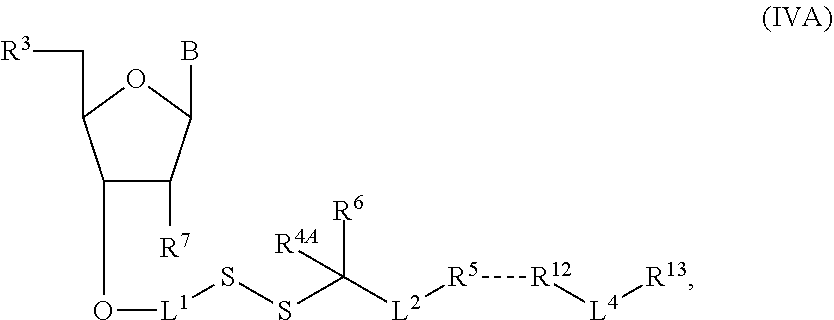
wherein R3, B, R7, L1, R4A, R6, L2, R5, R12, L4, and R13 are as described herein. In embodiments, R5 is an affinity anchor moiety. The symbol “----” is a non-covalent bond. In embodiments, R4A is not hydrogen. In embodiments, R6 is not hydrogen. In embodiments, R4A and R6 are not hydrogen.


wherein R3, B, R7, L1, R4A, R4B, L2, and R5 are as described herein. In embodiments, R5 is a detectable label or anchor moiety.

wherein R3, B, R7, L1, R4A, R4B, L2, R5, R12, L4, and R13 are as described herein. In embodiments, R5 is an affinity anchor moiety. The symbol “----” is a non-covalent bond.

In embodiments, B is

In embodiments, B is

In embodiments, B is

In embodiments, B is

In embodiments, B is

In embodiments, B is

In embodiments, B is


wherein R5 is as described herein. In embodiments, L2 is

wherein R5 is as described herein. In embodiments, L2 is

wherein R5 is as described herein and ne is an integer from 0 to 20.

wherein R5 is as described herein. In embodiments, L2 is

wherein R5 is as described herein. In embodiments, L2 is

wherein R5 is as described herein and ne is an integer from 0 to 20.


In embodiments, -L2- is

wherein z is an integer from 0 to 10. In embodiments z is an integer from 1 to 8. In embodiments z is an integer from 2 to 4. In embodiments z is 0. In embodiments z is 1. In embodiments z is 2. In embodiments z is 3. In embodiments z is 4. In embodiments z is 5. In embodiments z is 6. In embodiments z is 7. In embodiments z is 8. In embodiments z is 9. In embodiments z is 10.

In embodiments, L1A, L2B, L2C, L2D, and L2E are each independently

In embodiments, L2A, L2B, L2C, L2D, and L2E are each independently

In embodiments, L1A, L2B, L2C, L1D, and L2E are each independently

In embodiments, L2A, L2B, L2C, L2Dand L2E are each independently

In embodiments, L2A, L2B, L2C, L2D, and L2E are each independently

In embodiments, L2A, L2B, L2C, L2D, and L2E are each independently

In embodiments, L2A, L2B, L2C, L2D, and L2E are each independently

In embodiments, L2A, L2B, L2C, L2D, and L2E are each independently


and z is an integer from 0 to 10.


and z is an integer from 0 to 10.

In embodiments, -L2-R5 is

In embodiments, -L2-R5 is

In embodiments, -L2-R5 is

In embodiments, -L2-R5 is

In embodiments, -L2-R5 is

In embodiments, -L2-R5 is

In embodiments, -L2-R5 is

wherein z is an integer from 0 to 10. In embodiments z is an integer from 1 to 8. In embodiments z is an integer from 2 to 4. In embodiments z is 0. In embodiments z is 1. In embodiments z is 2. In embodiments z is 3. In embodiments z is 4. In embodiments z is 5. In embodiments z is 6. In embodiments z is 7. In embodiments z is 8. In embodiments z is 9. In embodiments z is 10. In embodiments, -L2-R5 is

In embodiments, -L2-R5 is

In embodiments, -L2-R5 is

In embodiments, -L2-R5 is

In embodiments, -L2-R5 is


wherein L1 is a bond, substituted (e.g., substituted with a substituent group, size-limited substituent group, or lower substituent group) or unsubstituted a substituted (e.g., substituted with a substituent group, size-limited substituent group, or lower substituent group) or unsubstituted alkylene (e.g., alkylene, alkenylene, or alkynylene), substituted (e.g., substituted with a substituent group, size-limited substituent group, or lower substituent group) or unsubstituted heteroalkylene (e.g., heteroalkylene, heteroalkenylene, or heteroalkynylene), substituted (e.g., substituted with a substituent group, size-limited substituent group, or lower substituent group) or unsubstituted cycloalkylene, substituted (e.g., substituted with a substituent group, size-limited substituent group, or lower substituent group) or unsubstituted heterocycloalkylene, substituted (e.g., substituted with a substituent group, size-limited substituent group, or lower substituent group) or unsubstituted arylene, or substituted (e.g., substituted with a substituent group, size-limited substituent group, or lower substituent group) or unsubstituted heteroarylene. L2 is a bond, substituted (e.g., substituted with a substituent group, size-limited substituent group, or lower substituent group) or unsubstituted a substituted (e.g., substituted with a substituent group, size-limited substituent group, or lower substituent group) or unsubstituted alkylene (e.g., alkylene, alkenylene, or alkynylene), substituted (e.g., substituted with a substituent group, size-limited substituent group, or lower substituent group) or unsubstituted heteroalkylene (e.g., heteroalkylene, heteroalkenylene, or heteroalkynylene), substituted (e.g., substituted with a substituent group, size-limited substituent group, or lower substituent group) or unsubstituted cycloalkylene, substituted (e.g., substituted with a substituent group, size-limited substituent group, or lower substituent group) or unsubstituted heterocycloalkylene, substituted (e.g., substituted with a substituent group, size-limited substituent group, or lower substituent group) or unsubstituted arylene, substituted (e.g., substituted with a substituent group, size-limited substituent group, or lower substituent group) or unsubstituted heteroarylene, a cleavable linker, an orthogonally cleavable linker, non-covalent linker, or -L2A-L2B-L2C-L2D-, wherein L2A is a bond, substituted (e.g., substituted with a substituent group, size-limited substituent group, or lower substituent group) or unsubstituted a substituted (e.g., substituted with a substituent group, size-limited substituent group, or lower substituent group) or unsubstituted alkylene (e.g., alkylene, alkenylene, or alkynylene), substituted (e.g., substituted with a substituent group, size-limited substituent group, or lower substituent group) or unsubstituted heteroalkylene (e.g., heteroalkylene, heteroalkenylene, or heteroalkynylene). L2B is a bond substituted (e.g., substituted with a substituent group, size-limited substituent group, or lower substituent group) or unsubstituted cycloalkylene, substituted (e.g., substituted with a substituent group, size-limited substituent group, or lower substituent group) or unsubstituted heterocycloalkylene, substituted (e.g., substituted with a substituent group, size-limited substituent group, or lower substituent group) or unsubstituted arylene, substituted (e.g., substituted with a substituent group, size-limited substituent group, or lower substituent group) or unsubstituted heteroarylene. L2C is a bond substituted (e.g., substituted with a substituent group, size-limited substituent group, or lower substituent group) or unsubstituted cycloalkylene, substituted (e.g., substituted with a substituent group, size-limited substituent group, or lower substituent group) or unsubstituted heterocycloalkylene, substituted (e.g., substituted with a substituent group, size-limited substituent group, or lower substituent group) or unsubstituted arylene, substituted (e.g., substituted with a substituent group, size-limited substituent group, or lower substituent group) or unsubstituted heteroarylene. L2D is a bond, substituted (e.g., substituted with a substituent group, size-limited substituent group, or lower substituent group) or unsubstituted a substituted (e.g., substituted with a substituent group, size-limited substituent group, or lower substituent group) or unsubstituted alkylene (e.g., alkylene, alkenylene, or alkynylene), substituted (e.g., substituted with a substituent group, size-limited substituent group, or lower substituent group) or unsubstituted heteroalkylene (e.g., heteroalkylene, heteroalkenylene, or heteroalkynylene), wherein at least one of L2A, L2B, L2C, L2D is not a bond. R4A and R6A are independently hydrogen, —OH, —CF, —CCl3, —CBr3, —CI3, —CHF2, —CHCl2, —CHBr2, —CHI2, —CH2F, —CH2Cl, —CH2Br, —CH2I, —CN, substituted (e.g., substituted with a substituent group, size-limited substituent group, or lower substituent group) or unsubstituted alkyl, substituted (e.g., substituted with a substituent group, size-limited substituent group, or lower substituent group) or unsubstituted heteroalkyl, substituted (e.g., substituted with a substituent group, size-limited substituent group, or lower substituent group) or unsubstituted cycloalkyl, substituted (e.g., substituted with a substituent group, size-limited substituent group, or lower substituent group) or unsubstituted heterocycloalkyl, substituted (e.g., substituted with a substituent group, size-limited substituent group, or lower substituent group) or unsubstituted aryl, or substituted (e.g., substituted with a substituent group, size-limited substituent group, or lower substituent group) or unsubstituted heteroaryl. R6 is hydrogen, —CF3, —CCl3, —CBr3, —CI3, —CHF2, —CHCl2, —CHBr2, —CHI2, —CH2F, —CH2Cl, —CH2Br, —CH2I, —CN, substituted (e.g., substituted with a substituent group, size-limited substituent group, or lower substituent group) or unsubstituted alkyl, substituted (e.g., substituted with a substituent group, size-limited substituent group, or lower substituent group) or unsubstituted heteroalkyl, substituted (e.g., substituted with a substituent group, size-limited substituent group, or lower substituent group) or unsubstituted cycloalkyl, substituted (e.g., substituted with a substituent group, size-limited substituent group, or lower substituent group) or unsubstituted heterocycloalkyl, substituted (e.g., substituted with a substituent group, size-limited substituent group, or lower substituent group) or unsubstituted aryl, or substituted (e.g., substituted with a substituent group, size-limited substituent group, or lower substituent group) or unsubstituted heteroaryl. X is a bond, O, NR6A, or S.

wherein L1, R4A, X, R6, and L2 are as described herein. In embodiments, L3 is

wherein L2 is as described herein. In embodiments, L3 is

wherein L2 is as described herein.


In embodiments, R5 is

In embodiments, R5 is

In embodiments, R5 is

In embodiments, R5 is

In embodiments, R5 is

In embodiments, R5 is

In embodiments, R5 is

In embodiments, R5 is

In embodiments, R5 is

In embodiments, R5 is

In embodiments, R5 is —N3. In embodiments, R5 is

In embodiments, R5 is


In embodiments, R5 is

In embodiments, R5 is

In embodiments, R5 is

In embodiments, R5 is

In embodiments, R5 is

In embodiments, R5 is

In embodiments, R5 is

In embodiments, R5 is

In embodiments, R5 is

In embodiments, R5 is

In embodiments, R5 is

In embodiments, R5 is

In embodiments, R5 is

In embodiments, R5 is

In embodiments, R5 is

In embodiments, R5 is

In embodiments, R5 is

In embodiments, R5 is or


In embodiments, R5 is

In embodiments, R5 is

In embodiments, R5 is


wherein j1, j2, and j3 are independently an integer from 0 to 30.

wherein j1, j2, and j3 are independently an integer from 0 to 30.

wherein j1 is an integer from 0 to 30.

wherein j1, j2, and j3 are independently an integer from 0 to 30.

or —CH2—O—CH3.

In embodiments, R7A is

R8C is hydrogen, —CX8C 3, —CHX8C 2, —CH2X8C, —OCX8C 3, —OCH2X8C, —OCHX8C 2, —CN, —OH, —SH, —NH2, substituted or unsubstituted alkyl, substituted or unsubstituted heteroalkyl, substituted or unsubstituted cycloalkyl, substituted or unsubstituted heterocycloalkyl, substituted or unsubstituted aryl, or substituted or unsubstituted heteroaryl. The symbol X8C is independently halogen. In embodiments, R8C is independently unsubstituted phenyl. In embodiments, R8C is —CX8C 3, —CHX8C 2, —CH2X8C, —CH2OCX8C 3, —CH2OCH2X8C, —CH2OCHX8C 2, —CN, substituted or unsubstituted alkyl, substituted or unsubstituted heteroalkyl, substituted or unsubstituted cycloalkyl, substituted or unsubstituted heterocycloalkyl, substituted or unsubstituted aryl, or substituted or unsubstituted heteroaryl.

wherein R8A is hydrogen, —CX3 3, —CHX3 2, —CH2X3, —OCX3, —OCH2X3, —OCHX3 2, —CN, —OH, —SH, —NH2, substituted (e.g., substituted with a substituent group, size-limited substituent group, or lower substituent group) or unsubstituted C1-C6 alkyl, substituted (e.g., substituted with a substituent group, size-limited substituent group, or lower substituent group) or unsubstituted 2 to 6 membered heteroalkyl, substituted (e.g., substituted with a substituent group, size-limited substituent group, or lower substituent group) or unsubstituted C3-C6 cycloalkyl, substituted (e.g., substituted with a substituent group, size-limited substituent group, or lower substituent group) or unsubstituted 3 to 6 membered heterocycloalkyl, substituted (e.g., substituted with a substituent group, size-limited substituent group, or lower substituent group) or unsubstituted phenyl, or substituted (e.g., substituted with a substituent group, size-limited substituent group, or lower substituent group) or unsubstituted 5 to 6 membered heteroaryl; R8B is independently hydrogen, —CX4 3, —CHX4 2, —CH2X4, —OCX4 3, —OCH2X4, —OCHX4 2, —CN, —OH, —SH, —NH2, substituted (e.g., substituted with a substituent group, size-limited substituent group, or lower substituent group) or unsubstituted C1-C6 alkyl, substituted (e.g., substituted with a substituent group, size-limited substituent group, or lower substituent group) or unsubstituted 2 to 6 membered heteroalkyl, substituted (e.g., substituted with a substituent group, size-limited substituent group, or lower substituent group) or unsubstituted C3-C6 cycloalkyl, substituted (e.g., substituted with a substituent group, size-limited substituent group, or lower substituent group) or unsubstituted 3 to 6 membered heterocycloalkyl, substituted (e.g., substituted with a substituent group, size-limited substituent group, or lower substituent group) or unsubstituted phenyl, or substituted (e.g., substituted with a substituent group, size-limited substituent group, or lower substituent group) or unsubstituted 5 to 6 membered heteroaryl; R9 is independently hydrogen, —CX5 3, —CHX5 2, —CH2X5, —OCX5 3, —OCH2X3, —OCHX5 2, —CN, —OH, —SH, —NH2, substituted (e.g., substituted with a substituent group, size-limited substituent group, or lower substituent group) or unsubstituted C1-C6 alkyl, substituted (e.g., substituted with a substituent group, size-limited substituent group, or lower substituent group) or unsubstituted 2 to 6 membered heteroalkyl, substituted (e.g., substituted with a substituent group, size-limited substituent group, or lower substituent group) or unsubstituted C3-C6 cycloalkyl, substituted (e.g., substituted with a substituent group, size-limited substituent group, or lower substituent group) or unsubstituted 3 to 6 membered heterocycloalkyl, substituted (e.g., substituted with a substituent group, size-limited substituent group, or lower substituent group) or unsubstituted phenyl, or substituted (e.g., substituted with a substituent group, size-limited substituent group, or lower substituent group) or unsubstituted 5 to 6 membered heteroaryl; R10 is independently hydrogen, —CX6 3, —CHX6 2, —CH2X6, —OCX6 3, —OCH2X6, —OCHX6 2, —CN, —OH, —SH, —NH2, substituted (e.g., substituted with a substituent group, size-limited substituent group, or lower substituent group) or unsubstituted C1-C6 alkyl, substituted (e.g., substituted with a substituent group, size-limited substituent group, or lower substituent group) or unsubstituted 2 to 6 membered heteroalkyl, substituted (e.g., substituted with a substituent group, size-limited substituent group, or lower substituent group) or unsubstituted C3-C6 cycloalkyl, substituted (e.g., substituted with a substituent group, size-limited substituent group, or lower substituent group) or unsubstituted 3 to 6 membered heterocycloalkyl, substituted (e.g., substituted with a substituent group, size-limited substituent group, or lower substituent group) or unsubstituted phenyl, or substituted (e.g., substituted with a substituent group, size-limited substituent group, or lower substituent group) or unsubstituted 5 to 6 membered heteroaryl; R11 is independently hydrogen, —CX7 3, —CHX7 2, —CH2X7, —OCX7 3, —OCH2X7, —OCHX7 2, —CN, —OH, —SH, —NH2, substituted (e.g., substituted with a substituent group, size-limited substituent group, or lower substituent group) or unsubstituted C1-C6 alkyl, substituted (e.g., substituted with a substituent group, size-limited substituent group, or lower substituent group) or unsubstituted 2 to 6 membered heteroalkyl, substituted (e.g., substituted with a substituent group, size-limited substituent group, or lower substituent group) or unsubstituted C3-C6 cycloalkyl, substituted (e.g., substituted with a substituent group, size-limited substituent group, or lower substituent group) or unsubstituted 3 to 6 membered heterocycloalkyl, substituted (e.g., substituted with a substituent group, size-limited substituent group, or lower substituent group) or unsubstituted phenyl, or substituted (e.g., substituted with a substituent group, size-limited substituent group, or lower substituent group) or unsubstituted 5 to 6 membered heteroaryl; and X3, X4, X5, X6 and X7 are independently halogen.

wherein R8A, R8B, R9, R10, and R11 are independently hydrogen or unsubstituted methyl. In embodiments, R7 is —OR7A; R7A is a polymerase-compatible cleavable moiety; and the polymerase-compatible cleavable moiety is:

In embodiments, R7A is hydrogen. In embodiments, R7A is

In embodiments, R7A is

In embodiments, R7A is


a streptavidin moiety, or

In embodiments, R12 is

In embodiments, R12 is

In embodiments, R12 is

In embodiments, R12 is

In embodiments, R12 is

In embodiments, R12 is

In embodiments, R12 is

In embodiments, R12 is a streptavidin moiety. In embodiments, R12 is or

In embodiments, R12 streptavidin, dibenzocyclooctyne (DBCO), tetrazine (TZ), or salicylhydroxamic acid (SHA).


In embodiments, R12 is

In embodiments, R12 is

In embodiments, R12 is

In embodiments, R12 is

In embodiments, R12 is

In embodiments, R12 is

In embodiments, R12 is

In embodiments, R12 is

In embodiments, R12 is

In embodiments, R12 is

In embodiments, R12 is

In embodiments, R2 is

In embodiments, R12 is

In embodiments, R12 is

In embodiments, R12 is

In embodiments, R12 is

In embodiments, R12 is

In embodiments, R12 is or

In embodiments, R12 is streptavidin, dibenzylcyclooctene (DBCO), tetrazine, salicylhydroxamic acid (SHA), bis(dithiobenzil)nickel(II), or nitrile oxide.

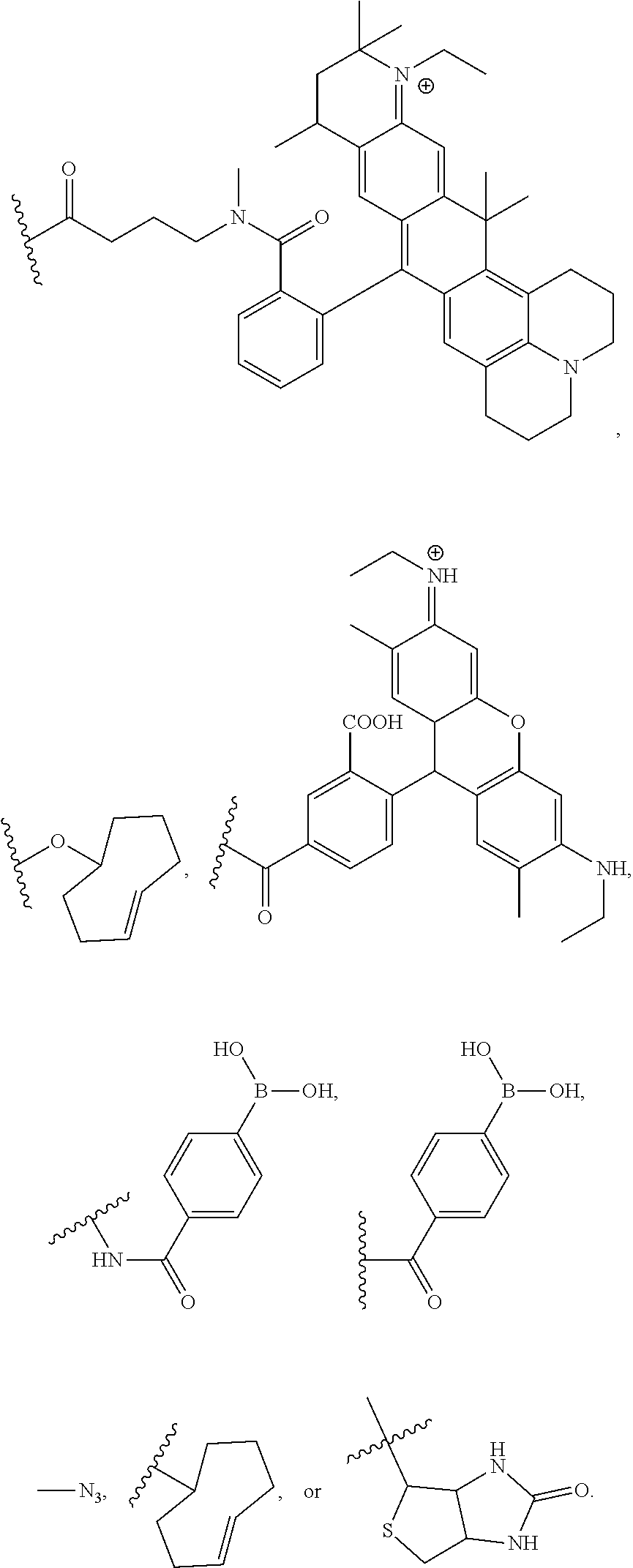


In embodiments, R13 is

In embodiments, R13 is

In embodiments, R13 is

In embodiments, R13 is

In embodiments, R13 is

In embodiments, R13 is

In embodiments, R13 is

In embodiments, R13 is

In embodiments, R13 is

In embodiments, R3 is —N3. In embodiments, R13 is

In embodiments, R13 is


In embodiments, R13 is

In embodiments, R13 is

In embodiments, R13 is


wherein j1, j2, and j3 are independently an integer from 0 to 30.

wherein j1, j2, and j3 are independently an integer from 0 to 30.

wherein j1 is an integer from 0 to 30.

wherein j1, j2, and j3 are independently an integer from 0 to 30.


a streptavidin moiety, or

In embodiments, R12z is

In embodiments, R12z is

In embodiments, R12z is

In embodiments, R12z is

In embodiments, R12 is

In embodiments, R12z is

In embodiments, R12z is

In embodiments, R12z is a streptavidin moiety. In embodiments, R12z is


wherein R12z is as described herein.

wherein R4A, L2, R5, and R6 are as described herein.

wherein L2 and R5 are as described herein.

wherein R4A, L2, R5, and R6 are as described herein.

wherein L2 and R5 are as described herein.

wherein R4A, L2, R5, and R6 are as described herein.

wherein L2 and R5 are as described herein.

wherein L2 and R5 are as described herein.

wherein R4A, L2, R5, and R6 are as described herein.

wherein np, R4A, L2, R5, and R6 are as described herein.

wherein np, L2, and R5 are as described herein.

wherein np, R4A, L2, R5, and R6 are as described herein.

wherein np, L2, and R6 are as described herein.

wherein np, R4A, L2, R5, and R6 are as described herein.

wherein np, L2, and R5 are as described herein.

wherein np, L, and R5 are as described herein.

wherein np, R4A, L2, R5, and R6 are as described herein.

wherein np, B, R4, X, and R6 are as described herein.

wherein np and B are as described herein.

wherein B, R4A, X, and R6 are as described herein.

wherein B is as described herein.


wherein B, R4A, X, and R6 are as described herein.

wherein B is as described herein.


wherein B, R4A, X, and R6 are as described herein.

wherein B is as described herein.


In embodiments, the nucleotide analogue has the formula:


wherein B, R4A, X, and R6 are as described herein.

wherein B is as described herein.


wherein B, R4A, X, and R6 are as described herein.

wherein B is as described herein.


wherein B, R4A, X, and R6 are as described herein.

wherein B is as described herein.


wherein B, R4A, X, and R6 are as described herein.

wherein B is as described herein.


wherein B. R4A, X, and R6 are as described herein.

wherein B is as described herein.


wherein B, R4A, X, and R6 are as described herein.

wherein B is as described herein.


wherein B, R4A, X, and R6 are as described herein.

wherein B is as described herein.


wherein B, R4A, X, and R6 are as described herein.

wherein B is as described herein.


wherein B, R4A, X, and R6 are as described herein.

wherein B is as described herein.


wherein B, R4A, X, and R6 are as described herein.

wherein B is as described herein.


wherein B and R5 are as described herein.

wherein B and R5 are as described herein.

wherein R5 is as described herein.

wherein R5 is as described herein.

wherein R5 is as described herein.

wherein R5 is as described herein.

wherein R4A, L2, R5, and R6 are as described herein.

wherein L2 and R5 are as described herein.

wherein R4A, L2, R5, and R6 are as described herein.

wherein L2 and R5 are as described herein.

wherein R4A, L2, R5, and R6 are as described herein.

wherein L2 and R5 are as described herein.

wherein L2 and R5 are as described herein.

wherein R4A, L2, R5, and R6 are as described herein.

wherein R4A, L2, R5, and R6 are as described herein.

wherein L2 and R5 are as described herein.

wherein R4A, L2, R5, and R6 are as described herein.

wherein L2 and R5 are as described herein.

wherein R4A, L2, R5, and R6 are as described herein.

wherein L2 and R5 are as described herein.

wherein L2 and R5 are as described herein.

wherein R4A, L2, R5, and R6 are as described herein.

wherein R4A, L2, R5, and R6 are as described herein.

wherein L2 and R5 are as described herein.

wherein R4A, L2, R5, and R6 are as described herein.

wherein L2 and R5 are as described herein.

wherein R4A, L2, R5, and R6 are as described herein.

wherein L2 and R5 are as described herein.

wherein L2 and R5 are as described herein.

wherein R4A, L2, R5, and R6 are as described herein.

wherein R4A, R12, L4, R13, L2, R5, and R6 are as described herein.

wherein R12, L4, R13, L2, and R5 are as described herein.

wherein R4A, R12, L4, R13, L2, R5, and R6 are as described herein.

wherein R12. L4, R13, L2, and R5 are as described herein.

wherein R4A, R12, L4, R13, L2, R5, and R6 are as described herein.

wherein R12, L4, R13, L2, and R5 are as described herein.

wherein R12, L4, R13, L2, and R5 are as described herein.

wherein R4A, R12, L4, R13, L2, R5, and R6 are as described herein.
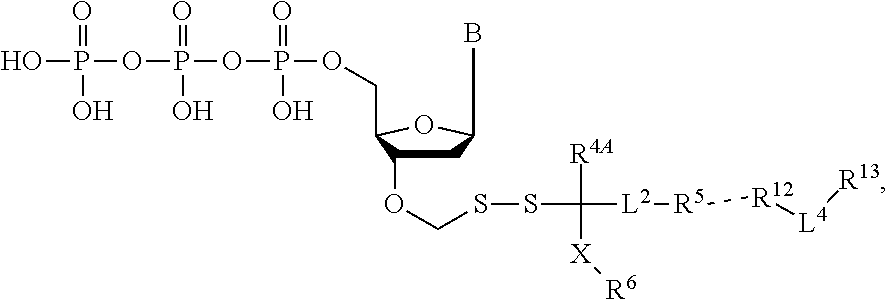
wherein B, R4, R12, L4, R13, X, and R6 are as described herein.

wherein B, R4, X, R12, L4, R13, and R6 are as described herein.

wherein R12, L4, R16, B, and R5 are as described herein.

wherein R12, L4, R13, B, and R5 are as described herein.

wherein R12, L4, R13, and R5 are as described herein.

wherein R12, L4, R13, and R5 are as described herein.

wherein R12, L4, R13, and R5 are as described herein.

wherein R12, L4, R13, and R5 are as described herein.

wherein R12, L4, R13, np, R4A, L2, R5, and R6 are as described herein.

wherein R12, L4, R13, np, L2, and R5 are as described herein.

wherein R12, L4, R13, np, R4A, L2, R5, and R6 are as described herein.

wherein R12, L4, R13, np, L2, and R5 are as described herein.

wherein R12, L4, R13, np, R4A, L2, R5, and R6 are as described herein.

wherein R12, L4, R13, np, L2, and R5 are as described herein.

wherein R12. L4, R13, np, L2, and R5 are as described herein.

wherein R12, L4, R13, np, R4A, L2, R5, and R6 are as described herein.

wherein R12, L4, R13, np, B, R4, X, and R6 are as described herein.

wherein R12, L4, R13, np, B, R4, X, and R6 are as described herein.

wherein R12, L4, R13, np, B, and R5 are as described herein.

wherein R12, L4, R3, np, B, and R5 are as described herein.

wherein R12, L4, R13, np, and R5 are as described herein.

wherein R12, L4, R3, np, and R5 are as described herein.

wherein R12, L4, R13, np, and R5 are as described herein.

wherein R12, L4, R13, np, R5 are as described herein.

wherein the first of the four different labeled nucleotide analogues, B is a thymine or uracil hybridizing base; in the second of the four different labeled nucleotide analogues, B is an adenine hybridizing base; in the third of the four different labeled nucleotide analogues. B is an guanine hybridizing base; and in the fourth of the four different labeled nucleotide analogues, B is an cytosine hybridizing base. B is a base or analogue thereof. L1 is covalent linker. L2 is covalent linker. L4 is covalent linker. X is a bond, O, NR6A, or S. R3 is —OH, monophosphate, polyphosphate or a nucleic acid. In embodiments, R3 is a triphosphate or higher polyphosphate. R4A and R6A are independently hydrogen, —OH, —CF3, —CCl3, —CBr3, —CI3, —CHF2, —CHCl2, —CHBr2, —CHI2, —CH2F, —CH2Cl, —CH2Br, —CH2I, —CN, substituted or unsubstituted alkyl, substituted or unsubstituted heteroalkyl, substituted or unsubstituted cycloalkyl, substituted or unsubstituted heterocycloalkyl, substituted or unsubstituted aryl, or substituted or unsubstituted heteroaryl. R5 is a detectable label, anchor moiety, or affinity anchor moiety. R6 is hydrogen, —CF3, —CCI3, —CBr3, —CI3, —CHF2, —CHCl2, —CHBr2, —CHI2, —CH2F, —CH2Cl, —CH2Br, —CH2I, —CN, substituted or unsubstituted alkyl, substituted or unsubstituted heteroalkyl, substituted or unsubstituted cycloalkyl, substituted or unsubstituted heterocycloalkyl, substituted or unsubstituted aryl, or substituted or unsubstituted heteroaryl. R7 is hydrogen or —OR7A, wherein R7A is hydrogen or a polymerase-compatible moiety. R12 is a complementary affinity anchor moiety binder. R13 is a detectable label. The symbol “----” is a non-covalent bond. In embodiments, the nucleic acid polymerase is a thermophilic nucleic acid polymerase. In embodiments, the nucleic acid polymerase is 9°N and mutants thereof. In embodiments, the nucleic acid polymerase is Phi29 and mutants thereof.
-
- a) providing
- 1) the nucleic acid of interest,
- 2) a nucleic acid polymerase,
- 3) a primer capable of hybridizing to said nucleic acid immediately 3′ of such predetermined position,
- 4) four different nucleotide analogs of
claim 1, each of which consists of one of adenine or an analog of adenine, guanine or an analog of guanine, cytosine or an analog of cytosine, thiamine or an analog of thiamine, and a unique detectable label:
- b) incorporating one of said nucleotide analogs onto the end of said primer to form an extension strand;
- c) detecting the unique detectable label of the incorporated nucleotide analog so as to thereby identify the incorporated nucleotide analog on the end of said extension strand; and
- d) based on the identity of the incorporated nucleotide, determining the identity of the nucleotide at the predetermined position.
- a) providing
-
- a) reacting,
- 1) a 5′-O-tert-Butyldimethylsilyl-nucleoside,
- 2) acetic acid,
- 3) acetic anhydride, and
- 4) DMSO under conditions permitting the production of a 3′-O-methylthiomethyl-5′-O-tert-butyldimerthylsilyl-nucleoside;
- b) contacting the 3′-O-methylthiomethyl-5′-O-tert-butyldimerthylsilyl-nucleoside produced in step a) with trimethylamine, molecular sieve, sulfuryl chloride, potassium p-toluenethiosulfonate, and 2,2,2,-trifluoro-N-(2-mercapto-2-methylpropyl)acetamide, under conditions permitting the production of a product having the structure:
- a) reacting,

wherein B is a nucleobase:
-
- c) contacting the product produced in step b) with tetrabutylammonium fluoride THF solution under conditions permitting the production of a product having the structure:

-
-
- wherein B is a nucleobase;
- d) contacting the product produced in step c) with tetrabutylammonium pyrophosphate, 2-chloro-4-H-1,3,2-benzodioxaphosphorin-4-one, iodine solution and ammonium hydroxide under conditions permitting the production of a 3-O-NH2-t-Butyldithiomethyl-dNTP;
- e) contacting the 3-O-NH2-t-Butyldithiomethyl-dNTP of step d) with Bodipy FL-NHS ester under conditions permitting the production of the 3′-O-Bodipy-t-Butyldithiomethyl-dNTP.
-
-
- a) reacting,
- 1) a 5′-O-tert-Butyldimethylsilyl-nucleoside,
- 2) acetic acid,
- 3) acetic anhydride, and
- 4) DMSO
under conditions permitting the production of a 3′-O-methylthiomethyl-5′-O-tert-butyldimerthylsilyl-nucleoside;
- b) contacting the 3′-O-methylthiomethyl-5′-O-tert-butyldimerthylsilyl-nucleoside produced in part a) with trimethylamine, molecular sieve, sulfuryl chloride, potassium p-toluenethiosulfonate, and 2,2,2-trifluoro-N-(2-mercapto-2-methylpropyl)acetamide, under conditions permitting the production of a product having the structure:
- a) reacting,

wherein B is a nucleobase;
-
- c) contacting the product produced in step b) with tetrabutylammonium fluoride THF solution under conditions permitting the production of a product having the structure:

-
-
- wherein B is a nucleobase;
- d) contacting the product produced in step c) with tetrabutylammonium pyrophosphate, 2-chloro-4-H-1,3,2-benzodioxaphosphorin-4-one, iodine solution and ammonium hydroxide under conditions permitting the production of a 3-O-NH2-t-Butyldithiomethyl-dNTP;
- e) contacting the 3-O-NH2-1-Butyldithiomethyl-dNTP of step d) with Bodipy-PEG4-Acid, N,N-disuccinimidyl carbonate, and 4-dimethylaminopyridine under conditions permitting the production of the 3′-O-PEG4-Bodipy-t-Butyldithiomethyl-dNTP.
-
-
- a) reacting,
- 1) a N4-Benzoyl-5′-O-tert-butyldimethylsilyl-2′-deoxyadenosine, and
- 2) acetic acid and acetic anhydride, and
- 3) DMSO
under conditions permitting the formation of a N4-Benzoyl-3′-O-methylthiomethyl-5′-O-tert-butyldimethylsilyl-2′-deoxyadenosine;
- b) contacting the N4-Benzoyl-3′-O-methylthiomethyl-5′-O-tert-butyldimethylsilyl-2′-deoxyadenosine produced in step a) with trimethylamine, molecular sieves, sufuryl chloride, p-toluenethiosulfonate, and 2,2,2,-trifluor-N-(2-mercapto-2-methylpropyl)acetamide under conditions permitting the production of a product having the structure:
- a) reacting,

-
- c) contacting the product of step b) with tetrabutylammonium fluoride THF solution under conditions permitting the production of a product having the structure:

-
- d) contacting product of step c) with tetrabutylammonium pyrophosphate, 1-chloro-4-H-1,3,2-benzodioxaphosphorin-4-one, tributylamine, iodine solution, and ammonium hydroxide under conditions permitting the production of 3′-O-NH2-t-Butyldithiomethyl-dATP;
- e) contacting the 3′-O-NH2-t-Butyldithiomethyl-dATP produced in step d) with ROX-NHS ester under conditions permitting the production of the 3′-O-Rox-t-Butyldithiomethyl-dATP.
-
- a) reacting,
- 1) a N4-Benzoyl-5′-O-tert-butyldimethylsilyl-2′-deoxyadenosine, and
- 2) acetic acid and acetic anhydride; and
- 3) DMSO
under conditions permitting the formation of a N4-Benzoyl-3′-O-methylthiomethyl-5′-O-tert-butyldimethylsilyl-2′-deoxyadenosine:
- b) contacting the N4-Benzoyl-3′-O-methylthiomethyl-5′-O-tert-butyldimethylsilyl-2′-deoxyadenosine produced in step a) with trimethylamine, molecular sieves, sufuryl chloride, p-toluenethiosulfonate, and 2,2,2,-trifluor-N-(2-mercapto-2-methylpropyl)acetamide under conditions permitting the production of a product having the structure:
- a) reacting,

-
- c) contacting the product of step b) with tetrabutylammonium fluoride THF solution under conditions permitting the production of a product having the structure:

-
- d) contacting product of step c) with tetrabutylammonium pyrophosphate, I-chloro-4-H-1,3,2-benzodioxaphosphorin-4-one, tributylamine, iodine solution and ammonium hydroxide under conditions permitting the production of 3′-O-NH2-t-Butyldithiomethyl-dATP;
- e) contacting the 3′-O-NH2-t-Butyldithiomethyl-dATP produced in step d) with ROX-PEG4-Acid, N,N-disuccinimidyl carbonate, and 4-dimethylaminopyridine under conditions permitting the production of the 3′-O-Rox-PEG4-Butyldithiomethyl-dATP.
-
- a) reacting
- 1) a N4-Benzoyl-5′-O-tert-butyldimethylsilyl-2′-deoxycytidine, and
- 2) acetic acid and acetic anhydride, and
- 3) DMSO
under conditions permitting the formation of a N4-Benzoyl-3′-O-methylthiomethyl-5′-O-tert-butyldimethylsilyl-2′-deoxycytidine;
- b) contacting the N4-Benzoyl-3′-O-methylthiomethyl-5′-O-tert-butyldimethylsilyl-2′-deoxycytidine produced in step a) with trimethylamine, molecular sieves, sufuryl chloride, p-toluenethiosulfonate, and 2,2,2,-trifluor-N-(2-mercapto-2-methylpropyl)acetamide under conditions permitting the production of a product having the structure:
- a) reacting

-
- c) contacting the product of step b) with tetrabutylammonium fluoride THF solution under conditions permitting the production of a product having the structure:

-
- d) contacting product of step c) with tetrabutylammonium pyrophosphate, 1-chloro-4-H-1,3,2-benzodioxaphosphorin-4-one, tributylamine, iodine solution and ammonium hydroxide under conditions permitting the production of a 3′-O-NH2-t-Butyldithiomethyl-dCTP;
- e) contacting the 3′-O-NH2-t-Butyldithiomethyl-dCTP produced in step d) with Alexa488-NHS ester under conditions permitting the production of the 3′-O-Alexa488-t-Butyldithiomethyl-dCTP.
-
- a) reacting
- 1) a N4-Benzoyl-5′-O-tert-butyldimethylsilyl-2′-deoxycytidine, and
- 2) acetic acid and acetic anhydride, and
- 3) DMSO
under conditions permitting the formation of a N4-Benzoyl-3′-O-methylthiomethyl-5′-O-tert-butyldimethylsilyl-2′-deoxycytidine:
- b) contacting the N4-Benzoyl-3′-O-methylthiomethyl-5′-O-tert-butyldimethylsilyl-2′-deoxycytidine produced in step a) with trimethylamine, molecular sieves, sufuryl chloride, p-toluenethiosulfonate, and 2,2,2,-trifluor-N-(2-mercapto-2-methylpropyl)acetamide under conditions permitting the production of a product having the structure:
- a) reacting

-
- c) contacting the product of step b) with tetrabutylammonium fluoride THF solution under conditions permitting the production of a product having the structure:

-
- d) contacting product of step c) with tetrabutylammonium pyrophosphate, 1-chloro-4-H-1,3,2-benzodioxaphosphorin-4-one, tributylamine, iodine solution and ammonium hydroxide under conditions permitting the production of a 3′-O-NH2-t-Butyldithiomethyl-dCTP;
- e) contacting the 3′-O-NH2-1-Butyldithiomethyl-dCTP produced in step d) with Alexa488-PEG4-NHS ester, N,N-disuccinimidyl carbonate, and 4-dimethylaminopyridine under conditions permitting the production of the 3′-O-Alexa488-PEG4-t-Butyldithiomethyl-dCTP.
-
- a) reacting
- 1) a 2′-deoxyguanosine, and
- 2) tert-butyldimethylsilyl chloride, imidazole, and N,N-dimethylformamide dimethyl acetal,
under conditions permitting the formation of a N4-DMF-5′-O-tert-butyldimethylsilyl-2′-deoxyguanosine;
- b) contacting the N-DMF-5′-O-tert-butyldimethylsilyl-2′-deoxyguanosine produced in step a) with acetic acid, acetic anhydride, and DMSO under conditions permitting the production of a product having the structure:
- a) reacting

-
- c) contacting the product of step b) with trimethylamine, molecular sieves, sufuryl chloride, p-toluenethiosulfonate, and 2,2,2,-trifluor-N-(2-mercapto-2-methylpropyl)acetamide under conditions permitting the production of a product having the structure:

-
- d) contacting the product of step c) with tetrabutylammonium fluoride THF solution under conditions permitting the production of a product having the structure:

-
- e) contacting product of step d) with tetrabutylammonium pyrophosphate, 1-chloro-4-H-1,3,2-benzodioxaphosphorin-4-one, tributylamine, iodine solution and ammonium hydroxide under conditions permitting the production of 3′-O-NH2-t-Butyldithiomethyl-dGTP;
- 1) contacting the 3′-O-NH2-t-Butyldithiomethyl-dGTP produced in step e) with Cy5-NHS under conditions permitting the production of the 3′-O-Cy5-t-Butyldithiomethyl-dGTP.
-
- a) reacting
- 1) a 2′-deoxyguanosine, and
- 2) tert-butyldimethylsilyl chloride, imidazole, and N,N-dimethylformamide dimethyl acetal,
under conditions permitting the formation of a N4-DMF-5′-O-tert-butyldimethylsilyl-2′-deoxyguanosine;
- b) contacting the N4-DMF-5′-O-tert-butyldimethylsilyl-2′-deoxyguanosine produced in step a) with acetic acid, acetic anhydride, and DMSO under conditions permitting the production of a product having the structure:
- a) reacting

-
- c) contacting the product of step b) with trimethylamine, molecular sieves, sufuryl chloride, p-toluenethiosulfonate, and 2,2,2,-trifluor-N-(2-mercapto-2-methylpropyl)acetamide under conditions permitting the production of a product having the structure:

-
- d) contacting the product of step c) with tetrabutylammonium fluoride THF solution under conditions permitting the production of a product having the structure:

-
- e) contacting product of step d) with tetrabutylammonium pyrophosphate, 1-chloro-4-H-1,3,2-benzodioxaphosphorin-4-one, tributylamine, iodine solution and ammonium hydroxide under conditions permitting the production of 3′-O-NH2-t-Butyldithiomethyl-dGTP;
contacting the 3′-O-NH2-t-Butyldithiomethyl-dGTP produced in step e) with Cy5-PEG4-NHS under conditions permitting the production of the 3′-O-Cy5-PEG4-t-Butyldithiomethyl-dGTP.
- e) contacting product of step d) with tetrabutylammonium pyrophosphate, 1-chloro-4-H-1,3,2-benzodioxaphosphorin-4-one, tributylamine, iodine solution and ammonium hydroxide under conditions permitting the production of 3′-O-NH2-t-Butyldithiomethyl-dGTP;

wherein α represents the point of connection to the 3′-oxygen; wherein R represents a structure consisting of one or more atoms one of which is covalently bound to the detectable label; and wherein Label represents the detectable label.

wherein α represents the point of connection to the 3′-oxygen; wherein n is an integer which may be 1, 2, 3, 4, or 5; and wherein R′ represents a structure covalently attached to the detectable label.


-
- a) providing
- 1) the nucleic acid of interest,
- 2) a nucleic acid polymerase,
- 3) a primer capable of hybridizing to said nucleic acid immediately 3′ of such predetermined position,
- 4) four different nucleotide analogs of
claim 1, each of which consists of one of adenine or an analog of adenine, guanine or an analog of guanine, cytosine or an analog of cytosine, thiamine or an analog of thiamine, and a unique detectable label;
- b) incorporating one of said nucleotide analogs onto the end of said primer to form an extension strand;
- c) detecting the unique detectable label of the incorporated nucleotide analog so as to thereby identify the incorporated nucleotide analog on the end of said extension strand; and
- d) based on the identity of the incorporated nucleotide, determining the identity of the nucleotide at the predetermined position.
- a) providing

wherein α represents the point of connection to the 3′-oxygen; wherein R represents one or more atoms through which a covalent connection is established to the detectable label; and wherein Label is the detectable label.

wherein α represents the point of connection to the 3′-oxygen; wherein n is 1, 2, 3, 4, or 5; and wherein R′ represents one or more atoms through which a covalent connection is established to the detectable label.


-
- a) reacting,
- 1) a 5′-O-tert-Butyldimethylsilyl-nucleoside,
- 2) acetic acid,
- 3) acetic anhydride, and
- 4) DMSO
under conditions permitting the production of a 3′-O-methylthiomethyl-5′-O-tert-butyldimerthylsilyl-nucleoside;
- b) contacting the 3′-O-methylthiomethyl-5′-O-tert-butyldimerthylsilyl-nucleoside produced in step a) with trimethylamine, molecular sieve, sulfuryl chloride, potassium p-toluenethiosulfonate, and 2,2,2,-trifluoro-N-(2-mercapto-2-methylpropyl)acetamide, under conditions permitting the production of a product having the structure:
- a) reacting,

wherein B is a nucleobase:
-
- c) contacting the product produced in step b) with tetrabutylammonium fluoride THF solution under conditions permitting the production of a product having the structure:

-
-
- wherein B is a nucleobase;
- d) contacting the product produced in step c) with tetrabutylammonium pyrophosphate, 2-chloro-4-H-1,3,2-benzodioxaphosphorin-4-one, iodine solution and ammonium hydroxide under conditions permitting the production of a 3-O-NH2-t-Butyldithiomethyl-dNTP;
- e) contacting the 3-O-NH2-t-Butyldithiomethyl-dNTP of step d) with Bodipy FL-NHS ester under conditions permitting the production of the 3′-O-Bodipy-t-Butyldithiomethyl-dNTP.
-
-
- a) reacting,
- 1) a 5′-O-tert-Butyldimethylsilyl-nucleoside,
- 2) acetic acid.
- 3) acetic anhydride, and
- 4) DMSO
under conditions permitting the production of a 3′-O-methylthiomethyl-5′-O-tert-butyldimerthylsilyl-nucleoside;
- b) contacting the 3′-O-methylthiomethyl-5′-O-tert-butyldimerthylsilyl-nucleoside produced in part a) with trimethylamine, molecular sieve, sulfuryl chloride, potassium p-toluenethiosulfonate, and 2,2,2,-trifluoro-N-(2-mercapto-2-methylpropyl)acetamide, under conditions permitting the production of a product having the structure:
- a) reacting,

wherein B is a nucleobase:
-
- c) contacting the product produced in step b) with tetrabutylammonium fluoride THF solution under conditions permitting the production of a product having the structure:

-
-
- wherein B is a nucleobase;
- d) contacting the product produced in step c) with tetrabutylammonium pyrophosphate, 2-chloro-4-H-1,3,2-benzodioxaphosphorin-4-one, iodine solution and ammonium hydroxide under conditions permitting the production of a 3-O-NH2-t-Butyldithiomethyl-dNTP;
- e) contacting the 3-O-NH2-t-Butyldithiomethyl-dNTP of step d) with Bodipy-PEG4-Acid, N,N-disuccinimidyl carbonate, and 4-dimethylaminopyridine under conditions permitting the production of the 3′-O-PEG4-Bodipy-t-Butyldithiomethyl-dNTP.
-
-
- a) reacting,
- 1) a N4-Benzoyl-5′-O-tert-butyldimethylsilyl-2′-deoxyadenosine, and
- 2) acetic acid, acetic anhydride and DMSO
under conditions permitting the formation of a N4-Benzoyl-3′-O-methylthiomethyl-5′-O-tert-butyldimethylsilyl-2′-deoxyadenosine:
- b) contacting the N4-Benzoyl-3′-O-methylthiomethyl-5′-O-tert-butyldimethylsilyl-2′-deoxyadenosine produced in step a) with trimethylamine, molecular sieves, sufuryl chloride, p-toluenethiosulfonate, and 2,2,2,-trifluor-N-(2-mercapto-2-methylpropyl)acetamide under conditions permitting the production of a product having the structure:
- a) reacting,

-
- c) contacting the product of step b) with tetrabutylammonium fluoride THF solution under conditions permitting the production of a product having the structure:

-
- d) contacting product of step c) with tetrabutylammonium pyrophosphate, 1-chloro-4-H-1,3,2-benzodioxaphosphorin-4-one, tributylamine, iodine solution and ammonium hydroxide under conditions permitting the production of 3′-O-NH2-t-Butyldithiomethyl-dATP;
- e) contacting the 3′-O-NH2-t-Butyldithiomethyl-dATP produced in step d) with ROX-NHS ester under conditions permitting the production of the 3′-O-Rox-t-Butyldithiomethyl-dATP.
-
- a) reacting,
- 1) a N4-Benzoyl-5′-O-tert-butyldimethylsilyl-2′-deoxyadenosine, and
- 2) acetic acid, acetic anhydride and DMSO under conditions permitting the formation of a N4-Benzoyl-3′-O-methylthiomethyl-5′-O-tert-butyldimethylsilyl-2′-deoxyadenosine;
- b) contacting the N4-Benzoyl-3′-O-methylthiomethyl-5′-O-tert-butyldimethylsilyl-2′-deoxyadenosine produced in step a) with trimethylamine, molecular sieves, sufuryl chloride, p-toluenethiosulfonate, and 2,2,2,-trifluor-N-(2-mercapto-2-methylpropyl)acetamide under conditions permitting the production of a product having the structure:
- a) reacting,

-
- c) contacting the product of step b) with tetrabutylammonium fluoride THF solution under conditions permitting the production of a product having the structure:

-
- d) contacting product of step c) with tetrabutylammonium pyrophosphate, 1-chloro-4-H-1,3,2-benzodioxaphosphorin-4-one, tributylamine, iodine solution and ammonium hydroxide under conditions permitting the production of 3′-O-NH2-t-Butyldithiomethyl-dATP;
- e) contacting the 3′-O-NH2-t-Butyldithiomethyl-dATP produced in step d) with ROX-PEG4-Acid, N,N-disuccinimidyl carbonate, and 4-dimethylaminopyridine under conditions permitting the production of the 3′-O-Rox-PEG4t-Butyldithiomethyl-dATP.
-
- a) reacting
- 1) a N4-Benzoyl-5′-O-tert-butyldimethylsilyl-2′-deoxycytidine, and
- 2) acetic acid, acetic anhydride and DMSO
under conditions permitting the formation of a N4-Benzoyl-3′-O-methylthiomethyl-5′-O-tert-butyldimethylsilyl-2′-deoxycytidine;
- b) contacting the N4-Benzoyl-3′-O-methylthiomethyl-5′-O-tert-butyldimethylsilyl-2′-deoxycytidine produced in step a) with trimethylamine, molecular sieves, sufuryl chloride, p-toluenethiosulfonate, and 2,2,2,-trifluor-N-(2-mercapto-2-methylpropyl)acetamide under conditions permitting the production of a product having the structure:
- a) reacting

-
- c) contacting the product of step b) with tetrabutylammonium fluoride THF solution under conditions permitting the production of a product having the structure:

-
- d) contacting product of step c) with tetrabutylammonium pyrophosphate, 1-chloro-4-H-1,3,2-benzodioxaphosphorin-4-one, tributylamine, iodine solution and ammonium hydroxide under conditions permitting the production of a 3′-O-NH2-t-Butyldithiomethyl-dCTP;
- e) contacting the 3′-O-NH2-t-Butyldithiomethyl-dCTP produced in step d) with Alexa488-NHS ester under conditions permitting the production of the 3′-O-Alexa488-t-Butyldithiomethyl-dCTP.
-
- a) reacting
- 1) a N4-Benzoyl-5′-O-tert-butyldimethylsilyl-2′-deoxycytidine, and
- 2) acetic acid, acetic anhydride and DMSO under conditions permitting the formation of a N4-Benzoyl-3′-O-methylthiomethyl-5′-O-tert-butyldimethylsilyl-2′-deoxycytidine;
- b) contacting the N4-Benzoyl-3′-O-methylthiomethyl-5′-O-tert-butyldimethylsilyl-2′-deoxycytidine produced in step a) with trimethylamine, molecular sieves, sufuryl chloride, p-toluenethiosulfonate, and 2,2,2,-trifluor-N-(2-mercapto-2-methylpropyl)acetamide under conditions permitting the production of a product having the structure:
- a) reacting

-
- c) contacting the product of step b) with tetrabutylammonium fluoride THF solution under conditions permitting the production of a product having the structure:

-
- d) contacting product of step c) with tetrabutylammonium pyrophosphate, 1-chloro-4-H-1,3,2-benzodioxaphosphorin-4-one, tributylamine, iodine solution and ammonium hydroxide under conditions permitting the production of a 3′-O-NH2-t-Butyldithiomethyl-dCTP;
- e) contacting the 3′-O-NH2-t-Butyldithiomethyl-dCTP produced in step d) with Alexa488-PEG4-NHS ester, N,N-disuccinimidyl carbonate, and 4-dimethylaminopyridine under conditions permitting the production of the 3′-O-Alexa488-PEG4-t-Butyldithiomethyl-dCTP.
-
- a) reacting
- 1) a 2′-deoxyguanosine, and
- 2) tert-butyldimethylsilyl chloride, imidazole, and N,N-dimethylformamide dimethyl acetal.
under conditions permitting the formation of a N4-DMF-5′-O-tert-butyldimethylsilyl-2′-deoxyguanosine;
- b) contacting the N4-DMF-5′-O-tert-butyldimethylsilyl-2′-deoxyguanosine produced in step a) with acetic acid acetic anhydride and DMSO under conditions permitting the production of a product having the structure:
- a) reacting

-
- c) contacting the product of step b) with trimethylamine, molecular sieves, sufuryl chloride, p-toluenethiosulfonate, and 2,2,2,-trifluor-N-(2-mercapto-2-methylpropyl)acetamide under conditions permitting the production of a product having the structure:

-
- d) contacting the product of step c) with tetrabutylammonium fluoride THF solution under conditions permitting the production of a product having the structure:

-
- e) contacting product of step d) with tetrabutylammonium pyrophosphate, I-chloro-4-H-1,3,2-benzodioxaphosphorin-4-one, tributylamine, iodine solution and ammonium hydroxide under conditions permitting the production of 3′-O-NH2-t-Butyldithiomethyl-dGTP;
- f) contacting the 3′-O-NH2-t-Butyldithiomethyl-dGTP produced in step e) with Cy5-NHS under conditions permitting the production of the 3′-O-Cy5-t-Butyldithiomethyl-dGTP.
-
- a) reacting
- 1) a 2′-deoxyguanosine, and
- 2) tert-butyldimethylsilyl chloride, imidazole, and N,N-dimethylformamide dimethyl acetal,
under conditions permitting the formation of a N4-DMF-5′-O-tert-butyldimethylsilyl-2′-deoxyguanosine;
- b) contacting the N4-DMF-5′-O-tert-butyldimethylsilyl-2′-deoxyguanosine produced in step a) with acetic acid acetic anhydride and DMSO under conditions permitting the production of a product having the structure:
- a) reacting

-
- c) contacting the product of step b) with trimethylamine, molecular sieves, sufurYl chloride, p-toluenethiosulfonate, and 2,2,2,-trifluor-N-(2-mercapto-2-methylpropyl)acetamide under conditions permitting the production of a product having the structure:

-
- d) contacting the product of step c) with tetrabutylammonium fluoride THF solution under conditions permitting the production of a product having the structure:

-
- e) contacting product of step d) with tetrabutylammonium pyrophosphate, 1-chloro-4-H-1,3,2-benzodioxaphosphorin-4-one, tributylamine, iodine solution and ammonium hydroxide under conditions permitting the production of 3′-O-NH2-t-Butyldithiomethyl-dGTP;
- f) contacting the 3′-O-NH2-t-Butyldithiomethyl-dGTP produced in step e) with Cy5-PEG4-NHS under conditions permitting the production of the 3′-O-Cy5-PEG4-t-Butyldithiomethyl-dGTP.
-
- a) contacting the single-stranded DNA having a primer hybridized to a portion thereof, with a nucleotide polymerase and a first type of nucleotide analogue under conditions permitting the nucleotide polymerase to catalyze incorporation of the nucleotide analogue into the primer if the nucleotide analogue is complementary to a nucleotide residue of the single-stranded DNA that is immediately 5′ to a nucleotide residue of the single-stranded DNA hybridized to the 3′ terminal nucleotide residue of the primer, so as to form a DNA extension product, wherein the nucleotide analogue has the structure:

wherein base is any one of adenine, guanine, thymine, cytosine, uracil, or an analogue thereof, wherein Cleavable Moiety is a cleavable t-butyldithiomethyl moiety that when bound to the 3′-O prevents a nucleotide polymerase from catalyzing a polymerase reaction with the 3′-O of the nucleotide analogue, wherein Anchor is an anchor moiety that is a small chemical moiety that orthogonally and rapidly reacts with a complementary binding molecule thereby forming a conjugate of the anchor moiety and binding molecule, wherein ω represents a structure consisting of one or more atoms of which is covalently bound to both the cleavable t-butyldithiomethyl moiety and the anchor moiety, wherein the identity of the anchor is predetermined and is correlated to the identity of the base,
-
- b) contacting the single-stranded DNA of step a) with a binding molecule complementary to the anchor of the nucleotide analogue of step a), wherein the binding molecule has the structure:

-
-
- wherein binder is a chemical group that orthogonally and rapidly reacts with the anchor moiety, thereby forming a conjugate of the binding molecule and the anchor moiety, and Label is a detectable label,
- c) removing any nucleotide analogue not incorporated into the primer in step a);
- d) detecting the presence of any detectable label so as to thereby determine whether the nucleotide analogue of step a) was incorporated so as to thereby determine the identity of the complementary nucleotide residue in the single-stranded DNA, and
- wherein if the base of the nucleotide analogue a) is not complementary to the nucleotide residue of the single-stranded DNA which is immediately 5′ to the nucleotide residue of the single-stranded DNA hybridized to the 3′ terminal nucleotide residue of the primer, then iteratively repeating steps a) through c) with a second, third, and then fourth type of nucleotide analogue, wherein each different type of nucleotide analogue has a different base from each other type of nucleotide analogue, until the nucleotide analogue has a base that is complementary,
- e) cleaving the cleavable t-butyldithiomethyl moiety, so as to thereby create a 3′-OH; and
- f) iteratively performing steps a) through e) for each nucleotide residue of the single-stranded DNA to be sequenced so as to thereby determine the sequence of the single-stranded DNA.
-
-
- a) contacting the single-stranded DNA having a primer hybridized to a portion thereof, with a nucleotide polymerase and a first, second, third, and fourth type of nucleotide analogue under conditions permitting the nucleotide polymerase to catalyze incorporation of a nucleotide analogue into the primer if the nucleotide analogue is complementary to a nucleotide residue of the single-stranded DNA that is immediately 5′ to a nucleotide residue of the single-stranded DNA hybridized to the 3′ terminal nucleotide residue of the primer, so as to form a DNA extension product, wherein each type of nucleotide analogue has the structure:

-
-
- wherein base is any one of adenine, guanine, thymine, cytosine, uracil, or an analogue thereof, wherein Cleavable Moiety is a cleavable t-butyldithiomethyl moiety that when bound to the 3′-O prevents a nucleotide polymerase from catalyzing a polymerase reaction with the 3′-O of the nucleotide analogue, wherein Anchor is an anchor moiety that is a small chemical moiety that orthogonally and rapidly reacts with a complementary binding molecule thereby forming a conjugate of the anchor moiety and binding molecule, wherein ω represents a structure consisting of one or more atoms of which is covalently bound to both the cleavable t-butyldithiomethyl moiety and the anchor moiety,
- wherein the base of each type of nucleotide analogue is independently different from the base of the remaining three types of nucleotide analogue, wherein the anchor of each type of nucleotide analogue is independently different from the anchor of the remaining three types of nucleotide analogue, wherein the anchor of each type of nucleotide analogue orthogonally and rapidly reacts with a different binding molecule from each of the remaining three types of nucleotide analogue;
- b) contacting the single-stranded DNA of step a) with a first, second, third, and fourth type of binding molecule, under conditions permitting the anchor of the nucleotide analogue incorporated in step a) to orthogonally and rapidly react with a complementary binding molecule thereby binding the binding molecule to the anchor,
- wherein the first, second, third, and fourth type of binding molecule each have the structure:
-

-
-
- wherein binder is a small chemical group that orthogonally and rapidly reacts with an anchor, and wherein Label is a predetermined detectable label correlated to the identity of the type of binding molecule, wherein the binder of each type of binding molecule is different from the binder of the remaining three types of binding molecule, wherein the first type of binding molecule and the first type of nucleotide analogue, the second type of binding molecule and second type of nucleotide analogue, the third type of binding molecule and third type of nucleotide analogue, and the fourth type of binding molecule and the fourth type of nucleotide analogue are respectively complementary and thereby orthogonally and rapidly react thereby forming a conjugate of each individual type of binding molecule an individual type of nucleotide analogue;
- c) determining the identity of the detectable label of the nucleotide analogue incorporated in step a) so as to thereby determine the identity of the incorporated nucleotide analogue and the identity of the complementary nucleotide residue in the single-stranded DNA;
- d) cleaving the cleavable t-butyldithiomethyl moiety, so as to thereby create a 3′-OH; and
- e) iteratively performing steps a) through d) for each nucleotide residue of the single-stranded DNA to be sequenced so as to thereby determine the sequence of the single-stranded DNA.
-
-
- a) contacting the single-stranded DNA having a primer hybridized to a portion thereof, with a nucleotide polymerase and a first, second, third, and fourth type of nucleotide analogue under conditions permitting the nucleotide polymerase to catalyze incorporation of a nucleotide analogue into the primer if the nucleotide analogue is complementary to a nucleotide residue of the single-stranded DNA that is immediately 5′ to a nucleotide residue of the single-stranded DNA hybridized to the 3′ terminal nucleotide residue of the primer, so as to form a DNA extension product,
- wherein the first and second types of nucleotide analogue have the structure:
- a) contacting the single-stranded DNA having a primer hybridized to a portion thereof, with a nucleotide polymerase and a first, second, third, and fourth type of nucleotide analogue under conditions permitting the nucleotide polymerase to catalyze incorporation of a nucleotide analogue into the primer if the nucleotide analogue is complementary to a nucleotide residue of the single-stranded DNA that is immediately 5′ to a nucleotide residue of the single-stranded DNA hybridized to the 3′ terminal nucleotide residue of the primer, so as to form a DNA extension product,

-
-
- wherein base is one of adenine, guanine, thymine, cytosine, uracil, or an analogue thereof, wherein Linker is a cleavable t-butyldithiomethyl moiety that when bound to the 3′-O prevents a nucleotide polymerase from catalyzing a polymerase reaction with the 3′-O of the nucleotide analogue, wherein Label is a predetermined detectable label, and wherein R represents a structure consisting of one or more atoms of which is covalently bound to both the cleavable t-butyldithiomethyl moiety and the detectable label,
- wherein the label of the first type of nucleotide analogue is different form the label of the second type of nucleotide analogue, wherein the base of each of the first and second type of nucleotide analogue is independently different from the base of each of the three remaining types of nucleotide analogue,
- wherein the third and fourth type of nucleotide analogue has the structure:
-

-
-
- wherein base is any one of adenine, guanine, thymine, cytosine, uracil, or an analogue thereof, wherein Cleavable Moiety is a cleavable t-butyldithiomethyl moiety that when bound to the 3′-O prevents a nucleotide polymerase from catalyzing a polymerase reaction with the 3′-O of the nucleotide analogue, wherein Anchor is an anchor moiety that is a small chemical moiety that orthogonally and rapidly reacts with a complementary binding molecule thereby forming a conjugate of the anchor moiety and binding molecule, wherein ω represents a structure consisting of one or more atoms of which is covalently bound to both the cleavable t-butyldithiomethyl moiety and the anchor moiety,
- wherein the base of the third and fourth type of nucleotide analogue is independently different from the base of each of the three remaining types of nucleotide analogue, wherein the anchor of the third type of nucleotide analogue is different from the anchor of the fourth type of nucleotide analogue:
- b) removing any nucleotide analogues not incorporated in step a);
- c) detecting the presence of either the detectable label of the first or second type of nucleotide analogue incorporated in step a) so as to thereby determine the identity of the incorporated nucleotide analogue and the identity of the complementary nucleotide residue in the single-stranded DNA,
- wherein if the base of the first and second type of nucleotide is not complementary, contacting the single-stranded DNA with a first and second type of binding molecule, wherein the first and second type of binding molecule have the structure:
-

-
-
- wherein binder is a small chemical group that orthogonally and rapidly reacts with an anchor, and wherein Label is a predetermined detectable label correlated to the identity of the binding molecule, wherein the detectable label of the first type of binding molecule is the same as the detectable label of the first type of nucleotide analogue, wherein the detectable label of the second type of binding molecule is the same as the detectable label of the second type of nucleotide analogue, wherein the binder of the first type of binding molecule orthogonally and rapidly reacts with the anchor of the third type of nucleotide analogue, and wherein the second type of binding molecule orthogonally and rapidly reacts with the anchor of the fourth type of nucleotide analogue, and
- removing any unbound binding molecule, and detecting the presence of either the first or second binding molecule so as to thereby determine the identity of the nucleotide analogue incorporated in step a) and the identity of the complementary nucleotide residue in the single-stranded DNA;
- d) cleaving the cleavable t-butyldithiomethyl moiety so as to thereby create a 3′-OH; and
- e) iteratively performing steps a) through d) for each nucleotide residue of the single-stranded DNA to be sequenced so as to thereby determine the sequence of the single-stranded DNA.
-
-
- a) contacting the single-stranded DNA having a primer hybridized to a portion thereof, with a nucleotide polymerase and a first, second, third, and fourth type of nucleotide analogue under conditions permitting the nucleotide polymerase to catalyze incorporation of a nucleotide analogue into the primer if the nucleotide analogue is complementary to a nucleotide residue of the single-stranded DNA that is immediately 5′ to a nucleotide residue of the single-stranded DNA hybridized to the 3′ terminal nucleotide residue of the primer, so as to form a DNA extension product,
- wherein the first, second, and third type of nucleotide analogue have the structure:
- a) contacting the single-stranded DNA having a primer hybridized to a portion thereof, with a nucleotide polymerase and a first, second, third, and fourth type of nucleotide analogue under conditions permitting the nucleotide polymerase to catalyze incorporation of a nucleotide analogue into the primer if the nucleotide analogue is complementary to a nucleotide residue of the single-stranded DNA that is immediately 5′ to a nucleotide residue of the single-stranded DNA hybridized to the 3′ terminal nucleotide residue of the primer, so as to form a DNA extension product,

-
-
- wherein base is any one of adenine, guanine, thymine, cytosine, uracil, or an analogue thereof, wherein Cleavable Moiety is a cleavable t-butyldithiomethyl moiety that when bound to the 3′-O prevents a nucleotide polymerase from catalyzing a polymerase reaction with the 3′-O of the nucleotide analogue, wherein Anchor is an anchor moiety that is a small chemical moiety that orthogonally and rapidly reacts with a complementary binding molecule thereby forming a conjugate of the anchor moiety and binding molecule, wherein w represents a structure consisting of one or more atoms of which is covalently bound to both the cleavable t-butyldithiomethyl moiety and the anchor moiety,
- wherein the base of the first, second, and third type of nucleotide analogue is independently different from the base of each of the three remaining types of nucleotide analogue, wherein the first, second, and third type of nucleotide analogue each independently have a different anchor from one another,
- wherein the fourth type of nucleotide analogue has the structure:
-

-
-
- wherein base is one of adenine, guanine, thymine, cytosine, uracil, or an analogue thereof, wherein Cleavable Moiety is a cleavable t-butyldithiomethyl moiety that when bound to the 3′-O prevents a nucleotide polymerase from catalyzing a polymerase reaction with the 3′-O of the nucleotide analogue, wherein the base of the fourth type of nucleotide analogue is independently different from the base of each of the three remaining types of nucleotide analogue:
- b) contact the single-stranded DNA of step a) with a first, second, and third type of binding molecule, each type of binding molecule having the structure:
-

-
-
- wherein binder is a small chemical group correlated to the identity of the type of binding molecule and that orthogonally and rapidly reacts with an anchor, and wherein Label is a detectable label,
- wherein the binder of each type of binding molecule is different from the binder of the remaining two types of binding molecule, wherein the first type of binding molecule and the first type of nucleotide analogue, the second type of binding molecule and second type of nucleotide analogue, and third type of binding molecule and third type of nucleotide analogue are respectively complementary and thereby orthogonally and rapidly react thereby binding each individual type of binding molecule with an individual type of nucleotide analogue:
- c) removing any nucleotide analogues from step a) not incorporated into the primer;
- d) detecting whether there is an absence of detectable label bound to the incorporated nucleotide of step a), thereby determining that identity of the incorporated nucleotide is of the fourth type of nucleotide analogue, and thereby the identity of the complementary nucleotide residue in the single-stranded DNA;
- e) if a detectable label is detected in step d), contacting the single-stranded DNA with a means of cleaving the detectable label and/or the binding molecule from the first type of nucleotide analogue;
- f) detecting whether there is an absence of detectable label bound to the incorporated nucleotide of step a), thereby determining that identity of the incorporated nucleotide is of the first type of nucleotide analogue, and thereby the identity of the complementary nucleotide residue in the single-stranded DNA;
- g) if a detectable label is detected in step f), contacting the single-stranded DNA with a means of cleaving the detectable label and/or the binding molecule from the second type of nucleotide analogue;
- h) detecting whether there is an absence of detectable label bound to the incorporated nucleotide of step a), thereby determining the identity of the incorporated nucleotide analogue, and thereby the identity of the complementary nucleotide residue in the single-stranded DNA;
- i) cleaving the cleavable t-butyldithiomethyl moiety so as to thereby create a 3′-OH; and
- j) iteratively performing steps a) through i) for each nucleotide residue of the single-stranded DNA to be sequenced so as to thereby determine the sequence of the single-stranded DNA.
-
-
- a) contacting the single-stranded DNA having a primer hybridized to a portion thereof, with a nucleotide polymerase and a first, second, third, and fourth type of nucleotide analogue under conditions permitting the nucleotide polymerase to catalyze incorporation of a nucleotide analogue into the primer if the nucleotide analogue is complementary to a nucleotide residue of the single-stranded DNA that is immediately 5′ to a nucleotide residue of the single-stranded DNA hybridized to the 3′ terminal nucleotide residue of the primer, so as to form a DNA extension product,
- wherein the first and second types of nucleotide analogue have the structure:
- a) contacting the single-stranded DNA having a primer hybridized to a portion thereof, with a nucleotide polymerase and a first, second, third, and fourth type of nucleotide analogue under conditions permitting the nucleotide polymerase to catalyze incorporation of a nucleotide analogue into the primer if the nucleotide analogue is complementary to a nucleotide residue of the single-stranded DNA that is immediately 5′ to a nucleotide residue of the single-stranded DNA hybridized to the 3′ terminal nucleotide residue of the primer, so as to form a DNA extension product,

-
-
- wherein base is any one of adenine, guanine, thymine, cytosine, uracil, or an analogue thereof, wherein Cleavable Moiety is a cleavable t-butyldithiomethyl moiety that when bound to the 3′-O prevents a nucleotide polymerase from catalyzing a polymerase reaction with the 3′-O of the nucleotide analogue, wherein Anchor is an anchor moiety that is a small chemical moiety that orthogonally and rapidly reacts with a complementary binding molecule thereby forming a conjugate of the anchor moiety and binding molecule, wherein ω represents a structure consisting of one or more atoms of which is covalently bound to both the cleavable t-butyldithiomethyl moiety and the anchor moiety,
- wherein the base of the first and second type of nucleotide analogue is independently different from the base of each of the three remaining types of nucleotide analogue, wherein the anchor of the first type of nucleotide analogue is different from the anchor of the second type of nucleotide analogue,
- wherein the third type of nucleotide analogue has the structure:
- wherein base is any one of adenine, guanine, thymine, cytosine, uracil, or an analogue thereof, wherein Cleavable Moiety is a cleavable t-butyldithiomethyl moiety that when bound to the 3′-O prevents a nucleotide polymerase from catalyzing a polymerase reaction with the 3′-O of the nucleotide analogue, wherein Anchor is an anchor moiety that is a small chemical moiety that orthogonally and rapidly reacts with a complementary binding molecule thereby forming a conjugate of the anchor moiety and binding molecule, wherein ω represents a structure consisting of one or more atoms of which is covalently bound to both the cleavable t-butyldithiomethyl moiety and the anchor moiety,
-

-
-
- wherein base is one of adenine, guanine, thymine, cytosine, uracil, or an analogue thereof, wherein Linker is a cleavable t-butyldithiomethyl moiety that when bound to the 3′-O prevents a nucleotide polymerase from catalyzing a polymerase reaction with the 3′-O of the nucleotide analogue, wherein Label is a predetermined detectable label, and wherein R represents a structure consisting of one or more atoms of which is covalently bound to both the cleavable t-butyldithiomethyl moiety and the detectable label,
- wherein the base of the third type of nucleotide analogue is independently different from the base of each of the three remaining types of nucleotide analogue,
- wherein the fourth type of nucleotide analogue has the structure:
-

-
-
- wherein base is one of adenine, guanine, thymine, cytosine, uracil, or an analogue thereof, wherein Cleavable Moiety is a cleavable t-butyldithiomethyl moiety that when bound to the 3′-O prevents a nucleotide polymerase from catalyzing a polymerase reaction with the 3′-O of the nucleotide analogue, wherein the base of the fourth type of nucleotide analogue is independently different from the base of each of the three remaining types of nucleotide analogue;
- b) removing any nucleotide analogues from step a) not incorporated into the primer;
- c) detecting whether there is a presence of detectable label bound to the incorporated nucleotide of step a), thereby determining that identity of the incorporated nucleotide is of the third type of nucleotide analogue, and thereby the identity of the complementary nucleotide residue in the single-stranded DNA;
- d) if an absence of detectable label bound to the incorporated nucleotide of step a) is detected in step c), contacting the single-stranded DNA with a first and second type of binding molecule, wherein the first and second type of binding molecule have the structure:
-

-
-
- wherein binder is a small chemical group correlated to the identity of the type of binding molecule and that orthogonally and rapidly reacts with an anchor, and wherein Label is a detectable label,
- wherein the binder of each type of binding molecule is different one another, wherein the first type of binding molecule and the first type of nucleotide analogue, and the second type of binding molecule and second type of nucleotide analogue, respectively complementary and thereby orthogonally and rapidly react thereby binding each individual type of binding molecule with an individual type of nucleotide analogue;
- e) detecting whether there is an absence of detectable label bound to the incorporated nucleotide of step a), thereby determining that identity of the incorporated nucleotide is of the fourth type of nucleotide analogue, and thereby the identity of the complementary nucleotide residue in the single-stranded DNA;
- f) if a detectable label is detected in step e), contacting the single-stranded DNA with a means of cleaving the detectable label and/or the binding molecule from the first type of nucleotide analogue;
- g) detecting whether there is an absence of detectable label bound to the incorporated nucleotide of step a), thereby determining the identity of the incorporated nucleotide analogue, and thereby the identity of the complementary nucleotide residue in the single-stranded DNA;
- h) cleaving the cleavable t-butyldithiomethyl moiety so as to thereby create a 3′-OH; and
- i) iteratively performing steps a) through h) for each nucleotide residue of the single-stranded DNA to be sequenced so as to thereby determine the sequence of the single-stranded DNA.
-
-
- a) contacting the single-stranded DNA having a primer hybridized to a portion thereof, with a nucleotide polymerase and a first, second, third, and fourth type of nucleotide analogue under conditions permitting the nucleotide polymerase to catalyze incorporation of a nucleotide analogue into the primer if the nucleotide analogue is complementary to a nucleotide residue of the single-stranded DNA that is immediately 5′ to a nucleotide residue of the single-stranded DNA hybridized to the 3′ terminal nucleotide residue of the primer, so as to form a DNA extension product,
- wherein the first, second, and third type of nucleotide analogue have the structure:
- a) contacting the single-stranded DNA having a primer hybridized to a portion thereof, with a nucleotide polymerase and a first, second, third, and fourth type of nucleotide analogue under conditions permitting the nucleotide polymerase to catalyze incorporation of a nucleotide analogue into the primer if the nucleotide analogue is complementary to a nucleotide residue of the single-stranded DNA that is immediately 5′ to a nucleotide residue of the single-stranded DNA hybridized to the 3′ terminal nucleotide residue of the primer, so as to form a DNA extension product,

-
-
-
- wherein base is any one of adenine, guanine, thymine, cytosine, uracil, or an analogue thereof, wherein Cleavable Moiety is a cleavable t-butyldithiomethyl moiety that when bound to the 3′-O prevents a nucleotide polymerase from catalyzing a polymerase reaction with the 3′-O of the nucleotide analogue, wherein Anchor is an anchor moiety that is a small chemical moiety that orthogonally and rapidly reacts with a complementary binding molecule thereby forming a conjugate of the anchor moiety and binding molecule, wherein ω represents a structure consisting of one or more atoms of which is covalently bound to both the cleavable t-butyldithiomethyl moiety and the anchor moiety,
- wherein the base of the first, second, and third type of nucleotide analogue is independently different from the base of each of the three remaining types of nucleotide analogue, wherein the first, second, and third type of nucleotide analogue each independently have a different anchor from one another,
- wherein the fourth type of nucleotide analogue has the structure:
-
-

-
-
-
- wherein base is one of adenine, guanine, thymine, cytosine, uracil, or an analogue thereof, wherein Linker is a cleavable t-butyldithiomethyl moiety that when bound to the 3′-O prevents a nucleotide polymerase from catalyzing a polymerase reaction with the 3′-O of the nucleotide analogue, wherein Label is a predetermined detectable label, and wherein R represents a structure consisting of one or more atoms of which is covalently bound to both the cleavable t-butyldithiomethyl moiety and the detectable label,
- wherein the base of the fourth type of nucleotide analogue is independently different from the base of each of the three remaining types of nucleotide analogue;
-
- b) removing all unincorporated nucleotide analogues from step a);
- c) detecting whether there is a presence of detectable label bound to the incorporated nucleotide of step a), thereby determining that identity of the incorporated nucleotide is of the fourth type of nucleotide analogue, and thereby the identity of the complementary nucleotide residue in the single-stranded DNA;
- d) if an absence of detectable label bound to the incorporated nucleotide of step a) is detected in step c), contacting the single-stranded DNA with a first, second, and third type of binding molecule, wherein the first, second, and third type of binding molecule have the structure:
-

-
-
- wherein binder is a small chemical group correlated to the identity of the type of binding molecule and that orthogonally and rapidly reacts with an anchor, and wherein Label is a detectable label,
- wherein the binder of each type of binding molecule is different from one another, wherein the first type of binding molecule and wherein the first type of binding molecule and the first type of nucleotide analogue, the second type of binding molecule and second type of nucleotide analogue, and third type of binding molecule and third type of nucleotide analogue are respectively complementary and thereby orthogonally and rapidly react thereby binding each individual type of binding molecule with an individual type of nucleotide analogue;
- e) detecting whether there is a presence of detectable label bound to the incorporated nucleotide of step a);
- f) contacting the single-stranded DNA with a means of cleaving the detectable label and/or the binding molecule from the first type of nucleotide analogue;
- g) detecting whether there is an absence of detectable label bound to the incorporated nucleotide of step a), thereby determining that the identity of the incorporated nucleotide is of the first type of nucleotide analogue, and thereby the identity of the complementary nucleotide residue in the single-stranded DNA;
- h) if a detectable label is detected in step f), contacting the single-stranded DNA with a means of cleaving the detectable label and/or the binding molecule from the second type of nucleotide analogue;
- i) detecting whether there is an absence of detectable label bound to the incorporated nucleotide of step a), thereby determining the identity of the incorporated nucleotide analogue, and thereby the identity of the complementary nucleotide residue in the single-stranded DNA;
- j) cleaving the cleavable t-butyldithiomethyl moiety so as to thereby create a 3′-OH; and
- k) iteratively performing steps a) through j) for each nucleotide residue of the single-stranded DNA to be sequenced so as to thereby determine the sequence of the single-stranded DNA.
-
-
- a) contacting the single-stranded DNA having a primer hybridized to a portion thereof, with a nucleotide polymerase and a first, second, third, and fourth type of nucleotide analogue under conditions permitting the nucleotide polymerase to catalyze incorporation of a nucleotide analogue into the primer if the nucleotide analogue is complementary to a nucleotide residue of the single-stranded DNA that is immediately 5′ to a nucleotide residue of the single-stranded DNA hybridized to the 3′ terminal nucleotide residue of the primer, so as to form a DNA extension product,
- wherein the first, second, and third types of nucleotide analogue have the structure:
- a) contacting the single-stranded DNA having a primer hybridized to a portion thereof, with a nucleotide polymerase and a first, second, third, and fourth type of nucleotide analogue under conditions permitting the nucleotide polymerase to catalyze incorporation of a nucleotide analogue into the primer if the nucleotide analogue is complementary to a nucleotide residue of the single-stranded DNA that is immediately 5′ to a nucleotide residue of the single-stranded DNA hybridized to the 3′ terminal nucleotide residue of the primer, so as to form a DNA extension product,

-
-
-
- wherein base is one of adenine, guanine, thymine, cytosine, uracil, or an analogue thereof, wherein Linker is a cleavable t-butyldithiomethyl moiety that when bound to the 3′-O prevents a nucleotide polymerase from catalyzing a polymerase reaction with the 3′-O of the nucleotide analogue, wherein Label is a predetermined detectable label, and wherein R represents a structure consisting of one or more atoms of which is covalently bound to both the cleavable t-butyldithiomethyl moiety and the detectable label,
- wherein the base of the first, second, and third type of nucleotide analogue is independently different from the base of each of the three remaining types of nucleotide analogue,
- wherein the fourth type of nucleotide analogue has the structure:
-
-

-
-
-
- wherein base is one of adenine, guanine, thymine, cytosine, uracil, or an analogue thereof, wherein Cleavable Moiety is a cleavable t-butyldithiomethyl moiety that when bound to the 3′-O prevents a nucleotide polymerase from catalyzing a polymerase reaction with the 3′-O of the nucleotide analogue, wherein the base of the fourth type of nucleotide analogue is independently different from the base of each of the three remaining types of nucleotide analogue:
-
- b) removing all unincorporated nucleotide analogues from step a);
- c) detecting whether there is an absence of detectable label bound to the incorporated nucleotide of step a), thereby determining that identity of the incorporated nucleotide is of the fourth type of nucleotide analogue, and thereby the identity of the complementary nucleotide residue in the single-stranded DNA;
- d) if a detectable label is detected in step c), contacting the single-stranded DNA with a means of cleaving the detectable label from the first type of nucleotide analogue;
- e) detecting whether there is an absence of detectable label bound to the incorporated nucleotide of step a), thereby determining that identity of the incorporated nucleotide is of the first type of nucleotide analogue, and thereby the identity of the complementary nucleotide residue in the single-stranded DNA;
- f) if a detectable label is detected in step e), contacting the single-stranded DNA with a means of cleaving the detectable label from the second type of nucleotide analogue;
- g) detecting whether there is an absence of detectable label bound to the incorporated nucleotide of step a), thereby determining the identity of the incorporated nucleotide analogue, and thereby the identity of the complementary nucleotide residue in the single-stranded DNA;
- h) cleaving the cleavable t-butyldithiomethyl moiety so as to thereby create a 3′-OH; and
- i) iteratively performing steps a) through h) for each nucleotide residue of the single-stranded DNA to be sequenced so as to thereby determine the sequence of the single-stranded DNA.
-
-
- a) providing
- 1) the nucleic acid of interest,
- 2) a nucleic acid polymerase,
- 3) a primer capable of hybridizing to said nucleic acid immediately 3′ of such predetermined position,
- 4) four different nucleotide analogues, wherein each nucleotide analogue comprises (i) a base (ii) a sugar, and (iii) a cleavable t-butyldithiomethyl moiety covalently attached to a 3′-oxygen of the sugar, and
- wherein the base of each analogue consists of one of adenine or an analogue of adenine, guanine or an analogue of guanine, cytosine or an analogue of cytosine, thiamine or an analogue of thiamine, and a unique detectable label;
- b) incorporating one of said nucleotide analogues onto the end of said primer to form an extension strand,
- c) detecting the unique detectable label of the incorporated nucleotide analogue so as to thereby identify the incorporated nucleotide analogue on the end of said extension strand; and
- d) based on the identity of the incorporated nucleotide, determining the identity of the nucleotide at the predetermined position.
- a) providing

wherein α represents the point of connection to the 3′-oxygen.

wherein α represents the point of connection to the 3′-oxygen and wherein n is an integer which may be 1, 2, 3, 4, or 5.


wherein α represents the point of connection to the 3′-oxygen; wherein R represents a structure consisting of one or more atoms one of which is covalently bound to the detectable label; and wherein Label represents the detectable label.

wherein α represents the point of connection to the 3′-oxygen; wherein n is an integer which may be 1, 2, 3, 4, or 5; and wherein R′ represents one or more atoms through which a covalent connection is established to the detectable label.

wherein Cleavable Moiety is the cleavable t-butyldithiomethyl moiety, wherein Label represents the detectable label, and wherein R′ represents one or more atoms through which a covalent connection is established to the detectable label.


wherein base is one of adenine, guanine, thymine, cytosine, uracil, or an analogue thereof, wherein Cleavable Moiety is the cleavable t-butyldithiomethyl moiety, wherein Anchor is the anchor moiety, and wherein ω represents a structure consisting of one or more atoms of which is covalently bound to both the t-butyldithiomethyl cleavable moiety and the anchor moiety.

wherein ω represents one or more atoms through which a covalent connection is established to the cleavable t-butyldithiomethyl moiety.

wherein binder is a small chemical group correlated to the identity of the type of binding molecule and that orthogonally and rapidly reacts with an anchor, and wherein Label is a detectable label.

wherein T1 is a point of attachment for one or more fluorescent energy donor or acceptor, and T2 is a point of attachment for one or more of the complementary energy donor or acceptor to that in T1, wherein n is an integer between 1 and 20, and R represents the point of attachment to the binder of the binding molecule.
-
- a) a compound comprising streptavidin having the structure:

or
-
- b) a compound comprising the structure:

wherein α represents one or more atoms through which a covalent connection is established to the detectable label.

wherein ω represents one or more atoms through which a covalent connection is established to the cleavable t-butldithiomethyl moiety, then the anchor can orthogonally and rapidly react with a binder of a complimentary binding molecule, wherein said binder comprises streptavidin, and has the structure:

wherein α is one or more atoms through which a covalent connection is established to a detectable label, thereby forming a conjugate having the structure:

wherein α is one or more atoms through which a covalent connection is established to detectable label, and wherein ω is one or more atoms through which a covalent connection is established to the cleavable t-butyldithiomethyl moiety.

wherein base is one of adenine, guanine, thymine, cytosine, uracil, or an analogue thereof.


wherein ω represents one or more atoms through which a covalent connection is established to the cleavable t-butyldithiomethyl moiety, then the anchor can orthogonally and rapidly react with a binder of a complimentary binding molecule, wherein said binder has the structure:

wherein α is one or more atoms through which a covalent connection is established to a detectable label, thereby forming a conjugate having the structure:

wherein α is one or more atoms through which a covalent connection is established to detectable label, and wherein ω is one or more atoms through which a covalent connection is established to the cleavable t-butyldithiomethyl moiety.

wherein base is one of adenine, guanine, thymine, cytosine, uracil, or an analogue thereof.


wherein ω represents one or more atoms through which a covalent connection is established to the cleavable t-butyldithiomethyl moiety, then the anchor orthogonally and rapidly reacts with a binder of a complimentary binding molecule, wherein said binder has the structure:

wherein α is one or more atoms through which a covalent connection is established to a detectable label, thereby forming a conjugate having the structure:

wherein α is one or more atoms through which a covalent connection is established to detectable label, and wherein ω is one or more atoms through which a covalent connection is established to the cleavable t-butyldithiomethyl moiety.

wherein base is one of adenine, guanine, thymine, cytosine, uracil, or an analogue thereof.


wherein ω represents one or more atoms through which a covalent connection is established to the cleavable t-butyldithiomethyl moiety, then the anchor can orthogonally and rapidly react with a binder of a complimentary binding molecule, wherein said binder has the structure:

wherein α is one or more atoms through which a covalent connection is established to a detectable label, thereby forming a conjugate having the structure:

wherein α is one or more atoms through which a covalent connection is established to detectable label, and wherein ω is one or more atoms through which a covalent connection is established to the cleavable t-butldithiomethyl moiety.

wherein base is one of adenine, guanine, thymine, cytosine, uracil, or an analogue thereof.

-
- a) contacting the single-stranded DNA having a primer hybridized to a portion thereof, with a nucleotide polymerase and a first type of nucleotide analogue under conditions permitting the nucleotide polymerase to catalyze incorporation of the nucleotide analogue into the primer if the nucleotide analogue is complementary to a nucleotide residue of the single-stranded DNA that is immediately 5′ to a nucleotide residue of the single-stranded DNA hybridized to the 3′ terminal nucleotide residue of the primer, so as to form a DNA extension product, wherein the nucleotide analogue has the structure:

wherein base is any one of adenine, guanine, thymine, cytosine, uracil, or an analogue thereof, wherein Cleavable Moiety is a cleavable t-butyldithiomethyl moiety that when bound to the 3′-O prevents a nucleotide polymerase from catalyzing a polymerase reaction with the 3′-O of the nucleotide analogue, wherein Anchor is an anchor moiety that is a small chemical moiety that orthogonally and rapidly reacts with a complementary binding molecule thereby forming a conjugate of the anchor moiety and binding molecule, wherein ω represents a structure consisting of one or more atoms of which is covalently bound to both the cleavable t-butyldithiomethyl moiety and the anchor moiety, wherein the identity of the anchor is predetermined and is correlated to the identity of the base,
-
- b) contacting the single-stranded DNA of step a) with a binding molecule complementary to the anchor of the nucleotide analogue of step a), wherein the binding molecule has the structure:

wherein binder is a chemical group that orthogonally and rapidly reacts with the anchor moiety, thereby forming a conjugate of the binding molecule and the anchor moiety, and Label is a detectable label,
-
- c) removing any nucleotide analogue not incorporated into the primer in step a);
- d) detecting the presence of any detectable label so as to thereby determine whether the nucleotide analogue of step a) was incorporated so as to thereby determine the identity of the complementary nucleotide residue in the single-stranded DNA, and wherein if the base of the nucleotide analogue a) is not complementary to the nucleotide residue of the single-stranded DNA which is immediately 5′ to the nucleotide residue of the single-stranded DNA hybridized to the 3′ terminal nucleotide residue of the primer, then iteratively repeating steps a) through c) with a second, third, and then fourth type of nucleotide analogue, wherein each different type of nucleotide analogue has a different base from each other type of nucleotide analogue, until the nucleotide analogue has a base that is complementary,
- e) cleaving the cleavable t-butyldithiomethyl moiety, so as to thereby create a 3′-OH; and
- f) iteratively performing steps a) through e) for each nucleotide residue of the single-stranded DNA to be sequenced so as to thereby determine the sequence of the single-stranded DNA.
-
- a) contacting the single-stranded DNA having a primer hybridized to a portion thereof, with a nucleotide polymerase and a first, second, third, and fourth type of nucleotide analogue under conditions permitting the nucleotide polymerase to catalyze incorporation of a nucleotide analogue into the primer if the nucleotide analogue is complementary to a nucleotide residue of the single-stranded DNA that is immediately 5′ to a nucleotide residue of the single-stranded DNA hybridized to the 3′ terminal nucleotide residue of the primer, so as to form a DNA extension product, wherein each type of nucleotide analogue has the structure:

wherein base is any one of adenine, guanine, thymine, cytosine, uracil, or an analogue thereof, wherein Cleavable Moiety is a cleavable t-butyldithiomethyl moiety that when bound to the 3′-O prevents a nucleotide polymerase from catalyzing a polymerase reaction with the 3′-O of the nucleotide analogue, wherein Anchor is an anchor moiety that is a small chemical moiety that orthogonally and rapidly reacts with a complementary binding molecule thereby forming a conjugate of the anchor moiety and binding molecule, wherein ω represents a structure consisting of one or more atoms of which is covalently bound to both the cleavable t-butyldithiomethyl moiety and the anchor moiety, wherein the base of each type of nucleotide analogue is independently different from the base of the remaining three types of nucleotide analogue, wherein the anchor of each type of nucleotide analogue is independently different from the anchor of the remaining three types of nucleotide analogue, wherein the anchor of each type of nucleotide analogue orthogonally and rapidly reacts with a different binding molecule from each of the remaining three types of nucleotide analogue;
-
- b) contacting the single-stranded DNA of step a) with a first, second, third, and fourth type of binding molecule, under conditions permitting the anchor of the nucleotide analogue incorporated in step a) to orthogonally and rapidly react with a complementary binding molecule thereby binding the binding molecule to the anchor, wherein the first, second, third, and fourth type of binding molecule each have the structure:

wherein binder is a small chemical group that orthogonally and rapidly reacts with an anchor, and wherein Label is a predetermined detectable label correlated to the identity of the type of binding molecule, wherein the binder of each type of binding molecule is different from the binder of the remaining three types of binding molecule, wherein the first type of binding molecule and the first type of nucleotide analogue, the second type of binding molecule and second type of nucleotide analogue, the third type of binding molecule and third type of nucleotide analogue, and the fourth type of binding molecule and the fourth type of nucleotide analogue are respectively complementary and thereby orthogonally and rapidly react thereby forming a conjugate of each individual type of binding molecule an an individual type of nucleotide analogue;
-
- c) determining the identity of the detectable label of the nucleotide analogue incorporated in step a) so as to thereby determine the identity of the incorporated nucleotide analogue and the identity of the complementary nucleotide residue in the single-stranded DNA;
- d) cleaving the cleavable t-butyldithiomethyl moiety, so as to thereby create a 3′-OH; and
- e) iteratively performing steps a) through d) for each nucleotide residue of the single-stranded DNA to be sequenced so as to thereby determine the sequence of the single-stranded DNA.
-
- a) contacting the single-stranded DNA having a primer hybridized to a portion thereof, with a nucleotide polymerase and a first, second, third, and fourth type of nucleotide analogue under conditions permitting the nucleotide polymerase to catalyze incorporation of a nucleotide analogue into the primer if the nucleotide analogue is complementary to a nucleotide residue of the single-stranded DNA that is immediately 5′ to a nucleotide residue of the single-stranded DNA hybridized to the 3′ terminal nucleotide residue of the primer, so as to form a DNA extension product,
- wherein the first and second types of nucleotide analogue have the structure:
- a) contacting the single-stranded DNA having a primer hybridized to a portion thereof, with a nucleotide polymerase and a first, second, third, and fourth type of nucleotide analogue under conditions permitting the nucleotide polymerase to catalyze incorporation of a nucleotide analogue into the primer if the nucleotide analogue is complementary to a nucleotide residue of the single-stranded DNA that is immediately 5′ to a nucleotide residue of the single-stranded DNA hybridized to the 3′ terminal nucleotide residue of the primer, so as to form a DNA extension product,

-
-
- wherein base is one of adenine, guanine, thymine, cytosine, uracil, or an analogue thereof, wherein Linker is a cleavable t-butyldithiomethyl moiety that when bound to the 3′-O prevents a nucleotide polymerase from catalyzing a polymerase reaction with the 3′-O of the nucleotide analogue, wherein Label is a predetermined detectable label, and wherein R represents a structure consisting of one or more atoms of which is covalently bound to both the cleavable t-butyldithiomethyl moiety and the detectable label,
- wherein the label of the first type of nucleotide analogue is different form the label of the second type of nucleotide analogue, wherein the base of each of the first and second type of nucleotide analogue is independently different from the base of each of the three remaining types of nucleotide analogue,
- wherein the third and fourth type of nucleotide analogue has the structure:
-

-
-
- wherein base is any one of adenine, guanine, thymine, cytosine, uracil, or an analogue thereof, wherein Cleavable Moiety is a cleavable t-butyldithiomethyl moiety that when bound to the 3′-O prevents a nucleotide polymerase from catalyzing a polymerase reaction with the 3′-O of the nucleotide analogue, wherein Anchor is an anchor moiety that is a small chemical moiety that orthogonally and rapidly reacts with a complementary binding molecule thereby forming a conjugate of the anchor moiety and binding molecule, wherein w represents a structure consisting of one or more atoms of which is covalently bound to both the cleavable t-butyldithiomethyl moiety and the anchor moiety,
- wherein the base of the third and fourth type of nucleotide analogue is independently different from the base of each of the three remaining types of nucleotide analogue, wherein the anchor of the third type of nucleotide analogue is different from the anchor of the fourth type of nucleotide analogue;
- b) removing any nucleotide analogues not incorporated in step a);
- c) detecting the presence of either the detectable label of the first or second type of nucleotide analogue incorporated in step a) so as to thereby determine the identity of the incorporated nucleotide analogue and the identity of the complementary nucleotide residue in the single-stranded DNA,
- wherein if the base of the first and second type of nucleotide is not complementary, contacting the single-stranded DNA with a first and second type of binding molecule, wherein the first and second type of binding molecule have the structure:
-

-
-
- wherein binder is a small chemical group that orthogonally and rapidly reacts with an anchor, and wherein Label is a predetermined detectable label correlated to the identity of the binding molecule, wherein the detectable label of the first type of binding molecule is the same as the detectable label of the first type of nucleotide analogue, wherein the detectable label of the second type of binding molecule is the same as the detectable label of the second type of nucleotide analogue, wherein the binder of the first type of binding molecule orthogonally and rapidly reacts with the anchor of the third type of nucleotide analogue, and wherein the second type of binding molecule orthogonally and rapidly reacts with the anchor of the fourth type of nucleotide analogue,
- removing any unbound binding molecule, and detecting the presence of either the first or second binding molecule so as to thereby determine the identity of the nucleotide analogue incorporated in step a) and the identity of the complementary nucleotide residue in the single-stranded DNA;
- d) cleaving the cleavable t-butyldithiomethyl moiety so as to thereby create a 3′-OH; and
- e) iteratively performing steps a) through d) for each nucleotide residue of the single-stranded DNA to be sequenced so as to thereby determine the sequence of the single-stranded DNA.
-
-
- a) contacting the single-stranded DNA having a primer hybridized to a portion thereof, with a nucleotide polymerase and a first, second, third, and fourth type of nucleotide analogue under conditions permitting the nucleotide polymerase to catalyze incorporation of a nucleotide analogue into the primer if the nucleotide analogue is complementary to a nucleotide residue of the single-stranded DNA that is immediately 5′ to a nucleotide residue of the single-stranded DNA hybridized to the 3′ terminal nucleotide residue of the primer, so as to form a DNA extension product,
- wherein the first, second, and third type of nucleotide analogue have the structure:
- a) contacting the single-stranded DNA having a primer hybridized to a portion thereof, with a nucleotide polymerase and a first, second, third, and fourth type of nucleotide analogue under conditions permitting the nucleotide polymerase to catalyze incorporation of a nucleotide analogue into the primer if the nucleotide analogue is complementary to a nucleotide residue of the single-stranded DNA that is immediately 5′ to a nucleotide residue of the single-stranded DNA hybridized to the 3′ terminal nucleotide residue of the primer, so as to form a DNA extension product,

-
-
- wherein base is any one of adenine, guanine, thymine, cytosine, uracil, or an analogue thereof, wherein Cleavable Moiety is a cleavable t-butyldithiomethyl moiety that when bound to the 3′-O prevents a nucleotide polymerase from catalyzing a polymerase reaction with the 3′-O of the nucleotide analogue, wherein Anchor is an anchor moiety that is a small chemical moiety that orthogonally and rapidly reacts with a complementary binding molecule thereby forming a conjugate of the anchor moiety and binding molecule, wherein ω represents a structure consisting of one or more atoms of which is covalently bound to both the cleavable t-butyldithiomethyl moiety and the anchor moiety,
- wherein the base of the first, second, and third type of nucleotide analogue is independently different from the base of each of the three remaining types of nucleotide analogue, wherein the first, second, and third type of nucleotide analogue each independently have a different anchor from one another,
- wherein the fourth type of nucleotide analogue has the structure:
-

-
-
- wherein base is one of adenine, guanine, thymine, cytosine, uracil, or an analogue thereof, wherein Cleavable Moiety is a cleavable t-butyldithiomethyl moiety that when bound to the 3′-O prevents a nucleotide polymerase from catalyzing a polymerase reaction with the 3′-O of the nucleotide analogue, wherein the base of the fourth type of nucleotide analogue is independently different from the base of each of the three remaining types of nucleotide analogue:
- b) contact the single-stranded DNA of step a) with a first, second, and third type of binding molecule, each type of binding molecule having the structure:
-

-
-
- wherein binder is a small chemical group correlated to the identity of the type of binding molecule and that orthogonally and rapidly reacts with an anchor, and wherein Label is a detectable label,
- wherein the binder of each type of binding molecule is different from the binder of the remaining two types of binding molecule, wherein the first type of binding molecule and the first type of nucleotide analogue, the second type of binding molecule and second type of nucleotide analogue, and third type of binding molecule and third type of nucleotide analogue are respectively complementary and thereby orthogonally and rapidly react thereby binding each individual type of binding molecule with an individual type of nucleotide analogue:
- c) removing any nucleotide analogues from step a) not incorporated into the primer;
- d) detecting whether there is an absence of detectable label bound to the incorporated nucleotide of step a), thereby determining that identity of the incorporated nucleotide is of the fourth type of nucleotide analogue, and thereby the identity of the complementary nucleotide residue in the single-stranded DNA;
- e) if a detectable label is detected in step d), contacting the single-stranded DNA with a means of cleaving the detectable label and/or the binding molecule from the first type of nucleotide analogue;
- f) detecting whether there is an absence of detectable label bound to the incorporated nucleotide of step a), thereby determining that identity of the incorporated nucleotide is of the first type of nucleotide analogue, and thereby the identity of the complementary nucleotide residue in the single-stranded DNA;
- g) if a detectable label is detected in step f), contacting the single-stranded DNA with a means of cleaving the detectable label and/or the binding molecule from the second type of nucleotide analogue,
- h) detecting whether there is an absence of detectable label bound to the incorporated nucleotide of step a), thereby determining the identity of the incorporated nucleotide analogue, and thereby the identity of the complementary nucleotide residue in the single-stranded DNA;
- i) cleaving the cleavable t-butyldithiomethyl moiety so as to thereby create a 3′-OH; and
- j) iteratively performing steps a) through i) for each nucleotide residue of the single-stranded DNA to be sequenced so as to thereby determine the sequence of the single-stranded DNA.
-
-
- a) contacting the single-stranded DNA having a primer hybridized to a portion thereof, with a nucleotide polymerase and a first, second, third, and fourth type of nucleotide analogue under conditions permitting the nucleotide polymerase to catalyze incorporation of a nucleotide analogue into the primer if the nucleotide analogue is complementary to a nucleotide residue of the single-stranded DNA that is immediately 5′ to a nucleotide residue of the single-stranded DNA hybridized to the 3′ terminal nucleotide residue of the primer, so as to form a DNA extension product,
- wherein the first and second types of nucleotide analogue have the structure:
- a) contacting the single-stranded DNA having a primer hybridized to a portion thereof, with a nucleotide polymerase and a first, second, third, and fourth type of nucleotide analogue under conditions permitting the nucleotide polymerase to catalyze incorporation of a nucleotide analogue into the primer if the nucleotide analogue is complementary to a nucleotide residue of the single-stranded DNA that is immediately 5′ to a nucleotide residue of the single-stranded DNA hybridized to the 3′ terminal nucleotide residue of the primer, so as to form a DNA extension product,

-
-
- wherein base is any one of adenine, guanine, thymine, cytosine, uracil, or an analogue thereof, wherein Cleavable Moiety is a cleavable t-butyldithiomethyl moiety that when bound to the 3′-O prevents a nucleotide polymerase from catalyzing a polymerase reaction with the 3′-O of the nucleotide analogue, wherein Anchor is an anchor moiety that is a small chemical moiety that orthogonally and rapidly reacts with a complementary binding molecule thereby forming a conjugate of the anchor moiety and binding molecule, wherein ω represents a structure consisting of one or more atoms of which is covalently bound to both the cleavable t-butyldithiomethyl moiety and the anchor moiety,
- wherein the base of the first and second type of nucleotide analogue is independently different from the base of each of the three remaining types of nucleotide analogue, wherein the anchor of the first type of nucleotide analogue is different from the anchor of the second type of nucleotide analogue,
- wherein the third type of nucleotide analogue has the structure:
-

-
-
- wherein base is one of adenine, guanine, thymine, cytosine, uracil, or an analogue thereof, wherein Linker is a cleavable t-butyldithiomethyl moiety that when bound to the 3′-O prevents a nucleotide polymerase from catalyzing a polymerase reaction with the 3′-O of the nucleotide analogue, wherein Label is a predetermined detectable label, and wherein R represents a structure consisting of one or more atoms of which is covalently bound to both the cleavable t-butyldithiomethyl moiety and the detectable label,
- wherein the base of the third type of nucleotide analogue is independently different from the base of each of the three remaining types of nucleotide analogue, wherein the fourth type of nucleotide analogue has the structure:
-

-
-
- wherein base is one of adenine, guanine, thymine, cytosine, uracil, or an analogue thereof, wherein Cleavable Moiety is a cleavable t-butyldithiomethyl moiety that when bound to the 3′-O prevents a nucleotide polymerase from catalyzing a polymerase reaction with the 3′-O of the nucleotide analogue, wherein the base of the fourth type of nucleotide analogue is independently different from the base of each of the three remaining types of nucleotide analogue:
- b) removing any nucleotide analogues from step a) not incorporated into the primer;
- c) detecting whether there is a presence of detectable label bound to the incorporated nucleotide of step a), thereby determining that identity of the incorporated nucleotide is of the third type of nucleotide analogue, and thereby the identity of the complementary nucleotide residue in the single-stranded DNA;
- d) if an absence of detectable label bound to the incorporated nucleotide of step a) is detected in step c), contacting the single-stranded DNA with a first and second type of binding molecule, wherein the first and second type of binding molecule have the structure:
-

-
-
- wherein binder is a small chemical group correlated to the identity of the type of binding molecule and that orthogonally and rapidly reacts with an anchor, and wherein Label is a detectable label,
- wherein the binder of each type of binding molecule is different one another, wherein the first type of binding molecule and the first type of nucleotide analogue, and the second type of binding molecule and second type of nucleotide analogue, respectively complementary and thereby orthogonally and rapidly react thereby binding each individual type of binding molecule with an individual type of nucleotide analogue;
- e) detecting whether there is an absence of detectable label bound to the incorporated nucleotide of step a), thereby determining that identity of the incorporated nucleotide is of the fourth type of nucleotide analogue, and thereby the identity of the complementary nucleotide residue in the single-stranded DNA;
- f) if a detectable label is detected in step e), contacting the single-stranded DNA with a means of cleaving the detectable label and/or the binding molecule from the first type of nucleotide analogue;
- g) detecting whether there is an absence of detectable label bound to the incorporated nucleotide of step a), thereby determining the identity of the incorporated nucleotide analogue, and thereby the identity of the complementary nucleotide residue in the single-stranded DNA;
- h) cleaving the cleavable t-butyldithiomethyl moiety so as to thereby create a 3′-OH; and
- i) iteratively performing steps a) through h) for each nucleotide residue of the single-stranded DNA to be sequenced so as to thereby determine the sequence of the single-stranded DNA.
-
-
- a) contacting the single-stranded DNA having a primer hybridized to a portion thereof, with a nucleotide polymerase and a first, second, third, and fourth type of nucleotide analogue under conditions permitting the nucleotide polymerase to catalyze incorporation of a nucleotide analogue into the primer if the nucleotide analogue is complementary to a nucleotide residue of the single-stranded DNA that is immediately 5′ to a nucleotide residue of the single-stranded DNA hybridized to the 3′ terminal nucleotide residue of the primer, so as to form a DNA extension product,
- wherein the first, second, and third type of nucleotide analogue have the structure:
- a) contacting the single-stranded DNA having a primer hybridized to a portion thereof, with a nucleotide polymerase and a first, second, third, and fourth type of nucleotide analogue under conditions permitting the nucleotide polymerase to catalyze incorporation of a nucleotide analogue into the primer if the nucleotide analogue is complementary to a nucleotide residue of the single-stranded DNA that is immediately 5′ to a nucleotide residue of the single-stranded DNA hybridized to the 3′ terminal nucleotide residue of the primer, so as to form a DNA extension product,

-
-
- wherein base is any one of adenine, guanine, thymine, cytosine, uracil, or an analogue thereof, wherein Cleavable Moiety is a cleavable t-butyldithiomethyl moiety that when bound to the 3′-O prevents a nucleotide polymerase from catalyzing a polymerase reaction with the 3′-O of the nucleotide analogue, wherein Anchor is an anchor moiety that is a small chemical moiety that orthogonally and rapidly reacts with a complementary binding molecule thereby forming a conjugate of the anchor moiety and binding molecule, wherein ω represents a structure consisting of one or more atoms of which is covalently bound to both the cleavable t-butyldithiomethyl moiety and the anchor moiety.
- wherein the base of the first, second, and third type of nucleotide analogue is independently different from the base of each of the three remaining types of nucleotide analogue, wherein the first, second, and third type of nucleotide analogue each independently have a different anchor from one another,
- wherein the fourth type of nucleotide analogue has the structure:
-

-
-
- wherein base is one of adenine, guanine, thymine, cytosine, uracil, or an analogue thereof, wherein Linker is a cleavable t-butyldithiomethyl moiety that when bound to the 3′-O prevents a nucleotide polymerase from catalyzing a polymerase reaction with the 3′-O of the nucleotide analogue, wherein Label is a predetermined detectable label, and wherein R represents a structure consisting of one or more atoms of which is covalently bound to both the cleavable t-butyldithiomethyl moiety and the detectable label,
- wherein the base of the fourth type of nucleotide analogue is independently different from the base of each of the three remaining types of nucleotide analogue;
- b) removing all unincorporated nucleotide analogues from step a);
- c) detecting whether there is a presence of detectable label bound to the incorporated nucleotide of step a), thereby determining that identity of the incorporated nucleotide is of the fourth type of nucleotide analogue, and thereby the identity of the complementary nucleotide residue in the single-stranded DNA;
- d) if an absence of detectable label bound to the incorporated nucleotide of step a) is detected in step c), contacting the single-stranded DNA with a first, second, and third type of binding molecule, wherein the first, second, and third type of binding molecule have the structure:
-

-
-
- wherein binder is a small chemical group correlated to the identity of the type of binding molecule and that orthogonally and rapidly reacts with an anchor, and wherein Label is a detectable label,
- wherein the binder of each type of binding molecule is different from one another, wherein the first type of binding molecule and wherein the first type of binding molecule and the first type of nucleotide analogue, the second type of binding molecule and second type of nucleotide analogue, and third type of binding molecule and third type of nucleotide analogue are respectively complementary and thereby orthogonally and rapidly react thereby binding each individual type of binding molecule with an individual type of nucleotide analogue;
- e) detecting whether there is a presence of detectable label bound to the incorporated nucleotide of step a);
- f) contacting the single-stranded DNA with a means of cleaving the detectable label and/or the binding molecule from the first type of nucleotide analogue;
- g) detecting whether there is an absence of detectable label bound to the incorporated nucleotide of step a), thereby determining that the identity of the incorporated nucleotide is of the first type of nucleotide analogue, and thereby the identity of the complementary nucleotide residue in the single-stranded DNA;
- h) if a detectable label is detected in step f), contacting the single-stranded DNA with a means of cleaving the detectable label and/or the binding molecule from the second type of nucleotide analogue;
- i) detecting whether there is an absence of detectable label bound to the incorporated nucleotide of step a), thereby determining the identity of the incorporated nucleotide analogue, and thereby the identity of the complementary nucleotide residue in the single-stranded DNA;
- j) cleaving the cleavable t-butyldithiomethyl moiety so as to thereby create a 3′-OH; and
- k) iteratively performing steps a) through j) for each nucleotide residue of the single-stranded DNA to be sequenced so as to thereby determine the sequence of the single-stranded DNA.
-
-
- a) contacting the single-stranded DNA having a primer hybridized to a portion thereof, with a nucleotide polymerase and a first, second, third, and fourth type of nucleotide analogue under conditions permitting the nucleotide polymerase to catalyze incorporation of a nucleotide analogue into the primer if the nucleotide analogue is complementary to a nucleotide residue of the single-stranded DNA that is immediately 5′ to a nucleotide residue of the single-stranded DNA hybridized to the 3′ terminal nucleotide residue of the primer, so as to form a DNA extension product,
- wherein the first, second, and third types of nucleotide analogue have the structure:
- a) contacting the single-stranded DNA having a primer hybridized to a portion thereof, with a nucleotide polymerase and a first, second, third, and fourth type of nucleotide analogue under conditions permitting the nucleotide polymerase to catalyze incorporation of a nucleotide analogue into the primer if the nucleotide analogue is complementary to a nucleotide residue of the single-stranded DNA that is immediately 5′ to a nucleotide residue of the single-stranded DNA hybridized to the 3′ terminal nucleotide residue of the primer, so as to form a DNA extension product,

-
-
- wherein base is one of adenine, guanine, thymine, cytosine, uracil, or an analogue thereof, wherein Linker is a cleavable t-butyldithiomethyl moiety that when bound to the 3′-O prevents a nucleotide polymerase from catalyzing a polymerase reaction with the 3′-O of the nucleotide analogue, wherein Label is a predetermined detectable label, and wherein R represents a structure consisting of one or more atoms of which is covalently bound to both the cleavable t-butyldithiomethyl moiety and the detectable label,
- wherein the base of the first, second, and third type of nucleotide analogue is independently different from the base of each of the three remaining types of nucleotide analogue,
- wherein the fourth type of nucleotide analogue has the structure:
-

-
-
- wherein base is one of adenine, guanine, thymine, cytosine, uracil, or an analogue thereof, wherein Cleavable Moiety is a cleavable t-butyldithiomethyl moiety that when bound to the 3′-O prevents a nucleotide polymerase from catalyzing a polymerase reaction with the 3′-O of the nucleotide analogue, wherein the base of the fourth type of nucleotide analogue is independently different from the base of each of the three remaining types of nucleotide analogue;
- b) removing all unincorporated nucleotide analogues from step a);
- c) detecting whether there is an absence of detectable label bound to the incorporated nucleotide of step a), thereby determining that identity of the incorporated nucleotide is of the fourth type of nucleotide analogue, and thereby the identity of the complementary nucleotide residue in the single-stranded DNA;
- d) if a detectable label is detected in step c), contacting the single-stranded DNA with a means of cleaving the detectable label from the first type of nucleotide analogue;
- e) detecting whether there is an absence of detectable label bound to the incorporated nucleotide of step a), thereby determining that identity of the incorporated nucleotide is of the first type of nucleotide analogue, and thereby the identity of the complementary nucleotide residue in the single-stranded DNA;
- f) if a detectable label is detected in step e), contacting the single-stranded DNA with a means of cleaving the detectable label from the second type of nucleotide analogue;
- g) detecting whether there is an absence of detectable label bound to the incorporated nucleotide of step a), thereby determining the identity of the incorporated nucleotide analogue, and thereby the identity of the complementary nucleotide residue in the single-stranded DNA;
- h) cleaving the cleavable t-butyldithiomethyl moiety so as to thereby create a 3′-OH; and
- i) iteratively performing steps a) through h) for each nucleotide residue of the single-stranded DNA to be sequenced so as to thereby determine the sequence of the single-stranded DNA.
-

wherein ω represents one or more atoms through which a covalent connection is established to the cleavable t-butyldithiomethyl moiety.

wherein T1 is a point of attachment for one or more fluorescent energy donor or acceptor, and T2 is a point of attachment for one or more of the complementary energy donor or acceptor to that in Ti, wherein n is an integer between 1 and 20, and R represents the point of attachment to the binder of the binding molecule.
-
- a) a compound comprising streptavidin having the structure:

or
b) a compound comprising the structure:

wherein α is one or more atoms through which a covalent connection is established to a detectable label.

wherein ω represents one or more atoms through which a covalent connection is established to the cleavable t-butyldithiomethyl moiety, then the anchor orthogonally and rapidly reacts with a binder of a complimentary binding molecule, wherein said binder comprises streptavidin, and has the structure:

wherein α is one or more atoms through which a covalent connection is established to a detectable label, thereby forming a conjugate having the structure:

wherein α is one or more atoms through which a covalent connection is established to detectable label, and wherein ω is one or more atoms through which a covalent connection is established to the cleavable t-butyldithiomethyl moiety.

wherein base is one of adenine, guanine, thymine, cytosine, uracil, or derivatives thereof.


wherein ω represents one or more atoms through which a covalent connection is established to the cleavable t-butyldithiomethyl moiety, then the anchor orthogonally and rapidly reacts with a binder of a complimentary binding molecule, wherein said binder has the structure:

wherein α is one or more atoms through which a covalent connection is established to a detectable label, thereby forming a conjugate having the structure:

wherein α is one or more atoms through which a covalent connection is established to detectable label, and wherein ω is one or more atoms through which a covalent connection is established to the cleavable t-butyldithiomethyl moiety.

wherein base is one of adenine, guanine, thymine, cytosine, uracil, or derivatives thereof.


wherein ω represents one or more atoms through which a covalent connection is established to the cleavable t-butyldithiomethyl moiety, then the anchor orthogonally and rapidly reacts with a binder of a complimentary binding molecule, wherein said binder has the structure:

wherein α is one or more atoms through which a covalent connection is established to a detectable label, thereby forming a conjugate having the structure:

wherein α is one or more atoms through which a covalent connection is established to detectable label, and wherein ω is one or more atoms through which a covalent connection is established to the cleavable t-butyldithiomethyl moiety.

wherein base is one of adenine, guanine, thymine, cytosine, uracil, or derivatives thereof.


wherein ω represents one or more atoms through which a covalent connection is established to the cleavable t-butyldithiomethyl moiety, then the anchor orthogonally and rapidly reacts with a binder of a complimentary binding molecule, wherein said binder has the structure:

wherein α is one or more atoms through which a covalent connection is established to a detectable label, thereby forming a conjugate having the structure:

wherein α is one or more atoms through which a covalent connection is established to detectable label, and wherein ω is one or more atoms through which a covalent connection is established to the cleavable t-butyldithiomethyl moiety.

wherein base is one of adenine, guanine, thymine, cytosine, uracil, or derivatives thereof.


wherein α represents the point of connection to the 3′-oxygen.

wherein α represents the point of connection to the 3′-oxygen; and wherein n is an integer which may be 1, 2, 3, 4, or 5.

may be nucleotide analogues having the structure:

-
- a) providing
- 1) the nucleic acid of interest,
- 2) a nucleic acid polymerase,
- 3) a primer capable of hybridizing to said nucleic acid immediately 3′ of such predetermined position,
- 4) four different nucleotide analogues, wherein each nucleotide analogue comprises (i) a base (ii) a sugar, and (iii) a cleavable t-butyldithiomethyl moiety covalently attached to a 3′-oxygen of the sugar, and
- wherein the base of each analogue consists of one of adenine or an analogue of adenine, guanine or an analogue of guanine, cytosine or an analogue of cytosine, thiamine or an analogue of thiamine, and a unique detectable label;
- b) incorporating one of said nucleotide analogues onto the end of said primer to form an extension strand;
- c) detecting the unique detectable label of the incorporated nucleotide analogue so as to thereby identify the incorporated nucleotide analogue on the end of said extension strand; and
- d) based on the identity of the incorporated nucleotide, determining the identity of the nucleotide at the predetermined position.
- a) providing

wherein α represents the point of connection to the 3′-oxygen; wherein R represents one or more atoms through which a covalent connection is established to the detectable label; and wherein Label is the detectable label.

wherein α represents the point of connection to the 3′-oxygen; wherein n is 1, 2, 3, 4, or 5; and wherein R′ represents one or more atoms through which a covalent connection is established to the detectable label.

wherein α represents the point of connection to the 3′-oxygen; wherein R represents one or more atoms through which a covalent connection is established to the detectable label; and wherein Label is the detectable label.


wherein α represents the point of connection to the 3′-oxygen; wherein R represents a structure consisting of one or more atoms one of which is covalently bound to the detectable label; and wherein Label represents the detectable label.

wherein α represents the point of connection to the 3′-oxygen; wherein n is an integer which may be 1, 2, 3, 4, or 5; and wherein R′ represents a structure covalently attached to the detectable label.


-
- a) providing
- 1) the nucleic acid of interest,
- 2) a nucleic acid polymerase.
- 3) a primer capable of hybridizing to said nucleic acid immediately 3′ of such predetermined position,
- 4) four different nucleotide analogs of
embodiment 1, each of which consists of one of adenine or an analog of adenine, guanine or an analog of guanine, cytosine or an analog of cytosine, thiamine or an analog of thiamine, and a unique detectable label;
- b) incorporating one of said nucleotide analogs onto the end of said primer to form an extension strand;
- c) detecting the unique detectable label of the incorporated nucleotide analog so as to thereby identify the incorporated nucleotide analog on the end of said extension strand; and
- d) based on the identity of the incorporated nucleotide, determining the identity of the nucleotide at the predetermined position.
- a) providing

wherein α represents the point of connection to the 3′-oxygen; wherein R represents one or more atoms through which a covalent connection is established to the detectable label; and wherein Label is the detectable label.

wherein α represents the point of connection to the 3′-oxygen; wherein n is 1, 2, 3, 4, or 5; and wherein R′ represents one or more atoms through which a covalent connection is established to the detectable label.


-
- a) reacting,
- 1) a 5′-O-tert-Butyldimethylsilyl-nucleoside,
- 2) acetic acid, and
- 3) acetic anhydride, under conditions permitting the production of a 3′-O-methylthiomethyl-5′-O-tert-butyldimerthylsilyl-nucleoside:
- b) contacting the 3′-O-methylthiomethyl-5′-O-tert-butyldimerthylsilyl-nucleoside produced in step a) with trimethylamine, molecular sieve, sulfuryl chloride, potassium p-toluenethiosulfonate, and 2,2,2,-trifluoro-N-(2-mercapto-2-methylpropyl)acetamide, under conditions permitting the production of a product having the structure:
- a) reacting,

wherein B is a nucleobase
-
- c) contacting the product produced in step b) with tetrabutylammonium fluoride THF solution under conditions permitting the production of a product having the structure:

-
-
- wherein B is a nucleobase;
- d) contacting the product produced in step c) with tetrabutylammonium pyrophosphate, 2-chloro-4-H-1,3,2-benzodioxaphosphorin-4-one, and iodine solution under conditions permitting the production of a 3-O-NH2-t-Butyldithiomethyl-dNTP;
- e) contacting the 3-O-NH2-t-Butyldithiomethyl-dNTP of step d) with Bodipy FL-NHS ester under conditions permitting the production of the 3′-O-Bodipy-t-Butyldithiomethyl-dNTP.
-
-
- a) reacting,
- 1) a 5′-O-tert-Butyldimethylsilyl-nucleoside,
- 2) acetic acid, and
- 3) acetic anhydride, under conditions permitting the production of a 3′-O-methylthiomethyl-5′-O-tert-butyldimerthylsilyl-nucleoside:
- b) contacting the 3′-O-methylthiomethyl-5′-O-tert-butyldimerthylsilyl-nucleoside produced in part a) with trimethylamine, molecular sieve, sulfuryl chloride, potassium p-toluenethiosulfonate, and 2,2,2,-trifluoro-N-(2-mercapto-2-methylpropyl)acetamide, under conditions permitting the production of a product having the structure:
- a) reacting,

-
-
- wherein B is a nucleobase:
- c) contacting the product produced in step b) with tetrabutylammonium fluoride THF solution under conditions permitting the production of a product having the structure:
-

-
-
- wherein B is a nucleobase:
- d) contacting the product produced in step c) with tetrabutylammonium pyrophosphate, 2-chloro-4-H-1,3,2-benzodioxaphosphorin-4-one, and iodine solution under conditions permitting the production of a 3-O-NH2-t-Butyldithiomethyl-dNTP;
- e) contacting the 3-O-NH2-t-Butyldithiomethyl-dNTP of step d) with Bodipy-PEG4-Acid, N,N-disuccinimidyl carbonate, and 4-dimethylaminopyridine under conditions permitting the production of the 3′-O-PEG4-Bodipy-t-Butyldithiomethyl-dNTP.
-
-
- a) reacting,
- 1) a N4-Benzoyl-5′-O-tert-butyldimethylsilyl-2′-deoxyadenosine, and
- 2) acetic acid and acetic anhydride
- under conditions permitting the formation of a N4-Benzoyl-3′-O-methylthiomethyl-5′-O-tert-butyldimethylsilyl-2′-deoxyadenosine;
- b) contacting the N4-Benzoyl-3′-O-methylthiomethyl-5′-O-tert-butyldimethylsilyl-2′-deoxyadenosine produced in step a) with trimethylamine, molecular sieves, sufuryl chloride, p-toluenethiosulfonate, and 2,2,2,-trifluor-N-(2-mercapto-2-methylpropyl)acetamide under conditions permitting the production of a product having the structure:
- a) reacting,

-
- c) contacting the product of step b) with tetrabutylammonium fluoride THF solution under conditions permitting the production of a product having the structure:

-
- d) contacting product of step c) with tetrabutylammonium pyrophosphate, 1-chloro-4-H-1,3,2-benzodioxaphosphorin-4-one, tributylamine, and iodine solution under conditions permitting the production of 3′-O-NH2-t-Butyldithiomethyl-dATP;
- e) contacting the 3′-O-NH2-t-Butyldithiomethyl-dATP produced in step d) with ROX-NHS ester under conditions permitting the production of the 3′-O-Rox-t-Butyldithiomethyl-dATP.
-
- a) reacting.
- 1) a N4-Benzoyl-5′-O-tert-butyldimethylsilyl-2′-deoxyadenosine, and
- 2) acetic acid and acetic anhydride
- under conditions permitting the formation of a N4-Benzoyl-3′-O-methylthiomethyl-5′-O-tert-butyldimethylsilyl-2′-deoxyadenosine:
- b) contacting the N4-Benzoyl-3′-O-methylthiomethyl-5′-O-tert-butyldimethylsilyl-2′-deoxyadenosine produced in step a) with trimethylamine, molecular sieves, sufuryl chloride, p-toluenethiosulfonate, and 2,2,2,-trifluor-N-(2-mercapto-2-methylpropyl)acetamide under conditions permitting the production of a product having the structure:
- a) reacting.

-
- c) contacting the product of step b) with tetrabutylammonium fluoride THF solution under conditions permitting the production of a product having the structure:

-
- d) contacting product of step c) with tetrabutylammonium pyrophosphate, 1-chloro-4-H-1,3,2-benzodioxaphosphorin-4-one, tributylamine, and iodine solution under conditions permitting the production of 3′-O-NH2-t-Butyldithiomethyl-dATP;
- e) contacting the 3′-O-NH2-t-Butyldithiomethyl-dATP produced in step d) with ROX-PEG4-Acid, N,N-disuccinimidyl carbonate, and 4-dimethylaminopyridine under conditions permitting the production of the 3′-O-Rox-PEG4t-Butyldithiomethyl-dATP.
-
- a) reacting
- 1) a N4-Benzoyl-5′-O-tert-butyldimethylsilyl-2′-deoxycytidine, and
- 2) acetic acid and acetic anhydride
- under conditions permitting the formation of a N4-Benzoyl-3′-O-methylthiomethyl-5′-O-tert-butyldimethylsilyl-2′-deoxycytidine;
- b) contacting the N4-Benzoyl-3′-O-methylthiomethyl-5′-O-tert-butyldimethylsilyl-2′-deoxycytidine produced in step a) with trimethylamine, molecular sieves, sufuryl chloride, p-toluenethiosulfonate, and 2,2,2,-trifluor-N-(2-mercapto-2-methylpropyl)acetamide under conditions permitting the production of a product having the structure:
- a) reacting

-
- c) contacting the product of step b) with tetrabutylammonium fluoride THF solution under conditions permitting the production of a product having the structure:

-
- d) contacting product of step c) with tetrabutylammonium pyrophosphate, 1-chloro-4-H-1,3,2-benzodioxaphosphorin-4-one, tributylamine, and iodine solution under conditions permitting the production of a 3′-O-NH2-t-Butyldithiomethyl-dCTP;
- e) contacting the 3′-O-NH2-t-Butyldithiomethyl-dCTP produced in step d) with Alexa488-NHS ester under conditions permitting the production of the 3′-O-Alexa488-t-Butyldithiomethyl-dCTP.
-
- a) reacting
- 1) a 1-Benzoyl-5′-O-tert-butyldimethylsilyl-2′-deoxycytidine, and
- 2) acetic acid and acetic anhydride
- under conditions permitting the formation of a N4-Benzoyl-3′-O-methylthiomethyl-5′-O-tert-butyldimethylsilyl-2-deoxycytidine;
- b) contacting the N4-Benzoyl-3′-O-methylthiomethyl-5′-O-tert-butyldimethylsilyl-2′-deoxycytidine produced in step a) with trimethylamine, molecular sieves, sufuryl chloride, p-toluenethiosulfonate, and 2,2,2,-trifluor-N-(2-mercapto-2-methylpropyl)acetamide under conditions permitting the production of a product having the structure:
- a) reacting

-
- c) contacting the product of step b) with tetrabutylammonium fluoride THF solution under conditions permitting the production of a product having the structure:

-
- d) contacting product of step c) with tetrabutylammonium pyrophosphate, I-chloro-4-H-1,3,2-benzodioxaphosphorin-4-one, tributylamine, and iodine solution under conditions permitting the production of a 3′-O-NH2-t-Butyldithiomethyl-dCTP;
- e) contacting the 3′-O-NH2-t-Butyldithiomethyl-dCTP produced in step d) with Alexa488-PEG4-NHS ester, N,N-disuccinimidyl carbonate, and 4-dimethylaminopyridine under conditions permitting the production of the 3′-O-Alexa488-PEG4-t-Butyldithiomethyl-dCTP.
-
- a) reacting
- 1) a 2′-deoxyguanosine, and
- 2) tert-butyldimethylsilyl chloride, imidazole, and N,N-dimethylformamide dimethyl acetal,
- under conditions permitting the formation of a N4-DMF-5′-O-tert-butyldimethylsilyl-2′-deoxyguanosine;
- b) contacting the N4-DMF-5′-O-tert-butyldimethylsilyl-2′-deoxyguanosine produced in step a) with acetic acid and acetic anhydride under conditions permitting the production of a product having the structure:
- a) reacting

-
- c) contacting the product of step b) with trimethylamine, molecular sieves, sufuryl chloride, p-toluenethiosulfonate, and 2,2,2,-trifluor-N-(2-mercapto-2-methylpropyl)acetamide under conditions permitting the production of a product having the structure:

-
- d) contacting the product of step c) with tetrabutylammonium fluoride THF solution under conditions permitting the production of a product having the structure:

-
- e) contacting product of step d) with tetrabutylammonium pyrophosphate, 1-chloro-4-H-1,3,2-benzodioxaphosphorin-4-one, tributylamine, and iodine solution under conditions permitting the production of 3′-O-NH2-t-Butyldithiomethyl-dGTP;
- f) contacting the 3′-O-NH2-t-Butyldithiomethyl-dGTP produced in step e) with Cy5-NHS under conditions permitting the production of the 3′-O-Cy5-t-Butyldithiomethyl-dGTP.
-
- a) reacting
- 1) a 2′-deoxyguanosine, and
- 2) tert-butyldimethylsilyl chloride, imidazole, and N,N-dimethylformamide dimethyl acetal,
- under conditions permitting the formation of a MN-DMF-5′-O-tert-butyldimethylsilyl-2′-deoxyguanosine;
- b) contacting the N-DMF-5′-O-tert-butyldimethylsilyl-2′-deoxyguanosine produced in step a) with acetic acid and acetic anhydride under conditions permitting the production of a product having the structure:
- a) reacting

-
- c) contacting the product of step b) with trimethylamine, molecular sieves, sufuryl chloride, p-toluenethiosulfonate, and 2,2,2,-trifluor-N-(2-mercapto-2-methylpropyl)acetamide under conditions permitting the production of a product having the structure:

-
- d) contacting the product of step c) with tetrabutylammonium fluoride THF solution under conditions permitting the production of a product having the structure:

-
- e) contacting product of step d) with tetrabutylammonium pyrophosphate, 1-chloro-4-H-1,3,2-benzodioxaphosphorin-4-one, tributylamine, and iodine solution under conditions permitting the production of 3′-O-NH2-t-Butyldithiomethyl-dGTP;
- f) contacting the 3′-O-NH2-t-Butyldithiomethyl-dGTP produced in step e) with Cy5-PEG4-NHS under conditions permitting the production of the 3′-O-Cy5-PEG4-t-Butyldithiomethyl-dGTP.

-
- wherein α represents the point of connection to the 3′-oxygen.

-
- wherein α represents the point of connection to the 3′-oxygen; and
- wherein n is an integer which may be 1, 2, 3, 4, or 5.


-
- wherein α represents the point of connection to the 3′-oxygen;
- wherein R represents a structure consisting of one or more atoms one of which is covalently bound to the detectable label; and wherein Label represents the detectable label.

-
- wherein α represents the point of connection to the 3′-oxygen;
- wherein n is an integer which may be 1, 2, 3, 4, or 5; and
- wherein R′ represents one or more atoms through which a covalent connection is established to the detectable label.

-
- wherein Cleavable Moiety is the cleavable t-butyldithiomethyl moiety,
- wherein Label represents the detectable label, and
- wherein R′ represents one or more atoms through which a covalent connection is established to the detectable label.


-
- wherein base is one of adenine, guanine, thymine, cytosine, uracil; or analogues thereof,
- wherein Cleavable Moiety is the cleavable t-butyldithiomethyl moiety,
- wherein Anchor is the anchor moiety, and
- wherein ω represents a structure consisting of one or more atoms of which is covalently bound to both the t-butyldithiomethyl cleavable moiety and the anchor moiety.

-
- wherein ω represents one or more atoms through which a covalent connection is established to the cleavable t-butyldithiomethyl moiety.

-
- wherein Label is a detectable label, and
- wherein binder is a small chemical group correlated to the identity of the detectable label and that orthogonally and rapidly reacts with an anchor moiety thereby forming a conjugate of the anchor moiety and binding molecule.

-
- wherein T1 is a point of attachment for one or more fluorescent energy donor or acceptor, and T2 is a point of attachment for one or more of the complementary energy donor or acceptor to that in Ti, wherein n is an integer between 1 and 20, and R represents the point of attachment to the binder of the binding molecule.
-
- a) a compound comprising streptavidin having the structure:

-
- b) a compound comprising the structure:

-
- wherein α represents one or more atoms through which a covalent connection is established to the detectable label.

-
- wherein ω represents one or more atoms through which a covalent connection is established to the cleavable t-butyldithiomethyl moiety, and
- the anchor moiety orthogonally and rapidly reacts with a binder of the complimentary binding molecule, wherein said binder comprises streptavidin, and has the structure:

-
- wherein α is one or more atoms through which a covalent connection is established to the detectable label, and
- thereby forms a conjugate having the structure:
- wherein α is one or more atoms through which a covalent connection is established to the detectable label, and

-
-
-
- wherein α is one or more atoms through which a covalent connection is established to the detectable label, and wherein ω is one or more atoms through which a covalent connection is established to the cleavable t-butyldithiomethyl moiety.
-
-

-
- wherein base is one of adenine, guanine, thymine, cytosine, uracil, or analogues thereof.


wherein ω represents one or more atoms through which a covalent connection is established to the cleavable t-butyldithiomethyl moiety, and the anchor moiety orthogonally and rapidly reacts with the binder of the complimentary binding molecule, wherein said binder has the structure:

wherein α is one or more atoms through which a covalent connection is established to the detectable label, and thereby forms a conjugate having the structure:

-
- wherein α is one or more atoms through which a covalent connection is established to the detectable label, and wherein ω is one or more atoms through which a covalent connection is established to the cleavable t-butyldithiomethyl moiety.

-
- wherein base is one of adenine, guanine, thymine, cytosine, uracil, or P an analogue thereof.


-
- wherein ω represents one or more atoms through which a covalent connection is established to the cleavable t-butyldithiomethyl moiety, and
- the anchor moiety orthogonally and rapidly reacts with the binder of the complimentary binding molecule, wherein said binder has the structure:
- wherein ω represents one or more atoms through which a covalent connection is established to the cleavable t-butyldithiomethyl moiety, and

-
-
- wherein α is one or more atoms through which a covalent connection is established to the detectable label, and
- thereby forms a conjugate having the structure:
-

-
-
- wherein α is one or more atoms through which a covalent connection is established to the detectable label, and wherein ω is one or more atoms through which a covalent connection is established to the cleavable t-butyldithiomethyl moiety.
-

-
- wherein base is one of adenine, guanine, thymine, cytosine, uracil, or derivatives thereof.


wherein ω represents one or more atoms through which a covalent connection is established to the cleavable t-butyldithiomethyl moiety, and the anchor orthogonally and rapidly reacts with a binder of a complimentary binding molecule, wherein said binder has the structure:

wherein α is one or more atoms through which a covalent connection is established to a detectable label, and thereby forms a conjugate having the structure:

-
- wherein α is one or more atoms through which a covalent connection is established to detectable label, and wherein ω is one or more atoms through which a covalent connection is established to the cleavable t-butyldithiomethyl moiety.

wherein base is one of adenine, guanine, thymine, cytosine, uracil, or an analogue thereof.

-
- a) reacting,
- 1) a 5′-O-tert-Butyldimethylsilyl-nucleoside,
- 2) acetic acid, and
- 3) acetic anhydride, under conditions permitting the production of a 3′-O-methylthiomethyl-5′-O-tert-butyldimerthylsilyl-nucleoside;
- b) contacting the 3′-O-methylthiomethyl-5′-O-tert-butyldimerthylsilyl-nucleoside produced in step a) with trimethylamine, molecular sieve, sulfuryl chloride, potassium p-toluenethiosulfonate, and 2,2,2,-trifluoro-N-(2-mercapto-2-methylpropyl)acetamide, under conditions permitting the production of a product having the structure:
- a) reacting,

-
-
- wherein B is a nucleobase;
- c) contacting the product produced in step b) with tetrabutylammonium fluoride THF solution under conditions permitting the production of a product having the structure:
-

-
-
- wherein B is a nucleobase:
- d) contacting the product produced in step c) with tetrabutylammonium pyrophosphate, 2-chloro-4-H-1,3,2-benzodioxaphosphorin-4-one, and iodine solution under conditions permitting the production of a 3-O-NH2-t-Butyldithiomethyl-dNTP;
- e) contacting the 3-O-NH2-t-Butyldithiomethyl-dNTP of step d) with Bodipy FL-NHS ester under conditions permitting the production of the 3′-O-Bodipy-t-Butyldithiomethyl-dNTP
-
-
- a) reacting,
- 1) a 5′-O-tert-Butyldimethylsilyl-nucleoside,
- 2) acetic acid, and
- 3) acetic anhydride,
- under conditions permitting the production of a 3′-O-methylthiomethyl-5′-O-tert-butyldimerthylsilyl-nucleoside;
- b) contacting the 3′-O-methylthiomethyl-5′-O-tert-butyldimerthylsilyl-nucleoside produced in part a) with trimethylamine, molecular sieve, sulfuryl chloride, potassium p-toluenethiosulfonate, and 2,2,2,-trifluoro-N-(2-mercapto-2-methylpropyl)acetamide, under conditions permitting the production of a product having the structure:
- a) reacting,

-
-
- wherein B is a nucleobase:
- c) contacting the product produced in step b) with tetrabutylammonium fluoride THF solution under conditions permitting the production of a product having the structure:
-

-
-
- wherein B is a nucleobase:
- d) contacting the product produced in step c) with tetrabutylammonium pyrophosphate, 2-chloro-4-H-1,3,2-benzodioxaphosphorin-4-one, and iodine solution under conditions permitting the production of a 3-O-NH2-t-Butyldithiomethyl-dNTP;
- e) contacting the 3-O-NH2-t-Butyldithiomethyl-dNTP of step d) with Bodipy-PEG4-Acid, N,N-disuccinimidyl carbonate, and 4-dimethylaminopyridine under conditions permitting the production of the 3′-O-PEG4-Bodipy-t-Butyldithiomethyl-dNTP.
-
-
- a) reacting,
- 1) a N4-Benzoyl-5′-O-tert-butyldimethylsilyl-2′-deoxyadenosine, and
- 2) acetic acid and acetic anhydride under conditions permitting the formation of a N4-Benzoyl-3′-O-methylthiomethyl-5′-O-tert-butyldimethylsilyl-2′-deoxyadenosine;
- b) contacting the N4-Benzoyl-3′-O-methylthiomethyl-5′-O-tert-butyldimethylsilyl-2′-deoxyadenosine produced in step a) with trimethylamine, molecular sieves, sufuryl chloride, p-toluenethiosulfonate, and 2,2,2,-trifluor-N-(2-mercapto-2-methylpropyl)acetamide under conditions permitting the production of a product having the structure:
- a) reacting,

-
- c) contacting the product of step b) with tetrabutylammonium fluoride THF solution under conditions permitting the production of a product having the structure:

-
- d) contacting product of step c) with tetrabutylammonium pyrophosphate, 1-chloro-4-H-1,3,2-benzodioxaphosphorin-4-one, tributylamine, and iodine solution under conditions permitting the production of 3′-O-NH2-t-Butyldithiomethyl-dATP; e) contacting the 3′-O-NH2-t-Butyldithiomethyl-dATP produced in step d) with ROX-NHS ester under conditions permitting the production of the 3′-O-Rox-t-Butyldithiomethyl-dATP.
-
- a) reacting,
- 1) a N4-Benzoyl-5′-O-tert-butyldimethylsilyl-2′-deoxyadenosine, and
- 2) acetic acid and acetic anhydride
- under conditions permitting the formation of a N4-Benzoyl-3′-O-methylthiomethyl-5′-O-tert-butyldimethylsilyl-2′-deoxyadenosine;
- b) contacting the N4-Benzoyl-3′-O-methylthiomethyl-5′-O-tert-butyldimethylsilyl-2′-deoxyadenosine produced in step a) with trimethylamine, molecular sieves, sufuryl chloride, p-toluenethiosulfonate, and 2,2,2,-trifluor-N-(2-mercapto-2-methylpropyl)acetamide under conditions permitting the production of a product having the structure:
- a) reacting,

-
- c) contacting the product of step b) with tetrabutylammonium fluoride THF solution under conditions permitting the production of a product having the structure:

-
- d) contacting product of step c) with tetrabutylammonium pyrophosphate, 1-chloro-4-H-1,3,2-benzodioxaphosphorin-4-one, tributylamine, and iodine solution under conditions permitting the production of 3′-O-NH2-t-Butyldithiomethyl-dATP; e) contacting the 3′-O-NH2-t-Butyldithiomethyl-dATP produced in step d) with ROX-PEG4-Acid, N,N-disuccinimidyl carbonate, and 4-dimethylaminopyridine under conditions permitting the production of the 3′-O-Rox-PEG4t-Butyldithiomethyl-dATP.
-
- a) reacting
- 1) a N4-Benzoyl-5′-O-tert-butyldimethylsilyl-2′-deoxycytidine, and
- 2) acetic acid and acetic anhydride
- under conditions permitting the formation of a N4-Benzoyl-3′-O-methylthiomethyl-5′-O-tert-butyldimethylsilyl-2′-deoxycytidine;
- b) contacting the N4-Benzoyl-3′-O-methylthiomethyl-5′-O-tert-butyldimethylsilyl-2′-deoxycytidine produced in step a) with trimethylamine, molecular sieves, sufuryl chloride, p-toluenethiosulfonate, and 2,2,2,-trifluor-N-(2-mercapto-2-methylpropyl)acetamide under conditions permitting the production of a product having the structure:
- a) reacting

-
- c) contacting the product of step b) with tetrabutylammonium fluoride THF solution under conditions permitting the production of a product having the structure:

-
- d) contacting product of step c) with tetrabutylammonium pyrophosphate, 1-chloro-4-H-1,3,2-benzodioxaphosphorin-4-one, tributylamine, and iodine solution under conditions permitting the production of a 3′-O-NH2-t-Butyldithiomethyl-dCTP; e) contacting the 3′-O-NH2-t-Butyldithiomethyl-dCTP produced in step d) with Alexa488-NHS ester under conditions permitting the production of the 3′-O-Alexa488-t-Butyldithiomethyl-dCTP.
-
- a) reacting
- 1) a N4-Benzoyl-5′-O-tert-butyldimethylsilyl-2′-deoxycytidine, and
- 2) acetic acid and acetic anhydride
- under conditions permitting the formation of a N4-Benzoyl-3′-O-methylthiomethyl-5′-O-tert-butyldimethylsilyl-2′-deoxycytidine;
- b) contacting the N4-Benzoyl-3′-O-methylthiomethyl-5′-O-tert-butyldimethylsilyl-2′-deoxycytidine produced in step a) with trimethylamine, molecular sieves, sufuryl chloride, p-toluenethiosulfonate, and 2,2,2,-trifluor-N-(2-mercapto-2-methylpropyl)acetamide under conditions permitting the production of a product having the structure:
- a) reacting

-
- c) contacting the product of step b) with tetrabutylammonium fluoride THF solution under conditions permitting the production of a product having the structure:

-
- d) contacting product of step c) with tetrabutylammonium pyrophosphate, 1-chloro-4-H-1,3,2-benzodioxaphosphorin-4-one, tributylamine, and iodine solution under conditions permitting the production of a 3′-O-NH2-t-Butyldithiomethyl-dCTP;
- e) contacting the 3′-O-NH2-t-Butyldithiomethyl-dCTP produced in step d) with Alexa488-PEG4-NHS ester, N,N-disuccinimidyl carbonate, and 4-dimethylaminopyridine under conditions permitting the production of the 3′-O-Alexa488-PEG4-t-Butyldithiomethyl-dCTP.
-
- a) reacting
- 1) a 2′-deoxyguanosine, and
- 2) tert-butyldimethylsilyl chloride, imidazole, and N,N-dimethylformamide dimethyl acetal,
- under conditions permitting the formation of a N4-DMF-5′-O-tert-butyldimethylsilyl-2′-deoxyguanosine:
- b) contacting the N4-DMF-5′-O-tert-butyldimethylsilyl-2′-deoxyguanosine produced in step a) with acetic acid and acetic anhydride under conditions permitting the production of a product having the structure:
- a) reacting

-
- c) contacting the product of step b) with trimethylamine, molecular sieves, sufuryl chloride, p-toluenethiosulfonate, and 2,2,2,-trifluor-N-(2-mercapto-2-methylpropyl)acetamide under conditions permitting the production of a product having the structure:

-
- d) contacting the product of step c) with tetrabutylammonium fluoride THF solution under conditions permitting the production of a product having the structure:

-
- e) contacting product of step d) with tetrabutylammonium pyrophosphate, 1-chloro-4-H-1,3,2-benzodioxaphosphorin-4-one, tributylamine, and iodine solution under conditions permitting the production of 3′-O-NH2-t-Butyldithiomethyl-dGTP;
- f) contacting the 3′-O-NH2-t-Butyldithiomethyl-dGTP produced in step e) with Cy5-NHS under conditions permitting the production of the 3′-O-Cy5-t-Butyldithiomethyl-dGTP.
-
- a) reacting
- 1) a 2′-deoxyguanosine, and
- 2) tert-butyldimethylsilyl chloride, imidazole, and N,N-dimethylformamide dimethyl acetal,
- under conditions permitting the formation of a N-DMF-5′-O-tert-butyldimethylsilyl-2′-deoxyguanosine;
- b) contacting the M-DMF-5′-O-tert-butyldimethylsilyl-2′-deoxyguanosine produced in step a) with acetic acid and acetic anhydride under conditions permitting the production of a product having the structure:
- a) reacting

-
- c) contacting the product of step b) with trimethylamine, molecular sieves, sufuryl chloride, p-toluenethiosulfonate, and 2,2,2-trifluor-N-(2-mercapto-2-methylpropyl)acetamide under conditions permitting the production of a product having the structure:

-
- d) contacting the product of step c) with tetrabutylammonium fluoride THF solution under conditions permitting the production of a product having the structure:

-
- e) contacting product of step d) with tetrabutylammonium pyrophosphate, 1-chloro-4-H-1,3,2-benzodioxaphosphorin-4-one, tributylamine, and iodine solution under conditions permitting the production of 3′-O-NH2-t-Butyldithiomethyl-dGTP; f) contacting the 3′-O-NH2-t-Butyldithiomethyl-dGTP produced in step e) with Cy5-PEG4-NHS under conditions permitting the production of the 3′-O-Cy5-PEG4-t-Butyldithiomethyl-dGTP.
-
- a) contacting the single-stranded DNA having a primer hybridized to a portion thereof, with a nucleotide polymerase and a first type of nucleotide analogue under conditions permitting the nucleotide polymerase to catalyze incorporation of the nucleotide analogue into the primer if the nucleotide analogue is complementary to a nucleotide residue of the single-stranded DNA that is immediately 5′ to a nucleotide residue of the single-stranded DNA hybridized to the 3′ terminal nucleotide residue of the primer, so as to form a DNA extension product, wherein the nucleotide analogue has the structure:

-
-
- wherein base is any one of adenine, guanine, thymine, cytosine, uracil, or an analogue thereof, wherein Cleavable Moiety is a cleavable t-butyldithiomethyl moiety that when bound to the 3′-O prevents a nucleotide polymerase from catalyzing a polymerase reaction with the 3′-O of the nucleotide analogue, wherein Anchor is an anchor moiety that is a small chemical moiety that orthogonally and rapidly reacts with a complementary binding molecule thereby forming a conjugate of the anchor moiety and binding molecule, wherein ω represents a structure consisting of one or more atoms of which is covalently bound to both the cleavable t-butyldithiomethyl moiety and the anchor moiety,
- wherein the identity of the anchor moiety is predetermined and is correlated to the identity of the base,
- b) contacting the single-stranded DNA of step a) with a binding molecule complementary to the anchor moiety of the nucleotide analogue of step a), wherein the binding molecule has the structure:
-

-
-
- wherein binder is a chemical group that orthogonally and rapidly reacts with the anchor moiety, thereby forming a conjugate of the binding molecule and the anchor moiety, and Label is a detectable label.
- c) removing any nucleotide analogue not incorporated into the primer in step a);
- d) detecting the presence of any detectable label so as to thereby determine whether the nucleotide analogue of step a) was incorporated so as to thereby determine the identity of the complementary nucleotide residue in the single-stranded DNA, and
- wherein if the base of the nucleotide analogue a) is not complementary to the nucleotide residue of the single-stranded DNA which is immediately 5′ to the nucleotide residue of the single-stranded DNA hybridized to the 3′ terminal nucleotide residue of the primer, then iteratively repeating steps a) through c) with a second, third, and then fourth type of nucleotide analogue, wherein each different type of nucleotide analogue has a different base from each other type of nucleotide analogue, until the nucleotide analogue has a base that is complementary,
- e) cleaving the cleavable t-butyldithiomethyl moiety, so as to thereby create a 3′-OH; and
- f) iteratively performing steps a) through e) for each nucleotide residue of the single-stranded DNA to be sequenced so as to thereby determine the sequence of the single-stranded DNA.
-
-
- a) contacting the single-stranded DNA having a primer hybridized to a portion thereof, with a nucleotide polymerase and a first, second, third, and fourth type of nucleotide analogue under conditions permitting the nucleotide polymerase to catalyze incorporation of a nucleotide analogue into the primer if the nucleotide analogue is complementary to a nucleotide residue of the single-stranded DNA that is immediately 5′ to a nucleotide residue of the single-stranded DNA hybridized to the 3′ terminal nucleotide residue of the primer, so as to form a DNA extension product, wherein each type of nucleotide analogue has the structure:

-
-
- wherein base is any one of adenine, guanine, thymine, cytosine, uracil, or an analogue thereof, wherein Cleavable Moiety is a cleavable t-butyldithiomethyl moiety that when bound to the 3′-O prevents a nucleotide polymerase from catalyzing a polymerase reaction with the 3′-O of the nucleotide analogue, wherein Anchor is an anchor moiety that is a small chemical moiety that orthogonally and rapidly reacts with a complementary binding molecule thereby forming a conjugate of the anchor moiety and binding molecule, wherein ω represents a structure consisting of one or more atoms of which is covalently bound to both the cleavable t-butyldithiomethyl moiety and the anchor moiety,
- wherein the base of each type of nucleotide analogue is independently different from the base of the remaining three types of nucleotide analogue, wherein the anchor moiety of each type of nucleotide analogue is independently different from the anchor moiety of the remaining three types of nucleotide analogue, wherein the anchor moiety of each type of nucleotide analogue orthogonally and rapidly reacts with a different binding molecule from each of the remaining three types of nucleotide analogue;
- b) contacting the single-stranded DNA of step a) with a first, second, third, and fourth type of binding molecule, under conditions permitting the anchor of the nucleotide analogue incorporated in step a) to orthogonally and rapidly react with a complementary binding molecule thereby forming a conjugate of the binding molecule and the anchor moiety,
- wherein the first, second, third, and fourth type of binding molecule each have the structure:
-

-
-
- wherein binder is a small chemical group that orthogonally and rapidly reacts with an anchor moiety, and wherein Label is a predetermined detectable label correlated to the identity of the type of binding molecule, wherein the binder of each type of binding molecule is different from the binder of the remaining three types of binding molecule, wherein the first type of binding molecule and the first type of nucleotide analogue, the second type of binding molecule and second type of nucleotide analogue, the third type of binding molecule and third type of nucleotide analogue, and the fourth type of binding molecule and the fourth type of nucleotide analogue are respectively complementary and thereby orthogonally and rapidly react thereby forming a conjugate of an individual type of binding molecule with an individual type of nucleotide analogue;
- c) determining the identity of the detectable label of the nucleotide analogue incorporated in step a) so as to thereby determine the identity of the incorporated nucleotide analogue and the identity of the complementary nucleotide residue in the single-stranded DNA;
- d) cleaving the cleavable t-butyldithiomethyl moiety, so as to thereby create a 3′-OH; and
- e) iteratively performing steps a) through d) for each nucleotide residue of the single-stranded DNA to be sequenced so as to thereby determine the sequence of the single-stranded DNA.
-
-
- a) contacting the single-stranded DNA having a primer hybridized to a portion thereof, with a nucleotide polymerase and a first, second, third, and fourth type of nucleotide analogue under conditions permitting the nucleotide polymerase to catalyze incorporation of a nucleotide analogue into the primer if the nucleotide analogue is complementary to a nucleotide residue of the single-stranded DNA that is immediately 5′ to a nucleotide residue of the single-stranded DNA hybridized to the 3′ terminal nucleotide residue of the primer, so as to form a DNA extension product,
- wherein the first and second types of nucleotide analogue have the structure:
- a) contacting the single-stranded DNA having a primer hybridized to a portion thereof, with a nucleotide polymerase and a first, second, third, and fourth type of nucleotide analogue under conditions permitting the nucleotide polymerase to catalyze incorporation of a nucleotide analogue into the primer if the nucleotide analogue is complementary to a nucleotide residue of the single-stranded DNA that is immediately 5′ to a nucleotide residue of the single-stranded DNA hybridized to the 3′ terminal nucleotide residue of the primer, so as to form a DNA extension product,

-
-
-
- wherein base is one of adenine, guanine, thymine, cytosine, uracil, or an analogue thereof, wherein Linker is a cleavable t-butyldithiomethyl moiety that when bound to the 3′-O prevents a nucleotide polymerase from catalyzing a polymerase reaction with the 3′-O of the nucleotide analogue, wherein Label is a predetermined detectable label, and wherein R represents a structure consisting of one or more atoms of which is covalently bound to both the cleavable t-butyldithiomethyl moiety and the detectable label,
- wherein the label of the first type of nucleotide analogue is different form the label of the second type of nucleotide analogue, wherein the base of each of the first and second type of nucleotide analogue is independently different from the base of each of the three remaining types of nucleotide analogue,
- wherein the third and fourth type of nucleotide analogue has the structure:
-
-

-
-
-
- wherein base is any one of adenine, guanine, thymine, cytosine, uracil, or an analogue thereof, wherein Cleavable Moiety is a cleavable t-butyldithiomethyl moiety that when bound to the 3′-O prevents a nucleotide polymerase from catalyzing a polymerase reaction with the 3′-O of the nucleotide analogue, wherein Anchor is an anchor moiety that is a small chemical moiety that orthogonally and rapidly reacts with a complementary binding molecule thereby forming a conjugate of the anchor moiety and binding molecule, wherein ω represents a structure consisting of one or more atoms of which is covalently bound to both the cleavable t-butyldithiomethyl moiety and the anchor moiety,
- wherein the base of the third and fourth type of nucleotide analogue is independently different from the base of each of the three remaining types of nucleotide analogue, wherein the anchor moiety of the third type of nucleotide analogue is different from the anchor moiety of the fourth type of nucleotide analogue;
-
- b) removing any nucleotide analogues not incorporated in step a);
- c) detecting the presence of either the detectable label of the first or second type of nucleotide analogue incorporated in step a) so as to thereby determine the identity of the incorporated nucleotide analogue and the identity of the complementary nucleotide residue in the single-stranded DNA,
- wherein if the base of the first and second type of nucleotide is not complementary, contacting the single-stranded DNA with a first and second type of binding molecule, wherein the first and second type of binding molecule have the structure:
-

-
-
-
- wherein binder is a small chemical group that orthogonally and rapidly reacts with an anchor, and wherein Label is a predetermined detectable label correlated to the identity of the binding molecule, wherein the detectable label of the first type of binding molecule is the same as the detectable label of the first type of nucleotide analogue, wherein the detectable label of the second type of binding molecule is the same as the detectable label of the second type of nucleotide analogue, wherein the binder of the first type of binding molecule orthogonally and rapidly reacts with the anchor of the third type of nucleotide analogue, and wherein the second type of binding molecule orthogonally and rapidly reacts with the anchor of the fourth type of nucleotide analogue,
- removing any unbound binding molecule, and detecting the presence of either the first or second binding molecule so as to thereby determine the identity of the nucleotide analogue incorporated in step a) and the identity of the complementary nucleotide residue in the single-stranded DNA;
-
- d) cleaving the cleavable t-butyldithiomethyl moiety so as to thereby create a 3′-OH; and
- e) iteratively performing steps a) through d) for each nucleotide residue of the single-stranded DNA to be sequenced so as to thereby determine the sequence of the single-stranded DNA.
-
-
- a) contacting the single-stranded DNA having a primer hybridized to a portion thereof, with a nucleotide polymerase and a first, second, third, and fourth type of nucleotide analogue under conditions permitting the nucleotide polymerase to catalyze incorporation of a nucleotide analogue into the primer if the nucleotide analogue is complementary to a nucleotide residue of the single-stranded DNA that is immediately 5′ to a nucleotide residue of the single-stranded DNA hybridized to the 3′ terminal nucleotide residue of the primer, so as to form a DNA extension product,
- wherein the first, second, and third type of nucleotide analogue have the structure:
- a) contacting the single-stranded DNA having a primer hybridized to a portion thereof, with a nucleotide polymerase and a first, second, third, and fourth type of nucleotide analogue under conditions permitting the nucleotide polymerase to catalyze incorporation of a nucleotide analogue into the primer if the nucleotide analogue is complementary to a nucleotide residue of the single-stranded DNA that is immediately 5′ to a nucleotide residue of the single-stranded DNA hybridized to the 3′ terminal nucleotide residue of the primer, so as to form a DNA extension product,

-
-
-
- wherein base is any one of adenine, guanine, thymine, cytosine, uracil, or an analogue thereof, wherein Cleavable Moiety is a cleavable t-butyldithiomethyl moiety that when bound to the 3′-O prevents a nucleotide polymerase from catalyzing a polymerase reaction with the 3′-O of the nucleotide analogue, wherein Anchor is an anchor moiety that is a small chemical moiety that orthogonally and rapidly reacts with a complementary binding molecule thereby forming a conjugate of the anchor moiety and binding molecule, wherein ω represents a structure consisting of one or more atoms of which is covalently bound to both the cleavable t-butyldithiomethyl moiety and the anchor moiety,
- wherein the base of the first, second, and third type of nucleotide analogue is independently different from the base of each of the three remaining types of nucleotide analogue, wherein the first, second, and third type of nucleotide analogue each independently have a different anchor from one another,
- wherein the fourth type of nucleotide analogue has the structure:
-
-

-
-
-
- wherein base is one of adenine, guanine, thymine, cytosine, uracil, or an analogue thereof, wherein Cleavable Moiety is a cleavable t-butyldithiomethyl moiety that when bound to the 3′-O prevents a nucleotide polymerase from catalyzing a polymerase reaction with the 3′-O of the nucleotide analogue, wherein the base of the fourth type of nucleotide analogue is independently different from the base of each of the three remaining types of nucleotide analogue:
-
- b) contacting the single-stranded DNA of step a) with a first, second, and third type of binding molecule, each type of binding molecule having the structure:
-

-
-
- wherein binder is a small chemical group correlated to the identity of the type of binding molecule and that orthogonally and rapidly reacts with an anchor so as to form a conjugate, and wherein Label is a detectable label,
- wherein the binder of each type of binding molecule is different from the binder of the remaining two types of binding molecule, wherein the first type of binding molecule and the first type of nucleotide analogue, the second type of binding molecule and second type of nucleotide analogue, and third type of binding molecule and third type of nucleotide analogue are respectively complementary and thereby orthogonally and rapidly react thereby binding each individual type of binding molecule with an individual type of nucleotide analogue:
- c) removing any nucleotide analogues from step a) not incorporated into the primer;
- d) detecting whether there is an absence of detectable label bound to the incorporated nucleotide of step a), thereby determining that identity of the incorporated nucleotide is of the fourth type of nucleotide analogue, and thereby the identity of the complementary nucleotide residue in the single-stranded DNA;
- e) if a detectable label is detected in step d), contacting the single-stranded DNA with a means of cleaving the detectable label and/or the binding molecule from the first type of nucleotide analogue;
- f) detecting whether there is an absence of detectable label bound to the incorporated nucleotide of step a), thereby determining that identity of the incorporated nucleotide is of the first type of nucleotide analogue, and thereby the identity of the complementary nucleotide residue in the single-stranded DNA;
- g) if a detectable label is detected in step f), contacting the single-stranded DNA with a means of cleaving the detectable label and/or the binding molecule from the second type of nucleotide analogue;
- h) detecting whether there is an absence of detectable label bound to the incorporated nucleotide of step a), thereby determining the identity of the incorporated nucleotide analogue, and thereby the identity of the complementary nucleotide residue in the single-stranded DNA;
- i) cleaving the cleavable t-butyldithiomethyl moiety so as to thereby create a 3′-OH; and
- j) iteratively performing steps a) through i) for each nucleotide residue of the single-stranded DNA to be sequenced so as to thereby determine the sequence of the single-stranded DNA.
-
-
- a) contacting the single-stranded DNA having a primer hybridized to a portion thereof, with a nucleotide polymerase and a first, second, third, and fourth type of nucleotide analogue under conditions permitting the nucleotide polymerase to catalyze incorporation of a nucleotide analogue into the primer if the nucleotide analogue is complementary to a nucleotide residue of the single-stranded DNA that is immediately 5′ to a nucleotide residue of the single-stranded DNA hybridized to the 3′ terminal nucleotide residue of the primer, so as to form a DNA extension product,
- wherein the first and second types of nucleotide analogue have the structure:
- a) contacting the single-stranded DNA having a primer hybridized to a portion thereof, with a nucleotide polymerase and a first, second, third, and fourth type of nucleotide analogue under conditions permitting the nucleotide polymerase to catalyze incorporation of a nucleotide analogue into the primer if the nucleotide analogue is complementary to a nucleotide residue of the single-stranded DNA that is immediately 5′ to a nucleotide residue of the single-stranded DNA hybridized to the 3′ terminal nucleotide residue of the primer, so as to form a DNA extension product,

-
-
-
- wherein base is any one of adenine, guanine, thymine, cytosine, uracil, or an analogue thereof, wherein Cleavable Moiety is a cleavable t-butyldithiomethyl moiety that when bound to the 3′-O prevents a nucleotide polymerase from catalyzing a polymerase reaction with the 3′-O of the nucleotide analogue, wherein Anchor is an anchor moiety that is a small chemical moiety that orthogonally and rapidly reacts with a complementary binding molecule thereby forming a conjugate of the anchor moiety and binding molecule, wherein ω represents a structure consisting of one or more atoms of which is covalently bound to both the cleavable t-butyldithiomethyl moiety and the anchor moiety,
- wherein the base of the first and second type of nucleotide analogue is independently different from the base of each of the three remaining types of nucleotide analogue, wherein the anchor of the first type of nucleotide analogue is different from the anchor of the second type of nucleotide analogue,
- wherein the third type of nucleotide analogue has the structure:
-
-

-
-
-
- wherein base is one of adenine, guanine, thymine, cytosine, uracil, or an analogue thereof, wherein Linker is a cleavable t-butyldithiomethyl moiety that when bound to the 3′-O prevents a nucleotide polymerase from catalyzing a polymerase reaction with the 3′-O of the nucleotide analogue, wherein Label is a predetermined detectable label, and wherein R represents a structure consisting of one or more atoms of which is covalently bound to both the cleavable t-butyldithiomethyl moiety and the detectable label,
- wherein the base of the third type of nucleotide analogue is independently different from the base of each of the three remaining types of nucleotide analogue,
- wherein the fourth type of nucleotide analogue has the structure:
-
-

-
-
-
- wherein base is one of adenine, guanine, thymine, cytosine, uracil, or an analogue thereof, wherein Cleavable Moiety is a cleavable t-butyldithiomethyl moiety that when bound to the 3′-O prevents a nucleotide polymerase from catalyzing a polymerase reaction with the 3′-O of the nucleotide analogue, wherein the base of the fourth type of nucleotide analogue is independently different from the base of each of the three remaining types of nucleotide analogue:
-
- b) removing any nucleotide analogues from step a) not incorporated into the primer;
- c) detecting whether there is a presence of detectable label bound to the incorporated nucleotide of step a), thereby determining that identity of the incorporated nucleotide is of the third type of nucleotide analogue, and thereby the identity of the complementary nucleotide residue in the single-stranded DNA;
- d) if an absence of detectable label bound to the incorporated nucleotide of step a) is detected in step c), contacting the single-stranded DNA with a first and second type of binding molecule, wherein the first and second type of binding molecule have the structure:
-

-
-
- wherein binder is a small chemical group correlated to the identity of the type of binding molecule and that orthogonally and rapidly reacts with an anchor, and wherein Label is a detectable label,
- wherein the binder of each type of binding molecule is different one another, wherein the first type of binding molecule and the first type of nucleotide analogue, and the second type of binding molecule and second type of nucleotide analogue, respectively complementary and thereby orthogonally and rapidly react thereby binding each individual type of binding molecule with an individual type of nucleotide analogue so as to form a conjugate;
- e) detecting whether there is an absence of detectable label bound to the incorporated nucleotide of step a), thereby determining that identity of the incorporated nucleotide is of the fourth type of nucleotide analogue, and thereby the identity of the complementary nucleotide residue in the single-stranded DNA;
- f) if a detectable label is detected in step e), contacting the single-stranded DNA with a means of cleaving the detectable label and/or the binding molecule from the first type of nucleotide analogue;
- g) detecting whether there is an absence of detectable label bound to the incorporated nucleotide of step a), thereby determining the identity of the incorporated nucleotide analogue, and thereby the identity of the complementary nucleotide residue in the single-stranded DNA;
- h) cleaving the cleavable t-butyldithiomethyl moiety so as to thereby create a 3′-OH; and
- i) iteratively performing steps a) through h) for each nucleotide residue of the single-stranded DNA to be sequenced so as to thereby determine the sequence of the single-stranded DNA.
-
-
- a) contacting the single-stranded DNA having a primer hybridized to a portion thereof, with a nucleotide polymerase and a first, second, third, and fourth type of nucleotide analogue under conditions permitting the nucleotide polymerase to catalyze incorporation of a nucleotide analogue into the primer if the nucleotide analogue is complementary to a nucleotide residue of the single-stranded DNA that is immediately 5′ to a nucleotide residue of the single-stranded DNA hybridized to the 3′ terminal nucleotide residue of the primer, so as to form a DNA extension product,
- wherein the first, second, and third type of nucleotide analogue have the structure:

-
-
- wherein base is any one of adenine, guanine, thymine, cytosine, uracil, or an analogue thereof, wherein Cleavable Moiety is a cleavable t-butyldithiomethyl moiety that when bound to the 3′-O prevents a nucleotide polymerase from catalyzing a polymerase reaction with the 3′-O of the nucleotide analogue, wherein Anchor is an anchor moiety that is a small chemical moiety that orthogonally and rapidly reacts with a complementary binding molecule thereby forming a conjugate of the anchor moiety and binding molecule, wherein ω represents a structure consisting of one or more atoms of which is covalently bound to both the cleavable t-butyldithiomethyl moiety and the anchor moiety,
- wherein the base of the first, second, and third type of nucleotide analogue is independently different from the base of each of the three remaining types of nucleotide analogue, wherein the first, second, and third type of nucleotide analogue each independently have a different anchor from one another,
- wherein the fourth type of nucleotide analogue has the structure:
-

-
-
- wherein base is one of adenine, guanine, thymine, cytosine, uracil, or an analogue thereof, wherein Linker is a cleavable t-butyldithiomethyl moiety that when bound to the 3′-O prevents a nucleotide polymerase from catalyzing a polymerase reaction with the 3′-O of the nucleotide analogue, wherein Label is a predetermined detectable label, and wherein R represents a structure consisting of one or more atoms of which is covalently bound to both the cleavable t-butyldithiomethyl moiety and the detectable label,
- wherein the base of the fourth type of nucleotide analogue is independently different from the base of each of the three remaining types of nucleotide analogue;
- b) removing all unincorporated nucleotide analogues from step a);
- c) detecting whether there is a presence of detectable label bound to the incorporated nucleotide of step a), thereby determining that identity of the incorporated nucleotide is of the fourth type of nucleotide analogue, and thereby the identity of the complementary nucleotide residue in the single-stranded DNA;
- d) if an absence of detectable label bound to the incorporated nucleotide of step a) is detected in step c), contacting the single-stranded DNA with a first, second, and third type of binding molecule, wherein the first, second, and third type of binding molecule have the structure:
-

-
- wherein binder is a small chemical group correlated to the identity of the type of binding molecule and that orthogonally and rapidly reacts with an anchor moiety so as to form a conjugate, and wherein Label is a detectable label,
- wherein the binder of each type of binding molecule is different from one another, wherein the first type of binding molecule and wherein the first type of binding molecule and the first type of nucleotide analogue, the second type of binding molecule and second type of nucleotide analogue, and third type of binding molecule and third type of nucleotide analogue are respectively complementary and thereby orthogonally and rapidly react thereby binding each individual type of binding molecule with an individual type of nucleotide analogue so as to form a conjugate;
- e) detecting whether there is a presence of detectable label bound to the incorporated nucleotide of step a);
- f) contacting the single-stranded DNA with a means of cleaving the detectable label and/or the binding molecule from the first type of nucleotide analogue;
- g) detecting whether there is an absence of detectable label bound to the incorporated nucleotide of step a), thereby determining that the identity of the incorporated nucleotide is of the first type of nucleotide analogue, and thereby the identity of the complementary nucleotide residue in the single-stranded DNA;
- h) if a detectable label is detected in step f), contacting the single-stranded DNA with a means of cleaving the detectable label and/or the binding molecule from the second type of nucleotide analogue;
- i) detecting whether there is an absence of detectable label bound to the incorporated nucleotide of step a), thereby determining the identity of the incorporated nucleotide analogue, and thereby the identity of the complementary nucleotide residue in the single-stranded DNA;
- j) cleaving the cleavable t-butyldithiomethyl moiety so as to thereby create a 3′-OH; and
- k) iteratively performing steps a) through j) for each nucleotide residue of the single-stranded DNA to be sequenced so as to thereby determine the sequence of the single-stranded DNA.
-
- a) contacting the single-stranded DNA having a primer hybridized to a portion thereof, with a nucleotide polymerase and a first, second, third, and fourth type of nucleotide analogue under conditions permitting the nucleotide polymerase to catalyze incorporation of a nucleotide analogue into the primer if the nucleotide analogue is complementary to a nucleotide residue of the single-stranded DNA that is immediately 5′ to a nucleotide residue of the single-stranded DNA hybridized to the 3′ terminal nucleotide residue of the primer, so as to form a DNA extension product.
- wherein the first, second, and third types of nucleotide analogue have the structure:

-
-
- wherein base is one of adenine, guanine, thymine, cytosine, uracil, or an analogue thereof, wherein Linker is a cleavable t-butyldithiomethyl moiety that when bound to the 3′-O prevents a nucleotide polymerase from catalyzing a polymerase reaction with the 3′-O of the nucleotide analogue, wherein Label is a predetermined detectable label, and wherein R represents a structure consisting of one or more atoms of which is covalently bound to both the cleavable t-butyldithiomethyl moiety and the detectable label,
- wherein the base of the first, second, and third type of nucleotide analogue is independently different from the base of each of the three remaining types of nucleotide analogue,
- wherein the fourth type of nucleotide analogue has the structure:
-

-
-
-
- wherein base is one of adenine, guanine, thymine, cytosine, uracil, or an analogue thereof, wherein Cleavable Moiety is a cleavable t-butyldithiomethyl moiety that when bound to the 3′-O prevents a nucleotide polymerase from catalyzing a polymerase reaction with the 3′-O of the nucleotide analogue, wherein the base of the fourth type of nucleotide analogue is independently different from the base of each of the three remaining types of nucleotide analogue:
-
- b) removing all unincorporated nucleotide analogues from step a);
- c) detecting whether there is an absence of detectable label bound to the incorporated nucleotide of step a), thereby determining that identity of the incorporated nucleotide is of the fourth type of nucleotide analogue, and thereby the identity of the complementary nucleotide residue in the single-stranded DNA;
- d) if a detectable label is detected in step c), contacting the single-stranded DNA with a means of cleaving the detectable label from the first type of nucleotide analogue;
- e) detecting whether there is an absence of detectable label bound to the incorporated nucleotide of step a), thereby determining that identity of the incorporated nucleotide is of the first type of nucleotide analogue, and thereby the identity of the complementary nucleotide residue in the single-stranded DNA;
- i) if a detectable label is detected in step e), contacting the single-stranded DNA with a means of cleaving the detectable label from the second type of nucleotide analogue;
- g) detecting whether there is an absence of detectable label bound to the incorporated nucleotide of step a), thereby determining the identity of the incorporated nucleotide analogue, and thereby the identity of the complementary nucleotide residue in the single-stranded DNA;
- h) cleaving the cleavable t-butyldithiomethyl moiety so as to thereby create a 3′-OH; and
- i) iteratively performing steps a) through h) for each nucleotide residue of the single-stranded DNA to be sequenced so as to thereby determine the sequence of the single-stranded DNA.
-

-
- wherein ω represents one or more atoms through which a covalent connection is established to the cleavable t-butyldithiomethyl moiety.

-
- wherein T1 is a point of attachment for one or more fluorescent energy donor or acceptor, and T2 is a point of attachment for one or more of the complementary energy donor or acceptor to that in Ti, wherein n is an integer between 1 and 20, and R represents the point of attachment to the binder of the binding molecule.
-
- a) a compound comprising streptavidin having the structure:

or
-
- b) a compound comprising the structure:

-
- wherein α is one or more atoms through which a covalent connection is established to a detectable label.

-
- wherein ω represents one or more atoms through which a covalent connection is established to the cleavable t-butyldithiomethyl moiety, and
- the anchor orthogonally and rapidly reacts with a binder of a complimentary binding molecule, wherein said binder comprises streptavidin, and has the structure:

-
- wherein α is one or more atoms through which a covalent connection is established to a detectable label.
- and thereby forms a conjugate having the structure:

-
- wherein α is one or more atoms through which a covalent connection is established to detectable label, and wherein ω is one or more atoms through which a covalent connection is established to the cleavable t-butyldithiomethyl moiety.

-
- wherein base is one of adenine, guanine, thymine, cytosine, uracil, or an analogue thereof.


-
- wherein ω represents one or more atoms through which a covalent connection is established to the cleavable t-butyldithiomethyl moiety, and
- the anchor orthogonally and rapidly reacts with a binder of a complimentary binding molecule, wherein said binder has the structure:

-
- wherein α is one or more atoms through which a covalent connection is established to a detectable label, and
- thereby forms a conjugate having the structure:

-
- wherein α is one or more atoms through which a covalent connection is established to detectable label, and wherein ω is one or more atoms through which a covalent connection is established to the cleavable t-butyldithiomethyl moiety.

-
- wherein base is one of adenine, guanine, thymine, cytosine, uracil, or an analogue thereof.


-
- wherein ω represents one or more atoms through which a covalent connection is established to the cleavable t-butyldithiomethyl moiety, and
- the anchor orthogonally and rapidly reacts with a binder of a complimentary binding molecule, wherein said binder has the structure:

-
- wherein α is one or more atoms through which a covalent connection is established to a detectable label, and
- thereby forms a conjugate having the structure:

-
- wherein α is one or more atoms through which a covalent connection is established to detectable label, and wherein ω is one or more atoms through which a covalent connection is established to the cleavable t-butyldithiomethyl moiety.

-
- wherein base is one of adenine, guanine, thymine, cytosine, uracil, or an analogue thereof.


-
- wherein ω represents one or more atoms through which a covalent connection is established to the cleavable t-butyldithiomethyl moiety, and
- the anchor orthogonally and rapidly reacts with a binder of a complimentary binding molecule, wherein said binder has the structure:

-
- wherein α is one or more atoms through which a covalent connection is established to a detectable label, and
- thereby forms a conjugate having the structure:

-
- wherein α is one or more atoms through which a covalent connection is established to detectable label, and wherein ω is one or more atoms through which a covalent connection is established to the cleavable t-butyldithiomethyl moiety.

-
- wherein base is one of adenine, guanine, thymine, cytosine, uracil, or a derivative thereof.


-
- wherein α represents the point of connection to the 3′-oxygen.

-
- wherein α represents the point of connection to the 3′-oxygen; and wherein n is an integer which may be 1, 2, 3, 4, or 5.

-
- a) providing
- 1) the nucleic acid of interest,
- 2) a nucleic acid polymerase,
- 3) a primer capable of hybridizing to said nucleic acid immediately 3′ of such predetermined position,
- 4) four different nucleotide analogues of
embodiment 9, each of which consists of one of adenine or an analogue of adenine, guanine or an analogue of guanine, cytosine or an analogue of cytosine, thiamine or an analogue of thiamine, and a unique detectable label;
- b) incorporating one of said nucleotide analogues onto the end of said primer to form an extension strand;
- c) detecting the unique detectable label of the incorporated nucleotide analogue so as to thereby identify the incorporated nucleotide analogue on the end of said extension strand; and
- d) based on the identity of the incorporated nucleotide, determining the identity of the nucleotide at the predetermined position.
- a) providing

-
- wherein α represents the point of connection to the 3′-oxygen;
- wherein R represents one or more atoms through which a covalent connection is established to the detectable label; and
- wherein Label is the detectable label.

-
- wherein α represents the point of connection to the 3′-oxygen;
- wherein n is 1, 2, 3, 4, or 5; and
- wherein R′ represents one or more atoms through which a covalent connection is established to the detectable label.


-
- (a) addition of four nucleotides including 3′-O-cleavable linkers (DTM) attached with anchor moieties. The appropriate nucleotide analogue complementary to the nucleotide residue of the single-stranded DNA (template) which is immediately 5′ to a nucleotide residue of the single-stranded DNA will be incorporated by DNA polymerase at the 3′ terminal nucleotide residue of the primer, so as to form a DNA extension product. Only a single 3′-O-anchor-cleavable linker (DTM) nucleotide will add to the primer due to the 3′-O-being blocked by a cleavable linker and anchor moiety, preventing further incorporation in this step;
- (b) addition to the extended primer of 4 different nanopore tags attached with different binding molecules corresponding to the 4 anchors; the appropriate binding molecule with tag will either covalently bind or complex with the 3′-O-anchor nucleotide incorporated in step (a);
- (c) application of a voltage across the membrane and measuring an electronic (ionic current) change across the nanopore resulting from the tag attached thereto generated in step (b) translocating through the nanopore, wherein the electronic change is different for each different type of tag, thereby identifying the nucleotide residue in the single-stranded template DNA, which is complementary to the incorporated tagged nucleotide;
- (d) cleavage of the 3′-O-cleavable linker-attached tag by treatment with an appropriate cleaving agent, thus generating a free 3′-OH ready for the next extension reaction.
- (e) Iteratively performing steps (a)-(d) for each nucleotide residue of the single-stranded DNA being sequenced, wherein in each iteration of step (a) the 3′-O-cleavable anchor nucleotide is incorporated into the DNA extension product resulting from the previous iteration of step (d) if it is complementary to the nucleotide residue of the single-stranded (template) DNA which is immediately 5′ to a nucleotide residue of the single-stranded DNA hybridized to the 3′ terminal nucleotide residue of the DNA extension product, thereby determining the nucleotide sequence of the single-stranded DNA.
-
- (a) addition of polymerase and four nucleotides including 3′-O-cleavable linkers (DTM) attached with anchor moieties. The appropriate nucleotide analogue complementary to the nucleotide residue of the single-stranded DNA (template) which is immediately 5′ to a nucleotide residue of the single-stranded DNA will be incorporated by DNA polymerase at the 3′ terminal nucleotide residue of the primer, so as to form a DNA extension product. Only a single 3′-O-anchor-cleavable linker (DTM) nucleotide will add to the primer due to the 3′-O-being blocked by a cleavable linker and anchor moiety, preventing further incorporation in this step;
- (b) addition to the extended primer of 4 different nanopore tags attached with different binding molecules corresponding to the 4 anchors; the appropriate binding molecule with tag will either covalently bind or complex with the 3′-O-anchor nucleotide incorporated in step (a);
- (c) application of a voltage across the membrane and measuring an electronic (ionic current) change across the nanopore resulting from the tag attached thereto generated in step (b) translocating through the nanopore, wherein the electronic change is different for each different type of tag, thereby identifying the nucleotide residue in the single-stranded template DNA, which is complementary to the incorporated tagged nucleotide;
- (d) cleavage of the 3′-O-cleavable linker-attached tag by treatment with an appropriate cleaving agent, thus generating a free 3′-OH ready for the next extension reaction.
- (e) Iteratively performing steps (a)-(d) for each nucleotide residue of the single-stranded DNA being sequenced, wherein in each iteration of step (a) the 3′-O-cleavable anchor nucleotide is incorporated into the DNA extension product resulting from the previous iteration of step (d) if it is complementary to the nucleotide residue of the single-stranded (template) DNA which is immediately 5′ to a nucleotide residue of the single-stranded DNA hybridized to the 3′ terminal nucleotide residue of the DNA extension product, thereby determining the nucleotide sequence of the single-stranded DNA.
| 51mer template: |
| 5′-TACATCAACTACCCGGAGGCCAAGTACGGCGGGTACGT CCTTGACAA |
| TGTG-3′ |
| 13mer primer: |
| 5′-CACATTGTCAAGG-3′ |
| MW: 3959 |
After each incorporation, the expected size of the product should be the sum of the starting primer plus the incoming nucleotide minus the MW (175) of the pyrophosphate group, yielding MWs of 5188 Da, 4939 Da, 5194 Da and 5620 Da.


Claims (16)


Priority Applications (1)
| Application Number | Priority Date | Filing Date | Title |
|---|---|---|---|
| US16/303,715 US11266673B2 (en) | 2016-05-23 | 2017-05-23 | Nucleotide derivatives and methods of use thereof |
Applications Claiming Priority (5)
| Application Number | Priority Date | Filing Date | Title |
|---|---|---|---|
| US201662340419P | 2016-05-23 | 2016-05-23 | |
| US201662365321P | 2016-07-21 | 2016-07-21 | |
| US201762477945P | 2017-03-28 | 2017-03-28 | |
| US16/303,715 US11266673B2 (en) | 2016-05-23 | 2017-05-23 | Nucleotide derivatives and methods of use thereof |
| PCT/US2017/033939 WO2017205336A1 (en) | 2016-05-23 | 2017-05-23 | Nucleotide derivatives and methods of use thereof |
Related Parent Applications (1)
| Application Number | Title | Priority Date | Filing Date |
|---|---|---|---|
| PCT/US2017/033939 A-371-Of-International WO2017205336A1 (en) | 2016-05-23 | 2017-05-23 | Nucleotide derivatives and methods of use thereof |
Related Child Applications (1)
| Application Number | Title | Priority Date | Filing Date |
|---|---|---|---|
| US17/688,752 Division US12337009B2 (en) | 2016-05-23 | 2022-03-07 | Nucleotide derivatives and methods of use thereof |
Publications (2)
| Publication Number | Publication Date |
|---|---|
| US20200069717A1 US20200069717A1 (en) | 2020-03-05 |
| US11266673B2 true US11266673B2 (en) | 2022-03-08 |
Family
ID=60412908
Family Applications (2)
| Application Number | Title | Priority Date | Filing Date |
|---|---|---|---|
| US16/303,715 Active 2038-05-30 US11266673B2 (en) | 2016-05-23 | 2017-05-23 | Nucleotide derivatives and methods of use thereof |
| US17/688,752 Active 2037-10-03 US12337009B2 (en) | 2016-05-23 | 2022-03-07 | Nucleotide derivatives and methods of use thereof |
Family Applications After (1)
| Application Number | Title | Priority Date | Filing Date |
|---|---|---|---|
| US17/688,752 Active 2037-10-03 US12337009B2 (en) | 2016-05-23 | 2022-03-07 | Nucleotide derivatives and methods of use thereof |
Country Status (4)
| Country | Link |
|---|---|
| US (2) | US11266673B2 (en) |
| EP (1) | EP3463381A4 (en) |
| CN (2) | CN109661232B (en) |
| WO (1) | WO2017205336A1 (en) |
Cited By (2)
| Publication number | Priority date | Publication date | Assignee | Title |
|---|---|---|---|---|
| US12018325B2 (en) | 2017-03-28 | 2024-06-25 | The Trustees Of Columbia University In The City Of New York | 3′-O-modified nucleotide analogues with different cleavable linkers for attaching fluorescent labels to the base for DNA sequencing by synthesis |
| US12188086B2 (en) | 2018-03-15 | 2025-01-07 | The Trustees Of Columbia University In The City Of New York | Nucleotide analogues and use thereof for nucleic acid sequencing and analysis preliminary class |
Families Citing this family (41)
| Publication number | Priority date | Publication date | Assignee | Title |
|---|---|---|---|---|
| US9624539B2 (en) | 2011-05-23 | 2017-04-18 | The Trustees Of Columbia University In The City Of New York | DNA sequencing by synthesis using Raman and infrared spectroscopy detection |
| WO2013154999A2 (en) | 2012-04-09 | 2013-10-17 | The Trustees Of Columbia University In The City Of New York | Method of preparation of nanopore and uses thereof |
| EP3674412A1 (en) | 2012-06-20 | 2020-07-01 | The Trustees of Columbia University in the City of New York | Nucleic acid sequencing by nanopore detection of tag molecules |
| US9605309B2 (en) | 2012-11-09 | 2017-03-28 | Genia Technologies, Inc. | Nucleic acid sequencing using tags |
| MA39774A (en) | 2014-03-24 | 2021-05-12 | Roche Sequencing Solutions Inc | CHEMICAL PROCESSES TO PRODUCE LABEL NUCLEOTIDES |
| CN108779138B (en) | 2015-09-28 | 2022-06-17 | 哥伦比亚大学董事会 | Design and synthesis of nucleotides based on novel disulfide linkers for use as reversible terminators for DNA sequencing by synthesis |
| WO2017205336A1 (en) | 2016-05-23 | 2017-11-30 | The Trustees Of Columbia University In The City Of New York | Nucleotide derivatives and methods of use thereof |
| US10662413B2 (en) * | 2016-11-01 | 2020-05-26 | Personal Genomics, Inc. | Recombinant DNA polymerase for improved incorporation of nucleotide analogues |
| EP3596099B1 (en) | 2017-03-06 | 2024-07-24 | Singular Genomics Systems, Inc. | Nucleic acid sequencing-by-synthesis (sbs) methods that combine sbs cycle steps |
| US12215124B2 (en) | 2018-02-21 | 2025-02-04 | Singular Genomics Systems, Inc. | Fluorinated nucleotides and uses thereof |
| KR20240027158A (en) * | 2018-05-15 | 2024-02-29 | 일루미나, 인코포레이티드 | Compositions and methods for chemical cleavage and deprotection of surface-bound oligonucleotides |
| CN119264211A (en) | 2018-08-27 | 2025-01-07 | 瑞泽恩制药公司 | Application of Raman spectroscopy in downstream purification |
| US20230011240A1 (en) | 2018-09-11 | 2023-01-12 | Singular Genomics Systems, Inc. | Modified archaeal family b polymerases |
| CN113039191B (en) * | 2018-10-25 | 2024-07-16 | 奇异基因组学系统公司 | Nucleotide analogs |
| JP2022516684A (en) | 2019-01-08 | 2022-03-01 | シンギュラー・ゲノミクス・システムズ・インコーポレイテッド | Nucleotide cleavable linker and its use |
| US12467085B2 (en) * | 2019-03-07 | 2025-11-11 | The Trustees Of Columbia University In The City Of New York | High accuracy nanopore-based single molecule sequencing by synthesis with tagged nucleotides |
| US20220213542A1 (en) * | 2019-04-02 | 2022-07-07 | The Trustees Of Columbia University In The City Of New York | Sequencing by synthesis with energy transfer dye pairs |
| EP3997101A4 (en) * | 2019-07-09 | 2024-03-13 | The Trustees Of Columbia University In The City Of New York | Novel nucleotide analogues and methods for use |
| CN110379467B (en) * | 2019-07-17 | 2022-08-19 | 成都火石创造科技有限公司 | Chemical molecular formula segmentation method |
| US11512295B2 (en) | 2019-09-12 | 2022-11-29 | Singular Genomics Systems, Inc. | Modified thermoccocus polymerases |
| AU2020416718A1 (en) | 2019-12-31 | 2022-07-07 | Singular Genomics Systems, Inc. | Polynucleotide barcodes for long read sequencing |
| US11034942B1 (en) | 2020-02-27 | 2021-06-15 | Singular Genomics Systems, Inc. | Modified pyrococcus polymerases and uses thereof |
| WO2021178893A2 (en) | 2020-03-06 | 2021-09-10 | Singular Genomics Systems, Inc. | Linked paired strand sequencing |
| EP4150009A1 (en) * | 2020-05-12 | 2023-03-22 | Université de Strasbourg | Fluorogenic dimer compound, useful as a probe for detection of endogenous receptors |
| WO2022015600A2 (en) | 2020-07-13 | 2022-01-20 | Singular Genomics Systems, Inc. | Methods of sequencing complementary polynucleotides |
| GB2599729A (en) * | 2020-10-12 | 2022-04-13 | Sumitomo Chemical Co | Method comprising light emitting marker |
| WO2022087485A1 (en) | 2020-10-22 | 2022-04-28 | Singular Genomics Systems, Inc. | Nucleic acid circularization and amplification on a surface |
| WO2022094415A1 (en) | 2020-10-30 | 2022-05-05 | Singular Genomics Systems, Inc. | Methods and compositions for reducing nucleotide impurities |
| KR102748180B1 (en) * | 2020-11-06 | 2024-12-31 | 한국과학기술원 | A gene editing protein site-specifically incorporated with unnatural amino acid and a method for editing of gene using the same |
| KR102748173B1 (en) * | 2020-11-06 | 2024-12-31 | 한국과학기술원 | A gene editing protein residue-specifically incorporated with unnatural amino acid and a method for editing of gene using the same |
| WO2022098141A1 (en) * | 2020-11-06 | 2022-05-12 | 한국과학기술원 | Gene-editing protein into which non-natural amino acid is residue-selectively introduced and method for editing gene using same |
| EP4251770A4 (en) | 2021-02-08 | 2024-05-29 | Singular Genomics Systems, Inc. | Methods and compositions for sequencing complementary polynucleotides |
| EP4263868A4 (en) | 2021-03-12 | 2024-11-27 | Singular Genomics Systems, Inc. | NANOARRAYS AND METHODS OF USE THEREOF |
| US11884977B2 (en) | 2021-03-12 | 2024-01-30 | Singular Genomics Systems, Inc. | Nanoarrays and methods of use thereof |
| CA3214986A1 (en) * | 2021-04-01 | 2022-10-06 | Bgi Shenzhen | Nucleotide analogue for sequencing |
| WO2022232308A1 (en) | 2021-04-27 | 2022-11-03 | Singular Genomics Systems, Inc. | High density sequencing and multiplexed priming |
| WO2023023638A1 (en) | 2021-08-20 | 2023-02-23 | Singular Genomics Systems, Inc. | Chemical and thermal assisted nucleic acid amplification methods |
| EP4422792A4 (en) | 2021-10-26 | 2025-12-17 | Singular Genomics Systems Inc | TARGETED MULTIPLEXED POLYNUCLEOTIDE AMPLIFICATION |
| WO2023107673A2 (en) * | 2021-12-10 | 2023-06-15 | Singular Genomics Systems, Inc. | Cleavable disulfide linkers and uses thereof |
| US20250188521A1 (en) | 2022-03-10 | 2025-06-12 | Singular Genomics Systems, Inc. | Nucleic acid delivery scaffolds |
| WO2026055487A1 (en) * | 2024-09-06 | 2026-03-12 | 10X Genomics, Inc. | Modified nucleotides with oligomer spacers |
Citations (46)
| Publication number | Priority date | Publication date | Assignee | Title |
|---|---|---|---|---|
| US5804386A (en) | 1997-01-15 | 1998-09-08 | Incyte Pharmaceuticals, Inc. | Sets of labeled energy transfer fluorescent primers and their use in multi component analysis |
| US5876936A (en) | 1997-01-15 | 1999-03-02 | Incyte Pharmaceuticals, Inc. | Nucleic acid sequencing with solid phase capturable terminators |
| US6046005A (en) | 1997-01-15 | 2000-04-04 | Incyte Pharmaceuticals, Inc. | Nucleic acid sequencing with solid phase capturable terminators comprising a cleavable linking group |
| WO2001025247A1 (en) | 1999-10-05 | 2001-04-12 | Quiatech Ab | Compounds for protecting hydroxyls and methods for their use |
| WO2002022883A1 (en) | 2000-09-11 | 2002-03-21 | The Trustees Of Columbia University In The City Of New York | Combinatorial fluorescence energy transfer tags and uses thereof |
| WO2002029003A2 (en) | 2000-10-06 | 2002-04-11 | The Trustees Of Columbia University In The City Of New York | Massive parallel method for decoding dna and rna |
| US20030027140A1 (en) | 2001-03-30 | 2003-02-06 | Jingyue Ju | High-fidelity DNA sequencing using solid phase capturable dideoxynucleotides and mass spectrometry |
| US6627748B1 (en) | 2000-09-11 | 2003-09-30 | The Trustees Of Columbia University In The City Of New York | Combinatorial fluorescence energy transfer tags and their applications for multiplex genetic analyses |
| US20060057565A1 (en) | 2000-09-11 | 2006-03-16 | Jingyue Ju | Combinatorial fluorescence energy transfer tags and uses thereof |
| US7074597B2 (en) | 2002-07-12 | 2006-07-11 | The Trustees Of Columbia University In The City Of New York | Multiplex genotyping using solid phase capturable dideoxynucleotides and mass spectrometry |
| US20060188901A1 (en) | 2001-12-04 | 2006-08-24 | Solexa Limited | Labelled nucleotides |
| US20080103058A1 (en) | 2006-04-26 | 2008-05-01 | Helicos Biosciences Corporation | Molecules and methods for nucleic acid sequencing |
| WO2009054922A1 (en) | 2007-10-19 | 2009-04-30 | The Trustees Of Columbia University In The City Of New York | Dna sequencing with non-fluorescent nucleotide reversible terminators and cleavable label modified nucleotide terminators |
| US7622279B2 (en) | 2004-03-03 | 2009-11-24 | The Trustees Of Columbia University In The City Of New York | Photocleavable fluorescent nucleotides for DNA sequencing on chip constructed by site-specific coupling chemistry |
| US20100304368A1 (en) | 2006-09-20 | 2010-12-02 | Dmitry Cherkasov | Components and method for enzymatic synthesis of nucleic acids |
| US7883869B2 (en) | 2006-12-01 | 2011-02-08 | The Trustees Of Columbia University In The City Of New York | Four-color DNA sequencing by synthesis using cleavable fluorescent nucleotide reversible terminators |
| US7982029B2 (en) | 2005-10-31 | 2011-07-19 | The Trustees Of Columbia University In The City Of New York | Synthesis of four color 3′O-allyl, modified photocleavable fluorescent nucleotides and related methods |
| US20110300534A1 (en) | 2010-06-02 | 2011-12-08 | Industrial Technology Research Institute | Compositions and methods for sequencing nucleic acids |
| WO2012083249A2 (en) | 2010-12-17 | 2012-06-21 | The Trustees Of Columbia University In The City Of New York | Dna sequencing by synthesis using modified nucleotides and nanopore detection |
| WO2012162429A2 (en) | 2011-05-23 | 2012-11-29 | The Trustees Of Columbia University In The City Of New York | Dna sequencing by synthesis using raman and infrared spectroscopy detection |
| US20130053252A1 (en) * | 2009-09-25 | 2013-02-28 | President & Fellows Of Harvard College | Nucleic acid amplification and sequencing by synthesis with fluorogenic nucleotides |
| WO2013154999A2 (en) | 2012-04-09 | 2013-10-17 | The Trustees Of Columbia University In The City Of New York | Method of preparation of nanopore and uses thereof |
| WO2013191793A1 (en) | 2012-06-20 | 2013-12-27 | The Trustees Of Columbia University In The City Of New York | Nucleic acid sequencing by nanopore detection of tag molecules |
| US8796432B2 (en) | 2005-10-31 | 2014-08-05 | The Trustees Of Columbia University In The City Of New York | Chemically cleavable 3'-o-allyl-DNTP-allyl-fluorophore fluorescent nucleotide analogues and related methods |
| WO2014144883A1 (en) | 2013-03-15 | 2014-09-18 | The Trustees Of Columbia University In The City Of New York | Raman cluster tagged molecules for biological imaging |
| WO2014144898A1 (en) | 2013-03-15 | 2014-09-18 | The Trustees Of Columbia University In The City Of New York | Method for detecting multiple predetermined compounds in a sample |
| US8889348B2 (en) | 2006-06-07 | 2014-11-18 | The Trustees Of Columbia University In The City Of New York | DNA sequencing by nanopore using modified nucleotides |
| US8900810B2 (en) | 2007-02-05 | 2014-12-02 | Intelligent Bio Systems, Inc. | Methods and devices for sequencing nucleic acids in smaller batches |
| US20150050697A1 (en) | 2013-08-19 | 2015-02-19 | Abbott Molecular Inc. | Nucleotide analogs |
| US20150140561A1 (en) | 2013-11-20 | 2015-05-21 | Roche Diagnostics Operations, Inc. | Compound for sequencing by synthesis |
| WO2015123430A2 (en) | 2014-02-12 | 2015-08-20 | The Trustees Of Columbia University In The City Of New York | Single molecule electronic multiplex snp assay and pcr analysis |
| WO2015148402A1 (en) | 2014-03-24 | 2015-10-01 | The Trustees Of Columbia Univeristy In The City Of New York | Chemical methods for producing tagged nucleotides |
| US9169510B2 (en) | 2005-06-21 | 2015-10-27 | The Trustees Of Columbia University In The City Of New York | Pyrosequencing methods and related compositions |
| US9175342B2 (en) | 2007-10-19 | 2015-11-03 | The Trustees Of Columbia University In The City Of New York | Synthesis of cleavable fluorescent nucleotides as reversible terminators for DNA sequencing by synthesis |
| WO2016144973A1 (en) | 2015-03-09 | 2016-09-15 | The Trustees Of Columbia University In The City Of New York | Pore-forming protein conjugate compositions and methods |
| WO2016154215A1 (en) | 2015-03-23 | 2016-09-29 | The Trustees Of Columbia University In The City Of New York | Polymer tagged nucleotides for single molecule electronic snp assay |
| US20170002407A1 (en) | 2001-12-04 | 2017-01-05 | Illumina Cambridge Limited | Labelled nucleotides |
| WO2017058593A1 (en) | 2015-09-30 | 2017-04-06 | Ethicon Endo-Surgery, Llc | Progressively releasable implantable adjunct for use with a surgical stapling instrument |
| WO2017079498A2 (en) | 2015-11-06 | 2017-05-11 | Intelligent Biosystems, Inc. | Nucleotide analogues |
| WO2017087887A1 (en) | 2015-11-18 | 2017-05-26 | The Trustees Of Columbia University In The City Of New York | Ion sensor dna and rna sequencing by synthesis using nucleotide reversible terminators |
| US9708358B2 (en) | 2000-10-06 | 2017-07-18 | The Trustees Of Columbia University In The City Of New York | Massive parallel method for decoding DNA and RNA |
| US20170211134A1 (en) | 2015-11-06 | 2017-07-27 | Intelligent Biosystems, Inc. | Thiol-containing cleave reagents and oxidative wash |
| WO2017176679A1 (en) | 2016-04-04 | 2017-10-12 | The Trustees Of Columbia University In The City Of New York | Dna sequencing by synthesis with nucleotide analogues and raman detection |
| WO2017176677A1 (en) | 2016-04-04 | 2017-10-12 | The Trustees Of Columbia University In The City Of New York | Flourescence energy transfer-based single molecule/ensemble dna sequencing by synthesis |
| US20180274024A1 (en) | 2015-09-28 | 2018-09-27 | The Trustees Of Columbia University In The City Of New York | Design and synthesis of novel disulfide linker based nucleotides as reversible terminators for dna sequencing by synthesis |
| WO2018183538A1 (en) | 2017-03-28 | 2018-10-04 | The Trustees Of Columbia University In The City Of New York | 3'-o-modified nucleotide analogues with different cleavable linkers for attaching fluorescent labels to the base for dna sequencing by synthesis |
Family Cites Families (26)
| Publication number | Priority date | Publication date | Assignee | Title |
|---|---|---|---|---|
| US5235033A (en) | 1985-03-15 | 1993-08-10 | Anti-Gene Development Group | Alpha-morpholino ribonucleoside derivatives and polymers thereof |
| US5034036A (en) | 1990-11-13 | 1991-07-23 | Navistar International Transportation Corp. | Device for separating water from engine intake air |
| US6485944B1 (en) | 1997-10-10 | 2002-11-26 | President And Fellows Of Harvard College | Replica amplification of nucleic acid arrays |
| WO2004018497A2 (en) | 2002-08-23 | 2004-03-04 | Solexa Limited | Modified nucleotides for polynucleotide sequencing |
| US7414116B2 (en) | 2002-08-23 | 2008-08-19 | Illumina Cambridge Limited | Labelled nucleotides |
| GB0324456D0 (en) | 2003-10-20 | 2003-11-19 | Isis Innovation | Parallel DNA sequencing methods |
| US20080103053A1 (en) | 2005-11-22 | 2008-05-01 | Helicos Biosciences Corporation | Methods and compositions for sequencing a nucleic acid |
| US8114973B2 (en) | 2004-05-25 | 2012-02-14 | Helicos Biosciences Corporation | Nucleotide analogs |
| US20070009980A1 (en) | 2004-06-01 | 2007-01-11 | Applera Corporation | Continuous fluorogenic analyte assays with dendritic amplification of signal |
| US20060003383A1 (en) | 2004-06-07 | 2006-01-05 | Applera Corporation | Fluorogenic enzyme activity assay methods and compositions using fragmentable linkers |
| US9035035B2 (en) * | 2004-11-05 | 2015-05-19 | Genovoxx Gmbh | Macromolecular nucleotide compounds and methods for using the same |
| US8030478B2 (en) * | 2005-12-09 | 2011-10-04 | Riken | Method for nucleic acid replication and novel artificial base pairs |
| WO2008037568A2 (en) | 2006-09-04 | 2008-04-03 | Quiatech Ab | Reversible terminators for efficient sequencing by synthesis |
| WO2008042067A2 (en) | 2006-09-28 | 2008-04-10 | Illumina, Inc. | Compositions and methods for nucleotide sequencing |
| US10397639B1 (en) | 2010-01-29 | 2019-08-27 | Sitting Man, Llc | Hot key systems and methods |
| WO2013040257A1 (en) | 2011-09-13 | 2013-03-21 | Lasergen, Inc. | 5-methoxy. 3'-oh unblocked, fast photocleavable terminating nucleotides and methods for nucleic acid sequencing |
| CA2859660C (en) | 2011-09-23 | 2021-02-09 | Illumina, Inc. | Methods and compositions for nucleic acid sequencing |
| WO2014139596A1 (en) | 2013-03-15 | 2014-09-18 | Illumina Cambridge Limited | Modified nucleosides or nucleotides |
| GB201414098D0 (en) | 2014-08-08 | 2014-09-24 | Illumina Cambridge Ltd | Modified nucleotide linkers |
| EP3699283A1 (en) | 2014-10-20 | 2020-08-26 | Molecular Assemblies Inc. | Modified template-independent enzymes for polydeoxynucleotide systhesis |
| GB201418718D0 (en) | 2014-10-21 | 2014-12-03 | Cambridge Epigenetix Ltd | Improved nucleic acid re-sequencing using a reduced number of identified bases |
| EP3091026B1 (en) | 2015-05-08 | 2019-02-20 | Centrillion Technology Holdings Corporation | Disulfide-linked reversible terminators |
| WO2017205336A1 (en) | 2016-05-23 | 2017-11-30 | The Trustees Of Columbia University In The City Of New York | Nucleotide derivatives and methods of use thereof |
| RU2760737C2 (en) | 2016-12-27 | 2021-11-30 | Еги Тек (Шэнь Чжэнь) Ко., Лимитед | Method for sequencing based on one fluorescent dye |
| EP3733683A4 (en) | 2017-11-30 | 2022-04-06 | GeneMind Biosciences Company Limited | NUCLEOSIDE ANALOG, METHOD OF PREPARATION AND APPLICATION |
| US10768173B1 (en) | 2019-09-06 | 2020-09-08 | Element Biosciences, Inc. | Multivalent binding composition for nucleic acid analysis |
-
2017
- 2017-05-23 WO PCT/US2017/033939 patent/WO2017205336A1/en not_active Ceased
- 2017-05-23 US US16/303,715 patent/US11266673B2/en active Active
- 2017-05-23 CN CN201780045730.5A patent/CN109661232B/en active Active
- 2017-05-23 EP EP17803398.1A patent/EP3463381A4/en not_active Withdrawn
- 2017-05-23 CN CN202310098650.3A patent/CN116656795A/en active Pending
-
2022
- 2022-03-07 US US17/688,752 patent/US12337009B2/en active Active
Patent Citations (110)
| Publication number | Priority date | Publication date | Assignee | Title |
|---|---|---|---|---|
| US5814454A (en) | 1997-01-15 | 1998-09-29 | Incyte Pharmaceuticals, Inc. | Sets of labeled energy transfer fluorescent primers and their use in multi component analysis |
| US5876936A (en) | 1997-01-15 | 1999-03-02 | Incyte Pharmaceuticals, Inc. | Nucleic acid sequencing with solid phase capturable terminators |
| US5952180A (en) | 1997-01-15 | 1999-09-14 | Incyte Pharmaceuticals, Inc. | Sets of labeled energy transfer fluorescent primers and their use in multi component analysis |
| US6046005A (en) | 1997-01-15 | 2000-04-04 | Incyte Pharmaceuticals, Inc. | Nucleic acid sequencing with solid phase capturable terminators comprising a cleavable linking group |
| US5804386A (en) | 1997-01-15 | 1998-09-08 | Incyte Pharmaceuticals, Inc. | Sets of labeled energy transfer fluorescent primers and their use in multi component analysis |
| WO2001025247A1 (en) | 1999-10-05 | 2001-04-12 | Quiatech Ab | Compounds for protecting hydroxyls and methods for their use |
| US20020015961A1 (en) * | 1999-10-05 | 2002-02-07 | Marek Kwiatkowski | Compounds for protecting hydroxyls and methods for their use |
| US7279563B2 (en) | 1999-10-05 | 2007-10-09 | Helicos Biosciences Corporation | Compounds for protecting hydroxyls and methods for their use |
| US20060057565A1 (en) | 2000-09-11 | 2006-03-16 | Jingyue Ju | Combinatorial fluorescence energy transfer tags and uses thereof |
| WO2002022883A1 (en) | 2000-09-11 | 2002-03-21 | The Trustees Of Columbia University In The City Of New York | Combinatorial fluorescence energy transfer tags and uses thereof |
| US6627748B1 (en) | 2000-09-11 | 2003-09-30 | The Trustees Of Columbia University In The City Of New York | Combinatorial fluorescence energy transfer tags and their applications for multiplex genetic analyses |
| US20180201642A1 (en) | 2000-10-06 | 2018-07-19 | The Trustees Of Columbia University In The City Of New York | Massive parallel method for decoding dna and rna |
| US9868985B2 (en) | 2000-10-06 | 2018-01-16 | The Trustees Of Columbia University In The City Of New York | Massive parallel method for decoding DNA and RNA |
| US9708358B2 (en) | 2000-10-06 | 2017-07-18 | The Trustees Of Columbia University In The City Of New York | Massive parallel method for decoding DNA and RNA |
| US20160264612A1 (en) | 2000-10-06 | 2016-09-15 | The Trustees Of Columbia University In The City Of New York | Massive parallel method for decoding dna and rna |
| US9718852B2 (en) | 2000-10-06 | 2017-08-01 | The Trustees Of Columbia University In The City Of New York | Massive parallel method for decoding DNA and RNA |
| US9719139B2 (en) | 2000-10-06 | 2017-08-01 | The Trustees Of Columbia University In The City Of New York | Massive parallel method for decoding DNA and RNA |
| US7345159B2 (en) | 2000-10-06 | 2008-03-18 | The Trustees Of Columbia University In The City Of New York | Massive parallel method for decoding DNA and RNA |
| WO2002029003A2 (en) | 2000-10-06 | 2002-04-11 | The Trustees Of Columbia University In The City Of New York | Massive parallel method for decoding dna and rna |
| US9725480B2 (en) | 2000-10-06 | 2017-08-08 | The Trustees Of Columbia University In The City Of New York | Massive parallel method for decoding DNA and RNA |
| US9133511B2 (en) | 2000-10-06 | 2015-09-15 | The Trustees Of Columbia University In The City Of New York | Massive parallel method for decoding DNA and RNA |
| US7635578B2 (en) | 2000-10-06 | 2009-12-22 | The Trustees Of Columbia University In The City Of New York | Massive parallel method for decoding DNA and RNA |
| US7713698B2 (en) | 2000-10-06 | 2010-05-11 | The Trustees Of Columbia University In The City Of New York | Massive parallel method for decoding DNA and RNA |
| US7790869B2 (en) | 2000-10-06 | 2010-09-07 | The Trustees Of Columbia University In The City Of New York | Massive parallel method for decoding DNA and RNA |
| US6664079B2 (en) | 2000-10-06 | 2003-12-16 | The Trustees Of Columbia University In The City Of New York | Massive parallel method for decoding DNA and RNA |
| US20150197800A1 (en) | 2000-10-06 | 2015-07-16 | The Trustees Of Columbia University In The City Of New York | Massive parallel method for decoding dna and rna |
| US20190031705A1 (en) | 2000-10-06 | 2019-01-31 | The Trustees Of Columbia University In The City Of New York | Massive parallel method for decoding dna and rna |
| US20190135850A1 (en) | 2000-10-06 | 2019-05-09 | The Trustees Of Columbia University In The City Of New York | Massive parallel method for decoding dna and rna |
| US8088575B2 (en) | 2000-10-06 | 2012-01-03 | The Trustees Of Columbia University In The City Of New York | Massive parallel method for decoding DNA and RNA |
| US20120142006A1 (en) | 2000-10-06 | 2012-06-07 | The Trustees Of Columbia University In The City Of New York | Massive parallel method for decoding dna and rna |
| US20190135851A1 (en) | 2000-10-06 | 2019-05-09 | The Trustees Of Columbia University In The City Of New York | Massive parallel method for decoding dna and rna |
| US20190031706A1 (en) | 2000-10-06 | 2019-01-31 | The Trustees Of Columbia University In The City Of New York | Massive parallel method for decoding dna and rna |
| US20190031704A1 (en) | 2000-10-06 | 2019-01-31 | The Trustees Of Columbia University In The City Of New York | Massive parallel method for decoding dna and rna |
| US20190092806A1 (en) | 2000-10-06 | 2019-03-28 | The Trustees Of Columbia University In The City Of New York | Massive parallel method for decoding dna and rna |
| US20190092805A1 (en) | 2000-10-06 | 2019-03-28 | The Trustees Of Columbia University In The City Of New York | Massive parallel method for decoding dna and rna |
| US20190085016A1 (en) | 2000-10-06 | 2019-03-21 | The Trustees Of Columbia University In The City Of New York | Massive parallel method for decoding dna and rna |
| US20190085014A1 (en) | 2000-10-06 | 2019-03-21 | The Trustees Of Columbia University In The City Of New York | Massive parallel method for decoding dna and rna |
| US20190085015A1 (en) | 2000-10-06 | 2019-03-21 | The Trustees Of Columbia University In The City Of New York | Massive parallel method for decoding dna and rna |
| US20030027140A1 (en) | 2001-03-30 | 2003-02-06 | Jingyue Ju | High-fidelity DNA sequencing using solid phase capturable dideoxynucleotides and mass spectrometry |
| US20170002407A1 (en) | 2001-12-04 | 2017-01-05 | Illumina Cambridge Limited | Labelled nucleotides |
| US20060188901A1 (en) | 2001-12-04 | 2006-08-24 | Solexa Limited | Labelled nucleotides |
| US7074597B2 (en) | 2002-07-12 | 2006-07-11 | The Trustees Of Columbia University In The City Of New York | Multiplex genotyping using solid phase capturable dideoxynucleotides and mass spectrometry |
| US20060252038A1 (en) | 2002-07-12 | 2006-11-09 | Jingyue Ju | Multiplex genotyping using solid phase capturable dideoxynucleotides and mass spectrometry |
| US7622279B2 (en) | 2004-03-03 | 2009-11-24 | The Trustees Of Columbia University In The City Of New York | Photocleavable fluorescent nucleotides for DNA sequencing on chip constructed by site-specific coupling chemistry |
| US9169510B2 (en) | 2005-06-21 | 2015-10-27 | The Trustees Of Columbia University In The City Of New York | Pyrosequencing methods and related compositions |
| US7982029B2 (en) | 2005-10-31 | 2011-07-19 | The Trustees Of Columbia University In The City Of New York | Synthesis of four color 3′O-allyl, modified photocleavable fluorescent nucleotides and related methods |
| US8796432B2 (en) | 2005-10-31 | 2014-08-05 | The Trustees Of Columbia University In The City Of New York | Chemically cleavable 3'-o-allyl-DNTP-allyl-fluorophore fluorescent nucleotide analogues and related methods |
| US20120156680A1 (en) | 2005-10-31 | 2012-06-21 | The Trustees Of Columbia University In The City Of New York | Synthesis of four-color 3'-o-allyl modified photocleavable fluorescent nucleotides and related methods |
| US20160265048A1 (en) | 2005-10-31 | 2016-09-15 | The Trustees Of Columbia University In The City Of New York | Chemically cleavable 3'-o-allyl-dntp-allyl-fluorophore fluorescent nucleotide analogues and related methods |
| US20160208313A1 (en) | 2005-10-31 | 2016-07-21 | The Trustees Of Columbia University In The City Of New York | Synthesis of four-color 3'-o-allyl modified photocleavable fluorescent nucleotides and related methods |
| US9297042B2 (en) | 2005-10-31 | 2016-03-29 | The Trustees Of Columbia University In The City Of New York | Chemically cleavable 3′-O-allyl-dNTP-allyl-fluorophore fluorescent nucleotide analogues and related methods |
| US9255292B2 (en) | 2005-10-31 | 2016-02-09 | The Trustees Of Columbia University In The City Of New York | Synthesis of four-color 3′-O-allyl modified photocleavable fluorescent nucleotides and related methods |
| US20080103058A1 (en) | 2006-04-26 | 2008-05-01 | Helicos Biosciences Corporation | Molecules and methods for nucleic acid sequencing |
| US8889348B2 (en) | 2006-06-07 | 2014-11-18 | The Trustees Of Columbia University In The City Of New York | DNA sequencing by nanopore using modified nucleotides |
| US20150037788A1 (en) | 2006-06-07 | 2015-02-05 | The Trustees Of Columbia University In The City Of New York | Dna sequencing by nanopore using modified nucleotides |
| US20100304368A1 (en) | 2006-09-20 | 2010-12-02 | Dmitry Cherkasov | Components and method for enzymatic synthesis of nucleic acids |
| US20190136308A1 (en) | 2006-12-01 | 2019-05-09 | The Trustees Of Columbia University In The City Of New York | Four-color dna sequencing by synthesis using cleavable fluorescent nucleotide reversible terminators |
| US20130280700A1 (en) | 2006-12-01 | 2013-10-24 | The Trustees Of Columbia University In The City Of New York | Four-color dna sequencing by synthesis using cleavable fluorescent nucleotide reversible terminators |
| US10000801B2 (en) | 2006-12-01 | 2018-06-19 | The Trustees Of Columbia University In The City Of New York | Four-color DNA sequencing by synthesis using cleavable fluorescent nucleotide reversible terminators |
| US7883869B2 (en) | 2006-12-01 | 2011-02-08 | The Trustees Of Columbia University In The City Of New York | Four-color DNA sequencing by synthesis using cleavable fluorescent nucleotide reversible terminators |
| US8298792B2 (en) | 2006-12-01 | 2012-10-30 | The Trustees Of Columbia University In The City Of New York | Four-color DNA sequencing by synthesis using cleavable fluorescent nucleotide reversible terminators |
| US9528151B2 (en) | 2006-12-01 | 2016-12-27 | The Trustees Of Columbia University In The City Of New York | Four-color DNA sequencing by synthesis using cleavable fluorescent nucleotide reversible terminators |
| US8900810B2 (en) | 2007-02-05 | 2014-12-02 | Intelligent Bio Systems, Inc. | Methods and devices for sequencing nucleic acids in smaller batches |
| US9175342B2 (en) | 2007-10-19 | 2015-11-03 | The Trustees Of Columbia University In The City Of New York | Synthesis of cleavable fluorescent nucleotides as reversible terminators for DNA sequencing by synthesis |
| WO2009054922A1 (en) | 2007-10-19 | 2009-04-30 | The Trustees Of Columbia University In The City Of New York | Dna sequencing with non-fluorescent nucleotide reversible terminators and cleavable label modified nucleotide terminators |
| US9115163B2 (en) | 2007-10-19 | 2015-08-25 | The Trustees Of Columbia University In The City Of New York | DNA sequence with non-fluorescent nucleotide reversible terminators and cleavable label modified nucleotide terminators |
| US10260094B2 (en) | 2007-10-19 | 2019-04-16 | The Trustees Of Columbia University In The City Of New York | DNA sequencing with non-fluorescent nucleotide reversible terminators and cleavable label modified nucleotide terminators |
| US10144961B2 (en) | 2007-10-19 | 2018-12-04 | The Trustees Of Columbia University In The City Of New York | Synthesis of cleavable fluorescent nucleotides as reversible terminators for DNA sequencing by synthesis |
| US9670539B2 (en) | 2007-10-19 | 2017-06-06 | The Trustees Of Columbia University In The City Of New York | Synthesis of cleavable fluorescent nucleotides as reversible terminators for DNA sequencing by synthesis |
| US20190085388A1 (en) | 2007-10-19 | 2019-03-21 | The Trustees Of Columbia University In The City Of New York | Design and synthesis of cleavable fluorescent nucleotides as reversible terminators for dna sequencing by synthesis |
| US20130053252A1 (en) * | 2009-09-25 | 2013-02-28 | President & Fellows Of Harvard College | Nucleic acid amplification and sequencing by synthesis with fluorogenic nucleotides |
| US20110300534A1 (en) | 2010-06-02 | 2011-12-08 | Industrial Technology Research Institute | Compositions and methods for sequencing nucleic acids |
| US20130264207A1 (en) | 2010-12-17 | 2013-10-10 | Jingyue Ju | Dna sequencing by synthesis using modified nucleotides and nanopore detection |
| WO2012083249A2 (en) | 2010-12-17 | 2012-06-21 | The Trustees Of Columbia University In The City Of New York | Dna sequencing by synthesis using modified nucleotides and nanopore detection |
| WO2012162429A2 (en) | 2011-05-23 | 2012-11-29 | The Trustees Of Columbia University In The City Of New York | Dna sequencing by synthesis using raman and infrared spectroscopy detection |
| US20170283451A1 (en) | 2011-05-23 | 2017-10-05 | The Trustees Of Columbia University In The City Of New York | Dna sequencing by synthesis using rama and ifrared spectroscopy detection |
| US9624539B2 (en) | 2011-05-23 | 2017-04-18 | The Trustees Of Columbia University In The City Of New York | DNA sequencing by synthesis using Raman and infrared spectroscopy detection |
| WO2013154999A2 (en) | 2012-04-09 | 2013-10-17 | The Trustees Of Columbia University In The City Of New York | Method of preparation of nanopore and uses thereof |
| US10246479B2 (en) | 2012-04-09 | 2019-04-02 | The Trustees Of Columbia University In The City Of New York | Method of preparation of nanopore and uses thereof |
| US20180073071A1 (en) | 2012-06-20 | 2018-03-15 | The Trustees Of Columbia University In The City Of New York | Nucleic acid sequencing by nanopore detection of tag molecules |
| WO2013191793A1 (en) | 2012-06-20 | 2013-12-27 | The Trustees Of Columbia University In The City Of New York | Nucleic acid sequencing by nanopore detection of tag molecules |
| US20160024570A1 (en) | 2013-03-15 | 2016-01-28 | The Trustees Of Columbia University In The City Of New York | Raman cluster tagged molecules for biological imaging |
| US20160041179A1 (en) | 2013-03-15 | 2016-02-11 | The Trustees Of Columbia University In The City Of New York | Method for detecting multiple predetermined compounds in a sample |
| WO2014144883A1 (en) | 2013-03-15 | 2014-09-18 | The Trustees Of Columbia University In The City Of New York | Raman cluster tagged molecules for biological imaging |
| WO2014144898A1 (en) | 2013-03-15 | 2014-09-18 | The Trustees Of Columbia University In The City Of New York | Method for detecting multiple predetermined compounds in a sample |
| US20150050697A1 (en) | 2013-08-19 | 2015-02-19 | Abbott Molecular Inc. | Nucleotide analogs |
| US20150140561A1 (en) | 2013-11-20 | 2015-05-21 | Roche Diagnostics Operations, Inc. | Compound for sequencing by synthesis |
| WO2015123430A2 (en) | 2014-02-12 | 2015-08-20 | The Trustees Of Columbia University In The City Of New York | Single molecule electronic multiplex snp assay and pcr analysis |
| US20170058335A1 (en) | 2014-02-12 | 2017-03-02 | The Trustees Of Columbia University In The City Of New York | Single molecule electronic multiplex snp assay and pcr analysis |
| US10240195B2 (en) | 2014-03-24 | 2019-03-26 | The Trustees Of Columbia University In The City Of New York | Chemical methods for producing tagged nucleotides |
| WO2015148402A1 (en) | 2014-03-24 | 2015-10-01 | The Trustees Of Columbia Univeristy In The City Of New York | Chemical methods for producing tagged nucleotides |
| WO2016144973A1 (en) | 2015-03-09 | 2016-09-15 | The Trustees Of Columbia University In The City Of New York | Pore-forming protein conjugate compositions and methods |
| US9890426B2 (en) | 2015-03-09 | 2018-02-13 | The Trustees Of Columbia University In The City Of New York | Pore-forming protein conjugate compositions and methods |
| WO2016154215A1 (en) | 2015-03-23 | 2016-09-29 | The Trustees Of Columbia University In The City Of New York | Polymer tagged nucleotides for single molecule electronic snp assay |
| US20180112257A1 (en) | 2015-03-23 | 2018-04-26 | The Trustees Of Columbia University In The City Of New York | Polymer tagged nucleotides for single molecule electronic snp assay |
| US20180274024A1 (en) | 2015-09-28 | 2018-09-27 | The Trustees Of Columbia University In The City Of New York | Design and synthesis of novel disulfide linker based nucleotides as reversible terminators for dna sequencing by synthesis |
| WO2017058593A1 (en) | 2015-09-30 | 2017-04-06 | Ethicon Endo-Surgery, Llc | Progressively releasable implantable adjunct for use with a surgical stapling instrument |
| US20170137869A1 (en) | 2015-11-06 | 2017-05-18 | Intelligent Biosystems, Inc. | Methods for synthesizing nucleotide analogues with disulfide linkers |
| US20170211134A1 (en) | 2015-11-06 | 2017-07-27 | Intelligent Biosystems, Inc. | Thiol-containing cleave reagents and oxidative wash |
| US10273539B2 (en) | 2015-11-06 | 2019-04-30 | Qiagen Sciences, Llc | Methods of using nucleotide analogues |
| WO2017079498A2 (en) | 2015-11-06 | 2017-05-11 | Intelligent Biosystems, Inc. | Nucleotide analogues |
| US20180274025A1 (en) | 2015-11-06 | 2018-09-27 | Intelligent Biosystems, Inc. | Methods of using nucleotide analogues |
| US20180208774A1 (en) | 2015-11-06 | 2018-07-26 | Intelligent Biosystems, Inc. | Nucleotide analogues |
| US20180327828A1 (en) | 2015-11-18 | 2018-11-15 | The Trustees Of Columbia University In The City Of New York | Ion sensor dna and rna sequencing by synthesis using nucleotide reversible terminators |
| WO2017087887A1 (en) | 2015-11-18 | 2017-05-26 | The Trustees Of Columbia University In The City Of New York | Ion sensor dna and rna sequencing by synthesis using nucleotide reversible terminators |
| WO2017176679A1 (en) | 2016-04-04 | 2017-10-12 | The Trustees Of Columbia University In The City Of New York | Dna sequencing by synthesis with nucleotide analogues and raman detection |
| WO2017176677A1 (en) | 2016-04-04 | 2017-10-12 | The Trustees Of Columbia University In The City Of New York | Flourescence energy transfer-based single molecule/ensemble dna sequencing by synthesis |
| US20190112650A1 (en) | 2016-04-04 | 2019-04-18 | The Trustees Of Columbia University In The City Of New York | Dna sequencing by synthesis with nucleotide analogues and raman detection |
| US20190153527A1 (en) | 2016-04-04 | 2019-05-23 | The Trustees Of Columbia University In The City Of New York | Flourescene energy transfer-based single molecule/ensemble dna sequencing by synthesis |
| WO2018183538A1 (en) | 2017-03-28 | 2018-10-04 | The Trustees Of Columbia University In The City Of New York | 3'-o-modified nucleotide analogues with different cleavable linkers for attaching fluorescent labels to the base for dna sequencing by synthesis |
Non-Patent Citations (5)
| Title |
|---|
| Communication forwarding an Extended European Search Report, issued by the European Patent Office dated Nov. 28, 2019, concerning counterpart European Patent Application No. 17803398.1. |
| International Search Report in connection with PCT International Application No. PCT/US2017/033,939. |
| Svagera, Z., Hanzlikova, D., Simek, P., and Husek, P. (2012) Study of disulfide reduction and alkyl chloroformate derivatization of plasma sulfur amino acids using gas chromatography-mass spectrometry. Anal. Bioanal. Chem. 402: 2953-2963. |
| Wolfram Schumacher, Christof Holliger, Alexander J.B Zehnder, Wilfred R Hagen, Redox chemistry of cobalamin and iron-sulfur cofactors in the tetrachloroethene reductase of Dehalobacter restrictus, FEBS Letters, vol. 409, Issue 3, 1997, pp. 421-425, ISSN 0014-5793. |
| Written Opinion of the International Searching Authority in connection with the PCT International Application No. PCT/US2017/033,939. |
Cited By (2)
| Publication number | Priority date | Publication date | Assignee | Title |
|---|---|---|---|---|
| US12018325B2 (en) | 2017-03-28 | 2024-06-25 | The Trustees Of Columbia University In The City Of New York | 3′-O-modified nucleotide analogues with different cleavable linkers for attaching fluorescent labels to the base for DNA sequencing by synthesis |
| US12188086B2 (en) | 2018-03-15 | 2025-01-07 | The Trustees Of Columbia University In The City Of New York | Nucleotide analogues and use thereof for nucleic acid sequencing and analysis preliminary class |
Also Published As
| Publication number | Publication date |
|---|---|
| EP3463381A4 (en) | 2020-01-01 |
| US20230028321A1 (en) | 2023-01-26 |
| CN109661232B (en) | 2023-03-03 |
| CN116656795A (en) | 2023-08-29 |
| CN109661232A (en) | 2019-04-19 |
| EP3463381A1 (en) | 2019-04-10 |
| US20200069717A1 (en) | 2020-03-05 |
| WO2017205336A1 (en) | 2017-11-30 |
| US12337009B2 (en) | 2025-06-24 |
Similar Documents
| Publication | Publication Date | Title |
|---|---|---|
| US12337009B2 (en) | Nucleotide derivatives and methods of use thereof | |
| US12006540B2 (en) | Synthesis of novel disulfide linker based nucleotides as reversible terminators for DNA sequencing by synthesis | |
| US11958877B2 (en) | Nucleotide analogues | |
| US12595508B2 (en) | Nucleotide cleavable linkers and uses thereof | |
| US20250084120A1 (en) | Fluorinated nucleotides and uses thereof | |
| US20220372061A1 (en) | Novel nucleotide analogues and methods for use | |
| HK40099906A (en) | Nucleotide derivatives and methods of use thereof | |
| HK40080402A (en) | Design and synthesis of novel disulfide linker based nucleotides as reversible terminators for dna sequencing by synthesis |
Legal Events
| Date | Code | Title | Description |
|---|---|---|---|
| FEPP | Fee payment procedure |
Free format text: ENTITY STATUS SET TO UNDISCOUNTED (ORIGINAL EVENT CODE: BIG.); ENTITY STATUS OF PATENT OWNER: SMALL ENTITY |
|
| AS | Assignment |
Owner name: THE TRUSTEES OF COLUMBIA UNIVERSITY IN THE CITY OF NEW YORK, NEW YORK Free format text: ASSIGNMENT OF ASSIGNORS INTEREST;ASSIGNORS:JU, JINGYUE;CHEN, XIN;LI, XIAOXU;AND OTHERS;REEL/FRAME:048230/0076 Effective date: 20170523 |
|
| FEPP | Fee payment procedure |
Free format text: ENTITY STATUS SET TO SMALL (ORIGINAL EVENT CODE: SMAL); ENTITY STATUS OF PATENT OWNER: SMALL ENTITY |
|
| STPP | Information on status: patent application and granting procedure in general |
Free format text: NON FINAL ACTION MAILED |
|
| STPP | Information on status: patent application and granting procedure in general |
Free format text: RESPONSE TO NON-FINAL OFFICE ACTION ENTERED AND FORWARDED TO EXAMINER |
|
| STPP | Information on status: patent application and granting procedure in general |
Free format text: NON FINAL ACTION MAILED |
|
| STPP | Information on status: patent application and granting procedure in general |
Free format text: NON FINAL ACTION MAILED |
|
| STPP | Information on status: patent application and granting procedure in general |
Free format text: RESPONSE TO NON-FINAL OFFICE ACTION ENTERED AND FORWARDED TO EXAMINER |
|
| STPP | Information on status: patent application and granting procedure in general |
Free format text: NOTICE OF ALLOWANCE MAILED -- APPLICATION RECEIVED IN OFFICE OF PUBLICATIONS |
|
| STCF | Information on status: patent grant |
Free format text: PATENTED CASE |
|
| FEPP | Fee payment procedure |
Free format text: MAINTENANCE FEE REMINDER MAILED (ORIGINAL EVENT CODE: REM.); ENTITY STATUS OF PATENT OWNER: SMALL ENTITY |
|
| FEPP | Fee payment procedure |
Free format text: SURCHARGE FOR LATE PAYMENT, SMALL ENTITY (ORIGINAL EVENT CODE: M2554); ENTITY STATUS OF PATENT OWNER: SMALL ENTITY |
|
| MAFP | Maintenance fee payment |
Free format text: PAYMENT OF MAINTENANCE FEE, 4TH YR, SMALL ENTITY (ORIGINAL EVENT CODE: M2551); ENTITY STATUS OF PATENT OWNER: SMALL ENTITY Year of fee payment: 4 |