US11263793B2 - Method and system for assessing images using biomarkers - Google Patents
Method and system for assessing images using biomarkers Download PDFInfo
- Publication number
- US11263793B2 US11263793B2 US16/504,514 US201916504514A US11263793B2 US 11263793 B2 US11263793 B2 US 11263793B2 US 201916504514 A US201916504514 A US 201916504514A US 11263793 B2 US11263793 B2 US 11263793B2
- Authority
- US
- United States
- Prior art keywords
- moving window
- probability
- event
- stop
- voxels
- Prior art date
- Legal status (The legal status is an assumption and is not a legal conclusion. Google has not performed a legal analysis and makes no representation as to the accuracy of the status listed.)
- Expired - Fee Related
Links
Images




Classifications
-
- G—PHYSICS
- G06—COMPUTING OR CALCULATING; COUNTING
- G06T—IMAGE DATA PROCESSING OR GENERATION, IN GENERAL
- G06T12/00—Tomographic reconstruction from projections
- G06T12/30—Image post-processing, e.g. metal artefact correction
-
- G06T11/008—
-
- A—HUMAN NECESSITIES
- A61—MEDICAL OR VETERINARY SCIENCE; HYGIENE
- A61B—DIAGNOSIS; SURGERY; IDENTIFICATION
- A61B5/00—Measuring for diagnostic purposes; Identification of persons
- A61B5/0059—Measuring for diagnostic purposes; Identification of persons using light, e.g. diagnosis by transillumination, diascopy, fluorescence
- A61B5/0082—Measuring for diagnostic purposes; Identification of persons using light, e.g. diagnosis by transillumination, diascopy, fluorescence adapted for particular medical purposes
- A61B5/0091—Measuring for diagnostic purposes; Identification of persons using light, e.g. diagnosis by transillumination, diascopy, fluorescence adapted for particular medical purposes for mammography
-
- A—HUMAN NECESSITIES
- A61—MEDICAL OR VETERINARY SCIENCE; HYGIENE
- A61B—DIAGNOSIS; SURGERY; IDENTIFICATION
- A61B5/00—Measuring for diagnostic purposes; Identification of persons
- A61B5/72—Signal processing specially adapted for physiological signals or for diagnostic purposes
- A61B5/7271—Specific aspects of physiological measurement analysis
- A61B5/7275—Determining trends in physiological measurement data; Predicting development of a medical condition based on physiological measurements, e.g. determining a risk factor
-
- G—PHYSICS
- G06—COMPUTING OR CALCULATING; COUNTING
- G06F—ELECTRIC DIGITAL DATA PROCESSING
- G06F18/00—Pattern recognition
- G06F18/20—Analysing
- G06F18/24—Classification techniques
- G06F18/241—Classification techniques relating to the classification model, e.g. parametric or non-parametric approaches
- G06F18/2415—Classification techniques relating to the classification model, e.g. parametric or non-parametric approaches based on parametric or probabilistic models, e.g. based on likelihood ratio or false acceptance rate versus a false rejection rate
- G06F18/24155—Bayesian classification
-
- G—PHYSICS
- G06—COMPUTING OR CALCULATING; COUNTING
- G06F—ELECTRIC DIGITAL DATA PROCESSING
- G06F18/00—Pattern recognition
- G06F18/20—Analysing
- G06F18/24—Classification techniques
- G06F18/243—Classification techniques relating to the number of classes
- G06F18/24317—Piecewise classification, i.e. whereby each classification requires several discriminant rules
-
- G06K9/6278—
-
- G06K9/6281—
-
- G—PHYSICS
- G06—COMPUTING OR CALCULATING; COUNTING
- G06T—IMAGE DATA PROCESSING OR GENERATION, IN GENERAL
- G06T7/00—Image analysis
- G06T7/0002—Inspection of images, e.g. flaw detection
- G06T7/0012—Biomedical image inspection
-
- G—PHYSICS
- G06—COMPUTING OR CALCULATING; COUNTING
- G06V—IMAGE OR VIDEO RECOGNITION OR UNDERSTANDING
- G06V10/00—Arrangements for image or video recognition or understanding
- G06V10/70—Arrangements for image or video recognition or understanding using pattern recognition or machine learning
- G06V10/764—Arrangements for image or video recognition or understanding using pattern recognition or machine learning using classification, e.g. of video objects
-
- G—PHYSICS
- G16—INFORMATION AND COMMUNICATION TECHNOLOGY [ICT] SPECIALLY ADAPTED FOR SPECIFIC APPLICATION FIELDS
- G16H—HEALTHCARE INFORMATICS, i.e. INFORMATION AND COMMUNICATION TECHNOLOGY [ICT] SPECIALLY ADAPTED FOR THE HANDLING OR PROCESSING OF MEDICAL OR HEALTHCARE DATA
- G16H30/00—ICT specially adapted for the handling or processing of medical images
- G16H30/40—ICT specially adapted for the handling or processing of medical images for processing medical images, e.g. editing
-
- G—PHYSICS
- G16—INFORMATION AND COMMUNICATION TECHNOLOGY [ICT] SPECIALLY ADAPTED FOR SPECIFIC APPLICATION FIELDS
- G16H—HEALTHCARE INFORMATICS, i.e. INFORMATION AND COMMUNICATION TECHNOLOGY [ICT] SPECIALLY ADAPTED FOR THE HANDLING OR PROCESSING OF MEDICAL OR HEALTHCARE DATA
- G16H50/00—ICT specially adapted for medical diagnosis, medical simulation or medical data mining; ICT specially adapted for detecting, monitoring or modelling epidemics or pandemics
- G16H50/30—ICT specially adapted for medical diagnosis, medical simulation or medical data mining; ICT specially adapted for detecting, monitoring or modelling epidemics or pandemics for calculating health indices; for individual health risk assessment
-
- A—HUMAN NECESSITIES
- A61—MEDICAL OR VETERINARY SCIENCE; HYGIENE
- A61B—DIAGNOSIS; SURGERY; IDENTIFICATION
- A61B2576/00—Medical imaging apparatus involving image processing or analysis
- A61B2576/02—Medical imaging apparatus involving image processing or analysis specially adapted for a particular organ or body part
-
- A—HUMAN NECESSITIES
- A61—MEDICAL OR VETERINARY SCIENCE; HYGIENE
- A61B—DIAGNOSIS; SURGERY; IDENTIFICATION
- A61B5/00—Measuring for diagnostic purposes; Identification of persons
- A61B5/0059—Measuring for diagnostic purposes; Identification of persons using light, e.g. diagnosis by transillumination, diascopy, fluorescence
- A61B5/0075—Measuring for diagnostic purposes; Identification of persons using light, e.g. diagnosis by transillumination, diascopy, fluorescence by spectroscopy, i.e. measuring spectra, e.g. Raman spectroscopy, infrared absorption spectroscopy
-
- A—HUMAN NECESSITIES
- A61—MEDICAL OR VETERINARY SCIENCE; HYGIENE
- A61B—DIAGNOSIS; SURGERY; IDENTIFICATION
- A61B5/00—Measuring for diagnostic purposes; Identification of persons
- A61B5/05—Detecting, measuring or recording for diagnosis by means of electric currents or magnetic fields; Measuring using microwaves or radio waves
- A61B5/055—Detecting, measuring or recording for diagnosis by means of electric currents or magnetic fields; Measuring using microwaves or radio waves involving electronic [EMR] or nuclear [NMR] magnetic resonance, e.g. magnetic resonance imaging
-
- A—HUMAN NECESSITIES
- A61—MEDICAL OR VETERINARY SCIENCE; HYGIENE
- A61B—DIAGNOSIS; SURGERY; IDENTIFICATION
- A61B6/00—Apparatus or devices for radiation diagnosis; Apparatus or devices for radiation diagnosis combined with radiation therapy equipment
- A61B6/02—Arrangements for diagnosis sequentially in different planes; Stereoscopic radiation diagnosis
- A61B6/03—Computed tomography [CT]
- A61B6/032—Transmission computed tomography [CT]
-
- A—HUMAN NECESSITIES
- A61—MEDICAL OR VETERINARY SCIENCE; HYGIENE
- A61B—DIAGNOSIS; SURGERY; IDENTIFICATION
- A61B6/00—Apparatus or devices for radiation diagnosis; Apparatus or devices for radiation diagnosis combined with radiation therapy equipment
- A61B6/02—Arrangements for diagnosis sequentially in different planes; Stereoscopic radiation diagnosis
- A61B6/03—Computed tomography [CT]
- A61B6/037—Emission tomography
-
- G06K2209/053—
-
- G—PHYSICS
- G06—COMPUTING OR CALCULATING; COUNTING
- G06T—IMAGE DATA PROCESSING OR GENERATION, IN GENERAL
- G06T2207/00—Indexing scheme for image analysis or image enhancement
- G06T2207/10—Image acquisition modality
- G06T2207/10072—Tomographic images
- G06T2207/10081—Computed x-ray tomography [CT]
-
- G—PHYSICS
- G06—COMPUTING OR CALCULATING; COUNTING
- G06T—IMAGE DATA PROCESSING OR GENERATION, IN GENERAL
- G06T2207/00—Indexing scheme for image analysis or image enhancement
- G06T2207/10—Image acquisition modality
- G06T2207/10072—Tomographic images
- G06T2207/10088—Magnetic resonance imaging [MRI]
-
- G—PHYSICS
- G06—COMPUTING OR CALCULATING; COUNTING
- G06T—IMAGE DATA PROCESSING OR GENERATION, IN GENERAL
- G06T2207/00—Indexing scheme for image analysis or image enhancement
- G06T2207/10—Image acquisition modality
- G06T2207/10072—Tomographic images
- G06T2207/10104—Positron emission tomography [PET]
-
- G—PHYSICS
- G06—COMPUTING OR CALCULATING; COUNTING
- G06T—IMAGE DATA PROCESSING OR GENERATION, IN GENERAL
- G06T2207/00—Indexing scheme for image analysis or image enhancement
- G06T2207/10—Image acquisition modality
- G06T2207/10072—Tomographic images
- G06T2207/10108—Single photon emission computed tomography [SPECT]
-
- G—PHYSICS
- G06—COMPUTING OR CALCULATING; COUNTING
- G06T—IMAGE DATA PROCESSING OR GENERATION, IN GENERAL
- G06T2207/00—Indexing scheme for image analysis or image enhancement
- G06T2207/20—Special algorithmic details
- G06T2207/20076—Probabilistic image processing
-
- G—PHYSICS
- G06—COMPUTING OR CALCULATING; COUNTING
- G06T—IMAGE DATA PROCESSING OR GENERATION, IN GENERAL
- G06T2207/00—Indexing scheme for image analysis or image enhancement
- G06T2207/30—Subject of image; Context of image processing
- G06T2207/30004—Biomedical image processing
- G06T2207/30068—Mammography; Breast
-
- G—PHYSICS
- G06—COMPUTING OR CALCULATING; COUNTING
- G06T—IMAGE DATA PROCESSING OR GENERATION, IN GENERAL
- G06T2207/00—Indexing scheme for image analysis or image enhancement
- G06T2207/30—Subject of image; Context of image processing
- G06T2207/30004—Biomedical image processing
- G06T2207/30081—Prostate
-
- G—PHYSICS
- G06—COMPUTING OR CALCULATING; COUNTING
- G06T—IMAGE DATA PROCESSING OR GENERATION, IN GENERAL
- G06T2207/00—Indexing scheme for image analysis or image enhancement
- G06T2207/30—Subject of image; Context of image processing
- G06T2207/30004—Biomedical image processing
- G06T2207/30096—Tumor; Lesion
-
- G—PHYSICS
- G06—COMPUTING OR CALCULATING; COUNTING
- G06V—IMAGE OR VIDEO RECOGNITION OR UNDERSTANDING
- G06V2201/00—Indexing scheme relating to image or video recognition or understanding
- G06V2201/03—Recognition of patterns in medical or anatomical images
- G06V2201/032—Recognition of patterns in medical or anatomical images of protuberances, polyps nodules, etc.
Definitions
- the disclosure relates to a method of forming a probability map, and more particularly, to a method of forming a probability map based on molecular and structural imaging data, such as magnetic resonance imaging (MRI) parameters, computed tomography (CT) parameters, positron emission tomography (PET) parameters, single-photon emission computed tomography (SPECT) parameters, micro-PET parameters, micro-SPECT parameters, Raman parameters, and/or bioluminescence optical (BLO) parameters, or based on other structural imaging data, such as from CT and/or ultrasound images.
- MRI magnetic resonance imaging
- CT computed tomography
- PET positron emission tomography
- SPECT single-photon emission computed tomography
- micro-PET parameters micro-SPECT parameters
- Raman parameters Raman parameters
- bioluminescence optical (BLO) parameters bioluminescence optical
- Big Data represents the information assets characterized by such a high volume, velocity and variety to require specific technology and analytical methods for its transformation into value. Big Data is used to describe a wide range of concepts: from the technological ability to store, aggregate, and process data, to the cultural shift that is pervasively invading business and society, both drowning in information overload. Precision medicine is a medical model that proposes the customization of healthcare—with medical decisions, practices, and/or products being tailored to the individual patient. In this model, diagnostic testing is often employed for selecting appropriate and optimal therapies based on the context of a patient's genetic content or other molecular or cellular analysis.
- the invention proposes an objective to provide a method of forming a probability map based on molecular and/or structural imaging data, such as MRI parameters, CT parameters, PET parameters, SPECT parameters, micro-PET parameters, micro-SPECT parameters, Raman parameters, and/or BLO parameters, and/or other structural imaging data, such as from CT and/or ultrasound images, for a first subject (e.g., an individual patient).
- the method may build a dataset or database of big data containing molecular and/or structural imaging data (and/or other structural imaging data) for multiple second subjects and biopsy tissue-based data associated with the molecular and/or structural imaging data for the second subjects.
- a classifier or biomarker library may be constructed or established from the dataset or database of big data.
- the invention proposes a computing method including an algorithm for generating a voxelwise probability map of a specific tissue or tumor characteristic for the first subject from the first subject's registered imaging dataset including the molecular and/or structural imaging data for the first subject.
- the computing method includes the step of matching the registered ones of the molecular and/or structural imaging data for the first subject to a dataset from the established or constructed classifier or biomarker library obtained from population-based information for the molecular and/or structural imaging (and/or other structural imaging) data for the second subjects and other information (such as clinical and demographic data or the biopsy tissue-based data) associated with the molecular and/or structural imaging data for the second subjects.
- the method provides direct biopsy tissue-based evidence (i.e., a large amount of the biopsy tissue-based data in the dataset or database of big data) for a medical or biological test or diagnosis of tissues or organs of the first subject and shows heterogeneity within a single tumor focus with high sensitivity and specificity.
- direct biopsy tissue-based evidence i.e., a large amount of the biopsy tissue-based data in the dataset or database of big data
- the invention also proposes an objective to provide a method of forming a probability change map based on imaging data of a first subject before and after a medical treatment.
- the imaging data for the first subject may include (1) molecular and/or structural imaging data, such as MRI parameters, CT parameters, PET parameters, SPECT parameters, micro-PET parameters, micro-SPECT parameters, Raman parameters, and/or BLO parameters, and/or (2) other structural imaging data, such as from CT and/or ultrasound images.
- the method may build a dataset or database of big data containing molecular and/or structural imaging (and/or other structural imaging) data for multiple second subjects and biopsy tissue-based data associated with the molecular and/or structural imaging data for the second subjects.
- a classifier or biomarker library may be constructed or established from the dataset or database of big data.
- the invention proposes a computing method including an algorithm for generating a probability change map of a specific tissue or tumor characteristic for the first subject from the first subject's molecular and/or structural imaging (and/or other structural imaging) data before and after the medical treatment.
- the computing method includes matching the registered ones of the molecular and/or structural imaging (and/or other structural imaging) data of the first subject before and after the medical treatment in the first subject's registered (multi-parametric) image dataset to the established or constructed classifier or biomarker library.
- the method matches the molecular and/or structural imaging (and/or other structural imaging) data for the first subject to the established or constructed classifier or biomarker library derived from direct biopsy tissue-based evidence (i.e., a large amount of the biopsy tissue-based data in the dataset or database of big data) to obtain the change of probabilities for the response and/or progression of the medical treatment and show heterogeneity of the response and/or progression within a single tumor focus with high sensitivity and specificity.
- the invention provides a method for effectively and timely evaluating the effectiveness of the medical treatment, such as neoadjuvant chemotherapy for breast cancer, or radiation treatment for prostate cancer.
- the invention also proposes an objective to provide a method for collecting data for an image-tissue-clinical database for cancers.
- the invention also proposes an objective to apply a big data technology to build a probability map from multi-parameter molecular and/or structural imaging data, including MRI parameters, PET parameters, SPECT parameters, micro-PET parameters, micro-SPECT parameters, Raman parameters, and/or BLO parameters, and/or from other imaging data, including data from CT and/or ultrasound images.
- the invention provides a non-invasive method (such as molecular and/or structural imaging methods, for example, MRI, Raman imaging, CT imaging) to diagnose a specific tissue characteristic, such as breast cancer cells or prostate cancer cells, with better resolution (resolution size is 50% smaller, or 25% smaller than the current resolution capability), and with a higher confidence level.
- the confidence level for example, percentage of accurate diagnosis of a specific cancer cell
- the confidence level can be greater than 90%, or 95%, and eventually, greater than 99%.
- the invention also proposes an objective to apply a big data technology to build a probability change map from imaging data before and after a treatment.
- the imaging data may include (1) molecular and structural imaging data, including MRI parameters, CT parameters, PET parameters, SPECT parameters, micro-PET parameters, micro-SPECT parameters, Raman parameters, and/or BLO parameters, and/or (2) other structural imaging data, including data from CT and/or ultrasound images.
- the invention provides a method for effectively and timely evaluating the effectiveness of a treatment, such as neoadjuvant chemotherapy for breast cancer or radiation treatment for prostate cancer.
- the invention may provide a method of forming a probability map composed of multiple computation voxels with the same size or volume.
- the method may include the following steps. First, a big data database (or called a database of big data) including multiple data sets is created.
- Each of the data sets in the big data database may include a first set of information data, which may be obtained by a non-invasive method or a less-invasive method (as compared to a method used to obtain the following second set of information data), may be obtained more easily (than the method used to obtain the following second set of information data), or may provide information, obtained by a non-invasive method, for a specific tissue, to be biopsied or to be obtained by an invasive method, of an organ (e.g., prostate or breast) of a subject with a spatial volume covering, e.g., less than 10% or even less than 1% of the spatial volume of the organ of the subject.
- the organ of the subject for example, may be the prostate or breast of a human patient.
- the first set of data information may include measures of molecular and/or structural imaging parameters, such as measures of MRI parameters and/or CT parameters, and/or other structural imaging parameters, such as from CT and/or ultrasound images, for a volume and location of the specific tissue to be biopsied (e.g., prostate or breast) from the organ of the subject.
- measures of molecular and/or structural imaging parameters such as measures of MRI parameters and/or CT parameters
- other structural imaging parameters such as from CT and/or ultrasound images
- Each of the molecular and/or structural imaging parameters for the specific tissue may have a measure calculated based on an average of measures, for said each of the molecular and/or structural imaging parameters, obtained from corresponding registered regions, portions, locations or volumes of interest of multiple molecular and/or structural images, such as MRI slices, PET slices, or SPECT images, registered to or aligned with respective regions, portions, locations or volumes of interest of the specific tissue to be biopsied.
- the combination of the registered regions, portions, locations or volumes of interest of the molecular and/or structural images may have a total volume covering and substantially equaling the total volume of the specific tissue to be biopsied.
- Each of the data sets in the big data database may further include the second set of information data, which may be obtained by an invasive method or a more-invasive method (as compared to the method used to obtain the above first set of information data), may be obtained with more difficulty (as compared to the method used to obtain the above first set of information data), or may provide information for the specific tissue, having been biopsied or obtained by an invasive method, of the organ of the subject.
- the second set of information data may provide information data with decisive, conclusive results for a better judgment or decision making.
- the second set of information data may include a biopsy result, data or information (i.e., pathologist diagnosis, for example cancer or no cancer) for the biopsied specific tissue.
- Each of the data sets in the big data database may also include: (1) dimensions related to molecular and/or structural imaging for the parameters, such as the thickness T of an MRI slice and the size of an MRI voxel of the MRI slice, including the width of the MRI voxel and the thickness or height of the MRI voxel (which may be the same as the thickness T of the MRI slice), (2) clinical data (e.g., age and sex of the patient and/or Gleason score of a prostate cancer) associated with the biopsied specific tissue and/or the subject, and (3) risk factors for cancer associated with the subject (such as smoking history, sun exposure, premalignant lesions, and/or gene).
- dimensions related to molecular and/or structural imaging for the parameters such as the thickness T of an MRI slice and the size of an MRI voxel of the MRI slice, including the width of the MRI voxel and the thickness or height of the MRI voxel (which may be the same as the
- the biopsied specific tissue is obtained by a needle
- the biopsied specific tissue is cylinder-shaped with a diameter or radius Rn (that is, an inner diameter or radius of the needle) and a height tT normalized to the thickness T of the MRI slice.
- the invention proposes a method to transform the volume of the cylinder-shaped biopsied specific tissue (or Volume of Interest (VOI), which is ⁇ Rn 2 ⁇ tT) into other shapes for easy or meaningful computing purposes, for medical instrumentation purposes, or for clearer final data presentation purposes.
- VOI Volume of Interest
- the long cylinder of the biopsy specific tissue (with radius Rn and height tT) may be transformed into a planar cylinder (with radius Rw, which is the radius Rn multiplied by the square root of the number of the MRI slices having the specific tissue to be biopsied extend therethrough) to match the MRI slice thickness T.
- the information of the radius Rw of the planner cylinder which has a volume the same or about the same as the volume of the biopsied specific tissue, i.e., VOI, and has a height of the MRI slice thickness T, is used to define the size (e.g., the radius) of a moving window in calculating a probability map for a patient (e.g., human).
- the volume of the biopsy specific tissue i.e., VOI
- the volume of the biopsy specific tissue i.e., VOI
- the moving window may be determined with the radius Rw (i.e., feature size), perpendicular to a thickness of the moving window, based on a statistical distribution or average of the radii Rw (calculated from VOIs) associated with a subset data from the big data database.
- a classifier for an event such as biopsy-diagnosed tissue characteristic for specific cancerous cells or occurrence of prostate cancer or breast cancer is created based on the subset data associated with the event from the big data database.
- the subset data may be obtained from all data associated with the given event.
- a classifier or biomarker library can be constructed or obtained using statistical methods, correlation methods, big data methods, and/or learning and training methods.
- an image of a patient such as MRI slice image (i.e., a molecular image) or other suitable image
- MRI slice image i.e., a molecular image
- the size of a computation voxel which becomes the basic unit of the probability map, is defined. If the moving window is circular, the biggest square inscribed in the moving window is then defined. Next, the biggest square is divided into n 2 small squares each having a width Wsq, where n is an integer, such as 2, 3, 4, 5, 6, or more than 6.
- the divided squares define the size and shape of the computation voxels in the probability map for the image of the patient.
- the moving window may move across the patient's image at a regular step or interval of a fixed distance, e.g., substantially equal to the width Wsq of the computation voxels.
- a stop of the moving window overlaps the neighboring stop of the moving window.
- the biggest square may be divided into n rectangles each having a width Wrec and a length Lrec, where n is an integer, such as 2, 3, 4, 5, 6, 7, 8, or more than 8.
- the divided rectangles define the size and shape of the computation voxels in the probability map for the image of the patient.
- the moving window may move across the patient's image at a regular step or interval of a fixed distance, e.g., substantially equal to the width of the computation voxels (i.e., the width Wrec), in the x direction and at a regular step or interval of a fixed distance, e.g., substantially equal to the length of computation voxels (i.e., the length Lrec), in the y direction.
- a stop of the moving window overlaps the neighboring stop of the moving window.
- each of the stops of the moving window may have a width, length or diameter less than the side length (e.g., the width or length) of voxels, such as defined by a resolution of a MRI system, in the image of the patient.
- the stepping of the moving window and the overlapping between two neighboring stops of the moving window can then be determined.
- Measures of specific imaging parameters for each stop of the moving window are obtained from the patient's molecular and/or structural imaging information or image.
- the specific imaging parameters may include molecular and/or structural imaging parameters, such as MRI parameters, PET parameters, SPECT parameters, micro-PET parameters, micro-SPECT parameters, Raman parameters, and/or BLO parameters, and/or other imaging parameters, such as CT parameters and/or ultrasound imaging parameters.
- Each of the specific imaging parameters for each stop of the moving window may have a measure calculated based on an average of measures, for said each of the specific imaging parameters, for voxels of the patient's image inside said each stop of the moving window. Some voxels of the patient's image may be only partially inside said each stop of the moving window.
- the average for example, may be obtained from the measures, in said each stop of the moving window, each weighed by its area proportion of an area of the voxel for said each measure to an area of said each stop of the moving window.
- a registered (multi-parametric) image dataset may be created for the patient to include multiple imaging parameters, such as molecular parameters and/or other imaging parameters, obtained from various equipment, machines, or devices, at a defined time-point (e.g., specific date) or in a time range (e.g., within five days after treatment).
- Each of the image parameters in the patient's registered (multi-parametric) image dataset requires alignment or registration.
- the registration can be done by, for examples, using unique anatomical marks, structures, tissues, geometry, shapes or using mathematical algorithms and computer pattern recognition.
- the specific imaging parameters for each stop of the moving window may be reduced using, e.g., subset selection, aggregation, and dimensionality reduction into a parameter set for said each stop of the moving window.
- the parameter set includes measures for independent imaging parameters.
- the imaging parameters selected in the parameter set may have multiple types, such as two types, more than two types, more than three types, or more than four types, (statistically) independent from each other or one another, or may have a single type.
- the imaging parameters selected in the parameter set may include (a) MRI parameters and PET parameters, (b) MRI parameters and SPET parameters, (c) MRI parameters and CT parameters, (d) MRI parameters and ultrasound imaging parameters, (e) Raman imaging parameters and CT parameters, (f) Raman imaging parameters and ultrasound imaging parameters, (g) MRI parameters, PET parameters, and ultrasound imaging parameters, or (h) MRI parameters, PET parameters, and CT parameters.
- the parameter set for each stop of the moving window is matched to the classifier to obtain a probability PW of the event for said each stop of the moving window.
- This invention discloses an algorithm to compute a probability of the event for each of the computation voxels from the probabilities PWs of the event for the stops of the moving window covering said each of the computation voxels, as described in the following steps ST 1 -ST 11 .
- a first probability PV 1 for each of the computation voxels is calculated or assumed based on an average of the probabilities PWs of the event for the stops of the moving window overlapping said each of the computation voxels.
- a first probability guess PG 1 for each stop of the moving window is calculated by averaging the first probabilities PV 1 s (obtained in the step ST 1 ) of all the computation voxels inside said each stop of the moving widow.
- a first comparison is performed to determine whether the absolute value of the first difference DW 1 for each stop of the moving window is less than or equal to a preset threshold error. If any one of the absolute values of all the first differences DW 1 s is greater than the preset threshold error, the step ST 5 continues. If the absolute values of all the first differences DW 1 s are less than or equal to the preset threshold error, the step ST 11 continues.
- a first error correction factor (ECF 1 ) for each of the computation voxels is calculated by summing error correction contributions from the stops of the moving window overlapping said each of the computation voxels.
- the error correction contribution from each of the four stops to said one of the computation voxels is calculated by obtaining an area ratio of an overlapped area between said one of the computation voxels and said each of the four stops to an area of the biggest square inscribed in said each of the four stops, and then multiplying the first difference DW 1 for said each of the four stops by the area ratio.
- a second probability guess PG 2 for each stop of the moving window is calculated by averaging the second probabilities PV 2 s (obtained in the step ST 6 ) of all the computation voxels inside said each stop of the moving widow.
- step S 9 a second comparison is performed to determine whether the absolute value of the second difference DW 2 for each stop of the moving window is less than or equal the preset threshold error. If any one of the absolute values of all the second differences DW 2 s is greater than the preset threshold error, the step ST 10 continues. If the absolute values of all the second differences DW 2 s are less than or equal to the preset threshold error, the step ST 11 continues.
- step ST 10 the steps ST 5 -ST 9 are repeated or iterated, using the newly obtained the n th difference DWn between the n th probability guess PGn and the probability PW of the event for each stop of the moving window for calculation in the (n+1) th iteration, until the absolute value of the (n+1) th difference DW(n+1) for said each stop of the moving window is equal to or less than the preset threshold error (Note: PV 1 , PG 1 and DW 1 for the first iteration, ECF 1 , PV 2 , PG 2 and DW 2 for the second iteration, and ECF(n ⁇ 1), PVn, PGn and DWn for the n th iteration).
- the preset threshold error Note: PV 1 , PG 1 and DW 1 for the first iteration, ECF 1 , PV 2 , PG 2 and DW 2 for the second iteration, and ECF(n ⁇ 1), PVn, PGn and DWn for the n
- the first probabilities PV 1 s in the first iteration i.e., the steps ST 1 -ST 4
- the second probabilities PV 2 s in the second iteration i.e., the steps ST 5 -ST 9
- the (n+1) th probabilities PV(n+1)s in the (n+1) th iteration i.e., the step ST 10
- the probability map is used to form the probability map.
- the probabilities of the event for the computation voxels are obtained using the above method, procedure or algorithm, based on overlapped stops of the moving window, to form the probability map of the event for the image of the patient (e.g., patient's MRI slice) having imaging information (e.g., molecular and/or structural imaging information).
- imaging information e.g., molecular and/or structural imaging information.
- the above process using the moving window in the x-y direction would create a two-dimensional (2D) probability map.
- 3D three-dimensional
- the patient may undergo a biopsy to obtain a tissue sample from an organ of the patient (i.e., that is shown on the image of the patient) at a suspected region of the probability map.
- the tissue sample is then sent to be examined by pathology. Based on the pathology diagnosis of the tissue sample, it can be determined whether the probabilities for the suspected region of the probability map are precise or not.
- the probability map may provide information for a portion or all of the organ of the patient with a spatial volume greater than 80% or even 90% of the spatial volume of the organ, than the spatial volume of the tissue sample (which may be less than 10% or even 1% of the spatial volume of the organ), and/or than the spatial volume of the specific tissue provided for the first and second sets of information data in the big data database.
- the invention may provide a method of forming a probability-change map of the aforementioned event for a treatment.
- the method is described in the following steps: (1) obtaining probabilities of the event for respective stops of the moving window on pre-treatment and post-treatment images (e.g., MRI slice) of a patient in accordance with the methods and procedures as described above, wherein the probability of the event for each stop of the moving window on the pre-treatment image of the patient can be obtained based on measures for molecular and/or structural imaging parameters (and/or other imaging parameters) taken before the treatment; similarly, the probability of the event for each stop of the moving window on the post-treatment image of the patient can be obtained based on measures for the molecular and/or structural imaging parameters (and/or other imaging parameters) taken after the treatment; all the measures for the molecular and/or structural imaging parameters (or other imaging parameters) taken before the treatment are obtained from the registered (multi-parametric) image dataset for the pre-treatment image; all the measures for the molecular and
- the obtained probability changes PVCs for the computation voxels then compose a probability-change map of the event for the treatment.
- a 3D probability-change map of the event for the treatment can be obtained.
- the invention proposes an objective to provide a method, system (including, e.g., hardware, devices, computers, processors, software, and/or tools), device, tool, software or hardware for forming or generating a decision data map, e.g., a probability map, based on first data of a first type (e.g., first measures of MRI parameters) from a first subject such as a human or an animal.
- a decision data map e.g., a probability map
- the method, system, device, tool, software or hardware may include building a database of big data (or call a big data database) including second data of the first type (e.g., second measures of the MRI parameters) from a population of second subjects and third data of a second type (e.g., biopsy results, data or information) from the population of second subjects.
- the third data of the second type may provide information data with decisive, conclusive results for a better judgment or decision making (e.g., a patient whether to have a specific cancer or not).
- the second and third data of the first and second types from each of the second subjects in the population for example, may be obtained from a common portion of said each of the second subjects in the population.
- a classifier related to a decision-making characteristic (e.g., occurrence of prostate cancer or breast cancer) is established or constructed from the database of big data.
- the method, system, device, tool, software or hardware may provide a computing method including an algorithm for generating the decision data map with finer voxels associated with the decision-making characteristic for the first subject by matching the first data of the first type to the established or constructed classifier.
- the method, system, device, tool, software or hardware provides a decisive-and-conclusive-result-based evidence for a better judgment or decision making based on the first data of the first type (without any data of the second type from the first subject).
- the second data of the first type may be obtained by a non-invasive method or a less-invasive method (as compared to a method used to obtain the third data of the second type) or may be obtained more easily (as compared to the method used to obtain the third data of the second type).
- the second data of the first type may provide information, obtained by, e.g., a non-invasive method, for a specific tissue, to be biopsied or to be obtained by an invasive method, of an organ of each second subject with a spatial volume covering, e.g., less than 10% or even less than 1% of the spatial volume of the organ of said each second subject.
- the second data of the first type may include measures or data of molecular imaging (and/or other imaging) parameters, such as measures of MRI parameters and/or CT data.
- the third data of the second type may be obtained by an invasive method or a more-invasive method (as compared to the method used to obtain the second data of the first type) or may be harder to obtain (as compared to the method used to obtain the second data of the first type).
- the third data of the second type may provide information for the specific tissue, having been biopsied or obtained by an invasive method, of the organ of each second subject.
- the third data of the second type may include biopsy results, data or information (for example a patient whether to have a cancer or not) for the biopsied specific tissues of the second subjects in the population.
- the decision making may be related to, for example, a decision on whether the first subject has cancerous cells or not.
- This invention provides a method to make better decision, judgment or conclusion for the first subject (a patient, for example) based on the first data of the first type, without any data of the second type from the first subject.
- This invention provides a method to use MRI imaging data to directly diagnose whether an organ or tissue (such as breast or prostate) of the first subject has cancerous cells or not without performing a biopsy test for the first subject.
- this invention provides a method to make decisive conclusion, with 90% or over 90% of accuracy (or confidence level), or with 95% or over 95% of accuracy (or confidence level), or eventually, with 99% or over 99% of accuracy (or confidence level).
- the invention provides a probability map with its spatial resolution of computation voxels that is 75%, 50% or 25%, in one dimension (1D), smaller than that of machine-defined voxels of an image created by the current available method.
- the machine-defined voxels of the image for example, may be voxels of an MRI image.
- FIG. 1A is a schematic drawing showing a “Big Data” probability map creation in accordance with an embodiment of the present invention
- FIGS. 1B-1G show a subset data table in accordance with an embodiment of the present invention
- FIGS. 1H-1M show a subset data table in accordance with an embodiment of the present invention
- FIG. 2A is a schematic drawing showing a biopsy tissue and multiple MRI slices registered to the biopsy tissue in accordance with an embodiment of the present invention
- FIG. 2B is a schematic drawing of a MRI slice in accordance with an embodiment of the present invention.
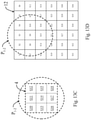
- FIG. 2C is a schematic drawing showing multiple voxels of a MRI slice covered by a region of interest (ROI) on the MRI slice in accordance with an embodiment of the present invention
- FIG. 2D shows a data table in accordance with an embodiment of the present invention
- FIG. 2E shows a planar cylinder transformed from a long cylinder of a biopsied tissue in accordance with an embodiment of the present invention
- FIG. 3A is a schematic drawing showing a circular window and a two-by-two grid array within a square inscribed in the circular window in accordance with an embodiment of the present invention
- FIG. 3B is a schematic drawing showing a circular window and a three-by-three grid array within a square inscribed in the circular window in accordance with an embodiment of the present invention
- FIG. 3C is a schematic drawing showing a circular window and a four-by-four grid array within a square inscribed in the circular window in accordance with an embodiment of the present invention
- FIG. 4 is a flow chart illustrating a computing method of generating or forming a probability map in accordance with an embodiment of the present invention
- FIG. 5 shows a MRI slice showing a prostate, as well as a computation region on the MRI slice, in accordance with an embodiment of the present invention
- FIG. 6A is a schematic drawing showing a circular window moving across a computation region of a MRI slice in accordance with an embodiment of the present invention
- FIG. 6B shows a square inscribed in a circular window having a corner aligned with a corner of a computation region of a MRI slice in accordance with an embodiment of the present invention
- FIG. 7A is a schematic drawing showing multiple voxels of a MRI slice covered by a circular window in accordance with an embodiment of the present invention
- FIG. 7B shows a data table in accordance with an embodiment of the present invention.
- FIG. 8 is a flow chart depicting an algorithm for generating a probability map in accordance with an embodiment of the present invention.
- FIG. 9 shows a computation region defined with nine computation voxels for a probability map in accordance with an embodiment of the present invention.
- FIGS. 10A, 10C, 10E, and 10G show four stops of a circular moving window, each of which includes four non-overlapped small squares, in accordance with an embodiment of the present invention
- FIGS. 10B, 10D, 10F, and 10H show a circular window moving across a computation region defined with nine computation voxels in accordance with an embodiment of the present invention
- FIGS. 11A, 11B, and 11C show initial probabilities for computation voxels, updated probabilities for the computation voxels, and optimal probabilities for the computation voxels, respectively, in accordance with an embodiment of the present invention
- FIG. 12 shows a computation region defined with thirty-six computation voxels for a probability map in accordance with an embodiment of the present invention
- FIGS. 13A, 13C, 13E, 13G, 14A, 14C, 14E, 14G, 15A, 15C, 15E, 15G, 16A, 16C, 16E, and 16G show sixteen stops of a circular moving window, each of which includes nine non-overlapped small squares, in accordance with an embodiment of the present invention
- FIGS. 13B, 13D, 13F, 13H, 14B, 14D, 14F, 14H, 15B, 15D, 15F, 15H, 16B, 16D, 16F, and 16H show a circular window moving across a computation region defined with thirty-six computation voxels in accordance with an embodiment of the present invention
- FIGS. 17A, 17B, and 17C show initial probabilities for computation voxels, updated probabilities for the computation voxels, and optimal probabilities for the computation voxels, respectively, in accordance with an embodiment of the present invention
- FIGS. 18A-18C show three probability maps
- FIG. 18D shows a composite probability image or map
- FIG. 19 shows a MRI slice showing a breast, as well as a computation region on the MRI slice, in accordance with an embodiment of the present invention
- FIGS. 20A-20R show a description of various parameters (“parameter charts” and “biomarker” charts could be used to explain many items that could be included in a big data database, this would include the ontologies, mRNA, next generation sequencing, etc., and exact data in “subset” databases could then be more specific and more easily generated data);
- FIG. 21 is a flow chart depicting a method of evaluating, identifying, or determining the effect of a treatment (e.g., neoadjuvant chemotherapy or minimally invasive treatment of prostate cancer) or a drug used in the treatment on a subject in accordance with an embodiment of the present invention
- a treatment e.g., neoadjuvant chemotherapy or minimally invasive treatment of prostate cancer
- a drug used in the treatment on a subject in accordance with an embodiment of the present invention
- FIG. 22 is a flow chart depicting a method of evaluating, identifying, or determining the effect of a treatment or a drug used in the treatment on a subject in accordance with an embodiment of the present invention
- FIG. 23 is a flow chart depicting a method of evaluating, identifying, or determining the effect of a treatment or a drug used in the treatment on a subject in accordance with an embodiment of the present invention.
- FIG. 24 is a diagram showing two Gaussian curves of two given different groups with respect to parameter measures.
- Computing methods described in the present invention may be performed on any type of image, such as molecular and structural image (e.g., MRI image, CT image, PET image, SPECT image, micro-PET, micro-SPECT, Raman image, or bioluminescence optical (BLO) image), structural image (e.g., CT image or ultrasound image), fluoroscopy image, structure/tissue image, optical image, infrared image, X-ray image, or any combination of these types of images, based on a registered (multi-parametric) image dataset for the image.
- molecular and structural image e.g., CT image, PET image, SPECT image, micro-PET, micro-SPECT, Raman image, or bioluminescence optical (BLO) image
- structural image e.g., CT image or ultrasound image
- fluoroscopy image e.g., structure/tissue image
- optical image e.g., infrared image
- X-ray image e.g., X-ray
- the registered (multi-parametric) image dataset may include multiple imaging data or parameters obtained from one or more modalities, such as MRI, PET, SPECT, CT, fluoroscopy, ultrasound imaging, BLO imaging, micro-PET, micro-SPECT, Raman imaging, structure/tissue imaging, optical imaging, infrared imaging, and/or X-ray imaging.
- the registered (multi-parametric) image dataset may be created by aligning or registering in space all parameters obtained from different times or from various machines. Methods in first, second and third embodiments of the invention may be performed on a MRI image based on the registered (multi-parametric) image dataset, including, e.g., MRI parameters and/or PET parameters, for the MRI image.
- a big data database 70 is created to include multiple data sets, each of which may include: (1) a first set of information data, which may be obtained by a non-invasive method or a less-invasive method (as compared to a method used to obtain the following second set of information data), wherein the first set of data information may include measures for multiple imaging parameters, including, e.g., molecular and structural imaging parameters (such as MRI parameters, CT parameters, PET parameters, SPECT parameters, micro-PET parameters, micro-SPECT parameters, Raman parameters, and/or BLO parameters) and/or other structural imaging data (such as from CT and/or ultrasound images), for a volume and location of a tissue to be biopsied (e.g., prostate or breast) from a subject such as human or animal, (2) combinations each of specific some of the imaging parameters, (3) dimensions related to imaging parameters (e.g., molecular and structural imaging parameters), such as the thickness T of an MRI slice and the size of an MRI voxel
- the imaging parameters in each of the data sets of the big data database 70 may be obtained from different modalities, including two or more of the following: MRI, PET, SPECT, CT, fluoroscopy, ultrasound imaging, BLO imaging, micro-PET, micro-SPECT, and Raman imaging. Accordingly, the imaging parameters in each of the data sets of the big data database 70 may include four or more types of MRI parameters depicted in FIGS.
- the first set of information data may only include a type of imaging parameter (such as T1 mapping).
- each of the imaging parameters (such as T1 mapping) for the tissue to be biopsied may have a measure calculated based on an average of measures, for said each of the imaging parameters, for multiple regions, portions, locations or volumes of interest of multiple registered images (such as MRI slices) registered to or aligned with respective regions, portions, locations or volumes of the tissue to be biopsied, wherein all of the regions, portions, locations or volumes of interest of the registered images may have a total volume covering and substantially equaling the volume of the tissue to be biopsied.
- the number of the registered images for the tissue to be biopsied may be greater than or equal to 2, 5 or 10.
- the biopsied tissue may be long cylinder-shaped with a radius Rn, which is substantially equal to an inner radius of the needle, and a height tT normalized to the thickness T of the MRI slice.
- the volume of the long cylinder-shaped biopsied tissue may be transformed into another shape, which may have a volume the same or about the same as the volume of the long cylinder-shaped biopsied tissue (or Volume of Interest, VOI, which may be ⁇ Rn 2 ⁇ tT), for easy or meaningful computing purposes, for medical instrumentation purposes, or for clearer final data presentation purposes.
- the long cylinder of the biopsied tissue with the radius Rn and height tT may be transformed into a planar cylinder to match the MRI slice thickness T.
- the planar cylinder for example, may have a height equal to the MRI slice thickness T, a radius Rw equal to the radius Rn multiplied by the square root of the number of the registered images, and a volume the same or about the same as the volume of the biopsied tissue, i.e., VOI.
- the radius Rw of the planner cylinder is used to define the size (e.g., the radius Rm) of a moving window MW in calculating a probability map for a patient (e.g., human).
- the volume of the biopsied tissue, i.e., VOI, for each of the data sets may be substantially equal to the volume of the moving window MW to be used in calculating probability maps.
- the volume of the biopsied tissue, i.e., VOI defines the size of the moving window MW to be used in calculating probability maps.
- the moving window MW may be determined with the radius Rm, perpendicular to a thickness of the moving window MW, based on the statistical distribution or average of the radii Rw (calculated from multiple VOIs) associated with a subset data (e.g., the following subset data DB- 1 or DB- 2 ) from the big data database 70 .
- a subset data e.g., the following subset data DB- 1 or DB- 2
- the tissue-based information in each of the data sets of the big data database 70 may include (1) a biopsy result, data, information (i.e., pathologist diagnosis, for example cancer or no cancer) for the biopsied tissue, (2) mRNA data or expression patterns, (3) DNA data or mutation patterns (including that obtained from next generation sequencing), (4) ontologies, (5) biopsy related feature size or volume (including the radius Rn of the biopsied tissue, the volume of the biopsied tissue (i.e., VOI), and/or the height tT of the biopsied tissue), and (6) other histological and biomarker findings such as necrosis, apoptosis, percentage of cancer, increased hypoxia, vascular reorganization, and receptor expression levels such as estrogen, progesterone, HER2, and EPGR receptors.
- information i.e., pathologist diagnosis, for example cancer or no cancer
- DNA data or mutation patterns including that obtained from next generation sequencing
- ontologies (5) biopsy related feature size or volume (including the radius
- each of the data sets may include specific long chain mRNA biomarkers from next generation sequencing that are predictive of metastasis-free survival, such as HOTAIR, RP11-278 L15.2-001, LINC00511-009, AC004231.2-001.
- the clinical data in each of the data sets of the big data database 70 may include the timing of treatment, demographic data (e.g., age, sex, race, weight, family type, and residence of the subject), and TNM staging depicted in, e.g., FIGS. 20N and 20O or FIGS. 20P, 20Q and 20R .
- Each of the data sets of the big data database 70 may further include information regarding neoadjuvant chemotherapy and/or information regarding (preoperative) radiation therapy.
- Imaging protocol details such as MRI magnet strength, pulse sequence parameters, PET dosing, time at PET imaging, may also be included in the big data database 70 .
- the information regarding (preoperative) radiation therapy may include the type of radiation, the strength of radiation, the total dose of radiation, the number of fractions (depending on the type of cancer being treated), the duration of the fraction from start to finish, the dose of the fraction, the duration of the preoperative radiation therapy from start to finish, and the type of machine used for the preoperative radiation therapy.
- the information regarding neoadjuvant chemotherapy may include the given drug(s), the number of cycles (i.e., the duration of the neoadjuvant chemotherapy from start to finish), the duration of the cycle from start to finish, and the frequency of the cycle.
- Data of interest are selected from the big data database 70 into a subset, used to build a classifier CF.
- the subset from the big data database 70 may be selected for a specific application, such as prostate cancer, breast cancer, breast cancer after neoadjuvant chemotherapy, or prostate cancer after radiation.
- the subset may include data in a tissue-based or biopsy-based subset data DB- 1 .
- the subset may include data in a tissue-based or biopsy-based subset data DB- 2 .
- the classifier CF may be constructed or created based on a first group associated with a first data type or feature (e.g., prostate cancer or breast cancer) in the subset, a second group associated with a second data type or feature (e.g., non-prostate cancer or non-breast cancer) in the subset, and some or all of the variables in the subset associated with the first and second groups.
- a first data type or feature e.g., prostate cancer or breast cancer
- a second group associated with a second data type or feature e.g., non-prostate cancer or non-breast cancer
- the classifier CF for an event such as the first data type or feature
- the event may be a biopsy-diagnosed tissue characteristic, such as having specific cancerous cells, or occurrence of prostate cancer or breast cancer.
- a probability map composed of multiple computation voxels with the same size, is generated or constructed for, e.g., evaluating or determining the health status of a patient (e.g., human subject), the physical condition of an organ or other structure inside the patient's body, or the patient's progress and therapeutic effectiveness by the steps described below.
- a patient e.g., human subject
- an image of the patient is obtained by a device or system, such as MRI system.
- the image of the patient for example, may be a molecular image (e.g., MRI image, PET image, SPECT image, micro-PET image, micro-SPECT image, Raman image, or BLO image) or other suitable image (e.g., CT image or ultrasound image).
- the size of the computation voxel which becomes the basic unit of the probability map, is defined.
- the biggest square inscribed in the moving window MW is then defined.
- the biggest square inscribed in the moving window MW is divided into n 2 small squares, i.e., cubes, each having a width Wsq, where n is an integer, such as 2, 3, 4, 5, 6, or more than 6.
- the divided squares define the size and shape of the computation voxels in the probability map for the image of the patient.
- each of the computation voxels of the probability map may be defined as a square, i.e., cube, having the width Wsq and a volume the same or about the same as that of each of the divided squares.
- the moving window MW may move across the image of the patient at a regular step or interval of a fixed distance, e.g., substantially equal to the width Wsq (i.e., the width of the computation voxels), in the x and y directions.
- a stop of the moving window MW overlaps the neighboring stop of the moving window MW.
- the biggest square inscribed in the moving window MW may be divided into n rectangles each having a width Wrec and a length Lrec, where n is an integer, such as 2, 3, 4, 5, 6, 7, 8, or more than 8.
- the divided rectangles define the size and shape of the computation voxels in the probability map for the image of the patient.
- Each of the computation voxels of the probability map may be a rectangle having the width Wrec, the length Lrec, and a volume the same or about the same as that of each of the divided rectangles.
- the moving window MW may move across the patient's molecular image at a regular step or interval of a fixed distance, e.g., substantially equal to the width Wrec (i.e., the width of the computation voxels), in the x direction and at a regular step or interval of a fixed distance, e.g., substantially equal to the length Lrec (i.e., the length of the computation voxels), in the y direction.
- a stop of the moving window MW overlaps the neighboring stop of the moving window MW.
- each of the stops of the moving window MW may have a width, length or diameter less than the side length (e.g., the width or length) of voxels in the image of the patient.
- the stepping of the moving window MW and the overlapping between two neighboring stops of the moving window MW can then be determined.
- Measures of specific imaging parameters for each stop of the moving window MW may be obtained from the patient's image and/or different parameter maps (e.g., MRI parameter map(s), PET parameter map(s) and/or CT parameter map(s)) registered to the patient's image.
- the specific imaging parameters may include two or more of the following: MRI parameters, PET parameters, SPECT parameters, micro-PET parameters, micro-SPECT parameters, Raman parameters, BLO parameters, CT parameters, and ultrasound imaging parameters.
- Each of the specific imaging parameters for each stop of the moving window MW may have a measure calculated based on an average of measures, for said each of the specific imaging parameters, for voxels of the patient's image inside said each stop of the moving window MW. In the case that some voxels of the patient's image only partially inside that stop of the moving window MW, the average can be weighed by the area proportion.
- the specific imaging parameters of different modalities may be obtained from registered image sets (or registered parameter maps), and rigid and nonrigid standard registration techniques may be used to get each section of anatomy into the same exact coordinate location on each of the registered (multi-parametric) image dataset.
- a registered (multi-parametric) image dataset may be created for the patient to include multiple registered images (including two or more of the following: MRI slice images, PET images, SPECT images, micro-PET images, micro-SPECT images, Raman images, BLO images, CT images, and ultrasound images) and/or corresponding imaging parameters (including two or more of the following: MRI parameters, PET parameters, SPECT parameters, micro-PET parameters, micro-SPECT parameters, Raman parameters, BLO parameters, CT parameters, and/or ultrasound imaging parameters) obtained from various equipment, machines, or devices or from a defined time-point (e.g., specific date) or time range (e.g., within five days after treatment).
- MRI slice images including two or more of the following: MRI slice images, PET images, SPECT images, micro-PET images, micro-SPECT images, Raman images, BLO images, CT images, and ultrasound images
- corresponding imaging parameters including two or more of the following: MRI parameters, PET parameters, SPECT parameters, micro-PET parameters,
- Each of the imaging parameters in the patient's registered (multi-parametric) image dataset requires alignment or registration.
- the registration can be done by, for examples, using unique anatomical marks, structures, tissues, geometry, and/or shapes or using mathematical algorithms and computer pattern recognition.
- the measures of the specific imaging parameters for each stop of the moving window MW may be obtained from the registered (multi-parametric) image dataset for the patient.
- the specific imaging parameters for each stop of the moving window MW may be reduced using, e.g., subset selection, aggregation, and dimensionality reduction into a parameter set for said each stop of the moving window MW.
- the parameter set includes measures for independent imaging parameters.
- the imaging parameters used in the parameter set may have multiple types, such as two types, more than two types, more than three types, or more than four types, independent from each other or one another, or may have a single type.
- the imaging parameters used in the parameter set may include (a) MRI parameters and PET parameters, (b) MRI parameters and SPET parameters, (c) MRI parameters and CT parameters, (d) MRI parameters and ultrasound imaging parameters, (e) Raman imaging parameters and CT parameters, (f) Raman imaging parameters and ultrasound imaging parameters, (g) MRI parameters, PET parameters, and ultrasound imaging parameters, or (h) MRI parameters, PET parameters, and CT parameters.
- the parameter set for each stop of the moving window MW is matched to the classifier CF to obtain a probability PW of the event for said each stop of the moving window MW.
- an algorithm is performed based on the probabilities PWs of the event for the stops of the moving window MW to compute probabilities of the event for the computation voxels, as mentioned in the following steps ST 1 -ST 11 .
- a first probability PV 1 for each of the computation voxels for example, may be calculated or assumed based on an average of the probabilities PWs of the event for the stops of the moving window MW overlapping or covering said each of the computation voxels.
- a first probability guess PG 1 for each stop of the moving window MW is calculated by averaging the first probabilities PV 1 s (obtained in the step ST 1 ) of all the computation voxels inside said each stop of the moving widow MW.
- a first comparison is performed to determine whether an absolute value of the first difference DW 1 for each stop of the moving window MW is less than or equal to a preset threshold error. If any one of the absolute values of all the first differences DW 1 s is greater than the preset threshold error, the step ST 5 continues. If the absolute values of all the first differences DW 1 s are less than or equal to the preset threshold error, the step ST 11 continues.
- a first error correction factor (ECF 1 ) for each of the computation voxels is calculated by, e.g., summing error correction contributions from the stops of the moving window MW overlapping or covering said each of the computation voxels.
- each of the error correction contributions to said one of the computation voxels is calculated by obtaining an area ratio of an overlapped area between said one of the computation voxels and a corresponding one of the four stops to an area of the biggest square inscribed in the corresponding one of the four stops, and then multiplying the first difference DW 1 for the corresponding one of the four stops by the area ratio.
- a second probability guess PG 2 for each stop of the moving window MW is calculated by averaging the second probabilities PV 2 s (obtained in the step ST 6 ) of all the computation voxels inside said each stop of the moving widow MW.
- a second comparison is performed to determine whether an absolute value of the second difference DW 2 for each stop of the moving window MW is less than or equal the preset threshold error.
- step ST 10 If any one of the absolute values of all the second differences DW 2 s is greater than the preset threshold error, the step ST 10 continues. If the absolute values of all the second differences DW 2 s are less than or equal to the preset threshold error, the step ST 11 continues.
- step ST 10 the steps ST 5 -ST 9 are repeated or iterated, using the newly obtained the n th difference DWn between the n th probability guess PGn and the probability PW of the event for each stop of the moving window MW for calculation in the (n+1) th iteration, until an absolute value of the (n+1) th difference DW(n+1) for each stop of the moving window MW is equal to or less than the preset threshold error (Note: PV 1 , PG 1 and DW 1 for the first iteration, ECF 1 , PV 2 , PG 2 and DW 2 for the second iteration, and ECF(n ⁇ 1), PVn, PGn and DWn for the n th iteration).
- the preset threshold error Note: PV 1 , PG 1 and DW 1 for the first iteration, ECF 1 , PV 2 , PG 2 and DW 2 for the second iteration, and ECF(n ⁇ 1), PVn, PGn and DWn for
- the first probabilities PV 1 s in the first iteration i.e., the steps ST 1 -ST 4
- the second probabilities PV 2 s in the second iteration i.e., the steps ST 5 -ST 9
- the (n+1) th probabilities PV(n+1)s in the (n+1) th iteration i.e., the step ST 10
- the probability map is used to form the probability map.
- the probabilities of the event for the computation voxels are obtained using the above method, procedure or algorithm, based on the overlapped stops of the moving window MW, to form the probability map of the event for the image (e.g., patient's MRI slice) for the patient having imaging information (e.g., molecular imaging information).
- the above process is performed to generate the moving window MW across the image in the x and y directions to create a two-dimensional (2D) probability map.
- 2D two-dimensional
- 3D three-dimensional
- the tissue-based or biopsy-based subset data DB- 1 from the big data database 70 includes multiple data sets each listed in the corresponding one of its rows 2 through N, wherein the number of the data sets may be greater than 100, 1,000 or 10,000.
- Each of the data sets in the subset data DB- 1 may include: (1) measures for MRI parameters associated with a prostate biopsy tissue (i.e., biopsied sample of the prostate) obtained from a subject (e.g., human), as shown in columns A-O; (2) measures for processed parameters associated with the prostate biopsy tissue, as shown in columns P and Q; (3) a result or pathologist diagnosis of the prostate biopsy tissue, such as prostate cancer, normal tissue, or benign condition, as shown in a column R; (4) sample characters associated with the prostate biopsy tissue, as shown in columns S-X; (5) MRI characters associated with MRI slices registered to respective regions, portions, locations or volumes of the prostate biopsy tissue, as shown in columns Y, Z and AA; (6) clinical or pathology parameters associated with the prostate biopsy tissue or the subject, as shown in columns AB-AN; and (7) personal information associated with the subject, as shown in columns AO-AR.
- a prostate biopsy tissue i.e., biopsied sample of the prostate
- Needles used to obtain the prostate biopsy tissues may have the same cross-sectional shape (e.g., round shape or square shape) and the same inner diameter or width, e.g., ranging from, equal to or greater than 0.1 millimeters up to, equal to or less than 5 millimeters, and more preferably ranging from, equal to or greater than 1 millimeter up to, equal to or less than 3 millimeters.
- the same cross-sectional shape e.g., round shape or square shape
- the same inner diameter or width e.g., ranging from, equal to or greater than 0.1 millimeters up to, equal to or less than 5 millimeters, and more preferably ranging from, equal to or greater than 1 millimeter up to, equal to or less than 3 millimeters.
- the MRI parameters in the columns A-O of the subset data DB- 1 are T1 mapping, T2 raw signal, T2 mapping, delta Ktrans ( ⁇ Ktrans), tau, Dt IVIM, fp IVIM, ADC (high b-values), nADC (high b-values), R*, Ktrans from Tofts Model (TM), Ktrans from Extended Tofts Model (ETM), Ktrans from Shutterspeed Model (SSM), Ve from TM, and Ve from SSM.
- the processed parameter in the column P of the subset data DB- 1 is average Ve, obtained by averaging Ve from TM and Ve from SSM.
- the processed parameter in the column Q of the subset data DB- 1 is average Ktrans, obtained by averaging Ktrans from TM, Ktrans from ETM, and Ktrans from SSM. All data can have normalized values, such as z scores.
- Measures in the respective columns T, U and V of the subset data DB- 1 are Gleason scores associated with the respective prostate biopsy tissues and primary and secondary Gleason grades associated with the Gleason scores; FIG. 20L briefly explains Gleason score, the primary Gleason grade, and the secondary Gleason grade.
- Measures in the column W of the subset data DB- 1 may be the diameters of the prostate biopsy tissues, and the diameter of each of the prostate biopsy tissues may be substantially equal to an inner diameter of a cylinder needle, through which a circular or round hole passes for receiving said each of the prostate biopsy tissues.
- measures in the column W of the subset data DB- 1 may be the widths of the prostate biopsy tissues, and the width of each of the prostate biopsy tissues may be substantially equal to an inner width of a needle, through which a square or rectangular hole passes for receiving said each of the prostate biopsy tissues.
- the clinical or pathology parameters in the columns AB-AN of the subset data DB- 1 are prostate specific antigen (PSA), PSA velocity, % free PSA, Histology subtype, location within a given anatomical structure of gland, tumor size, PRADS, pathological diagnosis (e.g., Atypia, benign prostatic hypertrophy (BPH), prostatic intraepithelial neoplasia (PIN), or Atrophy), pimonidazole immunoscore (hypoxia marker), pimonidazole genescore (hypoxia marker), primary tumor (T), regional lymph nodes (N), and distant metastasis (M).
- PSA prostate specific antigen
- PSA velocity PSA velocity
- % free PSA Histology subtype
- location within a given anatomical structure of gland tumor size
- PRADS pathological diagnosis
- pathological diagnosis e.g., Atypia, benign prostatic hypertrophy (BPH), prostatic intraepithelial neoplasia (PIN
- each of the data sets in the subset data DB- 1 may further include risk factors for cancer associated with the subject, such as smoking history, sun exposure, premalignant lesions, gene information or data, etc.
- Each of the data sets in the subset data DB- 1 may also include imaging protocol details, such as MRI magnet strength, and pulse sequence parameters, and/or information regarding (preoperative) radiation therapy, including the type of radiation, the strength of radiation, the total dose of radiation, the number of fractions (depending on the type of cancer being treated), the duration of the fraction from start to finish, the dose of the fraction, the duration of the preoperative radiation therapy from start to finish, and the type of machine used for the preoperative radiation therapy.
- a post-therapy data or information for prostate cancer may also be included in the subset data DB- 1 .
- data regarding ablative minimally invasive techniques or radiation treatments (care for early prostate cancer or post surgery), imaging data or information following treatment, and biopsy results following treatment are included in the subset data DB- 1 .
- data in the column W of the subset data DB- 1 are various diameters; data in the column X of the subset data DB- 1 are various lengths; data in the column Y of the subset data DB- 1 are the various numbers of MRI slices registered to respective regions, portions, locations or volumes of a prostate biopsy tissue; data in the column Z of the subset data DB- 1 are various MRI area resolutions; data in the column AA of the subset data DB- 1 are various MRI slice thicknesses.
- the diameters of all the prostate biopsy tissues in the column W of the subset data DB- 1 may be the same; the lengths of all the prostate biopsy tissues in the column X of the subset data DB- 1 may be the same; all the data in the column Y of the subset data DB- 1 may be the same; all the data in the column Z of the subset data DB- 1 may be the same; all the data in the column AA of the subset data DB- 1 may be the same.
- the tissue-based or biopsy-based subset data DB- 2 from the big data database 70 includes multiple data sets each listed in the corresponding one of its rows 2 through N, wherein the number of the data sets may be greater than 100, 1,000 or 10,000.
- Each of the data sets in the subset data DB- 2 may include: (1) measures for MRI parameters associated with a breast biopsy tissue (i.e., biopsied sample of the breast) obtained from a subject (e.g., human or animal model), as shown in columns A-O, R, and S; (2) measures for processed parameters associated with the breast biopsy tissue, as shown in columns P and Q; (3) features of breast tumors associated with the breast biopsy tissue, as shown in columns T-Z; (4) a result or pathologist diagnosis of the breast biopsy tissue, such as breast cancer, normal tissue, or benign condition, as shown in a column AA; (5) sample characters associated with the breast biopsy tissue, as shown in columns AB-AD; (6) MRI characters associated with MRI slices registered to respective regions, portions, locations or volumes of the breast biopsy tissue, as shown in columns AE-AG; (7) a PET parameter (e.g., maximum standardized uptake value (SUVmax) depicted in FIG.
- a PET parameter e.g., maximum standardized uptake value (
- Needles used to obtain the breast biopsy tissues may have the same cross-sectional shape (e.g., round shape or square shape) and the same inner diameter or width, e.g., ranging from, equal to or greater than 0.1 millimeters up to, equal to or less than 5 millimeters, and more preferably ranging from, equal to or greater than 1 millimeter up to, equal to or less than 3 millimeters.
- an intra-operative incisional biopsy tissue sampling may be performed by a surgery to obtain the breast biopsy.
- Intraoperative magnetic resonance imaging (iMRI) may be used for obtaining a specific localization of the breast biopsy tissue to be biopsied during the surgery.
- the MRI parameters in the columns A-O, R, and S of the subset data DB- 2 are T1 mapping, T2 raw signal, T2 mapping, delta Ktrans ( ⁇ Ktrans), tau, Dt IVIM, fp IVIM, ADC (high b-values), R*, Ktrans from Tofts Model (TM), Ktrans from Extended Tofts Model (ETM), Ktrans from Shutterspeed Model (SSM), Ve from TM, Ve from SSM, kep from Tofts Model (TM), kep from Shutterspeed Model (SSM), and mean diffusivity (MD) from diffusion tensor imaging (DTI).
- T1 mapping T2 raw signal
- T2 mapping delta Ktrans ( ⁇ Ktrans), tau, Dt IVIM, fp IVIM, ADC (high b-values), R*, Ktrans from Tofts Model (TM), Ktrans from Extended Tofts Model (ETM), Ktrans from Shutterspeed Model (SSM), Ve from TM, Ve from SSM,
- the processed parameter in the column P of the subset data DB- 2 is average Ve, obtained by averaging Ve from TM and Ve from SSM.
- the processed parameter in the column Q of the subset data DB- 2 is average Ktrans, obtained by averaging Ktrans from TM, Ktrans from ETM, and Ktrans from SSM.
- the features of breast tumors may be extracted from breast tumors with dynamic contrast-enhanced (DCE) MR image.
- DCE dynamic contrast-enhanced
- Measures in the column AC of the subset data DB- 2 may be the diameters of the breast biopsy tissues, and the diameter of each of the breast biopsy tissues may be substantially equal to an inner diameter of a cylinder needle, through which a circular or round hole passes for receiving said each of the breast biopsy tissues.
- the measures in the column AC of the subset data DB- 2 may be the widths of the breast biopsy tissues, and the width of each of the breast biopsy tissues may be substantially equal to an inner width of a needle, through which a square or rectangular hole passes for receiving said each of the breast biopsy tissues.
- the clinical or pathology parameters in the columns AI-AT of the subset data DB- 2 are estrogen hormone receptor positive (ER+), progesterone hormone receptor positive (PR+), HER2/neu hormone receptor positive (HER2/neu+), immunohistochemistry subtype, path, BIRADS, Oncotype DX score, primary tumor (T), regional lymph nodes (N), distant metastasis (M), tumor size, and location.
- ER+ estrogen hormone receptor positive
- PR+ progesterone hormone receptor positive
- HER2/neu hormone receptor positive HER2/neu+
- immunohistochemistry subtype path
- path BIRADS
- Oncotype DX score Oncotype DX score
- T primary tumor
- N regional lymph nodes
- M distant metastasis
- tumor size and location.
- each of the data sets in the subset data DB- 2 may further include specific long chain mRNA biomarkers from next generation sequencing that are predictive of metastasis-free survival, such as HOTAIR, RP11-278 L15.2-001, LINC00511-009, and AC004231.2-001.
- Each of the data sets in the subset data DB- 2 may also include risk factors for cancer associated with the subject, such as smoking history, sun exposure, premalignant lesions, gene information or data, etc.
- Each of the data sets in the subset data DB- 2 may also include imaging protocol details, such as MRI magnet strength, pulse sequence parameters, PET dosing, time at PET imaging, etc.
- data in the column AC of the subset data DB- 2 are various diameters; data in the column AD of the subset data DB- 2 are various lengths; data in the column AE of the subset data DB- 2 are the various numbers of MRI slices registered to respective regions, portions, locations or volumes of a breast biopsy tissue; data in the column AF of the subset data DB- 2 are various MRI area resolutions; data in the column AG of the subset data DB- 2 are various MRI slice thicknesses.
- the diameters of all the breast biopsy tissues in the column AC of the subset data DB- 2 may be the same; the lengths of all the breast biopsy tissues in the column AD of the subset data DB- 2 may be the same; all the data in the column AE of the subset data DB- 2 may be the same; all the data in the column AF of the data DB- 2 may be the same; all the data in the column AG of the subset data DB- 2 may be the same.
- a similar subset data like the subset data DB- 1 or DB- 2 may be established from the big data database 70 for generating probability maps for brain cancer, liver cancer, lung cancer, rectal cancer, sarcomas, cervical cancer, or cancer metastasis to any organ such as liver, bone, and brain.
- the subset data may include multiple data sets, each of which may include: (1) measures for MRI parameters (e.g., those in the columns A-O, R, and S of the subset data DB- 2 ) associated with a biopsy tissue (e.g., biopsied brain sample, biopsied liver sample, biopsied lung sample, biopsied rectal sample, biopsied sarcomas sample, or biopsied cervix sample) obtained from a subject (e.g., human); (2) processed parameters (e.g., those in the columns P and Q of the subset data DB- 2 ) associated with the biopsy tissue; (3) a result or pathologist diagnosis of the biopsy tissue, such as cancer, normal tissue, or benign condition; (4) sample characters (e.g., those in the columns S-X of the subset data DB- 1 ) associated with the biopsy tissue; (5) MRI characters (e.g., those in the columns Y, Z and AA of the subset data DB- 1 ) associated with
- CT parameters e.g., HU and Hetwave
- clinical or pathology parameters e.g., those in the columns AB-AN of the subset data DB- 1 or the columns AI-AT of the subset data DB- 2
- personal information e.g., those in the columns AO-AR of the subset data DB- 1 ) associated with the subject.
- a biopsy tissue or sample 90 such as any one of the biopsied tissues provided for the pathologist diagnosis depicted in the big data database 70 , any one of the prostate biopsy tissues provided for the pathologist diagnosis depicted in the subset data DB- 1 , or any one of the breast biopsy tissues provided for the pathologist diagnosis depicted in the subset data DB- 2 , may be obtained from a subject (e.g., human) by core needle biopsy, such as MRI-guided needle biopsy.
- core needle biopsy such as MRI-guided needle biopsy.
- an intra-operative incisional biopsy tissue sampling may be performed by a surgery to obtain the biopsy tissue 90 from the subject.
- fiducial markers that could be seen on subsequent imaging may be placed during the surgery to match tissues or identify positions of various portions of an organ with respect to the one or more fiducial markers.
- the fiducial marker is an object placed in the field of view of an imaging system which appears in the image produced, for use as a point of reference or a measure.
- the core needle biopsy is a procedure used to determine whether an abnormality or a suspicious area of an organ (e.g., prostate or breast) is a cancer, a normal tissue, or a benign condition or to determine any other tissue characteristic such as mRNA expression, receptor status, and molecular tissue characteristics.
- an organ e.g., prostate or breast
- a benign condition e.g., a cancer, a normal tissue, or a benign condition or to determine any other tissue characteristic such as mRNA expression, receptor status, and molecular tissue characteristics.
- MR magnetic resonance
- parallel MRI slices SI 1 through SI N registered to multiple respective regions, portions, locations or volumes of the tissue 90 may be obtained.
- the number of the registered MRI slices SI 1 -SI N may range from, equal to or greater than 2 up to, equal to or less than 10.
- the registered MRI slices SI 1 -SI N may have the same slice thickness T, e.g., ranging from, equal to or greater than 1 millimeter up to, equal to or less than 10 millimeters, and more preferably ranging from, equal to or greater than 3 millimeters up to, equal to or less than 5 millimeters.
- the biopsy tissue 90 obtained from the subject by the cylinder needle may be long cylinder-shaped with a height tT normalized to the slice thickness T and with a circular cross section perpendicular to its axial direction AD, and the circular cross section of the biopsy tissue 90 may have a diameter D 1 , perpendicular to its height tT extending along the axial direction AD, ranging from, equal to or greater than 0.5 millimeters up to, equal to or less than 4 millimeters.
- the diameter D 1 of the biopsy tissue 90 may be substantially equal to an inner diameter of the cylinder needle, through which a circular or round hole passes for receiving the biopsy tissue 90 .
- the axial direction AD of the tissue 90 to be biopsied may be parallel with the slice thickness direction of each of the MRI slices SI 1 -SI N .
- each of the MRI slices SI 1 -SI N may have an imaging plane 92 perpendicular to the axial direction AD of the tissue 90 to be biopsied, wherein an area of the imaging plane 92 is a side length W 1 multiplied by another side length W 2 .
- the MRI slices SI 1 -SI N may have the same area resolution, which is a field of view (FOV) of one of the MRI slices SI 1 -SI N (i.e., the area of its imaging plane 92 ) divided by the number of all voxels in the imaging plane 92 of said one of the MRI slices SI 1 -SI N .
- FOV field of view
- Regions, i.e., portions, locations or volumes, of interest (ROIs) 94 of the respective MRI slices SI 1 -SI N are registered to and aligned with the respective regions, portions, locations or volumes of the biopsy tissue 90 to determine or calculate measures of MRI parameters for the regions, portions, locations or volumes of the biopsy tissue 90 .
- the ROIs 94 of the MRI slices SI 1 -SI N may have the same diameter, substantially equal to the diameter D 1 of the biopsy tissue 90 , i.e., the inner diameter of the needle for taking the biopsy tissue 90 , and may have a total volume covering and substantially equaling the volume of the biopsy tissue 90 . As shown in FIG.
- the ROI 94 of each of the MRI slices SI 1 -SI N may cover or overlap multiple voxels, e.g., 96 a through 96 f .
- a MRI parameter (e.g., T1 mapping) for the ROI 94 of each of the MRI slices SI 1 -SI N may be measured by summing values of the MRI parameter for the voxels 96 a - 96 f in said each of the MRI slices SI 1 -SI N weighed or multiplied by the respective percentages of areas A 1 , A 2 , A 3 , A 4 , A 5 and A 6 , overlapping with the respective voxels 96 a - 96 f in the ROI 94 of said each of the MRI slices SI 1 -SI N , occupying the ROI 94 of said each of the MRI slices SI 1 -SI N .
- the MRI parameter for the whole biopsy tissue 90 may be measured by dividing the sum of measures for the MRI parameter for the ROIs 94 of the MRI slices SI 1 -SI N by the number of the MRI slices SI 1 -SI N .
- other MRI parameters e.g., those in the columns B-O of the subset data DB- 1 or those in the columns B-O, R and S of the subset data DB- 2 .
- the measures for the various MRI parameters (e.g., T1 mapping, T2 raw signal, T2 mapping, etc.) for the ROI 94 of each of the MRI slices SI 1 -SI N may be derived from different parameter maps registered to the corresponding region, portion, location or volume of the biopsy tissue 90 .
- the measures for some of the MRI parameters for the ROT 94 of each of the MRI slices SI 1 -SI N may be derived from different parameter maps registered to the corresponding region, portion, location or volume of the biopsy tissue 90
- the measures for the others may be derived from the same parameter map registered to the corresponding region, portion, location or volume of the biopsy tissue 90 .
- the aforementioned method for measuring the MRI parameters for the whole biopsy tissue 90 can be applied to each of the MRI parameters in the big data database 70 and the subset data DB- 1 and DB- 2 .
- T1 mapping in the case of (1) four MRI slices SI 1 -SI 4 having four respective regions, portions, locations or volumes registered to respective quarters of the biopsy tissue 90 and (2) the ROI 94 of each of the MRI slices SI 1 -SI 4 covering or overlapping the six voxels 96 a - 96 f , values of T1 mapping for the voxels 96 a - 96 f in each of the MRI slices SI 1 -SI 4 and the percentages of the areas A 1 -A 6 occupying the ROT 94 of each of the MRI slices SI 1 -SI 4 are assumed as shown in FIG. 2D .
- a measure of T1 mapping for the ROI 94 of the MRI slice SI 1 may be obtained or calculated by summing (1) the value, i.e., 1010, for the voxel 96 a multiplied by the percentage, i.e., 6%, of the area A 1 , overlapping with the voxel 96 a in the ROI 94 of the MRI slice SI 1 , occupying the ROI 94 of the MRI slice SI 1 , (2) the value, i.e., 1000, for the voxel 96 b multiplied by the percentage, i.e., 38%, of the area A 2 , overlapping with the voxel 96 b in the ROI 94 of the MRI slice SI 1 , occupying the ROT 94 of the MRI slice SI 1 , (3) the value, i.e., 1005, for the voxel 96 c multiplied by the percentage, i.e.,
- T1 mapping for the ROIs 94 of the MRI slices SI 2 , SI 3 , and SI 4 i.e., 1006.94, 1022, and 1015.4, are obtained or measured.
- T1 mapping for the whole biopsy tissue 90 i.e., 1013.745, is obtained or measured by dividing the sum, i.e., 4054.98, of T1 mapping for the ROIs 94 of the MRI slices SI 1 -SI 4 by the number of the MRI slices SI 1 -SI 4 , i.e., 4.
- the volume of the long cylinder-shaped biopsied tissue 90 may be transformed into another shape, which may have a volume the same or about the same as the volume of the long cylinder-shaped biopsied tissue 90 (or Volume of Interest (VOI), which may be ⁇ Rn 2 ⁇ tT, where Rn is the radius of the biopsied tissue 90 , and tT is the height of the biopsied tissue 90 ), for easy or meaningful computing purposes, for medical instrumentation purposes, or for clearer final data presentation purposes.
- VI Volume of Interest
- the long cylinder of the biopsied tissue 90 with the radius Rn and height tT may be transformed into a planar cylinder 98 to match the slice thickness T.
- the height tT of the biopsy tissue 90 may be substantially equal to the slice thickness T multiplied by the number of the MRI slices SI 1 -SI N .
- the height pT of the planar cylinder 98 is substantially equal to the slice thickness T, for example.
- the planar cylinder 98 may have the height pT equal to the slice thickness T and the radius Rw equal to the radius Rn multiplied by the square root of the number of the registered MRI slices SI 1 -SI N .
- the radius Rw of the planner cylinder 98 may be used to define the radius Rm of a moving window MW in calculating probability maps, e.g., illustrated in first through sixth embodiments, for a patient (e.g., human).
- Each of the biopsy tissue 90 , the planar cylinder 98 and the moving window MW may have a volume at least 2, 3, 5, 10 or 15 times greater than that of each voxel of the MRI slices SI 1 -SI N and than that of each voxel of an MRI image 10 from a subject (e.g., patient) depicted in a step S 1 of FIG. 4 .
- the measures of the MRI parameters for the whole biopsy tissue 90 may be considered as those for the planar cylinder 98 .
- each of biopsy tissues provided for pathologist diagnoses in a subset data, e.g., DB- 1 or DB- 2 , of the big data database 70 may have a corresponding planar cylinder 98 with its radius Rw, and data (such as pathologist diagnosis and measures of imaging parameters) for said each of the biopsy tissues in the subset data, e.g., DB- 1 or DB- 2 , of the big data database 70 may be considered as those for the corresponding planar cylinder 98 .
- the moving window MW may be determined with the radius Rm, perpendicular to a thickness of the moving window MW, based on the statistical distribution or average of the radii Rw of the planar cylinders 98 transformed from the volumes of the biopsy tissues provided for the pathologist diagnoses in the subset data, e.g., DB- 1 or DB- 2 , of the big data database 70 .
- each of the biopsy tissues provided for the pathologist diagnoses in the subset data, e.g., DB- 1 or DB- 2 , of the big data database 70 may have a volume, i.e., VOI, substantially equal to the volume of the moving window MW to be used in calculating one or more probability maps.
- the volume of the biopsy tissue i.e., VOI, defines the size (e.g., the radius Rm) of the moving window MW to be used in calculating one or more probability maps.
- Each of the prostate biopsy tissues provided for the pathologist diagnoses in the subset data DB- 1 may be referred to the illustration of the biopsy tissue 90 .
- the diameter of each of the prostate biopsy tissues may be referred to the illustration of the diameter D 1 of the biopsy tissue 90 .
- the MRI slices registered to the respective regions, portions, locations or volumes of each of the prostate biopsy tissues provided for the pathologist diagnoses in the subset data DB- 1 may be referred to the illustration of the MRI slices SI 1 -SI N registered to the respective regions, portions, locations or volumes of the biopsy tissue 90 .
- the measures of the MRI parameters for each of the prostate biopsy tissues, i.e., for each of the corresponding planar cylinders 98 , in the respective columns A-O of the subset data DB- 1 may be calculated as the measures of the MRI parameters for the whole biopsy tissue 90 , i.e., for the planar cylinder 98 transformed from the volume of the biopsy tissue 90 , are calculated.
- the MRI slices registered to the respective regions, portions, locations or volumes of each of the prostate biopsy tissues may have the same area resolution, which may be referred to the illustration of the area resolution of the MRI slices SI 1 -SI N registered to the respective regions, portions, locations or volumes of the biopsy tissue 90 .
- the MRI slices registered to the respective regions, portions, locations or volumes of each of the prostate biopsy tissues may have the same slice thickness, which may be referred to the illustration of the slice thickness T of the MRI slices SI 1 -SI N .
- the percentage of cancer for the whole volume of the prostate biopsy tissue in each of all or some of the data sets may be replaced by the percentage of cancer for a partial volume of the prostate biopsy tissue; a MRI slice is imaged for and registered to the partial volume of the prostate biopsy tissue.
- the MRI parameters, in the columns A-O of the subset data DB- 1 , that are in said each of all or some of the data sets are measured for a ROT of the MRI slice registered to the partial volume of the prostate biopsy tissue.
- the ROI of the MRI slice covers or overlaps multiple voxels in the MRI slice, and each of the MRI parameters for the ROI of the MRI slice may be measured by summing values of said each of the MRI parameters for the voxels weighed or multiplied by respective percentages of areas, overlapping with the respective voxels in the ROI of the MRI slice, occupying the ROT of the MRI slice.
- Measures for the MRI parameters for the ROI of the MRI slice may be derived from different parameter maps registered to the partial volume of the prostate biopsy tissue.
- the measures for some of the MRI parameters for the ROI of the MRI slice may be derived from different parameter maps registered to the partial volume of the prostate biopsy tissue, and the measures for the others may be derived from the same parameter map registered to the partial volume of the prostate biopsy tissue.
- Each of the breast biopsy tissues provided for the pathologist diagnoses in the subset data DB- 2 may be referred to the illustration of the biopsy tissue 90 .
- the diameter of each of the breast biopsy tissues may be referred to the illustration of the diameter D 1 of the biopsy tissue 90 .
- the MRI slices registered to the respective regions, portions, locations or volumes of each of the breast biopsy tissues provided for the pathologist diagnoses in the subset data DB- 2 may be referred to the illustration of the MRI slices SI 1 -SI N registered to the respective regions, portions, locations or volumes of the biopsy tissue 90 .
- the measures of the MRI parameters for each of the breast biopsy tissues, i.e., for each of the corresponding planar cylinders 98 , in the respective columns A-O, R, and S of the subset data DB- 2 may be calculated as the measures of the MRI parameters for the whole biopsy tissue 90 , i.e., for the planar cylinder 98 transformed from the volume of the biopsy tissue 90 , are calculated.
- the MRI slices registered to the respective regions, portions, locations or volumes of each of the breast biopsy tissues may have the same area resolution, which may be referred to the illustration of the area resolution of the MRI slices SI 1 -SI N registered to the respective regions, portions, locations or volumes of the biopsy tissue 90 .
- the MRI slices registered to the respective regions, portions, locations or volumes of each of the breast biopsy tissues may have the same slice thickness, which may be referred to the illustration of the slice thickness T of the MRI slices SI 1 -SI N .
- the percentage of cancer for the whole volume of the breast biopsy tissue in each of all or some of the data sets may be replaced by the percentage of cancer for a partial volume of the breast biopsy tissue; a MRI slice is imaged for and registered to the partial volume of the breast biopsy tissue.
- the MRI parameters, in the columns A-O, R, and S of the subset data DB- 2 , that are in said each of all or some of the data sets are measured for a ROI of the MRI slice registered to the partial volume of the breast biopsy tissue.
- the ROI of the MRI slice covers or overlaps multiple voxels in the MRI slice, and each of the MRI parameters for the ROI of the MRI slice may be measured by summing values of said each of the MRI parameters for the voxels weighed or multiplied by respective percentages of areas, overlapping with the respective voxels in the ROT of the MRI slice, occupying the ROI of the MRI slice.
- Measures for the MRI parameters for the ROI of the MRI slice may be derived from different parameter maps registered to the partial volume of the breast biopsy tissue.
- the measures for some of the MRI parameters for the ROI of the MRI slice may be derived from different parameter maps registered to the partial volume of the breast biopsy tissue, and the measures for the others may be derived from the same parameter map registered to the partial volume of the breast biopsy tissue.
- the biopsied tissue 90 may be obtained by a needle with a square through hole therein.
- the biopsied tissue 90 may have a longitudinal shape with a square-shaped cross-section having a width Wb (which is substantially equal to an inner width of the needle, i.e., the width of the square through hole of the needle) and a height Ht (which is substantially equal to, e.g., the slice thickness T multiplied by the number of the MRI slices SI 1 -SI N ).
- the volume of the biopsied tissue 90 may be transformed into a flat square FS with a width Wf and a thickness or height fT.
- the height or thickness fT of the flat square FS is substantially equal to the slice thickness T, for example. Accordingly, the flat square FS may have the height or thickness fT equal to the slice thickness T and the width Wf equal to the width Wb multiplied by the square root of the number of the registered MRI slices SI 1 -SI N . In the case of the moving window MW with a square shape, the width Wf of the flat square FS may be used to define the width of the moving window MW in calculating probability maps.
- Each of the biopsy tissue 90 , the flat square FS and the square moving window MW may have a volume at least 2, 3, 5, 10 or 15 times greater than that of each voxel of the MRI slices SI 1 -SI N and than that of each voxel of an MRI image, e.g., 10 from a subject (e.g., patient) depicted in a step S 1 of FIG. 4 .
- each of biopsy tissues provided for pathologist diagnoses in a subset data of the big data database 70 may have a corresponding flat square FS with its width Wf, and data (such as pathologist diagnosis and measures of imaging parameters) for said each of the biopsy tissues in the subset data of the big data database 70 may be considered as those for the corresponding flat square FS.
- an area resolution of a single MRI slice such as single slice MRI image 10 shown in FIG. 5 or 19 is a field of view (FOV) of the single MRI slice divided by the number of all voxels in the FOV of the single MRI slice.
- Each of the voxels of the single MRI slice may have a pixel (or pixel plane), perpendicular to the slice thickness direction of the single MRI slice, having a square area with the same four side lengths.
- Any probability map in the invention may be composed of multiple computation voxels with the same size, which are basic units of the probability map.
- the size of the computation voxels used to compose the probability map may be defined based on the size of the moving window MW, which is determined or defined based on information data associated with the biopsy tissues provided for the pathologist diagnoses in the subset data, e.g., DB- 1 or DB- 2 , of the big data database 70 .
- the information data for example, may include the radii Rw of planar cylinders 98 transformed from the volumes of the biopsy tissues.
- each of the computation voxels of the probability map may have a volume or size equal to, greater than or less than that of any voxel in a single MRI slice, such as MRI image 10 shown in FIG. 5 or 19 , depicted in steps S 1 -S 6 of FIG. 4 .
- the moving window MW may have various shapes, such as a circular shape, a square shape, a rectangular shape, a hexagonal shape, or an octagonal shape.
- the moving window MW is a circular moving window 2 with a radius Rm, for example.
- the radius Rm of the circular moving window 2 may be calculated, determined, or defined based on the statistical distribution or average of the radii Rw of planar cylinders 98 obtained from biopsy tissues associated with a subset data, e.g., DB- 1 or DB- 2 , of the big data database 70 .
- the radius Rm of the circular moving window 2 may be calculated, determined or defined based on the statistical distribution or average of the radii Rw of the planar cylinders 98 obtained from the prostate biopsy tissues associated with the subset data DB- 1 ; the approach to obtain the radius Rw of the planar cylinder 98 from the biopsy tissue 90 may be applied to obtain the radii Rw of the planar cylinders 98 from the prostate biopsy tissues associated with the subset data DB- 1 .
- the radius Rm of the circular moving window 2 may be calculated, determined or defined based on the statistical distribution or average of the radii Rw of the planar cylinders 98 obtained from the breast biopsy tissues associated with the subset data DB- 2 ; the approach to obtain the radius Rw of the planar cylinder 98 from the biopsy tissue 90 may be applied to obtain the radii Rw of the planar cylinders 98 from the breast biopsy tissues associated with the subset data DB- 2 .
- a square 4 having its four vertices lying on the circular moving window 2 i.e., the biggest square 4 inscribed in the circular moving window 2
- the small grids 6 may be n 2 small squares each having a width Wsq, where n is an integer, such as 2, 3, 4, 5, 6, or more than 6. Based on the size (e.g., the width Wsq) and shape of the divided squares 6 , the size and shape of the computation voxels used to compose the probability map may be defined.
- each of the computation voxels used to compose the probability map may be defined as a square with the width Wsq and a volume the same or about the same as that of each square 6 based on the radius Rm of the circular moving window 2 and the number of the squares 6 in the circular moving window 2 , i.e., based on the width Wsq of the squares 6 in the circular moving window 2 .
- the circular moving window 2 in FIG. 3A is shown with a two-by-two square array in the square 4 , each square 6 of which has the same area (i.e., a quarter of the square 4 ).
- the four non-overlapped squares 6 have the same width Wsq, which is equal to the radius Rm of the circular moving window 2 divided by ⁇ square root over (2) ⁇ .
- each square 6 may have an area of 1 millimeter by 1 millimeter, that is, each square 6 has the width Wsq of 1 millimeter.
- the square 4 may have a three-by-three square array, each square 6 of which has the same area (i.e., a ninth of the square 4 ); the nine non-overlapped squares 6 have the same width Wsq, which is equal to the radius Rm of the circular moving window 2 divided by 2 ⁇ 3 ⁇ square root over (2) ⁇ .
- the square 4 may have a four-by-four square array, each square 6 of which has the same area (i.e., one sixteenth of the square 4 ); the sixteen non-overlapped squares 6 have the same width Wsq, which is equal to the radius Rm of the circular moving window 2 divided by 2 ⁇ square root over (2) ⁇ .
- the moving window MW (e.g., the circular moving window 2 ) may be defined to include four or more non-overlapped grids 6 having the same square shape, the same size or area (e.g., 1 millimeter by 1 millimeter), and the same width Wsq, e.g., equal to, greater than or less than any side length of pixels of voxels in a single MRI slice, such as MRI image 10 shown in FIG. 5 or 19 , depicted in the steps S 1 -S 3 of FIG. 4 .
- Each of the squares 6 may have an area less than 25% of that of the moving window MW and equal to, greater than or less than that of the pixel of each voxel of the single MRI slice; each of the squares 6 , for example, may have a volume equal to, greater than or less than that of each voxel of the single MRI slice.
- the moving window MW defined to include four or more non-overlapped squares 6 with the width Wsq
- the moving window MW may move across the single MRI slice at a regular step or interval of a fixed distance of the width Wsq in the x and y directions so that the computation voxels of the probability map are defined.
- a stop of the moving window MW overlaps the neighboring stop of the moving window MW.
- the grids 6 may be n rectangles each having a width Wrec and a length Lrec, where n is an integer, such as 2, 3, 4, 5, 6, 7, 8, or more than 8. Based on the size (e.g., the width Wrec and the length Lrec) and shape of the divided rectangles 6 , the size and shape of the computation voxels used to compose the probability map may be defined.
- each of the computation voxels used to compose the probability map may be defined as a rectangle with the width Wrec, the length Lrec, and a volume the same or about the same as that of each rectangle 6 based on the radius Rm of the circular moving window 2 and the number of the rectangles 6 in the circular moving window 2 , i.e., based on the width Wrec and length Lrec of the rectangles 6 in the circular moving window 2 .
- the moving window MW (e.g., the circular moving window 2 ) may be defined to include four or more non-overlapped grids 6 having the same rectangle shape, the same size or area, the same width Wrec, e.g., equal to, greater than or less than any side length of pixels of voxels in a single MRI slice, such as MRI image 10 shown in FIG. 5 or 19 , depicted in the steps S 1 -S 3 of FIG. 4 , and the same length Lrec, e.g., equal to, greater than or less than any side length of the pixels of the voxels in the single MRI slice.
- Each of the rectangles 6 may have an area less than 25% of that of the moving window MW and equal to, greater than or less than that of the pixel of each voxel of the single MRI slice.
- Each of the rectangles 6 may have a volume equal to, greater than or less than that of each voxel of the single MRI slice.
- the moving window MW may move across the single MRI slice at a regular step or interval of a fixed distance of the width Wrec in the x direction and at a regular step or interval of a fixed distance of the length Lrec in the y direction so that the computation voxels of the probability map are defined.
- a stop of the moving window MW overlaps the neighboring stop of the moving window MW.
- the square moving window MW may be determined with a width Wsm based on the statistical distribution or average of the widths Wf of flat squares FS obtained from biopsy tissues associated with a subset data of the big data database 70 .
- the square moving window MW may be divided into the aforementioned small grids 6 .
- each of the computation voxels of the probability map may be defined as a square with the width Wsq and a volume the same or about the same as that of each square 6 based on the width Wsm of the square moving window MW and the number of the squares 6 in the square moving window MW, i.e., based on the width Wsq of the squares 6 in the square moving window MW.
- each of the computation voxels of the probability map may be defined as a rectangle with the width Wrec, the length Lrec, and a volume the same or about the same as that of each rectangle 6 based on the width Wsm of the square moving window MW and the number of the rectangles 6 in the square moving window MW, i.e., based on the width Wrec and length Lrec of the rectangles 6 in the square moving window MW.
- the classifier CF for an event may be created or established based on a subset (e.g., the subset data DB- 1 or DB- 2 or the aforementioned subset data established for generating the voxelwise probability map of brain cancer, liver cancer, lung cancer, rectal cancer, sarcomas, cervical cancer, or cancer metastasis to any organ such as liver, bone, and brain) obtained from the big data database 70 .
- the subset may have all data associated with the given event from the big data database 70 .
- the classifier CF may be a Bayesian classifier, which may be created by performing the following steps: constructing database, preprocessing parameters, ranking parameters, identifying a training dataset, and determining posterior probabilities for test data.
- a first group and a second group may be determined or selected from a tissue-based or biopsy-based subset data, such as the aforementioned subset data, e.g., DB- 1 or DB- 2 , from the big data database 70 , and various variables associated with each of the first and second groups are obtained from the tissue-based or biopsy-based subset data.
- the variables may be MRI parameters in the columns A-O of the subset data DB- 1 or the columns A-O, R, and S of the subset data DB- 2 .
- the variables may be T1 mapping, T2 raw signal, T2 mapping, delta Ktrans, tau, Dt IVIM, fp IVIM, ADC (high b-values), R*, Ktrans from TM, Ktrans from ETM, Ktrans from SSM, Ve from TM, Ve from ETM, Ve from SSM, and standard PET.
- the first group may be associated with a first data type or feature in a specific column of the subset data DB- 1 or DB- 2
- the second group may be associated with a second data type or feature in the specific column of the subset data DB- 1 or DB- 2
- the specific column of the subset data DB- 1 or DB- 2 may be one of the columns R-AR of the subset data DB- 1 or one of the columns AA-AX of the subset data DB- 2 .
- the first data type is associated with prostate cancer in the column R of the subset data DB- 1
- the second data type is associated with non-prostate cancer (e.g., normal tissue and benign condition) in the column R of the subset data DB- 1
- the first data type is associated with breast cancer in the column AA of the subset data DB- 2
- the second data type is associated with non-breast cancer (e.g., normal tissue and benign condition) in the column AA of the subset data DB- 2 .
- the cancer type may include data of interest for a single parameter, such as malignancy, mRNA expression, etc.
- the non-cancer type may include normal tissue and benign conditions.
- the benign conditions may vary based on tissues.
- the benign conditions for breast tissues may include fibroadenomas, cysts, etc.
- the first data type is associated with one of Gleason scores 0 through 10, such as Gleason score 5, in the column T of the subset data DB- 1
- the second data type is associated with the others of Gleason scores 0 through 10, such as Gleason scores 0 through 4 and 6 through 10, in the column T of the subset data DB- 1 .
- the first data type is associated with two or more of Gleason scores 0 through 10, such as Gleason scores greater than 7, in the column T of the subset data DB- 1
- the second data type is associated with the others of Gleason scores 0 through 10, such as Gleason scores equal to and less than 7, in the column T of the subset data DB- 1 .
- the first data type is associated with the percentage of cancer in a specific range from a first percent (e.g., 91 percent) to a second percent (e.g., 100 percent) in the column S of the subset data DB- 1
- the second data type is associated with the percentage of cancer beyond the specific range in the column S of the subset data DB- 1
- the first data type is associated with a small cell subtype in the column AE of the subset data DB- 1
- the second data type is associated with a non-small cell subtype in the column AE of the subset data DB- 1 .
- Any event depicted in the invention may be the above-mentioned first data type or feature, occurrence of prostate cancer, occurrence of breast cancer, or a biopsy-diagnosed tissue or tumor characteristic for, e.g., specific cancerous cells.
- the step of preprocessing parameters is performed to determine what the variables are conditionally independent.
- a technique for dimensionality reduction may allow reduction of some of the variables that are conditionally dependent to a single variable.
- Use of dimensionality reduction preprocessing of data may allow optimal use of all valuable information in datasets.
- the simplest method for dimensionality reduction may be simple aggregation and averaging of datasets. In one example, aggregation may be used for dynamic contrast-enhanced MRI (DCE-MRI) datasets. Ktrans and Ve measures from various different pharmacokinetic modeling techniques may be averaged to reduce errors and optimize sensitivity to tissue change.
- DCE-MRI dynamic contrast-enhanced MRI
- averaging and subtraction may be used to consolidate measures. Accordingly, five or more types of parameters may be selected or obtained from the variables.
- the five or more selected parameters are conditionally independent and may include T1 mapping, T2 mapping, delta Ktrans (obtained by subtracting “Ktrans from Tofts Model” from “Ktrans from Shutterspeed Model”), tau, Dt IVIM, fp IVIM, R*, average Ve, and average Ktrans in the respective columns A, C-G, J, P, and Q of the subset data DB- 1 or DB- 2 .
- the five or more selected parameters may include T1 mapping, T2 mapping, delta Ktrans, tau, fp IVIM, R*, average Ve, average Ktrans, standard PET, and a parameter D obtained by averaging Dt IVIM and ADC (high b-values), wherein the parameter D is conditionally independent of every other selected parameter.
- the step of ranking parameters is performed to determine the optimal ones of the five or more selected parameters for use in classification, e.g., to find the optimal parameters that are most likely to give the highest posterior probabilities, so that a rank list of the five or more selected parameters is obtained.
- a filtering method such as t-test, may be to look for an optimal distance between the first group (indicated by GR 1 ) and the second group (indicated by GR 2 ) for every one of the five or more selected parameters, as shown in FIG. 24 .
- FIG. 24 shows two Gaussian curves of two given different groups (i.e., the first and second groups GR 1 and GR 2 ) with respect to parameter measures.
- X axis is values for a specific parameter
- Y axis is the number of tissue biopsies.
- the first criterion is the p-value derived from a t-test of the hypothesis that the two features sets, corresponding to the first group and the second group, coming from distributions with equal means.
- the second criterion is the mutual information (MI) computed between the classes and each of the first and second groups.
- the last two criteria are derived from the minimum redundancymaximum relevance (mRMR) selection method.
- a training dataset of the first group and the second group is identified based on the rank list after the step of ranking parameters, and thereby the Bayesian classifier may be created based on the training dataset of the first group and the second group.
- the posterior probabilities for the test data may be determined using the Bayesian classifier. Once the Bayesian classifier is created, the test data may be applied to predict posterior probabilities for high resolution probability maps.
- the classifier CF may be a neural network (e.g., probabilistic neural network, single-layer feed forward neural network, multi-layer perception neural network, or radial basis function neural network), a discriminant analysis, a decision tree (e.g., classification and regression tree, quick unbiased and efficient statistical tree, Chi-square automatic interaction detector, C5.0, or random forest decision tree), an adaptive boosting, a K-nearest neighbors algorithm, or a support vector machine.
- the classifier CF may be created based on information associated with the various MRI parameters for the ROIs 94 of the MRI slices SI 1 -SI N registered to each of the biopsy tissues depicted in the subset data DB- 1 or DB- 2 .
- a (voxelwise) probability map i.e., a decision data map
- an event i.e., a decision-making characteristic
- a (voxelwise) probability map composed of multiple computation voxels with the same size, for an event (i.e., a decision-making characteristic) may be generated or constructed for, e.g., evaluating or determining the health status of a subject such as healthy individual or patient, the physical condition of an organ or other structure inside the subject's body, or the subject's progress and therapeutic effectiveness by sequentially performing six steps S 1 through S 6 illustrated in FIG. 4 .
- the steps S 1 -S 6 may be performed based on the moving window MW with a suitable shape such as a circular shape, a square shape, a rectangular shape, a hexagonal shape, or an octagonal shape.
- the moving window MW is selected for a circular shape, i.e., the circular moving window 2 , to perform the steps S 1 -S 6 as mentioned in the following paragraphs.
- a MRI image 10 single slice shown in FIG. 5 is obtained from the subject by a MRI device or system.
- the MRI image 10 (i.e., a molecular image) is composed of multiple voxels in its field of view (FOV) to show an anatomical region of the subject, such as prostate.
- FOV field of view
- the MRI image 10 may show another anatomical region of the subject, such as breast, brain, liver, lung, cervix, bone, sarcomas, metastatic lesion or site, capsule around the prostate, pelvic lymph nodes around the prostate, or lymph node.
- a desired or anticipated region 11 is determined on the MRI image 10
- a computation region 12 for the probability map is set in the desired or anticipated region 11 of the MRI image 10 and defined with the computation voxels based on the size (e.g., the radius Rm) of the moving window 2 and the size and shape of the smallgrids 6 in the moving window 2 such as the width Wsq of the small squares 6 or the width Wrec and the length Lrec of the small rectangles 6 .
- a side length of the computation region 12 in the x direction may be calculated by obtaining a first maximum positive integer of a side length of the desired or anticipated region 11 in the x direction divided by the width Wsq of the small squares 6 in the moving window 2 , and multiplying the width Wsq by the first maximum positive integer;
- a side length of the computation region 12 in the y direction may be calculated by obtaining a second maximum positive integer of a side length of the desired or anticipated region 11 in the y direction divided by the width Wsq of the small squares 6 in the moving window 2 , and multiplying the width Wsq by the second maximum positive integer.
- a side length of the computation region 12 in the x direction may be calculated by obtaining a first maximum positive integer of a side length of the desired or anticipated region 11 in the x direction divided by the width Wrec of the small rectangles 6 in the moving window 2 , and multiplying the width Wrec by the first maximum positive integer;
- a side length of the computation region 12 in the y direction may be calculated by obtaining a second maximum positive integer of a side length of the desired or anticipated region 11 in the y direction divided by the length Lrec of the small rectangles 6 in the moving window 2 , and multiplying the length Lrec by the second maximum positive integer.
- the computation region 12 may cover at least 10, 25, 50, 80, 90 or 95 percent of the FOV of the MRI image 10 , which may include the anatomical region of the subject.
- the computation region 12 may be shaped like a parallelogram such as square or rectangle.
- the size and shape of the computation voxels used to compose the probability map may be defined based on the radius Rm of the moving window 2 , wherein the radius Rm is calculated based on, e.g., the statistical distribution or average of the radii Rw of the planar cylinders 98 transformed from the volumes of the prostate biopsy tissues provided for the pathologist diagnoses depicted in the subset data DB- 1 , as illustrated in the section of “description of moving window and probability map”.
- Each of the computation voxels may be defined as a square with the width Wsq in the case of the moving window 2 defined to include the small squares 6 each having the width Wsq.
- each of the computation voxels may be defined as a rectangle with the width Wrec and the length Lrec in the case of the moving window 2 defined to include the small rectangles 6 each having the width Wrec and the length Lrec.
- a step for abbreviated search functions may be performed between the steps S 1 and S 2 , and the computation region 12 may cover the one or more specific areas of the MRI image 10 .
- FIGS. 6A and 6B show the computation region 12 without the MRI image 10 .
- the step S 3 of FIG. 4 after the computation region 12 and the size and shape of the computation voxels of the probability map are defined or determined, the stepping of the moving window 2 and the overlapping between two neighboring stops of the moving window 2 are determined.
- the moving window 2 illustrated in FIG.
- 3A, 3B or 3C moves across the computation region 12 at a regular step or interval of a fixed distance in the x and y directions
- measures of specific MRI parameters each, for example, may be the mean or a weighted mean
- the measures for some of the specific MRI parameters for each stop of the moving window 2 may be derived from different MRI parameter maps registered to the MRI image 10
- the measures for the others may be derived from the same parameter map registered to the MRI image 10 .
- the fixed distance in the x direction may be substantially equal to the width Wsq in the case of the computation voxels defined as the squares with the width Wsq or may be substantially equal to the width Wrec in the case of the computation voxels defined as the rectangles with the width Wrec and the length Lrec.
- the fixed distance in the y direction may be substantially equal to the width Wsq in the case of the computation voxels defined as the squares with the width Wsq or may be substantially equal to the length Lrec in the case of the computation voxels defined as the rectangles with the width Wrec and the length Lrec.
- the moving window 2 may start at a corner Cx of the computation region 12 .
- the square 4 inscribed in the moving window 2 may have a corner Gx aligned with the corner Cx of the computation region 12 .
- the square 4 inscribed in the moving window 2 has an upper side 401 aligned with an upper side 121 of the computation region 12 and a left side 402 aligned with a left side 122 of the computation region 12 .
- the specific MRI parameters for each stop of the moving window 2 may include T1 mapping, T2 raw signal, T2 mapping, delta Ktrans, tau, Dt IVIM, fp IVIM, ADC (high b-values), nADC (high b-values), R*, Ktrans from TM, ETM and SSM, and Ve from TM and SSM, which may be referred to the types of the MRI parameters in the columns A-O of the subset data DB- 1 , respectively.
- the specific MRI parameters for each stop of the moving window 2 may include four or more of the following: T1 mapping, T2 raw signal, T2 mapping, Ktrans from TM, ETM, and SSM, Ve from TM and SSM, delta Ktrans, tau, ADC (high b-values), nADC (high b-values), Dt IVIM, fp IVIM, and R*.
- the specific MRI parameters of different modalities may be obtained from registered (multi-parametric) image sets (or the MRI parameter maps in the registered (multi-parametric) image dataset), and rigid and nonrigid standard registration techniques may be used to get each section of anatomy into the same exact coordinate location on each of the registered (multi-parametric) image sets (or on each of the MRI parameter maps).
- the moving window 2 at each stop may cover or overlap multiple voxels, e.g., 14 a through 14 f , in the computation region 12 , of the MRI image 10 .
- a MRI parameter such as T1 mapping for each stop of the moving window 2 may be calculated or measured by summing values of the MRI parameter for the voxels 14 a - 14 f weighed or multiplied by the respective percentages of areas B 1 , B 2 , B 3 , B 4 , B 5 and B 6 , overlapping with the respective voxels 14 a - 14 f in the moving window 2 , occupying the moving window 2 .
- a measure, i.e., 1010.64, of T1 mapping for the stop of the moving window 2 may be obtained or calculated by summing (1) the value, i.e., 1010, of T1 mapping for the voxel 14 a multiplied by the percentage, i.e., 6%, of the area B 1 , overlapping with the voxel 14 a in the moving window 2 , occupying the moving window 2 , (2) the value, i.e., 1000, of T1 mapping for the voxel 14 b multiplied by the percentage, i.e., 38%, of the area B 2 , overlapping with the voxel 14 b in the moving window 2 , occupying the moving window 2 , (3) the value, i.e., 1005, of T1 mapping for the voxel 14 c multiplied by the percentage, i.e., 6%, of the area B 3 , overlapping with the voxel 14 c in the moving window
- the measure of each of the specific MRI parameters for each stop of the moving window 2 may be the Gaussian weighted average of measures, for said each of the specific MRI parameters, for the voxels, e.g., 14 a - 14 f of the MRI image 10 overlapping with said each stop of the moving window 2 .
- the registered imaging dataset may be created for the subject to include, e.g., multiple registered MRI slice images (including, e.g., MRI image 10 ) and/or corresponding MRI parameters obtained from various equipment, machines, or devices or from a defined time-point (e.g., specific date) or time range (e.g., within five days after treatment).
- Each of the MRI parameters in the subject's registered imaging dataset requires alignment or registration.
- the registration can be done by, for examples, using unique anatomical marks, structures, tissues, geometry, and/or shapes or using mathematical algorithms and computer pattern recognition.
- the measures of the specific imaging parameters for each stop of the moving window 2 may be obtained from the registered imaging dataset for the subject.
- the reduction of the MRI parameters may be performed using, e.g., subset selection, aggregation, and dimensionality reduction so that a parameter set for each stop of the moving window 2 is obtained.
- the parameter set for each stop of the moving window 2 may include the measures for some of the specific MRI parameters from the step S 3 (e.g., T1 mapping, T2 mapping, delta Ktrans, tau, Dt IVIM, fp IVIM, and R*) and values of average Ktrans (obtained by averaging Ktrans from TM, Ktrans from ETM, and Ktrans from SSM) and average Ve (obtained by averaging Ve from TM and Ve from SSM).
- T2 raw signal, ADC (high b-values), and nADC (high b-values) are not selected into the parameter set because the three MRI parameters are not determined to be conditionally independent.
- T1 mapping, T2 mapping, delta Ktrans, tau, Dt IVIM, fp IVIM, and R* are selected into the parameter set because the seven MRI parameters are determined to be conditionally independent.
- Performing the step S 4 may reduce parameter noise, create new parameters, and assure conditional independence needed for (Bayesian) classification described in the step S 5 .
- the parameter set for each stop of the moving window 2 from the step S 4 may be matched to a biomarker library or the classifier CF for an event (e.g., the first data type or feature depicted in the section of “description of classifier CF”, or biopsy-diagnosed tissue characteristic for, e.g., specific cancerous cells or occurrence of prostate or breast cancer) created based on data associated with the event from the subset data DB- 1 . Accordingly, a probability PW of the event for each stop of the moving window 2 is obtained.
- an event e.g., the first data type or feature depicted in the section of “description of classifier CF”, or biopsy-diagnosed tissue characteristic for, e.g., specific cancerous cells or occurrence of prostate or breast cancer
- the probability PW of the event for each stop of the moving window 2 may be obtained based on the parameter set (from the step S 4 ) or the measures of some or all of the specific MRI parameters (from the step S 3 ) for said each stop of the moving window 2 to match a matching dataset from the established or constructed biomarker library or classifier CF.
- the biomarker library or classifier CF may contain population-based information of MRI imaging data and other information such as clinical and demographic data for the event.
- the probability PW of the event for each stop of the moving window 2 is assumed to be that for the square 4 inscribed in said each stop of the moving window 2 .
- an algorithm including steps S 11 through S 16 depicted in FIG. 8 is performed based on the probabilities PWs of the event for the stops of the moving window 2 to compute probabilities PVs of the event for the respective computation voxels, and the probabilities PVs of the event for the respective computation voxels form the probability map.
- the probability map may be obtained in a short time (such as 10 minutes or 1 hour) after the MRI slice 10 obtained.
- the moving window 2 may be defined to include at least four squares 6 , as shown in FIG. 3A, 3B or 3C . Each of the squares 6 within the moving window 2 , for example, may have an area less than 25% of that of the moving window 2 .
- Two neighboring stops of the moving window 2 may have an overlapped region with an area ranging from 20% to 99% of that of any one of the two neighboring stops of the moving window 2 , and some of the squares 6 inside each of the two neighboring stops of the moving window 2 may be within the overlapped region of the two neighboring stops of the moving window 2 .
- two neighboring stops of the moving window 2 may have an overlapped region with an area ranging from 1% to 20% of that of any one of the two neighboring stops of the moving window 2 . Referring to FIG.
- the probability PV of the event for each of the computation voxels is assumed by, e.g., averaging the probabilities PWs of the event for some of the stops of the moving window 2 , each having one of the squares 6 overlapping or covering said each of the computation voxels.
- a probability guess PG for each stop of the moving window 2 is calculated by, e.g., averaging the probabilities PVs of the event for all the computation voxels inside said each stop of the moving widow 2 .
- a difference DW between the probability guess PG and the probability PW of the event for each stop of the moving window 2 is calculated by, e.g., subtracting the probability PW of the event for said each stop of the moving window 2 from the probability guess PG for said each stop of the moving window 2 .
- an absolute value of the difference DW between the probability guess PG and the probability PW of the event for each stop of the moving window 2 is compared with a preset threshold error or value (e.g., 0.001 or 0.0001) to determine whether an error, i.e., the absolute value of the difference DW, between the probability guess PG and the probability PW of the event for each stop of the moving window 2 is less than or equal to the preset threshold error or value. If the absolute value of the difference DW for each stop of the moving window 2 is determined in the step S 14 to be less than or equal to the preset threshold error or value, the step S 16 continues.
- a preset threshold error or value e.g., 0.001 or 0.0001
- the probabilities PVs of the event for the computation voxels are determined to be optimal, which are called optimal probabilities hereinafter, and the optimal probabilities of the respective computation voxels form the probability map of the event for the MRI image 10 for the subject having imaging information (e.g., MRI imaging information).
- imaging information e.g., MRI imaging information
- step S 15 continues.
- the probability PV of the event for each of the computation voxels is updated or adjusted by, e.g., subtracting an error correction factor ECF for said each of the computation voxels from the probability PV of the event for said each of the computation voxels.
- the error correction factor ECF for each of the computation voxels is calculated by, e.g., summing error correction contributions from the stops of the moving window 2 each having one of its squares 6 covering or overlapping said each of the computation voxels; each of the error correction contributions to said each of the computation voxels, for example, may be calculated by multiplying the difference DW for a corresponding one of the stops of the moving window 2 by an area ratio of an overlapped area between said each of the computation voxels and the corresponding one of the stops of the moving window 2 to an area of the square 4 inscribed in the corresponding one of the stops of the moving window 2 .
- the error correction factor ECF for each of the computation voxels is calculated by, e.g., dividing the sum of the differences DWs for overlapping ones of the stops of the moving window 2 , each having one of its squares 6 covering or overlapping said each of the computation voxels, by the number of all the squares 6 within the moving window 2 .
- the steps S 12 -S 15 are performed repeatedly based on the updated probabilities PVs of the event for the computation voxels in the step S 15 , until the absolute value of the difference DW between the probability guess PG and the probability PW of the event for each stop of the moving window 2 is determined in the step S 14 to be less than or equal to the preset threshold error or value.
- the steps S 12 -S 14 depicted in FIG. 8 may be performed N times, where N is a positive integer, e.g., greater than 2, 5 or 10.
- N is a positive integer, e.g., greater than 2, 5 or 10.
- the steps S 12 -S 14 are considered to perform the aforementioned steps ST 2 -ST 4 , respectively; in this case, the step S 11 is considered to perform the aforementioned step ST 1 .
- the steps S 12 -S 14 are considered to perform the aforementioned steps ST 7 -ST 9 , respectively; in this case, the step S 15 is considered to perform the aforementioned steps ST 5 and ST 6 .
- the steps S 12 -S 14 , as well as the step S 15 are considered to perform the aforementioned step ST 10 .
- the step S 16 is considered to perform the aforementioned step ST 11 .
- the square 4 inscribed in the moving window 2 with the radius Rm is divided into, e.g., four small squares 6 each having width Wsq as shown in FIG. 3A
- the computation region 12 for the probability map is defined with, e.g., nine computation voxels V 1 through V 9 shown in FIG. 9 based on the width Wsq of the four small squares 6 in the moving window 2 .
- Each of the nine computation voxels V 1 -V 9 used to compose the probability map is defined as a square with the width Wsq.
- the moving window 2 moves across the computation region 12 at a regular step or interval of a fixed distance in the x and y directions, and measures of the specific MRI parameters for four stops P 1-1 , P 1-2 , P 2-1 and P 2-2 of the moving window 2 are obtained from the MRI image 10 or the registered imaging dataset.
- the fixed distance is substantially equal to the width Wsq.
- each of the squares 6 a , 6 b , 6 c and 6 d has an area less than 25% of that of the stop P 1-1 of the moving window 2 .
- each of the squares 6 e , 6 f , 6 g and 6 h has an area less than 25% of that of the stop P 1-2 of the moving window 2 .
- each of the squares 6 i , 6 j , 6 k and 6 l has an area less than 25% of that of the stop P 2-1 of the moving window 2 .
- each of the squares 6 m , 6 n , 6 o and 6 p has an area less than 25% of that of the stop P 2-2 of the moving window 2 .
- the squares 6 a - 6 p please refer to the squares 6 illustrated in FIG. 3A .
- the step S 5 is performed to obtain the probabilities PWs of the event for the respective stops P 1-1 , P 1-2 , P 2-1 and P 2-2 of the moving window 2 .
- the probabilities PWs of the event for the four stops P 1-1 , P 1-2 , P 2-1 and P 2-2 of the moving window 2 are 0.8166, 0.5928, 0.4407 and 0.5586, respectively.
- the four probabilities PWs of the event for the four stops P 1-1 , P 1-2 , P 2-1 and P 2-2 of the moving window 2 are assumed to be those for the four squares 4 inscribed in the respective stops P 1-1 , P 1-2 , P 2-1 and P 2-2 of the moving window 2 , respectively.
- the four probabilities of the event for the four squares 4 inscribed in the four stops P 1-1 , P 1-2 , P 2-1 and P 2-2 of the moving window 2 are 0.8166, 0.5928, 0.4407 and 0.5586, respectively.
- the algorithm depicted in FIG. 8 is performed based on the probabilities PWs of the event for the respective stops P 1-1 , P 1-2 , P 2-1 and P 2-2 of the moving window 2 to obtain or calculate optimal probabilities of the event for the computation voxels V 1 -V 9 , as described in the following specification.
- the probabilities PVs of the event for the computation voxels V 1 -V 9 as shown in FIG. 11A are assumed by the step S 11 .
- the step S 11 referring to FIGS.
- the probability PV of the event for the computation voxel V 1 is assumed to be the probability PW, i.e., 0.8166, of the event for the stop P 1 of the moving window 2 .
- the probabilities PVs of the event for the computation voxels V 3 , V 7 and V 9 are assumed to be the probabilities PWs, i.e., 0.5928, 0.4407 and 0.5586, of the event for the stops P 1-2 , P 2-1 , and P 2-2 of the moving window 2 , respectively.
- the probability PV of the event for the computation voxel V 2 is assumed to be the average, i.e., 0.7047, of the two probabilities PWs, i.e., 0.8166 and 0.5928, of the event for the stops P 1-1 and P 1-2 of the moving window 2 .
- the probability PV of the event for the computation voxel V 4 is assumed to be the average, i.e., 0.6286, of the probabilities PWs, i.e., 0.8166 and 0.4407, of the event for the stops P 1-1 and P 2-1 of the moving window 2 .
- the probability PV of the event for the computation voxel V 6 is assumed to be the average, i.e., 0.5757, of the probabilities PWs, i.e., 0.5928 and 0.5586, of the event for the stops P 1-2 and P 2-2 of the moving window 2 .
- the probability PV of the event for the computation voxel V 8 is assumed to be the average, i.e., 0.4996, of the probabilities PWs, i.e., 0.4407 and 0.5586, of the event for the stops P 2-1 and P 2-2 of the moving window 2 .
- the probability PV of the event for the computation voxel V 5 is assumed to be the average, i.e., 0.6022, of the four probabilities PWs, i.e., 0.8166, 0.5928, 0.4407 and 0.5586, of the event for the stops P 1-1 , P 1-2 , P 2-1 and P 2-2 of the moving window 2 .
- the step S 12 is performed to obtain a first probability guess PG, i.e., 0.6880, for the stop P 1-1 of the moving window 2 , a second probability guess PG, i.e., 0.6188, for the stop P 1-2 of the moving window 2 , a third probability guess PG, i.e., 0.5428, for the stop P 2-1 of the moving window 2 , and a fourth probability guess PG, i.e., 0.5590, for the stop P 2-2 of the moving window 2 .
- the first probability guess PG for the stop P 1-1 of the moving window 2 is calculated by averaging the probabilities PVs, i.e., 0.8166, 0.7047, 0.6286 and 0.6022, of the event for the computation voxels V 1 , V 2 , V 4 and V 5 inside the stop P 1-1 of the moving window 2 .
- the second probability guess PG for the stop P 1-2 of the moving window 2 is calculated by averaging the probabilities PVs, i.e., 0.7047, 0.5928, 0.6022 and 0.5757, of the event for the computation voxels V 2 , V 3 , V 5 and V 6 inside the stop P 1-2 of the moving window 2 .
- the third probability guess PG for the stop P 2-1 of the moving window 2 is calculated by averaging the probabilities PVs, i.e., 0.6286, 0.6022, 0.4407 and 0.4996, of the event for the computation voxels V 4 , V 5 , V 7 and V 8 inside the stop P 2-1 of the moving window 2 .
- the fourth probability guess PG for the stop P 2-2 of the moving window 2 is calculated by averaging the probabilities PVs, i.e., 0.6022, 0.5757, 0.4996 and 0.5586, of the event for the computation voxels V 5 , V 6 , V 8 and V 9 inside the stop P 2-2 of the moving window 2 .
- the step S 13 is performed to obtain a first difference DW between the first probability guess PG and the probability PW of the event for the stop P 1-1 of the moving window 2 , a second difference DW between the second probability guess PG and the probability PW of the event for the stop P 1-2 of the moving window 2 , a third difference DW between the third probability guess PG and the probability PW of the event for the stop P 2-1 of the moving window 2 , and a fourth difference DW between the fourth probability guess PG and the probability PW of the event for the stop P 2-2 of the moving window 2 .
- the first difference DW i.e., ⁇ 0.1286, is calculated by subtracting the probability PW, i.e., 0.8166, of the event for the stop P 1-1 of the moving window 2 from the first probability guess PG, i.e., 0.6880.
- the second difference DW i.e., 0.0260, is calculated by subtracting the probability PW, i.e., 0.5928, of the event for the stop P 1-2 of the moving window 2 from the second probability guess PG, i.e., 0.6188.
- the third difference DW i.e., 0.1021 is calculated by subtracting the probability PW, i.e., 0.4407, of the event for the stop P 2-1 of the moving window 2 from the third probability guess PG, i.e., 0.5428.
- the fourth difference DW i.e., 0.0004, is calculated by subtracting the probability PW, i.e., 0.5586, of the event for the stop P 2-2 from the fourth probability guess PG, i.e., 0.5590.
- the step S 14 is performed to determine whether absolute values of the first through fourth differences DWs are less than or equal to a preset threshold value of 0.001. Because the absolute values of the first through third differences DWs are greater than the preset threshold value, the step S 15 continues in which the probabilities PVs of the event for the computation voxels V 1 -V 9 are updated, as shown in FIG. 11B .
- an error correction factor ECF i.e., ⁇ 0.03215, for the computation voxel V 1 is obtained by calculating an error correction contribution only from the stop P 1-1 of the moving window 2 .
- the error correction contribution to the computation voxel V 1 from the stop P 1-1 of the moving window 2 is calculated by multiplying the first difference DW, i.e., ⁇ 0.1286, for the stop P 1-1 of the moving window 2 by an area ratio, i.e., 1/4, of an overlapped area between the computation voxel V 1 and the stop P 1-1 of the moving window 2 to an area of the square 4 inscribed in the stop P 1-1 of the moving window 2 .
- the updated probability PV, i.e., 0.8488, of the event for the computation voxel V 1 is calculated by subtracting the error correction factor ECF, i.e., ⁇ 0.03215, for the computation voxel V 1 from the probability PV, i.e., 0.8166, of the event for the computation voxel V 1 .
- the updated probability PV, i.e., 0.5863, of the event for the computation voxel V 3 is calculated by subtracting an error correction factor ECF, i.e., 0.0065, for the computation voxel V 3 from the probability PV, i.e., 0.5928, of the event for the computation voxel V 3 , wherein the error correction factor ECF for the computation voxel V 3 is obtained by calculating an error correction contribution only from the stop P 1-2 of the moving window 2 .
- ECF error correction factor
- the error correction contribution to the computation voxel V 3 from the stop P 1-2 of the moving window 2 is calculated by multiplying the second difference DW, i.e., 0.0260, for the stop P 1-2 of the moving window 2 by an area ratio, i.e., 1/4, of an overlapped area between the computation voxel V 3 and the stop P 1-2 of the moving window 2 to an area of the square 4 inscribed in the stop P 1-2 of the moving window 2 .
- the updated probability PV, i.e., 0.4152, of the event for the computation voxel V 7 is calculated by subtracting an error correction factor ECF, i.e., 0.0255, for the computation voxel V 7 from the probability PV, i.e., 0.4407, of the event for the computation voxel V 7 , wherein the error correction factor ECF for the computation voxel V 7 is obtained by calculating an error correction contribution only from the stop P 2-1 of the moving window 2 .
- ECF error correction factor
- the error correction contribution to the computation voxel V 7 from the stop P 24 of the moving window 2 is calculated by multiplying the third difference DW, i.e., 0.1021, for the stop P 2-1 of the moving window 2 by an area ratio, i.e., 1/4, of an overlapped area between the computation voxel V 7 and the stop P 2-1 of the moving window 2 to an area of the square 4 inscribed in the stop P 24 of the moving window 2 .
- the updated probability PV, i.e., 0.5585, of the event for the computation voxel V 9 is calculated by subtracting an error correction factor ECF, i.e., 0.0001, for the computation voxel V 9 from the probability PV, i.e., 0.5586, of the event for the computation voxel V 9 , wherein the error correction factor ECF for the computation voxel V 9 is obtained by calculating an error correction contribution only from the stop P 2-2 of the moving window 2 .
- ECF error correction factor
- the error correction contribution to the computation voxel V 9 from the stop P 2-2 of the moving window 2 is calculated by multiplying the fourth difference DW, i.e., 0.0004, for the stop P 2-2 of the moving window 2 by an area ratio, i.e., 1/4, of an overlapped area between the computation voxel V 9 and the stop P 2-2 of the moving window 2 to an area of the square 4 inscribed in the stop P 2-2 of the moving window 2 .
- an error correction factor ECF i.e., ⁇ 0.02565
- ECF error correction factor
- the error correction contribution to the computation voxel V 2 from the stop P 1-1 of the moving window 2 is calculated by multiplying the first difference DW, i.e., ⁇ 0.1286, for the stop P 1 of the moving window 2 by an area ratio, i.e., 1/4, of an overlapped area between the computation voxel V 2 and the stop P 1-1 of the moving window 2 to the area of the square 4 inscribed in the stop P 1-1 of the moving window 2 .
- the error correction contribution to the computation voxel V 2 from the stop P 1-2 of the moving window 2 is calculated by multiplying the second difference DW, i.e., 0.0260, for the stop P 1-2 of the moving window 2 by an area ratio, i.e., 1/4, of an overlapped area between the computation voxel V 2 and the stop P 1-2 of the moving window 2 to the area of the square 4 inscribed in the stop P 1-2 of the moving window 2 .
- the updated probability PV i.e., 0.7304, of the event for the computation voxel V 2 is calculated by subtracting the error correction factor ECF, i.e., ⁇ 0.02565, for the computation voxel V 2 from the probability PV, i.e., 0.7047, of the event for the computation voxel V 2 .
- the updated probability PV, i.e., 0.6352 of the event for the computation voxel V 4 is calculated by subtracting an error correction factor ECF, i.e., ⁇ 0.006625, for the computation voxel V 4 from the probability PV, i.e., 0.6286, of the event for the computation voxel V 4 , wherein the error correction factor ECF for the computation voxel V 4 is calculated by summing error correction contributions from the respective stops P 1-1 and P 2-1 of the moving window 2 .
- ECF error correction factor
- the error correction contribution to the computation voxel V 4 from the stop P 1-1 of the moving window 2 is calculated by multiplying the first difference DW, i.e., ⁇ 0.1286, for the stop P 1-1 of the moving window 2 by an area ratio, i.e., 1/4, of an overlapped area between the computation voxel V 4 and the stop P 1-1 of the moving window 2 to the area of the square 4 inscribed in the stop P 1-1 of the moving window 2 .
- the error correction contribution to the computation voxel V 4 from the stop P 2-1 of the moving window 2 is calculated by multiplying the third difference DW, i.e., 0.1021, for the stop P 2-1 of the moving window 2 by an area ratio, i.e., 1/4, of an overlapped area between the computation voxel V 4 and the stop P 2 of the moving window 2 to the area of the square 4 inscribed in the stop P 2-1 of the moving window 2 .
- the updated probability PV, i.e., 0.5691, of the event for the computation voxel V 6 is calculated by subtracting an error correction factor ECF, i.e., 0.0066, for the computation voxel V 6 from the probability PV, i.e., 0.5757, of the event for the computation voxel V 6 , wherein the error correction factor ECF for the computation voxel V 6 is calculated by summing error correction contributions from the respective stops P 1-2 and P 2-2 of the moving window 2 .
- ECF error correction factor
- the error correction contribution to the computation voxel V 6 from the stop P 1-2 of the moving window 2 is calculated by multiplying the second difference DW, i.e., 0.0260, for the stop P 1-2 of the moving window 2 by an area ratio, i.e., 1/4, of an overlapped area between the computation voxel V 6 and the stop P 1-2 of the moving window 2 to the area of the square 4 inscribed in the stop P 1-2 of the moving window 2 .
- the error correction contribution to the computation voxel V 6 from the stop P 2-2 of the moving window 2 is calculated by multiplying the fourth difference DW, i.e., 0.0004, for the stop P 2-2 of the moving window 2 by an area ratio, i.e., 1/4, of an overlapped area between the computation voxel V 6 and the stop P 2-2 of the moving window 2 to the area of the square 4 inscribed in the stop P 2-2 of the moving window 2 .
- the updated probability PV, i.e., 0.4740, of the event for the computation voxel V 8 is calculated by subtracting an error correction factor ECF, i.e., 0.025625, for the computation voxel V 8 from the probability PV, i.e., 0.4996, of the event for the computation voxel V 8 , wherein the error correction factor ECF for the computation voxel V 8 is calculated by summing error correction contributions from the respective stops P 2-1 and P 2-2 of the moving window 2 .
- ECF error correction factor
- the error correction contribution to the computation voxel V 8 from the stop P 2-1 of the moving window 2 is calculated by multiplying the third difference DW, i.e., 0.1021, for the stop P 2-1 of the moving window 2 by an area ratio, i.e., 1/4, of an overlapped area between the computation voxel V 8 and the stop P 2 of the moving window 2 to the area of the square 4 inscribed in the stop P 2-1 of the moving window 2 .
- the error correction contribution to the computation voxel V 8 from the stop P 2-2 of the moving window 2 is calculated by multiplying the fourth difference DW, i.e., 0.0004, for the stop P 2-2 of the moving window 2 by an area ratio, i.e., 1/4, of an overlapped area between the computation voxel V 8 and the stop P 2-2 of the moving window 2 to the area of the square 4 inscribed in the stop P 2-2 of the moving window 2 .
- an error correction factor ECF i.e., ⁇ 0.000025
- ECF error correction factor
- the error correction contribution to the computation voxel V 5 from the stop P 1-1 of the moving window 2 is calculated by multiplying the first difference DW, i.e., ⁇ 0.1286, for the stop P 1-1 of the moving window 2 by an area ratio, i.e., 1/4, of an overlapped area between the computation voxel V 5 and the stop P 1-1 of the moving window 2 to the area of the square 4 inscribed in the stop P 1-1 of the moving window 2 .
- the error correction contribution to the computation voxel V 5 from the stop P 1-2 of the moving window 2 is calculated by multiplying the second difference DW, i.e., 0.0260, for the stop P 1-2 of the moving window 2 by an area ratio, i.e., 1/4, of an overlapped area between the computation voxel V 5 and the stop P 1-2 of the moving window 2 to the area of the square 4 inscribed in the stop P 1-2 of the moving window 2 .
- the error correction contribution to the computation voxel V 5 from the stop P 2-1 of the moving window 2 is calculated by multiplying the third difference DW, i.e., 0.1021, for the stop P 2-1 of the moving window 2 by an area ratio, i.e., 1/4, of an overlapped area between the computation voxel V 5 and the stop P 2-1 of the moving window 2 to the area of the square 4 inscribed in the stop P 2-1 of the moving window 2 .
- the error correction contribution to the computation voxel V 5 from the stop P 2-2 of the moving window 2 is calculated by multiplying the fourth difference DW, i.e., 0.0004, for the stop P 2-2 of the moving window 2 by an area ratio, i.e., 1/4, of an overlapped area between the computation voxel V 5 and the stop P 2-2 of the moving window 2 to the area of the square 4 inscribed in the stop P 2-2 of the moving window 2 .
- the updated probability PV, i.e., 0.6022, of the event for the computation voxel V 5 is calculated by subtracting the error correction factor ECF, i.e., ⁇ 0.000025, for the computation voxel V 5 from the probability PV, i.e., 0.6022, of the event for the computation voxel V 5 .
- the steps S 12 -S 15 are performed repeatedly based on the updated probabilities PVs of the event for the computation voxels V 1 -V 9 in the step S 15 , until the absolute values of the first through fourth differences DWs are less than or equal to the preset threshold value. Accordingly, the optimal probabilities of the event for the computation voxels V 1 -V 9 , as shown in FIG. 11C , are obtained and form the probability map for the event.
- the square 4 inscribed in the moving window 2 with the radius Rm is divided into, e.g., nine small squares 6 each having width Wsq as shown in FIG. 3B , and in the step S 2 , the computation region 12 for the probability map is defined with, e.g., 36 computation voxels X 1 through X 36 as shown in FIG. 12 based on the width Wsq of the nine small squares 6 in the moving window 2 .
- Each of the 36 computation voxels X 1 -X 36 used to compose the probability map is defined as a square with the width Wsq.
- the moving window 2 moves across the computation region 12 at a regular step or interval of a fixed distance in the x and y directions, and measures of the specific MRI parameters for sixteen stops P 1-1 , P 1-2 , P 1-3 , P 1-4 , P 2-1 , P 2-2 , P 2-3 , P 2-4 , P 3-1 , P 3-2 , P 3-3 , P 3-4 , P 4-1 , P 4-2 , P 4-3 , and P 4-4 of the moving window 2 are obtained from the MRI image 10 or the registered imaging dataset.
- the fixed distance is substantially equal to the width Wsq.
- nine small squares G 1 through G 9 i.e., the nine squares 6
- the nine squares 6 within the square 4 inscribed in the stops P 1-1 of the moving window 2 overlap or cover the nine computation voxels X 1 , X 2 , X 3 , X 7 , X 8 , X 9 , X 13 , X 14 and X 15 , respectively, and each of the squares G 1 -G 9 may have an area less than 10% of that of the stop P 1-1 of the moving window 2 .
- the squares G 1 -G 9 please refer to the squares 6 illustrated in FIG. 3B . Referring to FIGS.
- nine small squares G 10 through G 18 i.e., the nine squares 6 , within the square 4 inscribed in the stop P 1-2 of the moving window 2 overlap or cover the nine computation voxels X 2 , X 3 , X 4 , X 8 , X 9 , X 10 , X 14 , X 15 and X 16 , respectively, and each of the squares G 10 -G 18 may have an area less than 10% of that of the stop P 1-2 of the moving window 2 .
- the squares G 10 -G 18 please refer to the squares 6 illustrated in FIG. 3B . Referring to FIGS.
- nine small squares G 19 through G 27 i.e., the nine squares 6 , within the square 4 inscribed in the stop P 1-3 of the moving window 2 overlap or cover the nine computation voxels X 3 , X 4 , X 5 , X 9 , X 10 , X 11 , X 15 , X 16 and X 17 , respectively, and each of the squares G 19 -G 27 may have an area less than 10% of that of the stop P 1-3 of the moving window 2 .
- the squares G 19 -G 27 please refer to the squares 6 illustrated in FIG. 3B . Referring to FIGS.
- nine small squares G 28 through G 36 i.e., the nine squares 6 , within the square 4 inscribed in the stop P 1-4 of the moving window 2 overlap or cover the nine computation voxels X 4 , X 5 , X 6 , X 10 , X 11 , X 12 , X 16 , X 17 and X 18 , respectively, and each of the squares G 28 -G 36 may have an area less than 10% of that of the stop P 1-4 of the moving window 2 .
- the squares G 28 -G 36 please refer to the squares 6 illustrated in FIG. 3B .
- nine small squares G 37 through G 45 i.e., the nine squares 6
- the nine squares 6 within the square 4 inscribed in the stop P 2-1 of the moving window 2 overlap or cover the nine computation voxels X 7 , X 8 , X 9 , X 13 , X 14 , X 15 , X 19 , X 20 and X 21 , respectively, and each of the squares G 37 -G 45 may have an area less than 10% of that of the stop P 2-1 of the moving window 2 .
- the squares G 37 -G 45 please refer to the squares 6 illustrated in FIG. 3B . Referring to FIGS.
- nine small squares G 46 through G 54 i.e., the nine squares 6 , within the square 4 inscribed in the stop P 2-2 of the moving window 2 overlap or cover the nine computation voxels X 8 , X 9 , X 10 , X 14 , X 15 , X 16 , X 20 , X 21 and X 22 , respectively, and each of the squares G 46 -G 54 may have an area less than 10% of that of the stop P 2-2 of the moving window 2 .
- the squares G 46 -G 54 please refer to the squares 6 illustrated in FIG. 3B . Referring to FIGS.
- nine small squares G 55 through G 63 i.e., the nine squares 6 , within the square 4 inscribed in the stop P 2-3 of the moving window 2 overlap or cover the nine computation voxels X 9 , X 10 , X 11 , X 15 , X 16 , X 17 , X 21 , X 22 and X 23 , respectively, and each of the squares G 55 -G 63 may have an area less than 10% of that of the stop P 2-3 of the moving window 2 .
- the squares G 55 -G 63 please refer to the squares 6 illustrated in FIG. 3B . Referring to FIGS.
- nine small squares G 64 through G 72 i.e., the nine squares 6 , within the square 4 inscribed in the stop P 2-4 of the moving window 2 overlap or cover the nine computation voxels X 10 , X 11 , X 12 , X 16 , X 17 , X 18 , X 22 , X 23 and X 24 , respectively, and each of the squares G 64 -G 72 may have an area less than 10% of that of the stop P 2-4 of the moving window 2 .
- the squares G 64 -G 72 please refer to the squares 6 illustrated in FIG. 3B .
- nine small squares G 73 through G 81 i.e., the nine squares 6 , within the square 4 inscribed in the stop P 3-1 of the moving window 2 overlap or cover the nine computation voxels X 13 , X 14 , X 15 , X 19 , X 20 , X 21 , X 25 , X 26 and X 27 , respectively, and each of the squares G 73 -G 81 may have an area less than 10% of that of the stop P 3-1 of the moving window 2 .
- the squares G 73 -G 81 please refer to the squares 6 illustrated in FIG. 3B . Referring to FIGS.
- nine small squares G 82 through G 90 i.e., the nine squares 6 , within the square 4 inscribed in the stop P 3-2 of the moving window 2 overlap or cover the nine computation voxels X 14 , X 15 , X 16 , X 20 , X 21 , X 22 , X 26 , X 27 and X 28 , respectively, and each of the squares G 82 -G 90 may have an area less than 10% of that of the stop P 3-2 of the moving window 2 .
- the squares G 82 -G 90 please refer to the squares 6 illustrated in FIG. 3B . Referring to FIGS.
- nine small squares G 91 through G 99 i.e., the nine squares 6 , within the square 4 inscribed in the stop P 3-3 of the moving window 2 overlap or cover the nine computation voxels X 15 , X 16 , X 17 , X 21 , X 22 , X 23 , X 27 , X 28 and X 29 , respectively, and each of the squares G 91 -G 99 may have an area less than 10% of that of the stop P 3-3 of the moving window 2 .
- the squares G 91 -G 99 please refer to the squares 6 illustrated in FIG. 3B . Referring to FIGS.
- nine small squares G 100 through G 108 i.e., the nine squares 6 , within the square 4 inscribed in the stop P 3-4 of the moving window 2 overlap or cover the nine computation voxels X 16 , X 17 , X 18 , X 22 , X 23 , X 24 , X 28 , X 29 and X 30 , respectively, and each of the squares G 100 -G 108 may have an area less than 10% of that of the stop P 3-4 of the moving window 2 .
- the squares G 100 -G 108 please refer to the squares 6 illustrated in FIG. 3B .
- nine small squares G 109 through G 117 i.e., the nine squares 6 , within the square 4 inscribed in the stop P 4-1 of the moving window 2 overlap or cover the nine computation voxels X 19 , X 20 , X 21 , X 25 , X 26 , X 27 , X 31 , X 32 and X 33 , respectively, and each of the squares G 109 -G 117 may have an area less than 10% of that of the stop P 4-1 of the moving window 2 .
- the squares G 109 -G 117 please refer to the squares 6 illustrated in FIG. 3B . Referring to FIGS.
- nine small squares G 118 through G 126 i.e., the nine squares 6 , within the square 4 inscribed in the stop P 4-2 of the moving window 2 overlap or cover the nine computation voxels X 20 , X 21 , X 22 , X 26 , X 27 , X 28 , X 32 , X 33 and X 34 , respectively, and each of the squares G 118 -G 126 may have an area less than 10% of that of the stop P 4-2 of the moving window 2 .
- the squares G 118 -G 126 please refer to the squares 6 illustrated in FIG. 3B . Referring to FIGS.
- nine small squares G 127 through G 135 i.e., the nine squares 6 , within the square 4 inscribed in the stop P 4-3 of the moving window 2 overlap or cover the nine computation voxels X 21 , X 22 , X 23 , X 27 , X 28 , X 29 , X 33 , X 34 and X 35 , respectively, and each of the squares G 127 -G 135 may have an area less than 10% of that of the stop P 4-3 of the moving window 2 .
- the squares G 127 -G 135 please refer to the squares 6 illustrated in FIG. 3B . Referring to FIGS.
- nine small squares G 136 through G 144 i.e., the nine squares 6 , within the square 4 inscribed in the stop P 4-4 of the moving window 2 overlap or cover the nine computation voxels X 22 , X 23 , X 24 , X 28 , X 29 , X 30 , X 34 , X 35 and X 36 , respectively, and each of the squares G 136 -G 144 may have an area less than 10% of that of the stop P 4-4 of the moving window 2 .
- the squares G 136 -G 144 please refer to the squares 6 illustrated in FIG. 3B .
- the step S 5 is performed to obtain the probabilities PWs of the event for the respective stops P 1-1 -P 4-4 of the moving window 2 .
- the probabilities PWs of the event for the sixteen stops P 1-1 , P 1-2 , P 1-3 , P 1-4 , P 2-1 , P 2-2 , P 2-3 , P 2-4 , P 3-1 , P 3-2 , P 3-3 , P 3-4 , P 4-1 , P 4-2 , P 4-3 , and P 4-4 of the moving window 2 are 0.6055, 0.5628, 0.5366, 0.4361, 0.4982, 0.5534, 0.5521, 0.4227, 0.4618, 0.5132, 0.6214, 0.5810, 0.4371, 0.4698, 0.5774, and 0.5613, respectively.
- the sixteen probabilities PWs of the event for the sixteen stops P 1-1 -P 4-4 of the moving window 2 are assumed to be those for the sixteen squares 4 inscribed in the respective stops P 1-1 -P 4-4 of the moving window 2 , respectively.
- the sixteen probabilities of the event for the sixteen squares 4 inscribed in the sixteen stops P 1-1 -P 4-4 of the moving window 2 are 0.6055, 0.5628, 0.5366, 0.4361, 0.4982, 0.5534, 0.5521, 0.4227, 0.4618, 0.5132, 0.6214, 0.5810, 0.4371, 0.4698, 0.5774, and 0.5613, respectively.
- the algorithm depicted in FIG. 8 is performed based on the probabilities PWs of the event for the sixteen stops P 1-1 -P 4-4 of the moving window 2 to obtain or calculate optimal probabilities of the event for the computation voxels X 1 -X 36 , as described in the following specification.
- the probabilities PVs of the event for the computation voxels X 1 -X 36 as shown in FIG. 17A are assumed by the step S 11 .
- the step S 11 referring to FIGS.
- the probability PV of the event for the computation voxel X 1 is assumed to be the probability PW, i.e., 0.6055, of the event for the stop P 1-1 of the moving window 2 .
- the probabilities PVs of the event for the computation voxels X 6 , X 31 and X 36 are assumed to be the probabilities PWs, i.e., 0.4361, 0.4371 and 0.5613, of the event for the stops P 1-4 , P 4-1 , and P 4-4 of the moving window 2 , respectively.
- the probability PV of the event for the computation voxel X 2 is assumed to be the average, i.e., 0.5841, of the two probabilities PWs, i.e., 0.6055 and 0.5628, of the event for the stops P 1-1 and P 1-2 of the moving window 2 .
- the probability PV of the event for the computation voxel X 5 is assumed to be the average, i.e., 0.4863, of the probabilities PWs, i.e., 0.5366 and 0.4361, of the event for the stops P 1-3 and P 1-4 of the moving window 2 .
- the probability PV of the event for the computation voxel X 7 is assumed to be the average, i.e., 0.5519, of the probabilities PWs, i.e., 0.6055 and 0.4982, of the event for the stops P 1-1 and P 2-1 of the moving window 2 .
- the probability PV of the event for the computation voxel X 12 is assumed to be the average, i.e., 0.4294, of the probabilities PWs, i.e., 0.4361 and 0.4227, of the event for the stops P 1-4 and P 2-4 of the moving window 2 .
- the probability PV of the event for the computation voxel X 25 is assumed to be the average, i.e., 0.4495, of the probabilities PWs, i.e., 0.4618 and 0.4371, of the event for the stops P 3-1 and P 4-1 of the moving window 2 .
- the probability PV of the event for the computation voxel X 30 is assumed to be the average, i.e., 0.5711, of the probabilities PWs, i.e., 0.5810 and 0.5613, of the event for the stops P 3-4 and P 4-4 of the moving window 2 .
- the probability PV of the event for the computation voxel X 32 is assumed to be the average, i.e., 0.4535, of the probabilities PWs, i.e., 0.4371 and 0.4698, of the event for the stops P 4-1 and P 4-2 of the moving window 2 .
- the probability PV of the event for the computation voxel X 35 is assumed to be the average, i.e., 0.5693, of the probabilities PWs, i.e., 0.5774 and 0.5613, of the event for the stops P 4-3 and P 4-4 of the moving window 2 .
- the probability PV of the event for the computation voxel X 3 is assumed to be the average, i.e., 0.5683, of the three probabilities PWs, i.e., 0.6055, 0.5628 and 0.5366, of the event for the stops P 1-1 , P 1-2 and P 1-3 of the moving window 2 .
- the probability PV of the event for the computation voxel X 4 is assumed to be the average, i.e., 0.5118, of the probabilities PWs of the event for the stops P 1-2 , P 1-3 and P 1-4 of the moving window 2 .
- the probability PV of the event for the computation voxel X 13 is assumed to be the average, i.e., 0.5219, of the probabilities PWs of the event for the stops P 1-1 , P 2-1 and P 3-1 of the moving window 2 .
- the probability PV of the event for the computation voxel X 18 is assumed to be the average, i.e., 0.4799, of the probabilities PWs of the event for the stops P 1-4 , P 2-4 and P 3-4 of the moving window 2 .
- the probability PV of the event for the computation voxel X 19 is assumed to be the average, i.e., 0.4657, of the probabilities PWs of the event for the stops P 2-1 , P 3-1 and P 4-1 of the moving window 2 .
- the probability PV of the event for the computation voxel X 24 is assumed to be the average, i.e., 0.5216, of the probabilities PWs of the event for the stops P 2-4 , P 3-4 and P 4-4 of the moving window 2 .
- the probability PV of the event for the computation voxel X 33 is assumed to be the average, i.e., 0.4948, of the probabilities PWs of the event for the stops P 4-1 , P 4-2 and P 4-3 of the moving window 2 .
- the probability PV of the event for the computation voxel X 34 is assumed to be the average, i.e., 0.5362, of the probabilities PWs of the event for the stops P 4-2 , P 4-3 and P 4-4 of the moving window 2 .
- the probability PV of the event for the computation voxel X 8 is assumed to be the average, i.e., 0.5550, of the four probabilities PWs, i.e., 0.6055, 0.5628, 0.4982 and 0.5534, of the event for the stops P 1-1 , P 1-2 , P 2-1 and P 2-2 of the moving window 2 .
- the probability PV of the event for the computation voxel X 11 is assumed to be the average, i.e., 0.4869, of the probabilities PWs of the event for the stops P 1-3 , P 1-4 , P 2-3 and P 2-4 of the moving window 2 .
- the probability PV of the event for the computation voxel X 26 is assumed to be the average, i.e., 0.4705, of the probabilities PWs of the event for the stops P 3-1 , P 3-2 , P 4-1 and P 4-2 of the moving window 2 .
- the probability PV of the event for the computation voxel X 29 is assumed to be the average, i.e., 0.5852, of the probabilities PWs of the event for the stops P 3-3 , P 3-4 , P 4-3 and P 4-4 of the moving window 2 .
- the probability PV of the event for the computation voxel X 9 is assumed to be the average, i.e., 0.5514, of the six probabilities PWs, i.e., 0.6055, 0.5628, 0.5366, 0.4982, 0.5534 and 0.5521, of the event for the stops P 1-1 , P 1-2 , P 1-3 , P 2-1 , P 2-2 and P 2-3 of the moving window 2 .
- the probability PV of the event for the computation voxel X 10 is assumed to be the average, i.e., 0.5106, of the probabilities PWs of the event for the stops P 1-2 , P 1-3 , P 1-4 , P 2-2 , P 2-3 and P 2-4 of the moving window 2 .
- the probability PV of the event for the computation voxel X 14 is assumed to be the average, i.e., 0.5325, of the probabilities PWs of the event for the stops P 1-1 , P 1-2 , P 2-1 , P 2-2 , P 3-1 and P 3-2 of the moving window 2 .
- the probability PV of the event for the computation voxel X 17 is assumed to be the average, i.e., 0.5250, of the probabilities PWs of the event for the stops P 1-3 , P 1-4 , P 2-3 , P 2-4 , P 3-3 and P 3-4 of the moving window 2 .
- the probability PV of the event for the computation voxel X 20 is assumed to be the average, i.e., 0.4889, of the probabilities PWs of the event for the stops P 2-1 , P 2-2 , P 3-1 , P 3-2 , P 4-1 and P 4-2 of the moving window 2 .
- the probability PV of the event for the computation voxel X 23 is assumed to be the average, i.e., 0.5526, of the probabilities PWs of the event for the stops P 2-3 , P 2-4 , P 3-3 , P 3-4 , P 4-3 and P 4-4 of the moving window 2 .
- the probability PV of the event for the computation voxel X 27 is assumed to be the average, i.e., 0.5134, of the probabilities PWs of the event for the stops P 3-1 , P 3-2 , P 3-3 , P 4-1 , P 4-2 and P 4-3 of the moving window 2 .
- the probability PV of the event for the computation voxel X 28 is assumed to be the average, i.e., 0.5540, of the probabilities PWs of the event for the stops P 3-2 , P 3-3 , P 3-4 , P 4-2 , P 4-3 and P 4-4 of the moving window 2 .
- the probability PV of the event for the computation voxel X 15 is assumed to be the average, i.e., 0.5450, of the nine probabilities PWs, i.e., 0.6055, 0.5628, 0.5366, 0.4982, 0.5534, 0.5521, 0.4618, 0.5132 and 0.6214, of the event for the stops P 1-1 , P 1-2 , P 1-3 , P 2-1 , P 2-2 , P 2-3 , P 3-1 , P 3-2 and P 3-3 of the moving window 2 .
- the probability PV of the event for the computation voxel X 16 is assumed to be the average, i.e., 0.5310, of the probabilities PWs of the event for the stops P 1-2 , P 1-3 , P 1-4 , P 2-2 , P 2-3 , P 2-4 , P 3-2 , P 3-3 and P 3-4 of the moving window 2 .
- the probability PV of the event for the computation voxel X 21 is assumed to be the average, i.e., 0.5205, of the probabilities PWs of the event for the stops P 2-1 , P 2-2 , P 2-3 , P 3-1 , P 3-2 , P 3-3 , P 4-1 , P 4-2 and P 4-3 of the moving window 2 .
- the probability PV of the event for the computation voxel X 22 is assumed to be the average, i.e., 0.5391, of the probabilities PWs of the event for the stops P 2-2 , P 2-3 , P 2-4 , P 3-2 , P 3-3 , P 3-4 , P 4-2 , P 4-3 and P 4-4 of the moving window 2 .
- the step S 12 is performed to obtain sixteen probability guesses PGs for the respective stops P 1-1 , P 1-2 , P 1-3 , P 1-4 , P 2-1 , P 2-2 , P 2-3 , P 2-4 , P 3-1 , P 3-2 , P 3-3 , P 1-4 , P 4-1 , P 4-2 , P 4-1 , and P 4-4 of the moving window 2 .
- the probability guess PG for each of the sixteen stops P 1-1 -P 4-4 of the moving window 2 is calculated by averaging the nine probabilities PVs of the event for respective nine of the computation voxels X 1 -X 36 overlapping or covering the respective nine small squares 6 within the square 4 inscribed in said each of the sixteen stops P 1-1 -P 4-4 of the moving window 2 .
- the probability guess PG for the stop P 1-1 of the moving window 2 is calculated by averaging the nine probabilities PVs, i.e., 0.6055, 0.5841, 0.5683, 0.5519, 0.5550, 0.5514, 0.5219, 0.5325 and 0.5450, of the event for the computation voxels X 1 , X 2 , X 3 , X 7 , X 8 , X 9 , X 13 , X 14 and X 15 inside the stop P 1-1 of the moving window 2 .
- the probability guesses PGs for the stops P 1-1 , P 1-2 , P 1-3 , P 1-4 , P 2-1 , P 2-2 , P 2-3 , P 2-4 , P 3-1 , P 3-2 , P 3-3 , P 3-4 , P 4-1 , P 4-2 , P 4-3 , and P 4-4 of the moving window 2 are 0.5573, 0.5433, 0.5240, 0.4886, 0.5259, 0.5305, 0.5291, 0.5085, 0.5009, 0.5217, 0.5407, 0.5400, 0.4771, 0.5079, 0.5406, and 0.5545, respectively.
- the step S 13 is performed to obtain sixteen differences DWs for the sixteen stops P 1-1 -P 4-4 of the moving window 2 .
- Each of the sixteen differences DWs is calculated by, e.g., subtracting the probability PW of the event for a corresponding one of the sixteen stops P 1-1 -P 4-4 of the moving window 2 from the probability guess PG for the corresponding one of the sixteen stops P 1-1 -P 4-4 of the moving window 2 .
- the difference DW for the stop P hi of the moving window 2 is calculated by subtracting the probability PW, i.e., 0.6055, of the event for the stop P 1-1 of the moving window 2 from the probability guess PG, i.e., 0.5573, for the stop P 1-1 of the moving window 2 .
- the differences DWs for the stops P 1-1 , P 1-2 , P 1-3 , P 1-4 , P 2-1 , P 2-2 , P 2-3 , P 2-4 , P 3-1 , P 3-2 , P 3-3 , P 3-4 , P 4-1 , P 4-2 , P 4-3 , and P 4-4 of the moving window 2 are ⁇ 0.0482, ⁇ 0.0194, ⁇ 0.0126, 0.0525, 0.0276, ⁇ 0.0230, ⁇ 0.0230, 0.0858, 0.0391, 0.0085, ⁇ 0.0807, ⁇ 0.0410, 0.0400, 0.0380, ⁇ 0.0368, and ⁇ 0.0068, respectively.
- the step S 14 is performed to determine whether absolute values of the sixteen differences DWs are less than or equal to a preset threshold value of 0.0001. Because the absolute values of the sixteen differences DWs are greater than the preset threshold value, the step S 15 continues in which the probabilities PVs of the event for the computation voxels X 1 -X 36 are updated, as shown in FIG. 17B .
- the updated probability PV of the event for each of the computation voxels X 1 -X 36 is calculated by, e.g., subtracting an error correction factor ECF for said each of the computation voxels X 1 -X 36 from the probability PV of the event for said each of the computation voxels X 1 -X 36 .
- the error correction factor ECF for each of the 4 computation voxels X 1 , X 6 , X 31 and X 36 is obtained by, e.g., calculating an error correction contribution only from a corresponding one of the stops P 1-1 , P 1-4 , P 4-1 and P 4-4 of the moving window 2 , which has one of its squares 6 covering or overlapping said each of the 4 computation voxels X 1 , X 6 , X 31 and X 36 .
- the error correction factor ECF i.e., ⁇ 0.0054, for the computation voxel X 1 is obtained by calculating the error correction contribution only from the stop P 1-1 of the moving window 2 .
- the error correction contribution to the computation voxel X 1 from the stop P 1-1 of the moving window 2 is calculated by multiplying the difference DW, i.e., ⁇ 0.0482, for the stop P 1-1 of the moving window 2 by an area ratio, i.e., 1/9, of an overlapped area between the computation voxel X 1 and the stop P 1-1 of the moving window 2 to an area of the square 4 inscribed in the stop P 1-1 of the moving window 2 .
- the updated probability PV of the event for the computation voxel X 1 is calculated by subtracting the error correction factor ECF, i.e., ⁇ 0.0054, for the computation voxel X 1 from the probability PV, i.e., 0.6055, of the event for the computation voxel X 1 .
- the error correction factor ECF for each of the 32 computation voxels X 2 -X 5 , X 7 -X 30 and X 32 -X 35 is calculated by, e.g., summing error correction contributions from overlapping ones of the stops P 1-1 -P 4-4 of the moving window 2 , each having one of its squares 6 covering or overlapping said each of the 32 computation voxels X 2 -X 5 , X 7 -X 30 and X 32 -X 35 ; each of the error correction contributions to said each of the 32 computation voxels X 2 -X 5 , X 7 -X 30 and X 32 -X 35 is calculated by multiplying the difference DW for a corresponding one of the overlapping ones of the stops P 1-1 -P 44 of the moving window 2 by an area ratio of an overlapped area between said each of the 32 computation voxels X 2 -X 5 , X 7 -X 30 and X 32 -X 35 and the corresponding one of the
- the error correction factor ECF i.e., ⁇ 0.0146, for the computation voxel X 15 is obtained by summing error correction contributions from the respective stops P 1-1 , P 1-2 , P 1-3 , P 2-1 , P 2-2 , P 2-3 , P 3-1 , P 3-2 , and P 3-3 of the moving window 2 .
- the error correction contribution, i.e., ⁇ 0.0053, from the stop P 1-1 of the moving window 2 to the computation voxel X 15 is calculated by multiplying the difference DW, i.e., ⁇ 0.0482, for the stop P 1-1 of the moving window 2 by an area ratio, i.e., 1/9, of an overlapped area between the computation voxel X 15 and the stop P 1-1 of the moving window 2 to the area of the square 4 inscribed in the stop P 1-1 of the moving window 2 .
- the error correction contribution, i.e., ⁇ 0.0021, from the stop P 1-2 of the moving window 2 to the computation voxel X 15 is calculated by multiplying the difference DW, i.e., ⁇ 0.0194, for the stop P 1-2 of the moving window 2 by an area ratio, i.e., 1/9, of an overlapped area between the computation voxel X 15 and the stop P 1-2 of the moving window 2 to the area of the square 4 inscribed in the stop P 1-2 of the moving window 2 .
- the error correction contribution, i.e., ⁇ 0.0014, from the stop P 1-3 of the moving window 2 to the computation voxel X 15 is calculated by multiplying the difference DW, i.e., ⁇ 0.0126, for the stop P 1-3 of the moving window 2 by an area ratio, i.e., 1/9, of an overlapped area between the computation voxel X 15 and the stop P 1-3 of the moving window 2 to the area of the square 4 inscribed in the stop P 1-3 of the moving window 2 .
- the error correction contribution, i.e., 0.0031, from the stop P 2-1 of the moving window 2 to the computation voxel X 15 is calculated by multiplying the difference DW, i.e., 0.0276, for the stop P 2-1 of the moving window 2 by an area ratio, i.e., 1/9, of an overlapped area between the computation voxel X 15 and the stop P 2-1 of the moving window 2 to the area of the square 4 inscribed in the stop P 2-1 of the moving window 2 .
- the error correction contribution, i.e., ⁇ 0.0026, from the stop P 2-2 of the moving window 2 to the computation voxel X 15 is calculated by multiplying the difference DW, i.e., ⁇ 0.0230, for the stop P 2-2 of the moving window 2 by an area ratio, i.e., 1/9, of an overlapped area between the computation voxel X 15 and the stop P 2-2 of the moving window 2 to the area of the square 4 inscribed in the stop P 2-2 of the moving window 2 .
- the error correction contribution, i.e., ⁇ 0.0026, from the stop P 2-3 of the moving window 2 to the computation voxel X 15 is calculated by multiplying the difference DW, i.e., ⁇ 0.0230, for the stop P 2-3 of the moving window 2 by an area ratio, i.e., 1/9, of an overlapped area between the computation voxel X 15 and the stop P 2-3 of the moving window 2 to the area of the square 4 inscribed in the stop P 2-3 of the moving window 2 .
- the error correction contribution, i.e., 0.0043, from the stop P 3-1 of the moving window 2 to the computation voxel X 15 is calculated by multiplying the difference DW, i.e., 0.0391, for the stop P 3-1 of the moving window 2 by an area ratio, i.e., 1/9, of an overlapped area between the computation voxel X 15 and the stop P 3-1 of the moving window 2 to the area of the square 4 inscribed in the stop P 3-1 of the moving window 2 .
- the error correction contribution, i.e., 0.0009, from the stop P 3-2 of the moving window 2 to the computation voxel X 15 is calculated by multiplying the difference DW, i.e., 0.0085, for the stop P 3-2 of the moving window 2 by an area ratio, i.e., 1/9, of an overlapped area between the computation voxel X 15 and the stop P 3-2 of the moving window 2 to the area of the square 4 inscribed in the stop P 3-2 of the moving window 2 .
- the error correction contribution, i.e., ⁇ 0.0089, from the stop P 3-3 of the moving window 2 to the computation voxel X 15 is calculated by multiplying the difference DW, i.e., ⁇ 0.0807, for the stop P 3-3 of the moving window 2 by an area ratio, i.e., 1/9, of an overlapped area between the computation voxel X 15 and the stop P 3-3 of the moving window 2 to the area of the square 4 inscribed in the stop P 3-3 of the moving window 2 .
- the updated probability PV of the event for the computation voxel X 15 is calculated by subtracting the error correction factor ECF, i.e., ⁇ 0.0146, for the computation voxel X 15 from the probability PV, i.e., 0.5450, of the event for the computation voxel X 15 .
- the steps S 12 -S 15 are performed repeatedly based on the updated probabilities PVs of the event for the computation voxels X 1 -X 36 in the step S 15 , until the absolute values of the sixteen differences DWs for the sixteen stops P 1-1 -P 4-4 of the moving window 2 are less than or equal to the preset threshold value. Accordingly, the optimal probabilities of the event for the computation voxels X 1 -X 36 , as shown in FIG. 17C , are obtained and form the probability map for the event.
- the above process including the steps S 1 -S 6 , is performed to generate the moving window 2 across the computation regions 12 of the MRI slice 10 along the x and y directions to create a two-dimensional (2D) probability map.
- the above process including the steps S 1 -S 6 , may be applied to each of all MRI slices (including the MRI slice 10 ) of the subject arranged in the z direction perpendicular to the x and y directions.
- the invention provides a computing method, i.e., the steps S 1 -S 6 , to obtain measures of the specific MRI parameters for multiple large regions or volumes of the MRI image 10 (i.e., the stops of the moving window 2 ), each including multiple voxels of the MRI image 10 , and obtain a probability map having small regions (i.e., computation voxels) with extremely accurate probabilities based on the measures of the specific MRI parameters for the large regions or volumes, which overlaps, of the MRI image 10 . Because of calculation for the probabilities based on the large regions or volumes of the MRI image 10 , registered or aligned errors between the registered image sets (or registered parameter maps) can be compensated.
- some of the steps S 11 -S 16 may be performed on one or more MRI machines.
- the steps S 1 -S 6 may be performed on a MRI system, which may include one or more MRI machines to perform some or all of the steps S 11 -S 16 .
- a probability map for occurrence of prostate cancer may be formed by the MRI system to perform the steps S 1 -S 6 and shows a probability of cancer for a small portion of the prostate.
- the probability maps include a prostate cancer probability map shown in FIG. 18A , a small cell subtype probability map shown in FIG. 18B , and a probability map of Gleason scores greater than 7 shown in FIG. 18C .
- Some or all of the probability maps may be selected to be combined into a composite probability image or map to provide most useful information to interpreting Radiologist and Oncologist.
- the composite probability image or map may show areas of interest. For example, the composite probability image or map shows areas with high probability of cancer (>98%), high probability of small cell subtype, and high probability of Gleason score >7, as shown in FIG. 18D .
- the subset data DB- 1 may further include measures for a PET parameter (e.g., SUVmax) and a SPECT parameter.
- the classifier CF e.g., Bayesian classifier
- the event e.g., occurrence of prostate cancer
- the classifier CF e.g., Bayesian classifier
- the event e.g., occurrence of prostate cancer
- specific variables including, e.g., the PET parameter, the SPECT parameter, some or all of the MRI parameters depicted in the section of the “description of classifier CF”, and the processed parameters of average Ve and average Ktrans, in the subset data DB- 1 .
- the probability map for the event may be generated or formed based on measures of the specific variables for each stop of the moving window 2 .
- the computing method (i.e., the steps S 1 -S 6 ) depicted in FIG. 4 , for example, may be performed on a software, a device, or a system including, e.g., hardware, one or more computing devices, computers, processors, software, and/or tools to obtain the above-mentioned probability map(s) for the event(s) and/or the above-mentioned composite probability image or map.
- a doctor questions the software, device or system about a suspected region of an image such as MRI slice image, and the latter provides a probability map for the event (e.g., occurrence of prostate cancer) and/or a likelihood measurement of cancer (e.g., malignancy) as an answer.
- the effect of the treatment or the drugs on the subject may be evaluated, identified, or determined by analyzing the probability map(s) for the event(s) depicted in the first embodiment and/or the composite probability image or map depicted in the first embodiment.
- a method of evaluating, identifying, or determining the effect of the treatment or the drugs on the subject may include the following steps: (a) administering to the subject the treatment or the drugs, (b) after the step (a), obtaining the MRI image 10 from the subject by the MRI system, (c) after the step (b), performing the steps S 2 -S 6 to obtain the probability map(s) for the event(s) depicted in the first embodiment and/or obtaining the composite probability image or map depicted in the first embodiment, and (d) after the step (c), analyzing the probability map(s) for the event(s) and/or the composite probability image or map.
- the steps S 1 -S 6 may be employed to generate a probability map of breast cancer.
- the MRI image 10 shows the breast anatomical structure of the subject as shown in FIG. 19
- the computation region 12 set in the desired or anticipated region 11 of the MRI image 10 , is defined with the computation voxels and covers at least 10, 25, 50, 80, 90 or 95 percent of the FOV of the MRI image 10 , which includes the breast anatomical structure.
- the steps S 3 and S 4 are then sequentially performed.
- a probability of breast cancer for each stop of the moving window 2 may be obtained by matching the parameter set for said each stop of the moving window 2 from the step S 4 (or the measures of some or all of the specific MRI parameters for said each stop of the moving window 2 from the step S 3 ) to the classifier CF created for breast cancer.
- the algorithm including the steps S 11 -S 16 illustrated in FIG. 8 is performed based on the probabilities of breast cancer for the stops of the moving window 2 to compute probabilities of breast cancer for the respective computation voxels, and the probabilities of breast cancer for the respective computation voxels form the probability map of breast cancer.
- FIG. 21 is a flow chart of evaluating, identifying, or determining the effect of a treatment, such as neoadjuvant chemotherapy or (preoperative) radiation therapy, or a drug for the treatment on a subject (e.g., human or animal).
- a treatment such as neoadjuvant chemotherapy or (preoperative) radiation therapy, or a drug for the treatment on a subject (e.g., human or animal).
- a first MRI slice image is obtained from the subject by the MRI device or system.
- the first MRI slice image is composed of multiple voxels in its field of view (FOV) to show an anatomical region of the subject, such as prostate or breast.
- FOV field of view
- the steps S 2 -S 6 are performed on the first MRI slice image to generate a first probability map.
- step S 23 is performed.
- the subject is given the treatment, such as a drug given intravenously or orally.
- the treatment may be the (preoperative) radiation therapy (or called radiotherapy), a proton beam therapy, a minimally invasive treatment (such as ablation or radiation), or an ablation therapy such as high-intensity focused ultrasound treatment.
- the (preoperative) radiation therapy for prostate cancer may be performed by a radiotherapy device such as Truebeam or CyberKnife and may use high-energy radiation (e.g., gamma rays) to shrink tumors and kill cancer cells.
- a second MRI slice image is obtained from the subject by the MRI device or system.
- the second MRI slice image is composed of multiple voxels in its FOV to show the same anatomical region of the subject as the first MRI slice image shows.
- the steps S 2 -S 6 are performed on the second MRI slice image to generate a second probability map.
- the first and second probability maps may be generated for an event or data type, such as prostate cancer, breast cancer, one of Gleason scores 0 through 10, two or more of Gleason scores 0 through 10 (e.g., Gleason scores greater than 7), tissue necrosis, or the percentage of cancer in a specific range from a first percent (e.g., 91 percent) to a second percent (e.g., 100 percent).
- a step S 26 by comparing the first and second probability maps, the effect of the treatment or the drug used in the treatment on the subject may be identified, determined, or evaluated as effective or ineffective. Based on the result from the step S 26 , a doctor can decide or judge whether the treatment or the drug should be adjusted or changed.
- the method depicted in the steps S 21 -S 26 can detect responses or progression after the treatment or the drug within less than one week or two weeks, allowing earlier adjustments to the treatment regime.
- FIG. 22 is a flow chart of evaluating, identifying, or determining the effect of a treatment, such as neoadjuvant chemotherapy or (preoperative) radiation therapy, or a drug for the treatment on a subject (e.g., human or animal).
- a treatment such as neoadjuvant chemotherapy or (preoperative) radiation therapy, or a drug for the treatment on a subject (e.g., human or animal).
- a first MRI slice image is obtained from the subject by the MRI device or system.
- the first MRI slice image is composed of multiple voxels in its field of view (FOV) to show an anatomical region of the subject, such as prostate or breast.
- FOV field of view
- a step S 32 the steps S 2 -S 5 are performed on the first MRI slice image to obtain first probabilities of an event or data type for stops of the moving window 2 for the computation region 12 of the first MRI slice image.
- the first probabilities of the event or data type for the stops of the moving window 2 on the first MRI slice image for the subject before the treatment are obtained based on measures of the specific MRI parameters for the stops of the moving window 2 on the first MRI slice image to match a matching dataset from the established classifier CF or biomarker library.
- the measures of the specific MRI parameters for the stops of the moving window 2 on the first MRI slice image may be obtained from a registered (multi-parametric) image dataset including, e.g., the first MRI slice image and/or different parameter maps registered to the first MRI slice.
- the event or data type may be prostate cancer, breast cancer, one of Gleason scores 0 through 10, two or more of Gleason scores 0 through 10 (e.g., Gleason scores greater than 7), tissue necrosis, or the percentage of cancer in a specific range from a first percent (e.g., 91 percent) to a second percent (e.g., 100 percent).
- step S 33 is performed.
- the subject is given the treatment, such as a drug given intravenously or orally.
- the treatment may be the (preoperative) radiation therapy (or called radiotherapy), a proton beam therapy, a minimally invasive treatment (such as ablation or radiation), or an ablation therapy such as high-intensity focused ultrasound treatment.
- the (preoperative) radiation therapy for prostate cancer may be performed by a radiotherapy device such as Truebeam or CyberKnife and may use high-energy radiation (e.g., gamma rays) to shrink tumors and kill cancer cells.
- a second MRI slice image is obtained from the subject by the MRI device or system.
- the second MRI slice image is composed of multiple voxels in its FOV to show the same anatomical region of the subject as the first MRI slice image shows.
- the steps S 2 -S 5 are performed on the second MRI slice image to obtain second probabilities of the event or data type for stops of the moving window 2 for the computation region 12 of the second MRI slice image.
- the second probabilities of the event or data type for the stops of the moving window 2 on the second MRI slice image for the subject after the treatment are obtained based on measures of the specific MRI parameters for the stops of the moving window 2 on the second MRI slice image to match the matching dataset from the established classifier CF or biomarker library.
- the measures of the specific MRI parameters for the stops of the moving window 2 on the second MRI slice image may be obtained from a registered (multi-parametric) image dataset including, e.g., the second MRI slice image and/or different parameter maps registered to the second MRI slice.
- the stops of the moving window 2 for the computation region 12 of the first MRI slice may substantially correspond to or may be substantially aligned with or registered to the stops of the moving window 2 for the computation region 12 of the second MRI slice, respectively.
- Each of the stops of the moving window 2 for the computation region 12 of the first MRI slice and the registered or aligned one of the stops of the moving window 2 for the computation region 12 of the second MRI slice may substantially cover the same anatomical region of the subject.
- the first and second probabilities of the event or data type for each aligned or registered pair of the stops of the moving window 2 on the first and second MRI slice images are subtracted from each other into a corresponding probability change PMC for said each aligned or registered pair of the stops of the moving window 2 on the first and second MRI slice images.
- the probability change PMC may be obtained by subtracting the first probability of the event or data type from the second probability of the event or data type.
- a step S 37 the algorithm, including the steps S 11 -S 16 , depicted in the step S 6 is performed based on the probability changes PMCs for the aligned or registered pairs of the stops of the moving window 2 on the first and second MRI slice images to compute probability changes PVCs for respective computation voxels used to compose a probability change map for the event or data type, as described below.
- the probability change PVC for each of the computation voxels is assumed by, e.g., averaging the probability changes PMCs of the aligned or registered pairs, of the stops of the moving window 2 on the first and second MRI slice images, each having their aligned or registered squares 6 overlapping or covering said each of the computation voxels.
- a probability guess PG for each aligned or registered pair of the stops of the moving window 2 on the first and second MRI slice images is calculated by, e.g., averaging the probability changes PVCs for all the computation voxels inside said each aligned or registered pair of the stops of the moving window 2 on the first and second MRI slice images.
- a difference DW between the probability guess PG and the probability change PMC for each aligned or registered pair of the stops of the moving window 2 on the first and second MRI slice images is calculated by, e.g., subtracting the probability change PMC for said each aligned or registered pair of the stops of the moving window 2 on the first and second MRI slice images from the probability guess PG for said each aligned or registered pair of the stops of the moving window 2 on the first and second MRI slice images.
- an absolute value of the difference DW for each aligned or registered pair of the stops of the moving window 2 on the first and second MRI slice images is compared with the preset threshold error or value to determine whether an error, i.e., the absolute value of the difference DW, between the probability guess PG and the probability change PMC for each aligned or registered pair of the stops of the moving window 2 on the first and second MRI slice images is less than or equal to the preset threshold error or value. If the absolute values of the differences DWs for all the aligned or registered pairs of the stops of the moving window 2 on the first and second MRI slice images are determined in the step S 14 to be less than or equal to the preset threshold error or value, the step S 16 continues.
- the probability changes PVCs for the computation voxels are determined to be optimal, which are called optimal probability changes hereinafter, and the optimal probability changes of the computation voxels form the probability change map for the event or data type.
- the algorithm is completed.
- step S 15 continues.
- the probability change PVC for each of the computation voxels is updated or adjusted by, e.g., subtracting an error correction factor ECF for said each of the computation voxels from the probability change PVC for said each of the computation voxels.
- the error correction factor ECF for each of the computation voxels is calculated by, e.g., summing error correction contributions from the aligned or registered pairs, of the stops of the moving window 2 on the first and second MRI slice images, each having their aligned or registered squares 6 covering or overlapping said each of the computation voxels; each of the error correction contributions to said each of the computation voxels, for example, may be calculated by multiplying the difference DW for a corresponding one of the aligned or registered pairs of the stops of the moving window 2 on the first and second MRI slice images by an area ratio of an overlapped area between said each of the computation voxels and the corresponding one of the aligned or registered pairs of the stops of the moving window 2 on the first and second MRI slice images to a common area of the squares 4 inscribed in the corresponding one of the aligned or registered pairs of the stops of the moving window 2 on the first and second MRI slice images.
- the steps S 12 -S 15 are performed repeatedly based on the updated probability changes PVCs for the computation voxels in the step S 15 , until the absolute values of the differences DWs for all the aligned or registered pairs of the stops of the moving window 2 on the first and second MRI slice images are determined in the step S 14 to be less than or equal to the preset threshold error or value.
- the above process uses the moving window 2 in the x and y directions to create a 2D probability change map.
- the above process may be applied to multiple MRI slices of the subject registered in the z direction, perpendicular to the x and y directions, to form a 3D probability change map.
- a step S 38 by analyzing the probability change map, the effect of the treatment or the drug used in the treatment on the subject may be identified, determined, or evaluated as effective or ineffective. Based on the result from the step S 38 , a doctor can decide or judge whether the treatment or the drug should be adjusted or changed.
- the method depicted in the steps S 31 -S 38 can detect responses or progression after the treatment or the drugs within less than one week or two weeks, allowing earlier adjustments to the treatment regime.
- FIG. 23 is a flow chart of evaluating, identifying, or determining the effect of a treatment, such as neoadjuvant chemotherapy or (preoperative) radiation therapy, or a drug used in the treatment on a subject (e.g., human or animal).
- a treatment such as neoadjuvant chemotherapy or (preoperative) radiation therapy, or a drug used in the treatment on a subject (e.g., human or animal).
- a first MRI slice image is obtained from the subject by the MRI device or system.
- the first MRI slice image is composed of multiple voxels in its field of view (FOV) to show an anatomical region of the subject, such as prostate or breast.
- FOV field of view
- the steps S 2 -S 6 are performed on the first MRI slice image to generate a first probability map composed of first computation voxels.
- step S 43 is performed.
- the subject is given a treatment such as an oral or intravenous drug.
- the treatment may be the (preoperative) radiation therapy (or called radiotherapy), a proton beam therapy, or an ablation therapy such as high-intensity focused ultrasound treatment.
- the (preoperative) radiation therapy for prostate cancer may be performed by a radiotherapy device such as Truebeam or CyberKnife and may use high-energy radiation (e.g., gamma rays) to shrink tumors and kill cancer cells.
- a second MRI slice image is obtained from the subject by the MRI device or system.
- the second MRI slice image is composed of multiple voxels in its FOV to show the same anatomical region of the subject as the first MRI slice image shows.
- the steps S 2 -S 6 are performed on the second MRI slice image to generate a second probability map composed of second computation voxels.
- Each of the second computation voxels may substantially correspond to or may be substantially aligned with or registered to one of the first computation voxels.
- the first and second probability maps may be generated for an event or data type such as prostate cancer, breast cancer, one of Gleason scores 0 through 10, two or more of Gleason scores 0 through 10 (e.g., Gleason scores greater than 7), tissue necrosis, or the percentage of cancer in a specific range from a first percent (e.g., 91 percent) to a second percent (e.g., 100 percent).
- an event or data type such as prostate cancer, breast cancer, one of Gleason scores 0 through 10, two or more of Gleason scores 0 through 10 (e.g., Gleason scores greater than 7), tissue necrosis, or the percentage of cancer in a specific range from a first percent (e.g., 91 percent) to a second percent (e.g., 100 percent).
- a step S 46 by subtracting a probability for each of the first computation voxels from a probability for the corresponding, registered or aligned one of the second computation voxels, a corresponding probability change is obtained or calculated. Accordingly, a probability change map is formed or generated based on the probability changes.
- a step S 47 by analyzing the probability change map, the effect of the treatment or the drug used in the treatment on the subject may be identified, determined, or evaluated as effective or ineffective. Based on the result from the step S 47 , a doctor can decide or judge whether the treatment or the drug should be adjusted or changed.
- the method depicted in the steps S 41 -S 47 can detect responses or progression after the treatment or the drug within less than one week or two weeks, allowing earlier adjustments to the treatment regime.
Landscapes
- Engineering & Computer Science (AREA)
- Health & Medical Sciences (AREA)
- Life Sciences & Earth Sciences (AREA)
- Physics & Mathematics (AREA)
- Medical Informatics (AREA)
- Theoretical Computer Science (AREA)
- General Health & Medical Sciences (AREA)
- Public Health (AREA)
- Computer Vision & Pattern Recognition (AREA)
- General Physics & Mathematics (AREA)
- Data Mining & Analysis (AREA)
- Artificial Intelligence (AREA)
- Biomedical Technology (AREA)
- Pathology (AREA)
- Evolutionary Computation (AREA)
- Surgery (AREA)
- Biophysics (AREA)
- Veterinary Medicine (AREA)
- Animal Behavior & Ethology (AREA)
- Molecular Biology (AREA)
- Heart & Thoracic Surgery (AREA)
- Nuclear Medicine, Radiotherapy & Molecular Imaging (AREA)
- Radiology & Medical Imaging (AREA)
- Epidemiology (AREA)
- Primary Health Care (AREA)
- Databases & Information Systems (AREA)
- Bioinformatics & Cheminformatics (AREA)
- General Engineering & Computer Science (AREA)
- Evolutionary Biology (AREA)
- Bioinformatics & Computational Biology (AREA)
- Quality & Reliability (AREA)
- Physiology (AREA)
- Psychiatry (AREA)
- Signal Processing (AREA)
- Multimedia (AREA)
- Probability & Statistics with Applications (AREA)
- Software Systems (AREA)
- Computing Systems (AREA)
- Magnetic Resonance Imaging Apparatus (AREA)
- Apparatus For Radiation Diagnosis (AREA)
Abstract
Description
Claims (20)
Priority Applications (2)
| Application Number | Priority Date | Filing Date | Title |
|---|---|---|---|
| US16/504,514 US11263793B2 (en) | 2015-05-29 | 2019-07-08 | Method and system for assessing images using biomarkers |
| US17/682,802 US20230010515A1 (en) | 2015-05-29 | 2022-02-28 | Method and system for identifying biomarkers using a probability map |
Applications Claiming Priority (4)
| Application Number | Priority Date | Filing Date | Title |
|---|---|---|---|
| US201562167940P | 2015-05-29 | 2015-05-29 | |
| US14/821,703 US9922433B2 (en) | 2015-05-29 | 2015-08-08 | Method and system for identifying biomarkers using a probability map |
| US15/925,082 US10347015B2 (en) | 2015-05-29 | 2018-03-19 | Method for identifying biomarkers using a probability map |
| US16/504,514 US11263793B2 (en) | 2015-05-29 | 2019-07-08 | Method and system for assessing images using biomarkers |
Related Parent Applications (1)
| Application Number | Title | Priority Date | Filing Date |
|---|---|---|---|
| US15/925,082 Continuation US10347015B2 (en) | 2015-05-29 | 2018-03-19 | Method for identifying biomarkers using a probability map |
Related Child Applications (1)
| Application Number | Title | Priority Date | Filing Date |
|---|---|---|---|
| US17/682,802 Continuation US20230010515A1 (en) | 2015-05-29 | 2022-02-28 | Method and system for identifying biomarkers using a probability map |
Publications (2)
| Publication Number | Publication Date |
|---|---|
| US20200167976A1 US20200167976A1 (en) | 2020-05-28 |
| US11263793B2 true US11263793B2 (en) | 2022-03-01 |
Family
ID=57398966
Family Applications (6)
| Application Number | Title | Priority Date | Filing Date |
|---|---|---|---|
| US14/821,703 Expired - Fee Related US9922433B2 (en) | 2015-05-29 | 2015-08-08 | Method and system for identifying biomarkers using a probability map |
| US15/165,644 Abandoned US20160350933A1 (en) | 2015-05-29 | 2016-05-26 | Method of forming a probability map |
| US15/628,569 Abandoned US20170287175A1 (en) | 2015-05-29 | 2017-06-20 | Method of forming probability map |
| US15/925,082 Active US10347015B2 (en) | 2015-05-29 | 2018-03-19 | Method for identifying biomarkers using a probability map |
| US16/504,514 Expired - Fee Related US11263793B2 (en) | 2015-05-29 | 2019-07-08 | Method and system for assessing images using biomarkers |
| US17/682,802 Abandoned US20230010515A1 (en) | 2015-05-29 | 2022-02-28 | Method and system for identifying biomarkers using a probability map |
Family Applications Before (4)
| Application Number | Title | Priority Date | Filing Date |
|---|---|---|---|
| US14/821,703 Expired - Fee Related US9922433B2 (en) | 2015-05-29 | 2015-08-08 | Method and system for identifying biomarkers using a probability map |
| US15/165,644 Abandoned US20160350933A1 (en) | 2015-05-29 | 2016-05-26 | Method of forming a probability map |
| US15/628,569 Abandoned US20170287175A1 (en) | 2015-05-29 | 2017-06-20 | Method of forming probability map |
| US15/925,082 Active US10347015B2 (en) | 2015-05-29 | 2018-03-19 | Method for identifying biomarkers using a probability map |
Family Applications After (1)
| Application Number | Title | Priority Date | Filing Date |
|---|---|---|---|
| US17/682,802 Abandoned US20230010515A1 (en) | 2015-05-29 | 2022-02-28 | Method and system for identifying biomarkers using a probability map |
Country Status (1)
| Country | Link |
|---|---|
| US (6) | US9922433B2 (en) |
Families Citing this family (49)
| Publication number | Priority date | Publication date | Assignee | Title |
|---|---|---|---|---|
| WO2007095330A2 (en) | 2006-02-15 | 2007-08-23 | Hologic Inc | Breast biopsy and needle localization using tomosynthesis systems |
| EP2485651B1 (en) | 2009-10-08 | 2020-12-23 | Hologic, Inc. | Needle breast biopsy system |
| CA2829349C (en) | 2011-03-08 | 2021-02-09 | Hologic, Inc. | System and method for dual energy and/or contrast enhanced breast imaging for screening, diagnosis and biopsy |
| JP2014534042A (en) | 2011-11-27 | 2014-12-18 | ホロジック, インコーポレイテッドHologic, Inc. | System and method for generating 2D images using mammography and / or tomosynthesis image data |
| US9805507B2 (en) | 2012-02-13 | 2017-10-31 | Hologic, Inc | System and method for navigating a tomosynthesis stack using synthesized image data |
| JP6388347B2 (en) | 2013-03-15 | 2018-09-12 | ホロジック, インコーポレイテッドHologic, Inc. | Tomosynthesis guided biopsy in prone position |
| EP2967473B1 (en) | 2013-03-15 | 2020-02-19 | Hologic, Inc. | System and method for navigating a tomosynthesis stack including automatic focusing |
| JP6506769B2 (en) | 2014-02-28 | 2019-04-24 | ホロジック, インコーポレイテッドHologic, Inc. | System and method for generating and displaying tomosynthesis image slabs |
| US10340041B2 (en) * | 2014-05-09 | 2019-07-02 | Acupath Laboratories, Inc. | Biopsy mapping tools |
| WO2016020391A2 (en) * | 2014-08-04 | 2016-02-11 | Ventana Medical Systems, Inc. | Image analysis system using context features |
| US11213220B2 (en) | 2014-08-11 | 2022-01-04 | Cubisme, Inc. | Method for determining in vivo tissue biomarker characteristics using multiparameter MRI matrix creation and big data analytics |
| US9922433B2 (en) * | 2015-05-29 | 2018-03-20 | Moira F. Schieke | Method and system for identifying biomarkers using a probability map |
| US10803143B2 (en) * | 2015-07-30 | 2020-10-13 | Siemens Healthcare Gmbh | Virtual biopsy techniques for analyzing diseases |
| JP6493877B2 (en) * | 2015-08-25 | 2019-04-03 | 富士フイルム株式会社 | Reference point evaluation apparatus, method and program, and alignment apparatus, method and program |
| US10198810B2 (en) * | 2015-09-16 | 2019-02-05 | University Of Virginia Patent Foundation | Free-breathing parameter mapping with high-contrast image registration |
| US10049451B2 (en) * | 2015-12-02 | 2018-08-14 | The Cleveland Clinic Foundation | Automated lesion segmentation from MRI images |
| US10571390B2 (en) * | 2015-12-21 | 2020-02-25 | The Boeing Company | Composite inspection |
| US10776963B2 (en) | 2016-07-01 | 2020-09-15 | Cubismi, Inc. | System and method for forming a super-resolution biomarker map image |
| US9905044B1 (en) * | 2016-08-25 | 2018-02-27 | General Electric Company | Systems and methods for functional imaging |
| KR102707395B1 (en) * | 2016-09-09 | 2024-09-23 | 삼성디스플레이 주식회사 | Electronic device |
| US10699203B1 (en) * | 2016-09-21 | 2020-06-30 | Amazon Technologies, Inc. | Uplift modeling with importance weighting |
| US10346981B2 (en) * | 2016-11-04 | 2019-07-09 | Eric Kenneth Anderson | System and method for non-invasive tissue characterization and classification |
| CN106548038A (en) * | 2016-12-09 | 2017-03-29 | 江西中科九峰智慧医疗科技有限公司 | A kind of Knowledge based engineering medical imaging acquisition analysis system |
| CN110621233B (en) | 2017-03-30 | 2023-12-12 | 豪洛捷公司 | Methods for processing breast tissue image data |
| EP3600047A1 (en) | 2017-03-30 | 2020-02-05 | Hologic, Inc. | System and method for hierarchical multi-level feature image synthesis and representation |
| US11669970B2 (en) * | 2017-04-07 | 2023-06-06 | Children's National Medical Center | System, apparatus, and method for detection of ureteropelvic junction obstruction |
| GB201705876D0 (en) | 2017-04-11 | 2017-05-24 | Kheiron Medical Tech Ltd | Recist |
| GB201705911D0 (en) | 2017-04-12 | 2017-05-24 | Kheiron Medical Tech Ltd | Abstracts |
| US11232853B2 (en) * | 2017-04-21 | 2022-01-25 | Cubisme, Inc. | System and method for creating, querying, and displaying a MIBA master file |
| WO2019070658A1 (en) | 2017-10-03 | 2019-04-11 | The Regents Of The University Of California | Apparatus and method for determining the spatial probability of cancer within the prostate |
| EP3721373B1 (en) * | 2017-12-07 | 2025-03-05 | Ventana Medical Systems, Inc. | Deep-learning systems and methods for joint cell and region classification in biological images |
| US10872413B2 (en) | 2018-04-20 | 2020-12-22 | iCometrue Company Ltd. | Method for data management and machine learning with fine resolution |
| CN108898152B (en) * | 2018-05-14 | 2020-11-27 | 浙江工业大学 | A multi-channel multi-classifier-based classification method for pancreatic cystic tumor CT images |
| SI3806744T1 (en) | 2018-06-14 | 2022-07-29 | Kheiron Medical Technologies Ltd | Immediate workup |
| WO2020068851A1 (en) * | 2018-09-24 | 2020-04-02 | Hologic, Inc. | Breast mapping and abnormality localization |
| US11514571B2 (en) * | 2018-12-17 | 2022-11-29 | Siemens Healthcare Gmbh | Hierarchical analysis of medical images for identifying and assessing lymph nodes |
| TWI697686B (en) * | 2019-06-20 | 2020-07-01 | 臺北榮民總醫院 | System and method for analyzing brain tissue components based on magnetic resonance image |
| EP3770908A1 (en) * | 2019-07-22 | 2021-01-27 | Koninklijke Philips N.V. | Radiology-based risk assessment for biopsy-based scores |
| US12505645B2 (en) | 2020-03-27 | 2025-12-23 | Hologic, Inc. | Systems and methods for correlating regions of interest in multiple imaging modalities |
| JP7671776B2 (en) | 2020-03-27 | 2025-05-02 | ホロジック, インコーポレイテッド | System and method for identifying regions of interest in multiple imaging modalities - Patents.com |
| US11309072B2 (en) * | 2020-04-21 | 2022-04-19 | GE Precision Healthcare LLC | Systems and methods for functional imaging |
| US20220067919A1 (en) * | 2020-08-26 | 2022-03-03 | GE Precision Healthcare LLC | System and method for identifying a tumor or lesion in a probabilty map |
| EP4241198A4 (en) * | 2020-11-06 | 2024-10-23 | Verily Life Sciences LLC | ARTIFICIAL INTELLIGENCE PREDICTION OF PROSTATE CANCER OUTCOMES |
| KR102577161B1 (en) * | 2021-04-12 | 2023-09-11 | 주식회사 루닛 | Method and system for measuring size change of target lesion in x-ray image |
| US12254586B2 (en) | 2021-10-25 | 2025-03-18 | Hologic, Inc. | Auto-focus tool for multimodality image review |
| CN118318247A (en) | 2021-11-29 | 2024-07-09 | 豪洛捷公司 | System and method for correlating objects of interest |
| EP4257048B1 (en) * | 2022-04-08 | 2024-12-18 | Siemens Healthineers AG | Multimodal determination of augmented sequence of ct parameter cards |
| JP2024001405A (en) * | 2022-06-22 | 2024-01-10 | 富士フイルム株式会社 | Ultrasonic diagnostic device and method of controlling the ultrasonic diagnostic device |
| US12412269B2 (en) * | 2022-12-12 | 2025-09-09 | GE Precision Healthcare LLC | Deep learning image processing via region-wise parameter maps |
Citations (67)
| Publication number | Priority date | Publication date | Assignee | Title |
|---|---|---|---|---|
| US6123647A (en) | 1996-03-20 | 2000-09-26 | Mitchell; Andrew John | Motion apparatus |
| US20020186818A1 (en) | 2000-08-29 | 2002-12-12 | Osteonet, Inc. | System and method for building and manipulating a centralized measurement value database |
| US20020193677A1 (en) | 2001-06-07 | 2002-12-19 | Thornton Kenneth B. | Seed localization system and method in ultrasound by fluoroscopy and ultrasound fusion |
| US20030072479A1 (en) | 2001-09-17 | 2003-04-17 | Virtualscopics | System and method for quantitative assessment of cancers and their change over time |
| US6567684B1 (en) | 2000-11-08 | 2003-05-20 | Regents Of The University Of Michigan | Imaging system, computer, program product and method for detecting changes in rates of water diffusion in a tissue using magnetic resonance imaging (MRI) |
| US6956373B1 (en) | 2002-01-02 | 2005-10-18 | Hugh Keith Brown | Opposed orthogonal fusion system and method for generating color segmented MRI voxel matrices |
| US20060269476A1 (en) | 2005-05-31 | 2006-11-30 | Kuo Michael D | Method for integrating large scale biological data with imaging |
| US20080097186A1 (en) | 2006-10-19 | 2008-04-24 | Esaote S.P.A. | System for determining diagnostic indications |
| US20090161928A1 (en) * | 2007-12-06 | 2009-06-25 | Siemens Corporate Research, Inc. | System and method for unsupervised detection and gleason grading of prostate cancer whole mounts using nir fluorscence |
| US20090208075A1 (en) | 2006-05-19 | 2009-08-20 | Koninklijke Philips Electronics N. V. | Error adaptive functional iimaging |
| US20100158332A1 (en) | 2008-12-22 | 2010-06-24 | Dan Rico | Method and system of automated detection of lesions in medical images |
| US20100284927A1 (en) | 2007-10-26 | 2010-11-11 | University Of Utah Research Foundation | Use of mri contrast agents for evaluating the treatment of tumors |
| US20110243417A1 (en) * | 2008-09-03 | 2011-10-06 | Rutgers, The State University Of New Jersey | System and method for accurate and rapid identification of diseased regions on biological images with applications to disease diagnosis and prognosis |
| US20110312520A1 (en) | 2010-05-11 | 2011-12-22 | Veracyte, Inc. | Methods and compositions for diagnosing conditions |
| US20130004044A1 (en) | 2011-06-29 | 2013-01-03 | The Regents Of The University Of Michigan | Tissue Phasic Classification Mapping System and Method |
| US20130197349A1 (en) | 2012-02-01 | 2013-08-01 | Jan Ole BLUMHAGEN | Method for calculating a value of an absorption parameter in positron emission tomography |
| US8509570B2 (en) | 2007-05-17 | 2013-08-13 | Yeda Research & Development Co. Ltd. | Method and apparatus for computer-aided diagnosis of cancer and product |
| US8605980B2 (en) | 2008-10-31 | 2013-12-10 | Oregon Health & Science University | Method and apparatus using magnetic resonance imaging for cancer identification |
| US20130329973A1 (en) | 2012-06-06 | 2013-12-12 | The Regents Of The University Of Michigan | Subvolume identification for prediction of treatment outcome |
| US20140003697A1 (en) | 2011-03-16 | 2014-01-02 | Koninklijke Philips N.V. | Method and system for intelligent linking of medical data |
| US20140010430A1 (en) | 2011-02-24 | 2014-01-09 | Dog Microsystems Inc. | Method and apparatus for isolating a potential anomaly in imaging data and its application to medical imagery |
| US20140010429A1 (en) | 2010-11-30 | 2014-01-09 | Ralph Highnam | Imaging Technique and Imaging System |
| US20140037172A1 (en) | 2011-01-13 | 2014-02-06 | Rutgers, The State University Of New Jersey | Enhanced multi-protocol analysis via intelligent supervised embedding (empravise) for multimodal data fusion |
| US20140064580A1 (en) | 2011-01-11 | 2014-03-06 | Rutgers, The State University Of New Jersey | Method and apparatus for segmentation and registration of longitudinal images |
| US20140079302A1 (en) | 2011-11-25 | 2014-03-20 | Panasonic Corporation | Medical image compression device, medical image compression method, and prediction knowledge database creation device |
| US20140086836A1 (en) | 2011-05-03 | 2014-03-27 | Mental Health Research Institute | Method for detection of a neurological disease |
| US20140101080A1 (en) | 2012-09-28 | 2014-04-10 | Samsung Electronics Co., Ltd. | Apparatus and method of diagnosis using diagnostic models |
| US20140126794A1 (en) | 2012-11-02 | 2014-05-08 | General Electric Company | Systems and methods for partial volume correction in pet penalized-likelihood image reconstruction |
| US20140153795A1 (en) | 2012-11-30 | 2014-06-05 | The Texas A&M University System | Parametric imaging for the evaluation of biological condition |
| US8768431B2 (en) | 2007-04-13 | 2014-07-01 | The Regents Of The University Of Michigan | Systems and methods for tissue imaging |
| US20140185900A1 (en) | 2013-01-02 | 2014-07-03 | Samsung Electronics Co., Ltd. | Apparatus and method for supporting acquisition of multi-parametric images |
| US20140185888A1 (en) | 2013-01-03 | 2014-07-03 | Siemens Aktiengesellschaft | Method and system for lesion candidate detection |
| US20140195472A1 (en) | 2013-01-09 | 2014-07-10 | Canon Kabushiki Kaisha | Information processing apparatus, generating method, medical diagnosis support apparatus, and medical diagnosis support method |
| US8781214B2 (en) | 2009-10-29 | 2014-07-15 | Optovue, Inc. | Enhanced imaging for optical coherence tomography |
| US20140205163A1 (en) | 2013-01-21 | 2014-07-24 | Tracy J. Stark | Method for improved detection of nodules in medical images |
| US20140219535A1 (en) | 2011-09-06 | 2014-08-07 | Yunmei Chen | Systems and Methods for Detecting the Presence of Anomalous Material within Tissue |
| US8805619B2 (en) | 2002-10-28 | 2014-08-12 | The General Hospital Corporation | Tissue disorder imaging analysis |
| US20140228667A1 (en) | 2013-02-12 | 2014-08-14 | Siemens Aktiengesellschaft | Determining lesions in image data of an examination object |
| US20140233826A1 (en) | 2011-09-27 | 2014-08-21 | Board Of Regents Of The University Of Texas System | Systems and methods for automated screening and prognosis of cancer from whole-slide biopsy images |
| US8818484B2 (en) | 2002-09-16 | 2014-08-26 | Imatx, Inc. | Methods of predicting musculoskeletal disease |
| US20140241606A1 (en) | 2013-02-25 | 2014-08-28 | Seoul National University R&Db Foundation | Apparatus and method for lesion segmentation in medical image |
| US20140309511A1 (en) * | 2011-12-06 | 2014-10-16 | Dianovator Ab | Medical arrangements and a method for prediction of a value related to a medical condition |
| US8873836B1 (en) | 2012-06-29 | 2014-10-28 | Emc Corporation | Cluster-based classification of high-resolution data |
| US20150003706A1 (en) | 2011-12-12 | 2015-01-01 | University Of Stavanger | Probability mapping for visualisation and analysis of biomedical images |
| US20150093007A1 (en) | 2013-09-30 | 2015-04-02 | Median Technologies | System and method for the classification of measurable lesions in images of the chest |
| US20150198688A1 (en) | 2014-01-13 | 2015-07-16 | Siemens Aktiengesellschaft | Resolution enhancement of diffusion imaging biomarkers in magnetic resonance imaging |
| US9092691B1 (en) | 2014-07-18 | 2015-07-28 | Median Technologies | System for computing quantitative biomarkers of texture features in tomographic images |
| US9165362B2 (en) | 2013-05-07 | 2015-10-20 | The Johns Hopkins University | 3D-2D image registration for medical imaging |
| WO2015175746A1 (en) | 2014-05-15 | 2015-11-19 | Vida Diagnostics, Inc. | Visualization and quantification of lung disease utilizing image registration |
| US20150352363A1 (en) | 2014-06-06 | 2015-12-10 | Case Western Reserve University | Clinical Decision Support System |
| US20160019693A1 (en) | 2014-07-15 | 2016-01-21 | The Brigham And Women's Hospital | Systems and methods for generating biomarkers based on multivariate classification of functional imaging and associated data |
| US20160038095A1 (en) | 2014-08-11 | 2016-02-11 | Cubisme Imaging, Llc | Method for determining in vivo tissue biomarker characteristics using multiparameter mri matrix creation and big data analytics |
| US20160086326A1 (en) | 2013-04-26 | 2016-03-24 | St George's Hospital Medical School | Processing imaging data to obtain tissue type information |
| US20160117816A1 (en) | 2010-08-12 | 2016-04-28 | Heartflow, Inc. | Method and system for image processing to determine patient-specific blood flow characteristics |
| EP3043318A1 (en) | 2015-01-08 | 2016-07-13 | Imbio | Analysis of medical images and creation of a report |
| US20160217576A1 (en) | 2013-10-18 | 2016-07-28 | Koninklijke Philips N.V. | Registration of medical images |
| US9424639B2 (en) | 2013-04-10 | 2016-08-23 | Battelle Memorial Institute | Method of assessing heterogeneity in images |
| US20160292194A1 (en) | 2015-04-02 | 2016-10-06 | Sisense Ltd. | Column-oriented databases management |
| US20160350946A1 (en) * | 2015-05-29 | 2016-12-01 | Erica Lin | Method of forming probability map |
| WO2016206942A1 (en) | 2015-06-25 | 2016-12-29 | Koninklijke Philips N.V. | Image registration |
| EP3117771A2 (en) | 2015-03-05 | 2017-01-18 | Siemens Healthcare GmbH | Direct computation of image-derived biomarkers |
| US20170046839A1 (en) | 2015-08-14 | 2017-02-16 | Elucid Bioimaging Inc. | Systems and methods for analyzing pathologies utilizing quantitative imaging |
| US9615028B2 (en) | 2009-11-27 | 2017-04-04 | Sony Corporation | Method of displaying a pathological microscopic image, an information processing apparatus, a non-transitory computer-readable medium, and an information processing system |
| US20170261584A1 (en) | 2014-09-01 | 2017-09-14 | bioProtonics, LLC | Selective sampling for assessing structural spatial frequencies with specific contrast mechanisms |
| US20170263023A1 (en) | 2016-03-08 | 2017-09-14 | Siemens Healthcare Gmbh | Methods and systems for accelerated reading of a 3D medical volume |
| US20180114312A1 (en) | 2016-10-25 | 2018-04-26 | General Electric Company | Interpolated tomosynthesis projection images |
| US20200281539A1 (en) | 2019-03-08 | 2020-09-10 | Siemens Healthcare Gmbh | Creation of a digital twin for medical examinations |
-
2015
- 2015-08-08 US US14/821,703 patent/US9922433B2/en not_active Expired - Fee Related
-
2016
- 2016-05-26 US US15/165,644 patent/US20160350933A1/en not_active Abandoned
-
2017
- 2017-06-20 US US15/628,569 patent/US20170287175A1/en not_active Abandoned
-
2018
- 2018-03-19 US US15/925,082 patent/US10347015B2/en active Active
-
2019
- 2019-07-08 US US16/504,514 patent/US11263793B2/en not_active Expired - Fee Related
-
2022
- 2022-02-28 US US17/682,802 patent/US20230010515A1/en not_active Abandoned
Patent Citations (68)
| Publication number | Priority date | Publication date | Assignee | Title |
|---|---|---|---|---|
| US6123647A (en) | 1996-03-20 | 2000-09-26 | Mitchell; Andrew John | Motion apparatus |
| US20020186818A1 (en) | 2000-08-29 | 2002-12-12 | Osteonet, Inc. | System and method for building and manipulating a centralized measurement value database |
| US6567684B1 (en) | 2000-11-08 | 2003-05-20 | Regents Of The University Of Michigan | Imaging system, computer, program product and method for detecting changes in rates of water diffusion in a tissue using magnetic resonance imaging (MRI) |
| US20020193677A1 (en) | 2001-06-07 | 2002-12-19 | Thornton Kenneth B. | Seed localization system and method in ultrasound by fluoroscopy and ultrasound fusion |
| US20030072479A1 (en) | 2001-09-17 | 2003-04-17 | Virtualscopics | System and method for quantitative assessment of cancers and their change over time |
| US6956373B1 (en) | 2002-01-02 | 2005-10-18 | Hugh Keith Brown | Opposed orthogonal fusion system and method for generating color segmented MRI voxel matrices |
| US8818484B2 (en) | 2002-09-16 | 2014-08-26 | Imatx, Inc. | Methods of predicting musculoskeletal disease |
| US8805619B2 (en) | 2002-10-28 | 2014-08-12 | The General Hospital Corporation | Tissue disorder imaging analysis |
| US20060269476A1 (en) | 2005-05-31 | 2006-11-30 | Kuo Michael D | Method for integrating large scale biological data with imaging |
| US20090208075A1 (en) | 2006-05-19 | 2009-08-20 | Koninklijke Philips Electronics N. V. | Error adaptive functional iimaging |
| US20080097186A1 (en) | 2006-10-19 | 2008-04-24 | Esaote S.P.A. | System for determining diagnostic indications |
| US8768431B2 (en) | 2007-04-13 | 2014-07-01 | The Regents Of The University Of Michigan | Systems and methods for tissue imaging |
| US8509570B2 (en) | 2007-05-17 | 2013-08-13 | Yeda Research & Development Co. Ltd. | Method and apparatus for computer-aided diagnosis of cancer and product |
| US20100284927A1 (en) | 2007-10-26 | 2010-11-11 | University Of Utah Research Foundation | Use of mri contrast agents for evaluating the treatment of tumors |
| US20090161928A1 (en) * | 2007-12-06 | 2009-06-25 | Siemens Corporate Research, Inc. | System and method for unsupervised detection and gleason grading of prostate cancer whole mounts using nir fluorscence |
| US20110243417A1 (en) * | 2008-09-03 | 2011-10-06 | Rutgers, The State University Of New Jersey | System and method for accurate and rapid identification of diseased regions on biological images with applications to disease diagnosis and prognosis |
| US8605980B2 (en) | 2008-10-31 | 2013-12-10 | Oregon Health & Science University | Method and apparatus using magnetic resonance imaging for cancer identification |
| US20100158332A1 (en) | 2008-12-22 | 2010-06-24 | Dan Rico | Method and system of automated detection of lesions in medical images |
| US8781214B2 (en) | 2009-10-29 | 2014-07-15 | Optovue, Inc. | Enhanced imaging for optical coherence tomography |
| US9615028B2 (en) | 2009-11-27 | 2017-04-04 | Sony Corporation | Method of displaying a pathological microscopic image, an information processing apparatus, a non-transitory computer-readable medium, and an information processing system |
| US20110312520A1 (en) | 2010-05-11 | 2011-12-22 | Veracyte, Inc. | Methods and compositions for diagnosing conditions |
| US20160117816A1 (en) | 2010-08-12 | 2016-04-28 | Heartflow, Inc. | Method and system for image processing to determine patient-specific blood flow characteristics |
| US20140010429A1 (en) | 2010-11-30 | 2014-01-09 | Ralph Highnam | Imaging Technique and Imaging System |
| US20140064580A1 (en) | 2011-01-11 | 2014-03-06 | Rutgers, The State University Of New Jersey | Method and apparatus for segmentation and registration of longitudinal images |
| US20140037172A1 (en) | 2011-01-13 | 2014-02-06 | Rutgers, The State University Of New Jersey | Enhanced multi-protocol analysis via intelligent supervised embedding (empravise) for multimodal data fusion |
| US20140010430A1 (en) | 2011-02-24 | 2014-01-09 | Dog Microsystems Inc. | Method and apparatus for isolating a potential anomaly in imaging data and its application to medical imagery |
| US20140003697A1 (en) | 2011-03-16 | 2014-01-02 | Koninklijke Philips N.V. | Method and system for intelligent linking of medical data |
| US20140086836A1 (en) | 2011-05-03 | 2014-03-27 | Mental Health Research Institute | Method for detection of a neurological disease |
| US20130004044A1 (en) | 2011-06-29 | 2013-01-03 | The Regents Of The University Of Michigan | Tissue Phasic Classification Mapping System and Method |
| US20140219535A1 (en) | 2011-09-06 | 2014-08-07 | Yunmei Chen | Systems and Methods for Detecting the Presence of Anomalous Material within Tissue |
| US20140233826A1 (en) | 2011-09-27 | 2014-08-21 | Board Of Regents Of The University Of Texas System | Systems and methods for automated screening and prognosis of cancer from whole-slide biopsy images |
| US20140079302A1 (en) | 2011-11-25 | 2014-03-20 | Panasonic Corporation | Medical image compression device, medical image compression method, and prediction knowledge database creation device |
| US20140309511A1 (en) * | 2011-12-06 | 2014-10-16 | Dianovator Ab | Medical arrangements and a method for prediction of a value related to a medical condition |
| US20150003706A1 (en) | 2011-12-12 | 2015-01-01 | University Of Stavanger | Probability mapping for visualisation and analysis of biomedical images |
| US20130197349A1 (en) | 2012-02-01 | 2013-08-01 | Jan Ole BLUMHAGEN | Method for calculating a value of an absorption parameter in positron emission tomography |
| US20130329973A1 (en) | 2012-06-06 | 2013-12-12 | The Regents Of The University Of Michigan | Subvolume identification for prediction of treatment outcome |
| US8873836B1 (en) | 2012-06-29 | 2014-10-28 | Emc Corporation | Cluster-based classification of high-resolution data |
| US20140101080A1 (en) | 2012-09-28 | 2014-04-10 | Samsung Electronics Co., Ltd. | Apparatus and method of diagnosis using diagnostic models |
| US20140126794A1 (en) | 2012-11-02 | 2014-05-08 | General Electric Company | Systems and methods for partial volume correction in pet penalized-likelihood image reconstruction |
| US20140153795A1 (en) | 2012-11-30 | 2014-06-05 | The Texas A&M University System | Parametric imaging for the evaluation of biological condition |
| US20140185900A1 (en) | 2013-01-02 | 2014-07-03 | Samsung Electronics Co., Ltd. | Apparatus and method for supporting acquisition of multi-parametric images |
| US20140185888A1 (en) | 2013-01-03 | 2014-07-03 | Siemens Aktiengesellschaft | Method and system for lesion candidate detection |
| US20140195472A1 (en) | 2013-01-09 | 2014-07-10 | Canon Kabushiki Kaisha | Information processing apparatus, generating method, medical diagnosis support apparatus, and medical diagnosis support method |
| US20140205163A1 (en) | 2013-01-21 | 2014-07-24 | Tracy J. Stark | Method for improved detection of nodules in medical images |
| US20140228667A1 (en) | 2013-02-12 | 2014-08-14 | Siemens Aktiengesellschaft | Determining lesions in image data of an examination object |
| US20140241606A1 (en) | 2013-02-25 | 2014-08-28 | Seoul National University R&Db Foundation | Apparatus and method for lesion segmentation in medical image |
| US9424639B2 (en) | 2013-04-10 | 2016-08-23 | Battelle Memorial Institute | Method of assessing heterogeneity in images |
| US20160086326A1 (en) | 2013-04-26 | 2016-03-24 | St George's Hospital Medical School | Processing imaging data to obtain tissue type information |
| US9165362B2 (en) | 2013-05-07 | 2015-10-20 | The Johns Hopkins University | 3D-2D image registration for medical imaging |
| US20150093007A1 (en) | 2013-09-30 | 2015-04-02 | Median Technologies | System and method for the classification of measurable lesions in images of the chest |
| US20160217576A1 (en) | 2013-10-18 | 2016-07-28 | Koninklijke Philips N.V. | Registration of medical images |
| US20150198688A1 (en) | 2014-01-13 | 2015-07-16 | Siemens Aktiengesellschaft | Resolution enhancement of diffusion imaging biomarkers in magnetic resonance imaging |
| WO2015175746A1 (en) | 2014-05-15 | 2015-11-19 | Vida Diagnostics, Inc. | Visualization and quantification of lung disease utilizing image registration |
| US20150352363A1 (en) | 2014-06-06 | 2015-12-10 | Case Western Reserve University | Clinical Decision Support System |
| US20160019693A1 (en) | 2014-07-15 | 2016-01-21 | The Brigham And Women's Hospital | Systems and methods for generating biomarkers based on multivariate classification of functional imaging and associated data |
| US9092691B1 (en) | 2014-07-18 | 2015-07-28 | Median Technologies | System for computing quantitative biomarkers of texture features in tomographic images |
| US20160038095A1 (en) | 2014-08-11 | 2016-02-11 | Cubisme Imaging, Llc | Method for determining in vivo tissue biomarker characteristics using multiparameter mri matrix creation and big data analytics |
| US20170261584A1 (en) | 2014-09-01 | 2017-09-14 | bioProtonics, LLC | Selective sampling for assessing structural spatial frequencies with specific contrast mechanisms |
| EP3043318A1 (en) | 2015-01-08 | 2016-07-13 | Imbio | Analysis of medical images and creation of a report |
| EP3117771A2 (en) | 2015-03-05 | 2017-01-18 | Siemens Healthcare GmbH | Direct computation of image-derived biomarkers |
| US20160292194A1 (en) | 2015-04-02 | 2016-10-06 | Sisense Ltd. | Column-oriented databases management |
| US20160350933A1 (en) | 2015-05-29 | 2016-12-01 | Moira F. Schieke | Method of forming a probability map |
| US20160350946A1 (en) * | 2015-05-29 | 2016-12-01 | Erica Lin | Method of forming probability map |
| WO2016206942A1 (en) | 2015-06-25 | 2016-12-29 | Koninklijke Philips N.V. | Image registration |
| US20170046839A1 (en) | 2015-08-14 | 2017-02-16 | Elucid Bioimaging Inc. | Systems and methods for analyzing pathologies utilizing quantitative imaging |
| US20170263023A1 (en) | 2016-03-08 | 2017-09-14 | Siemens Healthcare Gmbh | Methods and systems for accelerated reading of a 3D medical volume |
| US20180114312A1 (en) | 2016-10-25 | 2018-04-26 | General Electric Company | Interpolated tomosynthesis projection images |
| US20200281539A1 (en) | 2019-03-08 | 2020-09-10 | Siemens Healthcare Gmbh | Creation of a digital twin for medical examinations |
Non-Patent Citations (62)
| Title |
|---|
| "Determining Single Voxel Value from Larger Region of Interest (ROI)," Dec. 18, 2014, 21 pages. |
| 3D Human Models from 1D, 2D & 3D Inputs @3DBODY.TECH Oct. 17, 2018. Retrieved from the Internet on Feb. 17, 2021 URL: https://www.slideshare.net/AlfredoBallesterFern/3-dbt2018-id36ballesterv04pdf. |
| Antipolis, "MEDIAN Technologies strengthens IP portfolio with US patent," MEDIAN Technologies (ALMDT), Sep. 10, 2015, 4 pages. |
| Ashraf, et al., "Identification of Intrinsic Imaging Phenotypes for Breast Cancer Tumors: Preliminary Associations with Gene Expression Profiles," Radiology, Aug. 2014, pp. 374-384, vol. 272, No. 2. |
| Baselga, et al., "Everolimus in Postmenopausal Hormone-Receptor 2013 Positive Advanced Breast Cancer," New England Journal of Medicine, Feb. 9, 2012, pp. 520-529, vol. 366, No. 6. |
| Boes, et al., "Image Registration for Quantitative Parametric Response Mapping of Cancer Treatment Response," Translational Oncology, Feb. 2014, pp. 101-110, vol. 7, No. 1. |
| Bornn, et al., "Herded Gibbs Sampling," Mar. 16, 2013, 21 pages. |
| Buckley,"Uncertainty in the Analysis of Tracer Kinetics Using Dynamic Contrast-Enhanced T1-Weighted MRI," Magnetic Resonance in Medicine, Feb. 20, 2002, pp. 601-606, vol. 47. |
| Chan, et al., "Detection of Prostate Cancer by Integration of Line-Scan Diffusion, T2-Mapping and T2-Weighted Magnetic Resonance Imagine; a Multichannel Statistical Classifier," Medical Physics, Sep. 2003, pp. 2390-2398, vol. 30, No. 9. |
| Colen, et al., "NCI Workshop Report: Clinical and Computational Requirements for Correlating Imaging Phenotypes with Genomics Signatures," Translational Oncology, Oct. 2014, pp. 565-569, vol. 7, No. 5. |
| Corads-AI—Grand Challenge. Retrieved from the Internet on Feb. 17, 2021 URL: https://github.com/microsoft/lnnerEye-DeepLearning. |
| Ellingson, et al., "Volumetric Analysis of Functional Diffusion Maps is a Predictive Imaging Biomarker for Cytotoxic and Anti-Angiogenic Treatments in Malignant Gliomas," Journal of Neuro-Oncology, Mar. 2011, pp. 95-103, vol. 102, Issue 1. |
| Ellingson, et al.,"Graded Functional Diffusion Map 2013 Defined Characteristics of Apparent Diffusion Coefficients Predict Overall Survival in Recurrent Glioblastoma Treated with Bevacizumab," Neuro-Oncology, Oct. 2011, pp. 1151-1161, vol. 13, No. 10. |
| Extended European Search Report in EP 17821418.5 dated Jul. 17, 2020 (10 pages). |
| Extended European Search Report in EP 18788304.6 dated Jan. 13, 2021 (9 pages). |
| Final Office Action on U.S. Appl. No. 14/821,700 dated Mar. 18, 2019. |
| Galavis, et al.,"Variability of Textural Features in FDG PET Images Due to Different Acquisition Modes and Reconstruction Parameters," Acta Oncologica, Sep. 2010, pp. 1012-1016, vol. 49, Issue 7. |
| Galban, et al., "The Parametric Response Map: An Imaging Biomarker for Early Cancer Treatment Outcome," Nature Medicine, 2009, pp. 572-576, vol. 15, No. 5. |
| Galbraith, et al., Reproducibility of Dynamic Contrast-Enhanced MRI in Human Muscle and Tumours: Comparison of Quantitative and Semi-Quantitative Analysis, NMR in Biomedicine, Apr. 2002, pp. 132-142, vol. 15, Issue 2. |
| Gillies, et al., "MRI of the Tumor Microenvironment," Journal of Magnetic Resonance Imaging, Oct. 2002, pp. 430-450, vol. 16, Issue 4. |
| GitHub—Microsoft InnerEye DeepLearning Medical Imaging Deep Learning library to train and deploy models on Azure Machine Learning and Azure Stack. Retrieved from the Internet on Feb. 17, 2021 URL: https://grand-challenge.org/algorithms/corads-ai/. |
| Haq, et al., "A Data-Driven Approach to Prostate Cancer Detection From Dynamic Contrast Enhanced MRI," Computerized Medical Imaging and Graphics, Apr. 2015, pp. 37-45, vol. 41. |
| International Preliminary Report on Patentability in International Application No. PCT/US2017/040456 dated Jan. 10, 2019 (10 pages). |
| International Search Report and Written Opinion in International Application No. PCT/US2017/040456 dated Oct. 19, 2017 (14 pages). |
| International Search Report and Written Opinion in PCT/US2018/028679 dated Jan. 29, 2019 (14 pages). |
| Irani, et al., "Motion Analysis for Image Enhancement: Resolution Occlusion, and Transparency," Journal of Visual Communication and Image Representation, Dec. 1993, pp. 324-335, vol. 4, No. 4. |
| Kwak, et ai., "correlation or Magnetic Resonance Imaging With Digital Histopathology in Prostate," International Journal of Computer Assisted Radiology and Surgery, Apr. 2016, pp. 657-666, vol. 11, Issue 4. |
| Kwak, et al., "Automated Prostate Cancer Detection Using T2-Weighted and High-B-Value Diffusion-Weighted Magnetic Resonance Imaging," The International Journal of Medical Physics Research and Practice, May 2015, pp. 2368-2378, vol. 42, Issue 5. |
| Kwak, et al., "Prostate Cancer: A Correlative Study of Multiparametric MR Imaging and Digital Histopathology," Radiology, Oct. 2017, pp. 1-10, vol. 285, Issue 1. |
| Langer, et al., "Prostate Cancer Detection With Multi-parametric MRI: Logistic Regression Analysis of Quantitative T2, Diffusion-Weighted Imaging, and Dynamic Contrast-Enhanced MRI," Journal of Magnetic Resonance Imaging, Aug. 2009, pp. 327-334, vol. 30, Issue 2. |
| Lee, et al., "Maximum Entropy and Bayesian Methods," Kluwer Academic Publishers, 1993, 414 pages. |
| Lessmann et al., Automated Assessment of COVID-19 Reporting and Data System and Chest CT Severity Scores in Patients Suspected of Having COVID-19 Using Artificial Intelligence. Radiology: vol. 298: No. 1—Jan. 2021 , https://pubs.rsna.org/doi/10.1148/radiol.2020202439. |
| Li, et al., "Cell Membrane Water Exchange Effects in Prostate DCE-MRI," Journal of Magnetic Resonance, May 2012, pp. 77-85, vol. 218. |
| Maani, et al., "Voxel-Based Texture Analysis of the Brain," Plos One, Mar. 10, 2015, pp. 1-19. |
| Maenpaa, et al., "Texture Analysis With Local Binary Patterns," WSPC, May 13, 2004, pp. 1-20, vol. 8, Issue 19. |
| MedSeg—free medical segmentation online. Retrieved from the Internet on Feb. 17, 2021 URL: https://www.medseg.ai. |
| Method for Determining in Vivo Tissue Biomarker Characteristics Using Multiparameter MRI Matrix Creation and Big Data Analytics (Draft application), 22 pages. |
| Moffat, et al., "Functional Diffusion Map: A Noninvasive MRI Biomarker for Early Stratification of Clinical Brain Tumor Response," Proceedings of the National Academy of Sciences, Apr. 2005, pp. 5524-5529, vol. 102, Issue 15. |
| Moradi, et al., "Multiparametric MRI Maps for Detection and Grading of Dominant Prostate Tumors," Journal of Magnetic Resonance Imaging, Jun. 2012, pp. 1403-1413 Vol. 35, Issue 6. |
| Nasrollahi, et al., "Super-resolution: A Comprehensive survey," Machine Vision & Applications, Aug. 2014, pp. 1423-1468, vol. 25, Issue 6. |
| Niaf, et al., "Computer-Aided Diagnosis of Prostate Cancer in the Peripheral Zone Using Multiparametric MRI," Physics in Medicine Biology, May 2012, pp. 3833-3851, vol. 57, No. 12. |
| Non-Final Office Action on U.S. Appl. No. 14/821,700 dated Apr. 28, 2020. |
| Non-Final Office Action on U.S. Appl. No. 15/640,107 dated Jan. 23, 2019. |
| Non-Final Office Action on U.S. Appl. No. 15/925,082 dated Jul. 24, 2018. |
| Non-Final Rejection Office Action in U.S. Appl. No. 14/821,703 dated Mar. 22, 2017 (56 pages). |
| Non-Final Rejection Office Action on U.S. Appl. No. 15/165,644 dated Nov. 30, 2017 (40 pages). |
| Notice of Allowance on U.S. Appl. No. 15/640,107 dated Mar. 10, 2020. |
| Oto, et al., "Diffusion-Weighted and Dynamic Contrast-Enhanced MRI of Prostate Cancer: Correlation of Quantitative MR Parameters With Gleason Score and Tumor Angiogenesis," American Journal of Roentgenology, Dec. 2011, pp. 1382-1390, vol. 197, No. 6. |
| Padhani, et al., "Reproducibility of Quantitative Dynamic MRI of Normal Human Tissues," NMR in Biomedicine, Apr. 2002, pp. 143-153, vol. 15, Issue 2. |
| Peng, et al., "Quantitative Analysis of Multiparametric Prostate MR Images: Differentiation Between Prostate Cancer and Normal Tissue and Correlation with Gleason Score—A Computer-aided Diagnosis Developmental Study," Radiology, Jun. 2013, pp. 787-796, vol. 267, No. 3. |
| Photo Tourism: Exploring Photo Collections in 3D. Retrieved from the Internet on Feb. 17, 2021 URL: http://phototour.cs.washington.edu/Photo_Tourism.pdf. |
| Point set registration—Wikipedia. Retrieved from the Internet on Feb. 17, 2021 URL: https://en.wikipedia.org/wiki/Point_set_registration. |
| Project InnerEye—Democratizing Medical Imaging AI—Microsoft Research. Retrieved from the Internet on Feb. 17, 2021 URL: https://www.microsoft.com/en-US/research/project/medical-image-analysis/. |
| Purysko, et al., "Li-Rads: A Case-based Review of the New Categorization of Liver Findings in Patients With End-Stage Liver Disease," RadioGraphics, November-Dec. 2012, pp. 1977-2012, vol. 32, Issue 7. |
| Rijpkema, et al., "Method for Quantitative Mapping of Dynamic MRI Contrast Agent Uptake in Human Tumors," Journal of Magnetic Resonance Imaging, Oct. 2001, pp. 457-463, vol. 14, Issue 4. |
| Roberts, et al., "The Effect of Blood Inflow and B1 -Field Inhomogeneity on Measurement of the Arterial Input Function in Axial3D Spoiled Gradient Echo Dynamic Contrast-Enhanced MRI," Magnetic Resonance in Medicine, Jan. 2010, pp. 108-119, vol. 65, Issue 1. |
| Senseney, et al., "Tumor Treatment Response Identification Using Combination Post-Treatment Mapping to Quantify Voxel-Wise Multiparameter MRI Biomarker Changes: A Simulation Study," International Symposium on Biomedical Imaging, May 2012, Barcelona, Spain. |
| Shah, et al., "Decision Support System for Localizing Prostate Cancer based on Multiparametric Magnetic Resonance Imaging," Medical Physics, Jul. 2012, pp. 4093-4103, vol. 39, No. 7. |
| US Office Action on U.S. Appl. No. 14/821,700 dated May 31, 2018. |
| Wang, et al., "Computer Aided-Diagnosis of Prostate Cancer on Multi para metric MRI: A Technical Review of Current Research," BioMed Research International, Aug. 2014, pp. 1-12, vol. 2014. |
| Yang, et al., "Comparison of Quantitative Parameters in Cervix Cancer Measured by Dynamic Contrast 2013 Enhanced MRI and CT," Magnetic Resonance in Medicine, Jun. 2010, pp. 1601-1609, vol. 63, Issue 6. |
| Yang, et al., "Reproducibility Assessment of a Multiple Reference Tissue Method for Quantitative Dynamic Contrast Enhanced 2013 MRI Analysis," Magnetic Resonance in Medicine, Apr. 2009, pp. 851-859, vol. 61, Issue 4. |
Also Published As
| Publication number | Publication date |
|---|---|
| US20200167976A1 (en) | 2020-05-28 |
| US20180276856A1 (en) | 2018-09-27 |
| US20160350946A1 (en) | 2016-12-01 |
| US10347015B2 (en) | 2019-07-09 |
| US20170287175A1 (en) | 2017-10-05 |
| US20160350933A1 (en) | 2016-12-01 |
| US20230010515A1 (en) | 2023-01-12 |
| US9922433B2 (en) | 2018-03-20 |
Similar Documents
| Publication | Publication Date | Title |
|---|---|---|
| US11263793B2 (en) | Method and system for assessing images using biomarkers | |
| US11232562B2 (en) | Method for data management and machine learning with fine resolution | |
| Cunliffe et al. | Lung texture in serial thoracic computed tomography scans: correlation of radiomics-based features with radiation therapy dose and radiation pneumonitis development | |
| Cusumano et al. | Fractal-based radiomic approach to predict complete pathological response after chemo-radiotherapy in rectal cancer | |
| Coroller et al. | Radiomic-based pathological response prediction from primary tumors and lymph nodes in NSCLC | |
| US10360344B2 (en) | Diagnostic techniques for continuous storage and joint analysis of both image and non-image medical data | |
| US7606405B2 (en) | Dynamic tumor diagnostic and treatment system | |
| Li et al. | Preoperative prediction of perineural invasion and KRAS mutation in colon cancer using machine learning | |
| Danala et al. | Applying quantitative CT image feature analysis to predict response of ovarian cancer patients to chemotherapy | |
| Xiong et al. | The role of PET-based radiomic features in predicting local control of esophageal cancer treated with concurrent chemoradiotherapy | |
| Gong et al. | The potential of prostate gland radiomic features in identifying the Gleason score | |
| US9603567B2 (en) | System and method for evaluation of disease burden | |
| Zhang et al. | Comparison of CT and MRI images for the prediction of soft-tissue sarcoma grading and lung metastasis via a convolutional neural networks model | |
| Jalalifar et al. | A self-attention-guided 3D deep residual network with big transfer to predict local failure in brain metastasis after radiotherapy using multi-channel MRI | |
| Di Re et al. | MRI radiomics in the prediction of therapeutic response to neoadjuvant therapy for locoregionally advanced rectal cancer: a systematic review | |
| Liu et al. | A hybrid classification model with radiomics and CNN for high and low grading of prostate cancer Gleason score on mp-MRI | |
| Long et al. | Development of the interpretable typing prediction model for osteosarcoma and chondrosarcoma based on machine learning and radiomics: a multicenter retrospective study | |
| de la Pinta et al. | Radiomics in lung cancer for oncologists | |
| Sadeghi et al. | A rapid review of influential factors and appraised solutions on organ delineation uncertainties reduction in radiotherapy | |
| Kawahara et al. | Usability of synthesized image using generative adversarial network for prediction model of recurrence after radiotherapy in locally advanced cervical cancer | |
| WO2006119340A2 (en) | Dynamic tumor diagnostic and treatment system | |
| Ren et al. | [Retracted] Analysis of KRAS Mutation Status Prediction Model for Colorectal Cancer Based on Medical Imaging | |
| Wang et al. | Establishment and validation of novel predictive models to predict bone metastasis in newly diagnosed prostate adenocarcinoma based on single-photon emission computed tomography radiomics | |
| Beigi et al. | Malignancy probability map as a novel imaging biomarker to predict malignancy distribution: employing MRS in GBM patients | |
| Hettiarachchi et al. | Differentiating adenocarcinoma and squamous cell carcinoma in lung cancer using semi automated segmentation and radiomics |
Legal Events
| Date | Code | Title | Description |
|---|---|---|---|
| FEPP | Fee payment procedure |
Free format text: ENTITY STATUS SET TO UNDISCOUNTED (ORIGINAL EVENT CODE: BIG.); ENTITY STATUS OF PATENT OWNER: SMALL ENTITY |
|
| FEPP | Fee payment procedure |
Free format text: ENTITY STATUS SET TO SMALL (ORIGINAL EVENT CODE: SMAL); ENTITY STATUS OF PATENT OWNER: SMALL ENTITY |
|
| STPP | Information on status: patent application and granting procedure in general |
Free format text: NON FINAL ACTION MAILED |
|
| STPP | Information on status: patent application and granting procedure in general |
Free format text: RESPONSE TO NON-FINAL OFFICE ACTION ENTERED AND FORWARDED TO EXAMINER |
|
| STPP | Information on status: patent application and granting procedure in general |
Free format text: FINAL REJECTION MAILED |
|
| AS | Assignment |
Owner name: SCHIEKE, MOIRA, WISCONSIN Free format text: ASSIGNMENT OF ASSIGNORS INTEREST;ASSIGNOR:LIN, ERICA;REEL/FRAME:057648/0736 Effective date: 20180418 |
|
| STPP | Information on status: patent application and granting procedure in general |
Free format text: RESPONSE AFTER FINAL ACTION FORWARDED TO EXAMINER |
|
| STPP | Information on status: patent application and granting procedure in general |
Free format text: NOTICE OF ALLOWANCE MAILED -- APPLICATION RECEIVED IN OFFICE OF PUBLICATIONS |
|
| STPP | Information on status: patent application and granting procedure in general |
Free format text: AWAITING TC RESP., ISSUE FEE NOT PAID |
|
| STPP | Information on status: patent application and granting procedure in general |
Free format text: NOTICE OF ALLOWANCE MAILED -- APPLICATION RECEIVED IN OFFICE OF PUBLICATIONS |
|
| STCF | Information on status: patent grant |
Free format text: PATENTED CASE |
|
| FEPP | Fee payment procedure |
Free format text: MAINTENANCE FEE REMINDER MAILED (ORIGINAL EVENT CODE: REM.); ENTITY STATUS OF PATENT OWNER: SMALL ENTITY |
|
| LAPS | Lapse for failure to pay maintenance fees |
Free format text: PATENT EXPIRED FOR FAILURE TO PAY MAINTENANCE FEES (ORIGINAL EVENT CODE: EXP.); ENTITY STATUS OF PATENT OWNER: SMALL ENTITY |
|
| STCH | Information on status: patent discontinuation |
Free format text: PATENT EXPIRED DUE TO NONPAYMENT OF MAINTENANCE FEES UNDER 37 CFR 1.362 |