US11263451B2 - Biometric recognition method - Google Patents
Biometric recognition method Download PDFInfo
- Publication number
- US11263451B2 US11263451B2 US16/561,778 US201916561778A US11263451B2 US 11263451 B2 US11263451 B2 US 11263451B2 US 201916561778 A US201916561778 A US 201916561778A US 11263451 B2 US11263451 B2 US 11263451B2
- Authority
- US
- United States
- Prior art keywords
- image
- iris
- recognition
- lens
- fluorescence
- Prior art date
- Legal status (The legal status is an assumption and is not a legal conclusion. Google has not performed a legal analysis and makes no representation as to the accuracy of the status listed.)
- Active, expires
Links
Images

Classifications
-
- G06K9/00617—
-
- G—PHYSICS
- G06—COMPUTING OR CALCULATING; COUNTING
- G06V—IMAGE OR VIDEO RECOGNITION OR UNDERSTANDING
- G06V10/00—Arrangements for image or video recognition or understanding
- G06V10/10—Image acquisition
- G06V10/12—Details of acquisition arrangements; Constructional details thereof
- G06V10/14—Optical characteristics of the device performing the acquisition or on the illumination arrangements
- G06V10/143—Sensing or illuminating at different wavelengths
-
- G—PHYSICS
- G02—OPTICS
- G02F—OPTICAL DEVICES OR ARRANGEMENTS FOR THE CONTROL OF LIGHT BY MODIFICATION OF THE OPTICAL PROPERTIES OF THE MEDIA OF THE ELEMENTS INVOLVED THEREIN; NON-LINEAR OPTICS; FREQUENCY-CHANGING OF LIGHT; OPTICAL LOGIC ELEMENTS; OPTICAL ANALOGUE/DIGITAL CONVERTERS
- G02F1/00—Devices or arrangements for the control of the intensity, colour, phase, polarisation or direction of light arriving from an independent light source, e.g. switching, gating or modulating; Non-linear optics
- G02F1/01—Devices or arrangements for the control of the intensity, colour, phase, polarisation or direction of light arriving from an independent light source, e.g. switching, gating or modulating; Non-linear optics for the control of the intensity, phase, polarisation or colour
- G02F1/13—Devices or arrangements for the control of the intensity, colour, phase, polarisation or direction of light arriving from an independent light source, e.g. switching, gating or modulating; Non-linear optics for the control of the intensity, phase, polarisation or colour based on liquid crystals, e.g. single liquid crystal display cells
- G02F1/133—Constructional arrangements; Operation of liquid crystal cells; Circuit arrangements
- G02F1/1333—Constructional arrangements; Manufacturing methods
- G02F1/1335—Structural association of cells with optical devices, e.g. polarisers or reflectors
- G02F1/1336—Illuminating devices
- G02F1/133621—Illuminating devices providing coloured light
-
- G—PHYSICS
- G06—COMPUTING OR CALCULATING; COUNTING
- G06K—GRAPHICAL DATA READING; PRESENTATION OF DATA; RECORD CARRIERS; HANDLING RECORD CARRIERS
- G06K7/00—Methods or arrangements for sensing record carriers, e.g. for reading patterns
- G06K7/10—Methods or arrangements for sensing record carriers, e.g. for reading patterns by electromagnetic radiation, e.g. optical sensing; by corpuscular radiation
- G06K7/10544—Methods or arrangements for sensing record carriers, e.g. for reading patterns by electromagnetic radiation, e.g. optical sensing; by corpuscular radiation by scanning of the records by radiation in the optical part of the electromagnetic spectrum
- G06K7/10712—Fixed beam scanning
- G06K7/10722—Photodetector array or CCD scanning
- G06K7/10732—Light sources
-
- G06K9/00114—
-
- G—PHYSICS
- G06—COMPUTING OR CALCULATING; COUNTING
- G06V—IMAGE OR VIDEO RECOGNITION OR UNDERSTANDING
- G06V10/00—Arrangements for image or video recognition or understanding
- G06V10/10—Image acquisition
- G06V10/12—Details of acquisition arrangements; Constructional details thereof
- G06V10/14—Optical characteristics of the device performing the acquisition or on the illumination arrangements
- G06V10/141—Control of illumination
-
- G—PHYSICS
- G06—COMPUTING OR CALCULATING; COUNTING
- G06V—IMAGE OR VIDEO RECOGNITION OR UNDERSTANDING
- G06V40/00—Recognition of biometric, human-related or animal-related patterns in image or video data
- G06V40/10—Human or animal bodies, e.g. vehicle occupants or pedestrians; Body parts, e.g. hands
- G06V40/12—Fingerprints or palmprints
- G06V40/1382—Detecting the live character of the finger, i.e. distinguishing from a fake or cadaver finger
- G06V40/1388—Detecting the live character of the finger, i.e. distinguishing from a fake or cadaver finger using image processing
-
- G—PHYSICS
- G06—COMPUTING OR CALCULATING; COUNTING
- G06V—IMAGE OR VIDEO RECOGNITION OR UNDERSTANDING
- G06V40/00—Recognition of biometric, human-related or animal-related patterns in image or video data
- G06V40/10—Human or animal bodies, e.g. vehicle occupants or pedestrians; Body parts, e.g. hands
- G06V40/18—Eye characteristics, e.g. of the iris
- G06V40/197—Matching; Classification
Definitions
- the present invention relates to the field of biometric recognition and more particularly biometric recognition from irises.
- a biometric recognition method conventionally comprises the following steps:
- retinal fluorescence is studied in Gaixia Xu et al, “Study on the fluorescence profiles of iris pigment epithelium and retinal pigment epithelium”, Fifth International Conference on Photonics and Imaging in Biology and Medicine, edited by Qingming Luo, Lihong V. Wang, Valery V. Tuchin, Min Gu, Proc. of SPIE Vol. 6534, 65341N, 2007 (doi: 10.1117/12.741571).
- One aim of the invention is to supply means for improving the reliability of the methods for the biometric recognition from irises.
- a recognition device based on biometric characteristics extracted from at least one image of at least one iris of a candidate for recognition
- the device comprising an image sensor having a field covering a capture zone in which at least one of the candidate's eyes is intended to be located, and an illumination source of the capture zone, the illumination source emitting incident radiation in a wavelength range adapted to excite the iris fluorescence and the sensor being arranged to be sensitive to iris fluorescence.
- the incident radiation is adapted to excite the fluorescence of the iris itself (and not that of a substance deposited thereon) so that an image of the fluorescence of the iris itself can be obtained.
- the iris appears with all or part of its patterns, whereas if a lens is present on the eye of the candidate for recognition and its fluorescence is excited, the image obtained is uniform.
- the senor is equipped with a filter to reject all or part of the excitation radiation.
- the illumination source is arranged to emit a blue light.
- the blue light creates no fluorescence in the same wavelength range as that of the iris fluorescence.
- the source of illumination is an infrared laser preferably controlled to emit two pulses of a few femtoseconds.
- the infrared laser provides effective fluorescence excitation and the use of short pulses makes it possible to reduce the risk of eye injury. More precisely, the fluorescence sought by using a femtosecond laser is a two-photon fluorescence (it is thanks to the energy provided by these two photons that fluorescence occurs).
- Another object of the invention also is a method comprising the steps of:
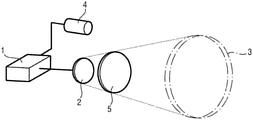
- FIG. 1 is a schematic perspective view of a device according to a first embodiment of the invention
- FIG. 2 is a schematic perspective view of a device according to a first embodiment of the invention
- the invention relates to a recognition device based on biometric characteristics extracted from at least one image of at least one iris of a candidate for recognition.
- the device comprises an electronic control unit 1 connected to an image sensor 2 having a field covering a capture zone 3 in which at least one of the eyes of a candidate for recognition, and more precisely the iris of that eye, is intended to be located.
- the electronic control unit 1 is here a computer or a computer terminal which comprises, in a manner known per se, a calculation module, such as a processor, and a memory containing one or more computer program(s), one of which allows the implementation of the method of the invention which will be described further in this description.
- the device also includes an source 4 illuminating the capture zone 3 .
- the illumination source 4 is connected to the electronic control unit 1 and is arranged to emit incident radiation in a wavelength range suitable for exciting the iris fluorescence.
- the image sensor 2 is designed to be sensitive to iris fluorescence.
- the illumination source 4 is arranged to emit a blue light.
- the image sensor 2 is preferably equipped with a filter 5 to reject all or part of the excitation radiation, as well as any radiation in a wavelength range different from that of the iris fluorescence. This makes it possible, if the candidate for recognition wears glasses, to prevent a fluorescence of the spectacle lens from altering the image of the iris and to prevent a part of the incident excitation radiation reflected by the glasses from altering the image of the iris.
- the illumination source 4 is an infrared laser that is advantageously controlled to emit two pulses of a few femtoseconds.
- the pulse duration is determined to achieve iris fluorescence excitation by simultaneously absorbing two photons.
- the device does not have a filter here, but it is possible to add one if there is a risk that the laser pulses might cause fluorescence of the spectacle glass or if the excitation radiation might be reflected in the spectacle glass and affect the iris image.
- the electronic control unit 1 is programmed to execute a program having instructions arranged for the implementation of a recognition method based on biometric characteristics extracted from at least one image of at least one iris of a candidate for recognition.
- the method includes the steps of:
- the control unit 1 is programmed to perform optical image processing, such as a study of contrasts in the image, to reveal if a lens is present.
- the electronic control unit interrupts the recognition process and issues an alert for an operator to intervene.
- the image is processed in a manner known per se to extract biometric characteristics from it that will be compared with biometric characteristics stored in a memory which the control unit 1 can access.
- Said memory can be:
- the advantage of using a filter depends on the desired performance of the considered application.
- Iris fluorescence can be used to detect the presence of a lens and if no lens is present another image can be captured to perform the recognition. For example, the image is captured under different lighting conditions or using different wavelengths than those of fluorescence.
Landscapes
- Engineering & Computer Science (AREA)
- Physics & Mathematics (AREA)
- General Physics & Mathematics (AREA)
- Theoretical Computer Science (AREA)
- Multimedia (AREA)
- Nonlinear Science (AREA)
- Electromagnetism (AREA)
- Computer Vision & Pattern Recognition (AREA)
- Health & Medical Sciences (AREA)
- General Health & Medical Sciences (AREA)
- Human Computer Interaction (AREA)
- Toxicology (AREA)
- Artificial Intelligence (AREA)
- Mathematical Physics (AREA)
- Chemical & Material Sciences (AREA)
- Crystallography & Structural Chemistry (AREA)
- Optics & Photonics (AREA)
- Ophthalmology & Optometry (AREA)
- Image Input (AREA)
- Measurement Of The Respiration, Hearing Ability, Form, And Blood Characteristics Of Living Organisms (AREA)
- Eye Examination Apparatus (AREA)
Abstract
Description
-
- capturing an image of one iris of a candidate for recognition;
- extracting, from the captured image, biometric characteristics corresponding to the characteristic point coordinates of the iris patterns;
- calculating a similarity score of the extracted biometric characteristics with respect to reference biometric characteristics stored in a memory of a personal data carrier such as an integrated circuit card or in a computer memory;
- validating or denying recognition based on the similarity score.
-
- illuminating the iris of an eye of a candidate for recognition with a radiation to excite the iris fluorescence;
- capturing an image of the iris fluorescence;
- determining, from this image, whether the eye is equipped with a lens.
-
- illuminating the iris of a candidate for recognition with iris fluorescence excitation radiation;
- capturing an image of the iris fluorescence;
- determining, from this image, whether the eye is equipped with a lens.
-
- that of the control unit 1;
- that of a server which the control unit is connected to;
- that of an integrated circuit card inserted by the candidate into a reader connected to the control unit 1;
- that of an identity document readable by radio frequency (in the near field and for example in RFID).
Claims (13)
Applications Claiming Priority (2)
| Application Number | Priority Date | Filing Date | Title |
|---|---|---|---|
| FR1857976A FR3085516B1 (en) | 2018-09-05 | 2018-09-05 | BIOMETRIC RECOGNITION PROCESS |
| FR1857976 | 2018-09-05 |
Publications (2)
| Publication Number | Publication Date |
|---|---|
| US20200074173A1 US20200074173A1 (en) | 2020-03-05 |
| US11263451B2 true US11263451B2 (en) | 2022-03-01 |
Family
ID=65494259
Family Applications (1)
| Application Number | Title | Priority Date | Filing Date |
|---|---|---|---|
| US16/561,778 Active 2040-06-18 US11263451B2 (en) | 2018-09-05 | 2019-09-05 | Biometric recognition method |
Country Status (2)
| Country | Link |
|---|---|
| US (1) | US11263451B2 (en) |
| FR (1) | FR3085516B1 (en) |
Families Citing this family (1)
| Publication number | Priority date | Publication date | Assignee | Title |
|---|---|---|---|---|
| CN108537111A (en) | 2018-02-26 | 2018-09-14 | 阿里巴巴集团控股有限公司 | A kind of method, apparatus and equipment of In vivo detection |
Citations (25)
| Publication number | Priority date | Publication date | Assignee | Title |
|---|---|---|---|---|
| US20030174868A1 (en) * | 2002-02-14 | 2003-09-18 | Omron Corporation | Image determination apparatus and individual authentication apparatus |
| US20060029264A1 (en) * | 2004-08-06 | 2006-02-09 | Canon Kabushiki Kaisha | Detection apparatus and information management method on object of analysis |
| US20080181467A1 (en) * | 2006-09-01 | 2008-07-31 | Zappia Thomas M | Method and apparatus for iris biometric systems for use in an entryway |
| US20100070988A1 (en) * | 2007-05-24 | 2010-03-18 | Yossef Gerard Cohen | Systems and methods for measuring an audience |
| US20120117633A1 (en) * | 2010-11-04 | 2012-05-10 | International Business Machines Corporation | Enhanced Security For Pervasive Devices Using A Weighting System |
| US20130222564A1 (en) * | 2012-02-29 | 2013-08-29 | Suprema Inc. | Apparatus for recognizing face based on environment adaptation |
| US8644562B2 (en) * | 2006-09-15 | 2014-02-04 | Morphotrust Usa, Inc. | Multimodal ocular biometric system and methods |
| US20150009313A1 (en) * | 2013-07-05 | 2015-01-08 | Sony Corporation | Visual line detection device and visual line detection method |
| US8965063B2 (en) * | 2006-09-22 | 2015-02-24 | Eyelock, Inc. | Compact biometric acquisition system and method |
| US20160012218A1 (en) * | 2013-10-08 | 2016-01-14 | Sri International | Validation of the right to access an object |
| US20160012291A1 (en) * | 2012-07-13 | 2016-01-14 | Retina Biometrix, Llc | Biometric identification via retina scanning with liveness detection |
| US20160092731A1 (en) * | 2014-08-08 | 2016-03-31 | Fotonation Limited | Optical system for an image acquisition device |
| US20160117544A1 (en) * | 2014-10-22 | 2016-04-28 | Hoyos Labs Ip Ltd. | Systems and methods for performing iris identification and verification using mobile devices |
| US20170020390A1 (en) * | 2015-07-24 | 2017-01-26 | Johnson & Johnson Vision Care, Inc. | Biomedical devices for biometric based information communication |
| US20170113042A1 (en) * | 2015-03-27 | 2017-04-27 | Elwha Llc | Controlling ear stimulation in response to image analysis |
| US20170132467A1 (en) * | 2014-06-20 | 2017-05-11 | Robert Bosch Gmbh | Method for personal identification |
| US20170164830A1 (en) * | 2015-12-09 | 2017-06-15 | Capitalbio Ehealth Science & Technology (Beijing) Co., Ltd. | Eye imaging device and method of use |
| US10108793B2 (en) * | 2014-10-30 | 2018-10-23 | Delta ID Inc. | Systems and methods for secure biometric processing |
| US20180349721A1 (en) * | 2017-06-06 | 2018-12-06 | Microsoft Technology Licensing, Llc | Biometric object spoof detection based on image intensity variations |
| US20180349683A1 (en) * | 2017-06-06 | 2018-12-06 | Global Bionic Optics Ltd. | Blended iris and facial biometric system |
| US20190019026A1 (en) * | 2017-07-13 | 2019-01-17 | Idemia Identity & Security France | Method of detecting fraud during iris recognition |
| US10614332B2 (en) * | 2016-12-16 | 2020-04-07 | Qualcomm Incorportaed | Light source modulation for iris size adjustment |
| US10740605B2 (en) * | 2017-07-05 | 2020-08-11 | Guangdong Oppo Mobile Telecommunications Corp., Ltd. | Iris collection method, electronic device, and computer readable storage medium |
| US10984267B2 (en) * | 2017-03-31 | 2021-04-20 | Zkteco Usa Llc | Method and system for imaging acquisition |
| US10984235B2 (en) * | 2016-12-16 | 2021-04-20 | Qualcomm Incorporated | Low power data generation for iris-related detection and authentication |
-
2018
- 2018-09-05 FR FR1857976A patent/FR3085516B1/en active Active
-
2019
- 2019-09-05 US US16/561,778 patent/US11263451B2/en active Active
Patent Citations (25)
| Publication number | Priority date | Publication date | Assignee | Title |
|---|---|---|---|---|
| US20030174868A1 (en) * | 2002-02-14 | 2003-09-18 | Omron Corporation | Image determination apparatus and individual authentication apparatus |
| US20060029264A1 (en) * | 2004-08-06 | 2006-02-09 | Canon Kabushiki Kaisha | Detection apparatus and information management method on object of analysis |
| US20080181467A1 (en) * | 2006-09-01 | 2008-07-31 | Zappia Thomas M | Method and apparatus for iris biometric systems for use in an entryway |
| US8644562B2 (en) * | 2006-09-15 | 2014-02-04 | Morphotrust Usa, Inc. | Multimodal ocular biometric system and methods |
| US8965063B2 (en) * | 2006-09-22 | 2015-02-24 | Eyelock, Inc. | Compact biometric acquisition system and method |
| US20100070988A1 (en) * | 2007-05-24 | 2010-03-18 | Yossef Gerard Cohen | Systems and methods for measuring an audience |
| US20120117633A1 (en) * | 2010-11-04 | 2012-05-10 | International Business Machines Corporation | Enhanced Security For Pervasive Devices Using A Weighting System |
| US20130222564A1 (en) * | 2012-02-29 | 2013-08-29 | Suprema Inc. | Apparatus for recognizing face based on environment adaptation |
| US20160012291A1 (en) * | 2012-07-13 | 2016-01-14 | Retina Biometrix, Llc | Biometric identification via retina scanning with liveness detection |
| US20150009313A1 (en) * | 2013-07-05 | 2015-01-08 | Sony Corporation | Visual line detection device and visual line detection method |
| US20160012218A1 (en) * | 2013-10-08 | 2016-01-14 | Sri International | Validation of the right to access an object |
| US20170132467A1 (en) * | 2014-06-20 | 2017-05-11 | Robert Bosch Gmbh | Method for personal identification |
| US20160092731A1 (en) * | 2014-08-08 | 2016-03-31 | Fotonation Limited | Optical system for an image acquisition device |
| US20160117544A1 (en) * | 2014-10-22 | 2016-04-28 | Hoyos Labs Ip Ltd. | Systems and methods for performing iris identification and verification using mobile devices |
| US10108793B2 (en) * | 2014-10-30 | 2018-10-23 | Delta ID Inc. | Systems and methods for secure biometric processing |
| US20170113042A1 (en) * | 2015-03-27 | 2017-04-27 | Elwha Llc | Controlling ear stimulation in response to image analysis |
| US20170020390A1 (en) * | 2015-07-24 | 2017-01-26 | Johnson & Johnson Vision Care, Inc. | Biomedical devices for biometric based information communication |
| US20170164830A1 (en) * | 2015-12-09 | 2017-06-15 | Capitalbio Ehealth Science & Technology (Beijing) Co., Ltd. | Eye imaging device and method of use |
| US10614332B2 (en) * | 2016-12-16 | 2020-04-07 | Qualcomm Incorportaed | Light source modulation for iris size adjustment |
| US10984235B2 (en) * | 2016-12-16 | 2021-04-20 | Qualcomm Incorporated | Low power data generation for iris-related detection and authentication |
| US10984267B2 (en) * | 2017-03-31 | 2021-04-20 | Zkteco Usa Llc | Method and system for imaging acquisition |
| US20180349721A1 (en) * | 2017-06-06 | 2018-12-06 | Microsoft Technology Licensing, Llc | Biometric object spoof detection based on image intensity variations |
| US20180349683A1 (en) * | 2017-06-06 | 2018-12-06 | Global Bionic Optics Ltd. | Blended iris and facial biometric system |
| US10740605B2 (en) * | 2017-07-05 | 2020-08-11 | Guangdong Oppo Mobile Telecommunications Corp., Ltd. | Iris collection method, electronic device, and computer readable storage medium |
| US20190019026A1 (en) * | 2017-07-13 | 2019-01-17 | Idemia Identity & Security France | Method of detecting fraud during iris recognition |
Non-Patent Citations (1)
| Title |
|---|
| Gaixia Xu et al, "Study on the fluorescence profiles of iris pigment epithelium and retinal pigment epithelium", Fifth International Conference on Photonics and Imaging in Biology and Medicine, 2007, vol. 6534, 9 pages. |
Also Published As
| Publication number | Publication date |
|---|---|
| US20200074173A1 (en) | 2020-03-05 |
| FR3085516A1 (en) | 2020-03-06 |
| FR3085516B1 (en) | 2021-09-24 |
Similar Documents
| Publication | Publication Date | Title |
|---|---|---|
| US8170293B2 (en) | Multimodal ocular biometric system and methods | |
| US11836237B2 (en) | Remote biometric identification and lighting | |
| KR102317180B1 (en) | Apparatus and method of face recognition verifying liveness based on 3d depth information and ir information | |
| CN101119679A (en) | Biometric identification device, authentication device, and biometric identification method | |
| US20120163783A1 (en) | System and method for illuminating and imaging the iris of a person | |
| EP2953057B1 (en) | Iris recognition terminal and method | |
| US20060165265A1 (en) | Image input device and authentication device using the same | |
| GB2495325A (en) | Focusing in iris cameras | |
| KR101622065B1 (en) | Biometric authentication device, biometric authentication method, and storage medium | |
| JP4313717B2 (en) | Gaze detection device | |
| US11645864B2 (en) | Imaging device, authentication device, and biometric imaging method | |
| US20200074173A1 (en) | Biometric recognition method | |
| KR20180090798A (en) | Method and apparatus for bi-directional biometric authentication | |
| JP3848953B2 (en) | Living body eye determination method and living body eye determination device | |
| US8831416B2 (en) | System and method for illuminating and identifying a person | |
| KR20190092635A (en) | Method and system for collecting means of publictransportation fares using bi0-information | |
| KR102176882B1 (en) | Apparatus and Method for Recognizing Fake Iris By Using Minutia Data Variation | |
| JP4527088B2 (en) | Living body eye determination method and living body eye determination device | |
| JP2006318374A (en) | Glasses discrimination device, authentication device, and glasses discrimination method | |
| KR101762852B1 (en) | Iris recognition apparatus | |
| Choi et al. | Image scanning method for vascular pattern recognition | |
| RU2355308C2 (en) | Biometric parametres reading device for personality identification | |
| WO2022059064A1 (en) | Focus determination device, iris authentication device, focus determination method, and recording medium | |
| CN110826451A (en) | Iris image acquisition device and acquisition method | |
| KR19980047573A (en) | Facial Image Imaging Device |
Legal Events
| Date | Code | Title | Description |
|---|---|---|---|
| FEPP | Fee payment procedure |
Free format text: ENTITY STATUS SET TO UNDISCOUNTED (ORIGINAL EVENT CODE: BIG.); ENTITY STATUS OF PATENT OWNER: LARGE ENTITY |
|
| AS | Assignment |
Owner name: IDEMIA IDENTITY & SECURITY FRANCE, FRANCE Free format text: ASSIGNMENT OF ASSIGNORS INTEREST;ASSIGNORS:TROUBOUL, LAURENT;SIWEK, JEAN-FRANCOIS;SANDRAZ, JEAN-REMI;SIGNING DATES FROM 20190729 TO 20190819;REEL/FRAME:050310/0404 |
|
| FEPP | Fee payment procedure |
Free format text: ENTITY STATUS SET TO SMALL (ORIGINAL EVENT CODE: SMAL); ENTITY STATUS OF PATENT OWNER: LARGE ENTITY |
|
| FEPP | Fee payment procedure |
Free format text: ENTITY STATUS SET TO UNDISCOUNTED (ORIGINAL EVENT CODE: BIG.); ENTITY STATUS OF PATENT OWNER: LARGE ENTITY |
|
| STPP | Information on status: patent application and granting procedure in general |
Free format text: NON FINAL ACTION MAILED |
|
| STPP | Information on status: patent application and granting procedure in general |
Free format text: RESPONSE TO NON-FINAL OFFICE ACTION ENTERED AND FORWARDED TO EXAMINER |
|
| STPP | Information on status: patent application and granting procedure in general |
Free format text: NOTICE OF ALLOWANCE MAILED -- APPLICATION RECEIVED IN OFFICE OF PUBLICATIONS |
|
| STCF | Information on status: patent grant |
Free format text: PATENTED CASE |
|
| AS | Assignment |
Owner name: IDEMIA PUBLIC SECURITY FRANCE, FRANCE Free format text: ASSIGNMENT OF ASSIGNORS INTEREST;ASSIGNOR:IDEMIA IDENTITY & SECURITY FRANCE;REEL/FRAME:071930/0625 Effective date: 20241231 |
|
| MAFP | Maintenance fee payment |
Free format text: PAYMENT OF MAINTENANCE FEE, 4TH YEAR, LARGE ENTITY (ORIGINAL EVENT CODE: M1551); ENTITY STATUS OF PATENT OWNER: LARGE ENTITY Year of fee payment: 4 |