US11261395B2 - Fullerene compound, lubricant for magnetic recording medium, and magnetic recording medium - Google Patents
Fullerene compound, lubricant for magnetic recording medium, and magnetic recording medium Download PDFInfo
- Publication number
- US11261395B2 US11261395B2 US16/972,813 US201916972813A US11261395B2 US 11261395 B2 US11261395 B2 US 11261395B2 US 201916972813 A US201916972813 A US 201916972813A US 11261395 B2 US11261395 B2 US 11261395B2
- Authority
- US
- United States
- Prior art keywords
- ocf
- fullerene
- compound
- bronsted
- lubricant
- Prior art date
- Legal status (The legal status is an assumption and is not a legal conclusion. Google has not performed a legal analysis and makes no representation as to the accuracy of the status listed.)
- Expired - Fee Related
Links
- 0 C.[1*][NH+]([2*])[3*] Chemical compound C.[1*][NH+]([2*])[3*] 0.000 description 10
- UYCJJJQZIOAKNG-UHFFFAOYSA-N C.C1=CC2=C3C4=C1C1=C5C4=C4C6=C\3C3=C2C=CC2=C3/C3=C\6C6=C4/C4=C5/C(=C5/C=C\C7=C8C=CC2=C3C8=C/6/C7=C/54)/C=C\1.CC.CO Chemical compound C.C1=CC2=C3C4=C1C1=C5C4=C4C6=C\3C3=C2C=CC2=C3/C3=C\6C6=C4/C4=C5/C(=C5/C=C\C7=C8C=CC2=C3C8=C/6/C7=C/54)/C=C\1.CC.CO UYCJJJQZIOAKNG-UHFFFAOYSA-N 0.000 description 2
- JUGWILLJMUQKBT-ICOKRFIPSA-N CC(=O)N1CCN([C@@]23/C=C\[C@@]4(N5CCN(C(=O)OC(C)(C)C)CC5)/C=C\[C@@]5(N6CCN(C(=O)OC(C)(C)C)CC6)/C=C\[C@@]6(N7CCN(C(=O)OC(C)(C)C)CC7)/C=C\[C@]7(/C=C\2)O[C@@]72C3=C4C5=C62)CC1 Chemical compound CC(=O)N1CCN([C@@]23/C=C\[C@@]4(N5CCN(C(=O)OC(C)(C)C)CC5)/C=C\[C@@]5(N6CCN(C(=O)OC(C)(C)C)CC6)/C=C\[C@@]6(N7CCN(C(=O)OC(C)(C)C)CC7)/C=C\[C@]7(/C=C\2)O[C@@]72C3=C4C5=C62)CC1 JUGWILLJMUQKBT-ICOKRFIPSA-N 0.000 description 2
- MJINLANPXMNNOC-ZPRGNZEXSA-Q CC(=O)N1CC[NH+]([C@]23C4=C5[C@@]67OC68=C6=C9=C%10C=C/C6=C6/C=C\C%11=C%12\C=CC%13=C%14=C%12=C([NH+]%12CCN(C(=O)OC(C)(C)C)CC%12)(C\%11=C/68)/C7=C/4[C@]%14([NH+]4CCN(C(=O)OC(C)(C)C)CC4)C4=C%13C=CC(=C=42)C2=C3=C(=C%10C=C2)[C@]59[NH+]2CCN(C(=O)OC(C)(C)C)CC2)CC1 Chemical compound CC(=O)N1CC[NH+]([C@]23C4=C5[C@@]67OC68=C6=C9=C%10C=C/C6=C6/C=C\C%11=C%12\C=CC%13=C%14=C%12=C([NH+]%12CCN(C(=O)OC(C)(C)C)CC%12)(C\%11=C/68)/C7=C/4[C@]%14([NH+]4CCN(C(=O)OC(C)(C)C)CC4)C4=C%13C=CC(=C=42)C2=C3=C(=C%10C=C2)[C@]59[NH+]2CCN(C(=O)OC(C)(C)C)CC2)CC1 MJINLANPXMNNOC-ZPRGNZEXSA-Q 0.000 description 2
- RQCNHUCCQJMSRG-UHFFFAOYSA-N CC(C)(C)OC(=O)N1CCCCC1 Chemical compound CC(C)(C)OC(=O)N1CCCCC1 RQCNHUCCQJMSRG-UHFFFAOYSA-N 0.000 description 2
- OYWYIYISGYZCDJ-UHFFFAOYSA-I CN(C)CC1=CC=CC(C(=O)[O-])=C1.CN(C)CC1=CC=CC(C(=O)[O-])=C1.CN(C)CC1=CC=CC(C(=O)[O-])=C1.CN1CC23/C4=C5/C=CC6=C7/C8=C9C%10=C%11C%12=C(\C=C/C6=C8\%12)C6=C\%11C8=C(\C=C/6)C6=C%11/C8=C/%10C(=C/9C\2=C/75)/C2=C%11/C(=C(/C=C4)C23C1C1=CC(C(=O)[O-])=CC(C(=O)[O-])=C1)C=C6 Chemical compound CN(C)CC1=CC=CC(C(=O)[O-])=C1.CN(C)CC1=CC=CC(C(=O)[O-])=C1.CN(C)CC1=CC=CC(C(=O)[O-])=C1.CN1CC23/C4=C5/C=CC6=C7/C8=C9C%10=C%11C%12=C(\C=C/C6=C8\%12)C6=C\%11C8=C(\C=C/6)C6=C%11/C8=C/%10C(=C/9C\2=C/75)/C2=C%11/C(=C(/C=C4)C23C1C1=CC(C(=O)[O-])=CC(C(=O)[O-])=C1)C=C6 OYWYIYISGYZCDJ-UHFFFAOYSA-I 0.000 description 2
- DPCJPYOSUPFBKY-UHFFFAOYSA-N CN(C)CC1=CC=CC=C1.CN(C)CC1=CC=CC=C1.CN(C)CC1=CC=CC=C1.CN1CC23/C4=C5/C=CC6=C7/C8=C9C%10=C%11C%12=C(\C=C/C6=C8\%12)C6=C\%11C8=C(\C=C/6)C6=C%11/C8=C/%10C(=C/9C\2=C/75)/C2=C%11/C(=C(/C=C4)C23C1C1=CC(C(=O)O)=CC(C(=O)O)=C1)C=C6.O=C(O)CCCC1(C2=CC=CC=C2)C23/C4=C5/C=CC6=C7/C8=C9C%10=C%11/C%12=C(/C=C\C6=C%128)C6=C/%11C8=C(/C=C\6)C6=C%11/C8=C%10/C(=C/9C\2=C/75)C2=C%11/C(=C(/C=C4)C/213)C=C6.O=C(O)CCCC1(C2=CC=CC=C2)C2CC=CCC21 Chemical compound CN(C)CC1=CC=CC=C1.CN(C)CC1=CC=CC=C1.CN(C)CC1=CC=CC=C1.CN1CC23/C4=C5/C=CC6=C7/C8=C9C%10=C%11C%12=C(\C=C/C6=C8\%12)C6=C\%11C8=C(\C=C/6)C6=C%11/C8=C/%10C(=C/9C\2=C/75)/C2=C%11/C(=C(/C=C4)C23C1C1=CC(C(=O)O)=CC(C(=O)O)=C1)C=C6.O=C(O)CCCC1(C2=CC=CC=C2)C23/C4=C5/C=CC6=C7/C8=C9C%10=C%11/C%12=C(/C=C\C6=C%128)C6=C/%11C8=C(/C=C\6)C6=C%11/C8=C%10/C(=C/9C\2=C/75)C2=C%11/C(=C(/C=C4)C/213)C=C6.O=C(O)CCCC1(C2=CC=CC=C2)C2CC=CCC21 DPCJPYOSUPFBKY-UHFFFAOYSA-N 0.000 description 2
- XXOMPFLSDNYFQF-UHFFFAOYSA-M O=C([O-])CCCC1(C2=CC=CC=C2)C23/C4=C5/C=CC6=C7/C8=C9C%10=C%11/C%12=C(/C=C\C6=C%128)C6=C/%11C8=C(/C=C\6)C6=C%11/C8=C%10/C(=C/9C\2=C/75)C2=C%11/C(=C(/C=C4)C/213)C=C6.[O-]CCCCC1(C2=CC=CC=C2)C2CC=CCC21 Chemical compound O=C([O-])CCCC1(C2=CC=CC=C2)C23/C4=C5/C=CC6=C7/C8=C9C%10=C%11/C%12=C(/C=C\C6=C%128)C6=C/%11C8=C(/C=C\6)C6=C%11/C8=C%10/C(=C/9C\2=C/75)C2=C%11/C(=C(/C=C4)C/213)C=C6.[O-]CCCCC1(C2=CC=CC=C2)C2CC=CCC21 XXOMPFLSDNYFQF-UHFFFAOYSA-M 0.000 description 2
- SQXVJCDLLTZUEN-UHFFFAOYSA-O C.C1=CC2=C3C4=C1C1=C5C4=C4C6=C\3C3=C2C=CC2=C3/C3=C\6C6=C4/C4=C5/C(=C5/C=C\C7=C8C=CC2=C3C8=C/6/C7=C/54)/C=C\1.CC.CCOC(F)(F)COCC[NH3+].CO Chemical compound C.C1=CC2=C3C4=C1C1=C5C4=C4C6=C\3C3=C2C=CC2=C3/C3=C\6C6=C4/C4=C5/C(=C5/C=C\C7=C8C=CC2=C3C8=C/6/C7=C/54)/C=C\1.CC.CCOC(F)(F)COCC[NH3+].CO SQXVJCDLLTZUEN-UHFFFAOYSA-O 0.000 description 1
- NQRYJNQNLNOLGT-UHFFFAOYSA-N C1CCNCC1 Chemical compound C1CCNCC1 NQRYJNQNLNOLGT-UHFFFAOYSA-N 0.000 description 1
- BPQLJMXFEAZRLB-OCNZVNLASA-N CC(=O)N1CCN([C@@]23/C=C\[C@@]4(N5CCN(C(=O)OC(C)(C)C)CC5)/C=C\[C@@]5(N6CCN(C(=O)OC(C)(C)C)CC6)/C=C\[C@@]6(N7CCN(C(C)=O)CC7)/C=C\[C@]7(/C=C\2)O[C@@]72C3=C4C5=C62)CC1 Chemical compound CC(=O)N1CCN([C@@]23/C=C\[C@@]4(N5CCN(C(=O)OC(C)(C)C)CC5)/C=C\[C@@]5(N6CCN(C(=O)OC(C)(C)C)CC6)/C=C\[C@@]6(N7CCN(C(C)=O)CC7)/C=C\[C@]7(/C=C\2)O[C@@]72C3=C4C5=C62)CC1 BPQLJMXFEAZRLB-OCNZVNLASA-N 0.000 description 1
- SKUJBGKUCLCXEA-CCMGCIQYSA-P CC(=O)N1CC[NH+]([C@@]23C4=C5/C=C\C6=C=4[C@]4([NH+]7CCN(C(=O)OC(C)(C)C)CC7)C7=C6C=C/C6=C8\C=C/C9=C%10\C=CC%11=C%12=C%10=C%10%13O[C@@]%10%14/C(=C4\C2=C/%14[C@@]%12([NH+]2CCN(C(=O)OC(C)(C)C)CC2)C2=C%11C=CC5=C=23)C([NH+]2CCN(C(=O)OC(C)(C)C)CC2)(=C=76)C8=C9%13)CC1.COC(F)(F)COCCCS(=O)(=O)[O-] Chemical compound CC(=O)N1CC[NH+]([C@@]23C4=C5/C=C\C6=C=4[C@]4([NH+]7CCN(C(=O)OC(C)(C)C)CC7)C7=C6C=C/C6=C8\C=C/C9=C%10\C=CC%11=C%12=C%10=C%10%13O[C@@]%10%14/C(=C4\C2=C/%14[C@@]%12([NH+]2CCN(C(=O)OC(C)(C)C)CC2)C2=C%11C=CC5=C=23)C([NH+]2CCN(C(=O)OC(C)(C)C)CC2)(=C=76)C8=C9%13)CC1.COC(F)(F)COCCCS(=O)(=O)[O-] SKUJBGKUCLCXEA-CCMGCIQYSA-P 0.000 description 1
- NMMROTNTULYNGQ-CCMGCIQYSA-Q CC.CC(=O)N1CC[NH+]([C@@]23C4=C5/C=C\C6=C=4[C@]4([NH+]7CCN(C(=O)OC(C)(C)C)CC7)C7=C6C=C/C6=C8\C=C/C9=C%10\C=CC%11=C%12=C%10=C%10%13O[C@@]%10%14/C(=C4\C2=C/%14[C@@]%12([NH+]2CCN(C(=O)OC(C)(C)C)CC2)C2=C%11/C=C\C5=C=23)C([NH+]2CCN(C(=O)OC(C)(C)C)CC2)(=C=76)C8=C9%13)CC1 Chemical compound CC.CC(=O)N1CC[NH+]([C@@]23C4=C5/C=C\C6=C=4[C@]4([NH+]7CCN(C(=O)OC(C)(C)C)CC7)C7=C6C=C/C6=C8\C=C/C9=C%10\C=CC%11=C%12=C%10=C%10%13O[C@@]%10%14/C(=C4\C2=C/%14[C@@]%12([NH+]2CCN(C(=O)OC(C)(C)C)CC2)C2=C%11/C=C\C5=C=23)C([NH+]2CCN(C(=O)OC(C)(C)C)CC2)(=C=76)C8=C9%13)CC1 NMMROTNTULYNGQ-CCMGCIQYSA-Q 0.000 description 1
- YWAYYTRAAWPFKO-UHFFFAOYSA-L CC.CCCC.CN1CC23/C4=C5/C=CC6=C7/C8=C9C%10=C%11C%12=C(\C=C/C6=C8\%12)C6=C\%11C8=C(\C=C/6)C6=C%11/C8=C/%10C(=C/9C\2=C/75)/C2=C%11/C(=C(/C=C4)C23C1C1=CC(C(=O)[O-])=CC(C(=O)[O-])=C1)C=C6 Chemical compound CC.CCCC.CN1CC23/C4=C5/C=CC6=C7/C8=C9C%10=C%11C%12=C(\C=C/C6=C8\%12)C6=C\%11C8=C(\C=C/6)C6=C%11/C8=C/%10C(=C/9C\2=C/75)/C2=C%11/C(=C(/C=C4)C23C1C1=CC(C(=O)[O-])=CC(C(=O)[O-])=C1)C=C6 YWAYYTRAAWPFKO-UHFFFAOYSA-L 0.000 description 1
- WMOPNFSGJDFYIQ-UHFFFAOYSA-M CC.CCCC.O=C([O-])CCCC1(C2=CC=CC=C2)C23/C4=C5/C=CC6=C7/C8=C9C%10=C%11/C%12=C(/C=C\C6=C%128)C6=C/%11C8=C(/C=C\6)C6=C%11/C8=C%10/C(=C/9C\2=C/75)C2=C%11/C(=C(/C=C4)C/213)C=C6 Chemical compound CC.CCCC.O=C([O-])CCCC1(C2=CC=CC=C2)C23/C4=C5/C=CC6=C7/C8=C9C%10=C%11/C%12=C(/C=C\C6=C%128)C6=C/%11C8=C(/C=C\6)C6=C%11/C8=C%10/C(=C/9C\2=C/75)C2=C%11/C(=C(/C=C4)C/213)C=C6 WMOPNFSGJDFYIQ-UHFFFAOYSA-M 0.000 description 1
- FTEDPLXXGPTUSV-UHFFFAOYSA-L CCC.CN(C)CC1=CC=CC=C1.CN(C)CC1=CC=CC=C1.CN(C)CC1=CC=CC=C1.CN1CC23/C4=C5/C=CC6=C7/C8=C9C%10=C%11C%12=C(\C=C/C6=C8\%12)C6=C\%11C8=C(\C=C/6)C6=C%11/C8=C/%10C(=C/9C\2=C/75)/C2=C%11/C(=C(/C=C4)C23C1C1=CC(C(=O)[O-])=CC(C(=O)[O-])=C1)C=C6 Chemical compound CCC.CN(C)CC1=CC=CC=C1.CN(C)CC1=CC=CC=C1.CN(C)CC1=CC=CC=C1.CN1CC23/C4=C5/C=CC6=C7/C8=C9C%10=C%11C%12=C(\C=C/C6=C8\%12)C6=C\%11C8=C(\C=C/6)C6=C%11/C8=C/%10C(=C/9C\2=C/75)/C2=C%11/C(=C(/C=C4)C23C1C1=CC(C(=O)[O-])=CC(C(=O)[O-])=C1)C=C6 FTEDPLXXGPTUSV-UHFFFAOYSA-L 0.000 description 1
- FDEAZIUXGRBNMF-UHFFFAOYSA-N CCOC(F)(F)COCC[NH3+].O=C([O-])CCCC1(C2=CC=CC=C2)C23/C4=C5/C=CC6=C7/C8=C9C%10=C%11/C%12=C(/C=C\C6=C%128)C6=C/%11C8=C(/C=C\6)C6=C%11/C8=C%10/C(=C/9C\2=C/75)C2=C%11/C(=C(/C=C4)C/213)C=C6 Chemical compound CCOC(F)(F)COCC[NH3+].O=C([O-])CCCC1(C2=CC=CC=C2)C23/C4=C5/C=CC6=C7/C8=C9C%10=C%11/C%12=C(/C=C\C6=C%128)C6=C/%11C8=C(/C=C\6)C6=C%11/C8=C%10/C(=C/9C\2=C/75)C2=C%11/C(=C(/C=C4)C/213)C=C6 FDEAZIUXGRBNMF-UHFFFAOYSA-N 0.000 description 1
- UMSHRBXZAIWBQS-UHFFFAOYSA-N CN(C)CC1=CC=CC=C1.CN(C)CC1=CC=CC=C1.CN(C)CC1=CC=CC=C1.CN1CC23/C4=C5/C=CC6=C7/C8=C9C%10=C%11C%12=C(\C=C/C6=C8\%12)C6=C\%11C8=C(\C=C/6)C6=C%11/C8=C/%10C(=C/9C\2=C/75)/C2=C%11/C(=C(/C=C4)C23C1C1=CC(C(=O)O)=CC(C(=O)O)=C1)C=C6.O=C(O)CCCC1(C2=CC=CC=C2)C23/C4=C5/C=CC6=C7/C8=C9C%10=C%11/C%12=C(/C=C\C6=C%128)C6=C/%11C8=C(/C=C\6)C6=C%11/C8=C%10/C(=C/9C\2=C/75)C2=C%11/C(=C(/C=C4)C/213)C=C6.O=C(O)CCCC1(C2=CC=CC=C2)C2CC=CCC21.O=COC1=CC(C=O)=CC(OC=O)=C1 Chemical compound CN(C)CC1=CC=CC=C1.CN(C)CC1=CC=CC=C1.CN(C)CC1=CC=CC=C1.CN1CC23/C4=C5/C=CC6=C7/C8=C9C%10=C%11C%12=C(\C=C/C6=C8\%12)C6=C\%11C8=C(\C=C/6)C6=C%11/C8=C/%10C(=C/9C\2=C/75)/C2=C%11/C(=C(/C=C4)C23C1C1=CC(C(=O)O)=CC(C(=O)O)=C1)C=C6.O=C(O)CCCC1(C2=CC=CC=C2)C23/C4=C5/C=CC6=C7/C8=C9C%10=C%11/C%12=C(/C=C\C6=C%128)C6=C/%11C8=C(/C=C\6)C6=C%11/C8=C%10/C(=C/9C\2=C/75)C2=C%11/C(=C(/C=C4)C/213)C=C6.O=C(O)CCCC1(C2=CC=CC=C2)C2CC=CCC21.O=COC1=CC(C=O)=CC(OC=O)=C1 UMSHRBXZAIWBQS-UHFFFAOYSA-N 0.000 description 1
- SVSRYLMHJICEJB-UHFFFAOYSA-N CN1CC23/C4=C5/C=CC6=C7/C8=C9C%10=C%11C%12=C(\C=C/C6=C8\%12)C6=C\%11C8=C(\C=C/6)C6=C%11/C8=C/%10C(=C/9C\2=C/75)/C2=C%11/C(=C(/C=C4)C23C1C1=CC(C(=O)O)=CC(C(=O)O)=C1)C=C6 Chemical compound CN1CC23/C4=C5/C=CC6=C7/C8=C9C%10=C%11C%12=C(\C=C/C6=C8\%12)C6=C\%11C8=C(\C=C/6)C6=C%11/C8=C/%10C(=C/9C\2=C/75)/C2=C%11/C(=C(/C=C4)C23C1C1=CC(C(=O)O)=CC(C(=O)O)=C1)C=C6 SVSRYLMHJICEJB-UHFFFAOYSA-N 0.000 description 1
- NSVRDZGAHYSGMO-UHFFFAOYSA-N O=C(O)CCCC1(C2=CC=CC=C2)C23/C4=C5/C=CC6=C7/C8=C9C%10=C%11/C%12=C(/C=C\C6=C%128)C6=C/%11C8=C(/C=C\6)C6=C%11/C8=C%10/C(=C/9C\2=C/75)C2=C%11/C(=C(/C=C4)C/213)C=C6 Chemical compound O=C(O)CCCC1(C2=CC=CC=C2)C23/C4=C5/C=CC6=C7/C8=C9C%10=C%11/C%12=C(/C=C\C6=C%128)C6=C/%11C8=C(/C=C\6)C6=C%11/C8=C%10/C(=C/9C\2=C/75)C2=C%11/C(=C(/C=C4)C/213)C=C6 NSVRDZGAHYSGMO-UHFFFAOYSA-N 0.000 description 1
Images


Classifications
-
- C—CHEMISTRY; METALLURGY
- C10—PETROLEUM, GAS OR COKE INDUSTRIES; TECHNICAL GASES CONTAINING CARBON MONOXIDE; FUELS; LUBRICANTS; PEAT
- C10M—LUBRICATING COMPOSITIONS; USE OF CHEMICAL SUBSTANCES EITHER ALONE OR AS LUBRICATING INGREDIENTS IN A LUBRICATING COMPOSITION
- C10M105/00—Lubricating compositions characterised by the base-material being a non-macromolecular organic compound
- C10M105/72—Lubricating compositions characterised by the base-material being a non-macromolecular organic compound containing sulfur, selenium or tellurium
-
- C—CHEMISTRY; METALLURGY
- C07—ORGANIC CHEMISTRY
- C07C—ACYCLIC OR CARBOCYCLIC COMPOUNDS
- C07C225/00—Compounds containing amino groups and doubly—bound oxygen atoms bound to the same carbon skeleton, at least one of the doubly—bound oxygen atoms not being part of a —CHO group, e.g. amino ketones
- C07C225/02—Compounds containing amino groups and doubly—bound oxygen atoms bound to the same carbon skeleton, at least one of the doubly—bound oxygen atoms not being part of a —CHO group, e.g. amino ketones having amino groups bound to acyclic carbon atoms of the carbon skeleton
- C07C225/04—Compounds containing amino groups and doubly—bound oxygen atoms bound to the same carbon skeleton, at least one of the doubly—bound oxygen atoms not being part of a —CHO group, e.g. amino ketones having amino groups bound to acyclic carbon atoms of the carbon skeleton the carbon skeleton being saturated
- C07C225/06—Compounds containing amino groups and doubly—bound oxygen atoms bound to the same carbon skeleton, at least one of the doubly—bound oxygen atoms not being part of a —CHO group, e.g. amino ketones having amino groups bound to acyclic carbon atoms of the carbon skeleton the carbon skeleton being saturated and acyclic
-
- C—CHEMISTRY; METALLURGY
- C07—ORGANIC CHEMISTRY
- C07C—ACYCLIC OR CARBOCYCLIC COMPOUNDS
- C07C305/00—Esters of sulfuric acids
- C07C305/22—Esters of sulfuric acids having oxygen atoms of sulfate groups bound to carbon atoms of six-membered aromatic rings
-
- C—CHEMISTRY; METALLURGY
- C07—ORGANIC CHEMISTRY
- C07C—ACYCLIC OR CARBOCYCLIC COMPOUNDS
- C07C57/00—Unsaturated compounds having carboxyl groups bound to acyclic carbon atoms
- C07C57/46—Unsaturated compounds having carboxyl groups bound to acyclic carbon atoms containing six-membered aromatic rings and other rings, e.g. cyclohexylphenylacetic acid
- C07C57/50—Unsaturated compounds having carboxyl groups bound to acyclic carbon atoms containing six-membered aromatic rings and other rings, e.g. cyclohexylphenylacetic acid containing condensed ring systems
-
- C—CHEMISTRY; METALLURGY
- C07—ORGANIC CHEMISTRY
- C07C—ACYCLIC OR CARBOCYCLIC COMPOUNDS
- C07C65/00—Compounds having carboxyl groups bound to carbon atoms of six—membered aromatic rings and containing any of the groups OH, O—metal, —CHO, keto, ether, groups, groups, or groups
- C07C65/30—Compounds having carboxyl groups bound to carbon atoms of six—membered aromatic rings and containing any of the groups OH, O—metal, —CHO, keto, ether, groups, groups, or groups containing —CHO groups
-
- C—CHEMISTRY; METALLURGY
- C07—ORGANIC CHEMISTRY
- C07D—HETEROCYCLIC COMPOUNDS
- C07D303/00—Compounds containing three-membered rings having one oxygen atom as the only ring hetero atom
- C07D303/02—Compounds containing oxirane rings
- C07D303/48—Compounds containing oxirane rings with hetero atoms or with carbon atoms having three bonds to hetero atoms with at the most one bond to halogen, directly attached to ring carbon atoms, e.g. ester or nitrile radicals
-
- C—CHEMISTRY; METALLURGY
- C07—ORGANIC CHEMISTRY
- C07D—HETEROCYCLIC COMPOUNDS
- C07D487/00—Heterocyclic compounds containing nitrogen atoms as the only ring hetero atoms in the condensed system, not provided for by groups C07D451/00 - C07D477/00
- C07D487/22—Heterocyclic compounds containing nitrogen atoms as the only ring hetero atoms in the condensed system, not provided for by groups C07D451/00 - C07D477/00 in which the condensed system contains four or more hetero rings
-
- C—CHEMISTRY; METALLURGY
- C10—PETROLEUM, GAS OR COKE INDUSTRIES; TECHNICAL GASES CONTAINING CARBON MONOXIDE; FUELS; LUBRICANTS; PEAT
- C10M—LUBRICATING COMPOSITIONS; USE OF CHEMICAL SUBSTANCES EITHER ALONE OR AS LUBRICATING INGREDIENTS IN A LUBRICATING COMPOSITION
- C10M103/00—Lubricating compositions characterised by the base-material being an inorganic material
- C10M103/02—Carbon; Graphite
-
- C—CHEMISTRY; METALLURGY
- C10—PETROLEUM, GAS OR COKE INDUSTRIES; TECHNICAL GASES CONTAINING CARBON MONOXIDE; FUELS; LUBRICANTS; PEAT
- C10M—LUBRICATING COMPOSITIONS; USE OF CHEMICAL SUBSTANCES EITHER ALONE OR AS LUBRICATING INGREDIENTS IN A LUBRICATING COMPOSITION
- C10M105/00—Lubricating compositions characterised by the base-material being a non-macromolecular organic compound
- C10M105/56—Lubricating compositions characterised by the base-material being a non-macromolecular organic compound containing nitrogen
- C10M105/58—Amines, e.g. polyalkylene polyamines, quaternary amines
- C10M105/60—Amines, e.g. polyalkylene polyamines, quaternary amines having amino groups bound to an acyclic or cycloaliphatic carbon atom
-
- C—CHEMISTRY; METALLURGY
- C10—PETROLEUM, GAS OR COKE INDUSTRIES; TECHNICAL GASES CONTAINING CARBON MONOXIDE; FUELS; LUBRICANTS; PEAT
- C10M—LUBRICATING COMPOSITIONS; USE OF CHEMICAL SUBSTANCES EITHER ALONE OR AS LUBRICATING INGREDIENTS IN A LUBRICATING COMPOSITION
- C10M105/00—Lubricating compositions characterised by the base-material being a non-macromolecular organic compound
- C10M105/56—Lubricating compositions characterised by the base-material being a non-macromolecular organic compound containing nitrogen
- C10M105/70—Lubricating compositions characterised by the base-material being a non-macromolecular organic compound containing nitrogen as ring hetero atom
-
- G—PHYSICS
- G11—INFORMATION STORAGE
- G11B—INFORMATION STORAGE BASED ON RELATIVE MOVEMENT BETWEEN RECORD CARRIER AND TRANSDUCER
- G11B5/00—Recording by magnetisation or demagnetisation of a record carrier; Reproducing by magnetic means; Record carriers therefor
- G11B5/62—Record carriers characterised by the selection of the material
- G11B5/72—Protective coatings, e.g. anti-static or antifriction
- G11B5/725—Protective coatings, e.g. anti-static or antifriction containing a lubricant, e.g. organic compounds
- G11B5/7253—Fluorocarbon lubricant
-
- G—PHYSICS
- G11—INFORMATION STORAGE
- G11B—INFORMATION STORAGE BASED ON RELATIVE MOVEMENT BETWEEN RECORD CARRIER AND TRANSDUCER
- G11B5/00—Recording by magnetisation or demagnetisation of a record carrier; Reproducing by magnetic means; Record carriers therefor
- G11B5/62—Record carriers characterised by the selection of the material
- G11B5/72—Protective coatings, e.g. anti-static or antifriction
- G11B5/725—Protective coatings, e.g. anti-static or antifriction containing a lubricant, e.g. organic compounds
- G11B5/7253—Fluorocarbon lubricant
- G11B5/7257—Perfluoropolyether lubricant
-
- C—CHEMISTRY; METALLURGY
- C07—ORGANIC CHEMISTRY
- C07C—ACYCLIC OR CARBOCYCLIC COMPOUNDS
- C07C2601/00—Systems containing only non-condensed rings
- C07C2601/12—Systems containing only non-condensed rings with a six-membered ring
- C07C2601/16—Systems containing only non-condensed rings with a six-membered ring the ring being unsaturated
-
- C—CHEMISTRY; METALLURGY
- C07—ORGANIC CHEMISTRY
- C07C—ACYCLIC OR CARBOCYCLIC COMPOUNDS
- C07C2604/00—Fullerenes, e.g. C60 buckminsterfullerene or C70
-
- C—CHEMISTRY; METALLURGY
- C10—PETROLEUM, GAS OR COKE INDUSTRIES; TECHNICAL GASES CONTAINING CARBON MONOXIDE; FUELS; LUBRICANTS; PEAT
- C10M—LUBRICATING COMPOSITIONS; USE OF CHEMICAL SUBSTANCES EITHER ALONE OR AS LUBRICATING INGREDIENTS IN A LUBRICATING COMPOSITION
- C10M2201/00—Inorganic compounds or elements as ingredients in lubricant compositions
- C10M2201/04—Elements
- C10M2201/041—Carbon; Graphite; Carbon black
-
- C—CHEMISTRY; METALLURGY
- C10—PETROLEUM, GAS OR COKE INDUSTRIES; TECHNICAL GASES CONTAINING CARBON MONOXIDE; FUELS; LUBRICANTS; PEAT
- C10M—LUBRICATING COMPOSITIONS; USE OF CHEMICAL SUBSTANCES EITHER ALONE OR AS LUBRICATING INGREDIENTS IN A LUBRICATING COMPOSITION
- C10M2201/00—Inorganic compounds or elements as ingredients in lubricant compositions
- C10M2201/04—Elements
- C10M2201/041—Carbon; Graphite; Carbon black
- C10M2201/0413—Carbon; Graphite; Carbon black used as base material
-
- C—CHEMISTRY; METALLURGY
- C10—PETROLEUM, GAS OR COKE INDUSTRIES; TECHNICAL GASES CONTAINING CARBON MONOXIDE; FUELS; LUBRICANTS; PEAT
- C10M—LUBRICATING COMPOSITIONS; USE OF CHEMICAL SUBSTANCES EITHER ALONE OR AS LUBRICATING INGREDIENTS IN A LUBRICATING COMPOSITION
- C10M2213/00—Organic macromolecular compounds containing halogen as ingredients in lubricant compositions
- C10M2213/06—Perfluoro polymers
-
- C—CHEMISTRY; METALLURGY
- C10—PETROLEUM, GAS OR COKE INDUSTRIES; TECHNICAL GASES CONTAINING CARBON MONOXIDE; FUELS; LUBRICANTS; PEAT
- C10M—LUBRICATING COMPOSITIONS; USE OF CHEMICAL SUBSTANCES EITHER ALONE OR AS LUBRICATING INGREDIENTS IN A LUBRICATING COMPOSITION
- C10M2215/00—Organic non-macromolecular compounds containing nitrogen as ingredients in lubricant Compositions
- C10M2215/02—Amines, e.g. polyalkylene polyamines; Quaternary amines
- C10M2215/04—Amines, e.g. polyalkylene polyamines; Quaternary amines having amino groups bound to acyclic or cycloaliphatic carbon atoms
-
- C—CHEMISTRY; METALLURGY
- C10—PETROLEUM, GAS OR COKE INDUSTRIES; TECHNICAL GASES CONTAINING CARBON MONOXIDE; FUELS; LUBRICANTS; PEAT
- C10M—LUBRICATING COMPOSITIONS; USE OF CHEMICAL SUBSTANCES EITHER ALONE OR AS LUBRICATING INGREDIENTS IN A LUBRICATING COMPOSITION
- C10M2215/00—Organic non-macromolecular compounds containing nitrogen as ingredients in lubricant Compositions
- C10M2215/24—Organic non-macromolecular compounds containing nitrogen as ingredients in lubricant Compositions having hydrocarbon substituents containing thirty or more carbon atoms, e.g. nitrogen derivatives of substituted succinic acid
- C10M2215/26—Amines
- C10M2215/265—Amines used as base material
-
- C—CHEMISTRY; METALLURGY
- C10—PETROLEUM, GAS OR COKE INDUSTRIES; TECHNICAL GASES CONTAINING CARBON MONOXIDE; FUELS; LUBRICANTS; PEAT
- C10M—LUBRICATING COMPOSITIONS; USE OF CHEMICAL SUBSTANCES EITHER ALONE OR AS LUBRICATING INGREDIENTS IN A LUBRICATING COMPOSITION
- C10M2215/00—Organic non-macromolecular compounds containing nitrogen as ingredients in lubricant Compositions
- C10M2215/24—Organic non-macromolecular compounds containing nitrogen as ingredients in lubricant Compositions having hydrocarbon substituents containing thirty or more carbon atoms, e.g. nitrogen derivatives of substituted succinic acid
- C10M2215/30—Heterocyclic compounds
- C10M2215/305—Heterocyclic compounds used as base material
-
- C—CHEMISTRY; METALLURGY
- C10—PETROLEUM, GAS OR COKE INDUSTRIES; TECHNICAL GASES CONTAINING CARBON MONOXIDE; FUELS; LUBRICANTS; PEAT
- C10M—LUBRICATING COMPOSITIONS; USE OF CHEMICAL SUBSTANCES EITHER ALONE OR AS LUBRICATING INGREDIENTS IN A LUBRICATING COMPOSITION
- C10M2219/00—Organic non-macromolecular compounds containing sulfur, selenium or tellurium as ingredients in lubricant compositions
- C10M2219/04—Organic non-macromolecular compounds containing sulfur, selenium or tellurium as ingredients in lubricant compositions containing sulfur-to-oxygen bonds, i.e. sulfones, sulfoxides
- C10M2219/044—Sulfonic acids, Derivatives thereof, e.g. neutral salts
-
- C—CHEMISTRY; METALLURGY
- C10—PETROLEUM, GAS OR COKE INDUSTRIES; TECHNICAL GASES CONTAINING CARBON MONOXIDE; FUELS; LUBRICANTS; PEAT
- C10N—INDEXING SCHEME ASSOCIATED WITH SUBCLASS C10M RELATING TO LUBRICATING COMPOSITIONS
- C10N2020/00—Specified physical or chemical properties or characteristics, i.e. function, of component of lubricating compositions
- C10N2020/01—Physico-chemical properties
- C10N2020/04—Molecular weight; Molecular weight distribution
-
- C—CHEMISTRY; METALLURGY
- C10—PETROLEUM, GAS OR COKE INDUSTRIES; TECHNICAL GASES CONTAINING CARBON MONOXIDE; FUELS; LUBRICANTS; PEAT
- C10N—INDEXING SCHEME ASSOCIATED WITH SUBCLASS C10M RELATING TO LUBRICATING COMPOSITIONS
- C10N2020/00—Specified physical or chemical properties or characteristics, i.e. function, of component of lubricating compositions
- C10N2020/01—Physico-chemical properties
- C10N2020/055—Particles related characteristics
- C10N2020/06—Particles of special shape or size
-
- C—CHEMISTRY; METALLURGY
- C10—PETROLEUM, GAS OR COKE INDUSTRIES; TECHNICAL GASES CONTAINING CARBON MONOXIDE; FUELS; LUBRICANTS; PEAT
- C10N—INDEXING SCHEME ASSOCIATED WITH SUBCLASS C10M RELATING TO LUBRICATING COMPOSITIONS
- C10N2020/00—Specified physical or chemical properties or characteristics, i.e. function, of component of lubricating compositions
- C10N2020/01—Physico-chemical properties
- C10N2020/077—Ionic Liquids
-
- C—CHEMISTRY; METALLURGY
- C10—PETROLEUM, GAS OR COKE INDUSTRIES; TECHNICAL GASES CONTAINING CARBON MONOXIDE; FUELS; LUBRICANTS; PEAT
- C10N—INDEXING SCHEME ASSOCIATED WITH SUBCLASS C10M RELATING TO LUBRICATING COMPOSITIONS
- C10N2030/00—Specified physical or chemical properties which is improved by the additive characterising the lubricating composition, e.g. multifunctional additives
- C10N2030/06—Oiliness; Film-strength; Anti-wear; Resistance to extreme pressure
-
- C—CHEMISTRY; METALLURGY
- C10—PETROLEUM, GAS OR COKE INDUSTRIES; TECHNICAL GASES CONTAINING CARBON MONOXIDE; FUELS; LUBRICANTS; PEAT
- C10N—INDEXING SCHEME ASSOCIATED WITH SUBCLASS C10M RELATING TO LUBRICATING COMPOSITIONS
- C10N2030/00—Specified physical or chemical properties which is improved by the additive characterising the lubricating composition, e.g. multifunctional additives
- C10N2030/08—Resistance to extreme temperature
-
- C—CHEMISTRY; METALLURGY
- C10—PETROLEUM, GAS OR COKE INDUSTRIES; TECHNICAL GASES CONTAINING CARBON MONOXIDE; FUELS; LUBRICANTS; PEAT
- C10N—INDEXING SCHEME ASSOCIATED WITH SUBCLASS C10M RELATING TO LUBRICATING COMPOSITIONS
- C10N2040/00—Specified use or application for which the lubricating composition is intended
- C10N2040/14—Electric or magnetic purposes
-
- C—CHEMISTRY; METALLURGY
- C10—PETROLEUM, GAS OR COKE INDUSTRIES; TECHNICAL GASES CONTAINING CARBON MONOXIDE; FUELS; LUBRICANTS; PEAT
- C10N—INDEXING SCHEME ASSOCIATED WITH SUBCLASS C10M RELATING TO LUBRICATING COMPOSITIONS
- C10N2040/00—Specified use or application for which the lubricating composition is intended
- C10N2040/14—Electric or magnetic purposes
- C10N2040/18—Electric or magnetic purposes in connection with recordings on magnetic tape or disc
-
- C—CHEMISTRY; METALLURGY
- C10—PETROLEUM, GAS OR COKE INDUSTRIES; TECHNICAL GASES CONTAINING CARBON MONOXIDE; FUELS; LUBRICANTS; PEAT
- C10N—INDEXING SCHEME ASSOCIATED WITH SUBCLASS C10M RELATING TO LUBRICATING COMPOSITIONS
- C10N2050/00—Form in which the lubricant is applied to the material being lubricated
- C10N2050/023—Multi-layer lubricant coatings
- C10N2050/025—Multi-layer lubricant coatings in the form of films or sheets
Definitions
- the present invention relates to a fullerene compound, a lubricant for a magnetic recording medium, and a magnetic recording medium.
- HAMR Heat Assisted Magnetic Recording
- This HAMR system is a next-generation recording technology that records and reproduces magnetic fields while applying thermal offset by way of local heating with near-field light.
- This technology even a weak signal is not affected by surrounding thermal noise, and reliability can be maintained.
- the HAMR system is heated by near-field light, further heat resistance and repeated durability are required for the lubricant. Specifically, heat resistance of 250° C. or more is required.
- Patent Document 1 discloses a compound of a perfluoropolyether having a carboxyl group at the terminal, and a diamine. Excellent lubricating property and durability are disclosed.
- Patent Document 2 discloses a lubricant containing an ionic liquid formed from a sulfonic acid or a carboxylic acid having a perfluoropolyether skeleton, and an amine basing a perfluoroalkyl chain bonded to a nitrogen atom via an unsubstituted alkylene group having 2 to 5 carbon atoms. Excellent heat resistance and lubricating property (low coefficient, of friction) are disclosed.
- Patent Document 3 discloses a lubricant containing a fullerene derivative having a fullerene skeleton and a perfluoropolyether chain. An excellent coaling property is disclosed.
- Patent Document 1 Japanese Unexamined Patent Application Publication No. H5-93059
- Patent Document 2 Japanese Unexamined Patent Application Publication No. 2016-9509
- Patent Document 3 Japanese Unexamined Patent Application Publication No. 2015-135710
- an ionic liquid compound formed from a Bronsted acid and a Bronsted base, one of which contains a group having a fullerene is a promising compound.
- the present invention relates to the following:
- a fullerene compound which is an ionic liquid represented by general formula (1), wherein the ionic liquid is formed from a Bronsted acid (H n1 X) and a Bronsted base ([R 2 R 3 )N—] m1 —R 1 );
- one of the Bronsted acid and the Bronsted base comprises a group having a fullerene
- the other one of the Bronsted acid and the Bronzed base comprises a perfluoroalkyl chain.
- R 1 , R 2 and R 3 is a hydrocarbon group having 1 to 20 carbon atoms
- At least one of X, R 1 , R 2 and R 3 has a fullerene skeleton, and at least one of X, R 1 , R 2 and R 3 has a perfluoroalkyl chain;
- R 2 and R 3 may be bonded to each other to form a nitrogen-containing heterocycle
- the Bronsted base comprises a perfluoropolyether chain.
- the Bronsted base comprises a fullerene skeleton.
- the Bronsted base is a compound represented by formula (10) or (11), C n (OH) x-y (OSO 3 H) y (6)
- C n represents a fullerene which is a base structure of polyhydroxylated fullerene hydrogen sulfate ester
- x is a number in the range of 10 to 30:
- y is a number in the range of 5 to 10;
- C n is at least one kind selected from C 60 , C 70 , C 76 , C 78 , C 80 , C 82 , and C 84 .
- the Bronsted base is a compound represented by formula (16), HO 3 S(CH 2 ) 3 OCH 2 CF 2 —(OCF 2 CF 2 ) m (OCF 2 ) n —OCF 2 CH 2 O(CH 2 ) 3 SO 3 H (12)
- a lubricant for a magnetic recording medium comprising the fullerene compound according to any one of [1] to [7].
- a magnetic recording medium in which at least a magnetic layer, a protective layer, and a lubricant layer are sequentially provided on a substrate, wherein the lubricant layer contains the fullerene compound according to any one of [1] to [7].
- thermal stability such as evaporation or thermal decomposition of the lubricant can be improved, and excellent lubrication characteristics can be maintained over a long period of time.
- this lubricant as a magnetic recording medium, it is possible to provide a magnetic recording medium having high reliability, particularly a magnetic recording medium having high reliability even in the HAMR system.
- FIG. 1 is a cross-sectional view showing an example of a hard disk according to an embodiment of the present invention.
- the compound of the present invention is represented by general formula (1).
- the compound is tut ionic liquid formed from a Bronsted acid (H n1 X) and a Bronsted base ([(R 2 R 3 )N—] m1 —R 1 ).
- One of the Bronsted acid and the Bronsted base contains a group having a fullerene and the other one of the Bronsted acid and the Bronsted base contains a perfluoroalkyl chain.
- At least one of R 1 , R 2 , and R 3 is a hydrocarbon group having 1 to 20 carbon atoms; at least one of X, R 1 , R 2 , and R 3 has a fullerene skeleton; and at least one of X, R 1 , R 2 , and R 3 has a perfluoroalkyl chain.
- R 2 and R 3 may be bonded to each other to form a nitrogen-containing heterocycle.
- Examples of the hydrocarbon group having 1 to 20 carbon atoms of the present invention include an alkyl group having 1 to 20 carbon atoms, an alkenyl group having 1 to 20 carbon atoms, an aryl group having 1 to 20 carbon atoms, and an aralkyl group having 1 to 20 carbon atoms.
- R 2 and R 1 may be bonded to each other to form a nitrogen-containing heterocycle.
- R 1 is a hydrocarbon group with m 1 bonding sites.
- the hydrocarbon group preferably has a fullerene skeleton or a perfluoroalkyl chain.
- R 2 and R 3 are each preferably independently a hydrogen atom or a hydrocarbon group having 1 to 20 carbon atoms.
- the hydrocarbon group having 1 to 20 carbon atoms may have a substituent.
- the fullerene skeleton of the present invention includes fullerenes having 60 to 120 carbon atoms, dimers or trimers thereof, and the like. More specifically, there arc C 60 , C 70 , C 76 , C 78 , C 82 , C 84 , C 90 , C 94 , and C 96 . Of these, C 60 and C 70 are preferable from the viewpoint of solubility.
- the perfluoroalkyl chain of the present invention is preferably a perfluoroalkyl chain having 1 to 30 carbon atoms.
- the perfluoroalkyl chain of the present invention may have an ether bond between the two ends of the chain.
- Examples include perfluoromethylene oxide polymers, perfluoroethylene oxide polymers, perfluoro-n-propylene oxide polymers, and perfluoroethylene oxide polymers: and copolymers thereof.
- the molecular weight of the perfluoroalkyl is not particularly limited, but is preferably 500 to 10,000 and particularly preferably 1,000 to 5,000.
- the perfluoroalkyl chain of the present invention the following structures are preferably used.
- the number average molecular weight (Mn) of the fluorine-containing ether compound is a value measured by 1 H-NMR and 19 F-NMR of AVANCE III 400 manufactured by Barker Biospin Co., Ltd. Specifically, the number of repeating units of the PEPE chain was calculated from the integral value measured by 19 F-NMR, and the number average molecular weight was calculated.
- NMR solvent a single or mixed solvent of d-acetone, d-tetrahydrofuran, d-toluene, and hexafluorobenzene was used.
- the ionic liquid is formed from, for example, a carboxylic acid having a fullerene skeleton and an amine having a perfluoroalkyl chain, a sulfonic acid having a fullerene skeleton and an amine having a perfluoroalkyl chain, a carboxylic acid having n perfluoroalkyl chain and an amine having a fullerene skeleton, or a sulfonic acid having a perfluoroalkyl chain and an amine having a fullerene skeleton.
- a combination of a carboxylic acid having a fullerene skeleton and an amine having a perfluoroalkyl chain is preferable in view of ease of synthesis.
- the number average molecular weight of the fullerene compound of the present invention is preferably within the range of 500 to 10,000, and more preferably within the range of 1,000 to 5,000.
- the fullerene compound of the first embodiment is an tonic liquid represented by general formula (1), wherein the ionic liquid is formed from Bronsted acid (H n1 X) and Bronsted base ([R 2 R 3 )N—] m1 —R 1 ); the Bronsted acid (H n1 X) contains a group having a fullerene; and the Bronsted base ([R 2 R 3 )N—] m1 —R 1 ) contains a perfluoroalkyl chain.
- the ionic liquid is formed from Bronsted acid (H n1 X) and Bronsted base ([R 2 R 3 )N—] m1 —R 1 );
- the Bronsted acid (H n1 X) contains a group having a fullerene;
- the Bronsted base ([R 2 R 3 )N—] m1 —R 1 ) contains a perfluoroalkyl chain.
- R 1 , R 2 , and R 3 are a hydrocarbon group having 1 to 20 carbon atoms; X has a fullerene skeleton; and at least one of R 1 , R 2 , and R 3 has a perfluoroalkyl chain.
- the fullerene skeleton is preferably C 60 or C 70 .
- n 1 is an integer of 2 to 6 and n 2 is 1. More preferably, n 1 is an integer of 2 to 4 and n 2 is 1. When n 1 is 2 or more, lubricating property and heat resistance can both be achieved.
- m 1 is 1 or 2
- m 2 is 1 to 6
- n 1 ⁇ n 2 m 1 ⁇ m 2
- m 1 is 1 or 2
- m 2 is 1 to 4
- n 1 ⁇ n 2 m 1 ⁇ m 2 .
- R 1 is a hydrocarbon group having 1 to 20 carbon atoms with m 1 bonding sites.
- the hydrocarbon group having 1 to 20 carbon atoms preferably has a perfluoroalkyl chain.
- R 2 and R 3 are each preferably independently a hydrogen atom or a hydrocarbon group having 1 to 20 carbon atoms. R 2 and R 3 are more preferably hydrogen atoms.
- the Bronsted acid according to the present embodiment includes u sulfonic acid having a fullerene skeleton, a carboxylic acid having a fullerene skeleton, and the like.
- the sulfonic acid having the fullerene skeleton can be synthesized from fullerene and fuming sulfuric acid, for example, by the method described in JP 2005-8564 A1.
- C n represents a fullerene which is a base structure of polyhydroxylated fullerene hydrogen sulfate ester
- x is a number in the range of 10 to 30
- y is a number in the range of 5 to 10.
- C n is at least one kind selected from C 60 , C 70 , C 76 , C 78 , C 80 , C 82 , C 84 , and the like.
- Compound 6 represented by the above formula (6) is preferably Compound 6A represented by the following formula (6A).
- x is a number in the range of 10 to 30 and y is a number in the range of 5 to 10.
- x is 10 and y is 5.
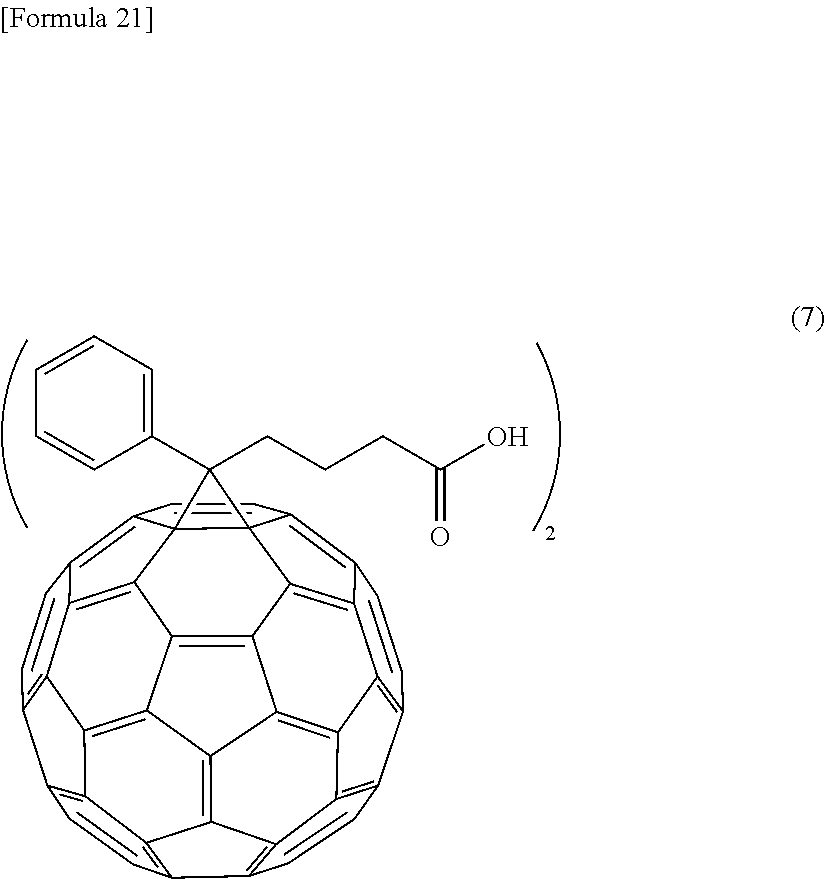
- carboxylate acid having the fullerene skeleton for example, a hydrolysate of phenyl C 61 butyricacid methyl ester, a hydrolysate of bis-phenyl C 61 butyricacid methyl ester (Compound 7 represented by formula (7)), a hydrolysate of phenyl C 71 butyricacid methyl ester, or the like can ho suitably used.
- a hydrolysate (Compound 8 represented by formula (8)) of a compound obtained by reacting fullerene with N-methylglycine and an aldehyde (Compound 9 represented by formula (9)) can also he suitably used.
- the Bronsted base of the present embodiment includes, for example, an amine having n perfluoroalkyl chain.
- the amine having the perfluoroalkyl chain can be obtained, for example, by tosylating the hydroxyl group of the alcohol having the perfluoroalkyl chain, then phthalimidizing the resulting tosyl group, and further aminating the resulting imide group.
- p and q are 1 to 3; m is 1 to 30; and n is 0 to 30.
- Compound A represented by formula (A) is an ionic liquid formed from Compound 7 and Compound 10.
- Compound B represented by formula (B) is an ionic liquid formed from Compound 7 and Compound 11.
- Compound C represented by formula (C) is an ionic liquid formed from Compound 8 and Compound 10.
- Compound D represented by formula (D) is an ionic liquid formed from Compound 8 and Compound 11.
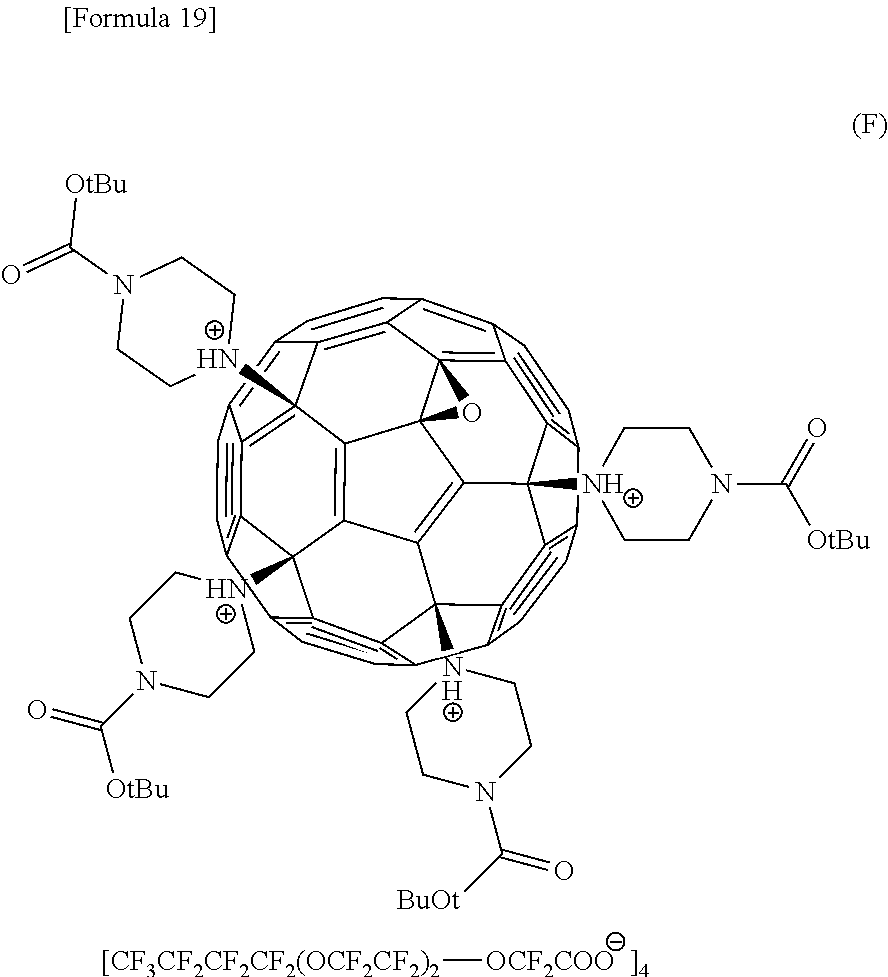
- Compound G represented by formula (G) is an ionic liquid formed from Compound 6A and Compound 11.
- x is 10 and y is 5.
- the ionic liquid is synthesized from a B roasted acid and a Bronsted base.
- a carboxylic acid having a fullerene skeleton and an amine having a perfluoropolyether as a main skeleton arc mixed in an equivalent amount and neutralized.
- fullerene compounds are less likely to dissolve in organic solvents, it is not easy to introduce perfluoropolyether chains into the fullerene skeleton.
- the perfluoropolyether chain can be relatively easily introduced into the fullerene skeleton.
- the lubricant of the present invention is characterized by containing the aforementioned ionic liquid.
- the aforementioned ionic liquid may be used alone or in combination with a known lubricant.
- long-chain carboxylic acids, long chain carboxylic acid esters, perfluoroalkylcarboxylic acid esters, carboxylic acid perfluoroalkyl esters. perfluoroalkylcarboxylic acid perfluoroalkyl esters, perfluoropolyether derivatives, and the like may be used in combination.
- an extreme-pressure agent may be used in combination at a compounding ratio of about 30:70 to 70:30 by weight.
- the extreme-pressure agent reacts with the metal surface by the frictional heat generated by the metal contact, and a film made of the reaction product is formed, thereby performing friction-preventing and wear-preventing action.
- the extreme-pressure agent any of a phosphorus-based extreme-pressure agent, a sulfur-based extreme-pressure agent, a halogen-based extreme-pressure agent, an organometal-based extreme-pressure agent, a composite extreme-pressure agent, and the like can be used.
- a rust preventing agent may be used in combination.
- the rust preventing agent it is sufficient as long as it can be used as a rust preventing agent for this kind of magnetic recording medium, and examples thereof include phenols, naphthols, quinones, heterocyclic compounds containing nitrogen atoms, heterocyclic compounds containing oxygen atoms, and heterocyclic compounds containing sulfur atoms
- the rust preventing agent may he used as a lubricant by mixing live rust preventing agent with the lubricant, or may be used by laminating two or more layers such that a magnetic layer is formed on the nonmagnetic support, a rust preventing agent layer is applied on the magnetic layer, and then a lubricant layer is applied.
- an alcohol-based solvent such as isopropyl alcohol (IPA) or ethanol: or a fluorine-based solvent can be used alone or in combination.
- the molecular weight of the lubricant according to the present invention is not particularly limited, the number average molecular weight (Mn) is preferably in the range of 500 to 20,000, and more preferably in the range of 1,000 to 10,000. This is because it has restorability due to an appropriate viscosity, exhibits suitable lubricant performance, and also has excellent heat resistance.
- a molecular weight dispersion (ratio of weight average molecular weight (Mw)/number average molecular weight (Mn)) is controlled to 1.3 or less by molecular-weight-fractionating the lubricant according to the present invention by an appropriate method.
- the lubricant layer can he formed by applying the lubricant by, for example, a dip method using a solution in which the lubricant is dispersed or dissolved in a suitable solvent.
- the solvent depends on the structure of the ionic liquid, but, for example, a fluorine-based solvent (product name: Vertrel (registered trademark) XF, produced by Mitsui DuPont Fluorochemicals Co., Ltd.) can be preferably used.
- the method of forming the lubricant layer is not limited to the dip method, and may be a film formation method such as a spin coating method, a spray method, a paper coating method, or the like.
- the heat treatment temperature is preferably 80 to 180° C. If the temperature is lower than 80° C., the adhesion is not sufficient, and on the other hand, if the temperature is higher than 180° C. the lubricant may be thermally decomposed, which is not preferable.
- the heat treatment time is preferably 5 to 120 minutes.
- the magnetic recording medium may be subjected to UV irradiation treatment before or after the heat treatment in order to further improve the adhesion of the formed lubricant layer to the protective layer.
- the thickness of the lubricant layer is preferably 5 to 25 ⁇ . If the thickness is less than 5 ⁇ , the lubricant performance as the lubricant layer may be deteriorated. A thickness exceeding 25 ⁇ is not preferable from the viewpoint of thinning the film.
- a carbon based protective layer may be preferably used as the protective layer in the present invention.
- an amorphous carbon protective layer is preferable.
- the protective layer is particularly preferably a carbon-based protective layer because the interaction between fullerenes of the lubricant of the present invention and the protective layer is further enhanced, and the effect of the present invention is further exerted.
- the content of hydrogen and/or nitrogen can be adjusted by using a carbon-based protective layer of hydrogenated-carbon and/or nitrogenated-carbon.
- the content of hydrogen is preferably 3 to 20 atom % as measured by the hydrogen forward scattering method (HFS).
- the content of nitrogen is preferably 4 to 15 atom % as measured by X-ray photoelectron spectroscopy (XPS).
- the carbon-based protective layer of the present invention if is not necessary that hydrogen and/or nitrogen is uniformly contained in the entire protective layer, and in particular, it is preferable to use a compositionally graded layer in which nitrogen is contained on the lubricant layer side of the protective layer and hydrogen is contained on the magnetic layer side.
- the film can be formed by. for example, a DC magnetron sputtering method.
- the amorphous carbon protective layer is preferably formed by a plasma CVD method.
- the surface of the protective layer becomes uniform and the film is formed densely. Therefore, it is preferable to form the lubricant layer according to the present invention on the protective layer formed by the CVD method having a smaller roughness.
- the thickness of the protective layer is preferably 10 to 70 ⁇ . If it is less than 10 ⁇ , the performance as a protective layer may be degraded. A thickness exceeding 70 ⁇ is not preferable from the viewpoint of thinning the film.
- the substrate is preferably a glass substrate or an aluminum substrate. Since the glass subsume has rigidity and excellent smoothness, it is suitable for high recording density.
- the glass substrate for example, an aluminosilicate glass substrate may be used, and especially, a chemically strengthened aluminosilicate glass substrate is suitable.
- the roughness of the main surface of the substrate is ultra-smooth with R max of 6 nm or less and R a of 0.6 nm or less.
- the surface roughness R max and R a are based on live standards of JIS B 0601.
- the magnetic recording medium of the present invention includes at least a magnetic layer, a protective layer, and a lubricant layer containing the lubricant according to the present invention on a substrate.
- the magnetic layer is not particularly limited and may be a magnetic layer for in-plane recording or a magnetic layer for perpendicular recording.
- a base layer may be provided between the substrate and the magnetic layer as necessary. Further, an adhesion layer, a soft magnetic layer, or the like may be provided between the base layer and the substrate.
- the base layer may be, for example, a Cr layer; a Ta layer; a Ru layer; or an alloy layer of CrMo, CoW, CrW, CrV, CrTi, or the like.
- an alloy layer of CrTi, NiAl, AlRu, or the like may be used.
- the soft magnetic layer may be. for example, a CoZrTa alloy film.
- the magnetic recording medium of the present invention is particularly suitable as a magnetic recording medium to be mounted on a LUL (Load Unload) type magnetic recording medium device.
- the magnetic recording medium of the present invention having high reliability under a low flying height is suitable because stable operation of the magnetic recording medium is required even under a low flying height of 10 nm or less, due to lowering of the flying height of the magnetic head caused by introduction of the LUL method.
- the fullerene compound according to the second embodiment of the present invention is an ionic liquid represented by the general formula (1), wherein the ionic liquid is formed from Bronsted acid (H n1 X) and Bronsted base ([(R 2 R 3 )N—] m1 —R 1 ); and the Bronsted acid (H n1 X) contains a perfluoroalkyl chain and the Bronsted base (R 2 —N(R 3 )—R 1 ) contains a fullerene-containing group.
- the ionic liquid is formed from Bronsted acid (H n1 X) and Bronsted base ([(R 2 R 3 )N—] m1 —R 1 ); and the Bronsted acid (H n1 X) contains a perfluoroalkyl chain and the Bronsted base (R 2 —N(R 3 )—R 1 ) contains a fullerene-containing group.
- R 1 , R 2 , and R 3 are a hydrocarbon group having 1 to 20 carbon atoms; X has a perfluoroalkyl chain; and at least one of R 1 , R 2 , and R 3 has a fullerene skeleton.
- R 2 and R 3 may be bonded to each other to form a nitrogen containing heterocycle.
- the fullerene skeleton is preferably C 60 or C 70 .
- n 1 is 1 or 2
- n 2 is 1 to 6
- n 1 ⁇ n 2 m 1 ⁇ m 2
- n 1 is 1 or 2
- n 2 is 1 to 4
- n 1 ⁇ n 2 m 1 ⁇ m 2 .
- m 1 is an integer of 2 to 6 and m 2 is 1. More preferably, m 1 is an integer of 2 to 4 and m 2 is 1. When m 1 is 2 or more, both lubrication and heat resistance can be achieved.
- R 1 is a hydrocarbon group with m 1 bonding sites.
- the hydrocarbon group may have a substituent.
- the hydrocarbon group preferably has a fullerene skeleton.
- the Bronsted acids of the present embodiment include, for example, a sulfonic acid having a perfluoroalkyl chain, a carboxylic acid having a perfluoroalkyl chain, and the like.
- the sulfonic acid having a perfluoroalkyl chain has, for example, a sulfonic acid group (—SO 3 H) at the terminal of a compound having the skeleton of structural formulas (2) to (5).
- the sulfonic acid having a perfluoroalkyl chain can be synthesized, for example, by the method described in JP 2016-9509 A, by using Fomblin (registered trademark) Z-DOL (Structural formula: HOCH 2 CF 2 (OCF 2 CF 2 ) m (OCF 2 ) n —OCF 2 —CH 2 OH or CF 3 CF 2 CF 2 CF 2 —(OCF 2 CF 2 ) 2 —OCF 2 CH 2 OH) or the like, manufactured by Solvay Solexis, as a raw material.
- n is 0 to 30.
- the carboxylic acid having a perfluoroalkyl chain has a carboxylic acid group at the end of a perfluoroalkyl chain having 1 to 20 carbon atoms, and examples thereof include undecafluorohexanoic acid, heptadecafluorononanoic acid, tricosafluorododecanoic acid, and the like.
- the compound is synthesized by using Fomblin Z-DOL (Structural formula: HOCH 2 CF 2 (OCF 2 CF 2 ) m (OCF 2 ) n —OCF 2 —CH 2 OH or CF 3 CF 2 CF 2 CF 2 —(OCF 2 CF 2 ) 2 —OCF 2 CH 2 OH) or the like manufactured by Solvay Solexis as a raw material.
- Fomblin Z-DOL Structuretural formula: HOCH 2 CF 2 (OCF 2 CF 2 ) m (OCF 2 ) n —OCF 2 —CH 2 OH or CF 3 CF 2 CF 2 CF 2 —(OCF 2 CF 2 ) 2 —OCF 2 CH 2 OH
- the carboxylic acid having the perfluoroalkyl chain may he commercially available.
- Commercial products include, for example. Fomblin Z-DIAC (number average molecular weight, about 2,000) (formula 14), Fomblin Z-DIAC 4000 (number average molecular weight, about 4,000), Fluorolink (registered trademark) C 10 (number average molecular weight, about 1,700), perfluoro-3,6,9-trioxadecanoic acid (formula 15), and the like, which all are manufactured by Solvay Solexis.
- n is 0 to 30.
- CF 3 CF 2 CF 2 CF 2 —(OCF 2 CF 2 ) 2 —OCF 2 COOH
- the carboxylic acid having a perfluoroalkyl chain or sulfonic acid having a perfluoroalkyl chain preferably hits a skeleton of structural formula (3) among the skeletons of structural formulas (2) to (4).
- the structure formula (3) has the same main skeleton as the compounds which exhibit excellent lubricity such as Fomblin Z-DOL (Structural formula: HOCH 2 CF 2 —(OCF 2 CF 2 ) m (OCF 2 ) n —OCF 2 CH 2 OH) and Fomblin Z-DIAC (Structural formula: HOOCCF 2 —(OCF 2 CF 2 ) m (OCF 2 ) n —OCF 2 COOH), which are manufactured by Solvay Solexis.
- Fomblin Z-DOL Structure formula (3) has the same main skeleton as the compounds which exhibit excellent lubricity such as Fomblin Z-DOL (Structural formula: HOCH 2 CF 2 —(OCF 2 CF 2 ) m (OCF 2 ) n —OCF 2 CH 2 OH) and Fomblin Z-DIAC (Structural formula: HOOCCF 2 —(OCF 2 CF 2 )
- the Bronsted base of the present embodiment includes, for example, an amine having a fullerene skeleton.
- J 204 (Compound 16) represented by formula (16), which is manufactured by Frontier Carbon Corporation, is preferably used.
- Compound E represented by formula (E) is an ionic liquid formed from Compound 16 and Compound 13.
- Compound F represented by formula (F) is an ionic liquid formed from Compound 16 and Compound 15.
- the thermal decomposition temperature of the ionic liquid is preferably 250° C. or higher, more preferably 300° C. or higher. Even more preferably, the temperature is 350° C. or higher.
- the thermal decomposition temperature of the ionic liquid is 250° C. or higher, lubricity can be maintained even when heating is performed, for example, during recording by the HAMR system.
- Compound 6A represented by the following formula (6A) was synthesized as the Bronsted acid of the present invention by the method described in JP 2005-8564A using C 60 made by Frontier Carbon Corporation as a raw material.
- x is 10 and y is 5.
- Compound 11 as the Bronsted base of the present invention was synthesized by reacting 1H, 1H-Perfluoro-3,6,9-trioxatridecan-1-ol (structure formula: CF 3 CF 2 CF 2 CF 2 —OCF 2 CF 2 —OCF 2 CH 2 OH, number average molecular weight: 548) manufactured by Alfa Chemistry with 2-(2-chloroethoxy)tetrahydro-2H-pyran, tosylating the hydroxyl group of the deprotected compound, phthalimidizing the resulting tosyl group, and then aminating the resulting imide group.
- Compound 7 as the Bronsted acid of the present invention was synthesized as a hydrolysate of bis-phenyl C 61 butyric acid methyl (Frontier Carbon Corporation).
- Compound 8 as the Breasted acid of the present invention was synthesized as a hydrolysate of a compound obtained by reacting fullerene C 60 (Frontier Carbon Corporation) with N-methylglycine and an aldehyde obtained from the partial reduction of trimethyl benzene-tricarboxylate.
- the synthesized Compound B was dissolved in Vertrel XF (product name, made by Mitsui DuPont Fluorochemicals Co., Ltd) to obtain a lubricant layer-forming solution.
- the concentration of the fullerene compound (lubricant) was 0.27 mass %.
- the solubility of Compound B in Vertrel XF was 0.36 mass %.
- FIG. 1 shows a magnetic recording medium 11 according to Example 1.
- the magnetic recording medium 11 was formed by sequentially forming a magnetic layer 2 , a protective layer 3 , and a lubricant layer 4 on a nonmagnetic substrate 1 .
- the cleaned glass substrate (manufactured by HOYA, external dimensions 65 mm) was housed in a film formation chamber of a DC magnetron sputtering apparatus (C-3040, manufactured by Anelva Corporation), and the inside of the film formation chamber was evacuated to an ultimate vacuum degree of 1 ⁇ 10 ⁇ 5 Pa.
- an adhesion layer having a thickness of 10 nm was formed on the glass substrate by sputtering method using a CrTi target.
- a first soft magnetic layer having a layer thickness of 25 nm was formed at a substrate temperature of 100° C.
- Co-20Fe-5Zr-5Ta Fe content of 20 atom %, Zr content of 5 atom%, Ta content of 5 atom %, and the balance Co
- an intermediate layer made of Ru having a layer thickness of 0.7 nm and a second soft magnetic layer made of Co-20Fe-5Zr-5Ta having a layer thickness of 25 nm were formed thereon.
- a seed layer having a layer thickness of 5 nm was formed on the soft magnetic base layer by sputtering method using a Ni-6W ⁇ W content of 6 atom %, and the balance Ni ⁇ target.
- a Ru layer having a thickness of 10 nm was formed on the seed layer by sputtering method at a sputtering pressure of 0.8 Pa.
- a Ru layer having a thickness of 10 run was formed on the first orientation control layer by sputtering method at a sputtering pressure of 1.5 Pa.
- a nonmagnetic layer of 88 (Co30Cr)-12(TiO 2 ) ⁇ 88 mol % of an alloy having Cr content of 30 atom % and the balance Co, and 12 mol % of an oxide made from TiO 2 ⁇ was formed on the first magnetic layer with a layer thickness of 0.3 nm by sputtering method.
- a nonmagnetic layer made of Ru was formed on the second magnetic layer with a thickness of 0.3 nm by sputtering method.
- the third magnetic layer was formed on the nonmagnetic layer with a layer thickness of 7 nm by sputtering method using a target made of Co-20Cr-14Pt-3B ⁇ Cr content of 20 atom %, Pt content of 14 atom %. B content of 3 atom %, and the balance Co ⁇ at a sputtering pressure of 0.6 Pa.
- Lubricant was applied onto the protective layer using a dip method. That is, after the prepared lubricant layer-forming solution was placed in the dipping tank of the dip coating apparatus, the substrate in which the layers up to the protective layer were formed was immersed in the lubricant layer-forming solution, and then the substrate was pulled up from the dipping tank at a constant speed to apply the lubricant layer-forming solution to the surface of the protective layer of the substrate.
- the thickness of five lubricant layer was 1.4 nm.
- a lubricant layer was formed and a magnetic recording medium was manufactured in the same manner as in Example 1 except that Compound D was used.
- a lubricant layer was formed and a magnetic recording medium was manufactured in the same manner as in Example 1 except that Compound F was used.
- a lubricant layer was formed and a magnetic recording medium was manufactured in the same manner as in Example 1 except that Compound G was used.
- a lubricant layer was formed and a magnetic recording medium was manufactured in the same manner us in Example 1 except that Compound H was used.
- a lubricant layer was formed and a magnetic recording medium was manufactured in the same manner as in Example 1 except that Compound I was used.
- TG-DTA Manufacturer: Seiko Instruments, Model: EXSTAR 6000
- weight loss relative to temperature was measured for fullerene compounds, and the temperature at 5% weight loss was defined as the pyrolysis temperature.
- a temperature rising rate of 10° C./min and an air flow rate of 200 mL/min were used.
- Samples were prepared by dip coating the lubricant on a slide glass as the substrate.
- a 0.2% by mass solution of an ionic liquid using Vertrel/ethanol (70/30) as a solvent was prepared as the lubricant.
- the dip coating was carried out by pulling up the slide glass from the lubricant tank at a speed of 50 mm/min.
- the synthesized fullerene compounds have a thermal decomposition temperature of 300° C. or higher and have sufficient heat resistance.
- the fullerene compound of the present invention is an ionic liquid formed from a Bronsted acid and a Bronsted base, and one of the Bronsted acid and the Bronsted base contains a group having a fullerene, and the other one of the Bronsted acid and the Bronsted base contains a perfluoroalkyl chain.
- the fullerene and the perfluoroalkyl chain are molecularized by ionic bonds, both lubricity and heat resistance can be achieved.
Landscapes
- Chemical & Material Sciences (AREA)
- Organic Chemistry (AREA)
- Chemical Kinetics & Catalysis (AREA)
- General Chemical & Material Sciences (AREA)
- Oil, Petroleum & Natural Gas (AREA)
- Lubricants (AREA)
- Magnetic Record Carriers (AREA)
- Epoxy Compounds (AREA)
- Nitrogen Condensed Heterocyclic Rings (AREA)
- Organic Low-Molecular-Weight Compounds And Preparation Thereof (AREA)
Abstract
Description

Cn(OH)x-y(OSO3H)y (6)

NH2(CH2CH2O)pCH2CF2—(OCF2CF2)m(OCF2)n—OCF2CH2(OCH2CH2)qNH2 (10)
CF3CF2CF2CF2—(OCF2CF2)2—OCF2CH2OCH2CH2NH2 (11)
HO3S(CH2)3OCH2CF2—(OCF2CF2)m(OCF2)n—OCF2CH2O(CH2)3SO3H (12)
CF3CF2CF2CF2—(OCF2CF2)2—OCF2CH2O(CH2)3SO3H (13)
HOOCCF2—(OCF2CF2)m(OCF2)n—OCF2COOH (14)
CF3CF2CF2CF2—(OCF2CF2)2—OCF2COOH (15)


—CF2—(OCF2CF2)b—(OCF2)e—OCF2— (2)
—CF(CF3)—(OCF(CF3)CF2)d—OCF(CF3)— (3)
—CF2CF2—(OCF2CF2CF2)e—OCF2CF2— (4)
CF3CF2CF2CF2(OCF2CF2)2—OCF2CH2— (5)

Cb(OH)x-y(OSO3H)y (6)


NH2(CH2CH2O)pCH2CF2—(OCF2CF2)m(OCF2)n—OCF2CH2(OCH2CH2)qNH2 (10)
CF3CF2CF2CF2—(OCF2CF2)2—OCF2CH2OCH2CH2NH2 (11)
| TABLE 1 | |||||||||
| X | R1 | R2 | R3 | n1 | n2 | m1 | m2 | ||
| Com- pound A |
 |
—(CH2CH2O)pCH2CF2—(OCF2CF2)m(OCF2)n—OCF2CH2(OCH2CH2)q— p = q = 1 m = n = 10 | | H | 2 | 1 | 2 | 1 | |
| Com- pound B |
 |
CF3CF2CF2CF2—(OCF2CF2)2—OCF2CH2OCH2CH2— | | H | 2 | 1 | 2 | 1 | |
| Com- pound C |
 |
—(CH2CH2O)pCH2CF2—(OCF2CF2)m(OCF2)n—OCF2CH2(OCH2CH2)q— p = q = 1 m = n = 10 | H | H | 8 | 1 | 2 | 4 | |
| Com- pound D |
 |
CF3CF2CF2CF2—(OCF2CF2)2—OCF2CH2OCH2CH2— | H | H | 8 | 1 | 1 | 8 | |
| Com- | Cn(OH)x-y(OSO3 ⊖)y | CF3CF2CF2CF2—(OCF2CF2)2—OCF2CH2OCH2CH2— | H | H | 5 | 1 | 1 | 5 | |
| pound | Cn = C60, | ||||||||
| G | x = 10, y = 5 | ||||||||


HO3S(CH2)3OCH2CF2—(OCF2CF2)m(OCF2)n—OCF2CH2O(CH2)eSO3H (12)
CF3CF2CF2CF2—(OCF2CF2)2—OCF2CH2O(CH2)3SO3H (13)
HOOCCF2·(OCF2CF2)m(OCF2)n—OCF2COOH (14)
CF3CF2CF2CF2—(OCF2CF2)2—OCF2COOH (15)

| TABLE 2 | ||
| X |
 |
|
| Com- pound E | CF3CF2CF2CF2—(OCF2CF2)2—OCF2CH2O(CH2)3SO3 − |
 |
| Com- pound F | CF3CF2CF2CF2 (OCF2CF2)2—OCF2COO− |
 |
| R2 | R3 | n1 | n2 | m1 | m2 | |||
| Compound E |
 |
1 | 4 | 4 | 1 | ||
| Compound F |
 |
1 | 4 | 4 | 1 | ||


CF3CF2CF2CF2−(OCF2CF2)2—OCF2CH2OCH2CH2NH2 (11)

| TABLE 3 | |||||
| Coeffi- | Coeffi- | ||||
| Coeffi- | cient of | cient of | |||
| Pyroly- | cient of | friction | friction | ||
| sis | friction | 140° C. | 250° C. | ||
| temper- | without heat | for 60 | for 60 | ||
| ature | treatment | minutes | minutes | ||
| Example 1 | Compound | 330 | 0.13 | 0.17 | 0.20 |
| B | |||||
| Example 2 | Compound | >350 | 0.09 | 0.13 | 0.19 |
| D | |||||
| Example 3 | Compound | 320 | 0.12 | 0.15 | 0.19 |
| F | |||||
| Example 4 | Compound | 330 | 0.11 | 0.15 | 0.19 |
| G | |||||
| Comparative | Compound | 200 | 0.14 | 0.24 | 0.36 |
| Example 1 | H | ||||
| Comparative | Compound | 190 | 0.12 | 0.15 | 0.39 |
| Example 2 | I | ||||
Claims (10)

Cn(OH)x-y(OSO3H)y (6)

NH2(CH2CH2O)pCH2CF2—(OCF2CF2)m(OCF2)n—OCF2CH2(OCH2CH2)qNH2 (10)
CF3CF2CF2CF2—(OCF2CF2)2—OCF2CH2OCH2CH2NH2 (11)
HO3S(CH2)3OCH2CF2—(OCF2CF2)m(OCF2)n—OCF2CH2O(CH2)3SO3H (12)
CF3CF2CF2CF2—(OCF2CF2)2—OCF2CH2O(CH2)3SO3H (13)
HOOCCF2—(OCF2CF2)m(OCF2)n—OCF2COOH (14)
CF3CF2CF2CF2—(OCF2CF2)2—OCF2COOH (15)

Applications Claiming Priority (4)
| Application Number | Priority Date | Filing Date | Title |
|---|---|---|---|
| JPJP2018-111894 | 2018-06-12 | ||
| JP2018111894 | 2018-06-12 | ||
| JP2018-111894 | 2018-06-12 | ||
| PCT/JP2019/022850 WO2019240058A1 (en) | 2018-06-12 | 2019-06-10 | Fullerene compound, lubricant for magnetic recording medium, and magnetic recording medium |
Publications (2)
| Publication Number | Publication Date |
|---|---|
| US20210253968A1 US20210253968A1 (en) | 2021-08-19 |
| US11261395B2 true US11261395B2 (en) | 2022-03-01 |
Family
ID=68842220
Family Applications (1)
| Application Number | Title | Priority Date | Filing Date |
|---|---|---|---|
| US16/972,813 Expired - Fee Related US11261395B2 (en) | 2018-06-12 | 2019-06-10 | Fullerene compound, lubricant for magnetic recording medium, and magnetic recording medium |
Country Status (4)
| Country | Link |
|---|---|
| US (1) | US11261395B2 (en) |
| JP (1) | JP7314936B2 (en) |
| CN (1) | CN112236409B (en) |
| WO (1) | WO2019240058A1 (en) |
Families Citing this family (3)
| Publication number | Priority date | Publication date | Assignee | Title |
|---|---|---|---|---|
| CN113710782B (en) | 2019-04-24 | 2022-11-18 | 昭和电工株式会社 | Method for producing lubricating oil composition and lubricating oil composition |
| CN113710780B (en) * | 2019-04-24 | 2023-05-12 | 株式会社力森诺科 | Lubricating oil composition and method for producing same |
| JP6995279B2 (en) * | 2019-04-24 | 2022-02-04 | 昭和電工株式会社 | Lubricating oil composition, its manufacturing method and vacuum equipment |
Citations (7)
| Publication number | Priority date | Publication date | Assignee | Title |
|---|---|---|---|---|
| JPH0593059A (en) | 1991-06-20 | 1993-04-16 | Sony Corp | Perfluoropolyether derivative, lubricant using the same, and magnetic recording medium |
| JP2005336309A (en) | 2004-05-26 | 2005-12-08 | Kyodo Yushi Co Ltd | Lubricant composition |
| US20150162044A1 (en) | 2013-12-05 | 2015-06-11 | Showa Denko K.K. | Lubricant for magnetic recording medium, magnetic recording medium, manufacturing method of magnetic recording medium, and magnetic recording and reproducing device |
| JP2015135710A (en) | 2014-01-16 | 2015-07-27 | 昭和電工株式会社 | Magnetic recording media lubricant, magnetic recording medium, method for manufacturing magnetic recording medium and magnetic recording/reproducing apparatus |
| WO2015125940A1 (en) | 2014-02-21 | 2015-08-27 | 昭和電工株式会社 | Fullerene derivative, fluororesin composition, and lubricant |
| JP2016009509A (en) | 2014-06-24 | 2016-01-18 | デクセリアルズ株式会社 | Lubricant for magnetic recording medium, and magnetic recording medium |
| WO2017006812A1 (en) * | 2015-07-03 | 2017-01-12 | 昭和電工株式会社 | Fullerene derivative and lubricant |
Family Cites Families (3)
| Publication number | Priority date | Publication date | Assignee | Title |
|---|---|---|---|---|
| JP6283515B2 (en) * | 2012-12-28 | 2018-02-21 | デクセリアルズ株式会社 | Ionic liquid, lubricant and magnetic recording medium |
| JP6042781B2 (en) * | 2013-08-21 | 2016-12-14 | デクセリアルズ株式会社 | Lubricant and magnetic recording medium |
| CN105646186B (en) * | 2016-02-14 | 2018-08-24 | 陈铭 | Using methanofullerene carboxylate radical as anion ion liquid and preparation method |
-
2019
- 2019-06-10 JP JP2020525542A patent/JP7314936B2/en active Active
- 2019-06-10 CN CN201980038263.2A patent/CN112236409B/en active Active
- 2019-06-10 WO PCT/JP2019/022850 patent/WO2019240058A1/en not_active Ceased
- 2019-06-10 US US16/972,813 patent/US11261395B2/en not_active Expired - Fee Related
Patent Citations (11)
| Publication number | Priority date | Publication date | Assignee | Title |
|---|---|---|---|---|
| JPH0593059A (en) | 1991-06-20 | 1993-04-16 | Sony Corp | Perfluoropolyether derivative, lubricant using the same, and magnetic recording medium |
| JP2005336309A (en) | 2004-05-26 | 2005-12-08 | Kyodo Yushi Co Ltd | Lubricant composition |
| US20150162044A1 (en) | 2013-12-05 | 2015-06-11 | Showa Denko K.K. | Lubricant for magnetic recording medium, magnetic recording medium, manufacturing method of magnetic recording medium, and magnetic recording and reproducing device |
| JP2015109129A (en) | 2013-12-05 | 2015-06-11 | 昭和電工株式会社 | Magnetic recording medium lubricant, magnetic recording medium, magnetic recording medium manufacturing method, and magnetic recording/reproducing apparatus |
| JP2015135710A (en) | 2014-01-16 | 2015-07-27 | 昭和電工株式会社 | Magnetic recording media lubricant, magnetic recording medium, method for manufacturing magnetic recording medium and magnetic recording/reproducing apparatus |
| WO2015125940A1 (en) | 2014-02-21 | 2015-08-27 | 昭和電工株式会社 | Fullerene derivative, fluororesin composition, and lubricant |
| US20160347703A1 (en) | 2014-02-21 | 2016-12-01 | Showa Denko K.K. | Fullerene derivative, fluororesin composition, and lubricant |
| JP2016009509A (en) | 2014-06-24 | 2016-01-18 | デクセリアルズ株式会社 | Lubricant for magnetic recording medium, and magnetic recording medium |
| WO2017006812A1 (en) * | 2015-07-03 | 2017-01-12 | 昭和電工株式会社 | Fullerene derivative and lubricant |
| JP2017014192A (en) | 2015-07-03 | 2017-01-19 | 昭和電工株式会社 | Fullerene derivatives and lubricants |
| EP3318553A1 (en) | 2015-07-03 | 2018-05-09 | Showa Denko K.K. | Fullerene derivative and lubricant |
Non-Patent Citations (1)
| Title |
|---|
| International Search Report of PCT/JP2019/022850 dated Aug. 27, 2019 [PCT/ISA/210]. |
Also Published As
| Publication number | Publication date |
|---|---|
| CN112236409B (en) | 2023-11-21 |
| JPWO2019240058A1 (en) | 2021-07-26 |
| US20210253968A1 (en) | 2021-08-19 |
| JP7314936B2 (en) | 2023-07-26 |
| CN112236409A (en) | 2021-01-15 |
| WO2019240058A1 (en) | 2019-12-19 |
Similar Documents
| Publication | Publication Date | Title |
|---|---|---|
| JP5613916B2 (en) | Perfluoropolyether compound, method for producing the same, lubricant containing the compound, and magnetic disk | |
| US9117475B2 (en) | Lubricant composition and use thereof | |
| JP5909837B2 (en) | Fluoropolyether compound, lubricant containing the same, and magnetic disk | |
| US11479641B2 (en) | Fluorine-containing ether compound, lubricant for magnetic recording medium, and magnetic recording medium | |
| CN109937198B (en) | Fluorinated ether compound, lubricant for magnetic recording medium, and magnetic recording medium | |
| US8828565B2 (en) | Lubricant composition, fluorine-based compound, and use thereof | |
| CN114845989B (en) | Fluorine-containing ether compound, lubricant for magnetic recording medium, and magnetic recording medium | |
| US11220649B2 (en) | Fluorine-containing ether compound, lubricant for magnetic recording medium, and magnetic recording medium | |
| CN111032608B (en) | Fluorine-containing ether compound, lubricant for magnetic recording medium, and magnetic recording medium | |
| US20120295134A1 (en) | Perfluoropolyether compound, manufacturing method therefor, lubricant containing said compound, and magnetic disc | |
| US10343972B2 (en) | Fullerene derivative, fluororesin composition, and lubricant | |
| CN111032625A (en) | Fluorinated ether compound, lubricant for magnetic recording medium, and magnetic recording medium | |
| US20210253968A1 (en) | Fullerene compound, lubricant for magnetic recording medium, and magnetic recording medium | |
| TW201009825A (en) | Lubricant, magnetic recording medium and head slider | |
| JPWO2011136379A1 (en) | Cyclophosphazene compound, lubricant using the same, and magnetic disk | |
| JP6695480B2 (en) | Method for producing compound and fullerene derivative | |
| JP5382876B2 (en) | Perfluoropolyether compound, lubricant containing the same and magnetic disk | |
| CN115038685B (en) | Fluorine-containing ether compound, lubricant for magnetic recording medium, and magnetic recording medium | |
| US11514945B2 (en) | Lubricant for magnetic recording medium, and method for producing magnetic recording medium | |
| JP6437422B2 (en) | Lubricant for magnetic recording medium and magnetic recording medium | |
| US9928865B2 (en) | Fluoropolyether compound, and lubricant and magnetic disc using same | |
| JP7845501B2 (en) | Lubricant for magnetic recording media | |
| HK1178540A (en) | Cyclophosphazene compound, lubricant comprising same, and magnetic disk |
Legal Events
| Date | Code | Title | Description |
|---|---|---|---|
| AS | Assignment |
Owner name: SHOWA DENKO K.K., JAPAN Free format text: ASSIGNMENT OF ASSIGNORS INTEREST;ASSIGNORS:KATO, TSUYOSHI;WATANABE, KENTARO;UEDA, YASUYUKI;REEL/FRAME:054566/0742 Effective date: 20201201 |
|
| FEPP | Fee payment procedure |
Free format text: ENTITY STATUS SET TO UNDISCOUNTED (ORIGINAL EVENT CODE: BIG.); ENTITY STATUS OF PATENT OWNER: LARGE ENTITY |
|
| STPP | Information on status: patent application and granting procedure in general |
Free format text: DOCKETED NEW CASE - READY FOR EXAMINATION |
|
| STPP | Information on status: patent application and granting procedure in general |
Free format text: NOTICE OF ALLOWANCE MAILED -- APPLICATION RECEIVED IN OFFICE OF PUBLICATIONS |
|
| STCF | Information on status: patent grant |
Free format text: PATENTED CASE |
|
| AS | Assignment |
Owner name: RESONAC CORPORATION, JAPAN Free format text: CHANGE OF NAME;ASSIGNOR:SHOWA DENKO K.K.;REEL/FRAME:064082/0513 Effective date: 20230623 |
|
| AS | Assignment |
Owner name: RESONAC CORPORATION, JAPAN Free format text: CHANGE OF ADDRESS;ASSIGNOR:RESONAC CORPORATION;REEL/FRAME:066599/0037 Effective date: 20231001 |
|
| FEPP | Fee payment procedure |
Free format text: MAINTENANCE FEE REMINDER MAILED (ORIGINAL EVENT CODE: REM.); ENTITY STATUS OF PATENT OWNER: LARGE ENTITY |
|
| LAPS | Lapse for failure to pay maintenance fees |
Free format text: PATENT EXPIRED FOR FAILURE TO PAY MAINTENANCE FEES (ORIGINAL EVENT CODE: EXP.); ENTITY STATUS OF PATENT OWNER: LARGE ENTITY |
|
| STCH | Information on status: patent discontinuation |
Free format text: PATENT EXPIRED DUE TO NONPAYMENT OF MAINTENANCE FEES UNDER 37 CFR 1.362 |
|
| FP | Lapsed due to failure to pay maintenance fee |
Effective date: 20260301 |