US11261328B2 - Circuit board using low dielectric resin composition - Google Patents

Circuit board using low dielectric resin composition Download PDF

Info

Publication number
US11261328B2
US11261328B2 US17/121,616 US202017121616A US11261328B2 US 11261328 B2 US11261328 B2 US 11261328B2 US 202017121616 A US202017121616 A US 202017121616A US 11261328 B2 US11261328 B2 US 11261328B2
Authority
US
United States
Prior art keywords
low dielectric
resin composition
circuit board
resin
dielectric resin
Prior art date
Legal status (The legal status is an assumption and is not a legal conclusion. Google has not performed a legal analysis and makes no representation as to the accuracy of the status listed.)
Active
Application number
US17/121,616
Other versions
US20210102067A1 (en
Inventor
Szu-Hsiang SU
Shou-Jui Hsiang
Mao-Feng Hsu
Ming-Jaan Ho
Current Assignee (The listed assignees may be inaccurate. Google has not performed a legal analysis and makes no representation or warranty as to the accuracy of the list.)
Zhen Ding Technology Co Ltd
Original Assignee
Zhen Ding Technology Co Ltd
Priority date (The priority date is an assumption and is not a legal conclusion. Google has not performed a legal analysis and makes no representation as to the accuracy of the date listed.)
Filing date
Publication date
Application filed by Zhen Ding Technology Co Ltd filed Critical Zhen Ding Technology Co Ltd
Priority to US17/121,616 priority Critical patent/US11261328B2/en
Assigned to Zhen Ding Technology Co., Ltd. reassignment Zhen Ding Technology Co., Ltd. ASSIGNMENT OF ASSIGNORS INTEREST (SEE DOCUMENT FOR DETAILS). Assignors: HO, MING-JAAN, HSIANG, SHOU-JUI, HSU, MAO-FENG, SU, SZU-HSIANG
Publication of US20210102067A1 publication Critical patent/US20210102067A1/en
Application granted granted Critical
Publication of US11261328B2 publication Critical patent/US11261328B2/en
Active legal-status Critical Current
Anticipated expiration legal-status Critical

Links

Images

Classifications

    • CCHEMISTRY; METALLURGY
    • C08ORGANIC MACROMOLECULAR COMPOUNDS; THEIR PREPARATION OR CHEMICAL WORKING-UP; COMPOSITIONS BASED THEREON
    • C08LCOMPOSITIONS OF MACROMOLECULAR COMPOUNDS
    • C08L79/00Compositions of macromolecular compounds obtained by reactions forming in the main chain of the macromolecule a linkage containing nitrogen with or without oxygen or carbon only, not provided for in groups C08L61/00 - C08L77/00
    • C08L79/04Polycondensates having nitrogen-containing heterocyclic rings in the main chain; Polyhydrazides; Polyamide acids or similar polyimide precursors
    • C08L79/08Polyimides; Polyester-imides; Polyamide-imides; Polyamide acids or similar polyimide precursors
    • CCHEMISTRY; METALLURGY
    • C08ORGANIC MACROMOLECULAR COMPOUNDS; THEIR PREPARATION OR CHEMICAL WORKING-UP; COMPOSITIONS BASED THEREON
    • C08JWORKING-UP; GENERAL PROCESSES OF COMPOUNDING; AFTER-TREATMENT NOT COVERED BY SUBCLASSES C08B, C08C, C08F, C08G or C08H
    • C08J3/00Processes of treating or compounding macromolecular substances
    • C08J3/24Crosslinking, e.g. vulcanising, of macromolecules
    • C08J3/246Intercrosslinking of at least two polymers
    • CCHEMISTRY; METALLURGY
    • C08ORGANIC MACROMOLECULAR COMPOUNDS; THEIR PREPARATION OR CHEMICAL WORKING-UP; COMPOSITIONS BASED THEREON
    • C08JWORKING-UP; GENERAL PROCESSES OF COMPOUNDING; AFTER-TREATMENT NOT COVERED BY SUBCLASSES C08B, C08C, C08F, C08G or C08H
    • C08J5/00Manufacture of articles or shaped materials containing macromolecular substances
    • C08J5/18Manufacture of films or sheets
    • CCHEMISTRY; METALLURGY
    • C08ORGANIC MACROMOLECULAR COMPOUNDS; THEIR PREPARATION OR CHEMICAL WORKING-UP; COMPOSITIONS BASED THEREON
    • C08LCOMPOSITIONS OF MACROMOLECULAR COMPOUNDS
    • C08L51/00Compositions of graft polymers in which the grafted component is obtained by reactions only involving carbon-to-carbon unsaturated bonds; Compositions of derivatives of such polymers
    • C08L51/003Compositions of graft polymers in which the grafted component is obtained by reactions only involving carbon-to-carbon unsaturated bonds; Compositions of derivatives of such polymers grafted on to macromolecular compounds obtained by reactions only involving unsaturated carbon-to-carbon bonds
    • CCHEMISTRY; METALLURGY
    • C08ORGANIC MACROMOLECULAR COMPOUNDS; THEIR PREPARATION OR CHEMICAL WORKING-UP; COMPOSITIONS BASED THEREON
    • C08LCOMPOSITIONS OF MACROMOLECULAR COMPOUNDS
    • C08L51/00Compositions of graft polymers in which the grafted component is obtained by reactions only involving carbon-to-carbon unsaturated bonds; Compositions of derivatives of such polymers
    • C08L51/006Compositions of graft polymers in which the grafted component is obtained by reactions only involving carbon-to-carbon unsaturated bonds; Compositions of derivatives of such polymers grafted on to block copolymers containing at least one sequence of polymer obtained by reactions only involving carbon-to-carbon unsaturated bonds
    • CCHEMISTRY; METALLURGY
    • C08ORGANIC MACROMOLECULAR COMPOUNDS; THEIR PREPARATION OR CHEMICAL WORKING-UP; COMPOSITIONS BASED THEREON
    • C08LCOMPOSITIONS OF MACROMOLECULAR COMPOUNDS
    • C08L51/00Compositions of graft polymers in which the grafted component is obtained by reactions only involving carbon-to-carbon unsaturated bonds; Compositions of derivatives of such polymers
    • C08L51/04Compositions of graft polymers in which the grafted component is obtained by reactions only involving carbon-to-carbon unsaturated bonds; Compositions of derivatives of such polymers grafted on to rubbers
    • CCHEMISTRY; METALLURGY
    • C08ORGANIC MACROMOLECULAR COMPOUNDS; THEIR PREPARATION OR CHEMICAL WORKING-UP; COMPOSITIONS BASED THEREON
    • C08LCOMPOSITIONS OF MACROMOLECULAR COMPOUNDS
    • C08L51/00Compositions of graft polymers in which the grafted component is obtained by reactions only involving carbon-to-carbon unsaturated bonds; Compositions of derivatives of such polymers
    • C08L51/08Compositions of graft polymers in which the grafted component is obtained by reactions only involving carbon-to-carbon unsaturated bonds; Compositions of derivatives of such polymers grafted on to macromolecular compounds obtained otherwise than by reactions only involving unsaturated carbon-to-carbon bonds
    • CCHEMISTRY; METALLURGY
    • C08ORGANIC MACROMOLECULAR COMPOUNDS; THEIR PREPARATION OR CHEMICAL WORKING-UP; COMPOSITIONS BASED THEREON
    • C08LCOMPOSITIONS OF MACROMOLECULAR COMPOUNDS
    • C08L71/00Compositions of polyethers obtained by reactions forming an ether link in the main chain; Compositions of derivatives of such polymers
    • C08L71/08Polyethers derived from hydroxy compounds or from their metallic derivatives
    • C08L71/10Polyethers derived from hydroxy compounds or from their metallic derivatives from phenols
    • C08L71/12Polyphenylene oxides
    • HELECTRICITY
    • H05ELECTRIC TECHNIQUES NOT OTHERWISE PROVIDED FOR
    • H05KPRINTED CIRCUITS; CASINGS OR CONSTRUCTIONAL DETAILS OF ELECTRIC APPARATUS; MANUFACTURE OF ASSEMBLAGES OF ELECTRICAL COMPONENTS
    • H05K1/00Printed circuits
    • H05K1/02Details
    • H05K1/03Use of materials for the substrate
    • H05K1/0313Organic insulating material
    • H05K1/0353Organic insulating material consisting of two or more materials, e.g. two or more polymers, polymer + filler, + reinforcement
    • H05K1/0373Organic insulating material consisting of two or more materials, e.g. two or more polymers, polymer + filler, + reinforcement containing additives, e.g. fillers
    • CCHEMISTRY; METALLURGY
    • C08ORGANIC MACROMOLECULAR COMPOUNDS; THEIR PREPARATION OR CHEMICAL WORKING-UP; COMPOSITIONS BASED THEREON
    • C08JWORKING-UP; GENERAL PROCESSES OF COMPOUNDING; AFTER-TREATMENT NOT COVERED BY SUBCLASSES C08B, C08C, C08F, C08G or C08H
    • C08J2351/00Characterised by the use of graft polymers in which the grafted component is obtained by reactions only involving carbon-to-carbon unsaturated bonds; Derivatives of such polymers
    • CCHEMISTRY; METALLURGY
    • C08ORGANIC MACROMOLECULAR COMPOUNDS; THEIR PREPARATION OR CHEMICAL WORKING-UP; COMPOSITIONS BASED THEREON
    • C08JWORKING-UP; GENERAL PROCESSES OF COMPOUNDING; AFTER-TREATMENT NOT COVERED BY SUBCLASSES C08B, C08C, C08F, C08G or C08H
    • C08J2351/00Characterised by the use of graft polymers in which the grafted component is obtained by reactions only involving carbon-to-carbon unsaturated bonds; Derivatives of such polymers
    • C08J2351/04Characterised by the use of graft polymers in which the grafted component is obtained by reactions only involving carbon-to-carbon unsaturated bonds; Derivatives of such polymers grafted on to rubbers
    • CCHEMISTRY; METALLURGY
    • C08ORGANIC MACROMOLECULAR COMPOUNDS; THEIR PREPARATION OR CHEMICAL WORKING-UP; COMPOSITIONS BASED THEREON
    • C08JWORKING-UP; GENERAL PROCESSES OF COMPOUNDING; AFTER-TREATMENT NOT COVERED BY SUBCLASSES C08B, C08C, C08F, C08G or C08H
    • C08J2351/00Characterised by the use of graft polymers in which the grafted component is obtained by reactions only involving carbon-to-carbon unsaturated bonds; Derivatives of such polymers
    • C08J2351/06Characterised by the use of graft polymers in which the grafted component is obtained by reactions only involving carbon-to-carbon unsaturated bonds; Derivatives of such polymers grafted on to homopolymers or copolymers of aliphatic hydrocarbons containing only one carbon-to-carbon double bond
    • CCHEMISTRY; METALLURGY
    • C08ORGANIC MACROMOLECULAR COMPOUNDS; THEIR PREPARATION OR CHEMICAL WORKING-UP; COMPOSITIONS BASED THEREON
    • C08JWORKING-UP; GENERAL PROCESSES OF COMPOUNDING; AFTER-TREATMENT NOT COVERED BY SUBCLASSES C08B, C08C, C08F, C08G or C08H
    • C08J2351/00Characterised by the use of graft polymers in which the grafted component is obtained by reactions only involving carbon-to-carbon unsaturated bonds; Derivatives of such polymers
    • C08J2351/08Characterised by the use of graft polymers in which the grafted component is obtained by reactions only involving carbon-to-carbon unsaturated bonds; Derivatives of such polymers grafted on to macromolecular compounds obtained otherwise than by reactions only involving carbon-to-carbon unsaturated bonds
    • CCHEMISTRY; METALLURGY
    • C08ORGANIC MACROMOLECULAR COMPOUNDS; THEIR PREPARATION OR CHEMICAL WORKING-UP; COMPOSITIONS BASED THEREON
    • C08JWORKING-UP; GENERAL PROCESSES OF COMPOUNDING; AFTER-TREATMENT NOT COVERED BY SUBCLASSES C08B, C08C, C08F, C08G or C08H
    • C08J2379/00Characterised by the use of macromolecular compounds obtained by reactions forming in the main chain of the macromolecule a linkage containing nitrogen with or without oxygen, or carbon only, not provided for in groups C08J2361/00 - C08J2377/00
    • C08J2379/04Polycondensates having nitrogen-containing heterocyclic rings in the main chain; Polyhydrazides; Polyamide acids or similar polyimide precursors
    • C08J2379/08Polyimides; Polyester-imides; Polyamide-imides; Polyamide acids or similar polyimide precursors
    • CCHEMISTRY; METALLURGY
    • C08ORGANIC MACROMOLECULAR COMPOUNDS; THEIR PREPARATION OR CHEMICAL WORKING-UP; COMPOSITIONS BASED THEREON
    • C08JWORKING-UP; GENERAL PROCESSES OF COMPOUNDING; AFTER-TREATMENT NOT COVERED BY SUBCLASSES C08B, C08C, C08F, C08G or C08H
    • C08J2447/00Characterised by the use of homopolymers or copolymers of compounds having one or more unsaturated aliphatic radicals, at least one having two or more carbon-to-carbon double bonds; Derivatives of such polymers
    • CCHEMISTRY; METALLURGY
    • C08ORGANIC MACROMOLECULAR COMPOUNDS; THEIR PREPARATION OR CHEMICAL WORKING-UP; COMPOSITIONS BASED THEREON
    • C08JWORKING-UP; GENERAL PROCESSES OF COMPOUNDING; AFTER-TREATMENT NOT COVERED BY SUBCLASSES C08B, C08C, C08F, C08G or C08H
    • C08J2463/00Characterised by the use of epoxy resins; Derivatives of epoxy resins
    • CCHEMISTRY; METALLURGY
    • C08ORGANIC MACROMOLECULAR COMPOUNDS; THEIR PREPARATION OR CHEMICAL WORKING-UP; COMPOSITIONS BASED THEREON
    • C08JWORKING-UP; GENERAL PROCESSES OF COMPOUNDING; AFTER-TREATMENT NOT COVERED BY SUBCLASSES C08B, C08C, C08F, C08G or C08H
    • C08J2471/00Characterised by the use of polyethers obtained by reactions forming an ether link in the main chain; Derivatives of such polymers
    • C08J2471/08Polyethers derived from hydroxy compounds or from their metallic derivatives
    • C08J2471/10Polyethers derived from hydroxy compounds or from their metallic derivatives from phenols
    • C08J2471/12Polyphenylene oxides
    • CCHEMISTRY; METALLURGY
    • C08ORGANIC MACROMOLECULAR COMPOUNDS; THEIR PREPARATION OR CHEMICAL WORKING-UP; COMPOSITIONS BASED THEREON
    • C08LCOMPOSITIONS OF MACROMOLECULAR COMPOUNDS
    • C08L2203/00Applications
    • C08L2203/20Applications use in electrical or conductive gadgets
    • CCHEMISTRY; METALLURGY
    • C08ORGANIC MACROMOLECULAR COMPOUNDS; THEIR PREPARATION OR CHEMICAL WORKING-UP; COMPOSITIONS BASED THEREON
    • C08LCOMPOSITIONS OF MACROMOLECULAR COMPOUNDS
    • C08L2205/00Polymer mixtures characterised by other features
    • C08L2205/03Polymer mixtures characterised by other features containing three or more polymers in a blend
    • CCHEMISTRY; METALLURGY
    • C08ORGANIC MACROMOLECULAR COMPOUNDS; THEIR PREPARATION OR CHEMICAL WORKING-UP; COMPOSITIONS BASED THEREON
    • C08LCOMPOSITIONS OF MACROMOLECULAR COMPOUNDS
    • C08L2312/00Crosslinking
    • HELECTRICITY
    • H05ELECTRIC TECHNIQUES NOT OTHERWISE PROVIDED FOR
    • H05KPRINTED CIRCUITS; CASINGS OR CONSTRUCTIONAL DETAILS OF ELECTRIC APPARATUS; MANUFACTURE OF ASSEMBLAGES OF ELECTRICAL COMPONENTS
    • H05K2201/00Indexing scheme relating to printed circuits covered by H05K1/00
    • H05K2201/01Dielectrics
    • H05K2201/0104Properties and characteristics in general
    • HELECTRICITY
    • H05ELECTRIC TECHNIQUES NOT OTHERWISE PROVIDED FOR
    • H05KPRINTED CIRCUITS; CASINGS OR CONSTRUCTIONAL DETAILS OF ELECTRIC APPARATUS; MANUFACTURE OF ASSEMBLAGES OF ELECTRICAL COMPONENTS
    • H05K2201/00Indexing scheme relating to printed circuits covered by H05K1/00
    • H05K2201/01Dielectrics
    • H05K2201/0137Materials
    • H05K2201/0154Polyimide
    • HELECTRICITY
    • H05ELECTRIC TECHNIQUES NOT OTHERWISE PROVIDED FOR
    • H05KPRINTED CIRCUITS; CASINGS OR CONSTRUCTIONAL DETAILS OF ELECTRIC APPARATUS; MANUFACTURE OF ASSEMBLAGES OF ELECTRICAL COMPONENTS
    • H05K3/00Apparatus or processes for manufacturing printed circuits
    • H05K3/38Improvement of the adhesion between the insulating substrate and the metal
    • H05K3/386Improvement of the adhesion between the insulating substrate and the metal by the use of an organic polymeric bonding layer, e.g. adhesive

Definitions

  • the subject matter herein generally relates to a low dielectric resin composition, a film made by the low dielectric resin composition, and a circuit board using the low dielectric resin composition.
  • a circuit board generally includes a conductive circuit and an insulating layer adjacent to the conductive circuit.
  • the dielectric constant of the insulating layer is an important factor of impedance matching. Impedance matching can allow high frequency signal at a high speed.
  • the insulating layer is made of resin composition. In order to realize high speed of high frequency signals, a resin composition having a low dielectric constant is needed.
  • FIG. 1 is a cross-sectional view of a film in accordance with an exemplary embodiment.
  • FIG. 2 is a cross-sectional view of a circuit board in accordance with an exemplary embodiment.
  • FIG. 3 is a cross-sectional view of a testing sample.
  • a low dielectric resin composition comprises a low dielectric resin containing acid anhydride, an epoxy resin, a rigid cross-linking agent, a soft cross-linking agent, and an accelerator.
  • the low dielectric resin composition comprises: 100 parts by weight of the low dielectric resin containing acid anhydride, 5-30 parts by weight of the epoxy resin, 5-50 parts by weight of the rigid cross-linking agent, 5-50 parts by weight of the soft cross-linking agent, and 0.1-5 parts by weight of the accelerator.
  • the low dielectric resin composition has a dielectric constant (D k ) that is less than 2.4, and the polyimide has a dielectric loss (D f ) that is less than 0.004.
  • the low dielectric resin containing acid anhydride can be dissolved in organic solvent more easily than a low dielectric resin without acid anhydride, and the low dielectric resin containing acid anhydride has better compatibility with other organic components than low dielectric resin without acid anhydride.
  • a low dielectric resin composition with lower dielectric constant and better properties can thus be obtained.
  • the low dielectric resin containing acid anhydride may be selected from maleic anhydride graft modified resin, polyimide resin containing anhydride, or combination thereof.
  • the maleic anhydride graft modified resin may be selected from maleic anhydride graft styrene-ethyl-butene-styrene block copolymer (SEBS-g-MA), maleic anhydride graft cyclo-olefin polymer (EPDM-g-MA), maleic anhydride graft ethylene propylene diene monomer, or any combination thereof.
  • the low dielectric resin containing acid anhydride has a dielectric constant (D k ) that is less than 3.
  • a chemical structure formula of the SEBS-g-MA is:
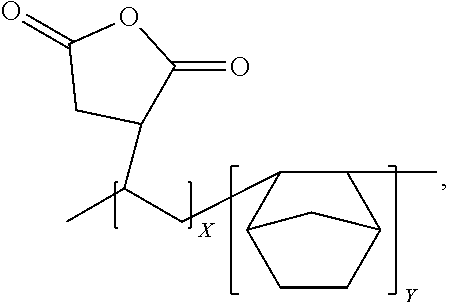
  • a chemical structure formula of the COC-g-MA is:
  • a chemical structure formula of the EPDM-g-MA is:
  • the epoxy resin is a special epoxy resin.
  • the special epoxy resin may be an epoxy resin containing more than two epoxy groups, or an epoxy resin containing vinyl.
  • the epoxy resin may be selected from 1,3-bis(oxiranylmethyl)-5-(2-propenyl)-1,3,5-Triazine-2,4,6(1H,3H,5H)-trione, 1-(oxiranylmethyl)-3,5-di-2-propenyl-1,3,5-Triazine-2,4,6(1H,3H,5H)-trione, 1,3,5-Triglycidyl isocyanurate, 3-Benzenedimethanamine, N,N,N′,N′-tetrakis(oxiranylmethyl)-1, 2,2′,2′′,2′′′-[1,2-ethanediylidenetetrakis(4,1-phenyleneoxymethylene)]tetrakis-Oxirane, or any combination thereof.
  • a chemical structure formula of the 1,3-bis(oxiranylmethyl)-5-(2-propenyl)-1,3,5-Triazine-2,4,6(1H,3H,5H)-trione is:
  • a chemical structure formula of the 1-(oxiranylmethyl)-3,5-di-2-propenyl-1,3,5-Triazine-2,4,6(1H,3H,5H)-trione is:
  • the rigid cross-linking agent may be polyphenylene ether resin with vinyl and active esters.
  • the polyphenylene ether resin with vinyl and active esters has a molecular weight of about 1500 g/mol to about 2500 g/mol.
  • the rigid cross-linking agent can adjust a hardness of a film formed by the low dielectric resin composition.
  • the soft cross-linking agent may be maleic acid liquid polybutadiene.
  • the maleic acid liquid polybutadiene has a molecular weight of about 2000 g/mol to about 8000 g/mol.
  • the soft cross-linking agent can adjust compliancy of a film formed by the low dielectric resin composition.
  • a chemical structure formula of the maleic acid liquid polybutadiene is:
  • the epoxy groups of the epoxy resin can undergo a cross-linking with the acid anhydride in the low dielectric resin containing acid anhydride, the active esters in the rigid cross-linking agent, and the acid anhydride in the soft cross-linking agent.
  • the low dielectric resin containing acid anhydride, the rigid cross-linking agent, and the soft cross-linking agent are thus connected together, to form a low dielectric resin composition with high heat resistance and high cross-linking density.
  • the accelerator may be an epoxy and anhydride reaction accelerator.
  • the epoxy and anhydride reaction accelerator may be selected from tertiary amine accelerator, organic phosphine derivative, or combination thereof.
  • the tertiary amine accelerator may be selected from N,N-Dimethylbenzylamine, N,N-dimethylaniline, triethylamine, or any combination thereof.
  • the organic phosphine derivative may be selected from Allyltri-n-butylphosphonium bromide (C 15 H 32 P.Br), Dodecyltributylphosphonium bromide (C 24 H 52 BrP), ltrioctylphosphonium bromide (C 26 H 56 BrP), Tributylhexadecylphosphonium bromide (C 28 H 60 BrP), Methyltributylphosphonium iodide (C 13 H 30 IP), Tetraethylphosphonium Bromide (C 8 H 20 BrP), Tetraethylphosphonium hydroxide (C 8 H 21 OP), Tetrabutylphosphonium bromide (C 16 H 36 BrP), Tetra-n-butylphosphonium chloride (C 16 H 36 ClP), Tetra-n-butylphosphonium O,O-Diethylphosphorodithioate (C 20 H 46 OP 2 S 2 ), Tetra-n-but
  • the low dielectric resin composition further comprises a thermal initiator.
  • the low dielectric resin composition comprises 0.1 ⁇ 5 parts by weight of the thermal initiator.
  • the thermal initiator is an organic peroxide.
  • An endothermic peak of the organic peroxide as measured by differential scanning calorimeter (DSC) is in the range from about 100 centigrade to about 200 centigrade.
  • DSC differential scanning calorimeter
  • the organic peroxide may be selected from peroxide with two acyl groups (RCOOOOCR′), peroxy ketal, peroxydicarbonate (ROCOOOOCOR′), peroxide ester (RCOOOR′), ketone peroxide ([R 2 C(OOH) 2 ]), peroxide with two alkyl groups (ROOR′), peroxide of hydrogen (ROOH), or any combination thereof.
  • the peroxide with two acyl groups may be selected from isononanoic acid peroxide, capryl peroxide, lauroyl peroxide, p-chorobenzpyl peroxide, 3,5,5-Trimethylhexanoyl peroxide, or any combination thereof.
  • the peroxy ketal may be 2,2-bis(4,4-di-tert-Butyldioxycyclohexyl)propane.
  • the peroxydicarbonate may be selected from peroxydicarbonic acid, bis(3-methoxybutyl) ester, dicyclohexyl peroxydicarbonate, or any combination thereof.
  • the peroxide ester may be selected from tert-Butyl perbenzoate, acetyl tert-butyl peroxide, tert-Butyl peroxy-2-ethylhexanoate, tert-Butyl2-methylpropaneperoxoate, 2,2-Dimethylpropaneperoxoic acid 1,1-dimethylethyl ester, cumyl peroxyneodecanoate, tert-Butyl peroxybenzoate, 1,1,3,3-Tetramethylbutylperoxy-2-ethylhexanoate, 2,5-Dimethyl-2,5-bis(benzoylperoxy)hexane, or any combination thereof.
  • the ketone peroxide may be selected from 2-butanone peroxide, 1-[(1-hydroperoxycyclohexyl) dioxy]-cyclohexanol, or combination thereof.
  • the peroxide with two alkyl groups may be selected from di-t-butyl peroxide, bis(1-methyl-1-phenylethyl) peroxide, Bis(tert-butyldioxyisopropyl)benzene, 1,1-di-(tert-butylperoxy)-3,3,5-trimethylcyclohexane, tert butyl peroxide, bis(tert-butyldioxyisopropyl)benzene, or any combination thereof.
  • the peroxide of hydrogen may be selected from cumyl hydroperoxide, tert-butyl hydroperoxide, hydrogen peroxide p-menthane, or any combination thereof.
  • the organic peroxide is selected from a group consisting of peroxide ester and peroxide with two alkyl groups.
  • the peroxide ester is selected from a group consisting of tert-butyl perbenzoate, 1,1,3,3-tetramethylbutyl ester and bis(tert-butyldioxyisopropyl)benzene.
  • the low dielectric resin composition further comprises a lubricant, a filler, and a flame retardant or an ion trapping agent.
  • the low dielectric resin composition further comprises a solvent.
  • the solvent may be toluene.
  • the amount of the solvent may be adjusted, ensuring that all the above components dissolve in the solvent.
  • a method for preparing the low dielectric resin composition may include the following steps. First, providing a low dielectric resin containing acid anhydride, an epoxy resin, a rigid cross-linking agent, a soft cross-linking agent, a accelerator, and a thermal initiator. Second, providing a vessel. Third, adding the low dielectric resin containing acid anhydride, the epoxy resin, the rigid cross-linking agent, the soft cross-linking agent, the accelerator and the thermal initiator into the vessel. Fourth and finally, adding a solvent into the vessel and stirring, until the low dielectric resin containing acid anhydride, the epoxy resin, the rigid cross-linking agent, the soft cross-linking agent, the accelerator and the thermal initiator are completely dissolved in the solvent.
  • FIG. 1 illustrates an embodiment of a film 100 made by the low dielectric resin composition.
  • the film 100 includes a resin layer 10 and a release film 20 attached to at least one surface of the resin layer 10 .
  • the film 100 is made by coating the low dielectric resin composition on at least one surface of the release film 20 , and then drying the low dielectric resin composition to form the at least one resin layer 10 .
  • FIG. 2 illustrates an embodiment of a circuit board 200 made by the film 100 .
  • the circuit board 200 includes a circuit substrate 201 and an insulating layer 202 attached to at least one surface of the circuit substrate 201 .
  • a method for making the circuit board 200 may include the steps of, first, sticking the resin layer 10 of the film 100 to one surface of the circuit substrate 201 , second, removing the release film 20 of the film 100 , and third heating the resin layer 10 to form an insulating layer 202 .
  • the low dielectric resin composition has a low dielectric constant, a low dielectric loss, a high heat resistance, and a high cross-linking density
  • the insulating layer 202 thus has a low dielectric constant, a low dielectric loss, a high heat resistance, and a high cross-linking density.
  • the chemical cross-linking network structure in the insulating layer 202 is stable enough to allow soldering on the circuit board 200 , having heat resistance.
  • EPDM-g-MA 100 g EPDM-g-MA, 20 g polyphenylene ether resin with vinyl and active esters (SABIC, SA9000), 15 g maleic acid liquid polybutadiene (Cray valley Ricon, 130MA13), 5 g 1,3-bis(oxiranylmethyl)-5-(2-propenyl)-1,3,5-Triazine-2,4,6(1H,3H,5H)-trione, 1 g Bis(tert-butyldioxyisopropyl)benzene, 1 g Tetra-n-butylphosphonium O,O-Diethylphosphorodithioate, and 568 g toluene were added into a 1000 ml vessel, and stirred to have all the above components dissolved, to form a low dielectric resin composition.
  • SABIC polyphenylene ether resin with vinyl and active esters
  • EPDM 100 g EPDM, 20 g polyphenylene ether resin with vinyl and active esters (SABIC, SA9000), 15 g maleic acid liquid polybutadiene (Cray valley Ricon, 130MA13), 5 g 1,3-bis(oxiranylmethyl)-5-(2-propenyl)-1,3,5-Triazine-2,4,6(1H,3H,5H)-trione, 1 g Bis(tert-butyldioxyisopropyl)benzene, 1 g Tetra-n-butylphosphonium O,O-Diethylphosphorodithioate, and 568 g toluene were added into a 1000 ml vessel, and stirred to have all the above components dissolved, to form a resin composition.
  • SABIC polyphenylene ether resin with vinyl and active esters
  • FIG. 3 illustrates a test sample 300 made by the low dielectric resin composition of the example 1.
  • the test sample 300 was made by the steps of, first, attaching a polyimide (PI) film 301 to one surface of a resin layer 10 and attaching a copper foil 302 to the surface of the resin layer 10 opposite to the PI film 301 to form a immediate product, second, pressing the immediate product to make the PI film 301 and copper foil 302 firmly attach to the resin layer 10 , and third, heating the mediate product, to have the resin layer 10 form an insulating layer 202 .
  • the resin layer 10 used for making the test sample 300 was made from the low dielectric resin composition of the example 1.
  • test samples 300 were made by the above-described method using the low dielectric resin compositions of the examples 2 to 6 and resin compositions of the comparative examples 1 to 7, respectively.
  • Table 1 illustrates that the dielectric constant and the dielectric loss of the low dielectric resin composition of the examples 1 to 6 are low, and approximately equal to the resin composition of the comparative examples 1 to 4.
  • the copper peeling strength and the PI peeling strength of test samples 300 made by the low dielectric resin composition of the examples 1 and 4 are higher than those of the test samples 300 made by the resin composition of the comparative examples 1 to 4.
  • the copper peeling strength of test samples 300 made by the low dielectric resin composition of the examples 2 and 5 is higher than that of the test samples 300 made by the resin composition of the comparative examples 1 to 4, and the PI peeling strength of test samples 300 made by the low dielectric resin composition of the examples 2 and 5 is approximately equal to that of the test samples 300 made by the resin composition of the comparative examples 1 to 4.
  • the PI peeling strength of test samples 300 made by the low dielectric resin composition of the examples 3 and 6 is higher than that of the test samples 300 made by the resin composition of the comparative examples 1 to 4, and the copper peeling strength of the test samples 300 made by the low dielectric resin composition of the examples 3 and 6 is approximately equal to that of the test samples 300 made by the resin composition of the comparative examples 1 to 4.
  • the thermal resistance of the test samples 300 made by the low dielectric resin composition of the examples 1 to 6 is higher than that of the test samples 300 made by the resin composition of the comparative examples 1 to 4.
  • the dielectric constant and the dielectric loss of the resin composition of the comparative examples 5 to 7 cannot be tested.
  • the low dielectric resin composition has very low dielectric constant and very low dielectric loss, and has high Copper peeling strength, high PI peeling strength, and high thermal resistance.

Landscapes

  • Chemical & Material Sciences (AREA)
  • Organic Chemistry (AREA)
  • Health & Medical Sciences (AREA)
  • Chemical Kinetics & Catalysis (AREA)
  • Medicinal Chemistry (AREA)
  • Polymers & Plastics (AREA)
  • Engineering & Computer Science (AREA)
  • Manufacturing & Machinery (AREA)
  • Materials Engineering (AREA)
  • Microelectronics & Electronic Packaging (AREA)
  • Compositions Of Macromolecular Compounds (AREA)
  • Laminated Bodies (AREA)
  • Epoxy Resins (AREA)

Abstract

A circuit board includes an insulating made by a low dielectric resin composition includes a low dielectric resin containing acid anhydride, an epoxy resin, polyphenylene ether resin with vinyl and active esters, maleic acid liquid polybutadiene, and an accelerator. Such low dielectric resin can be dissolved in organic solvent more easily than a low dielectric resin without acid anhydride, and the low dielectric resin containing acid anhydride has a better compatibility with other organic components than a low dielectric resin without acid anhydride. A low dielectric resin composition with lower dielectric constant and better properties can thus be obtained.

Description

CROSS-REFERENCE TO RELATED APPLICATIONS
This is a divisional application of patent application Ser. No. 15/871,141, filed on Jan. 15, 2018, assigned to the same assignee, which is based on and claims priority to Taiwan Patent Application No. 106108432 filed on Mar. 15, 2017, the contents of which are incorporated by reference herein.
FIELD
The subject matter herein generally relates to a low dielectric resin composition, a film made by the low dielectric resin composition, and a circuit board using the low dielectric resin composition.
BACKGROUND
A circuit board generally includes a conductive circuit and an insulating layer adjacent to the conductive circuit. The dielectric constant of the insulating layer is an important factor of impedance matching. Impedance matching can allow high frequency signal at a high speed. The insulating layer is made of resin composition. In order to realize high speed of high frequency signals, a resin composition having a low dielectric constant is needed.
BRIEF DESCRIPTION OF THE DRAWINGS
Implementations of the present disclosure will now be described, by way of example only, with reference to the attached figures.
FIG. 1 is a cross-sectional view of a film in accordance with an exemplary embodiment.
FIG. 2 is a cross-sectional view of a circuit board in accordance with an exemplary embodiment.
FIG. 3 is a cross-sectional view of a testing sample.
DETAILED DESCRIPTION
It will be appreciated that for simplicity and clarity of illustration, where appropriate, reference numerals have been repeated among the different figures to indicate corresponding or analogous elements. In addition, numerous specific details are set forth to provide a thorough understanding of the embodiments described herein. However, it will be understood by those of ordinary skill in the art that the embodiments described herein can be practiced without these specific details. In other instances, methods, procedures, and components have not been described in detail so as not to obscure the related relevant feature being described. Also, the description is not to be considered as limiting the scope of the embodiments described herein. The drawings are not necessarily to scale, and the proportions of certain parts may be exaggerated to illustrate details and features of the present disclosure better. The disclosure is illustrated by way of example and not by way of limitation in the figures of the accompanying drawings, in which like references indicate similar elements. It should be noted that references to “an” or “one” embodiment in this disclosure are not necessarily to the same embodiment, and such references mean “at least one.”
The term “comprising” when utilized, means “including, but not necessarily limited to”; it specifically indicates open-ended inclusion or membership in the so-described combination, group, series, and the like. The term “about” when utilized, means “not only includes the numerical value, but also includes numbers closest to the numerical value”.
In an exemplary embodiment, a low dielectric resin composition comprises a low dielectric resin containing acid anhydride, an epoxy resin, a rigid cross-linking agent, a soft cross-linking agent, and an accelerator.
In at least one exemplary embodiment, the low dielectric resin composition comprises: 100 parts by weight of the low dielectric resin containing acid anhydride, 5-30 parts by weight of the epoxy resin, 5-50 parts by weight of the rigid cross-linking agent, 5-50 parts by weight of the soft cross-linking agent, and 0.1-5 parts by weight of the accelerator.
In at least one exemplary embodiment, the low dielectric resin composition has a dielectric constant (Dk) that is less than 2.4, and the polyimide has a dielectric loss (Df) that is less than 0.004.
The low dielectric resin containing acid anhydride can be dissolved in organic solvent more easily than a low dielectric resin without acid anhydride, and the low dielectric resin containing acid anhydride has better compatibility with other organic components than low dielectric resin without acid anhydride. A low dielectric resin composition with lower dielectric constant and better properties can thus be obtained.
The low dielectric resin containing acid anhydride may be selected from maleic anhydride graft modified resin, polyimide resin containing anhydride, or combination thereof. The maleic anhydride graft modified resin may be selected from maleic anhydride graft styrene-ethyl-butene-styrene block copolymer (SEBS-g-MA), maleic anhydride graft cyclo-olefin polymer (EPDM-g-MA), maleic anhydride graft ethylene propylene diene monomer, or any combination thereof.
In at least one exemplary embodiment, the low dielectric resin containing acid anhydride has a dielectric constant (Dk) that is less than 3.
A chemical structure formula of the SEBS-g-MA is:
Figure US11261328-20220301-C00001

wherein, the w, x, y, and z are positive integers.
A chemical structure formula of the COC-g-MA is:
Figure US11261328-20220301-C00002

wherein, the X and Y are positive integers.
A chemical structure formula of the EPDM-g-MA is:
Figure US11261328-20220301-C00003

wherein, the p and q are positive integers.
The epoxy resin is a special epoxy resin. The special epoxy resin may be an epoxy resin containing more than two epoxy groups, or an epoxy resin containing vinyl. The epoxy resin may be selected from 1,3-bis(oxiranylmethyl)-5-(2-propenyl)-1,3,5-Triazine-2,4,6(1H,3H,5H)-trione, 1-(oxiranylmethyl)-3,5-di-2-propenyl-1,3,5-Triazine-2,4,6(1H,3H,5H)-trione, 1,3,5-Triglycidyl isocyanurate, 3-Benzenedimethanamine, N,N,N′,N′-tetrakis(oxiranylmethyl)-1, 2,2′,2″,2′″-[1,2-ethanediylidenetetrakis(4,1-phenyleneoxymethylene)]tetrakis-Oxirane, or any combination thereof.
A chemical structure formula of the 1,3-bis(oxiranylmethyl)-5-(2-propenyl)-1,3,5-Triazine-2,4,6(1H,3H,5H)-trione is:
Figure US11261328-20220301-C00004
A chemical structure formula of the 1-(oxiranylmethyl)-3,5-di-2-propenyl-1,3,5-Triazine-2,4,6(1H,3H,5H)-trione is:
Figure US11261328-20220301-C00005
A chemical structure formula of the 1,3,5-Triglycidyl isocyanurate, 3-Benzenedimethanamine is:
Figure US11261328-20220301-C00006
A chemical structure formula of the N,N,N′,N′-tetrakis(oxiranylmethyl)-1
Figure US11261328-20220301-C00007
A chemical structure formula of the 2,2′,2″,2′″-[1,2-ethanediylidenetetrakis(4,1-phenyleneoxymethylene)]tetrakis-Oxirane is:
Figure US11261328-20220301-C00008
The rigid cross-linking agent may be polyphenylene ether resin with vinyl and active esters. In at least one exemplary embodiment, the polyphenylene ether resin with vinyl and active esters has a molecular weight of about 1500 g/mol to about 2500 g/mol. The rigid cross-linking agent can adjust a hardness of a film formed by the low dielectric resin composition.
The soft cross-linking agent may be maleic acid liquid polybutadiene. The maleic acid liquid polybutadiene has a molecular weight of about 2000 g/mol to about 8000 g/mol. The soft cross-linking agent can adjust compliancy of a film formed by the low dielectric resin composition.
A chemical structure formula of the maleic acid liquid polybutadiene is:
Figure US11261328-20220301-C00009

wherein, the x1, y1, and z1 are positive integers.
The epoxy groups of the epoxy resin can undergo a cross-linking with the acid anhydride in the low dielectric resin containing acid anhydride, the active esters in the rigid cross-linking agent, and the acid anhydride in the soft cross-linking agent. The low dielectric resin containing acid anhydride, the rigid cross-linking agent, and the soft cross-linking agent are thus connected together, to form a low dielectric resin composition with high heat resistance and high cross-linking density.
The accelerator may be an epoxy and anhydride reaction accelerator. The epoxy and anhydride reaction accelerator may be selected from tertiary amine accelerator, organic phosphine derivative, or combination thereof.
The tertiary amine accelerator may be selected from N,N-Dimethylbenzylamine, N,N-dimethylaniline, triethylamine, or any combination thereof.
The organic phosphine derivative may be selected from Allyltri-n-butylphosphonium bromide (C15H32P.Br), Dodecyltributylphosphonium bromide (C24H52BrP), ltrioctylphosphonium bromide (C26H56BrP), Tributylhexadecylphosphonium bromide (C28H60BrP), Methyltributylphosphonium iodide (C13H30IP), Tetraethylphosphonium Bromide (C8H20BrP), Tetraethylphosphonium hydroxide (C8H21OP), Tetrabutylphosphonium bromide (C16H36BrP), Tetra-n-butylphosphonium chloride (C16H36ClP), Tetra-n-butylphosphonium O,O-Diethylphosphorodithioate (C20H46OP2S2), Tetra-n-butylphosphonium Benzotriazolate (C22H40N3P), Tris(2-carboxyethyl)phosphinehydrochloride (C9H16ClO6P), or any combination thereof.
In at least one exemplary embodiment, the low dielectric resin composition further comprises a thermal initiator. The low dielectric resin composition comprises 0.1˜5 parts by weight of the thermal initiator.
The thermal initiator is an organic peroxide. An endothermic peak of the organic peroxide as measured by differential scanning calorimeter (DSC) is in the range from about 100 centigrade to about 200 centigrade. When heated, the thermal initiator decomposes to produce free radicals, the free radicals and the vinyl react as an initiating reaction.
The organic peroxide may be selected from peroxide with two acyl groups (RCOOOOCR′), peroxy ketal, peroxydicarbonate (ROCOOOOCOR′), peroxide ester (RCOOOR′), ketone peroxide ([R2C(OOH)2]), peroxide with two alkyl groups (ROOR′), peroxide of hydrogen (ROOH), or any combination thereof.
The peroxide with two acyl groups may be selected from isononanoic acid peroxide, capryl peroxide, lauroyl peroxide, p-chorobenzpyl peroxide, 3,5,5-Trimethylhexanoyl peroxide, or any combination thereof.
The peroxy ketal may be 2,2-bis(4,4-di-tert-Butyldioxycyclohexyl)propane.
The peroxydicarbonate may be selected from peroxydicarbonic acid, bis(3-methoxybutyl) ester, dicyclohexyl peroxydicarbonate, or any combination thereof.
The peroxide ester may be selected from tert-Butyl perbenzoate, acetyl tert-butyl peroxide, tert-Butyl peroxy-2-ethylhexanoate, tert-Butyl2-methylpropaneperoxoate, 2,2-Dimethylpropaneperoxoic acid 1,1-dimethylethyl ester, cumyl peroxyneodecanoate, tert-Butyl peroxybenzoate, 1,1,3,3-Tetramethylbutylperoxy-2-ethylhexanoate, 2,5-Dimethyl-2,5-bis(benzoylperoxy)hexane, or any combination thereof.
The ketone peroxide may be selected from 2-butanone peroxide, 1-[(1-hydroperoxycyclohexyl) dioxy]-cyclohexanol, or combination thereof.
The peroxide with two alkyl groups may be selected from di-t-butyl peroxide, bis(1-methyl-1-phenylethyl) peroxide, Bis(tert-butyldioxyisopropyl)benzene, 1,1-di-(tert-butylperoxy)-3,3,5-trimethylcyclohexane, tert butyl peroxide, bis(tert-butyldioxyisopropyl)benzene, or any combination thereof.
The peroxide of hydrogen may be selected from cumyl hydroperoxide, tert-butyl hydroperoxide, hydrogen peroxide p-menthane, or any combination thereof.
In at least one embodiment, the organic peroxide is selected from a group consisting of peroxide ester and peroxide with two alkyl groups. The peroxide ester is selected from a group consisting of tert-butyl perbenzoate, 1,1,3,3-tetramethylbutyl ester and bis(tert-butyldioxyisopropyl)benzene.
The low dielectric resin composition further comprises a lubricant, a filler, and a flame retardant or an ion trapping agent.
The low dielectric resin composition further comprises a solvent. The solvent may be toluene. The amount of the solvent may be adjusted, ensuring that all the above components dissolve in the solvent.
A method for preparing the low dielectric resin composition may include the following steps. First, providing a low dielectric resin containing acid anhydride, an epoxy resin, a rigid cross-linking agent, a soft cross-linking agent, a accelerator, and a thermal initiator. Second, providing a vessel. Third, adding the low dielectric resin containing acid anhydride, the epoxy resin, the rigid cross-linking agent, the soft cross-linking agent, the accelerator and the thermal initiator into the vessel. Fourth and finally, adding a solvent into the vessel and stirring, until the low dielectric resin containing acid anhydride, the epoxy resin, the rigid cross-linking agent, the soft cross-linking agent, the accelerator and the thermal initiator are completely dissolved in the solvent.
FIG. 1 illustrates an embodiment of a film 100 made by the low dielectric resin composition. The film 100 includes a resin layer 10 and a release film 20 attached to at least one surface of the resin layer 10. The film 100 is made by coating the low dielectric resin composition on at least one surface of the release film 20, and then drying the low dielectric resin composition to form the at least one resin layer 10.
FIG. 2 illustrates an embodiment of a circuit board 200 made by the film 100. The circuit board 200 includes a circuit substrate 201 and an insulating layer 202 attached to at least one surface of the circuit substrate 201.
A method for making the circuit board 200 may include the steps of, first, sticking the resin layer 10 of the film 100 to one surface of the circuit substrate 201, second, removing the release film 20 of the film 100, and third heating the resin layer 10 to form an insulating layer 202.
The low dielectric resin composition has a low dielectric constant, a low dielectric loss, a high heat resistance, and a high cross-linking density The insulating layer 202 thus has a low dielectric constant, a low dielectric loss, a high heat resistance, and a high cross-linking density. The chemical cross-linking network structure in the insulating layer 202 is stable enough to allow soldering on the circuit board 200, having heat resistance.
Example 1
100 g COC-g-MA, 20 g polyphenylene ether resin with vinyl and active esters (SABIC, SA9000), 15 g maleic acid liquid polybutadiene (Cray valley Ricon, 130MA13), 5 g 1,3-bis(oxiranylmethyl)-5-(2-propenyl)-1,3,5-Triazine-2,4,6(1H,3H,5H)-trione, 1 g Bis(tert-butyldioxyisopropyl)benzene, 1 g Tetra-n-butylphosphonium O,O-Diethylphosphorodithioate, and 568 g toluene were added into a 1000 ml vessel, and stirred to have all the above components dissolved, to form a low dielectric resin composition.
Example 2
100 g EPDM-g-MA, 20 g polyphenylene ether resin with vinyl and active esters (SABIC, SA9000), 15 g maleic acid liquid polybutadiene (Cray valley Ricon, 130MA13), 5 g 1,3-bis(oxiranylmethyl)-5-(2-propenyl)-1,3,5-Triazine-2,4,6(1H,3H,5H)-trione, 1 g Bis(tert-butyldioxyisopropyl)benzene, 1 g Tetra-n-butylphosphonium O,O-Diethylphosphorodithioate, and 568 g toluene were added into a 1000 ml vessel, and stirred to have all the above components dissolved, to form a low dielectric resin composition.
Example 3
100 g polyimide resin containing anhydride, 20 g polyphenylene ether resin with vinyl and active esters (SABIC, SA9000), 15 g maleic acid liquid polybutadiene (Cray valley Ricon, 130MA13), 5 g 1,3-bis(oxiranylmethyl)-5-(2-propenyl)-1,3,5-Triazine-2,4,6(1H,3H,5H)-trione, 1 g Bis(tert-butyldioxyisopropyl)benzene, 1 g Tetra-n-butylphosphonium O,O-Diethylphosphorodithioate, and 568 g toluene were added into a 1000 ml vessel, and stirred to have all the above components dissolved, to form a low dielectric resin composition.
Example 4
100 g SEBS-g-MA, 20 g polyphenylene ether resin with vinyl and active esters (SABIC, SA9000), 15 g maleic acid liquid polybutadiene (Cray valley Ricon, 130MA13), 5 g 1,3-bis(oxiranylmethyl)-5-(2-propenyl)-1,3,5-Triazine-2,4,6(1H,3H,5H)-trione, 1 g Bis(tert-butyldioxyisopropyl)benzene, 1 g Tetra-n-butylphosphonium O,O-Diethylphosphorodithioate, and 568 g toluene were added into a 1000 ml vessel, and stirred to have all the above components dissolved, to form a low dielectric resin composition.
Example 5
100 g SEBS-g-MA, 30 g polyphenylene ether resin with vinyl and active esters (SABIC, SA9000), 15 g maleic acid liquid polybutadiene (Cray valley Ricon, 130MA13), 5 g 1,3-bis(oxiranylmethyl)-5-(2-propenyl)-1,3,5-Triazine-2,4,6(1H,3H,5H)-trione, 1 g Bis(tert-butyldioxyisopropyl)benzene, 1 g Tetra-n-butylphosphonium O,O-Diethylphosphorodithioate, and 608 g toluene were added into a 1000 ml vessel, and stirred to have all the above components dissolved, to form a low dielectric resin composition.
Example 6
100 g SEBS-g-MA, 20 g polyphenylene ether resin with vinyl and active esters (SABIC, SA9000), 30 g maleic acid liquid polybutadiene (Cray valley Ricon, 130MA13), 5 g 1,3-bis(oxiranylmethyl)-5-(2-propenyl)-1,3,5-Triazine-2,4,6(1H,3H,5H)-trione, 1 g Bis(tert-butyldioxyisopropyl)benzene, 1 g Tetra-n-butylphosphonium O,O-Diethylphosphorodithioate, and 628 g toluene were added into a 1000 ml vessel, and stirred to have all the above components dissolved, to form a low dielectric resin composition.
Comparative Example 1
100 g COC-g-MA and 400 g toluene were added into a 1000 ml vessel, and stirred to have all the above components dissolved, to form a resin composition.
Comparative Example 2
100 g EPDM-g-MA and 400 g toluene were added into a 1000 ml vessel, and stirred to have all the above components dissolved, to form a resin composition.
Comparative Example 3
100 g polyimide resin containing anhydride and 400 g toluene were added into a 1000 ml vessel, and stirred to have all the above components dissolved, to form a resin composition.
Comparative Example 4
100 g SEBS-g-MA and 400 g toluene were added into a 1000 ml vessel, and stirred to have all the above components dissolved, to form a resin composition.
Comparative Example 5
100 g EPDM, 20 g polyphenylene ether resin with vinyl and active esters (SABIC, SA9000), 15 g maleic acid liquid polybutadiene (Cray valley Ricon, 130MA13), 5 g 1,3-bis(oxiranylmethyl)-5-(2-propenyl)-1,3,5-Triazine-2,4,6(1H,3H,5H)-trione, 1 g Bis(tert-butyldioxyisopropyl)benzene, 1 g Tetra-n-butylphosphonium O,O-Diethylphosphorodithioate, and 568 g toluene were added into a 1000 ml vessel, and stirred to have all the above components dissolved, to form a resin composition.
Comparative Example 6
100 g SEBS-g-MA, 60 g polyphenylene ether resin with vinyl and active esters (SABIC, SA9000), 15 g maleic acid liquid polybutadiene (Cray valley Ricon, 130MA13), 5 g 1,3-bis(oxiranylmethyl)-5-(2-propenyl)-1,3,5-Triazine-2,4,6(1H,3H,5H)-trione, 1 g Bis(tert-butyldioxyisopropyl)benzene, 1 g Tetra-n-butylphosphonium O,O-Diethylphosphorodithioate, and 728 g toluene were added into a 1000 ml vessel, and stirred to have all the above components dissolved, to form a resin composition.
Comparative Example 7
100 g SEBS-g-MA, 20 g polyphenylene ether resin with vinyl and active esters (SABIC, SA9000), 60 g maleic acid liquid polybutadiene (Cray valley Ricon, 130MA13), 5 g 1,3-bis(oxiranylmethyl)-5-(2-propenyl)-1,3,5-Triazine-2,4,6(1H,3H,5H)-trione, 1 g Bis(tert-butyldioxyisopropyl)benzene, 1 g Tetra-n-butylphosphonium O,O-Diethylphosphorodithioate, and 748 g toluene were added into a 1000 ml vessel, and stirred to have all the above components dissolved, to form a resin composition.
The dielectric constant and the dielectric loss of the low dielectric resin compositions made in examples 1 to 6 and the resin compositions made in the comparative examples 1 to 7 were tested. The test results are shown in Table 1.
FIG. 3 illustrates a test sample 300 made by the low dielectric resin composition of the example 1. The test sample 300 was made by the steps of, first, attaching a polyimide (PI) film 301 to one surface of a resin layer 10 and attaching a copper foil 302 to the surface of the resin layer 10 opposite to the PI film 301 to form a immediate product, second, pressing the immediate product to make the PI film 301 and copper foil 302 firmly attach to the resin layer 10, and third, heating the mediate product, to have the resin layer 10 form an insulating layer 202. In at least one embodiment, the resin layer 10 used for making the test sample 300 was made from the low dielectric resin composition of the example 1.
Furthermore, twelve other test samples 300 were made by the above-described method using the low dielectric resin compositions of the examples 2 to 6 and resin compositions of the comparative examples 1 to 7, respectively.
Copper peeling strength, PI peeling strength, thermal resistance, and modulus of elasticity of the thirteen test samples 300 were tested, and the test results are shown in the Table 1. Thermal resistance was tested by, first, defining at least one through hole in the test samples 300, second, infilling molten solder into the through hole, third, heating the test samples 300 with solder at a temperature of 260 centigrade for 10 seconds and then cooling, and, fourth, repeating the third step another two times. If solder did not peel off from the through hole, the result of the thermal resistance test is a pass, otherwise, the result is fail.
TABLE 1
Copper PI
peeling peeling Thermal Thermal Modulus
Dk Df strength strength resistance resistance of
(10 GHz) (10 GHz) (kgf/cm) (kgf/cm) condition result elasticity
Example 1 2.11 0.002 1.15 1.05 300° C. × 10 sec pass 0.30
Example 2 2.15 0.002 1.05 0.86 300° C. × 10 sec pass 0.21
example 3 2.18 0.003 0.95 1.03 300° C. × 10 sec pass 0.20
Example 4 2.21 0.003 1.10 0.95 300° C. × 10 sec pass 0.25
Example 5 2.15 0.002 1.05 0.86 300° C. × 10 sec pass 0.35
Example 6 2.18 0.003 0.95 1.03 300° C. × 10 sec pass 0.20
Comparative 2.10 0.002 1.01 0.90 260° C. × 10 sec did not pass 0.31
example 1
Comparative 2.14 0.002 0.95 0.81 260° C. × 10 sec did not pass 0.23
example 2
Comparative 2.12 0.003 0.88 0.90 260° C. × 10 sec did not pass 0.22
example 3
Comparative 2.18 0.003 0.91 0.80 260° C. × 10 sec did not pass 0.27
example 4
Comparative Liquid resin composition solution delaminated, because EPDM
example 5 can not compatible with other components.
Comparative Too many rigid cross-linking agents, cause the insulating
example 6 layer brittle rupture.
Comparative Too many soft cross-linking agents, cause the surface of the
example 7 insulating layer has high viscosity.
Table 1 illustrates that the dielectric constant and the dielectric loss of the low dielectric resin composition of the examples 1 to 6 are low, and approximately equal to the resin composition of the comparative examples 1 to 4. The copper peeling strength and the PI peeling strength of test samples 300 made by the low dielectric resin composition of the examples 1 and 4 are higher than those of the test samples 300 made by the resin composition of the comparative examples 1 to 4. The copper peeling strength of test samples 300 made by the low dielectric resin composition of the examples 2 and 5 is higher than that of the test samples 300 made by the resin composition of the comparative examples 1 to 4, and the PI peeling strength of test samples 300 made by the low dielectric resin composition of the examples 2 and 5 is approximately equal to that of the test samples 300 made by the resin composition of the comparative examples 1 to 4. The PI peeling strength of test samples 300 made by the low dielectric resin composition of the examples 3 and 6 is higher than that of the test samples 300 made by the resin composition of the comparative examples 1 to 4, and the copper peeling strength of the test samples 300 made by the low dielectric resin composition of the examples 3 and 6 is approximately equal to that of the test samples 300 made by the resin composition of the comparative examples 1 to 4. The thermal resistance of the test samples 300 made by the low dielectric resin composition of the examples 1 to 6 is higher than that of the test samples 300 made by the resin composition of the comparative examples 1 to 4. The dielectric constant and the dielectric loss of the resin composition of the comparative examples 5 to 7 cannot be tested. The copper peeling strength, PI peeling strength, thermal resistance, and modulus of elasticity of the test samples 300 made by the resin composition of the comparative examples 5 to 7 cannot be tested. Thus, the low dielectric resin composition has very low dielectric constant and very low dielectric loss, and has high Copper peeling strength, high PI peeling strength, and high thermal resistance.
Comparing examples 4 with 5, when the amount of the rigid cross-linking agent is high in proportion, the circuit board made by the low dielectric resin composition has a large modulus of elasticity, in other words, the hardness of the circuit board is high. Comparing examples 4 with 6, when the amount of the soft cross-linking agent is high in proportion, the circuit board made by the low dielectric resin composition has a small modulus of elasticity, in other words, the hardness of the circuit board is lower. Thus the hardness of the circuit board can be adjusted by varying the amounts of the rigid cross-linking agent and the soft cross-linking agent.
It is to be understood, even though information and advantages of the present embodiments have been set forth in the foregoing description, together with details of the structures and functions of the present embodiments, the disclosure is illustrative only; changes may be made in detail, especially in matters of shape, size, and arrangement of parts within the principles of the present embodiments to the full extent indicated by the plain meaning of the terms in which the appended claims are expressed.

Claims (10)

What is claimed is:
1. A circuit board comprising:
a circuit substrate; and
an insulating layer attached to at least one surface of the circuit substrate, the insulating layer is made by sticking a resin layer to the surface of the circuit substrate, and then heating the resin layer, the resin layer is made by a low dielectric resin composition, the low dielectric resin composition comprising:
a low dielectric resin containing acid anhydride;
an epoxy resin;
polyphenylene ether resin with vinyl and active esters;
maleic acid liquid polybutadiene; and
an accelerator;
wherein the low dielectric resin containing acid anhydride is selected from the group consisting of maleic anhydride graft modified resin, polyimide resin containing anhydride, and combination thereof;
wherein the dielectric constant of the low dielectric resin containing acid anhydride is less than 3 at a frequency of 10 GHz.
2. The circuit board of claim 1, wherein the low dielectric resin composition comprises: 100 parts by weight of the low dielectric resin containing acid anhydride, 5-30 parts by weight of the epoxy resin, 5-50 parts by weight of the polyphenylene ether resin with vinyl and active esters, 5-50 parts by weight of the maleic acid liquid polybutadiene, and 0.1-5 parts by weight of the accelerator.
3. The circuit board of claim 1, wherein at a frequency of 10 GHz, the low dielectric resin composition has a dielectric constant that is less than 2.4, and the polyimide has a dielectric loss that is less than 0.004.
4. The circuit board of claim 1, wherein the maleic anhydride graft modified resin is selected from the group consisting of maleic anhydride graft styrene-ethyl-butene-styrene block copolymer, maleic anhydride graft cyclo-olefin polymer, maleic anhydride graft ethylene propylene diene monomer, and any combination thereof.
5. The circuit board of claim 1, wherein the epoxy resin is selected from an epoxy resin containing more than two epoxy groups, or an epoxy resin containing vinyl.
6. The circuit board of claim 5, wherein the epoxy resin is selected from 1,3-bis(oxiranylmethyl)-5-(2-propenyl)-1,3,5-Triazine-2,4,6(1H,3H,5H)-trione, 1-(oxiranylmethyl)-3,5-di-2-propenyl-1,3,5-Triazine-2,4,6(1H,3H,5H)-trione, 1,3,5-Triglycidyl isocyanurate, 3-Benzenedimethanamine, N,N,N′,N′-tetrakis(oxiranylmethyl)-1,2,2′,2″,2′″-[1,2-ethanediylidenetetrakis(4,1-phenyleneoxymethylene)]tetrakis-Oxirane, or any combination thereof.
7. The circuit board of claim 1, wherein the low dielectric resin composition further comprises a thermal initiator, the low dielectric resin composition comprises 0.1-5 parts by weight of the thermal initiator.
8. The circuit board of claim 1, wherein the accelerator is selected from tertiary amine accelerator, organic phosphine derivative, or combination thereof.
9. The circuit board of claim 8, wherein the tertiary amine accelerator is selected from N,N-Dimethylbenzylamine, N,N-dimethylaniline, triethylamine, or any combination thereof.
10. The circuit board of claim 8, wherein the organic phosphine derivative is selected from Allyltri-n-butylphosphonium bromide, Dodecyltributylphosphonium bromide, ltrioctylphosphonium bromide, Tributylhexadecylphosphonium bromide, Methyltributylphosphonium iodide, Tetraethylphosphonium Bromide, Tetraethylphosphonium hydroxide, Tetrabutylphosphonium bromide, Tetra-n-butylphosphonium chloride, Tetra-n-butylphosphonium O,O-Diethylphosphorodithioate, Tetra-n-butylphosphonium Benzotriazolate, Tris(2-carboxyethyl)phosphinehydrochloride, or any combination thereof.
US17/121,616 2017-03-15 2020-12-14 Circuit board using low dielectric resin composition Active US11261328B2 (en)

Priority Applications (1)

Application Number Priority Date Filing Date Title
US17/121,616 US11261328B2 (en) 2017-03-15 2020-12-14 Circuit board using low dielectric resin composition

Applications Claiming Priority (4)

Application Number Priority Date Filing Date Title
TW106108432A TWI637405B (en) 2017-03-15 2017-03-15 Low dielectric resin composition, film and circuit board using the same
TW106108432 2017-03-15
US15/871,141 US10894882B2 (en) 2017-03-15 2018-01-15 Low dielectric resin composition, film and circuit board using the same
US17/121,616 US11261328B2 (en) 2017-03-15 2020-12-14 Circuit board using low dielectric resin composition

Related Parent Applications (1)

Application Number Title Priority Date Filing Date
US15/871,141 Division US10894882B2 (en) 2017-03-15 2018-01-15 Low dielectric resin composition, film and circuit board using the same

Publications (2)

Publication Number Publication Date
US20210102067A1 US20210102067A1 (en) 2021-04-08
US11261328B2 true US11261328B2 (en) 2022-03-01

Family

ID=63521017

Family Applications (2)

Application Number Title Priority Date Filing Date
US15/871,141 Active 2038-08-04 US10894882B2 (en) 2017-03-15 2018-01-15 Low dielectric resin composition, film and circuit board using the same
US17/121,616 Active US11261328B2 (en) 2017-03-15 2020-12-14 Circuit board using low dielectric resin composition

Family Applications Before (1)

Application Number Title Priority Date Filing Date
US15/871,141 Active 2038-08-04 US10894882B2 (en) 2017-03-15 2018-01-15 Low dielectric resin composition, film and circuit board using the same

Country Status (3)

Country Link
US (2) US10894882B2 (en)
JP (1) JP6822995B2 (en)
TW (1) TWI637405B (en)

Families Citing this family (13)

* Cited by examiner, † Cited by third party
Publication number Priority date Publication date Assignee Title
CN109164114A (en) * 2018-09-27 2019-01-08 苏州市星辰科技有限公司 Silicon systems release film crosslinking rate test method
JP7200861B2 (en) * 2019-07-12 2023-01-10 味の素株式会社 resin composition
JP7333737B2 (en) * 2019-09-30 2023-08-25 太陽ホールディングス株式会社 Curable resin compositions, dry films, resin-coated copper foils, cured products, and electronic components
CN110582168B (en) * 2019-11-08 2020-03-06 南京中鸿润宁新材料科技有限公司 Low dielectric polyimide circuit board
CN112143020A (en) * 2020-09-25 2020-12-29 哈尔滨理工大学 A kind of water-resistant, low-dielectric polyimide composite film and its preparation method and application
CN114292607B (en) * 2022-01-06 2023-06-06 广东东溢新材料科技有限公司 Adhesive and preparation method and application thereof
EP4574899A1 (en) 2022-08-15 2025-06-25 Mitsui Chemicals, Inc. Low dielectric resin composition, adhesiveness imparting agent, low dielectric adhesive composition, low dielectric adhesive molded article, low dielectric adhesive and multilayer body
TWI819784B (en) * 2022-09-08 2023-10-21 台燿科技股份有限公司 Solvent-free resin composition and uses of the same
CN116082582A (en) * 2022-09-30 2023-05-09 安捷利(番禺)电子实业有限公司 A kind of modified plastic and its prepared low-dielectric pure rubber film
CN116082568A (en) * 2022-09-30 2023-05-09 安捷利(番禺)电子实业有限公司 Modified rubber and low-dielectric pure adhesive film prepared from same
EP4357406A1 (en) 2022-10-19 2024-04-24 Thai Polyethylene Co., Ltd. Polyethylene composition comprising a post-consumer polyethylene resin and articles made thereof
EP4357407A1 (en) 2022-10-19 2024-04-24 Thai Polyethylene Co., Ltd. Multimodal polyethylene composition, resin composition comprising the multimodal polyethylene composition and a post-consumer resin, a method for preparing the same and an article comprising the same
KR20250075804A (en) * 2023-11-21 2025-05-29 동우 화인켐 주식회사 Low Dielectric Adhesive Composition and Flexible Metal Laminate Using the Same

Citations (3)

* Cited by examiner, † Cited by third party
Publication number Priority date Publication date Assignee Title
US20110303438A1 (en) 2010-05-31 2011-12-15 Arisawa Mfg. Co., Ltd. Composition for Polyimide Resin, and Polyimide Resin Made of the Composition for Polyimide Resin
US20160137890A1 (en) 2014-11-18 2016-05-19 E I Du Pont De Nemours And Company Coverlay adhesive composition
TW201736118A (en) 2016-01-05 2017-10-16 荒川化學工業股份有限公司 Copper clad laminate and printed circuit board wherein the metal clad laminate has excellent metal adhesion, heat resistance, low dielectric constant of insulating material, and low dielectric loss tangent characteristics, and the printed circuit board has low transmission loss

Family Cites Families (8)

* Cited by examiner, † Cited by third party
Publication number Priority date Publication date Assignee Title
DE112007001861B4 (en) * 2006-08-08 2022-08-11 World Properties, Inc. Improved bonding circuit material, method of making same, and multilayer circuit
JP5943461B2 (en) * 2012-02-21 2016-07-05 株式会社Adeka Insulating adhesive for polyimide
WO2015062054A1 (en) * 2013-10-31 2015-05-07 Dow Global Technologies Llc Curable compositions which form interpenetrating polymer networks
WO2016052290A1 (en) * 2014-10-01 2016-04-07 Dic株式会社 Epoxy resin composition and cured product thereof
JP6383258B2 (en) * 2014-11-07 2018-08-29 三井化学株式会社 Resin composition, adhesive, coverlay film, bonding sheet, copper-clad laminate and electromagnetic shielding material
JP6705447B2 (en) * 2015-04-30 2020-06-03 日立化成株式会社 Resin composition, prepreg, laminated board and multilayer printed wiring board
JP6534442B2 (en) * 2015-05-26 2019-06-26 タツタ電線株式会社 Shield film and shield printed wiring board
JP6770793B2 (en) * 2015-08-19 2020-10-21 日鉄ケミカル&マテリアル株式会社 Flame-retardant epoxy resin composition and its cured product

Patent Citations (3)

* Cited by examiner, † Cited by third party
Publication number Priority date Publication date Assignee Title
US20110303438A1 (en) 2010-05-31 2011-12-15 Arisawa Mfg. Co., Ltd. Composition for Polyimide Resin, and Polyimide Resin Made of the Composition for Polyimide Resin
US20160137890A1 (en) 2014-11-18 2016-05-19 E I Du Pont De Nemours And Company Coverlay adhesive composition
TW201736118A (en) 2016-01-05 2017-10-16 荒川化學工業股份有限公司 Copper clad laminate and printed circuit board wherein the metal clad laminate has excellent metal adhesion, heat resistance, low dielectric constant of insulating material, and low dielectric loss tangent characteristics, and the printed circuit board has low transmission loss

Also Published As

Publication number Publication date
US10894882B2 (en) 2021-01-19
US20180265699A1 (en) 2018-09-20
TW201835943A (en) 2018-10-01
JP2018154823A (en) 2018-10-04
JP6822995B2 (en) 2021-01-27
TWI637405B (en) 2018-10-01
US20210102067A1 (en) 2021-04-08

Similar Documents

Publication Publication Date Title
US11261328B2 (en) Circuit board using low dielectric resin composition
JP7676503B2 (en) Copolymer and laminate containing same
JP4613977B2 (en) Prepreg including thin-layer quartz glass cloth and wiring board using the same
JP5093059B2 (en) Resin composition, prepreg, laminate and printed circuit board
KR101565907B1 (en) Low thermal expansion low dielectric loss prepreg and its additives
JP7287380B2 (en) Adhesive composition, film adhesive, adhesive layer, adhesive sheet, resin-coated copper foil, copper-clad laminate, printed wiring board, multilayer wiring board, and manufacturing method thereof
JP5138267B2 (en) Prepreg, multilayer substrate and electronic component using the same
US6500535B1 (en) Heat resistant, low dielectric polymers, and films, substrates, electronic parts and heat resistant resin molded parts using the same
JP2002249531A (en) Low dielectric loss tangent resin composition, curable film, cured product, electric component using the same, and method for producing the same
US12146057B2 (en) Cyclic imide resin composition, prepreg, copper-clad laminate and printed-wiring board
WO2017097000A1 (en) Thermosetting resin composition, prepreg containing same, laminated board, and printed circuit board
CN108623974B (en) Low-dielectric resin composition and film and circuit board using same
US11312829B2 (en) Flexible prepreg and uses thereof
EP4281488A1 (en) Fluoropolymer composition
JP2024040585A (en) Curable resin composition for bonding film, bonding film and printed wiring board
US20250354011A1 (en) Flame retarded resin composition and articles made therefrom
WO2025173575A1 (en) Resin composition, prepreg, metal foil with resin, laminate, printed wiring board, and semiconductor package
JP2024038791A (en) Resin compositions, prepregs, copper clad laminates and printed wiring boards
JP2025151407A (en) Low dielectric resin composition, adhesion promoter, low dielectric adhesive molded product, low dielectric adhesive, laminate, and method for producing low dielectric resin composition
WO2025142841A1 (en) Resin composition, resin film, prepreg, laminate, printed wiring board, and semiconductor package
JP2023142439A (en) liquid polyolefin composition
WO2007069491A1 (en) High-frequency substrate and process for producing the same

Legal Events

Date Code Title Description
AS Assignment

Owner name: ZHEN DING TECHNOLOGY CO., LTD., TAIWAN

Free format text: ASSIGNMENT OF ASSIGNORS INTEREST;ASSIGNORS:SU, SZU-HSIANG;HSIANG, SHOU-JUI;HSU, MAO-FENG;AND OTHERS;REEL/FRAME:054643/0224

Effective date: 20180112

FEPP Fee payment procedure

Free format text: ENTITY STATUS SET TO UNDISCOUNTED (ORIGINAL EVENT CODE: BIG.); ENTITY STATUS OF PATENT OWNER: LARGE ENTITY

STPP Information on status: patent application and granting procedure in general

Free format text: APPLICATION DISPATCHED FROM PREEXAM, NOT YET DOCKETED

STPP Information on status: patent application and granting procedure in general

Free format text: DOCKETED NEW CASE - READY FOR EXAMINATION

STPP Information on status: patent application and granting procedure in general

Free format text: NOTICE OF ALLOWANCE MAILED -- APPLICATION RECEIVED IN OFFICE OF PUBLICATIONS

STCF Information on status: patent grant

Free format text: PATENTED CASE

CC Certificate of correction
MAFP Maintenance fee payment

Free format text: PAYMENT OF MAINTENANCE FEE, 4TH YEAR, LARGE ENTITY (ORIGINAL EVENT CODE: M1551); ENTITY STATUS OF PATENT OWNER: LARGE ENTITY

Year of fee payment: 4