US11261177B2 - Benzoxazinone derivatives useful as herbicides - Google Patents
Benzoxazinone derivatives useful as herbicides Download PDFInfo
- Publication number
- US11261177B2 US11261177B2 US16/628,332 US201816628332A US11261177B2 US 11261177 B2 US11261177 B2 US 11261177B2 US 201816628332 A US201816628332 A US 201816628332A US 11261177 B2 US11261177 B2 US 11261177B2
- Authority
- US
- United States
- Prior art keywords
- alkyl
- compound
- cycloalkyl
- group
- independently
- Prior art date
- Legal status (The legal status is an assumption and is not a legal conclusion. Google has not performed a legal analysis and makes no representation as to the accuracy of the status listed.)
- Expired - Fee Related, expires
Links
- 0 CC.[1*]C1=CC=C2CC([4*])([5*])C(=[Y])N([3*])C2=C1 Chemical compound CC.[1*]C1=CC=C2CC([4*])([5*])C(=[Y])N([3*])C2=C1 0.000 description 67
- PCMHNMPPPHJXBR-UHFFFAOYSA-N B.C=NN(C=O)C(C)C Chemical compound B.C=NN(C=O)C(C)C PCMHNMPPPHJXBR-UHFFFAOYSA-N 0.000 description 4
- YVJQGPOCWIXJJG-UHFFFAOYSA-N CC.CC(C)C1(C(C)C)CCC1 Chemical compound CC.CC(C)C1(C(C)C)CCC1 YVJQGPOCWIXJJG-UHFFFAOYSA-N 0.000 description 4
- MLDMJZKQZGPMFM-UHFFFAOYSA-N O=C1C2=C(C=C(F)C=C2)C(=O)N1C1=C(F)C=C2OC3(CC3)C(=O)N(CC3CC3)C2=C1 Chemical compound O=C1C2=C(C=C(F)C=C2)C(=O)N1C1=C(F)C=C2OC3(CC3)C(=O)N(CC3CC3)C2=C1 MLDMJZKQZGPMFM-UHFFFAOYSA-N 0.000 description 3
- BMIGLHLHYIWCCD-UHFFFAOYSA-N *.C=CN(C=O)C(C)C Chemical compound *.C=CN(C=O)C(C)C BMIGLHLHYIWCCD-UHFFFAOYSA-N 0.000 description 2
- VVVUPONMDHBWAQ-JDTVYISYSA-N C#CCN1C(=C)C2(CC2)OC2=CC(F)=C(/N=C3\SC(=O)N4CCCCN34)C=C21.C#CCN1C(=C)C2(CC2)OC2=CC(F)=C(N3C(=O)C=C(C)NC3=O)C=C21.C#CCN1C(=C)C2(CC2)OC2=CC(F)=C(N3C(=O)CC(C)CC3=O)C=C21.C#CCN1C(=C)C2(CC2)OC2=CC(F)=C(N3C(=O)CCC3=O)C=C21.C#CCN1C(=O)C2(CN(C)C2)OC2=CC(F)=C(N3C(=O)C4=C(C=C(F)C=C4)C3=O)C=C21.C=C1N(CC2CC2)C2=CC(N3C(=O)C4=C(C=C(F)C=C4)C3=O)=C(F)C=C2OC12CC2.C=C1N(CCOC)C2=CC(N3C(=O)C4=C(C=C(F)C=C4)C3=O)=C(F)C=C2OC12CC2.CC#CCN1C(=O)C2(CC2)OC2=CC(F)=C(N3C(=O)C4=C(C=C(F)C=C4)C3=O)C=C21 Chemical compound C#CCN1C(=C)C2(CC2)OC2=CC(F)=C(/N=C3\SC(=O)N4CCCCN34)C=C21.C#CCN1C(=C)C2(CC2)OC2=CC(F)=C(N3C(=O)C=C(C)NC3=O)C=C21.C#CCN1C(=C)C2(CC2)OC2=CC(F)=C(N3C(=O)CC(C)CC3=O)C=C21.C#CCN1C(=C)C2(CC2)OC2=CC(F)=C(N3C(=O)CCC3=O)C=C21.C#CCN1C(=O)C2(CN(C)C2)OC2=CC(F)=C(N3C(=O)C4=C(C=C(F)C=C4)C3=O)C=C21.C=C1N(CC2CC2)C2=CC(N3C(=O)C4=C(C=C(F)C=C4)C3=O)=C(F)C=C2OC12CC2.C=C1N(CCOC)C2=CC(N3C(=O)C4=C(C=C(F)C=C4)C3=O)=C(F)C=C2OC12CC2.CC#CCN1C(=O)C2(CC2)OC2=CC(F)=C(N3C(=O)C4=C(C=C(F)C=C4)C3=O)C=C21 VVVUPONMDHBWAQ-JDTVYISYSA-N 0.000 description 2
- PHAVFWFFWVKUIK-UHFFFAOYSA-N C#CCN1C(=C)C2(CC2)OC2=CC(F)=C(N3C(=O)C4=C(C=C(C)C=C4)C3=O)C=C21.C#CCN1C(=C)C2(CC2)OC2=CC(F)=C(N3C(=O)C4=C(C=C(O)C=C4)C3=O)C=C21.C#CCN1C(=C)C2(CC2)OC2=CC(F)=C(N3C(=O)C4C5C=CC(C5)C4C3=O)C=C21.C#CCN1C(=C)C2(CC2)OC2=CC(F)=C(N3C(=O)C4CC4C3=O)C=C21.C#CCN1C(=C)C2(CC2)OC2=CC(F)=C(N3C(=O)C=C(C)C3=O)C=C21.C#CCN1C(=C)C2(CC2)OC2=CC(F)=C(N3C(=O)C=CC3=O)C=C21.CC(=O)C(C)N1C(=O)C2(CC2)OC2=CC(F)=C(N3C(=O)C4=C(C=C(F)C=C4)C3=O)C=C21.CC(=O)C(C)N1C(=O)C2(CC2)OC2=CC(F)=C(N3C(=O)C4=C(CCCC4)C3=O)C=C21 Chemical compound C#CCN1C(=C)C2(CC2)OC2=CC(F)=C(N3C(=O)C4=C(C=C(C)C=C4)C3=O)C=C21.C#CCN1C(=C)C2(CC2)OC2=CC(F)=C(N3C(=O)C4=C(C=C(O)C=C4)C3=O)C=C21.C#CCN1C(=C)C2(CC2)OC2=CC(F)=C(N3C(=O)C4C5C=CC(C5)C4C3=O)C=C21.C#CCN1C(=C)C2(CC2)OC2=CC(F)=C(N3C(=O)C4CC4C3=O)C=C21.C#CCN1C(=C)C2(CC2)OC2=CC(F)=C(N3C(=O)C=C(C)C3=O)C=C21.C#CCN1C(=C)C2(CC2)OC2=CC(F)=C(N3C(=O)C=CC3=O)C=C21.CC(=O)C(C)N1C(=O)C2(CC2)OC2=CC(F)=C(N3C(=O)C4=C(C=C(F)C=C4)C3=O)C=C21.CC(=O)C(C)N1C(=O)C2(CC2)OC2=CC(F)=C(N3C(=O)C4=C(CCCC4)C3=O)C=C21 PHAVFWFFWVKUIK-UHFFFAOYSA-N 0.000 description 2
- JNLKOTPWLJJGPP-GIDATAFXSA-N C#CCN1C(=C)C2(CC2)OC2=CC(F)=C(N3C(=O)C=C(C)N(C)C3=O)C=C21.C#CCN1C(=O)C2(CCC2)OC2=CC(F)=C(N3C(=O)C=C(C)NC3=O)C=C21.CC(=O)C(C)N1C(=O)C2(CC2)OC2=CC(F)=C(/N=C3\SC(=O)N4CCCCN34)C=C21.CC(=O)C(C)N1C(=O)C2(CC2)OC2=CC(F)=C(N3C(=O)C4=C(C=C(F)C=C4)C3=O)C=C21.CC(=O)C(C)N1C(=O)C2(CC2)OC2=CC(F)=C(N3C(=O)C=C(C)N(C)C3=O)C=C21.CC1=CC(=O)N(C2=C(F)C=C3OC4(CC4)C(=O)N(CC4CC4)C3=C2)C(=O)N1C.O=C1C2=C(C=C(F)C=C2)C(=O)N1C1=C(F)C=C2OC3(CC3)C(=O)N(CC3CO3)C2=C1.O=C1S/C(=N\C2=C(F)C=C3OC4(CC4)C(=O)N(CC4CC4)C3=C2)N2CCCCN12 Chemical compound C#CCN1C(=C)C2(CC2)OC2=CC(F)=C(N3C(=O)C=C(C)N(C)C3=O)C=C21.C#CCN1C(=O)C2(CCC2)OC2=CC(F)=C(N3C(=O)C=C(C)NC3=O)C=C21.CC(=O)C(C)N1C(=O)C2(CC2)OC2=CC(F)=C(/N=C3\SC(=O)N4CCCCN34)C=C21.CC(=O)C(C)N1C(=O)C2(CC2)OC2=CC(F)=C(N3C(=O)C4=C(C=C(F)C=C4)C3=O)C=C21.CC(=O)C(C)N1C(=O)C2(CC2)OC2=CC(F)=C(N3C(=O)C=C(C)N(C)C3=O)C=C21.CC1=CC(=O)N(C2=C(F)C=C3OC4(CC4)C(=O)N(CC4CC4)C3=C2)C(=O)N1C.O=C1C2=C(C=C(F)C=C2)C(=O)N1C1=C(F)C=C2OC3(CC3)C(=O)N(CC3CO3)C2=C1.O=C1S/C(=N\C2=C(F)C=C3OC4(CC4)C(=O)N(CC4CC4)C3=C2)N2CCCCN12 JNLKOTPWLJJGPP-GIDATAFXSA-N 0.000 description 2
- RYOUYAMFFCIMIZ-FXBPSFAMSA-N C#CCN1C(=O)C2(CC2)OC2=CC(F)=C(/N=C3\SC(=O)N4CCCCN34)C=C21 Chemical compound C#CCN1C(=O)C2(CC2)OC2=CC(F)=C(/N=C3\SC(=O)N4CCCCN34)C=C21 RYOUYAMFFCIMIZ-FXBPSFAMSA-N 0.000 description 2
- ZVHBVAGXHRXDDT-UHFFFAOYSA-N C#CCN1C(=O)C2(CC2)OC2=CC(F)=C(N3C(=O)C4=C(C=C(C)C=C4)C3=O)C=C21 Chemical compound C#CCN1C(=O)C2(CC2)OC2=CC(F)=C(N3C(=O)C4=C(C=C(C)C=C4)C3=O)C=C21 ZVHBVAGXHRXDDT-UHFFFAOYSA-N 0.000 description 2
- KVPCFRUEDWGFKV-UHFFFAOYSA-N C#CCN1C(=O)C2(CC2)OC2=CC(F)=C(N3C(=O)C4=C(C=CC=C4)C3=O)C=C21 Chemical compound C#CCN1C(=O)C2(CC2)OC2=CC(F)=C(N3C(=O)C4=C(C=CC=C4)C3=O)C=C21 KVPCFRUEDWGFKV-UHFFFAOYSA-N 0.000 description 2
- HYAIXAJJNSOLTR-UHFFFAOYSA-N C#CCN1C(=O)C2(CC2)OC2=CC(F)=C(N3C(=O)C4C5C=CC(C5)C4C3=O)C=C21 Chemical compound C#CCN1C(=O)C2(CC2)OC2=CC(F)=C(N3C(=O)C4C5C=CC(C5)C4C3=O)C=C21 HYAIXAJJNSOLTR-UHFFFAOYSA-N 0.000 description 2
- SPMRJMCYSUWVOE-UHFFFAOYSA-N C#CCN1C(=O)C2(CC2)OC2=CC(F)=C(N3C(=O)C4CCCCN4C3=O)C=C21.C#CCN1C(=O)C2(CC2)OC2=CC(F)=C(N3C(=O)C4CCCN4C3=O)C=C21.C#CCN1C(=O)C2(CC2)OC2=CC(F)=C(N3C(=O)C4COCCN4C3=O)C=C21.C#CCN1C(=O)C2(CC2)OC2=CC(F)=C(N3C(=O)C=C(C)N(CC(C)=O)C3=O)C=C21.C#CCN1C(=O)C2(CC2)OC2=CC(F)=C(N3C(=O)C=C(C)N(CCC)C3=O)C=C21.C#CCN1C(=O)N(C2=C(F)C=C3OC4(CC4)C(=O)N(CC#C)C3=C2)C(=O)C=C1C.O=C1C2CC(O)CN2C(=O)N1C1=C(F)C=C2OC3(CC3)C(=O)N(CC3CC3)C2=C1.O=C1C2COCCN2C(=O)N1C1=C(F)C=C2OC3(CC3)C(=O)N(CC3CC3)C2=C1 Chemical compound C#CCN1C(=O)C2(CC2)OC2=CC(F)=C(N3C(=O)C4CCCCN4C3=O)C=C21.C#CCN1C(=O)C2(CC2)OC2=CC(F)=C(N3C(=O)C4CCCN4C3=O)C=C21.C#CCN1C(=O)C2(CC2)OC2=CC(F)=C(N3C(=O)C4COCCN4C3=O)C=C21.C#CCN1C(=O)C2(CC2)OC2=CC(F)=C(N3C(=O)C=C(C)N(CC(C)=O)C3=O)C=C21.C#CCN1C(=O)C2(CC2)OC2=CC(F)=C(N3C(=O)C=C(C)N(CCC)C3=O)C=C21.C#CCN1C(=O)N(C2=C(F)C=C3OC4(CC4)C(=O)N(CC#C)C3=C2)C(=O)C=C1C.O=C1C2CC(O)CN2C(=O)N1C1=C(F)C=C2OC3(CC3)C(=O)N(CC3CC3)C2=C1.O=C1C2COCCN2C(=O)N1C1=C(F)C=C2OC3(CC3)C(=O)N(CC3CC3)C2=C1 SPMRJMCYSUWVOE-UHFFFAOYSA-N 0.000 description 2
- XJNCNLZCBVVNCE-UHFFFAOYSA-N C#CCN1C(=O)C2(CC2)OC2=CC(F)=C(N3C(=O)N(C)C(=S)N(C)C3=O)C=C21 Chemical compound C#CCN1C(=O)C2(CC2)OC2=CC(F)=C(N3C(=O)N(C)C(=S)N(C)C3=O)C=C21 XJNCNLZCBVVNCE-UHFFFAOYSA-N 0.000 description 2
- GBBBEGBNKRJUQO-UHFFFAOYSA-N C#CCN1C(=O)C2(CCC2)OC2=CC(F)=C(N3C(=O)C4=C(C=C(F)C=C4)C3=O)C=C21.C#CCN1C(=O)C2(CCC2)OC2=CC(F)=C(N3C(=O)C=C(C(F)(F)F)C3=O)C=C21.C=C1N(CCC)C2=CC(N3C(=O)C4=C(C=C(F)C=C4)C3=O)=C(F)C=C2OC12CC2.CC(=O)C(C)N1C(=O)C2(CC2)OC2=CC(F)=C(N3C(=O)C4=C(C=C(F)C=C4)C3=O)C=C21.CC(=O)C(C)N1C(=O)C2(CC2)OC2=CC(F)=C(N3C(=O)C4=C(CCCC4)C3=O)C=C21.CC(=O)C(C)N1C(=O)C2(CC2)OC2=CC(F)=C(N3C(=O)C=C(C)C3=O)C=C21.CC(=O)C(C)N1C(=O)C2(CC2)OC2=CC(F)=C(N3C(=O)C=C(C)C3=O)C=C21.O=C1C2=C(C=C(F)C=C2)C(=O)N1C1=C(F)C=C2OC3(CC3)C(=O)N(CC3CCC3)C2=C1 Chemical compound C#CCN1C(=O)C2(CCC2)OC2=CC(F)=C(N3C(=O)C4=C(C=C(F)C=C4)C3=O)C=C21.C#CCN1C(=O)C2(CCC2)OC2=CC(F)=C(N3C(=O)C=C(C(F)(F)F)C3=O)C=C21.C=C1N(CCC)C2=CC(N3C(=O)C4=C(C=C(F)C=C4)C3=O)=C(F)C=C2OC12CC2.CC(=O)C(C)N1C(=O)C2(CC2)OC2=CC(F)=C(N3C(=O)C4=C(C=C(F)C=C4)C3=O)C=C21.CC(=O)C(C)N1C(=O)C2(CC2)OC2=CC(F)=C(N3C(=O)C4=C(CCCC4)C3=O)C=C21.CC(=O)C(C)N1C(=O)C2(CC2)OC2=CC(F)=C(N3C(=O)C=C(C)C3=O)C=C21.CC(=O)C(C)N1C(=O)C2(CC2)OC2=CC(F)=C(N3C(=O)C=C(C)C3=O)C=C21.O=C1C2=C(C=C(F)C=C2)C(=O)N1C1=C(F)C=C2OC3(CC3)C(=O)N(CC3CCC3)C2=C1 GBBBEGBNKRJUQO-UHFFFAOYSA-N 0.000 description 2
- PYRWNGYJMFDKIA-UHFFFAOYSA-N C.C#CCN1C(=O)C2(CC2)OC2=CC(F)=C(N3C(=O)C4CSCCN4C3=O)C=C21.C=C1N(CC#N)C2=CC(N3C(=O)C4COCCN4C3=O)=C(F)C=C2OC12CC2.CC(=O)C(C)N1C(=O)C2(CC2)OC2=CC(F)=C(N3C(=O)C4COCCN4C3=O)C=C21.CC(C)=CCN1C(=O)C2(CC2)OC2=CC(F)=C(N3C(=O)C4COCCN4C3=O)C=C21.O=C1C2CCCN2C(=O)N1C1=C(F)C=C2OC3(CC3)C(=O)N(CC3CC3)C2=C1 Chemical compound C.C#CCN1C(=O)C2(CC2)OC2=CC(F)=C(N3C(=O)C4CSCCN4C3=O)C=C21.C=C1N(CC#N)C2=CC(N3C(=O)C4COCCN4C3=O)=C(F)C=C2OC12CC2.CC(=O)C(C)N1C(=O)C2(CC2)OC2=CC(F)=C(N3C(=O)C4COCCN4C3=O)C=C21.CC(C)=CCN1C(=O)C2(CC2)OC2=CC(F)=C(N3C(=O)C4COCCN4C3=O)C=C21.O=C1C2CCCN2C(=O)N1C1=C(F)C=C2OC3(CC3)C(=O)N(CC3CC3)C2=C1 PYRWNGYJMFDKIA-UHFFFAOYSA-N 0.000 description 2
- KHXOHZVHJIQKIQ-IEOVAKBOSA-N C=C1NCC(=O)N1C(C)C.[2HH] Chemical compound C=C1NCC(=O)N1C(C)C.[2HH] KHXOHZVHJIQKIQ-IEOVAKBOSA-N 0.000 description 2
- SUBKOENSVGIWNV-UHFFFAOYSA-N CC(C(=O)O)N1C(=O)C2(CC2)OC2=CC(F)=C(N)C=C21 Chemical compound CC(C(=O)O)N1C(=O)C2(CC2)OC2=CC(F)=C(N)C=C21 SUBKOENSVGIWNV-UHFFFAOYSA-N 0.000 description 2
- BTORDWVVSSKTSF-UHFFFAOYSA-N CC(C)=CCN1C(=O)C2(CC2)OC2=CC(F)=C(N)C=C21 Chemical compound CC(C)=CCN1C(=O)C2(CC2)OC2=CC(F)=C(N)C=C21 BTORDWVVSSKTSF-UHFFFAOYSA-N 0.000 description 2
- UHQWNYLUWYSGHX-UHFFFAOYSA-N CC(C)=CCN1C(=O)C2(CC2)OC2=CC(F)=C(N3C(=O)C4COCCN4C3=O)C=C21 Chemical compound CC(C)=CCN1C(=O)C2(CC2)OC2=CC(F)=C(N3C(=O)C4COCCN4C3=O)C=C21 UHQWNYLUWYSGHX-UHFFFAOYSA-N 0.000 description 2
- HZNYGEMDLSYVTR-UHFFFAOYSA-N CCCN1C(=O)C2(CC2)OC2=CC(F)=C(N)C=C21 Chemical compound CCCN1C(=O)C2(CC2)OC2=CC(F)=C(N)C=C21 HZNYGEMDLSYVTR-UHFFFAOYSA-N 0.000 description 2
- OMSWNDDAHCTZJH-UHFFFAOYSA-N CCCN1C(=O)C2(CC2)OC2=CC(F)=C(N3C(=O)C4=C(C=C(F)C=C4)C3=O)C=C21 Chemical compound CCCN1C(=O)C2(CC2)OC2=CC(F)=C(N3C(=O)C4=C(C=C(F)C=C4)C3=O)C=C21 OMSWNDDAHCTZJH-UHFFFAOYSA-N 0.000 description 2
- NKZHEPKVFBNZPJ-UHFFFAOYSA-N CCOC(=O)C(C)N1C(=O)C2(CC2)OC2=CC(F)=C(N3C(=O)C4=C(C=C(F)C=C4)C3=O)C=C21 Chemical compound CCOC(=O)C(C)N1C(=O)C2(CC2)OC2=CC(F)=C(N3C(=O)C4=C(C=C(F)C=C4)C3=O)C=C21 NKZHEPKVFBNZPJ-UHFFFAOYSA-N 0.000 description 2
- DOXVJLBVNUXSOV-UHFFFAOYSA-N N#CC1(OC2=CC(F)=C([N+](=O)[O-])C=C2[N+](=O)[O-])CCC1 Chemical compound N#CC1(OC2=CC(F)=C([N+](=O)[O-])C=C2[N+](=O)[O-])CCC1 DOXVJLBVNUXSOV-UHFFFAOYSA-N 0.000 description 2
- UMFFUZDFGCRVHM-UHFFFAOYSA-N NC1=C(F)C=C2OC3(CC3)C(=O)N(CC3CCC3)C2=C1 Chemical compound NC1=C(F)C=C2OC3(CC3)C(=O)N(CC3CCC3)C2=C1 UMFFUZDFGCRVHM-UHFFFAOYSA-N 0.000 description 2
- HHZVTVAHZLGXRD-UHFFFAOYSA-N O=C1C2=C(C=C(F)C=C2)C(=O)N1C1=C(F)C=C2OC3(CC3)C(=O)N(CC3CO3)C2=C1 Chemical compound O=C1C2=C(C=C(F)C=C2)C(=O)N1C1=C(F)C=C2OC3(CC3)C(=O)N(CC3CO3)C2=C1 HHZVTVAHZLGXRD-UHFFFAOYSA-N 0.000 description 2
- IKHUUABARQROIG-UHFFFAOYSA-N O=C1C2CCCN2C(=O)N1C1=C(F)C=C2OC3(CC3)C(=O)N(CC3CC3)C2=C1 Chemical compound O=C1C2CCCN2C(=O)N1C1=C(F)C=C2OC3(CC3)C(=O)N(CC3CC3)C2=C1 IKHUUABARQROIG-UHFFFAOYSA-N 0.000 description 2
- XLFCURMTAFJLMD-UHFFFAOYSA-N O=C1N(CC2CC2)C2=CC(I)=C(F)C=C2OC12CC2 Chemical compound O=C1N(CC2CC2)C2=CC(I)=C(F)C=C2OC12CC2 XLFCURMTAFJLMD-UHFFFAOYSA-N 0.000 description 2
- MUXYPYANBBEZEQ-UHFFFAOYSA-N *.C.CC.CC.CC.CC.CCOC(=O)C(Br)CCBr.CCOC(=O)C(CCBr)OC1=CC=CC=C1[N+](=O)[O-].CCOC(=O)C1(OC2=CC=CC=C2[N+](=O)[O-])CC1.O=C1CC2=CC=CC=C2OC12CC2.O=[N+]([O-])C1=CC=CC=C1O.[HH].[KH] Chemical compound *.C.CC.CC.CC.CC.CCOC(=O)C(Br)CCBr.CCOC(=O)C(CCBr)OC1=CC=CC=C1[N+](=O)[O-].CCOC(=O)C1(OC2=CC=CC=C2[N+](=O)[O-])CC1.O=C1CC2=CC=CC=C2OC12CC2.O=[N+]([O-])C1=CC=CC=C1O.[HH].[KH] MUXYPYANBBEZEQ-UHFFFAOYSA-N 0.000 description 1
- IQDOAWSEUKFQCW-UHFFFAOYSA-N C#CCN(C(C1(CC1)Oc1c2)=O)c1cc(N(C(C=C(C(F)(F)F)N1)=O)C1=O)c2F Chemical compound C#CCN(C(C1(CC1)Oc1c2)=O)c1cc(N(C(C=C(C(F)(F)F)N1)=O)C1=O)c2F IQDOAWSEUKFQCW-UHFFFAOYSA-N 0.000 description 1
- FSNPPLRKPYSIBY-UHFFFAOYSA-N C#CCN1C(=C)C2(CC2)OC2=CC(F)=C(N3C(=O)C4=C(C3=O)C(F)=CC=C4)C=C21.C#CCN1C(=C)C2(CC2)OC2=CC(F)=C(N3C(=O)C4=C(C=C(C)C=C4)C3=O)C=C21.C#CCN1C(=C)C2(CC2)OC2=CC(F)=C(N3C(=O)C4=C(C=C(F)C=C4)C3=O)C=C21.C#CCN1C(=C)C2(CC2)OC2=CC(F)=C(N3C(=O)C4=C(C=CC=C4)C3=O)C=C21.C#CCN1C(=C)C2(CC2)OC2=CC(F)=C(N3C(=O)C4=C(CCCC4)C3=O)C=C21.C#CCN1C(=C)C2(CC2)OC2=CC(F)=C(N3N=C(C(C)(C)C)OC3=O)C=C21.C#CCN1C(=C)C2(CC2)OC2=CC(F)=C(N3N=CC(C)=C(C)C3=O)C=C21 Chemical compound C#CCN1C(=C)C2(CC2)OC2=CC(F)=C(N3C(=O)C4=C(C3=O)C(F)=CC=C4)C=C21.C#CCN1C(=C)C2(CC2)OC2=CC(F)=C(N3C(=O)C4=C(C=C(C)C=C4)C3=O)C=C21.C#CCN1C(=C)C2(CC2)OC2=CC(F)=C(N3C(=O)C4=C(C=C(F)C=C4)C3=O)C=C21.C#CCN1C(=C)C2(CC2)OC2=CC(F)=C(N3C(=O)C4=C(C=CC=C4)C3=O)C=C21.C#CCN1C(=C)C2(CC2)OC2=CC(F)=C(N3C(=O)C4=C(CCCC4)C3=O)C=C21.C#CCN1C(=C)C2(CC2)OC2=CC(F)=C(N3N=C(C(C)(C)C)OC3=O)C=C21.C#CCN1C(=C)C2(CC2)OC2=CC(F)=C(N3N=CC(C)=C(C)C3=O)C=C21 FSNPPLRKPYSIBY-UHFFFAOYSA-N 0.000 description 1
- VLFFFGLAPGLHLM-UHFFFAOYSA-N C#CCN1C(=C)C2(CC2)OC2=CC(F)=C(N3C(=O)C4=C(C3=O)C(F)=CC=C4)C=C21.C#CCN1C(=C)C2(CC2)OC2=CC(F)=C(N3C(=O)C4=C(C=C(C)C=C4)C3=O)C=C21.C#CCN1C(=C)C2(CC2)OC2=CC(F)=C(N3C(=O)C4=C(C=C(F)C=C4)C3=O)C=C21.C#CCN1C(=C)C2(CC2)OC2=CC(F)=C(N3C(=O)C4=C(C=CC=C4)C3=O)C=C21.C#CCN1C(=C)C2(CC2)OC2=CC(F)=C(N3C(=O)C4=C(CCCC4)C3=O)C=C21.C#CCN1C(=C)C2(CC2)OC2=CC(F)=C(N3N=C(C(C)(C)C)OC3=O)C=C21.C#CCN1C(=C)C2(CC2)OC2=CC(F)=C(N3N=CC(C)=C(C)C3=O)C=C21.C#CCN1C(=O)C2(CC2)OC2=CC(F)=C(N3C(=O)C(=O)N(CCC)C3=S)C=C21 Chemical compound C#CCN1C(=C)C2(CC2)OC2=CC(F)=C(N3C(=O)C4=C(C3=O)C(F)=CC=C4)C=C21.C#CCN1C(=C)C2(CC2)OC2=CC(F)=C(N3C(=O)C4=C(C=C(C)C=C4)C3=O)C=C21.C#CCN1C(=C)C2(CC2)OC2=CC(F)=C(N3C(=O)C4=C(C=C(F)C=C4)C3=O)C=C21.C#CCN1C(=C)C2(CC2)OC2=CC(F)=C(N3C(=O)C4=C(C=CC=C4)C3=O)C=C21.C#CCN1C(=C)C2(CC2)OC2=CC(F)=C(N3C(=O)C4=C(CCCC4)C3=O)C=C21.C#CCN1C(=C)C2(CC2)OC2=CC(F)=C(N3N=C(C(C)(C)C)OC3=O)C=C21.C#CCN1C(=C)C2(CC2)OC2=CC(F)=C(N3N=CC(C)=C(C)C3=O)C=C21.C#CCN1C(=O)C2(CC2)OC2=CC(F)=C(N3C(=O)C(=O)N(CCC)C3=S)C=C21 VLFFFGLAPGLHLM-UHFFFAOYSA-N 0.000 description 1
- ZPMBJRFZOOCQMG-DJKKODMXSA-N C#CCN1C(=O)C2(CC2)OC2=CC(F)=C(C/N=C/C(C)=O)C=C21 Chemical compound C#CCN1C(=O)C2(CC2)OC2=CC(F)=C(C/N=C/C(C)=O)C=C21 ZPMBJRFZOOCQMG-DJKKODMXSA-N 0.000 description 1
- AUTFDDWENZRTGN-UHFFFAOYSA-N C#CCN1C(=O)C2(CC2)OC2=CC(F)=C(CC(=O)CC(C)CC(=O)O)C=C21 Chemical compound C#CCN1C(=O)C2(CC2)OC2=CC(F)=C(CC(=O)CC(C)CC(=O)O)C=C21 AUTFDDWENZRTGN-UHFFFAOYSA-N 0.000 description 1
- NIXOKNIYJJKCGC-UHFFFAOYSA-N C#CCN1C(=O)C2(CC2)OC2=CC(F)=C(CC(=O)CCC(=O)O)C=C21 Chemical compound C#CCN1C(=O)C2(CC2)OC2=CC(F)=C(CC(=O)CCC(=O)O)C=C21 NIXOKNIYJJKCGC-UHFFFAOYSA-N 0.000 description 1
- DKPKYWGBJYTRDC-UHFFFAOYSA-N C#CCN1C(=O)C2(CC2)OC2=CC(F)=C(CC(=S)CCCC)C=C21 Chemical compound C#CCN1C(=O)C2(CC2)OC2=CC(F)=C(CC(=S)CCCC)C=C21 DKPKYWGBJYTRDC-UHFFFAOYSA-N 0.000 description 1
- BMRLVBAMQCAPBP-UHFFFAOYSA-N C#CCN1C(=O)C2(CC2)OC2=CC(F)=C(CN)C=C21 Chemical compound C#CCN1C(=O)C2(CC2)OC2=CC(F)=C(CN)C=C21 BMRLVBAMQCAPBP-UHFFFAOYSA-N 0.000 description 1
- KUCAJAMFFMBQIT-UHFFFAOYSA-N C#CCN1C(=O)C2(CC2)OC2=CC(F)=C(CNC(=O)C(C)(C)C)C=C21 Chemical compound C#CCN1C(=O)C2(CC2)OC2=CC(F)=C(CNC(=O)C(C)(C)C)C=C21 KUCAJAMFFMBQIT-UHFFFAOYSA-N 0.000 description 1
- OCKAHHIXDDIDBK-UHFFFAOYSA-N C#CCN1C(=O)C2(CC2)OC2=CC(F)=C(N)C=C21 Chemical compound C#CCN1C(=O)C2(CC2)OC2=CC(F)=C(N)C=C21 OCKAHHIXDDIDBK-UHFFFAOYSA-N 0.000 description 1
- YVKHTURHRIXUNZ-UHFFFAOYSA-N C#CCN1C(=O)C2(CC2)OC2=CC(F)=C(N3C(=O)C(=O)N(CCC)C3=S)C=C21 Chemical compound C#CCN1C(=O)C2(CC2)OC2=CC(F)=C(N3C(=O)C(=O)N(CCC)C3=S)C=C21 YVKHTURHRIXUNZ-UHFFFAOYSA-N 0.000 description 1
- ORMZCVIZTFMKAR-UHFFFAOYSA-N C#CCN1C(=O)C2(CC2)OC2=CC(F)=C(N3C(=O)C4=C(C3=O)C(F)=CC=C4)C=C21 Chemical compound C#CCN1C(=O)C2(CC2)OC2=CC(F)=C(N3C(=O)C4=C(C3=O)C(F)=CC=C4)C=C21 ORMZCVIZTFMKAR-UHFFFAOYSA-N 0.000 description 1
- GWUQATFXLPPVFB-UHFFFAOYSA-N C#CCN1C(=O)C2(CC2)OC2=CC(F)=C(N3C(=O)C4=C(C=C(F)C=C4)C3=O)C=C21 Chemical compound C#CCN1C(=O)C2(CC2)OC2=CC(F)=C(N3C(=O)C4=C(C=C(F)C=C4)C3=O)C=C21 GWUQATFXLPPVFB-UHFFFAOYSA-N 0.000 description 1
- GGXTWRCVEJIOEM-UHFFFAOYSA-N C#CCN1C(=O)C2(CC2)OC2=CC(F)=C(N3C(=O)C4=C(C=C(O)C=C4)C3=O)C=C21 Chemical compound C#CCN1C(=O)C2(CC2)OC2=CC(F)=C(N3C(=O)C4=C(C=C(O)C=C4)C3=O)C=C21 GGXTWRCVEJIOEM-UHFFFAOYSA-N 0.000 description 1
- IWQIHPVLLMQURV-UHFFFAOYSA-N C#CCN1C(=O)C2(CC2)OC2=CC(F)=C(N3C(=O)C4=C(CCCC4)C3=O)C=C21 Chemical compound C#CCN1C(=O)C2(CC2)OC2=CC(F)=C(N3C(=O)C4=C(CCCC4)C3=O)C=C21 IWQIHPVLLMQURV-UHFFFAOYSA-N 0.000 description 1
- ODLSYMPCPQVIJR-UHFFFAOYSA-N C#CCN1C(=O)C2(CC2)OC2=CC(F)=C(N3C(=O)C4CC4C3=O)C=C21 Chemical compound C#CCN1C(=O)C2(CC2)OC2=CC(F)=C(N3C(=O)C4CC4C3=O)C=C21 ODLSYMPCPQVIJR-UHFFFAOYSA-N 0.000 description 1
- XRDLPOSVJQWCBW-UHFFFAOYSA-N C#CCN1C(=O)C2(CC2)OC2=CC(F)=C(N3C(=O)C4CCCC4C3=O)C=C21 Chemical compound C#CCN1C(=O)C2(CC2)OC2=CC(F)=C(N3C(=O)C4CCCC4C3=O)C=C21 XRDLPOSVJQWCBW-UHFFFAOYSA-N 0.000 description 1
- XOCGVEPFAOZTON-UHFFFAOYSA-N C#CCN1C(=O)C2(CC2)OC2=CC(F)=C(N3C(=O)C4CCCCN4C3=O)C=C21 Chemical compound C#CCN1C(=O)C2(CC2)OC2=CC(F)=C(N3C(=O)C4CCCCN4C3=O)C=C21 XOCGVEPFAOZTON-UHFFFAOYSA-N 0.000 description 1
- AVOBHUVYCUEBRU-UHFFFAOYSA-N C#CCN1C(=O)C2(CC2)OC2=CC(F)=C(N3C(=O)C4COCCN4C3=O)C=C21 Chemical compound C#CCN1C(=O)C2(CC2)OC2=CC(F)=C(N3C(=O)C4COCCN4C3=O)C=C21 AVOBHUVYCUEBRU-UHFFFAOYSA-N 0.000 description 1
- WCAFSYRGAURYTA-UHFFFAOYSA-N C#CCN1C(=O)C2(CC2)OC2=CC(F)=C(N3C(=O)C4CSCCN4C3=O)C=C21 Chemical compound C#CCN1C(=O)C2(CC2)OC2=CC(F)=C(N3C(=O)C4CSCCN4C3=O)C=C21 WCAFSYRGAURYTA-UHFFFAOYSA-N 0.000 description 1
- BMEIQLWOPAKRHD-UHFFFAOYSA-N C#CCN1C(=O)C2(CC2)OC2=CC(F)=C(N3C(=O)C=C(C)C3=O)C=C21 Chemical compound C#CCN1C(=O)C2(CC2)OC2=CC(F)=C(N3C(=O)C=C(C)C3=O)C=C21 BMEIQLWOPAKRHD-UHFFFAOYSA-N 0.000 description 1
- NPOPCQKVIMJCSB-UHFFFAOYSA-N C#CCN1C(=O)C2(CC2)OC2=CC(F)=C(N3C(=O)C=C(C)N(C)C3=O)C=C21 Chemical compound C#CCN1C(=O)C2(CC2)OC2=CC(F)=C(N3C(=O)C=C(C)N(C)C3=O)C=C21 NPOPCQKVIMJCSB-UHFFFAOYSA-N 0.000 description 1
- KRTVESYEWWZLPC-UHFFFAOYSA-N C#CCN1C(=O)C2(CC2)OC2=CC(F)=C(N3C(=O)C=C(C)N(CC(C)=O)C3=O)C=C21 Chemical compound C#CCN1C(=O)C2(CC2)OC2=CC(F)=C(N3C(=O)C=C(C)N(CC(C)=O)C3=O)C=C21 KRTVESYEWWZLPC-UHFFFAOYSA-N 0.000 description 1
- IDCJRXCNGRSBIZ-UHFFFAOYSA-N C#CCN1C(=O)C2(CC2)OC2=CC(F)=C(N3C(=O)C=C(C)N(CCC)C3=O)C=C21 Chemical compound C#CCN1C(=O)C2(CC2)OC2=CC(F)=C(N3C(=O)C=C(C)N(CCC)C3=O)C=C21 IDCJRXCNGRSBIZ-UHFFFAOYSA-N 0.000 description 1
- SYNWAXWFBPVVMI-UHFFFAOYSA-N C#CCN1C(=O)C2(CC2)OC2=CC(F)=C(N3C(=O)C=C(C)NC3=O)C=C21 Chemical compound C#CCN1C(=O)C2(CC2)OC2=CC(F)=C(N3C(=O)C=C(C)NC3=O)C=C21 SYNWAXWFBPVVMI-UHFFFAOYSA-N 0.000 description 1
- TTZNYZQDXVYTIA-UHFFFAOYSA-N C#CCN1C(=O)C2(CC2)OC2=CC(F)=C(N3C(=O)C=CC3=O)C=C21 Chemical compound C#CCN1C(=O)C2(CC2)OC2=CC(F)=C(N3C(=O)C=CC3=O)C=C21 TTZNYZQDXVYTIA-UHFFFAOYSA-N 0.000 description 1
- BBZVCABWCHOGHF-UHFFFAOYSA-N C#CCN1C(=O)C2(CC2)OC2=CC(F)=C(N3C(=O)CC(C)CC3=O)C=C21 Chemical compound C#CCN1C(=O)C2(CC2)OC2=CC(F)=C(N3C(=O)CC(C)CC3=O)C=C21 BBZVCABWCHOGHF-UHFFFAOYSA-N 0.000 description 1
- RLJRNDYGMICMKK-UHFFFAOYSA-N C#CCN1C(=O)C2(CC2)OC2=CC(F)=C(N3C(=O)CCC3=O)C=C21 Chemical compound C#CCN1C(=O)C2(CC2)OC2=CC(F)=C(N3C(=O)CCC3=O)C=C21 RLJRNDYGMICMKK-UHFFFAOYSA-N 0.000 description 1
- LCAIYAYHWNXUOK-UHFFFAOYSA-N C#CCN1C(=O)C2(CC2)OC2=CC(F)=C(N3N=C(C(C)(C)C)OC3=O)C=C21 Chemical compound C#CCN1C(=O)C2(CC2)OC2=CC(F)=C(N3N=C(C(C)(C)C)OC3=O)C=C21 LCAIYAYHWNXUOK-UHFFFAOYSA-N 0.000 description 1
- VBTIAWMLIRFHQC-UHFFFAOYSA-N C#CCN1C(=O)C2(CC2)OC2=CC(F)=C(N3N=CC(C)=C(C)C3=O)C=C21 Chemical compound C#CCN1C(=O)C2(CC2)OC2=CC(F)=C(N3N=CC(C)=C(C)C3=O)C=C21 VBTIAWMLIRFHQC-UHFFFAOYSA-N 0.000 description 1
- CSVCHBZVZOYOPA-UHFFFAOYSA-N C#CCN1C(=O)C2(CC2)OC2=CC(F)=C([N+](=O)[O-])C=C21 Chemical compound C#CCN1C(=O)C2(CC2)OC2=CC(F)=C([N+](=O)[O-])C=C21 CSVCHBZVZOYOPA-UHFFFAOYSA-N 0.000 description 1
- QEKZHHFZZXLUCT-UHFFFAOYSA-N C#CCN1C(=O)C2(CCC2)OC2=CC(F)=C(N)C=C21 Chemical compound C#CCN1C(=O)C2(CCC2)OC2=CC(F)=C(N)C=C21 QEKZHHFZZXLUCT-UHFFFAOYSA-N 0.000 description 1
- XEMKQSYXLLHFMG-UHFFFAOYSA-N C#CCN1C(=O)C2(CCC2)OC2=CC(F)=C(N3C(=O)C4=C(C=C(F)C=C4)C3=O)C=C21 Chemical compound C#CCN1C(=O)C2(CCC2)OC2=CC(F)=C(N3C(=O)C4=C(C=C(F)C=C4)C3=O)C=C21 XEMKQSYXLLHFMG-UHFFFAOYSA-N 0.000 description 1
- NPPPNBKMOPYTTL-UHFFFAOYSA-N C#CCN1C(=O)C2(CCC2)OC2=CC(F)=C(N3C(=O)C=C(C(F)(F)F)C3=O)C=C21 Chemical compound C#CCN1C(=O)C2(CCC2)OC2=CC(F)=C(N3C(=O)C=C(C(F)(F)F)C3=O)C=C21 NPPPNBKMOPYTTL-UHFFFAOYSA-N 0.000 description 1
- HKXIEYWTTZDLBR-UHFFFAOYSA-N C#CCN1C(=O)C2(CCC2)OC2=CC(F)=C(N3C(=O)C=C(C)NC3=O)C=C21 Chemical compound C#CCN1C(=O)C2(CCC2)OC2=CC(F)=C(N3C(=O)C=C(C)NC3=O)C=C21 HKXIEYWTTZDLBR-UHFFFAOYSA-N 0.000 description 1
- WGEXTFMNNMOJRQ-UHFFFAOYSA-N C#CCN1C(=O)C2(CN(C(=O)OCC3=CC=CC=C3)C2)OC2=CC(F)=C(N)C=C21 Chemical compound C#CCN1C(=O)C2(CN(C(=O)OCC3=CC=CC=C3)C2)OC2=CC(F)=C(N)C=C21 WGEXTFMNNMOJRQ-UHFFFAOYSA-N 0.000 description 1
- XJCKMKNKVLIVBO-UHFFFAOYSA-N C#CCN1C(=O)C2(CN(C(=O)OCC3=CC=CC=C3)C2)OC2=CC(F)=C(N3C(=O)C4=C(C=C(F)C=C4)C3=O)C=C21 Chemical compound C#CCN1C(=O)C2(CN(C(=O)OCC3=CC=CC=C3)C2)OC2=CC(F)=C(N3C(=O)C4=C(C=C(F)C=C4)C3=O)C=C21 XJCKMKNKVLIVBO-UHFFFAOYSA-N 0.000 description 1
- WZCOYGMTGMGTRL-UHFFFAOYSA-N C#CCN1C(=O)N(C(C)C)C(=O)C=C1C.CC(C)N1C(=O)C2=C(C=CC=C2)N(C)C1=O.CC1=CC(=O)N(C(C)C)C(=O)C1.CC1=CC(=O)N(C(C)C)C(=O)N1C.CCCN1C(=O)N(C(C)C)C(=O)C=C1C.COC(=O)CN1C(=O)N(C(C)C)C(=O)C=C1C Chemical compound C#CCN1C(=O)N(C(C)C)C(=O)C=C1C.CC(C)N1C(=O)C2=C(C=CC=C2)N(C)C1=O.CC1=CC(=O)N(C(C)C)C(=O)C1.CC1=CC(=O)N(C(C)C)C(=O)N1C.CCCN1C(=O)N(C(C)C)C(=O)C=C1C.COC(=O)CN1C(=O)N(C(C)C)C(=O)C=C1C WZCOYGMTGMGTRL-UHFFFAOYSA-N 0.000 description 1
- LMGMNDRWAQLJJQ-UHFFFAOYSA-N C#CCN1C(=O)N(C2=C(F)C=C3OC4(CC4)C(=O)N(CC#C)C3=C2)C(=O)C=C1C Chemical compound C#CCN1C(=O)N(C2=C(F)C=C3OC4(CC4)C(=O)N(CC#C)C3=C2)C(=O)C=C1C LMGMNDRWAQLJJQ-UHFFFAOYSA-N 0.000 description 1
- OXPWMVZQUCGNHY-UHFFFAOYSA-N C.CC(C)/N=C(\N)S Chemical compound C.CC(C)/N=C(\N)S OXPWMVZQUCGNHY-UHFFFAOYSA-N 0.000 description 1
- QDNKJYWJWHXNOX-UHFFFAOYSA-N C=C(N(CCCCCCC1)C1C1=O)N1SS Chemical compound C=C(N(CCCCCCC1)C1C1=O)N1SS QDNKJYWJWHXNOX-UHFFFAOYSA-N 0.000 description 1
- BEJNSZFGCJXROQ-UHFFFAOYSA-N C=C1C2=C(C=CC=C2)C(=O)N1C(C)C.CC Chemical compound C=C1C2=C(C=CC=C2)C(=O)N1C(C)C.CC BEJNSZFGCJXROQ-UHFFFAOYSA-N 0.000 description 1
- TYRNPUICKCMEAR-UHFFFAOYSA-N CC(C(=O)O)N1C(=O)C2(CC2)OC2=CC(F)=C(N3C(=O)C4=C(C=C(F)C=C4)C3=O)C=C21 Chemical compound CC(C(=O)O)N1C(=O)C2(CC2)OC2=CC(F)=C(N3C(=O)C4=C(C=C(F)C=C4)C3=O)C=C21 TYRNPUICKCMEAR-UHFFFAOYSA-N 0.000 description 1
- UIKNCHQOGBXNNN-UHFFFAOYSA-N CC(C(OC)=O)N1c(cc(c(F)c2)N(C(C=C(C(F)(F)F)N3)=O)C3=O)c2OC2(CC2)C1=O Chemical compound CC(C(OC)=O)N1c(cc(c(F)c2)N(C(C=C(C(F)(F)F)N3)=O)C3=O)c2OC2(CC2)C1=O UIKNCHQOGBXNNN-UHFFFAOYSA-N 0.000 description 1
- OPGQQTHVTCAWTC-LHWLUXSISA-N CC(C)/N=C1/SC(=O)N2CCCCN12.CC(C)/N=C1/SN=C2CC(C)(C)CN21 Chemical compound CC(C)/N=C1/SC(=O)N2CCCCN12.CC(C)/N=C1/SN=C2CC(C)(C)CN21 OPGQQTHVTCAWTC-LHWLUXSISA-N 0.000 description 1
- INFOHKBEVSEZEI-PXJNTPRPSA-N CC(C)N1C(=O)C(=O)N(C(C)C)C1=O.CC(C)N1C(=O)N2CCCCN2C1=O.CC(C)N1C(=O)N2CCCCN2C1=S.[H][C@]12C[C@H](F)CN1C(=O)N(C(C)C)C2=O Chemical compound CC(C)N1C(=O)C(=O)N(C(C)C)C1=O.CC(C)N1C(=O)N2CCCCN2C1=O.CC(C)N1C(=O)N2CCCCN2C1=S.[H][C@]12C[C@H](F)CN1C(=O)N(C(C)C)C2=O INFOHKBEVSEZEI-PXJNTPRPSA-N 0.000 description 1
- KTOKRXQMTLVEEE-UHFFFAOYSA-N CC(C)N1C(=O)C2=C(C1=O)C(F)=CC=C2.CC(C)N1C(=O)C2=C(C1=O)C1C=CC2C1.CC(C)N1C(=O)C2=C(C=C(F)C=C2)C1=O.CC(C)N1C(=O)C2=C(C=C(O)C=C2)C1=O.CC(C)N1C(=O)C2=C(C=CC=C2)C1=O.CC(C)N1C(=O)C2=C(CCCC2)C1=O.CC(C)N1C(=O)C2CC2C1=O.CC(C)N1C(=O)C=CC1=O.CC(C)N1C(=O)CCC1=O.CC1=CC(=O)N(C(C)C)C1=O.CC1=CC2=C(C=C1)C(=O)N(C(C)C)C2=O.CC1=CC2=C(C=C1)C(=O)N(C(C)C)C2=O.CC1CC(=O)N(C(C)C)C(=O)C1 Chemical compound CC(C)N1C(=O)C2=C(C1=O)C(F)=CC=C2.CC(C)N1C(=O)C2=C(C1=O)C1C=CC2C1.CC(C)N1C(=O)C2=C(C=C(F)C=C2)C1=O.CC(C)N1C(=O)C2=C(C=C(O)C=C2)C1=O.CC(C)N1C(=O)C2=C(C=CC=C2)C1=O.CC(C)N1C(=O)C2=C(CCCC2)C1=O.CC(C)N1C(=O)C2CC2C1=O.CC(C)N1C(=O)C=CC1=O.CC(C)N1C(=O)CCC1=O.CC1=CC(=O)N(C(C)C)C1=O.CC1=CC2=C(C=C1)C(=O)N(C(C)C)C2=O.CC1=CC2=C(C=C1)C(=O)N(C(C)C)C2=O.CC1CC(=O)N(C(C)C)C(=O)C1 KTOKRXQMTLVEEE-UHFFFAOYSA-N 0.000 description 1
- BTJGGFLUOUGYIT-UHFFFAOYSA-N CC(C)N1C(=O)C2CCCCN2C1=O.CC(C)N1C(=O)C2CCCN2C1=O.CC(C)N1C(=O)C2COCCN2C1=O.CC(C)N1C(=O)C2CSCCN2C1=O Chemical compound CC(C)N1C(=O)C2CCCCN2C1=O.CC(C)N1C(=O)C2CCCN2C1=O.CC(C)N1C(=O)C2COCCN2C1=O.CC(C)N1C(=O)C2CSCCN2C1=O BTJGGFLUOUGYIT-UHFFFAOYSA-N 0.000 description 1
- QZWOZFCCIRAMEF-UHFFFAOYSA-N CC(C)N1C(=O)N(C)C(=S)N(C)C1=O Chemical compound CC(C)N1C(=O)N(C)C(=S)N(C)C1=O QZWOZFCCIRAMEF-UHFFFAOYSA-N 0.000 description 1
- YVRFAEXLKBPJBT-UHFFFAOYSA-N CC(C)N1N=C(C(C)(C)C)OC1=O.CC(C)N1N=C2CCCCN2C1=O.CC(C)N1N=CCN(C)C1=O.CC(C)N1N=NN(CCCF)C1=O.CC1=C(C)C(=O)N(C(C)C)N=C1.CC1=CC(C)=NN(C(C)C)C1=O.CC1=NN(C(C)C)C(=O)N1[H]C(F)F Chemical compound CC(C)N1N=C(C(C)(C)C)OC1=O.CC(C)N1N=C2CCCCN2C1=O.CC(C)N1N=CCN(C)C1=O.CC(C)N1N=NN(CCCF)C1=O.CC1=C(C)C(=O)N(C(C)C)N=C1.CC1=CC(C)=NN(C(C)C)C1=O.CC1=NN(C(C)C)C(=O)N1[H]C(F)F YVRFAEXLKBPJBT-UHFFFAOYSA-N 0.000 description 1
- BISGEHMGIBDPCT-XFXZXTDPSA-O CC(N1/N=C\CCCCCCC1=O)S[SH+]C Chemical compound CC(N1/N=C\CCCCCCC1=O)S[SH+]C BISGEHMGIBDPCT-XFXZXTDPSA-O 0.000 description 1
- PLHSXLFOBDBTEF-UHFFFAOYSA-N CC1=CC(=O)N(C2=C(F)C=C3OC4(CC4)C(=O)N(CC4CC4)C3=C2)C(=O)N1 Chemical compound CC1=CC(=O)N(C2=C(F)C=C3OC4(CC4)C(=O)N(CC4CC4)C3=C2)C(=O)N1 PLHSXLFOBDBTEF-UHFFFAOYSA-N 0.000 description 1
- LOJSKJXPPFYLEJ-UHFFFAOYSA-N CC1=CC(=O)N(C2=C(F)C=C3OC4(CC4)C(=O)N(CC4CC4)C3=C2)C(=O)N1C Chemical compound CC1=CC(=O)N(C2=C(F)C=C3OC4(CC4)C(=O)N(CC4CC4)C3=C2)C(=O)N1C LOJSKJXPPFYLEJ-UHFFFAOYSA-N 0.000 description 1
- VXBUYOIXOQIGDG-UHFFFAOYSA-N CC1=CC(=O)OC(N(C)C)=N1 Chemical compound CC1=CC(=O)OC(N(C)C)=N1 VXBUYOIXOQIGDG-UHFFFAOYSA-N 0.000 description 1
- ZHKWAPVHBMWBPS-UHFFFAOYSA-N CCCNC(Nc(cc(c(OC12CC1)c1)N(CC#C)C2=O)c1F)=S Chemical compound CCCNC(Nc(cc(c(OC12CC1)c1)N(CC#C)C2=O)c1F)=S ZHKWAPVHBMWBPS-UHFFFAOYSA-N 0.000 description 1
- LKWJPTKCWPTKGU-UHFFFAOYSA-N CCOC(=O)C(C)N1C(=O)C2(CC2)OC2=CC(F)=C(N)C=C21 Chemical compound CCOC(=O)C(C)N1C(=O)C2(CC2)OC2=CC(F)=C(N)C=C21 LKWJPTKCWPTKGU-UHFFFAOYSA-N 0.000 description 1
- GEKMGUVBSAHEKO-UHFFFAOYSA-N CCOC(=O)C(C)N1C(=O)C2(CC2)OC2=CC(F)=C(N3C(=O)C4=C(CCCC4)C3=O)C=C21 Chemical compound CCOC(=O)C(C)N1C(=O)C2(CC2)OC2=CC(F)=C(N3C(=O)C4=C(CCCC4)C3=O)C=C21 GEKMGUVBSAHEKO-UHFFFAOYSA-N 0.000 description 1
- WQAHYEGEUOCTIL-UHFFFAOYSA-N CCOC(=O)C(C)N1C(=O)C2(CC2)OC2=CC(F)=C(N3C(=O)C=C(C)C3=O)C=C21 Chemical compound CCOC(=O)C(C)N1C(=O)C2(CC2)OC2=CC(F)=C(N3C(=O)C=C(C)C3=O)C=C21 WQAHYEGEUOCTIL-UHFFFAOYSA-N 0.000 description 1
- ZCQADSIBGITOGD-UHFFFAOYSA-N CCOC(=O)C1(OC2=CC(F)=CC=C2[N+](=O)[O-])CC1 Chemical compound CCOC(=O)C1(OC2=CC(F)=CC=C2[N+](=O)[O-])CC1 ZCQADSIBGITOGD-UHFFFAOYSA-N 0.000 description 1
- KNOIQQPXLXFYOQ-PYCFMQQDSA-N COC(=O)C(C)N1C(=O)C2(CC2)OC2=CC(F)=C(/N=C3\SC(=O)N4CCCCN34)C=C21 Chemical compound COC(=O)C(C)N1C(=O)C2(CC2)OC2=CC(F)=C(/N=C3\SC(=O)N4CCCCN34)C=C21 KNOIQQPXLXFYOQ-PYCFMQQDSA-N 0.000 description 1
- KXXQFLVDBVELQE-UHFFFAOYSA-N COC(=O)C(C)N1C(=O)C2(CC2)OC2=CC(F)=C(N)C=C21 Chemical compound COC(=O)C(C)N1C(=O)C2(CC2)OC2=CC(F)=C(N)C=C21 KXXQFLVDBVELQE-UHFFFAOYSA-N 0.000 description 1
- SIHCHPHQIDTRQG-UHFFFAOYSA-N COC(=O)C(C)N1C(=O)C2(CC2)OC2=CC(F)=C(N3C(=O)C4=C(C=C(F)C=C4)C3=O)C=C21 Chemical compound COC(=O)C(C)N1C(=O)C2(CC2)OC2=CC(F)=C(N3C(=O)C4=C(C=C(F)C=C4)C3=O)C=C21 SIHCHPHQIDTRQG-UHFFFAOYSA-N 0.000 description 1
- RCEOEFCGKPVXKV-UHFFFAOYSA-N COC(=O)C(C)N1C(=O)C2(CC2)OC2=CC(F)=C(N3C(=O)C4=C(CCCC4)C3=O)C=C21 Chemical compound COC(=O)C(C)N1C(=O)C2(CC2)OC2=CC(F)=C(N3C(=O)C4=C(CCCC4)C3=O)C=C21 RCEOEFCGKPVXKV-UHFFFAOYSA-N 0.000 description 1
- GZTUFISBQASRNZ-UHFFFAOYSA-N COC(=O)C(C)N1C(=O)C2(CC2)OC2=CC(F)=C(N3C(=O)C4COCCN4C3=O)C=C21 Chemical compound COC(=O)C(C)N1C(=O)C2(CC2)OC2=CC(F)=C(N3C(=O)C4COCCN4C3=O)C=C21 GZTUFISBQASRNZ-UHFFFAOYSA-N 0.000 description 1
- BNKVTKYCDHRQEF-UHFFFAOYSA-N COC(=O)C(C)N1C(=O)C2(CC2)OC2=CC(F)=C(N3C(=O)C=C(C)C3=O)C=C21 Chemical compound COC(=O)C(C)N1C(=O)C2(CC2)OC2=CC(F)=C(N3C(=O)C=C(C)C3=O)C=C21 BNKVTKYCDHRQEF-UHFFFAOYSA-N 0.000 description 1
- ITYSKRJPVSWGPC-UHFFFAOYSA-N COC(=O)C(C)N1C(=O)C2(CC2)OC2=CC(F)=C(N3C(=O)C=C(C)N(C)C3=O)C=C21 Chemical compound COC(=O)C(C)N1C(=O)C2(CC2)OC2=CC(F)=C(N3C(=O)C=C(C)N(C)C3=O)C=C21 ITYSKRJPVSWGPC-UHFFFAOYSA-N 0.000 description 1
- NQOOGXDHHVPRNX-UHFFFAOYSA-N COC(=O)C(C)N1C(=O)C2(CC2)OC2=CC(F)=C(N3C(=O)C=C(C)NC3=O)C=C21 Chemical compound COC(=O)C(C)N1C(=O)C2(CC2)OC2=CC(F)=C(N3C(=O)C=C(C)NC3=O)C=C21 NQOOGXDHHVPRNX-UHFFFAOYSA-N 0.000 description 1
- YYIASMKLUIHUAV-UHFFFAOYSA-N COC(=O)C1(OC2=CC(F)=C([N+](=O)[O-])C=C2[N+](=O)[O-])CC1 Chemical compound COC(=O)C1(OC2=CC(F)=C([N+](=O)[O-])C=C2[N+](=O)[O-])CC1 YYIASMKLUIHUAV-UHFFFAOYSA-N 0.000 description 1
- NSIQALKGFFKZGT-UHFFFAOYSA-N COCCN1C(=O)C2(CC2)OC2=CC(F)=C(N3C(=O)C4=C(C=C(F)C=C4)C3=O)C=C21 Chemical compound COCCN1C(=O)C2(CC2)OC2=CC(F)=C(N3C(=O)C4=C(C=C(F)C=C4)C3=O)C=C21 NSIQALKGFFKZGT-UHFFFAOYSA-N 0.000 description 1
- VGOUNPBUASFCKC-UHFFFAOYSA-N N#CC1(O)CCC1 Chemical compound N#CC1(O)CCC1 VGOUNPBUASFCKC-UHFFFAOYSA-N 0.000 description 1
- ZEDZHQYBKVWQQT-UHFFFAOYSA-N N#CC1(O)CN(C(=O)OCC2=CC=CC=C2)C1 Chemical compound N#CC1(O)CN(C(=O)OCC2=CC=CC=C2)C1 ZEDZHQYBKVWQQT-UHFFFAOYSA-N 0.000 description 1
- QKBJSGCLNNDFQH-UHFFFAOYSA-N N#CC1(OC2=CC(F)=C([N+](=O)[O-])C=C2[N+](=O)[O-])CN(C(=O)OCC2=CC=CC=C2)C1 Chemical compound N#CC1(OC2=CC(F)=C([N+](=O)[O-])C=C2[N+](=O)[O-])CN(C(=O)OCC2=CC=CC=C2)C1 QKBJSGCLNNDFQH-UHFFFAOYSA-N 0.000 description 1
- FLJOCZWZCKDDNR-UHFFFAOYSA-N N#CCN1C(=O)C2(CC2)OC2=CC(F)=C(N)C=C21 Chemical compound N#CCN1C(=O)C2(CC2)OC2=CC(F)=C(N)C=C21 FLJOCZWZCKDDNR-UHFFFAOYSA-N 0.000 description 1
- VYVMWHMVBKAZMA-UHFFFAOYSA-N N#CCN1C(=O)C2(CC2)OC2=CC(F)=C(N3C(=O)C4COCCN4C3=O)C=C21 Chemical compound N#CCN1C(=O)C2(CC2)OC2=CC(F)=C(N3C(=O)C4COCCN4C3=O)C=C21 VYVMWHMVBKAZMA-UHFFFAOYSA-N 0.000 description 1
- SPTOMEICKKIRDT-UHFFFAOYSA-N NC1=C(F)C=C2OC3(CC3)C(=O)CC2=C1 Chemical compound NC1=C(F)C=C2OC3(CC3)C(=O)CC2=C1 SPTOMEICKKIRDT-UHFFFAOYSA-N 0.000 description 1
- OJUOVQBMJZEEGI-UHFFFAOYSA-N NC1=C(F)C=C2OC3(CC3)C(=O)N(CC3CC3)C2=C1 Chemical compound NC1=C(F)C=C2OC3(CC3)C(=O)N(CC3CC3)C2=C1 OJUOVQBMJZEEGI-UHFFFAOYSA-N 0.000 description 1
- PJLFLVFQSCSDML-UHFFFAOYSA-N NC1=C(F)C=C2OC3(CC3)C(=O)N(CC3CO3)C2=C1 Chemical compound NC1=C(F)C=C2OC3(CC3)C(=O)N(CC3CO3)C2=C1 PJLFLVFQSCSDML-UHFFFAOYSA-N 0.000 description 1
- FFNHCXOWUGGQJN-UHFFFAOYSA-N NC1=C(F)C=C2OC3(CCC3)C(=O)CC2=C1 Chemical compound NC1=C(F)C=C2OC3(CCC3)C(=O)CC2=C1 FFNHCXOWUGGQJN-UHFFFAOYSA-N 0.000 description 1
- KZLPMBWFUCGVRK-UHFFFAOYSA-N NC1=C(F)C=C2OC3(CN(C(=O)OCC4=CC=CC=C4)C3)C(=O)CC2=C1 Chemical compound NC1=C(F)C=C2OC3(CN(C(=O)OCC4=CC=CC=C4)C3)C(=O)CC2=C1 KZLPMBWFUCGVRK-UHFFFAOYSA-N 0.000 description 1
- IZFGSHMJWXBCFE-UHFFFAOYSA-N O=C(C1C2CCCCCCCC1)OC2=O Chemical compound O=C(C1C2CCCCCCCC1)OC2=O IZFGSHMJWXBCFE-UHFFFAOYSA-N 0.000 description 1
- IMSKQRQAIITSOA-UHFFFAOYSA-N O=C1C2=C(C=C(F)C=C2)C(=O)N1C1=C(F)C=C2OC3(CC3)C(=O)CC2=C1 Chemical compound O=C1C2=C(C=C(F)C=C2)C(=O)N1C1=C(F)C=C2OC3(CC3)C(=O)CC2=C1 IMSKQRQAIITSOA-UHFFFAOYSA-N 0.000 description 1
- ZHEKIUAWOYFHCX-UHFFFAOYSA-N O=C1C2=C(C=C(F)C=C2)C(=O)N1C1=C(F)C=C2OC3(CC3)C(=O)N(CC#CI)C2=C1 Chemical compound O=C1C2=C(C=C(F)C=C2)C(=O)N1C1=C(F)C=C2OC3(CC3)C(=O)N(CC#CI)C2=C1 ZHEKIUAWOYFHCX-UHFFFAOYSA-N 0.000 description 1
- FCZJHYAHVHNSQI-UHFFFAOYSA-N O=C1C2CC(O)CN2C(=O)N1C1=C(F)C=C2OC3(CC3)C(=O)N(CC3CC3)C2=C1 Chemical compound O=C1C2CC(O)CN2C(=O)N1C1=C(F)C=C2OC3(CC3)C(=O)N(CC3CC3)C2=C1 FCZJHYAHVHNSQI-UHFFFAOYSA-N 0.000 description 1
- LRDKNKLBAAOGIG-UHFFFAOYSA-N O=C1C2COCCN2C(=O)N1C1=C(F)C=C2OC3(CC3)C(=O)N(CC3CC3)C2=C1 Chemical compound O=C1C2COCCN2C(=O)N1C1=C(F)C=C2OC3(CC3)C(=O)N(CC3CC3)C2=C1 LRDKNKLBAAOGIG-UHFFFAOYSA-N 0.000 description 1
- KPZNYMSKRDTSNQ-UHFFFAOYSA-N O=C1CC2=CC=C(F)C=C2OC12CC2 Chemical compound O=C1CC2=CC=C(F)C=C2OC12CC2 KPZNYMSKRDTSNQ-UHFFFAOYSA-N 0.000 description 1
- NYXVGAORVDRFJN-PYCFMQQDSA-N O=C1S/C(=N\C2=C(F)C=C3OC4(CC4)C(=O)N(CC4CC4)C3=C2)N2CCCCN12 Chemical compound O=C1S/C(=N\C2=C(F)C=C3OC4(CC4)C(=O)N(CC4CC4)C3=C2)N2CCCCN12 NYXVGAORVDRFJN-PYCFMQQDSA-N 0.000 description 1
Classifications
-
- C—CHEMISTRY; METALLURGY
- C07—ORGANIC CHEMISTRY
- C07D—HETEROCYCLIC COMPOUNDS
- C07D413/00—Heterocyclic compounds containing two or more hetero rings, at least one ring having nitrogen and oxygen atoms as the only ring hetero atoms
- C07D413/02—Heterocyclic compounds containing two or more hetero rings, at least one ring having nitrogen and oxygen atoms as the only ring hetero atoms containing two hetero rings
- C07D413/04—Heterocyclic compounds containing two or more hetero rings, at least one ring having nitrogen and oxygen atoms as the only ring hetero atoms containing two hetero rings directly linked by a ring-member-to-ring-member bond
-
- C—CHEMISTRY; METALLURGY
- C07—ORGANIC CHEMISTRY
- C07D—HETEROCYCLIC COMPOUNDS
- C07D413/00—Heterocyclic compounds containing two or more hetero rings, at least one ring having nitrogen and oxygen atoms as the only ring hetero atoms
- C07D413/02—Heterocyclic compounds containing two or more hetero rings, at least one ring having nitrogen and oxygen atoms as the only ring hetero atoms containing two hetero rings
- C07D413/10—Heterocyclic compounds containing two or more hetero rings, at least one ring having nitrogen and oxygen atoms as the only ring hetero atoms containing two hetero rings linked by a carbon chain containing aromatic rings
-
- A—HUMAN NECESSITIES
- A01—AGRICULTURE; FORESTRY; ANIMAL HUSBANDRY; HUNTING; TRAPPING; FISHING
- A01N—PRESERVATION OF BODIES OF HUMANS OR ANIMALS OR PLANTS OR PARTS THEREOF; BIOCIDES, e.g. AS DISINFECTANTS, AS PESTICIDES OR AS HERBICIDES; PEST REPELLANTS OR ATTRACTANTS; PLANT GROWTH REGULATORS
- A01N43/00—Biocides, pest repellants or attractants, or plant growth regulators containing heterocyclic compounds
- A01N43/72—Biocides, pest repellants or attractants, or plant growth regulators containing heterocyclic compounds having rings with nitrogen atoms and oxygen or sulfur atoms as ring hetero atoms
- A01N43/84—Biocides, pest repellants or attractants, or plant growth regulators containing heterocyclic compounds having rings with nitrogen atoms and oxygen or sulfur atoms as ring hetero atoms six-membered rings with one nitrogen atom and either one oxygen atom or one sulfur atom in positions 1,4
-
- A—HUMAN NECESSITIES
- A01—AGRICULTURE; FORESTRY; ANIMAL HUSBANDRY; HUNTING; TRAPPING; FISHING
- A01N—PRESERVATION OF BODIES OF HUMANS OR ANIMALS OR PLANTS OR PARTS THEREOF; BIOCIDES, e.g. AS DISINFECTANTS, AS PESTICIDES OR AS HERBICIDES; PEST REPELLANTS OR ATTRACTANTS; PLANT GROWTH REGULATORS
- A01N43/00—Biocides, pest repellants or attractants, or plant growth regulators containing heterocyclic compounds
- A01N43/90—Biocides, pest repellants or attractants, or plant growth regulators containing heterocyclic compounds having two or more relevant hetero rings, condensed among themselves or with a common carbocyclic ring system
-
- A—HUMAN NECESSITIES
- A01—AGRICULTURE; FORESTRY; ANIMAL HUSBANDRY; HUNTING; TRAPPING; FISHING
- A01N—PRESERVATION OF BODIES OF HUMANS OR ANIMALS OR PLANTS OR PARTS THEREOF; BIOCIDES, e.g. AS DISINFECTANTS, AS PESTICIDES OR AS HERBICIDES; PEST REPELLANTS OR ATTRACTANTS; PLANT GROWTH REGULATORS
- A01N53/00—Biocides, pest repellants or attractants, or plant growth regulators containing cyclopropane carboxylic acids or derivatives thereof
-
- C—CHEMISTRY; METALLURGY
- C07—ORGANIC CHEMISTRY
- C07D—HETEROCYCLIC COMPOUNDS
- C07D413/00—Heterocyclic compounds containing two or more hetero rings, at least one ring having nitrogen and oxygen atoms as the only ring hetero atoms
- C07D413/14—Heterocyclic compounds containing two or more hetero rings, at least one ring having nitrogen and oxygen atoms as the only ring hetero atoms containing three or more hetero rings
-
- C—CHEMISTRY; METALLURGY
- C07—ORGANIC CHEMISTRY
- C07D—HETEROCYCLIC COMPOUNDS
- C07D471/00—Heterocyclic compounds containing nitrogen atoms as the only ring hetero atoms in the condensed system, at least one ring being a six-membered ring with one nitrogen atom, not provided for by groups C07D451/00 - C07D463/00
- C07D471/02—Heterocyclic compounds containing nitrogen atoms as the only ring hetero atoms in the condensed system, at least one ring being a six-membered ring with one nitrogen atom, not provided for by groups C07D451/00 - C07D463/00 in which the condensed system contains two hetero rings
- C07D471/04—Ortho-condensed systems
-
- C—CHEMISTRY; METALLURGY
- C07—ORGANIC CHEMISTRY
- C07D—HETEROCYCLIC COMPOUNDS
- C07D487/00—Heterocyclic compounds containing nitrogen atoms as the only ring hetero atoms in the condensed system, not provided for by groups C07D451/00 - C07D477/00
- C07D487/02—Heterocyclic compounds containing nitrogen atoms as the only ring hetero atoms in the condensed system, not provided for by groups C07D451/00 - C07D477/00 in which the condensed system contains two hetero rings
- C07D487/04—Ortho-condensed systems
-
- C—CHEMISTRY; METALLURGY
- C07—ORGANIC CHEMISTRY
- C07D—HETEROCYCLIC COMPOUNDS
- C07D498/00—Heterocyclic compounds containing in the condensed system at least one hetero ring having nitrogen and oxygen atoms as the only ring hetero atoms
- C07D498/02—Heterocyclic compounds containing in the condensed system at least one hetero ring having nitrogen and oxygen atoms as the only ring hetero atoms in which the condensed system contains two hetero rings
- C07D498/04—Ortho-condensed systems
-
- C—CHEMISTRY; METALLURGY
- C07—ORGANIC CHEMISTRY
- C07D—HETEROCYCLIC COMPOUNDS
- C07D513/00—Heterocyclic compounds containing in the condensed system at least one hetero ring having nitrogen and sulfur atoms as the only ring hetero atoms, not provided for in groups C07D463/00, C07D477/00 or C07D499/00 - C07D507/00
- C07D513/02—Heterocyclic compounds containing in the condensed system at least one hetero ring having nitrogen and sulfur atoms as the only ring hetero atoms, not provided for in groups C07D463/00, C07D477/00 or C07D499/00 - C07D507/00 in which the condensed system contains two hetero rings
- C07D513/04—Ortho-condensed systems
Definitions
- the present invention relates to compounds which are of use in the field of agriculture as herbicides.
- EP0170191, EP0176101, EP0640600 and WO2010145992 describe benzoxazinone compounds that are useful as herbicides.
- herbicidal compounds that are more active than prior art compounds. It is an aim of certain embodiments of the invention to provide herbicidal compounds that are more selective than prior art compounds, i.e. they may have better, similar or even lower activity than prior art compounds against target plant species but are significantly less active against non-target plant species (e.g. the crops which are being protected).
- This invention provides compounds that achieve one or more of the above aims.
- X is independently selected from CR 6 R 7 , NR 8 , O, S, S(O) and S(O) 2 ; Y is independently selected from O and S; R 1 is independently a 5- to 7-membered heterocyclyl group; wherein said heterocyclyl group comprises at least one nitrogen atom in the ring; wherein said heterocyclyl group is optionally unsaturated and is optionally fused to either: a second ring selected from benzene, 5- or 6-membered heteroaryl, C 3 -C 6 -cycloalkyl and 5- to 7-membered heterocycloalkyl; or a bridged bicyclic ring system; wherein R 1 is optionally substituted with from 1 to 6 R 9 groups; or wherein R 1 is —N ⁇ CR 10 R 11 wherein R 10 and R 11 together with the carbon atom to which they are attached form a 5- to 9-membered bicyclic or monocyclic heterocyclyl group, wherein said heterocyclyl group is optionally uns
- X is independently selected from CR 6 R 7 , NR 8 , O, S, S(O) and S(O) 2 ; Y is independently selected from O and S; R 1 is independently selected from:
- R 10 and R 11 together with the carbon atom to which they are attached form a 5- to 9-membered bicyclic or monocyclic heterocyclyl group, wherein said heterocyclyl group is optionally unsaturated; and wherein said heterocyclyl group comprises at least one nitrogen atom in the ring and is optionally substituted with from 1 to 6 R 9 groups; wherein is either a double bond or a single bond; ⁇ Y 2 is ⁇ O or ⁇ S; X 1 is independently absent or is selected from NR 19 and CR 22 R 22 ; X 2 is independently absent or is CR 21 ; ring B is a 5- or 6-membered heterocyclyl group; and wherein said heterocyclyl group is optionally fused to a 5- or 6-membered cycloalkyl or heterocycloalkyl ring and wherein the group R 1 is optionally substituted with from 1 to 5 R 9 groups; R 2 is independently at each occurrence selected from C 1 -C
- the compound of formula I or formula II is a compound of formula III:
- R 1 , R 2 , R 3 , R 4 , R 5 and p are as described above for compounds of formula I or formula II.
- the compound of formula I or formula II is a compound of formula IV:
- R 1 , R 2 , R 3 , R 4 and R 5 are as described above for compounds of formula I or formula II.
- the compound of formula I or formula II is a compound of formula V:
- R 1 , R 2 , R 3 , R 15 and p are as described above for compounds of formula I or formula II; wherein x is an integer selected from 0, 1, 2, 3 and 4; and q is an integer selected from 1, 2, 3 and 4.
- the compound of formula I or formula II is a compound of formula VI:
- R 1 , R 2 , R 3 and R 15 are as described above for compounds of formula I or formula II; wherein x is an integer selected from 0, 1, 2, 3 and 4; and q is an integer selected from 1, 2, 3 and 4.
- the compound of formula I or formula II is a compound of formula VII:
- R 1 , R 2 , R 3 , R 15 and p are as described above for compounds of formula I or formula II; and wherein x is an integer selected from 0, 1, 2, 3 and 4.
- the compound of formula I or formula II is a compound of formula VIII:
- R 1 , R 2 , R 3 and R 15 are as described above for compounds of formula I or formula II; and wherein x is an integer selected from 0, 1, 2, 3 and 4.
- the compound of formula I or formula II is a compound of formula IX:
- R 1 , R 2 , R 3 , R 15 and p are as described above for compounds of formula I or formula II; and wherein Z is independently selected from —NR 16 —, —O—, —S(O)—, —S(O) 2 —, —S(O)NR 17 — and —S—;
- R 16 is independently selected from H, C 1 -C 4 -alkyl, S(O) 2 R 13 , C(O)R 13 , C 3 -C 4 -alkenyl and C 3 -C 4 -alkynyl;
- R 17 is independently selected from H, C 1 -C 4 -alkyl, C 3 -C 4 -alkenyl and C 3 -C 4 -alkynyl;
- y is an integer selected from 0, 1, 2 and 3;
- r and s are each an integer selected from 1, 2 and 3; and wherein the sum of r and s is 2, 3 or 4.
- the compound of formula I or formula II is a compound of formula X:
- R 1 , R 2 , R 3 and R 15 are as described above for compounds of formula I or formula II; and wherein Z is independently selected from —NR 6 —, —O—, —S(O)—, —S(O) 2 —, —S(O)NR 17 — and —S—;
- R 16 is independently selected from H, C 1 -C 4 -alkyl, S(O) 2 R 13 C(O)R 13 , C 3 -C 4 -alkenyl and C 3 -C 4 -alkynyl;
- R 17 is independently selected from H, C 1 -C 4 -alkyl, C 3 -C 4 -alkenyl and C 3 -C 4 -alkynyl;
- y is an integer selected from 0, 1, 2 and 3;
- r and s are each an integer selected from 1, 2 and 3; and wherein the sum of r and s is 2, 3 or 4.
- the compound of formula I or formula II is a compound of formula XI:
- R 1 , R 2 , R 3 , R 15 , X, Y and p are as described above for compounds of formula I or formula II; wherein x is an integer selected from 0, 1, 2, 3 and 4; and q is an integer selected from 1, 2, 3 and 4.
- the compound of formula I or formula II is a compound of formula XII:
- R 1 , R 2 , R 3 , R 15 , X and Y are as described above for compounds of formula I or formula II; wherein x is an integer selected from 0, 1, 2, 3 and 4; and q is an integer selected from 1, 2, 3 and 4.
- the compound of formula I or formula II is a compound of formula XIII:
- R 1 , R 2 , R 3 , R 15 , X, Y and p are as described above for compounds of formula I or formula II; and wherein x is an integer selected from 0, 1, 2, 3 and 4.
- the compound of formula I or formula II is a compound of formula XIV:
- R 1 , R 2 , R 3 , R 15 , X and Y are as described above for compounds of formula I or formula II; and wherein x is an integer selected from 0, 1, 2, 3 and 4.
- the compound of formula I or formula II is a compound of formula XV:
- R 1 , R 2 , R 3 , R 15 , X, Y and p are as described above for compounds of formula I or formula II; and wherein Z is independently selected from —NR 6 —, —O—, —S(O)—, —S(O) 2 —, —S(O)NR 17 and —S—;
- R 16 is independently selected from H, C 1 -C 4 -alkyl, S(O) 2 R 13 , C(O)R 13 , C 3 -C 4 -alkenyl and C 3 -C 4 -alkynyl;
- R 17 is independently selected from H, C 1 -C 4 -alkyl, C 3 -C 4 -alkenyl and C 3 -C 4 -alkynyl;
- y is an integer selected from 0, 1, 2 and 3;
- r and s are each an integer selected from 1, 2 and 3; and wherein the sum of r and s is 2, 3 or 4.
- the compound of formula I or formula II is a compound of formula XVI:
- R 1 , R 2 , R 3 , R 15 , X and Y are as described above for compounds of formula I or formula II; and wherein Z is independently selected from —NR 6 —, —O—, —S(O)—, —S(O) 2 —, —S(O)NR 17 and —S—;
- R 16 is independently selected from H, C 1 -C 4 -alkyl, S(O) 2 R 13 , C(O)R 13 , C 3 -C 4 -alkenyl and C 3 -C 4 -alkynyl;
- R 17 is independently selected from H, C 1 -C 4 -alkyl, C 3 -C 4 -alkenyl and C 3 -C 4 -alkynyl;
- y is an integer selected from 0, 1, 2 and 3;
- r and s are each an integer selected from 1, 2 and 3; and wherein the sum of r and s is 2, 3 or 4.
- R 1 is independently a 5- to 7-membered heterocyclyl group; wherein said heterocyclyl group is comprises at least one nitrogen atom in the ring; wherein said heterocyclyl group is optionally unsaturated and is optionally fused to a second ring selected from benzene, 5- or 6-membered heteroaryl, C 5 -C 6 -cycloalkyl and 5- to 7-membered heterocycloalkyl; wherein R 1 is optionally substituted with from 1 to 6 R 9 groups.
- the 5- to 7-membered heterocyclyl group is attached to the rest of the molecule via a nitrogen atom in the ring (where there is more than one nitrogen atom in the ring) or the nitrogen atom in the ring (where there is a single nitrogen atom in the ring).
- R 1 may have the structure:
- ring A is a 5- or 6-membered heterocyclyl group, wherein said heterocyclyl group is optionally unsaturated and is optionally fused to a 5- or 6-membered cycloalkyl, benzene or 5- or 6-heterocycloalkyl ring;
- ⁇ Y 2 is ⁇ O or ⁇ S and wherein the group R 1 is optionally substituted with from 1 to 4 R 9 groups.
- Ring A may be a 5- or 6-membered heterocyclyl group, wherein said heterocyclyl group is optionally unsaturated; and wherein the group R 1 is optionally substituted with from 1 to 4 R 9 groups.
- ⁇ Y 2 may be ⁇ O.
- R 1 may have the structure:
- a 1 is independently selected from ⁇ O, ⁇ S; and R 20 is independently at each occurrence selected from H and C 1 -C 4 -alkyl.
- a 1 may be ⁇ O.
- a 1 may be ⁇ S.
- R 20 may be at both occurrences C 1 -C 4 -alkyl, e.g. Me.
- R 1 may be:
- R 1 does not have the structure:
- R 1 may have the structure:
- R 19 is independently selected from H, C 1 -C 6 -alkyl, C 1 -C 6 -haloalkyl, C 3 -C 6 -cycloalkyl, C 3 -C 6 -alkenyl, C 3 -C 6 -alkynyl, 4- to 6-membered heterocycloalkyl, C 2 -C 3 -alkylene-OR 13a and C 1 -C 3 -alkylene-R 19a ; wherein R 19a is selected from: cyano, 3- to 6-membered heterocycloalkyl, C 3 -C 6 -cycloalkyl and CO 2 R 13a ; R 21 is independently selected from H, halo, C 1 -C 4 -alkyl and C 1
- R 1 may have the structure:
- R 19 is independently selected from H, C 1 -C 6 -alkyl, C 1 -C 6 -haloalkyl, C 3 -C 6 -cycloalkyl, C 3 -C 6 -alkenyl, C 3 -C 6 -alkynyl, 4- to 6-membered heterocycloalkyl, C 2 -C 3 -alkylene-OR 3a and C 1 -C 3 -alkylene-R 19a ; wherein R 19a is selected from: cyano, 3- to 6-membered heterocycloalkyl, C 3 -C 6 -cycloalkyl and CO 2 R 13a ; R 21 is independently selected from H, halo, C 1 -C 4 -alkyl and C 1 -C 4 -hal
- R 1 may have the structure:
- ⁇ Y 2 is ⁇ O or ⁇ S
- X 1 is independently absent or is selected from NR 19 and CR 22 R 22
- R 19 is independently selected from H and C 1 -C 4 -alkyl
- R 21 is independently selected from H, halo, C 1 -C 4 -alkyl and C 1 -C 4 -haloalkyl or the two R 21 groups, together with the carbons to which they are attached form a phenyl ring or a C 3 -C 6 -cycloalkyl ring, said phenyl or cyclohexyl ring being optionally substituted with from 1 to 6 R 9 groups
- R 22 is independently at each occurrence selected from H and C 1 -C 4 -alkyl.
- ⁇ Y 2 may be ⁇ O.
- X 1 may be absent.
- R 1 may be
- R 18 is independently at each occurrence selected from C 1 -C 4 -alkyl, C 1 -C 4 -haloalkyl, halogen, nitro, OR 12 , SR 13 , cyano, C 2 -C 4 -alkenyl, C 2 -C 4 -alkynyl, C 3 -C 6 -cycloalkyl and NR 13 R 14 ;
- R 19 is independently selected from H, C 1 -C 6 -alkyl, C 1 -C 6 -haloalkyl, C 3 -C 6 -cycloalkyl, C 3 -C 6 -alkenyl, C 3 -C 6 -alkynyl, 4- to 6-membered heterocycloalkyl, C 2 -C 3 -alkylene-OR 13a and C 1 -C 3 -alkylene-R 19a ; wherein R 19a is selected from: cyano, 3- to 6-membered heterocycloalkyl, C
- R 18 is independently at each occurrence selected from C 1 -C 4 -alkyl, C 1 -C 4 -haloalkyl, halogen, nitro, OR 12 , SR 13 , cyano, C 2 -C 4 -alkenyl, C 2 -C 4 -alkynyl, and NR 13 R 14 ;
- R 19 is independently selected from H, C 1 -C 6 -alkyl, C 1 -C 6 -haloalkyl, C 3 -C 6 -alkenyl, C 3 -C 6 -alkynyl, 4- to 6-membered heterocycloalkyl, C 2 -C 3 -alkylene-OR 13a and C 1 -C 3 -alkylene-R 19a ; wherein R 19a is selected from: cyano and CO 2 R 13a ; and n is an integer independently selected from 0, 1 and 2; wherein where n is 2, the two R 18 groups may together with the carbon atom
- R 18 may be independently at each occurrence selected from: C 1 -C 4 -alkyl, C 1 -C 4 -haloalkyl and halogen. R 18 may be independently at each occurrence selected from: C 1 -C 4 -alkyl and C 1 -C 4 -haloalkyl. Thus, R 18 may be C 1 -C 4 -haloalkyl, e.g. CF 3 .
- n 2 and the two R 18 groups may together with the carbon atoms to which they are attached form a benzene ring.
- R 19 may be independently selected from C 1 -C 4 -alkyl, C 3 -C 4 -alkenyl, C 3 -C 4 -alkynyl and C 1 -C 3 -alkylene-R 19a .
- R 19a may be CO 2 R 13a .
- R 19 may independently selected from H and C 1 -C 4 -alkyl.
- R 19 may be C 1 -C 4 -alkyl.
- R 19 is methyl.
- R 1 may be selected from:
- R 1 may have the structure:
- ⁇ Y 2 is ⁇ O or ⁇ S
- R 21 is independently selected from H, halo, C 1 -C 4 -alkyl and C 1 -C 4 -haloalkyl or the two R 21 groups, together with the carbons to which they are attached form a ring selected from phenyl ring, C 3 -C 6 -cycloalkyl, 5- or 6-membered heterocycloalkyl, said ring being optionally substituted with from 1 to 6 R 9 groups.
- ⁇ Y 2 may be ⁇ O.
- R 1 may have the structure:
- ⁇ Y 2 is ⁇ O or ⁇ S; and R 21 is independently selected from H, halo, C 1 -C 4 -alkyl and C 1 -C 4 -haloalkyl or the two R 21 groups, together with the carbons to which they are attached form a phenyl ring, said phenyl being optionally substituted with from 1 to 6 R 9 groups.
- ⁇ Y 2 may be ⁇ O.
- R 1 may have the structure:
- ⁇ Y 2 is ⁇ O or ⁇ S; and R 21 is independently selected from H, halo, C 1 -C 4 -alkyl and C 1 -C 4 -haloalkyl.
- ⁇ Y 2 may be ⁇ O.
- R 1 may have the structure:
- ⁇ Y 2 is ⁇ O or ⁇ S; and wherein z is an integer selected from 0 to 4.
- ⁇ Y 2 may be ⁇ O.
- R 9 may be independently at each occurrence selected from halo, OR 12 , C 1 -C 4 -alkyl and C 1 -C 4 -haloalkyl.
- z may be selected from 1 and 2. z may be 1.
- R 1 may be:
- R 1 may have the structure:
- ⁇ Y 2 is ⁇ O or ⁇ S; and ring D is a 5- to 7-membered heterocycloalkyl ring, said ring being optionally substituted with from 1 to 6 R 9 groups.
- ⁇ Y 2 may be ⁇ O.
- Ring D may be a heterocycle selected from piperidine, pyrrolidine, morpholine and thiomorpholine.
- Ring D may be unsubstituted.
- R 1 may be:
- R 1 include:
- R 1 may have the structure:
- ring B is a 5- or 6-membered heterocyclyl group; and wherein said heterocyclyl group is optionally fused to a 5- or 6-membered cycloalkyl or heterocycloalkyl ring and wherein the group R 1 is optionally substituted with from 1 to 5 R 9 groups.
- Ring B may be a 5- or 6-membered heterocyclyl group; and wherein said heterocyclyl group is optionally substituted with from 1 to 5 R 9 groups.
- R 1 Illustrative examples of R 1 include:
- R 1 may be —N ⁇ CR 10 R 11 wherein R 10 and R 11 together with the carbon atom to which they are attached form a 5- to 9-membered bicyclic or monocyclic heterocyclyl group, wherein said heterocyclyl group is optionally unsaturated; and wherein said heterocyclyl group comprises at least one nitrogen atom in the ring and is optionally substituted with from 1 to 6 R 9 groups.
- R 1 may have the structure:
- ring C is a 5- or 6-membered heterocyclyl group, wherein said heterocyclyl group is optionally unsaturated; and wherein said heterocyclyl group is optionally fused to a 5- or 6-membered cycloalkyl or heterocycloalkyl ring and wherein the group R 1 is optionally substituted with from 1 to 5 R 9 groups. It may be that ring C is a 5- or 6-membered heterocyclyl group, wherein said heterocyclyl group is optionally unsaturated; and wherein said heterocyclyl group is fused to a 5- or 6-membered cycloalkyl or heterocycloalkyl ring and wherein the group R 1 is optionally substituted with from 1 to 5 R 9 groups.
- R 1 Illustrative examples of R 1 include:
- R 3 may be selected from C 1 -C 6 -alkyl, C 1 -C 6 -haloalkyl, C 3 -C 6 -cycloalkyl, C 1 -C 3 -alkylene-C 3 -C 6 -cycloalkyl, C 1 -C 3 -alkylene-CO 2 R 13a , C 2 -C 3 -alkylene-OR 13a , C 3 -C 6 -alkenyl, C 3 -C 6 -alkynyl and 4- to 6-membered heterocycloalkyl.
- R 3 may be selected from C 1 -C 6 -alkyl, C 3 -C 6 -cycloalkyl, C 1 -C 3 -alkylene-C 3 -C 6 -cycloalkyl, C 3 -C 6 -alkenyl, C 3 -C 6 -alkynyl and 4- to 6-membered heterocycloalkyl.
- R 3 may be unsubstituted.
- R 3 may be selected from C 1 -C 4 -alkyl, C 1 -alkylene-C 3 -cycloalkyl, C 3 -C 5 -alkenyl and C 3 -C 4 -alkynyl.
- R 3 may be selected from C 3 -C 5 -alkenyl and C 3 -C 4 -alkynyl.
- R 3 may be selected from allyl, prenyl and propargyl.
- R 3 may be C 3 -C 4 -alkynyl.
- R 3 may be propargyl, which may be terminally substituted (e.g. with a halo group) or unsubstituted.
- R 3 may be unsubstituted propargyl.
- R 3 may be selected from C 1 -C 6 -alkyl, C 3 -C 6 -cycloalkyl, C 1 -C 3 -alkylene-CO 2 R 13a , C 2 -C 3 -alkylene-OR 13a , C 1 -C 3 -alkylene-C 3 -C 6 -cycloalkyl, C 3 -C 6 -alkenyl, C 3 -C 6 -alkynyl and 4- to 6-membered heterocycloalkyl.
- R 3 may be unsubstituted.
- R 3 may be selected from C 1 -C 4 -alkyl, C 1 -alkylene-C 3 -C 4 -cycloalkyl, C 3 -C 5 -alkenyl and C 3 -C 4 -alkynyl.
- R 3 may be C 1 -C 3 -alkylene-CO 2 R 13a .
- R 3 may be C 1 -alkylene-CO 2 R 13a .
- R 3 may be CH(Me)-CO 2 —R 13a .
- R 3 may be C 2 -C 3 -alkylene-OR 13a .
- R 3 may be C 2 -alkylene-OR 13a .
- R 13a may be C 1 -C 4 -alkyl.
- R 13a may be methyl or ethyl.
- R 3 may be C 1 -alkylene-C 3 -C 4 -cycloalkyl.
- R 3 may be C 1 -alkylene-cyclopropyl.
- R 3 may be C 1 -alkylene-cyclobutyl. In these embodiments, R 3 may be unsubstituted.
- R 3 may be C 1 -C 3 -alkylene-CN.
- R 3 may be C 1 -alkylene-CN.
- R 3 may be CH 2 CN.
- R 4 and R 5 may, together with the carbon atom to which they are attached, form a C 3 -C 6 -cycloalkyl group; wherein the cycloalkyl group is optionally substituted with from 1 to 4 R 15 groups.
- R 4 and R 5 may together with the carbon atom to which they are attached form a cyclopropyl group; wherein the cyclopropyl group is optionally substituted with from 1 to 4 R 15 groups.
- R 4 and R 5 may together with the carbon atom to which they are attached form an unsubstituted cyclopropyl group.
- R 4 and R 5 may together with the carbon atom to which they are attached form a cyclobutyl group; wherein the cyclobutyl group is optionally substituted with from 1 to 4 R 15 groups.
- R 4 and R 5 may together with the carbon atom to which they are attached form an unsubstituted cyclobutyl group.
- R 4 and R 5 may together with the carbon atom to which they are attached form a cyclopentyl group; wherein the cyclopentyl group is optionally substituted with from 1 to 4 R 15 groups.
- R 4 and R 5 may together with the carbon atom to which they are attached form an unsubstituted cyclopentyl group.
- R 4 and R 5 may together with the carbon atom to which they are attached form a cyclohexyl group; wherein the cyclohexyl group is optionally substituted with from 1 to 4 R 15 groups.
- R 4 and R 5 may together with the carbon atom to which they are attached form an unsubstituted cyclohexyl group.
- R 4 and R 5 together with the carbon atom to which they are attached may form a 4- to 6-membered heterocycloalkyl group; wherein the heterocycloalkyl group is optionally substituted with from 1 to 4 R 15 groups.
- R 4 and R 5 may, together with the carbon to which they are attached have the structure:
- Z is independently selected from —NR 16 —, —O—, —S(O)—, —S(O) 2 —, —S(O)NR 17 — and —S—;
- R 16 is independently selected from H, C 1 -C 4 -alkyl, S(O) 2 R 13 , C(O)R 13 , C 3 -C 4 -alkenyl and C 3 -C 4 -alkynyl;
- R 17 is independently selected from H, C 1 -C 4 -alkyl, C 3 -C 4 -alkenyl and C 3 -C 4 -alkynyl;
- y is an integer selected from 0, 1, 2 and 3;
- r and s are each an integer selected from 1, 2 and 3; and wherein the sum of r and s is 2, 3 or 4.
- R 4 and R 5 together with the carbon atom to which they are attached may form a 4-membered heterocycloalkyl group; wherein the heterocycloalkyl group is optionally substituted with from 1 to 4 R 15 groups.
- r is 1 and s is 1.
- R 4 and R 5 together with the carbon atom to which they are attached may form a 5-membered heterocycloalkyl group; wherein the heterocycloalkyl group is optionally substituted with from 1 to 4 R 15 groups.
- r is 1 and s is 2.
- R 4 and R 5 together with the carbon atom to which they are attached may form a 6-membered heterocycloalkyl group; wherein the heterocycloalkyl group is optionally substituted with from 1 to 4 R 15 groups. It may be that r is 2 and s is 2. It may be that r is 1 and s is 3.
- Z is NR 16 . It may be that Z is NR 16 , r is 1 and s is 1. It may be that Z is NR 16 , r is 1 and s is 2. It may be that Z is NR 16 , r is 2 and s is 2. It may be that Z is NR 16 , r is 1 and s is 3. It may be that R 16 is selected from H and C 1 -C 4 -alkyl. It may be that R 16 is H. It may be that R 16 is C 1 -C 4 -alkyl, e.g. Me.
- Z is O or S. It may be that Z is O. It may be that Z is S. It may be that Z is O, r is 1 and s is 1. It may be that Z is O, r is 1 and s is 2. It may be that Z is O, r is 2 and s is 2. It may be that Z is O, r is 1 and s is 3. It may be that Z is S, r is 1 and s is 1. It may be that Z is S, r is 1 and s is 2. It may be that Z is S, r is 2 and s is 2. It may be that Z is S, r is 1 and s is 3.
- Z is SO 2 . It may be that Z is SO 2 , r is 1 and s is 1. It may be that Z is SO 2 , r is 1 and s is 2. It may be that Z is SO 2 , r is 2 and s is 2. It may be that Z is SO 2 , r is 1 and s is 3. y may be 0. y may be 1.
- R 9 may be independently at each occurrence selected from: ⁇ O, ⁇ S, C 1 -C 4 -alkyl, C 1 -C 4 -haloalkyl and halogen.
- R 9 may be independently at each occurrence selected from: ⁇ O, ⁇ S, C 1 -C 4 -alkyl and C 1 -C 4 -haloalkyl.
- R 9 may be independently at each occurrence selected from: C 1 -C 4 -alkyl, C 1 -C 4 -haloalkyl and halogen.
- R 2 may be independently at each occurrence selected from: C 1 -C 4 -alkyl, C 1 -C 4 -haloalkyl and halogen. It may be that R 2 is at each occurrence halogen. It may be that R 2 is at each occurrence F. Said halogen substituents may be the same or different. If, for example, p is 2, R 2 may be at both occurrences F. As another example, if p is 2, R 2 may be at one occurrence Cl and at the other occurrence F.
- p is 1 and the single R 2 substituent is situated para to the nitrogen that is also attached to R 3 .
- the single R 2 may be halogen, e.g. fluoro. Further preferably, p is 1 and the single R 2 substituent is fluoro and is situated para to the nitrogen that is also attached to R 3 .
- R 12 is independently at each occurrence selected from: H, C 1 -C 6 -alkyl, C 3 -C 6 -cycloalkyl and C 1 -C 6 -haloalkyl;
- R 13 is independently at each occurrence selected from: H, C 3 -C 6 -cycloalkyl and C 1 -C 6 -alkyl;
- R 14 is independently at each occurrence selected from; H, C 1 -C 6 -alkyl, C 3 -C 6 -cycloalkyl, C(O)—C 1 -C 6 -alkyl and S(O) 2 —C 1 -C 6 -alkyl.
- R 12 is independently at each occurrence selected from: H, C 1 -C 4 -alkyl and C 1 -C 4 -haloalkyl;
- R 13 is independently at each occurrence selected from: H and C 1 -C 4 -alkyl;
- R 14 is independently at each occurrence selected from; H, C 1 -C 4 -alkyl, C(O)—C 1 -C 4 -alkyl and S(O) 2 —C 1 -C 4 -alkyl.
- R 15 may be independently at each occurrence be selected from ⁇ O, OR 12 , NR 13 R 14 , C 1 -C 4 -alkyl and C 1 -C 4 -haloalkyl.
- R 15 may be independently at each occurrence be selected from C 1 -C 4 -alkyl and C 1 -C 4 -haloalkyl.
- X is independently selected from O, S, S(O) and S(O) 2 .
- X is O.
- Y is O.
- X is independently selected from O, S, S(O) and S(O) 2 and Y is O.
- X is O and Y is O.
- X is independently selected from O, S, S(O) and S(O) 2 ; Y is O; R 2 is fluoro; p is 1 and R 2 is situated para to the nitrogen that is also attached to R 3 .
- X is O; Y is O and R 2 is fluoro; p is 1 and R 2 is situated para to the nitrogen that is also attached to R 3 .
- X is independently selected from O, S, S(O) and S(O) 2 ; Y is O and R 3 is propargyl. Preferably, X is O; Y is O and R 3 is propargyl.
- X is independently selected from O, S, S(O) and S(O) 2 ; Y is O; R 2 is F; p is 1 and R 4 and R 5 together with the carbon atom to which they are attached form a cyclic group selected from C 3 -C 6 -cycloalkyl.
- X is O; Y is O; R 2 is F; p is 1 and R 4 and R 5 together with the carbon atom to which they are attached form cyclopropyl.
- X is independently selected from O, S, S(O) and S(O) 2 ; Y is O; R 2 is F; p is 1; R 3 is propargyl and R 4 and R 5 together with the carbon atom to which they are attached form a cyclic group selected from C 3 -C 6 -cycloalkyl.
- X is O; Y is O; R 2 is F; p is 1; R 3 is propargyl and R 4 and R 5 together with the carbon atom to which they are attached form cyclopropyl.
- the compound of formula I or formula II may be selected from:
- X is independently selected from CR 6 R 7 , NR 8 , O, S, S(O) and S(O) 2 ; Y is independently selected from O and S; R 1 is independently a 5- to 7-membered heterocyclyl group; wherein said heterocyclyl group comprises at least one nitrogen atom in the ring; wherein said heterocyclyl group is optionally unsaturated and is optionally fused to a second ring selected from benzene, 5- or 6-membered heteroaryl, C 5 -C 6 -cycloalkyl and 5- to 7-membered heterocycloalkyl; wherein R 1 is optionally substituted with from 1 to 6 R 9 groups; or wherein R 1 is —N ⁇ CR 10 R 11 wherein R 10 and R 11 together with the carbon atom to which they are attached form a 5- to 9-membered bicyclic or monocyclic heterocyclyl group, wherein said heterocyclyl group is optionally unsaturated; and wherein said heterocyclyl group comprises at
- ring A is a 5- or 6-membered heterocyclyl group, wherein said heterocyclyl group is optionally unsaturated and is optionally fused to a 5- or 6-membered cycloalkyl, benzene or 5- or 6-heterocycloalkyl ring;
- ⁇ Y 2 is ⁇ O or ⁇ S and wherein the group R 1 is optionally substituted with from 1 to 4 R 9 groups.
- ring B is a 5- or 6-membered heterocyclyl group, wherein said heterocyclyl group is optionally unsaturated; and wherein said heterocyclyl group is optionally fused to a 5- or 6-membered cycloalkyl or heterocycloalkyl ring and wherein the group R 1 is optionally substituted with from 1 to 5 R 9 groups.
- Z is independently selected from —NR 16 —, —O—, —S(O)—, —S(O) 2 —, —S(O)NR 17 — and —S—;
- R 16 is independently selected from C 1 -C 4 -alkyl, S(O) 2 R 13 C(O)R 13 , C 3 -C 4 -alkenyl and C 3 -C 4 -alkynyl;
- R 17 is independently selected from H, C 1 -C 4 -alkyl, C 3 -C 4 -alkenyl and C 3 -C 4 -alkynyl;
- y is an integer selected from 0, 1, 2 and 3;
- r and s are each an integer selected from 1, 2 and 3; and wherein the sum of r and s is 2, 3 or 4.
- X is independently selected from CR 6 R 7 , NR 8 , O, S, S(O) and S(O) 2 ; Y is independently selected from O and S; R 1 is independently selected from:
- R 10 and R 11 together with the carbon atom to which they are attached form a 5- to 9-membered bicyclic or monocyclic heterocyclyl group, wherein said heterocyclyl group is optionally unsaturated; and wherein said heterocyclyl group comprises at least one nitrogen atom in the ring and is optionally substituted with from 1 to 6 R 9 groups; wherein is either a carbon-carbon double bond or a carbon-carbon single bond; ⁇ Y 2 is ⁇ O or ⁇ S; X 1 is independently absent or is selected from NR 19 and CR 22 R 22 ; ring B is a 5- or 6-membered heterocyclyl group, wherein said heterocyclyl group is optionally unsaturated; and wherein said heterocyclyl group is optionally fused to a 5- or 6-membered cycloalkyl or heterocycloalkyl ring and wherein the group R 1 is optionally substituted with from 1 to 5 R 9 groups; R 3 is selected from C 1
- Z is independently selected from —NR 16 —, —O—, —S(O)—, —S(O) 2 —, —S(O)NR 17 — and —S—;
- R 16 is independently selected from C 1 -C 4 -alkyl, S(O) 2 R 13 , C(O)R 13 , C 3 -C 4 -alkenyl and C 3 -C 4 -alkynyl;
- R 17 is independently selected from H, C 1 -C 4 -alkyl, C 3 -C 4 -alkenyl and C 3 -C 4 -alkynyl;
- y is an integer selected from 0, 1, 2 and 3;
- r and s are each an integer selected from 1, 2 and 3; and wherein the sum of r and s is 2, 3 or 4.
- C m -C n refers to a group with m to n carbon atom(s).
- alkyl refers to a monovalent linear or branched saturated hydrocarbon chain.
- C 1 -C 6 -alkyl may refer to methyl, ethyl, n-propyl, iso-propyl, n-butyl, sec-butyl, tert-butyl, n-pentyl and n-hexyl.
- the alkyl groups may be unsubstituted.
- alkylene refers to a divalent linear saturated hydrocarbon chain.
- C 1 -C 3 -alkylene may refer to a substituted or unsubstituted carbon chain that is 1, 2 or 3 carbons in length, e.g. —CH 2 —, —CH 2 CH 2 —, or —CH 2 CH 2 CH 2 —.
- the alkylene groups may be substituted, including with alkyl groups.
- the alkylene groups may be unsubstituted.
- haloalkyl refers to a hydrocarbon chain substituted with at least one halogen atom independently chosen at each occurrence from: fluorine, chlorine, bromine and iodine.
- the halogen atom may be present at any position on the hydrocarbon chain.
- C 1 -C 6 -haloalkyl may refer to chloromethyl, fluoromethyl, trifluoromethyl, chloroethyl e.g. 1-chloromethyl and 2-chloroethyl, trichloroethyl e.g. 1,2,2-trichloroethyl, 2,2,2-trichloroethyl, fluoroethyl e.g.
- a haloalkyl group may be a fluoroalkyl group, i.e. a hydrocarbon chain substituted with at least one fluorine atom.
- a haloalkyl group may have any amount of halogen substituents.
- the group may contain a single halogen substituent, it may have two or three halogen substituents, or it may be saturated with halogen substituents.
- alkenyl refers to a branched or linear hydrocarbon chain containing at least one double bond.
- the double bond(s) may be present as the E or Z isomer.
- the double bond may be at any possible position of the hydrocarbon chain.
- C 2 -C 6 -alkenyl may refer to ethenyl, propenyl, butenyl, butadienyl, pentenyl, pentadienyl, hexenyl and hexadienyl.
- the alkenyl groups may be unsubstituted.
- An allyl group is an example of an unsubstituted propenyl group: —CH 2 —CH ⁇ CH 2 .
- alkynyl refers to a branched or linear hydrocarbon chain containing at least one triple bond.
- the triple bond may be at any possible position of the hydrocarbon chain.
- C 2 -C 6 -alkynyl may refer to ethynyl, propynyl, butynyl, pentynyl and hexynyl.
- the alkynyl groups may be unsubstituted.
- a propargyl group is an example of an unsubstituted propynyl group: —CH 2 —C ⁇ CH.
- cycloalkyl refers to a saturated hydrocarbon ring system containing carbon atoms.
- C 3 -C 6 -cycloalkyl may refer to cyclopropyl, cyclobutyl, cyclopentyl, cyclohexyl.
- the cycloalkyl groups may be unsubstituted.
- cycloalkenyl refers to an unsaturated hydrocarbon ring system containing carbon atoms. Examples include cyclohexene.
- y-membered heterocycloalkyl group may refer to a monocyclic or bicyclic saturated or partially saturated group having y atoms in the ring system and comprising 1 or 2 heteroatoms independently selected from O, S and N in the ring system (in other words 1 or 2 of the atoms forming the ring system are selected from O, S and N).
- partially saturated it is meant that the ring may comprise one or two double bonds. This applies particularly to monocyclic rings with from 5 to 6 members. The double bond will typically be between two carbon atoms but may be between a carbon atom and a nitrogen atom.
- heterocycloalkyl group may refer to a monocyclic or bicyclic saturated group having from y to z atoms in the ring system.
- heterocycloalkyl groups include; piperidine, piperazine, morpholine, thiomorpholine, pyrrolidine, tetrahydrofuran, tetrahydrothiophene, dihydrofuran, tetrahydropyran, dihydropyran, dioxane, azepine.
- a heterocycloalkyl group may be unsubstituted.
- Aryl groups may be any aromatic carbocyclic ring system (i.e. a ring system containing 2(2n+1) ⁇ electrons). Aryl groups may have from 6 to 12 carbon atoms in the ring system. Aryl groups will typically be phenyl groups. Aryl groups may be naphthyl groups or biphenyl groups.
- heteroaryl groups may be any aromatic (i.e. a ring system containing 2(2n+1) ⁇ electrons or n electrons that can overlap with the ⁇ system) 5 or 6 membered ring system comprising from 1 to 4 heteroatoms independently selected from O, S and N (in other words from 1 to 4 of the atoms forming the ring system are selected from O, S and N).
- any heteroaryl groups may be independently selected from: 5 membered heteroaryl groups in which the heteroaromatic ring is substituted with 1-4 heteroatoms independently selected from O, S and N; and 6-membered heteroaryl groups in which the heteroaromatic ring is substituted with 1-3 (e.g. 1-2) nitrogen atoms.
- heteroaryl groups may be independently selected from: pyrrole, furan, thiophene, pyrazole, imidazole, oxazole, isoxazole, triazole, oxadiazole, thiadiazole, tetrazole; pyridine, pyridazine, pyrimidine, pyrazine, triazine.
- heterocyclyl group encompasses unsaturated, partially saturated and fully saturated heterocyclyl rings.
- heterocyclyl groups may be either heterocycloalkyl groups or heteroaryl groups.
- tautomeric isomerism (‘tautomerism’) can occur. This can take the form of proton tautomerism in compounds of the invention containing, for example, an imino, keto, or oxime group, or so-called valence tautomerism in compounds which contain an aromatic moiety. It follows that a single compound may exhibit more than one type of isomerism.
- the compounds of the invention may be obtained, stored and/or used in the form of an agronomically acceptable salt.
- Suitable salts include, but are not limited to, salts of acceptable inorganic acids such as hydrochloric, sulfuric, phosphoric, nitric, carbonic, boric, sulfamic, and hydrobromic acids, or salts of agronomically acceptable organic acids such as acetic, propionic, butyric, tartaric, maleic, hydroxymaleic, fumaric, malic, citric, lactic, mucic, gluconic, benzoic, succinic, oxalic, phenylacetic, methanesulfonic, toluenesulfonic, benzenesulfonic, salicylic, sulfanilic, aspartic, glutamic, edetic, stearic, palmitic, oleic, lauric, pantothenic, tannic, ascorbic and valeric acids.
- Suitable salts also include salts of inorganic and organic bases, e.g. counterions such as Na, Ca, K, Li, Mg, ammonium, trimethylsulfonium.
- the compounds may also be obtained, stored and/or used in the form of an N-oxide.
- Cis/trans isomers may be separated by conventional techniques well known to those skilled in the art, for example, chromatography and fractional crystallisation.
- chiral compounds of the invention may be obtained in enantiomerically-enriched form using chromatography, typically HPLC, on an asymmetric resin with a mobile phase consisting of a hydrocarbon, typically heptane or hexane, containing from 0 to 50% by volume of isopropanol, typically from 2% to 20%, and for specific examples, 0 to 5% by volume of an alkylamine e.g. 0.1% diethylamine. Concentration of the eluate affords the enriched mixture.
- the racemate (or a racemic precursor) may be reacted with a suitable optically active compound, for example, an alcohol, or, in the case where the compound of the invention contains an acidic or basic moiety, a base or acid such as 1-phenylethylamine or tartaric acid.
- a suitable optically active compound for example, an alcohol, or, in the case where the compound of the invention contains an acidic or basic moiety, a base or acid such as 1-phenylethylamine or tartaric acid.
- the resulting diastereomeric mixture may be separated by chromatography and/or fractional crystallization and one or both of the diastereoisomers converted to the corresponding pure enantiomer(s) by means well known to a skilled person.
- the first type is the racemic compound (true racemate) referred to above wherein one homogeneous form of crystal is produced containing both enantiomers in equimolar amounts.
- the second type is the racemic mixture or conglomerate wherein two forms of crystal are produced in equimolar amounts each comprising a single enantiomer.
- Racemic mixtures may be separated by conventional techniques known to those skilled in the art—see, for example, “Stereochemistry of Organic Compounds” by E. L. Eliel and S. H. Wilen (Wiley, 1994).
- the activity of the compounds of the present invention can be assessed by a variety of in silico, in vitro and in vivo assays. In silico analysis of a variety of compounds has been demonstrated to be predictive of ultimate in vitro and even in vivo activity.
- the present invention also includes all environmentally acceptable isotopically-labelled compounds of formulae I to XVI and their syntheses, wherein one or more atoms are replaced by atoms having the same atomic number, but an atomic mass or mass number different from the atomic mass or mass number usually found in nature.
- isotopes suitable for inclusion in the compounds of the invention include isotopes of hydrogen, such as 2 H and 3 H, carbon, such as 11 C, 13 C and 14 C, chlorine, such as 36 Cl, fluorine, such as 18 F, iodine, such as 123 I and 125 I, nitrogen, such as 13 N and 15 N, oxygen, such as 15 O, 17 O and 18 O, phosphorus, such as 32 P, and sulfur, such as 35 S.
- Isotopically-labelled compounds can generally be prepared by conventional techniques known to those skilled in the art or by processes analogous to those described using an appropriate isotopically-labelled reagent in place of the non-labelled reagent previously employed.
- the compounds of the invention can, at certain concentrations or application rates, be used as herbicides.
- a method for controlling weeds comprising applying a compound according to the invention to the weeds themselves or to the area where it is intended that the crop plants will grow.
- agronomically effective and substantially non-phytotoxic (to the crop plant) quantity of the compound according to the invention may be applied.
- the herbicide may be applied as a foliar application, stem application, drench or drip application (chemigation) to the plant or to the fruit of the plant or to soil or to inert substrate (e.g. inorganic substrates like sand, rockwool, glasswool; expanded minerals like perlite, vermiculite, zeolite or expanded clay), Pumbe, Pyroclastic materials or stuff, synthetic organic substrates (e.g. polyurethane) organic substrates (e.g. peat, composts, tree waste products like coir, wood fibre or chips, tree bark) or to a liquid substrate (e.g. floating hydroponic systems, Nutrient Film Technique, Aeroponics).
- inert substrate e.g. inorganic substrates like sand, rockwool, glasswool; expanded minerals like perlite, vermiculite, zeolite or expanded clay
- synthetic organic substrates e.g. polyurethane
- organic substrates e.g. peat, composts, tree waste
- the present invention also relates to a herbicidal composition
- a herbicidal composition comprising an effective amount of an active compound of the invention.
- the composition may further comprise one or more additional herbicides.
- the term “effective and non-phytotoxic amount” means an amount of pesticide according to the invention which is sufficient to control or destroy any of the targeted weeds present or liable to appear in the crops and which does not have any significant detrimental effect on the crops or indeed has a positive effect on plant vigour and yield in the absence of target organism.
- the amount will vary depending on the weed or weeds to be controlled, the type of crop, the climatic conditions and the compounds included in the herbicidal composition. This amount can be determined by systematic field trials, which are within the capabilities of a person skilled in the art.
- the active compounds of the invention can be formulated as solutions, emulsions, suspensions, powders, foams, pastes, granules, aerosols, microencapsulations in polymeric substances and also as ULV cold and warm fogging formulations.
- the active compounds can be used neat, or in the form of a formulation, e.g. ready-to-use solutions, emulsions, water- or oil-based suspensions, powders, wettable powders, pastes, soluble powders, dusts, soluble granules, granules for broadcasting, suspoemulsion concentrates, natural substances impregnated with active compound, synthetic substances impregnated with active compound, fertilizers and also microencapsulations in polymeric substances.
- Application may be carried out, for example, by watering, spraying, atomizing, broadcasting, dusting, foaming, spreading, etc. It is also possible to apply the active compounds by the ultra-low volume method or to inject the preparation of active compound or the active compound itself into the soil.
- Formulations containing the compounds of the invention are produced in a known manner, for example by mixing the compounds with extenders (e.g. liquid solvents and/or solid carriers), optionally with the use of surfactants (e.g. emulsifiers and/or dispersants and/or foam-formers).
- extenders e.g. liquid solvents and/or solid carriers
- surfactants e.g. emulsifiers and/or dispersants and/or foam-formers.
- the formulations are prepared either in factories/production plants or alternatively before or during the application.
- auxiliaries are substances which are suitable for imparting to the composition itself and/or to preparations derived therefrom (for example spray liquors) particular properties such as certain technical properties and/or also particular biological properties.
- suitable auxiliaries are: extenders, solvents and carriers.
- Suitable extenders are, for example, water, polar and nonpolar organic chemical liquids, for example from the classes of the aromatic and non-aromatic hydrocarbons (such as paraffins, alkylbenzenes, alkylnaphthalenes, chlorobenzenes), the alcohols and polyols (which, if appropriate, may also be substituted, etherified and/or esterified), the ketones (such as acetone, cyclohexanone), esters (including fats and oils) and (poly)ethers, the unsubstituted and substituted amines, amides, lactams (such as N-alkylpyrrolidones) and lactones, the sulfones and sulfoxides (such as dimethyl sulfoxide).
- aromatic and non-aromatic hydrocarbons such as paraffins, alkylbenzenes, alkylnaphthalenes, chlorobenzenes
- the alcohols and polyols
- suitable liquid solvents are: aromatics such as xylene, toluene or alkylnaphthalenes, chlorinated aromatics and chlorinated aliphatic hydrocarbons such as chlorobenzenes, chloroethylenes or methylene chloride, aliphatic hydrocarbons such as cyclohexane or paraffins, for example petroleum fractions, alcohols such as butanol or glycol and also their ethers and esters, ketones such as acetone, methyl ethyl ketone, methyl isobutyl ketone or cyclohexanone, strongly polar solvents such as dimethylformamide and dimethyl sulfoxide.
- aromatics such as xylene, toluene or alkylnaphthalenes
- chlorinated aromatics and chlorinated aliphatic hydrocarbons such as chlorobenzenes, chloroethylenes or methylene chloride
- aliphatic hydrocarbons such as cyclohexane
- Suitable solid carriers are: for example, ammonium salts and ground natural minerals such as kaolins, clays, talc, chalk, quartz, attapulgite, montmorillonite or diatomaceous earth, and ground synthetic minerals, such as finely divided silica, alumina and silicates;
- suitable solid carriers for granules are: for example, crushed and fractionated natural rocks such as calcite, marble, pumice, sepiolite and dolomite, and also synthetic granules of inorganic and organic meals, and granules of organic material such as paper, sawdust, coconut shells, maize cobs and tobacco stalks;
- suitable emulsifiers and/or foam-formers are: for example, nonionic and anionic emulsifiers, such as polyoxyethylene fatty acid esters, polyoxyethylene fatty alcohol ethers, for example alkylaryl polyglycol ethers, alkylsulfonates, alkyl sulfates
- oligo- or polymers for example those derived from vinylic monomers, from acrylic acid, from EO and/or PO alone or in combination with, for example, (poly)alcohols or (poly)amines. It is also possible to employ lignin and its sulfonic acid derivatives, unmodified and modified celluloses, aromatic and/or aliphatic sulfonic acids and their adducts with formaldehyde.
- Tackifiers such as carboxymethylcellulose and natural and synthetic polymers in the form of powders, granules or latices, such as gum arabic, polyvinyl alcohol and polyvinyl acetate, as well as natural phospholipids such as cephalins and lecithins, and synthetic phospholipids, can be used in the formulations.
- Further additives may be mineral and vegetable oils. It is also possible to add colorants such as inorganic pigments, for example iron oxide, titanium oxide and Prussian Blue, and organic dyestuffs, such as alizarin dyestuffs, azo dyestuffs and metal phthalocyanine dyestuffs, and trace nutrients such as salts of iron, manganese, boron, copper, cobalt, molybdenum and zinc.
- colorants such as inorganic pigments, for example iron oxide, titanium oxide and Prussian Blue
- organic dyestuffs such as alizarin dyestuffs, azo dyestuffs and metal phthalocyanine dyestuffs
- trace nutrients such as salts of iron, manganese, boron, copper, cobalt, molybdenum and zinc.
- Other possible additives are perfumes, mineral or vegetable, optionally modified oils and waxes.
- the formulations may also comprise stabilizers, e.g. low-temperature stabilizers, preservatives, antioxidants, light stabilizers or other agents which improve chemical and/or physical stability.
- stabilizers e.g. low-temperature stabilizers, preservatives, antioxidants, light stabilizers or other agents which improve chemical and/or physical stability.
- the formulations generally comprise between 0.01 and 98% by weight of active compound, preferably between 0.1 and 95% and particularly preferably between 0.5 and 90%.
- the active compounds according to the invention can also be used as a mixture with other known herbicides for example, to improve the activity spectrum or to reduce or slow the development of resistance.
- a mixture with other known active compounds such as nematicides, acaricides, fungicides, insecticides or bactericides, or with fertilizers and growth regulators, safeners or semiochemicals is also possible.
- Exemplary application rates of the active compounds according to the invention are: when treating leaves: from 0.1 to 10 000 g/ha, preferably from 10 to 1000 g/ha, particularly preferably from 50 to 300 g/ha (when the application is carried out by watering or dripping, it is even possible to reduce the application rate, especially when inert substrates such as rock wool or perlite are used); when treating the soil: from 0.1 to 10 000 g/ha, preferably from 1 to 5000 g/ha.
- a formulation which could be used to administer the compounds, particularly in the context of testing for activity, would be to supply all compounds as a 10% solution in DMSO. If there are solubility problems this can be helped by adding acetone (e.g. to dilute a DMSO solution/suspension by 50% resulting in a 5% solution of the compound in DMSO/acetone.
- the administration formulation is then obtained by adding the DMSO (or DMSO/acetone) solution to a 0.1% solution of Tween 20TM in water to give the required concentration. The result is likely to be an emulsion that can be sprayed. If crystallisation occurs, resulting in inconsistent results, further DMSO can be added to the test solution.
- compositions according to the invention are suitable for protecting any plant variety which is employed in agriculture, in the greenhouse, in forests or in horticulture and, in particular, cereals (e.g. wheat, barley, rye, millet and oats), maize, cotton, soya beans, rice, potatoes, sunflowers, beans, coffee, beet (for example sugar beet and fodder beet), peanuts, vegetables (e.g. tomatoes, cucumbers, onions and lettuce), lawns, fruit and nut trees (e.g. apples pears peaches nectarines, apricots, hazelnut, pecan, macadamia, pistachio), soft fruit (e.g. strawberries, raspberries, blackcurrants, redcurrants), grapevines, bananas, cocoa and ornamental plants.
- cereals e.g. wheat, barley, rye, millet and oats
- maize cotton
- soya beans rice
- potatoes e.g. tomatoes, cucumbers, onions and
- the active compounds of the invention in combination with good plant tolerance and favourable toxicity to warm-blooded animals and being tolerated well by the environment, are suitable for protecting plants and plant organs, for increasing the harvest yields, for improving the quality of the harvested material and for controlling animal pests, in particular nematodes, which are encountered in agriculture, in horticulture, in animal husbandry, in forests, in gardens and leisure facilities, in the protection of stored products and of materials, and in the hygiene sector. They may be preferably employed as crop protection agents.
- the compounds of the invention can be used as herbicides. Some compounds of the invention may also have herbicidal activity against a broad spectrum of economically important mono- and dicotyledonous harmful plants. Some compounds of the invention may have herbicidal activity against monocotyledonous plants but no activity or little activity against dicotyledonous crops. Other compounds of the invention may be selective, having excellent herbicidal activity against dicotyledonous plants but no activity or little activity against monocotyledonous crops.
- Difficult-to-control perennial weeds which produce shoots from rhizomes, root stocks or other perennial organs may also be controlled by herbicidal compounds.
- the substances can be applied by the pre-sowing method, the pre-emergence method and/or the post-emergence method.
- Avena spp. Alopecurus spp., Brachiaria spp., Digitaria spp., Lolium spp., Echinochloa spp., Panicum spp., Phalaris spp., Poa spp., Setaria spp. and also Bromus spp.
- dicotyledonous weeds that may be controlled by herbicidal compounds: Abutilon spp., Amaranthus spp., Chenopodium spp., Chrysanthemum spp., Galium spp. such as Galium aparine, Ipomoea spp., Kochia spp., Lamium spp., Matricaria spp., Pharbitis spp., Polygonum spp., Sida spp., Sinapis spp., Solanum spp., Stellaria spp., Veronica spp. and Viola spp., Xanthium spp., in the case of annuals, and Convolvulus, Cirsium, Rumex and Artemisia in the case of the perennials.
- the weed seedlings are inhibited or prevented completely from emerging or else the weeds grow until they have reached the cotyledon stage, but then their growth stops, and, eventually, they die completely.
- herbicides are not typically conducted in a sterile in vitro laboratory test. Herbicides are typically tested by spraying live plants or soil where seeds have been sown. There is typically greater variation in results obtained from such testing than might be the case in more controlled testing regimes that have been conducted in vitro.
- Sensitive functional groups may need to be protected and deprotected during synthesis of a compound of the invention. This may be achieved by conventional methods, for example as described in “Protective Groups in Organic Synthesis” by TW Greene and PGM Wuts, John Wiley & Sons Inc (1999), and references therein.
- Certain compounds of the invention can be made according to the following general synthetic schemes. Certain compounds of the invention can be made according to or analogously to the methods described in Examples 1 to 34.
- a compound of formula A can react with a compound of formula B (where X is O, S or NR 8 ) in the presence of a base (for example, sodium hydride and 15-crown-5 at 0° C. to room temperature) to form a compound of formula C.
- a base for example, sodium hydride and 15-crown-5 at 0° C. to room temperature
- Compound C can undergo reduction (e.g. using Fe and acetic acid at 60° C.) and subsequently cyclises to form a compound of formula D.
- Compound D can be nitrated (for example, using nitric acid and sulfuric acid at 0° C.) to form a compound of formula E.
- Compound E can react with R 3 -LG (LG is a leaving group, e.g. C 1 or Br) in the presence of a base (for example, potassium carbonate in DMF at room temperature) to form a compound of formula F.
- a base for example, potassium carbonate in DMF at room temperature
- the nitro group of compound F can be reduced to an amino group yielding a compound of formula G (for example, using Fe, NH 4 Cl in methanol, THF, H 2 O at 70° C.).
- a nitrophenol compound of formula H can react with a dibromo ester of formula J in the presence of a base (for example, potassium carbonate in DMF at room temperature) to form a compound of formula K.
- a base for example, potassium carbonate in DMF at room temperature
- Compound K can undergo a cyclisation reaction in the presence of a base (for example, potassium tert-butoxide in THF at room temperature) to form a compound of formula L.
- Compound L can undergo reduction in the presence of a reducing agent (for example, Fe and acetic acid at 60° C.) and in situ cyclisation to form a compound of formula M (a subset of compounds of formula D from Scheme A and which can be converted to the corresponding amino benzene as described in Scheme A).
- a reducing agent for example, Fe and acetic acid at 60° C.
- a compound of formula N can react with a compound of formula O (where X is O, S or NR 8 ) in the presence of a base (for example, triethylamine in dichloromethane at room temperature) to form a compound of formula P.
- a base for example, triethylamine in dichloromethane at room temperature
- Compound P can undergo reduction (using, for example, palladium on carbon and hydrogen in ethanol and dioxane at room temperature) and subsequent cyclisation can form a compound of formula Q.
- Compound Q can react with R 3 —X in the presence of a base (for example sodium hydride in DMF at room temperature) to form a compound of formula R.
- a compound of formula S can react with a compound of formula T (e.g. in the presence of KF in DMF at room temperature) to form a compound of formula U (a subset of compounds of formula D from Scheme A and which can be converted to the corresponding amino benzene as described in Scheme A).
- a compound of formula W (which can, for example, be made according to either scheme A or scheme C) can react with a compound of formula Y in the presence of acetic acid at 120° C. to form compounds of formula Z (a subset of compounds of formula I and formula II).
- a compound of formula W (which can, for example, be made according to either scheme A or scheme C) can be converted (e.g. with i) NaNO 2 , HCl at 0° C. and ii) SnCl 2 , HCl at 0° C.) to a compound of formula A1.
- Compound A1 can react with a compound of formula B1 in the presence of a base (for example, triethylamine in dichloromethane at room temperature) to form a compound of formula C1.
- Compound C1 can react with triphosgene in toluene at 110° C. to form compounds of formula D1 (a subset of compounds of the formula I and formula II).
- compound A1 can react with a compound of formula E1 (e.g. in the presence of sodium acetate at 0° C.) to form a compound of formula F1.
- compound F1 can react with a triphenylphosphine compound of formula G1 (e.g. in toluene in a microwave at 110° C.) to form compounds of formula H1 (a subset of compounds of the formula I and formula II).
- a compound of formula A1 can react with compound J1 in water at room temperature to form a compound of formula K1.
- Compound K1 can be rearranged and cyclised using diphenylphosphoryl azide, triethylamine in toluene at 100° C. to form a compound of formula L1.
- Compound L1 can react with CHClF 2 , potassium carbonate in DMF at 100° C. to form a compound of formula M1 (a subset of compounds of the formula I and formula II).
- a compound of formula W (which can, for example, be made according to either scheme A or C) can be treated with triphosgene and propylamine (e.g. in the presence of NaHCO 3 , THF, at 0° C.) and subsequently treated with oxalyl chloride (e.g. in the presence of trimethylamine in THF at room temperature) to form a compound of formula N1 (a subset of compounds of the formula (I)).
- triphosgene and propylamine e.g. in the presence of NaHCO 3 , THF, at 0° C.
- oxalyl chloride e.g. in the presence of trimethylamine in THF at room temperature
- a compound of formula W (which can, for example, be made according to either scheme A or C) can be treated with triphosgene or CDI and amino acid O1 (e.g. in the presence of DIPEA and a solvent, e.g. DCM or THF) and subsequently treated with an acid (e.g. 4M HCl in dioxane at 70° C.) to form a compound of formula P1 (a subset of compounds of the formula (I)).
- triphosgene or CDI and amino acid O1 e.g. in the presence of DIPEA and a solvent, e.g. DCM or THF
- an acid e.g. 4M HCl in dioxane at 70° C.
- Flash chromatography was carried out using a Biotage Isolera 4, with Biotage® SNAP KP-Sil cartridges, packed with 50 ⁇ m silica particles with a surface area of 500 m 2 /g, or alternative cartridges (e.g. Puriflash, produced by Interchim) where stated, or using silica gel (40-63 ⁇ m particles).
- Visualisation was carried out with UV light (254 nm) and by staining with either potassium permanganate, phosphomolybdic acid (PMA) or ninhydrin solutions.
- MS was carried out on a Waters Alliance ZQ MS, using a YMC-Triart C18 50 ⁇ 2 mm, 5 micron LC column (solvent: 5-90% gradient of acetonitrile in water (with 1% by volume of 28% (by weight) aqueous ammonia solution)) by Method A or B, or (solvent: 5-90% gradient of acetonitrile in water (with 1% formic acid) by Method C or D. Flow rate 0.8 mL/min. Wavelengths were 254 and 210 nm.
- MS was carried on a Waters Acquity UPLC-QDA UV-MS system using Method E (high pH) or Method F (low pH):
- Stage 2 The product from Stage 1 (252 mg, 1.06 mmol) was dissolved in DMF (2.5 mL). Potassium carbonate (175 mg, 1.27 mmol) was added, followed by propargyl bromide, 80% in toluene (137 ⁇ L, 1.27 mmol). After stirring at RT for 18 h, the reaction mixture was partitioned between EtOAc and water. The aqueous layer was extracted with EtOAc ( ⁇ 3). The combined EtOAc layers were washed (brine), dried (MgSO 4 ) and concentrated in vacuo. The residue was purified by chromatography (SiO 2 , 0-25% EtOAc in PE) and the title compound was isolated as an orange oil (189 mg, 65%).
- Triethylamine (3.44 mL, 24.7 mmol) was added to a solution of 1,5-difluoro-2,4-dinitrobenzene (5.04 g, 24.7 mmol) and Intermediate 9 (2.00 g, 20.6 mmol) in DCM (25 mL) at RT and the reaction mixture stirred for 18 h. The reaction was then concentrated in vacuo and the residue purified by flash chromatography (SiO 2 , 0-66% EtOAc in PE) to give the title compound as an orange solid (4.53 g, 78%).
- Example 1 2-(7-Fluoro-3-oxo-4-(prop-2-yn-1-yl)-3,4-dihydrospiro[benzo[b][1,4]oxazine-2,1′-cyclopropan]-6-yl)-4,5,6,7-tetrahydro-1H-isoindole-1,3(2H)-dione
- Example 28 1-(7-Fluoro-3-oxo-4-(prop-2-yn-1-yl)-3,4-dihydrospiro[benzo[b][1,4]oxazine-2,1′-cyclopropan]-6-yl)pyrrolidine-2,5-dione
- Example 5 Silver nitrate (2.58 mg, 0.015 mmol) followed by N-iodosuccinimide (35.9 mg, 0.160 mmol) were added to a solution of Example 5 (60 mg, 0.15 mmol) in anhydrous DMF (0.3 mL). The reaction was allowed to proceed at RT for 4 h. To the reaction mixture was added water (3 mL), saturated brine (0.5 mL) and EtOAc (3 mL) and the layers separated. The aqueous layer was extracted with EtOAc (2 ⁇ 3 mL). The combined organics were washed with saturated NaHCO 3 (3 mL) and brine (3 mL), dried over MgSO 4 and concentrated in vacuo to afford the title compound as a pale yellow solid.
- Example 32 (80 mg, 0.33 mmol), potassium carbonate (100 mg, 0.726 mmol), iodomethane (90.0 ⁇ L, 1.45 mmol) and DMF (2.9 mL) were added to a 20 mL round-bottomed flask. The flask was fitted with a rubber septum and the reaction was allowed to proceed at RT for approx. 18 h. Water (30 mL) and DCM (20 mL) were added to the reaction mixture and the layers separated. The aqueous layer was extracted with 3 ⁇ 20 mL DCM and the combined organics were washed with water (20 mL), dried with Na 2 SO 4 and concentrated under reduced pressure to afford the title compound as a white solid (76 mg, 62%).
- N,N-diisopropylethylamine (0.765 mL, 4.39 mmol) was added to a solution of Intermediate 30 (193 mg, 0.732 mmol), HATU (835 mg, 2.20 mmol) and 4-fluorophthalic acid (135 mg, 0.732 mmol) in DCM (5 mL). The mixture was stirred at RT for 18 h. The reaction was diluted with DCM (10 mL) and added to water (10 mL), 1 M aq. HCl (4 mL) and saturated brine (2 mL). The layers were separated and the aqueous layer was extracted with DCM (3 ⁇ 10 mL). The combined organics were washed with 1 M aq.
- N,N′—Carbonyl diimidazole (296 mg, 1.83 mmol) was added to a solution of Intermediate 4 (150 mg, 0.609 mmol) and triethylamine (0.127 mL, 0.914 mmol) in MeCN (10 mL). The reaction was heated at 80° C. for 1 h. DL-proline (70.1 mg, 0.609 mmol) was then added and the reaction continued at 80° C. for 2 h. The reaction was allowed to cool to RT and was poured onto 1 M aq. HCl and extracted with EtOAc (3 ⁇ 20 mL). The organics were dried over MgSO 4 and concentrated in vacuo.
- the compounds were screened at three concentrations (0.2, 1 and 5 kg/ha) against 2 weed species ( Stellaria media —Chickweed and Lolium perenne ).
- the seeds were sown in the cells of 96 cell trays (4-6 seeds per cell).
- 75 ⁇ L of a suspension of the test compound, at the above doses was added on top of the soil 1 day after sowing.
- the seedlings were sprayed with 200 ⁇ L of a suspension of the test compound two weeks after sowing.
- the formulation used is 25% acetone and 75% water/0.01% Tween 20.
- the data is presented in Tables 1 and 2 in which A represents a percentage control between 80 and 100%; B represents a percentage control of 20-80%; C represents a percentage control below 20% and D indicates that the compound was not tested at that concentration.
Landscapes
- Organic Chemistry (AREA)
- Chemical & Material Sciences (AREA)
- Life Sciences & Earth Sciences (AREA)
- Health & Medical Sciences (AREA)
- Environmental Sciences (AREA)
- Engineering & Computer Science (AREA)
- Dentistry (AREA)
- General Health & Medical Sciences (AREA)
- Wood Science & Technology (AREA)
- Zoology (AREA)
- Plant Pathology (AREA)
- Pest Control & Pesticides (AREA)
- Agronomy & Crop Science (AREA)
- Pharmaceuticals Containing Other Organic And Inorganic Compounds (AREA)
- Plural Heterocyclic Compounds (AREA)
- Agricultural Chemicals And Associated Chemicals (AREA)
- Heterocyclic Carbon Compounds Containing A Hetero Ring Having Nitrogen And Oxygen As The Only Ring Hetero Atoms (AREA)
- Nitrogen And Oxygen Or Sulfur-Condensed Heterocyclic Ring Systems (AREA)
- Nitrogen Condensed Heterocyclic Rings (AREA)
Abstract
Description

wherein
X is independently selected from CR6R7, NR8, O, S, S(O) and S(O)2;
Y is independently selected from O and S;
R1 is independently a 5- to 7-membered heterocyclyl group; wherein said heterocyclyl group comprises at least one nitrogen atom in the ring; wherein said heterocyclyl group is optionally unsaturated and is optionally fused to either: a second ring selected from benzene, 5- or 6-membered heteroaryl, C3-C6-cycloalkyl and 5- to 7-membered heterocycloalkyl; or a bridged bicyclic ring system; wherein R1 is optionally substituted with from 1 to 6 R9 groups;
or wherein R1 is —N═CR10R11 wherein R10 and R11 together with the carbon atom to which they are attached form a 5- to 9-membered bicyclic or monocyclic heterocyclyl group, wherein said heterocyclyl group is optionally unsaturated; and wherein said heterocyclyl group comprises at least one nitrogen atom in the ring and is optionally substituted with from 1 to 6 R9 groups; R2 is independently at each occurrence selected from C1-C6-alkyl, C1-C6-haloalkyl, halogen, nitro, OR12, SR13, OS(O)2R13, S(O)2R13, S(O)2NR13R13, S(O)(NR13)R13, S(O)R13, cyano, C2-C6-alkenyl, C2-C6-alkynyl, and NR13R14;
R3 is selected from C1-C6-alkyl, C1-C6-haloalkyl, C3-C6-cycloalkyl, C3-C6-alkenyl, C3-C6-alkynyl, 4- to 6-membered heterocycloalkyl, C2-C3-alkylene-OR13a and C1-C3-alkylene-R3a; wherein R3a is selected from: cyano, 3- to 6-membered heterocycloalkyl, C3-C6-cycloalkyl and CO2R13a;
R4 and R5 together with the carbon atom to which they are attached form a cyclic group selected from C3-C6-cycloalkyl and a 4- to 6-membered heterocycloalkyl, wherein said heterocycloalkyl group comprises at least one heteroatom selected from N, O and S; and wherein said cycloalkyl group and heterocycloalkyl group is optionally substituted with from 1 to 4 R15 groups;
R6, R7 and R8 are each independently selected from H, C1-C6-alkyl and C3-C6-cycloalkyl;
R9 is independently at each occurrence selected from: ═O, ═S, ═NR13, C1-C6-alkyl, C1-C6-haloalkyl, halogen, nitro, OR12, SR13, S(O)2R13, S(O)2NR13R13S(O)(NR13)R13, S(O)R13, C(O)R13, C(O)NR13R13, C(O)OR13, cyano, C2-C6-alkenyl, C2-C6-alkynyl, and NR13R14;
R12 is independently at each occurrence selected from: H, C1-C6-alkyl, C3-C6-cycloalkyl, C1-C6-haloalkyl and 4- to 6-membered heterocycloalkyl;
R13 is independently at each occurrence selected from: H, benzyl, C3-C6-cycloalkyl and C1-C6-alkyl;
or where two R13 groups are attached to the same nitrogen atom, said R13 groups, together with said nitrogen atom form a 4-, 5-, 6- or 7-membered heterocycloalkyl ring;
R13a is independently selected from: H, C3-C6-cycloalkyl and C1-C6-alkyl;
R14 is independently at each occurrence selected from; H, benzyl, C1-C6-alkyl, C3-C6-cycloalkyl, C(O)—C1-C6-alkyl, S(O)2—C1-C6-alkyl and 4- to 6-membered heterocycloalkyl;
or where a R13 group and a R14 group are attached to the same nitrogen atom, said R13 and R14 groups, together with said nitrogen atom form a 4-, 5-, 6- or 7-membered heterocycloalkyl ring;
R15 is independently at each occurrence selected from: ═O, ═S, ═NR13, C1-C6-alkyl, C1-C6-haloalkyl, halogen, nitro, OR12, SR13, S(O)2R13, S(O)2NR13R13, S(O)(NR13)R13, S(O)R13, C(O)R13, C(O)NR13R13, C(O)OR13, cyano, C2-C6-alkenyl, C2-C6-alkynyl, and NR13R14;
p is an integer selected from 0, 1, 2 and 3;
wherein any R2, R3, R6, R7, R8, R9, R12, R13 or R14 group that is alkyl, alkenyl, alkynyl, cycloalkyl, heterocycloalkyl (including where two R13 groups or an R13 group and an R14 group together with a nitrogen to which they are attached form a heterocycloalkyl ring), or alkylene-cycloalkyl is optionally substituted, where chemically possible, by 1 to 4 substituents which are each independently selected at each occurrence from the group consisting of: ═O; ═NRa, ═NORa, C1-C4-alkyl, halo, nitro, cyano, C1-C4-haloalkyl, C2-C4-alkenyl, C2-C4-alkynyl, NRaRb, S(O)2Ra, S(O)Ra, S(O)(NRa)Ra, S(O)2NRaRa, CO2Ra, C(O)Ra, CONRaRa and ORa;
wherein Ra is independently selected from H and C1-C4-alkyl; and Rb is independently H, C1-C4-alkyl, C(O)—C1-C4-alkyl, S(O)2—C1-C4-alkyl; or an agronomically acceptable salt or N-oxide thereof.

wherein
X is independently selected from CR6R7, NR8, O, S, S(O) and S(O)2;
Y is independently selected from O and S;
R1 is independently selected from:

and —N═CR10R11; wherein R10 and R11 together with the carbon atom to which they are attached form a 5- to 9-membered bicyclic or monocyclic heterocyclyl group, wherein said heterocyclyl group is optionally unsaturated; and wherein said heterocyclyl group comprises at least one nitrogen atom in the ring and is optionally substituted with from 1 to 6 R9 groups;
wherein

═Y2 is ═O or ═S;
X1 is independently absent or is selected from NR19 and CR22R22;
X2 is independently absent or is CR21;
ring B is a 5- or 6-membered heterocyclyl group; and wherein said heterocyclyl group is optionally fused to a 5- or 6-membered cycloalkyl or heterocycloalkyl ring and wherein the group R1 is optionally substituted with from 1 to 5 R9 groups;
R2 is independently at each occurrence selected from C1-C6-alkyl, C1-C6-haloalkyl, halogen, nitro, OR12, SR13, OS(O)2R13, S(O)2R13, S(O)2NR13R13, S(O)(NR13)R13, S(O)R13, cyano, C2-C6-alkenyl, C2-C6-alkynyl, and NR13R14;
R3 is selected from C1-C6-alkyl, C1-C6-haloalkyl, C3-C6-cycloalkyl, C3-C6-alkenyl, C3-C6-alkynyl, 4- to 6-membered heterocycloalkyl, C2-C3-alkylene-OR13a and C1-C3-alkylene-R3a; wherein R3a is selected from: cyano, 3- to 6-membered heterocycloalkyl, C3-C6-cycloalkyl and CO2R13a;
R4 and R5 together with the carbon atom to which they are attached form a cyclic group selected from C3-C6-cycloalkyl and a 4- to 6-membered heterocycloalkyl, wherein said heterocycloalkyl group comprises at least one heteroatom selected from N, O and S; and wherein said cycloalkyl group or heterocycloalkyl group is optionally substituted with from 1 to 4 R15 groups;
R6, R7 and R8 are each independently selected from H, C1-C6-alkyl and C3-C6-cycloalkyl;
R9 is independently at each occurrence selected from: ═O, ═S, ═NR13, C1-C6-alkyl, C1-C6-haloalkyl, halogen, nitro, OR12, SR13, S(O)2R13, S(O)2NR13R13, S(O)(NR13)R13, S(O)R13, C(O)R13, C(O)NR13R13, C(O)OR13, cyano, C2-C6-alkenyl, C2-C6-alkynyl, and NR13R14;
R12 is independently at each occurrence selected from: H, C1-C6-alkyl, C3-C6-cycloalkyl, C1-C6-haloalkyl and 4- to 6-membered heterocycloalkyl;
R13 is independently at each occurrence selected from: H, benzyl, C3-C6-cycloalkyl and C1-C6-alkyl;
or where two R13 groups are attached to the same nitrogen atom, said R13 groups, together with said nitrogen atom form a 4-, 5-, 6- or 7-membered heterocycloalkyl ring;
R13a is independently selected from: H, C3-C6-cycloalkyl and C1-C6-alkyl;
R14 is independently at each occurrence selected from; H, benzyl, C1-C6-alkyl, C3-C6-cycloalkyl, C(O)—C1-C6-alkyl, S(O)2—C1-C6-alkyl and 4- to 6-membered heterocycloalkyl;
or where a R13 group and a R14 group are attached to the same nitrogen atom, said R13 and R14 groups, together with said nitrogen atom form a 4-, 5-, 6- or 7-membered heterocycloalkyl ring; R15 is independently at each occurrence selected from: ═O, ═S, ═NR13, C1-C6-alkyl, C1-C6-haloalkyl, halogen, nitro, OR12, SR13, S(O)2R13, S(O)2NR13R13, S(O)(NR13)R13, S(O)R13, C(O)R13, C(O)NR13R13, C(O)OR13, cyano, C2-C6-alkenyl, C2-C6-alkynyl, and NR13R14;
R19 is independently selected from H, C1-C6-alkyl, C1-C6-haloalkyl, C3-C6-cycloalkyl, C3-C6-alkenyl, C3-C6-alkynyl, 4- to 6-membered heterocycloalkyl, C2-C3-alkylene-OR3a and C1-C3-alkylene-R19a; wherein R19a is selected from: cyano, 3- to 6-membered heterocycloalkyl, C3-C6-cycloalkyl and CO2R13a;
R21 is independently selected from H, halo, C1-C4-alkyl and C1-C4-haloalkyl;
or two R21 groups, together with the carbon atoms to which they are attached form a phenyl ring, a C3-C6-cycloalkyl ring, 5- to 7-membered heterocycloalkyl ring or a 5- or 6-membered bridged bicyclic cycloalkyl or cycloalkenyl ring system, said ring or ring system being optionally substituted with from 1 to 6 R9 groups;
or R19 and one R21 group, together with the nitrogen and carbon atoms to which they are attached form a 5- to 7-membered heterocycloalkyl ring, said ring being optionally substituted with from 1 to 6 R9 groups;
R22 is independently at each occurrence selected from H and C1-C4-alkyl; and
p is an integer selected from 0, 1, 2 and 3;
wherein any abovementioned alkyl, alkenyl, alkynyl, alkylene, cycloalkyl, heterocycloalkyl (including where two R13 groups or an R13 group and an R14 group together with a nitrogen to which they are attached form a heterocycloalkyl ring) group is optionally substituted, where chemically possible, by 1 to 4 substituents which are each independently selected at each occurrence from the group consisting of: ═O; ═NRa, ═NORa, C1-C4-alkyl, halo, nitro, cyano, C1-C4-haloalkyl, C2-C4-alkenyl, C2-C4-alkynyl, NRaRb, S(O)2Ra, S(O)Ra, S(O)(NRa)Ra, S(O)2NRaRa, CO2Ra, C(O)Ra, CONRaRa and ORa;
wherein Ra is independently selected from H and C1-C4-alkyl; and Rb is independently H, C1-C4-alkyl, C(O)—C1-C4-alkyl, S(O)2—C1-C4-alkyl; or an agronomically acceptable salt or N-oxide thereof.

wherein R1, R2, R3, R4, R5 and p are as described above for compounds of formula I or formula II.

wherein R1, R2, R3, R4 and R5 are as described above for compounds of formula I or formula II.

wherein R1, R2, R3, R15 and p are as described above for compounds of formula I or formula II; wherein x is an integer selected from 0, 1, 2, 3 and 4; and q is an integer selected from 1, 2, 3 and 4.

wherein R1, R2, R3 and R15 are as described above for compounds of formula I or formula II;
wherein x is an integer selected from 0, 1, 2, 3 and 4; and q is an integer selected from 1, 2, 3 and 4.

wherein R1, R2, R3, R15 and p are as described above for compounds of formula I or formula II; and wherein x is an integer selected from 0, 1, 2, 3 and 4.

wherein R1, R2, R3 and R15 are as described above for compounds of formula I or formula II; and wherein x is an integer selected from 0, 1, 2, 3 and 4.

wherein R1, R2, R3, R15 and p are as described above for compounds of formula I or formula II; and wherein Z is independently selected from —NR16—, —O—, —S(O)—, —S(O)2—, —S(O)NR17— and —S—; R16 is independently selected from H, C1-C4-alkyl, S(O)2R13, C(O)R13, C3-C4-alkenyl and C3-C4-alkynyl; R17 is independently selected from H, C1-C4-alkyl, C3-C4-alkenyl and C3-C4-alkynyl; y is an integer selected from 0, 1, 2 and 3; r and s are each an integer selected from 1, 2 and 3; and wherein the sum of r and s is 2, 3 or 4.

wherein R1, R2, R3 and R15 are as described above for compounds of formula I or formula II; and wherein Z is independently selected from —NR6—, —O—, —S(O)—, —S(O)2—, —S(O)NR17— and —S—; R16 is independently selected from H, C1-C4-alkyl, S(O)2R13C(O)R13, C3-C4-alkenyl and C3-C4-alkynyl; R17 is independently selected from H, C1-C4-alkyl, C3-C4-alkenyl and C3-C4-alkynyl; y is an integer selected from 0, 1, 2 and 3; r and s are each an integer selected from 1, 2 and 3; and wherein the sum of r and s is 2, 3 or 4.

wherein R1, R2, R3, R15, X, Y and p are as described above for compounds of formula I or formula II; wherein x is an integer selected from 0, 1, 2, 3 and 4; and q is an integer selected from 1, 2, 3 and 4.

wherein R1, R2, R3, R15, X and Y are as described above for compounds of formula I or formula II; wherein x is an integer selected from 0, 1, 2, 3 and 4; and q is an integer selected from 1, 2, 3 and 4.

wherein R1, R2, R3, R15, X, Y and p are as described above for compounds of formula I or formula II; and wherein x is an integer selected from 0, 1, 2, 3 and 4.

wherein R1, R2, R3, R15, X and Y are as described above for compounds of formula I or formula II; and wherein x is an integer selected from 0, 1, 2, 3 and 4.

wherein R1, R2, R3, R15, X, Y and p are as described above for compounds of formula I or formula II; and wherein Z is independently selected from —NR6—, —O—, —S(O)—, —S(O)2—, —S(O)NR17 and —S—; R16 is independently selected from H, C1-C4-alkyl, S(O)2R13, C(O)R13, C3-C4-alkenyl and C3-C4-alkynyl; R17 is independently selected from H, C1-C4-alkyl, C3-C4-alkenyl and C3-C4-alkynyl; y is an integer selected from 0, 1, 2 and 3; r and s are each an integer selected from 1, 2 and 3; and wherein the sum of r and s is 2, 3 or 4.

wherein R1, R2, R3, R15, X and Y are as described above for compounds of formula I or formula II; and wherein Z is independently selected from —NR6—, —O—, —S(O)—, —S(O)2—, —S(O)NR17 and —S—; R16 is independently selected from H, C1-C4-alkyl, S(O)2R13, C(O)R13, C3-C4-alkenyl and C3-C4-alkynyl; R17 is independently selected from H, C1-C4-alkyl, C3-C4-alkenyl and C3-C4-alkynyl; y is an integer selected from 0, 1, 2 and 3; r and s are each an integer selected from 1, 2 and 3; and wherein the sum of r and s is 2, 3 or 4.

wherein ring A is a 5- or 6-membered heterocyclyl group, wherein said heterocyclyl group is optionally unsaturated and is optionally fused to a 5- or 6-membered cycloalkyl, benzene or 5- or 6-heterocycloalkyl ring; ═Y2 is ═O or ═S and wherein the group R1 is optionally substituted with from 1 to 4 R9 groups. Ring A may be a 5- or 6-membered heterocyclyl group, wherein said heterocyclyl group is optionally unsaturated; and wherein the group R1 is optionally substituted with from 1 to 4 R9 groups. ═Y2 may be ═O.

wherein =A1 is independently selected from ═O, ═S; and R20 is independently at each occurrence selected from H and C1-C4-alkyl.
=A1 may be ═O. =A1 may be ═S. R20 may be at both occurrences C1-C4-alkyl, e.g. Me.


wherein

wherein


wherein

wherein R18 is independently at each occurrence selected from C1-C4-alkyl, C1-C4-haloalkyl, halogen, nitro, OR12, SR13, cyano, C2-C4-alkenyl, C2-C4-alkynyl, C3-C6-cycloalkyl and NR13R14; R19 is independently selected from H, C1-C6-alkyl, C1-C6-haloalkyl, C3-C6-cycloalkyl, C3-C6-alkenyl, C3-C6-alkynyl, 4- to 6-membered heterocycloalkyl, C2-C3-alkylene-OR13a and C1-C3-alkylene-R19a; wherein R19a is selected from: cyano, 3- to 6-membered heterocycloalkyl, C3-C6-cycloalkyl and CO2R13a; and n is an integer independently selected from 0, 1 and 2; wherein where n is 2, the two R18 groups may together with the carbon atoms to which they are attached form a benzene ring.


wherein

wherein ═Y2 is ═O or ═S; and R21 is independently selected from H, halo, C1-C4-alkyl and C1-C4-haloalkyl or the two R21 groups, together with the carbons to which they are attached form a phenyl ring, said phenyl being optionally substituted with from 1 to 6 R9 groups. ═Y2 may be ═O.

wherein ═Y2 is ═O or ═S; and R21 is independently selected from H, halo, C1-C4-alkyl and C1-C4-haloalkyl. ═Y2 may be ═O.

wherein ═Y2 is ═O or ═S; and wherein z is an integer selected from 0 to 4. ═Y2 may be ═O. In these embodiments, R9 may be independently at each occurrence selected from halo, OR12, C1-C4-alkyl and C1-C4-haloalkyl. In these embodiments, z may be selected from 1 and 2. z may be 1.


wherein ═Y2 is ═O or ═S; and ring D is a 5- to 7-membered heterocycloalkyl ring, said ring being optionally substituted with from 1 to 6 R9 groups. ═Y2 may be ═O.


wherein ring B is a 5- or 6-membered heterocyclyl group; and wherein said heterocyclyl group is optionally fused to a 5- or 6-membered cycloalkyl or heterocycloalkyl ring and wherein the group R1 is optionally substituted with from 1 to 5 R9 groups. Ring B may be a 5- or 6-membered heterocyclyl group; and wherein said heterocyclyl group is optionally substituted with from 1 to 5 R9 groups.


wherein ring C is a 5- or 6-membered heterocyclyl group, wherein said heterocyclyl group is optionally unsaturated; and wherein said heterocyclyl group is optionally fused to a 5- or 6-membered cycloalkyl or heterocycloalkyl ring and wherein the group R1 is optionally substituted with from 1 to 5 R9 groups. It may be that ring C is a 5- or 6-membered heterocyclyl group, wherein said heterocyclyl group is optionally unsaturated; and wherein said heterocyclyl group is fused to a 5- or 6-membered cycloalkyl or heterocycloalkyl ring and wherein the group R1 is optionally substituted with from 1 to 5 R9 groups.


wherein Z is independently selected from —NR16—, —O—, —S(O)—, —S(O)2—, —S(O)NR17— and —S—; R16 is independently selected from H, C1-C4-alkyl, S(O)2R13, C(O)R13, C3-C4-alkenyl and C3-C4-alkynyl; R17 is independently selected from H, C1-C4-alkyl, C3-C4-alkenyl and C3-C4-alkynyl; y is an integer selected from 0, 1, 2 and 3; r and s are each an integer selected from 1, 2 and 3; and wherein the sum of r and s is 2, 3 or 4.


-
- 1. A compound of formula Ia:

wherein
X is independently selected from CR6R7, NR8, O, S, S(O) and S(O)2;
Y is independently selected from O and S;
R1 is independently a 5- to 7-membered heterocyclyl group; wherein said heterocyclyl group comprises at least one nitrogen atom in the ring; wherein said heterocyclyl group is optionally unsaturated and is optionally fused to a second ring selected from benzene, 5- or 6-membered heteroaryl, C5-C6-cycloalkyl and 5- to 7-membered heterocycloalkyl; wherein R1 is optionally substituted with from 1 to 6 R9 groups;
or wherein R1 is —N═CR10R11 wherein R10 and R11 together with the carbon atom to which they are attached form a 5- to 9-membered bicyclic or monocyclic heterocyclyl group, wherein said heterocyclyl group is optionally unsaturated; and wherein said heterocyclyl group comprises at least one nitrogen atom in the ring and is optionally substituted with from 1 to 6 R9 groups; R2 is independently at each occurrence selected from C1-C6-alkyl, C1-C6-haloalkyl, halogen, nitro, OR12, SR13, OS(O)2R13, S(O)2R13, S(O)2NR13R13, S(O)(NR13)R13, S(O)R13, cyano, C2-C6-alkenyl, C2-C6-alkynyl, and NR13R14;
R3 is selected from C1-C6-alkyl, C1-C6-haloalkyl, C3-C6-cycloalkyl, C1-C3-alkylene-C3-C6-cycloalkyl, C3-C6-alkenyl, C3-C6-alkynyl and 4- to 6-membered heterocycloalkyl;
R4 and R5 together with the carbon atom to which they are attached form a cyclic group selected from C3-C6-cycloalkyl and a 4- to 6-membered heterocycloalkyl, wherein said heterocycloalkyl group comprises at least one heteroatom selected from N, O and S; and wherein said cycloalkyl group and heterocycloalkyl group is optionally substituted with from 1 to 4 R15 groups;
R6, R7 and R8 are each independently selected from H, C1-C6-alkyl and C3-C6-cycloalkyl;
R9 is independently at each occurrence selected from: ═O, ═S, ═NR13, C1-C6-alkyl, C1-C6-haloalkyl, halogen, nitro, OR12, SR13, S(O)2R13, S(O)2NR13R13S(O)(NR13)R13, S(O)R13, C(O)R13, C(O)NR13R13, C(O)OR13, cyano, C2-C4-alkenyl, C2-C4-alkynyl, and NR13R14;
R12 is independently at each occurrence selected from: H, C1-C6-alkyl, C3-C6-cycloalkyl, C1-C6-haloalkyl and 4- to 6-membered heterocycloalkyl;
R13 is independently at each occurrence selected from: H, C3-C6-cycloalkyl and C1-C6-alkyl; or where two R13 groups are attached to the same nitrogen atom, said R13 groups, together with said nitrogen atom form a 4-, 5-, 6- or 7-membered heterocycloalkyl ring;
R14 is independently at each occurrence selected from; H, C1-C6-alkyl, C3-C6-cycloalkyl, C(O)—C1-C6-alkyl, S(O)2—C1-C6-alkyl and 4- to 6-membered heterocycloalkyl;
or where a R13 group and a R14 group are attached to the same nitrogen atom, said R13 and R14 groups, together with said nitrogen atom form a 4-, 5-, 6- or 7-membered heterocycloalkyl ring;
R15 is independently at each occurrence selected from: ═O, ═S, ═NR13, C1-C6-alkyl, C1-C6-haloalkyl, halogen, nitro, OR12, SR13, S(O)2R13, S(O)2NR13R13, S(O)(NR13)R13, S(O)R13, C(O)R13, C(O)NR13R13, C(O)OR13, cyano, C2-C4-alkenyl, C2-C4-alkynyl, and NR13R14;
p is an integer selected from 0, 1, 2 and 3;
wherein any R2, R3, R6, R7, R8, R9, R12, R13 or R14 group that is alkyl, alkenyl, alkynyl, cycloalkyl, heterocycloalkyl (including where two R13 groups or an R13 group and an R14 group together with a nitrogen to which they are attached form a heterocycloalkyl ring), or alkylene-cycloalkyl is optionally substituted, where chemically possible, by 1 to 4 substituents which are each independently selected at each occurrence from the group consisting of: ═O; ═NRa, ═NORa, C1-C4-alkyl, halo, nitro, cyano, C1-C4-haloalkyl, C2-C4-alkenyl, C2-C4-alkynyl, NRaRb, S(O)2Ra, S(O)Ra, S(O)(NRa)Ra, S(O)2NRaRa, CO2Ra, C(O)Ra, CONRaRa and ORa;
wherein Ra is independently selected from H and C1-C4-alkyl; and Rb is independently H, C1-C4-alkyl, C(O)—C1-C4-alkyl, S(O)2—C1-C4-alkyl; or an agronomically acceptable salt or N-oxide thereof.
-
- 2. A compound of paragraph 1 wherein X is selected from O and S.
- 3. A compound of paragraph 1 or paragraph 2, wherein Y is O.
- 4. A compound of any one of paragraphs 1 to 3, wherein R1 has the structure:

wherein ring A is a 5- or 6-membered heterocyclyl group, wherein said heterocyclyl group is optionally unsaturated and is optionally fused to a 5- or 6-membered cycloalkyl, benzene or 5- or 6-heterocycloalkyl ring; ═Y2 is ═O or ═S and wherein the group R1 is optionally substituted with from 1 to 4 R9 groups.
-
- 5. A compound of any one of paragraphs 1 to 3, wherein R1 has the structure:

wherein ring B is a 5- or 6-membered heterocyclyl group, wherein said heterocyclyl group is optionally unsaturated; and wherein said heterocyclyl group is optionally fused to a 5- or 6-membered cycloalkyl or heterocycloalkyl ring and wherein the group R1 is optionally substituted with from 1 to 5 R9 groups.
-
- 6. A compound of any one of paragraphs 1 to 5, wherein R3 is selected from C1-C4-alkyl, C1-alkylene-C3-cycloalkyl, C3-C4-alkenyl and C3-C4-alkynyl.
- 7. A compound of claim 6, wherein R3 is propargyl.
- 8. A compound of any one of paragraphs 1 to 7, wherein R4 and R5 may together with the carbon atom to which they are attached form a C3-C6-cycloalkyl group; wherein the cycloalkyl group is optionally substituted with from 1 to 4 R15 groups.
- 9. A compound of paragraph 8, wherein R4 and R5 together with the carbon atom to which they are attached form a cyclopropyl group; wherein the cyclopropyl group is optionally substituted with from 1 to 4 R15 groups.
- 10. A compound of any one of paragraphs 1 to 7, wherein R4 and R5 may, together with the carbon to which they are attached have the structure:

wherein Z is independently selected from —NR16—, —O—, —S(O)—, —S(O)2—, —S(O)NR17— and —S—; R16 is independently selected from C1-C4-alkyl, S(O)2R13C(O)R13, C3-C4-alkenyl and C3-C4-alkynyl; R17 is independently selected from H, C1-C4-alkyl, C3-C4-alkenyl and C3-C4-alkynyl; y is an integer selected from 0, 1, 2 and 3; r and s are each an integer selected from 1, 2 and 3; and wherein the sum of r and s is 2, 3 or 4.
-
- 11. A compound of paragraph 10, wherein Z is NR16.
- 12. A compound of paragraph 10, wherein Z is O.
- 13. A compound of any one of paragraphs 10 to 12, wherein the sum of r and s is 2.
- 14. A compound of any one of paragraphs 10 to 12, wherein the sum of r and s is 3.
- 15. A compound of any one of paragraphs 10 to 12, wherein the sum of r and s is 4.
- 16. A compound of any one of paragraphs 1 to 3, wherein p is 1 and the single R2 substituent is situated para to the nitrogen that is also attached to R3.
- 17. A compound of formula II:

wherein
X is independently selected from CR6R7, NR8, O, S, S(O) and S(O)2;
Y is independently selected from O and S;
R1 is independently selected from:

and —N═CR10R11; wherein R10 and R11 together with the carbon atom to which they are attached form a 5- to 9-membered bicyclic or monocyclic heterocyclyl group, wherein said heterocyclyl group is optionally unsaturated; and wherein said heterocyclyl group comprises at least one nitrogen atom in the ring and is optionally substituted with from 1 to 6 R9 groups;
wherein

═Y2 is ═O or ═S;
X1 is independently absent or is selected from NR19 and CR22R22;
ring B is a 5- or 6-membered heterocyclyl group, wherein said heterocyclyl group is optionally unsaturated; and wherein said heterocyclyl group is optionally fused to a 5- or 6-membered cycloalkyl or heterocycloalkyl ring and wherein the group R1 is optionally substituted with from 1 to 5 R9 groups;
R3 is selected from C1-C6-alkyl, C1-C6-haloalkyl, C3-C6-cycloalkyl, C1-C3-alkylene-C3-C6-cycloalkyl, C1-C3-alkylene-CO2R13a, C2-C3-alkylene-OR13a, C3-C6-alkenyl, C3-C6-alkynyl and 4- to 6-membered heterocycloalkyl;
R4 and R5 together with the carbon atom to which they are attached form a cyclic group selected from C3-C6-cycloalkyl and a 4- to 6-membered heterocycloalkyl, wherein said heterocycloalkyl group comprises at least one heteroatom selected from N, O and S; and wherein said cycloalkyl group and heterocycloalkyl group is optionally substituted with from 1 to 4 R15 groups;
R6, R7 and R8 are each independently selected from H, C1-C6-alkyl and C3-C6-cycloalkyl;
R9 is independently at each occurrence selected from: ═O, ═S, ═NR13, C1-C6-alkyl, C1-C6-haloalkyl, halogen, nitro, OR12, SR13, S(O)2R13, S(O)2NR13R13, S(O)(NR13)R13, S(O)R13, C(O)R13, C(O)NR13R13, C(O)OR13, cyano, C2-C6-alkenyl, C2-C6-alkynyl, and NR13R14;
R12 is independently at each occurrence selected from: H, C1-C6-alkyl, C3-C6-cycloalkyl, C1-C6-haloalkyl and 4- to 6-membered heterocycloalkyl;
R13 is independently at each occurrence selected from: H, C3-C6-cycloalkyl and C1-C6-alkyl;
or where two R13 groups are attached to the same nitrogen atom, said R13 groups, together with said nitrogen atom form a 4-, 5-, 6- or 7-membered heterocycloalkyl ring;
R13a is independently selected from: H, C3-C6-cycloalkyl and C1-C6-alkyl;
R14 is independently at each occurrence selected from; H, C1-C6-alkyl, C3-C6-cycloalkyl, C(O)—C1-C6-alkyl, S(O)2—C1-C6-alkyl and 4- to 6-membered heterocycloalkyl;
or where a R13 group and a R14 group are attached to the same nitrogen atom, said R13 and R14 groups, together with said nitrogen atom form a 4-, 5-, 6- or 7-membered heterocycloalkyl ring; R15 is independently at each occurrence selected from: ═O, ═S, ═NR13, C1-C6-alkyl, C1-C6-haloalkyl, halogen, nitro, OR12, SR13, S(O)2R13, S(O)2NR13R13, S(O)(NR13)R13, S(O)R13, C(O)R13, C(O)NR13R13, C(O)OR13, cyano, C2-C6-alkenyl, C2-C6-alkynyl, and NR13R14;
R21 is independently selected from H, halo, C1-C4-alkyl and C1-C4-haloalkyl or two R21 groups, together with the carbons to which they are attached form a phenyl ring, a C3-C6-cycloalkyl ring or a 5- or 6-membered bridged bicyclic cycloalkyl ring system, said phenyl or cyclohexyl ring or ring system being optionally substituted with from 1 to 6 R9 groups;
R22 is independently at each occurrence selected from H and C1-C4-alkyl; and
p is an integer selected from 0, 1, 2 and 3;
wherein any R2, R3, R6, R7, R8, R9, R12, R13 or R14 group that is alkyl, alkenyl, alkynyl, cycloalkyl, heterocycloalkyl (including where two R13 groups or an R13 group and an R14 group together with a nitrogen to which they are attached form a heterocycloalkyl ring), or alkylene-cycloalkyl is optionally substituted, where chemically possible, by 1 to 4 substituents which are each independently selected at each occurrence from the group consisting of: ═O; ═NRa, ═NORa, C1-C4-alkyl, halo, nitro, cyano, C1-C4-haloalkyl, C2-C4-alkenyl, C2-C4-alkynyl, NRaRb, S(O)2Ra, S(O)Ra, S(O)(NRa)Ra, S(O)2NRaRa, CO2Ra, C(O)Ra, CONRaRa and ORa;
wherein Ra is independently selected from H and C1-C4-alkyl; and Rb is independently H, C1-C4-alkyl, C(O)—C1-C4-alkyl, S(O)2—C1-C4-alkyl; or an agronomically acceptable salt or N-oxide thereof.
-
- 18. A compound of paragraph 17 wherein X is selected from O and S.
- 19. A compound of paragraph 17 or paragraph 18, wherein Y is O.
- 20. A compound of any one of paragraphs 17 to 19, wherein R1 has the structure:

-
- 21. A compound of any one of paragraphs 17 to 19, wherein R1 has the structure:

-
- 22. A compound of any one of paragraphs 17 to 19, wherein R1 has the structure:

-
- 23. A compound of any one of paragraphs 17 to 22, wherein R3 is selected from C1-C4-alkyl, C1-alkylene-C3-C4-cycloalkyl, C1-C3-alkylene-CO2R13a, C2-C3-alkylene-OR13a, C3-C4-alkenyl and C3-C4-alkynyl.
- 24. A compound of paragraph 23, wherein R3 is propargyl.
- 25. A compound of any one of paragraphs 17 to 24, wherein R4 and R5 may together with the carbon atom to which they are attached form a C3-C6-cycloalkyl group; wherein the cycloalkyl group is optionally substituted with from 1 to 4 R15 groups.
- 26. A compound of paragraph 25, wherein R4 and R5 together with the carbon atom to which they are attached form a cyclopropyl group; wherein the cyclopropyl group is optionally substituted with from 1 to 4 R15 groups.
- 27. A compound of any one of paragraphs 17 to 24, wherein R4 and R5 may, together with the carbon to which they are attached have the structure:

wherein Z is independently selected from —NR16—, —O—, —S(O)—, —S(O)2—, —S(O)NR17— and —S—; R16 is independently selected from C1-C4-alkyl, S(O)2R13, C(O)R13, C3-C4-alkenyl and C3-C4-alkynyl; R17 is independently selected from H, C1-C4-alkyl, C3-C4-alkenyl and C3-C4-alkynyl; y is an integer selected from 0, 1, 2 and 3; r and s are each an integer selected from 1, 2 and 3; and wherein the sum of r and s is 2, 3 or 4.
-
- 28. A compound of paragraph 27, wherein Z is NR16
- 29. A compound of paragraph 27, wherein Z is O.
- 30. A compound of any one of paragraphs 27 to 29, wherein the sum of r and s is 2.
- 31. A compound of any one of paragraphs 27 to 29, wherein the sum of r and s is 3.
- 32. A compound of any one of paragraphs 27 to 29, wherein the sum of r and s is 4.
- 33. A compound of any one of paragraphs 17 to 32, wherein p is 1 and the single R2 substituent is situated para to the nitrogen that is also attached to R3.
- 34. A method for controlling weeds, the method comprising applying a compound of any one of paragraphs 1 to 33 to the plants themselves or to the area where it is intended that the plants will grow.
- 35. Use of a compound of any one of paragraphs 1 to 33 as a herbicide.
- 36. A herbicidal composition comprising an effective amount of an active compound of any one of paragraphs 1 to 33.
- Boc—tert-Butyloxycarbonyl DCM—dichloromethane
- DMF—N,N-dimethylformamide DIPEA—diisopropylethylamine
- DMAP—N,N-dimethylaminopyridine DMSO—dimethylsulfoxide
- EtOAc—Ethyl acetate conc.—concentrated
- PE—petroleum ether THF—tetrahydrofuran
- TFA—trifluoroacetic acid MeOH—methanol
- HPLC—high performance liquid chromatography RT—room temperature
- h—hour HATU—1-[Bis(dimethylamino)methylene]-1H-1,2,3-triazolo[4,5-b]pyridinium 3-oxid hexafluorophosphate


| Mobile Phase | A | H2O |
| B | CH3CN | |
| C | 50% H2O/50% CH3CN + 1.0% ammonia (aq.) | |
| Time (min) | A (%) | B (%) | C (%) | ||
| 0 | 95 | 0 | 5 | ||
| 4 | 0 | 95 | 5 | ||
| 4.4 | 0 | 95 | 5 | ||
| 4.5 | 95 | 5 | 0 | ||
| 4.5 | STOP | ||||
Method B (15 Minute Basic pH)
| Mobile Phase | A | H2O | ||
| B | CH3CN | |||
| C | 50% H2O/50% CH3CN + 1.0% NH3 | |||
| Time (min) | A (%) | B (%) | C (%) | ||
| 0 | 95 | 0 | 5 | ||
| 2.0 | 95 | 0 | 5 | ||
| 12.0 | 0 | 95 | 5 | ||
| 14.0 | 0 | 95 | 5 | ||
| 14.2 | 95 | 0 | 5 | ||
Method C (5 Minute Acidic pH)
| Mobile Phase | A | H2O |
| B | CH3CN | |
| C | 50% H2O/50% CH3CN + 1.0% formic acid | |
| Time (min) | A (%) | B (%) | C (%) | ||
| 0 | 95 | 0 | 5 | ||
| 4 | 0 | 95 | 5 | ||
| 4.4 | 0 | 95 | 5 | ||
| 4.5 | 95 | 5 | 0 | ||
| 4.5 | STOP | ||||
Method D (15 Minute Acidic pH)
| Mobile Phase | A | H2O |
| B | CH3CN | |
| C | 50% H2O/50% CH3CN + 1.0% formic acid | |
| Time (min) | A (%) | B (%) | C (%) | ||
| 0 | 95 | 0 | 5 | ||
| 2.0 | 95 | 0 | 5 | ||
| 12.0 | 0 | 95 | 5 | ||
| 14.0 | 0 | 95 | 5 | ||
| 14.2 | 95 | 0 | 5 | ||
| Time | % A | % B | Flow rate (mL/min) | ||
| Initial | 98 | 2 | 1.0 | ||
| 0.2 | 98 | 2 | 1.0 | ||
| 2.5 | 2 | 98 | 1.0 | ||
| 3.0 | 2 | 98 | 1.0 | ||
| 3.1 | 98 | 2 | 1.0 | ||
| 3.5 | 98 | 2 | 1.0 | ||
| Time | % A | % B | Flow rate (mL/min) | ||
| Initial | 98 | 2 | 1.0 | ||
| 0.2 | 98 | 2 | 1.0 | ||
| 2.5 | 2 | 98 | 1.0 | ||
| 3.0 | 2 | 98 | 1.0 | ||
| 3.1 | 98 | 2 | 1.0 | ||
| 3.5 | 98 | 2 | 1.0 | ||


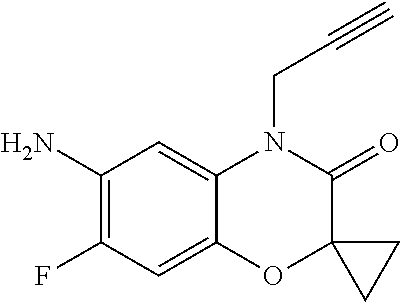


| Intermediate | ||
| No. | Compound | 1H NMR/LCMS |
| 12 From Intermediate 10 | Benzyl 3-cyano-3-(5-fluoro- 2,4- dinitrophenoxy)azetidine-1-carboxylate  |
(500 MHz, CDCl3): δ 8.90 (d, J = 7.6 Hz, 1H), 7.43-7.34 (m, 5H), 6.88 (d, J = 10.6 Hz, 1H), 5.16 (s, 2H), 4.75 (dd, J = 10.3, 1.0 Hz, 2H), 4.50 (dd, J = 10.4, 0.7 Hz, 2H). |
| 13 | Methyl 1-(5-fluoro-2,4- dinitrophenoxy)cyclopropane-1- carboxylate  |
(500 MHz, DMSO-d6): δ 8.80 (d, J = 7.7 Hz, 1H), 7.04 (d, J = 11.7 Hz, 1H), 3.83 (s, 3H), 1.88-1.78 (m, 2H), 1.56-1.46 (m, 2H). |


| Intermediate | ||
| No. | Compound | 1H NMR/LCMS |
| 18 |
 |
(500 MHz, DMSO-d6): δ 7.41-7.27 (m, 5H), 6.97 (d, J = 11.1 Hz, 1H), 6.69 (d, J = 8.5 Hz, 1H), 5.13 (s, 2H), 5.08 (s, 2H), 4.63 (d, J = 2.4 Hz, 2H), 4.33 (d, J = 5.8 Hz, 2H), 4.03 (d, J = 7.1 Hz, 2H), 3.39-3.31 (m, 1H). |
| 19 |
 |
(500 MHz, DMSO-d6): δ 6.69 (d, J = 11.1 Hz, 1H), 6.64 (d, J = 8.7 Hz, 1H), 4.92 (s, 2H), 3.89 (d, J = 7.3 Hz, 2H), 2.64 (m, 1H), 1.94 (m, 2H), 1.84-1.78 (m, 2H), 1.74 (m, 2H), 1.17 (m, 2H), 1.11 (m, 2H). |
| 20 |
 |
(500 MHz, DMSO-d6): δ 6.72 (d, J = 11.1 Hz, 1H), 6.67 (d, J = 8.5 Hz, 1H), 5.09 (s, 2H), 3.78-3.72 (m, 2H), 1.63-1.54 (m, 2H), 1.20- 1.15 (m, 2H), 1.14-1.09 (m, 2H), 0.89 (t, J = 7.4 Hz, 3H). |
| 21 |
 |
(500 MHz, DMSO-d6): δ 6.76 (d, J = 11.1 Hz, 1H), 6.56 (d, J = 8.5 Hz, 1H), 5.02 (q, J = 6.9 Hz, 1H), 4.95 (s, 2H), 3.63 (s, 23H), 1.49 (d, J = 7.0 Hz, 3H), 1.26-1.22 (m, 1H), 1.20- 1.16 (m, 1H), 1.14-1.10 (m, 1H), 1.07 (m, 1H). |
| 22 |
 |
(500 MHz, DMSO-d6): δ 6.76 (d, J = 11.1 Hz, 1H), 6.57 (d, J = 8.5 Hz, 1H), 4.99 (q, J = 6.9 Hz, 1H), 4.94 (s, 2H), 4.16-4.02 (m, 2H), 1.49 (d, J = 7.0 Hz, 3H), 1.25-1.06 (m, 7H). |


| Intermediate | ||
| No. | Compound | 1H NMR/LCMS |
| 27 |
 |
(500 MHz, DMSO-d6): δ 6.76 (d, J = 8.7 Hz, 1H), 6.71 (d, J = 11.1 Hz, 1H), 4.94 (s, 2H), 3.72 (d, J = 6.9 Hz, 2H), 1.24-1.05 (m, 5H), 0.54- 0.42 (m, 2H), 0.41-0.29 (m, 2H). LCMS (Method F): 1.63 min (263.1, [MH]+). |
| 28 |
 |
(500 MHz, DMSO-d6): δ 6.81 (d, J = 11.1 Hz, 1H), 6.68 (d, J = 8.4 Hz, 1H), 5.11 (s, 2H), 4.97 (s, 2H), 1.27-1.23 (m, 4H). LCMS (Method F): 1.44 min (246.1, [MH]−). |
| 29 |
 |
LCMS (Method F): 1.83 min (277.1, [MH]+). |
| 30 |
 |
(500 MHz, DMSO-d6): δ 6.74 (d, J = 1.9 Hz, 1H), 6.72 (d, J = 4.4 Hz, 1H), 4.94 (s, 2H), 4.16 (dd, J = 15.2, 3.6 Hz, 1H), 3.81 (dd, J = 15.2, 5.3 Hz, 1H), 3.18-3.15 (m, 1H), 2.79 (dd, J = 4.9, 4.1 Hz, 1H), 2.63 (dd, J = 5.0, 2.6 Hz, 1H), 1.20-1.12 (m, 4H). LCMS (Method F): 1.36 min (265.0, [MH]+). |


| Intermediate | ||
| No. | Compound | 1H NMR/LCMS |
| 33 |
 |
(500 MHz, CDCl3) 6.93 (d, J = 6.8 Hz, 1H), 6.79 (d, J = 9.6 Hz, 1H), 6.67 (d, J = 10.8 Hz, 1H), 6.23 (s, 1H), 3.86- 3.76 (m, 2H), 1.39 (ddd, J = 20.7, 8.0, 4.7 Hz, 5H), 1.32-1.20 (m, 2H), 1.17 (d, J = 5.1 Hz, 2H). LCMS (Method C): 3.10 min, (426.1 MH+). |
| 34 |
 |
(500 MHz, CDCl3) δ 6.84 (d, J = 9.5 Hz, 1H), 6.66 (t, J = 6.4 Hz, 1H), 6.26 (d, J = 4.4 Hz, 1H), 5.30-5.26 (m, 1H), 3.72 (d, J = 3.6 Hz, 3H), 1.61 (dd, J = 7.2, 1.8 Hz, 3H), 1.32-1.20 (m, 4H). LCMS (Method C): 2.89 min, (458.1 MH+). |


| Example No. | Compound | 1H NMR/LCMS |
| 5 |
 |
(500 MHz, CDCl3): δ 7.99 (dd, J = 8.2, 4.4 Hz, 1H), 7.65 (dd, J = 6.9, 2.2 Hz, 1H), 7.49 (td, J = 8.5, 2.1 Hz, 1H), 7.11 (d, J = 6.7 Hz, 1H), 6.85 (d, J = 9.6 Hz, 1H), 4.68 (d, J = 2.3 Hz, 2H), 2.29 (d, J = 2.3 Hz, 1H), 1.50-1.47 (m, 2H), 1.27 (dd, J = 9.9, 4.3 Hz, 2H). LCMS (Method F): 1.92 min (395.1, [MH]+). |
| Example No. | Compound | 1H NMR/LCMS |
| 6 |
 |
(500 MHz, CDCl3): δ 7.83 (m, 2H), 7.51-7.46 (m, 1H), 7.11 (d, J = 6.7 Hz, 1H), 6.85 (d, J = 9.6 Hz, 1H), 4.67 (d, J = 2.4 Hz, 2H), 2.29 (t, J = 2.4 Hz, 1H), 1.49 (dd, J = 8.4, 5.4 Hz, 2H), 1.28 (dd, J = 8.3, 5.4 Hz, 2H). LCMS (Method F): 1.88 min (395.1, MH+). |
| 7 |
 |
(500 MHz, DMSO-d6): δ 8.03 (dd, J = 5.5, 3.0 Hz, 2H), 7.96 (dd, J = 5.5, 3.1 Hz, 2H), 7.53 (d, J = 7.0 Hz, 1H), 7.23 (d, J = 9.9 Hz, 1H), 4.65 (d, J = 2.4 Hz, 2H), 3.31 (t, J = 2.4 Hz, 1H), 1.42-1.29 (m, 4H). LCMS (Method F): 1.90 min (377.1, MH+). |
| 8 |
 |
(500 MHz, CDCl3): δ 7.86 (d, J = 7.7 Hz, 1H), 7.78 (s, 1H), 7.61 (d, J = 7.7 Hz, 1H), 7.12 (d, J = 6.7 Hz, 1H), 6.84 (d, J = 9.6 Hz, 1H), 4.67 (d, J = 2.5 Hz, 2H), 2.56 (s, 3H), 2.28 (t, J = 2.5 Hz, 1H), 1.48 (dd, J = 8.5, 5.4 Hz, 2H), 1.27 (dd, J = 8.4, 5.4 Hz, 2H). LCMS (Method F): 2.04 min (391.1, MH+). |
| 9 |
 |
(500 MHz, DMSO-d6): δ 11.31 (s, 1H), 7.72 (dd, J = 8.4, 7.2 Hz, 1H), 7.48 (d, J = 7.1 Hz, 1H), 7.41 (d, J = 6.7 Hz, 1H), 7.31 (d, J = 7.9 Hz, 1H), 7.20 (d, J = 9.9 Hz, 1H), 4.66 (d, J = 1.6 Hz, 2H), 3.30 (t, J = 2.4 Hz, 1H), 1.34 (m, 4H). LCMS (Method F): .181 min (393.1, MH+). |
| 10 |
 |
(500 MHz, DMSO-d6): δ 7.94 (d, J = 8.3 Hz, 1H), 7.54 (d, J = 2.3 Hz, 1H), 7.51 (d, J = 7.1 Hz, 1H), 7.43 (dd, J = 8.4, 2.3 Hz, 1H), 7.22 (d, J = 9.9 Hz, 1H), 4.66 (d, J = 2.3 Hz, 2H), 3.97 (s, 3H), 3.30 (t, J = 2.4 Hz, 1H), 1.39-1.29 (m, 4H). LCMS (Method F): 1.96 min (407.2, MH+). |
| 11 |
 |
(500 MHz, DMSO-d6): δ 7.30-7.16 (m, 2H), 6.37 (s, 2H), 4.71 (s, 2H), 3.33-3.28 (m, 1H), 3.23 (s, 2H), 2.95 (s, 2H), 1.61-1.41 (m, 2H), 1.36-1.28 (m, 4H). LCMS (Method F): 1.83 min (393.1, MH+). |
| 12 |
 |
(500 MHz, CDCl3): δ 7.03 (d, J = 6.8 Hz, 1H), 6.92 (s, 2H), 6.81 (d, J = 9.6 Hz, 1H), 4.66 (d, J = 2.5 Hz, 2H), 2.29 (t, J = 2.5 Hz, 1H), 1.47 (dd, J = 8.5, 5.4 Hz, 2H), 1.26 (dd, J = 8.4, 5.4 Hz, 2H). LCMS (Method F): 1.70 min (327.0, MH+). |
| 13 |
 |
(500 MHz, DMSO-d6): δ 7.29 (d, J = 7.1 Hz, 1H), 7.13 (d, J = 10.0 Hz, 1H), 4.66 (d, J = 2.4 Hz, 2H), 3.31 (m, 1H), 2.80 (dd, J = 8.1, 3.6 Hz, 2H), 2.53-2.51 (m, 1H), 1.72 (m, 1H), 1.32 (t, J = 2.5 Hz, 2H), 1.30 (t, J = 2.4 Hz, 2H). LCMS (Method F): 1.62 min (341.2, MH+). |
| 14 |
 |
(500 MHz, DMSO-d6): δ 7.22 (q, J = 1.7 Hz, 1H), 7.04 (d, J = 6.7 Hz, 1H), 6.83 (d, J = 9.6 Hz, 1H), 4.67 (d, J = 2.5 Hz, 2H), 2.31 (t, J = 2.5 Hz, 1H), 1.49 (dd, J = 8.5, 5.5 Hz, 2H), 1.28 (dd, J = 8.4, 5.4 Hz, 2H). LCMS (Method F): 1.91 min (395.1, MH+). |
| 15 |
 |
(500 MHz, DMSO-d6): δ 7.32 (d, J = 7.0 Hz, 1H), 7.18 (d, J = 9.9 Hz, 1H), 5.05 (q, J = 6.9 Hz, 1H), 3.63 (s, 3H), 2.38-2.32 (m, 4H), 1.74 (m, 4H), 1.48 (d, J = 6.9 Hz, 3H), 1.34- 1.20 (m, 4H). LCMS (Method F): 2.01 min (429.2, MH+). |
| 16 |
 |
(500 MHz, CDCl3): δ 7.98 (dd, J = 8.3, 4.4 Hz, 1H), 7.64 (dd, J = 6.9, 2.2 Hz, 1H), 7.51-7.46 (m, 1H), 6.87 (d, J = 9.6 Hz, 1H), 6.74 (d, J = 6.6 Hz, 1H), 5.30 (q, J = 7.2 Hz, 1H), 3.75 (s, 3H), 1.64 (d, J = 7.2 Hz, 3H), 1.55-1.52 (m, 1H), 1.39-1.22 (m, 3H). LCMS (Method F): 1.98 min (443.2, MH+). |
| 17 |
 |
(500 MHz, CDCl3): δ 7.20 (q, J = 1.6 Hz, 1H), 6.85 (d, J = 9.6 Hz, 1H), 6.66 (d, J = 6.6 Hz, 1H), 5.29 (q, J = 7.1 Hz, 1H), 3.75 (s, 3H), 1.63 (d, J = 7.2 Hz, 3H), 1.55-1.51 (m, 1H), 1.40-1.34 (m, 1H), 1.33- 1.21 (m, 2H). LCMS (Method F): 1.97 min (443.2, MH+). |
| 18 |
 |
(500 MHz, CDCl3): δ 6.81 (d, J = 9.6 Hz, 1H), 6.66 (d, J = 6.7 Hz, 1H), 5.23 (q, J = 7.2 Hz, 1H), 4.26-4.14 (m, 2H), 2.46-2.41 (m, 4H), 1.86-1.81 (m, 4H), 1.62 (d, J = 7.2 Hz, 3H), 1.50 (m, 1H), 1.37-1.31 (m, 1H), 1.30-1.21 (m, 2H), 1.19 (t, J = 7.1 Hz, 3H). LCMS (Method F): 2.06 min (443.2, MH+). |
| 19 |
 |
(500 MHz, CDCl3): δ 7.98 (dd, J = 8.3, 4.5 Hz, 1H), 7.64 (dd, J = 6.9, 2.2 Hz, 1H), 7.51-7.46 (m, 1H), 6.86 (d, J = 9.6 Hz, 1H), 6.76 (d, J = 6.6 Hz, 1H), 5.25 (q, J = 7.2 Hz, 1H), 4.27-4.15 (m, 2H), 1.64 (d, J = 7.2 Hz, 3H), 1.54-1.50 (m, 1H), 1.39- 1.34 (m, 1H), 1.33-1.22 (m, 2H), 1.20 (t, J = 7.1 Hz, 3H). LCMS (Method F): 2.06 min (457.2, MH+). |
| 20 |
 |
(500 MHz, CDCl3): δ 7.20 (q, J = 1.6 Hz, 1H), 6.85 (d, J = 9.6 Hz, 1H), 6.69 (d, J = 6.6 Hz, 1H), 5.26 (q, J = 7.2 Hz, 1H), 4.27-4.14 (m, 2H), 1.63 (d, J = 7.2 Hz, 3H), 1.52 (m, 1H), 1.40-1.34 (m, 1H), 1.33- 1.23 (m, 2H), 1.20 (t, J = 7.1 Hz, 3H). LCMS (Method F): 2.02 min (457.1, MH+). |
| 21 |
 |
(500 MHz, CDCl3): δ 7.99 (dd, J = 8.2, 4.4 Hz, 1H), 7.65 (dd, J = 6.9, 2.1 Hz, 1H), 7.51-7.46 (m, 1H), 6.85 (d, J = 6.8 Hz, 1H), 6.81 (d, J = 9.6 Hz, 1H), 3.98 (d, J = 7.3 Hz, 2H), 2.74-2.66 (m, 1H), 2.02 (m, 2H), 1.90-1.76 (m, 4H), 1.43 (dd, J = 8.4, 5.4 Hz, 2H), 1.23 (dd, J = 8.3, 5.3 Hz, 2H). LCMS (Method D): 9.78 min (425.2, MH+). |
| 22 |
 |
(500 MHz, CDCl3): δ 7.99 (dd, J = 8.2, 4.4 Hz, 1H), 7.65 (dd, J = 6.9, 2.1 Hz, 1H), 7.51-7.47 (m, 1H), 6.86 (d, J = 6.7 Hz, 1H), 6.82 (d, J = 9.6 Hz, 1H), 3.89-3.83 (m, 2H), 1.70 (m, 2H), 1.44 (dd, J = 8.4, 5.4 Hz, 2H), 1.23 (dd, J = 8.3, 5.3 Hz, 2H), 0.96 (t, J = 7.4 Hz, 3H). LCMS (Method D): 9.26 min (399.2, MH+). |
| 23 |
 |
(500 MHz, CDCl3): δ 8.01 (dd, J = 8.2, 4.4 Hz, 1H), 7.67 (dd, J = 6.9, 2.2 Hz, 1H), 7.51 (td, J = 8.6, 2.3 Hz, 1H), 7.10 (d, J = 6.8 Hz, 1H), 6.99 (d, J = 9.7 Hz, 1H), 4.70 (d, J = 2.5 Hz, 2H), 2.75-2.62 (m, 2H), 2.44-2.32 (m, 2H), 2.30 (t, J = 2.5 Hz, 1H), 2.06-1.97 (m, 2H). LCMS (Method B): 3.57 mins (409.2, MH+). |
| 24 |
 |
(500 MHz, CDCl3): δ 7.24 (q, J = 1.6 Hz, 1H), 7.03 (t, J = 5.8 Hz, 1H), 6.97 (d, J = 9.7 Hz, 1H), 4.68 (d, J = 2.5 Hz, 2H), 2.74-2.60 (m, 2H), 2.44-2.32 (m, 2H), 2.31 (t, J = 2.5 Hz, 1H), 2.05-1.94 (m, 2H). LCMS (Method B): .356 min (409.2, MH+). |
| 25 |
 |
(500 MHz, CDCl3): δ 7.96-7.88 (m, 1H), 7.58 (dd, J = 6.9, 2.2 Hz, 1H), 7.43 (td, J = 8.6, 2.3 Hz, 1H), 7.34-7.24 (m, 5H), 7.07 (d, J = 6.6 Hz, 1H), 6.98 (d, J = 9.4 Hz, 1H), 5.07 (s, 2H), 4.63 (s, 2H), 4.49 (d, J = 9.6 Hz, 2H), 4.11 (dd, J = 9.7, 0.9 Hz, 2H), 2.23 (t, J = 2.5 Hz, 1H). LCMS (Method A): 3.60 min (544.3, MH+). |
| Example No. | Compound | 1H NMR/LCMS |
| 26 |
 |
(500 MHz, CDCl3): δ 7.99 (dd, J = 8.3, 4.4 Hz, 1H), 7.65 (dd, J = 7.0, 2.1 Hz, 1H), 7.51-7.46 (m, 1H), 7.02 (d, J = 6.8 Hz, 1H), 6.83 (d, J = 9.7 Hz, 1H), 3.82 (d, J = 6.9 Hz, 2H), 1.44 (dd, J = 8.4, 5.4 Hz, 2H), 1.24 (dd, J = 8.3, 5.3 Hz, 2H), 1.19- 1.13 (m, 1H), 0.57-0.52 (m, 2H), 0.43- 0.39 (m, 2H). LCMS (Method D): 9.41 min (411.2, MH+). |
| 27 |
 |
(500 MHz, CDCl3): δ 7.98 (dd, J = 8.2, 4.4 Hz, 1H), 7.65 (dd, J = 6.9, 2.3 Hz, 1H), 7.48 (td, J = 8.5, 2.3 Hz, 1H), 7.21 (d, J = 6.9 Hz, 1H), 6.80 (d, J = 9.6 Hz, 1H), 4.07 (t, J = 5.5 Hz, 2H), 3.65 (t, J = 5.5 Hz, 2H), 3.34 (s, 3H), 1.44 (dd, J = 8.4, 5.4 Hz, 2H), 1.25 (dd, J = 8.4, 5.3 Hz, 2H). LCMS (Method D): 8.67 min (415.2, MH+). |


| Example No. | Compound | 1H NMR/LCMS |
| 35 |
 |
(500 MHz, DMSO-d6): δ 12.92 (s, 1H), 8.10 (dd, J = 8.3, 4.6 Hz, 1H), 7.95 (dd, J = 7.4, 2.3 Hz, 1H), 7.82-7.77 (m, 1H), 7.47 (d, J = 7.0 Hz, 1H), 7.23 (d, J = 9.8 Hz, 1H), 4.94 (q, J = 7.2 Hz, 1H), 1.49 (d, J = 7.0 Hz, 3H), 1.38-1.19 (m, 4H). LCMS (Method D): 8.18 min (429.1, MH+). |

| Example No. | Compound | 1H NMR/LCMS |
| 37 |
 |
(500 MHz, DMSO-d6): δ 6.99 (d, J = 8.0 Hz, 1H), 6.97 (d, J = 10.5 Hz, 1H), 3.82 (d, J = 6.9 Hz, 2H), 3.77-3.72 (m, 2H), 3.72-3.62 (m, 2H), 1.87-1.79 (m, 2H), 1.78-1.71 (m, 2H), 1.28-1.24 (m, 2H), 1.23- 1.19 (m, 2H), 1.16-1.09 (m, 1H), 0.,50-0.42 (m, 2H), 0.35-0.28 (m, 2H). LCMS (Method F): 2.05 min (417.2, MH+). |
| 38 |
 |
(500 MHz, DMSO-d6): δ 7.02 (d, J = 10.4 Hz, 1H), 6.90 (d, J = 7.8 Hz, 1H), 5.10 (q, J = 6.9 Hz, 1H), 3.77-3.71 (m, 2H), 3.68 (td, J = 5.8, 1.4 Hz, 2H), 3.62 (s, 3H), 1.86- 1.79 (m, 2H), 1.78-1.71 (m, 2H), 1.47 (d, J = 6.9 Hz, 3H), 1.31-1.16 (m, 4H). LCMS (Method F): 1.96 min (449.1, MH+). |
| Example No. | Compound | 1H NMR/LCMS |
| 39 |
 |
(500 MHz, CDCl3): δ 6.83 (d, J = 9.5 Hz, 1H), 6.64 (dd, J = 8.3, 6.7 Hz, 1H), 6.37 (d, J = 3.1 Hz, 1H), 5.31-5.20 (m, 1H), 3.72 (d, J = 2.2 Hz, 3H), 3.58-3.54 (m, 3H), 1.61 (d, J = 7.2 Hz, 3H), 1.55-1.49 (m, 2H), 1.41-1.20 (m, 2H) LCMS (Method C): 3.30 min (472.0, MH+). |
| 40 |
 |
(500 MHz, DMSO-d6): δ 7.49 (d, J = 7.1 Hz, 1H), 7.12 (d, J = 9.9 Hz, 1H), 6.60 (s, 1H), 3.83-3.65 (m, 2H), 3.43 (s, 3H), 1.29 (dd, J = 7.8, 4.6 Hz, 4H), 1.10 (tt, J = 7.8, 4.3 Hz, 1H), 0.47-0.44 (m, 2H), 0.34-0.31 (m, 2H). LCMS (Method C): 3.55 min (440.1, MH+). |
| 41 |
 |
(500 MHz, DMSO-d6): δ 7.44 (d, J = 7.0 Hz, 1H), 7.19 (d, J = 9.9 Hz, 1H), 6.69 (s, 1H), 4.74-4.50 (m, 4H), 3.45 (t, J = 2.3 Hz, 1H), 3.30 (t, J = 2.4 Hz, 1H), 1.37-1.30 (m, 4H). LCMS (Method F): 1.82 min (446.1, MH−). |
| 42 |
 |
(500 MHz, DMSO-d6): δ 7.39 (d, J = 7.0 Hz, 1H), 7.19 (d, J = 9.9 Hz, 1H), 6.76 (s, 1H), 4.86-4.53 (m, 4H), 3.71 (s, 3H), 3.31 (t, J = 2.3 Hz, 1H), 1.41-1.25 (m, 4H). LCMS (Method F): 1.79 min (482.1, MH+). |
| 43 |
 |
(500 MHz, DMSO-d6): δ 7.41 (d, J = 7.1 Hz, 1H), 7.17 (d, J = 9.8 Hz, 1H), 6.60 (s, 1H), 4.71-4.33 (m, 1H), 3.86-3.68 (m, 2H), 1.75- 1.54 (m, 4H), 1.38-1.29 (m, 4H), 0.89 (t, J = 7.4 Hz, 3H). LCMS (Method F): 2.00 min (452.1, MH+). |


| Example No. | Compound | 1H NMR/LCMS |
| 46 |
 |
(500 MHz, DMSO-d6): δ 7.47 (d, J = 7.2 Hz, 1H), 7.12 (d, J = 10.0 Hz, 1H), 5.38 (s, 1H), 4.58 (s, 1H), 3.87-3.68 (m, 3H), 3.09 (d, J = 11.6 Hz, 1H), 2.54 (t, J = 5.6 Hz, 1H), 2.09 (s, 1H), 1.36-1.04 (m, 6H), 0.55-0.41 (m, 2H), 0.40-0.26 (m, 2H). LCMS (Method F): 1.55 min (402.2, MH+). |
| 47 |
 |
(500 MHz, CDCl3): δ 7.05 (d, J = 6.8 Hz, 1H), 6.79 (d, J = 9.7 Hz, 1H), 4.66 (d, J = 2.5 Hz, 2H), 4.33- 4.21 (m, 1H), 4.05-3.93 (m, 1H), 2.94 (td, J = 12.5, 3.6 Hz, 1H), 2.38-2.24 (m, 2H), 2.08 (d, J = 7.0 Hz, 1H), 1.81 (d, J = 11.4 Hz, 1H), 1.65-1.56 (m, 3H), 1.48- 1.40 (m, 2H), 1.30-1.18 (m, 2H). LCMS (Method C): 3.14 min (384.1, MH+). |
| 48 |
 |
(500 MHz, DMSO-d6): δ 7.48 (d, J = 7.1 Hz, 1H), 7.14 (d, J = 10.0 Hz, 1H), 4.53 (s, 1H), 4.19 (s, 1H), 3.94-3.88 (m, 2H), 3.86-3.75 (m, 2H), 3.43 (td, J = 11.7, 3.2 Hz, 1H), 3.20 (td, J = 13.4, 4.0 Hz, 1H), 1.34-1.10 (m, 6H), 0.50-0.45 (m, 2H), 0.38-0.34 (m, 2H). LCMS (Method F): 1.66 min (402.2, MH+). |
| 49 |
 |
LCMS (Method F): 1.50 min (434.1, MH−). |
| 50 |
 |
(500 MHz, DMSO-d6): δ 7.49 (d, J = 7.0 Hz, 1H), 7.25 (d, J = 9.9 Hz, 1H), 5.02 (s, 2H), 4.57 (tt, J = 14.6, 7.5 Hz, 1H), 4.23 (dd, J = 10.7, 4.7 Hz, 1H), 3.99-3.85 (m, 2H), 3.67- 3.38 (m, 2H), 3.28-3.15 (m, 1H), 1.47-1.29 (m, 4H). LCMS (Method F): 1.48 min (387.1, MH+). |
| 51 |
 |
(500 MHz, DMSO-d6): δ 7.19 (d, J = 6.9 Hz, 1H), 7.13 (d, J = 10.0 Hz, 1H), 5.10 (t, J = 6.5 Hz, 1H), 4.63-4.39 (m, 3H), 4.19 (dd, J = 10.7, 4.4 Hz, 1H), 3.91 (dd, J = 11.5, 3.4 Hz, 2H), 3.41 (td, J = 11.8, 3.1 Hz, 1H), 3.19 (td, J = 13.2, 4.0 Hz, 1H), 1.73 (s, 3H), 1.67 (s, 3H), 1.39- 1.19 (m, 5H). LCMS (Method F): .180 min (416.2, MH+). |
| 62 |
 |
LCMS (Method F): 1.73 min (386.2, MH+). |
| 53 |
 |
(500 MHz, DMSO-d6): δ 7.33 (d, J = 6.6 Hz, 1H), 7.18 (d, J = 10.0 Hz, 1H), 4.66 (s, 2H), 4.43 (s, 1H), 4.29 (dt, J = 13.2, 2.8 Hz, 1H), 3.32 (t, J = 2.4 Hz, 1H), 3.13 (td, J = 13.3, 2.9 Hz, 1H), 3.01-2.94 (m, 1H), 2.80-2.71 (m, 1H), 2.69-2.62 (m, 2H), 1.36-1.28 (m, 4H). LCMS (Method F): 1.71 min (402.2, MH+). |

| TABLE 1 | |||
| Pre-Emergence | Post-Emergence | ||
| Stellaria | Lollium | Stellaria | Lollium |
| kg/ha |
| Example | 0.2 | 1 | 5 | 0.2 | 1 | 5 | 0.2 | 1 | 5 | 0.2 | 1 | 5 |
| Comparative | C | C | C | C | B | A | C | B | B | B | B | A |
| Example | ||||||||||||
| 1 | C | C | C | B | B | B | C | B | B | C | B | A |
| 2 | B | B | B | C | C | C | B | B | B | C | C | C |
| 3 | B | A | A | C | B | A | B | B | B | B | A | A |
| 4 | A | A | A | A | A | A | B | B | B | A | A | A |
| TABLE 2 | |||
| Pre-Emergence | Post-Emergence | ||
| Stellaria | Lollium | Stellaria | Lollium |
| kg/ha |
| Example | 0.2 | 1 | 5 | 0.2 | 1 | 5 | 0.2 | 1 | 5 | 0.2 | 1 | 5 |
| Comparative | B | A | A | C | B | A | B | A | A | B | B | A |
| Example | ||||||||||||
| 1 | B | A | A | B | B | A | A | A | A | B | A | A |
| 2 | B | B | B | C | C | C | B | B | B | C | C | C |
| 4 | A | A | A | A | A | A | A | A | A | A | A | A |
| 5 | D | A | A | D | B | A | A | A | A | B | B | A |
| 6 | B | B | A | C | C | B | B | A | A | B | A | A |
| 7 | A | A | A | B | A | A | A | A | A | C | B | B |
| 8 | A | A | A | B | A | A | A | A | A | B | A | A |
| 9 | C | C | B | C | C | B | C | C | B | C | C | B |
| 10 | B | A | A | C | C | C | B | A | A | C | C | C |
| 13 | B | A | A | C | C | B | A | A | A | C | C | C |
| 14 | C | C | C | C | C | C | C | C | C | C | C | C |
| 15 | A | A | A | B | A | A | A | A | A | B | A | A |
| 16 | A | A | A | C | B | B | A | A | A | B | B | A |
| 17 | B | B | A | C | B | B | C | B | B | C | C | C |
| 18 | A | A | A | A | A | A | A | A | A | B | A | A |
| 19 | A | A | A | B | A | A | A | A | A | B | A | A |
| 20 | C | B | B | C | C | C | B | A | A | C | C | C |
| 21 | A | A | A | C | C | B | A | A | A | C | B | B |
| 22 | A | A | A | C | B | B | A | A | A | B | B | A |
| 23 | C | A | A | C | C | B | A | A | A | C | C | C |
| 24 | C | B | B | C | B | B | C | C | C | C | C | C |
| 25 | B | B | B | C | C | C | C | C | C | C | C | C |
| 26 | A | A | A | A | A | A | A | A | A | A | A | A |
| 27 | A | A | A | B | A | A | A | A | A | B | A | A |
| 28 | A | A | A | A | A | A | A | A | A | B | A | A |
| 29 | A | A | A | A | A | A | A | A | A | C | B | B |
| 30 | A | A | A | B | B | A | A | A | A | C | C | C |
| 31 | A | A | A | A | A | A | A | A | A | A | A | A |
| 33 | C | B | B | C | C | C | C | C | B | C | C | C |
| 34 | A | A | A | B | A | A | A | A | A | B | A | A |
| 35 | C | B | B | C | B | B | A | A | A | C | B | B |
| 36 | C | B | A | C | B | B | A | A | A | C | B | B |
| 37 | D | D | D | D | D | D | A | A | A | B | B | A |
| 38 | D | D | D | D | D | D | A | A | A | B | B | A |
| 39 | A | A | A | A | A | A | A | A | A | A | A | A |
| 40 | A | A | A | B | B | A | A | A | A | B | B | A |
| 41 | A | A | A | A | A | A | A | A | A | C | B | A |
| 42 | B | A | A | C | B | B | A | A | A | B | B | A |
| 43 | B | A | A | B | A | A | A | A | A | B | B | A |
| 44 | A | A | A | C | B | A | A | A | A | A | A | A |
| 45 | D | D | D | D | D | D | A | A | A | A | A | A |
| 46 | D | D | D | D | D | D | C | C | C | C | C | C |
| 47 | A | A | A | B | A | A | A | A | A | A | A | A |
| 48 | D | D | D | D | D | D | A | A | A | C | C | B |
| 49 | D | D | D | D | D | D | A | A | A | C | C | C |
| 50 | D | D | D | D | D | D | A | A | A | C | C | C |
| 51 | D | D | D | D | D | D | A | A | A | C | C | C |
| 52 | D | D | D | D | D | D | A | A | A | C | B | B |
Claims (21)


Applications Claiming Priority (7)
| Application Number | Priority Date | Filing Date | Title |
|---|---|---|---|
| GB1711839.9 | 2017-07-24 | ||
| GBGB1711839.9A GB201711839D0 (en) | 2017-07-24 | 2017-07-24 | Agricultural chemicals |
| GB1711839 | 2017-07-24 | ||
| GB1801491 | 2018-01-30 | ||
| GB1801491.0 | 2018-01-30 | ||
| GBGB1801491.0A GB201801491D0 (en) | 2018-01-30 | 2018-01-30 | Agricultural chemicals |
| PCT/GB2018/052078 WO2019020987A1 (en) | 2017-07-24 | 2018-07-23 | Benzoxazinone derivatives useful as herbicides |
Publications (2)
| Publication Number | Publication Date |
|---|---|
| US20200172527A1 US20200172527A1 (en) | 2020-06-04 |
| US11261177B2 true US11261177B2 (en) | 2022-03-01 |
Family
ID=63077904
Family Applications (1)
| Application Number | Title | Priority Date | Filing Date |
|---|---|---|---|
| US16/628,332 Expired - Fee Related US11261177B2 (en) | 2017-07-24 | 2018-07-23 | Benzoxazinone derivatives useful as herbicides |
Country Status (9)
| Country | Link |
|---|---|
| US (1) | US11261177B2 (en) |
| EP (1) | EP3658551B1 (en) |
| JP (1) | JP7295088B2 (en) |
| CN (1) | CN111132979B (en) |
| AU (1) | AU2018307564B2 (en) |
| CA (1) | CA3070195A1 (en) |
| IL (1) | IL271793B2 (en) |
| WO (1) | WO2019020987A1 (en) |
| ZA (1) | ZA202000464B (en) |
Families Citing this family (3)
| Publication number | Priority date | Publication date | Assignee | Title |
|---|---|---|---|---|
| CN110156714B (en) * | 2019-05-16 | 2020-10-30 | 江苏省农用激素工程技术研究中心有限公司 | Preparation method of iodosulfuron-methyl sodium intermediate |
| GB202209303D0 (en) | 2022-06-24 | 2022-08-10 | Redag Crop Prot Ltd | Agricultural chemicals |
| CN121991050A (en) * | 2024-11-05 | 2026-05-08 | 青岛清原化合物有限公司 | Fused heterocyclic compound, preparation method thereof, weeding composition and application |
Citations (6)
| Publication number | Priority date | Publication date | Assignee | Title |
|---|---|---|---|---|
| US4640707A (en) | 1984-07-23 | 1987-02-03 | Sumitomo Chemical Company, Ltd. | Tetrahydrophthalimides and their herbicidal use |
| US20120214668A1 (en) | 2009-11-02 | 2012-08-23 | Basf Se | Herbicidal Tetrahydrophthalimides |
| US20130184155A1 (en) | 2010-10-01 | 2013-07-18 | Trevor William Newton | Herbicidal Benzoxazinones |
| US20140329682A1 (en) | 2011-12-15 | 2014-11-06 | Sumitomo Chemical Company, Limited | Method of controlling weed in a sugar cane field |
| US20150250181A1 (en) | 2009-06-19 | 2015-09-10 | Basf Se | Herbicidal Benzoxazinones |
| CN105061416A (en) | 2015-07-16 | 2015-11-18 | 北京颖泰嘉和生物科技股份有限公司 | Method for preparing flumioxazin |
Family Cites Families (11)
| Publication number | Priority date | Publication date | Assignee | Title |
|---|---|---|---|---|
| JPS6130586A (en) * | 1984-07-23 | 1986-02-12 | Sumitomo Chem Co Ltd | Tetrahydrophthalimide derivative, its preparation, and herbicide comprising it as active ingredient |
| JPS6176486A (en) * | 1984-09-20 | 1986-04-18 | Sumitomo Chem Co Ltd | Tetrahydrophthalimide derivative, its production, and herbicide containing same as active ingredient |
| US5198013A (en) * | 1988-02-05 | 1993-03-30 | Sagami Chemical Research Center | Benzoxazinone compounds and herbicidal composition containing the same |
| JP3064371B2 (en) * | 1989-09-26 | 2000-07-12 | 住友化学工業株式会社 | Benzoxazyluracil derivative, process for producing the same and herbicide containing the same as active ingredient |
| GB9412603D0 (en) * | 1994-06-23 | 1994-08-10 | Sandoz Ltd | Organic compounds |
| DE10000600A1 (en) * | 2000-01-10 | 2001-07-12 | Bayer Ag | New N-substituted oxazolyl-uracil and thiazolyl-uracil derivatives useful as herbicides, especially for weed control in crops |
| DE10029077A1 (en) * | 2000-06-13 | 2001-12-20 | Bayer Ag | New heterocyclic-substituted thiazole derivatives, useful as total or selective herbicides, insecticides, acaricides, nematocides, ectoparasiticides or antifouling agents |
| CN1194975C (en) * | 2003-03-31 | 2005-03-30 | 湖南化工研究院 | Helerocyclic substituted benzoxazine cyclic compound having biological activity |
| EP2382210B1 (en) * | 2008-12-30 | 2017-03-01 | Rigel Pharmaceuticals, Inc. | Pyrimidinediamine kinase inhibitors |
| US20120082719A1 (en) * | 2010-10-05 | 2012-04-05 | Sam Poon Ang | Compositions For Treating Chronic Viral Infections |
| EP3112016A1 (en) * | 2015-07-02 | 2017-01-04 | Basf Se | Microcapsules containing benzoxazinones |
-
2018
- 2018-07-23 WO PCT/GB2018/052078 patent/WO2019020987A1/en not_active Ceased
- 2018-07-23 JP JP2020503777A patent/JP7295088B2/en active Active
- 2018-07-23 US US16/628,332 patent/US11261177B2/en not_active Expired - Fee Related
- 2018-07-23 EP EP18749098.2A patent/EP3658551B1/en active Active
- 2018-07-23 AU AU2018307564A patent/AU2018307564B2/en not_active Ceased
- 2018-07-23 CA CA3070195A patent/CA3070195A1/en active Pending
- 2018-07-23 CN CN201880062033.5A patent/CN111132979B/en not_active Expired - Fee Related
-
2020
- 2020-01-01 IL IL271793A patent/IL271793B2/en unknown
- 2020-01-23 ZA ZA2020/00464A patent/ZA202000464B/en unknown
Patent Citations (6)
| Publication number | Priority date | Publication date | Assignee | Title |
|---|---|---|---|---|
| US4640707A (en) | 1984-07-23 | 1987-02-03 | Sumitomo Chemical Company, Ltd. | Tetrahydrophthalimides and their herbicidal use |
| US20150250181A1 (en) | 2009-06-19 | 2015-09-10 | Basf Se | Herbicidal Benzoxazinones |
| US20120214668A1 (en) | 2009-11-02 | 2012-08-23 | Basf Se | Herbicidal Tetrahydrophthalimides |
| US20130184155A1 (en) | 2010-10-01 | 2013-07-18 | Trevor William Newton | Herbicidal Benzoxazinones |
| US20140329682A1 (en) | 2011-12-15 | 2014-11-06 | Sumitomo Chemical Company, Limited | Method of controlling weed in a sugar cane field |
| CN105061416A (en) | 2015-07-16 | 2015-11-18 | 北京颖泰嘉和生物科技股份有限公司 | Method for preparing flumioxazin |
Non-Patent Citations (2)
| Title |
|---|
| International Search Report and Written Opinion issued in corresponding to International Application No. PCT/GB2018/052078, dated Sep. 17, 2018, 13 pages. |
| Search Report Under 17(5), for International Application No. GB1711839.9, dated Jan. 23, 2018, 3 pages. |
Also Published As
| Publication number | Publication date |
|---|---|
| AU2018307564A1 (en) | 2020-02-13 |
| EP3658551A1 (en) | 2020-06-03 |
| CN111132979B (en) | 2024-03-26 |
| CA3070195A1 (en) | 2019-01-31 |
| ZA202000464B (en) | 2023-07-26 |
| JP2020528896A (en) | 2020-10-01 |
| IL271793A (en) | 2020-02-27 |
| BR112020001268A2 (en) | 2020-07-28 |
| JP7295088B2 (en) | 2023-06-20 |
| CN111132979A (en) | 2020-05-08 |
| US20200172527A1 (en) | 2020-06-04 |
| EP3658551B1 (en) | 2022-01-19 |
| WO2019020987A1 (en) | 2019-01-31 |
| AU2018307564B2 (en) | 2022-05-05 |
| IL271793B2 (en) | 2023-06-01 |
Similar Documents
| Publication | Publication Date | Title |
|---|---|---|
| US5077401A (en) | Benzo-fused cyclic compounds | |
| EP3658551B1 (en) | Benzoxazinone derivatives useful as herbicides | |
| US11634390B2 (en) | Agricultural chemicals | |
| US9951028B2 (en) | Agricultural chemicals | |
| US11224224B2 (en) | Thiobenzoimidazole as fungicides | |
| US20210206744A1 (en) | Benzimidazole compounds as agricultural chemicals | |
| US11241013B2 (en) | Benzimidazole compounds as agricultural chemicals | |
| EA043615B1 (en) | AGRICULTURAL CHEMICALS | |
| BR112020001268B1 (en) | COMPOUNDS DERIVED FROM BENZOXAZINONE USEFUL AS HERBICIDES, THEIR USES, HERBICIDAL COMPOSITION, AND METHOD FOR CONTROLLING WEEDS | |
| WO2023247976A1 (en) | Deuterated herbicides based on oxazinones and 6-(trifluoromethyl)pyrimidine-2,4-diones |
Legal Events
| Date | Code | Title | Description |
|---|---|---|---|
| FEPP | Fee payment procedure |
Free format text: ENTITY STATUS SET TO UNDISCOUNTED (ORIGINAL EVENT CODE: BIG.); ENTITY STATUS OF PATENT OWNER: SMALL ENTITY |
|
| FEPP | Fee payment procedure |
Free format text: ENTITY STATUS SET TO SMALL (ORIGINAL EVENT CODE: SMAL); ENTITY STATUS OF PATENT OWNER: SMALL ENTITY |
|
| STPP | Information on status: patent application and granting procedure in general |
Free format text: APPLICATION DISPATCHED FROM PREEXAM, NOT YET DOCKETED |
|
| STPP | Information on status: patent application and granting procedure in general |
Free format text: DOCKETED NEW CASE - READY FOR EXAMINATION |
|
| STPP | Information on status: patent application and granting procedure in general |
Free format text: NOTICE OF ALLOWANCE MAILED -- APPLICATION RECEIVED IN OFFICE OF PUBLICATIONS |
|
| STCF | Information on status: patent grant |
Free format text: PATENTED CASE |
|
| FEPP | Fee payment procedure |
Free format text: MAINTENANCE FEE REMINDER MAILED (ORIGINAL EVENT CODE: REM.); ENTITY STATUS OF PATENT OWNER: SMALL ENTITY |
|
| LAPS | Lapse for failure to pay maintenance fees |
Free format text: PATENT EXPIRED FOR FAILURE TO PAY MAINTENANCE FEES (ORIGINAL EVENT CODE: EXP.); ENTITY STATUS OF PATENT OWNER: SMALL ENTITY |
|
| STCH | Information on status: patent discontinuation |
Free format text: PATENT EXPIRED DUE TO NONPAYMENT OF MAINTENANCE FEES UNDER 37 CFR 1.362 |
|
| FP | Lapsed due to failure to pay maintenance fee |
Effective date: 20260301 |