US11256121B2 - Liquid crystal display device for under-screen identification scheme - Google Patents

Liquid crystal display device for under-screen identification scheme Download PDF

Info

Publication number
US11256121B2
US11256121B2 US16/631,170 US201916631170A US11256121B2 US 11256121 B2 US11256121 B2 US 11256121B2 US 201916631170 A US201916631170 A US 201916631170A US 11256121 B2 US11256121 B2 US 11256121B2
Authority
US
United States
Prior art keywords
liquid crystal
under
micro led
module
screen
Prior art date
Legal status (The legal status is an assumption and is not a legal conclusion. Google has not performed a legal analysis and makes no representation as to the accuracy of the status listed.)
Active, expires
Application number
US16/631,170
Other versions
US20210356788A1 (en
Inventor
Guowei Zha
Current Assignee (The listed assignees may be inaccurate. Google has not performed a legal analysis and makes no representation or warranty as to the accuracy of the list.)
Wuhan China Star Optoelectronics Technology Co Ltd
Original Assignee
Wuhan China Star Optoelectronics Technology Co Ltd
Priority date (The priority date is an assumption and is not a legal conclusion. Google has not performed a legal analysis and makes no representation as to the accuracy of the date listed.)
Filing date
Publication date
Application filed by Wuhan China Star Optoelectronics Technology Co Ltd filed Critical Wuhan China Star Optoelectronics Technology Co Ltd
Assigned to WUHAN CHINA STAR OPTOELECTRONICS TECHNOLOGY CO., LTD. reassignment WUHAN CHINA STAR OPTOELECTRONICS TECHNOLOGY CO., LTD. ASSIGNMENT OF ASSIGNORS INTEREST (SEE DOCUMENT FOR DETAILS). Assignors: ZHA, GUOWEI
Publication of US20210356788A1 publication Critical patent/US20210356788A1/en
Application granted granted Critical
Publication of US11256121B2 publication Critical patent/US11256121B2/en
Active legal-status Critical Current
Adjusted expiration legal-status Critical

Links

Images

Classifications

    • GPHYSICS
    • G02OPTICS
    • G02FOPTICAL DEVICES OR ARRANGEMENTS FOR THE CONTROL OF LIGHT BY MODIFICATION OF THE OPTICAL PROPERTIES OF THE MEDIA OF THE ELEMENTS INVOLVED THEREIN; NON-LINEAR OPTICS; FREQUENCY-CHANGING OF LIGHT; OPTICAL LOGIC ELEMENTS; OPTICAL ANALOGUE/DIGITAL CONVERTERS
    • G02F1/00Devices or arrangements for the control of the intensity, colour, phase, polarisation or direction of light arriving from an independent light source, e.g. switching, gating or modulating; Non-linear optics
    • G02F1/01Devices or arrangements for the control of the intensity, colour, phase, polarisation or direction of light arriving from an independent light source, e.g. switching, gating or modulating; Non-linear optics for the control of the intensity, phase, polarisation or colour 
    • G02F1/13Devices or arrangements for the control of the intensity, colour, phase, polarisation or direction of light arriving from an independent light source, e.g. switching, gating or modulating; Non-linear optics for the control of the intensity, phase, polarisation or colour  based on liquid crystals, e.g. single liquid crystal display cells
    • G02F1/133Constructional arrangements; Operation of liquid crystal cells; Circuit arrangements
    • G02F1/1333Constructional arrangements; Manufacturing methods
    • G02F1/13338Input devices, e.g. touch panels
    • GPHYSICS
    • G02OPTICS
    • G02FOPTICAL DEVICES OR ARRANGEMENTS FOR THE CONTROL OF LIGHT BY MODIFICATION OF THE OPTICAL PROPERTIES OF THE MEDIA OF THE ELEMENTS INVOLVED THEREIN; NON-LINEAR OPTICS; FREQUENCY-CHANGING OF LIGHT; OPTICAL LOGIC ELEMENTS; OPTICAL ANALOGUE/DIGITAL CONVERTERS
    • G02F1/00Devices or arrangements for the control of the intensity, colour, phase, polarisation or direction of light arriving from an independent light source, e.g. switching, gating or modulating; Non-linear optics
    • G02F1/01Devices or arrangements for the control of the intensity, colour, phase, polarisation or direction of light arriving from an independent light source, e.g. switching, gating or modulating; Non-linear optics for the control of the intensity, phase, polarisation or colour 
    • G02F1/13Devices or arrangements for the control of the intensity, colour, phase, polarisation or direction of light arriving from an independent light source, e.g. switching, gating or modulating; Non-linear optics for the control of the intensity, phase, polarisation or colour  based on liquid crystals, e.g. single liquid crystal display cells
    • G02F1/133Constructional arrangements; Operation of liquid crystal cells; Circuit arrangements
    • G02F1/1333Constructional arrangements; Manufacturing methods
    • GPHYSICS
    • G02OPTICS
    • G02FOPTICAL DEVICES OR ARRANGEMENTS FOR THE CONTROL OF LIGHT BY MODIFICATION OF THE OPTICAL PROPERTIES OF THE MEDIA OF THE ELEMENTS INVOLVED THEREIN; NON-LINEAR OPTICS; FREQUENCY-CHANGING OF LIGHT; OPTICAL LOGIC ELEMENTS; OPTICAL ANALOGUE/DIGITAL CONVERTERS
    • G02F1/00Devices or arrangements for the control of the intensity, colour, phase, polarisation or direction of light arriving from an independent light source, e.g. switching, gating or modulating; Non-linear optics
    • G02F1/01Devices or arrangements for the control of the intensity, colour, phase, polarisation or direction of light arriving from an independent light source, e.g. switching, gating or modulating; Non-linear optics for the control of the intensity, phase, polarisation or colour 
    • G02F1/13Devices or arrangements for the control of the intensity, colour, phase, polarisation or direction of light arriving from an independent light source, e.g. switching, gating or modulating; Non-linear optics for the control of the intensity, phase, polarisation or colour  based on liquid crystals, e.g. single liquid crystal display cells
    • G02F1/133Constructional arrangements; Operation of liquid crystal cells; Circuit arrangements
    • G02F1/1333Constructional arrangements; Manufacturing methods
    • G02F1/1335Structural association of cells with optical devices, e.g. polarisers or reflectors
    • G02F1/133509Filters, e.g. light shielding masks
    • G02F1/133514Colour filters
    • GPHYSICS
    • G02OPTICS
    • G02FOPTICAL DEVICES OR ARRANGEMENTS FOR THE CONTROL OF LIGHT BY MODIFICATION OF THE OPTICAL PROPERTIES OF THE MEDIA OF THE ELEMENTS INVOLVED THEREIN; NON-LINEAR OPTICS; FREQUENCY-CHANGING OF LIGHT; OPTICAL LOGIC ELEMENTS; OPTICAL ANALOGUE/DIGITAL CONVERTERS
    • G02F1/00Devices or arrangements for the control of the intensity, colour, phase, polarisation or direction of light arriving from an independent light source, e.g. switching, gating or modulating; Non-linear optics
    • G02F1/01Devices or arrangements for the control of the intensity, colour, phase, polarisation or direction of light arriving from an independent light source, e.g. switching, gating or modulating; Non-linear optics for the control of the intensity, phase, polarisation or colour 
    • G02F1/13Devices or arrangements for the control of the intensity, colour, phase, polarisation or direction of light arriving from an independent light source, e.g. switching, gating or modulating; Non-linear optics for the control of the intensity, phase, polarisation or colour  based on liquid crystals, e.g. single liquid crystal display cells
    • G02F1/133Constructional arrangements; Operation of liquid crystal cells; Circuit arrangements
    • G02F1/1333Constructional arrangements; Manufacturing methods
    • G02F1/1335Structural association of cells with optical devices, e.g. polarisers or reflectors
    • G02F1/133528Polarisers
    • GPHYSICS
    • G02OPTICS
    • G02FOPTICAL DEVICES OR ARRANGEMENTS FOR THE CONTROL OF LIGHT BY MODIFICATION OF THE OPTICAL PROPERTIES OF THE MEDIA OF THE ELEMENTS INVOLVED THEREIN; NON-LINEAR OPTICS; FREQUENCY-CHANGING OF LIGHT; OPTICAL LOGIC ELEMENTS; OPTICAL ANALOGUE/DIGITAL CONVERTERS
    • G02F1/00Devices or arrangements for the control of the intensity, colour, phase, polarisation or direction of light arriving from an independent light source, e.g. switching, gating or modulating; Non-linear optics
    • G02F1/01Devices or arrangements for the control of the intensity, colour, phase, polarisation or direction of light arriving from an independent light source, e.g. switching, gating or modulating; Non-linear optics for the control of the intensity, phase, polarisation or colour 
    • G02F1/13Devices or arrangements for the control of the intensity, colour, phase, polarisation or direction of light arriving from an independent light source, e.g. switching, gating or modulating; Non-linear optics for the control of the intensity, phase, polarisation or colour  based on liquid crystals, e.g. single liquid crystal display cells
    • G02F1/133Constructional arrangements; Operation of liquid crystal cells; Circuit arrangements
    • G02F1/1333Constructional arrangements; Manufacturing methods
    • G02F1/1335Structural association of cells with optical devices, e.g. polarisers or reflectors
    • G02F1/1336Illuminating devices
    • G02F1/133602Direct backlight
    • G02F1/133603Direct backlight with LEDs
    • GPHYSICS
    • G02OPTICS
    • G02FOPTICAL DEVICES OR ARRANGEMENTS FOR THE CONTROL OF LIGHT BY MODIFICATION OF THE OPTICAL PROPERTIES OF THE MEDIA OF THE ELEMENTS INVOLVED THEREIN; NON-LINEAR OPTICS; FREQUENCY-CHANGING OF LIGHT; OPTICAL LOGIC ELEMENTS; OPTICAL ANALOGUE/DIGITAL CONVERTERS
    • G02F1/00Devices or arrangements for the control of the intensity, colour, phase, polarisation or direction of light arriving from an independent light source, e.g. switching, gating or modulating; Non-linear optics
    • G02F1/01Devices or arrangements for the control of the intensity, colour, phase, polarisation or direction of light arriving from an independent light source, e.g. switching, gating or modulating; Non-linear optics for the control of the intensity, phase, polarisation or colour 
    • G02F1/13Devices or arrangements for the control of the intensity, colour, phase, polarisation or direction of light arriving from an independent light source, e.g. switching, gating or modulating; Non-linear optics for the control of the intensity, phase, polarisation or colour  based on liquid crystals, e.g. single liquid crystal display cells
    • G02F1/133Constructional arrangements; Operation of liquid crystal cells; Circuit arrangements
    • G02F1/1333Constructional arrangements; Manufacturing methods
    • G02F1/1335Structural association of cells with optical devices, e.g. polarisers or reflectors
    • G02F1/1336Illuminating devices
    • G02F1/133615Edge-illuminating devices, i.e. illuminating from the side
    • G06K9/0004
    • GPHYSICS
    • G06COMPUTING OR CALCULATING; COUNTING
    • G06VIMAGE OR VIDEO RECOGNITION OR UNDERSTANDING
    • G06V10/00Arrangements for image or video recognition or understanding
    • G06V10/10Image acquisition
    • G06V10/12Details of acquisition arrangements; Constructional details thereof
    • G06V10/14Optical characteristics of the device performing the acquisition or on the illumination arrangements
    • G06V10/147Details of sensors, e.g. sensor lenses
    • GPHYSICS
    • G06COMPUTING OR CALCULATING; COUNTING
    • G06VIMAGE OR VIDEO RECOGNITION OR UNDERSTANDING
    • G06V40/00Recognition of biometric, human-related or animal-related patterns in image or video data
    • G06V40/10Human or animal bodies, e.g. vehicle occupants or pedestrians; Body parts, e.g. hands
    • G06V40/12Fingerprints or palmprints
    • G06V40/13Sensors therefor
    • GPHYSICS
    • G06COMPUTING OR CALCULATING; COUNTING
    • G06VIMAGE OR VIDEO RECOGNITION OR UNDERSTANDING
    • G06V40/00Recognition of biometric, human-related or animal-related patterns in image or video data
    • G06V40/10Human or animal bodies, e.g. vehicle occupants or pedestrians; Body parts, e.g. hands
    • G06V40/12Fingerprints or palmprints
    • G06V40/13Sensors therefor
    • G06V40/1318Sensors therefor using electro-optical elements or layers, e.g. electroluminescent sensing
    • GPHYSICS
    • G06COMPUTING OR CALCULATING; COUNTING
    • G06VIMAGE OR VIDEO RECOGNITION OR UNDERSTANDING
    • G06V40/00Recognition of biometric, human-related or animal-related patterns in image or video data
    • G06V40/10Human or animal bodies, e.g. vehicle occupants or pedestrians; Body parts, e.g. hands
    • G06V40/16Human faces, e.g. facial parts, sketches or expressions
    • GPHYSICS
    • G09EDUCATION; CRYPTOGRAPHY; DISPLAY; ADVERTISING; SEALS
    • G09FDISPLAYING; ADVERTISING; SIGNS; LABELS OR NAME-PLATES; SEALS
    • G09F9/00Indicating arrangements for variable information in which the information is built-up on a support by selection or combination of individual elements
    • G09F9/30Indicating arrangements for variable information in which the information is built-up on a support by selection or combination of individual elements in which the desired character or characters are formed by combining individual elements
    • G09F9/33Indicating arrangements for variable information in which the information is built-up on a support by selection or combination of individual elements in which the desired character or characters are formed by combining individual elements being semiconductor devices, e.g. diodes
    • HELECTRICITY
    • H04ELECTRIC COMMUNICATION TECHNIQUE
    • H04NPICTORIAL COMMUNICATION, e.g. TELEVISION
    • H04N23/00Cameras or camera modules comprising electronic image sensors; Control thereof
    • H04N23/57Mechanical or electrical details of cameras or camera modules specially adapted for being embedded in other devices
    • GPHYSICS
    • G02OPTICS
    • G02FOPTICAL DEVICES OR ARRANGEMENTS FOR THE CONTROL OF LIGHT BY MODIFICATION OF THE OPTICAL PROPERTIES OF THE MEDIA OF THE ELEMENTS INVOLVED THEREIN; NON-LINEAR OPTICS; FREQUENCY-CHANGING OF LIGHT; OPTICAL LOGIC ELEMENTS; OPTICAL ANALOGUE/DIGITAL CONVERTERS
    • G02F2201/00Constructional arrangements not provided for in groups G02F1/00 - G02F7/00
    • G02F2201/44Arrangements combining different electro-active layers, e.g. electrochromic, liquid crystal or electroluminescent layers

Definitions

  • the present invention relates to the field of liquid crystal display (LCD) devices, and in particular, to an LCD device for an under-screen identification scheme.
  • LCD liquid crystal display
  • the first generation of full-screen technologies mainly focused on a screen size ratio that changed from 16:9 to 18+:9.
  • the second generation of the full-screen technologies further compress top, bottom, left, and right borders of a screen, and even use flexible folding technologies to maximize viewing areas.
  • Another full-screen technology trend is how to further integrate fingerprint recognition, cameras, face recognition, distance sensing, and other sensors of display terminals into active areas of a display screen, so that the display screens gradually transition from a simple display interface to a comprehensive sensing and interactive interface.
  • LCDs liquid crystal displays
  • OLEDs organic light emitting diodes
  • the LCDs are passive light emitting technologies, and a light and dark control of light is realized by illuminating liquid crystal cells through an entire backlight structure.
  • the OLED technologies use active illuminating of OLED pixels one by one, which have advantages such as high contrast, thin, flexible, and foldable.
  • micro LEDs which has similar active luminescence characteristics compared to OLED technologies.
  • advantages such as long life, high brightness, small size of control chips, and short response time, and have become one of the key developments of display industries.
  • the micro LEDs mainly rely on “additive manufacturing” methods with mass-transfers, and have low technical maturity.
  • additive manufacturing methods with mass-transfers
  • the OLEDs have obvious advantages in the full-screen technologies.
  • the advantage of low cost in the LCDs is precarious in the demand for next-generation full-screen technologies based on an under-screen sensing.
  • an object of the present invention is to provide a liquid crystal display (LCD) device for an under-screen identification scheme, which can realize a transparent display by using a color filter bypass (CF-bypass) and without pixel circuits at a position of an under-screen sensor under a LCD panel, and using micro light emitting diode (LED) modules with small areas based on a transparent substrate for display in a stacking direction.
  • the micro LED module utilizes red, green, and blue (RGB) three-color for display, and a coverage area of each of chips is smaller than an area of each of sub-pixels.
  • a micro LED operable region of a micro LED module can realize normal display.
  • the micro LED operable region of the micro LED module can be used to capture an external image into the under-screen sensor at any time when the sub-pixels are turned off. In this way, various under-screen sensing schemes such as under-screen fingerprint recognition, under-screen camera, under-screen recognition, and screen distance sensing can be realized.
  • micro LED micro LED operable region module is seamlessly connected with a liquid crystal module operable region of a liquid crystal module, so that there is no display interruption and discontinuous boundaries in the vision (such as notches, holes, etc.), and can achieve a complete full-screen design.
  • micro LEDs have characteristics of high brightness and long life, some sub-pixels of the micro LEDs can be used as functions such as a fill light and indicator light.
  • the present invention provides an LCD device for an under-screen identification scheme.
  • the LCD device comprises a liquid crystal module, a backlight module, an under-screen sensor, and a micro LED module.
  • the liquid crystal module comprises an array glass, a liquid crystal layer, a color filter, and a polarizer.
  • the liquid crystal layer, the color filter, and the polarizer are sequentially disposed on the array glass, and the liquid crystal module defines a liquid crystal module operable region and a digging region adjacent to the liquid crystal module operable region.
  • the backlight module is disposed under the liquid crystal module and emits light toward the liquid crystal module.
  • the under-screen sensor is disposed in the backlight module with respect to the digging region of the liquid crystal module.
  • the micro LED module is disposed in the digging region defined by the liquid crystal module. Wherein the micro LED module defines a micro LED operable region, and the micro LED operable region is adjacent to the liquid crystal module operable region.
  • the micro LED module comprises a transparent substrate, a plurality of sub-pixels, and a plurality of chips, and the plurality of sub-pixels and the plurality of chips are disposed on the transparent substrate.
  • the chip of the micro LED module has a size ranging from 1 to 500 micrometers ( ⁇ m), and the sub-pixel of the micro LED module has a size ranging from 10 to 1000 ⁇ m.
  • a coverage area of each of the chips is smaller than an area of each of the sub-pixels.
  • the under-screen sensor comprises a fingerprint recognition, a camera, a structured light sensor, a time-of-flight ranging sensor, a distance sensor, and a light sensor.
  • the micro LED module utilizes red, green, and blue (RGB) three-color display.
  • the micro LED operable region is disposed at a position comprising one of a hole, a water droplet, a notch, and an outward-facing of the liquid crystal module.
  • the area of the micro LED operable region is less than 10*10 mm.
  • the substrate of the micro LED module is driven by a passive matrix (PM) method or an active matrix (AM) method.
  • PM passive matrix
  • AM active matrix
  • a vertical stack of the micro LED module comprises one of a built-in structure, a surface embedded structure, and a plug-in structure.
  • FIG. 1( a ) to FIG. 1( e ) are diagrams showing a set position of a micro light emitting diode (LED) operable region of a liquid crystal display (LCD) device for an under-screen identification scheme according to the present invention.
  • LED micro light emitting diode
  • FIG. 2 shows a schematic diagram of the LCD device for the under-screen identification scheme according a first embodiment of the present invention.
  • FIG. 3 shows a schematic diagram of the LCD device for the under-screen identification scheme according a second embodiment of the present invention
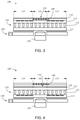
  • FIG. 4 shows a schematic diagram of the LCD device for the under-screen identification scheme according a third embodiment of the present invention.
  • FIG. 5 is a schematic diagram showing a micro LED module of the LCD device for the under-screen identification scheme according to the present invention.
  • an object of the present invention is to provide a liquid crystal display (LCD) device 100 for an under-screen identification scheme, which can realize transparent display using color filter bypass (CF-bypass) and without pixel circuits at a position of an under-screen sensor under a LCD panel, and use micro light emitting diode (LED) modules 140 with small areas based on a transparent substrate for display in a stacking direction.
  • LCD liquid crystal display
  • CF-bypass color filter bypass
  • LED micro light emitting diode
  • the micro LED module 140 utilizes red, green, and blue (RGB) three-color for display, and a coverage area of each of chips 144 is smaller than an area of each of sub-pixels 143 .
  • RGB red, green, and blue
  • the micro LED operable area 141 of the micro LED module 140 can realize normal display.
  • the micro LED operable area 141 of the micro LED module 140 can be used to capture an external image into the under-screen sensor by turning off the sub-pixels 143 at any time. In this way, various under-screen sensing schemes such as under-screen fingerprint recognition, under-screen camera, under-screen recognition, and screen distance sensing can be realized.
  • the micro LED operable area 141 of the micro LED module 140 is seamlessly connected with a liquid crystal module operable area 115 of a liquid crystal module 110 . Therefore, there is no display interruption and discontinuous boundaries in the vision (such as notches, holes, etc.), and can achieve a complete full-screen design. Moreover, since micro LEDs have high brightness and long life characteristics, some sub-pixels 143 of the micro LEDs can be used as functions such as a fill light and indicator light.
  • FIG. 2 shows a schematic diagram of the LCD device for the under-screen identification scheme according a first embodiment of the present invention.
  • the present invention provides the LCD device 100 for the under-screen identification scheme.
  • the LCD device 100 comprises the liquid crystal module 110 , a backlight module 120 , an under-screen sensor 130 , and the micro LED module 140 .
  • the liquid crystal module 110 comprises an array glass 111 , a liquid crystal layer 112 , a color filter 113 , and a polarizer 114 .
  • the liquid crystal layer 112 , the color filter 113 , and the polarizer 114 are sequentially disposed on the array glass 111 .
  • the liquid crystal module 110 defines the liquid crystal module operable region 115 and a digging region 116 adjacent to the liquid crystal module operable region 115 .
  • the backlight module 120 is disposed under the liquid crystal module 110 and emits light toward the liquid crystal module 110 .
  • the under-screen sensor 130 is disposed in the backlight module 120 with respect to the digging region 116 of the liquid crystal module 110 .
  • the micro LED module 140 is disposed in the digging region 116 defined by the liquid crystal module 110 .
  • the micro LED module 140 is disposed in the liquid crystal module 110 in an in-cell manner.
  • the micro LED module 140 define a micro LED operable region 141 , and the micro LED operable region 141 is adjacent to the liquid crystal module operable area 115 in a seamless manner, so that there is no display interruption and discontinuous boundaries in the vision.
  • the micro LED module 140 comprises a transparent substrate 142 , the plurality of sub-pixels 143 , and the plurality of chips 144 , and the plurality of sub-pixels 143 and the plurality of chips 144 are disposed on the transparent substrate 142 .
  • the chip 144 of the micro LED module 140 has a size ranging from 1 to 500 micrometers ( ⁇ m), and the sub-pixel 143 of the micro LED module 140 has a size ranging from 10 to 1000 ⁇ m.
  • a coverage area of each of the chips 144 is smaller than an area of each of the sub-pixels 143 . Therefore, in the area where there is no chip 144 inside the sub-pixel 143 , the light can pass normally.
  • the micro LED operable area 141 of the micro LED module 140 can realize normal display.
  • the micro LED operable area 141 of the micro LED module 140 can be used to capture the external image into the under-screen sensor by turning off the sub-pixels 143 at any time.
  • various under-screen sensing schemes such as under-screen fingerprint recognition, under-screen camera, under-screen recognition, and screen distance sensing can be realized.
  • the micro LED module 140 is disposed on the liquid crystal module 110 in an on-cell manner.
  • the mutual spatial relationship between the other components is the same as the first embodiment shown in FIG. 2 .
  • the micro LED operable area 141 is seamlessly connected to the liquid crystal module operable area 115 of the liquid crystal module 110 , and thus there is no display interruption and discontinuous boundaries in the vision.
  • the micro LED module 140 is disposed in the liquid crystal module 110 in an add-on manner.
  • the mutual spatial relationship between the other components is the same as the first embodiment shown in FIG. 2 .
  • the micro LED operable area 141 is seamlessly connected to the liquid crystal module operable area 115 of the liquid crystal module 110 , and thus there is no display interruption and discontinuous boundaries in the vision.
  • the under-screen sensor 130 comprises a fingerprint recognition, a camera, a structured light sensor, a time-of-flight ranging sensor, a distance sensor, and a light sensor.
  • the micro LED module 140 utilizes red, green, and blue (RGB) three-color for display, but is not limited thereto.
  • RGB red, green, and blue
  • the micro LED operable region 141 is disposed at a position such as a hole (as shown in FIGS. 1( a ) and 1( d ) ), a water droplet (as shown in FIG. 1( b ) ), a notch (as shown in FIG. 1( c ) ), and an outward-facing (as shown in FIG. 1( e ) ) of the liquid crystal module 110 .
  • micro LED operable area 141 of the micro LED module 140 is seamlessly connected to the liquid crystal module operable area 115 of the liquid crystal module 110 , and thus there is no display interruption and discontinuous boundaries in the vision, and can achieve a complete full-screen design.
  • the area of the micro LED operable region is less than 10*10 mm. Because the number of sub-pixels required for the aforementioned area is small, the transfer yield and cost control of the area can be ensured.
  • the substrate of the micro LED module 140 is driven by a passive matrix (PM) method or an active matrix (AM) method.
  • PM passive matrix
  • AM active matrix
  • the micro LED module 140 of the LED device 100 for the under-screen identification scheme provided by the present invention utilizes red, green, and blue (RGB) three-color for display, and the coverage area of each of the chips 144 is smaller than the area of each of the sub-pixels 143 .
  • RGB red, green, and blue
  • the micro LED operable region of the micro LED module can realize normal display.
  • the micro LED operable region of the micro LED module can be used to capture the external image into the under-screen sensor at any time when the sub-pixels are turned off. In this way, various under-screen sensing schemes such as under-screen fingerprint recognition, under-screen camera, under-screen recognition, and screen distance sensing can be easily realized, thereby avoiding the high manufacturing cost when using OLED.

Landscapes

  • Physics & Mathematics (AREA)
  • Engineering & Computer Science (AREA)
  • Nonlinear Science (AREA)
  • General Physics & Mathematics (AREA)
  • Mathematical Physics (AREA)
  • Optics & Photonics (AREA)
  • Crystallography & Structural Chemistry (AREA)
  • Chemical & Material Sciences (AREA)
  • Theoretical Computer Science (AREA)
  • Multimedia (AREA)
  • Human Computer Interaction (AREA)
  • Health & Medical Sciences (AREA)
  • General Health & Medical Sciences (AREA)
  • Devices For Indicating Variable Information By Combining Individual Elements (AREA)
  • Signal Processing (AREA)
  • Vascular Medicine (AREA)
  • Oral & Maxillofacial Surgery (AREA)
  • Liquid Crystal (AREA)

Abstract

The present invention provides a liquid crystal display (LCD) device for an under-screen identification scheme. The LCD device for the under-screen identification scheme comprises a liquid crystal module, a backlight module, an under-screen sensor, and a micro light emitting diode (LED) module. The liquid crystal module defines a liquid crystal module operable region and a digging region adjacent to the liquid crystal module operable region. Therefore, there is no display interruption and discontinuous boundaries in the vision, and can achieve a complete full-screen design.

Description

RELATED APPLICATIONS
This application is a National Phase of PCT Patent Application No. PCT/CN2019/112954 having International filing date of Oct. 24, 2019, which claims the benefit of priority of Chinese Patent Application No. 201910496520.9 filed on Jun. 10, 2019. The contents of the above applications are all incorporated by reference as if fully set forth herein in their entirety.
FIELD AND BACKGROUND OF THE INVENTION
The present invention relates to the field of liquid crystal display (LCD) devices, and in particular, to an LCD device for an under-screen identification scheme.
BACKGROUND OF INVENTION
In the field of small and medium size displays, full-screen technologies have become a current focus of research and development. In other words, how to maximize a screen ratio of a human-computer interaction interface through development of related technologies is the current focus of research and development.
The first generation of full-screen technologies mainly focused on a screen size ratio that changed from 16:9 to 18+:9. The second generation of the full-screen technologies further compress top, bottom, left, and right borders of a screen, and even use flexible folding technologies to maximize viewing areas. Another full-screen technology trend is how to further integrate fingerprint recognition, cameras, face recognition, distance sensing, and other sensors of display terminals into active areas of a display screen, so that the display screens gradually transition from a simple display interface to a comprehensive sensing and interactive interface.
Current mainstream display technologies comprise liquid crystal displays (LCDs) and organic light emitting diodes (OLEDs). The LCDs are passive light emitting technologies, and a light and dark control of light is realized by illuminating liquid crystal cells through an entire backlight structure. The OLED technologies use active illuminating of OLED pixels one by one, which have advantages such as high contrast, thin, flexible, and foldable.
On the other hand, based on non-backlight characteristics of the OLED, it is well compatible with current optical fingerprinting modules, and thus inward-facing optical fingerprint recognitions have become unique advantages of the OLED. At the same time, industries are also developing under-screen camera schemes based on the OLED, which can further switch between a display mode and an imaging mode, and thus have an advantage of there is no need to use current LCD digging schemes with digging areas that cannot be displayed.
The latest generation of display technologies is micro LEDs, which has similar active luminescence characteristics compared to OLED technologies. In addition, due to the stability and high efficiency of inorganic LEDs, they have advantages such as long life, high brightness, small size of control chips, and short response time, and have become one of the key developments of display industries. However, compared with traditional panel technologies with “subtraction manufacturing” methods by etching and the like, the micro LEDs mainly rely on “additive manufacturing” methods with mass-transfers, and have low technical maturity. Especially in the face of mass display pixel transfers, it has inherent process yield and cost challenges, so it is still difficult to become a truly mature display technology in short term.
Obviously, in view of above three display technologies, the OLEDs have obvious advantages in the full-screen technologies. The advantage of low cost in the LCDs is precarious in the demand for next-generation full-screen technologies based on an under-screen sensing.
Although the next generation of micro LED technologies has great advantages in the requirements of the full-screen technologies, the process still faces the problem of mass-transfers yield and high cost, so how to achieve better OLED solutions based on existing LCD technologies has become an important direction for the industries to explore.
SUMMARY OF THE INVENTION
In order to solve the above technical problems, an object of the present invention is to provide a liquid crystal display (LCD) device for an under-screen identification scheme, which can realize a transparent display by using a color filter bypass (CF-bypass) and without pixel circuits at a position of an under-screen sensor under a LCD panel, and using micro light emitting diode (LED) modules with small areas based on a transparent substrate for display in a stacking direction. The micro LED module utilizes red, green, and blue (RGB) three-color for display, and a coverage area of each of chips is smaller than an area of each of sub-pixels. In the area where there is no chip inside the sub-pixel, light can pass normally, so when the sub-pixels are turned on, a micro LED operable region of a micro LED module can realize normal display. Also, the micro LED operable region of the micro LED module can be used to capture an external image into the under-screen sensor at any time when the sub-pixels are turned off. In this way, various under-screen sensing schemes such as under-screen fingerprint recognition, under-screen camera, under-screen recognition, and screen distance sensing can be realized. In addition, the micro LED micro LED operable region module is seamlessly connected with a liquid crystal module operable region of a liquid crystal module, so that there is no display interruption and discontinuous boundaries in the vision (such as notches, holes, etc.), and can achieve a complete full-screen design. Moreover, since micro LEDs have characteristics of high brightness and long life, some sub-pixels of the micro LEDs can be used as functions such as a fill light and indicator light.
In order to achieve the above object, the present invention provides an LCD device for an under-screen identification scheme. The LCD device comprises a liquid crystal module, a backlight module, an under-screen sensor, and a micro LED module. The liquid crystal module comprises an array glass, a liquid crystal layer, a color filter, and a polarizer. The liquid crystal layer, the color filter, and the polarizer are sequentially disposed on the array glass, and the liquid crystal module defines a liquid crystal module operable region and a digging region adjacent to the liquid crystal module operable region. The backlight module is disposed under the liquid crystal module and emits light toward the liquid crystal module. The under-screen sensor is disposed in the backlight module with respect to the digging region of the liquid crystal module. The micro LED module is disposed in the digging region defined by the liquid crystal module. Wherein the micro LED module defines a micro LED operable region, and the micro LED operable region is adjacent to the liquid crystal module operable region.
In an embodiment of the present invention, the micro LED module comprises a transparent substrate, a plurality of sub-pixels, and a plurality of chips, and the plurality of sub-pixels and the plurality of chips are disposed on the transparent substrate.
In an embodiment of the present invention, the chip of the micro LED module has a size ranging from 1 to 500 micrometers (μm), and the sub-pixel of the micro LED module has a size ranging from 10 to 1000 μm.
In an embodiment of the present invention, a coverage area of each of the chips is smaller than an area of each of the sub-pixels.
In an embodiment of the present invention, the under-screen sensor comprises a fingerprint recognition, a camera, a structured light sensor, a time-of-flight ranging sensor, a distance sensor, and a light sensor.
In an embodiment of the present invention, the micro LED module utilizes red, green, and blue (RGB) three-color display.
In an embodiment of the present invention, the micro LED operable region is disposed at a position comprising one of a hole, a water droplet, a notch, and an outward-facing of the liquid crystal module.
In an embodiment of the present invention, the area of the micro LED operable region is less than 10*10 mm.
In an embodiment of the present invention, the substrate of the micro LED module is driven by a passive matrix (PM) method or an active matrix (AM) method.
In an embodiment of the present invention, a vertical stack of the micro LED module comprises one of a built-in structure, a surface embedded structure, and a plug-in structure.
In order to make the above description of the present invention more comprehensible, preferred embodiments are described below, and drawings are described in detail below.
BRIEF DESCRIPTION OF THE SEVERAL VIEWS OF THE DRAWINGS
FIG. 1(a) to FIG. 1(e) are diagrams showing a set position of a micro light emitting diode (LED) operable region of a liquid crystal display (LCD) device for an under-screen identification scheme according to the present invention.
FIG. 2 shows a schematic diagram of the LCD device for the under-screen identification scheme according a first embodiment of the present invention.
FIG. 3 shows a schematic diagram of the LCD device for the under-screen identification scheme according a second embodiment of the present invention
FIG. 4 shows a schematic diagram of the LCD device for the under-screen identification scheme according a third embodiment of the present invention.
FIG. 5 is a schematic diagram showing a micro LED module of the LCD device for the under-screen identification scheme according to the present invention.
DESCRIPTION OF SPECIFIC EMBODIMENTS OF THE INVENTION
In order to make the above description of the present invention more comprehensible, preferred embodiments are described below, and drawings are described in detail below. Furthermore, directional terms mentioned in the present invention, such as up, down, top, bottom, front, back, left, right, inner, outer, side, surrounding, center, horizontal, vertical, longitudinal, axial, radial, uppermost or lowermost, etc., only refer to the direction of the additional drawings. Therefore, the directional terms used are for the purpose of illustration and understanding of the invention.
In the figure, elements with similar structure are denoted by the same reference numerals.
As shown in FIG. 1 to FIG. 5, an object of the present invention is to provide a liquid crystal display (LCD) device 100 for an under-screen identification scheme, which can realize transparent display using color filter bypass (CF-bypass) and without pixel circuits at a position of an under-screen sensor under a LCD panel, and use micro light emitting diode (LED) modules 140 with small areas based on a transparent substrate for display in a stacking direction.
Referring to FIG. 5, the micro LED module 140 utilizes red, green, and blue (RGB) three-color for display, and a coverage area of each of chips 144 is smaller than an area of each of sub-pixels 143. In the areas where there is no chip 144 inside the sub-pixel 143, light can pass normally. Therefore, as shown in FIG. 2 to FIG. 4, when the sub-pixels 143 are turned on, the micro LED operable area 141 of the micro LED module 140 can realize normal display. At the same time, the micro LED operable area 141 of the micro LED module 140 can be used to capture an external image into the under-screen sensor by turning off the sub-pixels 143 at any time. In this way, various under-screen sensing schemes such as under-screen fingerprint recognition, under-screen camera, under-screen recognition, and screen distance sensing can be realized.
Please refer to FIG. 1(a) to FIG. 1(e). In the present invention, the micro LED operable area 141 of the micro LED module 140 is seamlessly connected with a liquid crystal module operable area 115 of a liquid crystal module 110. Therefore, there is no display interruption and discontinuous boundaries in the vision (such as notches, holes, etc.), and can achieve a complete full-screen design. Moreover, since micro LEDs have high brightness and long life characteristics, some sub-pixels 143 of the micro LEDs can be used as functions such as a fill light and indicator light.
In detail, FIG. 2 shows a schematic diagram of the LCD device for the under-screen identification scheme according a first embodiment of the present invention. The present invention provides the LCD device 100 for the under-screen identification scheme. The LCD device 100 comprises the liquid crystal module 110, a backlight module 120, an under-screen sensor 130, and the micro LED module 140.
The liquid crystal module 110 comprises an array glass 111, a liquid crystal layer 112, a color filter 113, and a polarizer 114. The liquid crystal layer 112, the color filter 113, and the polarizer 114 are sequentially disposed on the array glass 111. The liquid crystal module 110 defines the liquid crystal module operable region 115 and a digging region 116 adjacent to the liquid crystal module operable region 115.
The backlight module 120 is disposed under the liquid crystal module 110 and emits light toward the liquid crystal module 110. The under-screen sensor 130 is disposed in the backlight module 120 with respect to the digging region 116 of the liquid crystal module 110.
The micro LED module 140 is disposed in the digging region 116 defined by the liquid crystal module 110. In detail, the micro LED module 140 is disposed in the liquid crystal module 110 in an in-cell manner.
As shown in FIG. 2, the micro LED module 140 define a micro LED operable region 141, and the micro LED operable region 141 is adjacent to the liquid crystal module operable area 115 in a seamless manner, so that there is no display interruption and discontinuous boundaries in the vision.
As shown in FIG. 5, in the present invention, the micro LED module 140 comprises a transparent substrate 142, the plurality of sub-pixels 143, and the plurality of chips 144, and the plurality of sub-pixels 143 and the plurality of chips 144 are disposed on the transparent substrate 142. The chip 144 of the micro LED module 140 has a size ranging from 1 to 500 micrometers (μm), and the sub-pixel 143 of the micro LED module 140 has a size ranging from 10 to 1000 μm. In addition, a coverage area of each of the chips 144 is smaller than an area of each of the sub-pixels 143. Therefore, in the area where there is no chip 144 inside the sub-pixel 143, the light can pass normally. Therefore, when the sub-pixels 143 are turned on, the micro LED operable area 141 of the micro LED module 140 can realize normal display. At the same time, the micro LED operable area 141 of the micro LED module 140 can be used to capture the external image into the under-screen sensor by turning off the sub-pixels 143 at any time. In this way, various under-screen sensing schemes such as under-screen fingerprint recognition, under-screen camera, under-screen recognition, and screen distance sensing can be realized.
In the second embodiment as shown in FIG. 3, the micro LED module 140 is disposed on the liquid crystal module 110 in an on-cell manner. In addition, the mutual spatial relationship between the other components is the same as the first embodiment shown in FIG. 2. As a result, the micro LED operable area 141 is seamlessly connected to the liquid crystal module operable area 115 of the liquid crystal module 110, and thus there is no display interruption and discontinuous boundaries in the vision.
In the third embodiment as shown in FIG. 4, the micro LED module 140 is disposed in the liquid crystal module 110 in an add-on manner. In addition, the mutual spatial relationship between the other components is the same as the first embodiment shown in FIG. 2. As a result, the micro LED operable area 141 is seamlessly connected to the liquid crystal module operable area 115 of the liquid crystal module 110, and thus there is no display interruption and discontinuous boundaries in the vision.
In the present invention, the under-screen sensor 130 comprises a fingerprint recognition, a camera, a structured light sensor, a time-of-flight ranging sensor, a distance sensor, and a light sensor.
In the present invention, the micro LED module 140 utilizes red, green, and blue (RGB) three-color for display, but is not limited thereto.
As shown in FIG. 1(a) to FIG. 1(e), in the present invention, the micro LED operable region 141 is disposed at a position such as a hole (as shown in FIGS. 1(a) and 1(d)), a water droplet (as shown in FIG. 1(b)), a notch (as shown in FIG. 1(c)), and an outward-facing (as shown in FIG. 1(e)) of the liquid crystal module 110. In addition, the micro LED operable area 141 of the micro LED module 140 is seamlessly connected to the liquid crystal module operable area 115 of the liquid crystal module 110, and thus there is no display interruption and discontinuous boundaries in the vision, and can achieve a complete full-screen design.
In the embodiment of the present invention, the area of the micro LED operable region is less than 10*10 mm. Because the number of sub-pixels required for the aforementioned area is small, the transfer yield and cost control of the area can be ensured.
In the present invention, the substrate of the micro LED module 140 is driven by a passive matrix (PM) method or an active matrix (AM) method.
In summary, the micro LED module 140 of the LED device 100 for the under-screen identification scheme provided by the present invention utilizes red, green, and blue (RGB) three-color for display, and the coverage area of each of the chips 144 is smaller than the area of each of the sub-pixels 143. Thus, in the area where there is no chip 144 inside the sub-pixel 143, the light can pass normally, so when the sub-pixels 143 are turned on, the micro LED operable region of the micro LED module can realize normal display. Also, the micro LED operable region of the micro LED module can be used to capture the external image into the under-screen sensor at any time when the sub-pixels are turned off. In this way, various under-screen sensing schemes such as under-screen fingerprint recognition, under-screen camera, under-screen recognition, and screen distance sensing can be easily realized, thereby avoiding the high manufacturing cost when using OLED.
The present invention has been shown and described with respect to one or more implementations, and equivalents and modifications will be apparent to those skilled in the art. The present invention includes all such modifications and variations and is only limited by the scope of the appended claims. With particular regard to the various functions performed by the above-described components, the terms used to describe such components are intended to correspond to any component that performs the specified function of the component (eg, which is functionally equivalent) (unless otherwise indicated), even if it is structurally not identical to the disclosed structure for performing the functions in the exemplary implementation of the present specification shown herein. Moreover, although specific features of the specification have been disclosed with respect to only one of several implementations, such features may be combined with one or more other implementations as may be desired and advantageous for a given or particular application. Furthermore, the terms “comprising,” “having,” “including,” or a variant thereof is used in the detailed description or the claims, such terms are intended to include in a similar manner to the term “comprising.”
The above is only a preferred embodiment of the present disclosure. It should be noted that a number of improvements and modifications may be made by those skilled in the art without departing from the principles of the present invention. These improvements and modifications should also be considered as the scope of protection of the present disclosure.

Claims (10)

What is claimed is:
1. A liquid crystal display (LCD) device for an under-screen identification scheme, comprising:
a liquid crystal module comprising an array glass, a liquid crystal layer, a color filter, and a polarizer, wherein the liquid crystal layer, the color filter, and the polarizer are sequentially disposed on the array glass, and the liquid crystal module defines a liquid crystal module operable region and a digging region adjacent to the liquid crystal module operable region;
a backlight module disposed under the liquid crystal module and emitting light toward the liquid crystal module;
an under-screen sensor disposed in the backlight module with respect to the digging region of the liquid crystal module; and
a micro light emitting diode (LED) module disposed in the digging region defined by the liquid crystal module;
wherein the micro LED module defines a micro LED operable region, and the micro LED operable region is adjacent to the liquid crystal module operable region.
2. The LCD device for the under-screen identification scheme as claimed in claim 1, wherein the micro LED module comprises a transparent substrate, a plurality of sub-pixels, and a plurality of chips, and the plurality of sub-pixels and the plurality of chips are disposed on the transparent substrate.
3. The LCD device for the under-screen identification scheme as claimed in claim 2, wherein the chip of the micro LED module has a size ranging from 1 to 500 micrometers (μm), and the sub-pixel of the micro LED module has a size ranging from 10 to 1000 μm.
4. The LCD device for the under-screen identification scheme as claimed in claim 3, wherein a coverage area of each of the chips is smaller than an area of each of the sub-pixels.
5. The LCD device for the under-screen identification scheme as claimed in claim 1, wherein the under-screen sensor comprises one of a fingerprint recognition, a camera, a structured light sensor, a time-of-flight ranging sensor, a distance sensor, and a light sensor.
6. The LCD device for the under-screen identification scheme as claimed in claim 1, wherein the micro LED module utilizes red, green, and blue (RGB) three-color for display.
7. The LCD device for the under-screen identification scheme as claimed in claim 1, wherein the micro LED operable region is disposed at a position comprising one of a hole, a water droplet, a notch, and an outward-facing of the liquid crystal module.
8. The LCD device for the under-screen identification scheme as claimed in claim 7, wherein the area of the micro LED operable region is less than 10*10 mm.
9. The LCD device for the under-screen identification scheme as claimed in claim 8, wherein the substrate of the micro LED module is driven by a passive matrix method or an active matrix method.
10. The LCD device for the under-screen identification scheme as claimed in claim 9, wherein a vertical stack of the micro LED module comprises one of a built-in structure, a surface embedded structure, and a plug-in structure.
US16/631,170 2019-06-10 2019-10-24 Liquid crystal display device for under-screen identification scheme Active 2040-06-19 US11256121B2 (en)

Applications Claiming Priority (3)

Application Number Priority Date Filing Date Title
CN201910496520.9A CN110275340A (en) 2019-06-10 2019-06-10 For shielding the liquid crystal display of lower identification scheme
CN201910496520.9 2019-06-10
PCT/CN2019/112954 WO2020248467A1 (en) 2019-06-10 2019-10-24 Liquid crystal display device for under-screen identification scheme

Publications (2)

Publication Number Publication Date
US20210356788A1 US20210356788A1 (en) 2021-11-18
US11256121B2 true US11256121B2 (en) 2022-02-22

Family

ID=67960659

Family Applications (1)

Application Number Title Priority Date Filing Date
US16/631,170 Active 2040-06-19 US11256121B2 (en) 2019-06-10 2019-10-24 Liquid crystal display device for under-screen identification scheme

Country Status (3)

Country Link
US (1) US11256121B2 (en)
CN (1) CN110275340A (en)
WO (1) WO2020248467A1 (en)

Cited By (1)

* Cited by examiner, † Cited by third party
Publication number Priority date Publication date Assignee Title
US12412359B2 (en) 2021-12-23 2025-09-09 Honor Device Co., Ltd. Method for eliminating interference pattern in image, and apparatus

Families Citing this family (27)

* Cited by examiner, † Cited by third party
Publication number Priority date Publication date Assignee Title
CN110275340A (en) * 2019-06-10 2019-09-24 武汉华星光电技术有限公司 For shielding the liquid crystal display of lower identification scheme
CN110955083B (en) * 2019-09-30 2022-10-11 厦门天马微电子有限公司 Display device
CN110794604A (en) * 2019-11-29 2020-02-14 武汉华星光电技术有限公司 Display device and manufacturing method thereof
KR20210078129A (en) 2019-12-18 2021-06-28 엘지디스플레이 주식회사 Display Device
CN111142284A (en) 2019-12-20 2020-05-12 维沃移动通信有限公司 Preparation method of display module, display module and electronic equipment
CN211959311U (en) * 2020-01-21 2020-11-17 神盾股份有限公司 Image scanning device
CN111176018A (en) * 2020-02-12 2020-05-19 武汉华星光电技术有限公司 a display device
CN111258101A (en) 2020-03-18 2020-06-09 武汉华星光电技术有限公司 Display device
CN111308782B (en) * 2020-03-18 2022-05-17 Oppo广东移动通信有限公司 Electronic equipment
CN111638614A (en) * 2020-06-01 2020-09-08 武汉华星光电技术有限公司 Liquid crystal display device having a plurality of pixel electrodes
CN111596484A (en) * 2020-06-01 2020-08-28 武汉华星光电技术有限公司 Color film substrate and display panel
CN111596485A (en) 2020-06-08 2020-08-28 武汉华星光电技术有限公司 A color filter substrate, a display panel, and a display device
CN111638606B (en) * 2020-06-11 2021-12-03 武汉华星光电技术有限公司 Display panel
CN111653582B (en) * 2020-06-12 2024-01-26 京东方科技集团股份有限公司 Display panels and display devices
CN111653585A (en) * 2020-06-19 2020-09-11 武汉华星光电技术有限公司 Display panel, method for producing the same, and display device
EP4170416A4 (en) * 2020-06-23 2024-08-14 Wuhan China Star Optoelectronics Technology Co., Ltd. Display panel and display device
CN111708196A (en) * 2020-06-23 2020-09-25 武汉华星光电技术有限公司 Display panel and display device
CN111785762B (en) * 2020-07-28 2023-04-25 Oppo(重庆)智能科技有限公司 Display screen assembly and electronic equipment
CN112015004A (en) * 2020-09-02 2020-12-01 武汉华星光电技术有限公司 Display device and electronic apparatus
CN116438467A (en) * 2020-11-13 2023-07-14 特里纳米克斯股份有限公司 Depth measurement by display
CN112764258B (en) * 2020-12-22 2022-06-28 厦门天马微电子有限公司 Display device and control method thereof
CN112764261B (en) * 2021-01-29 2022-12-06 北京京东方显示技术有限公司 Display panel, driving method thereof, and display device
CN113345927B (en) * 2021-05-31 2023-06-02 武汉华星光电技术有限公司 Preparation method of under-screen camera display panel and transparent display area
US12015844B2 (en) 2021-07-27 2024-06-18 Samsung Electronics Co., Ltd. Apparatus and method for providing fingerprint recognition and photographing based on under display camera in electronic device
FR3153931A1 (en) 2023-10-04 2025-04-11 Valeo Comfort And Driving Assistance Combined system forming a screen
FR3153932B1 (en) 2023-10-04 2025-12-12 Valeo Comfort & Driving Assistance Combined system forming a screen
FR3153933B1 (en) 2023-10-04 2025-11-21 Valeo Comfort & Driving Assistance Combined system forming a screen

Citations (5)

* Cited by examiner, † Cited by third party
Publication number Priority date Publication date Assignee Title
US20170161543A1 (en) * 2015-12-03 2017-06-08 Synaptics Incorporated Optical sensor for integration in a display
US20180012069A1 (en) * 2016-07-06 2018-01-11 Samsung Electronics Co., Ltd. Fingerprint sensor, fingerprint sensor package, and fingerprint sensing system using light sources of display panel
US20190157337A1 (en) * 2017-11-22 2019-05-23 Taiwan Semiconductor Manufacturing Co., Ltd. Biometric Sensor and Methods Thereof
US20190171050A1 (en) * 2017-12-01 2019-06-06 Innolux Corporation Electronic device
US20190310724A1 (en) * 2018-04-10 2019-10-10 Apple Inc. Electronic Device Display for Through-Display Imaging

Family Cites Families (10)

* Cited by examiner, † Cited by third party
Publication number Priority date Publication date Assignee Title
CN106896577A (en) * 2017-03-27 2017-06-27 武汉华星光电技术有限公司 Transflective liquid crystal display
CN109508135B (en) * 2017-09-15 2022-05-27 上海耕岩智能科技有限公司 A fingerprint recognition-based electronic device execution command method and electronic device
WO2019083154A1 (en) * 2017-10-26 2019-05-02 주식회사 루멘스 Photography device comprising flash unit having individually controlled micro led pixels, and photography device for skin diagnosis
CN108986678B (en) * 2018-09-10 2020-11-24 上海天马微电子有限公司 A display panel, its manufacturing method, and display device
CN109377922B (en) * 2018-09-26 2022-03-08 京东方科技集团股份有限公司 Circuit detection jig and method for micro light-emitting diode substrate
CN109001935B (en) * 2018-09-27 2023-11-28 武汉华星光电技术有限公司 Liquid crystal display device having a light shielding layer
CN109300951B (en) * 2018-09-30 2020-09-08 上海天马微电子有限公司 Display panel, manufacturing method thereof and electronic equipment
CN109618031B (en) * 2018-12-25 2020-06-12 Oppo广东移动通信有限公司 Electronic device and control method thereof
CN208819534U (en) * 2019-03-28 2019-05-03 北京小米移动软件有限公司 a terminal
CN110275340A (en) * 2019-06-10 2019-09-24 武汉华星光电技术有限公司 For shielding the liquid crystal display of lower identification scheme

Patent Citations (5)

* Cited by examiner, † Cited by third party
Publication number Priority date Publication date Assignee Title
US20170161543A1 (en) * 2015-12-03 2017-06-08 Synaptics Incorporated Optical sensor for integration in a display
US20180012069A1 (en) * 2016-07-06 2018-01-11 Samsung Electronics Co., Ltd. Fingerprint sensor, fingerprint sensor package, and fingerprint sensing system using light sources of display panel
US20190157337A1 (en) * 2017-11-22 2019-05-23 Taiwan Semiconductor Manufacturing Co., Ltd. Biometric Sensor and Methods Thereof
US20190171050A1 (en) * 2017-12-01 2019-06-06 Innolux Corporation Electronic device
US20190310724A1 (en) * 2018-04-10 2019-10-10 Apple Inc. Electronic Device Display for Through-Display Imaging

Cited By (1)

* Cited by examiner, † Cited by third party
Publication number Priority date Publication date Assignee Title
US12412359B2 (en) 2021-12-23 2025-09-09 Honor Device Co., Ltd. Method for eliminating interference pattern in image, and apparatus

Also Published As

Publication number Publication date
WO2020248467A1 (en) 2020-12-17
CN110275340A (en) 2019-09-24
US20210356788A1 (en) 2021-11-18

Similar Documents

Publication Publication Date Title
US11256121B2 (en) Liquid crystal display device for under-screen identification scheme
CN111697039B (en) Display panel and display device
US11693271B2 (en) Display device
EP4075512A1 (en) Display panel and display device
US12193291B2 (en) Display substrate and display device
KR102683935B1 (en) Display device with integrated touch screen and method for fabricating the same
US11994778B2 (en) Color filter substrate and display panel
KR20240127930A (en) Electronic device
US11977292B2 (en) Color filter substrate, display panel, and display device
CN107347254B (en) Image processing device, display system, and electronic equipment
EP4002472A1 (en) Light-transmissive display panel, display panel and display apparatus
TW201629586A (en) Display device and electronic device
WO2021103390A1 (en) Display apparatus and method for manufacturing display apparatus
CN111708196A (en) Display panel and display device
US11925094B2 (en) Display device
CN111370461A (en) Display panel and display device
US20240334795A1 (en) Display panel and display device
CN114695783A (en) Display device
CN112951106A (en) Display device
US11536995B2 (en) Display panel and display device
CN116390596A (en) Display panel and display device
US20230422558A1 (en) Display device
CN116266444A (en) Display device and driving method thereof
CN116390582A (en) display device
US20250008777A1 (en) Display panel, electronic apparatus including the same, and method for manufacturing the display panel

Legal Events

Date Code Title Description
FEPP Fee payment procedure

Free format text: ENTITY STATUS SET TO UNDISCOUNTED (ORIGINAL EVENT CODE: BIG.); ENTITY STATUS OF PATENT OWNER: LARGE ENTITY

AS Assignment

Owner name: WUHAN CHINA STAR OPTOELECTRONICS TECHNOLOGY CO., LTD., CHINA

Free format text: ASSIGNMENT OF ASSIGNORS INTEREST;ASSIGNOR:ZHA, GUOWEI;REEL/FRAME:051718/0914

Effective date: 20200107

STPP Information on status: patent application and granting procedure in general

Free format text: NOTICE OF ALLOWANCE MAILED -- APPLICATION RECEIVED IN OFFICE OF PUBLICATIONS

STCF Information on status: patent grant

Free format text: PATENTED CASE

MAFP Maintenance fee payment

Free format text: PAYMENT OF MAINTENANCE FEE, 4TH YEAR, LARGE ENTITY (ORIGINAL EVENT CODE: M1551); ENTITY STATUS OF PATENT OWNER: LARGE ENTITY

Year of fee payment: 4