US11254675B2 - Process for preparation of grapiprant - Google Patents
Process for preparation of grapiprant Download PDFInfo
- Publication number
- US11254675B2 US11254675B2 US16/991,323 US202016991323A US11254675B2 US 11254675 B2 US11254675 B2 US 11254675B2 US 202016991323 A US202016991323 A US 202016991323A US 11254675 B2 US11254675 B2 US 11254675B2
- Authority
- US
- United States
- Prior art keywords
- grapiprant
- formula
- compound
- added
- reaction
- Prior art date
- Legal status (The legal status is an assumption and is not a legal conclusion. Google has not performed a legal analysis and makes no representation as to the accuracy of the status listed.)
- Active
Links
- DNWQHWFJPGMXKH-UHFFFAOYSA-N CCC1=NC2=C(C=C(C)N=C2C)N1C1=CC=C(CCN)C=C1 Chemical compound CCC1=NC2=C(C=C(C)N=C2C)N1C1=CC=C(CCN)C=C1 DNWQHWFJPGMXKH-UHFFFAOYSA-N 0.000 description 7
- DLCJDFSFBBCOEY-UHFFFAOYSA-O CCC1=N(C2=CC=C(CCNC(=O)NS(=O)(=O)C3=CC=C(C)C=C3)C=C2)C2=CC(C)=[N+](O)C(C)=C2N1.CCC1=NC2=C(C=C(C)N=C2C)N1C1=CC=C(CCNC(=O)NS(=O)(=O)C2=C(C)C=CC=C2)C=C1.CCC1=NC2=C(C=C(C)N=C2C)N1C1=CC=C(CCNC(=O)NS(=O)(=O)C2=CC(C)=CC=C2)C=C1.CCC1=NC2=C(C=C(C)N=C2C)N1C1=CC=C(CCNS(=O)(=O)C2=CC=C(C)C=C2)C=C1 Chemical compound CCC1=N(C2=CC=C(CCNC(=O)NS(=O)(=O)C3=CC=C(C)C=C3)C=C2)C2=CC(C)=[N+](O)C(C)=C2N1.CCC1=NC2=C(C=C(C)N=C2C)N1C1=CC=C(CCNC(=O)NS(=O)(=O)C2=C(C)C=CC=C2)C=C1.CCC1=NC2=C(C=C(C)N=C2C)N1C1=CC=C(CCNC(=O)NS(=O)(=O)C2=CC(C)=CC=C2)C=C1.CCC1=NC2=C(C=C(C)N=C2C)N1C1=CC=C(CCNS(=O)(=O)C2=CC=C(C)C=C2)C=C1 DLCJDFSFBBCOEY-UHFFFAOYSA-O 0.000 description 3
- HZVLFTCYCLXTGV-UHFFFAOYSA-N [H]N(CCC1=CC=C(N2C(CC)=NC3=C2C=C(C)N=C3C)C=C1)C(=O)N([H])S(=O)(=O)C1=CC=C(C)C=C1 Chemical compound [H]N(CCC1=CC=C(N2C(CC)=NC3=C2C=C(C)N=C3C)C=C1)C(=O)N([H])S(=O)(=O)C1=CC=C(C)C=C1 HZVLFTCYCLXTGV-UHFFFAOYSA-N 0.000 description 3
- ZEHYGSOQUDOOOW-UHFFFAOYSA-N CC1=CC(Cl)=C([N+](=O)[O-])C(C)=N1.NC1=CC=C(CCO)C=C1 Chemical compound CC1=CC(Cl)=C([N+](=O)[O-])C(C)=N1.NC1=CC=C(CCO)C=C1 ZEHYGSOQUDOOOW-UHFFFAOYSA-N 0.000 description 2
- DLUNNXZDDFQQIF-UHFFFAOYSA-N CC1=CC(NC2=CC=C(CCO)C=C2)=C(N)C(C)=N1 Chemical compound CC1=CC(NC2=CC=C(CCO)C=C2)=C(N)C(C)=N1 DLUNNXZDDFQQIF-UHFFFAOYSA-N 0.000 description 2
- HFTJOSWXQHUUKC-UHFFFAOYSA-N CCC1=NC2=C(C=C(C)N=C2C)N1C1=CC=C(CCN=[N+]=[N-])C=C1 Chemical compound CCC1=NC2=C(C=C(C)N=C2C)N1C1=CC=C(CCN=[N+]=[N-])C=C1 HFTJOSWXQHUUKC-UHFFFAOYSA-N 0.000 description 2
- SCKCYPNUKGOGGS-UHFFFAOYSA-N CCC1=NC2=C(C=C(C)N=C2C)N1C1=CC=C(CCO)C=C1 Chemical compound CCC1=NC2=C(C=C(C)N=C2C)N1C1=CC=C(CCO)C=C1 SCKCYPNUKGOGGS-UHFFFAOYSA-N 0.000 description 2
- 0 *O.CC1=CC(Cl)=C([N+](=O)[O-])C(C)=N1.CC1=CC(NC2=CC=C(CCO)C=C2)=C(N)C(C)=N1.CC1=CC(NC2=CC=C(CCO)C=C2)=C([N+](=O)[O-])C(C)=N1.CC1=CC=C(S(=O)(=O)OC#N)C=C1.CCC(=O)OCCC1=CC=C(N2C(CC)=NC3=C2C=C(C)N=C3C)C=C1.CCC1=NC2=C(C=C(C)N=C2C)N1C1=CC=C(CCCl)C=C1.CCC1=NC2=C(C=C(C)N=C2C)N1C1=CC=C(CCN)C=C1.CCC1=NC2=C(C=C(C)N=C2C)N1C1=CC=C(CCN=[N+]=[N-])C=C1.CCC1=NC2=C(C=C(C)N=C2C)N1C1=CC=C(CCO)C=C1.CCOC(=O)NS(=O)(=O)C1=CC=C(C)C=C1.Cl.II.I[IH]I.I[V](I)I.I[V]I.NC1=CC=C(CCO)C=C1.[V].[V]I.[V]I Chemical compound *O.CC1=CC(Cl)=C([N+](=O)[O-])C(C)=N1.CC1=CC(NC2=CC=C(CCO)C=C2)=C(N)C(C)=N1.CC1=CC(NC2=CC=C(CCO)C=C2)=C([N+](=O)[O-])C(C)=N1.CC1=CC=C(S(=O)(=O)OC#N)C=C1.CCC(=O)OCCC1=CC=C(N2C(CC)=NC3=C2C=C(C)N=C3C)C=C1.CCC1=NC2=C(C=C(C)N=C2C)N1C1=CC=C(CCCl)C=C1.CCC1=NC2=C(C=C(C)N=C2C)N1C1=CC=C(CCN)C=C1.CCC1=NC2=C(C=C(C)N=C2C)N1C1=CC=C(CCN=[N+]=[N-])C=C1.CCC1=NC2=C(C=C(C)N=C2C)N1C1=CC=C(CCO)C=C1.CCOC(=O)NS(=O)(=O)C1=CC=C(C)C=C1.Cl.II.I[IH]I.I[V](I)I.I[V]I.NC1=CC=C(CCO)C=C1.[V].[V]I.[V]I 0.000 description 1
- BONUBWFXPMDPPC-UHFFFAOYSA-N CC1=CC(NC2=CC=C(CCO)C=C2)=C([N+](=O)[O-])C(C)=N1.Cl Chemical compound CC1=CC(NC2=CC=C(CCO)C=C2)=C([N+](=O)[O-])C(C)=N1.Cl BONUBWFXPMDPPC-UHFFFAOYSA-N 0.000 description 1
- YJDJUJWYQPLZLX-UHFFFAOYSA-O CCC1=N(C2=CC=C(CCNC(=O)NS(=O)(=O)C3=CC=C(C)C=C3)C=C2)C2=CC(C)=[N+](O)C(C)=C2N1.CCC1=NC2=C(C=C(C)N=C2C)N1C1=CC=C(CCNC(=O)NS(=O)(=O)C2=C(C)C=CC=C2)C=C1.CCC1=NC2=C(C=C(C)N=C2C)N1C1=CC=C(CCNC(=O)NS(=O)(=O)C2=CC(C)=CC=C2)C=C1.CCC1=NC2=C(C=C(C)N=C2C)N1C1=CC=C(CCNS(=O)(=O)C2=CC=C(C)C=C2)C=C1.CCCC1=CC=C(NC2=C([N+](=O)[O-])C(C)=NC(C)=C2)C=C1.Cl Chemical compound CCC1=N(C2=CC=C(CCNC(=O)NS(=O)(=O)C3=CC=C(C)C=C3)C=C2)C2=CC(C)=[N+](O)C(C)=C2N1.CCC1=NC2=C(C=C(C)N=C2C)N1C1=CC=C(CCNC(=O)NS(=O)(=O)C2=C(C)C=CC=C2)C=C1.CCC1=NC2=C(C=C(C)N=C2C)N1C1=CC=C(CCNC(=O)NS(=O)(=O)C2=CC(C)=CC=C2)C=C1.CCC1=NC2=C(C=C(C)N=C2C)N1C1=CC=C(CCNS(=O)(=O)C2=CC=C(C)C=C2)C=C1.CCCC1=CC=C(NC2=C([N+](=O)[O-])C(C)=NC(C)=C2)C=C1.Cl YJDJUJWYQPLZLX-UHFFFAOYSA-O 0.000 description 1
- DLCJDFSFBBCOEY-UHFFFAOYSA-N CCC1=NC2=C(C)N(O)=C(C)C=C2N1C1=CC=C(CCNC(=O)NS(=O)(=O)C2=CC=C(C)C=C2)C=C1.CCC1=NC2=C(C=C(C)N=C2C)N1C1=CC=C(CCNC(=O)NS(=O)(=O)C2=C(C)C=CC=C2)C=C1.CCC1=NC2=C(C=C(C)N=C2C)N1C1=CC=C(CCNC(=O)NS(=O)(=O)C2=CC(C)=CC=C2)C=C1.CCC1=NC2=C(C=C(C)N=C2C)N1C1=CC=C(CCNS(=O)(=O)C2=CC=C(C)C=C2)C=C1 Chemical compound CCC1=NC2=C(C)N(O)=C(C)C=C2N1C1=CC=C(CCNC(=O)NS(=O)(=O)C2=CC=C(C)C=C2)C=C1.CCC1=NC2=C(C=C(C)N=C2C)N1C1=CC=C(CCNC(=O)NS(=O)(=O)C2=C(C)C=CC=C2)C=C1.CCC1=NC2=C(C=C(C)N=C2C)N1C1=CC=C(CCNC(=O)NS(=O)(=O)C2=CC(C)=CC=C2)C=C1.CCC1=NC2=C(C=C(C)N=C2C)N1C1=CC=C(CCNS(=O)(=O)C2=CC=C(C)C=C2)C=C1 DLCJDFSFBBCOEY-UHFFFAOYSA-N 0.000 description 1
- YJDJUJWYQPLZLX-UHFFFAOYSA-N CCC1=NC2=C(C)N(O)=C(C)C=C2N1C1=CC=C(CCNC(=O)NS(=O)(=O)C2=CC=C(C)C=C2)C=C1.CCC1=NC2=C(C=C(C)N=C2C)N1C1=CC=C(CCNC(=O)NS(=O)(=O)C2=C(C)C=CC=C2)C=C1.CCC1=NC2=C(C=C(C)N=C2C)N1C1=CC=C(CCNC(=O)NS(=O)(=O)C2=CC(C)=CC=C2)C=C1.CCC1=NC2=C(C=C(C)N=C2C)N1C1=CC=C(CCNS(=O)(=O)C2=CC=C(C)C=C2)C=C1.CCCC1=CC=C(NC2=C([N+](=O)[O-])C(C)=NC(C)=C2)C=C1.Cl Chemical compound CCC1=NC2=C(C)N(O)=C(C)C=C2N1C1=CC=C(CCNC(=O)NS(=O)(=O)C2=CC=C(C)C=C2)C=C1.CCC1=NC2=C(C=C(C)N=C2C)N1C1=CC=C(CCNC(=O)NS(=O)(=O)C2=C(C)C=CC=C2)C=C1.CCC1=NC2=C(C=C(C)N=C2C)N1C1=CC=C(CCNC(=O)NS(=O)(=O)C2=CC(C)=CC=C2)C=C1.CCC1=NC2=C(C=C(C)N=C2C)N1C1=CC=C(CCNS(=O)(=O)C2=CC=C(C)C=C2)C=C1.CCCC1=CC=C(NC2=C([N+](=O)[O-])C(C)=NC(C)=C2)C=C1.Cl YJDJUJWYQPLZLX-UHFFFAOYSA-N 0.000 description 1
- ZQEHUEVSUIZENB-UHFFFAOYSA-N CCCC1=CC=C(NC2=C([N+](=O)[O-])C(C)=NC(C)=C2)C=C1.Cl Chemical compound CCCC1=CC=C(NC2=C([N+](=O)[O-])C(C)=NC(C)=C2)C=C1.Cl ZQEHUEVSUIZENB-UHFFFAOYSA-N 0.000 description 1
Images

Classifications
-
- C—CHEMISTRY; METALLURGY
- C07—ORGANIC CHEMISTRY
- C07D—HETEROCYCLIC COMPOUNDS
- C07D471/00—Heterocyclic compounds containing nitrogen atoms as the only ring hetero atoms in the condensed system, at least one ring being a six-membered ring with one nitrogen atom, not provided for by groups C07D451/00 - C07D463/00
- C07D471/02—Heterocyclic compounds containing nitrogen atoms as the only ring hetero atoms in the condensed system, at least one ring being a six-membered ring with one nitrogen atom, not provided for by groups C07D451/00 - C07D463/00 in which the condensed system contains two hetero rings
- C07D471/06—Peri-condensed systems
-
- C—CHEMISTRY; METALLURGY
- C07—ORGANIC CHEMISTRY
- C07D—HETEROCYCLIC COMPOUNDS
- C07D213/00—Heterocyclic compounds containing six-membered rings, not condensed with other rings, with one nitrogen atom as the only ring hetero atom and three or more double bonds between ring members or between ring members and non-ring members
- C07D213/02—Heterocyclic compounds containing six-membered rings, not condensed with other rings, with one nitrogen atom as the only ring hetero atom and three or more double bonds between ring members or between ring members and non-ring members having three double bonds between ring members or between ring members and non-ring members
- C07D213/04—Heterocyclic compounds containing six-membered rings, not condensed with other rings, with one nitrogen atom as the only ring hetero atom and three or more double bonds between ring members or between ring members and non-ring members having three double bonds between ring members or between ring members and non-ring members having no bond between the ring nitrogen atom and a non-ring member or having only hydrogen or carbon atoms directly attached to the ring nitrogen atom
- C07D213/60—Heterocyclic compounds containing six-membered rings, not condensed with other rings, with one nitrogen atom as the only ring hetero atom and three or more double bonds between ring members or between ring members and non-ring members having three double bonds between ring members or between ring members and non-ring members having no bond between the ring nitrogen atom and a non-ring member or having only hydrogen or carbon atoms directly attached to the ring nitrogen atom with hetero atoms or with carbon atoms having three bonds to hetero atoms with at the most one bond to halogen, e.g. ester or nitrile radicals, directly attached to ring carbon atoms
- C07D213/72—Nitrogen atoms
- C07D213/74—Amino or imino radicals substituted by hydrocarbon or substituted hydrocarbon radicals
-
- A—HUMAN NECESSITIES
- A61—MEDICAL OR VETERINARY SCIENCE; HYGIENE
- A61K—PREPARATIONS FOR MEDICAL, DENTAL OR TOILETRY PURPOSES
- A61K31/00—Medicinal preparations containing organic active ingredients
- A61K31/64—Sulfonylureas, e.g. glibenclamide, tolbutamide, chlorpropamide
-
- C—CHEMISTRY; METALLURGY
- C07—ORGANIC CHEMISTRY
- C07D—HETEROCYCLIC COMPOUNDS
- C07D213/00—Heterocyclic compounds containing six-membered rings, not condensed with other rings, with one nitrogen atom as the only ring hetero atom and three or more double bonds between ring members or between ring members and non-ring members
- C07D213/02—Heterocyclic compounds containing six-membered rings, not condensed with other rings, with one nitrogen atom as the only ring hetero atom and three or more double bonds between ring members or between ring members and non-ring members having three double bonds between ring members or between ring members and non-ring members
- C07D213/04—Heterocyclic compounds containing six-membered rings, not condensed with other rings, with one nitrogen atom as the only ring hetero atom and three or more double bonds between ring members or between ring members and non-ring members having three double bonds between ring members or between ring members and non-ring members having no bond between the ring nitrogen atom and a non-ring member or having only hydrogen or carbon atoms directly attached to the ring nitrogen atom
- C07D213/60—Heterocyclic compounds containing six-membered rings, not condensed with other rings, with one nitrogen atom as the only ring hetero atom and three or more double bonds between ring members or between ring members and non-ring members having three double bonds between ring members or between ring members and non-ring members having no bond between the ring nitrogen atom and a non-ring member or having only hydrogen or carbon atoms directly attached to the ring nitrogen atom with hetero atoms or with carbon atoms having three bonds to hetero atoms with at the most one bond to halogen, e.g. ester or nitrile radicals, directly attached to ring carbon atoms
- C07D213/72—Nitrogen atoms
- C07D213/76—Nitrogen atoms to which a second hetero atom is attached
-
- C—CHEMISTRY; METALLURGY
- C07—ORGANIC CHEMISTRY
- C07D—HETEROCYCLIC COMPOUNDS
- C07D471/00—Heterocyclic compounds containing nitrogen atoms as the only ring hetero atoms in the condensed system, at least one ring being a six-membered ring with one nitrogen atom, not provided for by groups C07D451/00 - C07D463/00
- C07D471/02—Heterocyclic compounds containing nitrogen atoms as the only ring hetero atoms in the condensed system, at least one ring being a six-membered ring with one nitrogen atom, not provided for by groups C07D451/00 - C07D463/00 in which the condensed system contains two hetero rings
- C07D471/04—Ortho-condensed systems
Definitions
- the invention relates to process for the preparation of grapiprant and its intermediates thereof.
- the invention also relates to grapiprant having a purity 98% or more and compounds of Formula (A), (B), (C) and (D) in an amount of 0.5 or less, relative to grapiprant, by area percentage of HPLC.
- the invention also relates to an amorphous form of grapiprant and process for preparation thereof.
- Grapiprant is a Non-COX inhibiting NSAID that specifically targets the EP4 receptor. It is indicated for the control of pain and inflammation associated with osteoarthritis in dogs. Its chemical name is 1-[2-(4- ⁇ 2-ethyl-4,6-dimethylimidazo[4,5-c]pyridin-1-yl ⁇ phenyl)ethyl]-3-(4-ethylphenyl)sulfonylurea. It has structural formula as represented by compound of Formula (I).
- U.S. Pat. No. 6,710,054 B2 discloses the compound of Formula (I) and various routes of synthesis for the preparation of aryl or heteroaryl fused imidazole compounds as anti-inflammatory and analgesic agents.
- U.S. Pat. No. 7,960,407 B2 discloses various crystalline forms of grapiprant which are designated as Form A and Form B.
- U.S. Pat. No. 9,265,756 B2 discloses other crystalline form of grapiprant which are designated as Form X, X 2 , X 3 , F, K, L, M and N.
- the object of the present invention is to provide a cost effective and commercially feasible process for the production of grapiprant.
- the present invention also discloses amorphous form of grapiprant and its amorphous solid dispersion.
- grapiprant having a purity 98% or more and compounds of Formula (A), (B), (C), and (D), in an amount of 0.5 or less, relative to grapiprant, by area percentage of HPLC:
- grapiprant having a purity 98% or more and the compounds of Formula (A), (B), (C), and (D), in an amount of 0.5 or less, relative to grapiprant, by area percentage of HPLC.
- an amorphous solid dispersion of grapiprant and a polymer in another general aspect, there is provided an amorphous solid dispersion of grapiprant and a polymer.
- an amorphous form of grapiprant in another general aspect, there is provided an amorphous form of grapiprant.
- a pharmaceutical composition comprising grapiprant and one or more of compounds of Formula (A), (B), (C), and (D).
- a pharmaceutical composition comprising grapiprant and one or more of compounds of Formula (A), (B), (C), and (D), wherein the grapiprant is having a purity of about 98% or more, and the compounds of Formula (A), (B), (C), and (D), are present in amount an amount of 0.5 or less, relative to grapiprant, by area percentage of HPLC.
- a pharmaceutical composition comprising grapiprant and one or more of compounds of Formula (A), (B), (C), and (D), wherein the grapiprant is having a purity of 98% or more, and the compounds of Formula (A), (B), (C), and (D), are present in an amount of 0.2 or less relative to grapiprant, by area percentage of HPLC.
- the grapiprant in the composition may be in amorphous form or in any crystalline or hydrated or anhydrous form.
- grapiprant having a purity of 95% or more, or 98% or more, or 99% or more, or 99.5% or more, or 99.8% or more, or 99.9% or more, by area percentage of HPLC.
- a pharmaceutical composition comprising amorphous solid dispersion of grapiprant and one or more of compounds of Formula (A), (B), (C), and (D), wherein the grapiprant is having a purity of about 98% or more, and one or more of compounds of Formula (A), (B), (C), and (D), in an amount an amount of 0.5% or less, relative to grapiprant, by area percentage of HPLC.
- grapiprant having particle size distributions wherein the 10th volume percentile particle size (D10) is 50 ⁇ m or less, the 50th volume percentile particle size (D50) is 200 ⁇ m or less, or the 90th volume percentile particle size (D90) is 400 ⁇ m or less, or any combination thereof.
- a pharmaceutical composition comprising an amorphous form or an amorphous solid dispersion of grapiprant and one or more of compounds of Formula (A), (B), (C), and (D), wherein the grapiprant is having a purity of 98% or more, and the compounds of Formula (A), (B), (C), and (D), in an amount of 0.5% or less, relative to grapiprant, by area percentage of HPLC, and a polymer together with one or more of pharmaceutically acceptable carriers, excipients or diluents.
- FIG. 1 X-ray diffractogram (XRD) of the amorphous grapiprant of Formula (I).
- isolation is generally interchangeable and include but not specifically limited to extraction, evaporation, crystallization, filtration, recrystallization or chromatographic operations.
- converting relates to reacting the compound, to which it refers, with another compound and/or reagent, and/or subjecting it to condition(s) such that it transforms to another compound as results of such process or treatment.
- the product(s) obtained may further be purified to obtain them in purer forms.
- the product(s) obtained may further be dried additionally to achieve desired level of moisture and/or residual solvents.
- the product(s) obtained may further be converted to any other physical forms thereof which includes but not specifically limited to salt(s), solvate(s), hydrate(s), co-crystal(s) and solid dispersion(s) in either crystalline or amorphous forms.
- solid dispersion means any solid composition having at least two components.
- a solid dispersion as disclosed herein includes an active ingredient grapiprant dispersed among at least one other component, for example a polymer.
- the product(s) obtained may further be subjected to physical processing which includes, but not limited to, pressing, crushing, triturating, milling or grinding to adjust the particle size of the product(s) to desired levels.
- Particle Size Distribution means the cumulative volume size distribution of equivalent spherical diameters as determined by laser diffraction in Malvern Master Sizer 2000 equipment or its equivalent.
- solution or “reaction mixture” does not limit to a clear solution only and includes any hazy or opaque mass obtained.
- composition means two or more substances present in combination, not in fixed proportions and not with chemical bonding.
- composition is intended to encompass a drug product including the active ingredient(s), pharmaceutically acceptable excipients that make up the carrier, as well as any product which results, directly or indirectly, from combination, complexation or aggregation of any two or more of the ingredients. Accordingly, the pharmaceutical compositions encompass any composition made by admixing the active ingredient, active ingredient dispersion or composite, additional active ingredient(s), and pharmaceutically acceptable excipients.
- grapiprant having a purity 98% or more, and compounds of Formula (A), (B), (C), and (D) in an amount of 0.5% or less, relative to grapiprant, by area percentage of HPLC,
- grapiprant having a purity 98% or more, and the compounds of Formula (A), (B), (C), and (D) in an amount of 0.5% or less, relative to grapiprant, by area percentage of HPLC.
- an amorphous solid dispersion of grapiprant and a polymer in another general aspect, there is provided an amorphous solid dispersion of grapiprant and a polymer.
- the solvent at the step (a) is selected from one or more of methanol, ethanol, isopropanol, 1-butanol, tert-butanol, acetonitrile, dichloromethane, acetone, cyclohexane, hexane, dimethyl formamide and dimethyl sulphoxide.
- the polymer at the step (b) may be a non-ionic polymer or an ionic polymer.
- the polymer comprises of hydroxypropylmethyl cellulose acetate succinate (HPMC-AS), hydroxypropylmethyl cellulose (HPMC), methacrylic acid copolymers, polyvinyl pyrrolidone (PVP), and co-povidone.
- the removal of the solvents at the step (c) comprises one or more of distillation, distillation under vacuum, spray drying, agitated thin film drying (“ATFD”), and freeze drying (lyophilization).
- an amorphous solid dispersion of grapiprant and a polymer having a purity 98% or more and the compounds of Formula (A), (B), (C), and (D) in an amount of 0.5% or less, relative to grapiprant, by area percentage of HPLC.
- an amorphous form of grapiprant in another general aspect, there is provided an amorphous form of grapiprant.
- the solvent at step (a) is selected from one or more of C 1 -C 6 alcohols selected from methanol, ethanol, isopropanol, 1-butanol and tert-butanol; nitriles selected from acetonitrile and propionitrile; halogenated solvents selected from chloroform, ethylene dichloride, carbon tetrachloride, and dichloromethane; ketones selected from acetone; aliphatic hydrocarbons selected from cyclohexane and hexane; aromatic hydrocarbons selected from toluene and xylene; dimethyl sulphoxide; dimethyl formamide, ethers selected from THF and dioxane; and mixtures thereof.
- C 1 -C 6 alcohols selected from methanol, ethanol, isopropanol, 1-butanol and tert-butanol
- nitriles selected from acetonitrile and propionitrile
- halogenated solvents
- the removal of the solvents at step (b) comprises one or more of distillation, distillation under vacuum, spray drying, agitated thin film drying (“ATFD”), and freeze drying (lyophilization).
- reaction of the compound (II) and ethyl(p-tolylsulfonyl)carbamate may be performed in one or more solvents selected from ethyl acetate, isopropyl acetate, butyl acetate, benzene, toluene, xylene, methylene dichloride, ethylene dichloride, chloroform, and chlorobenzene.
- solvents selected from ethyl acetate, isopropyl acetate, butyl acetate, benzene, toluene, xylene, methylene dichloride, ethylene dichloride, chloroform, and chlorobenzene.
- toluene may be used.
- the base for the reaction can be selected from sodium hydroxide, potassium hydroxide, lithium hydroxide, sodium carbonate, potassium carbonate lithium carbonate, sodium bicarbonate, potassium bicarbonate, sodium hydride, potassium tert-butoxide or triethyl amine, diisopropyl amine, diisopropylethylamine, pyridine, morpholine, piperidine, DBU or DABCO.
- triethyl amine can be used.
- the temperature range for the reaction may be selected from 50 to 100° C.
- the reaction is carried out at 80-85° C.
- reaction of 2-(4-aminophenyl)ethyl alcohol in step (a) of Formula (VIII) can be reacted with 4-chloro-2,6-dimethyl-3-nitropyridine compound of Formula (VII) in the presence of the polar aprotic solvents which may be selected from N-methyl pyrrolidone, dimethyl formamide and dimethyl sulfoxide.
- the reaction can be carried out in the presence of N-methyl-2-pyrrolidone at a temperature in the range of from about 50 to 120° C. Particularly, 75-110° C. to obtain a compound of Formula (VI).
- the compound of Formula (VI) at step (b) is treated with reducing reagent in one or more solvents to obtain a compound of Formula (V).
- the reaction can be performed at temperature range selected from 60-70° C. In particular, at 63-68° C.
- the reducing reagents for the reaction can be selected from Palladium/carbon, Raney Ni, ruthenium, rhodium and platinum and hydrazine hydrate, zinc metal in aqueous ammonium chloride, zinc metal with sodium hydroxide or using lithium aluminium hydride.
- Raney Ni and hydrazine hydrate can be used.
- the solvents for the reaction can be selected from methylene dichloride, ethylene dichloride, chloroform, chlorobenzene, N,N′-dimethyl formamide and dimethyl sulfoxide, C 1 -C 6 alcohols.
- methylene dichloride and methanol may be used.
- the compound of Formula (V) in step (c) is treated with propionic acid and propionic anhydride at temperature ranging from 80-150° C. Particularly, temperature ranging from 100-130° C.
- a base which may be selected from one or more of alkali metal carbonates selected from sodium carbonate, potassium carbonate and cesium carbonate; alkali metal bicarbonates selected from sodium bicarbonate and potassium bicarbonate; alkali metal hydroxides selected from sodium hydroxide, potassium hydroxide, magnesium hydroxide and lithium hydroxide; alkali metal hydride such as sodium hydride and potassium hydride.
- alkali metal carbonates selected from sodium carbonate, potassium carbonate and cesium carbonate
- alkali metal bicarbonates selected from sodium bicarbonate and potassium bicarbonate
- alkali metal hydroxides selected from sodium hydroxide, potassium hydroxide, magnesium hydroxide and lithium hydroxide
- alkali metal hydride such as sodium hydride and potassium hydride.
- Solvent for the reaction can be selected from one or more of water, C 1 -C 6 -alcohols selected from methanol, ethanol, isopropanol, 1-butanol and tert-butanol; nitriles selected from acetonitrile and propionitrile; halogenated solvents selected from chloroform, ethylene dichloride, carbon tetrachloride and dichloromethane; ketones selected from acetone; aliphatic hydrocarbons selected from cyclohexane and hexane; aromatic hydrocarbons selected from toluene and xylene; dimethyl sulphoxide; ethers selected from THF and dioxane; and mixtures thereof.
- water and methanol can be used.
- the compound of Formula (IV) in the step (d) is treated with thionyl chloride in presence of one or more solvents selected from methylene dichloride, ethylene dichloride, chloroform, chlorobenzene, N,N′-dimethylformamide and dimethyl sulfoxide.
- solvents selected from methylene dichloride, ethylene dichloride, chloroform, chlorobenzene, N,N′-dimethylformamide and dimethyl sulfoxide.
- methylene dichloride ethylene dichloride
- chloroform chlorobenzene
- N,N′-dimethylformamide dimethyl sulfoxide
- dimethyl sulfoxide preferably, methylene dichloride.
- the chloro intermediate thus formed is treated with metal azide selected from sodium azide or potassium azide.
- metal azide selected from sodium azide or potassium azide.
- sodium azide solution in water is used to obtain the compound of Formula (III).
- reaction can be carried out in presence of polar aprotic solvent, which may be selected from dimethyl formamide, dimethyl sulfoxide, acetone, N-methyl pyrrolidine and acetonitrile.
- polar aprotic solvent which may be selected from dimethyl formamide, dimethyl sulfoxide, acetone, N-methyl pyrrolidine and acetonitrile.
- the compound of Formula (III) at step (e) can be reduced by a reducing agent selected from palladium/ammonium acetate, zinc/formic acid, zinc/acetic acid or by hydrogenation under 3-4 kg/cm 2 hydrogen pressure in the presence of catalyst and one or more solvents to obtain a compound of Formula (II).
- a reducing agent selected from palladium/ammonium acetate, zinc/formic acid, zinc/acetic acid or by hydrogenation under 3-4 kg/cm 2 hydrogen pressure in the presence of catalyst and one or more solvents to obtain a compound of Formula (II).
- the catalyst may be selected from Raney nickel, palladium/carbon, platinum, platinum dioxide. Particularly, Raney Nickel or Pd/C are used.
- Solvent for the reaction can be selected from water, C 1 -C 6 -alcohols for example methanol, ethanol, isopropanol, n-butanol, or mixture thereof.
- methanol can be used.
- step (f) the compound of Formula (II) in step (f) is reacted with ethyl(p-tolyl sulfonyl)carbamate or p-toluenesulfonyl isocyanate to obtain grapiprant.
- the reaction can be carried out in the presence of base in one or more solvents.
- the base for the reaction can be selected from sodium hydroxide, potassium hydroxide, lithium hydroxide, sodium carbonate, potassium carbonate lithium carbonate, sodium bicarbonate, potassium bicarbonate, sodium hydride, potassium tert-butoxide or triethyl amine, diisopropyl amine, diisopropylethylamine, pyridine, morpholine, piperidine, DBU, or DABCO.
- triethyl amine can be used.
- the solvent for the reaction may be selected from one or more of C 1 -C 6 -alcohols selected from methanol, ethanol, isopropanol, 1-butanol and tert-butanol, nitriles selected from acetonitrile and propionitrile, halogenated solvents selected from methylene dichloride, ethylene dichloride, chloroform and chlorobenzene, carbon tetrachloride, aliphatic hydrocarbons selected from cyclohexane and hexane; aromatic hydrocarbons selected from benzene, toluene and xylene, dimethyl sulphoxide; ethers selected from THF and dioxane, esters selected from ethyl acetate, isopropyl acetate, butyl acetate.
- toluene or methylene dichloride may be used.
- the temperature range for the reaction may be selected from 50 to 100° C. In particular, the reaction is carried out at 80-85° C.
- a pharmaceutical composition comprising grapiprant and one or more of compounds of Formula (A), (B), (C), and (D):
- composition comprising grapiprant and one or more of compounds of Formula (A), (B), (C), and (D), wherein the grapiprant is having a purity of about 98% or more, and the compounds of Formula (A), (B), (C), and (D), are present in amount an amount of 0.5 or less, relative to grapiprant, by area percentage of HPLC.
- a pharmaceutical composition comprising grapiprant and one or more of compounds of Formula (A), (B), (C), and (D), wherein the grapiprant is having a purity of 98% or more, and the compounds of Formula (A), (B), (C), and (D) are present in an amount of 0.2% or less relative to grapiprant, by area percentage of HPLC.
- grapiprant having a purity of 95% or more, or 98% or more, or 99% or more, or 99.5% or more, or 99.8% or more, or 99.9% or more, by area percentage of HPLC.
- the grapiprant may be in amorphous form, crystalline form, hydrated from or in anhydrous form.
- grapiprant having particle size distributions wherein the 10th volume percentile particle size (D10) is 50 ⁇ m or less, the 50th volume percentile particle size (D50) is 200 ⁇ m or less, or the 90th volume percentile particle size (D90) is 400 ⁇ m or less, or any combination thereof.
- a pharmaceutical composition comprising an amorphous form or an amorphous solid dispersion of grapiprant and one or more of compounds of Formula (A), (B), (C), and (D), wherein the grapiprant is having a purity of 98% or more, and the compounds of Formula (A), (B), (C), and (D) are present in an amount of 0.5% or less relative to grapiprant, by area percentage of HPLC and a polymer together with one or more of pharmaceutically acceptable carriers, excipients or diluents.
- a pharmaceutical composition comprising amorphous grapiprant together with one or more pharmaceutically acceptable carriers, excipients or diluents.
- a pharmaceutical composition comprising an amorphous solid dispersion of grapiprant and a polymer together with one or more of pharmaceutically acceptable carriers, excipients or diluents.
- the layers were separated and the aqueous layer was taken in another flask and 55 mL ethyl acetate was added and stirred for 2-3 hours.
- the solid was filtered and washed with 11 mL water and 22 mL ethyl acetate.
- the solid was taken into another flask and 55 mL water and 55 mL MDC were added.
- a solution of 4 g sodium bicarbonate in 46 mL water was added into the reaction mixture at 25-35° C. to adjust pH to 7-7.5 and stirred for 15-30 minutes at 25-35° C.
- the layers were separated and the aqueous layer was washed with 22 mL MDC.
- the layers were separated and the aqueous layer was taken in another flask and 400 mL ethyl acetate was added and stirred for 2-3 hours.
- the solid was filtered and washed with 80 mL water and 160 mL ethyl acetate.
- the solid was taken into another flask and 400 mL water and 400 mL MDC were added.
- a solution of 30 g sodium bicarbonate in 345 mL water was added into the reaction mixture at 25-35° C. to adjust pH to 7-8 and stirred for 15-30 minutes at 25-35° C.
- the layers were separated and the aqueous layer was washed with 22 mL MDC.
- the organic layer was taken into another flask and the solvent was distilled out under vacuum.
Landscapes
- Chemical & Material Sciences (AREA)
- Organic Chemistry (AREA)
- Health & Medical Sciences (AREA)
- Medicinal Chemistry (AREA)
- Pharmacology & Pharmacy (AREA)
- Epidemiology (AREA)
- Life Sciences & Earth Sciences (AREA)
- Animal Behavior & Ethology (AREA)
- General Health & Medical Sciences (AREA)
- Public Health (AREA)
- Veterinary Medicine (AREA)
- Pharmaceuticals Containing Other Organic And Inorganic Compounds (AREA)
Abstract
Description


with ethyl(p-tolylsulfonyl)carbamate.

with ethyl(p-tolylsulfonyl)carbamate in the presence of a base.

the process comprising:
(a) reacting a compound of Formula (VII) with a compound of Formula (VIII),

-
- to obtain a compound of Formula (VI);

(b) converting the compound of Formula (VI) into a compound of Formula (V);
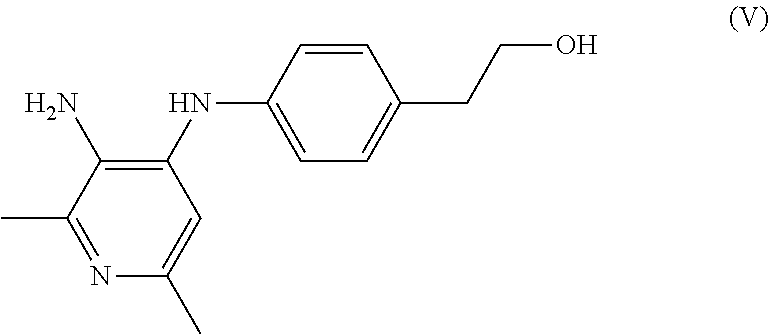
(c) converting the compound of Formula (V) into a compound of Formula (IV);

(d) converting the compound of Formula (IV) into a compound of Formula (III); and

(e) converting the compound of Formula (III) into a compound of Formula (II).


with ethyl(p-tolylsulfonyl)carbamate.

with ethyl(p-tolylsulfonyl)carbamate in the presence of a base.

-
- to obtain a compound of Formula (VI);

(b) converting the compound of Formula (VI) into a compound of Formula (V);

(c) converting the compound of Formula (V) into a compound of Formula (IV);

(d) converting the compound of Formula (IV) into a compound of Formula (III); and

(e) converting the compound of Formula (III) into a compound of Formula (II).


| Buchi Spray Dryer Model | B-290 Mini spray dryer with Inert |
| loop B-295 and Dehumidifier B-296 | |
| Inlet temperature set | 70-75 |
| (° C.) | |
| N2 pressure (Kg/cm2) | 3-4 |
| Aspirator-Mower RPM | 65-85% |
| Peristaltic pump RPM | 10-12% |
Claims (4)

Priority Applications (1)
| Application Number | Priority Date | Filing Date | Title |
|---|---|---|---|
| US17/383,978 US20210347776A1 (en) | 2019-08-12 | 2021-07-23 | Process for preparation of grapiprant |
Applications Claiming Priority (4)
| Application Number | Priority Date | Filing Date | Title |
|---|---|---|---|
| IN201921032548 | 2019-08-12 | ||
| IN201921032548 | 2019-08-12 | ||
| IN202021014512 | 2020-04-01 | ||
| IN202021014512 | 2020-04-01 |
Related Child Applications (1)
| Application Number | Title | Priority Date | Filing Date |
|---|---|---|---|
| US17/383,978 Division US20210347776A1 (en) | 2019-08-12 | 2021-07-23 | Process for preparation of grapiprant |
Publications (2)
| Publication Number | Publication Date |
|---|---|
| US20210079000A1 US20210079000A1 (en) | 2021-03-18 |
| US11254675B2 true US11254675B2 (en) | 2022-02-22 |
Family
ID=74869347
Family Applications (2)
| Application Number | Title | Priority Date | Filing Date |
|---|---|---|---|
| US16/991,323 Active US11254675B2 (en) | 2019-08-12 | 2020-08-12 | Process for preparation of grapiprant |
| US17/383,978 Abandoned US20210347776A1 (en) | 2019-08-12 | 2021-07-23 | Process for preparation of grapiprant |
Family Applications After (1)
| Application Number | Title | Priority Date | Filing Date |
|---|---|---|---|
| US17/383,978 Abandoned US20210347776A1 (en) | 2019-08-12 | 2021-07-23 | Process for preparation of grapiprant |
Country Status (1)
| Country | Link |
|---|---|
| US (2) | US11254675B2 (en) |
Families Citing this family (2)
| Publication number | Priority date | Publication date | Assignee | Title |
|---|---|---|---|---|
| CN116478155B (en) * | 2022-01-17 | 2025-06-13 | 洛阳惠中兽药有限公司 | A preparation method of glapiron and its intermediates |
| CN117466888A (en) * | 2023-10-30 | 2024-01-30 | 西北农林科技大学 | A kind of preparation method of 1H-imidazo[4,5-C]pyridine compound |
Citations (3)
| Publication number | Priority date | Publication date | Assignee | Title |
|---|---|---|---|---|
| US6710054B2 (en) | 2000-10-19 | 2004-03-23 | Pfizer Inc | Aryl or heteroaryl fused imidazole compounds as anti-inflammatory and analgesic agents |
| US7960407B2 (en) | 2005-03-11 | 2011-06-14 | Requalia Pharma Inc. | Crystal forms of an imidazole derivative |
| US9265756B2 (en) | 2014-03-06 | 2016-02-23 | Aratana Therapeutics, Inc. | Crystalline forms of grapiprant |
Family Cites Families (4)
| Publication number | Priority date | Publication date | Assignee | Title |
|---|---|---|---|---|
| JP2004035522A (en) * | 2002-07-08 | 2004-02-05 | Sumitomo Chem Co Ltd | Method for producing N-methylureas |
| WO2005092907A2 (en) * | 2004-03-26 | 2005-10-06 | Ranbaxy Laboratories Limited | Monosaccharide derivatives as anti-cancer and anti-inflammatory agents |
| WO2005102389A2 (en) * | 2004-04-20 | 2005-11-03 | Pfizer Products Inc. | Combinations comprising alpha-2-delta ligands and ep4 receptor antagonists |
| US20210300921A1 (en) * | 2018-07-11 | 2021-09-30 | Arrys Therapeutics, Inc. | Ep4 inhibitors and synthesis thereof |
-
2020
- 2020-08-12 US US16/991,323 patent/US11254675B2/en active Active
-
2021
- 2021-07-23 US US17/383,978 patent/US20210347776A1/en not_active Abandoned
Patent Citations (3)
| Publication number | Priority date | Publication date | Assignee | Title |
|---|---|---|---|---|
| US6710054B2 (en) | 2000-10-19 | 2004-03-23 | Pfizer Inc | Aryl or heteroaryl fused imidazole compounds as anti-inflammatory and analgesic agents |
| US7960407B2 (en) | 2005-03-11 | 2011-06-14 | Requalia Pharma Inc. | Crystal forms of an imidazole derivative |
| US9265756B2 (en) | 2014-03-06 | 2016-02-23 | Aratana Therapeutics, Inc. | Crystalline forms of grapiprant |
Also Published As
| Publication number | Publication date |
|---|---|
| US20210347776A1 (en) | 2021-11-11 |
| US20210079000A1 (en) | 2021-03-18 |
Similar Documents
| Publication | Publication Date | Title |
|---|---|---|
| US11390583B2 (en) | Process for preparation of Siponimod, its salts and solid state forms thereof | |
| US12269811B2 (en) | Synthesis of omecamtiv mecarbil | |
| ES2208265T3 (en) | TELMISARTAN POLYMORPHES, PROCEDURE FOR PREPARATION AND USE FOR THE PREPARATION OF A MEDICINAL PRODUCT. | |
| US20160194301A1 (en) | Preparation of lenalidomide | |
| WO2012090043A1 (en) | Novel solid state forms of azilsartan medoxomil and preparation thereof | |
| TW201026680A (en) | Apoptosis-inducing agents for the treatment of cancer and immune and autoimmune diseases | |
| TW201302753A (en) | 9-substituted-8-oxoadenine compound | |
| US11254675B2 (en) | Process for preparation of grapiprant | |
| EP2093225A1 (en) | Process for preparing crystalline eletriptan hydrobromide form ß | |
| US20040014983A1 (en) | Method for preparing benzisoxazole methane sulfonyl chloride and its amidation to form zonisamide | |
| US20240208968A1 (en) | Alpha v beta 6 and alpha v beta 1 integrin inhibitors and uses thereof | |
| US20090286990A1 (en) | Process for preparing irbesartan | |
| CN117377658A (en) | Process for preparing quinoline derivative compounds | |
| US20070197535A1 (en) | Polymorphic forms of vardenafil | |
| US10301353B2 (en) | Co-crystal of carfilzomib with maleic acid and process for the preparation of pure carfilzomib | |
| EP2474529B1 (en) | Crystalline forms of an active pharmaceutical ingredient | |
| CN120693332A (en) | A stable amorphous form of a potassium ion competitive acid blocker and a method for preparing the same | |
| WO2023152773A1 (en) | Solid forms of momelotinib salts and improved processes for the preparation of momelotinib | |
| WO2008017020A2 (en) | Process for preparing proton pump inhibitors | |
| WO2018029699A1 (en) | Solid state forms of (2e)-n-hydroxy-3-[3-(phenylsulfamoyl)phenyl]prop-2-enamide and process for preparation thereof | |
| WO2022049534A1 (en) | Polymorphic forms of a rorγ inhibiting compound and processes for its preparation | |
| US20060293375A1 (en) | Crystal of benzimidazole derivative and process for producing the same | |
| US8735408B2 (en) | Solid forms of 3-(4-(aminomethyl)-1-(5-methyl-7H-pyrrolo[2,3-d]pyrimidin-4-yl)piperidine-4-carboxamido)phenyl dimethylcarbamate | |
| US20100285075A1 (en) | Novel Hemioxalate Salt of Eletriptan | |
| US20220127231A1 (en) | Process for the prepartion of amifampridine phosphate |
Legal Events
| Date | Code | Title | Description |
|---|---|---|---|
| FEPP | Fee payment procedure |
Free format text: ENTITY STATUS SET TO UNDISCOUNTED (ORIGINAL EVENT CODE: BIG.); ENTITY STATUS OF PATENT OWNER: LARGE ENTITY |
|
| AS | Assignment |
Owner name: CADILA HEALTHCARE LIMITED, INDIA Free format text: ASSIGNMENT OF ASSIGNORS INTEREST;ASSIGNORS:SINGH, KUMAR KAMLESH;GAJERA, JITENDRA MAGANBHAI;CHUNDAVAT, SUMER SINGH;AND OTHERS;REEL/FRAME:054093/0526 Effective date: 20200814 |
|
| STPP | Information on status: patent application and granting procedure in general |
Free format text: NON FINAL ACTION MAILED |
|
| STPP | Information on status: patent application and granting procedure in general |
Free format text: RESPONSE TO NON-FINAL OFFICE ACTION ENTERED AND FORWARDED TO EXAMINER |
|
| STPP | Information on status: patent application and granting procedure in general |
Free format text: EX PARTE QUAYLE ACTION MAILED |
|
| STPP | Information on status: patent application and granting procedure in general |
Free format text: RESPONSE TO EX PARTE QUAYLE ACTION ENTERED AND FORWARDED TO EXAMINER |
|
| STPP | Information on status: patent application and granting procedure in general |
Free format text: NOTICE OF ALLOWANCE MAILED -- APPLICATION RECEIVED IN OFFICE OF PUBLICATIONS |
|
| STPP | Information on status: patent application and granting procedure in general |
Free format text: PUBLICATIONS -- ISSUE FEE PAYMENT RECEIVED |
|
| STCF | Information on status: patent grant |
Free format text: PATENTED CASE |
|
| AS | Assignment |
Owner name: ZYDUS LIFESCIENCES LIMITED, INDIA Free format text: CHANGE OF NAME;ASSIGNOR:CADILA HEALTHCARE LIMITED;REEL/FRAME:064657/0716 Effective date: 20220415 |
|
| MAFP | Maintenance fee payment |
Free format text: PAYMENT OF MAINTENANCE FEE, 4TH YEAR, LARGE ENTITY (ORIGINAL EVENT CODE: M1551); ENTITY STATUS OF PATENT OWNER: LARGE ENTITY Year of fee payment: 4 |