US11253502B2 - Tie-2 activators targeting the Schlemm's canal - Google Patents
Tie-2 activators targeting the Schlemm's canal Download PDFInfo
- Publication number
- US11253502B2 US11253502B2 US16/860,347 US202016860347A US11253502B2 US 11253502 B2 US11253502 B2 US 11253502B2 US 202016860347 A US202016860347 A US 202016860347A US 11253502 B2 US11253502 B2 US 11253502B2
- Authority
- US
- United States
- Prior art keywords
- substituted
- group
- unsubstituted
- aryl
- mmhg
- Prior art date
- Legal status (The legal status is an assumption and is not a legal conclusion. Google has not performed a legal analysis and makes no representation as to the accuracy of the status listed.)
- Active
Links
- 0 CC(C)(C)N(*)C(C(*)N(*)IO*)=O Chemical compound CC(C)(C)N(*)C(C(*)N(*)IO*)=O 0.000 description 26
- KWJDHELCGJFUHW-SFTDATJTSA-N COC(=O)N[C@@H](CC1=CC=CC=C1)C(=O)N[C@@H](CC1=CC=C(NS(=O)(=O)O)C=C1)C1=CSC(C2=CC=CS2)=N1 Chemical compound COC(=O)N[C@@H](CC1=CC=CC=C1)C(=O)N[C@@H](CC1=CC=C(NS(=O)(=O)O)C=C1)C1=CSC(C2=CC=CS2)=N1 KWJDHELCGJFUHW-SFTDATJTSA-N 0.000 description 8
- KWJDHELCGJFUHW-UHFFFAOYSA-N [H]N(C(=O)C(CC1=CC=CC=C1)NC(=O)OC)C(CC1=CC=C(NS(=O)(=O)O)C=C1)C1=CSC(C2=CC=CS2)=N1 Chemical compound [H]N(C(=O)C(CC1=CC=CC=C1)NC(=O)OC)C(CC1=CC=C(NS(=O)(=O)O)C=C1)C1=CSC(C2=CC=CS2)=N1 KWJDHELCGJFUHW-UHFFFAOYSA-N 0.000 description 6
- GGWMINFKGVMFIT-SFTDATJTSA-N COC(=O)N[C@@H](CC1=CC=CC=C1)C(=O)N[C@@H](CC1=CC=C(NS(=O)(=O)O)C=C1)C1=NC(C2=CC=CS2)=CS1 Chemical compound COC(=O)N[C@@H](CC1=CC=CC=C1)C(=O)N[C@@H](CC1=CC=C(NS(=O)(=O)O)C=C1)C1=NC(C2=CC=CS2)=CS1 GGWMINFKGVMFIT-SFTDATJTSA-N 0.000 description 5
- GGWMINFKGVMFIT-UHFFFAOYSA-N [H]N(C(=O)OC)C(CC1=CC=CC=C1)C(=O)N([H])C(CC1=CC=C(N([H])S(=O)(=O)O)C=C1)C1=NC(C2=CC=CS2)=CS1 Chemical compound [H]N(C(=O)OC)C(CC1=CC=CC=C1)C(=O)N([H])C(CC1=CC=C(N([H])S(=O)(=O)O)C=C1)C1=NC(C2=CC=CS2)=CS1 GGWMINFKGVMFIT-UHFFFAOYSA-N 0.000 description 5
- XVROYCYZSUKGSR-UHFFFAOYSA-N CC1=C(C)SC(C(C)(C)C)=N1 Chemical compound CC1=C(C)SC(C(C)(C)C)=N1 XVROYCYZSUKGSR-UHFFFAOYSA-N 0.000 description 4
- JWIGAPIAAKCSFG-IBGZPJMESA-N CCC1=CSC([C@H](CC2=CC=C(NS(=O)(=O)O)C=C2)NC(=O)CC2=CC=CC=C2)=N1 Chemical compound CCC1=CSC([C@H](CC2=CC=C(NS(=O)(=O)O)C=C2)NC(=O)CC2=CC=CC=C2)=N1 JWIGAPIAAKCSFG-IBGZPJMESA-N 0.000 description 4
- XKZOMUWCCBPCCW-SFTDATJTSA-N CCC1=CSC([C@H](CC2=CC=C(NS(=O)(=O)O)C=C2)NC(=O)[C@H](CC2=CC=CC=C2)NC(=O)OC)=N1 Chemical compound CCC1=CSC([C@H](CC2=CC=C(NS(=O)(=O)O)C=C2)NC(=O)[C@H](CC2=CC=CC=C2)NC(=O)OC)=N1 XKZOMUWCCBPCCW-SFTDATJTSA-N 0.000 description 4
- IAMKUFQDLHWRPW-PMACEKPBSA-N CCC1=NC([C@H](CC2=CC=C(NS(=O)(=O)O)C=C2)NC(=O)[C@H](CC2=CC=CC=C2)NC(=O)OC)=CS1 Chemical compound CCC1=NC([C@H](CC2=CC=C(NS(=O)(=O)O)C=C2)NC(=O)[C@H](CC2=CC=CC=C2)NC(=O)OC)=CS1 IAMKUFQDLHWRPW-PMACEKPBSA-N 0.000 description 4
- IAMKUFQDLHWRPW-UHFFFAOYSA-N [H]N(C(=O)OC)C(CC1=CC=CC=C1)C(=O)N([H])C(CC1=CC=C(N([H])S(=O)(=O)O)C=C1)C1=CSC(CC)=N1 Chemical compound [H]N(C(=O)OC)C(CC1=CC=CC=C1)C(=O)N([H])C(CC1=CC=C(N([H])S(=O)(=O)O)C=C1)C1=CSC(CC)=N1 IAMKUFQDLHWRPW-UHFFFAOYSA-N 0.000 description 4
- XKZOMUWCCBPCCW-UHFFFAOYSA-N [H]N(C(=O)OC)C(CC1=CC=CC=C1)C(=O)N([H])C(CC1=CC=C(N([H])S(=O)(=O)O)C=C1)C1=NC(CC)=CS1 Chemical compound [H]N(C(=O)OC)C(CC1=CC=CC=C1)C(=O)N([H])C(CC1=CC=C(N([H])S(=O)(=O)O)C=C1)C1=NC(CC)=CS1 XKZOMUWCCBPCCW-UHFFFAOYSA-N 0.000 description 4
- ANYMEUYQUSMDBN-UHFFFAOYSA-N CC1=NC(C(C)(C)C)=C(C)S1 Chemical compound CC1=NC(C(C)(C)C)=C(C)S1 ANYMEUYQUSMDBN-UHFFFAOYSA-N 0.000 description 3
- BJRLGZLUQQREGO-UHFFFAOYSA-N CCC(C)[Y] Chemical compound CCC(C)[Y] BJRLGZLUQQREGO-UHFFFAOYSA-N 0.000 description 3
- OUTWGVOHQCVNCV-INIZCTEOSA-N CCC1=CSC([C@H](CC2=CC=C(NS(=O)(=O)O)C=C2)NC(=O)CNC(=O)OC(C)(C)C)=N1 Chemical compound CCC1=CSC([C@H](CC2=CC=C(NS(=O)(=O)O)C=C2)NC(=O)CNC(=O)OC(C)(C)C)=N1 OUTWGVOHQCVNCV-INIZCTEOSA-N 0.000 description 3
- MXNFFNWYKPACLF-PMACEKPBSA-N CCC1=CSC([C@H](CC2=CC=C(NS(=O)(=O)O)C=C2)NC(=O)[C@H](CC(C)C)NC(=O)OC(C)(C)C)=N1 Chemical compound CCC1=CSC([C@H](CC2=CC=C(NS(=O)(=O)O)C=C2)NC(=O)[C@H](CC(C)C)NC(=O)OC(C)(C)C)=N1 MXNFFNWYKPACLF-PMACEKPBSA-N 0.000 description 3
- RGULHINSXZCWCM-VXKWHMMOSA-N CC(=O)N[C@@H](CC1=CC=CC=C1)C(=O)N[C@@H](CC1=CC=C(NS(=O)(=O)O)C=C1)C1=NC(C(C)(C)C)=CS1 Chemical compound CC(=O)N[C@@H](CC1=CC=CC=C1)C(=O)N[C@@H](CC1=CC=C(NS(=O)(=O)O)C=C1)C1=NC(C(C)(C)C)=CS1 RGULHINSXZCWCM-VXKWHMMOSA-N 0.000 description 2
- PUGPBUYYQXYNDU-AWEZNQCLSA-N CC(C)(C)C(=O)N[C@@H](CC1=CC=C(NS(=O)(=O)O)C=C1)C1=NC(CO)=CS1 Chemical compound CC(C)(C)C(=O)N[C@@H](CC1=CC=C(NS(=O)(=O)O)C=C1)C1=NC(CO)=CS1 PUGPBUYYQXYNDU-AWEZNQCLSA-N 0.000 description 2
- OGXLOMHMFQEQGZ-SFHVURJKSA-N CC(C)(C)OC(=O)N[C@@H](CC1=CC=C(NS(=O)(=O)O)C=C1)C1=NC(C2=CC=CC=C2)=CS1 Chemical compound CC(C)(C)OC(=O)N[C@@H](CC1=CC=C(NS(=O)(=O)O)C=C1)C1=NC(C2=CC=CC=C2)=CS1 OGXLOMHMFQEQGZ-SFHVURJKSA-N 0.000 description 2
- XAMSWURHUNEZDT-HNNXBMFYSA-N CC(C)(C)OC(=O)N[C@@H](CC1=CC=C(NS(=O)(=O)O)C=C1)C1=NC(OC(=O)C(C)(C)C)=CS1 Chemical compound CC(C)(C)OC(=O)N[C@@H](CC1=CC=C(NS(=O)(=O)O)C=C1)C1=NC(OC(=O)C(C)(C)C)=CS1 XAMSWURHUNEZDT-HNNXBMFYSA-N 0.000 description 2
- MPJJNZGGVGAPSE-UIOOFZCWSA-N CC(C)(C)OC(=O)N[C@@H](CC1=CC=CC=C1)C(=O)N[C@@H](CC1=CC=C(NS(=O)(=O)O)C=C1)C1=CSC(C2=CC=CC=C2)=N1 Chemical compound CC(C)(C)OC(=O)N[C@@H](CC1=CC=CC=C1)C(=O)N[C@@H](CC1=CC=C(NS(=O)(=O)O)C=C1)C1=CSC(C2=CC=CC=C2)=N1 MPJJNZGGVGAPSE-UIOOFZCWSA-N 0.000 description 2
- CDBITOLFHNZNPG-UHFFFAOYSA-N CCC(C)N(C)C(=O)C(C)N(C)CC Chemical compound CCC(C)N(C)C(=O)C(C)N(C)CC CDBITOLFHNZNPG-UHFFFAOYSA-N 0.000 description 2
- NPIWLASULOULQV-UIOOFZCWSA-N CCC1=C(C2=CC=CC=C2)SC([C@H](CC2=CC=C(NS(=O)(=O)O)C=C2)NC(=O)[C@H](CC2=CC=CC=C2)NC(=O)OC)=N1 Chemical compound CCC1=C(C2=CC=CC=C2)SC([C@H](CC2=CC=C(NS(=O)(=O)O)C=C2)NC(=O)[C@H](CC2=CC=CC=C2)NC(=O)OC)=N1 NPIWLASULOULQV-UIOOFZCWSA-N 0.000 description 2
- ZTQSPAZWIDVFAB-KRWDZBQOSA-N CCC1=CSC([C@H](CC2=CC=C(NS(=O)(=O)O)C=C2)NC(=O)C2=CC=C3OCOC3=C2)=N1 Chemical compound CCC1=CSC([C@H](CC2=CC=C(NS(=O)(=O)O)C=C2)NC(=O)C2=CC=C3OCOC3=C2)=N1 ZTQSPAZWIDVFAB-KRWDZBQOSA-N 0.000 description 2
- VLWFEBRQUXEKDY-IBGZPJMESA-N CCC1=CSC([C@H](CC2=CC=C(NS(=O)(=O)O)C=C2)NC(=O)CC2=C(Cl)C=CC=C2)=N1 Chemical compound CCC1=CSC([C@H](CC2=CC=C(NS(=O)(=O)O)C=C2)NC(=O)CC2=C(Cl)C=CC=C2)=N1 VLWFEBRQUXEKDY-IBGZPJMESA-N 0.000 description 2
- STTNVVHPOLOFHV-FQEVSTJZSA-N CCC1=CSC([C@H](CC2=CC=C(NS(=O)(=O)O)C=C2)NC(=O)CCC2=CC(Cl)=CC=C2)=N1 Chemical compound CCC1=CSC([C@H](CC2=CC=C(NS(=O)(=O)O)C=C2)NC(=O)CCC2=CC(Cl)=CC=C2)=N1 STTNVVHPOLOFHV-FQEVSTJZSA-N 0.000 description 2
- ZKHCEGCYHCMNNC-NRFANRHFSA-N CCC1=CSC([C@H](CC2=CC=C(NS(=O)(=O)O)C=C2)NC(=O)CCC2=CC=C(OC)C=C2)=N1 Chemical compound CCC1=CSC([C@H](CC2=CC=C(NS(=O)(=O)O)C=C2)NC(=O)CCC2=CC=C(OC)C=C2)=N1 ZKHCEGCYHCMNNC-NRFANRHFSA-N 0.000 description 2
- DEIJXDZGXQFLLW-KRWDZBQOSA-N CCC1=CSC([C@H](CC2=CC=C(NS(=O)(=O)O)C=C2)NC(=O)CN2CCN(CC)C(=O)C2=O)=N1 Chemical compound CCC1=CSC([C@H](CC2=CC=C(NS(=O)(=O)O)C=C2)NC(=O)CN2CCN(CC)C(=O)C2=O)=N1 DEIJXDZGXQFLLW-KRWDZBQOSA-N 0.000 description 2
- DFMNJBSBPRRYMI-PKTZIBPZSA-N CCC1=CSC([C@H](CC2=CC=C(NS(=O)(=O)O)C=C2)NC(=O)[C@@H](CC2=CC=CC=C2)NC(=O)OC(C)(C)C)=N1 Chemical compound CCC1=CSC([C@H](CC2=CC=C(NS(=O)(=O)O)C=C2)NC(=O)[C@@H](CC2=CC=CC=C2)NC(=O)OC(C)(C)C)=N1 DFMNJBSBPRRYMI-PKTZIBPZSA-N 0.000 description 2
- FITWNTKDWFGMCY-SFTDATJTSA-N CCC1=CSC([C@H](CC2=CC=C(NS(=O)(=O)O)C=C2)NC(=O)[C@H](CC2=CC=CC=C2)NC(=O)OC(=O)OC)=N1 Chemical compound CCC1=CSC([C@H](CC2=CC=C(NS(=O)(=O)O)C=C2)NC(=O)[C@H](CC2=CC=CC=C2)NC(=O)OC(=O)OC)=N1 FITWNTKDWFGMCY-SFTDATJTSA-N 0.000 description 2
- QFPXHOSHKYXCBU-VXKWHMMOSA-N CCC1=CSC([C@H](CC2=CC=C(NS(=O)(=O)O)C=C2)NC(=O)[C@H](CC2=CC=CC=C2)NC(C)=O)=N1 Chemical compound CCC1=CSC([C@H](CC2=CC=C(NS(=O)(=O)O)C=C2)NC(=O)[C@H](CC2=CC=CC=C2)NC(C)=O)=N1 QFPXHOSHKYXCBU-VXKWHMMOSA-N 0.000 description 2
- YGRSMNYROMHYSL-UHFFFAOYSA-N CCN(C)C(C)C(=O)N(C)C(C)(C)C Chemical compound CCN(C)C(C)C(=O)N(C)C(C)(C)C YGRSMNYROMHYSL-UHFFFAOYSA-N 0.000 description 2
- ADHAMZCDBCHQLA-ZEQRLZLVSA-N COC(=O)N[C@@H](CC1=CC=CC=C1)C(=O)N[C@@H](CC1=CC=C(NS(=O)(=O)O)C=C1)C1=CSC(C2=CC=CC=C2)=N1 Chemical compound COC(=O)N[C@@H](CC1=CC=CC=C1)C(=O)N[C@@H](CC1=CC=C(NS(=O)(=O)O)C=C1)C1=CSC(C2=CC=CC=C2)=N1 ADHAMZCDBCHQLA-ZEQRLZLVSA-N 0.000 description 2
- YGOAMOKFHNYNHK-PMACEKPBSA-N COC(=O)N[C@@H](CC1=CC=CC=C1)C(=O)N[C@@H](CC1=CC=C(NS(=O)(=O)O)C=C1)C1=NC(C)=CS1 Chemical compound COC(=O)N[C@@H](CC1=CC=CC=C1)C(=O)N[C@@H](CC1=CC=C(NS(=O)(=O)O)C=C1)C1=NC(C)=CS1 YGOAMOKFHNYNHK-PMACEKPBSA-N 0.000 description 2
- HWJBEXMPVQKCEM-PMACEKPBSA-N COC(=O)N[C@@H](CC1=CC=CC=C1)C(=O)N[C@@H](CC1=CC=C(NS(=O)(=O)O)C=C1)C1=NC(C2=CC=C(Cl)S2)=CS1 Chemical compound COC(=O)N[C@@H](CC1=CC=CC=C1)C(=O)N[C@@H](CC1=CC=C(NS(=O)(=O)O)C=C1)C1=NC(C2=CC=C(Cl)S2)=CS1 HWJBEXMPVQKCEM-PMACEKPBSA-N 0.000 description 2
- PDSYWBUJNFTRKV-SFTDATJTSA-N COC(=O)N[C@@H](CC1=CC=CC=C1)C(=O)N[C@@H](CC1=CC=C(NS(=O)(=O)O)C=C1)C1=NC(CCC(F)(F)F)=CS1 Chemical compound COC(=O)N[C@@H](CC1=CC=CC=C1)C(=O)N[C@@H](CC1=CC=C(NS(=O)(=O)O)C=C1)C1=NC(CCC(F)(F)F)=CS1 PDSYWBUJNFTRKV-SFTDATJTSA-N 0.000 description 2
- SPXYGWSITXECNH-IBGZPJMESA-N COC1=CC=CC(C2=CSC([C@H](CC3=CC=C(NS(=O)(=O)O)C=C3)NC(=O)C(C)(C)C)=N2)=C1 Chemical compound COC1=CC=CC(C2=CSC([C@H](CC3=CC=C(NS(=O)(=O)O)C=C3)NC(=O)C(C)(C)C)=N2)=C1 SPXYGWSITXECNH-IBGZPJMESA-N 0.000 description 2
- LBUJPTNKIBCYBY-UHFFFAOYSA-N C1=CC=C2NCCCC2=C1 Chemical compound C1=CC=C2NCCCC2=C1 LBUJPTNKIBCYBY-UHFFFAOYSA-N 0.000 description 1
- ZCZVGQCBSJLDDS-UHFFFAOYSA-N C1=CN=C2NCCCC2=C1 Chemical compound C1=CN=C2NCCCC2=C1 ZCZVGQCBSJLDDS-UHFFFAOYSA-N 0.000 description 1
- BJUPTJXRJDXLHF-UHFFFAOYSA-N C1=NC=C2CCCC2=N1 Chemical compound C1=NC=C2CCCC2=N1 BJUPTJXRJDXLHF-UHFFFAOYSA-N 0.000 description 1
- SJXHSNZPIWYRNY-SFHVURJKSA-N CC(C)(C)C(=O)N[C@@H](CC1=CC=C(NS(=O)(=O)O)C=C1)C1=NC(C2=CC3=C(C=C2)OCCO3)=CS1 Chemical compound CC(C)(C)C(=O)N[C@@H](CC1=CC=C(NS(=O)(=O)O)C=C1)C1=NC(C2=CC3=C(C=C2)OCCO3)=CS1 SJXHSNZPIWYRNY-SFHVURJKSA-N 0.000 description 1
- WGHDSQOEFWDDAH-DEOSSOPVSA-N CC(C)(C)C(=O)N[C@@H](CC1=CC=C(NS(=O)(=O)O)C=C1)C1=NC(C2=CC=C(C3=CC=CC=C3)C=C2)=CS1 Chemical compound CC(C)(C)C(=O)N[C@@H](CC1=CC=C(NS(=O)(=O)O)C=C1)C1=NC(C2=CC=C(C3=CC=CC=C3)C=C2)=CS1 WGHDSQOEFWDDAH-DEOSSOPVSA-N 0.000 description 1
- IHLNYOYOOXRVFX-SFHVURJKSA-N CC(C)(C)C(=O)N[C@@H](CC1=CC=C(NS(=O)(=O)O)C=C1)C1=NC(C2=CC=CC=C2)=CS1 Chemical compound CC(C)(C)C(=O)N[C@@H](CC1=CC=C(NS(=O)(=O)O)C=C1)C1=NC(C2=CC=CC=C2)=CS1 IHLNYOYOOXRVFX-SFHVURJKSA-N 0.000 description 1
- NATJGEGUQHEWOC-NRFANRHFSA-N CC(C)(C)C(=O)N[C@@H](CC1=CC=C(NS(=O)(=O)O)C=C1)C1=NC(CC2=CC(CO)=CC=C2)=CS1 Chemical compound CC(C)(C)C(=O)N[C@@H](CC1=CC=C(NS(=O)(=O)O)C=C1)C1=NC(CC2=CC(CO)=CC=C2)=CS1 NATJGEGUQHEWOC-NRFANRHFSA-N 0.000 description 1
- ZKDWAOAVSQQEJN-FQEVSTJZSA-N CC(C)(C)C(=O)N[C@@H](CC1=CC=C(NS(=O)(=O)O)C=C1)C1=NC(CC2=CC=CC=C2)=CS1 Chemical compound CC(C)(C)C(=O)N[C@@H](CC1=CC=C(NS(=O)(=O)O)C=C1)C1=NC(CC2=CC=CC=C2)=CS1 ZKDWAOAVSQQEJN-FQEVSTJZSA-N 0.000 description 1
- RQOCHQZZERGEFT-IBGZPJMESA-N CC(C)(C)C(N[C@@H](Cc(cc1)ccc1NS(O)(=O)=O)c1nc(-c(ccc(OC)c2)c2OC)c[s]1)=O Chemical compound CC(C)(C)C(N[C@@H](Cc(cc1)ccc1NS(O)(=O)=O)c1nc(-c(ccc(OC)c2)c2OC)c[s]1)=O RQOCHQZZERGEFT-IBGZPJMESA-N 0.000 description 1
- VASMAVOWDKZEGL-UHFFFAOYSA-N CC(C)(C)C1=CC=CC1.CC(C)(C)C1=CC=CO1.CC(C)(C)C1=CC=CO1.CC(C)(C)C1=CC=CS1.CC(C)(C)C1=CCC=C1.CC(C)(C)C1=CCC=C1.CC(C)(C)C1=CCC=C1.CC(C)(C)C1=CCC=N1.CC(C)(C)C1=CCC=N1.CC(C)(C)C1=CCN=C1.CC(C)(C)C1=CCN=N1.CC(C)(C)C1=CN=CC1.CC(C)(C)C1=CN=CO1.CC(C)(C)C1=NC=CC1.CC(C)(C)C1=NC=CN1.CC(C)(C)C1=NC=CO1.CC(C)(C)C1=NC=CO1.CC(C)(C)C1=NC=CO1.CC(C)(C)C1=NC=NC1.CC(C)(C)C1=NOC=C1.CC(C)(C)C1=NOC=N1.CC(C)(C)N1C=CN=C1.CC(C)(C)N1C=CN=N1 Chemical compound CC(C)(C)C1=CC=CC1.CC(C)(C)C1=CC=CO1.CC(C)(C)C1=CC=CO1.CC(C)(C)C1=CC=CS1.CC(C)(C)C1=CCC=C1.CC(C)(C)C1=CCC=C1.CC(C)(C)C1=CCC=C1.CC(C)(C)C1=CCC=N1.CC(C)(C)C1=CCC=N1.CC(C)(C)C1=CCN=C1.CC(C)(C)C1=CCN=N1.CC(C)(C)C1=CN=CC1.CC(C)(C)C1=CN=CO1.CC(C)(C)C1=NC=CC1.CC(C)(C)C1=NC=CN1.CC(C)(C)C1=NC=CO1.CC(C)(C)C1=NC=CO1.CC(C)(C)C1=NC=CO1.CC(C)(C)C1=NC=NC1.CC(C)(C)C1=NOC=C1.CC(C)(C)C1=NOC=N1.CC(C)(C)N1C=CN=C1.CC(C)(C)N1C=CN=N1 VASMAVOWDKZEGL-UHFFFAOYSA-N 0.000 description 1
- HPSUGUDGNUMNBP-UHFFFAOYSA-N CC(C)(C)C1=CC=CS1.CC(C)(C)C1=CCC=N1.CC(C)(C)C1=CCN=C1.CC(C)(C)C1=CN=CS1.CC(C)(C)C1=NC=CS1.CC(C)(C)C1=NC=CS1.CC(C)(C)C1=NC=CS1.CC(C)(C)C1=NSC=C1.CC(C)(C)C1=NSC=N1 Chemical compound CC(C)(C)C1=CC=CS1.CC(C)(C)C1=CCC=N1.CC(C)(C)C1=CCN=C1.CC(C)(C)C1=CN=CS1.CC(C)(C)C1=NC=CS1.CC(C)(C)C1=NC=CS1.CC(C)(C)C1=NC=CS1.CC(C)(C)C1=NSC=C1.CC(C)(C)C1=NSC=N1 HPSUGUDGNUMNBP-UHFFFAOYSA-N 0.000 description 1
- WCXZBHQKWFRLBJ-IAPPQJPRSA-N CC(C)(C)OC(=O)CC[C@H](CC1=CC=CC=C1)C(=O)N[C@@H](CC1=CC=C(NS(=O)(=O)O)C=C1)C1=NC(C2=CC=CC=C2)=CS1 Chemical compound CC(C)(C)OC(=O)CC[C@H](CC1=CC=CC=C1)C(=O)N[C@@H](CC1=CC=C(NS(=O)(=O)O)C=C1)C1=NC(C2=CC=CC=C2)=CS1 WCXZBHQKWFRLBJ-IAPPQJPRSA-N 0.000 description 1
- CRUNCYGPRCJQNZ-HNNXBMFYSA-N CC(C)(C)OC(=O)N[C@@H](CC1=CC=C(NS(=O)(=O)O)C=C1)C1=NC(C(C)(C)C)=CS1 Chemical compound CC(C)(C)OC(=O)N[C@@H](CC1=CC=C(NS(=O)(=O)O)C=C1)C1=NC(C(C)(C)C)=CS1 CRUNCYGPRCJQNZ-HNNXBMFYSA-N 0.000 description 1
- LFHPJRALAZKSSA-SFHVURJKSA-N CC(C)(C)OC(=O)N[C@@H](CC1=CC=C(NS(=O)(=O)O)C=C1)C1=NC(C2=CC(C(F)(F)F)=CC=C2)=CS1 Chemical compound CC(C)(C)OC(=O)N[C@@H](CC1=CC=C(NS(=O)(=O)O)C=C1)C1=NC(C2=CC(C(F)(F)F)=CC=C2)=CS1 LFHPJRALAZKSSA-SFHVURJKSA-N 0.000 description 1
- NLJNCBGCTAYSDS-INIZCTEOSA-N CC(C)(C)OC(=O)N[C@@H](CC1=CC=C(NS(=O)(=O)O)C=C1)C1=NC(C2=CSC=C2)=CS1 Chemical compound CC(C)(C)OC(=O)N[C@@H](CC1=CC=C(NS(=O)(=O)O)C=C1)C1=NC(C2=CSC=C2)=CS1 NLJNCBGCTAYSDS-INIZCTEOSA-N 0.000 description 1
- PXTPWWKQCJENPU-AWEZNQCLSA-N CC(C)(C)OC(=O)N[C@@H](CC1=CC=C(NS(=O)(=O)O)C=C1)C1=NC(CO)=CS1 Chemical compound CC(C)(C)OC(=O)N[C@@H](CC1=CC=C(NS(=O)(=O)O)C=C1)C1=NC(CO)=CS1 PXTPWWKQCJENPU-AWEZNQCLSA-N 0.000 description 1
- RMUOIGZNNCUUTD-SFHVURJKSA-N CC(C)(C)OC(=O)N[C@@H](CC1=CC=C(NS(=O)(=O)O)C=C1)C1=NC=C(C2=CC=CC=C2)S1 Chemical compound CC(C)(C)OC(=O)N[C@@H](CC1=CC=C(NS(=O)(=O)O)C=C1)C1=NC=C(C2=CC=CC=C2)S1 RMUOIGZNNCUUTD-SFHVURJKSA-N 0.000 description 1
- WKOUBJPNGMAWPM-UHFFFAOYSA-N CC(C)(C)c(c(N[I]=C)c(c(S1=CN1)c1N)N)c1N Chemical compound CC(C)(C)c(c(N[I]=C)c(c(S1=CN1)c1N)N)c1N WKOUBJPNGMAWPM-UHFFFAOYSA-N 0.000 description 1
- NXHUHEUOFBLGGT-UHFFFAOYSA-N CC.CCC1=CC=CC=C1 Chemical compound CC.CCC1=CC=CC=C1 NXHUHEUOFBLGGT-UHFFFAOYSA-N 0.000 description 1
- MJCJLUHXDWVDRJ-UHFFFAOYSA-N CC.CCC1=NC=CC=C1 Chemical compound CC.CCC1=NC=CC=C1 MJCJLUHXDWVDRJ-UHFFFAOYSA-N 0.000 description 1
- WGZWEEHVPCGJOR-UHFFFAOYSA-N CC1=C(C)C(C)=C(C(C)(C)C)C(C)=C1C Chemical compound CC1=C(C)C(C)=C(C(C)(C)C)C(C)=C1C WGZWEEHVPCGJOR-UHFFFAOYSA-N 0.000 description 1
- ZOLAHFBNGNECSE-IBGZPJMESA-N CC1=C(C2=CC=CC=C2)N=C([C@H](CC2=CC=C(NS(=O)(=O)O)C=C2)NC(=O)C(C)(C)C)S1 Chemical compound CC1=C(C2=CC=CC=C2)N=C([C@H](CC2=CC=C(NS(=O)(=O)O)C=C2)NC(=O)C(C)(C)C)S1 ZOLAHFBNGNECSE-IBGZPJMESA-N 0.000 description 1
- QDLLTACANIARFO-AWEZNQCLSA-N CC1=CSC([C@H](CC2=CC=C(NS(=O)(=O)O)C=C2)NC(=O)C(C)(C)C)=N1 Chemical compound CC1=CSC([C@H](CC2=CC=C(NS(=O)(=O)O)C=C2)NC(=O)C(C)(C)C)=N1 QDLLTACANIARFO-AWEZNQCLSA-N 0.000 description 1
- MPMODSGSSRZHDE-KRWDZBQOSA-N CC1=NC(CC2=NN=C(N[C@@H](CC3=CC=C(NS(=O)(=O)O)C=C3)C3=CSC(C4=CC=CS4)=N3)S2)=CS1 Chemical compound CC1=NC(CC2=NN=C(N[C@@H](CC3=CC=C(NS(=O)(=O)O)C=C3)C3=CSC(C4=CC=CS4)=N3)S2)=CS1 MPMODSGSSRZHDE-KRWDZBQOSA-N 0.000 description 1
- CGDQWVNUZQIGCU-AWEZNQCLSA-N CC1=NC([C@H](CC2=CC=C(NS(=O)(=O)O)C=C2)NC(=O)OC(C)(C)C)=CS1 Chemical compound CC1=NC([C@H](CC2=CC=C(NS(=O)(=O)O)C=C2)NC(=O)OC(C)(C)C)=CS1 CGDQWVNUZQIGCU-AWEZNQCLSA-N 0.000 description 1
- BNMPXZKWADCLTR-KRWDZBQOSA-N CC1=NN=C(N[C@@H](CC2=CC=C(NS(=O)(=O)O)C=C2)C2=CSC(C3=CC=CC=C3)=N2)S1 Chemical compound CC1=NN=C(N[C@@H](CC2=CC=C(NS(=O)(=O)O)C=C2)C2=CSC(C3=CC=CC=C3)=N2)S1 BNMPXZKWADCLTR-KRWDZBQOSA-N 0.000 description 1
- UYSGJGRBPMUHIG-UXQCFNEQSA-N CCC(C)N(C)C(=O)C(C)N(C)CC.CC[C@@H](C)N(C)C(=O)[C@H](C)N(C)CC Chemical compound CCC(C)N(C)C(=O)C(C)N(C)CC.CC[C@@H](C)N(C)C(=O)[C@H](C)N(C)CC UYSGJGRBPMUHIG-UXQCFNEQSA-N 0.000 description 1
- MPGAPBMIXOPYKD-UHFFFAOYSA-N CCC(C)N(C)C(=O)C([Rb])N(C)CC Chemical compound CCC(C)N(C)C(=O)C([Rb])N(C)CC MPGAPBMIXOPYKD-UHFFFAOYSA-N 0.000 description 1
- COBAVACDNNTELY-UHFFFAOYSA-N CCC(C)[Y].CC[C@@H](C)[Y] Chemical compound CCC(C)[Y].CC[C@@H](C)[Y] COBAVACDNNTELY-UHFFFAOYSA-N 0.000 description 1
- UFFMDKKUPWAYOC-VXKWHMMOSA-N CCC1=C(C)SC([C@H](CC2=CC=C(NS(=O)(=O)O)C=C2)NC(=O)[C@H](CC2=CC=CC=C2)NC(=O)OC)=N1 Chemical compound CCC1=C(C)SC([C@H](CC2=CC=C(NS(=O)(=O)O)C=C2)NC(=O)[C@H](CC2=CC=CC=C2)NC(=O)OC)=N1 UFFMDKKUPWAYOC-VXKWHMMOSA-N 0.000 description 1
- YDMOYGLNUKECPA-HNNXBMFYSA-N CCC1=CSC([C@H](CC2=CC=C(NS(=O)(=O)O)C=C2)NC(=O)C(C)(C)C)=N1 Chemical compound CCC1=CSC([C@H](CC2=CC=C(NS(=O)(=O)O)C=C2)NC(=O)C(C)(C)C)=N1 YDMOYGLNUKECPA-HNNXBMFYSA-N 0.000 description 1
- XUJJNTYWZAVJHS-IBGZPJMESA-N CCC1=CSC([C@H](CC2=CC=C(NS(=O)(=O)O)C=C2)NC(=O)CC2=C(F)C=CC=C2)=N1 Chemical compound CCC1=CSC([C@H](CC2=CC=C(NS(=O)(=O)O)C=C2)NC(=O)CC2=C(F)C=CC=C2)=N1 XUJJNTYWZAVJHS-IBGZPJMESA-N 0.000 description 1
- VOMZSGGAZAVKDV-SFHVURJKSA-N CCC1=CSC([C@H](CC2=CC=C(NS(=O)(=O)O)C=C2)NC(=O)CC2=C(O)C=CC=C2)=N1 Chemical compound CCC1=CSC([C@H](CC2=CC=C(NS(=O)(=O)O)C=C2)NC(=O)CC2=C(O)C=CC=C2)=N1 VOMZSGGAZAVKDV-SFHVURJKSA-N 0.000 description 1
- AGKCTKMOEMXUNB-IBGZPJMESA-N CCC1=CSC([C@H](CC2=CC=C(NS(=O)(=O)O)C=C2)NC(=O)CC2=CC=C(F)C(F)=C2)=N1 Chemical compound CCC1=CSC([C@H](CC2=CC=C(NS(=O)(=O)O)C=C2)NC(=O)CC2=CC=C(F)C(F)=C2)=N1 AGKCTKMOEMXUNB-IBGZPJMESA-N 0.000 description 1
- UMEVMMJAIZFKAX-IBGZPJMESA-N CCC1=CSC([C@H](CC2=CC=C(NS(=O)(=O)O)C=C2)NC(=O)CC2=CC=C(OC)C(OC)=C2)=N1 Chemical compound CCC1=CSC([C@H](CC2=CC=C(NS(=O)(=O)O)C=C2)NC(=O)CC2=CC=C(OC)C(OC)=C2)=N1 UMEVMMJAIZFKAX-IBGZPJMESA-N 0.000 description 1
- CFBAFWZBQFEGBW-IBGZPJMESA-N CCC1=CSC([C@H](CC2=CC=C(NS(=O)(=O)O)C=C2)NC(=O)CC2=CC=CC(Cl)=C2)=N1 Chemical compound CCC1=CSC([C@H](CC2=CC=C(NS(=O)(=O)O)C=C2)NC(=O)CC2=CC=CC(Cl)=C2)=N1 CFBAFWZBQFEGBW-IBGZPJMESA-N 0.000 description 1
- OWQRDPCPQKJXGQ-IBGZPJMESA-N CCC1=CSC([C@H](CC2=CC=C(NS(=O)(=O)O)C=C2)NC(=O)CC2=CC=CC(F)=C2)=N1 Chemical compound CCC1=CSC([C@H](CC2=CC=C(NS(=O)(=O)O)C=C2)NC(=O)CC2=CC=CC(F)=C2)=N1 OWQRDPCPQKJXGQ-IBGZPJMESA-N 0.000 description 1
- OYRLZGKRUDDGED-SFHVURJKSA-N CCC1=CSC([C@H](CC2=CC=C(NS(=O)(=O)O)C=C2)NC(=O)CC2=CC=CC(F)=C2F)=N1 Chemical compound CCC1=CSC([C@H](CC2=CC=C(NS(=O)(=O)O)C=C2)NC(=O)CC2=CC=CC(F)=C2F)=N1 OYRLZGKRUDDGED-SFHVURJKSA-N 0.000 description 1
- VUBRJZVWXOODGV-IBGZPJMESA-N CCC1=CSC([C@H](CC2=CC=C(NS(=O)(=O)O)C=C2)NC(=O)CC2=CC=CC(O)=C2)=N1 Chemical compound CCC1=CSC([C@H](CC2=CC=C(NS(=O)(=O)O)C=C2)NC(=O)CC2=CC=CC(O)=C2)=N1 VUBRJZVWXOODGV-IBGZPJMESA-N 0.000 description 1
- RCKIITSHDNZSIP-FQEVSTJZSA-N CCC1=CSC([C@H](CC2=CC=C(NS(=O)(=O)O)C=C2)NC(=O)CC2=CC=CC(OC)=C2)=N1 Chemical compound CCC1=CSC([C@H](CC2=CC=C(NS(=O)(=O)O)C=C2)NC(=O)CC2=CC=CC(OC)=C2)=N1 RCKIITSHDNZSIP-FQEVSTJZSA-N 0.000 description 1
- OMEARSOPYMXZCH-IBGZPJMESA-N CCC1=CSC([C@H](CC2=CC=C(NS(=O)(=O)O)C=C2)NC(=O)CC2=CC=CC(OC)=C2OC)=N1 Chemical compound CCC1=CSC([C@H](CC2=CC=C(NS(=O)(=O)O)C=C2)NC(=O)CC2=CC=CC(OC)=C2OC)=N1 OMEARSOPYMXZCH-IBGZPJMESA-N 0.000 description 1
- INUIUGLCVCUBPQ-FQEVSTJZSA-N CCC1=CSC([C@H](CC2=CC=C(NS(=O)(=O)O)C=C2)NC(=O)CCC2=C(OC)C=CC=C2)=N1 Chemical compound CCC1=CSC([C@H](CC2=CC=C(NS(=O)(=O)O)C=C2)NC(=O)CCC2=C(OC)C=CC=C2)=N1 INUIUGLCVCUBPQ-FQEVSTJZSA-N 0.000 description 1
- GBLHRFSKNLGKOI-NRFANRHFSA-N CCC1=CSC([C@H](CC2=CC=C(NS(=O)(=O)O)C=C2)NC(=O)CCC2=CC(OC)=CC=C2)=N1 Chemical compound CCC1=CSC([C@H](CC2=CC=C(NS(=O)(=O)O)C=C2)NC(=O)CCC2=CC(OC)=CC=C2)=N1 GBLHRFSKNLGKOI-NRFANRHFSA-N 0.000 description 1
- UIAZWGVZVAATRB-FQEVSTJZSA-N CCC1=CSC([C@H](CC2=CC=C(NS(=O)(=O)O)C=C2)NC(=O)CCC2=CC=CC=C2)=N1 Chemical compound CCC1=CSC([C@H](CC2=CC=C(NS(=O)(=O)O)C=C2)NC(=O)CCC2=CC=CC=C2)=N1 UIAZWGVZVAATRB-FQEVSTJZSA-N 0.000 description 1
- IBXJYYUKQGSDAT-INIZCTEOSA-N CCC1=CSC([C@H](CC2=CC=C(NS(=O)(=O)O)C=C2)NC(=O)CN2C=C(C)C(=O)NC2=O)=N1 Chemical compound CCC1=CSC([C@H](CC2=CC=C(NS(=O)(=O)O)C=C2)NC(=O)CN2C=C(C)C(=O)NC2=O)=N1 IBXJYYUKQGSDAT-INIZCTEOSA-N 0.000 description 1
- KJKQRCUEOASSMU-AWEZNQCLSA-N CCC1=CSC([C@H](CC2=CC=C(NS(=O)(=O)O)C=C2)NC(=O)CNC(=O)OC)=N1 Chemical compound CCC1=CSC([C@H](CC2=CC=C(NS(=O)(=O)O)C=C2)NC(=O)CNC(=O)OC)=N1 KJKQRCUEOASSMU-AWEZNQCLSA-N 0.000 description 1
- MSGLVGKSRPFBIJ-HOTGVXAUSA-N CCC1=CSC([C@H](CC2=CC=C(NS(=O)(=O)O)C=C2)NC(=O)[C@@H](NC(=O)OO)C(C)C)=N1 Chemical compound CCC1=CSC([C@H](CC2=CC=C(NS(=O)(=O)O)C=C2)NC(=O)[C@@H](NC(=O)OO)C(C)C)=N1 MSGLVGKSRPFBIJ-HOTGVXAUSA-N 0.000 description 1
- WMTDWNXLEOBULV-ROUUACIJSA-N CCC1=CSC([C@H](CC2=CC=C(NS(=O)(=O)O)C=C2)NC(=O)[C@H](CC(C)C)NC(=O)OC)=N1 Chemical compound CCC1=CSC([C@H](CC2=CC=C(NS(=O)(=O)O)C=C2)NC(=O)[C@H](CC(C)C)NC(=O)OC)=N1 WMTDWNXLEOBULV-ROUUACIJSA-N 0.000 description 1
- ZAQJVNMXFJJFQP-RDGATRHJSA-N CCC1=CSC([C@H](CC2=CC=C(NS(=O)(=O)O)C=C2)NC(=O)[C@H](CCC(=O)OC(C)(C)C)CC2=CC=CC=C2)=N1 Chemical compound CCC1=CSC([C@H](CC2=CC=C(NS(=O)(=O)O)C=C2)NC(=O)[C@H](CCC(=O)OC(C)(C)C)CC2=CC=CC=C2)=N1 ZAQJVNMXFJJFQP-RDGATRHJSA-N 0.000 description 1
- QGKMQYPNJKNQSH-INIZCTEOSA-N CCCC1=CSC([C@H](CC2=CC=C(NS(=O)(=O)O)C=C2)NC(=O)OC(C)(C)C)=N1 Chemical compound CCCC1=CSC([C@H](CC2=CC=C(NS(=O)(=O)O)C=C2)NC(=O)OC(C)(C)C)=N1 QGKMQYPNJKNQSH-INIZCTEOSA-N 0.000 description 1
- UXJUYFLQXJQSSV-VXKWHMMOSA-N CCCC1=CSC([C@H](CC2=CC=C(NS(=O)(=O)O)C=C2)NC(=O)[C@H](CC2=CC=CC=C2)NC(=O)OC)=N1 Chemical compound CCCC1=CSC([C@H](CC2=CC=C(NS(=O)(=O)O)C=C2)NC(=O)[C@H](CC2=CC=CC=C2)NC(=O)OC)=N1 UXJUYFLQXJQSSV-VXKWHMMOSA-N 0.000 description 1
- MHMREPFVAYYGLG-HNNXBMFYSA-N CCCC1=NN=C(N[C@@H](CC2=CC=C(NS(=O)(=O)O)C=C2)C2=CSC(C3=CC=CS3)=N2)S1 Chemical compound CCCC1=NN=C(N[C@@H](CC2=CC=C(NS(=O)(=O)O)C=C2)C2=CSC(C3=CC=CS3)=N2)S1 MHMREPFVAYYGLG-HNNXBMFYSA-N 0.000 description 1
- NLQURINLKRAGIF-UHFFFAOYSA-N CCCc1nnc(N)[s]1 Chemical compound CCCc1nnc(N)[s]1 NLQURINLKRAGIF-UHFFFAOYSA-N 0.000 description 1
- RDMBYZXLXGCFHH-FVGYRXGTSA-N CCN(C)C(C)C(=O)N(C)C(C)(C)C.CCN(C)[C@@H](C)C(=O)N(C)C(C)(C)C Chemical compound CCN(C)C(C)C(=O)N(C)C(C)(C)C.CCN(C)[C@@H](C)C(=O)N(C)C(C)(C)C RDMBYZXLXGCFHH-FVGYRXGTSA-N 0.000 description 1
- WDRLFWGIWNRZOQ-AWEZNQCLSA-N CCOC(=O)C1=CSC([C@H](CC2=CC=C(NS(=O)(=O)O)C=C2)NC(=O)C(C)(C)C)=N1 Chemical compound CCOC(=O)C1=CSC([C@H](CC2=CC=C(NS(=O)(=O)O)C=C2)NC(=O)C(C)(C)C)=N1 WDRLFWGIWNRZOQ-AWEZNQCLSA-N 0.000 description 1
- NKDAZIQHANNNIG-INIZCTEOSA-N CCOC(=O)CC1=CSC([C@H](CC2=CC=C(NS(=O)(=O)O)C=C2)NC(=O)OC(C)(C)C)=N1 Chemical compound CCOC(=O)CC1=CSC([C@H](CC2=CC=C(NS(=O)(=O)O)C=C2)NC(=O)OC(C)(C)C)=N1 NKDAZIQHANNNIG-INIZCTEOSA-N 0.000 description 1
- NYZPFYWHECWAGM-VXKWHMMOSA-N CCOC(=O)N[C@@H](CC1=CC=CC=C1)C(=O)N[C@@H](CC1=CC=C(NS(=O)(=O)O)C=C1)C1=NC(CC)=CS1 Chemical compound CCOC(=O)N[C@@H](CC1=CC=CC=C1)C(=O)N[C@@H](CC1=CC=C(NS(=O)(=O)O)C=C1)C1=NC(CC)=CS1 NYZPFYWHECWAGM-VXKWHMMOSA-N 0.000 description 1
- VGRBASMGCILKQB-HVHHGIHYSA-N CCc1c[s]c([C@H](Cc(cc2)ccc2NS(O)(=O)=O)NC(C(C2)([C@H]2C(C)C)NC(OC)=O)=O)n1 Chemical compound CCc1c[s]c([C@H](Cc(cc2)ccc2NS(O)(=O)=O)NC(C(C2)([C@H]2C(C)C)NC(OC)=O)=O)n1 VGRBASMGCILKQB-HVHHGIHYSA-N 0.000 description 1
- WUZNCUBOAURWQF-URXFXBBRSA-N CCc1c[s]c([C@H](Cc(cc2)ccc2NS(O)(=O)=O)NC([C@@H](Cc2ccccc2)CNC(OC(C)(C)C)=O)=O)n1 Chemical compound CCc1c[s]c([C@H](Cc(cc2)ccc2NS(O)(=O)=O)NC([C@@H](Cc2ccccc2)CNC(OC(C)(C)C)=O)=O)n1 WUZNCUBOAURWQF-URXFXBBRSA-N 0.000 description 1
- PDLGAQYTYOMNNA-DRNDDYJUSA-N CCc1nc([C@H](Cc(cc2)ccc2NS(O)(=O)=O)NC(C(C2)([C@H]2c2ccccc2)NC(OC)=O)=O)c[s]1 Chemical compound CCc1nc([C@H](Cc(cc2)ccc2NS(O)(=O)=O)NC(C(C2)([C@H]2c2ccccc2)NC(OC)=O)=O)c[s]1 PDLGAQYTYOMNNA-DRNDDYJUSA-N 0.000 description 1
- NWTSSWGCUPAOJK-HNNXBMFYSA-N COC(=O)CC1=CSC([C@H](CC2=CC=C(NS(=O)(=O)O)C=C2)NC(=O)OC(C)(C)C)=N1 Chemical compound COC(=O)CC1=CSC([C@H](CC2=CC=C(NS(=O)(=O)O)C=C2)NC(=O)OC(C)(C)C)=N1 NWTSSWGCUPAOJK-HNNXBMFYSA-N 0.000 description 1
- FKTZFMQOSAFOBX-AWEZNQCLSA-N COC(=O)CC1=NN=C(N[C@@H](CC2=CC=C(NS(=O)(=O)O)C=C2)C2=CSC(C3=CC=CS3)=N2)S1 Chemical compound COC(=O)CC1=NN=C(N[C@@H](CC2=CC=C(NS(=O)(=O)O)C=C2)C2=CSC(C3=CC=CS3)=N2)S1 FKTZFMQOSAFOBX-AWEZNQCLSA-N 0.000 description 1
- CDAIFHLUNRODFG-UHFFFAOYSA-J COC(=O)NC(CC1=CC=CC=C1)C(=O)NC(CC1=CC=C(NS(=O)(=O)[O-])C=C1)C1=CSC(C2=CC=CS2)=N1.[H]N(C(=O)C(CC1=CC=CC=C1)NC(=O)OC)C(CC1=CC=C(NS(=O)(=O)[O-])C=C1)C1=CSC(C2=CC=CS2)=N1.[H]N(C(=O)C(CC1=CC=CC=C1)NC(=O)OC)C(CC1=CC=C(NS(=O)(=O)[O-])C=C1)C1=CSC(C2=CC=CS2)=N1.[H]N(C(=O)C(CC1=CC=CC=C1)NC(=O)OC)C(CC1=CC=C(NS(=O)(=O)[O-])C=C1)C1=CSC(C2=CC=CS2)=N1.[Li+].[NH4+].[Na+] Chemical compound COC(=O)NC(CC1=CC=CC=C1)C(=O)NC(CC1=CC=C(NS(=O)(=O)[O-])C=C1)C1=CSC(C2=CC=CS2)=N1.[H]N(C(=O)C(CC1=CC=CC=C1)NC(=O)OC)C(CC1=CC=C(NS(=O)(=O)[O-])C=C1)C1=CSC(C2=CC=CS2)=N1.[H]N(C(=O)C(CC1=CC=CC=C1)NC(=O)OC)C(CC1=CC=C(NS(=O)(=O)[O-])C=C1)C1=CSC(C2=CC=CS2)=N1.[H]N(C(=O)C(CC1=CC=CC=C1)NC(=O)OC)C(CC1=CC=C(NS(=O)(=O)[O-])C=C1)C1=CSC(C2=CC=CS2)=N1.[Li+].[NH4+].[Na+] CDAIFHLUNRODFG-UHFFFAOYSA-J 0.000 description 1
- RUZLLRXYZARLIE-ROUUACIJSA-N COC(=O)N[C@@H](CC(C)C)C(=O)N[C@@H](CC1=CC=C(NS(=O)(=O)O)C=C1)C1=NC(C2=CC=CS2)=CS1 Chemical compound COC(=O)N[C@@H](CC(C)C)C(=O)N[C@@H](CC1=CC=C(NS(=O)(=O)O)C=C1)C1=NC(C2=CC=CS2)=CS1 RUZLLRXYZARLIE-ROUUACIJSA-N 0.000 description 1
- XHTDBODTEOVGSP-PMACEKPBSA-N COC(=O)N[C@@H](CC1=CC=CC=C1)C(=O)N[C@@H](CC1=CC=C(NS(=O)(=O)O)C=C1)C1=CSC(C)=N1 Chemical compound COC(=O)N[C@@H](CC1=CC=CC=C1)C(=O)N[C@@H](CC1=CC=C(NS(=O)(=O)O)C=C1)C1=CSC(C)=N1 XHTDBODTEOVGSP-PMACEKPBSA-N 0.000 description 1
- CFYUASGLGNVULT-VXKWHMMOSA-N COC(=O)N[C@@H](CC1=CC=CC=C1)C(=O)N[C@@H](CC1=CC=C(NS(=O)(=O)O)C=C1)C1=CSC(C2=C(C)C=CS2)=N1 Chemical compound COC(=O)N[C@@H](CC1=CC=CC=C1)C(=O)N[C@@H](CC1=CC=C(NS(=O)(=O)O)C=C1)C1=CSC(C2=C(C)C=CS2)=N1 CFYUASGLGNVULT-VXKWHMMOSA-N 0.000 description 1
- XFZVFSSTJNXXMX-SFTDATJTSA-N COC(=O)N[C@@H](CC1=CC=CC=C1)C(=O)N[C@@H](CC1=CC=C(NS(=O)(=O)O)C=C1)C1=CSC(C2=C(Cl)C=CS2)=N1 Chemical compound COC(=O)N[C@@H](CC1=CC=CC=C1)C(=O)N[C@@H](CC1=CC=C(NS(=O)(=O)O)C=C1)C1=CSC(C2=C(Cl)C=CS2)=N1 XFZVFSSTJNXXMX-SFTDATJTSA-N 0.000 description 1
- OKVMYPIWMAKMQE-SFTDATJTSA-N COC(=O)N[C@@H](CC1=CC=CC=C1)C(=O)N[C@@H](CC1=CC=C(NS(=O)(=O)O)C=C1)C1=CSC(C2=CC=CO2)=N1 Chemical compound COC(=O)N[C@@H](CC1=CC=CC=C1)C(=O)N[C@@H](CC1=CC=C(NS(=O)(=O)O)C=C1)C1=CSC(C2=CC=CO2)=N1 OKVMYPIWMAKMQE-SFTDATJTSA-N 0.000 description 1
- VXTVFOVFFRVRJC-SFTDATJTSA-N COC(=O)N[C@@H](CC1=CC=CC=C1)C(=O)N[C@@H](CC1=CC=C(NS(=O)(=O)O)C=C1)C1=CSC(C2=CN=CC=N2)=N1 Chemical compound COC(=O)N[C@@H](CC1=CC=CC=C1)C(=O)N[C@@H](CC1=CC=C(NS(=O)(=O)O)C=C1)C1=CSC(C2=CN=CC=N2)=N1 VXTVFOVFFRVRJC-SFTDATJTSA-N 0.000 description 1
- OKQJDGUYVFYKQO-SFTDATJTSA-N COC(=O)N[C@@H](CC1=CC=CC=C1)C(=O)N[C@@H](CC1=CC=C(NS(=O)(=O)O)C=C1)C1=CSC(C2CC2)=N1 Chemical compound COC(=O)N[C@@H](CC1=CC=CC=C1)C(=O)N[C@@H](CC1=CC=C(NS(=O)(=O)O)C=C1)C1=CSC(C2CC2)=N1 OKQJDGUYVFYKQO-SFTDATJTSA-N 0.000 description 1
- YMYBMVGXHHLDLG-VXKWHMMOSA-N COC(=O)N[C@@H](CC1=CC=CC=C1)C(=O)N[C@@H](CC1=CC=C(NS(=O)(=O)O)C=C1)C1=CSC(CS(=O)(=O)C(C)(C)C)=N1 Chemical compound COC(=O)N[C@@H](CC1=CC=CC=C1)C(=O)N[C@@H](CC1=CC=C(NS(=O)(=O)O)C=C1)C1=CSC(CS(=O)(=O)C(C)(C)C)=N1 YMYBMVGXHHLDLG-VXKWHMMOSA-N 0.000 description 1
- XWXOBELZRBQCSO-DQEYMECFSA-N COC(=O)N[C@@H](CC1=CC=CC=C1)C(=O)N[C@@H](CC1=CC=C(NS(=O)(=O)O)C=C1)C1=CSC(CS(=O)(=O)C2=CC=C(Cl)C=C2)=N1 Chemical compound COC(=O)N[C@@H](CC1=CC=CC=C1)C(=O)N[C@@H](CC1=CC=C(NS(=O)(=O)O)C=C1)C1=CSC(CS(=O)(=O)C2=CC=C(Cl)C=C2)=N1 XWXOBELZRBQCSO-DQEYMECFSA-N 0.000 description 1
- ABBHIOCEKHDZTI-OALUTQOASA-N COC(=O)N[C@@H](CC1=CC=CC=C1)C(=O)N[C@@H](CC1=CC=C(NS(=O)(=O)O)C=C1)C1=NC(C(=O)OC)=CS1 Chemical compound COC(=O)N[C@@H](CC1=CC=CC=C1)C(=O)N[C@@H](CC1=CC=C(NS(=O)(=O)O)C=C1)C1=NC(C(=O)OC)=CS1 ABBHIOCEKHDZTI-OALUTQOASA-N 0.000 description 1
- GRGXZTOMWQBGBV-SFTDATJTSA-N COC(=O)N[C@@H](CC1=CC=CC=C1)C(=O)N[C@@H](CC1=CC=C(NS(=O)(=O)O)C=C1)C1=NC(C(C)(C)C)=CS1 Chemical compound COC(=O)N[C@@H](CC1=CC=CC=C1)C(=O)N[C@@H](CC1=CC=C(NS(=O)(=O)O)C=C1)C1=NC(C(C)(C)C)=CS1 GRGXZTOMWQBGBV-SFTDATJTSA-N 0.000 description 1
- JEGPJCVGGPRJOW-SFTDATJTSA-N COC(=O)N[C@@H](CC1=CC=CC=C1)C(=O)N[C@@H](CC1=CC=C(NS(=O)(=O)O)C=C1)C1=NC(C)=C(C)S1 Chemical compound COC(=O)N[C@@H](CC1=CC=CC=C1)C(=O)N[C@@H](CC1=CC=C(NS(=O)(=O)O)C=C1)C1=NC(C)=C(C)S1 JEGPJCVGGPRJOW-SFTDATJTSA-N 0.000 description 1
- ACXDWCYYIMPYIC-ZEQRLZLVSA-N COC(=O)N[C@@H](CC1=CC=CC=C1)C(=O)N[C@@H](CC1=CC=C(NS(=O)(=O)O)C=C1)C1=NC(C2=CC=CC=C2)=CS1 Chemical compound COC(=O)N[C@@H](CC1=CC=CC=C1)C(=O)N[C@@H](CC1=CC=C(NS(=O)(=O)O)C=C1)C1=NC(C2=CC=CC=C2)=CS1 ACXDWCYYIMPYIC-ZEQRLZLVSA-N 0.000 description 1
- RESHFVSZEOKBMM-VXKWHMMOSA-N COC(=O)N[C@@H](CC1=CC=CC=C1)C(=O)N[C@@H](CC1=CC=C(NS(=O)(=O)O)C=C1)C1=NC(C2=CSC=C2)=CS1 Chemical compound COC(=O)N[C@@H](CC1=CC=CC=C1)C(=O)N[C@@H](CC1=CC=C(NS(=O)(=O)O)C=C1)C1=NC(C2=CSC=C2)=CS1 RESHFVSZEOKBMM-VXKWHMMOSA-N 0.000 description 1
- RIEOVQPCPBMOSJ-SFTDATJTSA-N COC(=O)N[C@@H](CC1=CC=CC=C1)C(=O)N[C@@H](CC1=CC=C(NS(=O)(=O)O)C=C1)C1=NC(C2CC2)=CS1 Chemical compound COC(=O)N[C@@H](CC1=CC=CC=C1)C(=O)N[C@@H](CC1=CC=C(NS(=O)(=O)O)C=C1)C1=NC(C2CC2)=CS1 RIEOVQPCPBMOSJ-SFTDATJTSA-N 0.000 description 1
- OMJLGUFRLBKFON-ZEQRLZLVSA-N COC(=O)N[C@@H](CC1=CC=CC=C1)C(=O)N[C@@H](CC1=CC=C(NS(=O)(=O)O)C=C1)C1=NC(C2CCCCC2)=CS1 Chemical compound COC(=O)N[C@@H](CC1=CC=CC=C1)C(=O)N[C@@H](CC1=CC=C(NS(=O)(=O)O)C=C1)C1=NC(C2CCCCC2)=CS1 OMJLGUFRLBKFON-ZEQRLZLVSA-N 0.000 description 1
- UEDXDGTYRBGQSC-PMACEKPBSA-N COC(=O)N[C@@H](CC1=CC=CC=C1)C(=O)N[C@@H](CC1=CC=C(NS(=O)(=O)O)C=C1)C1=NC(CC(F)(F)F)=CS1 Chemical compound COC(=O)N[C@@H](CC1=CC=CC=C1)C(=O)N[C@@H](CC1=CC=C(NS(=O)(=O)O)C=C1)C1=NC(CC(F)(F)F)=CS1 UEDXDGTYRBGQSC-PMACEKPBSA-N 0.000 description 1
- FBHDOKDDKKSQTM-SFTDATJTSA-N COC(=O)N[C@@H](CC1=CC=CC=C1)C(=O)N[C@@H](CC1=CC=C(NS(=O)(=O)O)C=C1)C1=NC2=C(CCC2)S1 Chemical compound COC(=O)N[C@@H](CC1=CC=CC=C1)C(=O)N[C@@H](CC1=CC=C(NS(=O)(=O)O)C=C1)C1=NC2=C(CCC2)S1 FBHDOKDDKKSQTM-SFTDATJTSA-N 0.000 description 1
- BSDMZFVYAMVOBN-VXKWHMMOSA-N COC(=O)N[C@@H](CC1=CC=CC=C1)C(=O)N[C@@H](CC1=CC=C(NS(=O)(=O)O)C=C1)C1=NC2=C(CCCC2)S1 Chemical compound COC(=O)N[C@@H](CC1=CC=CC=C1)C(=O)N[C@@H](CC1=CC=C(NS(=O)(=O)O)C=C1)C1=NC2=C(CCCC2)S1 BSDMZFVYAMVOBN-VXKWHMMOSA-N 0.000 description 1
- FILDUXUCFHCOQA-ZEQRLZLVSA-N COC(=O)N[C@@H](CC1=CC=CC=C1)C(=O)N[C@@H](CC1=CC=C(NS(=O)(=O)O)C=C1)C1=NC=C(C2=CC=CC=C2)S1 Chemical compound COC(=O)N[C@@H](CC1=CC=CC=C1)C(=O)N[C@@H](CC1=CC=C(NS(=O)(=O)O)C=C1)C1=NC=C(C2=CC=CC=C2)S1 FILDUXUCFHCOQA-ZEQRLZLVSA-N 0.000 description 1
- IGNCEOLTJMMJPU-OALUTQOASA-N COC(=O)N[C@@H](CC1=CC=CC=C1)C(=O)N[C@@H](CC1=CC=C(NS(=O)(=O)O)C=C1)C1=NC=CS1 Chemical compound COC(=O)N[C@@H](CC1=CC=CC=C1)C(=O)N[C@@H](CC1=CC=C(NS(=O)(=O)O)C=C1)C1=NC=CS1 IGNCEOLTJMMJPU-OALUTQOASA-N 0.000 description 1
- VBEFGEAUTGQZBT-UHFFFAOYSA-N COC1=CC(C(CC(C)(C)C)C(=O)C(C)(C)C)=CC=C1 Chemical compound COC1=CC(C(CC(C)(C)C)C(=O)C(C)(C)C)=CC=C1 VBEFGEAUTGQZBT-UHFFFAOYSA-N 0.000 description 1
- VDLYVSWJPSIUQT-FQEVSTJZSA-N COC1=CC(CO)=C(C2=CSC([C@H](CC3=CC=C(NS(=O)(=O)O)C=C3)NC(=O)C(C)(C)C)=N2)C=C1 Chemical compound COC1=CC(CO)=C(C2=CSC([C@H](CC3=CC=C(NS(=O)(=O)O)C=C3)NC(=O)C(C)(C)C)=N2)C=C1 VDLYVSWJPSIUQT-FQEVSTJZSA-N 0.000 description 1
- RTIDWRDKKJFCIW-HNNXBMFYSA-N COCC1=CSC([C@H](CC2=CC=C(NS(=O)(=O)O)C=C2)NC(=O)OC(C)(C)C)=N1 Chemical compound COCC1=CSC([C@H](CC2=CC=C(NS(=O)(=O)O)C=C2)NC(=O)OC(C)(C)C)=N1 RTIDWRDKKJFCIW-HNNXBMFYSA-N 0.000 description 1
- PGXMMFNHRWAUMK-SFTDATJTSA-N COCC1=CSC([C@H](CC2=CC=C(NS(=O)(=O)O)C=C2)NC(=O)[C@H](CC2=CC=CC=C2)NC(=O)OC)=N1 Chemical compound COCC1=CSC([C@H](CC2=CC=C(NS(=O)(=O)O)C=C2)NC(=O)[C@H](CC2=CC=CC=C2)NC(=O)OC)=N1 PGXMMFNHRWAUMK-SFTDATJTSA-N 0.000 description 1
- OVVDWPRBTMQVRU-SFTDATJTSA-N O=C(O)N[C@@H](CC1=CC=CC=C1)C(=O)N[C@@H](CC1=CC=C(NS(=O)(=O)O)C=C1)C1=NC(C2=CSC=C2)=CS1 Chemical compound O=C(O)N[C@@H](CC1=CC=CC=C1)C(=O)N[C@@H](CC1=CC=C(NS(=O)(=O)O)C=C1)C1=NC(C2=CSC=C2)=CS1 OVVDWPRBTMQVRU-SFTDATJTSA-N 0.000 description 1
- NHLYJKHQNOQFLU-NRFANRHFSA-N O=S(=O)(O)NC1=CC=C(C[C@H](NC2=NN=C(C3=CC=CC=C3)S2)C2=CSC(C3=CC=CC=C3)=N2)C=C1 Chemical compound O=S(=O)(O)NC1=CC=C(C[C@H](NC2=NN=C(C3=CC=CC=C3)S2)C2=CSC(C3=CC=CC=C3)=N2)C=C1 NHLYJKHQNOQFLU-NRFANRHFSA-N 0.000 description 1
- MMYLSMYTNAHPDC-IBGZPJMESA-N O=S(=O)(O)NC1=CC=C(C[C@H](NC2=NN=C(CC3=CC=CC=C3)S2)C2=CSC(C3=CC=CS3)=N2)C=C1 Chemical compound O=S(=O)(O)NC1=CC=C(C[C@H](NC2=NN=C(CC3=CC=CC=C3)S2)C2=CSC(C3=CC=CS3)=N2)C=C1 MMYLSMYTNAHPDC-IBGZPJMESA-N 0.000 description 1
- TXZZTEAMSTXFGA-UHFFFAOYSA-N OS(Nc1ccc(CC2(CC2)c2c[s]c(-c3ccc[s]3)n2)cc1)(=O)=O Chemical compound OS(Nc1ccc(CC2(CC2)c2c[s]c(-c3ccc[s]3)n2)cc1)(=O)=O TXZZTEAMSTXFGA-UHFFFAOYSA-N 0.000 description 1
- HDMVYTLCWCWDKF-SFHVURJKSA-P [Cl-].[Cl-].[H][N+]([H])(C1=CC=CC(F)=C1)[C@@H](CC1=CC=C(NS(=O)(=O)O)C=C1)C1=CSC(C2=CC=CS2)=[NH+]1 Chemical compound [Cl-].[Cl-].[H][N+]([H])(C1=CC=CC(F)=C1)[C@@H](CC1=CC=C(NS(=O)(=O)O)C=C1)C1=CSC(C2=CC=CS2)=[NH+]1 HDMVYTLCWCWDKF-SFHVURJKSA-P 0.000 description 1
- ZFPGARUNNKGOBB-UHFFFAOYSA-N [H]CC([H])N1CCCC1=O Chemical compound [H]CC([H])N1CCCC1=O ZFPGARUNNKGOBB-UHFFFAOYSA-N 0.000 description 1
- SYNFZJNGNFPKKV-GKRYIHNQSA-N [H]N(C(=O)C(C)(C)C)[C@@H](C(=O)C(C)(C)C)C(C)C.[H]N(C(=O)C(C)(C)C)[C@@H](CC(C)C)C(=O)C(C)(C)C.[H]N(C(=O)C(C)(C)C)[C@@H](CC1=CC=CC=C1)C(=O)C(C)(C)C.[H]N(C(=O)C(C)(C)C)[C@H](C(=O)C(C)(C)C)C(C)C.[H]N(C(=O)C(C)(C)C)[C@H](CC(C)C)C(=O)C(C)(C)C.[H]N(C(=O)C(C)(C)C)[C@H](CC1=CC=CC=C1)C(=O)C(C)(C)C.[H]N(CC(=O)C(C)(C)C)C(=O)C(C)(C)C Chemical compound [H]N(C(=O)C(C)(C)C)[C@@H](C(=O)C(C)(C)C)C(C)C.[H]N(C(=O)C(C)(C)C)[C@@H](CC(C)C)C(=O)C(C)(C)C.[H]N(C(=O)C(C)(C)C)[C@@H](CC1=CC=CC=C1)C(=O)C(C)(C)C.[H]N(C(=O)C(C)(C)C)[C@H](C(=O)C(C)(C)C)C(C)C.[H]N(C(=O)C(C)(C)C)[C@H](CC(C)C)C(=O)C(C)(C)C.[H]N(C(=O)C(C)(C)C)[C@H](CC1=CC=CC=C1)C(=O)C(C)(C)C.[H]N(CC(=O)C(C)(C)C)C(=O)C(C)(C)C SYNFZJNGNFPKKV-GKRYIHNQSA-N 0.000 description 1
- YHHSUUNWMIFWCB-IOUQKEMISA-N [H]N(C(=O)C(C)(C)C)[C@@H](CC(=O)C(C)(C)C)C1=CC=CC=C1.[H]N(CCC(=O)C(C)(C)C)C(=O)C(C)(C)C.[H]N(C[C@@H](CC1=CC=CC=C1)C(=O)C(C)(C)C)C(=O)C(C)(C)C Chemical compound [H]N(C(=O)C(C)(C)C)[C@@H](CC(=O)C(C)(C)C)C1=CC=CC=C1.[H]N(CCC(=O)C(C)(C)C)C(=O)C(C)(C)C.[H]N(C[C@@H](CC1=CC=CC=C1)C(=O)C(C)(C)C)C(=O)C(C)(C)C YHHSUUNWMIFWCB-IOUQKEMISA-N 0.000 description 1
- CSZOLROCWRHOBN-MXHDAQFASA-N [H]N(C(=O)C(CC1=CC=CC=C1)NC(=O)OC)C(CC1=CC=C(NS(=O)(=O)[O-])C=C1)C1=CSC(C2=CC=CS2)=[NH+]1.[H][N+]([H])(C1=CC=CC(F)=C1)[C@@H](CC1=CC=C(NS(=O)(=O)[O-])C=C1)C1=CSC(C2=CC=CS2)=N1 Chemical compound [H]N(C(=O)C(CC1=CC=CC=C1)NC(=O)OC)C(CC1=CC=C(NS(=O)(=O)[O-])C=C1)C1=CSC(C2=CC=CS2)=[NH+]1.[H][N+]([H])(C1=CC=CC(F)=C1)[C@@H](CC1=CC=C(NS(=O)(=O)[O-])C=C1)C1=CSC(C2=CC=CS2)=N1 CSZOLROCWRHOBN-MXHDAQFASA-N 0.000 description 1
Images


Classifications
-
- A—HUMAN NECESSITIES
- A61—MEDICAL OR VETERINARY SCIENCE; HYGIENE
- A61P—SPECIFIC THERAPEUTIC ACTIVITY OF CHEMICAL COMPOUNDS OR MEDICINAL PREPARATIONS
- A61P27/00—Drugs for disorders of the senses
- A61P27/02—Ophthalmic agents
-
- A—HUMAN NECESSITIES
- A61—MEDICAL OR VETERINARY SCIENCE; HYGIENE
- A61K—PREPARATIONS FOR MEDICAL, DENTAL OR TOILETRY PURPOSES
- A61K31/00—Medicinal preparations containing organic active ingredients
- A61K31/33—Heterocyclic compounds
- A61K31/395—Heterocyclic compounds having nitrogen as a ring hetero atom, e.g. guanethidine or rifamycins
- A61K31/41—Heterocyclic compounds having nitrogen as a ring hetero atom, e.g. guanethidine or rifamycins having five-membered rings with two or more ring hetero atoms, at least one of which being nitrogen, e.g. tetrazole
- A61K31/425—Thiazoles
- A61K31/426—1,3-Thiazoles
-
- A—HUMAN NECESSITIES
- A61—MEDICAL OR VETERINARY SCIENCE; HYGIENE
- A61K—PREPARATIONS FOR MEDICAL, DENTAL OR TOILETRY PURPOSES
- A61K9/00—Medicinal preparations characterised by special physical form
- A61K9/0012—Galenical forms characterised by the site of application
- A61K9/0019—Injectable compositions; Intramuscular, intravenous, arterial, subcutaneous administration; Compositions to be administered through the skin in an invasive manner
-
- A—HUMAN NECESSITIES
- A61—MEDICAL OR VETERINARY SCIENCE; HYGIENE
- A61K—PREPARATIONS FOR MEDICAL, DENTAL OR TOILETRY PURPOSES
- A61K9/00—Medicinal preparations characterised by special physical form
- A61K9/0012—Galenical forms characterised by the site of application
- A61K9/0048—Eye, e.g. artificial tears
-
- A—HUMAN NECESSITIES
- A61—MEDICAL OR VETERINARY SCIENCE; HYGIENE
- A61K—PREPARATIONS FOR MEDICAL, DENTAL OR TOILETRY PURPOSES
- A61K47/00—Medicinal preparations characterised by the non-active ingredients used, e.g. carriers or inert additives; Targeting or modifying agents chemically bound to the active ingredient
- A61K47/06—Organic compounds, e.g. natural or synthetic hydrocarbons, polyolefins, mineral oil, petrolatum or ozokerite
- A61K47/26—Carbohydrates, e.g. sugar alcohols, amino sugars, nucleic acids, mono-, di- or oligo-saccharides; Derivatives thereof, e.g. polysorbates, sorbitan fatty acid esters or glycyrrhizin
Definitions
- Open angle glaucoma is a leading cause of blindness worldwide.
- IOP IOP
- the Angiopoietin/Tie2 pathway is involved in the development and maintenance of Schlemm's canal (SC), a central component of the conventional outflow (CO) pathway. This pathway regulates in part the pressure in the eye.
- the invention provides a method for modulating fluid outflow in an eye of a subject in need thereof, the method comprising administering to the subject a therapeutically-effective amount of a Tie-2 activator, wherein administration of the Tie-2 activator in the subject modulates the fluid outflow by at least about 20% as compared to absence of administration.
- the invention provides a method for increasing area of Schlemm's canal in a subject in need thereof, the method comprising administering to the subject a therapeutically-effective amount of a Tie-2 activator, wherein administration of the Tie-2 activator in the subject increases area of Schlemm's canal by at least about 10% as compared to absence of administration.
- FIG. 1A illustrates the effect of subcutaneous Compound 1 alone or as an adjunct to intravitreal ranibizumab on intraocular pressure (IOP) in ocular normotensive patients with diabetic eye disease.
- IOP intraocular pressure
- FIG. 1B illustrates patient level IOP mean change from baseline over time in all patients receiving Compound 1, patients receiving Compound 1 alone, patients receiving Compound 1+ranibizumab, and patients receiving placebo.
- FIG. 1C illustrates patient level IOP change from baseline as a function of baseline IOP.
- FIG. 1D illustrates patient level IOP mean change from baseline over time in all patients receiving Compound 1 15 mg QD, Compound 1 15 mg BID, and placebo.
- FIG. 2 illustrates the effect of Compound 1 administered once daily (QD) and twice daily (BID) over 48 weeks on IOP in patients with severe non-proliferative diabetic retinopathy (NPDR) without diabetic macular edema (DME).
- QD once daily
- BID twice daily
- FIG. 3A illustrates daily mean changes in IOP relative to vehicle control over 8 days in ocular normotensive New Zealand White rabbits administered ocular topical or subcutaneous Compound 1.
- FIG. 3B illustrates the area under the curve (AOC) for IOP values over 7 days of 4% Compound 1 TO, dosed QD or BID in ocular normotensive New Zealand White rabbits.
- FIG. 3C illustrates the decrease in IOP at end of treatment (7 days) and 24 hours after the last dose (Day 8) relative to Day 0 baseline in New Zealand White rabbits administered ocular topical or subcutaneous Compound 1.
- FIG. 4A illustrates the change in IOP observed in C57 mice administered QD 4% Compound 1 (w/w) over 3 days.
- FIG. 4B illustrates the difference in IOP relative to placebo observed in C57 mice administered QD 4% Compound 1 (w/w) over 3 days.
- FIG. 4C illustrates outflow facility observed in mouse eyes that had been dosed for three days QD with 4% Compound 1 (w/w) and placebo.
- FIG. 5A illustrates VE-PTP expression in Schlemm's canal endothelial cells in adult murine eyes of either wildtype (VE-PTP+/+) or heterozygous knock-in mice (VE-PTP+/mut).
- FIG. 5B illustrates VE-PTP and VE-cadherin expression in sagittal sections of adult VE-PTP +/+ murine eyes stained with antibodies specific for VE-PTP (top left) or VE-cadherin (top right), and VE-PTP and VE-cadherin expression in heterozygous knockout mice (VE-PTP +/mut , bottom).
- FIG. 5C illustrates an immunofluorescence analysis of adult murine eyes of VE-PTP+/+ or VE-PTP+/mut mice stained for PECAM-1, Prox-1 and Tie-2.
- FIG. 5D illustrates whole mount immunofluorescence staining of adult murine eyes topically treated with either Compound 1 or vehicle for 1 h and stained for PECAM-1, pY992-Tie-2 and total Tie-2.
- FIG. 6A illustrates relative sizes of PECAM-1 stained Schlemm's canals in 4-week old mice treated for 4 weeks BID with eye drops (5 ⁇ L) containing 4% Compound 1 or vehicle.
- FIG. 6B summarizes the average SC area as measured in eyes of mice treated with 4% Compound 1 and vehicle.
- FIG. 7 shows that VE-PTP (HPTP- ⁇ ) and CD31 expression was seen in human SC from human donor cells.
- FIG. 8 provides a study design for a Phase 1B trial disclosed herein.
- FIG. 9 shows that an ANCOVA model supported a dose response in Compound 1 IOP reduction.
- FIG. 10 shows that there were significant IOP reductions from baseline at 2, 4, and 8 hours post-dose on days 1 and 7 of the treatment regimen.
- FIG. 11 shows that were a persistent IOP reduction on day 7 at the 0-hour, pre-dose time point (12 hours after the previous dose).
- VE-PTP HPTP- ⁇
- a negative regulator of Tie-2 activation is expressed in the SC endothelium, but not in the trabecular meshwork.
- Topical ocular administration of a Tie-2 activator can increase Tie-2 activation in the SC endothelium, reduce IOP, and increase outflow facility.
- the Schlemm's Canal expresses lymphatic endothelial markers such as Prox1, VEGFR3, and the integrin chain ⁇ 9. SC endothelium also expresses blood vascular endothelial markers including Tie-2, VEGFR2, PECAM1/CD31, and endomucin.
- BMPR2 and VEGFR-3 can physically associate to form a complex in which VEGFR-3 is required for BMR-mediated receptor stimulation and downstream signaling, such as SMAD phosphorylation and Inhibitor of DNA Binding (ID) gene transcription.
- ID DNA Binding
- Inactivation of the tyrosine kinase encoded by VEGFR-3 can be linked to congenital hereditary lymphedema.
- VEGFR-3 can be essential for development of Schlemm's canal and can be a critical regulator of lymphangiogenesis in the Schlemm's canal.
- OAG is characterized by death of retinal ganglion cells, degeneration of the optic nerve, and progressive vision loss. Elevated intraocular pressure (IOP) is a primary and a major modifiable risk factor for OAG. Effective reduction in IOP can slow and reduce the likelihood of vision loss.
- IOP Elevated intraocular pressure
- the CO pathway comprising the trabecular meshwork (TM) and SC, regulates IOP within a narrow range in healthy eyes and is the site of increased resistance to aqueous outflow in OAG.
- Therapies to reduce IOP can work by either decreasing the formation of aqueous humor, or by increasing outflow through the secondary, uveoscleral outflow pathway.
- Development of agents that target the pathology in the CO pathway can help to improve treatment efficacy (REFS), either alone or in combination with agents that treat glaucoma.
- REFS treatment efficacy
- Tie-2 tyrosine kinase with immunoglobulin-like and EGF-like domains 2 (Tie-2) pathway is important in the development and maintenance of the CO pathway.
- Tie-2 is expressed and activated in SC endothelial cells, both during development, and after a mature SC lumen has formed.
- Disruption of the Tie-2 pathway in mice, by conditional knockout of Tie-2, or Tie-2 ligands (Angpt1 and Angpt2), early in postnatal development can result in failure of SC formation.
- the failure of SC formation can be associated with increased IOP and optic nerve pathology resembling human congenital glaucoma.
- Tie-2 pathway disruption in 8-week old mice can result in degeneration of SC, IOP elevation, and optic nerve pathology resembling OAG.
- Both Tie-2 and Angpt1 loss of function variants can be associated with a risk of congenital glaucoma, and single-nucleotide polymorphisms in the Angpt1 promoter region can be associated with OAG risk.
- Compounds that activate Tie-2 can treat disorders and injuries associated with vascular instability, which include, for example, nephropathy, acute kidney injury, cancer, systemic vascular leak syndromes including acute lung injury (ALI) and acute respiratory distress syndrome (ARDS), hypertension including hypertensive crisis/urgency, pulmonary artery hypertension, hepatorenal syndrome, cerebrovascular leakage, and brain edema.
- vascular instability which include, for example, nephropathy, acute kidney injury, cancer, systemic vascular leak syndromes including acute lung injury (ALI) and acute respiratory distress syndrome (ARDS), hypertension including hypertensive crisis/urgency, pulmonary artery hypertension, hepatorenal syndrome, cerebrovascular leakage, and brain edema.
- Compounds that activate Tie-2 can treat disorders of the vascular networks of the eye that include, for example, retinopathies, ocular edema, and ocular neovascularization.
- diseases or conditions that involve retinopathy, ocular edema, or neovascularization can include, for example, diabetic macular edema, age-related macular degeneration (wet form), choroidal neovascularization, diabetic retinopathy, retinal vein occlusion (central or branch), ocular trauma, surgery induced edema, surgery induced neovascularization, cystoid macular edema, ocular ischemia, and uveitis.
- diseases or conditions are characterized by changes in the ocular vasculature whether progressive or non-progressive, whether a result of an acute disease or condition, or a chronic disease or condition.
- Compounds that activate Tie-2 can also treat disorders related to the impairment of aqueous humor outflow from the anterior chamber of the eye, which can include, for example, glaucoma, primary glaucoma, pseudoexfoliative glaucoma, pigmentary glaucoma, primary juvenile glaucoma, open angle glaucoma, wide-angle glaucoma, close-angle glaucoma, congenital glaucoma, acquired glaucoma, secondary glaucoma, inflammatory glaucoma, phacogenic glaucoma, or neovascular glaucoma.
- a Tie-2 activator of the disclosure can stabilize vasculature associated with the trabecular meshwork, reducing intraocular pressure and treating ocular hypertension.
- Compounds disclosed herein can be effective as Tie-2 modulators.
- a compound disclosed herein can activate Tie-2.
- the compounds can affect that activity, for example, by binding or inhibiting HPTB- ⁇ .
- a compound of the disclosure can bind or inhibit HPTPP in a Schlemm's canal of a subject.
- Such compounds can bind, for example, by mimicking the binding mechanism of a native substrate, such as a phosphorylated compound.
- a compound can be a phosphate mimetic or bioisostere, for example, a sulfamic acid.
- the compound could also be derived from an amino acid building block or comprise an amino acid backbone for efficiency and economy of synthesis.
- a compound disclosed herein is a compound of formula:
- Aryl 1 is an aryl group which is substituted or unsubstituted
- Aryl 2 is an aryl group which is substituted or unsubstituted
- X is alkylene, alkenylene, alkynylene, an ether linkage, an amine linkage, an amide linkage, an ester linkage, a thioether linkage, a carbamate linkage, a carbonate linkage, a ureido linkage, a sulfone linkage, any of which is substituted or unsubstituted, or a chemical bond
- Y is H, aryl, heteroaryl, NH(aryl), NH(heteroaryl), NHSO 2 R g , or NHCOR g , any of which is substituted or unsubstituted, or
- L 2 is alkylene, alkenylene, or alkynylene, any of which is substituted or unsubstituted, or together with the nitrogen atom to which L is bound forms an amide linkage, a carbamate linkage, a ureido linkage, or a sulfonamide linkage, or a chemical bond, or together with any of R a , R b , R c , and R d forms a ring that is substituted or unsubstituted.
- R a is H, alkyl, alkenyl, alkynyl, aryl, arylalkyl, heterocyclyl, heterocyclylalkyl, heteroaryl, or heteroarylalkyl, any of which is substituted or unsubstituted, or together with any of L 2 , R b , R c , and R d forms a ring that is substituted or unsubstituted.
- R b is H, alkyl, alkenyl, alkynyl, aryl, arylalkyl, heterocyclyl, heterocyclylalkyl, heteroaryl, or heteroarylalkyl, any of which is substituted or unsubstituted, or together with any of L 2 , R a , R c , and R d forms a ring that is substituted or unsubstituted.
- R c is H or alkyl which is substituted or unsubstituted, or together with any of L 2 , R a , R b , and R d forms a ring that is substituted or unsubstituted.
- R d is H or alkyl which is substituted or unsubstituted, or together with any of L 2 , R a , R b , and R c forms a ring that is substituted or unsubstituted
- R g is H, alkyl, alkenyl, alkynyl, aryl, arylalkyl, heterocyclyl, heterocyclylalkyl, heteroaryl, or heteroarylalkyl, any of which is substituted or unsubstituted, or a pharmaceutically-acceptable salt, tautomer, or zwitterion thereof.
- aryl 1 is substituted or unsubstituted phenyl
- aryl 2 is substituted or unsubstituted heteroaryl
- X is alkylene.
- aryl 1 is substituted phenyl
- aryl 2 is substituted heteroaryl
- X is methylene.
- a compound is of the formula:
- L 2 is alkylene, alkenylene, or alkynylene, any of which is substituted or unsubstituted, or together with the nitrogen atom to which L is bound forms an amide linkage, a carbamate linkage, a ureido linkage, or a sulfonamide linkage, or a chemical bond.
- R a is H, alkyl, alkenyl, alkynyl, aryl, arylalkyl, heterocyclyl, heterocyclylalkyl, heteroaryl, or heteroarylalkyl, any of which is substituted or unsubstituted.
- R b is H, alkyl, alkenyl, alkynyl, aryl, arylalkyl, heterocyclyl, heterocyclylalkyl, heteroaryl, or heteroarylalkyl, any of which is substituted or unsubstituted.
- R c is H or alkyl which is substituted or unsubstituted
- R d is H or alkyl which is substituted or unsubstituted.
- aryl 1 is para-substituted phenyl
- aryl 2 is a substituted thiazole moiety.
- X is methylene
- L 2 together with the nitrogen atom to which L is bound forms a carbamate linkage
- R a is alkyl, which is substituted or unsubstituted
- R b is arylalkyl, which is substituted or unsubstituted
- R c is H
- R d is H.
- Aryl 2 is:
- R e is H, OH, F, Cl, Br, I, CN, alkyl, alkenyl, alkynyl, an alkoxy group, an ether group, a carboxylic acid group, a carboxaldehyde group, an ester group, an amine group, an amide group, a carbonate group, a carbamate group, a ureido group, a thioether group, a thioester group, a thioacid group, aryl, arylalkyl, heterocyclyl, heterocyclylalkyl, heteroaryl, or heteroarylalkyl, any of which is substituted or unsubstituted, and R f is H, OH, F, Cl, Br, I, CN, alkyl, alkenyl, alkynyl, an alkoxy group, an ether group, a carboxylic acid group, a carboxaldehyde group, an ester group, an amine group
- R e is H, OH, F, Cl, Br, I, alkyl, an alkoxy group, aryl, arylalkyl, heterocyclyl, heterocyclylalkyl, heteroaryl, or heteroarylalkyl, any of which is substituted or unsubstituted
- R f is H, OH, F, Cl, Br, I, alkyl, an alkoxy group, aryl, arylalkyl, heterocyclyl, heterocyclylalkyl, heteroaryl, or heteroarylalkyl, any of which is substituted or unsubstituted.
- R e is H, OH, F, Cl, Br, I, alkyl, or an alkoxy group, any of which is substituted or unsubstituted and R f is alkyl, aryl, heterocyclyl, or heteroaryl, any of which is substituted or unsubstituted.
- aryl 1 is 4-phenylsulfamic acid
- R a is alkyl, which is substituted or unsubstituted
- R b is arylalkyl, which is substituted or unsubstituted
- R e is H
- R f is heteroaryl.
- aryl 1 is 4-phenylsulfamic acid
- R a is alkyl, which is substituted or unsubstituted
- R b is arylalkyl, which is substituted or unsubstituted
- R e is H
- R f is alkyl
- Aryl 2 is:
- R e is H, OH, F, Cl, Br, I, CN, alkyl, alkenyl, alkynyl, an alkoxy group, an ether group, a carboxylic acid group, a carboxaldehyde group, an ester group, an amine group, an amide group, a carbonate group, a carbamate group, a ureido group, a thioether group, a thioester group, a thioacid group, aryl, arylalkyl, heterocyclyl, heterocyclylalkyl, heteroaryl, or heteroarylalkyl, any of which is substituted or unsubstituted, R f is H, OH, F, Cl, Br, I, CN, alkyl, alkenyl, alkynyl, an alkoxy group, an ether group, a carboxylic acid group, a carboxaldehyde group, an ester group, an amine group,
- R e is H, OH, F, Cl, Br, I, alkyl, an alkoxy group, aryl, arylalkyl, heterocyclyl, heterocyclylalkyl, heteroaryl, or heteroarylalkyl, any of which is substituted or unsubstituted
- R f is H, OH, F, Cl, Br, I, alkyl, an alkoxy group, aryl, arylalkyl, heterocyclyl, heterocyclylalkyl, heteroaryl, or heteroarylalkyl, any of which is substituted or unsubstituted.
- R e is H, OH, F, Cl, Br, I, alkyl, or an alkoxy group, any of which is substituted or unsubstituted and R f is alkyl, aryl, heterocyclyl, or heteroaryl, any of which is substituted or unsubstituted.
- aryl 1 is 4-phenylsulfamic acid
- R a is alkyl, which is substituted or unsubstituted
- R b is arylalkyl, which is substituted or unsubstituted
- R e is H
- R f is heteroaryl.
- a substituted phenyl group is:
- each of R ph1 , R ph2 , R ph3 , R ph4 , and R ph5 is independently H, OH, F, Cl, Br, I, CN, sulfamic acid, tosylate, mesylate, triflate, besylate, alkyl, alkenyl, alkynyl, an alkoxy group, a sulfhydryl group, a nitro group, a nitroso group, an azido group, a sulfoxide group, a sulfone group, a sulfonamide group, an ether group, a carboxylic acid group, a carboxaldehyde group, an ester group, an amine group, an amide group, a carbonate group, a carbamate group, a ureido group, a thioether group, a thioester group, a thioacid group, aryl,
- Non-limiting examples of optional substituents include hydroxyl groups, sulfhydryl groups, halogens, amino groups, nitro groups, nitroso groups, cyano groups, azido groups, sulfoxide groups, sulfone groups, sulfonamide groups, carboxyl groups, carboxaldehyde groups, imine groups, alkyl groups, halo-alkyl groups, alkenyl groups, halo-alkenyl groups, alkynyl groups, halo-alkynyl groups, alkoxy groups, aryl groups, aryloxy groups, aralkyl groups, arylalkoxy groups, heterocyclyl groups, acyl groups, acyloxy groups, carbamate groups, amide groups, ureido groups, and ester groups.
- Non-limiting examples of alkyl and alkylene groups include straight, branched, and cyclic alkyl and alkylene groups.
- An alkyl group can be, for example, a C 1 , C 2 , C 3 , C 4 , C 5 , C 6 , C 7 , C 8 , C 9 , C 10 , C 11 , C 12 , C 13 , C 14 , C 15 , C 16 , C 17 , C 18 , C 19 , C 20 , C 21 , C 22 , C 23 , C 24 , C 25 , C 26 , C 27 , C 28 , C 29 , C 30 , C 31 , C 32 , C 33 , C 34 , C 35 , C 36 , C 37 , C 38 , C 39 , C 40 , C 41 , C 42 , C 43 , C 44 , C 45 , C 46 , C 47 , C 48 , C 49 , or C 50 group that is substituted or un
- Non-limiting examples of straight alkyl groups include methyl, ethyl, propyl, butyl, pentyl, hexyl, heptyl, octyl, nonyl, and decyl.
- Branched alkyl groups include any straight alkyl group substituted with any number of alkyl groups.
- Non-limiting examples of branched alkyl groups include isopropyl, isobutyl, sec-butyl, and t-butyl.
- Non-limiting examples of cyclic alkyl groups include cyclopropyl, cyclobutyl, cyclopentyl, cyclohexyl, cycloheptyl, and cyclooctyl groups. Cyclic alkyl groups also include fused-, bridged-, and spiro-bicycles and higher fused-, bridged-, and spiro-systems. A cyclic alkyl group can be substituted with any number of straight, branched, or cyclic alkyl groups.
- Non-limiting examples of alkenyl and alkenylene groups include straight, branched, and cyclic alkenyl groups.
- the olefin or olefins of an alkenyl group can be, for example, E, Z, cis, trans, terminal, or exo-methylene.
- An alkenyl or alkenylene group can be, for example, a C 2 , C 3 , C 4 , C 5 , C 6 , C 7 , C 8 , C 9 , C 10 , C 11 , C 12 , C 13 , C 14 , C 15 , C 16 , C 17 , C 18 , C 19 , C 20 , C 21 , C 22 , C 23 , C 24 , C 25 , C 26 , C 27 , C 28 , C 29 , C 30 , C 31 , C 32 , C 33 , C 34 , C 35 , C 36 , C 37 , C 38 , C 39 , C 40 , C 41 , C 42 , C 43 , C 44 , C 45 , C 46 , C 47 , C 48 , C 49 , or C 50 group that is substituted or unsubstituted.
- Non-limiting examples of alkynyl or alkynylene groups include straight, branched, and cyclic alkynyl groups.
- the triple bond of an alkylnyl or alkynylene group can be internal or terminal.
- An alkylnyl or alkynylene group can be, for example, a C 2 , C 3 , C 4 , C 5 , C 6 , C 7 , C 8 , C 9 , C 10 , C 11 , C 12 , C 13 , C 14 , C 15 , C 16 , C 17 , C 18 , C 19 , C 20 , C 21 , C 22 , C 23 , C 24 , C 25 , C 26 , C 27 , C 28 , C 29 , C 30 , C 31 , C 32 , C 33 , C 34 , C 35 , C 36 , C 37 , C 38 , C 39 , C 40 , C 41 , C 42 , C 43 , C
- Non-limiting examples of substituted and unsubstituted acyclic hydrocarbyl include:
- Non-limiting examples of substituted and unsubstituted cyclic hydrocarbyl include: rings comprising from 3 to 20 carbon atoms, wherein the atoms which comprise said rings are limited to carbon atoms, and further each ring can be independently substituted with one or more moieties capable of replacing one or more hydrogen atoms.
- carbocyclic rings having a single substituted or unsubstituted hydrocarbon ring non-limiting examples of which include, cyclopropyl (C 3 ), 2-methyl-cyclopropyl (C 3 ), cyclopropenyl (C 3 ), cyclobutyl (C 4 ), 2,3-dihydroxycyclobutyl (C 4 ), cyclobutenyl (C 4 ), cyclopentyl (C 5 ), cyclopentenyl (C 5 ), cyclopentadienyl (C 5 ), cyclohexyl (C 6 ), cyclohexenyl (C 6 ), cycloheptyl (C 7 ), cyclooctanyl (C 8 ), 2,5-dimethylcyclopentyl (C 5 ), 3,5-dichlorocyclohexyl (C 6 ), 4-hydroxycyclohexyl (C 6 ), and 3,3,5-trimethylcyclohex-1-y
- carbocyclic rings having two or more substituted or unsubstituted fused hydrocarbon rings non-limiting examples of which include, octahydropentalenyl (C 8 ), octahydro-1H-indenyl (C 9 ), 3a,4,5,6,7,7a-hexahydro-3H-inden-4-yl (C 9 ), decahydroazulenyl (C 10 ).
- carbocyclic rings which are substituted or unsubstituted bicyclic hydrocarbon rings, non-limiting examples of which include, bicyclo-[2.1.1]hexanyl, bicyclo[2.2.1]heptanyl, bicyclo[3.1.1]heptanyl, 1,3-dimethyl[2.2.1]heptan-2-yl, bicyclo[2.2.2]octanyl, and bicyclo[3.3.3]undecanyl.
- C 1 -C 6 tethered cyclic hydrocarbyl units (whether carbocyclic units, C 6 or C 10 aryl units, heterocyclic units, or heteroaryl units) can be connected to another moiety, unit, or core of the molecule by way of a C 1 -C 6 alkylene unit.
- tethered cyclic hydrocarbyl units include benzyl C 1 -(C 6 ) having the formula:
- R a is optionally one or more independently chosen substitutions for hydrogen.
- Further examples include other aryl units, inter alia, (2-hydroxyphenyl)hexyl C 6 —(C 6 ); naphthalen-2-ylmethyl C 1 -(C 10 ), 4-fluorobenzyl C 1 -(C 6 ), 2-(3-hydroxyphenyl)ethyl C 2 -(C 6 ), as well as substituted and unsubstituted C 3 -C 10 alkylenecarbocyclic units, for example, cyclopropylmethyl C 1 -(C 3 ), cyclopentylethyl C 2 -(C 5 ), cyclohexylmethyl C 1 -(C 6 ). Included within this category are substituted and unsubstituted C 1 -C 10 alkylene-heteroaryl units, for example a 2-picolyl C 1 -(C 6 ) unit having the formula:
- C 1 -C 12 tethered cyclic hydrocarbyl units include C 1 -C 10 alkyleneheterocyclic units and alkylene-heteroaryl units, non-limiting examples of which include, aziridinylmethyl C 1 -(C 2 ) and oxazol-2-ylmethyl C 1 -(C 3 ).
- a halo group can be any halogen atom, for example, fluorine, chlorine, bromine, or iodine.
- a halo-alkyl group can be any alkyl group substituted with any number of halogen atoms, for example, fluorine, chlorine, bromine, and iodine atoms.
- a halo-alkenyl group can be any alkenyl group substituted with any number of halogen atoms.
- a halo-alkynyl group can be any alkynyl group substituted with any number of halogen atoms.
- An alkoxy group can be, for example, an oxygen atom substituted with any alkyl, alkenyl, or alkynyl group.
- An ether or an ether group comprises an alkoxy group.
- alkoxy groups include methoxy, ethoxy, propoxy, isopropoxy, and isobutoxy.
- An aryl group can be heterocyclic or non-heterocyclic.
- An aryl group can be monocyclic or polycyclic.
- An aryl group can be substituted with any number of substituents described herein, for example, hydrocarbyl groups, alkyl groups, alkoxy groups, and halogen atoms.
- Non-limiting examples of aryl groups include phenyl, toluyl, naphthyl, pyrrolyl, pyridyl, imidazolyl, thiophenyl, and furyl.
- Non-limiting examples of aryl groups can include: i) C 6 or C 10 substituted or unsubstituted aryl rings; phenyl and naphthyl rings whether substituted or unsubstituted, non-limiting examples of which include, phenyl (C 6 ), naphthylen-1-yl (C 10 ), naphthylen-2-yl (C 10 ), 4-fluorophenyl (C 6 ), 2-hydroxyphenyl (C 6 ), 3-methylphenyl (C 6 ), 2-amino-4-fluorophenyl (C 6 ), 2-(N,N-diethylamino)phenyl (C 6 ), 2-cyanophenyl (C 6 ), 2,6-di-tert-butylphenyl (C 6 ), 3-methoxyphenyl (C 6 ), 8-hydroxynaphthylen-2-yl (C 10 ), 4,5-dimethoxynaphthylen-1-y
- An aryloxy group can be, for example, an oxygen atom substituted with any aryl group, such as phenoxy.
- An aralkyl group can be, for example, any alkyl group substituted with any aryl group, such as benzyl.
- An arylalkoxy group can be, for example, an oxygen atom substituted with any aralkyl group, such as benzyloxy.
- a heterocycle can be any ring containing a ring atom that is not carbon, for example, N, O, S, P, Si, B, or any other heteroatom.
- a heterocycle can be substituted with any number of substituents, for example, alkyl groups and halogen atoms.
- a heterocycle can be aromatic (heteroaryl) or non-aromatic.
- Non-limiting examples of heterocycles include pyrrole, pyrrolidine, pyridine, piperidine, succinamide, maleimide, morpholine, imidazole, thiophene, furan, tetrahydrofuran, pyran, and tetrahydropyran.
- heterocycles include: heterocyclic units having a single ring containing one or more heteroatoms, non-limiting examples of which include, diazirinyl (C 1 ), aziridinyl (C 2 ), urazolyl (C 2 ), azetidinyl (C 3 ), pyrazolidinyl (C 3 ), imidazolidinyl (C 3 ), oxazolidinyl (C 3 ), isoxazolinyl (C 3 ), thiazolidinyl (C 3 ), isothiazolinyl (C 3 ), oxathiazolidinonyl (C 3 ), oxazolidinonyl (C 3 ), hydantoinyl (C 3 ), tetrahydrofuranyl (C 4 ), pyrrolidinyl (C 4 ), morpholinyl (C 4 ), piperazinyl (C 4 ), piperidinyl (C 4 ), piperidin
- heteroaryl include: i) heteroaryl rings containing a single ring, non-limiting examples of which include, 1,2,3,4-tetrazolyl (C 1 ), [1,2,3]triazolyl (C 2 ), [1,2,4]triazolyl (C 2 ), triazinyl (C 3 ), thiazolyl (C 3 ), 1H-imidazolyl (C 3 ), oxazolyl (C 3 ), isoxazolyl (C 3 ), isothiazolyl (C 3 ), furanyl (C 4 ), thiophenyl (C 4 ), pyrimidinyl (C 4 ), 2-phenylpyrimidinyl (C 4 ), pyridinyl (C 5 ), 3-methylpyridinyl (C 5 ), and 4-dimethylaminopyridinyl (C 5 ); and ii) heteroaryl rings containing 2 or more fused rings one of which is a heteroaryl
- heteroaryl examples include 1,2,3,4-tetrahydroquinoline having the formula:
- acyl group can be, for example, a carbonyl group substituted with hydrocarbyl, alkyl, hydrocarbyloxy, alkoxy, aryl, aryloxy, aralkyl, arylalkoxy, or a heterocycle.
- Non-limiting examples of acyl include acetyl, benzoyl, benzyloxycarbonyl, phenoxycarbonyl, methoxycarbonyl, and ethoxycarbonyl.
- An acyloxy group can be an oxygen atom substituted with an acyl group.
- An ester or an ester group comprises an acyloxy group.
- a non-limiting example of an acyloxy group, or an ester group, is acetate.
- a carbamate group can be an oxygen atom substituted with a carbamoyl group, wherein the nitrogen atom of the carbamoyl group is unsubstituted, monosubstituted, or disubstituted with one or more of hydrocarbyl, alkyl, aryl, heterocyclyl, or aralkyl.
- the nitrogen atom is disubstituted, the two substituents together with the nitrogen atom can form a heterocycle.
- a compound of the disclosure has Formula (I):
- the units which comprise R and Z can comprise units having any configuration, and, as such, a compound of the disclosure can be a single enantiomer, a diastereomer, or pairs or combinations thereof.
- the compounds can be isolated as salts or hydrates.
- the compounds can comprise more than one cation or anion.
- any number of water molecules, or fractional part thereof for example, less than 1 water molecule present for each molecule of analogue) can be present.
- R is a substituted or unsubstituted thiazolyl unit having the formula:
- R 2 , R 3 , and R 4 are substituent groups that can be independently chosen from a wide variety of non-carbon atom containing units (for example, hydrogen, hydroxyl, amino, halogen, and nitro) or organic substituent units, such as substituted and unsubstituted acyclic hydrocarbyl and cyclic hydrocarbyl units as described herein.
- the carbon comprising units can comprise, for example, from 1 to 12 carbon atoms, or 1 to 10 carbon atoms, or 1 to 6 carbon atoms.
- An example of compounds of Formula (I) include compounds wherein R units are thiazol-2-yl units having the formula:
- R 2 and R 3 are each independently chosen from:
- An example of compounds of Formula (I) includes R units having the formula:
- R 3 is hydrogen and R 2 is a unit chosen from methyl (C 1 ), ethyl (C 2 ), n-propyl (C 3 ), iso-propyl (C 3 ), n-butyl (C 4 ), sec-butyl (C 4 ), iso-butyl (C 4 ), tert-butyl (C 4 ), n-pentyl (C 5 ), 1-methylbutyl (C 5 ), 2-methylbutyl (C 5 ), 3-methylbutyl (C 5 ), cyclopropyl (C 3 ), n-hexyl (C 6 ), 4-methylpentyl (C 6 ), and cyclohexyl (C 6 ).
- R 2 is a unit chosen from methyl (C 1 ), ethyl (C 2 ), n-propyl (C 3 ), iso-propyl (C 3 ), n-butyl (C 4 ), sec-butyl (C 4 ), iso-butyl (C 4 ), and tert-butyl (C 4 ); and R 3 is a unit chosen from methyl (C 1 ) or ethyl (C 2 ).
- Non-limiting examples of this aspect of R includes 4,5-dimethylthiazol-2-yl, 4-ethyl-5-methylthiazol-2-yl, 4-methyl-5-ethylthiazol-2-yl, and 4,5-diethylthiazol-2-yl.
- An example of compounds of Formula (I) includes R units wherein R 3 is hydrogen and R 2 is a substituted alkyl unit, said substitutions chosen from:
- units that can be a substitute for a R 2 or R 3 hydrogen atom on R units include 2,2-difluorocyclopropyl, 2-methoxycyclohexyl, and 4-chlorocyclohexyl.
- R units include units wherein R 3 is hydrogen and R 2 is phenyl or substituted phenyl, wherein non-limiting examples of R 2 units include phenyl, 3,4-dimethylphenyl, 4-tert-butylphenyl, 4-cyclopropylphenyl, 4-diethylaminophenyl, 4-(trifluoromethyl)phenyl, 4-methoxyphenyl, 4-(difluoromethoxy)-phenyl, 4-(trifluoromethoxy)phenyl, 3-chloropheny, 4-chlorophenyl, and 3,4-dichloro-phenyl, which when incorporated into the definition of R affords the following R units 4-phenylthiazol-2-yl, 3,4-dimethylphenylthiazol-2-yl, 4-tert-butylphenylthiazol-2-yl, 4-cyclopropylphenylthiazol-2-yl, 4-diethylaminoph
- An example of compounds of Formula (I) includes R units wherein R 2 is chosen from hydrogen, methyl, ethyl, n-propyl, and iso-propyl and R 3 is phenyl or substituted phenyl.
- R unit according to the fifth aspect of the first category of R units includes 4-methyl-5-phenylthiazol-2-yl and 4-ethyl-5-phenylthiazol-2-yl.
- An example of compounds of Formula (I) includes R units wherein R 3 is hydrogen and R 2 is a substituted or unsubstituted heteroaryl unit chosen from 1,2,3,4-tetrazol-1-yl, 1,2,3,4-tetrazol-5-yl, [1,2,3]triazol-4-yl, [1,2,3]triazol-5-yl, [1,2,4]triazol-4-yl, [1,2,4]triazol-5-yl, imidazol-2-yl, imidazol-4-yl, pyrrol-2-yl, pyrrol-3-yl, oxazol-2-yl, oxazol-4-yl, oxazol-5-yl, isoxazol-3-yl, isoxazol-4-yl, isoxazol-5-yl, [1,2,4]oxadiazol-3-yl, [1,2,4]oxadiazol-5-yl, [1,3,4]oxadiazol-2-yl
- compounds of Formula (I) includes R units wherein R 2 is substituted or unsubstituted thiophen-2-yl, for example thiophen-2-yl, 5-chlorothiophen-2-yl, and 5-methylthiophen-2-yl.
- An example of compounds of Formula (I) includes R units wherein R 2 is substituted or unsubstituted thiophen-3-yl, for example thiophen-3-yl, 5-chlorothiophen-3-yl, and 5-methylthiophen-3-yl.
- An example of compounds of Formula (I) includes R units wherein R 2 and R 3 are taken together to form a saturated or unsaturated ring having from 5 to 7 atoms.
- Non-limiting examples of the sixth aspect of the first category of R units include 5,6-dihydro-4H-cyclopenta[d]thiazol-2-yl and 4,5,6,7-tetrahydrobenzo[d]thiazol-2-yl.
- compounds of Formula (I) include R units that are thiazol-4-yl or thiazol-5-yl units having the formula:
- R 4 is a unit chosen from:
- An example of compounds of Formula (I) includes R units wherein R 4 is hydrogen.
- R 4 is a unit chosen from methyl (C 1 ), ethyl (C 2 ), n-propyl (C 3 ), iso-propyl (C 3 ), n-butyl (C 4 ), sec-butyl (C 4 ), iso-butyl (C 4 ), and tert-butyl (C 4 ).
- R 4 is a unit chosen from methyl (C 1 ), ethyl (C 2 ), n-propyl (C 3 ), iso-propyl (C 3 ), n-butyl (C 4 ), sec-butyl (C 4 ), iso-butyl (C 4 ), and tert-butyl (C 4 ).
- Non-limiting examples of this aspect of R includes 2-methylthiazol-4-yl, 2-ethylthiazol-4-yl, 2-(n-propyl)thiazol-4-yl, and 2-(iso-propyl)thiazol-4-yl
- An example of compounds of Formula (I) includes R units wherein R 4 is substituted or unsubstituted phenyl, non-limiting examples of which include phenyl, 2-fluorophenyl, 2-chlorophenyl, 2-methylphenyl, 2-methoxyphenyl, 3-fluorophenyl, 3-chlorophenyl, 3-methylphenyl, 3-methoxyphenyl, 4-fluorophenyl, 4-chlorophenyl, 4-methylphenyl, and 4-methoxyphenyl.
- An example of compounds of Formula (I) includes R units wherein R 4 is substituted or unsubstituted heteroaryl, non-limiting examples of which include thiophen-2-yl, thiophen-3-yl, thiazol-2-yl, thiazol-4-yl, thiazol-5-yl, 2,5-dimethylthiazol-4-yl, 2,4-dimethylthiazol-5-yl, 4-ethylthiazol-2-yl, oxazol-2-yl, oxazol-4-yl, oxazol-5-yl, and 3-methyl-1,2,4-oxadiazol-5-yl.
- 5-member ring R units includes substituted or unsubstituted imidazolyl units having the formula:
- imidazolyl R units includes imidazol-2-yl units having the formula:
- R 2 and R 3 are each independently chosen from:
- R units include compounds wherein R units have the formula:
- R 3 is hydrogen and R 2 is a unit chosen from methyl (C 1 ), ethyl (C 2 ), n-propyl (C 3 ), iso-propyl (C 3 ), n-butyl (C 4 ), sec-butyl (C 4 ), iso-butyl (C 4 ), and tert-butyl (C 4 ).
- R units includes compounds wherein R 2 is a unit chosen from methyl (C 1 ), ethyl (C 2 ), n-propyl (C 3 ), iso-propyl (C 3 ), n-butyl (C 4 ), sec-butyl (C 4 ), iso-butyl (C 4 ), and tert-butyl (C 4 ); and R 3 is a unit chosen from methyl (C 1 ) or ethyl (C 2 ).
- Non-limiting examples of this aspect of R includes 4,5-dimethylimidazol-2-yl, 4-ethyl-5-methylimidazol-2-yl, 4-methyl-5-ethylimidazol-2-yl, and 4,5-diethylimidazol-2-yl.
- R units includes compounds wherein R 3 is hydrogen and R 2 is a substituted alkyl unit chosen, said substitutions chosen from:
- R units includes units wherein R 3 is hydrogen and R 2 is phenyl.
- R units includes units wherein R 3 is hydrogen and R 2 is a heteroaryl unit chosen from 1,2,3,4-tetrazol-1-yl, 1,2,3,4-tetrazol-5-yl, [1,2,3]triazol-4-yl, [1,2,3]triazol-5-yl, [1,2,4]triazol-4-yl, [1,2,4]triazol-5-yl, imidazol-2-yl, imidazol-4-yl, pyrrol-2-yl, pyrrol-3-yl, oxazol-2-yl, oxazol-4-yl, oxazol-5-yl, isoxazol-3-yl, isoxazol-4-yl, isoxazol-5-yl, [1,2,4]oxadiazol-3-yl, [1,2,4]oxadiazol-5-yl, [1,3,4]oxadiazol-2-yl, furan-2-yl, furan-3-yl,
- Z is a unit having the formula: -(L) n -R 1
- R 1 is chosen from:
- R 1 units includes substituted or unsubstituted phenyl (C 6 aryl) units, wherein each substitution is independently chosen from: halogen, C 1 -C 4 linear, branched alkyl, or cyclic alkyl, —OR 11 , —CN, —N(R 11 ) 2 , —C 2 R 11 , —C(O)N(R 11 ) 2 , —NR 11 C(O)R 11 , —NO 2 , and —SO 2 R 11 ; each R 11 is independently hydrogen; substituted or unsubstituted C 1 -C 4 linear, C 3 -C 4 branched, C 3 -C 4 cyclic alkyl, alkenyl, or alkynyl; substituted or unsubstituted phenyl or benzyl; or two R 11 units can be taken together to form a ring comprising from 3-7 atoms.
- R 1 units includes substituted C 6 aryl units chosen from phenyl, 2-fluorophenyl, 3-fluorophenyl, 4-fluorophenyl, 2,3-difluorophenyl, 3,4-difluorophenyl, 3,5-difluorophenyl, 2-chlorophenyl, 3-chlorophenyl, 4-chlorophenyl, 2,3-dichlorophenyl, 3,4-dichlorophenyl, 3,5-dichlorophenyl, 2-hydroxyphenyl, 3-hydroxyphenyl, 4-hydroxyphenyl, 2-methoxyphenyl, 3-methoxyphenyl, 4-methoxyphenyl, 2,3-dimethoxyphenyl, 3,4-dimethoxyphenyl, and 3,5-dimethoxyphenyl.
- R 1 units includes substituted or unsubstituted C 6 aryl units chosen from 2,4-difluorophenyl, 2,5-difluorophenyl, 2,6-difluorophenyl, 2,3,4-trifluorophenyl, 2,3,5-trifluorophenyl, 2,3,6-trifluorophenyl, 2,4,5-trifluorophenyl, 2,4,6-trifluorophenyl, 2,4-dichlorophenyl, 2,5-dichlorophenyl, 2,6-dichlorophenyl, 3,4-dichlorophenyl, 2,3,4-trichlorophenyl, 2,3,5-trichlorophenyl, 2,3,6-trichlorophenyl, 2,4,5-trichlorophenyl, 3,4,5-trichlorophenyl, and 2,4,6-trichlorophenyl.
- R 1 units includes substituted C 6 aryl units chosen from 2-methylphenyl, 3-methylphenyl, 4-methylphenyl, 2,3-dimethylphenyl, 2,4-dimethylphenyl, 2,5-dimethylphenyl, 2,6-dimethylphenyl, 3,4-dimethylphenyl, 2,3,4-trimethylphenyl, 2,3,5-trimethylphenyl, 2,3,6-trimethylphenyl, 2,4,5-trimethylphenyl, 2,4,6-trimethylphenyl, 2-ethylphenyl, 3-ethylphenyl, 4-ethylphenyl, 2,3-diethylphenyl, 2,4-diethylphenyl, 2,5-diethylphenyl, 2,6-diethylphenyl, 3,4-diethylphenyl, 2,3,4-triethylphenyl, 2,3,5-triethylphenyl, 2,3,6-triethylphenyl,
- R 1 units includes substituted C 6 aryl units chosen from 2-aminophenyl, 2-(N-methylamino)phenyl, 2-(N,N-dimethylamino)phenyl, 2-(N-ethylamino)phenyl, 2-(N,N-diethylamino)phenyl, 3-aminophenyl, 3-(N-methylamino)phenyl, 3-(N,N-dimethylamino)phenyl, 3-(N-ethylamino)phenyl, 3-(N,N-diethylamino)phenyl, 4-aminophenyl, 4-(N-methylamino)phenyl, 4-(N,N-dimethylamino)phenyl, 4-(N-ethylamino)phenyl, and 4-(N,N-diethylamino)phenyl.
- R 1 can comprise heteroaryl units.
- C 1 -C 9 heteroaryl units include:
- R 1 heteroaryl units can be substituted or unsubstituted.
- units that can substitute for hydrogen include units chosen from:
- R 1 relates to units substituted by an alkyl unit chosen from methyl, ethyl, n-propyl, iso-propyl, n-butyl, iso-butyl, sec-butyl, and tert-butyl.
- R 1 includes units that are substituted by substituted or unsubstituted phenyl and benzyl, wherein the phenyl and benzyl substitutions are chosen from one or more:
- R 1 relates to phenyl and benzyl units substituted by a carboxy unit having the formula —C(O)R 9 ;
- R 9 is chosen from methyl, methoxy, ethyl, and ethoxy.
- R 1 includes phenyl and benzyl units substituted by an amide unit having the formula —NHC(O)R 9 ;
- R 9 is chosen from methyl, methoxy, ethyl, ethoxy, tert-butyl, and tert-butoxy.
- R 1 includes phenyl and benzyl units substituted by one or more fluoro or chloro units.
- L is a linking unit which is present when the index n is equal to 1, but is absent when the index n is equal to 0.
- L units have the formula: -[Q]Y[C(R 5a R 5b )] x [Q 1 ] z [C(R 6a R 6b )] w — wherein Q and Q 1 are each independently:
- R 5a and R 5b are each independently:
- R 8 is:
- R 6a and R 6b are each independently:
- the indices t, w and x are each independently from 0 to 4.
- R 5a , R 5b , R 7a , R 7b , and R 8 units are each independently chosen:
- L units relates to units having the formula: —C(O)[C(R 5a R 5b )] x NHC(O)— wherein R 5a is hydrogen, substituted or unsubstituted C 1 -C 4 alkyl, substituted or unsubstituted phenyl, and substituted or unsubstituted heteroaryl; and the index x is 1 or 2.
- Some embodiments relate to linking units having the formula:
- R 5a is:
- this embodiment provides the following non-limiting examples of L units:
- this embodiment provides the following non-limiting examples of L units:
- L units includes units wherein Q is —C(O)—, the indices x and z are equal to 0, w is equal to 1 or 2, a first R 6a unit chosen from phenyl, 2-fluorophenyl, 3-fluorophenyl, 4-fluorophenyl, 2,3-difluorophenyl, 3,4-difluorophenyl, 3,5-difluorophenyl, 2-chlorophenyl, 3-chlorophenyl, 4-chlorophenyl, 2,3-dichlorophenyl, 3,4-dichlorophenyl, 3,5-dichlorophenyl, 2-hydroxyphenyl, 3-hydroxyphenyl, 4-hydroxyphenyl, 2-methoxyphenyl, 3-methoxyphenyl, 4-methoxyphenyl, 2,3-dimethoxyphenyl, 3,4-dimethoxyphenyl, and 3,5-dimethoxyphenyl; a second R 6a unit is hydrogen and R 6a
- An example of this embodiment of L includes a first R 6a unit as depicted herein above that is a substituted or unsubstituted heteroaryl unit as described herein above.
- L includes units having the formula: —C(O)[C(R 6a R 6b )] w —; wherein R 6a and R 6b are hydrogen and the index w is equal to 1 or 2; said units chosen from:
- L units includes units having the formula: —C(O)[C(R 5a R 5b )] x C(O)—; wherein R 5a and R 5b are hydrogen and the index x is equal to 1 or 2; said units chosen from:
- L units includes units having the formula: —C(O)NH[C(R 5a R 5b )] x —; wherein R 5a and R 5b are hydrogen and the index w is equal to 0, 1 or 2; said units chosen from:
- L units includes units having the formula: —SO 2 [C(R 6a R 6b )] w —; wherein R 8a and R 8b are hydrogen or methyl and the index w is equal to 0, 1 or 2; said units chosen from:
- Pharmaceutically-acceptable salts include, for example, acid-addition salts and base-addition salts.
- the acid that is added to the compound to form an acid-addition salt can be an organic acid or an inorganic acid.
- a base that is added to the compound to form a base-addition salt can be an organic base or an inorganic base.
- a pharmaceutically-acceptable salt is a metal salt.
- a pharmaceutically-acceptable salt is an ammonium salt.
- a pharmaceutically-acceptable salt is a lithium salt.
- a pharmaceutically-acceptable salt is a sodium salt.
- Metal salts can arise from the addition of an inorganic base to a compound of the disclosure.
- the inorganic base consists of a metal cation paired with a basic counterion, such as, for example, hydroxide, carbonate, bicarbonate, or phosphate.
- the metal can be an alkali metal, alkaline earth metal, transition metal, or main group metal.
- the metal is lithium, sodium, potassium, cesium, cerium, magnesium, manganese, iron, calcium, strontium, cobalt, titanium, aluminum, copper, cadmium, or zinc.
- a metal salt is a lithium salt, a sodium salt, a potassium salt, a cesium salt, a cerium salt, a magnesium salt, a manganese salt, an iron salt, a calcium salt, a strontium salt, a cobalt salt, a titanium salt, an aluminum salt, a copper salt, a cadmium salt, or a zinc salt.
- Ammonium salts can arise from the addition of ammonia or an organic amine to a compound of the disclosure.
- the organic amine is triethyl amine, diisopropyl amine, ethanol amine, diethanol amine, triethanol amine, morpholine, N-methylmorpholine, piperidine, N-methylpiperidine, N-ethylpiperidine, dibenzylamine, piperazine, pyridine, pyrazole, imidazole, or pyrazine.
- an ammonium salt is a triethyl amine salt, a diisopropyl amine salt, an ethanol amine salt, a diethanol amine salt, a triethanol amine salt, a morpholine salt, an N-methylmorpholine salt, a piperidine salt, an N-methylpiperidine salt, an N-ethylpiperidine salt, a dibenzylamine salt, a piperazine salt, a pyridine salt, a pyrazole salt, a an imidazole salt, or a pyrazine salt.
- Acid addition salts can arise from the addition of an acid to a compound of the disclosure.
- the acid is organic.
- the acid is inorganic.
- the acid is hydrochloric acid, hydrobromic acid, hydroiodic acid, nitric acid, nitrous acid, sulfuric acid, sulfurous acid, a phosphoric acid, isonicotinic acid, lactic acid, salicylic acid, tartaric acid, ascorbic acid, gentisic acid, gluconic acid, glucaronic acid, saccaric acid, formic acid, benzoic acid, glutamic acid, pantothenic acid, acetic acid, propionic acid, butyric acid, fumaric acid, succinic acid, methanesulfonic acid, ethanesulfonic acid, benzenesulfonic acid, p-toluenesulfonic acid, citric acid, oxalic acid, or maleic acid.
- the salt is a hydrochloride salt, a hydrobromide salt, a hydroiodide salt, a nitrate salt, a nitrite salt, a sulfate salt, a sulfite salt, a phosphate salt, isonicotinate salt, a lactate salt, a salicylate salt, a tartrate salt, an ascorbate salt, a gentisinate salt, a gluconate salt, a glucaronate salt, a saccarate salt, a formate salt, a benzoate salt, a glutamate salt, a pantothenate salt, an acetate salt, a propionate salt, a butyrate salt, a fumarate salt, a succinate salt, a methanesulfonate salt, an ethanesulfonate salt, a benzenesulfonate salt, a p-toluenesulfonate salt,
- salts for example, a salt of the sulfamic acid:
- the compounds can also exist in a zwitterionic form, for example:
- An aspect of Category I of the present disclosure relates to compounds wherein R is a substituted or unsubstituted thiazol-2-yl unit having the formula:
- R units are thiazol-2-yl units, that when substituted, are substituted with R 2 and R 3 units.
- R and R 5a units are further described in Table 1.
- a compound of the disclosure is selected from one of TABLE 1, or a pharmaceutically acceptable salt thereof.
- a pharmaceutical composition of the disclosure can provide a therapeutically-effective amount of an inhibitor of HPTP ⁇ .
- a pharmaceutical composition of the disclosure can provide a therapeutically-effective amount of a Tie-2 modulator.
- a pharmaceutical composition of the disclosure can be a combination of any pharmaceutical compounds described herein with other chemical components, such as carriers, stabilizers, diluents, dispersing agents, suspending agents, thickening agents, solubilizing agents, or excipients.
- the pharmaceutical composition facilitates administration of the compound to an organism.
- Pharmaceutical compositions can be administered in therapeutically-effective amounts as pharmaceutical compositions by various forms and routes including, for example, intravenous, intravitreal, subcutaneous, intramuscular, oral, rectal, aerosol, parenteral, ophthalmic, pulmonary, transdermal, vaginal, otic, nasal, intraocular, and topical administration.
- a pharmaceutical composition of the disclosure can be administered topical to the eye of a subject.
- a subject can self-administer a pharmaceutical composition of the disclosure.
- a compound disclosed herein is present in a pharmaceutical composition in an amount of from about 0.1 mg/mL to about 300 mg/mL, from about 30 mg/mL to about 300 mg/mL, from about 0.1 mg/mL to about 1 mg/mL, from about 0.1 mg/mL to about 5 mg/mL, from about 1 mg/mL to about 50 mg/mL, from about 5 mg/mL to about 10 mg/mL, from about 10 mg/mL to about 15 mg/mL, from about 10 mg/mL to about 120 mg/L, from about 15 mg/mL to about 20 mg/mL, from about 20 mg/mL to about 25 mg/mL, from about 25 mg/mL to about 30 mg/mL, from about 30 mg/mL to about 35 mg/mL, from about 35 mg/mL to about 40 mg/mL, from about 40 mg/mL to about 45 mg/mL, about 45 mg/mL to about 50 mg/mL, from about 50 mg/mL
- a compound disclosed herein is present in a pharmaceutical composition in an amount of from about 0.1 mg/mL to about 100 mg/mL, from about 0.1 mg/mL to about 1 mg/mL, from about 0.1 mg/mL to about 5 mg/mL, from about 5 mg/mL to about 10 mg/mL, from about 10 mg/mL to about 15 mg/mL, from about 15 mg/mL to about 20 mg/mL, from about 20 mg/mL to about 25 mg/mL, from about 25 mg/mL to about 30 mg/mL, from about 30 mg/mL to about 35 mg/mL, from about 30 mg/mL to about 50 mg/mL, from about 35 mg/mL to about 40 mg/mL, from about 40 mg/mL to about 45 mg/mL, about 45 mg/mL to about 50 mg/mL, from about 50 mg/mL to about 55 mg/mL, from about 55 mg/mL to about 60 mg/mL, from about 60 mg/m
- a compound disclosed herein is present in a pharmaceutical composition in an amount of about 1 mg/mL, about 2 mg/mL, about 3 mg/mL, about 4 mg/mL, about 5 mg/mL, about 6 mg/mL, about 7 mg/mL, about 8 mg/mL, about 9 mg/mL, about 10 mg/mL, about 11 mg/mL about 12 mg/mL, about 13 mg/mL, about 14 mg/mL, about 15 mg/mL, about 16 mg/mL, about 17 mg/mL, about 18 mg/mL, about 19 mg/mL, about 20 mg/mL, about 21 mg/mL about 22 mg/mL, about 23 mg/mL, about 24 mg/mL, about 25 mg/mL, about 26 mg/mL, about 27 mg/mL, about 28 mg/mL, about 29 mg/mL, about 30 mg/mL, about 31 mg/mL about 32 mg/mL, about 33 mg/mL, about 34 mg/mL, about 10
- a compound disclosed herein is present in a pharmaceutical composition or a unit dosage form in an amount of about 1 mg to about 5 mg, from about 5 mg to about 10 mg, from about 10 mg to about 15 mg, from about 15 mg to about 20 mg, from about 20 mg to about 25 mg, from about 25 mg to about 30 mg, from about 30 mg to about 35 mg, from about 30 mg to about 50 mg, from about 35 mg to about 40 mg, from about 40 mg to about 45 mg, from about 45 mg to about 50 mg, from about 50 mg to about 55 mg, from about 55 mg to about 60 mg, from about 60 mg to about 65 mg, from about 65 mg to about 70 mg, from about 70 mg to about 75 mg, from about 75 mg to about 80 mg, from about 80 mg to about 85 mg, from about 85 mg to about 90 mg, from about 90 mg to about 95 mg, from about 95 mg to about 100 mg, from about 100 mg to about 125 mg, from about 125 mg to about 150 mg, from about 150 mg to about 175 mg, from about 175 mg to about 200 mg
- a Tie-2 modulator or pharmaceutically-acceptable salt thereof is present in a pharmaceutical composition or a unit dosage form in an amount of about 1 mg, about 2 mg, about 3 mg, about 4 mg, about 5 mg, about 6 mg, about 7 mg, about 8 mg, about 9 mg, about 10 mg, about 15 mg, about 20 mg, about 25 mg, about 30 mg, about 35 mg, about 40 mg, about 45 mg, about 50 mg, about 55 mg, about 60 mg, about 65 mg, about 70 mg, about 75 mg, about 80 mg, about 85 mg, about 90 mg, about 95 mg, about 100 mg, about 125 mg, about 150 mg, about 175 mg, about 200 mg, about 225 mg, about 250 mg, or about 300 mg.
- a compound herein can be least 1% pure, at least 2% pure, at least 3% pure, at least 4% pure, at least 5% pure, at least 6% pure, at least 7% pure, at least 8% pure, at least 9% pure, at least 10% pure, at least 11% pure, at least 12% pure, at least 13% pure, at least 14% pure, at least 15% pure, at least 16% pure, at least 17% pure, at least 18% pure, at least 19% pure, at least 20% pure, at least 21% pure, at least 22% pure, at least 23% pure, at least 24% pure, at least 25% pure, at least 26% pure, at least 27% pure, at least 28% pure, at least 29% pure, at least 30% pure, at least 31% pure, at least 32% pure, at least 33% pure, at least 34% pure, at least 35% pure, at least 36% pure, at least 37% pure, at least 38% pure, at least 39% pure, at least
- a pharmaceutical composition disclosed herein can be stable for about 1 day, about 2 days, about 3 days, about 4 days, about 5 days, about 6 days, about 7 days, about 8 days, about 9 days, about 10 days, about 15 days, about 20 days, about 25 days, about 30 days, about 35 days, about 40 days, about 45 days, about 2 weeks, about 4 weeks, about 6 weeks, about 8 weeks, about 10 weeks, about 12 weeks, about 3 months, about 4 months, about 5 months, about 6 months, about 7 months, about 8 months, about 9 months, about 10 months, about 11 months, or about one year.
- a formulation disclosed herein can be stable, for example, at about 0° C., about 5° C., about 10° C., about 15° C., about 20° C., about 25° C., about 30° C., about 35° C., about 40° C., about 45° C., about 50° C., about 60° C., about 70° C., or about 80° C.
- a pharmaceutical composition disclosed herein can be administered in a local or systemic manner, for example, via injection of the compound directly into an organ, optionally in a depot or sustained release formulation.
- Pharmaceutical compositions can be provided in the form of a rapid release formulation, in the form of an extended release formulation, or in the form of an intermediate release formulation.
- a rapid release form can provide an immediate release.
- An extended release formulation can provide a controlled release or a sustained delayed release.
- compositions for oral use can be obtained by mixing one or more solid excipient with one or more of the compounds described herein, optionally grinding the resulting mixture, and processing the mixture of granules, after adding suitable auxiliaries, if desired, to obtain tablets or dragee cores.
- Cores can be provided with suitable coatings.
- concentrated sugar solutions can be used, which can contain an excipient such as gum arabic, talc, polyvinylpyrrolidone, carbopol gel, polyethylene glycol, or titanium dioxide, lacquer solutions, and suitable organic solvents or solvent mixtures.
- Dyestuffs or pigments can be added to the tablets or dragee coatings, for example, for identification or to characterize different combinations of active compound doses.
- compositions which can be used orally include push-fit capsules made of gelatin, as well as soft, sealed capsules made of gelatin and a plasticizer, such as glycerol or sorbitol.
- the capsule comprises a hard gelatin capsule comprising one or more of pharmaceutical, bovine, and plant gelatins.
- a gelatin can be alkaline-processed.
- the push-fit capsules can contain the active ingredients in admixture with filler such as lactose, binders such as starches, or lubricants such as talc or magnesium stearate and, stabilizers.
- the active compounds can be dissolved or suspended in suitable liquids, such as fatty oils, liquid paraffin, or liquid polyethylene glycols. Stabilizers can be added. All formulations for oral administration are provided in dosages suitable for such administration.
- compositions can be tablets, lozenges, or gels.
- Parenteral injections can be formulated for bolus injection or continuous infusion.
- the pharmaceutical compositions can be in a form suitable for parenteral injection as a sterile suspension, solution or emulsion in oily or aqueous vehicles, and can contain formulatory agents such as suspending, stabilizing or dispersing agents.
- Pharmaceutical formulations for parenteral administration include aqueous solutions of the active compounds in water-soluble form. Suspensions of the active compounds can be prepared as oily injection suspensions. Suitable lipophilic solvents or vehicles include fatty oils such as sesame oil, or synthetic fatty acid esters, such as ethyl oleate or triglycerides, or liposomes.
- Aqueous injection suspensions can contain substances which increase the viscosity of the suspension, such as sodium carboxymethyl cellulose, sorbitol, or dextran.
- the suspension can also contain suitable stabilizers or agents which increase the solubility of the compounds to allow for the preparation of highly concentrated solutions.
- the active ingredient can be in powder form for constitution with a suitable vehicle, e.g., sterile pyrogen-free water, before use.
- the active compounds can be administered topically and can be formulated into a variety of topically administrable compositions, such as solutions, suspensions, lotions, gels, pastes, medicated sticks, balms, creams, and ointments.
- Such pharmaceutical compositions can contain solubilizers, stabilizers, tonicity enhancing agents, buffers and preservatives.
- Formulations suitable for transdermal administration of the active compounds can employ transdermal delivery devices and transdermal delivery patches, and can be lipophilic emulsions or buffered aqueous solutions, dissolved or dispersed in a polymer or an adhesive. Such patches can be constructed for continuous, pulsatile, or on demand delivery of pharmaceutical compounds. Transdermal delivery can be accomplished by means of iontophoretic patches. Additionally, transdermal patches can provide controlled delivery. The rate of absorption can be slowed by using rate-controlling membranes or by trapping the compound within a polymer matrix or gel. Conversely, absorption enhancers can be used to increase absorption.
- An absorption enhancer or carrier can include absorbable pharmaceutically-acceptable solvents to assist passage through the skin.
- transdermal devices can be in the form of a bandage comprising a backing member, a reservoir containing compounds and carriers, a rate controlling barrier to deliver the compounds to the skin of the subject at a controlled and predetermined rate over a prolonged period of time, and adhesives to secure the device to the skin or the eye.
- the active compounds can be in a form as an aerosol, a mist, or a powder.
- Pharmaceutical compositions are conveniently delivered in the form of an aerosol spray presentation from pressurized packs or a nebulizer, with the use of a suitable propellant, for example, dichlorodifluoromethane, trichlorofluoromethane, dichlorotetrafluoroethane, carbon dioxide or other suitable gas.
- a suitable propellant for example, dichlorodifluoromethane, trichlorofluoromethane, dichlorotetrafluoroethane, carbon dioxide or other suitable gas.
- the dosage unit can be determined by providing a valve to deliver a metered amount.
- Capsules and cartridges of, for example, gelatin for use in an inhaler or insufflator can be formulated containing a powder mix of the compounds and a suitable powder base such as lactose or starch.
- the compounds can also be formulated in rectal compositions such as enemas, rectal gels, rectal foams, rectal aerosols, suppositories, jelly suppositories, or retention enemas, containing conventional suppository bases such as cocoa butter or other glycerides, as well as synthetic polymers such as polyvinylpyrrolidone and PEG.
- rectal compositions such as enemas, rectal gels, rectal foams, rectal aerosols, suppositories, jelly suppositories, or retention enemas
- conventional suppository bases such as cocoa butter or other glycerides
- synthetic polymers such as polyvinylpyrrolidone and PEG.
- a low-melting wax such as a mixture of fatty acid glycerides or cocoa butter can be used.
- therapeutically-effective amounts of the compounds described herein are administered in pharmaceutical compositions to a subject having a disease or condition to be treated.
- the subject is a mammal such as a human.
- a therapeutically-effective amount can vary widely depending on the severity of the disease, the age and relative health of the subject, the potency of the compounds used, and other factors.
- the compounds can be used singly or in combination with one or more therapeutic agents as components of mixtures.
- compositions can be formulated using one or more physiologically-acceptable carriers comprising excipients and auxiliaries, which facilitate processing of the active compounds into preparations that can be used pharmaceutically. Formulation can be modified depending upon the route of administration chosen.
- Pharmaceutical compositions comprising a compound described herein can be manufactured, for example, by mixing, dissolving, granulating, dragee-making, levigating, emulsifying, encapsulating, entrapping, or compression processes.
- compositions can include at least one pharmaceutically-acceptable carrier, diluent, or excipient and compounds described herein as free-base or pharmaceutically-acceptable salt form.
- the methods and pharmaceutical compositions described herein include the use of crystalline forms (also known as polymorphs), and active metabolites of these compounds having the same type of activity.
- compositions comprising the compounds described herein include formulating the compounds with one or more inert, pharmaceutically-acceptable excipients or carriers to form a solid, semi-solid, or liquid composition.
- Solid compositions include, for example, powders, tablets, dispersible granules, capsules, cachets, and suppositories.
- Liquid compositions include, for example, solutions in which a compound is dissolved, emulsions comprising a compound, or a solution containing liposomes, micelles, or nanoparticles comprising a compound as disclosed herein.
- Semi-solid compositions include, for example, gels, suspensions, and creams.
- compositions can be in liquid solutions or suspensions, solid forms suitable for solution or suspension in a liquid prior to use, or as emulsions. These compositions can also contain minor amounts of nontoxic, auxiliary substances, such as wetting or emulsifying agents, pH buffering agents, and other pharmaceutically-acceptable additives.
- Non-limiting examples of dosage forms suitable for use in the present disclosure include feed, food, pellet, lozenge, liquid, elixir, aerosol, inhalant, spray, powder, tablet, pill, capsule, gel, geltab, nanosuspension, nanoparticle, microgel, suppository troches, aqueous or oily suspensions, ointment, patch, lotion, dentifrice, emulsion, creams, drops, dispersible powders or granules, emulsion in hard or soft gel capsules, syrups, phytoceuticals, nutraceuticals, and any combination thereof.
- the disclosure can be administered in a unit dosage form, such as, for example, as an eye drop.
- the average volume of each drop administered to a subject can be about 0.1 ⁇ l, about 0.2 ⁇ l, about 0.3 ⁇ l, about 0.4 ⁇ l, about 0.5 ⁇ l, about 0.6 ⁇ l, about 0.7 ⁇ l, about 0.8 ⁇ l, about 0.9 ⁇ l, about 1 ⁇ l, about 2 ⁇ l, about 3 ⁇ l, about 4 ⁇ l, about 5 ⁇ l, about 5 ⁇ l, about 10 ⁇ l, about 15 ⁇ l, about 20 ⁇ l, about 30 ⁇ l, about 40 ⁇ l, about 50 ⁇ l, about 60 ⁇ l, about 70 ⁇ l, about 80 ⁇ l, about 90 ⁇ l, or about 100 ⁇ l.
- the unit dosage form (e.g. eye drops) can contain about 0.1%, about 0.2%, about 0.3%, about 0.4%, about 0.5%, about 0.6%, about 0.7%, about 0.8%, about 0.9%, about 1%, about 2%, about 3%, about 4%, about 5%, about 6%, about 7%, about 8%, about 9%, about 10%, about 10.5%, about 11%, about 11.5%, about 12%, about 12.5%, about 13%, about 13.5%, about 14%, about 14.5%, about 15%, about 15.5%, about 16%, about 16.5%, about 17%, about 17.5%, about 18%, about 18.5%, about 19%, about 19.5%, or about 20% of a compound of the disclosure by mass.
- the unit dosage form such as, for example, an eye drop, can contain about from about 0.01% to about 20% of a compound of the disclosure by mass, such as from about 0.01% to about 15%, from about 0.01% to about 10%, from about 0.01% to about 9%, from about 0.01% to about 8%, from about 0.01% to about 7%, from about 0.01% to about 6%, from about 0.01% to about 5%, from about 0.01% to about 4%, from about 0.01% to about 3%, from about 0.01% to about 2%, from about 0.01% to about 1%, from about 0.5% to about 5%, from about 1% to about 15%, from about 1% to about 10%, from about 1% to about 9%, from about 1% to about 8%, from about 1% to about 7%, from about 1% to about 6%, from about 1% to about 5%, from about 1% to about 4%, from about 1% to about 3%, from about 1% to about 2%, from about 2% to about 5%, from about
- the unit dosage form such as, for example, an eye drop, can contain about 1 mg/mL, about 5 mg/mL, about 10 mg/mL, about 15 mg/mL, about 20 mg/mL, about 25 mg/mL, about 30 mg/mL, about 35 mg/mL, about 40 mg/mL, about 45 mg/mL, about 50 mg/mL, about 60 mg/mL, about 70 mg/mL, about 80 mg/mL, about 90 mg/mL, about 100 mg/mL, about 120 mg/mL, about 140 mg/mL, about 160 mg/mL, about 180 mg/mL, or about 200 mg/mL of a compound of the disclosure.
- the individual dose administered to a subject in, for example, an eye drop, can be about 0.5 ⁇ g, about 1 ⁇ g, about 2 ⁇ g, about 3 ⁇ g, about 4 ⁇ g, about 5 ⁇ g, about 6 ⁇ g, about 7 ⁇ g, about 8 ⁇ g, about 9 ⁇ g, about 10 ⁇ g, about 20 ⁇ g, about 30 ⁇ g, about 40 ⁇ g, about 50 ⁇ g, about 60 ⁇ g, about 70 ⁇ g, about 80 ⁇ g, about 90 ⁇ g, about 100 ⁇ g, about 150 ⁇ g, about 200 ⁇ g, about 250 ⁇ g, about 300 ⁇ g, about 350 ⁇ g, about 400 ⁇ g, about 450 ⁇ g, about 500 ⁇ g, about 550 ⁇ g, about 600 ⁇ g, about 650 ⁇ g, about 700 ⁇ g, about 750 ⁇ g, about 800 ⁇ g, about 850 ⁇ g, about 900 ⁇ g, about 950 ⁇ g, about 1 mg, about
- Non-limiting examples of excipients suitable for use in a formulation described herein include cyclodextrin, ⁇ -cyclodextrin, ⁇ -cyclodextrin, 2-hydroxypropyl- ⁇ -cyclodextrin (HP- ⁇ -CD), random methyl- ⁇ -cyclodextrin (RM- ⁇ -CD), sulfobutyl ether ⁇ -cyclodextrin (SBE- ⁇ -CD), ⁇ -cyclodextrin, hydroxypropyl- ⁇ -cyclodextrin (HP- ⁇ -CD), hydroxyethyl- ⁇ -cyclodextrin (HE- ⁇ -CD), heptakis (2,6-di-O-methyl)- ⁇ -cyclodextrin (DM ⁇ CD), saline, sodium bisulfate, metabisulfate, ascorbic acid, acetylcysteine, benzalkonium chloride, boric acid, hyaluronic acid, hypromel
- the individual dose administered to a subject can be about 0.5 mg, about 1 mg, about 2 mg, about 3 mg, about 4 mg, about 5 mg, about 6 mg, about 7 mg, about 8 mg, about 9 mg, about 10 mg, about 20 mg, about 30 mg, about 40 mg, about 50 mg, about 60 mg, about 70 mg, about 80 mg, about 90 mg, about 100 mg, about 150 mg, about 200 mg, about 250 mg, about 300 mg, about 350 mg, about 400 mg, about 450 mg, or about 500 mg of a compound of the present disclosure.
- the individual dose administered to a subject can be from about 0.1 mg to about 25 mg, about 0.1 mg to about 50 mg, about 0.1 mg to about 75 mg, or about 0.1 mg to about 100 mg.
- the individual dose administered to a subject can be from about 0.5 mg to about 10 mg, about 0.5 mg to about 20 mg, or about 0.5 mg to about 30 mg. In some embodiments, the individual dose administered to a subject can be about 10 mg of a compound of the present disclosure. In some embodiments, the individual dose administered to a subject can be about 15 mg of a compound of the present disclosure. In some embodiments, the individual dose administered to a subject can be about 20 mg of a compound of the present disclosure. In some embodiments, the individual dose administered to a subject can be about 30 mg of a compound of the present disclosure. In some embodiments, the individual dose of a compound of the present disclosure administered to a subject can be about 15 mg twice per day or about 30 mg per day.
- Non-limiting examples of pharmaceutically-acceptable excipients suitable for use in the present disclosure include granulating agents, binding agents, lubricating agents, disintegrating agents, sweetening agents, glidants, anti-adherents, anti-static agents, surfactants, anti-oxidants, gums, coating agents, coloring agents, flavoring agents, coating agents, plasticizers, preservatives, suspending agents, emulsifying agents, anti-microbial agents, plant cellulosic material and spheronization agents, and any combination thereof.
- a composition of the present disclosure can be, for example, an immediate release form or a controlled release formulation.
- An immediate release formulation can be formulated to allow the compounds to act rapidly.
- Non-limiting examples of immediate release formulations include readily dissolvable formulations.
- a controlled release formulation can be a pharmaceutical formulation that has been adapted such that drug release rates and drug release profiles can be matched to physiological and chronotherapeutic requirements or, alternatively, has been formulated to effect release of a drug at a programmed rate.
- Non-limiting examples of controlled release formulations include granules, delayed release granules, hydrogels (e.g., of synthetic or natural origin), other gelling agents (e.g., gel-forming dietary fibers), matrix-based formulations (e.g., formulations comprising a polymeric material having at least one active ingredient dispersed through), granules within a matrix, polymeric mixtures, and granular masses.
- hydrogels e.g., of synthetic or natural origin
- other gelling agents e.g., gel-forming dietary fibers
- matrix-based formulations e.g., formulations comprising a polymeric material having at least one active ingredient dispersed through
- compositions can optionally comprise from about 0.001% to about 2% weight by volume pharmaceutically-acceptable preservatives.
- the preservative is an alcohol, such as, for example, ethanol, 2-phenylethanol or benzyl alcohol.
- a controlled release formulation is a delayed release form.
- a delayed release form can be formulated to delay a compound's action for an extended period of time.
- a delayed release form can be formulated to delay the release of an effective dose of one or more compounds, for example, for about 4, about 8, about 12, about 16, or about 24 hours.
- a controlled release formulation can be a sustained release form.
- a sustained release form can be formulated to sustain, for example, the compound's action over an extended period of time.
- a sustained release form can be formulated to provide an effective dose of any compound described herein (e.g., provide a physiologically-effective blood profile) over about 4, about 8, about 12, about 16 or about 24 hours.
- Non-limiting examples of pharmaceutically-acceptable excipients can be found, for example, in Remington: The Science and Practice of Pharmacy , Nineteenth Ed (Easton, Pa.: Mack Publishing Company, 1995); Hoover, John E., Remington's Pharmaceutical Sciences , Mack Publishing Co., Easton, Pa. 1975; Liberman, H. A. and Lachman, L., Eds., Pharmaceutical Dosage Forms , Marcel Decker, New York, N.Y., 1980; and Pharmaceutical Dosage Forms and Drug Delivery Systems , Seventh Ed. (Lippincott Williams & Wilkins 1999), each of which is incorporated by reference in its entirety.
- the disclosed methods include administration of an HPTPP inhibitor, or a pharmaceutically-acceptable salt thereof, in combination with a pharmaceutically-acceptable carrier.
- the carrier can be selected to minimize any degradation of the active ingredient and to minimize any adverse side effects in the subject.
- the disclosed methods include administration of a Tie-2 activator, or a pharmaceutically-acceptable salt thereof, in combination with a pharmaceutically-acceptable carrier.
- the carrier can be selected to minimize any degradation of the active ingredient and to minimize any adverse side effects in the subject.
- compositions composed of one or more pharmaceutically-acceptable carriers.
- pharmaceutically-acceptable carriers See e.g., Remington's Pharmaceutical Sciences , latest edition, by E.W. Martin Mack Pub. Co., Easton, Pa., which discloses typical carriers, including fluid carriers, and conventional methods of preparing pharmaceutical compositions that can be used in conjunction with the preparation of formulations of the compound described herein and which is incorporated by reference herein.
- Such pharmaceuticals can be standard carriers for administration of compositions to humans and non-humans, including solutions such as sterile water, saline, and buffered solutions at physiological pH.
- Other compositions can be administered according to standard procedures.
- pharmaceutical compositions can also include one or more additional active ingredients such as antimicrobial agents, anti-inflammatory agents, and anesthetics.
- Non-limiting examples of pharmaceutically-acceptable liquid carriers include water, saline solution, Ringer's solution, glycerol, ethanol, and dextrose solution.
- the pH of the solution can be from about 5 to about 8, and can be from about 7 to about 7.5.
- Further carriers include sustained release preparations such as semipermeable matrices of solid hydrophobic polymers containing the compound or a pharmaceutically-acceptable salt thereof, where the matrices are in the form of shaped articles, such as films, liposomes, microparticles, and microcapsules.
- compositions of the present disclosure can comprise a liquid comprising an active agent in solution, in suspension, or both.
- Liquid compositions can include gels.
- the liquid composition is aqueous.
- the composition can take form of an ointment.
- the composition is an in situ gellable aqueous composition.
- the composition is an in situ gellable aqueous solution.
- compositions can include additional carriers, as well as thickeners, diluents, buffers, preservatives, and surface active agents in addition to the compounds disclosed herein.
- Pharmaceutical formulations can also include one or more additional active ingredients such as antimicrobial agents, anti-inflammatory agents, or anesthetics.
- excipient can fill a role as simple and direct as being an inert filler, or an excipient as used herein can be part of a pH stabilizing system or coating to ensure delivery of the ingredients safely to the stomach.
- Tie-2 modulator or a pharmaceutically-acceptable salt thereof can also be present in liquids, emulsions, or suspensions for delivery of active therapeutic agents in aerosol form to cavities of the body such as the nose, throat, or bronchial passages.
- the ratio of Tie-2 modulator or a pharmaceutically-acceptable salt thereof to the other compounding agents in these preparations can vary as the dosage form requires.
- the pharmaceutical compositions administered as part of the disclosed methods can be in the form of solid, semi-solid or liquid dosage forms, such as, for example, tablets, suppositories, pills, capsules, powders, liquids, suspensions, lotions, creams, gels, for example, in unit dosage form suitable for single administration of a precise dosage.
- the compositions can contain, as noted above, an effective amount of the Tie-2 activator or a pharmaceutically-acceptable salt thereof in combination with a pharmaceutically-acceptable carrier and, in addition, can include other medicinal agents, pharmaceutical agents, carriers, adjuvants, diluents, etc.
- nontoxic solid carriers include, for example, pharmaceutical grades of mannitol, lactose, starch, magnesium stearate, sodium saccharin, talc, cellulose, glucose, sucrose, and magnesium carbonate.
- a composition comprising the Tie-2 activator or a pharmaceutically-acceptable salt thereof in an amount of approximately 4 mg per 0.1 mL liquid is prepared.
- the liquid phase comprises sterile water and an appropriate amount of a saccharide or polysaccharide.
- compositions containing the compounds described herein can be administered for prophylactic or therapeutic treatments.
- Compositions can contain any number of active agents.
- the compositions can be administered to a subject already suffering from a disease or condition, in an amount sufficient to cure or at least partially arrest the symptoms of the disease or condition, or to cure, heal, improve, reduce, lessen, ameliorate, or reduce a likelihood the disease or condition.
- Compounds can also be administered to lessen or reduce a likelihood of developing, contracting, or worsening a condition. Amounts effective for this use can vary based on the severity and course of the disease or condition, previous therapy, the subject's health status, weight, response to the drugs, and the judgment of the treating physician.
- Multiple therapeutic agents can be administered in any order or simultaneously. If simultaneously, the multiple therapeutic agents can be provided in a single, unified form, or in multiple forms, for example, as multiple separate pills or injections.
- the compounds can be packed together or separately, in a single package or in a plurality of packages.
- One or all of the therapeutic agents can be given in multiple doses. If not simultaneous, then the timing between the multiple doses can vary.
- kits comprising a compound disclosed herein, or a pharmaceutically-acceptable salt thereof, and written instructions on use of the kit in the treatment of a condition described herein.
- the present disclosure provides a kit comprising a compound disclosed herein, or a pharmaceutically-acceptable salt thereof, an antibody, and written instructions on use of the kit in the treatment of a condition described herein.
- the compounds described herein can be administered before, during, or after the occurrence of a disease or condition, and the timing of administering the composition containing a compound can vary.
- the compounds can be used as a prophylactic and can be administered continuously to subjects with a propensity to conditions or diseases in order to lessen or reduce a likelihood of the occurrence of the disease or condition.
- the compounds and compositions can be administered to a subject during or as soon as possible after the onset of the symptoms.
- the administration of the compounds can be initiated within the first 48 hours of the onset of the symptoms, within the first 24 hours of the onset of the symptoms, within the first 6 hours of the onset of the symptoms, or within 3 hours of the onset of the symptoms.
- the initial administration can be via any route practical, such as by any route described herein using any formulation described herein.
- a compound can be administered as soon as is practical after the onset of a disease or condition is detected or suspected, and for a length of time necessary for the treatment of the disease, such as, for example, from about 1 month to about 3 months.
- the length of time a compound can be administered can be about 1 day, about 2 days, about 3 days, about 4 days, about 5 days, about 6 days, about 1 week, about 2 weeks, about 3 weeks, about 4 weeks, about 1 month, about 5 weeks, about 6 weeks, about 7 weeks, about 8 weeks, about 2 months, about 9 weeks, about 10 weeks, about 11 weeks, about 12 weeks, about 3 months, about 13 weeks, about 14 weeks, about 15 weeks, about 16 weeks, about 4 months, about 17 weeks, about 18 weeks, about 19 weeks, about 20 weeks, about 5 months, about 21 weeks, about 22 weeks, about 23 weeks, about 24 weeks, about 6 months, about 7 months, about 8 months, about 9 months, about 10 months, about 11 months, about 1 year, about 13 months, about 14 months, about 15 months, about 16 months, about
- a Tie-2 modulator described herein can be present in a composition with one or more solubilizing and preservative agents.
- concentration of a solubilizing agent or additive in a pharmaceutical composition of the disclosure can be from about 0.1 mg/mL to about 300 mg/mL, from about 0.1 mg/mL to about 1 mg/mL, from about 0.1 mg/mL to about 5 mg/mL, from about 1 mg/mL to about 50 mg/mL, from about 5 mg/mL to about 10 mg/mL, from about 10 mg/mL to about 15 mg/mL, from about 15 mg/mL to about 20 mg/mL, from about 20 mg/mL to about 25 mg/mL, from about 25 mg/mL to about 30 mg/mL, from about 30 mg/mL to about 35 mg/mL, from about 35 mg/mL to about 40 mg/mL, from about 40 mg/mL to about 45 mg/mL, about 45 mg/mL to about 50 mg/mL, from about 50 mg
- a Tie-2 modulator of the disclosure has a solubility in a pharmaceutical composition of at least about 10 mg/mL, such as from about 10 mg/mL to about 120 mg/mL, from about 30 mg/mL to about 35 mg/mL, from about 30 mg/mL to about 200 mg/mL, from about 35 mg/mL to about 40 mg/mL, from about 40 mg/mL to about 45 mg/mL, about 45 mg/mL to about 50 mg/mL, from about 50 mg/mL to about 55 mg/mL, from about 55 mg/mL to about 60 mg/mL, from about 60 mg/mL to about 65 mg/mL, from about 65 mg/mL to about 70 mg/mL, from about 70 mg/mL to about 75 mg/mL, about 75 mg/mL to about 80 mg/mL, from about 80 mg/mL to about 85 mg/mL, from about 85 mg/mL to about 90 mg/mL, from about 90 mg/mL to about
- a Tie-2 modulator of the disclosure has a solubility in a pharmaceutical composition of at least about 30 mg/mL, such as, for example, at least about 40 mg/mL, at least about 50 mg/mL, at least about 60 mg/mL, at least about 70 mg/mL, at least about 80 mg/mL, at least about 90 mg/mL, or at least about 100 mg/mL.
- the solubility of a compound of the disclosure may be increased by addition of an additive or agent to a composition containing the compound.
- a solubilizing agent can increase the solubility of a compound of the disclosure by about 1%, about 2%, about 3%, about 4%, 5%, about 10%, about 15%, about 20%, about 25%, about 30%, about 35%, about 40%, about 45%, about 50%, about 55%, about 60%, about 65%, about 70%, about 75% about 80%, about 85%, about 90%, about 95%, about 100%, about 110%, about 120%, about 130%, about 140%, about 150%, about 160%, about 170%, about 180%, about 190%, about 200%, about 225%, about 250%, about 275%, about 300%, about 325%, about 350%, about 375%, about 400%, about 450%, or about 500%.
- a composition disclosed herein can comprise a ratio of about 20 parts of a compound herein or a pharmaceutically-acceptable salt thereof to about 1 part solubilizing agent (about 20:about 1), to about 1 part of the compound herein or a pharmaceutically-acceptable salt thereof to about 20 parts solubilizing system (about 1:about 20).
- a formulation containing about 100 mg of a compound herein or a pharmaceutically-acceptable salt thereof can contain from about 5 mg to about 2000 mg of a solubilizing agent.
- the ratio can be based on number, or moles, or compound compared to number, or moles, of the solubilizing system.
- ratios of a compound herein and a solubilizing agent are non-limiting examples.
- the following examples alternatively describe the weight ratio of a solubilizing agent, such as a cyclodextrin, and a compound herein.
- the ratio can be: about 20:about 1; about 19.9:about 1; about 19.8:about 1; about 19.7:about 1; about 19.6:about 1; about 19.5:about 1; about 19.4:about 1; about 19.3:about 1; about 19.2:about 1; about 19.1 about 1; about 19:about 1; about 18.9:about 1; about 18.8:about 1; about 18.7:about 1; about 18.6:about 1; about 18.5:about 1; about 18.4:about 1; about 18.3:about 1; about 18.2:about 1; about 18.1:about 1; about 18:about 1; about 17.9:about 1; about 17.8:about 1; about 17.7 about 1; about 17.6:about 1; about 17.5:about 1; about 17.4:about 1; about 17.
- Non-limiting examples of cyclodextrins include ⁇ -cyclodextrin, methyl ⁇ -cyclodextrin, 2-hydroxypropyl- ⁇ -cyclodextrin (HP ⁇ CD), sulfobutyl ether- ⁇ -cyclodextrin sodium salt, hydroxyethyl- ⁇ -cyclodextrin (HE- ⁇ -CD), heptakis (2,6-di-O-methyl)- ⁇ -cyclodextrin (DM ⁇ CD), 2-hydroxypropyl- ⁇ -cyclodextrin, ⁇ -cyclodextrin, ⁇ -cyclodextrin, 2-hydroxypropyl- ⁇ -cyclodextrin (HP ⁇ CD), and sulfobutylether- ⁇ -cyclodextrin (SBECD) sodium salt.
- a cyclodextrin can possess a large cyclic structure with a channel passing through the center of the structure.
- the interior of the cyclodextrin can be hydrophobic, and interact favorably with hydrophobic molecules.
- the exterior of the cyclodextrin can be highly hydrophilic owing to the several hydroxyl groups exposed to bulk solvent. Capture of a hydrophobic molecule, such as a compound disclosed herein, in the channel of the cyclodextrin can result in the formation of a complex stabilized by non-covalent hydrophobic interactions.
- the complex can be soluble in water, and carry the captured hydrophobic molecule into the bulk solvent.
- compositions of the disclosure can comprise randomly methylated ⁇ -cyclodextrins (RAMEB or RMCD).
- RAMEB random methylated ⁇ -cyclodextrins
- the compositions of the disclosure can comprise RAMEB comprising at least 1, at least 2, at least 3, at least 4, at least 5, at least 6, at least 7, at least 8, at least 9, at least 10, at least 11, at least 12, at least 13, at least 14, at least 15, at least 16, at least 17, at least 18, at least 19, at least 20, or at least 21 methyl groups.
- the disclosed solubilizing systems comprise 2-hydroxypropyl-beta-cyclodextrin (HP ⁇ CD).
- 2-Hydroxypropyl- ⁇ -cyclodextrin [CAS No. 128446-35-5] is commercially available as CavitronTM.
- 2-Hydroxypropyl- ⁇ -cyclodextrin also described known as hydroxypropyl- ⁇ -cyclodextrin, 2-hydroxypropyl-beta-cyclodextrin, hydroxypropyl-beta-cyclodextrin or HP ⁇ CD, can be represented by either of the following formulae:
- the average molecular weight of CavitronTM is approximately 1396 Da, wherein the average degree of substitution is from about 0.5 to about 1.3 units of 2-hydroxypropyl per ring glucose unit.
- PVP polyvinylpyrrolidone
- PVP's can have an average molecular weight from about 5500 to about 28,000 g/mol.
- PVP-10 having an average molecular weight of approximately 10,000 g/mol.
- Other non-limiting examples include povidone K12, povidone K25, povidone K27, povidone K29/32, povidone K30, and povidone K90.
- the solubilizing agent can be a copolymer, such as a block copolymer comprising povidone and vinyl acetate monomers.
- copovidone K25-31 a copolymer of 1-vinyl-2-pyrrolidone and vinyl acetate in the mass proportion of 3:2 with an average molecular weight of 40000.
- solubilizing agents includes polyalkyleneoxides, and polymers of alcohols or polyols. Polymers can be mixed, or contain a single monomeric repeat subunit.
- a polyalkyleneoxide of the disclosure can be a polyethylene glycol of the following formula: HO[CH 2 CH 2 O] x H where x represents the average number of ethylene oxide units in the polymer.
- polyethylene glycols can have an average molecular weight of from about 200 to about 20,000, for example, PEG 200, PEG 400, PEG 600, PEG 1000, PEG 1450, PEG 1500, PEG 4000, PEG 4600, and PEG 8000.
- a composition comprises one or more polyethylene glycols chosen from PEG 400, PEG 1000, PEG 1450, PEG 4600 and PEG 8000.
- the solubilizing agent can be a sorbitan derivative, such as a sorbitan ester or polysorbate.
- a sorbitan ester can be, for example, sorbitan monostearate, sorbitan tristearate, sorbitan monolaurate, sorbitan monooleate, and sorbitan monopalmitate.
- the solubilizing agent is a polysorbate, which can include polyethoxylated derivates of sorbitan that are esterfied with fatty acids, such as polysorbate 20, polysorbate 40, polysorbate 60, polysorbate 65, and polysorbate 80, as well as PEG-20 sorbitan isostearate and PEG-40 sorbitan diisostearate.
- the solubilizing agent comprises Polysorbate 80 (TweenTM 80), which is an oleate ester of sorbitol and its anhydrides copolymerized with approximately 20 moles of ethylene oxide for each mole of sorbitol and sorbitol anhydrides.
- Polysorbate 80 is made up of sorbitan mono-9-octadecanoate poly(oxy-1,2-ethandiyl) derivatives.
- polyalkyleneoxides are polypropylene glycols having the formula: HO[CH(CH 3 )CH 2 O] x H wherein the index x represents the average number of propyleneoxy units in the polymer.
- the index x can be represented by a whole number or a fraction.
- a polypropylene glycol having an average molecular weight of 8,000 g/mole (PPG 8000) can be represented by the formulae: HO[CH(CH 3 )CH 2 O] 138 H or HO[CH(CH 3 )CH 2 O] 137.6 H or the polypropylene glycol can be represented by the common, short hand notation: PPG 8000.
- polypropylene glycols can have an average molecular weight from about 1200 g/mol to about 20,000 g/mol, i.e., a polypropylene glycol having an average molecular weight of about 8,000 g/mol, for example, PPG 8000.
- Solubilizing agents also include poloxamers having the formula: HO(CH 2 CH 2 ) y1 (CH 2 CH 2 CH 2 O) y2 (CH 2 CH 2 O) y3 OH which are nonionic block copolymers composed of a polypropyleneoxy unit flanked by two polyethyleneoxy units.
- the indices y 1 , y 2 , and y 3 have values such that the poloxamer has an average molecular weight of from about 1000 g/mol to about 20,000 g/mol.
- solubilizing agents can include, for example, poloxamer 124, poloxamer 182, poloxamer 188, poloxamer 331, or poloxamer 407, including those listed in the Inactive Ingredient Guide prepared by the U.S. Food and Drug Administration. Alcohols.
- a non-limiting example of a solubilizing agent includes an organic solvent.
- organic solvents include alcohols, for example, C 1 -C 4 linear alkyl, C 3 -C 4 branched alkyl, ethanol, ethylene glycol, glycerin, 2-hydroxypropanol, propylene glycol, maltitol, sorbitol, xylitol; substituted or unsubstituted aryl, benzyl alcohol, and 2-phenylethanol.
- the present disclosure provides methods for treating a subject afflicted with vascular disorders with an activator of Tie-2 or an inhibitor of HPTP ⁇ .
- the subject can be a human.
- Treatment can include treating a human in a clinical trial.
- a treatment can comprise administering to a subject a pharmaceutical composition comprising one or more of the activators of Tie-2 described throughout the disclosure.
- a treatment can comprise administrating to a subject a therapy that promotes the phosphorylation of a Tie-2 molecule.
- the present disclosure provides methods for treating a subject afflicted with vascular disorders with a therapeutically-effective amount of an activator of Tie-2 or an inhibitor of HPTP ⁇ .
- the subject can be a human.
- Treatment can include treating a human in a clinical trial.
- a treatment can comprise administering to a subject a pharmaceutical composition comprising one or more of the activators of Tie-2 described throughout the disclosure.
- a treatment can comprise administering to a subject a therapy that promotes the phosphorylation of a Tie-2 molecule.
- a therapeutically-effective amount can be, for example, from about 0.1 mg to about 100 mg or from about 0.5 mg to about 30 mg.
- Subjects can be humans, non-human primates such as chimpanzees, and other apes and monkey species; farm animals such as cattle, horses, sheep, goats, and swine; domestic animals such as rabbits, dogs, and cats; and laboratory animals including rats, mice, and guinea pigs.
- a subject can be of any age.
- Subjects can be, for example, elderly adults, adults, adolescents, pre-adolescents, children, toddlers, and infants.
- a subject described herein can express Ang1.
- a subject described herein can express Ang2.
- a subject described herein can express both Ang1 and Ang2.
- a therapy can improve the outcome of a disease state by altering the ratio of Ang-1/Ang-2 in circulation.
- a therapy can provide an Ang-1/Ang-2 ratio or an Ang-2/Ang-1 ratio of about 1:about 1, about 2:about 1, about 3:about 1, about 4:about 1, about 5:about 1, about 6:about 1, about 7:about 1, about 8:about 1, about 9:about 1, or about 10:about 1.
- NPDR non-proliferative diabetic retinopathy
- DRSS Diabetic Retinopathy Severity Scale
- a subject has a DRSS score from about 40 to about 56, from about 41 to about 55, from about 42 to about 54, from about 43 to about 53.
- a subject does not suffer from central involved diabetic macular edema.
- an eye of a subject has an intraocular pressure that is no more than about 40 mmHg, no more than about 39 mmHg, no more than about 38 mmHg, no more than about 37 mmHg, no more than about 36 mmHg, no more than about 35 mmHg, no more than about 34 mmHg, no more than about 33 mmHg, no more than about 32 mmHg, no more than about 31 mmHg, no more than about 30 mmHg, no more than about 29 mmHg, no more than about 28 mmHg, no more than about 27 mmHg, no more than about 26 mmHg, or no more than about 25 mmHg.
- Administration of a Tie-2 activator disclosed herein to a subject can reduce the intraocular pressure in the subject by, for example, about 0.1 mmHg, about 0.2 mmHg, about 0.3 mmHg, about 0.4 mmHg, about 0.5 mmHg, about 0.6 mmHg, about 0.7 mmHg, about 0.8 mmHg, about 0.9 mmHg, about 1 mmHg, about 1.1 mmHg, about 1.2 mmHg, about 1.3 mmHg, about 1.4 mmHg, about 1.5 mmHg, about 1.6 mmHg, about 1.7 mmHg, about 1.8 mmHg, about 1.9 mmHg, about 2 mmHg, about 2.1 mmHg, about 2.2 mmHg, about 2.3 mmHg, about 2.4 mmHg, about 2.5 mmHg, about 2.6 mmHg, about 2.7 mmHg, about 2.8 mmHg, about 2.9
- Administration of a Tie-2 activator disclosed herein to a subject can reduce the intraocular pressure in the subject by, for example, about 0.1 mmHg to about 20 mmHg, by about 0.1 mmHg to about 15 mmHg, by about 0.1 mmHg to about 10 mmHg, by about 0.1 mmHg to about 9 mmHg, by about 0.1 mmHg to about 8 mmHg, by about 0.1 mmHg to about 7 mmHg, by about 0.1 mmHg to about 6 mmHg, by about 0.1 mmHg to about 5 mmHg, by about 0.1 mmHg to about 4 mmHg, by about 0.1 mmHg to about 3 mmHg, by about 0.1 mmHg to about 2 mmHg, by about 0.1 mmHg to about 1 mmHg, by about 0.5 mmHg to about 20 mmHg, by about 0.5 mmHg to about 15 mmHg,
- Intraocular pressure in a subject can be measured by, for example, applanation tonometry, dynamic contour tonometry, impression tonometry, pneumatonometry, rebound tonometry, electronic indentation tonometry, or transpalpebral tonometry.
- the present disclosure provides a method for modulating fluid outflow facility in an eye of a subject in need thereof by administering a therapeutically-effective amount of a Tie-2 activator, wherein administration of the Tie-2 activator in the subject modulates the fluid outflow facility by at least about 5%, at least about 6%, at least about 7%, at least about 8%, at least about 9%, at least about 10%, at least about 11%, at least about 12%, at least about 13%, at least about 14%, at least about 15%, at least about 16%, at least about 17%, at least about 18%, at least about 19%, at least about 20%, at least about 21%, at least about 22%, at least about 23%, at least about 24%, at least about 25%, at least about 26%, at least about 27%, at least about 28%, at least about 29%, at least about 30%, at least about 31%, at least about 32%, at least about 33%, at least about 34%, at least about 35%, at least about 36%
- the present disclosure provides a method for modulating fluid outflow facility in an eye of a subject in need thereof by administering to the subject a therapeutically-effective amount of a Tie-2 activator, wherein administration of the Tie-2 activator in the subject modulates the fluid outflow facility by from about 5% to about 50%, from about 5% to about 40%, from about 10% to about 40%, from about 15% to about 40%, from about 20% to about 40%, from about 21% to about 40%, from about 22% to about 40%, from about 23% to about 40%, from about 24% to about 40%, from about 25% to about 40%, from about 26% to about 40%, from about 27% to about 40%, from about 28% to about 40%, from about 29% to about 40%, from about 30% to about 40%, from about 30% to about 45%, or from about 30% to about 50%, as compared to the absence of administration.
- administration of a compound disclosed herein to a subject increases the fluid outflow facility by about 2 nL/min/mmHg to about 6 nL/min/mmHg, from about 2.5 nL/min/mmHg to about 6 nL/min/mmHg, from about 3 nL/min/mmHg to about 6 nL/min/mmHg, from about 3.5 nL/min/mmHg to about 6 nL/min/mmHg, from about 4 nL/min/mmHg to about 6 nL/min/mmHg, from about 4.5 nL/min/mmHg to about 6 nL/min/mmHg, from about 5 nL/min/mmHg to about 6 nL/min/mmHg, from about 2 nL/min/mmHg to about 5 nL/min/mmHg, from about 2.5 nL/min/mmHg to about 5 nL/min/mmHg, from about 3 n
- Ocular normotensive can refer to an ocular pressure that is no more than about 24 mmHg.
- Ocular normotensive can refer to an ocular pressure that is from about 5 mmHg to about 24 mmHg, from about 6 mmHg to about 24 mmHg, from about 7 mmHg to about 24 mmHg, from about 8 mmHg to about 24 mmHg, from about 9 mmHg to about 24 mmHg, from about 10 mmHg to about 24 mmHg, from about 5 mmHg to about 23 mmHg, from about 5 mmHg to about 22 mmHg, from about 5 mmHg to about 21 mmHg, from about 5 mmHg to about 20 mmHg, from about 6 mmHg to about 23 mmHg, from about 6 mmHg to about 22 mmHg to about 22
- a compound disclosed herein can reduce the likelihood of vision loss in a subject disclosed herein.
- a subject described herein can be evaluated on the basis of visual acuity.
- Visual acuity can be described by a Snellan fraction.
- the visual acuity of a subject disclosed herein can be about 20/200, about 20/100, about 20/70, about 20/50, about 20/40, or about 20/20.
- a compound of the disclosure can increase visual acuity in an eye of a subject. Improvement in visual acuity can be determined by the number of letters, arranged in lines, that a subject can read on an Early Treatment Diabetic Retinopathy Study (ETDRS) eye chart. Each line on an ETDRS eye chart has five letters, and a count of the number of letters that can read by a subject can provide a visual acuity determination.
- ETDRS Early Treatment Diabetic Retinopathy Study
- administration of a compound disclosed herein can increase visual acuity in a subject by, for example, at least about 3 ETDRS letters, at least about 4 ETDRS letters, at least about 5 ETDRS letters, at least about 6 ETDRS letters, at least about 7 ETDRS letters, at least about 8 ETDRS letters, at least about 9 ETDRS letters, at least about 10 ETDRS letters, at least about 11 ETDRS letters, at least about 12 ETDRS letters, at least about 13 ETDRS letters, at least about 14 ETDRS letters, at least about 15 ETDRS letters, at least about 16 ETDRS letters, at least about 17 ETDRS letters, at least about 18 ETDRS letters, at least about 19 ETDRS letters, at least about 20 ETDRS letters, at least about 25 ETDRS letters, at least about 30 ETDRS letters, at least about 35 ETDRS letters, or at least about 40 ETDRS letters.
- the administration increases best corrected visual acuity in an eye of the subject by at least 2 Early Treatment Diabetic Retinopathy Study (ETDRS) letters, such as, for example, at least about 3 ETDRS letters, at least about 4 ETDRS letters, at least about 5 ETDRS letters, at least about 6 ETDRS letters, at least about 7 ETDRS letters, at least about 8 ETDRS letters, at least about 9 ETDRS letters, at least about 10 ETDRS letters, at least about 11 ETDRS letters, at least about 12 ETDRS letters, at least about 13 ETDRS letters, at least about 14 ETDRS letters, at least about 15 ETDRS letters, at least about 16 ETDRS letters, at least about 17 ETDRS letters, at least about 18 ETDRS letters, at least about 19 ETDRS letters, at least about 20 ETDRS letters, at least about 25 ETDRS letters, at least about 30 ETDRS letters, at least about 35 ETDRS letters, or at least about 40 ETDRS letters, wherein the eye of the subject has
- a compound of the disclosure can increase an area of a Schlemm's canal of a subject.
- treatment of a subject with a compound of the disclosure can increase an area of a Schlemm's canal of a subject by at least about 1%, at least about 2%, at least about 3%, at least about 4%, at least about 5%, at least about 6%, at least about 7%, at least about 8%, at least about 9%, at least about 10%, at least about 11%, at least about 12%, at least about 13%, at least about 14%, at least about 15%, at least about 16%, at least about 17%, at least about 18%, at least about 19%, at least about 20%, at least about 21%, at least about 22%, at least about 23%, at least about 24%, at least about 25%, at least about 26%, at least about 27%, at least about 28%, at least about 29%, or at least about 30%.
- treatment of a subject with a compound of the disclosure can increase an area of a Schlemm's canal of a subject by from about 1% to about 30%, such as from about 2% to about 30%, from about 3% to about 30%, from about 4% to about 30%, from about 5% to about 30%, from about 6% to about 30%, from about 7% to about 30%, from about 8% to about 30%, from about 9% to about 30%, from about 10% to about 30%, from about 11% to about 30%, from about 12% to about 30%, from about 13% to about 30%, from about 14% to about 30%, from about 15% to about 25%, from about 5% to about 20%, from about 5% to about 19%, from about 5% to about 18%, from about 5% to about 17%, from about 5% to about 6%, from about 5% to about 15%, from about 6% to about 15%, from about 7% to about 15%, from about 8% to about 15%, from about 9% to about 15% percent, or from about 10% to about 15%.
- Example 1 Subcutaneous Administration of Compound 1 Reduces IOP in Ocular Normotensive Patients with Diabetic Macular Edema
- a phase 2 human clinical trial in ocular normotensive human patients with diabetic eye disease was undertaken to assess the effect of subcutaneous administration of the sodium salt of Compound 1 on IOP.
- IOP in patients were measured using a double-masked, parallel-group designed to assess the effects of subcutaneous (SC) Compound 1 (sodium salt) alone, or as an adjunct to intravitreal ranibizumab trial.
- SC subcutaneous
- DME center-involved diabetic macular edema
- 144 human subjects with diabetic retinopathy complicated by center-involved diabetic macular edema (DME) were randomized to 3 months of one of 3 treatments: 1) Compound 1 (15 mg) SC twice daily (BID) plus sham monthly intravitreal injection (IVT); 2) Compound 1 SC BID plus ranibizumab (0.3 mg) monthly IVT; and 3) Placebo SC BID+ranibizumab IVT.
- Subcutaneous administration of Compound 1 reduced mean IOP by 0.8 to 1.8 mmHg compared to baseline.
- the reduction in IOP was statistically significant across all time points in both eyes (Study Eye and Fellow Eye) for the Compound 1-treated groups, except for the Compound 1+Sham group at the Week 4 time point.
- IOP reduction with Compound 1 was similar in eyes treated with or without ranibizumab at all time points.
- patients in the Placebo+ranibizumab group did not show a significant change in mean IOP from baseline in either Study or Fellow Eye (mean change from ⁇ 0.3 to +0.1 mmHg).
- FIG. 1B illustrates patient level IOP (average of both eyes, Study and Fellow eye, within each patient) mean change from baseline over time in all patients receiving Compound 1, patients receiving Compound 1 alone (Compound 1+Sham), patients receiving Compound 1+ranibizumab, and patients receiving placebo.
- patient level IOP change from baseline is expressed as a function of baseline IOP ( ⁇ 16, ⁇ 16 or ⁇ 18; placebo adjusted mean standard error). Higher baseline IOP was consistently associated with larger IOP reduction consistent with decreased resistance in the pressure-dependent conventional outflow pathway.
- Example 2 Subcutaneous Administration of Compound 1 Reduces IOP in Ocular Normotensive Patients with Diabetic Macular Edema
- NPDR non-proliferative diabetic retinopathy
- Eligible subjects were aged 18 to 80 years with moderate to severe NPDR.
- the major inclusion criteria for the qualified eyes included Early Treatment Diabetic Retinopathy Study (ETDRS) Severity Score ⁇ 43 and ⁇ 53, no evidence of central involved diabetic macular edema (DME) and ETDRS ⁇ 70 letters using the ETDRS visual acuity charts.
- Study eye ocular exclusion criteria included uncontrolled glaucoma defined as IOP ⁇ 30 mm Hg on maximum IOP reduction therapy.
- Subjects were randomized 1:1:1 to either Compound 1, 15 mg once daily (QD), Compound 1, 15 mg twice daily (BID), or placebo BID treatment groups.
- Subjects self-administered the masked study medication (Compound 1 or placebo) supplied as sterile pre-filled single-use syringes.
- Subjects visited the clinical site monthly during the 48-week treatment period.
- a battery of comprehensive ophthalmic evaluations including IOP assessments were conducted every 12-weeks with either applanation tonometry or Tono-Pen® and the methodology was consistent throughout the study. On Day 1 and Week 24, IOP was measured prior to dosing.
- IOP data were analyzed using a mixed-model repeated measures ANCOVA, with visit as the repeated measure within subject.
- the model included change from baseline as the dependent variable.
- the p-value from the model was adjusted by baseline IOP.
- FIG. 1D depicts Patient level IOP (average of both eyes, within each patient) mean change from baseline over time in all patients receiving Compound 1, 15 mg QD (circles), Compound 1, 15 mg BID (squares), and placebo (triangles).
- Compound 1 reduced IOP at all post-baseline timepoints, whereas a slight elevation in IOP was observed in the placebo-treated group.
- a relationship between Compound 1 dose and IOP lowering was observed, with a larger reduction for the BID dose at all timepoints, ranging from 0.22 to 0.71 mmHg.
- the AM dose was withheld until after the IOP measurement so that drug pharmacokinetics could be assessed.
- the IOP reduction was similar to other timepoints in which the AM dose was not withheld, suggesting a sustained IOP lowering effect of Compound 1.
- NPDR non-proliferative diabetic retinopathy
- DME diabetic macular edema
- a visual acuity of 20/40 or better were enrolled in a 48-week study of the effect of Compound 1 (sodium salt) in the treatment of NPDR.
- the IOP was measured at baseline, and at weeks 12, 24, 36, and 48.
- the trial consisted of three study arms: 1) patients receiving 15 mg of Compound 1 subcutaneously BID; 2) patients receiving placebo subcutaneously QD, and 15 mg of Compound 1 subcutaneously QD; and 3) patients receiving a placebo subcutaneously BID.
- FIG. 2 The results are summarized in FIG. 2 .
- Example 4 Topical Ocular Administration of Compound 1 Reduces IOP in Ocular Normotensive Rabbits
- Compound 1 was delivered either by subcutaneous injection, or by topical drops to ocular normotensive New Zealand White rabbits, and IOP was followed over time ( FIGS. 3A-3C ).
- 25 female New Zealand White rabbits were administered the sodium salt of Compound 1 for seven days QD or BID topically (30 ⁇ L drop) into both eyes, or twice daily subcutaneously, or vehicle twice daily topically into both eyes. Eye drops (4% Compound 1 or vehicle) were administered, with study staff masked to treatment.
- IOP measurements were performed at baseline (prior to the start of dosing), and once daily on days 2-8. Prior to performing IOP measurements, 1 to 2 drops of a 0.5% proparacaine solution were applied to the eye as a topical anesthetic. IOP measurements were performed with a pneumotonometer 2 hours after morning dosing. The only exceptions were Day 8 measurements, which were performed 24 hours after the final dose.
- IOP data were analyzed using a mixed-design two-factor ANOVA, with time as the within-subjects factor and treatment as the between-subjects factor.
- IOP values for Day 7 and Day 8 were analyzed using one-way ANOVA.
- the change from baseline IOP on Day 7 and on Day 8 was calculated for each animal, and the resulting values were analyzed using one-way ANOVA.
- Area under the curve (AUC) was calculated for all morning IOP measurements throughout the study for each group; AUC values for the different groups were analyzed using one-way ANOVA. Where appropriate, post hoc testing was performed using Tukey's multiple comparisons tests. The level of significance was set at 0.05.
- Topical ocular administration of 4% Compound 1 QD and BID had a significantly larger IOP-lowering effect than topical dosing of the vehicle control or of 1.5% Compound 1 BID (p ⁇ 0.001; ANOVA).
- IOP reduction in rabbits was larger with topical ocular administration than with subcutaneous administration. The result supports a local effect of Compound 1 on IOP regulation.
- Topical ocular dosing of Compound 1 yielded larger decreases in IOP than did subcutaneous dosing in New Zealand White rabbits. The observed decrease in IOP persisted for 24 hours after the last dose.
- Example 5 Topical Ocular Administration of Compound 1 Reduces IOP and Increases Outflow Facility in Ocular Normotensive Mice
- mice were handled in accordance with acceptable animal care and use guidelines.
- C57BL/6 (C57) mice were bred/housed in clear cages and kept in housing rooms at 21° C. with a 12 h: 12 h light-dark cycle. Mice were examined at ages between 4 to 6 months old.
- Outflow facility is a measure of the ability of aqueous humor to flow from the trabecular meshwork to maintain a steady state IOP.
- mice were euthanized using isoflurane and freshly enucleated, paired mouse eyes were mounted on two stabilization platforms in temperature-controlled perfusion chambers by using a small amount of cyanoacrylate glue.
- the perfusion chambers were filled with pre-warmed D-glucose in phosphate-buffered saline (DBG, 5.5 mM) and temperature regulated at 35° C.
- DBG phosphate-buffered saline
- a glass microneedle was back filled with either vehicle or 10 M Compound 1 in a masked manner, matching topical treatments described in Example 4.
- Microneedles were connected to two parallel perfusion systems and were inserted into the anterior chamber of each eye using micromanipulators visualized using a stereomicroscope.
- Both eyes of the mice were perfused at 9 mmHg for 45-60 min to allow acclimatization and to deliver the drug or vehicle to the outflow pathway, followed by 9 sequential pressure steps of 4.5, 6, 7.5, 9, 10.5, 12, 15, 18, and 21 mmHg.
- the outflow from the eye was measured at multiple pressures to calculate the outflow facility.
- a non-linear flow-pressure model was used to account for the pressure dependence of outflow facility in mice.
- the reference facility was analyzed at a reference pressure of 8 mmHg, which approximates the physiological pressure drop across the conventional outflow pathway in living mice.
- a paired two-tailed t-test was used to determine difference in facility between paired eyes was statistically significant.
- IOP lowering was more pronounced at these additional time points, with a significant decrease of ⁇ 30% (mean ⁇ SE: ⁇ 3.85 ⁇ 1.1 mmHg at 2 hours and ⁇ 3.1 ⁇ 0.6 mmHg at 4 hours when compared to both Day 0 pretreatment and placebo treatment; ⁇ 5.66 ⁇ 1.0 mmHg at 2 hours and ⁇ 4.87 ⁇ 0.75 mmHg at 4 hours, when compared to only placebo-treated eyes; p ⁇ 0.01 by paired student t test) ( FIG. 4B ).
- VE-PTP expression was assessed in anterior eye segments of mice.
- VE-PTP expression was assessed in the endothelium of SC in VE-PTP knock-in reporter mice expressing a nuclear-localizing ⁇ -galactosidase from the endogenous VE-PTP promoter (VE-PTP+/mut).
- C57BL/6JRj mice were also used in the experiments as control animals.
- Mice were anaesthetized using ketamine (125 mg/kg) and xylazine (12.5 mg/kg). 10 ⁇ L of Compound 1 eye drop solution (4% Compound 1) or vehicle was applied to each eye. Mice were euthanized 1 hour following dosing, and the eyes were processed for immunofluorescence analysis to detect Tie-2 phosphorylation.
- VE-PTP rat-a-mouse-VE-PTP, clone 109.1, 10 ⁇ g/mL
- VE-cadherin rabbit-a-mouse-VE-cadherin, pAB42
- Prox1 goat-anti-human-Prox1, AF-2727, 2 ⁇ g/mL
- PECAM-1 rat-anti-mouse PECAM-1, clone 1G5.1 (3 ⁇ g/mL)+clone 5D2.6 (1 ⁇ g/mL)
- Tie-2 goat-anti-mouse-Tie-2, AF762, 5 ⁇ g/mL
- phospho-Tie-2 rabbit-a-pY992-Tie2, AF2720, 10 ⁇ g/mL).
- Alexa Fluor-labelled secondary antibodies were used at a concentration of 2 ⁇ g/mL: donkey-anti-rat-IgG-Alexa-488 (A-21208); donkey-anti-goat-IgG-Alexa-568 (A-11057); donkey-anti-goat-IgG-Alexa-647 (A-10042); donkey-a-rabbit-IgG-Alexa-568 (A-21447).
- enucleated eyes were fixed in 2% PFA for 15 min at RT, followed by incubation in X-Gal staining solution (1 mg/mL X-Gal, 5 mM K 4 Fe(CN) 6 , 5 mM K 3 Fe(CN) 6 , 2 mM MgCl 2 in PBS) over night at 37° C.
- X-Gal staining solution (1 mg/mL X-Gal, 5 mM K 4 Fe(CN) 6 , 5 mM K 3 Fe(CN) 6 , 2 mM MgCl 2 in PBS) over night at 37° C.
- corneas were isolated, permeabilized, and blocked in blocking buffer (5% donkey serum, 0.3% Triton-X-100 in PBS) for 1 h at RT and incubated with primary antibodies in blocking buffer overnight at 4° C.
- mice were perfused with PBS followed by 1% PFA via the left ventricle. Eyes were enucleated, and eyeballs were fixed in 4% PFA for 30 min at RT, followed by incubation in fixative solution (1% PFA, 0.1% Triton-X-100, 0.1% NP-40 in PBS) for 30 min at RT. Corneas were isolated from the fixed eyeballs, permeabilized, and blocked in blocking buffer (5% donkey serum, 0.2% BSA, 0.2% Triton-X-100 in PBS) for 1 h or overnight at RT. Incubation with primary antibodies diluted in blocking buffer was performed overnight at RT.
- fixative solution 1% PFA, 0.1% Triton-X-100, 0.1% NP-40 in PBS
- Corneas were isolated from the fixed eyeballs, permeabilized, and blocked in blocking buffer (5% donkey serum, 0.2% BSA, 0.2% Triton-X-100 in PBS) for 1 h or overnight at RT. Incubation with primary antibodies
- mice For histological analysis of adult murine eyes, the vasculature of mice was perfused with PBS followed by 1% PFA via the left ventricle. Eyes were enucleated, and eyeballs were fixed in 2% PFA for 15 min at RT, followed by incubation in X-Gal staining solution over night at 37° C. Eyes were post-fixed in 4% PFA for 2 h at RT, embedded in OCT (optimal cutting temperature compound), and frozen. Frozen blocks were cut into 10 ⁇ m sections. Analysis was performed using a confocal microscope.
- VE-PTP +/+ wildtype mice
- VE-PTP +/mut heterozygous knock-in mice expressing ⁇ -Galactosidase under the VE-PTP promoter
- FIG. 5A ⁇ -galactosidase activity was detected in nuclei of SC but not the TM in the VE-PTP +/mut mice.
- sagittal cryostat sections of adult murine eyes were stained with monoclonal antibodies specific for VE-PTP ( FIG. 5B , top left) or VE-cadherin ( FIG. 5B , top right).
- tyrosine phosphorylation and activation of Tie-2 in SC following VE-PTP inhibition was assessed one hour following a single topical ocular administration of Compound 1.
- VE-PTP was not homogeneously expressed when assessed by reporter gene expression, and expression levels appeared generally lower than in vascular endothelial cells. However, expression was found in all regions of SC including its inner wall.
- FIG. 7 shows VE-PTP (HPTP-0) expression in SC in human donor eyes.
- the left panel shows labelling of conventional outflow tissues from human donor eyes restricted to the endothelial cells of Schlemm's canal (SC) using antibodies specific for VE-PTP.
- the right panel shows selective staining of SC with antibodies against the vascular endothelial cell marker, CD31.
- the analysed sections underwent counterstaining with DAPI for cell nuclei localization.
- a rabbit-anti-human VE-PTP antibody (hVE-PTP 1-8) was generated in rabbits against a recombinant form of the extracellular fibronectin type III-like domains 1-8 of human VE-PTP and affinity purified using the antigen.
- Example 7 Topical Ocular Administration of Compound 1 Enhances Schlemm's Canal Area in Mice
- mice 4-week old C57Bl6 mice were treated twice daily for 4 weeks BID with eye drops (5 ⁇ L) containing 4% Compound 1 or vehicle. Prior to application of eye drops, mice were anaesthetized using an isoflurane evaporator. Whole mounts of corneas were stained for PECAM-1 ( FIG. 6A ) and SC areas were measured ( FIG. 6B ). As depicted in FIG. 6A , 20 ⁇ fields shown represent an area of 146 ⁇ m 2 . Images were captured as Z stacks with a step size of 0.89 ⁇ m and a pinhole of 1 airy unit, and are shown as maximum intensity projections.
- a multi-center, double-masked, randomized, placebo-controlled, multiple-ascending dose (MAD) cohort study in up to 48 ocular normotensive patients was conducted.
- IOP was between 12 mmHg and 23 mmHg (inclusive) in both eyes on Day ⁇ 1.
- Cohorts 2-4 were limited to subjects with pre-treatment IOP ⁇ 16 mmHg and ⁇ 23 mmHg in at least one eye and ⁇ 23 mmHg in both eyes at all timepoints on two separate days of IOP assessment during screening.
- Subjects who received additional carbonic-anhydrase inhibiting drops or cholinergic agonist drops were washed-out for at least 7 days prior to Day ⁇ 1.
- FIG. 8 shows that cohorts 1-3 received seven days of once daily dosing, while cohort 4 received 7 days of twice daily dosing.
- Day ⁇ 1 day before first day of dosing
- day 1, and day 7 for all cohorts, a baseline diurnal time point assessment of IOP in both eyes occurred at pre-dose, and 2, 4, and 8 hours post-dose relative to the planned dosing time the following day.
- cohort 1 On the morning of day 1 and day 2, all subjects were administered a single dose (one drop of approximately 30 ⁇ L of the dosing solution (Compound 1 or placebo) corresponding to the respective dose level) into the right eye only. If no AEs related to the investigational medicinal product (IMP) that represented a cause for concern were observed, then treatment was administered to both eyes once daily on the mornings of days 3 to 7. For all subsequent cohorts, dose administration was to both eyes on all 7 days (except cohort 4, in which treatment was administered in both eyes twice daily (AM and PM) on days 1-6 with a final single dose in both eyes on the morning of day 7).
- IMP investigational medicinal product
- the Compound 1 ophthalmic solution used for the trial was formulated as a sterile unpreserved solution of Compound 1 (0.5% w/v to 4.0% w/v, or 5 mg/mL to 40 mg/mL; as the sodium salt) in a vehicle containing 15% w/v HP ⁇ CD and 1% w/v mannitol and adjusted to a pH of 6.5-7.5 with 1N Hydrochloric Acid and/or 1N Sodium Hydroxide.
- the solution was filtered through sterile 0.22- ⁇ m filters, and 0.5 mL was aseptically filled into single-use sterile dose administration bottles suitable for ophthalmic delivery. Placebo was the same as the vehicle for the Compound 1 ophthalmic solution.
- Compound 1 was stored at United States Pharmacopeia (USP) controlled room temperature.
- FIG. 9 shows that an ANCOVA model supported a dose response in Compound 1 IOP reduction.
- FIG. 10 shows that the 40 mg/ml dose resulted in significant IOP reductions from baseline at 2, 4, and 8 hours post-dose on days 1 and 7 of the treatment regimen.
- FIG. 11 shows that the 40 mg/ml dose resulted in a persistent IOP reduction on day 7 at the 0-hour, pre-dose time point (12 hours after the previous dose).
- a method for modulating fluid outflow in an eye of a subject in need thereof comprising administering to the subject a therapeutically-effective amount of a Tie-2 activator, wherein administration of the Tie-2 activator in the subject modulates the fluid outflow by at least about 20% as compared to absence of administration.
- Aryl 1 is an aryl group which is substituted or unsubstituted
- Aryl 2 is an aryl group which is substituted or unsubstituted
- X is alkylene, alkenylene, alkynylene, an ether linkage, an amine linkage, an amide linkage, an ester linkage, a thioether linkage, a carbamate linkage, a carbonate linkage, a sulfone linkage, any of which is substituted or unsubstituted, or a chemical bond
- Y is H, aryl, heteroaryl, NH(aryl), NH(heteroaryl), NHSO 2 R g , or NHCOR g , any of which is substituted or unsubstituted, or
- a method for increasing area of a Schlemm's canal in a subject in need thereof comprising administering to the subject a therapeutically-effective amount of a Tie-2 activator, wherein administration of the Tie-2 activator in the subject increases area of the Schlemm's canal by at least about 10% as compared to absence of administration.
- Aryl 1 is an aryl group which is substituted or unsubstituted
- Aryl 2 is an aryl group which is substituted or unsubstituted
- X is alkylene, alkenylene, alkynylene, an ether linkage, an amine linkage, an amide linkage, an ester linkage, a thioether linkage, a carbamate linkage, a carbonate linkage, a sulfone linkage, any of which is substituted or unsubstituted, or a chemical bond
- Y is H, aryl, heteroaryl, NH(aryl), NH(heteroaryl), NHSO 2 R g , or NHCOR g , any of which is substituted or unsubstituted, or
Landscapes
- Health & Medical Sciences (AREA)
- Veterinary Medicine (AREA)
- General Health & Medical Sciences (AREA)
- Chemical & Material Sciences (AREA)
- Public Health (AREA)
- Medicinal Chemistry (AREA)
- Life Sciences & Earth Sciences (AREA)
- Pharmacology & Pharmacy (AREA)
- Animal Behavior & Ethology (AREA)
- Epidemiology (AREA)
- Ophthalmology & Optometry (AREA)
- General Chemical & Material Sciences (AREA)
- Engineering & Computer Science (AREA)
- Nuclear Medicine, Radiotherapy & Molecular Imaging (AREA)
- Organic Chemistry (AREA)
- Chemical Kinetics & Catalysis (AREA)
- Bioinformatics & Cheminformatics (AREA)
- Dermatology (AREA)
- Pharmaceuticals Containing Other Organic And Inorganic Compounds (AREA)
- Medicinal Preparation (AREA)
- Medicines That Contain Protein Lipid Enzymes And Other Medicines (AREA)
Abstract
Description

wherein:
Aryl1 is an aryl group which is substituted or unsubstituted; Aryl2 is an aryl group which is substituted or unsubstituted; X is alkylene, alkenylene, alkynylene, an ether linkage, an amine linkage, an amide linkage, an ester linkage, a thioether linkage, a carbamate linkage, a carbonate linkage, a ureido linkage, a sulfone linkage, any of which is substituted or unsubstituted, or a chemical bond; and Y is H, aryl, heteroaryl, NH(aryl), NH(heteroaryl), NHSO2Rg, or NHCORg, any of which is substituted or unsubstituted, or

wherein
L2 is alkylene, alkenylene, or alkynylene, any of which is substituted or unsubstituted, or together with the nitrogen atom to which L is bound forms an amide linkage, a carbamate linkage, a ureido linkage, or a sulfonamide linkage, or a chemical bond, or together with any of Ra, Rb, Rc, and Rd forms a ring that is substituted or unsubstituted. Ra is H, alkyl, alkenyl, alkynyl, aryl, arylalkyl, heterocyclyl, heterocyclylalkyl, heteroaryl, or heteroarylalkyl, any of which is substituted or unsubstituted, or together with any of L2, Rb, Rc, and Rd forms a ring that is substituted or unsubstituted. Rb is H, alkyl, alkenyl, alkynyl, aryl, arylalkyl, heterocyclyl, heterocyclylalkyl, heteroaryl, or heteroarylalkyl, any of which is substituted or unsubstituted, or together with any of L2, Ra, Rc, and Rd forms a ring that is substituted or unsubstituted. Rc is H or alkyl which is substituted or unsubstituted, or together with any of L2, Ra, Rb, and Rd forms a ring that is substituted or unsubstituted. Rd is H or alkyl which is substituted or unsubstituted, or together with any of L2, Ra, Rb, and Rc forms a ring that is substituted or unsubstituted, and Rg is H, alkyl, alkenyl, alkynyl, aryl, arylalkyl, heterocyclyl, heterocyclylalkyl, heteroaryl, or heteroarylalkyl, any of which is substituted or unsubstituted, or a pharmaceutically-acceptable salt, tautomer, or zwitterion thereof.

wherein
wherein aryl is para-substituted phenyl, aryl2 is substituted heteroaryl, X is methylene. L2 is alkylene, alkenylene, or alkynylene, any of which is substituted or unsubstituted, or together with the nitrogen atom to which L is bound forms an amide linkage, a carbamate linkage, a ureido linkage, or a sulfonamide linkage, or a chemical bond. Ra is H, alkyl, alkenyl, alkynyl, aryl, arylalkyl, heterocyclyl, heterocyclylalkyl, heteroaryl, or heteroarylalkyl, any of which is substituted or unsubstituted. Rb is H, alkyl, alkenyl, alkynyl, aryl, arylalkyl, heterocyclyl, heterocyclylalkyl, heteroaryl, or heteroarylalkyl, any of which is substituted or unsubstituted. Rc is H or alkyl which is substituted or unsubstituted, and Rd is H or alkyl which is substituted or unsubstituted.

wherein Re is H, OH, F, Cl, Br, I, CN, alkyl, alkenyl, alkynyl, an alkoxy group, an ether group, a carboxylic acid group, a carboxaldehyde group, an ester group, an amine group, an amide group, a carbonate group, a carbamate group, a ureido group, a thioether group, a thioester group, a thioacid group, aryl, arylalkyl, heterocyclyl, heterocyclylalkyl, heteroaryl, or heteroarylalkyl, any of which is substituted or unsubstituted, and Rf is H, OH, F, Cl, Br, I, CN, alkyl, alkenyl, alkynyl, an alkoxy group, an ether group, a carboxylic acid group, a carboxaldehyde group, an ester group, an amine group, an amide group, a carbonate group, a carbamate group, a ureido group, a thioether group, a thioester group, a thioacid group, aryl, arylalkyl, heterocyclyl, heterocyclylalkyl, heteroaryl, or heteroarylalkyl, any of which is substituted or unsubstituted.

wherein Re is H, OH, F, Cl, Br, I, CN, alkyl, alkenyl, alkynyl, an alkoxy group, an ether group, a carboxylic acid group, a carboxaldehyde group, an ester group, an amine group, an amide group, a carbonate group, a carbamate group, a ureido group, a thioether group, a thioester group, a thioacid group, aryl, arylalkyl, heterocyclyl, heterocyclylalkyl, heteroaryl, or heteroarylalkyl, any of which is substituted or unsubstituted, Rf is H, OH, F, Cl, Br, I, CN, alkyl, alkenyl, alkynyl, an alkoxy group, an ether group, a carboxylic acid group, a carboxaldehyde group, an ester group, an amine group, an amide group, a carbonate group, a carbamate group, a ureido group, a thioether group, a thioester group, a thioacid group, aryl, arylalkyl, heterocyclyl, heterocyclylalkyl, heteroaryl, or heteroarylalkyl, any of which is substituted or unsubstituted. In some embodiments, Re is H, OH, F, Cl, Br, I, alkyl, an alkoxy group, aryl, arylalkyl, heterocyclyl, heterocyclylalkyl, heteroaryl, or heteroarylalkyl, any of which is substituted or unsubstituted and Rf is H, OH, F, Cl, Br, I, alkyl, an alkoxy group, aryl, arylalkyl, heterocyclyl, heterocyclylalkyl, heteroaryl, or heteroarylalkyl, any of which is substituted or unsubstituted. In some embodiments, Re is H, OH, F, Cl, Br, I, alkyl, or an alkoxy group, any of which is substituted or unsubstituted and Rf is alkyl, aryl, heterocyclyl, or heteroaryl, any of which is substituted or unsubstituted. In some embodiments, aryl1 is 4-phenylsulfamic acid, Ra is alkyl, which is substituted or unsubstituted, Rb is arylalkyl, which is substituted or unsubstituted, Re is H; and Rf is heteroaryl.

wherein:
each of Rph1, Rph2, Rph3, Rph4, and Rph5 is independently H, OH, F, Cl, Br, I, CN, sulfamic acid, tosylate, mesylate, triflate, besylate, alkyl, alkenyl, alkynyl, an alkoxy group, a sulfhydryl group, a nitro group, a nitroso group, an azido group, a sulfoxide group, a sulfone group, a sulfonamide group, an ether group, a carboxylic acid group, a carboxaldehyde group, an ester group, an amine group, an amide group, a carbonate group, a carbamate group, a ureido group, a thioether group, a thioester group, a thioacid group, aryl, arylalkyl, heterocyclyl, heterocyclylalkyl, heteroaryl, or heteroarylalkyl.
Optional Substituents for Chemical Groups.
-
- i) C1-C12 linear, branched, or cyclic alkyl, alkenyl, and alkynyl; methyl (C1), ethyl (C2), ethenyl (C2), ethynyl (C2), n-propyl (C3), iso-propyl (C3), cyclopropyl (C3), 3-propenyl (C3), 1-propenyl (also 2-methylethenyl) (C3), isopropenyl (also 2-methylethen-2-yl) (C3), prop-2-ynyl (also propargyl) (C3), propyn-1-yl (C3), n-butyl (C4), sec-butyl (C4), iso-butyl (C4), tert-butyl (C4), cyclobutyl (C4), buten-4-yl (C4), cyclopentyl (C5), cyclohexyl (C6);
- ii) substituted or unsubstituted C6 or C10 aryl; for example, phenyl, naphthyl (also referred to herein as naphthylen-1-yl (C10) or naphthylen-2-yl (C10));
- iii) substituted or unsubstituted C6 or C10 alkylenearyl; for example, benzyl, 2-phenylethyl, naphthylen-2-ylmethyl;
- iv) substituted or unsubstituted C1-C9 heterocyclic rings;
- v) substituted or unsubstituted C1-C9 heteroaryl rings;
- vi) —(CR102aR102b)aOR101; for example, —OH, —CH2OH, —OCH3, —CH2OCH3, —OCH2CH3, —CH2OCH2CH3, —OCH2CH2CH3, and —CH2OCH2CH2CH3;
- vii) —(CR102aR102b)aC(O)R101; for example, —COCH3, —CH2COCH3, —COCH2CH3, —CH2COCH2CH3, —COCH2CH2CH3, and —CH2COCH2CH2CH3;
- viii) —(CR102aR102b)aC(O)OR101; for example, —CO2CH3, —CH2CO2CH3, —CO2CH2CH3, —CH2CO2CH2CH3, —CO2CH2CH2CH3, and —CH2CO2CH2CH2CH3;
- ix) —(CR102aR102b)aC(O)N(R101)2; for example, —CONH2, —CH2CONH2, —CONHCH3, —CH2CONHCH3, —CON(CH3)2, and —CH2CON(CH3)2;
- x) —(CR102aR102b)aN(R101)2; for example, —NH2, —CH2NH2, —NHCH3, —CH2NHCH3, —N(CH3)2, and —CH2N(CH3)2;
- xi) halogen; —F, —Cl, —Br, and —I;
- xii) —(CR102aR102b)aCN;
- xiii) —(CR102aR102b)aNO2;
- xiv) —CHjXk; wherein X is halogen, the index j is an integer from 0 to 2, j+k=3; for example, —CH2F, —CHF2, —CF3, —CCl3, or —CBr3;
- xv) —(CR102aR102b)aSR101; —SH, —CH2SH, —SCH3, —CH2SCH3, —SC6H5, and —CH2SC6H5;
- xvi) —(CR102aR102b)aSO2R101; for example, —SO2H, —CH2SO2H, —SO2CH3, —CH2SO2CH3, —SO2C6H5, and —CH2SO2C6H5; and
- xvii) —(CR102aR102b)aSO3R101; for example, —SO3H, —CH2SO3H, —SO3CH3, —CH2SO3CH3, —SO3C6H5, and —CH2SO3C6H5;
wherein each R101 is independently hydrogen, substituted or unsubstituted C1-C6 linear, branched, or cyclic alkyl, phenyl, benzyl, heterocyclic, or heteroaryl; or two R101 units can be taken together to form a ring comprising 3-7 atoms; R102a and R102b are each independently hydrogen or C1-C4 linear or branched alkyl; the index “a” is from 0 to 4.
- 1) linear or branched alkyl, non-limiting examples of which include, methyl (C1), ethyl (C2), n-propyl (C3), iso-propyl (C3), n-butyl (C4), sec-butyl (C4), iso-butyl (C4), tert-butyl (C4), and the like; substituted linear or branched alkyl, non-limiting examples of which includes, hydroxymethyl (C1), chloromethyl (C1), trifluoromethyl (C1), aminomethyl (C1), 1-chloroethyl (C2), 2-hydroxyethyl (C2), 1,2-difluoroethyl (C2), and 3-carboxypropyl (C3).
- 2) linear or branched alkenyl, non-limiting examples of which include, ethenyl (C2), 3-propenyl (C3), 1-propenyl (also 2-methylethenyl) (C3), isopropenyl (also 2-methylethen-2-yl) (C3), buten-4-yl (C4), and the like; substituted linear or branched alkenyl, non-limiting examples of which include, 2-chloroethenyl (also 2-chlorovinyl) (C2), 4-hydroxybuten-1-yl (C4), 7-hydroxy-7-methyloct-4-en-2-yl (C9), and 7-hydroxy-7-methyloct-3,5-dien-2-yl (C9).
- 3) linear or branched alkynyl, non-limiting examples of which include, ethynyl (C2), prop-2-ynyl (also propargyl) (C3), propyn-1-yl (C3), and 2-methyl-hex-4-yn-1-yl (C7); substituted linear or branched alkynyl, non-limiting examples of which include, 5-hydroxy-5-methylhex-3-ynyl (C7), 6-hydroxy-6-methylhept-3-yn-2-yl (C8), and 5-hydroxy-5-ethylhept-3-ynyl (C9).
ii) carbocyclic rings having two or more substituted or unsubstituted fused hydrocarbon rings, non-limiting examples of which include, octahydropentalenyl (C8), octahydro-1H-indenyl (C9), 3a,4,5,6,7,7a-hexahydro-3H-inden-4-yl (C9), decahydroazulenyl (C10).
iii) carbocyclic rings which are substituted or unsubstituted bicyclic hydrocarbon rings, non-limiting examples of which include, bicyclo-[2.1.1]hexanyl, bicyclo[2.2.1]heptanyl, bicyclo[3.1.1]heptanyl, 1,3-dimethyl[2.2.1]heptan-2-yl, bicyclo[2.2.2]octanyl, and bicyclo[3.3.3]undecanyl.

wherein Ra is optionally one or more independently chosen substitutions for hydrogen. Further examples include other aryl units, inter alia, (2-hydroxyphenyl)hexyl C6—(C6); naphthalen-2-ylmethyl C1-(C10), 4-fluorobenzyl C1-(C6), 2-(3-hydroxyphenyl)ethyl C2-(C6), as well as substituted and unsubstituted C3-C10 alkylenecarbocyclic units, for example, cyclopropylmethyl C1-(C3), cyclopentylethyl C2-(C5), cyclohexylmethyl C1-(C6). Included within this category are substituted and unsubstituted C1-C10 alkylene-heteroaryl units, for example a 2-picolyl C1-(C6) unit having the formula:

wherein Ra is the same as defined above. In addition, C1-C12 tethered cyclic hydrocarbyl units include C1-C10 alkyleneheterocyclic units and alkylene-heteroaryl units, non-limiting examples of which include, aziridinylmethyl C1-(C2) and oxazol-2-ylmethyl C1-(C3).


and


wherein the carbon atom having the amino unit has the stereochemistry indicated in the following formula:

The units which comprise R and Z can comprise units having any configuration, and, as such, a compound of the disclosure can be a single enantiomer, a diastereomer, or pairs or combinations thereof. In addition, the compounds can be isolated as salts or hydrates. In the case of salts, the compounds can comprise more than one cation or anion. In the case of hydrates, any number of water molecules, or fractional part thereof (for example, less than 1 water molecule present for each molecule of analogue) can be present.
R Units

R2, R3, and R4 are substituent groups that can be independently chosen from a wide variety of non-carbon atom containing units (for example, hydrogen, hydroxyl, amino, halogen, and nitro) or organic substituent units, such as substituted and unsubstituted acyclic hydrocarbyl and cyclic hydrocarbyl units as described herein. The carbon comprising units can comprise, for example, from 1 to 12 carbon atoms, or 1 to 10 carbon atoms, or 1 to 6 carbon atoms.

wherein R2 and R3 are each independently chosen from:
-
- i) hydrogen;
- ii) substituted or unsubstituted C1-C6 linear, C3-C6 branched, or C3-C6 cyclic alkyl;
- iii) substituted or unsubstituted C2-C6 linear, C3-C6 branched, or C3-C6 cyclic alkenyl;
- iv) substituted or unsubstituted C2-C6 linear or C3-C6 branched alkynyl;
- v) substituted or unsubstituted C6 or C10 aryl;
- vi) substituted or unsubstituted C1-C9 heteroaryl;
- vii) substituted or unsubstituted C1-C9 heterocyclic; or
- viii) R2 and R3 can be taken together to form a saturated or unsaturated ring having from 5 to 7 atoms; wherein from 1 to 3 atoms can optionally be heteroatoms chosen from oxygen, nitrogen, and sulfur.
-
- i) C1-C12 linear, C3-C12 branched, or C3-C12 cyclic alkyl, alkenyl, and alkynyl; methyl (C1), ethyl (C2), ethenyl (C2), ethynyl (C2), n-propyl (C3), iso-propyl (C3), cyclopropyl (C3), 3-propenyl (C3), 1-propenyl (also 2-methylethenyl) (C3), isopropenyl (also 2-methylethen-2-yl) (C3), prop-2-ynyl (also propargyl) (C3), propyn-1-yl (C3), n-butyl (C4), sec-butyl (C4), iso-butyl (C4), tert-butyl (C4), cyclobutyl (C4), buten-4-yl (C4), cyclopentyl (C5), cyclohexyl (C6);
- ii) substituted or unsubstituted C6 or C10 aryl; for example, phenyl, naphthyl (also referred to herein as naphthylen-1-yl (C10) or naphthylen-2-yl (C10));
- iii) substituted or unsubstituted C6 or C10 alkylenearyl; for example, benzyl, 2-phenylethyl, naphthylen-2-ylmethyl;
- iv) substituted or unsubstituted C1-C9 heterocyclic rings; as described herein;
- v) substituted or unsubstituted C1-C9 heteroaryl rings; as described herein;
- vi) —(CR21aR21b)pOR20; for example, —OH, —CH2OH, —OCH3, —CH2OCH3, —OCH2CH3, —CH2OCH2CH3, —OCH2CH2CH3, and —CH2OCH2CH2CH3;
- vii) —(CR21aR21b)pC(O)R20; for example, —COCH3, —CH2COCH3, —COCH2CH3, —CH2COCH2CH3, —COCH2CH2CH3, and —CH2COCH2CH2CH3;
- viii) —(CR21aR21b)pC(O)OR2; for example, —CO2CH3, —CH2CO2CH3, —CO2CH2CH3, —CH2CO2CH2CH3, —CO2CH2CH2CH3, and —CH2CO2CH2CH2CH3;
- ix) —(CR21aR21b)pC(O)N(R20)2; for example, —CONH2, —CH2CONH2, —CONHCH3, —CH2CONHCH3, —CON(CH3)2, and —CH2CON(CH3)2;
- x) —(CR21aR21b)pN(R2)2; for example, —NH2, —CH2NH2, —NHCH3, —CH2NHCH3, —N(CH3)2, and —CH2N(CH3)2;
- xi) halogen; —F, —Cl, —Br, and —I;
- xii) —(CR21aR21b)pCN;
- xiii) —(CR21aR21b)pNO2;
- xiv) —(CHj′Xk′)hCHjXk; wherein X is halogen, the index j is an integer from 0 to 2, j+k=3, the index j′ is an integer from 0 to 2, j′+k′=2, the index h is from 0 to 6; for example, —CH2F, —CHF2, —CF3, —CH2CF3, —CHFCF3, —CCl3, or —CBr3;
- xv) —(CR21aR21b)pSR2; —SH, —CH2SH, —SCH3, —CH2SCH3, —SC6H5, and —CH2SC6H5;
- xvi) —(CR21aR21b)pSO2R20; for example, —SO2H, —CH2SO2H, —SO2CH3, —CH2SO2CH3, —SO2C6H5, and —CH2SO2C6H5; and
- xvii) —(CR21aR21b)pSO3R20; for example, —SO3H, —CH2SO3H, —SO3CH3, —CH2SO3CH3, —SO3C6H5, and —CH2SO3C6H5; wherein each R20 is independently hydrogen, substituted or unsubstituted C1-C4 linear, C3-C4 branched, or C3-C4 cyclic alkyl, phenyl, benzyl, heterocyclic, or heteroaryl; or two R20 units can be taken together to form a ring comprising 3-7 atoms; R21a and R21b are each independently hydrogen or C1-C4 linear or C3-C4 branched alkyl; the index p is from 0 to 4.

wherein R3 is hydrogen and R2 is a unit chosen from methyl (C1), ethyl (C2), n-propyl (C3), iso-propyl (C3), n-butyl (C4), sec-butyl (C4), iso-butyl (C4), tert-butyl (C4), n-pentyl (C5), 1-methylbutyl (C5), 2-methylbutyl (C5), 3-methylbutyl (C5), cyclopropyl (C3), n-hexyl (C6), 4-methylpentyl (C6), and cyclohexyl (C6).

wherein R2 is a unit chosen from methyl (C1), ethyl (C2), n-propyl (C3), iso-propyl (C3), n-butyl (C4), sec-butyl (C4), iso-butyl (C4), and tert-butyl (C4); and R3 is a unit chosen from methyl (C1) or ethyl (C2). Non-limiting examples of this aspect of R includes 4,5-dimethylthiazol-2-yl, 4-ethyl-5-methylthiazol-2-yl, 4-methyl-5-ethylthiazol-2-yl, and 4,5-diethylthiazol-2-yl.
-
- i) halogen: —F, —Cl, —Br, and —I;
- ii) —N(R1)2; and
- iii) —OR1;
wherein each R11 is independently hydrogen or C1-C4 linear or C3-C4 branched alkyl. Non-limiting examples of units that can be a substitute for a R2 or R3 hydrogen atom on R units include —CH2F, —CHF2, —CF3, —CH2CF3, —CH2CH2CF3, —CH2Cl, —CH2OH, —CH2OCH3, —CH2CH2OH, —CH2CH2OCH3, —CH2NH2, —CH2NHCH3, —CH2N(CH3)2, and —CH2NH(CH2CH3).

-
- i) hydrogen;
- ii) substituted or unsubstituted C1-C6 linear, C3-C6 branched, or C3-C6 cyclic alkyl;
- iii) substituted or unsubstituted C2-C6 linear, C3-C6 branched, or C3-C6 cyclic alkenyl;
- iv) substituted or unsubstituted C2-C6 linear or branched alkynyl;
- v) substituted or unsubstituted C6 or C10 aryl;
- vi) substituted or unsubstituted C1-C9 heteroaryl; or
- vii) substituted or unsubstituted C1-C9 heterocyclic.
-
- i) C1-C12 linear, C3-C12 branched, or C3-C12 cyclic alkyl, alkenyl, and alkynyl; methyl (C1), ethyl (C2), ethenyl (C2), ethynyl (C2), n-propyl (C3), iso-propyl (C3), cyclopropyl (C3), 3-propenyl (C3), 1-propenyl (also 2-methylethenyl) (C3), isopropenyl (also 2-methylethen-2-yl) (C3), prop-2-ynyl (also propargyl) (C3), propyn-1-yl (C3), n-butyl (C4), sec-butyl (C4), iso-butyl (C4), tert-butyl (C4), cyclobutyl (C4), buten-4-yl (C4), cyclopentyl (C5), cyclohexyl (C6);
- ii) substituted or unsubstituted C6 or C10 aryl; for example, phenyl, naphthyl (also referred to herein as naphthylen-1-yl (C10) or naphthylen-2-yl (C10));
- iii) substituted or unsubstituted C6 or C10 alkylenearyl; for example, benzyl, 2-phenylethyl, naphthylen-2-ylmethyl;
- iv) substituted or unsubstituted C1-C9 heterocyclic rings;
- v) substituted or unsubstituted C1-C9 heteroaryl rings;
- vi) —(CR21aR21b)pOR20; for example, —OH, —CH2OH, —OCH3, —CH2OCH3, —OCH2CH3, —CH2OCH2CH3, —OCH2CH2CH3, and —CH2OCH2CH2CH3;
- vii) —(CR21aR21b)pC(O)R20; for example, —COCH3, —CH2COCH3, —COCH2CH3, —CH2COCH2CH3, —COCH2CH2CH3, and —CH2COCH2CH2CH3;
- viii) —(CR21aR21b)pC(O)OR20; for example, —CO2CH3, —CH2CO2CH3, —CO2CH2CH3, —CH2CO2CH2CH3, —CO2CH2CH2CH3, and —CH2CO2CH2CH2CH3;
- ix) —(CR21aR21b)pC(O)N(R20)2; for example, —CONH2, —CH2CONH2, —CONHCH3, —CH2CONHCH3, —CON(CH3)2, and —CH2CON(CH3)2;
- x) —(CR21aR21b)pN(R20)2; for example, —NH2, —CH2NH2, —NHCH3, —CH2NHCH3, —N(CH3)2, and —CH2N(CH3)2;
- xi) halogen; —F, —Cl, —Br, and —I;
- xii) —(CR21aR21b)pCN;
- xiii) —(CR21aR21b)pNO2;
- xiv) —(CHj′Xk′)hCHjXk; wherein X is halogen, the index j is an integer from 0 to 2, j+k=3, the index j′ is an integer from 0 to 2, j′+k′=2, the index h is from 0 to 6; for example, —CH2F, —CHF2, —CF3, —CH2CF3, —CHFCF3, —CCl3, or —CBr3;
- xv) —(CR21aR21b)pSR20; —SH, —CH2SH, —SCH3, —CH2SCH3, —SC6H5, and —CH2SC6H5;
- xvi) —(CR21aR21b)pSO2R20; for example, —SO2H, —CH2SO2H, —SO2CH3, —CH2SO2CH3, —SO2C6H5, and —CH2SO2C6H5; and
- xvii) —(CR21aR21b)pSO3R20; for example, —SO3H, —CH2SO3H, —SO3CH3, —CH2SO3CH3, —SO3C6H5, and —CH2SO3C6H5;
wherein each R20 is independently hydrogen, substituted or unsubstituted C1-C4 linear, C3-C4 branched, or C3-C4 cyclic alkyl, phenyl, benzyl, heterocyclic, or heteroaryl; or two R20 units can be taken together to form a ring comprising 3-7 atoms; R21a and R21b are each independently hydrogen or C1-C4 linear or C3-C4 branched alkyl; the index p is from 0 to 4.


wherein R2 and R3 are each independently chosen from:
-
- i) hydrogen;
- ii) substituted or unsubstituted C1-C6 linear, C3-C6 branched, or C3-C6 cyclic alkyl;
- iii) substituted or unsubstituted C2-C6 linear, C3-C6 branched, or C3-C6 cyclic alkenyl;
- iv) substituted or unsubstituted C2-C6 linear or branched alkynyl;
- v) substituted or unsubstituted C6 or C10 aryl;
- vi) substituted or unsubstituted C1-C9 heteroaryl;
- vii) substituted or unsubstituted C1-C9 heterocyclic; or
- viii) R2 and R3 can be taken together to form a saturated or unsaturated ring having from 5 to 7 atoms; wherein from 1 to 3 atoms can optionally be heteroatoms chosen from oxygen, nitrogen, and sulfur.
-
- i) C1-C12 linear, C3-C12 branched, or C3-C12 cyclic alkyl, alkenyl, and alkynyl; methyl (C1), ethyl (C2), ethenyl (C2), ethynyl (C2), n-propyl (C3), iso-propyl (C3), cyclopropyl (C3), 3-propenyl (C3), 1-propenyl (also 2-methylethenyl) (C3), isopropenyl (also 2-methylethen-2-yl) (C3), prop-2-ynyl (also propargyl) (C3), propyn-1-yl (C3), n-butyl (C4), sec-butyl (C4), iso-butyl (C4), tert-butyl (C4), cyclobutyl (C4), buten-4-yl (C4), cyclopentyl (C5), cyclohexyl (C6);
- ii) substituted or unsubstituted C6 or C10 aryl; for example, phenyl, naphthyl (also referred to herein as naphthylen-1-yl (C10) or naphthylen-2-yl (C10));
- iii) substituted or unsubstituted C6 or C10 alkylenearyl; for example, benzyl, 2-phenylethyl, naphthylen-2-ylmethyl;
- iv) substituted or unsubstituted C1-C9 heterocyclic rings; as described herein;
- v) substituted or unsubstituted C1-C9 heteroaryl rings; as described herein;
- vi) —(CR21aR21b)zOR20; for example, —OH, —CH2OH, —OCH3, —CH2OCH3, —OCH2CH3, —CH2OCH2CH3, —OCH2CH2CH3, and —CH2OCH2CH2CH3;
- vii) —(CR21aR21b)zC(O)R20; for example, —COCH3, —CH2COCH3, —COCH2CH3, —CH2COCH2CH3, —COCH2CH2CH3, and —CH2COCH2CH2CH3;
- viii) —(CR21aR21b)zC(O)OR20; for example, —CO2CH3, —CH2CO2CH3, —CO2CH2CH3, —CH2CO2CH2CH3, —CO2CH2CH2CH3, and —CH2CO2CH2CH2CH3;
- ix) —(CR21aR21b)zC(O)N(R20)2; for example, —CONH2, —CH2CONH2, —CONHCH3, —CH2CONHCH3, —CON(CH3)2, and —CH2CON(CH3)2;
- x) —(CR21aR21b)zN(R20)2; for example, —NH2, —CH2NH2, —NHCH3, —CH2NHCH3, —N(CH3)2, and —CH2N(CH3)2;
- xi) halogen; —F, —Cl, —Br, and —I;
- xii) —(CR21aR21b)zCN;
- xiii) —(CR21aR21b)zNO2;
- xiv) —(CHj′Xk′)hCHjXk; wherein X is halogen, the index j is an integer from 0 to 2, j+k=3, the index j′ is an integer from 0 to 2, j′+k′=2, the index h is from 0 to 6; for example, —CH2F, —CHF2, —CF3, —CH2CF3, —CHFCF3, —CCl3, or —CBr3;
- xv) —(CR21aR21b)zSR20; —SH, —CH2SH, —SCH3, —CH2SCH3, —SC6H5, and —CH2SC6H5;
- xvi) —(CR21aR21b)zSO2R20; for example, —SO2H, —CH2SO2H, —SO2CH3, —CH2SO2CH3, —SO2C6H5, and —CH2SO2C6H5; and
- xvii) —(CR21aR21b)zSO3R20; for example, —SO3H, —CH2SO3H, —SO3CH3, —CH2SO3CH3, —SO3C6H5, and —CH2SO3C6H5;
wherein each R20 is independently hydrogen, substituted or unsubstituted C1-C4 linear, C3-C4 branched, or C3-C4 cyclic alkyl, phenyl, benzyl, heterocyclic, or heteroaryl; or two R20 units can be taken together to form a ring comprising 3-7 atoms; R21a and R21b are each independently hydrogen or C1-C4 linear or C3-C4 branched alkyl; the index p is from 0 to 4.

wherein R3 is hydrogen and R2 is a unit chosen from methyl (C1), ethyl (C2), n-propyl (C3), iso-propyl (C3), n-butyl (C4), sec-butyl (C4), iso-butyl (C4), and tert-butyl (C4).
-
- i) halogen: —F, —Cl, —Br, and —I;
- ii) —N(R11)2; and
- iii) —OR11;
wherein each R11 is independently hydrogen or C1-C4 linear or C3-C4 branched alkyl.
1. Non-limiting examples of units comprising this embodiment of R includes: —CH2F, —CHF2, —CF3, —CH2CF3, —CH2Cl, —CH2OH, —CH2OCH3, —CH2CH2OH, —CH2CH2OCH3, —CH2NH2, —CH2NHCH3, —CH2N(CH3)2, and —CH2NH(CH2CH3).
-(L)n-R1
-
- i) hydrogen;
- ii) hydroxyl;
- iii) amino;
- iv) substituted or unsubstituted C1-C6 linear, C3-C6 branched or C3-C6 cyclic alkyl;
- v) substituted or unsubstituted C1-C6 linear, C3-C6 branched or C3-C6 cyclic alkoxy;
- vi) substituted or unsubstituted C6 or C10 aryl;
- vii) substituted or unsubstituted C1-C9 heterocyclic rings; or
- viii) substituted or unsubstituted C1-C9 heteroaryl rings.
-
- i) C1-C12 linear, C3-C12 branched, or C3-C12 cyclic alkyl, alkenyl, and alkynyl; methyl (C1), ethyl (C2), ethenyl (C2), ethynyl (C2), n-propyl (C3), iso-propyl (C3), cyclopropyl (C3), 3-propenyl (C3), 1-propenyl (also 2-methylethenyl) (C3), isopropenyl (also 2-methylethen-2-yl) (C3), prop-2-ynyl (also propargyl) (C3), propyn-1-yl (C3), n-butyl (C4), sec-butyl (C4), iso-butyl (C4), tert-butyl (C4), cyclobutyl (C4), buten-4-yl (C4), cyclopentyl (C5), cyclohexyl (C6);
- ii) substituted or unsubstituted C6 or C10 aryl; for example, phenyl, naphthyl (also referred to herein as naphthylen-1-yl (C10) or naphthylen-2-yl (C10));
- iii) substituted or unsubstituted C6 or C10 alkylenearyl; for example, benzyl, 2-phenylethyl, naphthylen-2-ylmethyl;
- iv) substituted or unsubstituted C1-C9 heterocyclic rings; as described herein;
- v) substituted or unsubstituted C1-C9 heteroaryl rings; as described herein;
- vi) —(CR31aR31b)qOR30; for example, —OH, —CH2OH, —OCH3, —CH2OCH3, —OCH2CH3, —CH2OCH2CH3, —OCH2CH2CH3, and —CH2OCH2CH2CH3;
- vii) —(CR31aR31b)qC(O)R30; for example, —COCH3, —CH2COCH3, —COCH2CH3, —CH2COCH2CH3, —COCH2CH2CH3, and —CH2COCH2CH2CH3;
- viii) —(CR31aR31b)qC(O)OR30; for example, —CO2CH3, —CH2CO2CH3, —CO2CH2CH3, —CH2CO2CH2CH3, —CO2CH2CH2CH3, and —CH2CO2CH2CH2CH3;
- ix) —(CR31aR31b)qC(O)N(R30)2; for example, —CONH2, —CH2CONH2, —CONHCH3, —CH2CONHCH3, —CON(CH3)2, and —CH2CON(CH3)2;
- x) —(CR31aR31b)qN(R30)2; for example, —NH2, —CH2NH2, —NHCH3, —CH2NHCH3, —N(CH3)2, and —CH2N(CH3)2;
- xi) halogen; —F, —Cl, —Br, and —I;
- xii) —(CR31aR31b)qCN;
- xiii) —(CR31aR31b)qNO2;
- xiv) —(CHj′Xk′)hCHjXk; wherein X is halogen, the index j is an integer from 0 to 2, j+k=3, the index j′ is an integer from 0 to 2, j′+k′=2, the index h is from 0 to 6; for example, —CH2F, —CHF2, —CF3, —CH2CF3, —CHFCF3, —CCl3, or —CBr3;
- xv) —(CR31aR31b)qSR30; —SH, —CH2SH, —SCH3, —CH2SCH3, —SC6H5, and —CH2SC6H5;
- xvi) —(CR31aR31b)qSO2R30; for example, —SO2H, —CH2SO2H, —SO2CH3, —CH2SO2CH3, —SO2C6H5, and —CH2SO2C6H5; and
- xvii) —(CR31aR31b)qSO3R30; for example, —SO3H, —CH2SO3H, —SO3CH3, —CH2SO3CH3, —SO3C6H5, and —CH2SO3C6H5;
wherein each R30 is independently hydrogen, substituted or unsubstituted C1-C6 linear, C3-C6 branched, or C3-C6 cyclic alkyl, phenyl, benzyl, heterocyclic, or heteroaryl; or two R30 units can be taken together to form a ring comprising 3-7 atoms; R31a and R31b are each independently hydrogen or C1-C4 linear or C3-C4 branched alkyl; the index q is from 0 to 4.


-
- i) C1-C6 linear, C3-C6 branched, and C3-C6 cyclic alkyl;
- ii) substituted or unsubstituted phenyl and benzyl;
- iii) substituted of unsubstituted C1-C9 heteroaryl;
- iv) —C(O)R9; and
- v) —NHC(O)R9;
wherein R9 is C1-C6 linear and branched alkyl; C1-C6 linear and C3-C6 branched alkoxy; or —NHCH2C(O)R10; R10 is chosen from hydrogen, methyl, ethyl, and tert-butyl.
-
- i) halogen;
- ii) C1-C3 alkyl;
- iii) C1-C3 alkoxy;
- iv) —CO2R11; and
- v) —NHCOR16;
wherein R11 and R16 are each independently hydrogen, methyl, or ethyl.
-[Q]Y[C(R5aR5b)]x[Q1]z[C(R6aR6b)]w—
wherein Q and Q1 are each independently:
-
- i) —C(O)—;
- ii) —NH—;
- iii) —C(O)NH—;
- iv) —NHC(O)—;
- v) —NHC(O)NH—;
- vi) —NHC(O)O—;
- vii) —C(O)O—;
- viii) —C(O)NHC(O)—;
- ix) —O—;
- x) —S—;
- xi) —SO2—;
- xii) —C(═NH)—;
- xiii) —C(═NH)NH—;
- xiv) —NHC(═NH)—; or
- xv) —NHC(═NH)NH—.
-
- i) hydrogen;
- ii) hydroxy;
- iii) halogen;
- iv) substituted or unsubstituted C1-C6 linear or C3-C6 branched alkyl; or
- v) a unit having the formula:
—[C(R7aR7b)]tR8
wherein R7a and R7b are each independently: - i) hydrogen; or
- ii) substituted or unsubstituted C1-C6 linear, C3-C6 branched, or C3-C6 cyclic alkyl.
-
- i) hydrogen;
- ii) substituted or unsubstituted C1-C6 linear, C3-C6 branched, or C3-C6 cyclic alkyl;
- iii) substituted or unsubstituted C6 or C10 aryl;
- iv) substituted or unsubstituted C1-C9 heteroaryl; or
- v) substituted or unsubstituted C1-C9 heterocyclic.
-
- i) hydrogen; or
- ii) C1-C4 linear or C3-C4 branched alkyl.
-
- i) C1-C12 linear, branched, or cyclic alkyl, alkenyl, and alkynyl; methyl (C1), ethyl (C2), ethenyl (C2), ethynyl (C2), n-propyl (C3), iso-propyl (C3), cyclopropyl (C3), 3-propenyl (C3), 1-propenyl (also 2-methylethenyl) (C3), isopropenyl (also 2-methylethen-2-yl) (C3), prop-2-ynyl (also propargyl) (C3), propyn-1-yl (C3), n-butyl (C4), sec-butyl (C4), iso-butyl (C4), tert-butyl (C4), cyclobutyl (C4), buten-4-yl (C4), cyclopentyl (C5), cyclohexyl (C6);
- ii) substituted or unsubstituted C6 or C10 aryl; for example, phenyl, naphthyl (also referred to herein as naphthylen-1-yl (C10) or naphthylen-2-yl (C10));
- iii) substituted or unsubstituted C6 or C10 alkylenearyl; for example, benzyl, 2-phenylethyl, naphthylen-2-ylmethyl;
- iv) substituted or unsubstituted C1-C9 heterocyclic rings; as described herein below;
- v) substituted or unsubstituted C1-C9 heteroaryl rings; as described herein below;
- vi) —(CR41aR41b)rOR40; for example, —OH, —CH2OH, —OCH3, —CH2OCH3, —OCH2CH3, —CH2OCH2CH3, —OCH2CH2CH3, and —CH2OCH2CH2CH3;
- vii) —(CR41aR41b)rC(O)R40; for example, —COCH3, —CH2COCH3, —COCH2CH3, —CH2COCH2CH3, —COCH2CH2CH3, and —CH2COCH2CH2CH3;
- viii) —(CR41aR41b)rC(O)OR40; for example, —CO2CH3, —CH2CO2CH3, —CO2CH2CH3, —CH2CO2CH2CH3, —CO2CH2CH2CH3, and —CH2CO2CH2CH2CH3;
- ix) —(CR41aR41b)rC(O)N(R40)2; for example, —CONH2, —CH2CONH2, —CONHCH3, —CH2CONHCH3, —CON(CH3)2, and —CH2CON(CH3)2;
- x) —(CR41aR41b)rN(R40)2; for example, —NH2, —CH2NH2, —NHCH3, —CH2NHCH3, —N(CH3)2, and —CH2N(CH3)2;
- xi) halogen; —F, —Cl, —Br, and —I;
- xii) —(CR41aR41b)rCN;
- xiii) —(CR41aR41b)rNO2;
- xiv) —(CHj′Xk′)hCHjXk; wherein X is halogen, the index j is an integer from 0 to 2, j+k=3, the index j′ is an integer from 0 to 2, j′+k′=2, the index h is from 0 to 6; for example, —CH2F, —CHF2, —CF3, —CH2CF3, —CHFCF3, —CCl3, or —CBr3;
- xv) —(CR41aR41b)rSR40; —SH, —CH2SH, —SCH3, —CH2SCH3, —SC6H5, and —CH2SC6H5;
- xvi) —(CR41aR41b)rSO2R40; for example, —SO2H, —CH2SO2H, —SO2CH3, —CH2SO2CH3, —SO2C6H5, and —CH2SO2C6H5; and
- xvii) —(CR41aR41b)rSO3R40; for example, —SO3H, —CH2SO3H, —SO3CH3, —CH2SO3CH3, —SO3C6H5, and —CH2SO3C6H5;
wherein each R40 is independently hydrogen, substituted or unsubstituted C1-C6 linear, C3-C6 branched, or C3-C6 cyclic alkyl, phenyl, benzyl, heterocyclic, or heteroaryl; or two R40 units can be taken together to form a ring comprising 3-7 atoms; R41a and R41b are each independently hydrogen or C1-C4 linear or C3-C4 branched alkyl; the index r is from 0 to 4.
—C(O)[C(R5aR5b)]xNHC(O)—
wherein R5a is hydrogen, substituted or unsubstituted C1-C4 alkyl, substituted or unsubstituted phenyl, and substituted or unsubstituted heteroaryl; and the index x is 1 or 2. Some embodiments relate to linking units having the formula:
-
- i) —C(O)[C(R5aH)]NHC(O)O—;
- ii) —C(O)[C(R5aH)][CH2]NHC(O)O—;
- ii) —C(O)[CH2][C(R5aH)]NHC(O)O—;
- iv) —C(O)[C(R5aH)]NHC(O)—;
- v) —C(O)[C(R5aH)][CH2]NHC(O)—; or
- vi) —C(O)[CH2][C(R5aH)]NHC(O)—;
-
- i) hydrogen;
- ii) methyl;
- iii) ethyl;
- iv) isopropyl;
- v) phenyl;
- vi) benzyl;
- vii) 4-hydroxybenzyl;
- viii) hydroxymethyl; or
- ix) 1-hydroxyethyl.


—C(O)[C(R6aR6b)]w—;
wherein R6a and R6b are hydrogen and the index w is equal to 1 or 2; said units chosen from:
-
- i) —C(O)CH2—; and
- ii) —C(O)CH2CH2—.
—C(O)[C(R5aR5b)]xC(O)—;
wherein R5a and R5b are hydrogen and the index x is equal to 1 or 2; said units chosen from:
-
- i) —C(O)CH2C(O)—; and
- ii) —C(O)CH2CH2C(O)—.
—C(O)NH[C(R5aR5b)]x—;
wherein R5a and R5b are hydrogen and the index w is equal to 0, 1 or 2; said units chosen from:
-
- ii) —C(O)NH—;
- ii) —C(O)NHCH2—; and
- iii) —C(O)NHCH2CH2—.
—SO2[C(R6aR6b)]w—;
wherein R8a and R8b are hydrogen or methyl and the index w is equal to 0, 1 or 2; said units chosen from:
-
- i) —SO2—;
- ii) —SO2CH2—; and
- iii) —SO2CH2CH2—.
Pharmaceutically-Acceptable Salts.
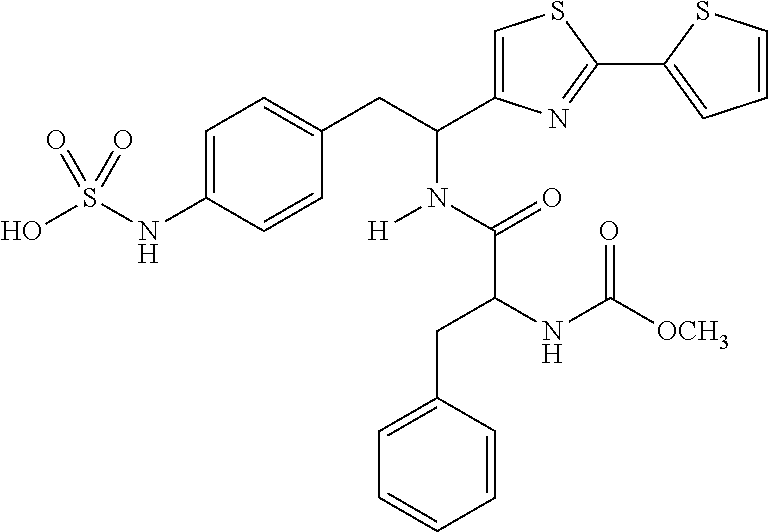
can form salts, for example, a salt of the sulfamic acid:


as a salt of a strong acid, for example:


one embodiment of which relates to inhibitors having the formula:

wherein R units are thiazol-2-yl units, that when substituted, are substituted with R2 and R3 units. R and R5a units are further described in Table 1.
| TABLE 1 | ||||
| No. | R | R5a | ||
| A1 | thiazol-2-yl | (S)-benzyl | ||
| A2 | 4-methylthiazol-2-yl | (S)-benzyl | ||
| A3 | 4-ethylthiazol -2-yl | (S)-benzyl | ||
| A4 | 4-propylthiazol-2-yl | (S)-benzyl | ||
| A5 | 4-iso-propylthiazol-2-yl | (S)-benzyl | ||
| A6 | 4-cyclopropylthiazol-2-yl | (S)-benzyl | ||
| A7 | 4-butylthiazol-2-yl | (S)-benzyl | ||
| A8 | 4-tert-butylthiazol-2-yl | (S)-benzyl | ||
| A9 | 4-cyclohexylthiazol-2-yl | (S)-benzyl | ||
| A10 | 4-(2,2,2-trifluoroethyl)thiazol-2-yl | (S)-benzyl | ||
| A11 | 4-(3,3,3-trifluoropropyl)thiazol-2-yl | (S)-benzyl | ||
| A12 | 4-(2,2-difluorocyclopropyl)thiazol-2-yl | (S)-benzyl | ||
| A13 | 4-(methoxymethyl)thiazol-2-yl | (S)-benzyl | ||
| A14 | 4-(carboxylic acid ethyl ester)thiazol-2-yl | (S)-benzyl | ||
| A15 | 4,5-dimethylthiazol-2-yl | (S)-benzyl | ||
| A16 | 4-methyl-5-ethylthiazol-2-yl | (S)-benzyl | ||
| A17 | 4-phenylthiazol-2-yl | (S)-benzyl | ||
| A18 | 4-(4-chlorophenyl)thiazol-2-yl | (S)-benzyl | ||
| A19 | 4-(3,4-dimethylphenyl)thiazol-2-yl | (S)-benzyl | ||
| A20 | 4-methyl-5-phenylthiazol-2-yl | (S)-benzyl | ||
| A21 | 4-(thiophen-2-yl)thiazol-2-yl | (S)-benzyl | ||
| A22 | 4-(thiophen-3-yl)thiazol-2-yl | (S)-benzyl | ||
| A23 | 4-(5-chlorothiophen-2-yl)thiazol-2-yl | (S)-benzyl | ||
| A24 | 5,6-dihydro-4H-cyclopenta[d]thiazol-2-yl | (S)-benzyl | ||
| A25 | 4,5,6,7-tetrahydrobenzo[d]thiazol-2-yl | (S)-benzyl | ||


wherein the index n is from about 40 to about 200. PVP's can have an average molecular weight from about 5500 to about 28,000 g/mol. One non-limiting example is PVP-10, having an average molecular weight of approximately 10,000 g/mol. Other non-limiting examples include povidone K12, povidone K25, povidone K27, povidone K29/32, povidone K30, and povidone K90. In some embodiments, the solubilizing agent can be a copolymer, such as a block copolymer comprising povidone and vinyl acetate monomers. One non-limiting example is copovidone K25-31, a copolymer of 1-vinyl-2-pyrrolidone and vinyl acetate in the mass proportion of 3:2 with an average molecular weight of 40000.
Polyakyleneoxides and Ethers Thereof.
HO[CH2CH2O]xH
where x represents the average number of ethylene oxide units in the polymer.
HO[CH(CH3)CH2O]xH
wherein the index x represents the average number of propyleneoxy units in the polymer. The index x can be represented by a whole number or a fraction. For example, a polypropylene glycol having an average molecular weight of 8,000 g/mole (PPG 8000) can be represented by the formulae:
HO[CH(CH3)CH2O]138H or HO[CH(CH3)CH2O]137.6H
or the polypropylene glycol can be represented by the common, short hand notation: PPG 8000.
HO(CH2CH2)y1(CH2CH2CH2O)y2(CH2CH2O)y3OH
which are nonionic block copolymers composed of a polypropyleneoxy unit flanked by two polyethyleneoxy units. The indices y1, y2, and y3 have values such that the poloxamer has an average molecular weight of from about 1000 g/mol to about 20,000 g/mol. Such solubilizing agents can include, for example, poloxamer 124, poloxamer 182, poloxamer 188, poloxamer 331, or poloxamer 407, including those listed in the Inactive Ingredient Guide prepared by the U.S. Food and Drug Administration.
Alcohols.
| TABLE 2 | ||
| HPTP-β | ||
| No. | Compound | IC50 μM |
| AA1 |
 |
0.000157 |
| AA2 |
 |
0.004 |
| AA3 |
 |
0.031 |
| AA4 |
 |
<5 × 10⁻⁸ |
| AA5 |
 |
<5 × 10⁻⁸ |
| AA6 |
 |
0.000162 |
| AA7 |
 |
0.006 |
| AA8 |
 |
0.001 |
| AA9 |
 |
0.0001 |
| AA10 |
 |
0.0002 |
| AA11 |
 |
0.00001 |
| AA12 |
 |
<5 × 10⁻⁸ |
| AA13 |
 |
0.001 |
| AA14 |
 |
0.0001 |
| AA15 |
 |
0.0003 |
| AA16 |
 |
0.00008 |
| AA17 |
 |
0.001 |
| AA18 |
 |
0.0002 |
| AA19 |
 |
0.0003 |
| AA20 |
 |
<5 × 10⁻⁸ |
| AA21 |
 |
<2 × 10⁻⁶ |
| AA22 |
 |
<5 × 10⁻⁸ |
| AA23 |
 |
0.00009 |
| AA24 |
 |
0.001 |
| AA25 |
 |
0.0004 |
| AA26 |
 |
<5 × 10⁻⁸ |
| AA27 |
 |
0.00014 |
| AA28 |
 |
0.0001 |
| AA29 |
 |
0.001 |
| AA30 |
 |
0.0002 |
| AA31 |
 |
0.00008 |
| AA32 |
 |
0.002 |
| AA33 |
 |
7 × 10⁻⁷ |
| AA34 (Compound 1) |
 |
5 × 10⁻⁸ |
| AA35 |
 |
<5 × 10⁻⁸ |
| AA36 |
 |
<5 × 10⁻⁸ |
| AA37 |
 |
0.0004 |
| AA38 |
 |
0.003 |
| AA39 |
 |
0.001 |
| AA40 |
 |
0.0003 |
| AA41 |
 |
0.00024 |
| AA42 |
 |
0.006 |
| AA43 |
 |
0.028 |
| AA44 |
 |
0.020 |
| AA45 |
 |
0.003 |
| AA46 |
 |
0.001 |
| AA47 |
 |
0.0003 |
| AA48 |
 |
0.0003 |
| AA49 |
 |
<5 × 10⁻⁸ |
| AA50 |
 |
0.028 |
| AA51 |
 |
0.049 |
| AA52 |
 |
0.112 |
| AA53 |
 |
0.085 |
| AA54 |
 |
0.266 |
| AA55 |
 |
0.584 |
| AA56 |
 |
0.042 |
| AA57 |
 |
0.110 |
| AA58 |
 |
0.086 |
| AA59 |
 |
0.113 |
| AA60 |
 |
0.132 |
| AA61 |
 |
0.138 |
| AA62 |
 |
0.098 |
| AA63 |
 |
0.381 |
| AA64 |
 |
0.033 |
| AA65 |
 |
0.04 |
| AA66 |
 |
0.027 |
| AA67 |
 |
0.18 |
| AA68 |
 |
0.644 |
| AA69 |
 |
0.167 |
| AA70 |
 |
0.132 |
| AA71 |
 |
0.555 |
| AA72 |
 |
0.308 |
| AA73 |
 |
0.253 |
| AA74 |
 |
0.045 |
| AA75 |
 |
0.05 |
| AA76 |
 |
0.012 |
| AA77 |
 |
0.0003 |
| AA78 |
 |
0.028 |
| AA79 |
 |
0.075 |
| AA80 |
 |
0.056 |
| AA81 |
 |
0.033 |
| AA82 |
 |
0.04 |
| AA83 |
 |
0.014 |
| AA84 |
 |
0.008 |
| AA85 |
 |
0.002 |
| AA86 |
 |
0.028 |
| AA87 |
 |
0.037 |
| AA88 |
 |
0.0002 |
| AA89 |
 |
0.003 |
| AA90 |
 |
0.01 |
| AA91 |
 |
0.006 |
| AA92 |
 |
0.002 |
| AA93 |
 |
0.002 |
| AA94 |
 |
0.042 |
| AA95 |
 |
0.003 |
| AA96 |
 |
0.046 |
| AA97 |
 |
0.0002 |
| AA98 |
 |
0.0006 |
| AA99 |
 |
0.002 |
| AA100 |
 |
9 × 10⁻⁶ |

Methods.
| TABLE 3 | ||||
| Compound 1 + | Placebo + | |||
| Compound 1 + Sham | ranibizumab | ranibizumab |
| SE | FE | SE | FE | SE | FE | |
| Baseline n | 48 | 48 | 49 | 49 | 47 | 47 |
| Baseline IOP | 15.8 (3.69) | 15.4 (3.37) | 15.9 (3.15) | 16.1 (3.18) | 15.2 (3.14) | 15.8 (6.12) |
| mean (SD) | ||||||
| Week 4 n | 45 | 45 | 48 | 48 | 44 | 44 |
| Week 4 IOP | 14.8 (3.27) | 14.5 (2.81) | 14.7 (3.05) | 14.4 (3.58) | 15.0 (3.50) | 15.5 (4.85) |
| Change from | −0.8 (3.34) | −0.8 (3.36) | −1.3 (3.04) | −1.8 (2.98) | −0.1 (2.74) | −0.3 (3.49) |
| BL | ||||||
| Change BL- | 0.125 | 0.118 | 0.004 | 0.001 | 0.870 | 0.606 |
| Week 4 (p- | ||||||
| value) | ||||||
| Week 8 n | 45 | 45 | 47 | 47 | 44 | 44 |
| Week 8 IOP | 14.4 (3.53) | 14.3 (3.22) | 14.6 (3.54) | 14.7 (3.81) | 15.0 (3.61) | 15.5 (4.52) |
| Change from | −1.1 (3.37) | −1.1 (3.58) | −1.5 (3.07) | −1.4 (3.66) | 0.0 (3.25) | −0.3 (3.44) |
| BL | ||||||
| Change BL | 0.032 | 0.052 | 0.002 | 0.013 | 0.926 | 0.572 |
| Week 8 (p- | ||||||
| value) | ||||||
| Week 12 n | 45 | 45 | 48 | 48 | 47 | 47 |
| Week 12 IOP | 14.3 (3.56) | 14.0 (3.41) | 15.1 (3.51) | 14.7 (3.39) | 15.3 (4.09) | 15.7 (5.19) |
| Change from | −1.4 (3.16) | −1.4 (3.29) | −1.0 (3.24) | −1.5 (3.49) | 0.1 (3.83) | −0.1 (3.62) |
| BL | ||||||
| Change BL- | 0.006 | 0.005 | 0.042 | 0.006 | 0.880 | 0.841 |
| Week 12 (p- | ||||||
| value) | ||||||
| BL = baseline; | ||||||
| n = number of subjects; | ||||||
| SE = study eye; | ||||||
| FE = Fellow eye; | ||||||
| SD = standard deviation | ||||||
| TABLE 4 | |||||
| | |||||
| Compound | |||||
| 1 + | All | Placebo + | |||
| 1 + | ranibizumab | Compound | 1 | ranibizumab | |
| Baseline | 15.6 (3.32) | 16.0 (2.83) | 15.8 (3.08) | 15.5 (3.82) | |
| mean IOP | |||||
| (SD) | |||||
| |
14.7 (2.88) | 14.5 (2.98) | 14.5 (2.92) | 15.2 (3.50) | |
| Change from | −0.8 (3.14) | −1.5 (3.04) | −1.2 (2.92) | −0.2 (2.61) | |
| | |||||
| Week | |||||
| 8 | 14.4 (3.26) | 14.7 (3.38) | 14.5 (3.31) | 15.3 (3.31) | |
| Change from | −1.1 (3.25) | −1.4 (3.10) | −1.3 (3.17) | 0.2 (2.86) | |
| | |||||
| Week | |||||
| 12 | 14.1 (3.36) | 14.9 (3.25) | 14.5 (3.31) | 15.5 (3.85) | |
| Change from | −1.4 (2.98) | −1.2 (2.92) | −1.3 (2.93) | 0.0 (3.32) | |
| BL | |||||
| Change from | 0.001 | <0.001 | <0.001 | 0.56 | |
| BL (p-value) | |||||
| vs. Placebo | 0.017 | 0.013 | 0.005 | ||
| (p-value) | |||||
| BL = baseline; SD = standard deviation | |||||
| TABLE 5 | |||||
| |
|
||||
| QD | BID | Placebo | |||
| Baseline | 15.9 (2.85) | 15.6 (2.60) | 15.0 (3.82) | ||
| mean IOP | |||||
| (SD) | |||||
| |
15.3 (2.75) | 14.6 (2.93) | 15.4 (2.99) | ||
| Change | −0.56 (2.83) | −0.91 (3.20) | 0.45 (3.00) | ||
| from | |||||
| Week | |||||
| 24 | 15.3 (2.90) | 14.2 (2.60) | 15.4 (2.89) | ||
| Change | −0.56 (2.99) | −1.27 (3.31) | 0.50 (2.91) | ||
| from | |||||
| Week | |||||
| 36 | 14.9 (3.58) | 14.0 (2.74) | 15.5 (2.84) | ||
| Change | −0.94 (3.39) | −1.48 (3.48) | 0.62 (3.85) | ||
| from | |||||
| Week | |||||
| 48 | 15.2 (2.84) | 14.6 (2.73) | 15.2 (2.85) | ||
| Change | −0.72 (2.80) | −0.94 (3.00) | 0.34 (2.58) | ||
| from BL | |||||
| Change | 0.041 | <0.001 | 0.50 | ||
| from BL (p- | |||||
| value) | |||||
| vs. Placebo | 0.055 | <0.001 | |||
| (p-value) | |||||
| BL = Baseline; sd = standard deviation | |||||
| TABLE 6 | ||||
| |
Placebo | | ||
| Cohort | Compound | |||
| 1 Regimen | (n) | (n) | (n) | |
| 1 | 5 mg/ |
9 | 3 | 12 |
| 2 | 15 mg/ |
9 | 3 | 12 |
| 3 | 40 mg/ |
9 | 3 | 12 |
| 4 | 40 mg/ |
9 | 3 | 12 |
| (maximum tolerated dose) | ||||

wherein:
Aryl1 is an aryl group which is substituted or unsubstituted; Aryl2 is an aryl group which is substituted or unsubstituted; X is alkylene, alkenylene, alkynylene, an ether linkage, an amine linkage, an amide linkage, an ester linkage, a thioether linkage, a carbamate linkage, a carbonate linkage, a sulfone linkage, any of which is substituted or unsubstituted, or a chemical bond; and Y is H, aryl, heteroaryl, NH(aryl), NH(heteroaryl), NHSO2Rg, or NHCORg, any of which is substituted or unsubstituted, or

wherein:
-
- L2 is alkylene, alkenylene, or alkynylene, any of which is substituted or unsubstituted, or together with the nitrogen atom to which L2 is bound forms an amide linkage, a carbamate linkage, or a sulfonamide linkage, or a chemical bond, or together with any of Ra, Rb, Rc, and Rd forms a ring that is substituted or unsubstituted;
- Ra is H, alkyl, alkenyl, alkynyl, aryl, arylalkyl, heterocyclyl, heterocyclylalkyl, heteroaryl, or heteroarylalkyl, any of which is substituted or unsubstituted, or together with any of L2, Rb, Rc, and Rd forms a ring that is substituted or unsubstituted;
- Rb is H, alkyl, alkenyl, alkynyl, aryl, arylalkyl, heterocyclyl, heterocyclylalkyl, heteroaryl, or heteroarylalkyl, any of which is substituted or unsubstituted, or together with any of L2, Ra, Rc, and Rd forms a ring that is substituted or unsubstituted;
- Rc is H or alkyl which is substituted or unsubstituted, or together with any of L2, Ra, Rb, and Rd forms a ring that is substituted or unsubstituted;
- Rd is H or alkyl which is substituted or unsubstituted, or together with any of L2, Ra, Rb, and Rc forms a ring that is substituted or unsubstituted; and
- Rg is H, alkyl, alkenyl, alkynyl, aryl, arylalkyl, heterocyclyl, heterocyclylalkyl, heteroaryl, or heteroarylalkyl, any of which is substituted or unsubstituted,
or a pharmaceutically-acceptable salt thereof.
-
- Aryl1 is substituted or unsubstituted phenyl;
- Aryl2 is substituted or unsubstituted heteroaryl; and
- X is alkylene.
-
- Aryl1 is substituted phenyl;
- Aryl1 is substituted heteroaryl; and
- X is methylene.

wherein
-
- Aryl1 is para-substituted phenyl;
- Aryl2 is substituted heteroaryl;
- X is methylene;
- L2 is alkylene, alkenylene, or alkynylene, any of which is substituted or unsubstituted, or together with the nitrogen atom to which L2 is bound forms an amide linkage, a carbamate linkage, or a sulfonamide linkage, or a chemical bond;
- Ra is H, alkyl, alkenyl, alkynyl, aryl, arylalkyl, heterocyclyl, heterocyclylalkyl, heteroaryl, or heteroarylalkyl, any of which is substituted or unsubstituted;
- Rb is H, alkyl, alkenyl, alkynyl, aryl, arylalkyl, heterocyclyl, heterocyclylalkyl, heteroaryl, or heteroarylalkyl, any of which is substituted or unsubstituted;
- Rc is H or alkyl which is substituted or unsubstituted; and
- Rd is H or alkyl which is substituted or unsubstituted.
-
- Aryl1 is para-substituted phenyl;
- Aryl2 is a substituted thiazole moiety;
- X is methylene;
- L2 together with the nitrogen atom to which L2 is bound forms a carbamate linkage;
- Ra is alkyl, which is substituted or unsubstituted;
- Rb is arylalkyl, which is substituted or unsubstituted;
- Rc is H; and
- Rd is H.

wherein:
-
- Re is H, OH, F, Cl, Br, I, CN, alkyl, alkenyl, alkynyl, an alkoxy group, an ether group, a carboxylic acid group, a carboxaldehyde group, an ester group, an amine group, an amide group, a carbonate group, a carbamate group, a thioether group, a thioester group, a thioacid group, aryl, arylalkyl, heterocyclyl, heterocyclylalkyl, heteroaryl, or heteroarylalkyl, any of which is substituted or unsubstituted; and
- Rf is H, OH, F, Cl, Br, I, CN, alkyl, alkenyl, alkynyl, an alkoxy group, an ether group, a carboxylic acid group, a carboxaldehyde group, an ester group, an amine group, an amide group, a carbonate group, a carbamate group, a thioether group, a thioester group, a thioacid group, aryl, arylalkyl, heterocyclyl, heterocyclylalkyl, heteroaryl, or heteroarylalkyl, any of which is substituted or unsubstituted.
-
- Re is H, OH, F, Cl, Br, I, alkyl, an alkoxy group, aryl, arylalkyl, heterocyclyl, heterocyclylalkyl, heteroaryl, or heteroarylalkyl, any of which is substituted or unsubstituted; and
- Rf is H, OH, F, Cl, Br, I, alkyl, an alkoxy group, aryl, arylalkyl, heterocyclyl, heterocyclylalkyl, heteroaryl, or heteroarylalkyl, any of which is substituted or unsubstituted.
-
- Re is H, OH, F, Cl, Br, I, alkyl, or an alkoxy group, any of which is substituted or unsubstituted; and
- Rf is alkyl, aryl, heterocyclyl, or heteroaryl, any of which is substituted or unsubstituted.
-
- Aryl1 is 4-phenylsulfamic acid;
- Ra is alkyl, which is substituted or unsubstituted;
- Rb is arylalkyl, which is substituted or unsubstituted;
- Re is H; and
- Rf is heteroaryl.


-
- Aryl1 is 4-phenylsulfamic acid;
- Ra is alkyl, which is substituted or unsubstituted;
- Rb is arylalkyl, which is substituted or unsubstituted;
- Re is H; and
- Rf is alkyl.


wherein:
-
- Re is H, OH, F, Cl, Br, I, CN, alkyl, alkenyl, alkynyl, an alkoxy group, an ether group, a carboxylic acid group, a carboxaldehyde group, an ester group, an amine group, an amide group, a carbonate group, a carbamate group, a thioether group, a thioester group, a thioacid group, aryl, arylalkyl, heterocyclyl, heterocyclylalkyl, heteroaryl, or heteroarylalkyl, any of which is substituted or unsubstituted; and
- Rf is H, OH, F, Cl, Br, I, CN, alkyl, alkenyl, alkynyl, an alkoxy group, an ether group, a carboxylic acid group, a carboxaldehyde group, an ester group, an amine group, an amide group, a carbonate group, a carbamate group, a thioether group, a thioester group, a thioacid group, aryl, arylalkyl, heterocyclyl, heterocyclylalkyl, heteroaryl, or heteroarylalkyl, any of which is substituted or unsubstituted.
-
- Re is H, OH, F, Cl, Br, I, alkyl, an alkoxy group, aryl, arylalkyl, heterocyclyl, heterocyclylalkyl, heteroaryl, or heteroarylalkyl, any of which is substituted or unsubstituted; and
- Rf is H, OH, F, Cl, Br, I, alkyl, an alkoxy group, aryl, arylalkyl, heterocyclyl, heterocyclylalkyl, heteroaryl, or heteroarylalkyl, any of which is substituted or unsubstituted.
-
- Re is H, OH, F, Cl, Br, I, alkyl, or an alkoxy group, any of which is substituted or unsubstituted; and
- Rf is alkyl, aryl, heterocyclyl, or heteroaryl, any of which is substituted or unsubstituted.
-
- Aryl1 is 4-phenylsulfamic acid;
- Ra is alkyl, which is substituted or unsubstituted;
- Rb is arylalkyl, which is substituted or unsubstituted;
- Re is H; and
- Rf is heteroaryl.


wherein:
Aryl1 is an aryl group which is substituted or unsubstituted; Aryl2 is an aryl group which is substituted or unsubstituted; X is alkylene, alkenylene, alkynylene, an ether linkage, an amine linkage, an amide linkage, an ester linkage, a thioether linkage, a carbamate linkage, a carbonate linkage, a sulfone linkage, any of which is substituted or unsubstituted, or a chemical bond; and Y is H, aryl, heteroaryl, NH(aryl), NH(heteroaryl), NHSO2Rg, or NHCORg, any of which is substituted or unsubstituted, or

wherein:
-
- L2 is alkylene, alkenylene, or alkynylene, any of which is substituted or unsubstituted, or together with the nitrogen atom to which L2 is bound forms an amide linkage, a carbamate linkage, or a sulfonamide linkage, or a chemical bond, or together with any of Ra, Rb, Rc, and Rd forms a ring that is substituted or unsubstituted;
- Ra is H, alkyl, alkenyl, alkynyl, aryl, arylalkyl, heterocyclyl, heterocyclylalkyl, heteroaryl, or heteroarylalkyl, any of which is substituted or unsubstituted, or together with any of L2, Rb, Rc, and Rd forms a ring that is substituted or unsubstituted;
- Rb is H, alkyl, alkenyl, alkynyl, aryl, arylalkyl, heterocyclyl, heterocyclylalkyl, heteroaryl, or heteroarylalkyl, any of which is substituted or unsubstituted, or together with any of L2, Ra, Rc, and Rd forms a ring that is substituted or unsubstituted;
- Rc is H or alkyl which is substituted or unsubstituted, or together with any of L2, Ra, Rb, and Rd forms a ring that is substituted or unsubstituted;
- Rd is H or alkyl which is substituted or unsubstituted, or together with any of L2, Ra, Rb, and Rc forms a ring that is substituted or unsubstituted; and
- Rg is H, alkyl, alkenyl, alkynyl, aryl, arylalkyl, heterocyclyl, heterocyclylalkyl, heteroaryl, or heteroarylalkyl, any of which is substituted or unsubstituted, or a pharmaceutically-acceptable salt thereof.
-
- Aryl1 is substituted or unsubstituted phenyl;
- Aryl2 is substituted or unsubstituted heteroaryl; and
- X is alkylene.
-
- Aryl1 is substituted phenyl;
- Aryl2 is substituted heteroaryl; and
- X is methylene.

wherein
-
- Aryl1 is para-substituted phenyl;
- Aryl2 is substituted heteroaryl;
- X is methylene;
- L2 is alkylene, alkenylene, or alkynylene, any of which is substituted or unsubstituted, or together with the nitrogen atom to which L2 is bound forms an amide linkage, a carbamate linkage, or a sulfonamide linkage, or a chemical bond;
- Ra is H, alkyl, alkenyl, alkynyl, aryl, arylalkyl, heterocyclyl, heterocyclylalkyl, heteroaryl, or heteroarylalkyl, any of which is substituted or unsubstituted;
- Rb is H, alkyl, alkenyl, alkynyl, aryl, arylalkyl, heterocyclyl, heterocyclylalkyl, heteroaryl, or heteroarylalkyl, any of which is substituted or unsubstituted;
- Rc is H or alkyl which is substituted or unsubstituted; and
- Rd is H or alkyl which is substituted or unsubstituted.
-
- Aryl1 is para-substituted phenyl;
- Aryl2 is a substituted thiazole moiety;
- X is methylene;
- L2 together with the nitrogen atom to which L2 is bound forms a carbamate linkage;
- Ra is alkyl, which is substituted or unsubstituted;
- Rb is arylalkyl, which is substituted or unsubstituted;
- Rc is H; and
- Rd is H.

wherein:
-
- Re is H, OH, F, Cl, Br, I, CN, alkyl, alkenyl, alkynyl, an alkoxy group, an ether group, a carboxylic acid group, a carboxaldehyde group, an ester group, an amine group, an amide group, a carbonate group, a carbamate group, a thioether group, a thioester group, a thioacid group, aryl, arylalkyl, heterocyclyl, heterocyclylalkyl, heteroaryl, or heteroarylalkyl, any of which is substituted or unsubstituted; and
- Rf is H, OH, F, Cl, Br, I, CN, alkyl, alkenyl, alkynyl, an alkoxy group, an ether group, a carboxylic acid group, a carboxaldehyde group, an ester group, an amine group, an amide group, a carbonate group, a carbamate group, a thioether group, a thioester group, a thioacid group, aryl, arylalkyl, heterocyclyl, heterocyclylalkyl, heteroaryl, or heteroarylalkyl, any of which is substituted or unsubstituted.
-
- Re is H, OH, F, Cl, Br, I, alkyl, an alkoxy group, aryl, arylalkyl, heterocyclyl, heterocyclylalkyl, heteroaryl, or heteroarylalkyl, any of which is substituted or unsubstituted; and
- Rf is H, OH, F, Cl, Br, I, alkyl, an alkoxy group, aryl, arylalkyl, heterocyclyl, heterocyclylalkyl, heteroaryl, or heteroarylalkyl, any of which is substituted or unsubstituted.
-
- Re is H, OH, F, Cl, Br, I, alkyl, or an alkoxy group, any of which is substituted or unsubstituted; and
- Rf is alkyl, aryl, heterocyclyl, or heteroaryl, any of which is substituted or unsubstituted.
-
- Aryl1 is 4-phenylsulfamic acid;
- Ra is alkyl, which is substituted or unsubstituted;
- Rb is arylalkyl, which is substituted or unsubstituted;
- Re is H; and
- Rf is heteroaryl.


-
- Aryl1 is 4-phenylsulfamic acid;
- Ra is alkyl, which is substituted or unsubstituted;
- Rb is arylalkyl, which is substituted or unsubstituted;
- Re is H; and
- Rf is alkyl.


wherein:
-
- Re is H, OH, F, Cl, Br, I, CN, alkyl, alkenyl, alkynyl, an alkoxy group, an ether group, a carboxylic acid group, a carboxaldehyde group, an ester group, an amine group, an amide group, a carbonate group, a carbamate group, a thioether group, a thioester group, a thioacid group, aryl, arylalkyl, heterocyclyl, heterocyclylalkyl, heteroaryl, or heteroarylalkyl, any of which is substituted or unsubstituted; and
- Rf is H, OH, F, Cl, Br, I, CN, alkyl, alkenyl, alkynyl, an alkoxy group, an ether group, a carboxylic acid group, a carboxaldehyde group, an ester group, an amine group, an amide group, a carbonate group, a carbamate group, a thioether group, a thioester group, a thioacid group, aryl, arylalkyl, heterocyclyl, heterocyclylalkyl, heteroaryl, or heteroarylalkyl, any of which is substituted or unsubstituted.
-
- Re is H, OH, F, Cl, Br, I, alkyl, an alkoxy group, aryl, arylalkyl, heterocyclyl, heterocyclylalkyl, heteroaryl, or heteroarylalkyl, any of which is substituted or unsubstituted; and
- Rf is H, OH, F, Cl, Br, I, alkyl, an alkoxy group, aryl, arylalkyl, heterocyclyl, heterocyclylalkyl, heteroaryl, or heteroarylalkyl, any of which is substituted or unsubstituted.
-
- Re is H, OH, F, Cl, Br, I, alkyl, or an alkoxy group, any of which is substituted or unsubstituted; and
- Rf is alkyl, aryl, heterocyclyl, or heteroaryl, any of which is substituted or unsubstituted.
-
- Aryl1 is 4-phenylsulfamic acid;
- Ra is alkyl, which is substituted or unsubstituted;
- Rb is arylalkyl, which is substituted or unsubstituted;
- Re is H; and
- Rf is heteroaryl.


Claims (39)


Priority Applications (3)
| Application Number | Priority Date | Filing Date | Title |
|---|---|---|---|
| US16/860,347 US11253502B2 (en) | 2019-04-29 | 2020-04-28 | Tie-2 activators targeting the Schlemm's canal |
| US17/569,838 US12064420B2 (en) | 2019-04-29 | 2022-01-06 | Tie-2 activators targeting the Schlemm's canal |
| US18/766,271 US20250082613A1 (en) | 2019-04-29 | 2024-07-08 | Tie-2 activators targeting the schlemm's canal |
Applications Claiming Priority (2)
| Application Number | Priority Date | Filing Date | Title |
|---|---|---|---|
| US201962840068P | 2019-04-29 | 2019-04-29 | |
| US16/860,347 US11253502B2 (en) | 2019-04-29 | 2020-04-28 | Tie-2 activators targeting the Schlemm's canal |
Related Child Applications (1)
| Application Number | Title | Priority Date | Filing Date |
|---|---|---|---|
| US17/569,838 Continuation US12064420B2 (en) | 2019-04-29 | 2022-01-06 | Tie-2 activators targeting the Schlemm's canal |
Publications (2)
| Publication Number | Publication Date |
|---|---|
| US20200338048A1 US20200338048A1 (en) | 2020-10-29 |
| US11253502B2 true US11253502B2 (en) | 2022-02-22 |
Family
ID=72921115
Family Applications (3)
| Application Number | Title | Priority Date | Filing Date |
|---|---|---|---|
| US16/860,347 Active US11253502B2 (en) | 2019-04-29 | 2020-04-28 | Tie-2 activators targeting the Schlemm's canal |
| US17/569,838 Active 2040-12-07 US12064420B2 (en) | 2019-04-29 | 2022-01-06 | Tie-2 activators targeting the Schlemm's canal |
| US18/766,271 Pending US20250082613A1 (en) | 2019-04-29 | 2024-07-08 | Tie-2 activators targeting the schlemm's canal |
Family Applications After (2)
| Application Number | Title | Priority Date | Filing Date |
|---|---|---|---|
| US17/569,838 Active 2040-12-07 US12064420B2 (en) | 2019-04-29 | 2022-01-06 | Tie-2 activators targeting the Schlemm's canal |
| US18/766,271 Pending US20250082613A1 (en) | 2019-04-29 | 2024-07-08 | Tie-2 activators targeting the schlemm's canal |
Country Status (7)
| Country | Link |
|---|---|
| US (3) | US11253502B2 (en) |
| EP (1) | EP3962482A4 (en) |
| JP (1) | JP7564824B2 (en) |
| CN (1) | CN114269341A (en) |
| AU (1) | AU2020264969B2 (en) |
| CA (1) | CA3138682A1 (en) |
| WO (1) | WO2020223209A1 (en) |
Cited By (1)
| Publication number | Priority date | Publication date | Assignee | Title |
|---|---|---|---|---|
| US20210386713A1 (en) * | 2015-09-23 | 2021-12-16 | Aerpio Pharmaceuticals, Inc. | Methods of treating intraocular pressure with activators of tie-2 |
Citations (70)
| Publication number | Priority date | Publication date | Assignee | Title |
|---|---|---|---|---|
| WO1998018914A1 (en) | 1996-10-31 | 1998-05-07 | Duke University | Soluble tie2 receptor |
| US5919813A (en) | 1998-03-13 | 1999-07-06 | Johns Hopkins University, School Of Medicine | Use of a protein tyrosine kinase pathway inhibitor in the treatment of diabetic retinopathy |
| US5980929A (en) | 1998-03-13 | 1999-11-09 | Johns Hopkins University, School Of Medicine | Use of a protein tyrosine kinase pathway inhibitor in the treatment of retinal ischmemia or ocular inflammation |
| WO2000057901A1 (en) | 1999-03-26 | 2000-10-05 | Regeneron Pharmaceuticals, Inc. | Modulation of vascular permeability by means of tie2 receptor activators |
| WO2000065085A1 (en) | 1999-04-23 | 2000-11-02 | MAX-PLANCK-Gesellschaft zur Förderung der Wissenschaften e.V. | Interaction of vascular-endothelial protein-tyrosine phosphatase with the angiopoietin receptor tie-2 |
| US6455035B1 (en) | 1999-03-26 | 2002-09-24 | Regeneron Pharmaceuticals, Inc. | Angiopoietins and methods of use thereof |
| US20030040463A1 (en) | 1996-04-05 | 2003-02-27 | Wiegand Stanley J. | TIE-2 ligands, methods of making and uses thereof |
| WO2003084565A2 (en) | 2002-04-08 | 2003-10-16 | MAX-PLANCK-Gesellschaft zur Förderung der Wissenschaften e.V. | Ve-ptp as regulator of ve-cadherin mediated processes or disorders |
| US20040077065A1 (en) | 2002-09-25 | 2004-04-22 | The Procter & Gamble Company | Three dimensional coordinates of HPTPbeta |
| US7052695B2 (en) | 2001-10-25 | 2006-05-30 | Regeneron Pharmaceuticals, Inc. | Angiopoietins and methods of treating hypertension |
| WO2007033216A2 (en) | 2005-09-12 | 2007-03-22 | Beth Israel Deaconess Medical Center | Methods and compositions for the treatment and diagnosis of diseases characterized by vascular leak, hypotension, or a procoagulant state |
| US7226755B1 (en) | 2002-09-25 | 2007-06-05 | The Procter & Gamble Company | HPTPbeta as a target in treatment of angiogenesis mediated disorders |
| WO2007116360A2 (en) | 2006-04-07 | 2007-10-18 | The Procter & Gamble Company | Antibodies that bind human protein tyrosine phosphatase beta (hptpbeta) and uses thereof |
| WO2008002569A2 (en) | 2006-06-27 | 2008-01-03 | The Procter & Gamble Company | Human protein tyrosine phosphatase inhibitors and methods of use |
| US7354579B2 (en) | 2003-07-25 | 2008-04-08 | Regeneron Pharmaceuticals, Inc. | Method of treating cancer with a VEGF antagonist and an anti-proliferative agent |
| WO2008002570B1 (en) | 2006-06-27 | 2008-04-17 | Procter & Gamble | Human protein tyrosine phosphatase inhibitors and methods of use |
| WO2008002571B1 (en) | 2006-06-27 | 2008-04-17 | Procter & Gamble | Human protein tyrosine phosphatase inhibitors and methods of use |
| US20080268051A1 (en) | 2007-04-30 | 2008-10-30 | Allergan, Inc. | High viscosity macromolecular compositions for treating ocular conditions |
| US7740846B2 (en) | 2004-07-20 | 2010-06-22 | Genentech, Inc. | Inhibitors of angiopoietin-like 4 protein, combinations, and their use |
| WO2010081172A1 (en) | 2009-01-12 | 2010-07-15 | Akebia Therapeutics Inc. | Methods for treating vascular leak syndrome |
| WO2010097800A1 (en) | 2009-02-26 | 2010-09-02 | Muhammad Abdulrazik | Synergistic combination of bioactive compounds for lowering of intraocular pressure |
| US20100226992A1 (en) | 2009-03-03 | 2010-09-09 | Alcon Research, Ltd. | Pharmaceutical Composition for Delivery of Receptor Tyrosine Kinase Inhibiting (RTKi) Compounds to the Eye |
| WO2011005330A1 (en) | 2009-07-06 | 2011-01-13 | Akebia Therapeutics Inc. | Compounds, compositions, and methods for preventing metastasis of cancer cells |
| WO2012047966A2 (en) | 2010-10-07 | 2012-04-12 | Akebia Therapeutics Inc. | Compositions and methods for treating ocular edema, neovascularization and related diseases |
| EP2142189B1 (en) | 2007-04-02 | 2013-02-27 | Allergan, Inc. | Methods and compositions for intraocular administration to treat ocular conditions |
| WO2013056240A1 (en) | 2011-10-13 | 2013-04-18 | Aerpio Therapeutics, Inc. | Methods for treating vascular leak syndrome and cancer |
| WO2013056233A1 (en) | 2011-10-13 | 2013-04-18 | Aerpio Therapeutics, Inc. | Treatment of ocular disease |
| US20130137741A1 (en) | 2009-03-03 | 2013-05-30 | Alcon Research, Ltd. | Pharmaceutical Composition for Delivery of Receptor Tyrosine Kinase Inhibiting (RTKi) Compounds to the Eye |
| US20130190324A1 (en) | 2011-12-23 | 2013-07-25 | The Regents Of The University Of Colorado, A Body Corporate | Topical ocular drug delivery |
| US8524234B2 (en) | 2011-11-03 | 2013-09-03 | Tolera Therapeutics, Inc | Antibody for selective inhibition of T-cell responses |
| WO2014145068A1 (en) | 2013-03-15 | 2014-09-18 | Aerpio Therapeutics Inc. | Compositions, formulations and methods for treating ocular diseases |
| US8846685B2 (en) | 2006-06-27 | 2014-09-30 | Aerpio Therapeutics Inc. | Human protein tyrosine phosphatase inhibitors and methods of use |
| US8883832B2 (en) | 2009-07-06 | 2014-11-11 | Aerpio Therapeutics Inc. | Compounds, compositions, and methods for preventing metastasis of cancer cells |
| US20150030603A1 (en) | 2013-07-29 | 2015-01-29 | Samsung Electronics Co., Ltd. | Anti-ang2 antibody |
| US8968766B2 (en) | 2004-04-30 | 2015-03-03 | Allergan, Inc. | Sustained release intraocular implants containing tyrosine kinase inhibitors and related methods |
| US20150065781A1 (en) | 2013-08-30 | 2015-03-05 | Genentech, Inc. | Combination therapy for the treatment of glioblastoma |
| US20150071941A1 (en) | 2012-04-13 | 2015-03-12 | The Johns Hopkins University | Treatment of ischemic retinopathies |
| US8999953B2 (en) | 2005-07-22 | 2015-04-07 | Oculis Ehf | Cyclodextrin nanotechnology for ophthalmic drug delivery |
| US20150125455A1 (en) | 2004-12-21 | 2015-05-07 | Medimmune Limited | Antibodies directed to angiopoietin-2 and uses thereof |
| US20150125542A1 (en) | 2010-12-02 | 2015-05-07 | Maruzen Pharmaceuticals Co., Ltd. | TIE2 Activator, Vascular Endothelial Growth Factor (VEGF) Inhibitor, Angiogenesis Inhibitor, Vascular Maturing Agent, Vascular Normalizing Agent and Vascular Stabilizing Agent, and Pharmaceutical Composition |
| US20150175676A1 (en) | 2004-01-16 | 2015-06-25 | Regeneron Pharmaceuticals, Inc. | Fusion Polypeptides Capable Of Activating Receptors |
| US9096555B2 (en) | 2009-01-12 | 2015-08-04 | Aerpio Therapeutics, Inc. | Methods for treating vascular leak syndrome |
| US20150259335A1 (en) | 2014-03-14 | 2015-09-17 | Aerpio Therapeutics, Inc. | Hptp-beta inhibitors |
| US20150258120A1 (en) | 2012-11-08 | 2015-09-17 | Clearside Biomedical, Inc. | Methods and devices for the treatment of ocular diseases in human subjects |
| WO2015152416A1 (en) | 2014-04-04 | 2015-10-08 | 国立大学法人東北大学 | Ocular hypotensive agent |
| US20150290235A1 (en) | 2012-11-23 | 2015-10-15 | Ab Science | Use of small molecule inhibitors/activators in combination with (deoxy)nucleoside or (deoxy)nucleotide analogs for treatment of cancer and hematological malignancies or viral infections |
| US20150297740A1 (en) | 2012-10-11 | 2015-10-22 | Ascendis Pharma Ophthalmology Division A/S | VEGF Neutralizing Prodrugs for the Treatment of Ocular Conditions |
| US20160000871A1 (en) | 2014-07-03 | 2016-01-07 | Mannin Research Inc. | Tie2 receptor activation for glaucoma |
| US20160015810A1 (en) | 2006-01-19 | 2016-01-21 | Potentia Pharmaceuticals, Inc. | Injectable combination therapy for eye disorders |
| US20160030393A1 (en) | 2004-03-15 | 2016-02-04 | Jannsen Pharmaceutica Nv | Novel compounds as opioid receptor modulators |
| WO2016022813A1 (en) | 2014-08-07 | 2016-02-11 | Aerpio Therapeutics, Inc. | Combination of immunotherapies with activators of tie-2 |
| US20160045566A1 (en) | 2013-11-01 | 2016-02-18 | Regeneron Pharmaceuticals, Inc. | Angiopoietin-based interventions for treating cerebral malaria |
| US20160058828A1 (en) | 2013-04-11 | 2016-03-03 | Sunnybrook Research Institute | Methods, uses and compositions of tie2 agonists |
| WO2016049183A1 (en) | 2014-09-24 | 2016-03-31 | Aerpio Therapeutics, Inc. | Ve-ptp extracellular domain antibodies delivered by a gene therapy vector |
| US20160130321A1 (en) | 2013-06-20 | 2016-05-12 | Gabriela Burian | Use of a vegf antagonist in treating macular edema |
| US20160130337A1 (en) | 2014-11-07 | 2016-05-12 | Novartis Ag | Methods for treating ocular diseases |
| US20160137717A1 (en) | 2013-06-20 | 2016-05-19 | Gabriela Burian | Use of a vegf antagonist in treating choroidal neovascularisation |
| US20160144025A1 (en) | 2014-11-25 | 2016-05-26 | Regeneron Pharmaceuticals, Inc. | Methods and formulations for treating vascular eye diseases |
| US20160151410A1 (en) | 2013-07-02 | 2016-06-02 | The Trustees Of Columbia University In The City Of New York | Clearance of bioactive lipids from membrane structures by cyclodextrins |
| US20160151448A1 (en) | 2006-10-27 | 2016-06-02 | Sunnybrook Health Sciences Centre | Multimeric tie 2 agonists and uses thereof in stimulating angiogenesis |
| US20160159893A1 (en) | 2013-07-11 | 2016-06-09 | Gabriela Burian | Use of a VEGF Antagonist in Treating Retinopathy of Prematurity |
| US20160168240A1 (en) | 2013-07-11 | 2016-06-16 | Sergey AKSENOV | Use of vegf antagonist in treating chorioretinal neovascular and permeability disorders in paediatric patients |
| US9403789B2 (en) | 2008-02-21 | 2016-08-02 | Sequoia Pharmaceuticals, Inc. | Benzofuran-containing amino acid inhibitors of cytochrome P450 |
| US20160251421A1 (en) | 2005-12-15 | 2016-09-01 | Medimmune Limited | Combination of angiopoietin-2 antagonist and of vegf-a, kdr and/or flt1 antagonist for treating cancer |
| US20170079959A1 (en) | 2015-09-23 | 2017-03-23 | Aerpio Therapeutics, Inc. | Methods of treating intraocular pressure with activators of tie-2 |
| US20170145416A1 (en) | 2006-03-08 | 2017-05-25 | Archemix Llc | Complement Binding Aptamers and Anti-C5 Agents Useful in the Treatment of Ocular Disorders |
| US20170260265A1 (en) | 2012-07-13 | 2017-09-14 | Roche Glycart Ag | Bispecific anti-vegf/anti-ang-2 antibodies and their use in the treatment of ocular vascular diseases |
| WO2018124582A1 (en) | 2016-12-26 | 2018-07-05 | 기초과학연구원 | Composition for preventing and treating eye diseases including anti-ang2 antibody |
| US10220048B2 (en) | 2013-03-15 | 2019-03-05 | Aerpio Therapeutics, Inc. | Compositions and methods for treating ocular diseases |
| US20190262321A1 (en) | 2018-02-26 | 2019-08-29 | Aerpio Therapeutics, Inc. | Methods of treating diabetic nephropathy using hptpb inhibitors |
Family Cites Families (5)
| Publication number | Priority date | Publication date | Assignee | Title |
|---|---|---|---|---|
| US953924A (en) | 1909-06-28 | 1910-04-05 | Dow Wire & Iron Works | Sliding door. |
| US20130023542A1 (en) * | 2006-06-27 | 2013-01-24 | Aerpio Therapeutics Inc. | Human protein tyrosine phosphatase inhibitors and methods of use |
| US9269499B2 (en) | 2013-08-22 | 2016-02-23 | Avx Corporation | Thin wire/thick wire lead assembly for electrolytic capacitor |
| WO2015152415A1 (en) | 2014-04-04 | 2015-10-08 | 株式会社ダイゾー | Discharge container |
| JP2023510747A (en) | 2020-01-08 | 2023-03-15 | アイポイント ファーマシューティカルズ, インコーポレイテッド | Combinations of TIE-2 activators and prostaglandins and their uses |
-
2020
- 2020-04-28 EP EP20799257.9A patent/EP3962482A4/en active Pending
- 2020-04-28 WO PCT/US2020/030224 patent/WO2020223209A1/en not_active Ceased
- 2020-04-28 AU AU2020264969A patent/AU2020264969B2/en active Active
- 2020-04-28 JP JP2021564557A patent/JP7564824B2/en active Active
- 2020-04-28 CA CA3138682A patent/CA3138682A1/en active Pending
- 2020-04-28 US US16/860,347 patent/US11253502B2/en active Active
- 2020-04-28 CN CN202080048046.4A patent/CN114269341A/en active Pending
-
2022
- 2022-01-06 US US17/569,838 patent/US12064420B2/en active Active
-
2024
- 2024-07-08 US US18/766,271 patent/US20250082613A1/en active Pending
Patent Citations (110)
| Publication number | Priority date | Publication date | Assignee | Title |
|---|---|---|---|---|
| US7309483B2 (en) | 1996-04-05 | 2007-12-18 | Regeneron Pharmaceuticals, Inc. | Method of treatment using Tie2 ligand2 |
| US20030040463A1 (en) | 1996-04-05 | 2003-02-27 | Wiegand Stanley J. | TIE-2 ligands, methods of making and uses thereof |
| WO1998018914A1 (en) | 1996-10-31 | 1998-05-07 | Duke University | Soluble tie2 receptor |
| US5919813A (en) | 1998-03-13 | 1999-07-06 | Johns Hopkins University, School Of Medicine | Use of a protein tyrosine kinase pathway inhibitor in the treatment of diabetic retinopathy |
| US5980929A (en) | 1998-03-13 | 1999-11-09 | Johns Hopkins University, School Of Medicine | Use of a protein tyrosine kinase pathway inhibitor in the treatment of retinal ischmemia or ocular inflammation |
| US5919813C1 (en) | 1998-03-13 | 2002-01-29 | Univ Johns Hopkins Med | Use of a protein tyrosine kinase pathway inhibitor in the treatment of diabetic retinopathy |
| WO2000057901A1 (en) | 1999-03-26 | 2000-10-05 | Regeneron Pharmaceuticals, Inc. | Modulation of vascular permeability by means of tie2 receptor activators |
| US6455035B1 (en) | 1999-03-26 | 2002-09-24 | Regeneron Pharmaceuticals, Inc. | Angiopoietins and methods of use thereof |
| EP1165115B1 (en) | 1999-03-26 | 2003-05-28 | Regeneron Pharmaceuticals, Inc. | Modulation of vascular permeability by mean of tie2 receptor activators |
| WO2000065085A1 (en) | 1999-04-23 | 2000-11-02 | MAX-PLANCK-Gesellschaft zur Förderung der Wissenschaften e.V. | Interaction of vascular-endothelial protein-tyrosine phosphatase with the angiopoietin receptor tie-2 |
| US7052695B2 (en) | 2001-10-25 | 2006-05-30 | Regeneron Pharmaceuticals, Inc. | Angiopoietins and methods of treating hypertension |
| WO2003084565A2 (en) | 2002-04-08 | 2003-10-16 | MAX-PLANCK-Gesellschaft zur Förderung der Wissenschaften e.V. | Ve-ptp as regulator of ve-cadherin mediated processes or disorders |
| US7632862B2 (en) | 2002-09-25 | 2009-12-15 | Procter & Gamble Company | Pharmaceutical compositions that modulate HPTPbeta activity |
| US7507568B2 (en) | 2002-09-25 | 2009-03-24 | The Proctor & Gamble Company | Three dimensional coordinates of HPTPbeta |
| US20040077065A1 (en) | 2002-09-25 | 2004-04-22 | The Procter & Gamble Company | Three dimensional coordinates of HPTPbeta |
| US7769575B2 (en) | 2002-09-25 | 2010-08-03 | Warner Chilcott, LLC | Three dimensional coordinates of HPTPbeta |
| US20100030487A1 (en) | 2002-09-25 | 2010-02-04 | Artem Gennady Evdokimov | THREE DIMENSIONAL COORDINATES OF HPTPbeta |
| US7226755B1 (en) | 2002-09-25 | 2007-06-05 | The Procter & Gamble Company | HPTPbeta as a target in treatment of angiogenesis mediated disorders |
| US7354579B2 (en) | 2003-07-25 | 2008-04-08 | Regeneron Pharmaceuticals, Inc. | Method of treating cancer with a VEGF antagonist and an anti-proliferative agent |
| US20150175676A1 (en) | 2004-01-16 | 2015-06-25 | Regeneron Pharmaceuticals, Inc. | Fusion Polypeptides Capable Of Activating Receptors |
| US20160030393A1 (en) | 2004-03-15 | 2016-02-04 | Jannsen Pharmaceutica Nv | Novel compounds as opioid receptor modulators |
| US8968766B2 (en) | 2004-04-30 | 2015-03-03 | Allergan, Inc. | Sustained release intraocular implants containing tyrosine kinase inhibitors and related methods |
| US7740846B2 (en) | 2004-07-20 | 2010-06-22 | Genentech, Inc. | Inhibitors of angiopoietin-like 4 protein, combinations, and their use |
| US20150125455A1 (en) | 2004-12-21 | 2015-05-07 | Medimmune Limited | Antibodies directed to angiopoietin-2 and uses thereof |
| US8999953B2 (en) | 2005-07-22 | 2015-04-07 | Oculis Ehf | Cyclodextrin nanotechnology for ophthalmic drug delivery |
| WO2007033216A2 (en) | 2005-09-12 | 2007-03-22 | Beth Israel Deaconess Medical Center | Methods and compositions for the treatment and diagnosis of diseases characterized by vascular leak, hypotension, or a procoagulant state |
| US20160251421A1 (en) | 2005-12-15 | 2016-09-01 | Medimmune Limited | Combination of angiopoietin-2 antagonist and of vegf-a, kdr and/or flt1 antagonist for treating cancer |
| EP3168234A1 (en) | 2005-12-15 | 2017-05-17 | Medimmune Limited | Combination of angiopoietin-2 antagonist and of vegf-a, kdr and/or fltl antagonist for treating cancer |
| US20160015810A1 (en) | 2006-01-19 | 2016-01-21 | Potentia Pharmaceuticals, Inc. | Injectable combination therapy for eye disorders |
| US20170145416A1 (en) | 2006-03-08 | 2017-05-25 | Archemix Llc | Complement Binding Aptamers and Anti-C5 Agents Useful in the Treatment of Ocular Disorders |
| US8524235B2 (en) | 2006-04-07 | 2013-09-03 | Aeripo Therapeutics Inc. | Method for treating coronary artery disease using antibody binding human protein tyrosine phosphatase beta(HPTPbeta) |
| US9926367B2 (en) | 2006-04-07 | 2018-03-27 | Aerpio Therapeutics, Inc. | Antibodies that bind human protein tyrosine phosphatase beta (HPTPbeta) and uses thereof |
| WO2007116360A2 (en) | 2006-04-07 | 2007-10-18 | The Procter & Gamble Company | Antibodies that bind human protein tyrosine phosphatase beta (hptpbeta) and uses thereof |
| US7973142B2 (en) | 2006-04-07 | 2011-07-05 | Warner Chilcott Company | Antibodies that bind human protein tyrosine phosphatase beta (HPTPβ) |
| US8946232B2 (en) | 2006-06-27 | 2015-02-03 | Aerpio Therapeutics, Inc. | Human protein tyrosine phosphatase inhibitors and methods of use |
| WO2008002570B1 (en) | 2006-06-27 | 2008-04-17 | Procter & Gamble | Human protein tyrosine phosphatase inhibitors and methods of use |
| US8188125B2 (en) | 2006-06-27 | 2012-05-29 | Aerpio Therapeutics Inc. | Human protein tyrosine phosphatase inhibitors and methods of use |
| US8258311B2 (en) | 2006-06-27 | 2012-09-04 | Aerpio Therapeutics Inc. | Human protein tyrosine phosphatase inhibitors and methods of use |
| US8329916B2 (en) | 2006-06-27 | 2012-12-11 | Aerpio Therapeutics Inc. | Human protein tyrosine phosphatase inhibitors and method of use |
| US8338615B2 (en) | 2006-06-27 | 2012-12-25 | Aerpio Therapeutics Inc. | Human protein tyrosine phosphatase inhibitors and methods of use |
| US9126958B2 (en) | 2006-06-27 | 2015-09-08 | Aerpio Therapeutics, Inc. | Human protein tyrosine phosphatase inhibitors and methods of use |
| US10463650B2 (en) | 2006-06-27 | 2019-11-05 | Aerpio Pharmaceuticals, Inc. | Human protein tyrosine phosphatase inhibitors and methods of use |
| WO2008002569A2 (en) | 2006-06-27 | 2008-01-03 | The Procter & Gamble Company | Human protein tyrosine phosphatase inhibitors and methods of use |
| US7622593B2 (en) | 2006-06-27 | 2009-11-24 | The Procter & Gamble Company | Human protein tyrosine phosphatase inhibitors and methods of use |
| USRE46592E1 (en) | 2006-06-27 | 2017-10-31 | Aerpio Therapeutics, Inc. | Human protein tyrosine phosphatase inhibitors and methods of use |
| US9795594B2 (en) | 2006-06-27 | 2017-10-24 | Aerpio Therapeutics, Inc. | Human protein tyrosine phosphatase inhibitors and methods of use |
| US8106078B2 (en) | 2006-06-27 | 2012-01-31 | Warner Chilcott Company, Llc | Human protein tyrosine phosphatase inhibitors and methods of use |
| US7589212B2 (en) | 2006-06-27 | 2009-09-15 | Procter & Gamble Company | Human protein tyrosine phosphatase inhibitors and methods of use |
| WO2008002571B1 (en) | 2006-06-27 | 2008-04-17 | Procter & Gamble | Human protein tyrosine phosphatase inhibitors and methods of use |
| US8846685B2 (en) | 2006-06-27 | 2014-09-30 | Aerpio Therapeutics Inc. | Human protein tyrosine phosphatase inhibitors and methods of use |
| US9284285B2 (en) | 2006-06-27 | 2016-03-15 | Aerpio Therapeutics, Inc. | Human protein tyrosine phosphatase inhibitors and methods of use |
| US8895563B2 (en) | 2006-06-27 | 2014-11-25 | Aerpio Therapeutics, Inc. | Human protein tyrosine phosphatase inhibitors and methods of use |
| US7795444B2 (en) | 2006-06-27 | 2010-09-14 | Warner Chilcott Company | Human protein tyrosine phosphatase inhibitors and methods of use |
| US20160151448A1 (en) | 2006-10-27 | 2016-06-02 | Sunnybrook Health Sciences Centre | Multimeric tie 2 agonists and uses thereof in stimulating angiogenesis |
| EP2142189B1 (en) | 2007-04-02 | 2013-02-27 | Allergan, Inc. | Methods and compositions for intraocular administration to treat ocular conditions |
| US20080268051A1 (en) | 2007-04-30 | 2008-10-30 | Allergan, Inc. | High viscosity macromolecular compositions for treating ocular conditions |
| US9403789B2 (en) | 2008-02-21 | 2016-08-02 | Sequoia Pharmaceuticals, Inc. | Benzofuran-containing amino acid inhibitors of cytochrome P450 |
| US9096555B2 (en) | 2009-01-12 | 2015-08-04 | Aerpio Therapeutics, Inc. | Methods for treating vascular leak syndrome |
| WO2010081172A1 (en) | 2009-01-12 | 2010-07-15 | Akebia Therapeutics Inc. | Methods for treating vascular leak syndrome |
| WO2010097800A1 (en) | 2009-02-26 | 2010-09-02 | Muhammad Abdulrazik | Synergistic combination of bioactive compounds for lowering of intraocular pressure |
| US20100226992A1 (en) | 2009-03-03 | 2010-09-09 | Alcon Research, Ltd. | Pharmaceutical Composition for Delivery of Receptor Tyrosine Kinase Inhibiting (RTKi) Compounds to the Eye |
| US20130137741A1 (en) | 2009-03-03 | 2013-05-30 | Alcon Research, Ltd. | Pharmaceutical Composition for Delivery of Receptor Tyrosine Kinase Inhibiting (RTKi) Compounds to the Eye |
| US9174950B2 (en) | 2009-07-06 | 2015-11-03 | Aerpio Therapeutics, Inc. | Compounds, compositions, and methods for preventing metastasis of cancer cells |
| US8883832B2 (en) | 2009-07-06 | 2014-11-11 | Aerpio Therapeutics Inc. | Compounds, compositions, and methods for preventing metastasis of cancer cells |
| US9949956B2 (en) | 2009-07-06 | 2018-04-24 | Aerpio Therapeutics, Inc. | Compounds, compositions, and methods for preventing metastasis of cancer cells |
| WO2011005330A1 (en) | 2009-07-06 | 2011-01-13 | Akebia Therapeutics Inc. | Compounds, compositions, and methods for preventing metastasis of cancer cells |
| US8569348B2 (en) | 2009-07-06 | 2013-10-29 | Aerpio Therapeutics Inc. | Compounds, compositions, and methods for preventing metastasis of cancer cells |
| WO2012047966A2 (en) | 2010-10-07 | 2012-04-12 | Akebia Therapeutics Inc. | Compositions and methods for treating ocular edema, neovascularization and related diseases |
| US20150125542A1 (en) | 2010-12-02 | 2015-05-07 | Maruzen Pharmaceuticals Co., Ltd. | TIE2 Activator, Vascular Endothelial Growth Factor (VEGF) Inhibitor, Angiogenesis Inhibitor, Vascular Maturing Agent, Vascular Normalizing Agent and Vascular Stabilizing Agent, and Pharmaceutical Composition |
| US10329357B2 (en) | 2011-10-13 | 2019-06-25 | Aerpio Therapeutics, Inc. | Treatment of ocular disease |
| US10150811B2 (en) | 2011-10-13 | 2018-12-11 | Aerpio Therapeutics, Inc. | Methods for treating vascular leak syndrome and cancer |
| US8999325B2 (en) | 2011-10-13 | 2015-04-07 | Aerpio Therapeutics, Inc | Treatment of ocular disease |
| WO2013056240A1 (en) | 2011-10-13 | 2013-04-18 | Aerpio Therapeutics, Inc. | Methods for treating vascular leak syndrome and cancer |
| WO2013056233A1 (en) | 2011-10-13 | 2013-04-18 | Aerpio Therapeutics, Inc. | Treatment of ocular disease |
| US8524234B2 (en) | 2011-11-03 | 2013-09-03 | Tolera Therapeutics, Inc | Antibody for selective inhibition of T-cell responses |
| US20130190324A1 (en) | 2011-12-23 | 2013-07-25 | The Regents Of The University Of Colorado, A Body Corporate | Topical ocular drug delivery |
| US20150071941A1 (en) | 2012-04-13 | 2015-03-12 | The Johns Hopkins University | Treatment of ischemic retinopathies |
| US20170260265A1 (en) | 2012-07-13 | 2017-09-14 | Roche Glycart Ag | Bispecific anti-vegf/anti-ang-2 antibodies and their use in the treatment of ocular vascular diseases |
| US20150297740A1 (en) | 2012-10-11 | 2015-10-22 | Ascendis Pharma Ophthalmology Division A/S | VEGF Neutralizing Prodrugs for the Treatment of Ocular Conditions |
| US20150258120A1 (en) | 2012-11-08 | 2015-09-17 | Clearside Biomedical, Inc. | Methods and devices for the treatment of ocular diseases in human subjects |
| US20150290235A1 (en) | 2012-11-23 | 2015-10-15 | Ab Science | Use of small molecule inhibitors/activators in combination with (deoxy)nucleoside or (deoxy)nucleotide analogs for treatment of cancer and hematological malignancies or viral infections |
| US10220048B2 (en) | 2013-03-15 | 2019-03-05 | Aerpio Therapeutics, Inc. | Compositions and methods for treating ocular diseases |
| WO2014145068A1 (en) | 2013-03-15 | 2014-09-18 | Aerpio Therapeutics Inc. | Compositions, formulations and methods for treating ocular diseases |
| US9440963B2 (en) * | 2013-03-15 | 2016-09-13 | Aerpio Therapeutics, Inc. | Compositions, formulations and methods for treating ocular diseases |
| US20160220540A1 (en) | 2013-03-15 | 2016-08-04 | Aerpio Therapeutics, Inc. | Compositions, formulations and methods for treating ocular diseases |
| US20160058828A1 (en) | 2013-04-11 | 2016-03-03 | Sunnybrook Research Institute | Methods, uses and compositions of tie2 agonists |
| US20160130321A1 (en) | 2013-06-20 | 2016-05-12 | Gabriela Burian | Use of a vegf antagonist in treating macular edema |
| US20160137717A1 (en) | 2013-06-20 | 2016-05-19 | Gabriela Burian | Use of a vegf antagonist in treating choroidal neovascularisation |
| US20160151410A1 (en) | 2013-07-02 | 2016-06-02 | The Trustees Of Columbia University In The City Of New York | Clearance of bioactive lipids from membrane structures by cyclodextrins |
| US20160159893A1 (en) | 2013-07-11 | 2016-06-09 | Gabriela Burian | Use of a VEGF Antagonist in Treating Retinopathy of Prematurity |
| US20160168240A1 (en) | 2013-07-11 | 2016-06-16 | Sergey AKSENOV | Use of vegf antagonist in treating chorioretinal neovascular and permeability disorders in paediatric patients |
| US20150030603A1 (en) | 2013-07-29 | 2015-01-29 | Samsung Electronics Co., Ltd. | Anti-ang2 antibody |
| US20150065781A1 (en) | 2013-08-30 | 2015-03-05 | Genentech, Inc. | Combination therapy for the treatment of glioblastoma |
| US20160045566A1 (en) | 2013-11-01 | 2016-02-18 | Regeneron Pharmaceuticals, Inc. | Angiopoietin-based interventions for treating cerebral malaria |
| US20150259335A1 (en) | 2014-03-14 | 2015-09-17 | Aerpio Therapeutics, Inc. | Hptp-beta inhibitors |
| WO2015138882A1 (en) | 2014-03-14 | 2015-09-17 | Aerpio Therapeutics, Inc. | Hptp-beta inhibitors |
| US9994560B2 (en) | 2014-03-14 | 2018-06-12 | Aerpio Therapeutics, Inc. | HPTP-β inhibitors |
| WO2015152416A1 (en) | 2014-04-04 | 2015-10-08 | 国立大学法人東北大学 | Ocular hypotensive agent |
| US20170314063A1 (en) | 2014-07-03 | 2017-11-02 | Mannin Research | Tie2 receptor activation for glaucoma |
| US20160000871A1 (en) | 2014-07-03 | 2016-01-07 | Mannin Research Inc. | Tie2 receptor activation for glaucoma |
| US20190256889A1 (en) | 2014-07-03 | 2019-08-22 | Mannin Research Inc. | Tie2 receptor activation for glaucoma |
| WO2016022813A1 (en) | 2014-08-07 | 2016-02-11 | Aerpio Therapeutics, Inc. | Combination of immunotherapies with activators of tie-2 |
| US9539245B2 (en) | 2014-08-07 | 2017-01-10 | Aerpio Therapeutics, Inc. | Combination of immunotherapies with activators of Tie-2 |
| WO2016049183A1 (en) | 2014-09-24 | 2016-03-31 | Aerpio Therapeutics, Inc. | Ve-ptp extracellular domain antibodies delivered by a gene therapy vector |
| US20160130337A1 (en) | 2014-11-07 | 2016-05-12 | Novartis Ag | Methods for treating ocular diseases |
| US20160144025A1 (en) | 2014-11-25 | 2016-05-26 | Regeneron Pharmaceuticals, Inc. | Methods and formulations for treating vascular eye diseases |
| WO2017053566A1 (en) | 2015-09-23 | 2017-03-30 | Aerpio Therapeutics, Inc. | Methods of treating intraocular pressure with activators of tie-2 |
| US20170079959A1 (en) | 2015-09-23 | 2017-03-23 | Aerpio Therapeutics, Inc. | Methods of treating intraocular pressure with activators of tie-2 |
| WO2018124582A1 (en) | 2016-12-26 | 2018-07-05 | 기초과학연구원 | Composition for preventing and treating eye diseases including anti-ang2 antibody |
| US20190262321A1 (en) | 2018-02-26 | 2019-08-29 | Aerpio Therapeutics, Inc. | Methods of treating diabetic nephropathy using hptpb inhibitors |
Non-Patent Citations (20)
| Title |
|---|
| Amarasinghe, et al., Design and synthesis of potent, non-peptidic inhibitors of HPTPbeta, Bioorganic & Medicinal Chemistry Letters, 16 (2006) 4252-56. |
| Baumer, et al. Vascular endothelial cell-specific phosphotyrosine phosphatase (VE-PTP) activity is required for blood vessel development. Blood. Jun. 15, 2006;107(12):4754-62. Epub Mar. 2, 2006. |
| Bernier-Latmani et al., All TIEd up: mechanisms of Schlemm's canal maintenance, The Journal of Clinical Investigation, 2017, vol. 127 (10), pp. 3594-3597. |
| DECAROLIS, J.F. ; KEITH, D.W.: "The Costs of Wind's Variability: Is There a Threshold?", THE ELECTRICITY JOURNAL, ELSEVIER, AMSTERDAM, NL, vol. 18, no. 1, 1 January 2005 (2005-01-01), AMSTERDAM, NL , pages 69 - 77, XP027789738, ISSN: 1040-6190 |
| High Eye Pressure and Glaucoma, Available at web.archive.org/web/20140822034439, http://www.glaucoma.org/gleams/high-eyepressure-andglaucoma.php, Accessed on Sep. 28, 2017. |
| International Search Report and Written Opinion issued in PCT/US2020/030224 dated Aug. 28, 2020. |
| Jeansson, et al., Angiopoietin-1 is essential in mouse vasculature during development and in response to injury, The Journal of Clinical Investigation, Jun. 2011, 121(6):2278-89. |
| Kernt, et al., Intravitreal bevacizumab (Avastin) treatment is safe in terms of intraocular and blood pressure, Acta Ophthalmologies 85(1):1-4. |
| Kim et al., Impaired angiopoietin/Tie2 signaling compromises Schlemm's canal integrity and induces glaucoma, The Journal of Clinical Investigation, 2017, vol. 127 (10), pp. 387-3896. |
| Kurna, Sevda Aydin et al., The Effects of Topical Antiglaucoma Drugs and Monotherapy on the Ocular Surface: A Prospective Study, Journal of Ophthalmology, vol. 2014, Jan. 1, 2014, pp. 1-8, XP055654445, US ISSN:2090-004XX, DOI:10.1155/2014/460483. |
| Lip, et al. Plasma vascular endothelial growth factor, angiopoietin-2, and soluble angiopoietin receptor tie-2 in diabetic retinopathy: effects of laser photocoagulation and angiotensin receptor blockade. Br J Ophthalmol. Dec. 2004;88(12):1543-6. |
| Nawroth, et al. VE-PTP and VE-cadherin ectodomains interact to facilitate regulation of phosphorylation and cell contacts. EMBO J. Sep. 16, 2002;21(18):4885-95. |
| SEVDA AYDIN KURNA, SEMIH ACIKGOZ, AHMET ALTUN, NURVER OZBAY, TOMRIS SENGOR, OSMAN OKAN OLCAYSU: "The Effects of Topical Antiglaucoma Drugs as Monotherapy on the Ocular Surface: A Prospective Study", JOURNAL OF OPHTHALMOLOGY, HINDAWI PUBLISHING CORPORATION, US, vol. 2014, 1 January 2014 (2014-01-01), US , pages 1 - 8, XP055654445, ISSN: 2090-004X, DOI: 10.1155/2014/460483 |
| Shen, et al. Targeting VE-PTP activates TIE2 and stabilizes the ocular vasculature. J Clin Invest. Oct. 2014; 124(10):4564-76. |
| Thomson et al., A lymphatic defect causes ocular hypertension and glaucoma in mice, The Journal of clinical Investigation, 2014, vol. 124 (10), pp. 4320-4324. |
| Thomson, Benjamin R. et al., Defects in Angiopoietin-Tie2 signaling lead to dose-dependent glaucoma in mice. Program No. 6084, ARVO 2016 Annual Meeting Abstracts, May 5, 2016, pp. 1-4, XP055569557. |
| Types of Glaucoma, Available at web.archive.org/web/ 20140822230205, www.glaucoma.org/glaucoma/types-of-glaucoma.php, Accessed on Sep. 28, 2017. |
| Vestweber, et al., Molecular Mechanisms That Control Endothelial Cell Contacts, J. Pathol 2000, 190:281-91. |
| XP-0027789738 Database WPI Week 201571 Thomson Scientific, London, GB: AN2015-61106C & WO2015/152516A1 (Shiseido Co. Ltd) Oct. 8, 2015. |
| Yacyshyn, et al. Tyrosine phosphatase beta regulates angiopoietin-Tie2 signaling in human endothelial cells. Angiogenesis. 2009;12(1):25-33. doi: 10.1007/S10456-008-9126-0. Epub Jan. 1, 2009. |
Cited By (3)
| Publication number | Priority date | Publication date | Assignee | Title |
|---|---|---|---|---|
| US20210386713A1 (en) * | 2015-09-23 | 2021-12-16 | Aerpio Pharmaceuticals, Inc. | Methods of treating intraocular pressure with activators of tie-2 |
| US11666558B2 (en) * | 2015-09-23 | 2023-06-06 | EyePoint Pharmaceuticals, Inc. | Methods of treating intraocular pressure with activators of Tie-2 |
| US12171751B2 (en) | 2015-09-23 | 2024-12-24 | EyePoint Pharmaceuticals, Inc. | Methods of treating intraocular pressure with activators of Tie-2 |
Also Published As
| Publication number | Publication date |
|---|---|
| NZ782338A (en) | 2025-02-28 |
| US20220211675A1 (en) | 2022-07-07 |
| WO2020223209A1 (en) | 2020-11-05 |
| EP3962482A1 (en) | 2022-03-09 |
| US20250082613A1 (en) | 2025-03-13 |
| US12064420B2 (en) | 2024-08-20 |
| CA3138682A1 (en) | 2020-11-05 |
| CN114269341A (en) | 2022-04-01 |
| EP3962482A4 (en) | 2023-01-11 |
| AU2020264969A1 (en) | 2021-12-09 |
| JP7564824B2 (en) | 2024-10-09 |
| US20200338048A1 (en) | 2020-10-29 |
| JP2022530657A (en) | 2022-06-30 |
| AU2020264969B2 (en) | 2025-06-05 |
Similar Documents
| Publication | Publication Date | Title |
|---|---|---|
| JP7249374B2 (en) | Compositions, Formulations and Methods for Treating Eye Diseases | |
| US10858354B2 (en) | HPTP-Beta inhibitors | |
| US12171751B2 (en) | Methods of treating intraocular pressure with activators of Tie-2 | |
| US20250082613A1 (en) | Tie-2 activators targeting the schlemm's canal | |
| US20210212998A1 (en) | Combinations of Tie-2 Activators and Prostaglandins and Uses Thereof | |
| HK40063841A (en) | Tie-2 activators targeting the schlemm's canal |
Legal Events
| Date | Code | Title | Description |
|---|---|---|---|
| FEPP | Fee payment procedure |
Free format text: ENTITY STATUS SET TO UNDISCOUNTED (ORIGINAL EVENT CODE: BIG.); ENTITY STATUS OF PATENT OWNER: LARGE ENTITY |
|
| AS | Assignment |
Owner name: AERPIO PHARMACEUTICALS, INC., OHIO Free format text: ASSIGNMENT OF ASSIGNORS INTEREST;ASSIGNOR:PETERS, KEVIN;REEL/FRAME:052782/0100 Effective date: 20200430 |
|
| STPP | Information on status: patent application and granting procedure in general |
Free format text: RESPONSE TO NON-FINAL OFFICE ACTION ENTERED AND FORWARDED TO EXAMINER |
|
| STPP | Information on status: patent application and granting procedure in general |
Free format text: NON FINAL ACTION MAILED |
|
| AS | Assignment |
Owner name: EYEPOINT PHARMACEUTICALS, INC., MASSACHUSETTS Free format text: ASSIGNMENT OF ASSIGNORS INTEREST;ASSIGNOR:AERPIO PHARMACEUTICALS, INC.;REEL/FRAME:057448/0033 Effective date: 20210826 |
|
| STPP | Information on status: patent application and granting procedure in general |
Free format text: RESPONSE TO NON-FINAL OFFICE ACTION ENTERED AND FORWARDED TO EXAMINER |
|
| STPP | Information on status: patent application and granting procedure in general |
Free format text: NOTICE OF ALLOWANCE MAILED -- APPLICATION RECEIVED IN OFFICE OF PUBLICATIONS |
|
| STPP | Information on status: patent application and granting procedure in general |
Free format text: PUBLICATIONS -- ISSUE FEE PAYMENT VERIFIED |
|
| STPP | Information on status: patent application and granting procedure in general |
Free format text: PUBLICATIONS -- ISSUE FEE PAYMENT VERIFIED |
|
| STCF | Information on status: patent grant |
Free format text: PATENTED CASE |
|
| FEPP | Fee payment procedure |
Free format text: ENTITY STATUS SET TO SMALL (ORIGINAL EVENT CODE: SMAL); ENTITY STATUS OF PATENT OWNER: SMALL ENTITY |
|
| MAFP | Maintenance fee payment |
Free format text: PAYMENT OF MAINTENANCE FEE, 4TH YEAR, LARGE ENTITY (ORIGINAL EVENT CODE: M1551); ENTITY STATUS OF PATENT OWNER: LARGE ENTITY Year of fee payment: 4 |