US11237066B2 - Temperature-determining device and method for calibrating same and for determining a medium temperature - Google Patents
Temperature-determining device and method for calibrating same and for determining a medium temperature Download PDFInfo
- Publication number
- US11237066B2 US11237066B2 US16/157,132 US201816157132A US11237066B2 US 11237066 B2 US11237066 B2 US 11237066B2 US 201816157132 A US201816157132 A US 201816157132A US 11237066 B2 US11237066 B2 US 11237066B2
- Authority
- US
- United States
- Prior art keywords
- temperature
- medium
- calibration
- mixed
- ambient
- Prior art date
- Legal status (The legal status is an assumption and is not a legal conclusion. Google has not performed a legal analysis and makes no representation as to the accuracy of the status listed.)
- Active, expires
Links
Images


Classifications
-
- G—PHYSICS
- G01—MEASURING; TESTING
- G01K—MEASURING TEMPERATURE; MEASURING QUANTITY OF HEAT; THERMALLY-SENSITIVE ELEMENTS NOT OTHERWISE PROVIDED FOR
- G01K15/00—Testing or calibrating of thermometers
- G01K15/005—Calibration
-
- G—PHYSICS
- G01—MEASURING; TESTING
- G01K—MEASURING TEMPERATURE; MEASURING QUANTITY OF HEAT; THERMALLY-SENSITIVE ELEMENTS NOT OTHERWISE PROVIDED FOR
- G01K1/00—Details of thermometers not specially adapted for particular types of thermometer
- G01K1/14—Supports; Fastening devices; Arrangements for mounting thermometers in particular locations
- G01K1/143—Supports; Fastening devices; Arrangements for mounting thermometers in particular locations for measuring surface temperatures
-
- G—PHYSICS
- G01—MEASURING; TESTING
- G01K—MEASURING TEMPERATURE; MEASURING QUANTITY OF HEAT; THERMALLY-SENSITIVE ELEMENTS NOT OTHERWISE PROVIDED FOR
- G01K1/00—Details of thermometers not specially adapted for particular types of thermometer
- G01K1/20—Compensating for effects of temperature changes other than those to be measured, e.g. changes in ambient temperature
-
- G—PHYSICS
- G01—MEASURING; TESTING
- G01K—MEASURING TEMPERATURE; MEASURING QUANTITY OF HEAT; THERMALLY-SENSITIVE ELEMENTS NOT OTHERWISE PROVIDED FOR
- G01K13/00—Thermometers specially adapted for specific purposes
- G01K13/02—Thermometers specially adapted for specific purposes for measuring temperature of moving fluids or granular materials capable of flow
-
- G—PHYSICS
- G01—MEASURING; TESTING
- G01K—MEASURING TEMPERATURE; MEASURING QUANTITY OF HEAT; THERMALLY-SENSITIVE ELEMENTS NOT OTHERWISE PROVIDED FOR
- G01K7/00—Measuring temperature based on the use of electric or magnetic elements directly sensitive to heat ; Power supply therefor, e.g. using thermoelectric elements
- G01K7/42—Circuits effecting compensation of thermal inertia; Circuits for predicting the stationary value of a temperature
- G01K7/427—Temperature calculation based on spatial modeling, e.g. spatial inter- or extrapolation
Definitions
- the invention relates to a temperature-determining device for determining a temperature of a medium via the temperature of a surface surrounding the medium, said device comprising an ambient-temperature sensor, arranged in the surroundings of the surface, for measuring an ambient temperature, and a surface-temperature sensor, which lies on the surface, for measuring a mixed temperature lying between the temperature of a medium and the ambient temperature.
- the invention also relates to a method for calibrating the temperature-determining device and to a method for determining a temperature of a medium.
- the application range of the invention extends to temperature-determining devices in which a surface-temperature sensor lies on a surface in order to determine the temperature of a medium lying therebeneath or therebehind.
- a sensor of this type should record the temperature of the medium that is surrounded by the surface. If the temperature sensor is for example in the form of an electrical thermocouple, the temperature of the sensor, and thus the temperature of the medium, can be concluded by measuring the thermoelectric voltage, provided that both the sensor and the medium are in thermal equilibrium, that is to say that they have the same temperature.
- the surface-temperature sensor not only thermally interacts with the surface, but also with its surroundings, for example the ambient air.
- the surface-temperature sensor measures neither the temperature of the medium nor of the surface; instead, it measures a mixed temperature that lies between the temperature of the medium and the ambient temperature.
- DD 87 677 B1 discloses a temperature-determining device for determining the temperature of liquid and semi-liquid masses, which device comprises, in addition to a sensor in the tip of a rod-shaped temperature sensing element that is submerged in the medium, a second sensor in the shaft of the sensing element.
- the device comprises an arithmetic-logic unit having an approximation formula electronically stored thereon for calculating an approximation of a temperature of a medium, the approximation formula being stored as the sum of the mixed temperature and a product of two factors, one factor resulting from the difference between the mixed temperature and the ambient temperature and the second factor being a calibration factor.
- the present invention provides a temperature-determining device for determining a temperature (TMED) of a medium via a temperature of a surface, the device comprising: an ambient-temperature sensor, which is arranged in surroundings of the surface, configured to measure an ambient temperature (TU); a surface-temperature sensor, which lies on the surface, configured to measure a mixed temperature (TM) lying between the temperature (TMED) of a medium and the ambient temperature (TU); and an arithmetic-logic unit having an approximation formula electronically stored thereon for calculating an approximation (TMEDN) of a temperature of a medium, the approximation formula being stored as a sum of the mixed temperature (TM) and a product of two factors, the first factor comprising a difference between the mixed temperature (TM) and the ambient temperature (TU) and the second factor comprising a ratio of a dividend to a quotient, the dividend comprising a difference between a calibration temperature (TMEDKAL) of a medium and a calibration mixed temperature (TMKAL) of
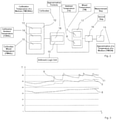
- FIG. 1 is the diagram of a temperature-determining device according to the invention
- FIG. 2 is the diagram of a method according to the invention for calibrating and operating a temperature-determining device
- FIG. 3 is a graphical representation of measured temperatures and a calculated temperature.
- the object of the present invention is that of providing the method for non-invasive measurement of a temperature of a medium through a housing wall surrounding the medium, of providing a temperature-determining device and providing a method for calibrating and operating same, in which a systematic measurement error, introduced owing to the influence of the ambient temperature, is prevented as simply as possible.
- a temperature-determining device also comprises an ambient-temperature sensor which measures the ambient temperature of the medium surrounding the surface, for example air, an arithmetic-logic unit being provided that has an approximation formula electronically stored thereon, this approximation formula being an approximation value that provides the temperature of a medium and is stored as the sum of the mixed temperature, measured by the surface-temperature sensor, and a product of two factors, the first factor resulting from the difference between the mixed temperature and the ambient temperature, and the second temperature resulting from a ratio of a dividend to a quotient, the dividend resulting as the difference between a previously stored calibration temperature of a medium and a likewise previously stored calibration mixed temperature, and the divisor resulting from the difference between the calibration mixed temperature and a previously stored calibration ambient temperature.
- the central concept of this technical solution builds on the fact that the mixed temperature, measured and provided by the surface-temperature sensor, corresponds to the temperature of a medium that is distorted by the ambient temperature.
- the distortion and/or deviation of the actual temperature of a medium by the ambient temperature is linear.
- a constellation of temperatures characterizing this linear relationship, is stored on the arithmetic-logic unit, said constellation consisting of the three thermally interlinked temperatures in the form of a calibration mixed temperature, a calibration ambient temperature and a calibration temperature of a medium. These temperatures may for example be recorded during a calibration process or be calculated by numeric simulations with the aid of known process parameters and/or known material properties.
- the influence of the ambient temperature on the mixed temperature of the surface-temperature sensor depends inter alia on the existence and shape, and for example the thermal capacity, of a housing of the surface sensor, and on the design of the surface enclosing the medium (material, wall thickness, etc.) and the medium itself.
- the electronically stored approximation formula provided according to the invention, is designed such that the following essential criteria are met:
- the approximation value of a temperature of a medium to be calculated corresponds precisely to the measured ambient temperature.
- the temperature of a medium were to deviate from the ambient temperature, a value would form between these two temperatures as the mixed temperature, and not as a value that corresponds exactly to the ambient temperature.
- the approximation of a temperature of a medium to be calculated also has to correspond precisely to the calibration temperature of a medium. This is achieved in accordance with the definition of the approximation formula such that, in this case, all the parts of the equation, up to the calibration temperature of a medium, cancel out or subtract out.
- the equation is linear; it thus describes a linear relationship between the deviation of the mixed temperature from the temperature of a medium and the difference between the mixed temperature and the ambient temperature.
- Advantageous in this instance is a particularly simple modeling of a thermally relatively complex system, which modeling in practice provides very precise predictions about the temperature of a medium on the basis of the measured mixed temperature and the ambient temperature.
- the proportionality factor which characterizes the linear equation, is dependent on the thermal properties of the materials used and the manner in which they are brought together, and can for example be determined by calibration or—in the case of sufficiently known properties—by simulation.
- this approximation formula is therefore intended to linearly interpolate between two known states or to linearly extrapolate outside thereof, the first state being that in which the mixed temperature lies between the ambient temperature and the calibration mixed temperature and the second state being that in which the mixed temperature is lower than the ambient temperature or is higher than the calibration mixed temperature.
- TMEDN TM+(TM ⁇ TU)*((TOKAL ⁇ TMKAL)/(TMKAL ⁇ TUKAL))
- the temperature of a medium is determined in that a mixed temperature between the temperature of a medium and an ambient temperature is measured, and the ambient temperature is additionally measured, and finally an approximation value for the temperature of a medium is calculated, the approximation formula for calculating this approximation value relating to a previously described linear relationship and being the basis for a calibration ambient temperature of the ambient-temperature sensor, a calibration temperature of a medium and a calibration mixed temperature of the surface sensor.
- the approximation formula is stored in this case as set out previously.
- a method is proposed according to the invention, in which, in a calibration scenario in which the temperature of a medium differs from the ambient temperature, a calibration mixed temperature is recorded by the surface sensor. The absolute value of this calibration mixed temperature is then dependent on the existence, shape and for example the thermal capacity of the housing of the surface sensor and other thermally relevant aspects.
- a calibration mixed temperature and a calibration ambient temperature are recorded and, in addition, the calibration temperature of a medium is also measured exactly by a measuring instrument that provides values that are independent of the ambient temperature, i.e. said values are undistorted.
- the calibration temperature of a medium is measured in a contactless manner and in particular with the aid of an infrared thermometer which is thermally insulated from the surroundings of the surface enclosing the medium.
- a temperature-determining device 19 comprises a surface-temperature sensor 4 , which is attached to the surface 1 of a pipe 2 , has a mixed temperature 3 and is surrounded by a housing 5 .
- the housing 5 is, in turn, surrounded by the air of its surroundings 6 .
- An ambient-temperature sensor 7 is arranged in the vicinity of the housing 5 and measures the ambient temperature 8 of the air located there.
- the temperature 9 of a medium and the temperature of the surface 1 is higher than the ambient temperature 8 of the ambient air.
- a mixed temperature 3 of the surface-temperature sensor 4 arranged in the housing 5 occurs, which temperature lies between the temperature 9 of a medium and the ambient temperature 8 .
- An arithmetic-logic unit 10 is connected to the surface-temperature sensor 4 and the ambient-temperature sensor 7 and calculates an approximation 11 of a temperature of a medium that is linearly dependent on the difference between the ambient temperature 8 and the measured mixed temperature 3 .
- the proportionality factor is dependent on calibration values that have been previously defined for example by calibration 12 or by numerical simulation.
- the calibration 12 of a temperature-determining device is carried out once by a calibration temperature 13 of a medium being recorded by an infrared thermometer, a calibration ambient temperature 14 being recorded by an ambient-temperature sensor 7 , and a calibration mixed temperature 15 being recorded by a medium-temperature sensor 4 , and is electronically stored in an arithmetic-logic unit 10 and is used for defining an approximation formula 16 .
- a measurement step 17 an ambient temperature 8 and a mixed temperature 3 are measured and in a second step 18 an approximation 11 of a temperature of a medium is calculated by an arithmetic-logic unit 10 using the approximation formula 16 . Therefore, in contrast to the calibration 12 , there is less need for a measurement, and thus a measurement instrument.
- FIG. 3 shows in a coordinate system, which plots temperature T in degrees Celsius over the time t, a graphical representation of a measured ambient temperature 8 (dashed-dotted line), a measured mixed temperature 3 (solid line), an approximation 11 of a temperature of a medium (dotted line), calculated using the method according to the invention, and the actually existing temperature 9 of a medium (dashed line).
- the influence of the ambient temperature 8 on the mixed temperature 3 and the very precise compensation of this influence by means of the method described can be seen in particular.
- This influence can be seen in particular from the fact that the temperature 9 of a medium and the approximation 11 of a temperature of a medium lie one on top of the other so as to be almost superimposed.
- Deviations primarily relate to high frequency oscillations, which can be explained for example by the inertia of the surface-temperature sensor 4 , of the ambient-temperature sensor 7 or by the thermal capacity of the surface sensor 4 or its housing 5 .
- the recitation of “at least one of A, B and C” should be interpreted as one or more of a group of elements consisting of A, B and C, and should not be interpreted as requiring at least one of each of the listed elements A, B and C, regardless of whether A, B and C are related as categories or otherwise.
- the recitation of “A, B and/or C” or “at least one of A, B or C” should be interpreted as including any singular entity from the listed elements, e.g., A, any subset from the listed elements, e.g., A and B, or the entire list of elements A, B and C.
Landscapes
- Physics & Mathematics (AREA)
- General Physics & Mathematics (AREA)
- Measuring Temperature Or Quantity Of Heat (AREA)
Abstract
Description
- 1 surface
- 2 pipe
- 3 mixed temperature (TM)
- 4 surface-temperature sensor
- 5 housing
- 6 surroundings
- 7 ambient-temperature sensor
- 8 ambient temperature (TU)
- 9 temperature of a medium (TMED)
- 10 arithmetic-logic unit
- 11 approximation of a temperature of a medium (TMEDN)
- 12 calibration
- 13 calibration temperature of a medium (TMEDKAL)
- 14 calibration ambient temperature (TUKAL)
- 15 calibration mixed temperature (TMKAL)
- 16 approximation formula
- 17 measurement step
- 18 second step
- 19 temperature-determining device
Claims (10)
Applications Claiming Priority (3)
| Application Number | Priority Date | Filing Date | Title |
|---|---|---|---|
| DE102016107335.0 | 2016-04-20 | ||
| DE102016107335.0A DE102016107335A1 (en) | 2016-04-20 | 2016-04-20 | Temperature determination device and method for its calibration and for determining a medium temperature |
| PCT/EP2017/059232 WO2017182491A1 (en) | 2016-04-20 | 2017-04-19 | Temperature-determining device and method for calibrating same and for determining a medium temperature |
Related Parent Applications (1)
| Application Number | Title | Priority Date | Filing Date |
|---|---|---|---|
| PCT/EP2017/059232 Continuation WO2017182491A1 (en) | 2016-04-20 | 2017-04-19 | Temperature-determining device and method for calibrating same and for determining a medium temperature |
Publications (2)
| Publication Number | Publication Date |
|---|---|
| US20190041275A1 US20190041275A1 (en) | 2019-02-07 |
| US11237066B2 true US11237066B2 (en) | 2022-02-01 |
Family
ID=58664651
Family Applications (1)
| Application Number | Title | Priority Date | Filing Date |
|---|---|---|---|
| US16/157,132 Active 2038-09-12 US11237066B2 (en) | 2016-04-20 | 2018-10-11 | Temperature-determining device and method for calibrating same and for determining a medium temperature |
Country Status (5)
| Country | Link |
|---|---|
| US (1) | US11237066B2 (en) |
| EP (1) | EP3446086B1 (en) |
| CN (1) | CN109073474A (en) |
| DE (1) | DE102016107335A1 (en) |
| WO (1) | WO2017182491A1 (en) |
Families Citing this family (7)
| Publication number | Priority date | Publication date | Assignee | Title |
|---|---|---|---|---|
| EP3857189B1 (en) | 2018-09-28 | 2025-01-15 | Rosemount Inc. | Non-invasive process fluid temperature indication with reduced error |
| US20200103293A1 (en) | 2018-09-28 | 2020-04-02 | Rosemount Inc. | Non-invasive process fluid temperature indication |
| DE102020104820A1 (en) | 2020-02-24 | 2021-08-26 | LABOM Meß- und Regeltechnik Gesellschaft mit beschränkter Haftung | Temperature measuring device |
| CN111595488B (en) * | 2020-04-15 | 2022-05-24 | 岭东核电有限公司 | Nuclear power station diesel engine oil temperature detection method and device, terminal equipment and storage medium |
| CN113588122A (en) * | 2021-07-27 | 2021-11-02 | 吉林省中赢高科技有限公司 | Method and device for measuring surface temperature of object |
| EP4336158A1 (en) * | 2022-09-06 | 2024-03-13 | Siemens Aktiengesellschaft | Temperature measuring device |
| CH721338A1 (en) * | 2023-11-29 | 2025-06-13 | R Nussbaum Ag | System for supplying drinking water to a building |
Citations (10)
| Publication number | Priority date | Publication date | Assignee | Title |
|---|---|---|---|---|
| DD87677A1 (en) | 1970-09-02 | 1972-02-05 | Method and device for measuring the temperature of the product | |
| JPH07198503A (en) | 1993-12-28 | 1995-08-01 | Ricoh Co Ltd | Fluid temperature measuring device in piping |
| US5522662A (en) | 1993-04-01 | 1996-06-04 | Terumo Kabushiki Kaisha | Clinical thermometer |
| US20030032893A1 (en) | 2001-08-11 | 2003-02-13 | Jochim Koch | Device for measuring the body temperature |
| US20070206655A1 (en) | 2006-03-03 | 2007-09-06 | Haslett James W | Bandage with sensors |
| DE102007025806B3 (en) | 2007-06-02 | 2008-06-26 | Dräger Safety AG & Co. KGaA | Animal's body temperature measuring device, has evaluating device in which temperature is calculated based on formula depending on temporal change of sensor temperature, to form temperature corrective value |
| WO2009051588A1 (en) | 2007-10-15 | 2009-04-23 | Micro Motion, Inc. | Vibratory flow meter and method for determining a fluid temperature of a flow material |
| GB2500034A (en) | 2012-03-07 | 2013-09-11 | Passivsystems Ltd | Calculation of temperature on a remote side of a barrier using thermal conductivity properties of the barrier and temperature measurements |
| DE102015000728A1 (en) | 2015-01-21 | 2016-07-21 | Abb Technology Ag | Temperature determination device with calibration sensor and method for this purpose |
| US20190049278A1 (en) * | 2017-08-14 | 2019-02-14 | Azbil Corporation | Thermal type flowmeter |
Family Cites Families (2)
| Publication number | Priority date | Publication date | Assignee | Title |
|---|---|---|---|---|
| DE19800753A1 (en) * | 1998-01-12 | 1999-07-22 | Siemens Ag | Non-invasive temperature sensor for process technology, power stations, chemical plant and food production |
| DE102013007631A1 (en) * | 2013-05-02 | 2014-11-06 | Dräger Medical GmbH | Method and device for determining a core temperature of a body |
-
2016
- 2016-04-20 DE DE102016107335.0A patent/DE102016107335A1/en not_active Withdrawn
-
2017
- 2017-04-19 WO PCT/EP2017/059232 patent/WO2017182491A1/en not_active Ceased
- 2017-04-19 CN CN201780024531.6A patent/CN109073474A/en active Pending
- 2017-04-19 EP EP17720705.7A patent/EP3446086B1/en active Active
-
2018
- 2018-10-11 US US16/157,132 patent/US11237066B2/en active Active
Patent Citations (14)
| Publication number | Priority date | Publication date | Assignee | Title |
|---|---|---|---|---|
| DD87677A1 (en) | 1970-09-02 | 1972-02-05 | Method and device for measuring the temperature of the product | |
| SU520518A1 (en) | 1970-09-02 | 1976-07-05 | Феб Пласт Унд Эластферарбайтунгсмашинен Компбинат Карл-Маркс-Штадт (Инопредприятие) | Device for measuring the temperature of liquid and viscous masses |
| US5522662A (en) | 1993-04-01 | 1996-06-04 | Terumo Kabushiki Kaisha | Clinical thermometer |
| DE69425846T2 (en) | 1993-04-01 | 2001-04-12 | Terumo K.K., Tokio/Tokyo | Medical thermometer |
| JPH07198503A (en) | 1993-12-28 | 1995-08-01 | Ricoh Co Ltd | Fluid temperature measuring device in piping |
| DE10139705A1 (en) | 2001-08-11 | 2003-04-03 | Draeger Medical Ag | Device for measuring body temperature |
| US20030032893A1 (en) | 2001-08-11 | 2003-02-13 | Jochim Koch | Device for measuring the body temperature |
| US20070206655A1 (en) | 2006-03-03 | 2007-09-06 | Haslett James W | Bandage with sensors |
| DE102007025806B3 (en) | 2007-06-02 | 2008-06-26 | Dräger Safety AG & Co. KGaA | Animal's body temperature measuring device, has evaluating device in which temperature is calculated based on formula depending on temporal change of sensor temperature, to form temperature corrective value |
| US20080300819A1 (en) | 2007-06-02 | 2008-12-04 | Drager Safety Ag & Co. Kgaa | Device and method for measuring the body temperature of a living being |
| WO2009051588A1 (en) | 2007-10-15 | 2009-04-23 | Micro Motion, Inc. | Vibratory flow meter and method for determining a fluid temperature of a flow material |
| GB2500034A (en) | 2012-03-07 | 2013-09-11 | Passivsystems Ltd | Calculation of temperature on a remote side of a barrier using thermal conductivity properties of the barrier and temperature measurements |
| DE102015000728A1 (en) | 2015-01-21 | 2016-07-21 | Abb Technology Ag | Temperature determination device with calibration sensor and method for this purpose |
| US20190049278A1 (en) * | 2017-08-14 | 2019-02-14 | Azbil Corporation | Thermal type flowmeter |
Also Published As
| Publication number | Publication date |
|---|---|
| EP3446086B1 (en) | 2023-06-21 |
| CN109073474A (en) | 2018-12-21 |
| WO2017182491A1 (en) | 2017-10-26 |
| DE102016107335A1 (en) | 2017-10-26 |
| US20190041275A1 (en) | 2019-02-07 |
| EP3446086A1 (en) | 2019-02-27 |
Similar Documents
| Publication | Publication Date | Title |
|---|---|---|
| US11237066B2 (en) | Temperature-determining device and method for calibrating same and for determining a medium temperature | |
| Rudtsch et al. | Calibration and self-validation of thermistors for high-precision temperature measurements | |
| US11415466B2 (en) | Temperature measuring device and method for determining temperature | |
| CA3044692C (en) | Method for the in-situ calibration of a thermometer | |
| CN105588667B (en) | A kind of high-accuracy compensation by thermistor calibrating installation | |
| JP6153646B2 (en) | Method for correcting temperature drift of temperature measuring device using thermocouple | |
| EP3770569B1 (en) | Method using dry block temperature calibrator to calibrate short temperature measuring apparatus | |
| JP6225766B2 (en) | Internal temperature measurement method and internal temperature measurement device | |
| US20180224338A1 (en) | Apparatus for determining and/or monitoring temperature of a medium | |
| CN105784149A (en) | Device For Measuring The Temperature Of A Medium Through A Wall | |
| CN111693154A (en) | Temperature compensation method and device for infrared temperature measurement sensor | |
| CN110702274B (en) | An in-space calibration method based on an accurate miniature phase transition fixed-point blackbody model | |
| White | Interpolation errors in thermistor calibration equations | |
| Saunders | Calibration and use of low-temperature direct-reading radiation thermometers | |
| CN212255479U (en) | Thermal control system and temperature correction device | |
| Saunders | Dealing with the size-of-source effect in the calibration of direct-reading radiation thermometer | |
| CN102706465B (en) | Temperature measuring method | |
| KR101740340B1 (en) | Temperature measurement device and method thereof | |
| Gureyev et al. | High accuracy semiautomatic calibration of industrial RTDs | |
| CN107748017A (en) | The measuring method of blast furnace cooling stave cooler-water temperature is accurately measured based on platinum resistance thermometer sensor, | |
| JP2001281182A (en) | Humidity detector | |
| US12480825B2 (en) | Thermometer having a diagnostic function | |
| Dona | Methods of Calibration and Characterization of Temperature Controlled Environments | |
| US10281311B2 (en) | Method of operating a liquid-level transmitter device and implementation thereof | |
| Hocenski et al. | Comparison of methods for nonlinearity correction of platinum resistance thermometer |
Legal Events
| Date | Code | Title | Description |
|---|---|---|---|
| AS | Assignment |
Owner name: ABB SCHWEIZ AG, SWITZERLAND Free format text: ASSIGNMENT OF ASSIGNORS INTEREST;ASSIGNOR:MERLIN, TILO;REEL/FRAME:047129/0042 Effective date: 20181002 |
|
| FEPP | Fee payment procedure |
Free format text: ENTITY STATUS SET TO UNDISCOUNTED (ORIGINAL EVENT CODE: BIG.); ENTITY STATUS OF PATENT OWNER: LARGE ENTITY |
|
| STPP | Information on status: patent application and granting procedure in general |
Free format text: APPLICATION DISPATCHED FROM PREEXAM, NOT YET DOCKETED |
|
| STPP | Information on status: patent application and granting procedure in general |
Free format text: DOCKETED NEW CASE - READY FOR EXAMINATION |
|
| STPP | Information on status: patent application and granting procedure in general |
Free format text: RESPONSE TO NON-FINAL OFFICE ACTION ENTERED AND FORWARDED TO EXAMINER |
|
| STPP | Information on status: patent application and granting procedure in general |
Free format text: NOTICE OF ALLOWANCE MAILED -- APPLICATION RECEIVED IN OFFICE OF PUBLICATIONS |
|
| STPP | Information on status: patent application and granting procedure in general |
Free format text: PUBLICATIONS -- ISSUE FEE PAYMENT VERIFIED |
|
| STCF | Information on status: patent grant |
Free format text: PATENTED CASE |
|
| MAFP | Maintenance fee payment |
Free format text: PAYMENT OF MAINTENANCE FEE, 4TH YEAR, LARGE ENTITY (ORIGINAL EVENT CODE: M1551); ENTITY STATUS OF PATENT OWNER: LARGE ENTITY Year of fee payment: 4 |