US11236195B2 - Corrosion-indicating materials and methods of making and using the same - Google Patents

Corrosion-indicating materials and methods of making and using the same Download PDF

Info

Publication number
US11236195B2
US11236195B2 US16/799,137 US202016799137A US11236195B2 US 11236195 B2 US11236195 B2 US 11236195B2 US 202016799137 A US202016799137 A US 202016799137A US 11236195 B2 US11236195 B2 US 11236195B2
Authority
US
United States
Prior art keywords
corrosion
indicating material
joined
metal substrate
formula
Prior art date
Legal status (The legal status is an assumption and is not a legal conclusion. Google has not performed a legal analysis and makes no representation as to the accuracy of the status listed.)
Expired - Fee Related
Application number
US16/799,137
Other versions
US20210269584A1 (en
Inventor
Haleema Alamri
Aziz Fihri
Mohamed BOUHRARA
Enrico Bovero
Bashayer Mishari
Current Assignee (The listed assignees may be inaccurate. Google has not performed a legal analysis and makes no representation or warranty as to the accuracy of the list.)
Saudi Arabian Oil Co
Original Assignee
Saudi Arabian Oil Co
Priority date (The priority date is an assumption and is not a legal conclusion. Google has not performed a legal analysis and makes no representation as to the accuracy of the date listed.)
Filing date
Publication date
Application filed by Saudi Arabian Oil Co filed Critical Saudi Arabian Oil Co
Priority to US16/799,137 priority Critical patent/US11236195B2/en
Assigned to SAUDI ARABIAN OIL COMPANY reassignment SAUDI ARABIAN OIL COMPANY ASSIGNMENT OF ASSIGNORS INTEREST (SEE DOCUMENT FOR DETAILS). Assignors: ALAMRI, Haleema, BOUHRARA, Mohamed, BOVERO, ENRICO, FIHRI, AZIZ, MISHARI, Bashayer
Priority to PCT/US2021/019002 priority patent/WO2021173477A1/en
Publication of US20210269584A1 publication Critical patent/US20210269584A1/en
Application granted granted Critical
Publication of US11236195B2 publication Critical patent/US11236195B2/en
Priority to SA522440257A priority patent/SA522440257B1/en
Expired - Fee Related legal-status Critical Current
Anticipated expiration legal-status Critical

Links

Classifications

    • CCHEMISTRY; METALLURGY
    • C08ORGANIC MACROMOLECULAR COMPOUNDS; THEIR PREPARATION OR CHEMICAL WORKING-UP; COMPOSITIONS BASED THEREON
    • C08GMACROMOLECULAR COMPOUNDS OBTAINED OTHERWISE THAN BY REACTIONS ONLY INVOLVING UNSATURATED CARBON-TO-CARBON BONDS
    • C08G59/00Polycondensates containing more than one epoxy group per molecule; Macromolecules obtained by polymerising compounds containing more than one epoxy group per molecule using curing agents or catalysts which react with the epoxy groups
    • C08G59/18Macromolecules obtained by polymerising compounds containing more than one epoxy group per molecule using curing agents or catalysts which react with the epoxy groups ; e.g. general methods of curing
    • C08G59/40Macromolecules obtained by polymerising compounds containing more than one epoxy group per molecule using curing agents or catalysts which react with the epoxy groups ; e.g. general methods of curing characterised by the curing agents used
    • C08G59/50Amines
    • C08G59/5046Amines heterocyclic
    • C08G59/5053Amines heterocyclic containing only nitrogen as a heteroatom
    • C08G59/506Amines heterocyclic containing only nitrogen as a heteroatom having one nitrogen atom in the ring
    • CCHEMISTRY; METALLURGY
    • C09DYES; PAINTS; POLISHES; NATURAL RESINS; ADHESIVES; COMPOSITIONS NOT OTHERWISE PROVIDED FOR; APPLICATIONS OF MATERIALS NOT OTHERWISE PROVIDED FOR
    • C09DCOATING COMPOSITIONS, e.g. PAINTS, VARNISHES OR LACQUERS; FILLING PASTES; CHEMICAL PAINT OR INK REMOVERS; INKS; CORRECTING FLUIDS; WOODSTAINS; PASTES OR SOLIDS FOR COLOURING OR PRINTING; USE OF MATERIALS THEREFOR
    • C09D5/00Coating compositions, e.g. paints, varnishes or lacquers, characterised by their physical nature or the effects produced; Filling pastes
    • CCHEMISTRY; METALLURGY
    • C08ORGANIC MACROMOLECULAR COMPOUNDS; THEIR PREPARATION OR CHEMICAL WORKING-UP; COMPOSITIONS BASED THEREON
    • C08GMACROMOLECULAR COMPOUNDS OBTAINED OTHERWISE THAN BY REACTIONS ONLY INVOLVING UNSATURATED CARBON-TO-CARBON BONDS
    • C08G59/00Polycondensates containing more than one epoxy group per molecule; Macromolecules obtained by polymerising compounds containing more than one epoxy group per molecule using curing agents or catalysts which react with the epoxy groups
    • C08G59/18Macromolecules obtained by polymerising compounds containing more than one epoxy group per molecule using curing agents or catalysts which react with the epoxy groups ; e.g. general methods of curing
    • C08G59/20Macromolecules obtained by polymerising compounds containing more than one epoxy group per molecule using curing agents or catalysts which react with the epoxy groups ; e.g. general methods of curing characterised by the epoxy compounds used
    • C08G59/22Di-epoxy compounds
    • C08G59/24Di-epoxy compounds carbocyclic
    • C08G59/245Di-epoxy compounds carbocyclic aromatic
    • CCHEMISTRY; METALLURGY
    • C08ORGANIC MACROMOLECULAR COMPOUNDS; THEIR PREPARATION OR CHEMICAL WORKING-UP; COMPOSITIONS BASED THEREON
    • C08GMACROMOLECULAR COMPOUNDS OBTAINED OTHERWISE THAN BY REACTIONS ONLY INVOLVING UNSATURATED CARBON-TO-CARBON BONDS
    • C08G59/00Polycondensates containing more than one epoxy group per molecule; Macromolecules obtained by polymerising compounds containing more than one epoxy group per molecule using curing agents or catalysts which react with the epoxy groups
    • C08G59/18Macromolecules obtained by polymerising compounds containing more than one epoxy group per molecule using curing agents or catalysts which react with the epoxy groups ; e.g. general methods of curing
    • C08G59/40Macromolecules obtained by polymerising compounds containing more than one epoxy group per molecule using curing agents or catalysts which react with the epoxy groups ; e.g. general methods of curing characterised by the curing agents used
    • C08G59/50Amines
    • C08G59/5046Amines heterocyclic
    • C08G59/5053Amines heterocyclic containing only nitrogen as a heteroatom
    • CCHEMISTRY; METALLURGY
    • C09DYES; PAINTS; POLISHES; NATURAL RESINS; ADHESIVES; COMPOSITIONS NOT OTHERWISE PROVIDED FOR; APPLICATIONS OF MATERIALS NOT OTHERWISE PROVIDED FOR
    • C09DCOATING COMPOSITIONS, e.g. PAINTS, VARNISHES OR LACQUERS; FILLING PASTES; CHEMICAL PAINT OR INK REMOVERS; INKS; CORRECTING FLUIDS; WOODSTAINS; PASTES OR SOLIDS FOR COLOURING OR PRINTING; USE OF MATERIALS THEREFOR
    • C09D163/00Coating compositions based on epoxy resins; Coating compositions based on derivatives of epoxy resins
    • GPHYSICS
    • G01MEASURING; TESTING
    • G01NINVESTIGATING OR ANALYSING MATERIALS BY DETERMINING THEIR CHEMICAL OR PHYSICAL PROPERTIES
    • G01N17/00Investigating resistance of materials to the weather, to corrosion, or to light
    • G01N17/006Investigating resistance of materials to the weather, to corrosion, or to light of metals
    • GPHYSICS
    • G01MEASURING; TESTING
    • G01NINVESTIGATING OR ANALYSING MATERIALS BY DETERMINING THEIR CHEMICAL OR PHYSICAL PROPERTIES
    • G01N31/00Investigating or analysing non-biological materials by the use of the chemical methods specified in the subgroup; Apparatus specially adapted for such methods
    • G01N31/22Investigating or analysing non-biological materials by the use of the chemical methods specified in the subgroup; Apparatus specially adapted for such methods using chemical indicators

Definitions

  • the present specification generally relates to corrosion-indicating materials and, more particularly, to color-changing corrosion-indicating materials and methods for forming and using the same.
  • Organic coatings may be utilized in a vast array of products and industries, including, for example, corrosion protection of metallic structures such as steel pipes or steel storage tanks.
  • the organic coating may form a barrier between the metal and corrosive conditions, repress electrochemical reactions that occur at the metal-coating interface, or both.
  • the early detection of corrosion under the coating is critical to maintaining the structural integrity of the metal and to reduce maintenance costs.
  • conventional visual inspection of the metallic structure and organic coating is ineffective and inefficient, as a conventional visual inspection cannot detect early-stage corrosion at the metal-coating interface.
  • techniques such as thermal imaging, radiographic imaging, electromagnetic imaging, ultrasonic imaging, microwave imaging, and electromagnetic imaging may be employed.
  • each of these techniques require the use of specialized equipment or instruments. Additionally, none of these techniques can assess large or complicated metal structures such as offshore and onshore metallic platforms for oil and gas production or other metal structures that would obstruct conventional inspection techniques.
  • the corrosion-indicating materials indicate corrosion of a metal substrate underlying the corrosion-indicating material.
  • the corrosion-indicating materials include a cured product of reacting a bisphenol A diglycidyl ether (DGEBA) epoxy resin with a curing agent.
  • the curing agent includes a 1,10-phenanthroline derivative having formula (I):
  • R 1 and R 2 are independently selected from —NH 2 ; —NH(CH 2 ) a NH 2 , where a is 1, 2, or 3; —OC( ⁇ O)(CH 2 ) b NH 2 , where b is 1, 2, or 3; and —H.
  • R 3 and R 4 are either: non-joined monovalent radicals each independently chosen from —H, —NH 2 , and (C 1 -C 20 )heterohydrocarbyls including at least one primary amine or at least one secondary amine; or joined as a single divalent radical, the single divalent radical being a (C 1 -C 40 )heterohydrocarbylene including at least one primary amine or at least one secondary amine. Additionally, at least one of R 1 , R 2 , R 3 , and R 4 is not —H.
  • Corrosion-indicating materials include a cured product of reacting a bisphenol A diglycidyl ether (DGEBA) epoxy resin with a curing agent to form a cured resin.
  • the cured resin includes a resin backbone of DGEBA crosslinked through or terminated by molecules of the curing agent.
  • the curing agent is chosen from a class of 1,10-phenanthroline derivatives that will be subsequently described.
  • the 1,10-phenanthroline derivatives situated within the cured product include particular atoms or functional groups such as nitrogen atoms or primary or secondary amines, for example.
  • the functional groups are capable of donating electrons to metal ions to form complexes with the metal ions.
  • the complexes formed in this manner may have characteristic colors that are imparted to the corrosion-indicating material.
  • the corrosion-indicating material has an initial color before exposure of the corrosion-indicating material to metal ions.
  • the complexes form and the corrosion-indicating material changes to a corrosion-indicative color different from the initial color.
  • the actual corrosion-indicative color and its intensity may depend on factors such as the identity of the curing agent, the concentration of the curing agent within the cured product, and the identity of the metal ion.
  • the corrosion-indicating materials according to embodiments may be applied to a substrate as a coating material for the substrate or a particular surface thereof.
  • the coating including the corrosion-indicating material overlies the substrate or, stated in an equivalent manner, the substrate underlies the coating including the corrosion-indicating material.
  • the substrate may be a metal substrate.
  • the metal substrate may be a unitary metal body or may be a metal part or metal component of an apparatus.
  • a coating layer according to embodiments of this disclosure that overlies a substrate such as a metal substrate may physically contact the metal substrate directly, but need not necessarily physically contact the metal substrate directly.
  • the coating layer may be applied over one or more intermediate layer, where the one or more intermediate layers also overlie the substrate, but only one such intermediate layer is in direct physical contact with the metal substrate.
  • the coating layers formed from a corrosion-indicating material may be regarded to overlie the metal substrate if the proximity of the coating layer to the metal substrate is such that corrosion of the metal substrate triggers an indication of corrosion in the corrosion-indicating material.
  • the indication of corrosion may include a color change, such as will be described subsequently in greater detail.
  • the process of metal corrosion typically involves oxidation of a metal to one or more positively-charged metal ions. Corrosion is common in environments where the metal is exposed to moisture. Thus, when a metal substrate underlying a coating of corrosion-indicating material according to embodiments corrodes, the positively-charged metal ions and molecules of water from the moisture can contact portions of the corrosion-indicating material. As the contact occurs, complexes form between the curing agent component of the corrosion-indicating material, the positively-charged metal ions, and the water molecules. Thereby, the corrosion-indicating material changes color. The change of color may serve as a detectable indicator of corrosion. Detection of corrosion may be carried out as simply as by visually noting a dramatic color change of coated areas of the metal substrate.
  • the detection of corrosion may involve spectrophotometric determination and analysis of color changes, in view of an expected characteristic absorption or fluorescence wavelength that can be monitored actively or remotely.
  • ultraviolet-visible (UV-VIS) absorption spectra of a corrosion-indicating material may be monitored within a wavelength range including one or multiple absorption maxima for metal complexes expected to form when the corrosion-indicating material is exposed to metal ions upon corrosion of the underlying substrate.
  • Changes to the absorption spectra that indicate corrosion include bathochromic shifts of one or more characteristic absorption peaks and hyperchromic shifts of one or more characteristic peaks.
  • characteristic UV-VIS absorption maxima of 1,10-phenanthroline derivatives may be evaluated to assess bathochromic shifts, hyperchromic shifts, or both.
  • Such characteristic absorption maxima for 1,10-phenanthroline may arise in wavelength regions such as from 200 nm to 500 nm, or from 200 nm to 400 nm, or from 250 nm to 400 nm, for example.
  • Specific examples include 1,10-phenanthroline derivative absorption maxima at 282 nm and 365 nm.
  • Bathochromic shifts are shifts of a characteristic peak to a lower energy or longer wavelength.
  • observation of a bathochromic shift provides qualitative information in that before corrosion occurs the corrosion-indicating material exhibits a UV-VIS peak at one characteristic wavelength, whereas after corrosion occurs the corrosion-indicating material exhibits a corresponding UV-VIS peak at a slightly longer wavelength.
  • Hyperchromic shifts of a UV-VIS peak result from an increased concentration of a complex within the corrosion-indicating materials.
  • Such characteristic absorption maxima for 1,10-phenanthroline may arise in wavelength regions such as from 200 nm to 500 nm, or from 200 nm to 400 nm, or from 250 nm to 400 nm, for example.
  • bathochromic shifts indicative of complex formation may include shifting of any characteristic UV-VIS absorption band by 1 nm to 100 nm, or by 1 nm to 50 nm, or by 1 nm to 20 nm, or by 1 nm to 10 nm, or by 5 nm to 50 nm, or by 10 nm to 50 nm, or by 20 nm to 50 nm from an initial wavelength to a corrosion-indicative wavelength longer than the initial wavelength.
  • Hyperchromic shifts are observable by comparing initial characteristic peak heights upon application of the corrosion-indicating material with later characteristic peak heights measured when corrosion is assessed. In such assessments, an increase in peak heights over those of the initial measurement indicate corrosion by an increase in the amount of absorption at the characteristic wavelength of the complex formed when ions contact the corrosion-indicating material. Thus, observation of hyperchromic shift provides quantitative information as to the amount of complex formation and, accordingly, to the extent of the corrosion of the underlying substrate. Hyperchromic shifts indicative of complex formation may include increase in percent absorption at any characteristic UV-VIS absorption band by at least 1%, at least 2%, at least 5%, at least 10%, at least 20%, or at least 50%.
  • the increase in percent absorption may be determined by comparing percent absorption of a particular peak of the UV-VIS spectrum from an initial measurement with the percent absorption of a corresponding peak of the UV-VIS spectrum at a later measurement upon assessment of corrosion over time. It should be understood that the precise wavelengths of the initial measurement and the later measurement may not necessarily be identical, particularly if a bathochromic shift of the characteristic peak has occurred. Thus, the corresponding peak in the later measurement should be understood to be the peak corresponding to the peak observed in the initial measurement but shifted to a longer wavelength in the later measurement.
  • Complex formation in the corrosion-indicating material and, in turn, corrosion of a substrate underlying the corrosion-indicating material also may be assessed by monitoring fluorescence spectra of the corrosion-indicating material.
  • the corrosion-indicating material When interrogated with light of a specific wavelength, the corrosion-indicating material will emit various wavelengths by fluorescence.
  • the specific fluorescence wavelengths and their respective intensities vary with respect to the presence of complexes in the corrosion-indicating material and the concentration of the complexes in the corrosion-indicating material.
  • corrosion-indicating materials are provided that indicate corrosion of a metal substrate underlying the corrosion-indicating material.
  • the corrosion-indicating materials are or include a cured product of reacting an uncured bisphenol A diglycidyl ether (DGEBA) epoxy resin with a curing agent.
  • DGEBA diglycidyl ether
  • DGEBA is an organic compound used as a constituent of epoxy resins.
  • DGEBA may be prepared by O-alkylation of bisphenol A with epichlorohydrin.
  • Uncured DGEBA resin has the following structure:
  • the curing agent that is reacted with the DGEBA is chosen from one or a combination of 1,10-phenanthroline derivatives having formula (I):
  • R 1 and R 2 are independently selected from —NH 2 ; —NH(CH 2 ) a NH 2 ; where a is 1, 2, or 3; —OC( ⁇ O)(CH 2 ) b NH 2 , where b is 1, 2, or 3; and —H.
  • R 1 and R 2 may be unsubstituted (when either or both are —H) or substituted with a functional group including at least one primary amine or at least one secondary amine, of which —NH(CH 2 ) a NH 2 and —OC( ⁇ O)(CH 2 ) b NH 2 are exemplary.
  • R 3 and R 4 may be non-joined monovalent radicals each independently chosen from —H, —NH 2 , and (C 1 -C 20 )heterohydrocarbyls that include at least one primary amine or at least one secondary amine.
  • R 3 and R 4 may be joined to the base 1,10-phenanthroline molecule as a single divalent radical.
  • the single divalent radical may be a (C 1 -C 40 )heterohydrocarbylene including at least one primary amine or at least one secondary amine.
  • the curing agent according to formula (I) is not 1,10-phenanthroline.
  • at least one of R 1 , R 2 , R 3 , and R 4 is not —H.
  • variable groups may be the same as each other or different from each other, without respect to the identities of the groups, subject to any explicit limitations or provisos.
  • hydrocarbon means a chemical group composed exclusively of carbon atoms and hydrogen atoms.
  • a “hydrocarbon radical” is a hydrocarbon from which one hydrogen atom has been removed.
  • a “hydrocarbon diradical” is a hydrocarbon from which two hydrogen atoms have been removed, typically one hydrogen atom from each of two different carbon atoms.
  • (C X -C Y )hydrocarbyl means a hydrocarbon radical of from X to Y carbon atoms, in which each hydrocarbon radical is aromatic or non-aromatic, saturated or unsaturated, straight chain or branched chain, cyclic (having three carbons or more, and including mono- and poly-cyclic, fused and non-fused polycyclic, and bicyclic) or acyclic, optionally substituted in any position with one or more groups R S as previously described.
  • (C X -C Y )hydrocarbylene means a hydrocarbon diradical of from X to Y carbon atoms, in which each hydrocarbon radical and each hydrocarbon diradical is aromatic or non-aromatic, saturated or unsaturated, straight chain or branched chain, cyclic (having three carbons or more, and including mono- and poly-cyclic, fused and non-fused polycyclic, and bicyclic) or acyclic, optionally substituted in any position with one or more groups R S as previously described.
  • substituted means that at least one hydrogen atom (—H) bonded to a carbon atom or heteroatom of a corresponding unsubstituted compound or functional group is replaced by a substituent.
  • a parenthetical expression having the form “(C X -C Y )” means that the unsubstituted form of the chemical group has from X carbon atoms to Y carbon atoms, inclusive of X and Y.
  • a (C 1 -C 50 )hydrocarbyl is an hydrocarbyl group having from 1 to 50 carbon atoms in its unsubstituted form.
  • certain chemical groups may be substituted by one or more substituents such as R S .
  • R S substituted chemical group defined using the “(C X -C Y )” parenthetical may contain more than Y carbon atoms depending on the identity of any groups R S .
  • a “(C 1 -C 50 )hydrocarbyl substituted with exactly one group R S , where R S is phenyl (—C 6 H 5 )” may contain from 7 to 56 carbon atoms.
  • the minimum and maximum total number of carbon atoms of the chemical group is determined by adding to both X and Y the combined sum of the number of carbon atoms from all of the carbon atom-containing substituents R S .
  • heteroatom refers to an atom other than hydrogen or carbon.
  • heteroatoms include nitrogen (N), oxygen (O), and sulfur (S).
  • heterohydrocarbon refers to a molecule or molecular framework in which one or more carbon atoms, either in a main chain of a hydrocarbon or in a substituent group in a hydrocarbon, are replaced with a heteroatom.
  • (C X -C Y )heterohydrocarbyl means a monovalent heterohydrocarbon radical of from X to Y carbon atoms.
  • the heterohydrocarbon of the (C X -C Y )heterohydrocarbyl may include one or more heteroatoms.
  • the heterohydrocarbon of the (C X -C Y )heterohydrocarbyl may include one or more nitrogen atoms, such that the (C X -C Y )heterohydrocarbyl or the (C X -C Y )heterohydrocarbylene may include at least one primary amine (—NH 2 or ⁇ NH, for example), at least one secondary amine (—N(H)—, —NR S H where R S is a hydrocarbyl, or ⁇ N—, for example), or a combination of one or more primary amines and one or more secondary amines.
  • the radical of the heterohydrocarbyl may be on a carbon atom or a heteroatom.
  • Each heterohydrocarbyl may be unsubstituted or substituted (for example, by one or more R S ), aromatic or non-aromatic, saturated or unsaturated, straight chain or branched chain, cyclic (including mono- and poly-cyclic, fused and non-fused polycyclic), or acyclic.
  • (C X -C Y )heterohydrocarbylene means a divalent heterohydrocarbon radical of from X to Y carbon atoms.
  • the heterohydrocarbon of the ((C X -C Y )heterohydrocarbylene may include one or more heteroatoms.
  • the heterohydrocarbon of the (C X -C Y )heterohydrocarbylene may include one or more nitrogen atoms, such that the (C X -C Y )heterohydrocarbylene may include at least one primary amine (—NH 2 or ⁇ NH, for example), at least one secondary amine (—N(H)—, —NR S H where R S is an hydrocarbyl, or ⁇ N—, for example), or a combination of one or more primary amines and one or more secondary amines.
  • the radicals of the heterohydrocarbylene may be on a carbon atom or on a heteroatom.
  • one of the two radicals of the diradical may be on a carbon atom and the other radical may be on a different carbon atom; one of the two radicals may be on a carbon atom and the other on a heteroatom; or one of the two radicals may be on a heteroatom and the other radical on a different heteroatom.
  • Each heterohydrocarbylene may be unsubstituted or substituted (for example, by one or more R S ), aromatic or non-aromatic, saturated or unsaturated, straight chain or branched chain, cyclic (including mono- and poly-cyclic, fused and non-fused polycyclic), or acyclic.
  • R 3 and R 4 of formula (I) may be non-joined monovalent radicals.
  • R 3 and R 4 may be identical to each other or different from each other.
  • R 3 and R 4 are identical non-joined monovalent radicals.
  • the 1,10-phenanthroline derivative has formula (Ia), in which R 1 and R 2 are as defined in formula (I); R 3 and R 4 are non-joined monovalent radicals as described with respect to formula (I), and at least one of R 1 , R 2 , R 3 , and R 4 is not —H. It should be readily understood that all compounds according to formula (Ia) also are compounds according to formula (I).
  • examples of non-joined monovalent radicals for groups R 3 and R 4 of formula (Ia) include —H, —NH 2 , and (C 1 -C 20 )heterohydrocarbyls including at least one primary amine or at least one secondary amine.
  • Specific non-limiting examples of the non-joined monovalent radicals are provided in TABLE 1 as both linear formulas and graphic structures. In the graphic structures, the wavy line across a bond refers to the point of connection of the radical to the main body of the 1,10-phenanthroline molecule.
  • R 3 and R 4 of formula (I) may be joined as a single divalent radical.
  • the single divalent radical may be a (C 1 -C 40 )heterohydrocarbylene that includes at least one primary amine or at least one secondary amine.
  • the 1,10-phenanthroline derivative has formula (Ib), in which R 1 and R 2 are as defined in formula (I); and R 3 and R 4 are joined as a single divalent radical as described with respect to formula (I). It should be readily understood that all compounds according to formula (Ib) also are compounds according to formula (I).
  • specific examples of single divalent radicals of a joined R 3 and R 4 when the 1,10-phenanthroline derivative has formula (Ib) include —CH 2 —NH—[(CH 2 ) x N(H)—] n CH 2 —, where x is 2 or 3 and n is 2, 3, 4, or 5; and —CH ⁇ N—(CH 2 ) 2 ⁇ —N[(CH 2 ) 2 NH 2 ]—(CH 2 ) 2 ⁇ y —N ⁇ CH—, where y is 1 or 2.
  • the curing agent may have formula (I) in which R 1 and R 2 are independently selected from the group consisting of —NH 2 and —H and R 3 and R 4 are defined as previously described with respect to formula (I), formula (Ia), or formula (Ib), provided at least one of R 1 , R 2 , R 3 , and R 4 is not —H.
  • R 1 and R 2 are independently selected from the group consisting of —NH 2 and —H and R 3 and R 4 are defined as previously described with respect to formula (I), formula (Ia), or formula (Ib), provided at least one of R 1 , R 2 , R 3 , and R 4 is not —H.
  • Examples of such embodiments include those in which both R 1 and R 2 are —H; in which both R 1 and R 2 are —NH 2 ; or in which one of R 1 and R 2 is —NH 2 and the other of R 1 and R 2 is —H.
  • R 1 , R 2 , R 3 , and R 4 of formula (I) are independently —NH 2 or —H, provided at least one of R 1 , R 2 , R 3 , and R 4 is —NH 2 .
  • examples of such embodiments include a compound of formula (I) in which R 1 and R 2 are —NH 2 and R 3 and R 4 are —H; or in which R 1 , R 3 , and R 4 are —H, and R 2 is —NH 2 .
  • the curing agent is chosen from 1,10-phenanthroline-5-amine or 1,10-phenanthroline-5,6-diamine, and 1,10-phenanthroline-2,9-diamine.
  • the curing agent may have formula (I), in which R 3 and R 4 are as previously defined and R 1 and R 2 may be selected from —NH 2 ; —NH(CH 2 ) a NH 2 ; where a is 1, 2, or 3; or —OC( ⁇ O)(CH 2 ) b NH 2 , where b is 1, 2, or 3; and —H.
  • R 3 and R 4 are as previously defined and R 1 and R 2 may be selected from —NH 2 ; —NH(CH 2 ) a NH 2 ; where a is 1, 2, or 3; or —OC( ⁇ O)(CH 2 ) b NH 2 , where b is 1, 2, or 3; and —H.
  • Non-limiting examples of such curing agents may be prepared by from 5,6-Epoxy-5,6-dihydro-[1,10]phenanthroline according to the following reaction scheme, in which both R 3 and R 4 of the resulting curing agent are —H:
  • the 1,10-phenanthroline derivatives having formula (I) as previously described may be prepared by any suitable synthetic strategy with 1,10-phenanthroline or 5,6-Epoxy-5,6-dihydro-[1,10]phenanthroline as a starting material.
  • Exemplary synthetic schemes for preparing 1,10-phenanthroline derivatives include those disclosed in A. Bencini and V. Lippolis, 1,10- Phenanthroline: A Versatile Building Block for the Construction of Ligands for Various Purposes , Coordination Chemistry Reviews, volume 254 (2010), pages 2096-2180, and references cited therein.
  • the corrosion-indicating materials according to embodiments are cured products of reacting a bisphenol A diglycidyl ether (DGEBA) epoxy resin with a curing according to formula (I), as previously described.
  • the corrosion-indicating material may be prepared by preparing separate solutions of a DGEBA epoxy resin and a curing agent according to formula (I), then mixing the solutions.
  • An example of a suitable solvent for both solutions includes tetrahydrofuran (THF).
  • THF tetrahydrofuran
  • the curing procedure may be performed in sufficient solvent to provide suitable viscosity to the solution to enable application of the mixture as a coating composition to a substrate such as a metal substrate, so as to form a coated article that produces a color change when corrosion of the article occurs.
  • the corrosion-indicating material may be a corrosion-indicating material according to any of the embodiments previously described in this disclosure.
  • the methods may include curing a DGEBA epoxy resin and a curing agent according to formula (I) in sufficient solvent to form a spreadable coating composition.
  • the methods may include dissolving or softening a dried, cured product of the DGEBA epoxy resin and curing agent of formula (I) in a sufficient amount of a suitable solvent to provide a spreadable coating composition.
  • suitable solvents for applying the coating composition include, without limitation, tetrahydrofuran, chloroform, and isopropanol.
  • the corrosion-indicating material may be combined with the solvent via mixing.
  • the methods may include adding the corrosion-indicating material to the solvent and mixing, or adding the solvent to the corrosion-indicating material and mixing.
  • the methods for applying the coating composition may then include heating the coating composition at from 50° C. to 130° C., from 50° C. to 110° C., from 50° C. to 100° C., from 50° C. to 90° C., from 50° C. to 80° C., from 50° C. to 70° C., from 70° C. to 130° C., from 70° C. to 110° C., from 70° C. to 100° C., from 70° C. to 90° C., from 70° C. to 80° C., from 80° C. to 130° C., from 80° C. to 110° C., from 80° C. to 100° C., from 80° C.
  • 90° C. from 90° C. to 130° C., from 90° C. to 110° C., from 90° C. to 100° C., from 100° C. to 130° C., from 100° C. to 110° C., from 110° C. to 130° C., or at about 90° C.
  • the hearing may be carried out over example heating times such as from 1 hour to 30 hours, from 1 hour to 20 hours, from 1 hour to 17 hours, from 1 hour to 15 hours, from 1 hour to 13 hours, from 1 hour to 10 hours, from 1 hour to 5 hours, from 5 hours to 30 hours, from 5 hours to 20 hours, from 5 hours to 17 hours, from 5 hours to 15 hours, from 5 hours to 13 hours, from 5 hours to 10 hours, from 10 hours to 30 hours, from 10 hours to 20 hours, from 10 hours to 17 hours, from 10 hours to 15 hours, from 10 hours to 13 hours, from 13 hours to 30 hours, from 13 hours to 20 hours, from 13 hours to 17 hours, from 13 hours to 15 hours, from 15 hours to 30 hours, from 15 hours to 20 hours, from 15 hours to 17 hours, from 17 hours to 30 hours, from 17 hours to 20 hours, from 20 hours to 30 hours, or for about 15 hours.
  • the heating may be performed while stirring the coating composition with a suitable stirring apparatus such as a mixer, at a suitable speed such as from 100 revolutions per minute (
  • the methods for applying the coating composition may further include coating a metal substrate with the coating composition.
  • the coating composition may be a spreadable liquid having a viscosity of from 1000 cP to 500,000 cP, from 1000 cP to 300,000 cP, from 1000 cP to 100,000 cP, from 1000 cP to 50,000 cP, from 1000 cP to 20,000 cP, from 1000 cP to 10,000 cP, from 1000 cP to 5000 cP, from 5000 cP to 500,000 cP, from 5000 cP to 300,000 cP, from 5000 cP to 100,000 cP, from 5000 cP to 50,000 cP, from 5000 cP to 20,000 cP, from 5000 cP to 10,000 cP, from 10,000 cP to 500,000 cP, from 10,000 cP to 300,000 cP, from 10,000 cP to 100,000 cP, from 10,000 cP to 100,000 cP, from 10,000 cP to
  • the coating composition upon application of the coating composition to the substrate or metal substrate, may be a surface layer overlying the metal substrate. Such a surface layer may cover at least a portion of the surface of the metal substrate.
  • the coating composition may cover the entire surface of the metal substrate or, alternatively, may only partially surround the metal substrate, leaving at least a portion of the surface of the metal substrate uncoated or otherwise exposed.
  • the coating composition may be the outermost coating of the metal substrate with one or more other, intervening, coatings, positioned between the coating composition and the metal substrate.
  • the coating composition indirectly contacts the metal substrate or is in communication with the metal substrate such that metal ions resulting from corrosion of the metal substrate can contact the coating composition.
  • the coating composition may include a corrosion-indicating material according to any embodiment as previously described and a solvent.
  • the solvent may include tetrahydrofuran (THF), chloroform, acetone, isopropanol, or any other organic polar solvent.
  • the articles may include a metal substrate and a corrosion-indicating material as previously described.
  • a layer of the corrosion-indicating material may overlie a surface of the metal substrate.
  • the metal substrate may include an oxidizable metal.
  • Oxidizable metals include any metal that, upon corrosion by any means, produces positive metal ions capable of forming complexes with the corrosion-indicating materials described in this disclosure.
  • the oxidizable metal may be selected from iron, vanadium, chromium, manganese, cobalt, nickel, copper, and combinations of any of the foregoing.
  • the metal substrate when the metal substrate is selected from iron, the metal substrate may include iron alloys and iron-based steels. The oxidizable metal may be converted to metal ions when the metal substrate corrodes.
  • the metal ions may then form complexes with the 1,10-phenanthroline derivative in the corrosion-indicating material, which is a cured product of reacting DGEBA epoxy resin with a 1,10-phenanthroline derivative having formula (I) curing agent as previously described.
  • the complexes may impart a color change to the corrosion-indicating material in the presence of the moisture from an initial color before corrosion to a corrosion-indicative color different from the initial color. It should be understood that the specific color change imparted to the corrosion-indicting material will vary based on the identity of the oxidizable metal in the metal substrate that has formed positive metal ions when the metal substrate has corroded.
  • the following scheme illustrates an example of the mechanism for corrosion detection by a corrosion-indicating material according to embodiments of this disclosure, when applied as a coating material onto a metal substrate that includes an iron component:
  • line (A) represents the reaction of DGEBA epoxy resin with 1,10-phenanthroline-5,6-diamine, an example curing agent according to formula (I) as previously described.
  • Line (B) schematically illustrates two molecules of the curing agent covalently bonded to respective ends of a resin backbone to form a cured product of a reaction of the DGEBA and the curing agent. It should be understood that the reaction scheme is simplified and that in a corrosion-indicating material according to embodiments, a crosslinked structure may result to the resin material. Regardless, line (B) illustrates that the corrosion-indicating material incorporates the curing agent into the main structure.
  • the molecules of curing agent incorporated into the resin structure remain capable of forming complexes.
  • line (C) of the foregoing scheme two molecules of curing agent, each covalently bonded to a resin backbone indicated by the long wavy lines, account for four positions in a hexagonal complex with a single iron (Fe) ion, particularly Fe(II). The other two positions of the hexagonal complex are occupied by water molecules. This particular complex results when Fe(II) is produced from the corrosion of the metal substrate in the presence of moisture, namely, water.
  • the cured product of line (B) may be clear or may have an initial color such as yellow or light orange
  • the complex illustrated in line (C) has a distinctive, dark-red color.
  • the corrosion-indicating material indicates corrosion of the metal substrate underlying the corrosion-indicating material when the color changes from the initial color to the dark-red color.
  • a coating including DGEBA resin and phenanthroline derivatives 0.5 grams (g) of 1,10-phenanthroline-5-amine was dissolved in 5 ml tetrahydrofuran. Then, 1.0 g of DGEBA resin was dissolved in 2 milliliters (mL) of tetrahydrofuran. Then, both mixtures were combined and 20 mL of additional tetrahydrofuran was added to form the coating composition. The coating composition was then heated at 90° C. for 15 hours while stirring at 350 RPM using a H3770-S Digital Hotplate Magnetic Stirrer from Benchmark Scientific, headquartered in New Jersey. The coating composition was then cast as a thin layer on a glass substrate and left overnight at 120° C. to react. This ensured that all excess solvent was evaporated and that the epoxy monomer was fully crosslinked. The solvent dried from the coating composition, leaving a smooth coating of corrosion-indicating material on the surface of the glass. The corrosion-indicating material had a light-yellow color.
  • the coated glass substrate upon contact with Fe(II) ions and moisture, changes color from light-yellow to dark-red.
  • transitional phrase “consisting essentially of” may be introduced in the claims to limit the scope of one or more claims to the recited elements, components, materials, or method steps as well as any non-recited elements, components, materials, or method steps that do not materially affect the novel characteristics of the claimed subject matter.
  • transitional phrases “consisting of” and “consisting essentially of” may be interpreted to be subsets of the open-ended transitional phrases, such as “comprising” and “including,” such that any use of an open ended phrase to introduce a recitation of a series of elements, components, materials, or steps should be interpreted to also disclose recitation of the series of elements, components, materials, or steps using the closed terms “consisting of” and “consisting essentially of.”
  • the recitation of a composition “comprising” components A, B, and C should be interpreted as also disclosing a composition “consisting of” components A, B, and C as well as a composition “consisting essentially of” components A, B, and C.
  • Embodiments of this disclosure may incorporate one or more of the following aspects of the present disclosure, without limitation:
  • a first aspect of the present disclosure may be directed to a corrosion-indicating material that indicates corrosion of a metal substrate underlying the corrosion-indicating material, the corrosion-indicating material comprising a cured product of reacting a bisphenol A diglycidyl ether (DGEBA) epoxy resin with a curing agent, the curing agent comprising a 1,10-phenanthroline derivative having formula (I):
  • DGEBA bisphenol A diglycidyl ether
  • R 1 and R 2 are independently selected from —NH 2 ; —NH(CH 2 ) a NH 2 , where a is 1, 2, or 3; —OC( ⁇ O)(CH 2 ) b NH 2 , where b is 1, 2, or 3; and —H;
  • R 3 and R 4 are either: non-joined monovalent radicals each independently chosen from —H, —NH 2 , and (C 1 -C 20 )heterohydrocarbyls comprising at least one primary amine or at least one secondary amine; or joined as a single divalent radical, the single divalent radical being a (C 1 -C 40 )heterohydrocarbylene comprising at least one primary amine or at least one secondary amine; and at least one of R 1 , R 2 , R 3 , and R 4 is not —H.
  • a second aspect of the present disclosure may be directed to an article comprising a metal substrate and a layer of the corrosion-indicating material of the first aspect overlying a surface of the metal substrate.
  • a third aspect of the present disclosure may be directed to a coating composition comprising a corrosion-indicating resin according to the first aspect and a solvent.
  • the non-joined monovalent radicals are selected from the group consisting of —NH 2 , —CH 2 NH 2 , —CH 2 N(CH 2 CH 2 NH 2 ) 2 , —CH 2 N(H)(cyclohexyl), —CH 2 N(H)[(CH 2 ) d CH 3 ], where d is 1, 2, or 3, —CH 2 N(H)[(CH 2 ) 2 N(H)(phenyl)], —CH 2 N(H)[(CH 2 )(2-pyridyl)], and —H; or the single divalent radical is selected from the group consisting of —CH 2 —NH—[(CH 2 ) x N(H)—] n CH 2 —, where x is 2 or 3 and n is 2, 3, 4, or 5; and —CH ⁇ N—(CH 2 ) 2 ⁇ —N[(CH 2 ) 2 NH 2 ]—
  • R 1 and R 2 are independently selected from the group consisting of —NH 2 and —H.
  • Another aspect of the present disclosure may include any of the previous aspects, in which both R 1 and R 2 are —H.
  • Another aspect of the present disclosure may include any of the previous aspects, in which both R 1 and R 2 are —NH 2 .
  • Another aspect of the present disclosure may include any of the previous aspects, in which one of R 1 and R 2 is —NH 2 and the other of R 1 and R 2 is —H.
  • R 1 , R 2 , R 3 , and R 4 are independently —NH 2 or —H, provided at least one of R 1 , R 2 , R 3 , and R 4 is —NH 2 .
  • Another aspect of the present disclosure may include any of the previous aspects, in which: R 1 and R 2 are —H; and R 3 and R 4 are —NH 2 .
  • Another aspect of the present disclosure may include any of the previous aspects, in which: R 1 and R 2 are —NH 2 ; and R 3 and R 4 are —H.
  • Another aspect of the present disclosure may include any of the previous aspects, in which: R 1 , R 3 , and R 4 are —H; and R 2 is —NH 2 .
  • Another aspect of the present disclosure may include any of the previous aspects, in which R 3 and R 4 are identical non-joined monovalent radicals.
  • Another aspect of the present disclosure may include any of the previous aspects, in which both R 3 and R 4 are —NH 2 .
  • R 3 and R 4 are identical non-joined monovalent radicals selected from the group consisting of —CH 2 NH 2 , —CH 2 N(CH 2 CH 2 NH 2 ) 2 , —CH 2 N(H)(cyclohexyl), —CH 2 N(H)[(CH 2 ) d CH 3 ] where d is 1, 2, or 3, —CH 2 N(H)[(CH 2 ) 2 N(H)(phenyl)], and —CH 2 N(H)[(CH 2 )(2-pyridyl)].
  • Another aspect of the present disclosure may include any of the previous aspects, in which R 3 and R 4 are joined as a single divalent radical having the formula —CH 2 —NH—[(CH 2 ) x N(H)—] n CH 2 —, where x is 2 or 3 and n is 2, 3, 4, or 5.
  • Another aspect of the present disclosure may include any of the previous aspects, in which R 3 and R 4 are joined as a single divalent radical having the formula —CH ⁇ N—(CH 2 ) 2 ⁇ —N[(CH 2 ) 2 NH 2 ]—(CH 2 ) 2 ⁇ y —N ⁇ CH—, where y is 1 or 2.
  • the metal substrate comprises an oxidizable metal that is converted to metal ions when the metal substrate corrodes; the metal ions form complexes with the 1,10-phenanthroline derivative present in the corrosion-indicating material; the complexes impart a color change to the corrosion-indicating material in the presence of moisture from an initial color before corrosion to a corrosion-indicative color different from the initial color.
  • Another aspect of the present disclosure may include any of the previous aspects, in which the oxidizable metal is selected from iron, vanadium, chromium, manganese, cobalt, nickel, copper, and combinations of any of the foregoing.
  • Another aspect of the present disclosure may include any of the previous aspects, in which the metal substrate is selected from iron, iron alloys, and iron-based steels.
  • Another aspect of the present disclosure may include any of the previous aspects, in which the solvent comprises tetrahydrofuran (THF), chloroform, acetone, isopropanol, or combinations thereof.
  • THF tetrahydrofuran
  • chloroform chloroform
  • acetone acetone
  • isopropanol or combinations thereof.

Landscapes

  • Chemical & Material Sciences (AREA)
  • Organic Chemistry (AREA)
  • Health & Medical Sciences (AREA)
  • Life Sciences & Earth Sciences (AREA)
  • Chemical Kinetics & Catalysis (AREA)
  • Medicinal Chemistry (AREA)
  • Polymers & Plastics (AREA)
  • Engineering & Computer Science (AREA)
  • Materials Engineering (AREA)
  • Wood Science & Technology (AREA)
  • Environmental & Geological Engineering (AREA)
  • General Health & Medical Sciences (AREA)
  • Biodiversity & Conservation Biology (AREA)
  • Environmental Sciences (AREA)
  • Physics & Mathematics (AREA)
  • Analytical Chemistry (AREA)
  • Biochemistry (AREA)
  • Ecology (AREA)
  • General Physics & Mathematics (AREA)
  • Immunology (AREA)
  • Pathology (AREA)
  • Paints Or Removers (AREA)
  • Epoxy Resins (AREA)
  • Epoxy Compounds (AREA)

Abstract

A corrosion-indicating material and methods of producing and using the corrosion-indicating material are provided. The corrosion-indicating material comprises a cured product of reacting a bisphenol A diglycidyl ether epoxy (DGEBA) resin with a curing agent, the curing agent comprising a 1,10-phenanthroline derivative having formula (I):where: R1 and R2 are independently selected from —NH2; —NH(CH2)aNH2, where a is 1, 2, or 3; —OC(═O)(CH2)bNH2, where b is 1, 2, or 3; and —H; R3 and R4 are either: non-joined monovalent radicals each independently chosen from —H, —NH2, and (C1-C20)heterohydrocarbyls comprising at least one primary amine or at least one secondary amine; or joined as a single divalent radical, the single divalent radical being a (C1-C40)heterohydrocarbyl comprising at least one primary amine or at least one secondary amine; and at least one of R1, R2, R3, and R4 is not —H.

Description

BACKGROUND Field
The present specification generally relates to corrosion-indicating materials and, more particularly, to color-changing corrosion-indicating materials and methods for forming and using the same.
Technical Background
Organic coatings may be utilized in a vast array of products and industries, including, for example, corrosion protection of metallic structures such as steel pipes or steel storage tanks. The organic coating may form a barrier between the metal and corrosive conditions, repress electrochemical reactions that occur at the metal-coating interface, or both. In all such applications, the early detection of corrosion under the coating is critical to maintaining the structural integrity of the metal and to reduce maintenance costs. However, conventional visual inspection of the metallic structure and organic coating is ineffective and inefficient, as a conventional visual inspection cannot detect early-stage corrosion at the metal-coating interface. To detect early-stage corrosion at the metal-coating interface, techniques such as thermal imaging, radiographic imaging, electromagnetic imaging, ultrasonic imaging, microwave imaging, and electromagnetic imaging may be employed. However, each of these techniques require the use of specialized equipment or instruments. Additionally, none of these techniques can assess large or complicated metal structures such as offshore and onshore metallic platforms for oil and gas production or other metal structures that would obstruct conventional inspection techniques.
Accordingly, ongoing needs exist for organic coatings that facilitate early detection of corrosion under the coating at the metal-coating interface. The coatings described in this disclosure address this need by employing color-changing technology such that the color of the coating changes upon contact with corrosion products, thereby indicating the presence of corrosion under the coating at the metal-coating interface immediately.
SUMMARY
Some embodiments of the present disclosure are directed to corrosion-indicating materials. The corrosion-indicating materials indicate corrosion of a metal substrate underlying the corrosion-indicating material. The corrosion-indicating materials include a cured product of reacting a bisphenol A diglycidyl ether (DGEBA) epoxy resin with a curing agent. The curing agent includes a 1,10-phenanthroline derivative having formula (I):
Figure US11236195-20220201-C00002
In formula (I), R1 and R2 are independently selected from —NH2; —NH(CH2)aNH2, where a is 1, 2, or 3; —OC(═O)(CH2)bNH2, where b is 1, 2, or 3; and —H. R3 and R4 are either: non-joined monovalent radicals each independently chosen from —H, —NH2, and (C1-C20)heterohydrocarbyls including at least one primary amine or at least one secondary amine; or joined as a single divalent radical, the single divalent radical being a (C1-C40)heterohydrocarbylene including at least one primary amine or at least one secondary amine. Additionally, at least one of R1, R2, R3, and R4 is not —H.
Specific embodiments will now be described with references to the figures. Whenever possible, the same reference numerals will be used throughout the drawings to refer to the same or like parts. As used throughout this disclosure, the singular forms “a,” “an” and “the” include plural referents unless the context clearly dictates otherwise. Thus, for example, reference to “a” component includes aspects having two or more such components, unless the context clearly indicates otherwise.
DETAILED DESCRIPTION
Corrosion-indicating materials according to embodiments include a cured product of reacting a bisphenol A diglycidyl ether (DGEBA) epoxy resin with a curing agent to form a cured resin. The cured resin includes a resin backbone of DGEBA crosslinked through or terminated by molecules of the curing agent. In embodiments, the curing agent is chosen from a class of 1,10-phenanthroline derivatives that will be subsequently described. The 1,10-phenanthroline derivatives situated within the cured product include particular atoms or functional groups such as nitrogen atoms or primary or secondary amines, for example. The functional groups are capable of donating electrons to metal ions to form complexes with the metal ions. The complexes formed in this manner may have characteristic colors that are imparted to the corrosion-indicating material. In embodiments, the corrosion-indicating material has an initial color before exposure of the corrosion-indicating material to metal ions. When the corrosion-indicating material is subsequently exposed to the metal ions, typically in the presence of moisture, the complexes form and the corrosion-indicating material changes to a corrosion-indicative color different from the initial color. The actual corrosion-indicative color and its intensity may depend on factors such as the identity of the curing agent, the concentration of the curing agent within the cured product, and the identity of the metal ion.
The corrosion-indicating materials according to embodiments may be applied to a substrate as a coating material for the substrate or a particular surface thereof. When applied to a substrate as a coating material, the coating including the corrosion-indicating material overlies the substrate or, stated in an equivalent manner, the substrate underlies the coating including the corrosion-indicating material. In particular embodiments, the substrate may be a metal substrate. The metal substrate may be a unitary metal body or may be a metal part or metal component of an apparatus.
It should be understood that the terms “overlies” and “underlies” or “overlying” and “underlying” are not intended to limit the orientation of the metal substrate and the coating material with respect to any particular vertical or horizontal direction, except insofar as “over” and “under” are intended to refer to opposite directions. Moreover, a coating layer according to embodiments of this disclosure that overlies a substrate such as a metal substrate may physically contact the metal substrate directly, but need not necessarily physically contact the metal substrate directly. For example, the coating layer may be applied over one or more intermediate layer, where the one or more intermediate layers also overlie the substrate, but only one such intermediate layer is in direct physical contact with the metal substrate. It should be understood that the coating layers formed from a corrosion-indicating material according to embodiments of this disclosure may be regarded to overlie the metal substrate if the proximity of the coating layer to the metal substrate is such that corrosion of the metal substrate triggers an indication of corrosion in the corrosion-indicating material. The indication of corrosion may include a color change, such as will be described subsequently in greater detail.
The process of metal corrosion typically involves oxidation of a metal to one or more positively-charged metal ions. Corrosion is common in environments where the metal is exposed to moisture. Thus, when a metal substrate underlying a coating of corrosion-indicating material according to embodiments corrodes, the positively-charged metal ions and molecules of water from the moisture can contact portions of the corrosion-indicating material. As the contact occurs, complexes form between the curing agent component of the corrosion-indicating material, the positively-charged metal ions, and the water molecules. Thereby, the corrosion-indicating material changes color. The change of color may serve as a detectable indicator of corrosion. Detection of corrosion may be carried out as simply as by visually noting a dramatic color change of coated areas of the metal substrate.
In some embodiments, the detection of corrosion may involve spectrophotometric determination and analysis of color changes, in view of an expected characteristic absorption or fluorescence wavelength that can be monitored actively or remotely. For example, ultraviolet-visible (UV-VIS) absorption spectra of a corrosion-indicating material may be monitored within a wavelength range including one or multiple absorption maxima for metal complexes expected to form when the corrosion-indicating material is exposed to metal ions upon corrosion of the underlying substrate. Changes to the absorption spectra that indicate corrosion include bathochromic shifts of one or more characteristic absorption peaks and hyperchromic shifts of one or more characteristic peaks. In example embodiments, characteristic UV-VIS absorption maxima of 1,10-phenanthroline derivatives may be evaluated to assess bathochromic shifts, hyperchromic shifts, or both. Such characteristic absorption maxima for 1,10-phenanthroline may arise in wavelength regions such as from 200 nm to 500 nm, or from 200 nm to 400 nm, or from 250 nm to 400 nm, for example. Specific examples include 1,10-phenanthroline derivative absorption maxima at 282 nm and 365 nm.
Bathochromic shifts, known also as red shifts, are shifts of a characteristic peak to a lower energy or longer wavelength. Thus, observation of a bathochromic shift provides qualitative information in that before corrosion occurs the corrosion-indicating material exhibits a UV-VIS peak at one characteristic wavelength, whereas after corrosion occurs the corrosion-indicating material exhibits a corresponding UV-VIS peak at a slightly longer wavelength. Hyperchromic shifts of a UV-VIS peak result from an increased concentration of a complex within the corrosion-indicating materials. Such characteristic absorption maxima for 1,10-phenanthroline may arise in wavelength regions such as from 200 nm to 500 nm, or from 200 nm to 400 nm, or from 250 nm to 400 nm, for example. Examples of bathochromic shifts indicative of complex formation may include shifting of any characteristic UV-VIS absorption band by 1 nm to 100 nm, or by 1 nm to 50 nm, or by 1 nm to 20 nm, or by 1 nm to 10 nm, or by 5 nm to 50 nm, or by 10 nm to 50 nm, or by 20 nm to 50 nm from an initial wavelength to a corrosion-indicative wavelength longer than the initial wavelength.
Hyperchromic shifts are observable by comparing initial characteristic peak heights upon application of the corrosion-indicating material with later characteristic peak heights measured when corrosion is assessed. In such assessments, an increase in peak heights over those of the initial measurement indicate corrosion by an increase in the amount of absorption at the characteristic wavelength of the complex formed when ions contact the corrosion-indicating material. Thus, observation of hyperchromic shift provides quantitative information as to the amount of complex formation and, accordingly, to the extent of the corrosion of the underlying substrate. Hyperchromic shifts indicative of complex formation may include increase in percent absorption at any characteristic UV-VIS absorption band by at least 1%, at least 2%, at least 5%, at least 10%, at least 20%, or at least 50%. The increase in percent absorption may be determined by comparing percent absorption of a particular peak of the UV-VIS spectrum from an initial measurement with the percent absorption of a corresponding peak of the UV-VIS spectrum at a later measurement upon assessment of corrosion over time. It should be understood that the precise wavelengths of the initial measurement and the later measurement may not necessarily be identical, particularly if a bathochromic shift of the characteristic peak has occurred. Thus, the corresponding peak in the later measurement should be understood to be the peak corresponding to the peak observed in the initial measurement but shifted to a longer wavelength in the later measurement.
Complex formation in the corrosion-indicating material and, in turn, corrosion of a substrate underlying the corrosion-indicating material, also may be assessed by monitoring fluorescence spectra of the corrosion-indicating material. When interrogated with light of a specific wavelength, the corrosion-indicating material will emit various wavelengths by fluorescence. The specific fluorescence wavelengths and their respective intensities vary with respect to the presence of complexes in the corrosion-indicating material and the concentration of the complexes in the corrosion-indicating material.
Specific non-limiting embodiments of corrosion-indicating materials will now be described. Embodiments of coated articles incorporating the corrosion-indicating materials and of methods incorporating the corrosion-indicating materials will be described subsequently.
According to embodiments, corrosion-indicating materials are provided that indicate corrosion of a metal substrate underlying the corrosion-indicating material. The corrosion-indicating materials are or include a cured product of reacting an uncured bisphenol A diglycidyl ether (DGEBA) epoxy resin with a curing agent.
DGEBA is an organic compound used as a constituent of epoxy resins. DGEBA may be prepared by O-alkylation of bisphenol A with epichlorohydrin. Uncured DGEBA resin has the following structure:
Figure US11236195-20220201-C00003
In embodiments of the corrosion-indicating material, the curing agent that is reacted with the DGEBA is chosen from one or a combination of 1,10-phenanthroline derivatives having formula (I):
Figure US11236195-20220201-C00004
In formula (I), R1 and R2 are independently selected from —NH2; —NH(CH2)aNH2; where a is 1, 2, or 3; —OC(═O)(CH2)bNH2, where b is 1, 2, or 3; and —H. Thus, R1 and R2 may be unsubstituted (when either or both are —H) or substituted with a functional group including at least one primary amine or at least one secondary amine, of which —NH(CH2)aNH2 and —OC(═O)(CH2)bNH2 are exemplary.
In formula (I), the dashed line between R3 and R4 indicates an optional covalent connection of R3 and R4. In some embodiments, R3 and R4 may be non-joined monovalent radicals each independently chosen from —H, —NH2, and (C1-C20)heterohydrocarbyls that include at least one primary amine or at least one secondary amine. In some embodiments, R3 and R4 may be joined to the base 1,10-phenanthroline molecule as a single divalent radical. In such embodiments, the single divalent radical may be a (C1-C40)heterohydrocarbylene including at least one primary amine or at least one secondary amine.
According to some embodiments of the corrosion-indicating material, the curing agent according to formula (I) is not 1,10-phenanthroline. For such embodiments, in formula (I) at least one of R1, R2, R3, and R4 is not —H.
As used herein, the phrase “independently selected from” referring to two or more variable groups means that the variable groups may be the same as each other or different from each other, without respect to the identities of the groups, subject to any explicit limitations or provisos.
The term “hydrocarbon” means a chemical group composed exclusively of carbon atoms and hydrogen atoms. A “hydrocarbon radical” is a hydrocarbon from which one hydrogen atom has been removed. A “hydrocarbon diradical” is a hydrocarbon from which two hydrogen atoms have been removed, typically one hydrogen atom from each of two different carbon atoms.
The term “(CX-CY)hydrocarbyl” means a hydrocarbon radical of from X to Y carbon atoms, in which each hydrocarbon radical is aromatic or non-aromatic, saturated or unsaturated, straight chain or branched chain, cyclic (having three carbons or more, and including mono- and poly-cyclic, fused and non-fused polycyclic, and bicyclic) or acyclic, optionally substituted in any position with one or more groups RS as previously described.
The term “(CX-CY)hydrocarbylene” means a hydrocarbon diradical of from X to Y carbon atoms, in which each hydrocarbon radical and each hydrocarbon diradical is aromatic or non-aromatic, saturated or unsaturated, straight chain or branched chain, cyclic (having three carbons or more, and including mono- and poly-cyclic, fused and non-fused polycyclic, and bicyclic) or acyclic, optionally substituted in any position with one or more groups RS as previously described.
The term “substituted” means that at least one hydrogen atom (—H) bonded to a carbon atom or heteroatom of a corresponding unsubstituted compound or functional group is replaced by a substituent.
When used to describe certain carbon atom-containing chemical groups, a parenthetical expression having the form “(CX-CY)” means that the unsubstituted form of the chemical group has from X carbon atoms to Y carbon atoms, inclusive of X and Y. For example, a (C1-C50)hydrocarbyl is an hydrocarbyl group having from 1 to 50 carbon atoms in its unsubstituted form. In some embodiments and general structures, certain chemical groups may be substituted by one or more substituents such as RS. An RS substituted chemical group defined using the “(CX-CY)” parenthetical may contain more than Y carbon atoms depending on the identity of any groups RS. For example, a “(C1-C50)hydrocarbyl substituted with exactly one group RS, where RS is phenyl (—C6H5)” may contain from 7 to 56 carbon atoms. Thus, in general when a chemical group defined using the “(CX-CY)” parenthetical is substituted by one or more carbon atom-containing substituents RS, the minimum and maximum total number of carbon atoms of the chemical group is determined by adding to both X and Y the combined sum of the number of carbon atoms from all of the carbon atom-containing substituents RS.
The term “heteroatom,” refers to an atom other than hydrogen or carbon. Examples of heteroatoms include nitrogen (N), oxygen (O), and sulfur (S).
In the specific context of the curing agents according to formula (I), the term “heterohydrocarbon” refers to a molecule or molecular framework in which one or more carbon atoms, either in a main chain of a hydrocarbon or in a substituent group in a hydrocarbon, are replaced with a heteroatom.
The term “(CX-CY)heterohydrocarbyl” means a monovalent heterohydrocarbon radical of from X to Y carbon atoms. The heterohydrocarbon of the (CX-CY)heterohydrocarbyl may include one or more heteroatoms. In specific embodiments of this disclosure, the heterohydrocarbon of the (CX-CY)heterohydrocarbyl may include one or more nitrogen atoms, such that the (CX-CY)heterohydrocarbyl or the (CX-CY)heterohydrocarbylene may include at least one primary amine (—NH2 or ═NH, for example), at least one secondary amine (—N(H)—, —NRSH where RS is a hydrocarbyl, or ═N—, for example), or a combination of one or more primary amines and one or more secondary amines. The radical of the heterohydrocarbyl may be on a carbon atom or a heteroatom. Each heterohydrocarbyl may be unsubstituted or substituted (for example, by one or more RS), aromatic or non-aromatic, saturated or unsaturated, straight chain or branched chain, cyclic (including mono- and poly-cyclic, fused and non-fused polycyclic), or acyclic.
Likewise, the term “(CX-CY)heterohydrocarbylene” means a divalent heterohydrocarbon radical of from X to Y carbon atoms. The heterohydrocarbon of the ((CX-CY)heterohydrocarbylene may include one or more heteroatoms. In specific embodiments, the heterohydrocarbon of the (CX-CY)heterohydrocarbylene may include one or more nitrogen atoms, such that the (CX-CY)heterohydrocarbylene may include at least one primary amine (—NH2 or ═NH, for example), at least one secondary amine (—N(H)—, —NRSH where RS is an hydrocarbyl, or ═N—, for example), or a combination of one or more primary amines and one or more secondary amines. The radicals of the heterohydrocarbylene may be on a carbon atom or on a heteroatom. Additionally, one of the two radicals of the diradical may be on a carbon atom and the other radical may be on a different carbon atom; one of the two radicals may be on a carbon atom and the other on a heteroatom; or one of the two radicals may be on a heteroatom and the other radical on a different heteroatom. Each heterohydrocarbylene may be unsubstituted or substituted (for example, by one or more RS), aromatic or non-aromatic, saturated or unsaturated, straight chain or branched chain, cyclic (including mono- and poly-cyclic, fused and non-fused polycyclic), or acyclic.
In embodiments, R3 and R4 of formula (I) may be non-joined monovalent radicals. When R3 and R4 are non-joined monovalent radicals, R3 and R4 may be identical to each other or different from each other. In some embodiments, R3 and R4 are identical non-joined monovalent radicals. In such embodiments, the 1,10-phenanthroline derivative has formula (Ia), in which R1 and R2 are as defined in formula (I); R3 and R4 are non-joined monovalent radicals as described with respect to formula (I), and at least one of R1, R2, R3, and R4 is not —H. It should be readily understood that all compounds according to formula (Ia) also are compounds according to formula (I).
Figure US11236195-20220201-C00005
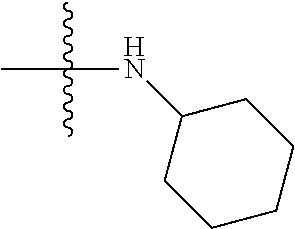
In embodiments of the corrosion-indicating material, examples of non-joined monovalent radicals for groups R3 and R4 of formula (Ia) include —H, —NH2, and (C1-C20)heterohydrocarbyls including at least one primary amine or at least one secondary amine. Specific non-limiting examples of the non-joined monovalent radicals are provided in TABLE 1 as both linear formulas and graphic structures. In the graphic structures, the wavy line across a bond refers to the point of connection of the radical to the main body of the 1,10-phenanthroline molecule.
TABLE 1
Non-limiting examples of non-joined radicals R3 and R4 of formula (Ia)
Line formula Graphic formula
—NH2
Figure US11236195-20220201-C00006
—CH2NH2
Figure US11236195-20220201-C00007
—CH2N(CH2CH2NH2)2
Figure US11236195-20220201-C00008
—CH2N(H)(cyclohexyl)
Figure US11236195-20220201-C00009
—CH2N(H)[(CH2)dCH3] (d = 1, 2, or 3)
Figure US11236195-20220201-C00010
—CH2N(H)[(CH2)2N(H)(phenyl)]
Figure US11236195-20220201-C00011
—CH2N(H)[(CH2)(2-pyridyl)]
Figure US11236195-20220201-C00012
In further embodiments, R3 and R4 of formula (I) may be joined as a single divalent radical. The single divalent radical may be a (C1-C40)heterohydrocarbylene that includes at least one primary amine or at least one secondary amine. In such embodiments, the 1,10-phenanthroline derivative has formula (Ib), in which R1 and R2 are as defined in formula (I); and R3 and R4 are joined as a single divalent radical as described with respect to formula (I). It should be readily understood that all compounds according to formula (Ib) also are compounds according to formula (I).
Figure US11236195-20220201-C00013
In embodiments of the corrosion-indicating material, specific examples of single divalent radicals of a joined R3 and R4 when the 1,10-phenanthroline derivative has formula (Ib) include —CH2—NH—[(CH2)xN(H)—]nCH2—, where x is 2 or 3 and n is 2, 3, 4, or 5; and —CH═N—(CH2)2{—N[(CH2)2NH2]—(CH2)2}y—N═CH—, where y is 1 or 2. These specific examples of single divalent radicals result in 1,10-phenanthroline derivatives with macrocyclic moieties, in which the heterohydrocarbylene component of the macrocycle is composed of only carbon, hydrogen, and nitrogen atoms. The macrocyclic 1,10-phenanthroline derivatives, each having formula (Ib), are illustrated in the following TABLE 2.
TABLE 2
Examples of macrocyclic 1,10-phenanthroline derivatives, each having formula (Ib)
Graphic formula of
Line formula of R3/R4 divalent radical 1,10-phenanthroline derivative
—CH2—NH—[(CH2)xN(H)—]nCH2— (x = 2 or 3; n = 2, 3, 4, or 5)
Figure US11236195-20220201-C00014
—CH═N—(CH2)2{—N[(CH2)2NH2]—(CH2)2}y—N═CH— (y = 1)
Figure US11236195-20220201-C00015
—CH═N—(CH2)2{—N[(CH2)2NH2]—(CH2)2}y—N═CH— (y = 2)
Figure US11236195-20220201-C00016
According to some embodiments, the curing agent may have formula (I) in which R1 and R2 are independently selected from the group consisting of —NH2 and —H and R3 and R4 are defined as previously described with respect to formula (I), formula (Ia), or formula (Ib), provided at least one of R1, R2, R3, and R4 is not —H. Examples of such embodiments include those in which both R1 and R2 are —H; in which both R1 and R2 are —NH2; or in which one of R1 and R2 is —NH2 and the other of R1 and R2 is —H. In further embodiments, R1, R2, R3, and R4 of formula (I) are independently —NH2 or —H, provided at least one of R1, R2, R3, and R4 is —NH2. Examples of such embodiments include a compound of formula (I) in which R1 and R2 are —NH2 and R3 and R4 are —H; or in which R1, R3, and R4 are —H, and R2 is —NH2. In specific examples of the foregoing embodiments, the curing agent is chosen from 1,10-phenanthroline-5-amine or 1,10-phenanthroline-5,6-diamine, and 1,10-phenanthroline-2,9-diamine.
In further embodiments, the curing agent may have formula (I), in which R3 and R4 are as previously defined and R1 and R2 may be selected from —NH2; —NH(CH2)aNH2; where a is 1, 2, or 3; or —OC(═O)(CH2)bNH2, where b is 1, 2, or 3; and —H. Non-limiting examples of such curing agents may be prepared by from 5,6-Epoxy-5,6-dihydro-[1,10]phenanthroline according to the following reaction scheme, in which both R3 and R4 of the resulting curing agent are —H:
Figure US11236195-20220201-C00017
The 1,10-phenanthroline derivatives having formula (I) as previously described may be prepared by any suitable synthetic strategy with 1,10-phenanthroline or 5,6-Epoxy-5,6-dihydro-[1,10]phenanthroline as a starting material. Exemplary synthetic schemes for preparing 1,10-phenanthroline derivatives include those disclosed in A. Bencini and V. Lippolis, 1,10-Phenanthroline: A Versatile Building Block for the Construction of Ligands for Various Purposes, Coordination Chemistry Reviews, volume 254 (2010), pages 2096-2180, and references cited therein.
As previously described, the corrosion-indicating materials according to embodiments are cured products of reacting a bisphenol A diglycidyl ether (DGEBA) epoxy resin with a curing according to formula (I), as previously described. In an example embodiment, the corrosion-indicating material may be prepared by preparing separate solutions of a DGEBA epoxy resin and a curing agent according to formula (I), then mixing the solutions. An example of a suitable solvent for both solutions includes tetrahydrofuran (THF). Upon combination of the DGEBA and the curing agent, curing may occur spontaneously, or upon application of heat. When the solvent evaporates, the cured product is left behind. In embodiments, the curing procedure may be performed in sufficient solvent to provide suitable viscosity to the solution to enable application of the mixture as a coating composition to a substrate such as a metal substrate, so as to form a coated article that produces a color change when corrosion of the article occurs.
Having described the corrosion-indicating material, embodiments of methods for applying the corrosion-indicating material will now be described.
In methods for applying a corrosion-indicating material, the corrosion-indicating material may be a corrosion-indicating material according to any of the embodiments previously described in this disclosure. The methods may include curing a DGEBA epoxy resin and a curing agent according to formula (I) in sufficient solvent to form a spreadable coating composition. Alternatively, the methods may include dissolving or softening a dried, cured product of the DGEBA epoxy resin and curing agent of formula (I) in a sufficient amount of a suitable solvent to provide a spreadable coating composition. Examples of suitable solvents for applying the coating composition include, without limitation, tetrahydrofuran, chloroform, and isopropanol. The corrosion-indicating material may be combined with the solvent via mixing. The methods may include adding the corrosion-indicating material to the solvent and mixing, or adding the solvent to the corrosion-indicating material and mixing.
The methods for applying the coating composition, specifically in preparing the coating composition for spreading, may then include heating the coating composition at from 50° C. to 130° C., from 50° C. to 110° C., from 50° C. to 100° C., from 50° C. to 90° C., from 50° C. to 80° C., from 50° C. to 70° C., from 70° C. to 130° C., from 70° C. to 110° C., from 70° C. to 100° C., from 70° C. to 90° C., from 70° C. to 80° C., from 80° C. to 130° C., from 80° C. to 110° C., from 80° C. to 100° C., from 80° C. to 90° C., from 90° C. to 130° C., from 90° C. to 110° C., from 90° C. to 100° C., from 100° C. to 130° C., from 100° C. to 110° C., from 110° C. to 130° C., or at about 90° C. The hearing may be carried out over example heating times such as from 1 hour to 30 hours, from 1 hour to 20 hours, from 1 hour to 17 hours, from 1 hour to 15 hours, from 1 hour to 13 hours, from 1 hour to 10 hours, from 1 hour to 5 hours, from 5 hours to 30 hours, from 5 hours to 20 hours, from 5 hours to 17 hours, from 5 hours to 15 hours, from 5 hours to 13 hours, from 5 hours to 10 hours, from 10 hours to 30 hours, from 10 hours to 20 hours, from 10 hours to 17 hours, from 10 hours to 15 hours, from 10 hours to 13 hours, from 13 hours to 30 hours, from 13 hours to 20 hours, from 13 hours to 17 hours, from 13 hours to 15 hours, from 15 hours to 30 hours, from 15 hours to 20 hours, from 15 hours to 17 hours, from 17 hours to 30 hours, from 17 hours to 20 hours, from 20 hours to 30 hours, or for about 15 hours. In some embodiments, the heating may be performed while stirring the coating composition with a suitable stirring apparatus such as a mixer, at a suitable speed such as from 100 revolutions per minute (rpm) to 500 rpm.
The methods for applying the coating composition may further include coating a metal substrate with the coating composition. The coating composition may be a spreadable liquid having a viscosity of from 1000 cP to 500,000 cP, from 1000 cP to 300,000 cP, from 1000 cP to 100,000 cP, from 1000 cP to 50,000 cP, from 1000 cP to 20,000 cP, from 1000 cP to 10,000 cP, from 1000 cP to 5000 cP, from 5000 cP to 500,000 cP, from 5000 cP to 300,000 cP, from 5000 cP to 100,000 cP, from 5000 cP to 50,000 cP, from 5000 cP to 20,000 cP, from 5000 cP to 10,000 cP, from 10,000 cP to 500,000 cP, from 10,000 cP to 300,000 cP, from 10,000 cP to 100,000 cP, from 10,000 cP to 50,000 cP, from 10,000 cP to 20,000 cP, from 20,000 cP to 500,000 cP, from 20,000 cP to 300,000 cP, from 20,000 cP to 100,000 cP, from 20,000 cP to 50,000 cP, from 50,000 cP to 500,000 cP, from 50,000 cP to 300,000 cP, from 50,000 cP to 100,000 cP, from 100,000 cP to 500,000 cP, from 100,000 cP to 300,000 cP, or from 300,000 cP to 500,000 cP. Coating the metal substrate may include any suitable technique for covering a substrate or portion of a substrate with a liquid solution having the viscosity of the coating composition. Example techniques for covering the substrate may include painting or spraying the coating composition onto the metal substrate.
In some embodiments, upon application of the coating composition to the substrate or metal substrate, the coating composition may be a surface layer overlying the metal substrate. Such a surface layer may cover at least a portion of the surface of the metal substrate. The coating composition may cover the entire surface of the metal substrate or, alternatively, may only partially surround the metal substrate, leaving at least a portion of the surface of the metal substrate uncoated or otherwise exposed. In embodiments, the coating composition may be the outermost coating of the metal substrate with one or more other, intervening, coatings, positioned between the coating composition and the metal substrate. In such embodiments, as opposed to directly contacting the metal substrate, the coating composition indirectly contacts the metal substrate or is in communication with the metal substrate such that metal ions resulting from corrosion of the metal substrate can contact the coating composition.
Further embodiments of the present disclosure include a coating composition for applying the corrosion-indicating material, as previously described, to a substrate such as a metal substrate. The coating composition may include a corrosion-indicating material according to any embodiment as previously described and a solvent. In example embodiments, the solvent may include tetrahydrofuran (THF), chloroform, acetone, isopropanol, or any other organic polar solvent.
Further embodiments of this disclosure include articles onto which the corrosion-indicating material have been applied, such that the corrosion-indicating material is capable of indicating corrosion of the article. Thus, the articles may include a metal substrate and a corrosion-indicating material as previously described. A layer of the corrosion-indicating material may overlie a surface of the metal substrate.
In the articles according to embodiments, the metal substrate may include an oxidizable metal. Oxidizable metals include any metal that, upon corrosion by any means, produces positive metal ions capable of forming complexes with the corrosion-indicating materials described in this disclosure. In example embodiments, the oxidizable metal may be selected from iron, vanadium, chromium, manganese, cobalt, nickel, copper, and combinations of any of the foregoing. As a non-limiting example, when the metal substrate is selected from iron, the metal substrate may include iron alloys and iron-based steels. The oxidizable metal may be converted to metal ions when the metal substrate corrodes. The metal ions may then form complexes with the 1,10-phenanthroline derivative in the corrosion-indicating material, which is a cured product of reacting DGEBA epoxy resin with a 1,10-phenanthroline derivative having formula (I) curing agent as previously described. In turn, the complexes may impart a color change to the corrosion-indicating material in the presence of the moisture from an initial color before corrosion to a corrosion-indicative color different from the initial color. It should be understood that the specific color change imparted to the corrosion-indicting material will vary based on the identity of the oxidizable metal in the metal substrate that has formed positive metal ions when the metal substrate has corroded.
The following scheme illustrates an example of the mechanism for corrosion detection by a corrosion-indicating material according to embodiments of this disclosure, when applied as a coating material onto a metal substrate that includes an iron component:
Figure US11236195-20220201-C00018
In the foregoing scheme, line (A) represents the reaction of DGEBA epoxy resin with 1,10-phenanthroline-5,6-diamine, an example curing agent according to formula (I) as previously described. Line (B) schematically illustrates two molecules of the curing agent covalently bonded to respective ends of a resin backbone to form a cured product of a reaction of the DGEBA and the curing agent. It should be understood that the reaction scheme is simplified and that in a corrosion-indicating material according to embodiments, a crosslinked structure may result to the resin material. Regardless, line (B) illustrates that the corrosion-indicating material incorporates the curing agent into the main structure. When the corrosion-indicating material is applied to a substrate as a coating material, the molecules of curing agent incorporated into the resin structure remain capable of forming complexes. As illustrated in line (C) of the foregoing scheme, two molecules of curing agent, each covalently bonded to a resin backbone indicated by the long wavy lines, account for four positions in a hexagonal complex with a single iron (Fe) ion, particularly Fe(II). The other two positions of the hexagonal complex are occupied by water molecules. This particular complex results when Fe(II) is produced from the corrosion of the metal substrate in the presence of moisture, namely, water. Though the cured product of line (B) may be clear or may have an initial color such as yellow or light orange, the complex illustrated in line (C) has a distinctive, dark-red color. Thus, it should be understood that the corrosion-indicating material indicates corrosion of the metal substrate underlying the corrosion-indicating material when the color changes from the initial color to the dark-red color.
EXAMPLE
The following example illustrates one or more additional features of the present disclosure described previously. It should be understood that these examples are not intended to limit the scope of the disclosure or the appended claims in any manner.
To produce a coating including DGEBA resin and phenanthroline derivatives, 0.5 grams (g) of 1,10-phenanthroline-5-amine was dissolved in 5 ml tetrahydrofuran. Then, 1.0 g of DGEBA resin was dissolved in 2 milliliters (mL) of tetrahydrofuran. Then, both mixtures were combined and 20 mL of additional tetrahydrofuran was added to form the coating composition. The coating composition was then heated at 90° C. for 15 hours while stirring at 350 RPM using a H3770-S Digital Hotplate Magnetic Stirrer from Benchmark Scientific, headquartered in New Jersey. The coating composition was then cast as a thin layer on a glass substrate and left overnight at 120° C. to react. This ensured that all excess solvent was evaporated and that the epoxy monomer was fully crosslinked. The solvent dried from the coating composition, leaving a smooth coating of corrosion-indicating material on the surface of the glass. The corrosion-indicating material had a light-yellow color.
The coated glass substrate, upon contact with Fe(II) ions and moisture, changes color from light-yellow to dark-red.
It should be apparent to those skilled in the art that various modifications and variations may be made to the embodiments described within without departing from the scope of the claimed subject matter. Thus, it is intended that the specification cover the modifications and variations of the various embodiments described within provided such modification and variations come within the scope of the appended claims and their equivalents.
It is noted that one or more of the following claims utilize the term “where” or “in which” as a transitional phrase. For the purposes of defining the present technology, it is noted that this term is introduced in the claims as an open-ended transitional phrase that is used to introduce a recitation of a series of characteristics of the structure and should be interpreted in like manner as the more commonly used open-ended preamble term “comprising.” For the purposes of defining the present technology, the transitional phrase “consisting of” may be introduced in the claims as a closed preamble term limiting the scope of the claims to the recited components or steps and any naturally occurring impurities. For the purposes of defining the present technology, the transitional phrase “consisting essentially of” may be introduced in the claims to limit the scope of one or more claims to the recited elements, components, materials, or method steps as well as any non-recited elements, components, materials, or method steps that do not materially affect the novel characteristics of the claimed subject matter. The transitional phrases “consisting of” and “consisting essentially of” may be interpreted to be subsets of the open-ended transitional phrases, such as “comprising” and “including,” such that any use of an open ended phrase to introduce a recitation of a series of elements, components, materials, or steps should be interpreted to also disclose recitation of the series of elements, components, materials, or steps using the closed terms “consisting of” and “consisting essentially of.” For example, the recitation of a composition “comprising” components A, B, and C should be interpreted as also disclosing a composition “consisting of” components A, B, and C as well as a composition “consisting essentially of” components A, B, and C. Any quantitative value expressed in the present application may be considered to include open-ended embodiments consistent with the transitional phrases “comprising” or “including” as well as closed or partially closed embodiments consistent with the transitional phrases “consisting of” and “consisting essentially of.”
As used in the Specification and appended Claims, the singular forms “a”, “an”, and “the” include plural references unless the context clearly indicates otherwise. The verb “comprises” and its conjugated forms should be interpreted as referring to elements, components or steps in a non-exclusive manner. The referenced elements, components or steps may be present, utilized or combined with other elements, components or steps not expressly referenced.
Embodiments of this disclosure may incorporate one or more of the following aspects of the present disclosure, without limitation:
A first aspect of the present disclosure may be directed to a corrosion-indicating material that indicates corrosion of a metal substrate underlying the corrosion-indicating material, the corrosion-indicating material comprising a cured product of reacting a bisphenol A diglycidyl ether (DGEBA) epoxy resin with a curing agent, the curing agent comprising a 1,10-phenanthroline derivative having formula (I):
Figure US11236195-20220201-C00019
where: R1 and R2 are independently selected from —NH2; —NH(CH2)aNH2, where a is 1, 2, or 3; —OC(═O)(CH2)bNH2, where b is 1, 2, or 3; and —H; R3 and R4 are either: non-joined monovalent radicals each independently chosen from —H, —NH2, and (C1-C20)heterohydrocarbyls comprising at least one primary amine or at least one secondary amine; or joined as a single divalent radical, the single divalent radical being a (C1-C40)heterohydrocarbylene comprising at least one primary amine or at least one secondary amine; and at least one of R1, R2, R3, and R4 is not —H.
A second aspect of the present disclosure may be directed to an article comprising a metal substrate and a layer of the corrosion-indicating material of the first aspect overlying a surface of the metal substrate.
A third aspect of the present disclosure may be directed to a coating composition comprising a corrosion-indicating resin according to the first aspect and a solvent.
Another aspect of the present disclosure may include any of the previous aspects, in which: the non-joined monovalent radicals are selected from the group consisting of —NH2, —CH2NH2, —CH2N(CH2CH2NH2)2, —CH2N(H)(cyclohexyl), —CH2N(H)[(CH2)dCH3], where d is 1, 2, or 3, —CH2N(H)[(CH2)2N(H)(phenyl)], —CH2N(H)[(CH2)(2-pyridyl)], and —H; or the single divalent radical is selected from the group consisting of —CH2—NH—[(CH2)xN(H)—]nCH2—, where x is 2 or 3 and n is 2, 3, 4, or 5; and —CH═N—(CH2)2{—N[(CH2)2NH2]—(CH2)2}y—N═CH—, where y is 1 or 2.
Another aspect of the present disclosure may include any of the previous aspects, in which R1 and R2 are independently selected from the group consisting of —NH2 and —H.
Another aspect of the present disclosure may include any of the previous aspects, in which both R1 and R2 are —H.
Another aspect of the present disclosure may include any of the previous aspects, in which both R1 and R2 are —NH2.
Another aspect of the present disclosure may include any of the previous aspects, in which one of R1 and R2 is —NH2 and the other of R1 and R2 is —H.
Another aspect of the present disclosure may include any of the previous aspects, in which R1, R2, R3, and R4 are independently —NH2 or —H, provided at least one of R1, R2, R3, and R4 is —NH2.
Another aspect of the present disclosure may include any of the previous aspects, in which: R1 and R2 are —H; and R3 and R4 are —NH2.
Another aspect of the present disclosure may include any of the previous aspects, in which: R1 and R2 are —NH2; and R3 and R4 are —H.
Another aspect of the present disclosure may include any of the previous aspects, in which: R1, R3, and R4 are —H; and R2 is —NH2.
Another aspect of the present disclosure may include any of the previous aspects, in which R3 and R4 are identical non-joined monovalent radicals.
Another aspect of the present disclosure may include any of the previous aspects, in which both R3 and R4 are —NH2.
Another aspect of the present disclosure may include any of the previous aspects, in which R3 and R4 are identical non-joined monovalent radicals selected from the group consisting of —CH2NH2, —CH2N(CH2CH2NH2)2, —CH2N(H)(cyclohexyl), —CH2N(H)[(CH2)dCH3] where d is 1, 2, or 3, —CH2N(H)[(CH2)2N(H)(phenyl)], and —CH2N(H)[(CH2)(2-pyridyl)].
Another aspect of the present disclosure may include any of the previous aspects, in which R3 and R4 are joined as a single divalent radical having the formula —CH2—NH—[(CH2)xN(H)—]nCH2—, where x is 2 or 3 and n is 2, 3, 4, or 5.
Another aspect of the present disclosure may include any of the previous aspects, in which R3 and R4 are joined as a single divalent radical having the formula —CH═N—(CH2)2{—N[(CH2)2NH2]—(CH2)2}y—N═CH—, where y is 1 or 2.
Another aspect of the present disclosure may include any of the previous aspects, in which: the metal substrate comprises an oxidizable metal that is converted to metal ions when the metal substrate corrodes; the metal ions form complexes with the 1,10-phenanthroline derivative present in the corrosion-indicating material; the complexes impart a color change to the corrosion-indicating material in the presence of moisture from an initial color before corrosion to a corrosion-indicative color different from the initial color.
Another aspect of the present disclosure may include any of the previous aspects, in which the oxidizable metal is selected from iron, vanadium, chromium, manganese, cobalt, nickel, copper, and combinations of any of the foregoing.
Another aspect of the present disclosure may include any of the previous aspects, in which the metal substrate is selected from iron, iron alloys, and iron-based steels.
Another aspect of the present disclosure may include any of the previous aspects, in which the solvent comprises tetrahydrofuran (THF), chloroform, acetone, isopropanol, or combinations thereof.
Having described the subject matter of the present disclosure in detail and by reference to specific embodiments, it is noted that the various details disclosed within should not be taken to imply that these details relate to elements that are essential components of the various embodiments described within, even in cases where a particular element is illustrated in each of the drawings that accompany the present description. Further, it should be apparent that modifications and variations are possible without departing from the scope of the present disclosure, including, but not limited to, embodiments defined in the appended claims. More specifically, although some aspects of the present disclosure are identified as particularly advantageous, it is contemplated that the present disclosure is not necessarily limited to these aspects.

Claims (10)

What is claimed is:
1. A corrosion-indicating material that indicates corrosion of a metal substrate underlying the corrosion-indicating material, the corrosion-indicating material comprising a cured product of reacting a bisphenol A diglycidyl ether (DGEBA) epoxy resin with a curing agent, the curing agent comprising a 1,10-phenanthroline derivative having formula (I):
Figure US11236195-20220201-C00020
where:
R1 and R2 are independently selected from —NH2; —NH(CH2)aNH2, where a is 1, 2, or 3; —OC(═O)(CH2)bNH2, where b is 1, 2, or 3; and —H;
R3 and R4 are either:
non-joined monovalent radicals each independently chosen from —H, —NH2, and (C1-C20)heterohydrocarbyls comprising at least one primary amine or at least one secondary amine; or
joined as a single divalent radical, the single divalent radical being a (C1-C40)heterohydrocarbylene comprising at least one primary amine or at least one secondary amine;
at least one of R1, R2, R3, and R4 is not —H; and
provided at least one of (i), (ii), (iii), (iv), (v), or (vi) is true:
(i) R1 and R2 are independently selected from the group consisting of —NH2 and —H and:
both R1 and R2 are —H, or
both R1 and R2 are —NH2; or
(ii) R1, R2, R3, and R4 are independently —NH2 or —H, provided at least one of R1, R2, R3, and R4 is —NH2 and:
R1 and R2 are —H and R3 and R4 are —NH2, or
R1 and R2 are —NH2 and R3 and R4 are —H; or
(iii) both R3 and R4 are —NH2; or
(iv) R3 and R4 are identical non-joined monovalent radicals selected from the group consisting of —CH2NH2, —CH2N(CH2CH2NH2)2, —CH2N(H)(cyclohexyl), —CH2N(H)[(CH2)dCH3] where d is 1, 2, or 3, —CH2N(H)[CH2)2N(H)(phenyl)], and —CH2N(H)[CH2)(2-pyridyl)]; or
(v) R3 and R4 are joined as a single divalent radical having the formula —CH2—NH—[(CH2)xN(H)—]nCH2—, where x is 2 or 3 and n is 2, 3, 4, or 5; or
(vi) R3 and R4 are joined as a single divalent radical having the formula —CH═N—(CH2)2{—N[CH2)2NH2]—(CH2)2}y—N═CH—, where y is 1 or 2.
2. The corrosion-indicating material of claim 1, in which at least (i) is true and:
the non-joined monovalent radicals are selected from the group consisting of —NH2, —CH2NH2, —CH2N(CH2CH2NH2)2, —CH2N(H)(cyclohexyl), —CH2N(H)[(CH2)dCH3], where d is 1, 2, or 3, —CH2N(H)[(CH2)2N(H)(phenyl)], —CH2N(H)[CH2)(2-pyridyl)], and —H; or
the single divalent radical is selected from the group consisting of —CH2—NH—[(CH2)xN(H)—]nCH2—, where x is 2 or 3 and n is 2, 3, 4, or 5; and —CH═N—(CH2)2{—N[(CH2)2NH2]—(CH2)2}y—N═CH—, where y is 1 or 2.
3. The corrosion-indicating material of claim 1, in which at least one of (iii) through (vi) is true and one of R1 and R2 is —NH2 and the other of R1 and R2 is —H.
4. The corrosion-indicating material of claim 1, in which at least (i) is true and R3 and R4 are identical non-joined monovalent radicals.
5. An article comprising a metal substrate and a layer of the corrosion-indicating material according to claim 1 overlying a surface of the metal substrate.
6. The article of claim 5, in which:
the metal substrate comprises an oxidizable metal that is converted to metal ions when the metal substrate corrodes;
the metal ions form complexes with the 1,10-phenanthroline derivative present in the corrosion-indicating material;
the complexes impart a color change to the corrosion-indicating material in the presence of moisture from an initial color before corrosion to a corrosion-indicative color different from the initial color.
7. The article of claim 6, in which the oxidizable metal is selected from iron, vanadium, chromium, manganese, cobalt, nickel, copper, and combinations of any of the foregoing.
8. The article of claim 5, in which the metal substrate is selected from iron, iron alloys, and iron-based steels.
9. A coating composition comprising a corrosion-indicating resin according to claim 1 and a solvent.
10. The coating composition of claim 9, in which the solvent comprises tetrahydrofuran (THF), chloroform, acetone, isopropanol, or combinations thereof.
US16/799,137 2020-02-24 2020-02-24 Corrosion-indicating materials and methods of making and using the same Expired - Fee Related US11236195B2 (en)

Priority Applications (3)

Application Number Priority Date Filing Date Title
US16/799,137 US11236195B2 (en) 2020-02-24 2020-02-24 Corrosion-indicating materials and methods of making and using the same
PCT/US2021/019002 WO2021173477A1 (en) 2020-02-24 2021-02-22 Corrosion-indicating materials and methods of making and using the same
SA522440257A SA522440257B1 (en) 2020-02-24 2022-08-22 Corrosion-Indicating Materials and Methods of Making and Using the Same

Applications Claiming Priority (1)

Application Number Priority Date Filing Date Title
US16/799,137 US11236195B2 (en) 2020-02-24 2020-02-24 Corrosion-indicating materials and methods of making and using the same

Publications (2)

Publication Number Publication Date
US20210269584A1 US20210269584A1 (en) 2021-09-02
US11236195B2 true US11236195B2 (en) 2022-02-01

Family

ID=74875323

Family Applications (1)

Application Number Title Priority Date Filing Date
US16/799,137 Expired - Fee Related US11236195B2 (en) 2020-02-24 2020-02-24 Corrosion-indicating materials and methods of making and using the same

Country Status (3)

Country Link
US (1) US11236195B2 (en)
SA (1) SA522440257B1 (en)
WO (1) WO2021173477A1 (en)

Families Citing this family (2)

* Cited by examiner, † Cited by third party
Publication number Priority date Publication date Assignee Title
CN118389024A (en) * 2024-05-08 2024-07-26 青岛科技大学 Intelligent epoxy resin anticorrosive paint based on dual-mode early warning and preparation method thereof
CN119767657B (en) * 2024-12-24 2025-09-19 西北工业大学 An iron-based magnetic absorbent with corrosion warning and inhibition functions, and its preparation method and application

Citations (4)

* Cited by examiner, † Cited by third party
Publication number Priority date Publication date Assignee Title
US5646400A (en) 1995-07-14 1997-07-08 The United States Of America As Represented By The Secretary Of The Navy Corrosion detecting and monitoring method and apparatus
JP2012149109A (en) * 2011-01-17 2012-08-09 Jfe Steel Corp Anticorrosive coating material and coated steel stock
CN106189771A (en) * 2016-07-19 2016-12-07 上海理工大学 A self-detection anti-corrosion coating containing nano-carrier and its preparation method and application
EP3483231A1 (en) 2017-11-14 2019-05-15 3M Innovative Properties Company Color changing composition

Patent Citations (4)

* Cited by examiner, † Cited by third party
Publication number Priority date Publication date Assignee Title
US5646400A (en) 1995-07-14 1997-07-08 The United States Of America As Represented By The Secretary Of The Navy Corrosion detecting and monitoring method and apparatus
JP2012149109A (en) * 2011-01-17 2012-08-09 Jfe Steel Corp Anticorrosive coating material and coated steel stock
CN106189771A (en) * 2016-07-19 2016-12-07 上海理工大学 A self-detection anti-corrosion coating containing nano-carrier and its preparation method and application
EP3483231A1 (en) 2017-11-14 2019-05-15 3M Innovative Properties Company Color changing composition

Non-Patent Citations (27)

* Cited by examiner, † Cited by third party
Title
Agarwala et al., "Corrosion Detection and Monitoring—A Review", Corrosion 2000, Paper No. 00271, NACE International, 2000.
Aguilar et al., "Dinuclear Znll Complexes of Polydentate Polyamines as Minimalist Models of Hydrolytic Reactions", Eur. J. Inorg. Chem., pp. 4061-4071, 2004.
Al-Sharani et al., "The effect of Clay Structures on the Modification Process to Synthesize Polymer-Clay Nanocomposites", Journal of Materials and Environmental Sciences, vol. 8, Issue 6, pp. 2192-2202, 2017.
Arca et al., "Conformationally locked pentadentate macrocycles containing the 1,10-phenanthroline unit. Synthesis and crystal structure of 5-oxa-2,8-dithia[9](2,9)-1,10-phenanthrolinophane (L) and its coordination properties to Nill, Pdll, PtIl, Rhlll and Rull", J. Chem. Soc., Dalton Trans., pp. 1180-1188, 2001.
Augustyniak et al., "Early detection of aluminum corrosion via "turn-on" fluorescence in smart coatings"Progress in Organic Coatings, vol. 71, pp. 406-412, 2011.
Augustyniak et al., "Early Detection of Steel Corrosion via "Turn-On" Florescence in Smart Epoxy Coatings", Applied Materials & Interfaces, vol. 1, No. 11, pp. 2618-2613, 2009.
Bazzicalupi et al., "Phenanthroline-containing macrocycles as multifunctional receptors for nucleotide anions. A thermodynamic and NMR study", J. Chem. Soc., Perkin Trans. vol 2, pp. 1675-1682, 1999.
Bazzicalupi et al., "Polyamine Receptors Containing Dipyridine or Phenanthroline Units: Clues for the Design of Fluorscent Chemosensors for Metal Ions", Chem. Eur. J., vol. 15, pp. 8049-8063, 2009.
Blake et al., "A new class of mixed aza-thioether crown containing a 1,10-phenathroline sub-unit", J. Chem. Soc., Dalton Trans., pp. 3705-3712, 1996.
Bryant et al., "The use of fluorscent probes for the detection of under-film corrosion", Progress in Organic Coatings, vol. 57, pp. 416-420, 2006.
Buchheit et al., "Active corrosion protection and corrosion sensing in chromate-free organic coatings", Progress in Organic Coatings, vol. 47, pp. 174-182, 2003.
Dhole, G. S. et al. "Modified Epoxy Coatings for Corrosion Detection", Corrosion, Coden: Corrak, vol. 73, No. 4, Apr. 2017, pp. 326-338.
Dhole, G.S. et al. "Smart corrosion sensing phenanthroline modified alkyd coatings", Progress in Organic Coatings, vol. 89, 2015, pp. 8-16.
Dohle et al., "Smart acrylic coatings for corrosion detection", Progress in Organic Coatings, vol. 110, pp. 140-149, 2017.
International Search Report and Written Opinion dated Jul. 6, 2021 pertaining to International application No. PCT/US2021/019002 filed Feb. 22, 2021, 14 pages.
Keypour et al., "New macrocyclic Schiff base complxes incorporating a phenanthroline unit: Part 1; Template synthesis of three Cadmium(lI) complexes and crystal structure, NMR and ab initio studies", Inorganica Chimica Acta 360 pp. 2298-2306, 2007.
Keypour et al., "New macrocyclic Schiff base complxes incorporating a phenanthroline unit: Part 2: Template synthesis of some maganese(II) complexes and crystal structure studies", Inorganica Chimica Acta 361, pp. 1415-1420, 2008.
Kim, J. et al. "Preparation and properties of luminescent metal-complex containing conjugated and non-conjugated polymers", Polymer Preprints, American Chemical Society, US, vol. 40, No. 2, Jan. 1, 1999, pp. 1237-1238.
Mendoza et al., "Hydrogen-ion driven molecular motions in Cu2+-complexes of a ditopic phenanthrolinophane ligand", Chem Commun., pp. 3032-3033, 2003.
O'Mahony et al., "Voltammetry of chromium(VI) at the liquid/liquid interface", Electrochemistry Communications, vol. 7, pp. 976-982, 2005.
Rinaldi, Ginoo, "A Literature Review of Corrosion Sensing Methods", Defence Research and Development Canada, Technical Memorandum, DRDC Atlantic TM 2009-082, Sep. 2009.
Roshan et al., "Monitoring underlying epoxy-coated St-37 corrosion via 8-hydroxyquinoline as a fluorescent indicator", Applied Surface Science, vol. 440, pp. 880-888, 2018.
Saidarasamoot et al., "Assessment of the Emerging Technologies for the Detection and Measurement of Corrosion Wastage of Coated Marine Structures", The 22nd International Conference on Offshore Mechanics & Artic Engineering, Proceedings of OMAE, Jun. 8-13, 2003.
Shepard et al., "Introduction to active thermography for non-destructive evaluation", Anti-Corrosion Methods and Materials, vol. 44, Issue 4, Nov. 4, 1997.
Wheat, "Smart Coatings for Corrosion Detection-A Review of Recent Advances", Proceedings of the Twenty-second (2012) International Offshore and Polar Engineering Conference, pp. 360-363, Jun. 17-22, 2012.
Zhang et al., "Corrosion-Sensing Behavior of an Acrylic-Based Coating System", Corrosion, vol. 55, No. 10, pp. 957-967, Jul. 1999.
Zhao et al., "Palladium(lI) complexes with N,N'-Dialky1-1,10-phenanthroline-2,9-diamathanamine: synthesis, characterization and cytotoxic activity", Journal of Inorganic Biochemistry, pp. 173-177, 1998.

Also Published As

Publication number Publication date
WO2021173477A1 (en) 2021-09-02
US20210269584A1 (en) 2021-09-02
SA522440257B1 (en) 2023-10-01

Similar Documents

Publication Publication Date Title
Aly et al. Conducting copolymers nanocomposite coatings with aggregation-controlled luminescence and efficient corrosion inhibition properties
Cao et al. Inhibition behavior of synthesized ZIF-8 derivative for copper in sodium chloride solution
Murmu et al. Amine cured double Schiff base epoxy as efficient anticorrosive coating materials for protection of mild steel in 3.5% NaCl medium
Zhou et al. Corrosion resistance of novel silane-functional polybenzoxazine coating on steel
US11236195B2 (en) Corrosion-indicating materials and methods of making and using the same
Huang et al. Effect of amino-capped aniline trimer on corrosion protection and physical properties for electroactive epoxy thermosets
Zhang et al. Designing a high-performance waterborne epoxy coating with passive/active dual self-healing properties by synergistic effect of V2O5@ polyaniline-tannic acid inhibitors
Zhou et al. Enhanced corrosion resistance of polybenzoxazine coatings by epoxy incorporation
CN104746081B (en) Functionalization imidazole ion liquid corrosion inhibiter and its preparation method and application
Wang et al. The polymeric nanofilm of triazinedithiolsilane fabricated by self-assembled technique on copper surface. Part 1: design route and corrosion resistance
Krishnan et al. Silane‐functionalized polybenzoxazines: a superior corrosion resistant coating for steel plates
BR112013027461B1 (en) METALLIC SURFACE MATERIAL AND TREATED WATER METAL SURFACE AGENT
Zhang et al. Vapor phase assembly of benzotriazole and octadecylamine complex films on aluminum alloy surface
Yeldir et al. Synthesis and characterization of a pyrene-based Schiff base and its oligomer: Investigation of fluorescent Cr3+ probe
Liu et al. Robust Rare‐Earth‐Containing Superhydrophobic Coatings for Strong Protection of Magnesium and Aluminum Alloys
Yang et al. Synthesis of thin‐layered molybdenum disulfide‐based polyaniline nanointerfaces for enhanced direct electrochemical DNA detection
Bălănucă et al. Phenolated oleic acid based polybenzoxazine derivatives as corrosion protection layers
Xu et al. Evaluation of the anticorrosion properties of passivation solution containing different metal ions coated on a steel surface
Al Jahdaly Electrochemical and DFT insights into 2-amino-4-(4-hydroxy-3-methoxyphenyl)-7-methyl-4 H-chromene-3-carbonitrile: an innovative strategy for antibacterial activity and corrosion protection of carbon steel
Ishak et al. Extracts of curcumin-incorporated hybrid sol–gel coatings for the corrosion mitigation of mild steel in 0.5 M HCl
Raicopol et al. Vegetable oil-based polybenzoxazine derivatives coatings on Zn–Mg–Al alloy coated steel
San et al. Synthesis of 1, 8-naphthyridines by the ionic liquid-catalyzed friedlander reaction and application in corrosion inhibition
KR20070061484A (en) Corrosion Inhibiting Compounds and Uses thereof
Dua et al. Functionalized polypyrrole for mild steel corrosion protection in 15% HCl
Selvaraj et al. Synthesis of new quinoline derivatives based on mono-functional polybenzoxazines for oil-water separation, anti-corrosion and antibacterial applications

Legal Events

Date Code Title Description
AS Assignment

Owner name: SAUDI ARABIAN OIL COMPANY, SAUDI ARABIA

Free format text: ASSIGNMENT OF ASSIGNORS INTEREST;ASSIGNORS:ALAMRI, HALEEMA;FIHRI, AZIZ;BOUHRARA, MOHAMED;AND OTHERS;REEL/FRAME:051905/0884

Effective date: 20200202

FEPP Fee payment procedure

Free format text: ENTITY STATUS SET TO UNDISCOUNTED (ORIGINAL EVENT CODE: BIG.); ENTITY STATUS OF PATENT OWNER: LARGE ENTITY

STPP Information on status: patent application and granting procedure in general

Free format text: RESPONSE TO NON-FINAL OFFICE ACTION ENTERED AND FORWARDED TO EXAMINER

STPP Information on status: patent application and granting procedure in general

Free format text: NOTICE OF ALLOWANCE MAILED -- APPLICATION RECEIVED IN OFFICE OF PUBLICATIONS

STPP Information on status: patent application and granting procedure in general

Free format text: PUBLICATIONS -- ISSUE FEE PAYMENT VERIFIED

STCF Information on status: patent grant

Free format text: PATENTED CASE

FEPP Fee payment procedure

Free format text: MAINTENANCE FEE REMINDER MAILED (ORIGINAL EVENT CODE: REM.); ENTITY STATUS OF PATENT OWNER: LARGE ENTITY

LAPS Lapse for failure to pay maintenance fees

Free format text: PATENT EXPIRED FOR FAILURE TO PAY MAINTENANCE FEES (ORIGINAL EVENT CODE: EXP.); ENTITY STATUS OF PATENT OWNER: LARGE ENTITY

STCH Information on status: patent discontinuation

Free format text: PATENT EXPIRED DUE TO NONPAYMENT OF MAINTENANCE FEES UNDER 37 CFR 1.362

FP Lapsed due to failure to pay maintenance fee

Effective date: 20260201