US11233246B2 - Electrode including metal nanoparticles having conductive polymer shell and conductive film and method for manufacturing the same - Google Patents
Electrode including metal nanoparticles having conductive polymer shell and conductive film and method for manufacturing the same Download PDFInfo
- Publication number
- US11233246B2 US11233246B2 US16/215,010 US201816215010A US11233246B2 US 11233246 B2 US11233246 B2 US 11233246B2 US 201816215010 A US201816215010 A US 201816215010A US 11233246 B2 US11233246 B2 US 11233246B2
- Authority
- US
- United States
- Prior art keywords
- poly
- catalyst
- p3ht
- electrode
- conductive polymer
- Prior art date
- Legal status (The legal status is an assumption and is not a legal conclusion. Google has not performed a legal analysis and makes no representation as to the accuracy of the status listed.)
- Active, expires
Links
- IYOPCGLDIKISMV-UHFFFAOYSA-N C#CC1=C(CCCCCC)C=C(Br)S1.CCCCCCC1=C(Br)SC(Br)=C1 Chemical compound C#CC1=C(CCCCCC)C=C(Br)S1.CCCCCCC1=C(Br)SC(Br)=C1 IYOPCGLDIKISMV-UHFFFAOYSA-N 0.000 description 1
- NNFAIZNJTZIHBL-UHFFFAOYSA-N C#CC1=C(CCCCCC)C=C(Br)S1.CCCCCCC1=C(C2=CN(CCCS)N=N2)SC(Br)=C1.[N-]=[N+]=NCCCS Chemical compound C#CC1=C(CCCCCC)C=C(Br)S1.CCCCCCC1=C(C2=CN(CCCS)N=N2)SC(Br)=C1.[N-]=[N+]=NCCCS NNFAIZNJTZIHBL-UHFFFAOYSA-N 0.000 description 1
- WIFHJVSHEDLMJY-UHFFFAOYSA-N C1CCOC1.SCCCCl.[N-]=[N+]=NCCCS Chemical compound C1CCOC1.SCCCCl.[N-]=[N+]=NCCCS WIFHJVSHEDLMJY-UHFFFAOYSA-N 0.000 description 1
- 0 [1*]C1=CN(CCCC)N=N1 Chemical compound [1*]C1=CN(CCCC)N=N1 0.000 description 1
Images




Classifications
-
- H—ELECTRICITY
- H01—ELECTRIC ELEMENTS
- H01M—PROCESSES OR MEANS, e.g. BATTERIES, FOR THE DIRECT CONVERSION OF CHEMICAL ENERGY INTO ELECTRICAL ENERGY
- H01M4/00—Electrodes
- H01M4/86—Inert electrodes with catalytic activity, e.g. for fuel cells
- H01M4/90—Selection of catalytic material
- H01M4/92—Metals of platinum group
- H01M4/921—Alloys or mixtures with metallic elements
-
- H—ELECTRICITY
- H01—ELECTRIC ELEMENTS
- H01M—PROCESSES OR MEANS, e.g. BATTERIES, FOR THE DIRECT CONVERSION OF CHEMICAL ENERGY INTO ELECTRICAL ENERGY
- H01M4/00—Electrodes
- H01M4/86—Inert electrodes with catalytic activity, e.g. for fuel cells
- H01M4/8647—Inert electrodes with catalytic activity, e.g. for fuel cells consisting of more than one material, e.g. consisting of composites
- H01M4/8657—Inert electrodes with catalytic activity, e.g. for fuel cells consisting of more than one material, e.g. consisting of composites layered
-
- C—CHEMISTRY; METALLURGY
- C08—ORGANIC MACROMOLECULAR COMPOUNDS; THEIR PREPARATION OR CHEMICAL WORKING-UP; COMPOSITIONS BASED THEREON
- C08G—MACROMOLECULAR COMPOUNDS OBTAINED OTHERWISE THAN BY REACTIONS ONLY INVOLVING UNSATURATED CARBON-TO-CARBON BONDS
- C08G61/00—Macromolecular compounds obtained by reactions forming a carbon-to-carbon link in the main chain of the macromolecule
- C08G61/12—Macromolecular compounds containing atoms other than carbon in the main chain of the macromolecule
- C08G61/122—Macromolecular compounds containing atoms other than carbon in the main chain of the macromolecule derived from five- or six-membered heterocyclic compounds, other than imides
- C08G61/123—Macromolecular compounds containing atoms other than carbon in the main chain of the macromolecule derived from five- or six-membered heterocyclic compounds, other than imides derived from five-membered heterocyclic compounds
- C08G61/126—Macromolecular compounds containing atoms other than carbon in the main chain of the macromolecule derived from five- or six-membered heterocyclic compounds, other than imides derived from five-membered heterocyclic compounds with a five-membered ring containing one sulfur atom in the ring
-
- C—CHEMISTRY; METALLURGY
- C08—ORGANIC MACROMOLECULAR COMPOUNDS; THEIR PREPARATION OR CHEMICAL WORKING-UP; COMPOSITIONS BASED THEREON
- C08G—MACROMOLECULAR COMPOUNDS OBTAINED OTHERWISE THAN BY REACTIONS ONLY INVOLVING UNSATURATED CARBON-TO-CARBON BONDS
- C08G85/00—General processes for preparing compounds provided for in this subclass
- C08G85/004—Modification of polymers by chemical after-treatment
-
- C—CHEMISTRY; METALLURGY
- C08—ORGANIC MACROMOLECULAR COMPOUNDS; THEIR PREPARATION OR CHEMICAL WORKING-UP; COMPOSITIONS BASED THEREON
- C08K—Use of inorganic or non-macromolecular organic substances as compounding ingredients
- C08K3/00—Use of inorganic substances as compounding ingredients
- C08K3/02—Elements
- C08K3/08—Metals
-
- H—ELECTRICITY
- H01—ELECTRIC ELEMENTS
- H01M—PROCESSES OR MEANS, e.g. BATTERIES, FOR THE DIRECT CONVERSION OF CHEMICAL ENERGY INTO ELECTRICAL ENERGY
- H01M4/00—Electrodes
- H01M4/86—Inert electrodes with catalytic activity, e.g. for fuel cells
- H01M4/8663—Selection of inactive substances as ingredients for catalytic active masses, e.g. binders, fillers
-
- H—ELECTRICITY
- H01—ELECTRIC ELEMENTS
- H01M—PROCESSES OR MEANS, e.g. BATTERIES, FOR THE DIRECT CONVERSION OF CHEMICAL ENERGY INTO ELECTRICAL ENERGY
- H01M4/00—Electrodes
- H01M4/86—Inert electrodes with catalytic activity, e.g. for fuel cells
- H01M4/8663—Selection of inactive substances as ingredients for catalytic active masses, e.g. binders, fillers
- H01M4/8673—Electrically conductive fillers
-
- H—ELECTRICITY
- H01—ELECTRIC ELEMENTS
- H01M—PROCESSES OR MEANS, e.g. BATTERIES, FOR THE DIRECT CONVERSION OF CHEMICAL ENERGY INTO ELECTRICAL ENERGY
- H01M4/00—Electrodes
- H01M4/86—Inert electrodes with catalytic activity, e.g. for fuel cells
- H01M4/88—Processes of manufacture
-
- H—ELECTRICITY
- H01—ELECTRIC ELEMENTS
- H01M—PROCESSES OR MEANS, e.g. BATTERIES, FOR THE DIRECT CONVERSION OF CHEMICAL ENERGY INTO ELECTRICAL ENERGY
- H01M4/00—Electrodes
- H01M4/86—Inert electrodes with catalytic activity, e.g. for fuel cells
- H01M4/90—Selection of catalytic material
- H01M4/9008—Organic or organo-metallic compounds
-
- H—ELECTRICITY
- H01—ELECTRIC ELEMENTS
- H01M—PROCESSES OR MEANS, e.g. BATTERIES, FOR THE DIRECT CONVERSION OF CHEMICAL ENERGY INTO ELECTRICAL ENERGY
- H01M4/00—Electrodes
- H01M4/86—Inert electrodes with catalytic activity, e.g. for fuel cells
- H01M4/90—Selection of catalytic material
- H01M4/9041—Metals or alloys
-
- H—ELECTRICITY
- H01—ELECTRIC ELEMENTS
- H01M—PROCESSES OR MEANS, e.g. BATTERIES, FOR THE DIRECT CONVERSION OF CHEMICAL ENERGY INTO ELECTRICAL ENERGY
- H01M4/00—Electrodes
- H01M4/86—Inert electrodes with catalytic activity, e.g. for fuel cells
- H01M4/90—Selection of catalytic material
- H01M4/9075—Catalytic material supported on carriers, e.g. powder carriers
-
- H—ELECTRICITY
- H01—ELECTRIC ELEMENTS
- H01M—PROCESSES OR MEANS, e.g. BATTERIES, FOR THE DIRECT CONVERSION OF CHEMICAL ENERGY INTO ELECTRICAL ENERGY
- H01M4/00—Electrodes
- H01M4/86—Inert electrodes with catalytic activity, e.g. for fuel cells
- H01M4/90—Selection of catalytic material
- H01M4/92—Metals of platinum group
-
- H—ELECTRICITY
- H01—ELECTRIC ELEMENTS
- H01M—PROCESSES OR MEANS, e.g. BATTERIES, FOR THE DIRECT CONVERSION OF CHEMICAL ENERGY INTO ELECTRICAL ENERGY
- H01M4/00—Electrodes
- H01M4/86—Inert electrodes with catalytic activity, e.g. for fuel cells
- H01M4/90—Selection of catalytic material
- H01M4/92—Metals of platinum group
- H01M4/925—Metals of platinum group supported on carriers, e.g. powder carriers
-
- C—CHEMISTRY; METALLURGY
- C08—ORGANIC MACROMOLECULAR COMPOUNDS; THEIR PREPARATION OR CHEMICAL WORKING-UP; COMPOSITIONS BASED THEREON
- C08K—Use of inorganic or non-macromolecular organic substances as compounding ingredients
- C08K2201/00—Specific properties of additives
- C08K2201/011—Nanostructured additives
-
- H—ELECTRICITY
- H01—ELECTRIC ELEMENTS
- H01M—PROCESSES OR MEANS, e.g. BATTERIES, FOR THE DIRECT CONVERSION OF CHEMICAL ENERGY INTO ELECTRICAL ENERGY
- H01M8/00—Fuel cells; Manufacture thereof
- H01M8/10—Fuel cells with solid electrolytes
- H01M2008/1095—Fuel cells with polymeric electrolytes
-
- Y—GENERAL TAGGING OF NEW TECHNOLOGICAL DEVELOPMENTS; GENERAL TAGGING OF CROSS-SECTIONAL TECHNOLOGIES SPANNING OVER SEVERAL SECTIONS OF THE IPC; TECHNICAL SUBJECTS COVERED BY FORMER USPC CROSS-REFERENCE ART COLLECTIONS [XRACs] AND DIGESTS
- Y02—TECHNOLOGIES OR APPLICATIONS FOR MITIGATION OR ADAPTATION AGAINST CLIMATE CHANGE
- Y02E—REDUCTION OF GREENHOUSE GAS [GHG] EMISSIONS, RELATED TO ENERGY GENERATION, TRANSMISSION OR DISTRIBUTION
- Y02E60/00—Enabling technologies; Technologies with a potential or indirect contribution to GHG emissions mitigation
- Y02E60/30—Hydrogen technology
- Y02E60/50—Fuel cells
Definitions
- the present invention relates to an electrode for fuel cells including a catalyst and a conductive polymer matrix, and a method for manufacturing the same.
- the electrode for fuel cells may include a polymer matrix in which a catalyst including metal nanoparticles and a conductive polymer is dispersed.
- a fuel cell generally has a basic structure including an anode, a cathode and a polymer electrolyte membrane.
- the anode includes a catalyst layer to facilitate oxidation of a fuel
- the cathode includes a catalyst layer to facilitate reduction of an oxidant.
- the fuel is oxidized to produce a hydrogen ion (proton) and an electron
- the produced proton is transported to the cathode through the electrolyte membrane
- the electron is transported to an exterior circuit through a conductive wire.
- the proton transported through the electrolyte membrane and the electron transported to the exterior circuit through the conductive wire combine with oxygen to produce water.
- the cathode and anode of the fuel cell contain a catalyst to facilitate electrochemical oxidation of a fuel and a catalyst to facilitate electrochemical reduction of oxygen, respectively.
- the performance of the fuel cell may be greatly affected by performances of the catalysts of the anode and the cathode.
- a catalyst material of such electrode platinum, which is a precious metal, has been the most generally used.
- the precious metal catalyst which is the most representatively used for the anode and the cathode, has included a Pt/C catalyst including platinum metal particles supported on a carbon support having a high specific surface area and excellent electrical conductivity.
- a platinum catalyst has been produced by reducing a combination of a platinum precursor with a carbon support and platinum may be inevitably randomly disposed in a polymer matrix.
- hybrid nanoparticles having a shell made of an organic substance may be dispersed well in an organic solvent and thus have advantages of considerably wide surface area and excellent processability.
- Shells of conventional hybrid nanoparticles have include a single molecule and may be synthesized by secondarily surface-modifying with a noncrystalline polymer such as polystyrene through a ligand exchange method.
- a process of synthesizing a conductive polymer having a functional group that can interact with metal nanoparticles may be difficult such that not metal nanoparticles having conductive polymer shells has been made.
- a purification process for removing the moiety of conductive polymer that remains non-reacted has not yet been developed.
- nanoparticles such as gold nanoparticles stably bonded to ligands have been used with limitation.
- a method of preparing an electrode nanoparticles by including surface-modifying nanoparticles such as gold nanoparticles and platinum nanoparticles having functions with a conductive polymer and purifying the nanoparticles, and a new method that may control the position of metal nanoparticles on an electrode for fuel cells.
- the electrode including a polymer matrix including a block copolymer.
- an electrode for fuel cells including a polymer matrix, and a catalyst dispersed in the polymer matrix.
- the catalyst may have a core-shell structure including a core including metal nanoparticles, and a shell including a conductive polymer.
- metal nanoparticle(s) refers to a particle comprising one or more metal components and having a size (e.g., diameter measured at a longest length) less than about 990 nm, less than about 900 nm, less than about 800 nm, less than about 700 nm, less than about 600 nm, from about 500, less than about 400 nm, less than about 300 nm, less than about 200 nm, less than about 100 nm, or less than about 50 nm.
- a size e.g., diameter measured at a longest length
- conductive polymer refers to a polymer having conductivity characteristics, for example, electric conductivity or thermal conductivity.
- the conductive polymer may include aromatic monomers, i.e. monomers having one or more aromatic groups such as phenyl, pyrrolyl, naphthyl, or the like, which may be optionally substituted.
- the conductive polymer may induce electric conductivity or metallic conductivity.
- polymer matrix refers to component that comprises one or more polymers.
- the core may include one or more metal components selected from the group consisting of platinum (Pt), gold (Au), tin (Sn), copper (Cu), nickel (Ni), iron (Fe), cobalt (Co), zinc (Zn), titanium (Ti), chromium (Cr), manganese (Mn), iridium (Ir), tantalum (Ta), molybdenum (Mo), rhodium (Rh), osmium (Os), rhenium (Re), tungsten (W), vanadium (V), cadmium (Cd), selenium (Se), tellurium (Te), indium (In) and silver (Ag).
- the metal component may suitably form a nanoparticle or particles.
- the core may include alloys or mixture of the metal components.
- the conductive polymer may suitably include one or more selected from the group consisting of polytriphenylamine, polyacetylene (PA), polythiophene (PT), poly(3-alkyl)thiophene (P3AT), polypyrrole (PPY), polyisothianapthelene (PITN), polyethylene dioxythiophene (PEDOT), polyparaphenylenevinylene (PPV), poly(2,5-dialkoxy)paraphenylenevinylene, polyparaphenylene (PPP), polyparaphenylene sulfide (PPS), polyheptadiene (PHT), poly(3-hexyl)thiophene (P3HT), polycarbazole and polyaniline (PANI).
- PA polyacetylene
- PT polythiophene
- P3AT poly(3-alkyl)thiophene
- PY polypyrrole
- PITN polyisothianapthelene
- PEDOT polyethylene dioxythiophene
- the catalyst may include an amount of about 80% by weight to 90% by weight of the core, and an amount of about 10% by weight to 20% by weight of the shell, based on the total weight of the catalyst.
- the polymer matrix may include a block copolymer.
- block copolymer may include two or more clusters of monomers, each of cluster may be a homopolymer.
- the block copolymer may include a first cluster (or block) consisting of “A” monomers, i.e., “A block”, and a second cluster (or block) consisting of “B” monomers, i.e. “B block”.
- the first region and the second region may be directly connected or connected via a linker group.
- the block copolymer may include a copolymer of: i) one or more selected from the group consisting of polystyrene, nylon, polyethylene, polyisoprene, SBS rubber, polydicyclopentadiene, polytetrafluoroethylene, poly(phenylene sulfide), silicone, aramid, cellulose, rayon, poly(methyl methacrylate), poly(vinylidene chloride), poly(vinylidene fluoride), carbon fibers, polyisobutylene, polychloroprene, polybutadiene, poly(vinyl chloride), poly(vinyl acetate), polyvinylpyrrolidone, polycyanoacrylate, polyacrylonitrile, poly(aryleneethynylene), poly(phenyleneethynylene), polyaniline, polyphenylene, ethylene vinyl alcohol, fluoroplastic, ionomers, polyacrylate, polybutadiene, polybutylene, polyethylene, chlorin
- the polymer matrix may include a first region including an A block, and a second region including a B block.
- the polymer matrix may have a lamellar structure in which the first region and the second region are alternately disposed.
- lamellar structure refers to a structure including two or more planar structures or sheets, which may be the same or different, linearly connected.
- the two or more planar structures may include the respective sheet alternately and/or repeatedly.
- the catalyst may be disposed at an interface between the first region and the second region.
- the first region may suitably include one or more selected from the group consisting of polystyrene, nylon, polyethylene, polyisoprene, SBS rubber, polydicyclopentadiene, polytetrafluoroethylene, poly(phenylene sulfide), silicone, aramid, cellulose, rayon, poly(methyl methacrylate), poly(vinylidene chloride), poly(vinylidene fluoride), carbon fibers, polyisobutylene, polychloroprene, polybutadiene, poly(vinyl chloride), poly(vinyl acetate), polyvinylpyrrolidone, polycyanoacrylate, polyacrylonitrile, poly(aryleneethynylene), poly(phenyleneethynylene), polyaniline, polyphenylene, ethylene vinyl alcohol, fluoroplastic, ionomers, polyacrylate, polybutylene, chlorinated polyethylene, polymethylpentene, polypropylene, polyamide, poly
- the electrode may include an amount of about 80% by weight to 90% by weight of the polymer matrix, and an amount of about 10% by weight to 20% by weight of the catalyst, based on the total weight of the electrode.
- a method for preparing an electrode for fuel cells may include: preparing a conductive polymer using a precursor comprising an azide group and a thiol group and a first polymer represented by the following Formula 1: R 1 —C ⁇ C, [Formula 1] wherein the conductive polymer is represented by the following Formula 2:
- R 1 in Formula 1 or Formula 2 is a polymer comprising a block copolymer; preparing nanoparticles having a core-shell structure comprising a core of metal nanoparticles and a shell comprising the conductive polymer; preparing a catalyst by purifying the nanoparticles; and admixing the catalyst and a block copolymer to prepare a polymer matrix in which the catalyst is dispersed.
- the precursor may suitably include 3-azido-1-propanethiol.
- the conductive polymer of Formula 1 may be prepared using a Grignard metathesis (GRIM) polymerization method.
- GRIM Grignard metathesis
- the polymer matrix may suitably include: a first region comprising an A block; and a second region comprising a B block.
- the polymer matrix may have a lamellar structure in which the first region and the second region are alternately disposed.
- the catalyst may be disposed at an interface between the first region and the second region.
- the first region may suitably include one or more selected from the group consisting of polystyrene, nylon, polyethylene, polyisoprene, SBS rubber, polydicyclopentadiene, polytetrafluoroethylene, poly(phenylene sulfide), silicone, aramid, cellulose, rayon, poly(methyl methacrylate), poly(vinylidene chloride), poly(vinylidene fluoride), carbon fibers, polyisobutylene, polychloroprene, polybutadiene, poly(vinyl chloride), poly(vinyl acetate), polyvinylpyrrolidone, polycyanoacrylate, polyacrylonitrile, poly(aryleneethynylene), poly(phenyleneethynylene), polyaniline, polyphenylene, ethylene vinyl alcohol, fluoroplastic, ionomers, polyacrylate, polybutylene, chlorinated polyethylene, polymethylpentene, polypropylene, polyamide, poly
- R 1 may include suitably one or more selected from the group consisting of polytriphenylamine, polyacetylene (PA), polythiophene (PT), poly(3-alkyl)thiophene (P3AT), polypyrrole (PPY), polyisothianapthelene (PITN), polyethylene dioxythiophene (PEDOT), polyparaphenylenevinylene (PPV), poly(2,5-dialkoxy)paraphenylenevinylene, polyparaphenylene (PPP), polyparaphenylene sulfide (PPS), polyheptadiene (PHT), poly(3-hexyl)thiophene (P3HT), polycarbazole and polyaniline (PANI).
- PA polyacetylene
- PT polythiophene
- P3AT poly(3-alkyl)thiophene
- PY polypyrrole
- PITN polyisothianapthelene
- PEDOT polyethylene dioxythiophene
- PV polypara
- the metal nanoparticles may suitably include one or more selected from the group consisting of platinum (Pt), gold (Au), tin (Sn), copper (Cu), nickel (Ni), iron (Fe), cobalt (Co), zinc (Zn), titanium (Ti), chromium (Cr), manganese (Mn), iridium (Ir), tantalum (Ta), molybdenum (Mo), rhodium (Rh), osmium (Os), rhenium (Re), tungsten (W), vanadium (V), cadmium (Cd), selenium (Se), tellurium (Te), indium (In) and silver (Ag).
- the method may further include adding a solvent component including tetrahydrofuran (THF) and hexane to remove a conductive polymer by-product.
- a solvent component including tetrahydrofuran (THF) and hexane may be added to remove a conductive polymer by-product.
- the conductive polymer by-product may not participate in synthesis reaction with the metal nanoparticles.
- the solvent component may be used to purify the catalyst as a synthesis reaction product.
- a ratio of THF to hexane of the solvent component may be of about 1:1.2 to 1:2.0.
- the catalyst may be dispersed in the polymer matrix by microwave annealing both the block copolymer and the catalyst at a temperature of about 150 to 200° C. for about 5 minutes to 30 minutes, for example by using a microwave.
- FIG. 1 shows exemplary processes of preparing an exemplary electrode including polymer matrix a catalyst having a core-shell structure dispersed in the polymer matrix, according to an exemplary embodiment of the present invention
- FIG. 2 shows an exemplary process for preparing an exemplary catalyst with a core-shell structure according to an exemplary embodiment of the present invention
- FIG. 3 shows an exemplary process of producing a film of an exemplary block copolymer and iron-platinum (FePt) nanoparticles and an exemplary process of microwave annealing;
- FIG. 4 shows correlation between molecular weight of a P3HT polymer having an alkane end and amount of nickel (Ni) catalyst, based on 2 g of a P3HT monomer;
- FIG. 5 shows analysis results of a nuclear magnetic resonance ( 1 H-NMR) spectrum of polythiophene (P3HT) having a thiol end;
- FIG. 6 shows analysis results of a matrix-assisted laser desorption/ionization (MALDI) spectrum of polythiophene (P3HT) having a thiol end;
- MALDI matrix-assisted laser desorption/ionization
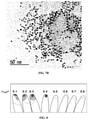
- FIG. 7A is a TEM image of FePt-OA immediately before and after FePt synthesis
- FIG. 7B is a TEM image of FePt-P3HT after ligand exchange
- FIG. 8 shows centrifugation results depending on ratio of tetrahydrofuran (THF) and hexane of the solvent component
- FIG. 9 is a dynamic light scattering (DLS) graph of FePt before and after ligand exchange
- FIG. 10 is a graph of thermogravimetric analysis (TGA) of FePt before and after ligand exchange
- FIG. 11 is a TEM image showing morphology of an exemplary P3HT-b-P2VP block copolymer
- FIG. 12 is a TEM image showing dispersion an exemplary FePt-OA catalyst in an exemplary P3HT-b-P2VP block copolymer.
- FIG. 13 is a TEM image showing dispersion of an exemplary FePt-P3HT catalyst in an exemplary P3HT-b-P2VP block copolymer.
- the term “about” is understood as within a range of normal tolerance in the art, for example within 2 standard deviations of the mean. “About” can be understood as within 10%, 9%, 8%, 7%, 6%, 5%, 4%, 3%, 2%, 1%, 0.5%, 0.1%, 0.05%, or 0.01% of the stated value. Unless otherwise clear from the context, all numerical values provided herein are modified by the term “about.”
- the present invention relates to an electrode for fuel cells including a catalyst with a core-shell structure including metal nanoparticles and a conductive polymer.
- the catalyst may be dispersed at a controlled position on a conductive polymer matrix including an A-b-B-type block copolymer.
- the catalyst of the present invention may include the metal nanoparticles as a core and the conductive polymer as a shell.
- the metal nanoparticles constituting the catalyst may suitably include one or more selected from the group consisting of platinum (Pt), gold (Au), tin (Sn), copper (Cu), nickel (Ni), iron (Fe), cobalt (Co), zinc (Zn), titanium (Ti), chromium (Cr), manganese (Mn), iridium (Ir), tantalum (Ta), molybdenum (Mo), rhodium (Rh), osmium (Os), rhenium (Re), tungsten (W), vanadium (V), cadmium (Cd), selenium (Se), tellurium (Te), indium (In) and silver (Ag).
- the metal nanoparticles may include an alloy or a mixture of the metal components.
- the metal nanoparticles may suitably include one or more selected from the group consisting of CuPt, CoPt 3 , PtNi, CuPd, FePt and CuAu.
- the metal nanoparticles may include iron-platinum (FePt).
- FePt iron-platinum
- nanoparticles are not limited thereto and any substance may be used so long as it can serve as a catalyst for fuel cells.
- the size of the metal nanoparticles may suitably range from about 2 to about 30 nm depending on reduction temperature of a metal precursor and amount of ligand.
- the conductive polymer may suitably include one or more selected from the group consisting of polytriphenylamine, polyacetylene (PA), polythiophene (PT), poly(3-alkyl)thiophene (P3AT), polypyrrole (PPY), polyisothianapthelene (PITN), polyethylene dioxythiophene (PEDOT), polyparaphenylenevinylene (PPV), poly(2,5-dialkoxy)paraphenylenevinylene, polyparaphenylene (PPP), polyparaphenylene sulfide (PPS), polyheptadiene (PHT), poly(3-hexylthiophene) (P3HT), polycarbazole, and polyaniline (PANI).
- PA polyacetylene
- PT polythiophene
- P3AT poly(3-alkyl)thiophene
- PY polypyrrole
- PITN polyisothianapthelene
- PEDOT polyethylene dioxythiophene
- a thiophene polymer such as polythiophene [poly(3-hexylthiophene, P3HT)] may be preferably used.
- the conductive polymer is not limited thereto and any substance may be used so long as it basically has electrical conductivity and includes the nanoparticles and the core-shell structure according to the present invention.
- FIG. 1 shows a flowchart illustrating exemplary processes of preparing a polymer matrix in which a catalyst with a core-shell structure may be suitably dispersed.
- a conductive polymer surrounding metal nanoparticles serving as a catalyst is prepared.
- a conductive polymer R 1 having an end substituted by alkyne may be formed.
- a precursor material R2 which reacts with the alkyne substituted on the end of R1 formed in step (S′1) to replace the end of R1 with thiol, may be formed.
- the conductive polymer R1 having an end substituted by alkyne of step (S′1) may react with the precursor material R2 of step (S′2), to form a conductive polymer R1 having an end substituted by thiol.
- metal nanoparticles e.g., FePt
- oleic acid and oleylamine may be prepared.
- the metal nanoparticles stabilized in step (S′4) may react with the conductive polymer R1 having an end substituted by thiol formed in step (S′3) to synthesize a metal catalyst with a core-shell structure having a structure in which the conductive polymer surrounds metal nanoparticles, and the metal catalyst may be then purified.
- a block copolymer, that serves as a base for providing a matrix, in which the metal catalyst formed in step (S′5) is dispersed, and includes a conductive polymer may be prepared.
- the metal catalyst of step (S′5) may be mixed with the block copolymer of step (S′6) and a matrix, in which the metal catalyst is dispersed, may be provided using a microwave annealing method, for example, microwave annealing both the block copolymer and the catalyst.
- the metal nanoparticles are FePt and the conductive polymer is P3HT.
- a 2,5-dibromo-3-hexylthiophene monomer may be prepared as a starting material to obtain poly(3-hexylthiophene-2,5-diyl (hereinafter, referred to as “P3HT”) as a conductive polymer.
- P3HT poly(3-hexylthiophene-2,5-diyl
- the monomer of the present invention may be variably selected depending on the type of used conductive polymer.
- 2,5-dibromo-pyrrole, 2,5-dibromo-1-octyl-pyrrole or the like is used as the monomer to obtain polypyrrole or the like.
- a 2,5-dibromo derivative monomer may be polymerized in order to substitute by alkane in the following step.
- Step 2 Polymerization of Polymer Having End Substituted by Alkane
- Grignard metathesis (hereinafter, referred to as “GRIM”) polymerization may be conducted using a solution of nickel catalyst dissolved in a solvent.
- GRIM polymerization of symmetric monomer may be described in, for example, the documents [Campos et al., Photovoltai Activity of a PolyProDOT Derivative in a Bulk Heterojunction Solar Cell, Solar Energy Materials & Solar Cells, August 2006] and [Iovu, M. C. et al. Macromolecules 2005, 38, (21), 8649-8656], [Macromolecules 2009, 42, 30-32] and [Adv. Funct. Mater. 2006, 16, 2263-2273].
- THF High purity tetrahydrofuran
- Isopropyl magnesium chloride may be slowly added to the mixture and the resulting mixture may stand at room temperature for 3 hours for thorough reaction.
- a dispersion of dichloro(1,3-bis(diphenylphosphino)propane)nickel (hereinafter, referred to as “Ni(dppp)Cl 2 ”) in THF may be quickly added to the reaction mixture, followed by reaction for about 30 minutes.
- the length (molecular weight) of P3HT chains may be controlled by the amount of used nickel catalyst.
- reaction solution may be reacted with alkyne magnesium chloride (hereinafter, referred to as “ethynylMgCl”), and the reaction may be ceased by addition of excess methanol to obtain poly(3-hexylthiophene) (hereinafter referred to as “P3HT”) substituted by alkyne.
- ethynylMgCl alkyne magnesium chloride
- P3HT poly(3-hexylthiophene) substituted by alkyne.
- the polymerization reaction may be depicted by the following reaction scheme.
- Step 3 Synthesis of Precursor Having Two Ends of Azide and Thiol
- Chloropropanethiol (3-chloro-1-propanethiol, hereinafter, referred to as “CClS”) as a starting material may be added to and dissolved in dimethylformamide (hereinafter referred to as “DMF”), followed by degassing.
- DMF dimethylformamide
- a mixture of sodium azide (hereinafter referred to as “NaN 3 ”) with DMF may be subjected to ultrasonic decomposition at about 50 W for about 30 minutes to thoroughly dissolve NaN 3 and then the solution may be reacted with CClS dissolved in DMF. At this time, preferably, the reaction may be carried out at a temperature of about 60° C. for about 8 hours.
- reaction solution may be extracted with dichloromethane (hereinafter, referred to as “DCM”) to obtain an azidopropanethiol (3-azido-1-propanethiol, C 3 H 7 N 3 S) precursor having two ends of azide and thiol.
- DCM dichloromethane
- the process may be depicted by the following reaction scheme.
- Step 4 Synthesis of poly(3-hexylthiophene-2,5-diyl (Hereinafter, Referred to as “P3HT”) Conductive Polymer Having End of Thiol
- P3HT having an end substituted by alkane, polymerized in step 2 may be mixed with the C 3 H 7 N 3 S precursor obtained in step 3 in a ratio of about 4:1 to 6:1, highly concentrated THF may be added to the resulting mixture, one equivalent of copper (I) bromide (CuBr) and one equivalent of N′′-pentamethyldiethylenetriamine (hereinafter, referred to as “PMDETA”) may be added thereto, nitrogen bubbling is conducted and reaction may be conducted in a microwave reactor. The reaction may be preferably carried out in the microwave reactor at a temperature of about 60° C. for about 2 hours.
- the process may be depicted by the following reaction scheme.
- High-temperature pyrolysis nanoparticle synthesis may be used to synthesize iron-platinum (FePt) metal nanoparticles with a uniform size.
- 2,4-pentanedione platinum (II) (hereinafter, referred to as “Pt(acac) 2 ”), 1,2-hexadecanediol and benzyl ether ((C 6 H 5 CH 2 ) 2 O) may be mixed and reacted while heating under vacuum. At this time, after heating to a temperature of about 100° C., the vacuum condition may be maintained for about 30 minutes to maximize removal of moisture and oxygen.
- oleic acid and oleylamine may be added and reflux may be conducted at high-temperature for about 30 minutes.
- applied temperature may preferably be of about 280 to 300° C.
- reaction mixture may be cool to room temperature and centrifugation may be conducted with ethanol to obtain a precipitate.
- the obtained precipitate may be dispersed in hexane and centrifugation may be conducted with ethanol again. At this time, centrifugation may be preferably carried out at a rotation rate of about 3,000 rpm for about 2 minutes, and the process may be preferably repeated two or more times.
- the precipitate obtained by the process may be finally dispersed in hexane or toluene, and oleic acid and oleylamine may be added thereto to stabilize FePt nanoparticles.
- the process corresponds to (M1) of FIG. 1 , which shows that FePt nanoparticles may be stabilized by an oleylamine shell.
- FePt-OA FePt-OA nanoparticles
- P3HT P3HT obtained in step 4
- the P3HT solution may be added to the FePt-OA nanoparticle solution under a nitrogen atmosphere by a syringe. At this time, the reaction may be preferably carried out at a temperature of about 40° C. for about 12 hours.
- FePt-P3HT may be obtained by adding P3HT having a thiol end to the stabilized FePt nanoparticles.
- a solution of THF and hexane in a ratio of 1:1.2 to 1:2.0 may be added and P3HT may be removed using a centrifuge at a rotating speed about 8,000 rpm for about 10 minutes to obtain a FePt-P3HT core-shell structure nano-composite material (hereinafter, referred to as “catalyst”, “FePt-P3HT nanoparticles” or “FePt-P3HT catalyst”).
- the nickel catalyst added in step 2 may determine the molecular weight of the conductive polymer P3HT constituting the FePt-P3HT nanoparticles. Since the number of conductive polymers of the shell linked to one core is limited, as molecular weight increases, the weight of the shell may increase.
- the core according to an exemplary embodiment of the present invention e.g., FePt
- the shell according to an exemplary embodiment of the present invention, P3HT may be present in an amount of about 5 to 30% by weight, based on the total weight of the catalyst.
- P3HT may be present in an amount of about 10 to 20% by weight
- FePt may be present in an amount of about 85 to 90% by weight
- P3HT is present in an amount of 10 to 15% by weight, based on the total weight of the catalyst.
- a ratio of THF to hexane may be about 1:1.3 to 1:1.8, or particularly about 1:1.4 to 1:1.6.
- the ratio of THF to hexane is less than about 1:1.2, precipitation may not occur entirely, which causes deterioration in effectiveness of separation, and when the ratio is greater than about 1:2.0, P3HT, which is the conductive polymer material remaining unreacted, may be precipitated together, which makes separation impossible.
- P3HTs remaining unreacted may be removed by centrifugation.
- Purification may be conducted with ethanol in accordance with conventional methods.
- centrifugation may be conducted in a solvent component including THF and hexane in order to separate and purify the conductive polymer 3 that reacted with FePt, and the conductive polymer 3′ that remains unreacted therewith.
- the conductive polymer matrix for forming an electrode may include an A-b-B-type block copolymer.
- A may suitably include poly(2-vinylpyridine) (hereinafter, referred to as “P2VP”), and B may suitably include the same material as the conductive polymer constituting the catalyst of the present invention.
- P2VP poly(2-vinylpyridine)
- the conductive polymer matrix may have a layered (lamellar) structure in which a domain including A and a domain including B may be alternately disposed.
- the conductive polymer matrix of the present invention may have a certain-shape domain.
- a matrix with a several nanometer-scaled minute domain size may be obtained.
- annealing may induce self-assembly of the block copolymer.
- Conventionally known annealing methods include thermal annealing, solvent annealing and solvothermal annealing.
- microwave annealing which is one form of solvothermal annealing may be used.
- solvothermal annealing is used for the process of inducing self-assembly of a conductive polymer-based block copolymer such as P3HT, conditions enabling chains of the conductive polymer to be freely moved may not be satisfied and thus desired conductive polymer matrixes may not be formed.
- two polymers constituting the block copolymer for a long time may be heated to a melting point or greater. Since the melting point of the conductive polymer is relatively high and, in particular, is higher than a degradation temperature of other blocks, other polymers than the conductive polymer may be decomposed, which makes experimentation impossible.
- microwave annealing which is one solvothermal annealing method, that may induce self-assembly without heating to a high temperature may be used.
- the solvent used for microwave annealing may swell the polymer increase degree of freedom of chains to widen a processing window, greatly reduce conventional long annealing times, and enable relatively low temperature processes to greatly reduce structural defect rates in morphologies.
- FIG. 3 shows an exemplary process of preparing an exemplary conductive polymer matrix and steps of dispersing an exemplary catalyst in an exemplary conductive polymer matrix.
- poly(sulfonyl sulfate) (PSS) used as an interlayer material to separate silicon wafer from a polymer sample may be dissolved in distilled water and the resulting mixture may be stirred for one day.
- PSS poly(sulfonyl sulfate)
- the silicon wafer may be hydroxylated by oxygen plasma treatment (S1) and then may be spin-coated with the prepared interlayer material dope (S2).
- the catalyst may be present in an amount of about 5 to 20 wt % of the block copolymer, or particularly of about 10 to 15 wt % thereof (S3), based on the total weight of the copolymer.
- the ratio of platinum oxide is less than about 5 wt %, reactivity as the catalyst may be insufficient, and when the ratio is greater than about 20 wt %, dispersibility may be deteriorated due to interaction between catalysts.
- the reaction mixture prepared in step (S3) may be drop-cast on a PSS-coated silicon wafer (S4).
- the silicon wafer obtained in step (S4) may be dipped in a microwave vial containing 1 ml of tetrahydrofuran (THF) capable of effectively dissolving materials constituting the block copolymer and annealed at a temperature of about 180° C. for about 10 minutes to obtain a conductive polymer matrix containing a catalyst.
- THF tetrahydrofuran
- the completed conductive polymer matrix may have a lamellar structure in which two regions, i.e., a domain including a P3HT conductive polymer (first region) and a domain including a P2VP polymer (second region) may be alternately disposed in the form of a layer.
- the catalyst may be disposed at the interface between the first region and the second region.
- the most basic unit to generate electricity is a membrane electrode assembly (MEA), which includes an electrolyte membrane and an anode and a cathode formed at two surfaces of the electrolyte membrane.
- MEA membrane electrode assembly
- oxidation between hydrogen or methanol, a fuel, for example, a hydrocarbon such as butane occurs to produce a hydrogen ion (H + ) and an electron (e ⁇ ), and the hydrogen ion is moved through the electrolyte membrane to the cathode.
- the hydrogen ion transported through the electrolyte membrane reacts with an oxidant such as oxygen and an electron to produce water. Through this reaction, the electron is moved to an exterior circuit.
- a membrane electrode assembly for fuel cells includes an electrolyte membrane, and a cathode and an anode which face each other via the electrolyte membrane.
- the cathode includes a cathode catalyst layer and a cathode gas diffusion layer disposed sequentially from the electrolyte membrane
- the anode includes an anode catalyst layer and an anode gas diffusion layer disposed sequentially from the electrolyte membrane.
- the polymer matrix, in which the catalyst is dispersed, may be included in at least one of the cathode catalyst layer and the anode catalyst layer in the membrane electrode assembly, which may provide an electrode material having a structure in which three phases including P3HT enabling movement of electrons, P2VP enabling movement of ions and FePt serving as a catalyst contact one another.
- reaction was conducted at room temperature for 3 hours and a dispersion of 73.1 mg of a dichloro(1,3-bis(diphenylphosphino)propane)nickel (Ni (dppp)Cl 2 ) catalyst in 3 mL of THF was quickly added to the reaction solution. After reaction for 30 minutes, 4 mL of alkyne magnesium chloride (0.5M) was quickly added thereto for end-capping. After 5 minutes, excess methanol was added to cease reaction and the polymer was obtained by filtration. In order to remove monomer and catalyst residues that remain unreacted, washing with methanol was conducted several times. Through this step, 832 mg (81.6% yield) of P3HT having an alkane end with a molecular weight of 1.5 kg/mol could be obtained.
- a dichloro(1,3-bis(diphenylphosphino)propane)nickel (Ni (dppp)Cl 2 ) catalyst was quickly added to the reaction solution. After reaction for 30 minutes, 4
- the resulting product was dissolved in 300 mL of excess dichloro methane (DCM), 100 mL of a small amount of DI-water was added and only DCM was extracted. This process was repeated three or more times to remove sodium azide. The DCM residue was evaporated to obtain a transparent liquid product.
- DCM dichloro methane
- High-temperature pyrolysis nanoparticle synthesis was used to synthesize FePt nanoparticles with a uniform size.
- 200 mg of P3HT having a thiol-propyl end synthesized in (Preparation Example 1-3) was dissolved in 20 mL of THF and nitrogen bubbling was conducted for 30 minutes.
- the FePt-P3HT catalyst was centrifuged in THF and hexane in a ratio of 1:1.5 at 8,000 rpm for 10 minutes to separate out the precipitate.
- FIG. 8 which shows whether or not separation is conducted well at various THF rates ( ⁇ THF ), shows separation is conducted well at ⁇ THF of 0.3 to 0.4.
- the TEM image of the FePt-P3HT catalyst prepared by the reaction is shown in FIG. 7B .
- FIG. 7A shows that the nanoparticles partially have a hexagonal close-packed structure
- FIG. 7B shows that the distance between the nanoparticles is wide and the nanoparticles are randomly distributed.
- the hydrodynamic radius is increased after reaction, which means that ligand exchange into a polymer is conducted.
- the hydrodynamic radius was 10 nm to 30 nm when ligand exchange is conducted from FePt-OA to FePt-P3HT.
- the weight (curve) is dropped at a temperature of about 450° C. at which P3HT starts to decompose, which shows that P3HT is present in an amount 20 wt % of ingredients of the catalyst.
- PSS Poly(sulfonyl sulfate) used as an interlayer material to a separate silicon wafer from a polymer sample was dissolved at a concentration of 10 mg/mL in distilled water and the resulting mixture was stirred for one day.
- the silicon wafer was hydroxylated by oxygen plasma treatment for 5 minutes (S1) and then spin-coated with the prepared interlayer material dope at 3,000 rpm for 40 seconds (S2).
- a P3HT-b-P2VP block copolymer to be used as a polymer matrix was dissolved at 50 mg/mL in chloroform, and platinum oxide (FePt-OA nanoparticles and FePt-P3HT catalyst) prepared in Preparation Examples 1-4 and 1-5 above were added to this solution in a ratio of 10 wt % of the block copolymer (S3).
- reaction mixture prepared in step (S3) was drop-cast on PSS-coated silicon wafer (S4).
- step (S4) The silicon wafer obtained in step (S4) was dipped in a microwave vial containing 1 ml of tetrahydrofuran (THF) capable of effectively dissolving both P3HT and P2VP and annealed at a temperature of 180° C. for 10 minutes to obtain a conductive polymer matrix.
- THF tetrahydrofuran
- the P2VP was selectively dyed by iodine vapor for observation (S5).
- FIG. 11 is a TEM image of a conductive polymer matrix prepared from only a block copolymer without adding platinum oxide, which shows that P3HT-b-P2VP is aligned in the form of a lamellar structure.
- the P3HT domain and P2VP domain having a lamellar shape have a thickness of about 36 nm.
- a relatively bright region represents a P3HT part non-dyed with iodine and a dark region represents a P2VP part dyed with iodine.
- a conductive polymer matrix was prepared using FePt-P3HT synthesized in (Preparation Example 1-5) as platinum oxide in step (S3) of (Preparation Example 2).
- a bulk sample of the prepared conductive polymer matrix was separated from the silicon wafer and then molded with epoxy.
- Thin sections with a thickness of 50 nm were produced from the molded epoxy using an ultra-microtome, which is a machine for producing ultrathin sections, P2VP was selectively dyed with iodine vapor and morphology was observed by TEM.
- most FePt-P3HT is distributed at the interface between the bright P3HT domain and the dark P2VP domain constituting the conductive polymer matrix, thereby forming a three-phase structure, in which P3HT serving as an electron movement channel, P2VP serving as an ion movement channel, and FePt serving as a catalyst completely contact one another, which can maximize availability as an electrode.
- a conductive polymer matrix was prepared using FePt-OA synthesized in (Preparation Example 1-4) as platinum oxide in step (S3) of (Preparation Example 2).
- a bulk sample of the prepared conductive polymer matrix was separated from the silicon wafer and then molded with epoxy.
- Thin sections with a thickness of 50 nm were produced from the molded epoxy using an ultra-microtome, which is a machine for producing ultrathin sections, P2VP was selectively dyed with iodine vapor and morphology was observed by TEM.
- This may be caused by the interaction between the nitrogen atom of P2VP constituting the conductive polymer matrix that electrostatically may interact with an inorganic substance, and FePt particles of FePt-OA.
- the agglomeration may be due to the interaction between FePt-OA particles.
- metal nanoparticles having a conductive polymer shell through end substitution of a conductive polymer and surface-modification may be provided.
- various hybrid nano-composites may be formed by a combination of other conductive polymers than P3HT with metal nanoparticles.
- conventional nano-composites having normal polymer or monomer shells may not have electrical properties due to insulation effect. Platinum, which is used as a metal, may be helpful for catalytic activity in fuel cells. Furthermore, methods for selectively disposing metal nanoparticles in only a conductive polymer domain in two or more shapes of conductive polymer-based block copolymers may be provided.
Landscapes
- Chemical & Material Sciences (AREA)
- Chemical Kinetics & Catalysis (AREA)
- General Chemical & Material Sciences (AREA)
- Electrochemistry (AREA)
- Engineering & Computer Science (AREA)
- Materials Engineering (AREA)
- Organic Chemistry (AREA)
- Polymers & Plastics (AREA)
- Medicinal Chemistry (AREA)
- Health & Medical Sciences (AREA)
- Manufacturing & Machinery (AREA)
- Composite Materials (AREA)
- Inert Electrodes (AREA)
- Catalysts (AREA)
Abstract
Description
R1—C≡C, [Formula 1]
wherein the conductive polymer is represented by the following Formula 2:

wherein R1 in


Claims (8)
Priority Applications (1)
| Application Number | Priority Date | Filing Date | Title |
|---|---|---|---|
| US17/552,778 US11631864B2 (en) | 2018-08-20 | 2021-12-16 | Electrode including metal nanoparticles having conductive polymer shell and conductive film and method for manufacturing the same |
Applications Claiming Priority (2)
| Application Number | Priority Date | Filing Date | Title |
|---|---|---|---|
| KR10-2018-0096548 | 2018-08-20 | ||
| KR1020180096548A KR102664090B1 (en) | 2018-08-20 | 2018-08-20 | Electrodes comprising metal nanoparticles having conductive polymer-shell and conductive film, and manufacture method thereof |
Related Child Applications (1)
| Application Number | Title | Priority Date | Filing Date |
|---|---|---|---|
| US17/552,778 Division US11631864B2 (en) | 2018-08-20 | 2021-12-16 | Electrode including metal nanoparticles having conductive polymer shell and conductive film and method for manufacturing the same |
Publications (2)
| Publication Number | Publication Date |
|---|---|
| US20200058944A1 US20200058944A1 (en) | 2020-02-20 |
| US11233246B2 true US11233246B2 (en) | 2022-01-25 |
Family
ID=69523483
Family Applications (2)
| Application Number | Title | Priority Date | Filing Date |
|---|---|---|---|
| US16/215,010 Active 2039-05-31 US11233246B2 (en) | 2018-08-20 | 2018-12-10 | Electrode including metal nanoparticles having conductive polymer shell and conductive film and method for manufacturing the same |
| US17/552,778 Active US11631864B2 (en) | 2018-08-20 | 2021-12-16 | Electrode including metal nanoparticles having conductive polymer shell and conductive film and method for manufacturing the same |
Family Applications After (1)
| Application Number | Title | Priority Date | Filing Date |
|---|---|---|---|
| US17/552,778 Active US11631864B2 (en) | 2018-08-20 | 2021-12-16 | Electrode including metal nanoparticles having conductive polymer shell and conductive film and method for manufacturing the same |
Country Status (3)
| Country | Link |
|---|---|
| US (2) | US11233246B2 (en) |
| KR (1) | KR102664090B1 (en) |
| CN (1) | CN110854390B (en) |
Families Citing this family (8)
| Publication number | Priority date | Publication date | Assignee | Title |
|---|---|---|---|---|
| KR102910467B1 (en) * | 2020-05-11 | 2026-01-08 | 삼성전자주식회사 | Sensor and electronic device |
| CN111640963A (en) * | 2020-06-16 | 2020-09-08 | 陕西中丰新能源有限公司 | Manufacturing process of battery pole plate |
| KR102481440B1 (en) | 2020-11-13 | 2022-12-26 | 부경대학교 산학협력단 | Method for synthesizing conducting polymer and method for fabricating thin film including conducting polymer |
| CN112961279B (en) * | 2021-02-10 | 2022-10-21 | 浙江沪通模具有限公司 | Polyttricyclopentadiene PTCPD and polydicyclopentadiene PDCPD copolymer and preparation method thereof |
| CN113113621B (en) * | 2021-02-24 | 2022-03-18 | 深圳清华大学研究院 | Preparation method and application of ordered low-platinum alloy catalyst |
| CN113871631B (en) * | 2021-10-27 | 2024-01-02 | 天津市生态环境科学研究院(天津市环境规划院、天津市低碳发展研究中心) | Photocatalytic fuel cell for treating azo dye wastewater and preparation method thereof |
| CN117024874B (en) * | 2023-08-04 | 2024-03-15 | 链行走新材料科技(广州)有限公司 | P3HT composite functional material and application thereof |
| CN120109215B (en) * | 2025-03-07 | 2026-01-16 | 北京航空航天大学 | Sulfonated polyether-ether-ketone/polyaniline composite membrane and preparation method and application thereof |
Citations (5)
| Publication number | Priority date | Publication date | Assignee | Title |
|---|---|---|---|---|
| US20060083694A1 (en) * | 2004-08-07 | 2006-04-20 | Cabot Corporation | Multi-component particles comprising inorganic nanoparticles distributed in an organic matrix and processes for making and using same |
| US20080193827A1 (en) * | 2007-02-12 | 2008-08-14 | Jang Bor Z | Conducting polymer-transition metal electro-catalyst compositions for fuel cells |
| US20100323269A1 (en) * | 2007-02-07 | 2010-12-23 | Kuraray Co., Ltd. | Catalyst layer and preparation process thereof, and membrane-electrode assembly and polymer electrolyte fuel cell using the catalyst layer |
| US20150333338A1 (en) * | 2013-01-16 | 2015-11-19 | Ilika Technologies Ltd | A Mixed Metal Oxide Material of Tin and Titanium |
| KR20170092125A (en) | 2016-02-02 | 2017-08-10 | 주식회사 엘지화학 | Carrier-nano particles complex, catalyst comprising the same and method for fabricating the same |
Family Cites Families (11)
| Publication number | Priority date | Publication date | Assignee | Title |
|---|---|---|---|---|
| KR100669456B1 (en) * | 2004-11-26 | 2007-01-15 | 삼성에스디아이 주식회사 | Electrode for fuel cell, fuel cell comprising same and method for manufacturing electrode for fuel cell |
| CN100405648C (en) * | 2005-06-28 | 2008-07-23 | 三星Sdi株式会社 | Polymer membrane and membrane-electrode assembly for fuel cell and fuel cell system comprising same |
| US8318385B2 (en) * | 2006-09-19 | 2012-11-27 | Nanotek Instruments, Inc. | Process for producing fuel cell electrode |
| US8202669B2 (en) * | 2006-10-19 | 2012-06-19 | Nanotek Instruments, Inc. | Electro-catalyst compositions for fuel cells |
| US9379393B2 (en) * | 2006-12-26 | 2016-06-28 | Nanotek Instruments, Inc. | Carbon cladded composite flow field plate, bipolar plate and fuel cell |
| US8236462B2 (en) * | 2008-01-28 | 2012-08-07 | Toyota Jidosha Kabushiki Kaisha | Electrode catalyst for fuel cell, method for producing the electrode catalyst, and polymer electrolyte fuel cell using the electrode catalyst |
| US20110143263A1 (en) * | 2010-04-29 | 2011-06-16 | Ford Global Technologies, Llc | Catalyst Layer Having Thin Film Nanowire Catalyst and Electrode Assembly Employing the Same |
| US9570760B2 (en) * | 2010-04-29 | 2017-02-14 | Ford Global Technologies, Llc | Fuel cell electrode assembly and method of making the same |
| WO2015021177A1 (en) * | 2013-08-06 | 2015-02-12 | Massachusetts Institute Of Technology | Production of non-sintered transition metal carbide nanoparticles |
| WO2015153217A1 (en) * | 2014-04-02 | 2015-10-08 | Dow Global Technologies Llc | Cellulose ethers having 1,2,3-triazolyl substituents |
| CN108232203A (en) * | 2016-12-09 | 2018-06-29 | 中国科学院大连化学物理研究所 | A kind of hydrogen peroxide fuel battery cathode and its preparation and application |
-
2018
- 2018-08-20 KR KR1020180096548A patent/KR102664090B1/en active Active
- 2018-12-10 US US16/215,010 patent/US11233246B2/en active Active
- 2018-12-13 CN CN201811526120.XA patent/CN110854390B/en active Active
-
2021
- 2021-12-16 US US17/552,778 patent/US11631864B2/en active Active
Patent Citations (5)
| Publication number | Priority date | Publication date | Assignee | Title |
|---|---|---|---|---|
| US20060083694A1 (en) * | 2004-08-07 | 2006-04-20 | Cabot Corporation | Multi-component particles comprising inorganic nanoparticles distributed in an organic matrix and processes for making and using same |
| US20100323269A1 (en) * | 2007-02-07 | 2010-12-23 | Kuraray Co., Ltd. | Catalyst layer and preparation process thereof, and membrane-electrode assembly and polymer electrolyte fuel cell using the catalyst layer |
| US20080193827A1 (en) * | 2007-02-12 | 2008-08-14 | Jang Bor Z | Conducting polymer-transition metal electro-catalyst compositions for fuel cells |
| US20150333338A1 (en) * | 2013-01-16 | 2015-11-19 | Ilika Technologies Ltd | A Mixed Metal Oxide Material of Tin and Titanium |
| KR20170092125A (en) | 2016-02-02 | 2017-08-10 | 주식회사 엘지화학 | Carrier-nano particles complex, catalyst comprising the same and method for fabricating the same |
Non-Patent Citations (4)
| Title |
|---|
| Campos et al., "Photovoltai Activity of a PolyProDOT Derivative in a Bulk Heterojunction Solar Cell", Solar Energy Materials & Solar Cells 90 (2006) 3531-3546. |
| Hiorns et al., "High Molecular Weights, Polydispersities, and Annealing Temperatures in the Optimization of Bluk-Heterojunction Photovooltaic Cells Based on Poly(3-hexylthiophene) or Poly(3-butylthiophene)", Adv. Funct. Mater. 2006, 16, 2263-2273. |
| Iovu, M.C. et al. "Experimental Evidence for the Quasi-"Living" Nature of the Grignard Metathesis Method for the Synthesis if Regioregular Poly(3-alkylthiophenes)", Macromolecules 2005, 38, (21), 8649-8656. |
| Stefan et al., "Grignard Metathesis Method (GRIM): Toward a Universal Method for the Synthesis of Conjugated Polymers", Macromolecules 2009, 42, 30-32. |
Also Published As
| Publication number | Publication date |
|---|---|
| CN110854390A (en) | 2020-02-28 |
| US20200058944A1 (en) | 2020-02-20 |
| KR20200021154A (en) | 2020-02-28 |
| US20220109162A1 (en) | 2022-04-07 |
| US11631864B2 (en) | 2023-04-18 |
| CN110854390B (en) | 2022-08-09 |
| KR102664090B1 (en) | 2024-05-07 |
Similar Documents
| Publication | Publication Date | Title |
|---|---|---|
| US11631864B2 (en) | Electrode including metal nanoparticles having conductive polymer shell and conductive film and method for manufacturing the same | |
| Vijayakumar et al. | A facile approach to fabricate poly (2, 6-dimethyl-1, 4-phenylene oxide) based anion exchange membranes with extended alkaline stability and ion conductivity for fuel cell applications | |
| Wang et al. | Nanostructured polymer composite electrolytes with self-assembled polyoxometalate networks for proton conduction | |
| Dai et al. | Doping of conducting polymers by sulfonated fullerene derivatives and dendrimers | |
| WO2003089515A1 (en) | Organic semiconductor composition, organic semiconductor element, and process for producing the same | |
| WO2009157033A2 (en) | Core-shell mono/plurimetallic carbon nitride based electrocatalysts for low-temperature fuel cells (pemfcs, dmfcs, afcs and electrolysers | |
| WO2002098561A1 (en) | Conductive catalyst particle and its manufacturing method, gas-diffusing catalyst electrode, and electrochemical device | |
| Xue et al. | Layer-by-layer self-assembly of CHI/PVS–Nafion composite membrane for reduced methanol crossover and enhanced DMFC performance | |
| WO2023183720A2 (en) | Well defined quaternary ammonium functionalized quaterphenylene polymer derivatives for low and high temperature polymer electrolyte membrane fuel cells | |
| WO2017051786A1 (en) | Anion exchange resin and method for producing same, electrolyte membrane for fuel cells, binder for forming electrode catalyst layers, battery electrode catalyst layer, and fuel cell | |
| CN110787805B (en) | Fullerene nanorod/layered double-metal hydroxide electrocatalyst and preparation method thereof | |
| JP2004359724A (en) | Process for producing conductive polymer composite supporting noble metal catalyst | |
| US8709676B2 (en) | Chemically bonded carbon nanotube-polymer hybrid and nanocomposite thereof | |
| US9368821B2 (en) | Composite electrolyte membrane for fuel cell, method for producing the electrolyte membrane and fuel cell including the electrolyte membrane | |
| CN115172604A (en) | Organic solar cell suitable for R2R hybrid cathode interface layer and preparation method thereof | |
| JP4210659B2 (en) | Polyimide having sulfonic acid group at the end of side chain, polymer electrolyte and fuel cell employing the same | |
| Wei et al. | Improving the conductivity and dimensional stability of anion exchange membranes by grafting of quaternized dendrons | |
| Wu et al. | Highly Efficient Synthesis of Alkyl-Linked Poly (arylene alkylene) Anion Exchange Membranes via Postfunctionalization Integrated with Olefin Hydroboration and Suzuki Coupling Reaction | |
| WO2004063438A1 (en) | Method for producing carbon fiber, catalyst structure and membrane electrode junction body for solid polymer fuel cell | |
| US20140001420A1 (en) | Method of preparing metal nanoparticles | |
| CN119264353A (en) | Ionomer, preparation method thereof, and catalyst layer slurry and membrane electrode for electrolyzing water to produce hydrogen | |
| Zhang et al. | Copolymers for electronic, optical, and sensing applications with engineered physical properties | |
| JP5636608B2 (en) | A polymer organic compound having a nitrogen-containing heterocyclic ring having an N-alkylenesulfonic acid group or N-alkylenesulfonic acid group, and an organic compound having a nitrogen-containing heterocyclic ring having an N-alkylenesulfonic acid group or N-alkylenesulfonic acid group, Pharmaceuticals, disinfectants or antibacterial agents, ion exchangers, electrolyte membranes, catalysts, membrane electrode assemblies, fuel cells using them | |
| JP5017902B2 (en) | Method for producing catalyst layer for fuel cell | |
| TW201125904A (en) | Production method for composite polyvinyl alcohol/g -montmorillonite/polystrene sulfonic acid electrolyte membrane and application thereof |
Legal Events
| Date | Code | Title | Description |
|---|---|---|---|
| AS | Assignment |
Owner name: KIA MOTORS CORPORATION, KOREA, REPUBLIC OF Free format text: ASSIGNMENT OF ASSIGNORS INTEREST;ASSIGNORS:SONG, YOU JUNG;YUN, HONG SEOK;KIM, JIN SEONG;AND OTHERS;REEL/FRAME:047730/0107 Effective date: 20181206 Owner name: KOREA ADVANCED INSTITUTE OF SCIENCE AND TECHNOLOGY, KOREA, REPUBLIC OF Free format text: ASSIGNMENT OF ASSIGNORS INTEREST;ASSIGNORS:SONG, YOU JUNG;YUN, HONG SEOK;KIM, JIN SEONG;AND OTHERS;REEL/FRAME:047730/0107 Effective date: 20181206 Owner name: HYUNDAI MOTOR COMPANY, KOREA, REPUBLIC OF Free format text: ASSIGNMENT OF ASSIGNORS INTEREST;ASSIGNORS:SONG, YOU JUNG;YUN, HONG SEOK;KIM, JIN SEONG;AND OTHERS;REEL/FRAME:047730/0107 Effective date: 20181206 |
|
| FEPP | Fee payment procedure |
Free format text: ENTITY STATUS SET TO UNDISCOUNTED (ORIGINAL EVENT CODE: BIG.); ENTITY STATUS OF PATENT OWNER: LARGE ENTITY |
|
| STPP | Information on status: patent application and granting procedure in general |
Free format text: NON FINAL ACTION MAILED |
|
| STPP | Information on status: patent application and granting procedure in general |
Free format text: RESPONSE TO NON-FINAL OFFICE ACTION ENTERED AND FORWARDED TO EXAMINER |
|
| STPP | Information on status: patent application and granting procedure in general |
Free format text: NON FINAL ACTION MAILED |
|
| STPP | Information on status: patent application and granting procedure in general |
Free format text: RESPONSE TO NON-FINAL OFFICE ACTION ENTERED AND FORWARDED TO EXAMINER |
|
| STPP | Information on status: patent application and granting procedure in general |
Free format text: EX PARTE QUAYLE ACTION MAILED |
|
| STPP | Information on status: patent application and granting procedure in general |
Free format text: RESPONSE TO EX PARTE QUAYLE ACTION ENTERED AND FORWARDED TO EXAMINER |
|
| STPP | Information on status: patent application and granting procedure in general |
Free format text: NOTICE OF ALLOWANCE MAILED -- APPLICATION RECEIVED IN OFFICE OF PUBLICATIONS |
|
| STPP | Information on status: patent application and granting procedure in general |
Free format text: PUBLICATIONS -- ISSUE FEE PAYMENT VERIFIED |
|
| STCF | Information on status: patent grant |
Free format text: PATENTED CASE |
|
| MAFP | Maintenance fee payment |
Free format text: PAYMENT OF MAINTENANCE FEE, 4TH YEAR, LARGE ENTITY (ORIGINAL EVENT CODE: M1551); ENTITY STATUS OF PATENT OWNER: LARGE ENTITY Year of fee payment: 4 |