US11231476B2 - Accelerated magnetic resonance imaging acquisition using two-dimensional pulse segments as virtual receivers - Google Patents
Accelerated magnetic resonance imaging acquisition using two-dimensional pulse segments as virtual receivers Download PDFInfo
- Publication number
- US11231476B2 US11231476B2 US16/859,177 US202016859177A US11231476B2 US 11231476 B2 US11231476 B2 US 11231476B2 US 202016859177 A US202016859177 A US 202016859177A US 11231476 B2 US11231476 B2 US 11231476B2
- Authority
- US
- United States
- Prior art keywords
- pulse
- recited
- dimension
- segments
- segment
- Prior art date
- Legal status (The legal status is an assumption and is not a legal conclusion. Google has not performed a legal analysis and makes no representation as to the accuracy of the status listed.)
- Active
Links
Images



Classifications
-
- G—PHYSICS
- G01—MEASURING; TESTING
- G01R—MEASURING ELECTRIC VARIABLES; MEASURING MAGNETIC VARIABLES
- G01R33/00—Arrangements or instruments for measuring magnetic variables
- G01R33/20—Arrangements or instruments for measuring magnetic variables involving magnetic resonance
- G01R33/44—Arrangements or instruments for measuring magnetic variables involving magnetic resonance using nuclear magnetic resonance [NMR]
- G01R33/48—NMR imaging systems
- G01R33/4818—MR characterised by data acquisition along a specific k-space trajectory or by the temporal order of k-space coverage, e.g. centric or segmented coverage of k-space
- G01R33/482—MR characterised by data acquisition along a specific k-space trajectory or by the temporal order of k-space coverage, e.g. centric or segmented coverage of k-space using a Cartesian trajectory
-
- G—PHYSICS
- G01—MEASURING; TESTING
- G01R—MEASURING ELECTRIC VARIABLES; MEASURING MAGNETIC VARIABLES
- G01R33/00—Arrangements or instruments for measuring magnetic variables
- G01R33/20—Arrangements or instruments for measuring magnetic variables involving magnetic resonance
- G01R33/44—Arrangements or instruments for measuring magnetic variables involving magnetic resonance using nuclear magnetic resonance [NMR]
- G01R33/48—NMR imaging systems
- G01R33/54—Signal processing systems, e.g. using pulse sequences ; Generation or control of pulse sequences; Operator console
- G01R33/56—Image enhancement or correction, e.g. subtraction or averaging techniques, e.g. improvement of signal-to-noise ratio and resolution
- G01R33/561—Image enhancement or correction, e.g. subtraction or averaging techniques, e.g. improvement of signal-to-noise ratio and resolution by reduction of the scanning time, i.e. fast acquiring systems, e.g. using echo-planar pulse sequences
- G01R33/5611—Parallel magnetic resonance imaging, e.g. sensitivity encoding [SENSE], simultaneous acquisition of spatial harmonics [SMASH], unaliasing by Fourier encoding of the overlaps using the temporal dimension [UNFOLD], k-t-broad-use linear acquisition speed-up technique [k-t-BLAST], k-t-SENSE
- G01R33/5612—Parallel RF transmission, i.e. RF pulse transmission using a plurality of independent transmission channels
-
- A—HUMAN NECESSITIES
- A61—MEDICAL OR VETERINARY SCIENCE; HYGIENE
- A61B—DIAGNOSIS; SURGERY; IDENTIFICATION
- A61B5/00—Measuring for diagnostic purposes; Identification of persons
- A61B5/05—Detecting, measuring or recording for diagnosis by means of electric currents or magnetic fields; Measuring using microwaves or radio waves
- A61B5/055—Detecting, measuring or recording for diagnosis by means of electric currents or magnetic fields; Measuring using microwaves or radio waves involving electronic [EMR] or nuclear [NMR] magnetic resonance, e.g. magnetic resonance imaging
-
- A—HUMAN NECESSITIES
- A61—MEDICAL OR VETERINARY SCIENCE; HYGIENE
- A61B—DIAGNOSIS; SURGERY; IDENTIFICATION
- A61B5/00—Measuring for diagnostic purposes; Identification of persons
- A61B5/72—Signal processing specially adapted for physiological signals or for diagnostic purposes
- A61B5/7271—Specific aspects of physiological measurement analysis
- A61B5/7285—Specific aspects of physiological measurement analysis for synchronizing or triggering a physiological measurement or image acquisition with a physiological event or waveform, e.g. an ECG signal
-
- G—PHYSICS
- G01—MEASURING; TESTING
- G01R—MEASURING ELECTRIC VARIABLES; MEASURING MAGNETIC VARIABLES
- G01R33/00—Arrangements or instruments for measuring magnetic variables
- G01R33/20—Arrangements or instruments for measuring magnetic variables involving magnetic resonance
- G01R33/28—Details of apparatus provided for in groups G01R33/44 - G01R33/64
- G01R33/32—Excitation or detection systems, e.g. using radio frequency signals
- G01R33/36—Electrical details, e.g. matching or coupling of the coil to the receiver
- G01R33/3628—Tuning/matching of the transmit/receive coil
- G01R33/3635—Multi-frequency operation
-
- G—PHYSICS
- G01—MEASURING; TESTING
- G01R—MEASURING ELECTRIC VARIABLES; MEASURING MAGNETIC VARIABLES
- G01R33/00—Arrangements or instruments for measuring magnetic variables
- G01R33/20—Arrangements or instruments for measuring magnetic variables involving magnetic resonance
- G01R33/44—Arrangements or instruments for measuring magnetic variables involving magnetic resonance using nuclear magnetic resonance [NMR]
- G01R33/48—NMR imaging systems
- G01R33/4818—MR characterised by data acquisition along a specific k-space trajectory or by the temporal order of k-space coverage, e.g. centric or segmented coverage of k-space
- G01R33/4824—MR characterised by data acquisition along a specific k-space trajectory or by the temporal order of k-space coverage, e.g. centric or segmented coverage of k-space using a non-Cartesian trajectory
-
- G—PHYSICS
- G01—MEASURING; TESTING
- G01R—MEASURING ELECTRIC VARIABLES; MEASURING MAGNETIC VARIABLES
- G01R33/00—Arrangements or instruments for measuring magnetic variables
- G01R33/20—Arrangements or instruments for measuring magnetic variables involving magnetic resonance
- G01R33/44—Arrangements or instruments for measuring magnetic variables involving magnetic resonance using nuclear magnetic resonance [NMR]
- G01R33/48—NMR imaging systems
- G01R33/54—Signal processing systems, e.g. using pulse sequences ; Generation or control of pulse sequences; Operator console
- G01R33/56—Image enhancement or correction, e.g. subtraction or averaging techniques, e.g. improvement of signal-to-noise ratio and resolution
- G01R33/5608—Data processing and visualization specially adapted for MR, e.g. for feature analysis and pattern recognition on the basis of measured MR data, segmentation of measured MR data, edge contour detection on the basis of measured MR data, for enhancing measured MR data in terms of signal-to-noise ratio by means of noise filtering or apodization, for enhancing measured MR data in terms of resolution by means for deblurring, windowing, zero filling, or generation of gray-scaled images, colour-coded images or images displaying vectors instead of pixels
-
- A—HUMAN NECESSITIES
- A61—MEDICAL OR VETERINARY SCIENCE; HYGIENE
- A61B—DIAGNOSIS; SURGERY; IDENTIFICATION
- A61B5/00—Measuring for diagnostic purposes; Identification of persons
- A61B5/02—Detecting, measuring or recording for evaluating the cardiovascular system, e.g. pulse, heart rate, blood pressure or blood flow
- A61B5/0205—Simultaneously evaluating both cardiovascular conditions and different types of body conditions, e.g. heart and respiratory condition
-
- A—HUMAN NECESSITIES
- A61—MEDICAL OR VETERINARY SCIENCE; HYGIENE
- A61B—DIAGNOSIS; SURGERY; IDENTIFICATION
- A61B5/00—Measuring for diagnostic purposes; Identification of persons
- A61B5/08—Measuring devices for evaluating the respiratory organs
- A61B5/0803—Recording apparatus specially adapted therefor
-
- A—HUMAN NECESSITIES
- A61—MEDICAL OR VETERINARY SCIENCE; HYGIENE
- A61B—DIAGNOSIS; SURGERY; IDENTIFICATION
- A61B5/00—Measuring for diagnostic purposes; Identification of persons
- A61B5/24—Detecting, measuring or recording bioelectric or biomagnetic signals of the body or parts thereof
- A61B5/316—Modalities, i.e. specific diagnostic methods
- A61B5/318—Heart-related electrical modalities, e.g. electrocardiography [ECG]
- A61B5/33—Heart-related electrical modalities, e.g. electrocardiography [ECG] specially adapted for cooperation with other devices
-
- G—PHYSICS
- G01—MEASURING; TESTING
- G01R—MEASURING ELECTRIC VARIABLES; MEASURING MAGNETIC VARIABLES
- G01R33/00—Arrangements or instruments for measuring magnetic variables
- G01R33/20—Arrangements or instruments for measuring magnetic variables involving magnetic resonance
- G01R33/44—Arrangements or instruments for measuring magnetic variables involving magnetic resonance using nuclear magnetic resonance [NMR]
- G01R33/48—NMR imaging systems
- G01R33/54—Signal processing systems, e.g. using pulse sequences ; Generation or control of pulse sequences; Operator console
- G01R33/56—Image enhancement or correction, e.g. subtraction or averaging techniques, e.g. improvement of signal-to-noise ratio and resolution
- G01R33/561—Image enhancement or correction, e.g. subtraction or averaging techniques, e.g. improvement of signal-to-noise ratio and resolution by reduction of the scanning time, i.e. fast acquiring systems, e.g. using echo-planar pulse sequences
- G01R33/5611—Parallel magnetic resonance imaging, e.g. sensitivity encoding [SENSE], simultaneous acquisition of spatial harmonics [SMASH], unaliasing by Fourier encoding of the overlaps using the temporal dimension [UNFOLD], k-t-broad-use linear acquisition speed-up technique [k-t-BLAST], k-t-SENSE
-
- G—PHYSICS
- G01—MEASURING; TESTING
- G01R—MEASURING ELECTRIC VARIABLES; MEASURING MAGNETIC VARIABLES
- G01R33/00—Arrangements or instruments for measuring magnetic variables
- G01R33/20—Arrangements or instruments for measuring magnetic variables involving magnetic resonance
- G01R33/44—Arrangements or instruments for measuring magnetic variables involving magnetic resonance using nuclear magnetic resonance [NMR]
- G01R33/48—NMR imaging systems
- G01R33/54—Signal processing systems, e.g. using pulse sequences ; Generation or control of pulse sequences; Operator console
- G01R33/56—Image enhancement or correction, e.g. subtraction or averaging techniques, e.g. improvement of signal-to-noise ratio and resolution
- G01R33/561—Image enhancement or correction, e.g. subtraction or averaging techniques, e.g. improvement of signal-to-noise ratio and resolution by reduction of the scanning time, i.e. fast acquiring systems, e.g. using echo-planar pulse sequences
- G01R33/5615—Echo train techniques involving acquiring plural, differently encoded, echo signals after one RF excitation, e.g. using gradient refocusing in echo planar imaging [EPI], RF refocusing in rapid acquisition with relaxation enhancement [RARE] or using both RF and gradient refocusing in gradient and spin echo imaging [GRASE]
- G01R33/5616—Echo train techniques involving acquiring plural, differently encoded, echo signals after one RF excitation, e.g. using gradient refocusing in echo planar imaging [EPI], RF refocusing in rapid acquisition with relaxation enhancement [RARE] or using both RF and gradient refocusing in gradient and spin echo imaging [GRASE] using gradient refocusing, e.g. EPI
Definitions
- Multidimensional RF pulses are particularly sensitive to inhomogeneity due to their extended pulse length, which decreases their bandwidth.
- Signals produced by each excitation segment contain independent information since the same object is being imaged while using the same transmit and receive coil(s). This is due to various spatial phases resulting per excitation with the different pulse segments.
- Segmenting multidimensional pulses is useful whenever multidimensional localization is desired with robustness to B 0 inhomogeneity. Examples include localized spectroscopy and inner volume imaging. For sequences with an EPI readout, the reduced field-of-view (“FOV”) resulting from using a multidimensional pulse permits shorter echo-trains, thereby diminishing distortions in regions with large susceptibility differences. Segmenting the excitation pulse in these cases could increase the excitation bandwidth, yielding a more robust excitation profile.
- FOV field-of-view
- the present disclosure addresses the aforementioned drawbacks by providing a method for generating an image of a subject using a magnetic resonance imaging (MRI) system.
- the method includes selecting with a computer system, a radio frequency (RF) pulse.
- the RF pulse is then segmented in order to generate a series of RF pulse segments.
- Data are acquired from a subject using an MRI system implementing a pulse sequence that includes the series of RF pulse segments.
- An image of the subject is then reconstructed from the acquired data using a reconstruction technique that treats the series of RF pulse segments as virtual receivers.
- FIG. 1 is a flowchart setting forth the steps of an example method for generating an image with an MRI system using one or more segmented RF pulses and by reconstructing an image using the RF pulse segments as virtual receivers.
- FIGS. 2A-2C illustrate a k-space description of an example 2D RF pulse.
- FIG. 2A shows the RF amplitude as a function of k-space
- FIG. 2B shows the RF phase as a function of k-space
- FIG. 2C shows the transverse magnetization profile produced by the RF pulse.
- FIGS. 3A-3D show examples of k-space lines corresponding to a segmented 2D HS1 RF pulse.
- FIG. 3A is an example of a single segment coverage of k-space.
- FIG. 3B is an example of covering k-space in two segments, with each sampling 14 equidistant lines of k-space.
- FIG. 3C is an example of a 7-segment trajectory, with each segment sampling 4 equidistant lines of k-space.
- FIG. 3D is an example of a fully segmented trajectory, in which only one line of k-space is sampled with each segment.
- FIG. 4 illustrates the phase of the transverse magnetization for each of the 2D pulse segments corresponding to a 2D HS1 RF pulse when traversed in 4 segments.
- FIG. 5 illustrates the phase of the transverse magnetization for each of the 2D pulse segments corresponding to a 2D HS1 RF pulse when fully segmented into 28 segments.
- the x dimension is the fast (unsegmented) dimension of the pulse, while y is the slow (segmented) dimension of the pulse.
- FIGS. 6A-6H show simulated excitation profiles produced by the 2D pulses used in experiments at 4T ( FIGS. 6A-6D ) and 3T ( FIGS. 6E-6H ), when performed without ( FIGS. 6A, 6B, 6E, and 6F ) and with segmentation ( FIGS. 6C, 6D, 6G, and 6H ).
- the relative magnitude of the transverse magnetization is displayed as a function of position (e.g., x or y) versus resonance offset, for the case of flip angle equal 10° on resonance.
- the shape of the on-resonance excitation profile green is invariant with pulse segmentation. Coefficients used in combining the data from the 4 shots (segmented pulses) are described below.
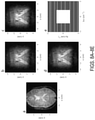
- FIG. 7B shows an image obtained from a reconstruction using the fully sampled dataset.
- FIG. 7C shows an image obtained from a reconstruction using only the undersampled data, resulting in low resolution due to the center ACS region containing most of the signal energy.
- FIG. 7D shows an image obtained from a GRAPPA reconstruction.
- FIG. 7E shows a retrospective undersampling pattern. White indicates sampled values, whereas black indicates unsampled values.
- FIG. 8B shows an image obtained from a reconstruction using the fully sampled dataset.
- FIG. 8C shows an image obtained from a reconstruction using only the undersampled data, resulting in low resolution due to the center ACS region containing most of the signal energy.
- FIG. 8D shows an image obtained from a GRAPPA reconstruction.
- FIG. 8E shows a retrospective undersampling pattern. White indicates sampled values, whereas black indicates unsampled values
- FIG. 9 is a block diagram of an example MRI system that can implement the methods described in the present disclosure.
- Data acquisition is accelerated using segmented RF pulses for excitation, refocusing, or both.
- parallel image reconstruction techniques such as GRAPPA, can be adapted to work with a single RF receive coil.
- unsampled data can be recovered. This shortens scan times, yielding the advantages of segmented pulses without the formerly required long scans.
- RF pulse shapes can be designed to have sharp boundaries.
- lipids in the scalp can create a very strong signal that can bleed into the brain metabolite signal.
- planar saturation techniques are used in an attempt to spoil the lipid signal, but those approaches aren't always effective.
- RF pulses can be designed to have sharper boundaries such that these lipid signals do not bleed into the brain metabolite signal.
- the methods described in the present disclosure can be used to accelerate other imaging techniques, such as B1-gradient based imaging methods.
- One non-limiting example of such techniques that can be accelerated using the methods described in the present disclosure is rotating frame zeugmatography (“RFZ”).
- RFZ generates a gradient in the RF excitation field (i.e., the B1 field) in order to cause a variation in flip angle that corresponds to spatial locations along the B1-field gradient.
- This B1-field gradient can be used to provide spatial encoding of the magnetic resonance signals.
- the different (e.g., incremented) RF pulse lengths in RFZ can be used as RF pulse segments discussed in the present disclosure. In this way, RFZ can be accelerated (e.g., by omitting some pulse increments) and the mathematical framework described in the present disclosure used to provide advantages of reduced scan time without a corresponding loss in image quality.
- the methods described in the present disclosure can also provide improvements for dental imaging applications.
- the lipids in the cheek can create a strong undesirable signal.
- signals from these lipids bleeding into the desired imaging region or volume can be mitigated.
- the methods described in the present disclosure can provide benefits for imaging near metallic implants.
- imaging near metallic implants is difficult because the metal in the implants can cause strong off resonances that result in signal loss.
- high bandwidth can be used to compensate for perturbations to B 0 around the implant.
- the redundant information from acquisitions of different pulse segments can be used to undersample acquisition k-space even when using a single receive coil.
- the redundancy between pulse segments permits data undersampling in the phase-encoded dimension aligned with the segmented dimension of the pulse.
- Data can be recovered, for instance, by treating each readout as originating from a virtual receiver in a GRAPPA-type, or other suitable parallel imaging, reconstruction. This approach is made possible by treating the data from each pulse segment as if received by a virtual coil with a spatially dependent sensitivity map. The total number of virtual coils is then equal to the number of excitation segments used, provided there is only one receive coil.
- TIAMO Time Interleaved Acquisition of Modes
- the FOV can also be reduced in the two spatially-selected dimensions.
- the different pulse segments induce unique spatial modulation with every excitation.
- the data from each excitation segment are then used to synthesize unsampled data in an accelerated acquisition.
- This concept is motivated by considering the excitation profile following a given pulse segment and the signal received following that excitation. Assuming a small tip angle excitation, the excitation profile P j ( ⁇ right arrow over (r) ⁇ ) of the imaged object I( ⁇ right arrow over (r) ⁇ ) following pulse segment j is given by,
- B 1,j + ( ⁇ right arrow over (r) ⁇ ,t) is the total complex RF field at position ⁇ right arrow over (r) ⁇ and time t
- ⁇ is the proton gyromagnetic ratio
- T p is the RF pulse duration
- ⁇ right arrow over (k) ⁇ j (t) is a parameterized trajectory through excitation k-space for pulse segment j.
- the index j runs from 1, . . . , N s , where N s is the number of pulse segments used.
- the signal can be written as, S m,j ( ⁇ right arrow over (k) ⁇ a ( t )) ⁇ V B 1,m + ( ⁇ right arrow over (r) ⁇ ) P j ( ⁇ right arrow over (r) ⁇ )exp( ⁇ i ⁇ right arrow over (r) ⁇ right arrow over (k) ⁇ a ( t )) d ⁇ right arrow over (r) ⁇ (5).
- the subscript a denotes acquisition, and the integral is performed over the sensitive volume V of the receive coil.
- the signal is recast as, S m,j ( ⁇ right arrow over (k) ⁇ a ( t )) ⁇ i ⁇ V B 1,m ⁇ ( ⁇ right arrow over (r) ⁇ ) M j ( ⁇ right arrow over (r) ⁇ ) B 1,j + ( ⁇ right arrow over (r) ⁇ ) I ( ⁇ right arrow over (r) ⁇ )exp( ⁇ i ⁇ right arrow over (r) ⁇ right arrow over (k) ⁇ a ( t )) d ⁇ right arrow over (r) ⁇ (6).
- the quantity ⁇ tilde over (B) ⁇ m,j can be interpreted as a complex coil sensitivity profile.
- the virtual coil profile is the product of the physical receiver sensitivity, transmit field map, and pulse segment excitation profile. This is distinct from other methods, which have treated the composite receive sensitivity as the product of the physical receive sensitivity and transmit field map only.
- N s virtual coils When only one physical receive coil is present, there are still N s virtual coils to work with.
- N s -segment pulse is combined with standard GRAPPA, the data from each pulse segment acquired with one physical coil can be split into N s virtual coil data sets.
- the number of effective coils, ⁇ c is equal to the product N s N c , as seen from Eqn. (7).
- SNR signal-to-noise ratio
- C j max
- each C j is set equal to the maximum value of the integral across all space r, but other scaling prescriptions could alternatively be used, such as the mean value of each segment's magnetization profile.
- the flip angle at each spatial location varies from segment to segment, and the amount of variation is spatially dependent and increases with number of segments used, except when using the fully segmented pulse.
- TR ⁇ T 1 it may not be possible to ignore variable T 1 -weighting of the different segments.
- the coefficients C j can therefore be used to scale the peak RF amplitude to obtain a more consistent flip angle across pulse segments.
- This procedure utilizes a processing step to compensate for the increased flip angles from scaling, so that signal outside the region of interest is perfectly cancelled when summing over segments. By scaling the amplitude of each pulse segment, flip angle variations can be minimized enough to avoid noticeable image artifacts.
- 2D RF pulses can be applied in segments to increase the excitation bandwidth relative to a single-shot implementation, at a cost of increased imaging time.
- the increased imaging time can be overcome by undersampling the acquisition in one phase-encoded dimension. Data from each segment are viewed as originating from “virtual receive coils” rather than multiple physical coils. The undersampled data are reconstructed using parallel imaging techniques (e.g., GRAPPA).
- the segmented RF pulses may have a high bandwidth in a fast time direction and a low bandwidth in a slow time direction, in which the pulses are segmented. Segmenting the RF pulse requires fewer gradient blips, or no gradient blips in the fully segmented case where every k-space line is a separate acquisition. To increase the bandwidth in the slow time direction, however, segmenting the RF pulse k-space in multiple undersampled segments can be used to increase their bandwidth by shortening pulse length.
- real-time adjustments of voltage can be made to compensate for B1+ maps and to keep the flip angle constant.
- 2D frequency-swept RF pulses can be modified to compensate for B1+ inhomogeneities.
- fully segmenting the pulse's k-space yields significant immunity to B0 inhomogeneities.
- FIG. 1 a flowchart is illustrated as setting forth the steps of an example method for generating an image with an MRI system using one or more segmented RF pulses and by reconstructing an image using the RF pulse segments as virtual receivers.
- the method includes selecting an RF pulse with a computer system, as indicated at step 102 .
- selecting the RF pulse can include selecting a desired RF pulse profile, or other characteristics of the RF pulse, to achieve the desired effect (e.g., excitation, refocusing) over a prescribed region or volume.
- the RF pulse profile is, for example, a two-dimensional (“2D”) RF pulse profile.
- the RF pulse profile defines a frequency-swept RF pulse, which enables higher bandwidth in the fast-selected dimension.
- the RF pulse profile may be a 2D hyperbolic secant pulse (e.g., an HS1 pulse).
- Other frequency-swept pulses can also be used, including higher order HSn pulses or a chirp pulse.
- FIGS. 2A-2C illustrate a k-space description of such a 2D RF pulse.
- FIG. 2A shows the RF amplitude as a function of k-space
- FIG. 2B shows the RF phase as a function of k-space
- FIG. 2C shows the transverse magnetization, M xy, profile produced by this pulse.
- ⁇ determines where these functions are truncated.
- choosing the positive sign leads to a parabolic phase over the object, while a negative sign yields a hyperbolic phase profile.
- it is assumed that the negative sign is used.
- ⁇ f,s are normalized by,
- the coefficients A f,x can be defined by,
- Eqn. (16) can be used to modify the pulse to produce a uniform flip angle with a spatially-varying RF field, B1+. While the 2D spatial selection can be performed in any orientation, the fast and slow spatially-selected dimensions will herein generally be referred to as X and Y, respectively.
- a 2D HS1 RF pulse is phase modulated in two spatial domains
- 2D spatiotemporal excitation takes place during the pulse in a manner that is dictated by the resulting (rasterized) trajectory of a hyperbolic phase function in space.
- excitation at a given moment is localized to the vertex of this hyperbolic phase function
- the 2D pulse can be modified to achieve uniform flip angle despite the existence of significant B1+ inhomogeneity.
- the process includes obtaining a unitless B1+ map (denoted by B 1,c + ) that is normalized to 1 at its maximum. Then the RF waveform can be recalculated as,
- the RF pulse is segmented to generate RF pulse segments, as indicated at step 104 .
- the bandwidth in the slow-selected dimension can be increased by sampling segments of the fully sampled RF pulse with each excitation. Segmenting the RF pulse in this manner decreases the pulse length while maintaining the time-bandwidth product, such that the bandwidth in the slow dimension increases in inverse proportion to the pulse length reduction.
- a full image readout can be acquired for each pulse segment. Depending on the specific sequence used, this might necessitate a tradeoff between minimum scan time and pulse bandwidth, since as the pulse is shortened, the minimum repetition time (“TR”) decreases.
- the total number of readouts to be acquired scales linearly with the number of pulse segments used.
- the data can be summed over all segments in either k-space or image space with the appropriate weights, as described below.
- Using a 2D pulse permits increased spatial resolution in a fixed imaging time by decreasing the field-of-view (“FOV”) in the phase-encoded dimensions.
- FOV field-of-view
- the acquisition time increases multiplicatively with the number of segments.
- the number of segments used can be selected so as not to exceed the acceleration gained by shrinking the FOV.
- the number of segments, N seg can be selected to satisfy,
- PE i,full and PE i,zoomed denote the number of phase encoded steps in a given dimension, i, in the full and zoomed FOV, respectively. This example assumes equal resolution between zoomed and full FOV scans.
- each segment should be taken to ensure that each segment has the same k-space center defined. Because the k-space trajectory is defined by the integral of the remaining gradient, there should be a variable area gradient lobe at the end of each segment in the slow-selected dimension. If these refocusing lobes are not the correct magnitude and polarity, different segments may amount to sampling the pulse multiple times along the same line(s) of k-space. Hence, the trajectory of a given segment can be influenced by the refocusing gradient, whereas the sampling weight is influenced by the RF amplitude and phase. Thus, even though each RF pulse segment can use the same gradient waveform during RF transmission, its trajectory in k-space is determined by the gradient refocusing lobe that follows the RF pulse.
- a 2D HS1 pulse was generated using 28 lines of k-space in the slow dimension (i.e., the y-direction).
- the time-bandwidth product (“TBP”) was set to 9 and the slab thickness to 5 cm in both dimensions of the pulse.
- TBP time-bandwidth product
- Each subpulse element was 700 ⁇ s long.
- the duration of the gradient blips in the slow dimension were 120 ⁇ s with a half-sinusoid shape.
- FIG. 3A is an example of a single segment coverage of k-space.
- FIG. 3B is an example of covering k-space in two segments, with each sampling 14 equidistant lines of k-space.
- FIG. 3C is an example of a 7-segment trajectory, with each segment sampling 4 equidistant lines of k-space.
- FIG. 3D is an example of a fully segmented trajectory, in which only one line of k-space is sampled with each segment.
- the segmented RF pulses can optionally employ an autocalibrating signal (“AC S”) region, which may be a rectangular ACS region, to maximize the acceleration gained.
- AC S autocalibrating signal
- segmented RF pulses Another option for the segmented RF pulses is to alternate the initial direction of the k-space trajectory between segments, which gives different off-resonant behavior. Trajectories do not need to be interleaved as shown. Segmented trajectories which sample k-space sequentially and do not overlap are also possible.
- a larger dimension can be chosen in the segmented (i.e., slow) direction of the 2D pulse, which has the spatial encoding information.
- a square region can be used to increase the number of points available for the kernel weight calibration.
- FIG. 4 illustrates the real component of the transverse magnetization for each of the 2D pulse segments when traversed in 4 segments
- FIG. 5 illustrates the real component of the transverse magnetization for each of the 2D pulse segments when fully segmented into 28 segments.
- the segmented RF pulses are then sent to the MRI system and implemented in one or more pulse sequences in order to acquire data, as indicated at step 106 .
- the segmented RF pulses are implemented in selected pulse sequence (e.g., for excitation, refocusing, or both) and data are acquired responsive to the applied, segmented RF pulses.
- the 2D HS1 RF pulse described above was used in a 3D-GRE sequence for an example imaging study. Both a fully segmented (i.e., 28 segments) and 4-segment RF excitation were used for comparison, with T1- and T2*-weighting, respectively. Sequence parameters were as follows.
- FIGS. 7A-7E show images obtained using this example sequence.
- the red box indicates the zoomed FOV in the phase encoded dimensions.
- FIG. 7B shows the reconstruction using the fully sampled dataset.
- FIG. 7C shows the reconstruction using only the undersampled data.
- FIG. 7D shows the image obtained using a GRAPPA reconstruction.
- FIG. 7E shows the undersampling pattern used.
- FIGS. 8A-8E show images obtained using this example sequence.
- the red box indicates the zoomed FOV in the phase encoded dimensions.
- FIG. 8B shows the reconstruction using the fully sampled dataset.
- FIG. 8C shows the reconstruction using only the undersampled data.
- FIG. 8D shows the image obtained using a GRAPPA reconstruction.
- FIG. 8E shows the undersampling pattern used.
- the GRAPPA kernel was 3 ⁇ 2 ⁇ 3 in k x , k y , and k z , respectively. Every 11th line of k y was sampled on readout for the 28 segment pulse, with the central 10 ⁇ 20 lines of k-space fully sampled in the phase encoded dimensions, k x and k y , for use as ACS lines.
- the central 32 lines were employed as ACS lines, while every 2nd line was sampled along k y on acquisition.
- the ACS lines were used in the final reconstruction.
- the power for each segment in the 4-segment and the 28-segment pulse was set by comparing the RF amplitude (B1+) determined from Bloch simulation to an experimental RF power calibration.
- an echo-planar imaging (“EPI”) gradient train was used during the excitation, and the low bandwidth achieved in the slow dimension of the pulses was increased by decreasing the pulse length of the RF pulse segments. Specifically, different segments of the pulse were undersampled to decrease the pulse length of each segment, thus increasing the bandwidth for a fixed time-bandwidth product, R.
- the direction of the oscillating (i.e., alternating) gradient in an EPI sequence can be referred to as the fast-selected dimension, while the direction of the blipped gradient can be referred to as the slow-selected dimension.
- each pulse segment will likely produce a different flip angle.
- the different pulse segments may produce variable T1-weighting of the image data. This can be remedied by rescaling the power of each pulse segment to achieve a constant flip angle for all segments.
- the data may be summed over all segments in either k-space or image space with the appropriate weights. During the summation over all segments used, perfect signal cancellation outside the desired selected region may not occur. This issue can be addressed by reweighting the reconstruction of each segment with a weight equal to the original flip angle of the segment. For a fully segmented pulse in which one line of k-space is sampled per segment, this procedure then amounts to reweighting each reconstruction according to a HS1 pulse defined by the number of segments used. For a partially segmented pulse, the data for each segment can be scaled in post-processing by the integral of the respective pulse segment. The weights can be given by Eqn. (10) above.
- One or more images are then reconstructed from the acquired data, as indicated at step 108 .
- images can be reconstructed using a GRAPPA or GRAPPA-like reconstruction.
- the determination of the GRAPPA weights may be an ill-posed linear inverse problem. In these instances, the problem can be regularized in order to find a unique solution that yields clinical-quality images.
- the transmitter is operated in a fixed mode, so there is no index over the transmit field map.
- the transmitter is not operated in a fixed mode, so the transmit field map varies between acquisitions.
- the role of the varying transmit field map in techniques such as TIAMO is replaced by the pulse segments in the methods described in the present disclosure in order to achieve spatial encoding.
- the different excitation modes used in techniques such as TIAMO yield a varying flip angle between each excitation at a fixed spatial location. This non-ideality results in varying T1 weighting and SNR at the same spatial location for each transmit mode.
- the present approach maintains consistent T1 contrast and SNR with each excitation by using the same flip angle with every excitation segment. Additionally, the present approach can implement a complex summation over the excitation segments before combination of data from physical coils.
- the MRI system 900 includes an operator workstation 902 that may include a display 904 , one or more input devices 906 (e.g., a keyboard, a mouse), and a processor 908 .
- the processor 908 may include a commercially available programmable machine running a commercially available operating system.
- the operator workstation 902 provides an operator interface that facilitates entering scan parameters into the MRI system 900 .
- the operator workstation 902 may be coupled to different servers, including, for example, a pulse sequence server 910 , a data acquisition server 912 , a data processing server 914 , and a data store server 916 .
- the operator workstation 902 and the servers 910 , 912 , 914 , and 916 may be connected via a communication system 940 , which may include wired or wireless network connections.
- the pulse sequence server 910 functions in response to instructions provided by the operator workstation 902 to operate a gradient system 918 and a radiofrequency (“RF”) system 920 .
- Gradient waveforms for performing a prescribed scan are produced and applied to the gradient system 918 , which then excites gradient coils in an assembly 922 to produce the magnetic field gradients G x , G y , and G z that are used for spatially encoding magnetic resonance signals.
- the gradient coil assembly 922 forms part of a magnet assembly 924 that includes a polarizing magnet 926 and a whole-body RF coil 928 .
- RF waveforms are applied by the RF system 920 to the RF coil 928 , or a separate local coil to perform the prescribed magnetic resonance pulse sequence.
- Responsive magnetic resonance signals detected by the RF coil 928 , or a separate local coil are received by the RF system 920 .
- the responsive magnetic resonance signals may be amplified, demodulated, filtered, and digitized under direction of commands produced by the pulse sequence server 910 .
- the RF system 920 includes an RF transmitter for producing a wide variety of RF pulses used in MRI pulse sequences.
- the RF transmitter is responsive to the prescribed scan and direction from the pulse sequence server 910 to produce RF pulses of the desired frequency, phase, and pulse amplitude waveform.
- the generated RF pulses may be applied to the whole-body RF coil 928 or to one or more local coils or coil arrays.
- the RF system 920 also includes one or more RF receiver channels.
- An RF receiver channel includes an RF preamplifier that amplifies the magnetic resonance signal received by the coil 928 to which it is connected, and a detector that detects and digitizes the I and Q quadrature components of the received magnetic resonance signal.
- phase of the received magnetic resonance signal may also be determined according to the following relationship:
- the pulse sequence server 910 may receive patient data from a physiological acquisition controller 930 .
- the physiological acquisition controller 930 may receive signals from a number of different sensors connected to the patient, including electrocardiograph (“ECG”) signals from electrodes, or respiratory signals from a respiratory bellows or other respiratory monitoring devices. These signals may be used by the pulse sequence server 910 to synchronize, or “gate,” the performance of the scan with the subject's heart beat or respiration.
- ECG electrocardiograph
- the pulse sequence server 910 may also connect to a scan room interface circuit 932 that receives signals from various sensors associated with the condition of the patient and the magnet system. Through the scan room interface circuit 932 , a patient positioning system 934 can receive commands to move the patient to desired positions during the scan.
- the digitized magnetic resonance signal samples produced by the RF system 920 are received by the data acquisition server 912 .
- the data acquisition server 912 operates in response to instructions downloaded from the operator workstation 902 to receive the real-time magnetic resonance data and provide buffer storage, so that data is not lost by data overrun. In some scans, the data acquisition server 912 passes the acquired magnetic resonance data to the data processor server 914 . In scans that require information derived from acquired magnetic resonance data to control the further performance of the scan, the data acquisition server 912 may be programmed to produce such information and convey it to the pulse sequence server 910 . For example, during pre-scans, magnetic resonance data may be acquired and used to calibrate the pulse sequence performed by the pulse sequence server 910 .
- navigator signals may be acquired and used to adjust the operating parameters of the RF system 920 or the gradient system 918 , or to control the view order in which k-space is sampled.
- the data acquisition server 912 may also process magnetic resonance signals used to detect the arrival of a contrast agent in a magnetic resonance angiography (“MRA”) scan.
- MRA magnetic resonance angiography
- the data acquisition server 912 may acquire magnetic resonance data and processes it in real-time to produce information that is used to control the scan.
- the data processing server 914 receives magnetic resonance data from the data acquisition server 912 and processes the magnetic resonance data in accordance with instructions provided by the operator workstation 902 .
- processing may include, for example, reconstructing two-dimensional or three-dimensional images by performing a Fourier transformation of raw k-space data, performing other image reconstruction algorithms (e.g., iterative or backprojection reconstruction algorithms), applying filters to raw k-space data or to reconstructed images, generating functional magnetic resonance images, or calculating motion or flow images.
- Images reconstructed by the data processing server 914 are conveyed back to the operator workstation 902 for storage.
- Real-time images may be stored in a data base memory cache, from which they may be output to operator display 902 or a display 936 .
- Batch mode images or selected real time images may be stored in a host database on disc storage 938 .
- the data processing server 914 may notify the data store server 916 on the operator workstation 902 .
- the operator workstation 902 may be used by an operator to archive the images, produce films, or send the images via a network to other facilities.
- the MRI system 900 may also include one or more networked workstations 942 .
- a networked workstation 942 may include a display 944 , one or more input devices 946 (e.g., a keyboard, a mouse), and a processor 948 .
- the networked workstation 942 may be located within the same facility as the operator workstation 902 , or in a different facility, such as a different healthcare institution or clinic.
- the networked workstation 942 may gain remote access to the data processing server 914 or data store server 916 via the communication system 940 . Accordingly, multiple networked workstations 942 may have access to the data processing server 914 and the data store server 916 . In this manner, magnetic resonance data, reconstructed images, or other data may be exchanged between the data processing server 914 or the data store server 916 and the networked workstations 942 , such that the data or images may be remotely processed by a networked workstation 942 .
Landscapes
- Physics & Mathematics (AREA)
- Health & Medical Sciences (AREA)
- Engineering & Computer Science (AREA)
- High Energy & Nuclear Physics (AREA)
- Nuclear Medicine, Radiotherapy & Molecular Imaging (AREA)
- Life Sciences & Earth Sciences (AREA)
- General Physics & Mathematics (AREA)
- Condensed Matter Physics & Semiconductors (AREA)
- General Health & Medical Sciences (AREA)
- Radiology & Medical Imaging (AREA)
- Signal Processing (AREA)
- Molecular Biology (AREA)
- Biomedical Technology (AREA)
- Surgery (AREA)
- Animal Behavior & Ethology (AREA)
- Heart & Thoracic Surgery (AREA)
- Public Health (AREA)
- Veterinary Medicine (AREA)
- Medical Informatics (AREA)
- Biophysics (AREA)
- Pathology (AREA)
- Artificial Intelligence (AREA)
- Computer Vision & Pattern Recognition (AREA)
- Psychiatry (AREA)
- Physiology (AREA)
- Magnetic Resonance Imaging Apparatus (AREA)
Abstract
Description
P j({right arrow over (r)})∝iγI({right arrow over (r)})B 1,j +({right arrow over (r)})∫0 T
P j({right arrow over (r)})∝iγI({right arrow over (r)})B 1,j +({right arrow over (r)})M j({right arrow over (r)}) (3);
where
M j({right arrow over (r)})

S m,j({right arrow over (k)} a(t))∝∫V B 1,m +({right arrow over (r)})P j({right arrow over (r)})exp(−i{right arrow over (r)}{right arrow over (k)} a(t))d{right arrow over (r)} (5).
S m,j({right arrow over (k)} a(t))∝iγ∫ V B 1,m −({right arrow over (r)})M j({right arrow over (r)})B 1,j +({right arrow over (r)})I({right arrow over (r)})exp(−i·{right arrow over (r)}·{right arrow over (k)} a(t))d{right arrow over (r)} (6).
{tilde over (B)} m,j({right arrow over (r)})
the signal equation becomes,
S m,j({right arrow over (k)} a(t))∝∫V {tilde over (B)} m,j(r){right arrow over (I)}({right arrow over (r)})exp(−i·{right arrow over (r)}·{right arrow over (k)} a(t))d{right arrow over (r)}. (8).
C j=max|∫0 T(t)exp(−iϕ RF,j(t))exp(i{right arrow over (r)}·{right arrow over (k)} j(t))dt| (10);
ω1=ω1,max sec h(βκf(t))sec h(βκs(t)) (11);
ϕRF =A f log(cos h(βκf(t)))±A s log(cos h(βκs(t))) (12).
M=√{square root over (I 2 +Q 2)} (19);
Claims (18)
Priority Applications (1)
| Application Number | Priority Date | Filing Date | Title |
|---|---|---|---|
| US16/859,177 US11231476B2 (en) | 2019-04-26 | 2020-04-27 | Accelerated magnetic resonance imaging acquisition using two-dimensional pulse segments as virtual receivers |
Applications Claiming Priority (2)
| Application Number | Priority Date | Filing Date | Title |
|---|---|---|---|
| US201962839067P | 2019-04-26 | 2019-04-26 | |
| US16/859,177 US11231476B2 (en) | 2019-04-26 | 2020-04-27 | Accelerated magnetic resonance imaging acquisition using two-dimensional pulse segments as virtual receivers |
Publications (2)
| Publication Number | Publication Date |
|---|---|
| US20200341096A1 US20200341096A1 (en) | 2020-10-29 |
| US11231476B2 true US11231476B2 (en) | 2022-01-25 |
Family
ID=72921390
Family Applications (1)
| Application Number | Title | Priority Date | Filing Date |
|---|---|---|---|
| US16/859,177 Active US11231476B2 (en) | 2019-04-26 | 2020-04-27 | Accelerated magnetic resonance imaging acquisition using two-dimensional pulse segments as virtual receivers |
Country Status (1)
| Country | Link |
|---|---|
| US (1) | US11231476B2 (en) |
Cited By (1)
| Publication number | Priority date | Publication date | Assignee | Title |
|---|---|---|---|---|
| US20230003820A1 (en) * | 2021-06-30 | 2023-01-05 | Siemens Healthcare Gmbh | Echo-spacing shuffling for echo-planar-imaging |
Families Citing this family (1)
| Publication number | Priority date | Publication date | Assignee | Title |
|---|---|---|---|---|
| US12313710B2 (en) * | 2022-03-01 | 2025-05-27 | Siemens Healthineers Ag | B1+ mapping near metallic hardware |
Citations (4)
| Publication number | Priority date | Publication date | Assignee | Title |
|---|---|---|---|---|
| US7075301B2 (en) * | 2003-11-26 | 2006-07-11 | General Electric Company | Method and apparatus to reduce RF power deposition during MR data acquisition |
| US20080100292A1 (en) * | 2006-10-30 | 2008-05-01 | Ileana Hancu | System and method for fast mr coil sensitivity mapping |
| US20130134975A1 (en) * | 2010-08-20 | 2013-05-30 | Koninklijke Philips Electronics N.V. | Virtual coil emulation in parallel transmission mri |
| US20160245882A1 (en) * | 2015-02-24 | 2016-08-25 | Siemens Aktiengesellschaft | Method and magnetic resonance apparatus for determining absolute receive sensitivity maps for reception coils |
-
2020
- 2020-04-27 US US16/859,177 patent/US11231476B2/en active Active
Patent Citations (4)
| Publication number | Priority date | Publication date | Assignee | Title |
|---|---|---|---|---|
| US7075301B2 (en) * | 2003-11-26 | 2006-07-11 | General Electric Company | Method and apparatus to reduce RF power deposition during MR data acquisition |
| US20080100292A1 (en) * | 2006-10-30 | 2008-05-01 | Ileana Hancu | System and method for fast mr coil sensitivity mapping |
| US20130134975A1 (en) * | 2010-08-20 | 2013-05-30 | Koninklijke Philips Electronics N.V. | Virtual coil emulation in parallel transmission mri |
| US20160245882A1 (en) * | 2015-02-24 | 2016-08-25 | Siemens Aktiengesellschaft | Method and magnetic resonance apparatus for determining absolute receive sensitivity maps for reception coils |
Non-Patent Citations (6)
| Title |
|---|
| Griswold et al., Generalized Autocalibrating Partially Parallel Acquisitions (GRAPPA), Magnetic Resonance in Medicine, 2002, 47(6):1202-1210. |
| Jang et al., 2D Pulses Using Spatially Dependent Frequency Sweeping, Magnetic Resonance in Medicine, 2016, 76 (5): 1364-1374. |
| Mullen et al., Two-Dimensional Frequency-Swept Pulse with Resilience to Both B1 and BO Inhomogeneity, Journal of Magnetic Resonance, 2019, 299:93-100. |
| Orzada et al., RF Excitation Using Time Interleaved Acquisition of Modes (TIAMO) to Address B1 Inhomogeneity in High-Field MRI, Magnetic Resonance in Medicine, 2010, 64(2):327-333. |
| Panych et al., Selection of High-Definition 2D Virtual Profiles with Multiple RF Pulse Excitations Along Interleaved Echo-Planar k-Space Trajectories, Magnetic Resonance in Medicine, 1999,41 (2):224-229. |
| Pruessmann et al., SENSE: Sensitivity Encoding for Fast MRI, Magnetic Resonance in Medicine, 1999, 42 (5):952-962. |
Cited By (2)
| Publication number | Priority date | Publication date | Assignee | Title |
|---|---|---|---|---|
| US20230003820A1 (en) * | 2021-06-30 | 2023-01-05 | Siemens Healthcare Gmbh | Echo-spacing shuffling for echo-planar-imaging |
| US11815583B2 (en) * | 2021-06-30 | 2023-11-14 | Siemens Healthcare Gmbh | Echo-spacing shuffling for echo-planar-imaging |
Also Published As
| Publication number | Publication date |
|---|---|
| US20200341096A1 (en) | 2020-10-29 |
Similar Documents
| Publication | Publication Date | Title |
|---|---|---|
| US11022665B2 (en) | Method for echo planar time-resolved magnetic resonance imaging | |
| US9396562B2 (en) | MRI reconstruction with incoherent sampling and redundant haar wavelets | |
| US9778336B2 (en) | System and method for rapid, multi-shot segmented magnetic resonance imaging | |
| US9482732B2 (en) | MRI reconstruction with motion-dependent regularization | |
| US9726742B2 (en) | System and method for iteratively calibrated reconstruction kernel for accelerated magnetic resonance imaging | |
| US9317917B2 (en) | Method, reconstruction device, and magnetic resonance apparatus for reconstructing magnetic resonance raw data | |
| US20130088225A1 (en) | System for Reconstructing MRI Images Acquired in Parallel | |
| US10436866B2 (en) | Simultaneous multislice MRI with random gradient encoding | |
| US10901061B2 (en) | Accelerated diffusion-weighted magnetic resonance imaging with self-navigated, phase corrected tilted kernel reconstruction of phase encoded and point spread function encoded k-space | |
| US10598747B2 (en) | System and method for simultaneous multislice magnetic resonance fingerprinting with variable radio frequency encoding | |
| US12372595B2 (en) | Multi-echo radio frequency (RF) based spatial encoding in magnetic resonance imaging using frequency-modulated RF pulses | |
| US11231476B2 (en) | Accelerated magnetic resonance imaging acquisition using two-dimensional pulse segments as virtual receivers | |
| US12345786B2 (en) | Propeller echo planar time-resolved imaging with dynamic encoding | |
| US9329251B2 (en) | System and method for magnetic resonance imaging using multiple spatial encoding magnetic fields | |
| US11266324B2 (en) | System and methods for fast multi-contrast magnetic resonance imaging | |
| US11009576B2 (en) | Method for magnetic resonance imaging using slice quadratic phase for spatiotemporal encoding | |
| US10871534B2 (en) | Accelerated magnetic resonance imaging using a tilted reconstruction kernel in phase encoded and point spread function encoded K-space | |
| US12153110B2 (en) | Simultaneous multi-slice MRSI using density weighted concentric ring acquisition | |
| US20030214291A1 (en) | Method, system and computer product for k-space correction of gradient non-linearities | |
| US12578408B2 (en) | Autocalibrated multi-shot magnetic resonance image reconstruction with joint optimization of shot-dependent phase and parallel image reconstruction | |
| US10422841B2 (en) | Systems and methods for designing multidimensional selective adiabatic pulses | |
| US11874353B2 (en) | Multi-shot echo planar imaging using reordered segments and recursive radio frequency pulse design giving matched slice profiles across segments | |
| EP4394425B1 (en) | Method for generating a motion-corrected magnetic resonance image dataset | |
| Jochimsen et al. | Single-shot curved slice imaging |
Legal Events
| Date | Code | Title | Description |
|---|---|---|---|
| FEPP | Fee payment procedure |
Free format text: ENTITY STATUS SET TO UNDISCOUNTED (ORIGINAL EVENT CODE: BIG.); ENTITY STATUS OF PATENT OWNER: SMALL ENTITY |
|
| FEPP | Fee payment procedure |
Free format text: ENTITY STATUS SET TO SMALL (ORIGINAL EVENT CODE: SMAL); ENTITY STATUS OF PATENT OWNER: SMALL ENTITY |
|
| STPP | Information on status: patent application and granting procedure in general |
Free format text: DOCKETED NEW CASE - READY FOR EXAMINATION |
|
| AS | Assignment |
Owner name: REGENTS OF THE UNIVERSITY OF MINNESOTA, MINNESOTA Free format text: ASSIGNMENT OF ASSIGNORS INTEREST;ASSIGNORS:GARWOOD, MICHAEL;MULLEN, MICHAEL;GUTIERREZ, ALEXANDER;AND OTHERS;SIGNING DATES FROM 20200727 TO 20200730;REEL/FRAME:053396/0768 |
|
| STPP | Information on status: patent application and granting procedure in general |
Free format text: NOTICE OF ALLOWANCE MAILED -- APPLICATION RECEIVED IN OFFICE OF PUBLICATIONS |
|
| STPP | Information on status: patent application and granting procedure in general |
Free format text: DOCKETED NEW CASE - READY FOR EXAMINATION |
|
| STPP | Information on status: patent application and granting procedure in general |
Free format text: NOTICE OF ALLOWANCE MAILED -- APPLICATION RECEIVED IN OFFICE OF PUBLICATIONS |
|
| STPP | Information on status: patent application and granting procedure in general |
Free format text: PUBLICATIONS -- ISSUE FEE PAYMENT VERIFIED |
|
| STCF | Information on status: patent grant |
Free format text: PATENTED CASE |
|
| MAFP | Maintenance fee payment |
Free format text: PAYMENT OF MAINTENANCE FEE, 4TH YR, SMALL ENTITY (ORIGINAL EVENT CODE: M2551); ENTITY STATUS OF PATENT OWNER: SMALL ENTITY Year of fee payment: 4 |