US11231014B2 - System and method for reducing voltage distortion from an inverter-based resource - Google Patents
System and method for reducing voltage distortion from an inverter-based resource Download PDFInfo
- Publication number
- US11231014B2 US11231014B2 US16/907,910 US202016907910A US11231014B2 US 11231014 B2 US11231014 B2 US 11231014B2 US 202016907910 A US202016907910 A US 202016907910A US 11231014 B2 US11231014 B2 US 11231014B2
- Authority
- US
- United States
- Prior art keywords
- voltage
- distortion
- component
- inverter
- power
- Prior art date
- Legal status (The legal status is an assumption and is not a legal conclusion. Google has not performed a legal analysis and makes no representation as to the accuracy of the status listed.)
- Active
Links
Images





Classifications
-
- F—MECHANICAL ENGINEERING; LIGHTING; HEATING; WEAPONS; BLASTING
- F03—MACHINES OR ENGINES FOR LIQUIDS; WIND, SPRING, OR WEIGHT MOTORS; PRODUCING MECHANICAL POWER OR A REACTIVE PROPULSIVE THRUST, NOT OTHERWISE PROVIDED FOR
- F03D—WIND MOTORS
- F03D9/00—Adaptations of wind motors for special use; Combinations of wind motors with apparatus driven thereby; Wind motors specially adapted for installation in particular locations
- F03D9/20—Wind motors characterised by the driven apparatus
- F03D9/25—Wind motors characterised by the driven apparatus the apparatus being an electrical generator
- F03D9/255—Wind motors characterised by the driven apparatus the apparatus being an electrical generator connected to electrical distribution networks; Arrangements therefor
- F03D9/257—Wind motors characterised by the driven apparatus the apparatus being an electrical generator connected to electrical distribution networks; Arrangements therefor the wind motor being part of a wind farm
-
- H—ELECTRICITY
- H02—GENERATION; CONVERSION OR DISTRIBUTION OF ELECTRIC POWER
- H02J—ELECTRIC POWER NETWORKS; CIRCUIT ARRANGEMENTS OR SYSTEMS FOR SUPPLYING OR DISTRIBUTING ELECTRIC POWER; SYSTEMS FOR STORING ELECTRIC ENERGY
- H02J3/00—Circuit arrangements for AC mains or AC distribution networks
- H02J3/38—Arrangements for feeding a single network from two or more generators or sources in parallel; Arrangements for feeding already energised networks from additional generators or sources in parallel
- H02J3/46—Controlling the sharing of generated power between the generators, sources or networks
- H02J3/50—Controlling the sharing of reactive power
-
- H—ELECTRICITY
- H02—GENERATION; CONVERSION OR DISTRIBUTION OF ELECTRIC POWER
- H02P—CONTROL OR REGULATION OF ELECTRIC MOTORS, ELECTRIC GENERATORS OR DYNAMO-ELECTRIC CONVERTERS; CONTROLLING TRANSFORMERS, REACTORS OR CHOKE COILS
- H02P29/00—Arrangements for regulating or controlling electric motors, appropriate for both AC and DC motors
- H02P29/50—Reduction of harmonics
-
- H—ELECTRICITY
- H02—GENERATION; CONVERSION OR DISTRIBUTION OF ELECTRIC POWER
- H02J—ELECTRIC POWER NETWORKS; CIRCUIT ARRANGEMENTS OR SYSTEMS FOR SUPPLYING OR DISTRIBUTING ELECTRIC POWER; SYSTEMS FOR STORING ELECTRIC ENERGY
- H02J3/00—Circuit arrangements for AC mains or AC distribution networks
- H02J3/001—Arrangements for handling faults or abnormalities, e.g. emergencies or contingencies
- H02J3/0014—Arrangements for handling faults or abnormalities, e.g. emergencies or contingencies for preventing or reducing power oscillations in networks
-
- H—ELECTRICITY
- H02—GENERATION; CONVERSION OR DISTRIBUTION OF ELECTRIC POWER
- H02J—ELECTRIC POWER NETWORKS; CIRCUIT ARRANGEMENTS OR SYSTEMS FOR SUPPLYING OR DISTRIBUTING ELECTRIC POWER; SYSTEMS FOR STORING ELECTRIC ENERGY
- H02J3/00—Circuit arrangements for AC mains or AC distribution networks
- H02J3/12—Arrangements for adjusting voltage in AC networks by changing a characteristic of the network load
- H02J3/16—Arrangements for adjusting voltage in AC networks by changing a characteristic of the network load by adjustment of reactive power
-
- H—ELECTRICITY
- H02—GENERATION; CONVERSION OR DISTRIBUTION OF ELECTRIC POWER
- H02J—ELECTRIC POWER NETWORKS; CIRCUIT ARRANGEMENTS OR SYSTEMS FOR SUPPLYING OR DISTRIBUTING ELECTRIC POWER; SYSTEMS FOR STORING ELECTRIC ENERGY
- H02J3/00—Circuit arrangements for AC mains or AC distribution networks
- H02J3/18—Arrangements for adjusting, eliminating or compensating reactive power in networks
-
- H—ELECTRICITY
- H02—GENERATION; CONVERSION OR DISTRIBUTION OF ELECTRIC POWER
- H02J—ELECTRIC POWER NETWORKS; CIRCUIT ARRANGEMENTS OR SYSTEMS FOR SUPPLYING OR DISTRIBUTING ELECTRIC POWER; SYSTEMS FOR STORING ELECTRIC ENERGY
- H02J3/00—Circuit arrangements for AC mains or AC distribution networks
- H02J3/28—Arrangements for balancing of the load in networks by storage of energy
-
- H—ELECTRICITY
- H02—GENERATION; CONVERSION OR DISTRIBUTION OF ELECTRIC POWER
- H02M—APPARATUS FOR CONVERSION BETWEEN AC AND AC, BETWEEN AC AND DC, OR BETWEEN DC AND DC, AND FOR USE WITH MAINS OR SIMILAR POWER SUPPLY SYSTEMS; CONVERSION OF DC OR AC INPUT POWER INTO SURGE OUTPUT POWER; CONTROL OR REGULATION THEREOF
- H02M1/00—Details of apparatus for conversion
- H02M1/08—Circuits specially adapted for the generation of control voltages for semiconductor devices incorporated in static converters
-
- H—ELECTRICITY
- H02—GENERATION; CONVERSION OR DISTRIBUTION OF ELECTRIC POWER
- H02M—APPARATUS FOR CONVERSION BETWEEN AC AND AC, BETWEEN AC AND DC, OR BETWEEN DC AND DC, AND FOR USE WITH MAINS OR SIMILAR POWER SUPPLY SYSTEMS; CONVERSION OF DC OR AC INPUT POWER INTO SURGE OUTPUT POWER; CONTROL OR REGULATION THEREOF
- H02M1/00—Details of apparatus for conversion
- H02M1/12—Arrangements for reducing harmonics from AC input or output
-
- H—ELECTRICITY
- H02—GENERATION; CONVERSION OR DISTRIBUTION OF ELECTRIC POWER
- H02M—APPARATUS FOR CONVERSION BETWEEN AC AND AC, BETWEEN AC AND DC, OR BETWEEN DC AND DC, AND FOR USE WITH MAINS OR SIMILAR POWER SUPPLY SYSTEMS; CONVERSION OF DC OR AC INPUT POWER INTO SURGE OUTPUT POWER; CONTROL OR REGULATION THEREOF
- H02M5/00—Conversion of AC power input into AC power output, e.g. for change of voltage, for change of frequency, for change of number of phases
- H02M5/40—Conversion of AC power input into AC power output, e.g. for change of voltage, for change of frequency, for change of number of phases with intermediate conversion into DC
- H02M5/42—Conversion of AC power input into AC power output, e.g. for change of voltage, for change of frequency, for change of number of phases with intermediate conversion into DC by static converters
- H02M5/44—Conversion of AC power input into AC power output, e.g. for change of voltage, for change of frequency, for change of number of phases with intermediate conversion into DC by static converters using discharge tubes or semiconductor devices to convert the intermediate DC into AC
- H02M5/453—Conversion of AC power input into AC power output, e.g. for change of voltage, for change of frequency, for change of number of phases with intermediate conversion into DC by static converters using discharge tubes or semiconductor devices to convert the intermediate DC into AC using devices of a triode or transistor type requiring continuous application of a control signal
- H02M5/458—Conversion of AC power input into AC power output, e.g. for change of voltage, for change of frequency, for change of number of phases with intermediate conversion into DC by static converters using discharge tubes or semiconductor devices to convert the intermediate DC into AC using devices of a triode or transistor type requiring continuous application of a control signal using semiconductor devices only
-
- H—ELECTRICITY
- H02—GENERATION; CONVERSION OR DISTRIBUTION OF ELECTRIC POWER
- H02P—CONTROL OR REGULATION OF ELECTRIC MOTORS, ELECTRIC GENERATORS OR DYNAMO-ELECTRIC CONVERTERS; CONTROLLING TRANSFORMERS, REACTORS OR CHOKE COILS
- H02P9/00—Arrangements for controlling electric generators for the purpose of obtaining a desired output
- H02P9/02—Details of the control
-
- H—ELECTRICITY
- H02—GENERATION; CONVERSION OR DISTRIBUTION OF ELECTRIC POWER
- H02J—ELECTRIC POWER NETWORKS; CIRCUIT ARRANGEMENTS OR SYSTEMS FOR SUPPLYING OR DISTRIBUTING ELECTRIC POWER; SYSTEMS FOR STORING ELECTRIC ENERGY
- H02J2101/00—Supply or distribution of decentralised, dispersed or local electric power generation
- H02J2101/20—Dispersed power generation using renewable energy sources
- H02J2101/22—Solar energy
-
- H—ELECTRICITY
- H02—GENERATION; CONVERSION OR DISTRIBUTION OF ELECTRIC POWER
- H02J—ELECTRIC POWER NETWORKS; CIRCUIT ARRANGEMENTS OR SYSTEMS FOR SUPPLYING OR DISTRIBUTING ELECTRIC POWER; SYSTEMS FOR STORING ELECTRIC ENERGY
- H02J2101/00—Supply or distribution of decentralised, dispersed or local electric power generation
- H02J2101/20—Dispersed power generation using renewable energy sources
- H02J2101/28—Wind energy
-
- H02J2300/28—
-
- H—ELECTRICITY
- H02—GENERATION; CONVERSION OR DISTRIBUTION OF ELECTRIC POWER
- H02P—CONTROL OR REGULATION OF ELECTRIC MOTORS, ELECTRIC GENERATORS OR DYNAMO-ELECTRIC CONVERTERS; CONTROLLING TRANSFORMERS, REACTORS OR CHOKE COILS
- H02P9/00—Arrangements for controlling electric generators for the purpose of obtaining a desired output
- H02P9/007—Control circuits for doubly fed generators
-
- Y—GENERAL TAGGING OF NEW TECHNOLOGICAL DEVELOPMENTS; GENERAL TAGGING OF CROSS-SECTIONAL TECHNOLOGIES SPANNING OVER SEVERAL SECTIONS OF THE IPC; TECHNICAL SUBJECTS COVERED BY FORMER USPC CROSS-REFERENCE ART COLLECTIONS [XRACs] AND DIGESTS
- Y02—TECHNOLOGIES OR APPLICATIONS FOR MITIGATION OR ADAPTATION AGAINST CLIMATE CHANGE
- Y02E—REDUCTION OF GREENHOUSE GAS [GHG] EMISSIONS, RELATED TO ENERGY GENERATION, TRANSMISSION OR DISTRIBUTION
- Y02E10/00—Energy generation through renewable energy sources
- Y02E10/70—Wind energy
- Y02E10/72—Wind turbines with rotation axis in wind direction
-
- Y—GENERAL TAGGING OF NEW TECHNOLOGICAL DEVELOPMENTS; GENERAL TAGGING OF CROSS-SECTIONAL TECHNOLOGIES SPANNING OVER SEVERAL SECTIONS OF THE IPC; TECHNICAL SUBJECTS COVERED BY FORMER USPC CROSS-REFERENCE ART COLLECTIONS [XRACs] AND DIGESTS
- Y02—TECHNOLOGIES OR APPLICATIONS FOR MITIGATION OR ADAPTATION AGAINST CLIMATE CHANGE
- Y02E—REDUCTION OF GREENHOUSE GAS [GHG] EMISSIONS, RELATED TO ENERGY GENERATION, TRANSMISSION OR DISTRIBUTION
- Y02E10/00—Energy generation through renewable energy sources
- Y02E10/70—Wind energy
- Y02E10/76—Power conversion electric or electronic aspects
Definitions
- the present disclosure relates generally to inverter-based resources, and more particularly to a system and method for reducing voltage distortion created by an inverter-based resource.
- Wind power is considered one of the cleanest, most environmentally friendly energy sources presently available, and wind turbines have gained increased attention in this regard.
- a modern wind turbine typically includes a tower, generator, gearbox, nacelle, and one or more rotor blades.
- the rotor blades capture kinetic energy of wind using known airfoil principles.
- rotor blades typically have the cross-sectional profile of an airfoil such that, during operation, air flows over the blade producing a pressure difference between the sides. Consequently, a lift force, which is directed from a pressure side towards a suction side, acts on the blade. The lift force generates torque on the main rotor shaft, which is geared to a generator for producing electricity.
- the low-speed shaft is configured to drive the gearbox that subsequently steps up the low rotational speed of the low-speed shaft to drive a high-speed shaft at an increased rotational speed.
- the high-speed shaft is generally rotatably coupled to a generator so as to rotatably drive a generator rotor. As such, a rotating magnetic field may be induced by the generator rotor and a voltage may be induced within a generator stator that is magnetically coupled to the generator rotor.
- the associated electrical power can be transmitted to a turbine transformer that is typically connected to a power grid via a grid breaker.
- the turbine transformer steps up the voltage amplitude of the electrical power such that the transformed electrical power may be further transmitted to the power grid.
- the generator rotor may be electrically coupled to a bi-directional power converter that includes a rotor side converter joined to a line side converter via a regulated DC link.
- a bi-directional power converter that includes a rotor side converter joined to a line side converter via a regulated DC link.
- some wind turbines such as wind-driven dual-fed asynchronous generator (DFAG) systems or full power conversion systems, may include a power converter with an AC-DC-AC topology.
- the generator stator is separately connected to the power grid via a main transformer.
- the DFAG may be a variable speed machine.
- Such systems can generate voltage distortion that need to be controlled and/or reduced.
- the primary sources of such voltage distortion in DFAG-based wind turbine systems may be the rotor-side and the line-side converters and the generator stator. More specifically, the line-side converter generates distortions seen on the grid as integer multiples of grid frequency, whereas the rotor-side converter generates distortions seen on the grid as variable frequency associated with rotor speed. Further, slotting effects of the generator stator are seen on the grid as integer multiples of grid frequency, which is generally the same for all electric machines. External background distortion always exists, which is created by all other devices connected to grid. At their point of origin, all such distortions manifest as primarily voltage-source characteristics with small internal impedance. Typically, the fifth (5 th ) and seventh (7 th ) frequency components are of practical concern, but other frequencies may also be of concern in certain applications.
- the resultant distortion components of current flowing via connection with the grid is the sum of the distortion produced by the wind turbine components and the background distortion.
- an external filter is provided to reduce such distortions.
- the external equipment can be active or passive filter types. Passive filters are generally avoided due to cost and the need to apply on the grid rather than within the generating unit. Active filters can be applied within each generating unit, which uses a measure of current flowing via the grid connection and acts to absorb the distortion component via feedback control. However, in such instances, the rating of the active filter is forced to be larger than needed since it must compensate for currents produced by external background sources in addition to those created by the wind turbine power system. As such, active filters can create the potential for closed-loop instability.
- the present disclosure is directed to a system and method that is insensitive to distortion that is caused by external sources, does not require external equipment, and significantly reduces the distortion created from within the wind turbine power system.
- the system and method of the present disclosure creates trim signals that compensate for the voltage distortion introduced by the converter nonlinearities of the wind turbine power system.
- the present disclosure is directed to a method for operating a inverter-based resource connected to a power grid.
- the method includes receiving one or more voltage feedback signals created by at least one component of the inverter-based resource, wherein distortion components of the one or more voltage feedback signals are more sensitive to voltage distortion created by the inverter-based resource than by external sources of voltage distortion. Further, the method includes extracting a distortion component of the one or more feedback signals having a certain phase sequence and frequency. Moreover, the method includes determining a voltage command for the power converter as a function of, at least, the distortion component. Thus, the method includes controlling the power converter based on the voltage command such that the voltage distortion created by the at least one component of the inverter-based resource is reduced in a manner that is relatively insensitive to voltage distortion created by sources external to the inverter-based resource.
- the inverter-based resource may be a dual-fed asynchronous generator (DFAG).
- the component(s) of the inverter-based resource may be a rotor-side converter or a line-side converter of the DFAG.
- the inverter-based resource may be a full-conversion wind generating system, a solar generation system, or an energy storage power system.
- extracting the distortion component of the one or more voltage feedback signals may include, for example, determining an angle representing the time-varying angular position of a specific frequency and phase sequence associated with the distortion component, rotating the one or more voltage feedback signals from a first reference frame by the angle to obtain a signal wherein a steady component of the signal represents vector components of the distortion component, filtering the rotated signal to attenuate components unrelated to the distortion component to isolate the distortion component, regulating, via a regulator, the rotated signal with a gain that sets a bandwidth thereof, and then rotating an output from the regulator back to the first reference frame to obtain the voltage command.
- the regulator may include non-windup control having phase-preserving limit logic that maintains proportionality of the output signals.
- the component(s) of the inverter-based resource may be the rotor-side converter, with the phase-preserving limit logic of the rotor-side converter being based on rotor speed.
- the method may include determining the voltage command for the power converter as a function of, at least, the distortion component for multiple control paths.
- determining the voltage command for the power converter as a function of, at least, the distortion reduction signal may include adding the voltage commands from the multiple control paths together to obtain a trim signal.
- determining the voltage command for the power converter as a function of, at least, the distortion reduction signal may include rotating the trim signal to a reference frame to combine with other control signals to obtain the voltage command.
- the present disclosure is directed to a dual-fed asynchronous generator (DFAG) power system connected to a power grid.
- the DFAG power system includes a DFAG having a rotor and a stator, a power converter, a controller for controlling the DFAG power system.
- the controller is configured to perform a plurality of operations, including but not limited to receiving one or more voltage feedback signals created by at least one component of the DFAG power system, wherein distortion components of the one or more voltage feedback signals are more sensitive to voltage distortion created by the DFAG power system than by external sources of voltage distortion, extracting a distortion component of the one or more voltage feedback signals having a certain phase sequence and frequency, determining a voltage command for the power converter as a function of, at least, the distortion component, and controlling the power converter based on the voltage command such that the voltage distortion created by the at least one component of the DFAG is reduced in a manner that is relatively insensitive to voltage distortion created by sources external to the DFAG.
- the DFAG power system may further include any of the additional features as described herein.
- FIG. 1 illustrates one embodiment of an example inverter-based resource according to the present disclosure, particularly illustrating a DFAG wind turbine power system
- FIG. 2 illustrates a block diagram of one embodiment of a controller suitable for use with the inverter-based resource shown in FIG. 1 ;
- FIG. 3 illustrates a simplified schematic diagram of one embodiment of inverter-based resource according to the present disclosure, particularly illustrating a linearizing trim function of the system;
- FIG. 4 illustrates a flow diagram of an embodiment of a method for operating a inverter-based resource connected to a power grid according to the present disclosure
- FIG. 5 illustrates a detailed, schematic diagram of one embodiment of a linearizing trim function for reducing voltage distortion of a particular character in a inverter-based resource according to the present disclosure
- FIG. 6 illustrates a detailed, schematic diagram of the linearizing trim function for simultaneously reducing multiple components of voltage distortion in a inverter-based resource of FIG. 5 ;
- FIG. 7 illustrates a detailed, schematic diagram of one embodiment of a linearizing trim function for reducing voltage distortion of a particular character in a inverter-based resource according to the present disclosure
- FIG. 8 illustrates a detailed, schematic diagram of the linearizing trim function for simultaneously reducing multiple components of voltage distortion in a inverter-based resource of FIG. 7 ;
- FIG. 9 illustrates a graph of one embodiment of the logistic function output (y-axis) versus rotor speed (x-axis) according to the present disclosure
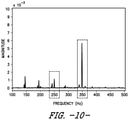
- FIG. 10 illustrates a graph of one embodiment of a Fast Fourier transform (FFT) of phase A current at a high-voltage winding of a transformer of a inverter-based resource without the linearizing trim function of the present disclosure
- FIG. 11 illustrates a graph of one embodiment of a FFT of phase A current at a high-voltage winding of a transformer of a inverter-based resource with the linearizing trim function of the present disclosure.
- the primary sources of voltage distortion in inverter-based resources typically include the fifth and seventh harmonics of the fundamental frequency of the converter AC output.
- the present disclosure is directed to a controller that implements a trim function to sufficiently reduce the distortion components contributed by the DFAG to the grid.
- the present disclosure uses the line AC voltage feedback to provide improved harmonic reduction for the line-side converter.
- the same structure may also be used on the rotor converter, but using rotor converter voltage with appropriate modification to account for the rotor electrical frequency.
- inverter-based resources In addition to DFAG wind power systems, there exists other energy conversion systems that connect to the electric power grid. Such systems are generally referred to as inverter-based resources. Examples of such resources include full-converter wind generators, solar energy converters, and energy storage systems. These latter examples all experience problems with voltage distortion similar to the DFAG wind turbines, although with less complexity than the DFAG wind turbine. The solutions explained herein for the DFAG wind turbine thereby cover the most complex application but are applicable as well to the simpler conversion systems.
- FIG. 1 illustrates an inverter-based resource 100 according to one embodiment of the present disclosure.
- the inverter-based resource 100 is a wind driven dual-fed asynchronous generator (DFAG) system 100 according to one embodiment of the present disclosure.
- DFAG wind driven dual-fed asynchronous generator
- a rotor 106 includes a plurality of rotor blades 108 coupled to a rotatable hub 110 , and together define a propeller that rotates at a rotor speed ⁇ R and at angle ⁇ P .
- the propeller is coupled to an optional gearbox 118 , which is, in turn, coupled to a generator 120 having a rotor 122 and a stator 124 .
- the generator 120 may be any suitable generator, including for example, a dual-fed asynchronous generator (DFAG).
- the generator 120 is typically coupled to a stator bus 154 and a power converter 162 via a rotor bus 156 .
- the stator bus 154 provides an output multiphase power (e.g. three-phase power) as well as stator current Is from the stator 122 of the generator 120 and the rotor bus 156 provides an output multiphase power (e.g. three-phase power) of a rotor of the generator 120 as well as stator current Is.
- the power converter 162 includes a rotor-side converter 166 coupled to a line-side converter 168 .
- the DFAG 120 is coupled to the rotor-side converter 166 via the rotor bus 156 .
- the line-side converter 168 is coupled to a line-side bus 188 .
- the stator bus 154 may be directly connected to the line-side bus 188 and may include a line inductor 155 that is associated with a voltage VL and a current IL.
- a distortion filter 157 may be coupled in series to the line-side bus 188 .
- the rotor-side converter 166 and the line-side converter 168 are configured for normal operating mode in a three-phase, PWM arrangement using insulated gate bipolar transistor (IGBT) switching elements, which are discussed in more detail herein.
- the rotor-side converter 166 and the line-side converter 168 can be coupled via a DC link 136 across which is the DC link capacitor 138 . Further, as shown, the voltage across the DC link 136 is referred to as VDC.
- the stator bus 154 and the power converter 162 may be connected to separate isolated windings of a transformer (not shown), i.e. at the junction of the generator breaker 158 and the converter breaker 186 .
- the power converter 162 can be coupled to a controller 174 to control the operation of the rotor-side converter 166 and the line-side converter 168 and other aspects of the power system 100 .
- the controller 174 can include any number of control devices.
- the controller 174 can include one or more processor(s) 176 and associated memory device(s) 178 configured to perform a variety of computer-implemented functions and/or instructions (e.g., performing the methods, steps, calculations and the like and storing relevant data as disclosed herein).
- the instructions when executed by the processor 176 can cause the processor 176 to perform operations, including providing control commands (e.g. pulse width modulation commands) to the switching elements of the power converter 162 and other aspects of the power system 100 .
- control commands e.g. pulse width modulation commands
- the controller 174 may also include a communications module 180 to facilitate communications between the controller 174 and the various components of the power system 100 , e.g. any of the components of FIG. 1 .
- the communications module 180 may include a sensor interface 182 (e.g., one or more analog-to-digital converters) to permit signals transmitted from one or more sensors to be converted into signals that can be understood and processed by the processors 176 .
- the sensors e.g. sensors 181 , 183 , 185
- the sensors 181 , 183 , 185 may be communicatively coupled to the communications module 180 using any suitable means.
- the sensors 181 , 183 , 185 are coupled to the sensor interface 182 via a wired connection.
- the sensors 181 , 183 , 185 may be coupled to the sensor interface 182 via a wireless connection, such as by using any suitable wireless communications protocol known in the art.
- the processor 176 may be configured to receive one or more signals from the sensors.
- processor refers not only to integrated circuits referred to in the art as being included in a computer, but also refers to a controller, a microcontroller, a microcomputer, a programmable logic controller (PLC), an application specific integrated circuit, and other programmable circuits.
- the processor 176 is also configured to compute advanced control algorithms and communicate to a variety of Ethernet or serial-based protocols (Modbus, OPC, CAN, etc.).
- the memory device(s) 178 may generally comprise memory element(s) including, but not limited to, computer readable medium (e.g., random access memory (RAM)), computer readable non-volatile medium (e.g., a flash memory), a floppy disk, a compact disc-read only memory (CD-ROM), a magneto-optical disk (MOD), a digital versatile disc (DVD) and/or other suitable memory elements.
- RAM random access memory
- computer readable non-volatile medium e.g., a flash memory
- CD-ROM compact disc-read only memory
- MOD magneto-optical disk
- DVD digital versatile disc
- Such memory device(s) 178 may generally be configured to store suitable computer-readable instructions that, when implemented by the processor(s) 176 , configure the controller 174 to perform the various functions as described herein.
- alternating current power generated at the DFAG 120 by rotation of the rotor 106 is provided via a dual path to a grid bus 160 and ultimately to a power grid 164 .
- the grid bus 160 may provide a voltage V T , a current I T , power P T , and/or a reactive power Q T to the grid 164 .
- the dual paths are defined by a generator power path 130 and a converter power path 132 .
- sinusoidal multi-phase (e.g. three-phase) alternating current (AC) power is provided to the power converter 162 via the rotor bus 156 .
- the rotor-side power converter 166 converts the AC power provided from the rotor bus 156 into direct current (DC) power and provides the DC power to the DC link 136 .
- Switching elements e.g. IGBTs
- IGBTs IGBTs
- the line-side converter 168 converts the DC power on the DC link 136 into AC output power suitable for the power grid 160 .
- switching elements e.g. IGBTs
- the AC power from the power converter 162 can be combined with the power from the stator of the DFAG 120 to provide multi-phase power (e.g. three-phase power) having a frequency maintained substantially at the frequency of the power grid 160 (e.g. 50 Hz/60 Hz).
- the associated electrical power can be transmitted to a main transformer 142 that is typically connected to the power grid 160 .
- the main transformer 142 steps up the voltage amplitude of the electrical power such that the transformed electrical power may be further transmitted to the power grid 160 .
- circuit breakers and switches such as a generator breaker 158 and converter breaker 186 , can be included in the system 100 to connect or disconnect corresponding buses, for example, when current flow is excessive and can damage components of the wind turbine system 100 or for other operational considerations. Additional protection components can also be included in the wind turbine system 100 .
- the power converter 162 can receive control signals from, for instance, the controller 174 .
- the control signals can be based, among other things, on sensed conditions or operating characteristics of the wind turbine system 100 .
- the control signals provide for control of the operation of the power converter 162 .
- feedback in the form of sensed speed of the DFAG 120 can be used to control the conversion of the output power from the rotor bus 156 to maintain a proper and balanced multi-phase (e.g. three-phase) power supply.
- Other feedback from other sensors can also be used by the controller 174 to control the power converter 162 , including, for example, stator and rotor bus voltages and current feedbacks.
- switching control signals e.g. gate timing commands for IGBTs
- stator synchronizing control signals e.g. gate timing commands for IGBTs
- circuit breaker signals can be generated.
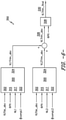
- FIG. 3 a simplified schematic diagram of one embodiment of a DFAG power system 200 according to the present disclosure is illustrated.
- the diagram illustrates a closed loop control system that sets forth the characteristics of the system that are to be controlled.
- the control loop includes a main circuit 202 , main regulators 204 (such as torque, flux, voltage, synchronization, etc.), a linearizing trim function 350 , 450 for the line-side and rotor-side converters 166 , 168 , and a pulse width modulation (PWM) logic 210 , 212 for the line-side and rotor-side converters 166 , 168 .
- PWM pulse width modulation
- the main circuit 202 generally includes the converters 166 , 168 , the DC link 136 , various filters, the generator 120 , the transformer 142 , the external grid 164 , and any external distortion.
- the main circuit 202 provides various signals (e.g. voltage, current, torque, speed, etc.) to the main regulators 204 .
- Synchronization signals from the main regulators 204 along with the various feedback signals from the main circuit 202 and voltage commands from the linearizing trim function 350 , 450 are sent to the PWM logic 210 , 212 for each of the line-side and rotor-side converters 166 , 168 , respectively.
- the PWM logic 210 , 212 then generates gate pulse commands (e.g. the gate pulses illustrated in FIG. 1 ) for the converters 166 , 168 , respectively.
- gate pulse commands e.g. the gate pulses illustrated in FIG. 1
- Each signal path indicated in FIG. 3 may represent a plurality of individual signals, e.g. measured voltages are a three-phase set, commands to the PWM logic and output of the linearizing trim functions each typically contain two individual signals.
- FIGS. 4-8 systems and methods for reducing such voltage distortion contributed to the power grid by the inverter-based resource 100 are illustrated. More specifically, as mentioned, the linearizing trim function 350 is provided to reduce such voltage distortion.
- FIG. 4 a simplified flow diagram of one embodiment of a method 250 for operating a power system connected to a power grid so as to reduce voltage distortion generated thereby according to the present disclosure is illustrated.
- the method 250 described herein generally applies to operating the DFAG wind turbine power systems 100 , 200 described above with respect to FIGS. 1-3 and the systems 300 , 400 of FIGS. 5-8 .
- the disclosed method 250 may be implemented using any other suitable power system that is configured to supply power for application to a load, such as a power grid, such as a solar power system, a hydropower system, an energy storage power system, or combinations thereof.
- a power grid such as a solar power system, a hydropower system, an energy storage power system, or combinations thereof.
- FIG. 4 depicts steps performed in a particular order for purposes of illustration and discussion. Those of ordinary skill in the art, using the disclosures provided herein, will understand that various steps of any of the methods disclosed herein can be adapted, omitted, rearranged, or expanded in various ways without deviating from the scope of the present disclosure.
- the method 250 may include receiving one or more feedback signals that include voltage distortion created by at least one component of the inverter-based resource 100 , wherein voltage is more sensitive to the voltage distortion created by the inverter-based resource 100 than by external sources of voltage distortion inverter-based resource 100 .
- the method 250 may include extracting a distortion component of the feedback signal(s) having a certain phase sequence and frequency.
- a distortion component generally refers to any component of the three-phase AC signal that is different from the positive-sequence, fundamental-frequency component. Therefore, there may be multiple distortion components present in the signal and each can be characterized by a frequency and phase sequence, i.e. either positive-sequence or negative-sequence or zero-sequence.
- the method 250 may include determining a voltage command for the power converter as a function of, at least, the distortion component. As shown at ( 258 ), the method 250 may include controlling the power converter based on the voltage command such that the voltage distortion created by the component(s) of the inverter-based resource 100 is reduced in a manner that is relatively insensitive to voltage distortion created by sources external to the inverter-based resource 100 .
- the simplified method 250 of FIG. 4 can be better understand with the system 300 illustrated in FIG. 5 .
- the input voltage feedback signals 302 received by the system 300 may be alternating current (AC) voltage feedback signals from one or more sensors, and its output may be the change in voltage commands to eliminate the desired harmonic(s), which is discussed in more detail herein.
- AC alternating current
- the voltage feedback signals (e.g. VFbk_abc) contain components due to the fundamental frequency and components due to harmonics.
- the three-phase voltage feedback signals may be represented as follows:
- V a V 1 ⁇ cos ⁇ ( ⁇ i ⁇ t + ⁇ 1 ) + V h ⁇ cos ⁇ ( ⁇ h ⁇ t + ⁇ h ) + ⁇ V n ⁇ cos ⁇ ( ⁇ n ⁇ t + ⁇ n )
- V b V 1 ⁇ cos ⁇ ( ⁇ 1 ⁇ t + ⁇ 1 - 2 ⁇ ⁇ 3 ) + V h ⁇ cos ⁇ ( ⁇ h ⁇ t + ⁇ h - m h ⁇ 2 ⁇ ⁇ 3 ) + ⁇ V n ⁇ cos ⁇ ( ⁇ n ⁇ t + ⁇ n - m n ⁇ 2 ⁇ ⁇ 3 )
- V c V 1 ⁇ cos ⁇ ( ⁇ 1 ⁇ t + ⁇ 1 + 2 ⁇ ⁇ 3 ) + V h ⁇ cos ⁇ ( ⁇ h ⁇ t + ⁇
- Vh is the line-ground peak amplitude of the harmonic feedback voltage
- ⁇ h is the harmonic frequency in rad/s
- ⁇ h is the initial phase angle of the harmonic in radians
- Vn, ⁇ n, ⁇ n, mn are the voltage amplitude, frequency, phase and sequence of every other harmonic present in the voltage feedback signal(s) except for the one that is to be controlled.
- the system 300 receives voltage signal V abc and rotates the signal by a multiple of the phase-locked loop angle ⁇ pll 315 .
- the angle of the harmonic voltage may be needed to transform the voltage feedback signal(s) to a reference frame where the harmonic of interest can be separated from the fundamental frequency and other harmonics.
- the system 300 can assume that the harmonic angle can be obtained by multiplying the PLL angle by a factor N (e.g. 317 ) as represented below:
- N is an integer.
- the polarity of factor N 317 is indicative of the phase sequence to be reduced.
- the multiplied PLL angle can then be used to rotate the raw feedback voltages to the harmonic reference frame using the following equations:
- V xh 2 3 ⁇ [ V a ⁇ cos ⁇ ( N ⁇ ⁇ ⁇ pll ) + V b ⁇ cos ⁇ ( N ⁇ ⁇ ⁇ pll - 2 ⁇ ⁇ 3 ) + V c ⁇ cos ⁇ ( N ⁇ ⁇ ⁇ pll + 2 ⁇ ⁇ 3 ) ]
- V yh 2 3 ⁇ [ V a ⁇ sin ⁇ ( N ⁇ ⁇ ⁇ pll ) + V b ⁇ sin ⁇ ( N ⁇ ⁇ ⁇ pll - 2 ⁇ ⁇ 3 ) + V c ⁇ sin ⁇ ( N ⁇ ⁇ ⁇ pll + 2 ⁇ ⁇ 3 ) ] , where Vxh and Vyh represent the voltages in the harmonic rotating frame.
- Vxh, Vyh have a steady component, such as a steady DC component, proportional to the magnitude of the voltage Vh plus several components which alternate in time (AC).
- alternating components may be filtered by means known in the art to create a filtered version of Vxh, Vyh which contains predominantly of the DC component:
- V xhf V h cos( ⁇ h ⁇ N ⁇ 1 )
- V yhf V h sin( ⁇ h ⁇ N ⁇ 1 )
- Vxhf and Vyhf represent the filtered harmonic voltages in the harmonic rotating frame.
- the above process is represented by the steps leading up to creation of Vxhf and Vyhf (as shown at 310 ) from the feedback voltage signal(s) 302 and the harmonic angle 304 .
- the rotation function 306 converts the AC input to the rotating harmonic reference frame using the harmonic angle 304 .
- the filtering function 308 may be a low-pass type filter that isolates the DC component. Those skilled in art will understand that the filter 308 may take several forms, including various low-pass and/or notch filters, selected according to the particular application.
- the feedback voltage 302 includes three phases, while the result of the rotation 306 and subsequent signals include two independent components denoted above by xh and yh.
- the system 300 may also include a regulator 312 .
- a regulator 312 may be, as an example, of an integral type.
- the regulator 312 is configured to create an output signal 314 (VxhReg and VyhReg) that, with additional steps as described subsequently, acts to reduce the amplitude of the measured harmonic phasor Vhf.
- the regulator 312 may be of several types, e.g. proportional-integral, or integral with droop, or other forms as is well known in the art.
- the integral type is shown here for clarity of describing the limiting functions and is not meant to be limiting.
- the regulator 312 may include a phase-preserving limit logic 316 .
- the logic constrains the amplitude of the regulator output 314 to a predetermined limit while preserving the ratio of the x and y components and preventing windup.
- the system 300 may also determine a factor that is used as a multiplier in appropriate locations.
- this factor may be equal to unity unless the magnitude of VhReg_Unlim exceeds the limit Vlim, and less than unity otherwise.
- the new values of VxhReg and VyhReg become signal 314 for the next steps in the process, and also the values to be used to integrate from on the next pass through the control algorithms. Accordingly, the process prevents windup while preserving the phase.
- another step includes rotating the regulator outputs to the same reference frame as used for the other control functions.
- rotation is represented by element 318 , with output 324 VhTrim representing the output of the trim regulator for an example where the output 324 is in the same abc reference frame as the feedback voltage 302 .
- the rotation angle uses the harmonic angle 304 with a negative sign.
- the rotation may also include a compensation phase angle 322 .
- the compensation angle 322 may be predetermined to account for latencies in the overall system 300 .
- trim signals for each.
- trim signals can be added to create a total trim function VTrim 326 .
- the final trim signal may need to be in a different reference frame to combine with other control signals to the converter as shown in FIG. 3 .
- This additional rotation is included as element 328 in FIG. 6 .
- the reference for this final rotation can be the same as comparable reference frame rotations used in other portions of the overall control.
- the resulting final trim signal 330 is then combined with other converter commands as shown in FIG. 3 .
- the illustrated system 350 can be used for the line converter 168 of a DFAG wind turbine.
- the input 302 may be the line converter voltage 159 ( FIG. 1 ).
- the transformer low-side voltage 188 may provide a suitable feedback signal in applications where voltage 188 is more sensitive to line converter voltage 159 than external sources of distortion.
- the trim function described herein may also be used for other inverter-based resources such as solar energy systems, energy storage, or other types of wind generators.
- the previous methods described thus far generally refer to undesired harmonics applied to the line-side converter 168
- the proposed methods of the present disclosure can also be applied to the rotor-side converter 166 as well or both.
- the previously-described approaches can be applied to the rotor-side converter 166 if the angle used for the transformations is adjusted by the rotor feedback angle.
- the rotor feedback voltages 402 e.g. VRFbk_abc
- V ra V r ⁇ ⁇ 1 ⁇ cos ⁇ ( ⁇ r ⁇ ⁇ 1 ⁇ t + ⁇ r ⁇ ⁇ 1 ) + V h ⁇ cos ⁇ ( ⁇ h ⁇ t + ⁇ h ) + ⁇ V n ⁇ cos ⁇ ( ⁇ n ⁇ t + ⁇ n )
- V rb V r ⁇ ⁇ 1 ⁇ cos ⁇ ( ⁇ r ⁇ ⁇ 1 ⁇ t + ⁇ r ⁇ ⁇ 1 - 2 ⁇ ⁇ 3 ) + V h ⁇ cos ⁇ ( ⁇ h ⁇ t + ⁇ h - m h ⁇ 2 ⁇ ⁇ 3 ) + ⁇ V n ⁇ cos ⁇ ( ⁇ n ⁇ t + ⁇ n - m n ⁇ 2 ⁇ ⁇ 3 )
- V rc V r ⁇ ⁇ 1 ⁇ cos ⁇
- V ra , V rb , V rc represent the rotor feedback voltages
- V r1 is the amplitude of the rotor feedback
- ⁇ r1 is the initial phase angle of the rotor fundamental
- ⁇ r1 is the rotor frequency in rad/s.
- Vh is the line-ground peak amplitude of the harmonic feedback voltage
- ⁇ h is the harmonic frequency in rad/s
- ⁇ h is the initial phase angle of the harmonic in radians
- mn is an integer to represent phase sequence of the harmonic (+1 for positive sequence and ⁇ 1 for negative sequence).
- Vn, ⁇ n, ⁇ n, mn are the voltage amplitude, frequency, phase and sequence of every other harmonic present in the feedback voltage except for the one that is to be controlled.
- a PLL can be used to obtain the electrical angle at the stator winding terminals and the angle of the rotor shaft is measured using a tachometer or similar device.
- FIG. 7 a schematic diagram of system 400 , similar to FIG. 5 , but instead applied to the rotor-side converter 166 is illustrated.
- the structure is identical to system 300 with exception of the signal 404 used for rotation and the use of rotor speed to adjust the limit on the regulator 412 .
- the system 400 also includes a rotation function 406 that converts the AC input to the rotating harmonic reference frame using the harmonic angle 404 , which may be determined using phase-locked loop angle 415 and factor N 417 .
- the filtering function 408 may be a low-pass type filter that isolates the DC component.
- the system 400 may also include a regulator 412 configured to create an output signal 414 (VRxhReg and VRyhReg).
- the system 400 includes rotating the regulator outputs to the same reference frame with output 424 VRhTrim_abc representing the output of the trim regulator for an example where the output 424 is in the same abc reference frame as the feedback voltage 402 .
- the rotation may also include a compensation phase angle 422 .
- the compensation angle 222 may be predetermined to account for latencies in the overall system 400 .
- the above process may be performed for several different values of factor N 417 to obtain trim signals for each.
- trim signals can be added to create a total trim function VTrim 426 .
- the final trim signal may need to be in a different reference frame to combine with other control signals to the converter as shown in FIG. 3 .
- This additional rotation is included as element 428 in FIG. 7 .
- the reference for this final rotation can be the same as comparable reference frame rotations used in other portions of the overall control.
- the resulting final trim signal 430 is then combined with other converter commands as shown in FIG. 3 .
- Phase preserving limits applied to the rotor-side converter 166 can be made speed-dependent to restrict the operation of the harmonic trimmer only to certain speeds of the DFAG 120 .
- disabling the harmonic trimmer around synchronous speed operating condition prevents the harmonic trimmer from interfering with the positive-sequence fundamental regulation functions (e.g. due to zero frequency in the rotor electrical circuit around synchronous speed).
- FIG. 9 illustrates how this limit may be scaled based on rotor speed.
- the speed dependency can be implemented by scaling the limits based on a logistic function, thereby smoothly transitioning between a minimum value of zero and a maximum value of 1.
- An example function for this speed-dependent limit is represented by the following equation, but many other forms can be used to create a suitable shape:
- f ⁇ ( ⁇ ) 1 1 + e - k ⁇ ( ⁇ - ⁇ 0 )
- k represents a steepness factor of the curve
- w is the rotor speed feedback
- ⁇ 0 is the rotor speed corresponding to the transition mid-point of the logistic function.
- the elements k and (DO can be selected to have the desired speed range for which the rotor harmonic trimmer can operate.
- this speed dependent factor f( ⁇ ) can be used to scale the limit of the harmonic trimmer function on the rotor-side converter 166 to effectively disable the harmonic trimmer in certain speed ranges that correspond to a scale factor close output close to 0.
- FIGS. 10 and 11 comparative frequency graphs are provided to illustrate the distortion at the high-voltage winding of the transformer 142 . More particularly, FIG. 10 illustrates the case without the harmonic trimmer, in which the 5th and 7th harmonic (250 Hz and 350 Hz) components are clearly depicted. In contrast, as shown in FIG. 11 , with the harmonic trimmer feature applied, these components are negligibly small.
- Exemplary embodiments of a wind turbine, a controller for a wind turbine, and methods of controlling a wind turbine are described above in detail.
- the methods, wind turbine, and controller are not limited to the specific embodiments described herein, but rather, components of the wind turbine and/or the controller and/or steps of the methods may be utilized independently and separately from other components and/or steps described herein.
- the controller and methods may also be used in combination with other wind turbine power systems and methods, and are not limited to practice with only the power system as described herein. Rather, the exemplary embodiment can be implemented and utilized in connection with many other wind turbine or power system applications, such as solar power systems.
- a method for operating an inverter-based resource connected to a power grid comprising:
- controlling the power converter based on the voltage command such that the voltage distortion created by the at least one component of the inverter-based resource is reduced in a manner that is relatively insensitive to voltage distortion created by sources external to the inverter-based resource.
- Clause 3 The method of clause 2, wherein the at least one component of the inverter-based resource comprises at least one of a rotor-side converter or a line-side converter of the DFAG.
- the inverter-based resource comprises at least one of a full-conversion wind generating system, a solar generation system, or an energy storage power system.
- extracting the distortion component of the one or more voltage feedback signals further comprises:
- extracting the distortion component of the one or more voltage feedback signals further comprises:
- regulator further comprises non-windup control comprising phase-preserving limit logic that maintains proportionality of the output signals.
- Clause 10 The method of any of the preceding clauses, further comprising determining the voltage command for the power converter as a function of, at least, the distortion component for multiple control paths.
- determining the voltage command for the power converter as a function of, at least, the distortion reduction signal further comprises:
- determining the voltage command for the power converter as a function of, at least, the distortion reduction signal further comprises:
- a DFAG comprising a rotor and a stator
- controller for controlling the DFAG power system, the controller configured to perform a plurality of operations, the plurality of operations comprising:
- Clause 14 The DFAG power system of clause 13, wherein the at least one component of the DFAG power system comprises at least one or the rotor-side converter or the line-side converter.
- Clause 18 The DFAG power system of clauses 13-17, further comprising determining the voltage command for the power converter as a function of, at least, the distortion component for multiple control paths.
- determining the voltage command for the power converter as a function of, at least, the distortion reduction signal further comprises:
- determining the voltage command for the power converter as a function of, at least, the distortion reduction signal further comprises:
Landscapes
- Engineering & Computer Science (AREA)
- Power Engineering (AREA)
- Life Sciences & Earth Sciences (AREA)
- Sustainable Development (AREA)
- Sustainable Energy (AREA)
- Chemical & Material Sciences (AREA)
- Combustion & Propulsion (AREA)
- Mechanical Engineering (AREA)
- General Engineering & Computer Science (AREA)
- Control Of Eletrric Generators (AREA)
Abstract
Description
Where Va, Vb, and Vc are the voltage feedback signals,
V1 is the line-ground peak amplitude of the fundamental feedback voltage,
ω1 is the fundamental frequency in radians/second (rad/s), and
ϕ1 is the initial phase angle of the fundamental in radians.
θpll=ω1 t+ϕ 1
where Vxh and Vyh represent the voltages in the harmonic rotating frame. Furthermore, in an embodiment, the x, y voltages can also be expressed as follows:
V xh =V h cos(ϕh −Nϕ 1)+V 1 cos([1−N]θpll)+ΣV n cos(ωn t+ϕ n −Nθ pll)
V yh =V h sin(ϕh −Nϕ 1)+V 1 sin([1−N]θpll)+ΣV n sin(ωn t+ϕ n −Nθ pll)
V xhf =V h cos(ϕh −Nϕ 1)
V yhf =V h sin(ϕh −Nϕ 1)
where Vxhf and Vyhf represent the filtered harmonic voltages in the harmonic rotating frame. These represent the harmonic voltage of interest in phasor form as represented below:
Vhf=Vxhf+jVyhf
LimFactor=min(1.0,Vlim/abs(VhReg_Unlim))
Where abs(VhReg_Unhm))=sqrt(VxhReg_Unlim2+VyhReg_Unlim2),
“Unlim” versions are the initial result of the integration step, and
Vlim is the maximum value of the amplitude.
VxhReg=VxhReg_Unlim*LimFactor
VyhReg=VyhReg_Unlim*LimFactor
where Vra, Vrb, Vrc represent the rotor feedback voltages,
Vr1 is the amplitude of the rotor feedback,
ϕr1 is the initial phase angle of the rotor fundamental, and
ωr1 is the rotor frequency in rad/s.
θr=θpll−θm
where the θr is the angle of the rotor reference frame,
θpll is the PLL angle locked to the stator voltage, and
θm is the electrical angle corresponding to the measured mechanical angle of the rotor with respect to the stator.
where k represents a steepness factor of the curve,
w is the rotor speed feedback, and
ω0 is the rotor speed corresponding to the transition mid-point of the logistic function.
-
- receiving one or more voltage feedback signals created by at least one component of the DFAG power system, wherein distortion components of the one or more voltage feedback signals are more sensitive to voltage distortion created by the DFAG power system than by external sources of voltage distortion;
- extracting a distortion component of the one or more voltage feedback signals having a certain phase sequence and frequency;
- determining a voltage command for the power converter as a function of, at least, the distortion component; and,
- controlling the power converter based on the voltage command such that the voltage distortion created by the at least one component of the DFAG is reduced in a manner that is relatively insensitive to voltage distortion created by sources external to the DFAG.
Claims (19)
Priority Applications (3)
| Application Number | Priority Date | Filing Date | Title |
|---|---|---|---|
| US16/907,910 US11231014B2 (en) | 2020-06-22 | 2020-06-22 | System and method for reducing voltage distortion from an inverter-based resource |
| EP21179027.4A EP3930180A1 (en) | 2020-06-22 | 2021-06-11 | System and method for reducing voltage distortion from an inverter-based resource |
| CN202110689189.XA CN113904387A (en) | 2020-06-22 | 2021-06-22 | System and method for reducing voltage distortion from inverter-based resources |
Applications Claiming Priority (1)
| Application Number | Priority Date | Filing Date | Title |
|---|---|---|---|
| US16/907,910 US11231014B2 (en) | 2020-06-22 | 2020-06-22 | System and method for reducing voltage distortion from an inverter-based resource |
Publications (2)
| Publication Number | Publication Date |
|---|---|
| US20210396212A1 US20210396212A1 (en) | 2021-12-23 |
| US11231014B2 true US11231014B2 (en) | 2022-01-25 |
Family
ID=76392282
Family Applications (1)
| Application Number | Title | Priority Date | Filing Date |
|---|---|---|---|
| US16/907,910 Active US11231014B2 (en) | 2020-06-22 | 2020-06-22 | System and method for reducing voltage distortion from an inverter-based resource |
Country Status (3)
| Country | Link |
|---|---|
| US (1) | US11231014B2 (en) |
| EP (1) | EP3930180A1 (en) |
| CN (1) | CN113904387A (en) |
Cited By (2)
| Publication number | Priority date | Publication date | Assignee | Title |
|---|---|---|---|---|
| US20210249966A1 (en) * | 2018-11-14 | 2021-08-12 | Toshiba Mitsubishi-Electric Industrial Systems Corporation | Power conversion apparatus |
| US20220205424A1 (en) * | 2020-12-31 | 2022-06-30 | General Electric Company | Method for operating doubly-fed wind turbine generator as a virtual synchronous machine to provide grid-forming control thereof |
Families Citing this family (2)
| Publication number | Priority date | Publication date | Assignee | Title |
|---|---|---|---|---|
| US12451696B2 (en) * | 2023-02-22 | 2025-10-21 | Ge Vernova Infrastructure Technology Llc | System and method of decoupling drivetrain related power oscillations of an inverter-based resource from active power injected into the electrical grid |
| US12301005B2 (en) * | 2023-05-17 | 2025-05-13 | Ge Vernova Infrastructure Technology Llc | System and method for controlling an active harmonic filter in an inverter-based resource |
Citations (32)
| Publication number | Priority date | Publication date | Assignee | Title |
|---|---|---|---|---|
| JP2000050634A (en) | 1998-07-29 | 2000-02-18 | Mitsubishi Electric Corp | AC-DC power converter |
| US6681190B2 (en) | 2001-02-01 | 2004-01-20 | Drs Power & Control Technologies, Inc. | Method and system of harmonic regulation |
| US6950322B2 (en) | 2003-04-10 | 2005-09-27 | Rsm Electron Power, Inc. | Regulated AC to DC converter for aerospace applications |
| US7485987B2 (en) | 2006-02-23 | 2009-02-03 | Mitsubishi Denki Kabushiki Kaisha | Power converting device |
| US7904495B2 (en) | 2005-09-22 | 2011-03-08 | Instituto Potosino De Investigacion Cientifica Y Tecnologica | Repetitive controller to compensate for odd harmonics |
| DE102011083753A1 (en) | 2010-09-30 | 2012-04-05 | Rockwell Automation Technologies, Inc. | Apparatus and method for adaptive harmonic reduction |
| CN102664413A (en) | 2012-05-14 | 2012-09-12 | 重庆大学 | Method for controlling harmonic current of full-power converter for suppressing wind power grid integration and controller |
| EP2436092B1 (en) | 2009-05-27 | 2013-07-03 | Siemens Aktiengesellschaft | Device for compensating harmonics |
| JP2014050150A (en) | 2012-08-29 | 2014-03-17 | Denso Corp | Three-phase rotary machine control device |
| US8742734B2 (en) | 2007-03-13 | 2014-06-03 | Centre National De La Recherche Scientifque | Active filtering device for a power supply |
| EP2750270A1 (en) | 2012-12-27 | 2014-07-02 | Siemens Aktiengesellschaft | Harmonic current controller |
| US8773873B2 (en) | 2011-12-15 | 2014-07-08 | General Electric Company | Methods and systems for operating a power converter |
| JP2015192593A (en) | 2014-03-31 | 2015-11-02 | 株式会社トーメック | Individually operable higher harmonic wave suppression device |
| US9231481B2 (en) | 2013-04-26 | 2016-01-05 | Motorola Solutions, Inc. | Power converter apparatus |
| US9270194B2 (en) | 2013-04-16 | 2016-02-23 | Siemens Aktiengesellschaft | Controller for controlling a power converter |
| US20160065105A1 (en) * | 2014-09-03 | 2016-03-03 | General Electric Company | System and method for optimizing wind turbine operation |
| US9407133B1 (en) | 2013-02-15 | 2016-08-02 | Ideal Power, Inc. | Active power conditioner |
| US20160285390A1 (en) | 2015-03-25 | 2016-09-29 | Sunpower Corporation | Converter topologies for common mode voltage reduction |
| US9722427B2 (en) | 2012-06-25 | 2017-08-01 | University Of Central Florida Research Foundation, Inc. | Modular inverter system |
| JP2017139945A (en) | 2016-02-01 | 2017-08-10 | 株式会社デンソー | Controller for rotary electric machine |
| JP2017147840A (en) | 2016-02-17 | 2017-08-24 | 株式会社デンソー | Control device for three-phase rotating machine and electric power steering device |
| US9806598B2 (en) | 2015-12-01 | 2017-10-31 | Schneider Electric Industries Sas | Active filtering system |
| US9837943B2 (en) | 2013-12-13 | 2017-12-05 | Ge Renewable Technologies | Harmonics mitigation in multiphase generator-conversion systems |
| US9887616B2 (en) | 2015-07-01 | 2018-02-06 | Hella Corporate Center Usa, Inc. | Electric power conversion apparatus with active filter |
| EP3282538A1 (en) | 2016-08-08 | 2018-02-14 | General Electric Company | System and method for controlling a negative sequence current in a wind turbine generator |
| EP2460244B1 (en) | 2009-07-30 | 2018-05-09 | Siemens Aktiengesellschaft | Device for compensating harmonics occurring in current flows in a high-voltage network |
| CN108471263A (en) | 2018-03-28 | 2018-08-31 | 华中科技大学 | The exciter control system of brushless dual-feed motor Independent Power Generation under a kind of nonlinear load |
| US10128742B2 (en) | 2015-02-27 | 2018-11-13 | Det International Holding Limited | Reference signal for a current regulator |
| US10431984B2 (en) | 2015-07-09 | 2019-10-01 | Moteurs Leroy-Somer | Power-generating system with improved treatment of charging impacts, load-shedding and harmonics |
| US20190312502A1 (en) | 2018-04-04 | 2019-10-10 | General Electric Company | DFIG Converter with Active Filter |
| US10511220B2 (en) | 2016-09-30 | 2019-12-17 | Daikin Industries, Ltd. | Control device for active filter |
| EP2487780B1 (en) | 2011-02-14 | 2019-12-25 | Siemens Aktiengesellschaft | Controller for a power converter and method of operating the same |
-
2020
- 2020-06-22 US US16/907,910 patent/US11231014B2/en active Active
-
2021
- 2021-06-11 EP EP21179027.4A patent/EP3930180A1/en active Pending
- 2021-06-22 CN CN202110689189.XA patent/CN113904387A/en active Pending
Patent Citations (39)
| Publication number | Priority date | Publication date | Assignee | Title |
|---|---|---|---|---|
| JP2000050634A (en) | 1998-07-29 | 2000-02-18 | Mitsubishi Electric Corp | AC-DC power converter |
| US6681190B2 (en) | 2001-02-01 | 2004-01-20 | Drs Power & Control Technologies, Inc. | Method and system of harmonic regulation |
| US6950322B2 (en) | 2003-04-10 | 2005-09-27 | Rsm Electron Power, Inc. | Regulated AC to DC converter for aerospace applications |
| US7904495B2 (en) | 2005-09-22 | 2011-03-08 | Instituto Potosino De Investigacion Cientifica Y Tecnologica | Repetitive controller to compensate for odd harmonics |
| US7485987B2 (en) | 2006-02-23 | 2009-02-03 | Mitsubishi Denki Kabushiki Kaisha | Power converting device |
| US8742734B2 (en) | 2007-03-13 | 2014-06-03 | Centre National De La Recherche Scientifque | Active filtering device for a power supply |
| EP2436092B1 (en) | 2009-05-27 | 2013-07-03 | Siemens Aktiengesellschaft | Device for compensating harmonics |
| EP2460244B1 (en) | 2009-07-30 | 2018-05-09 | Siemens Aktiengesellschaft | Device for compensating harmonics occurring in current flows in a high-voltage network |
| DE102011083753A1 (en) | 2010-09-30 | 2012-04-05 | Rockwell Automation Technologies, Inc. | Apparatus and method for adaptive harmonic reduction |
| US8471514B2 (en) | 2010-09-30 | 2013-06-25 | Rockwell Automation Technologies, Inc. | Adaptive harmonic reduction apparatus and methods |
| EP2487780B1 (en) | 2011-02-14 | 2019-12-25 | Siemens Aktiengesellschaft | Controller for a power converter and method of operating the same |
| US8773873B2 (en) | 2011-12-15 | 2014-07-08 | General Electric Company | Methods and systems for operating a power converter |
| CN102664413A (en) | 2012-05-14 | 2012-09-12 | 重庆大学 | Method for controlling harmonic current of full-power converter for suppressing wind power grid integration and controller |
| US9722427B2 (en) | 2012-06-25 | 2017-08-01 | University Of Central Florida Research Foundation, Inc. | Modular inverter system |
| JP2014050150A (en) | 2012-08-29 | 2014-03-17 | Denso Corp | Three-phase rotary machine control device |
| US9214886B2 (en) | 2012-08-29 | 2015-12-15 | Denso Corporation | Control apparatus for three-phase rotary machine |
| EP2750270A1 (en) | 2012-12-27 | 2014-07-02 | Siemens Aktiengesellschaft | Harmonic current controller |
| US9407133B1 (en) | 2013-02-15 | 2016-08-02 | Ideal Power, Inc. | Active power conditioner |
| US9270194B2 (en) | 2013-04-16 | 2016-02-23 | Siemens Aktiengesellschaft | Controller for controlling a power converter |
| US9231481B2 (en) | 2013-04-26 | 2016-01-05 | Motorola Solutions, Inc. | Power converter apparatus |
| US9837943B2 (en) | 2013-12-13 | 2017-12-05 | Ge Renewable Technologies | Harmonics mitigation in multiphase generator-conversion systems |
| JP2015192593A (en) | 2014-03-31 | 2015-11-02 | 株式会社トーメック | Individually operable higher harmonic wave suppression device |
| US20160065105A1 (en) * | 2014-09-03 | 2016-03-03 | General Electric Company | System and method for optimizing wind turbine operation |
| US10128742B2 (en) | 2015-02-27 | 2018-11-13 | Det International Holding Limited | Reference signal for a current regulator |
| JP6637507B2 (en) | 2015-03-25 | 2020-01-29 | エンフェーズ エナジー インコーポレイテッドEnphase Energy, Inc. | Converter topology for common mode voltage reduction |
| US20160285390A1 (en) | 2015-03-25 | 2016-09-29 | Sunpower Corporation | Converter topologies for common mode voltage reduction |
| US20180152095A1 (en) | 2015-07-01 | 2018-05-31 | Hella Corporate Center Usa, Inc. | Electric power conversion apparatus |
| US9887616B2 (en) | 2015-07-01 | 2018-02-06 | Hella Corporate Center Usa, Inc. | Electric power conversion apparatus with active filter |
| EP3317955A1 (en) | 2015-07-01 | 2018-05-09 | Hella Corporate Center USA, Inc. | Electric power conversion apparatus |
| US10431984B2 (en) | 2015-07-09 | 2019-10-01 | Moteurs Leroy-Somer | Power-generating system with improved treatment of charging impacts, load-shedding and harmonics |
| US9806598B2 (en) | 2015-12-01 | 2017-10-31 | Schneider Electric Industries Sas | Active filtering system |
| JP2017139945A (en) | 2016-02-01 | 2017-08-10 | 株式会社デンソー | Controller for rotary electric machine |
| JP2017147840A (en) | 2016-02-17 | 2017-08-24 | 株式会社デンソー | Control device for three-phase rotating machine and electric power steering device |
| US10532765B2 (en) | 2016-02-17 | 2020-01-14 | Denso Corporation | Control apparatus for three-phase rotary machine, and electric power steering apparatus |
| EP3282538A1 (en) | 2016-08-08 | 2018-02-14 | General Electric Company | System and method for controlling a negative sequence current in a wind turbine generator |
| US10511220B2 (en) | 2016-09-30 | 2019-12-17 | Daikin Industries, Ltd. | Control device for active filter |
| CN108471263A (en) | 2018-03-28 | 2018-08-31 | 华中科技大学 | The exciter control system of brushless dual-feed motor Independent Power Generation under a kind of nonlinear load |
| CN108471263B (en) | 2018-03-28 | 2019-09-27 | 华中科技大学 | An excitation control system for independent power generation of brushless doubly-fed motor under nonlinear load |
| US20190312502A1 (en) | 2018-04-04 | 2019-10-10 | General Electric Company | DFIG Converter with Active Filter |
Non-Patent Citations (6)
| Title |
|---|
| De Oliveira et al., Wind Energy Conversion System Based on DFIG With Three-Phase Series Active Filter Operating with Floating Capacitors, 2018 IEEE Energy Conversion Congress and Exposition (ECCE), pp. 5500-5507. |
| European Search Report for EP Application No. 21179027,4:, dated, Nov. 16, 2021. |
| Manias, Power Electronics and Motor Drive Systems, Science Direct, 11.5 thru 11.5.5, ISBN 978-0-12-811798-9, 2017, pp. 826-842. |
| Peng et al., A New Approach to Harmonic Compensation in Power Systems—A Combined System of Shunt Passive and Series Active Filters, IEEE Transactions on Industry Applications, vol. 26, No. 6, Nov./Dec. 1990, pp. 983-990. |
| Wang et al., A Series Active Power Filter Adopting Hybrid Control Approach, IEEE Transactions on Power Electronics, vol. 16, No. 3, May 2001, pp. 301-310. |
| Yao et al., Enhanced Control of a DFIG-Based Wind-Power Generation System with Series Grid-Side Converter Under Unbalanced Voltage Conditions, IEEE Transactions on Power Electronics, vol. 28, No. 7, Jul. 2013, pp. 3167-3181. |
Cited By (4)
| Publication number | Priority date | Publication date | Assignee | Title |
|---|---|---|---|---|
| US20210249966A1 (en) * | 2018-11-14 | 2021-08-12 | Toshiba Mitsubishi-Electric Industrial Systems Corporation | Power conversion apparatus |
| US11728742B2 (en) * | 2018-11-14 | 2023-08-15 | Toshiba Mitsubishi-Electric Industrial Systems Corporation | Power conversion apparatus that drives a motor by receiving a three-phase AC voltage from an AC power system |
| US20220205424A1 (en) * | 2020-12-31 | 2022-06-30 | General Electric Company | Method for operating doubly-fed wind turbine generator as a virtual synchronous machine to provide grid-forming control thereof |
| US11486355B2 (en) * | 2020-12-31 | 2022-11-01 | General Electric Company | Method for operating doubly-fed wind turbine generator as a virtual synchronous machine to provide grid-forming control thereof |
Also Published As
| Publication number | Publication date |
|---|---|
| US20210396212A1 (en) | 2021-12-23 |
| EP3930180A1 (en) | 2021-12-29 |
| CN113904387A (en) | 2022-01-07 |
Similar Documents
| Publication | Publication Date | Title |
|---|---|---|
| EP3930180A1 (en) | System and method for reducing voltage distortion from an inverter-based resource | |
| Amrane et al. | Design and implementation of high performance field oriented control for grid-connected doubly fed induction generator via hysteresis rotor current controller | |
| Shao et al. | Dynamic control of the brushless doubly fed induction generator under unbalanced operation | |
| Hu et al. | Direct active and reactive power regulation of DFIG using sliding-mode control approach | |
| US8310074B2 (en) | Method and apparatus for generating power in a wind turbine | |
| US10084403B2 (en) | Power supply system and control method therefor | |
| US10491146B2 (en) | System and method for compensating for generator-induced flicker in a wind turbine | |
| CN102035452B (en) | Wind power generating system | |
| Cheng et al. | Direct stator current vector control strategy of DFIG without phase-locked loop during network unbalance | |
| EP3635838B1 (en) | Adaptive current damping method and system for improved power converter control in wind turbine systems and control system | |
| US11258387B1 (en) | System and method for neutral point balancing for back-to-back voltage source converters | |
| CN103746378B (en) | Double-fed induction wind power system total output harmonic wave electric current suppressing method under Voltage Harmonic | |
| Shukla et al. | Isolated wind power supply system using double-fed induction generator for remote areas | |
| Xiang et al. | Switching frequency dynamic control for DFIG wind turbine performance improvement around synchronous speed | |
| CN112436766B (en) | Load disturbance resisting control device and method for brushless doubly-fed generator | |
| Kenne et al. | Adaptive PI control strategy for a self-excited induction generator driven by a variable speed wind turbine | |
| Wang et al. | Active disturbance rejection control strategy for permanent magnet synchronous wind power system | |
| US12301005B2 (en) | System and method for controlling an active harmonic filter in an inverter-based resource | |
| CN118435484A (en) | System and method for decoupling current command components in a synchronous rotating system | |
| CN118920505B (en) | Control method and system for direct-current voltage synchronous full-power wind turbine generator | |
| Li et al. | Harmonic compensation for variable speed DFIG wind turbines using multiple reference frame theory | |
| Luo et al. | Control of electrolytic capacitor-less single-phase to three-phase converter for IPMSM drive | |
| CN121036092B (en) | A method and equipment for small-signal modeling of a doubly-fed wind power grid-connected system under AC asymmetric operating conditions. | |
| Tenca et al. | Reduced cost current-source topology improving the harmonic spectrum through on-line functional minimization | |
| EP4422013A1 (en) | System and method of decoupling drivetrain related power oscillations of an inverter-based resource from active power injected into the electrical grid |
Legal Events
| Date | Code | Title | Description |
|---|---|---|---|
| AS | Assignment |
Owner name: GENERAL ELECTRIC COMPANY, NEW YORK Free format text: ASSIGNMENT OF ASSIGNORS INTEREST;ASSIGNORS:LARSEN, EINAR VAUGHN;HOWARD, DUSTIN;LWIN, MIN NAING;AND OTHERS;SIGNING DATES FROM 20200618 TO 20200619;REEL/FRAME:053002/0309 |
|
| FEPP | Fee payment procedure |
Free format text: ENTITY STATUS SET TO UNDISCOUNTED (ORIGINAL EVENT CODE: BIG.); ENTITY STATUS OF PATENT OWNER: LARGE ENTITY |
|
| STPP | Information on status: patent application and granting procedure in general |
Free format text: AWAITING TC RESP, ISSUE FEE PAYMENT VERIFIED |
|
| STPP | Information on status: patent application and granting procedure in general |
Free format text: PUBLICATIONS -- ISSUE FEE PAYMENT VERIFIED |
|
| STCF | Information on status: patent grant |
Free format text: PATENTED CASE |
|
| AS | Assignment |
Owner name: GE INFRASTRUCTURE TECHNOLOGY LLC, SOUTH CAROLINA Free format text: ASSIGNMENT OF ASSIGNORS INTEREST;ASSIGNOR:GENERAL ELECTRIC COMPANY;REEL/FRAME:065727/0001 Effective date: 20231110 |
|
| MAFP | Maintenance fee payment |
Free format text: PAYMENT OF MAINTENANCE FEE, 4TH YEAR, LARGE ENTITY (ORIGINAL EVENT CODE: M1551); ENTITY STATUS OF PATENT OWNER: LARGE ENTITY Year of fee payment: 4 |