US11230001B2 - Biped robot gait control method and biped robot - Google Patents
Biped robot gait control method and biped robot Download PDFInfo
- Publication number
- US11230001B2 US11230001B2 US16/572,637 US201916572637A US11230001B2 US 11230001 B2 US11230001 B2 US 11230001B2 US 201916572637 A US201916572637 A US 201916572637A US 11230001 B2 US11230001 B2 US 11230001B2
- Authority
- US
- United States
- Prior art keywords
- zmp
- biped robot
- ankle joint
- legs
- leg
- Prior art date
- Legal status (The legal status is an assumption and is not a legal conclusion. Google has not performed a legal analysis and makes no representation as to the accuracy of the status listed.)
- Active, expires
Links
Images


Classifications
-
- B—PERFORMING OPERATIONS; TRANSPORTING
- B62—LAND VEHICLES FOR TRAVELLING OTHERWISE THAN ON RAILS
- B62D—MOTOR VEHICLES; TRAILERS
- B62D57/00—Vehicles characterised by having other propulsion or other ground- engaging means than wheels or endless track, alone or in addition to wheels or endless track
- B62D57/02—Vehicles characterised by having other propulsion or other ground- engaging means than wheels or endless track, alone or in addition to wheels or endless track with ground-engaging propulsion means, e.g. walking members
- B62D57/032—Vehicles characterised by having other propulsion or other ground- engaging means than wheels or endless track, alone or in addition to wheels or endless track with ground-engaging propulsion means, e.g. walking members with alternately or sequentially lifted supporting base and legs; with alternately or sequentially lifted feet or skid
-
- B—PERFORMING OPERATIONS; TRANSPORTING
- B25—HAND TOOLS; PORTABLE POWER-DRIVEN TOOLS; MANIPULATORS
- B25J—MANIPULATORS; CHAMBERS PROVIDED WITH MANIPULATION DEVICES
- B25J9/00—Program-controlled manipulators
- B25J9/0006—Exoskeletons, i.e. resembling a human figure
-
- B—PERFORMING OPERATIONS; TRANSPORTING
- B25—HAND TOOLS; PORTABLE POWER-DRIVEN TOOLS; MANIPULATORS
- B25J—MANIPULATORS; CHAMBERS PROVIDED WITH MANIPULATION DEVICES
- B25J13/00—Controls for manipulators
- B25J13/08—Controls for manipulators by means of sensing devices, e.g. viewing or touching devices
- B25J13/085—Force or torque sensors
-
- B—PERFORMING OPERATIONS; TRANSPORTING
- B25—HAND TOOLS; PORTABLE POWER-DRIVEN TOOLS; MANIPULATORS
- B25J—MANIPULATORS; CHAMBERS PROVIDED WITH MANIPULATION DEVICES
- B25J9/00—Program-controlled manipulators
- B25J9/16—Program controls
- B25J9/1602—Program controls characterised by the control system, structure, architecture
- B25J9/1607—Calculation of inertia, jacobian matrixes and inverses
-
- B—PERFORMING OPERATIONS; TRANSPORTING
- B25—HAND TOOLS; PORTABLE POWER-DRIVEN TOOLS; MANIPULATORS
- B25J—MANIPULATORS; CHAMBERS PROVIDED WITH MANIPULATION DEVICES
- B25J9/00—Program-controlled manipulators
- B25J9/16—Program controls
- B25J9/1615—Program controls characterised by special kind of manipulator, e.g. planar, scara, gantry, cantilever, space, closed chain, passive/active joints and tendon driven manipulators
-
- B—PERFORMING OPERATIONS; TRANSPORTING
- B25—HAND TOOLS; PORTABLE POWER-DRIVEN TOOLS; MANIPULATORS
- B25J—MANIPULATORS; CHAMBERS PROVIDED WITH MANIPULATION DEVICES
- B25J9/00—Program-controlled manipulators
- B25J9/16—Program controls
- B25J9/1628—Program controls characterised by the control loop
- B25J9/1641—Program controls characterised by the control loop compensation for backlash, friction, compliance, elasticity in the joints
-
- G05D2201/0217—
Definitions
- the present disclosure relates to biped robot gait control technology, and particularly to a biped robot gait control method and a biped robot.
- biped robots have developed rapidly and are widely used in many fields.
- the biped robots since most buildings and tools are designed according to the height and shape of human, the biped robots as a kind of robot platform have better flexibility.
- the stability control of the gait of a biped robot is the premise and basis for the smooth walking of the robot.
- the gait refers to a relationship between the time and space of joints during standing or walking, which can be described through the motion trajectory of the joints.
- ZMP zero moment point
- the rules of the walking control of the biped robot are realized by gait planning, and most of them are in the form of open-loop. They usually plans the point trajectories of the centroid and the leg based on inverted pendulum models, obtain the angle of each joint of the robot through inverse kinematics solutions, and track the trajectories by using the proportion integral differential (PID) algorithm through a motor driver, thereby realizing a complete walking process.
- PID proportion integral differential
- the biped robot has an error in the posture of the body of the robot during a working process which caused by, for example, the interference of external forces or moving on an uneven ground, a deviation in the posture of the body of the robot will caused.
- the existing biped robot generally does not include a processing algorithm for posture control, the posture of the body of the robot will gradually diverge when the interference occurs, which resulting in the failure in walking, and even causes the falling down of the biped robot.
- the present disclosure provides biped robot gait control method which controls the ZMP real time to realize the posture control of the body and the step smoothing to ensure the stability of the walking when the body of the robot is subjected to interference and deviated, impacted by an external force, or on an uneven ground.
- the biped robot gait control method and a biped robot modify the expected ZMP of the leg in real time, control the posture through ZMP tracking control, and smooth the ankle joint when walking, thereby ensuring the stability of walking.
- a technical solution provided by the embodiments of the present disclosure is to provide a gait control method for a biped robot including the following steps:
- the motion state comprises a single-leg supporting state, a single-leg swing state, and a two legs supporting state;
- the gait control method for a biped robot includes: obtaining body posture data of the biped robot detected through art inertial detecting unit and calculating the ZMP expected value based on the body posture data in real time in response to determining the motion state of the biped robot being a single-leg supporting state; and
- the step of tracking and adjusting the current angle of the ankle joint of each of the two legs of the biped robot further includes:
- the step of tracking and adjusting the current angle of the ankle joint of each of the two legs of the biped robot further includes:
- ⁇ virtual K p *(ZMP_desire ⁇ ZMP)+ K d *(ZMP_desire_dot ⁇ ZMP_dot);
- K p and K d are parameters of the ankle joint smoothing controller
- ⁇ is the angle that the ankle joint needs to be compensated
- J is the rotational inertia of the ankle joint
- t is the time
- K p1 and K d1 are control parameters
- Roll_desire is the expected rolling angle
- Roll_imu and Roll_dot_imu are respectively the rolling angle and the angular velocity fed back by an inertial detecting unit.
- the step of obtaining the six-dimensional force information includes:
- the motion state is a non-single, leg supporting state when a force vertical to a surface of the leg is less than a preset threshold, and the motion state is a single-leg supporting state when greater than then preset threshold.
- the step of calculating the ZMP position of each of the two legs of the biped robot include:
- a technical solution provided by the embodiments of the present disclosure is to provide a biped robot including a body, a first leg, and a second leg, where the body is provided with at least one processor, a storage, and an inertial detecting unit coupled to the at least one processor; the first leg includes a first six-dimensional force sensor and a first joint controller both coupled to the at least one processor, and the second leg includes a second six-dimensional force sensor and a second joint controller both coupled to the at least one processor;
- the storage stores instructions executable by the at least one processor, the at least one processor is enabled to perform the above-mentioned method when the instructions are executable by the at least one processor, such that the inertial detecting unit, the first six-dimensional force sensor, and the second six-dimensional force sensor collect data and control the first joint controller and the second joint controller to perform a posture control or an ankle joint smoothing in different motion states.
- a technical solution provided by the embodiments of the present disclosure is to provide a program product for a computer, where the program product includes a computer program stored on a non-transitory computer readable storage medium, the computer program includes program instructions, and the computer is caused to perform the above-mentioned method when the program instructions are executed by the computer.
- the beneficial effects of the embodiments of the present disclosure are as follows.
- the ZMP expectation of the legs are modified in real time when the body of the robot is subjected to interference and deviated, impacted by an external force, or on an uneven ground by disposing a first posture control module and a second smoothing control module on each of the two legs, the posture is controlled through ZMP tracking control, and the ankle joint is smoothed when walking, thereby ensuring the stability of walking.
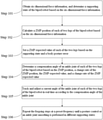
- FIG. 1 is a flow chart of a biped robot gait control method according to an embodiment of the present disclosure
- FIG. 2 is a schematic diagram of the biped robot according to an embodiment of the present disclosure
- FIG. 3 is a schematic diagram of a hardware architecture for the biped robot gait control method according to an embodiment of the present disclosure
- FIG. 4 is a schematic diagram of a six-dimensional force sensor according to an embodiment of the present disclosure.
- FIG. 5 is a detailed flow chart of the biped robot gait control method of FIG. 1 .
- the present disclosure relates to a gait control method for a biped robot, which uses the data of an inertial detecting unit 20 (see FIG. 2 ) for posture control of the biped robot itself, integrates the data of six-dimensional force sensors disposed on each of two legs of the biped robot, thereby performing posture correction when the biped robot is subjected to external force or is unstable when walking.
- the method detects motion states it a single-leg supporting state, a two-legs supporting state, and a single-leg swing state in the walking of the biped robot through a six-dimensional force sensor disposed on a sole of a first leg 31 leg 31 and a second leg 32 of the biped robot, and obtain a contact force and a contact moment between the legs and the ground in the walking process of the biped robot.
- the ZMP position of the first leg 31 and the second leg 32 in the X and Y directions are solved based on body posture data fed back by the inertial detecting unit 20 .
- the inertial detecting unit 20 detects the body posture data of the biped robot in real time, and obtains the ZMP expected value of each leg based on a calculated posture deviation.
- the biped robot of the present disclosure is provided with an ankle joint ZMP tracking controller which obtains the body posture data of the biped robot at a preset frequency, and performs tracking and compensation on the ZMP position of the sole of the legs real-time based on the feedback data of the inertial detecting unit 20 and the six-dimensional force sensor, thereby achieving the posture control or the ankle joint smoothing in the single-leg supporting state or the two-legs supporting state as well as the single-leg swing state in a close-loop control manner.
- the present disclosure realizes the close-loop control of the posture of the body 10 by tracking and compensating the ZMP position of the legs.
- the ZMP expected value is calculated based on posture data of the body 10 , and the posture of the body 10 is controlled in real time through the ZMP tracking controller, thereby ensuring the stability of the posture of the body 10 .
- the ZMP expected value is set to zero to realize step smoothing and terrain adaptation through the ZMP tracking controller, which reduces the influence of impact force when stepping and improves the stability and environmental adaptability of the walking of the biped robot.
- a biped robot of the present disclosure includes a body 10 , a first leg 31 , and a second leg 32 .
- the body 10 is provided with at least one processor, a storage, and an inertial detecting unit 20 coupled to the at least one processor.
- the first leg 31 includes a first six-dimensional force sensor 51 and a first joint controller 41 both coupled to the at least one processor
- the second leg 32 includes a second six-dimensional force sensor 52 and a second joint controller 42 both coupled to the at least one processor.
- the inertial detecting unit 20 , the first six-dimensional force sensor 51 , and the second six-dimensional force sensor 52 collect data and control the first joint controller 41 and the second joint controller 42 to perform a posture control or an ankle joint smoothing in different motion states.
- the biped robot gait control method includes the following steps:
- step 101 obtaining six-dimensional force information, and determining a motion state of two legs of the biped robot based on the six-dimensional force information, where the motion state comprises a single-leg supporting state, a single-leg swing state, and a two-legs supporting state;
- step 102 determining a zero moment point (ZMP) position of each of the two legs of the biped robot in real time based on the six-dimensional force information;
- ZMP zero moment point
- step 103 setting a ZMP expected value of each of the two legs based on the motion state and body posture data of the biped robot;
- step 104 obtaining a compensation angle of an ankle joint of each of the two legs of the biped robot by inputting the ZMP position, a change rate of the ZMP position, the ZMP expected value, and a change rate of the ZMP expected value to an ankle joint smoothing controller so as to perform a close-loop ZMP tracking control on each of the two legs;
- step 105 adjusting a current angle of the ankle joint of each of the two legs of the biped robot in real time according to the compensation angle of the ankle joint;
- step 106 repeating the forgoing steps at a preset frequency until a posture control and an ankle joint smoothing is performed in different motion states.
- step 101 further includes:
- the motion state is a non-single leg supporting state when a force vertical to a surface of the sole is less than a preset threshold, and the motion state is a single-leg supporting state when greater than the preset threshold.
- the step 102 includes:
- the definition of the coordinate system is as shown in the above-mentioned figure.
- the X direction is the forward direction of the robot, the Z direction is vertical, and the Y direction is determined by the right-hand system.
- d is the height difference between the sole of the leg and the six-dimensional force sensor
- p x is the ZMP position in the X direction
- p y is the ZMP position in the Y direction.
- the step 105 further includes:
- ZMP_desire K p1 *(Roll_desire ⁇ Roll_imu)+ K d1 *(0 ⁇ Roll_dot_imu);
- K p1 and K d1 are control parameters
- Roll_desire is the expected rolling angle which is typically 0
- Roll_imu and Roll_dot_imu are respectively the rolling angle and the angular velocity fed back by the inertial detecting unit 20 .
- the step 105 further includes:
- ⁇ virtual K p *(ZMP_desire ⁇ ZMP)+ K d *(ZMP_desire_dot ⁇ ZMP_dot);
- K p and K d are parameters of the ankle joint smoothing controller
- ⁇ is the angle the ankle joint needs to be compensated
- J is the moment of inertia of the ankle joint
- t is the time
- the ZMP expectation of the legs are modified in real time when the body 10 of the robot is subjected to interference and deviated, impacted by an external force, or on an uneven ground by disposing a first posture control module and a second smoothing control module on each of the two legs, the posture is controlled through ZMP tracking control, and the ankle joint is smoothed when walking, thereby ensuring the stability of walking.
- FIG. 3 is a schematic diagram of the hardware structure of a biped robot 600 according to an embodiment of the present disclosure. As shown in FIG. 3 , the robot 600 includes:
- the storage 620 stores instructions executable by the at least one processor 610 , that is, a computer program 640 . When executed by the at least one processor 610 , the instructions establish a data path through the communication component 650 to enable the at least one processor 610 to execute the control method for improving the stability of the walking of the biped robot.
- the processor 610 , the storage 620 , and the communication component 650 may be coupled through a bus or other means. In FIG. 3 , it is exemplified by coupling through a bus.
- the storage 620 is a non-volatile computer readable storage medium, which can be used for storing non-volatile software programs as well as non-volatile computer executable programs modules such as the program instructions/modules corresponding to the control method for improving the stability of the walking of the biped robot in this embodiment.
- the processor 610 executes various functional applications and data processing of a server, that is, realizing the control method for improving the stability of the walking of the biped robot in the above-mentioned method embodiments.
- the storage 620 may include a program storage area and a data storage area, where the program storage area may store an operating system and an application required for at least one function; the data storage area may store data created in the use of the biped robot and the like.
- the storage 620 may include a high speed random access memory, and may also include a non-volatile memory such as at least one magnetic disk storage device, flash memory device, or other non-volatile solid storage device.
- storage 620 can optionally include a storage that is remotely disposed with respect to processor 610 , which can be connected to the biped robot via a network. Examples of the above-mentioned network includes, but is not limited to, the Internet, an intranet, a local area network, a mobile communication network, and a combination thereof.
- the one or more modules are stored in the storage 620 , and execute the control method for improving the stability of the walking of the biped robot in any of the above-mentioned method embodiments when executed by the one or more processors 610 , for example, execute the above-mentioned steps 101 - 106 in FIG. 1 , and implement the functions of posture control and ankle joint smoothing.
- the above-mentioned product can execute the methods provided by the embodiments of the present disclosure, and has the corresponding functional modules and beneficial effects for executing the method.
- the methods provided by the embodiments of the present disclosure can execute the methods provided by the embodiments of the present disclosure, and has the corresponding functional modules and beneficial effects for executing the method.
- Embodiments of the present disclosure provide a non-transitory computer readable storage medium which stores computer executable instructions that are executed by one or more processors so as to, for example, execute the steps 101 - 106 in FIG. 1 that are described above, and implement the functions of posture control and ankle joint smoothing.
Landscapes
- Engineering & Computer Science (AREA)
- Mechanical Engineering (AREA)
- Robotics (AREA)
- Health & Medical Sciences (AREA)
- Physics & Mathematics (AREA)
- Mathematical Physics (AREA)
- Automation & Control Theory (AREA)
- General Health & Medical Sciences (AREA)
- Orthopedic Medicine & Surgery (AREA)
- Human Computer Interaction (AREA)
- Transportation (AREA)
- Combustion & Propulsion (AREA)
- Chemical & Material Sciences (AREA)
- Manipulator (AREA)
Abstract
Description
τvirtual =K p*(ZMP_desire−ZMP)+K d*(ZMP_desire_dot−ZMP_dot);
τvirtual =J{umlaut over (θ)}(t); and
θ(t)={dot over (θ)}0 t+½{umlaut over (θ)}t 2;
ZMP_desire=K p1*(Roll_desire−Roll_imu)+K d1*(0−Roll_dot_imu);
p x=(τx −f x d)/f z; and
p y=(τx −f y d)/f z;
p l,x=(τl,y −f l,x d)/f l,z
p l,y=(τl,x −f l,y d)/f l,z; and
p Rx=(τRy −f Rx d)/f Rz
p Ry=(τRx −f Ry d)/f Rz;
ZMP_desire=K p1*(Roll_desire−Roll_imu)+K d1*(0−Roll_dot_imu).
ZMP_desire=K p1*(Roll_desire−Roll_imu)+K d1*(0−Roll_dot_imu);
τvirtual =K p*(ZMP_desire−ZMP)+K d*(ZMP_desire_dot−ZMP_dot);
τvirtual =J{umlaut over (θ)}(t); and
θ(t)={dot over (θ)}0 t+½{umlaut over (θ)}t 2;
Claims (20)
τvirtual =K p*(ZMP_desire−ZMP)+K d*(ZMP_desire_dot−ZMP_dot);
τvirtual =J{umlaut over (θ)}(t); and
θ(t)={dot over (θ)}0 t+½{umlaut over (θ)}t 2;
ZMP_desire=K p1*(Roll_desire−Roll_imu)+K d1*(0−Roll_dot_imu);
τvirtual =K p*(ZMP_desire−ZMP)+K d*(ZMP_desire_dot−ZMP_dot);
τvirtual =J{umlaut over (θ)}(t); and
θ(t)={dot over (θ)}0 t+½{umlaut over (θ)}t 2;
τvirtual =K p*(ZMP_desire−ZMP)+K d*(ZMP_desire_dot−ZMP_dot);
τvirtual =J{umlaut over (θ)}(t); and
θ(t)={dot over (θ)}0 t+½{umlaut over (θ)}t 2;
ZMP_desire=K p1*(Roll_desire−Roll_imu)+K d1*(0−Roll_dot_imu);
τvirtual =K p*(ZMP_desire−ZMP)+K d*(ZMP_desire_dot−ZMP_dot);
τvirtual =J{umlaut over (θ)}(t); and
θ(t)={dot over (θ)}0 t+½{umlaut over (θ)}t 2;
Applications Claiming Priority (1)
| Application Number | Priority Date | Filing Date | Title |
|---|---|---|---|
| PCT/CN2018/125103 WO2020133288A1 (en) | 2018-12-28 | 2018-12-28 | Method for controlling gait of biped robot, and biped robot |
Related Parent Applications (1)
| Application Number | Title | Priority Date | Filing Date |
|---|---|---|---|
| PCT/CN2018/125103 Continuation WO2020133288A1 (en) | 2018-12-28 | 2018-12-28 | Method for controlling gait of biped robot, and biped robot |
Publications (2)
| Publication Number | Publication Date |
|---|---|
| US20200206898A1 US20200206898A1 (en) | 2020-07-02 |
| US11230001B2 true US11230001B2 (en) | 2022-01-25 |
Family
ID=71123772
Family Applications (1)
| Application Number | Title | Priority Date | Filing Date |
|---|---|---|---|
| US16/572,637 Active 2040-01-17 US11230001B2 (en) | 2018-12-28 | 2019-09-17 | Biped robot gait control method and biped robot |
Country Status (2)
| Country | Link |
|---|---|
| US (1) | US11230001B2 (en) |
| WO (1) | WO2020133288A1 (en) |
Cited By (1)
| Publication number | Priority date | Publication date | Assignee | Title |
|---|---|---|---|---|
| DE102023126559B3 (en) | 2023-09-28 | 2025-03-06 | Deutsches Zentrum für Luft- und Raumfahrt e.V. | Method and system for planning and controlling the balance and locomotion of a humanoid bipedal robot |
Families Citing this family (16)
| Publication number | Priority date | Publication date | Assignee | Title |
|---|---|---|---|---|
| CN112180958B (en) * | 2020-09-23 | 2022-08-19 | 北航歌尔(潍坊)智能机器人有限公司 | Robot and motion coordination method, control device and readable storage medium thereof |
| CN112147898B (en) * | 2020-09-29 | 2022-05-31 | 陕西师范大学 | Rigid system anti-interference control method and system only depending on control direction information |
| KR102392930B1 (en) * | 2020-10-26 | 2022-05-02 | 주식회사 토리 | Biped walking device using two independent rotating motors, control method for bipedal walking |
| CN112327860B (en) * | 2020-11-16 | 2023-12-12 | 西安应用光学研究所 | Amphibious bionic robot self-adaptive motion control system |
| CN112486170B (en) * | 2020-11-23 | 2024-09-17 | 深圳市优必选科技股份有限公司 | Robot control method and device, computer readable storage medium and robot |
| FR3117393B1 (en) * | 2020-12-16 | 2023-01-06 | Wandercraft | Process for setting an exoskeleton in motion |
| CN113962073A (en) * | 2021-05-18 | 2022-01-21 | 追觅创新科技(苏州)有限公司 | Gait control method and device of intelligent robot, storage medium and electronic device |
| CN113552880B (en) * | 2021-07-14 | 2023-08-04 | 中国北方车辆研究所 | A balance control method for a biped wheeled robot |
| CN113467246B (en) * | 2021-07-16 | 2023-10-20 | 浙江大学 | A method of yaw moment compensation for bipedal robots |
| CN114625129B (en) * | 2022-02-22 | 2023-09-12 | 中国科学院自动化研究所 | Motion control method and system of position control leg-foot robot |
| CN117647972A (en) * | 2022-08-10 | 2024-03-05 | 北京小米机器人技术有限公司 | Biped robot control method and device, biped robot, readable storage medium |
| CN115857328B (en) * | 2022-11-07 | 2023-10-17 | 哈尔滨理工大学 | Six-foot robot fault-tolerant gait foot drop point planning method based on cooperative optimization of moment balance points and motion stability |
| CN116224892B (en) * | 2023-05-08 | 2023-07-21 | 之江实验室 | A control method, device, storage medium and electronic equipment for a robot |
| CN116931580A (en) * | 2023-08-24 | 2023-10-24 | 上海开普勒探索机器人有限公司 | Biped robot gait generation method, instruction generation device and robot |
| CN117067223B (en) * | 2023-10-16 | 2024-01-05 | 哈尔滨理工大学 | Six-foot robot free gait planning method based on motion stability estimation |
| CN121541671B (en) * | 2026-01-16 | 2026-03-24 | 赛飞特工程技术集团有限公司 | Gait stability control method for blind guiding robot fusing IMU and foot end force sensing |
Citations (29)
| Publication number | Priority date | Publication date | Assignee | Title |
|---|---|---|---|---|
| US5432417A (en) | 1992-04-30 | 1995-07-11 | Honda Giken Kogyo Kabushiki Kaisha | Locomotion control system for legged mobile robot |
| US5936367A (en) * | 1997-01-31 | 1999-08-10 | Honda Giken Kogyo Kabushiki Kaisha | Gait generation system of legged mobile robot |
| US6301524B1 (en) * | 1996-07-25 | 2001-10-09 | Honda Giken Kogyo Kabushiki Kaisha | Gait generation system of legged mobile robot |
| US20050110448A1 (en) * | 2002-01-18 | 2005-05-26 | Honda Giken Kogyo Kabushiki Kaisha | Controller of legged mobile robot |
| US20060059975A1 (en) * | 2004-09-17 | 2006-03-23 | Honda Motor Co., Ltd. | Force sensor abnormality detection system for legged mobile robot |
| US20070016329A1 (en) * | 2005-03-31 | 2007-01-18 | Massachusetts Institute Of Technology | Biomimetic motion and balance controllers for use in prosthetics, orthotics and robotics |
| US20080065269A1 (en) * | 2004-10-15 | 2008-03-13 | Honda Motor Co., Ltd. | Controller of Leg Type Moving Robot |
| US20090312867A1 (en) * | 2005-12-12 | 2009-12-17 | Honda Motor Co., Ltd. | Gait creation device of leg-type mobile robot |
| KR20100001567A (en) * | 2008-06-27 | 2010-01-06 | 삼성전자주식회사 | Walking robot and method of controlling the same |
| EP2177324A1 (en) * | 2004-08-02 | 2010-04-21 | Honda Motor Co., Ltd. | Gait generating system and control device of legged mobile robot |
| JP4483254B2 (en) * | 2002-10-01 | 2010-06-16 | ソニー株式会社 | Robot apparatus and control method of robot apparatus |
| US20110022232A1 (en) * | 2009-07-23 | 2011-01-27 | Honda Motor Co., Ltd. | Control device for mobile body |
| US20110098856A1 (en) * | 2009-10-28 | 2011-04-28 | Honda Motor Co., Ltd. | Control device for legged mobile robot |
| US20110098860A1 (en) * | 2009-10-28 | 2011-04-28 | Honda Motor Co., Ltd. | Control device for legged mobile robot |
| US20110098857A1 (en) * | 2009-10-28 | 2011-04-28 | Honda Motor Co., Ltd. | Control device for legged mobile body |
| US20110178636A1 (en) * | 2010-01-18 | 2011-07-21 | Samsung Electronics Co., Ltd. | Humanoid robot and walking control method thereof |
| US20110231050A1 (en) * | 2010-03-22 | 2011-09-22 | Goulding John R | In-Line Legged Robot Vehicle and Method for Operating |
| US20110264264A1 (en) * | 2010-04-22 | 2011-10-27 | Honda Motor Co., Ltd. | Control device and gait generating device for bipedal mobile robot |
| US20110301756A1 (en) * | 2010-06-07 | 2011-12-08 | Honda Motor Co., Ltd. | Control device for legged mobile robot |
| US20120065778A1 (en) * | 2010-09-09 | 2012-03-15 | Samsung Electronics Co., Ltd. | Robot and control method thereof |
| US20120083922A1 (en) * | 2010-10-05 | 2012-04-05 | Samsung Electronics Co., Ltd. | Walking robot and control method thereof |
| JP5071140B2 (en) * | 2008-02-14 | 2012-11-14 | トヨタ自動車株式会社 | Legged robot and control method thereof |
| US20130144441A1 (en) * | 2011-12-02 | 2013-06-06 | Honda Motor Co., Ltd. | Gait generating device for legged mobile robot and operational target generating device for robot |
| CN103976739A (en) * | 2014-05-04 | 2014-08-13 | 宁波麦思电子科技有限公司 | Wearing type dynamic real-time fall detection method and device |
| KR101549817B1 (en) * | 2009-01-22 | 2015-09-04 | 삼성전자 주식회사 | robot walking control apparatus and method thereof |
| US20160089786A1 (en) * | 2014-09-29 | 2016-03-31 | Honda Motor Co., Ltd. | Control device for mobile robot |
| CN106607910A (en) * | 2015-10-22 | 2017-05-03 | 中国科学院深圳先进技术研究院 | Robot real-time simulation method |
| US10836040B2 (en) * | 2017-09-04 | 2020-11-17 | Honda Motor Co., Ltd. | Desired ZMP trajectory generating device |
| US20210354299A1 (en) * | 2018-12-25 | 2021-11-18 | Ubtech Robotics Corp | External parameter calibration method for robot sensors and apparatus, robot and storage medium with the same |
Family Cites Families (4)
| Publication number | Priority date | Publication date | Assignee | Title |
|---|---|---|---|---|
| JP4733875B2 (en) * | 2001-08-08 | 2011-07-27 | 富士通株式会社 | Foot mechanism of walking robot and walking control method |
| CN105973143B (en) * | 2016-05-06 | 2019-08-09 | 北京理工大学 | Method and device for measuring walking parameters of biped walking |
| KR102503955B1 (en) * | 2016-11-02 | 2023-02-28 | 삼성전자주식회사 | Method and apparatus for controlling balance |
| CN107891920B (en) * | 2017-11-08 | 2020-04-28 | 北京理工大学 | An automatic acquisition method of leg joint compensation angle for biped robot |
-
2018
- 2018-12-28 WO PCT/CN2018/125103 patent/WO2020133288A1/en not_active Ceased
-
2019
- 2019-09-17 US US16/572,637 patent/US11230001B2/en active Active
Patent Citations (31)
| Publication number | Priority date | Publication date | Assignee | Title |
|---|---|---|---|---|
| US5432417A (en) | 1992-04-30 | 1995-07-11 | Honda Giken Kogyo Kabushiki Kaisha | Locomotion control system for legged mobile robot |
| US6301524B1 (en) * | 1996-07-25 | 2001-10-09 | Honda Giken Kogyo Kabushiki Kaisha | Gait generation system of legged mobile robot |
| US5936367A (en) * | 1997-01-31 | 1999-08-10 | Honda Giken Kogyo Kabushiki Kaisha | Gait generation system of legged mobile robot |
| US20050110448A1 (en) * | 2002-01-18 | 2005-05-26 | Honda Giken Kogyo Kabushiki Kaisha | Controller of legged mobile robot |
| JP4483254B2 (en) * | 2002-10-01 | 2010-06-16 | ソニー株式会社 | Robot apparatus and control method of robot apparatus |
| EP2177324A1 (en) * | 2004-08-02 | 2010-04-21 | Honda Motor Co., Ltd. | Gait generating system and control device of legged mobile robot |
| US20060059975A1 (en) * | 2004-09-17 | 2006-03-23 | Honda Motor Co., Ltd. | Force sensor abnormality detection system for legged mobile robot |
| US20080065269A1 (en) * | 2004-10-15 | 2008-03-13 | Honda Motor Co., Ltd. | Controller of Leg Type Moving Robot |
| US20070016329A1 (en) * | 2005-03-31 | 2007-01-18 | Massachusetts Institute Of Technology | Biomimetic motion and balance controllers for use in prosthetics, orthotics and robotics |
| US20090312867A1 (en) * | 2005-12-12 | 2009-12-17 | Honda Motor Co., Ltd. | Gait creation device of leg-type mobile robot |
| JP5071140B2 (en) * | 2008-02-14 | 2012-11-14 | トヨタ自動車株式会社 | Legged robot and control method thereof |
| KR20100001567A (en) * | 2008-06-27 | 2010-01-06 | 삼성전자주식회사 | Walking robot and method of controlling the same |
| KR101549817B1 (en) * | 2009-01-22 | 2015-09-04 | 삼성전자 주식회사 | robot walking control apparatus and method thereof |
| US20110022232A1 (en) * | 2009-07-23 | 2011-01-27 | Honda Motor Co., Ltd. | Control device for mobile body |
| US20110098857A1 (en) * | 2009-10-28 | 2011-04-28 | Honda Motor Co., Ltd. | Control device for legged mobile body |
| US20110098856A1 (en) * | 2009-10-28 | 2011-04-28 | Honda Motor Co., Ltd. | Control device for legged mobile robot |
| US8306657B2 (en) * | 2009-10-28 | 2012-11-06 | Honda Motor Co., Ltd. | Control device for legged mobile robot |
| US20110098860A1 (en) * | 2009-10-28 | 2011-04-28 | Honda Motor Co., Ltd. | Control device for legged mobile robot |
| US20110178636A1 (en) * | 2010-01-18 | 2011-07-21 | Samsung Electronics Co., Ltd. | Humanoid robot and walking control method thereof |
| US20110231050A1 (en) * | 2010-03-22 | 2011-09-22 | Goulding John R | In-Line Legged Robot Vehicle and Method for Operating |
| US20110264264A1 (en) * | 2010-04-22 | 2011-10-27 | Honda Motor Co., Ltd. | Control device and gait generating device for bipedal mobile robot |
| US20110301756A1 (en) * | 2010-06-07 | 2011-12-08 | Honda Motor Co., Ltd. | Control device for legged mobile robot |
| US20120065778A1 (en) * | 2010-09-09 | 2012-03-15 | Samsung Electronics Co., Ltd. | Robot and control method thereof |
| US20120083922A1 (en) * | 2010-10-05 | 2012-04-05 | Samsung Electronics Co., Ltd. | Walking robot and control method thereof |
| US20130144441A1 (en) * | 2011-12-02 | 2013-06-06 | Honda Motor Co., Ltd. | Gait generating device for legged mobile robot and operational target generating device for robot |
| CN103976739A (en) * | 2014-05-04 | 2014-08-13 | 宁波麦思电子科技有限公司 | Wearing type dynamic real-time fall detection method and device |
| US20160089786A1 (en) * | 2014-09-29 | 2016-03-31 | Honda Motor Co., Ltd. | Control device for mobile robot |
| CN106607910A (en) * | 2015-10-22 | 2017-05-03 | 中国科学院深圳先进技术研究院 | Robot real-time simulation method |
| CN106607910B (en) * | 2015-10-22 | 2019-03-22 | 中国科学院深圳先进技术研究院 | A kind of robot imitates method in real time |
| US10836040B2 (en) * | 2017-09-04 | 2020-11-17 | Honda Motor Co., Ltd. | Desired ZMP trajectory generating device |
| US20210354299A1 (en) * | 2018-12-25 | 2021-11-18 | Ubtech Robotics Corp | External parameter calibration method for robot sensors and apparatus, robot and storage medium with the same |
Non-Patent Citations (5)
| Title |
|---|
| CN 103976739.translate (Year: 2014). * |
| ISR for PCT/CN2018/125103. |
| JP2009190122A.translate (Year: 2009). * |
| JP5071140B2.translate (Year: 2012). * |
| Written opinions of ISA for PCT/CN2018/125103. |
Cited By (1)
| Publication number | Priority date | Publication date | Assignee | Title |
|---|---|---|---|---|
| DE102023126559B3 (en) | 2023-09-28 | 2025-03-06 | Deutsches Zentrum für Luft- und Raumfahrt e.V. | Method and system for planning and controlling the balance and locomotion of a humanoid bipedal robot |
Also Published As
| Publication number | Publication date |
|---|---|
| WO2020133288A1 (en) | 2020-07-02 |
| US20200206898A1 (en) | 2020-07-02 |
Similar Documents
| Publication | Publication Date | Title |
|---|---|---|
| US11230001B2 (en) | Biped robot gait control method and biped robot | |
| CN111377004B (en) | Biped robot gait control method and biped robot | |
| US11642786B2 (en) | Humanoid robot and its balance control method and computer readable storage medium | |
| Bjelonic et al. | Weaver: Hexapod robot for autonomous navigation on unstructured terrain | |
| US11059532B1 (en) | Control of robotic devices with non-constant body pitch | |
| US20210107150A1 (en) | Dynamic Planning Controller | |
| US8676381B2 (en) | Humanoid robot and walking control method thereof | |
| US20250147517A1 (en) | Robotic step timing and sequencing using reinforcement learning | |
| Lu et al. | Whole‐body motion planning and control of a quadruped robot for challenging terrain | |
| CN111290272B (en) | Attitude stationarity adjusting method based on multi-legged robot | |
| CN113843799B (en) | A quadruped robot posture reset control method, device and storage medium | |
| CN119839889B (en) | Method and system for estimating and compensating mass center of variable-configuration quadruped robot with arm | |
| WO2022134131A1 (en) | Robot posture control method and apparatus, and robot | |
| CN111230868A (en) | Gait planning and control method of biped robot when the forward direction is disturbed by external thrust | |
| EP4112234B1 (en) | Legged robot and method for controlling legged robot | |
| US11472024B2 (en) | Humanoid robot and its control method and computer readable storage medium | |
| CN121179441B (en) | A method and apparatus for training motion control policy networks for legged robots with floating bases based on reinforcement learning. | |
| Ding et al. | Walking stabilization control for humanoid robots on unknown slope based on walking sequences adjustment | |
| US20100286822A1 (en) | Apparatus and method for robot control | |
| CN107121128A (en) | A kind of measuring method and system of legged type robot terrain parameter | |
| CN113618740B (en) | Dance balance control method and device for biped robot and biped robot | |
| Orsolino et al. | A combined limit cycle-zero moment point based approach for omni-directional quadrupedal bounding | |
| CN115848352A (en) | Balance control method and device and robot | |
| Park et al. | Balance control of a biped robot using camera image of reference object | |
| Guan et al. | Research on Stability Optimization of Quadruped Robots in Complex Terrain Under the Improved ZMP Theory |
Legal Events
| Date | Code | Title | Description |
|---|---|---|---|
| AS | Assignment |
Owner name: UBTECH ROBOTICS CORP LTD, CHINA Free format text: ASSIGNMENT OF ASSIGNORS INTEREST;ASSIGNORS:XIONG, YOUJUN;GE, LIGANG;LIU, YIZHANG;AND OTHERS;REEL/FRAME:050394/0507 Effective date: 20190824 |
|
| FEPP | Fee payment procedure |
Free format text: ENTITY STATUS SET TO UNDISCOUNTED (ORIGINAL EVENT CODE: BIG.); ENTITY STATUS OF PATENT OWNER: LARGE ENTITY |
|
| STPP | Information on status: patent application and granting procedure in general |
Free format text: APPLICATION DISPATCHED FROM PREEXAM, NOT YET DOCKETED |
|
| STPP | Information on status: patent application and granting procedure in general |
Free format text: DOCKETED NEW CASE - READY FOR EXAMINATION |
|
| STPP | Information on status: patent application and granting procedure in general |
Free format text: NOTICE OF ALLOWANCE MAILED -- APPLICATION RECEIVED IN OFFICE OF PUBLICATIONS |
|
| STPP | Information on status: patent application and granting procedure in general |
Free format text: PUBLICATIONS -- ISSUE FEE PAYMENT VERIFIED |
|
| STCF | Information on status: patent grant |
Free format text: PATENTED CASE |
|
| MAFP | Maintenance fee payment |
Free format text: PAYMENT OF MAINTENANCE FEE, 4TH YEAR, LARGE ENTITY (ORIGINAL EVENT CODE: M1551); ENTITY STATUS OF PATENT OWNER: LARGE ENTITY Year of fee payment: 4 |