US11228628B2 - Method and device for downloading audiovisual content - Google Patents
Method and device for downloading audiovisual content Download PDFInfo
- Publication number
- US11228628B2 US11228628B2 US16/626,461 US201816626461A US11228628B2 US 11228628 B2 US11228628 B2 US 11228628B2 US 201816626461 A US201816626461 A US 201816626461A US 11228628 B2 US11228628 B2 US 11228628B2
- Authority
- US
- United States
- Prior art keywords
- downloading
- information
- network interface
- terminal
- download
- Prior art date
- Legal status (The legal status is an assumption and is not a legal conclusion. Google has not performed a legal analysis and makes no representation as to the accuracy of the status listed.)
- Active
Links
Images



Classifications
-
- H04L65/4084—
-
- H—ELECTRICITY
- H04—ELECTRIC COMMUNICATION TECHNIQUE
- H04N—PICTORIAL COMMUNICATION, e.g. TELEVISION
- H04N21/00—Selective content distribution, e.g. interactive television or video on demand [VOD]
- H04N21/20—Servers specifically adapted for the distribution of content, e.g. VOD servers; Operations thereof
- H04N21/25—Management operations performed by the server for facilitating the content distribution or administrating data related to end-users or client devices, e.g. end-user or client device authentication, learning user preferences for recommending movies
- H04N21/262—Content or additional data distribution scheduling, e.g. sending additional data at off-peak times, updating software modules, calculating the carousel transmission frequency, delaying a video stream transmission, generating play-lists
- H04N21/26258—Content or additional data distribution scheduling, e.g. sending additional data at off-peak times, updating software modules, calculating the carousel transmission frequency, delaying a video stream transmission, generating play-lists for generating a list of items to be played back in a given order, e.g. playlist, or scheduling item distribution according to such list
-
- H—ELECTRICITY
- H04—ELECTRIC COMMUNICATION TECHNIQUE
- H04L—TRANSMISSION OF DIGITAL INFORMATION, e.g. TELEGRAPHIC COMMUNICATION
- H04L65/00—Network arrangements, protocols or services for supporting real-time applications in data packet communication
- H04L65/60—Network streaming of media packets
- H04L65/61—Network streaming of media packets for supporting one-way streaming services, e.g. Internet radio
- H04L65/612—Network streaming of media packets for supporting one-way streaming services, e.g. Internet radio for unicast
-
- H04L65/4023—
-
- H—ELECTRICITY
- H04—ELECTRIC COMMUNICATION TECHNIQUE
- H04L—TRANSMISSION OF DIGITAL INFORMATION, e.g. TELEGRAPHIC COMMUNICATION
- H04L65/00—Network arrangements, protocols or services for supporting real-time applications in data packet communication
- H04L65/40—Support for services or applications
- H04L65/402—Support for services or applications wherein the services involve a main real-time session and one or more additional parallel non-real time sessions, e.g. downloading a file in a parallel FTP session, initiating an email or combinational services
- H04L65/4025—Support for services or applications wherein the services involve a main real-time session and one or more additional parallel non-real time sessions, e.g. downloading a file in a parallel FTP session, initiating an email or combinational services where none of the additional parallel sessions is real time or time sensitive, e.g. downloading a file in a parallel FTP session, initiating an email or combinational services
-
- H04L65/608—
-
- H—ELECTRICITY
- H04—ELECTRIC COMMUNICATION TECHNIQUE
- H04L—TRANSMISSION OF DIGITAL INFORMATION, e.g. TELEGRAPHIC COMMUNICATION
- H04L65/00—Network arrangements, protocols or services for supporting real-time applications in data packet communication
- H04L65/60—Network streaming of media packets
- H04L65/61—Network streaming of media packets for supporting one-way streaming services, e.g. Internet radio
-
- H—ELECTRICITY
- H04—ELECTRIC COMMUNICATION TECHNIQUE
- H04L—TRANSMISSION OF DIGITAL INFORMATION, e.g. TELEGRAPHIC COMMUNICATION
- H04L65/00—Network arrangements, protocols or services for supporting real-time applications in data packet communication
- H04L65/60—Network streaming of media packets
- H04L65/65—Network streaming protocols, e.g. real-time transport protocol [RTP] or real-time control protocol [RTCP]
-
- H—ELECTRICITY
- H04—ELECTRIC COMMUNICATION TECHNIQUE
- H04N—PICTORIAL COMMUNICATION, e.g. TELEVISION
- H04N21/00—Selective content distribution, e.g. interactive television or video on demand [VOD]
- H04N21/40—Client devices specifically adapted for the reception of or interaction with content, e.g. set-top-box [STB]; Operations thereof
- H04N21/45—Management operations performed by the client for facilitating the reception of or the interaction with the content or administrating data related to the end-user or to the client device itself, e.g. learning user preferences for recommending movies, resolving scheduling conflicts
- H04N21/462—Content or additional data management e.g. creating a master electronic programme guide from data received from the Internet and a Head-end or controlling the complexity of a video stream by scaling the resolution or bit-rate based on the client capabilities
- H04N21/4622—Retrieving content or additional data from different sources, e.g. from a broadcast channel and the Internet
-
- H—ELECTRICITY
- H04—ELECTRIC COMMUNICATION TECHNIQUE
- H04N—PICTORIAL COMMUNICATION, e.g. TELEVISION
- H04N21/00—Selective content distribution, e.g. interactive television or video on demand [VOD]
- H04N21/80—Generation or processing of content or additional data by content creator independently of the distribution process; Content per se
- H04N21/83—Generation or processing of protective or descriptive data associated with content; Content structuring
- H04N21/845—Structuring of content, e.g. decomposing content into time segments
- H04N21/8456—Structuring of content, e.g. decomposing content into time segments by decomposing the content in the time domain, e.g. in time segments
-
- H—ELECTRICITY
- H04—ELECTRIC COMMUNICATION TECHNIQUE
- H04W—WIRELESS COMMUNICATION NETWORKS
- H04W88/00—Devices specially adapted for wireless communication networks, e.g. terminals, base stations or access point devices
- H04W88/02—Terminal devices
- H04W88/06—Terminal devices adapted for operation in multiple networks or having at least two operational modes, e.g. multi-mode terminals
-
- H—ELECTRICITY
- H04—ELECTRIC COMMUNICATION TECHNIQUE
- H04L—TRANSMISSION OF DIGITAL INFORMATION, e.g. TELEGRAPHIC COMMUNICATION
- H04L2101/00—Indexing scheme associated with group H04L61/00
- H04L2101/60—Types of network addresses
- H04L2101/677—Multiple interfaces, e.g. multihomed nodes
-
- H—ELECTRICITY
- H04—ELECTRIC COMMUNICATION TECHNIQUE
- H04L—TRANSMISSION OF DIGITAL INFORMATION, e.g. TELEGRAPHIC COMMUNICATION
- H04L61/00—Network arrangements, protocols or services for addressing or naming
- H04L61/50—Address allocation
- H04L61/5007—Internet protocol [IP] addresses
Definitions
- the invention relates to the downloading of audiovisual contents through a data network, and more particularly to the downloading of such contents in streaming mode.
- the broadcasting of audiovisual contents in streaming mode on a communications network requires that the broadcast stream should be adapted to the bit-rate or the bandwidth available on the network at a given point in time.
- a technique of dynamic adaptive streaming based on the HTTP is used to deliver a prepared content according to different data streams having variable quality and bit rate.
- This technique has been standardized with the standardization body ISO/IEC MPEG under the name MPEG-DASH (Moving Picture Expert Group—Dynamic Adaptive Streaming over HTTP) but other similar solutions exist, such as for example APPLE HTTP Live Streaming, Microsoft Smooth Streaming or Adobe HTTP Dynamic Streaming.
- Each content is cut into short-duration segments, generally lasting a few seconds.
- the organization of the segments and the parameters associated with the segments are published in a file commonly called a manifest.
- This file in XML (eXtensible Markup Language) format is called MPD or Media Presentation Description according to the MPEG-DASH standard.
- Other formats can be used, such as for example the text format for a playlist compliant with the HTTP live streaming protocol described in an IETF draft.
- Broadcasting in streaming mode is understood here to mean the distribution of a content downloaded by a terminal and played by the terminal as and when the segments of the audiovisual content are received. Such a technique is suited especially to the direct retransmission of video streams.
- the terminal When a terminal equipped with a client compliant with the MPEG-DASH standard downloads an audiovisual content broadcast on the Internet, the terminal typically carries out an estimation of the available bandwidth to receive segments of the audiovisual content and selects the next segment to be downloaded that provides the best possible quality and a segment reception time compatible with the uninterrupted rendering of the audiovisual content.
- a terminal can receive and send out data via a Wifi interface or a 3G interface.
- Such terminals can then implement an MPTCP (Multi-Path Transport Control Protocol) technique that enables data exchange during a same session via different network interfaces in using a TCP connection on several network interfaces between the extremities.
- MPTCP Multi-Path Transport Control Protocol
- the terminal that exchanges data with another terminal or a server determines only the distribution of the TCP exchanges on the different interfaces available to the terminal. For example, when congestion is detected by the terminal on a particular interface, the terminal implementing the MPTCP protocol reacts, following this detection, by modifying the distribution of TCP exchanges on the different interfaces.
- Such a technique is therefore not optimal because the terminal reacts after the detection of a congestion. In the case of the downloading of an audiovisual stream by the terminal, such a behavior can then have an impact on the quality of rendering of the audiovisual stream.
- the invention improves the prior art. It relates to a method for downloading an audiovisual content from a data network, implemented by a terminal.
- a description file describing a sub-dividing of the audiovisual content into a set of segments is received by the terminal.
- Such a description file comprises at least two pieces of information representative of respectively two segment download paths, each piece of information representative of a download path being associated with a network interface and at least two network interfaces being distinct.
- the terminal obtains at least one piece of information on the distribution of requests for downloading segments by network interface and, for at least one segment of the audiovisual content to be downloaded, a network interface of the terminal is selected from among the network interfaces associated with the download paths comprised in the description file, this selection being made as a function of the information on distribution of requests obtained. Such a segment download request is sent via the selected network interface.
- the method according to the invention thus enables a terminal to make the most efficient possible use of the network interfaces available to download an audiovisual content in taking account, during the sending of segment download requests, of a piece of information on distribution by network interface.
- the terminal is informed of the possibility of using several paths to download an audiovisual content via a piece of information comprised in the description file of the audiovisual content, for example the manifest of the MPEG-DASH standard.
- download path is understood to mean the network path by which the segments travel in transit to go from the distribution server to the terminal.
- a network path includes among others a URL enabling access to a distribution server.
- segment is understood here to mean equally well a segment of an audiovisual content and a fragment of a segment of an audiovisual content, also known as a “byte-range” in the MPEG-DASH standard.
- the network path specified in the description file is associated implicitly or explicitly with a network interface, i.e. a technology (3G, 4G, WIFI, DSL, etc.) implemented by the network interface used to access the data network.
- a network interface i.e. a technology (3G, 4G, WIFI, DSL, etc.) implemented by the network interface used to access the data network.
- Such an association can be implicit, for example it can be deduced from the IP address of the distribution server, or else it can be explicit in specifying a network interface identifier for example.
- the distribution of the download requests on the different interfaces is further carried out at the application level by the terminal and no longer at the transport level as is the case for the MPTCP.
- multipath downloading is also possible for requests according to the HTTPS protocol.
- the at least one piece of information on distribution of requests for downloading segments by network interface is obtained from an apparatus of the data network.
- the pieces of information on distribution of the requests for downloading segments by network interface are provided to the terminal.
- the terminal does not determine anymore the distribution of the requests for downloading by network interface on its own.
- a particular embodiment such as this enables a distribution by network interface that is proactive and no longer reactive as in the prior art.
- such pieces of information on distribution are provided by the operator of the network or the broadcaster of the audiovisual content. These entities can also control the use of the network resources and of the access points for the downloading of the audiovisual content and anticipate problems of congestion, for example an increase in load on an access point.
- such pieces of information on distribution are provided by apparatuses spliced into the content distribution chain in the data network. Such devices have information on optimal distribution and can thus enrich the description file with information on distribution.
- the at least two pieces of information respectively representative of two download paths are comprised respectively in a “BaseURL” field of the description file according to the MPEG-DASH standard.
- the use of the “BaseURL” field of the MPEG-DASH manifest to specify the different possible download paths gives a description file compatible with the terminals that do not implement the downloading method according to the invention.
- Such terminals can however download the audiovisual streams by using the field specified in the first “BaseURL” field encountered in the description file.
- the information on distribution of the requests for downloading segments by network interface is comprised in the description file received.
- the information on distribution of the requests for downloading segments by network interface is a parameter of a “BaseURL” field of the description file received.
- a rough distribution of segment downloads can be provided in terms of percentage of segments to be downloaded on each network interface.
- the information on distribution of the requests for downloading segments by network interface is represented for each segment by a list of byte-ranges of the audiovisual content, each byte-range being associated with a download path.
- a fine distribution of the downloads of segments is provided.
- the information on distribution of the requests for downloading segments by network interface is obtained via an exchange of messages between a server of the data network and the terminal according to the SAND (Server And Network Assisted DASH) mechanism of the MPEG-DASH standard.
- SAND Server And Network Assisted DASH
- the information on distribution of downloads of the segments by network interface is obtained dynamically, without requiring the sending of a new description file.
- the invention also relates to a device for downloading an audiovisual content from a data network, comprising a processor configured to:
- the transmission device is comprised in the downloading device and at least two network interfaces adapted to receiving and sending out data from and to the data network are comprised in the downloading device.
- the invention also relates to a downloading terminal comprising a downloading device according to any one of the particular embodiments described here above.
- the invention also relates to a method for providing a piece of multipath downloading information for downloading an audiovisual content sub-divided into segments.
- a descriptive file of the audiovisual content is generated, such a file comprising at least two pieces of information respectively representative of two segment download paths, each piece of information representative of a download path being associated with a network interface and at least two network interfaces being distinct.
- the at least two pieces of information representative of two segment download paths enable a terminal, depending on a piece of information on the distribution of download requests obtained by the terminal, to select a network interface through which a request for downloading a segment is intended to be issued by said terminal.
- the description file generated is sent to the terminal.
- the invention also relates to a device for providing a piece of information on multipath downloading of an audiovisual content sub-divided into segments, the providing device comprising a processor configured to transmit the following to a terminal:
- the providing device here above is also configured to transmit said information on distribution of requests for downloading segments by network interfaces to the terminal.
- the invention also relates to a method for providing a piece of information on distribution of requests for downloading an audiovisual content sub-divided into segments.
- a method for providing a piece of information on distribution pieces of information on distribution of download requests for downloading segments by network interface are determined by a device for providing a piece of information on distribution and are transmitted to a terminal suited to downloading said audiovisual content.
- pieces of distribution information enable the terminal to select a network interface via which a request for downloading a segment is to be transmitted by said terminal.
- the invention also provides a device for providing a piece of information on distribution of requests for downloading an audiovisual content sub-divided into segments.
- a device for providing a piece of distribution information is configured to transmit, to a terminal adapted to downloading said audiovisual content, pieces of information on distribution of requests for downloading segments by network interface, enabling the terminal to select a network interface through which a request for downloading a segment is intended to be sent out by said terminal.
- such a device for providing information on distribution is spliced into a network's distribution chain for audiovisual content distribution.
- the invention also relates to a computer program comprising instructions to implement the method for downloading according to any one of the particular embodiments described here above when said program is executed by a processor.
- the method of downloading according to the invention can be implemented in various ways, especially in wired form or in software form.
- the invention also relates to a computer program comprising instructions to implement the method for providing a piece of multipath downloading information for downloading an audiovisual content according to any one of the particular embodiments described here above, when said program is executed by a processor.
- the method for providing a piece of multipath downloading information for downloading an audiovisual content according to the invention can be implemented in various ways, especially in wired form or in software form.
- the invention also relates to a computer program comprising instructions to implement the method for providing a piece of information on distribution of requests for downloading an audiovisual content according to any one of the particular embodiments described here above, when said program is executed by a processor.
- the method for providing a piece of information on distribution of requests for downloading an audiovisual content according to the invention can be implemented in various ways, especially in wired form or in software form.
- These programs can use any programming language whatsoever and can be in the form of source code, object code or intermediate code between source code and object code such as in a partially compiled form or in any other desirable form whatsoever.
- the invention is also aimed at providing a recording medium or information medium readable by a computer, and comprising instructions of a computer program as mentioned here above.
- the recording media mentioned here above can be any entity or device whatsoever capable of storing the program.
- the medium can comprise a storage means such as a ROM, for example, a CD ROM or microelectronic circuit ROM or again a magnetic recording means, for example a floppy disk or a hard disk drive.
- the recording media can correspond to a transmissible medium such as an electrical or optical signal, that can be conveyed by an electrical or optical cable, by radio or by other means.
- the programs according to the invention can especially be uploaded to an Internet type network.
- the information media can correspond to an integrated circuit into which the program is incorporated, the circuit being adapted to executing or to being used in the execution of the method in question.
- FIG. 1A illustrates an environment of implementation according to a particular embodiment of the invention
- FIG. 1B illustrates an environment of implementation according to another particular embodiment of the invention
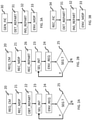
- FIG. 2A illustrates steps of the downloading method according to a particular embodiment of the invention
- FIG. 2B illustrates steps of the downloading method according to another particular embodiment of the invention
- FIG. 3A illustrates steps of the method for providing a piece of information on multipath downloading of an audiovisual content according to a particular embodiment of the invention
- FIG. 3B illustrates the steps of a method for providing pieces of information on distribution of download requests according to a particular embodiment of the invention
- FIG. 3C illustrates steps of the method for providing pieces of information on distribution of download requests according to another particular embodiment of the invention.
- FIG. 4A illustrates a downloading system configured to implement the downloading method according to a particular embodiment of the invention
- FIG. 4B illustrates a downloading device configured to implement the downloading method according to a particular embodiment of the invention
- FIG. 5 illustrates a device for providing a piece of information on multipath downloading of an audiovisual content according to a particular embodiment of the invention
- FIG. 6 illustrates a device for providing information on distribution of download requests according to a particular embodiment of the invention.
- this terminal when a terminal is streaming a multimedia content, for example a film, or a television stream or the like, this terminal can retrieve the segments of the multimedia contents via different communications paths associated with different network interfaces available on the terminal.
- the selection of a network interface to obtain a particular segment is carried out by the terminal using information on distribution of the requests for downloading by network interface that are obtained by the terminal.
- Such information on distribution of requests for downloading can be determined as a function of network performance values, for example the use of the bandwidth of a network related to a particular network interface, or the load of the apparatuses of the network.
- Such information on distribution of download requests can be determined by the terminal itself. For example, the terminal makes a measurement on each interface of the time taken to download the requested data segment and, from this, it deduces the useful bit-rate associated with the interface. It can thus make a distribution by comparing the useful bit-rate of each interface. In this example, the pieces of information on distribution are determined relative to the network information obtained by an applications level (HTTP level) of the terminal.
- HTTP level applications level
- the terminal possesses a lower-level module (TCP, IP, or even a physical layer) that sends back finer network information such as loss rate, stability, etc. to the applications level (http) of the terminal.
- TCP lower-level module
- IP IP
- http applications level
- the terminal has a module called an “edge controller” that is a module driven by the EDGE network, a higher-level controller of the network sending the terminal specifications on the use of the different access networks.
- the terminal can receive such information on distribution of requests for downloading by network interface coming for example from a device of a data network.
- the terminal thus has distribution information determined as a function of network information that it normally does not know and the downloading of segments of the multimedia content by the terminal is thus optimized.
- information on distribution by network interface can be associated with a profile.
- these items of information can be dependent on a criterion of efficiency.
- a set of pieces of information on distribution by network interface can be associated with a “low delay” profile according to which the distribution will be such that it optimizes the downloading time to limit the delay for live audiovisual contents for example.
- a set of pieces of information on distribution by network interface can be associated with a “high reliability” profile according to which the distribution would be such that it gives preference to the most reliable networks for downloading.
- a set of pieces of information on distribution by network interface can be associated with a “high bit-rate” profile according to which the distribution would be such that it maximizes the aggregate bandwidth, i.e. the bandwidth on the different networks used for the downloading.
- a set of pieces of information on distribution by network interface can be associated with a “tile priority” according to which the distribution would be such that it gives preference to the downloading of regions of interest of an audiovisual content via optimal download paths.
- Other types of profiles can also be envisaged.
- FIG. 1A illustrates an environment of implementation according to one particular embodiment of the invention.
- Such an environment comprises a terminal T configured to download a multimedia content in streaming mode, for example according to the MPEG-DASH protocol, provided by a content distribution server SRV 1 via a data network RES of a communications operator.
- the data network RES is for example an IP network.
- the data network RES is interconnected with different access networks ACC 1 , ACC 2 , ACC 3 enabling devices connected to such access networks to use the data network RES to send and receive data.
- the server SRV 1 accesses the data network RES via an access network ACC 3 , for example a landline DSL (Digital Subscriber Line) network.
- the terminal T is capable of accessing a network RES via any one of the network interfaces available on this terminal T.
- the terminal T can access the network RES via an access network ACC 1 , for example a landline DSL network and via an access network ACC 2 , for example a mobile 4G network.
- the terminal T can download the segments of the multimedia contents provided by the server SRV 1 via several download paths: path 1 , path 2 and path 3 .
- the terminal T receives a description file MPD comprising especially an IP address of the server providing the multimedia content.
- the segments of the multimedia content can be accessed from the server SRV 1 via one of the IP addresses of the server SRV 1 : ip 1 and ip 2 .
- Other embodiments are of course possible. For example, several distribution servers are possible or else a single distribution server having a single IP distribution address, etc.
- the terminal T identifies, for each download path 1 , path 2 , path 3 , a network interface, i.e. a technology enabling access to the data network associated with the download path.
- the download paths path 1 and path 2 are associated with the access network ACC 1 and the download path path 2 is associated with the access network ACC 2 .
- the terminal T uses for example a radio network interface for a WIFI access network or an Ethernet network interface for a DSL access network and to request a segment via the download path 2 , the terminal T uses for example a 4G network interface.
- the terminal T obtains information on distribution of download requests.
- information can be provided to it by a device (EQ 1 ) of the data network RES spliced into the content distribution chain or by the server SRV 1 .
- the spliced-in device EQ 1 is for example a DANE (DASH Aware Network Element) server or a CGW (Convergent Gateway) setting up a convergence between an LTE radio network and a landline network or a UGW (Unified Gateway) used in the 5G networks or again, in the case of a mobile network, an MEC (Mobile Edge Computing) network or EDGE-node.
- DANE DASH Aware Network Element
- CGW Convergent Gateway
- the terminal T can also itself determine information on distribution, for example from network traffic information sent back to it or from observations on traffic carried out on the different interfaces of the terminal T.
- a router module of the terminal T transmits the segment download request via the selected network interface.
- the router module is not comprised in the terminal T but in another device connected to the terminal T.
- the environment illustrated in FIG. 1B is distinguished from the environment illustrated in FIG. 1A in that the terminal T is connected to the data network RES via a routing device PAS, for example a home gateway.
- the terminal T is for example connected to the gateway PAS via a local area network LOC set up by the gateway PAS, for example a WIFI network.
- the terminal T can be connected by wire to the gateway PAS.
- the terminal T is for example a video decoder or a connected television set.
- the download request comprises a piece of information informing the gateway PAS as to the network interface towards which the download request must be routed.
- the terminal T sends the contents distribution server SRV 1 a request for downloading an audiovisual content.
- a user of the terminal T views a catalogue of audiovisual contents displayed in a browser on a screen of the terminal T and, via a user interface of the terminal T, selects an audiovisual content in the catalogue.
- Such a selection of an audiovisual content causes the browser of the terminal T to send a request for downloading audiovisual content to the server SRV 1 .
- the terminal T and the server SRV 1 communicate to acknowledge the request from the terminal T and start the distribution of the audiovisual content.
- the terminal T receives a file from the server SRV 1 which is a description file MPD of the audiovisual content selected.
- Such a description file MPD describes the sub-dividing of the audiovisual network into a set of segments which the terminal T must download to be able to play back the audiovisual content.
- Such a description file MPD comprises at least two pieces of information respectively representative of two segment download paths, each piece of information representative of a download path being associated with a network interface.
- the description file MPD comprises three download paths: path 1 , path 2 and path 3 indicating a network path to access the server SRV 1 .
- the paths path 1 and path 2 are associated with a network interface enabling access to the access network ACC 1 and the download path path 2 is associated with a network interface enabling access to the access network ACC 2 .
- the description file MPD takes the following form:
- the segments of the audiovisual content can be downloaded from the server SRV 1 or a server SRV 2 via the URLs (Uniform Resource Locators) specified in the “BaseURL” fields of the file.
- URLs Uniform Resource Locators
- the list of the segments of the audiovisual content to be downloaded is specified by means of “SegmentList” tags.
- a network interface is associated implicitly with each download path as a parameter of the URL.
- a terminal that is not compatible with the downloading of segments of the audiovisual content via several download paths could nevertheless use the MPD description file received to send out segment download requests. Indeed, such a terminal will for example read the first or second “BaseURL” field specified in such a description file and will use the download path indicated in this field.
- the terminal T obtains at least one piece of information on the distribution of requests for downloading segments by network interface.
- the information on distribution by interface are provided in terms of parameters of the URL, download paths for example in the form of percentage.
- download paths for example in the form of percentage.
- the description file MPD can be of the following form:
- the pieces of information on distribution of requests for downloading segments by network interface are provided in specifying, for each segment to be downloaded, a list of byte ranges of the audiovisual content, and for each byte range of the segment, the associated download path.
- the first byte range of 1305-9678 should be requested via the download path path 1
- the second byte interval of 9679-19876 should be requested via the download path path 2
- the third byte range of 19877-25305 should be requested via the download path path 3 .
- the description file MPD is in what is called a template segment mode and may be of the following form:
- the terminal T must itself generate the URLs through which it can download the segments of the audiovisual content in using the model or template defined in the “SegmentTemplate” field.
- the pieces of information on distribution by interface are provided in a “MultipathTemplate” field in the form of percentages associated with each downloading field.
- This way of providing distribution information by interface can also be used when the description file MPD comprises the list of segments with the “SegmentList” field as illustrated with the first example of a file here above.
- the information on distribution by interface can be provided in the MPD file in segment template mode as a parameter of the “BaseURL” fields as described with the first example of a file here above.
- the terminal T determines the segment of the audiovisual content to be downloaded and for this segment selects a terminal network interface T among the network interfaces associated with the download paths. Such a selection is made according to the information on distribution of requests obtained during the step 22 .
- the terminal T also takes account of the network interfaces selected for the preliminarily sent download requests in order to comply with the distribution of the requests obtained.
- the terminal T sends a request for downloading the segment of the audiovisual content to be downloaded via the network interface selected during the step 23 .
- the terminal T verifies whether other segments of the audiovisual content must be downloaded. If this is the case (Y), the procedure resumes at the step 23 . Else, if all the segments of the audiovisual content have been downloaded, or if the user has asked for the stopping of the viewing of the audiovisual content, the downloading comes to an end.
- FIG. 2B illustrates another particular embodiment of the invention.
- the steps identified with the same references as FIG. 2A are identical to those described with reference to FIG. 2A .
- the pieces of information on distribution are provided at a step 26 , by exchanges of messages between the terminal T and the server SRV 1 .
- messages can be exchanged according to the SAND (Server And Network Assisted DASH) standard, defined in the ISO/IEC 23009-5 standard.
- SAND Server And Network Assisted DASH
- Such messages can be XML messages, exchanged according to the HTTP protocol or any other.
- the information on distribution can be provided in the form of percentage or else a network interface is specified for each segment, or for each segment interval or range.
- the pieces of information on distribution provided by the terminal T can be updated by sending either a new MPD description file to the terminal T or new SAND messages.
- FIG. 3A illustrates steps of the method for providing a piece of information on multipath downloading of an audiovisual content according to one particular embodiment of the invention.
- a method is implemented by the server SRV 1 illustrated in FIGS. 1A and 1B .
- the server SRV 1 following the request for downloading an audiovisual content sent by the terminal T, the server SRV 1 generates a description file of the audiovisual content.
- the generated description file then comprises at least two pieces of information respectively representative of two segment download paths, and each piece of information representative of a download path is associated with a network interface.
- the server SRV 1 determines the distribution by network interface of requests for downloading that the terminal T must implement to download the audiovisual content. For example, the server SRV 1 obtains a piece of information on the use of network resources and the load coming from network devices RES. The server SRV 1 determines the distribution by network interface as a function of these pieces of information.
- the server SRV 1 inserts the pieces of information on distribution into the description file MPD of the audiovisual content asked for by the terminal T.
- the pieces of information on distribution can be inserted into the file according to any one of the examples described here above with reference to FIG. 2A .
- the server SRV 1 sends the terminal T the description file.
- the pieces of information on distribution of download requests are provided by a device EQ 1 of the data network RES, spliced into the audiovisual content distribution chain as shown in FIG. 1A et 1 B.
- the device EQ 1 receives it at a step 34 .
- the device EQ 1 determines the pieces of information on distribution as a function of the load of the devices of the network and of the traffic of the data network RES, and of the access networks ACC 1 , ACC 2 , and at the step 32 similar to that of FIG. 3A , it modifies the received description file MPD to insert information on distribution by network interface of requests for downloading, according to any one of the examples described here above with reference to FIG. 2A .
- FIG. 3C illustrates the steps of the method for providing information on distribution of download requests according to another particular embodiment of the invention.
- the steps of the method can be implemented by the server SRV 1 or by a device EQ 1 of the network RES.
- the pieces of information on distribution by network interface are provided to the terminal T via the exchange of SAND messages.
- the terminal T when the terminal T detects, via the description file MPD, that the segments of the audiovisual content can be downloaded via several download paths, the terminal T sends the server SRV 1 or the device EQ 1 a distribution request to obtain information on distribution by network interface. Such a request is sent according to the exchanges of SAND messages.
- a step 31 similar to that described with reference to FIG. 3A or 3B , the pieces of information on distribution are determined.
- the server SRV 1 of the device EQ 1 sends a SAND message to the terminal T comprising the determined pieces of information on distribution.
- the server SRV 1 or the device EQ 1 can send a new SAND message containing new pieces of information on distribution, for example following the detection of an increase in the load of the network, so as to avoid congestion.
- FIG. 4A illustrates a downloading system configured to implement the method of downloading according to any one of the particular embodiments of the invention described here above.
- the downloading system has a downloading device TEL, for example the terminal T described with reference to FIG. 1B and a router PAS.
- the downloading device TEL has the classic architecture of a computer and comprises especially a memory MEM, a processing unit UT, equipped for example with a processor PROC and driven by the computer program PG stored in a memory MEM.
- the computer program PG comprises instructions to implement the steps of the method of downloading as described here above, when the program is executed by the processor PROC.
- the computer program code instructions PG are for example loaded into a memory RAM and then executed by the processor PROC.
- the processor PROC of the processing unit UT implements especially the steps of the method of downloading described with reference to FIG. 2A or 2B according to the instructions of the computer program PG.
- the downloading device TEL comprises especially a network interface COM enabling the downloading device TEL to communicate with the router PAS and send it segment download requests for downloading segments of an audiovisual content.
- the router PAS comprises especially at least two network interfaces COM 1 , COM 2 adapted to accessing a data network and transmitting data on this network.
- Each network interface COM 1 , COM 2 is specific to the access network to which it enables access.
- the router PAS also comprises routing tables RT configured to redirect a download request towards a network interface COM 1 or COM 2 as a function of the IP destination address comprised in the request.
- the steps of the downloading method are implemented by functional modules.
- the downloading device TEL comprises in addition:
- the communications module COM is also configured to receive data from the data network RES via the router PAS and especially a description file for an audiovisual content to be downloaded.
- the processing unit UT cooperates with the different functional modules described here above and the memory MEM in order to implement the steps of the downloading method.
- the different functional modules described here above may be in hardware and/or software form.
- a functional module can include a processor, a memory and program code instructions to implement the function corresponding to the module when the code instructions are executed by the processor of the module.
- a functional module can be implemented by any type of adapted circuit.
- the downloading device TEL is configured to carry out the rendering of the audiovisual content as and when segments from the network RES are received.
- FIG. 4B illustrates a downloading device TEL configured to implement the downloading method according to any one of the particular embodiments of the invention described here above.
- the routing function for routing download requests is implemented by the downloading device TEL.
- the downloading device TEL corresponds for example to the terminal T described with reference to FIG. 1A . It has the same characteristics as those described with reference to FIG. 4A .
- the downloading device TEL comprises at least two network interfaces COM 1 , COM 2 adapted to accessing a data network and transmitting data on this network.
- Each network interface COM 1 , COM 2 is specific to the access network to which it enables access.
- the downloading device TEL also comprises routing tables RT configured to redirect a download request to one network interface COM 1 or COM 2 as a function of the destination IP address comprised in the request.
- FIG. 5 illustrates a device DISP for providing a piece of information on the multipath downloading of an audiovisual content according to one particular embodiment of the invention and according to any one of the particular embodiments of the invention described here above.
- the device DISP 5 has the classic architecture of a computer and comprises especially a memory MEM 5 , a processing unit UT 5 , equipped for example with a processor PROC 5 and driven by the computer program PG 5 stored in memory MEM 5 .
- the computer program PG 5 comprises instructions to implement the steps of the method for providing a piece of information on multipath downloading of an audiovisual content as described here above, when the program is executed by the processor PROC 5 .
- the computer program code instructions PG 5 are for example loaded into a memory RAM and then executed by the processor PROC 5 .
- the processor PROC 5 of the processing unit UT 5 implements especially the steps of the method for providing a piece of information on multipath downloading of an audiovisual content described with reference to FIG. 3A according to the instructions of the computer program PG 5 .
- the device DISP also comprises a communications interface COMS enabling the device to communicate via the data network RES and especially to transmit the description file for the audiovisual content.
- the communications interface COMS also enables the device to transmit distribution information to a downloading device.
- the device DISP described here above is comprised in a contents distribution server SERV 1 .
- FIG. 6 illustrates a device DISP 6 for providing a piece of information on distribution of download requests for downloading an audiovisual content according to any one of the particular embodiments of the invention described here above.
- the device DISP 6 has the classic architecture of a computer and comprises especially a memory MEM 6 , a processing unit UT 6 , equipped for example with a processor PROC 6 and driven by the computer program PG 6 stored in memory MEM 6 .
- the computer program PG 6 comprises instructions to implement the steps of the method for providing a piece of information on the distribution of downloading requests as described here above, when the program is executed by the processor PROC 6 .
- the computer program code instructions PG 6 are for example loaded into a memory RAM and then executed by the processor PROC 6 .
- the processor PROC 6 of the processing unit UT 6 implements especially the steps of the method for providing a piece of information on the distribution of downloading requests described with reference to any one of the figures FIG. 3B or 3C according to the instructions of the computer program PG 6 .
- the device DISP 6 also comprises a communications interface COM 6 enabling the device to communicate via the data network RES and especially to transmit information on sharing to a downloading device.
- the device DISP 6 described here above is comprised in an EQ 1 device of the data network, as shown in FIGS. 1A and 1B .
Landscapes
- Engineering & Computer Science (AREA)
- Multimedia (AREA)
- Signal Processing (AREA)
- Computer Networks & Wireless Communication (AREA)
- Databases & Information Systems (AREA)
- Information Transfer Between Computers (AREA)
Abstract
Description
-
- receive a description file describing a sub-dividing of the audiovisual content into a set of segments, the description file comprising at least two pieces of information respectively representative of two segment download paths, each piece of information representative of a download path being associated with a network interface,
- obtaining at least one piece of information on distribution of requests for downloading segments by network interface,
- for at least one segment of the audiovisual content to be downloaded:
- select, as a function of the information on distribution of download requests obtained and of at least two pieces of information respectively representative of two segment download paths, a network interface through which a request for downloading said segment is intended to be sent out,
- transmit said download request to a transmission device adapted to sending out a download request via the selected network interface.
-
- a description file comprising at least two pieces of information respectively representative of two segment download paths, each piece of information representative of a download path being associated with a network interface,
- the at least two pieces of information representative of two paths for downloading segments enabling the terminal to select, as a function of a piece of information on distribution of download requests obtained by the terminal, a network interface through which a request for downloading a segment is intended to be sent out by said terminal.
| <MPD xmins=“urn:mpeg:dash:schema:mpd:2011” ...> | |
| <Period ...> | |
| <AdaptationSet ...> | |
| <Representation ...> | |
| <BaseURL>http://srv1.monopath.fr/path/</BaseURL> | |
| <BaseURL>http://srv2.monopath.net/path/</BaseURL> | |
| <BaseURL>http://srv1.multipath.path1.fr?path-DSL- | |
| @ip=167.105.177.6&percent=25/</BaseURL> | |
| <BaseURL>http://srv1.multipath.path2.fr?path-4G- | |
| @ip=10.127.4.54&percent=60/</BaseURL> | |
| <BaseURL>http://srv1.multipath.path3.fr?path-DSL- | |
| @ip=10.127.4.54&percent=15/</BaseURL> | |
| <SegmentList timescale=“90000” duration=“5400000”> | |
| <RepresentationIndexsourceURL=“representation-index.sidx”/> | |
| <SegmentURL media=“segment-1.ts”/> | |
| <SegmentURL media=“segment-2.ts”/> | |
| <SegmentURL media=“segment-3.ts”/> | |
| <SegmentURL media=“segment-4.ts”/> | |
| <SegmentURL media=“segment-5.ts”/> | |
| <SegmentURL media=“segment-6.ts”/> | |
| <SegmentURL media=“segment-7.ts”/> | |
| <SegmentURL media=“segment-8.ts”/> | |
| <SegmentURL media=“segment-9.ts”/> | |
| <SegmentURL media=“segment-10.ts”/> | |
| ... | |
| </SegmentList> | |
| </Representation> | |
| </AdaptationSet> | |
| </Period> | |
| </MPD> | |
-
- The path path1 must be used for 25% of the download requests,
- the path path2 must be used for 60% of the download requests,
- the path path3 must be used for 15% of the download requests.
| <MPD xmlns=“urn:mpeg:dash:schema:mpd:2011” ...> |
| <Period ...> |
| <AdaptationSet ...> |
| <Representation ...> |
| <BaseURL>http://server1.monopath.fr/path/</BaseURL> |
| <BaseURL>http://server2.monopath.net/path/</BaseURL> |
| <BaseURL>http://server1.multipath.path1.fr?path-DSL-@ip=167.105.177.6/</BaseURL> |
| <BaseURL>http://server1.multipath.path2.fr?path-4G-@ip=10.127.4.54/</BaseURL> |
| <BaseURL>http://server1.multipath.path3.fr?path-DSL-@ip=10.127.4.54/</BaseURL> |
| <SegmentList ...> ... |
| <SegmentURL media=“path/segment1.m4s mediaRange=“1305-25305” indexRange- |
| path1=“1305-9678” indexRange-path2=“9679-19876” indexRange-path3=“19877-25305”/> |
| <SegmentURL media=“path/segment2.m4s mediaRange=“25306-49306” indexRange- |
| path1=“25306-29875” indexRange-path2=“29876-37860” indexRange-path3=“37861-49306”/> |
| <SegmentURL media=“path/segment3.m4s mediaRange=“49307-60512” indexRange- |
| path1=“49307-52741” indexRange-path2=“52741-60512”/> |
| .. |
| </SegmentList> |
| </Representation> |
| </AdaptationSet> |
| </Period> |
| </MPD> |
| ... |
| </SegmentList> |
| </Representation> |
| </AdaptationSet> |
| </Period> |
| </MPD> |
| </Representation> |
| <MPD xmlns=“urn:mpeg:dash:schema:mpd:2011” ...> |
| <Period ...> |
| <AdaptationSet ...> |
| <Representation ...> |
| <BaseURL>http://server1.monopath.fr/path/</BaseURL> |
| <BaseURL>http://server2.monopath.net/path/</BaseURL> |
| <BaseURL>http://server1.multipath.path1.fr?path-DSL-@ip=167.105.177.6/</BaseURL> |
| <BaseURL>http://server1.multipath.path2.fr?path-4G-@ip=10.127.4.54/</BaseURL> |
| <BaseURL>http://server1.multipath.path3.fr0path-DSL-@ip=10.127.4.54/</BaseURL> |
| <SegmentTemplate media=“segment-$Number$.m4s” timescale=“90000”> |
| <MultipathTemplate mediaRange-path1=“%25” mediaRange-path2=“%60” mediaRange- |
| path3=“%15”> |
| </MultipathTemplate> |
| <SegmentTimeline> |
| <S t=“0” r=“100” d=“5400000”/> |
| </SegmentTimeline> |
| </SegmentTemplate> |
| ... |
| </Representation> |
| </AdaptationSet> |
| </Period> |
| </MPD> |
-
- a streaming module DASH STRM adapted to determining segments of the audiovisual content to be downloaded at a given point in time,
- a multipath module MTPH adapted to selecting a network interface to be used to transmit a download request for downloading a segment as a function of distribution information received.
Claims (13)
Applications Claiming Priority (3)
| Application Number | Priority Date | Filing Date | Title |
|---|---|---|---|
| FR1755913 | 2017-06-27 | ||
| FR1755913A FR3067544A1 (en) | 2017-06-27 | 2017-06-27 | METHOD AND DEVICE FOR DOWNLOADING AUDIOVISUAL CONTENT |
| PCT/FR2018/051503 WO2019002729A1 (en) | 2017-06-27 | 2018-06-21 | Method and device for downloading audiovisual content |
Publications (2)
| Publication Number | Publication Date |
|---|---|
| US20200228582A1 US20200228582A1 (en) | 2020-07-16 |
| US11228628B2 true US11228628B2 (en) | 2022-01-18 |
Family
ID=60382283
Family Applications (1)
| Application Number | Title | Priority Date | Filing Date |
|---|---|---|---|
| US16/626,461 Active US11228628B2 (en) | 2017-06-27 | 2018-06-21 | Method and device for downloading audiovisual content |
Country Status (6)
| Country | Link |
|---|---|
| US (1) | US11228628B2 (en) |
| EP (1) | EP3646196B1 (en) |
| CN (1) | CN110832821B (en) |
| ES (1) | ES2974614T3 (en) |
| FR (1) | FR3067544A1 (en) |
| WO (1) | WO2019002729A1 (en) |
Families Citing this family (3)
| Publication number | Priority date | Publication date | Assignee | Title |
|---|---|---|---|---|
| CN109347968B (en) * | 2018-11-07 | 2021-09-24 | 网宿科技股份有限公司 | A method, device and system for downloading data blocks of resource files |
| CN111212114B (en) * | 2019-12-19 | 2021-08-27 | 网宿科技股份有限公司 | Method and device for downloading resource file |
| US11910032B1 (en) | 2022-08-02 | 2024-02-20 | Rovi Guides, Inc. | Systems and methods for distributed media streaming |
Citations (5)
| Publication number | Priority date | Publication date | Assignee | Title |
|---|---|---|---|---|
| US20030065762A1 (en) * | 2001-09-28 | 2003-04-03 | Cable & Wireless Internet Services, Inc. | Configurable adaptive global traffic control and management |
| US7584262B1 (en) * | 2002-02-11 | 2009-09-01 | Extreme Networks | Method of and system for allocating resources to resource requests based on application of persistence policies |
| WO2011101371A1 (en) | 2010-02-19 | 2011-08-25 | Thomson Licensing | Multipath delivery for adaptive streaming |
| EP2953319A1 (en) | 2014-06-06 | 2015-12-09 | Koninklijke KPN N.V. | Method, system and various components of such a system for selecting a chunk identifier |
| US20180139254A1 (en) * | 2015-06-16 | 2018-05-17 | Intel IP Corporation | Adaptive video streaming using dynamic radio access network information |
Family Cites Families (5)
| Publication number | Priority date | Publication date | Assignee | Title |
|---|---|---|---|---|
| KR101633769B1 (en) * | 2012-04-05 | 2016-06-27 | 후아웨이 테크놀러지 컴퍼니 리미티드 | System and method for secure asynchronous event notification for adaptive streaming based on iso base media file format |
| JP6348251B2 (en) * | 2012-09-13 | 2018-06-27 | サターン ライセンシング エルエルシーSaturn Licensing LLC | Terminal device, receiving method, and program |
| US20150195374A1 (en) * | 2014-01-08 | 2015-07-09 | Futurewei Technologies, Inc. | Method and system of quality of service (qos) negotiation for network assisted adaptive streaming |
| KR20160106701A (en) * | 2014-01-10 | 2016-09-12 | 톰슨 라이센싱 | Method for obtaining network information by a client terminal configured for receiving a multimedia content divided into segments |
| CN106376099A (en) * | 2016-09-18 | 2017-02-01 | 惠州Tcl移动通信有限公司 | Method and system for downloading files based on LTE network and WIFI network meanwhile |
-
2017
- 2017-06-27 FR FR1755913A patent/FR3067544A1/en not_active Withdrawn
-
2018
- 2018-06-21 US US16/626,461 patent/US11228628B2/en active Active
- 2018-06-21 EP EP18748982.8A patent/EP3646196B1/en active Active
- 2018-06-21 CN CN201880043235.5A patent/CN110832821B/en active Active
- 2018-06-21 ES ES18748982T patent/ES2974614T3/en active Active
- 2018-06-21 WO PCT/FR2018/051503 patent/WO2019002729A1/en not_active Ceased
Patent Citations (7)
| Publication number | Priority date | Publication date | Assignee | Title |
|---|---|---|---|---|
| US20030065762A1 (en) * | 2001-09-28 | 2003-04-03 | Cable & Wireless Internet Services, Inc. | Configurable adaptive global traffic control and management |
| US7584262B1 (en) * | 2002-02-11 | 2009-09-01 | Extreme Networks | Method of and system for allocating resources to resource requests based on application of persistence policies |
| WO2011101371A1 (en) | 2010-02-19 | 2011-08-25 | Thomson Licensing | Multipath delivery for adaptive streaming |
| US20120311174A1 (en) * | 2010-02-19 | 2012-12-06 | Guillaume Bichot | Multipath delivery for adaptive streaming |
| EP2537340A1 (en) | 2010-02-19 | 2012-12-26 | Thomson Licensing | Multipath delivery for adaptive streaming |
| EP2953319A1 (en) | 2014-06-06 | 2015-12-09 | Koninklijke KPN N.V. | Method, system and various components of such a system for selecting a chunk identifier |
| US20180139254A1 (en) * | 2015-06-16 | 2018-05-17 | Intel IP Corporation | Adaptive video streaming using dynamic radio access network information |
Non-Patent Citations (3)
| Title |
|---|
| English translation of the Written Opinion of the International Searching Authority dated Sep. 6, 2018 for corresponding International Application No. PCT/FR2018/051503, filed Jun. 21, 2018. |
| International Search Report dated Aug. 30, 2018 for corresponding International Application No. PCT/FR2018/051503, filed Jun. 21, 2018. |
| Written Opinion of the International Searching Authority dated Aug. 30, 2018 for corresponding International Application No. PCT/FR2018/051503, filed Jun. 21, 2018. |
Also Published As
| Publication number | Publication date |
|---|---|
| WO2019002729A1 (en) | 2019-01-03 |
| EP3646196B1 (en) | 2023-11-22 |
| US20200228582A1 (en) | 2020-07-16 |
| FR3067544A1 (en) | 2018-12-14 |
| ES2974614T3 (en) | 2024-06-28 |
| CN110832821B (en) | 2023-04-04 |
| EP3646196A1 (en) | 2020-05-06 |
| CN110832821A (en) | 2020-02-21 |
Similar Documents
| Publication | Publication Date | Title |
|---|---|---|
| US11652903B2 (en) | Method and system for streaming applications using rate pacing and MPD fragmenting | |
| US10321199B2 (en) | Streaming with optional broadcast delivery of data segments | |
| US9148682B2 (en) | Method and apparatus for providing broadcast content and system using the same | |
| EP2897340B1 (en) | Routing proxy for adaptive streaming | |
| CN107454101B (en) | System and method for content storage and transmission for downloading and streaming | |
| US20150006621A1 (en) | Adaptive Video Streaming for Information Centric Networks | |
| US20130013799A1 (en) | Method and apparatus for transmitting and receiving content in a broadcasting system | |
| KR101573329B1 (en) | Method and apparatus for using internet protocol television based on application received by multi-cast session | |
| US20170041422A1 (en) | Method and system for retrieving a content manifest in a network | |
| CN105556922A (en) | Dash representations adaptations in network | |
| WO2018034172A1 (en) | Information processing device, client device, and data processing method | |
| WO2018079295A1 (en) | Information processing device and information processing method | |
| US20200228582A1 (en) | Method and device for downloading audiovisual content | |
| US9380104B2 (en) | Media player web service | |
| KR101922552B1 (en) | Method amd apparatus for controlling traffic using adaptive streaming in multimedia content content transmission system | |
| RU2663187C2 (en) | Device and method of content provision, program, terminal device, and content provision system | |
| CN105900433B (en) | Method and corresponding cache for providing content parts of multimedia content to client terminals | |
| WO2011136703A1 (en) | Method and arrangement for playing out a media object | |
| US9271053B2 (en) | Data receiving method and device for applications providing an IPTV communications service | |
| WO2016119735A1 (en) | Method and device for adaptive video content delivery using http |
Legal Events
| Date | Code | Title | Description |
|---|---|---|---|
| FEPP | Fee payment procedure |
Free format text: ENTITY STATUS SET TO UNDISCOUNTED (ORIGINAL EVENT CODE: BIG.); ENTITY STATUS OF PATENT OWNER: LARGE ENTITY |
|
| AS | Assignment |
Owner name: ORANGE, FRANCE Free format text: ASSIGNMENT OF ASSIGNORS INTEREST;ASSIGNORS:HOUZE, PATRICE;MORY, EMMANUEL;KERVADEC, SYLVAIN;REEL/FRAME:052212/0911 Effective date: 20200310 |
|
| STPP | Information on status: patent application and granting procedure in general |
Free format text: FINAL REJECTION MAILED |
|
| STPP | Information on status: patent application and granting procedure in general |
Free format text: RESPONSE AFTER FINAL ACTION FORWARDED TO EXAMINER |
|
| STPP | Information on status: patent application and granting procedure in general |
Free format text: ADVISORY ACTION MAILED |
|
| STPP | Information on status: patent application and granting procedure in general |
Free format text: DOCKETED NEW CASE - READY FOR EXAMINATION |
|
| STPP | Information on status: patent application and granting procedure in general |
Free format text: NON FINAL ACTION MAILED |
|
| STPP | Information on status: patent application and granting procedure in general |
Free format text: RESPONSE TO NON-FINAL OFFICE ACTION ENTERED AND FORWARDED TO EXAMINER |
|
| STPP | Information on status: patent application and granting procedure in general |
Free format text: AWAITING TC RESP., ISSUE FEE NOT PAID |
|
| STPP | Information on status: patent application and granting procedure in general |
Free format text: NOTICE OF ALLOWANCE MAILED -- APPLICATION RECEIVED IN OFFICE OF PUBLICATIONS |
|
| STPP | Information on status: patent application and granting procedure in general |
Free format text: PUBLICATIONS -- ISSUE FEE PAYMENT VERIFIED |
|
| STCF | Information on status: patent grant |
Free format text: PATENTED CASE |
|
| MAFP | Maintenance fee payment |
Free format text: PAYMENT OF MAINTENANCE FEE, 4TH YEAR, LARGE ENTITY (ORIGINAL EVENT CODE: M1551); ENTITY STATUS OF PATENT OWNER: LARGE ENTITY Year of fee payment: 4 |