US11228457B2 - Priority-arbitrated access to a set of one or more computational engines - Google Patents
Priority-arbitrated access to a set of one or more computational engines Download PDFInfo
- Publication number
- US11228457B2 US11228457B2 US16/842,268 US202016842268A US11228457B2 US 11228457 B2 US11228457 B2 US 11228457B2 US 202016842268 A US202016842268 A US 202016842268A US 11228457 B2 US11228457 B2 US 11228457B2
- Authority
- US
- United States
- Prior art keywords
- request
- data unit
- multiplexer module
- driver
- data
- Prior art date
- Legal status (The legal status is an assumption and is not a legal conclusion. Google has not performed a legal analysis and makes no representation as to the accuracy of the status listed.)
- Expired - Fee Related, expires
Links
Images


Classifications
-
- G—PHYSICS
- G06—COMPUTING OR CALCULATING; COUNTING
- G06F—ELECTRIC DIGITAL DATA PROCESSING
- G06F5/00—Methods or arrangements for data conversion without changing the order or content of the data handled
- G06F5/06—Methods or arrangements for data conversion without changing the order or content of the data handled for changing the speed of data flow, i.e. speed regularising or timing, e.g. delay lines, FIFO buffers; over- or underrun control therefor
-
- H—ELECTRICITY
- H04—ELECTRIC COMMUNICATION TECHNIQUE
- H04L—TRANSMISSION OF DIGITAL INFORMATION, e.g. TELEGRAPHIC COMMUNICATION
- H04L12/00—Data switching networks
- H04L12/28—Data switching networks characterised by path configuration, e.g. LAN [Local Area Networks] or WAN [Wide Area Networks]
- H04L12/40—Bus networks
- H04L12/40052—High-speed IEEE 1394 serial bus
- H04L12/40084—Bus arbitration
-
- H—ELECTRICITY
- H04—ELECTRIC COMMUNICATION TECHNIQUE
- H04L—TRANSMISSION OF DIGITAL INFORMATION, e.g. TELEGRAPHIC COMMUNICATION
- H04L12/00—Data switching networks
- H04L12/02—Details
- H04L12/16—Arrangements for providing special services to substations
- H04L12/18—Arrangements for providing special services to substations for broadcast or conference, e.g. multicast
- H04L12/1863—Arrangements for providing special services to substations for broadcast or conference, e.g. multicast comprising mechanisms for improved reliability, e.g. status reports
-
- H—ELECTRICITY
- H04—ELECTRIC COMMUNICATION TECHNIQUE
- H04L—TRANSMISSION OF DIGITAL INFORMATION, e.g. TELEGRAPHIC COMMUNICATION
- H04L12/00—Data switching networks
- H04L12/28—Data switching networks characterised by path configuration, e.g. LAN [Local Area Networks] or WAN [Wide Area Networks]
- H04L12/40—Bus networks
- H04L12/40052—High-speed IEEE 1394 serial bus
- H04L12/40123—Interconnection of computers and peripherals
Definitions
- a physical computing device may serve multiple users at the same time. Such a system is often called a multitenancy computing system. Serving many different tenants, it may provide extensive computational resources.
- a multitenancy computing system may feature multiple computational engines which perform computations for its tenants.
- the computational engines may be cryptographic engines, for instance.
- Drivers can send requests from the tenants over a network bus of the physical computing system to the computational engines.
- the computational engines then process the requests and send the results back to the tenants.
- a multiplexer is a device which can select between different input signals.
- An input signal can comprise various types of data, for instance a request for performing computations.
- a multiplexer may distribute multiple requests for performing computations from tenants to multiple computational engines. This allows multiple tenants to make use of a relatively small number of computational engines.
- Various embodiments of the disclosure provide a method for managing priority-arbitrated access to a set of one or more computational engines of a physical computing device. Further embodiments provide a physical computing device suitable for implementing the method for managing priority-arbitrated access to a set of one or more computational engines of a physical computing device. Further embodiments provide a computer program product for operating the physical computing device so that the physical computing device can implement the method for managing priority-arbitrated access to a set of one or more computational engines of a physical computing device. Advantageous embodiments are described in the dependent claims. Embodiments of the present invention can be freely combined with each other if they are not mutually exclusive.
- the disclosure relates to a method for managing priority-arbitrated access to a set of one or more computational engines of a physical computing device.
- the method includes providing a multiplexer module and a network bus in the physical computing device, wherein the multiplexer module is connected to the network bus.
- the method includes receiving by the multiplexer module a first data processing request from a driver and inferring by the multiplexer module a first priority class from the first data processing request according to at least one property of the first data processing request.
- the method further includes transmitting, by the multiplexer module communication data to the driver, the communication data being provided for enabling transmission of a first request data unit and a first result data unit between the driver and the multiplexer module, wherein the first request data unit and the first result data unit are associated with the first data processing request.
- the method further includes receiving, via the network bus by the multiplexer module, the first request data unit from the driver, and in response thereto, processing the first request data unit by the multiplexer module, wherein the processing of the first request data unit comprises transmitting the first request data unit to the set of one or more computational engines.
- the method further includes manipulating, by the multiplexer module, a priority according to which the physical computing device handles data associated with the first data processing request in relation to data associated with other data processing requests, wherein priority is determined by the first priority class, and in response to transmitting the first request data unit to the set of one or more computational engines, receiving by the multiplexer module the first result data unit from the set of one or more computational engines, and causing, by the multiplexer module, the driver to read the first result data unit from the multiplexer module.
- the invention in another aspect, relates to a physical computing device with a multiplexer module and a network bus, the multiplexer module being connected to the network bus, the physical computing device being configured to implement the method which is described above.
- Further embodiments provide a computer program product for operating a physical computing device with a multiplexer module and a network bus, the multiplexer module being connected to the network bus, the computer program product comprising a computer readable storage medium having program instructions embodied therewith, the program instructions executable by a processor to cause the physical computing device to implement the method which is described above.
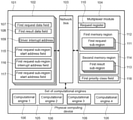
- FIG. 1 depicts a block diagram of a physical computing device, in accordance with an embodiment of the present invention.
- FIG. 2 depicts a block diagram detailing a data structure of a first request sub-region within a multiplexer module of the physical computing device, in accordance with an embodiment of the present invention.
- FIG. 3 depicts a flowchart detailing the operation of the physical computing device, in accordance with an embodiment of the present invention.
- FIG. 4 depicts a flowchart detailing how the multiplexer module may infer a priority class from a processing request, in accordance with an embodiment of the present invention.
- FIG. 5 depicts a priority-indicating address scheme for accessing request registers of the multiplexer module, in accordance with an embodiment of the present invention.
- FIG. 6 depicts a block diagram detailing a set of logical buffers of the multiplexer module, in accordance with an embodiment of the present invention.
- FIG. 7 depicts a flowchart detailing the operation of the logical buffers, in accordance with an embodiment of the present invention.
- FIG. 8 depicts a flowchart detailing a flow control method implemented by the multiplexer module, in accordance with an embodiment of the present invention.
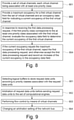
- FIG. 9 depicts a flowchart providing an overview of how a priority of handling data associated with a first data processing request may be manipulated, in accordance with an embodiment of the present invention.
- the invention relates to a method for managing priority-arbitrated access to a set of one or more computational engines of a physical computing device.
- a multiplexer module and a network bus are provided in the physical computing device, the multiplexer module being connected to the network bus.
- the multiplexer module receives a first data processing request from a driver.
- the driver may be a unit of the physical computing device which is configured for communicating with the multiplexer over the network bus. Multiple drivers may be present within the physical computing device.
- the driver may comprise driver software and/or a network bus transceiver.
- a tenant using the physical computing device may employ the driver for communicating with the multiplexer module.
- the engines from the set of computational engines are cryptographic engines, i.e., computational engines specialized for performing cryptographic computations.
- the multiplexer module infers a first priority class from the first data processing request according to at least one property of the first data processing request and transmits communication data to the driver, the communication data being provided for enabling transmission of a first request data unit and a first result data unit between the driver and the multiplexer module.
- the communication data may comprise data transmission indicators for enabling communication between the driver and the multiplexer module.
- the first request data unit and the first result data unit are associated with the first data processing request.
- the first request data unit and the first result data unit are used to transmit data associated with the first data processing request.
- the first request data unit and the first result data unit may be network data packets.
- hardware-relevant attributes such as a maximum size of the first request data unit or a maximum size of the first result data unit may be included in the first data processing request.
- the first data processing request may also include further attributes, for instance a request type.
- the multiplexer module receives the first request data unit from the driver over the network bus. While the first data processing request was merely a request indicating an intention of the driver to have data processed by the set of one more computational engines, the first request data unit contains an actual computational request associated with the first data processing request. In response to receiving the first request data unit, the multiplexer module processes the first request data unit. This comprises transmitting the first request data unit to the set of one or more computational engines. The first request data unit is transmitted to the set of computational engines so that one of the computational engines may perform a computation specified in the first request data unit.
- the multiplexer module manipulates a priority according to which the physical computing device handles data associated with the first data processing request in relation to data associated with other data processing requests, said priority being determined by the first priority class. The manipulation via the multiplexer module may apply to handling the first data processing request itself, the first request data unit, the first result data unit, and/or any other data associated with the first data processing request.
- the multiplexer module In response to transmitting the first request data unit to the set of one or more computational engines, the multiplexer module receives the first result data unit from the set of one or more computational engines and causes the driver to read the first result data unit from the multiplexer module. In this manner, the driver obtains the result data unit.
- This invention may have the advantage that it allows for priority-arbitration of data processing requests in a physical computing device, which may be particularly advantageous in multitenancy computing systems. In such systems, a large number of tenants may compete for a relatively small amount of computational resources. With a large number of tenants present, it is advantageous when communication takes over a network bus—the network bus provides conflict resolution by means of bus arbitration.
- the set of one or more computational engines may form a part of the physical computing device.
- the first request data unit contains at least one instruction for performing a computation.
- the first result data unit contains at least one result of a computation performed by a computational engine from the set of one or more computational engines.
- a computational engine from the set of one or more computational engines performs a computation according to an instruction from the first request data unit in response to receiving the first request data unit. The computational engine may then transmit a result of the computation to the multiplexer module.
- the first request sub-region and the first result sub-region may be accessed via the network bus.
- This embodiment may have the advantage that a first request sub-region and a first result sub-region are provided for communicating data related to the first data processing request. Since the driver may use the sub-regions for communication exclusively, no lock-related functionality needs to be implemented on the driver side. By storing data in sub-regions, large blocks of data can be handled.
- the first request sub-region may have a memory size specified in the first data processing request.
- the first result sub-region may have a memory size specified in the first data processing request. Therefore, request sub-regions and result sub-regions of varying sizes can be provided, conforming to requirements of respective data processing requests.
- the multiplexer module may transmit communication data which indicates properties of the first request sub-region and of the first result sub-region to the driver. According to embodiments, the driver can therefore write the first request data unit into the first request sub-region and read the first result data unit from the first result sub-region. In exemplary embodiments, it is preferable if data can only be written to, but not read from the first request sub-region. It is also preferable if data can only be read from, but not written to, the first result sub-region.
- the method further comprises exposing a request register of the multiplexer module to data processing requests, and receiving at the request register the first data processing request.
- the request register can be accessed via the network bus by using a network bus address of the request register.
- the network bus address of the request register is static. It is an inherent advantage of using the network bus since it provides a means for conflict resolution between different drivers.
- the method further comprises, in response to receiving the information indicative of the driver and of the first data processing request, transmitting by the multiplexer module to the driver data transmission indicators selected from the group consisting of a start address of the first request sub-region, a size of the first request sub-region, an interrupt address within the first request sub-region for signaling that a request data unit has been written into the first request sub-region, a start address of the first result sub-region, and a size of the first result sub-region.
- the multiplexer module may provide communication data to the driver.
- One address within the first request sub-region may be designated as the interrupt address, which may have the following purpose:
- the driver writes the first request unit into the first sub-region.
- the driver may write data to the interrupt address within the first request sub-region. This causes the multiplexer module to process the data which have been written into the first request sub-region.
- the method further comprises providing a set of logical buffers in the multiplexer module, each logical buffer being associated with a priority class, in response to receiving the first data processing request, selecting a first logical buffer from the set of logical buffers to store the first request data unit, the priority class of the first logical buffer corresponding to the first priority class, in response to receiving the first request data unit by the multiplexer module, storing the first request data unit in the first logical buffer, removing request data units from the first logical buffer which precede the first request data unit within the first logical buffer until the first request data unit reaches an output position of the first logical buffer, and, when the first request data unit has reached the output position of the first logical buffer, transmitting the first request data unit to the set of one or more computational engines and removing the first request data unit from the first logical buffer.
- This may have the advantage that the multiplexer module places incoming request data units in into logical buffers according to their priorities.
- the logical buffers may have different sizes, thereby
- the logical buffers may temporarily store incoming request data units within the multiplexer module. It may be necessary to temporarily store request data units within logical buffers if all computational engines are occupied.
- the logical buffers from the set of logical buffers provide queues for processing request data units sequentially.
- the logical buffers from the set of logical buffers have a first in, first out (FIFO) data structure.
- the logical buffers are implemented as ring buffers. However, the logical buffers may also be implemented according to other designs.
- Each logical buffer is associated with a priority class. According to an embodiment, one logical buffer may be associated with more than one priority class.
- the first logical buffer When the first data processing request is received by the multiplexer, the first logical buffer is selected for storing the first request unit because the first logical buffer has a corresponding priority class.
- the multiplexer module receives the first request data unit, the first request data unit is stored in the first logical buffer.
- the multiplexer module may select other logical buffers for storing request data units associated with the other data processing requests. According to an embodiment, it is possible that the first logical buffer is selected for storing other request data units in addition to storing the first request data unit.
- the multiplexer module transmits to the driver a first logical buffer address or a first range of logical buffer addresses that allows to write data into the first logical buffer.
- This embodiment may have the advantage that information for accessing a specific buffer is provided to the driver.
- the first logical buffer address is used.
- the driver may write data associated with the first request data unit to the first logical buffer address in sequential steps, causing the data to be stored in the first logical buffer.
- the first range of logical buffer addresses is used. The first request data unit may fit into the first range of logical buffer addresses as a whole.
- the first range of logical buffer addresses coincides with a range of network bus addresses belonging to the first request sub-region. Therefore, any data written into the first request sub-region is stored in the first logical buffer. According to an embodiment, when the driver has completed writing the first request data unit into the first request sub-region and has triggered the interrupt located within the first request sub-region, the multiplexer module moves the first request data unit into the first logical buffer.
- the method comprises, in response to receiving the first data processing request, selecting a randomly chosen bus address as the first logical buffer address or selecting a random range of bus addresses as the first range of logical buffer addresses, enabling write access to the first logical buffer via the first logical buffer address or via the first range of logical buffer addresses, and, after receiving the first request data unit by the multiplexer module has been completed, disabling access to the first logical buffer via the first logical buffer address or via the first range of logical buffer addresses. Therefore, the first logical buffer address, or the first range of logical buffer addresses, is dynamically allocated. This may have the advantage that only a driver that knows the logical buffer address, or the first range of logical buffer addresses, can access the first logical buffer.
- the multiplexer module ensures that the randomly chosen bus address or that the bus addresses from the random range of bus addresses, respectively, are provided to only one driver at the same time. In order to prevent misuse of the first logical buffer address, or the first range of logical buffer addresses, access via the first logical buffer address, or the first range of logical buffer addresses, is disabled after the first request data unit has been transmitted to the multiplexer module by the driver.
- the method comprises, when the first request data unit has reached the output position of the first logical buffer, if other request data units are available at output positions of other logical buffers of the multiplexer module, transmitting the first request data unit and the other request data units to the set of one or more computational engines in an order determined by the first priority class and respective priority classes associated with the other request data units.
- the multiplexer module may provide multiple logical buffers. In such embodiments, the multiplexer can determine an order in which request data units from the multiple logical buffers are transmitted to the set of one or more computational engines. This embodiment may have the advantage that request data units are transmitted to the set of one or more computational engines in an order determined by their respective priority classes.
- a request data unit with a high priority class may be transmitted before a request data unit with a low priority class.
- arbitration at this stage may not be based on priority classes.
- request data units from different logical buffers may be transmitted to the set of logical buffers in an order determined by round-robin scheduling.
- the order in which request data units are transmitted may be determined by a queue arbiter of the multiplexer module.
- the multiplexer module may infer further information from the destination address. For instance, hardware-relevant attributes such as a maximum size of the first request data unit or a maximum size of the first result data unit may be encoded within the destination address. In this way, both information regarding a priority of a data processing request and information regarding the size of the associated request data unit or result data unit may be provided at the same time. According to an embodiment, other attributes may be encoded within the destination address as well, for instance a request type.
- the first priority class is inferred by evaluating a range of higher-order bits of the destination address.
- the multiplexer module may evaluate at least one higher-order bit of the destination address.
- lower-order bits of the destination address contain a network bus address of the multiplexer module.
- the lower-order bits may specify a network bus address of the request register.
- the higher-order bits may encode the priority of the first priority request.
- the destination address may therefore function as a virtual address which allows addressing different virtual request registers of the multiplexer module. Different priorities may be specified by transmitting data processing requests to different virtual request registers. This embodiment may have the advantage that the driver may specify a desired priority by means of the destination address.
- the range of higher-order bits may also be used to specify other attributes of the first data processing request.
- the first priority class is inferred by evaluating a source address identifying the first driver contained within the first data processing request.
- This embodiment may have the advantage that priority classes may be inferred on the basis of an origin of the first data processing request.
- the multiplexer module contains a list of source addresses, each source address belonging to a driver.
- a priority class may be associated with each driver. By means of the list, a source address may be matched with a certain priority class.
- the multiplexer module may infer further information from the source address. For instance, the multiplexer module may infer a maximum size of the first request data unit or a maximum size of the first result data unit from the source address.
- the first priority class may be inferred by both evaluating the destination address contained within the first data processing request and by evaluating the source address identifying the first driver contained within the first data processing request.
- This embodiment may have the advantage that priority classes may be inferred by taking into account the origin of the first priority request and the desired priority as indicated by the driver.
- the method further comprises providing a set of virtual channels, each virtual channel being associated with at least one priority class, providing a maximum occupancy for a first virtual channel from the set of virtual channels and providing an occupancy data field for indicating a current occupancy of the first virtual channel, in response to receiving the first data processing request, if the first priority class corresponds to the at least one priority class associated with the first virtual channel, evaluating the occupancy data field in order to determine the current occupancy of the first virtual channel, and, if the current occupancy equals the maximum occupancy of the first virtual channel, rejecting the first data processing request, and otherwise accepting the first data processing request and recording an increase of the current occupancy in the occupancy data field.
- Virtual channels may be used in order to implement flow control mechanisms. The embodiment may have the advantage that it allows for flow control by representing the processing capabilities of the multiplexer module, and the set of one or more computational engines, by means of virtual channels. According to embodiments, the maximum occupancy of the virtual channels may be configurable.
- each virtual channel may be associated with one or more priority classes.
- the multiplexer module After the multiplexer module receives the first data processing request, it infers the first priority class from the first data processing request. If the first virtual channel is associated with the first priority class, then the first data processing request will occupy a virtual slot in the first virtual channel.
- the maximum occupancy of the first virtual channel determines a maximum amount of data processing requests that the first virtual channel allows for.
- the occupancy data field records the current occupancy of the first virtual channel. The first data processing request is rejected if a maximum capacity of the first virtual channel has been reached.
- the method further comprises, after causing the driver to read the first result data unit from the multiplexer module, recording a decrease of the current occupancy in the occupancy data field. This means that a slot in the virtual channel is freed when the multiplexer module has finished processing the first data processing request.
- the first data processing request is deemed to have been completed as soon as the driver has read the first result data unit from the multiplexer module.
- the occupancy data field is initialized with the maximum occupancy of the first virtual channel.
- a value stored in the occupancy data field can be interpreted as a number of tokens, each token representing an unoccupied slot of the first virtual channel.
- a token is removed.
- the value stored in the occupancy data field is decremented, recording an increase of the current occupancy.
- the value has decreased to zero, then this means that the first virtual channel has no more unoccupied slots. No further data processing requests are accepted.
- the value stored in the occupancy data field is increased, recording a decrease of the current occupancy of the first virtual channel.
- recording the occupancy of the first virtual channel and other virtual channels may be implemented in other ways.
- the method further comprises, in response to receiving the first data processing request, selecting a first logical buffer from a set of logical buffers in the multiplexer module to store the first request data unit, and, if the current occupancy equals the maximum occupancy of the first virtual channel, delaying to transmit the communication data to the driver and thereby accept the first data processing request until the current occupancy no longer equals the maximum occupancy of the first virtual channel.
- the multiplexer module changes an arbitration setting of the network bus so that the network bus processes the first request data unit in relation to other request data units being transferred over the network bus according to a priority set by the multiplexer module, said priority being based on the first priority class.
- This embodiment has the advantage that priority-based arbitration capabilities of the network bus can be made use of.
- the multiplexer module may control how the network bus processes the first request data unit in relation to other request data units.
- Various network buses allow for priority-based bus arbitration, and to influence priority-based arbitration. For instance, this may be possible if a network bus features switches or similar devices for packet switching which allow for controlling an order in which packets are transferred over the network bus.
- the network bus of the physical computing device is a peripheral component interconnect (PCI) express bus.
- the multiplexer module provides to the network bus a source address of a driver and a priority class associated with the source address. The network bus can then perform bus arbitration accordingly.
- infrastructure features of the network bus are used in order to enforce a priority.
- this comprises impersonating, by the multiplexer module, multiple bus devices which are handled differently by the network bus.
- This embodiment is preferably used in conjunction with a network bus that features bus-integrated arbitration hardware, such as switches and the like.
- the multiplexer module may make different network addresses available to the bus, each network address being associated with a certain priority. If the network bus is a PCI express bus, then the multiplexer module may declare that each network address belongs to a different PCI express device. This would enable in-band arbitration which is directly provided by the bus hardware of the PCI express bus. According to this example, priority arbitration is delegated to bus-integrated arbitration hardware that is provided by PCI express bus systems.
- the present invention also relates to a physical computing device with a multiplexer module and a network bus, the multiplexer module being connected to the network bus, the physical computing device being configured to operate as described above.
- Embodiments of the physical computing device can perform all of the actions described above in arbitrary combinations.
- the present invention also relates to a computer program product for operating a physical computing device with a multiplexer module and a network bus, the multiplexer module being connected to the network bus, the computer program product comprising a computer readable storage medium having program instructions embodied therewith, the program instructions executable by a processor to cause the physical computing device to operate as described above.
- Embodiments of the physical computing device can perform all of the actions described above in arbitrary combinations.
- the present invention may be a system, a method, and/or a computer program product at any possible technical detail level of integration
- the computer program product may include a computer readable storage medium (or media) having computer readable program instructions thereon for causing a processor to carry out aspects of the present invention
- the computer readable storage medium can be a tangible device that can retain and store instructions for use by an instruction execution device.
- the computer readable storage medium may be, for example, but is not limited to, an electronic storage device, a magnetic storage device, an optical storage device, an electromagnetic storage device, a semiconductor storage device, or any suitable combination of the foregoing.
- a non-exhaustive list of more specific examples of the computer readable storage medium includes the following: a portable computer diskette, a hard disk, a random access memory (RAM), a read-only memory (ROM), an erasable programmable read-only memory (EPROM or Flash memory), a static random access memory (SRAM), a portable compact disc read-only memory (CD-ROM), a digital versatile disk (DVD), a memory stick, a floppy disk, a mechanically encoded device such as punch-cards or raised structures in a groove having instructions recorded thereon, and any suitable combination of the foregoing.
- RAM random access memory
- ROM read-only memory
- EPROM or Flash memory erasable programmable read-only memory
- SRAM static random access memory
- CD-ROM compact disc read-only memory
- DVD digital versatile disk
- memory stick a floppy disk
- a mechanically encoded device such as punch-cards or raised structures in a groove having instructions recorded thereon
- a computer readable storage medium is not to be construed as being transitory signals per se, such as radio waves or other freely propagating electromagnetic waves, electromagnetic waves propagating through a waveguide or other transmission media (e.g., light pulses passing through a fiber-optic cable), or electrical signals transmitted through a wire.
- Computer readable program instructions described herein can be downloaded to respective computing/processing devices from a computer readable storage medium or to an external computer or external storage device via a network, for example, the Internet, a local area network, a wide area network and/or a wireless network.
- the network may comprise copper transmission cables, optical transmission fibers, wireless transmission, routers, firewalls, switches, gateway computers and/or edge servers.
- a network adapter card or network interface in each computing/processing device receives computer readable program instructions from the network and forwards the computer readable program instructions for storage in a computer readable storage medium within the respective computing/processing device.
- Computer readable program instructions for carrying out operations of the present invention may be assembler instructions, instruction-set-architecture (ISA) instructions, machine instructions, machine dependent instructions, microcode, firmware instructions, state-setting data, configuration data for integrated circuitry, or either source code or object code written in any combination of one or more programming languages, including an object oriented programming language such as Smalltalk, C++, or the like, and procedural programming languages, such as the “C” programming language or similar programming languages.
- the computer readable program instructions may execute entirely on the user's computer, partly on the user's computer, as a stand-alone software package, partly on the user's computer and partly on a remote computer or entirely on the remote computer or server.
- the remote computer may be connected to the user's computer through any type of network, including a local area network (LAN) or a wide area network (WAN), or the connection may be made to an external computer (for example, through the Internet using an Internet Service Provider).
- electronic circuitry including, for example, programmable logic circuitry, field-programmable gate arrays (FPGA), or programmable logic arrays (PLA) may execute the computer readable program instructions by utilizing state information of the computer readable program instructions to personalize the electronic circuitry, in order to perform aspects of the present invention.
- These computer readable program instructions may be provided to a processor of a computer, or other programmable data processing apparatus to produce a machine, such that the instructions, which execute via the processor of the computer or other programmable data processing apparatus, create means for implementing the functions/acts specified in the flowchart and/or block diagram block or blocks.
- These computer readable program instructions may also be stored in a computer readable storage medium that can direct a computer, a programmable data processing apparatus, and/or other devices to function in a particular manner, such that the computer readable storage medium having instructions stored therein comprises an article of manufacture including instructions which implement aspects of the function/act specified in the flowchart and/or block diagram block or blocks.
- the computer readable program instructions may also be loaded onto a computer, other programmable data processing apparatus, or other device to cause a series of operational steps to be performed on the computer, other programmable apparatus or other device to produce a computer implemented process, such that the instructions which execute on the computer, other programmable apparatus, or other device implement the functions/acts specified in the flowchart and/or block diagram block or blocks.
- each block in the flowchart or block diagrams may represent a module, segment, or portion of instructions, which comprises one or more executable instructions for implementing the specified logical function(s).
- the functions noted in the blocks may occur out of the order noted in the Figures.
- two blocks shown in succession may, in fact, be accomplished as one step, executed concurrently, substantially concurrently, in a partially or wholly temporally overlapping manner, or the blocks may sometimes be executed in the reverse order, depending upon the functionality involved.
- FIG. 1 depicts a block diagram of a physical computing device 101 , in accordance with an embodiment of the present invention.
- the physical computing device features a driver 102 , a network bus 103 , a multiplexer module 104 and a set of computational engines 105 .
- the set of computational engines 105 comprises multiple computational engines 106 .
- the computational engines 106 may be cryptographic engines.
- the driver 102 may contain a first request data field 107 and a first result data field 108 .
- the first request data field 107 contains data which is supposed to be processed by a computational engine 106 from the set of computational engines 105 .
- the driver 102 can transmit the data from the first request data field 107 to the multiplexer module 104 over the network bus 103 .
- the multiplexer module 104 may obtain a result from a computation by one of the computational engines 106 and store the result in the first result data field 108 . Said result may be transmitted to the driver 102 over the network bus 103 by the multiplexer module 104 .
- the driver 102 makes a driver interrupt address 109 available to the network bus 103 .
- the multiplexer module 104 may write data to the driver interrupt address 109 in order to indicate to the driver 102 that the result is ready for transmission from the multiplexer module 104 to the driver 102 .
- the multiplexer module 104 may feature a request register 110 .
- the request register 110 may be accessed by the driver 102 over the network bus 103 .
- the driver 102 may write a first data processing request into the request register 110 .
- the multiplexer module 104 allocates a first request sub-region 111 in a first memory region 112 of the multiplexer module 104 and a first result sub-region 113 of a second memory region 114 of the multiplexer module 104 .
- the first memory region 112 can only be written to and the second memory region 114 can only be read from.
- Multiple request sub-regions and result sub-regions may be allocated in the first memory region 112 and the second memory region 114 , respectively.
- the first request sub-region 111 allows the driver 102 to write data to the multiplexer module 104 and the first result sub-region allows the driver 102 to read data from the multiplexer module 104 .
- the driver 102 may store auxiliary communication data for communicating with the multiplexer module 104 . For instance, it may store a start address of the first request sub-region 111 in a first request sub-region start address field 115 , an interrupt address of the first request sub-region 111 in a first request sub-region interrupt address field 116 , and a start address of the first result sub-region 113 in a first result sub-region start address field 117 .
- the multiplexer module 104 may access the computational engines 106 over the network bus 103 . However, alternatively, it is also possible that the multiplexer module 104 accesses the computational engines 106 over another bus system or via direct communication lines.
- FIG. 3 depicts a flowchart detailing the operation of the physical computing device, in accordance with an embodiment of the present invention.
- the method provides a multiplexer module and a network bus in the physical computing device, the multiplexer module being connected to the network bus ( 301 ).
- the multiplexer module may subsequently receive a first data processing request from a driver ( 302 ).
- the multiplexer module infers a first priority class from the first data processing request according to at least one property of the first data processing request ( 303 ).
- the multiplexer module transmits communication data to the driver ( 304 ).
- the communication data is provided for enabling transmission of a first request data unit and a first result data unit between the driver and the multiplexer module, the first request data unit and the first result data unit being associated with the first data processing request.
- the multiplexer module subsequently receives the first request data unit from the driver and transmits the first request data unit to the set of one or more computational engines ( 305 ).
- the multiplexer module also manipulates a priority according to which the physical computing device handles data associated with the first data processing request in relation to data associated with other data processing requests, said priority being determined by the first priority class ( 306 ). Therefore, the first request data unit may be processed by the physical computing device with a lower or a higher priority, depending on the first priority class.
- the multiplexer module receives the first result data unit from the set of one or more computational engines and causes the driver to read the first result data unit from the multiplexer module ( 307 ). This may be accomplished by writing to an interrupt address of the driver, causing the driver to read the first result data unit from the multiplexer module.
- FIG. 5 depicts a priority-indicating address scheme for accessing request registers of the multiplexer module, in accordance with an embodiment of the present invention.
- a 32-bit address range contains four priority windows 501 , 502 , 503 and 504 , each of the priority windows 501 , 502 , 503 , and 504 representing an address range.
- all addresses are indicated as hexadecimal values.
- Two higher-order bits indicate a desired priority class.
- the first priority window 501 allows to access a request register while indicating that processing with a first priority is desired.
- a second priority window 502 allows to access a request register while indicating that processing with a second priority is desired.
- a third priority window 503 allows to access a request register while indicating that processing with a third priority is desired.
- a fourth priority window 504 allows to access a request register while indicating that processing with a fourth priority is desired. For instance, a request register may be accessed via the address h0000′0100 in order to indicate that processing with the first priority is desired, and the same physical request register may be accessed via the address hC000′0100 in order to indicate that processing with the fourth priority is desired.
- the second logical buffer 603 and the third logical buffer 604 store request data units from other request sub-regions at their respective input positions 606 . Having traversed the logical buffers 602 , 603 , and 604 , request data units reach output positions 607 of the logical buffers 602 , 603 , and 604 . The request data units are then processed by a queue arbiter 608 of the multiplexer module 601 . If multiple request data units are available at the output positions 607 of the logical buffers 602 , 603 , and 604 at the same time, the queue arbiter 608 may determine an order in which the request data units are transmitted to a set of computational engines 609 . The set of computational engines 609 contains four computational engines 610 . According to an example, the queue arbiter 608 determines the order based on priority classes associated with the request data units, respectively. According to another example, the queue arbiter 608 determines the order by means of round-robin scheduling.
- FIG. 7 depicts a flowchart detailing the operation of the logical buffers, in accordance with an embodiment of the present invention.
- the multiplexer module may select a first logical buffer from the set of logical buffers to store the first request data unit, the priority class of the first logical buffer corresponding to the first priority class ( 701 ).
- the first logical buffer is therefore selected to store the first request data unit. According to an example, this may be accomplished by having the first logical buffer listen to a first network bus address or to a range of first network bus addresses.
- the range of first network bus addresses may correspond to the first request sub-region.
- the first logical buffer may listen to multiple network bus addresses or to multiple ranges of network bus addresses.
- the multiplexer module In response to receiving the first request data unit by the multiplexer module, the multiplexer module stores the first request data unit in the first logical buffer ( 702 ). The multiplexer module may then remove request data units from the first logical buffer which precede the first request data unit within the first logical buffer until the first request data unit reaches an output position of the first logical buffer ( 703 ). The multiplexer module transmits the first request data unit to the set of one or more computational engines and removes the first request data unit from the first logical buffer ( 704 ). According to an example, this may be done when the first request data unit has reached the output position of the first logical buffer. According to some examples, the first request data unit may be subject to processing by a queue arbiter of the multiplexer module before the request data unit is transmitted to the set of one or more computational engines.
- FIG. 8 depicts a flowchart detailing a flow control method implemented by the multiplexer module, in accordance with an embodiment of the present invention.
- the multiplexer module provides a set of virtual channels, each virtual channel being associated with at least one priority class ( 801 ).
- the multiplexer module provides a maximum occupancy for a first virtual channel from the set of virtual channels and an occupancy data field for indicating a current occupancy of the first virtual channel ( 802 ).
- the maximum occupancy determines how many requests can be handled by the first virtual channel.
- This parameter can be provided for other virtual channels from the set of virtual channels, as well.
- the amount of virtual channels and their respective maximum occupancies can be determined when initializing the physical computing device.
- these parameters can be changed during operation of the physical computing device.
- the multiplexer module evaluates the occupancy data field to determine the current occupancy of the first virtual channel ( 803 ). This means that the multiplexer module determines which virtual channel is responsible for tracking the first data processing request. If the current occupancy equals the maximum occupancy of the first virtual channel, the multiplexer module rejects the first data processing request, and otherwise, the multiplexer module accepts the first data processing request and records an increase of the current occupancy in the occupancy data field ( 804 ). Therefore, the virtual channels provide a way for providing flow control by the multiplexer module.
- FIG. 9 depicts a flowchart providing an overview of how the priority of handling data associated with the first data processing request may be manipulated, in accordance with an embodiment of the present invention.
- the data associated with the first data processing request may comprise data contained within the first data processing request, the first request data unit and the first result data unit.
- Selecting logical buffers to store request data units according to priority classes associated with the request data units changes the priority of how the request data units are handled by the multiplexer module. For instance, a request data unit may be processed more slowly and therefore with a lower priority if it is stored by a logical buffer which also has to store many other request data units.
- the network bus may be instructed to handle first request data units with a higher priority than other request data units, so that the network bus will transmit the first request data units instead of the other request data units in case of a packet collision on the network bus.
- the aforementioned methods for manipulating the priority can all be applied simultaneously. According to other examples, it is possible that only one of the aforementioned methods is used or that a subset of the aforementioned methods are used in any possible combination.
Landscapes
- Engineering & Computer Science (AREA)
- Computer Networks & Wireless Communication (AREA)
- Signal Processing (AREA)
- General Engineering & Computer Science (AREA)
- Theoretical Computer Science (AREA)
- Computer Hardware Design (AREA)
- Physics & Mathematics (AREA)
- General Physics & Mathematics (AREA)
- Small-Scale Networks (AREA)
Abstract
Description
Claims (19)
Priority Applications (1)
| Application Number | Priority Date | Filing Date | Title |
|---|---|---|---|
| US16/842,268 US11228457B2 (en) | 2020-04-07 | 2020-04-07 | Priority-arbitrated access to a set of one or more computational engines |
Applications Claiming Priority (1)
| Application Number | Priority Date | Filing Date | Title |
|---|---|---|---|
| US16/842,268 US11228457B2 (en) | 2020-04-07 | 2020-04-07 | Priority-arbitrated access to a set of one or more computational engines |
Publications (2)
| Publication Number | Publication Date |
|---|---|
| US20210314185A1 US20210314185A1 (en) | 2021-10-07 |
| US11228457B2 true US11228457B2 (en) | 2022-01-18 |
Family
ID=77921799
Family Applications (1)
| Application Number | Title | Priority Date | Filing Date |
|---|---|---|---|
| US16/842,268 Expired - Fee Related US11228457B2 (en) | 2020-04-07 | 2020-04-07 | Priority-arbitrated access to a set of one or more computational engines |
Country Status (1)
| Country | Link |
|---|---|
| US (1) | US11228457B2 (en) |
Citations (7)
| Publication number | Priority date | Publication date | Assignee | Title |
|---|---|---|---|---|
| US20030065842A1 (en) * | 2001-09-30 | 2003-04-03 | Riley Dwight D. | Priority transaction support on the PCI-X bus |
| US7007121B1 (en) * | 2002-02-27 | 2006-02-28 | Xilinx, Inc. | Method and apparatus for synchronized buses |
| US20070139423A1 (en) * | 2005-12-15 | 2007-06-21 | Via Technologies, Inc. | Method and system for multiple GPU support |
| US20150007177A1 (en) * | 2013-06-26 | 2015-01-01 | Fujitsu Limited | Virtual machine management method and information processing apparatus |
| US20150220372A1 (en) | 2013-07-15 | 2015-08-06 | Intel Corporation | Techniques for controlling use of locks |
| US20170177365A1 (en) | 2015-12-22 | 2017-06-22 | Intel Corporation | Transaction end plus commit to persistence instructions, processors, methods, and systems |
| WO2019094118A1 (en) | 2017-11-08 | 2019-05-16 | Google Llc | Streaming network monitoring caching infrastructure |
-
2020
- 2020-04-07 US US16/842,268 patent/US11228457B2/en not_active Expired - Fee Related
Patent Citations (7)
| Publication number | Priority date | Publication date | Assignee | Title |
|---|---|---|---|---|
| US20030065842A1 (en) * | 2001-09-30 | 2003-04-03 | Riley Dwight D. | Priority transaction support on the PCI-X bus |
| US7007121B1 (en) * | 2002-02-27 | 2006-02-28 | Xilinx, Inc. | Method and apparatus for synchronized buses |
| US20070139423A1 (en) * | 2005-12-15 | 2007-06-21 | Via Technologies, Inc. | Method and system for multiple GPU support |
| US20150007177A1 (en) * | 2013-06-26 | 2015-01-01 | Fujitsu Limited | Virtual machine management method and information processing apparatus |
| US20150220372A1 (en) | 2013-07-15 | 2015-08-06 | Intel Corporation | Techniques for controlling use of locks |
| US20170177365A1 (en) | 2015-12-22 | 2017-06-22 | Intel Corporation | Transaction end plus commit to persistence instructions, processors, methods, and systems |
| WO2019094118A1 (en) | 2017-11-08 | 2019-05-16 | Google Llc | Streaming network monitoring caching infrastructure |
Non-Patent Citations (1)
| Title |
|---|
| Jo et al., "FLSCHED: A Lockless and Lightweight Approach to OS Scheduler for Xeon Phi", APSys '17, Sep. 2, 2017, Mumbai, India, 8 pages. |
Also Published As
| Publication number | Publication date |
|---|---|
| US20210314185A1 (en) | 2021-10-07 |
Similar Documents
| Publication | Publication Date | Title |
|---|---|---|
| US10375022B2 (en) | Cooperated approach to network packet filtering | |
| CN101419579B (en) | Apparatus and method for providing quality of service on DRAM | |
| US12038867B2 (en) | Two-level arbitration in a reconfigurable processor | |
| TW202349215A (en) | Aribitration for a network in a reconfigurable data processor | |
| US11343176B2 (en) | Interconnect address based QoS regulation | |
| CN106354544A (en) | Virtual machine creating method and system and host | |
| US10705985B1 (en) | Integrated circuit with rate limiting | |
| US8725873B1 (en) | Multi-server round robin arbiter | |
| US8190801B2 (en) | Interconnect logic for a data processing apparatus | |
| US7373467B2 (en) | Storage device flow control | |
| CN116664377A (en) | Data transmission method and related device | |
| US10911292B1 (en) | Controlling peer-to-peer communication | |
| US10817177B1 (en) | Multi-stage counters | |
| CN117931391B (en) | Lossless and efficient data processing method based on RMDA and network interface card | |
| US20210200707A1 (en) | End-to-end isolation over pcie | |
| US20210314185A1 (en) | Priority-arbitrated access to a set of one or more computational engines | |
| CN113010464B (en) | Data processing devices and equipment | |
| CN115004163B (en) | Devices and methods for managing packet transmission across memory architecture physical layer interfaces | |
| US11743134B2 (en) | Programmable traffic management engine | |
| US9747106B1 (en) | Allocating multiple operand data areas of a computer instruction within a program buffer | |
| US20160224481A1 (en) | Multiprocessor cache buffer management | |
| US20160140071A1 (en) | Arbitrated Access To Resources Among Multiple Devices | |
| CN115699006B (en) | Dual level management | |
| KR20050076702A (en) | Method for transferring data in a multiprocessor system, multiprocessor system and processor carrying out this method | |
| CN107835134A (en) | Port access arbitration method and device applied to Ethernet switching chip |
Legal Events
| Date | Code | Title | Description |
|---|---|---|---|
| AS | Assignment |
Owner name: INTERNATIONAL BUSINESS MACHINES CORPORATION, NEW YORK Free format text: ASSIGNMENT OF ASSIGNORS INTEREST;ASSIGNORS:DRAGONE, SILVIO;VISEGRADY, TAMAS;OSBORNE, MICHAEL CHARLES;AND OTHERS;SIGNING DATES FROM 20200403 TO 20200406;REEL/FRAME:052333/0783 |
|
| FEPP | Fee payment procedure |
Free format text: ENTITY STATUS SET TO UNDISCOUNTED (ORIGINAL EVENT CODE: BIG.); ENTITY STATUS OF PATENT OWNER: LARGE ENTITY |
|
| STPP | Information on status: patent application and granting procedure in general |
Free format text: RESPONSE TO NON-FINAL OFFICE ACTION ENTERED AND FORWARDED TO EXAMINER |
|
| STPP | Information on status: patent application and granting procedure in general |
Free format text: NOTICE OF ALLOWANCE MAILED -- APPLICATION RECEIVED IN OFFICE OF PUBLICATIONS |
|
| STPP | Information on status: patent application and granting procedure in general |
Free format text: PUBLICATIONS -- ISSUE FEE PAYMENT RECEIVED |
|
| STPP | Information on status: patent application and granting procedure in general |
Free format text: PUBLICATIONS -- ISSUE FEE PAYMENT VERIFIED |
|
| STCF | Information on status: patent grant |
Free format text: PATENTED CASE |
|
| FEPP | Fee payment procedure |
Free format text: MAINTENANCE FEE REMINDER MAILED (ORIGINAL EVENT CODE: REM.); ENTITY STATUS OF PATENT OWNER: LARGE ENTITY |
|
| LAPS | Lapse for failure to pay maintenance fees |
Free format text: PATENT EXPIRED FOR FAILURE TO PAY MAINTENANCE FEES (ORIGINAL EVENT CODE: EXP.); ENTITY STATUS OF PATENT OWNER: LARGE ENTITY |
|
| STCH | Information on status: patent discontinuation |
Free format text: PATENT EXPIRED DUE TO NONPAYMENT OF MAINTENANCE FEES UNDER 37 CFR 1.362 |
|
| FP | Lapsed due to failure to pay maintenance fee |
Effective date: 20260118 |