US11228325B2 - Multiband receivers for millimeter wave devices - Google Patents
Multiband receivers for millimeter wave devices Download PDFInfo
- Publication number
- US11228325B2 US11228325B2 US16/833,663 US202016833663A US11228325B2 US 11228325 B2 US11228325 B2 US 11228325B2 US 202016833663 A US202016833663 A US 202016833663A US 11228325 B2 US11228325 B2 US 11228325B2
- Authority
- US
- United States
- Prior art keywords
- frequency
- signal
- local oscillator
- passive mixer
- oscillator signal
- Prior art date
- Legal status (The legal status is an assumption and is not a legal conclusion. Google has not performed a legal analysis and makes no representation as to the accuracy of the status listed.)
- Active, expires
Links
Images




Classifications
-
- H—ELECTRICITY
- H03—ELECTRONIC CIRCUITRY
- H03F—AMPLIFIERS
- H03F3/00—Amplifiers with only discharge tubes or only semiconductor devices as amplifying elements
- H03F3/189—High-frequency amplifiers, e.g. radio frequency amplifiers
- H03F3/19—High-frequency amplifiers, e.g. radio frequency amplifiers with semiconductor devices only
- H03F3/195—High-frequency amplifiers, e.g. radio frequency amplifiers with semiconductor devices only in integrated circuits
-
- H—ELECTRICITY
- H04—ELECTRIC COMMUNICATION TECHNIQUE
- H04B—TRANSMISSION
- H04B1/00—Details of transmission systems, not covered by a single one of groups H04B3/00 - H04B13/00; Details of transmission systems not characterised by the medium used for transmission
- H04B1/005—Details of transmission systems, not covered by a single one of groups H04B3/00 - H04B13/00; Details of transmission systems not characterised by the medium used for transmission adapting radio receivers, transmitters andtransceivers for operation on two or more bands, i.e. frequency ranges
-
- H—ELECTRICITY
- H03—ELECTRONIC CIRCUITRY
- H03G—CONTROL OF AMPLIFICATION
- H03G3/00—Gain control in amplifiers or frequency changers
- H03G3/20—Automatic control
- H03G3/30—Automatic control in amplifiers having semiconductor devices
- H03G3/3036—Automatic control in amplifiers having semiconductor devices in high-frequency amplifiers or in frequency-changers
- H03G3/3042—Automatic control in amplifiers having semiconductor devices in high-frequency amplifiers or in frequency-changers in modulators, frequency-changers, transmitters or power amplifiers
-
- H—ELECTRICITY
- H03—ELECTRONIC CIRCUITRY
- H03L—AUTOMATIC CONTROL, STARTING, SYNCHRONISATION OR STABILISATION OF GENERATORS OF ELECTRONIC OSCILLATIONS OR PULSES
- H03L7/00—Automatic control of frequency or phase; Synchronisation
- H03L7/06—Automatic control of frequency or phase; Synchronisation using a reference signal applied to a frequency- or phase-locked loop
- H03L7/08—Details of the phase-locked loop
- H03L7/099—Details of the phase-locked loop concerning mainly the controlled oscillator of the loop
- H03L7/0991—Details of the phase-locked loop concerning mainly the controlled oscillator of the loop the oscillator being a digital oscillator, e.g. composed of a fixed oscillator followed by a variable frequency divider
- H03L7/0992—Details of the phase-locked loop concerning mainly the controlled oscillator of the loop the oscillator being a digital oscillator, e.g. composed of a fixed oscillator followed by a variable frequency divider comprising a counter or a frequency divider
-
- H—ELECTRICITY
- H04—ELECTRIC COMMUNICATION TECHNIQUE
- H04B—TRANSMISSION
- H04B1/00—Details of transmission systems, not covered by a single one of groups H04B3/00 - H04B13/00; Details of transmission systems not characterised by the medium used for transmission
- H04B1/005—Details of transmission systems, not covered by a single one of groups H04B3/00 - H04B13/00; Details of transmission systems not characterised by the medium used for transmission adapting radio receivers, transmitters andtransceivers for operation on two or more bands, i.e. frequency ranges
- H04B1/0053—Details of transmission systems, not covered by a single one of groups H04B3/00 - H04B13/00; Details of transmission systems not characterised by the medium used for transmission adapting radio receivers, transmitters andtransceivers for operation on two or more bands, i.e. frequency ranges with common antenna for more than one band
- H04B1/006—Details of transmission systems, not covered by a single one of groups H04B3/00 - H04B13/00; Details of transmission systems not characterised by the medium used for transmission adapting radio receivers, transmitters andtransceivers for operation on two or more bands, i.e. frequency ranges with common antenna for more than one band using switches for selecting the desired band
-
- H—ELECTRICITY
- H04—ELECTRIC COMMUNICATION TECHNIQUE
- H04B—TRANSMISSION
- H04B1/00—Details of transmission systems, not covered by a single one of groups H04B3/00 - H04B13/00; Details of transmission systems not characterised by the medium used for transmission
- H04B1/005—Details of transmission systems, not covered by a single one of groups H04B3/00 - H04B13/00; Details of transmission systems not characterised by the medium used for transmission adapting radio receivers, transmitters andtransceivers for operation on two or more bands, i.e. frequency ranges
- H04B1/0067—Details of transmission systems, not covered by a single one of groups H04B3/00 - H04B13/00; Details of transmission systems not characterised by the medium used for transmission adapting radio receivers, transmitters andtransceivers for operation on two or more bands, i.e. frequency ranges with one or more circuit blocks in common for different bands
- H04B1/0075—Details of transmission systems, not covered by a single one of groups H04B3/00 - H04B13/00; Details of transmission systems not characterised by the medium used for transmission adapting radio receivers, transmitters andtransceivers for operation on two or more bands, i.e. frequency ranges with one or more circuit blocks in common for different bands using different intermediate frequencied for the different bands
-
- H—ELECTRICITY
- H04—ELECTRIC COMMUNICATION TECHNIQUE
- H04B—TRANSMISSION
- H04B1/00—Details of transmission systems, not covered by a single one of groups H04B3/00 - H04B13/00; Details of transmission systems not characterised by the medium used for transmission
- H04B1/005—Details of transmission systems, not covered by a single one of groups H04B3/00 - H04B13/00; Details of transmission systems not characterised by the medium used for transmission adapting radio receivers, transmitters andtransceivers for operation on two or more bands, i.e. frequency ranges
- H04B1/0067—Details of transmission systems, not covered by a single one of groups H04B3/00 - H04B13/00; Details of transmission systems not characterised by the medium used for transmission adapting radio receivers, transmitters andtransceivers for operation on two or more bands, i.e. frequency ranges with one or more circuit blocks in common for different bands
- H04B1/0082—Details of transmission systems, not covered by a single one of groups H04B3/00 - H04B13/00; Details of transmission systems not characterised by the medium used for transmission adapting radio receivers, transmitters andtransceivers for operation on two or more bands, i.e. frequency ranges with one or more circuit blocks in common for different bands with a common local oscillator for more than one band
-
- H—ELECTRICITY
- H04—ELECTRIC COMMUNICATION TECHNIQUE
- H04B—TRANSMISSION
- H04B1/00—Details of transmission systems, not covered by a single one of groups H04B3/00 - H04B13/00; Details of transmission systems not characterised by the medium used for transmission
- H04B1/06—Receivers
- H04B1/16—Circuits
-
- H—ELECTRICITY
- H04—ELECTRIC COMMUNICATION TECHNIQUE
- H04B—TRANSMISSION
- H04B1/00—Details of transmission systems, not covered by a single one of groups H04B3/00 - H04B13/00; Details of transmission systems not characterised by the medium used for transmission
- H04B1/06—Receivers
- H04B1/16—Circuits
- H04B1/26—Circuits for superheterodyne receivers
-
- H—ELECTRICITY
- H03—ELECTRONIC CIRCUITRY
- H03F—AMPLIFIERS
- H03F1/00—Details of amplifiers with only discharge tubes, only semiconductor devices or only unspecified devices as amplifying elements
- H03F1/08—Modifications of amplifiers to reduce detrimental influences of internal impedances of amplifying elements
-
- H—ELECTRICITY
- H03—ELECTRONIC CIRCUITRY
- H03F—AMPLIFIERS
- H03F2200/00—Indexing scheme relating to amplifiers
- H03F2200/267—A capacitor based passive circuit, e.g. filter, being used in an amplifying circuit
-
- H—ELECTRICITY
- H03—ELECTRONIC CIRCUITRY
- H03F—AMPLIFIERS
- H03F2200/00—Indexing scheme relating to amplifiers
- H03F2200/294—Indexing scheme relating to amplifiers the amplifier being a low noise amplifier [LNA]
-
- H—ELECTRICITY
- H03—ELECTRONIC CIRCUITRY
- H03F—AMPLIFIERS
- H03F2200/00—Indexing scheme relating to amplifiers
- H03F2200/451—Indexing scheme relating to amplifiers the amplifier being a radio frequency amplifier
-
- H—ELECTRICITY
- H03—ELECTRONIC CIRCUITRY
- H03L—AUTOMATIC CONTROL, STARTING, SYNCHRONISATION OR STABILISATION OF GENERATORS OF ELECTRONIC OSCILLATIONS OR PULSES
- H03L2207/00—Indexing scheme relating to automatic control of frequency or phase and to synchronisation
- H03L2207/50—All digital phase-locked loop
Definitions
- the present disclosure relates to sophisticated semiconductor devices, and, more specifically, to multiband receivers for millimeter wave devices.
- mm-wave millimeter wave
- Semiconductor devices that involve mm-wave applications include devices that operate based on the electromagnetic spectrum of radio band frequencies in the range of about 30 Gigahertz (GHz) to about 300 GHz.
- the mm-wave radio waves have a wavelength in the range of 1 millimeter (mm) to about 10 mm, which corresponds to a radio frequency of 30 GHz to about 300 GHz.
- This band of frequencies is sometimes referred to as extremely high frequency (EHF) frequency band range.
- Examples of applications of mm-wave application include radar devices, high-speed communication devices (e.g., wireless gigabit (WiGig) devices), etc. Radar devices have been implemented in various applications such as vehicle safety and automation applications.
- mm-wave applications produces many challenges when designing circuits for these applications.
- new standards in wireless communications systems e.g., the 5G standard
- multiband receivers have undesirably high power consumption and undesirably large size for use in contemporary devices. These problems are particularly pronounced for millimeter wave devices, such as vehicular radar devices, 5G telecommunication devices, and the like.
- Attempts to form multiband receivers have generally included one differential passive mixer driven by a local oscillator signal having a frequency equal to the frequency of the input radio frequency (RF) signal.
- RF radio frequency
- an input RF signal at 28 GHz requires a local oscillator signal at 28 GHz to drive the differential passive mixer.
- a differential passive mixer contains two mixers, one to mix the “I” component of the input RF signal and the other to mix the “Q” component of the input RF signal.
- an initial local oscillator signal of e.g., 56 GHz must be generated by e.g. a digital phase locked loop (DPLL) and distributed to the differential passive mixer. Distributing a signal of such high frequency may cause various problems, such as consumption of an undesirably large amount of power, signal crosstalk, signal transmission errors, etc.
- DPLL digital phase locked loop
- the present disclosure is directed to an apparatus, comprising a first band path comprising a first passive mixer configured to receive a first input radio frequency (RF) signal having a first frequency, wherein the first passive mixer is driven by a first local oscillator signal having a frequency about two-thirds of the first frequency, and is configured to provide a first intermediate RF signal having a frequency about one-third of the first frequency; a second band path comprising a second passive mixer configured to receive a second input RF signal having a second frequency, wherein the second passive mixer is driven by a second local oscillator signal having a frequency about two-thirds of the second frequency, and is configured to provide a second intermediate RF signal having a frequency about one-third of the second frequency; and a base band path comprising a third passive mixer configured to receive the first intermediate RF signal during a first period of a duty cycle and the second intermediate RF signal during a second period of the duty cycle, wherein the third passive mixer is driven by a third local oscillator signal having a
- the present disclosure is directed to an apparatus, comprising: a first band path, comprising a first passive mixer configured to receive a first input radio frequency (RF) signal having a first frequency, wherein the first passive mixer is driven by a first local oscillator signal having a frequency about two-thirds of the first frequency, and is configured to provide a first intermediate RF signal having a frequency about one-third of the first frequency; and a second passive mixer configured to receive the first intermediate RF signal, wherein the second passive mixer is driven by a second local oscillator signal having a frequency about one-third of the first frequency, and is configured to provide a first differential output signal having a frequency about one-third of the first frequency; and a second band path, comprising a third passive mixer configured to receive a second input RF signal having a second frequency, wherein the third passive mixer is driven by a third local oscillator signal having a frequency about two-thirds of the second frequency, and is configured to provide a second intermediate RF signal having a frequency about one-third
- the present disclosure is directed to a manufacturing system, configured to manufacture an apparatus, such as one or more of the apparatus mentioned above.
- Embodiments herein may provide multiband receiver circuits with one or more of reduced size or reduced power consumption.
- FIG. 1 illustrates a stylized block diagram representation of a mm-wave communication system, in accordance with embodiments herein;
- FIG. 2 illustrates a stylized block diagram description of the controller unit 140 , in accordance with embodiments herein;
- FIG. 3 illustrates a stylized block diagram depiction of the communication front end unit of FIG. 1 , in accordance with embodiments herein, is illustrated;
- FIG. 4 illustrates a stylized block diagram of the transmitter unit of FIG. 3 , in accordance with embodiments herein;
- FIG. 5 illustrates a stylized block diagram of the receiver unit of FIG. 3 , in accordance with embodiments herein;
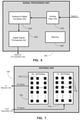
- FIG. 6 illustrates a stylized block diagram depiction of the signal processing unit of FIG. 1 , in accordance with embodiments herein;
- FIG. 7 illustrates a stylized block diagram depiction of the antenna unit of FIG. 1 , in accordance with embodiments herein;
- FIG. 8 illustrates a first multiband receiver circuit, in accordance with embodiments herein;
- FIG. 9 illustrates a second multiband receiver circuit, in accordance with embodiments herein.
- FIG. 10 illustrates a flowchart of a method, in accordance with embodiments herein;
- FIG. 11 illustrates a flowchart of a method, in accordance with embodiments herein.
- FIG. 12 illustrates a stylized depiction of a system for fabricating a semiconductor device, in accordance with embodiments herein.
- Embodiments herein provide for multiband receivers for millimeter wave (mm-wave) devices with one or more of lower size and lower power consumption.
- mm-wave millimeter wave
- FIG. 1 a stylized block diagram representation of an mm-wave system, in accordance with embodiments herein, is illustrated.
- a system 100 may comprise an mm-wave device 110 and a database 170 .
- the mm-wave device 110 may be a communication device or alternatively, a radar device, a wireless communication device, a data network device, a video device, or the like.
- the mm-wave device 110 is described in the context of a 5G or WiGig communication application; as such, the mm-wave device 110 may also be referred to below as a communication device 110 .
- the concepts described herein may be applied to a variety of type of mm-wave applications, including vehicle applications using radar signals, wireless network applications, data network applications, video and audio applications, etc.
- the communication device 110 is capable of transmitting a first communication signal, receiving a second communication signal, and processing the second communication signal.
- the mm-wave device 110 may comprise a communication unit front end unit 120 , an antenna unit 130 , a controller unit 140 , and a signal processing unit 150 .
- the communication front end unit 120 may comprise a plurality of components, circuit, and/or modules, and is capable of sending, receiving, and processing communication signals.
- the mm-wave device 110 may be encompassed into a single integrated circuit (IC) chip.
- the mm-wave device 110 may be formed on a plurality of integrated circuits that are positioned on a single IC chip. In other embodiments, mm-wave device 110 may be formed on single integrated circuit, which is shrouded into an IC chip.
- the communication front end unit 120 is capable of providing an output signal, e.g., a first communication signal.
- the frequency range of the communication signals processed by the mm-wave device 110 may be in the range of about 10 GHz to about 90 GHz.
- the communication front end unit 120 may be a network communications front end unit.
- the mm-wave device 110 may process network communications for various types of communication applications, such as packet data network communications, wireless (e.g., cellular communications, IEEE 802.11ad WiGig Technology, etc.), data communications, etc.
- the concepts disclosed herein may also be utilized for other types of applications, such as network communications, wireless communications, high-definition video, etc.
- the antenna unit 130 may also comprise a transmission antenna and/or a receiver antenna. Further, each of the transmission and receiver antennas may comprise sub-portions to form an array of antennas. The transmission antennas are used for transmitting the first communication signal, while the receiver antennas are used for receiving the second communication signal. A more detailed description of the antenna unit 130 is provided in FIG. 7 , and accompanying description below.
- the mm-wave device 110 may also comprise a signal processing unit 150 .
- the signal processing unit is capable of performing various analog and/or digital processing of the signals that are transmitted and/or received by the mm-wave device 110 .
- the first communication signal transmitted by the mm-wave device 110 may be amplified prior to its transmission.
- the second communication signal received by the mm-wave device 110 may be sent through one or more analog filter stages.
- the received communication signals may then be converted to a digital signal by one or more analog-to-digital converters (DAC) in the signal processing unit 150 .
- Digital signal processing (DSP) may be performed on the digitized signal.
- the mm-wave device 110 may also comprise a controller unit 140 .
- the controller unit 140 may perform various control operations of the mm-wave device 110 . These functions include generating a communication signal, transmitting the communication signal, receiving an incoming communication signal, and processing the incoming communication signal
- the controller unit 140 may comprise a processor unit 230 capable of controlling various function of the device 110 .
- the processor unit 230 may comprise a microprocessor, a microcontroller, a field programmable gate array (FPGA), an application-specific integrated circuit (ASIC), and/or the like.
- the controller unit 140 may also comprise a logic unit 220 .
- the logic unit 220 may comprise a circuit that is capable of performing various logic operations, receiving data, and/or performing interface functions with respect to input data (data_in) and output data (data_out).
- the signal data_in may represent data derived from processing and analyzing a received communication signal.
- the data_out signal may represent data generated for a transmitted communication signal.
- the controller unit 140 may also comprise a memory unit 210 .
- the memory unit 210 may comprise a non-volatile memory 214 and a RAM 212 .
- the non-volatile memory 214 may comprise FLASH memory and/or programmable read only (PROM) devices.
- the memory unit 210 is capable of storing operation parameters for controlling operations of the device 110 .
- the memory unit 210 may also store data that may be used to program any FPGA devices in the mm-wave device 110 . As such, the memory unit 210 may be subdivided into a program data memory, a status data memory, and a reaction data memory. This subdivision may be performed logically, or physically.
- the communication front end unit 120 may comprise a signal generation unit 310 , a transmitter unit 320 , and a receiver unit 330 .
- the signal generation unit 310 is capable of generating a communication signal at a predetermined frequency. For example, a signal in the range of about 70 GHz to about 85 GHz may be generated.
- the signal generation unit 310 is capable of providing a communication signal for transmission. More detailed description of the signal generation unit 310 is provided below.
- a signal for processing and transmission is provided by signal generation unit 310 to the transmitter unit 320 .
- the transmitter unit 320 may comprise a plurality of filters, signal conditioning circuits, buffer, amplifiers, etc. for processing the signal from the signal generation unit 310 .
- the transmission unit 320 provides a communication signal to be transmitted to the antenna unit 130 .
- FIG. 4 illustrates a stylized block diagram of the transmitter unit 320 , in accordance with embodiments herein.
- the transmitter unit 320 may comprise a plurality of similar transmitters, i.e., a 1 st transmitter 410 a , a 2 nd transmitter 410 b , through an N th transmitter 410 n (collectively “410”).
- the 1 st through N th transmitters 410 may each process a single signal from the signal generation unit 310 and provide an output transmission signal to one or more antennas.
- the signal generation unit 310 may provide a plurality of signals to the through N th transmitters 410 .
- the signal generation unit 310 may provide a signal transmit signal for each transmitter 410 , or alternatively, a 1 4 transmit signal for a first set of transmitters 410 and a 2 nd transmit signal for a second set of transmitters 410 .
- a received signal (i.e., a received communication signal) is provided to the receiver unit 330 .
- the receiver unit 330 is capable of receiving the processed received signal from the signal processing unit 130 .
- the receiver unit 330 is capable of performing analog-to-digital (A/D) conversion, signal buffering, DSP, etc.
- the signal processing unit 130 may perform A/D conversions and DSP; however, in other embodiments, these tasks may be performed by the receiver unit 330 .
- the receiver unit 330 is capable of directing data_out to the controller unit 140 .
- FIG. 5 illustrates a stylized block diagram of the receiver unit 320 , in accordance with embodiments herein.
- the receiver unit 320 may comprise a plurality of similar receivers, i.e., a 1 st receiver 510 a , a 2 nd receiver 510 b , through an N th receiver 510 n (collectively “ 510 ”).
- the 1 st through N th receiver 510 may each process a single signal from the signal generation unit 310 and provide the signal to the controller unit 140 .
- the may provide a plurality of signals to the through N th receiver 510 .
- the antenna unit 130 may provide a signal to each receiver 510 , or alternatively, a 1 4 receiver signal for a first set of receivers 510 and a 2 nd receiver signal for a second set of receivers 510 .
- the signal processing unit 150 may comprise an analog filter unit 610 , an A/D converter 620 , a DSP unit 630 , and a memory 640 .
- the analog filter unit 610 is capable of performing filtering as well as amplification of the analog mm-wave signal received by the signal processing unit 150 . Noise filtering may be performed by the analog filter unit 610 prior to performing amplification of the analog mm-wave signal.
- the A/D converter 620 is capable of converting the filtered and/or amplified analog signal into a digital signal.
- the A/D converter 620 may be capable of performing conversions of predetermined or varying accuracy.
- the A/D converter 620 may have an accuracy of 12-bit, 24-bit, 36-bit, 48-bit, 64-bit, 96-bit, 128-bit, 256-bit, 512-bit, 1024-bit, or greater accuracy.
- the converted digital mm-wave signal is provided to the DSP unit 630 .
- the DSP unit 630 is capable of performing a variety of DSP operations on the digital mm-wave signal. For example, digital filtering of the digital mm-wave may be performed by the DSP unit 630 . As an example, signal components outside of a predetermined frequency range, e.g., 70 GHz to about 85 GHz may be filtered to be of lower amplitude. In other instances, mathematical functions, such as a Fast Fourier Transform (FFT) may be performed on the mm-wave signal.
- FFT Fast Fourier Transform
- the processed digital output from the DSP unit 630 may be sent to the controller unit 140 for analysis. In other instances, the digital output may be buffered or stored into a memory 640 . In some cases, the memory 610 may be a first-in-first-out (FIFO) memory. In other cases, the processed digital output from the DSP unit 630 may be stored in the memory unit 210 of the controller unit 140 .
- FIFO first-in-first-out
- Millimeter-wave signals to be sent out may be provided by the transmitter unit 320 ( FIG. 3 ) to the transmit antenna 710 .
- the transmit antenna 710 may comprise a plurality of transmit antenna portions 715 .
- the transmit antenna portions 715 are arranged in a predetermined pattern, e.g., an array matrix, as exemplified in FIG. 7 .
- Millimeter-wave signals that are to be received may be captured by the receive antenna 720 .
- the receive antenna 720 provides the received mm-wave signals to the receiver unit 330 ( FIG. 3 ).
- the receive antenna 720 may comprise a plurality of receive antenna portions 725 .
- the receive antenna portions 725 are also arranged in a predetermined pattern, e.g., an array matrix exemplified in FIG. 7 .
- FIG. 8 depicts an implementation of a first multiband receiver 800 , in accordance with embodiments herein.
- the first multiband receiver 800 comprises a first band path 810 .
- the first band path 810 comprises a first passive mixer 813 configured to receive (e.g., from a first RF signal source 811 ) a first input radio frequency (RF) signal having a first frequency.
- RF radio frequency
- the first RF signal source 811 may comprise a switch actuated by a signal from a transmitter, such that the first band path 810 only receives the first input RF signal from upstream components (not shown) when the transmitter is not transmitting.
- the first input RF signal may be amplified by a first low noise amplifier 812 prior to being provided to the first passive mixer 813 .
- the first frequency may be about 28 GHz, e.g., from 24.25 GHz to 29.50 GHz. In one embodiment, the first frequency may be about 40 GHz, e.g., from 37 GHz to 43.5 GHz. In one embodiment, the first frequency may be a frequency within a first frequency range specified by a 5G telecommunications standard.
- the first passive mixer 813 is driven by a first local oscillator signal, such as may be provided by a digital phase locked loop (DPLL) 840 , and controlled by a first enable signal (EN 1 ).
- the first local oscillator signal may have a frequency about two-thirds of the first frequency. In one embodiment, if the first frequency is about 28 GHz, the frequency of the first local oscillator signal may be about 18 GHz. For example, if the first frequency is in the range from 24.25 GHz to 29.50 GHz, the frequency of the first local oscillator signal may be from 16.17 GHz to 19.67 GHz.
- the first passive mixer 813 is configured to provide a first intermediate RF signal having a frequency about one-third of the first frequency. In one embodiment, if the first frequency is about 28 GHz, the frequency of the first intermediate RF signal may be about 9 GHz (e.g., from 8.08 GHz to 9.83 GHz).
- the architecture of the first band path 810 is depicted in FIG. 8 as receiving a single-ended input.
- the first band path 810 may be configured to receive a differential input.
- the first band path 810 may provide a single-ended output or alternatively, a differential output.
- the first band path 810 provides a differential first intermediate RF signal comprising “I” and “Q” components having a 90° phase shift therebetween.
- the first band path 810 may further comprise a first gain stage 814 configured to increase the gain of the first intermediate RF signal.
- the first gain stage 814 may comprise an inverter and a feedback resistor.
- one or more of the components 812 , 813 , or 814 of the first band path 810 may be a fully depleted silicon on insulator (FDSOI) device.
- FDSOI fully depleted silicon on insulator
- the first multiband receiver 800 also comprises a second band path 820 comprising a second passive mixer 823 configured to receive (e.g., from a second RF signal source 821 ) a second input RF signal having a second frequency.
- the second frequency may be a frequency within a first frequency range specified by a 5G telecommunications standard, such as about 28 GHZ or about 40 GHz.
- the second frequency differs from the first frequency.
- the second RF signal source 821 may comprise a switch actuated by a signal from a transmitter, such that the second band path 820 only receives the second input RF signal from upstream components (not shown) when the transmitter is not transmitting.
- the first RF signal source 811 and the second RF signal source 822 may be controlled such that only one of the first band path 810 and the second band path 820 is enabled at any one time.
- the second input RF signal may be amplified by a second low noise amplifier 822 prior to being provided to the second passive mixer 823 .
- the second passive mixer 823 is driven by a second local oscillator signal, such as may be provided by DPLL 840 , and controlled by a second enable signal (EN 2 ).
- the second local oscillator signal may have a frequency about two-thirds of the second frequency. For example, if the second frequency is about 40 GHz (e.g., from 37 GHz to 43.5 GHz), the second local oscillator signal may be about 27 GHz (e.g., from 24.6 GHz to 29 GHz).
- the second passive mixer 823 is configured to provide a second intermediate RF signal having a frequency about one-third of the second frequency.
- the frequency of the second intermediate RF signal may be about 13 GHz, such as from about 12.3 GHz to about 13.3 GHz.
- the architecture of the second band path 820 is depicted in FIG. 8 as receiving a single-ended input.
- the second band path 820 may be configured to receive a differential input.
- the second band path 820 may provide a single-ended output or a differential output.
- the second band path 820 provides a differential second intermediate RF signal comprising “I” and “Q” components having a 90° phase shift therebetween.
- the second band path 820 further comprises a second gain stage 824 configured to increase the gain of the second intermediate RF signal.
- the second gain stage 824 may comprise an inverter and a feedback resistor.
- one or more of the components 822 , 823 , or 824 of the second band path 820 may be an FDSOI device.
- the first multiband receiver 800 also comprises a base band path 830 .
- the base band path 830 comprises a third passive mixer 833 configured to receive the first (differential) intermediate RF signal during a first period of a duty cycle and the second (differential) intermediate RF signal during a second period of the duty cycle.
- the third passive mixer 833 comprises mixer 833 i , configured to receive the “I” components of the intermediate RF signals, and mixer 833 q , configured to receive the “Q” components of the intermediate RF signals.
- the mixers 833 i and 833 q may be controlled by control signals EN i and EN q , respectively, such that the mixers 833 i and 833 q are only active at desired times during the duty cycle.
- the base band path 830 may further comprise a coupling capacitor 831 between the first and second band paths 810 , 820 and the third passive mixer 833 .
- the coupling capacitor 831 may provide high-pass filtering of the intermediate RF signals.
- the coupling capacitor 831 may decouple other devices 833 , 834 of the base band path 830 from bias induced by the gain stages 814 , 824 .
- the coupling capacitor 831 may block the flow of any direct current signals generated by the passive mixers 813 , 823 .
- the third passive mixer 833 is driven by a third local oscillator signal having a frequency about one-third of the first frequency during the first period, and is driven by a fourth local oscillator signal having a frequency about one-third of the second frequency during the second period.
- the frequency of the third local oscillator may be about one-half of the frequency of the first local oscillator driving the first passive mixer 813
- the frequency of the fourth local oscillator may be about one-half of the frequency of the second local oscillator driving the second passive mixer 823 .
- the third local oscillator signal and the fourth local oscillator signal for the third passive mixer 833 may require lower loading and accordingly may consume less power than other multiband receivers.
- the frequency of the third local oscillator may be about 9 GHZ, e.g., from 8.08 GHz to 9.83 GHz.
- the frequency of the fourth local oscillator may be about 13 GHz, such as from 12.33 GHZ to 14.5 GHz.
- the third and fourth local oscillator signals may be provided by dividing the first and second local oscillator signals at a first frequency divider 851 and a second frequency divider 852 , respectively.
- the third passive mixer 833 is configured to provide a first differential output signal having a frequency about one-third of the first frequency during the first period, and is configured to provide a second differential output signal having a frequency about one-third of the second frequency during the second period.
- the frequency of the first differential output signal may be about 9 GHz, such as from 8.08 GHz to 9.83 GHz.
- the second frequency is about 40 GHz
- the frequency of the second differential output signal may be about 13 GHz, such as from 12.3 GHz to 13.3 GHz.
- the base band path 830 may comprise a transimpedance amplifier (TIA) 834 (e.g., TIAs 834 i and 834 q for particular components of the first and second differential output signals) configured to receive the first differential output signal and the second differential output signal.
- TIA transimpedance amplifier
- Each TIA 834 i , 834 q may comprise an inverter, and a resistor and capacitor, which latter two may provide low-pass filtering.
- one or more of the components 831 , 833 , or 834 of the base band path 830 may be an FDSOI device.
- the base band path 830 provides differential output signals 861 to subsequent components of a device comprising the first multiband receiver 800 .
- the DPLL 840 of the first multiband receiver 800 is configured to provide the first local oscillator signal and the second local oscillator signal.
- the DPLL 840 may comprise two DCOs, one for each of the first and second band paths, and a multiplexer providing the first local oscillator signal at certain periods of the duty cycle and the second local oscillator signal at other periods of the duty cycle.
- the first multiband receiver 800 may contain two separated DPLLs, one for each of the first and second band paths.
- FIG. 9 depicts an implementation of a second multiband receiver 900 , in accordance with embodiments herein. Many of the components depicted in FIG. 9 will be the same or similar to components depicted in FIG. 8 and described above. Also, the first frequency, the second frequency, and the frequencies of the local oscillators will be the same or similar to those described above. Accordingly, the following description of FIG. 9 will focus on differences between FIG. 8 and FIG. 9 .
- the first band path 910 may comprise a first RF signal source 911 providing a first input RF signal having a first frequency; a first low noise amplifier 912 ; a first passive mixer 913 driven by a first local oscillator signal having a frequency about two-thirds of the first frequency and controlled by a first control signal EN 1 , wherein the first passive mixer 913 is configured to provide a first intermediate RF signal having a frequency about one-third of the first frequency; a first gain stage 914 ; and a first coupling capacitor 915 .
- the first band path 910 of the second multiband receiver 900 may also comprise a second passive mixer 916 configured to receive the first intermediate RF signal.
- the first intermediate RF signal may be differential, and as depicted, the second passive mixer 916 may comprise two mixing components 916 i and 916 q , for each of the “I” and “Q” components of the differential first intermediate RF signal, respectively.
- the mixing components 916 i and 916 q may each be controlled by an appropriate control signal (not shown for the sake of brevity).
- the second passive mixer 916 is driven by a second local oscillator signal having a frequency about one-third of the first frequency.
- the second passive mixer 916 is configured to provide a first differential output signal having a frequency about one-third of the first frequency.
- the second band path 920 may also comprise a second RF signal source 921 providing a second input RF signal having a second frequency; a second low noise amplifier 922 ; a third passive mixer 923 driven by a third local oscillator signal having a frequency about two-thirds of the second frequency, wherein the third passive mixer 923 is configured to provide a second intermediate RF signal having a frequency about one-third of the second frequency; a second gain stage 924 ; and a second coupling capacitor 925 .
- the second band path 920 also comprises a fourth passive mixer 926 configured to receive the second intermediate RF signal.
- the fourth passive mixer 926 is driven by a fourth local oscillator signal having a frequency about one-third of the second frequency.
- the fourth passive mixer 926 is configured to provide a second differential output signal having a frequency about one-third of the second frequency.
- FIG. 8 a notable difference between FIG. 8 and FIG. 9 is that, in FIG. 8 , the passive mixer 833 (comprising mixing components 833 i and 833 q ) down-converts the frequencies of both the first and second intermediate RF signals, whereas in FIG. 9 , the passive mixer 916 down-converts the frequency of the first intermediate RF signal and the passive mixer 926 down-converts the frequency of the second intermediate RF signal.
- the second multiband receiver 900 may also comprise a DPLL 940 configured to provide the first local oscillator signal and the third local oscillator signal.
- the second multiband receiver 900 may also comprise a first frequency divider 951 configured to receive the first local oscillator signal and provide the second local oscillator signal.
- the second multiband receiver 900 may also comprise a second frequency divider 952 configured to receive the third local oscillator signal and provide the fourth local oscillator signal.
- the second multiband receiver 900 may also comprise a base band path comprising a transimpedance amplifier 930 configured to receive the first differential output signal from the first band path 910 and the second differential output signal from the second band path 920 , and provide differential output signals 961 .
- FIG. 10 provides a flowchart of a method 1000 , in accordance with embodiments herein.
- the method 1000 comprises forming (at 1010 ) a first band path.
- the first band path comprises a first passive mixer configured to receive a first input radio frequency (RF) signal having a first frequency, wherein the first passive mixer is driven by a first local oscillator signal having a frequency about two-thirds of the first frequency, and is configured to provide a first intermediate RF signal having a frequency about one-third of the first frequency.
- the first frequency is about 28 GHz.
- forming (at 1010 ) comprises forming at least one fully depleted silicon on insulator (FDSOI) device.
- FDSOI fully depleted silicon on insulator
- Forming (at 1010 ) may comprise forming a first low noise amplifier, wherein the first RF signal is provided by the first low noise amplifier to the first passive mixer.
- forming (at 1010 ) may comprise forming a first gain stage configured to increase the gain of the first intermediate RF signal.
- the method 1000 also comprises forming (at 1020 ) a second band path.
- the second band path comprises a second passive mixer configured to receive a second input RF signal having a second frequency, wherein the second passive mixer is driven by a second local oscillator signal having a frequency about two-thirds of the second frequency, and is configured to provide a second intermediate RF signal having a frequency about one-third of the second frequency.
- the second frequency is about 40 GHz.
- forming (at 1020 ) comprises forming at least one FDSOI device.
- Forming (at 1020 ) may comprise forming a second low noise amplifier, wherein the second RF signal is provided by the second low noise amplifier to the second passive mixer.
- forming (at 1020 ) may comprise forming a second gain stage configured to increase the gain of the second intermediate RF signal.
- the method 1000 also comprises forming (at 1030 ) a base band path.
- the base band path comprises a third passive mixer configured to receive the first intermediate RF signal during a first period of a duty cycle and the second intermediate RF signal during a second period of the duty cycle, wherein the third passive mixer is driven by a third local oscillator signal having a frequency about one-third of the first frequency during the first period, is driven by a fourth local oscillator signal having a frequency about one-third of the second frequency during the second period, is configured to provide a first differential output signal having a frequency about one-third of the first frequency during the first period, and is configured to provide a second differential output signal having a frequency about one-third of the second frequency during the second period.
- forming (at 1030 ) comprises forming at least one FDSOI device.
- Forming (at 1030 ) may comprise forming a coupling capacitor between the first and second band paths and the third passive mixer.
- forming (at 1030 ) may comprise forming a transimpedance amplifier configured to receive the first differential output signal and the second differential output signal.
- the method 1000 may also comprise forming a digital phase locked loop configured to provide the first local oscillator signal and the second local oscillator signal.
- the method 1000 may also comprise forming a first frequency divider configured to receive the first local oscillator signal and provide the third local oscillator signal; and a second frequency divider configured to receive the second local oscillator signal and provide the fourth local oscillator signal.
- FIG. 11 provides a flowchart of a method 1100 , in accordance with embodiments herein.
- the method 1100 comprises forming (at 1110 ) a first band path.
- the first band path may comprise a first passive mixer configured to receive a first input radio frequency (RF) signal having a first frequency, wherein the first passive mixer is driven by a first local oscillator signal having a frequency about two-thirds of the first frequency, and is configured to provide a first intermediate RF signal having a frequency about one-third of the first frequency; and a second passive mixer configured to receive the first intermediate RF signal, wherein the second passive mixer is driven by a second local oscillator signal having a frequency about one-third of the first frequency, and is configured to provide a first differential output signal having a frequency about one-third of the first frequency.
- the first frequency is about 28 GHz.
- Forming (at 1110 ) may also comprise forming a first low noise amplifier, wherein the first RF signal is provided by the first low noise amplifier to the first passive mixer.
- forming (at 1110 ) may comprise forming one or both of a first gain stage configured to increase the gain of the first intermediate RF signal, and a first coupling capacitor between the first gain stage and the second passive mixer.
- the method 1100 also comprises forming (at 1120 ) a second band path.
- the second band path may comprise a third passive mixer configured to receive a second input RF signal having a second frequency, wherein the third passive mixer is driven by a third local oscillator signal having a frequency about two-thirds of the second frequency, and is configured to provide a second intermediate RF signal having a frequency about one-third of the second frequency; and a fourth passive mixer configured to receive the second intermediate RF signal, wherein the fourth passive mixer is driven by a fourth local oscillator signal having a frequency about one-third of the second frequency, and is configured to provide a second differential output signal having a frequency about one-third of the second frequency.
- the second frequency is about 40 GHz.
- Forming (at 1120 ) may also comprise forming a second low noise amplifier, wherein the second RF signal is provided by the second low noise amplifier to the third passive mixer.
- forming (at 1120 ) may comprise forming one or both of a second gain stage configured to increase the gain of the second intermediate RF signal, and a second coupling capacitor between the second gain stage and the third passive mixer.
- the method 1100 may also comprise forming a digital phase locked loop configured to provide the first local oscillator signal and the third local oscillator signal.
- the method 1100 may also comprise forming a first frequency divider configured to receive the first local oscillator signal and provide the second local oscillator signal; and a second frequency divider configured to receive the third local oscillator signal and provide the fourth local oscillator signal.
- the method 1100 may also comprise forming a base band path comprising a transimpedance amplifier configured to receive the first differential output signal and the second differential output signal.
- a system 1200 of FIG. 12 may comprise a semiconductor device processing system 1210 and an integrated circuit design unit 1240 .
- the semiconductor device processing system 1210 may manufacture integrated circuit devices based upon one or more designs provided by the integrated circuit design unit 1240 .
- the semiconductor device processing system 1210 may comprise various processing stations, such as etch process stations, photolithography process stations, CMP process stations, etc. Each of the processing stations may comprise one or more processing tools 1214 and or metrology tools 1216 . Feedback based on data from the metrology tools 1216 may be used to modify one or more process parameters used by the processing tools 1214 for performing process steps.
- the semiconductor device processing system 1210 may also comprise an interface 1212 that is capable of providing communications between the processing tools 1214 , the metrology tools 1216 , and a controller, such as the processing controller 1220 .
- a controller such as the processing controller 1220 .
- One or more of the processing steps performed by the semiconductor device processing system 1210 may be controlled by the processing controller 1220 .
- the processing controller 1220 may be a workstation computer, a desktop computer, a laptop computer, a tablet computer, or any other type of computing device comprising one or more software products that are capable of controlling processes, receiving process feedback, receiving test results data, performing learning cycle adjustments, performing process adjustments, etc.
- the semiconductor device processing system 1210 may produce integrated circuits on a medium, such as silicon wafers. More particularly, the semiconductor device processing system 1210 may produce integrated circuits comprising a multiband receiver, such as the first multiband receiver 800 depicted in FIG. 8 or the second multiband receiver 900 depicted in FIG. 9 .
- a multiband receiver such as the first multiband receiver 800 depicted in FIG. 8 or the second multiband receiver 900 depicted in FIG. 9 .
- the production of integrated circuits by the semiconductor device processing system 1210 may be based upon the circuit designs provided by the integrated circuit design unit 1240 .
- the semiconductor device processing system 1210 may provide processed integrated circuits/devices 1215 on a transport mechanism 1250 , such as a conveyor system.
- the conveyor system may be sophisticated clean room transport systems that are capable of transporting semiconductor wafers.
- the semiconductor device processing system 1210 may implement a plurality of processing steps, e.g., the steps of the method 1000 described above and depicted in FIG. 10 .
- the items labeled “ 1215 ” may represent individual wafers, and in other embodiments, the items 1215 may represent a group of semiconductor wafers, e.g., a “lot” of semiconductor wafers.
- the integrated circuit or device 1215 may comprise a transistor, a capacitor, a resistor, a memory cell, a processor, and/or the like.
- the integrated circuit design unit 1240 of the system 1200 is capable of providing a circuit design that may be manufactured by the semiconductor device processing system 1210 . This may include information regarding whether a first multiband receiver 800 or a second multiband receiver 900 is to be manufactured; what signal frequency/ies are to be provided by a DPLL 840 / 1040 ; etc.
- the integrated circuit design unit 1240 may be capable of determining the number of devices (e.g., processors, memory devices, etc.) to place in a device package. Based upon such details of the devices, the integrated circuit design unit 1240 may determine specifications of the devices that are to be manufactured. Based upon these specifications, the integrated circuit design unit 1240 may provide data for manufacturing a semiconductor device package described herein.
- devices e.g., processors, memory devices, etc.
- the system 1200 may be capable of performing analysis and manufacturing of various products involving various technologies.
- the system 1200 may receive design and production data for manufacturing devices of CMOS technology, Flash technology, BiCMOS technology, power devices, memory devices (e.g., DRAM devices), NAND memory devices, and/or various other semiconductor technologies. This data may be used by the system 1200 to fabricate semiconductor devices described herein.
Landscapes
- Engineering & Computer Science (AREA)
- Computer Networks & Wireless Communication (AREA)
- Signal Processing (AREA)
- Microelectronics & Electronic Packaging (AREA)
- Power Engineering (AREA)
- Transceivers (AREA)
- Superheterodyne Receivers (AREA)
Abstract
Description
Claims (20)
Priority Applications (2)
| Application Number | Priority Date | Filing Date | Title |
|---|---|---|---|
| US16/833,663 US11228325B2 (en) | 2018-04-10 | 2020-03-30 | Multiband receivers for millimeter wave devices |
| US17/556,624 US11791848B2 (en) | 2018-04-10 | 2021-12-20 | Multiband receivers for millimeter wave devices |
Applications Claiming Priority (3)
| Application Number | Priority Date | Filing Date | Title |
|---|---|---|---|
| US201862655629P | 2018-04-10 | 2018-04-10 | |
| US15/967,281 US10944437B2 (en) | 2018-04-10 | 2018-04-30 | Multiband receivers for millimeter wave devices |
| US16/833,663 US11228325B2 (en) | 2018-04-10 | 2020-03-30 | Multiband receivers for millimeter wave devices |
Related Parent Applications (1)
| Application Number | Title | Priority Date | Filing Date |
|---|---|---|---|
| US15/967,281 Continuation US10944437B2 (en) | 2018-04-10 | 2018-04-30 | Multiband receivers for millimeter wave devices |
Related Child Applications (1)
| Application Number | Title | Priority Date | Filing Date |
|---|---|---|---|
| US17/556,624 Continuation US11791848B2 (en) | 2018-04-10 | 2021-12-20 | Multiband receivers for millimeter wave devices |
Publications (2)
| Publication Number | Publication Date |
|---|---|
| US20200228149A1 US20200228149A1 (en) | 2020-07-16 |
| US11228325B2 true US11228325B2 (en) | 2022-01-18 |
Family
ID=67991728
Family Applications (2)
| Application Number | Title | Priority Date | Filing Date |
|---|---|---|---|
| US16/833,663 Active 2038-08-08 US11228325B2 (en) | 2018-04-10 | 2020-03-30 | Multiband receivers for millimeter wave devices |
| US17/556,624 Active 2038-05-26 US11791848B2 (en) | 2018-04-10 | 2021-12-20 | Multiband receivers for millimeter wave devices |
Family Applications After (1)
| Application Number | Title | Priority Date | Filing Date |
|---|---|---|---|
| US17/556,624 Active 2038-05-26 US11791848B2 (en) | 2018-04-10 | 2021-12-20 | Multiband receivers for millimeter wave devices |
Country Status (2)
| Country | Link |
|---|---|
| US (2) | US11228325B2 (en) |
| DE (1) | DE102019203172B4 (en) |
Citations (8)
| Publication number | Priority date | Publication date | Assignee | Title |
|---|---|---|---|---|
| US20070066254A1 (en) | 2005-09-16 | 2007-03-22 | Kabushiki Kaisha Toshiba | Analog signal processing circuit and communication device therewith |
| WO2014054908A1 (en) | 2012-10-05 | 2014-04-10 | Samsung Electronics Co., Ltd. | High-throughput beamforming mimo receiver for millimeter wave communication and method |
| US20140378077A1 (en) | 2012-02-03 | 2014-12-25 | Teelfonaktiebolaget L M Ericsson (publ) | Down-conversion circuit |
| US20150173091A1 (en) | 2013-12-12 | 2015-06-18 | Nokia Solutions And Networks Oy | Band and channel selection in 5g |
| US9294264B2 (en) | 2011-08-31 | 2016-03-22 | Renesas Electronics Corporation | High-frequency signal processing device and wireless communication system |
| US10411745B1 (en) * | 2018-04-05 | 2019-09-10 | Speedlink Technology Inc. | Broadband image-reject receiver for multi-band millimeter-wave 5G communication |
| US20190312604A1 (en) * | 2018-04-05 | 2019-10-10 | Speedlink Technology Inc. | Broadband receiver for multi-band millimeter-wave wireless communication |
| US20200091608A1 (en) * | 2016-12-21 | 2020-03-19 | Intel Corporation | Wireless communication technology, apparatuses, and methods |
-
2019
- 2019-03-08 DE DE102019203172.2A patent/DE102019203172B4/en active Active
-
2020
- 2020-03-30 US US16/833,663 patent/US11228325B2/en active Active
-
2021
- 2021-12-20 US US17/556,624 patent/US11791848B2/en active Active
Patent Citations (8)
| Publication number | Priority date | Publication date | Assignee | Title |
|---|---|---|---|---|
| US20070066254A1 (en) | 2005-09-16 | 2007-03-22 | Kabushiki Kaisha Toshiba | Analog signal processing circuit and communication device therewith |
| US9294264B2 (en) | 2011-08-31 | 2016-03-22 | Renesas Electronics Corporation | High-frequency signal processing device and wireless communication system |
| US20140378077A1 (en) | 2012-02-03 | 2014-12-25 | Teelfonaktiebolaget L M Ericsson (publ) | Down-conversion circuit |
| WO2014054908A1 (en) | 2012-10-05 | 2014-04-10 | Samsung Electronics Co., Ltd. | High-throughput beamforming mimo receiver for millimeter wave communication and method |
| US20150173091A1 (en) | 2013-12-12 | 2015-06-18 | Nokia Solutions And Networks Oy | Band and channel selection in 5g |
| US20200091608A1 (en) * | 2016-12-21 | 2020-03-19 | Intel Corporation | Wireless communication technology, apparatuses, and methods |
| US10411745B1 (en) * | 2018-04-05 | 2019-09-10 | Speedlink Technology Inc. | Broadband image-reject receiver for multi-band millimeter-wave 5G communication |
| US20190312604A1 (en) * | 2018-04-05 | 2019-10-10 | Speedlink Technology Inc. | Broadband receiver for multi-band millimeter-wave wireless communication |
Non-Patent Citations (3)
| Title |
|---|
| J. Paramesh, et al.; Wideband Millimeter-wave Beamforming Receivers in Silicon; Carnegie Mellon University; WSO: Towards 5G: Circuits, Systems, MIMO, and Beamforming IMS/RFIC Workshop, Phoenix, Arizona, May 17, 2015; pp. 1-34. |
| Office Action dated Oct. 31, 2019 of co-pending U.S. Appl. No. 15/967,281, filed Apr. 30, 2018. |
| S. Bonkers, Wireless Receiver Architecture Towards 5G: Where Are We?, IEEE Circuits and Systems Magazine, pp. 6-16, Aug. 2017. |
Also Published As
| Publication number | Publication date |
|---|---|
| DE102019203172B4 (en) | 2024-08-14 |
| US11791848B2 (en) | 2023-10-17 |
| DE102019203172A1 (en) | 2019-10-10 |
| US20200228149A1 (en) | 2020-07-16 |
| US20220200636A1 (en) | 2022-06-23 |
Similar Documents
| Publication | Publication Date | Title |
|---|---|---|
| US10483917B2 (en) | Power amplifier for millimeter wave devices | |
| US10680557B2 (en) | Method and apparatus for using back gate biasing for power amplifiers for millimeter wave devices | |
| US11114736B2 (en) | Multi-channel power combiner with phase adjustment | |
| CN109951157B (en) | Method, apparatus and system for a frequency doubler of a millimeter wave device | |
| US10326420B1 (en) | Receiver circuits for millimeter wave devices | |
| US10574245B2 (en) | Digitally controlled oscillator for a millimeter wave semiconductor device | |
| US20090081961A1 (en) | Method and system for injection locking an oscillator via frequency multiplication of a multiphase signal | |
| US10594356B1 (en) | Methods, apparatus, and system for high-bandwidth on-mold antennas | |
| US11791848B2 (en) | Multiband receivers for millimeter wave devices | |
| US10944437B2 (en) | Multiband receivers for millimeter wave devices | |
| US20090080541A1 (en) | Method and system for transmission and/or reception of signals utilizing a delay circuit and ddfs | |
| TWI764219B (en) | Transmitter unit suitable for millimeter-wave devices | |
| US10432179B1 (en) | Methods, apparatus, and system for frequency doubler using a passive mixer for millimeter wave devices | |
| US10924058B2 (en) | Local oscillator distribution for a millimeter wave semiconductor device | |
| CN116930945A (en) | Local oscillator allocation for millimeter wave semiconductor devices |
Legal Events
| Date | Code | Title | Description |
|---|---|---|---|
| AS | Assignment |
Owner name: GLOBALFOUNDRIES INC., CAYMAN ISLANDS Free format text: ASSIGNMENT OF ASSIGNORS INTEREST;ASSIGNORS:BELLAOUAR, ABDELLATIF;FANG, SHER JIUN;ZHANG, FRANK;SIGNING DATES FROM 20180414 TO 20180424;REEL/FRAME:052265/0759 |
|
| FEPP | Fee payment procedure |
Free format text: ENTITY STATUS SET TO UNDISCOUNTED (ORIGINAL EVENT CODE: BIG.); ENTITY STATUS OF PATENT OWNER: LARGE ENTITY |
|
| STPP | Information on status: patent application and granting procedure in general |
Free format text: DOCKETED NEW CASE - READY FOR EXAMINATION |
|
| AS | Assignment |
Owner name: GLOBALFOUNDRIES U.S. INC., CALIFORNIA Free format text: ASSIGNMENT OF ASSIGNORS INTEREST;ASSIGNOR:GLOBALFOUNDRIES INC.;REEL/FRAME:054633/0001 Effective date: 20201022 |
|
| AS | Assignment |
Owner name: GLOBALFOUNDRIES U.S. INC., NEW YORK Free format text: RELEASE BY SECURED PARTY;ASSIGNOR:WILMINGTON TRUST, NATIONAL ASSOCIATION;REEL/FRAME:056987/0001 Effective date: 20201117 Owner name: GLOBALFOUNDRIES U.S. INC., NEW YORK Free format text: RELEASE OF SECURITY INTEREST;ASSIGNOR:WILMINGTON TRUST, NATIONAL ASSOCIATION;REEL/FRAME:056987/0001 Effective date: 20201117 |
|
| STPP | Information on status: patent application and granting procedure in general |
Free format text: NOTICE OF ALLOWANCE MAILED -- APPLICATION RECEIVED IN OFFICE OF PUBLICATIONS |
|
| STPP | Information on status: patent application and granting procedure in general |
Free format text: PUBLICATIONS -- ISSUE FEE PAYMENT VERIFIED |
|
| STCF | Information on status: patent grant |
Free format text: PATENTED CASE |
|
| MAFP | Maintenance fee payment |
Free format text: PAYMENT OF MAINTENANCE FEE, 4TH YEAR, LARGE ENTITY (ORIGINAL EVENT CODE: M1551); ENTITY STATUS OF PATENT OWNER: LARGE ENTITY Year of fee payment: 4 |