US11227159B2 - Explanatory visualizations for object detection - Google Patents
Explanatory visualizations for object detection Download PDFInfo
- Publication number
- US11227159B2 US11227159B2 US16/876,540 US202016876540A US11227159B2 US 11227159 B2 US11227159 B2 US 11227159B2 US 202016876540 A US202016876540 A US 202016876540A US 11227159 B2 US11227159 B2 US 11227159B2
- Authority
- US
- United States
- Prior art keywords
- digital image
- proposal
- series
- pixels
- similarity
- Prior art date
- Legal status (The legal status is an assumption and is not a legal conclusion. Google has not performed a legal analysis and makes no representation as to the accuracy of the status listed.)
- Active, expires
Links
Images




Classifications
-
- G06K9/00671—
-
- G—PHYSICS
- G06—COMPUTING OR CALCULATING; COUNTING
- G06T—IMAGE DATA PROCESSING OR GENERATION, IN GENERAL
- G06T11/00—Two-dimensional [2D] image generation
-
- G—PHYSICS
- G06—COMPUTING OR CALCULATING; COUNTING
- G06F—ELECTRIC DIGITAL DATA PROCESSING
- G06F18/00—Pattern recognition
- G06F18/20—Analysing
- G06F18/22—Matching criteria, e.g. proximity measures
-
- G—PHYSICS
- G06—COMPUTING OR CALCULATING; COUNTING
- G06F—ELECTRIC DIGITAL DATA PROCESSING
- G06F18/00—Pattern recognition
- G06F18/20—Analysing
- G06F18/24—Classification techniques
-
- G06K9/4671—
-
- G06K9/6215—
-
- G06K9/6267—
-
- G—PHYSICS
- G06—COMPUTING OR CALCULATING; COUNTING
- G06T—IMAGE DATA PROCESSING OR GENERATION, IN GENERAL
- G06T7/00—Image analysis
- G06T7/70—Determining position or orientation of objects or cameras
-
- G—PHYSICS
- G06—COMPUTING OR CALCULATING; COUNTING
- G06V—IMAGE OR VIDEO RECOGNITION OR UNDERSTANDING
- G06V10/00—Arrangements for image or video recognition or understanding
- G06V10/70—Arrangements for image or video recognition or understanding using pattern recognition or machine learning
- G06V10/764—Arrangements for image or video recognition or understanding using pattern recognition or machine learning using classification, e.g. of video objects
-
- G—PHYSICS
- G06—COMPUTING OR CALCULATING; COUNTING
- G06V—IMAGE OR VIDEO RECOGNITION OR UNDERSTANDING
- G06V10/00—Arrangements for image or video recognition or understanding
- G06V10/70—Arrangements for image or video recognition or understanding using pattern recognition or machine learning
- G06V10/82—Arrangements for image or video recognition or understanding using pattern recognition or machine learning using neural networks
-
- G—PHYSICS
- G06—COMPUTING OR CALCULATING; COUNTING
- G06V—IMAGE OR VIDEO RECOGNITION OR UNDERSTANDING
- G06V20/00—Scenes; Scene-specific elements
-
- G—PHYSICS
- G06—COMPUTING OR CALCULATING; COUNTING
- G06V—IMAGE OR VIDEO RECOGNITION OR UNDERSTANDING
- G06V20/00—Scenes; Scene-specific elements
- G06V20/20—Scenes; Scene-specific elements in augmented reality scenes
-
- G—PHYSICS
- G06—COMPUTING OR CALCULATING; COUNTING
- G06T—IMAGE DATA PROCESSING OR GENERATION, IN GENERAL
- G06T2200/00—Indexing scheme for image data processing or generation, in general
- G06T2200/24—Indexing scheme for image data processing or generation, in general involving graphical user interfaces [GUIs]
Definitions
- Various embodiments concern computer programs and associated computer-implemented techniques for creating visualization components to explain the outputs produced by models designed for object detection in a form suitable for human consumption.
- Object detection is a challenging computer vision task that involves detecting the presence and location of semantic objects (or simply “objects”) in digital images.
- a computer-implemented model (or simply a “model”) designed for object detection is applied to the pixels.
- the model is represented by a series of algorithms that are applied, either sequentially or simultaneously, to the pixels to detect features that are representative of objects. For example, if a model is designed to identify human faces, then the underlying algorithms may search for a pair of eyes that are proximate to one another and surrounded by pixels whose color corresponds to skin tones. As another example, if a model is designed to identify buildings, then the underlying algorithms may search for perpendicular corners connected to sides of roughly equal lengths.
- ML-based approaches it is necessary to define the features of the object to be detected and then employ a technique such as support vector machine (SVM) to perform the detection.
- SVM support vector machine
- Examples of ML-based approaches include the Viola-Jones framework, scale-invariant feature transform (SIFT), and histogram of oriented gradients (HOG). Since DL-based approaches are based on neural networks, object detection can be performed without specifically defining the features. Instead, the neural networks can simply learn which features are important over time.
- DL-based approaches include region-proposal based approaches, such as Region-Based Convolutional Neural Network (R-CNN) and Fast R-CNN, Single Shot MultiBox Detector (SSD), and You Only Look Once (YOLO).
- R-CNN Region-Based Convolutional Neural Network
- SSD Single Shot MultiBox Detector
- YOLO You Only Look Once
- FIG. 1A illustrates a network environment that includes an editing platform.
- FIG. 1B illustrates an example of a computing device capable of implementing the techniques described herein.
- FIG. 2 includes a high-level illustration of a perturbation approach to explaining an output produced by a model designed for object detection.
- FIG. 3 depicts a flow diagram of a process for generating a set of masks.
- FIG. 4 depicts a flow diagram of a process for computing a similarity metric between a target vector and a proposal vector.
- FIG. 5 depicts a flow diagram of a process for programmatically explaining a reference output (also referred to as a “detection” or “prediction”) produced for a digital image by a model designed for object detection.
- a reference output also referred to as a “detection” or “prediction”
- FIG. 6 depicts a flow diagram of a process for generating a visualization (here, a saliency map) that explains why a reference output was produced for a digital image.
- a visualization here, a saliency map
- FIG. 7 depicts a flow diagram of another process for generating saliency maps for explaining predictions made by models without needing access to the weights, gradients, or architectures of those models.
- FIG. 8 includes several examples of explanations generated for missed detections (also referred to as “false negative detections”) and false positive detections.
- FIG. 9 includes several examples of explanations for poor localization and misclassification.
- FIG. 10 includes examples of saliency maps for several Microsoft Common Objects in Context (COCO) classes that were cropped, aligned, and averaged for all predictions.
- COCO Common Objects in Context
- FIG. 11 is a block diagram illustrating an example of a computing system in which at least some operations described herein can be implemented.
- computer vision involves understanding the content of digital images to produce useful information (e.g., in the form of decisions or predictions).
- object detection a model (also referred to as an “object detector”) is applied to the pixels that constitute a digital image in order to detect objects in that digital image.
- Each model is normally comprised of a series of algorithms that are trained to identify a single class of objects, such as humans, animals, buildings, vehicles, and the like. This series of algorithms may be referred to as a “neural network.”
- a neural network To detect multiple classes of objects, multiple models (and thus multiple neural networks) could be applied to a digital image, either sequentially or simultaneously. For instance, multiple models could be applied to a digital image in order to detect objects in different classes. Alternatively, a multi-headed model comprised of multiple neural networks could be applied to the digital image.
- Neural networks have become increasingly popular due to their ability to perform various computer vision tasks. However, it is difficult to understand how the outputs produced by neural networks can be attributed to the digital images that serve as the inputs. This is especially true for deep neural networks with multiple layers of algorithms.
- a graphics editing platform may perform a process for producing visualizations that does not require any knowledge of the weights, gradients, or architectures of the neural networks.
- Models with two-stage architectural designs include a proposal stage in which regions of interest (ROI) are selected followed by an extraction state in which each ROI is classified based on its features.
- ROI regions of interest
- the visualizations enable individuals to investigate the abilities implicitly learned by models that employ neural networks. This is beneficial in several respects. First, exploring spatial importance has historically been deemed redundant because it was assumed that models placed bounding boxes around all pixels deemed important. However, this assumption has been shown to be false. Neural networks may learn to utilize the surrounding pixels to determine whether an object is present. For instance, a neural network designed to identify sinks may search for other items, such as faucets or mirrors, that would be expected to be located nearby. The visualizations described herein can identify those surrounding pixels. Second, all pixels within a bounding box have historically been deemed equally important. This assumption has also been shown to be false. As further discussed below, the visualizations described herein are able to visually identify those regions that are more discriminant than others.
- Embodiments may be described with reference to particular types of classes, models, computer programs, digital images, etc. However, those skilled in the art will recognize that these features are equally applicable to other types of classes, models, computer programs, digital images, etc.
- embodiments may be described in the context of generating saliency maps that explain predictions made for two-dimensional digital images. However, features of these embodiments could be extended to three-dimensional digital images, such as those used in autonomous driving and medical applications.
- embodiments may be described in the context of an editing platform that employs a neural network with a two-stage architectural design, such as Faster R-CNN, to detect objects in digital images.
- features of these embodiments may be similarly applicable to editing platforms that employ neural networks with one-stage architectural designs, such as SSD and YOLO, to detect objects in digital images. Whether a neural network with a one- or two-stage architectural design is used may depend on the speed at which explanations should be produced. The approaches described herein are generally faster (e.g., by approximately 50 percent) when a neural network with a one-stage architectural design is employed.
- embodiments may include a machine-readable medium with instructions that, when executed, cause a computing device to perform a process for generating a series of masks, applying the series of masks to a digital image to produce masked versions of the digital image, applying a neural network to the masked versions of the digital image to produce predictions, establishing a degree of similarity between the predictions and a reference prediction (also referred to as a “ground truth”), and the generating a visualization based on the degree of similarity.
- a reference prediction also referred to as a “ground truth”
- FIG. 1A illustrates a network environment 100 that includes an editing platform 102 able to execute instructions for creating visualization components to explain the outputs produced by models that employ, for example, neural networks.
- the editing platform 102 may be comprised of a series of modules operable to encode a reference output for a digital image into a target vector, apply a series of masks to the digital image to create masked versions of the digital image, apply a model to each masked version of the digital image to generate a series of outputs indicative of alleged instances of objects, encode the series of outputs into a series of proposal vectors, and compute pairwise similarity between the target vector and the series of proposal vectors.
- module refers broadly to software components, firmware components, and/or hardware components. Accordingly, aspects of the editing platform 102 could be implemented in software, firmware, and/or hardware.
- an editing platform 2 can interface with the editing platform 102 via an interface 104 .
- An example of an editing platform 2 is a raster graphics editor through which individuals can view, create, or manipulate raster graphics.
- the editing platform 102 may be responsible for creating the interfaces through which these actions can be specified.
- the editing platform 102 may be responsible for creating the interfaces through which an individual can request an explanation for why an object was detected in a digital image, specify preferences, etc.
- the digital image to be examined is created/modified through the editing platform 102 .
- the digital image to be examined is uploaded to the editing platform 102 .
- an individual may access the editing platform 102 and then select, via an interface generated by the editing platform 102 , a digital image from a memory, cause a model designed for object detection to be applied to the digital image, and request an explanation for outputs, if any, produced by the model.
- the editing platform 102 may reside in a network environment 100 .
- the editing platform 102 may be connected to one or more networks 106 a - b .
- the network(s) 106 a - b can include personal area networks (PANs), local area networks (LANs), wide area networks (WANs), metropolitan area networks (MANs), cellular networks, the Internet, etc.
- PANs personal area networks
- LANs local area networks
- WANs wide area networks
- MANs metropolitan area networks
- cellular networks the Internet, etc.
- the editing platform 102 can be communicatively coupled to computing device(s) over a short-range communication protocol, such as Bluetooth® or near-field communication (NFC).
- a short-range communication protocol such as Bluetooth® or near-field communication (NFC).
- the interface 104 is preferably accessible via a web browser, desktop application, mobile application, and/or over-the-top (OTT) application. Accordingly, the interface 104 may be viewed on a personal computer, tablet computer, mobile phone, game console, music player, wearable electronic device (e.g., a watch or a fitness accessory), network-connected (“smart”) electronic device, (e.g., a television or a home assistant device), virtual/augmented reality system (e.g., a head-mounted display), or some other electronic device.
- OTT over-the-top
- the editing platform 102 are hosted locally. That is, the editing platform 102 may reside on the computing device used to access the interface 104 .
- the editing platform 102 may be embodied as a desktop application executing on a personal computer.
- Other embodiments of the editing platform 102 are executed by a cloud computing service operated by Amazon Web Services® (AWS), Google Cloud PlatformTM, Microsoft Azure®, or a similar technology.
- the editing platform 102 may reside on a network-accessible server system 108 comprised of one or more computer servers. These computer server(s) can include different types of data (e.g., digital images, bounding boxes, and labels), user information (e.g., profiles and credentials), and other assets.
- Embodiments may be described in the context of network-accessible interfaces. However, those skilled in the art will recognize that the interfaces need not necessarily be accessible via a network.
- a computing device may be configured to execute a self-contained computer program that does not require network access. Instead, the self-contained computer program may download assets (e.g., graphics, matching algorithms, and processing operations) at a single point in time or on a periodic basis (e.g., weekly, daily, or hourly).
- assets e.g., graphics, matching algorithms, and processing operations
- FIG. 1B illustrates an example of a computing device 150 capable of implementing the techniques described herein. Note that the components shown in FIG. 1B are merely illustrative. Components that are well known are not shown for simplicity.
- the computing device 150 includes a processor 152 , a memory 154 , and a display 156 .
- the computing device 150 may also include wireless communication circuitry 170 designed to establish wireless communication channels with other computing devices.
- the processor 152 can have generic characteristics similar to general-purpose processors, or the processor 152 may be an application-specific integrated circuit (ASIC) that provides arithmetic and control functions to the computing device 150 . While not shown, the processor 152 may include a dedicated cache memory.
- the processor 152 can be coupled to all components of the computing device 150 , either directly or indirectly, for data communication.
- the memory 154 may be comprised of any suitable type of storage device including, for example, a static random-access memory (SRAM), dynamic random-access memory (DRAM), electrically erasable programmable read-only memory (EEPROM), flash memory, latches, and/or registers.
- SRAM static random-access memory
- DRAM dynamic random-access memory
- EEPROM electrically erasable programmable read-only memory
- flash memory latches, and/or registers.
- the memory 154 can also store data generated by the processor 152 (e.g., when executing the modules of the editing platform 158 ).
- the memory 154 is merely an abstract representation of a storage environment.
- the memory 154 is comprised of one or more actual memory chips or modules.
- the display 156 can be, for example, a touch-enabled display or a non-touch-enabled display—in which case the computing device 150 likely also includes (or is connected to) an input device such as a keyboard.
- the wireless communication circuitry 170 can form and/or communicate with a network for data transmission among computing devices, such as personal computers, mobile phones, and computer servers.
- the wireless communication circuitry 170 can be used for communicating with these computing devices or for connecting to a higher-level network (e.g., a LAN) or the Internet.
- Examples of wireless communication circuitry 170 include Bluetooth, Z-Wave, ZigBee, and the like.
- the connection established by the wireless communication circuitry 170 can be bootstrapped by a near field communication (NFC) connection.
- NFC near field communication
- the editing platform 158 may be referred to as a computer program that resides within the memory 154 .
- the editing platform 158 could be comprised of software, firmware, and/or hardware components implemented in, or accessible to, the computing device 150 .
- the editing platform 158 includes a mask creation module 160 , a vector computation module 162 , an object detection module 164 , and an analysis module 166 . Similar to the editing platform 158 , each of these modules can be implemented via software, firmware, and/or hardware. As illustrated in FIG. 1B , these modules can be an integral part of the editing platform 158 .
- these modules can be logically separate from the editing platform 158 but operate “alongside” it. Together, these modules may enable the editing platform 158 to programmatically explain a reference output (also referred to as a “detection” or “prediction”) produced for a digital image by a model designed for object detection.
- a reference output also referred to as a “detection” or “prediction”
- the editing platform 158 can obtain (i) a digital image comprised of pixels and (ii) a reference output that includes information regarding an object of detected in the digital image.
- the reference output is obtained by the object detection module 164 that applies a model to the digital image, while in other embodiments the reference output is obtained from the memory 154 .
- the reference output need not necessarily be produced by the editing platform 158 .
- the vector computation module 162 can then encode the reference output into a target vector (also referred to as a “reference vectors”).
- the object detection module 164 can identify a model associated with a class of which the object is a part. For example, if the reference output is a bounding box that is labeled as containing a vehicle, then the model may be designed to identify instances of vehicles in digital images. Generally, the object detection module 164 will identify the model from amongst a library of models corresponding to different classes.
- the library of models may be stored in the memory 154 , or the library of models may be accessible to the editing platform 158 across a network (e.g., via a connection established by the wireless communication circuitry 170 ).
- the mask creation module 160 may create a series of masks based on the digital image. This process is further discussed below with respect to FIG. 3 . Moreover, the mask creation module 160 may apply the series of masks to the digital image to create masked versions of the digital image. In some embodiments, the masked digital images have identical dimensions as the original digital image. In other embodiments, the masks cause the masked digital images to be cropped with uniformly random offsets in either spatial direction. Thus, the masked digital images could include cropped (i.e., fully masked) regions along any of its sides.
- the object detection module 164 can then apply the model to the masked digital images to generate a series of outputs indicative of separate instances of objects.
- the model may employ a neural network to detect instances, if any, of objects in the class.
- each masked digital image is associated with at least one instance of an object.
- the model could identify multiple instances of objects in a single masked digital image.
- each output in the series of outputs could be associated with a different masked digital image, or multiple outputs in the series of outputs could be associated with a single masked digital image.
- the vector computation module 162 can then encode the series of outputs into a series of proposal vectors.
- the analysis module 166 can compute pairwise similarity between the target vector and the series of proposal vectors. More specifically, the analysis module 166 can compare the target vector and the series of proposal vectors so that for each proposal vector, a similarity metric is computed.
- the similarity metric for each proposal vector may be representative of the degree of similarity with the target vector based on a comparison of information encoded in those vectors.
- the analysis module 166 may associate each similarity metric with a corresponding masked digital image.
- each similarity metric is associated with a proposal vector that encodes information regarding a proposed output produced by a model upon being applied to a masked digital image, and the analysis module 166 may assign each similarity metric to the appropriate masked digital image.
- each masked digital image is associated with at least one similarity metric.
- multiple similarity metrics could be assigned to a single masked digital image if multiple objects were detected in that masked digital image.
- the analysis module 166 can assign the highest similarity metric to the corresponding mask as a weight metric. Accordingly, each mask will be associated with a weight metric that is indicative of the highest similarity metric calculated for objects, if any, detected in the corresponding masked digital image. Those skilled in the art will recognize that if no objects were detected in a masked digital image, then no similarity metrics will be assigned since no proposal vectors were created. In such instances, the corresponding mask can be assigned a weight metric of zero.
- the analysis module 166 can then compute a weighted sum of the masks. Such an approach will cause each pixel in the digital image to be associated with a weighted sum of the corresponding elements in the series of masks. These values may be loaded into a matrix having the same dimensions as the digital image.
- GUI graphical user interface
- Other modules could also be included as part of the editing platform 158 .
- a graphical user interface (GUI) module 168 may be responsible for generating the interfaces through which an individual can interact with the editing platform 158 , view information indicative of the outputs produced by the aforementioned modules, etc.
- the GUI module 168 could produce a visualization component, such as a saliency map, based on the matrix of values computed by the analysis module 166 , and then the GUI module 168 could post the visualization component to an interface presented on the display 156 .
- One approach focuses on backpropagating scores indicative of importance through the layers of a neural network from an output to the pixels of the digital image that serves as the input.
- this approach is disadvantageous since the technique is closely tailored to the architecture of the model and requires that the model is differentiable. Since the backpropagation path depends on the architecture of the model, this approach cannot be readily implemented across different models with different architectures.
- Another approach focuses on performing perturbations (e.g., inpainting, blurring, occluding) on regions of the digital image that serves as the input for a neural network.
- the importance of each region can be inferred based on the effect that a perturbation on those regions had on the output produced by the neural network. Since this approach can be extended across different architectures, it represents a more attractive option than the backpropagation approach.
- an editing platform obtains a digital image (I) comprised of pixels, a model (f) designed to detect objects in a given class, and a reference output (d) that identifies a region of pixels (also referred to as a “bounding box”) of the digital image that allegedly contains an object in the given class.
- the reference output also referred to as the “target output” also includes a label (e.g., “human,” “vehicle,” “sink,” or “giraffe”) that identifies the class to which the object belongs.
- the editing platform may wish to produce a saliency map (S) to explain the reference output.
- the saliency map may be represented by a matrix of discrete values indicative of the salience of the pixels in the digital image in influencing the reference output.
- the editing platform may be designed to solve this problem in a black-box manner. That is, the editing platform may attempt to produce the saliency map without needing access to the weights, gradients, or architecture of the model.
- the approaches described herein do not require that the model used for object detection is differentiable—unlike backpropagation-based approached—and thus can be applied to derive explanations for outputs produced by differentiable models and non-differentiable models.
- This approach is loosely inspired by the RISE approach described by Vitali Petisuk et al. in “RISE: Randomized Input Sampling for Explanation of Black-box Models,” British Machine Vision Conference (2016).
- the perturbation concepts described therein are leveraged to explain object detection rather than image classification.
- the editing platform may attempt to measure the effect of perturbing (e.g., masking) regions of the digital image on the outputs produced by the model and then infers the importance of these regions based on the measured effects on the output. For instance, the editing platform may produce masked versions of the digital image and then apply the model to those masked versions to discover what effect, if any, such a perturbation had on the outputs (e.g., the bounding boxes) produced by the model.
- FIG. 2 includes a high-level illustration of this perturbation approach.
- an editing platform can obtain a digital image along with one or more reference outputs.
- the digital image is accompanied by two reference outputs, namely, a first bounding box labeled as containing a person and a second bounding box labeled as containing a tennis racket.
- the editing platform can then generate a series of masks that are applied to the digital image to produce masked versions of the digital image.
- the editing platform can apply a model to the masked versions of the digital image to produce a series of proposed outputs (also referred to as “detection proposals”).
- each proposed output may be representative of a region of pixels that allegedly contains an object in the class the model is designed to detect.
- Pairwise similarity can then be established between the reference output(s) and the series of proposed outputs. For instance, pairwise similarity may be computed so that for each reference output, a similarity metric is produced for each proposal output.
- the highest similarity metric associated with each masked version of the digital image can be assigned to the corresponding mask as a weight metric, and then a weighted sum of the series of masks can be computed.
- the weighted sum of the series of masks may be represented as a saliency map that visually represents saliency of the corresponding reference output.
- the saliency maps may be useful in conveying how the reference outputs relate to the digital image.
- the first saliency map indicates that the handle of tennis racket was important in determining that a tennis racket is present
- the second saliency map indicates that the face and arm were important in determining that a person is present.
- the editing platform may incorporate additional data, such as localization information, classification information, and objectness scores, into the process by which visualizations are produced.
- each bounding box proposal is encoded into a separate vector (d i ).
- each vector may include localization information (L i ) that defines the corners (x 1 i , y 1 i ) and (x 2 i , y 2 i ) of the bounding box, an objectness score (O i ⁇ [0,1]) that represents the probability that the bounding box contains an object of any class, and classification information (P i ) that specifies the probabilities (p 1 i , . . . , p C i ) that the region of pixels within the bounding box belongs to each of a number of classes (C).
- the editing platform can construct a vector for a given bounding box by identifying the corners of the given bounding box, setting the objectness score to 1 to indicate that an object is contained therein, and then using a one-hot vector for the probabilities.
- the editing platform can generate a saliency map that visually highlights the regions important for the model in predicting such a reference output.
- the reference output need not necessarily have been produced by the model.
- the editing platform may obtain a reference output produced by another model (f 2 ) upon being applied to the digital image.
- the saliency map may be treated as a high-level explanation for how features in the digital image could be analyzed.
- the saliency map represents an explanation for what pixels would have been important in predicting the reference output, though that output may not actually have been predicted.
- the reference output was produced by the model under consideration, then the saliency map may be treated as an explanation for how the dimensions of the bounding box were determined.
- the editing platform can measure the importance of pixels inside and outside the bounding box by observing the effect that perturbation of these pixels has on the model. At a high level, if perturbing a pixel (or a series of pixels) has a significant impact on the output produced by the model, then the pixel (or the series of pixels) is likely considered important by the model.
- detection models are designed and then trained with regression objectives unlike classification models.
- detection models may not have a proposal that directly corresponds to the reference output, which could be an arbitrary bounding box. Instead, multiple bounding boxes may be proposed that overlap to varying degrees. Therefore, it is important that the editing platform determine not only how the disturbance in the output is measured but also where the disturbance is measured.
- the editing platform may produce similarity metrics (s) indicative of the pairwise similarity between a reference output and a series of proposed outputs representing.
- the reference output may be representative of the output produced by a model when applied to a digital image
- the series of proposed outputs may be representative of the outputs produced by the model when applied to a series of masked versions of the digital image.
- the editing platform can infer the disturbance caused by each mask based on the similarity metrics. As further discussed below, the editing platform can select the proposed output with the highest pairwise similarity between a target vector (also referred to as the reference vector”) associated with the reference output and all proposal vectors produced for a masked version of the digital image.
- a target vector also referred to as the reference vector
- the editing platform can sample smaller binary masks and then upsample those masks to larger resolution using bilinear interpolation. Following bilinear interpolation, the masks will no longer be binary but will have values in the range of [0,1].
- FIG. 3 depicts a flow diagram of a process 300 for generating a set of masks.
- an editing platform can obtain a digital image for which masks are to be created (step 301 ).
- the digital image may be associated with a reference output for which an explanation is to be produced.
- the reference output may be representative of a bounding box identifying a region of pixels in the digital image.
- the editing platform can sample N number of binary masks by independently setting each element to a value of one with probability p and to a value of zero with the remaining probability (step 302 ).
- Probability p is a predetermined value (e.g., 0.5, 0.7) that may be selected empirically. If probability p is large (e.g., greater than 0.7), then a greater number of masks will be needed to cover the entire digital image. Conversely, if probability p is small (e.g., less than 0.3), then much of the digital image will be lost and the editing platform may not be able to localize the saliency map. Accordingly, selecting an appropriate value for probability p is largely based on desired efficiency, coverage, etc.
- the number of binary masks may vary based on the desired level of confidence in the explanation, as well as the speed with which the process shown in FIG. 2 should be completed. If higher resolution of the saliency map is desired, then the number of binary masks may number in the thousands (e.g., 2,500, 5,000, 7,500). Conversely, if lower resolution is sufficient, then the number of binary masks may number in the tens or hundreds (e.g., 25, 100, 500).
- the dimensions of the masks, as defined by height (h) and width (w), are normally smaller than the dimensions of the digital image, as defined by height (H) and width (W).
- the editing platform can upsample all binary masks using bilinear interpolation (step 303 ).
- the masks will no longer be binary following bilinear interpolation. Instead, each mask will be comprised of values in the range of [0,1].
- all masks may be shifted by a random number of pixels in both spatial directions (step 304 ).
- the editing platform may crop areas H ⁇ W with uniformly random offsets ranging from (0,0) to (C H , C W ).
- the editing platform may attempt to produce an explanation for a reference output associated with a digital image by computing the similarity between the reference output and a series of proposal outputs associated with masked versions of the digital image. To accomplish this, the editing platform can generate a similarity metric for each proposal vector based on its similarity to the target vector.
- each vector (d) may include localization information (L), classification information (P), an objectness score (O), or any combination thereof.
- the similarity metrics may be based on the degree of similarity between each of these elements.
- the editing platform can examine the Intersection over Union (IoU) of the bounding boxes encoded by a pair of vectors. This can be accomplished by comparing the localization information (L t ) encoded in the target vector (d t ) against the localization information (L j ) encoded in each proposal vector (d j ).
- IOU Intersection over Union
- the editing platform can examine the cosine similarities of the class probabilities associated with those regions. For instance, the editing platform may examine the cosine similarity of the classification information (C t ) encoded in the target vector (d t ) against the classification information (C j ) encoded in each proposal vector (d j ).
- some neural networks output objectness scores, such as YOLO.
- the editing platform can incorporate a measure of similarity between the objectness scores of a pair of vectors into the similarity metric.
- the editing platform is designed to only explain high-confidence decisions (e.g., where the objectness score of the target vector is set to one since it represents a detection to be explained), so the objectness score (O t ) of the target vector could be incorporated into the similarity metric by simply multiplying it by the objectness score (O j ) of each proposal vector.
- Such an approach ensures that proposal vectors with lower objectness scores will have lower similarity with a high-confidence target vector.
- the objectness term can be omitted.
- FIG. 4 depicts a flow diagram of a process 400 for computing a similarity metric between a target vector and a proposal vector.
- the proposal vector may be one of many proposal vectors created by an editing platform, and a separate similarity metric can be produced for each of these proposal vectors. As such, multiple instances of the process 400 could be executed simultaneously or sequentially.
- an editing platform can acquire a target vector (d t ) associated with a reference output for a digital image (step 401 ) and a proposal vector (d j ) associated with a proposed output produced for a masked version of the digital image (step 402 ).
- the reference output may be representative of a bounding box defining a region of pixels in the digital image for which an explanation is to be produced, while the proposed output may be representative of a bounding box defining a region of pixels in a masked version of the digital image.
- the editing platform may create the target and proposal vectors itself, or the editing platform may obtain the target and proposal vectors from some other source (e.g., a memory having data structure with vectors stored therein).
- each vector represents a data structure that has been populated with information regarding the corresponding bounding box.
- each vector include localization information (L), classification information (P), and/or an objectness score (O). Note that some vectors may include a subset of this information. For instance, the target and proposal vectors may not include objectness scores if the neural network that generated the reference and proposed outputs (i.e., the bounding boxes) does not produce objectness scores.
- the editing platform can compute similarity between the target and proposal vectors (step 403 ). Similarity may be represented as a metric that is based on the degree of similarity between the individual elements of the target and proposal vectors. For instance, the editing platform can examine the similarity between localization information encoded in the target and proposal vectors (step 403 A), examine the similarity between classification information encoded in the target and proposal vectors (step 403 B), or examine the similarity between objectness scores encoded in the target and proposal vectors (step 403 C). Such an approach will result in the production of a similarity metric that is indicative of the degree of similarity between the reference output and the proposal output.
- an editing platform can generate a visualization that explains a reference output represented by the target vector.
- a digital image comprised of pixels
- a model designed to detect objects in a given class
- a reference output d
- the reference output takes the form of a bounding box that defines the perimeter of the region of pixels.
- the editing platform may wish to produce a visualization to explain the reference output.
- a visualization is a saliency map that visually indicates the importance of each pixel in the digital image in influencing the reference output.
- FIG. 5 depicts a flow diagram of a process 500 for programmatically explaining a reference output (also referred to as a “detection” or “prediction”) produced for a digital image by a model designed for object detection.
- a reference output also referred to as a “detection” or “prediction”
- an editing platform can obtain (i) a digital image comprised of pixels and (ii) a reference output that includes information regarding an object of detected in the digital image (step 501 ).
- the editing platform obtains the reference output by applying a model to the digital image, while in other embodiments the editing platform obtains the reference output from a memory.
- the reference output need not necessarily be produced by the editing platform.
- the editing platform can then encode the reference output into a target vector (also referred to as a “reference vector”) (step 502 ).
- the editing platform can identify a model associated with a class of which the object is a part (step 503 ). For example, if the reference output is a bounding box that is labeled as containing a vehicle, then the model may be designed to identify instances of vehicles in digital images. Generally, the editing platform will identify the model from amongst a library of models corresponding to different classes.
- the editing platform can create a series of masks (step 504 ) as discussed above with respect to FIG. 3 . Then, the editing platform can apply the series of masks to the digital image to create masked versions of the digital image (step 505 ).
- the masked digital images have identical dimensions as the original digital image.
- the masks cause the masked digital images to be cropped with uniformly random offsets in either spatial direction.
- the masked digital images could include cropped (i.e., fully masked) regions along any of its sides. In FIG. 2 , for example, the masked digital images include cropped regions along the top and bottom sides.
- the editing platform can apply the model to the masked digital images to generate a series of outputs indicative of separate instances of objects (step 506 ).
- the model may employ a neural network to detect instances, if any, of objects in the class.
- each masked digital image is associated with at least one instance of an object.
- the model could identify multiple instances of objects in a single masked digital image.
- each output in the series of outputs could be associated with a different masked digital image, or multiple outputs in the series of outputs could be associated with a single masked digital image.
- the editing platform can then encode the series of outputs into a series of proposal vectors (step 507 ).
- the editing platform can compute pairwise similarity between the target vector and the series of proposal vectors (step 508 ). More specifically, the editing platform can compare the target vector and the series of proposal vectors so that for each proposal vector, a similarity metric is computed.
- the similarity metric for each proposal vector may be representative of the degree of similarity with the target vector based on a comparison of information encoded in those vectors.
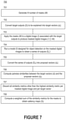
- FIG. 6 depicts a flow diagram of a process 600 for generating a visualization (here, a saliency map) that explains why a reference output was produced for a digital image.
- an editing platform can obtain a series of similarity metrics representing the degree of similarity between a target vector and a series of proposal vectors (step 601 ). These similarity metrics may have been produced by the editing platform as discussed above with respect to FIG. 5 .
- each similarity metric is associated with a proposal vector that encodes information regarding a proposed output produced by a model upon being applied to a masked digital image, and the editing platform may assign each similarity metric to the appropriate masked digital image.
- each masked digital image is associated with at least one similarity metric.
- multiple similarity metrics could be assigned to a single masked digital image if multiple objects were detected in that masked digital image.
- the editing platform can assign the highest similarity metric to the corresponding mask as a weight metric (step 603 ). Accordingly, each mask will be associated with a weight metric that is indicative of the highest similarity metric calculated for objects, if any, detected in the corresponding masked digital image. Those skilled in the art will recognize that if no objects were detected in a masked digital image, then no similarity metrics will be assigned since no proposal vectors were created. In such instances, the corresponding mask can be assigned a weight metric of zero.
- the editing platform can then compute a weighted sum of the masks (step 604 ). Such an approach will cause each pixel in the digital image to be associated with a weighted sum of the corresponding elements in the series of masks.
- the weighted sum for a given pixel in the digital image could be denoted as follows: w 1 M 1 +w 2 M 2 + . . . w N M N . These values may be loaded into a matrix having the same dimensions as the original digital image.
- the editing platform can generate a saliency map based on the weighted sum (step 605 ). More specifically, the editing platform can generate a saliency map by establishing, on a per-pixel basis, importance of the digital image based on the values in the matrix. In some embodiments, the editing platform applies a thresholding technique so that important pixels (i.e., those corresponding to higher values in the weighted sum) are rendered in one color while less important pixels (i.e., those corresponding to lower values in the weighted sum) are rendered in another color.
- important pixels i.e., those corresponding to higher values in the weighted sum
- less important pixels i.e., those corresponding to lower values in the weighted sum
- the editing platform may establish the importance of each pixel in the digital image by comparing a corresponding value in the matrix to defined ranges of values and then assign a color to each pixel based on the defined range of values in which the corresponding value is included.
- the editing platform may sort the values in the matrix into groups (e.g., based on natural breaks, or based on a defined number of values per group) and then assign the same color to all pixels in each group.
- the saliency map includes multiple colors that visually represent different levels of important. In FIG. 2 , for example, the saliency maps include pixels rendered in red, orange, yellow, green, and blue depending on saliency.
- FIG. 7 depicts a flow diagram of another process 700 for generating saliency maps for explaining predictions made by models without needing access to the weights, gradients, or architectures of those models.
- an editing platform can generate N number of masks (M i , . . . , n) having shape H ⁇ W (step 701 ).
- the editing platform can convert one or more outputs (also referred to as “detections” or “predictions”) to be explained into target vectors (d t ) (step 702 ).
- the editing platform will be interested in explaining a single output, so a single target vector will be created. However, in some instances, the editing platform will be interested in explaining multiple outputs.
- the editing platform is interested in explaining a first bounding box labeled as containing a person and a second bounding box labeled as containing a tennis racket.
- the editing platform can apply the masks (M i , . . . , n) to a digital image (I) associated with the outputs converted into the target vectors to produce masked digital images (I ⁇ M i , . . . , n) (step 703 ).
- the editing platform can run a model (f) designed for object detection on these masked digital images to obtain a series of outputs (D p ) (step 704 ), and the series of outputs can be converted into a series of proposal vectors (d p ) (step 705 ).
- the proposal vectors may be encoded such that they have similar information as the target vectors.
- the editing platform can then compute pairwise similarity between the target vectors (d t ) and proposal vectors (d p ) (step 706 ). More specifically, the editing platform may compare the target and proposal vectors so that for each pair of vectors, a similarity metric is produced. Such an approach will ensure that each proposal vector has a similarity metric for each target vector. Then, the editing platform may discard all similarity metrics other than the highest similarity metric per masked digital image and per target vector (step 707 ). Said another way, for each target vector, the editing platform may retain only the highest similarity score for each masked digital image.
- weights (w i ) can be assigned to the corresponding masks as weights (w i ) such that a weight metric is associated with each mask for each target output.
- w i weights
- the similarity metric associated with the corresponding proposal vector will be the highest by default. However, there may be instances in which the model detects multiple objects in the given class. In such a scenario, the editing platform will only retain the highest similarity metric.
- the editing platform can then compute a weighted sum of the similarity metrics for the masks to obtain saliency maps (S t ) (step 708 ).
- S t saliency maps
- each saliency map is posted to an interface for review by an individual.
- the saliency maps are displayed by themselves, while in other embodiments the saliency maps overlay the digital image that includes the target outputs. Additionally or alternatively, the saliency maps may be aligned with the digital image. Examples are shown in FIG. 8 , in which a digital image with its bounding box is arranged adjacent to a saliency map that overlays another instance of the digital image.
- the saliency map overlays a modified version of the digital image in which the hue, intensity, or color format has been altered.
- the editing platform may overlay the saliency map on a partially transparent version of the digital image to improve clarity.
- All of these operations, including the similarity computation, can be performed using efficient calls to the vectorized functions of whatever framework is being used by the editing platform.
- Examples of such functions include tensor multiplication, maximum along axis, and weighted sum along axis.
- the editing platform may simultaneously execute multiple instances of the process 500 of FIG. 5 in order to generate explanations for multiple reference outputs.
- an individual may wish to produce explanations for multiple objects detected in a single digital image, such as the person and tennis racket in FIG. 2 .
- the editing platform may receive input specifying the number of binary masks to be produced.
- the editing platform may receive input selecting the model to be applied to the masked digital images. For instance, the individual may be permitted from a library of models having different architectures, associated with different classes, etc.
- the errors of a model designed for object detection can be categorized into the following modes of failure: (1) missing an object entirely; (2) detecting an object with poor localization; and (3) proper localization but misclassification of an object.
- the approaches described herein can be used to analyze each of these errors.
- the editing platform can compute saliency for a missed ground-truth detection vector. This may provide an insight into the source of error for missed detections. For example, parts of a digital image highlighted by a saliency map may still considered to be discriminative features even though the model did not detect the object, and the failure may have occurred while processing these features (e.g., in the non-maximum suppression step). On the other hand, the saliency map may not identify any relevant regions when the object is not recognized at all. Such an outcome suggests that the features of the object may not have been learned by the model yet.
- FIG. 8 includes several examples of explanations generated for missed detections (also referred to as “false negative detections”) and false positive detections. In Example D, the saliency map shows that even though the backpack was missed, the model still considered the straps discriminatory.
- the editing platform can generate saliency maps for the ground truth and predicted detections. By separately and collectively analyzing these saliency maps, parts of the digital image that contributed to the error can be identified.
- FIG. 9 includes several examples of explanations for poor localization and misclassification.
- the red regions may be interpreted as the regions supporting the boxes.
- the red regions indicate where the model focused more than it should have while the blue regions indicate where the model did not focus enough.
- the first row illustrates that the model was unable to distinguish two pairs of skis, and the differences in the saliency maps indicate that the second pair of skis caused the bounding box to be erroneously extended.
- the last row illustrates how the television was misclassified as a microwave due to its surrounding context.
- the editing platform may compute average saliency maps for each class in a given dataset.
- a dataset is the Microsoft Common Objects in Context (COCO).
- COCO Microsoft Common Objects in Context
- the editing platform may obtain all occurrences of the class detected by a model and then crop those occurrences with the surrounding context.
- the editing platform can normalize/resize to the average size computed per category and then compute those averages.
- FIG. 10 includes examples of saliency maps for several COCO classes that were cropped, aligned, and averaged for all predictions.
- an individual may be able to observe patterns in how models generate predictions. For instance, the individual may observe that some parts of objects are consistently more important than others, while saliency may be more evenly spread across the entire object in other cases. For example, the upper parts of the human body are normally more salient for detecting a person as shown in Example B of FIG. 10 . Similarly, the upper parts of the fire hydrant are normally more salient for detecting its presence as shown in Example C of FIG. 10 . Moreover, the individual may observe that average saliency may be relatively high outside of the bounding boxes for some classes. This signifies that the model is using more of the surrounding context for detecting these classes. For example, it may be retrospectively evident that a model designed to identify sinks considers nearby items (e.g., faucets and mirrors) when making its predictions as shown in Example D of Figure
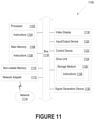
- FIG. 11 is a block diagram illustrating an example of a computing system 1100 in which at least some operations described herein can be implemented.
- some components of the computing system 1100 may be hosted on a computing device that includes an editing platform (e.g., the editing platforms 102 , 158 of FIGS. 1A-B ).
- the computing system 1100 may include one or more central processing units (also referred to as “processors”) 1102 , main memory 1106 , non-volatile memory 1110 , network adapter 1112 (e.g., network interface), video display 1118 , input/output devices 1120 , control device 1122 (e.g., keyboard and pointing devices), drive unit 1124 including a storage medium 1126 , and signal generation device 1130 that are communicatively connected to a bus 1116 .
- the bus 1116 is illustrated as an abstraction that represents one or more physical buses and/or point-to-point connections that are connected by appropriate bridges, adapters, or controllers.
- the bus 1116 can include a system bus, a Peripheral Component Interconnect (PCI) bus or PCI-Express bus, a HyperTransport or industry standard architecture (ISA) bus, a small computer system interface (SCSI) bus, a universal serial bus (USB), IIC (I2C) bus, or an Institute of Electrical and Electronics Engineers (IEEE) standard 1394 bus (also referred to as “Firewire”).
- PCI Peripheral Component Interconnect
- ISA HyperTransport or industry standard architecture
- SCSI small computer system interface
- USB universal serial bus
- I2C IIC
- IEEE Institute of Electrical and Electronics Engineers
- the computing system 1100 may share a similar computer processor architecture as that of a personal computer, tablet computer, mobile phone, game console, music player, wearable electronic device (e.g., a watch or fitness tracker), network-connected (“smart”) device (e.g., a television or home assistant device), virtual/augmented reality systems (e.g., a head-mounted display), or another electronic device capable of executing a set of instructions (sequential or otherwise) that specify action(s) to be taken by the computing system 1100 .
- a personal computer tablet computer, mobile phone, game console, music player, wearable electronic device (e.g., a watch or fitness tracker), network-connected (“smart”) device (e.g., a television or home assistant device), virtual/augmented reality systems (e.g., a head-mounted display), or another electronic device capable of executing a set of instructions (sequential or otherwise) that specify action(s) to be taken by the computing system 1100 .
- smart network-connected
- main memory 1106 non-volatile memory 1110 , and storage medium 1126 (also called a “machine-readable medium”) are shown to be a single medium, the term “machine-readable medium” and “storage medium” should be taken to include a single medium or multiple media (e.g., a centralized/distributed database and/or associated caches and servers) that store one or more sets of instructions 1128 .
- the term “machine-readable medium” and “storage medium” shall also be taken to include any medium that is capable of storing, encoding, or carrying a set of instructions for execution by the computing system 1100 .
- routines executed to implement the embodiments of the disclosure may be implemented as part of an operating system or a specific application, component, program, object, module, or sequence of instructions (collectively referred to as “computer programs”).
- the computer programs typically comprise one or more instructions (e.g., instructions 1104 , 1108 , 1128 ) set at various times in various memory and storage devices in a computing device.
- the instruction(s) When read and executed by the one or more processors 1102 , the instruction(s) cause the computing system 1100 to perform operations to execute elements involving the various aspects of the disclosure.
- machine-readable storage media such as volatile and non-volatile memory devices 1110 , floppy and other removable disks, hard disk drives, optical disks (e.g., Compact Disk Read-Only Memory (CD-ROMS), Digital Versatile Disks (DVDs)), and transmission-type media such as digital and analog communication links.
- recordable-type media such as volatile and non-volatile memory devices 1110 , floppy and other removable disks, hard disk drives, optical disks (e.g., Compact Disk Read-Only Memory (CD-ROMS), Digital Versatile Disks (DVDs)), and transmission-type media such as digital and analog communication links.
- CD-ROMS Compact Disk Read-Only Memory
- DVDs Digital Versatile Disks
- the network adapter 1112 enables the computing system 1100 to mediate data in a network 1114 with an entity that is external to the computing system 1100 through any communication protocol supported by the computing system 1100 and the external entity.
- the network adapter 1112 can include a network adaptor card, a wireless network interface card, a router, an access point, a wireless router, a switch, a multilayer switch, a protocol converter, a gateway, a bridge, bridge router, a hub, a digital media receiver, and/or a repeater.
- the network adapter 1112 may include a firewall that governs and/or manages permission to access/proxy data in a computer network and tracks varying levels of trust between different machines and/or applications.
- the firewall can be any number of modules having any combination of components able to enforce a predetermined set of access rights between a particular set of machines and applications, machines and machines, and/or applications and applications (e.g., to regulate the flow of traffic and resource sharing between these entities).
- the firewall may additionally manage and/or have access to an access control list that details permissions including the access and operation rights of an object by an individual, a machine, and/or an application, and the circumstances under which the permission rights stand.
- programmable circuitry e.g., one or more microprocessors
- software and/or firmware special-purpose hardwired (i.e., non-programmable) circuitry, or a combination of such forms.
- Special-purpose circuitry can be in the form of one or more application-specific integrated circuits (ASICs), programmable logic devices (PLDs), field-programmable gate arrays (FPGAs), etc.
- ASICs application-specific integrated circuits
- PLDs programmable logic devices
- FPGAs field-programmable gate arrays
Landscapes
- Engineering & Computer Science (AREA)
- Theoretical Computer Science (AREA)
- General Physics & Mathematics (AREA)
- Physics & Mathematics (AREA)
- Computer Vision & Pattern Recognition (AREA)
- Evolutionary Computation (AREA)
- Multimedia (AREA)
- Artificial Intelligence (AREA)
- Databases & Information Systems (AREA)
- Computing Systems (AREA)
- Health & Medical Sciences (AREA)
- General Health & Medical Sciences (AREA)
- Medical Informatics (AREA)
- Software Systems (AREA)
- Data Mining & Analysis (AREA)
- Life Sciences & Earth Sciences (AREA)
- Bioinformatics & Cheminformatics (AREA)
- Bioinformatics & Computational Biology (AREA)
- Evolutionary Biology (AREA)
- General Engineering & Computer Science (AREA)
- Image Analysis (AREA)
Abstract
Description
S(d t ,d j)=s L(d t ,d j)·s P(d t ,d j)·s O(d t ,d j) Eq. 4
where
s L(d t ,d j)=IoU(L t ,L j) Eq. 5
s O(d t ,d j)=O j. Eq. 7
Such an approach results in a separate saliency map for each target output.
Claims (20)
Priority Applications (1)
| Application Number | Priority Date | Filing Date | Title |
|---|---|---|---|
| US16/876,540 US11227159B2 (en) | 2020-05-18 | 2020-05-18 | Explanatory visualizations for object detection |
Applications Claiming Priority (1)
| Application Number | Priority Date | Filing Date | Title |
|---|---|---|---|
| US16/876,540 US11227159B2 (en) | 2020-05-18 | 2020-05-18 | Explanatory visualizations for object detection |
Publications (2)
| Publication Number | Publication Date |
|---|---|
| US20210357644A1 US20210357644A1 (en) | 2021-11-18 |
| US11227159B2 true US11227159B2 (en) | 2022-01-18 |
Family
ID=78512483
Family Applications (1)
| Application Number | Title | Priority Date | Filing Date |
|---|---|---|---|
| US16/876,540 Active 2040-07-11 US11227159B2 (en) | 2020-05-18 | 2020-05-18 | Explanatory visualizations for object detection |
Country Status (1)
| Country | Link |
|---|---|
| US (1) | US11227159B2 (en) |
Families Citing this family (11)
| Publication number | Priority date | Publication date | Assignee | Title |
|---|---|---|---|---|
| EP3933691B1 (en) * | 2020-07-02 | 2026-03-11 | Robert Bosch GmbH | System and method to alter an image |
| JP7819181B2 (en) * | 2020-10-02 | 2026-02-24 | ロレアル | Systems and methods for counting, locating and visualizing acne |
| US11954139B2 (en) * | 2020-11-19 | 2024-04-09 | Accenture Global Solutions Limited | Deep document processing with self-supervised learning |
| CN113837171B (en) * | 2021-11-26 | 2022-02-08 | 成都数之联科技有限公司 | Candidate region extraction method, candidate region extraction system, candidate region extraction device, medium and target detection method |
| CN114612902B (en) * | 2022-03-17 | 2024-11-19 | 腾讯科技(深圳)有限公司 | Image semantic segmentation method, device, equipment, storage medium and program product |
| CN115017571B (en) * | 2022-04-27 | 2025-03-18 | 阿里巴巴(中国)有限公司 | Method and electronic device for providing information on spatial structure |
| CN115019138B (en) * | 2022-05-20 | 2025-05-02 | 阿里巴巴(中国)有限公司 | Video subtitle erasure, model training, interactive method, device and storage medium |
| US12561778B2 (en) * | 2022-05-31 | 2026-02-24 | Konica Minolta, Inc. | Saliency analysis system, saliency analysis method and recording medium |
| CN115546677B (en) * | 2022-07-11 | 2023-10-24 | 北京国电通网络技术有限公司 | Method, apparatus, device and computer readable medium for processing information of construction site |
| US12494036B2 (en) * | 2023-01-17 | 2025-12-09 | Dell Products L.P. | Detailed perturbative heatmap explanations |
| JP2025105234A (en) | 2023-12-28 | 2025-07-10 | Astemo株式会社 | Method and apparatus for analyzing image recognition processing |
Citations (1)
| Publication number | Priority date | Publication date | Assignee | Title |
|---|---|---|---|---|
| US20200273090A1 (en) * | 2019-02-21 | 2020-08-27 | Adobe Inc. | Compatibility-based identification of incompatible objects in digital representations of real-world environments |
-
2020
- 2020-05-18 US US16/876,540 patent/US11227159B2/en active Active
Patent Citations (1)
| Publication number | Priority date | Publication date | Assignee | Title |
|---|---|---|---|---|
| US20200273090A1 (en) * | 2019-02-21 | 2020-08-27 | Adobe Inc. | Compatibility-based identification of incompatible objects in digital representations of real-world environments |
Non-Patent Citations (39)
| Title |
|---|
| Adebayo, Julius , et al., "Sanity checks for saliency maps. In Advances in Neural Information Processing", Systems 31: Annual Conference on Neural Information Processing Systems 2018, NeurIPS 2018, Dec. 3-8, 2018, Montr 'eal, Canada., pp. 9525-9536. |
| Antonio Torralba, Contextual priming for object detection. International Journal of Computer Vision, 53(2):169-191. 2003. |
| Aude Oliva and Antonio Torralba. The role of context in object recognition. Trends in cognitive sciences, 2007, 2007. |
| Bach, Sebastian , et al., "On pixel-wise explanations for non-linear classifier decisions by layer-wise relevance propagation", PLOS ONE,10(7):1-46, 2015. |
| Bargal, Sarah Adel, et al., "Excitation backprop for mns", In 2018 IEEE Conference on Computer Vision and Pattern Recognition, CVPR 2018, Salt Lake City, UT, USA, Jun. 18-22, 2018, pp. 1440-1449. |
| Bau, David , et al., "Network dissection: Quantifying interpretability of deep visual representations", In 2017 IEEE Conference on Computer Vision and Pattern Recognition, CVPR 2017, Honolulu, HI, USA, Jul. 21-26, 2017, pp. 3319-3332.7. |
| Biederman, Irving , et al., "Scene perception: Detecting and judging objects undergoing relational violations", Cognitive psychology, 14(2):143-177, 1982. |
| Brendel, Wieland , et al., "Approximating cnns with bag-of-local-features models works surprisingly well on magenet", International Conference on Learning Representations, 2019. |
| Dabkowski, Piotr, et al., "Real time image saliency for black box classifiers", In Advances in Neural Information Processing Systems 30: Annual Conference on Neural Information Processing Systems 2017, Dec. 4-9, 2017, Long Beach, CA, USA, pp. 6967-6976. |
| Everingham, M., et al., "The pascal visual object classes challenge: A retrospective", International Journal of Computer Vision, 111(1):98-136., Jan. 2015. |
| Fong, Ruth , et al., "Net2vec: Quantifying and explaining how concepts are encoded by filters in deep neural networks". In 2018 IEEE Conference on Computer Vision and Pattern Recognition, CVPR 2018, Salt Lake City, UT, USA, Jun. 18-22, 2018, pp. 8730-8738. |
| Girshick, Ross B., et al., "Rich feature hierarchies for accurate object detection and semantic segmentation", In 2014 IEEE Conference on Computer Vision and Pattern Recognition, CVPR 2014, Columbus, OH, USA, Jun. 23-28, 2014, pp. 580-587. |
| Gudovskiy, Denis A., et al., "Explain to fix: A framework to interpret and correct DNN object detector predictions", CoRR, abs/1811.08011, 2018. |
| Hoiem, Derek, et al., "Diagnosing error in object detectors", In Computer Vision—ECCV 2012—12th European Conference on Computer Vision, Florence, Italy, Oct. 7-13, 2012, Proceedings, Part III, pp. 340-353. |
| Huk, Dong , et al., "Multimodal explanations: Justifying decisions and pointing to the evidence", In 2018 IEEE Conference on Computer Vision and Pattern Recognition, CVPR 2018, Salt Lake City, UT, USA, Jun. 18-22, 2018, pp. 8779-8788. |
| Koh, Pang Wei, et al., "Understanding black-box predictions via influence functions", In Proceedings of the 34th International Conference on Machine Learning, ICML 2017, Sydney, NSW, Australia, Aug. 6-11, 2017, pp. 1885-1894. |
| Lai, Baisheng , et al., "Saliency guided end-toend learning for weakly supervised object detection", In Proceedings of the Twenty-Sixth International Joint Conference on Artificial Intelligence, IJCAI 2017, Melbourne, Australia, Aug. 19-25, 2017, pp. 2053-2059. |
| Lapuschkin, Sebastian , et al., "Unmasking clever hans predictors and assessing what machines really learn", CoRR, abs/1902.10178, 2019. |
| Law, Hei, et al., "Detecting objects as paired keypoints", In Computer Vision—ECCV 2018—15th European Conference, Munich, Germany, Sep. 8-14, 2018, Proceedings, Part XIV, pp. 765-781. |
| Lin, Tsung-Yi, et al., "Microsoft COCO: common objects in context", In Computer Vision—ECCV 2014—13th European Conference, Zurich, Switzerland, Sep. 6-12, 2014, Proceedings, Part V, pp. 740-755. |
| Liu, Wei, et al., "SSD: single shot multibox detector", In Computer Vision—ECCV 2016—14th European Conference, Amsterdam, The Netherlands, Oct. 11-14, 2016, Proceedings, Part I, pp. 21-37. |
| Morch, Niels J.S., et al., "Visualization of neural networks using saliency maps", In Proceedings of International Conference on Neural Networks (ICNN'95), Perth, WA, Australia, Nov. 27-Dec. 1, 1995, pp. 2085-2090. |
| Mottaghi, Roozbeh , et al., "The role of context for object detection and semantic segmentation in the wild", In 2014 IEEE Conference on Computer Vision and Pattern Recognition, CVPR 2014, Columbus, OH, USA, Jun. 23-28, 2014, pp. 891-898. |
| Olah, Chris , et al., "Feature visualization", Distill, 2(11):e7, 2017. |
| Paszke, Adam , et al., Automatic differentiation in PyTorch. In NIPS Autodiff Workshop, 2017. |
| Petsiuk, Vitali, et al., "RISE: randomized input sampling for explanation of black-box models", In British Machine Vision Conference 2018, BMVC 2018, Northumbria University, Newcastle, UK, Sep. 3-6, 2018, p. 151. |
| Ramanishka, Vasili, et al., "Top-down visual saliency guided by captions", In 2017 IEEE Conference on Computer Vision and Pattern Recognition, CVPR 2017, Honolulu, HI, USA, Jul. 21, 26, 2017, pp. 3135-3144. |
| Redmon, Joseph , et al., "An Incremental Improviement", CoRR, abs/1804.02767, 2018. |
| Ren, Shaoqing , et al., "Faster R-CNN: towards real-time object detection with region proposal networks", EEE Trans. Pattern Anal. Mach. Intell., 39(6):1137-1149, 2017. |
| Ribeiro, Marco Tulio, et al., ""why should I trust you?": Explaining the predictions of any classifier", In Proceedings of the 22nd ACM SIGKDD International Conference on Knowledge Discovery and Data Mining, San Francisco, CA, USA, Aug. 13-17, 2016, pp. 1135-1144. |
| Selvaraju, Ramprasaath R., et al., "Grad-cam: Visual explanations from deep networks via gradient-based ocalization". In IEEE International Conference on Computer Vision, ICCV 2017, Venice, Italy, Oct. 22-29, 2017, pp. 618-626. |
| Simonyan, Karen , et al., Deep inside convolutional networks: Visualising image classification models and saliency maps. In 2nd International Conference on Learning Representations, ICLR 2014, Banff, AB, Canada, Apr. 14-16, 2014, 2007. |
| Tsunakawa, Hideomi, et al., Contrastive relevance propagation for interpreting predictions by a single-shot object detector. In International Joint Conference on Neural Networks, IJCNN 2019 Budapest, Hungary, pp. 1-9, Jul. 2019. |
| Vondrick, Carl , et al., Visualizing object detection features. International Journal of Computer Vision, 119(2):145-158, 2016. |
| Wang, Fulton , et al., Causal falling rule lists.CoRR, abs/1510.05189, 2015. |
| Wilson, Benjamin , et al., Predictive inequity in object detection. CoRR, abs/1902.11097, 2019. |
| Zeiler, Matthew D., et al., Visualizing and understanding convolutional networks. In Computer Vision—ECCV 2014—13th European Conference, Zurich, Switzerland, Sep. 6-12, 2014, Proceedings, Part I, pp. 818-833. |
| Zhang, Jianming , et al., Top-down neural attention by excitation backprop. International Journal at Computer Vision, 126(10):1084-1102, 2018. |
| Zhou, Bolei, et al., Learning deep features for discriminative localization. In 2016 IEEE Conference on Computer Vision and Pattern Recognition, CVPR 2016, Las Vegas, NV, USA, Jun. 27-30, 2016, pp. 2921-2929, 2016. |
Also Published As
| Publication number | Publication date |
|---|---|
| US20210357644A1 (en) | 2021-11-18 |
Similar Documents
| Publication | Publication Date | Title |
|---|---|---|
| US11227159B2 (en) | Explanatory visualizations for object detection | |
| Wells et al. | Artificial intelligence in dermatopathology: Diagnosis, education, and research | |
| AU2019200270B2 (en) | Concept mask: large-scale segmentation from semantic concepts | |
| Kothadiya et al. | SignExplainer: an explainable AI-enabled framework for sign language recognition with ensemble learning | |
| Xu et al. | Gland instance segmentation by deep multichannel side supervision | |
| Dodge et al. | Visual saliency prediction using a mixture of deep neural networks | |
| Chen et al. | Exploring gradient-based multi-directional controls in gans | |
| US12488221B2 (en) | Unsupervised pre-training of neural networks using generative models | |
| Liu et al. | Construction of a smart face recognition model for university libraries based on FaceNet-MMAR algorithm | |
| Mmadumbu et al. | Early detection of Alzheimer's disease using deep learning methods | |
| Akgündoğdu et al. | Explainable deep learning framework for brain tumor detection: Integrating LIME, Grad-CAM, and SHAP for enhanced accuracy | |
| Han et al. | Dual-scale shifted window attention network for medical image segmentation | |
| Sutradhar et al. | BOO-ST and CBCEC: two novel hybrid machine learning methods aim to reduce the mortality of heart failure patients | |
| Charaabi et al. | EXplainable Artificial Intelligence (XAI) for MRI brain tumor diagnosis: A survey | |
| Agrawal et al. | A-XAI: adversarial machine learning for trustable explainability | |
| Cho et al. | Enhanced classification performance through GauGAN‐based data augmentation for tomato leaf images | |
| Pradnyatama et al. | A Comparative Analysis of Convolutional Neural Network (CNN): MobileNetV2 and Xception for Butterfly Species Classification | |
| Chen et al. | A new patch-based lbp with adaptive weights for gender classification of human face | |
| Asmat et al. | Utilizing conditional GANs for synthesis of equilibrated hyperspectral data to enhance classification and mitigate majority class bias | |
| Gao et al. | UiAnalyzer: Evaluating whether the UI of apps is at the risk of violating the design conventions in terms of function layout | |
| Mindlin et al. | ABC-GAN: spatially constrained counterfactual generation for image classification explanations | |
| Pang et al. | Siamese tracking combing frequency channel attention with adaptive template | |
| Shim et al. | Fast and accurate interpretation of workload classification model | |
| Michel et al. | Multiclass sparse Bayesian regression for fMRI‐based prediction | |
| Liang et al. | Enhancing artistic style classification through a novel ArtFusionNet framework |
Legal Events
| Date | Code | Title | Description |
|---|---|---|---|
| AS | Assignment |
Owner name: ADOBE INC., CALIFORNIA Free format text: ASSIGNMENT OF ASSIGNORS INTEREST;ASSIGNORS:JAIN, RAJIV BHAWANJI;MORARIU, VLAD ION;MANJUNATHA, VARUN;AND OTHERS;SIGNING DATES FROM 20200428 TO 20200515;REEL/FRAME:052687/0640 |
|
| FEPP | Fee payment procedure |
Free format text: ENTITY STATUS SET TO UNDISCOUNTED (ORIGINAL EVENT CODE: BIG.); ENTITY STATUS OF PATENT OWNER: LARGE ENTITY |
|
| FEPP | Fee payment procedure |
Free format text: PETITION RELATED TO MAINTENANCE FEES GRANTED (ORIGINAL EVENT CODE: PTGR); ENTITY STATUS OF PATENT OWNER: LARGE ENTITY |
|
| STPP | Information on status: patent application and granting procedure in general |
Free format text: NOTICE OF ALLOWANCE MAILED -- APPLICATION RECEIVED IN OFFICE OF PUBLICATIONS |
|
| STPP | Information on status: patent application and granting procedure in general |
Free format text: PUBLICATIONS -- ISSUE FEE PAYMENT VERIFIED |
|
| STCF | Information on status: patent grant |
Free format text: PATENTED CASE |
|
| MAFP | Maintenance fee payment |
Free format text: PAYMENT OF MAINTENANCE FEE, 4TH YEAR, LARGE ENTITY (ORIGINAL EVENT CODE: M1551); ENTITY STATUS OF PATENT OWNER: LARGE ENTITY Year of fee payment: 4 |