US11225687B2 - DNA sequencing by synthesis with nucleotide analogues and Raman detection - Google Patents
DNA sequencing by synthesis with nucleotide analogues and Raman detection Download PDFInfo
- Publication number
- US11225687B2 US11225687B2 US16/091,435 US201716091435A US11225687B2 US 11225687 B2 US11225687 B2 US 11225687B2 US 201716091435 A US201716091435 A US 201716091435A US 11225687 B2 US11225687 B2 US 11225687B2
- Authority
- US
- United States
- Prior art keywords
- raman
- nucleotide
- polymerase
- base
- cluster
- Prior art date
- Legal status (The legal status is an assumption and is not a legal conclusion. Google has not performed a legal analysis and makes no representation as to the accuracy of the status listed.)
- Active, expires
Links
- 0 CCCCC1C*CC1 Chemical compound CCCCC1C*CC1 0.000 description 17
- GHTTWYJARHGUSD-REJBHVJUSA-K [H]C1([H])C([H])(OC)[C@@]([H])(COP(=O)([O-])OP(=O)([O-])OP(=O)([O-])O)O[C@@]1([H])C Chemical compound [H]C1([H])C([H])(OC)[C@@]([H])(COP(=O)([O-])OP(=O)([O-])OP(=O)([O-])O)O[C@@]1([H])C GHTTWYJARHGUSD-REJBHVJUSA-K 0.000 description 11
- MMGOPOFOOOKPQM-LQNFLIGQSA-E CC#CCCC(C)=O.CC#CCCC(C)=O.[H]C1([H])C([H])(O)[C@@]([H])(COP(=O)([O-])OP(=O)([O-])OP(=O)([O-])O)O[C@@]1([H])C.[H]C1([H])C([H])(O)[C@@]([H])(COP(=O)([O-])OP(=O)([O-])OP(=O)([O-])OC)O[C@@]1([H])C.[H]C1([H])C([H])(O)[C@@]([H])(COP(=O)([O-])OP(=O)([O-])OP(=O)([O-])OC)O[C@@]1([H])C Chemical compound CC#CCCC(C)=O.CC#CCCC(C)=O.[H]C1([H])C([H])(O)[C@@]([H])(COP(=O)([O-])OP(=O)([O-])OP(=O)([O-])O)O[C@@]1([H])C.[H]C1([H])C([H])(O)[C@@]([H])(COP(=O)([O-])OP(=O)([O-])OP(=O)([O-])OC)O[C@@]1([H])C.[H]C1([H])C([H])(O)[C@@]([H])(COP(=O)([O-])OP(=O)([O-])OP(=O)([O-])OC)O[C@@]1([H])C MMGOPOFOOOKPQM-LQNFLIGQSA-E 0.000 description 3
- QVMVTBLFRDKPFO-LJMPJZRBSA-L [H]C1([H])C([H])(O)[C@@]([H])(COP(=O)([Y-])CP(=O)([O-])OP(=O)([O-])OC)O[C@@]1([H])C Chemical compound [H]C1([H])C([H])(O)[C@@]([H])(COP(=O)([Y-])CP(=O)([O-])OP(=O)([O-])OC)O[C@@]1([H])C QVMVTBLFRDKPFO-LJMPJZRBSA-L 0.000 description 3
- HUHMQOSIGZPNKH-YPVSKDHRSA-K [H]C1([H])C([H])(OC)[C@@]([H])(COP(=O)([O-])OP(=O)([O-])OP(=O)([O-])OC)O[C@@]1([H])C Chemical compound [H]C1([H])C([H])(OC)[C@@]([H])(COP(=O)([O-])OP(=O)([O-])OP(=O)([O-])OC)O[C@@]1([H])C HUHMQOSIGZPNKH-YPVSKDHRSA-K 0.000 description 3
- GIWNBBGDSFATQG-SNIIHZGJSA-K C.C.[H]C1([H])C([H])(OC)[C@@]([H])(COP(=O)([O-])OP(=O)([O-])OP(=O)([O-])O)O[C@@]1([H])C Chemical compound C.C.[H]C1([H])C([H])(OC)[C@@]([H])(COP(=O)([O-])OP(=O)([O-])OP(=O)([O-])O)O[C@@]1([H])C GIWNBBGDSFATQG-SNIIHZGJSA-K 0.000 description 2
- UTMMOZNBGNAVSC-NRNCSNIFSA-K CC.CC.[H]C1([H])C([H])(OC)[C@@]([H])(COP(=O)([O-])OP(=O)([O-])OP(=O)([O-])OC)O[C@@]1([H])C Chemical compound CC.CC.[H]C1([H])C([H])(OC)[C@@]([H])(COP(=O)([O-])OP(=O)([O-])OP(=O)([O-])OC)O[C@@]1([H])C UTMMOZNBGNAVSC-NRNCSNIFSA-K 0.000 description 2
- OYMWNNJSTHCKKG-REJBHVJUSA-K [H]C1([H])C([H])(O)[C@@]([H])(COP(=O)([O-])OP(=O)([O-])OP(=O)([O-])OC)O[C@@]1([H])C Chemical compound [H]C1([H])C([H])(O)[C@@]([H])(COP(=O)([O-])OP(=O)([O-])OP(=O)([O-])OC)O[C@@]1([H])C OYMWNNJSTHCKKG-REJBHVJUSA-K 0.000 description 2
- ZYFZMYOAUAPGRB-FBRLKIMPSA-B C#CCCC(N=[N+]=[N-])OC1C[C@H](N2C=CC(N)=NC2=O)O[C@@H]1COP(=O)([O-])OP(=O)([O-])OP(=O)([O-])O.C=C1NC(=O)C(C)=CN1[C@H]1CC(OC(CCC#N)N=[N+]=[N-])[C@@H](COP(=O)([O-])OP(=O)([O-])OP(=O)([O-])O)O1.CC#CCCC(N=[N+]=[N-])OC1C[C@H](N2C=NC3=C2N=CN=C3N)O[C@@H]1COP(=O)([O-])OP(=O)([O-])OP(=O)([O-])O.CC1=NC2=C(N=CN2[C@H]2CC(OCN=[N+]=[N-])[C@@H](COP(=O)([O-])OP(=O)([O-])OP(=O)([O-])O)O2)C(=O)C1 Chemical compound C#CCCC(N=[N+]=[N-])OC1C[C@H](N2C=CC(N)=NC2=O)O[C@@H]1COP(=O)([O-])OP(=O)([O-])OP(=O)([O-])O.C=C1NC(=O)C(C)=CN1[C@H]1CC(OC(CCC#N)N=[N+]=[N-])[C@@H](COP(=O)([O-])OP(=O)([O-])OP(=O)([O-])O)O1.CC#CCCC(N=[N+]=[N-])OC1C[C@H](N2C=NC3=C2N=CN=C3N)O[C@@H]1COP(=O)([O-])OP(=O)([O-])OP(=O)([O-])O.CC1=NC2=C(N=CN2[C@H]2CC(OCN=[N+]=[N-])[C@@H](COP(=O)([O-])OP(=O)([O-])OP(=O)([O-])O)O2)C(=O)C1 ZYFZMYOAUAPGRB-FBRLKIMPSA-B 0.000 description 1
- XBLONDWYTYGOSG-VVWQAWQBSA-E C.C.C.C.C.C.C.C.C.C.C.CC#CCCC(C)=O.CC#CCCC(C)=O.[H]C1([H])C([H])(O)[C@@]([H])(COP(=O)([O-])OP(=O)([O-])OP(=O)([O-])O)O[C@@]1([H])C.[H]C1([H])C([H])(O)[C@@]([H])(COP(=O)([O-])OP(=O)([O-])OP(=O)([O-])OC)O[C@@]1([H])C.[H]C1([H])C([H])(O)[C@@]([H])(COP(=O)([O-])OP(=O)([O-])OP(=O)([O-])[O-]C)O[C@@]1([H])C Chemical compound C.C.C.C.C.C.C.C.C.C.C.CC#CCCC(C)=O.CC#CCCC(C)=O.[H]C1([H])C([H])(O)[C@@]([H])(COP(=O)([O-])OP(=O)([O-])OP(=O)([O-])O)O[C@@]1([H])C.[H]C1([H])C([H])(O)[C@@]([H])(COP(=O)([O-])OP(=O)([O-])OP(=O)([O-])OC)O[C@@]1([H])C.[H]C1([H])C([H])(O)[C@@]([H])(COP(=O)([O-])OP(=O)([O-])OP(=O)([O-])[O-]C)O[C@@]1([H])C XBLONDWYTYGOSG-VVWQAWQBSA-E 0.000 description 1
- OWNPXZNFJLINPE-QHRFMKFISA-E C.C.C.C.C.C.C.C.C.CC.CC.CC.CC.[H]C1([H])C([H])(OC)[C@@]([H])(COP(=O)([O-])OP(=O)([O-])OP(=O)([O-])O)O[C@@]1([H])C.[H]C1([H])C([H])(OC)[C@@]([H])(COP(=O)([O-])OP(=O)([O-])OP(=O)([O-])OC)O[C@@]1([H])C.[H]C1([H])C([H])(OC)[C@@]([H])(COP(=O)([O-])OP(=O)([O-])OP(=O)([O-])OC)O[C@@]1([H])C Chemical compound C.C.C.C.C.C.C.C.C.CC.CC.CC.CC.[H]C1([H])C([H])(OC)[C@@]([H])(COP(=O)([O-])OP(=O)([O-])OP(=O)([O-])O)O[C@@]1([H])C.[H]C1([H])C([H])(OC)[C@@]([H])(COP(=O)([O-])OP(=O)([O-])OP(=O)([O-])OC)O[C@@]1([H])C.[H]C1([H])C([H])(OC)[C@@]([H])(COP(=O)([O-])OP(=O)([O-])OP(=O)([O-])OC)O[C@@]1([H])C OWNPXZNFJLINPE-QHRFMKFISA-E 0.000 description 1
- UMANYLSDBZESEI-RRVBLIKMSA-L C.C.[H]C1([H])C([H])(O)[C@@]([H])(COP(=O)([Y-])CP(=O)([O-])OP(=O)([O-])OC)O[C@@]1([H])C Chemical compound C.C.[H]C1([H])C([H])(O)[C@@]([H])(COP(=O)([Y-])CP(=O)([O-])OP(=O)([O-])OC)O[C@@]1([H])C UMANYLSDBZESEI-RRVBLIKMSA-L 0.000 description 1
- RAXUZYDYTSEFCE-NRNCSNIFSA-L C.[H]C1([H])C([H])(OC)[C@@]([H])(COP(=O)([Y-])CP(=O)([O-])OP(=O)([O-])O)O[C@@]1([H])C Chemical compound C.[H]C1([H])C([H])(OC)[C@@]([H])(COP(=O)([Y-])CP(=O)([O-])OP(=O)([O-])O)O[C@@]1([H])C RAXUZYDYTSEFCE-NRNCSNIFSA-L 0.000 description 1
- IVXXFTFWRMTRDU-SQBYSVNCSA-H CC#CCCC(C)=O.CC#CCCC(C)=O.[H]C1([H])C([H])(O)[C@@]([H])(COP(=O)([Y-])CP(=O)([O-])OP(=O)([O-])O)O[C@@]1([H])C.[H]C1([H])C([H])(O)[C@@]([H])(COP(=O)([Y-])CP(=O)([O-])OP(=O)([O-])O)O[C@@]1([H])C.[H]C1([H])C([H])(O)[C@@]([H])(COP(=O)([Y-])CP(=O)([O-])OP(=O)([O-])OC)O[C@@]1([H])C Chemical compound CC#CCCC(C)=O.CC#CCCC(C)=O.[H]C1([H])C([H])(O)[C@@]([H])(COP(=O)([Y-])CP(=O)([O-])OP(=O)([O-])O)O[C@@]1([H])C.[H]C1([H])C([H])(O)[C@@]([H])(COP(=O)([Y-])CP(=O)([O-])OP(=O)([O-])O)O[C@@]1([H])C.[H]C1([H])C([H])(O)[C@@]([H])(COP(=O)([Y-])CP(=O)([O-])OP(=O)([O-])OC)O[C@@]1([H])C IVXXFTFWRMTRDU-SQBYSVNCSA-H 0.000 description 1
- YYOBCWYSHUKYJM-LQNFLIGQSA-E CC#CCNC(C)=O.CC#CCNC(C)=O.[H]C1([H])C([H])(O)[C@@]([H])(COP(=O)([O-])OP(=O)([O-])OP(=O)([O-])O)O[C@@]1([H])C.[H]C1([H])C([H])(O)[C@@]([H])(COP(=O)([O-])OP(=O)([O-])OP(=O)([O-])OC)O[C@@]1([H])C.[H]C1([H])C([H])(O)[C@@]([H])(COP(=O)([O-])OP(=O)([O-])OP(=O)([O-])OC)O[C@@]1([H])C Chemical compound CC#CCNC(C)=O.CC#CCNC(C)=O.[H]C1([H])C([H])(O)[C@@]([H])(COP(=O)([O-])OP(=O)([O-])OP(=O)([O-])O)O[C@@]1([H])C.[H]C1([H])C([H])(O)[C@@]([H])(COP(=O)([O-])OP(=O)([O-])OP(=O)([O-])OC)O[C@@]1([H])C.[H]C1([H])C([H])(O)[C@@]([H])(COP(=O)([O-])OP(=O)([O-])OP(=O)([O-])OC)O[C@@]1([H])C YYOBCWYSHUKYJM-LQNFLIGQSA-E 0.000 description 1
- UVZPMGHMKOCNOG-SNIIHZGJSA-K CC#CCNC(C)=O.[HH].[H]C1([H])C([H])(O)[C@@]([H])(COP(=O)([O-])OP(=O)([O-])OP(=O)([O-])[O-]C)O[C@@]1([H])C Chemical compound CC#CCNC(C)=O.[HH].[H]C1([H])C([H])(O)[C@@]([H])(COP(=O)([O-])OP(=O)([O-])OP(=O)([O-])[O-]C)O[C@@]1([H])C UVZPMGHMKOCNOG-SNIIHZGJSA-K 0.000 description 1
- DLXMVYFTELZQSG-CYINNENISA-H CC.CC.CC.CC.[H]C1([H])C([H])(O)[C@@]([H])(COP(=O)([O-])OP(=O)([O-])OP(=O)([O-])O)O[C@@]1([H])C.[H]C1([H])C([H])(O)[C@@]([H])(COP(=O)([O-])OP(=O)([O-])OP(=O)([O-])OC)O[C@@]1([H])C Chemical compound CC.CC.CC.CC.[H]C1([H])C([H])(O)[C@@]([H])(COP(=O)([O-])OP(=O)([O-])OP(=O)([O-])O)O[C@@]1([H])C.[H]C1([H])C([H])(O)[C@@]([H])(COP(=O)([O-])OP(=O)([O-])OP(=O)([O-])OC)O[C@@]1([H])C DLXMVYFTELZQSG-CYINNENISA-H 0.000 description 1
- AJTYSKVDNJXFKL-SPSULGLQSA-K CC.CC.COP(=O)([O-])OP(=O)([O-])OP(=O)([O-])OC.[H]C1([H])[C@]([H])(C)O[C@]([H])(CC)[C@]1([H])OC Chemical compound CC.CC.COP(=O)([O-])OP(=O)([O-])OP(=O)([O-])OC.[H]C1([H])[C@]([H])(C)O[C@]([H])(CC)[C@]1([H])OC AJTYSKVDNJXFKL-SPSULGLQSA-K 0.000 description 1
- AHQQNKDIQPGSKJ-FRQFLOQASA-K CC.CC.[H]C1([H])C([H])(O)[C@@]([H])(COP(=O)([O-])OP(=O)([O-])OP(=O)([O-])O)O[C@@]1([H])C Chemical compound CC.CC.[H]C1([H])C([H])(O)[C@@]([H])(COP(=O)([O-])OP(=O)([O-])OP(=O)([O-])O)O[C@@]1([H])C AHQQNKDIQPGSKJ-FRQFLOQASA-K 0.000 description 1
- KZURXHQRNIBALB-SNIIHZGJSA-K CC.CC.[H]C1([H])C([H])(O)[C@@]([H])(COP(=O)([O-])OP(=O)([O-])OP(=O)([O-])OC)O[C@@]1([H])C Chemical compound CC.CC.[H]C1([H])C([H])(O)[C@@]([H])(COP(=O)([O-])OP(=O)([O-])OP(=O)([O-])OC)O[C@@]1([H])C KZURXHQRNIBALB-SNIIHZGJSA-K 0.000 description 1
- KZURXHQRNIBALB-OJSHLMAWSA-K CC.CC.[H]C1([H])[C@]([H])(C)O[C@]([H])(COP(=O)([O-])OP(=O)([O-])OP(=O)([O-])OC)[C@]1([H])O Chemical compound CC.CC.[H]C1([H])[C@]([H])(C)O[C@]([H])(COP(=O)([O-])OP(=O)([O-])OP(=O)([O-])OC)[C@]1([H])O KZURXHQRNIBALB-OJSHLMAWSA-K 0.000 description 1
- LMMMFQVMFVVFRU-NOWQFEBASA-K [H]C1([H])C([H])(O)[C@@]([H])(COP(=O)([O-])OP(=O)([O-])OP(=O)([O-])O)O[C@@]1([H])C Chemical compound [H]C1([H])C([H])(O)[C@@]([H])(COP(=O)([O-])OP(=O)([O-])OP(=O)([O-])O)O[C@@]1([H])C LMMMFQVMFVVFRU-NOWQFEBASA-K 0.000 description 1
- KTASYAXRIPKWAS-ABVGKKTISA-E [H]C1([H])C([H])(OC)[C@@]([H])(COP(=O)([O-])OP(=O)([O-])OP(=O)([O-])O)O[C@@]1([H])C.[H]C1([H])C([H])(OC)[C@@]([H])(COP(=O)([O-])OP(=O)([O-])OP(=O)([O-])OC)O[C@@]1([H])C.[H]C1([H])C([H])(OC)[C@@]([H])(COP(=O)([O-])OP(=O)([O-])OP(=O)([O-])OC)O[C@@]1([H])C Chemical compound [H]C1([H])C([H])(OC)[C@@]([H])(COP(=O)([O-])OP(=O)([O-])OP(=O)([O-])O)O[C@@]1([H])C.[H]C1([H])C([H])(OC)[C@@]([H])(COP(=O)([O-])OP(=O)([O-])OP(=O)([O-])OC)O[C@@]1([H])C.[H]C1([H])C([H])(OC)[C@@]([H])(COP(=O)([O-])OP(=O)([O-])OP(=O)([O-])OC)O[C@@]1([H])C KTASYAXRIPKWAS-ABVGKKTISA-E 0.000 description 1
Images



Classifications
-
- C—CHEMISTRY; METALLURGY
- C12—BIOCHEMISTRY; BEER; SPIRITS; WINE; VINEGAR; MICROBIOLOGY; ENZYMOLOGY; MUTATION OR GENETIC ENGINEERING
- C12Q—MEASURING OR TESTING PROCESSES INVOLVING ENZYMES, NUCLEIC ACIDS OR MICROORGANISMS; COMPOSITIONS OR TEST PAPERS THEREFOR; PROCESSES OF PREPARING SUCH COMPOSITIONS; CONDITION-RESPONSIVE CONTROL IN MICROBIOLOGICAL OR ENZYMOLOGICAL PROCESSES
- C12Q1/00—Measuring or testing processes involving enzymes, nucleic acids or microorganisms; Compositions therefor; Processes of preparing such compositions
- C12Q1/68—Measuring or testing processes involving enzymes, nucleic acids or microorganisms; Compositions therefor; Processes of preparing such compositions involving nucleic acids
- C12Q1/6869—Methods for sequencing
-
- B—PERFORMING OPERATIONS; TRANSPORTING
- B82—NANOTECHNOLOGY
- B82Y—SPECIFIC USES OR APPLICATIONS OF NANOSTRUCTURES; MEASUREMENT OR ANALYSIS OF NANOSTRUCTURES; MANUFACTURE OR TREATMENT OF NANOSTRUCTURES
- B82Y30/00—Nanotechnology for materials or surface science, e.g. nanocomposites
-
- B—PERFORMING OPERATIONS; TRANSPORTING
- B82—NANOTECHNOLOGY
- B82Y—SPECIFIC USES OR APPLICATIONS OF NANOSTRUCTURES; MEASUREMENT OR ANALYSIS OF NANOSTRUCTURES; MANUFACTURE OR TREATMENT OF NANOSTRUCTURES
- B82Y5/00—Nanobiotechnology or nanomedicine, e.g. protein engineering or drug delivery
-
- C—CHEMISTRY; METALLURGY
- C12—BIOCHEMISTRY; BEER; SPIRITS; WINE; VINEGAR; MICROBIOLOGY; ENZYMOLOGY; MUTATION OR GENETIC ENGINEERING
- C12N—MICROORGANISMS OR ENZYMES; COMPOSITIONS THEREOF; PROPAGATING, PRESERVING, OR MAINTAINING MICROORGANISMS; MUTATION OR GENETIC ENGINEERING; CULTURE MEDIA
- C12N9/00—Enzymes; Proenzymes; Compositions thereof; Processes for preparing, activating, inhibiting, separating or purifying enzymes
- C12N9/10—Transferases (2.)
- C12N9/12—Transferases (2.) transferring phosphorus containing groups, e.g. kinases (2.7)
- C12N9/1241—Nucleotidyltransferases (2.7.7)
-
- C—CHEMISTRY; METALLURGY
- C12—BIOCHEMISTRY; BEER; SPIRITS; WINE; VINEGAR; MICROBIOLOGY; ENZYMOLOGY; MUTATION OR GENETIC ENGINEERING
- C12Q—MEASURING OR TESTING PROCESSES INVOLVING ENZYMES, NUCLEIC ACIDS OR MICROORGANISMS; COMPOSITIONS OR TEST PAPERS THEREFOR; PROCESSES OF PREPARING SUCH COMPOSITIONS; CONDITION-RESPONSIVE CONTROL IN MICROBIOLOGICAL OR ENZYMOLOGICAL PROCESSES
- C12Q1/00—Measuring or testing processes involving enzymes, nucleic acids or microorganisms; Compositions therefor; Processes of preparing such compositions
- C12Q1/68—Measuring or testing processes involving enzymes, nucleic acids or microorganisms; Compositions therefor; Processes of preparing such compositions involving nucleic acids
-
- C—CHEMISTRY; METALLURGY
- C12—BIOCHEMISTRY; BEER; SPIRITS; WINE; VINEGAR; MICROBIOLOGY; ENZYMOLOGY; MUTATION OR GENETIC ENGINEERING
- C12Q—MEASURING OR TESTING PROCESSES INVOLVING ENZYMES, NUCLEIC ACIDS OR MICROORGANISMS; COMPOSITIONS OR TEST PAPERS THEREFOR; PROCESSES OF PREPARING SUCH COMPOSITIONS; CONDITION-RESPONSIVE CONTROL IN MICROBIOLOGICAL OR ENZYMOLOGICAL PROCESSES
- C12Q1/00—Measuring or testing processes involving enzymes, nucleic acids or microorganisms; Compositions therefor; Processes of preparing such compositions
- C12Q1/68—Measuring or testing processes involving enzymes, nucleic acids or microorganisms; Compositions therefor; Processes of preparing such compositions involving nucleic acids
- C12Q1/6813—Hybridisation assays
- C12Q1/6816—Hybridisation assays characterised by the detection means
- C12Q1/6825—Nucleic acid detection involving sensors
-
- C—CHEMISTRY; METALLURGY
- C12—BIOCHEMISTRY; BEER; SPIRITS; WINE; VINEGAR; MICROBIOLOGY; ENZYMOLOGY; MUTATION OR GENETIC ENGINEERING
- C12Q—MEASURING OR TESTING PROCESSES INVOLVING ENZYMES, NUCLEIC ACIDS OR MICROORGANISMS; COMPOSITIONS OR TEST PAPERS THEREFOR; PROCESSES OF PREPARING SUCH COMPOSITIONS; CONDITION-RESPONSIVE CONTROL IN MICROBIOLOGICAL OR ENZYMOLOGICAL PROCESSES
- C12Q2525/00—Reactions involving modified oligonucleotides, nucleic acids, or nucleotides
- C12Q2525/10—Modifications characterised by
- C12Q2525/101—Modifications characterised by incorporating non-naturally occurring nucleotides, e.g. inosine
-
- C—CHEMISTRY; METALLURGY
- C12—BIOCHEMISTRY; BEER; SPIRITS; WINE; VINEGAR; MICROBIOLOGY; ENZYMOLOGY; MUTATION OR GENETIC ENGINEERING
- C12Q—MEASURING OR TESTING PROCESSES INVOLVING ENZYMES, NUCLEIC ACIDS OR MICROORGANISMS; COMPOSITIONS OR TEST PAPERS THEREFOR; PROCESSES OF PREPARING SUCH COMPOSITIONS; CONDITION-RESPONSIVE CONTROL IN MICROBIOLOGICAL OR ENZYMOLOGICAL PROCESSES
- C12Q2563/00—Nucleic acid detection characterized by the use of physical, structural and functional properties
- C12Q2563/155—Particles of a defined size, e.g. nanoparticles
-
- C—CHEMISTRY; METALLURGY
- C12—BIOCHEMISTRY; BEER; SPIRITS; WINE; VINEGAR; MICROBIOLOGY; ENZYMOLOGY; MUTATION OR GENETIC ENGINEERING
- C12Q—MEASURING OR TESTING PROCESSES INVOLVING ENZYMES, NUCLEIC ACIDS OR MICROORGANISMS; COMPOSITIONS OR TEST PAPERS THEREFOR; PROCESSES OF PREPARING SUCH COMPOSITIONS; CONDITION-RESPONSIVE CONTROL IN MICROBIOLOGICAL OR ENZYMOLOGICAL PROCESSES
- C12Q2565/00—Nucleic acid analysis characterised by mode or means of detection
- C12Q2565/60—Detection means characterised by use of a special device
- C12Q2565/632—Detection means characterised by use of a special device being a surface enhanced, e.g. resonance, Raman spectrometer
-
- G—PHYSICS
- G01—MEASURING; TESTING
- G01N—INVESTIGATING OR ANALYSING MATERIALS BY DETERMINING THEIR CHEMICAL OR PHYSICAL PROPERTIES
- G01N21/00—Investigating or analysing materials by the use of optical means, i.e. using sub-millimetre waves, infrared, visible or ultraviolet light
- G01N21/62—Systems in which the material investigated is excited whereby it emits light or causes a change in wavelength of the incident light
- G01N21/63—Systems in which the material investigated is excited whereby it emits light or causes a change in wavelength of the incident light optically excited
- G01N21/65—Raman scattering
- G01N21/658—Raman scattering enhancement Raman, e.g. surface plasmons
-
- C—CHEMISTRY; METALLURGY
- C12—BIOCHEMISTRY; BEER; SPIRITS; WINE; VINEGAR; MICROBIOLOGY; ENZYMOLOGY; MUTATION OR GENETIC ENGINEERING
- C12Q—MEASURING OR TESTING PROCESSES INVOLVING ENZYMES, NUCLEIC ACIDS OR MICROORGANISMS; COMPOSITIONS OR TEST PAPERS THEREFOR; PROCESSES OF PREPARING SUCH COMPOSITIONS; CONDITION-RESPONSIVE CONTROL IN MICROBIOLOGICAL OR ENZYMOLOGICAL PROCESSES
- C12Q2565/00—Nucleic acid analysis characterised by mode or means of detection
-
- C—CHEMISTRY; METALLURGY
- C12—BIOCHEMISTRY; BEER; SPIRITS; WINE; VINEGAR; MICROBIOLOGY; ENZYMOLOGY; MUTATION OR GENETIC ENGINEERING
- C12Q—MEASURING OR TESTING PROCESSES INVOLVING ENZYMES, NUCLEIC ACIDS OR MICROORGANISMS; COMPOSITIONS OR TEST PAPERS THEREFOR; PROCESSES OF PREPARING SUCH COMPOSITIONS; CONDITION-RESPONSIVE CONTROL IN MICROBIOLOGICAL OR ENZYMOLOGICAL PROCESSES
- C12Q2600/00—Oligonucleotides characterized by their use
- C12Q2600/106—Pharmacogenomics, i.e. genetic variability in individual responses to drugs and drug metabolism
-
- C—CHEMISTRY; METALLURGY
- C12—BIOCHEMISTRY; BEER; SPIRITS; WINE; VINEGAR; MICROBIOLOGY; ENZYMOLOGY; MUTATION OR GENETIC ENGINEERING
- C12Y—ENZYMES
- C12Y207/00—Transferases transferring phosphorus-containing groups (2.7)
- C12Y207/07—Nucleotidyltransferases (2.7.7)
Definitions
- High throughput DNA sequencing is essential to a broad array of genomic studies, such as whole genome and metagenome sequencing, expression profiling of mRNAs and miRNAs, discovery of alternatively spliced and polyadenylated transcripts, histone and chromatin changes involved in epigenetic events, and identification of binding sites for transcription factors and RNA binding proteins. Sequencing of individual human genomes is especially appealing, with its potentially unlimited but as yet unachieved promise for personalized medicine.
- SBS Sequencing by Synthesis
- SBS also offers the possibility of high sensitivity, leading to both longer reads and permitting single molecule sequencing, thereby removing one of the most time-consuming and biased steps—the generation and amplification of DNA templates.
- protein-protein interactions In addition to high throughput DNA sequencing, detection of protein-protein interactions are essential for study of cell biology.
- Examples of protein-protein interactions include generation of protein assemblies for enzymatic reactions in metabolic pathways (e.g., fatty acid synthesis), ribosomes (protein synthesis), ubiquitin association with proteins destined to be degraded, for transport of ions (multi-subunit membrane channels and pumps), for enhancing or inhibiting transcription of genes (cooperating transcription factors), formation of cellular junctions and cell-cell interactions, and countless other examples. Mutations in these proteins affecting their assembly or interactions are crucial for a number of diseases, and particularly relevant to the development of tumors.
- Biochemical approaches include gel shift assays, cross-linking assays, immunoprecipitation, immunoblotting, etc.
- the yeast two-hybrid and three-hybrid systems are genetic approaches that have been developed to identify target proteins that can bind to a bait protein molecule.
- Several of these methods characterize the partners and the complexes by gel electrophoresis with at least one of the partners radiolabeled.
- Other assays including surface binding assays, for example protein arrays, may use fluorescent tags. Finally, it is possible to reveal the interacting proteins by mass spectrometry.
- Raman spectroscopy which is based on the inelastic scattering of light, has the ability to distinguish a set of nucleotide tags due to their ability to produce Raman shifts in the spectral region, 2100-2300 cm ⁇ 1 , where proteins, nucleic acids, amino acids and nucleotides do not produce any Raman signals.
- these small chemical groups produce very sharp peaks in the Raman spectrum compared to much broader peaks in the visible spectrum associated with bulky fluorescent tags, making it possible to select sets of 4 or more tags for labeling the different nucleotides.
- spontaneous Raman signals are substantially weaker than fluorescent signals.
- the Raman signals can be enhanced dramatically, by as much as 11 orders of magnitude (Le Ru et al 2007), by taking advantage of localizing the Raman active molecules within 10 nm of rough or nanostructured noble metal surfaces, an effect thought to be due to the excitement of localized surface plasmons.
- the phenomenon is referred to as surface-enhanced Raman spectroscopy (SERS).
- SERS surface-enhanced Raman spectroscopy
- the most common SERS substrates are made with gold or silver nanoparticles. Accordingly, herein described are molecular tags utilizing a variety of chemical groups, which have been verified in that they produce discrete signals in the aforementioned Raman spectral window surrounding 2200 cm ⁇ 1 .
- This invention provides a nucleotide polymerase with one or more attached and/or conjugated noble metal nanoparticles, wherein the noble metal nanoparticles are surface-enhanced Raman spectroscopy (SERS) substrates thereby creating a region of enhanced sensitivity for surface enhanced Raman spectroscopy (SERS) within or adjacent to the polymerase.
- SERS surface-enhanced Raman spectroscopy
- This invention also provides a compound having the structure:
- This invention also provides a compound having the structure:
- This invention also provides a compound that have the structure:
- the Raman Cluster Tag comprises Raman active groups, wherein X is any one of CH 2 , NH, CHF—, or CF 2 , and wherein Y is any one of O, S, or BH 3 , wherein X and/or Y prevent the nucleotide polymerase from cleaving the bond between the ⁇ and ⁇ phosphates.
- This invention also provides a method for sequencing a polynucleotide sequence, comprising:
- This invention also comprises a method for sequencing a polynucleotide sequence, comprising:
- This invention also provides a method for sequencing an nucleotide sequence, comprising:
- FIG. 1 Schematic of set-up for ensemble SBS on SERS substrate with template amplified on beads attached to surface.
- Gold nanoparticles are distributed on a glass slide.
- DNA is amplified on magnetic beads by emulsion PCR or equivalent approach and attracted to the gold surface by a magnetic field.
- the surface is derivatized with a large excess of tethered polymerases. This keeps the enzyme's active site within the SERS hot zone.
- the use of the magnetic beads permits washing and maintains the reactions in a particular location for multiple sequencing cycles.
- the solution contains primer and nucleotides bearing single Raman active groups (RAGs) or RAG clusters.
- RAGs Raman active groups
- the Raman signal is detected, and the block to incorporation of the current or subsequent nucleotide is removed, the next round is initiated.
- FIG. 2 Schematic of set-up for single molecule SBS on SERS substrate with primers bound to surface. Gold nanoparticles are distributed on a glass slide. Primer DNA is chemically attached to the gold surface where it is maintained in a constant position. Following binding of template, polymerase and nucleotides bearing single Raman active groups (RAGs) or RAG clusters, the rest of the procedure is carried out as indicated in the legend to FIG. 1 . The tether on the polymerase maintains its active site within the hot zone.
- RAGs Raman active groups
- FIG. 3 Schematic of set-up for single molecule real-time SES on SERS substrate with polymerase bound to surface.
- Gold nanoparticles are distributed on a glass slide. Polymerase is directly chemically bound to the gold particles.
- DNA and primers are added, along with nucleotides bearing single Raman active groups (RAGs) or RAG clusters. Each of the four nucleotides bears a different RAG or RAG cluster. Constant monitoring under a Raman microscope allows sequence determination in real time.
- RAGs Raman active groups
- FIG. 4 Ensemble or single molecule Raman SBS with gold nanoparticles attached to polymerase, Raman active groups attached to nucleotide, and DNA bound to magnetic beads.
- Gold particles are attached to the polymerase as described in FIG. 4 and create a hot zone within the enzyme. Nucleotides in solution are outside the hot zone and will not generate a signal. A magnetic field is used to attract the template (or primer) bearing beads to the surface. Alternatively, the DNA may be directly attached to the surface of the reaction chamber.
- the solution contains primer, polymerase, and the primer (or template) DNA. Reactions are performed as described in FIG. 1 .
- FIG. 5 Single molecule real-time Raman SBS with gold particles attached to polymerase, Raman active groups attached to nucleotide, and polymerase bound to magnetic beads.
- Gold particles conjugated to polymerase produce a hot zone within the enzyme.
- the biotin on the polymerase permits attachment to streptavidin beads allowing washing and maintaining the reaction in a specific localization for Raman detection over many sequencing cycles.
- the DNA may be directly attached to the surface of the reaction chamber.
- Four different nucleotides, each with different Raman cluster labels are added, along with template and primer. Nucleotides in solution are outside the hot zone and will not elicit a signal. Raman detection is carried out in real time.
- FIG. 6 Schematic of hybrid set-up for ensemble SBS using both a SERS substrate and gold nanoparticles attached to the polymerase.
- Gold nanoparticles are distributed on a glass slide.
- DNA is amplified on magnetic beads by emulsion PCR or equivalent approach and attracted to the gold surface by a magnetic field.
- the surface is derivatized with a large excess of tethered polymerases, which in this variant are decorated with gold nanoparticles. This keeps the enzyme's active site within the SERS hot zone and in addition produces a hot spot within the polymerase.
- the use of the magnetic beads permits washing and maintains the reactions in a particular location for multiple sequencing cycles.
- the solution contains primer and nucleotides bearing single Raman active groups (RAGs) or RAG clusters.
- RAGs Raman active groups
- the Raman signal is detected, and the block to incorporation of the current or subsequent nucleotide is removed, the next round is initiated.
- FIG. 7 Schematic of hybrid set-up for single molecule SBS using both a SERS substrate and gold nanoparticles attached to the polymerase.
- Gold nanoparticles are distributed on a glass slide.
- Primer DNA is chemically attached to the gold surface where it is maintained in a constant position.
- polymerase decorated with gold nanoparticles and nucleotides bearing single Raman active groups (RAGs) or RAG clusters the rest of the procedure is carried out as indicated in the legend to Figure S.
- the bound primer maintains the active site of the polymerase within the SERS hot zone, while the gold nanoparticles attached to the polymerase produce an additional hot spot directly within the enzyme.
- FIG. 8 Example Raman cluster (RC) labeled nucleotides in which RC is attached at the terminal phosphate.
- Multiple Raman active groups can be either linked to an oligonucleotide (A) or linked to a dendrimer (B). The method of synthesizing the dendrimer shown in (B) is presented in FIG. 9 .
- FIG. 9 Synthetic scheme for a dendrimer compound carrying 9 Raman active signal groups.
- X refers to any functional group which can be attached to the nucleotide.
- FIG. 10 Structures of 3′-O reversibly blocked dNTPs for Raman sequencing.
- the 3′-blocking groups also serve as Raman tags which will produce distinguishable combinations of Raman signals.
- FIG. 11 Raman cluster (RC) labeled 3′-O reversibly blocked nucleotides.
- RC is attached to terminal phosphate (A) or attached to the base via a cleavable linker (B).
- FIG. 12 Example Raman cluster (RC) labeled nucleotide in which RC is attached at the terminal phosphate and 3′-OH is reversibly blocked with a variety of removable groups.
- RC Raman cluster
- FIG. 13 Example Raman cluster (RC) labeled 3′-O reversibly blocked nucleotides. RC is attached to base via a variety of cleavable linkers.
- FIG. 14 Raman cluster labeled nucleotides for Raman SBS.
- RC can be attached at terminal phosphate (A), base (B) and or to both terminal phosphate and base (C).
- FIG. 15 Example Raman cluster (RC) labeled nucleotide in which RC is attached at the base.
- FIG. 16 Example Raman cluster (RC) labeled nucleotides in which RC is attached at both the base and the terminal phosphate.
- RC Raman cluster
- FIG. 17 Raman cluster (RC) labeled nucleotides.
- RC is attached to base via a variety of cleavable linkers (A) or to both the terminal phosphate and base (B).
- FIG. 18 Example Raman cluster (RC) labeled nucleotides. RC is attached to base via a variety of cleavable linkers.
- FIG. 19 Example Raman cluster (RC) labeled nucleotides. RC is attached to base via a variety of cleavable linkers and also attached to the terminal phosphate.
- RC is attached to base via a variety of cleavable linkers and also attached to the terminal phosphate.
- FIG. 20 Raman cluster (RC) labeled non-incorporable nucleotides.
- RC is attached to the terminal phosphate (A), to base (B) or to both the terminal phosphate and base (C).
- FIG. 21 Raman cluster (RC) labeled non-incorporable nucleotides. Shown is an example in which RC is attached to the terminal phosphate.
- FIG. 22 Raman cluster (RC) labeled non-incorporable nucleotides. Shown is an example in which RC is attached to the base.
- FIG. 23 Raman cluster (RC) labeled non-incorporable nucleotides. Shown is an example in which RC is attached to both the terminal phosphate and base.
- FIG. 24 Example synthesis of terminal phosphate labeled non-incorporable nucleotide for SERS.
- FIG. 25 Example of the synthesis of Raman cluster (RC) labeled non-incorporable nucleotide in which the RC is linked to base.
- RC Raman cluster
- FIG. 26 Synthesis of Raman cluster (RC) labeled nucleotide in which RC is attached to both terminal phosphate and base.
- RC Raman cluster
- FIG. 27 Structures of 3′-O reversibly blocked nucleotides.
- a variety of functional groups can be used as reversible blocker including allyl, methoxymethyl, azidomethyl, disulfide and 2-nitrobenzyl which can be readily removed to restore 3′-OH.
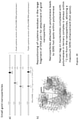
- FIG. 28 SERS-active nanoparticles attached to polymerase forming a hot spot within the active center of the enzyme. Repositioning of cysteine in the large fragment of DNA pol I for attachment of gold nanoparticles was carried out. a) Amino acid positions for attachment of gold nanoparticles to the large fragment DNA polymerase I from Geobacillus kaustophilus were selected outside the enzyme's catalytic center. The cysteine at position C388 in a wild-type enzyme was substituted with lysine and the amino acids in the designated positions were in turn substituted with cysteines by means of recombinant DNA techniques and can now be used for attachment to gold nanoparticles along with C845.
- FIG. 29 This figure is identical to FIG. 28 , except for the depiction of larger ⁇ 3.5 nm gold nanoparticles. In this case the distance between gold nanoparticles and the active center where ternary complexes containing Raman-tagged nucleotides are localized is always ⁇ 1 nm.
- This invention provides a nucleotide polymerase having 1 or more attached and/or conjugated noble metal nanoparticles, wherein the noble metal nanoparticles are a surface-enhanced Raman spectroscopy (SERS) substrates.
- the noble metal nanoparticles are either gold or silver nanoparticles.
- the metal nanoparticles are between 3 nm and 10 nm. In another embodiment there are 2, 3, 4, or 5 metal nanoparticles.
- the metal nanoparticles are attached and/or conjugated to the polymerase 1 nm-3 nm from the active site of the polymerase.
- the metal nanoparticles are attached and/or conjugated to the polymerase 1 nm-3 nm from the active site of the polymerase, thereby creating a region of enhanced sensitivity for surface enhanced Raman spectroscopy (SERS) at the active site.
- the metal nanoparticles are attached and/or conjugated to the polymerase such that when a nucleoside and/or nucleotide are in the active site of the polymerase, and wherein the nucleoside and/or nucleotide are tagged with a Raman active molecule, the metal nanoparticles are located 1 nm-3 nm from the Raman active molecule.
- the attached and/or conjugated metal nanoparticles create a region of enhanced sensitivity for surface enhanced Raman spectroscopy (SERS) at the location of the Raman active molecule.
- This invention also provide for a compound having the structure:
- the cleavable linker and reversible blocking moiety independently comprise any one of an allyl, alkyl, carbonyl, Sieber linkers, indole, disulfide, dithiomethyl, azidomethyl, nitrobenzyl, or any derivative thereof.
- R′ comprises a Raman cluster tag.
- the Raman cluster tag is one or more of —N ⁇ N + ⁇ N ⁇ , —C ⁇ CH, —C ⁇ CD, —C ⁇ C— alkyl, —C ⁇ C-aryl and —C ⁇ N moieties.
- the Raman cluster tag and/or tags has a Raman spectroscopy peak with a wave number from 2100 cm ⁇ 1 to 2300 cm ⁇ 1 .
- the reversible blocking moiety may be cleaved, and thereby result in a 3′-OH.
- the reversible blocking moiety is photo cleavable or chemically cleavable.
- the reversible blocking moiety is cleavable with one or more of Pd(0), tetrabutylammonium, DTT, a triphosphine, peroxydisulphate, iodine, or any derivative thereof.
- n 0, 1, 2, 3, 4, 5, or 6, and wherein R is a Raman active group.
- the Raman active group is any one of —N ⁇ N + ⁇ N ⁇ , —C ⁇ CH, —C ⁇ CD, —C ⁇ CH 3 and —C ⁇ N.
- a Raman cluster tag is attached to the 2′ position of the sugar.
- the invention also provides a compound having the structure:
- the invention also provides a compound having the structure:
- base is A, G, T, C, or U, or derivatives thereof, wherein n 0, 1, 2, 3, 4, 5, or 6, and wherein the Raman Cluster Tag comprises one or more Raman active groups.
- the cleavable linker is either chemically cleavable or photo cleavable.
- the cleavable linker comprises any one of an allyl, alkyl, carbonyl, Sieber linkers, indole, disulfide, dithiomethyl, azidomethyl, nitrobenzyl, or any derivative thereof.
- the cleavable linker is cleavable with one or more of Pd(0), tetrabutylammonium, DTT, a triphosphine, peroxydisulphate, iodine, or any derivative thereof.
- the compound has the structure:
- the invention also provides a compound having the structure:
- the invention also provides a compound having the structure:
- the Raman active groups are one or more of —N ⁇ N + ⁇ N ⁇ , —C ⁇ CH, —C ⁇ CD, —C ⁇ CH 3 and —C ⁇ N.
- the Raman active groups have a Raman spectroscopy peak with a wave number from 2100 cm ⁇ 1 to 2300 cm ⁇ 1 .
- the invention also provides a method for sequencing a single-stranded polynucleotide molecule, comprising:
- the invention also provides a method for sequencing a single-stranded polynucleotide molecule, comprising:
- the invention also provides a method for sequencing a single-stranded polynucleotide molecule, comprising:
- the cleavable linker of R′ comprises any one of an allyl, alkyl, carbonyl, Sieber linkers, indole, disulfide, dithiomethyl, azidomethyl, nitrobenzyl, or any derivative thereof.
- the cleavable linker of R′ is cleavable with one or more of Pd(0), tetrabutylammonium, DTT, a triphosphine, peroxydisulphate, iodine, or any derivative thereof.
- the invention also provides a method for sequencing a single-stranded polynucleotide molecule, comprising:
- the invention also provides a method for sequencing a single-stranded polynucleotide molecule, comprising:
- the invention also provides a method for sequencing a single-stranded polynucleotide molecule, comprising:
- the invention also provides a method for sequencing a single-stranded polynucleotide molecule, comprising:
- the cleavable linker attached to the base comprises any one of an allyl, alkyl, carbonyl, Sieber linkers, indole, disulfide, dithiomethyl, azidomethyl, nitrobenzyl, or any derivative thereof.
- the cleavable linker attached to the base is cleavable with one or more of Pd(0), tetrabutylammonium, DTT, a triphosphine, peroxydisulphate, iodine, or any derivative thereof.
- non-catalytic metal ions are one or more of Sr ++ and Ca ++ .
- catalytic metal ions are one or more of Mg ++ or Mn ++ .
- the Raman active groups are one or more of —N ⁇ N + ⁇ N ⁇ , —C ⁇ CH, —C ⁇ CD, —C ⁇ CH 3 and —C ⁇ N.
- the Raman active groups have a Raman spectroscopy peak with a wave number from 2100 cm ⁇ 1 to 2300 cm ⁇ 1 .
- the primer is attached to the surface or other substrate.
- single-stranded polynucleotide comprises an adapter that is a predetermined nucleotide sequence, and wherein the primer comprises a complementary nucleotide sequence.
- the single-stranded polynucleotide is Polymerase Chain Reaction (PCR)-amplified so as to thereby produce a plurality of copies which are attached to a bead, and wherein the beads with the attached plurality of single-stranded polynucleotide copies are proximally located to the surface so as to thereby permit the contacting in a region of enhanced sensitivity for surface enhanced Raman spectroscopy.
- PCR Polymerase Chain Reaction
- polymerases and primers there are a plurality of polymerases and primers so as to thereby permit simultaneous parallel sequencing of the single-stranded polynucleotide copies.
- the polymerase or polymerases are tethered to the noble metal nanoparticles.
- the noble metal nanoparticles are silver and/or gold nanoparticles.
- the polymerase or polymerases have 1 or more attached and/or conjugated noble metal nanoparticles, wherein the noble metal nanoparticles are a surface-enhanced Raman spectroscopy (SERS) substrates.
- SERS surface-enhanced Raman spectroscopy
- the noble metal nanoparticles are either gold or silver nanoparticles.
- the metal nanoparticles of the polymerase or polymerases are between 3 nm and 10 nm.
- polymerase or polymerases have 2, 3, 4, or 5 metal nanoparticles.
- the metal nanoparticles of the polymerase or polymerases are attached and/or conjugated to the polymerase 1 nm-3 nm from the active site of the polymerase. In a further embodiment the metal nanoparticles of the polymerase or polymerases are attached and/or conjugated to the polymerase or polymerases 1 nm-3 nm from the active site of the polymerase, thereby creating a region of enhanced sensitivity for surface enhanced Raman spectroscopy (SERS) at the active site.
- SERS surface enhanced Raman spectroscopy
- the metal nanoparticles are attached and/or conjugated to the polymerase such that when a nucleoside and/or nucleotide are in the active site of the polymerase, and wherein the nucleoside and/or nucleotide are tagged with a Raman active molecule, the metal nanoparticles are located 1 nm-3 nm from the Raman active molecule.
- the attached and/or conjugated metal nanoparticles of the polymerase create a region of enhanced sensitivity for surface enhanced Raman spectroscopy (SERS) at the location of the Raman active molecule.
- SERS surface enhanced Raman spectroscopy
- the invention also provides a method of single molecule real-time sequencing of a single-stranded polynucleotide, comprising:
- the nanoparticles are one of silver or gold.
- the single-stranded polynucleotide comprises an adapter which is a predetermined nucleotide sequence, and wherein the hybridized primer comprises a nucleotide sequence complementary to portion of the adapter.
- the single-stranded polynucleotide is completely sequenced, a subsequent single-stranded polynucleotide is sequenced using the same polymerase.
- the Raman spectroscopy signals of the sequenced nucleotides corresponding to the predetermined adaptor sequence indicate that a subsequent single-stranded polynucleotide is being sequenced.
- the invention also provides a method for sequencing a single-stranded polynucleotide molecule, comprising:
- the invention also provides a method for sequencing a single-stranded polynucleotide molecule, comprising:
- the invention also provides a method for sequencing a single-stranded polynucleotide molecule, comprising
- the cleavable linker of R′ comprises any one of an allyl, alkyl, carbonyl, Sieber linkers, indole, disulfide, dithiomethyl, azidomethyl, nitrobenzyl, or any derivative thereof.
- the cleavable linker of R′ is cleavable with one or more of Pd(0), tetrabutylammonium, DTT, a triphosphine, peroxydisulphate, iodine, or any derivative thereof.
- the invention also provides method for sequencing a single-stranded polynucleotide molecule, comprising:
- the invention also provides a method for sequencing a single-stranded polynucleotide molecule, comprising:
- the invention also provides method for sequencing a single-stranded polynucleotide molecule, comprising:
- the invention also provides a method for sequencing a single-stranded polynucleotide molecule, comprising:
- the cleavable linker attached to the base comprises any one of an allyl, alkyl, carbonyl, Sieber linkers, indole, disulfide, dithiomethyl, azidomethyl, nitrobenzyl, or any derivative thereof.
- the cleavable linker attached to the base is cleavable with one or more of Pd(0), tetrabutylammonium, DTT, a triphosphine, peroxydisulphate, iodine, or any derivative thereof.
- non-catalytic metal ions are one or more of Sr ++ and Ca ++ .
- catalytic metal ions are one or more of Mg ++ or Mn ++ .
- the Raman active groups are one or more of —N ⁇ N + ⁇ N ⁇ , —C ⁇ CH, —C ⁇ CD, —C ⁇ CH 3 and —C ⁇ N. In another embodiment the Raman active groups have a Raman spectroscopy peak with a wave number from 2100 cm ⁇ 1 to 2300 cm ⁇ 1 .
- the primer is attached to a surface or other substrate.
- the single-stranded polynucleotide comprises an adapter that is a predetermined nucleotide sequence, and wherein the primer comprises a complementary nucleotide sequence.
- the single-stranded polynucleotide is Polymerase Chain Reaction (PCR)-amplified so as to thereby produce a plurality of copies which are attached to a bead, and wherein the beads with the attached plurality of single-stranded polynucleotide.
- PCR Polymerase Chain Reaction
- polymerases and primers there are a plurality of polymerases and primers so as to thereby permit simultaneous parallel sequencing of the single-stranded polynucleotide copies.
- polymerase or polymerases are attached to a surface.
- the noble metal nanoparticles are silver and/or gold nanoparticles.
- the metal nanoparticles of the polymerase or polymerases are between 3 nm and 10 nm. In another embodiment the polymerase or polymerases have 2, 3, 4, or 5 metal nanoparticles. In another embodiment the metal nanoparticles of the polymerase or polymerases are attached and/or conjugated to the polymerase 1 nm-3 nm from the active site of the polymerase. In another embodiment the metal nanoparticles of the polymerase or polymerases are attached and/or conjugated to the polymerase or polymerases 1 nm-3 nm from the active site of the polymerase, thereby creating a region of enhanced sensitivity for surface enhanced Raman spectroscopy (SERS) at the active site.
- SERS surface enhanced Raman spectroscopy
- the metal nanoparticles are attached and/or conjugated to the polymerase such that when a nucleoside and/or nucleotide are in the active site of the polymerase, and wherein the nucleoside and/or nucleotide are tagged with a Raman active molecule, the metal nanoparticles are located 1 nm-3 nm from the Raman active molecule.
- the attached and/or conjugated metal nanoparticles of the polymerase create a region of enhanced sensitivity for surface enhanced Raman spectroscopy (SERS) at the location of the Raman active molecule.
- SERS surface enhanced Raman spectroscopy
- the tag comprises a plurality of identical Raman-scattering moieties. In other embodiments, the tag comprises a plurality of different Raman-scattering moieties.
- the tag comprises 3, 9, or 27 Raman-scattering moieties.
- the plurality of Raman-scattering moieties forms a linear tag. In another embodiment, the plurality of Raman-scattering moieties forms a non-linear tag. In a preferred embodiment, the non-linear tag is a dendrimer tag.
- the tag has a Raman spectroscopy peak with wavenumber from 2125 cm ⁇ 1 to 2260 cm ⁇ 1 .
- each embodiment disclosed herein is contemplated as being applicable to each of the other disclosed embodiments.
- the elements recited in the compound embodiments can be used in the composition and method embodiments described herein and vice versa.
- nucleic acid shall mean, unless otherwise specified, any nucleic acid molecule, including, without limitation, DNA, RNA and hybrids thereof.
- nucleic acid bases that form nucleic acid molecules can be the bases A, C, G, T and U, as well as derivatives thereof. Derivatives of these bases are well known in the art, and are exemplified in PCR Systems, Reagents and Consumables (Perkin Elmer Catalogue 1996-1997, Roche Molecular Systems, Inc., Branchburg, N.J., USA).
- “Substrate” or “Surface” shall mean any suitable medium present in the solid phase to which a nucleic acid or an agent may be affixed. Non-limiting examples include chips, beads, nanopore structures and columns.
- the solid substrate can be present in a solution, including an aqueous solution, a gel, or a fluid.
- Hybridize shall mean the annealing of one single-stranded nucleic acid to another nucleic acid based on the well-understood principle of sequence complementarity.
- the other nucleic acid is a single-stranded nucleic acid.
- the propensity for hybridization between nucleic acids depends on the temperature and ionic strength of their milieu, the length of the nucleic acids and the degree of complementarity. The effect of these parameters on hybridization is well known in the art (see Sambrook J, Fritsch E F, Maniatis T. 1989. Molecular cloning: a laboratory manual. Cold Spring Harbor Laboratory Press, New York.).
- hybridization of a primer sequence, or of a DNA extension product, to another nucleic acid shall mean annealing sufficient such that the primer, or DNA extension product, respectively, is extendable by creation of a phosphodiester bond with an available nucleotide or nucleotide analog capable of forming a phosphodiester bond.
- a base which is “different from” another base or a recited list of bases shall mean that the base has a different structure from the other base or bases.
- a base that is “different from” adenine, thymine, and cytosine would include a base that is guanine or a base that is uracil.
- a tag moiety which is different from the tag moiety of a referenced molecule means that the tag moiety has a different chemical structure from the chemical structure of the other/referenced tag moiety.
- vibrational spectroscopy is used to detect the presence of incorporated nucleotide analogs.
- Vibrational spectroscopy is a spectrographic analysis where the sample is illuminated with incident radiation in order to excite molecular vibrations. Vibrational excitation, caused by molecules of the sample absorbing, reflecting or scattering a particular discrete amount of energy, is detected and can be measured.
- the two major types of vibrational spectroscopy are infrared (usually FTIR) and Raman. If FTIR is employed, then the IR spectra of the nucleotide analogs are measured. If Raman is employed, then the Raman spectra of the nucleotide analogs is measured (for example of the nucleotide analogs and in the methods described herein).
- the polymerase, single-stranded polynucleotide, RNA, or primer is bound to a solid substrate via 1,3-dipolar azide-alkyne cycloaddition chemistry.
- the polymerase, DNA, RNA, or primer is bound to the solid substrate via a polyethylene glycol molecule.
- the polymerase, DNA, RNA, primer, or probe is alkyne-labeled.
- the polymerase, DNA, RNA, primer, or probe is bound to the solid substrate via a polyethylene glycol molecule and the solid substrate is azide-functionalized.
- the polymerase, DNA, RNA, or primer is immobilized on the solid substrate via an azido linkage, an alkynyl linkage, or biotin-streptavidin interaction. Immobilization of nucleic acids is described in Immobilization of DNA on Chips II, edited by Christine Wittmann (2005), Springer Verlag, Berlin, which is hereby incorporated by reference.
- the DNA is single-stranded polynucleotide.
- the RNA is single-stranded RNA.
- the solid substrate is in the form of a chip, a bead, a well, a capillary tube, a slide, a wafer, a filter, a fiber, a porous media, a porous nanotube, or a column.
- the solid substrate is a metal, gold, silver, quartz, silica, a plastic, polypropylene, a glass, or diamond.
- the solid substrate is a porous non-metal substance to which is attached or impregnated a metal or combination of metals.
- the solid surface may be in different forms including the non-limiting examples of a chip, a bead, a tube, a matrix, a nanotube.
- the solid surface may be made from materials common for DNA microarrays, including the non-limiting examples of glass or nylon.
- the solid surface for example beads/micro-beads, may be in turn immobilized to another solid surface such as a chip.
- the surface or substrate is a SERS-prepared surface or substrate designed specifically for detection of a label nucleotide.
- the surface may include one or more nanoplasmonic antenna, wherein the nanoplasmonic antenna may be a nanoplasmonic bowtie antenna.
- the nanoplasmonic bowtie antenna comprises crossed-bowtie structure in which one pair of triangles couples to incident field, while another pair of triangles couples to Raman scattered field in an orthogonal polarization. It is also contemplated that the nanoplasmonic antenna may be an array of antennas.
- the nanoplasmonic antenna may include DNA functionalized sites, and may have a gap size range from 50 nm to 1 nm.
- a nucleotide polymerase is immobilized within the gap.
- the nucleotide polymerase SERS-prepared and designed specifically for detection of a labeled nucleotide and/or nucleoside.
- the surface may include one or more nanoplasmonic antenna, wherein the nanoplasmonic antenna may be a nanoplasmonic bowtie antenna.
- the nanoplasmonic bowtie antenna comprises crossed-bowtie structure in which one pair of triangles couples to incident field, while another pair of triangles couples to Raman scattered field in an orthogonal polarization. It is also contemplated that the nanoplasmonic antenna may be an array of antennas.
- the nanoplasmonic antenna may have a gap size range from 12 nm to 1 nm.
- a nucleotide polymerase is immobilized within on a surface, substrate, or nanoplasmonic antenna on a surface.
- the surface comprises a DNA origami scaffold or an array of DNA origami scaffolds. It is also contemplated that the DNA origami scaffold further comprising a primer molecules positioned between Au and Ag nanoparticles and nanorods located at specified binding sites.
- the surface comprises plasmonic crystals or an array of plasmonic structures.
- the plasmonic structures may be periodic TiO—Au—TiO structures.
- the polymerase, nucleic acid samples, DNA, RNA, primer, or probe are separated in discrete compartments, wells or depressions on a surface.
- methods are provided wherein about 1000 or fewer copies of the polymerase, nucleic acid sample, DNA, RNA, or primer are bound to the substrate.
- This invention also provides the instant methods wherein 2 ⁇ 10 7 , 1 ⁇ 10 7 , 1 ⁇ 10 6 or 1 ⁇ 10 4 or fewer copies of the polymerase, nucleic acid sample, DNA, RNA, or primer are bound to the substrate or surface.
- the immobilized polymerase, nucleic acid sample, DNA, RNA, or primer is immobilized at a high density.
- This invention also provides the instant methods wherein over or up to 1 ⁇ 10 7 , 1 ⁇ 10 8 , 1 ⁇ 10 9 copies of the polymerase, nucleic acid sample, DNA, RNA, or primer are bound to the substrate or surface.
- the DNA is single-stranded.
- the single-stranded polynucleotide is replaced with an RNA that is single-stranded.
- UV light is used to photochemically cleave the photochemically cleavable linkers and moieties.
- the photocleavable linker is a 2-nitrobenzyl moiety.
- monochromatic light is used to irradiate Raman-label-containing nucleotide analogs (e.g. incorporated into a primer or DNA extension product) so as to elicit a signal measurable by Raman spectroscopy.
- the laser is a 532 nm, 633 nm, or 785 nm laser.
- near infra-red light is used to irradiate Raman-label-containing nucleotide analogs.
- near infra-red light is used to irradiate Raman-label-containing polynucleotide analogs.
- nucleotide residue is a single nucleotide in the state it exists after being incorporated into, and thereby becoming a monomer of, a polynucleotide.
- a nucleotide residue is a nucleotide monomer of a polynucleotide, e.g.
- DNA which is bound to an adjacent nucleotide monomer of the polynucleotide through a phosphodiester bond at the 3′ position of its sugar and is bound to a second adjacent nucleotide monomer through its phosphate group, with the exceptions that (i) a 3′ terminal nucleotide residue is only bound to one adjacent nucleotide monomer of the polynucleotide by a phosphodiester bond from its phosphate group, and (ii) a 5′ terminal nucleotide residue is only bound to one adjacent nucleotide monomer of the polynucleotide by a phosphodiester bond from the 3′ position of its sugar.
- determining the wavenumber of the Raman spectroscopy peak of a dNTP analog incorporated into a primer or DNA extension product, and thereby the identity of the dNTP analog that was incorporated permits identification of the complementary nucleotide residue in the single-stranded polynucleotide that the primer or DNA extension product is hybridized to.
- the dNTP analog that was incorporated has a unique wavenumber in the Raman spectroscopy peak identifying it as comprising an adenine, a thymine, a cytosine, or a guanine
- the complementary nucleotide residue in the single-stranded polynucleotide is identified as a thymine, an adenine, a guanine or a cytosine, respectively.
- the purine adenine (A) pairs with the pyrimidine thymine (T).
- the pyrimidine cytosine (C) pairs with the purine guanine (G).
- RNA if the dNTP analog that was incorporated comprises an adenine, a uracil, a cytosine, or a guanine, then the complementary nucleotide residue in the single-stranded RNA is identified as a uracil, an adenine, a guanine or a cytosine, respectively.
- Incorporation into an oligonucleotide or polynucleotide (such as a primer or DNA extension strand) of a nucleotide and/or nucleoside analogue means the formation of a phosphodiester bond between the 3′ carbon atom of the 3′ terminal nucleotide residue of the polynucleotide and the 5′ carbon atom of the dNTP analog resulting in the loss of pyrophosphate from the dNTP analog.
- a Raman spectroscopy system typically comprises an excitation source (such as a laser, including a laser diode in appropriate configuration, or two or more lasers), a sample illumination system and light collection optics, a wavelength selector (such as a filter or spectrophotometer), and a detection apparatus (such as a CCD, a photodiode array, or a photomultiplier).
- an excitation source such as a laser, including a laser diode in appropriate configuration, or two or more lasers
- a sample illumination system and light collection optics such as a wavelength selector (such as a filter or spectrophotometer), and a detection apparatus (such as a CCD, a photodiode array, or a photomultiplier).
- Interference (notch) filters with cut-off spectral range of ⁇ 80-120 cm ⁇ 1 from the laser line can be used for stray light elimination.
- Holographic gratings can be used.
- Double and triple spectrometers allow taking Ram
- surface enhanced Raman spectroscopy is used which employs a surface treated with one or more of certain metals known in the art to cause SERS effects.
- the surface is a surface to which the polymerase, polynucleotide, single-stranded polynucleotide, single-stranded DNA polynucleotide, single-stranded RNA, primer, DNA extension strand, or oligonucleotide probe of the methods described herein is attached. Many suitable metals are known in the art.
- the surface is electrochemically etched silver or treated with/comprises silver and/or gold colloids with average particle size below 20 nm.
- the wavenumber of the Raman spectroscopy peak of an entity is identified by irradiating the entity with the excitation source, such as a laser, and collecting the resulting Raman spectrum using a detection apparatus.
- the wavenumber of the Raman spectroscopy peak is determined from the Raman spectrum.
- the spectrum measured is from 2000 cm ⁇ 1 to 2300 cm ⁇ 1 and the wavenumber of the Raman spectroscopy peak is the peak wavenumber within that spectrum.
- the spectrum measured is a sub-range of 2000 cm ⁇ 1 to 2300 cm ⁇ 1 and the Raman spectroscopy peak wavenumber is the peak wavenumber within that spectrum sub-range.
- alkyl includes both branched and straight-chain saturated aliphatic hydrocarbon groups having the specified number of carbon atoms and may be unsubstituted or substituted.
- C1-Cn as in “C1-Cn alkyl” includes groups having 1, 2, . . . , n ⁇ 1 or n carbons in a linear or branched arrangement.
- a “C1-C5 alkyl” includes groups having 1, 2, 3, 4, or 5 carbons in a linear or branched arrangement, and specifically includes methyl, ethyl, n-propyl, isopropyl, n-butyl, t-butyl, and pentyl.
- alkenyl refers to a non-aromatic hydrocarbon group, straight or branched, containing at least 1 carbon to carbon double bond, and up to the maximum possible number of non-aromatic carbon-carbon double bonds may be present, and may be unsubstituted or substituted.
- C2-C5 alkenyl means an alkenyl group having 2, 3, 4, or 5, carbon atoms, and up to 1, 2, 3, or 4, carbon-carbon double bonds respectively.
- Alkenyl groups include ethenyl, propenyl, and butenyl.
- alkynyl refers to a hydrocarbon group straight or branched, containing at least 1 carbon to carbon triple bond, and up to the maximum possible number of non-aromatic carbon-carbon triple bonds may be present, and may be unsubstituted or substituted.
- C2-C5 alkynyl means an alkynyl group having 2 or 3 carbon atoms and 1 carbon-carbon triple bond, or having 4 or 5 carbon atoms and up to 2 carbon-carbon triple bonds.
- Alkynyl groups include ethynyl, propynyl and butynyl.
- substituted refers to a functional group as described above such as an alkyl, or a hydrocarbyl, in which at least one bond to a hydrogen atom contained therein is replaced by a bond to non-hydrogen or non-carbon atom, provided that normal valencies are maintained and that the substitution(s) result(s) in a stable compound.
- Substituted groups also include groups in which one or more bonds to a carbon(s) or hydrogen(s) atom are replaced by one or more bonds, including double or triple bonds, to a heteroatom.
- substituents include the functional groups described above, and for example, N, e.g. so as to form —CN.
- substituents and substitution patterns on the compounds of the instant invention can be selected by one of ordinary skill in the art to provide compounds that are chemically stable and that can be readily synthesized by techniques known in the art, as well as those methods set forth below, from readily available starting materials. If a substituent is itself substituted with more than one group, it is understood that these multiple groups may be on the same carbon or on different carbons, so long as a stable structure results.
- SBS sequencing by synthesis
- Related methods for nucleic acid sequencing that combine the advantages of sequencing by synthesis (SBS) in terms of sequencing accuracy with the power of SERS to describe a number of approaches for nucleic acid sequencing with both ensembles of identical template molecules and single template molecules. Further disclosed are related methods for real-time single molecule sequencing by synthesis.
- novel sequencing methods herein disclosed include (1) Raman-based sequencing by synthesis (SBS) on a surface-enhanced Raman substrate studded with noble metal nanoparticles which create a Raman hot zone above the gold layer generating SERS ( FIGS. 1-3 ), (2) one in which noble metal nanoparticles are directly attached to the polymerase resulting in a Raman hot zone within the enzyme itself ( FIGS. 4 and 5 ), and (3) a hybrid method in which noble metal nanoparticles are attached to both the substrate and the polymerase ( FIGS. 6 and 7 ).
- Raman active groups present on nucleotides and polymerase localized near or within SERS hot spots are key features of the invention disclosed herein.
- Raman groups are generally shown in the following examples as azido groups (—N ⁇ N + ⁇ N ⁇ ), but can be any chemical moiety or combination of chemical moieties (—C ⁇ CH, —C ⁇ CD, —C ⁇ C-alkyl, —C ⁇ C-aryl and —C ⁇ N) that produce a signal in a particular portion of the Raman spectrum where natural nucleotides, amino acids, nucleic acids and proteins do not.
- These Raman groups may be positioned on a nucleotide 2′- or 3′-OH group in some cases so that the resulting nucleotides are reversible terminators.
- Raman tags can also be attached to the terminal phosphate, or attached via cleavable or uncleavable bonds to the base of the nucleotides.
- the Raman active groups may be present singly or more typically in clusters such as dendrimers or bound to polynucleotide chains ( FIGS. 8 and 9 ), the latter especially when they are linked directly to the terminal phosphate or the base.
- the nucleotides in turn may be ribonucleoside or deoxyribonucleoside triphosphates or polyphosphates, dNTPs, dNPPs, NTPs or NPPs, where N can indicate adenine, thymine, guanine, cytosine, uracil or common variants of these bases well known in the sequencing field.
- These nucleotides may be further modified with 3′-OH blocking groups or with uncleavable bonds between the ⁇ and ⁇ phosphates.
- the Raman SBS strategies may include detection of an ensemble of molecules or single molecules, and in a couple of cases are designed for real-time single molecule sequencing.
- these methods can be “single color” in which a single Raman active group is used and these nucleotides are added sequentially one by one in the course of the sequencing reaction, or “four color” in which four different Raman active groups (RAGS) or combinations of RAGs are attached to each of the four nucleotides (e.g., A, C, G and T) which are added together in the reaction and can produce four distinct signatures.
- RAGS Raman active groups
- Approaches for carrying out Raman SBS utilizing most of the varieties of hot spot localization, types of nucleotides, positioning of Raman active chemical groups, ensemble or single molecule detection, number of RAGs and other features indicated above will be presented in the following section.
- a surface enhanced Raman substrate is first created by noble metal nanoparticles on a glass or other substrate.
- the glass surface may be derivatized with a sulfhydryl or equivalent chemical group to allow covalent binding of the noble metal particles.
- a wide variety of methods for generating clusters of noble metal particles for SERS are available.
- the colloidal gold particles may themselves be derivatized with chemical groups to permit self-assembly into a mono- or multilayer on the glass surface.
- Gaps of 1-5 nm between the noble metal particles are to serve as SERS hotspots, and a region of up to 10 nm above the noble metal surface forms a discontinuous hot zone (Chen et al 2015).
- the Raman signal enhancement at the hotspots may be as high as 10 8 -fold or more compared to the unenhanced Raman signal. Even at a distance of 5-10 nm from the hotspots, the hot zone, the signal enhancement should still be substantial, ⁇ 10 6 -fold. As shown in FIG.
- groups of templates are amplified onto a solid support by emulsion PCR on beads (Dressman et al 2003, Shendure et al 2005), by PCR-based bridge amplification (Bentley et al 2008), or by an isothermal amplification using walking strand displacement (Ma et al 2013) for ensemble sequencing.
- a linker of up to 2 nm in length
- the primers are immobilized to a solid support following the procedure of Harris et al (2008) in preparation for single molecule sequencing, although in this case they are modified so as to bind to the noble metal surface where the polymerase would be tethered as well; this keeps the polymerase active center within the hot zone.
- FIG. 3 just the polymerase can be directly attached to the noble metal surface following procedures in the literature for substrate attachment (Eid et al 2009, Korlach et al 2010) for real-time single molecule sequencing.
- a single moiety of one of the Raman active groups is attached to the 3′-OH of the sugar of the nucleotide as shown in FIG. 10 , which depicts four examples.
- beads bearing emulsion PCR-amplified (clonal) DNA molecules bearing adapters and adapter-based primers are deposited on the SERS surface, and the first of four 3′-azidomethyl dNTPs (NRTs), e.g., 3′-blocked dATP.
- NRTs 3′-azidomethyl dNTPs
- Any small-sized Sepharose bead may be used for the emulsion PCR; paramagnetic beads might be particularly useful when a magnet is placed below the slide, to collect the maximum number of template-bearing beads near the polymerase molecules, which are present in excess and tethered to the gold substrate, as well as to keep them in place during washing and replacement of reagents.
- the azidomethyl group not only blocks the 3′-hydroxyl group, preventing additional incorporations beyond the initial nucleotide, but also serves as a Raman active group producing peaks with a wave number in the region of the Raman spectrum (2100-2300 cm ⁇ 1 ) where proteins and DNA do not.
- the slide is treated with TCEP to restore the 3′-hydroxyl group, washed, and the second NRT, e.g., 3′-blocked dCTP, is added.
- the second NRT e.g., 3′-blocked dCTP
- nucleotides are added one at a time, all “labeled” with the same azidomethyl group. Because these nucleotides are reversible terminators, there are no difficulties in decoding the precise length of homopolymeric stretches of the same nucleotide. With potentially hundreds of millions or even billions of sites of active DNA-bound polymerases, this technique may allow human genome scale sequencing from a single chip so long as the region around each bead is monitored independently. In the case of single molecule sequencing, instead of using templates amplified on beads, templates are hybridized with primers bound to the gold surface.
- the Raman active blocking groups on the 3′-OH have already been described in Experiment 1.
- clusters from 2-100 Raman active moieties, identical to each other and the 3′ group moiety are present (similar to that shown in FIG. 11A ).
- Examples of nucleotides with attached clusters of RAGs are shown in FIG. 12 . It has been shown that nucleotides modified with very large polymers including PEG molecules with up to 36 ethylene glycol units (Kumar et al 2012) and nucleic acid chains of up to 30 nucleotides are still correctly recognized as substrates by a variety of polymerases (Fuller et al 2015). RAG clusters have important benefits for SERS detection.
- the beads After amplification of DNA on the beads by emulsion PCR, they are washed to remove Mg ++ and any other catalytic metal ions.
- Sr ++ or Ca ++ is added along with the primer and the nucleotides bearing the Raman active 3′ blocking group and the terminal phosphate-bound Raman cluster.
- Raman measurements After sufficient time to form the ternary complex, Raman measurements are made. Following measurement for as long as needed to obtain a convincing signature, Mg ++ is added to allow incorporation. Finally, TCEP is added to remove the blocking group.
- Sr ++ is added back to the solution in readiness for addition of the subsequent nucleotide for the next cycle of the sequencing process.
- Sr ++ is added before addition of TCEP to improve in-phase reading by preventing incorporation of any remaining nucleotide in the case of homopolymers, but if washes are complete, this is less necessary.
- This method only requires a set of four nucleotides, and in each round it restores the growing DNA strand to a natural state, but it requires several washes.
- templates are hybridized with primers bound to the gold surface.
- This variant which is similar to Experiment 2 in that many RAGs are present on the nucleotide, does not require switching between non-catalytic and catalytic metal ions. If the cluster on the base is attached via a cleavable linker identical to the one used as a blocking group, cleavage of both can occur at the same time ( FIG. 11B ). If for example an azidomethyl group or a disulfide group is used to attach the blocking group and the linker on the base, TCEP can be used to remove both (Guo et al 2008).
- This method utilizes twice as many RAGs as either Experiment 2 or 3.
- the procedure is identical to that of example 2.
- TCEP or other deblocking agent
- Small remnants of the tag a propargyl or other small chemical group
- a substantial number of nucleotides can be added to the primer and the sequence determined (Ju et al 2006, Guo et al 2008).
- nucleotide is added in the presence of a non-catalytic metal (Sr ++ or Ca ++ ) to preserve the ternary complex as long as needed for Raman measurements, exactly as described for Experiment 2. This is necessary as otherwise the tag cluster would be released rapidly during the incorporation reaction.
- a large excess of nucleotide reversible terminators (NRTs) i.e., nucleotides with blocking groups are added so as to replace the phosphate-tagged nucleotides.
- Mg ++ or Mn ++ is added to the solution to allow incorporation of the NRTs.
- TCEP or other reagent to remove the blocking group from the NRT, Sr ++ or Ca ++ is added again, and finally the next tagged nucleotide is added to begin the second cycle.
- This method requires 2 sets of four nucleotides and several washes. Examples of such a nucleotide are shown in FIG. 8 .
- the procedure requires both switching between catalytic and non-catalytic ion incubations and the use of NRTs, following an identical procedure to Experiment 5. Examples of such a nucleotide are shown in FIG. 16 .
- nucleotides with large clusters of RAGs attached to the base prevent the entrance and incorporation of further nucleotides.
- These large RAGs are attached via a cleavable linker, and thus the nucleotides can be considered NRTs.
- Raman detection is performed after the nucleotide is incorporated into the priming strand.
- the Raman cluster is removed by chemical or other agents depending on the cleavable moiety in the linker to allow entrance of the next nucleotide. This has the advantage of requiring only 2 steps, less than most of the other disclosed experiments, and concomitantly fewer washes. Examples of such nucleotides are shown in FIG. 18 .
- these nucleotides serve as NRTs.
- the following steps are required to take full advantage of these molecules: incubation in the presence of non-catalytic metal ions, measurement of Raman signal, incubation with catalytic metal ions to allow incorporation and release of the cluster on the terminal phosphate, treatment with the appropriate reagent for cleavage of the cluster on the base, and re-incubation with non-catalytic metal ions in preparation for the second cycle. Examples of such nucleotides are shown in FIG. 19 .
- PCP-dNTPs ⁇ , ⁇ -X-2′-deoxynucleoside 5′-triphosphates
- PCP-dNPPs polyphosphates
- X can be CH 2 , NH, CHF or CF 2 (Upton et al 2009)
- the terminal phosphate and/or the base is derivatized with clusters of Raman active chemical moieties (see example structure in FIG. 21, 22, 23 and synthetic schemes shown in FIG. 24, 25, 26 )
- a ternary complex consisting of polymerase, template, primer and nucleotide is formed (Yang et al 2004).
- cleavage of the ⁇ , ⁇ bond in these nucleotides cannot take place, they are unable to be incorporated into DNA.
- the ternary complex is monitored for sufficient time to obtain a convincing Raman signal for sequence determination.
- Nucleotides in solution will usually be too far from the hot zone to give a strong signal.
- the reaction chamber is then flushed with a high concentration of unlabeled NRTs. These replace the non-hydrolyzable phosphate nucleotides in the ternary complex and are incorporated.
- the NRTs may have any of a variety of blocking groups attached to the 3′-OH as shown in FIG. 27 , including allyl or azido-methyl groups.
- the polymerase is directly linked to the gold nanoparticles.
- the template, primer and nucleotide are added to the solution and Raman signals are monitored in real time.
- the complementary nucleotide is within ⁇ 10 nm of the SERS surface for enhanced detection.
- each of the 4 nucleotides has a cluster with a different set of Raman active groups on its terminal phosphate.
- A may have a cluster of —N ⁇ N + ⁇ N ⁇ moieties
- C may have a —C ⁇ CH cluster
- G may have a cluster
- T may have a —C ⁇ C-aryl cluster.
- a polymerase molecule is conjugated to 2, 3, 4 or 5 gold nanoparticles of approximately 3-10 nm size ( FIGS. 28 and 29 ).
- the positions selected for attachment have the following properties: (1) they do not interfere with the polymerase function, i.e., they are excluded from the key binding pockets and active center of the enzyme as well other amino acids required for enzyme activity; and (2) they are distributed so as to produce a hot zone over the polymerase molecule: given that most polymerases have dimensions in the 4-10 nm range, a pair or triangle of gold particles accomplishes this objective, allowing the Raman-tagged nucleotide in the active site of the polymerase to be localized to within 1-3 nm from the nanoparticles for SERS tag detection.
- mutants of several DNA polymerases having amino acid substitutions that do not inhibit enzyme activity and can be used to attach gold nanoparticles.
- Geobacillus kaustophilus DNA polymerase I mutants with pairs of cysteines in various antipodal locations that are used for attachment of gold particles and produce a hot zone over the active center of the polymerase FIGS. 28 and 29 ). Binding of ⁇ 1.5 nm ( FIG. 28 ) or ⁇ 3.5 gold nanoparticles ( FIG.
- FIGS. 4 and 5 Two different setups for General Category 2 are depicted in FIGS. 4 and 5 .
- the DNA is linked to magnetic beads or the chamber surface. Either the template, as shown in FIG. 4 , or the primer may be attached. Many different linkage strategies are available.
- the DNA may be modified with amino, sulfhydryl, or biotin moieties and reacted with beads derivatized with NHS succinimide, maleimide and streptavidin, respectively.
- Other chemical pairs including but not limited to azide-alkyne and trans-cyclooctene-tetrazine, are also feasible.
- Many homobifunctional and heterobifunctional cross-linkers of assorted lengths are commercially available, including photoactivatable ones.
- the gold nanoparticle-decorated polymerases are directly conjugated to the paramagnetic beads or solid surface. Again, many linkage strategies are available in addition to the biotin-Streptavidin pair shown in FIG. 5 .
- the first 9 experimental examples utilize the setup shown in FIG. 4
- Experiment 11 uses the setup shown in FIG. 5 . They may all be considered single molecule methods if random template libraries are added to each well. Alternatively, individual DNA molecules may be amplified on the magnetic beads for ensemble sequencing.
- Experiment 21 is a real-time single molecule sequencing approach. These examples are very similar to the examples in General Category 1, with nearly identical reagents and steps, hence the descriptions here will generally be shorter. Though feasible with amplification of template DNA and separate wells, the experimental examples herein disclosed do not present an example in this category equivalent to Experiment 1, an ensemble SBS only method in which single RAG molecules were present at the 3′-OH but no RAG clusters were used.
- the template (or primer) DNA-containing beads, free primer (or template), excess polymerase decorated with gold nanoparticles, and nucleotides are added to the reaction chamber in a buffer containing non-catalytic metal ions such as Sr ++ or Ca ++ .
- a buffer containing non-catalytic metal ions such as Sr ++ or Ca ++ .
- Raman measurements are made.
- Mg ++ is added to allow incorporation.
- TCEP is added to remove the blocking group.
- Sr ++ is added back to the solution in readiness for addition of the subsequent nucleotide for the next cycle of the sequencing process.
- Sr ++ may be added before addition of TCEP to improve in-phase reading by preventing incorporation of any remaining nucleotide in the case of homopolymers, but if washes are complete, this is unlikely to be necessary.
- This method only requires a set of four nucleotides, and in each round it restores the growing DNA strand to a natural state, but it requires several washes. Examples of such a nucleotide are shown in FIG. 11A .
- This variant is similar to Experiment 12 in that many RAGs are present on the nucleotide, but does not require switching between non-catalytic and catalytic metal ions. If the cluster on the base is attached via a cleavable linker identical to the one used as a blocking group, cleavage of both can occur at the same time. If for example an azidomethyl group or a disulfide group is used to attach the blocking group and the linker on the base, TCEP can be used to remove both (Guo et al 2008). With an allyl group attachment, Pd(0) or tetrabutylammonium peroxydisulphate/iodine may be used (Ju et al 2006, Yang et al 2002).
- the 2-nitrobenzyl group undergoes photocleavage after irradiation at 350 nm. Examples of such a nucleotide are shown in FIG. 19 . It has been demonstrated the attachment of many large moieties to the 5 position of pyrimidines and the 7 position of purines (Guo et al 2008, Ju et al 2006, Ruparel et al 2005, Seo et al 2005); these do not prevent their ability to be recognized by several classes of polymerases. It should be noted that the azidomethyl group produces a peak in the Raman area of interest, though it can be readily resolved from the other Raman active groups. In a slight variant of this method the blocking group on the NRT does not have to be a Raman active group.
- This method takes advantage of having twice as many RAGs as in Experiment 12 or 13.
- the procedure is identical to that of Experiment 12.
- TCEP or other deblocking agent
- Small remnants of the tag a propargyl or other small chemical group
- a substantial number of nucleotides can be added to the primer and the sequence determined (Guo et al 2008, Ju et al 2006).
- the blocking group on the NRT does not have to be a Raman active group.
- the solution contains magnetic beads with either template or primer, free primer or template depending on which is attached to the beads, nucleotides with RAG clusters on the terminal phosphate, polymerase decorated with gold nanoparticles, and non-catalytic metal ions such as Sr ++ or Ca ++ , resulting in the formation of a ternary complex consisting of polymerase, template, primer and nucleotide (Vander Horn et al 2014).
- a magnetic field is applied to bring the bead with the DNA primer or template to the surface when the DNA is not directly attached to the surface.
- NRTs nucleotide reversible terminators bearing any of several reversible blocking groups at the 3′-OH position (allyl, methoxymethyl, azidomethyl, disulfide, 2-nitrobenzyl) is added, followed by the addition of a catalytic metal such as Mg ++ or Mn ++ . This leads to the preferential binding and incorporation of the NRT which temporarily terminates the sequencing reaction at that step.
- nucleotide is added in the presence of a non-catalytic metal (Sr ++ or Ca ++ ) to preserve the ternary complex as long as needed for Raman measurements, exactly as described for Experiment 12. This is necessary as otherwise the tag cluster would be released rapidly during the incorporation reaction.
- a large excess of nucleotide reversible terminators (NRTs) i.e., nucleotides with blocking groups are added so as to replace the phosphate-tagged nucleotides.
- Mg ++ or Mn ++ is added to the solution to allow incorporation of the NRTs.
- TCEP or other reagent is added to remove the blocking group from the NRT, Sr ++ or Ca ++ is added again, and finally the next tagged nucleotide is added to begin the second cycle.
- This method requires 2 sets of four nucleotides and several washes. Examples of such a nucleotide are shown in FIG. 15 .
- the procedure requires both switching between catalytic and non-catalytic ion incubations and the use of NRTs, following an identical procedure to Experiment 15. Examples of such a nucleotide are shown in FIG. 16 .
- nucleotides with large clusters of RAGs attached to the base prevent the entrance and incorporation of further nucleotides.
- These large RAGs are attached via a cleavable linker, and the nucleotides are considered NRTs.
- Raman detection is performed after the nucleotide incorporates into the growing primer strand.
- the cluster is removed by chemical or other agents depending on the cleavable moiety in the linker to allow entrance of the next nucleotide. This has the advantage of requiring only 2 steps, less than most of the other examples, and concomitantly fewer washes. Examples of such a nucleotide are shown in FIG. 18 .
- these nucleotides serve as NRTs.
- the following steps are required to take full advantage of these molecules: incubation in the presence of non-catalytic metal ions, measurement of Raman signal, incubation with catalytic metal ions to allow incorporation and release of the cluster on the terminal phosphate, treatment with the appropriate reagent for cleavage of the cluster on the base, and re-incubation with non-catalytic metal ions in preparation for the second cycle. Examples of such a nucleotide are shown in FIG. 19 .
- PCP-dNTPs ⁇ , ⁇ -X-2′-deoxynucleoside 5′-triphosphates
- PCP-dNPPs polyphosphates
- X can be CH 2 , NH, CHF or CF 2 (Upton et al 2009)
- the terminal phosphate and/or the base is derivatized with clusters of Raman active chemical moieties ( FIG. 20C ) (see example structure in FIG. 23 and scheme for its synthesis in FIG.
- a ternary complex consisting of polymerase decorated with gold beads, template (or primer) on magnetic beads or surface, primer (or template) and nucleotide will be formed (Yang et al 2004). Because cleavage of the ⁇ , ⁇ bond in these nucleotides cannot take place, they are unable to be incorporated into DNA. Thus the ternary complex can be monitored for sufficient time to obtain a convincing Raman signal. Nucleotides in solution are usually be too far from the hot zone to give a strong signal. The fluidic chamber is then flushed with a high concentration of unlabeled NRTs. These replace the non-hydrolyzable phosphate nucleotides in the ternary complex and are incorporated.
- the NRTs may have any of a variety of blocking groups attached to the 3′-OH as shown in FIG. 27 , including allyl or azido-methyl groups.
- Pd(0) or tetrabutylammonium peroxydisulphate/iodine, or TCEP cleavage respectively to restore the 3′-OH group, another round with the next unincorporable nucleotide will be initiated, and so forth. Buffer washes are carried out between each reagent addition to reduce background. The use of unincorporable nucleotides obviates the need to use non-catalytic metal ions, resulting in less overall solution changes and washes.
- the gold-decorated polymerase is itself attached to the magnetic beads or the surface via a biotin-avidin or other linkage and the DNA template, primer and nucleotides are in solution.
- the gold particles serve to localize the Raman detection to the active site of the enzyme.
- unblocked nucleotides are used with each of the 4 nucleotides having a cluster with a different set of Raman active groups on its terminal phosphate.
- A may have a cluster of —N ⁇ N + ⁇ N ⁇ moieties
- C may have a —C ⁇ CH cluster
- G may have a —C ⁇ N cluster
- T may have a —C ⁇ C-aryl cluster.
- Raman monitoring takes place in real time.
Landscapes
- Chemical & Material Sciences (AREA)
- Life Sciences & Earth Sciences (AREA)
- Engineering & Computer Science (AREA)
- Health & Medical Sciences (AREA)
- Organic Chemistry (AREA)
- Zoology (AREA)
- Wood Science & Technology (AREA)
- Proteomics, Peptides & Aminoacids (AREA)
- Bioinformatics & Cheminformatics (AREA)
- General Health & Medical Sciences (AREA)
- Genetics & Genomics (AREA)
- Molecular Biology (AREA)
- Biochemistry (AREA)
- General Engineering & Computer Science (AREA)
- Biotechnology (AREA)
- Microbiology (AREA)
- Analytical Chemistry (AREA)
- Physics & Mathematics (AREA)
- Immunology (AREA)
- Biophysics (AREA)
- Nanotechnology (AREA)
- Medicinal Chemistry (AREA)
- Crystallography & Structural Chemistry (AREA)
- General Physics & Mathematics (AREA)
- Biomedical Technology (AREA)
- Condensed Matter Physics & Semiconductors (AREA)
- Composite Materials (AREA)
- Materials Engineering (AREA)
- Medical Informatics (AREA)
- Pharmacology & Pharmacy (AREA)
- Nuclear Medicine, Radiotherapy & Molecular Imaging (AREA)
- Pathology (AREA)
- Measuring Or Testing Involving Enzymes Or Micro-Organisms (AREA)
- Chemical Kinetics & Catalysis (AREA)
- Investigating, Analyzing Materials By Fluorescence Or Luminescence (AREA)
Abstract
Description

wherein the base is A, G, T, C, or U, or derivatives thereof, wherein n=0, 1, 2, 3, 4, 5, or 6, wherein R′ is H, a reversible 3′-0 blocking moiety that prevents a subsequent nucleotide polymerase event, and/or a Raman cluster tag, wherein the Raman cluster tag(s) comprise one or more Raman active groups.

wherein base is any one of A, G, T, C, or U, or derivatives thereof, wherein n=0, 1, 2, 3, 4, 5, or 6, and wherein the Raman Cluster Tag is a chemical structure comprising one or more Raman active groups.

wherein base is any one of A, G, T, C, or U, or derivatives thereof, wherein n=0, 1, 2, 3, 4, 5, or 6, wherein the Raman Cluster Tag comprises Raman active groups, wherein X is any one of CH2, NH, CHF—, or CF2, and wherein Y is any one of O, S, or BH3, wherein X and/or Y prevent the nucleotide polymerase from cleaving the bond between the α and β phosphates.
-
- a) contacting an nucleotide sequence having a primer hybridized to a portion thereof, with a nucleotide polymerase and nucleoside polyphosphate analogues:
- (i) under conditions that permit the nucleotide polymerase to catalyze incorporation onto the primer of a nucleoside polyphosphate analogue if the analogue is complementary to a nucleotide residue of oligonucleotide sequence which is immediately 5′ to a nucleotide residue of the nucleotide sequence hybridized to the 3′ terminal nucleotide of the primer, so as to form a DNA extension product, or
- (ii) further contacting with one or more non-catalytic metal ions under conditions permitting the nucleotide polymerase to form a ternary complex with the single-stranded DNA, primer, and the nucleoside polyphosphate analogue if the analogue is complementary to a nucleotide residue of the single-stranded DNA which is immediately 5′ to a nucleotide residue of the single-stranded DNA hybridized to the 3′ terminal nucleotide of the primer,
- wherein one or more of the polymerase, single-stranded DNA, or primer are located within 10 nm of a surface or other substrate with embedded, derivatized, attached, or conjugated noble metal nanoparticles that are interspersed between 1 nm-5 nm on the surface, thereby creating regions of enhanced sensitivity for surface enhanced Raman spectroscopy, wherein the nucleoside polyphosphate analogues have the structure:
- a) contacting an nucleotide sequence having a primer hybridized to a portion thereof, with a nucleotide polymerase and nucleoside polyphosphate analogues:

-
-
-
- wherein base is any one of A, G, T, C, or U, or derivatives thereof, wherein n=0, 1, 2, 3, 4, 5, or 6, and R′ comprises H, a 3′-O blocking group, a cleavable linker and/or a Raman cluster tag, and optionally wherein the analogue has a Raman cluster tag attached to the base,
- wherein said Raman cluster attached to the base is optionally attached via a cleavable linker, and
- wherein optionally a Raman cluster tag is attached to the terminal phosphate of the analogue, and
- wherein the Raman cluster tag comprises one or more Raman active groups, wherein the Raman spectroscopy peak of the Raman cluster tag is predetermined, wherein the Raman spectroscopy peak of the tag on each analogue is distinguishable from the Raman spectroscopy peak of the tag on each of the remaining analogues, wherein each analogue comprises a base which is different from the base of each of the remaining three analogues, and wherein when the cleavable linker is cleaved it results in a 3′-OH,
-
- b) determining the wavenumber of the Raman spectroscopy peak of the incorporated nucleoside polyphosphate analogue Raman cluster tag, so as to thereby determine the identity of the incorporated nucleoside polyphosphate analogue and the identity of the complementary nucleotide residue in the single-stranded DNA;
- c) wherein R′ or a linker attaching a base to a Raman cluster tag contain cleavable linkers, cleaving the linkers;
- d) wherein the base contains a terminal phosphate bound Raman cluster tag, adding catalytic metal ions, thereby allowing the polymerase to catalyze incorporation of the analogue while also cleaving the terminal phosphate with the bound Raman cluster tag, or optionally adding nucleotide reversible terminators to replace the analogue in the ternary complex, and subsequently adding a catalytic metal ion so as to permit the polymerase to incorporate the nucleotide reversible terminator;
- e) iteratively performing steps a) through d) for each nucleotide residue of the nucleotide sequence to be sequenced so as to thereby determine the sequence of the nucleotide sequence.
-
-
- a) contacting the nucleotide sequence having a primer hybridized to a portion thereof, with a nucleotide polymerase, four nucleoside polyphosphate analogues, under conditions permitting the nucleotide polymerase to form a ternary complex with the single-stranded DNA, primer, and the nucleoside polyphosphate analogue if the analogue is complementary to a nucleotide residue of the single-stranded DNA which is immediately 5′ to a nucleotide residue of the single-stranded DNA hybridized to the 3′ terminal nucleotide of the primer, wherein one or more of the polymerase, single-stranded DNA, or primer are located within 10 nm of a surface or other substrate with embedded, derivatized, attached, or conjugated noble metal nanoparticles that are interspersed between 1 nm-5 nm on the surface, thereby creating regions of enhanced sensitivity for surface enhanced Raman spectroscopy, wherein the nucleoside polyphosphate analogues have the structure:

-
-
- wherein base is any one of A, G, T, C, or U, or derivatives thereof, wherein n=0, 1, 2, 3, 4, 5, or 6, wherein the Raman Cluster Tag comprises Raman active groups, wherein X is any one of CH2, NH, CHF—, or CF2, and wherein Y is any one of O, S, or BH3, wherein X and/or Y prevent the nucleotide polymerase from cleaving the bond between the α and β phosphate, wherein the Raman spectroscopy peaks of the Raman cluster tag are predetermined, wherein the Raman spectroscopy peaks of the tag on each analogue are distinguishable from the Raman spectroscopy peaks of the tags on each of the remaining analogues, wherein each analogue comprises a base which is different from the base of each of the remaining three analogues;
- b) determining the wavenumber of the Raman spectroscopy peaks of the Raman cluster tag of the analogue in the ternary complex, so as to thereby determine the identity of the nucleoside polyphosphate and the identity of the complementary nucleotide residue in the nucleotide sequence;
- c) contacting the ternary complex with four nucleotide reversible terminators thereby replacing the nucleoside polyphosphate analogue with a nucleotide reversible terminator with the proviso that the nucleotide reversible terminator is complementary to a nucleotide residue of the single-stranded DNA which is immediately 5′ to a nucleotide residue of the single-stranded DNA hybridized to the 3′ terminal nucleotide of the primer, wherein each nucleotide reversible terminator has the structure:
-

-
-
- wherein base is any one of A, G, T, C, or U, or derivatives thereof, wherein n=0, 1, 2, 3, 4, 5, or 6, wherein R′ comprises a cleavable 3′ blocking group, wherein each nucleotide reversible terminator comprises a base which is different from the base of each of the remaining nucleotide reversible terminators;
- d) removing some or all of the non-catalytic metal ions, and adding catalytic metal ions, thereby permitting the nucleotide polymerase to incorporate the nucleotide reversible terminator into the primer so as to form a nucleotide extension product;
- e) cleaving the blocking group thereby resulting in a 3′-OH;
- f) iteratively performing steps a) through e) for each nucleotide residue of the single-stranded DNA to be sequenced so as to thereby determine the sequence of the nucleotide sequence.
-
-
- a) contacting an nucleotide sequence having a primer hybridized to a portion thereof, with a nucleotide polymerase and nucleoside polyphosphate analogues:
- (i) under conditions that permit the nucleotide polymerase to catalyze incorporation onto the primer of a nucleoside polyphosphate if the analogue is complementary to a nucleotide residue of oligonucleotide sequence which is immediately 5′ to a nucleotide residue of the nucleotide sequence hybridized to the 3′ terminal nucleotide of the primer, so as to form a DNA extension product, or
- (ii) further contacting with or more non-catalytic metal ions under conditions permitting the nucleotide polymerase to form a ternary complex with the single-stranded DNA, primer, and the nucleoside polyphosphate analogue if the analogue is complementary to a nucleotide residue of the single-stranded DNA which is immediately 5′ to a nucleotide residue of the single-stranded DNA hybridized to the 3′ terminal nucleotide of the primer,
- wherein the polymerase has one or more embedded, derivatized, attached, and/or conjugated noble metal nanoparticles thereby creating a region or regions of enhanced sensitivity for surface enhanced Raman spectroscopy within or adjacent to the polymerase, wherein the nucleoside polyphosphate analogues have the structure:
- a) contacting an nucleotide sequence having a primer hybridized to a portion thereof, with a nucleotide polymerase and nucleoside polyphosphate analogues:

-
-
-
- wherein base is any one of A, G, T, C, or U, or derivatives thereof, wherein n=0, 1, 2, 3, 4, 5, or 6, and R′ comprises H, a 3′-O blocking group, a cleavable linker and/or a Raman cluster tag, and optionally wherein the analogue has a Raman cluster tag attached to the base,
- wherein said Raman cluster attached to the base is optionally attached via a cleavable linker, and
- wherein optionally a Raman cluster tag is attached to the terminal phosphate of the analogue, and
- wherein the Raman cluster tag comprises one or more Raman active groups, wherein the Raman spectroscopy peak of the Raman cluster tag is predetermined, wherein the Raman spectroscopy peak of the tag on each analogue is distinguishable from the Raman spectroscopy peak of the tag on each of the remaining analogues, wherein each analogue comprises a base which is different from the base of each of the remaining three analogues, and wherein when the cleavable linker is cleaved it results in a 3′-OH;
-
- b) determining the wavenumber of the Raman spectroscopy peak of the incorporated nucleoside polyphosphate analogue Raman cluster tag, so as to thereby determine the identity of the incorporated nucleoside polyphosphate and the identity of the complementary nucleotide residue in the single-stranded DNA;
- c) wherein R′ or a linker attaching a base to a Raman cluster tag contain cleavable linkers, cleaving the linkers;
- d) wherein the base contains a terminal phosphate bound Raman cluster tag, adding catalytic metal ions, thereby allowing the polymerase to catalyze incorporation of the analogue while also cleaving the terminal phosphate with the bound Raman cluster tag, or optionally adding nucleotide reversible terminators to replace the analogue in the ternary complex, and subsequently adding a catalytic metal ion so as to permit the polymerase to incorporate the nucleotide reversible terminator;
- e) iteratively performing steps a) through d) for each nucleotide residue of the nucleotide sequence to be sequenced so as to thereby determine the sequence of the nucleotide sequence.
-


wherein, n=0, 1, 2, 3, 4, 5, or 6, and wherein R is a Raman active group.

wherein base is any one of A, G, T, C, or U, or derivatives thereof, wherein n=0, 1, 2, 3, 4, 5, or 6, and wherein the Raman Cluster Tag is a chemical structure comprising one or more Raman active groups.

wherein R is a Raman active group and n=0, 1, 2, 3, 4, 5, or 6.

wherein base is A, G, T, C, or U, or derivatives thereof, wherein


wherein R is a Raman active group and n=0, 1, 2, 3, 4, 5, or 6.

wherein base is any one of A, G, T, C, or U, or derivatives thereof, wherein n=0, 1, 2, 3, 4, 5, or 6, wherein the Raman Cluster Tag comprises Raman active groups, wherein X is any one of CH2, NH, CHF—, or CF2, and wherein Y is any one of O, S, or BH3.


wherein R is a Raman active group and n=0, 1, 2, 3, 4, 5, or 6.

wherein base is any one of A, G, T, C, or U, or derivatives thereof, wherein n=0, 1, 2, 3, 4, 5, or 6, wherein R′ comprises a Raman Cluster Tag, and wherein the Raman Cluster Tag comprises Raman active groups, and optionally the Raman cluster tag comprises a cleavable linker wherein cleaving the linker results in a 3′-OH.

- a) contacting the single-stranded polynucleotide having a primer hybridized to a portion thereof, with a nucleotide polymerase and a nucleoside polyphosphate analogue under conditions permitting the nucleotide polymerase to catalyze incorporation onto the primer of the nucleoside polyphosphate analogue if the analogue is complementary to a nucleotide residue of the single-stranded polynucleotide which is immediately 5′ to a nucleotide residue of the single-stranded polynucleotide hybridized to the 3′ terminal nucleotide of the primer, so as to form a DNA extension product, wherein one or more of the polymerase, single-stranded polynucleotide, or primer are located within 10 nm of a surface or other substrate with embedded, derivatized, attached, or conjugated noble metal nanoparticles that are interspersed between 1 nm-5 nm on the surface, thereby creating regions of enhanced sensitivity for surface enhanced Raman spectroscopy, wherein the nucleoside polyphosphate analogue has the structure:

-
- wherein base is any one of A, G, T, C, or U, or derivatives thereof, wherein n=0, 1, 2, 3, 4, 5, or 6, and R′ comprises a cleavable linker and a Raman cluster tag, wherein R′ is a 3′ blocking group, wherein the Raman cluster tag comprises one or more Raman active groups, wherein the Raman spectroscopy peak of the Raman cluster tag is predetermined, and wherein when the cleavable linker is cleaved it results in a 3′-OH, and
- wherein if the base of the analogue is not complementary to the nucleotide residue of the single-stranded polynucleotide which is immediately 5′ to the nucleoside residue of the single-stranded polynucleotide hybridized to the 3′ terminal nucleotide residue of the primer, then iteratively repeating the contacting with a nucleoside polyphosphate having a different base until the nucleoside polyphosphate analogue has a base that is complementary;
- b) determining the wavenumber of the Raman spectroscopy peak of the incorporated nucleoside polyphosphate analogue Raman cluster tag, so as to thereby determine the identity of the incorporated nucleoside polyphosphate and the identity of the complementary nucleotide residue in the single-stranded polynucleotide;
- c) cleaving the cleavable linker, so as to thereby create a 3′-OH;
- d) iteratively performing steps a) through c) for each nucleotide residue of the single-stranded polynucleotide to be sequenced so as to thereby determine the sequence of the single-stranded polynucleotide.
- a) contacting the single-stranded polynucleotide having a primer hybridized to a portion thereof, with a nucleotide polymerase and four nucleoside polyphosphate analogues under conditions permitting the nucleotide polymerase to catalyze incorporation onto the primer of a nucleoside polyphosphate analogue if the analogue is complementary to a nucleotide residue of the single-stranded polynucleotide which is immediately 5′ to a nucleotide residue of the single-stranded polynucleotide hybridized to the 3′ terminal nucleotide of the primer, so as to form a DNA extension product, wherein one or more of the polymerase, single-stranded polynucleotide, or primer are located within 10 nm of a surface or other substrate with embedded, derivatized, attached, or conjugated noble metal nanoparticles that are interspersed between 1 nm-5 nm on the surface, thereby creating regions of enhanced sensitivity for surface enhanced Raman spectroscopy, wherein the nucleoside polyphosphate analogues have the structure:

-
- wherein base is any one of A, G, T, C, or U, or derivatives thereof, wherein n=0, 1, 2, 3, 4, 5, or 6, and R′ comprises a cleavable linker and a Raman cluster tag, wherein R′ is a 3′ blocking group, wherein the Raman cluster tag comprises one or more Raman active groups, wherein the Raman spectroscopy peak of the Raman cluster tag is predetermined, wherein the Raman spectroscopy peak of the tag on each analogue is distinguishable from the Raman spectroscopy peak of the tag on each of the remaining analogues, wherein each analogue comprises a base which is different from the base of each of the remaining three analogues, and wherein when the cleavable linker is cleaved it results in a 3′-OH;
- b) determining the wavenumber of the Raman spectroscopy peak of the incorporated nucleoside polyphosphate analogue Raman cluster tag, so as to thereby determine the identity of the incorporated nucleoside polyphosphate and the identity of the complementary nucleotide residue in the single-stranded polynucleotide;
- c) cleaving the cleavable linker of R′, so as to thereby create a 3′-OH;
- d) iteratively performing steps a) through c) for each nucleotide residue of the single-stranded polynucleotide to be sequenced so as to thereby determine the sequence of the single-stranded polynucleotide.

-
- wherein base is any one of A, G, T, C, or U, or derivatives thereof, wherein n=0, 1, 2, 3, 4, 5, or 6, and R′ comprises a cleavable linker and a Raman cluster tag, wherein R′ is a 3′ blocking group, wherein the Raman cluster tag comprises one or more Raman active groups, wherein the Raman spectroscopy peak of the Raman cluster tag is predetermined, wherein the Raman spectroscopy peak of the tag on each analogue is distinguishable from the Raman spectroscopy peak of the tag on each of the remaining analogues, wherein each analogue comprises a base which is different from the base of each of the remaining three analogues, and wherein when the cleavable linker of R′ is cleaved it results in a 3′-OH,
- wherein in step c) the cleavable linker attached to the base and the cleavable linker of R′ are cleaved under identical circumstances.
- a) contacting the single-stranded polynucleotide having a primer hybridized to a portion thereof, with a nucleotide polymerase, four nucleoside polyphosphate analogues, and one or more non-catalytic metal ions under conditions permitting the nucleotide polymerase to form a ternary complex with the single-stranded polynucleotide, primer, and the nucleoside polyphosphate analogue if the analogue is complementary to a nucleotide residue of the single-stranded polynucleotide which is immediately 5′ to a nucleotide residue of the single-stranded polynucleotide hybridized to the 3′ terminal nucleotide of the primer, wherein one or more of the polymerase, single-stranded polynucleotide, or primer are located within 10 nm of a surface or other substrate with embedded, derivatized, attached, or conjugated noble metal nanoparticles that are interspersed between 1 nm-5 nm on the surface, thereby creating regions of enhanced sensitivity for surface enhanced Raman spectroscopy, wherein the nucleoside polyphosphate analogues have the structure:

-
- wherein base is any one of A, G, T, C, or U, or derivatives thereof, wherein n=0, 1, 2, 3, 4, 5, or 6, and R′ comprises a cleavable linker and a Raman cluster tag, wherein R′ is a 3′ blocking group, wherein the Raman cluster tags comprise one or more Raman active groups, wherein the Raman spectroscopy peaks of the Raman cluster tags are predetermined, wherein the Raman spectroscopy peaks of the tags on each analogue are distinguishable from the Raman spectroscopy peaks of the tags on each of the remaining analogues, wherein each analogue comprises a base which is different from the base of each of the remaining three analogues, and wherein when the cleavable linker is cleaved it results in a 3′-OH;
- b) determining the wavenumber of the Raman spectroscopy peaks of the Raman cluster tags of the analogue in the ternary complex, so as to thereby determine the identity of the nucleoside polyphosphate and the identity of the complementary nucleotide residue in the single-stranded polynucleotide;
- c) cleaving the cleavable linker, so as to thereby create a 3′-OH, removing some or all of the non-catalytic metal ions, and adding catalytic metal ions, thereby permitting the nucleotide polymerase to cleave the terminal phosphate with the bound Raman cluster tag and catalyze the incorporation of the analogue into the primer so as to form a DNA extension product;
- d) iteratively performing steps a) through c) for each nucleotide residue of the single-stranded polynucleotide to be sequenced so as to thereby determine the sequence of the single-stranded polynucleotide.

-
- wherein base is any one of A, G, T, C, or U, or derivatives thereof, wherein n=0, 1, 2, 3, 4, 5, or 6, and R′ comprises a cleavable linker and a Raman cluster tag, wherein R′ is a 3′ blocking group, wherein the Raman cluster tags comprise one or more Raman active groups, wherein the Raman spectroscopy peaks of the Raman cluster tags are predetermined, wherein the Raman spectroscopy peaks of the tags on each analogue are distinguishable from the Raman spectroscopy peaks of the tags on each of the remaining analogues, wherein each analogue comprises a base which is different from the base of each of the remaining three analogues, and wherein when the cleavable linker of R′ is cleaved it results in a 3′-OH, and
- wherein step c) also includes cleaving the cleavable linker attached to the base.
- a) contacting the single-stranded polynucleotide having a primer hybridized to a portion thereof, with a nucleotide polymerase, four nucleoside polyphosphate analogues, and one or more non-catalytic metal ions under conditions permitting the nucleotide polymerase to form a ternary complex with the single-stranded polynucleotide, primer, and the nucleoside polyphosphate analogue if the analogue is complementary to a nucleotide residue of the single-stranded polynucleotide which is immediately 5′ to a nucleotide residue of the single-stranded polynucleotide hybridized to the 3′ terminal nucleotide of the primer, wherein one or more of the polymerase, single-stranded polynucleotide, or primer are located within 10 nm of a surface or other substrate with embedded, derivatized, attached, or conjugated noble metal nanoparticles that are interspersed between 1 nm-5 nm on the surface, thereby creating regions of enhanced sensitivity for surface enhanced Raman spectroscopy, wherein the nucleoside polyphosphate analogues have the structure:

-
- wherein base is any one of A, G, T, C, or U, or derivatives thereof, wherein n=0, 1, 2, 3, 4, 5, or 6, wherein the Raman cluster tag comprises one or more Raman active groups, wherein the Raman spectroscopy peaks of the Raman cluster tag is predetermined, wherein the Raman spectroscopy peaks of the tag on each analogue are distinguishable from the Raman spectroscopy peaks of the tags on each of the remaining analogues, wherein each analogue comprises a base which is different from the base of each of the remaining three analogues;
- b) determining the wavenumber of the Raman spectroscopy peaks of the Raman cluster tag of the analogue in the ternary complex, so as to thereby determine the identity of the nucleoside polyphosphate and the identity of the complementary nucleotide residue in the single-stranded polynucleotide;
- c) contacting the ternary complex with four nucleotide reversible terminators thereby replacing the nucleoside polyphosphate analogue with a nucleotide reversible terminator with the proviso that the nucleotide reversible terminator is complementary to a nucleotide residue of the single-stranded polynucleotide which is immediately 5′ to a nucleotide residue of the single-stranded polynucleotide hybridized to the 3′ terminal nucleotide of the primer, wherein the nucleotide reversible terminators have the structure:

-
- wherein base is any one of A, G, T, C, or U, or derivatives thereof, wherein n=0, 1, 2, 3, 4, 5, or 6, wherein R′ comprises a cleavable 3′ blocking group, wherein each nucleotide reversible terminator comprises a base which is different from the base of each of the remaining nucleotide reversible terminators;
- d) removing some or all of the non-catalytic metal ions, and adding catalytic metal ions, thereby permitting the nucleotide polymerase to incorporate the nucleotide reversible terminator into the primer so as to form a DNA extension product;
- e) cleaving the blocking group thereby resulting in a 3′-OH;
- f) iteratively performing steps a) through e) for each nucleotide residue of the single-stranded polynucleotide to be sequenced so as to thereby determine the sequence of the single-stranded polynucleotide.
- a) contacting the single-stranded polynucleotide having a primer hybridized to a portion thereof, with a nucleotide polymerase and four nucleoside polyphosphate analogues under conditions permitting the nucleotide polymerase to catalyze incorporation onto the primer of a nucleoside polyphosphate analogue if the analogue is complementary to a nucleotide residue of the single-stranded polynucleotide which is immediately 5′ to a nucleotide residue of the single-stranded polynucleotide hybridized to the 3′ terminal nucleotide of the primer, so as to form a DNA extension product, wherein one or more of the polymerase, single-stranded polynucleotide, or primer are located within 10 nm of a surface or other substrate with embedded, derivatized, attached, or conjugated noble metal nanoparticles that are interspersed between 1 nm-5 nm on the surface, thereby creating regions of enhanced sensitivity for surface enhanced Raman spectroscopy, wherein the nucleoside polyphosphate analogues have the structure:

-
- wherein base is any one of A, G, T, C, or U, or derivatives thereof, wherein n=0, 1, 2, 3, 4, 5, or 6, and wherein the Raman cluster tag comprises one or more Raman active groups, wherein the Raman spectroscopy peak of the Raman cluster tag is predetermined, wherein the Raman spectroscopy peak of the tag on each analogue is distinguishable from the Raman spectroscopy peak of the tag on each of the remaining analogues, wherein the presence of the Raman cluster tag prevents the polymerase from incorporating a subsequent nucleotide, wherein each analogue comprises a base which is different from the base of each of the remaining three analogues,
- b) determining the wavenumber of the Raman spectroscopy peak of the incorporated nucleoside polyphosphate analogue Raman cluster tag, so as to thereby determine the identity of the incorporated nucleoside polyphosphate and the identity of the complementary nucleotide residue in the single-stranded polynucleotide;
- c) cleaving the cleavable linker, thereby permitting the polymerase to incorporate a subsequent nucleoside polyphosphate analogue;
- d) iteratively performing steps a) through c) for each nucleotide residue of the single-stranded polynucleotide to be sequenced so as to thereby determine the sequence of the single-stranded polynucleotide.
- a) contacting the single-stranded polynucleotide having a primer hybridized to a portion thereof, with a nucleotide polymerase, four nucleoside polyphosphate analogues, and one or more non-catalytic metal ions under conditions permitting the nucleotide polymerase to form a ternary complex with the single-stranded polynucleotide, primer, and the nucleoside polyphosphate analogue if the analogue is complementary to a nucleotide residue of the single-stranded polynucleotide which is immediately 5′ to a nucleotide residue of the single-stranded polynucleotide hybridized to the 3′ terminal nucleotide of the primer, wherein one or more of the polymerase, single-stranded polynucleotide, or primer are located within 10 nm of a surface or other substrate with embedded, derivatized, attached, or conjugated noble metal nanoparticles that are interspersed between 1 nm-5 nm on the surface, thereby creating regions of enhanced sensitivity for surface enhanced Raman spectroscopy, wherein the nucleoside polyphosphate analogues have the structure:

-
- wherein base is any one of A, G, T, C, or U, or derivatives thereof, wherein n=0, 1, 2, 3, 4, 5, or 6, wherein the Raman cluster tags comprise one or more Raman active groups, wherein the Raman spectroscopy peaks of the Raman cluster tags are predetermined, wherein the Raman spectroscopy peaks of the tags on each analogue are distinguishable from the Raman spectroscopy peaks of the tags on each of the remaining analogues, wherein the presence of the Raman cluster tag linked to the base prevents the polymerase from incorporating a subsequent nucleoside polyphosphate, wherein each analogue comprises a base which is different from the base of each of the remaining three analogues,
- b) determining the wavenumber of the Raman spectroscopy peaks of the Raman cluster tags of the analogue in the ternary complex, so as to thereby determine the identity of the nucleoside polyphosphate and the identity of the complementary nucleotide residue in the single-stranded polynucleotide;
- c) cleaving the cleavable linker so as to remove the tag attached to the base, removing some or all of the non-catalytic metal ions, adding one or more catalytic metal ions, thereby permitting the nucleotide polymerase to cleave the terminal phosphate with the bound Raman cluster tag and catalyze the incorporation of the analogue into the primer so as to form a DNA extension product;
- d) iteratively performing steps a) through c) for each nucleotide residue of the single-stranded polynucleotide to be sequenced so as to thereby determine the sequence of the single-stranded polynucleotide.
- a) contacting the single-stranded polynucleotide having a primer hybridized to a portion thereof, with a nucleotide polymerase, four nucleoside polyphosphate analogues, under conditions permitting the nucleotide polymerase to form a ternary complex with the single-stranded polynucleotide, primer, and the nucleoside polyphosphate analogue if the analogue is complementary to a nucleotide residue of the single-stranded polynucleotide which is immediately 5′ to a nucleotide residue of the single-stranded polynucleotide hybridized to the 3′ terminal nucleotide of the primer, wherein one or more of the polymerase, single-stranded polynucleotide, or primer are located within 10 nm of a surface or other substrate with embedded, derivatized, attached, or conjugated noble metal nanoparticles that are interspersed between 1 nm-5 nm on the surface, thereby creating regions of enhanced sensitivity for surface enhanced Raman spectroscopy, wherein the nucleoside polyphosphate analogues have the structure:

-
- wherein base is any one of A, G, T, C, or U, or derivatives thereof, wherein n=0, 1, 2, 3, 4, 5, or 6, wherein the Raman Cluster Tag comprises Raman active groups, wherein X is any one of CH2, NH, CHF—, or CF2, and wherein Y is any one of O, S, or BH3, wherein X and/or Y prevent the nucleotide polymerase from cleaving the bond between the α and β phosphate, wherein the Raman spectroscopy peaks of the Raman cluster tag is predetermined, wherein the Raman spectroscopy peaks of the tag on each analogue are distinguishable from the Raman spectroscopy peaks of the tags on each of the remaining analogues, wherein each analogue comprises a base which is different from the base of each of the remaining three analogues;
- b) determining the wavenumber of the Raman spectroscopy peaks of the Raman cluster tag of the analogue in the ternary complex, so as to thereby determine the identity of the nucleoside polyphosphate and the identity of the complementary nucleotide residue in the single-stranded polynucleotide;
- c) contacting the ternary complex with four nucleotide reversible terminators thereby replacing the nucleoside polyphosphate analogue with a nucleotide reversible terminator with the proviso that the nucleotide reversible terminator is complementary to a nucleotide residue of the single-stranded polynucleotide which is immediately 5′ to a nucleotide residue of the single-stranded polynucleotide hybridized to the 3′ terminal nucleotide of the primer, wherein each nucleotide reversible terminator has the structure:

-
- wherein base is any one of A, G, T, C, or U, or derivatives thereof, wherein n=0, 1, 2, 3, 4, 5, or 6, wherein R′ comprises a cleavable 3′ blocking group, wherein each nucleotide reversible terminator comprises a base which is different from the base of each of the remaining nucleotide reversible terminators;
- d) removing some or all of the non-catalytic metal ions, and adding catalytic metal ions, thereby permitting the nucleotide polymerase to incorporate the nucleotide reversible terminator into the primer so as to form a DNA extension product;
- e) cleaving the blocking group thereby resulting in a 3′-OH;
- f) iteratively performing steps a) through e) for each nucleotide residue of the single-stranded polynucleotide to be sequenced so as to thereby determine the sequence of the single-stranded polynucleotide.
- a) first, contacting the single-stranded polynucleotide having a primer hybridized to a portion thereof, with a nucleotide polymerase, four nucleoside polyphosphate analogues, under conditions permitting the nucleotide polymerase to form a ternary complex with the single-stranded polynucleotide, primer, and the nucleoside polyphosphate analogue if the analogue is complementary to a nucleotide residue of the single-stranded polynucleotide which is immediately 5′ to a nucleotide residue of the single-stranded polynucleotide hybridized to the 3′ terminal nucleotide of the primer, wherein the ternary complex is formed within 10 nm of a surface or other substrate with embedded, derivatized, attached, or conjugated noble metal nanoparticles that are interspersed between 1 nm-5 nm on the surface, thereby creating regions of enhanced sensitivity for surface enhanced Raman spectroscopy, and wherein the polymerase is attached to a noble metal nanoparticle on the surface or other substrate thereof, wherein the nucleoside polyphosphate analogues have the structure:

-
- wherein base is any one of A, G, T, C, or U, or derivatives thereof, wherein n=0, 1, 2, 3, 4, 5, or 6, wherein the Raman cluster tag comprises one or more Raman active groups, wherein the Raman spectroscopy peaks of the Raman cluster tag are predetermined, wherein the Raman spectroscopy peaks of the tag on each analogue are distinguishable from the Raman spectroscopy peaks of the tags on each of the remaining analogues, wherein each analogue comprises a base which is different from the base of each of the remaining three analogues,
- b) determining the wavenumber of the Raman spectroscopy peaks of the Raman cluster tag of the analogue in the ternary complex, so as to thereby determine the identity of the nucleoside polyphosphate and the identity of the complementary nucleotide residue in the single-stranded polynucleotide;
- c) permitting the polymerase to cleave the terminal phosphate with the attached Raman cluster tag, thereby allowing the polymerase to catalyze the incorporation of the nucleoside polyphosphate into the primer as a nucleotide extension product;
- d) iteratively performing steps a) through c) for each nucleotide residue of the single-stranded polynucleotide to be sequenced so as to thereby determine the sequence of the single-stranded polynucleotide.
- a) contacting the single-stranded polynucleotide having a primer hybridized to a portion thereof, with a nucleotide polymerase and a nucleoside polyphosphate analogue under conditions permitting the nucleotide polymerase to catalyze incorporation onto the primer of the nucleoside polyphosphate if the analogue is complementary to a nucleotide residue of the single-stranded polynucleotide which is immediately 5′ to a nucleotide residue of the single-stranded polynucleotide hybridized to the 3′ terminal nucleotide of the primer, so as to form a DNA extension product, wherein the polymerase has one or more embedded, derivatized, attached, and/or conjugated noble metal nanoparticles thereby creating a region or regions of enhanced sensitivity for surface enhanced Raman spectroscopy within or adjacent to the polymerase, wherein the nucleoside polyphosphate analogue has the structure:

-
- wherein base is any one of A, G, T, C, or U, or derivatives thereof, wherein n=0, 1, 2, 3, 4, 5, or 6, and R′ comprises a cleavable linker and a Raman cluster tag, wherein R′ is a 3′ blocking group, wherein the Raman cluster tag comprises one or more Raman active groups, wherein the Raman spectroscopy peak of the Raman cluster tag is predetermined, and wherein when the cleavable linker is cleaved it results in a 3′-OH, and
- wherein if the base of the analogue is not complementary to the nucleotide residue of the single-stranded polynucleotide which is immediately 5′ to the nucleoside residue of the single-stranded polynucleotide hybridized to the 3′ terminal nucleotide residue of the primer, then iteratively repeating the contacting with a nucleoside polyphosphate having a different base until the nucleoside polyphosphate analogue has a base that is complementary;
- b) determining the wavenumber of the Raman spectroscopy peak of the incorporated nucleoside polyphosphate analogue Raman cluster tag, so as to thereby determine the identity of the incorporated nucleoside polyphosphate and the identity of the complementary nucleotide residue in the single-stranded polynucleotide;
- c) cleaving the cleavable linker, so as to thereby create a 3′-OH;
- d) iteratively performing steps a) through c) for each nucleotide residue of the single-stranded polynucleotide to be sequenced so as to thereby determine the sequence of the single-stranded polynucleotide.
- a) contacting the single-stranded polynucleotide having a primer hybridized to a portion thereof, with a nucleotide polymerase and four nucleoside polyphosphate analogues under conditions permitting the nucleotide polymerase to catalyze incorporation onto the primer of a nucleoside polyphosphate if the analogue is complementary to a nucleotide residue of the single-stranded polynucleotide which is immediately 5′ to a nucleotide residue of the single-stranded polynucleotide hybridized to the 3′ terminal nucleotide of the primer, so as to form a DNA extension product, wherein the polymerase has one or more embedded, derivatized, attached, and/or conjugated noble metal nanoparticles thereby creating a region or regions of enhanced sensitivity for surface enhanced Raman spectroscopy within or adjacent to the polymerase, wherein the nucleoside polyphosphate analogues have the structure:

-
- wherein base is any one of A, G, T, C, or U, or derivatives thereof, wherein n=0, 1, 2, 3, 4, 5, or 6, and R′ comprises a cleavable linker and a Raman cluster tag, wherein R′ is a 3′ blocking group, wherein the Raman cluster tag comprises one or more Raman active groups, wherein the Raman spectroscopy peak of the Raman cluster tag is predetermined, wherein the Raman spectroscopy peak of the tag on each analogue is distinguishable from the Raman spectroscopy peak of the tag on each of the remaining analogues, wherein each analogue comprises a base which is different from the base of each of the remaining three analogues, and wherein when the cleavable linker is cleaved it results in a 3′-OH;
- b) determining the wavenumber of the Raman spectroscopy peak of the incorporated nucleoside polyphosphate analogue Raman cluster tag, so as to thereby determine the identity of the incorporated nucleoside polyphosphate and the identity of the complementary nucleotide residue in the single-stranded polynucleotide;
- c) cleaving the cleavable linker of R′, so as to thereby create a 3′-OH;
- d) iteratively performing steps a) through c) for each nucleotide residue of the single-stranded polynucleotide to be sequenced so as to thereby determine the sequence of the single-stranded polynucleotide.

-
- wherein base is any one of A, G, T, C, or U, or derivatives thereof, wherein n=0, 1, 2, 3, 4, 5, or 6, and R′ comprises a cleavable linker and a Raman cluster tag, wherein R′ is a 3′ blocking group, wherein the Raman cluster tag comprises one or more Raman active groups, wherein the Raman spectroscopy peak of the Raman cluster tag is predetermined, wherein the Raman spectroscopy peak of the tag on each analogue is distinguishable from the Raman spectroscopy peak of the tag on each of the remaining analogues,
- wherein each analogue comprises a base which is different from the base of each of the remaining three analogues, and wherein when the cleavable linker of R′ is cleaved it results in a 3′-OH, and wherein in step c) the cleavable linker attached to the base and the cleavable linker of R′ are cleaved under identical circumstances.
- a) contacting the single-stranded polynucleotide having a primer hybridized to a portion thereof, with a nucleotide polymerase, four nucleoside polyphosphate analogues, and one or more non-catalytic metal ions under conditions permitting the nucleotide polymerase to form a ternary complex with the single-stranded polynucleotide, primer, and the nucleoside polyphosphate if the analogue is complementary to a nucleotide residue of the single-stranded polynucleotide which is immediately 5′ to a nucleotide residue of the single-stranded polynucleotide hybridized to the 3′ terminal nucleotide of the primer, wherein the polymerase has one or more embedded, derivatized, attached, and/or conjugated noble metal nanoparticles thereby creating a region or regions of enhanced sensitivity for surface enhanced Raman spectroscopy within or adjacent to the polymerase, wherein the nucleoside polyphosphate analogues have the structure:

-
- wherein base is any one of A, G, T, C, or U, or derivatives thereof, wherein n=0, 1, 2, 3, 4, 5, or 6, and R′ comprises a cleavable linker and a Raman cluster tag, wherein R′ is a 3′ blocking group, wherein the Raman cluster tags comprise one or more Raman active groups, wherein the Raman spectroscopy peaks of the Raman cluster tags are predetermined, wherein the Raman spectroscopy peaks of the tags on each analogue are distinguishable from the Raman spectroscopy peaks of the tags on each of the remaining analogues, wherein each analogue comprises a base which is different from the base of each of the remaining three analogues, and wherein when the cleavable linker is cleaved it results in a 3′-OH;
- b) determining the wavenumber of the Raman spectroscopy peaks of the Raman cluster tags of the analogue in the ternary complex, so as to thereby determine the identity of the nucleoside polyphosphate and the identity of the complementary nucleotide residue in the single-stranded polynucleotide;
- c) cleaving the cleavable linker, so as to thereby create a 3′-OH, removing some or all of the non-catalytic metal ions, and adding catalytic metal ions, thereby permitting the nucleotide polymerase to cleave the terminal phosphate with the bound Raman cluster tag and catalyze the incorporation of the analogue into the primer so as to form a DNA extension product;
- d) iteratively performing steps a) through c) for each nucleotide residue of the single-stranded polynucleotide to be sequenced so as to thereby determine the sequence of the single-stranded polynucleotide.

-
- wherein base is any one of A, G, T, C, or U, or derivatives thereof, wherein n=0, 1, 2, 3, 4, 5, or 6, and R′ comprises a cleavable linker and a Raman cluster tag, wherein R′ is a 3′ blocking group, wherein the Raman cluster tags comprise one or more Raman active groups, wherein the Raman spectroscopy peaks of the Raman cluster tags are predetermined, wherein the Raman spectroscopy peaks of the tags on each analogue are distinguishable from the Raman spectroscopy peaks of the tags on each of the remaining analogues, wherein each analogue comprises a base which is different from the base of each of the remaining three analogues, and wherein when the cleavable linker of R′ is cleaved it results in a 3′-OH,
- and wherein step c) also includes cleaving the cleavable linker attached to the base.
- a) contacting the single-stranded polynucleotide having a primer hybridized to a portion thereof, with a nucleotide polymerase, four nucleoside polyphosphate analogues, and one or more non-catalytic metal ions under conditions permitting the nucleotide polymerase to form a ternary complex with the single-stranded polynucleotide, primer, and the nucleoside polyphosphate analogue if the analogue is complementary to a nucleotide residue of the single-stranded polynucleotide which is immediately 5′ to a nucleotide residue of the single-stranded polynucleotide hybridized to the 3′ terminal nucleotide of the primer, wherein the polymerase has one or more embedded, derivatized, attached, and/or conjugated noble metal nanoparticles thereby creating a region or regions of enhanced sensitivity for surface enhanced Raman spectroscopy within or adjacent to the polymerase, wherein the nucleoside polyphosphate analogues have the structure:

-
- wherein base is any one of A, G, T, C, or U, or derivatives thereof, wherein n=0, 1, 2, 3, 4, 5, or 6, wherein the Raman cluster tag comprises one or more Raman active groups, wherein the Raman spectroscopy peaks of the Raman cluster tag is predetermined, wherein the Raman spectroscopy peaks of the tag on each analogue are distinguishable from the Raman spectroscopy peaks of the tags on each of the remaining analogues, wherein each analogue comprises a base which is different from the base of each of the remaining three analogues;
- b) determining the wavenumber of the Raman spectroscopy peaks of the Raman cluster tag of the analogue in the ternary complex, so as to thereby determine the identity of the nucleoside polyphosphate and the identity of the complementary nucleotide residue in the single-stranded polynucleotide;
- c) contacting the ternary complex with four nucleotide reversible terminators thereby replacing the nucleoside polyphosphate analogue with a nucleotide reversible terminator with the proviso that the nucleotide reversible terminator is complementary to a nucleotide residue of the single-stranded polynucleotide which is immediately 5′ to a nucleotide residue of the single-stranded polynucleotide hybridized to the 3′ terminal nucleotide of the primer, wherein each nucleotide reversible terminator has the structure:

-
- wherein base is any one of A, G, T, C, or U, or derivatives thereof, wherein n=0, 1, 2, 3, 4, 5, or 6, wherein R′ comprises a cleavable 3′ blocking group, wherein each nucleotide reversible terminator comprises a base which is different from the base of each of the remaining nucleotide reversible terminators;
- d) removing some or all of the non-catalytic metal ions, and adding catalytic metal ions, thereby permitting the nucleotide polymerase to incorporate the nucleotide reversible terminator into the primer so as to form a DNA extension product;
- e) cleaving the blocking group thereby resulting in a 3′-OH;
- f) iteratively performing steps a) through e) for each nucleotide residue of the single-stranded polynucleotide to be sequenced so as to thereby determine the sequence of the single-stranded polynucleotide.
- a) contacting the single-stranded polynucleotide having a primer hybridized to a portion thereof, with a nucleotide polymerase and four nucleoside polyphosphate analogues under conditions permitting the nucleotide polymerase to catalyze incorporation onto the primer of a nucleoside polyphosphate analogue if the analogue is complementary to a nucleotide residue of the single-stranded polynucleotide which is immediately 5′ to a nucleotide residue of the single-stranded polynucleotide hybridized to the 3′ terminal nucleotide of the primer, so as to form a DNA extension product, wherein the polymerase has one or more embedded, derivatized, attached, and/or conjugated noble metal nanoparticles thereby creating a region or regions of enhanced sensitivity for surface enhanced Raman spectroscopy within or adjacent to the polymerase, wherein the nucleoside polyphosphate analogues have the structure:

-
- wherein base is any one of A, G, T, C, or U, or derivatives thereof, wherein n=0, 1, 2, 3, 4, 5, or 6, and wherein the Raman cluster tag comprises one or more Raman active groups, wherein the Raman spectroscopy peak of the Raman cluster tag is predetermined, wherein the Raman spectroscopy peak of the tag on each analogue is distinguishable from the Raman spectroscopy peak of the tag on each of the remaining analogues, wherein the presence of the Raman cluster tag prevents the polymerase from incorporating a subsequent nucleotide, wherein each analogue comprises a base which is different from the base of each of the remaining three analogues;
- b) determining the wavenumber of the Raman spectroscopy peak of the incorporated nucleoside polyphosphate analogue Raman cluster tag, so as to thereby determine the identity of the incorporated nucleoside polyphosphate and the identity of the complementary nucleotide residue in the single-stranded polynucleotide;
- c) cleaving the cleavable linker, thereby permitting the polymerase to incorporate a subsequent nucleoside polyphosphate analogue;
- d) iteratively performing steps a) through c) for each nucleotide residue of the single-stranded polynucleotide to be sequenced so as to thereby determine the sequence of the single-stranded polynucleotide.
- a) contacting the single-stranded polynucleotide having a primer hybridized to a portion thereof, with a nucleotide polymerase, four nucleoside polyphosphate analogues, and one or more non-catalytic metal ions under conditions permitting the nucleotide polymerase to form a ternary complex with the single-stranded polynucleotide, primer, and the nucleoside polyphosphate if the analogue is complementary to a nucleotide residue of the single-stranded polynucleotide which is immediately 5′ to a nucleotide residue of the single-stranded polynucleotide hybridized to the 3′ terminal nucleotide of the primer, wherein the polymerase has one or more embedded, derivatized, attached, and/or conjugated noble metal nanoparticles thereby creating a region or regions of enhanced sensitivity for surface enhanced Raman spectroscopy within or adjacent to the polymerase, wherein the nucleoside polyphosphate analogues have the structure:

-
- wherein base is any one of A, G, T, C, or U, or derivatives thereof, wherein n=0, 1, 2, 3, 4, 5, or 6, wherein the Raman cluster tags comprise one or more Raman active groups, wherein the Raman spectroscopy peaks of the Raman cluster tags are predetermined, wherein the Raman spectroscopy peaks of the tags on each analogue are distinguishable from the Raman spectroscopy peaks of the tags on each of the remaining analogues, wherein the presence of the Raman cluster tag linked to the base prevents the polymerase from incorporating a subsequent nucleoside polyphosphate, wherein each analogue comprises a base which is different from the base of each of the remaining three analogues,
- b) determining the wavenumber of the Raman spectroscopy peaks of the Raman cluster tags of the analogue in the ternary complex, so as to thereby determine the identity of the nucleoside polyphosphate and the identity of the complementary nucleotide residue in the single-stranded polynucleotide;
- c) cleaving the cleavable linker so as to remove the tag attached to the base, removing some or all of the non-catalytic metal ions, adding one or more catalytic metal ions, thereby permitting the nucleotide polymerase to cleave the terminal phosphate with the bound Raman cluster tag and catalyze the incorporation of the analogue into the primer so as to form a DNA extension product;
- d) iteratively performing steps a) through c) for each nucleotide residue of the single-stranded polynucleotide to be sequenced so as to thereby determine the sequence of the single-stranded polynucleotide.
- a) contacting the single-stranded polynucleotide having a primer hybridized to a portion thereof, with a nucleotide polymerase, four nucleoside polyphosphate analogues, and one or more non-catalytic metal ions under conditions permitting the nucleotide polymerase to form a ternary complex with the single-stranded polynucleotide, primer, and the nucleoside polyphosphate analogue if the analogue is complementary to a nucleotide residue of the single-stranded polynucleotide which is immediately 5′ to a nucleotide residue of the single-stranded polynucleotide hybridized to the 3′ terminal nucleotide of the primer, wherein the polymerase has one or more embedded, derivatized, attached, and/or conjugated noble metal nanoparticles thereby creating a region or regions of enhanced sensitivity for surface enhanced Raman spectroscopy within or adjacent to the polymerase, wherein the nucleoside polyphosphate analogues have the structure:

-
- wherein base is any one of A, G, T, C, or U, or derivatives thereof, wherein n=0, 1, 2, 3, 4, 5, or 6, wherein the Raman Cluster Tag comprises Raman active groups, wherein X is any one of CH2, NH, CHF—, or CF2, and wherein Y is any one of O, S, or BH3, wherein X and/or Y prevent the nucleotide polymerase from cleaving the bond between the α and β phosphates, wherein the Raman spectroscopy peaks of the Raman cluster tag is predetermined, wherein the Raman spectroscopy peaks of the tag on each analogue are distinguishable from the Raman spectroscopy peaks of the tags on each of the remaining analogues, wherein each analogue comprises a base which is different from the base of each of the remaining three analogues;
- b) determining the wavenumber of the Raman spectroscopy peaks of the Raman cluster tag of the analogue in the ternary complex, so as to thereby determine the identity of the nucleoside polyphosphate and the identity of the complementary nucleotide residue in the single-stranded polynucleotide;
- c) contacting the ternary complex with four nucleotide reversible thereby replacing the nucleoside polyphosphate analogue with a nucleotide reversible terminator with the proviso that the nucleotide reversible terminator is complementary to a nucleotide residue of the single-stranded polynucleotide which is immediately 5′ to a nucleotide residue of the single-stranded polynucleotide hybridized to the 3′ terminal nucleotide of the primer, wherein the nucleotide reversible terminators have the structure:

-
- wherein base is any one of A, G, T, C, or U, or derivatives thereof, wherein n=0, 1, 2, 3, 4, 5, or 6, wherein R′ comprises a cleavable 3′ blocking group, wherein each nucleotide reversible terminator comprises a base which is different from the base of each of the remaining nucleotide reversible terminators;
- d) removing some or all of the non-catalytic metal ions, and adding catalytic metal ions, thereby permitting the nucleotide polymerase to incorporate the nucleotide reversible terminator into the primer so as to form a DNA extension product;
- e) cleaving the blocking group thereby resulting in a 3′-OH;
- f) iteratively performing steps a) through e) for each nucleotide residue of the single-stranded polynucleotide to be sequenced so as to thereby determine the sequence of the single-stranded polynucleotide.
- Ju, J. et al. DNA Sequencing by Synthesis Using Raman and Infrared Spectroscopy Detection. United States Patent Application 20150080232 (2015).
- Ju, J. et al. Raman Cluster Tagged Molecules for Biological Imaging. United States Patent Application 20160024570 (2016).
- Le Ru, E. C., Blackie, E., Meyer, M., Etchegoin, P. G. Surface Enhanced Raman Scattering Enhancement Factors: A Comprehensive Study. J. Phys. Chem. C 111, 13794-13803 (2007).
- Palla, M., Guo, W., Shi, S., Li, Z., Wu, J., Jockusch, S., Guo, C., Russo, J. J., Turro, N. J., Ju, J. DNA sequencing by synthesis using 3′-O-azidomethyl nucleotide reversible terminators and surface-enhanced Raman spectroscopic detection. RSC Advances 4, 49342-49346 (2014).
- Chen, H.-Y., Lin, M.-H., Wang, C.-Y., Chang, Y.-M., Gwo, S. Large-scale hot spot engineering for quantitative SERS at the single-molecule scale. J. Am. Chem. Soc. 137, 13698-13705 (2016).
- Dressman, D., Yan, H., Traverso, G., Kinzler, K. W., Vogelstein, B. Transforming single DNA molecules into fluorescent magnetic particles for detection and enumeration of genetic variations. Proc. Natl. Acad. Sci. U.S.A 100, 8817-8822 (2003).
- Shendure, J., Porreca, G. J., Reppas, N. B., Lin, X., McCutcheon, J. P., Rosenbaum, A. M., Wang, M. D., Zhang, K., Mitra, R. D., Church, G. M. Accurate multiplex polony sequencing of an evolved bacterial genome. Science 309, 1728-1732 (2005).
- Bentley, D. R., et al. Accurate whole human genome sequencing using reversible terminator chemistry.
- Nature 456, 53-59 (2008).
- Ma, Z., et al. Isothermal amplification method for next-generation sequencing. Proc. Natl. Acad. Sci. U.S.A 110, 14320-14323 (2013).
- Harris, T. D. et al. Single-molecule DNA sequencing of a viral genome. Science 320, 106-109 (2008).
- Eid, J. et al Real-time DNA sequencing from single polymerase molecules. Science 323, 133-138 (2009).
- Korlach J., et al. Real-time DNA sequencing from single polymerase molecules. Methods Enzymol 472, 431-55 (2010).
- Kumar, S. et al. PEG-labeled nucleotides and nanopore detection for single molecule DNA sequencing by synthesis.
Sci Rep 2, 684 (2012). - Fuller, C. W., Kumar, S., Ju, J., Davis, R., Chen, R. Chemical methods for producing tagged nucleotides. Patent Application US20150368710 (2015).
- Yang, L., Arora, K., Beard, W. A., Wilson, S. H., Schlick, T. Critical role of magnesium ions in DNA polymerase beta's closing and active site assembly. J. Am. Chem. Soc. 126, 8441-8453 (2004).
- Vander Horn, P. B. Nucleotide transient binding for sequencing methods. U.S. Pat. No. 8,632,975 B2 (2014).
- Lipshutz, B. H., Harvey, D. F. Hydrolysis of acetals and ketals using LiBF4, Synth. Commun. 12, 267-277 (1982).
- Ireland, R. E., Varney M. D. Approach to the total synthesis of chlorothricolide: synthesis of (+/−)-19,20-dihydro-24-O-methylchlorothricolide, methyl-ester, ethyl carbonate. J. Org. Chem. 51, 635-648 (1986).
- Guo J, et al. Four-color DNA sequencing with 3′-O-modified nucleotide reversible terminators and chemically cleavable fluorescent dideoxynucleotides. Proc. Natl. Acad. Sci. U.S.A 105, 9145-9150 (2008).
- Ju, J., et al. Four-color DNA sequencing by synthesis using cleavable fluorescent nucleotide reversible terminators. Proc. Natl. Acad. Sci. U.S.A 103, 19635-19640 (2006).
- Yang, S. G., Park, M. Y., Kim, Y. H. Facile and chemo-selective cleavages of allyl ethers utilizing tetrabutylammonium sulfate radical species. Synlett. 2002, 492-494 (2002).
- Ruparel, H., et al. Design and synthesis of a 3′-O-allyl photocleavable fluorescent nucleotide as a reversible terminator for DNA sequencing by synthesis. Proc. Natl. Acad. Sci. U.S.A 102, 5932-5937 (2005).
- Seo, T. S., et al. Four-color DNA sequencing by synthesis on a chip using photocleavable fluorescent nucleotides. Proc. Natl. Acad. Sci. U.S.A 102, 5926-5931 (2005).
- Upton, T. G., et al. Alpha, beta-difluoromethylene deoxynucleoside 5′-triphosphates: a convenient synthesis of useful probes for DNA polymerase beta structure and function. Org. Lett. 11, 1883-1886 (2009).
Claims (19)


Priority Applications (1)
| Application Number | Priority Date | Filing Date | Title |
|---|---|---|---|
| US16/091,435 US11225687B2 (en) | 2016-04-04 | 2017-04-04 | DNA sequencing by synthesis with nucleotide analogues and Raman detection |
Applications Claiming Priority (3)
| Application Number | Priority Date | Filing Date | Title |
|---|---|---|---|
| US201662317846P | 2016-04-04 | 2016-04-04 | |
| PCT/US2017/025850 WO2017176679A1 (en) | 2016-04-04 | 2017-04-04 | Dna sequencing by synthesis with nucleotide analogues and raman detection |
| US16/091,435 US11225687B2 (en) | 2016-04-04 | 2017-04-04 | DNA sequencing by synthesis with nucleotide analogues and Raman detection |
Publications (2)
| Publication Number | Publication Date |
|---|---|
| US20190112650A1 US20190112650A1 (en) | 2019-04-18 |
| US11225687B2 true US11225687B2 (en) | 2022-01-18 |
Family
ID=60000628
Family Applications (1)
| Application Number | Title | Priority Date | Filing Date |
|---|---|---|---|
| US16/091,435 Active 2037-12-23 US11225687B2 (en) | 2016-04-04 | 2017-04-04 | DNA sequencing by synthesis with nucleotide analogues and Raman detection |
Country Status (4)
| Country | Link |
|---|---|
| US (1) | US11225687B2 (en) |
| EP (1) | EP3458082A4 (en) |
| CN (1) | CN109562142B (en) |
| WO (1) | WO2017176679A1 (en) |
Families Citing this family (29)
| Publication number | Priority date | Publication date | Assignee | Title |
|---|---|---|---|---|
| US9624539B2 (en) | 2011-05-23 | 2017-04-18 | The Trustees Of Columbia University In The City Of New York | DNA sequencing by synthesis using Raman and infrared spectroscopy detection |
| WO2013154999A2 (en) | 2012-04-09 | 2013-10-17 | The Trustees Of Columbia University In The City Of New York | Method of preparation of nanopore and uses thereof |
| EP3674412A1 (en) | 2012-06-20 | 2020-07-01 | The Trustees of Columbia University in the City of New York | Nucleic acid sequencing by nanopore detection of tag molecules |
| US9605309B2 (en) | 2012-11-09 | 2017-03-28 | Genia Technologies, Inc. | Nucleic acid sequencing using tags |
| MA39774A (en) | 2014-03-24 | 2021-05-12 | Roche Sequencing Solutions Inc | CHEMICAL PROCESSES TO PRODUCE LABEL NUCLEOTIDES |
| CN108779138B (en) | 2015-09-28 | 2022-06-17 | 哥伦比亚大学董事会 | Design and synthesis of nucleotides based on novel disulfide linkers for use as reversible terminators for DNA sequencing by synthesis |
| WO2017205336A1 (en) | 2016-05-23 | 2017-11-30 | The Trustees Of Columbia University In The City Of New York | Nucleotide derivatives and methods of use thereof |
| EP3596099B1 (en) | 2017-03-06 | 2024-07-24 | Singular Genomics Systems, Inc. | Nucleic acid sequencing-by-synthesis (sbs) methods that combine sbs cycle steps |
| WO2018183538A1 (en) | 2017-03-28 | 2018-10-04 | The Trustees Of Columbia University In The City Of New York | 3'-o-modified nucleotide analogues with different cleavable linkers for attaching fluorescent labels to the base for dna sequencing by synthesis |
| US11473135B2 (en) * | 2017-12-06 | 2022-10-18 | The Regents Of The University Of Colorado, A Body Corporate | High-throughput block optical DNA sequence identification |
| WO2019161381A1 (en) * | 2018-02-16 | 2019-08-22 | Illumina, Inc. | Charge-tagged nucleotides and methods of use thereof |
| US12215124B2 (en) | 2018-02-21 | 2025-02-04 | Singular Genomics Systems, Inc. | Fluorinated nucleotides and uses thereof |
| CN112218640A (en) * | 2018-03-15 | 2021-01-12 | 哥伦比亚大学董事会 | Nucleotide analogs and their use in nucleic acid sequencing and analysis |
| CN113039191B (en) * | 2018-10-25 | 2024-07-16 | 奇异基因组学系统公司 | Nucleotide analogs |
| WO2020102766A2 (en) | 2018-11-15 | 2020-05-22 | Element Biosciences, Inc. | Methods for generating circular nucleic acid molecules |
| WO2020118444A1 (en) * | 2018-12-13 | 2020-06-18 | The Royal Institution For The Advancement Of Learning/Mcgill University | Ultraviolet quantitative label-free detection of dna amplification |
| JP2022516684A (en) | 2019-01-08 | 2022-03-01 | シンギュラー・ゲノミクス・システムズ・インコーポレイテッド | Nucleotide cleavable linker and its use |
| CA3144528A1 (en) * | 2019-12-23 | 2021-07-01 | Illumina, Inc. | Nanoparticle with single site for template polynucleotide attachment |
| US11174281B1 (en) | 2020-04-24 | 2021-11-16 | Singular Genomics Systems, Inc. | Modified nucleotides and uses thereof |
| KR102429576B1 (en) * | 2020-04-29 | 2022-08-03 | 경희대학교 산학협력단 | Method and apparatus for dna sequencing using conductive tag |
| KR102304028B1 (en) * | 2020-04-29 | 2021-09-17 | 경희대학교 산학협력단 | Method and apparatus for generating conductive tag for dna sequencing |
| EP4150065A2 (en) | 2020-05-12 | 2023-03-22 | Illumina Inc | Generating nucleic acids with modified bases using recombinant terminal deoxynucleotidyl transferase |
| WO2021236792A1 (en) * | 2020-05-20 | 2021-11-25 | Element Biosciences, Inc. | Methods for paired-end sequencing library preparation |
| WO2022101400A1 (en) * | 2020-11-16 | 2022-05-19 | Illumina, Inc. | Incorporation and imaging mixes |
| WO2023107673A2 (en) | 2021-12-10 | 2023-06-15 | Singular Genomics Systems, Inc. | Cleavable disulfide linkers and uses thereof |
| WO2023212369A1 (en) * | 2022-04-29 | 2023-11-02 | Singular Genomics Systems, Inc. | Nucleotide cyclic cleavable moieties and uses thereof |
| EP4623093A2 (en) * | 2022-11-22 | 2025-10-01 | Yale University | Methods and kits for microscopic imaging |
| CN119086503B (en) * | 2024-08-28 | 2025-09-26 | 天府绛溪实验室 | A DNA origami microarray biochip based on plasmon surface lattice resonance |
| CN120064236A (en) * | 2025-01-17 | 2025-05-30 | 东北林业大学 | Base recognition method based on semiconductor SERS technology |
Citations (6)
| Publication number | Priority date | Publication date | Assignee | Title |
|---|---|---|---|---|
| US20060188901A1 (en) * | 2001-12-04 | 2006-08-24 | Solexa Limited | Labelled nucleotides |
| US20110097729A1 (en) | 2003-07-24 | 2011-04-28 | Daniel Densham | Apparatus and method for sequencing nucleic acid molecules |
| WO2012083249A2 (en) * | 2010-12-17 | 2012-06-21 | The Trustees Of Columbia University In The City Of New York | Dna sequencing by synthesis using modified nucleotides and nanopore detection |
| US20150118688A1 (en) | 2012-04-12 | 2015-04-30 | Becton Dickinson And Company | Methods, systems, and devices for detecting and identifying microorganisms in microbiological culture samples |
| US20150140561A1 (en) * | 2013-11-20 | 2015-05-21 | Roche Diagnostics Operations, Inc. | Compound for sequencing by synthesis |
| US20160024570A1 (en) * | 2013-03-15 | 2016-01-28 | The Trustees Of Columbia University In The City Of New York | Raman cluster tagged molecules for biological imaging |
-
2017
- 2017-04-04 EP EP17779619.0A patent/EP3458082A4/en not_active Withdrawn
- 2017-04-04 WO PCT/US2017/025850 patent/WO2017176679A1/en not_active Ceased
- 2017-04-04 US US16/091,435 patent/US11225687B2/en active Active
- 2017-04-04 CN CN201780034767.8A patent/CN109562142B/en not_active Expired - Fee Related
Patent Citations (7)
| Publication number | Priority date | Publication date | Assignee | Title |
|---|---|---|---|---|
| US20060188901A1 (en) * | 2001-12-04 | 2006-08-24 | Solexa Limited | Labelled nucleotides |
| US20110097729A1 (en) | 2003-07-24 | 2011-04-28 | Daniel Densham | Apparatus and method for sequencing nucleic acid molecules |
| WO2012083249A2 (en) * | 2010-12-17 | 2012-06-21 | The Trustees Of Columbia University In The City Of New York | Dna sequencing by synthesis using modified nucleotides and nanopore detection |
| US20150118688A1 (en) | 2012-04-12 | 2015-04-30 | Becton Dickinson And Company | Methods, systems, and devices for detecting and identifying microorganisms in microbiological culture samples |
| US20160024570A1 (en) * | 2013-03-15 | 2016-01-28 | The Trustees Of Columbia University In The City Of New York | Raman cluster tagged molecules for biological imaging |
| US10648026B2 (en) * | 2013-03-15 | 2020-05-12 | The Trustees Of Columbia University In The City Of New York | Raman cluster tagged molecules for biological imaging |
| US20150140561A1 (en) * | 2013-11-20 | 2015-05-21 | Roche Diagnostics Operations, Inc. | Compound for sequencing by synthesis |
Non-Patent Citations (7)
| Title |
|---|
| Communication forwarding a Partial Supplementary European Search Report, issued by the European Patent Office dated Feb. 10, 2020, concerning counterpart European Patent Application No. 17779619.0. |
| Communication forwarding an Extended European Search Report, issued by the European Patent Office dated Jun. 26, 2020, concerning counterpart European Patent Application No. 17779619.0. |
| International Search Report dated Aug. 10, 2017 in connection with PCT International Application No. PCT/US2017/025850. |
| Response to Jul. 14, 2020 Communication Pursuant to Rules 70(2) and 70a (2) EPC and dated Jun. 26, 2020 Extended European Search Report filed Jan. 22, 2021 in connection with counterpart European Patent Application No. 17779619.0. |
| Thacker et al. (2014) "DNA origami based assembly of gold nanoparticle dimers for surface-enhance Raman scattering" Nat. Commun. 5:3448-1-7. |
| Wabuyele et al. (2005) "Hyperspectral surface-enhanced Raman imaging of labeled silver nanoparticles in single cells" Rev. Sci. Instrum. 76:063710-1-7. |
| Written Opinion of the International Searching Authority dated Aug. 10, 2017 in connection with PCT International Application No. PCT/US2017/025850. |
Also Published As
| Publication number | Publication date |
|---|---|
| US20190112650A1 (en) | 2019-04-18 |
| CN109562142B (en) | 2022-09-13 |
| EP3458082A4 (en) | 2020-07-29 |
| CN109562142A (en) | 2019-04-02 |
| EP3458082A1 (en) | 2019-03-27 |
| WO2017176679A1 (en) | 2017-10-12 |
Similar Documents
| Publication | Publication Date | Title |
|---|---|---|
| US11225687B2 (en) | DNA sequencing by synthesis with nucleotide analogues and Raman detection | |
| US11384391B2 (en) | Flourescene energy transfer-based single molecule/ensemble DNA sequencing by synthesis | |
| US10648026B2 (en) | Raman cluster tagged molecules for biological imaging | |
| US10112969B2 (en) | Compositions and methods for sequencing nucleic acids | |
| Jett et al. | High-speed DNA sequencing: an approach based upon fluorescence detection of single molecules | |
| AU769102B2 (en) | DNA sequencing method | |
| US9624539B2 (en) | DNA sequencing by synthesis using Raman and infrared spectroscopy detection | |
| EP1594987B1 (en) | Nucleic acid sequencing methods, kits and reagents | |
| US9175348B2 (en) | Identification of 5-methyl-C in nucleic acid templates | |
| US12071662B2 (en) | Short pendant arm linkers for nucleotides in sequencing applications | |
| EP3146075B1 (en) | Ion sensor dna and rna sequencing by synthesis using nucleotide reversible terminators | |
| CN110997934B (en) | Oligonucleotide probe array with electronic detection system | |
| US12559796B2 (en) | Fluorescence energy transfer-based single molecule/ensemble DNA sequencing by synthesis | |
| Gerrity | Investigations in readlength improvements for DNA sequencing by synthesis | |
| HK1045857B (en) | Dna sequencing method |
Legal Events
| Date | Code | Title | Description |
|---|---|---|---|
| AS | Assignment |
Owner name: THE TRUSTEES OF COLUMBIA UNIVERSITY IN THE CITY OF NEW YORK, NEW YORK Free format text: ASSIGNMENT OF ASSIGNORS INTEREST;ASSIGNORS:JU, JINGYUE;KUMAR, SHIV;RUSSO, JAMES J.;AND OTHERS;REEL/FRAME:047073/0482 Effective date: 20170404 Owner name: THE TRUSTEES OF COLUMBIA UNIVERSITY IN THE CITY OF Free format text: ASSIGNMENT OF ASSIGNORS INTEREST;ASSIGNORS:JU, JINGYUE;KUMAR, SHIV;RUSSO, JAMES J.;AND OTHERS;REEL/FRAME:047073/0482 Effective date: 20170404 |
|
| FEPP | Fee payment procedure |
Free format text: ENTITY STATUS SET TO UNDISCOUNTED (ORIGINAL EVENT CODE: BIG.); ENTITY STATUS OF PATENT OWNER: SMALL ENTITY |
|
| FEPP | Fee payment procedure |
Free format text: ENTITY STATUS SET TO SMALL (ORIGINAL EVENT CODE: SMAL); ENTITY STATUS OF PATENT OWNER: SMALL ENTITY |
|
| AS | Assignment |
Owner name: THE TRUSTEES OF COLUMBIA UNIVERSITY IN THE CITY OF NEW YORK, NEW YORK Free format text: ASSIGNMENT OF ASSIGNORS INTEREST;ASSIGNORS:JU, JINGYUE;KUMAR, SHIV;RUSSO, JAMES J.;AND OTHERS;REEL/FRAME:047478/0384 Effective date: 20170404 Owner name: THE TRUSTEES OF COLUMBIA UNIVERSITY IN THE CITY OF Free format text: ASSIGNMENT OF ASSIGNORS INTEREST;ASSIGNORS:JU, JINGYUE;KUMAR, SHIV;RUSSO, JAMES J.;AND OTHERS;REEL/FRAME:047478/0384 Effective date: 20170404 |
|
| STPP | Information on status: patent application and granting procedure in general |
Free format text: DOCKETED NEW CASE - READY FOR EXAMINATION |
|
| STPP | Information on status: patent application and granting procedure in general |
Free format text: NON FINAL ACTION MAILED |
|
| STPP | Information on status: patent application and granting procedure in general |
Free format text: RESPONSE TO NON-FINAL OFFICE ACTION ENTERED AND FORWARDED TO EXAMINER |
|
| STPP | Information on status: patent application and granting procedure in general |
Free format text: FINAL REJECTION MAILED |
|
| STPP | Information on status: patent application and granting procedure in general |
Free format text: RESPONSE AFTER FINAL ACTION FORWARDED TO EXAMINER |
|
| STPP | Information on status: patent application and granting procedure in general |
Free format text: NOTICE OF ALLOWANCE MAILED -- APPLICATION RECEIVED IN OFFICE OF PUBLICATIONS |
|
| STPP | Information on status: patent application and granting procedure in general |
Free format text: PUBLICATIONS -- ISSUE FEE PAYMENT VERIFIED |
|
| STCF | Information on status: patent grant |
Free format text: PATENTED CASE |
|
| FEPP | Fee payment procedure |
Free format text: MAINTENANCE FEE REMINDER MAILED (ORIGINAL EVENT CODE: REM.); ENTITY STATUS OF PATENT OWNER: SMALL ENTITY |
|
| FEPP | Fee payment procedure |
Free format text: SURCHARGE FOR LATE PAYMENT, SMALL ENTITY (ORIGINAL EVENT CODE: M2554); ENTITY STATUS OF PATENT OWNER: SMALL ENTITY |
|
| MAFP | Maintenance fee payment |
Free format text: PAYMENT OF MAINTENANCE FEE, 4TH YR, SMALL ENTITY (ORIGINAL EVENT CODE: M2551); ENTITY STATUS OF PATENT OWNER: SMALL ENTITY Year of fee payment: 4 |