US11225601B2 - Photo-crosslinkable emissive molecular materials - Google Patents
Photo-crosslinkable emissive molecular materials Download PDFInfo
- Publication number
- US11225601B2 US11225601B2 US15/552,336 US201615552336A US11225601B2 US 11225601 B2 US11225601 B2 US 11225601B2 US 201615552336 A US201615552336 A US 201615552336A US 11225601 B2 US11225601 B2 US 11225601B2
- Authority
- US
- United States
- Prior art keywords
- group
- compound
- emissive
- compounds
- general formula
- Prior art date
- Legal status (The legal status is an assumption and is not a legal conclusion. Google has not performed a legal analysis and makes no representation as to the accuracy of the status listed.)
- Active, expires
Links
- 0 [3H]C*CC1=CC=C(N(C2=CC=C(C)C=C2)C2=CC=C([Y]BCC)C=C2)C=C1 Chemical compound [3H]C*CC1=CC=C(N(C2=CC=C(C)C=C2)C2=CC=C([Y]BCC)C=C2)C=C1 0.000 description 27
- IKQGQDKOUHYRIG-UHFFFAOYSA-N CC(C)CCOC(=O)CCC(=O)OC(C)C Chemical compound CC(C)CCOC(=O)CCC(=O)OC(C)C IKQGQDKOUHYRIG-UHFFFAOYSA-N 0.000 description 13
- LYBIZMNPXTXVMV-UHFFFAOYSA-N C=CC(=O)OC(C)C Chemical compound C=CC(=O)OC(C)C LYBIZMNPXTXVMV-UHFFFAOYSA-N 0.000 description 7
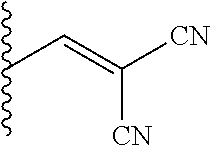
- QJVQEWMEWWZHHF-UHFFFAOYSA-N CC(C)C=C(C#N)C#N Chemical compound CC(C)C=C(C#N)C#N QJVQEWMEWWZHHF-UHFFFAOYSA-N 0.000 description 7
- DZQYZQWGZJSVMZ-UHFFFAOYSA-N CC(C)COC(=O)CCC(=O)OC(C)C Chemical compound CC(C)COC(=O)CCC(=O)OC(C)C DZQYZQWGZJSVMZ-UHFFFAOYSA-N 0.000 description 7
- AONJLNQVCZHGPP-UHFFFAOYSA-N CCC1(C(C)C)COC1 Chemical compound CCC1(C(C)C)COC1 AONJLNQVCZHGPP-UHFFFAOYSA-N 0.000 description 7
- QNILTEGFHQSKFF-UHFFFAOYSA-N C=CC(=O)NC(C)C Chemical compound C=CC(=O)NC(C)C QNILTEGFHQSKFF-UHFFFAOYSA-N 0.000 description 6
- KQNPFQTWMSNSAP-UHFFFAOYSA-N CC(C)C(=O)O Chemical compound CC(C)C(=O)O KQNPFQTWMSNSAP-UHFFFAOYSA-N 0.000 description 6
- AMIMRNSIRUDHCM-UHFFFAOYSA-N CC(C)C=O Chemical compound CC(C)C=O AMIMRNSIRUDHCM-UHFFFAOYSA-N 0.000 description 6
- CRMDKFIRWNDLDJ-UHFFFAOYSA-N C=CC(=O)OCCOC(=O)C(C)C Chemical compound C=CC(=O)OCCOC(=O)C(C)C CRMDKFIRWNDLDJ-UHFFFAOYSA-N 0.000 description 2
- DJQYUVQQRMGPJG-BSBMXCDCSA-N C=C(C)C(=O)OCC(C)C.C=CC(=O)OCC(C)C.CC(C)COC(=O)/C(C#N)=C\C1=CC=C(N(C2=CC=C(C3=CC=C(C(C)(C)C)C=C3)C=C2)C2=CC=C(C3=CC=C(C(C)(C)C)C=C3)C=C2)C=C1.CCC1(C(C)C)COC1 Chemical compound C=C(C)C(=O)OCC(C)C.C=CC(=O)OCC(C)C.CC(C)COC(=O)/C(C#N)=C\C1=CC=C(N(C2=CC=C(C3=CC=C(C(C)(C)C)C=C3)C=C2)C2=CC=C(C3=CC=C(C(C)(C)C)C=C3)C=C2)C=C1.CCC1(C(C)C)COC1 DJQYUVQQRMGPJG-BSBMXCDCSA-N 0.000 description 1
- WHYKMXFDQZRDAP-UHFFFAOYSA-N C=CC(=C)OCCOC(=O)CCC(=O)OC(C)C1=CC=C(C2=CC=C(N(C3=CC=C(C(=O)OCCOC(=O)C=C)C=C3)C3=CC=C(C4=CC=C(C(C)OC(=O)CCC(=O)OCCOC(=O)C=C)C=C4)C=C3)C=C2)C=C1.C=CC(=C)OCCOC(=O)CCC(=O)OC(C)C1=CC=C(C2=CC=C(N(C3=CC=C(C=O)C=C3)C3=CC=C(C4=CC=C(C(C)OC(=O)CCC(=O)OCCOC(=O)C=C)C=C4)C=C3)C=C2)C=C1 Chemical compound C=CC(=C)OCCOC(=O)CCC(=O)OC(C)C1=CC=C(C2=CC=C(N(C3=CC=C(C(=O)OCCOC(=O)C=C)C=C3)C3=CC=C(C4=CC=C(C(C)OC(=O)CCC(=O)OCCOC(=O)C=C)C=C4)C=C3)C=C2)C=C1.C=CC(=C)OCCOC(=O)CCC(=O)OC(C)C1=CC=C(C2=CC=C(N(C3=CC=C(C=O)C=C3)C3=CC=C(C4=CC=C(C(C)OC(=O)CCC(=O)OCCOC(=O)C=C)C=C4)C=C3)C=C2)C=C1 WHYKMXFDQZRDAP-UHFFFAOYSA-N 0.000 description 1
- TZAKIIZOONZAFA-UHFFFAOYSA-N C=CC(=C)OCCOC(=O)CCC(=O)OC(C)C1=CC=C(C2=CC=C(N(C3=CC=C(C=C(C#N)C#N)C=C3)C3=CC=C(C4=CC=C(C(C)OC(=O)CCC(=O)OCCOC(=O)C=C)C=C4)C=C3)C=C2)C=C1.CCC1(COC(=O)CCC(=O)OC(C)C2=CC=C(C3=CC=C(N(C4=CC=C(C=C(C#N)C#N)C=C4)C4=CC=C(C5=CC=C(C(C)OC(=O)CCC(=O)OCC6(CC)COC6)C=C5)C=C4)C=C3)C=C2)CCC1 Chemical compound C=CC(=C)OCCOC(=O)CCC(=O)OC(C)C1=CC=C(C2=CC=C(N(C3=CC=C(C=C(C#N)C#N)C=C3)C3=CC=C(C4=CC=C(C(C)OC(=O)CCC(=O)OCCOC(=O)C=C)C=C4)C=C3)C=C2)C=C1.CCC1(COC(=O)CCC(=O)OC(C)C2=CC=C(C3=CC=C(N(C4=CC=C(C=C(C#N)C#N)C=C4)C4=CC=C(C5=CC=C(C(C)OC(=O)CCC(=O)OCC6(CC)COC6)C=C5)C=C4)C=C3)C=C2)CCC1 TZAKIIZOONZAFA-UHFFFAOYSA-N 0.000 description 1
- LCXDZCSWLHVJKC-UHFFFAOYSA-N C=CC(=O)OCCOC(=O)C(C)C.C=CC(=O)OCCOC(=O)CCC(=O)O.C=CC(=O)OCCOC(=O)CCC(=O)OC(C)C1=CC=C(C2=CC=C(N(C3=CC=C(C)C=C3)C3=CC=C(C4=CC=C(C(C)OC(=O)CCC(=O)OCCOC(=O)C=C)C=C4)C=C3)C=C2)C=C1.CC(C)C=C(C#N)C#N.CC(C)C=O.CC1=CC=C(N(C2=CC=C(C3=CC=C(C(C)O)C=C3)C=C2)C2=CC=C(C3=CC=C(C(C)O)C=C3)C=C2)C=C1 Chemical compound C=CC(=O)OCCOC(=O)C(C)C.C=CC(=O)OCCOC(=O)CCC(=O)O.C=CC(=O)OCCOC(=O)CCC(=O)OC(C)C1=CC=C(C2=CC=C(N(C3=CC=C(C)C=C3)C3=CC=C(C4=CC=C(C(C)OC(=O)CCC(=O)OCCOC(=O)C=C)C=C4)C=C3)C=C2)C=C1.CC(C)C=C(C#N)C#N.CC(C)C=O.CC1=CC=C(N(C2=CC=C(C3=CC=C(C(C)O)C=C3)C=C2)C2=CC=C(C3=CC=C(C(C)O)C=C3)C=C2)C=C1 LCXDZCSWLHVJKC-UHFFFAOYSA-N 0.000 description 1
- XTDYBAFPKUMJSE-UHFFFAOYSA-N C=CC(=O)OCCOC(=O)C(C)C.CC(C)C=C(C#N)C#N.CC(C)C=O.CC1=CC=C(N(C2=CC=C(C3=CC=C(C(C)O)C=C3)C=C2)C2=CC=C(C3=CC=C(C(C)O)C=C3)C=C2)C=C1.CCC1(COC(=O)CCC(=O)O)COC1.CCC1(COC(=O)CCC(=O)OC(C)C2=CC=C(C3=CC=C(N(C4=CC=C(C)C=C4)C4=CC=C(C5=CC=C(C(C)OC(=O)CCC(=O)OCC6(CC)COC6)C=C5)C=C4)C=C3)C=C2)COC1 Chemical compound C=CC(=O)OCCOC(=O)C(C)C.CC(C)C=C(C#N)C#N.CC(C)C=O.CC1=CC=C(N(C2=CC=C(C3=CC=C(C(C)O)C=C3)C=C2)C2=CC=C(C3=CC=C(C(C)O)C=C3)C=C2)C=C1.CCC1(COC(=O)CCC(=O)O)COC1.CCC1(COC(=O)CCC(=O)OC(C)C2=CC=C(C3=CC=C(N(C4=CC=C(C)C=C4)C4=CC=C(C5=CC=C(C(C)OC(=O)CCC(=O)OCC6(CC)COC6)C=C5)C=C4)C=C3)C=C2)COC1 XTDYBAFPKUMJSE-UHFFFAOYSA-N 0.000 description 1
- BGFHAEZGQWVLTN-UHFFFAOYSA-N C=CC(=O)OCCOC(=O)C1=CC=C(N(C2=CC=C(C3=CC=C(C(C)O)C=C3)C=C2)C2=CC=C(C3=CC=C(C(C)O)C=C3)C=C2)C=C1.CC(O)C1=CC=C(C2=CC=C(N(C3=CC=C(C=C(C#N)C#N)C=C3)C3=CC=C(C4=CC=C(C(C)O)C=C4)C=C3)C=C2)C=C1 Chemical compound C=CC(=O)OCCOC(=O)C1=CC=C(N(C2=CC=C(C3=CC=C(C(C)O)C=C3)C=C2)C2=CC=C(C3=CC=C(C(C)O)C=C3)C=C2)C=C1.CC(O)C1=CC=C(C2=CC=C(N(C3=CC=C(C=C(C#N)C#N)C=C3)C3=CC=C(C4=CC=C(C(C)O)C=C4)C=C3)C=C2)C=C1 BGFHAEZGQWVLTN-UHFFFAOYSA-N 0.000 description 1
- UTKJLYYBRUHSAE-UHFFFAOYSA-N C=CC(=O)OCCOC(=O)CCC(=O)OC(C)C1=CC=C(C2=CC=C(N(C3=CC=C(C=C(C#N)C#N)C=C3)C3=CC=C(C4=CC=C(C(C)OC(=O)CCC(=O)OCCOC(=O)C=C)C=C4)C=C3)C=C2)C=C1 Chemical compound C=CC(=O)OCCOC(=O)CCC(=O)OC(C)C1=CC=C(C2=CC=C(N(C3=CC=C(C=C(C#N)C#N)C=C3)C3=CC=C(C4=CC=C(C(C)OC(=O)CCC(=O)OCCOC(=O)C=C)C=C4)C=C3)C=C2)C=C1 UTKJLYYBRUHSAE-UHFFFAOYSA-N 0.000 description 1
- OUBJNXKTMGWFQC-UHFFFAOYSA-N CC(C)(C)[Si](C)(C)Cl.CC(C)OB(OC(C)C)OC(C)C.CC(O)C1=CC=C(Br)C=C1.CC(O)C1=CC=C(C2=CC=C(N(C3=CC=C(C(=O)O)C=C3)C3=CC=C(C4=CC=C(C(C)O)C=C4)C=C3)C=C2)C=C1.CC(O)C1=CC=C(C2=CC=C(N(C3=CC=C(C=O)C=C3)C3=CC=C(C4=CC=C(C(C)O)C=C4)C=C3)C=C2)C=C1.CC(O[Si](C)(C)C(C)(C)C)C1=CC=C(B(O)O)C=C1.CC(O[Si](C)(C)C(C)(C)C)C1=CC=C(Br)C=C1.CC(O[Si](C)(C)C(C)(C)C)C1=CC=C(C2=CC=C(N(C3=CC=C(C=O)C=C3)C3=CC=C(C4=CC=C(C(C)O[Si](C)(C)C(C)(C)C)C=C4)C=C3)C=C2)C=C1 Chemical compound CC(C)(C)[Si](C)(C)Cl.CC(C)OB(OC(C)C)OC(C)C.CC(O)C1=CC=C(Br)C=C1.CC(O)C1=CC=C(C2=CC=C(N(C3=CC=C(C(=O)O)C=C3)C3=CC=C(C4=CC=C(C(C)O)C=C4)C=C3)C=C2)C=C1.CC(O)C1=CC=C(C2=CC=C(N(C3=CC=C(C=O)C=C3)C3=CC=C(C4=CC=C(C(C)O)C=C4)C=C3)C=C2)C=C1.CC(O[Si](C)(C)C(C)(C)C)C1=CC=C(B(O)O)C=C1.CC(O[Si](C)(C)C(C)(C)C)C1=CC=C(Br)C=C1.CC(O[Si](C)(C)C(C)(C)C)C1=CC=C(C2=CC=C(N(C3=CC=C(C=O)C=C3)C3=CC=C(C4=CC=C(C(C)O[Si](C)(C)C(C)(C)C)C=C4)C=C3)C=C2)C=C1 OUBJNXKTMGWFQC-UHFFFAOYSA-N 0.000 description 1
- XWYKZYYLPZDZHV-UHFFFAOYSA-N CC(C)C1=CC=C(C2=CC=CC=C2)C2=NSN=C12 Chemical compound CC(C)C1=CC=C(C2=CC=CC=C2)C2=NSN=C12 XWYKZYYLPZDZHV-UHFFFAOYSA-N 0.000 description 1
- QTOQDVAGPZPZGV-UHFFFAOYSA-N CC(O)C1=CC=C(C2=CC=C(N(C3=CC=C(C(=O)O)C=C3)C3=CC=C(C4=CC=C(C(C)O)C=C4)C=C3)C=C2)C=C1 Chemical compound CC(O)C1=CC=C(C2=CC=C(N(C3=CC=C(C(=O)O)C=C3)C3=CC=C(C4=CC=C(C(C)O)C=C4)C=C3)C=C2)C=C1 QTOQDVAGPZPZGV-UHFFFAOYSA-N 0.000 description 1
- CFEHQEPDGHYKDD-UHFFFAOYSA-N CC(O)C1=CC=C(C2=CC=C(N(C3=CC=C(C=C(C#N)C#N)C=C3)C3=CC=C(C4=CC=C(C(C)O)C=C4)C=C3)C=C2)C=C1 Chemical compound CC(O)C1=CC=C(C2=CC=C(N(C3=CC=C(C=C(C#N)C#N)C=C3)C3=CC=C(C4=CC=C(C(C)O)C=C4)C=C3)C=C2)C=C1 CFEHQEPDGHYKDD-UHFFFAOYSA-N 0.000 description 1
- ZOZAMKMIPVGFDZ-UHFFFAOYSA-N CC(O[Si](C)(C)C(C)(C)C)C1=CC=C(B(O)O)C=C1.CC(O[Si](C)(C)C(C)(C)C)C1=CC=C(B(O)O)C=C1 Chemical compound CC(O[Si](C)(C)C(C)(C)C)C1=CC=C(B(O)O)C=C1.CC(O[Si](C)(C)C(C)(C)C)C1=CC=C(B(O)O)C=C1 ZOZAMKMIPVGFDZ-UHFFFAOYSA-N 0.000 description 1
- LIJBQGULKYRKIG-UHFFFAOYSA-N CCC1(COC(=O)CCC(=O)OC(C)C2=CC=C(C3=CC=C(N(C4=CC=C(C=C(C#N)C#N)C=C4)C4=CC=C(C5=CC=C(C(C)OC(=O)CCC(=O)OCC6(CC)COC6)C=C5)C=C4)C=C3)C=C2)COC1 Chemical compound CCC1(COC(=O)CCC(=O)OC(C)C2=CC=C(C3=CC=C(N(C4=CC=C(C=C(C#N)C#N)C=C4)C4=CC=C(C5=CC=C(C(C)OC(=O)CCC(=O)OCC6(CC)COC6)C=C5)C=C4)C=C3)C=C2)COC1 LIJBQGULKYRKIG-UHFFFAOYSA-N 0.000 description 1
- NQVGRDFVTLVPQJ-UHFFFAOYSA-N [H]C(=O)C1=CC=C(N(C2=CC=C(C3=CC=C(C(C)O)C=C3)C=C2)C2=CC=C(C3=CC=C(C(C)O)C=C3)C=C2)C=C1 Chemical compound [H]C(=O)C1=CC=C(N(C2=CC=C(C3=CC=C(C(C)O)C=C3)C=C2)C2=CC=C(C3=CC=C(C(C)O)C=C3)C=C2)C=C1 NQVGRDFVTLVPQJ-UHFFFAOYSA-N 0.000 description 1
- CSQBYCXDTFIPFT-UHFFFAOYSA-N [H]C(=O)C1=CC=C(N(C2=CC=C(C3=CC=C(C(C)O[Si](C)(C)C(C)(C)C)C=C3)C=C2)C2=CC=C(C3=CC=C(C(C)O[Si](C)(C)C(C)(C)C)C=C3)C=C2)C=C1 Chemical compound [H]C(=O)C1=CC=C(N(C2=CC=C(C3=CC=C(C(C)O[Si](C)(C)C(C)(C)C)C=C3)C=C2)C2=CC=C(C3=CC=C(C(C)O[Si](C)(C)C(C)(C)C)C=C3)C=C2)C=C1 CSQBYCXDTFIPFT-UHFFFAOYSA-N 0.000 description 1
Images


Classifications
-
- C—CHEMISTRY; METALLURGY
- C09—DYES; PAINTS; POLISHES; NATURAL RESINS; ADHESIVES; COMPOSITIONS NOT OTHERWISE PROVIDED FOR; APPLICATIONS OF MATERIALS NOT OTHERWISE PROVIDED FOR
- C09K—MATERIALS FOR MISCELLANEOUS APPLICATIONS, NOT PROVIDED FOR ELSEWHERE
- C09K11/00—Luminescent materials, e.g. electroluminescent or chemiluminescent
- C09K11/06—Luminescent materials, e.g. electroluminescent or chemiluminescent containing organic luminescent materials
-
- C—CHEMISTRY; METALLURGY
- C07—ORGANIC CHEMISTRY
- C07C—ACYCLIC OR CARBOCYCLIC COMPOUNDS
- C07C219/00—Compounds containing amino and esterified hydroxy groups bound to the same carbon skeleton
- C07C219/34—Compounds containing amino and esterified hydroxy groups bound to the same carbon skeleton having amino groups and esterified hydroxy groups bound to carbon atoms of six-membered aromatic rings of the same carbon skeleton
-
- C—CHEMISTRY; METALLURGY
- C07—ORGANIC CHEMISTRY
- C07C—ACYCLIC OR CARBOCYCLIC COMPOUNDS
- C07C223/00—Compounds containing amino and —CHO groups bound to the same carbon skeleton
- C07C223/06—Compounds containing amino and —CHO groups bound to the same carbon skeleton having amino groups bound to carbon atoms of six-membered aromatic rings of the carbon skeleton
-
- C—CHEMISTRY; METALLURGY
- C07—ORGANIC CHEMISTRY
- C07C—ACYCLIC OR CARBOCYCLIC COMPOUNDS
- C07C229/00—Compounds containing amino and carboxyl groups bound to the same carbon skeleton
- C07C229/52—Compounds containing amino and carboxyl groups bound to the same carbon skeleton having amino and carboxyl groups bound to carbon atoms of six-membered aromatic rings of the same carbon skeleton
- C07C229/54—Compounds containing amino and carboxyl groups bound to the same carbon skeleton having amino and carboxyl groups bound to carbon atoms of six-membered aromatic rings of the same carbon skeleton with amino and carboxyl groups bound to carbon atoms of the same non-condensed six-membered aromatic ring
- C07C229/60—Compounds containing amino and carboxyl groups bound to the same carbon skeleton having amino and carboxyl groups bound to carbon atoms of six-membered aromatic rings of the same carbon skeleton with amino and carboxyl groups bound to carbon atoms of the same non-condensed six-membered aromatic ring with amino and carboxyl groups bound in meta- or para- positions
-
- C—CHEMISTRY; METALLURGY
- C07—ORGANIC CHEMISTRY
- C07C—ACYCLIC OR CARBOCYCLIC COMPOUNDS
- C07C255/00—Carboxylic acid nitriles
- C07C255/01—Carboxylic acid nitriles having cyano groups bound to acyclic carbon atoms
- C07C255/32—Carboxylic acid nitriles having cyano groups bound to acyclic carbon atoms having cyano groups bound to acyclic carbon atoms of a carbon skeleton containing at least one six-membered aromatic ring
- C07C255/42—Carboxylic acid nitriles having cyano groups bound to acyclic carbon atoms having cyano groups bound to acyclic carbon atoms of a carbon skeleton containing at least one six-membered aromatic ring the carbon skeleton being further substituted by singly-bound nitrogen atoms, not being further bound to other hetero atoms
-
- C—CHEMISTRY; METALLURGY
- C07—ORGANIC CHEMISTRY
- C07D—HETEROCYCLIC COMPOUNDS
- C07D305/00—Heterocyclic compounds containing four-membered rings having one oxygen atom as the only ring hetero atoms
- C07D305/02—Heterocyclic compounds containing four-membered rings having one oxygen atom as the only ring hetero atoms not condensed with other rings
- C07D305/04—Heterocyclic compounds containing four-membered rings having one oxygen atom as the only ring hetero atoms not condensed with other rings having no double bonds between ring members or between ring members and non-ring members
- C07D305/06—Heterocyclic compounds containing four-membered rings having one oxygen atom as the only ring hetero atoms not condensed with other rings having no double bonds between ring members or between ring members and non-ring members with only hydrogen atoms, hydrocarbon or substituted hydrocarbon radicals, directly attached to the ring atoms
-
- C—CHEMISTRY; METALLURGY
- C07—ORGANIC CHEMISTRY
- C07F—ACYCLIC, CARBOCYCLIC OR HETEROCYCLIC COMPOUNDS CONTAINING ELEMENTS OTHER THAN CARBON, HYDROGEN, HALOGEN, OXYGEN, NITROGEN, SULFUR, SELENIUM OR TELLURIUM
- C07F7/00—Compounds containing elements of Groups 4 or 14 of the Periodic Table
- C07F7/02—Silicon compounds
- C07F7/08—Compounds having one or more C—Si linkages
- C07F7/18—Compounds having one or more C—Si linkages as well as one or more C—O—Si linkages
- C07F7/1804—Compounds having Si-O-C linkages
-
- H01L51/0035—
-
- H—ELECTRICITY
- H10—SEMICONDUCTOR DEVICES; ELECTRIC SOLID-STATE DEVICES NOT OTHERWISE PROVIDED FOR
- H10K—ORGANIC ELECTRIC SOLID-STATE DEVICES
- H10K50/00—Organic light-emitting devices
- H10K50/10—OLEDs or polymer light-emitting diodes [PLED]
- H10K50/11—OLEDs or polymer light-emitting diodes [PLED] characterised by the electroluminescent [EL] layers
-
- H—ELECTRICITY
- H10—SEMICONDUCTOR DEVICES; ELECTRIC SOLID-STATE DEVICES NOT OTHERWISE PROVIDED FOR
- H10K—ORGANIC ELECTRIC SOLID-STATE DEVICES
- H10K85/00—Organic materials used in the body or electrodes of devices covered by this subclass
- H10K85/10—Organic polymers or oligomers
- H10K85/111—Organic polymers or oligomers comprising aromatic, heteroaromatic, or aryl chains, e.g. polyaniline, polyphenylene or polyphenylene vinylene
-
- C—CHEMISTRY; METALLURGY
- C09—DYES; PAINTS; POLISHES; NATURAL RESINS; ADHESIVES; COMPOSITIONS NOT OTHERWISE PROVIDED FOR; APPLICATIONS OF MATERIALS NOT OTHERWISE PROVIDED FOR
- C09K—MATERIALS FOR MISCELLANEOUS APPLICATIONS, NOT PROVIDED FOR ELSEWHERE
- C09K2211/00—Chemical nature of organic luminescent or tenebrescent compounds
- C09K2211/10—Non-macromolecular compounds
- C09K2211/1003—Carbocyclic compounds
- C09K2211/1007—Non-condensed systems
-
- C—CHEMISTRY; METALLURGY
- C09—DYES; PAINTS; POLISHES; NATURAL RESINS; ADHESIVES; COMPOSITIONS NOT OTHERWISE PROVIDED FOR; APPLICATIONS OF MATERIALS NOT OTHERWISE PROVIDED FOR
- C09K—MATERIALS FOR MISCELLANEOUS APPLICATIONS, NOT PROVIDED FOR ELSEWHERE
- C09K2211/00—Chemical nature of organic luminescent or tenebrescent compounds
- C09K2211/10—Non-macromolecular compounds
- C09K2211/1003—Carbocyclic compounds
- C09K2211/1014—Carbocyclic compounds bridged by heteroatoms, e.g. N, P, Si or B
-
- H01L51/5012—
Definitions
- the present invention relates to the field of organic electronics and photonics. More particularly, this invention relates to fluorescent charge-transfer compounds emitting in the visible spectral range from blue to red, comprising a triarylamine moiety, an electron-withdrawing group and at least two photopolymerizable groups. This invention also relates to a method for manufacturing a film-forming and photo-crosslinkable composition comprising at least one compound of the invention and its use as a precursor of a photocrosslinked emissive layer.
- organic materials can be applied in very thin layers of hardly a few tens of nanometers on various substrates, in particular via vacuum evaporation techniques, spin coating or inkjet printing to mention only a few; they can be adapted easily to surfaces with a highly varied surface and geometry, which makes it possible to generate flexible and light devices.
- OLEDs organic light-emitting diodes
- OLEDs are devices constituted of a multilayer of organic and inorganic materials, sandwiched between two electrodes, having as the simplest architecture:
- the greatest difficulty in manufacturing OLEDs resides in the multilayer deposition of the organic materials in such a way that the lower layer is not dissolved during the deposition of the upper layer.
- This deposition step is implemented primarily according to two methods: (a) solution process also called wet deposition and (b) vapor deposition.
- the solution process method (a) is a method that is easily implementable, inexpensive and extendable to large-area substrates.
- This deposition method is mostly used when the organic molecules to be deposited are polymers or oligomers. Indeed, polymers or oligomers exhibit good morphological stability (absence of recrystallization) and low molecular diffusion compared to small organic molecules used the same conditions.
- the choice of the solvents used to dissolve the oligomers or polymers before their deposition is delicate. Indeed, in this method, fabricating stacked layers requires successive deposition of several polymer materials on the substrate, each deposition step requiring distinct solvents. As such, the deposition of a second layer using a polymer solution can result in partly dissolving the previously deposited layer.
- the solution-based deposition method therefore requires the use of “orthogonal” solvents, i.e. solvents that do not dissolve the previously deposited layers.
- This method also faces issues related to the ejection of solutions from printing nozzles or the formation of satellite droplets when using inkjet deposition technique, highly dependent on the polymer molecular weight and the viscosity of the polymer solutions.
- Solutions of low-molecular-weight molecules can be injected more easily, thereby making solution-based process very attractive.
- the use of small molecules most often results in intermolecular aggregation phenomena responsible for the degradation in the material optical qualities and performances in emission and electroluminescence.
- the vapor deposition method (b) represents until now, the method of choice for depositing small organic molecules.
- This method has the advantage of providing multilayered structures that are perfectly controlled, and consists in evaporating low-molecular-weight molecules on a substrate.
- Vapor deposition does not require the use of solvent.
- the deposition rate is limited and protecting substrate areas from material deposition using a mask is mandatory.
- the need of several evaporators connected in series to ensure continuous vacuum makes this technique more burdensome, in particular when cleaning evaporation chain is required.
- material spitting can occur resulting in surface irregularities, and thus short-circuits. Carrying out vapor deposition on substrates of large surface area is moreover delicate due to the limited-size evaporators, which results in prohibitive manufacturing costs.
- the optimization of the deposition conditions strongly depends on the structure of the organic molecules constituting the organic emissive layer (emissive molecules).
- organic molecules that can form an organic emissive layer in a controlled manner; in particular in order to obtain a multilayered electronic or photonic device.
- These organic molecules must in particular make optimization of the deposition method possible, i.e. reducing the manufacturing costs and wastes while still maintaining a high level of performance.
- the Applicant was able to elaborate small molecule-based compounds which, after deposition and photopolymerization, form layers of high-surface qualit, and emitting in the solid state.
- These compounds are triarylamine derivatives comprising photopolymerizable groups and an electron-withdrawing group, giving rise to materials with high-film forming (filmogenicity) and emissive properties. They can easily be deposited in solution, making the method easily transferrable to large-area substrates. In addition, they allow for the fabrication of emissive layers that are uniform, insoluble and stable over time after photo-crosslinking in gentle conditions.
- the triarylamine derivatives have received very little attention as photopolymerizable emissive molecules and/or as precursors of emissive organic layers.
- Kido et al. (EP 1 617 493) described the preparation of a layer containing a charge-transfer complex comprising a hole-transporting compound based on a triarylamine moiety.
- Baldo et al. (EP 1 729 327) developed organic light-emitting diodes wherein iridium or osmium complexes with a triarylamine unit are used as hole-transporting layers.
- Hirose et al. US 2008/0124638
- Gough et al. WO 2009/061314
- a method for manufacturing an electronic device comprising a hole-transporting layer constituted of triarylamine derivatives having photopolymerizable functions.
- the hole-transporting layers have a chemical structure that does not comprise electron-withdrawing groups, hence they do not intrinsically emit light in the visible range.
- hole-transporting layers are primarily constituted of electron-rich compounds, easily oxidizable in order to facilitate internal hole migration.
- emissive layers are organic layers capable of transporting both electrons and electronic holes so that both charges recombine as an exciton inside the emissive layers, and allow in fine for photon emission.
- organometallic complexes such as tris-(8-hydroxyquinoline) aluminum (Alq 3 ) or coordination complexes like iridium complexes comprising photopolymerizable groups
- Liq 3 tris-(8-hydroxyquinoline) aluminum
- coordination complexes like iridium complexes comprising photopolymerizable groups
- Du et al. “Cross-linked Alq 3 -containing polymers with improved electroluminescence efficiency used for OLED”, Macromol. Rapid. Commun ., Vol. 27, January 2006, pp 412-417
- Ma et al. “Multifunctional crosslinkable iridium complexes as hole-transporting/electron blocking and emitting materials for solution-processed multilayer organic light-emitting diodes”, Adv. Funct. Mater. Vol.
- emissive layers mostly operate by adding an emissive dopant (Forrest et al. (WO 01/08230)).
- doping an organic emissive layer for manufacturing purpose generally results in aggregation issues due to molecular reorganization or diffusion of organic molecules within the layer. It is therefore necessary to develop precursors of organic emissive layers for getting rid of dopant.
- This invention relates to a photopolymerizable emissive compound of general formula (I):
- the electron-withdrawing group Z is the group 4-phenylbenzo[c][1,2,5]thiadiazolyl:
- the preferred compounds of general formula (I) are those of formula
- the preferred compounds of general formula (II) are those described in the following table:
- the preferred compound of general formula (II) is bis(2-(acryloyloxy)ethyl) O,O′-((((4-(2,2-dicyanovinyl)phenyl)azanediyl)bis([1,1′-biphenyl]-4′,4-diyl))bis(ethane-1,1-diyl)) disuccinate of formula (II-a):
- the preferred compound of general formula (II) is the compound O,O′-((((4-(2,2-dicyanovinyl)phenyl)azanediyl)bis([1,1′-biphenyl]-4′,4-diyl))bis(ethane-1,1-diyl)) bis((3-ethyloxetan-3-yl)methyl) disuccinate of formula (II-b):
- the compound of the invention is a photo-crosslinkable emissive compound of general formula (II-a), (II-b), (II-c) or (II-d).
- the compound of the invention is amorphous for temperatures ranging from ⁇ 20° C. to 200° C.; preferably, for temperatures ranging from ⁇ 10° C. to 100° C.; more preferably, for temperatures ranging from 0° C. to 30° C.
- the compound of the invention has a glass transition temperature (T g ) less than or equal to 30° C.; preferably, less than 30° C.; more preferably, less than 20° C. According to one embodiment, the compound of the invention has a glass transition temperature (T g ) equal to about 28° C. According to one embodiment, the compound of the invention has a glass transition temperature (T g ) equal to about 12° C.
- the compound of the invention comprises at least one chiral center giving rise to a racemic mixture of stereoisomers.
- the compound of the invention is a solid-state emissive molecule.
- the compound of the invention displays an emission spectrum that is function of the chemical structure of its electron-withdrawing group Z.
- the compound of the invention emits in the visible range.
- the compound of the invention emits in the red, the green or the blue of the white light spectrum.
- the compound of the invention emits in the red.
- the compound of the invention emits in the green.
- the compound of the invention emits in the blue.
- This present invention also relates to the intermediate compounds obtained during the method for manufacturing compounds of formula (I).
- the invention relates to an intermediate compound of general formula:
- X and Y each independently represent an aryl or heteroaryl; preferably, phenyl group; R represents a —OH or —OTBDMS group; A and B each independently represent a chiral center; preferably, A and B simultaneously represent a —CHMe— group; and Z represents an electron-withdrawing group; preferably, Z represents an aldehyde, dicyanovinylidene, cyanovinylidene, benzothiadiazole group or an alkyl ester group comprising at least one photopolymerizable group selected from at least one acryloyl, alkylacryloyl, oxetane, alkyloxetane, styryl, allyl, acrylamide, methacrylamide or cinnamate.
- the invention also relates to a composition comprising the compounds of the invention.
- the invention relates to a composition comprising at least one compound of general formula (I):
- the composition comprises at least one compound of general formula (II):
- the composition comprises at least one compound of formula (I) and/or (II), an initiator and an organic solvent.
- the composition comprises at least one compound of formula (I) and/or (II), a photoinitiator and an organic solvent.
- said composition allows for the fabrication of an amorphous thin film of photo-crosslinkable monomers without any detectable micro-aggregate. In one embodiment, said composition allows obtaining a photo-crosslinkable film of the compounds of the invention.
- the composition comprises the mixture of at least two different compounds of formula (I).
- the Applicant observes that the structural similarity of the compounds in said composition allows for limited segregation phenomena and makes possible the simultaneous photopolymerization of the various compounds of the invention by using a single irradiation wavelength.
- the composition comprises the mixture of at least one compound of general formula (I) and of at least one compound of general formula (II).
- the composition comprises the mixture of at least two compounds of general formula (II). According to one embodiment, the composition comprises the mixture of at least three compounds of general formula (II).
- the composition comprises the mixture of at least two compounds of general formula (I) and/or of general formula (II), wherein said compounds have separate emission spectra. According to one embodiment, the composition comprises the mixture of at least two compounds of general formula (I) and/or of general formula (II), wherein said compounds emit in the red, green and/or blue.
- the concentration of the compounds of the invention in the composition ranges from 10 ⁇ 3 to 1 mol/L; preferably, from 10 ⁇ 2 to 0.1 mol/L; more preferably, is about 1 ⁇ 5 ⁇ 10 ⁇ 2 mol/L.
- the compounds of the invention in the composition are at a weight concentration ranging from 1 to 100 g/L; preferably, from 10 to 50 g/L; more preferably, being about 15 g/L.
- said composition further comprises an organic solvent such as but not limited to hydrocarbons, such as cyclohexane or methylcyclohexane, petroleum ether, toluene or xylene; chlorinated hydrocarbons, such as 1,2-dichloroethane, trifluoromethylbenzene, chloroform or dichloromethane; hydroxyls, such as methanol, ethanol, isopropanol, n-propanol or n-butanol; ethers, such as diethyl ether, diisopropyl ether, 2-methyltetrahydrofuran or dioxane; ketones, such as acetone or butanone; amides, such as acetamide, dimethylacetamide, N-methylpyrrolidone (NMP) or dimethylformamide (DMF); nitriles, such as acetonitrile; carboxylic acids, such as formic acid or acetic acid; esters, such
- the solvent is polar. According to one embodiment, the solvent is apolar. According to one embodiment, the solvent is a green solvent.
- the solvent is chloroform or toluene.
- the photoinitiator is selected from 2-tert-butylanthraquinone, camphorquinone, diphenyl(2,4,6-trimethylbenzoyl)phosphine oxide, 9,10-phenanthrenequinone, phenylbis(2,4,6-trimethylbenzoyl)phosphine oxide, 2-benzyl-2-(dimethylamino)-4′-morpholinobutyrophenone, 3,6-bis(2-methyl-2-morpholinopropionyl)-9-octylcarbazole, 4′-tert-butyl-2′,6′-dimethylacetophenone, 2,2-diethoxyacetophenone, 4′-ethoxyacetophenone, 3′-hydroxyacetophenone, 4′-hydroxyacetophenone, 1-hydroxycyclohexylphenylcetone, 2-hydroxy-4′-(2-hydroxyethoxy)-2-methylpropiophenone, 2-hydroxy-2-methylpropiophenone, 2-methylmethylpropioph
- the photoinitiator is diphenyl(2,4,6-trimethylbenzoyl)phosphine oxide.
- the photoinitiator in the composition is at a molar concentration ranging from 1 ⁇ 10 ⁇ 4 to 5 ⁇ 10 ⁇ 3 mol/L; preferably, less than 1 ⁇ 10 ⁇ 3 mol/L; more preferably, about 7 ⁇ 7 ⁇ 10 ⁇ 4 mol/L.
- the photoinitiator in the composition is at a weight concentration ranging from 0.1 to 1 g/L; preferably, less than 0.5 g/L; more preferably, about 0.27 g/L.
- the ratio of the molar concentration of the photoinitiator with the molar concentration in compounds of general formula (I) and/or (II) ranges from 0.01 to 1; preferably, this ratio is equal to about 0.02.
- the composition is kept away from light.
- the composition is stored at low temperatures (refrigerator or freezer).
- the composition is stored in an inert atmosphere.
- the invention also relates to a fluorescent organic nanoparticle comprising at least one compound of general formula (I):
- the fluorescent nanoparticle is constituted of compounds of general formula (I).
- the fluorescent nanoparticle is a photocrosslinked fluorescent nanoparticle.
- the fluorescent nanoparticle is insoluble.
- the fluorescent nanoparticle comprises compound of formula (II-a). According to one embodiment, the fluorescent nanoparticle comprises compound of formula (II-b). According to one embodiment, the fluorescent nanoparticle comprises compound of formula (II-c).
- the fluorescent nanoparticle comprises a mixture of compounds of formula (II-a), (II-b) and/or (II-c). In one embodiment, the fluorescent nanoparticle comprises a mixture of compounds (II-a) and (II-c). In one embodiment, the fluorescent nanoparticle comprises a mixture of compounds (II-a) and (II-b). In one embodiment, the fluorescent nanoparticle comprises a mixture of compounds (II-b) and (II-c).
- the nanoparticle of the invention is an emissive nanoparticle. According to one embodiment, the nanoparticle of the invention emits in the visible range. According to one embodiment, the nanoparticle of the invention emits in the red, the green or the blue of the white light spectrum. According to a one embodiment, the nanoparticle of the invention emits in the red. According to one embodiment, the nanoparticle of the invention emits in the green. According to one embodiment, the nanoparticle of the invention emits in the blue.
- the fluorescent nanoparticle has a diameter less than 300 nm; preferably less than 200 nm; more preferably, less than 100 nm.
- the invention also relates to a kit comprising a first compartment comprising at least one compound of formula (I) and/or (II) and an organic solvent, and a second compartment comprising the photoinitiator.
- the second compartment further comprises a solvent; preferably, an organic solvent; more preferably, a volatile organic solvent.
- the invention also relates to a method for manufacturing a compound of general formula (I):
- the preferred compound of formula (III-1) is 4 ⁇ 1-[(tert-butyldimethylsilyl)oxy]ethyl ⁇ phenyl boronic acid:
- the preferred compounds of formula (III-2) are the compounds of general formula (III′-2):
- the preferred compound of formula (III′-2) is 4-(bis(4′-(1-((tert-butyldimethylsilyl)oxy)ethyl)-[1,1′-biphenyl]-4-yl)amino)benzaldehyde:
- the compound of formula (III-3) are the compounds of general formula (III′-3):
- the preferred compound of formula (III′-3) is 4-(bis(4′-(1-hydroxyethyl)-[1,1′-biphenyl]-4-yl)amino)benzaldehyde:
- the step (i) or the step (ii) further comprises a step of modifying the aldehyde group.
- the step (i) or the step (ii) further comprises a step of modifying the aldehyde group aiming to provide an electron-withdrawing group different from the initial aldehyde group; preferably, said electron-withdrawing group is a dicyanovinylidene, cyanovinylidene, benzothiadiazole group or an alkyl ester group comprising at least one photopolymerizable group selected from at least one acryloyl, alkylacryloyl, oxetane, alkyloxetane, styryl, allyl, acrylamide, methacrylamide or cinnamate.
- the step (i) or the step (ii) further comprises a step of modifying the aldehyde group with malononitrile. According to one embodiment, the step (i) further comprises a step of modifying the aldehyde group into a dicyanovinylidene group.
- the step (i) or the step (ii) further comprises a step of modifying the aldehyde group with an oxidant; preferably, with silver oxide.
- the step (i) or the step (ii) further comprises a step of modifying the aldehyde group into a carboxylic acid group, said carboxylic group furthermore able to be modified with an organic compound comprising at least one photopolymerizable group selected from at least one acryloyl, alkylacryloyl, oxetane, alkyloxetane, styryl, allyl, acrylamide, methacrylamide or cinnamate.
- the step (i) or the step (ii) further comprises a step of modifying the aldehyde group resulting in an intermediate compound of general formula (III-2bis) or (III-3bis):
- A, B, X and Y are defined as hereinabove, and Z′ represents an electron-withdrawing group; preferably, a dicyanovinylidene, cyanovinylidene, benzothiadiazole group or an alkyl ester group comprising at least one photopolymerizable group selected from at least one acryloyl, alkylacryloyl, oxetane, alkyloxetane, styryl, allyl, acrylamide, methacrylamide or cinnamate.
- the preferred compounds of formula (III-3bis) are the compounds of general formula (III′-3bis):
- the preferred compound of formula (III′-3bis) is 2-(4-(bis(4′-(1-hydroxyethyl)-[1,1′-biphenyl]-4-yl)amino)benzylidene)malononitrile:
- the preferred compound of formula (III′-3bis) is 4-(bis(4′-(1-hydroxyethyl)-[1,1′-biphenyl]-4-yl)amino)benzoic acid:
- the step (iv) comprises the reaction of a compound of general formula (III-3) or (III′-3) having at least one photopolymerizable compound of formula (IV): T-L-COOH Formula (IV) wherein
- L represents an alkyl group comprising 1 to 10 carbon atoms, linear or branched, that may be interrupted by one or several atoms —O—, —N— or —S—; said group being optionally substituted with at least one alkyl, alkene, alkyne, oxo, amine, amide, cyano, hydroxyl, carboxy group; preferably, L represents an alkyl group comprising 3 to 10 carbon atoms, linear or branched, that may be interrupted by one or several atoms —O—, —N— or —S—; said group being optionally substituted with at least one alkyl, alkene, alkyne, oxo, amine, amide, cyano, hydroxyl, carboxy group; more preferentially, L represents an alkyl chain interrupted by at least one oxygen atom and substituted with at least one oxo group;
- T represents a photopolymerizable group selected from at least one acryloyl, alkylacryloyl, oxetane, alkyloxetane, styryl, allyl, acrylamide, methacrylamide, cinnamate; preferably, T represents an acryloyl group or an alkyloxetane group.
- the photopolymerizable compound is selected from 4-(2-(acryloyloxy)ethoxy)-4-oxobutanoic acid, 4-(2-(methacryloyloxy)ethoxy)-4-oxobutanoic acid, 4-((3-ethyloxetan-3-yl)methoxy)-4-oxobutanoic acid, 4-((2-(acryloyloxy)ethyl)amino)-4-oxobutanoic acid, 4-((2-(methacryloyloxy)ethyl)amino)-4-oxobutanoic acid, 4-(((3-ethyloxetan-3-yl)methyl)amino)-4-oxobutanoic acid.
- the photopolymerizable compound is 4-(2-(acryloyloxy)ethoxy)-4-oxobutanoic acid and/or 4-((3-ethyloxetan-3-yl)methoxy)-4-oxobutanoic acid.
- reaction steps (i), (ii), (iii) and (iv) are each independently implemented in organic solvents such as but not limited to hydrocarbons, such as cyclohexane or methylcyclohexane, petroleum ether, toluene or xylene; chlorinated hydrocarbons, such as 1,2-dichloroethane, trifluoromethylbenzene, chloroform or dichloromethane; hydroxyls, such as methanol, ethanol, isopropanol, n-propanol, n-butanol; ethers, such as diethylether, diisopropylether, 2-methyltetrahydrofuran; tetrahydrofuran (THF) or dioxane; ketones, such as acetone or butanone; amides, such as acetamide, dimethylacetamide, N-methylpyrrolidone (NMP) or dimethylformamide (DMF); nit
- organic solvents
- reaction steps (i), (ii), (iii) or (iv) is implemented in dichloromethane. In one embodiment, at least one of the reaction steps (i), (ii), (iii) or (iv) is implemented in anhydrous dichloromethane.
- the method is carried out at a temperature between 0° C. and 70° C. In one embodiment, the method is carried out at ambient temperature.
- At least one of the steps (i), (ii), (iii) or (iv) is implemented at a temperature between 0 and 70° C. In one embodiment, at least one of the steps (i), (ii), (iii) or (iv) is implemented at ambient temperature.
- the reaction of at least one of the steps (i), (ii), (iii) or (iv) is carried out for at least 4 h; preferably, at least 12 h. In one embodiment, the reaction of the step (i) is carried out for 12 h. In one embodiment, the reaction of the step (ii) is carried out for 4 h. In one embodiment, the reaction of the step (iii) is carried out for 12 h. In one embodiment, the reaction of the step (iv) is carried out for 12 h.
- the reaction of at least one of the steps (i), (ii), (iii) or (iv) is carried out in an inert atmosphere; preferably, under argon or nitrogen.
- At least one of the steps (i), (ii), (iii) or (iv) has a yield greater than or equal to 40%; preferably, greater than or equal to 50%; preferably, greater than or equal to 60%; preferably, greater than or equal to 80%. In one embodiment at least one of the steps (i), (ii), (iii) or (iv) has a yield greater than or equal to 80%.
- the step (i) further comprises the use of a phosphine; preferably, tris-o-tolylphosphine.
- the step (iv) further comprises the use of 4-dimethylaminopyridinium p-toluene sulfonate (DPTS).
- DPTS 4-dimethylaminopyridinium p-toluene sulfonate
- the step (iv) further comprises the use of a carbodiimide derivative; preferably, N,N′-dicyclohexylcarbodiimide (DCC).
- a carbodiimide derivative preferably, N,N′-dicyclohexylcarbodiimide (DCC).
- the compounds obtained by the method of the invention are stored in an inert atmosphere. According to one embodiment, the compounds obtained by the method of the invention are kept away from light. According to one embodiment, the compounds obtained by the method of the invention are stored at cold temperatures; preferably, between 2 and 8° C.
- This present invention also relates to the use of the compounds of the invention in the field of organic electronics, organic optoelectronics or organic photonics.
- the compounds of the invention are useful as precursors of insoluble emissive thin layers, more preferably, for their use in multilayer photonic or electronic devices.
- this invention relates to the use of the compound of formula (I) or of an intermediate compound of the invention in the field of organic electronics. In one embodiment, this invention relates to the use of the compound of formula (I) or of an intermediate compound of the invention in the field of organic photonics.
- the present invention relates to a method for manufacturing a monomer photo-crosslinkable film having emission properties in the visible range.
- the present invention relates to a method for manufacturing a substrate coated with a thin, amorphous, emissive, photo-crosslinkable and non-doped small molecule-based film, comprising the following steps:
- said film is constituted exclusively of the compounds of the invention in the solid state.
- the method further comprises a synthetic step of compounds of general formula (I) and/or of general formula (II).
- the composition of the step a) comprises at least one compound of general formula (II).
- the composition comprises compounds of formula (II-a), (II-b), (II-c), (II-d), (II-e) or (II-f).
- the composition comprises the compound of formula (II-a) and the compound of formula (II-b).
- the composition comprises the mixture of at least two compounds selected from the compounds (II-a), (II-b), (II-c), (II-d), (II-e) or (II-f).
- the composition of step a) comprises at least one compound of general formula (I). In one preferred embodiment, the composition comprises at least one compound of formula (I) and the compound of formula (II-a). In one preferred embodiment, the composition comprises at least one compound of formula (I) and the compound of formula (II-b). In one preferred embodiment, the composition comprises at least one compound of formula (I), the compound of formula (II-a) and the compound of formula (II-b). In one preferred embodiment, the composition comprises at least one compound of formula (I) and at least one compound selected from the compounds (II-a), (II-b), (II-c), (II-d), (II-e) or (II-f).
- the solvent is preferably an organic solvent.
- the weight concentration in compounds of the invention is comprised in a range from 0.1 to 10 wt. % to the total weight of the composition; preferably, the weight concentration in compounds of the invention is about 1 wt. %.
- the deposition step may be implemented by a machine or by hand. In one embodiment, the deposition step is carried out in solution. In one embodiment, the deposition step may be implemented by at least one of the techniques selected from spraying, inkjet depositing, spin coating or application with a brush.
- the deposition step is preferably implemented by the technique of spin coating.
- spin coating is carried out at an angular acceleration less than 1000 rpm/min; preferably, ranging from 200 to 1000 rpm/min; more preferably, the angular acceleration is about 500 rpm/min.
- the spin coating is carried out at a rotation speed less than 6000 rpm; preferably from 500 to 3000 rpm; more preferably, the rotation speed is about 1000 rpm.
- the rotation of the substrate whereon the composition has been deposited via spin coating is carried out for less than 10 min; preferably, from 10 s to 300 s; more preferably, the rotation time is about 60 s.
- the substrate is an organic, metal or mineral material; preferably, the substrate is a glass slide or a polymer.
- the substrate is transparent. According to one embodiment, the substrate is flexible.
- said film further comprises a dopant.
- the present invention also relates to a method for manufacturing a photo-crosslinked emissive organic layer or a photo-crosslinked emissive multilayer system comprising the following steps:
- the photopolymerization of step b′) includes a photo-crosslinking.
- the photopolymerization is carried out without heating. In one embodiment, the photopolymerization is carried out at room temperature.
- said method further comprises a step c′) of repeating steps a′) and b′) resulting in a photo-crosslinked emissive multilayer system.
- the photopolymerization of the step b′ or c′) is carried out using the composition of the compounds of the invention in solid form.
- the photopolymerization of step b′ or c′) is carried out without residual solvent.
- the photopolymerization performed in step b′) or c′) is induced by the irradiation of the organic deposit carried out in the step a′).
- irradiation is carried out by a white light source, and light-emitting diode or a laser.
- irradiation is carried out by a white light source or a laser.
- irradiation is carried out by a filtered white light source.
- irradiation is carried out at one or several wavelengths between 250 nm and 700 nm; preferably, a wavelength of 365 nm.
- irradiation is carried out at a single wavelength. In one embodiment, irradiation of a mixture of the compounds of the invention is carried out at a single wavelength.
- irradiation is carried out at a power comprised in a range from 1 to 100 mW/cm 2 . In one embodiment, irradiation is carried out at a power of about 30 mW/cm 2 . In one embodiment, irradiation is carried out at a power of about 3.5 mW/cm 2 .
- the duration of irradiation is comprised in a range from 10 to 2000 s; preferably the duration of irradiation is about 1800 s.
- the photopolymerization temperature is comprised in a range from 25 to 50° C.; preferably, the photopolymerization temperature is about 25° C.
- the photopolymerization of the organic deposit carried out in the step b′) results in the formation of an organic thin layer.
- the organic thin layer has a thickness comprised in a range from 20 to 500 nm; preferably, the thickness of the organic thin layer is about 130 nm.
- the photopolymerization of the organic deposit carried out in the step b′) results in the formation of an amorphous organic layer for temperatures comprised in a range from ⁇ 20° C. to 200° C.
- the amorphous organic layer is a polymerized organic material.
- the emissive organic layer has a quantum yield in a range from 0.1 to 1; preferably, greater than 0.1; preferably, greater than 0.2. In one embodiment, the quantum yield of fluorescence is about 0.28.
- the organic layer is insoluble; in particular with respect to the later deposits.
- the present invention relates to a method for manufacturing a fluorescent nanoparticle having emission properties in the visible range, comprising the following steps:
- the solution of the step (a) comprises at least one compound selected from compounds (II-a), (II-c) and/or (II-d). According to one embodiment, the solution of the step (a) comprises a mixture of compounds (II-a), (II-c) and/or (II-d).
- the step (a) comprises providing a solution comprising compounds of formula (II-a) and another solution comprising compounds of formula (II-c). According to one embodiment, the step (a) comprises providing a solution comprising compounds of formula (II-a) and another solution comprising compounds of formula (II-d). According to one embodiment, the step (a) comprises providing a solution comprising compounds of formula (II-c) and another solution comprising compounds of formula (II-d).
- the compound of formula (I) and/or (II) is at a concentration in the solvent, ranging from 0.05 to 5 mg/mL; preferably, from 0.5 to 2 mg/mL; more preferably, the concentration of compound of formula (I) and/or (II) is about 1 mg/mL.
- the photoinitiator is selected from 2-tert-butylanthraquinone, camphorquinone, diphenyl(2,4,6-trimethylbenzoyl)phosphine oxide, 9,10-phenanthrenequinone, phenylbis(2,4,6-trimethylbenzoyl)phosphine oxide, 2-benzyl-2-(dimethylamino)-4′-morpholinobutyrophenone, 3,6-bis(2-methyl-2-morpholinopropionyl)-9-octylcarbazole, 4′-tert-butyl-2′,6′-dimethylacetophenone, 2,2-diethoxyacetophenone, 4′-ethoxyacetophenone, 3′-hydroxyacetophenone, 4′-hydroxyacetophenone, 1-hydroxycyclohexylphenylcetone, 2-hydroxy-4′-(2-hydroxyethoxy)-2-methylpropiophenone, 2-hydroxy-2-methylpropiophenone, 2-methylmethylpropioph
- the concentration of the photoinitiator ranges from 0.1 to 20%; preferably, from 1% to 15%; more preferably, the concentration of the initiator is 10% mol. with respect to the concentration of the compound of general formula (I) and/or (II).
- the fluorescent nanoparticle may be obtained by a microfluidic process.
- the microfluidic process comprises the use of at least one syringe pump.
- the microfluidic process comprises the use of colinear tubings, an injection needle and three syringe pumps.
- the flow of the microfluidic process ranges from 0.1 ⁇ L ⁇ min ⁇ 1 to 300 ⁇ L ⁇ min ⁇ 1 ; preferably, from 1 ⁇ L ⁇ min ⁇ 1 to 150 ⁇ L ⁇ min ⁇ 1 ; more preferably, the flow is about 10 ⁇ L ⁇ min ⁇ 1 , 40 ⁇ L ⁇ min ⁇ 1 and/or 100 ⁇ L ⁇ min ⁇ 1 .
- the flow of the syringe ranges from 0.1 ⁇ L ⁇ min ⁇ 1 to 300 ⁇ L ⁇ min ⁇ 1 ; preferably, from 1 ⁇ L ⁇ min ⁇ 1 to 150 ⁇ L ⁇ min ⁇ 1 ; more preferably, the flow is about 10 ⁇ L ⁇ min ⁇ 1 , 40 ⁇ L ⁇ min ⁇ 1 and/or 100 ⁇ L ⁇ min ⁇ 1 .
- the microfluidic process comprises the use of more than one syringe pump, wherein each syringe has a flow ranging from 0.1 ⁇ L ⁇ min ⁇ 1 to 300 ⁇ L ⁇ min ⁇ 1 ; preferably, from 1 ⁇ L ⁇ min ⁇ 1 to 150 ⁇ L ⁇ min ⁇ 1 ; more preferably, the flow is about 10 ⁇ L ⁇ min ⁇ 1 , 40 ⁇ L ⁇ min ⁇ 1 and/or 100 ⁇ L ⁇ min ⁇ 1 .
- the method for manufacturing the fluorescent nanoparticles further comprises a step of photopolymerization.
- the photopolymerization is carried out under inert atmosphere; preferably under argon or nitrogen.
- the photopolymerization is carried out with a UV lamp; preferably, equipped with a 365 narrow bandpass filter and a quartz light guide.
- the photopolymerization is carried out during a period ranging from 5 s to 180 s; preferably, from 10 s to 60 s; more preferably, during a period of about 30 seconds.
- FIG. 1 relates to the absorption spectra of compounds II-a, II-b, A, B and C ( FIG. 1A ) or compounds II-a, II-c and II-d ( FIG. 1B ) in toluene solution.
- FIG. 2 relates to the UV-vis emission spectra of compounds II-a, II-b, A, B and C ( FIG. 2A ) or compounds II-a, II-c and II-d ( FIG. 2B ) in toluene solution.
- FIG. 3 relates to the absorption spectra of compounds II-a, II-b, A, B and C ( FIG. 3A ) or compounds II-a, II-c and II-d ( FIG. 3B ) processed as thin films.
- FIG. 4 relates to the emission spectra of compounds II-a, II-b, A, B and C ( FIG. 4A ) or compounds II-a, II-c and II-d ( FIG. 4B ) processed as thin films.
- FIG. 5 relates to cyclic voltammograms of compounds A, B and C ( FIG. 5A ) or compounds II-a, II-c and II-d ( FIG. 5B ), recorded in 10-3 mol ⁇ L ⁇ 1 acetonitrile (support electrolyte: nBu4NPF6 (0.1 mol ⁇ L ⁇ 1); scan rate: 0.1 V ⁇ s ⁇ 1).
- FIG. 6 relates to the evolution in infrared absorption spectroscopy of the vibration band at 810 cm ⁇ 1 (characteristics of photopolymerizable acrylate functions) during the polymerization reaction of compounds II-a.
- FIG. 7 relates to the evolution of the maximum absorbance ( FIG. 7A ) and fluorescence signal intensity ( FIG. 7B ) of developed organic layers at given irradiation power and irradiation.
- FIG. 8 represents the picture in transmission (Abs) and emission (EM) of emissive organic thin films before and after development.
- FIG. 9 depicts the profile of organic layers after polymerization at an irradiation power of 450 mW ⁇ cm ⁇ 2 for 1 min. ( FIG. 9A ) or at an irradiation power of 30 mW ⁇ cm ⁇ 2 for 5 min. ( FIG. 9B ).
- FIG. 10 relates to the UV-vis emission spectra of nanoparticles comprising compounds II-a ( FIG. 10A ) and the UV-vis emission of nanoparticles comprising a mixture of compounds II-a and II-c ( FIG. 10B ).
- FIG. 11 relates to TEM images of photo-crosslinked fluorescent nanoparticles made of photopolymerized compounds II-a ( FIG. 11A ) or II-c ( FIG. 11B ).
- LR-MS Low-resolution mass
- HR-MS High-resolution mass
- HR-MS electrospray ionization coupled with high resolution ion trap orbitrap
- MALDI-TOF-TOF Autoflex III de Bruker
- UV-visible absorption spectra were recorded using a Varian Model Cary 5E spectrophotometer.
- Fluorescence intensity decays were measured by the time-correlated single-photon counting method (TCSPC) using the TimeHarp 260 PICO TCSPC module implemented on the FluoTime 300 “EasyTau” fluorescence lifetime spectrometer purchased from Picoquant. Excitation was performed with a picosecond pulsed laser diode at 450 ⁇ 10 nm (FWHM>70 ps) at magic angle. Fluorescence photons were detected at the emission maximum through a monochromator by means of a Hybrid-PMT (PMA Hybrid 40, Picoquant) with an instrument response of 120 ps and connected to a constant-fraction discriminator.
- TCSPC time-correlated single-photon counting method
- Potassium bromide monocrystals were used as infrared substrates to investigate the photopolymerization reaction of spin-coated thin films.
- the spectra were recorded as a function of time under a flow of nitrogen using an infrared Bruker Tensor 27 spectrometer.
- Photoirradiation was performed using a continuous Hg—Xe white source lamp (Hamamatsu—LC8) equipped with a bundle of quartz fibers and a collimator.
- the irradiation was selected by means of a narrow band filter at 365 nm (Semrock, Hg-01-365-25, 12 nm bandwith) with a high transmittance Tav (>93%).
- Compound II-a Bis(2-(acryloyloxy)ethyl) O,O′-(((4-2(2,2-dicyanovinyl)phenyl)azanediyl)bis([1,1′-biphenyl]-4′,4-diyl))bis(ethane-1,1-diyl)) disuccinate
- Compound II-c Bis(2-(acryloyloxy)ethyl) O,O′-((((4-formylphenyl)azanediyl)bis([1,1′-biphenyl]-4′,4-diyl))bis(ethane-1,1-diyl)) disuccinate
- the resulting crude product was dissolved in toluene ( ⁇ 1-3 mL) and filtered to remove undissolved urea. After concentration of the solution, purification of the white solid was performed by silica gel chromatography using dichloromethane as an eluent to yield the photopolymerizable green emitter II-c as a yellow green amorphous solid (1.6 g, 1.76 mmol, 64%).
- the aim is to show that the compounds of the invention provide amorphous materials, enabling their further use in organic electronics or photonics.
- Amorphous compounds display glass transition temperature but no melting point (the latter characteristic being proper to the crystalline areas of semi-crystalline or crystalline materials).
- the compounds of the invention possess a specific chemical structure responsible for their amorphous character, which allows for their use in the fabrication of organic layers.
- the thermal properties of compounds II-a up to II-d impart with enough mobility the molecular chains linked to the acrylate and oxetane groups to favor photo-crosslinking at room temperature.
- the aim is to show that the presence of photopolymerizable groups on triarylamine derivatives does not perturb the photophysical properties (absorption and emission) of these compound; more particularly, when these compounds are structured as thin films.
- UV-vis absorption and emission properties of compounds II-a up to II-d were studied first in toluene solution and secondly as thin films.
- Compounds II-a and II-b comprise the same dicyanovinylidene electron-withdrawing group and the same spacer but differ from the nature of the photo-crosslinking group (II-a: acrylate; II-b: oxetane).
- FIGS. 1A and 2A show the absorption and emission spectra, respectively, of compounds II-a, II-b, A, B and C in toluene solution at a concentration of 5 ⁇ 10 ⁇ 5 mol ⁇ L ⁇ 1 .
- All compounds show similar UV-vis absorption spectra with two absorption bands: i) a first band at around 324 nm corresponding to the ⁇ - ⁇ * transition related to the biphenylamino unit; ii) a second band at around 445 nm corresponding to charge transfer of the triphenylamino core to the electron-withdrawing unit.
- both absorption and emission spectra display a very slight bathochromic shift (namely towards higher wavelengths) compared to those of compounds A, B, and C.
- All compounds II-a, II-c and II-d comprise two acrylate functions separated from the triarylamino core by identical spacers but present distinct electron-withdrawing groups.
- the emission spectra are strongly shifted from the absorption ones, with a large Stokes shift (>5000 cm 1 ), featuring nuclear reorganization at the excited state.
- Large Stokes shift value is typical of weak reabsorption of the light emitted by the surrounding molecules and warrants efficient emission in the solid state as thin films, which is a mandatory pre-requisite for the fabrication of performing electroluminescent devices.
- the aim is to demonstrate that the photophysical properties of these compounds, be they processed as neat films or dissolved in toluene solution, do not change significantly change.
- the aim is to demonstrate that the compounds of the invention behave more as electron-rather than as hole-transporting materials.
- the electrochemical measurements of the redox potentials are performed using cyclic voltametry, using a three-electrode setup.
- the working electrode and counter electrode are platinum electrodes while the reference electrode is a AgCl/Ag pseudo-reference electrode.
- Potentials are referred to the standard redox potential of ferricinium/ferrocene couple E 0 (Fc + /Fc) equal to 0.64 V vs ENH.
- a 0.1 V ⁇ s ⁇ 1 scan rate was selected with no possibility to make the second oxidation wave reversible at higher scan rate.
- Compounds A, B and C comprise no spacer. Conversely, they incorporate electron-withdrawing groups with distinct photopolymerizable functions.
- Compounds A, B and C comprise the same chromophore, responsible for the first electrochemical oxidation.
- FIG. 5A The results obtained from cyclic voltammetry are depicted by FIG. 5A .
- Oxidation first regards the triphenylamino core and is characterized by a quasi-reversible wave, centered at a half-wave potential almost identical at 0.60-0.61 V for all compounds A, B and C. Oxidation potentials of the second oxidation wave appear at slightly higher voltage. Yet, this shift is not significant due to the non-complete reversibility of the oxidation process.
- Compounds II-a, II-c and II-d comprise identical spacers and distinct electron-withdrawing groups. The results obtained from cyclic voltammetry are reported in FIG. 5B .
- the aim also is to show that the reaction conditions of photopolymerization do not alter the photophysical properties of the compounds constituting the insoluble organic layer after reaction.
- compositions comprising compounds II-a or II-b (1 wt. %) and diphenyl(2,4,6-trimethylbenzoyl)phosphine oxide as a photoinitiator (2 to 5 mol. % relative to compound II-a or II-b) have been prepared in chloroform.
- compositions with compound II-a
- the photopolymerizable composition was pre-filtered using a PTFE filter (Millex, 0.45 ⁇ m), placed on a 1 mL glass syringe.
- the spin-coating and drying steps were carried out at a rotation speed of 1000 rpm for 60 s and at a spin acceleration of 500 rpm/min. A thin film is obtained.
- crosslinking of the film deposited on the substrate was performed through photopolymerization at a 365 nm irradiation wavelength.
- FIG. 6 depicts the evolution of the vibration band resonating ay 810 cm ⁇ 1 .
- the photoconversion yield of compound II-a after irradiation is about 53%. After development, the percentage of crosslinked monomers compared to non-photocrosslinked ones is about 92%, which corresponds to a high yield of crosslinking of the emissive organic layer.
- the compounds of the invention were dissolved in the presence of a photoinitiator in an organic solvent, spin-cast as thin films on a substrate and further photoplymerized upon irradiation at 365 nm.
- FIGS. 7A and 7B display the efficiency of the photopolymerization process (in absorption and fluorescence respectively), as a function of the irradiation power and duration.
- the size of the circles drawn on each graph represents the absorbance and emission signals of the photopolymerized organic layer compared to those of the organic layer before photopolymerization.
- an insoluble emissive organic layer is obtained with a thickness of around 130 nm (measured using a Dektak Veeco 8 mechanical profilometer).
- FIG. 8 represents the picture in transmission (Abs) and emission (EM) of photo-irradiated organic thin layers obtained by spin-coating a solution containing compound II-a, before and after development with organic solvents.
- a compromise in terms of energy dose prompts to adopt an energy dose comprised between 0 and 100 J ⁇ cm ⁇ 2 ; preferably less than 20 J ⁇ cm ⁇ 2 ; preferably less than 10 J ⁇ cm ⁇ 2 ; preferably less than 6 J ⁇ cm ⁇ 2 .
- the aim is to obtain insoluble emissive organic layers displaying no structural defects.
- topographic analyses were performed using a mechanical profilometer and atomic force microscope.
- Comparison between two organic layers obtained following distinct polymerization conditions was made using: 1) high irradiation power for a short irradiation time; or 2) low irradiation power for a longer irradiation time.
- FIGS. 9A and 9B show the topographic results regarding both organic layers after polymerization.
- FIG. 9A clearly shows that polymerization conditions based on high irradiation power (450 mW ⁇ cm ⁇ 2 for 1 min.) leads to a heterogeneous surface with micro reliefs and defects.
- FIG. 9B shows that for milder polymerization conditions based (30 mW ⁇ cm ⁇ 2 for 5 min.), the surface of the insoluble organic layer surface is homogeneous and displays neither defects, nor micro reliefs.
- Optimized irradiation conditions (irradiation power of 3.5 mW ⁇ cm ⁇ 2 for 30 min.) have been implemented and led to very smooth surfaces after polymerization, with root mean square roughness of 0.7 nm, very close to that of the surface before polymerization.
- a solution of photopolymerizable compound II-a or II-c (1 mg) and TPO photoinitiator (10 mol. % with respect to the dye concentration) was prepared in THF (1 mL). 50 ⁇ L of this solution were quickly added under stirring into Millipore water (2.5 mL) to form bright spots, visible under fluorescence microscope using an oil-immersion objective (magnification 60 ⁇ , numerical aperture 1.43).
- Method B Two distinct solutions of compound II-a or compound II-c (1 mg) containing each TPO (10 mol. %) were prepared in THF (1 mL). Nanoprecipitation was performed using first the solution of compound II-a following the same protocol as that previously described for monocomponent nanoparticles. To the solution of II-a nanoparticles were added 50 ⁇ L of solution of compound II-c. In this way, a solution of fluorescent organic nanoparticles II-a and II-c was formed.
- a microfluidic setup made of colinear tubings, an injection needle, and three syringe pumps, could also be used to fabricate photopolymerized FONs.
- a first glass syringe (5 mL) was filled with THF solution of one or two fluorescent dyes (0.1% wt.) and the flow was fixed at 10 ⁇ L ⁇ min ⁇ 1 .
- a second plastic syringe (5 mL) was filled with Millipore water and the flow was fixed at 40 ⁇ L ⁇ min ⁇ 1 .
- a third glass syringe (10 mL) was filled with Fomblin® and the flow was fixed at 100 ⁇ L ⁇ min ⁇ 1 .
- Photopolymerization was performed only with nanoparticles fabricated in bulk solution and incorporated a single component or two components following method A or method B.
- Irradiation was used to induce cross-linking either during the nanoprecipitation step or once the nanoparticles have been fabricated. Careful deoxygenation of water before mixing or after forming nanoparticles was carried out using gentle argon bubbling during 2 min. The solution was irradiated for 30 s using a UV lamp equipped (maximum power) with a 365 narrow bandpass filter and a quartz light guide, while maintaining argon bubbling.
- the aim is to study the fluorescent properties of nanoparticles obtained from the compounds of the invention.
- the aim is to study the influence of the irradiation on the photophysical properties of nanoparticles.
- the emission spectra for FONs made of compound II-a were measured before and after irradiation.
- the emission spectra for FONs made of compound II-a were found identical whatever the irradiation step order (once the nanoparticles have been generated (post irradiation) or during nanoprecipitation (pre-irradiation).
- FONs solution Nanoparticles (II-a+II-c) made of co-precipitated compounds II-a (red-emissive) and II-c (green emissive) was compared to a FON solution made of successive precipitation of compound II-a (red-emissive) and compound II-c (green-emissive) (NP II-a+NP II-c).
- FIG. 11A Transmission electron microscopy imaging of photo-crosslinked nanoparticles made of photopolymerized dye II-a ( FIG. 11A ) or II-c dyes have been recorded ( FIG. 11B ).
- the samples were deposited on TEM copper grids coated with carbon thin films and lacey carbon copper grids respectively.
- the mean average size (less than 100 nm or less than 200 nm) depends on the studied compound and the reaction conditions (solvent composition, concentration of the dye stock solution, irradiation time).
Landscapes
- Chemical & Material Sciences (AREA)
- Organic Chemistry (AREA)
- Engineering & Computer Science (AREA)
- Materials Engineering (AREA)
- Physics & Mathematics (AREA)
- Optics & Photonics (AREA)
- Polymerisation Methods In General (AREA)
- Organic Low-Molecular-Weight Compounds And Preparation Thereof (AREA)
- Electroluminescent Light Sources (AREA)
- Addition Polymer Or Copolymer, Post-Treatments, Or Chemical Modifications (AREA)
- Polyethers (AREA)
Abstract
Description
-
- a transparent substrate (the support material for the diode);
- a transparent anode that generates the holes (i.e. the lack of electrons);
- a cathode, usually metallic, that generates electrons;
- the superposition of several organic layers located between the anode and the cathode comprising at least one electron-transporting layer, a hole-transporting layer and an emissive layer.
-
- “About”: preceding a figure means plus or minus 10% of the value of said figure;
- “Alkene”: relates to a branched or linear unsaturated hydrocarbon chain, comprising at least 2 carbon atoms, characterized by the presence of at least one double covalent bond between two carbon atoms;
- “Alkyne”: relates to a branched or linear unsaturated hydrocarbon chain, comprising at least 2 carbon atoms, characterized by the presence of at least one triple covalent bond between two carbon atoms;
- “Alkyl”: relates to an optionally substituted, branched or linear hydrocarbon chain, comprising from 1 to 20 carbon atoms; preferably, the term alkyl including the alkyl chains comprising from 1 to 10 carbon atoms; preferably, methyl, ethyl, propyl, isopropyl, n-butyl, sec-butyl, isobutyl, tert-butyl, pentyl, hexyl, heptyl, octyl, nonyl, decyl;
- “Alkylacryloyl”: relates to a CH2═CR—CO— group wherein R represents an alkyl group; preferably, a methyl group;
- “Alkyloxetane”: relates to an oxetane group substituted with at least one alkyl group;
- “Allyl”: relates to the polymerizable group —CH2—CH═CH2;
- “Amorphous”: refers to a material wherein the atoms or the molecules do not have a medium or large distance, which distinguishes them from crystalline materials;
- “Aryl”: relates to a mono- or polycyclic system of 5 to 32 atoms; preferably, from 6 to 14 atoms; more preferably, from 6 to 10 carbon atoms having one or several aromatic rings. According to the invention, the aryl group is preferentially a phenyl group;
- “Acryloyl”: relates to a CH2═CH—CO— group;
- “Acrylamide”: relates to a CH2═CH—CO—NH— group;
- “Carboxy”: relates to a —COOH group;
- “Chiral center”: refers to a carbon linked to four different atoms or groups of atoms;
- “Cinnamate”: refers to a —OCOCH═CH—C6H5 group;
- “Cyanovinylidene”: relates to a —CH═C(CN)— group;
- “Dicyanovinylidene”: relates to a —CH═C(CN)2 group;
- “Doping”: refers to a chemical method consisting in introducing into the matrix of a semiconductor material, atoms or molecules in order to increase either the number of electrons (n-type doping) or the number of “holes” (p-type doping) in said material; these dopings make it possible to modify the conduction and/or emission properties of the material involved;
- “Electron-withdrawing”: refers to an atom or functional group that has electronegativity greater than that of the hydrogen atom and therefore having the capability to attract electrons within the bond; in particular, to an atom or a group which is electron-withdrawing by negative mesomeric or inductive effects, selected from halogens (—F, —Br or —I), cyano (—CN), carboxyl (—COOH), ester (—COOR wherein R represents a alkyl, alkene, alkyne or aryl group), quaternary ammonium (—NH3 + or —NR3 +), sulfonium (—SR2 +), sulfoxy (—SOR), sulfone (—SO2R), diarylammonium (Ar2NH+), pyridinium (C5H6N+), aldehyde (—CHO), oxo (—CO—), benzothiadiazole; preferably selected from halogens (—F, —Br or —I), cyano (—CN), carboxyl (—COOH), ester (—COOR wherein R represents a alkyl, alkene or alkyne group), quaternary ammonium (—NH3 + or —NR3 +), diarylammonium (Ar2NH+), pyridinium (C5H6N+), aldehyde (—CHO), oxo (—CO—), benzothiadiazole. In terms of this invention, an electron-withdrawing group may include one or several electron-withdrawing mesomeric or negative inductive groups;
- “Emissive”: refers to a chemical entity able to emit a photon with energy in the visible range;
- “Heteroaryl”: relates to an aryl group having at least one atom different from an carbon or hydrogen atom; preferably, said atom being selected from N, S, P or O;
- “Oxetane”: relates to a heterocyclic group of formula C3H6O which consists in a cyclic ether having four atoms: three carbon and one oxygen;
- “Oxo”: relates to a C═O group;
- “Photoinitiator”: refers to a compound able to initiate a polymerization reaction following light irradiation at a certain wavelength; in particular, in the UV— visible—near infrared range;
- “Photopolymerizable”: refers to a compound capable of polymerizing following a reaction photoinduced by illuminating a photoinitiator at a certain wavelength; in particular, in the UV— visible—near infrared range;
- “Photo-crosslinkable”: refers to a compound comprising at least two polymerizable chemical functions allowing for the formation of a network of chemical bonds, and of which the initiation of the polymerization in solid phase is induced by the irradiation of a photoinitiator at a certain wavelength;
- “Styryl”: relates to a polymerizable group of formula —C6H4—CH═CH2.

-
- wherein X and Y each independently represent an aryl or heteroaryl; preferably, a phenyl group;
- A and B each independently represent a chiral center; preferably, A and B simultaneously represent a —CHMe— group;
- L1 and L2 each independently represent an alkyl group comprising 1 to 10 carbon atoms, linear or branched, that may be interrupted by one or several atoms —O—, —N— or —S—; said group being optionally substituted with at least one alkyl, alkene, alkyne, oxo, amine, amide, cyano, hydroxyl, carboxy group; preferably, L1 and L2 each independently represent an alkyl group comprising 3 to 10 carbon atoms, linear or branched, that may be interrupted by one or several atoms —O—, —N— or —S—; said group being optionally substituted with at least one alkyl, alkene, alkyne, oxo, amine, amide, cyano, hydroxyl, carboxy group; more preferably, L1 and L2 simultaneously represent an alkyl chain interrupted by at least one oxygen atom and substituted with at least one oxo group;
- T1 and T2 each independently represent a photopolymerizable group selected from at least one acryloyl, alkylacryloyl, oxetane, alkyloxetane, styryl, allyl, acrylamide, methacrylamide or cinnamate; preferably, T1 and T2 simultaneously represent an acryloyl group or an alkyloxetane group;
- Z represents an electron-withdrawing group; preferably, Z represents an aldehyde, dicyanovinylidene, cyanovinylidene, benzothiadiazole group or an alkyl ester group comprising at least one photopolymerizable group selected from at least one acryloyl, alkylacryloyl, oxetane, alkyloxetane, styryl, allyl, acrylamide, methacrylamide or cinnamate.


-
- wherein A and B each independently represent a chiral center, preferably A and B simultaneously represent a —CHMe— group;
- L1 and L2 each independently represent an alkyl group comprising 1 to 10 carbon atoms, linear or branched, that may be interrupted by one or several atoms —O—, —N— or —S—; said group being optionally substituted with at least one alkyl, alkene, alkyne, oxo, amine, amide, cyano, hydroxyl, carboxy group; preferably, L1 and L2 each independently represent an alkyl group comprising 3 to 10 carbon atoms, linear or branched, that may be interrupted by one or several atoms —O—, —N— or —S—; said group being optionally substituted with at least one alkyl, alkene, alkyne, oxo, amine, amide, cyano, hydroxyl, carboxy group; more preferably, L1 and L2 simultaneously represent an alkyl chain interrupted by at least one oxygen atom and substituted with at least one oxo group;
- T1 and T2 each independently represent a photopolymerizable group selected from at least one acryloyl, alkylacryloyl, oxetane, alkyloxetane, styryl, allyl, acrylamide, methacrylamide or cinnamate; preferably, T1 and T2 simultaneously represent an acryloyl group or an alkyloxetane group; and
- Z represents an electron-withdrawing group; preferably, an aldehyde, dicyanovinylidene, cyanovinylidene, benzothiadiazole group or an alkyl ester group comprising at least one photopolymerizable group selected from at least one acryloyl, alkylacryloyl, oxetane, alkyloxetane, styryl, allyl, acrylamide, methacrylamide or cinnamate.
| Compound | ||||
| No. | A = B | L1 = L2 | T1 = T2 | Z |
| II-a | —CHMe — |
 |
 |
 |
| II-b | —CHMe — |
 |
 |
 |
| II-c | —CHMe — |
 |
 |
 |
| II-d | —CHMe — |
 |
 |
 |
| II-e | —CHMe — |
 |
 |
 |
| II-f | —CHMe — |
 |
 |
 |
| II-g | —CHMe — |
 |
 |
 |
| II-h | —CHMe — |
 |
 |
 |
| II-i | —CHEt — |
 |
 |
 |
| II-j | —CHEt — |
 |
 |
 |
| II-k | —CHEt — |
 |
 |
 |
| II-l | —CHEt — |
 |
 |
 |
| II-m | —CHEt — |
 |
 |
 |
| II-n | —CHEt — |
 |
 |
 |
| II-o | —CHMe — |
 |
 |
 |
| II-p | —CHMe — |
 |
 |
 |
| II-q | —CHMe — |
 |
 |
 |
| II-r | —CHEt — |
 |
 |
 |
| II-s | —CHEt — |
 |
 |
 |
| II-t | —CHEt — |
 |
 |
 |


wherein X and Y each independently represent an aryl or heteroaryl; preferably, phenyl group;
R represents a —OH or —OTBDMS group;
A and B each independently represent a chiral center; preferably, A and B simultaneously represent a —CHMe— group; and
Z represents an electron-withdrawing group; preferably, Z represents an aldehyde, dicyanovinylidene, cyanovinylidene, benzothiadiazole group or an alkyl ester group comprising at least one photopolymerizable group selected from at least one acryloyl, alkylacryloyl, oxetane, alkyloxetane, styryl, allyl, acrylamide, methacrylamide or cinnamate.
Composition

-
- wherein A, B, X, Y, L1, L2, T1, T2 and Z are defined as herein above.

-
- wherein A, B, L1, L2, T1, T2 and Z are defined as herein above.

-
- wherein A, B, L1, L2, T1, T2, X, Y and Z are defined as hereinabove.
-
- wherein A, B, L1, L2, T1, T2, X, Y and Z are defined as hereinabove, comprising:

-
- (i) the synthesis of the intermediate compound of general formula (III-2):

-
-
- wherein A, B, X and Y are defined as hereinabove,
- obtained by the reaction of the 4-di(4-bromophenyl)aminobenzaldehyde with the compound of formula (III-1):
-

-
-
- also noted as
-

-
-
- wherein A represents a chiral center; preferably, A represents a —CHMe— group; and X represents an aryl or heteroaryl; preferably, a phenyl group;
- (ii) a deprotection reaction;
- (iii) optionally, a step of modifying the aldehyde group into another electron-withdrawing group Z′ allowing the provision of intermediate compound of formula (III-3bis):
-

-
-
- wherein A, B, X and Y are defined as hereinabove and Z′ represents an electron-withdrawing group; preferably, Z′ is a dicyanovinylidene, cyanovinylidene, benzothiadiazole group or an alkyl ester group comprising at least one photopolymerizable group selected from at least one acryloyl, alkylacryloyl, oxetane, alkyloxetane, styryl, allyl, acrylamide, methacrylamide or cinnamate;
- (iv) and, comprising a step of modifying the compound obtained in (ii) or in (iii) allowing for the introduction of spacers L comprising at least one photopolymerizable group T.
-


wherein A, B, X and Y are defined as hereinabove, and Z′ represents an electron-withdrawing group; preferably, a dicyanovinylidene, cyanovinylidene, benzothiadiazole group or an alkyl ester group comprising at least one photopolymerizable group selected from at least one acryloyl, alkylacryloyl, oxetane, alkyloxetane, styryl, allyl, acrylamide, methacrylamide or cinnamate.


T-L-COOH Formula (IV)
wherein
-
- a) providing a composition comprising at least one compound of general formula (I) and/or (II), a solvent and a photoinitiator;
- b) depositing the composition obtained in a) onto a substrate.
-
- a′) implementing the method of manufacturing a substrate coated with a photo-crosslinkable emissive film as described above; then
- b′) the photopolymerization of said film;
- c′) optionally, repeating steps a′) and b′), resulting in an insoluble emissive multilayer device.
-
- a) providing at least one solution comprising at least one compound of general formula (I) and/or (II), a solvent and a photoinitiator; and
- b) adding the solution (a) into an aqueous solution under stirring.
- DCC: dicyclohexylcarbodiimide
- DEAD: diethylazodicarboxylate
- DIPC: N, N-diisopropylcarbodiimide
- DMF: dimethylformamide
- DPTS: dimethylaminopyridinium p-toluenesulfonate
- DSC: Differential Scanning Calorimetry
- MeOH: methanol
- NHE: Normal Hydrogen Electrode
- RT: room temperature
- SDS: sodium dodecylsufate
- TBAF: tetrabutylammonium fluoride
- TBDMS: tert-butyldimethylsilyl group
- TBDMSCI: tert-butyldimethylsilyl chloride
- TEM: Transmission Electronic Microscopy
- THF: tetrahydrofuran
- TMS: tetramethylsilane
- TPO: phenylbis(2,4,6-trimethylbenzoyl)phosphine oxide
Reagents


| TABLE 1 |
| Phase change temperatures characteristic of the |
| compound of the invention measured by DSC using a 20° |
| C. min−1 thermal gradient. |
| Compound | Tg(° C.) | Tm(° C.) | |
| II-a | 12 | not observed | |
| II-b | 28 | not observed | |
| II-c | 6.4 | not observed | |
| II-d | 1.9 | not observed | |
| A | 41 | not observed | |
| B | 36 | not observed | |
| C | 57 | not observed | |
| TABLE 2 |
| Photophysical properties of compounds II-a, II-b, A, B and C in |
| toluene solution. (~5.10−5 mol · L−1). |
| | Absorption | ||||
| band | |||||
| 1 | |
||||
| λmax(abs)/nm | λmax(abs)/nm | Emission | Stokes | Fluorescence | |
| [εmax/L · | [εmax/L · | banda | shift | quantum yieldb | |
| Compound | mol−1 · cm−1] | mol−1 · cm−1] | λmax(em)/nm | Δ |
Φf |
| II-a | 450 | 324 | 595 | 5 410 | 0.29 |
| [30 200] | [19 500] | ||||
| II- |
450 | 324 | 595 | 5 410 | 0.26 |
| [34 000] | [21 800] | ||||
| A | 445 | 325 | 589 | 5 490 | 0.31 |
| [34 400] | [22 300] | ||||
| B | 445 | 325 | 589 | 5 380 | 0.33 |
| [29 200] | [19 000] | ||||
| C | 445 | 325 | 585 | 5 380 | 0.28 |
| [27 700] | [19 500] | ||||
| aExcitation at the absorption maximum. | |||||
| bMeasured from fluorescence standard using coumarin 540A in ethanol (Φf = 0.38). | |||||
| TABLE 3 |
| Photo-physical properties of compounds II-a, II-c and II-d, in |
| toluene solution (~5.10−5 mol · L−1). |
| | Absorption | ||||
| band | |||||
| 1 | |
||||
| λmax(abs)/nm | λmax(abs)/nm | Emission | Stokes | Fluorescence | |
| [εmax/L · | [εmax/L · | banda | shift | quantum yielda | |
| Compound | mol−1 · cm−1] | mol−1 · cm−1] | λmax(cm)/nm | Δ |
Φf |
| II-a | 452 | 323 | 585 | 5 030 | 0.29 |
| [30 200] | [19 500] | ||||
| II-c | 370 | 345 | 465 | 5 520 | 0.37 |
| [25 900] | — | ||||
| II-d | 346 | — | 428 | 5540 | 0.28 |
| [35 500] | |||||
| aExcitation at the absorption maximum. | |||||
| bMeasured from fluorescence standard using coumarin 540A in ethanol as reference (Φf = 0.38). | |||||
| TABLE 4 |
| Photo-physical properties of compounds II-a, |
| II-b, A, B and C processed as thin films. |
| Absorption | Absorption | | Stokes | |
| band | ||||
| 1 | |
banda | shift | |
| Compound | λmax(abs)/nm | λmax(abs)/nm | λmax(em)/nm | Δ |
| II-a | 459 | 326 | 635 | 6 040 |
| II-b | 459 | 326 | 635 | 6 040 |
| A | 448 | 326 | 607 | 5 850 |
| B | 448 | 326 | 601 | 5 680 |
| C | 448 | 326 | 607 | 5 850 |
| aExcitation performed at the absorption maximum. | ||||
| TABLE 5 |
| Photo-physical properties of compounds II-a, |
| II-b, II-c processed as thin films. |
| Absorption | Absorption | | Stokes | |
| band | ||||
| 1 | |
banda | shift | |
| Compound | λmax(abs)/nm | λmax(abs)/nm | λmax(em)/nm | Δ |
| II-a | 458 | 323 | 635 | 6 090 |
| II-c | 370 | 345 | 496 | 6 870 |
| II-d | 346 | — | 450 | 6 680 |
| aExcitation performed at the absorption maximum. | ||||
-
- for low irradiation power and short irradiation time, absorbance is weak;
- for high irradiation power and long irradiation time, absorbance is high and fluorescence intensity is weak;
- for low irradiation power and long irradiation time, both the absorbance and fluorescence intensity are larger.
-
- first, addition of THF to a drop of non-irradiated solution of nanoparticles (i.e. no-photo-crosslinked nanoparticles) was carried out. This experiment led to the dissolution of nanoparticles into individual molecules featured by a considerable decrease in fluorescence and a loss of the spot-like emission signal;
- then, THF was added to a solution of irradiated solution of nanoparticles (i.e. photo-crosslinked nanoparticles). In this case, no particular drop of the emission was noted while the spot-like character emission signal remains.
| TABLE 6 |
| Emission maximum wavelength of photo-crosslinked FON |
| solutions made of monocomponent dyes (II-a or II-c), |
| bicomponent dyes (coprecipitated NP (II-a + II-c) |
| or successively precipitated NP II-a + NP II-c). |
| NP (II-a + | NP II-a + | |||
| FON | NP (II-a) | NP (II-c) | II-c) | NP-II-c |
| (λmax(em) (nm) | 633 | 500 | 623 | 585 |
-
- the fluorescent organic nanoparticles (II-a+II-c) solution display emission centered at 623 nm, close to the emission maximum of FONs made exclusively of compound II-a (λmax(em.)=633 nm), which proves efficient energy transfer from the green emitter to the red emitter (Table 6);
- on the contrary, successive precipitation of compound II-a and then compound II-c in the same solution yields an emission signal with both green and red components.
Claims (19)


Applications Claiming Priority (3)
| Application Number | Priority Date | Filing Date | Title |
|---|---|---|---|
| FR1551540A FR3032970B1 (en) | 2015-02-23 | 2015-02-23 | MOLECULAR EMISSIVE MATERIALS PHOTOPOLYMERIZABLE |
| FR1551540 | 2015-02-23 | ||
| PCT/EP2016/053789 WO2016135151A1 (en) | 2015-02-23 | 2016-02-23 | Photo-crosslinkable emissive molecular materials |
Publications (2)
| Publication Number | Publication Date |
|---|---|
| US20180030342A1 US20180030342A1 (en) | 2018-02-01 |
| US11225601B2 true US11225601B2 (en) | 2022-01-18 |
Family
ID=53776691
Family Applications (1)
| Application Number | Title | Priority Date | Filing Date |
|---|---|---|---|
| US15/552,336 Active 2038-11-28 US11225601B2 (en) | 2015-02-23 | 2016-02-23 | Photo-crosslinkable emissive molecular materials |
Country Status (6)
| Country | Link |
|---|---|
| US (1) | US11225601B2 (en) |
| EP (1) | EP3262054B1 (en) |
| JP (1) | JP2018508628A (en) |
| KR (1) | KR20170127438A (en) |
| FR (1) | FR3032970B1 (en) |
| WO (1) | WO2016135151A1 (en) |
Families Citing this family (1)
| Publication number | Priority date | Publication date | Assignee | Title |
|---|---|---|---|---|
| US11569448B2 (en) * | 2018-02-19 | 2023-01-31 | Samsung Display Co., Ltd. | Cross-linkable arylamine-based compound, polymer obtained therefrom, light-emitting device including the polymer, and electronic apparatus including the light-emitting device |
Citations (7)
| Publication number | Priority date | Publication date | Assignee | Title |
|---|---|---|---|---|
| WO2001008230A1 (en) | 1999-07-21 | 2001-02-01 | The Trustees Of Princeton University | Intersystem crossing agents for efficient utilization of excitons in organic light emitting devices |
| EP1617493A2 (en) | 2004-07-08 | 2006-01-18 | Junji Kido | Organic devices, organic electroluminescent devices and organic solar cells |
| EP1729327A1 (en) | 1999-05-13 | 2006-12-06 | The Trustees Of Princeton University | Very high efficiency organic light emitting devices based on electrophosphorescence |
| US20080124638A1 (en) | 2006-11-28 | 2008-05-29 | Mitsuaki Hirose | Electrophotographic photoreceptor, method of preparing the photoreceptor, and image forming method, image forming apparatus and process cartridge therefor using the photoreceptor |
| WO2009061314A1 (en) | 2007-11-06 | 2009-05-14 | Dynamic Organic Light, Inc. | Hole transport polymer for use in electronic devices |
| WO2014106522A1 (en) | 2013-01-03 | 2014-07-10 | Merck Patent Gmbh | Materials for electronic devices |
| US9597418B2 (en) * | 2014-03-18 | 2017-03-21 | Universite De Nantes | Magnetic and fluorescent reverse nanoassemblies |
Family Cites Families (1)
| Publication number | Priority date | Publication date | Assignee | Title |
|---|---|---|---|---|
| JP2013209300A (en) * | 2012-03-30 | 2013-10-10 | Toyo Ink Sc Holdings Co Ltd | Material for organic electroluminescence device, and its use |
-
2015
- 2015-02-23 FR FR1551540A patent/FR3032970B1/en not_active Expired - Fee Related
-
2016
- 2016-02-23 EP EP16707681.9A patent/EP3262054B1/en active Active
- 2016-02-23 JP JP2017543369A patent/JP2018508628A/en active Pending
- 2016-02-23 KR KR1020177024589A patent/KR20170127438A/en not_active Ceased
- 2016-02-23 WO PCT/EP2016/053789 patent/WO2016135151A1/en not_active Ceased
- 2016-02-23 US US15/552,336 patent/US11225601B2/en active Active
Patent Citations (9)
| Publication number | Priority date | Publication date | Assignee | Title |
|---|---|---|---|---|
| EP1729327A1 (en) | 1999-05-13 | 2006-12-06 | The Trustees Of Princeton University | Very high efficiency organic light emitting devices based on electrophosphorescence |
| WO2001008230A1 (en) | 1999-07-21 | 2001-02-01 | The Trustees Of Princeton University | Intersystem crossing agents for efficient utilization of excitons in organic light emitting devices |
| EP1617493A2 (en) | 2004-07-08 | 2006-01-18 | Junji Kido | Organic devices, organic electroluminescent devices and organic solar cells |
| US20080124638A1 (en) | 2006-11-28 | 2008-05-29 | Mitsuaki Hirose | Electrophotographic photoreceptor, method of preparing the photoreceptor, and image forming method, image forming apparatus and process cartridge therefor using the photoreceptor |
| WO2009061314A1 (en) | 2007-11-06 | 2009-05-14 | Dynamic Organic Light, Inc. | Hole transport polymer for use in electronic devices |
| US20100308754A1 (en) * | 2007-11-06 | 2010-12-09 | Hcf Partners, Lp | Hole Transport Polymer for Use in Electronic Devices |
| WO2014106522A1 (en) | 2013-01-03 | 2014-07-10 | Merck Patent Gmbh | Materials for electronic devices |
| US20150329772A1 (en) | 2013-01-03 | 2015-11-19 | Merck Patent Gmbh | Materials for Electronic Devices |
| US9597418B2 (en) * | 2014-03-18 | 2017-03-21 | Universite De Nantes | Magnetic and fluorescent reverse nanoassemblies |
Non-Patent Citations (8)
| Title |
|---|
| Biwu Ma et al.: "Multifunctional crosslinkable iridium complexes as hole-transporting/electron blocking and emitting materials for solution-processed multilayer organic light-emitting diodes", Adv. Funct. Mater., vol. 19, 2009, pp. 1024-1031. |
| Du et al.: "Cross-linked Alq3—containing polymers with improved electroluminescence efficiency used for OLED", Macromol. Rapid. Commun., vol. 27, Jan. 2006 (Jan. 1, 2006), pp. 412-417. |
| Elena Ishow et al., "Multicolor Emission of Small Molecule-Based Amorphous Thin Films and Nanoparticles with a Single Excitation Wavelength" Chem. Mater., vol. 20, 2008, pp. 6597-6599. |
| Elisa Campioli et al: "Enforcing Luminescence at Organic Nanointerfaces: Luminescence Spatial Confinement and Amplification in Molecular-Based Core-Shell Nanoparticles", Small, vol. 9, No. 11, Jun. 10, 2013 (Jun. 10, 2013), DE, pp. 1982-1988, XP055269194, ISSN: 1613-6810, DOI: 10.1002/smll.201202504. |
| ELISA CAMPIOLI, CÉDRIC ROUXEL, MARCO CAMPANINI, LUCIA NASI, MIREILLE BLANCHARD-DESCE, FRANCESCA TERENZIANI: "Enforcing Luminescence at Organic Nanointerfaces: Luminescence Spatial Confinement and Amplification in Molecular-Based Core-Shell Nanoparticles", SMALL, WILEY, vol. 9, no. 11, 10 June 2013 (2013-06-10), pages 1982 - 1988, XP055269194, ISSN: 1613-6810, DOI: 10.1002/smll.201202504 |
| H. Shirakawa et al.: "Synthesis of Electrically Conducting Organic Polymers : Halogen Derivatives of Polyacetylene, (CH),", (Department of Chemistry and Department of Physics, Laboratory for Research on the Structure of Matter, University of Pennsylvania, Philadelphia 19104) , Satisfactory microanalytical data were obtained for this compound, J.C.S. Chem. Comm., 1977, pp. 579-580. |
| International Search Report, dated May 9, 2016, from corresponding PCT/EP2016/053789 application. |
| Zuniga et al.: "Approaches to solution-processed multilayer organic light-emitting diodes based on cross-linking", Chem. Mater., vol. 23, No. 3, Nov. 2011 (Nov. 1, 2011), pp. 658-681. |
Also Published As
| Publication number | Publication date |
|---|---|
| EP3262054A1 (en) | 2018-01-03 |
| JP2018508628A (en) | 2018-03-29 |
| FR3032970B1 (en) | 2017-03-31 |
| KR20170127438A (en) | 2017-11-21 |
| US20180030342A1 (en) | 2018-02-01 |
| WO2016135151A1 (en) | 2016-09-01 |
| FR3032970A1 (en) | 2016-08-26 |
| EP3262054B1 (en) | 2019-11-13 |
Similar Documents
| Publication | Publication Date | Title |
|---|---|---|
| TWI724003B (en) | Metal complex and organic light-emitting device | |
| US8089064B2 (en) | Aromatic chalcogen compounds and their use | |
| US9929363B2 (en) | Composition and synthesis of aggregation-induced emission materials | |
| US9893304B2 (en) | Organic metal complexes and organic electroluminescent devices comprising the same | |
| JP6898930B2 (en) | Charge transfer salts, electronic devices and methods of their formation | |
| Szłapa et al. | Simple donor–π–acceptor derivatives exhibiting aggregation-induced emission characteristics for use as emitting layer in OLED | |
| TW200415225A (en) | Charge transport compositions and electronic devices made with such compositions | |
| EP1665895A1 (en) | Electroluminescent device | |
| CN101405367A (en) | Phosphorescent light-emitting materials and methods of preparing | |
| CN108117506A (en) | A kind of optical voidness hot activation delayed fluorescence material based on chiral 1,2- cyclohexanediamine and preparation method and application | |
| CN102827196A (en) | Boron-containing indole (3, 2-b) carbazole derivative and preparion method and application thereof | |
| CN101407717A (en) | High efficient green electroluminescent material for processing solution in diazosulfide luminescent centre | |
| Jiang et al. | Novel benzonitrile-based AIE host with high triplet energy for highly efficient solution-processed blue TADF OLEDs | |
| US20190058134A1 (en) | Compound, composition and organic light-emitting device | |
| CN101591531B (en) | Efficient red light electroluminescence material processed by solution using naphthothiadiazole as luminous center | |
| US11225601B2 (en) | Photo-crosslinkable emissive molecular materials | |
| US20130161603A1 (en) | Phosphaphenanthrene-carbazole-based organic light-emitting compound, and organic light-emitting device comprising same | |
| JP7190215B2 (en) | Alkynyl gold(III) complex and light-emitting device | |
| JP7212046B2 (en) | Compound | |
| CN116854695B (en) | An organic pyrrole compound, its preparation method and application | |
| CN112661887A (en) | Non-conjugated electroluminescent polymer with high exciton utilization rate and preparation method and application thereof | |
| CN1275990C (en) | Alcohol soluble polyterephtha acetylene derivative and its preparation method and application | |
| CN100371417C (en) | Organic electroluminescence materials, preparation and application | |
| Orlov | Synthesis of Diazirine-Functionalized Organic Semiconductor Materials | |
| CN104478941A (en) | Dibenzo-18-crown-6-yl cyclometalated iridium complex and application thereof |
Legal Events
| Date | Code | Title | Description |
|---|---|---|---|
| AS | Assignment |
Owner name: COMMISSARIAT A L'ENERGIE ATOMIQUE ET AUX ENERGIES ALTERNATIVES (CEA), FRANCE Free format text: ASSIGNMENT OF ASSIGNORS INTEREST;ASSIGNORS:ISHOW, ELENA;OLIVIER, SIMON;MAINDRON, TONY;AND OTHERS;SIGNING DATES FROM 20170907 TO 20171007;REEL/FRAME:044011/0727 Owner name: CENTRE NATIONAL DE LA RECHERCHE SCIENTIFIQUE, FRANCE Free format text: ASSIGNMENT OF ASSIGNORS INTEREST;ASSIGNORS:ISHOW, ELENA;OLIVIER, SIMON;MAINDRON, TONY;AND OTHERS;SIGNING DATES FROM 20170907 TO 20171007;REEL/FRAME:044011/0727 Owner name: CENTRE NATIONAL DE LA RECHERCHE SCIENTIFIQUE, FRAN Free format text: ASSIGNMENT OF ASSIGNORS INTEREST;ASSIGNORS:ISHOW, ELENA;OLIVIER, SIMON;MAINDRON, TONY;AND OTHERS;SIGNING DATES FROM 20170907 TO 20171007;REEL/FRAME:044011/0727 Owner name: UNIVERSITE DE NANTES, FRANCE Free format text: ASSIGNMENT OF ASSIGNORS INTEREST;ASSIGNORS:ISHOW, ELENA;OLIVIER, SIMON;MAINDRON, TONY;AND OTHERS;SIGNING DATES FROM 20170907 TO 20171007;REEL/FRAME:044011/0727 Owner name: COMMISSARIAT A L'ENERGIE ATOMIQUE ET AUX ENERGIES Free format text: ASSIGNMENT OF ASSIGNORS INTEREST;ASSIGNORS:ISHOW, ELENA;OLIVIER, SIMON;MAINDRON, TONY;AND OTHERS;SIGNING DATES FROM 20170907 TO 20171007;REEL/FRAME:044011/0727 |
|
| STPP | Information on status: patent application and granting procedure in general |
Free format text: DOCKETED NEW CASE - READY FOR EXAMINATION |
|
| STPP | Information on status: patent application and granting procedure in general |
Free format text: NON FINAL ACTION MAILED |
|
| STPP | Information on status: patent application and granting procedure in general |
Free format text: RESPONSE TO NON-FINAL OFFICE ACTION ENTERED AND FORWARDED TO EXAMINER |
|
| STPP | Information on status: patent application and granting procedure in general |
Free format text: RESPONSE TO NON-FINAL OFFICE ACTION ENTERED AND FORWARDED TO EXAMINER |
|
| STPP | Information on status: patent application and granting procedure in general |
Free format text: FINAL REJECTION MAILED |
|
| STPP | Information on status: patent application and granting procedure in general |
Free format text: RESPONSE AFTER FINAL ACTION FORWARDED TO EXAMINER |
|
| STPP | Information on status: patent application and granting procedure in general |
Free format text: ADVISORY ACTION MAILED |
|
| STPP | Information on status: patent application and granting procedure in general |
Free format text: RESPONSE AFTER FINAL ACTION FORWARDED TO EXAMINER |
|
| STPP | Information on status: patent application and granting procedure in general |
Free format text: NOTICE OF ALLOWANCE MAILED -- APPLICATION RECEIVED IN OFFICE OF PUBLICATIONS |
|
| STPP | Information on status: patent application and granting procedure in general |
Free format text: PUBLICATIONS -- ISSUE FEE PAYMENT VERIFIED |
|
| STCF | Information on status: patent grant |
Free format text: PATENTED CASE |
|
| AS | Assignment |
Owner name: NANTES UNIVERSITE, FRANCE Free format text: MERGER;ASSIGNOR:UNIVERSITE DE NANTES;REEL/FRAME:064824/0596 Effective date: 20211001 |
|
| MAFP | Maintenance fee payment |
Free format text: PAYMENT OF MAINTENANCE FEE, 4TH YEAR, LARGE ENTITY (ORIGINAL EVENT CODE: M1551); ENTITY STATUS OF PATENT OWNER: LARGE ENTITY Year of fee payment: 4 |