US11225536B1 - Method for producing solid catalyst component for polymerization of olefin, solid catalyst component for polymerization of olefin, catalyst for polymerization of olefin, method for producing catalyst for polymerization of olefin and method for producing polymer of olefin - Google Patents
Method for producing solid catalyst component for polymerization of olefin, solid catalyst component for polymerization of olefin, catalyst for polymerization of olefin, method for producing catalyst for polymerization of olefin and method for producing polymer of olefin Download PDFInfo
- Publication number
- US11225536B1 US11225536B1 US16/931,971 US202016931971A US11225536B1 US 11225536 B1 US11225536 B1 US 11225536B1 US 202016931971 A US202016931971 A US 202016931971A US 11225536 B1 US11225536 B1 US 11225536B1
- Authority
- US
- United States
- Prior art keywords
- carbon atoms
- polymerization
- olefin
- group
- alkyl group
- Prior art date
- Legal status (The legal status is an assumption and is not a legal conclusion. Google has not performed a legal analysis and makes no representation as to the accuracy of the status listed.)
- Active
Links
- 0 [4*]C([5*])([6*])OCC([10*])([11*])COC([7*])([8*])[9*] Chemical compound [4*]C([5*])([6*])OCC([10*])([11*])COC([7*])([8*])[9*] 0.000 description 13
Classifications
-
- C—CHEMISTRY; METALLURGY
- C08—ORGANIC MACROMOLECULAR COMPOUNDS; THEIR PREPARATION OR CHEMICAL WORKING-UP; COMPOSITIONS BASED THEREON
- C08F—MACROMOLECULAR COMPOUNDS OBTAINED BY REACTIONS ONLY INVOLVING CARBON-TO-CARBON UNSATURATED BONDS
- C08F110/00—Homopolymers of unsaturated aliphatic hydrocarbons having only one carbon-to-carbon double bond
- C08F110/04—Monomers containing three or four carbon atoms
- C08F110/06—Propene
-
- C—CHEMISTRY; METALLURGY
- C08—ORGANIC MACROMOLECULAR COMPOUNDS; THEIR PREPARATION OR CHEMICAL WORKING-UP; COMPOSITIONS BASED THEREON
- C08F—MACROMOLECULAR COMPOUNDS OBTAINED BY REACTIONS ONLY INVOLVING CARBON-TO-CARBON UNSATURATED BONDS
- C08F2410/00—Features related to the catalyst preparation, the catalyst use or to the deactivation of the catalyst
- C08F2410/06—Catalyst characterized by its size
Definitions
- the present invention relates to a method for producing a solid catalyst component for polymerization of an olefin, a solid catalyst component for polymerization of an olefin, a catalyst for polymerization of an olefin, a method for producing a catalyst for polymerization of an olefin and a method for producing a polymer of an olefin.
- a solid catalyst component comprising magnesium, titanium, halogen and an electron-donating compound as essential components has conventionally been known.
- a number of methods for polymerizing or copolymerizing olefins in the presence of a catalyst for polymerization of an olefin formed of such a solid catalyst component, an organoaluminum compound and an organosilicon compound have been proposed.
- Patent Literature 4 a solid catalyst component using a particular 1,3-diether compound as an internal electron-donating compound has been reported.
- VOCs volatile organic compounds
- Patent Literature 1 Japanese Patent Laid-Open No. 58-83006
- Patent Literature 2 Japanese Patent Laid-Open No. 56-811
- Patent Literature 3 Japanese Patent Laid-Open No. 63-3010
- Patent Literature 4 Japanese Patent Laid-Open No. 2009-263678
- the present invention aims to provide a solid catalyst component for polymerization of an olefin that has a polymerization activity equivalent to or higher than that of the case using a conventional solid catalyst component in which a phthalic acid ester compound or diether compound is used as an internal electron-donating compound, and that can produce an olefin polymer with an excellent bulk density and a low content of olefin oligomers, and also aims to provide a method for producing a solid catalyst component for polymerization of an olefin, a catalyst for polymerization of an olefin, a method for producing a catalyst for polymerization of an olefin and a method for producing a polymer of an olefin.
- step (ii) a second step of further bringing the first contact product obtained in the above step (i) and one or two or more compounds selected from particular diether compounds (B) into contact with each other, and then washing the obtained second contact product;
- the present invention is to provide the followings:
- a method for producing a solid catalyst component for polymerization of an olefin comprising the following steps sequentially performed:
- R 4 to R 9 each represent any of a hydrogen atom, a linear alkyl group having 1 to 6 carbon atoms, a branched alkyl group having 3 to 6 carbon atoms, a cycloalkyl group having 3 to 6 carbon atoms and a phenyl group, and may be the same as or different from each other; and R 10 and R 11 each represent any of a hydrogen atom, a linear alkyl group having 1 to 6 carbon atoms, a branched alkyl group having 3 to 6 carbon atoms, a cycloalkyl group having 3 to 6 carbon atoms and a phenyl group, and may be the same as or different from each other, or may be bonded to each other to form a ring; and
- R 4 to R 9 each represent any of a hydrogen atom, a linear alkyl group having 1 to 6 carbon atoms, a branched alkyl group having 3 to 6 carbon atoms, a cycloalkyl group having 3 to 6 carbon atoms and a phenyl group, and may be the same as or different from each other; and R 10 and R 11 each represent any of a hydrogen atom, a linear alkyl group having 1 to 6 carbon atoms, a branched alkyl group having 3 to 6 carbon atoms, a cycloalkyl group having 3 to 6 carbon atoms and a phenyl group, and may be the same as or different from each other, or may be bonded to each other to form a ring; and
- the solid catalyst component for polymerization of an olefin comprises titanium, magnesium, halogen and an internal electron-donating compound
- the internal electron-donating compound comprises one or two or more compounds selected from phthalic acid ester compounds (A) represented by the following general formula (1): (R 1 ) k C 6 H 4-k (COOR 2 )(COOR 3 ) (1) wherein R 1 represents an alkyl group having 1 to 8 carbon atoms or a halogen atom; R 2 and R 3 each represent an alkyl group having 1 to 12 carbon atoms and may be the same as or different from each other; and the number of the substituent R 1 , k, is 0, 1 or 2, and when k is 2, each R 1 may be the same as or different from each other, and one or two or more compounds selected from diether compounds (B) represented by the following general formula (2):
- R 4 to R 9 each represent any of a hydrogen atom, a linear alkyl group having 1 to 6 carbon atoms, a branched alkyl group having 3 to 6 carbon atoms, a cycloalkyl group having 3 to 6 carbon atoms and a phenyl group, and may be the same as or different from each other; and R 10 and RU each represent any of a hydrogen atom, a linear alkyl group having 1 to 6 carbon atoms, a branched alkyl group having 3 to 6 carbon atoms, a cycloalkyl group having 3 to 6 carbon atoms and a phenyl group, and may be the same as or different from each other, or may be bonded to each other to form a ring;
- the total amount of the phthalic acid ester compounds (A) and the diether compounds (B) per g of the solid catalyst component for polymerization of an olefin is 0.5 to 1.2 mmol;
- a catalyst for polymerization of an olefin comprising:
- R 12 p AlQ 3-p (3) wherein p is a real number of 0 ⁇ p ⁇ 3; R 12 represents an alkyl group having 1 to 6 carbon atoms, and when a plurality of R 12 is present, a plurality of R 12 may be the same as or different from each other; and Q represents a hydrogen atom or halogen, and when a plurality of Q is present, a plurality of Q may be the same as or different from each other; and
- diether compounds (B) represented by the following general formula (2):
- R 4 to R 9 each represent any of a hydrogen atom, a linear alkyl group having 1 to 6 carbon atoms, a branched alkyl group having 3 to 6 carbon atoms, a cycloalkyl group having 3 to 6 carbon atoms and a phenyl group, and may be the same as or different from each other; and R 10 and R 11 each represent any of a hydrogen atom, a linear alkyl group having 1 to 6 carbon atoms, a branched alkyl group having 3 to 6 carbon atoms, a cycloalkyl group having 3 to 6 carbon atoms and a phenyl group, and may be the same as or different from each other, or may be bonded to each other to form a ring;
- organosilicon compounds represented by the following general formula (4): R 13 q Si(OR 4 ) 4-q (4) wherein R 13 represents any of an alkyl group having 1 to 12 carbon atoms, a vinyl group, an allyl group, an aralkyl group, a cycloalkyl group having 3 to 12 carbon atoms, a phenyl group, an alkylamino group having 1 to 12 carbon atoms and a dialkylamino group having 1 to 12 carbon atoms; q is an integer of 0 ⁇ q ⁇ 3 and when q is 2 or more, a plurality of R 13 may be the same as or different from each other; and R 14 represents an alkyl group having 1 to 4 carbon atoms, a cycloalkyl group having 3 to 6 carbon atoms, a phenyl group, a vinyl group, an allyl group or an aralkyl group, and when a plurality of R 14 is present, a plurality of R 14 may be the same as or
- R 12 p AlQ 3-p (3) wherein p is a real number of 0 ⁇ p ⁇ 3; R 12 represents an alkyl group having 1 to 6 carbon atoms, and when a plurality of R 12 is present, a plurality of R 12 may be the same as or different from each other; and Q is a hydrogen atom or halogen, and when a plurality of Q is present, a plurality of Q may be the same as or different from each other; and (8) A method for producing a polymer of an olefin, wherein polymerization of an olefin is carried out by using the catalyst for polymerization of an olefin according to any of the above item (4) to item (6).
- solid catalyst component for polymerization of an olefin will be referred to as a solid catalyst component, as appropriate.
- a solid catalyst component for polymerization of an olefin that has a polymerization activity equivalent to or higher than that of the case using a solid catalyst component in which a phthalic acid ester compound or diether compound is used as an internal electron-donating compound, and that can produce an olefin polymer with an excellent bulk density and a low content of olefin oligomers can be provided, and a method for producing a solid catalyst component for polymerization of an olefin, a catalyst for polymerization of an olefin, a method for producing a catalyst for polymerization of an olefin and a method for producing a polymer of an olefin can also be provided.
- R 4 to R 9 each represent any of a hydrogen atom, a linear alkyl group having 1 to 6 carbon atoms, a branched alkyl group having 3 to 6 carbon atoms, a cycloalkyl group having 3 to 6 carbon atoms and a phenyl group, and may be the same as or different from each other; and R 10 and R 11 each represent any of a hydrogen atom, a linear alkyl group having 1 to 6 carbon atoms, a branched alkyl group having 3 to 6 carbon atoms, a cycloalkyl group having 3 to 6 carbon atoms and a phenyl group, and may be the same as or different from each other, or may be bonded to each other to form a ring; and
- R 1 is an alkyl group having 1 to 8 carbon atoms or a halogen atom.
- R 1 is an alkyl group having 1 to 8 carbon atoms
- the alkyl group having 1 to 8 carbon atoms may be either linear or branched chain, and examples thereof include, for example, a methyl group, an ethyl group, a n-propyl group, an iso-propyl group, a n-butyl group, an iso-butyl group, a t-butyl group, a n-pentyl group, an iso-pentyl group, a neopentyl group, a n-hexyl group, a n-heptyl group and a n-octyl group.
- R 1 is a halogen atom
- examples of the halogen atom include, for example, fluorine, chlorine, bromine and iodine. Among the above, chlorine, bromine or iodine is preferable, and chlorine or bromine is more preferable.
- the number of the substituent R 1 , k, is 0, 1 or 2, and when k is 2, a plurality of R 1 may be the same as or different from each other.
- R 2 and R 3 are each an alkyl group having 1 to 12 carbon atoms and may be the same as or different from each other.
- the alkyl group having 1 to 12 carbon atoms may be either linear or branched chain, and examples thereof include, for example, a methyl group, an ethyl group, a n-propyl group, an iso-propyl group, a n-butyl group, an iso-butyl group, a t-butyl group, a n-pentyl group, an iso-pentyl group, a neopentyl group, a n-hexyl group, a n-heptyl group, a n-octyl group, a n-nonyl group, a n-decyl group, a n-undecyl group and a n-dodecyl group.
- Examples of the phthalic acid ester compounds (A) represented by the general formula (1) include dimethyl phthalate, diethyl phthalate, di-n-propyl phthalate, di-iso-propyl phthalate, di-n-butyl phthalate, di-iso-butyl phthalate, di-n-butyl bromophthalate, di-iso-propyl methylphthalate, di-iso-butyl diethylphthalate, ethyl n-butyl phthalate, ethyl iso-butyl phthalate, ethyl n-propyl phthalate and n-propyl n-butyl phthalate.
- diethyl phthalate, di-n-propyl phthalate, di-iso-propyl phthalate, di-n-butyl phthalate or di-iso-butyl phthalate is preferable.
- One of these phthalic acid ester compounds (A) may be used singly, or two or more of them may be used in combination.
- Examples of the magnesium compound used in the first step include one or two or more selected from a magnesium dihalide, a dialkylmagnesium, an alkylmagnesium halide, a dialkoxymagnesium, a diaryloxymagnesium, an alkoxymagnesium halide and a fatty acid magnesium.
- a magnesium dihalide, a mixture of a magnesium dihalide and a dialkoxymagnesium, or a dialkoxymagnesium is preferable, and a dialkoxymagnesium is particularly preferable.
- dialkoxymagnesium examples include dimethoxymagnesium, diethoxymagnesium, dipropoxymagnesium, dibutoxymagnesium, ethoxymethoxymagnesium, ethoxypropoxymagnesium and butoxyethoxymagnesium.
- dialkoxymagnesiums may be prepared by allowing magnesium metal to react with an alcohol in the presence of halogen, a halogen-containing metal compound or the like.
- one of the above dialkoxymagnesiums may be used singly, or two or more of them may be used in combination.
- a dialkoxymagnesium when used as the magnesium compound, it is preferably in a granular or powdery form, and that having an amorphous or spherical shape can be used.
- the resulting polymer powder when a dialkoxymagnesium having a spherical shape is used, the resulting polymer powder has a better particle shape and a narrower particle size distribution upon polymerization, the handling operability of the produced polymer powder upon polymerization operation is improved, and problems such as clogging caused by fine powder contained in the produced polymer powder are solved.
- halogen-containing titanium compound used in the first step examples include, for example, tetravalent titanium compounds represented by the following general formula (6): Ti(OR 18 ) j X 4-j (6) wherein R 18 represents a hydrocarbon group having 1 to 10 carbon atoms; when a plurality of the OR 18 groups is present, a plurality of R 18 may be the same as or different from each other; X represents a halogen group, and when a plurality of X is present, a plurality of X may be the same as or different from each other; and j is an integer of 0 or 1 to 4.
- Examples of the tetravalent titanium compounds represented by the above general formula (6) include one or two or more selected from the group of an alkoxytitanium, a titanium halide and an alkoxytitanium halide.
- tetravalent titanium compounds described above include a titanium tetrahalide such as titanium tetrafluoride, titanium tetrachloride, titanium tetrabromide and titanium tetraiodide
- alkoxytitanium halide examples include an alkoxytitanium trihalide such as methoxytitanium trichloride, ethoxytitanium trichloride, propoxytitanium trichloride and n-butoxytitanium trichloride; a dialkoxytitanium dihalide such as dimethoxytitanium dichloride, diethoxytitanium dichloride, dipropoxytitanium dichloride and di-n-butoxytitanium dichloride; a trialkoxytitanium halide such as trimethoxytitanium chloride, triethoxytitanium chloride, tripropoxytitanium chloride and tri-n
- a halogen-containing titanium compound is preferable, a titanium tetrahalide such as titanium tetrachloride, titanium tetrabromide and titanium tetraiodide is particularly preferable, and titanium tetrachloride is most preferable.
- titanium compounds may be used singly, or two or more of them may be used in combination. Furthermore, these tetravalent titanium compounds represented by the general formula (6) may be diluted in a hydrocarbon compound, a halogenated hydrocarbon compound or the like for use.
- the treatment of bringing the phthalic acid ester compounds (A), the magnesium compound and the halogen-containing titanium compound into contact be carried out in the presence of an inert organic solvent.
- an inert organic solvent that is liquid at ordinary temperature (20° C.) and has a boiling point of 50 to 150° C. is preferable; an aromatic hydrocarbon compound or saturated hydrocarbon compound that is liquid at ordinary temperature and has a boiling point of 50 to 150° C. is more preferable; and one or two or more selected from linear hydrocarbon, branched aliphatic hydrocarbon, alicyclic hydrocarbon and aromatic hydrocarbon that are liquid at ordinary temperature and have boiling points of 50 to 150° C. are still more preferable.
- the inert organic solvent described above include one or more selected from a linear aliphatic hydrocarbon compound such as hexane, heptane and decane; a branched aliphatic hydrocarbon compound such as methylheptane; an alicyclic hydrocarbon compound such as cyclohexane, methylcyclohexane and ethylcyclohexane; an aromatic hydrocarbon compound such as toluene, xylene and ethylbenzene; and the like.
- a linear aliphatic hydrocarbon compound such as hexane, heptane and decane
- a branched aliphatic hydrocarbon compound such as methylheptane
- an alicyclic hydrocarbon compound such as cyclohexane, methylcyclohexane and ethylcyclohexane
- an aromatic hydrocarbon compound such as toluene, xylene and ethylbenzene
- an aromatic hydrocarbon compound that is liquid at ordinary temperature and has a boiling point of 50 to 150° C. is suitable because it can improve the activity of the solid catalyst component to be obtained and can improve the stereoregularity of the polymer to be obtained.
- the phthalic acid ester compounds (A), the magnesium compound and the halogen-containing titanium compound can be brought into contact in the first step by mixing them in the presence of the inert organic solvent, as appropriate.
- the phthalic acid ester compounds (A), the magnesium compound and the halogen-containing titanium compound are brought into contact, and are allowed to react, as appropriate.
- the temperature upon the contact described above is preferably ⁇ 20 to 60° C., more preferably ⁇ 20 to 40° C., still more preferably ⁇ 10 to 30° C., and further preferably ⁇ 10 to 20° C.
- the contact time is preferably 1 minute or longer, more preferably 10 minutes or longer, still more preferably 30 minutes to 6 hours, further preferably 30 minutes to 5 hours, and even further preferably 1 to 4 hours.
- the amount of the halogen-containing titanium compound to be used relative to 1 mol of the magnesium compound is preferably 0.5 to 100 mol, more preferably 1 to 50 mol, and still more preferably 1 to 10 mol.
- the amount of the phthalic acid ester compounds (A) to be used relative to 1 mol of the magnesium compound is preferably 0.01 to 10 mol, more preferably 0.01 to 1 mol, and still more preferably 0.02 to 0.6 mol.
- the amount of the inert organic solvent to be used relative to 1 mol of the magnesium compound is preferably 0.001 to 500 mol, more preferably 0.5 to 100 mol, and still more preferably 1.0 to 20 mol.
- the contact of each component be carried out by stirring them in a vessel equipped with a stirrer, under an inert gas atmosphere and under conditions from which moisture and the like have been removed.
- a second step of further bringing the first contact product obtained in the above first step and one or two or more compounds selected from diether compounds (B) represented by the following general formula (2) into contact with each other, thereby obtaining a second contact product, and then washing the obtained second contact product is performed:
- R 4 to R 9 each represent any of a hydrogen atom, a linear alkyl group having 1 to 6 carbon atoms, a branched alkyl group having 3 to 6 carbon atoms, a cycloalkyl group having 3 to 6 carbon atoms and a phenyl group, and may be the same as or different from each other; and R 10 and R 11 each represent any of a hydrogen atom, a linear alkyl group having 1 to 6 carbon atoms, a branched alkyl group having 3 to 6 carbon atoms, a cycloalkyl group having 3 to 6 carbon atoms and a phenyl group, and may be the same as or different from each other, or may be bonded to each other to form a ring.
- R 4 to R 9 are each any of a hydrogen atom, a linear alkyl group having 1 to 6 carbon atoms, a branched alkyl group having 3 to 6 carbon atoms, a cycloalkyl group having 3 to 6 carbon atoms and a phenyl group. May be the same as or different from each other.
- any of R 4 to R 9 in the general formula (2) is a linear alkyl group having 1 to 6 carbon atoms
- examples of the linear alkyl group having 1 to 6 carbon atoms include, for example, a methyl group, an ethyl group, a n-propyl group, a n-butyl group, a n-pentyl group and a n-hexyl group.
- R 4 to R 9 in the above general formula (2) is a branched alkyl group having 3 to 6 carbon atoms
- examples of the branched alkyl group having 3 to 6 carbon atoms include, for example, an iso-propyl group, an iso-butyl group, a t-butyl group, an iso-pentyl group, a neopentyl group and an iso-hexyl group.
- R 4 to R 9 in the general formula (2) is a cycloalkyl group having 3 to 6 carbon atoms
- examples of the cycloalkyl group having 3 to 6 carbon atoms include, for example, a cyclopropyl group, a cyclobutyl group, a cyclopentyl group, a cyclohexyl group and a phenyl group.
- R 10 and R 11 in the general formula (2) are each any of a hydrogen atom, a linear alkyl group having 1 to 6 carbon atoms, a branched alkyl group having 3 to 6 carbon atoms, a cycloalkyl group having 3 to 6 carbon atoms and a phenyl group, and may be the same as or different from each other. Alternatively, R 10 and R 11 may be bonded to each other to form a ring.
- R 10 or R 11 in the general formula (2) is a linear alkyl group having 1 to 6 carbon atoms, a branched alkyl group having 3 to 6 carbon atoms or a cycloalkyl group having 3 to 6 carbon atoms, specific examples thereof include groups that are the same as those exemplified in the description of R 4 to R 9 .
- Examples of the diether compounds (B) represented by the general formula (2) include 2-iso-propyl-2-iso-butyl-1,3-dimethoxypropane, 2,2-di-iso-butyl-1,3-dimethoxypropane, 2-iso-propyl-2-iso-pentyl-1,3-dimethoxypropane, 2,2-dicyclohexyl-1,3-dimethoxypropane, 2,2-bis(cyclohexylmethyl)1,3-dimethoxypropane and 9,9-bis(methoxymethyl)fluorene.
- 2-iso-propyl-2-iso-butyl-1,3-dimethoxypropane 2,2-di-iso-butyl-1,3-dimethoxypropane
- 2-iso-propyl-2-iso-pentyl-1,3-dimethoxypropane or 9,9-bis(methoxymethyl)fluorene is preferable.
- diether compounds (B) may be used singly, or two or more of them may be used in combination.
- the first contact product obtained in the first step and the diether compounds (B) are brought into contact, thereby obtaining the second contact product in the second step.
- the diether compounds (B) can be suitably brought into contact by mixing in the presence of an inert organic solvent that is the same as that exemplified in the first step, as appropriate.
- Conditions under which each component is brought into contact and is allowed to react as appropriate in the second step are not particularly limited, but the temperature upon the contact described above is preferably 60 to 200° C., more preferably 60 to 160° C., still more preferably 80 to 140° C., and further preferably 80 to 120° C.
- the contact time is preferably 1 minute or longer, more preferably 10 minutes or longer, still more preferably 30 minutes to 6 hours, further preferably 30 minutes to 5 hours, and even further preferably 1 to 4 hours.
- the molar ratio of the amount of the diether compounds (B) to be used to 1 mol of the magnesium compound (added in the first step) is preferably 0.001 to 10, more preferably 0.002 to 1, and still more preferably 0.003 to 0.6.
- the molar ratio of the amount of the diether compounds (B) to be used to 1 mol of the phthalic acid ester compounds (A) (added in the first step) is preferably 0.01 to 0.9, more preferably 0.01 to 0.6, and still more preferably 0.02 to 0.4.
- the ratio represented as the molar amount of the diether compounds (B)/the molar amount of the phthalic acid ester compounds (A) is within the range described above, it becomes easier to suppress excessive formation of complex compounds formed of the diether compounds (B) and the halogen-containing titanium compound, and upon polymerizing an olefin using the obtained solid catalyst component, the polymerization activity and the stereoregularity can be readily improved.
- the amount of the inert organic solvent to be used relative to 1 mol of the magnesium compound (added in the first step) is preferably 0.001 to 500 mol, more preferably 0.5 to 100 mol, and still more preferably 1.0 to 20 mol.
- the magnesium compound be added to the reaction system in the first step in the entirety of the required amount, and it is preferable that the magnesium compound not be added to the reaction system in the second step.
- the contact of each component be carried out by stirring them in a vessel equipped with a stirrer, under an inert gas atmosphere and under conditions from which moisture and the like have been removed.
- reaction solution After the contact treatment described above is completed, it is preferable to leave the reaction solution to stand and remove the supernatant as appropriate to make it wet (slurry-like), or to further dry it by hot air drying or the like and then carry out a washing treatment.
- the second step it is preferable not to use a halogen-containing titanium compound since the halogen-containing titanium compound added in the first step is sufficiently present.
- the obtained reaction product is subjected to a washing treatment.
- the washing treatment described above is normally carried out using a washing liquid.
- the washing treatment in the second step it is preferable to carry out the washing treatment in the second step at a temperature of 0 to 150° C., more preferable to carry out the washing treatment at a temperature of 60 to 150° C., still more preferable to carry out the washing treatment at a temperature of 80 to 130° C., further preferable to carry out the washing treatment at a temperature of 90 to 130° C., and even further preferable to carry out the washing treatment at a temperature of 90 to 120° C.
- the washing treatment be carried out by adding a desired amount of the washing liquid to the reaction product, stirring the mixture, and then removing the liquid phase by the filtration method or decantation method.
- the reaction product may be subjected to the next step as it is without removing the last washing liquid added to the reaction product.
- the amount of the washing liquid to be used is preferably 1 to 500 mL, more preferably 3 to 200 mL, and still more preferably 5 to 100 mL per g of the second contact product.
- washing liquid Even when the number of times of washing is multiple times, it is preferable to use the washing liquid at the amount mentioned above for every washing.
- the suspension after the washing treatment may be left to stand and the supernatant was removed to make the suspension wet (slurry-like) as appropriate, or the resultant may be further dried by hot air drying or the like, or the suspension may be subjected to a third step as is in the state of the suspension.
- the drying treatment can be omitted and addition of an inert organic solvent in the third step can also be omitted.
- a third step of bringing the washed second contact product described above and a halogen-containing titanium compound into contact with each other to obtain a contact product, then washing the obtained contact product, and further bringing the washed contact product, one or two or more compounds selected from phthalic acid ester compounds (A) represented by the above general formula (1) and a halogen-containing titanium compound into contact with each other, thereby obtaining a third contact product is performed.
- the details of the phthalic acid ester compounds (A) represented by the general formula (1) and the halogen-containing titanium compound to be brought into contact with the washed second contact product described above are as mentioned above.
- the phthalic acid ester compounds (A) and the halogen-containing titanium compound to be brought into contact in the third step may each be the same as or different from those used in the first step.
- Conditions under which the halogen-containing titanium compound is brought into contact in the third step are not particularly limited, and specific examples thereof may include contact conditions that are the same as those in the first step.
- the amount of the halogen-containing titanium compound to be used relative to 1 mol of the magnesium compound (added in the first step) is preferably 0.5 to 100 mol, more preferably 1 to 50 mol, and still more preferably 1 to 10 mol.
- the amount of the inert organic solvent to be used relative to 1 mol of the magnesium compound (added in the first step) is preferably 0.001 to 500 mol, more preferably 0.5 to 100 mol, and still more preferably 1.0 to 20 mol.
- conditions under which the phthalic acid ester compounds (A) and the halogen-containing titanium compound are brought into contact are not particularly limited, and specific examples thereof may include contact conditions that are the same as those in the first step.
- the ratio of the amount of the phthalic acid ester compounds (A) to be used to 1 mol of the magnesium compound (added in the first step) is preferably 0.001 to 10, more preferably 0.002 to 1, and still more preferably 0.003 to 0.6.
- the molar ratio of the amount of the phthalic acid ester compounds (A) to be used added in the third step to 1 mol of the phthalic acid ester compounds (A) added in the first step is preferably 0.01 to 0.9, more preferably 0.01 to 0.6, and still more preferably 0.02 to 0.4.
- the ratio represented as the molar amount of the phthalic acid ester compounds (A) added in the third step/the molar amount of the phthalic acid ester compounds (A) added in the first step is within the range described above, it becomes easier to suppress excessive formation of complex compounds formed of the phthalic acid ester compounds (A) added in the third step and the halogen-containing titanium compound, and upon polymerizing an olefin using the obtained solid catalyst component, the polymerization activity and the stereoregularity of the obtained polymer can be readily improved.
- the molar amount of the phthalic acid ester compounds (A) used in the third step be less than the molar amount of the phthalic acid ester compounds (A) used in the first step and be the same as or less than the molar amount of the diether compounds (B) used in the second step.
- the molar amount of the phthalic acid ester compounds (A) used in the first step >the molar amount of the diether compounds (B) used in the second step ⁇ the molar amount of the phthalic acid ester compounds (A) used in the third step.
- the amount of the inert organic solvent to be used relative to 1 mol of the magnesium compound (added in the first step) is preferably 0.001 to 500 mol, more preferably 0.5 to 100 mol, and still more preferably 1.0 to 20 mol.
- the magnesium compound be added to the reaction system in the first step in the entirety of the required amount, and it is preferable that the magnesium compound not be added to the reaction system in the third step.
- the halogen-containing titanium compound which can produce a polymer exhibiting high stereoregularity, can be introduced into the solid catalyst component with high efficiency.
- the contact treatment such that the total amount of the phthalic acid ester compounds (A) and the diether compounds (B) per g of the solid catalyst component for polymerization of an olefin to be obtained is 0.5 to 1.2 mmol, more preferable to carry out the contact treatment such that the total amount is 0.6 to 1.2 mmol, and still more preferable to carry out the contact treatment such that the total amount is 0.8 to 1.2 mmol.
- the ratio represented by the entire amount (molar amount) of the phthalic acid ester compounds (A) to be used/the entire amount (molar amount) of the diether compounds (B) to be used is preferably 0.5 to 1.2, more preferably 0.5 to 1.0, and still more preferably 0.5 to 0.8.
- an additional internal electron-donating compound other than the phthalic acid ester compounds (A) represented by the general formula (1) and the diether compounds (B) represented by the general formula (2) may be used.
- Examples of such an additional internal electron-donating compound include an acid halide, an acid amide, a nitrile, an acid anhydride, and an organic acid ester other than the phthalic acid ester compounds (A) such as a succinic acid ester, a maleic acid ester, a malonic acid ester, a glutaric acid ester, a cyclohexanedicarboxylic acid ester and a cyclohexenedicarboxylic acid ester.
- A phthalic acid ester compounds
- One of such additional electron-donating compounds may be used singly, or two or more of them may be used in combination.
- the internal electron-donating compound used in the method for producing a solid catalyst component for polymerization of an olefin according to the present invention acts as an electron-donating compound upon preparing the solid catalyst component for polymerization of an olefin.
- a polysiloxane may be used in combination.
- the stereoregularity or the crystallinity of the produced polymer can be improved, and furthermore, fine powder of the produced polymer can be reduced.
- the polysiloxane is a polymer having a siloxane bond (—Si—O— bond) in the main chain, and is also generically referred to as a “silicone oil”. It is a chain-like, partially hydrogenated, cyclic or modified polysiloxane that is liquid or viscous at ordinary temperature, having a viscosity at 25° C. of 0.02 to 100 cm 2 /s (2 to 10000 cSt), more preferably 0.03 to 5 cm 2 /s (3 to 500 cSt).
- Examples of the chain-like polysiloxane include dimethylpolysiloxane and methylphenylpolysiloxane.
- Examples of the partially hydrogenated polysiloxane include methyl hydrogen polysiloxane having a degree of hydrogenation of 10 to 80%.
- Examples of the cyclic polysiloxane include hexamethylcyclotrisiloxane, octamethylcyclotetrasiloxane, decamethylcyclopentasiloxane, 2,4,6-trimethylcyclotrisiloxane and 2,4,6,8-tetramethylcyclotetrasiloxane.
- the solid catalyst component for polymerization of an olefin obtained by performing the third step be made into a powdered solid component by removing the residual solvent until the weight ratio to the solid catalyst component becomes 1 ⁇ 3 or less, preferably 1/20 to 1 ⁇ 6, and that fine powder with a particle diameter of 11 ⁇ m or less mixed in the powdered solid component be removed by means of airflow classification or the like.
- Specific examples of the method for producing a solid catalyst component for polymerization of an olefin according to the present invention include a method for obtaining a solid catalyst component for polymerization of an olefin by sequentially performing the following steps:
- the ratio represented by the entire molar amount of the phthalic acid ester compounds (A)/the entire molar amount of the diether compounds (B) in the solid catalyst component for polymerization of an olefin to be obtained can be readily controlled within the range, which will be mentioned below, and each of the phthalic acid ester compounds (A) and diether compounds (B) in the solid catalyst component for polymerization of an olefin can be readily carried in an optimal amount at an optimal location on a carrier.
- a solid catalyst component for polymerization of an olefin that has a polymerization activity equivalent to or higher than that of the case using a solid catalyst component in which a phthalic acid ester compound or diether compound is used as an internal electron-donating compound, and that can produce an olefin polymer with an excellent bulk density and a low content of olefin oligomers can be provided.
- a solid catalyst component for polymerization of an olefin according to the present invention which will be mentioned below, can be obtained.
- the details of the solid catalyst component for polymerization of an olefin obtained through the production method according to the present invention are as mentioned below.
- a method for conveniently producing a solid catalyst component for polymerization of an olefin that has a polymerization activity equivalent to or higher than that of the case using a solid catalyst component in which a phthalic acid ester compound or diether compound is used as an internal electron-donating compound, and that can produce an olefin polymer with an excellent bulk density and a low content of olefin oligomers can be provided.
- R 4 to R 9 each represent any of a hydrogen atom, a linear alkyl group having 1 to 6 carbon atoms, a branched alkyl group having 3 to 6 carbon atoms, a cycloalkyl group having 3 to 6 carbon atoms and a phenyl group, and may be the same as or different from each other; and R 10 and R 11 each represent any of a hydrogen atom, a linear alkyl group having 1 to 6 carbon atoms, a branched alkyl group having 3 to 6 carbon atoms, a cycloalkyl group having 3 to 6 carbon atoms and a phenyl group, and may be the same as or different from each other, or may be bonded to each other to form a ring; and
- the solid catalyst component for polymerization of an olefin according to the present invention is expressed by a production method therefor, and the details of such a production method are as described in detail in the description of the method for producing a solid catalyst component for polymerization of an olefin according to the present invention.
- the solid catalyst component for polymerization of an olefin according to the present invention is preferably a solid catalyst component for polymerization of an olefin, comprising titanium, magnesium, halogen and an internal electron-donating compound, wherein:
- the internal electron-donating compound comprises one or two or more compounds selected from phthalic acid ester compounds (A) represented by the following general formula (1): (R 1 ) k C 6 H 4-k (COOR 2 )(COOR 3 ) (1) wherein R 1 represents an alkyl group having 1 to 8 carbon atoms or a halogen atom; R 2 and R 3 each represent an alkyl group having 1 to 12 carbon atoms and may be the same as or different from each other; and the number of the substituent R 1 , k, is 0, 1 or 2, and when k is 2, each R 1 may be the same as or different from each other, and one or two or more compounds selected from diether compounds (B) represented by the following general formula (2):
- R 4 to R 9 each represent any of a hydrogen atom, a linear alkyl group having 1 to 6 carbon atoms, a branched alkyl group having 3 to 6 carbon atoms, a cycloalkyl group having 3 to 6 carbon atoms and a phenyl group, and may be the same as or different from each other; and R 10 and R 11 each represent any of a hydrogen atom, a linear alkyl group having 1 to 6 carbon atoms, a branched alkyl group having 3 to 6 carbon atoms, a cycloalkyl group having 3 to 6 carbon atoms and a phenyl group, and may be the same as or different from each other, or may be bonded to each other to form a ring;
- the total amount of the phthalic acid ester compounds (A) and the diether compounds (B) per g of the solid catalyst component for polymerization of an olefin is 0.5 to 1.2 mmol;
- the ratio represented by the entire molar amount of the phthalic acid ester compounds (A)/the entire molar amount of the diether compounds (B) is 0.5 to 1.2.
- the solid catalyst component for polymerization of an olefin according to the present invention comprises, as essential components, magnesium, titanium, halogen, and the phthalic acid ester compounds (A) represented by the above general formula (1) and the diether compounds (B) represented by the above general formula (2), which are each an electron-donating compound.
- examples of the halogen that is included along with magnesium, titanium and the electron-donating compound include, for example, fluorine, chlorine, bromine and iodine. Among the above, chlorine, bromine or iodine is preferable, and chlorine or iodine is more preferable.
- the contents of titanium, magnesium, halogen, the phthalic acid ester compounds (A) and the diether compounds (B) in the solid catalyst component for polymerization of an olefin according to the present invention are not particularly specified as long as the effects of the present invention are achieved.
- the total amount of the phthalic acid ester compounds (A) and the diether compounds (B) per g of the solid catalyst component for polymerization of an olefin is preferably 0.5 to 1.2 mmol, more preferably 0.6 to 1.2 mmol, and still more preferably 0.8 to 1.2 mmol.
- an optimal amount of titanium can be immobilized on the surface of a carrier for maintaining the catalytic activity at a high level.
- the ratio represented by the entire molar amount of the phthalic acid ester compounds (A)/the entire molar amount of the diether compounds (B) is preferably 0.5 to 1.2, more preferably 0.5 to 1.0, and still more preferably 0.5 to 0.8.
- each of the phthalic acid ester compounds (A) and diether compounds (B) is carried in an optimal amount at an optimal location on a carrier.
- a solid catalyst component for polymerization of an olefin that has a polymerization activity equivalent to or higher than that of the case using a solid catalyst component in which a phthalic acid ester compound or diether compound is used as an internal electron-donating compound, and that can produce an olefin polymer with an excellent bulk density and a low content of olefin oligomers can be provided.
- the content of titanium is preferably 0.1 to 10% by weight, more preferably 0.5 to 8.0% by weight, and still more preferably 1.0 to 8.0% by weight.
- the content of magnesium is preferably 10 to 70% by weight, more preferably 10 to 50% by weight, still more preferably 15 to 40% by weight, and further preferably 15 to 25% by weight.
- the content of halogen is preferably 20 to 84.2% by weight, more preferably 30 to 80% by weight, still more preferably 40 to 75% by weight, and further preferably 45 to 75% by weight.
- the content of the phthalic acid ester compounds (A) is preferably 3.3 to 40.9% by weight, more preferably 3.8 to 30.1% by weight, and still more preferably 3.8 to 21.4% by weight.
- the content of the diether compounds (B) is preferably 2.4 to 20% by weight, more preferably 3.0 to 18.0% by weight, and still more preferably 4.0 to 17.0% by weight.
- the content ratio of titanium included in the solid catalyst component for polymerization of an olefin refer to values measured in accordance with the method (oxidation reduction titration) described in JIS 8311-1997 “Method for determination of titanium in titanium ores”.
- the content ratio of halogen included in the solid catalyst component for polymerization of an olefin refers to a value measured through the silver nitrate titration method by treating the solid catalyst component for polymerization of an olefin with a mixed solution of sulfuric acid and pure water to obtain an aqueous solution, then separating a predetermined amount of the aqueous solution, and titrating halogen with a silver nitrate standard solution.
- the content or content ratio of the internal electron-donating compound such as the phthalic acid ester compounds (A) or diether compounds (B) included in the solid catalyst component for polymerization of an olefin refers to a value obtained by hydrolyzing the solid catalyst for polymerization of an olefin, then extracting the internal electron-donating compound with an aromatic solvent, and measuring this solution through the gas chromatography with FID (flame ionization detector, hydrogen flame ionization detector).
- FID flame ionization detector, hydrogen flame ionization detector
- the solid catalyst component for polymerization of an olefin according to the present invention can be suitably produced through the production method according to the present invention.
- a solid catalyst component for polymerization of an olefin that has a polymerization activity equivalent to or higher than that of the case using a solid catalyst component in which a phthalic acid ester compound or diether compound is used as an internal electron-donating compound, and that can produce an olefin polymer with an excellent bulk density and a low content of olefin oligomers can be provided.
- R 12 p AlQ 3-p (3) wherein p is a real number of 0 ⁇ p ⁇ 3; R 12 represents an alkyl group having 1 to 6 carbon atoms, and when a plurality of R 12 is present, a plurality of R 12 may be the same as or different from each other; and Q represents a hydrogen atom or halogen, and when a plurality of Q is present, a plurality of Q may be the same as or different from each other.
- the organoaluminum compounds are represented by the following general formula (3): R 12 p AlQ 3-p (3) wherein p is a real number of 0 ⁇ p ⁇ 3; R 12 represents an alkyl group having 1 to 6 carbon atoms, and when a plurality of R 12 is present, a plurality of R 12 may be the same as or different from each other; and Q represents a hydrogen atom or halogen, and when a plurality of Q is present, a plurality of Q may be the same as or different from each other.
- organoaluminum compounds include one or two or more selected from a trialkylaluminum such as triethylaluminum, triisopropylaluminum, tri-n-butylaluminum, tri-n-hexylaluminum and triisobutylaluminum; an alkylaluminum halide such as diethylaluminum chloride and diethylaluminum bromide; and diethylaluminum hydride.
- a trialkylaluminum such as triethylaluminum, triisopropylaluminum, tri-n-butylaluminum, tri-n-hexylaluminum and triisobutylaluminum
- an alkylaluminum halide such as diethylaluminum chloride and diethylaluminum bromide
- diethylaluminum hydride diethylaluminum hydride
- an alkylaluminum halide such as diethylaluminum chloride
- a trialkylaluminum such as triethylaluminum, tri-n-butylaluminum and triisobutylaluminum are preferable, and one or two or more selected from triethylaluminum and triisobutylaluminum are more preferable.
- the catalyst for polymerization of an olefin according to the present invention may further comprises (III) an external electron-donating compound along with (I) the solid catalyst component for polymerization of an olefin according to the present invention and (II) the organoaluminum compounds.
- Examples of (III) the external electron-donating compound described above include an organic compound that contains an oxygen atom or nitrogen atom, and examples thereof include, for example, an alcohol, a phenol, an ether, an ester, a ketone, an acid halide, an aldehyde, an amine, an amide, a nitrile, an iso-cyanate and an organosilicon compound.
- examples thereof include an organosilicon compound that has a Si—O—C bond or an aminosilane compound that has a Si—N—C bond.
- an ester such as ethyl benzoate, ethyl p-methoxybenzoate, ethyl p-ethoxybenzoate, methyl p-toluate, ethyl p-toluate, methyl anisate and ethyl anisate; a 1,3-diether; an organosilicon compound that includes a Si—O—C bond; and an aminosilane compound that includes a Si—N—C bond are preferable, and an organosilicon compound that includes a Si—O—C bond; an aminosilane compound that includes a Si—N—C bond; and a 1,3-diether are particularly preferable.
- (III) the external electron-donating compound it is preferable that (III) the external electron-donating compound described above be one or two or more selected from:
- diether compounds (B) represented by the following general formula (2):
- R 4 to R 9 each represent any of a hydrogen atom, a linear alkyl group having 1 to 6 carbon atoms, a branched alkyl group having 3 to 6 carbon atoms, a cycloalkyl group having 3 to 6 carbon atoms and a phenyl group, and may be the same as or different from each other; and R 10 and R 11 each represent any of a hydrogen atom, a linear alkyl group having 1 to 6 carbon atoms, a branched alkyl group having 3 to 6 carbon atoms, a cycloalkyl group having 3 to 6 carbon atoms and a phenyl group, and may be the same as or different from each other, or may be bonded to each other to form a ring;
- organosilicon compounds represented by the following general formula (4): R 13 q Si(OR 14 ) 4-q (4) wherein R 13 represents any of an alkyl group having 1 to 12 carbon atoms, a vinyl group, an allyl group, an aralkyl group, a cycloalkyl group having 3 to 12 carbon atoms, a phenyl group, an alkylamino group having 1 to 12 carbon atoms and a dialkylamino group having 1 to 12 carbon atoms; q is an integer of 0 ⁇ q ⁇ 3 and when q is 2 or more, a plurality of R 13 may be the same as or different from each other; and R 14 represents an alkyl group having 1 to 4 carbon atoms, a cycloalkyl group having 3 to 6 carbon atoms, a phenyl group, a vinyl group, an allyl group or an aralkyl group, and when a plurality of R 14 is present, a plurality of R 14 may be the same as or
- organosilicon compounds represented by the following general formula (5): (R 15 R 16 N) s SiR 17 4-s (5) wherein R 15 and R 16 each represent a hydrogen atom, a linear alkyl group having 1 to 20 carbon atoms, a branched alkyl group having 3 to 20 carbon atoms, a vinyl group, an allyl group, an aralkyl group, a cycloalkyl group having 3 to 20 carbon atoms or an aryl group, and may be the same as or different from each other, or may be bonded to each other to form a ring; R 17 represents a linear alkyl group having 1 to 20 carbon atoms, a branched alkyl group having 3 to 20 carbon atoms, a vinyl group, an allyl group, an aralkyl group, a linear or branched alkoxy group having 1 to 20 carbon atoms, a vinyloxy group, an allyloxy group, a cycloalkyl group having 3 to 20 carbon atom
- Examples of the organosilicon compounds represented by the general formula (4) and the general formula (5) may include a phenylalkoxysilane, an alkylalkoxysilane, a phenylalkylalkoxysilane, a cycloalkylalkoxysilane, an alkyl(cycloalkyl)alkoxysilane, an (alkylamino)alkoxysilane, an alkyl(alkylamino)alkoxysilane, a cycloalkyl(alkylamino)alkoxysilane, a tetraalkoxysilane, a tetrakis(alkylamino)silane, an alkyltris(alkylamino)silane, a dialkylbis(alkylamino)silane, a trialkyl(alkylamino)silane.
- organosilicon compounds represented by the general formula (4) and the general formula (5) include phenyltrimethoxysilane, t-butyltrimethoxysilane, di-iso-propyldimethoxysilane, iso-propyl-iso-butyldimethoxysilane, di-iso-pentyldimethoxysilane, bis(2-ethylhexyl)dimethoxysilane, t-butylmethyldimethoxysilane, t-butylethyldimethoxysilane, dicyclopentyldimethoxysilane, dicyclohexyldimetoxysilane, cyclohexylcyclopentyldimethoxysilane, cyclohexylmethyldimethoxysilane, tetraethoxysilane, tetrabutoxysilane, bis(ethylamino)methylethyl
- organosilicon compounds represented by the general formula (4) and the general formula (5) phenyltrimethoxysilane, t-butylmethyldimethoxysilane, t-butylethyldimethoxysilane, di-iso-propyldimethoxysilane, iso-propyl-iso-butyldimethoxysilane, di-iso-pentyldimethoxysilane, diphenyldimethoxysilane, dicyclopentyldimethoxysilane, cyclohexylmethyldimethoxysilane, tetramethoxysilane, tetraethoxysilane, t-butylmethylbis(ethylamino)silane, dicyclohexylbis(ethylamino)silane, dicyclopentylbis(ethylamino)silane, bis(perhydroisoquinolin
- the content ratio of each component is arbitrary and is not particularly limited as long as it does not affect the effects of the present invention.
- the catalyst for polymerization of an olefin according to the present invention comprises preferably 1 to 2000 mol of, and more preferably 50 to 1000 mol of (II) the organoaluminum compounds described above per mol of titanium atoms in (I) the solid catalyst component for polymerization of an olefin described above.
- the catalyst for polymerization of an olefin according to the present invention comprises preferably 0.002 to 10 mol of, more preferably 0.01 to 2 mol of, and still more preferably 0.01 to 0.5 mol of (III) the external electron-donating compound described above per mol of (II) the organoaluminum compounds described above.
- a catalyst for polymerization of an olefin that has a polymerization activity equivalent to or higher than that of the case using a solid catalyst component in which a phthalic acid ester compound or diether compound is used as an internal electron-donating compound, and that can produce an olefin polymer with an excellent bulk density and a low content of olefin oligomers can be provided.
- R 12 p AlQ 3-p (3) wherein p is a real number of 0 ⁇ p ⁇ 3; R 12 represents an alkyl group having 1 to 6 carbon atoms, and when a plurality of R 12 is present, a plurality of R 12 may be the same as or different from each other; and Q is a hydrogen atom or halogen, and when a plurality of Q is present, a plurality of Q may be the same as or different from each other.
- a contact product be obtained by bringing not only (I) the solid catalyst component for polymerization of an olefin according to the present invention and (II) the organoaluminum compounds represented by the general formula (3), but also (III) an external electron-donating compound into contact with each other.
- the catalyst may be prepared by bringing (I) the solid catalyst component for polymerization of an olefin according to the present invention, (II) the organoaluminum compounds represented by the general formula (3) and (III) the external electron-donating compound optionally used into contact in the absence of an olefin, or as mentioned below, the contact product may be obtained by bringing them into contact in the presence of an olefin (in the polymerization system). It is preferable that the contact product be obtained by bringing them into contact in the presence of an olefin (in the polymerization system).
- a method for conveniently producing a catalyst for polymerization of an olefin that has a polymerization activity equivalent to or higher than that of the case using a solid catalyst component in which a phthalic acid ester compound or diether compound is used as an internal electron-donating compound, and that can produce an olefin polymer with an excellent bulk density and a low content of olefin oligomers can be provided.
- the method for producing a polymer of an olefin according to the present invention is characterized in that polymerization of an olefin is carried out by using the catalyst for polymerization of an olefin according to the present invention.
- an objective polymer of an olefin can be produced by carrying out homopolymerization or copolymerization of olefins by using the catalyst for polymerization of an olefin according to the present invention.
- olefins examples include ethylene, propylene, 1-butene, 1-pentene, 4-methyl-1-pentene and vinylcyclohexane, and one of these olefins may be used, or two or more of them may be used.
- olefin one or two or more selected from ethylene, propylene and 1-butene are preferable, and propylene is more preferable.
- copolymerization with another olefin may also be carried out.
- the olefins to be copolymerized include ethylene, 1-butene, 1-pentene, 4-methyl-1-pentene and vinylcyclohexane, and one of them or two or more of them may be used.
- the olefin one or two or more selected from ethylene and 1-butene are preferable.
- the ratio of constituents of the catalyst for polymerization of an olefin to be used for polymerization of an olefin is arbitrary and is not particularly limited as long as it does not affect the effects of the present invention.
- the amount of (II) the organoaluminum compounds constituting the catalyst for polymerization of an olefin described above is preferably 1 to 2000 mol, and more preferably 50 to 1000 mol per mol of titanium atoms in (I) the solid catalyst component for polymerization of an olefin.
- the amount of (III) the external electron-donating compound constituting the catalyst for polymerization of an olefin described above is preferably 0.002 to 10 mol, more preferably 0.01 to 2 mol of, and still more preferably 0.01 to 0.5 mol per mol of (II) the organoaluminum compounds.
- the solid catalyst component for polymerization of an olefin according to the present invention (II) the organoaluminum compounds represented by the general formula (3) and (III) the external electron-donating compound optionally used are brought into contact in the presence of an olefin (in the polymerization system), thereby preparing a contact product (a catalyst for polymerization of an olefin), the olefin be polymerized.
- the order of charging and contact of each component constituting the catalyst for polymerization of an olefin can be arbitrarily selected.
- the organoaluminum compounds be charged into the polymerization system at first, and then, (I) the solid catalyst component for polymerization of an olefin be charged.
- the method for producing a polymer of an olefin according to the present invention can be performed in the presence of or in the absence of an organic solvent.
- olefin monomers such as propylene can be used either in a gaseous state or in a liquid state.
- the polymerization temperature is preferably 200° C. or lower, and more preferably 100° C. or lower.
- the polymerization pressure is preferably 10 MPa or less, and more preferably 5 MPa or less.
- the method for producing a polymer of an olefin according to the present invention can be either continuous polymerization method or batch polymerization method.
- the polymerization reaction may be carried out in one stage or may be carried out in two or more stages.
- the method for producing a polymer of an olefin according to the present invention upon polymerization of an olefin using the catalyst for polymerization of an olefin according to the present invention (also referred to as the present polymerization), in order to further improve the catalytic activity, the stereoregularity, and the particle properties of the polymer to be produced, it is preferable to carry out preliminary polymerization prior to the present polymerization, and at the time of preliminary polymerization, a monomer such as an olefin that is the same as those for the present polymerization or styrene can be used.
- the order of contact of each component constituting the catalyst for polymerization of an olefin described above and a monomer (olefin) is arbitrary, but preferably, it is preferable that (II) the organoaluminum compounds be charged at first into the preliminary polymerization system that has been set to an inert gas atmosphere or an olefin gas atmosphere, (I) the solid catalyst component for polymerization of an olefin according to the present invention be charged next and brought into contact, and then an olefin such as propylene be brought into contact alone, or a mixture of olefins such as propylene and one or two or more of other olefins be brought into contact.
- an olefin such as propylene be brought into contact alone, or a mixture of olefins such as propylene and one or two or more of other olefins be brought into contact.
- the organoaluminum compounds be charged at first into the preliminary polymerization system that has been set to an inert gas atmosphere or an olefin gas atmosphere, (III) the external electron-donating compound be charged next and brought into contact, (I) the solid catalyst component for polymerization of an olefin according to the present invention be further brought into contact, and then an olefin such as propylene be brought into contact alone, or a mixture of olefins such as propylene and one or two or more of other olefins be brought into contact.
- an olefin such as propylene be brought into contact alone, or a mixture of olefins such as propylene and one or two or more of other olefins be brought into contact.
- a method is desirable in which (II) the organoaluminum compounds are charged at first into the preliminary polymerization system that has been set to an inert gas atmosphere or an olefin gas atmosphere, (III) the external electron-donating compound is brought into contact next, (I) the solid catalyst component for polymerization of an olefin is further brought into contact, and then an olefin such as propylene or a mixture of propylene and one or two or more of other olefins is brought into contact.
- an olefin such as propylene or a mixture of propylene and one or two or more of other olefins is brought into contact.
- the production is carried out through multistage polymerization in two or more stages, and normally, the copolymer can be obtained by polymerizing propylene using the catalyst for polymerization at the first stage and copolymerizing ethylene and propylene at the second stage.
- an ⁇ -olefin other than propylene can be polymerized together or alone at the second stage or at the time of subsequent polymerization. Examples of the ⁇ -olefin include ethylene, 1-butene, 4-methyl-1-pentene, vinylcyclohexane, 1-hexene and 1-octene.
- polymerization is carried out by adjusting the polymerization temperature and time such that the proportion of the polypropylene part is 20 to 80% by weight, and then, at the second stage, ethylene and propylene or another ⁇ -olefin are introduced and polymerization is carried out such that the proportion of the rubber part such as an ethylene-propylene rubber (EPR) is 20 to 80% by weight.
- EPR ethylene-propylene rubber
- the polymerization temperatures at the first stage and the second stage are both preferably 200° C. or lower, and more preferably 100° C. or lower.
- the polymerization pressure is preferably 10 MPa or less, and more preferably 5 MPa or less.
- the polymerization time at each polymerization stage, or the residence time in the case of continuous polymerization is normally 1 minute to 5 hours.
- Examples of the polymerization method include a slurry polymerization method in which a solvent of an inert hydrocarbon compound such as cyclohexane and heptane is used, a bulk polymerization method in which a solvent such as liquefied propylene is used, and a gas phase polymerization method in which a solvent is substantially not used.
- Examples of the preferable polymerization method may include the bulk polymerization method and the gas phase polymerization method.
- a method for producing an olefin polymer with an excellent bulk density and a low content of olefin oligomers under a polymerization activity equivalent to or higher than that of the case using a solid catalyst component in which a phthalic acid ester compound or diether compound is used as an internal electron-donating compound can be provided.
- the content of titanium in the solid catalyst component for polymerization of an olefin was measured in accordance with JIS 8311-1997 “Method for determination of titanium in titanium ores” (oxidation-reduction titration).
- the content of the internal electron-donating compound in the solid catalyst component for polymerization of an olefin was measured using gas chromatography (GC-2014, manufactured by Shimadzu Corporation) under the following measurement conditions.
- the number of moles of the internal electron-donating compound per g of the solid catalyst component for polymerization of an olefin was determined using a calibration curve measured based on a standard solution of the internal electron-donating compound when the content of the internal electron-donating compound was measured.
- the solid catalyst component was dispersed in an air stream with a dispersion pressure of 0.4 bar and measurement was carried out twice by automatic measurement, thereby measuring the particle size distribution.
- the particle diameter at a cumulative volume fraction of 10% (D10), the particle diameter at a cumulative volume fraction of 50% (D50) and the particle diameter at a cumulative volume fraction of 90% (D90) were determined, and the respective average values were defined as D10, D50 and D90 for the obtained solid catalyst component for polymerization of an olefin.
- SPAN ( D 90 ⁇ D 10)/ D 50 (6)
- the abundance (% by volume) of particles of 111 ⁇ m or larger (coarse powder) was determined from the particle size distribution described above.
- the polymerization activity (PP polymerization activity) per g of the solid catalyst component for polymerization of an olefin was calculated by the following formula ( ⁇ ).
- the PP polymerization activity indicates the amount (g) of the polymer to be produced per g of the solid catalyst component for polymerization of an olefin and per hour of the polymerization time.
- PP polymerization activity (g-PP/(g-cat ⁇ time)) (the amount of the polymer to be produced (g)/(the solid catalyst component (g) ⁇ 1 hour)) ( ⁇ ) (The Bulk Density (BD) of the Polymer)
- the bulk density (BD) of the obtained polymer was measured in accordance with JIS K-6721:1997.
- a soxhlet extractor was charged with 5.0 g of an undried polymer (polypropylene) obtained through homopolypropylene polymerization and 100 mL of chloroform.
- an undried polymer polypropylene
- the external temperature about 80° C. or higher, while maintaining the temperature of chloroform at the extraction part below the boiling point (60° C.)
- the polymer was extracted over 4 hours. Thereafter, the liquid temperature of the extraction liquid was cooled to 23° C., and the amounts of oligomeric components (C6 to C21) contained in the extraction liquid were determined using gas chromatography (GC-2014, manufactured by Shimadzu Corporation) with 2,4-dimethylheptane as the reference substance.
- GC-2014 gas chromatography
- the resultant mixture was stirred and allowed to react for 60 min, and after the reaction, an obtained third contact product was washed twice with toluene at 100° C. Thereafter, the third contact product was washed seven times with 151 mL of n-heptane at 60° C., and through the solid-liquid separation, a solid catalyst component for polymerization of an olefin was obtained.
- Example 1 dipropyl phthalate was used as a phthalate (A) and 2-isopropyl-2-isopentyl-1,3-dimethoxypropane was used as a diether (B) among internal electron-donating compounds.
- a solid catalyst component for polymerization of an olefin was prepared in the same manner as in Example 1 except that a mixed solution of 0.01 mmol of dicyclopentyldimethoxysilane (DCPDMS) and 0.12 mmol of propyltriethoxysilane (PTES) was used instead of 0.13 mmol of cyclohexylmethyldimethoxysilane (CMDMS), and from this solid catalyst component, a catalyst for polymerization of an olefin was formed and a polymerization reaction was carried out, thereby obtaining a propylene homopolymer.
- DCPDMS dicyclopentyldimethoxysilane
- PTES propyltriethoxysilane
- CDMS cyclohexylmethyldimethoxysilane
- a solid catalyst component for polymerization of an olefin was prepared in the same manner as in Example 1 except that 0.13 mmol of dicyclopentylbis(ethylamino)silane (DCPBEAS) was used instead of 0.13 mmol of cyclohexylmethyldimethoxysilane (CMDMS) and that 1.5 liters of hydrogen gas was used instead of 3.0 liters of hydrogen gas. From this solid catalyst component, a catalyst for polymerization of an olefin was formed and a polymerization reaction was carried out, thereby obtaining a propylene homopolymer.
- DCPBEAS dicyclopentylbis(ethylamino)silane
- CDMS cyclohexylmethyldimethoxysilane
- a solid catalyst component was prepared in the same manner as in Example 1 except that 16.8 mmol (4.3 g) of 9,9-bis(methoxymethyl)fluorene (BMMF) was used instead of 16.8 mmol of 2-isopropyl-2-isopentyl-1,3-dimethoxypropane, and from this solid catalyst component, a catalyst for polymerization of an olefin was formed and a polymerization reaction was carried out, thereby obtaining a propylene homopolymer.
- BMMF 9,9-bis(methoxymethyl)fluorene
- a solid catalyst component was prepared in the same manner as in Example 1 except that 16.8 mmol of dipropyl phthalate was used instead of 16.8 mmol of 2-isopropyl-2-isopentyl-1,3-dimethoxypropane in the step (ii) of Example 1, and from this solid catalyst component, a catalyst for polymerization of an olefin was formed and a polymerization reaction was carried out, thereby obtaining a propylene homopolymer.
- a solid catalyst component was prepared in the same manner as in Example 1 except that 17.6 mmol of 2-isopropyl-2-isopentyl-1,3-dimethoxypropane was used instead of 17.3 mmol of dipropyl phthalate in the step (i) of Example 1 and that 200 mL of a toluene solution containing 10 vol % of titanium tetrachloride and 2.0 mmol (0.4 g) of 2-isopropyl-2-isopentyl-1,3-dimethoxypropane was used instead of 200 mL of the toluene solution containing 10 vol % of titanium tetrachloride and 2.0 mmol (0.5 g) of dipropyl phthalate in the step (iii) of Example 1. From this solid catalyst component, a catalyst for polymerization of an olefin was formed and a polymerization reaction was carried out, thereby obtaining a propylene homopolymer.
- a solid catalyst component was prepared in the same manner as in Example 1 except that 16.8 mmol of dipropyl phthalate was used instead of 16.8 mmol of 2-isopropyl-2-isopentyl-1,3-dimethoxypropane in the step (ii) of Example 1 and that 200 mL of a toluene solution containing 10 vol % of titanium tetrachloride, 16.8 mmol of dipropyl phthalate and 2.0 mmol (0.4 g) of 2-isopropyl-2-isopentyl-1,3-dimethoxypropane was used instead of 200 mL of the toluene solution containing 10 vol % of titanium tetrachloride and 2.0 mmol (0.5 g) of dipropyl phthalate in the step (iii) of Example 1. From this solid catalyst component, a catalyst for polymerization of an olefin was formed and a polymerization reaction was carried out, thereby obtaining a propylene
- a solid catalyst component for polymerization of an olefin was prepared in the same manner as in Example 1 except that, in the step (i) of Example 1, the first contact product was obtained by adding only 20 g (175 mmol) of diethoxymagnesium, 140 mL of toluene and 40 mL of titanium tetrachloride, and that, in the step (ii) of Example 1, the temperature of the first contact product described above was elevated, 17.3 mmol of dipropyl phthalate and 16.8 mmol of 2-isopropyl-2-isopentyl-1,3-dimethoxypropane were added in the middle of the temperature elevation at 80° C., and the temperature was further elevated to 113° C.
- the obtained solid catalyst component a catalyst for polymerization of an olefin was formed and a polymerization reaction was carried out, thereby obtaining a propylene homopolymer.
- a solid catalyst component for polymerization of an olefin was prepared in the same manner as in Example 1 except that, in the step (i) of Example 1, the first contact product was obtained by adding 20 g (175 mmol) of diethoxymagnesium, 140 mL of toluene, 40 mL of titanium tetrachloride, 17.3 mmol of dipropyl phthalate and 16.8 mmol of 2-isopropyl-2-isopentyl-1,3-dimethoxypropane, and that, in the step (ii) of Example 1, 2-isopropyl-2-isopentyl-1,3-dimethoxypropane was not added.
- the obtained solid catalyst component a catalyst for polymerization of an olefin was formed and a polymerization reaction was carried out, thereby obtaining a propylene homopolymer.
- a solid catalyst component for polymerization of an olefin that has a polymerization activity equivalent to or higher than that of the case using a solid catalyst component in which a phthalic acid ester compound or diether compound is used as an internal electron-donating compound, and that can produce an olefin polymer with an excellent bulk density and a low content of olefin oligomers can be provided, and a method for producing a solid catalyst component for polymerization of an olefin, a catalyst for polymerization of an olefin, a method for producing a catalyst for polymerization of an olefin and a method for producing a polymer of an olefin can also be provided.
Landscapes
- Chemical & Material Sciences (AREA)
- Health & Medical Sciences (AREA)
- Chemical Kinetics & Catalysis (AREA)
- Medicinal Chemistry (AREA)
- Polymers & Plastics (AREA)
- Organic Chemistry (AREA)
- Transition And Organic Metals Composition Catalysts For Addition Polymerization (AREA)
Abstract
Description
(R1)kC6H4-k(COOR2)(COOR3) (1)
wherein R1 represents an alkyl group having 1 to 8 carbon atoms or a halogen atom; R2 and R3 each represent an alkyl group having 1 to 12 carbon atoms and may be the same as or different from each other; and the number of the substituent R1, k, is 0, 1 or 2, and when k is 2, a plurality of R1 may be the same as or different from each other;

wherein R4 to R9 each represent any of a hydrogen atom, a linear alkyl group having 1 to 6 carbon atoms, a branched alkyl group having 3 to 6 carbon atoms, a cycloalkyl group having 3 to 6 carbon atoms and a phenyl group, and may be the same as or different from each other; and R10 and R11 each represent any of a hydrogen atom, a linear alkyl group having 1 to 6 carbon atoms, a branched alkyl group having 3 to 6 carbon atoms, a cycloalkyl group having 3 to 6 carbon atoms and a phenyl group, and may be the same as or different from each other, or may be bonded to each other to form a ring; and
(R1)kC6H4-k(COOR2)(COOR3) (1)
wherein R1 represents an alkyl group having 1 to 8 carbon atoms or a halogen atom; R2 and R3 each represent an alkyl group having 1 to 12 carbon atoms and may be the same as or different from each other; and the number of the substituent R1, k, is 0, 1 or 2, and when k is 2, a plurality of R1 may be the same as or different from each other;

wherein R4 to R9 each represent any of a hydrogen atom, a linear alkyl group having 1 to 6 carbon atoms, a branched alkyl group having 3 to 6 carbon atoms, a cycloalkyl group having 3 to 6 carbon atoms and a phenyl group, and may be the same as or different from each other; and R10 and R11 each represent any of a hydrogen atom, a linear alkyl group having 1 to 6 carbon atoms, a branched alkyl group having 3 to 6 carbon atoms, a cycloalkyl group having 3 to 6 carbon atoms and a phenyl group, and may be the same as or different from each other, or may be bonded to each other to form a ring; and
(R1)kC6H4-k(COOR2)(COOR3) (1)
wherein R1 represents an alkyl group having 1 to 8 carbon atoms or a halogen atom; R2 and R3 each represent an alkyl group having 1 to 12 carbon atoms and may be the same as or different from each other; and the number of the substituent R1, k, is 0, 1 or 2, and when k is 2, each R1 may be the same as or different from each other, and one or two or more compounds selected from diether compounds (B) represented by the following general formula (2):

wherein R4 to R9 each represent any of a hydrogen atom, a linear alkyl group having 1 to 6 carbon atoms, a branched alkyl group having 3 to 6 carbon atoms, a cycloalkyl group having 3 to 6 carbon atoms and a phenyl group, and may be the same as or different from each other; and R10 and RU each represent any of a hydrogen atom, a linear alkyl group having 1 to 6 carbon atoms, a branched alkyl group having 3 to 6 carbon atoms, a cycloalkyl group having 3 to 6 carbon atoms and a phenyl group, and may be the same as or different from each other, or may be bonded to each other to form a ring;
R12 pAlQ3-p (3)
wherein p is a real number of 0<p≤3; R12 represents an alkyl group having 1 to 6 carbon atoms, and when a plurality of R12 is present, a plurality of R12 may be the same as or different from each other; and Q represents a hydrogen atom or halogen, and when a plurality of Q is present, a plurality of Q may be the same as or different from each other;
(5) The catalyst for polymerization of an olefin according to the above item (4), comprising:
R12 pAlQ3-p (3)
wherein p is a real number of 0<p≤3; R12 represents an alkyl group having 1 to 6 carbon atoms, and when a plurality of R12 is present, a plurality of R12 may be the same as or different from each other; and Q represents a hydrogen atom or halogen, and when a plurality of Q is present, a plurality of Q may be the same as or different from each other; and

wherein R4 to R9 each represent any of a hydrogen atom, a linear alkyl group having 1 to 6 carbon atoms, a branched alkyl group having 3 to 6 carbon atoms, a cycloalkyl group having 3 to 6 carbon atoms and a phenyl group, and may be the same as or different from each other; and R10 and R11 each represent any of a hydrogen atom, a linear alkyl group having 1 to 6 carbon atoms, a branched alkyl group having 3 to 6 carbon atoms, a cycloalkyl group having 3 to 6 carbon atoms and a phenyl group, and may be the same as or different from each other, or may be bonded to each other to form a ring;
R13 qSi(OR4)4-q (4)
wherein R13 represents any of an alkyl group having 1 to 12 carbon atoms, a vinyl group, an allyl group, an aralkyl group, a cycloalkyl group having 3 to 12 carbon atoms, a phenyl group, an alkylamino group having 1 to 12 carbon atoms and a dialkylamino group having 1 to 12 carbon atoms; q is an integer of 0≤q≤3 and when q is 2 or more, a plurality of R13 may be the same as or different from each other; and R14 represents an alkyl group having 1 to 4 carbon atoms, a cycloalkyl group having 3 to 6 carbon atoms, a phenyl group, a vinyl group, an allyl group or an aralkyl group, and when a plurality of R14 is present, a plurality of R14 may be the same as or different from each other; and organosilicon compounds represented by the following general formula (5):
(R15R16N)sSiR17 4-s (5)
wherein R15 and R16 each represent a hydrogen atom, a linear alkyl group having 1 to 20 carbon atoms, a branched alkyl group having 3 to 20 carbon atoms, a vinyl group, an allyl group, an aralkyl group, a cycloalkyl group having 3 to 20 carbon atoms or an aryl group, and may be the same as or different from each other, or may be bonded to each other to form a ring; R17 represents a linear alkyl group having 1 to 20 carbon atoms, a branched alkyl group having 3 to 20 carbon atoms, a vinyl group, an allyl group, an aralkyl group, a linear or branched alkoxy group having 1 to 20 carbon atoms, a vinyloxy group, an allyloxy group, a cycloalkyl group having 3 to 20 carbon atoms, an aryl group, an aryloxy group and a derivative thereof, and when a plurality of R17 is present, a plurality of R17; may be the same as or different from each other; and s is an integer of 1 to 3, and a plurality of the R15R16N groups is present, a plurality of the R15R16N groups may be the same as or different from each other;
(7) A method for producing a catalyst for polymerization of an olefin, wherein a contact product is obtained by bringing the followings into contact with each other:
R12 pAlQ3-p (3)
wherein p is a real number of 0<p≤3; R12 represents an alkyl group having 1 to 6 carbon atoms, and when a plurality of R12 is present, a plurality of R12 may be the same as or different from each other; and Q is a hydrogen atom or halogen, and when a plurality of Q is present, a plurality of Q may be the same as or different from each other; and
(8) A method for producing a polymer of an olefin, wherein polymerization of an olefin is carried out by using the catalyst for polymerization of an olefin according to any of the above item (4) to item (6).
(R1)kC6H4-k(COOR2)(COOR3) (1)
wherein R1 represents an alkyl group having 1 to 8 carbon atoms or a halogen atom; R2 and R3 each represent an alkyl group having 1 to 12 carbon atoms and may be the same as or different from each other; and the number of the substituent R1, k, is 0, 1 or 2, and when k is 2, a plurality of R1 may be the same as or different from each other;

wherein R4 to R9 each represent any of a hydrogen atom, a linear alkyl group having 1 to 6 carbon atoms, a branched alkyl group having 3 to 6 carbon atoms, a cycloalkyl group having 3 to 6 carbon atoms and a phenyl group, and may be the same as or different from each other; and R10 and R11 each represent any of a hydrogen atom, a linear alkyl group having 1 to 6 carbon atoms, a branched alkyl group having 3 to 6 carbon atoms, a cycloalkyl group having 3 to 6 carbon atoms and a phenyl group, and may be the same as or different from each other, or may be bonded to each other to form a ring; and
(R1)kC6H4-k(COOR2)(COOR3) (1)
R1 is an alkyl group having 1 to 8 carbon atoms or a halogen atom.
Ti(OR18)jX4-j (6)
wherein R18 represents a hydrocarbon group having 1 to 10 carbon atoms; when a plurality of the OR18 groups is present, a plurality of R18 may be the same as or different from each other; X represents a halogen group, and when a plurality of X is present, a plurality of X may be the same as or different from each other; and j is an integer of 0 or 1 to 4.

wherein R4 to R9 each represent any of a hydrogen atom, a linear alkyl group having 1 to 6 carbon atoms, a branched alkyl group having 3 to 6 carbon atoms, a cycloalkyl group having 3 to 6 carbon atoms and a phenyl group, and may be the same as or different from each other; and R10 and R11 each represent any of a hydrogen atom, a linear alkyl group having 1 to 6 carbon atoms, a branched alkyl group having 3 to 6 carbon atoms, a cycloalkyl group having 3 to 6 carbon atoms and a phenyl group, and may be the same as or different from each other, or may be bonded to each other to form a ring.
(R1)kC6H4-k(COOR2)(COOR3) (1)
wherein R1 represents an alkyl group having 1 to 8 carbon atoms or a halogen atom; R2 and R3 each represent an alkyl group having 1 to 12 carbon atoms and may be the same as or different from each other; and the number of the substituent R1, k, is 0, 1 or 2, and when k is 2, a plurality of R1 may be the same as or different from each other;
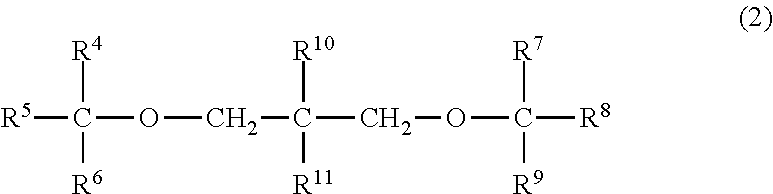
wherein R4 to R9 each represent any of a hydrogen atom, a linear alkyl group having 1 to 6 carbon atoms, a branched alkyl group having 3 to 6 carbon atoms, a cycloalkyl group having 3 to 6 carbon atoms and a phenyl group, and may be the same as or different from each other; and R10 and R11 each represent any of a hydrogen atom, a linear alkyl group having 1 to 6 carbon atoms, a branched alkyl group having 3 to 6 carbon atoms, a cycloalkyl group having 3 to 6 carbon atoms and a phenyl group, and may be the same as or different from each other, or may be bonded to each other to form a ring; and
(R1)kC6H4-k(COOR2)(COOR3) (1)
wherein R1 represents an alkyl group having 1 to 8 carbon atoms or a halogen atom; R2 and R3 each represent an alkyl group having 1 to 12 carbon atoms and may be the same as or different from each other; and the number of the substituent R1, k, is 0, 1 or 2, and when k is 2, each R1 may be the same as or different from each other, and one or two or more compounds selected from diether compounds (B) represented by the following general formula (2):

wherein R4 to R9 each represent any of a hydrogen atom, a linear alkyl group having 1 to 6 carbon atoms, a branched alkyl group having 3 to 6 carbon atoms, a cycloalkyl group having 3 to 6 carbon atoms and a phenyl group, and may be the same as or different from each other; and R10 and R11 each represent any of a hydrogen atom, a linear alkyl group having 1 to 6 carbon atoms, a branched alkyl group having 3 to 6 carbon atoms, a cycloalkyl group having 3 to 6 carbon atoms and a phenyl group, and may be the same as or different from each other, or may be bonded to each other to form a ring;
R12 pAlQ3-p (3)
wherein p is a real number of 0<p≤3; R12 represents an alkyl group having 1 to 6 carbon atoms, and when a plurality of R12 is present, a plurality of R12 may be the same as or different from each other; and Q represents a hydrogen atom or halogen, and when a plurality of Q is present, a plurality of Q may be the same as or different from each other.
R12 pAlQ3-p (3)
wherein p is a real number of 0<p≤3; R12 represents an alkyl group having 1 to 6 carbon atoms, and when a plurality of R12 is present, a plurality of R12 may be the same as or different from each other; and Q represents a hydrogen atom or halogen, and when a plurality of Q is present, a plurality of Q may be the same as or different from each other.

wherein R4 to R9 each represent any of a hydrogen atom, a linear alkyl group having 1 to 6 carbon atoms, a branched alkyl group having 3 to 6 carbon atoms, a cycloalkyl group having 3 to 6 carbon atoms and a phenyl group, and may be the same as or different from each other; and R10 and R11 each represent any of a hydrogen atom, a linear alkyl group having 1 to 6 carbon atoms, a branched alkyl group having 3 to 6 carbon atoms, a cycloalkyl group having 3 to 6 carbon atoms and a phenyl group, and may be the same as or different from each other, or may be bonded to each other to form a ring;
R13 qSi(OR14)4-q (4)
wherein R13 represents any of an alkyl group having 1 to 12 carbon atoms, a vinyl group, an allyl group, an aralkyl group, a cycloalkyl group having 3 to 12 carbon atoms, a phenyl group, an alkylamino group having 1 to 12 carbon atoms and a dialkylamino group having 1 to 12 carbon atoms; q is an integer of 0≤q≤3 and when q is 2 or more, a plurality of R13 may be the same as or different from each other; and R14 represents an alkyl group having 1 to 4 carbon atoms, a cycloalkyl group having 3 to 6 carbon atoms, a phenyl group, a vinyl group, an allyl group or an aralkyl group, and when a plurality of R14 is present, a plurality of R14 may be the same as or different from each other; and
(R15R16N)sSiR17 4-s (5)
wherein R15 and R16 each represent a hydrogen atom, a linear alkyl group having 1 to 20 carbon atoms, a branched alkyl group having 3 to 20 carbon atoms, a vinyl group, an allyl group, an aralkyl group, a cycloalkyl group having 3 to 20 carbon atoms or an aryl group, and may be the same as or different from each other, or may be bonded to each other to form a ring; R17 represents a linear alkyl group having 1 to 20 carbon atoms, a branched alkyl group having 3 to 20 carbon atoms, a vinyl group, an allyl group, an aralkyl group, a linear or branched alkoxy group having 1 to 20 carbon atoms, a vinyloxy group, an allyloxy group, a cycloalkyl group having 3 to 20 carbon atoms, an aryl group, an aryloxy group and a derivative thereof, and when a plurality of R17 is present, a plurality of R17 may be the same as or different from each other; and s is an integer of 1 to 3, and a plurality of the R15R16N groups is present, a plurality of the R15R16N groups may be the same as or different from each other.
R12 pAlQ3-p (3)
wherein p is a real number of 0<p≤3; R12 represents an alkyl group having 1 to 6 carbon atoms, and when a plurality of R12 is present, a plurality of R12 may be the same as or different from each other; and Q is a hydrogen atom or halogen, and when a plurality of Q is present, a plurality of Q may be the same as or different from each other.
-
- Column: capillary column (I.D. 0.32 mm×Length 30 m df 1.00 μm InertCapl, manufactured by GL Sciences Inc.)
- Detector: FID (flame ionization detector, hydrogen flame ionization detector)
- Carrier gas: helium, flow rate 7 mL/min
- Measurement temperature: vaporizing chamber 280° C., column 225° C., detector 280° C., or vaporizing chamber 265° C., column 180° C., detector 265° C.
(Method for Measuring the Particle Size Distribution of the Solid Catalyst Component for Polymerization of an Olefin)
SPAN=(D90−D10)/D50 (6)
PP polymerization activity (g-PP/(g-cat·time))=(the amount of the polymer to be produced (g)/(the solid catalyst component (g)·1 hour)) (α)
(The Bulk Density (BD) of the Polymer)
| TABLE 1 | |
| Component analysis | |
| Content (% by mass) | Number of moles (mmol) |
| Ti | (A) | (B) | (A) | (B) | (A) + (B) | (A)/( B) | |
| Example 1 | 1.8 | 7.7 | 10.4 | 0.3 | 0.5 | 0.8 | 0.6 |
| Example 2 | 1.8 | 7.7 | 10.4 | 0.3 | 0.5 | 0.8 | 0.6 |
| Example 3 | 1.8 | 7.7 | 10.4 | 0.3 | 0.5 | 0.8 | 0.6 |
| Example 4 | 2.4 | 9.3 | 16.6 | 0.4 | 0.8 | 1.2 | 0.5 |
| Comparative | 2.1 | 13.4 | 0.0 | 0.6 | 0.0 | 0.6 | — |
| Example 1 | |||||||
| Comparative | 2.4 | 0.0 | 21.1 | 0.0 | 1.0 | 1.0 | 0.0 |
| Example 2 | |||||||
| Comparative | 1.8 | 6.0 | 11.2 | 0.2 | 0.5 | 0.7 | 0.4 |
| Example 3 | |||||||
| Comparative | 2.1 | 5.7 | 11.2 | 0.2 | 0.5 | 0.7 | 0.4 |
| Example 4 | |||||||
| Comparative | 1.8 | 12.8 | 1.8 | 0.5 | 0.1 | 0.6 | 5.0 |
| Example 5 | |||||||
| Comparative | 2.0 | 8.1 | 7.8 | 0.3 | 0.4 | 0.7 | 0.8 |
| Example 6 | |||||||
| Comparative | 1.8 | 8.1 | 8.3 | 0.3 | 0.4 | 0.7 | 0.8 |
| Example 7 | |||||||
-
- Ti: titanium in the solid catalyst component for polymerization of an olefin
- (A): the internal electron-donating compound (phthalic acid ester compound) in the solid catalyst component for polymerization of an olefin . . . dipropyl phthalate
- (B): the internal electron-donating compound (diether compound) in the solid catalyst component for polymerization of an olefin . . . 2-isopropyl-2-isopentyl-1,3-dimethoxypropane or 9,9-bis(methoxymethyl)fluorene
| TABLE 2 | |
| Physical property evaluation | |
| Amount of | |||
| coarse powder | |||
| Particle size | (% by volume) | ||
| Particle diameter (μm) | distribution | On 111 μm |
| D10 | D50 | D90 | SPAN | sieve | |
| Example 1 | 31.6 | 47.6 | 69.1 | 0.79 | 0.00 |
| Example 2 | 31.6 | 47.6 | 69.1 | 0.79 | 0.00 |
| Example 3 | 31.6 | 47.6 | 69.1 | 0.79 | 0.00 |
| Example 4 | 15.6 | 43.6 | 71.3 | 1.28 | 0.00 |
| Comparative | 28.5 | 45.8 | 66.7 | 0.83 | 0.00 |
| Example 1 | |||||
| Comparative | 25.8 | 46.5 | 73.7 | 1.03 | 0.00 |
| Example 2 | |||||
| Comparative | 24.8 | 46.0 | 73.5 | 1.06 | 0.01 |
| Example 3 | |||||
| Comparative | 28.2 | 47.1 | 71.9 | 0.93 | 0.00 |
| Example 4 | |||||
| Comparative | 11.0 | 46.1 | 77.4 | 1.44 | 0.46 |
| Example 5 | |||||
| Comparative | 30.0 | 52.9 | 88.9 | 1.11 | 1.73 |
| Example 6 | |||||
| Comparative | 31.9 | 47.3 | 67.8 | 0.76 | 0.00 |
| Example 7 | |||||
| TABLE 3 | |||
| Polymerization | Bulk | Amount of | |
| activity | density | oligomers | |
| (g-PP/g-cat.) | (g/mL) | (μg/g) | |
| Example 1 | 62,000 | 0.44 | 620 |
| Example 2 | 66,300 | 0.44 | 560 |
| Example 3 | 58,500 | 0.44 | 610 |
| Example 4 | 54,300 | 0.43 | 680 |
| Comparative | 61,000 | 0.44 | 1020 |
| Example 1 | |||
| Comparative | 31,800 | 0.42 | 790 |
| Example 2 | |||
| Comparative | 62,500 | 0.42 | 730 |
| Example 3 | |||
| Comparative | 52,600 | 0.42 | 760 |
| Example 4 | |||
| Comparative | 43,300 | 0.44 | 950 |
| Example 5 | |||
| Comparative | 62,100 | 0.42 | 750 |
| Example 6 | |||
| Comparative | 47,600 | 0.44 | 960 |
| Example 7 | |||
Claims (6)
(R1)kC6H4-k(COOR2XCOOR3) (1)

(R1)kC6H4-k(COOR2)(COOR3) (1)

(R1)kC6H4-k(COOR2)(COOR3) (1)

R12 pAlQ3-p (3)

R13 qSi(OR14)4-q (4)
(R15R16N)sSiR17 4-s (5)
R12 pAlQ3-p (3)
Priority Applications (5)
| Application Number | Priority Date | Filing Date | Title |
|---|---|---|---|
| US16/931,971 US11225536B1 (en) | 2020-07-17 | 2020-07-17 | Method for producing solid catalyst component for polymerization of olefin, solid catalyst component for polymerization of olefin, catalyst for polymerization of olefin, method for producing catalyst for polymerization of olefin and method for producing polymer of olefin |
| CN202180060358.1A CN116134057B (en) | 2020-07-17 | 2021-06-25 | Solid catalyst component for olefin polymerization and method for producing the same, catalyst for olefin polymerization and method for producing the same, and method for producing olefin polymer |
| PCT/JP2021/024104 WO2022014298A1 (en) | 2020-07-17 | 2021-06-25 | Method for producing solid catalyst component for polymerization of olefin, solid catalyst component for polymerization of olefin, catalyst for polymerization of olefin, method for producing catalyst for polymerization of olefin and method for producing polymer of olefin |
| JP2021560880A JP7181424B2 (en) | 2020-07-17 | 2021-06-25 | Method for producing solid catalyst component for olefin polymerization, method for producing catalyst for olefin polymerization, and method for producing olefin polymer |
| TW110125432A TWI882144B (en) | 2020-07-17 | 2021-07-12 | Method for producing solid catalyst component for polymerization of olefin |
Applications Claiming Priority (1)
| Application Number | Priority Date | Filing Date | Title |
|---|---|---|---|
| US16/931,971 US11225536B1 (en) | 2020-07-17 | 2020-07-17 | Method for producing solid catalyst component for polymerization of olefin, solid catalyst component for polymerization of olefin, catalyst for polymerization of olefin, method for producing catalyst for polymerization of olefin and method for producing polymer of olefin |
Publications (2)
| Publication Number | Publication Date |
|---|---|
| US11225536B1 true US11225536B1 (en) | 2022-01-18 |
| US20220017664A1 US20220017664A1 (en) | 2022-01-20 |
Family
ID=79293363
Family Applications (1)
| Application Number | Title | Priority Date | Filing Date |
|---|---|---|---|
| US16/931,971 Active US11225536B1 (en) | 2020-07-17 | 2020-07-17 | Method for producing solid catalyst component for polymerization of olefin, solid catalyst component for polymerization of olefin, catalyst for polymerization of olefin, method for producing catalyst for polymerization of olefin and method for producing polymer of olefin |
Country Status (5)
| Country | Link |
|---|---|
| US (1) | US11225536B1 (en) |
| JP (1) | JP7181424B2 (en) |
| CN (1) | CN116134057B (en) |
| TW (1) | TWI882144B (en) |
| WO (1) | WO2022014298A1 (en) |
Families Citing this family (1)
| Publication number | Priority date | Publication date | Assignee | Title |
|---|---|---|---|---|
| JP2022181400A (en) * | 2021-05-26 | 2022-12-08 | 東邦チタニウム株式会社 | Solid catalyst component for polymerizing olefins, catalyst for polymerizing olefins, method for producing olefins polymer, olefin polymer, method for producing propylene-based block copolymer and propylene-based block copolymer |
Citations (5)
| Publication number | Priority date | Publication date | Assignee | Title |
|---|---|---|---|---|
| JPS56811A (en) | 1979-06-18 | 1981-01-07 | Mitsui Petrochem Ind Ltd | Preparation of olefin polymer or copolymer |
| JPS5883006A (en) | 1981-11-13 | 1983-05-18 | Mitsui Petrochem Ind Ltd | Polymerization of olefin |
| JPS633010A (en) | 1986-06-24 | 1988-01-08 | Toho Titanium Co Ltd | Catalyst for polymerization of olefin |
| US20050267272A1 (en) * | 2004-05-31 | 2005-12-01 | Sumitomo Chemical Company, Limited | Solid catalyst component for alpha-olefin polymerization, process for producing catalyst therefor, and process for producing alpha-olefin polymer |
| JP2009263678A (en) | 1998-05-06 | 2009-11-12 | Basell Technology Co Bv | Catalyst component for polymerizing olefin |
Family Cites Families (8)
| Publication number | Priority date | Publication date | Assignee | Title |
|---|---|---|---|---|
| JPH072798B2 (en) * | 1987-10-28 | 1995-01-18 | 住友化学工業株式会社 | Solid catalyst component for olefin polymerization |
| JP2940993B2 (en) * | 1990-04-13 | 1999-08-25 | 三井化学株式会社 | Solid titanium catalyst component for olefin polymerization, olefin polymerization catalyst and olefin polymerization method |
| JP2006028483A (en) * | 2004-06-15 | 2006-02-02 | Sumitomo Chemical Co Ltd | Method for producing solid catalyst component for α-olefin polymerization |
| MY148239A (en) | 2009-08-13 | 2013-03-29 | China Petroleum & Chemical | A catalyst component for olefin polymerization and a catalyst comprising the same |
| CN102146146B (en) * | 2010-02-10 | 2013-08-14 | 中国石油化工股份有限公司 | Catalyst component for olefin polymerization and catalyst |
| US20130109789A1 (en) * | 2011-10-28 | 2013-05-02 | Sumitomo Chemical Company, Limited | Olefin polymerization catalyst, process for producing olefin polymer, polypropylene resin composition and article comprising the same |
| KR102006050B1 (en) * | 2012-09-28 | 2019-07-31 | 도호 티타늄 가부시키가이샤 | Solid catalyst component for polymerization of olefins, catalyst for polymerization of olefins, and method for producing olefin polymer |
| SG11201501883UA (en) | 2013-02-27 | 2015-05-28 | Toho Titanium Co Ltd | Production method for solid catalyst component for polymerizing olefins, catalyst for polymerizing olefins, and production method for polymerized olefins |
-
2020
- 2020-07-17 US US16/931,971 patent/US11225536B1/en active Active
-
2021
- 2021-06-25 CN CN202180060358.1A patent/CN116134057B/en active Active
- 2021-06-25 WO PCT/JP2021/024104 patent/WO2022014298A1/en not_active Ceased
- 2021-06-25 JP JP2021560880A patent/JP7181424B2/en active Active
- 2021-07-12 TW TW110125432A patent/TWI882144B/en active
Patent Citations (5)
| Publication number | Priority date | Publication date | Assignee | Title |
|---|---|---|---|---|
| JPS56811A (en) | 1979-06-18 | 1981-01-07 | Mitsui Petrochem Ind Ltd | Preparation of olefin polymer or copolymer |
| JPS5883006A (en) | 1981-11-13 | 1983-05-18 | Mitsui Petrochem Ind Ltd | Polymerization of olefin |
| JPS633010A (en) | 1986-06-24 | 1988-01-08 | Toho Titanium Co Ltd | Catalyst for polymerization of olefin |
| JP2009263678A (en) | 1998-05-06 | 2009-11-12 | Basell Technology Co Bv | Catalyst component for polymerizing olefin |
| US20050267272A1 (en) * | 2004-05-31 | 2005-12-01 | Sumitomo Chemical Company, Limited | Solid catalyst component for alpha-olefin polymerization, process for producing catalyst therefor, and process for producing alpha-olefin polymer |
Also Published As
| Publication number | Publication date |
|---|---|
| CN116134057B (en) | 2024-07-26 |
| TWI882144B (en) | 2025-05-01 |
| JP7181424B2 (en) | 2022-11-30 |
| TW202208455A (en) | 2022-03-01 |
| US20220017664A1 (en) | 2022-01-20 |
| JP2022534354A (en) | 2022-07-29 |
| WO2022014298A1 (en) | 2022-01-20 |
| CN116134057A (en) | 2023-05-16 |
Similar Documents
| Publication | Publication Date | Title |
|---|---|---|
| US9683059B2 (en) | Solid catalyst component for polymerization of olefins, catalyst for polymerization of olefins, and method for producing olefin polymer | |
| EP2730590B1 (en) | Solid catalyst component for olefin polymerization, catalyst for olefin polymerization, and method for producing olefin polymer | |
| JP5816481B2 (en) | SOLID CATALYST COMPONENT FOR OLEFIN POLYMERIZATION, PROCESS FOR PRODUCING THE SAME, OLEFIN POLYMERIZATION CATALYST, AND METHOD FOR PRODUCING OLEFIN POLYMER | |
| EP2360190A1 (en) | Solid catalyst component and catalyst for polymerization of olefins, and process for production of olefin polymers using same | |
| JP6137463B2 (en) | Solid catalyst component for olefin polymerization, olefin polymerization catalyst, and process for producing olefin polymer using the same | |
| JP5785809B2 (en) | SOLID CATALYST COMPONENT FOR OLEFIN POLYMERIZATION, PROCESS FOR PRODUCING THE SAME, OLEFIN POLYMERIZATION CATALYST, AND METHOD FOR PRODUCING OLEFIN POLYMER | |
| EP2636688A1 (en) | Method for producing solid catalyst component for olefin polymerization, catalyst for olefin polymerization, and olefin polymers | |
| EP1921092A1 (en) | Catalyst component and catalyst for olefin polymerization and method for producing olefin polymer using those | |
| US20090253874A1 (en) | Solid catalyst component for olefin polymerization, catalyst and method for producing olefin polymer by using same | |
| KR20170109576A (en) | Process for preparing olefin polymerization catalyst and process for producing olefin polymer | |
| EP3521324A1 (en) | Solid catalyst component for olefin polymerization, method for producing solid catalyst component for olefin polymerization, catalyst for olefin polymerization, method for producing olefin polymer, method for producing propylene copolymer, and propylene copolymer | |
| JP6847098B2 (en) | Method for producing solid catalyst component for olefin polymerization, catalyst for olefin polymerization and olefin polymer | |
| KR20170110077A (en) | Olefin-polymerization solid catalytic component, production method for olefin-polymerization catalyst, and production method for olefin polymer | |
| US9315601B2 (en) | Solid catalyst component for olefin polymerization, and catalyst | |
| TWI882144B (en) | Method for producing solid catalyst component for polymerization of olefin | |
| CN108473612B (en) | Solid catalyst component for olefin polymerization, catalyst for olefin polymerization, and process for producing olefin polymer | |
| JP2022170676A (en) | Solid catalyst component for olefin polymerization, method for producing solid catalyst component for olefin polymerization, method for producing catalyst for olefin polymerization, and method for producing olefin polymer | |
| WO2021240955A1 (en) | Method for producing catalyst for olefin polymerization, catalyst for olefin polymerization, and method for producing olefin polymer | |
| JP6054690B2 (en) | Solid catalyst component for olefin polymerization, catalyst for olefin polymerization, and method for producing olefin polymer | |
| US20240218087A1 (en) | Solid catalyst component for polymerization of olefin, catalyst for polymerization of olefin, method for producing polymer of olefin, polymer of olefin, method for producing propylene-based block copolymer, and propylene-based block copolymer |
Legal Events
| Date | Code | Title | Description |
|---|---|---|---|
| FEPP | Fee payment procedure |
Free format text: ENTITY STATUS SET TO UNDISCOUNTED (ORIGINAL EVENT CODE: BIG.); ENTITY STATUS OF PATENT OWNER: LARGE ENTITY |
|
| AS | Assignment |
Owner name: TOHO TITANIUM CO., LTD., JAPAN Free format text: ASSIGNMENT OF ASSIGNORS INTEREST;ASSIGNORS:UOZUMI, TOSHIYA;ISHIKAWA, TEPPEI;REEL/FRAME:054093/0173 Effective date: 20200722 |
|
| STCF | Information on status: patent grant |
Free format text: PATENTED CASE |
|
| MAFP | Maintenance fee payment |
Free format text: PAYMENT OF MAINTENANCE FEE, 4TH YEAR, LARGE ENTITY (ORIGINAL EVENT CODE: M1551); ENTITY STATUS OF PATENT OWNER: LARGE ENTITY Year of fee payment: 4 |