US11225492B2 - Heterocycles useful as anti-cancer agents - Google Patents
Heterocycles useful as anti-cancer agents Download PDFInfo
- Publication number
- US11225492B2 US11225492B2 US16/061,747 US201616061747A US11225492B2 US 11225492 B2 US11225492 B2 US 11225492B2 US 201616061747 A US201616061747 A US 201616061747A US 11225492 B2 US11225492 B2 US 11225492B2
- Authority
- US
- United States
- Prior art keywords
- membered
- independently
- compound
- alkyl
- formula
- Prior art date
- Legal status (The legal status is an assumption and is not a legal conclusion. Google has not performed a legal analysis and makes no representation as to the accuracy of the status listed.)
- Expired - Fee Related, expires
Links
- 0 *[U]C1=CC2=C(C=[Y]1)C([4*])=C([3*])C(=[3H])N2[2*] Chemical compound *[U]C1=CC2=C(C=[Y]1)C([4*])=C([3*])C(=[3H])N2[2*] 0.000 description 21
- VUJVDPNDRUOMRM-BFDKIIGWSA-N B.C1=CP=[K]C=C1.CC.CC(C)C Chemical compound B.C1=CP=[K]C=C1.CC.CC(C)C VUJVDPNDRUOMRM-BFDKIIGWSA-N 0.000 description 6
- ATGVHTIGCVZJBI-UHFFFAOYSA-N CC.C[W]C(C)C Chemical compound CC.C[W]C(C)C ATGVHTIGCVZJBI-UHFFFAOYSA-N 0.000 description 5
- DIXIHQKCNIJKCJ-UHFFFAOYSA-N C[W]C(C)C Chemical compound C[W]C(C)C DIXIHQKCNIJKCJ-UHFFFAOYSA-N 0.000 description 5
- SVBBJQWUIAIERV-UHFFFAOYSA-N CC(C)C1=NC=C(N2CC3CNCC(C2)C3(F)F)C=C1.CC(C)C1=NC=C(N2CC3CNCC(C2)O3)C=C1.CC(C)C1=NC=C(N2CC3CNCC(C3)C2)C=C1.CC(C)C1=NC=C(N2CCC3(CC2)CNC3)C=C1.CC(C)C1=NC=C(N2CCC3(CCNCC3)CC2)C=C1.CC(C)C1=NC=C(N2CCCC3(CCNCC3)C2)C=C1 Chemical compound CC(C)C1=NC=C(N2CC3CNCC(C2)C3(F)F)C=C1.CC(C)C1=NC=C(N2CC3CNCC(C2)O3)C=C1.CC(C)C1=NC=C(N2CC3CNCC(C3)C2)C=C1.CC(C)C1=NC=C(N2CCC3(CC2)CNC3)C=C1.CC(C)C1=NC=C(N2CCC3(CCNCC3)CC2)C=C1.CC(C)C1=NC=C(N2CCCC3(CCNCC3)C2)C=C1 SVBBJQWUIAIERV-UHFFFAOYSA-N 0.000 description 2
- UTGSONLPGYXHKA-HXESQRBYSA-N *.*.*.*.CC(=O)C1=C(C)C2=CN=C(NC3=CC4=C(C=C3)N3CCNC[C@@H]3CO4)N=C2N(C2CCCC2)C1=O.CC(C)(C)OC(=O)N1CCC[C@@H](CO)C1.CC(C)(C)OC(=O)N1CCN2C3=C(/C=C(N)\C=C/3)OC[C@H]2C1.CC(C)(C)OC(=O)N1CCN2C3=C(/C=C([N+](=O)[O-])\C=C/3)OC[C@H]2C1 Chemical compound *.*.*.*.CC(=O)C1=C(C)C2=CN=C(NC3=CC4=C(C=C3)N3CCNC[C@@H]3CO4)N=C2N(C2CCCC2)C1=O.CC(C)(C)OC(=O)N1CCC[C@@H](CO)C1.CC(C)(C)OC(=O)N1CCN2C3=C(/C=C(N)\C=C/3)OC[C@H]2C1.CC(C)(C)OC(=O)N1CCN2C3=C(/C=C([N+](=O)[O-])\C=C/3)OC[C@H]2C1 UTGSONLPGYXHKA-HXESQRBYSA-N 0.000 description 1
- NCYJNDBAADJEFS-XHRJFJTASA-N B.C.C1=C2CCC3CCCCC3C2=CP=[K]1.C1=CP=[K]C=C1.CC.CC.CC.CC.CC(C)C.CC(C)C.C[W]C(C)C.C[W]C(C)C Chemical compound B.C.C1=C2CCC3CCCCC3C2=CP=[K]1.C1=CP=[K]C=C1.CC.CC.CC.CC.CC(C)C.CC(C)C.C[W]C(C)C.C[W]C(C)C NCYJNDBAADJEFS-XHRJFJTASA-N 0.000 description 1
- AFWAUTFJLMJXJY-UHFFFAOYSA-N C.C.CC(=O)C1=C(C)C2=CN=C(N)N=C2N(C2CCCC2)C1=O.CC(=O)C1=C(C)C2=CN=C(NC3=CC=C4CN(C(=O)OC(C)(C)C)CCC4=N3)N=C2N(C2CCCC2)C1=O.CC(=O)C1=C(C)C2=CN=C(NC3=CC=C4CNCCC4=N3)N=C2N(C2CCCC2)C1=O.CC(=O)C1=C(C)C2=CN=C(S(C)(=O)=O)N=C2N(C2CCCC2)C1=O.CC(C)(C)OC(=O)C1CCC2=NC(Cl)=CC=C2C1.N.O Chemical compound C.C.CC(=O)C1=C(C)C2=CN=C(N)N=C2N(C2CCCC2)C1=O.CC(=O)C1=C(C)C2=CN=C(NC3=CC=C4CN(C(=O)OC(C)(C)C)CCC4=N3)N=C2N(C2CCCC2)C1=O.CC(=O)C1=C(C)C2=CN=C(NC3=CC=C4CNCCC4=N3)N=C2N(C2CCCC2)C1=O.CC(=O)C1=C(C)C2=CN=C(S(C)(=O)=O)N=C2N(C2CCCC2)C1=O.CC(C)(C)OC(=O)C1CCC2=NC(Cl)=CC=C2C1.N.O AFWAUTFJLMJXJY-UHFFFAOYSA-N 0.000 description 1
- LNHIAEINVGBRDH-UHFFFAOYSA-N C.CC(=O)C1=C(C)C2=CN=C(NC3=NC=C(N4CC5CN(C(=O)OC(C)(C)C)CC(C4)O5)C=C3)N=C2N(C2CCCC2)C1=O.CC(=O)C1=C(C)C2=CN=C(NC3=NC=C(N4CC5CNCC(C4)O5)C=C3)N=C2N(C2CCCC2)C1=O.CC(C)(C)OC(=O)N1CC2CN(C3=CC=C(N)N=C3)CC(C1)O2.CC(C)(C)OC(=O)N1CC2CN(C3=CC=C([N+](=O)[O-])N=C3)CC(C1)O2.CC(C)(C)OC(=O)N1CC2CNCC(C1)O2.N=N.O=[N+]([O-])C1=NC=C(Br)C=C1.[HH] Chemical compound C.CC(=O)C1=C(C)C2=CN=C(NC3=NC=C(N4CC5CN(C(=O)OC(C)(C)C)CC(C4)O5)C=C3)N=C2N(C2CCCC2)C1=O.CC(=O)C1=C(C)C2=CN=C(NC3=NC=C(N4CC5CNCC(C4)O5)C=C3)N=C2N(C2CCCC2)C1=O.CC(C)(C)OC(=O)N1CC2CN(C3=CC=C(N)N=C3)CC(C1)O2.CC(C)(C)OC(=O)N1CC2CN(C3=CC=C([N+](=O)[O-])N=C3)CC(C1)O2.CC(C)(C)OC(=O)N1CC2CNCC(C1)O2.N=N.O=[N+]([O-])C1=NC=C(Br)C=C1.[HH] LNHIAEINVGBRDH-UHFFFAOYSA-N 0.000 description 1
- VHWKTNCBJKPOOJ-UHFFFAOYSA-N C.CC(=O)C1=C(C)C2=CN=C(NC3=NC=C(N4CCC5(CC4)CN(C(=O)OC(C)(C)C)C5)C=C3)N=C2N(C2CCCC2)C1=O.CC(=O)C1=C(C)C2=CN=C(NC3=NC=C(N4CCC5(CC4)CNC5)C=C3)N=C2N(C2CCCC2)C1=O.CC(C)(C)OC(=O)N1CC2(CCCCC2)C1.CC(C)(C)OC(=O)N1CC2(CCN(C3=CN=C(N)C=C3)CC2)C1.CC(C)(C)OC(=O)N1CC2(CCN(C3=CN=C([N+](=O)[O-])C=C3)CC2)C1.O=[N+]([O-])C1=NC=C(Br)C=C1 Chemical compound C.CC(=O)C1=C(C)C2=CN=C(NC3=NC=C(N4CCC5(CC4)CN(C(=O)OC(C)(C)C)C5)C=C3)N=C2N(C2CCCC2)C1=O.CC(=O)C1=C(C)C2=CN=C(NC3=NC=C(N4CCC5(CC4)CNC5)C=C3)N=C2N(C2CCCC2)C1=O.CC(C)(C)OC(=O)N1CC2(CCCCC2)C1.CC(C)(C)OC(=O)N1CC2(CCN(C3=CN=C(N)C=C3)CC2)C1.CC(C)(C)OC(=O)N1CC2(CCN(C3=CN=C([N+](=O)[O-])C=C3)CC2)C1.O=[N+]([O-])C1=NC=C(Br)C=C1 VHWKTNCBJKPOOJ-UHFFFAOYSA-N 0.000 description 1
- AOVNALWDVOOCCT-UHFFFAOYSA-N C.CC(=O)C1=C(C)C2=CN=C(NC3=NC=C(N4CCN(C(=O)CCC(=O)CO)CC4)C=C3)N=C2N(C2CCCC2)C1=O.CC(=O)C1=C(C)C2=CN=C(NC3=NC=C(N4CCN(CCCC(=O)CO)CC4)C=C3)N=C2N(C2CCCC2)C1=O.CC(=O)C1=C(C)C2=CN=C(NC3=NC=C(N4CCN(CCCCCCCC(=O)CO)CC4)C=C3)N=C2N(C2CCCC2)C1=O Chemical compound C.CC(=O)C1=C(C)C2=CN=C(NC3=NC=C(N4CCN(C(=O)CCC(=O)CO)CC4)C=C3)N=C2N(C2CCCC2)C1=O.CC(=O)C1=C(C)C2=CN=C(NC3=NC=C(N4CCN(CCCC(=O)CO)CC4)C=C3)N=C2N(C2CCCC2)C1=O.CC(=O)C1=C(C)C2=CN=C(NC3=NC=C(N4CCN(CCCCCCCC(=O)CO)CC4)C=C3)N=C2N(C2CCCC2)C1=O AOVNALWDVOOCCT-UHFFFAOYSA-N 0.000 description 1
- NFNSUCNJWLRJAJ-UHFFFAOYSA-N C.CC(=O)C1=C(C)C2=CN=C(NC3=NC=C(N4CCN(C(=O)CCCC(=O)NO)CC4)C=C3)N=C2N(C2CCCC2)C1=O.CC(=O)C1=C(C)C2=CN=C(NC3=NC=C(N4CCNCC4)C=C3)N=C2N(C2CCCC2)C1=O.COC(=O)CCCC(=O)O.O=C(O)CCCC(=O)NO Chemical compound C.CC(=O)C1=C(C)C2=CN=C(NC3=NC=C(N4CCN(C(=O)CCCC(=O)NO)CC4)C=C3)N=C2N(C2CCCC2)C1=O.CC(=O)C1=C(C)C2=CN=C(NC3=NC=C(N4CCNCC4)C=C3)N=C2N(C2CCCC2)C1=O.COC(=O)CCCC(=O)O.O=C(O)CCCC(=O)NO NFNSUCNJWLRJAJ-UHFFFAOYSA-N 0.000 description 1
- MJPRABALVXLTQB-UHFFFAOYSA-N C.CC(=O)C1=C(C)C2=CN=C(NC3=NC=C(N4CCN(C(=O)CCCCCCC(=O)CO)CC4)C=C3)N=C2N(C2CCCC2)C1=O.CC(=O)C1=C(C)C2=CN=C(NC3=NC=C(N4CCNCC4)C=C3)N=C2N(C2CCCC2)C1=O.COC(=O)CCCCCCC(=O)O.O=C(O)CCCCCCC(=O)CO Chemical compound C.CC(=O)C1=C(C)C2=CN=C(NC3=NC=C(N4CCN(C(=O)CCCCCCC(=O)CO)CC4)C=C3)N=C2N(C2CCCC2)C1=O.CC(=O)C1=C(C)C2=CN=C(NC3=NC=C(N4CCNCC4)C=C3)N=C2N(C2CCCC2)C1=O.COC(=O)CCCCCCC(=O)O.O=C(O)CCCCCCC(=O)CO MJPRABALVXLTQB-UHFFFAOYSA-N 0.000 description 1
- CPJFHCQVBFGZNA-UHFFFAOYSA-N C.CC(=O)C1=C(C)C2=CN=C(NC3=NC=C(N4CCN(CCCCCCC(=O)NOC5CCCCO5)CC4)C=C3)N=C2N(C2CCCC2)C1=O.CC(=O)C1=C(C)C2=CN=C(NC3=NC=C(N4CCNCC4)C=C3)N=C2N(C2CCCC2)C1=O.NOC1CCCCO1.O=C(CCCCCCBr)NOC1CCCCO1.O=C(O)CCCCCCCCBr Chemical compound C.CC(=O)C1=C(C)C2=CN=C(NC3=NC=C(N4CCN(CCCCCCC(=O)NOC5CCCCO5)CC4)C=C3)N=C2N(C2CCCC2)C1=O.CC(=O)C1=C(C)C2=CN=C(NC3=NC=C(N4CCNCC4)C=C3)N=C2N(C2CCCC2)C1=O.NOC1CCCCO1.O=C(CCCCCCBr)NOC1CCCCO1.O=C(O)CCCCCCCCBr CPJFHCQVBFGZNA-UHFFFAOYSA-N 0.000 description 1
- IPECMDNFGXZHLP-UHFFFAOYSA-N C1=CC2=C(C=C1)CCC2.C1=CC2=C(C=C1)CCCC2.C1CC2(C1)CCC2.C1CC2CC(C1)C2.C1CC2CC2C1.C1CC2CCC(C1)C2.C1CC2CCC1CC2.C1CC2CCCC2C1.C1CCC2CCC2C1.C1CCC2CCCCC2C1.CC(C)(C)C.CC(C)(C)C.CC(C)(C)C.CC(C)(C)C1CC1.CC(C)(C)C1CC2=C(CCC2)C1.CC(C)(C)C1CCC1.CC(C)(C)C1CCCC1.CC(C)(C)C1CCCCC1.CC(C)C.CC(C)C.CC(C)C.CC(C)C.CC(C)C.CC(C)C.CC(C)C Chemical compound C1=CC2=C(C=C1)CCC2.C1=CC2=C(C=C1)CCCC2.C1CC2(C1)CCC2.C1CC2CC(C1)C2.C1CC2CC2C1.C1CC2CCC(C1)C2.C1CC2CCC1CC2.C1CC2CCCC2C1.C1CCC2CCC2C1.C1CCC2CCCCC2C1.CC(C)(C)C.CC(C)(C)C.CC(C)(C)C.CC(C)(C)C1CC1.CC(C)(C)C1CC2=C(CCC2)C1.CC(C)(C)C1CCC1.CC(C)(C)C1CCCC1.CC(C)(C)C1CCCCC1.CC(C)C.CC(C)C.CC(C)C.CC(C)C.CC(C)C.CC(C)C.CC(C)C IPECMDNFGXZHLP-UHFFFAOYSA-N 0.000 description 1
- FGZHFLMIVDOOIL-UHFFFAOYSA-N C1=CC2=C(C=C1)OCCN2.C1=CC2=C(CCCC2)N=C1.C1=NC2=C(CCCC2)O1.C1CC2(C1)CNC2.C1CC2(C1)COC2.C1CC2CCNC2C1.C1CC2CNCC2C1.C1CC2CNCC2C1.C1CCN2CCC2C1.C1CCNC1.C1CCNC1.C1CCNCC1.C1CCOC1.C1CCOCC1.CC(C)(C)C.CC(C)(C)C.CC(C)(C)C.CC(C)(C)C.CC(C)(C)C.CC(C)(C)C.CC(C)(C)N1CC2CC2C1.CC(C)C.CC(C)C.CC(C)C.CC(C)C.CC(C)C.CC(C)C.CC(C)C.CC(C)C.CC(C)C.CC(C)C.CC(C)C.CC(C)C.O=C1CCCC2CCCN12.O=C1CNCC2=CC=CN12.O=C1CNCC2CCCN12.O=S1(=O)CCCC1 Chemical compound C1=CC2=C(C=C1)OCCN2.C1=CC2=C(CCCC2)N=C1.C1=NC2=C(CCCC2)O1.C1CC2(C1)CNC2.C1CC2(C1)COC2.C1CC2CCNC2C1.C1CC2CNCC2C1.C1CC2CNCC2C1.C1CCN2CCC2C1.C1CCNC1.C1CCNC1.C1CCNCC1.C1CCOC1.C1CCOCC1.CC(C)(C)C.CC(C)(C)C.CC(C)(C)C.CC(C)(C)C.CC(C)(C)C.CC(C)(C)C.CC(C)(C)N1CC2CC2C1.CC(C)C.CC(C)C.CC(C)C.CC(C)C.CC(C)C.CC(C)C.CC(C)C.CC(C)C.CC(C)C.CC(C)C.CC(C)C.CC(C)C.O=C1CCCC2CCCN12.O=C1CNCC2=CC=CN12.O=C1CNCC2CCCN12.O=S1(=O)CCCC1 FGZHFLMIVDOOIL-UHFFFAOYSA-N 0.000 description 1
- OCWGPUOHYCSKPS-UHFFFAOYSA-N C1=CC=C2C(=C1)CC1=C2C=CC=C1.C1=CC=C2C=CC=CC2=C1.C1=CC=C2CCCC2=C1.C1=CC=C2CCCCC2=C1.C1=CC=CC=C1.CC(C)C.CC(C)C.CC(C)C.CC(C)C.CC(C)C Chemical compound C1=CC=C2C(=C1)CC1=C2C=CC=C1.C1=CC=C2C=CC=CC2=C1.C1=CC=C2CCCC2=C1.C1=CC=C2CCCCC2=C1.C1=CC=CC=C1.CC(C)C.CC(C)C.CC(C)C.CC(C)C.CC(C)C OCWGPUOHYCSKPS-UHFFFAOYSA-N 0.000 description 1
- MNDOSSNRRATKRX-UHFFFAOYSA-N C1=CC=C2C(=C1)OCC1CNCCN21.C1=CC=C2C(=C1)OCC1COCCN21.C1=CC=C2CN=CC2=C1.C1=CC=C2CNCCC2=C1.C1=CC=C2N=CC=CC2=C1.C1=CC=C2N=CCC2=C1.C1=CC=C2NCCCC2=C1.C1=CC=C2OC=NC2=C1.C1=CC=C2OC=NC2=C1.C1=CC=C2OCCNC2=C1.C1=CC=NC=C1.C1=CC=NC=C1.C1=CN2C=CN=C2C=N1.C1=CN=C2C(=C1)CC1=C2C=CC=C1.C1=CN=C2CCCC2=C1.C1=CN=C2CCCCC2=C1.C1=CN=CN=C1.C1=COC=N1.C1=CSC=N1.C1=NC=C2N=COC2=C1.C1=NN=CO1.C1=NN=NC1.CC(C)C.CC(C)C.CC(C)C.CC(C)C.CC(C)C.CC(C)C.CC(C)C.CC(C)C.CC(C)C.CC(C)C.CC(C)C.CC(C)C.CC(C)C.CC(C)C.CC(C)C.CC(C)C.CC(C)C.CC(C)C.CC(C)C.CC(C)C.CC(C)C.CC(C)C.CC(C)C.CC(C)C.CC(C)C.CC(C)C.O=C1C=CC2=CC=CC=C2N1.O=C1CC2=CC=CC=C2C1.O=C1CC2=CC=CC=C2O1.O=C1CNCC2COC3=CC=CC=C3N12 Chemical compound C1=CC=C2C(=C1)OCC1CNCCN21.C1=CC=C2C(=C1)OCC1COCCN21.C1=CC=C2CN=CC2=C1.C1=CC=C2CNCCC2=C1.C1=CC=C2N=CC=CC2=C1.C1=CC=C2N=CCC2=C1.C1=CC=C2NCCCC2=C1.C1=CC=C2OC=NC2=C1.C1=CC=C2OC=NC2=C1.C1=CC=C2OCCNC2=C1.C1=CC=NC=C1.C1=CC=NC=C1.C1=CN2C=CN=C2C=N1.C1=CN=C2C(=C1)CC1=C2C=CC=C1.C1=CN=C2CCCC2=C1.C1=CN=C2CCCCC2=C1.C1=CN=CN=C1.C1=COC=N1.C1=CSC=N1.C1=NC=C2N=COC2=C1.C1=NN=CO1.C1=NN=NC1.CC(C)C.CC(C)C.CC(C)C.CC(C)C.CC(C)C.CC(C)C.CC(C)C.CC(C)C.CC(C)C.CC(C)C.CC(C)C.CC(C)C.CC(C)C.CC(C)C.CC(C)C.CC(C)C.CC(C)C.CC(C)C.CC(C)C.CC(C)C.CC(C)C.CC(C)C.CC(C)C.CC(C)C.CC(C)C.CC(C)C.O=C1C=CC2=CC=CC=C2N1.O=C1CC2=CC=CC=C2C1.O=C1CC2=CC=CC=C2O1.O=C1CNCC2COC3=CC=CC=C3N12 MNDOSSNRRATKRX-UHFFFAOYSA-N 0.000 description 1
- HBBIJKZSFSDOKJ-UHFFFAOYSA-N C1CCOC1.CC(=O)C1=C(C)C2=CN=C(NC3=NC=C(N4CCN(CC5=CC=C(C(=O)CO)C=C5)CC4)C=C3)N=C2N(C2CCCC2)C1=O.CC(=O)C1=C(C)C2=CN=C(NC3=NC=C(N4CCN(CC5=CC=C(C(=O)COC6CCCCO6)C=C5)CC4)C=C3)N=C2N(C2CCCC2)C1=O Chemical compound C1CCOC1.CC(=O)C1=C(C)C2=CN=C(NC3=NC=C(N4CCN(CC5=CC=C(C(=O)CO)C=C5)CC4)C=C3)N=C2N(C2CCCC2)C1=O.CC(=O)C1=C(C)C2=CN=C(NC3=NC=C(N4CCN(CC5=CC=C(C(=O)COC6CCCCO6)C=C5)CC4)C=C3)N=C2N(C2CCCC2)C1=O HBBIJKZSFSDOKJ-UHFFFAOYSA-N 0.000 description 1
- HSXJFTMUUZQAAE-UHFFFAOYSA-N C=C(NCCCCCCC(=O)ON)C1=CN=C(C(C)C)C=C1 Chemical compound C=C(NCCCCCCC(=O)ON)C1=CN=C(C(C)C)C=C1 HSXJFTMUUZQAAE-UHFFFAOYSA-N 0.000 description 1
- ZKHCTVKFIYAEFH-UHFFFAOYSA-N CC(=O)C1=C(C)C2=C(C=C(NC3=CC=C4CN(C(=O)CCCCCCC(=O)NO)CCC4=N3)N=C2)N(C2CCCC2)C1=O.CC(=O)C1=C(C)C2=C(N=C(NC3=CC=C(C(=O)NCCCCCCC(=O)NO)C=N3)N=C2)N(C2CCCC2)C1=O.CC(=O)C1=C(C)C2=C(N=C(NC3=CC=C(N4CCN(C(=O)C5=CC=C(C(=O)NO)C=C5)CC4)C=N3)N=C2)N(C2CCCC2)C1=O.CC(=O)C1=C(C)C2=C(N=C(NC3=CC=C4CN(CC5=CC=C(C(=O)NO)C=C5)CCC4=N3)N=C2)N(C2CCCC2)C1=O Chemical compound CC(=O)C1=C(C)C2=C(C=C(NC3=CC=C4CN(C(=O)CCCCCCC(=O)NO)CCC4=N3)N=C2)N(C2CCCC2)C1=O.CC(=O)C1=C(C)C2=C(N=C(NC3=CC=C(C(=O)NCCCCCCC(=O)NO)C=N3)N=C2)N(C2CCCC2)C1=O.CC(=O)C1=C(C)C2=C(N=C(NC3=CC=C(N4CCN(C(=O)C5=CC=C(C(=O)NO)C=C5)CC4)C=N3)N=C2)N(C2CCCC2)C1=O.CC(=O)C1=C(C)C2=C(N=C(NC3=CC=C4CN(CC5=CC=C(C(=O)NO)C=C5)CCC4=N3)N=C2)N(C2CCCC2)C1=O ZKHCTVKFIYAEFH-UHFFFAOYSA-N 0.000 description 1
- LBSVHQBTUPPPSP-UHFFFAOYSA-O CC(=O)C1=C(C)C2=C(N=C(NC3=CC=C(N4CCC5(CCN(C(=O)OC(C)(C)C)CC5)CC4)C=N3)N=C2)N(C2CCCC2)C1=O.CC(=O)C1=C(C)C2=C(N=C(NC3=CC=C(N4CCC5(CCNCC5)CC4)C=N3)N=C2)N(C2CCCC2)C1=O.[H+] Chemical compound CC(=O)C1=C(C)C2=C(N=C(NC3=CC=C(N4CCC5(CCN(C(=O)OC(C)(C)C)CC5)CC4)C=N3)N=C2)N(C2CCCC2)C1=O.CC(=O)C1=C(C)C2=C(N=C(NC3=CC=C(N4CCC5(CCNCC5)CC4)C=N3)N=C2)N(C2CCCC2)C1=O.[H+] LBSVHQBTUPPPSP-UHFFFAOYSA-O 0.000 description 1
- BJEDFAQFWKNEAI-UHFFFAOYSA-N CC(=O)C1=C(C)C2=C(N=C(NC3=CC=C(N4CCCC5(CCNCC5)C4)C=N3)N=C2)N(C2CCCC2)C1=O.CC(C)(C)OC(=O)N1CCC2(CCCCC2)CC1 Chemical compound CC(=O)C1=C(C)C2=C(N=C(NC3=CC=C(N4CCCC5(CCNCC5)C4)C=N3)N=C2)N(C2CCCC2)C1=O.CC(C)(C)OC(=O)N1CCC2(CCCCC2)CC1 BJEDFAQFWKNEAI-UHFFFAOYSA-N 0.000 description 1
- FQQAATAKQBCOQX-UHFFFAOYSA-N CC(=O)C1=C(C)C2=C(N=C(NC3=CC=C(N4CCN(C(=O)CCCC(=O)NO)CC4)C=N3)N=C2)N(C2CCCC2)C1=O.CC(=O)C1=C(C)C2=C(N=C(NC3=CC=C(N4CCN(C(=O)CCCCCCC(=O)NO)CC4)C=N3)N=C2)N(C2CCCC2)C1=O.CC(=O)C1=C(C)C2=C(N=C(NC3=CC=C(N4CCN(CC5=CC=C(C(=O)NO)C=C5)CC4)C=N3)N=C2)N(C2CCCC2)C1=O.CC(=O)C1=C(C)C2=C(N=C(NC3=CC=C(N4CCN(CCCCCCC(=O)NO)CC4)C=N3)N=C2)N(C2CCCC2)C1=O.CC(=O)C1=C(C)C2=C(N=C(NC3=CC=C(N4CCN(CCCCCCCC(=O)NO)CC4)C=N3)N=C2)N(C2CCCC2)C1=O Chemical compound CC(=O)C1=C(C)C2=C(N=C(NC3=CC=C(N4CCN(C(=O)CCCC(=O)NO)CC4)C=N3)N=C2)N(C2CCCC2)C1=O.CC(=O)C1=C(C)C2=C(N=C(NC3=CC=C(N4CCN(C(=O)CCCCCCC(=O)NO)CC4)C=N3)N=C2)N(C2CCCC2)C1=O.CC(=O)C1=C(C)C2=C(N=C(NC3=CC=C(N4CCN(CC5=CC=C(C(=O)NO)C=C5)CC4)C=N3)N=C2)N(C2CCCC2)C1=O.CC(=O)C1=C(C)C2=C(N=C(NC3=CC=C(N4CCN(CCCCCCC(=O)NO)CC4)C=N3)N=C2)N(C2CCCC2)C1=O.CC(=O)C1=C(C)C2=C(N=C(NC3=CC=C(N4CCN(CCCCCCCC(=O)NO)CC4)C=N3)N=C2)N(C2CCCC2)C1=O FQQAATAKQBCOQX-UHFFFAOYSA-N 0.000 description 1
- LOYWCOALOBTSDU-KYIGKLDSSA-N CC(=O)C1=C(C)C2=C(N=C(NC3=CC=C(N4CCN(C5=CC=C(/C=C/C(=O)NO)C=C5)CC4)C=N3)N=C2)N(C2CCCC2)C1=O.CC(=O)C1=C(C)C2=C(N=C(NC3=CC=C(N4CCN(C5=CC=C(C(=O)NO)C=C5)CC4)C=N3)N=C2)N(C2CCCC2)C1=O Chemical compound CC(=O)C1=C(C)C2=C(N=C(NC3=CC=C(N4CCN(C5=CC=C(/C=C/C(=O)NO)C=C5)CC4)C=N3)N=C2)N(C2CCCC2)C1=O.CC(=O)C1=C(C)C2=C(N=C(NC3=CC=C(N4CCN(C5=CC=C(C(=O)NO)C=C5)CC4)C=N3)N=C2)N(C2CCCC2)C1=O LOYWCOALOBTSDU-KYIGKLDSSA-N 0.000 description 1
- RDUGJVZWDOFYKQ-NPAYTLFNSA-N CC(=O)C1=C(C)C2=CN=C(NC3=CC4=C(C=C3)N3CCNC[C@H]3CO4)N=C2N(C2CCCC2)C1=O.CC(C)(C)OC(=O)N1CCC[C@H](CO)C1.CC(C)(C)OC(=O)N1CCN2C3=C(/C=C(N)\C=C/3)OC[C@@H]2C1.CC(C)(C)OC(=O)N1CCN2C3=C(/C=C([N+](=O)[O-])\C=C/3)OC[C@@H]2C1.S.S.S.S Chemical compound CC(=O)C1=C(C)C2=CN=C(NC3=CC4=C(C=C3)N3CCNC[C@H]3CO4)N=C2N(C2CCCC2)C1=O.CC(C)(C)OC(=O)N1CCC[C@H](CO)C1.CC(C)(C)OC(=O)N1CCN2C3=C(/C=C(N)\C=C/3)OC[C@@H]2C1.CC(C)(C)OC(=O)N1CCN2C3=C(/C=C([N+](=O)[O-])\C=C/3)OC[C@@H]2C1.S.S.S.S RDUGJVZWDOFYKQ-NPAYTLFNSA-N 0.000 description 1
- YDBYCNUZAKJGRE-XZWXDCEQSA-N CC(=O)C1=C(C)C2=CN=C(NC3=CC=C4C(=C3)OCC3CNCCN43)N=C2N(C2CCCC2)C1=O.CC(=O)C1=C(C)C2=CN=C(NC3=CC=C4C(=C3)OC[C@@H]3CNCCN43)N=C2N(C2CCCC2)C1=O.CC(=O)C1=C(C)C2=CN=C(NC3=CC=C4C(=C3)OC[C@H]3CNCCN43)N=C2N(C2CCCC2)C1=O.CC(=O)C1=C(C)C2=CN=C(NC3=NC=C(N4CCN(C(=O)CCC(=O)CO)CC4)C=C3)N=C2N(C2CCCC2)C1=O Chemical compound CC(=O)C1=C(C)C2=CN=C(NC3=CC=C4C(=C3)OCC3CNCCN43)N=C2N(C2CCCC2)C1=O.CC(=O)C1=C(C)C2=CN=C(NC3=CC=C4C(=C3)OC[C@@H]3CNCCN43)N=C2N(C2CCCC2)C1=O.CC(=O)C1=C(C)C2=CN=C(NC3=CC=C4C(=C3)OC[C@H]3CNCCN43)N=C2N(C2CCCC2)C1=O.CC(=O)C1=C(C)C2=CN=C(NC3=NC=C(N4CCN(C(=O)CCC(=O)CO)CC4)C=C3)N=C2N(C2CCCC2)C1=O YDBYCNUZAKJGRE-XZWXDCEQSA-N 0.000 description 1
- GJOKATMBJSKSGC-UHFFFAOYSA-N CC(=O)C1=C(C)C2=CN=C(NC3=NC4=C(C=C3)CN(C(=O)CCCCCCC(=O)CO)CC4)N=C2N(C2CCCC2)C1=O.CC(=O)C1=C(C)C2=CN=C(NC3=NC4=C(C=C3)CN(C(=O)CCCCCCC(=O)COC3CCCCO3)CC4)N=C2N(C2CCCC2)C1=O.CC(=O)C1=C(C)C2=CN=C(NC3=NC4=C(C=C3)CN(C(=O)CCCCCCC(=O)O)CC4)N=C2N(C2CCCC2)C1=O.CC(=O)C1=C(C)C2=CN=C(NC3=NC4=C(C=C3)CNCC4)N=C2N(C2CCCC2)C1=O.COC(=O)CCCCCCC(=O)N1CCC2=C(C=CC(NC3=NC=C4C(=N3)N(C3CCCC3)C(=O)C(C(C)=O)=C4C)=N2)C1.NOC1CCCCO1.O=C(O)CCCCCCC(=O)OO Chemical compound CC(=O)C1=C(C)C2=CN=C(NC3=NC4=C(C=C3)CN(C(=O)CCCCCCC(=O)CO)CC4)N=C2N(C2CCCC2)C1=O.CC(=O)C1=C(C)C2=CN=C(NC3=NC4=C(C=C3)CN(C(=O)CCCCCCC(=O)COC3CCCCO3)CC4)N=C2N(C2CCCC2)C1=O.CC(=O)C1=C(C)C2=CN=C(NC3=NC4=C(C=C3)CN(C(=O)CCCCCCC(=O)O)CC4)N=C2N(C2CCCC2)C1=O.CC(=O)C1=C(C)C2=CN=C(NC3=NC4=C(C=C3)CNCC4)N=C2N(C2CCCC2)C1=O.COC(=O)CCCCCCC(=O)N1CCC2=C(C=CC(NC3=NC=C4C(=N3)N(C3CCCC3)C(=O)C(C(C)=O)=C4C)=N2)C1.NOC1CCCCO1.O=C(O)CCCCCCC(=O)OO GJOKATMBJSKSGC-UHFFFAOYSA-N 0.000 description 1
- DBZNYBCYBCGNHJ-UHFFFAOYSA-N CC(=O)C1=C(C)C2=CN=C(NC3=NC4=C(C=C3)CN(C(=O)CCCCCCC(=O)CO)CC4)N=C2N(C2CCCC2)C1=O.CC(=O)C1=C(C)C2=CN=C(NC3=NC=C(C(=O)NCCCCCCC(=O)NO)C=C3)N=C2N(C2CCCC2)C1=O.CC(=O)C1=C(C)C2=CN=C(NC3=NC=C(C(=O)NO)C=C3)N=C2N(C2CCCC2)C1=O.CC(=O)C1=C(C)C2=CN=C(NC3=NC=C(N4CCN(CC5=CC=C(C(=O)CO)C=C5)CC4)C=C3)N=C2N(C2CCCC2)C1=O Chemical compound CC(=O)C1=C(C)C2=CN=C(NC3=NC4=C(C=C3)CN(C(=O)CCCCCCC(=O)CO)CC4)N=C2N(C2CCCC2)C1=O.CC(=O)C1=C(C)C2=CN=C(NC3=NC=C(C(=O)NCCCCCCC(=O)NO)C=C3)N=C2N(C2CCCC2)C1=O.CC(=O)C1=C(C)C2=CN=C(NC3=NC=C(C(=O)NO)C=C3)N=C2N(C2CCCC2)C1=O.CC(=O)C1=C(C)C2=CN=C(NC3=NC=C(N4CCN(CC5=CC=C(C(=O)CO)C=C5)CC4)C=C3)N=C2N(C2CCCC2)C1=O DBZNYBCYBCGNHJ-UHFFFAOYSA-N 0.000 description 1
- LYVCEYXZUADALJ-UHFFFAOYSA-N CC(=O)C1=C(C)C2=CN=C(NC3=NC4=C(C=C3)CN(CC3=CC=C(C(=O)CO)C=C3)CC4)N=C2N(C2CCCC2)C1=O.CC(=O)C1=C(C)C2=CN=C(NC3=NC4=C(C=C3)CN(CC3=CC=C(C(=O)COC5CCCCO5)C=C3)CC4)N=C2N(C2CCCC2)C1=O.CC(=O)C1=C(C)C2=CN=C(NC3=NC4=C(C=C3)CNCC4)N=C2N(C2CCCC2)C1=O.O=C(COC1CCCCO1)C1=CC=C(CCl)C=C1 Chemical compound CC(=O)C1=C(C)C2=CN=C(NC3=NC4=C(C=C3)CN(CC3=CC=C(C(=O)CO)C=C3)CC4)N=C2N(C2CCCC2)C1=O.CC(=O)C1=C(C)C2=CN=C(NC3=NC4=C(C=C3)CN(CC3=CC=C(C(=O)COC5CCCCO5)C=C3)CC4)N=C2N(C2CCCC2)C1=O.CC(=O)C1=C(C)C2=CN=C(NC3=NC4=C(C=C3)CNCC4)N=C2N(C2CCCC2)C1=O.O=C(COC1CCCCO1)C1=CC=C(CCl)C=C1 LYVCEYXZUADALJ-UHFFFAOYSA-N 0.000 description 1
- FGDKZXMXQSPEEU-UHFFFAOYSA-N CC(=O)C1=C(C)C2=CN=C(NC3=NC4=C(C=C3)CN(CC3=CC=C(C(=O)CO)C=C3)CC4)N=C2N(C2CCCC2)C1=O.CC(=O)C1=C(C)C2=CN=C(NC3=NC=C(N4CCN(C(=O)C5=CC=C(C(=O)CO)C=C5)CC4)C=C3)N=C2N(C2CCCC2)C1=O.CC(=O)C1=C(C)C2=CN=C(NC3=NC=C(N4CCN(C5=CC=C(C(=O)NO)C=C5)CC4)C=C3)N=C2N(C2CCCC2)C1=O Chemical compound CC(=O)C1=C(C)C2=CN=C(NC3=NC4=C(C=C3)CN(CC3=CC=C(C(=O)CO)C=C3)CC4)N=C2N(C2CCCC2)C1=O.CC(=O)C1=C(C)C2=CN=C(NC3=NC=C(N4CCN(C(=O)C5=CC=C(C(=O)CO)C=C5)CC4)C=C3)N=C2N(C2CCCC2)C1=O.CC(=O)C1=C(C)C2=CN=C(NC3=NC=C(N4CCN(C5=CC=C(C(=O)NO)C=C5)CC4)C=C3)N=C2N(C2CCCC2)C1=O FGDKZXMXQSPEEU-UHFFFAOYSA-N 0.000 description 1
- WWYSKENLRXROAU-UHFFFAOYSA-N CC(=O)C1=C(C)C2=CN=C(NC3=NC=C(C(=O)NCCCCCCC(=O)NO)C=C3)N=C2N(C2CCCC2)C1=O.CC(=O)C1=C(C)C2=CN=C(NC3=NC=C(C(=O)NCCCCCCC(=O)NOC4CCCCO4)C=C3)N=C2N(C2CCCC2)C1=O.CC(=O)C1=C(C)C2=CN=C(NC3=NC=C(C(=O)NCCCCCCC(=O)O)C=C3)N=C2N(C2CCCC2)C1=O.CC(=O)C1=C(C)C2=CN=C(NC3=NC=C(C(=O)O)C=C3)N=C2N(C2CCCC2)C1=O.COC(=O)CCCCCCN.COC(=O)CCCCCCNC(=O)C1=CN=C(NC2=NC=C3C(=N2)N(C2CCCC2)C(=O)C(C(C)=O)=C3C)C=C1.NOC1CCCCO1 Chemical compound CC(=O)C1=C(C)C2=CN=C(NC3=NC=C(C(=O)NCCCCCCC(=O)NO)C=C3)N=C2N(C2CCCC2)C1=O.CC(=O)C1=C(C)C2=CN=C(NC3=NC=C(C(=O)NCCCCCCC(=O)NOC4CCCCO4)C=C3)N=C2N(C2CCCC2)C1=O.CC(=O)C1=C(C)C2=CN=C(NC3=NC=C(C(=O)NCCCCCCC(=O)O)C=C3)N=C2N(C2CCCC2)C1=O.CC(=O)C1=C(C)C2=CN=C(NC3=NC=C(C(=O)O)C=C3)N=C2N(C2CCCC2)C1=O.COC(=O)CCCCCCN.COC(=O)CCCCCCNC(=O)C1=CN=C(NC2=NC=C3C(=N2)N(C2CCCC2)C(=O)C(C(C)=O)=C3C)C=C1.NOC1CCCCO1 WWYSKENLRXROAU-UHFFFAOYSA-N 0.000 description 1
- OSUJSRFDMDLCHS-UHFFFAOYSA-N CC(=O)C1=C(C)C2=CN=C(NC3=NC=C(C(=O)NO)C=C3)N=C2N(C2CCCC2)C1=O Chemical compound CC(=O)C1=C(C)C2=CN=C(NC3=NC=C(C(=O)NO)C=C3)N=C2N(C2CCCC2)C1=O OSUJSRFDMDLCHS-UHFFFAOYSA-N 0.000 description 1
- SPNOPMNBNYNOHR-UHFFFAOYSA-N CC(=O)C1=C(C)C2=CN=C(NC3=NC=C(C(=O)NOC4CCCCO4)C=C3)N=C2N(C2CCCC2)C1=O.CC(=O)C1=C(C)C2=CN=C(NC3=NC=C(C(=O)O)C=C3)N=C2N(C2CCCC2)C1=O.CC(=O)C1=C(C)C2=CN=C(S(C)(=O)=O)N=C2N(C2CCCC2)C1=O.COC(=O)C1=CN=C(N)C=C1.COC(=O)C1=CN=C(NC2=NC=C3C(=N2)N(C2CCCC2)C(=O)C(C(C)=O)=C3C)C=C1.NOC1CCCCO1 Chemical compound CC(=O)C1=C(C)C2=CN=C(NC3=NC=C(C(=O)NOC4CCCCO4)C=C3)N=C2N(C2CCCC2)C1=O.CC(=O)C1=C(C)C2=CN=C(NC3=NC=C(C(=O)O)C=C3)N=C2N(C2CCCC2)C1=O.CC(=O)C1=C(C)C2=CN=C(S(C)(=O)=O)N=C2N(C2CCCC2)C1=O.COC(=O)C1=CN=C(N)C=C1.COC(=O)C1=CN=C(NC2=NC=C3C(=N2)N(C2CCCC2)C(=O)C(C(C)=O)=C3C)C=C1.NOC1CCCCO1 SPNOPMNBNYNOHR-UHFFFAOYSA-N 0.000 description 1
- WDROMHZMYSYWCJ-UHFFFAOYSA-N CC(=O)C1=C(C)C2=CN=C(NC3=NC=C(N4CC5CC(CN(C(=O)OC(C)(C)C)C5)C4)C=C3)N=C2N(C2CCCC2)C1=O.CC(=O)C1=C(C)C2=CN=C(NC3=NC=C(N4CC5CNCC(C5)C4)C=C3)N=C2N(C2CCCC2)C1=O Chemical compound CC(=O)C1=C(C)C2=CN=C(NC3=NC=C(N4CC5CC(CN(C(=O)OC(C)(C)C)C5)C4)C=C3)N=C2N(C2CCCC2)C1=O.CC(=O)C1=C(C)C2=CN=C(NC3=NC=C(N4CC5CNCC(C5)C4)C=C3)N=C2N(C2CCCC2)C1=O WDROMHZMYSYWCJ-UHFFFAOYSA-N 0.000 description 1
- DFRJQUTUZFWQEL-UHFFFAOYSA-N CC(=O)C1=C(C)C2=CN=C(NC3=NC=C(N4CC5CN(C(=O)OC(C)(C)C)CC(C4)C5(F)F)C=C3)N=C2N(C2CCCC2)C1=O.CC(=O)C1=C(C)C2=CN=C(NC3=NC=C(N4CC5CNCC(C4)C5(F)F)C=C3)N=C2N(C2CCCC2)C1=O.O=[N+]([O-])C1=CC=C(N2CC3CCCC(C2)C3(F)F)C=N1.O=[N+]([O-])C1=CC=C(N2CC3CCCC(C2)C3(F)F)C=N1 Chemical compound CC(=O)C1=C(C)C2=CN=C(NC3=NC=C(N4CC5CN(C(=O)OC(C)(C)C)CC(C4)C5(F)F)C=C3)N=C2N(C2CCCC2)C1=O.CC(=O)C1=C(C)C2=CN=C(NC3=NC=C(N4CC5CNCC(C4)C5(F)F)C=C3)N=C2N(C2CCCC2)C1=O.O=[N+]([O-])C1=CC=C(N2CC3CCCC(C2)C3(F)F)C=N1.O=[N+]([O-])C1=CC=C(N2CC3CCCC(C2)C3(F)F)C=N1 DFRJQUTUZFWQEL-UHFFFAOYSA-N 0.000 description 1
- CSLKGKGFYQSPCO-UHFFFAOYSA-N CC(=O)C1=C(C)C2=CN=C(NC3=NC=C(N4CC5CNCC(C4)C5(F)F)C=C3)N=C2N(C2CCCC2)C1=O.CC(=O)C1=C(C)C2=CN=C(NC3=NC=C(N4CC5CNCC(C4)C5(F)F)C=C3)N=C2N(C2CCCC2)C1=O.O=[N+]([O-])C1=CC=C(N2CC3CCCC(C2)C3(F)F)C=N1.O=[N+]([O-])C1=CC=C(N2CC3CCCC(C2)C3(F)F)C=N1 Chemical compound CC(=O)C1=C(C)C2=CN=C(NC3=NC=C(N4CC5CNCC(C4)C5(F)F)C=C3)N=C2N(C2CCCC2)C1=O.CC(=O)C1=C(C)C2=CN=C(NC3=NC=C(N4CC5CNCC(C4)C5(F)F)C=C3)N=C2N(C2CCCC2)C1=O.O=[N+]([O-])C1=CC=C(N2CC3CCCC(C2)C3(F)F)C=N1.O=[N+]([O-])C1=CC=C(N2CC3CCCC(C2)C3(F)F)C=N1 CSLKGKGFYQSPCO-UHFFFAOYSA-N 0.000 description 1
- XPRHDTPNLALTPK-UHFFFAOYSA-N CC(=O)C1=C(C)C2=CN=C(NC3=NC=C(N4CC5CNCC(C4)C5(F)F)C=C3)N=C2N(C2CCCC2)C1=O.CC(=O)C1=C(C)C2=CN=C(NC3=NC=C(N4CCC5(CCNCC5)CC4)C=C3)N=C2N(C2CCCC2)C1=O.CC(=O)C1=C(C)C2=CN=C(NC3=NC=C(N4CCCC5(CCNCC5)C4)C=C3)N=C2N(C2CCCC2)C1=O Chemical compound CC(=O)C1=C(C)C2=CN=C(NC3=NC=C(N4CC5CNCC(C4)C5(F)F)C=C3)N=C2N(C2CCCC2)C1=O.CC(=O)C1=C(C)C2=CN=C(NC3=NC=C(N4CCC5(CCNCC5)CC4)C=C3)N=C2N(C2CCCC2)C1=O.CC(=O)C1=C(C)C2=CN=C(NC3=NC=C(N4CCCC5(CCNCC5)C4)C=C3)N=C2N(C2CCCC2)C1=O XPRHDTPNLALTPK-UHFFFAOYSA-N 0.000 description 1
- AQAKSGSWZRWGBN-UHFFFAOYSA-N CC(=O)C1=C(C)C2=CN=C(NC3=NC=C(N4CC5CNCC(C4)O5)C=C3)N=C2N(C2CCCC2)C1=O.CC(=O)C1=C(C)C2=CN=C(NC3=NC=C(N4CC5CNCC(C5)C4)C=C3)N=C2N(C2CCCC2)C1=O.CC(=O)C1=C(C)C2=CN=C(NC3=NC=C(N4CCC5(CC4)CNC5)C=C3)N=C2N(C2CCCC2)C1=O Chemical compound CC(=O)C1=C(C)C2=CN=C(NC3=NC=C(N4CC5CNCC(C4)O5)C=C3)N=C2N(C2CCCC2)C1=O.CC(=O)C1=C(C)C2=CN=C(NC3=NC=C(N4CC5CNCC(C5)C4)C=C3)N=C2N(C2CCCC2)C1=O.CC(=O)C1=C(C)C2=CN=C(NC3=NC=C(N4CCC5(CC4)CNC5)C=C3)N=C2N(C2CCCC2)C1=O AQAKSGSWZRWGBN-UHFFFAOYSA-N 0.000 description 1
- KTAYBQHFSXYJQT-UHFFFAOYSA-N CC(=O)C1=C(C)C2=CN=C(NC3=NC=C(N4CCN(C(=O)C5=CC=C(C(=O)CO)C=C5)CC4)C=C3)N=C2N(C2CCCC2)C1=O.CC(=O)C1=C(C)C2=CN=C(NC3=NC=C(N4CCN(C(=O)C5=CC=C(C(=O)COC6CCCCO6)C=C5)CC4)C=C3)N=C2N(C2CCCC2)C1=O Chemical compound CC(=O)C1=C(C)C2=CN=C(NC3=NC=C(N4CCN(C(=O)C5=CC=C(C(=O)CO)C=C5)CC4)C=C3)N=C2N(C2CCCC2)C1=O.CC(=O)C1=C(C)C2=CN=C(NC3=NC=C(N4CCN(C(=O)C5=CC=C(C(=O)COC6CCCCO6)C=C5)CC4)C=C3)N=C2N(C2CCCC2)C1=O KTAYBQHFSXYJQT-UHFFFAOYSA-N 0.000 description 1
- ZBBGSSLZXQFYOG-UHFFFAOYSA-N CC(=O)C1=C(C)C2=CN=C(NC3=NC=C(N4CCN(C(=O)C5=CC=C(C(=O)O)C=C5)CC4)C=C3)N=C2N(C2CCCC2)C1=O.CC(=O)C1=C(C)C2=CN=C(NC3=NC=C(N4CCNCC4)C=C3)N=C2N(C2CCCC2)C1=O.COC(=O)C1=CC=C(C(=O)N2CCN(C3=CN=C(NC4=NC=C5C(=N4)N(C4CCCC4)C(=O)C(C(C)=O)=C5C)C=C3)CC2)C=C1.COC(=O)C1=CC=C(C(=O)O)C=C1.NOC1OCCCO1 Chemical compound CC(=O)C1=C(C)C2=CN=C(NC3=NC=C(N4CCN(C(=O)C5=CC=C(C(=O)O)C=C5)CC4)C=C3)N=C2N(C2CCCC2)C1=O.CC(=O)C1=C(C)C2=CN=C(NC3=NC=C(N4CCNCC4)C=C3)N=C2N(C2CCCC2)C1=O.COC(=O)C1=CC=C(C(=O)N2CCN(C3=CN=C(NC4=NC=C5C(=N4)N(C4CCCC4)C(=O)C(C(C)=O)=C5C)C=C3)CC2)C=C1.COC(=O)C1=CC=C(C(=O)O)C=C1.NOC1OCCCO1 ZBBGSSLZXQFYOG-UHFFFAOYSA-N 0.000 description 1
- BEORLKQKLDINIE-NTEUORMPSA-N CC(=O)C1=C(C)C2=CN=C(NC3=NC=C(N4CCN(C5=CC=C(/C=C/C(=O)NO)C=C5)CC4)C=C3)N=C2N(C2CCCC2)C1=O Chemical compound CC(=O)C1=C(C)C2=CN=C(NC3=NC=C(N4CCN(C5=CC=C(/C=C/C(=O)NO)C=C5)CC4)C=C3)N=C2N(C2CCCC2)C1=O BEORLKQKLDINIE-NTEUORMPSA-N 0.000 description 1
- ARCXFQCOGKJYRH-WXEPVDIESA-N CC(=O)C1=C(C)C2=CN=C(NC3=NC=C(N4CCN(C5=CC=C(/C=C/C(=O)NO)C=C5)CC4)C=C3)N=C2N(C2CCCC2)C1=O.CC(=O)C1=C(C)C2=CN=C(NC3=NC=C(N4CCN(C5=CC=C(/C=C/C(=O)NOC6CCCCC6)C=C5)CC4)C=C3)N=C2N(C2CCCC2)C1=O Chemical compound CC(=O)C1=C(C)C2=CN=C(NC3=NC=C(N4CCN(C5=CC=C(/C=C/C(=O)NO)C=C5)CC4)C=C3)N=C2N(C2CCCC2)C1=O.CC(=O)C1=C(C)C2=CN=C(NC3=NC=C(N4CCN(C5=CC=C(/C=C/C(=O)NOC6CCCCC6)C=C5)CC4)C=C3)N=C2N(C2CCCC2)C1=O ARCXFQCOGKJYRH-WXEPVDIESA-N 0.000 description 1
- RPMOYCDRABYFCG-CAFJVWNPSA-N CC(=O)C1=C(C)C2=CN=C(NC3=NC=C(N4CCN(C5=CC=C(/C=C/C(=O)O)C=C5)CC4)C=C3)N=C2N(C2CCCC2)C1=O.CC(=O)C1=C(C)C2=CN=C(NC3=NC=C(N4CCN(C5=CC=C(C=O)C=C5)CC4)C=C3)N=C2N(C2CCCC2)C1=O.CC(=O)C1=C(C)C2=CN=C(NC3=NC=C(N4CCNCC4)C=C3)N=C2N(C2CCCC2)C1=O.NOC1CCCCO1.O=C(O)CC(=O)O.O=CC1=CC=C(Br)C=C1 Chemical compound CC(=O)C1=C(C)C2=CN=C(NC3=NC=C(N4CCN(C5=CC=C(/C=C/C(=O)O)C=C5)CC4)C=C3)N=C2N(C2CCCC2)C1=O.CC(=O)C1=C(C)C2=CN=C(NC3=NC=C(N4CCN(C5=CC=C(C=O)C=C5)CC4)C=C3)N=C2N(C2CCCC2)C1=O.CC(=O)C1=C(C)C2=CN=C(NC3=NC=C(N4CCNCC4)C=C3)N=C2N(C2CCCC2)C1=O.NOC1CCCCO1.O=C(O)CC(=O)O.O=CC1=CC=C(Br)C=C1 RPMOYCDRABYFCG-CAFJVWNPSA-N 0.000 description 1
- YNIAMCUJHJWOBK-UHFFFAOYSA-N CC(=O)C1=C(C)C2=CN=C(NC3=NC=C(N4CCN(C5=CC=C(C(=O)NO)C=C5)CC4)C=C3)N=C2N(C2CCCC2)C1=O.CC(=O)C1=C(C)C2=CN=C(NC3=NC=C(N4CCN(C5=CC=C(C(=O)NOC6CCCCC6)C=C5)CC4)C=C3)N=C2N(C2CCCC2)C1=O Chemical compound CC(=O)C1=C(C)C2=CN=C(NC3=NC=C(N4CCN(C5=CC=C(C(=O)NO)C=C5)CC4)C=C3)N=C2N(C2CCCC2)C1=O.CC(=O)C1=C(C)C2=CN=C(NC3=NC=C(N4CCN(C5=CC=C(C(=O)NOC6CCCCC6)C=C5)CC4)C=C3)N=C2N(C2CCCC2)C1=O YNIAMCUJHJWOBK-UHFFFAOYSA-N 0.000 description 1
- OWZXAGSOUWPEDU-UHFFFAOYSA-N CC(=O)C1=C(C)C2=CN=C(NC3=NC=C(N4CCN(C5=CC=C(C(=O)O)C=C5)CC4)C=C3)N=C2N(C2CCCC2)C1=O.CC(=O)C1=C(C)C2=CN=C(NC3=NC=C(N4CCNCC4)C=C3)N=C2N(C2CCCC2)C1=O.COC(=O)C1=CC=C(C)C=C1.COC(=O)C1=CC=C(N2CCN(C3=CN=C(NC4=NC=C5C(=N4)N(C4CCCC4)C(=O)C(C(C)=O)=C5C)C=C3)CC2)C=C1.NOC1CCCCO1 Chemical compound CC(=O)C1=C(C)C2=CN=C(NC3=NC=C(N4CCN(C5=CC=C(C(=O)O)C=C5)CC4)C=C3)N=C2N(C2CCCC2)C1=O.CC(=O)C1=C(C)C2=CN=C(NC3=NC=C(N4CCNCC4)C=C3)N=C2N(C2CCCC2)C1=O.COC(=O)C1=CC=C(C)C=C1.COC(=O)C1=CC=C(N2CCN(C3=CN=C(NC4=NC=C5C(=N4)N(C4CCCC4)C(=O)C(C(C)=O)=C5C)C=C3)CC2)C=C1.NOC1CCCCO1 OWZXAGSOUWPEDU-UHFFFAOYSA-N 0.000 description 1
- ABDHOEKIEGYNBR-UHFFFAOYSA-N CC(=O)C1=C(C)C2=CN=C(NC3=NC=C(N4CCN(CCCCCCC(=O)NO)CC4)C=C3)N=C2N(C2CCCC2)C1=O Chemical compound CC(=O)C1=C(C)C2=CN=C(NC3=NC=C(N4CCN(CCCCCCC(=O)NO)CC4)C=C3)N=C2N(C2CCCC2)C1=O ABDHOEKIEGYNBR-UHFFFAOYSA-N 0.000 description 1
- GODSHPBASZCCTD-UHFFFAOYSA-N CC(=O)C1=C(C)C2=CN=C(S(C)(=O)=O)N=C2N(C2CCCC2)C1=O.CC(=O)C1=C(C)C2=CN=C(S(C)=O)N=C2N(C2CCCC2)C1=O.CC(C)(C)OC(=O)N1CC2CC(C1)CN(C1=CC=C(N)N=C1)C2.CC(C)(C)OC(=O)N1CC2CC(C1)CN(C1=CC=C([N+](=O)[O-])N=C1)C2.CC(C)(C)OC(=O)N1CC2CNCC(C2)C1.CSC1=NC=C2C(=N1)N(C1CCCC1)C(=O)C(C(C)=O)=C2C.I.II.O=[N+]([O-])C1=NC=C(Br)C=C1 Chemical compound CC(=O)C1=C(C)C2=CN=C(S(C)(=O)=O)N=C2N(C2CCCC2)C1=O.CC(=O)C1=C(C)C2=CN=C(S(C)=O)N=C2N(C2CCCC2)C1=O.CC(C)(C)OC(=O)N1CC2CC(C1)CN(C1=CC=C(N)N=C1)C2.CC(C)(C)OC(=O)N1CC2CC(C1)CN(C1=CC=C([N+](=O)[O-])N=C1)C2.CC(C)(C)OC(=O)N1CC2CNCC(C2)C1.CSC1=NC=C2C(=N1)N(C1CCCC1)C(=O)C(C(C)=O)=C2C.I.II.O=[N+]([O-])C1=NC=C(Br)C=C1 GODSHPBASZCCTD-UHFFFAOYSA-N 0.000 description 1
- LADGGVXXAGRAPK-UHFFFAOYSA-M CC(=O)C1=C(C)C2=CN=C(S(C)(=O)=O)N=C2N(C2CCCC2)C1=O.CC(C)(C)OC(=O)N1CCC2(CC1)CCN(C1=CC=C(N)N=C1)CC2.CC(C)(C)OC(=O)N1CCC2(CC1)CCN(C1=CC=C([N+](=O)[O-])N=C1)CC2.CC(C)(C)OC(=O)N1CCC2(CCCCC2)CC1.CO.CSC1=NC=C2C(=N1)N(C1CCCC1)C(=O)C(C(C)=O)=C2C.I.O=COO[K].O=[N+]([O-])C1=CC=C(Br)C=N1.[KH] Chemical compound CC(=O)C1=C(C)C2=CN=C(S(C)(=O)=O)N=C2N(C2CCCC2)C1=O.CC(C)(C)OC(=O)N1CCC2(CC1)CCN(C1=CC=C(N)N=C1)CC2.CC(C)(C)OC(=O)N1CCC2(CC1)CCN(C1=CC=C([N+](=O)[O-])N=C1)CC2.CC(C)(C)OC(=O)N1CCC2(CCCCC2)CC1.CO.CSC1=NC=C2C(=N1)N(C1CCCC1)C(=O)C(C(C)=O)=C2C.I.O=COO[K].O=[N+]([O-])C1=CC=C(Br)C=N1.[KH] LADGGVXXAGRAPK-UHFFFAOYSA-M 0.000 description 1
- MQNXAQHXRFIZAD-UHFFFAOYSA-M CC(=O)C1=C(C)C2=CN=C(S(C)(=O)=O)N=C2N(C2CCCC2)C1=O.CC(C)(C)OC(=O)N1CCCC(CO)C1.CC(C)(C)OC(=O)N1CCN2C3=C(C=C(N)C=C3)OCC2C1.CC(C)(C)OC(=O)N1CCN2C3=C(C=C([N+](=O)[O-])C=C3)OCC2C1.O=[N+]([O-])C1=CC(F)=C(F)C=C1.O[K].[HH] Chemical compound CC(=O)C1=C(C)C2=CN=C(S(C)(=O)=O)N=C2N(C2CCCC2)C1=O.CC(C)(C)OC(=O)N1CCCC(CO)C1.CC(C)(C)OC(=O)N1CCN2C3=C(C=C(N)C=C3)OCC2C1.CC(C)(C)OC(=O)N1CCN2C3=C(C=C([N+](=O)[O-])C=C3)OCC2C1.O=[N+]([O-])C1=CC(F)=C(F)C=C1.O[K].[HH] MQNXAQHXRFIZAD-UHFFFAOYSA-M 0.000 description 1
- VSAXCKVHNCYFKG-UHFFFAOYSA-N CC(C)C1=NC2=C(C=C1)CN(C(=O)CCCCCCC(=O)ON)CC2.CC(C)C1=NC2=C(C=C1)CN(CC1=CC=C(C(=O)NO)C=C1)CC2 Chemical compound CC(C)C1=NC2=C(C=C1)CN(C(=O)CCCCCCC(=O)ON)CC2.CC(C)C1=NC2=C(C=C1)CN(CC1=CC=C(C(=O)NO)C=C1)CC2 VSAXCKVHNCYFKG-UHFFFAOYSA-N 0.000 description 1
- IEDVTHVKTANKQT-UHFFFAOYSA-N CC(C)C1=NC=C(N2CCN(C(=O)C3=CC=C(C(=O)NO)C=C3)CC2)C=C1.CC(C)C1=NC=C(N2CCN(C(=O)CCCC(=O)NO)CC2)C=C1.CC(C)C1=NC=C(N2CCN(C(=O)CCCCCCC(=O)NO)CC2)C=C1.CC(C)C1=NC=C(N2CCN(CC3=CC=C(C(=O)NO)C=C3)CC2)C=C1.CC(C)C1=NC=C(N2CCN(CCCCCCC(=O)NO)CC2)C=C1.CC(C)C1=NC=C(N2CCN(CCCCCCCC(=O)NO)CC2)C=C1 Chemical compound CC(C)C1=NC=C(N2CCN(C(=O)C3=CC=C(C(=O)NO)C=C3)CC2)C=C1.CC(C)C1=NC=C(N2CCN(C(=O)CCCC(=O)NO)CC2)C=C1.CC(C)C1=NC=C(N2CCN(C(=O)CCCCCCC(=O)NO)CC2)C=C1.CC(C)C1=NC=C(N2CCN(CC3=CC=C(C(=O)NO)C=C3)CC2)C=C1.CC(C)C1=NC=C(N2CCN(CCCCCCC(=O)NO)CC2)C=C1.CC(C)C1=NC=C(N2CCN(CCCCCCCC(=O)NO)CC2)C=C1 IEDVTHVKTANKQT-UHFFFAOYSA-N 0.000 description 1
- KTZHXADTSYLJKS-OAZHBLANSA-N CC(C)C1=NC=C(N2CCN(C3=CC=C(/C=C/C(=O)NO)C=C3)CC2)C=C1.CC(C)C1=NC=C(N2CCN(C3=CC=C(C(=O)NO)C=C3)CC2)C=C1 Chemical compound CC(C)C1=NC=C(N2CCN(C3=CC=C(/C=C/C(=O)NO)C=C3)CC2)C=C1.CC(C)C1=NC=C(N2CCN(C3=CC=C(C(=O)NO)C=C3)CC2)C=C1 KTZHXADTSYLJKS-OAZHBLANSA-N 0.000 description 1
Classifications
-
- C—CHEMISTRY; METALLURGY
- C07—ORGANIC CHEMISTRY
- C07D—HETEROCYCLIC COMPOUNDS
- C07D519/00—Heterocyclic compounds containing more than one system of two or more relevant hetero rings condensed among themselves or condensed with a common carbocyclic ring system not provided for in groups C07D453/00 or C07D455/00
-
- A—HUMAN NECESSITIES
- A61—MEDICAL OR VETERINARY SCIENCE; HYGIENE
- A61P—SPECIFIC THERAPEUTIC ACTIVITY OF CHEMICAL COMPOUNDS OR MEDICINAL PREPARATIONS
- A61P35/00—Antineoplastic agents
- A61P35/02—Antineoplastic agents specific for leukemia
-
- C—CHEMISTRY; METALLURGY
- C07—ORGANIC CHEMISTRY
- C07D—HETEROCYCLIC COMPOUNDS
- C07D471/00—Heterocyclic compounds containing nitrogen atoms as the only ring hetero atoms in the condensed system, at least one ring being a six-membered ring with one nitrogen atom, not provided for by groups C07D451/00 - C07D463/00
- C07D471/02—Heterocyclic compounds containing nitrogen atoms as the only ring hetero atoms in the condensed system, at least one ring being a six-membered ring with one nitrogen atom, not provided for by groups C07D451/00 - C07D463/00 in which the condensed system contains two hetero rings
- C07D471/04—Ortho-condensed systems
-
- C—CHEMISTRY; METALLURGY
- C07—ORGANIC CHEMISTRY
- C07B—GENERAL METHODS OF ORGANIC CHEMISTRY; APPARATUS THEREFOR
- C07B59/00—Introduction of isotopes of elements into organic compounds ; Labelled organic compounds per se
- C07B59/002—Heterocyclic compounds
Definitions
- CDKs Cyclin-dependent kinases
- Each of the CDKs controls a specific checkpoint of the cell cycle.
- CDKs are activated by the binding to the cyclins and thus form specific complexes.
- CDKs are overactive or CDK-inhibiting proteins are not functional. Therefore, it is rational to target CDK function to prevent unregulated proliferation of cancer cells ( Nature Reviews, 2009, 9, 153-166).
- CDK4 is the key regulator of the G1-S transition.
- CDK4 phosphorylates Rb and drives cell cycle progression, a process inhibited by p16.
- the p16-CDK4-cyclin D-Rb is aberrant in the majority of cancers and thus is an attractive target for anti-cancer therapy.
- Histone deacetylases are a class of enzymes that remove the acetyl group from the 8-amino groups of lysine residues located in the NH 2 terminal tails of core histones.
- HDACs Histone deacetylases
- Class I includes HDAC1, HDAC2, HDAC3, and HDAC8 and have homology to yeast RPD3.
- HDAC4, HDAC5, HDAC7, and HDAC9 belong to class II and have homology to yeast HDA1.
- HDAC6 and HDAC10 contain two catalytic sites and are classified as class IIa, whereas HDAC11 has conserved residues in its catalytic center that are shared by both class I and class II deacetylases and is sometimes placed in class IV.
- Histone deacetylase inhibitors are emerging as a new class of potential anticancer agents and have been shown to induce differentiation, cell-cycle arrest, and apoptosis and to inhibit migration, invasion, and angiogenesis in many cancer cell lines.
- HDAC inhibitors inhibit tumor growth in animal models and show antitumor activity in patients ( Mol. Cancer Res . Oct. 2007, 5; 981).
- HDAC inhibitors have potential therapeutic application in nonmalignant diseases, such as for treatment of inflammatory and neurodegenerative diseases.
- the present invention provides, among others, novel heterocyclic compounds and their uses, e.g., as inhibitors for protein kinases (e.g., CDKs) and HDACs.
- protein kinases e.g., CDKs
- HDACs protein kinases
- the present invention provides a compound of Formula (I), its diastereomer or its enantiomer when possible, its deuterium derivative, and/or their corresponding pharmaceutically acceptable salt, prodrug, hydrate, solvate thereof.
- U is NR 7 , O, or S
- each of X, Y and Z independently is N or CR 8 , and each R 8 independently is hydrogen, halogen, C 1-8 alkyl, C 2-8 alkenyl, C 2-8 alkynyl, OR 5 , SR 5 , NR 5 R 6 , CN, C(O)R 5 , or C(O)OR 5 ;
- T O
- R 2 is hydrogen, C 1-8 alkyl, C 2-8 alkenyl, C 2-8 alkynyl, cycloalkyl, heterocyclyl, aryl, or heteroaryl;
- R 3 is hydrogen, halogen, C 1-8 alkyl, C 2-8 alkenyl, C 2-8 alkynyl, cycloalkyl, heterocyclyl, aryl, heteroaryl, CN, NO 2 , (CR 9 R 10 ) m OR 5 , (CR 9 R 10 ) m SR 5 , (CR 9 R 10 ) m NR 5 R 6 , (CR 9 R 10 ) m C(O)R 5 , (CR 9 R 10 ) m C(O)OR 5 , (CR 9 R 10 ) m C(O)NR 5 R 6 , (CR 9 R 10 ) m OC(O)R 5 , (CR 9 R 10 ) m OC(O)OR 5 , (CR 9 R 10 ) m OC(O)NR 5 R 6 , (CR 9 R 10 ) m OC(O)NR 5 R 6 , (CR 9 R 10 ) m OC(O)NR 5 R 6 , (CR
- n 0, 1, 2, or 3;
- R 4 is hydrogen, halogen, C 1-8 alkyl, C 2-8 alkenyl, C 2-8 alkynyl, cycloalkyl, heterocyclyl, aryl, heteroaryl, OR 5 , NR 5 R 6 , or CN;
- each of R 5 and R 6 is hydrogen, C 1-8 alkyl, C 2-8 alkenyl, C 2-8 alkynyl, cycloalkyl, heterocyclyl, aryl, or heteroaryl;
- R 5 and R 6 together with the nitrogen to which they are attached to, form a 3- to 9-membered ring that optionally contains 0-3 additional heteroatoms each independently being N, O, or S;
- R 7 is hydrogen or C 1-4 alkyl
- each of R 9 and R 10 is hydrogen or C 1-8 alkyl; or, R 9 and R 10 , together with the carbon to which they are attached to, form a 3- to 9-membered ring that optionally contains 0-3 additional heteroatoms each independently being N, O, or S;
- A is of Formula (II), Formula (III), Formula (IV), or Formula (V):
- W is aryl or heteroaryl
- Het is a 4- to 15-membered mono- or polycyclic heterocycle or a cycloalkyl (wherein the polycyclic heterocycle or a cycloalky comprise bridge ring structure or spiro ring structure) containing 0-5 heteroatoms each independently being N, O, S, S(O), or S(O) 2 ;
- n 0, 1, 2 or 3;
- each R 1 independently is halogen, C 1-8 alkyl, C 2-8 alkenyl, C 2-8 alkynyl, cycloalkyl, heterocyclyl, aryl, heteroaryl, CN, OR 5 , SR 5 , NR 5 R 6 , C(O)R 5 , C(O)OR 5 , C(O)NR 5 R 6 , OC(O)R 5 , NR 6 C(O)R 5 , S(O) 2 R 5 , or (CH 2 ) p —V—(CH 2 ) q C(O)NH(OH); provided that when n is 1, R 1 is (CH 2 ) P —V—(CH 2 ) q C(O)NH(OH); or when n is 2 or 3, one R 1 is (CH 2 ) P —V—(CH 2 ) q C(O)NH(OH), and the other R 1 is selected from groups other than (CH 2 ) P —V—(CH 2 ) q
- Formula (II) is selected from:
- each of p and q independently is 0, 1, 2, 3, 4, 5, 6, 7, 8, 9, or 10;
- V is CH 2 , CH ⁇ CH, C ⁇ C, O, S, NR 13 , C(O), OC(O), C(O)O, OC(O)O, C(O)NH, NHC(O), NHC(O)NH, S(O), S(O) 2 , S(O) 2 NH, NHS(O) 2 , C 1-8 alkyl, cycloalkyl, heterocyclyl, aryl, heteroaryl, CR 14 R 15 , V 1 CH 2 ) t V 2 ;
- R 13 is hydrogen, C 1-4 alkyl, C(O)R 5 , or S(O) 2 R 5 ;
- R 14 and R 15 independently is hydrogen, halogen, C 1-4 alkyl, C 2-4 alkenyl, C 2-4 alkynyl, cycloalkyl, heterocyclyl, aryl, heteroaryl, CN, OR 5 , SR 5 , NR 5 R 6 , C(O)R 5 , C(O)OR 5 , C(O)NR 5 R 6 , OC(O)R 5 , NR 6 C(O)R 5 , S(O) 2 R 5 ; or, R 14 and R 15 , together with the carbon to which they are attached to, form a 3- to 9-membered ring that optionally contains 0-3 heteroatoms each independently being N, O, or S;
- V 1 and V 2 independently CH ⁇ CH, C ⁇ C, O, S, NR 13 , C(O)NH, NHC(O), S(O) 2 , S(O) 2 NH, NHS(O) 2 , cycloalkyl, heterocyclyl, aryl, heteroaryl;
- t 0, 1, 2, 3, 4, 5;
- V, V 1 , V 2 , p, q and t meets the requirement of forming a chemically stable structure
- B is a 5- to 15-membered ring containing 1-5 heteroatoms each independently being N, O, or S;
- each of K, M, P, and Q independently is N or CR 8 ;
- n and R 1 are the same as defined for Formula (II);
- E is N or CR 11 , wherein R 11 is hydrogen, C 1-4 alkyl, or OR 5 ;
- J is O, S, NR 12 , CR 9 R 10 , C(O), S(O), or S(O) 2 ;
- G is NR 12 , O, S, S(O), S(O) 2 , or CR 9 R 10 ;
- k 0, 1, 2 or 3;
- each R 1a independently is hydrogen, halogen, C 1-4 alkyl; or two R 1a , together with the carbon to which they are attached to, form a carbonyl ( ⁇ O);
- R 12 is hydrogen, C 1-8 alkyl, C 2-8 alkenyl, C 2-8 alkynyl, cycloalkyl, heterocyclyl, aryl, heteroaryl, C(O)R 5 , C(O)OR 5 , C(O)NR 5 R 6 , S(O) 2 R 5 , or (CH 2 ) P —V—(CH 2 ) q C(O)NH(OH);
- each of a, b and c, independently, is 0, 1, 2, or 3;
- each alkyl, alkenyl, alkynyl, cycloalkyl, heterocyclyl, aryl, or heteroaryl can be optionally and independently substituted by 1-3 substituents selected from the following group: halogen, C 1-8 alkyl, C 2-8 alkenyl, C 2-8 alkynyl, C 3-10 cycloalkyl, heterocyclyl, aryl, heteroaryl, CN, NO 2 , OR 5 , SR 5 , NR 5 R 6 , C(O)R 5 , C(O)OR 5 , C(O)NR 5 R 6 , or S(O) 2 R 5 .
- aryl comprises 6-12 carbon atoms; heteroaryl is 5- to 15-membered heteroaryl; cycloalkyl is C 3-8 cycloalkyl; and heterocyclyl is 3- to 12-membered heterocyclyl;
- R 2 is C 3-8 cycloalkyl; R 3 is C(O)C 1-8 alkyl, R 4 is C 1-8 alkyl; X and Y are both N; Z is CH; and U is NH.
- R 2 is cyclopentyl
- R 3 is C(O)CH 3
- R 4 is methyl
- X and Y are both N
- Z is CH
- U is NH.
- Het is a 4- to 8-membered mono-heterocycle or a 9- to 15-membered bridged or spiro bicyclic ring containing 1-4 heteroatoms each independently being N or O; n is 1; and R 1 is (CH 2 ) P —V—(CH 2 ) q C(O)NH(OH).
- W is phenyl or pyridinyl.
- R 1 is (CH 2 ) P —V—(CH 2 ) q C(O)NH(OH).
- B is a 5- to 12-membered non-aromatic monocyclic ring containing 1-4 heteroatoms each independently being N or O; n is 1; and R 1 is (CH 2 ) p —V—(CH 2 ) q C(O)NH(OH).
- R 1 is (CH 2 ) p —V—(CH 2 ) q C(O)NH(OH);
- each of d and e independently is 0, 1, 2, or 3, provided the sum of d and e is equal to or greater than 2;
- each f independently is 1, 2, or 3;
- each of g and h independently is 2, 3, or 4.
- J is O, NH, NCH 3 , NC(O)CH 3 , or CH 2 ;
- E is N; and
- G is NR 12 , O, S, S(O), S(O) 2 , or CR 9 R 10 ; a, b and c each independently is 1; R 9 , R 10 and R 12 are the same as defined in claim 1 .
- J is O; E is N; and G is NR 12 or O; a, b and c each independently is 1; k is 0, 1, or 2; R 1a independently is hydrogen, or two R 1a , together with the carbon to which they are attached to, form a carbonyl (C ⁇ O);
- R 12 is hydrogen, C 1-4 alkyl, C 2-4 alkenyl, C 2-4 alkynyl, cycloalkyl, heterocyclyl, aryl, heteroaryl, C(O)R 5 , C(O)OR 5 , C(O)NR 5 R 6 , S(O) 2 R 5 , or (CH 2 ) p —V—(CH 2 ) q C(O)NH(OH).
- Formula (IV) is:
- R 12 is defined as above.
- W in Formula (V) is phenyl or pyridinyl, n is 1, and R 1 is (CH 2 ) p —V—(CH 2 ) q C(O)NH(OH).
- each of p and q independently is 0, 1, 2, 3, 4, 5, 6, or V is CH 2 , CH ⁇ CH, C ⁇ C, O, NR 13 , C(O), C(O)O, C(O)NH, S(O) 2 , S(O) 2 NH, cycloalkyl, heterocyclyl, aryl, heteroaryl, V 1 (CH 2 ) t V 2 ; wherein V 1 and V 2 independently CH ⁇ CH, O, NR 13 , cycloalkyl, heterocyclyl, aryl, heteroaryl; t is 0, 1, 2, or 3; and R 13 is hydrogen, C 1-4 alkyl; Provided that the selection of V, V 1 , V 2 , p, q and t meets the requirement of forming a chemically stable structure.
- a compound of Formula (I) is:
- the second aspect of the invention provided a pharmaceutical composition, wherein comprising the compound of the first aspect of the present invention and a pharmaceutically acceptable carrier or excipient.
- the third aspect of the invention provided a use of a compound of the first aspect of the present invention for the manufacture of a pharmaceutical composition for treating and/or preventing a disease or condition mediated by a cyclin-dependent kinase or a histone deacetylase.
- the third aspect of the invention provided a method for treating a disease or condition mediated by a cyclin-dependent kinase or a histone deacetylase in a subject, comprising administering to the subject in need thereof a therapeutically effective amount of a compound of the first aspect of the present invention or a composition of the second aspect of the present invention.
- the disease or condition is selected from the following group: breast cancer, lymph cancer, leukemia, lung cancer, ovarian cancer, liver cancer, melanoma, colon cancers, rectal cancer, renal-cell carcinoma, cancer of the small intestine and cancer of the esophagus, bladder cancer, prostate cancer, or pharynx cancer.
- a chiral carbon atom (or chiral center) of the compound(s) in the invention is optionally R-type, S-type, or a combination thereof.
- alkyl by itself or as part of another substituent (which may include the short form of “alk,” e.g., alkoxy), refers to a straight (i.e. unbranched), branched chain, or cyclic hydrocarbon radical, or combination thereof, which may be fully saturated, mono- or polyunsaturated and can include di- and multivalent radicals.
- alk e.g., alkoxy
- examples of C 1-8 alkyl may include a linear or branched alkyl having 1-8 carbon atoms, such as methyl, ethyl, propyl, isopropyl, butyl, isobutyl, sec-butyl, and t-butyl.
- alkenyl refers to a straight chain, or branched hydrocarbon chains having at least one carbon-carbon double bond.
- An alkenyl group with one double bond can be denoted as —C n H 2n-1 or —C n H 2n-3 with two double bonds.
- a carbon-number modifier e.g., C 2-8
- alkenyl group contains 2 to 8 carbon atoms.
- examples of C 2-8 alkenyl may include vinyl, allyl, 1,2-butenyl, 2,3-butenyl, and butadienyl etc.
- alkynyl refers to an aliphatic hydrocarbon group with at least one carbon-carbon triple bond.
- An alkynyl group may be linear or branched or combinations thereof. In some embodiments, it can contain 2 to 12 (e.g., 2 to 8, 2 to 6, or 2 to 4) carbon atoms.
- a carbon-number modifier e.g., C 2-8 , it means the alkynyl group contains 2 to 8 carbon atoms.
- Examples of an alkynyl group may include acetenyl, propynyl, isopropynyl, 1-butynyl, isobutynl, and sec-butynyl etc.
- cycloalkyl refers to a saturated or partially saturated carbocyclic mono-, bi-, or tri-cyclic (fused or bridged or spiral) ring system. It can contain 3 to 12 (e.g., 3 to 10, or 5 to 10) carbon atoms. When a cycloalkyl group is preceded by a carbon-number modifier, e.g., C 3-10 , it means the cycloalkyl group contains 3 to 10 carbon atoms.
- C 3-10 cycloalkyl may refer to a saturated or partially saturated mono- or bicyclic alkyl ring system containing 3 to 10 carbon atoms, such as cyclopropyl, cyclobutyl, cyclopentyl, cyclohexyl, and cycloheptyl. Below are some examples of cycloalkyl group.
- alkoxy refers to an alkyl group linked by an oxygen atom (i.e., —O-alkyl), wherein alkyl is as defined above.
- alkoxy include, but are not limited to, methoxy, ethoxy, n-propoxy, isopropoxy, n-butoxy, iso-butoxy, sec-butoxy, t-butoxy, cyclohexyloxy, and cyclopentyloxy.
- An alkoxy group can be optionally substituted with one or more appropriate substituents such as halogen, amino, cyano, or hydroxyl.
- An alkoxy group can be straight or branched. When an alkoxy group is preceded by a carbon-number modifier, e.g., C 1-8 , it means the alkoxy group contains 1 to 8 carbon atoms.
- halo or “halogen,” by itself or as part of another substituent (e.g., haloalkyl), may refer to and include F, Cl, Br, and/or I.
- carbonyl refers to —C(O)— or —C( ⁇ O)—.
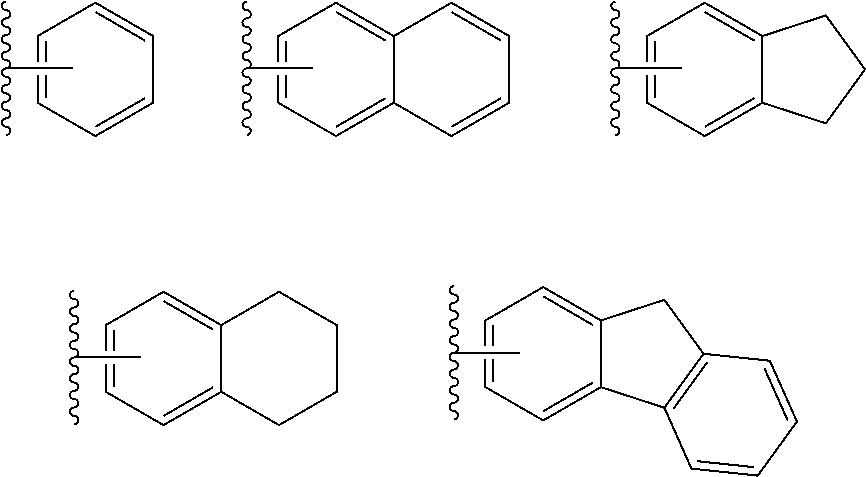
- aryl refers to and includes monocyclic, bicyclic, or polycyclic aromatic hydrocarbon radicals.
- An aryl group can be substituted or unsubstituted.
- a carbon-number modifier e.g., C 6-12
- Aryl group can be fused with another all-carbon containing cyclic structure (including saturated, partial saturated, or aromatic ring). But the attaching point to the parent structure has to be from aromatic ring system to be able to qualify as aryl.
- aryl group When attaching point to parent structure is on a saturated carbon atom, it can be called as cycloalkyl instead of aryl.
- aryl group include but are not limited to phenyl, biphenylyl, and naphthyl.
- heteroaryl refers to a monocyclic or polycyclic aromatic hydrocarbon radicals, having the number of annular carbon atoms designated (e.g., C 4-10 means four to ten annular carbon atoms) and containing at least one or more of the same or different heteroatoms each independently being N, O, or S. Each carbon atom may be optionally substituted.
- a heteroaryl group may be 5- to 15-membered aromatic group containing 1 to 4 heteroatoms each independently being N, O, or S.
- a heteroaryl group may include a nitrogen containing heteroaryl, an oxygen containing heteroaryl, a sulfur containing heteroaryl.
- nitrogen containing heteroaryl refers to an aromatic group having one or more nitrogen atoms in the ring(s). Preferably, it is C 4-10 nitrogen containing heteroaryl which is an aromatic group having 4 to 10 carbon atoms and one or more nitrogen atoms in the ring. Specific examples include but are not limited to substituted or unsubstituted pyridinyl, pyrimidinyl, and pyrrolyl.
- oxygen containing heteroaryl refers to an aromatic group having one or more oxygen atoms in the ring(s).
- it is C 4-10 nitrogen-containing heteroaryl which is an aromatic group having 4 to 10 carbon atoms and one or more oxygen atoms in the ring(s), such as optionally substituted furyl and benzofuryl.
- sulfur containing heteroaryl refers to an aromatic group having one or more sulfur atoms in the ring(s). Preferably, it is C 4-10 sulfur containing heteroaryl which is an aromatic group having 4 to 10 carbon atoms and one or more sulfur atoms in the ring, such as optionally substituted thienyl.
- heterocyclyl refers to mono- or polycyclic radicals which may be saturated, partially saturated, or fully unsaturated, having the number of annular carbon atoms designated (e.g., C 3-11 means three to eleven annular carbon atoms) and containing at least one or more of the same or different heteroatoms each independently being N, S, or O.
- a heterocyclyl group may be 3- to 15-membered group containing 1 to 4 heteroatoms each independently being N, O, or S.
- a heteroaryl group may include a nitrogen containing heterocyclyl, oxygen containing heterocyclyl, and sulfur containing heterocyclyl, nitrogen and oxygen containing heterocyclyl, nitrogen and sulfur containing heterocyclyl, sulfur and oxygen containing heterocyclyl, etc. Below are some examples of heterocycle.
- the term “optionally” means that the moiety at issue is either substituted or not substituted, and that the substitution occurs only when it is chemically feasible. For instance, H cannot be substituted with a substituent and a covalent bond or —C( ⁇ O)— group cannot be substituted with a substituent.
- an “oxo” or “oxide” group refers to ⁇ O.
- pharmaceutically acceptable salt refers to salts which are suitable for use in contact with the tissues of a subject (e.g., human) without excessive adverse effect.
- pharmaceutically acceptable salts include salts of a compound of the invention having an acidic group (e.g., potassium salts, sodium salts, magnesium salts, calcium salts) or a basic group (e.g., sulfate, hydrochloride, phosphate, nitrate, carbonate).
- substituted refers to the replacement of hydrogen radicals in a given structure with the radical of a specified substituent. Specific substituents are described above in the definitions and below in the description of compounds and examples thereof. Unless otherwise indicated, an optionally substituted group can have a substituent at each substitutable position of the group, and when more than one position in any given structure can be substituted with more than one substituent selected from a specified group, the substituent can be either the same or different in every position.
- a ring substituent such as a heterocycloalkyl
- substituents envisioned by this invention are those combinations that result in the formation of stable or chemically feasible compounds.
- substituents include but are not limited to C 1-8 alkyl, C 2-8 alkenyl, C 2-8 alkynyl, C 3-10 cycloalkyl, C 1-8 alkyloxy, halogen, hydroxyl, carboxyl(-COOH), C 1-8 aldehyde, C 2-10 acyl, C 2-10 ester, amino, amido, phenyl.
- a phenyl may be optionally substituted with 1-3 substituents each independently is halogen, C 1-10 alkyl, cyano, OH, nitro, C 3-10 cyclic hydrocarbyl, C 1-8 alkoxy, or amino.
- a compound of Formula (I) is selected from the compounds shown above.
- each of R 1 , R 1a , R 2 , R 3 , R 4 , R 5 , R 6 , R 7 , R 8 , R 9 , R 10 , R 11 , R 12 , R 13 , R 14 , and R 15 in Formula (I) independently is selected from the corresponding groups included by the specific compounds shown above.
- DIPEA N,N-diisopropylethylamine
- HATU (1-[bis(dimethylamino)methylene]-1H-1,2,3-triazolo[4,5-b]pyridinium 3-oxid hexafluorophosphate)
- MgCl 2 magnesium chloride
- the reaction is carried out in an inert solvent and at a temperature of ⁇ 40 to reflux temperature (such as 100 or 120° C.) with a reaction time of from 1 min to 72 hours and preferably 0.1-24 hours or 0.2-12 hours.
- a temperature of ⁇ 40 to reflux temperature such as 100 or 120° C.
- the exemplary solvents and temperature are those used in the Examples.
- Scheme A illustrates a general synthesis of Compound A7.
- Scheme B illustrates a general synthesis of Compound B4.
- Scheme D illustrates a general synthesis of Compound D5A and D5B.
- the compounds provided by the present invention are useful as kinase inhibitors, especially as inhibitors of CDK4 and/or CDK6, and/or HDAC inhibitors. Therefore, these compounds possess outstanding therapeutic effect for cancer.
- the pharmaceutical composition according to the present invention comprises (i) a safe and effective amount of the compounds of the invention or the pharmaceutical acceptable salts thereof and (ii) a pharmaceutically acceptable excipient or carrier.
- safe and effective amount means an amount of the compounds which is sufficient to improve the patient's condition and will not induce any serious side effect.
- the pharmaceutical composition contains 0.01-100 mg compounds of the invention/dose, preferably 0.10-10 mg compounds of the invention/dose.
- “one dose” refers to a capsule or tablet.
- a “pharmaceutically acceptable carrier” means one or more compatible solid or liquid fillers or gel materials, which are suitable for human, and usually must have sufficient purity and sufficiently low toxicity.
- the term “compatibility” as used herein means that the components of the compositions can be blended with the compounds of the invention or with each other, and would not significantly reduce the efficacy of the compounds.
- Examples of pharmaceutically acceptable carriers include but are not limited to cellulose and the derivatives thereof (such as sodium carboxymethyl cellulose, sodium ethyl cellulose, cellulose acetate, etc.), gelatin, talc, solid lubricants (such as stearic acid and magnesium stearate), calcium sulfate, vegetable oils (such as soybean oil, sesame oil, peanut oil, olive oil, etc.), polyols (such as propylene glycol, glycerol, mannitol, sorbitol, etc.), emulsifiers (such as Tween®), wetting agent (such as sodium dodecyl sulfate), coloring agents, flavoring agents, stabilizers, antioxidants, preservatives, and pyrogen-free water.
- cellulose and the derivatives thereof such as sodium carboxymethyl cellulose, sodium ethyl cellulose, cellulose acetate, etc.
- gelatin such as talc
- solid lubricants such as stearic acid
- the route of administration includes but is not limited to: oral, parenteral (intravenous, intramuscular or subcutaneous), and topical administration.
- Solid dosage forms for oral administration include capsules, tablets, pills, powders and granules.
- the active compounds are mixed with at least one conventional inert excipient (or carrier), such as sodium citrate or dicalcium phosphate, or mixed with the following components: (a) fillers or compatibilizer, for example, starch, lactose, sucrose, glucose, mannitol and silicic acid; (b) binders, for example, hydroxymethyl cellulose, alginates, gelatin, polyvinylpyrrolidone, sucrose and gum arabic; (c) humectant, such as, glycerol; (d) disintegrating agents such as agar, calcium carbonate, potato starch or tapioca starch, alginic acid, certain complex silicates, and sodium carbonate; (e) dissolution-retarding agents, such as paraffin; (f) absorption accelerators, for example, quaternary ammonium compounds; (g) wetting agents, such as cetylene glycol
- the solid dosage forms such as tablets, sugar pills, capsules, pills and granules can be prepared by using coating and shell material, such as enteric coatings and other materials known in the art. They can contain opaque agent, and the release of the active compounds or compounds in such compositions can be delayed for releasing in certain portion of the digestive tract. Instance of the embedding components can be polymers and waxes. If necessary, the active compounds and one or more above excipients can be prepared into microcapsules.
- Liquid dosage forms for oral administration include pharmaceutically acceptable emulsions, solutions, suspensions, syrups or tinctures.
- the liquid dosage forms may contain conventional inert diluent known in the art, such as water or other solvent, solubilizer and emulsifier, for example, ethanol, isopropanol, ethyl carbonate, ethyl acetate, propylene glycol, 1,3-butanediol, dimethyl formamide, as well as oil, in particular, cottonseed oil, peanut oil, corn germ oil, olive oil, castor oil and sesame oil, or the mixtures thereof and so on.
- the composition may also contain additives such as wetting agents, emulsifiers, and suspending agent, sweetener, flavoring agents and perfume.
- the suspension may contain suspending agent, for example, ethoxylated isooctadecanol, polyoxyethylene sorbitol and sorbitan esters, microcrystalline cellulose, methanol aluminum and agar, or the mixtures thereof and so on.
- suspending agent for example, ethoxylated isooctadecanol, polyoxyethylene sorbitol and sorbitan esters, microcrystalline cellulose, methanol aluminum and agar, or the mixtures thereof and so on.
- compositions for parenteral injection may comprise physiologically acceptable sterile aqueous or anhydrous solutions, dispersions, suspensions or emulsions, and sterile powders which can be re-dissolved into sterile injectable solutions or dispersions.
- Suitable aqueous and non-aqueous carriers, diluents, solvents or excipients include water, ethanol, polyols and the suitable mixtures thereof.
- the dosage forms of compounds of the invention for topical administration include ointments, powders, patches, aerosol, and inhalants.
- the active ingredients are mixed with physiologically acceptable carriers and any preservatives, buffers, or propellant if necessary, under sterile conditions.
- the compounds of the invention can be administered alone, or in combination with other pharmaceutically acceptable compounds.
- a safe and effective amount of compounds of the present invention is administered or delivered to mammals in need thereof (such as human), wherein the dosage of administration is a pharmaceutically effective amount.
- the daily dose is usually 1 to 2000 mg, preferably 20 to 500 mg.
- the particular dose should also depend on other factors, such as the route of administration, patient healthy status, etc., which are well within the skill of a skilled physician.
- cancer can be used for treating cancer.
- cancer is meant to include all types of cancerous growths or oncogenic processes, metastatic tissues or malignantly transformed cells, tissues, or organs, irrespective of histopathologic type or stage of invasiveness.
- cancerous disorders include, but are not limited to, solid tumors, soft tissue tumors, and metastatic lesions.
- solid tumors include malignancies, e.g., sarcomas, adenocarcinomas, and carcinomas, of the various organ systems, such as those affecting prostate, lung, breast, lymphoid, gastrointestinal (e.g., colon), and genitourinary tract (e.g., renal, urothelial cells), pharynx.
- Adenocarcinomas include malignancies such as most colon cancers, rectal cancer, renal-cell carcinoma, liver cancer, non-small cell carcinoma of the lung, cancer of the small intestine and cancer of the esophagus. Metastatic lesions of the aforementioned cancers can also be treated or prevented using the methods and compositions of the invention.
- the subject method can be useful in treating malignancies of the various organ systems, such as those affecting lung, breast, lymphoid, gastrointestinal (e.g., colon), bladder, genitourinary tract (e.g., prostate), pharynx, as well as adenocarcinomas which include malignancies such as most colon cancers, renal-cell carcinoma, prostate cancer and/or testicular tumors, non-small cell carcinoma of the lung, cancer of the small intestine and cancer of the esophagus.
- gastrointestinal e.g., colon
- bladder genitourinary tract
- pharynx e.g., pharynx
- adenocarcinomas which include malignancies such as most colon cancers, renal-cell carcinoma, prostate cancer and/or testicular tumors, non-small cell carcinoma of the lung, cancer of the small intestine and cancer of the esophagus.
- cancer examples include but are not limited to breast cancer, lymph cancer, lung cancer, ovarian cancer, liver cancer melanoma, colon cancers, rectal cancer, renal-cell carcinoma, cancer of the small intestine and cancer of the esophagus, bladder cancer, prostate cancer, or pharynx cancer, etc.
- the invention provides novel heterocyclic compounds useful as kinase inhibitors and/or histone deacetylase inhibitors;
- Example 7 Preparation of (R,S)-2-(1,2,3,4,4a,5-hexahydro-pyrazino[2,1-c][1,4]benzoxazine-8-amino)-6-acetyl-8-cyclopentyl-5-methylpyrido[2,3-d]pyrimidin-7(8H)-one (Compounds 7); (R)-2-(1,2,3,4,4a,5-hexahydro-pyrazino[2,1-c][1,4]benzoxazine-8-amino)-6-acetyl-8-cyclopentyl-5-methylpyrido[2,3-d]pyrimidin-7(8H)-one (Compound 7R); and (S)-2-(1,2,3,4,4a,5-hexahydro-pyrazino[2,1-c][1,4]benzoxazine-8-amino)-6-acetyl-8-cyclopentyl-5-methylpyrido
- CDK2, CDK4 and CDK6 Kinase Assays 1. CDK2, CDK4 and CDK6 Kinase Assays:
- CDK2/CycA2 In vitro enzymatic activity of the CDK isoforms CDK2/CycA2, CDK4/CycD3 and CDK6/cycD3 were measured using Mobility Shift Assay that monitors phosphorylation ratio of FAM labelled peptide (Peptide 18 for CDK2/CycA2, Peptide 8 for CDK4/CycD3 and CDK6/cycD3).
- CDK2/CycA2 and CDK6/cycD3 were assayed under buffer conditions in the presence of 50 mM HEPES (pH 7.5), 10 mM MgCl2, 0.0015% Brij-35, and 2 mM dithiothreitol, CDK4/CycD3 with buffer condition of 20 mM HEPES (pH 7.5), 10 mM MgCl2, 0.01% Triton X-100, and 2 mM dithiothreitol.
- dosage of enzyme and substrate are CDK2/CycA2 12 nM, ATP Km 39 ⁇ M; CDK4/CycD3 10 nM, ATP Km 221 ⁇ M; CDK6/cycD3 15 nM, ATP Km 800 ⁇ M.
- stop solution 50 mM EDTA, 0.015% Brij-35, 0.2% Coating Reagent #3 and 100 mM HEPES (pH 7.5)).
- Collect conversion on Caliper EZ Reader IC50 values were calculated by fitting the dose-response curves with Xlfit excel add-in version 4.3.1.
- CDK4 and CDK6 assays Compound CDK4(IC 50 , nM) CDK6(IC 50 , nM) CDK2(IC 50 , ⁇ M) 1 ⁇ 10 ⁇ 25 >5 2 ⁇ 25 ⁇ 100 >5 3 ⁇ 10 ⁇ 25 >5 4-1 ⁇ 25 ⁇ 100 ⁇ 1 4-2 ⁇ 50 ⁇ 100 5 ⁇ 10 ⁇ 25 >5 6 ⁇ 10 ⁇ 25 >5 7 ⁇ 10 ⁇ 25 ⁇ 1 7R ⁇ 10 ⁇ 25 ⁇ 1 7S ⁇ 10 ⁇ 25 ⁇ 1 8 ⁇ 10 ⁇ 100 >1 12 ⁇ 10 ⁇ 25 >10 13 ⁇ 25 ⁇ 50 >1 14 ⁇ 10 ⁇ 10 15 ⁇ 10 ⁇ 25 >1 16 ⁇ 10 ⁇ 50 >1 17 ⁇ 50 ⁇ 500 >1 18 ⁇ 50 ⁇ 1000 >1
- HDAC-1, HDAC-2 and HDAC-6 function were determined in vitro using an optimized homogenous assay performed in 384-well plate format.
- recombinant, full-length HDAC-1, HDAC-2 or HDAC-6 protein (BPS Biosciences) was incubated with Ac-peptide-AMC with concentration in Km plot. Reactions were performed in Tris-based assay buffer and followed for fluorogenic release of 7-amino-4-methylcoumarin from substrate upon deacetylase and trypsin enzymatic activity. Fluorescence measurements were obtained using a multilabel plate reader (Synergy MX with excitation at 355 nm and emission at 460 nm).
- HDAC-1 and HDAC-6 assays (IC 50 , nM) Compound HDAC1 HDAC6 12 ⁇ 50 ⁇ 10 14 ⁇ 500 ⁇ 50 15 ⁇ 500 ⁇ 50 16 ⁇ 500 ⁇ 10 17 ⁇ 500 ⁇ 50 18 ⁇ 50 ⁇ 10
Landscapes
- Chemical & Material Sciences (AREA)
- Organic Chemistry (AREA)
- Health & Medical Sciences (AREA)
- Hematology (AREA)
- Oncology (AREA)
- Chemical Kinetics & Catalysis (AREA)
- General Chemical & Material Sciences (AREA)
- Medicinal Chemistry (AREA)
- Nuclear Medicine, Radiotherapy & Molecular Imaging (AREA)
- Pharmacology & Pharmacy (AREA)
- Life Sciences & Earth Sciences (AREA)
- Animal Behavior & Ethology (AREA)
- General Health & Medical Sciences (AREA)
- Public Health (AREA)
- Veterinary Medicine (AREA)
- Pharmaceuticals Containing Other Organic And Inorganic Compounds (AREA)
- Nitrogen Condensed Heterocyclic Rings (AREA)
- Nitrogen And Oxygen Or Sulfur-Condensed Heterocyclic Ring Systems (AREA)
Abstract
Description

or their corresponding pharmaceutically acceptable salt, prodrug, hydrate, solvate thereof, wherein:


wherein

Wherein R12 is defined as above.




Pharmaceutical Compositions and Administration Thereof


| TABLE 1 |
| CDK2, CDK4 and CDK6 assays |
| Compound | CDK4(IC50, nM) | CDK6(IC50, nM) | CDK2(IC50, μM) |
| 1 | <10 | <25 | >5 |
| 2 | <25 | <100 | >5 |
| 3 | <10 | <25 | >5 |
| 4-1 | <25 | <100 | <1 |
| 4-2 | <50 | <100 | |
| 5 | <10 | <25 | >5 |
| 6 | <10 | <25 | >5 |
| 7 | <10 | <25 | <1 |
| 7R | <10 | <25 | <1 |
| 7S | <10 | <25 | <1 |
| 8 | <10 | <100 | >1 |
| 12 | <10 | <25 | >10 |
| 13 | <25 | <50 | >1 |
| 14 | <10 | <10 | |
| 15 | <10 | <25 | >1 |
| 16 | <10 | <50 | >1 |
| 17 | <50 | <500 | >1 |
| 18 | <50 | <1000 | >1 |
| TABLE 2 |
| HDAC-1 and HDAC-6 assays (IC50, nM) |
| Compound | HDAC1 | HDAC6 |
| 12 | <50 | <10 |
| 14 | <500 | <50 |
| 15 | <500 | <50 |
| 16 | <500 | <10 |
| 17 | <500 | <50 |
| 18 | <50 | <10 |
Claims (14)


Priority Applications (1)
| Application Number | Priority Date | Filing Date | Title |
|---|---|---|---|
| US16/061,747 US11225492B2 (en) | 2015-12-13 | 2016-12-13 | Heterocycles useful as anti-cancer agents |
Applications Claiming Priority (3)
| Application Number | Priority Date | Filing Date | Title |
|---|---|---|---|
| US201562266634P | 2015-12-13 | 2015-12-13 | |
| PCT/CN2016/109754 WO2017101763A1 (en) | 2015-12-13 | 2016-12-13 | Heterocycles useful as anti-cancer agents |
| US16/061,747 US11225492B2 (en) | 2015-12-13 | 2016-12-13 | Heterocycles useful as anti-cancer agents |
Publications (2)
| Publication Number | Publication Date |
|---|---|
| US20180370991A1 US20180370991A1 (en) | 2018-12-27 |
| US11225492B2 true US11225492B2 (en) | 2022-01-18 |
Family
ID=59055838
Family Applications (1)
| Application Number | Title | Priority Date | Filing Date |
|---|---|---|---|
| US16/061,747 Expired - Fee Related US11225492B2 (en) | 2015-12-13 | 2016-12-13 | Heterocycles useful as anti-cancer agents |
Country Status (5)
| Country | Link |
|---|---|
| US (1) | US11225492B2 (en) |
| EP (1) | EP3386981B1 (en) |
| JP (1) | JP6951767B2 (en) |
| CN (1) | CN108699055B (en) |
| WO (1) | WO2017101763A1 (en) |
Cited By (1)
| Publication number | Priority date | Publication date | Assignee | Title |
|---|---|---|---|---|
| US12195456B1 (en) * | 2019-10-10 | 2025-01-14 | Jean-Jacques Lebrun | Single molecules having mixed CDK4, CDK6, PLK1 targeting properties |
Families Citing this family (21)
| Publication number | Priority date | Publication date | Assignee | Title |
|---|---|---|---|---|
| CN110746443B (en) * | 2016-12-12 | 2021-04-27 | 杭州英创医药科技有限公司 | Tricyclic heteroaryl-containing compounds |
| US10676474B2 (en) | 2016-12-16 | 2020-06-09 | Cstone Pharmaceuticals | 1,6-naphthyridine derivatives as CDK4/6 inhibitor |
| WO2019126731A1 (en) | 2017-12-22 | 2019-06-27 | Petra Pharma Corporation | Aminopyridine derivatives as phosphatidylinositol phosphate kinase inhibitors |
| WO2019161224A1 (en) | 2018-02-15 | 2019-08-22 | GiraFpharma LLC | Heterocyclic compounds as kinase inhibitors |
| CN112292379B (en) * | 2018-06-13 | 2022-03-04 | 基石药业(苏州)有限公司 | Salt form and crystal form of pyridopyridone derivative |
| WO2020094084A1 (en) * | 2018-11-07 | 2020-05-14 | 南京明德新药研发有限公司 | Tricyclic derivative as ret inhibitor |
| US12358911B2 (en) * | 2018-12-07 | 2025-07-15 | Hangzhou Innogate Pharma Co., Ltd. | Heterocyclic comipound as CDK-HDAC dual pathway inhibitor |
| CN112010844B (en) * | 2019-05-31 | 2023-07-25 | 中国药科大学 | Preparation method and application of N- (pyrimidine-2-yl) coumarin-7-amine derivative as protein kinase inhibitor |
| TW202112767A (en) | 2019-06-17 | 2021-04-01 | 美商佩特拉製藥公司 | Aminopyridine derivatives as phosphatidylinositol phosphate kinase inhibitors |
| CN110143948B (en) * | 2019-06-21 | 2021-05-14 | 上海博悦生物科技有限公司 | CDK4/6 inhibitor, pharmaceutical composition, preparation method and application thereof |
| CN112442049A (en) * | 2019-09-03 | 2021-03-05 | 微境生物医药科技(上海)有限公司 | Pyrimidine derivatives as Wee1 inhibitors |
| CN114901659A (en) | 2019-11-26 | 2022-08-12 | 施万生物制药研发Ip有限责任公司 | Fused pyrimidinone compounds as JAK inhibitors |
| US12478621B2 (en) | 2019-11-28 | 2025-11-25 | Deutsches Krebsforschungszentrum | Substituted aminoquinolones as dgkalpha inhibitors for immune activation |
| IL293940B2 (en) | 2019-12-16 | 2026-05-01 | Lunella Biotech Inc | Selective cdk4/6 inhibitor cancer therapeutics |
| EP4077325B1 (en) * | 2019-12-16 | 2026-03-11 | Lunella Biotech, Inc. | Selective cdk4/6 inhibitor cancer therapeutics |
| US12589092B2 (en) * | 2020-01-10 | 2026-03-31 | Hangzhou Innogate Pharma Co., Ltd. | Polycyclic compound acting as kinase inhibitor |
| CN112961152B (en) * | 2020-02-26 | 2021-11-12 | 北京新康哌森医药科技有限公司 | Synthesis method of palbociclib impurity |
| CN113583026B (en) * | 2020-04-30 | 2024-06-14 | 杭州英创医药科技有限公司 | Compounds containing condensed tricyclic structures |
| WO2024140537A1 (en) * | 2022-12-26 | 2024-07-04 | 石药集团中奇制药技术(石家庄)有限公司 | Use of cdk inhibitor |
| JP2026502614A (en) * | 2023-01-17 | 2026-01-23 | シーエスピーシー ゾンチー ファーマシューティカル テクノロジー(シージアチュアン)カンパニー,リミテッド | Crystalline forms of CDK inhibitors and pharmaceutically acceptable salts thereof and uses thereof |
| CN120569393A (en) * | 2023-12-29 | 2025-08-29 | 石药集团中奇制药技术(石家庄)有限公司 | Crystal form of compound containing tricyclic heteroaryl, preparation method and application thereof |
Citations (4)
| Publication number | Priority date | Publication date | Assignee | Title |
|---|---|---|---|---|
| CN1433417A (en) | 2000-01-27 | 2003-07-30 | 沃尼尔·朗伯公司 | Pyridopyrimidinone derivatives for treatment of neurodegenerative disease |
| US7208489B2 (en) * | 2002-01-22 | 2007-04-24 | Warner-Lambert Company | 2-(pyridin-2-ylamino)-pyrido [2,3-d]pyrimidin-7-ones |
| WO2014183520A1 (en) | 2013-05-17 | 2014-11-20 | 上海恒瑞医药有限公司 | Thiophene miazines derivate, preparation method therefor, and medical application thereof |
| CN105294736A (en) | 2014-07-26 | 2016-02-03 | 广东东阳光药业有限公司 | Compound of CDK small-molecule inhibitor and application thereof |
Family Cites Families (4)
| Publication number | Priority date | Publication date | Assignee | Title |
|---|---|---|---|---|
| US20060142312A1 (en) * | 2004-12-23 | 2006-06-29 | Pfizer Inc | C6-aryl and heteroaryl substituted pyrido[2,3-D] pyrimidin-7-ones |
| JP2016512831A (en) | 2013-03-15 | 2016-05-09 | コンサート ファーマシューティカルズ インコーポレイテッド | Deuterated parvocyclib |
| JP2016147807A (en) * | 2013-06-04 | 2016-08-18 | 日本理化学工業株式会社 | Hydroxamic acid derivative and salt thereof |
| CN105130986B (en) * | 2015-09-30 | 2017-07-18 | 广州科擎新药开发有限公司 | Pyrimidine or pyridopyridine ketone compounds and its application |
-
2016
- 2016-12-13 WO PCT/CN2016/109754 patent/WO2017101763A1/en not_active Ceased
- 2016-12-13 EP EP16874820.0A patent/EP3386981B1/en not_active Not-in-force
- 2016-12-13 JP JP2018530822A patent/JP6951767B2/en not_active Expired - Fee Related
- 2016-12-13 US US16/061,747 patent/US11225492B2/en not_active Expired - Fee Related
- 2016-12-13 CN CN201680081722.1A patent/CN108699055B/en active Active
Patent Citations (5)
| Publication number | Priority date | Publication date | Assignee | Title |
|---|---|---|---|---|
| CN1433417A (en) | 2000-01-27 | 2003-07-30 | 沃尼尔·朗伯公司 | Pyridopyrimidinone derivatives for treatment of neurodegenerative disease |
| US7208489B2 (en) * | 2002-01-22 | 2007-04-24 | Warner-Lambert Company | 2-(pyridin-2-ylamino)-pyrido [2,3-d]pyrimidin-7-ones |
| CN101001857A (en) | 2002-01-22 | 2007-07-18 | 沃尼尔·朗伯有限责任公司 | 2-(Pyridin-2-ylamino)-pyrido[2,3-d]pyrimidin-7-one |
| WO2014183520A1 (en) | 2013-05-17 | 2014-11-20 | 上海恒瑞医药有限公司 | Thiophene miazines derivate, preparation method therefor, and medical application thereof |
| CN105294736A (en) | 2014-07-26 | 2016-02-03 | 广东东阳光药业有限公司 | Compound of CDK small-molecule inhibitor and application thereof |
Non-Patent Citations (9)
| Title |
|---|
| Atzrodt et al. Angew. Chem. Int. Ed. 2007, 46, 7744-7765. * |
| Banker, G.S. etal, "Modern Pharmaceutices, 3ed.", Marcel Dekker, New York. 1996, pp. 451 and 596. * |
| Cecil Textbook of Medicine, edited by Bennet, J.C., and Plum F., 20th edition,vol. 1, 1004-1010, 1996. * |
| Cohen et al., Current Opinion in Chemical Biology, 3,459-465, 1999. * |
| Dermeret al., Bio/Technology, 1994, 12:320. * |
| Freshney et al.,Culture of Animal Cells, A Manual of Basic Technique, Alan R. Liss, Inc., 1983, New York, p. 4. * |
| International Search Report and Written Opinion dated Mar. 14, 2017 in International Application No. PCT/CN2016/109754. |
| Wolff Manfred E. "Burger's Medicinal Chemistry, 5ed, Part 1", John Wiley & Sons, 1995, pp. 975-977. * |
| Zhang et al., "The research progress of selective histone deacetylase inihibitors," Chinese Journal of Medicinal Chemistry, vol. 23, No. 4, pp. 321-330 (Aug. 31, 2013) (English Abstract attached). |
Cited By (1)
| Publication number | Priority date | Publication date | Assignee | Title |
|---|---|---|---|---|
| US12195456B1 (en) * | 2019-10-10 | 2025-01-14 | Jean-Jacques Lebrun | Single molecules having mixed CDK4, CDK6, PLK1 targeting properties |
Also Published As
| Publication number | Publication date |
|---|---|
| US20180370991A1 (en) | 2018-12-27 |
| CN108699055B (en) | 2020-10-23 |
| JP6951767B2 (en) | 2021-10-20 |
| JP2018537482A (en) | 2018-12-20 |
| WO2017101763A1 (en) | 2017-06-22 |
| EP3386981A4 (en) | 2019-06-19 |
| EP3386981B1 (en) | 2021-10-13 |
| CN108699055A (en) | 2018-10-23 |
| EP3386981A1 (en) | 2018-10-17 |
Similar Documents
| Publication | Publication Date | Title |
|---|---|---|
| EP3386981B1 (en) | Heterocycles useful as anti-cancer agents | |
| CN116113632B (en) | Heterocyclic derivatives, preparation methods thereof and medical uses thereof | |
| KR102236605B1 (en) | Pyridopyrimidineone CDK2/4/6 inhibitor | |
| KR102793825B1 (en) | (S)-7-(1-Acryloylpiperidin-4-yl)-2-(4-Phenoxyphenyl)-4,5,6,7-tetra-Hydrazolo[1,5-a]Pyrimidine-3-Carboxamide, Preparation, and Uses Thereof | |
| CN116514846A (en) | Heterocyclic derivative, preparation method and medical application thereof | |
| CN116162099A (en) | Heterocyclic derivative and preparation method and application thereof | |
| US20220363681A1 (en) | Oxo six-membered cyclopyrimidine compound, preparation method and medical use thereof | |
| CN116332938A (en) | Fused tricyclic derivatives, preparation method and use thereof | |
| CN117466917A (en) | Heterocyclic derivatives, their preparation methods and their medicinal uses | |
| EP2966079B1 (en) | Pyridopyrimidine or pyrimidopyrimidine compound, preparation method, pharmaceutical composition and use thereof | |
| US11352353B2 (en) | Heterocyclic compound serving as FGFR4 inhibitor | |
| CN116157400B (en) | Heterocyclic derivative and preparation method and application thereof | |
| CN116157401B (en) | Heterocyclic derivatives and preparation methods and uses thereof | |
| US12415797B2 (en) | Heterocyclic compound as CDK-HDAC double-channel inhibitor | |
| WO2009130016A1 (en) | Dihydropteridinones as plk inhibitors | |
| CN113939518A (en) | Fused tricyclic compounds as kinase inhibitors | |
| CA3020053A1 (en) | 1,5-dihydro-4h-pyrazolo[3,4-d]pyrimidin-4-ones and 1,5-dihydro-4h-pyrazolo[4,3-c]pyridin-4-ones as pde1 inhibitors | |
| KR20220140731A (en) | Polycyclic compounds acting as kinase inhibitors | |
| US20100113498A1 (en) | Novel vinblastine derivatives, their preparation, use and pharmaceutical compositions comprising the said derivatives | |
| US12358911B2 (en) | Heterocyclic comipound as CDK-HDAC dual pathway inhibitor | |
| CN113583026B (en) | Compounds containing condensed tricyclic structures | |
| WO2022257047A1 (en) | Diazaspirobicylic compounds as protein-protein interaction inhibitors and applications thereof | |
| WO2024041397A1 (en) | Jak1/jak2/tyk2 inhibitors for topical treatment of dermatological diseases | |
| HK1262463A1 (en) | Heterocycles useful as anti-cancer agents | |
| JP2026508195A (en) | Heteroaromatic ring compounds as CDK7 kinase inhibitors and their preparation and use |
Legal Events
| Date | Code | Title | Description |
|---|---|---|---|
| FEPP | Fee payment procedure |
Free format text: ENTITY STATUS SET TO UNDISCOUNTED (ORIGINAL EVENT CODE: BIG.); ENTITY STATUS OF PATENT OWNER: SMALL ENTITY |
|
| STPP | Information on status: patent application and granting procedure in general |
Free format text: APPLICATION UNDERGOING PREEXAM PROCESSING |
|
| FEPP | Fee payment procedure |
Free format text: ENTITY STATUS SET TO SMALL (ORIGINAL EVENT CODE: SMAL); ENTITY STATUS OF PATENT OWNER: SMALL ENTITY |
|
| AS | Assignment |
Owner name: HANGZHOU INNOGATE PHARMA CO., LTD., CHINA Free format text: ASSIGNMENT OF ASSIGNORS INTEREST;ASSIGNORS:ZHANG, HANCHENG;LIU, SHIFENG;REEL/FRAME:047172/0590 Effective date: 20180803 |
|
| STPP | Information on status: patent application and granting procedure in general |
Free format text: APPLICATION DISPATCHED FROM PREEXAM, NOT YET DOCKETED |
|
| STPP | Information on status: patent application and granting procedure in general |
Free format text: NON FINAL ACTION MAILED |
|
| STPP | Information on status: patent application and granting procedure in general |
Free format text: RESPONSE TO NON-FINAL OFFICE ACTION ENTERED AND FORWARDED TO EXAMINER |
|
| STPP | Information on status: patent application and granting procedure in general |
Free format text: NON FINAL ACTION MAILED |
|
| STPP | Information on status: patent application and granting procedure in general |
Free format text: DOCKETED NEW CASE - READY FOR EXAMINATION |
|
| STPP | Information on status: patent application and granting procedure in general |
Free format text: NON FINAL ACTION MAILED |
|
| STPP | Information on status: patent application and granting procedure in general |
Free format text: RESPONSE TO NON-FINAL OFFICE ACTION ENTERED AND FORWARDED TO EXAMINER |
|
| STPP | Information on status: patent application and granting procedure in general |
Free format text: NOTICE OF ALLOWANCE MAILED -- APPLICATION RECEIVED IN OFFICE OF PUBLICATIONS |
|
| STPP | Information on status: patent application and granting procedure in general |
Free format text: PUBLICATIONS -- ISSUE FEE PAYMENT RECEIVED |
|
| STPP | Information on status: patent application and granting procedure in general |
Free format text: PUBLICATIONS -- ISSUE FEE PAYMENT VERIFIED |
|
| STCF | Information on status: patent grant |
Free format text: PATENTED CASE |
|
| FEPP | Fee payment procedure |
Free format text: MAINTENANCE FEE REMINDER MAILED (ORIGINAL EVENT CODE: REM.); ENTITY STATUS OF PATENT OWNER: SMALL ENTITY |
|
| LAPS | Lapse for failure to pay maintenance fees |
Free format text: PATENT EXPIRED FOR FAILURE TO PAY MAINTENANCE FEES (ORIGINAL EVENT CODE: EXP.); ENTITY STATUS OF PATENT OWNER: SMALL ENTITY |
|
| STCH | Information on status: patent discontinuation |
Free format text: PATENT EXPIRED DUE TO NONPAYMENT OF MAINTENANCE FEES UNDER 37 CFR 1.362 |
|
| FP | Lapsed due to failure to pay maintenance fee |
Effective date: 20260118 |