US11223346B2 - Apparatus and method for reducing output skew and transition delay of level shifter - Google Patents

Apparatus and method for reducing output skew and transition delay of level shifter Download PDF

Info

Publication number
US11223346B2
US11223346B2 US16/992,449 US202016992449A US11223346B2 US 11223346 B2 US11223346 B2 US 11223346B2 US 202016992449 A US202016992449 A US 202016992449A US 11223346 B2 US11223346 B2 US 11223346B2
Authority
US
United States
Prior art keywords
inverter
power supply
vol
channel transistor
supply voltage
Prior art date
Legal status (The legal status is an assumption and is not a legal conclusion. Google has not performed a legal analysis and makes no representation as to the accuracy of the status listed.)
Expired - Fee Related
Application number
US16/992,449
Other versions
US20200373916A1 (en
Inventor
Chih-Wei Chen
Current Assignee (The listed assignees may be inaccurate. Google has not performed a legal analysis and makes no representation or warranty as to the accuracy of the list.)
Samsung Electronics Co Ltd
Original Assignee
Samsung Electronics Co Ltd
Priority date (The priority date is an assumption and is not a legal conclusion. Google has not performed a legal analysis and makes no representation as to the accuracy of the date listed.)
Filing date
Publication date
Application filed by Samsung Electronics Co Ltd filed Critical Samsung Electronics Co Ltd
Priority to US16/992,449 priority Critical patent/US11223346B2/en
Publication of US20200373916A1 publication Critical patent/US20200373916A1/en
Application granted granted Critical
Publication of US11223346B2 publication Critical patent/US11223346B2/en
Expired - Fee Related legal-status Critical Current
Anticipated expiration legal-status Critical

Links

Images

Classifications

    • HELECTRICITY
    • H03ELECTRONIC CIRCUITRY
    • H03KPULSE TECHNIQUE
    • H03K19/00Logic circuits, i.e. having at least two inputs acting on one output; Inverting circuits
    • H03K19/003Modifications for increasing the reliability for protection
    • H03K19/00315Modifications for increasing the reliability for protection in field-effect transistor circuits
    • HELECTRICITY
    • H03ELECTRONIC CIRCUITRY
    • H03KPULSE TECHNIQUE
    • H03K3/00Circuits for generating electric pulses; Monostable, bistable or multistable circuits
    • H03K3/02Generators characterised by the type of circuit or by the means used for producing pulses
    • H03K3/353Generators characterised by the type of circuit or by the means used for producing pulses by the use, as active elements, of field-effect transistors with internal or external positive feedback
    • H03K3/356Bistable circuits
    • H03K3/356104Bistable circuits using complementary field-effect transistors
    • HELECTRICITY
    • H03ELECTRONIC CIRCUITRY
    • H03KPULSE TECHNIQUE
    • H03K19/00Logic circuits, i.e. having at least two inputs acting on one output; Inverting circuits
    • H03K19/003Modifications for increasing the reliability for protection
    • H03K19/00323Delay compensation
    • HELECTRICITY
    • H03ELECTRONIC CIRCUITRY
    • H03KPULSE TECHNIQUE
    • H03K3/00Circuits for generating electric pulses; Monostable, bistable or multistable circuits
    • H03K3/02Generators characterised by the type of circuit or by the means used for producing pulses
    • H03K3/353Generators characterised by the type of circuit or by the means used for producing pulses by the use, as active elements, of field-effect transistors with internal or external positive feedback
    • H03K3/356Bistable circuits
    • H03K3/356017Bistable circuits using additional transistors in the input circuit
    • HELECTRICITY
    • H03ELECTRONIC CIRCUITRY
    • H03KPULSE TECHNIQUE
    • H03K19/00Logic circuits, i.e. having at least two inputs acting on one output; Inverting circuits
    • H03K19/0175Coupling arrangements; Interface arrangements
    • H03K19/0185Coupling arrangements; Interface arrangements using field effect transistors only
    • HELECTRICITY
    • H03ELECTRONIC CIRCUITRY
    • H03KPULSE TECHNIQUE
    • H03K19/00Logic circuits, i.e. having at least two inputs acting on one output; Inverting circuits
    • H03K19/0175Coupling arrangements; Interface arrangements
    • H03K19/0185Coupling arrangements; Interface arrangements using field effect transistors only
    • H03K19/018507Interface arrangements
    • HELECTRICITY
    • H03ELECTRONIC CIRCUITRY
    • H03KPULSE TECHNIQUE
    • H03K19/00Logic circuits, i.e. having at least two inputs acting on one output; Inverting circuits
    • H03K19/0175Coupling arrangements; Interface arrangements
    • H03K19/0185Coupling arrangements; Interface arrangements using field effect transistors only
    • H03K19/018507Interface arrangements
    • H03K19/018521Interface arrangements of complementary type, e.g. CMOS
    • HELECTRICITY
    • H03ELECTRONIC CIRCUITRY
    • H03KPULSE TECHNIQUE
    • H03K3/00Circuits for generating electric pulses; Monostable, bistable or multistable circuits
    • H03K3/01Details
    • H03K3/011Modifications of generator to compensate for variations in physical values, e.g. voltage, temperature
    • HELECTRICITY
    • H03ELECTRONIC CIRCUITRY
    • H03KPULSE TECHNIQUE
    • H03K3/00Circuits for generating electric pulses; Monostable, bistable or multistable circuits
    • H03K3/01Details
    • H03K3/012Modifications of generator to improve response time or to decrease power consumption
    • HELECTRICITY
    • H03ELECTRONIC CIRCUITRY
    • H03KPULSE TECHNIQUE
    • H03K3/00Circuits for generating electric pulses; Monostable, bistable or multistable circuits
    • H03K3/02Generators characterised by the type of circuit or by the means used for producing pulses
    • H03K3/353Generators characterised by the type of circuit or by the means used for producing pulses by the use, as active elements, of field-effect transistors with internal or external positive feedback
    • H03K3/356Bistable circuits
    • H03K3/356104Bistable circuits using complementary field-effect transistors
    • H03K3/356165Bistable circuits using complementary field-effect transistors using additional transistors in the feedback circuit

Definitions

  • the present disclosure relates generally to electronic circuits, and more particularly, to an apparatus and a method for reducing output skew and transition delay of a level shifter.
  • a power management integrated circuit may include multiple power supply voltages and power management functions within a single integrated circuit (IC).
  • a PMIC may include a high voltage level shifter circuit.
  • a conventional high voltage level shifter circuit e.g., a laterally diffused metal-oxide semiconductor field-effect transistor (MOSFET) (LDMOS), a drain-extended MOSFET (DEMOS)
  • LDMOS laterally diffused metal-oxide semiconductor field-effect transistor
  • DEMOS drain-extended MOSFET
  • a conventional high voltage level shifter circuit uses large and slow high-voltage devices to handle large voltage differences (e.g., from e.g., 0 volt (V) to 6V, and from e.g., 17V to 23V).
  • MOSFET laterally diffused metal-oxide semiconductor field-effect transistor
  • DEMOS drain-extended MOSFET
  • PVT process, voltage, and temperature
  • an apparatus includes a level-shifter circuit configured to output voltages Vol+ and Vol ⁇ ; and an output alignment circuit configured to output voltages Vo+ and Vo ⁇ that are triggered by an edge of a combination of Vol+ and Vol ⁇ , and where Vo+ and Vo ⁇ are set by high states of Vol+ and Vol ⁇ prior to a transition on an input of the level-shifter circuit.
  • a method includes outputting, by an output alignment circuit, voltages Vo+ and Vo ⁇ that are triggered by an edge of a combination of Vol+ and Vol ⁇ , and where Vo+ and Vo ⁇ are set by high states of Vol+ and Vol ⁇ prior to a transition on an input of the level-shifter circuit.
  • FIG. 1 is a diagram of a low-to-high voltage level shifter
  • FIG. 2 is a timing diagram of the low-to-high voltage level shifter of FIG. 1 ;
  • FIG. 3 is a diagram of a high-to-low voltage level shifter
  • FIG. 4 is a timing diagram of the high-to-low voltage level shifter of FIG. 3 ;
  • FIG. 5 is an illustration of voltage transitions for a low-to-high voltage level shifter and a high-to-low voltage level shifter
  • FIG. 6 is a diagram of a low-to-high voltage level shifter, according to one embodiment
  • FIG. 7 is a diagram of an output alignment device of the low-to-high voltage level shifter of FIG. 6 , according to one embodiment
  • FIG. 8 is a timing diagram of the low-to-high voltage level shifter of FIG. 6 , according to one embodiment
  • FIG. 9 is a timing diagram of the low-to-high voltage level shifter of FIG. 6 , according to one embodiment.
  • FIG. 10 is a diagram of a high-to-low voltage level shifter, according to one embodiment.
  • FIG. 11 is a flowchart of a method of aligning outputs of a voltage level shifter, according to one embodiment
  • first, second, etc. may be used for describing various elements, the structural elements are not restricted by the terms. The terms are only used to distinguish one element from another element. For example, without departing from the scope of the present disclosure, a first structural element may be referred to as a second structural element. Similarly, the second structural element may also be referred to as the first structural element. As used herein, the term “and/or” includes any and all combinations of one or more associated items.
  • FIG. 1 is a diagram of a low-to-high voltage level shifter 100 .
  • the low-to-high voltage level shifter 100 includes an inverter 101 , a first n-channel LDMOS (NLDMOS) transistor 103 , a second NLDMOS transistor 105 , a first p-channel LDMOS (PLDMOS) transistor 107 , a second PLDMOS transistor 109 , a first p-channel MOSFET (PMOS) transistor 111 , a second PMOS transistor 113 , a first buffer 115 , and a second buffer 117 .
  • NLDMOS n-channel LDMOS
  • PLDMOS p-channel LDMOS
  • PMOS p-channel MOSFET
  • the inverter 101 includes an input for receiving a voltage input signal In+, a power supply input for receiving a first power supply input voltage VDD 1 , a ground input for receiving a second power supply input voltage VSS 1 , and an output for outputting an output voltage In ⁇ , where In ⁇ is the inverse of In+.
  • the first NLDMOS transistor 103 includes a drain terminal, a gate terminal connected to the output of the inverter 101 , and a source terminal connected to the second power supply voltage VSS 1 .
  • the second NLDMOS transistor 105 includes a drain terminal, a gate terminal connected to the input of the inverter 101 , and a source terminal connected to the second power supply voltage VSS 1 .
  • the first PLDMOS transistor 107 includes a drain terminal connected to the drain terminal of the first NLDMOS transistor 103 , a gate terminal connected to a third power supply voltage VSS 2 , and a source terminal.
  • the second PLDMOS transistor 109 includes a drain terminal connected to the drain terminal of the second NLDMOS transistor 105 , a gate terminal connected to the third power supply voltage VSS 2 , and a source terminal.
  • the first PMOS transistor 111 includes a drain terminal connected to the source terminal of the first PLDMOS transistor 107 , a gate terminal, and a source terminal connected to a fourth power supply voltage VDD 2 .
  • the second PMOS transistor 113 includes a drain terminal connected to the source terminal of the second PLDMOS transistor 109 and a gate terminal connected to the drain terminal of the first PMOS transistor 111 and the source terminal of the first PLDMOS transistor 107 , and a source terminal connected to the fourth power supply voltage VDD 2 .
  • the first buffer 115 includes an input connected to the source terminal of the first PLDMOS transistor 107 , the drain terminal of the first PMOS transistor 111 , and the gate terminal of the second PMOS transistor 113 ; a power supply voltage input connected to the fourth power supply voltage VDD 2 ; a ground input connected to the third power supply voltage VSS 2 ; and an output for outputting a voltage Vo+.
  • the second buffer 117 includes an input connected to the source terminal of the second PLDMOS transistor 109 , the gate terminal of the first PMOS transistor 111 , and the drain terminal of the second PMOS transistor 113 ; a power supply voltage input connected to the fourth power supply voltage VDD 2 ; a ground input connected to the third power supply voltage VSS 2 , and an output for outputting a voltage Vo ⁇ , where Vo ⁇ is the inverse of Vo+.
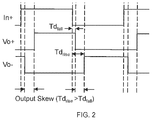
  • FIG. 2 is an illustration of a timing diagram of the low-to-high voltage level shifter 100 of FIG. 1 .
  • the low-to-high voltage level shifter 100 has a large output skew due to a weak cross-coupled transistor pair and large high voltage device parasitics.
  • Output skew varies across different PVT.
  • Output skew (time duration of a falling edge of a voltage signal (Td fall ) ⁇ time duration of a rising edge of a voltage signal (Td rise) ) may cause a timing issue for a succeeding stage. Timing performance or speed of the low-to-high voltage level shifter is limited by the slower output transition (Td rise in this case).
  • FIG. 3 is diagram of a high-to-low voltage level shifter 300 .
  • the high-to-low voltage level shifter 300 includes an inverter 301 , a first PLDMOS transistor 303 , a second PLDMOS transistor 305 , a first NLDMOS transistor 307 , a second NLDMOS transistor 309 , a first n-channel MOSFET (NMOS) transistor 311 , a second NMOS transistor 313 , a first buffer 315 , and a second buffer 317 .
  • NMOS n-channel MOSFET
  • the inverter 301 includes an input for receiving a voltage input signal In+, a power supply input for receiving a first power supply input voltage VDD 2 , a ground input for receiving a second power supply input voltage VSS 2 , and an output for outputting an output voltage In ⁇ , where In ⁇ is the inverse of In+.
  • the first PLDMOS transistor 303 includes a drain terminal, a gate terminal connected to the output of the inverter 301 , and a source terminal connected to the first power supply voltage VDD 2 .
  • the second PLDMOS transistor 305 includes a drain terminal, a gate terminal connected to the input of the inverter 301 , and a source terminal connected to the first power supply voltage VDD 2 .
  • the first NLDMOS transistor 307 includes a drain terminal connected to the drain terminal of the first PLDMOS transistor 303 , a gate terminal connected to a third power supply voltage VDD 1 , and a source terminal.
  • the second NLDMOS transistor 309 includes a drain terminal connected to the drain terminal of the second PLDMOS transistor 305 , a gate terminal connected to the third power supply voltage VDD 1 , and a source terminal.
  • the first NMOS transistor 311 includes a drain terminal connected to the source terminal of the first NLDMOS transistor 307 , a gate terminal, and a source terminal connected to a fourth power supply voltage VSS 1 .
  • the second NMOS transistor 313 includes a drain terminal connected to the source terminal of the second NLDMOS transistor 309 and the gate terminal of the first NMOS transistor 311 , a gate terminal connected to the drain terminal of the first NMOS transistor 311 and the source terminal of the first NLDMOS transistor 307 , and a source terminal connected to the fourth power supply voltage VSS 1 .
  • the first buffer 315 includes an input connected to the source terminal of the first NLDMOS transistor 307 , the drain terminal of the first NMOS transistor 311 , and the gate terminal of the second NMOS transistor 313 ; a power supply voltage input connected to the third power supply voltage VDD 1 ; a ground input connected to the fourth power supply voltage VSS 1 ; and an output for outputting a voltage Vo+.
  • the second buffer 317 includes an input connected to the source terminal of the second NLDMOS transistor 309 , the gate terminal of the first NMOS transistor 311 , and the drain terminal of the second NMOS transistor 313 ; a power supply voltage input connected to the third power supply voltage VDD 1 ; a power ground input connected to the fourth power supply voltage VSS 1 ; and an output for outputting a voltage Vo ⁇ , where Vo ⁇ is the inverse of Vo+.
  • FIG. 4 is an illustration of a timing diagram of the high-to-low voltage level shifter 300 of FIG. 3 .
  • the output skew of the high-to-low voltage level shifter 300 varies across PVT.
  • the output skew (Td fall >Td rise ) may cause timing issue for a succeeding stage.
  • Speed of the high-to-low voltage level shifter 300 may be limited by the slower output transition (Td fall in this case).
  • FIG. 5 is an illustration of voltage transitions for a low-to-high voltage level shifter and a high-to-low voltage level shifter.
  • the low-to-high voltage level shifter and the high-to-low voltage level shifter may each have a power supply voltage VSS 1 of 0V, a power supply voltage VDD 1 of 6V, a power supply voltage VSS 2 of 17V, and a power supply voltage VDD 2 of 23V.
  • VSS 1 0V
  • VDD 1 6V
  • VSS 2 17V
  • VDD 2 23V
  • the present disclose is not limited to these particular voltages, and the present disclosure may use different voltages for VSS 1 , VDD 1 , VSS 2 , and VDD 2 .
  • FIG. 6 is a diagram of a low-to-high level shifter 600 , according to one embodiment.
  • the low-to-high level shifter 600 includes an inverter 601 , a first NLDMOS transistor 603 , a second NLDMOS transistor 605 , a first PLDMOS transistor 607 , a second PLDMOS transistor 609 , a first PMOS transistor 611 , a second PMOS transistor 613 , a first buffer 615 , a second buffer 617 , and an output alignment device 619 .
  • the inverter 601 includes an input for receiving a voltage input signal In+, a power supply input for receiving a first power supply input voltage VDD 1 , a ground input for receiving a second power supply input voltage VSS 1 , and an output for outputting an output voltage In ⁇ , where In ⁇ is the inverse of In+.
  • the first NLDMOS transistor 603 includes a drain terminal, a gate terminal connected to the output of the inverter 601 , and a source terminal connected to the second power supply voltage VSS 1 .
  • the second NLDMOS transistor 605 includes a drain terminal, a gate terminal connected to the input of the inverter 601 , and a source terminal connected to the second power supply voltage VSS 1 .
  • the first PLDMOS transistor 607 includes a drain terminal connected to the drain terminal of the first NLDMOS transistor 603 , a gate terminal connected to a third power supply voltage VSS 2 , and a source terminal.
  • the second PLDMOS transistor 609 includes a drain terminal connected to the drain terminal of the second NLDMOS transistor 605 , a gate terminal connected to the third power supply voltage VSS 2 , and a source terminal.
  • the first PMOS transistor 611 includes a drain terminal connected to the source terminal of the first PLDMOS transistor 607 , a gate terminal, and a source terminal connected to a fourth power supply voltage VDD 2 .
  • the second PMOS transistor 613 includes a drain terminal connected to the source terminal of the second PLDMOS transistor 609 and the gate terminal of the first PMOS transistor 611 , a gate terminal connected to the drain terminal of the first PMOS transistor 611 and the source terminal of the first PLDMOS transistor 607 , and a source terminal connected to the fourth power supply voltage VDD 2 .
  • the first buffer 615 includes an input connected to the source terminal of the first PLDMOS transistor 607 , the drain terminal of the first PMOS transistor 611 , and the gate terminal of the second PMOS transistor 613 ; a power supply voltage input connected to the fourth power supply voltage VDD 2 ; a ground input connected to the third power supply voltage VSS 2 ; and an output for outputting a voltage Vol+.
  • the second buffer 617 includes an input connected to the source terminal of the second PLDMOS transistor 609 , the gate terminal of the first PMOS transistor 611 , and the drain terminal of the second PMOS transistor 613 ; a power supply voltage input connected to the fourth power supply voltage VDD 2 ; a ground input connected to the third power supply voltage VSS 2 ; and an output for outputting a voltage Vol ⁇ , where Vol ⁇ is the inverse of Vol+.
  • the output alignment device 619 includes a first input connected to the output of the first buffer 615 for receiving Vol+ as an input voltage In+, a second input connected to the output of the second buffer 617 for receiving Vol ⁇ as an input voltage In ⁇ , a first output for outputting an output voltage Vo+, and a second output for outputting an output voltage Vo ⁇ .
  • the low-to-high level shifter 600 provides a faster transition speed (e.g., a shorter delay, Td fall/rise ).
  • FIG. 7 is a diagram of the output alignment device 619 of the low-to-high voltage level shifter 600 of FIG. 6 , according to one embodiment.
  • the output alignment device 619 includes a first inverter 701 , a second inverter 703 , a third inverter 705 , a fourth inverter 707 , a first NAND gate 709 , a second NAND gate 711 , a third NAND gate 713 , a fourth NAND gate 715 , and a reset-set (RS) flip-flop 717 .
  • a first inverter 701 a second inverter 703 , a third inverter 705 , a fourth inverter 707 , a first NAND gate 709 , a second NAND gate 711 , a third NAND gate 713 , a fourth NAND gate 715 , and a reset-set (RS) flip-flop 717 .
  • RS reset-set
  • the first inverter 701 includes an input for receiving a voltage Vol+ as an input voltage In+, and an output for outputting the inverse of Vol+.
  • the second inverter 703 includes an input for receiving a voltage Vol ⁇ as an input voltage In ⁇ , and an output for outputting the inverse of Vol ⁇ .
  • the third inverter 705 includes an input connected to the output of the first inverter 701 , and an output for outputting the inverse of the output of the first inverter 701 , where the third inverter 705 provides a delay.
  • the fourth inverter 707 includes an input connected to the output of the second inverter 703 , and an output for outputting the inverse of the output of the second inverter 703 , where the fourth inverter 707 provides a delay.
  • the first NAND gate 709 includes a first input connected to the output of the first inverter 701 , a second input connected to the output of the third inverter 705 , and an output.
  • the second NAND gate 711 includes a first input connected to the output of the second inverter 703 , a second input connected to the output of the fourth inverter 707 , and an output.
  • the third NAND gate 713 includes a first input connected to the output of the second inverter 703 , a second input connected to the output of the first NAND gate 709 , and an output.
  • the fourth NAND gate 715 includes a first input connected to the output of the first inverter 701 , a second input connected to the output of the second NAND 711 , and an output.
  • the RS flip-flop 717 includes a first input connected to the output of the third NAND gate for receiving a reset signal (RST), a second input connected to the output of the fourth NAND gate 715 for receiving a set signal (SET), a first output for outputting a voltage Vo ⁇ , and a second output for outputting a voltage Vo+.
  • RST reset signal
  • SET set signal
  • FIG. 8 is an illustration of a timing diagram of the low-to-high voltage level sifter 600 of FIG. 6 .
  • Td fall is equal to Td rise .
  • the present disclosure is not limited to using NAND gates in the output alignment device 619 of FIG. 7 .
  • the present disclosure includes any combination of logic gates that implement the equivalent logic of the output alignment device 619 of FIG. 7 and satisfies the timing diagram of FIG. 8 .
  • FIG. 9 is a timing diagram of the low-to-high voltage level shifter 600 of FIG. 6 , according to one embodiment.
  • both outputs Vo+ and Vo ⁇ are triggered by an earlier edge (falling in this case) of inputs Vol+ and Vol ⁇ , respectively, which causes no output skew and a smaller delay.
  • High states of inputs Vol+ and Vol ⁇ are used to set output states when there is no input transition initially.
  • FIG. 10 is a diagram of a high-to-low voltage level shifter 1000 , according to one embodiment.
  • the high-to-low voltage level shifter 1000 includes a first inverter 1001 , a first PLDMOS transistor 1003 , a second PLDMOS transistor 1005 , a first NLDMOS transistor 1007 , a second NLDMOS transistor 1009 , a first NMOS transistor 1011 , a second NMOS transistor 1013 , a second inverter 1015 , a third inverter 1017 , and an output alignment device 1019 .
  • the first inverter 1001 includes an input for receiving a voltage input signal In+, a power supply input for receiving a first power supply input voltage VDD 2 , a ground input for receiving a second power supply input voltage VSS 2 , and an output for outputting an output voltage In ⁇ , where In ⁇ is the inverse of In+.
  • the first PLDMOS transistor 1003 includes a drain terminal, a gate terminal connected to the output of the first inverter 1001 , and a source terminal connected to the first power supply voltage VDD 2 .
  • the second PLDMOS transistor 1005 includes a drain terminal, a gate terminal connected to the input of the first inverter 1001 , and a source terminal connected to the first power supply voltage VDD 2 .
  • the first NLDMOS transistor 1007 includes a drain terminal connected to the drain terminal of the first PLDMOS transistor 1003 , a gate terminal connected to a third power supply voltage VDD 1 , and a source terminal.
  • the second NLDMOS transistor 1009 includes a drain terminal connected to the drain terminal of the second PLDMOS transistor 1005 , a gate terminal connected to the third power supply voltage VDD 1 , and a source terminal.
  • the first NMOS transistor 1011 includes a drain terminal connected to the source terminal of the first NLDMOS transistor 1007 , a gate terminal, and a source terminal connected to a fourth power supply voltage VSS 1 .
  • the second NMOS transistor 1013 includes a drain terminal connected to the source terminal of the second NLDMOS transistor 1009 and the gate terminal of the first NMOS transistor 1011 , a gate terminal connected to the drain terminal of the first NMOS transistor 1011 and the source terminal of the first NLDMOS transistor 1007 , and a source terminal connected to the fourth power supply voltage VSS 1 .
  • the second inverter 1015 includes an input connected to the source terminal of the first NLDMOS transistor 1007 , the drain terminal of the first NMOS transistor 1011 , and the gate terminal of the second NMOS transistor 1013 ; a power supply voltage input connected to the third power supply voltage VDD 1 ; a ground input connected to the fourth power supply voltage VSS 1 ; and an output for outputting a voltage Vol ⁇ .
  • the third inverter 1017 includes an input connected to the source terminal of the second NLDMOS transistor 1009 , the gate terminal of the first NMOS transistor 1011 , and the drain terminal of the second NMOS transistor 1013 ; a power supply voltage input connected to the third power supply voltage VDD 1 ; a ground input connected to the fourth power supply voltage VSS 1 ; and an output for outputting a voltage Vol+, where Vol ⁇ is the inverse of Vol+.
  • the output alignment device 1019 includes a first input connected to the output of the third inverter 1017 for receiving Vol+ as an input voltage In+, a second input connected to the output of the second inverter 1015 for receiving Vol ⁇ as an input voltage In ⁇ , a first output for outputting an output voltage Vo+, and a second output for outputting an output voltage Vo ⁇ .
  • the timing diagram of FIG. 10 is the same as the timing diagram of FIG. 8 .
  • the second inverter 1015 and the third inverter 1017 are used instead of buffers as in FIG. 6 (i.e., the first buffer 615 and the second buffer 617 ).
  • the output alignment 1019 may be used to minimize output skew and transition delay of a level shifter.
  • An earlier transition edge of inputs In+ and In ⁇ is used to trigger the outputs Vo+ and Vo ⁇ .
  • Level information (e.g., high state) of inputs is used to guarantee output states when there is no input transition.
  • Such an alignment method provided by the output alignment device 1019 may be used where similar signal alignment is required.
  • the high-to-low voltage level shifter 1000 may be part of a power management integrated circuit (IC) used for providing signals to a display device (e.g., a liquid crystal display (LCD) driver).
  • IC power management integrated circuit
  • LCD liquid crystal display
  • the high-to-low voltage level shifter 1000 with output aligning includes a level shifter circuit with outputs Vol+ and Vol ⁇ ; and an output alignment circuit electrically coupled to the outputs of the level shifter circuit, where the output alignment circuit has outputs Vo+ and Vo ⁇ that are triggered by an earlier edge of either Vol+ or Vol ⁇ , and where the outputs Vo+ and Vo ⁇ are set by high states of Vol+ and Vol ⁇ when there is no input transition initially.
  • FIG. 11 is a flowchart of a method of aligning outputs of a voltage level shifter, according to one embodiment.
  • a voltage level is shifted at 1101 .
  • the electronic device may be one of various types of electronic devices.
  • the electronic devices may include, for example, a portable communication device (e.g., a smartphone), a computer device, a portable multimedia device, a portable medical device, a camera, a wearable device, or a home appliance. According to an embodiment of the disclosure, the electronic devices are not limited to those described above.
  • each of such phrases as “A or B,” “at least one of A and B,” “at least one of A or B,” “A, B, or C,” “at least one of A, B, and C,” and “at least one of A, B, or C,” may include any one of, or all possible combinations of the items enumerated together in a corresponding one of the phrases.
  • such terms as “1st” and “2nd,” or “first” and “second” may be used to simply distinguish a corresponding component from another, and does not limit the components in other aspect (e.g., importance or order).
  • an element e.g., a first element
  • the element may be coupled with the other element directly (e.g., wiredly), wirelessly, or via a third element.
  • module may include a unit implemented in hardware, software, or firmware, and may interchangeably be used with other terms, for example, “logic,” “logic block,” “part,” or “circuitry”.
  • a module may be a single integral component, or a minimum unit or part thereof, adapted to perform one or more functions.
  • the module may be implemented in a form of an application-specific integrated circuit (ASIC).
  • ASIC application-specific integrated circuit

Landscapes

  • Engineering & Computer Science (AREA)
  • Computer Hardware Design (AREA)
  • Physics & Mathematics (AREA)
  • Computing Systems (AREA)
  • General Engineering & Computer Science (AREA)
  • Mathematical Physics (AREA)
  • Logic Circuits (AREA)

Abstract

An apparatus and method are provided. According to one embodiment, an apparatus includes a level-shifter circuit configured to output voltages Vol+ and Vol−; and an output alignment circuit configured to output voltages Vo+ and Vo− that are triggered by an edge of a combination of Vol+ and Vol−, and where Vo+ and Vo− are set by high states of Vol+ and Vol− prior to a transition on an input of the level-shifter circuit, and the method includes outputting, by a level-shifter circuit, voltages Vol+ and Vol−; and outputting, by an output alignment circuit, voltages Vo+ and Vo− that are triggered by an edge of a combination of Vol+ and Vol−, and where Vo+ and Vo− are set by high states of Vol+ and Vol− prior to a transition on an input of the level-shifter circuit.

Description

PRIORITY
This application is a Continuation of U.S. patent application Ser. No. 16/451,898, filed on Jun. 25, 2019 in the United States Patent and Trademark Office, which claims priority under 35 U.S.C. § 119(e) to a U.S. Provisional Patent Application filed on Mar. 28, 2019 in the United States Patent and Trademark Office and assigned Ser. No. 62/825,438, the entire contents of which are incorporated herein by reference.
FIELD
The present disclosure relates generally to electronic circuits, and more particularly, to an apparatus and a method for reducing output skew and transition delay of a level shifter.
BACKGROUND
A power management integrated circuit (PMIC) may include multiple power supply voltages and power management functions within a single integrated circuit (IC). A PMIC may include a high voltage level shifter circuit.
A conventional high voltage level shifter circuit (e.g., a laterally diffused metal-oxide semiconductor field-effect transistor (MOSFET) (LDMOS), a drain-extended MOSFET (DEMOS)) uses large and slow high-voltage devices to handle large voltage differences (e.g., from e.g., 0 volt (V) to 6V, and from e.g., 17V to 23V). Due to a cross-coupled transistor pair structure, a positive output transition and a negative output transition experience large skew across process, voltage, and temperature (PVT) variations. Such a large skew may cause timing issues for succeeding blocks/stages of circuits. Furthermore, the slower output transition edge limits overall speed.
SUMMARY
According to one embodiment, an apparatus includes a level-shifter circuit configured to output voltages Vol+ and Vol−; and an output alignment circuit configured to output voltages Vo+ and Vo− that are triggered by an edge of a combination of Vol+ and Vol−, and where Vo+ and Vo− are set by high states of Vol+ and Vol− prior to a transition on an input of the level-shifter circuit.
According to one embodiment, a method includes outputting, by an output alignment circuit, voltages Vo+ and Vo− that are triggered by an edge of a combination of Vol+ and Vol−, and where Vo+ and Vo− are set by high states of Vol+ and Vol− prior to a transition on an input of the level-shifter circuit.
BRIEF DESCRIPTION OF THE DRAWINGS
The above and other aspects, features, and advantages of certain embodiments of the present disclosure will be more apparent from the following detailed description, taken in conjunction with the accompanying drawings, in which:
FIG. 1 is a diagram of a low-to-high voltage level shifter;
FIG. 2 is a timing diagram of the low-to-high voltage level shifter of FIG. 1;
FIG. 3 is a diagram of a high-to-low voltage level shifter;
FIG. 4 is a timing diagram of the high-to-low voltage level shifter of FIG. 3;
FIG. 5 is an illustration of voltage transitions for a low-to-high voltage level shifter and a high-to-low voltage level shifter;
FIG. 6 is a diagram of a low-to-high voltage level shifter, according to one embodiment;
FIG. 7 is a diagram of an output alignment device of the low-to-high voltage level shifter of FIG. 6, according to one embodiment;
FIG. 8 is a timing diagram of the low-to-high voltage level shifter of FIG. 6, according to one embodiment;
FIG. 9 is a timing diagram of the low-to-high voltage level shifter of FIG. 6, according to one embodiment;
FIG. 10 is a diagram of a high-to-low voltage level shifter, according to one embodiment; and
FIG. 11 is a flowchart of a method of aligning outputs of a voltage level shifter, according to one embodiment;
DETAILED DESCRIPTION OF EMBODIMENTS OF THE PRESENT DISCLOSURE
Hereinafter, embodiments of the present disclosure are described in detail with reference to the accompanying drawings. It should be noted that the same elements will be designated by the same reference numerals although they are shown in different drawings. In the following description, specific details such as detailed configurations and components are merely provided to assist with the overall understanding of the embodiments of the present disclosure. Therefore, it should be apparent to those skilled in the art that various changes and modifications of the embodiments described herein may be made without departing from the scope of the present disclosure. In addition, descriptions of well-known functions and constructions are omitted for clarity and conciseness. The terms described below are terms defined in consideration of the functions in the present disclosure, and may be different according to users, intentions of the users, or customs. Therefore, the definitions of the terms should be determined based on the contents throughout this specification.
The present disclosure may have various modifications and various embodiments, among which embodiments are described below in detail with reference to the accompanying drawings. However, it should be understood that the present disclosure is not limited to the embodiments, but includes all modifications, equivalents, and alternatives within the scope of the present disclosure.
Although the terms including an ordinal number such as first, second, etc. may be used for describing various elements, the structural elements are not restricted by the terms. The terms are only used to distinguish one element from another element. For example, without departing from the scope of the present disclosure, a first structural element may be referred to as a second structural element. Similarly, the second structural element may also be referred to as the first structural element. As used herein, the term “and/or” includes any and all combinations of one or more associated items.
The terms used herein are merely used to describe various embodiments of the present disclosure but are not intended to limit the present disclosure. Singular forms are intended to include plural forms unless the context clearly indicates otherwise. In the present disclosure, it should be understood that the terms “include” or “have” indicate existence of a feature, a number, a step, an operation, a structural element, parts, or a combination thereof, and do not exclude the existence or probability of the addition of one or more other features, numerals, steps, operations, structural elements, parts, or combinations thereof.
Unless defined differently, all terms used herein have the same meanings as those understood by a person skilled in the art to which the present disclosure belongs. Terms such as those defined in a generally used dictionary are to be interpreted to have the same meanings as the contextual meanings in the relevant field of art, and are not to be interpreted to have ideal or excessively formal meanings unless clearly defined in the present disclosure.
FIG. 1 is a diagram of a low-to-high voltage level shifter 100.
Referring to FIG. 1, the low-to-high voltage level shifter 100 includes an inverter 101, a first n-channel LDMOS (NLDMOS) transistor 103, a second NLDMOS transistor 105, a first p-channel LDMOS (PLDMOS) transistor 107, a second PLDMOS transistor 109, a first p-channel MOSFET (PMOS) transistor 111, a second PMOS transistor 113, a first buffer 115, and a second buffer 117.
The inverter 101 includes an input for receiving a voltage input signal In+, a power supply input for receiving a first power supply input voltage VDD1, a ground input for receiving a second power supply input voltage VSS1, and an output for outputting an output voltage In−, where In− is the inverse of In+. The first NLDMOS transistor 103 includes a drain terminal, a gate terminal connected to the output of the inverter 101, and a source terminal connected to the second power supply voltage VSS1. The second NLDMOS transistor 105 includes a drain terminal, a gate terminal connected to the input of the inverter 101, and a source terminal connected to the second power supply voltage VSS1. The first PLDMOS transistor 107 includes a drain terminal connected to the drain terminal of the first NLDMOS transistor 103, a gate terminal connected to a third power supply voltage VSS2, and a source terminal. The second PLDMOS transistor 109 includes a drain terminal connected to the drain terminal of the second NLDMOS transistor 105, a gate terminal connected to the third power supply voltage VSS2, and a source terminal. The first PMOS transistor 111 includes a drain terminal connected to the source terminal of the first PLDMOS transistor 107, a gate terminal, and a source terminal connected to a fourth power supply voltage VDD2. The second PMOS transistor 113 includes a drain terminal connected to the source terminal of the second PLDMOS transistor 109 and a gate terminal connected to the drain terminal of the first PMOS transistor 111 and the source terminal of the first PLDMOS transistor 107, and a source terminal connected to the fourth power supply voltage VDD2. The first buffer 115 includes an input connected to the source terminal of the first PLDMOS transistor 107, the drain terminal of the first PMOS transistor 111, and the gate terminal of the second PMOS transistor 113; a power supply voltage input connected to the fourth power supply voltage VDD2; a ground input connected to the third power supply voltage VSS2; and an output for outputting a voltage Vo+. The second buffer 117 includes an input connected to the source terminal of the second PLDMOS transistor 109, the gate terminal of the first PMOS transistor 111, and the drain terminal of the second PMOS transistor 113; a power supply voltage input connected to the fourth power supply voltage VDD2; a ground input connected to the third power supply voltage VSS2, and an output for outputting a voltage Vo−, where Vo− is the inverse of Vo+.
FIG. 2 is an illustration of a timing diagram of the low-to-high voltage level shifter 100 of FIG. 1.
Referring to FIG. 2, the low-to-high voltage level shifter 100 has a large output skew due to a weak cross-coupled transistor pair and large high voltage device parasitics. Output skew varies across different PVT. Output skew (time duration of a falling edge of a voltage signal (Tdfall)<time duration of a rising edge of a voltage signal (Tdrise)) may cause a timing issue for a succeeding stage. Timing performance or speed of the low-to-high voltage level shifter is limited by the slower output transition (Tdrise in this case).
FIG. 3 is diagram of a high-to-low voltage level shifter 300.
Referring to FIG. 3, the high-to-low voltage level shifter 300 includes an inverter 301, a first PLDMOS transistor 303, a second PLDMOS transistor 305, a first NLDMOS transistor 307, a second NLDMOS transistor 309, a first n-channel MOSFET (NMOS) transistor 311, a second NMOS transistor 313, a first buffer 315, and a second buffer 317.
The inverter 301 includes an input for receiving a voltage input signal In+, a power supply input for receiving a first power supply input voltage VDD2, a ground input for receiving a second power supply input voltage VSS2, and an output for outputting an output voltage In−, where In− is the inverse of In+. The first PLDMOS transistor 303 includes a drain terminal, a gate terminal connected to the output of the inverter 301, and a source terminal connected to the first power supply voltage VDD2. The second PLDMOS transistor 305 includes a drain terminal, a gate terminal connected to the input of the inverter 301, and a source terminal connected to the first power supply voltage VDD2. The first NLDMOS transistor 307 includes a drain terminal connected to the drain terminal of the first PLDMOS transistor 303, a gate terminal connected to a third power supply voltage VDD1, and a source terminal. The second NLDMOS transistor 309 includes a drain terminal connected to the drain terminal of the second PLDMOS transistor 305, a gate terminal connected to the third power supply voltage VDD1, and a source terminal. The first NMOS transistor 311 includes a drain terminal connected to the source terminal of the first NLDMOS transistor 307, a gate terminal, and a source terminal connected to a fourth power supply voltage VSS1. The second NMOS transistor 313 includes a drain terminal connected to the source terminal of the second NLDMOS transistor 309 and the gate terminal of the first NMOS transistor 311, a gate terminal connected to the drain terminal of the first NMOS transistor 311 and the source terminal of the first NLDMOS transistor 307, and a source terminal connected to the fourth power supply voltage VSS1. The first buffer 315 includes an input connected to the source terminal of the first NLDMOS transistor 307, the drain terminal of the first NMOS transistor 311, and the gate terminal of the second NMOS transistor 313; a power supply voltage input connected to the third power supply voltage VDD1; a ground input connected to the fourth power supply voltage VSS1; and an output for outputting a voltage Vo+. The second buffer 317 includes an input connected to the source terminal of the second NLDMOS transistor 309, the gate terminal of the first NMOS transistor 311, and the drain terminal of the second NMOS transistor 313; a power supply voltage input connected to the third power supply voltage VDD1; a power ground input connected to the fourth power supply voltage VSS1; and an output for outputting a voltage Vo−, where Vo− is the inverse of Vo+.
FIG. 4 is an illustration of a timing diagram of the high-to-low voltage level shifter 300 of FIG. 3.
Referring to FIG. 4, the output skew of the high-to-low voltage level shifter 300 varies across PVT. The output skew (Tdfall>Tdrise) may cause timing issue for a succeeding stage. Speed of the high-to-low voltage level shifter 300 may be limited by the slower output transition (Tdfall in this case).
FIG. 5 is an illustration of voltage transitions for a low-to-high voltage level shifter and a high-to-low voltage level shifter.
Referring to FIG. 5, the low-to-high voltage level shifter and the high-to-low voltage level shifter may each have a power supply voltage VSS1 of 0V, a power supply voltage VDD1 of 6V, a power supply voltage VSS2 of 17V, and a power supply voltage VDD2 of 23V. However, the present disclose is not limited to these particular voltages, and the present disclosure may use different voltages for VSS1, VDD1, VSS2, and VDD2.
FIG. 6 is a diagram of a low-to-high level shifter 600, according to one embodiment.
Referring to FIG. 6, the low-to-high level shifter 600 includes an inverter 601, a first NLDMOS transistor 603, a second NLDMOS transistor 605, a first PLDMOS transistor 607, a second PLDMOS transistor 609, a first PMOS transistor 611, a second PMOS transistor 613, a first buffer 615, a second buffer 617, and an output alignment device 619.
The inverter 601 includes an input for receiving a voltage input signal In+, a power supply input for receiving a first power supply input voltage VDD1, a ground input for receiving a second power supply input voltage VSS1, and an output for outputting an output voltage In−, where In− is the inverse of In+. The first NLDMOS transistor 603 includes a drain terminal, a gate terminal connected to the output of the inverter 601, and a source terminal connected to the second power supply voltage VSS1. The second NLDMOS transistor 605 includes a drain terminal, a gate terminal connected to the input of the inverter 601, and a source terminal connected to the second power supply voltage VSS1. The first PLDMOS transistor 607 includes a drain terminal connected to the drain terminal of the first NLDMOS transistor 603, a gate terminal connected to a third power supply voltage VSS2, and a source terminal. The second PLDMOS transistor 609 includes a drain terminal connected to the drain terminal of the second NLDMOS transistor 605, a gate terminal connected to the third power supply voltage VSS2, and a source terminal. The first PMOS transistor 611 includes a drain terminal connected to the source terminal of the first PLDMOS transistor 607, a gate terminal, and a source terminal connected to a fourth power supply voltage VDD2. The second PMOS transistor 613 includes a drain terminal connected to the source terminal of the second PLDMOS transistor 609 and the gate terminal of the first PMOS transistor 611, a gate terminal connected to the drain terminal of the first PMOS transistor 611 and the source terminal of the first PLDMOS transistor 607, and a source terminal connected to the fourth power supply voltage VDD2. The first buffer 615 includes an input connected to the source terminal of the first PLDMOS transistor 607, the drain terminal of the first PMOS transistor 611, and the gate terminal of the second PMOS transistor 613; a power supply voltage input connected to the fourth power supply voltage VDD2; a ground input connected to the third power supply voltage VSS2; and an output for outputting a voltage Vol+. The second buffer 617 includes an input connected to the source terminal of the second PLDMOS transistor 609, the gate terminal of the first PMOS transistor 611, and the drain terminal of the second PMOS transistor 613; a power supply voltage input connected to the fourth power supply voltage VDD2; a ground input connected to the third power supply voltage VSS2; and an output for outputting a voltage Vol−, where Vol− is the inverse of Vol+. The output alignment device 619 includes a first input connected to the output of the first buffer 615 for receiving Vol+ as an input voltage In+, a second input connected to the output of the second buffer 617 for receiving Vol− as an input voltage In−, a first output for outputting an output voltage Vo+, and a second output for outputting an output voltage Vo−.
The present low-to-high level shifter provides minimum output skew, and outputs Vo+ and Vo−, where Vo+ and Vo− have similar delay (e.g., Tdfall=Tdrise) regardless of variations in PVT. The low-to-high level shifter 600 provides a faster transition speed (e.g., a shorter delay, Tdfall/rise).
FIG. 7 is a diagram of the output alignment device 619 of the low-to-high voltage level shifter 600 of FIG. 6, according to one embodiment.
Referring to FIG. 7, the output alignment device 619 includes a first inverter 701, a second inverter 703, a third inverter 705, a fourth inverter 707, a first NAND gate 709, a second NAND gate 711, a third NAND gate 713, a fourth NAND gate 715, and a reset-set (RS) flip-flop 717.
The first inverter 701 includes an input for receiving a voltage Vol+ as an input voltage In+, and an output for outputting the inverse of Vol+. The second inverter 703 includes an input for receiving a voltage Vol− as an input voltage In−, and an output for outputting the inverse of Vol−. The third inverter 705 includes an input connected to the output of the first inverter 701, and an output for outputting the inverse of the output of the first inverter 701, where the third inverter 705 provides a delay. The fourth inverter 707 includes an input connected to the output of the second inverter 703, and an output for outputting the inverse of the output of the second inverter 703, where the fourth inverter 707 provides a delay.
The first NAND gate 709 includes a first input connected to the output of the first inverter 701, a second input connected to the output of the third inverter 705, and an output. The second NAND gate 711 includes a first input connected to the output of the second inverter 703, a second input connected to the output of the fourth inverter 707, and an output. The third NAND gate 713 includes a first input connected to the output of the second inverter 703, a second input connected to the output of the first NAND gate 709, and an output. The fourth NAND gate 715 includes a first input connected to the output of the first inverter 701, a second input connected to the output of the second NAND 711, and an output. The RS flip-flop 717 includes a first input connected to the output of the third NAND gate for receiving a reset signal (RST), a second input connected to the output of the fourth NAND gate 715 for receiving a set signal (SET), a first output for outputting a voltage Vo−, and a second output for outputting a voltage Vo+.
FIG. 8 is an illustration of a timing diagram of the low-to-high voltage level sifter 600 of FIG. 6.
Referring to FIG. 8, Tdfall is equal to Tdrise.
The present disclosure is not limited to using NAND gates in the output alignment device 619 of FIG. 7. The present disclosure includes any combination of logic gates that implement the equivalent logic of the output alignment device 619 of FIG. 7 and satisfies the timing diagram of FIG. 8.
FIG. 9 is a timing diagram of the low-to-high voltage level shifter 600 of FIG. 6, according to one embodiment.
Referring to FIG. 9, both outputs Vo+ and Vo− are triggered by an earlier edge (falling in this case) of inputs Vol+ and Vol−, respectively, which causes no output skew and a smaller delay. High states of inputs Vol+ and Vol− are used to set output states when there is no input transition initially.
FIG. 10 is a diagram of a high-to-low voltage level shifter 1000, according to one embodiment.
Referring to FIG. 10, the high-to-low voltage level shifter 1000 includes a first inverter 1001, a first PLDMOS transistor 1003, a second PLDMOS transistor 1005, a first NLDMOS transistor 1007, a second NLDMOS transistor 1009, a first NMOS transistor 1011, a second NMOS transistor 1013, a second inverter 1015, a third inverter 1017, and an output alignment device 1019.
The first inverter 1001 includes an input for receiving a voltage input signal In+, a power supply input for receiving a first power supply input voltage VDD2, a ground input for receiving a second power supply input voltage VSS2, and an output for outputting an output voltage In−, where In− is the inverse of In+. The first PLDMOS transistor 1003 includes a drain terminal, a gate terminal connected to the output of the first inverter 1001, and a source terminal connected to the first power supply voltage VDD2. The second PLDMOS transistor 1005 includes a drain terminal, a gate terminal connected to the input of the first inverter 1001, and a source terminal connected to the first power supply voltage VDD2. The first NLDMOS transistor 1007 includes a drain terminal connected to the drain terminal of the first PLDMOS transistor 1003, a gate terminal connected to a third power supply voltage VDD1, and a source terminal. The second NLDMOS transistor 1009 includes a drain terminal connected to the drain terminal of the second PLDMOS transistor 1005, a gate terminal connected to the third power supply voltage VDD1, and a source terminal. The first NMOS transistor 1011 includes a drain terminal connected to the source terminal of the first NLDMOS transistor 1007, a gate terminal, and a source terminal connected to a fourth power supply voltage VSS1. The second NMOS transistor 1013 includes a drain terminal connected to the source terminal of the second NLDMOS transistor 1009 and the gate terminal of the first NMOS transistor 1011, a gate terminal connected to the drain terminal of the first NMOS transistor 1011 and the source terminal of the first NLDMOS transistor 1007, and a source terminal connected to the fourth power supply voltage VSS1. The second inverter 1015 includes an input connected to the source terminal of the first NLDMOS transistor 1007, the drain terminal of the first NMOS transistor 1011, and the gate terminal of the second NMOS transistor 1013; a power supply voltage input connected to the third power supply voltage VDD1; a ground input connected to the fourth power supply voltage VSS1; and an output for outputting a voltage Vol−. The third inverter 1017 includes an input connected to the source terminal of the second NLDMOS transistor 1009, the gate terminal of the first NMOS transistor 1011, and the drain terminal of the second NMOS transistor 1013; a power supply voltage input connected to the third power supply voltage VDD1; a ground input connected to the fourth power supply voltage VSS1; and an output for outputting a voltage Vol+, where Vol− is the inverse of Vol+. The output alignment device 1019 includes a first input connected to the output of the third inverter 1017 for receiving Vol+ as an input voltage In+, a second input connected to the output of the second inverter 1015 for receiving Vol− as an input voltage In−, a first output for outputting an output voltage Vo+, and a second output for outputting an output voltage Vo−.
The timing diagram of FIG. 10 is the same as the timing diagram of FIG. 8.
In FIG. 10, the second inverter 1015 and the third inverter 1017 are used instead of buffers as in FIG. 6 (i.e., the first buffer 615 and the second buffer 617).
The output alignment 1019 may be used to minimize output skew and transition delay of a level shifter. An earlier transition edge of inputs In+ and In− is used to trigger the outputs Vo+ and Vo−. Level information (e.g., high state) of inputs is used to guarantee output states when there is no input transition. Such an alignment method provided by the output alignment device 1019 may be used where similar signal alignment is required.
According to one embodiment, the high-to-low voltage level shifter 1000 may be part of a power management integrated circuit (IC) used for providing signals to a display device (e.g., a liquid crystal display (LCD) driver).
According to an embodiment, the high-to-low voltage level shifter 1000 with output aligning includes a level shifter circuit with outputs Vol+ and Vol−; and an output alignment circuit electrically coupled to the outputs of the level shifter circuit, where the output alignment circuit has outputs Vo+ and Vo− that are triggered by an earlier edge of either Vol+ or Vol−, and where the outputs Vo+ and Vo− are set by high states of Vol+ and Vol− when there is no input transition initially.
FIG. 11 is a flowchart of a method of aligning outputs of a voltage level shifter, according to one embodiment.
Referring to FIG. 11, a voltage level is shifted at 1101.
At 1103, outputs of the shifted voltage level are aligned.
The electronic device according to various embodiments may be one of various types of electronic devices. The electronic devices may include, for example, a portable communication device (e.g., a smartphone), a computer device, a portable multimedia device, a portable medical device, a camera, a wearable device, or a home appliance. According to an embodiment of the disclosure, the electronic devices are not limited to those described above.
It should be appreciated that various embodiments of the present disclosure and the terms used therein are not intended to limit the technological features set forth herein to particular embodiments and include various changes, equivalents, or replacements for a corresponding embodiment. With regard to the description of the drawings, similar reference numerals may be used to refer to similar or related elements. It is to be understood that a singular form of a noun corresponding to an item may include one or more of the things, unless the relevant context clearly indicates otherwise. As used herein, each of such phrases as “A or B,” “at least one of A and B,” “at least one of A or B,” “A, B, or C,” “at least one of A, B, and C,” and “at least one of A, B, or C,” may include any one of, or all possible combinations of the items enumerated together in a corresponding one of the phrases. As used herein, such terms as “1st” and “2nd,” or “first” and “second” may be used to simply distinguish a corresponding component from another, and does not limit the components in other aspect (e.g., importance or order). It is to be understood that if an element (e.g., a first element) is referred to, with or without the term “operatively” or “communicatively”, as “coupled with,” “coupled to,” “connected with,” or “connected to” another element (e.g., a second element), it means that the element may be coupled with the other element directly (e.g., wiredly), wirelessly, or via a third element.
As used herein, the term “module” may include a unit implemented in hardware, software, or firmware, and may interchangeably be used with other terms, for example, “logic,” “logic block,” “part,” or “circuitry”. A module may be a single integral component, or a minimum unit or part thereof, adapted to perform one or more functions. For example, according to an embodiment, the module may be implemented in a form of an application-specific integrated circuit (ASIC).
Although certain embodiments of the present disclosure have been described in the detailed description of the present disclosure, the present disclosure may be modified in various forms without departing from the scope of the present disclosure. Thus, the scope of the present disclosure shall not be determined merely based on the described embodiments, but rather determined based on the accompanying claims and equivalents thereto.

Claims (20)

What is claimed is:
1. An apparatus, comprising:
a level-shifter circuit configured to output voltages Vol+ and Vol−; and
an output alignment circuit configured to:
receive the output voltages Vol+ and Vol− from the level-shifter circuit;
set a voltage Vo+ based on level information of Vol+ and set a voltage Vo− based on level information of Vol−;
trigger voltages Vo+ and Vo− based on an edge of a combination of Vol+ and Vol−; and
output voltages Vo+ and Vo−.
2. The apparatus of claim 1, wherein the output alignment circuit comprises:
a first inverter configured to receive a first input signal;
a second inverter configured to receive a second input signal, wherein the second input signal is an inverse of the first input signal;
a third inverter connected to the first inverter;
a fourth inverter connected to the second inverter;
a logic circuit connected to the first inverter, the second inverter, the third inverter, and the fourth inverter; and
a flip-flop connected to the logic circuit.
3. The apparatus of claim 2, wherein the logic circuit comprises:
a first NAND gate connected to the first inverter and the third inverter;
a second NAND gate connected to the second inverter and the fourth inverter;
a third NAND gate connected to the second inverter and the first NAND gate; and
a fourth NAND gate connected to the first inverter and the second NAND gate.
4. The apparatus of claim 2, wherein the level-shifter circuit is a low-to-high voltage shifter circuit.
5. The apparatus of claim 4, wherein the low-to-high voltage shifter circuit comprises:
a fifth inverter configured to receive a third input signal and including a power supply input connected to a first power supply voltage VDD1 and a ground input connected to a second power supply voltage VSS1;
a first n-channel transistor including a source connected to the second power supply voltage VSS1, a gate connected to an output of the fifth inverter, and a drain;
a second n-channel transistor including a source connected to the second power supply voltage VSS1, a gate connected to an input of the fifth inverter, and a drain;
a first p-channel transistor including a drain connected to the drain of the first n-channel transistor, a gate connected to a third power supply voltage VSS2, and a source;
a second p-channel transistor including a drain connected to the drain of the second n-channel transistor, a gate connected to the third power supply voltage VSS2, and a source;
a third p-channel transistor including a drain connected to the source of the first p-channel transistor, a gate, and a source connected to a fourth power supply voltage VDD2;
a fourth p-channel transistor including a drain connected to the source of the second p-channel transistor and the gate of the third p-channel transistor, a gate connected to the drain of the third p-channel transistor, and a source connected to the fourth power supply voltage VDD2;
a first buffer connected between the drain of the fourth p-channel transistor and the second inverter, and including a power supply input connected to the fourth power supply voltage VDD2 and a ground input connected to the third power supply voltage VSS2; and
a second buffer connected between the source of the first p-channel transistor and the first inverter, and including a power supply input connected to the fourth power supply voltage VDD2 and a ground input connected to the third power supply voltage VSS2.
6. The apparatus of claim 5, wherein:
the first n-channel transistor and the second n-channel transistor are each an n-channel laterally diffused metal-oxide semiconductor field-effect transistor (NLDMOS);
the first p-channel transistor and the second p-channel transistor are each a p-channel laterally diffused metal-oxide semiconductor
field-effect transistor (PLDMOS); and
the third p-channel transistor and the fourth p-channel transistor are each a p-channel metal oxide semiconductor field-effect transistor (PMOS).
7. The apparatus of claim 1, wherein the output alignment circuit is configured to set a voltage Vo+ based on level information of Vol+ and set a voltage Vo− based on level information of Vol− when there is no prior input transition on the level-sifter circuit.
8. The apparatus of claim 2, wherein the level-shifter circuit is a high-to-low voltage shifter circuit.
9. The apparatus of claim 1, wherein the level information of Vol+ includes a high state of Vol+.
10. The apparatus of claim 1, wherein the level information of Vol− includes a high state of Vol−.
11. A method, comprising
outputting, by a level-shifter circuit, voltages Vol+ and Vol−;
receiving, by an output alignment circuit, the output voltages Vol+ and Vol− from the level-shifter circuit;
setting, by the output alignment circuit, Vo+ based on level information of Vol+ and setting, by the output alignment circuit, Vo− based on level information of Vol−;
triggering, by the output alignment circuit, voltages Vo+ and Vo− based on an edge of a combination of Vol+ and Vol−; and
outputting, by the output alignment circuit, voltages Vo+ and Vo−.
12. The method of claim 11, further comprising:
inverting, by a first inverter, a first input signal;
inverting, by a second inverter, a second input signal, wherein the second input signal is an inverse of the first input signal;
inverting, by a third inverter, an output of the first inverter;
inverting, by a fourth inverter, an output of the second inverter;
reducing output skew and transition delay between the first input signal and the second input signal by a logic circuit connected to the first inverter, the second inverter, the third inverter, and the fourth inverter; and
latching the reduced output skew and transition delay between the first input signal and the second input signal by a flip-flop connected to the logic circuit.
13. The method of claim 12, wherein the logic circuit comprises:
a first NAND gate connected to the first inverter and the third inverter;
a second NAND gate connected to the second inverter and the fourth inverter;
a third NAND gate connected to the second inverter and the first NAND gate; and
a fourth NAND gate connected to the first inverter and the second NAND gate.
14. The method of claim 12, further comprising shifting a voltage by a low-to-high voltage shifter circuit.
15. The method of claim 14, wherein the low-to-high voltage shifter circuit comprises:
a fifth inverter configured to receive a third input signal and including a power supply input connected to a first power supply voltage VDD1 and a ground input connected to a second power supply voltage VSS1;
a first n-channel transistor including a source connected to the second power supply voltage VSS1, a gate connected to an output of the fifth inverter, and a drain;
a second n-channel transistor including a source connected to the second power supply voltage VSS1, a gate connected to an input of the fifth inverter, and a drain;
a first p-channel transistor including a drain connected to the drain of the first n-channel transistor, a gate connected to a third power supply voltage VSS2, and a source;
a second p-channel transistor including a drain connected to the drain of the second n-channel transistor, a gate connected to the third power supply voltage VSS2, and a source;
a third p-channel transistor including a drain connected to the source of the first p-channel transistor, a gate, and a source connected to a fourth power supply voltage VDD2;
a fourth p-channel transistor including a drain connected to the source of the second p-channel transistor and the gate of the third p-channel transistor, a gate connected to the drain of the third p-channel transistor, and a source connected to the fourth power supply voltage VDD2;
a first buffer connected between the drain of the fourth p-channel transistor and the second inverter, and including a power supply input connected to the fourth power supply voltage VDD2 and a ground input connected to the third power supply voltage VSS2; and
a second buffer connected between the source of the first p-channel transistor and the first inverter, and including a power supply input connected to the fourth power supply voltage VDD2 and a ground input connected to the third power supply voltage VSS2.
16. The method of claim 15, wherein:
the first n-channel transistor and the second n-channel transistor are each an n-channel laterally diffused metal-oxide semiconductor field-effect transistor (NLDMOS);
the first p-channel transistor and the second p-channel transistor are each a p-channel laterally diffused metal-oxide semiconductor field-effect transistor (PLDMOS); and
the third p-channel transistor and the fourth p-channel transistor are each a p-channel metal oxide semiconductor field-effect transistor (PMOS).
17. The method of claim 11, wherein setting Vo+ based on level information of Vol+ and setting, by the output alignment circuit, Vo− based on level information of Vol− is performed when there is no prior input transition on the level-shifter circuit.
18. The method of claim 12, further comprising shifting a voltage by a high-to-low voltage shifter circuit.
19. The method of claim 11, wherein the level information of Vol+ includes a high state of Vol+.
20. The method of claim 11, wherein the level information of Vol− includes a high state of Vol−.
US16/992,449 2019-03-28 2020-08-13 Apparatus and method for reducing output skew and transition delay of level shifter Expired - Fee Related US11223346B2 (en)

Priority Applications (1)

Application Number Priority Date Filing Date Title
US16/992,449 US11223346B2 (en) 2019-03-28 2020-08-13 Apparatus and method for reducing output skew and transition delay of level shifter

Applications Claiming Priority (3)

Application Number Priority Date Filing Date Title
US201962825438P 2019-03-28 2019-03-28
US16/451,898 US10771045B1 (en) 2019-03-28 2019-06-25 Apparatus and method for reducing output skew and transition delay of level shifter
US16/992,449 US11223346B2 (en) 2019-03-28 2020-08-13 Apparatus and method for reducing output skew and transition delay of level shifter

Related Parent Applications (1)

Application Number Title Priority Date Filing Date
US16/451,898 Continuation US10771045B1 (en) 2019-03-28 2019-06-25 Apparatus and method for reducing output skew and transition delay of level shifter

Publications (2)

Publication Number Publication Date
US20200373916A1 US20200373916A1 (en) 2020-11-26
US11223346B2 true US11223346B2 (en) 2022-01-11

Family

ID=72290102

Family Applications (2)

Application Number Title Priority Date Filing Date
US16/451,898 Expired - Fee Related US10771045B1 (en) 2019-03-28 2019-06-25 Apparatus and method for reducing output skew and transition delay of level shifter
US16/992,449 Expired - Fee Related US11223346B2 (en) 2019-03-28 2020-08-13 Apparatus and method for reducing output skew and transition delay of level shifter

Family Applications Before (1)

Application Number Title Priority Date Filing Date
US16/451,898 Expired - Fee Related US10771045B1 (en) 2019-03-28 2019-06-25 Apparatus and method for reducing output skew and transition delay of level shifter

Country Status (3)

Country Link
US (2) US10771045B1 (en)
KR (1) KR102739994B1 (en)
CN (1) CN111756363B (en)

Families Citing this family (8)

* Cited by examiner, † Cited by third party
Publication number Priority date Publication date Assignee Title
WO2019190507A1 (en) 2018-03-28 2019-10-03 Intel IP Corporation Techniques for multiple signal fan-out
US10862463B1 (en) * 2020-01-10 2020-12-08 University Of Electronic Science And Technology Of China Level shifter for high-speed gate drivers
CN113972907B (en) * 2020-07-24 2025-01-28 雅特力科技(重庆)有限公司 Voltage divider circuit for battery voltage and electronic device having the voltage divider circuit
US11165426B1 (en) * 2020-09-01 2021-11-02 Nxp Usa, Inc. Level shifter and a method of level shifting a signal
US11469744B1 (en) * 2021-10-04 2022-10-11 Novatek Microelectronics Corp. Level shifter
CN116978332B (en) * 2023-08-15 2024-07-09 禹创半导体(深圳)有限公司 Voltage conversion circuit and driving device
KR20250041963A (en) * 2023-09-19 2025-03-26 삼성전자주식회사 A High Voltage Transfer Device and A Memory Device including The Same
US12381558B2 (en) 2023-11-09 2025-08-05 Texas Instruments Incorporated Level shifter for high voltage driver

Citations (8)

* Cited by examiner, † Cited by third party
Publication number Priority date Publication date Assignee Title
US7142035B2 (en) 2004-06-10 2006-11-28 Oki Electric Industry Co., Ltd. Signal generator circuit and level shifter with signal generator circuit
US7245153B2 (en) 2004-09-29 2007-07-17 Ricoh Company, Ltd. Level shift circuit having timing adjustment circuit for maintaining duty ratio
US20100117708A1 (en) 2008-11-11 2010-05-13 Wei-Ta Chen Voltage Level Converter without Phase Distortion
US8497726B2 (en) 2011-02-18 2013-07-30 Magnachip Semiconductor, Ltd. Level shifter
US8502592B2 (en) 2010-11-12 2013-08-06 Panasonic Corporation Level shift circuit
US8872571B2 (en) 2012-10-19 2014-10-28 Mstar Semiconductor, Inc. Level shifter and operational amplifier
US9350353B2 (en) 2014-02-27 2016-05-24 Realtek Semiconductor Corp. Method and apparatus for equalizing a level shifted signal
US9496870B2 (en) 2015-01-26 2016-11-15 SK Hynix Inc. Semiconductor device

Family Cites Families (4)

* Cited by examiner, † Cited by third party
Publication number Priority date Publication date Assignee Title
JP3278621B2 (en) * 1998-12-24 2002-04-30 松下電器産業株式会社 Data transmission equipment
US7956642B2 (en) * 2007-06-26 2011-06-07 Qualcomm Incorporated Level shifter having low duty cycle distortion
KR101532271B1 (en) * 2008-11-10 2015-06-29 삼성전자주식회사 Low power high speed level shifter
JP5491319B2 (en) * 2010-08-16 2014-05-14 ルネサスエレクトロニクス株式会社 Display driver circuit

Patent Citations (8)

* Cited by examiner, † Cited by third party
Publication number Priority date Publication date Assignee Title
US7142035B2 (en) 2004-06-10 2006-11-28 Oki Electric Industry Co., Ltd. Signal generator circuit and level shifter with signal generator circuit
US7245153B2 (en) 2004-09-29 2007-07-17 Ricoh Company, Ltd. Level shift circuit having timing adjustment circuit for maintaining duty ratio
US20100117708A1 (en) 2008-11-11 2010-05-13 Wei-Ta Chen Voltage Level Converter without Phase Distortion
US8502592B2 (en) 2010-11-12 2013-08-06 Panasonic Corporation Level shift circuit
US8497726B2 (en) 2011-02-18 2013-07-30 Magnachip Semiconductor, Ltd. Level shifter
US8872571B2 (en) 2012-10-19 2014-10-28 Mstar Semiconductor, Inc. Level shifter and operational amplifier
US9350353B2 (en) 2014-02-27 2016-05-24 Realtek Semiconductor Corp. Method and apparatus for equalizing a level shifted signal
US9496870B2 (en) 2015-01-26 2016-11-15 SK Hynix Inc. Semiconductor device

Also Published As

Publication number Publication date
US10771045B1 (en) 2020-09-08
US20200313662A1 (en) 2020-10-01
CN111756363B (en) 2024-10-18
CN111756363A (en) 2020-10-09
KR102739994B1 (en) 2024-12-06
US20200373916A1 (en) 2020-11-26
KR20200114977A (en) 2020-10-07

Similar Documents

Publication Publication Date Title
US11223346B2 (en) Apparatus and method for reducing output skew and transition delay of level shifter
US6897696B2 (en) Duty-cycle adjustable buffer and method and method for operating same
US6801064B1 (en) Buffer circuit using low voltage transistors and level shifters
US7804346B2 (en) Level converting flip-flop and method of operating the same
CN101442307B (en) Level shifter
US7053657B1 (en) Dynamically biased wide swing level shifting circuit for high speed voltage protection input/outputs
EP2965425B1 (en) Voltage level shifter with a low-latency voltage boost circuit
US20150303925A1 (en) Output Buffer, Gate Electrode Driving Circuit and Method for Controlling the Same
US7924080B2 (en) Level shifter circuit
US7994821B1 (en) Level shifter circuits and methods
CN107257236B (en) Apparatus, system, and method for voltage level translation
EP3982542B1 (en) A chip having a receiver including a hysteresis circuit
WO2020007059A1 (en) Shift register unit, driving method, light-emission control gate driving circuit, and display apparatus
CN108604898A (en) Input/Output (I/O) Drivers Implementing Dynamic Gate Biasing of Buffer Transistors
JP5643158B2 (en) Level shift circuit
US8570091B2 (en) Level shifter
US9705490B2 (en) Driver circuit for single wire protocol slave unit
US11239842B1 (en) Level down shifter
US8547139B2 (en) CMOS logic integrated circuit
US10181301B2 (en) Liquid crystal display and demultiplexer thereof
US9124266B1 (en) Increasing switching speed of logic circuits
KR100904486B1 (en) Strobe decoder and decoding method
US20130321060A1 (en) Input buffer circuit and semiconductor device

Legal Events

Date Code Title Description
FEPP Fee payment procedure

Free format text: ENTITY STATUS SET TO UNDISCOUNTED (ORIGINAL EVENT CODE: BIG.); ENTITY STATUS OF PATENT OWNER: LARGE ENTITY

STPP Information on status: patent application and granting procedure in general

Free format text: DOCKETED NEW CASE - READY FOR EXAMINATION

STPP Information on status: patent application and granting procedure in general

Free format text: EX PARTE QUAYLE ACTION MAILED

STPP Information on status: patent application and granting procedure in general

Free format text: RESPONSE TO EX PARTE QUAYLE ACTION ENTERED AND FORWARDED TO EXAMINER

STPP Information on status: patent application and granting procedure in general

Free format text: RESPONSE TO EX PARTE QUAYLE ACTION ENTERED AND FORWARDED TO EXAMINER

STPP Information on status: patent application and granting procedure in general

Free format text: NOTICE OF ALLOWANCE MAILED -- APPLICATION RECEIVED IN OFFICE OF PUBLICATIONS

STPP Information on status: patent application and granting procedure in general

Free format text: PUBLICATIONS -- ISSUE FEE PAYMENT VERIFIED

STCF Information on status: patent grant

Free format text: PATENTED CASE

FEPP Fee payment procedure

Free format text: MAINTENANCE FEE REMINDER MAILED (ORIGINAL EVENT CODE: REM.); ENTITY STATUS OF PATENT OWNER: LARGE ENTITY