US11223066B2 - Solid-state electrolyte and method of manufacture thereof - Google Patents
Solid-state electrolyte and method of manufacture thereof Download PDFInfo
- Publication number
- US11223066B2 US11223066B2 US16/224,968 US201816224968A US11223066B2 US 11223066 B2 US11223066 B2 US 11223066B2 US 201816224968 A US201816224968 A US 201816224968A US 11223066 B2 US11223066 B2 US 11223066B2
- Authority
- US
- United States
- Prior art keywords
- state electrolyte
- solid
- compound
- lithium
- lanthanum
- Prior art date
- Legal status (The legal status is an assumption and is not a legal conclusion. Google has not performed a legal analysis and makes no representation as to the accuracy of the status listed.)
- Active, expires
Links
Images




Classifications
-
- H—ELECTRICITY
- H01—ELECTRIC ELEMENTS
- H01M—PROCESSES OR MEANS, e.g. BATTERIES, FOR THE DIRECT CONVERSION OF CHEMICAL ENERGY INTO ELECTRICAL ENERGY
- H01M10/00—Secondary cells; Manufacture thereof
- H01M10/05—Accumulators with non-aqueous electrolyte
- H01M10/056—Accumulators with non-aqueous electrolyte characterised by the materials used as electrolytes, e.g. mixed inorganic/organic electrolytes
- H01M10/0561—Accumulators with non-aqueous electrolyte characterised by the materials used as electrolytes, e.g. mixed inorganic/organic electrolytes the electrolyte being constituted of inorganic materials only
- H01M10/0562—Solid materials
-
- C—CHEMISTRY; METALLURGY
- C01—INORGANIC CHEMISTRY
- C01G—COMPOUNDS CONTAINING METALS NOT COVERED BY SUBCLASSES C01D OR C01F
- C01G25/00—Compounds of zirconium
- C01G25/006—Compounds containing zirconium, with or without oxygen or hydrogen, and containing two or more other elements
-
- H—ELECTRICITY
- H01—ELECTRIC ELEMENTS
- H01B—CABLES; CONDUCTORS; INSULATORS; SELECTION OF MATERIALS FOR THEIR CONDUCTIVE, INSULATING OR DIELECTRIC PROPERTIES
- H01B1/00—Conductors or conductive bodies characterised by the conductive materials; Selection of materials as conductors
- H01B1/06—Conductors or conductive bodies characterised by the conductive materials; Selection of materials as conductors mainly consisting of other non-metallic substances
- H01B1/08—Conductors or conductive bodies characterised by the conductive materials; Selection of materials as conductors mainly consisting of other non-metallic substances oxides
-
- H—ELECTRICITY
- H01—ELECTRIC ELEMENTS
- H01M—PROCESSES OR MEANS, e.g. BATTERIES, FOR THE DIRECT CONVERSION OF CHEMICAL ENERGY INTO ELECTRICAL ENERGY
- H01M10/00—Secondary cells; Manufacture thereof
- H01M10/05—Accumulators with non-aqueous electrolyte
- H01M10/052—Li-accumulators
-
- H—ELECTRICITY
- H01—ELECTRIC ELEMENTS
- H01M—PROCESSES OR MEANS, e.g. BATTERIES, FOR THE DIRECT CONVERSION OF CHEMICAL ENERGY INTO ELECTRICAL ENERGY
- H01M10/00—Secondary cells; Manufacture thereof
- H01M10/05—Accumulators with non-aqueous electrolyte
- H01M10/052—Li-accumulators
- H01M10/0525—Rocking-chair batteries, i.e. batteries with lithium insertion or intercalation in both electrodes; Lithium-ion batteries
-
- H—ELECTRICITY
- H01—ELECTRIC ELEMENTS
- H01M—PROCESSES OR MEANS, e.g. BATTERIES, FOR THE DIRECT CONVERSION OF CHEMICAL ENERGY INTO ELECTRICAL ENERGY
- H01M4/00—Electrodes
- H01M4/02—Electrodes composed of, or comprising, active material
- H01M4/13—Electrodes for accumulators with non-aqueous electrolyte, e.g. for lithium-accumulators; Processes of manufacture thereof
-
- H—ELECTRICITY
- H01—ELECTRIC ELEMENTS
- H01M—PROCESSES OR MEANS, e.g. BATTERIES, FOR THE DIRECT CONVERSION OF CHEMICAL ENERGY INTO ELECTRICAL ENERGY
- H01M4/00—Electrodes
- H01M4/02—Electrodes composed of, or comprising, active material
- H01M4/62—Selection of inactive substances as ingredients for active masses, e.g. binders, fillers
-
- H—ELECTRICITY
- H01—ELECTRIC ELEMENTS
- H01M—PROCESSES OR MEANS, e.g. BATTERIES, FOR THE DIRECT CONVERSION OF CHEMICAL ENERGY INTO ELECTRICAL ENERGY
- H01M6/00—Primary cells; Manufacture thereof
- H01M6/14—Cells with non-aqueous electrolyte
- H01M6/18—Cells with non-aqueous electrolyte with solid electrolyte
- H01M6/185—Cells with non-aqueous electrolyte with solid electrolyte with oxides, hydroxides or oxysalts as solid electrolytes
-
- H—ELECTRICITY
- H01—ELECTRIC ELEMENTS
- H01M—PROCESSES OR MEANS, e.g. BATTERIES, FOR THE DIRECT CONVERSION OF CHEMICAL ENERGY INTO ELECTRICAL ENERGY
- H01M4/00—Electrodes
- H01M4/02—Electrodes composed of, or comprising, active material
- H01M2004/026—Electrodes composed of, or comprising, active material characterised by the polarity
- H01M2004/027—Negative electrodes
-
- H—ELECTRICITY
- H01—ELECTRIC ELEMENTS
- H01M—PROCESSES OR MEANS, e.g. BATTERIES, FOR THE DIRECT CONVERSION OF CHEMICAL ENERGY INTO ELECTRICAL ENERGY
- H01M4/00—Electrodes
- H01M4/02—Electrodes composed of, or comprising, active material
- H01M2004/026—Electrodes composed of, or comprising, active material characterised by the polarity
- H01M2004/028—Positive electrodes
-
- H—ELECTRICITY
- H01—ELECTRIC ELEMENTS
- H01M—PROCESSES OR MEANS, e.g. BATTERIES, FOR THE DIRECT CONVERSION OF CHEMICAL ENERGY INTO ELECTRICAL ENERGY
- H01M2300/00—Electrolytes
- H01M2300/0017—Non-aqueous electrolytes
- H01M2300/002—Inorganic electrolyte
-
- H—ELECTRICITY
- H01—ELECTRIC ELEMENTS
- H01M—PROCESSES OR MEANS, e.g. BATTERIES, FOR THE DIRECT CONVERSION OF CHEMICAL ENERGY INTO ELECTRICAL ENERGY
- H01M2300/00—Electrolytes
- H01M2300/0017—Non-aqueous electrolytes
- H01M2300/0025—Organic electrolyte
- H01M2300/0028—Organic electrolyte characterised by the solvent
-
- H—ELECTRICITY
- H01—ELECTRIC ELEMENTS
- H01M—PROCESSES OR MEANS, e.g. BATTERIES, FOR THE DIRECT CONVERSION OF CHEMICAL ENERGY INTO ELECTRICAL ENERGY
- H01M2300/00—Electrolytes
- H01M2300/0017—Non-aqueous electrolytes
- H01M2300/0065—Solid electrolytes
- H01M2300/0068—Solid electrolytes inorganic
- H01M2300/0071—Oxides
-
- H—ELECTRICITY
- H01—ELECTRIC ELEMENTS
- H01M—PROCESSES OR MEANS, e.g. BATTERIES, FOR THE DIRECT CONVERSION OF CHEMICAL ENERGY INTO ELECTRICAL ENERGY
- H01M4/00—Electrodes
- H01M4/02—Electrodes composed of, or comprising, active material
- H01M4/13—Electrodes for accumulators with non-aqueous electrolyte, e.g. for lithium-accumulators; Processes of manufacture thereof
- H01M4/131—Electrodes based on mixed oxides or hydroxides, or on mixtures of oxides or hydroxides, e.g. LiCoOx
-
- H—ELECTRICITY
- H01—ELECTRIC ELEMENTS
- H01M—PROCESSES OR MEANS, e.g. BATTERIES, FOR THE DIRECT CONVERSION OF CHEMICAL ENERGY INTO ELECTRICAL ENERGY
- H01M4/00—Electrodes
- H01M4/02—Electrodes composed of, or comprising, active material
- H01M4/13—Electrodes for accumulators with non-aqueous electrolyte, e.g. for lithium-accumulators; Processes of manufacture thereof
- H01M4/133—Electrodes based on carbonaceous material, e.g. graphite-intercalation compounds or CFx
-
- H—ELECTRICITY
- H01—ELECTRIC ELEMENTS
- H01M—PROCESSES OR MEANS, e.g. BATTERIES, FOR THE DIRECT CONVERSION OF CHEMICAL ENERGY INTO ELECTRICAL ENERGY
- H01M4/00—Electrodes
- H01M4/02—Electrodes composed of, or comprising, active material
- H01M4/62—Selection of inactive substances as ingredients for active masses, e.g. binders, fillers
- H01M4/621—Binders
- H01M4/622—Binders being polymers
- H01M4/623—Binders being polymers fluorinated polymers
-
- Y—GENERAL TAGGING OF NEW TECHNOLOGICAL DEVELOPMENTS; GENERAL TAGGING OF CROSS-SECTIONAL TECHNOLOGIES SPANNING OVER SEVERAL SECTIONS OF THE IPC; TECHNICAL SUBJECTS COVERED BY FORMER USPC CROSS-REFERENCE ART COLLECTIONS [XRACs] AND DIGESTS
- Y02—TECHNOLOGIES OR APPLICATIONS FOR MITIGATION OR ADAPTATION AGAINST CLIMATE CHANGE
- Y02E—REDUCTION OF GREENHOUSE GAS [GHG] EMISSIONS, RELATED TO ENERGY GENERATION, TRANSMISSION OR DISTRIBUTION
- Y02E60/00—Enabling technologies; Technologies with a potential or indirect contribution to GHG emissions mitigation
- Y02E60/10—Energy storage using batteries
Definitions
- a battery including a solid-state electrolyte can potentially offer improved safety, and in some configurations provide improved specific energy and energy density.
- Garnet-type oxides can provide promising lithium-ion conductivity. It would thus be desirable to use a garnet-type oxide electrolyte in a solid-state lithium-ion battery.
- a scalable method to manufacture a garnet-type electrolyte in a suitable form which also provides suitable lithium-ion conductivity.
- a method of manufacturing a solid-state electrolyte including: providing a solvent; dissolving a precursor compound including lithium, a precursor compound including lanthanum, and a precursor compound including zirconium in the solvent to provide a precursor composition, wherein a content of lithium in the precursor composition is greater than a stoichiometric amount; spraying the precursor composition onto a heated substrate to form a film; and heat-treating the film at 300° C. to 800° C.
- the solid-state electrolyte includes Li (7-x) Al x/3 La 3 Zr 2 O 12 wherein 0 ⁇ x ⁇ 1, wherein the solid state electrolyte is in a form a film having a thickness of 5 nanometers to 1000 micrometers.
- Solid-state electrolyte film including cubic Li (7-x) Al x/3 La 3 Zr 2 O 12 wherein 0 ⁇ x ⁇ 1, wherein a thickness of the film is 5 nanometers to 1000 micrometers.
- a lithium battery including the solid-state electrolyte in at least one of a positive electrode, a separator, or a negative electrode.
- FIG. 1 is a schematic diagram of an apparatus for manufacturing a solid-state electrolyte by spray pyrolysis
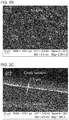
- FIGS. 2A and 2B are scanning electron micrographs of a surface of a solid-state electrolyte manufactured in the Example
- FIGS. 2C and 2D are scanning electron micrographs showing the results of cross-section analysis of the films of FIGS. 2A and 2B ;
- FIG. 3 is a graph of intensity (arbitrary units, a.u.) versus wavenumber (inverse centimeters, cm ⁇ 1 ) showing the results of Raman analysis of the solid-state electrolyte of the Example before and after annealing, and for reference Raman spectra of cubic lithium lanthanum zirconium oxide (c-LLZO), tetragonal lithium lanthanum zirconium oxide (t-LLZO), La 2 Zr 2 O 7 and Li 2 CO 3 ;
- FIG. 4 is a graph of intensity (arbitrary units, a.u.) versus diffraction angle (degrees two-theta, 2 ⁇ ) showing the results of X-ray diffraction analysis of the solid-state electrolyte of the Example before and after annealing, and for reference the MgO substrate and c-LLZO;
- FIG. 5 is an optical photograph of the solid-state electrolyte of the Example showing pin-holes in the film
- FIG. 6 is a schematic diagram of an embodiment of an electrochemical cell
- FIG. 7 is a schematic diagram of another embodiment of an electrochemical cell.
- Lithium lanthanum zirconium oxide (LLZO) garnet-type solid-state electrolytes are currently synthesized by either bulk-type methods, e.g., sintering a pressed pellet, or sintering a compressed tape.
- the products of the bulk-type methods can have desirable conductivity, however the processing temperatures, while suitable for laboratory setting, exceed those desirable for a manufacturing environment, and films of a solid-state electrolyte produced by bulk-type methods are relatively thick, resulting in undesirably low conductivity.
- methods to provide thin-films of LLZO by vacuum techniques are known, however such methods are economically unsuitable for scalable production.
- Disclosed is a method of manufacturing a solid-state electrolyte comprising: providing a solvent; dissolving a compound comprising lithium, a compound comprising lanthanum, and a compound comprising zirconium in the solvent to provide a solution, wherein a content of the lithium compound is greater than a stoichiometric amount; spraying the solution onto a heated substrate to form a film; and heat-treating the film at 300° C. to 800° C.
- the solid state electrolyte comprises Li (7-x) Al x/3 La 3 Zr 2 O 12 wherein 0 ⁇ x ⁇ 1, and wherein the solid state electrolyte is in a form a film having a thickness of 5 nanometers to 1000 micrometers.
- the disclosed method provides films having a selected thickness, desirable conductivity, and selective surface morphology. Also, the disclosed method is scalable and can have a cost which is suitable for a manufacturing environment.
- FIG. 1 A schematic diagram of an apparatus 100 for the disclosed method is shown in FIG. 1 .
- the disclosed apparatus includes an atomizer 110 for atomizing a composition for forming the solid-electrolyte, a droplet transport region 120 between the atomizer and a substrate 130 , and a heated surface 140 beneath the substrate.
- the composition for forming the solid-state electrolyte may be a solution, a suspension, or a combination thereof of the precursor in the solvent.
- the composition is a solution of the precursor in the solvent.
- the solvent may comprise a substituted or unsubstituted C1 to C20 alcohol, a substituted or unsubstituted C1 to C20 ester, a substituted or unsubstituted C2 to C20 carbonate, a substituted or unsubstituted C1 to C20 ketone, or a combination thereof.
- the solvent comprises a substituted or unsubstituted C1 to C6 alcohol, a substituted or unsubstituted phthalate, or a combination thereof.
- a substituted alcohol e.g., methoxy propanol, and a phthalate are mentioned.
- a composition for forming the solid-state electrolyte comprising a solution of the starting materials in methanol, 1-methoxy-2-propanol, and bis(2-ethylhexyl) phthalate.
- the solvent comprises a C1 to C2 alcohol, e.g., methanol, a C3 to C5 alcohol, e.g., 1-methyl-2-propanol, and a phthalate, e.g., bis(2-ethylhexyl)phthalate.
- the C1 to C2 alcohol, the C3 to C5 alcohol, and the phthalate may be combined in any suitable ratio.
- a content of the C1 to C2 alcohol, the C3 to C5 alcohol, and the phthalate may be independently selected and each may be 1 to 99 volume percent (vol %), 2 to 98 vol %, 4 to 92 vol %, or 8 to 75 vol %, based on a total volume of the solvent.
- An embodiment in which equal volumes of the C1 to C2 alcohol, the C3 to C5 alcohol, and the phthalate are used as mentioned.
- a boiling point of the solvent can be 0° C. to 350° C., 5° C. to 325° C., 10° C. to 300° C., or 20° C. to 250° C. In an embodiment, the solvent has a boiling point between 80° C. and 240° C.
- the precursor of the solid-state electrolyte comprises a compound comprising lithium, a compound comprising lanthanum, and a compound comprising zirconium, and the solvent.
- the solvent may dissolve the compound comprising lithium, the compound comprising lanthanum, and the compound comprising zirconium to provide a solution, wherein a content of the lithium compound is greater than a stoichiometric amount.
- the precursor may further comprise a compound comprising aluminum.
- a suspension is disclosed. In an embodiment, at least one of the compound comprising lithium, the compound comprising lanthanum, and the compound comprising zirconium is not fully dissolved in the solvent to provide a suspension.
- Suitable compounds for the precursor include an oxide, hydroxide, nitrate, carbonate, oxalate, peroxide, acetate, acetylacetonate, or a combination thereof.
- the precursor may comprise lithium, lanthanum, zirconium, and optionally aluminum.
- the precursor comprises a plurality of lithium, lanthanum, zirconium, and optionally aluminum.
- Representative precursor compounds comprising lithium include lithium oxide, lithium hydroxide, lithium nitrate, lithium carbonate, lithium oxalate, lithium peroxide, lithium acetate, lithium acetoacetate, or a combination thereof.
- Representative precursor compounds comprising lanthanum include lanthanum oxide, lanthanum hydroxide, lanthanum nitrate, lanthanum carbonate, lanthanum oxalate, lanthanum peroxide, lanthanum acetate, lanthanum acetoacetate, or a combination thereof.
- Representative precursor compounds comprising zirconium include zirconium oxide, zirconium hydroxide, zirconium nitrate, zirconium carbonate, zirconium oxalate, zirconium peroxide, zirconium acetate, zirconium acetoacetate, or a combination thereof.
- Representative precursor compounds comprising aluminum include aluminum oxide, aluminum hydroxide, aluminum nitrate, aluminum carbonate, aluminum oxalate, aluminum peroxide, aluminum acetate, aluminum acetoacetate, or a combination thereof.
- precursor compounds that provide a combination of lithium, lanthanum, or zirconium, and optionally aluminum.
- the precursor may be a hydrate.
- the precursor may be a hydrate.
- use of La(NO 3 ) 3 .6H 2 O or Al(NO 3 ) 3 .9H2O is mentioned.
- the concentration of the precursor compound in the solvent may be a concentration which is suitable for spray pyrolysis.
- the concentration of the precursor compound in the solvent is 0.001 to 1 molar (M), 0.01 to 0.5 M, or 0.05 to 0.1 M. Use of a precursor concentration of 0.01 to 0.05 M is mentioned.
- the precursor composition may comprise a stoichiometric excess of the compound comprising lithium, based on a stoichiometry for Li (7-x) Al x/3 La 3 Zr 2 O 12 wherein 0 ⁇ x ⁇ 1.
- the stoichiometric excess of the compound comprising lithium may be 10% to 300%, 20% to 250%, or 40% to 200%, based on a stoichiometry for Li (7-x) Al x/3 La 3 Zr 2 O 12 wherein 0 ⁇ x ⁇ 1.
- Use of a stoichiometric of 150% for the compound comprising lithium in the precursor composition is mentioned.
- the precursor composition is disposed onto a heated substrate.
- the disposing may comprise atomizing the precursor composition, and spraying the resulting fluid onto the heated substrate.
- the spraying may comprise disposing 1 to 100 milliliter (mL), 5 to 50 mL, or 10 to 25 mL of the precursor composition onto the heated substrate per square centimeter of heated substrate per hour.
- a temperature of the heated substrate may be 300° C. to 800° C., 350° C. to 750° C., 400° C. to 700° C., or 450° C. to 650° C. Use of a substrate heated to 600° C. is mentioned.
- the substrate may be heated by any suitable method including convection heating, infrared heating, or a combination thereof.
- a film comprising Li (7-x) Al x/3 La 3 Zr 2 O 12 wherein 0 ⁇ x ⁇ 1 and having a thickness of 5 nanometers (nm) to 1000 micrometers ( ⁇ m) is formed on the heated substrate.
- the thickness of the film may be 10 nm to 100 ⁇ m, 20 nm to 10 ⁇ m, or 0.1 ⁇ m to 1 ⁇ m.
- the film may be heat-treated at a temperature of 300° C. to 800° C., 350° C. to 750° C., 400° C. to 700° C., or 450° C. to 650° C. Heat-treating at 750° C. is mentioned.
- An atmosphere of the heat treating may comprise nitrogen, argon, helium, hydrogen, or a combination thereof, and may be a reducing atmosphere comprising hydrogen, or an oxidizing atmosphere comprising oxygen, e.g., air.
- the heat-treating is conducted in an atmosphere having a content of oxygen which is greater than that of air.
- the film comprising Li (7-x) Al x/3 La 3 Zr 2 O 12 may have a desirable surface roughness.
- a surface roughness (Ra) of the solid-state electrolyte may be 0.1 to 50 ⁇ m, 0.5 to 25 ⁇ m, or 1 to 10 ⁇ m. Surface roughness can be measured using a commercially available surface profilometer.
- Cubic, tetragonal, and amorphous Li (7-x) Al x/3 La 3 Zr 2 O 12 can be provided by the disclosed method. Because cubic Li (7-x) Al x/3 La 3 Zr 2 O 12 provides improved ionic conductivity, cubic Li (7-x) Al x/3 La 3 Zr 2 O 12 is for many applications desirable.
- a content of the cubic Li (7-x) Al x/3 La 3 Zr 2 O 12 is 50 to 100 weight percent (wt %)
- a content of the tetragonal Li (7-x) Al x/3 La 3 Zr 2 O 12 is 0 to 50 wt %
- a content of the amorphous Li (7-x) Al x/3 La 3 Zr 2 O 12 is 0 to 100 wt %, each based on a total content of the solid-state electrolyte.
- a content of the cubic Li (7-x) Al x/3 La 3 Zr 2 O 12 is 60 to 99 wt %
- a content of the tetragonal Li (7-x) Al x/3 La 3 Zr 2 O 12 is 1 to 50 wt %
- a content of the amorphous Li (7-x) Al x/3 La 3 Zr 2 O 12 is 1 to 99 wt %, each based on a total content of the solid-state electrolyte.
- a content of the cubic Li (7-x) Al x/3 La 3 Zr 2 O 12 is 70 to 95 wt %
- a content of the tetragonal Li (7-x) Al x/3 La 3 Zr 2 O 12 is 0 to 50 wt %
- a content of the amorphous Li (7-x) Al x/3 La 3 Zr 2 O 12 is 10 to 30 wt %, each based on a total content of the solid-state electrolyte.
- the solid-state electrolyte may have a porosity of 0 to 10%, 0.1 to 8%, or 0.2 to 4%, based on a total volume of the solid-state electrolyte. Embodiment in which the porosity is 0 to 0.2%, based on a total volume of the solid-state electrolyte is mentioned.
- the porosity may be determined by scanning electron microscopy, the details of which can be determined by one of skill in the art without undue experimentation.
- a feature of the disclosed method is that it provides solid-state electrolyte films having unexpectedly reduced or effectively no defect content.
- a defect content of the film can be 0 to 5 percent (%), 0.01 to 3%, or 0.1 to 1%, based on a total area of the film.
- a defect content may be determined by illuminating light through a film and determining an area of the film that does not contain the solid-state electrolyte. Alternatively, the defect content can be determined by scanning electron microscopy (SEM).
- a lithium battery comprising the solid-state electrolyte in at least one of a positive electrode, a separator, or a negative electrode.
- the negative electrode 610 can be used in combination with a positive electrode 630 comprising the positive active material and a separator 620 , e.g., a separator comprising the solid-state electrolyte, provided between the positive electrode and the negative electrode.
- a header 640 on a can 650 is also shown in FIG. 6 .
- an electrochemical cell 700 may comprise a porous separator on the solid-state electrolyte. Shown in FIG. 7 is a positive electrode current collector 710 , a positive electrode 720 comprising a positive electrode active material and a liquid electrolyte, a porous separator 730 , the solid-state electrolyte 740 , a negative electrode 750 , and a negative electrode current collector 760 .
- the positive electrode can be prepared by forming a positive active material layer including a positive active material on a current collector.
- the current collector may comprise aluminum, for example.
- the positive active material can comprise a lithium transition metal oxide, a transition metal sulfide, or the like.
- the positive active material can include a composite oxide of lithium and a metal selected from cobalt, manganese, and nickel.
- the positive active material can be a compound represented by any of the Formulas: Li a A 1-b M b D 2 wherein 0.90 ⁇ a ⁇ 1.8 and 0 ⁇ b ⁇ 0.5; Li a E 1-b M b O 2-c D c wherein 0.90 ⁇ a ⁇ 1.8, 0 ⁇ b ⁇ 0.5, and 0 ⁇ c ⁇ 0.05; LiE 2-b M b O 4-c D c wherein 0 ⁇ b ⁇ 0.5 and 0 ⁇ c ⁇ 0.05; Li a Ni 1-b-c Co b M c D ⁇ wherein 0.90 ⁇ a ⁇ 1.8, 0 ⁇ b ⁇ 0.5, 0 ⁇ c ⁇ 0.05, and 0 ⁇ a ⁇ 2; Li a Ni 1-b-c Co b M c O 2- ⁇ X ⁇ wherein 0.90 ⁇ a ⁇ 1.8, 0 ⁇
- the positive active material layer may further include a conductive agent and a binder. Any suitable conductive agent and binder may be used.
- a binder can facilitate adherence between components of the electrode, such as the positive active material and the conductor, and adherence of the electrode to a current collector.
- the binder can include polyacrylic acid (PAA), polyvinylidene fluoride, polyvinyl alcohol, carboxymethyl cellulose (CMC), starch, hydroxypropyl cellulose, regenerated cellulose, polyvinylpyrrolidone, tetrafluoroethylene, polyethylene, polypropylene, ethylene-propylene-diene monomer (EPDM), sulfonated EPDM, styrene-butadiene-rubber, fluorinated rubber, a copolymer thereof, or a combination thereof.
- PAA polyacrylic acid
- CMC carboxymethyl cellulose
- EPDM ethylene-propylene-diene monomer
- EPDM ethylene-propylene-diene monomer
- EPDM ethylene-propylene-diene monomer
- sulfonated EPDM st
- the amount of the binder can be in a range of about 1 part by weight to about 10 parts by weight, for example, in a range of about 2 parts by weight to about 7 parts by weight, based on a total weight of the positive active material.
- the amount of the binder is in the range above, e.g., about 1 part by weight to about 10 parts by weight, the adherence of the electrode to the current collector may be suitably strong.
- the conductive agent can include, for example, carbon black, carbon fiber, graphite, carbon nanotubes, graphene, or a combination thereof.
- the carbon black can be, for example, acetylene black, Ketjen black, Super P carbon, channel black, furnace black, lamp black, thermal black, or a combination thereof.
- the graphite can be a natural graphite or an artificial graphite. A combination comprising at least one of the foregoing conductive agents can be used.
- the positive electrode can additionally include an additional conductor other than the carbonaceous conductor described above.
- the additional conductor can be an electrically conductive fiber, such as a metal fiber; a metal powder such as a fluorinated carbon powder, an aluminum powder, or a nickel powder; a conductive whisker such as a zinc oxide or a potassium titanate; or a polyphenylene derivative.
- a combination comprising at least one of the foregoing additional conductors can be used.
- the positive active material layer may be prepared by a solid-state method such as screen printing, slurry casting, or powder compression.
- the solid-state method is not limited thereto, and any suitable method may be used.
- the current collector may comprise aluminum, for example.
- the positive electrode can further comprise an electrolyte.
- the electrolyte can comprise a solid-state electrolyte, a liquid electrolyte, a polymeric electrolyte, or a combination thereof.
- the liquid electrolyte may comprise a lithium salt and a solvent.
- Representative lithium salts include LiN(SO 2 CF 2 CF 3 ) 2 , LiBF 4 , LiPF 6 , LiSbF 6 , LiAsF 6 , LiClO 4 , LiCF 3 SO 3 , LiN(SO 2 CF 3 ) 2 , LiN(SO 2 C 2 F 5 ) 2 , LiC(SO 2 CF 3 ) 3 , LiN(SO 3 CF 3 ) 2 , LiC 4 F 9 SO 3 , LiAlCl 4 , NaAsF 6 , or a combination thereof.
- the solvent may comprise a carbonate, an ester, an ether, a ketone, an alcohol, or a combination thereof.
- the carbonate may be linear or cyclic, and may be fluorinated.
- Representative carbonates include at least one selected from diethyl carbonate (“DEC”), dimethyl carbonate (“DMC”), dipropyl carbonate (“DPC”), methyl propyl carbonate (“MPC”), ethyl propyl carbonate (“EPC”), methyl ethyl carbonate (“MEC”), or a combination thereof
- the cyclic carbonate compound may be, for example, ethylene carbonate (“EC”), propylene carbonate (“PC”), butylene carbonate (“BC”), vinyl ethylene carbonate (“VEC”), fluoroethylene carbonate (“FEC”), 4,5-difluoroethylene carbonate, 4,4-difluoroethylene carbonate, 4,4,5-trifluoroethylene carbonate, 4,4,5,5-tetrafluoroethylene carbonate, 4-fluoro-5-methylethylene carbonate, 4-fluoro-4-methyl ethyl ene carbonate, 4,5-diflu
- Representative esters include at least one selected from methyl acetate, ethyl acetate, n-propyl acetate, dimethyl acetate, methyl propionate, ethyl propionate, ⁇ -butyrolactone, decanolide, valerolactone, mevalonolactone, caprolactone, and methyl formate.
- Representative ethers include at least one selected from dibutyl ether, tetraglyme, diglyme, 1,2-dimethoxy ethane, 1,2-diethoxy ethane, ethoxy methoxy ethane, 2-methyl tetrahydrofuran, and tetrahydrofuran.
- a representative ketone is cyclohexanone.
- the solvent may comprise a nitrile, such as a C1 to C20 nitrile; an amide such as formamide or dimethyl formamide; a dioxolane such as 1,2-dioxolane or 1,3-dioxolane; a sulfolane such as dimethyl sulfoxide, sulfolane, or methyl sulfolane; 1,3-dimethyl-2-imidazolinone; N-methyl-2-pyrrolidinone; nitromethane; trimethyl phosphate; triethyl phosphate; trioctyl phosphate; or triester phosphate.
- a concentration of the salt in the solvent may be 0.1 to 2 molar (M), e.g., 0.5 to 1.5 M.
- the polymeric electrolyte may comprise an ionically conductive polymer.
- exemplary ionically conductive polymers can include but are not limited to polyethylene oxide, polyethylene oxide comprising a metal salt, poly(methyl (meth)acrylate), polypropylene oxide, polyvinylidene fluoride, polystyrene, polyvinyl chloride, polyvinyl alcohol, polyacrylonitrile, polyester sulfide, or a combination thereof.
- the ionically conductive polymer can optionally further comprise a lithium salt, for example LiN(SO 2 CF 2 CF 3 ) 2 , LiBF 4 , LiPF 6 , LiSbF 6 , LiAsF 6 , LiClO 4 , LiCF 3 SO 3 , LiN(SO 2 CF 3 ) 2 , LiN(SO 2 C 2 F 5 ) 2 , LiC(SO 2 CF 3 ) 3 , LiN(SO 3 CF 3 ) 2 , LiC 4 F 9 SO 3 , LiAlCl 4 , or a combination thereof.
- the ionically conductive polymer comprises the lithium salt, and is preferably a polyethylene oxide comprising the lithium salt.
- the separator may be included between the positive electrode and negative electrode.
- the separator consists of the solid-state electrolyte.
- the separator comprises a glass fiber, polyester, polyethylene, polypropylene, polytetrafluoroethylene (PTFE), or a combination thereof.
- the separator may comprise a microporous polymeric film, such as a microporous polyethylene or microporous polypropylene film.
- the separator comprises the solid-state electrolyte and a porous olefin film such as polyethylene and polypropylene.
- a diameter of a pore of the porous olefin film can be 0.01 to 10 micrometers ( ⁇ m), and a thickness of the separator can be in a range of 5 to 300 ⁇ m.
- the electrochemical cell may comprise a porous separator 720 comprising a microporous polyethylene film having a pore size of 1 to 50 ⁇ m, 2 to 40 ⁇ m, or 5 to 30 ⁇ m, and a layer of the solid-state electrolyte on the porous separator.
- the solid-state electrolyte may be liquid-impermeable, may be non-porous, or may have a pore size of 0.01 to 1 ⁇ m, 0.05 to 0.5 ⁇ m.
- the negative electrode can be produced from a negative active material composition including a negative active material, and optionally, a conductive agent, and a binder.
- a suitable negative active material includes a material capable of storing and releasing lithium ions electrochemically.
- Such negative electrode active material can a carbon, such as a hard carbon, soft carbon, carbon black, ketjen black, acetylene black, activated carbon, carbon nanotubes, carbon fiber, graphite, or an amorphous carbon.
- lithium-containing metals and alloys for example a lithium alloy comprising Si, Sn, Sb, Ge, or a combination thereof.
- Lithium-containing metal oxides, metal nitrides, and metal sulfides are also useful, in particular wherein metal can be Ti, Mo, Sn, Fe, Sb, Co, V, or a combination thereof. Also useable are phosphorous (P) or metal doped phosphorous (e.g., NiP 3 ).
- the negative active material is not limited to the foregoing and any suitable negative active material can be used. In an embodiment the negative active material is disposed on a current collector, such as copper current collector.
- the negative electrode comprises graphite. In an embodiment, the negative electrode comprises lithium metal or a lithium metal alloy. Use of lithium metal is mentioned.
- the electrochemical cell can be made by a method comprising disposing the solid-state electrolyte film between a positive electrode and a negative electrode and inserting the assembly into a can, for example, to provide the electrochemical cell.
- LiNO 3 ( ⁇ 99%), Zirconium(IV) acetylacetonate (97%), and 1-methoxy-2-propanol ( ⁇ 99.5%) were purchased from SIGMA-ALDRICH; Al(NO 3 ) 3 .9H 2 O, La(NO 3 ) 3 .6H 2 O (99.99%), and bis(2-ethylhexyl) phthalate were purchased from ALFA AESAR; Methanol was purchased from VWR INTERNATIONAL. Polished MgO (100) substrates (10 ⁇ 10 ⁇ 0.5 mm) were purchased from MTI CORPORATION.
- precursor solutions were prepared by dissolving stoichiometric ratios of La, Al, and Zr salts and a 150% stoichiometric excess of the Li salt in a methanol:1-methoxy-2-propanol:bis(2-ethylhexyl) phthalate (33:33:33 vol %) solution. The precursor solutions were stirred overnight for at least 12 hours.
- the precursor solutions were loaded into a polypropylene syringe and pumped at 5 to 30 mL/hour into a spray gun (DEVILBLISS AG361).
- the spray gun used compressed air as a carrier gas with a pressure at the atomizer of 0.3 kPa.
- MgO substrates were placed on a heated stainless steel hot plate. The substrate temperature ranged from 270 to 330° C., and the distance between the MgO substrate and the atomizer was approximately 24 cm.
- the solid-state electrolyte films were analyzed using scanning electron microscopy (SEM) on a ZEISS Supra55VP field emission scanning electron microscope operated between 3.0 to 10.0 kV using both the In-lens SE and the Everhart-Thornley SE detectors.
- SEM scanning electron microscopy
- the solid-state electrolyte films were cross sectioned with a diamond blade and attached to a sample stage via carbon-conductive tape.
- X-ray photoelectron spectroscopy (XPS) spectra were collected using a THERMO K-Alpha XPS system with a spot size of 400 ⁇ m and a resolution of 0.1 eV.
- Raman spectroscopy analysis was completed using a WITec spectrometer with a spectral resolution of 0.7 cm ⁇ 1 at 10 mW and a wavelength of 532 nm to ensure low penetration depths.
- FIGS. 2A and 2B Shown in FIGS. 2A and 2B are results of surface analysis of two films, and shown in FIGS. 2C and 2D , the results of cross-section analysis of the films of FIGS. 2A and 2B , respectively, wherein each film comprises Li 6.25 Al 0.25 La 3 Zr 2 O 12 , and each was prepared using an injection rate of 10 milliliters per hour of a 0.03 M precursor solution onto a 1 cm 2 MgO substrate, prior to annealing at 800° C. for 30 minutes under a flow of oxygen. As shown in the cross-section images, films have a thickness of 2-5 ⁇ m.
- FIG. 3 Shown in FIG. 3 are the results of the Raman analysis after annealing (top result), before annealing, and reference spectra for cubic and tetragonal Li 6.25 Al 0.25 La 3 Zr 2 O 12 , LazZr 2 O 7 , and LiCO 3 .
- Li 6.25 Al 0.25 La 3 Zr 2 O 12 was observed only after annealing.
- FIG. 4 show the results of X-ray powder diffraction analysis before and after annealing, as well as result for the MgO substrate and cubic Li 6.25 Al 0.25 La 3 Zr 2 O 12 . CuK ⁇ radiation was used.
- annealing resulted in in conversion of tetragonal to cubic Li 6.25 Al 0.25 La 3 Zr 2 O 12 .
- FIG. 5 Shown in FIG. 5 is an optical image of the Li 6.25 Al 0.25 La 3 Zr 2 O 12 solid-state electrolyte. As shown in FIG. 5 , few defects are observed.
- first,” “second,” “third,” etc. may be used herein to describe various elements, components, regions, layers, and/or sections, these elements, components, regions, layers, and/or sections should not be limited by these terms. These terms are only used to distinguish one element, component, region, layer, or section from another element, component, region, layer or section. Thus, “a first element,” “component,” “region,” “layer,” or “section” discussed below could be termed a second element, component, region, layer or section without departing from the teachings herein.
- spatially relative terms such as “beneath,” “below,” “lower,” “above,” “upper” and the like, may be used herein for ease of description to describe one element or feature's relationship to another element(s) or feature(s) as illustrated in the figures. It will be understood that the spatially relative terms are intended to encompass different orientations of the device in use or operation in addition to the orientation depicted in the figures. For example, if the device in the figures is turned over, elements described as “below” or “beneath” other elements or features would then be oriented “above” the other elements or features. Thus, the exemplary term “below” can encompass both an orientation of above and below. The device may be otherwise oriented (rotated 90 degrees or at other orientations) and the spatially relative descriptors used herein interpreted accordingly.
- Exemplary embodiments are described herein with reference to cross section illustrations that are schematic illustrations of idealized embodiments. As such, variations from the shapes of the illustrations as a result, for example, of manufacturing techniques and/or tolerances, are to be expected. Thus, embodiments described herein should not be construed as limited to the particular shapes of regions as illustrated herein but are to include deviations in shapes that result, for example, from manufacturing. For example, a region illustrated or described as flat may, typically, have rough and/or nonlinear features. Moreover, sharp angles that are illustrated may be rounded. Thus, the regions illustrated in the figures are schematic in nature and their shapes are not intended to illustrate the precise shape of a region and are not intended to limit the scope of the present claims.
- “Substituted” means that the compound is substituted with at least one (e.g., 1, 2, 3, or 4) substituent, and the substituents are independently a hydroxyl (—OH), a C1-9 alkoxy, a C1-9 haloalkoxy, an oxo ( ⁇ O), a nitro (—NO 2 ), a cyano (—CN), an amino (—NH 2 ), an azido (—N 3 ), an amidino (—C( ⁇ NH)NH 2 ), a hydrazino (—NHNH 2 ), a hydrazono ( ⁇ N—NH 2 ), a carbonyl (—C( ⁇ O)—), a carbamoyl group (—C(O)NH 2 ), a sulfonyl (—S( ⁇ O) 2 —), a thiol (—SH), a thiocyano (—SCN), a tosyl (CH 3 C 6 H 4 SO 2 —), a
Landscapes
- Chemical & Material Sciences (AREA)
- Engineering & Computer Science (AREA)
- Electrochemistry (AREA)
- General Chemical & Material Sciences (AREA)
- Chemical Kinetics & Catalysis (AREA)
- Manufacturing & Machinery (AREA)
- Inorganic Chemistry (AREA)
- Physics & Mathematics (AREA)
- Condensed Matter Physics & Semiconductors (AREA)
- General Physics & Mathematics (AREA)
- Materials Engineering (AREA)
- Organic Chemistry (AREA)
- Secondary Cells (AREA)
- Battery Electrode And Active Subsutance (AREA)
Abstract
Description
Claims (15)
Priority Applications (3)
| Application Number | Priority Date | Filing Date | Title |
|---|---|---|---|
| US16/224,968 US11223066B2 (en) | 2018-08-01 | 2018-12-19 | Solid-state electrolyte and method of manufacture thereof |
| KR1020190071777A KR102822352B1 (en) | 2018-08-01 | 2019-06-17 | Solid-state electrolyte and method of manufacture thereof |
| US17/519,185 US20220059871A1 (en) | 2018-08-01 | 2021-11-04 | Solid-state electrolyte and method of manufacture thereof |
Applications Claiming Priority (2)
| Application Number | Priority Date | Filing Date | Title |
|---|---|---|---|
| US201862713366P | 2018-08-01 | 2018-08-01 | |
| US16/224,968 US11223066B2 (en) | 2018-08-01 | 2018-12-19 | Solid-state electrolyte and method of manufacture thereof |
Related Child Applications (1)
| Application Number | Title | Priority Date | Filing Date |
|---|---|---|---|
| US17/519,185 Division US20220059871A1 (en) | 2018-08-01 | 2021-11-04 | Solid-state electrolyte and method of manufacture thereof |
Publications (2)
| Publication Number | Publication Date |
|---|---|
| US20200044281A1 US20200044281A1 (en) | 2020-02-06 |
| US11223066B2 true US11223066B2 (en) | 2022-01-11 |
Family
ID=69228113
Family Applications (2)
| Application Number | Title | Priority Date | Filing Date |
|---|---|---|---|
| US16/224,968 Active 2039-09-11 US11223066B2 (en) | 2018-08-01 | 2018-12-19 | Solid-state electrolyte and method of manufacture thereof |
| US17/519,185 Pending US20220059871A1 (en) | 2018-08-01 | 2021-11-04 | Solid-state electrolyte and method of manufacture thereof |
Family Applications After (1)
| Application Number | Title | Priority Date | Filing Date |
|---|---|---|---|
| US17/519,185 Pending US20220059871A1 (en) | 2018-08-01 | 2021-11-04 | Solid-state electrolyte and method of manufacture thereof |
Country Status (2)
| Country | Link |
|---|---|
| US (2) | US11223066B2 (en) |
| KR (1) | KR102822352B1 (en) |
Families Citing this family (12)
| Publication number | Priority date | Publication date | Assignee | Title |
|---|---|---|---|---|
| KR100721825B1 (en) | 2001-07-12 | 2007-05-25 | 주식회사 포스코 | Foreign material suction removal device on strip surface |
| US11251460B2 (en) | 2018-08-01 | 2022-02-15 | Samsung Electronics Co., Ltd. | Solution-processed solid-state electrolyte and method of manufacture thereof |
| US11999630B2 (en) * | 2019-06-14 | 2024-06-04 | Uchicago Argonne, Llc | Method of tuning the conversion temperature of cubic phase of aluminum-doped lithium lanthanum zirconium oxide |
| US11757127B2 (en) | 2019-06-18 | 2023-09-12 | Samsung Electronics Co., Ltd. | Lithium solid electrolyte and method of manufacture thereof |
| JP7709120B2 (en) * | 2019-09-05 | 2025-07-16 | 日本電気硝子株式会社 | Solid electrolyte sheet and method for producing same |
| US11699811B2 (en) | 2020-03-25 | 2023-07-11 | Samsung Electronics Co., Ltd. | Bilayer component for a lithium battery |
| KR102876035B1 (en) | 2020-04-17 | 2025-10-23 | 주식회사 엘지에너지솔루션 | Electrolyte for lithium secondary battery and lithium secondary battery including the same |
| US11631888B2 (en) | 2020-07-13 | 2023-04-18 | Samsung Electronics Co., Ltd. | Amorphous nitrogen-rich solid state lithium electrolyte |
| US11821091B2 (en) | 2020-07-24 | 2023-11-21 | Uchicago Argonne, Llc | Solvent-free processing of lithium lanthanum zirconium oxide coated-cathodes |
| CN113336547B (en) * | 2021-04-22 | 2022-05-31 | 海南大学 | Oxide type solid electrolyte film and preparation method thereof |
| EP4350830A1 (en) * | 2022-10-04 | 2024-04-10 | SK On Co., Ltd. | Oxide-based thin film sintered body, oxide-based solid electrolyte sheet, and all-solid lithium secondary battery |
| DE102024204375A1 (en) * | 2024-05-10 | 2025-11-13 | Powerco Se | Method for manufacturing a solids separator |
Citations (20)
| Publication number | Priority date | Publication date | Assignee | Title |
|---|---|---|---|---|
| US6884514B2 (en) | 2002-01-11 | 2005-04-26 | Saint-Gobain Ceramics & Plastics, Inc. | Method for forming ceramic layer having garnet crystal structure phase and article made thereby |
| US7901658B2 (en) | 2004-03-06 | 2011-03-08 | Werner Weppner | Chemically stable solid lithium ion conductor |
| JP2014002965A (en) | 2012-06-20 | 2014-01-09 | Toyota Motor Corp | Method for producing solid electrolyte thin film, solid electrolyte thin film and solid battery |
| US8658317B2 (en) | 2007-07-02 | 2014-02-25 | Basf Se | Solid ion conductor which has a garnet-like crystal structure and has the stoichiometric composition L7+XAXG3−XZr2O12 |
| US20150111110A1 (en) | 2012-04-27 | 2015-04-23 | Kabushiki Kaisha Toyota Jidoshokki | Solid electrolyte and secondary battery |
| US20150200420A1 (en) | 2013-10-07 | 2015-07-16 | Quantumscape Corporation | Garnet materials for li secondary batteries and methods of making and using garnet materials |
| US9093717B2 (en) | 2011-05-20 | 2015-07-28 | Board Of Trustees Of Michigan State University | Methods of making and using oxide ceramic solids and products and devices related thereto |
| CN105406118A (en) | 2015-12-30 | 2016-03-16 | 哈尔滨工业大学 | Ceramic solid electrolyte and preparation method thereof |
| US20160133990A1 (en) * | 2014-11-11 | 2016-05-12 | Purdue Research Foundation | Solid-state electrolytes and batteries made therefrom, and methods of making solid-state electrolytes |
| US20160141108A1 (en) | 2010-09-29 | 2016-05-19 | Junichi Inahara | Method for drying electrode pair, method for manufacturing lithium-ion secondary battery, method for manufacturing electric double-layer capacitor, and method for manufacturing lithium-ion capacitor |
| CN106374085A (en) | 2015-07-20 | 2017-02-01 | 马鞍山首拓新能源科技有限公司 | Lithium ion battery material preparation method |
| US20170363928A1 (en) | 2015-01-14 | 2017-12-21 | Universite De Liege | Improved process of ultrasonic spray pyrolysis deposition of one or more electrochromic and/or electrolytic films on a substrate |
| US20180026299A1 (en) | 2016-07-21 | 2018-01-25 | Hyundai Motor Company | Method of Manufacturing High-Density Solid Electrolyte Thin Film Using Room-Temperature High-Speed Powder Spray Method |
| US20180138546A1 (en) | 2016-11-16 | 2018-05-17 | Hyundai Motor Company | Solid Electrolyte and Preparing Method Thereof |
| WO2018089430A1 (en) | 2016-11-08 | 2018-05-17 | Fisker Inc. | All-solid state li ion batteries comprising mechanically flexible ceramic electrolytes and manufacturing methods for the same |
| US20180175446A1 (en) | 2015-07-29 | 2018-06-21 | Central Glass Company, Limited | Garnet-Type Oxide Sintered Body and Method for Producing Same |
| US20180309136A1 (en) * | 2015-09-28 | 2018-10-25 | VON ARDENNE Asset GmbH & Co. KG | Method for substrate coating with particles and device for carrying out the method |
| US20180375151A1 (en) | 2015-12-31 | 2018-12-27 | I-Ten | All-solid-state battery including a solid electrolyte and a layer of ion-conducting material |
| US20200044282A1 (en) | 2018-08-01 | 2020-02-06 | Samsung Electronics Co., Ltd. | Solution-processed solid-state electrolyte and method of manufacture thereof |
| US20200403269A1 (en) | 2019-06-18 | 2020-12-24 | Samsung Electronics Co., Ltd. | Lithium solid electrolyte and method of manufacture thereof |
Family Cites Families (4)
| Publication number | Priority date | Publication date | Assignee | Title |
|---|---|---|---|---|
| US9368775B2 (en) * | 2004-02-06 | 2016-06-14 | Polyplus Battery Company | Protected lithium electrodes having porous ceramic separators, including an integrated structure of porous and dense Li ion conducting garnet solid electrolyte layers |
| JP6272229B2 (en) * | 2012-09-04 | 2018-01-31 | 日本碍子株式会社 | Solid electrolyte ceramic materials |
| KR101526703B1 (en) * | 2013-11-12 | 2015-06-05 | 현대자동차주식회사 | A method for preparing Al substituted garnet |
| DE102014100684B4 (en) * | 2014-01-22 | 2017-05-11 | Schott Ag | Ion-conducting glass-ceramic with garnet-like crystal structure, process for the production and use of such a glass-ceramic |
-
2018
- 2018-12-19 US US16/224,968 patent/US11223066B2/en active Active
-
2019
- 2019-06-17 KR KR1020190071777A patent/KR102822352B1/en active Active
-
2021
- 2021-11-04 US US17/519,185 patent/US20220059871A1/en active Pending
Patent Citations (23)
| Publication number | Priority date | Publication date | Assignee | Title |
|---|---|---|---|---|
| US6884514B2 (en) | 2002-01-11 | 2005-04-26 | Saint-Gobain Ceramics & Plastics, Inc. | Method for forming ceramic layer having garnet crystal structure phase and article made thereby |
| US7901658B2 (en) | 2004-03-06 | 2011-03-08 | Werner Weppner | Chemically stable solid lithium ion conductor |
| US8658317B2 (en) | 2007-07-02 | 2014-02-25 | Basf Se | Solid ion conductor which has a garnet-like crystal structure and has the stoichiometric composition L7+XAXG3−XZr2O12 |
| US9450271B2 (en) | 2007-07-02 | 2016-09-20 | Basf Se | Electrode which has been coated with a solid ion conductor which has a garnet-like crystal structure and has the stoichiometric composition L7+XAXG3−XZr2O12 |
| US20160141108A1 (en) | 2010-09-29 | 2016-05-19 | Junichi Inahara | Method for drying electrode pair, method for manufacturing lithium-ion secondary battery, method for manufacturing electric double-layer capacitor, and method for manufacturing lithium-ion capacitor |
| US9093717B2 (en) | 2011-05-20 | 2015-07-28 | Board Of Trustees Of Michigan State University | Methods of making and using oxide ceramic solids and products and devices related thereto |
| US20150111110A1 (en) | 2012-04-27 | 2015-04-23 | Kabushiki Kaisha Toyota Jidoshokki | Solid electrolyte and secondary battery |
| JP2014002965A (en) | 2012-06-20 | 2014-01-09 | Toyota Motor Corp | Method for producing solid electrolyte thin film, solid electrolyte thin film and solid battery |
| US20150200420A1 (en) | 2013-10-07 | 2015-07-16 | Quantumscape Corporation | Garnet materials for li secondary batteries and methods of making and using garnet materials |
| US10008742B2 (en) | 2013-10-07 | 2018-06-26 | Quantumscape Corporation | Garnet materials for Li secondary batteries and methods of making and using garnet materials |
| US20160056500A1 (en) | 2013-10-07 | 2016-02-25 | Quantumscape Corporation | Garnet materials for li secondary batteries and methods of making and using garnet materials |
| US20160133990A1 (en) * | 2014-11-11 | 2016-05-12 | Purdue Research Foundation | Solid-state electrolytes and batteries made therefrom, and methods of making solid-state electrolytes |
| US20170363928A1 (en) | 2015-01-14 | 2017-12-21 | Universite De Liege | Improved process of ultrasonic spray pyrolysis deposition of one or more electrochromic and/or electrolytic films on a substrate |
| CN106374085A (en) | 2015-07-20 | 2017-02-01 | 马鞍山首拓新能源科技有限公司 | Lithium ion battery material preparation method |
| US20180175446A1 (en) | 2015-07-29 | 2018-06-21 | Central Glass Company, Limited | Garnet-Type Oxide Sintered Body and Method for Producing Same |
| US20180309136A1 (en) * | 2015-09-28 | 2018-10-25 | VON ARDENNE Asset GmbH & Co. KG | Method for substrate coating with particles and device for carrying out the method |
| CN105406118A (en) | 2015-12-30 | 2016-03-16 | 哈尔滨工业大学 | Ceramic solid electrolyte and preparation method thereof |
| US20180375151A1 (en) | 2015-12-31 | 2018-12-27 | I-Ten | All-solid-state battery including a solid electrolyte and a layer of ion-conducting material |
| US20180026299A1 (en) | 2016-07-21 | 2018-01-25 | Hyundai Motor Company | Method of Manufacturing High-Density Solid Electrolyte Thin Film Using Room-Temperature High-Speed Powder Spray Method |
| WO2018089430A1 (en) | 2016-11-08 | 2018-05-17 | Fisker Inc. | All-solid state li ion batteries comprising mechanically flexible ceramic electrolytes and manufacturing methods for the same |
| US20180138546A1 (en) | 2016-11-16 | 2018-05-17 | Hyundai Motor Company | Solid Electrolyte and Preparing Method Thereof |
| US20200044282A1 (en) | 2018-08-01 | 2020-02-06 | Samsung Electronics Co., Ltd. | Solution-processed solid-state electrolyte and method of manufacture thereof |
| US20200403269A1 (en) | 2019-06-18 | 2020-12-24 | Samsung Electronics Co., Ltd. | Lithium solid electrolyte and method of manufacture thereof |
Non-Patent Citations (17)
| Title |
|---|
| Ashby, D., et al., "Patternable, Solution-Processed Ionogels for Thin-Film Lithium-Ion Electrolytes," Joule, 1, Oct. 11, 2017, pp. 344-358. |
| Bitzer, M., et al., "Sol-gel synthesis of thin solid Li7La3Zr2O12 electrolyte films for Li-ion batteries," Thin Solid Films, 615 (2016), pp. 128-134. |
| Chen, R-J, et al., "Sol-gel derived Li—La—Zr—O thin films as solid electrolytes for lithium-ion batteries," J. Mater. Chem. A, 2014, 2, pp. 13277-13282. |
| Djenadic, R., et al., "Nebulized spray pyrolysis of Al-doped Li7La3Zr2O12 solid electrolyte for battery applications," Solid State Ionics, 263, 2014, pp. 49-56. |
| Garbayo, I., et al., "Glass-Type Polyamorphism in Li-Garnet Thin Film Solid State Battery Conductors," Adv. Energy Mater., 2018, 8, 1702265 (14 pages). |
| Huang, X., et al., "Method Using Water-Based Solvent to Prepare Li7La3Zr2O12 Solid Electrolytes," ACS Appl. Mater. Interfaces 2018, 10, pp. 17147-17155. |
| Kazyak, E., et al., "Atomic Layer Deposition of the Solid Electrolyte Garnet Li7La3Zr2O12," Chem. Mater., 2017, 29, pp. 3785-3792. |
| Lee, G., et al., "Fabrication of a stretchable and patchable array of high performance micro-supercapacitors using a non-aqueous solvent based gel electrolyte," Energy Environ. Sci., 2015, 8, pp. 1764-1774. |
| NIST URL: hhtps://www.nist.gov/pmi/weights-and-measures/si-units-temperature (Year: 2010) 7 pages. |
| Non Final Office Action issued for U.S. Appl. No. 16/225,068, filed Dec. 19, 2018; dated Oct. 19, 2020; 11 pages. |
| Rawlence, M., et al., "Effect of Gallium Substitution on Lithium-Ion Conductivity and Phase Evolution in Sputtered Li7-3xGaxLa3Zr2O12 Thin Film," ACS Appl. Mater. Interfaces, 2018, 10, pp. 13720-13728. |
| Shen, C.H., et al., "Electrode and solid electrolyte thin films for secondary lithium-ion batteries," Journal of Power Sources, 68 (1997), pp. 377-380. |
| Solano, M., "Development of artificial surface layers for thin film cathode materials,"Material chemistry, Université de Bordeaux, 2015, English, submitted on Jun. 7, 2016, 160 pages. |
| U.S. Final Office Action issued for U.S. Appl. No. 16/225,068, filed Dec. 19, 2018; dated Mar. 15, 2021; 22 pages. |
| U.S. Non Final Office Action issued for U.S. Appl. No. 16/225,068, filed Dec. 19, 2019; dated May 29, 2020; 21 pages. |
| Van Den Broek, J., et al., "Boosting the electrochemical performance of Li-garnet based all-solid-state batteries with Li4Ti5O12 electrode: Routes to cheap and large scale ceramic processing," J Electroceram (2017), 38, pp. 182-188. |
| Wang, B., et al., "Sol-gel-derived amperometric biosensor for hydrogen peroxide based on methylene green incorporated in Nafion film," Talanta, 51 (2000), pp. 565-572. |
Also Published As
| Publication number | Publication date |
|---|---|
| KR102822352B1 (en) | 2025-06-18 |
| US20200044281A1 (en) | 2020-02-06 |
| US20220059871A1 (en) | 2022-02-24 |
| KR20200014685A (en) | 2020-02-11 |
Similar Documents
| Publication | Publication Date | Title |
|---|---|---|
| US11223066B2 (en) | Solid-state electrolyte and method of manufacture thereof | |
| US12261268B2 (en) | Lithium solid electrolyte and method of manufacture thereof | |
| US11251460B2 (en) | Solution-processed solid-state electrolyte and method of manufacture thereof | |
| US8173301B2 (en) | Positive electrode active material for non-aqueous electrolyte secondary battery and non-aqueous electrolyte secondary battery including the same | |
| EP2518819B1 (en) | Negative electrode for lithium secondary battery, method of manufacturing the same, and lithium secondary battery employing the same | |
| US9029017B2 (en) | Lithium composite oxide for a lithium secondary battery and positive electrode for a lithium secondary battery including the lithium composite oxide | |
| US12347827B2 (en) | Bilayer component for a lithium battery | |
| KR101610364B1 (en) | Positive active material for lithium secondary battery, method of preparing same and a lithium secondary battery comprising the same | |
| KR102314576B1 (en) | Positive active material for rechargeable lithium battery, method of preparing the same and rechargeable lithium battery including the same | |
| JP4632016B2 (en) | Non-aqueous electrolyte battery | |
| JP4332845B2 (en) | Non-aqueous electrolyte battery | |
| US20250192227A1 (en) | Amorphous nitrogen-rich solid state lithium electrolyte | |
| KR102872591B1 (en) | Anode for lithium secondary battery, manufacturing method of the same, lithium secondary battery including the same | |
| KR101611404B1 (en) | Separator for lithium ion secondary battery and method for the same | |
| KR101134566B1 (en) | Novel cathode active material for lithium secondary battery and method of fabricating a cathode thin film for lithium secondary battery using the same | |
| KR20140088932A (en) | Negative electrode active material for rechargeable lithium battery, method for preparing negative electrode active material for rechargeable lithium battery and rechargeable lithium battery | |
| EP4738477A1 (en) | Negative electrode for lithium-free secondary battery, manufacturing method therefor, and lithium-free secondary battery comprising same | |
| KR20250091111A (en) | Separator for electrochemical devices, member for electrochemical devices, and electrochemical devices | |
| KR20250091112A (en) | Separator for electrochemical devices, member for electrochemical devices, and electrochemical devices | |
| KR20190131770A (en) | Positive active material for rechargeable lithium battery and rechargeable lithium battery including same |
Legal Events
| Date | Code | Title | Description |
|---|---|---|---|
| AS | Assignment |
Owner name: SAMSUNG ELECTRONICS CO., LTD., KOREA, REPUBLIC OF Free format text: ASSIGNMENT OF ASSIGNORS INTEREST;ASSIGNORS:ZHU, YUNTONG;HOOD, ZACHARY;RUPP, JENNIFER;AND OTHERS;SIGNING DATES FROM 20181212 TO 20181214;REEL/FRAME:047813/0813 Owner name: MASSACHUSETTS INSTITUTE OF TECHNOLOGY, MASSACHUSETTS Free format text: ASSIGNMENT OF ASSIGNORS INTEREST;ASSIGNORS:ZHU, YUNTONG;HOOD, ZACHARY;RUPP, JENNIFER;AND OTHERS;SIGNING DATES FROM 20181212 TO 20181214;REEL/FRAME:047813/0813 |
|
| FEPP | Fee payment procedure |
Free format text: ENTITY STATUS SET TO UNDISCOUNTED (ORIGINAL EVENT CODE: BIG.); ENTITY STATUS OF PATENT OWNER: LARGE ENTITY |
|
| STPP | Information on status: patent application and granting procedure in general |
Free format text: RESPONSE TO NON-FINAL OFFICE ACTION ENTERED AND FORWARDED TO EXAMINER |
|
| STPP | Information on status: patent application and granting procedure in general |
Free format text: NON FINAL ACTION MAILED |
|
| STPP | Information on status: patent application and granting procedure in general |
Free format text: RESPONSE TO NON-FINAL OFFICE ACTION ENTERED AND FORWARDED TO EXAMINER |
|
| STPP | Information on status: patent application and granting procedure in general |
Free format text: FINAL REJECTION MAILED |
|
| STPP | Information on status: patent application and granting procedure in general |
Free format text: ADVISORY ACTION MAILED |
|
| STPP | Information on status: patent application and granting procedure in general |
Free format text: DOCKETED NEW CASE - READY FOR EXAMINATION |
|
| STPP | Information on status: patent application and granting procedure in general |
Free format text: NOTICE OF ALLOWANCE MAILED -- APPLICATION RECEIVED IN OFFICE OF PUBLICATIONS |
|
| STPP | Information on status: patent application and granting procedure in general |
Free format text: PUBLICATIONS -- ISSUE FEE PAYMENT VERIFIED |
|
| STCF | Information on status: patent grant |
Free format text: PATENTED CASE |
|
| MAFP | Maintenance fee payment |
Free format text: PAYMENT OF MAINTENANCE FEE, 4TH YEAR, LARGE ENTITY (ORIGINAL EVENT CODE: M1551); ENTITY STATUS OF PATENT OWNER: LARGE ENTITY Year of fee payment: 4 |