US11222774B2 - Data acquisition apparatus and methods for mass spectrometry - Google Patents
Data acquisition apparatus and methods for mass spectrometry Download PDFInfo
- Publication number
- US11222774B2 US11222774B2 US16/090,446 US201716090446A US11222774B2 US 11222774 B2 US11222774 B2 US 11222774B2 US 201716090446 A US201716090446 A US 201716090446A US 11222774 B2 US11222774 B2 US 11222774B2
- Authority
- US
- United States
- Prior art keywords
- digital
- signal
- analog
- data acquisition
- mass spectrometer
- Prior art date
- Legal status (The legal status is an assumption and is not a legal conclusion. Google has not performed a legal analysis and makes no representation as to the accuracy of the status listed.)
- Active, expires
Links
Images




Classifications
-
- H—ELECTRICITY
- H01—ELECTRIC ELEMENTS
- H01J—ELECTRIC DISCHARGE TUBES OR DISCHARGE LAMPS
- H01J49/00—Particle spectrometers or separator tubes
- H01J49/0027—Methods for using particle spectrometers
- H01J49/0036—Step by step routines describing the handling of the data generated during a measurement
Definitions
- the present invention relates generally to measuring mass-to-charge (m/z) ratios and abundances of ions of interest in a mass spectrometer. More particularly, this invention relates to devices, methods, and systems for the automatic acquisition of digitized time-domain (transient) signals and corresponding mass spectra, from an analog signal generated in response to ion motion in a mass spectrometer by a transducer that employs induced current sensing for ion detection.
- transient time-domain
- the invention may be used in conjunction with those mass spectrometers that employ a Fourier transform (FT) mass analyzer, such as an ion cyclotron resonance (ICR) cell or an electrostatic ion trap (e.g, an orbitrap), for acquiring digitized transient signals and corresponding mass spectra with improved analytical characteristics relative to the prior art.
- FT Fourier transform
- ICR ion cyclotron resonance
- electrostatic ion trap e.g, an orbitrap
- Mass spectrometry is one of the most sensitive and selective analytical techniques for molecular structural and quantitative analyses. To provide molecular level information on samples from solid, liquid, or gas phase state, it is required to first transform molecules into charged particles (ions), then to separate the formed ions by their mass-to-charge ratios, m/z, and finally record the abundance of each species as a function of m/z values.
- the main analytical characteristics of mass spectrometric techniques include resolving power (or resolution), mass accuracy, dynamic range, sensitivity, and acquisition speed (throughput). Resolving power, or resolution, refers to an ability of a mass spectrometer to distinguish molecular species that are close in their m/z values.
- Sensitivity refers to the ability of mass spectrometers to detect minor amounts of components from a sample.
- detection limit The lowest amount of ions that a mass spectrometer is capable of detecting is referred to as detection limit.
- the complex molecular mixtures analysis includes analysis of isotopic fine structures of biomolecules, specifically peptides and proteins, as well as analysis of isotopic distribution of large biomolecules, e.g., proteins.
- Comprehensive analyses of crude oils and crude oil fractions require many analytical characteristics, including resolving power, mass accuracy, and dynamic range, to be all at sufficiently high levels.
- Mass spectrometry has already revolutionized the way we consider molecular structural analysis nowadays, but the extreme sample complexity in many cases still cannot be addressed even by the most sophisticated instruments.
- the major application areas of MS nowadays are in life, pharmaceutical, clinical, environmental, material, and forensic sciences.
- FTMS Fourier transform mass spectrometry
- DFT discrete Fourier transform
- FDM filter-diagonalization method
- LSF least-squares fitting
- PSDM phased spectrum deconvolution method
- the latter one uses alternating directions method of multipliers (ADMM) to deconvolve the Fourier spectra.
- ADMM alternating directions method of multipliers
- the known relations between ion motion frequencies and m/z values of ions allow converting the frequency spectra into mass spectra.
- frequency-to-m/z conversion using several known compounds in order to calibrate such conversion
- Low-ppm and sub-ppm mass accuracy levels are achievable nowadays even for MS analyses of very complex mixtures such as crude oils.
- the resolving power achieved with Fourier transform-based signal processing is directly proportional to the transient duration (detection period).
- FTMS Fourier transform ion cyclotron resonance mass spectrometers
- Orbitrap Fourier transform ion cyclotron resonance mass spectrometers
- the former employs static magnetic field for periodic ion motion development, whereas the latter is with an electrostatic field based mass analyzer (viz, an orbitrap).
- electrospray ionization ESI
- MALDI matrix assisted laser desorption ionization
- Orbitrap FTMS ions are generated externally to the orbitrap and are transferred to the orbitrap by pulsed injection of well confined ion packets.
- ion excitation by injection takes place and ions get trapped into the rings of ions, where each ring comprises ions of the same m/z value, which coherently oscillate along the central spindle electrode of the orbitrap.
- the specific shape of static electric field created between the spindle and detection electrodes allows for prolonged, up to several seconds, coherent motion of ion rings.
- the frequency of the axial oscillations is related to the m/z values in question.
- Orbitrap FTMS has a feature that in the first-order theoretical approximation there exists a point of phase intersection in time, where time-dependent phases of all ions trapped in the orbitrap are equal.
- the practical aspect of the phase intersection point is in facilitated implementation of those methods of signal processing that use not only the amplitude values but also the initial phase values of Fourier components of a transient signal generated by the axial oscillations.
- Such signal processing methods include absorption-mode FT, as well as various non-FT methods.
- absorption-mode FT is extremely useful for Orbitrap FTMS applications, as it allows reducing the required transient duration twice without a loss in obtained resolving power.
- eFT enhanced FT
- phase functions viz. those induced by non-linear phase distortion, either for Orbitrap FTMS or for FT-ICR MS, lead to introduction of artifacts, e.g., baseline roll, peak splitting, and peak asymmetry, in mass spectra, resulting in reduced analytical characteristics of such data. Therefore, there is a need in appropriate solutions allowing substantial reduction of the phase distortion and, preferably, providing mass spectral data without the necessity of data post-processing.
- Data acquisition is defined as the automatic collection of data from sensors of measurement instruments.
- data acquisition refers to converting analog signals generated by a signal transducer connected to a Fourier transform mass analyzer (e.g., an orbitrap, an ICR cell) of such mass spectrometer, into digitized transients, i.e., sequences of voltages discretely sampled in time, for further use.
- a DAQ system usually consists of different DAQ components, including a signal conditioning analog circuitry, an analog-to-digital converter, a data bus, and a host computer.
- DAQ systems based on various hardware platforms have been used in FTMS, including: custom-built electronics, ISA (Industry Standard Architecture), GPIB (General Purpose Interface Bus), VXI (Versa module europa eXtension for Instrumentation), PCI (the Peripheral Component Interconnect), and PXI (PCI eXtensions for Instrumentation).
- ISA Industry Standard Architecture
- GPIB General Purpose Interface Bus
- VXI Versa module europa eXtension for Instrumentation
- PCI the Peripheral Component Interconnect
- PXI PCI eXtensions for Instrumentation
- disadvantages of such hardware architecture are: (i) it does not provide capabilities for sophisticated in-line processing of digitized signals and for advanced triggering of data acquisition, as well as (ii) its analog anti-aliasing filter(s) and analog-to-digital converter(s) are designed based solely on the frequency range of ions of interest.
- an analog signal that is generated in a mass spectrometer by an induced current sensing transducer is routed, possibly through one or more amplification stages, to the analog input (AI) 01 of the DAQ system.
- the signal After entering the DAQ system, the signal passes through an analog circuitry for signal conditioning 02 before it reaches an analog-to-digital converter (ADC) 03 .
- the analog circuitry 02 includes signal amplification and low-pass anti-aliasing filtering, which are required to make the signal suitable for the ADC. Specifically, the circuitry 02 provides one (A 1 ) or several (A 1 , A 2 , . . .
- n>1 factors for amplification, as well as one (K 1 ) or several (K 1 , K 2 , . . . , Km, m>1) cut-off frequencies for anti-aliasing filtering.
- Some of these options may possibly be implemented as a single electronic unit (e.g., a variable-gain amplifier (VGA) whose gain is controlled with an external signal), whereas the others as separate electronic units (e.g., a number of individual analog filters, each with a pre-set cutoff frequency).
- VGA variable-gain amplifier
- the available set of amplification factors and cut-off frequencies are illustrated as separate elements of the block diagram (viz., the elements 07 , 08 , and 09 denoting the amplification factors A 1 , A 2 , and An, as well as the elements 10 , 11 , and 12 denoting the cut-off frequencies K 1 , K 2 , and Km), whereas selecting given amplification factor and cut-off frequency of the analog signal path within the circuitry 02 is illustrated with switches 13 and 14 , respectively, which are pre-set by a host computer 06 before acquiring a transient signal.
- the ADC, 03 is usually configured to produce a digital data stream at a sample rate that is twice exceeding the highest fundamental frequency of ions of interest.
- the main reason for such sample rate is in the minimum number of samples according to the Nyquist-Shannon-Kotelnikov sampling theorem.
- IC integral circuitry
- FPGA field-programmable-gate array
- the digital circuitry 04 is employed for basic processing of the data stream and communication with a host computer, 06 .
- the circuitry 04 usually implements an acquisition mode with fixed-size records, thus relying on an in-advance specified number (e.g., received from the host computer 06 ) of samples to acquire into a finite-size data buffer of the DAQ system.
- each digital transient begins according to a start trigger generated by a mass spectrometer and ends once the specified number of samples (data points) is acquired.
- the main reason for such mode is in its straightforward implementation, as well as in computing power and algorithms of the host computer, 06 , being optimized for processing transients whose numbers of samples are a multiple of 2 (e.g., 262144 samples, 524288 samples, and so on up to the limit due to the buffer's size).
- individual digitized transients are transferred to the host computer 06 through a data bus 05 for further signal processing, e.g. Fourier transformation.
- DSP Digital signal processing
- the Nyquist-Shannon-Kotelnikov sampling theorem which is otherwise known as the cardinal theorem of interpolation, establishes a sufficient condition for the sample rate (frequency) fs in question: fs>B, where B is the full bandwidth (i.e., in the sense of both positive and negative frequencies, if any) of a Fourier spectrum of the continuous signal.
- n is 0, ⁇ 1, ⁇ 2, etc.
- the sampling theorem's conditions are not met (under-sampling mode)
- an effect of aliasing is happening causing different continuous signals to become indistinguishable by their sampled versions.
- at least two replicas, viz. those at n ⁇ 1, fold over the folding frequency thus causing distortions of the replica at n 0 which in turn represents a spectrum of interest.
- the Nyquist rate defines the minimum sampling frequency with which the periodic spectral replicas do not intersect.
- a frequency region of interest, [0, fmax) is less or much less than the bandwidth b of a signal that is used to carry the Fourier (frequency) components in question.
- an analog signal of interest is passed through an analog anti-aliasing filter (i.e. a low-pass, and usually high-order, filter based on analog electronic circuitries) with a cut-off frequency, f 0 , that is set about the maximum frequency of interest: f 0 ⁇ f max . Therefore, sampling the filtered signal at a sample rate of as low as about 2f 0 is allowed, i.e. fs ⁇ 2f max , thus making for minimum amounts of resulting digital data.
- An alternative approach is based on digital filtering after analog-to-digital conversion. It comprises sampling at the high rate, fs>>2f max , followed by passing thus acquired digital sequence through a digital filter and a digital sample rate converter in order to downsample this sequence to a new, lower sample rate, fds.
- the new rate may be as low as 2f max , i.e.fds ⁇ 2f max , thus minimizing amounts of digital data (similarly to the case with anti-aliasing analog filtering of the traditional approach above).
- the discrete sequence may be passed through a digital anti-aliasing filter, e.g., a finite impulse response filter (FIR), with a cut-off frequency that is set at f 0 ⁇ f max , followed by digital re-sampling at fds ⁇ 2f max .
- a digital anti-aliasing filter e.g., a finite impulse response filter (FIR)
- FIR finite impulse response filter
- the re-sampling may be performed via decimation with a factor of k, whereas the cut-off frequency of the filter may be set at f 0 ⁇ fs/(2k) or lower, thus providing a digital sequence whose number of samples is k-fold less than in the original sequence, and whose frequency band is [0, f 0 ).
- An impulse response, as exemplified in FIG. 2 defining such FIR filter may be numerically synthesized using standard DSP algorithms for generating a FIR filter with desired properties of its transfer function (e.g., the cut-off frequency f 0 ).
- sampling frequency employed in FTMS data acquisition systems according to the prior art, FIG. 1A is typically relatively low, e.g. 1 . . . 5 MHz, and is aimed to be about twice the maximum ion fundamental frequency of interest.
- the switch 14 is set to select an analog filter with a cut-off frequency that is preferably close to, but not exceeding, one-half the sample rate. Because such filter is: (i) analog, (ii) usually of high order (typically, from 6 to 11), and (iii) its cut-off frequency is relatively low, such filter induces substantial non-linear phase distortions to the signal at the signal conditioning stage, 02 , and thus to the digitized transient signal.
- phase distortions may take place during transient downsampling, if implemented, to a lower sample rate given reduced precision of digital algorithms of low-performance FPGAs.
- phase measurement is also important for transients containing non-sinusoidal but also periodic functions.
- FT processing of such transients would produce spectra with many harmonics.
- other than FT methods of signal processing are needed, for example extended-basis FT processing.
- data acquisition systems do not introduce any non-linear phase distortion to digitized transient signals.
- these periods of time, Ti are not necessarily equal to each other.
- each period of time Ti is usually longer than a pre-selected detection period T.
- the signal conditioning stage, 02 there exist other limitations due to the signal conditioning stage, 02 , as depicted in FIG. 5 .
- mutual mis-tuning of different cascades of the analog filter may result in reduction of the signal-to-noise ratio (S/N) when the analog signal in question passes through the filter.
- S/N signal-to-noise ratio
- reduction in the S/N value may also take place due to introducing digital noise at the analog-to-digital conversion stage, 03 , when the amplification factor (which is usually pre-set by the host computer 06 for a given MS scan) of the signal conditioning stage, 02 , is not suitable (e.g., under-estimated), as depicted in FIG. 6 .
- Performance of FTMS mass analyzers depends on the number of charges available for ion detection, on the variation of this number of charges between the consecutive measurements, as well as on the distribution of the total charge between different channels (different ion species). Particularly, mass accuracy, resolution, and sensitivity performance suffer from these variations, primarily due to the space-charge effects.
- different devices and methods to control the total number of charges participating in each mass measurement have been introduced.
- it is known as an automated gain control for injection of a certain number of charges into a mass analyzer. This function requires a pre-scan that determines total ion current value from a short measurement.
- One or several subsequent (longer) measurements utilize this information by accumulating ions for a period of time calculated using the estimated total ion current value.
- transient amplitude may substantially vary between subsequent measurements even if such function is enabled.
- Specific examples can be listed for bottom-up and top-down proteomics applications, as well as imaging MS.
- reaching the pre-set value of charges for example 100,000 charges, may take an unacceptably long time when low abundance ions are to be measured.
- an upper limit of time is specified, for example 100 ms. Therefore, when low abundance ions are to be measured, the accumulated ion population may be significantly lower than the one required for efficient mass measurement.
- the parameters of the data acquisition system are set to ensure accurate recording of data as if the target charge value is reached in each mass measurement. Therefore, operation of data acquisition system may not be optimal when the required number of ions (charges) for ion detection is not provided.
- Particular examples of bottom-up approaches suffering from this limitation are data-independent proteomics and phospho-/glyco-proteomics where exceptional sensitivity levels of mass measurements are required.
- top-down proteomics as well as native mass spectrometry where large, for example 50 kDa, molecules are analyzed, the pre-set target charge values are typically higher than for the small molecule analysis.
- the prior art method of signal recording with under-estimated amplification gain (which is, specifically, set the same for a given target charge value and a scan type, MS or MS n ) for MS or MS n experiments, as depicted in FIGS. 9 and 10 , can potentially lead to reduced sensitivity, as the amplitude of a transient signal is reduced for ion fragmentation scan MS n compared to the MS scan, especially for proteins, FIG. 10 .
- left column of FIG. 10 shows transient and mass spectrum of the isolated charge states of a precursor protein.
- Right panel of FIG. 10 shows resulting transient and mass spectrum following fragmentation of isolated precursor ions, for example using electron transfer dissociation.
- SNR signal-to-noise ratio
- the data acquisition systems employed in Fourier transform mass spectrometry possess a number of disadvantages. These systems digitize analog transient signals with losses of information (e.g., introduction of phase distortions), reduced sensitivity (e.g., introduction of digital and analog noise), non-optimal timing (e.g., reduced duty cycle of data acquisition), requirements for extensive data post-processing (e.g., phase correction, calculations of combined spectra from absorption mode and magnitude mode spectra), and limited number of samples (e.g., the upper limit in available detection periods). As a result, the sensitivity, resolution, and acquisition speed of mass spectral data in FTMS suffer. Notably, similar limitations exist in other Fourier transform-based methods and techniques of molecular structural analysis, e.g., nuclear magnetic resonance spectroscopy and infrared spectroscopy.
- DSP digital signal processing
- the present invention provides an apparatus and allied methods for acquisition of mass spectral data, such as digitized time-domain (transient) signals and corresponding mass spectra, from an analog signal generated in response to ion motion in a mass spectrometer by a transducer that employs induced current sensing for ion detection, enabling:
- the invention provides a data acquisition system for acquiring a digitized time-domain signal and corresponding mass spectra from a mass spectrometer.
- the system comprises a signal conditioning device including an amplifier and an analog low-pass filter, to amplify and filter an analog signal generated by the mass spectrometer, and to output a conditioned analog signal; an analog-to-digital converter to convert in real time the conditioned analog signal into a digital data stream; a digital signal processing device having an in-line digital signal processing device for processing the digital data stream to generate the digitized time-domain signal, and to digitally decode a digital triggering signal from the mass spectrometer; and a host device having a data processing device to receive the digitized time-domain signal from the digital signal processing device, and to construct a corresponding mass spectra from the digitized time-domain signal.
- the mass spectrometer is a Fourier transform mass spectrometer used for ion detection of a signal transducer based on induced current sensing.
- a passband of the analog low-pass filter of the signal conditioning device is exceeded at least twice by a fundamental frequency of ion motion in the mass spectrometer for a lowest m/z value of interest.
- An amplification factor of the amplifier of the signal conditioning device is set to a value such that a voltage level of the conditioned analog signal closely approaches but does not exceed a voltage range of the analog-to-digital converter for signal voltage levels corresponding to ion motion in the mass spectrometer for total ion charges of interest.
- a sampling frequency of the analog-to-digital converter exceeds at least twice the passband of the analog low-pass filter regarding positive-value frequencies.
- the in-line digital signal processing device comprises a digital decoder to decode a start event and a stop event when generating each individual digitized transient signal in the mass spectrometer, a detection of the stop event is performed by using the digital triggering signal from the mass spectrometer; a digital valve to distinguish individual digitized transient signals in the digital data stream, according to the start event and the stop event; and a digital downsampler based on a digital low-pass filter for reducing data of the individual digitzied transient signals, the digital low-pass filter providing a phase function close to a linear function of frequency, a deviation from the linear function resulting from limitations of a digital implementation of the digital low-pass filter.
- the data processing device of the host device performs further processing of the digitized time-domain signal.
- the signal conditioning device comprises n amplifiers and n analog low-pass filters, n being in integer number greater than 1, amplification factors of the n amplifiers being divergent to cover two orders of magnitude, such that the signal conditioning device is configured to amplify and filter the analog signal generated by the mass spectrometer and to output n conditioned analog signals to the analog-to-digital converter.
- the analog-to-digital converter comprises n analog-to-digital converters, n being in integer number greater than 1, the n analog-to-digital converters configured to convert in real time the n conditioned analog signals into n digital data streams.
- the digital valve comprises n digital valves, n being in integer number greater than 1, the n digital valves configured to distinguish the individual digitized transient signals in the digital data stream, according to the start event and the stop event.
- the digital downsampler includes n digital downsamplers, the n digital downsamplers configured to process the individual digitized transient signals from the digital data stream.
- the in-line digital signal processing device further comprises an amplitude analyzer configured to reject one or more digital data streams from the n digital data streams that are clipped, and configured to select from remaining n digital data streams the ones that were acquired with maximum amplification factor.
- the data processing device of the host device performs a data-dependent decision to control an operating parameter of the digital signal processing device.
- the data processing device of the host device performs a data-dependent decision to control an operating parameter of the mass spectrometer.
- the data acquisition system further comprises an additional analog input for recording a signal of ion excitation from the mass spectrometer.
- the invention provides adata acquisition method for acquiring digitized time-domain signals and corresponding mass spectra from a mass spectrometer.
- the method comprises signal conditioning an analog signal in response to ion motion in the mass spectrometer, the signal conditioning including amplificating and anti-aliasing the analog signal to produce a conditioned analog signal; analog-to-digital converting the conditioned analog signal into a digital data stream; digital signal processing of the digital data stream, and digital decoding of a digital triggering signal from the mass spectrometer; and constructing corresponding mass spectra from the digital data stream.
- the mass spectrometer is a Fourier transform mass spectrometer using ion detection a signal transducer that is based on induced current sensing.
- a passband of the anti-aliasing exceeds at least twice fundamental frequency of ion motion in the mass spectrometer for the lowest m/z value of interest.
- An amplification factor of the amplifying is set to a value such that a voltage level of the conditioned analog signal closely approaches but does not exceed a voltage range of the analog-to-digital converter for signal voltage levels corresponding to ion motion in the mass spectrometer for total ion charges of interest.
- a sampling frequency of the analog-to-digital converting exceeds by at least twice the passband of the anti-aliasing regarding positive-value frequencies.
- the step of digital signal processing comprises decoding a start event and a stop event when generating each individual digital transient signal in the mass spectrometer, a detection of the stop event is performed by using the digital triggering signal from the mass spectrometer; distinguishing individual digitized transient signals in the digital data stream, based on the start event and the stop event; and digital downsampling with a digital low-pass finite-impulse response (FIR) filtering for reducing data of the individual digitized transient signals, the digital low-pass FIR filter providing a phase function close to a linear function of frequency, a deviation from the linear function resulting from limitations of a digital implementation of the digital low-pass FIR filter.
- FIR finite-impulse response
- the step of constructing the mass spectra includes data processing including at least one of signal apodization, zero-padding, Fourier transformation, calculating an absorption-mode Fourier spectrum, and conversion of a frequency axis into a mass-to-charge axis for obtaining resultant mass spectra.
- the step of signal conditioning, the analog-to-digital converting, the distinguishing individual digitized transient signals, and the digital downsampling are performed with n diverse amplification factors, n being an integer greater than 1, the diverse amplification factors covering two orders of magnitude, to produce n digital variants for each individual transient signal.
- the digital signal processing further comprises analyzing amplitudes of the n digital to reject one or more digital variants from the n digital variants that are clipped, and selecting from remaining n variants the ones that were acquired with maximum amplification factor.
- the data acquisition method further comprises making a data dependent decision to control an operating parameter of the step of digital signal processing.
- the data acquisition method further comprises making a data dependent decisions to control an operating parameter of the mass spectrometer.
- a linear property of the phase function is parametrized for time-domain least-squares fitting to calculate an initial phase of ions oscillating in the mass spectrometer.
- the initial phase of ions is used to calculate an absorption mode Fourier spectrum.
- ions included in a pre-defined region of a full mass spectrum are submitted for ion detection using a Fourier transform mass analyzer, and ions included in a complementary part of the mass spectrum are submitted for ion detection using another mass analyzer.
- the data acquisition method further comprises the step of multiplexed quantificating of protein using isobaric mass tags, using tandem mass spectrometry (MS/MS)-based quantification.
- MS/MS tandem mass spectrometry
- a linear property of the phase function is parametrized for time-domain least-squares fitting for calculating ion abundances for the protein multiplexed quantification.
- the data acquisition method further comprises the step of submitting ions for multistage tandem mass spectrometry, for example using an ion trap mass analyzer, with product ion detection taking place in a Fourier transform mass analyzer.
- the data acquisition method further comprises the step of multiplexed quantificating protein using isobaric mass tags using MS/MS/MS-based quantification.
- a linear property of the phase function is parametrized for time-domain least-squares fitting for calculating ion abundances for the protein multiplexed quantification.
- the data acquisition method further comprises the step of measuring m/z and abundances of ions for tandem mass spectrometry of large biomolecular ions.
- the data acquisition method is applied to applications that involve detection of ions or neutrals produced via desorption from solid or liquid surfaces as in matrix assisted laser desorption ionization (MALDI) and desorption electrospray ionization (DESI).
- MALDI matrix assisted laser desorption ionization
- DESI desorption electrospray ionization
- the application is imaging mass spectrometry.
- the data acquisition method further comprises the step of improving analytical characteristics in data-independent mass spectrometry-based proteomics.
- FIG. 1A is a schematic block diagram representation of an FTMS data acquisition system according to the prior art
- FIG. 1B is a schematic block diagram representation of an example of an apparatus according to the present invention.
- FIG. 2 shows impulse response of an example of a finite-impulse response filter (FIR) according to the prior art
- FIG. 3A shows an example of amplitude (top panel) and phase (bottom panel) characteristics of an FTMS data acquisition system according to the prior art
- FIG. 3B shows amplitude (top panel) and phase (bottom panel) characteristics of an example of an apparatus according to the present invention
- FIG. 4A is a schematic flow diagram representation of data acquisition with an FTMS data acquisition system according to the prior art
- FIG. 4B is a schematic flow diagram representation of data acquisition with an example of an apparatus according to the present invention.
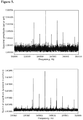
- FIG. 5 shows comparison of noise levels, including contributions of both analog and digital noise components, in mass spectra obtained from two transient signals acquired in parallel in the same analysis of ions in a mass spectrometer: one transient signal was acquired using an FTMS data acquisition system according to the prior art (mass spectrum in top panel), the other transient signal was acquired using an example of an apparatus according to the present invention (mass spectrum in bottom panel);
- FIG. 6 shows comparison of digital noise levels in mass spectra (bottom panels) obtained from two transient signals (top panels) simulated for the prior art with insufficient amplification (mass spectrum in right bottom panel) and simulated for an example of an apparatus according to the present invention with the automatic gain control (AGC) functionality for signal amplification (mass spectrum in left bottom panel);
- AGC automatic gain control
- FIG. 7A shows real-part Fourier spectra of two transient signals of 13 compounds of a calibration mixture (calibrants): top panel, demonstrating a mixed-mode display, corresponds to the simulations for the prior art with phase distortions; bottom panel, demonstrating the correct absorption-mode display, corresponds to an example of an apparatus according to the present invention.
- FIG. 7B shows a magnified view in the two spectra of FIG. 7A in the frequency region around one of the calibrants
- FIG. 8 is a schematic flow diagram representation of the automatic gain control (AGC) functionality for signal amplification of an example of an apparatus according to the present invention when such apparatus is coupled to a Fourier transform mass spectrometer (an Orbitrap FTMS is shown by example);
- AGC automatic gain control
- CID collision induced dissociation
- FIG. 10 shows examples of transient signals (top panels) in sequential stages, shown from left to right, of MS 2 -type analysis of a large molecule or a protein (corresponding mass spectra are shown in bottom panels) according to the prior art with under-estimated amplification gains, demonstrating substantial reduction of transient signal amplitude after the fragmentation event;
- FIG. 11 is a schematic flow diagram representation of MS n -type analysis of a small molecule (e.g., a peptide) using an example of an apparatus according to the present invention with the automatic gain control (AGC) functionality for signal amplification;
- AGC automatic gain control
- FIG. 12 is a schematic flow diagram representation of mass spectral analysis with fluctuating ion sources using an example of an apparatus according to the present invention with the automatic gain control (AGC) functionality for signal amplification (MALDI ion source is shown by example).
- AGC automatic gain control
- MALDI ion source is shown by example.
- Fluctuating ion sources refer to significant (e.g., 2-10 fold) variation in the number of ions (charges) injected into a mass analyzer between different single experiments (scans) within the same experiment (which may contain, for example 100-1000 scans);
- FIG. 13 shows examples of a transient signal (top panel) and a corresponding mass spectrum (bottom panel) of an MS 2 event in quantitative proteomics experiments with isobaric labeling (e.g., TMT or iTRAQ labels) using a Fourier transform mass analyzer according to the prior art; the transient signal was acquired in a broad m/z range including the reporter region shown in the inset in bottom panel;
- isobaric labeling e.g., TMT or iTRAQ labels
- FIG. 14 is a schematic flow diagram representation of an MS 2 event in quantitative proteomics experiments with isobaric labeling (e.g., TMT or iTRAQ labels) where the transient signal and corresponding mass spectrum are acquired for a narrow m/z range with reporter ions using a Fourier transform mass analyzer in conjunction with an example of an apparatus according to the present invention with the automatic gain control (AGC) functionality for signal amplification, whereas the mass spectrum including the higher m/z region may be separately acquired using a another, for example low resolution, mass analyzer in parallel with the acquisition of the above-mentioned narrow-m/z-range mass spectrum.
- isobaric labeling e.g., TMT or iTRAQ labels
- FIG. 15A is a schematic flow diagram representation of a “top N”-experiment with isobaric labeling (e.g., TMT or iTRAQ labelling approaches) where ion accumulation and fragmentation (dissociation) events are carried out in parallel with trapping and analysis of ions in Fourier transform and another, for example, low resolution mass analyzers for the lower m/z (reporter ions) and higher m/z regions respectively, wherein transient signals and corresponding mass spectra for the lower m/z region are acquired using an example of an apparatus according to the present invention; and
- isobaric labeling e.g., TMT or iTRAQ labelling approaches
- ion accumulation and fragmentation (dissociation) events are carried out in parallel with trapping and analysis of ions in Fourier transform and another, for example, low resolution mass analyzers for the lower m/z (reporter ions) and higher m/z regions respectively, wherein transient signals and corresponding mass spectra for the
- FIG. 15B is a schematic block diagram representation of a mass spectrometer for a parallel and separate acquisition of transient signals in the lower m/z (reporter ions) and broad m/z ranges “top N”-experiment with isobaric labeling (e.g., TMT or iTRAQ labels) according to the present invention.
- isobaric labeling e.g., TMT or iTRAQ labels
- the present invention provides an apparatus and methods for acquisition of mass spectral data, such as digitized time-domain (transient) signals and corresponding mass spectra, from an analog signal generated in response to ion motion in a mass spectrometer by a transducer that employs induced current sensing for ion detection.
- mass spectral data such as digitized time-domain (transient) signals and corresponding mass spectra
- the proposed apparatus is distinct from the prior art, in particular, by its back-end with a high-performance field-programmable gate array (FPGA) chip for advanced triggering of data acquisition and sophisticated in-line digital signal processing (DSP), as well as by its front-end for advanced signal conditioning.
- FPGA field-programmable gate array
- FIG. 1B is a schematic block diagram representation of an example of an apparatus according to the present invention.
- An analog signal that is generated in a mass spectrometer by an induced current sensing transducer is routed, possibly through one or more amplification stages, to the analog input (AI) 15 of the apparatus.
- the signal After entering the apparatus, the signal passes through a signal conditioning sub-system, 16 , which amplifies and filters the continuous analog signal from the mass spectrometer.
- conditioned analog signal further passes to an analog-to-digital conversion sub-system, 17 , which converts in real time said conditioned analog signal into a continuous stream of digital data.
- this stream is sent to a digital signal processing sub-system, 18 , which is based on a field-programmable gate array (FPGA) chip, for triggering of data acquisition and for in-line digital signal processing (DSP) of said digital stream.
- FPGA field-programmable gate array
- DSP digital signal processing
- individual digitized transients are transferred to a host computer, 20 , through a data bus, 19 , for further signal processing, e.g. absorption-mode Fourier transformation.
- the amplification factors (gain levels) of all the n amplifiers are pre-set to diverse values, e.g., covering two orders of magnitude.
- the amplification factors are preferably different, but some of them may be equal.
- the filters are of the same type and of the same order to have preferably identical amplitude-frequency and amplitude-phase characteristics.
- these filters have a passband width that is exceeding, in the sense of positive-value frequencies, by at least ten-fold the fundamental frequency of ion motion in the mass spectrometer for the lowest m/z value of interest (for example, the passband ranging from DC to 50 . . . 125 MHz if the fundamental frequency of ion motion is 5 MHz for the lowest m/z value of interest).
- 27 - 29 one ADC per each of the analog paths in the signal conditioning sub-system, 16 .
- a corresponding ADC produces a digital stream of samples. It is essential that, unlike in the prior art, the ADCs operate with a sample rate exceeding at least twice the full passband of said analog filter in the sense of positive-value frequencies (for example, the sample rate of 100 . . . 250 MHz if the passband width is 50 . . . 125 MHz in the sense of positive-value frequencies).
- the digital signal processing sub-system provides a digital triggering valve, 30 , digital filter-downsampler, 31 , and, if n>1, a digital implementation of automatic gain control (AGC), 32 , for selecting a digital signal corresponding to a suitable analog path in the signal conditioning sub-system, 16 .
- the triggering valve controls the n digital streams so that all the streams are either blocked or passed further based on a digital decoder.
- the digital decoder controls the valve by decoding the start and stop events in generation of each individual transient signal in order to achieve an optimal (maximized) duty cycle of data acquisition, as depicted in FIG. 4B .
- Acquisition of digital transients, 36 takes the full available time Ti.
- the digitized transients are sent to the host computer in a form suitable for absorption mode Fourier transform processing, FIG. 7 . No phase correction pre-processing is required on the host computer side. Additionally, unlike in the prior art, the transient data is acquired without imposing limits on the maximum detection period T of a transient signal.
- the digital filter-downsampler, 31 is a digital integer downsampler with a digital finite-response filter (FIR) processing the n data streams in parallel.
- the digital downsampler produces decimated digital transient signals with a passband width of 1 . . . 2 the fundamental frequency of ion motion for the lowest m/z value of interest (e.g., if the original sampling frequency is 250 MHz, a decimation factor of 64 results in the sample rate of 3.90625 MHz and the passband ranging from DC to 3 . . . 3.9 MHz).
- the digital filter is preferably of high dynamic range.
- the digital filter is synthesized to obtain a linear phase function with any non-linear deviations from this linear function being below a desirable level.
- FIG. 5 shows cumulative improvement in the signal-to-noise ratio (S/N) in experimental mass spectra due to reduced analog and digital noise in question relative to the prior art.
- An amplitude analyzer is provided in the digital signal processing sub-system, when n>1, to reject from the n digital variants received for each individual transient signal those that are clipped, if any, and then to select from the remaining variants one that, for example, was acquired with maximum amplification factor in the signal conditioning sub-system, 16 .
- AGC automatic gain control
- FIGS. 11 and 12 schematic flow diagrams of applications of the AGC for signal amplification in MS n and MALDI experiments are shown in FIGS. 11 and 12 , respectively.
- Application example depicted in FIG. 11 may refer to structural analysis of small molecules, e.g., natural products, when after precursor ion selection and isolation ( FIG. 11 top panel) two or more fragmentation steps are required for in-depth molecular structural analysis. Typically, 3-4 MS/MS stages are performed for small molecule analysis using ESI MS/MS.
- Isolation of precursor ions at each stage can take place in an ion trap, e.g., linear ion trap, hyphenated to a high resolution FTMS mass analyzer. Similar approach of multistage MS/MS can be also applied to analysis of protein complexes, for example using native mass spectrometry.
- protein subunits can be first ejected out of a complex (MS/MS stage), followed by subunit fragmentation (MS/MS/MS stage).
- MS/MS/MS stage subunit fragmentation
- FIG. 11 CID is shown as a fragmentation method, whereas other tandem MS methods can be applied, including electron transfer dissociation, electron capture dissociation, higher energy collision induced dissociation, infrared multiphoton dissociation and ultraviolet photodissociation.
- Examples shown in FIG. 12 illustrate applications with unpredictable and highly variable numbers of ions (charges) between scans (not necessarily consecutive), shown using the case of MALDI-based MS.
- the latter method is one of the most commonly employed ones for imaging MS applications.
- Other ionization methods employed for imaging include desorption electrospray ionization (DESI), secondary ion mass spectrometry (SIMS), and LDI without matrix application.
- DESI desorption electrospray ionization
- SIMS secondary ion mass spectrometry
- LDI without matrix application.
- transient amplification gain is data-dependent and is thus selected out of several transients acquired in parallel for each scan.
- the sensitivity can be increased in quantitative proteomics experiments, for example using isobaric labeling (as employed in multichannel TMT, iTRAQ, neutron encoded parallel reaction monitoring or NeuCode PRM, and neutron encoded stable isotopic labelling in amino acid cell culture or NeuCode SILAC) and in quantitative metabolomics experiments, for example using isobaric labeling of lipids, FIGS. 13-15 .
- isobaric labeling as employed in multichannel TMT, iTRAQ, neutron encoded parallel reaction monitoring or NeuCode PRM, and neutron encoded stable isotopic labelling in amino acid cell culture or NeuCode SILAC
- transient signals are acquired for a narrow m/z range, limited to the region of interest where peaks to resolve are located, for example reporter m/z region in TMT/iTRAQ approaches, using Fourier transform mass analyzer and the AGC for signal amplification, whereas, mass spectra in a broad m/z region including higher or lower m/z values are separately acquired with, for example, a low resolution mass analyzer, see FIG. 15B .
- FIG. 15B is a tribrid orbitrap-routing multipole-linear ion trap mass spectrometer, commercially known as OrbitrapTM FusionTM LumosTM from Thermo Scientific (Bremen, Germany).
- FIG. 13 shows a typical multichannel quantitative proteomics experiment of TMT/iIRAQ approach, which corresponds to the prior art.
- Experimental sequence corresponding to the present invention follows an approach visualized in FIG. 14 .
- Number of quantitation channels in FIGS. 13 and 14 can be equal to, for example, 6 . . . 20, or more.
- a particular example is a 10-plex TMT protein quantitation approach with 6.3 mDa splitting between 3 pairs of reporter ions.
- FIG. 15A describes a natural extension of experimental sequence shown in FIG.
- the number of targeted peptides can be further increased to, for example, 50-100 potentially addressable peptides per each MS/MS or MS/MS/MS cycle. That may be achieved due to the increased quality of each transient leading to reduced, for example 2 . . . 10-fold, transient duration required to resolve the reporter ions, for example using super-resolution methods of signal processing, and to the optimized sensitivity in each measurement.
- transient automatic gain control can be applied along the time-axis of the transient signal.
- the whole transient can be split into a left and right sections and each of these transient sections can be amplified with a corresponding amplification factor. More than two sections can be considered.
- Particular cases for such applications can be with transients decaying in time or transients with pronounced bit patterns as obtained for multiply-charged ions, especially of large molecules, e.g., proteins.
- the present invention has several particularly favorable embodiments, aiming for improved performance of analytical instrumentation and related applications, for example as employed using Fourier transform mass spectrometry, including the following:
Landscapes
- Chemical & Material Sciences (AREA)
- Analytical Chemistry (AREA)
- Other Investigation Or Analysis Of Materials By Electrical Means (AREA)
Abstract
Description
-
- a) data acquisition without introduction of substantial phase distortions and analog noise to digitized transient signals;
- b) data acquisition with maximized duty cycle of transient signal digitization, as well as without pre-setting detection periods of transient signals;
- c) data acquisition with automatic gain control (AGC) functionality for eliminating introduction of substantial digital noise to digitized transient signals.
-
- a) data acquisition without introduction of substantial phase distortions and analog noise to digitized transient signals;
- b) data acquisition with maximized duty cycle of transient signal digitization, as well as without pre-setting detection periods of transient signals;
- c) data acquisition with automatic gain control (AGC) functionality for eliminating introduction of substantial digital noise to digitized transient signals.
-
- 1. Data acquisition without introduction of substantial non-linear phase distortions to digitized transient signals. There is no analog anti-aliasing filters with a relatively low cut-off frequency, i.e. whose where f0≈fmax where fmax is the fundamental frequency for the lowest m/z of interest (e.g., fmax of 0.5 . . . 5 MHz). An anti-aliasing filter with a high cut-off frequency, f0, should be employed, exceeding fmax by at least an order, and preferably by two orders, of magnitude (e.g. f0=100 MHz). Therefore, signal sampling frequency, fs, of analog-to-digital converter(s) should be set sufficiently high (e.g. fs=250 MHz).
- 2. The resolution and mass accuracy of mass spectra may be improved due to eliminating introduction of substantial phase distortions to transient signals, providing improved transient signal processing, for example to provide absorption-mode FT spectral representation without phase correction requirements, as well as for least-squares fitting processing.
- 3. The resolution, sensitivity, and mass accuracy of mass spectra may be improved due to optimized (maximized) duty cycle of transient data acquisition, achieving acquisition of transient signals during full available periods of ion trapping in a mass analyzer.
- 4. Data acquisition without imposing an upper limit on the maximum detection period of a transient signal. Long transients would result in increased resolution performance and eliminate or reduced the need for frequency reduction using heterodyne detection.
- 5. The sensitivity of mass spectra may be improved due to optimized analog signal conditioning prior to signal digitization for each mass measurement experiment. The required gain (amplification) is to be determined based on the strength of transient signal in the given experiment instead of the pre-set value based on diverse assumptions, e.g., pre-scan total ion current or target charge value.
- 6. To enable on-the-fly selection of transient amplification (gain) it is suggested to employ multiple signal amplifiers functioning in parallel. The multiple transients of the same mass measurement provided by the amplifiers are to be digitized simultaneously. Transient(s) providing the most sensitive and artifact-free signal digitization is (are) to be employed for further use.
- 7. Transient amplification (gain) may be selected based on the information on the accumulated number of charges, provided prior to ion detection. In case if a pre-set target chage is not reached and ion accumulation time reaches the maximum allowed ion accumulation time in a particular MS scan, the gain of the amplifier may be increased.
Claims (21)
Applications Claiming Priority (4)
| Application Number | Priority Date | Filing Date | Title |
|---|---|---|---|
| IBPCT/IB2016/051887 | 2016-04-01 | ||
| WOPCT/IB2016/051887 | 2016-04-01 | ||
| IB2016051887 | 2016-04-01 | ||
| PCT/IB2017/051867 WO2017168389A1 (en) | 2016-04-01 | 2017-03-31 | Data acquisition apparatus and methods for mass spectrometry |
Publications (2)
| Publication Number | Publication Date |
|---|---|
| US20190043704A1 US20190043704A1 (en) | 2019-02-07 |
| US11222774B2 true US11222774B2 (en) | 2022-01-11 |
Family
ID=58664744
Family Applications (1)
| Application Number | Title | Priority Date | Filing Date |
|---|---|---|---|
| US16/090,446 Active 2038-12-18 US11222774B2 (en) | 2016-04-01 | 2017-03-31 | Data acquisition apparatus and methods for mass spectrometry |
Country Status (3)
| Country | Link |
|---|---|
| US (1) | US11222774B2 (en) |
| EP (1) | EP3440691B1 (en) |
| WO (1) | WO2017168389A1 (en) |
Cited By (1)
| Publication number | Priority date | Publication date | Assignee | Title |
|---|---|---|---|---|
| US11361952B2 (en) * | 2017-12-22 | 2022-06-14 | Thermo Fisher Scientific (Bremen) Gmbh | Method and device for crosstalk compensation |
Families Citing this family (13)
| Publication number | Priority date | Publication date | Assignee | Title |
|---|---|---|---|---|
| WO2018112188A1 (en) * | 2016-12-14 | 2018-06-21 | Waveguide Corporation | Variable gain amplification for linearization of nmr signals |
| GB201802917D0 (en) | 2018-02-22 | 2018-04-11 | Micromass Ltd | Charge detection mass spectrometry |
| US10600632B2 (en) * | 2018-08-23 | 2020-03-24 | Thermo Finnigan Llc | Methods for operating electrostatic trap mass analyzers |
| RU196283U1 (en) * | 2019-12-16 | 2020-02-21 | Общество с ограниченной ответственностью "Газпром трансгаз Уфа" | DEVICE FOR SPECTRAL ANALYSIS OF NOISED ELECTRICAL SIGNALS |
| US11270874B2 (en) * | 2020-03-30 | 2022-03-08 | Thermo Finnigan Llc | Amplifier amplitude digital control for a mass spectrometer |
| US11842891B2 (en) | 2020-04-09 | 2023-12-12 | Waters Technologies Corporation | Ion detector |
| US11581916B2 (en) * | 2020-06-18 | 2023-02-14 | Qualcomm Incorporated | Wideband positioning reference signal processing via sub-nyquist sampling |
| CN112904772A (en) * | 2021-01-20 | 2021-06-04 | 上海为讷科学仪器有限公司 | Special thick film circuit applied to electronic circuit precision measurement and signal processing |
| WO2023111707A1 (en) | 2021-12-15 | 2023-06-22 | Waters Technologies Corporation | An inductive detector with integrated amplifier |
| CN114415933B (en) * | 2021-12-29 | 2024-03-29 | 北京无线电计量测试研究所 | Cross-correlation operator based on FPGA, processing method and signal processing system |
| US20240085387A1 (en) * | 2022-06-07 | 2024-03-14 | University Of Washington | Multi-stage tandem mass spectrometry for protonated glycan isomer assignment |
| US12354762B2 (en) * | 2022-09-28 | 2025-07-08 | Infineon Technologies Austria Ag | Ion movement control system with low pass filter in analog switch |
| CN116758891A (en) * | 2023-07-13 | 2023-09-15 | 广州声博士声学技术有限公司 | An active noise control method, system, equipment and medium |
Citations (3)
| Publication number | Priority date | Publication date | Assignee | Title |
|---|---|---|---|---|
| US20060132346A1 (en) | 2004-12-22 | 2006-06-22 | Tryggvason Bjami V | Digital data acquisition system |
| US20070136017A1 (en) * | 2003-10-20 | 2007-06-14 | Yongdong Wang | Method for calibrating mass spectrometry (ms) and other instrument systems and for processing ms and other data |
| WO2016004542A1 (en) | 2014-07-09 | 2016-01-14 | Tofwerk Ag | Device for mass spectrometry |
-
2017
- 2017-03-31 EP EP17720875.8A patent/EP3440691B1/en active Active
- 2017-03-31 US US16/090,446 patent/US11222774B2/en active Active
- 2017-03-31 WO PCT/IB2017/051867 patent/WO2017168389A1/en not_active Ceased
Patent Citations (3)
| Publication number | Priority date | Publication date | Assignee | Title |
|---|---|---|---|---|
| US20070136017A1 (en) * | 2003-10-20 | 2007-06-14 | Yongdong Wang | Method for calibrating mass spectrometry (ms) and other instrument systems and for processing ms and other data |
| US20060132346A1 (en) | 2004-12-22 | 2006-06-22 | Tryggvason Bjami V | Digital data acquisition system |
| WO2016004542A1 (en) | 2014-07-09 | 2016-01-14 | Tofwerk Ag | Device for mass spectrometry |
Non-Patent Citations (7)
| Title |
|---|
| International Search Report for PCT/IB2017/051867, dated Jul. 31, 2017, 5 pages. |
| Lange, Oliver, et al., "Enhanced Fourier transform for Orbitrap mass spectrometry," International Journal of Mass Spectrometry, vol. 369, 2014, pp. 16-22. |
| Marshall, Alan G., et al., "40 years of Fourier transform ion cyclotron resonance mass," International Journal of Mass Spectrometry, vol. 377, 2015, pp. 410-420. |
| Scigelova, Michaela, et al., "Fourier Transform Mass Spectrometry," Molecular & Cellular Proteomics 10.7, 2011, M111.009431, 19 pages. |
| Written Opinion of the ISA for PCT/IB2017/051867, dated Jul. 31, 2017, 8 pages. |
| Xiaofang et al., "Time Measurement System Based on Waveform Digitization for Time-of-Flight Mass Spectrometer", IEEE Transactions On Nuclear Science, vol. 60, No. 6, Dec. 1, 2013, pp. 4588-4594. |
| Zubarev, Roman A., et al., "Orbitrap Mass Spectrometry," Analytical Chemistry, vol. 85, 2013, pp. 5288-5296. |
Cited By (2)
| Publication number | Priority date | Publication date | Assignee | Title |
|---|---|---|---|---|
| US11361952B2 (en) * | 2017-12-22 | 2022-06-14 | Thermo Fisher Scientific (Bremen) Gmbh | Method and device for crosstalk compensation |
| US11817301B2 (en) | 2017-12-22 | 2023-11-14 | Thermo Fisher Scientific (Bremen) Gmbh | Method and device for crosstalk compensation |
Also Published As
| Publication number | Publication date |
|---|---|
| EP3440691A1 (en) | 2019-02-13 |
| EP3440691B1 (en) | 2021-11-03 |
| WO2017168389A1 (en) | 2017-10-05 |
| US20190043704A1 (en) | 2019-02-07 |
Similar Documents
| Publication | Publication Date | Title |
|---|---|---|
| US11222774B2 (en) | Data acquisition apparatus and methods for mass spectrometry | |
| Marshall et al. | High-resolution mass spectrometers | |
| JP5027511B2 (en) | Method for calibrating mass spectrometry (MS) and other instrument systems and processing MS and other data | |
| Michalski et al. | Ultra high resolution linear ion trap Orbitrap mass spectrometer (Orbitrap Elite) facilitates top down LC MS/MS and versatile peptide fragmentation modes | |
| Lange et al. | Enhanced Fourier transform for Orbitrap mass spectrometry | |
| Stone et al. | Surface-induced dissociation on a MALDI-ion mobility-orthogonal time-of-flight mass spectrometer: sequencing peptides from an “in-solution” protein digest | |
| EP2642508A2 (en) | A method of processing image charge/current signals | |
| US20080067349A1 (en) | Multi-channel time-of-flight mass spectrometer | |
| US20160217985A1 (en) | Targeted mass analysis | |
| US10354849B2 (en) | Method of recording ADC saturation | |
| WO2014171390A1 (en) | Analysis system | |
| Belov et al. | Dynamic range expansion applied to mass spectrometry based on data-dependent selective ion ejection in capillary liquid chromatography Fourier transform ion cyclotron resonance for enhanced proteome characterization | |
| CN108982729A (en) | System and method for extracting mass traces | |
| Strittmatter et al. | High mass measurement accuracy determination for proteomics using multivariate regression fitting: application to electrospray ionization time-of-flight mass spectrometry | |
| US10297436B2 (en) | Device and method for ion cyclotron resonance mass spectrometry | |
| JP2022508140A (en) | Orbitrap for single particle mass spectroscopy | |
| US20260066250A1 (en) | Method and device for the quantification of target ion species | |
| Perez et al. | Applications of time-of-flight and orbitrap mass spectrometry in environmental, food, doping, and forensic analysis | |
| US9595427B2 (en) | Acquisition of fragment ion mass spectra of biopolymers in mixtures | |
| Brown et al. | Miniaturized ultra high field asymmetric waveform ion mobility spectrometry combined with mass spectrometry for peptide analysis | |
| JP5003508B2 (en) | Mass spectrometry system | |
| US7529629B2 (en) | Computational methods and systems for multidimensional analysis | |
| EP1623352B1 (en) | Computational methods and systems for multidimensional analysis | |
| US8680461B2 (en) | Analytical instrumentation, apparatuses, and methods | |
| Dennis et al. | Distance-of-Flight Mass Spectrometry: What, Why, and How? |
Legal Events
| Date | Code | Title | Description |
|---|---|---|---|
| FEPP | Fee payment procedure |
Free format text: ENTITY STATUS SET TO UNDISCOUNTED (ORIGINAL EVENT CODE: BIG.); ENTITY STATUS OF PATENT OWNER: SMALL ENTITY |
|
| AS | Assignment |
Owner name: SPECTROSWISS SARL, SWITZERLAND Free format text: ASSIGNMENT OF ASSIGNORS INTEREST;ASSIGNORS:KOZHINOV, ANTON;TSYBIN, YURY;NAGORNOV, KONSTANTIN;SIGNING DATES FROM 20181009 TO 20181012;REEL/FRAME:047222/0168 |
|
| FEPP | Fee payment procedure |
Free format text: ENTITY STATUS SET TO SMALL (ORIGINAL EVENT CODE: SMAL); ENTITY STATUS OF PATENT OWNER: SMALL ENTITY |
|
| STPP | Information on status: patent application and granting procedure in general |
Free format text: APPLICATION DISPATCHED FROM PREEXAM, NOT YET DOCKETED |
|
| STPP | Information on status: patent application and granting procedure in general |
Free format text: DOCKETED NEW CASE - READY FOR EXAMINATION |
|
| STPP | Information on status: patent application and granting procedure in general |
Free format text: NON FINAL ACTION MAILED |
|
| STPP | Information on status: patent application and granting procedure in general |
Free format text: RESPONSE TO NON-FINAL OFFICE ACTION ENTERED AND FORWARDED TO EXAMINER |
|
| STPP | Information on status: patent application and granting procedure in general |
Free format text: NOTICE OF ALLOWANCE MAILED -- APPLICATION RECEIVED IN OFFICE OF PUBLICATIONS |
|
| STPP | Information on status: patent application and granting procedure in general |
Free format text: PUBLICATIONS -- ISSUE FEE PAYMENT VERIFIED |
|
| STCF | Information on status: patent grant |
Free format text: PATENTED CASE |
|
| MAFP | Maintenance fee payment |
Free format text: PAYMENT OF MAINTENANCE FEE, 4TH YR, SMALL ENTITY (ORIGINAL EVENT CODE: M2551); ENTITY STATUS OF PATENT OWNER: SMALL ENTITY Year of fee payment: 4 |