US11222236B2 - Image question answering method, apparatus and system, and storage medium - Google Patents
Image question answering method, apparatus and system, and storage medium Download PDFInfo
- Publication number
- US11222236B2 US11222236B2 US16/798,359 US202016798359A US11222236B2 US 11222236 B2 US11222236 B2 US 11222236B2 US 202016798359 A US202016798359 A US 202016798359A US 11222236 B2 US11222236 B2 US 11222236B2
- Authority
- US
- United States
- Prior art keywords
- feature
- question
- detection frame
- image
- global
- Prior art date
- Legal status (The legal status is an assumption and is not a legal conclusion. Google has not performed a legal analysis and makes no representation as to the accuracy of the status listed.)
- Active, expires
Links
Images




Classifications
-
- G06K9/6256—
-
- G—PHYSICS
- G06—COMPUTING OR CALCULATING; COUNTING
- G06F—ELECTRIC DIGITAL DATA PROCESSING
- G06F40/00—Handling natural language data
- G06F40/20—Natural language analysis
- G06F40/279—Recognition of textual entities
- G06F40/284—Lexical analysis, e.g. tokenisation or collocates
-
- G—PHYSICS
- G06—COMPUTING OR CALCULATING; COUNTING
- G06F—ELECTRIC DIGITAL DATA PROCESSING
- G06F16/00—Information retrieval; Database structures therefor; File system structures therefor
- G06F16/30—Information retrieval; Database structures therefor; File system structures therefor of unstructured textual data
- G06F16/33—Querying
- G06F16/332—Query formulation
- G06F16/3329—Natural language query formulation
-
- G—PHYSICS
- G06—COMPUTING OR CALCULATING; COUNTING
- G06F—ELECTRIC DIGITAL DATA PROCESSING
- G06F18/00—Pattern recognition
- G06F18/20—Analysing
- G06F18/21—Design or setup of recognition systems or techniques; Extraction of features in feature space; Blind source separation
- G06F18/214—Generating training patterns; Bootstrap methods, e.g. bagging or boosting
-
- G—PHYSICS
- G06—COMPUTING OR CALCULATING; COUNTING
- G06F—ELECTRIC DIGITAL DATA PROCESSING
- G06F18/00—Pattern recognition
- G06F18/20—Analysing
- G06F18/24—Classification techniques
- G06F18/241—Classification techniques relating to the classification model, e.g. parametric or non-parametric approaches
- G06F18/2413—Classification techniques relating to the classification model, e.g. parametric or non-parametric approaches based on distances to training or reference patterns
-
- G—PHYSICS
- G06—COMPUTING OR CALCULATING; COUNTING
- G06F—ELECTRIC DIGITAL DATA PROCESSING
- G06F40/00—Handling natural language data
- G06F40/30—Semantic analysis
-
- G06K9/2054—
-
- G06K9/4676—
-
- G—PHYSICS
- G06—COMPUTING OR CALCULATING; COUNTING
- G06N—COMPUTING ARRANGEMENTS BASED ON SPECIFIC COMPUTATIONAL MODELS
- G06N3/00—Computing arrangements based on biological models
- G06N3/02—Neural networks
- G06N3/04—Architecture, e.g. interconnection topology
- G06N3/044—Recurrent networks, e.g. Hopfield networks
- G06N3/0442—Recurrent networks, e.g. Hopfield networks characterised by memory or gating, e.g. long short-term memory [LSTM] or gated recurrent units [GRU]
-
- G—PHYSICS
- G06—COMPUTING OR CALCULATING; COUNTING
- G06N—COMPUTING ARRANGEMENTS BASED ON SPECIFIC COMPUTATIONAL MODELS
- G06N3/00—Computing arrangements based on biological models
- G06N3/02—Neural networks
- G06N3/04—Architecture, e.g. interconnection topology
- G06N3/045—Combinations of networks
-
- G—PHYSICS
- G06—COMPUTING OR CALCULATING; COUNTING
- G06N—COMPUTING ARRANGEMENTS BASED ON SPECIFIC COMPUTATIONAL MODELS
- G06N3/00—Computing arrangements based on biological models
- G06N3/02—Neural networks
- G06N3/04—Architecture, e.g. interconnection topology
- G06N3/0464—Convolutional networks [CNN, ConvNet]
-
- G—PHYSICS
- G06—COMPUTING OR CALCULATING; COUNTING
- G06N—COMPUTING ARRANGEMENTS BASED ON SPECIFIC COMPUTATIONAL MODELS
- G06N3/00—Computing arrangements based on biological models
- G06N3/02—Neural networks
- G06N3/08—Learning methods
- G06N3/09—Supervised learning
Definitions
- VQA Visual Question Answering
- the present disclosure relates to the field of CV (Computer Vision), and in particular, to an image question answering method, apparatus and system, and a storage medium
- the present disclosure provides technical solutions of image question answering.
- the image question answering method includes: extracting a question feature representing a semantic meaning of a question, a global feature of an image, and a detection frame feature of a detection frame encircling an object in the image; obtaining a first weight of each of at least one area of the image and a second weight of each of at least one detection frame of the image according to the question feature, the global feature, and the detection frame feature; performing weighting processing on the global feature by using the first weight to obtain an area attention feature of the image; performing weighting processing on the detection frame feature by using the second weight to obtain a detection frame attention feature of the image; and predicting an answer to a question according to the question feature, the area attention feature, and the detection frame attention feature.
- the image question answering apparatus includes: a feature extractor for extracting the question feature representing the semantic meaning of the question, the global feature of the image, and the detection frame feature of the detection frame encircling the object in the image; a weight calculator for obtaining the first weight of each of at least one area of the image and the second weight of each detection frame in at least one detection frame of the image according to the question feature, the global feature, and the detection frame feature; an area attention extractor for performing weighting processing on the global feature by using the first weight to obtain the area attention feature of the image; a detection frame attention extractor for performing weighting processing on the detection frame feature by using the second weight to obtain the detection frame attention feature of the image; and a predictor for predicting the answer to the question according to the question feature, the area attention feature, and the detection frame attention feature.
- the image question answering system includes: a memory for storing executable instructions; and one or more processors.
- One or more processors communicate with the memory to execute the executable instructions so as to complete an operation corresponding to the image question answering method provided in the embodiments of the present disclosure, for example, including but not limited to performing the following operations: extracting the question feature representing the semantic meaning of the question, the global feature of the image, and the detection frame feature of the detection frame encircling the object in the image; obtaining the first weight of each of at least one area of the image and the second weight of each of at least one detection frame of the image according to the question feature, the global feature, and the detection frame feature; performing weighting processing on the global feature by using the first weight to obtain the area attention feature of the image; performing weighting processing on the detection frame feature by using the second weight to obtain the detection frame attention feature of the image; and predicting the answer to the question according to the question feature, the area attention feature, and the detection frame attention feature.
- an electronic device including: a memory for storing the executable instructions;
- the processor is configured to extract a question feature representing a semantic meaning of a question, a global feature of an image, and a detection frame feature of a detection frame encircling an object in the image; obtain a first weight of each of at least one area of the image and a second weight of each of at least one detection frame of the image according to the question feature, the global feature, and the detection frame feature; perform weighting processing on the global feature by using the first weight to obtain an area attention feature of the image; performing weighting processing on the detection frame feature by using the second weight to obtain a detection frame attention feature of the image; and predict an answer to a question according to the question feature, the area attention feature, and the detection frame attention feature.
- Yet another aspect of the embodiments of the present disclosure provides a non-transitory computer readable storage medium capable of storing computer readable instructions, where if the computer readable instructions are executed, the processor can perform an operation corresponding to any one of the image question answering methods provided in the embodiments of the present disclosure, for example, including but not limited to performing the following operations: extracting the question feature representing the semantic meaning of the question, the global feature of the image, and the detection frame feature of the detection frame encircling the object in the image; obtaining the first weight of each of at least one area of the image and the second weight of each of at least one detection frame of the image according to the question feature, the global feature, and the detection frame feature; performing weighting processing on the global feature by using the first weight to obtain the area attention feature of the image; performing weighting processing on the detection frame feature by using the second weight to obtain the detection frame attention feature of the image; and predicting the answer to the question according to the question feature, the area attention feature, and the detection frame attention feature.
- Yet another aspect of the embodiments of the present disclosure provides a computer program product, including computer readable codes, where if the computer readable codes run on a device, the processor in the device executes the instructions for implementing the image question answering method according to any one of the foregoing embodiments.
- FIG. 1 is a schematic flowchart of an embodiment of an image question answering method provided in the embodiments of the present disclosure.
- FIG. 2 is a schematic diagram of some embodiments of an image and a question related to the image provided in the embodiments of the present disclosure.
- FIG. 3 is a schematic flowchart of one example of a method for extracting a detection frame feature provided in the embodiments of the present disclosure.
- FIG. 4 is a schematic flowchart of one example of a method for obtaining a first weight provided in the embodiments of the present disclosure.
- FIG. 5 is a schematic flowchart of one example of a method for obtaining a second weight provided in the embodiments of the present disclosure.
- FIG. 6 is a schematic flowchart of one example of a method for predicting an answer to a question provided in the embodiments of the present disclosure.
- FIG. 7 is a schematic structural diagram of an embodiment of an image question answering apparatus provided in the embodiments of the present disclosure.
- FIG. 8 is a schematic structural diagram of an embodiment of an image question answering system provided in the embodiments of the present disclosure.
- the technical solutions of the present disclosure more comprehensively analyze an interaction between the image and the question, so that the efficiency and accuracy of image question answering are improved.
- the embodiments of the present disclosure may be applied to a computer system/server, which may operate with numerous other general-purpose or special-purpose computing system environments or configurations.
- Examples of well-known computing systems, environments, and/or configurations suitable for use together with the computer system/server include, but are not limited to, Personal Computer (PC) systems, server computer systems, thin clients, thick clients, handheld or laptop devices, microprocessor-based systems, set top boxes, programmable consumer electronics, network PCs, small computer systems, large computer systems, distributed cloud computing environments that include any one of the foregoing systems, and the like.
- PC Personal Computer
- server computer systems thin clients, thick clients, handheld or laptop devices
- microprocessor-based systems set top boxes
- programmable consumer electronics network PCs
- small computer systems small computer systems
- large computer systems distributed cloud computing environments that include any one of the foregoing systems, and the like.
- the computer system/server may be described in the general context of computer system executable instructions (for example, program modules) executed by the computer system.
- the program modules may include routines, programs, target programs, components, logics, data structures, and the like for performing specific tasks or implementing specific abstract data types.
- the computer systems/servers may be practiced in the distributed cloud computing environments in which tasks are executed by remote processing devices that are linked through a communications network.
- the program modules may be located in local or remote computing system storage media including storage devices.
- FIG. 1 is a schematic flowchart of an embodiment of an image question answering method 1000 provided in the embodiments of the present disclosure.
- the method may be performed by any electronic device, such as a terminal device, a server, a mobile device, and the like.
- the method of the embodiments includes the following operations.
- a question feature representing a semantic meaning of a question, a global feature of an image, and a detection frame feature of a detection frame encircling an object in the image are extracted.
- the question may be a question sentence associated with the image and consisting of the natural language.
- FIG. 2 is a schematic diagram of some embodiments of the image and the question related to the image provided in the embodiments of the present disclosure.
- the question is a question 2120 related to an image 2110 , i.e., “what is on the dish?”, a question 2220 related to an image 2210 , i.e., “what kind of sports is this?”, and a question 2320 related to an image 2310 , i.e., “is it sunny today?” and the like.
- the question feature of the question may be extracted by using a deep learning network.
- the question feature for example, may be represented as a feature vector, and the feature vector includes a semantic representation of the question.
- the global feature of the image may be expressed as a feature vector, and the feature vector includes a semantic representation of content of all areas of the image.
- feature extraction content of the image is not limited, i.e., the foreground content (including an object and the like) and the background content of the image are not distinguished. Therefore, the global feature of the image may reserve global visual content of the image and specific foreground content required for answering the question.
- the extracting the detection frame feature of the detection frame encircling the object in the image is different from the extracting the global feature of the image, firstly the foreground content and the background content of the image may need to be distinguished.
- the foreground content in the image may be marked by using the detection frame, for example, the object and the like.
- the detection frame for example, may be rectangular and may encircle the object in the image.
- the detection frame feature is extracted, only the image feature in the detection frame is extracted.
- the detection frame feature for example, is represented as the feature vector, and the feature vector includes a semantic representation of the content in the detection frame. Therefore, the detection frame feature may filter out a large amount of background information, thereby predicting the question related to the foreground content more efficiently and accurately.
- the operation S 1010 may be performed by the processor by invoking a corresponding instruction stored in the memory, or may also be performed by a feature extractor 2100 run by the processor.
- the first weight of each area in the plurality of areas of the image and the second weight of each detection frame in the plurality of detection frames of the image are obtained on the basis of the question feature, the global feature, and the detection frame feature.
- the operation introduces a visual attention mechanism.
- the visual attention mechanism may preliminarily associate the question with the image, thereby setting different attention weights for different parts of the image.
- the attention weight reflects an association level between the part and the question.
- the image part closely associated with the question may be efficiently concerned by introducing the visual attention mechanism, thereby improving the prediction efficiency and accuracy.
- the embodiments of the present disclosure introduce a double-channel visual attention mechanism.
- the visual attention mechanism is introduced on the basis of a natural partition of the image.
- the natural partition of the image indicates dividing the image into one or more areas in a natural position relationship without distinguishing the foreground content and the background content of the image.
- an image 2410 and an image 2510 both include the same image content and have a same associated question 2420 , i.e., “what is the man pouring?”.
- the image 2410 is divided into N ⁇ N areas 2411 on the basis of horizontal and vertical coordinates of the image 2410 , where N is an integer greater than or equal to 1, for example, in an example shown in FIG.
- the image 2410 is divided into 5 ⁇ 5 areas.
- the visual attention mechanism introduced on the basis of the natural partition preliminarily associates the question with the N ⁇ N areas of the image, respectively, so as to obtain the association level between each area in the N ⁇ N areas and the question.
- association level may be represented in a weight form. That is, the first weight of each area in the plurality of areas of the image may be obtained by introducing the visual attention mechanism on the basis of the natural partition of the image.
- the advantage of introducing the visual attention mechanism on the basis of the natural partition of the image is that the global visual content of the image is reserved to a larger extent, and particularly, the background content is reserved better. For example, when the question 2320 related to the image 2310 , i.e., “is it sunny today?” as shown in FIG. 2 is answered, since the question is actually related to the background content (sky) of the image 2310 , the introducing the visual attention mechanism on the basis of the natural partition of the image may perform answer prediction on such questions better.
- the visual attention mechanism is introduced on the basis of the detection frame of the image.
- the detection frame of the image identifies and encircles the foreground content (e.g., the object) of the image.
- the image may include one or more objects. Therefore, one or more detection frames may be generated in the image, for example, as shown in FIG. 2 , M detection frames 2511 are generated in the image 2510 , where M is an integer greater than or equal to 1. for example, in the example shown in FIG. 2 , 4 detection frames are generated in the image 2510 .
- the visual attention mechanism introduced on the basis of the detection frame of the image preliminarily associates the question with the M detection frames of the image, respectively, so as to obtain an association level between each of the M detection frames and the question. Such association level may be represented in the weight form. That is, the second weight of each detection frame in the plurality of detection frames of the image may be obtained by introducing the visual attention mechanism on the basis of the detection frame of the image.
- the advantage of introducing the visual attention mechanism on the basis of the detection frame of the image is that the foreground content of the image is concerned more closely, so that the question related to the foreground content may be answered efficiently and accurately.
- the question 2120 related to an image 2110 i.e., “what is on the dish?”
- the question 2220 related to the image 2210 i.e., “what kind of sports is this?” as shown in FIG.
- the introducing the visual attention mechanism on the basis of the detection frame of the image may ignore background information in the image 2110 and the image 2210 , and meanwhile, a greater weight is configured for the detection frame encircling the dish and the detection frame encircling a bat, so that more efficient and accurate answer prediction is performed on such questions.
- the operation S 1020 may be performed by the processor by invoking the corresponding instruction stored in the memory, or may be performed by a weight calculator 2200 run by the processor.
- weighted sum is performed on the global feature by using the first weight to obtain the area attention feature of the image.
- the global feature may include the plurality of area features related to the plurality of areas of the image, for example, a global feature vector may be formed by linking N ⁇ N area feature vectors.
- the first weight of each area in the N ⁇ N areas is obtained. Therefore, weighted sum may be performed on the N ⁇ N area feature vectors by using the N ⁇ N first weights, so as to obtain the area attention feature of the image, and the area attention feature, for example, may be represented in a vector form.
- the operation S 1030 may be performed by the processor by invoking a corresponding instruction stored in the memory, or may also be performed by an area attention extractor 2300 run by the processor.
- weighted sum is performed on the detection frame feature by using the second weight to obtain the detection frame attention feature of the image.
- the detection frame feature may include the plurality of detection frame sub-features related to the plurality of detection frames of the image, for example, a detection frame feature vector may be formed by linking M detection frame sub-feature vectors.
- the second weight of each detection frame in the M detection frames is obtained. Therefore, weighted sum may be performed on the M detection frame sub-feature vectors by using the M second weights, so as to obtain the detection frame attention feature of the image, and the detection frame attention feature, for example, may be represented in the vector form.
- the operation S 1040 may be performed by the processor by invoking a corresponding instruction stored in the memory, or may also be performed by a detection frame attention extractor 2400 run by the processor.
- an order between the operation S 1030 and the operation S 1040 may be exchanged, i.e., the operation S 1030 may be performed after the operation S 1040 is performed.
- the answer to the question is predicted on the basis of the question feature, the area attention feature, and the detection frame attention feature.
- relationships between the question feature and the area attention feature and the detection frame attention feature may also be learnt.
- Such prediction process may be processed as a multi-classification task, for example, a learning result may be classified by using a classifier, and the answer to the question is predicted according to scores of a plurality of candidate answers. According to the technical solution of the present disclosure, due to the introduction of the double-channel visual attention mechanism, efficient and accurate answer prediction may be implemented in a plurality of VQA scenes.
- the operation S 1050 is performed by the processor by invoking a corresponding instruction stored in the memory, or may also be performed by a predictor 2500 run by the processor.
- the extracting the question feature may include: performing feature extraction on the context of the words constituting the question by using the RNN, and obtaining the question feature.
- the question feature of the question may be extracted by using multiple kinds of deep learning networks, including but not limited to the CNN, the RNN and the like.
- the RNN different from the CNN in the usual sense, may provide output information at a previous time point as one of input information of the next time point, and therefore has an ability to learn historical information.
- the question is generally a question sentence consisting of the natural language.
- Such sentence includes a plurality of words, and there is a contextual relationship among the words, for example, when a question “is an apple or a pear placed on the dining table?” is parsed, it may be predicted that a word related to foods is likely to appear in the following text after performing semantic feature extraction on the word “dining table”. Therefore, in a process of question feature extraction, introducing the RNN having the ability to learn the historical information is beneficial.
- the RNN may include multiple kinds of variations, such as a Long Short-Term Memory (LSTM) unit and a Gated Recurrent Unit (GRU).
- LSTM Long Short-Term Memory
- GRU Gated Recurrent Unit
- One-hot encoding is an encoding mode that how many states the system has, how many bits the encoding has. In these bits, only one bit is 1, and the remaining bits are all 0, for example, the system sorts 5,000 words (i.e., 5,000 probable states), and therefore, the one-hot codes have 5,000 bits. In this case, the one-hot codes are viewed as a vector, and each element may only be 0 or 1.
- the bit of the element only corresponding to an input word is 1, and the remaining elements are all 0. In actual application, at least one bit may be reserved for the system for representing the words that are not sorted by the system.
- a text character may be converted to digitalized data.
- semantic feature extraction may be performed on the question on the basis of the one-hot codes, for example, a one-hot code input at the current moment and the previously output one-hot code feature extraction result are jointly input into the RNN.
- the RNN may perform encoding processing on the jointly input content in consideration of the historical information, and thus the semantic feature of the current word is extracted.
- the extracting the global feature may include: extracting the global feature by using the CNN, where the global feature includes the plurality of area features related to the plurality of areas of the image.
- An example of the CNN that may be used for performing global feature extraction of the image may include but is not limited to a ResNet network or a VGG-16 network.
- the CNN may aim at an application scene of an image identification task to perform pre-training by using an appropriate training sample set, such as ImageNet.
- the input image may be first adjusted to a size (e.g., the number of pixels) applicable to the used CNN, and then may be input to the CNN.
- the CNN may include a plurality of convolution kernels, and one feature channel output is obtained after performing a convolution operation on each convolution kernel and the image.
- the number of the convolution kernels (or the number of feature channels) of the CNN may be set according to the application scene of the image identification task.
- the global feature in the case that the image is divided into N ⁇ N areas on the basis of the horizontal and vertical coordinates of the image, the global feature may include the plurality of area features related to the plurality of areas of the image, for example, the global feature is represented as the vector form, and the global feature vector may be formed by linking the N ⁇ N area feature vectors.
- FIG. 3 is a schematic flowchart of one example of the method for extracting the detection frame feature provided in the embodiments of the present disclosure.
- the extracting the detection frame feature may include: at operation S 1031 , obtaining the plurality of detection frames encircling the object in the image by using the Faster-RCNN; at operation S 1032 , determining at least one detection frame according to the difference between the object encircled by the plurality of detection frames and the background of the image; at operation S 1033 , extracting at least one detection frame sub-feature on the basis of the at least one detection frame; and at operation S 1034 , obtaining the detection frame feature on the basis of the at least one detection frame sub-feature.
- the object and the background of the image may be first distinguished, which relates to an object identification technology.
- the Faster-RCNN is an efficient object identification network.
- the Faster-RCNN distinguishing from the RCNN and a Fast Region Convolutional Neural Network (Fast-RCNN) may automatically generate a candidate detection frame (Region Proposal).
- the Faster-RCNN may identify the image feature in the candidate detection frame, thereby determining whether the candidate detection frame encircles the object or the background. In the case that the candidate detection frame completely or partially encircles the object, the Faster-RCNN may further correct the size and position of the candidate detection frame, so as to completely encircle the object in the image in an appropriate size.
- the plurality of detection frames may be generated to encircle the plurality of objects in the image, for example, M′ detection frames may be generated to encircle M′ objects.
- the M′ detection frames all map score values of the objects included in the M′ detection frames, where the score value reflects a difference degree between the object and the background. The lower the score value, the smaller the difference between the object and the background.
- M detection frames is selected from the M′ detection frames according to the score values in a descending order to perform subsequent feature extractions, where M is less than or equal to M′; the detection frame sub-feature is extracted from a part of selected detection frames; and finally, the extracted detection frame sub-feature is synthesized into the detection frame feature.
- the detection frame feature is extracted by means of the mode above, so that the detection frame may be independently generated to reduce human intervention.
- object information having high quality may be extracted as far as possible, so as to provide an image parsing result having strong pertinence for the VQA task related to the foreground content.
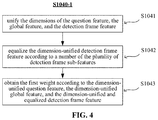
- FIG. 4 is a schematic flowchart of one example of the method for obtaining the first weight provided in the embodiments of the present disclosure.
- the obtaining the first weight S 1040 - 1 may include: at operation S 1041 , unifying the dimensions of the question feature, the global feature, and the detection frame feature; at operation S 1042 , equalizing a dimension-unified detection frame feature on the basis of the number of the plurality of detection frame sub-features; and at operation S 1043 , obtaining the first weight on the basis of a dimension-unified question feature, a dimension-unified global feature, and a dimension-unified and equalized detection frame feature.
- the visual attention mechanism may be introduced on the basis of the natural partition of the image.
- the image may be divided into the N ⁇ N areas on the basis of the horizontal and vertical coordinates.
- the visual attention mechanism introduced on the basis of the natural partition preliminarily associates the question with the N ⁇ N areas of the image, respectively, so as to obtain the association level between each area in the N ⁇ N areas and the question.
- the M detection frames may be selected from the image to perform the subsequent feature extractions, and the extracted features are linked into the detection frame feature.
- the features extracted from the M detection frames are M detection frame sub-features constituting the detection frame feature.
- the question feature, the global feature, and the detection frame feature all may be represented as the vector forms. Therefore, the dimensions of the three vectors may be unified to facilitate subsequent operations.
- the detection frame feature may be equalized on the basis of the number M of the detection frame sub-features so as to better learn and understand the global visual content of the image.
- the equalizing process and the dimension unification process may be represented by the following equation (1):
- R 1 tanh ⁇ ( W r ⁇ ⁇ 1 ⁇ R + b r ⁇ ⁇ 1 )
- ⁇ D 1 1 M ⁇ 1 ⁇ ( tanh ⁇ ( W d ⁇ ⁇ 1 ⁇ D + b d ⁇ ⁇ 1 ) T )
- ⁇ Q 1 tanh ⁇ ( W q ⁇ ⁇ 1 ⁇ Q + b q ⁇ ⁇ 1 ) ( 1 )
- Q is a question feature vector
- R is a global feature vector
- D is a detection frame feature vector
- Q 1 is the dimension-unified question feature
- D 1 is the dimension-unified and equalized detection frame feature
- R 1 is the dimension-unified global feature.
- W q1 , b q1 , W r1 , b r1 , W d1, and b d1 respectively are network parameters updated by using machine learning, and may be used to unify the dimensions of the question feature vector Q, the global feature vector R and the detection frame feature vector D.
- M represents the number of the detection frame sub-features
- tanh( ) is a hyperbolic tangent function
- 1 represents an all-ones vector.
- the first weight may be obtained on the basis of the dimension-unified question feature Q 1 , the dimension-unified global feature R 1 , and the dimension-unified and equalized detection frame feature D 1 , for example, the dimension-unified question feature Q 1 , the dimension-unified global feature R 1 , and the dimension-unified and equalized detection frame feature D 1 are added or multiplied element by element.
- a multiplying mode is adopted, such as performing Hadamard product.
- the first weight is obtained by multiplying the dimension-unified question feature Q 1 , the dimension-unified global feature R 1 , and the dimension-unified and equalized detection frame feature D 1 , so that more accurate weight information may be obtained.
- L2 norm regularization may be performed after multiplying to limit a norm of the vector.
- C 1 represents a joint feature representation of the dimension-unified question feature Q 1 , the dimension-unified global feature R 1 , and the dimension-unified and equalized detection frame feature D 1 ;
- Norm 2 represents L2 norm regularization, and
- ⁇ represents Hadamard product.
- C 1 is viewed as the first weight in the vector form and includes weight information of the plurality of areas of the image.
- further convolution operation is performed on the joint feature representation C 1 and activation is performed by using a Softmax function on the joint feature representation C 1 .
- a 1 softmax( W c1 *C 1 +b c1 ) (3)
- a 1 is a first weight in a scalar form
- W c1 and b c1 are network parameters updated by using machine learning.
- FIG. 5 is a schematic flowchart of one example of the method for obtaining the second weight provided in the embodiments of the present disclosure.
- the obtaining the second weight S 1040 - 2 may include: at operation S 1044 , unifying the dimensions of the question feature, the global feature, and the detection frame feature; at operation S 1045 , equalizing a dimension-unified global feature on the basis of the number of the plurality of area features; and at operation S 1046 , obtaining the second weight on the basis of a dimension-unified question feature, a dimension-unified detection frame feature, and a dimension-unified and equalized global feature.
- the visual attention mechanism may be introduced on the basis of the detection frame of the image.
- the detection frame feature may include M detection frame sub-feature related to the M detection frames of the image.
- the visual attention mechanism introduced on the basis of the detection frame of the image preliminarily associates the question with the M detection frames of the image, respectively, so as to obtain an association level between each of the M detection frames and the question.
- the image may include N ⁇ N areas. Feature vector extraction is performed on the N ⁇ N areas, and N ⁇ N area features related to the N ⁇ N areas of the image are obtained.
- the question feature, the global feature, and the detection frame feature all may be represented as the vector form. Therefore, the dimensions of the three vectors may be unified to facilitate subsequent operations.
- the dimension-unified global feature are equalized on the basis of the number of the plurality of area features N ⁇ N.
- the equalizing process and the dimension unification process may be represented by the following equation (4):
- Q is the question feature vector
- R is the global feature vector
- D is the detection frame feature vector
- Q 2 is the dimension-unified question feature
- D 2 is the dimension-unified detection frame feature
- R 2 is the dimension-unified and equalized global feature
- W q2 , b q2 , W r2 , b r2 , W d2 , and b d2 respectively are network parameters updated by using machine learning, and may be used to unify the dimensions of the question feature vector Q, the global feature vector R and the detection frame feature vector D.
- N ⁇ N represents the number of the image areas
- tanh( ) is the hyperbolic tangent function
- 1 represents an all-ones vector.
- the second weight may be obtained on the basis of the dimension-unified question feature Q 2 , the dimension-unified detection frame feature D 2 , and the dimension-unified and equalized global feature R 2 ; for example, the dimension-unified question feature Q 2 , the dimension-unified detection frame feature D 2 , and the dimension-unified and equalized global feature R 2 are added or multiplied element by element.
- the multiplying mode is adopted, such as performing Hadamard product.
- the second weight is obtained by multiplying the dimension-unified question feature Q 2 , the dimension-unified detection frame feature D 2 , and the dimension-unified and equalized global feature R 2 , so that more accurate weight information may be obtained.
- L2 norm regularization may be performed after multiplying to limit the norm of the vector.
- C 2 represents the joint feature representation of the dimension-unified question feature Q 2 , the dimension-unified detection frame feature D 2 , and the dimension-unified and equalized global feature R 2 ;
- Norm 2 represents L2 norm regularization, and
- ⁇ represents Hadamard product.
- C2 is viewed as the second weight in the vector form and includes weight information of at least one detection frame of the image.
- further convolution operation is performed on the joint feature representation C 2 and Softmax activation is performed on the joint feature representation C 2 .
- a 2 softmax( W c2 C 2 +b c2 ) (6)
- a 2 is a second weight in the scalar form
- W c2 and b c2 are network parameters updated by using machine learning.
- weighted sum may be performed on the N ⁇ N area feature vectors by using the N ⁇ N first weights a 1 , so as to obtain the area attention feature of the image, and the area attention feature, for example, may be represented in a vector form v 1 .
- v 2 ⁇ i M a 2 ( i ) D 2 ( i ) (8)
- weighted sum may be performed on the M detection frame sub-feature vectors by using the M second weights a 2 , so as to obtain the detection frame attention feature of the image, and the detection frame attention feature, for example, may be represented in the vector form v 2 .
- FIG. 6 is a schematic flowchart of one example of the method for predicting the answer to the question provided in the embodiments of the present disclosure.
- the predicting the answer to the question may include: in operation S 1071 , fusing the question feature and the area attention feature to obtain the first predicted answer to the question; in operation S 1072 , fusing the question feature and the detection frame attention feature to obtain the second predicted answer to the question; in operation S 1073 , predicting the answer to the question by classifying the first predicted answer to the question and the second predicted answer to the question.
- question prediction may be processed as a multi-target classification task.
- the question feature may be further learnt, and the further learnt question feature is multiplied with the area attention feature, thereby obtaining the first prediction of the question.
- the question feature may be further learnt, and the further learnt question feature is multiplied with the detection frame attention feature, thereby obtaining the second prediction of the question.
- h r v 1 ⁇ tand( W hr Q+b hr )
- h d v 2 ⁇ tand( W hd Q+b hd ) (9)
- h r is the first predicted answer to the question, h d i s the second predicted answer to the question; W hr , b hr , W hd , and b hd are network parameters updated by using machine learning, and the question feature may be further learnt, thereby enhancing a representation capability.
- the first predicted answer to the question h r may more accurately answer a question related to global visual content, and the second predicted answer to the question h d may more accurately answer a question related to foreground content.
- first predicted answer to the question h r and the second predicted answer to the question h d are added, and linear classification is performed on the sum of t the second predicted answer to the question h r and the second predicted answer to the question h d , thereby finally predicting the answer to the question.
- linear transformation is performed on the sum of the first predicted answer to the question h r and the second predicted answer to the question h d , and the Softmax function is applied to predict a final answer to the question.
- P ans represents the probability of predicting the answer to the question
- W p and b p are network parameters updated by using machine learning.
- an answer that the value of P ans is maximum is selected as the final answer to the question, or the values of P ans are arranged in a descending order, so as to select a plurality of answers that the value of P ans is maximum as a candidate answer for a user to select.
- processes of the first predicted answer to the question and the second predicted answer to the question are performed independently, and therefore, different types of information may be captured from the image as much as possible; on the other hand, answer prediction may adapt to a plurality of VQA scenes better by combining the double-channel prediction.
- the fusion operation of the feature vector mentioned in the foregoing embodiments of the present disclosure may use multiple kinds of modes, such as adding and multiplying.
- Hadamard product is used in the exemplary embodiments of the present disclosure.
- using Hadamard product is more appropriate.
- using Hadamard product may also reduce computing burden, thereby improving the execution efficiency of the method.
- Training may be completed by using a conventional Back-Propagation (BP) method and/or a Back-Propagation Through Time (BPTT) method.
- BP Back-Propagation
- BPTT Back-Propagation Through Time
- the foregoing program may be stored in a computer-readable storage medium; when the program is executed, operations including the foregoing method embodiments are executed.
- the foregoing storage medium includes various media capable of storing program codes, such as a ROM, a RAM, a magnetic disk, or an optical disk.
- FIG. 7 is a schematic structural diagram of an embodiment of an image question answering apparatus 2000 provided in the embodiments of the present disclosure.
- the apparatus of the embodiment is used for implementing the foregoing method embodiments of the present disclosure.
- the apparatus of the embodiment includes: the image question answering apparatus 2000 includes the feature extractor 2100 , the weight calculator 2200 , the area attention extractor 2300 , the detection frame attention extractor 2400 , and the predictor 2500 .
- the feature extractor 2100 extracts the question feature representing the semantic meaning of the question, the global feature of the image, and the detection frame feature of the detection frame encircling the object in the image; the weight calculator 2200 obtains the first weight of each of at least one area of the image and the second weight of each of at least one detection frame of the image on the basis of the question feature, the global feature, and the detection frame feature; the area attention extractor 2300 performs weighting processing on the global feature by using the first weight to obtain the area attention feature of the image; the detection frame attention extractor 2400 performs weighting processing on the detection frame feature by using the second weight to obtain the detection frame attention feature of the image; and the predictor 2500 predicts the answer to the question on the basis of the question feature, the area attention feature, and the detection frame attention feature.
- the feature extractor 2100 is configured with the RNN.
- the feature extractor 2100 may perform feature extraction on the basis of the context of the words constituting the question by using the RNN to obtain the question feature.
- the feature extractor 2100 is configured with the CNN.
- the feature extractor 2100 may extract the global feature by using the CNN, where the global feature includes the plurality of area features related to the plurality of areas of the image.
- the feature extractor 2100 may include: the detection frame generator configured with the Faster-RCNN of the plurality of detections frames for encircling the object in the image; the detection frame selector for determining at least one detection frame according to the difference between the object encircled by the plurality of detection frames and the background of the image; the detection frame sub-feature extractor for extracting at least one detection frame sub-feature on the basis of the at least one detection frame; and the feature synthesizer for obtaining the detection frame feature on the basis of the at least one detection frame sub-feature.
- the weight calculator 2200 may include: the first dimension unification unit for unifying the dimensions of the question feature, the global feature, and the detection frame feature; the detection frame equalizer for equalizing a dimension-unified detection frame feature on the basis of the number of the plurality of detection frame sub-features; and the first weight obtaining unit, where the first weight obtaining unit obtains the first weight on the basis of the dimension-unified question feature, the dimension-unified global feature, and the dimension-unified and equalized detection frame feature.
- the weight calculator 2200 may include: the second dimension unification unit for unifying the dimensions of the question feature, the global feature, and the detection frame feature; the area equalizer for equalizing a dimension-unified global feature on the basis of the number of the plurality of area features; and the second weight obtaining unit, where the second weight obtaining unit obtains the second weight on the basis of the dimension-unified question feature, the dimension-unified detection frame feature, and the dimension-unified and equalized global feature.
- the predictor 2500 may include: the area predictor for fusing the question feature and the area attention feature to obtain the first predicted answer to the question; the detection frame predictor for fusing the question feature and the detection frame attention feature to obtain the second predicted answer to the question; and the dual-mode analyzer for obtaining the answer to the question by classifying the first predicted answer to the question and the second predicted answer to the question.
- an electronic device including a processor, where the processor includes the image question answering apparatus provided in any one of the foregoing embodiments.
- an electronic device including: a memory for storing an executable instruction
- a computer storage medium for storing a computer readable instruction.
- the instruction When the instruction is executed, the operations of the image question answering method provided in any one of the foregoing embodiments are executed.
- the neural networks are separately a multi-layer neural network (i.e., a deep neural network), such as a multi-layer CNN, for example, any neural network model such as LeNet, AlexNet, GoogLeNet, VGG, and ResNet.
- the neural networks can adopt the neural network of the same type and structure, and can also adopt the neural networks of different types and structures, which is not limited in the embodiments of the present disclosure.
- the embodiments of the present disclosure further provide an electronic device which, for example, may be a mobile terminal, a PC, a tablet computer, a server, and the like.
- an electronic device 800 which may be a terminal device or a server, suitable for implementing an embodiment of the present disclosure is shown.
- the computer system 800 includes one or more processors, a communication part, and the like.
- the one or more processors are, for example, one or more Central Processing Units (CPUs) 801 and/or one or more Graphic Processing Units (GPUs) 813 , and the processor may execute appropriate actions and processing according to executable instructions stored in a Read Only Memory (ROM) 802 or executable instructions loaded from a storage section 808 to a Random Access Memory (RAM) 803 .
- the communication part 812 may include, but is be limited to, a network card.
- the network card may include, but is not limited to, an Infiniband (IB) network card.
- the processor may communicate with the ROM 802 and/or the RAM 803 so as to execute the executable instructions, is connected to the communication part 812 by means of a bus 804 , and communicates with other target devices by means of the communication part 812 , thereby completing the operation corresponding to any method provided in the embodiments of the present disclosure, for example, extracting the question feature representing the semantic meaning of the question, the global feature of the image, and the detection frame feature of the detection frame encircling the object in the image; obtaining the first weight of each of at least one area of the image and the second weight of each of at least one detection frame of the image on the basis of the question feature, the global feature, and the detection frame feature; performing weighting processing on the global feature by using the first weight to obtain the area attention feature of the image; performing weighting processing on the detection frame feature by using the second weight to obtain the detection frame attention feature of the image; and predicting the answer to the question on the basis of the question feature, the area attention feature, and the detection frame attention feature.
- the RAM 803 further stores programs and data required for operations of an apparatus.
- the CPU 801 , the ROM 802 , and the RAM 803 are connected to each other by means of the bus 804 .
- the ROM 802 is an optional module.
- the RAM 803 stores executable instructions, or writes the executable instructions to the ROM 802 during running, where the executable instructions enable the CPU 801 to perform corresponding operations of the foregoing communication method.
- An Input/Output (I/O) interface 805 is also connected to the bus 804 .
- the communication part 812 is integrated, or is also configured to have multiple sub-modules (for example, multiple IB network cards) connected to the bus.
- the following components are connected to the I/O interface 805 : an input section 806 including a keyboard, a mouse and the like; an output section 807 including a Cathode-Ray Tube (CRT), a Liquid Crystal Display (LCD), a speaker and the like; a storage section 808 including a hard disk and the like; and a communication section 809 of a network interface card including an LAN card, a modem and the like.
- the communication section 809 performs communication processing via a network such as the Internet.
- a drive 810 is also connected to the I/O interface 805 according to requirements.
- a removable medium 811 such as a magnetic disk, an optical disk, a magneto-optical disk, a semiconductor memory or the like is mounted on the drive 810 according to requirements, so that a computer program read from the removable medium is installed on the storage section 808 according to requirements.
- FIG. 8 is merely an optional implementation mode. During specific practice, the number and types of the components in FIG. 8 are selected, decreased, increased, or replaced according to actual requirements. Different functional components are separated or integrated or the like. For example, the GPU 813 and the CPU 801 are separated, or the GPU 813 is integrated on the CPU 801 , and the communication part are separated from or integrated on the CPU 801 or the GPU 813 or the like. These alternative implementations all fall within the scope of protection of the present disclosure.
- the process described above with reference to the flowchart according to the embodiments of the present disclosure may be implemented as a computer software program.
- the embodiments of the present disclosure include a computer program product, including a computer program tangibly included on a machine readable medium.
- the computer program includes program codes for executing the method shown in the flowchart.
- the program codes may include corresponding instructions for correspondingly executing the operations of the method provided in the embodiments of the present disclosure, for example, extracting the question feature representing the semantic meaning of the question, the global feature of the image, and the detection frame feature of the detection frame encircling the object in the image; obtaining the first weight of each of at least one area of the image and the second weight of each of at least one detection frame of the image on the basis of the question feature, the global feature, and the detection frame feature; performing weighting processing on the global feature by using the first weight to obtain the area attention feature of the image; performing weighting processing on the detection frame feature by using the second weight to obtain the detection frame attention feature of the image; and predicting the answer to the question on the basis of the question feature, the area attention feature, and the detection frame attention feature.
- the computer program is downloaded and installed from the network by means of the communication section 809 , and/or is installed from the removable medium 811 .
- the computer program when being executed by the CPU 801 , executes the foregoing functions defined in the methods of the present disclosure.
- the methods and apparatuses in the present disclosure may be implemented in many manners.
- the methods and apparatuses in the present disclosure may be implemented with software, hardware, firmware, or any combination of software, hardware, and firmware.
- the foregoing specific sequence of operations of the method is merely for description, and unless otherwise stated particularly, is not intended to limit the operations of the method in the present disclosure.
- the present disclosure may also be implemented as programs recorded in a recording medium.
- the programs include machine-readable instructions for implementing the methods according to the present disclosure. Therefore, the present disclosure further covers the recording medium storing the programs for performing the methods according to the present disclosure.
Landscapes
- Engineering & Computer Science (AREA)
- Theoretical Computer Science (AREA)
- Physics & Mathematics (AREA)
- General Engineering & Computer Science (AREA)
- General Physics & Mathematics (AREA)
- Artificial Intelligence (AREA)
- Computational Linguistics (AREA)
- Data Mining & Analysis (AREA)
- General Health & Medical Sciences (AREA)
- Health & Medical Sciences (AREA)
- Mathematical Physics (AREA)
- Evolutionary Computation (AREA)
- Life Sciences & Earth Sciences (AREA)
- Audiology, Speech & Language Pathology (AREA)
- Biophysics (AREA)
- Biomedical Technology (AREA)
- Molecular Biology (AREA)
- Computing Systems (AREA)
- Software Systems (AREA)
- Evolutionary Biology (AREA)
- Computer Vision & Pattern Recognition (AREA)
- Bioinformatics & Computational Biology (AREA)
- Bioinformatics & Cheminformatics (AREA)
- Human Computer Interaction (AREA)
- Databases & Information Systems (AREA)
- Image Analysis (AREA)
Abstract
Description
C 1=Norm2({tilde over (Q)} 1 ∘R 1 ∘{tilde over (D)} 1) (2)
a 1=softmax(W c1 *C 1 +b c1) (3)
C 2=Norm2({tilde over (Q)} 2 ∘{tilde over (R)} 2 ∘D 2) (5)
a 2=softmax(W c2 C 2 +b c2) (6)
v 1=Σi N×N a 1(i)R 1(i) (7)
v 2=Σi M a 2(i)D 2(i) (8)
h r =v 1∘ tand(W hr Q+b hr)
h d =v 2∘ tand(W hd Q+b hd) (9)
p ans=softmax(W p(h r +h d)+b p) (10)
Claims (17)
Applications Claiming Priority (3)
| Application Number | Priority Date | Filing Date | Title |
|---|---|---|---|
| CN201711049294.7A CN108228703B (en) | 2017-10-31 | 2017-10-31 | Image question answering method, device, system and storage medium |
| CN201711049294.7 | 2017-10-31 | ||
| PCT/CN2018/112735 WO2019085905A1 (en) | 2017-10-31 | 2018-10-30 | Image question answering method, device and system, and storage medium |
Related Parent Applications (1)
| Application Number | Title | Priority Date | Filing Date |
|---|---|---|---|
| PCT/CN2018/112735 Continuation WO2019085905A1 (en) | 2017-10-31 | 2018-10-30 | Image question answering method, device and system, and storage medium |
Publications (2)
| Publication Number | Publication Date |
|---|---|
| US20200193228A1 US20200193228A1 (en) | 2020-06-18 |
| US11222236B2 true US11222236B2 (en) | 2022-01-11 |
Family
ID=62654947
Family Applications (1)
| Application Number | Title | Priority Date | Filing Date |
|---|---|---|---|
| US16/798,359 Active 2039-02-25 US11222236B2 (en) | 2017-10-31 | 2020-02-22 | Image question answering method, apparatus and system, and storage medium |
Country Status (5)
| Country | Link |
|---|---|
| US (1) | US11222236B2 (en) |
| JP (1) | JP6916383B2 (en) |
| CN (1) | CN108228703B (en) |
| SG (1) | SG11202001737SA (en) |
| WO (1) | WO2019085905A1 (en) |
Cited By (1)
| Publication number | Priority date | Publication date | Assignee | Title |
|---|---|---|---|---|
| US20220164588A1 (en) * | 2020-11-20 | 2022-05-26 | Fujitsu Limited | Storage medium, machine learning method, and output device |
Families Citing this family (45)
| Publication number | Priority date | Publication date | Assignee | Title |
|---|---|---|---|---|
| CN108228703B (en) | 2017-10-31 | 2020-05-08 | 北京市商汤科技开发有限公司 | Image question answering method, device, system and storage medium |
| CN108984730A (en) * | 2018-07-12 | 2018-12-11 | 三星电子(中国)研发中心 | A kind of searching method and search equipment |
| CN109086779B (en) * | 2018-07-28 | 2021-11-09 | 天津大学 | Attention target identification method based on convolutional neural network |
| CN109146786A (en) * | 2018-08-07 | 2019-01-04 | 北京市商汤科技开发有限公司 | Scene chart generation method and device, electronic equipment and storage medium |
| CN109447943B (en) * | 2018-09-21 | 2020-08-14 | 中国科学院深圳先进技术研究院 | Target detection method, system and terminal equipment |
| CN109408627B (en) * | 2018-11-15 | 2021-03-02 | 众安信息技术服务有限公司 | A question answering method and system integrating convolutional neural network and recurrent neural network |
| CN109544524B (en) * | 2018-11-15 | 2023-05-23 | 中共中央办公厅电子科技学院 | Attention mechanism-based multi-attribute image aesthetic evaluation system |
| CN113168713B (en) * | 2018-12-14 | 2024-09-06 | 富士胶片株式会社 | Small batch learning device, working program, working method and image processing device thereof |
| CN109871457A (en) | 2019-01-30 | 2019-06-11 | 北京百度网讯科技有限公司 | Data processing method, device, electronic equipment and storage medium based on image |
| CN109858555B (en) * | 2019-02-12 | 2022-05-17 | 北京百度网讯科技有限公司 | Image-based data processing method, apparatus, device and readable storage medium |
| CN110134774B (en) * | 2019-04-29 | 2021-02-09 | 华中科技大学 | Image visual question-answering model, method and system based on attention decision |
| CN110263912B (en) * | 2019-05-14 | 2021-02-26 | 杭州电子科技大学 | An Image Question Answering Method Based on Multi-object Association Deep Reasoning |
| CN110175231B (en) * | 2019-05-31 | 2022-03-15 | 北京市商汤科技开发有限公司 | Visual question answering method, device and equipment |
| CN110287814A (en) * | 2019-06-04 | 2019-09-27 | 北方工业大学 | Visual question-answering method based on image target characteristics and multilayer attention mechanism |
| CN110335291A (en) * | 2019-07-01 | 2019-10-15 | 腾讯科技(深圳)有限公司 | Personage's method for tracing and terminal |
| CN110348535B (en) * | 2019-07-17 | 2022-05-31 | 北京金山数字娱乐科技有限公司 | Visual question-answering model training method and device |
| CN113032535A (en) * | 2019-12-24 | 2021-06-25 | 中国移动通信集团浙江有限公司 | Visual question and answer method and device for assisting visually impaired people, computing equipment and storage medium |
| US12127726B2 (en) | 2020-04-30 | 2024-10-29 | Samsung Electronics Co., Ltd. | System and method for robust image-query understanding based on contextual features |
| CN111666882B (en) * | 2020-06-08 | 2023-04-25 | 武汉唯理科技有限公司 | Method for extracting answers of handwriting test questions |
| SG10202007347VA (en) | 2020-08-01 | 2021-09-29 | Sensetime Int Pte Ltd | Method, apparatus and system for identifying target objects |
| CN112084901B (en) * | 2020-08-26 | 2024-03-01 | 长沙理工大学 | GCAM-based high-resolution SAR image airport runway area automatic detection method and system |
| JP7481995B2 (en) * | 2020-10-28 | 2024-05-13 | 株式会社東芝 | State determination device, method, and program |
| CN112860847B (en) * | 2021-01-19 | 2022-08-19 | 中国科学院自动化研究所 | Video question-answer interaction method and system |
| CN112784856A (en) * | 2021-01-29 | 2021-05-11 | 长沙理工大学 | Channel attention feature extraction method and identification method of chest X-ray image |
| US12444062B2 (en) | 2021-01-29 | 2025-10-14 | International Business Machines Corporation | Visual question generation with answer-awareness and region-reference |
| CN113010656B (en) * | 2021-03-18 | 2022-12-20 | 广东工业大学 | Visual question-answering method based on multi-mode fusion and structural control |
| CN113066065B (en) * | 2021-03-29 | 2023-08-04 | 中国科学院上海高等研究院 | No-reference image quality detection method, system, terminal and medium |
| CN113239784B (en) * | 2021-05-11 | 2022-09-30 | 广西科学院 | Pedestrian re-identification system and method based on space sequence feature learning |
| CN113222026B (en) * | 2021-05-18 | 2022-11-11 | 合肥工业大学 | Method, system and server for visual question answering of locomotive depot scene |
| CN113033721B (en) * | 2021-05-31 | 2021-09-28 | 北京世纪好未来教育科技有限公司 | Title correction method and computer storage medium |
| CN113220859B (en) * | 2021-06-01 | 2024-05-10 | 平安科技(深圳)有限公司 | Question answering method and device based on image, computer equipment and storage medium |
| CN113536952B (en) * | 2021-06-22 | 2023-04-21 | 电子科技大学 | A video question answering method based on motion-captured attention networks |
| CN113793187B (en) * | 2021-09-24 | 2024-06-18 | 福州大学 | Click rate prediction method and system based on instance weight balance and dual attention |
| CN114973041B (en) * | 2021-12-20 | 2024-11-19 | 昆明理工大学 | A method to overcome language priors in visual question answering based on self-contrastive learning |
| CN114417878B (en) * | 2021-12-29 | 2023-04-18 | 北京百度网讯科技有限公司 | Semantic recognition method and device, electronic equipment and storage medium |
| CN114417044B (en) * | 2022-01-19 | 2023-05-26 | 中国科学院空天信息创新研究院 | Image question and answer method and device |
| CN114445826A (en) * | 2022-01-28 | 2022-05-06 | 北京百度网讯科技有限公司 | Visual question answering method and device, electronic equipment and storage medium |
| CN114972944B (en) * | 2022-06-16 | 2023-10-27 | 中国电信股份有限公司 | Training methods and devices, question and answer methods, media, and equipment for visual question and answer models |
| CN115346067B (en) * | 2022-07-25 | 2025-11-07 | 浙江理工大学 | Visual question-answering method based on image global feature injection |
| CN115391511B (en) * | 2022-08-29 | 2025-05-27 | 京东方科技集团股份有限公司 | Video question-answering method, device, system and storage medium |
| CN115129848B (en) * | 2022-09-02 | 2023-02-28 | 苏州浪潮智能科技有限公司 | Processing method, device, equipment and medium for a visual question answering task |
| CN116540972A (en) * | 2023-03-13 | 2023-08-04 | 北京有竹居网络技术有限公司 | Method, apparatus, device and storage medium for question and answer |
| CN119068907B (en) * | 2023-06-02 | 2026-01-16 | 大众酷翼(北京)科技有限公司 | Voice activity detection method, voice activity detection device, computer equipment and storage medium |
| US20250005370A1 (en) * | 2023-06-29 | 2025-01-02 | International Business Machines Corporation | Multitask prompt tuning for parameter-efficient transfer learning |
| CN118013065A (en) * | 2024-03-15 | 2024-05-10 | 北京百度网讯科技有限公司 | Image-based human-computer interaction method, device, equipment and storage medium |
Citations (9)
| Publication number | Priority date | Publication date | Assignee | Title |
|---|---|---|---|---|
| US20120290577A1 (en) | 2011-05-13 | 2012-11-15 | Microsoft Corporation | Identifying visual contextual synonyms |
| CN105574133A (en) | 2015-12-15 | 2016-05-11 | 苏州贝多环保技术有限公司 | Multi-mode intelligent question answering system and method |
| US20160350653A1 (en) | 2015-06-01 | 2016-12-01 | Salesforce.Com, Inc. | Dynamic Memory Network |
| US20170124432A1 (en) * | 2015-11-03 | 2017-05-04 | Baidu Usa Llc | Systems and methods for attention-based configurable convolutional neural networks (abc-cnn) for visual question answering |
| CN107256228A (en) | 2017-05-02 | 2017-10-17 | 清华大学 | Answer selection system and method based on structuring notice mechanism |
| CN108228703A (en) | 2017-10-31 | 2018-06-29 | 北京市商汤科技开发有限公司 | Image answering method, device, system and storage medium |
| US10198671B1 (en) * | 2016-11-10 | 2019-02-05 | Snap Inc. | Dense captioning with joint interference and visual context |
| US10754851B2 (en) * | 2017-12-22 | 2020-08-25 | Adobe Inc. | Question answering for data visualizations |
| US10997233B2 (en) * | 2016-04-12 | 2021-05-04 | Microsoft Technology Licensing, Llc | Multi-stage image querying |
-
2017
- 2017-10-31 CN CN201711049294.7A patent/CN108228703B/en active Active
-
2018
- 2018-10-30 JP JP2020511894A patent/JP6916383B2/en active Active
- 2018-10-30 SG SG11202001737SA patent/SG11202001737SA/en unknown
- 2018-10-30 WO PCT/CN2018/112735 patent/WO2019085905A1/en not_active Ceased
-
2020
- 2020-02-22 US US16/798,359 patent/US11222236B2/en active Active
Patent Citations (13)
| Publication number | Priority date | Publication date | Assignee | Title |
|---|---|---|---|---|
| US9082040B2 (en) | 2011-05-13 | 2015-07-14 | Microsoft Technology Licensing, Llc | Identifying visual contextual synonyms |
| US20120290577A1 (en) | 2011-05-13 | 2012-11-15 | Microsoft Corporation | Identifying visual contextual synonyms |
| US20160350653A1 (en) | 2015-06-01 | 2016-12-01 | Salesforce.Com, Inc. | Dynamic Memory Network |
| JP2017091525A (en) | 2015-11-03 | 2017-05-25 | バイドゥ・ユーエスエイ・リミテッド・ライアビリティ・カンパニーBaidu USA LLC | System and method for attention-based configurable convolutional neural network (abc-cnn) for visual question answering |
| US20170124432A1 (en) * | 2015-11-03 | 2017-05-04 | Baidu Usa Llc | Systems and methods for attention-based configurable convolutional neural networks (abc-cnn) for visual question answering |
| CN106649542A (en) | 2015-11-03 | 2017-05-10 | 百度(美国)有限责任公司 | Systems and methods for visual question answering |
| US9965705B2 (en) | 2015-11-03 | 2018-05-08 | Baidu Usa Llc | Systems and methods for attention-based configurable convolutional neural networks (ABC-CNN) for visual question answering |
| CN105574133A (en) | 2015-12-15 | 2016-05-11 | 苏州贝多环保技术有限公司 | Multi-mode intelligent question answering system and method |
| US10997233B2 (en) * | 2016-04-12 | 2021-05-04 | Microsoft Technology Licensing, Llc | Multi-stage image querying |
| US10198671B1 (en) * | 2016-11-10 | 2019-02-05 | Snap Inc. | Dense captioning with joint interference and visual context |
| CN107256228A (en) | 2017-05-02 | 2017-10-17 | 清华大学 | Answer selection system and method based on structuring notice mechanism |
| CN108228703A (en) | 2017-10-31 | 2018-06-29 | 北京市商汤科技开发有限公司 | Image answering method, device, system and storage medium |
| US10754851B2 (en) * | 2017-12-22 | 2020-08-25 | Adobe Inc. | Question answering for data visualizations |
Non-Patent Citations (8)
| Title |
|---|
| Co-attending Free-form Regions and Detections with Multi-modal Multiplicative Feature Embedding for Visual Question Answering. |
| English Translation of the Written Opinion of the International Search Authority in the international application No. PCT/CN2018/112735,, dated Feb. 3, 2019. |
| First Office Action of the Chinese application No. 201711049294.7, dated Mar. 27, 2019. |
| First Office Action of the Japanese application No. 2020-511894, dated Feb. 2, 2021. |
| First Office Action of the Singaporean application No. 11202001737S, dated Jan. 1, 2021. |
| International Search Report in the international application No. PCT/CN2018/112735, dated Feb. 3, 2019. |
| Notice of Allowance of the Chinese application No. 201711049294.7, dated Apr. 1, 2020. |
| Second Office Action of the Chinese application No. 201711049294.7, dated Nov. 12, 2019. |
Cited By (1)
| Publication number | Priority date | Publication date | Assignee | Title |
|---|---|---|---|---|
| US20220164588A1 (en) * | 2020-11-20 | 2022-05-26 | Fujitsu Limited | Storage medium, machine learning method, and output device |
Also Published As
| Publication number | Publication date |
|---|---|
| CN108228703A (en) | 2018-06-29 |
| CN108228703B (en) | 2020-05-08 |
| SG11202001737SA (en) | 2020-03-30 |
| JP2020532017A (en) | 2020-11-05 |
| US20200193228A1 (en) | 2020-06-18 |
| WO2019085905A1 (en) | 2019-05-09 |
| JP6916383B2 (en) | 2021-08-11 |
Similar Documents
| Publication | Publication Date | Title |
|---|---|---|
| US20200193228A1 (en) | Image question answering method, apparatus and system, and storage medium | |
| US20260024314A1 (en) | Artificial intelligence-based object detection method and apparatus, device, and storage medium | |
| US11455782B2 (en) | Target detection method and apparatus, training method, electronic device and medium | |
| US11734851B2 (en) | Face key point detection method and apparatus, storage medium, and electronic device | |
| US11270124B1 (en) | Temporal bottleneck attention architecture for video action recognition | |
| CN108229478B (en) | Image semantic segmentation and training method and device, electronic device, storage medium, and program | |
| US11960843B2 (en) | Multi-module and multi-task machine learning system based on an ensemble of datasets | |
| US20190138798A1 (en) | Time domain action detecting methods and system, electronic devices, and computer storage medium | |
| US11144800B2 (en) | Image disambiguation method and apparatus, storage medium, and electronic device | |
| US20210073558A1 (en) | Method of detecting target object detection method and device for detecting target object, electronic apparatus and storage medium | |
| US12475565B2 (en) | Amodal instance segmentation using diffusion models | |
| US11842540B2 (en) | Adaptive use of video models for holistic video understanding | |
| CN111507378A (en) | Method and apparatus for training image processing model | |
| US20220366259A1 (en) | Method, apparatus and system for training a neural network, and storage medium storing instructions | |
| CN108280451A (en) | Semantic segmentation and network training method and device, equipment, medium, program | |
| US20200125898A1 (en) | Methods and systems of segmentation of a document | |
| US20240312252A1 (en) | Action recognition method and apparatus | |
| CN119251657A (en) | A method, device, equipment and medium for generating scene understanding information | |
| US11468296B2 (en) | Relative position encoding based networks for action recognition | |
| CN112989843A (en) | Intention recognition method and device, computing equipment and storage medium | |
| CN118607576A (en) | Multimodal data generation method, device, system, electronic device and storage medium | |
| Nagavasista et al. | A robust hand gesture recognition model for assistive typing systems using YOLOv8 | |
| CN115082840B (en) | Action video classification method and device based on data combination and channel correlation | |
| CN114595780A (en) | Image-text processing model training and graphic-text processing method, device, equipment and medium | |
| CN116245157B (en) | Facial expression representation model training method, facial expression recognition method and device |
Legal Events
| Date | Code | Title | Description |
|---|---|---|---|
| FEPP | Fee payment procedure |
Free format text: ENTITY STATUS SET TO UNDISCOUNTED (ORIGINAL EVENT CODE: BIG.); ENTITY STATUS OF PATENT OWNER: LARGE ENTITY |
|
| STPP | Information on status: patent application and granting procedure in general |
Free format text: APPLICATION DISPATCHED FROM PREEXAM, NOT YET DOCKETED |
|
| AS | Assignment |
Owner name: BEIJING SENSETIME TECHNOLOGY DEVELOPMENT CO., LTD., CHINA Free format text: ASSIGNMENT OF ASSIGNORS INTEREST;ASSIGNORS:LU, PAN;LI, HONGSHENG;WANG, XIAOGANG;REEL/FRAME:053234/0410 Effective date: 20200211 |
|
| STPP | Information on status: patent application and granting procedure in general |
Free format text: DOCKETED NEW CASE - READY FOR EXAMINATION |
|
| STPP | Information on status: patent application and granting procedure in general |
Free format text: NON FINAL ACTION MAILED |
|
| STPP | Information on status: patent application and granting procedure in general |
Free format text: RESPONSE TO NON-FINAL OFFICE ACTION ENTERED AND FORWARDED TO EXAMINER |
|
| STPP | Information on status: patent application and granting procedure in general |
Free format text: NOTICE OF ALLOWANCE MAILED -- APPLICATION RECEIVED IN OFFICE OF PUBLICATIONS |
|
| STPP | Information on status: patent application and granting procedure in general |
Free format text: PUBLICATIONS -- ISSUE FEE PAYMENT RECEIVED |
|
| STPP | Information on status: patent application and granting procedure in general |
Free format text: PUBLICATIONS -- ISSUE FEE PAYMENT VERIFIED |
|
| STCF | Information on status: patent grant |
Free format text: PATENTED CASE |
|
| FEPP | Fee payment procedure |
Free format text: SURCHARGE FOR LATE PAYMENT, LARGE ENTITY (ORIGINAL EVENT CODE: M1554); ENTITY STATUS OF PATENT OWNER: LARGE ENTITY |
|
| MAFP | Maintenance fee payment |
Free format text: PAYMENT OF MAINTENANCE FEE, 4TH YEAR, LARGE ENTITY (ORIGINAL EVENT CODE: M1551); ENTITY STATUS OF PATENT OWNER: LARGE ENTITY Year of fee payment: 4 |