US11222210B2 - Attention and warping based domain adaptation for videos - Google Patents
Attention and warping based domain adaptation for videos Download PDFInfo
- Publication number
- US11222210B2 US11222210B2 US16/673,156 US201916673156A US11222210B2 US 11222210 B2 US11222210 B2 US 11222210B2 US 201916673156 A US201916673156 A US 201916673156A US 11222210 B2 US11222210 B2 US 11222210B2
- Authority
- US
- United States
- Prior art keywords
- source
- domain
- target
- features
- computer
- Prior art date
- Legal status (The legal status is an assumption and is not a legal conclusion. Google has not performed a legal analysis and makes no representation as to the accuracy of the status listed.)
- Expired - Fee Related, expires
Links
Images




Classifications
-
- G06K9/00744—
-
- G—PHYSICS
- G06—COMPUTING OR CALCULATING; COUNTING
- G06N—COMPUTING ARRANGEMENTS BASED ON SPECIFIC COMPUTATIONAL MODELS
- G06N3/00—Computing arrangements based on biological models
- G06N3/02—Neural networks
- G06N3/08—Learning methods
- G06N3/084—Backpropagation, e.g. using gradient descent
-
- G—PHYSICS
- G06—COMPUTING OR CALCULATING; COUNTING
- G06F—ELECTRIC DIGITAL DATA PROCESSING
- G06F18/00—Pattern recognition
- G06F18/20—Analysing
- G06F18/21—Design or setup of recognition systems or techniques; Extraction of features in feature space; Blind source separation
- G06F18/214—Generating training patterns; Bootstrap methods, e.g. bagging or boosting
-
- G—PHYSICS
- G06—COMPUTING OR CALCULATING; COUNTING
- G06F—ELECTRIC DIGITAL DATA PROCESSING
- G06F18/00—Pattern recognition
- G06F18/20—Analysing
- G06F18/22—Matching criteria, e.g. proximity measures
-
- G—PHYSICS
- G06—COMPUTING OR CALCULATING; COUNTING
- G06F—ELECTRIC DIGITAL DATA PROCESSING
- G06F18/00—Pattern recognition
- G06F18/20—Analysing
- G06F18/24—Classification techniques
- G06F18/241—Classification techniques relating to the classification model, e.g. parametric or non-parametric approaches
- G06F18/2411—Classification techniques relating to the classification model, e.g. parametric or non-parametric approaches based on the proximity to a decision surface, e.g. support vector machines
-
- G06K9/6201—
-
- G06K9/6256—
-
- G06K9/6269—
-
- G—PHYSICS
- G06—COMPUTING OR CALCULATING; COUNTING
- G06N—COMPUTING ARRANGEMENTS BASED ON SPECIFIC COMPUTATIONAL MODELS
- G06N3/00—Computing arrangements based on biological models
- G06N3/02—Neural networks
- G06N3/04—Architecture, e.g. interconnection topology
- G06N3/045—Combinations of networks
-
- G—PHYSICS
- G06—COMPUTING OR CALCULATING; COUNTING
- G06N—COMPUTING ARRANGEMENTS BASED ON SPECIFIC COMPUTATIONAL MODELS
- G06N3/00—Computing arrangements based on biological models
- G06N3/02—Neural networks
- G06N3/04—Architecture, e.g. interconnection topology
- G06N3/0464—Convolutional networks [CNN, ConvNet]
-
- G—PHYSICS
- G06—COMPUTING OR CALCULATING; COUNTING
- G06N—COMPUTING ARRANGEMENTS BASED ON SPECIFIC COMPUTATIONAL MODELS
- G06N3/00—Computing arrangements based on biological models
- G06N3/02—Neural networks
- G06N3/08—Learning methods
-
- G—PHYSICS
- G06—COMPUTING OR CALCULATING; COUNTING
- G06N—COMPUTING ARRANGEMENTS BASED ON SPECIFIC COMPUTATIONAL MODELS
- G06N3/00—Computing arrangements based on biological models
- G06N3/02—Neural networks
- G06N3/08—Learning methods
- G06N3/0895—Weakly supervised learning, e.g. semi-supervised or self-supervised learning
-
- G—PHYSICS
- G06—COMPUTING OR CALCULATING; COUNTING
- G06N—COMPUTING ARRANGEMENTS BASED ON SPECIFIC COMPUTATIONAL MODELS
- G06N3/00—Computing arrangements based on biological models
- G06N3/02—Neural networks
- G06N3/08—Learning methods
- G06N3/09—Supervised learning
-
- G—PHYSICS
- G06—COMPUTING OR CALCULATING; COUNTING
- G06N—COMPUTING ARRANGEMENTS BASED ON SPECIFIC COMPUTATIONAL MODELS
- G06N3/00—Computing arrangements based on biological models
- G06N3/02—Neural networks
- G06N3/08—Learning methods
- G06N3/094—Adversarial learning
-
- G—PHYSICS
- G06—COMPUTING OR CALCULATING; COUNTING
- G06N—COMPUTING ARRANGEMENTS BASED ON SPECIFIC COMPUTATIONAL MODELS
- G06N3/00—Computing arrangements based on biological models
- G06N3/02—Neural networks
- G06N3/08—Learning methods
- G06N3/096—Transfer learning
-
- G—PHYSICS
- G06—COMPUTING OR CALCULATING; COUNTING
- G06V—IMAGE OR VIDEO RECOGNITION OR UNDERSTANDING
- G06V10/00—Arrangements for image or video recognition or understanding
- G06V10/20—Image preprocessing
- G06V10/26—Segmentation of patterns in the image field; Cutting or merging of image elements to establish the pattern region, e.g. clustering-based techniques; Detection of occlusion
- G06V10/267—Segmentation of patterns in the image field; Cutting or merging of image elements to establish the pattern region, e.g. clustering-based techniques; Detection of occlusion by performing operations on regions, e.g. growing, shrinking or watersheds
-
- G—PHYSICS
- G06—COMPUTING OR CALCULATING; COUNTING
- G06V—IMAGE OR VIDEO RECOGNITION OR UNDERSTANDING
- G06V10/00—Arrangements for image or video recognition or understanding
- G06V10/70—Arrangements for image or video recognition or understanding using pattern recognition or machine learning
- G06V10/764—Arrangements for image or video recognition or understanding using pattern recognition or machine learning using classification, e.g. of video objects
-
- G—PHYSICS
- G06—COMPUTING OR CALCULATING; COUNTING
- G06V—IMAGE OR VIDEO RECOGNITION OR UNDERSTANDING
- G06V10/00—Arrangements for image or video recognition or understanding
- G06V10/70—Arrangements for image or video recognition or understanding using pattern recognition or machine learning
- G06V10/82—Arrangements for image or video recognition or understanding using pattern recognition or machine learning using neural networks
-
- G—PHYSICS
- G06—COMPUTING OR CALCULATING; COUNTING
- G06V—IMAGE OR VIDEO RECOGNITION OR UNDERSTANDING
- G06V20/00—Scenes; Scene-specific elements
- G06V20/40—Scenes; Scene-specific elements in video content
- G06V20/46—Extracting features or characteristics from the video content, e.g. video fingerprints, representative shots or key frames
Definitions
- the present invention relates to information processing and more particularly to attention and warping based domain adaptation for videos.
- a computer-implemented method for domain adaptation between a source domain and a target domain.
- the method includes applying, by a hardware processor, an attention network to features extracted from images included in the source and target domains to provide attended features relating to a given task to be domain adapted between the source and target domains.
- the method further includes applying, by the hardware processor, a deformation network to at least some of the attended features to align the attended features between the source and target domains using warping to provide attended and warped features.
- the method also includes training, by the hardware processor, a target domain classifier using the images from the source domain.
- the method additionally includes classifying, by the hardware processor using the trained target domain classifier, at least one image from the target domain.
- a computer program product for domain adaptation between a source domain and a target domain.
- the computer program product includes a non-transitory computer readable storage medium having program instructions embodied therewith.
- the program instructions are executable by a computer to cause the computer to perform a method.
- the method includes applying, by a hardware processor, an attention network to features extracted from images included in the source and target domains to provide attended features relating to a given task to be domain adapted between the source and target domains.
- the method further includes applying, by the hardware processor, a deformation network to at least some of the attended features to align the attended features between the source and target domains using warping to provide attended and warped features.
- the method also includes training, by the hardware processor, a target domain classifier using the images from the source domain.
- the method additionally includes classifying, by the hardware processor using the trained target domain classifier, at least one image from the target domain.
- a computer processing system for domain adaptation between a source domain and a target domain.
- the computer processing system includes a memory device including program code stored thereon.
- the computer processing system further includes a hardware processor, operatively coupled to the memory device, and configured to run the program code stored on the memory device to apply an attention network to features extracted from images included in the source and target domains to provide attended features relating to a given task to be domain adapted between the source and target domains.
- the hardware processor further runs the program code to apply a deformation network to at least some of the attended features to align the attended features between the source and target domains using warping to provide attended and warped features.
- the hardware processor also runs the program code to train a target domain classifier using the images from the source domain.
- the processor additionally runs the program code to classify, using the trained target domain classifier, at least one image from the target domain.
- FIG. 1 is a block diagram showing an exemplary processing system, in accordance with an embodiment of the present invention
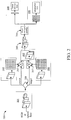
- FIG. 2 is a block diagram showing an exemplary apparatus for attention and warping based adaptation for videos, in accordance with an embodiment of the present invention
- FIG. 3 is a flow diagram showing an exemplary method for domain adaptation, in accordance with an embodiment of the present invention.
- FIG. 4 is a high-level flow diagram showing an exemplary method for domain adaptation, in accordance with an embodiment of the present invention.
- Embodiments of the present invention are directed to attention and warping based domain adaptation for videos.
- One or more embodiments of the present invention provide a domain adaptation method for human action recognition in videos, which can take annotated videos of a source domain, e.g. third person videos, along with unannotated videos of a target domain, e.g. videos from first person cameras, and can learn a classifier for classifying the target domain videos.
- a source domain e.g. third person videos
- unannotated videos of a target domain e.g. videos from first person cameras
- the idea is to leverage the annotation on the source domain to learn a better classifier for the target domain.
- the proposed domain adaptation method learns to attend to relevant discriminative regions in the source domain videos as well as videos from challenging platforms (e.g., taken from drones). Given the attention regions in the source and target videos, the method then learns warping using deformable convolutions to align the target video to the source video. This alignment is learned by minimizing a loss which is a combination of two components: (i) domain adversarial loss which ensures alignment of the two domains at either the video level or at an intermediate feature level, and (ii) classification or verification loss which forces correct classification for the source domain examples. Once learned, the classifier can then predict the regions to attend to for a new test video from the target domain, and then warp the regions to make the features closer to the source domain so that the source classifier can be used to make the prediction.
- a loss which is a combination of two components: (i) domain adversarial loss which ensures alignment of the two domains at either the video level or at an intermediate feature level, and (ii) classification or verification loss which forces correct classification for the source domain examples
- FIG. 1 is a block diagram showing an exemplary processing system 100 , in accordance with an embodiment of the present invention.
- the processing system 100 includes a set of processing units (e.g., CPUs) 101 , a set of GPUs 102 , a set of memory devices 103 , a set of communication devices 104 , and set of peripherals 105 .
- the CPUs 101 can be single or multi-core CPUs.
- the GPUs 102 can be single or multi-core GPUs.
- the one or more memory devices 103 can include caches, RAMs, ROMs, and other memories (flash, optical, magnetic, etc.).
- the communication devices 104 can include wireless and/or wired communication devices (e.g., network (e.g., WIFI, etc.) adapters, etc.).
- the peripherals 105 can include a display device, a user input device, a printer, an imaging device, and so forth. Elements of processing system 100 are connected by one or more buses or networks (collectively denoted by the figure reference numeral 110 ).
- memory devices 103 can store specially programmed software modules to transform the computer processing system into a special purpose computer configured to implement various aspects of the present invention.
- special purpose hardware e.g., Application Specific Integrated Circuits, Field Programmable Gate Arrays (FPGAs), and so forth
- FPGAs Field Programmable Gate Arrays
- the memory devices 103 can store code for implementing one or more of the following: a feature extractor 103 A; an attention network 103 B; a deformation network 103 C; a global pooler 103 D; a domain adversarial classifier 103 E, and a classifier 103 F with classification loss. These and other elements described herein can be implemented at least in part by memory devices 103 .
- processing system 100 may also include other elements (not shown), as readily contemplated by one of skill in the art, as well as omit certain elements.
- various other input devices and/or output devices can be included in processing system 100 , depending upon the particular implementation of the same, as readily understood by one of ordinary skill in the art.
- various types of wireless and/or wired input and/or output devices can be used.
- additional processors, controllers, memories, and so forth, in various configurations can also be utilized.
- a cloud configuration can be used.
- the term “hardware processor subsystem” or “hardware processor” in short refers to a processor, memory, and software combination that cooperate to perform one or more specific tasks.
- the hardware processor subsystem can include one or more data processing elements (e.g., logic circuits, etc.).
- the one or more data processing elements can be included in a central processing unit, a graphics processing unit, and/or a separate processor or computing element-based (e.g., logic gates, etc.) controller.
- the hardware processor subsystem can include one or more on-board memories (e.g., caches).
- the hardware processor subsystem can include one or more other memories (e.g., ROM, RAM, BIOS).
- the hardware processor subsystem can include and execute one or more software applications.
- the one or more software applications can include the operating system and/or one or more other applications and/or specific code to achieve a specified result.
- FIG. 2 is a block diagram showing an exemplary apparatus 200 for attention and warping based adaptation for videos, in accordance with an embodiment of the present invention.
- the apparatus 200 includes a feature extractor 201 , an attention network 202 , a deformation network 203 , global average pooling portion 204 , a domain adversarial classifier and loss portion 205 , and a classifier 206 trained with a classification loss.
- the apparatus further includes combiners 207 , a demultiplexor 208 , and additional common CNN layers 209 .
- the feature extractor 201 is a convolutional neural network (CNN) which takes RGB or optical flow frames (one or multiple frames concatenated) of the input video and gives out the corresponding features.
- CNN convolutional neural network
- the feature extractor 201 can be any image or video based CNN.
- the attention network 202 can be applied to either or both the source and the target domain.
- the purpose of the attention network 202 is to highlight (by giving high relative weights to) regions of the video frame which include more information for the task, e.g., for human actions like “picking up an object” the attention network 202 may highlight the actor's hand and the object with which the actor's hand is interacting.
- the deformation network (or “deform-net” in short) 203 is a small CNN with a deformable convolution layer and possibly more, convolutional or other types of layers.
- the deformation network 203 can be applied to either or both the source and target domain (noting that it is only shown on target domain in FIG. 2 for the sake of illustration).
- the purpose of the deformation network 203 is to take the attended feature and warp it spatially so that the features from both domains are better aligned with each other. This would enable usage of the source classifier for classifying the target domain videos as well.
- the additional common CNN layers 209 further use the aligned features and transforms them so that they are better suited for the goals of (i) classification (via loss 206 ) and (ii) confusing the domain discriminator (via loss 205 ). While the main intended purpose of the deformation network is to spatially align the features, the main intended purpose of the additional layers 209 is to further bring the spatially aligned features from source and target domains closer in the feature space so that the source classifier can be successfully used for the target videos as well. These additional layers can be zero or any number, as required by the application, of convolution of any other types of CNN layers.
- the domain adversarial classifier and loss portion 205 tries to predict which video/frame features come from the source domain and which come from the target domain.
- the learning is based on maximizing this loss by the feature module (the output after 204 ) and minimizing this loss by the domain adversarial module 205 .
- the network layers from the beginning to module 204 are trained to maximize this loss, which encourages that the features which are obtained after the global pooling module 204 are such that they are hard to distinguish in terms of their domain (source or target). While the network layers in block 205 are trained to minimize the same loss, to force the features to be domain invariant.
- the classifier 206 trained with a classification loss ensures that the source features are learned in a way which is discriminative with respect to the source classification task.
- FIG. 2 shows only the cross entropy classification loss; the classification loss is used when the source and target labels are the same, while the verification loss is used when they are different.
- the source classifier can be directly used for the target examples.
- the feature embedding can be used for the target domain to do nearest neighbor based classification.
- FIG. 3 is a flow diagram showing an exemplary method for domain adaptation 300 , in accordance with an embodiment of the present invention.
- the classification can be of an action (action recognition), a gesture, and so forth.
- the classification can further involve performing an action responsive to the classification. For example, a wave up can mean “turn on” appliance on and wave down can mean “turn off” an appliance, and responsive to the classification, one of those actions can be automatically performed.
- FIG. 4 is a high-level flow diagram showing an exemplary method 400 for domain adaptation, in accordance with an embodiment of the present invention.
- the training method 400 includes a target video flow path on the left and a source video flow path on the right. Blocks 405 through 480 corresponding to a training stage of method 400 , while block 490 corresponds to an inference stage of method 400 .
- sample the target videos to obtain RGB or optical flow frames.
- sample the source videos to obtain RGB or optical flow frames.
- block 490 generate a classification/label for an input test image using the trained classifier.
- the prediction is for an action classification.
- actions taken by objects e.g., motor vehicles, people, pets, etc.
- block 490 can further include performing an action responsive to the prediction.
- block 490 can further involve applying the brakes or steering out of the way of an obstacle, and so forth.
- a user's movement can be characterized relative to a virtual gaming environment.
- the classification of an undesirable action such as dropping an object (e.g., by a robot or person in an assembly line)
- a remedial action such as picking up the object and putting it back it in proper place, e.g., in the assembly line (e.g., by the same or another robot, etc.) or dispatching a robotic cleaner to clean a spill, and/or so forth.
- x ⁇ h ⁇ w ⁇ c denotes a c-channel h ⁇ w image (in general, a feature map);
- I ⁇ Y, I ⁇ h ⁇ w ⁇ c denotes a CNN which transforms the image input to the desired output (e.g. distribution over class labels);
- f s ( ⁇ ) and f t ( ⁇ ) denote two CNNs operating on the source and target domains, respectively, e.g., third person and first person videos, respectively in the described example.
- One or more embodiments of the present invention can be implemented in an unsupervised domain adaptation setting, where we have annotated training data for the source domain, i.e. (x s , y s ) ⁇ (X s , Y s ), and only unannotated target domain data, x t ⁇ X t .
- the aim is to train a classifier C(x) to classify the examples into K classes in a domain invariant way, i.e., trained using annotated source domain videos but usable for target videos as well.
- Utilizing the current domain adaptation methods would be equivalent to aligning the distributions of ⁇ (x s ) and ⁇ (x t ).
- the classes are human actions, then we should aim to focus on regions (for both training and inference) that include the human regions and the associated objects (if any) which are contributing to the action, while ignoring the background.
- the source network is trained with attention, as we expect the action to be localized on one or more of the following: (i) the human actor(s); and (ii) the nearby context, and the object(s) of interest (if any).
- attention For any video, we define attention as a 2D spatial array or weights which modifies the input feature map by taking the Hadamard (i.e., elementwise) product with the two dimensional output of every channel.
- the fractional ⁇ p n are the offsets to the integral p 0 +p n and allow the network to learn arbitrary local non-linear deformations.
- the locality of such deformations is determined by the depth at which they operate, i.e., if the deformations are on a layer closer to the image, they are relatively more localized.
- the loss function is a combination of the standard cross entropy based classification loss, L cls on the source examples and an adversarial loss, L adv , on both the and target examples.
- the objective of training is to optimize the parameters of the classifier C and those of the mappings M s , M t to minimize L cls ⁇ adv , where ⁇ is a hyperparameter to set the tradeoff between the two losses, and to optimize the parameters of the discriminator to minimize L adv , i.e., while keeping the source classification loss as low as possible, the mappings try to align the two domains at a distribution level by making them indistinguishable by the discriminator while the discriminator tries to tell them apart as best as possible.
- the present invention may be a system, a method, and/or a computer program product at any possible technical detail level of integration
- the computer program product may include a computer readable storage medium (or media) having computer readable program instructions thereon for causing a processor to carry out aspects of the present invention
- any of the following “/”, “and/or”, and “at least one of”, for example, in the cases of “A/B”, “A and/or B” and “at least one of A and B”, is intended to encompass the selection of the first listed option (A) only, or the selection of the second listed option (B) only, or the selection of both options (A and B).
- such phrasing is intended to encompass the selection of the first listed option (A) only, or the selection of the second listed option (B) only, or the selection of the third listed option (C) only, or the selection of the first and the second listed options (A and B) only, or the selection of the first and third listed options (A and C) only, or the selection of the second and third listed options (B and C) only, or the selection of all three options (A and B and C).
- This may be extended for as many items listed.
Landscapes
- Engineering & Computer Science (AREA)
- Theoretical Computer Science (AREA)
- Physics & Mathematics (AREA)
- General Physics & Mathematics (AREA)
- Evolutionary Computation (AREA)
- Artificial Intelligence (AREA)
- Data Mining & Analysis (AREA)
- Health & Medical Sciences (AREA)
- Software Systems (AREA)
- General Health & Medical Sciences (AREA)
- Computing Systems (AREA)
- Life Sciences & Earth Sciences (AREA)
- General Engineering & Computer Science (AREA)
- Biophysics (AREA)
- Molecular Biology (AREA)
- Mathematical Physics (AREA)
- Computational Linguistics (AREA)
- Biomedical Technology (AREA)
- Multimedia (AREA)
- Computer Vision & Pattern Recognition (AREA)
- Databases & Information Systems (AREA)
- Medical Informatics (AREA)
- Bioinformatics & Cheminformatics (AREA)
- Bioinformatics & Computational Biology (AREA)
- Evolutionary Biology (AREA)
- Image Analysis (AREA)
Abstract
Description


ϕ(z)::k =α⊙z ::k ∀k∈{1, . . . ,

where the subscript :: k denotes the k-th channel of the respective feature map, ⊙ is the Hadamard product for matrices, and α∈

x*(x)=


x(p)=Σq G(p,q)·x(q), (3)
where
G(p,q)=g(q x ,p x)·g(q y ,p y), (4)
with
g(a,b)=max(0,1−|a−b|). (5)
z(p 0)=Σp
N={−1,0,1}2 ,Δp n∈(−1,1) (7)


where we are denoting the input to the layer as

α=softmax(W a *

with the weights Wa and bias ba being parameters learned jointly with the other. Here the symbol * denotes standard convolution operation.


−
where ys k=1 if xs belongs to class k, otherwise 0 (i.e., ys is the one hot encoding of the class annotation).
Claims (20)
Priority Applications (1)
| Application Number | Priority Date | Filing Date | Title |
|---|---|---|---|
| US16/673,156 US11222210B2 (en) | 2018-11-13 | 2019-11-04 | Attention and warping based domain adaptation for videos |
Applications Claiming Priority (2)
| Application Number | Priority Date | Filing Date | Title |
|---|---|---|---|
| US201862760395P | 2018-11-13 | 2018-11-13 | |
| US16/673,156 US11222210B2 (en) | 2018-11-13 | 2019-11-04 | Attention and warping based domain adaptation for videos |
Publications (2)
| Publication Number | Publication Date |
|---|---|
| US20200151457A1 US20200151457A1 (en) | 2020-05-14 |
| US11222210B2 true US11222210B2 (en) | 2022-01-11 |
Family
ID=70552178
Family Applications (1)
| Application Number | Title | Priority Date | Filing Date |
|---|---|---|---|
| US16/673,156 Expired - Fee Related US11222210B2 (en) | 2018-11-13 | 2019-11-04 | Attention and warping based domain adaptation for videos |
Country Status (1)
| Country | Link |
|---|---|
| US (1) | US11222210B2 (en) |
Cited By (2)
| Publication number | Priority date | Publication date | Assignee | Title |
|---|---|---|---|---|
| US20230103737A1 (en) * | 2020-03-03 | 2023-04-06 | Nec Corporation | Attention mechanism, image recognition system, and feature conversion method |
| US20240282091A1 (en) * | 2023-02-17 | 2024-08-22 | International Business Machines Corporation | Domain vector-based domain adaptation for object detection and instance segmentation |
Families Citing this family (12)
| Publication number | Priority date | Publication date | Assignee | Title |
|---|---|---|---|---|
| US12118445B1 (en) * | 2018-12-13 | 2024-10-15 | Zoox, Inc. | Temporal-based deformable kernels |
| US11537901B2 (en) * | 2019-12-31 | 2022-12-27 | Robert Bosch Gmbh | System and method for unsupervised domain adaptation with mixup training |
| US11676370B2 (en) * | 2020-05-27 | 2023-06-13 | Nec Corporation | Self-supervised cross-video temporal difference learning for unsupervised domain adaptation |
| CN112363216A (en) * | 2020-08-19 | 2021-02-12 | 中国石油大学(华东) | Seismic data denoising method based on attention mechanism |
| CN112115976B (en) * | 2020-08-20 | 2023-12-08 | 北京嘀嘀无限科技发展有限公司 | Model training method, model training device, storage medium and electronic equipment |
| CN112257727B (en) * | 2020-11-03 | 2023-10-27 | 西南石油大学 | A feature image extraction method based on deep learning adaptive deformable convolution |
| CN112308158B (en) * | 2020-11-05 | 2021-09-24 | 电子科技大学 | Multi-source field self-adaptive model and method based on partial feature alignment |
| CN113065633B (en) * | 2021-02-26 | 2024-07-09 | 华为技术有限公司 | A model training method and related equipment |
| US20220284285A1 (en) * | 2021-03-02 | 2022-09-08 | Sony Group Corporation | Training a machine learning-based model for action recognition |
| CN113222997B (en) * | 2021-03-31 | 2024-12-13 | 北京绝影智联科技有限公司 | Neural network generation, image processing method, device, electronic device and medium |
| CN113688867B (en) * | 2021-07-20 | 2023-04-28 | 广东工业大学 | Cross-domain image classification method |
| CN115457347A (en) * | 2022-09-06 | 2022-12-09 | 广东工业大学 | Video unsupervised domain self-adaptive algorithm |
Citations (22)
| Publication number | Priority date | Publication date | Assignee | Title |
|---|---|---|---|---|
| US20170140253A1 (en) * | 2015-11-12 | 2017-05-18 | Xerox Corporation | Multi-layer fusion in a convolutional neural network for image classification |
| US20180174046A1 (en) * | 2016-12-15 | 2018-06-21 | Beijing Kuangshi Technology Co., Ltd. | Target detection method and device, neural network training method and device |
| US20180235577A1 (en) * | 2014-06-12 | 2018-08-23 | Koninklijke Philips N.V. | Medical image processing device and method |
| US20180330205A1 (en) * | 2017-05-15 | 2018-11-15 | Siemens Aktiengesellschaft | Domain adaptation and fusion using weakly supervised target-irrelevant data |
| US20190114462A1 (en) * | 2017-10-15 | 2019-04-18 | Alethio Co. | Signal translation system and signal translation method |
| US20190180136A1 (en) * | 2016-07-28 | 2019-06-13 | Gogle Llc | Domain separation neural networks |
| US20190220977A1 (en) * | 2018-01-16 | 2019-07-18 | Siemens Healthcare Gmbh | Cross-Domain Image Analysis and Cross-Domain Image Synthesis Using Deep Image-to-Image Networks and Adversarial Networks |
| US20190244107A1 (en) * | 2018-02-06 | 2019-08-08 | Hrl Laboratories, Llc | Domain adaption learning system |
| US20190304065A1 (en) * | 2016-12-15 | 2019-10-03 | Google Llc | Transforming source domain images into target domain images |
| US20190354801A1 (en) * | 2018-05-16 | 2019-11-21 | Nec Laboratories America, Inc. | Unsupervised cross-domain distance metric adaptation with feature transfer network |
| US20200042877A1 (en) * | 2018-08-03 | 2020-02-06 | Arm Limited | System, method and apparatus for neural networks |
| US20200074289A1 (en) * | 2017-11-01 | 2020-03-05 | Tencent Technology (Shenzhen) Company Limited | Pooling processing method and system applied to convolutional neural network |
| US20200134444A1 (en) * | 2018-10-31 | 2020-04-30 | Sony Interactive Entertainment Inc. | Systems and methods for domain adaptation in neural networks |
| US20200184256A1 (en) * | 2018-12-10 | 2020-06-11 | Canon Kabushiki Kaisha | Method, system and apparatus for performing re-identification in images |
| US20200193269A1 (en) * | 2018-12-18 | 2020-06-18 | Samsung Electronics Co., Ltd. | Recognizer, object recognition method, learning apparatus, and learning method for domain adaptation |
| US20200272897A1 (en) * | 2017-11-22 | 2020-08-27 | Nec Corporation | Learning device, learning method, and recording medium |
| US20200342643A1 (en) * | 2017-10-27 | 2020-10-29 | Google Llc | Semantically-consistent image style transfer |
| US20210012198A1 (en) * | 2018-05-31 | 2021-01-14 | Huawei Technologies Co., Ltd. | Method for training deep neural network and apparatus |
| US20210012486A1 (en) * | 2019-07-09 | 2021-01-14 | Shenzhen Malong Technologies Co., Ltd. | Image synthesis with generative adversarial network |
| US20210043306A1 (en) * | 2018-10-25 | 2021-02-11 | Tencent Technology (Shenzhen) Company Limited | Detection model training method and apparatus, and terminal device |
| US20210056693A1 (en) * | 2018-11-08 | 2021-02-25 | Tencent Technology (Shenzhen) Company Limited | Tissue nodule detection and tissue nodule detection model training method, apparatus, device, and system |
| US20210232926A1 (en) * | 2018-08-17 | 2021-07-29 | Siemens Aktiengesellschaft | Mapping images to the synthetic domain |
-
2019
- 2019-11-04 US US16/673,156 patent/US11222210B2/en not_active Expired - Fee Related
Patent Citations (22)
| Publication number | Priority date | Publication date | Assignee | Title |
|---|---|---|---|---|
| US20180235577A1 (en) * | 2014-06-12 | 2018-08-23 | Koninklijke Philips N.V. | Medical image processing device and method |
| US20170140253A1 (en) * | 2015-11-12 | 2017-05-18 | Xerox Corporation | Multi-layer fusion in a convolutional neural network for image classification |
| US20190180136A1 (en) * | 2016-07-28 | 2019-06-13 | Gogle Llc | Domain separation neural networks |
| US20180174046A1 (en) * | 2016-12-15 | 2018-06-21 | Beijing Kuangshi Technology Co., Ltd. | Target detection method and device, neural network training method and device |
| US20190304065A1 (en) * | 2016-12-15 | 2019-10-03 | Google Llc | Transforming source domain images into target domain images |
| US20180330205A1 (en) * | 2017-05-15 | 2018-11-15 | Siemens Aktiengesellschaft | Domain adaptation and fusion using weakly supervised target-irrelevant data |
| US20190114462A1 (en) * | 2017-10-15 | 2019-04-18 | Alethio Co. | Signal translation system and signal translation method |
| US20200342643A1 (en) * | 2017-10-27 | 2020-10-29 | Google Llc | Semantically-consistent image style transfer |
| US20200074289A1 (en) * | 2017-11-01 | 2020-03-05 | Tencent Technology (Shenzhen) Company Limited | Pooling processing method and system applied to convolutional neural network |
| US20200272897A1 (en) * | 2017-11-22 | 2020-08-27 | Nec Corporation | Learning device, learning method, and recording medium |
| US20190220977A1 (en) * | 2018-01-16 | 2019-07-18 | Siemens Healthcare Gmbh | Cross-Domain Image Analysis and Cross-Domain Image Synthesis Using Deep Image-to-Image Networks and Adversarial Networks |
| US20190244107A1 (en) * | 2018-02-06 | 2019-08-08 | Hrl Laboratories, Llc | Domain adaption learning system |
| US20190354801A1 (en) * | 2018-05-16 | 2019-11-21 | Nec Laboratories America, Inc. | Unsupervised cross-domain distance metric adaptation with feature transfer network |
| US20210012198A1 (en) * | 2018-05-31 | 2021-01-14 | Huawei Technologies Co., Ltd. | Method for training deep neural network and apparatus |
| US20200042877A1 (en) * | 2018-08-03 | 2020-02-06 | Arm Limited | System, method and apparatus for neural networks |
| US20210232926A1 (en) * | 2018-08-17 | 2021-07-29 | Siemens Aktiengesellschaft | Mapping images to the synthetic domain |
| US20210043306A1 (en) * | 2018-10-25 | 2021-02-11 | Tencent Technology (Shenzhen) Company Limited | Detection model training method and apparatus, and terminal device |
| US20200134444A1 (en) * | 2018-10-31 | 2020-04-30 | Sony Interactive Entertainment Inc. | Systems and methods for domain adaptation in neural networks |
| US20210056693A1 (en) * | 2018-11-08 | 2021-02-25 | Tencent Technology (Shenzhen) Company Limited | Tissue nodule detection and tissue nodule detection model training method, apparatus, device, and system |
| US20200184256A1 (en) * | 2018-12-10 | 2020-06-11 | Canon Kabushiki Kaisha | Method, system and apparatus for performing re-identification in images |
| US20200193269A1 (en) * | 2018-12-18 | 2020-06-18 | Samsung Electronics Co., Ltd. | Recognizer, object recognition method, learning apparatus, and learning method for domain adaptation |
| US20210012486A1 (en) * | 2019-07-09 | 2021-01-14 | Shenzhen Malong Technologies Co., Ltd. | Image synthesis with generative adversarial network |
Non-Patent Citations (6)
| Title |
|---|
| "Adaptive Deep Learning Through Visual Domain Localization"; Gabriele Angeletti, 2018 IEEE International Conference on Robotics and Automation (ICRA) (pp. 7135-7142) (Year: 2018). * |
| "Diversified Dual Domain-Adversarial Neural Networks"; Yuchun Fang, 2018 24th International Conference on Pattern Recognition (ICPR) (pp. 615-620) (Year: 2018). * |
| "Synthesizing Training Images for Boosting Human 3D Pose Estimation"; Wenzheng Chen, 2016 Fourth International Conference on 3D Vision (3DV) (pp. 479-488) (Year: 2016). * |
| Carreira et al., "Quo Vadis, Action Recognition? A New Model and the Kinetics Dataset", arXiv:1705.07750v3 [cs.CV] Feb. 12, 2018, p. 1-10. |
| Dai et al., "Deformable Convolutional Networks", arXiv:1703.06211v3 [cs.CV] Jun. 5, 2017, pp. 1-12. |
| Ganin et al., "Unsupervised Domain Adaptation by Backpropagation", Proceedings of the 32 nd International Conference on Machine Learning, Jul. 2015, 10 pages. |
Cited By (3)
| Publication number | Priority date | Publication date | Assignee | Title |
|---|---|---|---|---|
| US20230103737A1 (en) * | 2020-03-03 | 2023-04-06 | Nec Corporation | Attention mechanism, image recognition system, and feature conversion method |
| US20240282091A1 (en) * | 2023-02-17 | 2024-08-22 | International Business Machines Corporation | Domain vector-based domain adaptation for object detection and instance segmentation |
| US12536785B2 (en) * | 2023-02-17 | 2026-01-27 | International Business Machines Corporation | Domain vector-based domain adaptation for object detection and instance segmentation |
Also Published As
| Publication number | Publication date |
|---|---|
| US20200151457A1 (en) | 2020-05-14 |
Similar Documents
| Publication | Publication Date | Title |
|---|---|---|
| US11222210B2 (en) | Attention and warping based domain adaptation for videos | |
| AU2024201361B2 (en) | Processing images using self-attention based neural networks | |
| US10885383B2 (en) | Unsupervised cross-domain distance metric adaptation with feature transfer network | |
| EP4238067B1 (en) | Neural network models for semantic image segmentation | |
| US12061991B2 (en) | Transfer learning with machine learning systems | |
| WO2021169852A1 (en) | System and method for real-time, simultaneous object detection and semantic segmentation | |
| US10579860B2 (en) | Learning model for salient facial region detection | |
| US9767381B2 (en) | Similarity-based detection of prominent objects using deep CNN pooling layers as features | |
| US12019706B2 (en) | Data augmentation for object detection via differential neural rendering | |
| CN107909026B (en) | Small-scale convolutional neural network based age and/or gender assessment method and system | |
| CN110929622A (en) | Video classification method, model training method, device, equipment and storage medium | |
| GB2555136A (en) | A method for analysing media content | |
| US10062013B2 (en) | Method of image processing | |
| JP5936561B2 (en) | Object classification based on appearance and context in images | |
| Chandler et al. | Mitigation of Effects of Occlusion on Object Recognition with Deep Neural Networks through Low‐Level Image Completion | |
| US11301716B2 (en) | Unsupervised domain adaptation for video classification | |
| US11423262B2 (en) | Automatically filtering out objects based on user preferences | |
| Han et al. | LMD-YOLO: A lightweight algorithm for multi-defect detection of power distribution network insulators based on an improved YOLOv8 | |
| CN118351081A (en) | Equipment abnormality detection method and device based on image recognition and electronic equipment | |
| Ghauri et al. | SurveillanceNet: Spatio-temporal anomaly identification in surveillance videos using two-stream CNN and LSTM | |
| Savadatti et al. | Face Recognition of Live-Feed Imagery Using the Viola-Jones Algorithm | |
| Duan et al. | Motion blur aware multiscale adaptive cascade framework for ear tag dropout detection in reserve breeding pigs | |
| Wang et al. | Robust visual place recognition with adaptive deformable token aggregation | |
| Arif | Person of interest rapid identification and tracking (POIRIT) assistance system | |
| Li et al. | Robust object tracking using a spatial pyramid heat kernel structural information representation |
Legal Events
| Date | Code | Title | Description |
|---|---|---|---|
| FEPP | Fee payment procedure |
Free format text: ENTITY STATUS SET TO UNDISCOUNTED (ORIGINAL EVENT CODE: BIG.); ENTITY STATUS OF PATENT OWNER: LARGE ENTITY |
|
| STPP | Information on status: patent application and granting procedure in general |
Free format text: NOTICE OF ALLOWANCE MAILED -- APPLICATION RECEIVED IN OFFICE OF PUBLICATIONS |
|
| AS | Assignment |
Owner name: NEC CORPORATION, JAPAN Free format text: ASSIGNMENT OF ASSIGNORS INTEREST;ASSIGNOR:NEC LABORATORIES AMERICA, INC.;REEL/FRAME:058225/0665 Effective date: 20211118 |
|
| STPP | Information on status: patent application and granting procedure in general |
Free format text: PUBLICATIONS -- ISSUE FEE PAYMENT VERIFIED |
|
| STCF | Information on status: patent grant |
Free format text: PATENTED CASE |
|
| FEPP | Fee payment procedure |
Free format text: MAINTENANCE FEE REMINDER MAILED (ORIGINAL EVENT CODE: REM.); ENTITY STATUS OF PATENT OWNER: LARGE ENTITY |
|
| LAPS | Lapse for failure to pay maintenance fees |
Free format text: PATENT EXPIRED FOR FAILURE TO PAY MAINTENANCE FEES (ORIGINAL EVENT CODE: EXP.); ENTITY STATUS OF PATENT OWNER: LARGE ENTITY |
|
| STCH | Information on status: patent discontinuation |
Free format text: PATENT EXPIRED DUE TO NONPAYMENT OF MAINTENANCE FEES UNDER 37 CFR 1.362 |
|
| FP | Lapsed due to failure to pay maintenance fee |
Effective date: 20260111 |