US11222135B2 - User device privacy protection - Google Patents
User device privacy protection Download PDFInfo
- Publication number
- US11222135B2 US11222135B2 US15/990,783 US201815990783A US11222135B2 US 11222135 B2 US11222135 B2 US 11222135B2 US 201815990783 A US201815990783 A US 201815990783A US 11222135 B2 US11222135 B2 US 11222135B2
- Authority
- US
- United States
- Prior art keywords
- user device
- recipient
- user
- permission
- application program
- Prior art date
- Legal status (The legal status is an assumption and is not a legal conclusion. Google has not performed a legal analysis and makes no representation as to the accuracy of the status listed.)
- Expired - Fee Related, expires
Links
Images



Classifications
-
- G—PHYSICS
- G06—COMPUTING OR CALCULATING; COUNTING
- G06F—ELECTRIC DIGITAL DATA PROCESSING
- G06F21/00—Security arrangements for protecting computers, components thereof, programs or data against unauthorised activity
- G06F21/60—Protecting data
- G06F21/62—Protecting access to data via a platform, e.g. using keys or access control rules
-
- G—PHYSICS
- G06—COMPUTING OR CALCULATING; COUNTING
- G06F—ELECTRIC DIGITAL DATA PROCESSING
- G06F21/00—Security arrangements for protecting computers, components thereof, programs or data against unauthorised activity
- G06F21/60—Protecting data
- G06F21/62—Protecting access to data via a platform, e.g. using keys or access control rules
- G06F21/6218—Protecting access to data via a platform, e.g. using keys or access control rules to a system of files or objects, e.g. local or distributed file system or database
- G06F21/6245—Protecting personal data, e.g. for financial or medical purposes
Definitions
- the present disclosure generally relates to security tools, and more particularly, to tools that protect user private information.
- a computing device a non-transitory computer readable storage medium, and a method are provided to protect user sensitive information from an application program of a user device.
- the application program to be installed is received on the user device. Permissions to resources of the user device for the application program are identified. For each permission, mapping the permission to one or more sections of a code of the application program. For each mapped section of the code, a recipient of user sensitive information facilitated by the permission is determined. For each recipient, it is determined whether the recipient should be restricted. Upon determining that the recipient should not be restricted, the user sensitive information facilitated by the permission is provided to the recipient. Upon determining that the recipient should be restricted, alternate information to the recipient.
- the alternate information is randomly generated, received from a user interface of the user device or retrieved from a repository over a network.
- FIG. 1 is an example architecture for implementing a system that prevents user sensitive information to be disclosed by vulnerable applications, consistent with an illustrative embodiment.
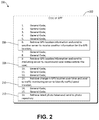
- FIG. 2 illustrates an example static analysis of the code of an application.
- FIG. 3 is an example dialogue box, which can be displayed on a user interface of the user device, consistent with an illustrative embodiment.
- FIG. 4 is a block diagram showing various components of a user device at a high level, consistent with an illustrative embodiment.
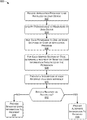
- FIG. 5 presents an illustrative process for protecting the sensitive information of a user with respect to an application.
- FIG. 6 is a functional block diagram illustration of a computer hardware that can communicate with various networked components.
- the present disclosure generally relates to security tools, and more particularly, to tools that identify apps that are vulnerable to disclose user sensitive information. Indeed, one of the main threats posed by malicious or poorly written applications are privacy violations that leak sensitive information, such as location information, contact data, SMS messages, pictures, etc., to an attacker or a third party, collectively referred to herein as a malicious party.
- Applications for mobile devices sometimes referred to herein as apps, have access to different categories of private information, including unique device identification (e.g., International Mobile Equipment Identity (IMEI), email address, IP address, etc.), geographic location, calendar events and contacts, accelerometer information, speed of travel, etc.
- IMEI International Mobile Equipment Identity
- applications often receive as input security-sensitive information, including user IDs and passwords, as well as credit-card social-security and bank-account numbers.
- security-sensitive information including user IDs and passwords, as well as credit-card social-security and bank-account numbers.
- the foregoing private information is collectively referred to herein as user sensitive information.
- This user sensitive information may be used to identify a user for targeted advertisement or more nefarious activity.
- Permissions govern access to designated resources, such as the contact list or GPS system.
- permissions are managed at install time, whereas in iOS a permission is granted or revoked upon first access to the respective resource.
- permissions apply globally across all contexts and usage scenarios. For example, usage of the user's location for navigation cannot be distinguished from its usage for contextual advertising.
- the android platform typically does not allow a user to control what permission(s) to forbid during installation.
- Android apps can declare as many permissions as the developer desires. Often, users can only view the permission details but can't deny them to warrant successful installation of the app.
- some developers lack the sense of privacy, or there may not be reasonable alternatives for an app, which may facilitate abuse of permissions. User sensitive information is often part of the business model of the app.
- FIG. 1 illustrates an example architecture 100 for implementing a system that prevents user sensitive information to be disclosed by vulnerable applications.
- Architecture 100 includes a network 106 that allows various user devices 102 ( 1 ) to 102 ( n ) to communicate with each other, as well as other components that are connected to the network 106 , such as one or more software application store(s) 110 and security database(s) 112 .
- CRM customer relations management
- the network 106 may be, without limitation, a local area network (“LAN”), a virtual private network (“VPN”), a cellular network, the Internet, or a combination thereof.
- the network 106 may include a mobile network that is communicatively coupled to a private network, sometimes referred to as an intranet, which provides various ancillary services, such as communication with various application stores, databases, and the Internet.
- a mobile network as may be operated by a carrier or service provider to provide a wide range of mobile communication services and supplemental services or features to its subscriber customers and associated mobile device users.
- the network 106 allows users of the user devices 102 ( 1 ) to 102 ( n ) to communicate with each other and to be able to receive applications from one or more app stores 110 .
- the app store(s) 110 may receive their content and updates thereof from various application developers represented collectively herein by application developer(s) 120 .
- the application developer(s) 120 often have the flexibility of requesting permissions to various resources of a user device that may be deemed as user sensitive information.
- user devices For purposes of later discussion, several user devices appear in the drawing, to represent some examples of the devices that may receive various services via the network 106 .
- user device's typically take the form of portable handsets, smart-phones, tablet computers, personal digital assistants (PDAs), smart watches, and laptops, although they may be implemented in other form factors, including consumer, and business electronic devices.
- PDAs personal digital assistants
- a user device may have various applications stored in its memory that may have been downloaded from various application stores, represented herein by application store(s) 110 .
- the application store(s) 110 may provide applications and updates thereof to user device's over the network 106 .
- These applications may include multi-tier applications that interact with servers, libraries, and databases, such as security database 112 for content.
- Each computing device that is subscribed to the security services described herein includes an application, sometimes referred to herein as the privacy engine, that is operative to protect the user sensitive information of the corresponding user device, based on the preferences of the user.
- the privacy engine is discussed in more detail below.
- each computing device has one or more applications stored in its memory. These applications may come from various sources, such as application store(s) 110 or even directly from application developers 120 . The permissions requested by each of these applications may relate to various information that may be deemed sensitive information by the user. For example, the application may request access to information related to various sensors of the user device, such as sound recorded by the microphone, accelerometer information (which may indicate an accident), location information (to determine the exact location of the user device and/or speed thereof), internet traffic, cookie information, camera information, humidity, barometer, battery status (e.g., power level), IP address, hardware configuration, and other sensor information of the user device, which are regarded as resources of the user device.
- various sensors of the user device such as sound recorded by the microphone, accelerometer information (which may indicate an accident), location information (to determine the exact location of the user device and/or speed thereof), internet traffic, cookie information, camera information, humidity, barometer, battery status (e.g., power level), IP address, hardware configuration, and other sensor information of the user device, which
- a user may download an app and provide general permissions to various resources requested by the app.
- a calculator app may request permission to access the GPS, camera, or other user sensitive information, that may not be relevant to the calculator app.
- a user may not immediately understand whether this information is used for other purposes as well, such as location tracking and/or targeted advertising.
- the privacy engine herein can analyze the app (i.e., code thereof) upon download to the user device both dynamically and statically. Dynamic program analysis may involve test runs to reach appropriate code coverage. In some situations, the app may be sophisticated enough to recognize a dynamic analysis thereof, to provide a deliberate false negative. Thus, while dynamic program analysis may be generally effective and have more precision, some malicious applications may nonetheless provide a false negative. In this regard, applicants have identified that a static analysis, while not necessarily having the same precision of dynamic analysis, is more sensitive to potential security threats caused by unintended use of user sensitive information. Stated differently, static analysis by the privacy engine is less likely to lead to false negatives. In one embodiment, dynamic analysis is performed in addition to static analysis.
- FIG. 2 illustrates an example static analysis of the code 200 of an app.
- the analysis of the code 200 is explained in view of the architecture of FIG. 1 .
- the privacy engine on a user device e.g., 102 ( 1 )
- the app may request permission to various resources of the user device, which may disclose user sensitive information.
- the received application may be a weather app that is requesting access to the GPS to determine location information to provide appropriate weather information.
- the privacy engine on the user device e.g., 102 ( 1 ) determines all the permission requests of the installed app (i.e., weather app in this example).
- Each determined permission request is mapped to one or more sections in the code of the app.
- the first permission request i.e., GPS
- sections 206 i.e., line 6
- 208 i.e., line 9
- 210 i.e., line 13
- the second permission request is mapped to section 212 (i.e., line 16 ) of the code 202 .
- a recipient is determined.
- the recipient of the user sensitive information i.e., GPS location
- the recipient of the GPS location is a marketing server that is configured to recommend local restaurants to the user, which may be beyond the scope of what the user intended with their grant of permission.
- the GPS location is used to determine a speed of the user device, which is sent to a traffic monitoring server configured to identify the traffic in that location and/or speed traveled. Still further, with respect to the second permission, section 212 retrieves a photo taken by the user and sends it to a photo repository.
- each permission to access information from a resource of the user device the user is prompted for a confirmation of the permission, for each particular recipient.
- FIG. 3 is an example dialogue box 300 that can be displayed on a user interface of the user device.
- a corresponding destination and/or purpose 304 is provided for each resource 302 .
- the user can then choose which permissions to restrict 306 .
- the privacy engine can still provide an addition layer of privacy that is tailored to the user for the subject application.
- the privacy engine is configured to provide alternate information that does not compromise the user sensitive information. For example, upon determining that a resource 302 for a destination/purpose 304 is restricted 306 , then a default or random value may be provided.
- the user may provide alternative information 308 .
- the user can specify the default speed to be provided to the traffic server to be 25 MPH.
- an alternative default photo 312 may be one selected by the user.
- the destination/purpose field 304 is left blank, which indicates to the user that although permission to the resource has been requested, it presently has no purpose.
- the analysis of the privacy engine is performed not only during an installation of an app, but also during every update thereof.
- the privacy engine determines the purpose of the app, from the security database 112 .
- the security database 112 may be maintained by a security software company or a consortium of organizations and/or individuals interested in software security to provide an up-to-date resource for identifiable software libraries and or linked servers that represent potential security risk. Accordingly, the security database 112 may provide an explanation as to the nature and purpose of a destination for the sensitive information harvested from a resource of the user device.
- the Customer Relationship Manager (CRM) server 118 offers its account holders (e.g., subscribers of the application security service) on-line access to a variety of information related to the user's account, such as on-line payment information, subscription changes, preferences (such as default GPS locations, default speeds, pictures, etc.), and the like.
- account holders e.g., subscribers of the application security service
- preferences such as default GPS locations, default speeds, pictures, etc.
- app store(s) 110 the security database 112 , and the CRM 118 have been illustrated by way of example to be on different platforms, it will be understood that in various embodiments, their functionality described herein can be combined. In other embodiments, these computing platforms may be implemented by virtual computing devices in the form of virtual machines or software containers that are hosted in a cloud, thereby providing an elastic architecture for processing and storage
- FIG. 4 illustrates a block diagram showing various components of an illustrative user device 400 at a high level.
- the illustration shows the user device 400 in the form of a wireless computing device, while it will be understood that other computing devices are contemplated as well.
- the user device 400 may include one or more antennae 402 ; a transceiver 404 for cellular, Wi-Fi communication, short-range communication technology, and/or wired communication; a user interface 406 ; one or more processors 408 ; hardware 410 ; and memory 430 .
- the antennae 402 may include an uplink antenna that sends radio signals to a base station, and a downlink antenna that receives radio signals from the base station.
- a single antenna may both send and receive radio signals.
- the same or other antennas may be used for Wi-Fi communication.
- These signals may be processed by the transceiver 404 , sometimes collectively referred to as a network interface, which is configured to receive and transmit digital data.
- the user device 400 does not include an antenna 402 and communication with external components is via wired communication.
- the user device 400 includes one or more user interface(s) 406 that enables a user to provide input and receive output from the user device 400 .
- the user interface 406 may include a data output device (e.g., visual display(s), audio speakers, haptic device, etc.) that may be used to provide the destination and/or purpose of each resource that is subject to the permission of the user, with respect to an app.
- the output device can also be used to solicit from the user whether to restrict resources for particular destinations and/or purposes and provide any alternatives for the user sensitive information.
- the user interface(s) 406 may also include one or more data input devices.
- the data input devices may include, but are not limited to, combinations of one or more of keypads, knobs/controls, keyboards, touch screens, microphones, speech recognition packages, and any other suitable devices or other electronic/software selection interfaces.
- the user device 400 may include one or more processors 408 , which may be a single-core processor, a multi-core processor, a complex instruction set computing (CISC) processor, gaming processor, or any other type of suitable processor.
- processors 408 may be a single-core processor, a multi-core processor, a complex instruction set computing (CISC) processor, gaming processor, or any other type of suitable processor.
- CISC complex instruction set computing
- the hardware 410 may include a power source and digital signal processors (DSPs), which may include single-core or multiple-core processors.
- DSPs digital signal processors
- the hardware 410 may also include network processors that manage high-speed communication interfaces, including communication interfaces that interact with peripheral components.
- the network processors and the peripheral components may be linked by switching fabric.
- the hardware 410 may include hardware decoders and encoders, a network interface controller, and/or a USB controller.
- the hardware 410 may include various sensors to determine the condition of the user device. For example, there may be one or more accelerometers 412 that are configured to measure acceleration forces, which may be used to determine an orientation of the user device 400 and/or whether the user device is in a scenario of a vehicular accident. There may be a gyroscope 414 , which allows the measure of the rotation of the user device, as well as lateral movements, which may indicate the activity a user may be involved with.
- the hardware 410 may further include a GPS sensor 416 that is operative to provide a location of the user device and its speed.
- the hardware 410 may include one or more cameras 418 that are operative to take photographs that can be stored in the memory 430 of the user device and/or shared with different recipients based on permission settings.
- the user device 400 includes memory 430 that may be implemented using computer-readable media, such as computer storage media.
- Storage media includes volatile and non-volatile, removable and non-removable media implemented in any method or technology for storage of information such as computer-readable instructions, data structures, program modules, or other data.
- Computer storage media includes, but is not limited to, RAM, ROM, EEPROM, flash memory or other memory technology, CD-ROM, digital versatile disks (DVD), high definition video storage disks, or other optical storage, magnetic cassettes, magnetic tape, magnetic disk storage or other magnetic storage devices, or any other non-transmission medium that can be used to store information for access by a computing device.
- the memory 430 may store various software components or modules that are executable or accessible by the processor(s) 408 and controller(s) of the user device 400 .
- the various components of the memory 430 may include software 432 and an operating system 450 .
- the software 432 may include various applications 440 , such as a privacy engine 442 having several modules, each configured to control a different aspect the determination of the identification of whether an app is vulnerable to disclose user sensitive information and how to protect the user sensitive information without inducing the app to fail.
- Each module may include routines, program instructions, objects, and/or data structures that perform tasks or implement abstract data types, discussed in more detail later.
- the operating system 450 may include components that enable the user device 400 to receive and transmit data via various interfaces (e.g., user controls, communication interface, and/or memory input/output devices), as well as process data using the processor(s) 408 to generate output.
- the operating system 450 may include a presentation component that presents the output (e.g., display the data on an electronic display of the user device 400 , store the data in memory 430 , transmit the data to another electronic device, etc.). Additionally, the operating system 450 may include other components that perform various additional functions generally associated with an operating system 450 .
- the privacy engine 442 is operative to protect user sensitive information that is tailored to the configuration of the user device 400 .
- FIG. 5 presents an illustrative process 500 for identifying a vulnerable app and protecting the sensitive information of a user from the app.
- Process 500 is illustrated as a collection of blocks in a process, representing a sequence of operations that can be implemented in hardware, software, or a combination thereof.
- the blocks represent computer-executable instructions that, when executed by one or more processors, perform the recited operations.
- computer-executable instructions may include routines, programs, objects, components, data structures, and the like that perform particular functions or implement particular abstract data types.
- the order in which the operations are described is not intended to be construed as a limitation, and any number of the described blocks can be combined in any order and/or performed in parallel to implement the process.
- the process 500 is described with reference to the architecture 100 of FIG. 1 .
- the user device receives a program to be installed in a memory of the user device.
- the application may be received from one or more app stores 110 or directly from an application developer 120 .
- the privacy engine of the user device identifies permissions to resources of the user device that are requested by the application program.
- the privacy engine maps the permission to one or more sections of a code of the application program.
- the privacy engine determines a recipient of user sensitive information that is facilitated by the permission to the corresponding resource.
- a nature or purpose of the recipient of the sensitive information is determined.
- the privacy engine may refer to the security database 112 , which may administer information related to different sites and the threats that are posed thereby.
- a description of each recipient is provided on a user interface of the user device.
- each recipient may be described on a display of the user device.
- the alternate information may be a default information (e.g., default GPS coordinates), random information (e.g., GPS coordinates randomly selected from another plausible location), information provided by the user through the user device during a prompt from the privacy engine, or information retrieved from the CRM 118 .
- a default information e.g., default GPS coordinates
- random information e.g., GPS coordinates randomly selected from another plausible location
- FIG. 6 is a functional block diagram illustration of a computer hardware platform such as a user device that can communicate with various networked components, such as various app stores, application developers, etc.
- the computer platform 600 may include a central processing unit (CPU) 604 , a hard disk drive (HDD) 606 , random access memory (RAM) and/or read only memory (ROM) 608 , a keyboard 610 , a mouse 612 , a display 614 , and a communication interface 616 , which are connected to a system bus 602 .
- CPU central processing unit
- HDD hard disk drive
- RAM random access memory
- ROM read only memory
- the HDD 606 has capabilities that include storing a program that can execute various processes, such as the privacy engine 640 , in a manner described herein.
- the privacy engine 640 may have various modules configured to perform different functions.
- an interaction module 642 that is operative to interact with one or more computing devices and databases, such as app store(s) 110 , database 1112 , application developer(s) 120 , and CRM 118 .
- resource module 644 operative to determine the resources available on a user device.
- different computer platforms may have different sensors (e.g., multiple camera's, accelerometer's, humidity sensors, etc.), which may affect whether a received app that is soliciting permissions poses a threat to user sensitive information accessed by these resources. Accordingly, the privacy solution provided herein is tailored for each computing platform.
- a static analysis module 646 that is operative to perform static analysis of the code of the application being installed on the user device.
- the static analysis module 646 can map the permissions to one or more sections of the code of the application.
- a dynamic analysis module 648 that is operative to perform dynamic analysis of the code of the application that is installed on the user device.
- the dynamic analysis may be performed in addition to the dynamic analysis.
- a purpose determination module 650 that is operative to determine the purpose of the potential recipient of user sensitive information.
- the purpose is provided by a database, upon being provided information about the recipient.
- an alternate information module 652 that is operative to provide alternate information to a recipient who would like to receive sensitive information from a user device. Instead of providing the user sensitive information, the alternate information module 652 is configured to provide false, default, or user provided information, collectively referred to herein as alternate information, to the recipient. By virtue of providing alternate information (i.e., instead of null data) the app that is harvesting the user sensitive information is facilitated to work without malfunction.
- a program such as ApacheTM, can be stored for operating the system as a Web server.
- the HDD 606 can store an executing application that includes one or more library software modules, such as those for the JavaTM Runtime Environment program for realizing a JVM (JavaTM virtual machine).
- These computer readable program instructions may be provided to a processor of a computer, special purpose computer, or other programmable data processing apparatus to produce a machine, such that the instructions, which execute via the processor of the computer or other programmable data processing apparatus, create means for implementing the functions/acts specified in the call flow process and/or block diagram block or blocks.
- These computer readable program instructions may also be stored in a computer readable storage medium that can direct a computer, a programmable data processing apparatus, and/or other devices to function in a particular manner, such that the computer readable storage medium having instructions stored therein comprises an article of manufacture including instructions which implement aspects of the function/act specified in the call flow and/or block diagram block or blocks.
- the computer readable program instructions may also be loaded onto a computer, other programmable data processing apparatus, or other device to cause a series of operational steps to be performed on the computer, other programmable apparatus or other device to produce a computer implemented process, such that the instructions which execute on the computer, other programmable apparatus, or other device implement the functions/acts specified in the call flow process and/or block diagram block or blocks.
- each block in the call flow process or block diagrams may represent a module, segment, or portion of instructions, which comprises one or more executable instructions for implementing the specified logical function(s).
- the functions noted in the blocks may occur out of the order noted in the Figures.
- two blocks shown in succession may, in fact, be executed substantially concurrently, or the blocks may sometimes be executed in the reverse order, depending upon the functionality involved.
- each block of the block diagrams and/or call flow illustration, and combinations of blocks in the block diagrams and/or call flow illustration can be implemented by special purpose hardware-based systems that perform the specified functions or acts or carry out combinations of special purpose hardware and computer instructions.
Landscapes
- Engineering & Computer Science (AREA)
- Theoretical Computer Science (AREA)
- Health & Medical Sciences (AREA)
- Bioethics (AREA)
- General Health & Medical Sciences (AREA)
- Computer Hardware Design (AREA)
- Computer Security & Cryptography (AREA)
- Software Systems (AREA)
- Physics & Mathematics (AREA)
- General Engineering & Computer Science (AREA)
- General Physics & Mathematics (AREA)
- Databases & Information Systems (AREA)
- Medical Informatics (AREA)
- Information Transfer Between Computers (AREA)
Abstract
Description
Claims (18)
Priority Applications (1)
| Application Number | Priority Date | Filing Date | Title |
|---|---|---|---|
| US15/990,783 US11222135B2 (en) | 2018-05-28 | 2018-05-28 | User device privacy protection |
Applications Claiming Priority (1)
| Application Number | Priority Date | Filing Date | Title |
|---|---|---|---|
| US15/990,783 US11222135B2 (en) | 2018-05-28 | 2018-05-28 | User device privacy protection |
Publications (2)
| Publication Number | Publication Date |
|---|---|
| US20190362095A1 US20190362095A1 (en) | 2019-11-28 |
| US11222135B2 true US11222135B2 (en) | 2022-01-11 |
Family
ID=68615306
Family Applications (1)
| Application Number | Title | Priority Date | Filing Date |
|---|---|---|---|
| US15/990,783 Expired - Fee Related US11222135B2 (en) | 2018-05-28 | 2018-05-28 | User device privacy protection |
Country Status (1)
| Country | Link |
|---|---|
| US (1) | US11222135B2 (en) |
Families Citing this family (3)
| Publication number | Priority date | Publication date | Assignee | Title |
|---|---|---|---|---|
| US11748522B2 (en) * | 2019-07-12 | 2023-09-05 | Peanut Butter and Jelly TV L.L.C. | Systems, devices, and methods for prevention of recording content |
| CN113806161A (en) * | 2020-06-12 | 2021-12-17 | 北京小米移动软件有限公司 | Application access method, application access device and storage medium |
| CN113806162A (en) * | 2020-06-12 | 2021-12-17 | 北京小米移动软件有限公司 | Application control method, device and storage medium |
Citations (25)
| Publication number | Priority date | Publication date | Assignee | Title |
|---|---|---|---|---|
| US20020172363A1 (en) * | 2001-05-15 | 2002-11-21 | Dierks Timothy M. | Data security on a mobile device |
| US20060120526A1 (en) * | 2003-02-28 | 2006-06-08 | Peter Boucher | Access control to files based on source information |
| US20070226797A1 (en) * | 2006-03-24 | 2007-09-27 | Exploit Prevention Labs, Inc. | Software vulnerability exploitation shield |
| US20090049550A1 (en) * | 2007-06-18 | 2009-02-19 | Pc Tools Technology Pty Ltd | Method of detecting and blocking malicious activity |
| US20090070734A1 (en) * | 2005-10-03 | 2009-03-12 | Mark Dixon | Systems and methods for monitoring software application quality |
| US20100125891A1 (en) * | 2008-11-17 | 2010-05-20 | Prakash Baskaran | Activity Monitoring And Information Protection |
| US20100281540A1 (en) * | 2009-05-01 | 2010-11-04 | Mcafee, Inc. | Detection of code execution exploits |
| US20110283269A1 (en) * | 2010-05-11 | 2011-11-17 | Albrecht Gass | Systems and methods for applying rules to transform objects of an application |
| US20120246731A1 (en) * | 2011-03-21 | 2012-09-27 | Mocana Corporation | Secure execution of unsecured apps on a device |
| US20120304310A1 (en) * | 2011-03-21 | 2012-11-29 | Mocana Corporation | Secure execution of unsecured apps on a device |
| US8452693B2 (en) | 2011-10-06 | 2013-05-28 | Dhavalkumar M. Shah | Method for providing geographical location-based security, restrict, permit access of varying level to individual's any kind of data, information, credit, finances, services obtained(online and or offline) |
| US8646032B2 (en) | 2011-12-30 | 2014-02-04 | Nokia Corporation | Method and apparatus providing privacy setting and monitoring user interface |
| US20140059695A1 (en) | 2012-08-24 | 2014-02-27 | Environmental Systems Research Institute (ESRI) | Systems and methods for managing location data and providing a privacy framework |
| US20140157351A1 (en) | 2012-12-04 | 2014-06-05 | International Business Machines Corporation | Mobile device security policy based on authorized scopes |
| US8844036B2 (en) | 2012-03-02 | 2014-09-23 | Sri International | Method and system for application-based policy monitoring and enforcement on a mobile device |
| US8886217B2 (en) | 2012-12-31 | 2014-11-11 | Apple Inc. | Location-sensitive security levels and setting profiles based on detected location |
| US20150207820A1 (en) | 2014-01-23 | 2015-07-23 | Unify Gmbh & Co. Kg | Method for handling security settings in a mobile end device |
| US20150222641A1 (en) | 2012-06-12 | 2015-08-06 | Zte Corporation | Method and device for controlling permission of application |
| US9203867B1 (en) | 2008-05-27 | 2015-12-01 | Open Invention Network, Llc | User-directed privacy control in a user-centric identity management system |
| US20160034711A1 (en) | 2011-12-30 | 2016-02-04 | Intel Corporation | Cloud based real time app privacy dashboard |
| US20160134660A1 (en) | 2014-11-11 | 2016-05-12 | Oracle International Corporation | Securely operating a process using user-specific and device-specific security constraints |
| US20170169224A1 (en) * | 2015-12-10 | 2017-06-15 | Electronics And Telecommunications Research Institute | Apparatus and method for detecting malicious mobile app |
| US20170287036A1 (en) * | 2016-04-01 | 2017-10-05 | OneTrust, LLC | Data processing systems and methods for integrating privacy information management systems with data loss prevention tools or other tools for privacy design |
| US20170353481A1 (en) * | 2016-06-06 | 2017-12-07 | Samsung Electronics Co., Ltd. | Malware detection by exploiting malware re-composition variations using feature evolutions and confusions |
| US20190166148A1 (en) * | 2017-11-28 | 2019-05-30 | Sap Se | Analysis of mobile applications |
-
2018
- 2018-05-28 US US15/990,783 patent/US11222135B2/en not_active Expired - Fee Related
Patent Citations (26)
| Publication number | Priority date | Publication date | Assignee | Title |
|---|---|---|---|---|
| US20020172363A1 (en) * | 2001-05-15 | 2002-11-21 | Dierks Timothy M. | Data security on a mobile device |
| US20060120526A1 (en) * | 2003-02-28 | 2006-06-08 | Peter Boucher | Access control to files based on source information |
| US20090070734A1 (en) * | 2005-10-03 | 2009-03-12 | Mark Dixon | Systems and methods for monitoring software application quality |
| US20070226797A1 (en) * | 2006-03-24 | 2007-09-27 | Exploit Prevention Labs, Inc. | Software vulnerability exploitation shield |
| US20090049550A1 (en) * | 2007-06-18 | 2009-02-19 | Pc Tools Technology Pty Ltd | Method of detecting and blocking malicious activity |
| US9203867B1 (en) | 2008-05-27 | 2015-12-01 | Open Invention Network, Llc | User-directed privacy control in a user-centric identity management system |
| US9338188B1 (en) | 2008-05-27 | 2016-05-10 | Open Invention Network, Llc | User agent to exercise privacy control management in a user-centric identity management system |
| US20100125891A1 (en) * | 2008-11-17 | 2010-05-20 | Prakash Baskaran | Activity Monitoring And Information Protection |
| US20100281540A1 (en) * | 2009-05-01 | 2010-11-04 | Mcafee, Inc. | Detection of code execution exploits |
| US20110283269A1 (en) * | 2010-05-11 | 2011-11-17 | Albrecht Gass | Systems and methods for applying rules to transform objects of an application |
| US20120246731A1 (en) * | 2011-03-21 | 2012-09-27 | Mocana Corporation | Secure execution of unsecured apps on a device |
| US20120304310A1 (en) * | 2011-03-21 | 2012-11-29 | Mocana Corporation | Secure execution of unsecured apps on a device |
| US8452693B2 (en) | 2011-10-06 | 2013-05-28 | Dhavalkumar M. Shah | Method for providing geographical location-based security, restrict, permit access of varying level to individual's any kind of data, information, credit, finances, services obtained(online and or offline) |
| US8646032B2 (en) | 2011-12-30 | 2014-02-04 | Nokia Corporation | Method and apparatus providing privacy setting and monitoring user interface |
| US20160034711A1 (en) | 2011-12-30 | 2016-02-04 | Intel Corporation | Cloud based real time app privacy dashboard |
| US8844036B2 (en) | 2012-03-02 | 2014-09-23 | Sri International | Method and system for application-based policy monitoring and enforcement on a mobile device |
| US20150222641A1 (en) | 2012-06-12 | 2015-08-06 | Zte Corporation | Method and device for controlling permission of application |
| US20140059695A1 (en) | 2012-08-24 | 2014-02-27 | Environmental Systems Research Institute (ESRI) | Systems and methods for managing location data and providing a privacy framework |
| US20140157351A1 (en) | 2012-12-04 | 2014-06-05 | International Business Machines Corporation | Mobile device security policy based on authorized scopes |
| US8886217B2 (en) | 2012-12-31 | 2014-11-11 | Apple Inc. | Location-sensitive security levels and setting profiles based on detected location |
| US20150207820A1 (en) | 2014-01-23 | 2015-07-23 | Unify Gmbh & Co. Kg | Method for handling security settings in a mobile end device |
| US20160134660A1 (en) | 2014-11-11 | 2016-05-12 | Oracle International Corporation | Securely operating a process using user-specific and device-specific security constraints |
| US20170169224A1 (en) * | 2015-12-10 | 2017-06-15 | Electronics And Telecommunications Research Institute | Apparatus and method for detecting malicious mobile app |
| US20170287036A1 (en) * | 2016-04-01 | 2017-10-05 | OneTrust, LLC | Data processing systems and methods for integrating privacy information management systems with data loss prevention tools or other tools for privacy design |
| US20170353481A1 (en) * | 2016-06-06 | 2017-12-07 | Samsung Electronics Co., Ltd. | Malware detection by exploiting malware re-composition variations using feature evolutions and confusions |
| US20190166148A1 (en) * | 2017-11-28 | 2019-05-30 | Sap Se | Analysis of mobile applications |
Non-Patent Citations (5)
| Title |
|---|
| Anonymous, "Xposed Module Repository"; http://repo.xposed.info/module/eu.faircode.xlua (2013); 2 pgs. |
| Artz, S. et al., "FlowDroid: Precise Context, Flow, Field, Object-sensitive and Lifecycle-aware Taint Analysis for Android Apps"; ACM (2014); 11pgs. |
| Nan, Y. et al., "UIPicker: User-Input Privacy Identification in Mobile Applications"; USENIX Association (2015); pp. 992-1008. |
| Rastogi, V. et al., "AppsPlayground: Automatic Security Analysis of Smartphone Applications"; ACM (2013); 12 pgs. |
| Tripp, O. et al., "Application- and User-Sensitive Privacy Enforcement in Mobile Systems"; MOBILESoft'15 IEEE/ACM 2nd Inter. Conf. on, May 16-17, 2015, pp. 162-163. |
Also Published As
| Publication number | Publication date |
|---|---|
| US20190362095A1 (en) | 2019-11-28 |
Similar Documents
| Publication | Publication Date | Title |
|---|---|---|
| US9215548B2 (en) | Methods and systems for rating privacy risk of applications for smart phones and other mobile platforms | |
| US10623962B2 (en) | System and method for geo-location-based mobile user authentication | |
| US8646032B2 (en) | Method and apparatus providing privacy setting and monitoring user interface | |
| US20190392174A1 (en) | Methods and systems for detecting attempts to access personal information on mobile communications devices | |
| US20130055387A1 (en) | Apparatus and method for providing security information on background process | |
| US9584494B2 (en) | Terminal and server for applying security policy, and method of controlling the same | |
| US8595489B1 (en) | Grouping and ranking of application permissions | |
| EP2965257B1 (en) | Method for measuring and monitoring the access levels to personal data generated by resources of a user device | |
| US20110010759A1 (en) | Providing a customized interface for an application store | |
| US20130212684A1 (en) | Detecting Application Harmful Behavior and Grading Application Risks for Mobile Devices | |
| EP3193519B1 (en) | Method for protecting terminal position information and intelligent terminal | |
| US9280665B2 (en) | Fast and accurate identification of message-based API calls in application binaries | |
| CN105404819A (en) | Data access control method and apparatus and terminal | |
| WO2019061362A1 (en) | Method and device for accessing device identifiers | |
| US10579814B2 (en) | Monitoring and preventing unauthorized data access | |
| US20160350525A1 (en) | Application Program Management Method, Device, Terminal, and Computer Storage Medium | |
| US20240292221A1 (en) | Security management on a mobile device | |
| US20150356283A1 (en) | User Configurable Profiles for Security Permissions | |
| US10754717B2 (en) | Fast and accurate identification of message-based API calls in application binaries | |
| US10958687B2 (en) | Generating false data for suspicious users | |
| US11222135B2 (en) | User device privacy protection | |
| US10250642B2 (en) | System, method and apparatus for fine-grained privacy specification and verification | |
| US10225285B2 (en) | Policy conflict resolution engine for mobile application management | |
| US20170337399A1 (en) | Privacy enabled runtime | |
| CN111143089A (en) | Method and device for calling third-party library dynamic lifting authority by application program |
Legal Events
| Date | Code | Title | Description |
|---|---|---|---|
| AS | Assignment |
Owner name: INTERNATIONAL BUSINESS MACHINES CORPORATION, NEW YORK Free format text: ASSIGNMENT OF ASSIGNORS INTEREST;ASSIGNORS:TRIPP, OMER;DOLBY, JULIAN TIMOTHY;PISTOIA, MARCO;AND OTHERS;SIGNING DATES FROM 20180508 TO 20180525;REEL/FRAME:045912/0264 Owner name: INTERNATIONAL BUSINESS MACHINES CORPORATION, NEW Y Free format text: ASSIGNMENT OF ASSIGNORS INTEREST;ASSIGNORS:TRIPP, OMER;DOLBY, JULIAN TIMOTHY;PISTOIA, MARCO;AND OTHERS;SIGNING DATES FROM 20180508 TO 20180525;REEL/FRAME:045912/0264 |
|
| FEPP | Fee payment procedure |
Free format text: ENTITY STATUS SET TO UNDISCOUNTED (ORIGINAL EVENT CODE: BIG.); ENTITY STATUS OF PATENT OWNER: LARGE ENTITY |
|
| STPP | Information on status: patent application and granting procedure in general |
Free format text: NON FINAL ACTION MAILED |
|
| STPP | Information on status: patent application and granting procedure in general |
Free format text: FINAL REJECTION MAILED |
|
| STPP | Information on status: patent application and granting procedure in general |
Free format text: RESPONSE AFTER FINAL ACTION FORWARDED TO EXAMINER |
|
| STPP | Information on status: patent application and granting procedure in general |
Free format text: DOCKETED NEW CASE - READY FOR EXAMINATION |
|
| STPP | Information on status: patent application and granting procedure in general |
Free format text: NON FINAL ACTION MAILED |
|
| STPP | Information on status: patent application and granting procedure in general |
Free format text: RESPONSE TO NON-FINAL OFFICE ACTION ENTERED AND FORWARDED TO EXAMINER |
|
| STPP | Information on status: patent application and granting procedure in general |
Free format text: FINAL REJECTION MAILED |
|
| STPP | Information on status: patent application and granting procedure in general |
Free format text: RESPONSE AFTER FINAL ACTION FORWARDED TO EXAMINER |
|
| STPP | Information on status: patent application and granting procedure in general |
Free format text: ADVISORY ACTION MAILED |
|
| STPP | Information on status: patent application and granting procedure in general |
Free format text: DOCKETED NEW CASE - READY FOR EXAMINATION |
|
| STPP | Information on status: patent application and granting procedure in general |
Free format text: NOTICE OF ALLOWANCE MAILED -- APPLICATION RECEIVED IN OFFICE OF PUBLICATIONS |
|
| STPP | Information on status: patent application and granting procedure in general |
Free format text: PUBLICATIONS -- ISSUE FEE PAYMENT RECEIVED |
|
| STPP | Information on status: patent application and granting procedure in general |
Free format text: PUBLICATIONS -- ISSUE FEE PAYMENT VERIFIED |
|
| STCF | Information on status: patent grant |
Free format text: PATENTED CASE |
|
| FEPP | Fee payment procedure |
Free format text: MAINTENANCE FEE REMINDER MAILED (ORIGINAL EVENT CODE: REM.); ENTITY STATUS OF PATENT OWNER: LARGE ENTITY |