US11222025B2 - De-serialized datastore transaction system - Google Patents
De-serialized datastore transaction system Download PDFInfo
- Publication number
- US11222025B2 US11222025B2 US16/361,961 US201916361961A US11222025B2 US 11222025 B2 US11222025 B2 US 11222025B2 US 201916361961 A US201916361961 A US 201916361961A US 11222025 B2 US11222025 B2 US 11222025B2
- Authority
- US
- United States
- Prior art keywords
- tuple
- data
- data store
- multimodal
- memory
- Prior art date
- Legal status (The legal status is an assumption and is not a legal conclusion. Google has not performed a legal analysis and makes no representation as to the accuracy of the status listed.)
- Expired - Fee Related, expires
Links
Images




Classifications
-
- G—PHYSICS
- G06—COMPUTING OR CALCULATING; COUNTING
- G06F—ELECTRIC DIGITAL DATA PROCESSING
- G06F16/00—Information retrieval; Database structures therefor; File system structures therefor
- G06F16/20—Information retrieval; Database structures therefor; File system structures therefor of structured data, e.g. relational data
- G06F16/23—Updating
- G06F16/2308—Concurrency control
- G06F16/2336—Pessimistic concurrency control approaches, e.g. locking or multiple versions without time stamps
- G06F16/2343—Locking methods, e.g. distributed locking or locking implementation details
-
- G—PHYSICS
- G06—COMPUTING OR CALCULATING; COUNTING
- G06F—ELECTRIC DIGITAL DATA PROCESSING
- G06F16/00—Information retrieval; Database structures therefor; File system structures therefor
- G06F16/20—Information retrieval; Database structures therefor; File system structures therefor of structured data, e.g. relational data
- G06F16/24—Querying
- G06F16/245—Query processing
- G06F16/2455—Query execution
- G06F16/24568—Data stream processing; Continuous queries
-
- G—PHYSICS
- G06—COMPUTING OR CALCULATING; COUNTING
- G06F—ELECTRIC DIGITAL DATA PROCESSING
- G06F16/00—Information retrieval; Database structures therefor; File system structures therefor
- G06F16/20—Information retrieval; Database structures therefor; File system structures therefor of structured data, e.g. relational data
- G06F16/23—Updating
- G06F16/2308—Concurrency control
- G06F16/2315—Optimistic concurrency control
-
- G—PHYSICS
- G06—COMPUTING OR CALCULATING; COUNTING
- G06F—ELECTRIC DIGITAL DATA PROCESSING
- G06F16/00—Information retrieval; Database structures therefor; File system structures therefor
- G06F16/90—Details of database functions independent of the retrieved data types
- G06F16/903—Querying
- G06F16/90335—Query processing
- G06F16/90339—Query processing by using parallel associative memories or content-addressable memories
-
- G—PHYSICS
- G06—COMPUTING OR CALCULATING; COUNTING
- G06F—ELECTRIC DIGITAL DATA PROCESSING
- G06F16/00—Information retrieval; Database structures therefor; File system structures therefor
- G06F16/90—Details of database functions independent of the retrieved data types
- G06F16/903—Querying
- G06F16/90335—Query processing
- G06F16/90344—Query processing by using string matching techniques
Definitions
- RW reader/writer
- GCC Global System for Mobile Communications
- CLang Posix Threads
- MRSW lock Multiple-Reader/Single-Writer
- a readers/writer (RsW) or shared-exclusive lock is a synchronization primitive that allows concurrent access for read-only operations, while write operations require exclusive access.
- Multimodal databases are often implemented using disparate technologies likely provided by independent vendors who specialize in subsets of full multi-modality. Further, multimodal databases are often stretched across multiple process spaces, for example, a time series database, document database and graph database may all be separately stored in different physical databases spread across multiple separate process spaces or machines on a network. This leads to increases in overhead as well as an increase in latency and complexity as the systems must manage multiple connections when exchanging information and/or executing queries. Additionally, due to use of heterogeneous storage mechanisms, data is stored in multiple different formats often requires a great deal of data redundancy, network transfers and data serialization, and the serialization process is often nontrivial and can be very resource intensive at scale.
- FIG. 1 illustrates a database access stack 100 in accordance with one embodiment.
- FIG. 2 illustrates a data storage architecture 200 in accordance with one embodiment.
- FIG. 3 illustrates an item 300 in accordance with one embodiment.
- FIG. 4 illustrates a proxy-free data access security 400 in accordance with one embodiment.
- FIG. 5 illustrates a content addressable memory 500 in accordance with one embodiment.
- FIG. 6 illustrates a database read/write access control mechanism 600 in accordance with one embodiment.
- FIG. 7 illustrates a split-associative data store 700 in accordance with one embodiment.
- FIG. 8 illustrates a standard serialization/deserialization 800 in accordance with one embodiment.
- FIG. 9 illustrates a de-serialized data store transaction system 900 in accordance with one embodiment.
- FIG. 10 illustrates a unified data store taxonomy model 1000 in accordance with one embodiment.
- FIG. 11 illustrates a unified data store and transaction system 1100 in accordance with one embodiment.
- FIG. 12 illustrates a digital apparatus 1200 in accordance with one embodiment.
- FIG. 13 illustrates a flow chart of a process employed by a unified data store and transaction system 1300 in accordance with an embodiment.
- FIG. 14 illustrates an embodiment of a digital apparatus 1400 to implement components and process steps in accordance with an embodiment.
- the database access stack 100 comprises per-core runtimes 102 , lisp operators 104 , a storage engine 106 , a computing device 108 , a computing device 110 , and a computing device 112 .
- the computing device 108 , the computing device 110 , and the computing device 112 access the storage engine 106 via the per core runtimes 102 , and the lisp operators 104 .
- the process for implementing a multimodal split-associative data store and control 200 receives data in the form of a plurality of n-tuples via a transactional pipeline interface (block 202 ).
- the process for implementing a multimodal split-associative data store and control 200 transmits the data to an in-memory multimodal data processor within a content-addressable memory, the in-memory multimodal data processor comprises an associative n-tuple store (block 204 ).
- the process for implementing a multimodal split-associative data store and control 200 and receives a plurality of commands to execute a plurality of actions on the data in the associative n-tuple store (block 206 ).
- a process receives data in the form of a plurality of n-tuples via a transactional pipeline interface. The process then transmits the data to an in-memory multimodal data processor within a content-addressable memory, the in-memory multimodal data processor comprises an associative n-tuple store. The process then and receives a plurality of commands to execute a plurality of actions on the data in the associative n-tuple store.
- the process for controlling read/write access to a database 300 obtains a reader pool ID for a thread from a fixed pool of cache-line based reader counts to initiate a read lock (block 302 ).
- the process for controlling read/write access to a database 300 waits for a writer to finish by enters a wait-loop and queries a scheduler to reschedule the thread if current wait time exceeds a threshold value (block 204 ).
- the process for controlling read/write access to a database 300 declares a resource to be read (block 306 ).
- the process for controlling read/write access to a database 300 checks if a writer lock is taken (block 308 ).
- the process for controlling read/write access to a database 300 returns the reader pool ID for the current thread (block 310 ).
- the process for controlling read/write access to a database 300 and decrements the reader count in a cache line associated with the reader thread to release the read lock (block 312 ).
- the process for controlling read/write access to a database 300 obtains a write lock by checks if a write-lock or reader pool cache line is taken and enters a wait-loop and queries a scheduler to reschedule the thread if current wait time exceeds a threshold (block 314 ).
- the process for controlling read/write access to a database 300 and resets the semaphore to mark is take on the cache line associated with the writer thread to release the write lock (block 316 ).
- a process for controlling read/write access initiates a read lock, the process obtains a reader pool ID for a thread from a fixed pool of cache-line based reader counts. The process then waits for a writer to finish by enters a wait-loop and queries a scheduler to reschedule the thread if current wait time exceeds a threshold value. The process then declares a resource to be read. The process then checks if a writer lock is taken. The process then returns the reader pool ID for the current thread. The process then and decrements the reader count in a cache line associated with the reader thread to release the read lock.
- the process then obtains a write lock by checks if a write-lock or reader pool cache line is taken and enters a wait-loop and queries a scheduler to reschedule the thread if current wait time exceeds a threshold. The process then and resets the semaphore to mark is take on the cache line associated with the writer thread to release the write lock.
- the database a data storage architecture 400 comprises an in-memory associative tuple store 402 , an optional value/rows key-tuple store 204 , a lexicographically ordered key tuple-store 206 , a stand-alone key n-tuple 208 , a key with value n-tuple 410 , a key with associated table n-tuple 412 , a value 214 , a table 416 , a first table row 418 , a last table row 420 , a transactional read pipeline 422 , a storage engine subsystem API 424 , a transactional write pipeline 426 , journaling 428 , storage based journals and snapshots 430 , a ssd 432 , a ssd 434 , and a cache line aware reader/writer lock for inter-core ipc and software transactional memory 436 .
- read/write locking mechanism To protect internal database structures, and increase the efficiency of reading and writing data, read/write locking mechanism is implemented.
- the read/write lock ensures that a write lock is only taken when necessary and released as quickly as possible after the write is complete. In order to minimize write lock duration, updates may be prepared before the write lock is taken.
- the read/write lock relies on CPU cache lines to modify the counters in a minimal-contention manner using only low-level processor-intrinsic instructions to protect the memory being modified or read. Because for each database partition only one writer may be present at any time, a semaphore may be maintained to mark if the write lock is taken. On the other hand, any number of threads may be reading at the same time (when no writes are occurring).
- a counter may be maintained which indicates the number of readers that are reading. Threads using the lock will either attempt to read or write to some shared data structure protected by the lock. A thread attempting to access the protected data structure will declare its intention to read or write by using the API of the lock. When any thread wishes to read, the thread calls TakeReadLock( ), reads from the protected data-structure and then calls ReleaseReadLock( ). When any thread wishes to write, the thread calls TakeWriteLock( ), writes to the protected data-structure and then calls ReleaseWriteLock( ). The process for obtaining a read lock is:
- step 4) If the write lock is now set, then the read lock is rolled back, and the process returns to step (1)
- the process for obtaining a write lock is:
- the read and write counters may be represented using atomic variables spaced evenly on cache lines.
- the counter for the number of readers is implemented as a pool of cache-line aligned counters that provide no write contention in the normal case where the number of counters representing threads running is equal or more than the number of cores on the machine.
- a tuple is a finite ordered list (sequence) of elements.
- An n-tuple is a sequence (or ordered list) of n elements, where n is a non-negative integer. There is only one 0-tuple, an empty sequence.
- the following exemplary code fragment creates a key in the Substrate tuple-store.(db.createKey “MyFirstTuple”).
- each element may be of different types, and there may be as many elements as needed, allowing much more complex tuples to be specified.
- Tuple elements may be, for example, one of the following types: UTF8 encoded string, Boolean, integer, IEEE 754 32 or 64-bit float, UTF8 encoded string, a binary string literal, identifier symbol.
- compound atoms comprised of data structures may also be used, for example, lists, vectors, maps, dictionaries.
- creating tuples of animals and their maximum running speed in kilometers per hour may be accomplished by: (db.createKey [“Mammal” “Greyhound” 63.5])(db.createKey [“Bird” “Penguin” 48.0]) (db.createKey [“Mammal” “Rabbit” 48.0])(db.createKey [“Bird” “Roadrunner” 32.0]).
- Tuple elements may be any of the following types but not limited to: string, float, double, integer (signed/unsigned) tuple, symbol expression(S-Expression), Boolean, binary blobs, symbol.
- a tuple is also a data type, it is possible to create arbitrarily nested tuples, for example: (db.createKey [“Mammal” “House Mouse” 13.0 [“Likes” [“Apples” “Cheese”′ ] ]).
- the length (or arity) of tuples does not need to be uniform. Not all the tuples from the earlier examples have the same length.
- time series data from several temperature sensors, measurements taken at regular intervals may store the following properties for each measurement: the sensor ID, the timestamp, and the measured temperature.
- Another example is representation of a 3D cube using tuples:
- Another example is representation of geospatial data: [ ⁇ 74.0059413;
- a proxy-free data access security system 500 comprises a cache line aware reader/writer lock for inter-core ipc and software transactional memory 502 , c++ built-in native lisp standard function libraries 504 , a global symbol table of private operators 506 , and a storage engine subsystem API 508 .
- the storage engine subsystem API 508 accesses the global symbol table of private operators 506 via the cache line aware reader/writer lock for inter-core ipc and software transactional memory 502 and the c++ built-in native lisp standard function libraries 504 .
- a proxy-free data access security system 600 comprises a Lisp virtual machine 602 , a processor core 604 , a cam 606 , a cam partition 608 , a computing device 610 , a computing device 612 , a Lisp virtual machine 614 , a processor core 616 , a data store 618 , a cam partition 620 , a processor 622 , and a data store 624 .
- the computing device 610 accesses the data store 618 via the Lisp virtual machine 602 .
- the computing device 612 accesses the data store 624 via the Lisp virtual machine 614 .
- the processor core 616 and the processor core 604 may be within the processor 622 .
- the cam partition 620 and the cam partition 608 may be partitioned from the cam 606 .
- a content addressable memory 700 comprises a CAM priority encoder 702 , search line drivers 704 , a tuple 706 , and memory cells 508 - 530 .
- the tuple 706 further comprises an element 732 and an element 734 .
- the search line drivers 704 receive a tuple 706 , the element 732 matches with the memory cell 508 and the memory cell 510 and the “don't care” values specified in element 734 match with elements memory cell 516 , memory cell 518 , memory cell 520 , mem cell 722 , memory cell 526 , and mem cell 724 .
- CAM priority encoder 702 returns the row that includes the memory cell 508 , the memory cell 510 the memory cell 520 and the mem cell 722 .
- a database read/write access control mechanism 800 comprises the processor 802 , the memory 804 , the cache lines 812 , the cache lines 816 , and the cache lines 820 .
- the processor 802 further comprises the core 808 , the core 806 and the core 810 .
- the memory 804 further comprises the memory partition 814 , memory partition 818 , and the memory partition 822 .
- the cache lines 812 is pinned to the core 808 and the memory partition 814 .
- the cache lines 816 are pinned to the core 806 and the memory partition 818 the cache lines 820 are pinned to the memory partition 822 and the core 810 .
- a split-associative data store 900 comprises a tuple 902 , a tweet 904 , a GPS 906 , search line drivers 908 , a CAM 910 , a GPS 912 , a GPS 914 , a memory cells 716 , a tweet 918 , an Instagram 920 , and a memory cells 722 .
- the CAM 910 receives a tuple 902 via the search line drivers 908 .
- the cam 606 receives the tuple 902 , the tuple 902 , and the GPS 906 .
- the cam 606 may return the tweet 918 associated with the GPS 912 and the Instagram 920 associated with the GPS 914 .
- a serialization 1002 a database 1004 , a de-serialization 1006 , a memory 1008 , an object 1010 , a bytestream 1012 , an object 1014 , a bytestream 1016 , and a file 1018 .
- the object 1010 is serialized into bytestream 1012 and saved to the database 1004 as serialized object 1022 , saved to the memory 1008 as serialized object 1020 and the file 1018 as serialized object 1024 .
- the serialized object 1024 , the serialized object 1020 and the serialized object 1022 are deserialized in de-serialization 1006 to bytestream 1016 and object 1014 .
- serialization is the process of translating data structures or object state into a format that can be stored (for example, in a file or memory buffer) or transmitted (for example, across a network connection link) and reconstructed later (possibly in a different computer environment).
- data of different types often needs to be stored in separate databases, for example a time series database, a graph database and a document database and the formats must be serialized and deserialized to and to relate them together and perform various operations.
- additional databases are created to conveniently relate data of disparate types.
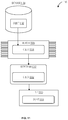
- a bytestream 1012 an object 1102 , a database 1104 , a memory 1106 , an object 1108 , a file 1110 , an object 1112 , and an object 1114 .
- the de-serialized data store transaction system 1100 utilizes a homoiconic (self-describing) n-tuple-based deserialized format; presenting the data the same way in code as it does when stored in memory.
- This format enables storage of multiple data types in a single multimodal database without the need for large-scale data duplication or serialization to link the data in different ways. Instead, the data may be stored as a single tuple database, and relations may be added on the fly. Further, these tuples may be encoded in any convenient format, for example, as (1 ‘foo’) or (00000001 00100111 01100110 01101111 01101111 00100111).
- the tuples are lexicographically self-sorting and stored in a content addressable memory so the content of any query acts as an address for the location of the tuple containing the relevant information which may be retrieved quickly. Searching becomes trivial and almost implicit.
- the system utilizes a Lisp-derived syntax and semantics, utilizing prefix notation and representing both source code and data as symbolic expressions (s-expressions).
- Standard s-expressions (“symbolic expression”) are a notation for nested list (tree-structured) data, here the s-expressions have been modified to be nested tuples, where tuples and other data types may be nested within an initial tuple.
- a user To select the columns within a table to make a query, using, for example SQL, a user must use the commands which trigger the data tables and columns to be individual searched, then deserialized and returned.
- the unified data store taxonomy model 1200 comprises a concept 1202 , a relationship 1204 , a weight 1206 , a domain 1208 , a token 1210 , a concept 1212 , a relationship 1214 , a weight 1216 , a domain 1218 , a token 1220 , a relationship 1222 , a weight 1224 , a concept 1226 , a domain 1228 , a token 1230 , and a concept 1232 .
- the concept 1226 may be a data type, similar to a namespace or class.
- the unified data store taxonomy model 1200 may require five concepts: the self-describing data object 1032 (self-defining), the relationship 1222 , the weight 1224 , the domain 1228 and the token 1230 .
- a domain 1208 may be conceptualized as a knowledge domain which may be defined by the user. For given data, the user may define multiple domains. Relationship 1222 may be a connection between two different pieces of data (concepts, domains, tokens).
- the weight 1224 provides the strength for the relationship 1222 . For example, a user may define the following concepts: (createConcept 0), (createConcept 1), (createConcept 2),(createConcept 3), domain(createConcept 4).
- a relationship may be established between different concepts, tokens or domains, for example the unique identifier 1002 and the unique identifier 1012 may be connected to one another by the relationship 1204 and the relationship 1214 .
- This relationship may have a weight which denotes the strength of one datum/type to another. Weights may have values per relationship type, indicating the strength of the given relationship.
- a relationship may be defined as unidirectional or bi-directional. For example, a relationship may only be denoted in relationship 1204 referring to a relationship 1214 , or it may be defined in both tuples. Similarly, weights may differ directionally as well.
- a first tuple may have a weight 1206 of 0.7 to a second tuple but the second tuple may have a weight 1216 of 0.9 to the first tuple.
- the weights may also be the same between both tuples.
- This taxonomy implicitly reflects the underlying organization and architecture of a unified data store and content addressable memory when used in conjunction therewith allows for a substantial increase in a computer's operational efficiency pertaining to data querying and management.
- the taxonomy model is a conceptual graph built from atomic (meta-circular) data objects (“concepts”) Everything in the model is represented uniformly, by concepts themselves. Each “concept” may receive a numeric ‘concept ID’, which may be, for example increasing numbers starting at 0. Concepts are used to define other concepts, and anything stored will relate back to the initial model. The first concept will be the idea of a concept itself which is given an ID 0. All other concepts may then be namespaced under this ID in the key-tuple store, so the first tuple will be [0 0], to be interpreted as ‘the concept “concept”’. Utilizing s-expressions a function may be created to define the first concept, allowing the first concept to be generated in the following manner:
- the concept ‘animal’ is a hypernym of the concept ‘tiger’, so given three concepts, “animal” as 100, “tiger” as 101, and “hypernym of” as 102, the relationship could be defined as:
- the model also supports weighted relationships by first defining the concept ‘weight’, and then adding a fourth parameter to the createRelationship operator:
- createConcept 2 (createConcept 2) ; weight (defn createRelationship ( conceptId relationshipTypeConceptId relatedConceptId weight ) (db.createKey [ 1 ; namespace: relationships conceptId relationshipTypeConceptId relatedConceptId 2 ; weight weight ]) )
- ‘domain’ and ‘token’ In order to map from external data sources to the concept model. To do this, we will create the concepts ‘domain’ and ‘token’. ‘Domain’ refers to the way in which the data is represented, and token refers to associated data. For example, when talking about human languages, this could be ‘English’, ‘Spanish’ or any other languages that were defined. In the context of political parties for example, these tokens could be Zip codes or GPS coordinates. In addition, it is also possible to create combinations of tokens across domains.
- a token may refer to many concepts, and one concept can be captured by many tokens, and weights may be assigned in one or both directions. Weights may be used by the application to define how tightly tokens are bound to concepts and vice-versa. For example, one weight may link concepts to tokens in a domain, and another may link tokens in a domain to concepts.
- the first weight represents how tightly the token is bound to the concept, as opposed to other tokens.
- the tokens from the domain ‘English’, “cat”, and “tiger”, may both describe the abstract ‘tiger’, but the actual word “tiger” is more likely to be used to describe the concept of a ‘tiger’ than the word “cat”.
- the second weight represents how tightly the token is bound to this concept, as opposed to other concepts.
- the token “cat” may refer to ‘tiger’ only 10% of the time, and to other things 90% of the time.
- the unified data store and transaction system 1300 comprises a tuple 1302 , a reader 1304 , an evaluator 1306 , a tuple object 1308 , and a string object 1310 .
- the unified data store and transaction system 1300 may be a tuple processor.
- a tuple 1302 may be input as a typed string, the string object 1310 , the parts of which may represent any data type.
- the tuple 1302 may apply standard string operations (may be concatenated, trimmed, split etc.) as well as apply operations unique to the data types within it.
- the code for the unified data store and transaction system 1300 may be run on an interpreter or as compiled code.
- the unified data store and transaction system 1300 may utilize prefix notation, e.g. (OPERATOR, OPERAND, OPERAND . . . ). By way of example (a*(b+c)/d) may be written as (/(*a(+bc))d).
- Evaluation of a tuple 1302 by the unified data store and transaction system 1300 may comprise reading the tuple 1302 with a reader 1304 wherein the reader 1304 translates the tuple 1302 which may be in string format into a tuple object 1308 .
- the semantics of the commands and tuple objects may then be evaluated by the evaluator 1306 .
- the evaluator 1306 may evaluate the syntax which has been defined by the user.
- the evaluator 1306 may be a function which may take the tuple as an argument.
- the system stores data, regardless of type, in a tuple format. This provides the data structure with uniformity and allows for a multimodal data store, requiring little-to-no duplication of the data to relate different categories and types of data. Further, this architecture allows for multimodal databases to easily be stored within the same process space, leading to further increases in efficiency. For example, a user may have a set of tuples which represents time stamps, and another set of tuples which represents geolocations.
- a database of tweets may include the content of the tweet, string objects; as well as the times of the tweets, time-series; connections between the users, connected-graph; and location the tweet was sent from, geospatial. These may all be encapsulated in a single database.
- the tuples may be arranged such that tweets are embedded within geospatial data which is embedded within time.
- the system stores data, regardless of type, in a tuple format.
- This provides the data structure with uniformity and allows for a multimodal data store, requiring little-to-no duplication of the data to relate different categories and types of data.
- this architecture allows for multimodal databases to easily be stored within the same process space, leading to further increases in efficiency. For example, a user may have a set of tuples which represents time stamps, and another set of tuples which represents geolocations. The user may wish to associate the two of these, and so may combine them into a new tuple for storage within the database. The same operators may be used on the new tuple, and each subpart of the tuple as each element is a tuple.
- a database of tweets may include the content of the tweet, string objects; as well as the times of the tweets, time-series; connections between the users, connected-graph; and location the tweet was sent from, geospatial. These may all be encapsulated in a single database.
- the tuples may be arranged such that tweets are embedded within geospatial data which is embedded within time.
- the tuple may be instantiated (time minute hour day weekday week month year (geolocation latitude longitude locationString) (tweet tweetString)). Queries made to find a specific day of the week may query using the “weekday” position and all tuples which had matching content would be retrieved using that implicit “address”. This also allows for the returned information may be pruned in real time by altering individual parts of the tuples, to constrain them, for example, by specifying only tweets from Amsterdam on Jul. 1, 2017. Further, because the tuples are ordered, the user may also query by specifying a range of indices. For example, to get the day and time of all the tweets, the indices 1-4 could be retrieved.
- the order of complexity of the query is proportional to the length of the tuple, (order x, where x is the number of bytes in the tuple).
- the system also allows for reduced overhead when constraining existing queries; since the content of the tuples acts as an implicit address, if the user wished to constrain the data returned, a constraint could be specified to narrow the query. The system would not need to find and remove all the non-matching entries but would simply no longer return the non-matching entries.
- FIG. 14 illustrates an embodiment of a digital apparatus 1400 to implement components and process steps of the system described herein.
- Input devices 1404 comprise transducers that convert physical phenomenon into machine internal signals, typically electrical, optical or magnetic signals. Signals may also be wireless in the form of electromagnetic radiation in the radio frequency (RF) range but also potentially in the infrared or optical range. Examples of input devices 1404 are keyboards which respond to touch or physical pressure from an object or proximity of an object to a surface, mice which respond to motion through space or across a plane, microphones which convert vibrations in the medium (typically air) into device signals, scanners which convert optical patterns on two or three dimensional objects into device signals.
- the signals from the input devices 1404 are provided via various machine signal conductors (e.g., busses or network interfaces) and circuits to memory 1406 .
- the memory 1406 is typically what is known as a first or second level memory device, providing for storage (via configuration of matter or states of matter) of signals received from the input devices 1404 , instructions and information for controlling operation of the cpu 1402 , and signals from storage devices 1410 .
- the memory 1406 and/or the storage devices 1410 may store computer-executable instructions and thus forming logic 1414 that when applied to and executed by the cpu 1402 implement embodiments of the processes disclosed herein.
- Information stored in the memory 1406 is typically directly accessible to the cpu 1402 of the device. Signals input to the device cause the reconfiguration of the internal material/energy state of the memory 1406 , creating in essence a new machine configuration, influencing the behavior of the digital apparatus 1400 by affecting the behavior of the cpu 1402 with control signals (instructions) and data provided in conjunction with the control signals.
- Second or third level storage devices 1410 may provide a slower but higher capacity machine memory capability.
- Examples of storage devices 1410 are hard disks, optical disks, large capacity flash memories or other non-volatile memory technologies, and magnetic memories.
- the cpu 1402 may cause the configuration of the memory 1406 to be altered by signals in storage devices 1410 .
- the cpu 1402 may cause data and instructions to be read from storage devices 1410 in the memory 1406 from which may then influence the operations of cpu 1402 as instructions and data signals, and from which it may also be provided to the output devices 1408 .
- the cpu 1402 may alter the content of the memory 1406 by signaling to a machine interface of memory 1406 to alter the internal configuration, and then converted signals to the storage devices 1410 to alter its material internal configuration.
- data and instructions may be backed up from memory 1406 , which is often volatile, to storage devices 1410 , which are often non-volatile.
- Output devices 1408 are transducers which convert signals received from the memory 1406 into physical phenomenon such as vibrations in the air, or patterns of light on a machine display, or vibrations (i.e., haptic devices) or patterns of ink or other materials (i.e., printers and 3-D printers).
- the network interface 1412 receives signals from the memory 1406 and converts them into electrical, optical, or wireless signals to other machines, typically via a machine network.
- the network interface 1412 also receives signals from the machine network and converts them into electrical, optical, or wireless signals to the memory 1406 .
- Circuitry in this context refers to electrical circuitry having at least one discrete electrical circuit, electrical circuitry having at least one integrated circuit, electrical circuitry having at least one application specific integrated circuit, circuitry forming a general purpose computing device configured by a computer program (e.g., a general purpose computer configured by a computer program which at least partially carries out processes or devices described herein, or a microprocessor configured by a computer program which at least partially carries out processes or devices described herein), circuitry forming a memory device (e.g., forms of random access memory), or circuitry forming a communications device (e.g., a modem, communications switch, or optical-electrical equipment).
- a computer program e.g., a general purpose computer configured by a computer program which at least partially carries out processes or devices described herein, or a microprocessor configured by a computer program which at least partially carries out processes or devices described herein
- circuitry forming a memory device e.g., forms of random access memory
- “Firmware” in this context refers to software logic embodied as processor-executable instructions stored in read-only memories or media.
- Hardware in this context refers to logic embodied as analog or digital circuitry.
- Logic in this context refers to machine memory circuits, non transitory machine readable media, and/or circuitry which by way of its material and/or material-energy configuration comprises control and/or procedural signals, and/or settings and values (such as resistance, impedance, capacitance, inductance, current/voltage ratings, etc.), that may be applied to influence the operation of a device.
- Magnetic media, electronic circuits, electrical and optical memory (both volatile and nonvolatile), and firmware are examples of logic.
- Logic specifically excludes pure signals or software per se (however does not exclude machine memories comprising software and thereby forming configurations of matter).
- “Software” in this context refers to logic implemented as processor-executable instructions in a machine memory (e.g. read/write volatile or nonvolatile memory or media).
- references to “one embodiment” or “an embodiment” do not necessarily refer to the same embodiment, although they may.
- the words “comprise,” “comprising,” and the like are to be construed in an inclusive sense as opposed to an exclusive or exhaustive sense; that is to say, in the sense of “including, but not limited to.” Words using the singular or plural number also include the plural or singular number respectively, unless expressly limited to a single one or multiple ones.
- the words “herein,” “above,” “below” and words of similar import when used in this application, refer to this application as a whole and not to any particular portions of this application.
- association operation may be carried out by an “associator” or “correlator”.
- switching may be carried out by a “switch”, selection by a “selector”, and so on.
- logic may be distributed throughout one or more devices, and/or may be comprised of combinations memory, media, processing circuits and controllers, other circuits, and so on. Therefore, in the interest of clarity and correctness logic may not always be distinctly illustrated in drawings of devices and systems, although it is inherently present therein.
- the techniques and procedures described herein may be implemented via logic distributed in one or more computing devices. The particular distribution and choice of logic will vary according to implementation.
- a signal bearing media include, but are not limited to, the following: recordable type media such as floppy disks, hard disk drives, CD ROMs, digital tape, flash drives, SD cards, solid state fixed or removable storage, and computer memory.
Landscapes
- Engineering & Computer Science (AREA)
- Theoretical Computer Science (AREA)
- Databases & Information Systems (AREA)
- Data Mining & Analysis (AREA)
- Physics & Mathematics (AREA)
- General Engineering & Computer Science (AREA)
- General Physics & Mathematics (AREA)
- Computational Linguistics (AREA)
- Information Retrieval, Db Structures And Fs Structures Therefor (AREA)
Abstract
Description
| Lists: | ||
| (1 2 3 4 5 6) | ||
| (someSymbol “hello” true) | ||
| Vectors: | ||
| [“I” “am” “a” “vector” true] | ||
| [0.1 23.5 16.0] | ||
| Maps: | ||
| { | ||
| “firstName”:”Harry” | ||
| “lastName”:”Potter” | ||
| } | ||
| or: | ||
| { | ||
| “name”:”Seattle” | ||
| “position”: [ | ||
| 47.6129432 | ||
| −122.4821475 | ||
| ] | ||
| } | ||
| (createConcept 0). | ||
| ;|defines a new key in the ‘concept’ namespace|; | ||
| (defn createConcept | ||
| ( | ||
| id | ||
| ) | ||
| (db.createKey [ | ||
| 0 ;| namespace: concepts|; | ||
| id | ||
| ]) | ||
| ) | ||
| (createConcept 2) ; weight | ||
| (defn createRelationship | ||
| ( | ||
| conceptId | ||
| relationshipTypeConceptId | ||
| relatedConceptId | ||
| weight | ||
| ) | ||
| (db.createKey [ | ||
| 1 ; namespace: relationships | ||
| conceptId | ||
| relationshipTypeConceptId | ||
| relatedConceptId | ||
| 2 ; weight | ||
| weight | ||
| ]) | ||
| ) | ||
| To do all of this, we will define a single operator: | ||
| (defin createToken | ||
| ( | ||
| conceptId | ||
| domainConceptId | ||
| value | ||
| tokenWeight | ||
| conceptWeight | ||
| ) | ||
| (begin | ||
| ; create link from concept to token | ||
| (db.createKey [ | ||
| 3 ; namespace: domain | ||
| 0; concept | ||
| conceptId ; concept ID: concept | ||
| domainConceptId ; English, GPS, etc. | ||
| 4 ; token | ||
| value ; domain representation (word, coordinates, etc.) | ||
| 2 ; weight | ||
| tokenWeight | ||
| ]) | ||
| ; create link from token to concept | ||
| (db.createKey [ | ||
| 3 ; namespace: domain | ||
| domainConceptId ; English, GPS, etc. | ||
| 4 ; token | ||
| value ; domain representation (word, coordinates, etc.) | ||
| 0 ; concept | ||
| conceptId ; concept ID: concept | ||
| 2 ; weight | ||
| conceptWeight | ||
| ]) | ||
| ) | ||
| ) | ||
Claims (11)
Priority Applications (1)
| Application Number | Priority Date | Filing Date | Title |
|---|---|---|---|
| US16/361,961 US11222025B2 (en) | 2018-03-27 | 2019-03-22 | De-serialized datastore transaction system |
Applications Claiming Priority (2)
| Application Number | Priority Date | Filing Date | Title |
|---|---|---|---|
| US201862648544P | 2018-03-27 | 2018-03-27 | |
| US16/361,961 US11222025B2 (en) | 2018-03-27 | 2019-03-22 | De-serialized datastore transaction system |
Publications (2)
| Publication Number | Publication Date |
|---|---|
| US20190303372A1 US20190303372A1 (en) | 2019-10-03 |
| US11222025B2 true US11222025B2 (en) | 2022-01-11 |
Family
ID=68056286
Family Applications (1)
| Application Number | Title | Priority Date | Filing Date |
|---|---|---|---|
| US16/361,961 Expired - Fee Related US11222025B2 (en) | 2018-03-27 | 2019-03-22 | De-serialized datastore transaction system |
Country Status (1)
| Country | Link |
|---|---|
| US (1) | US11222025B2 (en) |
Families Citing this family (3)
| Publication number | Priority date | Publication date | Assignee | Title |
|---|---|---|---|---|
| CN111680051B (en) * | 2020-05-29 | 2023-10-20 | 杭州趣链科技有限公司 | A data serialization and deserialization method, device and storage medium |
| CN112671734B (en) * | 2020-12-16 | 2023-06-09 | 中国平安人寿保险股份有限公司 | Message processing method for multiple data sources and related equipment thereof |
| US20220327419A1 (en) * | 2021-04-10 | 2022-10-13 | At&T Intellectual Property I, L.P. | Increasing inclusivity in machine learning outputs |
Citations (4)
| Publication number | Priority date | Publication date | Assignee | Title |
|---|---|---|---|---|
| US20160071233A1 (en) * | 2014-09-10 | 2016-03-10 | Oracle International Corporation | Graph Processing Using a Mutable Multilevel Graph Representation |
| US20170139956A1 (en) * | 2015-11-18 | 2017-05-18 | Linkedin Corporation | Dynamic data-ingestion pipeline |
| US20170295108A1 (en) * | 2016-04-07 | 2017-10-12 | International Business Machines Corporation | Specifying a highly-resilient system in a disaggregated compute environment |
| US10757061B1 (en) * | 2016-08-18 | 2020-08-25 | Hrl Laboratories, Llc | Cross-modal event summarization system based on network of networks representations |
-
2019
- 2019-03-22 US US16/361,961 patent/US11222025B2/en not_active Expired - Fee Related
Patent Citations (4)
| Publication number | Priority date | Publication date | Assignee | Title |
|---|---|---|---|---|
| US20160071233A1 (en) * | 2014-09-10 | 2016-03-10 | Oracle International Corporation | Graph Processing Using a Mutable Multilevel Graph Representation |
| US20170139956A1 (en) * | 2015-11-18 | 2017-05-18 | Linkedin Corporation | Dynamic data-ingestion pipeline |
| US20170295108A1 (en) * | 2016-04-07 | 2017-10-12 | International Business Machines Corporation | Specifying a highly-resilient system in a disaggregated compute environment |
| US10757061B1 (en) * | 2016-08-18 | 2020-08-25 | Hrl Laboratories, Llc | Cross-modal event summarization system based on network of networks representations |
Also Published As
| Publication number | Publication date |
|---|---|
| US20190303372A1 (en) | 2019-10-03 |
Similar Documents
| Publication | Publication Date | Title |
|---|---|---|
| US11442994B2 (en) | Unified data store and transaction system | |
| US11231875B2 (en) | Database read/write access control mechanism | |
| Chasseur et al. | Enabling JSON Document Stores in Relational Systems. | |
| Plattner | A course in in-memory data management | |
| Fraczek et al. | Comparative analysis of relational and non-relational databases in the context of performance in web applications | |
| US11048669B2 (en) | Replicated state management using journal-based registers | |
| US11100110B2 (en) | Split-associative data store and associated control logic | |
| CN101706801A (en) | Method and system for managing memory database data | |
| US20190303372A1 (en) | De-serialized datastore transaction system | |
| CN108595664A (en) | A kind of agricultural data monitoring method under hadoop environment | |
| US12380109B2 (en) | Database join operations with early filtering | |
| Urbani et al. | Adaptive low-level storage of very large knowledge graphs | |
| US20250245230A1 (en) | Query Acceleration and Metadata Caching | |
| Matallah et al. | Experimental comparative study of NoSQL databases: HBASE versus MongoDB by YCSB | |
| Diao et al. | Efficient exploration of interesting aggregates in RDF graphs | |
| US11194768B2 (en) | Taxonomy model in a unified data store | |
| CN113806190B (en) | Method, device and system for predicting performance of database management system | |
| CN106874329A (en) | The implementation method and device of database table index | |
| US11288388B2 (en) | Proxy-free data access security for data store | |
| Wong et al. | ANVIL: An In-Storage Accelerator for Name–Value Data Stores | |
| Chirigati et al. | Virtual lightweight snapshots for consistent analytics in NoSQL stores | |
| Tekin et al. | B+ ANN: A Fast Billion-Scale Disk-based Nearest-Neighbor Index | |
| Hartmann et al. | Database and Expert Systems Applications: 30th International Conference, DEXA 2019, Linz, Austria, August 26–29, 2019, Proceedings, Part II | |
| CN117828127A (en) | A tree-like hierarchical cluster user management method based on semi-structured storage | |
| Wong et al. | TCAM-SSD: A Framework for Search-Based Computing in Solid-State Drives |
Legal Events
| Date | Code | Title | Description |
|---|---|---|---|
| AS | Assignment |
Owner name: SUBSTRATE INC., NETHERLANDS Free format text: ASSIGNMENT OF ASSIGNORS INTEREST;ASSIGNORS:BEAUMONT, CHRISTIAN;BEAUMONT, BEHNAZ;VAN DER MAAS, JOUKE;AND OTHERS;SIGNING DATES FROM 20190320 TO 20190321;REEL/FRAME:048679/0851 |
|
| FEPP | Fee payment procedure |
Free format text: ENTITY STATUS SET TO UNDISCOUNTED (ORIGINAL EVENT CODE: BIG.); ENTITY STATUS OF PATENT OWNER: SMALL ENTITY |
|
| FEPP | Fee payment procedure |
Free format text: ENTITY STATUS SET TO SMALL (ORIGINAL EVENT CODE: SMAL); ENTITY STATUS OF PATENT OWNER: SMALL ENTITY |
|
| STPP | Information on status: patent application and granting procedure in general |
Free format text: NON FINAL ACTION MAILED |
|
| STPP | Information on status: patent application and granting procedure in general |
Free format text: RESPONSE TO NON-FINAL OFFICE ACTION ENTERED AND FORWARDED TO EXAMINER |
|
| STPP | Information on status: patent application and granting procedure in general |
Free format text: NON FINAL ACTION MAILED |
|
| STPP | Information on status: patent application and granting procedure in general |
Free format text: RESPONSE TO NON-FINAL OFFICE ACTION ENTERED AND FORWARDED TO EXAMINER |
|
| STPP | Information on status: patent application and granting procedure in general |
Free format text: NOTICE OF ALLOWANCE MAILED -- APPLICATION RECEIVED IN OFFICE OF PUBLICATIONS |
|
| STPP | Information on status: patent application and granting procedure in general |
Free format text: PUBLICATIONS -- ISSUE FEE PAYMENT RECEIVED |
|
| STPP | Information on status: patent application and granting procedure in general |
Free format text: PUBLICATIONS -- ISSUE FEE PAYMENT VERIFIED |
|
| STCF | Information on status: patent grant |
Free format text: PATENTED CASE |
|
| FEPP | Fee payment procedure |
Free format text: MAINTENANCE FEE REMINDER MAILED (ORIGINAL EVENT CODE: REM.); ENTITY STATUS OF PATENT OWNER: SMALL ENTITY |
|
| LAPS | Lapse for failure to pay maintenance fees |
Free format text: PATENT EXPIRED FOR FAILURE TO PAY MAINTENANCE FEES (ORIGINAL EVENT CODE: EXP.); ENTITY STATUS OF PATENT OWNER: SMALL ENTITY |
|
| STCH | Information on status: patent discontinuation |
Free format text: PATENT EXPIRED DUE TO NONPAYMENT OF MAINTENANCE FEES UNDER 37 CFR 1.362 |
|
| FP | Lapsed due to failure to pay maintenance fee |
Effective date: 20260111 |