US11221292B2 - Method utilizing in-situ, subsurface, near-infrared spectroscopy to detect buried human remains - Google Patents
Method utilizing in-situ, subsurface, near-infrared spectroscopy to detect buried human remains Download PDFInfo
- Publication number
- US11221292B2 US11221292B2 US16/901,305 US202016901305A US11221292B2 US 11221292 B2 US11221292 B2 US 11221292B2 US 202016901305 A US202016901305 A US 202016901305A US 11221292 B2 US11221292 B2 US 11221292B2
- Authority
- US
- United States
- Prior art keywords
- location
- human remains
- spectroscopy
- fatty acid
- include human
- Prior art date
- Legal status (The legal status is an assumption and is not a legal conclusion. Google has not performed a legal analysis and makes no representation as to the accuracy of the status listed.)
- Active
Links
Images



Classifications
-
- G—PHYSICS
- G01—MEASURING; TESTING
- G01N—INVESTIGATING OR ANALYSING MATERIALS BY DETERMINING THEIR CHEMICAL OR PHYSICAL PROPERTIES
- G01N21/00—Investigating or analysing materials by the use of optical means, i.e. using sub-millimetre waves, infrared, visible or ultraviolet light
- G01N21/17—Systems in which incident light is modified in accordance with the properties of the material investigated
- G01N21/25—Colour; Spectral properties, i.e. comparison of effect of material on the light at two or more different wavelengths or wavelength bands
- G01N21/31—Investigating relative effect of material at wavelengths characteristic of specific elements or molecules, e.g. atomic absorption spectrometry
- G01N21/35—Investigating relative effect of material at wavelengths characteristic of specific elements or molecules, e.g. atomic absorption spectrometry using infrared light
- G01N21/3563—Investigating relative effect of material at wavelengths characteristic of specific elements or molecules, e.g. atomic absorption spectrometry using infrared light for analysing solids; Preparation of samples therefor
-
- G—PHYSICS
- G01—MEASURING; TESTING
- G01N—INVESTIGATING OR ANALYSING MATERIALS BY DETERMINING THEIR CHEMICAL OR PHYSICAL PROPERTIES
- G01N21/00—Investigating or analysing materials by the use of optical means, i.e. using sub-millimetre waves, infrared, visible or ultraviolet light
- G01N21/17—Systems in which incident light is modified in accordance with the properties of the material investigated
- G01N21/25—Colour; Spectral properties, i.e. comparison of effect of material on the light at two or more different wavelengths or wavelength bands
- G01N21/31—Investigating relative effect of material at wavelengths characteristic of specific elements or molecules, e.g. atomic absorption spectrometry
- G01N21/35—Investigating relative effect of material at wavelengths characteristic of specific elements or molecules, e.g. atomic absorption spectrometry using infrared light
- G01N21/359—Investigating relative effect of material at wavelengths characteristic of specific elements or molecules, e.g. atomic absorption spectrometry using infrared light using near infrared light
-
- G—PHYSICS
- G01—MEASURING; TESTING
- G01N—INVESTIGATING OR ANALYSING MATERIALS BY DETERMINING THEIR CHEMICAL OR PHYSICAL PROPERTIES
- G01N33/00—Investigating or analysing materials by specific methods not covered by groups G01N1/00 - G01N31/00
- G01N33/24—Earth materials
- G01N33/246—Earth materials for water content
-
- G—PHYSICS
- G01—MEASURING; TESTING
- G01V—GEOPHYSICS; GRAVITATIONAL MEASUREMENTS; DETECTING MASSES OR OBJECTS; TAGS
- G01V8/00—Prospecting or detecting by optical means
- G01V8/10—Detecting, e.g. by using light barriers
-
- G—PHYSICS
- G01—MEASURING; TESTING
- G01N—INVESTIGATING OR ANALYSING MATERIALS BY DETERMINING THEIR CHEMICAL OR PHYSICAL PROPERTIES
- G01N21/00—Investigating or analysing materials by the use of optical means, i.e. using sub-millimetre waves, infrared, visible or ultraviolet light
- G01N21/84—Systems specially adapted for particular applications
- G01N21/85—Investigating moving fluids or granular solids
- G01N21/8507—Probe photometers, i.e. with optical measuring part dipped into fluid sample
- G01N2021/855—Underground probe, e.g. with provision of a penetration tool
Definitions
- the present invention is directed to a method of locating human remains in clandestine or undocumented burials by detecting fatty acids or their salts utilizing in-situ, subsurface, near-infrared spectroscopy.
- Cadaver dogs when well trained and professionally handled, signal odors that result from the presence and decomposition of the cadaver.
- the chemical compounds responsible for these odors are volatile and may be water-soluble.
- a cadaver dog may find such odors in many places other than where the cadaver is actually buried. In this case, the negative result is the time and expense of fruitless excavations. In other cases, with a longer post-mortem interval, the odors may no longer be detectable.
- Ground penetrating radar is capable of detecting variations in density below the surface of the soil, but GPR does not indicate the nature of what is in the ground.
- U.S. Pat. No. 5,038,040 discloses a soil test apparatus for field use.
- the soil test apparatus includes means adapted for transport over a field for testing the soil thereof
- the soil test apparatus further includes an infrared radiation generator for producing infrared radiation at a plurality of predetermined wavelengths, an elongate light carrying member coupled to the infrared radiation generator and extending therefrom for directing infrared radiation onto the soil, and a light detector for detecting infrared radiation reflected from the soil and for producing corresponding electrical signals.
- U.S. Pat. No. 5,461,229 discloses an on-the-go probe for determining the presence of chemical residue in a soil using Transient Infrared Spectroscopy.
- the probe pulls a soil implement through the soil and the soil implement includes a heating or cooling source for temporarily creating a temperature differential between a layer of soil proximate the soil implement and a layer of soil remote from the soil implement.
- the soil is moved sufficiently fast with respect to the heating source to enable measuring the radiation characteristics of the thin layer of soil before the thin layer of soil begins to self-absorb and substantially change its emission characteristics.
- U.S. Pat. No. 9,285,501 discloses a multi-sensor system that measures diffuse reflectance of soil, soil conductivity, and other soil properties in situ, in three dimensions.
- the system includes a tractor-drawn implement containing a sensor shank used for X-Y axis measurements, a hydraulic probe implement containing a sensor probe for ⁇ Z axis measurements, and a set of visible and near-infrared spectrometers, controls, and firmware that are shared by each implement.
- Both implements include optical sensors and soil electrical conductivity sensors.
- the probe implement incorporates a sensor that measures insertion force, and the shank implement includes a soil temperature sensor. These combinations of sensors are used to calibrate the system and to characterize the soil properties within a field or area. Geo-referenced soil measurements are collected with the shank implement to identify optimal locations for conducting sensor probe insertions. The probe implement is then used for sensor probing and for collecting soil core samples for lab analysis.
- the present invention provides a method for locating human remains in a clandestine or undocumented burial, the method including providing a spectroscopy assembly including a spectroscopy probe with a distal end to a location that may include human remains, wherein the spectroscopy assembly is configured to identify whether a salt of a fatty acid is present based on overtone wavelengths of the salt of the fatty acid; inserting the distal end of the spectroscopy probe into a testing spot at the location that may include human remains; and analyzing, with the spectroscopy assembly and after the step of inserting, whether the salt of the fatty acid having the overtone wavelengths is present in the location that may include human remains.
- the step of analyzing may include utilizing near-infrared spectroscopy, and the overtone wavelengths may be characterized by an absorption band contour extending from about 1670 nm to about 1800 nm.
- FIG. 1 is a schematic for a method according to one or more embodiments of the present invention.
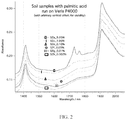
- FIG. 2 is a graph showing spectra from soil samples spiked with palmitic acid.
- FIG. 3 is a graph showing spectra from a variety of soil samples.
- One or more embodiments of the present invention are directed to a method of locating human remains in clandestine or undocumented burials.
- methods disclosed herein utilize in-situ subsurface, near-infrared spectroscopy, and focus on certain absorption bands, where the absorption bands are particularly useful for identifying fatty acids, by way of the salts of those fatty acids, from the human remains to be located. When these characteristic absorption features are observed, this is indicative of human remains being present at that location.
- the methods disclosed herein may be practically implemented by inserting a probe into the soil to measure diffuse reflectance spectra.
- One or more embodiments of the present invention are also directed to a probe assembly system that utilizes the method of detection.
- FIG. 1 shows a schematic for a method 10 of locating human remains in a clandestine or undocumented burial location 12 .
- Clandestine or undocumented burial location 12 may also be referred to soil location 12 or location 12 that may include human remains.
- the method 10 may include a first step of identifying the location 12 that may include human remains.
- the method 10 includes providing a spectroscopy assembly 14 that includes a spectroscopy probe 16 .
- the spectroscopy probe 16 includes a distal end 18 to be inserted below ground level 20 and into the location 14 that may include human remains.
- spectroscopy assembly 14 With distal end 18 below ground level 20 and in the location 14 that may include human remains, spectroscopy assembly 14 with spectroscopy probe 16 is utilized to perform an analysis step regarding the contents of location 12 . Specifically, spectroscopy assembly 14 analyzes whether any fatty acids 22 , or a salt of a fatty acid 22 , are present in the location 12 that may include human remains.
- Method 10 may also include additional steps toward further verification that the location 12 does indeed include human remains. These additional steps may include measuring a secondary property of the location 12 that may include human remains.
- the term secondary is utilized to indicate a property or indicator in addition to the presence of the salts of fatty acids 22 .
- the same secondary property can also be measured for a nearby location 26 that is near the location 12 that may include human remains, which may also be referred to as a background location 26 .
- Nearby location 26 should be a location that does not include human remains, or a location that has not been disturbed in the same way that location 12 may have been disturbed.
- the secondary property of the location 12 that may include human remains can be compared with the secondary property of the nearby location 26 that does not include human remains.
- the step of comparing is generally suitable for eliminating any false negative conclusion from the step analyzing whether the salt of the fatty acid is present, to thereby provide further conclusive results.
- Spectroscopy assembly 14 may be referred to as a push-probe system 14 .
- Spectroscopy assembly 14 includes the ability to perform near-infrared spectroscopy and may also include the ability to perform visible spectroscopy and other potentially useful spectroscopy.
- Spectroscopy probe 16 may include a small window through which light passes.
- the window may be made from sapphire or diamond.
- a spectrometer in spectroscopy assembly 14 measures and records the spectra of the reflected light, which may also be referred to as diffuse reflectance spectra.
- the recorded spectra are then analyzed for the overtone wavelengths of the salts of fatty acids 22 , as discussed elsewhere herein.
- Spectroscopy assembly 14 generally includes an onboard computer utilizing software capable of measuring and recording the spectra.
- Spectroscopy assembly 14 may include a mobile delivery vehicle that houses the spectroscopy probe 16 .
- Spectroscopy assembly 14 may include a hydraulic system for pushing the spectroscopy probe 16 into the ground.
- Exemplary spectroscopy assemblies 14 and aspects thereof are disclosed in U.S. Pat. Nos. 5,038,040; 5,461,229; and 9,285,501, which are each incorporated herein by reference.
- An exemplary spectroscopy assembly 14 is sold by Veris Technologies, Inc. under the trade name Veris P4000.
- spectroscopy assembly 14 should be particularly adapted to locate a decay product of human decomposition 24 , e.g. salts of fatty acids 22 . These decay products may be found based on certain wavelengths recorded by the spectroscopy assembly 14 .
- the salts of fatty acids 22 can be characterized by certain overtone wavelengths.
- spectroscopy assembly 14 may be particularly configured to identify the salts of fatty acids 22 within the location 12 that may include human remains based on these certain overtone wavelengths.
- these overtone wavelengths can be characterized by an absorption band contour extending from about 1670 nm to about 1780 nm, in other embodiments, from about 1670 nm to about 1800 nm.
- the absorption band contour generally includes two regions of increased area extending to respective peak absorption wavelengths.
- the peak absorption wavelengths for the overtone bands of the salts of fatty acids 22 have been measured at 1731 nm and 1763 nm, with an approximate uncertainty of +/ ⁇ 1 nm for each wavelength. That is, in one or more embodiments, these peak absorption wavelengths for the overtone bands of the salts of fatty acids 22 may be referred to as being between 1730-1732 nm and between 1762-1764 nm. In other embodiments, the approximate uncertainty for each wavelength may be +/ ⁇ 2 nm, such that these peak absorption wavelengths of the salts of fatty acids 22 may be referred to as being between 1729-1733 nm and between 1761-1765 nm.
- the spectroscopy assembly 14 and the corresponding method are configured to only identify whether a salt of a fatty acid is present based on these overtone wavelengths of the salt of the fatty acid. In one or more embodiments, the spectroscopy assembly 14 and the corresponding method are configured to consist essentially of identifying whether a salt of a fatty acid is present based on these overtone wavelengths of the salt of the fatty acid.
- spectroscopy assembly 14 may undergo a calibration step prior to use.
- This calibration step may be particularly adapted in accord with the location of a decay product of human decomposition 24 and identification thereof, as discussed herein.
- Other aspects related to calibration are disclosed in U.S. Pat. No. 9,285,501, which is incorporated herein by reference.
- exemplary locations 12 include those locations where war events have occurred and locations where a criminal may have buried human remains.
- the identification of a particular location 12 that may include human remains may be driven by other forensics factors. These forensics factors may include the assistance of police and military investigators to develop a lead based on witness testimony and the history of the crime or conflict.
- the location 12 that may include human remains includes a testing spot 28 A where the spectroscopy probe 16 is to be inserted.
- the location 12 that may include human remains may also include a plurality of testing spots (i.e. testing spot 28 A and testing spot 28 B) where the spectroscopy probe 16 is to be inserted.
- each testing spot 28 A, 28 B may be characterized by the distance between the testing spots 28 A, 28 B.
- the distance between each testing spot 28 A, 28 B is from 5 cm to 100 cm, in other embodiments, from 10 cm to 50 cm, in other embodiments, from 10 cm to 20 cm, and in other embodiments, from 25 cm to 50 cm.
- the average distance between each testing spot 28 A, 28 B is about 100 cm, in other embodiments, about 50 cm, in other embodiments, about 25 cm, and in other embodiments, about 10 cm.
- the distance between each testing spot 28 A, 28 B is at least 10 cm, in other embodiments, at least 20 cm, in other embodiments, at least 25 cm, and in other embodiments, at least 50 cm. In one or more embodiments, the distance between each testing spot 28 A, 28 B is less than 200 cm, in other embodiments, less than 100 cm, and in other embodiments, less than 50 cm.
- the plurality of testing spots 28 A, 28 B may be tested at a certain depth. Measuring at depths that are too near ground level 20 may lead to possible confusion of human remains 24 with other ubiquitous materials. For example, a false positive may be possible if someone had buried a family pet or fatty residue within the search area, and if the testing depth is not deep enough to get beyond these false results. Also, wild animal remains are generally found on the surface, not buried underground, so they would not cause a false positive indication.
- the depth of each testing spot 28 A, 28 B is from 20 cm to 150 cm, in other embodiments, from 30 cm to 90 cm, in other embodiments, from 40 cm to 80 cm, and in other embodiments, from 45 cm to 70 cm. In one or more embodiments, the average depth of each testing spot 28 A, 28 B is about 100 cm, in other embodiments, about 80 cm, in other embodiments, about 60 cm, and in other embodiments, about 45 cm. In one or more embodiments, the depth of each testing spot 28 A, 28 B is at least 30 cm, in other embodiments, at least 50 cm, in other embodiments, at least 70 cm, and in other embodiments, at least 100 cm. In one or more embodiments, the depth of each testing spot 28 A, 28 B is less than 200 cm, in other embodiments, less than 100 cm, and in other embodiments, less than 70 cm.
- the location 12 that may include human remains may be characterized by one or more properties of the soil thereof.
- Soil generally has characteristic water absorption peaks near 1920 nm and near 1420 nm. These are broad peaks that become much more intense in wet soils, so much so that the relevant fatty acid peaks discussed elsewhere herein are tiny bumps in the rounded valley between these two giant peaks.
- the soil of location 12 includes fatty content in the naturally occurring organic matter contained within the soil, a false positive may be possible; that is, if the method disclosed herein is not performed.
- This background ‘false positive’ is generally shown in the “Background” sample of FIG. 3 .
- Certain organic compounds not resulting from human remains have absorption bands in the same region of the spectrum as those resulting from human remains. Examples of these other organic compounds include kitchen waste and residues derived from petroleum. In general, such materials will have slightly different absorption band contours, such that they might be distinguished from the fatty acid salts characteristic of human remains, as discussed elsewhere herein.
- the method 10 generally includes focusing on identifying fatty acids 22 , by way of the salts of those fatty acids.
- Fatty acids 22 are constituents of adipocere, which is a decay product of human decomposition 24 , which may also be referred to as human remains 24 .
- the fatty acids 22 for example, palmitic acid, myristic acid, oleic acid, and stearic acid, are believed to primarily be in the form of a salt or salts of the fatty acid.
- the salt of the fatty acid 22 may be referred to herein simply as fatty acids 22 inasmuch as the fatty acid component of the salt will be detected by the spectroscopy assembly 14 .
- the salts of fatty acids 22 are formed with the metals generally found in the ground.
- Exemplary metals include alkaline earth metals such as calcium and magnesium. These salts of fatty acids 22 may persist in the soil location 12 for many years, up to decades or even centuries.
- the analysis as to the presence or absence of these fatty acids 22 based on their certain overtone wavelengths may include an analysis as to the amount of the fatty acids 22 .
- FIG. 2 and FIG. 3 generally show that higher amounts of fatty acids 22 lead to larger absorption peaks as indicated by their height above a baseline. Thus, the size of these peaks might be utilized to determine how close any particular testing spot 28 A, 28 B is to human remains 24 . For example, if first testing spot 28 A has a larger peak than second testing spot 28 B, this may be an indication that human remains 24 are closer to first testing spot 28 A.
- the analysis as to the presence or absence of these fatty acids 22 based on their certain overtone wavelengths may include an analysis as to the type of the fatty acids 22 .
- the contour of these peaks might be utilized to determine the original source of the fatty acids 22 .
- a certain contour may indicate fatty acids 22 from human remains 24 whereas a different contour may indicate fatty acids from another source of fat, such as kitchen waste.
- the concentration of fatty acids 22 within the soil may be in a range of from about 6% to about 10%. Lower concentrations may also be detectable. In other embodiments, where the analysis is directly in a location including adipocere, the concentration of fatty acids 22 may be up to 80%.
- Nearby location 26 may be one location or a plurality of locations. In embodiments where a plurality of locations are utilized for nearby location 26 , this may provide a good measure of the background soil conditions may be obtained and serve to define the ‘baseline’ spectrum.
- nearby location 26 includes a plurality of locations within 1 meter to 10 meters of the location 12 that may include human remains.
- Exemplary secondary properties or indicators may include measurements by equipment that indicates the presence of a refilled excavation, for example, a grave excavation. This indication would tend to indicate the presence of human remains 24 .
- Particular secondary property measurements include probe insertion pressure, variation of the soil color, and variations in water retention. Obtaining these secondary properties or indicators can cut down on false negatives; that is, those instances where human remains are at location 12 but initial testing does not find the human remains.
- a lower probe insertion pressure generally indicates the location of a refilled excavation. That is, location 12 that may include human remains will generally have a lower probe insertion pressure than nearby location 26 . In one or more embodiments, location 12 that may include human remains may have probe insertion pressure that is about 30%, in other embodiments, about 50%, and in other embodiments, about 70%, of the probe insertion pressure at nearby location 26 . These pressure values may be taken at an insertion depth of from 20 cm to 80 cm, for example, at about 50 cm.
- the soil color may reflect the mixing of the darker topsoil deeper into the ground. That is, location 12 that may include human remains will generally have a darker soil color than nearby location 26 . These soil colors may be taken at an insertion depth of from 20 cm to 80 cm, for example, at about 50 cm.
- the present methods may offer one or more other advantages.
- the present methods may offer a success rate of greater than 80%, and in other embodiments, greater than 90%, per excavation. Certain prior art techniques have a success rate of less than 30% per excavation.
- the present methods may also offer an improved recovery rate compared to prior art techniques. Certain prior art techniques have a recovery rate of about 3%.
- the present invention offers an improvement in the technology of utilizing spectroscopy. Moreover, the utilization of the spectroscopy assembly and spectroscopy probe should be considered a practical application as to certain aspects discussed herein.
- FIG. 2 includes spectra obtained from a variety of soil samples that were dosed with varying amounts of palmitic acid, with the amounts identified in FIG. 2 .
- the palmitic acid peaks are easily visible at 1731 nm and 1762 nm. These peaks are still discernible in the 1% palmitic acid sample, but not in the 0.1% palmitic acid sample.
- FIG. 3 includes spectra obtained from a variety of soil samples. Two of the samples were dosed with palmitic acid at amounts of 8% and 1%. Three of the samples (labeled D18_018) were taken from different spots at a site including a human cadaver. In these three samples, the palmitic acid peaks are visible at about 1731 nm and about 1762 nm. One of the samples (labeled background) was taken near the site including the human cadaver from a spot that did not include the human cadaver.
Landscapes
- Physics & Mathematics (AREA)
- Life Sciences & Earth Sciences (AREA)
- Spectroscopy & Molecular Physics (AREA)
- Health & Medical Sciences (AREA)
- Chemical & Material Sciences (AREA)
- General Physics & Mathematics (AREA)
- Pathology (AREA)
- General Health & Medical Sciences (AREA)
- Biochemistry (AREA)
- Immunology (AREA)
- Analytical Chemistry (AREA)
- Engineering & Computer Science (AREA)
- General Life Sciences & Earth Sciences (AREA)
- Environmental & Geological Engineering (AREA)
- Geology (AREA)
- Remote Sensing (AREA)
- Food Science & Technology (AREA)
- Medicinal Chemistry (AREA)
- Geophysics (AREA)
- Investigating Or Analysing Materials By Optical Means (AREA)
Abstract
Description
Claims (20)
Priority Applications (1)
| Application Number | Priority Date | Filing Date | Title |
|---|---|---|---|
| US16/901,305 US11221292B2 (en) | 2019-06-14 | 2020-06-15 | Method utilizing in-situ, subsurface, near-infrared spectroscopy to detect buried human remains |
Applications Claiming Priority (3)
| Application Number | Priority Date | Filing Date | Title |
|---|---|---|---|
| US201962861492P | 2019-06-14 | 2019-06-14 | |
| US202063033934P | 2020-06-03 | 2020-06-03 | |
| US16/901,305 US11221292B2 (en) | 2019-06-14 | 2020-06-15 | Method utilizing in-situ, subsurface, near-infrared spectroscopy to detect buried human remains |
Publications (2)
| Publication Number | Publication Date |
|---|---|
| US20200393369A1 US20200393369A1 (en) | 2020-12-17 |
| US11221292B2 true US11221292B2 (en) | 2022-01-11 |
Family
ID=73745043
Family Applications (1)
| Application Number | Title | Priority Date | Filing Date |
|---|---|---|---|
| US16/901,305 Active US11221292B2 (en) | 2019-06-14 | 2020-06-15 | Method utilizing in-situ, subsurface, near-infrared spectroscopy to detect buried human remains |
Country Status (1)
| Country | Link |
|---|---|
| US (1) | US11221292B2 (en) |
Citations (4)
| Publication number | Priority date | Publication date | Assignee | Title |
|---|---|---|---|---|
| US5038040A (en) | 1989-09-22 | 1991-08-06 | Agmed Inc. | Soil test apparatus |
| US5461229A (en) | 1994-06-06 | 1995-10-24 | Unisys Corporation | On-the-go optical spectroscopy soil analyzer |
| US20110106451A1 (en) * | 2008-11-04 | 2011-05-05 | Colin Christy | Multiple sensor system and method for mapping soil in three dimensions |
| US20170370064A1 (en) * | 2016-06-23 | 2017-12-28 | The Texas A&M University System | Vis-nir equipped soil penetrometer |
-
2020
- 2020-06-15 US US16/901,305 patent/US11221292B2/en active Active
Patent Citations (5)
| Publication number | Priority date | Publication date | Assignee | Title |
|---|---|---|---|---|
| US5038040A (en) | 1989-09-22 | 1991-08-06 | Agmed Inc. | Soil test apparatus |
| US5461229A (en) | 1994-06-06 | 1995-10-24 | Unisys Corporation | On-the-go optical spectroscopy soil analyzer |
| US20110106451A1 (en) * | 2008-11-04 | 2011-05-05 | Colin Christy | Multiple sensor system and method for mapping soil in three dimensions |
| US9285501B2 (en) | 2008-11-04 | 2016-03-15 | Veris Technologies, Inc. | Multiple sensor system and method for mapping soil in three dimensions |
| US20170370064A1 (en) * | 2016-06-23 | 2017-12-28 | The Texas A&M University System | Vis-nir equipped soil penetrometer |
Non-Patent Citations (9)
| Title |
|---|
| 53. Stuart, B. H., et al. "Studies of adipocere using diffuse reflectance infrared spectroscopy." Vibrational Spectroscopy 24.2 (2000): 233-242 (Year: 2000). * |
| Bereuter, Thomas L., Werner Mikenda, and Christian Reiter. "Iceman's Mummification—Implications from Infrared Spectroscopical and Histological Studies." Chemistry—A European Journal 3.7 (1997): 1032-1038. (Year: 1997). * |
| Forbes, Shari L., Boyd B. Dent, and Barbara H. Stuart. "The effect of soil type on adipocere formation." Forensic science international 154.1 (2005): 35-43. (Year: 2005). * |
| Merriam-Webster.com Dictionary, Merriam-Webster, https://www.merriam-webster.com/dictionary/human%20remains. Accessed Aug. 19, 2021). (Year: 2021). * |
| Miller et al. "Cemetery Setback Distances To Prevent Surface Water Contamination" Oct. 2017, National Collaborating Centre for Environmental Health (Year: 2017). * |
| Notter, Stephanie J., et al. "The initial changes of fat deposits during the decomposition of human and pig remains." Journal of Forensic Sciences 54.1 (2009): 195-201. (Year: 2006). * |
| Powell, K. "The Detection of Buried Human Skeletal Remains in The Australian Environment" Department of Anatomical Sciences, University of Adelaide, Apr. 2006. (Year: 2003). * |
| Rossel, RA Viscarra, et al. "In situ measurements of soil colour, mineral composition and clay content by vis-NIR spectroscopy." Geoderma 150.3-4 (2009): 253-266. (Year: 2009). * |
| Surabian, "Preservation of Buried Human Remains in Soil", U.S. Department of Agriculture Natural Resources Conservation Service, Dec. 2012 (Year: 2012). * |
Also Published As
| Publication number | Publication date |
|---|---|
| US20200393369A1 (en) | 2020-12-17 |
Similar Documents
| Publication | Publication Date | Title |
|---|---|---|
| Adamchuk et al. | Proximal soil and plant sensing | |
| US5412219A (en) | Method for determining surface coverage by materials exhibiting different fluorescent properties | |
| Bateman et al. | Detecting post-depositional sediment disturbance in sandy deposits using optical luminescence | |
| Barton et al. | Detection of tree roots and determination of root diameters by ground penetrating radar under optimal conditions | |
| US10337159B2 (en) | Vis-NIR equipped soil penetrometer | |
| Hirano et al. | Detection frequency of Pinus thunbergii roots by ground-penetrating radar is related to root biomass | |
| Ogen et al. | Evaluating the detection limit of organic matter using point and imaging spectroscopy | |
| Giambastiani et al. | Indirect root distribution characterization using electrical resistivity tomography in different soil conditions | |
| US20220205923A1 (en) | Device and Method for Determining an Elemental Composition of Ground | |
| Mouazen et al. | Influence of soil moisture content on assessment of bulk density with combined frequency domain reflectometry and visible and near infrared spectroscopy under semi field conditions | |
| FR3114653A1 (en) | SOIL POLLUTION ANALYSIS PROCEDURE | |
| Söderström et al. | Sensor mapping of Amazonian Dark Earths in deforested croplands | |
| Weindorf et al. | Lithologic discontinuity assessment in soils via portable X‐ray fluorescence spectrometry and visible near‐infrared diffuse reflectance spectroscopy | |
| Croft et al. | Characterizing soil surface roughness using a combined structural and spectral approach | |
| US20240003863A1 (en) | Methods for measuring organic carbon content or agricultural soils | |
| US20200393369A1 (en) | Method utilizing in-situ, subsurface, near-infrared spectroscopy to detect buried human remains | |
| Hubbard et al. | Environmental and agricultural applications of GPR | |
| van der Meijde et al. | A spectral-geophysical approach for detecting pipeline leakage | |
| EA008368B1 (en) | Measuring soil light response | |
| Netto et al. | Visible–NIR hyperspectral imagery for discriminating soil types in the La Peyne watershed (France) | |
| Rienecker et al. | Mapping phytoplankton in situ using a laser‐scattering sensor | |
| JP4354822B2 (en) | Method for revealing an object and related apparatus | |
| Davidson et al. | Examining the ultraviolet optical screening tool as a viable means for delineating a contaminated organic sediment | |
| Cuenca-García | Inorganic geochemical methods in archaeological prospection | |
| Lenz et al. | Evaluation and performance analysis of hydrocarbon detection methods using hyperspectral data |
Legal Events
| Date | Code | Title | Description |
|---|---|---|---|
| AS | Assignment |
Owner name: THE UNIVERSITY OF AKRON, OHIO Free format text: ASSIGNMENT OF ASSIGNORS INTEREST;ASSIGNORS:LOPA, AFRIN;PERRY, DAVID;MATNEY, TIMOTHY;AND OTHERS;REEL/FRAME:052938/0735 Effective date: 20200612 |
|
| FEPP | Fee payment procedure |
Free format text: ENTITY STATUS SET TO UNDISCOUNTED (ORIGINAL EVENT CODE: BIG.); ENTITY STATUS OF PATENT OWNER: MICROENTITY |
|
| FEPP | Fee payment procedure |
Free format text: ENTITY STATUS SET TO SMALL (ORIGINAL EVENT CODE: SMAL); ENTITY STATUS OF PATENT OWNER: MICROENTITY Free format text: ENTITY STATUS SET TO MICRO (ORIGINAL EVENT CODE: MICR); ENTITY STATUS OF PATENT OWNER: MICROENTITY |
|
| STPP | Information on status: patent application and granting procedure in general |
Free format text: DOCKETED NEW CASE - READY FOR EXAMINATION |
|
| STPP | Information on status: patent application and granting procedure in general |
Free format text: NON FINAL ACTION MAILED |
|
| STPP | Information on status: patent application and granting procedure in general |
Free format text: RESPONSE TO NON-FINAL OFFICE ACTION ENTERED AND FORWARDED TO EXAMINER |
|
| STPP | Information on status: patent application and granting procedure in general |
Free format text: FINAL REJECTION MAILED |
|
| STPP | Information on status: patent application and granting procedure in general |
Free format text: RESPONSE AFTER FINAL ACTION FORWARDED TO EXAMINER |
|
| STPP | Information on status: patent application and granting procedure in general |
Free format text: NOTICE OF ALLOWANCE MAILED -- APPLICATION RECEIVED IN OFFICE OF PUBLICATIONS |
|
| STPP | Information on status: patent application and granting procedure in general |
Free format text: PUBLICATIONS -- ISSUE FEE PAYMENT VERIFIED |
|
| STCF | Information on status: patent grant |
Free format text: PATENTED CASE |
|
| MAFP | Maintenance fee payment |
Free format text: PAYMENT OF MAINTENANCE FEE, 4TH YEAR, MICRO ENTITY (ORIGINAL EVENT CODE: M3551); ENTITY STATUS OF PATENT OWNER: MICROENTITY Year of fee payment: 4 |