US11220507B2 - Process for the preparation of rucaparib and novel synthesis intermediates - Google Patents
Process for the preparation of rucaparib and novel synthesis intermediates Download PDFInfo
- Publication number
- US11220507B2 US11220507B2 US16/770,811 US201716770811A US11220507B2 US 11220507 B2 US11220507 B2 US 11220507B2 US 201716770811 A US201716770811 A US 201716770811A US 11220507 B2 US11220507 B2 US 11220507B2
- Authority
- US
- United States
- Prior art keywords
- formula
- compound
- group
- hydrogen
- rucaparib
- Prior art date
- Legal status (The legal status is an assumption and is not a legal conclusion. Google has not performed a legal analysis and makes no representation as to the accuracy of the status listed.)
- Expired - Fee Related
Links
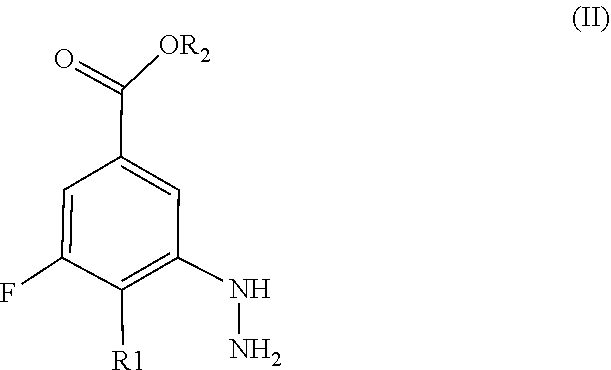
- 0 [1*]C1=C(NN)C=C(C(=O)O[2*])C=C1F Chemical compound [1*]C1=C(NN)C=C(C(=O)O[2*])C=C1F 0.000 description 21
- HMABYWSNWIZPAG-UHFFFAOYSA-N CNCC1=CC=C(/C2=C3\CCNC(=O)C4=C3C(=CC(F)=C4)N2)C=C1 Chemical compound CNCC1=CC=C(/C2=C3\CCNC(=O)C4=C3C(=CC(F)=C4)N2)C=C1 HMABYWSNWIZPAG-UHFFFAOYSA-N 0.000 description 3
- AHVIAHNWJCPPFG-PSZXADNCSA-N *.B.B.C.C#CCCCN1C(=O)C2=C(C=CC=C2)C1=O.C=C(Br)CCCN1C(=O)C2=C(C=CC=C2)C1=O.C=C(Br)CCCN1C(=O)C2=C(C=CC=C2)C1=O.C=C(CCCN1C(=O)C2=C(C=CC=C2)C1=O)C1=CC=C(CN(C)CC(=O)C2=CC=CC=C2)C=C1.CN(CC(=O)C1=CC=CC=C1)CC1=CC=C(B2OC(C)(C)C(C)(C)O2)C=C1.CN(CC(=O)C1=CC=CC=C1)CC1=CC=C(C(=O)CCCN2C(=O)C3=C(C=CC=C3)C2=O)C=C1.I[IH]I.[2HH] Chemical compound *.B.B.C.C#CCCCN1C(=O)C2=C(C=CC=C2)C1=O.C=C(Br)CCCN1C(=O)C2=C(C=CC=C2)C1=O.C=C(Br)CCCN1C(=O)C2=C(C=CC=C2)C1=O.C=C(CCCN1C(=O)C2=C(C=CC=C2)C1=O)C1=CC=C(CN(C)CC(=O)C2=CC=CC=C2)C=C1.CN(CC(=O)C1=CC=CC=C1)CC1=CC=C(B2OC(C)(C)C(C)(C)O2)C=C1.CN(CC(=O)C1=CC=CC=C1)CC1=CC=C(C(=O)CCCN2C(=O)C3=C(C=CC=C3)C2=O)C=C1.I[IH]I.[2HH] AHVIAHNWJCPPFG-PSZXADNCSA-N 0.000 description 1
- QAZSXRRLCZPXJX-UHFFFAOYSA-N C#CCCN1C(=O)C2=C(C=CC=C2)C1=O.CNCC1=CC=C(Br)C=C1.CNCC1=CC=C(C#CCCN2C(=O)C3=C(C=CC=C3)C2=O)C=C1 Chemical compound C#CCCN1C(=O)C2=C(C=CC=C2)C1=O.CNCC1=CC=C(Br)C=C1.CNCC1=CC=C(C#CCCN2C(=O)C3=C(C=CC=C3)C2=O)C=C1 QAZSXRRLCZPXJX-UHFFFAOYSA-N 0.000 description 1
- SGLWIOZABJKMRB-UHFFFAOYSA-N CN(CC1=CC=C(C#CCCN2C(=O)C3=C(C=CC=C3)C2=O)C=C1)C(=O)C(F)(F)F.CN(CC1=CC=C(C(=O)CCCN2C(=O)C3=C(C=CC=C3)C2=O)C=C1)C(=O)C(F)(F)F Chemical compound CN(CC1=CC=C(C#CCCN2C(=O)C3=C(C=CC=C3)C2=O)C=C1)C(=O)C(F)(F)F.CN(CC1=CC=C(C(=O)CCCN2C(=O)C3=C(C=CC=C3)C2=O)C=C1)C(=O)C(F)(F)F SGLWIOZABJKMRB-UHFFFAOYSA-N 0.000 description 1
- ZJQUDCJCROHCLL-UHFFFAOYSA-N CN(CC1=CC=C(C#CCCN2C(=O)C3=C(C=CC=C3)C2=O)C=C1)C(=O)C(F)(F)F.CNCC1=CC=C(C#CCCN2C(=O)C3=C(C=CC=C3)C2=O)C=C1 Chemical compound CN(CC1=CC=C(C#CCCN2C(=O)C3=C(C=CC=C3)C2=O)C=C1)C(=O)C(F)(F)F.CNCC1=CC=C(C#CCCN2C(=O)C3=C(C=CC=C3)C2=O)C=C1 ZJQUDCJCROHCLL-UHFFFAOYSA-N 0.000 description 1
- YYOCAOYYVWPXOW-UHFFFAOYSA-N CN(CC1=CC=C(C(=O)CCCN2C(=O)C3=C(C=CC=C3)C2=O)C=C1)C(=O)C(F)(F)F.CN(CC1=CC=C(C2=C(CCN3C(=O)C4=C(C=CC=C4)C3=O)C3=C(C(=O)O)C=C(F)C(Br)=C3N2)C=C1)C(=O)C(F)(F)F.CNCC1=CC=C(/C2=C3\CCCC(=O)C4=C3C(=C(Br)C(F)=C4)N2)C=C1.CNCC1=CC=C(/C2=C3\CCCC(=O)C4=C3C(=CC(F)=C4)N2)C=C1.Cl.NNC1=C(Br)C(F)=CC(C(=O)O)=C1 Chemical compound CN(CC1=CC=C(C(=O)CCCN2C(=O)C3=C(C=CC=C3)C2=O)C=C1)C(=O)C(F)(F)F.CN(CC1=CC=C(C2=C(CCN3C(=O)C4=C(C=CC=C4)C3=O)C3=C(C(=O)O)C=C(F)C(Br)=C3N2)C=C1)C(=O)C(F)(F)F.CNCC1=CC=C(/C2=C3\CCCC(=O)C4=C3C(=C(Br)C(F)=C4)N2)C=C1.CNCC1=CC=C(/C2=C3\CCCC(=O)C4=C3C(=CC(F)=C4)N2)C=C1.Cl.NNC1=C(Br)C(F)=CC(C(=O)O)=C1 YYOCAOYYVWPXOW-UHFFFAOYSA-N 0.000 description 1
- OJHSBFJZHQENMJ-UHFFFAOYSA-N CN(CC1=CC=C(C(=O)CCCN2C(=O)C3=C(C=CC=C3)C2=O)C=C1)C(=O)C(F)(F)F.CN(CC1=CC=C(C2=C(CCN3C(=O)C4=C(C=CC=C4)C3=O)C3=C(C(=O)O)C=C(F)C(Br)=C3N2)C=C1)C(=O)C(F)(F)F.Cl.NNC1=C(Br)C(F)=CC(C(=O)O)=C1 Chemical compound CN(CC1=CC=C(C(=O)CCCN2C(=O)C3=C(C=CC=C3)C2=O)C=C1)C(=O)C(F)(F)F.CN(CC1=CC=C(C2=C(CCN3C(=O)C4=C(C=CC=C4)C3=O)C3=C(C(=O)O)C=C(F)C(Br)=C3N2)C=C1)C(=O)C(F)(F)F.Cl.NNC1=C(Br)C(F)=CC(C(=O)O)=C1 OJHSBFJZHQENMJ-UHFFFAOYSA-N 0.000 description 1
- WXVWNYMCAOWAPL-UHFFFAOYSA-N CN(CC1=CC=C(C2=C(CCN3C(=O)C4=C(C=CC=C4)C3=O)C3=C(C(=O)O)C=C(F)C(Br)=C3N2)C=C1)C(=O)C(F)(F)F.CNCC1=CC=C(/C2=C3\CCNC(=O)C4=C3C(=C(Br)C(F)=C4)N2)C=C1 Chemical compound CN(CC1=CC=C(C2=C(CCN3C(=O)C4=C(C=CC=C4)C3=O)C3=C(C(=O)O)C=C(F)C(Br)=C3N2)C=C1)C(=O)C(F)(F)F.CNCC1=CC=C(/C2=C3\CCNC(=O)C4=C3C(=C(Br)C(F)=C4)N2)C=C1 WXVWNYMCAOWAPL-UHFFFAOYSA-N 0.000 description 1
- WLHCXSMCHCMGBZ-UHFFFAOYSA-N CN(Cc(cc1)ccc1C#CCCN(C(c1c2cccc1)=O)C2=O)C(C(F)(F)F)=O Chemical compound CN(Cc(cc1)ccc1C#CCCN(C(c1c2cccc1)=O)C2=O)C(C(F)(F)F)=O WLHCXSMCHCMGBZ-UHFFFAOYSA-N 0.000 description 1
- UTCLNLGHTNRPGS-UHFFFAOYSA-N CNCC1=CC=C(/C2=C3\CCCC(=O)C4=C3C(=C(Br)C(F)=C4)N2)C=C1.CNCC1=CC=C(/C2=C3\CCCC(=O)C4=C3C(=CC(F)=C4)N2)C=C1 Chemical compound CNCC1=CC=C(/C2=C3\CCCC(=O)C4=C3C(=C(Br)C(F)=C4)N2)C=C1.CNCC1=CC=C(/C2=C3\CCCC(=O)C4=C3C(=CC(F)=C4)N2)C=C1 UTCLNLGHTNRPGS-UHFFFAOYSA-N 0.000 description 1
- IDNMFYNPAUXYFE-UHFFFAOYSA-N CNCC1=CC=C(/C2=C3\CCCC(=O)C4=C3C(=CC(F)=C4)N2)C=C1 Chemical compound CNCC1=CC=C(/C2=C3\CCCC(=O)C4=C3C(=CC(F)=C4)N2)C=C1 IDNMFYNPAUXYFE-UHFFFAOYSA-N 0.000 description 1
- FYRFAMGRCHWXQR-UHFFFAOYSA-N CNCc(cc1)ccc1C#CCCN(C(c1c2cccc1)=O)C2=O Chemical compound CNCc(cc1)ccc1C#CCCN(C(c1c2cccc1)=O)C2=O FYRFAMGRCHWXQR-UHFFFAOYSA-N 0.000 description 1
- GMFNBGZBXJZZGX-UHFFFAOYSA-N Cl.NC1=C(Br)C(F)=CC(C(=O)O)=C1.NNC1=C(Br)C(F)=CC(C(=O)O)=C1 Chemical compound Cl.NC1=C(Br)C(F)=CC(C(=O)O)=C1.NNC1=C(Br)C(F)=CC(C(=O)O)=C1 GMFNBGZBXJZZGX-UHFFFAOYSA-N 0.000 description 1
Images

Classifications
-
- C—CHEMISTRY; METALLURGY
- C07—ORGANIC CHEMISTRY
- C07D—HETEROCYCLIC COMPOUNDS
- C07D487/00—Heterocyclic compounds containing nitrogen atoms as the only ring hetero atoms in the condensed system, not provided for by groups C07D451/00 - C07D477/00
- C07D487/02—Heterocyclic compounds containing nitrogen atoms as the only ring hetero atoms in the condensed system, not provided for by groups C07D451/00 - C07D477/00 in which the condensed system contains two hetero rings
- C07D487/06—Peri-condensed systems
-
- C—CHEMISTRY; METALLURGY
- C07—ORGANIC CHEMISTRY
- C07D—HETEROCYCLIC COMPOUNDS
- C07D487/00—Heterocyclic compounds containing nitrogen atoms as the only ring hetero atoms in the condensed system, not provided for by groups C07D451/00 - C07D477/00
- C07D487/02—Heterocyclic compounds containing nitrogen atoms as the only ring hetero atoms in the condensed system, not provided for by groups C07D451/00 - C07D477/00 in which the condensed system contains two hetero rings
- C07D487/04—Ortho-condensed systems
-
- C—CHEMISTRY; METALLURGY
- C07—ORGANIC CHEMISTRY
- C07C—ACYCLIC OR CARBOCYCLIC COMPOUNDS
- C07C243/00—Compounds containing chains of nitrogen atoms singly-bound to each other, e.g. hydrazines, triazanes
- C07C243/10—Hydrazines
- C07C243/22—Hydrazines having nitrogen atoms of hydrazine groups bound to carbon atoms of six-membered aromatic rings
-
- C—CHEMISTRY; METALLURGY
- C07—ORGANIC CHEMISTRY
- C07D—HETEROCYCLIC COMPOUNDS
- C07D209/00—Heterocyclic compounds containing five-membered rings, condensed with other rings, with one nitrogen atom as the only ring hetero atom
- C07D209/02—Heterocyclic compounds containing five-membered rings, condensed with other rings, with one nitrogen atom as the only ring hetero atom condensed with one carbocyclic ring
- C07D209/04—Indoles; Hydrogenated indoles
- C07D209/10—Indoles; Hydrogenated indoles with substituted hydrocarbon radicals attached to carbon atoms of the hetero ring
- C07D209/14—Radicals substituted by nitrogen atoms, not forming part of a nitro radical
-
- C—CHEMISTRY; METALLURGY
- C07—ORGANIC CHEMISTRY
- C07D—HETEROCYCLIC COMPOUNDS
- C07D209/00—Heterocyclic compounds containing five-membered rings, condensed with other rings, with one nitrogen atom as the only ring hetero atom
- C07D209/02—Heterocyclic compounds containing five-membered rings, condensed with other rings, with one nitrogen atom as the only ring hetero atom condensed with one carbocyclic ring
- C07D209/04—Indoles; Hydrogenated indoles
- C07D209/30—Indoles; Hydrogenated indoles with hetero atoms or with carbon atoms having three bonds to hetero atoms with at the most one bond to halogen, directly attached to carbon atoms of the hetero ring
- C07D209/32—Oxygen atoms
-
- C—CHEMISTRY; METALLURGY
- C07—ORGANIC CHEMISTRY
- C07D—HETEROCYCLIC COMPOUNDS
- C07D209/00—Heterocyclic compounds containing five-membered rings, condensed with other rings, with one nitrogen atom as the only ring hetero atom
- C07D209/02—Heterocyclic compounds containing five-membered rings, condensed with other rings, with one nitrogen atom as the only ring hetero atom condensed with one carbocyclic ring
- C07D209/44—Iso-indoles; Hydrogenated iso-indoles
- C07D209/48—Iso-indoles; Hydrogenated iso-indoles with oxygen atoms in positions 1 and 3, e.g. phthalimide
-
- C—CHEMISTRY; METALLURGY
- C07—ORGANIC CHEMISTRY
- C07D—HETEROCYCLIC COMPOUNDS
- C07D403/00—Heterocyclic compounds containing two or more hetero rings, having nitrogen atoms as the only ring hetero atoms, not provided for by group C07D401/00
- C07D403/02—Heterocyclic compounds containing two or more hetero rings, having nitrogen atoms as the only ring hetero atoms, not provided for by group C07D401/00 containing two hetero rings
- C07D403/06—Heterocyclic compounds containing two or more hetero rings, having nitrogen atoms as the only ring hetero atoms, not provided for by group C07D401/00 containing two hetero rings linked by a carbon chain containing only aliphatic carbon atoms
-
- C—CHEMISTRY; METALLURGY
- C07—ORGANIC CHEMISTRY
- C07D—HETEROCYCLIC COMPOUNDS
- C07D403/00—Heterocyclic compounds containing two or more hetero rings, having nitrogen atoms as the only ring hetero atoms, not provided for by group C07D401/00
- C07D403/02—Heterocyclic compounds containing two or more hetero rings, having nitrogen atoms as the only ring hetero atoms, not provided for by group C07D401/00 containing two hetero rings
- C07D403/08—Heterocyclic compounds containing two or more hetero rings, having nitrogen atoms as the only ring hetero atoms, not provided for by group C07D401/00 containing two hetero rings linked by a carbon chain containing alicyclic rings
-
- C—CHEMISTRY; METALLURGY
- C07—ORGANIC CHEMISTRY
- C07B—GENERAL METHODS OF ORGANIC CHEMISTRY; APPARATUS THEREFOR
- C07B2200/00—Indexing scheme relating to specific properties of organic compounds
- C07B2200/13—Crystalline forms, e.g. polymorphs
Definitions
- Rucaparib is the International Non-proprietary Name (INN) of 8-fluoro-2- ⁇ 4-[(methylamino)methyl]phenyl ⁇ -1,3,4,5-tetrahydro-6H-pyrrolo[4,3,2-ef][2]benzazepin-6-one (as reported in WHO Drug Information Vol 26, No. 1, 2012), herein after referred to only as rucaparib, and has the following formula (I)
- Rucaparib is a drug which was recently approved by the FDA for the treatment of ovarian cancer in patients with a deleterious BRCA-mutation and is still under clinical trials for investigating its potential activity for the treatment of other cancer diseases.
- FIG. 1 shows the XRPD of rucaparib obtained according to Example 3.
- the present invention relates to a process for the preparation of rucaparib of formula (I)
- R1 is selected from hydrogen a halogen atom, a cyano group, a sulfonyl group, an —O-sulfonyl group;
- R2 is selected from hydrogen, an alkyl group, an aryl group or an aryl-alkylgroup; or one of its salts,
- R3 is a protecting group
- R4 is hydrogen or a protecting group
- R5 is a protecting group
- R1, R2, R3, R4 and R5 are as above defined,
- R1 is as above defined:
- transforming rucaparib in one of its salts optionally, transforming rucaparib in one of its salts.
- the salts of rucaparib may be, according to the invention, either pharmaceutically acceptable or non-pharmaceutically acceptable salts.
- Non-pharmaceutically acceptable salts may be used, for example, in the isolation or purification of rucaparib.
- the salts may be any suitable salt and include salts with organic or inorganic acids or salts with organic or inorganic bases.
- the salts rucaparib are pharmaceutically acceptable salts, such as, for instance, hydrochloride, phosphate, maleate, camsylate and the like.
- the salts of compound of formula (II) may be any suitable salt and include salts with organic or inorganic acids such as hydrochloride, hydrobromide, phosphate, acetate, oxalate, and the like, salts, as well as, when R2 is a hydrogen atom, salts with organic or inorganic bases, such as salts with sodium, potassium, primary, secondary or tertiary amines, and the like.
- compound (II) is used in a salified form, preferably as its hydrochloride salt.
- step (a) may be carried out starting from compounds of formula (II) and (III) according to the methods known in the art.
- step (a) is carried out in the presence of an acid, preferably a weak acid such as for instance acetic acid, oxalic acid, phosphoric acid, and the like, or a Lewis acid, such boron trifluoride and the like, or mixtures thereof.
- step (a) is carried out in the presence of acetic acid and boron trifluoride, advantageously glacial acetic acid and boron trifluoride diethyl etherate.
- Step (a) is preferably carried out by heating the reaction mixture at a temperature from 40° C. to the reflux temperature, for instance for instance from 60° C. to the reflux temperature, preferably at about 90° C., advantageously in an inert atmosphere.
- the compound of formula (IV) thus obtained may be isolated by known conventional work-up techniques and either purified or used as such in the subsequent reaction step.
- Step (b) may be carried out in the presence of hydrazine in a suitable solvent or mixture of solvents, such as for instance alcohols and/or ethers, preferably in a mixture of ethanol and tetrahydrofuran.
- a suitable solvent or mixture of solvents such as for instance alcohols and/or ethers, preferably in a mixture of ethanol and tetrahydrofuran.
- Other possible reagents may however be used in lieu of hydrazine such as, for instance, methylamine, phenylhydrazine, sodium sulfide (Na 2 S), hydroxyl amine, and the like.
- Step (b) is preferably carried out by heating the reaction mixture at a temperature from 40° C. to the reflux temperature, for instance from 80° C. to the reflux temperature, preferably up to about 110° C.
- R4 and R5 may be removed before step (b) to form compound of formula (VI)
- R1, R2 and R3 are as above defined.
- R4 and R5 are spontaneously removed in the reaction of step in which the lactam of formula (V) is formed.
- R1 When R1 is other than a hydrogen atom, it may be removed from compound of formula (V) according to the method known in the art. For instance, when R1 is a halogen atom such as a bromine atom, it may be removed by hydrogenation with H 2 in the presence of a solvent or a mixture of solvents, and of a catalyst for example and preferably, with H 2 and palladium in an alcohol, such as methanol.
- Rucaparib as obtained in step (c) may be isolated and, if needed, purified according to any known method and, if necessary or desired, converted into a salt thereof; the skilled in the art is perfectly able to do.
- R1 and R2 are as above defined.
- the compound of formula (II) as well as its salts, is a novel compound and constitutes a further subject-matter of the present invention.
- R3, R4 and R5 are as above defined.
- compound of formula (III) may be prepared by a Suzuki reaction according to the following Scheme (IIIb) which shows a representative example for the preparation of compound (III) wherein R3 is carboxybenzyl (Cbz) and R4 and R5 forms a phathalimido protecting group:
- compound (IX) may also be directly prepared by a one-pot reaction combining the two synthetic steps depicted above.
- the compound of formula (III) as well as its salts, is a novel compound and constitutes a further subject-matter of the present invention.
- Preferred intermediate compounds according to the present invention are:
- the invention relates to the use of the novel compounds above and salts thereof as intermediates of synthesis.
- the invention relates to the use of the novel compounds above as intermediates in the synthesis of rucaparib.
- the process of the invention includes approximately seven synthetic steps, which means three to six steps less with respect to the prior art processes. This is an important technical result which is achieved by the invention, especially for an industrial scale production.
- the present invention relates to a crystalline form of rucaparib showing the XRPD of FIG. 1 and the peaks indicated in Example 3.
- LCMS liquid chromatography—mass spectrometry
- Method A Waters BEH (ethylene bridged hybrid) C18 column, 3.0 ⁇ 30 mm, 1.7 ⁇ m, was used at a temperature of 50° C. and at a flow rate of 1.5 mL/min, 2 ⁇ L injection, mobile phase: (A) water with 0.1% formic acid and 1% acetonitrile, mobile phase; (B) MeOH with 0.1% formic acid; retention time given in minutes.
- Mobile phase (A) water with 0.1% formic acid and 1% acetonitrile, mobile phase; (B) MeOH with 0.1% formic acid; retention time given in minutes.
- Method B An Agilent Zorbax Bonus RP column, 2.1 ⁇ 50 mm, 3.5 ⁇ m, was used at a temperature of 50° C. and at a flow rate of 0.8 mL/min, 2 ⁇ L injection, mobile phase: (A) water with 0.1% formic acid and 1%
- Method B details: (I) ran on a Binary Pump G1312B, Agilent Technologies, with UV/Vis diode array detector G1315C and Agilent 6130 mass spectrometer in positive and negative ion electrospray mode with UV-detection at 220 and 254 nm with a gradient of 5-95% (B) in a 2.5 min linear gradient (II) hold for 0.5 min at 95% (B)
- Method C An API 150EX mass spectrometer, Applied Biosystems, linked to a Shimadzu LC-10AT liquid chromatography system, with a diode array detector was used.
- the spectrometer had an electrospray source operating in positive and negative ion mode.
- the liquid chromatography was carried out using an Agilent ZORBAX XDB 50 ⁇ 2.1 mm C18 column and a 0.5 mL/minute flow rate.
- Solvent A 95% water, 5% acetonitrile containing 0.01% formic acid
- Solvent B acetonitrile.
- PdCl 2 [1,1′-bis(diphenylphosphino)ferrocene] was added and the mixture further deoxygenated with nitrogen for 1 h before heating to 80° C. for 18 h under an atm. of N 2 .
- the reaction was allowed to cool to room temperature and filtered through celite with EtOAc.
- the organic mother liquor was washed with 1 molar NaOH, water, brine, dried with Na 2 SO 4 , filtered and concentrated in vacuo.
- Hydrogen gas ( ⁇ 3-5 L) was bubbled through the reaction before it was allowed to vigorously stir at room temperature under an atmosphere of hydrogen for 18 h.
- Nitrogen ( ⁇ 3-5 L) was bubbled through the reaction before it was filtered through celite under an inverse funnel of nitrogen. The celite was rinsed with 200 mL of MeOH and NEt 3 (7 mL) was added to the mother liquor obtained before it was concentrated in vacuo.
- XRPD of rucaparib obtained according to Example 3 is depicted in FIG. 1 .
- the acquisition data and peak list are as follows:
Landscapes
- Chemical & Material Sciences (AREA)
- Organic Chemistry (AREA)
- Pharmaceuticals Containing Other Organic And Inorganic Compounds (AREA)
- Indole Compounds (AREA)
Abstract
Description

Rucaparib is a drug which was recently approved by the FDA for the treatment of ovarian cancer in patients with a deleterious BRCA-mutation and is still under clinical trials for investigating its potential activity for the treatment of other cancer diseases.



-
- the expression “halogen atom” indicates a chlorine, bromine or iodine atom;
- the expression “sulfonyl group” indicates a R′—S(═O)2O— group, wherein R is selected from —OH, an optionally substituted alkyl group and an optionally substituted aryl, and includes an optionally substituted phenylsulfonyl group;
- the expression “—O-sulfonyl group” indicates a R′—S(═O)2—O— group, R′ is selected from an an optionally substituted alkyl group and an optionally substituted aryl, and includes a triflate and a tosylate group;
- the expression “alkyl group” indicates a linear or branched, saturated or non-saturated optionally substituted alkyl chain, such as for instance a C1-C6 alkyl, preferably selected from methyl, ethyl, n-propyl, iso-propyl and tert-butyl groups;
- the expression “aryl group” indicates an optionally substituted aromatic groups, preferably phenyl or substituted phenyl groups;
- the expression “aryl-alkyl group” indicates an optionally substituted aromatic group bound to the carboxylic group by an alkylene chain, preferably benzyl or substituted benzyl groups;
- the expression “protecting group” indicates any protecting group suitable for the protection of the amino-group (as disclosed for instance in T. W. Greene, John Wiley & Sons, Ltd, “Protective Groups in Organic Synthesis”, 5th ed., 2014), and include acyl groups, such as optionally substituted acetyls for instance trifluoroacetyl or trichloroacetyl groups, sulfonyl groups, —O-sulfonyl groups as above defined or a carboxybenzyl group;
- the expression “cyclic protecting group” indicates a succinimmide, a phthalimide and the like;
- protecting groups R3, R4 and R5 may be equal or different.
-
- compound of formula (II) is in in the form of its hydrochloride salt;
- R1 is a hydrogen atom or a halogen atom, preferably a bromine atom;
- R2 is a hydrogen atom;
- R3 is a substituted acyl, preferably a substituted acetyl, more preferably trifluoroacetyl or trichloroacetyl;
- R4 and R5 together with the nitrogen atom to which they are bound, form a cyclic protecting group as above defined, preferably a phthalimide group.


-
- compounds of formula (II) wherein R1 is a hydrogen atom or halogen atom, preferably a bromine atom;
- compounds of formula (II) wherein R2 is H;
- compounds of formula (II) wherein R1 is a hydrogen atom or halogen atom, preferably a bromine atom and R2 is H;
- compounds of formula (III) and (IX) wherein R3 is a substituted acyl, preferably a substituted acetyl, more preferably trifluoroacetyl or trichloroacetyl;
- compounds of formula (VI) wherein R1 is a hydrogen atom or halogen atom, preferably a bromine atom, R2 is H and R3 is a substituted acyl, preferably a substituted acetyl, more preferably trifluoroacetyl or trichloroacetyl;
- compounds of formula (III), (VIII) and (IX) wherein R4 and R5 together with the nitrogen atom to which they are bound, form a cyclic protecting group as above defined, preferably a phthalimide group;
- compounds of formula (III) and (IX) wherein R3 is a substituted acyl, preferably a substituted acetyl, more preferably trifluoroacetyl or trichloroacetyl and R4 and R5 together with the nitrogen atom to which they are bound, form a cyclic protecting group as above defined, preferably a phthalimide group; as well as their salts.
- compounds of formula (II) wherein R1 is a hydrogen atom or halogen atom, preferably a bromine atom;


| Scan Type | Coupled TwoTheta/Theta | ||
| Scan Mode | Continuous PSD fast | ||
| Start | 2.000 | ||
| End | 40.017 | ||
| Step size | 0.050 | ||
| Time per Step | 192.00 | ||
| Anode | Cu | ||
| Kα1 | 1.54 | ||
| Generator kV | 40.0 | ||
| Generator mA | 40.0 | ||
| PSD Opening | 2.940 | ||
| Primary Soller slit | 2.500 | ||
| Secondary Soller slit | 2.500 | ||
| Sample rotation speed | 15.000 | ||
| Divergence Slit | 0.600 | ||
| Antiscatter Slit | 3.000 | ||
| Slit Mode | Fixed | ||
| Angle | D Value | Net Intensity | Gross Intensity | Rel Intensity |
| 6.907 | 12.78733 | 2405 | 2994 | 21.8% |
| 7.954 | 11.10643 | 2488 | 2946 | 22.5% |
| 11.178 | 7.90909 | 801 | 1176 | 7.3% |
| 11.703 | 7.55534 | 2437 | 2813 | 22.1% |
| 12.205 | 7.24602 | 461 | 838 | 4.2% |
| 12.405 | 7.12970 | 2962 | 3339 | 26.8% |
| 13.804 | 6.41007 | 384 | 764 | 3.5% |
| 14.308 | 6.18523 | 413 | 793 | 3.7% |
| 14.908 | 5.93775 | 2367 | 2748 | 21.4% |
| 15.206 | 5.82210 | 993 | 1375 | 9.0% |
| 15.805 | 5.60252 | 2088 | 2471 | 18.9% |
| 15.952 | 5.55125 | 1662 | 2045 | 15.1% |
| 16.612 | 5.33239 | 1091 | 1474 | 9.9% |
| 16.707 | 5.30219 | 1187 | 1571 | 10.8% |
| 16.957 | 5.22451 | 711 | 1095 | 6.4% |
| 17.160 | 5.16330 | 528 | 912 | 4.8% |
| 17.505 | 5.06216 | 274 | 659 | 2.5% |
| 18.156 | 4.88217 | 1297 | 1682 | 11.7% |
| 18.808 | 4.71427 | 651 | 1037 | 5.9% |
| 19.759 | 4.48962 | 1236 | 1622 | 11.2% |
| 20.461 | 4.33697 | 376 | 762 | 3.4% |
| 21.112 | 4.20486 | 376 | 762 | 3.4% |
| 21.961 | 4.04410 | 1340 | 1726 | 12.1% |
| 22.461 | 3.95521 | 1414 | 1800 | 12.8% |
| 22.809 | 3.89566 | 2464 | 2850 | 22.3% |
| 23.602 | 3.76658 | 771 | 1156 | 7.0% |
| 23.961 | 3.71094 | 1905 | 2290 | 17.3% |
| 24.510 | 3.62892 | 11038 | 11423 | 100.0% |
| 25.218 | 3.52875 | 582 | 966 | 5.3% |
| 25.559 | 3.48243 | 2961 | 3344 | 26.8% |
| 26.013 | 3.42256 | 1032 | 1415 | 9.4% |
| 26.562 | 3.35309 | 872 | 1255 | 7.9% |
| 27.012 | 3.29826 | 1225 | 1606 | 11.1% |
| 27.761 | 3.21095 | 660 | 1040 | 6.0% |
| 28.213 | 3.16058 | 826 | 1206 | 7.5% |
| 28.664 | 3.11182 | 576 | 955 | 5.2% |
| 29.816 | 2.99418 | 566 | 943 | 5.1% |
| 30.564 | 2.92260 | 447 | 822 | 4.1% |
| 32.260 | 2.77270 | 1308 | 1679 | 11.9% |
| 33.865 | 2.64482 | 440 | 806 | 4.0% |
| 35.017 | 2.56043 | 441 | 804 | 4.0% |
| 39.176 | 2.29766 | 271 | 637 | 2.5% |
Claims (13)


Applications Claiming Priority (1)
| Application Number | Priority Date | Filing Date | Title |
|---|---|---|---|
| PCT/EP2017/083174 WO2019115000A1 (en) | 2017-12-15 | 2017-12-15 | Process for the preparation of rucaparib and novel synthesis intermediates |
Publications (2)
| Publication Number | Publication Date |
|---|---|
| US20200331916A1 US20200331916A1 (en) | 2020-10-22 |
| US11220507B2 true US11220507B2 (en) | 2022-01-11 |
Family
ID=61027662
Family Applications (1)
| Application Number | Title | Priority Date | Filing Date |
|---|---|---|---|
| US16/770,811 Expired - Fee Related US11220507B2 (en) | 2017-12-15 | 2017-12-15 | Process for the preparation of rucaparib and novel synthesis intermediates |
Country Status (2)
| Country | Link |
|---|---|
| US (1) | US11220507B2 (en) |
| WO (1) | WO2019115000A1 (en) |
Families Citing this family (3)
| Publication number | Priority date | Publication date | Assignee | Title |
|---|---|---|---|---|
| KR102589441B1 (en) * | 2021-08-03 | 2023-10-16 | 고려대학교 산학협력단 | A new synthetic method of rucaparib as a PARP inhibitor and intermediates thereof |
| KR102638023B1 (en) * | 2021-08-03 | 2024-02-19 | 고려대학교 산학협력단 | A new synthetic method of rucaparib |
| KR102677962B1 (en) * | 2022-03-02 | 2024-06-25 | 고려대학교 산학협력단 | Improved method of preparing rucaparib |
Citations (3)
| Publication number | Priority date | Publication date | Assignee | Title |
|---|---|---|---|---|
| WO2000042040A1 (en) | 1999-01-11 | 2000-07-20 | Agouron Pharmaceuticals, Inc. | Tricyclic inhibitors of poly(adp-ribose) polymerases |
| WO2006033003A1 (en) | 2004-09-22 | 2006-03-30 | Pfizer, Inc. | Method of preparing poly(adp-ribose) polymerases inhibitors |
| WO2011098971A1 (en) | 2010-02-12 | 2011-08-18 | Pfizer Inc. | Salts and polymorphs of 8-fluoro-2-{4-[(methylamino}methyl]phenyl}-1,3,4,5-tetrahydro-6h-azepino[5,4,3-cd]indol-6-one |
-
2017
- 2017-12-15 WO PCT/EP2017/083174 patent/WO2019115000A1/en not_active Ceased
- 2017-12-15 US US16/770,811 patent/US11220507B2/en not_active Expired - Fee Related
Patent Citations (3)
| Publication number | Priority date | Publication date | Assignee | Title |
|---|---|---|---|---|
| WO2000042040A1 (en) | 1999-01-11 | 2000-07-20 | Agouron Pharmaceuticals, Inc. | Tricyclic inhibitors of poly(adp-ribose) polymerases |
| WO2006033003A1 (en) | 2004-09-22 | 2006-03-30 | Pfizer, Inc. | Method of preparing poly(adp-ribose) polymerases inhibitors |
| WO2011098971A1 (en) | 2010-02-12 | 2011-08-18 | Pfizer Inc. | Salts and polymorphs of 8-fluoro-2-{4-[(methylamino}methyl]phenyl}-1,3,4,5-tetrahydro-6h-azepino[5,4,3-cd]indol-6-one |
Non-Patent Citations (3)
| Title |
|---|
| Adam T. Gi llmore et a l: "Multkilogram Scale-Up of a Reductive Alkylati on Route to a Novel PARP Inhibitor", Organic Process Research and Development, vol. 16, No. 12, Dec. 21, 2012. |
| David L. Hughes: "Patent Review of Manufacturing Routes to Recently Approved PARP Inhibitors: Olaparib, Rucaparib, and Niraparib",Organic Process Research and Development, vol. 21, No. 9, Aug. 21, 2017. |
| International Search Report issued by the EPO dated Mar. 13, 2018 for PCT/EP2017/083174. |
Also Published As
| Publication number | Publication date |
|---|---|
| WO2019115000A1 (en) | 2019-06-20 |
| US20200331916A1 (en) | 2020-10-22 |
Similar Documents
| Publication | Publication Date | Title |
|---|---|---|
| US8288553B2 (en) | Method for preparing disubstituted piperidine and intermediates | |
| CN103282361B (en) | Asymmetric synthesis method, related raw material and preparation method of (S,S)-2,8-diazabicyclo[4,3,0]nonane | |
| US20200331916A1 (en) | Process for the preparation of rucaparib and novel synthesis intermediates | |
| US9890159B2 (en) | Process for making duocarmycin prodrugs | |
| US8716481B2 (en) | Process for the preparation of 6-substituted-1-(2H)-isoquinolinones | |
| US10934251B2 (en) | Process for the preparation of lomitapide | |
| US20070010568A1 (en) | Substituted azabicyclo hexane derivatives as muscarinic receptor antagonists | |
| CA2028209A1 (en) | Quinolone compounds and a process for their preparation | |
| CA2960473A1 (en) | Processes for the preparation of tadalafil and intermediates thereof | |
| US20220056053A1 (en) | Synthesis of crac channel inhibitors | |
| Hirokawa et al. | Synthesis and structure–activity relationships of 4-amino-5-chloro-N-(1, 4-dialkylhexahydro-1, 4-diazepin-6-yl)-2-methoxybenzamide derivatives, novel and potent serotonin 5-HT3 and dopamine D2 receptors dual antagonist | |
| AU2016314129A1 (en) | Method for producing novel 4-benzazonine derivative | |
| US20040138232A1 (en) | Acyl derivatives of 5-(2-(4-(1,2 benzisothiazole-3-yl)-1-piperazinyl)ethyl)-6-chloro-1,3-dihydro-2h-indol-2-one having neuroleptic activity | |
| US11254679B2 (en) | Process for the preparation of N-((1R,2S,5R)-5-(tert-butylamino)-2-((S)-3-(7-tert-butylpyrazolo[1,5-a][1,3,5]triazin-4-ylamino)-2-oxopyrroldin-1-yl)cyclohexyl)acetamide | |
| KR101959711B1 (en) | Substituted phenyl compounds | |
| JP2022535112A (en) | 4-phenyl-5-alkoxycarbonyl-2-thiazol-2-yl-1,4-dihydropyrimidin-6-yl]methyl]-3-oxo-5,6,8,8a-tetrahydro-1H-imidazo [1 ,5-a]pyrazin-2-yl]-carboxylic acids | |
| US20060069270A1 (en) | Process for the preparation of 1,3,5-trisubstituted pyrazoles via [3+2] cycloaddition | |
| RU2810976C1 (en) | Method for producing tofacitinib and its intermediates | |
| US11524957B2 (en) | Process for the synthesis of 2-[(2S)-1-azabicyclo[2.2.2]oct-2-yl]-6-(3-methyl-1H-pyrazol-4-yl)thieno[3,2-d]pyrimidin-4(3H)-one | |
| US20070015798A1 (en) | Efficient and stereoselective process for large scale synthesis of (3R)-3-(2,3-dihydrobenzofuran-5-yl)-1,2,3,4-tetrahydropyrrolo[3,4-b]quinolin-9-one derivatives | |
| CN117186083A (en) | Optically active pyrrolidine compounds and methods for producing the same | |
| JPH07252258A (en) | Production of enantiomerically pure 2-oxa-5,8- diazabicyclo(4.3.0)nonanes | |
| KR100711938B1 (en) | Method for preparing stereoselective 4-hydroxy-2-pyrrolidinone | |
| Hirokawa et al. | Synthesis of optically active af‐(1‐Ethyl‐3‐methylhexahydro‐1, 3‐diazin‐5‐yl)‐and N‐(1‐Ethyl‐5‐methyloctahydro‐1, 5‐diazocin‐3‐yl) pyridine‐3‐carboxamides | |
| CN116568298A (en) | For the preparation of 4-(3,5-difluorophenyl)-N-[3-(6-methylpyrimidin-4-yl)-3-azabicyclo[3.2.1]octane-8-yl] -6,7-dihydro-5H-[1,2,4]triazolo[1,5-a]pyrimidin-2-amine method |
Legal Events
| Date | Code | Title | Description |
|---|---|---|---|
| FEPP | Fee payment procedure |
Free format text: ENTITY STATUS SET TO UNDISCOUNTED (ORIGINAL EVENT CODE: BIG.); ENTITY STATUS OF PATENT OWNER: SMALL ENTITY |
|
| FEPP | Fee payment procedure |
Free format text: ENTITY STATUS SET TO SMALL (ORIGINAL EVENT CODE: SMAL); ENTITY STATUS OF PATENT OWNER: SMALL ENTITY |
|
| STPP | Information on status: patent application and granting procedure in general |
Free format text: DOCKETED NEW CASE - READY FOR EXAMINATION |
|
| STPP | Information on status: patent application and granting procedure in general |
Free format text: NON FINAL ACTION MAILED |
|
| STPP | Information on status: patent application and granting procedure in general |
Free format text: RESPONSE TO NON-FINAL OFFICE ACTION ENTERED AND FORWARDED TO EXAMINER |
|
| STPP | Information on status: patent application and granting procedure in general |
Free format text: NOTICE OF ALLOWANCE MAILED -- APPLICATION RECEIVED IN OFFICE OF PUBLICATIONS |
|
| AS | Assignment |
Owner name: ADVITECH ADVISORY AND TECHNOLOGIES SA, SWITZERLAND Free format text: ASSIGNMENT OF ASSIGNORS INTEREST;ASSIGNORS:BECK, BRENT CHRISTOPHER;PERALES, JOE B.;SPEAKE, JASON D.;AND OTHERS;SIGNING DATES FROM 20200901 TO 20200909;REEL/FRAME:057872/0031 |
|
| STPP | Information on status: patent application and granting procedure in general |
Free format text: PUBLICATIONS -- ISSUE FEE PAYMENT VERIFIED |
|
| STCF | Information on status: patent grant |
Free format text: PATENTED CASE |
|
| FEPP | Fee payment procedure |
Free format text: MAINTENANCE FEE REMINDER MAILED (ORIGINAL EVENT CODE: REM.); ENTITY STATUS OF PATENT OWNER: SMALL ENTITY |
|
| LAPS | Lapse for failure to pay maintenance fees |
Free format text: PATENT EXPIRED FOR FAILURE TO PAY MAINTENANCE FEES (ORIGINAL EVENT CODE: EXP.); ENTITY STATUS OF PATENT OWNER: SMALL ENTITY |
|
| STCH | Information on status: patent discontinuation |
Free format text: PATENT EXPIRED DUE TO NONPAYMENT OF MAINTENANCE FEES UNDER 37 CFR 1.362 |
|
| FP | Lapsed due to failure to pay maintenance fee |
Effective date: 20260111 |