US11220374B2 - Package closure for withstanding internal forces - Google Patents
Package closure for withstanding internal forces Download PDFInfo
- Publication number
- US11220374B2 US11220374B2 US12/910,487 US91048710A US11220374B2 US 11220374 B2 US11220374 B2 US 11220374B2 US 91048710 A US91048710 A US 91048710A US 11220374 B2 US11220374 B2 US 11220374B2
- Authority
- US
- United States
- Prior art keywords
- fin
- package
- panel
- sealing
- sealing member
- Prior art date
- Legal status (The legal status is an assumption and is not a legal conclusion. Google has not performed a legal analysis and makes no representation as to the accuracy of the status listed.)
- Active
Links
Images




Classifications
-
- B65D33/2591—
-
- B—PERFORMING OPERATIONS; TRANSPORTING
- B65—CONVEYING; PACKING; STORING; HANDLING THIN OR FILAMENTARY MATERIAL
- B65D—CONTAINERS FOR STORAGE OR TRANSPORT OF ARTICLES OR MATERIALS, e.g. BAGS, BARRELS, BOTTLES, BOXES, CANS, CARTONS, CRATES, DRUMS, JARS, TANKS, HOPPERS, FORWARDING CONTAINERS; ACCESSORIES, CLOSURES, OR FITTINGS THEREFOR; PACKAGING ELEMENTS; PACKAGES
- B65D33/00—Details of, or accessories for, sacks or bags
- B65D33/16—End- or aperture-closing arrangements or devices
- B65D33/25—Riveting; Dovetailing; Screwing; using press buttons or slide fasteners
- B65D33/2508—Riveting; Dovetailing; Screwing; using press buttons or slide fasteners using slide fasteners with interlocking members having a substantially uniform section throughout the length of the fastener; Sliders therefor
- B65D33/2516—Riveting; Dovetailing; Screwing; using press buttons or slide fasteners using slide fasteners with interlocking members having a substantially uniform section throughout the length of the fastener; Sliders therefor comprising tamper-indicating means, e.g. located within the fastener
- B65D33/2525—Riveting; Dovetailing; Screwing; using press buttons or slide fasteners using slide fasteners with interlocking members having a substantially uniform section throughout the length of the fastener; Sliders therefor comprising tamper-indicating means, e.g. located within the fastener located between the fastener and the product compartment
-
- B—PERFORMING OPERATIONS; TRANSPORTING
- B65—CONVEYING; PACKING; STORING; HANDLING THIN OR FILAMENTARY MATERIAL
- B65B—MACHINES, APPARATUS OR DEVICES FOR, OR METHODS OF, PACKAGING ARTICLES OR MATERIALS; UNPACKING
- B65B7/00—Closing containers or receptacles after filling
- B65B7/02—Closing containers or receptacles deformed by, or taking-up shape, of, contents, e.g. bags, sacks
-
- B—PERFORMING OPERATIONS; TRANSPORTING
- B65—CONVEYING; PACKING; STORING; HANDLING THIN OR FILAMENTARY MATERIAL
- B65D—CONTAINERS FOR STORAGE OR TRANSPORT OF ARTICLES OR MATERIALS, e.g. BAGS, BARRELS, BOTTLES, BOXES, CANS, CARTONS, CRATES, DRUMS, JARS, TANKS, HOPPERS, FORWARDING CONTAINERS; ACCESSORIES, CLOSURES, OR FITTINGS THEREFOR; PACKAGING ELEMENTS; PACKAGES
- B65D33/00—Details of, or accessories for, sacks or bags
- B65D33/16—End- or aperture-closing arrangements or devices
- B65D33/25—Riveting; Dovetailing; Screwing; using press buttons or slide fasteners
- B65D33/2508—Riveting; Dovetailing; Screwing; using press buttons or slide fasteners using slide fasteners with interlocking members having a substantially uniform section throughout the length of the fastener; Sliders therefor
-
- B—PERFORMING OPERATIONS; TRANSPORTING
- B65—CONVEYING; PACKING; STORING; HANDLING THIN OR FILAMENTARY MATERIAL
- B65D—CONTAINERS FOR STORAGE OR TRANSPORT OF ARTICLES OR MATERIALS, e.g. BAGS, BARRELS, BOTTLES, BOXES, CANS, CARTONS, CRATES, DRUMS, JARS, TANKS, HOPPERS, FORWARDING CONTAINERS; ACCESSORIES, CLOSURES, OR FITTINGS THEREFOR; PACKAGING ELEMENTS; PACKAGES
- B65D33/00—Details of, or accessories for, sacks or bags
- B65D33/16—End- or aperture-closing arrangements or devices
- B65D33/25—Riveting; Dovetailing; Screwing; using press buttons or slide fasteners
- B65D33/2508—Riveting; Dovetailing; Screwing; using press buttons or slide fasteners using slide fasteners with interlocking members having a substantially uniform section throughout the length of the fastener; Sliders therefor
- B65D33/2584—Riveting; Dovetailing; Screwing; using press buttons or slide fasteners using slide fasteners with interlocking members having a substantially uniform section throughout the length of the fastener; Sliders therefor characterized by the slider
- B65D33/2586—Riveting; Dovetailing; Screwing; using press buttons or slide fasteners using slide fasteners with interlocking members having a substantially uniform section throughout the length of the fastener; Sliders therefor characterized by the slider being provided with a separating plow
- B65D33/25865—Riveting; Dovetailing; Screwing; using press buttons or slide fasteners using slide fasteners with interlocking members having a substantially uniform section throughout the length of the fastener; Sliders therefor characterized by the slider being provided with a separating plow reaching between the interlocking fastener profiles
-
- B—PERFORMING OPERATIONS; TRANSPORTING
- B65—CONVEYING; PACKING; STORING; HANDLING THIN OR FILAMENTARY MATERIAL
- B65D—CONTAINERS FOR STORAGE OR TRANSPORT OF ARTICLES OR MATERIALS, e.g. BAGS, BARRELS, BOTTLES, BOXES, CANS, CARTONS, CRATES, DRUMS, JARS, TANKS, HOPPERS, FORWARDING CONTAINERS; ACCESSORIES, CLOSURES, OR FITTINGS THEREFOR; PACKAGING ELEMENTS; PACKAGES
- B65D33/00—Details of, or accessories for, sacks or bags
- B65D33/16—End- or aperture-closing arrangements or devices
- B65D33/25—Riveting; Dovetailing; Screwing; using press buttons or slide fasteners
- B65D33/2508—Riveting; Dovetailing; Screwing; using press buttons or slide fasteners using slide fasteners with interlocking members having a substantially uniform section throughout the length of the fastener; Sliders therefor
- B65D33/2584—Riveting; Dovetailing; Screwing; using press buttons or slide fasteners using slide fasteners with interlocking members having a substantially uniform section throughout the length of the fastener; Sliders therefor characterized by the slider
- B65D33/2587—Riveting; Dovetailing; Screwing; using press buttons or slide fasteners using slide fasteners with interlocking members having a substantially uniform section throughout the length of the fastener; Sliders therefor characterized by the slider the slider being made out of a plurality of pieces
-
- B—PERFORMING OPERATIONS; TRANSPORTING
- B65—CONVEYING; PACKING; STORING; HANDLING THIN OR FILAMENTARY MATERIAL
- B65B—MACHINES, APPARATUS OR DEVICES FOR, OR METHODS OF, PACKAGING ARTICLES OR MATERIALS; UNPACKING
- B65B2220/00—Specific aspects of the packaging operation
-
- B—PERFORMING OPERATIONS; TRANSPORTING
- B65—CONVEYING; PACKING; STORING; HANDLING THIN OR FILAMENTARY MATERIAL
- B65B—MACHINES, APPARATUS OR DEVICES FOR, OR METHODS OF, PACKAGING ARTICLES OR MATERIALS; UNPACKING
- B65B2230/00—Aspects of the final package
-
- B—PERFORMING OPERATIONS; TRANSPORTING
- B65—CONVEYING; PACKING; STORING; HANDLING THIN OR FILAMENTARY MATERIAL
- B65D—CONTAINERS FOR STORAGE OR TRANSPORT OF ARTICLES OR MATERIALS, e.g. BAGS, BARRELS, BOTTLES, BOXES, CANS, CARTONS, CRATES, DRUMS, JARS, TANKS, HOPPERS, FORWARDING CONTAINERS; ACCESSORIES, CLOSURES, OR FITTINGS THEREFOR; PACKAGING ELEMENTS; PACKAGES
- B65D2401/00—Tamper-indicating means
- B65D2401/05—Tearable non-integral strips
Definitions
- the present disclosed subject matter relates to package closures for with standing elevated internal forces. Particularly, the present disclosed subject matter is directed to package closures having a primary seal and a secondary seal, to provide packages of optimum fitness and convenience for consumer use.
- Polymeric bags are widely used in a diverse number of households, as well as commercial facilities. Polymeric bags are used for a wide range of applications, such as for storage and food packaging, for example.
- One advantage of polymeric bags is that they are relatively cost efficient and can be reused if desired.
- polymeric bags having a closure assembly provide a bag that is easily opened and reclosed. Reclosable bags often include a closure assembly such as a reclosable fastener or slider mechanism.
- the closure feature enables the bag to be reopened and reclosed countless times.
- the disclosed subject matter includes a reclosable package comprising a first panel including a first side section and a second side section and a second panel including a first side section and a second side section such that the first panel opposes the second panel and is joined to the second panel along the first and second side sections.
- a bottom connects the first and second panels to each other, and a reclosable top is disposed opposite the bottom and extends between the first and second side sections of the first and second panels.
- a closure assembly extends along the reclosable top and is configured to open and close the reclosable top, the closure assembly includes a first fin joined to the first panel and a second fin joined to the second panel.
- a sealing member is also provided having a first end and a second end, the first end joined to the first fin and the second end joined to the second fin, wherein at least one of the first end or second end is joined with a peelable seal.
- the first end of the sealing member can be joined to the fin with a peelable seal, and the second end of the sealing member can be joined to the fin with a lock-up seal. Additionally, the first end of the sealing member can be joined to the first fin with a peelable seal, and the second end of the sealing member can be joined to the second fin with a peelable seal. Also, the first end of the sealing member can be integrally formed with the first fin and the second end of the sealing member can be joined to the second fin with a peelable seal.
- the reclosable package further comprises a membrane having a first end joined to the first fin and a second end joined to the second fin, with a line of weakness formed at a point between the first and second ends.
- the membrane can be disposed below the sealing member, or above the sealing member.
- the sealing member can be a separately formed member which can be removed from the reclosable package, and the peelable seal can be formed by adhesives, heat-seal, or ultrasonic bonding, or by other methods and technologies well known in the art.
- a reclosable package comprises a first panel including a first side section and a second side section, and a second panel including a first side section and a second side section, with the first panel opposing the second panel and joined to the second panel along the first and second side sections.
- a bottom connects the first and second panels to each other, and a reclosable top is disposed opposite the bottom and extends between the first and second side sections of the first and second panels.
- a closure assembly extends along the reclosable top and is configured to open and close the reclosable top, the closure assembly including a first fin member joined to the first panel and a second fin member joined to the second panel.
- a sealing member having a first end and a second end, the first end is joined to a fin member and the second end is joined to a panel, wherein at least one of the first end of the sealing member or the second end of the sealing member is joined with a peelable seal.
- the first end of the sealing member can be joined to the first fin with a lock-up seal, and the second end of the sealing member can be joined to a panel with a peelable seal. Additionally, the sealing member can include a line of weakness formed at a point between the first and second ends. Further, the sealing member includes an intermediate portion disposed between the first and second ends, with the intermediate portion joined to the second fin with a lock-up seal.
- the first end of the sealing member and the fin member can be integrally formed, or alternatively, the sealing member, panels, and fins can be separately formed.
- a reclosable package comprises a first panel including a first side section and a second side section, and a second panel including a first side section and a second side section, with the first panel opposing the second panel and joined to the second panel along the first and second side sections.
- a bottom connects the first and second panels to each other, and a reclosable top is disposed opposite the bottom and extends between the first and second side sections of the first and second panels.
- a closure assembly extends along the reclosable top and is configured to open and close the reclosable top, the closure assembly including a first fin member joined to the first panel and a second fin member joined to the second panel, wherein the first fin is joined to the second panel with a peelable seal.
- first fin extends below the closure assembly a first distance
- second fin extends below the closure assembly a second distance, wherein the first distance is greater than the second distance.
- An upper portion of the first fin can be joined to the first panel with a lock-up seal, and a lower portion of the first fin can be joined to the second panel with a peelable seal.
- the second fin can be joined to the second panel with a lock-up seal.
- the first fin member can be integrally connected to the second fin member, and the integral fin member can be joined to the second panel with two peelable seals.
- FIG. 1 is a schematic representation of the reclosable package in accordance with the disclosed subject matter.
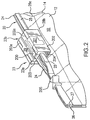
- FIG. 2 is an enlarged perspective view of one embodiment of the closure assembly in accordance with the disclosed subject matter.
- FIG. 3 is a front view of an embodiment of the reclosable fastener with a slider.
- FIG. 4 is a perspective view of the reclosable fastener with the slider shown in the open position preparatory to assembly.
- FIG. 5 is a perspective view of the reclosable fastener and slider in assembled position on a reclosable package.
- FIGS. 6A-8 are cross-sectional views of the reclosable fastener and sealing member in accordance with the disclosed subject matter.
- FIGS. 9-16 are cross-sectional views of the reclosable fastener and closure assembly in accordance with the disclosed subject matter.
- FIG. 17 is a front view of the reclosable package depicting a notch formed in the sealing member in accordance with the disclosed subject matter.
- FIG. 18 is a cross-sectional views of the closure assembly in accordance with the disclosed subject matter.
- a bag having a closed bottom, a reclosable top disposed opposite the bottom, and opposing first and second panels joined to each other.
- the bag further includes a closure assembly disposed along the reclosable top of the bag.
- the closure assembly includes a press to close fastener configuration, or alternatively, a slider device mounted on the fastener closure to facilitate opening and closing of the closure assembly.
- the slider device is constructed to separate the interlocking fastener closure profiles when the slider device is moved in a first direction along the fastener, and to engage the interlocking fastener profiles when the slider device is moved in a second, opposite direction along the fastener.
- FIG. 1 For purpose of explanation and illustration, and not limitation, an exemplary embodiment of the system in accordance with the disclosed subject matter is shown in FIG. 1 and is designated generally by reference character 10 . Additional features, aspects and embodiments of a package in accordance with the disclosed subject matter are provided in FIGS. 2-17 , as will be described below.
- bag 10 comprises first and second opposing body panels 12 , 14 .
- body panels 12 , 14 are joined or fixedly connected to each other along first and second side sections 18 a , 18 b , respectively.
- bottom 16 extends between the first and second side sections 18 a , 18 b . Further, bottom 16 connects the first panel 12 to the second panel 14 .
- the bag 10 can be configured with gussets as illustrated by reference numeral 17 , either along the bottom or along the side sections, or both if so desired.
- the first and second panels 12 , 14 can be made from two separate sheets joined along three sides, e.g., bottom and opposing side sections. Alternatively, the first and second panels can be formed from a unitary folded sheet.
- the unitary sheet can include a side fold or a bottom fold.
- First and second panels 12 , 14 can be formed from a wide range of materials.
- the panels are formed from polymeric material, for example and not limitation, polyesters; polystyrenes; nylon; polypropylene; polyethylene; copolymers of polyethylene and polypropylene; polycarbonates; polyacetals; acrylic-butadiene-styrene copolymers; monolayer or multilayer polyethylene, such as a low density polyethylene (LDPE), a linear low density polyethylene (LLDPE), high density polyethylenes (HDPE), and/or ethylene vinyl acetate, and/or a co-polymer mixture, multilayer combination, or laminate(s) thereof; or combinations thereof.
- LDPE low density polyethylene
- LLDPE linear low density polyethylene
- HDPE high density polyethylenes
- bag panels 12 , 14 can be formed from any woven material such as a web of paper, cardboard, fabric, or any other suitable material.
- first and second panels of the bag may be formed from co-extruded films having two or more layers.
- Each of the first and second panels preferably has a thickness ranging from about 0.4 mil to about 10 mils. In one preferred embodiment, the thickness is 3.5 mils. However, depending on the application contemplated for the bag, other thicknesses may be used, if desired.
- the closure assembly can include a fastener configured to open and close the reclosable top section of the bag.
- the fastener comprises a first fastener track attached to a first side panel and a second fastener track attached to a second side panel, wherein first and second fastener tracks are disposed in an opposing relationship on the first and second panels, respectively.
- the tracks may comprise integrally formed profiles and fins.
- the closure assembly fastener may be configured to be operated by finger pressure or by an auxiliary squeezing device, whereby the first and second tracks are squeezed together (e.g., as in a press-to-close fastener). In this manner, the closure assembly fastener includes first and second tracks configured to form an interlocking connection by the application of a force.
- the closure assembly includes a reclosable fastener.
- the reclosable fastener is operated by the use of an auxiliary slider mechanism, by finger pressure, or by an auxiliary squeezing device.
- the closure assembly is a fastener 20 including a slider mechanism 23 , and first track 24 , and second track 25 configured to form an interlocking connection.
- first and second tracks can include complementary rib 26 and groove 27 profiles which extend along a length of the closure assembly.
- the rib and groove profiles 26 , 27 are configured to have complementary cross-sectional shapes.
- the cross-sectional shapes of the interlocking rib and groove profiles 26 , 27 shown in FIG. 2 are the subject of the disclosed subject matter claimed in U.S. Pat. No. 5,007,143 to Herrington, which is incorporated herein by reference in its entirety. In this manner, the ribs 26 form a mating relationship with corresponding grooves 27 .
- the rib track 24 includes a rib profile 26 and a first depending fin or flange 28 a extending downward from the rib profile 26 .
- the groove track 25 includes a groove profile 27 and a second depending fin or flange 28 b extending downward from the groove profile 27 .
- the fins 28 a , 28 b are shown attached to opposing body panels 12 , 14 .
- the tracks 24 , 25 may be extruded separately with fins 28 a , 28 b and attached to the respective sides of the bag mouth or the tracks 24 , 25 may be extruded integral with the sides of the bag mouth. If the tracks 24 , 25 are extruded separately, they are most effectively attached by means of the respective first and second fins 28 a , 28 b , incorporated within the tracks, such as by heat sealing to the bag mouth.
- slider 23 as illustrated in FIG. 2 , and described in U.S. Pat. No. 5,896,627 to Cappel et al., which is incorporated herein by reference in its entirety, is slidingly mounted to closure assembly 20 disposed at the reclosable top of the bag 10 .
- the slider 23 is configured to facilitate the engagement and disengagement of the first and second tracks 24 , 25 of the closure assembly. In this manner, slider 23 is configured to transition between a closed position in which the first and second tracks are engaged, and an open position in which the first and second tracks are disengaged.
- first and second tracks 24 , 25 progressively disengage to define an open bag so that a user can gain access to the interior of the bag 10 .
- movement of the slider 23 from an open position to a closed position facilitates the interlocking connection between the first and second tracks, e.g., rib and groove profiles 26 , 27 , thereby restricting access to the interior of the bag 10 .
- the rib and groove profiles 26 , 27 may be rolled or pressed into their interlocking arrangement so as to securely close the bag by one of two means.
- the profiles may be rolled or pressed together at one end by a user and then sequentially fitted together along the length of the closure assembly by the user running a finger along the length of the closure assembly on each side of the profiles.
- the bag may include a slider that rides along the tracks of the closure assembly. If the slider is pulled in one direction, the bag is closed; if the slider is pulled in the opposite direction, the bag is reopened.
- the slider 23 comprises an inverted generally U-shaped member including a transverse support member or body 29 from which the separator finger 200 extends downward.
- the body 29 is itself U-shaped and includes two integral legs 201 extending downward.
- the finger 200 is positioned between the legs 201 .
- the body 29 is adapted to move along the top edges of the tracks 24 , 25 with the legs 201 straddling these elements and the finger 200 positioned between the tracks 24 , 25 .
- the slider 23 also includes a pair of hinged “wings” 202 , 203 that can be folded down into their final position.
- the wings 202 , 203 are hinged to the main slider body 29 by means of hinge structures 202 a , 203 a located at the opposite ends of the legs 201 .
- the foldable depending wings or side walls 202 , 203 extend from an opening end 23 a of the slider 23 to a closing end 23 b . It is noted that the main slider body 29 and the separator finger 200 are wider at the opening end 23 a than at the closing end 23 b . Similarly, the side walls 202 , 203 and the legs 201 are spaced wider apart at the opening end 23 a of the slider 23 to permit separation of the rib and groove profiles 26 , 27 by the finger 200 engaging the tracks 24 , 25 . The wings 202 , 203 and legs 201 are spaced sufficiently close together at the closing end 23 b of the slider to press the rib and groove profiles 26 , 27 into an interlocking relationship as the slider 23 is moved in a closure assembly closing direction.
- the side walls 202 , 203 at their lower ends are provided with an inwardly extending shoulder structure 204 .
- Shoulder structure 204 engages a bottom of the closure assembly 20 to prevent slider 23 from being lifted off the edges of the tracks 24 , 25 while the slider 23 straddles the closure assembly 20 .
- the slider 23 may be molded from any suitable polymeric material including, but not limited to, polyesters; polystyrenes; nylon; polypropylene; polyethylene; copolymers of polyethylene and polypropylene; polycarbonates; polyacetals; acrylic-butadiene-styrene copolymers; monolayer or multilayer polyethylene, such as a low density polyethylene (LDPE), a linear low density polyethylene (LLDPE), high density polyethylenes (HDPE), and/or ethylene vinyl acetate, and/or a co-polymer mixture, multilayer combination, or laminate(s) thereof; or combinations thereof.
- LDPE low density polyethylene
- LLDPE linear low density polyethylene
- HDPE high density polyethylenes
- co-polymer mixture multilayer combination, or laminate(s) thereof; or combinations thereof.
- the opposing ends of the closure assembly 20 can include end stop structures 205 as shown in FIG. 1 and U.S. Pat. No. 7,267,856 to Patel et al., which is incorporated herein by reference in its entirety.
- a portion of the end stop structures protrudes from the closure assembly 20 a distance adequate to engage the slider 23 and prevent the slider 23 from going past the respective ends of the closure assembly 20 and coming off the ends of the bag 10 .
- a portion of the end stops may protrude an adequate distance in the transverse direction to engage the slider 23 and prevent movement of the slider 23 past the respective ends of the closure assembly 20 .
- transverse means any direction which is normal to the axis of the track.
- a portion of the end stops may protrude an adequate distance in a generally horizontal or generally vertical direction to engage the slider 23 and prevent movement of the slider 23 past the respective ends of the closure assembly 20 .
- a portion of the end stops may protrude an adequate distance upwardly and/or outwardly from a remainder of the closure assembly 20 to engage the slider 23 and prevent movement of the slider 23 past the respective ends of the closure assembly 20 . Additional details concerning the formation of the end stops may be obtained from U.S. Pat. No. 5,131,121 to Herrington, which is incorporated herein by reference in its entirety.
- the thicknesses of the end stops at their widest point may vary from generally about 0.005 inches to about 0.2770 inches.
- the reclosable fastener comprises a pair of flexible plastic strips having separable fastener means extending along the length thereof comprising reclosable interlocking male and female profile elements on the respective strips.
- the strips include profiled tracks extending along the length thereof parallel to the male and female elements.
- the slider is provided with a separator finger and interlocking complementary structure formed from plastic for moving along the fastener in straddling relation.
- the complementary structure comprises a transverse support member having the separator finger depending therefrom. The support member is positioned on the top edges of the tracks with the separator finger inserted therebetween.
- a pair of side walls are positioned on the opposite sides of the support member for receiving the pair of strips therebetween, the separator finger and the side walls extend from an opening end of the slider to a closing end.
- the separator finger is wider at the opening end of the slider than at the closing end of the slider and the side walls are spaced wider apart at the opening end to permit separation of the male and female elements by the wider end of the separator finger extending between the side walls at the opening end.
- the side walls are spaced sufficiently close together at the closing end to press the male and female elements into interlocking relationship as the slider is moved in a fastener closing direction.
- means for restraining the slider in closed position and maintaining the male and female elements in interlocking relation when the slider reaches the closed end of its travel along its tracks comprising a protrusion on the wider end of the separator finger adjacent the opening end of the slider and notch structure at the adjacent end of the tracks.
- the notch structure has an end located on the tracks to permit the wider end of the separator finger to move beyond the end from between the tracks and into the notch structure.
- the protrusion is engageable with the end of the notch structure when the slider is at the closed end of its travel on the tracks thereby restraining the wider end of the separator finger from moving out of the notch structure and between the tracks and inadvertently opening the male and female elements of the fastener, as shown and described in U.S. Pat. No. 5,067,208 to Herrington, Jr., the entire contents of which is incorporated herein by reference thereto.
- bag 10 comprises a closure assembly including interlocking fastener profiles 26 , 27 and downwardly extending fins 28 a , 28 b which are joined to bag panels 12 , 14 .
- a sealing member 35 is also provided to resist high loads (e.g. burst forces) from the inside of the package, yet allow for an easy opening feature for the consumer.
- the fastener track material is extruded in a two-piece fashion with fastener profiles 26 , 27 and a fins 28 a , 28 b having a downwardly extending length of approximately 1.5 inches.
- the sealing member 35 configured as a thin gauge of approximately 2-6 mils of web material is attached to the interior surfaces of the fastener track, for example, just below the profiles 26 , 27 .
- the sealing member 35 forms a hermetic seal and also serves as a tamper evident membrane.
- the sides and bottom of panels 12 , 14 are joined to form a hermetic seal.
- the sealing member 35 is extruded from a web of sealable co-ex material capable of forming a peelable seal.
- the extrusion of co-ex sealing materials such as low melt plastomers in specified areas allows the sealing member to form a hard or permanent seal, whereas areas which are devoid of co-ex low melt plastomer material facilitate the formation of peelable seals, which allow for consumers to access the package contents.
- the permanent or “lock-up” seals can be formed by combining a co-ex low melt plastomer with a peel-seal material known in the art to achieve a firm union.
- the peelable seals can be formed with the peel-seal material only, i.e., without the co-ex low melt plastomer composition.
- the gussets expand such that the panels are moved apart which in turn places shearing load “s” on the peelable seal 320 , as shown in FIG. 13 .
- the bond of the peelable seal has sufficient strength to resist shearing forces “s” induced by the contents, but is weak in the peal direction “p” which allows a consumer to easily rupture the peelable seal to gain access the contents of the package.
- the bond formed between the closure fin and the bag panel at location 340 is a permanent, “lock-up” type which is capable of withstanding elevated loads regardless of the orientation of the loads.
- the seals disclosed herein i.e., either permanent or peelable, can be formed by a variety of techniques including adhesives, heat-seal, ultrasonic welding, etc. If ultrasonic welding is employed, it is advantageous to use a rotary ultrasonic wheel to form the seals since such an apparatus reduces the drag and heating of the closure assembly, thereby minimizing the formation of wrinkles and other undesirable deformations.
- the strength of the seals disclosed herein, i.e., either permanent or peelable can be varied by altering the amount or type of adhesives, or the duration of the seal time in the case of heat-seal or ultrasonic welding.
- the seal member 35 has a first end attached to the fin 28 a at location 30 , and a second end attached to fin 28 b at location 32 .
- the seal member 35 can be attached to the fins by a permanent union such as a “lock-up” seal, or by a temporary union such as a peelable seal. Accordingly, the seal member can be attached to the fin in such a manner where both attachment points 30 , 32 are configured as either lock-up seals, or alternatively, as peelable seals. Additionally, seal member 35 can be attached to the fins 28 a , 28 b utilizing a combination of different seal types, e.g.
- seal member 35 has a first end joined to a fin via a peelable seal and a second end joined to a fin via a “lock-up” seal.
- the permanent or “lock-up” seal is achieved by incorporating the co-ex, low melt material at the attachment point where it is desired to effectuate a hard seal.
- the different types of attachments i.e. “lock-up” or peelable, can be achieved utilizing a variety of mechanical treatments instead of the particular material compositions disclosed herein.
- the bottom portion of the fins 28 a , 28 b can include co-ex material at locations 34 , 36 which further reduces the likelihood of tearing or undesired opening of the package due to a heavy fill-load.
- the presence of the co-ex material in the fin portions increases the strength of the union between the closure assembly and the bag panels.
- the co-ex material in the fin members allows for the closure assembly to be configured such that the track extends beyond the sides of the bag panels 12 , 14 to form an overlying portion.
- This overlying portion can serve as a handle or grip device which enables a consumer to conveniently grasp and lift the package, while the co-ex material incorporated into the track fins prevents the track from being tearing off the bag panels while exposed to the load.
- the seal member 35 is a discrete structure which is formed separately from the panels and closure assembly.
- At least one end of the seal member 35 can be integrally formed with the fin 28 a , e.g. by co-extrusion, such that the attachment point 30 represents an integrally formed union of the fin 28 , and the sealing member 35 .
- This configuration is advantageous in that the sealing member remains attached to the fin even after the peelable seal 32 is ruptured by the consumer. Therefore, the sealing member is not susceptible to accidentally mixing with the contents of the package.
- the closure assembly is extruded with a W-shape closure track having a membrane 36 which is integrally formed with and extends from the first fin 28 a to the second fin 28 b .
- the sealing member 35 is attached to the fins 28 a , 28 b by a peelable seal at attachment locations 30 , 32 .
- the W-track membrane 36 can also be configured with a line of weakness, such as a score of perforations, which serve as a tamper evident device, alerting the consumer if the contents of the package have been accessed or damaged in any way.
- the sealing member 35 is preferably disposed below the membrane 36 to absorb any burst forces that may be generated.
- the sealing member 35 could be positioned above the W-track membrane 36 , this arrangement renders the line of weakness formed in membrane 36 prone to rupture in the event that an internal force is imposed on the membrane 36 , and is therefore not the preferred configuration.
- FIG. 6E depicts another embodiment of the present disclosed subject matter in which the sealing member is comprised of two flaps 35 a and 35 b which are joined with a peelable seal 37 .
- the fins can be attached to the panels by either a peelable seal or a permanent seal. This configuration is advantageous since the peel seal is placed in shear, as will be discussed further below.
- the peel seal 37 is centrally located thus providing easy identification and access by the consumer. Once the peel seal 37 has been opened there are only two relatively short flaps 35 a , 35 b which remain on the interior surface of the fins rather than one long sealing member which may occlude or otherwise interfere with the package mouth.
- the flaps 35 a , 35 b could be extruded with the fins to form an integral assembly, or alternatively the flaps can be discrete structures separately attached to the fins.
- sealing member 35 is particularly advantageous in packages which are bottom filled, i.e. where the fill load is imparted directly on the closure assembly at the top of the package, since the sealing member shields the closure assembly and inhibits or prevents the undesired separation of interlocking profiles 26 , 27 .
- the closure configuration of the present disclosed subject matter is particularly suited for bottom filled packages, however the present disclosed subject matter can also be employed in top filled packages as described in further detail below and exemplified in U.S. Pat. Nos. 6,071,011 and 6,378,177, which are hereby incorporated by reference in their entirety.
- the sealing member 45 can be configured to attach to both a fin member 28 a , and a bag panel 14 , as shown in FIG. 7 .
- the sealing member 45 is attached to the bag panel 14 at location 42 by a peelable seal, and can be attached to the fin member 28 a at location 40 by either a peelable seal or by a lock-up seal.
- the fin member can be provided with a sealant layer, e.g. co-ex material, as described above. This embodiment is advantageous in that it simplifies the manufacturing, i.e. extrusion, process and allows for customizable film webs as well as tailorable peel seals.
- FIG. 8 illustrates an additional embodiment wherein the sealing member has two portions 55 a , 55 b and three attachment points 50 , 51 , 52 .
- the first portion of the sealing member 55 a is attached to the first fin 28 a at location 50 , preferably by a permanent lock-up seal.
- the first portion of the sealing member 55 a is attached to the second fin member 28 b at location 51 which represents a co-extruded portion of the sealing member 55 a and the fin member 28 b , such as in the W-track configuration discussed above.
- a second portion of the sealing member 55 b extends below the first portion 55 a and is attached to a bag panel 14 at location 52 , preferably by a peelable seal which is contained within the sealing member 55 b and not the bag panel 14 .
- the sealing member 55 a includes a score or line of weakness designated by void 55 c which serves as a tamper evident feature.
- the closure assembly can include fins 280 a , 280 b which can be configured with sealing ribs 287 to facilitate permanent lock-up seals between the fins 280 and the bag panels 12 , 14 at locations 300 and 310 .
- a bottom portion of the first fin 280 a can extend below the second fin 280 b and can be formed with co-ex material and can form a peelable seal 290 between the bottom portion of the first fin 280 a and the second bag panel 14 at location 320 .
- this embodiment is particularly suited for top-fill packages, wherein upon loading of the contents through the mouth 13 of the package, the film panel 12 can be joined to the fin 280 a with a permanent lock-up seal.
- FIG. 12 depicts a similar embodiment wherein the fin members 380 a , 380 b are attached to short film webs 488 a , 488 b with permanent lock-up seals 400 , 410 .
- the first fin member 380 a extends downward a greater distance than the second fin member 380 b , and is attached to the second short film web 488 b at location 420 with a peelable seal.
- the use of such short film webs 488 a , 488 b allows greater flexibility in the manner in which the closure assembly is attached to the bag since the short film webs 488 a , 488 b can be attached to either the interior surface or exterior surface of the bag panels 12 , 14 . While FIGS. 9-12 illustrate first fin 280 a extending below second fin 280 b , it is to be understood that this arrangement could be reversed so that the second fin 280 b extended below first fin 280 a and attached to panel 12 .
- the fin members 480 a , 480 b are configured as an integral fin having a folded portion which is attached to the panel 14 at two locations 520 , 522 with peelable seals, as shown in FIGS. 14A-B .
- the folded portion of the fin includes a line of weakness 480 c which can serve as a tamper evident feature.
- the line of weakness is protected from any fill loads or burst pressure by the geometry of the fold which does not have any weakened areas. Consequently, the line of weakness in the fin 480 is ruptured by the consumer to gain access to the contents, and not due to elevated fill loads or drop tests.
- the fins 580 a , 580 b can be attached to each other with a peelable seal 620 which has sufficient strength to withstand elevated internal forces, yet allows a consumer to access the contents of the package.
- FIG. 16 illustrates a closure assembly with fin members 680 a , 680 b which are attached to panels 12 , 14 and wherein the fin member 680 b includes a score or area of weakness 680 c .
- This area of weakness 680 c allows a user to pierce through the fin member and rupture the peelable seal 620 and access the contents of the package. The closer the peelable seal 620 is located to the mouth of the package, the more the panels will be able to expand and thus dissipate internal forces.
- the peelable seal portions are formed devoid of co-ex material, and thus form a weaker union than the permanent lock-up seals. Consequently, areas of the bag which include a peelable seal material are more susceptible to rupture.
- both the fins 280 and the sealing member 35 can be received between opposing bag panels 12 , 14 and extend laterally across the entire width of the bag so as to span from one edge 18 a to a second edge 18 b . Therefore, the presence of the peelable seal material at the edges 18 a, b can interrupt or weaken the union of bag panels 12 , 14 along the edges 18 a, b and thus be detrimental to the bags performance.
- the peelable seal material can include a cut-out or notch portion 15 adjacent to one, or both, edges 18 a , 18 b of the bag.
- the notches 15 are configured to extend a lateral distance towards the center of the bag and a vertical distance towards the bottom of the bag. While the exemplary embodiment illustrated in FIG. 17 depicts linear notches 15 formed in the fins 280 , it is to be understood that the notches can be formed in a variety of shapes and sizes, and in either the fins 280 or seal member 35 , as so desired.
- the notch can be configured to extend along the entire height of the peelable seal material such that no portion of the peelable seal material is located at the side edges of the film panels 12 , 14 .
- the notch 15 allows for sealing of only homogeneous materials at the edge (i.e., only the bag panels 12 , 14 ), thereby reducing the chance of pin holes being formed at the sides resulting in a faulty seal.
- the notch 15 can be provided, for example in the fins 280 , by removing material from a portion of the fins 28 that includes the peelable seal material.
- the fins 280 can then be inserted between the panels 12 , 14 and positioned such that the notched region 15 is registered with the edges 18 a, b .
- the bag panels 12 , 14 can then be sealed along the edges 18 a , b and bottom 16 via any of the sealing techniques described above. Therefore, the peelable seal can be configured to extend a distance between the edges 18 a, b of the bag which is less than the width of the bag.
- the profile of the sealed bag edges 18 a, b remains uniform along the entire height of the bag, i.e., from the bottom to the mouth of the bag.
- areas of weakness such as perforations can be formed at select locations along the closure assembly thereby allowing the majority of the track fin to remain in-tact and capable of withstanding the forces generated from filling or dropping the package.
- Areas of weakness in the side gusset are particularly beneficial since the gusset allows for forces to be dissipated by the expansion of the panels and thus protects the area of weakness.
- Indicia such as printed directions, or color codes, can be provided along the closure assembly to aid a consumer in locating the areas of weakness to facilitate opening of the package.
- ribs can be provided on the closure assembly in order to ensure that the area of weakness is provided with a predictable and controlled rupture, especially for packages requiring over 13 lbs. force to open.
- the rib design channels the opening of the area of weakness 601 between adjacent ribs 600 , which will orient the tear in the machine direction.
- the ribs 600 are positioned between sealing ribs 602 .
- resins can be used to aid in the orientation of tearing or opening of the area of weakness.
Landscapes
- Engineering & Computer Science (AREA)
- Mechanical Engineering (AREA)
- Bag Frames (AREA)
- Packages (AREA)
- Cartons (AREA)
- Slide Fasteners (AREA)
Abstract
Description
Claims (13)
Priority Applications (2)
| Application Number | Priority Date | Filing Date | Title |
|---|---|---|---|
| US12/910,487 US11220374B2 (en) | 2008-04-23 | 2010-10-22 | Package closure for withstanding internal forces |
| US17/517,052 US20220055800A1 (en) | 2008-04-23 | 2021-11-02 | Package closure for withstanding internal forces |
Applications Claiming Priority (3)
| Application Number | Priority Date | Filing Date | Title |
|---|---|---|---|
| US4732708P | 2008-04-23 | 2008-04-23 | |
| PCT/US2009/041552 WO2009132199A1 (en) | 2008-04-23 | 2009-04-23 | Package closure for withstanding internal forces |
| US12/910,487 US11220374B2 (en) | 2008-04-23 | 2010-10-22 | Package closure for withstanding internal forces |
Related Parent Applications (1)
| Application Number | Title | Priority Date | Filing Date |
|---|---|---|---|
| PCT/US2009/041552 Continuation WO2009132199A1 (en) | 2008-04-23 | 2009-04-23 | Package closure for withstanding internal forces |
Related Child Applications (1)
| Application Number | Title | Priority Date | Filing Date |
|---|---|---|---|
| US17/517,052 Continuation US20220055800A1 (en) | 2008-04-23 | 2021-11-02 | Package closure for withstanding internal forces |
Publications (2)
| Publication Number | Publication Date |
|---|---|
| US20110033138A1 US20110033138A1 (en) | 2011-02-10 |
| US11220374B2 true US11220374B2 (en) | 2022-01-11 |
Family
ID=40750843
Family Applications (2)
| Application Number | Title | Priority Date | Filing Date |
|---|---|---|---|
| US12/910,487 Active US11220374B2 (en) | 2008-04-23 | 2010-10-22 | Package closure for withstanding internal forces |
| US17/517,052 Abandoned US20220055800A1 (en) | 2008-04-23 | 2021-11-02 | Package closure for withstanding internal forces |
Family Applications After (1)
| Application Number | Title | Priority Date | Filing Date |
|---|---|---|---|
| US17/517,052 Abandoned US20220055800A1 (en) | 2008-04-23 | 2021-11-02 | Package closure for withstanding internal forces |
Country Status (12)
| Country | Link |
|---|---|
| US (2) | US11220374B2 (en) |
| EP (6) | EP2669211B1 (en) |
| JP (2) | JP5571066B2 (en) |
| AU (1) | AU2009240577B2 (en) |
| CA (1) | CA2721405C (en) |
| DK (4) | DK2669211T3 (en) |
| ES (6) | ES2472541T3 (en) |
| HU (2) | HUE051955T2 (en) |
| PL (6) | PL2265506T3 (en) |
| PT (6) | PT2452888E (en) |
| TR (1) | TR201816535T4 (en) |
| WO (1) | WO2009132199A1 (en) |
Families Citing this family (8)
| Publication number | Priority date | Publication date | Assignee | Title |
|---|---|---|---|---|
| US8540427B2 (en) * | 2008-03-07 | 2013-09-24 | Mark Steele | Gusseted package with impact barrier |
| FR2962112A1 (en) * | 2010-07-05 | 2012-01-06 | Francis Gathie | REUSABLE SHIPPING PACKAGING |
| WO2012047896A2 (en) * | 2010-10-04 | 2012-04-12 | Exopack Llc | Reclosable full open mouth bag with a hook and hook closure and associated methods |
| US9487333B2 (en) | 2010-10-04 | 2016-11-08 | Coveris Flexibles Us Llc | Packaging for steaming and related methods |
| US8690430B2 (en) * | 2012-06-20 | 2014-04-08 | S.C. Johnson & Son, Inc. | Storage bag having a slider with ridges that presses together and separates interlocking profiles of fastener strips |
| JP6878879B2 (en) * | 2016-12-26 | 2021-06-02 | 大日本印刷株式会社 | Packaging bag |
| CN108577109B (en) * | 2018-07-17 | 2024-05-07 | 广东爱子优旺新材料有限公司 | Zipper bag capable of preventing children from opening |
| US20250326563A1 (en) * | 2024-04-18 | 2025-10-23 | Reynolds Consumer Products LLC | Package of reclosable bags with staggered sliders |
Citations (108)
| Publication number | Priority date | Publication date | Assignee | Title |
|---|---|---|---|---|
| US3198228A (en) | 1961-11-27 | 1965-08-03 | Seisan Nipponsha Kk | Integral reclosable bag |
| US3217871A (en) | 1963-05-06 | 1965-11-16 | Acme Backing Corp | Peelable seal package |
| US3256981A (en) | 1962-11-01 | 1966-06-21 | Leonard D Kurtz | Strippable package for sutures |
| US3329331A (en) | 1964-01-09 | 1967-07-04 | Morgan Adhesives Co | Resealable containers and flexible laminate therefor |
| US3339606A (en) | 1966-06-14 | 1967-09-05 | Kugler Emanuel | Slide closure |
| US3368740A (en) | 1967-01-17 | 1968-02-13 | Tower Packaging Company | Sheet material with film tear line |
| US3511436A (en) | 1966-09-12 | 1970-05-12 | Us Plywood Champ Papers Inc | Easy opening heat sealed package |
| US3535409A (en) | 1967-01-17 | 1970-10-20 | Tower Products | Method of making sheet material with film tear line |
| US3613874A (en) | 1969-08-21 | 1971-10-19 | Reclosable Package Corp | Reclosable package |
| US3625270A (en) | 1970-04-17 | 1971-12-07 | Milorad Skendzic | Pilferproof package |
| US3655503A (en) | 1969-01-13 | 1972-04-11 | Crown Zellerbach Corp | Package of composite film with peelable, heatsealable surfaces |
| US3711011A (en) | 1970-05-04 | 1973-01-16 | Action Packaging Corp | Resealable packaging device |
| US3791916A (en) | 1971-12-06 | 1974-02-12 | Grace W R & Co | Sealing polystyrene |
| US3827625A (en) | 1972-06-21 | 1974-08-06 | Reclosable Package Corp | Reclosable package and controlled release paper for use therein |
| US3967729A (en) | 1975-09-29 | 1976-07-06 | Johnson & Johnson | Fully sealed package for sterile contents |
| US4097236A (en) | 1977-01-24 | 1978-06-27 | Faser Industries | Method of detecting heat seal breaks and package thereof |
| US4279677A (en) | 1979-11-16 | 1981-07-21 | Seissan Nippon-Sha K. K. | Method of means for joining plastic fastener strip to film |
| US4295919A (en) | 1978-12-15 | 1981-10-20 | The Dow Chemical Co. | Forming an integral closure for a thermoplastic container |
| US4355494A (en) | 1979-08-06 | 1982-10-26 | Minigrip, Inc. | Reclosable bags, apparatus and method |
| US4522305A (en) | 1981-08-28 | 1985-06-11 | Tetra Pak Developpement Sa | Opening arrangement for packing containers with pressurized contents |
| US4576285A (en) | 1983-05-20 | 1986-03-18 | Fres-Co System Usa, Inc. | Sealed flexible container with non-destructive peelable opening and apparatus and method for forming same |
| US4589145A (en) | 1983-10-31 | 1986-05-13 | Signode Corporation | Packaging material and package |
| US4630311A (en) | 1984-11-29 | 1986-12-16 | Minigrip, Inc. | Zipper-lock bag chain with tearable strip interconnection means |
| US4638913A (en) | 1981-08-21 | 1987-01-27 | W. R. Grace & Co., Cryovac Div. | Multiply package having delaminating easy open seal |
| US4663915A (en) | 1983-10-31 | 1987-05-12 | Signode Corporation | Method of packaging and apparatus |
| US4705174A (en) | 1984-02-29 | 1987-11-10 | Fres-Co System Usa, Inc. | Sealed flexible container with non-destructive peelable opening |
| US4736451A (en) | 1986-12-22 | 1988-04-05 | Minigrip, Inc. | Extruded zipper having combination stabilizing and differential opening means |
| US4738998A (en) | 1982-08-12 | 1988-04-19 | Owens-Corning Fiberglas Corporation | Hot-melt adhesive |
| US4784885A (en) | 1986-08-29 | 1988-11-15 | R. J. Reynolds Tobacco Company | Peelable film laminate |
| US4785937A (en) | 1986-04-07 | 1988-11-22 | Kabushiki Kaisha Hosokawa Yoko | Retortable pouch and packaging material for the retortable pouch |
| US4834552A (en) | 1988-03-23 | 1989-05-30 | Makowka Kenneth R | Tamper-evident seal for envelope and method of making same |
| US4846585A (en) | 1988-01-29 | 1989-07-11 | Minigrip, Inc. | Easy open bag structure |
| US4855168A (en) | 1987-04-07 | 1989-08-08 | Yoshino Kogyosho Co., Ltd. | Synthetic resin sheet having notching strip and container |
| US4875587A (en) | 1985-02-21 | 1989-10-24 | W. R. Grace & Co.-Conn. | Easy open shrinkable laminate |
| US4889731A (en) | 1988-02-12 | 1989-12-26 | W. R. Grace & Co.-Conn. | Package having peelable film |
| US4915289A (en) | 1987-05-20 | 1990-04-10 | Toyo Seikan Kaisha, Ltd. | Easily openable sealed container |
| US4923309A (en) | 1989-02-27 | 1990-05-08 | Illinois Tool Works | Tamper-evident package |
| US4925318A (en) | 1988-10-17 | 1990-05-15 | Schurpack, Inc. | Packing, method of manufacturing same, and strip material therefor |
| US4925316A (en) | 1986-08-11 | 1990-05-15 | Minigrip, Inc. | Reclosable bag having an outer reclosable zipper type closure and inner non-reclosable closure |
| US4937040A (en) | 1988-03-07 | 1990-06-26 | Minnesota Mining And Manufacturing Company | Security deposit bag |
| US4944409A (en) | 1988-02-10 | 1990-07-31 | Curwood, Inc. | Easy open package |
| US4949527A (en) * | 1988-06-29 | 1990-08-21 | Zip-Pak Incorporated | Method of forming a reclosable tray |
| US4966470A (en) | 1989-02-24 | 1990-10-30 | Oscar Mayer Foods Corporation | Tamper-evident, reclosable, flexible packages |
| US4969967A (en) | 1989-01-18 | 1990-11-13 | Schurpack, Inc. | Method of manufacturing packing and strip material therefor |
| US4977206A (en) | 1987-08-31 | 1990-12-11 | Shell Oil Company | Modified polybutylene-based hot melt compositions |
| US4998666A (en) | 1988-05-13 | 1991-03-12 | Frederick R. Ewan | Tamper indicating containers and seals |
| US4999967A (en) | 1988-01-09 | 1991-03-19 | Korber Ag | Apparatus for draping packets into blanks of wrapping material |
| US5017021A (en) | 1989-05-19 | 1991-05-21 | Reynolds Consumer Products, Inc. | Reclosable profile having improved closure members |
| US5022530A (en) | 1989-10-13 | 1991-06-11 | The Dow Chemical Company | Modified zipper elements for easy open containers |
| US5024888A (en) | 1987-08-31 | 1991-06-18 | Shell Oil Company | Modified polybutylene-base hot melt compositions |
| US5033868A (en) | 1982-06-14 | 1991-07-23 | Paramount Packaging Corporation | Flexible plastic bag with perforated handle |
| US5063069A (en) | 1989-03-23 | 1991-11-05 | Zip-Pak Incorporated | Zippered closure for thermoformed package |
| US5064664A (en) | 1990-04-04 | 1991-11-12 | Oscar Mayer Foods Corporation | Package having engraved lettering peel seal tamper-evidence message |
| US5067822A (en) | 1989-04-24 | 1991-11-26 | Reynolds Consumer Products, Inc. | Method of forming recloseable packages, profiles used therein, and packages produced thereby |
| US5077001A (en) | 1988-11-21 | 1991-12-31 | Makowka Kenneth R | Tamper-evident sealing system for envelope having special characteristics and method of making same |
| US5082702A (en) | 1990-08-20 | 1992-01-21 | Minnesota Mining And Manufacturing Company | Tamper-indicating tape |
| US5103979A (en) | 1989-10-11 | 1992-04-14 | Oscar Mayer Foods Corp. | Package having peel seal tamper-evidence message |
| US5104704A (en) | 1990-10-09 | 1992-04-14 | Temple University | Gel-interleaved tamper-evident wrap |
| US5121997A (en) | 1990-10-09 | 1992-06-16 | Illinois Tool Words Inc. | Perforated tear strip for easy-open flexible containers |
| US5143961A (en) | 1987-06-29 | 1992-09-01 | H. B. Fuller Licensing & Financing Inc. | Hot melt adhesive comprising water soluble polyalkyloxazoline and water insoluble polymer |
| US5215380A (en) | 1990-10-19 | 1993-06-01 | Reynolds Consumer Products, Inc. | Reclosable package with tear strip |
| US5224779A (en) | 1989-02-24 | 1993-07-06 | Oscar Mayer Foods Corporation | Tamper-evident, reclosable flexible packages |
| US5238306A (en) | 1989-05-19 | 1993-08-24 | Reynolds Consumer Products, Inc. | Method of producing a sealing system for a reclosable webbed-wall package, and system made |
| US5330269A (en) | 1991-11-08 | 1994-07-19 | Toyo Aluminum Kabushiki Kaisha | Package |
| US5346301A (en) | 1993-04-02 | 1994-09-13 | Paul W. Scarberry | Reclosable bag with offset end seal |
| US5358334A (en) | 1993-02-11 | 1994-10-25 | Reynolds Consumer Products Inc. | Reclosable profile strip with joining web |
| US5360845A (en) | 1992-12-23 | 1994-11-01 | National Starch And Chemical Investment Holding Corporation | Starch ester based hot melt adhesive |
| US5407278A (en) | 1993-12-10 | 1995-04-18 | Fres-Co System Usa, Inc. | Dual compartment easily openable flexible package |
| US5425825A (en) | 1993-04-22 | 1995-06-20 | Rasko; George | Reclosable zipper with tamper evident feature |
| US5456928A (en) | 1989-06-30 | 1995-10-10 | Oscar Mayer Foods Corporation | Tamper-evident, flexible, reclosable package |
| US5470156A (en) | 1994-04-11 | 1995-11-28 | Reynolds Consumer Products, Inc. | Closure arrangement having a peelable seal |
| US5474382A (en) | 1995-05-01 | 1995-12-12 | Reynolds Consumer Products Inc. | Closure arrangement having a peelable seal |
| US5486051A (en) | 1994-04-11 | 1996-01-23 | Reynolds Consumer Products Inc. | Closure arrangement having a breakaway seal |
| US5492411A (en) | 1995-01-18 | 1996-02-20 | Reynolds Consumer Products Inc. | Tamper evident peelable seal |
| US5513915A (en) | 1994-04-11 | 1996-05-07 | Reynolds Consumer Products Inc. | Closure arrangement having a breakaway seal |
| US5525363A (en) | 1991-05-31 | 1996-06-11 | Kraft Foods, Inc. | Cheese pouch having easy opening and reclosing characteristics |
| US5538345A (en) | 1993-10-19 | 1996-07-23 | Idemitsy Petrochemical Co., Ltd. | Easy-open, hermetically-sealed, packaging bag |
| US5582887A (en) | 1989-08-17 | 1996-12-10 | The Kendall Company | Tamper-evident tape having discontinuous barrier layer |
| US5604000A (en) | 1995-01-18 | 1997-02-18 | Reynolds Consumer Products Inc. | Heat-sealable peelable composition |
| US5647671A (en) | 1994-04-11 | 1997-07-15 | Reynolds Consumer Products, Inc. | Closure arrangement having a peelable seal |
| US5725312A (en) | 1994-04-11 | 1998-03-10 | Reynolds Consumer Products, Inc. | Closure arrangement having a peelable seal |
| US5769772A (en) | 1996-08-13 | 1998-06-23 | Tenneco Packaging Inc. | Packages made with both high-frequency/radio-frequency seals and conventional heat/pressure seals using combinations of polar and non-polar polymers |
| US5893645A (en) | 1994-04-11 | 1999-04-13 | Reynolds Consumer Products, Inc. | Closure arrangement having peelable seal |
| JP2000287718A (en) | 1999-02-10 | 2000-10-17 | Illinois Tool Works Inc <Itw> | Reclosable zipper(r) |
| US6290391B1 (en) * | 2000-01-18 | 2001-09-18 | Reynolds Consumer Products, Inc. | Reclosable package having slider device and tamper-evident structure |
| US20010053253A1 (en) * | 2000-03-24 | 2001-12-20 | Reynolds Consumer Products, Inc. | Reclosable package having zipper closure, slider device and dual tamper-evident structures; and methods |
| WO2002000520A1 (en) | 2000-06-28 | 2002-01-03 | Pactiv Corporation | Top-filled tamper-evident package |
| US6354738B1 (en) | 2000-10-24 | 2002-03-12 | Illinois Tool Works Inc. | Tamper evident reclosable plastic bag |
| EP1223111A2 (en) | 2001-01-16 | 2002-07-17 | Illinois Tool Works Inc. | Tamper evident resealable packaging |
| US20020100144A1 (en) | 2001-01-30 | 2002-08-01 | Zdenek Machacek | Reclosable zipper strip with coated webs |
| US20030096042A1 (en) * | 1999-05-11 | 2003-05-22 | Sargento Foods Inc. | Resealable bag for filling with food product (s) and method |
| US20030198407A1 (en) * | 2002-03-20 | 2003-10-23 | Rehwinkel Gary E. | Reclosable bags with tamper evident features and methods of mking the same |
| EP1366999A1 (en) | 2002-05-30 | 2003-12-03 | Illinois Tool Works, Inc. | Reclosable packaging |
| US6713152B2 (en) * | 2001-09-07 | 2004-03-30 | Pactiv Corporation | Fins and profiles for plastic bags |
| WO2004050487A2 (en) | 2002-12-03 | 2004-06-17 | Reynolds Consumer Products, Inc. | Autoclavable reclosable package |
| US6845598B1 (en) * | 2003-12-19 | 2005-01-25 | Reynolds Consumer Products, Inc. | Top filled reclosable package and method for forming and filling the same |
| US20050063617A1 (en) | 2003-09-15 | 2005-03-24 | Tilman Paul A. | Reclosable bag having tamper-evident membrane |
| US6918230B2 (en) * | 1997-11-07 | 2005-07-19 | Illinois Tool Works Inc. | Method and apparatus for placing a product in a flexible recloseable container |
| WO2005077773A1 (en) | 2004-02-10 | 2005-08-25 | Pactiv Corporation | Packages with active agents |
| US20060030471A1 (en) * | 2004-08-05 | 2006-02-09 | Schaller Stephen P | Hooded reclosable packages and related methods of manufacture |
| WO2006041057A1 (en) | 2004-10-12 | 2006-04-20 | Idemitsu Unitech Co., Ltd. | Packaging bag with chuck tape |
| WO2006090693A1 (en) | 2005-02-22 | 2006-08-31 | Idemitsu Unitech Co., Ltd. | Tape with interlocking device |
| EP1721833A1 (en) | 2005-05-12 | 2006-11-15 | Illinois Tool Works Inc. | Self-venting reclosable packages |
| US20070183692A1 (en) | 2006-02-08 | 2007-08-09 | Pawloski James C | Reclosable pouch and zipper for a reclosable pouch |
| JP2007261640A (en) | 2006-03-29 | 2007-10-11 | Toyo Seikan Kaisha Ltd | Fastener and packaging bag which can be heat-sterilized |
| US7306370B2 (en) | 2003-07-31 | 2007-12-11 | Kraft Foods Holdings, Inc. | Shrouded flexible packages |
| JP2007331805A (en) | 2006-06-16 | 2007-12-27 | Dainippon Printing Co Ltd | Chuck and heat sterilized bag using the same |
| US20080019619A9 (en) * | 2005-04-12 | 2008-01-24 | Eads Claude A | Tamper evident reclosable seals |
Family Cites Families (18)
| Publication number | Priority date | Publication date | Assignee | Title |
|---|---|---|---|---|
| US4252846A (en) | 1975-09-22 | 1981-02-24 | The Dow Chemical Company | Packages embodying a controlled peel seal and method of preparing same |
| US4909017B1 (en) * | 1989-07-28 | 1999-02-09 | Minigrip Inc | Reclosable bag material method and apparatus |
| US5007143A (en) | 1990-03-07 | 1991-04-16 | Mobil Oil Corp. | Rolling action zipper profile and slipper therefor |
| US5131121A (en) | 1991-03-22 | 1992-07-21 | Mobil Oil Corporation | Protruding end stops for plastic reclosable fastener |
| US5067208A (en) | 1991-03-22 | 1991-11-26 | Mobil Oil Corporation | Plastic reclosable fastener with self-locking slider |
| US5896627A (en) | 1997-09-26 | 1999-04-27 | Tenneco Packaging Inc. | High-strength slider for a reclosable bag |
| US5911508A (en) * | 1997-11-10 | 1999-06-15 | Dobreski; David V. | Vented reclosable bag |
| US6131248A (en) | 1998-03-13 | 2000-10-17 | Reynolds Consumer Products, Inc. | Peelable seal on closure mechanism and method therefor |
| US6071011A (en) | 1999-08-12 | 2000-06-06 | Tenneco Packaging, Inc. | Fill-through-the-top package |
| US6183134B1 (en) | 2000-05-04 | 2001-02-06 | Illinois Tool Works, Inc. | High internal force resistant peel sealable zipper |
| US6290393B1 (en) | 2000-07-21 | 2001-09-18 | Reynolds Consumer Products, Inc. | Slider reclosable packages with dual peel seals |
| US7413535B2 (en) * | 2001-07-27 | 2008-08-19 | Illinois Tool Works Inc. | Method for manufacturing tamper evident reclosable plastic bags |
| US6901637B2 (en) | 2001-10-03 | 2005-06-07 | Illinois Tool Works Inc. | Zipper with pre-activated peel-seal |
| US20060291756A1 (en) * | 2002-02-27 | 2006-12-28 | Thomas Toby R | Web materials with active agent for use in forming reclosable packages |
| AU2003245518A1 (en) | 2002-06-17 | 2003-12-31 | Pliant Corporation | Peel seal tamper evident slider bag |
| US7267856B2 (en) | 2002-10-07 | 2007-09-11 | Pactiv Corporation | Ultrasonic end stops on zipper closure bags and methods for making same |
| PL1689260T3 (en) | 2003-12-02 | 2012-07-31 | Reynolds Consumer Prod | Slider for reclosable fastener |
| US7963007B2 (en) | 2006-08-23 | 2011-06-21 | Illinois Tool Works Inc. | High burst zipper assembly for large reclosable packages |
-
2009
- 2009-04-23 EP EP13177324.4A patent/EP2669211B1/en active Active
- 2009-04-23 PL PL09733813T patent/PL2265506T3/en unknown
- 2009-04-23 DK DK13177324.4T patent/DK2669211T3/en active
- 2009-04-23 AU AU2009240577A patent/AU2009240577B2/en active Active
- 2009-04-23 PL PL17160619T patent/PL3196141T3/en unknown
- 2009-04-23 ES ES12154536.2T patent/ES2472541T3/en active Active
- 2009-04-23 PT PT121545362T patent/PT2452888E/en unknown
- 2009-04-23 PL PL18185284T patent/PL3434613T3/en unknown
- 2009-04-23 PL PL12154536T patent/PL2452888T3/en unknown
- 2009-04-23 CA CA2721405A patent/CA2721405C/en active Active
- 2009-04-23 PL PL13177324T patent/PL2669211T3/en unknown
- 2009-04-23 ES ES15152633.2T patent/ES2641587T3/en active Active
- 2009-04-23 ES ES17160619.7T patent/ES2693605T3/en active Active
- 2009-04-23 PT PT131773244T patent/PT2669211E/en unknown
- 2009-04-23 ES ES09733813T patent/ES2394601T3/en active Active
- 2009-04-23 PT PT17160619T patent/PT3196141T/en unknown
- 2009-04-23 PL PL15152633T patent/PL2902335T3/en unknown
- 2009-04-23 ES ES13177324.4T patent/ES2533324T3/en active Active
- 2009-04-23 ES ES18185284T patent/ES2800451T3/en active Active
- 2009-04-23 DK DK18185284.9T patent/DK3434613T3/en active
- 2009-04-23 PT PT181852849T patent/PT3434613T/en unknown
- 2009-04-23 HU HUE18185284A patent/HUE051955T2/en unknown
- 2009-04-23 HU HUE15152633A patent/HUE034486T2/en unknown
- 2009-04-23 EP EP09733813A patent/EP2265506B1/en active Active
- 2009-04-23 DK DK15152633.2T patent/DK2902335T3/en active
- 2009-04-23 EP EP15152633.2A patent/EP2902335B1/en active Active
- 2009-04-23 WO PCT/US2009/041552 patent/WO2009132199A1/en not_active Ceased
- 2009-04-23 EP EP17160619.7A patent/EP3196141B1/en active Active
- 2009-04-23 PT PT151526332T patent/PT2902335T/en unknown
- 2009-04-23 PT PT09733813T patent/PT2265506E/en unknown
- 2009-04-23 JP JP2011506452A patent/JP5571066B2/en active Active
- 2009-04-23 EP EP12154536.2A patent/EP2452888B1/en active Active
- 2009-04-23 EP EP18185284.9A patent/EP3434613B1/en active Active
- 2009-04-23 DK DK17160619.7T patent/DK3196141T3/en active
- 2009-04-23 TR TR2018/16535T patent/TR201816535T4/en unknown
-
2010
- 2010-10-22 US US12/910,487 patent/US11220374B2/en active Active
-
2014
- 2014-06-25 JP JP2014130330A patent/JP6101234B2/en active Active
-
2021
- 2021-11-02 US US17/517,052 patent/US20220055800A1/en not_active Abandoned
Patent Citations (123)
| Publication number | Priority date | Publication date | Assignee | Title |
|---|---|---|---|---|
| US3198228A (en) | 1961-11-27 | 1965-08-03 | Seisan Nipponsha Kk | Integral reclosable bag |
| US3256981A (en) | 1962-11-01 | 1966-06-21 | Leonard D Kurtz | Strippable package for sutures |
| US3217871A (en) | 1963-05-06 | 1965-11-16 | Acme Backing Corp | Peelable seal package |
| US3329331A (en) | 1964-01-09 | 1967-07-04 | Morgan Adhesives Co | Resealable containers and flexible laminate therefor |
| US3339606A (en) | 1966-06-14 | 1967-09-05 | Kugler Emanuel | Slide closure |
| US3511436A (en) | 1966-09-12 | 1970-05-12 | Us Plywood Champ Papers Inc | Easy opening heat sealed package |
| US3368740A (en) | 1967-01-17 | 1968-02-13 | Tower Packaging Company | Sheet material with film tear line |
| US3535409A (en) | 1967-01-17 | 1970-10-20 | Tower Products | Method of making sheet material with film tear line |
| US3655503A (en) | 1969-01-13 | 1972-04-11 | Crown Zellerbach Corp | Package of composite film with peelable, heatsealable surfaces |
| US3613874A (en) | 1969-08-21 | 1971-10-19 | Reclosable Package Corp | Reclosable package |
| US3625270A (en) | 1970-04-17 | 1971-12-07 | Milorad Skendzic | Pilferproof package |
| US3711011A (en) | 1970-05-04 | 1973-01-16 | Action Packaging Corp | Resealable packaging device |
| US3791916A (en) | 1971-12-06 | 1974-02-12 | Grace W R & Co | Sealing polystyrene |
| US3827625A (en) | 1972-06-21 | 1974-08-06 | Reclosable Package Corp | Reclosable package and controlled release paper for use therein |
| US3967729A (en) | 1975-09-29 | 1976-07-06 | Johnson & Johnson | Fully sealed package for sterile contents |
| US4097236A (en) | 1977-01-24 | 1978-06-27 | Faser Industries | Method of detecting heat seal breaks and package thereof |
| US4295919A (en) | 1978-12-15 | 1981-10-20 | The Dow Chemical Co. | Forming an integral closure for a thermoplastic container |
| US4355494A (en) | 1979-08-06 | 1982-10-26 | Minigrip, Inc. | Reclosable bags, apparatus and method |
| US4279677A (en) | 1979-11-16 | 1981-07-21 | Seissan Nippon-Sha K. K. | Method of means for joining plastic fastener strip to film |
| US4638913A (en) | 1981-08-21 | 1987-01-27 | W. R. Grace & Co., Cryovac Div. | Multiply package having delaminating easy open seal |
| US4522305A (en) | 1981-08-28 | 1985-06-11 | Tetra Pak Developpement Sa | Opening arrangement for packing containers with pressurized contents |
| US5033868A (en) | 1982-06-14 | 1991-07-23 | Paramount Packaging Corporation | Flexible plastic bag with perforated handle |
| US4738998A (en) | 1982-08-12 | 1988-04-19 | Owens-Corning Fiberglas Corporation | Hot-melt adhesive |
| US4576285A (en) | 1983-05-20 | 1986-03-18 | Fres-Co System Usa, Inc. | Sealed flexible container with non-destructive peelable opening and apparatus and method for forming same |
| US4589145A (en) | 1983-10-31 | 1986-05-13 | Signode Corporation | Packaging material and package |
| US4663915A (en) | 1983-10-31 | 1987-05-12 | Signode Corporation | Method of packaging and apparatus |
| US4705174A (en) | 1984-02-29 | 1987-11-10 | Fres-Co System Usa, Inc. | Sealed flexible container with non-destructive peelable opening |
| US4630311A (en) | 1984-11-29 | 1986-12-16 | Minigrip, Inc. | Zipper-lock bag chain with tearable strip interconnection means |
| US4875587A (en) | 1985-02-21 | 1989-10-24 | W. R. Grace & Co.-Conn. | Easy open shrinkable laminate |
| US4785937A (en) | 1986-04-07 | 1988-11-22 | Kabushiki Kaisha Hosokawa Yoko | Retortable pouch and packaging material for the retortable pouch |
| US4925316A (en) | 1986-08-11 | 1990-05-15 | Minigrip, Inc. | Reclosable bag having an outer reclosable zipper type closure and inner non-reclosable closure |
| US4784885A (en) | 1986-08-29 | 1988-11-15 | R. J. Reynolds Tobacco Company | Peelable film laminate |
| US4736451A (en) | 1986-12-22 | 1988-04-05 | Minigrip, Inc. | Extruded zipper having combination stabilizing and differential opening means |
| US4855168A (en) | 1987-04-07 | 1989-08-08 | Yoshino Kogyosho Co., Ltd. | Synthetic resin sheet having notching strip and container |
| US4915289A (en) | 1987-05-20 | 1990-04-10 | Toyo Seikan Kaisha, Ltd. | Easily openable sealed container |
| US5143961A (en) | 1987-06-29 | 1992-09-01 | H. B. Fuller Licensing & Financing Inc. | Hot melt adhesive comprising water soluble polyalkyloxazoline and water insoluble polymer |
| US4977206A (en) | 1987-08-31 | 1990-12-11 | Shell Oil Company | Modified polybutylene-based hot melt compositions |
| US5024888A (en) | 1987-08-31 | 1991-06-18 | Shell Oil Company | Modified polybutylene-base hot melt compositions |
| US4999967A (en) | 1988-01-09 | 1991-03-19 | Korber Ag | Apparatus for draping packets into blanks of wrapping material |
| US4846585A (en) | 1988-01-29 | 1989-07-11 | Minigrip, Inc. | Easy open bag structure |
| US4944409A (en) | 1988-02-10 | 1990-07-31 | Curwood, Inc. | Easy open package |
| US4889731A (en) | 1988-02-12 | 1989-12-26 | W. R. Grace & Co.-Conn. | Package having peelable film |
| US4937040A (en) | 1988-03-07 | 1990-06-26 | Minnesota Mining And Manufacturing Company | Security deposit bag |
| US4834552A (en) | 1988-03-23 | 1989-05-30 | Makowka Kenneth R | Tamper-evident seal for envelope and method of making same |
| US4998666A (en) | 1988-05-13 | 1991-03-12 | Frederick R. Ewan | Tamper indicating containers and seals |
| US4949527A (en) * | 1988-06-29 | 1990-08-21 | Zip-Pak Incorporated | Method of forming a reclosable tray |
| US4925318A (en) | 1988-10-17 | 1990-05-15 | Schurpack, Inc. | Packing, method of manufacturing same, and strip material therefor |
| US5077001A (en) | 1988-11-21 | 1991-12-31 | Makowka Kenneth R | Tamper-evident sealing system for envelope having special characteristics and method of making same |
| US4969967A (en) | 1989-01-18 | 1990-11-13 | Schurpack, Inc. | Method of manufacturing packing and strip material therefor |
| US4966470A (en) | 1989-02-24 | 1990-10-30 | Oscar Mayer Foods Corporation | Tamper-evident, reclosable, flexible packages |
| US5224779A (en) | 1989-02-24 | 1993-07-06 | Oscar Mayer Foods Corporation | Tamper-evident, reclosable flexible packages |
| US4923309A (en) | 1989-02-27 | 1990-05-08 | Illinois Tool Works | Tamper-evident package |
| US5063069A (en) | 1989-03-23 | 1991-11-05 | Zip-Pak Incorporated | Zippered closure for thermoformed package |
| US5198055A (en) | 1989-04-24 | 1993-03-30 | Reynolds Consumer Products, Inc. | Method of forming recloseable packages, profiles used therein, and packages produced thereby |
| US5067822A (en) | 1989-04-24 | 1991-11-26 | Reynolds Consumer Products, Inc. | Method of forming recloseable packages, profiles used therein, and packages produced thereby |
| US5238306A (en) | 1989-05-19 | 1993-08-24 | Reynolds Consumer Products, Inc. | Method of producing a sealing system for a reclosable webbed-wall package, and system made |
| US5017021A (en) | 1989-05-19 | 1991-05-21 | Reynolds Consumer Products, Inc. | Reclosable profile having improved closure members |
| US5456928A (en) | 1989-06-30 | 1995-10-10 | Oscar Mayer Foods Corporation | Tamper-evident, flexible, reclosable package |
| US5582887A (en) | 1989-08-17 | 1996-12-10 | The Kendall Company | Tamper-evident tape having discontinuous barrier layer |
| US5103979A (en) | 1989-10-11 | 1992-04-14 | Oscar Mayer Foods Corp. | Package having peel seal tamper-evidence message |
| US5022530A (en) | 1989-10-13 | 1991-06-11 | The Dow Chemical Company | Modified zipper elements for easy open containers |
| US5064664A (en) | 1990-04-04 | 1991-11-12 | Oscar Mayer Foods Corporation | Package having engraved lettering peel seal tamper-evidence message |
| US5082702A (en) | 1990-08-20 | 1992-01-21 | Minnesota Mining And Manufacturing Company | Tamper-indicating tape |
| US5121997A (en) | 1990-10-09 | 1992-06-16 | Illinois Tool Words Inc. | Perforated tear strip for easy-open flexible containers |
| US5104704A (en) | 1990-10-09 | 1992-04-14 | Temple University | Gel-interleaved tamper-evident wrap |
| US5215380A (en) | 1990-10-19 | 1993-06-01 | Reynolds Consumer Products, Inc. | Reclosable package with tear strip |
| US5525363A (en) | 1991-05-31 | 1996-06-11 | Kraft Foods, Inc. | Cheese pouch having easy opening and reclosing characteristics |
| US5330269A (en) | 1991-11-08 | 1994-07-19 | Toyo Aluminum Kabushiki Kaisha | Package |
| US5360845A (en) | 1992-12-23 | 1994-11-01 | National Starch And Chemical Investment Holding Corporation | Starch ester based hot melt adhesive |
| US5358334A (en) | 1993-02-11 | 1994-10-25 | Reynolds Consumer Products Inc. | Reclosable profile strip with joining web |
| US5346301A (en) | 1993-04-02 | 1994-09-13 | Paul W. Scarberry | Reclosable bag with offset end seal |
| US5425825A (en) | 1993-04-22 | 1995-06-20 | Rasko; George | Reclosable zipper with tamper evident feature |
| US5538345A (en) | 1993-10-19 | 1996-07-23 | Idemitsy Petrochemical Co., Ltd. | Easy-open, hermetically-sealed, packaging bag |
| US5407278A (en) | 1993-12-10 | 1995-04-18 | Fres-Co System Usa, Inc. | Dual compartment easily openable flexible package |
| US5893645A (en) | 1994-04-11 | 1999-04-13 | Reynolds Consumer Products, Inc. | Closure arrangement having peelable seal |
| US5647671A (en) | 1994-04-11 | 1997-07-15 | Reynolds Consumer Products, Inc. | Closure arrangement having a peelable seal |
| US5509735A (en) | 1994-04-11 | 1996-04-23 | Reynolds Consumer Products Inc. | Closure arrangement having a peelable seal |
| US5513915A (en) | 1994-04-11 | 1996-05-07 | Reynolds Consumer Products Inc. | Closure arrangement having a breakaway seal |
| US5489252A (en) | 1994-04-11 | 1996-02-06 | Reynolds Consumer Products Inc. | Closure arrangement having a peelable seal |
| US5486051A (en) | 1994-04-11 | 1996-01-23 | Reynolds Consumer Products Inc. | Closure arrangement having a breakaway seal |
| US5551127A (en) | 1994-04-11 | 1996-09-03 | Reynolds Consumer Products Inc. | Closure arrangement having a peelable seal |
| US5904425A (en) | 1994-04-11 | 1999-05-18 | Reynolds Consumer Products, Inc. | Closure arrangement having a peelable seal |
| US5470156A (en) | 1994-04-11 | 1995-11-28 | Reynolds Consumer Products, Inc. | Closure arrangement having a peelable seal |
| US5887980A (en) | 1994-04-11 | 1999-03-30 | Reynolds Consumer Products Inc. | Closure arrangement having peelable seal |
| US5725312A (en) | 1994-04-11 | 1998-03-10 | Reynolds Consumer Products, Inc. | Closure arrangement having a peelable seal |
| US5733636A (en) | 1995-01-18 | 1998-03-31 | Reynolds Metals Company | Heat-sealable peelable composition |
| US5767184A (en) | 1995-01-18 | 1998-06-16 | Reynolds Consumer Products Inc. | Heat-sealable peelable composition |
| US5492411A (en) | 1995-01-18 | 1996-02-20 | Reynolds Consumer Products Inc. | Tamper evident peelable seal |
| US5604000A (en) | 1995-01-18 | 1997-02-18 | Reynolds Consumer Products Inc. | Heat-sealable peelable composition |
| US5474382A (en) | 1995-05-01 | 1995-12-12 | Reynolds Consumer Products Inc. | Closure arrangement having a peelable seal |
| US5769772A (en) | 1996-08-13 | 1998-06-23 | Tenneco Packaging Inc. | Packages made with both high-frequency/radio-frequency seals and conventional heat/pressure seals using combinations of polar and non-polar polymers |
| US6918230B2 (en) * | 1997-11-07 | 2005-07-19 | Illinois Tool Works Inc. | Method and apparatus for placing a product in a flexible recloseable container |
| US6154934A (en) | 1999-02-10 | 2000-12-05 | Illinois Tool Works, Inc. | Reclosable zipper with fusible rib layer |
| JP2000287718A (en) | 1999-02-10 | 2000-10-17 | Illinois Tool Works Inc <Itw> | Reclosable zipper(r) |
| US20030096042A1 (en) * | 1999-05-11 | 2003-05-22 | Sargento Foods Inc. | Resealable bag for filling with food product (s) and method |
| US6290391B1 (en) * | 2000-01-18 | 2001-09-18 | Reynolds Consumer Products, Inc. | Reclosable package having slider device and tamper-evident structure |
| US20010053253A1 (en) * | 2000-03-24 | 2001-12-20 | Reynolds Consumer Products, Inc. | Reclosable package having zipper closure, slider device and dual tamper-evident structures; and methods |
| WO2002000520A1 (en) | 2000-06-28 | 2002-01-03 | Pactiv Corporation | Top-filled tamper-evident package |
| US6378177B1 (en) * | 2000-06-28 | 2002-04-30 | Pactiv Corporation | Top-filled tamper-evident package |
| US6354738B1 (en) | 2000-10-24 | 2002-03-12 | Illinois Tool Works Inc. | Tamper evident reclosable plastic bag |
| EP1223111A2 (en) | 2001-01-16 | 2002-07-17 | Illinois Tool Works Inc. | Tamper evident resealable packaging |
| JP2002225889A (en) | 2001-01-16 | 2002-08-14 | Illinois Tool Works Inc <Itw> | Reclosable tamper proof package container leaving opening evidence |
| US20020094138A1 (en) * | 2001-01-16 | 2002-07-18 | Schneider John H. | Tamper-evident reclosable packaging with slide/zipper assembly and header |
| US6799890B2 (en) * | 2001-01-16 | 2004-10-05 | Illinois Tool Works Inc. | Tamper evident resealable packaging |
| JP2002284196A (en) | 2001-01-30 | 2002-10-03 | Illinois Tool Works Inc <Itw> | Reclosable zipper band with covered web |
| US20020100144A1 (en) | 2001-01-30 | 2002-08-01 | Zdenek Machacek | Reclosable zipper strip with coated webs |
| US6713152B2 (en) * | 2001-09-07 | 2004-03-30 | Pactiv Corporation | Fins and profiles for plastic bags |
| US20030198407A1 (en) * | 2002-03-20 | 2003-10-23 | Rehwinkel Gary E. | Reclosable bags with tamper evident features and methods of mking the same |
| EP1366999A1 (en) | 2002-05-30 | 2003-12-03 | Illinois Tool Works, Inc. | Reclosable packaging |
| WO2004050487A2 (en) | 2002-12-03 | 2004-06-17 | Reynolds Consumer Products, Inc. | Autoclavable reclosable package |
| US7306370B2 (en) | 2003-07-31 | 2007-12-11 | Kraft Foods Holdings, Inc. | Shrouded flexible packages |
| US20050063617A1 (en) | 2003-09-15 | 2005-03-24 | Tilman Paul A. | Reclosable bag having tamper-evident membrane |
| US6845598B1 (en) * | 2003-12-19 | 2005-01-25 | Reynolds Consumer Products, Inc. | Top filled reclosable package and method for forming and filling the same |
| WO2005077773A1 (en) | 2004-02-10 | 2005-08-25 | Pactiv Corporation | Packages with active agents |
| US20060030471A1 (en) * | 2004-08-05 | 2006-02-09 | Schaller Stephen P | Hooded reclosable packages and related methods of manufacture |
| JP2006111277A (en) | 2004-10-12 | 2006-04-27 | Idemitsu Unitech Co Ltd | Packaging bag with zipper tape |
| WO2006041057A1 (en) | 2004-10-12 | 2006-04-20 | Idemitsu Unitech Co., Ltd. | Packaging bag with chuck tape |
| WO2006090693A1 (en) | 2005-02-22 | 2006-08-31 | Idemitsu Unitech Co., Ltd. | Tape with interlocking device |
| US20080019619A9 (en) * | 2005-04-12 | 2008-01-24 | Eads Claude A | Tamper evident reclosable seals |
| EP1721833A1 (en) | 2005-05-12 | 2006-11-15 | Illinois Tool Works Inc. | Self-venting reclosable packages |
| US20070183692A1 (en) | 2006-02-08 | 2007-08-09 | Pawloski James C | Reclosable pouch and zipper for a reclosable pouch |
| JP2007261640A (en) | 2006-03-29 | 2007-10-11 | Toyo Seikan Kaisha Ltd | Fastener and packaging bag which can be heat-sterilized |
| JP2007331805A (en) | 2006-06-16 | 2007-12-27 | Dainippon Printing Co Ltd | Chuck and heat sterilized bag using the same |
Non-Patent Citations (5)
| Title |
|---|
| EP Extended Search Report dated Aug. 10, 2015 in EP Application No. 15152633.2. |
| European Search Report dated Jan. 7, 2019 in EP Application No. 18185284. |
| Extended European Search Report for EP 12154536.2, dated Mar. 14, 2012. |
| International Search Report dated Jul. 6, 2009. |
| JP Office Action dated Aug. 4, 2015 in JP Patent Application No. 2014-130330. |
Also Published As
Similar Documents
| Publication | Publication Date | Title |
|---|---|---|
| US20220055800A1 (en) | Package closure for withstanding internal forces | |
| EP2485954B1 (en) | Carton with plastic reclosable header | |
| WO2008134145A1 (en) | Zipper with fold over elements for reclosable package | |
| EP1642839B1 (en) | Multi-wall bag including slider actuated reclosable zipper | |
| AU2015202504B2 (en) | Package closure for withstanding internal forces |
Legal Events
| Date | Code | Title | Description |
|---|---|---|---|
| AS | Assignment |
Owner name: PACTIV CORPORATION, ILLINOIS Free format text: ASSIGNMENT OF ASSIGNORS INTEREST;ASSIGNORS:CAMERON, DAVID;SOLLER, CRAIG;BOHN, MICHAEL;AND OTHERS;SIGNING DATES FROM 20101013 TO 20101019;REEL/FRAME:025183/0464 |
|
| AS | Assignment |
Owner name: REYNOLDS CONSUMER PRODUCTS INC., ILLINOIS Free format text: ASSIGNMENT OF ASSIGNORS INTEREST;ASSIGNOR:PACTIV LLC F/K/A PACTIV CORPORATION;REEL/FRAME:027482/0049 Effective date: 20120103 |
|
| AS | Assignment |
Owner name: PACTIV LLC, ILLINOIS Free format text: CHANGE OF NAME;ASSIGNOR:PACTIV CORPORATION;REEL/FRAME:027854/0001 Effective date: 20111214 |
|
| AS | Assignment |
Owner name: REYNOLDS PRESTO PRODUCTS INC., WISCONSIN Free format text: ASSIGNMENT OF ASSIGNORS INTEREST;ASSIGNOR:REYNOLDS CONSUMER PRODUCTS INC.;REEL/FRAME:028230/0151 Effective date: 20120503 |
|
| AS | Assignment |
Owner name: THE BANK OF NEW YORK MELLON, NEW YORK Free format text: PATENT SECURITY AGREEMENT;ASSIGNORS:CLOSURE SYSTEMS INTERNATIONAL INC.;EVERGREEN PACKAGING INC.;GRAHAM PACKAGING COMPANY, L.P.;AND OTHERS;REEL/FRAME:044722/0528 Effective date: 20170817 |
|
| STPP | Information on status: patent application and granting procedure in general |
Free format text: DOCKETED NEW CASE - READY FOR EXAMINATION |
|
| STPP | Information on status: patent application and granting procedure in general |
Free format text: NON FINAL ACTION MAILED |
|
| AS | Assignment |
Owner name: REYNOLDS PRESTO PRODUCTS INC., ILLINOIS Free format text: RELEASE OF SECURITY INTEREST IN CERTAIN PATENT COLLATERAL;ASSIGNOR:THE BANK OF NEW YORK MELLON, AS COLLATERAL AGENT;REEL/FRAME:051797/0511 Effective date: 20200204 Owner name: REYNOLDS CONSUMER PRODUCTS LLC, ILLINOIS Free format text: RELEASE OF SECURITY INTEREST IN CERTAIN PATENT COLLATERAL;ASSIGNOR:THE BANK OF NEW YORK MELLON, AS COLLATERAL AGENT;REEL/FRAME:051797/0511 Effective date: 20200204 |
|
| AS | Assignment |
Owner name: CREDIT SUISSE AG, CAYMAN ISLANDS BRANCH, AS ADMINISTRATIVE AGENT AND COLLATERAL AGENT, NEW YORK Free format text: SECURITY INTEREST;ASSIGNORS:REYNOLDS PRESTO PRODUCTS INC.;REYNOLDS CONSUMER PRODUCTS LLC;REEL/FRAME:051832/0441 Effective date: 20200204 |
|
| STPP | Information on status: patent application and granting procedure in general |
Free format text: FINAL REJECTION MAILED |
|
| STPP | Information on status: patent application and granting procedure in general |
Free format text: RESPONSE AFTER FINAL ACTION FORWARDED TO EXAMINER |
|
| STPP | Information on status: patent application and granting procedure in general |
Free format text: DOCKETED NEW CASE - READY FOR EXAMINATION |
|
| FEPP | Fee payment procedure |
Free format text: PETITION RELATED TO MAINTENANCE FEES GRANTED (ORIGINAL EVENT CODE: PTGR); ENTITY STATUS OF PATENT OWNER: LARGE ENTITY |
|
| STPP | Information on status: patent application and granting procedure in general |
Free format text: NOTICE OF ALLOWANCE MAILED -- APPLICATION RECEIVED IN OFFICE OF PUBLICATIONS |
|
| STPP | Information on status: patent application and granting procedure in general |
Free format text: AWAITING TC RESP, ISSUE FEE PAYMENT VERIFIED |
|
| STPP | Information on status: patent application and granting procedure in general |
Free format text: PUBLICATIONS -- ISSUE FEE PAYMENT VERIFIED |
|
| STCF | Information on status: patent grant |
Free format text: PATENTED CASE |
|
| AS | Assignment |
Owner name: JPMORGAN CHASE BANK, N.A., AS SUCCESSOR ADMINISTRATIVE AGENT AND COLLATERAL AGENT, ILLINOIS Free format text: ASSIGNMENT OF ASSIGNORS INTEREST;ASSIGNOR:UBS AG, STAMFORD BRANCH, AS PREDECESSOR ADMINISTRATIVE AGENT AND COLLATERAL AGENT;REEL/FRAME:070403/0024 Effective date: 20250304 |
|
| MAFP | Maintenance fee payment |
Free format text: PAYMENT OF MAINTENANCE FEE, 4TH YEAR, LARGE ENTITY (ORIGINAL EVENT CODE: M1551); ENTITY STATUS OF PATENT OWNER: LARGE ENTITY Year of fee payment: 4 |