US11219888B2 - Method for preparing and processing catalyst solutions - Google Patents
Method for preparing and processing catalyst solutions Download PDFInfo
- Publication number
- US11219888B2 US11219888B2 US16/937,991 US202016937991A US11219888B2 US 11219888 B2 US11219888 B2 US 11219888B2 US 202016937991 A US202016937991 A US 202016937991A US 11219888 B2 US11219888 B2 US 11219888B2
- Authority
- US
- United States
- Prior art keywords
- solvent
- solution
- catalyst
- group
- radicals
- Prior art date
- Legal status (The legal status is an assumption and is not a legal conclusion. Google has not performed a legal analysis and makes no representation as to the accuracy of the status listed.)
- Expired - Fee Related
Links
- 0 CN1**[Sn](*)(*)**1 Chemical compound CN1**[Sn](*)(*)**1 0.000 description 8
- BIBOWMKOAQIVIF-MYFTVZQCSA-N CC[Sn]1(C)CC[2H][Y]C1.C[Sn]1(C)CC[2H][Y]C1 Chemical compound CC[Sn]1(C)CC[2H][Y]C1.C[Sn]1(C)CC[2H][Y]C1 BIBOWMKOAQIVIF-MYFTVZQCSA-N 0.000 description 3
- WTBHOTVBVRMQTQ-UHFFFAOYSA-N CN1CC[Sn](C)(C)C[Y]1 Chemical compound CN1CC[Sn](C)(C)C[Y]1 WTBHOTVBVRMQTQ-UHFFFAOYSA-N 0.000 description 3
- OPXMSIPCYNXBAW-NVDJIMJOSA-N [2H]1C[2H][Y]C[Sn]2(CC1)CC[2H]C[2H][Y]C2 Chemical compound [2H]1C[2H][Y]C[Sn]2(CC1)CC[2H]C[2H][Y]C2 OPXMSIPCYNXBAW-NVDJIMJOSA-N 0.000 description 3
- AMFKJLBDTMQMRN-RXZWXMFWSA-N [H]C[Sn]1(C)CC[2H][Y]C1 Chemical compound [H]C[Sn]1(C)CC[2H][Y]C1 AMFKJLBDTMQMRN-RXZWXMFWSA-N 0.000 description 3
Classifications
-
- B01J35/12—
-
- B—PERFORMING OPERATIONS; TRANSPORTING
- B01—PHYSICAL OR CHEMICAL PROCESSES OR APPARATUS IN GENERAL
- B01J—CHEMICAL OR PHYSICAL PROCESSES, e.g. CATALYSIS OR COLLOID CHEMISTRY; THEIR RELEVANT APPARATUS
- B01J35/00—Catalysts, in general, characterised by their form or physical properties
- B01J35/20—Catalysts, in general, characterised by their form or physical properties characterised by their non-solid state
- B01J35/27—Catalysts, in general, characterised by their form or physical properties characterised by their non-solid state in a liquid or molten state
-
- C—CHEMISTRY; METALLURGY
- C08—ORGANIC MACROMOLECULAR COMPOUNDS; THEIR PREPARATION OR CHEMICAL WORKING-UP; COMPOSITIONS BASED THEREON
- C08G—MACROMOLECULAR COMPOUNDS OBTAINED OTHERWISE THAN BY REACTIONS ONLY INVOLVING UNSATURATED CARBON-TO-CARBON BONDS
- C08G18/00—Polymeric products of isocyanates or isothiocyanates
- C08G18/06—Polymeric products of isocyanates or isothiocyanates with compounds having active hydrogen
- C08G18/08—Processes
- C08G18/16—Catalysts
- C08G18/22—Catalysts containing metal compounds
- C08G18/24—Catalysts containing metal compounds of tin
- C08G18/242—Catalysts containing metal compounds of tin organometallic compounds containing tin-carbon bonds
-
- B—PERFORMING OPERATIONS; TRANSPORTING
- B01—PHYSICAL OR CHEMICAL PROCESSES OR APPARATUS IN GENERAL
- B01J—CHEMICAL OR PHYSICAL PROCESSES, e.g. CATALYSIS OR COLLOID CHEMISTRY; THEIR RELEVANT APPARATUS
- B01J31/00—Catalysts comprising hydrides, coordination complexes or organic compounds
- B01J31/02—Catalysts comprising hydrides, coordination complexes or organic compounds containing organic compounds or metal hydrides
- B01J31/0201—Oxygen-containing compounds
- B01J31/0211—Oxygen-containing compounds with a metal-oxygen link
-
- B—PERFORMING OPERATIONS; TRANSPORTING
- B01—PHYSICAL OR CHEMICAL PROCESSES OR APPARATUS IN GENERAL
- B01J—CHEMICAL OR PHYSICAL PROCESSES, e.g. CATALYSIS OR COLLOID CHEMISTRY; THEIR RELEVANT APPARATUS
- B01J31/00—Catalysts comprising hydrides, coordination complexes or organic compounds
- B01J31/02—Catalysts comprising hydrides, coordination complexes or organic compounds containing organic compounds or metal hydrides
- B01J31/0215—Sulfur-containing compounds
- B01J31/0228—Sulfur-containing compounds with a metal-sulfur link, e.g. mercaptides
-
- B—PERFORMING OPERATIONS; TRANSPORTING
- B01—PHYSICAL OR CHEMICAL PROCESSES OR APPARATUS IN GENERAL
- B01J—CHEMICAL OR PHYSICAL PROCESSES, e.g. CATALYSIS OR COLLOID CHEMISTRY; THEIR RELEVANT APPARATUS
- B01J31/00—Catalysts comprising hydrides, coordination complexes or organic compounds
- B01J31/02—Catalysts comprising hydrides, coordination complexes or organic compounds containing organic compounds or metal hydrides
- B01J31/0234—Nitrogen-, phosphorus-, arsenic- or antimony-containing compounds
- B01J31/0235—Nitrogen containing compounds
- B01J31/0237—Amines
-
- B—PERFORMING OPERATIONS; TRANSPORTING
- B01—PHYSICAL OR CHEMICAL PROCESSES OR APPARATUS IN GENERAL
- B01J—CHEMICAL OR PHYSICAL PROCESSES, e.g. CATALYSIS OR COLLOID CHEMISTRY; THEIR RELEVANT APPARATUS
- B01J31/00—Catalysts comprising hydrides, coordination complexes or organic compounds
- B01J31/02—Catalysts comprising hydrides, coordination complexes or organic compounds containing organic compounds or metal hydrides
- B01J31/0234—Nitrogen-, phosphorus-, arsenic- or antimony-containing compounds
- B01J31/0271—Nitrogen-, phosphorus-, arsenic- or antimony-containing compounds also containing elements or functional groups covered by B01J31/0201 - B01J31/0231
-
- B—PERFORMING OPERATIONS; TRANSPORTING
- B01—PHYSICAL OR CHEMICAL PROCESSES OR APPARATUS IN GENERAL
- B01J—CHEMICAL OR PHYSICAL PROCESSES, e.g. CATALYSIS OR COLLOID CHEMISTRY; THEIR RELEVANT APPARATUS
- B01J31/00—Catalysts comprising hydrides, coordination complexes or organic compounds
- B01J31/16—Catalysts comprising hydrides, coordination complexes or organic compounds containing coordination complexes
- B01J31/22—Organic complexes
- B01J31/2204—Organic complexes the ligands containing oxygen or sulfur as complexing atoms
- B01J31/2208—Oxygen, e.g. acetylacetonates
- B01J31/2226—Anionic ligands, i.e. the overall ligand carries at least one formal negative charge
- B01J31/2243—At least one oxygen and one nitrogen atom present as complexing atoms in an at least bidentate or bridging ligand
-
- B—PERFORMING OPERATIONS; TRANSPORTING
- B01—PHYSICAL OR CHEMICAL PROCESSES OR APPARATUS IN GENERAL
- B01J—CHEMICAL OR PHYSICAL PROCESSES, e.g. CATALYSIS OR COLLOID CHEMISTRY; THEIR RELEVANT APPARATUS
- B01J37/00—Processes, in general, for preparing catalysts; Processes, in general, for activation of catalysts
- B01J37/009—Preparation by separation, e.g. by filtration, decantation, screening
-
- C—CHEMISTRY; METALLURGY
- C09—DYES; PAINTS; POLISHES; NATURAL RESINS; ADHESIVES; COMPOSITIONS NOT OTHERWISE PROVIDED FOR; APPLICATIONS OF MATERIALS NOT OTHERWISE PROVIDED FOR
- C09D—COATING COMPOSITIONS, e.g. PAINTS, VARNISHES OR LACQUERS; FILLING PASTES; CHEMICAL PAINT OR INK REMOVERS; INKS; CORRECTING FLUIDS; WOODSTAINS; PASTES OR SOLIDS FOR COLOURING OR PRINTING; USE OF MATERIALS THEREFOR
- C09D175/00—Coating compositions based on polyureas or polyurethanes; Coating compositions based on derivatives of such polymers
- C09D175/04—Polyurethanes
-
- B—PERFORMING OPERATIONS; TRANSPORTING
- B01—PHYSICAL OR CHEMICAL PROCESSES OR APPARATUS IN GENERAL
- B01J—CHEMICAL OR PHYSICAL PROCESSES, e.g. CATALYSIS OR COLLOID CHEMISTRY; THEIR RELEVANT APPARATUS
- B01J2531/00—Additional information regarding catalytic systems classified in B01J31/00
- B01J2531/40—Complexes comprising metals of Group IV (IVA or IVB) as the central metal
- B01J2531/42—Tin
-
- B—PERFORMING OPERATIONS; TRANSPORTING
- B01—PHYSICAL OR CHEMICAL PROCESSES OR APPARATUS IN GENERAL
- B01J—CHEMICAL OR PHYSICAL PROCESSES, e.g. CATALYSIS OR COLLOID CHEMISTRY; THEIR RELEVANT APPARATUS
- B01J31/00—Catalysts comprising hydrides, coordination complexes or organic compounds
- B01J31/16—Catalysts comprising hydrides, coordination complexes or organic compounds containing coordination complexes
- B01J31/22—Organic complexes
- B01J31/2204—Organic complexes the ligands containing oxygen or sulfur as complexing atoms
- B01J31/2208—Oxygen, e.g. acetylacetonates
- B01J31/2226—Anionic ligands, i.e. the overall ligand carries at least one formal negative charge
- B01J31/223—At least two oxygen atoms present in one at least bidentate or bridging ligand
-
- C—CHEMISTRY; METALLURGY
- C08—ORGANIC MACROMOLECULAR COMPOUNDS; THEIR PREPARATION OR CHEMICAL WORKING-UP; COMPOSITIONS BASED THEREON
- C08G—MACROMOLECULAR COMPOUNDS OBTAINED OTHERWISE THAN BY REACTIONS ONLY INVOLVING UNSATURATED CARBON-TO-CARBON BONDS
- C08G18/00—Polymeric products of isocyanates or isothiocyanates
- C08G18/06—Polymeric products of isocyanates or isothiocyanates with compounds having active hydrogen
- C08G18/08—Processes
- C08G18/16—Catalysts
- C08G18/22—Catalysts containing metal compounds
- C08G18/24—Catalysts containing metal compounds of tin
Definitions
- the invention relates to a method for preparing a solution B comprising at least one catalyst in at least one second solvent, comprising at least the steps of (A) providing a solution A comprising the at least one catalyst in at least one first solvent, (B) treating the solution A from step (A) with activated carbon, (C) removing the activated carbon from the solution A, and (D) exchanging the at least one first solvent in solution A for at least one second solvent in order to obtain the solution B comprising the at least one catalyst in at least one second solvent, to a corresponding solution of at least one catalyst in at least one second solvent, to the use of this solution for preparing a composition comprising the at least one catalyst, the at least one second solvent, at least one polyisocyanate and at least one NCO-reactive compound and the corresponding composition, to the use of the composition for preparing a single-layered or multi-layered coating system, to a process for the single-layered or multi-layered coating of a substrate with a coating system by applying the composition and to a substrate, coated
- WO 2011/051247 A1 and WO 2014/048854 A1 disclose a method for preparing Sn catalysts and the use thereof for preparing polyurethane coatings.
- EP 2 493 899 A1 discloses a method for preparing metal compounds which are suitable as catalysts in the preparation of polyesters, polyurethanes or polysiloxanes. According to this document, the metal compounds obtained are colorless to yellowish and are stable on storage for several months.
- EP 2 990 381 A1 and EP 2 274 092 A1 also disclose a method for preparing metal compounds which are suitable as catalysts in the preparation of polyurethanes. According to this method, alkali metal or alkaline earth metal stannates are reacted with appropriate* ligands. According to these documents, the desired metal compounds are obtained in sufficiently high purity without further purification.
- Sn-containing catalysts are obtained by reacting elemental tin with ligands bearing hydroxyl groups. According to this document, a recrystallization step is described as purification method of the catalysts obtained.
- metal compounds especially Sn-containing compounds
- latent in particular thermolatent, catalysts for preparing single-layered or multi-layered coating systems.
- the catalysts are preferably present in non-polar solvents, for example butyl acetate.
- non-polar solvents for example butyl acetate.
- These solutions often have a slight yellow discoloration per se, which may well worsen on storage and/or particularly in contact with lacquer hardeners based on polyisocyanate, such that corresponding preparations are often unsuitable for qualitatively high-value applications, for example automotive paints.
- the object of the present invention is that of providing a solution of a catalyst, especially a thermolatent catalyst, which firstly has no discoloration after preparation, especially no yellow discoloration, and in addition also after storage does not form any discoloration, especially no yellow discoloration.
- the object is particularly that of providing a corresponding catalyst solution which has the lowest possible Hazen color number in accordance with DIN EN ISO 6271-2:2005-03.
- a method should be provided in accordance with the invention with which the solution specified can be obtained efficiently and in consistently high quality so that they are also reliably suitable for qualitatively demanding applications, for example automotive paints.
- the objects according to the invention are achieved by a solution of at least one catalyst in at least one second solvent, obtainable by the method according to the invention, by a solution comprising at least one catalyst in at least one second solvent, wherein the solution has a Hazen color number, measured spectrophotometrically in accordance with DIN EN ISO 6271-2:2005-03, of less than 500 APHA, preferably less than 200 APHA, particularly preferably less than 100 APHA, very particularly preferably less than 80 APHA, in particular less than 60 APHA, by the use of the solution according to the invention for preparing a composition comprising the at least one catalyst, the at least one second solvent, at least one polyisocyanate and at least one NCO-reactive compound, by a composition comprising at least one polyisocyanate, at least one NCO-reactive compound and a solution according to the invention, by the use of the composition according to the invention for preparing single-layered or multi-layered coating systems, by a process for single-layered or multi-layered coating
- Step (A) of the method according to the invention comprises providing a solution A comprising the at least one catalyst in at least one first solvent.
- any at least one catalyst known to those skilled in the art can be present in solution A in accordance with the invention.
- the at least one catalyst is at least one thermolatent catalyst.
- the at least one catalyst present in solution A is preferably a thermolatent catalyst comprising tin.
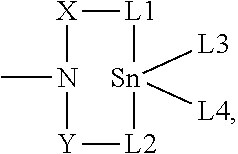
- the at least one catalyst is at least one cyclic tin compound of the general formula (I), (II), (III) or (IV):
- D represents —O—, —S— or —N(R1)—
- R1 represents a saturated or unsaturated, linear or branched, aliphatic or cycloaliphatic or an optionally substituted aromatic or araliphatic radical having up to 20 carbon atoms, which may optionally comprise heteroatoms from the group of oxygen, sulfur and nitrogen, or represents hydrogen or the radical
- R1 and L3 together represent —Z-L5-;
- D* represents —O— or —S—
- X, Y and Z represent identical or different radicals selected from alkylene radicals of the formulae —C(R2)(R3)—, —C(R2)(R3)—C(R4)(R5)— or —C(R2)(R3)—C(R4)(R5)—C(R6)(R7)— or ortho-arylene radicals of the formulae
- R2 to R11 independently of one another represent saturated or unsaturated, linear or branched, aliphatic or cycloaliphatic or optionally substituted aromatic or araliphatic radicals having up to 20 carbon atoms, which may optionally comprise heteroatoms from the group of oxygen, sulfur and nitrogen, or represent hydrogen;
- L1, L2 and L5 independently of one another represent —O—, —S—, —OC( ⁇ O)—, —OC( ⁇ S)—, —SC( ⁇ O)—, —SC( ⁇ S)—, —OS( ⁇ O) 2 O—, —OS( ⁇ O) 2 — or —N(R12)—,
- R12 represents a saturated or unsaturated, linear or branched, aliphatic or cycloaliphatic radical or an optionally substituted aromatic or araliphatic radical having up to 20 carbon atoms and may optionally comprise heteroatoms from the group of oxygen, sulfur and nitrogen, or represents hydrogen;
- L3 and L4 independently of one another represent —OH, —SH, —OR13, -Hal, —OC( ⁇ O)R14, —SR15, —OC( ⁇ S)R16, —OS( ⁇ O) 2 OR17, —OS( ⁇ O) 2 R18 or —NR19R20, or L3 and L4 together represent -L1-X-D-Y-L2-,
- R13 to R20 independently of one another represent saturated or unsaturated, linear or branched, aliphatic or cycloaliphatic or optionally substituted aromatic or araliphatic radicals having up to 20 carbon atoms, which may optionally comprise heteroatoms from the group of oxygen, sulfur and nitrogen, or are hydrogen.
- D* is preferably —O—.
- X, Y and Z are preferably the alkenylene radicals —C(R2)(R3)—, —C(R2)(R3)—C(R4)(R5)— or the ortho-arylene radical
- R2 to R7 are preferably hydrogen or alkyl, aralkyl, alkaryl or aryl radicals having up to 20 carbon atoms, particularly preferably hydrogen or alkyl, aralkyl, alkaryl or aryl radicals having up to 8 carbon atoms, very particularly preferably hydrogen or alkyl radicals having up to 8 carbon atoms, even further preferably hydrogen or methyl.
- R8 to R11 are preferably hydrogen or alkyl radicals having up to 8 carbon atoms, particularly preferably hydrogen or methyl.
- L1, L2 and L5 are preferably —NR12-, —S—, —SC( ⁇ S)—, —SC( ⁇ O)—, —OC( ⁇ S)—, —O—, or —OC( ⁇ O)—, particularly preferably —O—, or —OC( ⁇ O)—.
- R12 is preferably hydrogen or an alkyl, aralkyl, alkaryl or aryl radical having up to 20 carbon atoms, particularly preferably hydrogen or an alkyl, aralkyl, alkaryl or aryl radical having up to 12 carbon atoms, very particularly preferably hydrogen or a methyl, ethyl, propyl, butyl, hexyl or octyl radical, wherein propyl, butyl, hexyl and octyl represent all isomeric propyl, butyl, hexyl and octyl radicals.
- L3 and L4 are preferably -Hal, —OH, —SH, —OR13, —OC( ⁇ O)R14, wherein the R13 and R14 radicals have up to 20 carbon atoms, preferably up to 12 carbon atoms.
- L3 and L4 are particularly preferably Cl—, MeO—, EtO— PrO—, BuO—, HexO—, OctO—, PhO—, formate, acetate, propanoate, butanoate, pentanoate, hexanoate, octanoate, laurate, lactate or benzoate, wherein Pr, Bu, Hex and Oct represent all isomeric propyl, butyl, hexyl and octyl radicals, even further preferably Cl—, MeO—, EtO—, PrO— BuO—, HexO—, OctO—, PhO—, hexanoate, laurate or benzoate, wherein Pr, Bu, Hex and Oct represent all isomeric propyl, butyl, hexyl and octyl radicals.
- R15 to R20 are preferably hydrogen or alkyl, aralkyl, alkaryl or aryl radicals having up to 20 carbon atoms, particularly preferably hydrogen or alkyl, aralkyl, alkaryl or aryl radicals having up to 12 carbon atoms, very particularly preferably hydrogen, methyl, ethyl, propyl, butyl, hexyl or octyl radicals, wherein propyl, butyl, hexyl and octyl represent all isomeric propyl, butyl, hexyl and octyl radicals.
- the units L1-X, L2-Y and L5-Z preferably represent —CH 2 CH 2 O—, —CH 2 CH(Me)O—, CH(Me)CH 2 O—, CH 2 C(Me) 2 O—, —C(Me) 2 CH 2 O— or —CH 2 C( ⁇ O)O—.
- the L1-X-D-Y-L2 unit preferably represents: HN[CH 2 CH 2 O—] 2 , HN[CH 2 CH(Me)O—] 2 , HN[CH 2 CH(Me)O—][CH(Me)CH 2 O—], HN[CH 2 C(Me) 2 O—] 2 , HN[CH 2 C(Me) 2 O—][C(Me) 2 CH 2 O—], HN[CH 2 C( ⁇ O))—] 2 , MeN[CH 2 CH 2 O—] 2 , MeN[CH 2 CH(Me)O—] 2 , MeN[CH 2 CH(Me)O—][CH(Me)CH 2 O—], MeN[CH 2 C(Me) 2 O—] 2 , MeN[CH 2 C(Me) 2 O—][C(Me) 2 CH 2 O—], MeN[CH 2 C( ⁇ O)O—] 2 , EtN[CH 2 CH 2 O—] 2 ,
- the tin compounds have a propensity for oligomerization and therefore polynuclear tin compounds or mixtures of mono- and polynuclear tin compounds are often present.
- the tin atoms are preferably connected to one another via oxygen atoms (‘oxygen bridges’, vide intra).
- oxygen bridges oxygen atoms
- Typical oligomeric complexes form for example through condensation of the tin atoms via oxygen or sulfur, for example
- Cyclic oligomers are frequently encountered in the case of low degrees of oligomerization, linear oligomers with OH or SH end groups in the case of high degrees of oligomerization (cf. formula III).
- thermolatent catalyst is selected from the group of mono- or polycyclic tin compounds of the type:
- R represents D*, L3 or L4, as defined above, and “organyl” represents R1, as defined above.
- thermolatent catalyst is selected from the group consisting of 4,12-di-n-butyl-1,7,9,15-tetraoxa-4,12-diaza-8-stannaspiro[7.7]pentadecane, 4,12-di-n-butyl-2,6,10,14-tetramethyl-1,7,9,15-tetraoxa-4,12-diaza-8-stannaspiro [7.7]pentadecane, 2,4,6,10,12,14-hexamethyl-1,7,9,15-tetraoxa-4,12-diaza-8-stannaspiro [7.7]pentadecane, 4,12-di-n-octyl-2,6,10,14-tetramethyl-1,7,9,15-tetraoxa-4,12-diaza-8-stannaspiro [7.7]pentadecane, 4,12-di-n-
- Step (A) is preferably carried out by reacting one tin-containing precursor compound, in particular a tin(IV) salt, in the at least one first solvent to give the at least one catalyst.
- the concentration of the at least one tin-containing precursor compound in the at least one first solvent is preferably 2 to 60% by weight, based on the total solution A.
- step (A) of the method according to the invention the at least one catalyst is present in at least one first solvent.
- one first solvent is used in accordance with the invention, or a mixture of first solvents is used.
- one first solvent is preferably used.
- the first solvent used is preferably a solvent having a boiling point of 40 to 100° C., particularly preferably 50 to 80° C., in each case at 1 bar(a).
- the at least one first solvent is particularly preferably selected from the group consisting of alcohols, preferably methanol, ethanol, propanol, in particular isopropanol, or mixtures thereof, ethers, preferably diethyl ether, tetrahydrofuran, tert-butyl methyl ether or mixtures thereof, halogenated solvents, preferably dichloromethane, chloroform or mixtures thereof, and mixtures thereof.
- the at least one catalyst can be present in the at least one first solvent at any concentration deemed suitable to those skilled in the art.
- concentration of the at least one catalyst in the at least one first solvent is preferably 0.1 to 80% by weight, particularly preferably 1 to 50% by weight, very particularly preferably 2 to 20% by weight, in particular preferably 5 to 20% by weight, based in each case on the total solution A.
- Solution A generally comprises the at least one catalyst, the at least one first solvent and possibly impurities such as water, for example to an extent of up to 0.5% by weight, ligands from the catalyst preparation, for example N-organyldialkanolamines, in particular N-butyldiisopropylamine, sodium chloride etc.
- ligands from the catalyst preparation for example N-organyldialkanolamines, in particular N-butyldiisopropylamine, sodium chloride etc.
- ligands from the catalyst preparation for example N-organyldialkanolamines, in particular N-butyldiisopropylamine, sodium chloride etc.
- Preferably present in solution A is only the at least one catalyst, preferably one catalyst, and the at least one first solvent, preferably one first solvent.
- impurities possibly present can be removed by purification steps known to those skilled in the art, for example filtration and the like.
- step (A) the solution provided in step (A) is transferred to step (B) without further intermediate steps.
- solution A comprising the at least one catalyst in at least one first solvent is treated prior to step (B), i.e. after step (A), for at least 6 h at a temperature of at least ⁇ 10° C.
- This treatment can generally be carried out in any apparatus deemed suitable to those skilled in the art, for example in a tank, stirred vessel, container, reaction vessel etc.
- the treatment is generally carried out for at least 6 h, preferably for at least 12 h, further preferably for at least 24 h.
- the treatment is generally carried out for at most 168 h, preferably for at most 48 h.
- the treatment is generally carried out at a temperature of at least ⁇ 10° C., preferably at 10 to 80° C., particularly preferably at 15 to 60° C., very particularly preferably at room or ambient temperature.
- Solution A can be stirred during this treatment in any manner known to those skilled in the art. In a second embodiment, solution A is not stirred during this treatment.
- Step (B) of the method according to the invention comprises treating the solution A from step (A) with activated carbon.
- treating the solution A from step (A) with activated carbon is understood to mean that solution A is brought into contact with activated carbon. This bringing into contact can take place in accordance with the invention in any manner deemed suitable to those skilled in the art, for example introducing activated carbon into the solution A or perfusing activated carbon with solution A.
- Step (B) of the method according to the invention is preferably carried out at a temperature and a pressure at which the at least one first solvent is liquid.
- the temperature in step (B) is therefore preferably ⁇ 10 to 80° C., particularly preferably 10 to 60° C.
- the pressure in step (B) is therefore preferably 0.5 to 7 bar(a), particularly preferably 0.8 to 2 bar(a) and very particularly preferably 1 to 1.5 bar(a).
- step (B) of the method according to the invention the solution A is generally treated with a sufficiently large amount of activated carbon.
- activated carbon is preferably used in an amount of 1 to 100 g/100 g of solution A, particularly preferably 2 to 12 g/100 g of solution A.
- the activated carbon used in step (B) of the method according to the invention preferably has a specific surface area of 400 to 2500 m 2 /g, measured according to the BET method in accordance with DIN ISO 9277:2003-05. Preference is given to using activated carbon based on coconut shells or carbon, particularly preferably based on coconut shells.
- Step (B) of the method according to the invention is preferably carried out until the solution has a desired Hazen color number.
- step (B) is carried out for up to 48 h, particularly preferably for up to 24 h, in particular preferably for up to 12 h, very particularly preferably for up to 4 h.
- Step (B) of the method according to the invention is preferably carried out for at least 2 hours, particularly preferably for at least 3 hours.
- the Hazen color number, measured spectrophotometrically in accordance with DIN EN ISO 6271-2:2005-03, of the solution obtained in step (B) is less than 500 APHA, preferably less than 200 APHA, particularly preferably less than 100 APHA, very particularly preferably less than 80 APHA, in particular less than 60 APHA.
- the Hazen color number, measured spectrophotometrically in accordance with DIN EN ISO 6271-2:2005-03 is in this case* preferably less than 1 APHA.
- Step (C) of the method according to the invention comprises removing the activated carbon from the* solution A.
- Step (C) of the method according to the invention can generally be carried out in any manner known to those skilled in the art.
- step (B) of the method according to the invention is carried out by introducing the activated carbon into solution A
- step (C) of the method according to the invention is preferably carried out by filtration or by decanting.
- step (B) of the method according to the invention is carried out in that the solution A flows through the activated carbon
- step (C) of the method according to the invention is preferably carried out by the activated carbon being separated by means of a suitable apparatus, for example a funnel or a Nutsche filter, after the activated carbon has been perfused with solution A.
- Step (C) of the method according to the invention is preferably carried out at a temperature and a pressure at which the at least one first solvent is liquid.
- the temperature in step (C) is therefore preferably ⁇ 10 to 80° C., particularly preferably 10 to 60° C.
- the pressure in step (C) is therefore preferably 0.5 to 7 bar(a), particularly preferably 0.8 to 2 bar(a) and very particularly preferably 1 to 1.5 bar(a).
- Step (D) of the method according to the invention comprises exchanging the at least one first solvent in solution A for at least one second solvent in order to obtain the solution B, comprising the at least one catalyst in at least one second solvent.
- any at least one second solvent deemed suitable to those skilled in the art can be used.
- one second solvent is used in accordance with the invention, or a mixture of second solvents is used.
- one second solvent is preferably used.
- the at least one second solvent preferably has a boiling point of 80 to 180° C., particularly preferably 100 to 140° C., in each case at 1 bar(a).
- the at least one first solvent and the at least one second solvent are preferably different.
- the boiling point of the at least one second solvent is higher, preferably at least 10° C. higher, particularly preferably at least 30° C. higher, than the boiling point of the at least one first solvent.
- the present invention preferably relates to the method according to the invention wherein the at least one second solvent is selected from the group consisting of esters, preferably butyl acetate, in particular n-butyl acetate, ethyl acetate, ethylene glycol diacetate, 2-methoxypropyl acetate or mixtures thereof, aromatic solvents, preferably benzene, toluene, xylols or mixtures thereof, lactones, preferably butyrolactone or mixtures thereof, carbonates, preferably diethyl carbonate, propylene carbonate, ethylene carbonate or mixtures thereof.
- esters preferably butyl acetate, in particular n-butyl acetate, ethyl acetate, ethylene glycol diacetate, 2-methoxypropyl acetate or mixtures thereof
- aromatic solvents preferably benzene, toluene, xylols or mixtures thereof
- lactones preferably butyrolact
- Step (D) of the method according to the invention comprises exchanging the at least one first solvent for the at least one second solvent.
- step (D) of the method according to the invention can be carried out by removing the at least one first solvent at reduced pressure and/or elevated temperature in order to obtain the at least one catalyst in solid form.
- a suitable pressure is, for example, 0.001 bar(a) to 5 bar(a).
- a suitable temperature is, for example, 20 to 150° C.
- the solid catalyst thus obtained is subsequently dissolved in the at least one second solvent, optionally at elevated temperature.
- step (D) can be carried out by firstly removing the at least one first solvent at reduced pressure and/or elevated temperature, for example 0.001 to 5 bar(a) and/or 20 to 150° C., while at the same time adding the at least one second solvent, which preferably has a higher boiling point than the at least one first solvent.
- step (D) can be carried out by adding firstly the at least one second solvent, which preferably has a higher boiling point than the at least one first solvent, at least partly to the mixture obtained in step (C) and then removing the at least one first solvent at reduced pressure and/or elevated temperature, for example 0.001 to 5 bar(a) and/or 20 to 150° C., optionally with further addition of the second solvent.
- the exchange of the at least one first solvent for the at least one second solvent can also be carried out in accordance with the invention by selecting the at least one first solvent and the at least one second solvent such that, owing to the different solubility of the at least one catalyst in the two solvents and the densities of the two solvents, on bringing the mixture comprising the at least one catalyst and the at least one first solvent into contact with the at least one second solvent, the at least one catalyst at least partially migrates into the at least one second solvent and, owing to a miscibility gap, two phases are formed. These can be separated from each other, for example by decanting, in order to obtain the solution B.
- solution B is obtained comprising at least one catalyst in at least one second solvent.
- Solution B comprises the at least one catalyst in an amount of, for example, 3 to 45% by weight, preferably 15 to 25% by weight, based in each case on the total solution B.
- a corresponding solution B in at least one second solvent which has no discoloration, in particular no yellow discoloration.
- a solution B is obtained in accordance with the invention which, even on storage under an inert gas atmosphere at a temperature below 60° C. over a period of several days, preferably several weeks, develops no discoloration, in particular no yellow discoloration.
- the present invention therefore also relates to the solution of at least one catalyst in at least one second solvent, obtainable by the method according to the invention.
- the present invention relates to the solution according to the invention comprising at least one catalyst in at least one second solvent, wherein the solution has a Hazen color number, measured spectrophotometrically in accordance with DIN EN ISO 6271-2:2005-03, of less than 500 APHA, preferably less than 200 APHA, particularly preferably less than 100 APHA, very particularly preferably less than 80 APHA, in particular less than 60 APHA.
- the Hazen color number, measured spectrophotometrically in accordance with DIN EN ISO 6271-2:2005-03 is in this case preferably less than 1 APHA.
- the present invention relates to the solution according to the invention, wherein the Hazen color number of the solution, measured spectrophotometrically in accordance with DIN EN ISO 6271-2:2005-03, on storage under an inert gas atmosphere at a temperature of 30° C. over a period of 10 weeks changes by less than 200 APHA, preferably less than 100 APHA and particularly preferably less than 50 APHA.
- the present invention relates to the solution according to the invention, wherein the at least one catalyst is at least one cyclic tin compound of the general formula (I), (II), (III) or (IV):
- D represents —O—, —S— or —N(R1)—
- R1 represents a saturated or unsaturated, linear or branched, aliphatic or cycloaliphatic or an optionally substituted aromatic or araliphatic radical having up to 20 carbon atoms, which may optionally comprise heteroatoms from the group of oxygen, sulfur and nitrogen, or represents hydrogen or the radical
- R1 and L3 together represent—Z-L5-;
- D* represents —O— or —S—
- X, Y and Z represent identical or different radicals selected from alkylene radicals of the formulae —C(R2)(R3)—, —C(R2)(R3)—C(R4)(R5)— or —C(R2)(R3)—C(R4)(R5)—C(R6)(R7)— or ortho-arylene radicals of the formulae
- R2 to R11 independently of one another represent saturated or unsaturated, linear or branched, aliphatic or cycloaliphatic or optionally substituted aromatic or araliphatic radicals having up to 20 carbon atoms, which may optionally comprise heteroatoms from the group of oxygen, sulfur and nitrogen, or represent hydrogen;
- L1, L2 and L5 independently of one another represent —O—, —S—, —OC( ⁇ O)—, —OC( ⁇ S)—, —SC( ⁇ O)—, —SC( ⁇ S)—, —OS( ⁇ O) 2 O—, —OS( ⁇ O) 2 — or —N(R12)—,
- R12 represents a saturated or unsaturated, linear or branched, aliphatic or cycloaliphatic radical or an optionally substituted aromatic or araliphatic radical having up to 20 carbon atoms, which may optionally comprise heteroatoms from the group of oxygen, sulfur and nitrogen, or represents hydrogen;
- L3 and L4 independently of one another represent —OH, —SH, —OR13, -Hal, —OC( ⁇ O)R14, —SR15, —OC( ⁇ S)R16, —OS( ⁇ O) 2 OR17, —OS( ⁇ O) 2 R18 or —NR19R20, or L3 and L4 together represent —L1-X-D-Y-L2-,
- R13 to R20 independently of one another represent saturated or unsaturated, linear or branched, aliphatic or cycloaliphatic or optionally substituted aromatic or araliphatic radicals having up to 20 carbon atoms, which may optionally comprise heteroatoms from the group of oxygen, sulfur and nitrogen, or represent hydrogen.
- the at least one catalyst is present in an amount of, for example, 3 to 40% by weight, preferably 15 to 25% by weight, based in each case on the total solution.
- the present invention also relates to the use of the solution according to the invention for preparing a composition
- a composition comprising the at least one catalyst, the at least one second solvent, at least one polyisocyanate and at least one NCO-reactive compound.
- Suitable catalysts and second solvents in accordance with the invention have already been described with respect to the method according to the invention.
- Suitable NCO-reactive compounds in accordance with the invention are described, for example, in WO 2017/182429 A1 and in particular are selected from the group consisting of low molecular weight diols, e.g. 1,2-ethanediol, 1,3- or 1,2-propanediol, 1,4-butanediol, triols, e.g. glycerol, trimethylolpropane, tetraols e.g.
- pentaerythritol, short-chain polyamines, polyhydroxy compounds such as polyether polyols, polyester polyols, polyurethane polyols, polysiloxane polyols, polycarbonate polyols, polyether polyamines, polybutadiene polyols, polyacrylate polyols, polymethacrylate polyols, mixed polymers thereof, and mixtures thereof.
- the polyhydroxyl compounds preferably have mass-average molecular weights Mw>500 daltons, measured by means of gel permeation chromatography (GPC) against a polystyrene standard, particularly preferably between 800 and 100 000 daltons, in particular between 1000 and 50 000 daltons.
- GPC gel permeation chromatography
- the polyhydroxyl compounds preferably have an OH number of 30 to 400 mg KOH/g, in particular between 100 and 300 KOH/g.
- the hydroxyl number (OH number) indicates how many mg of potassium hydroxide are equivalent to the amount of acetic acid bound by 1 g of substance in the acetylation.
- the sample is boiled with acetic anhydride/pyridine, and the acid formed is titrated with potassium hydroxide solution (DIN 53240-2).
- the glass transition temperatures, measured with the aid of DSC measurements according to DIN EN ISO 1 1357-2, of the polyhydroxyl compounds are preferably between ⁇ 150 and 100° C., particularly preferably between ⁇ 120° C. and 80° C.
- Suitable polyisocyanates in accordance with the invention are described, for example, in WO 2017/182429 A1 and are preferably selected from the group consisting of di- or triisocyanates, for example butane 1,4-diisocyanate, pentane 1,5-diisocyanate (pentamethylene diisocyanate, PDI), hexane 1,6-diisocyanate (hexamethylene diisocyanate, HDI), 4-isocyanatomethyloctane 1,8-diisocyanate (triisocyanatononane, TIN), 4,4′-methylenebis(cyclohexyl isocyanate) (H 12 MDI), 3,5,5-trimethyl-1-isocyanato-3-isocyanatomethylcyclohexane (isophorone diisocyanate, IPDI), 1,3- and 1,4-bis(isocyanatomethyl)cyclohexane (H 6 XDI), naphthal
- the present invention therefore relates in addition to the composition according to the invention comprising at least one polyisocyanate, at least one NCO-reactive compound and a solution according to the invention, i.e. the solution B according to the invention.
- the present invention also relates to the use of the composition according to the invention for preparing single-layered or multi-layered coating systems.
- the present invention relates in addition to a process for single-layered or multi-layered coating of a substrate with a coating system by applying a composition according to the invention to the substrate.
- the present invention also relates to the substrate, coated with a single-layered or multi-layered coating system, comprising a composition according to the invention and/or obtainable by the method according to the invention, characterized in particular in that the substrate is a chassis, preferably of a vehicle, in particular of a land vehicle, aircraft or watercraft, or a part thereof.
- the Hazen color number was measured by spectrophotometry according to DIN EN ISO 6271-2:2005-03 with a LICO 400 spectrophotometer from Lange, Germany. 4,12-Di-n-butyl-2,6,10,14-tetramethyl-1,7,9,15-tetraoxa-4,12-diaza-8-stannaspiro [7.7]pentadecane was used as catalyst.
- a catalyst mixture consisting of 61 kg of methanol and 12.7 kg of catalyst was heat-treated at 10° C. for 24 h in a stirred tank and subsequently circulated for 24 h over 6 kg of activated carbon based on coconut shells. Over the experimental period, the coloring of the catalyst solution was slowly reduced to a color value of 16 APHA.
- the resulting catalyst solution had a catalyst content of 10.4% by weight and a color value of 16 APHA.
- the sample After temperature-controlled storage at 50° C., the sample showed after 10 days a color number of 18 APHA.
- the sample After temperature-controlled storage at 50° C., the sample showed after 69 days a color number of 150 APHA.
- a catalyst mixture consisting of 66 kg of methanol and 12.6 kg of catalyst, after preparation of the catalyst, was circulated for 24 h over 6 kg of activated carbon based on coconut shells. Over the experimental period, the coloring of the catalyst solution was slowly reduced to a color value of 42 APHA.
- a catalyst mixture consisting of 66 kg of methanol and 11.5 kg of catalyst, after preparation of the catalyst, was heat-treated for 24 h and then circulated for 24 h over 6 kg of activated carbon based on coconut shells. Over the experimental period, the coloring of the catalyst solution was slowly reduced to a color value of 33 APHA. Table 1 shows the time-dependent decrease of the color of the solution:
- a catalyst mixture consisting of 100 kg of methanol and 14.72 kg of catalyst (12.83%) was heat-treated at 10° C. for 24 h in a stirred tank and subsequently circulated for 24 h over 6 kg of activated carbon based on coconut shells. Over the experimental period, the coloring of the catalyst solution of 248 APHA was reduced to a color value of 69 APHA. The catalyst concentration obtained after the decolorization was 12.22%. The yield based on the catalyst was 95.2%.
- a catalyst mixture consisting of 100 kg of butyl acetate and 11.08 kg of catalyst (9.97%) was heat-treated at 10° C. for 24 h in a stirred tank and subsequently circulated for 24 h over 6 kg of activated carbon based on coconut shells.
- the coloring of the catalyst solution of 145 APHA was reduced to a color value of 60 APHA.
- the catalyst concentration obtained after the decolorization was 7.7%.
- the yield based on the catalyst was 78.0%.
Landscapes
- Chemical & Material Sciences (AREA)
- Organic Chemistry (AREA)
- Chemical Kinetics & Catalysis (AREA)
- Engineering & Computer Science (AREA)
- Materials Engineering (AREA)
- Inorganic Chemistry (AREA)
- Health & Medical Sciences (AREA)
- Medicinal Chemistry (AREA)
- Polymers & Plastics (AREA)
- Life Sciences & Earth Sciences (AREA)
- Wood Science & Technology (AREA)
- Catalysts (AREA)
- Paints Or Removers (AREA)
- Polyurethanes Or Polyureas (AREA)
Abstract
Description

where n>1,

where n>1,

where:

or R1 and L3 together represent —Z-L5-;

wherein R2 to R11 independently of one another represent saturated or unsaturated, linear or branched, aliphatic or cycloaliphatic or optionally substituted aromatic or araliphatic radicals having up to 20 carbon atoms, which may optionally comprise heteroatoms from the group of oxygen, sulfur and nitrogen, or represent hydrogen;


where n>1 (cf. formula II). Cyclic oligomers are frequently encountered in the case of low degrees of oligomerization, linear oligomers with OH or SH end groups in the case of high degrees of oligomerization (cf. formula III).

where n>1,

where n>1,

where:
or R1 and L3 together represent—Z-L5-;

wherein R2 to R11 independently of one another represent saturated or unsaturated, linear or branched, aliphatic or cycloaliphatic or optionally substituted aromatic or araliphatic radicals having up to 20 carbon atoms, which may optionally comprise heteroatoms from the group of oxygen, sulfur and nitrogen, or represent hydrogen;
| TABLE 1 | |||||||||
| Time [h] | 0 | 4 | 8 | 12 | 16 | 20 | 24 | ||
| APHA | 81 | 46 | 41 | 40 | 36 | 32 | 33 | ||
Claims (14)


Applications Claiming Priority (3)
| Application Number | Priority Date | Filing Date | Title |
|---|---|---|---|
| EP19188548 | 2019-07-26 | ||
| EP19188548.2A EP3770198A1 (en) | 2019-07-26 | 2019-07-26 | Method for preparing and processing catalyst solutions |
| EP19188548.2 | 2019-07-26 |
Publications (2)
| Publication Number | Publication Date |
|---|---|
| US20210023544A1 US20210023544A1 (en) | 2021-01-28 |
| US11219888B2 true US11219888B2 (en) | 2022-01-11 |
Family
ID=67439051
Family Applications (1)
| Application Number | Title | Priority Date | Filing Date |
|---|---|---|---|
| US16/937,991 Expired - Fee Related US11219888B2 (en) | 2019-07-26 | 2020-07-24 | Method for preparing and processing catalyst solutions |
Country Status (3)
| Country | Link |
|---|---|
| US (1) | US11219888B2 (en) |
| EP (1) | EP3770198A1 (en) |
| CN (1) | CN112300352A (en) |
Families Citing this family (1)
| Publication number | Priority date | Publication date | Assignee | Title |
|---|---|---|---|---|
| EP4234602A1 (en) * | 2022-02-28 | 2023-08-30 | Covestro Deutschland AG | Use of special catalysts for the preparation of polyurethane coatings |
Citations (11)
| Publication number | Priority date | Publication date | Assignee | Title |
|---|---|---|---|---|
| EP2698200A1 (en) | 2012-08-13 | 2014-02-19 | TIB Chemicals AG | Thermo-latent catalysts, production and use of same |
| EP2772496A1 (en) | 2013-02-28 | 2014-09-03 | Bayer MaterialScience AG | Direct synthesis of tin (II) - and tin (IV) alkoxides from elemental tin and alcohols in the presence of activation reagents |
| US8946372B2 (en) | 2009-10-30 | 2015-02-03 | Bayer Intellectual Property Gmbh | Use of tin catalysts for the production of polyurethane coatings |
| US9079924B2 (en) | 2009-10-30 | 2015-07-14 | Bayer Materialscience Ag | Method for producing metal compounds |
| US20150240024A1 (en) | 2012-09-25 | 2015-08-27 | Bayer Materialscience Ag | Polyisocyanate-polyaddition productions |
| US20150252638A1 (en) * | 2013-06-06 | 2015-09-10 | Halliburton Energy Services, Inc. | Fluid Loss Well Treatment |
| US20150252138A1 (en) | 2012-09-25 | 2015-09-10 | Bayer Materialscience, Ag | Polyisocyanate-polyaddition products |
| EP2990381A1 (en) | 2014-08-29 | 2016-03-02 | Covestro Deutschland AG | Method for the preparation of tin compounds |
| US9416215B2 (en) | 2008-05-02 | 2016-08-16 | Covestro Deutschland Ag | Catalysts and use thereof in the production of polyurethanes |
| US20190070589A1 (en) | 2017-09-07 | 2019-03-07 | Ppg Industries Ohio, Inc. | Thermolatent catalyst and its use in curable compositions |
| US20190135968A1 (en) | 2016-04-22 | 2019-05-09 | Covestro Deutschland Ag | Thermolatently catalysed two-component system |
Family Cites Families (2)
| Publication number | Priority date | Publication date | Assignee | Title |
|---|---|---|---|---|
| CN107108841A (en) * | 2015-01-14 | 2017-08-29 | 科思创德国股份有限公司 | Composition for polyurethane-base transparent formed article |
| CN108472684B (en) * | 2015-11-20 | 2022-07-26 | 科思创德国股份有限公司 | Multi-layer paint structure with heat latent catalyst |
-
2019
- 2019-07-26 EP EP19188548.2A patent/EP3770198A1/en not_active Withdrawn
-
2020
- 2020-07-24 US US16/937,991 patent/US11219888B2/en not_active Expired - Fee Related
- 2020-07-24 CN CN202010722052.5A patent/CN112300352A/en active Pending
Patent Citations (14)
| Publication number | Priority date | Publication date | Assignee | Title |
|---|---|---|---|---|
| US9416215B2 (en) | 2008-05-02 | 2016-08-16 | Covestro Deutschland Ag | Catalysts and use thereof in the production of polyurethanes |
| US8946372B2 (en) | 2009-10-30 | 2015-02-03 | Bayer Intellectual Property Gmbh | Use of tin catalysts for the production of polyurethane coatings |
| US9079924B2 (en) | 2009-10-30 | 2015-07-14 | Bayer Materialscience Ag | Method for producing metal compounds |
| EP2698200A1 (en) | 2012-08-13 | 2014-02-19 | TIB Chemicals AG | Thermo-latent catalysts, production and use of same |
| US20150240024A1 (en) | 2012-09-25 | 2015-08-27 | Bayer Materialscience Ag | Polyisocyanate-polyaddition productions |
| US20150252138A1 (en) | 2012-09-25 | 2015-09-10 | Bayer Materialscience, Ag | Polyisocyanate-polyaddition products |
| WO2014131750A1 (en) | 2013-02-28 | 2014-09-04 | Bayer Materialscience Ag | Direct synthesis of tin(ii) and tin(iv) alkoxides from elemental tin and alcohols in the presence of activating reagents |
| EP2772496A1 (en) | 2013-02-28 | 2014-09-03 | Bayer MaterialScience AG | Direct synthesis of tin (II) - and tin (IV) alkoxides from elemental tin and alcohols in the presence of activation reagents |
| US20150252638A1 (en) * | 2013-06-06 | 2015-09-10 | Halliburton Energy Services, Inc. | Fluid Loss Well Treatment |
| EP2990381A1 (en) | 2014-08-29 | 2016-03-02 | Covestro Deutschland AG | Method for the preparation of tin compounds |
| US20190135968A1 (en) | 2016-04-22 | 2019-05-09 | Covestro Deutschland Ag | Thermolatently catalysed two-component system |
| US10815330B2 (en) * | 2016-04-22 | 2020-10-27 | Covestro Deutschland Ag | Thermolatently catalysed two-component system |
| US20190070589A1 (en) | 2017-09-07 | 2019-03-07 | Ppg Industries Ohio, Inc. | Thermolatent catalyst and its use in curable compositions |
| US10773243B2 (en) * | 2017-09-07 | 2020-09-15 | Ppg Industries Ohio, Inc. | Thermolatent catalyst and its use in curable compositions |
Non-Patent Citations (5)
| Title |
|---|
| "Decoloring Carbo" http://www.pitt.edu/˜bandik/organicweb/decolorcarbon.html#:˜:text=Decolorizing%20carbon%2C%20also%20called%20activated,colored%20molecules%20may%20become%20adsorbed. (Year: 1999). * |
| Chem. Heterocycl. Comp. 2007, 43, pp. 813 to 834. |
| Donau Carbon, "Aktivkohle in der chemischen Industrie—Reinigung von Fluessigkeiten, Abluft und Abwasser", Jan. 1, 2020, XP 0555659489. |
| Indian J. Chem. 1967, 5, pp. 643 to 645. |
| J. Organomet. Chem. 2009, 694, pp. 3184 to 3189. |
Also Published As
| Publication number | Publication date |
|---|---|
| US20210023544A1 (en) | 2021-01-28 |
| CN112300352A (en) | 2021-02-02 |
| EP3770198A1 (en) | 2021-01-27 |
Similar Documents
| Publication | Publication Date | Title |
|---|---|---|
| EP3271411B1 (en) | Polyisocyanates containing silane groups based on 1,5-diisocyanatopentane | |
| JP2832451B2 (en) | Process for producing polyisocyanates containing isocyanurate groups and their use | |
| JPH0768226B2 (en) | Process for producing polyisocyanates containing isocyanurate groups and their use | |
| EP2881442B1 (en) | Polyisocyanate composition, solar cell member covering material, solar cell member with covering layer, microcapsule, and ink binder | |
| EP2900716B1 (en) | Polyisocyanate polyaddition products | |
| JPH10101638A5 (en) | ||
| WO2007039133A1 (en) | Two-component systems for producing flexible coatings | |
| CA2195162A1 (en) | Blocked polyisocyanate crosslinkers for providing improved flow properties to coating compositions | |
| EP0496208A2 (en) | Polyisocyanates containing allophanate and isocyanurate groups, a process for their production and their use in two-component coating compositions | |
| US20230203067A1 (en) | Production process for amino alcoholates | |
| CN110760055B (en) | Polyisocyanate composition and preparation method thereof | |
| US6765111B1 (en) | Process for the production of polyisocyanates containing isocyanurate groups and their use | |
| EP1170283A2 (en) | Process for the preparation of low odor and storage-stable monomer-containing polyisocyanurates from isophorone diisocyanate | |
| US11219888B2 (en) | Method for preparing and processing catalyst solutions | |
| EP3872108A1 (en) | Compositions containing uretdione groups | |
| EP1735363B1 (en) | Discolouration-resistant polyether allophanates | |
| US20070060731A1 (en) | Method for the production of prepolymers containing isocyanate groups | |
| WO2005097737A1 (en) | Method for producing polyether allophanates using zinc compounds as catalysts | |
| CN110621712B (en) | Polyisocyanate composition | |
| EP1809682B1 (en) | Process for the preparation of polyisocyanates blocked with sterically demanding phenols | |
| MXPA02007875A (en) | ALCOHOLminus;BLOCKED POLYISOCYANATES FOR COIL COATING. | |
| EP1765899B1 (en) | Method for producing amino-functional polyurethane prepolymers | |
| EP4480979A1 (en) | Polyisocyanate composition | |
| DE3018198A1 (en) | NEW ISOCYANATO ISOCYANURATE, A METHOD FOR THE PRODUCTION THEREOF, AND THEIR USE AS ISOCYANATE COMPONENT IN POLYURETHANE LACQUER | |
| DE102004012876A1 (en) | High activity urethanization catalysts, useful for producing non-discolored polyurethanes, e.g. for use in coatings, comprising scandium or rare earth metal beta-diketonate complexes |
Legal Events
| Date | Code | Title | Description |
|---|---|---|---|
| FEPP | Fee payment procedure |
Free format text: ENTITY STATUS SET TO UNDISCOUNTED (ORIGINAL EVENT CODE: BIG.); ENTITY STATUS OF PATENT OWNER: LARGE ENTITY |
|
| STPP | Information on status: patent application and granting procedure in general |
Free format text: DOCKETED NEW CASE - READY FOR EXAMINATION |
|
| AS | Assignment |
Owner name: COVESTRO INTELLECTUAL PROPERTY GMBH & CO. KG, GERMANY Free format text: ASSIGNMENT OF ASSIGNORS INTEREST;ASSIGNORS:TRAVING, MICHAEL;ROSELLEN, HOLGER;MANZELLI, SALVATORE;AND OTHERS;SIGNING DATES FROM 20200821 TO 20200831;REEL/FRAME:054206/0800 |
|
| STPP | Information on status: patent application and granting procedure in general |
Free format text: NON FINAL ACTION MAILED |
|
| STPP | Information on status: patent application and granting procedure in general |
Free format text: NOTICE OF ALLOWANCE MAILED -- APPLICATION RECEIVED IN OFFICE OF PUBLICATIONS |
|
| STPP | Information on status: patent application and granting procedure in general |
Free format text: AWAITING TC RESP., ISSUE FEE NOT PAID |
|
| STPP | Information on status: patent application and granting procedure in general |
Free format text: AWAITING TC RESP., ISSUE FEE NOT PAID |
|
| STPP | Information on status: patent application and granting procedure in general |
Free format text: NOTICE OF ALLOWANCE MAILED -- APPLICATION RECEIVED IN OFFICE OF PUBLICATIONS |
|
| STPP | Information on status: patent application and granting procedure in general |
Free format text: PUBLICATIONS -- ISSUE FEE PAYMENT VERIFIED |
|
| STCF | Information on status: patent grant |
Free format text: PATENTED CASE |
|
| FEPP | Fee payment procedure |
Free format text: MAINTENANCE FEE REMINDER MAILED (ORIGINAL EVENT CODE: REM.); ENTITY STATUS OF PATENT OWNER: LARGE ENTITY |