US11218876B2 - Secure channel estimation architecture - Google Patents
Secure channel estimation architecture Download PDFInfo
- Publication number
- US11218876B2 US11218876B2 US15/883,785 US201815883785A US11218876B2 US 11218876 B2 US11218876 B2 US 11218876B2 US 201815883785 A US201815883785 A US 201815883785A US 11218876 B2 US11218876 B2 US 11218876B2
- Authority
- US
- United States
- Prior art keywords
- wireless
- shared secret
- signal
- channel
- receiver system
- Prior art date
- Legal status (The legal status is an assumption and is not a legal conclusion. Google has not performed a legal analysis and makes no representation as to the accuracy of the status listed.)
- Expired - Fee Related, expires
Links
Images




Classifications
-
- H—ELECTRICITY
- H04—ELECTRIC COMMUNICATION TECHNIQUE
- H04W—WIRELESS COMMUNICATION NETWORKS
- H04W12/00—Security arrangements; Authentication; Protecting privacy or anonymity
- H04W12/08—Access security
-
- H—ELECTRICITY
- H04—ELECTRIC COMMUNICATION TECHNIQUE
- H04L—TRANSMISSION OF DIGITAL INFORMATION, e.g. TELEGRAPHIC COMMUNICATION
- H04L63/00—Network architectures or network communication protocols for network security
- H04L63/14—Network architectures or network communication protocols for network security for detecting or protecting against malicious traffic
- H04L63/1441—Countermeasures against malicious traffic
- H04L63/1483—Countermeasures against malicious traffic service impersonation, e.g. phishing, pharming or web spoofing
-
- G—PHYSICS
- G01—MEASURING; TESTING
- G01S—RADIO DIRECTION-FINDING; RADIO NAVIGATION; DETERMINING DISTANCE OR VELOCITY BY USE OF RADIO WAVES; LOCATING OR PRESENCE-DETECTING BY USE OF THE REFLECTION OR RERADIATION OF RADIO WAVES; ANALOGOUS ARRANGEMENTS USING OTHER WAVES
- G01S11/00—Systems for determining distance or velocity not using reflection or reradiation
- G01S11/02—Systems for determining distance or velocity not using reflection or reradiation using radio waves
-
- G—PHYSICS
- G01—MEASURING; TESTING
- G01S—RADIO DIRECTION-FINDING; RADIO NAVIGATION; DETERMINING DISTANCE OR VELOCITY BY USE OF RADIO WAVES; LOCATING OR PRESENCE-DETECTING BY USE OF THE REFLECTION OR RERADIATION OF RADIO WAVES; ANALOGOUS ARRANGEMENTS USING OTHER WAVES
- G01S11/00—Systems for determining distance or velocity not using reflection or reradiation
- G01S11/02—Systems for determining distance or velocity not using reflection or reradiation using radio waves
- G01S11/06—Systems for determining distance or velocity not using reflection or reradiation using radio waves using intensity measurements
-
- G—PHYSICS
- G01—MEASURING; TESTING
- G01S—RADIO DIRECTION-FINDING; RADIO NAVIGATION; DETERMINING DISTANCE OR VELOCITY BY USE OF RADIO WAVES; LOCATING OR PRESENCE-DETECTING BY USE OF THE REFLECTION OR RERADIATION OF RADIO WAVES; ANALOGOUS ARRANGEMENTS USING OTHER WAVES
- G01S5/00—Position-fixing by co-ordinating two or more direction or position line determinations; Position-fixing by co-ordinating two or more distance determinations
- G01S5/02—Position-fixing by co-ordinating two or more direction or position line determinations; Position-fixing by co-ordinating two or more distance determinations using radio waves
- G01S5/0205—Details
- G01S5/0215—Interference
-
- G—PHYSICS
- G01—MEASURING; TESTING
- G01S—RADIO DIRECTION-FINDING; RADIO NAVIGATION; DETERMINING DISTANCE OR VELOCITY BY USE OF RADIO WAVES; LOCATING OR PRESENCE-DETECTING BY USE OF THE REFLECTION OR RERADIATION OF RADIO WAVES; ANALOGOUS ARRANGEMENTS USING OTHER WAVES
- G01S5/00—Position-fixing by co-ordinating two or more direction or position line determinations; Position-fixing by co-ordinating two or more distance determinations
- G01S5/02—Position-fixing by co-ordinating two or more direction or position line determinations; Position-fixing by co-ordinating two or more distance determinations using radio waves
- G01S5/0273—Position-fixing by co-ordinating two or more direction or position line determinations; Position-fixing by co-ordinating two or more distance determinations using radio waves using multipath or indirect path propagation signals in position determination
-
- G—PHYSICS
- G01—MEASURING; TESTING
- G01S—RADIO DIRECTION-FINDING; RADIO NAVIGATION; DETERMINING DISTANCE OR VELOCITY BY USE OF RADIO WAVES; LOCATING OR PRESENCE-DETECTING BY USE OF THE REFLECTION OR RERADIATION OF RADIO WAVES; ANALOGOUS ARRANGEMENTS USING OTHER WAVES
- G01S5/00—Position-fixing by co-ordinating two or more direction or position line determinations; Position-fixing by co-ordinating two or more distance determinations
- G01S5/02—Position-fixing by co-ordinating two or more direction or position line determinations; Position-fixing by co-ordinating two or more distance determinations using radio waves
- G01S5/0278—Position-fixing by co-ordinating two or more direction or position line determinations; Position-fixing by co-ordinating two or more distance determinations using radio waves involving statistical or probabilistic considerations
-
- H—ELECTRICITY
- H04—ELECTRIC COMMUNICATION TECHNIQUE
- H04W—WIRELESS COMMUNICATION NETWORKS
- H04W12/00—Security arrangements; Authentication; Protecting privacy or anonymity
- H04W12/12—Detection or prevention of fraud
-
- H—ELECTRICITY
- H04—ELECTRIC COMMUNICATION TECHNIQUE
- H04W—WIRELESS COMMUNICATION NETWORKS
- H04W76/00—Connection management
- H04W76/10—Connection setup
- H04W76/14—Direct-mode setup
-
- G—PHYSICS
- G01—MEASURING; TESTING
- G01S—RADIO DIRECTION-FINDING; RADIO NAVIGATION; DETERMINING DISTANCE OR VELOCITY BY USE OF RADIO WAVES; LOCATING OR PRESENCE-DETECTING BY USE OF THE REFLECTION OR RERADIATION OF RADIO WAVES; ANALOGOUS ARRANGEMENTS USING OTHER WAVES
- G01S5/00—Position-fixing by co-ordinating two or more direction or position line determinations; Position-fixing by co-ordinating two or more distance determinations
- G01S5/02—Position-fixing by co-ordinating two or more direction or position line determinations; Position-fixing by co-ordinating two or more distance determinations using radio waves
- G01S5/0205—Details
- G01S5/0218—Multipath in signal reception
Definitions
- Many electronic devices such as smartphones and computers, include antennas that are used for various forms of wireless communication. Some electronic devices may benefit from determining an accurate estimate of proximity to another electronic device using wireless signals. This may be accomplished by calculating a time-of-flight estimation for a wireless signal sent over a wireless channel of the shortest free-space path between a transmitting device and a receiving device.
- a simple way to determine the wireless channel of the shortest free-space path involves identifying the wireless channel between the receiving device and the transmitting device that provides the strongest signal. However, the strongest signal may not always represent the shortest free-space path between the receiving device and the transmitting device.
- an obstruction such as a person—may be positioned in the shortest free-space path between the receiving device and the transmitting device.
- this disclosure provides several architectures that use both a preamble and a shared secret. Indeed, since a universally defined, plaintext preamble could be spoofed by an attacker, the systems and methods of this disclosure do not rely exclusively on a universally defined preamble to determine a shortest free-space path between a transmitting device and a receiving device. Instead, the transmitting device may send a signal that includes both a defined preamble and a cryptographically secure shared secret. Even if the attacker spoofs the preamble, the attacker may not be able to spoof the shared secret. As such, while the preamble may assist the receiving device in determining the earliest signal, and therefore the signal received over the wireless channel in the shortest free-space path, the receiving device may also rely on the shared secret.
- the receiving device may use the shared secret differently according to different architectures.
- the preamble and the shared secret may be used together to perform channel estimation for identifying the wireless channel in the shortest free-space path to the transmitting device.
- the preamble may be defined specifically to enable identifying the earliest signal
- the shared secret may not be as effective as the preamble for this purpose.
- the receiving device may use the preamble to identify the earliest signal, while using the shared secret to identify the attacker signal that lacks the correct shared secret present in the signals from the transmitting device. Having identified the attacker signal, the receiving device may filter away the attacker signal.
- the receiving device may estimate the wireless channel of the shortest free-space path using the preambles of the remaining non-attacker signals. In this way, a true wireless channel of the shortest free-space path between the transmitting device and the receiving device may be identified, even in the presence of an attacker.
- FIG. 2 is a perspective view of a notebook computer representing an embodiment of the electronic device of FIG. 1 , in accordance with an embodiment
- FIG. 3 is a front view of a hand-held device representing another embodiment of the electronic device of FIG. 1 , in accordance with an embodiment
- FIG. 5 is a front view of a desktop computer representing another embodiment of the electronic device of FIG. 1 , in accordance with an embodiment
- FIG. 6 is a front view and side view of a wearable electronic device representing another embodiment of the electronic device of FIG. 1 , in accordance with an embodiment
- FIG. 7 is a diagram of wireless signals between a transmitting device (initiator) and a receiving device (responder) in a room that includes a wireless channel in the free-space path and a wireless channel of a reflected path, in accordance with an embodiment
- FIG. 9 is a diagram of wireless signals between the transmitting device (initiator) and the receiving device (responder) in the room of FIG. 7 in which the wireless channel in the free-space path is obstructed, in accordance with an embodiment
- FIG. 10 is a signal diagram illustrating a signal strength and timing of signals received via the obstructed channel of the shortest free-space path and the wireless channel of the reflected path of FIG. 9 , in accordance with an embodiment
- FIG. 11 is a block diagram of a system for identifying the wireless channel in the shortest free-space path to determine a time-of-flight through the shortest free-space path between the transmitting device (initiator) and the receiving device (responder), in accordance with an embodiment
- FIG. 16 is a block diagram of another system for securely identifying the wireless channel in the shortest free-space path to determine a time-of-flight through the shortest free-space path between the transmitting device (initiator) and the receiving device (responder) in the presence of an attacker, in accordance with an embodiment
- FIG. 17 is a set of signal diagrams representing the operation of the system of FIG. 16 to securely identify the wireless channel in the shortest free-space by filtering away a signal from the attacker, in accordance with an embodiment.
- the articles “a,” “an,” and “the” are intended to mean that there are one or more of the elements.
- the terms “comprising,” “including,” and “having” are intended to be inclusive and mean that there may be additional elements other than the listed elements.
- references to “one embodiment” or “an embodiment” of the present disclosure are not intended to be interpreted as excluding the existence of additional embodiments that also incorporate the recited features.
- the phrase A “based on” B is intended to mean that A is at least partially based on B.
- the term “or” is intended to be inclusive (e.g., logical OR) and not exclusive (e.g., logical XOR). In other words, the phrase A “or” B is intended to mean A, B, or both A and B.
- an obstruction such as a person
- an obstruction may be positioned in the shortest free-space path between the receiving device and the transmitting device. This may lower the signal strength of the wireless channel of the shortest free-space path.
- a wireless channel in a non-direct path such as a reflection off a wall that goes around the obstruction, could provide a stronger signal. In cases like these, then, signal strength alone may not accurately identify the shortest free-space path between the receiving device and the transmitting device.
- the receiving device may use the shared secret differently according to different architectures.
- the preamble and the shared secret may be used together to perform channel estimation for identifying the wireless channel in the shortest free-space path to the transmitting device.
- the preamble may be defined specifically to enable identifying the earliest signal, whereas the shared secret may not be as effective for this purpose.
- the receiving device may use the preamble to identify the earliest signal, while using the shared secret to identify the attacker signal that lacks the correct shared secret present in the signals from the transmitting device. Having identified the attacker signal, the receiving device may filter away the attacker signal.
- the receiving device may thus estimate the wireless channel of the shortest free-space path using the preambles of the remaining non-attacker signals.
- a true wireless channel of the shortest free-space path may be identified to determine the proximity between the transmitting device and the receiving device, even in the presence of an attacker.
- the input structures 22 of the electronic device 10 may enable a user to interact with the electronic device 10 (e.g., pressing a button to increase or decrease a volume level).
- the I/O interface 24 may enable electronic device 10 to interface with various other electronic devices, as may the network interface 26 .
- the network interface 26 may also include one or more interfaces for, for example, broadband fixed wireless access networks (WiMAX), mobile broadband Wireless networks (mobile WiMAX), asynchronous digital subscriber lines (e.g., ADSL, VDSL), digital video broadcasting-terrestrial (DVB-T) and its extension DVB Handheld (DVB-H), ultra-Wideband (UWB), alternating current (AC) power lines, and so forth.
- WiMAX broadband fixed wireless access networks
- mobile WiMAX mobile broadband Wireless networks
- asynchronous digital subscriber lines e.g., ADSL, VDSL
- DVD-T digital video broadcasting-terrestrial
- DVD-H digital video broadcasting-terrestrial
- UWB ultra-Wideband
- AC alternating current
- User input structures 22 may allow a user to control the handheld device 10 B.
- the input structures 22 may activate or deactivate the handheld device 10 B, navigate user interface to a home screen, a user-configurable application screen, and/or activate a voice-recognition feature of the handheld device 10 B.
- Other input structures 22 may provide volume control, or may toggle between vibrate and ring modes.
- the input structures 22 may also include a microphone may obtain a user's voice for various voice-related features, and a speaker may enable audio playback and/or certain phone capabilities.
- the input structures 22 may also include a headphone input to provide a connection to external speakers and/or headphones.
- a computer 10 D may represent another embodiment of the electronic device 10 of FIG. 1 .
- the computer 10 D may be any computer, such as a desktop computer, a server, or a notebook computer, but may also be a standalone media player or video gaming machine.
- the computer 10 D may be an iMac®, a MacBook®, or other similar device by Apple Inc.
- the computer 10 D may also represent a personal computer (PC) by another manufacturer.
- a similar enclosure 36 may be provided to protect and enclose internal components of the computer 10 D such as the display 18 .
- a user of the computer 10 D may interact with the computer 10 D using various peripheral input devices, such as the keyboard 22 A or mouse 22 B (e.g., input structures 22 ), which may connect to the computer 10 D.
- the display 18 of the wearable electronic device 10 E may include a touch screen display 18 (e.g., LCD, OLED display, active-matrix organic light emitting diode (AMOLED) display, and so forth), as well as input structures 22 , which may allow users to interact with a user interface of the wearable electronic device 10 E.
- a touch screen display 18 e.g., LCD, OLED display, active-matrix organic light emitting diode (AMOLED) display, and so forth
- input structures 22 may allow users to interact with a user interface of the wearable electronic device 10 E.
- Wireless communication to an electronic device 10 from a transmitting device may be used to determine a distance between the electronic device 10 and the transmitting device. This may be referred to as “wireless ranging.”
- an initiator 60 e.g., a first electronic device 10
- a responder 62 e.g., a second electronic device 10
- the room 64 may have walls 66 A, 66 B, 66 C, and 66 D.
- the initiator 60 may communicate wirelessly with the responder 62 by sending a wireless ranging signal in the form of a first wireless signal 68 that travels directly to the responder 62 via a free-space channel 69 through a shortest free-space path.
- a second copy of the wireless ranging signal in the form of a second wireless signal 70 reaches the responder 62 via a reflected channel 71 that reflects off of the wall 66 A.
- a signal timing diagram 78 of FIG. 8 shows that, as a consequence, the responder 62 may initially receive the free-space first wireless signal 68 in time 80 before receiving the reflected second wireless signal 70 . Because the reflected second wireless signal 70 loses energy when the second wireless signal 70 reflects against the wall 66 A, the free-space first wireless signal 68 has a greater signal strength than the reflected second wireless signal 70 . In a situation like this, the stronger signal strength correlates with the channel in the most direct path between the initiator 60 and the responder 62 .
- an obstruction 90 may stand in the free-space path of the first wireless signal 68 . This could happen, for example, when a person or furniture is located directly between the initiator 60 and the responder 62 .
- the free-space first wireless signal 68 may still arrive earlier in time 80 than the reflected second wireless signal 70 .
- the free-space first wireless signal 68 is attenuated and may even have a lower signal strength than the reflected second wireless signal 70 .
- the responder 62 may employ a receiver system 100 as shown in FIG.
- the preamble p may take any suitable signal structure that enables the correlator 104 to accurately and/or efficiently (e.g., with reduced or minimal signal sidelobes) produce a preamble correlation signal 105 .
- the correlator 104 may provide the preamble correlation signal 105 to a channel estimation block 106 and a start-of-frame delimiter (SFD) detector 108 .
- the channel estimation block 106 may identify characteristics of the various channels (e.g., free-space channel 69 , reflected channel 71 ), including which of the channels provides the earliest signal, by analyzing the preamble correlation signal 105 from the correlator 104 .
- the ADC samples 102 may also enter a channel-matched filter 112 that analyzes the ADC samples 102 for each channel based on the channel estimation from the channel estimation block 106 .
- the filtered results may be aligned in a frame timing block 114 according to the start-of-frame delimiter from the SFD detector 108 to extract data that can be demodulated in a demodulation block 116 and decoded in a decode block 118 to identify a timestamp 120 .
- the timestamp 120 represents the time provided by the initiator 60 that indicates when the initiator 60 transmitted the communication to the responder 62 .
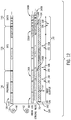
- a timing diagram 130 shown in FIG. 12 provides an example of the communication that may take place between the initiator 60 and the responder 62 using the system of FIG. 11 .
- the timing diagram 130 shows that, at a time 132 , the initiator 60 begins to transmit a wireless signal 134 .
- the wireless signal 134 may contain several components, including an initial preamble p 136 and a start-of-frame delimiter (SFD) 138 , followed by data 140 (which may encode the timestamp 120 ).
- SFD start-of-frame delimiter
- the wireless signal 134 may be received by the responder 62 as the free-space first wireless signal 68 and the reflected second wireless signal 70 .
- the preamble match signal 146 appears earlier than the preamble match signal 148 , but the preamble match signal 146 has a lower magnitude than the preamble match signal 148 because the signal strength of the free-space first wireless signal 68 is lower the reflected second wireless signal 70 (e.g., due to some obstruction along the free-space channel 69 ).
- the correlator 104 may also identify components of a received start-of-frame delimiter (SFD) 138 A of the free-space first wireless signal 68 and of a received start-of-frame delimiter (SFD) 138 B of the reflected second wireless signal 70 as SFD match signals 150 .
- SFD start-of-frame delimiter
- positive SFD match signal 152 relates to the received SFD 138 A
- positive SFD match signal 154 relates to the received SFD 138 B
- negative SFD match signal 156 relates to the received SFD 138 A
- negative SFD match signal 158 relates to the received SFD 138 B.
- the SFD match signals 150 allow the responder 62 to identify the start of received data 140 A or 140 B received via each wireless channel.
- the correlator 104 is used to determine which of the signals 68 or 70 are in the earliest channel.
- an attacker 170 may intercept the transmission from the initiator 60 (represented as intercepted wireless signal 172 ) and then delay and retransmit the intercepted wireless signal 172 as a false wireless ranging signal in the form of an attack signal 174 to the responder 62 .
- an attack channel 176 the channel through which the attack signal 174 reaches the responder 62 will be referred to in this disclosure as an attack channel 176 .
- the effect of the attack signal 174 on the receiver system 100 is shown by a signal timing diagram 188 in FIG. 14 , which builds on the example signal timing diagram 130 of FIG. 12 . As such, a description of elements that appear in both FIGS. 12 and 14 may be found in the previous discussion with reference to FIG. 12 .
- the attacker 170 is shown to receive the intercepted wireless signal 172 quickly after it has been transmitted by the initiator 60 .
- the intercepted wireless signal 172 includes a preamble 136 C and a start-of-frame delimiter (SFD) 138 C that corresponds to the preamble 136 and the SFD 138 from the initiator 60 .
- SFD start-of-frame delimiter
- the correlator 104 when the correlator 104 generates a preamble match signal 194 corresponding to a match to the preamble 136 D, it recurs before the preamble match signals 144 and 146 in a repeating pattern 196 .
- the responder 62 may interpret the attack channel 176 that carries the attack signal 174 to be the earliest channel. This may prevent or complicate the efforts by the responder 62 to correctly identify the free-space channel 69 .
- the receiver system 210 of FIG. 15 may receive digitized analog-to-digital (ADC) samples 102 received from an antenna of the transceiver 28 .
- a first correlator 104 A may compare the received ADC samples 102 to a known preamble p.
- the preamble p may be a predefined set of values that is known at least to the initiator 60 and responder 62 .
- the preamble p may be publicly known. As such, the preamble p may be sent via plaintext in at least some embodiments.
- the first channel estimation block 106 A may not alone identify the earliest channel if the attack signal 174 is being sent through the attack channel 176 in a way that makes the attack signal 174 appear to be the earliest signal. Instead, the first channel estimation block 106 A may be used identify the various channels over which the responder 62 may be receiving signals, since it is possible that an attacker signal (e.g., the attack signal 174 ) could spoof the preamble. Instead, as will be discussed further below, the receiver system 210 may use a shared secrete b to identify the earliest channel.
- the receiver system 210 may use a second frame timing block 114 B (which may reuse the same circuitry, software, or other processing logic as the first frame timing block 114 A) to align the ADC samples 102 to the start of the frame to begin receiving data that ostensibly contains the shared secret b.
- a second correlator 104 B (which may reuse the same circuitry, software, or other processing logic as the first correlator 104 A) may provide shared secret match signals 212 to a second channel estimation block 106 B (which may reuse the same circuitry, software, or other processing logic as the first channel estimation block 106 A).
- the shared secret match signals 212 output by the second correlator 104 B may have a higher-order behavior in comparison to the preamble match signals 105 output by the first correlator 104 A.
- the higher-order behavior of the shared secret match signals 212 may manifest as sidelobes or other higher-order signal features.
- a time-of-flight value 124 may be computed.
- the time-of-flight value 124 represents the time taken for the first wireless signal 68 to travel the shortest free-space path via the free-space channel 69 between the initiator 60 and the responder 62 .
- the time-of-flight value 124 and the physical parameter of the speed of electromagnetic radiation e.g., the speed of light
- Another secure receiver system 240 may allow the responder 62 to thwart attacks like those discussed above by filtering out the attack signal 174 using the shared secret b.
- the receiver system 240 is described in block diagram form.
- the various components of the receiver system 240 may be implemented in digital circuitry, software running on a processor (e.g., firmware), or some combination of these.
- the receiver system 240 of FIG. 16 may receive digitized analog-to-digital (ADC) samples 102 received from an antenna of the transceiver 28 .
- a first correlator 104 A may compare the received ADC samples 102 to a known preamble p.
- the preamble p may be a predefined set of values that is known at least to the initiator 60 and responder 62 .
- the preamble p may be publicly known. As such, the preamble p may be sent via plaintext in at least some embodiments.
- the preamble p may take any suitable signal structure that enables the first correlator 104 A to accurately and/or efficiently (e.g., with reduced or minimal signal sidelobes) produce a preamble correlation signal 105 .
- the first correlator 104 A may provide the preamble correlation signal 105 to a first channel estimation block 106 A and a start-of-frame delimiter (SFD) detector 108 .
- the first channel estimation block 106 A may estimate the various channels (e.g., free-space channel 69 , reflected channel 71 , attack channel 176 ) by analyzing the preamble correlation signal 105 from the first correlator 104 A.
- the receiver system 210 may use a shared secrete b to identify the attack signal 174 so it can be filtered out of the CIR at the first path correction block 110 . This will be discussed further below.
- the receiver system 240 may identify the attack signal 174 using a shared secret b.
- the shared secret b may be any cryptographically secure value that is known by both the initiator 60 and the responder 62 , but which is not known by the attacker 170 .
- the shared secret b appears as a cryptographically secure pseudorandom number.
- the attacker 170 attempts to retransmit the shared secret b, which does not have a known periodicity like the preamble p that the attacker 170 could exploit, the retransmitted shared secret b would arrive later and could be identified as late for that reason.
- the attacker 170 attempts to use a false shared secret b′, it will not match the shared secret b that is known by the responder 62 .
- the receiver system 240 may use a second frame timing block 114 B (which may reuse the same circuitry, software, or other processing logic as the first frame timing block 114 A) to align the ADC samples 102 to the start of the frame to begin receiving data that ostensibly contains the shared secret b.
- a local copy 242 of the shared secret b may be provided to a second channel match filter 112 B (which may reuse the same circuitry, software, or other processing logic as the first channel matched filter 112 A) and the result subtracted in a subtraction operation 244 from the received data. Because the attacker 170 does not know the shared secret b, the attack signal 174 may use a false shared secret b′ that does not match the shared secret b.
- any component related to a non-attacker signal e.g., the free-space first wireless signal 68 or the reflected second wireless signal 70
- any component related to a non-attacker signal may result in perfect correlation.
- any data from the attack signal 174 that includes a false shared secret b′ will produce a noise signal when passed through the second correlator 104 B.
- the noise signal will have a random pattern since the false shared secret b′ can be expected only to randomly correlate with the true shared secret b.
- an attacker estimation block 246 may use this predictable noise pattern to identify the attack signal 174 on the attack channel 176 .
- An attack signal estimate 248 that corresponds to the attack signal 174 may be provided to the first path correction block 110 .
- the first path correction block 110 may filter out the component of the CIR that corresponds to the attack signal estimate 248 , relying on the channel estimation from the channel estimation block 106 based on the preamble b to determine the first path correction.
- the first path correction block 110 of the receiver system 240 of FIG. 16 may be able to determine the arrival time of the first wireless signal 68 on the free-space channel 69 based on the preamble b without performing channel estimation on a shared secret match signal that could have higher-order behavior (e.g., sidelobes), as in the receiver system 210 of FIG. 15 . Accordingly, the receiver system 240 of FIG. 16 may be more sensitive to a weaker signal through a true free-space path.
- a time-of-flight value 124 may be computed.
- the time-of-flight value 124 represents the time taken for the first wireless signal 68 to travel the shortest free-space path via the free-space channel 69 between the initiator 60 and the responder 62 .
- the time-of-flight value 124 and the physical parameter of the speed of electromagnetic radiation e.g., the speed of light
- the operational results of processing the preamble may be represented as follows:
- h true represents the true free-space channel 69
- h attack represents the attack channel 176
- p represents the preamble sequence known to both the initiator 60 and the attacker 170
- p RX represents the correlation of the preambles from the various channels received by the responder 62
- ⁇ : represents the estimated earliest channel due to the combined true free-space channel 69 and attack channel 176 .
- the known preamble p has perfect autocorrelation.
- h true represents the true free-space channel 69
- h attack represents the attack channel 176
- b′ represents a false shared secret sent by the attacker 170
- b RX represents the correlation of the false and true shared secrets from the various channels received by the responder 62
- ⁇ ′ represents the estimated attack channel 176 .
- the true shared secret b but not the false shared secret b′, has at least partial autocorrelation.
- the use of the shared secret b, and the fact that it is not known to the attacker 170 can be used to estimate the attacker channel 176 and reject the attack signal 174 on the attack channel 176 .
- a plot 270 represents a channel impulse response (CIR) that includes the impulse response from the preambles of various received signals, including true signals from an initiator 60 (e.g., the free-space first wireless signal 68 from the free-space channel 69 , and the reflected second wireless signal 70 from the reflected channel 71 ), as well as a false signal from an attacker 170 (e.g., the attack signal 174 from the attack channel 176 ).
- a plot 272 represents a channel impulse response (CIR) from an attack channel estimate 248 as determined using the receiver system 240 , as discussed above.
- a corrected CIR may be obtained as shown in a plot 274 .
- the corrected CIR of plot 274 may include substantially only true signals from the initiator 60 . Indeed, this may allow even a faint CIR signal 276 to be detected, which may be due to the true free-space first wireless signal 68 of the free-space channel 69 because it is the earliest signal.
- an accurate first path correction may be determined even in the presence of an attacker that spoofs a preamble, and even when the rue free-space first wireless signal 68 of the free-space channel 69 is attenuated.
- an accurate and secure wireless ranging operation may be performed via the time-of-flight, to thereby determine a proximity between the initiator 60 and the responder 62 .
Landscapes
- Engineering & Computer Science (AREA)
- Computer Security & Cryptography (AREA)
- Computer Networks & Wireless Communication (AREA)
- Signal Processing (AREA)
- Physics & Mathematics (AREA)
- Radar, Positioning & Navigation (AREA)
- General Physics & Mathematics (AREA)
- Remote Sensing (AREA)
- General Engineering & Computer Science (AREA)
- Computing Systems (AREA)
- Computer Hardware Design (AREA)
- Probability & Statistics with Applications (AREA)
- Mobile Radio Communication Systems (AREA)
Abstract
Description
where htrue represents the true free-
where htrue represents the true free-
Claims (20)
Priority Applications (4)
| Application Number | Priority Date | Filing Date | Title |
|---|---|---|---|
| US15/883,785 US11218876B2 (en) | 2017-09-28 | 2018-01-30 | Secure channel estimation architecture |
| US17/549,517 US20220104019A1 (en) | 2017-09-28 | 2021-12-13 | Secure Channel Estimation Architecture |
| US17/947,066 US12156029B2 (en) | 2017-09-28 | 2022-09-16 | Secure channel estimation architecture |
| US18/957,144 US20250126474A1 (en) | 2017-09-28 | 2024-11-22 | Secure Channel Estimation Architecture |
Applications Claiming Priority (2)
| Application Number | Priority Date | Filing Date | Title |
|---|---|---|---|
| US201762564901P | 2017-09-28 | 2017-09-28 | |
| US15/883,785 US11218876B2 (en) | 2017-09-28 | 2018-01-30 | Secure channel estimation architecture |
Related Child Applications (1)
| Application Number | Title | Priority Date | Filing Date |
|---|---|---|---|
| US17/549,517 Continuation US20220104019A1 (en) | 2017-09-28 | 2021-12-13 | Secure Channel Estimation Architecture |
Publications (2)
| Publication Number | Publication Date |
|---|---|
| US20190098507A1 US20190098507A1 (en) | 2019-03-28 |
| US11218876B2 true US11218876B2 (en) | 2022-01-04 |
Family
ID=65808165
Family Applications (4)
| Application Number | Title | Priority Date | Filing Date |
|---|---|---|---|
| US15/883,785 Expired - Fee Related US11218876B2 (en) | 2017-09-28 | 2018-01-30 | Secure channel estimation architecture |
| US17/549,517 Abandoned US20220104019A1 (en) | 2017-09-28 | 2021-12-13 | Secure Channel Estimation Architecture |
| US17/947,066 Active 2038-03-12 US12156029B2 (en) | 2017-09-28 | 2022-09-16 | Secure channel estimation architecture |
| US18/957,144 Pending US20250126474A1 (en) | 2017-09-28 | 2024-11-22 | Secure Channel Estimation Architecture |
Family Applications After (3)
| Application Number | Title | Priority Date | Filing Date |
|---|---|---|---|
| US17/549,517 Abandoned US20220104019A1 (en) | 2017-09-28 | 2021-12-13 | Secure Channel Estimation Architecture |
| US17/947,066 Active 2038-03-12 US12156029B2 (en) | 2017-09-28 | 2022-09-16 | Secure channel estimation architecture |
| US18/957,144 Pending US20250126474A1 (en) | 2017-09-28 | 2024-11-22 | Secure Channel Estimation Architecture |
Country Status (1)
| Country | Link |
|---|---|
| US (4) | US11218876B2 (en) |
Families Citing this family (6)
| Publication number | Priority date | Publication date | Assignee | Title |
|---|---|---|---|---|
| US11722985B2 (en) * | 2018-08-09 | 2023-08-08 | Apple Inc. | Object tracking and authentication using modular wall units |
| US10746844B2 (en) * | 2018-10-16 | 2020-08-18 | The Regents Of The University Of Michigan | Low-power, long-range RF localization system and method |
| EP3667951B1 (en) * | 2018-12-13 | 2022-06-29 | ADVA Optical Networking SE | Determination of the latency of an optical transmission link |
| US11041948B2 (en) * | 2019-04-08 | 2021-06-22 | Apple Inc. | Channel estimation combining for secure time of flight applications |
| US11546766B2 (en) * | 2019-09-16 | 2023-01-03 | Nxp B.V. | First path acceptance for secure ranging |
| US11552662B1 (en) | 2021-08-30 | 2023-01-10 | Rockwell Collins, Inc. | Method for improving detection in multipath channels |
Citations (2)
| Publication number | Priority date | Publication date | Assignee | Title |
|---|---|---|---|---|
| US20060274843A1 (en) * | 2005-06-01 | 2006-12-07 | Samsung Electronics Co., Ltd. | Apparatus and method for transmitting/receiving preamble signal in a wireless communication system |
| US20150141034A1 (en) * | 2013-11-18 | 2015-05-21 | Qualcomm Incorporated | Method and apparatus for ranging using channel estimation with interference rejection |
Family Cites Families (3)
| Publication number | Priority date | Publication date | Assignee | Title |
|---|---|---|---|---|
| US6700538B1 (en) * | 2000-03-29 | 2004-03-02 | Time Domain Corporation | System and method for estimating separation distance between impulse radios using impulse signal amplitude |
| WO2013100970A1 (en) * | 2011-12-28 | 2013-07-04 | Intel Corporation | Transmitter precoding for optimizing positioning performance |
| KR102550919B1 (en) * | 2016-02-04 | 2023-07-05 | 데카웨이브 리미티드 | Secure Channel Sounding |
-
2018
- 2018-01-30 US US15/883,785 patent/US11218876B2/en not_active Expired - Fee Related
-
2021
- 2021-12-13 US US17/549,517 patent/US20220104019A1/en not_active Abandoned
-
2022
- 2022-09-16 US US17/947,066 patent/US12156029B2/en active Active
-
2024
- 2024-11-22 US US18/957,144 patent/US20250126474A1/en active Pending
Patent Citations (2)
| Publication number | Priority date | Publication date | Assignee | Title |
|---|---|---|---|---|
| US20060274843A1 (en) * | 2005-06-01 | 2006-12-07 | Samsung Electronics Co., Ltd. | Apparatus and method for transmitting/receiving preamble signal in a wireless communication system |
| US20150141034A1 (en) * | 2013-11-18 | 2015-05-21 | Qualcomm Incorporated | Method and apparatus for ranging using channel estimation with interference rejection |
Non-Patent Citations (1)
| Title |
|---|
| Chacko et. al. (2017). Physical Gate Based Preamble Obfuscation for Securing Wireless Communication. 2017 International Conference on Computing, Networking and Communications: Wireless Communications. IEEE Xplore. (Year: 2017). * |
Also Published As
| Publication number | Publication date |
|---|---|
| US12156029B2 (en) | 2024-11-26 |
| US20190098507A1 (en) | 2019-03-28 |
| US20230027851A1 (en) | 2023-01-26 |
| US20250126474A1 (en) | 2025-04-17 |
| US20220104019A1 (en) | 2022-03-31 |
Similar Documents
| Publication | Publication Date | Title |
|---|---|---|
| US12156029B2 (en) | Secure channel estimation architecture | |
| US11210367B2 (en) | Methods and devices for estimating secret values | |
| US9246545B1 (en) | Adaptive estimation of delay in audio systems | |
| WO2022262688A1 (en) | Security awareness method, devices, computer-readable storage medium and chip | |
| TW200518587A (en) | System and operating method for detecting eavesdropping device by using image | |
| TWI551171B (en) | Method and device for detecting primary synchronization signal | |
| US20140341386A1 (en) | Noise reduction | |
| RU2010150364A (en) | DEVICE, METHOD AND RECEPTION SYSTEM | |
| US12267188B2 (en) | Magnitude equalization of audio-based data transmissions | |
| US8924206B2 (en) | Electrical apparatus and voice signals receiving method thereof | |
| CN114339764A (en) | Pilot frequency deception attack detection method and device, electronic equipment and storage medium | |
| US20240223328A1 (en) | Reference Signal Sequence Generation Method and Device | |
| US9124480B2 (en) | Method and apparatus for spectrum sensing | |
| US20230117257A1 (en) | Detection and synchronization of audio transmissions using complex audio signals | |
| CN105763223A (en) | Receiver and method for detecting synchronization in wireless communication system | |
| CN109495418B (en) | OFDM signal synchronization method, apparatus and computer readable storage medium | |
| US10523261B2 (en) | Co-channel wireless detection | |
| WO2013075484A1 (en) | Method and device for detecting interference | |
| US20220358936A1 (en) | Multi-signal detection and combination of audio-based data transmissions | |
| US10447725B1 (en) | Secure ranging wireless communication | |
| CN106782614B (en) | Sound quality detection method and device | |
| TWI575896B (en) | Signal Detection Method and Device | |
| CN110581712B (en) | Antenna determination method and terminal device | |
| CN115632679B (en) | Antenna signal processing method, device and electronic equipment | |
| Gu et al. | CSI2Dig: Recovering Digit Content from Smartphone Loudspeakers Using Channel State Information |
Legal Events
| Date | Code | Title | Description |
|---|---|---|---|
| AS | Assignment |
Owner name: APPLE INC., CALIFORNIA Free format text: ASSIGNMENT OF ASSIGNORS INTEREST;ASSIGNORS:YANG, SHANGE-TE;CHEN, XU;MARQUEZ, ALEJANDRO J.;AND OTHERS;SIGNING DATES FROM 20180111 TO 20180116;REEL/FRAME:044777/0902 |
|
| FEPP | Fee payment procedure |
Free format text: ENTITY STATUS SET TO UNDISCOUNTED (ORIGINAL EVENT CODE: BIG.); ENTITY STATUS OF PATENT OWNER: LARGE ENTITY |
|
| STPP | Information on status: patent application and granting procedure in general |
Free format text: DOCKETED NEW CASE - READY FOR EXAMINATION |
|
| STPP | Information on status: patent application and granting procedure in general |
Free format text: NON FINAL ACTION MAILED |
|
| STPP | Information on status: patent application and granting procedure in general |
Free format text: NON FINAL ACTION MAILED |
|
| STPP | Information on status: patent application and granting procedure in general |
Free format text: RESPONSE TO NON-FINAL OFFICE ACTION ENTERED AND FORWARDED TO EXAMINER |
|
| STPP | Information on status: patent application and granting procedure in general |
Free format text: FINAL REJECTION MAILED |
|
| STPP | Information on status: patent application and granting procedure in general |
Free format text: RESPONSE AFTER FINAL ACTION FORWARDED TO EXAMINER |
|
| STPP | Information on status: patent application and granting procedure in general |
Free format text: ADVISORY ACTION MAILED |
|
| STPP | Information on status: patent application and granting procedure in general |
Free format text: DOCKETED NEW CASE - READY FOR EXAMINATION |
|
| STPP | Information on status: patent application and granting procedure in general |
Free format text: NOTICE OF ALLOWANCE MAILED -- APPLICATION RECEIVED IN OFFICE OF PUBLICATIONS |
|
| STPP | Information on status: patent application and granting procedure in general |
Free format text: PUBLICATIONS -- ISSUE FEE PAYMENT VERIFIED |
|
| STCF | Information on status: patent grant |
Free format text: PATENTED CASE |
|
| FEPP | Fee payment procedure |
Free format text: MAINTENANCE FEE REMINDER MAILED (ORIGINAL EVENT CODE: REM.); ENTITY STATUS OF PATENT OWNER: LARGE ENTITY |
|
| LAPS | Lapse for failure to pay maintenance fees |
Free format text: PATENT EXPIRED FOR FAILURE TO PAY MAINTENANCE FEES (ORIGINAL EVENT CODE: EXP.); ENTITY STATUS OF PATENT OWNER: LARGE ENTITY |
|
| STCH | Information on status: patent discontinuation |
Free format text: PATENT EXPIRED DUE TO NONPAYMENT OF MAINTENANCE FEES UNDER 37 CFR 1.362 |
|
| FP | Lapsed due to failure to pay maintenance fee |
Effective date: 20260104 |