US11218683B2 - Method and an apparatus and a computer program product for adaptive streaming - Google Patents
Method and an apparatus and a computer program product for adaptive streaming Download PDFInfo
- Publication number
- US11218683B2 US11218683B2 US16/495,288 US201816495288A US11218683B2 US 11218683 B2 US11218683 B2 US 11218683B2 US 201816495288 A US201816495288 A US 201816495288A US 11218683 B2 US11218683 B2 US 11218683B2
- Authority
- US
- United States
- Prior art keywords
- view
- dimensional
- streams
- virtual camera
- scene
- Prior art date
- Legal status (The legal status is an assumption and is not a legal conclusion. Google has not performed a legal analysis and makes no representation as to the accuracy of the status listed.)
- Active
Links
Images


Classifications
-
- H—ELECTRICITY
- H04—ELECTRIC COMMUNICATION TECHNIQUE
- H04N—PICTORIAL COMMUNICATION, e.g. TELEVISION
- H04N13/00—Stereoscopic video systems; Multi-view video systems; Details thereof
- H04N13/10—Processing, recording or transmission of stereoscopic or multi-view image signals
- H04N13/106—Processing image signals
- H04N13/161—Encoding, multiplexing or demultiplexing different image signal components
-
- H—ELECTRICITY
- H04—ELECTRIC COMMUNICATION TECHNIQUE
- H04N—PICTORIAL COMMUNICATION, e.g. TELEVISION
- H04N13/00—Stereoscopic video systems; Multi-view video systems; Details thereof
- H04N13/10—Processing, recording or transmission of stereoscopic or multi-view image signals
- H04N13/194—Transmission of image signals
-
- H—ELECTRICITY
- H04—ELECTRIC COMMUNICATION TECHNIQUE
- H04L—TRANSMISSION OF DIGITAL INFORMATION, e.g. TELEGRAPHIC COMMUNICATION
- H04L65/00—Network arrangements, protocols or services for supporting real-time applications in data packet communication
- H04L65/80—Responding to QoS
-
- H—ELECTRICITY
- H04—ELECTRIC COMMUNICATION TECHNIQUE
- H04N—PICTORIAL COMMUNICATION, e.g. TELEVISION
- H04N13/00—Stereoscopic video systems; Multi-view video systems; Details thereof
- H04N13/10—Processing, recording or transmission of stereoscopic or multi-view image signals
- H04N13/106—Processing image signals
- H04N13/111—Transformation of image signals corresponding to virtual viewpoints, e.g. spatial image interpolation
-
- H—ELECTRICITY
- H04—ELECTRIC COMMUNICATION TECHNIQUE
- H04N—PICTORIAL COMMUNICATION, e.g. TELEVISION
- H04N13/00—Stereoscopic video systems; Multi-view video systems; Details thereof
- H04N13/10—Processing, recording or transmission of stereoscopic or multi-view image signals
- H04N13/106—Processing image signals
- H04N13/15—Processing image signals for colour aspects of image signals
-
- H—ELECTRICITY
- H04—ELECTRIC COMMUNICATION TECHNIQUE
- H04N—PICTORIAL COMMUNICATION, e.g. TELEVISION
- H04N13/00—Stereoscopic video systems; Multi-view video systems; Details thereof
- H04N13/20—Image signal generators
- H04N13/275—Image signal generators from three-dimensional [3D] object models, e.g. computer-generated stereoscopic image signals
- H04N13/279—Image signal generators from three-dimensional [3D] object models, e.g. computer-generated stereoscopic image signals the virtual viewpoint locations being selected by the viewers or determined by tracking
-
- H—ELECTRICITY
- H04—ELECTRIC COMMUNICATION TECHNIQUE
- H04N—PICTORIAL COMMUNICATION, e.g. TELEVISION
- H04N13/00—Stereoscopic video systems; Multi-view video systems; Details thereof
- H04N13/20—Image signal generators
- H04N13/282—Image signal generators for generating image signals corresponding to three or more geometrical viewpoints, e.g. multi-view systems
-
- H—ELECTRICITY
- H04—ELECTRIC COMMUNICATION TECHNIQUE
- H04N—PICTORIAL COMMUNICATION, e.g. TELEVISION
- H04N19/00—Methods or arrangements for coding, decoding, compressing or decompressing digital video signals
- H04N19/50—Methods or arrangements for coding, decoding, compressing or decompressing digital video signals using predictive coding
- H04N19/597—Methods or arrangements for coding, decoding, compressing or decompressing digital video signals using predictive coding specially adapted for multi-view video sequence encoding
-
- H—ELECTRICITY
- H04—ELECTRIC COMMUNICATION TECHNIQUE
- H04N—PICTORIAL COMMUNICATION, e.g. TELEVISION
- H04N13/00—Stereoscopic video systems; Multi-view video systems; Details thereof
- H04N2013/0074—Stereoscopic image analysis
- H04N2013/0081—Depth or disparity estimation from stereoscopic image signals
Definitions
- new image and video capture devices are available. These devices are able to capture visual and audio content all around themselves, i.e. they can capture the whole angular field of view, sometimes referred to as 360 degrees field of view. More precisely, they can capture a spherical field of view (i.e., 360 degrees in all axes).
- new types of output technologies have been invented and produced, such as head-mounted displays. These devices allow a person to see visual content all around him/her, giving a feeling of being “immersed” into the scene captured by the 360 degrees camera.
- the new capture and display paradigm, where the field of view is spherical is commonly referred to as virtual reality (VR) and is believed to be the common way people will experience media content in the future.
- VR virtual reality
- a method comprising: generating a three-dimensional segment of a scene of a content; generating more than one two-dimensional views of the three-dimensional segment, each two-dimensional view representing a virtual camera view; generating multi-view streams by encoding each of the two-dimensional views; encoding parameters of a virtual camera to the respective stream of the multi-view stream; receiving a selection of one or more streams of the multi-view stream; and streaming only the selected one or more streams.
- an apparatus comprising at least one processor, memory including computer program code, the memory and the computer program code configured to, with the at least one processor, cause the apparatus to perform at least the following: to generate a three-dimensional segment of a scene of a content; to generate more than one two-dimensional views of the three-dimensional segment, each two-dimensional view representing a virtual camera view; to generate multi-view streams by encoding each of the two-dimensional views; to encode parameters of a virtual camera to the respective stream of the multi-view stream; to receive a selection of one or more streams of the multi-view stream; and to stream only the selected one or more streams.
- a computer program product embodied on a non-transitory computer readable medium, comprising computer program code configured to, when executed on at least one processor, cause an apparatus or a system to generate a three-dimensional segment of a scene of a content; generate more than one two-dimensional views of the three-dimensional segment, each two-dimensional view representing a virtual camera view; generate multi-view streams by encoding each of the two-dimensional views; encode parameters of a virtual camera to the respective stream of the multi-view stream; receive a selection of one or more streams of the multi-view stream; and stream only the selected one or more streams.
- the two-dimensional view is a color and depth view.
- the two-dimensional view comprises material and surface property channels.
- the selection is based on the parameters of the virtual camera.
- parameters comprises one or more of the following: a pose, a resolution, a projection type, a field of view, and depth range.
- the content is captured by multiple cameras.
- the content is synthetic content.
- FIG. 1 shows a system according to an embodiment
- FIG. 2 a shows a camera device according to an embodiment
- FIG. 2 b shows a display device according to an embodiment
- FIG. 3 shows an encoding process according to an embodiment
- FIG. 4 shows a decoding process according to an embodiment
- FIG. 5 shows an overview of a volumetric 6 DoF content consumption
- FIG. 6 shows an example of three different cameras on a scene
- FIG. 7 shows an example of selecting virtual camera views for streaming
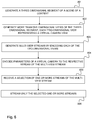
- FIG. 8 is a flowchart of a method according to an embodiment.
- the present embodiments relate to virtual reality (VR).
- VR virtual reality
- the present embodiments relate to streaming of three-dimensional (3D) virtual reality video for six degrees of freedom (6 DoF) viewing.
- Volumetric video may be captured using one or more cameras. Volumetric video is to virtual reality what traditional video is to 2D/3D displays. When multiple cameras are in use, the captured footage is synchronized so that the cameras provide different viewpoints to the same world. In contrast to traditional 2D/3D video, volumetric video describes a 3D model of the world where the viewer is free to move and observe different parts of the world.
- the present embodiments are discussed in relation to media content captured with more than one camera devices.
- FIG. 1 shows a system and apparatuses for stereo viewing, that is, for 3D video and 3D audio digital capture and playback.
- the task of the system is that of capturing sufficient visual and auditory information from a specific location such that a convincing reproduction of the experience, or presence, of being in that location can be achieved by one or more viewers physically located in different locations and optionally at a time later in the future.
- Such reproduction requires more information that can be captured by a single camera or microphone, in order that a viewer can determine the distance and location of objects within the scene using their eyes and their ears.
- two camera sources are used.
- the human auditory system can be able to sense the direction of sound, at least two microphones are used (the commonly known stereo sound is created by recording two audio channels).
- the human auditory system can detect the cues, e.g. in timing difference of the audio signals to detect the direction of sound.
- the system of FIG. 1 may consist of three main parts: image sources, a server and a rendering device.
- a video source SRC 1 comprises multiple cameras CAM 1 , CAM 2 , . . . , CAMN with overlapping field of view so that regions of the view around the video capture device is captured from at least two cameras.
- the video source SRC 1 may comprise multiple microphones to capture the timing and phase differences of audio originating from different directions.
- the video source SRC 1 may comprise a high resolution orientation sensor so that the orientation (direction of view) of the plurality of cameras CAM 1 , CAM 2 , . . . , CAMN can be detected and recorded.
- the video source SRC 1 comprises or is functionally connected to, or each of the plurality of cameras CAM 1 , CAM 2 , . . . , CAMN comprises or is functionally connected to a computer processor and memory, the memory comprising computer program code for controlling the source and/or the plurality of cameras.
- the image stream captured by the video source i.e. the plurality of the cameras, may be stored on a memory device for use in another device, e.g. a viewer, and/or transmitted to a server using a communication interface. It needs to be understood that although a video source comprising three cameras is described here as part of the system, another amount of camera devices may be used instead as part of the system.
- one or more sources SRC 2 of synthetic images may be present in the system.
- Such sources of synthetic images may use a computer model of a virtual world to compute the various image streams it transmits.
- the source SRC 2 may compute N video streams corresponding to N virtual cameras located at a virtual viewing position.
- the viewer may see a three-dimensional virtual world.
- the device SRC 2 comprises or is functionally connected to a computer processor PROC 2 and memory MEM 2 , the memory comprising computer program PROGR 2 code for controlling the synthetic sources device SRC 2 .
- the image stream captured by the device may be stored on a memory device MEM 5 for use in another device, e.g. a viewer, or transmitted to a server or the viewer using a communication interface COMM 2 .
- a server SERVER or a plurality of servers storing the output from the capture device SRC 1 or computation device SRC 2 .
- the device SERVER comprises or is functionally connected to a computer processor PROC 3 and memory MEM 3 , the memory comprising computer program PROGR 3 code for controlling the server.
- the device SERVER may be connected by a wired or wireless network connection, or both, to sources SRC 1 and/or SRC 2 , as well as the viewer devices VIEWER 1 and VIEWER 2 over the communication interface COMM 3 .
- the viewer devices may have a rendering module and a display module, or these functionalities may be combined in a single device.
- the devices may comprise or be functionally connected to a computer processor PROC 4 and memory MEM 4 , the memory comprising computer program PROG 4 code for controlling the viewing devices.
- the viewer (playback) devices may consist of a data stream receiver for receiving a video data stream from a server and for decoding the video data stream. The data stream may be received over a network connection through communications interface COMM 4 , or from a memory device MEM 6 like a memory card CARD 2 .
- the viewer devices may have a graphics processing unit for processing of the data to a suitable format for viewing.
- the viewer VIEWER 1 comprises a high-resolution stereo-image head-mounted display for viewing the rendered stereo video sequence.
- the head-mounted display may have an orientation sensor DET 1 and stereo audio headphones.
- the viewer VIEWER 2 comprises a display enabled with 3D technology (for displaying stereo video), and the rendering device may have a head-orientation detector DET 2 connected to it.
- the viewer VIEWER 2 may comprise a 2D display, since the volumetric video rendering can be done in 2D by rendering the viewpoint from a single eye instead of a stereo eye pair.
- Any of the devices (SRC 1 , SRC 2 , SERVER, RENDERER, VIEWER 1 , VIEWER 2 ) may be a computer or a portable computing device, or be connected to such.
- Such rendering devices may have computer program code for carrying out methods according to various examples described in this text.
- FIG. 2 a illustrates a camera CAM 1 .
- the camera has a camera detector CAMDET 1 , comprising a plurality of sensor elements for sensing intensity of the light hitting the sensor element.
- the camera has a lens OBJ 1 (or a lens arrangement of a plurality of lenses), the lens being positioned so that the light hitting the sensor elements travels through the lens to the sensor elements.
- the camera detector CAMDET 1 has a nominal center point CP 1 that is a middle point of the plurality of sensor elements, for example for a rectangular sensor the crossing point of the diagonals.
- the lens has a nominal center point PP 1 , as well, lying for example on the axis of symmetry of the lens.
- the direction of orientation of the camera is defined by the line passing through the center point CP 1 of the camera sensor and the center point PP 1 of the lens.
- the direction of the camera is a vector along this line pointing in the direction from the camera sensor to the lens.
- the optical axis of the camera is understood to be this line CP 1 -PP 1 .
- FIG. 2 b shows a head-mounted display (HMD) for stereo viewing.
- the head-mounted display comprises two screen sections or two screens DISP 1 and DISP 2 for displaying the left and right eye images.
- the displays are close to the eyes, and therefore lenses are used to make the images easily viewable and for spreading the images to cover as much as possible of the eyes' field of view.
- the device is attached to the head of the user so that it stays in place even when the user turns his head.
- the device may have an orientation detecting module ORDET 1 for determining the head movements and direction of the head.
- the head-mounted display gives a three-dimensional (3D) perception of the recorded/streamed content to a user.
- Time-synchronized video, audio and orientation data is first recorded with the capture device. This can consist of multiple concurrent video and audio streams as described above. These are then transmitted immediately or later to the storage and processing network for processing and conversion into a format suitable for subsequent delivery to playback devices. The conversion can involve post-processing steps to the audio and video data in order to improve the quality and/or reduce the quantity of the data while preserving the quality at a desired level.
- each playback device receives a stream of the data from the network, and renders it into a stereo viewing reproduction of the original location which can be experienced by a user with the head-mounted display and headphones.
- a video codec consists of an encoder that transforms an input video into a compressed representation suited for storage/transmission and a decoder that can uncompress the compressed video representation back into a viewable form.
- encoder discards some information in the original video sequence in order to represent the video in a more compact form (that is, at lower bitrate).
- FIG. 3 An example of an encoding process is illustrated in FIG. 3 .
- FIG. 3 illustrates an image to be encoded (I n ); a predicted representation of an image block (P′ n ); a prediction error signal (D n ); a reconstructed prediction error signal (D′ n ); a preliminary reconstructed image (I′ n ); a final reconstructed image (R′ n ); a transform (T) and inverse transform (T ⁇ 1 ); a quantization (Q) and inverse quantization (Q ⁇ 1 ); entropy encoding (E); a reference frame memory (RFM); inter prediction (Pinter); intra prediction (P intra ); mode selection (MS) and filtering (F).
- FIG. 4 An example of a decoding process is illustrated in FIG. 4 .
- FIG. 4 An example of a decoding process is illustrated in FIG. 4 .
- FIG. 4 illustrates a predicted representation of an image block (P′ n ); a reconstructed prediction error signal (D′ n ); a preliminary reconstructed image (I′ n ); a final reconstructed image (R′ n ); an inverse transform (T ⁇ 1 ); an inverse quantization (Q ⁇ 1 ); an entropy decoding (E ⁇ 1 ); a reference frame memory (RFM); a prediction (either inter or intra) (P); and filtering (F).
- the present embodiment relate to adaptive streaming of 3D virtual reality video for six degrees of freedom (6 DoF) viewing. Since the data rates of full-resolution VR scenes are high, efficient compression and decompression of the content is expected. Even though current video hardware may have built-in support for accelerated decoding of 2D video (such as H.264), the 6 DoF nature of real volumetric VR content precludes trivial encoding of the content as a single 2D video. Moreover, adaptive streaming is desirable because it may enable avoiding sending of data that does not contribute to the user's current view of the content.
- Voxel or mesh based approaches can be readily applied to animated 3D content and enable adaptive streaming, but there is no codec that can readily support hardware-accelerated decoding of such content in current hardware. This may create a bottleneck in the delivery chain of the content thus destroying the whole immersive experience.
- virtual reality scenes are encoded as multiple virtual camera views that can be selectively and adaptively streamed to the viewer.
- the solution comprises generating a sufficient number of two-dimensional (e.g. color and depth views) that are optimized for the scene content and for the desired viewing region. These views can be statically generated and compressed using existing video codecs. Based on scene metadata, the viewing client may then select the streams necessary for the current codecs. The selected views are streamed, and efficiently decoded in the current hardware decoders, and composited to generate a real-time 3D volumetric view of the scene from the viewer's current position in an optimal way.
- two-dimensional e.g. color and depth views
- FIG. 5 shows an overview of a pipeline for generating and viewing 6 DoF VR content according to embodiments.
- the multi-device capture system is configured to capture raw visual data of a dynamic scene by using multiple cameras and alternatively also by additional depth sensors.
- the scene may be synthetic, which means that it is synthetically generated without actual cameras capturing the scene.
- thee cameras and other sensors are operated simultaneously so that each device will record its own view of the dynamic scene, resulting in captured raw data for each individual camera and sensor.
- the raw per-device data may be first synchronized in time. This can be done by having the clocks in each device synchronized before capturing, for example by using a protocol such as PTP (Precision Time Protocol) in a local network that the devices are connected to, or other form of timecode transmitted in the local network. If clock synchronization was not done before capturing, recorded audio signals can be used for synchronizing the cameras.
- An explicit visual synchronization event of which a clapperboard is a traditional example, can be utilized to aid in manual synchronization of devices that do not record audio, such as LiDAR (Light Detecting and Ranging) depth sensors.
- the captured raw data are registered in 3D.
- the 2D visual features in the camera images can be identified and the camera poses recovered through established structure-from-motion techniques.
- a dense depth map can additionally be estimated using stereo imaging techniques. These techniques together enable a dense 3D point cloud to be reconstructed from the plurality cameras used to capture the scene.
- Non-camera devices can initially be registered manually, and the manual registration refined by matching e.g. LiDAR point cloud data to the 3D data reconstructed from the multi-view cameras.
- a sufficiently high-resolution visual reconstruction enables the LiDAR data to be registered using point-cloud alignment techniques such as iterative closest point.
- point-cloud alignment techniques such as iterative closest point.
- This mezzanine model can be in a number of formats, for example, an animated voxel model of the scene, or a collection of input camera views with corresponding high-resolution depth maps.
- the mezzanine model is a Sparse Voxel Octree (SVO).
- SVO is a tree of volume elements where the root node covers the extent of the entire captured scene, and each successive level branches into eight subtrees that describe a sub-volume of the scene in higher detail.
- the term ‘sparse’ refers to the fact that empty subtree are omitted from the structure.
- the SVO is a multi-resolution representation of the reconstructed scene geometry.
- Each voxel in the SVO additionally contains color and possibly other shading information such as a surface normal and reflectance properties.
- an animated voxel model encodes successive frames of a volumetric video as a combination of a full base frame and change-sets containing the changed parts of the SVO for each successive frame.
- the 3D model is an animated 3D scene created in a 3D modeling program, omitting the capture and reconstruction stages described previously. From this animated scene, a similar mezzanine representation can be created, and the rest of the encoding and streaming pipeline is agnostic to the source of the 3D model.
- the mezzanine 3D model consists of one or more 360° panorama images with associated depth maps and 3D camera pose information.
- multiple virtual views are created to represent the essence of the 3D scene as a plurality of 2D videos.
- these virtual view videos are stored as static files with associated scene metadata in a content delivery network. From there, a viewer can, based on the scene metadata, dynamically subscribe to a plurality of the 2D videos that best represent the scene from the current viewpoint of the viewer.
- more than one virtual cameras can be defined for capturing a 2D view of a 3D segment of the scene.
- Full 3D scene can be presented with multiple virtual cameras.
- a 2D view of a 3D segment may be a color and depth view of a respective virtual camera.
- the two-dimensional view may comprise material and surface property channels. Examples of such channels comprises one or more of the following: surface normal vectors, material roughness, material glossiness, etc.
- Two-dimensional views may allow good compression rates and lower bandwidth delivery to viewer devices (i.e. player devices).
- viewer devices i.e. player devices.
- viewer devices typically have accelerated video hardware and GPUs (Graphical Processing Unit) and therefore this color and depth presentation format suits well for the target devices and hence wide variety of devices will be supported.
- GPUs Graphic Processing Unit
- Virtual cameras should be placed on the scene so that they maximize the scene coverage and minimize occluded regions. However, covering the full scene may lead to a high number of virtual cameras. Moreover, the number of the virtual cameras should be minimized so that most of them see unique and not overlapping areas of the scene. Such an approach optimizes the amount of data to be delivered to the client if this data is to be streamed. Hence, the content visible from multiple virtual cameras may be optimized for the sake of reducing per-stream overhead and redundancy.
- virtual camera optimization is based on the octree structure inherent to an SVO mezzanine representation.
- the octree splits the scene into sub-volumes, where each sub-volume contains the geometry for a part of the scene.
- an oriented bounding box is computed for the geometry, and an orthogonal virtual camera is created that views the content of that oriented bounding box. This process is terminated at a specific level in the octree, so that virtual cameras are not created for sub-volumes smaller than a specified threshold.
- the virtual cameras are defined by a user in a 3D content editor so that they track specific regions of interest (ROI) in the scene.
- ROI regions of interest
- regions of interest are automatically detected based on face detection, and virtual cameras are created to capture the faces in higher detail than the rest of the scene.
- a subset of the virtual views are created by tiling the captured input camera views.
- the virtual views are created by tiling a 360° panorama image into M ⁇ N virtual views, each covering a region of 360/M by 180/N degrees.
- FIG. 6 illustrates an example of having different cameras in the scene: panorama 360-camera 601 for background (circular depth range) and normal perspective cameras 602 , 603 for central content.
- the perspective cameras comprises a portrait close-up camera 602 and a portrait camera 603 .
- Each of the cameras 601 , 602 , 603 captures respective content 611 , 612 , 613 .
- the motion of virtual cameras is constrained between frames so that abrupt changes in the video content are avoided and the video compression can utilize motion encoding inside each virtual view.
- this layout is smoothed by fitting a curve through the ideal 3D locations of each virtual camera, resampling the per-frame camera positions from that curve, and adjusting camera orientation so that the ROI targeted by that camera remains inside the virtual view.
- depth range for the virtual cameras needs to be minimized.
- Most video decoders only support 8-bit grayscale and depth range should be encoded to this. If a large depth range is used, it means that 3D objects can be presented only with coarse resolution. Therefore it's important to optimize the depth range for each virtual camera.
- max value is treated as infinity in the rendering. Therefore max ⁇ 1 ( ⁇ 1 or some other threshold value) value should be used as depth range when encoding the virtual camera depth values.
- Virtual cameras can be streamed individually to the viewers which can support high number of simultaneous video decoding streams.
- multiple virtual cameras should be encoded onto a single view (e.g. a texture atlas).
- a texture atlas As an example, 16 virtual cameras can be presented by 4 ⁇ 4 grid, where each grid element has the same size. It is expected that the texture atlases are very high resolution (e.g. 4K-8K) atlases. Thus, color and depth should have their own atlases.
- Each virtual camera can be represented with the following parameters: pose (i.e. position and orientation), resolution, projection type (e.g. pinhole, orthographic, equirectangular, stereographic, etc.), field of view (e.g. specific sub-rectangle of an equirectangular panorama), depth range (min, max) and encoding (bit depth and quantization; linear, logarithmic or other).
- the parameters of the virtual cameras can be encoded as per frame metadata to the video stream. Metadata may include virtual camera parameters and also the location and size (x, y, w, h in pixels) in the texture atlas, where the virtual camera is located. Typically virtual cameras have different sizes inside the texture atlas. In some cases color and layout may not be exactly the same for some of the virtual cameras, e.g. depth may be encoded in a lower resolution.
- Per-frame metadata allows dynamic changes to texture atlas layout and also to the number of virtual cameras. It is understood that any major layout change should happen only in the video I-frames where full encoding is done for the color and depth texture atlases.
- FIG. 7 illustrates a selection of virtual camera views for streaming.
- the viewer's view frustum defines the visible scene segment 701 . This is tested to overlap with the pre-encoded 3D scene segments, and the overlapping segments are selected for streaming. If the virtual camera 3D segment is visible from the user location, it should be streamed. However, as the user can rotate his/her head quickly, also the opposite viewing direction has to be streamed. This can be done in lower resolution.
- Matching available scene segments to the current view frustum is done based on the per-frame metadata described earlier.
- the camera projection parameters and depth range together define a 3D bounding volume for each of the scene segments, which can be matched against the view frustum.
- Video streaming cannot react to HMD movement in milliseconds, therefore there is always extra data streamed in the video streams.
- streamed virtual views may be analyzed and parts of the stream images of the whole stream images can be culled before the actual rendering.
- Per frame, color and depth stream images from virtual views are projected into user's view.
- the images can be projected as textured 3D patches or point clouds. This can occur as a single-pass textured patches, or depth pre-pass followed by screen-space texturing.
- Packed video frames may not have enough resolution to match every single pixel in HMD view in every frame. Therefore, temporal filtering with history frames can be used to stabilize and fill in the missing pixels before presenting the final image to the user.
- a method for adaptive streaming comprises capturing raw visual data of a dynamic scene or using synthetic content as a source for the scene.
- the captured raw data may be registered in three dimension (3D) and fused into a high-quality mezzanine 3D volumetric model containing all of the details captured from the scene.
- Virtual cameras are defined to capture a two-dimensional (2D) view of a 3D segment of the scene.
- the segment is presented by color plus depth images from virtual camera's point of view.
- the two-dimensional view may also comprise material and surface property channels. Depth range for each virtual camera may be optimized.
- Multi-view streams may be generated by color and depth encoding.
- the parameters of virtual cameras may be encoded as per frame metadata to the stream. Further, to ensure optimal content streaming, virtual cameras that are in a proximity to the user location are selected for streaming. The viewer's view frustum can be tested for overlap with the pre-encoded 3D scene segments and finally the overlapping segments may be selected for streaming.
- FIG. 8 is a flowchart of a method according to an embodiment.
- the method comprises generating a three-dimensional segment of a scene of a content 801 ; generating more than one two-dimensional views of the three-dimensional segment, each two-dimensional view representing a virtual camera view 802 ; generating multi-view streams by encoding each of the two-dimensional views 803 ; encoding parameters of a virtual camera to the respective stream of the multi-view stream 804 ; receiving a selection of one or more streams of the multi-view stream 805 ; and streaming only the selected one or more streams 806 .
- An apparatus comprises means for implementing the method.
- These means may comprise a computer program code that resides in a memory and causes the relevant apparatuses to carry out the invention.
- a device may comprise circuitry and electronics for handling, receiving and transmitting data, computer program code in a memory, and a processor that, when running the computer program code, causes the device to carry out the features of an embodiment.
- a network device like a server may comprise circuitry and electronics for handling, receiving and transmitting data, computer program code in a memory, and a processor that, when running the computer program code, causes the network device to carry out the features of an embodiment.
- the various embodiments may provide advantages.
- the solution is also compatible with existing graphics and video hardware.
- the present embodiments enable selective streaming of large 6 DoF scenes.
Landscapes
- Engineering & Computer Science (AREA)
- Multimedia (AREA)
- Signal Processing (AREA)
- Computer Networks & Wireless Communication (AREA)
- Testing, Inspecting, Measuring Of Stereoscopic Televisions And Televisions (AREA)
- Compression Or Coding Systems Of Tv Signals (AREA)
Abstract
Description
Claims (19)
Applications Claiming Priority (3)
| Application Number | Priority Date | Filing Date | Title |
|---|---|---|---|
| FI20175260 | 2017-03-22 | ||
| FI20175260 | 2017-03-22 | ||
| PCT/FI2018/050209 WO2018172614A1 (en) | 2017-03-22 | 2018-03-20 | A method and an apparatus and a computer program product for adaptive streaming |
Publications (2)
| Publication Number | Publication Date |
|---|---|
| US20200036955A1 US20200036955A1 (en) | 2020-01-30 |
| US11218683B2 true US11218683B2 (en) | 2022-01-04 |
Family
ID=63585076
Family Applications (1)
| Application Number | Title | Priority Date | Filing Date |
|---|---|---|---|
| US16/495,288 Active US11218683B2 (en) | 2017-03-22 | 2018-03-20 | Method and an apparatus and a computer program product for adaptive streaming |
Country Status (3)
| Country | Link |
|---|---|
| US (1) | US11218683B2 (en) |
| EP (1) | EP3603056A4 (en) |
| WO (1) | WO2018172614A1 (en) |
Cited By (3)
| Publication number | Priority date | Publication date | Assignee | Title |
|---|---|---|---|---|
| US12159016B1 (en) * | 2022-06-03 | 2024-12-03 | Amazon Technologies, Inc. | User interface for three-dimensional room modeling |
| US20250182385A1 (en) * | 2022-08-09 | 2025-06-05 | Korea Electronics Technology Institute | Image streaming method and device for streaming point cloud-based content |
| US12524906B2 (en) * | 2023-02-02 | 2026-01-13 | Qualcomm Incorporated | Method and apparatus for optimum overlap ratio estimation for three dimensional (3D) reconstructions |
Families Citing this family (18)
| Publication number | Priority date | Publication date | Assignee | Title |
|---|---|---|---|---|
| JP7159057B2 (en) * | 2017-02-10 | 2022-10-24 | パナソニック インテレクチュアル プロパティ コーポレーション オブ アメリカ | Free-viewpoint video generation method and free-viewpoint video generation system |
| US11386607B1 (en) * | 2017-04-16 | 2022-07-12 | Meta Platforms, Inc. | Systems and methods for capturing content |
| US11109066B2 (en) | 2017-08-15 | 2021-08-31 | Nokia Technologies Oy | Encoding and decoding of volumetric video |
| US11405643B2 (en) | 2017-08-15 | 2022-08-02 | Nokia Technologies Oy | Sequential encoding and decoding of volumetric video |
| WO2020036389A1 (en) * | 2018-08-13 | 2020-02-20 | Lg Electronics Inc. | Method for transmitting video, apparatus for transmitting video, method for receiving video, and apparatus for receiving video |
| JP7237538B2 (en) | 2018-11-14 | 2023-03-13 | キヤノン株式会社 | Information processing device, system including the same, information processing method, and program |
| US12155809B2 (en) * | 2019-06-20 | 2024-11-26 | At&T Intellectual Property I, L.P. | Processing system for streaming volumetric video to a client device |
| US11418560B1 (en) * | 2019-06-27 | 2022-08-16 | Cable Television Laboratories, Inc. | Media and application aware network architecture |
| US11470017B2 (en) * | 2019-07-30 | 2022-10-11 | At&T Intellectual Property I, L.P. | Immersive reality component management via a reduced competition core network component |
| US11159713B2 (en) * | 2019-10-11 | 2021-10-26 | Varjo Technologies Oy | Imaging system and method of producing images |
| EP3829166A1 (en) * | 2019-11-29 | 2021-06-02 | InterDigital CE Patent Holdings | A method and apparatus for decoding a 3d video |
| EP4082217A1 (en) * | 2019-12-24 | 2022-11-02 | Koninklijke KPN N.V. | Video processing device and manifest file for video streaming |
| GB2594714B (en) * | 2020-05-04 | 2022-12-07 | Createc Robotics Ltd | Virtual view generation |
| US12309434B2 (en) | 2020-10-01 | 2025-05-20 | Koninklijke Kpn N.V. | Streaming panoramic video of a scene from multiple viewpoints |
| US11699001B2 (en) * | 2020-10-13 | 2023-07-11 | Flyreel, Inc. | Generating measurements of physical structures and environments through automated analysis of sensor data |
| CN113223178B (en) * | 2021-05-12 | 2022-09-23 | 武汉中仪物联技术股份有限公司 | Method and device for determining selected structural characteristic parameters of pipeline |
| CN114745546B (en) * | 2022-03-21 | 2024-12-17 | 重庆理工大学 | Objective quality evaluation method for window six-degree-of-freedom synthesized video |
| JP2026098419A (en) * | 2024-12-05 | 2026-06-17 | 株式会社ソフトギア | Information processing programs, terminals, information processing devices, and information processing systems |
Citations (20)
| Publication number | Priority date | Publication date | Assignee | Title |
|---|---|---|---|---|
| US20020158873A1 (en) | 2001-01-26 | 2002-10-31 | Todd Williamson | Real-time virtual viewpoint in simulated reality environment |
| US7257237B1 (en) * | 2003-03-07 | 2007-08-14 | Sandia Corporation | Real time markerless motion tracking using linked kinematic chains |
| US20140063024A1 (en) * | 2012-12-19 | 2014-03-06 | Iowa State University Research Foundation, Inc. | Three-dimensional range data compression using computer graphics rendering pipeline |
| US8717405B2 (en) | 2008-12-30 | 2014-05-06 | Huawei Device Co., Ltd. | Method and device for generating 3D panoramic video streams, and videoconference method and device |
| US20140285640A1 (en) * | 2013-03-22 | 2014-09-25 | Samsung Display Co., Ltd. | Three dimensional image display device and method of displaying three dimensional image |
| US8917270B2 (en) | 2012-05-31 | 2014-12-23 | Microsoft Corporation | Video generation using three-dimensional hulls |
| US20150109410A1 (en) * | 2012-02-10 | 2015-04-23 | CARNEGIE MELLON UNIVERSITY a Pennsylvania Non-Profit Corporation | System and method of material handling using one or more imaging devices on the transferring vehicle to control the material distribution into the storage portion of the receiving vehicle |
| US20150117547A1 (en) | 2012-04-25 | 2015-04-30 | Zte Corporation | Method and device for decoding and encoding supplemental auxiliary information of three-dimensional video sequence |
| US20150172544A1 (en) | 2012-07-04 | 2015-06-18 | Zhipin Deng | Panorama based 3d video coding |
| US20150249813A1 (en) * | 2014-03-03 | 2015-09-03 | Next3D, Inc. | Methods and apparatus for streaming content |
| WO2015155406A1 (en) | 2014-04-07 | 2015-10-15 | Nokia Technologies Oy | Stereo viewing |
| US20160014395A1 (en) * | 2014-07-10 | 2016-01-14 | Arete Associates | Data fusion processing to identify obscured objects |
| US20160110647A1 (en) * | 2014-10-15 | 2016-04-21 | Blackwerks LLC | Suggesting Activities |
| EP3065406A1 (en) | 2015-03-05 | 2016-09-07 | Nokia Technologies Oy | Video streaming method |
| US20160300392A1 (en) * | 2015-04-10 | 2016-10-13 | VR Global, Inc. | Systems, media, and methods for providing improved virtual reality tours and associated analytics |
| WO2016167814A1 (en) | 2015-04-17 | 2016-10-20 | Pelican Imaging Corporation | Systems and methods for performing high speed video capture and depth estimation using array cameras |
| WO2016181202A1 (en) | 2014-05-13 | 2016-11-17 | Pcp Vr Inc. | Generation, transmission and rendering of virtual reality multimedia |
| US20170227765A1 (en) * | 2016-02-10 | 2017-08-10 | Advanced Micro Devices, Inc. | Method and system for streaming information in wireless virtual reality |
| US20180091791A1 (en) * | 2016-09-29 | 2018-03-29 | HypeVR | Streaming volumetric video for six degrees of freedom virtual reality |
| US20180262741A1 (en) * | 2017-03-07 | 2018-09-13 | Walter Joseph FUNK | Methods and system for generating three-dimensional spatial images |
-
2018
- 2018-03-20 US US16/495,288 patent/US11218683B2/en active Active
- 2018-03-20 EP EP18770657.7A patent/EP3603056A4/en active Pending
- 2018-03-20 WO PCT/FI2018/050209 patent/WO2018172614A1/en not_active Ceased
Patent Citations (20)
| Publication number | Priority date | Publication date | Assignee | Title |
|---|---|---|---|---|
| US20020158873A1 (en) | 2001-01-26 | 2002-10-31 | Todd Williamson | Real-time virtual viewpoint in simulated reality environment |
| US7257237B1 (en) * | 2003-03-07 | 2007-08-14 | Sandia Corporation | Real time markerless motion tracking using linked kinematic chains |
| US8717405B2 (en) | 2008-12-30 | 2014-05-06 | Huawei Device Co., Ltd. | Method and device for generating 3D panoramic video streams, and videoconference method and device |
| US20150109410A1 (en) * | 2012-02-10 | 2015-04-23 | CARNEGIE MELLON UNIVERSITY a Pennsylvania Non-Profit Corporation | System and method of material handling using one or more imaging devices on the transferring vehicle to control the material distribution into the storage portion of the receiving vehicle |
| US20150117547A1 (en) | 2012-04-25 | 2015-04-30 | Zte Corporation | Method and device for decoding and encoding supplemental auxiliary information of three-dimensional video sequence |
| US8917270B2 (en) | 2012-05-31 | 2014-12-23 | Microsoft Corporation | Video generation using three-dimensional hulls |
| US20150172544A1 (en) | 2012-07-04 | 2015-06-18 | Zhipin Deng | Panorama based 3d video coding |
| US20140063024A1 (en) * | 2012-12-19 | 2014-03-06 | Iowa State University Research Foundation, Inc. | Three-dimensional range data compression using computer graphics rendering pipeline |
| US20140285640A1 (en) * | 2013-03-22 | 2014-09-25 | Samsung Display Co., Ltd. | Three dimensional image display device and method of displaying three dimensional image |
| US20150249813A1 (en) * | 2014-03-03 | 2015-09-03 | Next3D, Inc. | Methods and apparatus for streaming content |
| WO2015155406A1 (en) | 2014-04-07 | 2015-10-15 | Nokia Technologies Oy | Stereo viewing |
| WO2016181202A1 (en) | 2014-05-13 | 2016-11-17 | Pcp Vr Inc. | Generation, transmission and rendering of virtual reality multimedia |
| US20160014395A1 (en) * | 2014-07-10 | 2016-01-14 | Arete Associates | Data fusion processing to identify obscured objects |
| US20160110647A1 (en) * | 2014-10-15 | 2016-04-21 | Blackwerks LLC | Suggesting Activities |
| EP3065406A1 (en) | 2015-03-05 | 2016-09-07 | Nokia Technologies Oy | Video streaming method |
| US20160300392A1 (en) * | 2015-04-10 | 2016-10-13 | VR Global, Inc. | Systems, media, and methods for providing improved virtual reality tours and associated analytics |
| WO2016167814A1 (en) | 2015-04-17 | 2016-10-20 | Pelican Imaging Corporation | Systems and methods for performing high speed video capture and depth estimation using array cameras |
| US20170227765A1 (en) * | 2016-02-10 | 2017-08-10 | Advanced Micro Devices, Inc. | Method and system for streaming information in wireless virtual reality |
| US20180091791A1 (en) * | 2016-09-29 | 2018-03-29 | HypeVR | Streaming volumetric video for six degrees of freedom virtual reality |
| US20180262741A1 (en) * | 2017-03-07 | 2018-09-13 | Walter Joseph FUNK | Methods and system for generating three-dimensional spatial images |
Non-Patent Citations (11)
| Title |
|---|
| "360° 6D Of Volumetric Video", HypeVR, Retrieved on Aug. 5, 2019, Webpage available at : https://hypevr.com/about/. |
| "Advanced Video Coding for Generic Audiovisual Services", Series H: Audiovisual and Multimedia Systems Infrastructure of audiovisual services—Coding of moving video, ITU-T H.264, Oct. 2016, 804 pages. |
| "PresenZ 2.0", Presenzvr, Retrieved on Aug. 5, 2019, Webpage available at : https://www.presenzvr.com/. |
| Finland Application No. 20175170, "A Method and An Apparatus and a Computer Program Product for Video Processing", filed on Feb. 24, 2017, 27 pages. |
| International Search Report and Written Opinion received for corresponding Patent Cooperation Treaty Application No. PCT/FI2018/050209, dated Jul. 18, 2018, 15 pages. |
| Maugey et al., "Navigation Domain Representation For Interactive Multiview Imaging", IEEE Transactions On Image Processing, vol. 22, No. 9, Sep. 2013, pp. 3459-3472. |
| Ni et al., "RGBD-HuDaAct: A Color-Depth Video Database for Human Daily Activity Recognition", IEEE International Conference on Computer Vision Workshops, 2011, pp. 1147-1153. |
| Office action received for corresponding Finland Patent Application No. 20175260, dated Sep. 26, 2017, 9 pages. |
| P. Lacroute; "Analysis of a Parallel Volume Rendering System Based on the Shear-Warp Factorization"; IEEE Transactions on Visualization and Computer Graphics, vol. 2, No. 3; Sep. 1, 1996; pp. 218-231. |
| Sun et al., "An Overview of Free Viewpoint Depth-Image-Based Rendering (DIBR)", Proceedings of the Second APSIPA Annual Summit and Conference, Dec. 14-17, 2010, pp. 1023-1030. |
| Zhang et al., "Depth Based Region Of Interest Extraction For Multi-View Video Coding", Proceedings of the Eighth International Conference on Machine Learning and Cybernetics, Jul. 12-15, 2009, pp. 2221-2227. |
Cited By (3)
| Publication number | Priority date | Publication date | Assignee | Title |
|---|---|---|---|---|
| US12159016B1 (en) * | 2022-06-03 | 2024-12-03 | Amazon Technologies, Inc. | User interface for three-dimensional room modeling |
| US20250182385A1 (en) * | 2022-08-09 | 2025-06-05 | Korea Electronics Technology Institute | Image streaming method and device for streaming point cloud-based content |
| US12524906B2 (en) * | 2023-02-02 | 2026-01-13 | Qualcomm Incorporated | Method and apparatus for optimum overlap ratio estimation for three dimensional (3D) reconstructions |
Also Published As
| Publication number | Publication date |
|---|---|
| WO2018172614A1 (en) | 2018-09-27 |
| US20200036955A1 (en) | 2020-01-30 |
| EP3603056A1 (en) | 2020-02-05 |
| EP3603056A4 (en) | 2020-12-23 |
Similar Documents
| Publication | Publication Date | Title |
|---|---|---|
| US20200036955A1 (en) | A method and an apparatus and a computer program product for adaptive streaming | |
| US11599968B2 (en) | Apparatus, a method and a computer program for volumetric video | |
| US11109066B2 (en) | Encoding and decoding of volumetric video | |
| US11430156B2 (en) | Apparatus, a method and a computer program for volumetric video | |
| US11405643B2 (en) | Sequential encoding and decoding of volumetric video | |
| US11202086B2 (en) | Apparatus, a method and a computer program for volumetric video | |
| US20210329222A1 (en) | System and method for creating a navigable, three-dimensional virtual reality environment having ultra-wide field of view | |
| US10567464B2 (en) | Video compression with adaptive view-dependent lighting removal | |
| US10341632B2 (en) | Spatial random access enabled video system with a three-dimensional viewing volume | |
| JP7344988B2 (en) | Methods, apparatus, and computer program products for volumetric video encoding and decoding | |
| US11463681B2 (en) | Encoding and decoding of volumetric video | |
| US20170163970A1 (en) | Stereo viewing | |
| US12356053B2 (en) | Multi-view video streaming | |
| EP3396635A2 (en) | A method and technical equipment for encoding media content | |
| CN116325769A (en) | Stream panoramic video of a scene from multiple viewpoints | |
| KR20190116928A (en) | Method for transmitting 360-degree video, method for receiving 360-degree video, apparatus for transmitting 360-degree video, and apparatus for receiving 360-degree video | |
| EP3540696B1 (en) | A method and an apparatus for volumetric video rendering | |
| WO2019077199A1 (en) | An apparatus, a method and a computer program for volumetric video | |
| WO2018109265A1 (en) | A method and technical equipment for encoding media content | |
| EP3729805B1 (en) | Method and apparatus for encoding and decoding volumetric video data | |
| US11653024B2 (en) | Method and technical equipment for encoding and decoding volumetric video |
Legal Events
| Date | Code | Title | Description |
|---|---|---|---|
| FEPP | Fee payment procedure |
Free format text: ENTITY STATUS SET TO UNDISCOUNTED (ORIGINAL EVENT CODE: BIG.); ENTITY STATUS OF PATENT OWNER: LARGE ENTITY |
|
| AS | Assignment |
Owner name: NOKIA TECHNOLOGIES OY, FINLAND Free format text: ASSIGNMENT OF ASSIGNORS INTEREST;ASSIGNORS:PESONEN, MIKA;ROIMELA, KIMMO;PYSTYNEN, JOHANNES;AND OTHERS;REEL/FRAME:051076/0907 Effective date: 20170327 |
|
| STPP | Information on status: patent application and granting procedure in general |
Free format text: DOCKETED NEW CASE - READY FOR EXAMINATION |
|
| STPP | Information on status: patent application and granting procedure in general |
Free format text: NON FINAL ACTION MAILED |
|
| STPP | Information on status: patent application and granting procedure in general |
Free format text: RESPONSE TO NON-FINAL OFFICE ACTION ENTERED AND FORWARDED TO EXAMINER |
|
| STPP | Information on status: patent application and granting procedure in general |
Free format text: FINAL REJECTION MAILED |
|
| STPP | Information on status: patent application and granting procedure in general |
Free format text: RESPONSE AFTER FINAL ACTION FORWARDED TO EXAMINER |
|
| STPP | Information on status: patent application and granting procedure in general |
Free format text: ADVISORY ACTION MAILED |
|
| STPP | Information on status: patent application and granting procedure in general |
Free format text: DOCKETED NEW CASE - READY FOR EXAMINATION |
|
| STPP | Information on status: patent application and granting procedure in general |
Free format text: NON FINAL ACTION MAILED |
|
| STPP | Information on status: patent application and granting procedure in general |
Free format text: RESPONSE TO NON-FINAL OFFICE ACTION ENTERED AND FORWARDED TO EXAMINER |
|
| STPP | Information on status: patent application and granting procedure in general |
Free format text: NOTICE OF ALLOWANCE MAILED -- APPLICATION RECEIVED IN OFFICE OF PUBLICATIONS |
|
| STPP | Information on status: patent application and granting procedure in general |
Free format text: PUBLICATIONS -- ISSUE FEE PAYMENT RECEIVED |
|
| STPP | Information on status: patent application and granting procedure in general |
Free format text: PUBLICATIONS -- ISSUE FEE PAYMENT VERIFIED |
|
| STCF | Information on status: patent grant |
Free format text: PATENTED CASE |
|
| MAFP | Maintenance fee payment |
Free format text: PAYMENT OF MAINTENANCE FEE, 4TH YEAR, LARGE ENTITY (ORIGINAL EVENT CODE: M1551); ENTITY STATUS OF PATENT OWNER: LARGE ENTITY Year of fee payment: 4 |