US11217270B2 - Training data generating method for training filled pause detecting model and device therefor - Google Patents
Training data generating method for training filled pause detecting model and device therefor Download PDFInfo
- Publication number
- US11217270B2 US11217270B2 US16/809,443 US202016809443A US11217270B2 US 11217270 B2 US11217270 B2 US 11217270B2 US 202016809443 A US202016809443 A US 202016809443A US 11217270 B2 US11217270 B2 US 11217270B2
- Authority
- US
- United States
- Prior art keywords
- data
- noise
- training
- speech data
- filled
- Prior art date
- Legal status (The legal status is an assumption and is not a legal conclusion. Google has not performed a legal analysis and makes no representation as to the accuracy of the status listed.)
- Active, expires
Links
Images


Classifications
-
- G—PHYSICS
- G10—MUSICAL INSTRUMENTS; ACOUSTICS
- G10L—SPEECH ANALYSIS TECHNIQUES OR SPEECH SYNTHESIS; SPEECH RECOGNITION; SPEECH OR VOICE PROCESSING TECHNIQUES; SPEECH OR AUDIO CODING OR DECODING
- G10L25/00—Speech or voice analysis techniques not restricted to a single one of groups G10L15/00 - G10L21/00
- G10L25/78—Detection of presence or absence of voice signals
- G10L25/87—Detection of discrete points within a voice signal
-
- G—PHYSICS
- G10—MUSICAL INSTRUMENTS; ACOUSTICS
- G10L—SPEECH ANALYSIS TECHNIQUES OR SPEECH SYNTHESIS; SPEECH RECOGNITION; SPEECH OR VOICE PROCESSING TECHNIQUES; SPEECH OR AUDIO CODING OR DECODING
- G10L15/00—Speech recognition
- G10L15/20—Speech recognition techniques specially adapted for robustness in adverse environments, e.g. in noise, of stress induced speech
-
- G—PHYSICS
- G06—COMPUTING OR CALCULATING; COUNTING
- G06N—COMPUTING ARRANGEMENTS BASED ON SPECIFIC COMPUTATIONAL MODELS
- G06N3/00—Computing arrangements based on biological models
- G06N3/02—Neural networks
- G06N3/08—Learning methods
- G06N3/092—Reinforcement learning
-
- G—PHYSICS
- G10—MUSICAL INSTRUMENTS; ACOUSTICS
- G10L—SPEECH ANALYSIS TECHNIQUES OR SPEECH SYNTHESIS; SPEECH RECOGNITION; SPEECH OR VOICE PROCESSING TECHNIQUES; SPEECH OR AUDIO CODING OR DECODING
- G10L15/00—Speech recognition
- G10L15/06—Creation of reference templates; Training of speech recognition systems, e.g. adaptation to the characteristics of the speaker's voice
- G10L15/063—Training
-
- G—PHYSICS
- G10—MUSICAL INSTRUMENTS; ACOUSTICS
- G10L—SPEECH ANALYSIS TECHNIQUES OR SPEECH SYNTHESIS; SPEECH RECOGNITION; SPEECH OR VOICE PROCESSING TECHNIQUES; SPEECH OR AUDIO CODING OR DECODING
- G10L15/00—Speech recognition
- G10L15/08—Speech classification or search
- G10L15/16—Speech classification or search using artificial neural networks
-
- G—PHYSICS
- G10—MUSICAL INSTRUMENTS; ACOUSTICS
- G10L—SPEECH ANALYSIS TECHNIQUES OR SPEECH SYNTHESIS; SPEECH RECOGNITION; SPEECH OR VOICE PROCESSING TECHNIQUES; SPEECH OR AUDIO CODING OR DECODING
- G10L25/00—Speech or voice analysis techniques not restricted to a single one of groups G10L15/00 - G10L21/00
- G10L25/78—Detection of presence or absence of voice signals
- G10L25/84—Detection of presence or absence of voice signals for discriminating voice from noise
-
- G—PHYSICS
- G10—MUSICAL INSTRUMENTS; ACOUSTICS
- G10L—SPEECH ANALYSIS TECHNIQUES OR SPEECH SYNTHESIS; SPEECH RECOGNITION; SPEECH OR VOICE PROCESSING TECHNIQUES; SPEECH OR AUDIO CODING OR DECODING
- G10L25/00—Speech or voice analysis techniques not restricted to a single one of groups G10L15/00 - G10L21/00
- G10L25/78—Detection of presence or absence of voice signals
- G10L2025/783—Detection of presence or absence of voice signals based on threshold decision
Definitions
- the present disclosure relates to a method and device for generating training data for training a filled pause detecting model using a domain randomization algorithm using an enhanced learning algorithm.
- Speech recognition technology can be understood as a series of processes of understanding utterances spoken by a speaker and converting the spoken utterance to text data recognizable and usable by computers.
- the speech recognition services using such speech recognition technology may include a series of processes for recognizing a user's spoken utterance and providing a service appropriate thereto.
- a device having a speech recognition function installed therein includes a filled pause detector including a filled pause detecting model.
- the above-described background technology is technical information that the inventors hold for the derivation of the present disclosure or that the inventors acquired in the process of deriving the present disclosure.
- the above-described background technology may not necessarily be regarded as known technology disclosed to the general public prior to the filing of the present application.
- An aspect of the present disclosure is to address issues associated with some related art in which it is not possible to acquire a large amount of speech data including a filled pause generated in a similar noise environment to an actual noise environment, and it is difficult to generate a filled pause detector having excellent performance because it is difficult to clearly define a noise environment.
- Another aspect of the present disclosure is to enhance filled pause detection performance for speech data generated in an actual noise environment by generating training data for training a filled pause detecting model in a simulation noise environment.
- Still another aspect of the present disclosure is to enhance filled pause detection performance for speech data generated in an actual noise environment by generating training data for training a filled pause detecting model using a domain randomization algorithm of an enhanced learning algorithm.
- Yet another aspect of the present disclosure is to address the issues associated with some related art in which it is not possible to acquire a large amount of speech data including a filled pause generated in a similar noise environment to an actual noise environment and it is difficult to generate a filled pause detector having excellent performance because it is difficult to clearly define a noise environment, while using optimum process resources.
- a method for generating training data for training a filled pause detecting model includes generating training data for training a filled pause detecting model in a simulation noise environment using a domain randomization algorithm of an enhanced learning algorithm.
- the method for generating training data for training a filled pause detecting model may include acquiring acoustic data including first speech data including a filled pause, second speech data that does not include a filled pause, and noise, the first speech data being labeled as speech data including the filled pause, and the second speech data being labeled as speech data that does not include a filled pause, generating a plurality of noise data based on the acoustic data, and generating first training data including a plurality of filled pauses and second training data that does not include a plurality of filled pauses by synthesizing the plurality of noise data with the first speech data and the second speech data, the first training data being labeled as speech data including a filled pause and the second training data being labeled as speech data that does not include a filled pause.
- training data for training the filled pause detecting model in a simulation noise environment may be generated, thereby enhancing filled pause detection performance with respect to speech data generated in an actual noise environment.
- a training data generating device for training a filled pause detecting model may include: an acquirer configured to acquire acoustic data including first speech data including a filled pause, second speech data that does not include a filled pause, and noise, the first speech data being labeled as speech data including a filled pause and the second speech data being labeled as speech data that does not include a filled pause, a first generator configured to generate a plurality of noise data based on the acoustic data, and a second generator configured to generate first training data including a plurality of filled pauses and second training data that does not include a plurality of filled pauses by synthesizing the plurality of noise data with the first speech data and the second speech data, the first training data being labeled as speech data including a filled pause and the second training data being labeled as speech data that does not include a filled pause.
- training data for training a filled pause detecting model in a simulation noise environment can be generated, and filled pause detection performance for speech data generated in an actual noise environment can be enhanced.
- a filled pause detector having excellent performance can be generated even when it is not possible to acquire a large amount of speech data including the filled pause generated in a similar noise environment to an actual noise environment.
- a filled pause detector having excellent performance may be generated even when the actual noise environment is not clearly defined.
- FIG. 1 is a schematic block diagram of a training data generating device for training a filled pause detecting model according to an embodiment of the present disclosure
- FIG. 2 is a diagram for schematically explaining an information table for generating simulation noise included in the training data generating device of FIG. 1 ;
- FIG. 3 is a schematic block diagram of a filled pause detector including the training data generating device of FIG. 1 according to an embodiment of the present disclosure
- FIG. 4 is a diagram illustrating an example of a filled pause detection environment including a training data generating device, a filled pause detector, an electronic device, and a network for connecting these components according to the an embodiment of the present disclosure
- FIG. 5 is a diagram for schematically explaining an example of a training data generating device according to an embodiment of the present disclosure.
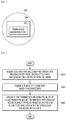
- FIG. 6 is a flowchart for explaining a method for generating training data for training a filled pause detecting model according to an embodiment of the present disclosure.
- FIG. 1 is a schematic block diagram of a training data generating device 100 for training a filled pause detecting model according to an embodiment of the present disclosure.
- FIG. 2 is a diagram for schematically explaining an information table for generating simulation noise included in the training data generating device 100 of FIG. 1 .
- the training data generating device 100 for training the filled pause detecting model may include an acquirer 110 , a first generator 120 , a memory 130 , and a second generator 140 .
- the training data generating device 100 may generate training data for training a filled pause detecting model using a domain randomization algorithm of an enhanced learning algorithm.
- an arbitrary training model is trained in a simulation environment, but when a training model is operated in an actual environment, an electronic device (such as a robot) having a training model installed therein may encounter a situation which is different from the simulation environment, which may result in an operation failure.
- a difference between the simulation environment and the actual environment may be generated due to mismatch between a physical coefficient and inaccurate environment modeling.
- a training model is generated using a domain randomization algorithm, features in the training environment may be randomized, thereby effectively reducing the difference between the simulation environment and the actual environment. That is, the simulation environment having random features may be created using the domain randomization algorithm, and a model may be trained based on the environment.
- a model based on a domain randomization algorithm may be easily applied to an actual environment because the actual environment is also considered as one sample of various simulation environments.
- a filled pause refers to a meaningless interjection that is represented when a user is not capable of smoothly speaking during speech, and may include a nonlinguistic element such as a meaningless syllable or word, for example, “uh”, “um”, “er”, or “erm”.
- the acquirer 110 may acquire acoustic data including first speech data, second speech data, and noise.
- the first speech data may be speech data including a filled pause, and the first speech data may be labeled as speech data including the filled pause.
- the first speech data may be speech data that does not include a filled pause, and the second speech data may be labeled as speech data that does not including a filled pause.
- the noise may include white noise, silence, meaningless sound, or the like.
- the first speech data and the second speech data may be clean data from which noise is not synthesized.
- the first generator 120 may generate a plurality of noise data based on the acoustic data.
- the first generator 120 may set one or more types of a noise parameter required to establish an arbitrary simulation noise environment and may set a range of the one or more set types of the noise parameter.
- FIG. 2 is a diagram for schematically explaining an information table for generating simulation noise stored in the memory 130 , and illustrates types of noise parameters required to establish an arbitrary simulation noise environment to be generated by the first generator 120 , and a range of each noise parameter.
- the first generator 120 may a set a signal to noise ratio (SNR), reverberation, a clean data number noise data number ratio, and background noise as the types of the noise parameters of the information table for generating simulation noise.
- SNR signal to noise ratio
- the first generator 120 may set the range based on an analysis result of an actual noise sample extracted from an actual noise environment. For example, the first generator 120 may set a range of the SNR as the set noise parameter to 5 to 25 [dB], may set a range of the reverberation as the set noise parameter to 100 to 900 [ms], may set a range of the clean data number noise data number ratio as the set noise parameter to 0.1 to 0.7, and may set a range of the background noise as the set noise parameter to 0 to 5.
- the first generator 120 may perform random sampling on an arbitrary noise parameter value of the set range of the noise parameter.
- the first generator 120 may perform random sampling on a noise parameter value according to uniform distribution having a preset interval between an upper value and a lower value of the range of the noise parameter.
- the first generator 120 may perform random sampling on a parameter value of the range of the SNR, as a noise parameter set according to uniform distribution, having a preset interval of 10 [dB].
- the first generator 120 may perform random sampling on a parameter value of the range of the reverberation, as a noise parameter set according to uniform distribution, having a preset interval of 400 [ms].
- the first generator 120 may perform random sampling on a parameter value of the range of the clean data number noise data number ratio, as a noise parameter set according to uniform distribution, having a preset interval of 0.4.
- the first generator 120 may perform random sampling on a parameter value of the range of the background noise, as a noise parameter set according to uniform distribution, having a preset interval of 4.
- the noise parameter value of the actual noise environment may be included in the preset interval. This is because a model based on domain randomization algorithm is easily applied to an actual environment in the above description of the domain randomization algorithm, and the actual environment is also considered as one sample of various trained simulation environments.
- the first generator 120 may synthesize the random-sampled noise parameter values to generate noise data of the simulation environment.
- a first generator 162 - 1 may synthesize a parameter value 10 [dB] of the random-sampled SNR, a parameter value 400 [ms] of the random-sampled random sampling, a parameter value 0.4 of the random-sampled clean data number noise data number ratio, and a parameter value 4 of the random-sampled background noise to generate noise data of the arbitrary simulation environment.
- the memory 130 may store various pieces of information required for an operation of the training data generating device 100 .
- the memory 130 may store the acoustic data acquired by the acquirer 110 , the information table for generating simulation noise, the noise data of the simulation environment generated by the first generator 120 , and first and second training data that will be described below.
- the memory 130 may store a command to be executed by the training data generating device 100 , for example, a command for acquiring acoustic data, a command for generating a plurality of noise data, a command for generating training data, or the like.
- the memory 130 may include magnetic storage media or flash storage media, but the scope of the present disclosure is not limited thereto.
- the memory 130 may include an internal memory and/or an external memory and may include a volatile memory such as a DRAM, a SRAM or a SDRAM, and a non-volatile memory such as one-time programmable ROM (OTPROM), a PROM, an EPROM, an EEPROM, a mask ROM, a flash ROM, a NAND flash memory or a NOR flash memory, a flash drive such as an SSD, a compact flash (CF) card, an SD card, a Micro-SD card, a Mini-SD card, an XD card or memory stick, or a storage device such as a HDD.
- a volatile memory such as a DRAM, a SRAM or a SDRAM
- a non-volatile memory such as one-time programmable ROM (OTPROM), a PROM, an EPROM, an EEPROM, a mask ROM,
- the second generator 140 may synthesize the plurality of noise data generated by the first generator 120 and the first and second speech data acquired by the acquirer 110 to generate first training data and second training data.
- the first training data may include a plurality of filled pauses, and may be labeled as speech data including the filled pause.
- the second training data may not include a plurality of filled pauses, and may be labeled as speech data that does not include a filled pause.
- FIG. 3 is a schematic block diagram of a filled pause detector including the training data generating device of FIG. 1 according to an embodiment of the present disclosure.
- a filled pause detector 200 may include the training data generating device 100 , a training processor 210 , a memory 220 , and a controller 230 .
- the training data generating device 100 has been described above with reference to FIGS. 1 and 2 , and thus a description thereof is omitted.
- the training data generating device 100 may be included outside the filled pause detector 200 as shown in FIG. 3 , or may be included inside the filled pause detector 200 and operate like the filled pause detector 200 .
- the training processor 210 may train a deep neural network using the first training data and second training data generated by the training data generating device 100 .
- the training processor 210 may extract features of the first training data and the second training data.
- the training processor 210 may extract features of the first training data and the second training data using a log-mel spectrogram.
- the log-mel spectrogram algorithm may segment the total data into short times instead of an entire portion of the first training data and the second training data as a target, and may analyze a spectrogram of the corresponding period to extract a feature.
- a speech signal including simulation noise of an input time domain may be segmented into a small-size frame (for example, a frame of 20 to 40 ms). Then, power spectrogram (frequency) of a power spectrogram may be calculated with respect to each frame. Then, Mel filter bank may be applied to the power spectrogram, and energy may be added to each filter. Then, log may be applied to the total filter bank energy.
- a small-size frame for example, a frame of 20 to 40 ms.
- the training processor 210 may perform classification on the first training data and the second training data using, as input, the first training data and the second training data that are labeled with whether the extracted feature and the filled pause are included.
- the training processor 210 may perform the aforementioned classification using a CNN algorithm.
- the training processor 210 may calculate a loss function indicating a difference between a target value and an estimated value generated as the classification result, and may optimize a weight to minimize the loss function.
- the training processor 210 may optimize the weight using a stochastic gradient descent algorithm.
- a stochastic gradient descent algorithm may refer to updating using only a portion of data instead of updating a weight using the total data. In this case, a portion of data may be referred to as Mini-Batch.
- the stochastic gradient descent algorithm has calculation costs of O(1) with respect to the size of the total data and has a suggestive normalization effect, and thus has an advantage of being appropriate for a non-convex loss function, that is, a loss function with Local Minima.
- the training processor 210 may be included outside the controller 230 as shown in FIG. 3 , or may be included inside the controller 230 and operate like the controller 230 .
- the memory 220 may store a filled pause detecting model for detecting whether a filled pause is included in speech information including actual noise through training of the aforementioned deep neural network.
- the memory 220 may store various pieces of information and control software required for an operation of the filled pause detector 200 .
- the controller 230 may be a kind of central processing device, and may drive control software installed in the memory 220 to control the overall operation of the filled pause detector 200 .
- the controller 230 may detect whether the filled pause is included in speech data including actual noise using the filled pause detecting model stored in the memory 220 .
- the controller 230 may include a device of any kind capable of processing data, such as a processor.
- processor may, for example, refer to a data processing device embedded in hardware, which has a physically structured circuitry to perform a function represented by codes or instructions contained in a program.
- a microprocessor a central processor (CPU), a processor core, a multiprocessor, an application-specific integrated circuit (ASIC), and a field programmable gate array (FPGA) may be included, but the scope of the present disclosure is not limited thereto.
- the controller 230 may execute an artificial intelligence (AI) algorithm and/or a machine learning algorithm in a 5G communication environment to output an optimum filled pause detection result by the filled pause detector 200 .
- AI artificial intelligence
- AI artificial intelligence
- the artificial intelligence does not exist on its own, but is rather directly or indirectly related to a number of other fields in computer science.
- Machine learning is an area of AI that includes the field of study that gives computers the capability to learn without being explicitly programmed.
- machine learning may be a technology for researching and constructing a system for learning, predicting, and improving its own performance based on empirical data and an algorithm for the same.
- Machine learning algorithms rather than only executing rigidly-set static program commands, may be used to take an approach that builds models for deriving predictions and decisions from input data.
- the controller 230 may perform machine learning such as deep learning on speech data acquired in a simulation environment and/or an actual environment, and the memory 220 may store data used in machine learning, result data, or the like.
- Deep learning technology which is a subfield of machine learning, enables data-based learning through multiple layers. As the number of layers in deep learning increases, the deep learning network may acquire a collection of machine learning algorithms that extract core data from multiple datasets.
- Deep learning structures may include an artificial neural network (ANN).
- the deep learning structure may include a deep neural network (DNN), such as a convolutional neural network (CNN), a recurrent neural network (RNN), and a deep belief network (DBN).
- DNN deep neural network
- the deep learning structure may use a variety of structures well known to those skilled in the art.
- the deep learning structure according to the present disclosure may include a CNN, a RNN, and a DBN.
- RNN is widely used in natural language processing and may configure an artificial neural network structure by building up layers at each instant in a structure that is effective for processing time-series data which vary with time.
- the DBN may include a deep learning structure that is constructed by stacking the result of restricted Boltzman machine (RBM) learning in multiple layers.
- a DBN has the number of layers formed by repeating RBM training.
- a CNN may include a model mimicking a human brain function, built under the assumption that when a person recognizes an object, the brain extracts the most basic features of the object and recognizes the object based on the results of complex processing in the brain.
- the artificial neural network may be trained by adjusting weights of connections between nodes (if necessary, adjusting bias values as well) so as to produce a desired output from a given input. Furthermore, the artificial neural network may continuously update the weight values through training. Furthermore, a method of back propagation, for example, may be used in the training of the artificial neural network.
- the controller 230 may include an artificial neural network installed therein, and may generate a sentence based on machine learning using one or more of acquired speech or image information as input data.
- the controller 230 may include an ANN, for example, a deep neural network (DNN) and train the DNN, and examples of the DNN include CNN, RNN, DBN, and so forth.
- DNN deep neural network
- Examples of the DNN include CNN, RNN, DBN, and so forth.
- a machine learning method for such an ANN both unsupervised learning and supervised learning may be used.
- the controller 230 may control so as to update an artificial neural network structure after learning according to a setting.
- FIG. 4 is a diagram illustrating an example of a filled pause detection environment including a training data generating device, a filled pause detector, an electronic device, and a network for connecting these components, according to an embodiment of the present disclosure.
- FIG. 5 is a diagram for schematically explaining an example of a training data generating device according to an embodiment of the present disclosure.
- the filled pause detection environment may include the filled pause detector 200 including the training data generating device 100 , an electronic device 300 , and a network 400 .
- the training data generating device 100 may acquire acoustic data including first speech data that includes a filled pause, second speech data that does not include a filled pause, and noise, may generate a plurality of noise data based on the acoustic data, may synthesize the plurality of noise data, and the first speech data and second speech data, and may generate first training data including a plurality of filled pauses and second training data that does not include a plurality of filled pauses.
- the filled pause detector 200 may train a deep neural network using the first training data and second training data generated by the training data generating device 100 , and may generate the filled pause detecting model. The filled pause detector 200 may detect whether a filled pause is included in speech data including actual noise using the filled pause detecting model.
- the training data generating device 100 may be included inside the filled pause detector 200 as shown in FIG. 5 , or the filled pause detector 200 may be included inside the electronic device 300 and the electronic device 300 may operate like the filled pause detector 200 . That is, the electronic device 300 may acquire speech data including actual noise and may detect whether a filled pause is included in speech data including actual noise using the filled pause detecting model inside the electronic device 300 .
- the electronic device 300 may include a speech recognition function installed therein for acquiring and outputting speech, performing speech recognition processing on the acquired speech, and transmitting the result as feedback.
- the electronic device 300 may include a user terminal 301 , an AI speaker 302 that functions as a hub for connecting electronic devices to the network 400 , a home appliance such as a television (TV) 303 , a robot cleaner 304 , an air conditioner 305 , a refrigerator 306 , a washing machine 307 , and a microwave 308 , a signage 309 as a display device installed in a public space or a commercial space, a first communication robot 310 installed in a home and performing emotional communication such as gaze, emotional expression, or physical contact, a second communication robot 311 that performs a function of patrol, guidance, cleaning, prevention of epidemics, delivery, or the like in a public space (such as an airport, a hospital, or an office), and various devices corresponding to Internet of things (IoT), such as a vehicle 312 .
- the electronic device 300 is not limited to the examples illustrated in FIG. 4 .
- the user terminal 301 of the electronic device 300 may be a desk top computer, a smartphone, a notebook computer, a tablet personal computer (PC), a smart TV, a cellular phone, a personal digital assistant (PDA) a laptop computer, a media player, a micro server, a global positioning system (GPS) device, an e-book terminal, a digital broadcast terminal, a navigation device, a kiosk, an MP4 player, a digital camera, a home appliance, and other mobile or immobile computing devices, which are manipulated by a user, but is not limited thereto.
- the user terminal 301 may be a wearable terminal having a communication function and a data processing function, such as a watch, glasses, a hairband, a ring, or the like.
- the user terminal 301 is not limited to the above-mentioned devices, and thus any terminal that supports web browsing may be used as the user terminal 300 .
- the network 400 may connect the training data generating device 100 , the filled pause detector 200 , and the electronic device 300 to each other.
- the network 400 may include a wired network such as a local area network (LAN), a wide area network (WAN), a metropolitan area network (MAN), or an integrated service digital network (ISDN), and a wireless network such as a wireless LAN, a CDMA, Bluetooth®, or satellite communication, but the present disclosure is not limited to these examples.
- the network 400 may transmit/receive information using short-range communications and/or long-distance communications.
- the short distance communication may include Bluetooth®, radio frequency identification (RFID), infrared data association (IrDA), ultra-wideband (UWB), ZigBee, and Wi-Fi (wireless fidelity) technologies
- the long distance communication may include code division multiple access (CDMA), frequency division multiple access (FDMA), time division multiple access (TDMA), orthogonal frequency division multiple access (OFDMA), and single carrier frequency division multiple access (SC-FDMA).
- CDMA code division multiple access
- FDMA frequency division multiple access
- TDMA time division multiple access
- OFDMA orthogonal frequency division multiple access
- SC-FDMA single carrier frequency division multiple access
- the network 400 may include connection of network elements such as hubs, bridges, routers, and switches.
- the network 400 may include one or more connected networks, including a public network such as the Internet and a private network such as a secure corporate private network.
- the network may include a multi-network environment. Access to the network 400 can be provided via one or more wired or wireless access networks.
- the network 400 may support the Internet of things (IoT) for 5G communication or exchanging and processing information between distributed elements such as objects.
- IoT Internet of things
- FIG. 6 is a flowchart for explaining a method for generating training data for training a filled pause detecting model according to an embodiment of the present disclosure.
- a repeated description of the common parts previously described with reference to FIG. 1 through FIG. 5 will be omitted.
- the training data generating device 100 may acquire acoustic data including first speech data, second speech data, and noise.
- the first speech data may be speech data including a filled pause, and may be labeled as speech data including a filled pause.
- the second speech data may be speech data that does not include a filled pause, and may be labeled as speech data that does not include a filled pause.
- the noise may include white noise, silence, meaningless sound, or the like.
- the first speech data and the second speech data may be clean data from which noise is not synthesized
- the training data generating device 100 generate a plurality of noise data based on the acoustic data.
- the training data generating device 100 may set one or more types of a noise parameter required to establish an arbitrary simulation noise environment, and may set a range of the one or more set types of the noise parameter using an information table for generating simulation noise.
- the training data generating device 100 may set the range based on an analysis result of an actual noise sample extracted from an actual noise environment.
- the training data generating device 100 may perform random sampling on an arbitrary noise parameter value of the set range of the noise parameter.
- the training data generating device 100 may perform random sampling on a noise parameter value according to uniform distribution having a preset interval between an upper value and a lower value of the range of the noise parameter.
- the noise parameter value of the actual noise environment may be included in the preset interval.
- the training data generating device 100 may synthesize the random-sampled noise parameter values to generate noise data of the simulation environment.
- the training data generating device 100 may synthesize the plurality of generated noise data with the acquired first speech data and second speech data to generate first training data and second training data.
- the first training data may include a plurality of filled pauses, and may be labeled as speech data including a filled pause.
- the second training data may not include a plurality of filled pauses, and may be labeled as speech data that does not include a filled pause.
- the exemplary embodiments described above may be implemented through computer programs executable through various components on a computer, and such computer programs may be recorded in computer-readable media.
- examples of the computer-readable media may include, but are not limited to: magnetic media such as hard disks, floppy disks, and magnetic tape; optical media such as CD-ROM disks and DVD-ROM disks; magneto-optical media such as floptical disks; and hardware devices that are specially configured to store and execute program instructions, such as ROM, RAM, and flash memory devices.
- the computer programs may be those specially designed and constructed for the purposes of the present disclosure or they may be of the kind well known and available to those skilled in the computer software arts.
- Examples of program code include both machine codes, such as produced by a compiler, and higher level code that may be executed by the computer using an interpreter.
Landscapes
- Engineering & Computer Science (AREA)
- Physics & Mathematics (AREA)
- Computational Linguistics (AREA)
- Health & Medical Sciences (AREA)
- Audiology, Speech & Language Pathology (AREA)
- Human Computer Interaction (AREA)
- Acoustics & Sound (AREA)
- Multimedia (AREA)
- Artificial Intelligence (AREA)
- Signal Processing (AREA)
- Evolutionary Computation (AREA)
- Theoretical Computer Science (AREA)
- Biomedical Technology (AREA)
- General Physics & Mathematics (AREA)
- Data Mining & Analysis (AREA)
- General Health & Medical Sciences (AREA)
- Molecular Biology (AREA)
- Computing Systems (AREA)
- General Engineering & Computer Science (AREA)
- Biophysics (AREA)
- Mathematical Physics (AREA)
- Software Systems (AREA)
- Life Sciences & Earth Sciences (AREA)
- Measurement Of Mechanical Vibrations Or Ultrasonic Waves (AREA)
- Machine Translation (AREA)
- Soundproofing, Sound Blocking, And Sound Damping (AREA)
- Electrically Operated Instructional Devices (AREA)
Abstract
Description
Claims (11)
Applications Claiming Priority (2)
| Application Number | Priority Date | Filing Date | Title |
|---|---|---|---|
| KR10-2019-0169887 | 2019-12-18 | ||
| KR1020190169887A KR102913171B1 (en) | 2019-12-18 | 2019-12-18 | Training data generating method for training filled pause detecting model and device therefor |
Publications (2)
| Publication Number | Publication Date |
|---|---|
| US20210193175A1 US20210193175A1 (en) | 2021-06-24 |
| US11217270B2 true US11217270B2 (en) | 2022-01-04 |
Family
ID=76438325
Family Applications (1)
| Application Number | Title | Priority Date | Filing Date |
|---|---|---|---|
| US16/809,443 Active 2040-04-17 US11217270B2 (en) | 2019-12-18 | 2020-03-04 | Training data generating method for training filled pause detecting model and device therefor |
Country Status (2)
| Country | Link |
|---|---|
| US (1) | US11217270B2 (en) |
| KR (1) | KR102913171B1 (en) |
Families Citing this family (4)
| Publication number | Priority date | Publication date | Assignee | Title |
|---|---|---|---|---|
| JP7588720B2 (en) * | 2020-11-20 | 2024-11-22 | ザ トラスティーズ オブ コロンビア ユニバーシティ イン ザ シティー オブ ニューヨーク | Method, program, system, and non-transitory computer-readable medium |
| CN114710325B (en) * | 2022-03-17 | 2023-09-15 | 广州杰赛科技股份有限公司 | Method, device, equipment and storage medium for constructing network intrusion detection model |
| CN114863424A (en) * | 2022-05-07 | 2022-08-05 | 天津优海云图科技有限公司 | Classification data set construction method for instant noodle flaw detection |
| CN117524318B (en) * | 2024-01-05 | 2024-03-22 | 深圳新合睿恩生物医疗科技有限公司 | New antigen heterogeneous data integration method and device, equipment and storage medium |
Citations (4)
| Publication number | Priority date | Publication date | Assignee | Title |
|---|---|---|---|---|
| US5848388A (en) * | 1993-03-25 | 1998-12-08 | British Telecommunications Plc | Speech recognition with sequence parsing, rejection and pause detection options |
| US20040181410A1 (en) * | 2003-03-13 | 2004-09-16 | Microsoft Corporation | Modelling and processing filled pauses and noises in speech recognition |
| US8244523B1 (en) * | 2009-04-08 | 2012-08-14 | Rockwell Collins, Inc. | Systems and methods for noise reduction |
| US20150058013A1 (en) * | 2012-03-15 | 2015-02-26 | Regents Of The University Of Minnesota | Automated verbal fluency assessment |
Family Cites Families (2)
| Publication number | Priority date | Publication date | Assignee | Title |
|---|---|---|---|---|
| KR101892095B1 (en) * | 2013-10-08 | 2018-08-28 | 한국전자통신연구원 | Method of creating acoustic model using muilti-space gaussian mixture model |
| KR101624926B1 (en) * | 2014-12-17 | 2016-05-27 | 서울대학교산학협력단 | Speech recognition method using feature compensation based on deep neural network |
-
2019
- 2019-12-18 KR KR1020190169887A patent/KR102913171B1/en active Active
-
2020
- 2020-03-04 US US16/809,443 patent/US11217270B2/en active Active
Patent Citations (4)
| Publication number | Priority date | Publication date | Assignee | Title |
|---|---|---|---|---|
| US5848388A (en) * | 1993-03-25 | 1998-12-08 | British Telecommunications Plc | Speech recognition with sequence parsing, rejection and pause detection options |
| US20040181410A1 (en) * | 2003-03-13 | 2004-09-16 | Microsoft Corporation | Modelling and processing filled pauses and noises in speech recognition |
| US8244523B1 (en) * | 2009-04-08 | 2012-08-14 | Rockwell Collins, Inc. | Systems and methods for noise reduction |
| US20150058013A1 (en) * | 2012-03-15 | 2015-02-26 | Regents Of The University Of Minnesota | Automated verbal fluency assessment |
Non-Patent Citations (4)
| Title |
|---|
| J. Ogata, M. Goto and K. Itou, "The use of acoustically detected filled and silent pauses in spontaneous speech recognition," 2009 IEEE International Conference on Acoustics, Soeech and Signal Processing, 2009, pp. 4305-4308, doi: 10.1109/ICASSP.2009.4960581. (Year: 2009) (Year: 2009). * |
| J. Ogata, M. Goto and K. Itou, "The use of acoustically detected filled and silent pauses in spontaneous speech recognition," 2009 IEEE International Conference on Acoustics, Speech and Signal Processing, 2009, pp. 4305-4308, doi: 10.1109/ICASSP.2009.4960581. (Year: 2009). * |
| J. Spohrer, P. Brown and R. Roth, "Automatic labeling of speech," ICASSP '82. IEEE International Conference on Acoustics, Speech, and Signal Processing, 1982, pp. 1641-1644, doi: 10.1109/ICASSP.1982.1171490. (Year: 1982) (Year: 1982). * |
| J. Spohrer, P. Brown and R. Roth, "Automatic labeling of speech," ICASSP '82. IEEE International Conference on Acoustics, Speech, and Signal Processing, 1982, pp. 1641-1644, doi: 10.1109/ICASSP.1982.1171490. (Year: 1982). * |
Also Published As
| Publication number | Publication date |
|---|---|
| US20210193175A1 (en) | 2021-06-24 |
| KR20210078133A (en) | 2021-06-28 |
| KR102913171B1 (en) | 2026-01-15 |
Similar Documents
| Publication | Publication Date | Title |
|---|---|---|
| US10957309B2 (en) | Neural network method and apparatus | |
| US11443735B2 (en) | Method for generating filled pause detecting model corresponding to new domain and device therefor | |
| US11238871B2 (en) | Electronic device and control method thereof | |
| US11217270B2 (en) | Training data generating method for training filled pause detecting model and device therefor | |
| US11211062B2 (en) | Intelligent voice recognizing method with improved noise cancellation, voice recognizing apparatus, intelligent computing device and server | |
| US11308955B2 (en) | Method and apparatus for recognizing a voice | |
| US11842735B2 (en) | Electronic apparatus and control method thereof | |
| US11222636B2 (en) | Intelligent voice recognizing method, apparatus, and intelligent computing device | |
| US11205417B2 (en) | Apparatus and method for inspecting speech recognition | |
| US11373647B2 (en) | Intelligent voice outputting method, apparatus, and intelligent computing device | |
| US20210125605A1 (en) | Speech processing method and apparatus therefor | |
| US11328718B2 (en) | Speech processing method and apparatus therefor | |
| US11367441B2 (en) | Electronic apparatus and control method thereof | |
| US20200035217A1 (en) | Method and device for speech processing | |
| EP3640934B1 (en) | Speech recognition method and apparatus | |
| US11302324B2 (en) | Speech processing method and apparatus therefor | |
| US11386895B2 (en) | Speech processing method and apparatus therefor | |
| KR102590914B1 (en) | Electronic apparatus and Method for contolling the electronic apparatus thereof | |
| US11514902B2 (en) | Speech recognition method and apparatus therefor | |
| US20200020327A1 (en) | Method and apparatus for recognizing a voice | |
| CN113555005B (en) | Model training, confidence determination method and device, electronic device, storage medium | |
| US11373656B2 (en) | Speech processing method and apparatus therefor | |
| CN114913859B (en) | Voiceprint recognition method, voiceprint recognition device, electronic equipment and storage medium | |
| US11437024B2 (en) | Information processing method and apparatus therefor | |
| US20250131915A1 (en) | Enhanced speech-to-text performance with mixed languages |
Legal Events
| Date | Code | Title | Description |
|---|---|---|---|
| FEPP | Fee payment procedure |
Free format text: ENTITY STATUS SET TO UNDISCOUNTED (ORIGINAL EVENT CODE: BIG.); ENTITY STATUS OF PATENT OWNER: LARGE ENTITY |
|
| AS | Assignment |
Owner name: LG ELECTRONICS INC., KOREA, REPUBLIC OF Free format text: ASSIGNMENT OF ASSIGNORS INTEREST;ASSIGNORS:LEE, YUN JIN;CHOI, JAEHUN;REEL/FRAME:052024/0622 Effective date: 20200220 |
|
| STPP | Information on status: patent application and granting procedure in general |
Free format text: NON FINAL ACTION MAILED |
|
| STPP | Information on status: patent application and granting procedure in general |
Free format text: RESPONSE TO NON-FINAL OFFICE ACTION ENTERED AND FORWARDED TO EXAMINER |
|
| STPP | Information on status: patent application and granting procedure in general |
Free format text: NOTICE OF ALLOWANCE MAILED -- APPLICATION RECEIVED IN OFFICE OF PUBLICATIONS |
|
| STPP | Information on status: patent application and granting procedure in general |
Free format text: PUBLICATIONS -- ISSUE FEE PAYMENT RECEIVED |
|
| STPP | Information on status: patent application and granting procedure in general |
Free format text: PUBLICATIONS -- ISSUE FEE PAYMENT VERIFIED |
|
| STCF | Information on status: patent grant |
Free format text: PATENTED CASE |
|
| MAFP | Maintenance fee payment |
Free format text: PAYMENT OF MAINTENANCE FEE, 4TH YEAR, LARGE ENTITY (ORIGINAL EVENT CODE: M1551); ENTITY STATUS OF PATENT OWNER: LARGE ENTITY Year of fee payment: 4 |