US11215519B2 - Device component swelling detection - Google Patents
Device component swelling detection Download PDFInfo
- Publication number
- US11215519B2 US11215519B2 US16/795,956 US202016795956A US11215519B2 US 11215519 B2 US11215519 B2 US 11215519B2 US 202016795956 A US202016795956 A US 202016795956A US 11215519 B2 US11215519 B2 US 11215519B2
- Authority
- US
- United States
- Prior art keywords
- component
- gap
- electronic device
- pressure sensor
- adaptive
- Prior art date
- Legal status (The legal status is an assumption and is not a legal conclusion. Google has not performed a legal analysis and makes no representation as to the accuracy of the status listed.)
- Active
Links
Images




Classifications
-
- G—PHYSICS
- G01—MEASURING; TESTING
- G01L—MEASURING FORCE, STRESS, TORQUE, WORK, MECHANICAL POWER, MECHANICAL EFFICIENCY, OR FLUID PRESSURE
- G01L9/00—Measuring steady of quasi-steady pressure of fluid or fluent solid material by electric or magnetic pressure-sensitive elements; Transmitting or indicating the displacement of mechanical pressure-sensitive elements, used to measure the steady or quasi-steady pressure of a fluid or fluent solid material, by electric or magnetic means
- G01L9/0041—Transmitting or indicating the displacement of flexible diaphragms
- G01L9/0051—Transmitting or indicating the displacement of flexible diaphragms using variations in ohmic resistance
- G01L9/0052—Transmitting or indicating the displacement of flexible diaphragms using variations in ohmic resistance of piezoresistive elements
- G01L9/0055—Transmitting or indicating the displacement of flexible diaphragms using variations in ohmic resistance of piezoresistive elements bonded on a diaphragm
-
- G—PHYSICS
- G01—MEASURING; TESTING
- G01L—MEASURING FORCE, STRESS, TORQUE, WORK, MECHANICAL POWER, MECHANICAL EFFICIENCY, OR FLUID PRESSURE
- G01L1/00—Measuring force or stress, in general
- G01L1/26—Auxiliary measures taken, or devices used, in connection with the measurement of force, e.g. for preventing influence of transverse components of force, for preventing overload
-
- G—PHYSICS
- G01—MEASURING; TESTING
- G01M—TESTING STATIC OR DYNAMIC BALANCE OF MACHINES OR STRUCTURES; TESTING OF STRUCTURES OR APPARATUS, NOT OTHERWISE PROVIDED FOR
- G01M3/00—Investigating fluid-tightness of structures
- G01M3/02—Investigating fluid-tightness of structures by using fluid or vacuum
- G01M3/04—Investigating fluid-tightness of structures by using fluid or vacuum by detecting the presence of fluid at the leakage point
- G01M3/16—Investigating fluid-tightness of structures by using fluid or vacuum by detecting the presence of fluid at the leakage point using electric detection means
- G01M3/18—Investigating fluid-tightness of structures by using fluid or vacuum by detecting the presence of fluid at the leakage point using electric detection means for pipes, cables or tubes; for pipe joints or seals; for valves; for welds; for containers, e.g. radiators
- G01M3/186—Investigating fluid-tightness of structures by using fluid or vacuum by detecting the presence of fluid at the leakage point using electric detection means for pipes, cables or tubes; for pipe joints or seals; for valves; for welds; for containers, e.g. radiators for containers, e.g. radiators
-
- H—ELECTRICITY
- H01—ELECTRIC ELEMENTS
- H01M—PROCESSES OR MEANS, e.g. BATTERIES, FOR THE DIRECT CONVERSION OF CHEMICAL ENERGY INTO ELECTRICAL ENERGY
- H01M10/00—Secondary cells; Manufacture thereof
- H01M10/42—Methods or arrangements for servicing or maintenance of secondary cells or secondary half-cells
- H01M10/48—Accumulators combined with arrangements for measuring, testing or indicating the condition of cells, e.g. the level or density of the electrolyte
- H01M10/482—Accumulators combined with arrangements for measuring, testing or indicating the condition of cells, e.g. the level or density of the electrolyte for several batteries or cells simultaneously or sequentially
-
- H—ELECTRICITY
- H01—ELECTRIC ELEMENTS
- H01M—PROCESSES OR MEANS, e.g. BATTERIES, FOR THE DIRECT CONVERSION OF CHEMICAL ENERGY INTO ELECTRICAL ENERGY
- H01M2200/00—Safety devices for primary or secondary batteries
- H01M2200/20—Pressure-sensitive devices
-
- Y—GENERAL TAGGING OF NEW TECHNOLOGICAL DEVELOPMENTS; GENERAL TAGGING OF CROSS-SECTIONAL TECHNOLOGIES SPANNING OVER SEVERAL SECTIONS OF THE IPC; TECHNICAL SUBJECTS COVERED BY FORMER USPC CROSS-REFERENCE ART COLLECTIONS [XRACs] AND DIGESTS
- Y02—TECHNOLOGIES OR APPLICATIONS FOR MITIGATION OR ADAPTATION AGAINST CLIMATE CHANGE
- Y02E—REDUCTION OF GREENHOUSE GAS [GHG] EMISSIONS, RELATED TO ENERGY GENERATION, TRANSMISSION OR DISTRIBUTION
- Y02E60/00—Enabling technologies; Technologies with a potential or indirect contribution to GHG emissions mitigation
- Y02E60/10—Energy storage using batteries
Definitions
- Mobile electronic devices for examples smart phones, tablets, laptop computers, and the like, must be powered in some way.
- the device In situations where the device is not attached to a connected power source such as an AC line, a charger, a power bank, etc., the device must draw energy from one or more battery packs integrated into the device. Through battery discharge, the device may draw the energy needed from the battery pack to power the device and/or to operate one or more applications on the device.
- one aspect provides an electronic device, comprising: a device component; a pressure sensor integrated into a surface lining of the device component; and at least one adaptive gap-filling component situated between the surface lining of the device component and a wall of the electronic device that at least partially surrounds the device component.
- Another aspect provides a method, comprising: detecting, using a pressure sensor integrated into a surface lining of a device component housed within an electronic device, a swelling event associated with the device component; wherein the detecting comprises utilizing at least one adaptive gap-filling component, wherein the at least one gap-filling component is situated between the surface lining of the device component and a wall of the electronic device that at least partially surrounds the device component.
- a further aspect provides a method, comprising: auto-zeroing a pressure sensor integrated into a surface lining of a device component housed within an electronic device, wherein the auto-zeroing comprises: introducing at least one adaptive gap-filling component between the surface lining of the device component and a wall of the electronic device that at least partially surrounds the device component.
- FIG. 1 (A-B) illustrates a prior art configuration of a device component having a pressure sensor.
- FIG. 2 provides a graph of actual device component swelling versus detected device component swelling.
- FIG. 3 (A-B) provides an example representation of a gap-filling component according to an embodiment and its effects on detected device component swelling.
- FIG. 4 provides an illustration of an adaptive gap-filling component according to an embodiment.
- FIG. 5 provides an illustration of an adaptive gap-filling component according to an embodiment.
- FIG. 6 provides an illustration of an adaptive gap-filling component according to an embodiment.
- FIG. 7 provides an illustration of an adaptive gap-filling component according to an embodiment.
- FIG. 8 (A-B) provides an illustration of an adaptive gap-filling component according to an embodiment.
- battery a battery pack
- the battery may stop working, the battery may bulge and/or bubble, the swelling may damage the device housing the battery, and, in extreme situations, the battery may explode, potentially harming a user.
- a variety of different factors may contribute to battery swelling such as, inter alia, aging during storage, time at full charge voltage, exposure to high temperature (e.g., when a device is left in the sun on a hot day, etc.), cycling count, manufacturing defects, poor cell quality and design, mechanical damage to electrodes due to mishandling, deep discharge of cells, and the like.
- a battery 10 is illustrated that contains a pressure sensor 11 .
- the sensor 11 may come into contact with a system lining 12 , at which point the sensor 11 may record data associated with the detected swelling event. This information may thereafter be communicated to the user (e.g., in an emergency notification, etc.) and/or may be utilized by the device (e.g., to perform a dynamic shut down, etc.).
- the graph in FIG. 2 illustrates the difference between how much the battery has actually swelled 21 versus what the pressure sensor detects 22 at the point at which the battery comes into contact with the system lining.
- the battery has actually swelled by about 17% at the touching point whereas the sensor only records that minimal swelling has occurred.
- the difference between the actual 21 versus detected 22 swelling percentage may be at least partially dependent upon the size of the gap (i.e., the greater the gap size the greater difference between the actual versus detected swelling percentage).
- an embodiment provides a method and configuration for more accurately detecting battery swelling.
- a swelling event associated with a battery may be detected by a pressure sensor integrated into a surface lining of the battery. Detection of the swelling event may be further facilitated by the presence of at least one adaptive gap-filling component.
- the adaptive gap-filling component may take one of a variety of different forms and may be situated between the surface lining of the battery and a wall of the electronic device that at least partially surrounds the battery. As the battery swells and expands into the adaptive gap-filling component, the component may dynamically adjust its length in response to the force of the swelling. The presence of such a component may therefore help “zero” the pressure sensor and allow it to record more accurate swelling readings.
- FIG. 3A a generic representation of an adaptive gap-filling component 31 placed between a pressure sensor 32 and a wall 33 of the system/electronic device is provided.
- the pressure sensor 32 may be integrated into a surface lining of a battery 34 .
- the battery 34 may be virtually any type of battery that is susceptible to swelling and/or bulging (e.g., a lithium-ion battery pack, etc.).
- the electronic device may be virtually any electronic device that is capable of supporting and/or drawing power from a swelling-susceptible battery (e.g., a smart phone, tablet, laptop, etc.).
- the adaptive gap-filling component 31 may serve to bridge the gap that is present in conventional configurations (i.e., as shown in FIG. 1A ).
- the adaptive gap-filling component may be specially designed to fit an exact gap distance (e.g., for a particular battery pack/electronic device pair, etc.).
- the adaptive-gap filling component may be designed to be dynamic to fit a variety of different gap distances that may be present in differing battery/electronic device pairs (e.g., from gap sizes ranging from 0.5 mm-5 mm, etc.).
- a length of the adaptive gap-filling component may be adjustable (e.g., similar to a spring, etc.).
- the flexible nature of this component may ensure that it is lengthy enough to appropriately fill the gap (i.e., by expanding in length to fit the dimensions of the gap).
- manufacturers may take advantage of this flexibility during the component installation.
- a length of the component may be originally decreased, e.g., by applying a force to one or both ends of the component, when the component is placed between the pressure sensor and a wall surrounding the battery. Once inserted, the applied forces may be removed and the component may naturally expand to fit the dimensions of the gap. Additionally or alternatively, the inserted components may thereafter substantially solidify in place and may thereby allow the pressure sensor to better detect early swelling.
- this component may help to “auto-zero” the pressure sensor, thereby allowing it to more accurately track the actual swelling experienced by the battery. More particularly, when swelling occurs, the pressure sensor is forced against the gap-filling component, thereby allowing the pressure sensor to receive an indication of pressure much earlier than what would have been detected in conventional designs (i.e., due to the pressure sensor expanding into an empty gap).
- the adaptive pressure sensor i.e., the pressure sensor utilized in combination with the adaptive gap-filling component
- the accuracy of the adaptive pressure sensor tapers off because, inter alia, a length of the gap-filling component can only contract so far, thereby preventing the pressure sensor from expanding naturally with the battery to the touching point and beyond.
- the pressure sensor may transmit (e.g., wirelessly, etc.) the swelling data to one or more processors of the device it is housed in, which may thereafter utilize that data to perform one or more downstream functions. For example, upon receipt of the swelling data, an embodiment may provide an alert notification to a user (e.g., that battery swelling is occurring, etc.). Additionally or alternatively, an embodiment may keep track of and record the data in an accessible storage database (e.g., stored locally on the device, etc.). Additionally or alternatively, an embodiment may dynamically initiate a power-off function (e.g., responsive to detecting that a rate of or a degree of swelling has exceeded a predetermined threshold, etc.).
- a power-off function e.g., responsive to detecting that a rate of or a degree of swelling has exceeded a predetermined threshold, etc.
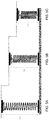
- FIG. 4 (A-C) illustrates an embodiment in which the adaptive gap-filling component corresponds to a spring piezoresistive sensor.
- the sensor of this embodiment may contain at least two arms 41 , as annotated in FIG. 4A , that are able to detect mechanical strain (i.e., produced from the swelling of the battery). These arms may be adjustable (e.g., as shown from FIG. 4A to FIG. 4C ) to accommodate the size of a gap. Additionally, as swelling occurs, the arms may correspondingly flatten to accommodate for the swelling of the battery.
- FIG. 5 (A-C) illustrates a similar concept wherein the adaptive gap-filling component corresponds to a simple spring configuration.
- the spring configuration may adjust in length responsive to increasing mechanical strain and may be manipulated to fit a number of different gap sizes.
- the spring may be composed of a polymer base (e.g., similar to epoxy, etc.). The composition of this embodiment allows the spring to be adjustable in length during installation (i.e., to expand/fit to a gap of a particular size) but may thereafter harden once it has settled into the gap. This “delayed thermosetting” property of the spring may allow the pressure sensor to better detect swelling (i.e., by contacting the solidified gap-filling component during battery swelling).
- FIG. 6 (A-D) illustrates an embodiment in which the adaptive gap-filling component corresponds to an adaptive air-dry polymer spring configuration.
- This component may contain a polyurethane base 61 that may consist of at least five component materials (i.e., polyols, sulfactants, catalyst, blowing agents, and fire retardents).
- component materials i.e., polyols, sulfactants, catalyst, blowing agents, and fire retardents.
- the component may be contracted to fit a needed gap size (as illustrated in FIGS. 6 (B-D)) at which point a bottom portion 62 of the component may penetrate the polyurethane base, as shown in FIG. 6C . This penetration initiates a chemical reaction that may allow the component to solidify to robustly fit to the gap space once component movement (i.e., expansion and/or contraction) has stopped.
- FIG. 7 illustrates an embodiment in which the adaptive gap-filling component corresponds to adaptive self-expanding foam. Similar to the embodiments illustrated in FIGS. 5 and 6 , the foam may exhibit some delayed solidification properties. More particularly, the foam may contain some glue-type material that may originally be more fluid-like during component installation (i.e., into the gap space). Once the component expands to appropriately fill the gap space, the component may thereafter harden and solidify.
- FIG. 8 illustrates an embodiment in which the adaptive gap-filling component corresponds to a corrugated/accordion-shaped adjustable pipe. Similar to some of the foregoing embodiments, this corrugated component may be adjustable to a desired gap size during installation. More particularly, as shown in FIG. 8A , a force may be applied to the component that allows it to be appropriately sized to a particular gap.
- an inner portion 81 of the component may contain a pre-mixed gel, as shown in FIG. 8B , that contains at least five components (i.e., polyols, sulfactants, catalyst, blowing agents, and fire retardants). The implementation of the sizing force may initiate a chemical reaction in the pre-mixed gel which solidifies the component in place once the desired size is achieved.
- embodiments described herein thus represent a technical improvement to conventional techniques for detecting battery swelling. More particularly, embodiments of the foregoing provide an adaptive gap-filling component that may be positioned in a gap located between a battery and a system wall that surrounds the battery. The implementation of this component may allow a pressure sensor located at a surface of the battery to more accurately and quickly detect a swelling event.
Landscapes
- Physics & Mathematics (AREA)
- General Physics & Mathematics (AREA)
- Engineering & Computer Science (AREA)
- Manufacturing & Machinery (AREA)
- Chemical & Material Sciences (AREA)
- Chemical Kinetics & Catalysis (AREA)
- Electrochemistry (AREA)
- General Chemical & Material Sciences (AREA)
- Secondary Cells (AREA)
Abstract
Description
Claims (11)
Priority Applications (1)
| Application Number | Priority Date | Filing Date | Title |
|---|---|---|---|
| US16/795,956 US11215519B2 (en) | 2020-02-20 | 2020-02-20 | Device component swelling detection |
Applications Claiming Priority (1)
| Application Number | Priority Date | Filing Date | Title |
|---|---|---|---|
| US16/795,956 US11215519B2 (en) | 2020-02-20 | 2020-02-20 | Device component swelling detection |
Publications (2)
| Publication Number | Publication Date |
|---|---|
| US20210262883A1 US20210262883A1 (en) | 2021-08-26 |
| US11215519B2 true US11215519B2 (en) | 2022-01-04 |
Family
ID=77365997
Family Applications (1)
| Application Number | Title | Priority Date | Filing Date |
|---|---|---|---|
| US16/795,956 Active US11215519B2 (en) | 2020-02-20 | 2020-02-20 | Device component swelling detection |
Country Status (1)
| Country | Link |
|---|---|
| US (1) | US11215519B2 (en) |
Families Citing this family (4)
| Publication number | Priority date | Publication date | Assignee | Title |
|---|---|---|---|---|
| DE102020130834A1 (en) * | 2020-11-23 | 2022-05-25 | Audi Aktiengesellschaft | Energy storage device for storing electrical energy, method for operating an energy storage device and motor vehicle |
| KR20230049454A (en) * | 2021-10-06 | 2023-04-13 | 주식회사 엘지에너지솔루션 | Battery module and battery pack including the same |
| US20230147262A1 (en) * | 2021-11-09 | 2023-05-11 | Hand Held Products, Inc. | Battery fault detection assemblies |
| US20240429580A1 (en) | 2023-06-26 | 2024-12-26 | GM Global Technology Operations LLC | Active pressure control piezeoelectric mechanism for improved battery performance |
Citations (29)
| Publication number | Priority date | Publication date | Assignee | Title |
|---|---|---|---|---|
| US6271644B1 (en) * | 1999-06-22 | 2001-08-07 | Hudson Soft, Co., Ltd. | Battery pack |
| US20050092329A1 (en) * | 2003-10-29 | 2005-05-05 | Sta-Maria Rosalinda C. | Nasal continuous positive airway pressure cannula device and securement for infants |
| US20060181517A1 (en) * | 2005-02-11 | 2006-08-17 | Apple Computer, Inc. | Display actuator |
| US20070054157A1 (en) * | 2005-09-07 | 2007-03-08 | Ryu Ji H | Secondary battery employing safety device |
| US20120208054A1 (en) * | 2011-02-16 | 2012-08-16 | Toyota Jidosha Kabushiki Kaisha | Battery system and battery structure |
| US20140002269A1 (en) * | 2012-06-28 | 2014-01-02 | Xunwei Zhou | Detection of swelling in batteries |
| US20140042961A1 (en) * | 2012-08-12 | 2014-02-13 | Compal Electronics, Inc. | Electronic Device and Method for Detecting Swelling of Battery Thereof |
| US8758920B2 (en) * | 2007-03-08 | 2014-06-24 | Nikon Corporation | Battery accommodating device, portable device, output device, and head mount display |
| US20150171410A1 (en) * | 2013-12-18 | 2015-06-18 | Hyundai Motor Company | Apparatus for preventing over-charge for battery of vehicle |
| US20160064780A1 (en) * | 2014-08-28 | 2016-03-03 | Apple Inc. | Methods for determining and controlling battery expansion |
| US20170077561A1 (en) * | 2014-06-30 | 2017-03-16 | Toyo Tire & Rubber Co., Ltd. | Method for determining abnormality in assembled battery, and device for determining abnormality in assembled battery |
| US20170108326A1 (en) * | 2015-10-16 | 2017-04-20 | Chroma Ate Inc. | Measurement fixture for a battery cell |
| US20170288283A1 (en) * | 2014-11-25 | 2017-10-05 | Toyo Tire & Rubber Co., Ltd. | Sensor for detecting deformation of sealed secondary battery |
| US20170309973A1 (en) * | 2016-04-20 | 2017-10-26 | Robert Bosch Gmbh | Length expansion monitoring for determining the aging of a battery cell or a battery module |
| US20170331157A1 (en) * | 2016-05-13 | 2017-11-16 | NextEv USA, Inc. | Battery module having a pressure sensor |
| US20180226698A1 (en) * | 2017-02-03 | 2018-08-09 | Omron Corporation | Abnormality detector |
| US20180261824A1 (en) * | 2017-03-10 | 2018-09-13 | Samsung Electronics Co., Ltd. | Method of detecting swelling of battery using pressure sensor and electronic device using the method |
| US10230136B2 (en) * | 2014-06-27 | 2019-03-12 | Toyo Tire Corporation | Monitoring sensor including a polymer matrix for monitoring a sealed secondary battery, sealed secondary battery including the monitoring sensor, and monitoring method for sealed secondary battery |
| US10355319B1 (en) * | 2016-08-04 | 2019-07-16 | Amazon Technologies, Inc. | Methods and systems for improved battery performance |
| US20190227125A1 (en) * | 2016-08-19 | 2019-07-25 | Toyo Tire Corporation | Assembled battery manufacturing method using used batteries, and assembled battery |
| US20190249979A1 (en) * | 2016-10-28 | 2019-08-15 | Toyo Tire Corporation | Deformation detection sensor for sealed secondary battery and sealed secondary battery |
| US10476068B2 (en) * | 2015-10-06 | 2019-11-12 | Lg Chem, Ltd. | Battery module including probe for detecting expansion of battery cell |
| US20190363392A1 (en) * | 2017-09-18 | 2019-11-28 | Lg Chem, Ltd. | Battery module and battery pack including same |
| US20200168959A1 (en) * | 2017-07-21 | 2020-05-28 | Quantumscape Corporation | Active and passive battery pressure management |
| US20200185166A1 (en) * | 2016-09-13 | 2020-06-11 | Panasonic Intellectual Property Management Co., Ltd. | Push switch |
| US20200203783A1 (en) * | 2018-12-21 | 2020-06-25 | Lenovo (Singapore) Pte. Ltd. | Battery swelling detection |
| US20200227793A1 (en) * | 2017-12-26 | 2020-07-16 | Lg Chem, Ltd. | Cylindrical battery having pressure sensor, and method for measuring internal pressure thereof |
| US20200239291A1 (en) * | 2019-01-25 | 2020-07-30 | Jungheinrich Aktiengesellschaft | Industrial truck with stand-on platform |
| US20200358440A1 (en) * | 2019-05-07 | 2020-11-12 | Dell Products, Lp | System and method for integrating components of an electro-permanent magnet key switch assembly |
-
2020
- 2020-02-20 US US16/795,956 patent/US11215519B2/en active Active
Patent Citations (29)
| Publication number | Priority date | Publication date | Assignee | Title |
|---|---|---|---|---|
| US6271644B1 (en) * | 1999-06-22 | 2001-08-07 | Hudson Soft, Co., Ltd. | Battery pack |
| US20050092329A1 (en) * | 2003-10-29 | 2005-05-05 | Sta-Maria Rosalinda C. | Nasal continuous positive airway pressure cannula device and securement for infants |
| US20060181517A1 (en) * | 2005-02-11 | 2006-08-17 | Apple Computer, Inc. | Display actuator |
| US20070054157A1 (en) * | 2005-09-07 | 2007-03-08 | Ryu Ji H | Secondary battery employing safety device |
| US8758920B2 (en) * | 2007-03-08 | 2014-06-24 | Nikon Corporation | Battery accommodating device, portable device, output device, and head mount display |
| US20120208054A1 (en) * | 2011-02-16 | 2012-08-16 | Toyota Jidosha Kabushiki Kaisha | Battery system and battery structure |
| US20140002269A1 (en) * | 2012-06-28 | 2014-01-02 | Xunwei Zhou | Detection of swelling in batteries |
| US20140042961A1 (en) * | 2012-08-12 | 2014-02-13 | Compal Electronics, Inc. | Electronic Device and Method for Detecting Swelling of Battery Thereof |
| US20150171410A1 (en) * | 2013-12-18 | 2015-06-18 | Hyundai Motor Company | Apparatus for preventing over-charge for battery of vehicle |
| US10230136B2 (en) * | 2014-06-27 | 2019-03-12 | Toyo Tire Corporation | Monitoring sensor including a polymer matrix for monitoring a sealed secondary battery, sealed secondary battery including the monitoring sensor, and monitoring method for sealed secondary battery |
| US20170077561A1 (en) * | 2014-06-30 | 2017-03-16 | Toyo Tire & Rubber Co., Ltd. | Method for determining abnormality in assembled battery, and device for determining abnormality in assembled battery |
| US20160064780A1 (en) * | 2014-08-28 | 2016-03-03 | Apple Inc. | Methods for determining and controlling battery expansion |
| US20170288283A1 (en) * | 2014-11-25 | 2017-10-05 | Toyo Tire & Rubber Co., Ltd. | Sensor for detecting deformation of sealed secondary battery |
| US10476068B2 (en) * | 2015-10-06 | 2019-11-12 | Lg Chem, Ltd. | Battery module including probe for detecting expansion of battery cell |
| US20170108326A1 (en) * | 2015-10-16 | 2017-04-20 | Chroma Ate Inc. | Measurement fixture for a battery cell |
| US20170309973A1 (en) * | 2016-04-20 | 2017-10-26 | Robert Bosch Gmbh | Length expansion monitoring for determining the aging of a battery cell or a battery module |
| US20170331157A1 (en) * | 2016-05-13 | 2017-11-16 | NextEv USA, Inc. | Battery module having a pressure sensor |
| US10355319B1 (en) * | 2016-08-04 | 2019-07-16 | Amazon Technologies, Inc. | Methods and systems for improved battery performance |
| US20190227125A1 (en) * | 2016-08-19 | 2019-07-25 | Toyo Tire Corporation | Assembled battery manufacturing method using used batteries, and assembled battery |
| US20200185166A1 (en) * | 2016-09-13 | 2020-06-11 | Panasonic Intellectual Property Management Co., Ltd. | Push switch |
| US20190249979A1 (en) * | 2016-10-28 | 2019-08-15 | Toyo Tire Corporation | Deformation detection sensor for sealed secondary battery and sealed secondary battery |
| US20180226698A1 (en) * | 2017-02-03 | 2018-08-09 | Omron Corporation | Abnormality detector |
| US20180261824A1 (en) * | 2017-03-10 | 2018-09-13 | Samsung Electronics Co., Ltd. | Method of detecting swelling of battery using pressure sensor and electronic device using the method |
| US20200168959A1 (en) * | 2017-07-21 | 2020-05-28 | Quantumscape Corporation | Active and passive battery pressure management |
| US20190363392A1 (en) * | 2017-09-18 | 2019-11-28 | Lg Chem, Ltd. | Battery module and battery pack including same |
| US20200227793A1 (en) * | 2017-12-26 | 2020-07-16 | Lg Chem, Ltd. | Cylindrical battery having pressure sensor, and method for measuring internal pressure thereof |
| US20200203783A1 (en) * | 2018-12-21 | 2020-06-25 | Lenovo (Singapore) Pte. Ltd. | Battery swelling detection |
| US20200239291A1 (en) * | 2019-01-25 | 2020-07-30 | Jungheinrich Aktiengesellschaft | Industrial truck with stand-on platform |
| US20200358440A1 (en) * | 2019-05-07 | 2020-11-12 | Dell Products, Lp | System and method for integrating components of an electro-permanent magnet key switch assembly |
Also Published As
| Publication number | Publication date |
|---|---|
| US20210262883A1 (en) | 2021-08-26 |
Similar Documents
| Publication | Publication Date | Title |
|---|---|---|
| US11215519B2 (en) | Device component swelling detection | |
| US11668756B2 (en) | Battery degradation monitoring system and methods | |
| CN108387844B (en) | Abnormality detection device | |
| US9634295B2 (en) | Expandable battery pack containment device for pouch battery cells | |
| CN104114988B (en) | Impact-resistant surface-mounted roof sensor | |
| US11150170B2 (en) | Apparatus and method for measuring deformation stiffness of a secondary battery | |
| US11143708B2 (en) | Electronic device and method for obtaining a correct battery temperature | |
| KR20210138883A (en) | Cell jig for detecting swelling of battery cell and method for measuring swelling of the battery cell using the same | |
| EP2827436B1 (en) | Electronic device and methods therein | |
| KR20170050926A (en) | A secondary battery, secondary battery charging system and secondary battery production method to prevent battery cell swelling by detecting a displacement of gas venting unit | |
| WO2004109708A3 (en) | Nanoelectromechanical memory cells and data storage devices | |
| US11264650B2 (en) | Apparatus and method for testing end plate | |
| WO2020242476A1 (en) | Methods to continuously monitor battery cell physical health and swell | |
| CN108414943B (en) | Battery detection device and method and battery pack system | |
| WO2018010294A1 (en) | Battery detection apparatus, battery detection method and device | |
| US12553701B2 (en) | Systems and methods for measuring real time battery dilation | |
| US8756025B2 (en) | Temperature sensing of electric batteries | |
| CN206989861U (en) | A kind of device for testing lithium ion battery discharge and recharge expansion rate | |
| CN114556667A (en) | Battery expansion test equipment | |
| CN214672742U (en) | Battery expansion monitoring device, battery and electronic device | |
| KR20220147253A (en) | Pressure measuring device and pressure measuring method of pouch-type battery cells | |
| CN115954559A (en) | Vehicle battery system and method for detecting and responding to swelling phenomenon | |
| US8656794B2 (en) | Apparatus for dissolution experiment of mineral | |
| JP2022146693A (en) | Temperature measurement method, temperature measurement device, and battery system | |
| TW202319771A (en) | Battery detection device and method therefor |
Legal Events
| Date | Code | Title | Description |
|---|---|---|---|
| AS | Assignment |
Owner name: LENOVO (SINGAPORE) PTE. LTD., SINGAPORE Free format text: ASSIGNMENT OF ASSIGNORS INTEREST;ASSIGNORS:YEBKA, BOUZIANE;WONG, TIN-LUP;JAKES, PHILIP JOHN;REEL/FRAME:051872/0708 Effective date: 20200218 |
|
| FEPP | Fee payment procedure |
Free format text: ENTITY STATUS SET TO UNDISCOUNTED (ORIGINAL EVENT CODE: BIG.); ENTITY STATUS OF PATENT OWNER: LARGE ENTITY |
|
| STPP | Information on status: patent application and granting procedure in general |
Free format text: NOTICE OF ALLOWANCE MAILED -- APPLICATION RECEIVED IN OFFICE OF PUBLICATIONS |
|
| STPP | Information on status: patent application and granting procedure in general |
Free format text: PUBLICATIONS -- ISSUE FEE PAYMENT VERIFIED |
|
| STCF | Information on status: patent grant |
Free format text: PATENTED CASE |
|
| AS | Assignment |
Owner name: LENOVO PC INTERNATIONAL LIMITED, HONG KONG Free format text: ASSIGNMENT OF ASSIGNORS INTEREST;ASSIGNOR:LENOVO (SINGAPORE) PTE LTD.;REEL/FRAME:070269/0001 Effective date: 20220401 |
|
| AS | Assignment |
Owner name: LENOVO SWITZERLAND INTERNATIONAL GMBH, SWITZERLAND Free format text: ASSIGNMENT OF ASSIGNORS INTEREST;ASSIGNOR:LENOVO PC INTERNATIONAL LIMITED;REEL/FRAME:070269/0092 Effective date: 20241231 |
|
| MAFP | Maintenance fee payment |
Free format text: PAYMENT OF MAINTENANCE FEE, 4TH YEAR, LARGE ENTITY (ORIGINAL EVENT CODE: M1551); ENTITY STATUS OF PATENT OWNER: LARGE ENTITY Year of fee payment: 4 |