US11214561B2 - Histone methyltransferase EZH2 inhibitor, preparation method and pharmaceutical use thereof - Google Patents
Histone methyltransferase EZH2 inhibitor, preparation method and pharmaceutical use thereof Download PDFInfo
- Publication number
- US11214561B2 US11214561B2 US16/478,472 US201816478472A US11214561B2 US 11214561 B2 US11214561 B2 US 11214561B2 US 201816478472 A US201816478472 A US 201816478472A US 11214561 B2 US11214561 B2 US 11214561B2
- Authority
- US
- United States
- Prior art keywords
- group
- alkyl
- further substituted
- optionally further
- groups
- Prior art date
- Legal status (The legal status is an assumption and is not a legal conclusion. Google has not performed a legal analysis and makes no representation as to the accuracy of the status listed.)
- Expired - Fee Related
Links
- 0 *N([2*])*N([1*])C.[6*]N(C(C)=O)C([10*])([11*])C1=C([7*])C([8*])=C([9*])N([12*])C1=O.[Ar] Chemical compound *N([2*])*N([1*])C.[6*]N(C(C)=O)C([10*])([11*])C1=C([7*])C([8*])=C([9*])N([12*])C1=O.[Ar] 0.000 description 24
- VZQUXAYYQMHIHP-UHFFFAOYSA-N C=CC(=O)N1CCC(N(CC)C2=C(C)C(C(=O)NCC3=C(C)C=C(C)NC3=O)=CC(C3=CC=C(CN4CCC(O)CC4)C=C3)=C2)CC1 Chemical compound C=CC(=O)N1CCC(N(CC)C2=C(C)C(C(=O)NCC3=C(C)C=C(C)NC3=O)=CC(C3=CC=C(CN4CCC(O)CC4)C=C3)=C2)CC1 VZQUXAYYQMHIHP-UHFFFAOYSA-N 0.000 description 4
- AGGVRKJXSNJTHF-UHFFFAOYSA-N C=CC(=O)N1CCC(N(CC)C2=C(C)C(C(=O)NCC3=C(C)C=C(C)NC3=O)=CC(C3=CC=C(CN4CCOCC4)C=C3)=C2)C1 Chemical compound C=CC(=O)N1CCC(N(CC)C2=C(C)C(C(=O)NCC3=C(C)C=C(C)NC3=O)=CC(C3=CC=C(CN4CCOCC4)C=C3)=C2)C1 AGGVRKJXSNJTHF-UHFFFAOYSA-N 0.000 description 4
- UYNNFXDIFOOMEQ-UHFFFAOYSA-N C=CC(=O)N1CCC(N(CC)C2=C(C)C(C(=O)NCC3=C(C)C=C(C)NC3=O)=CC(C#CCN3CCOCC3)=C2)C1 Chemical compound C=CC(=O)N1CCC(N(CC)C2=C(C)C(C(=O)NCC3=C(C)C=C(C)NC3=O)=CC(C#CCN3CCOCC3)=C2)C1 UYNNFXDIFOOMEQ-UHFFFAOYSA-N 0.000 description 3
- AOUHOSDWLKEZMJ-UHFFFAOYSA-N C=CC(=O)N1CCC(N(CC)C2=C(C)C(C(=O)NCC3=C(C)C=C(C)NC3=O)=CC(C3=CC=C(CN4CCCC4)C=C3)=C2)C1 Chemical compound C=CC(=O)N1CCC(N(CC)C2=C(C)C(C(=O)NCC3=C(C)C=C(C)NC3=O)=CC(C3=CC=C(CN4CCCC4)C=C3)=C2)C1 AOUHOSDWLKEZMJ-UHFFFAOYSA-N 0.000 description 3
- ZVONBNAIGCWKAS-UHFFFAOYSA-N C=CC(=O)N1CCC(N(CC)C2=C(C)C(C(=O)NCC3=C(C)C=C(C)NC3=O)=CC(C3=CC=C(N4CCOCC4)C=C3)=C2)C1 Chemical compound C=CC(=O)N1CCC(N(CC)C2=C(C)C(C(=O)NCC3=C(C)C=C(C)NC3=O)=CC(C3=CC=C(N4CCOCC4)C=C3)=C2)C1 ZVONBNAIGCWKAS-UHFFFAOYSA-N 0.000 description 3
- YTXRGRPMWYUUNL-UHFFFAOYSA-N C=CC(=O)N1CCC(N(CC)C2=C(C)C(C(=O)NCC3=C(C)C=C(C)NC3=O)=CC(C3=CC=CC(CN4CCCN(C)CC4)=C3)=C2)CC1 Chemical compound C=CC(=O)N1CCC(N(CC)C2=C(C)C(C(=O)NCC3=C(C)C=C(C)NC3=O)=CC(C3=CC=CC(CN4CCCN(C)CC4)=C3)=C2)CC1 YTXRGRPMWYUUNL-UHFFFAOYSA-N 0.000 description 3
- ISJGDUNYIIABMQ-UHFFFAOYSA-N C=CC(=O)N1CCC(N(CC)C2=C(C)C(C(=O)NCC3=C(C)C=C(C)NC3=O)=CC(C3=NC=NC(OCC)=C3)=C2)C1 Chemical compound C=CC(=O)N1CCC(N(CC)C2=C(C)C(C(=O)NCC3=C(C)C=C(C)NC3=O)=CC(C3=NC=NC(OCC)=C3)=C2)C1 ISJGDUNYIIABMQ-UHFFFAOYSA-N 0.000 description 3
- YNTSBPMZONBYII-UHFFFAOYSA-N C=CC(=O)N1CCC(N(CC)C2=C(C)C(C(=O)NCC3=C(C)C=C(C)NC3=O)=CC(F)=C2)C1 Chemical compound C=CC(=O)N1CCC(N(CC)C2=C(C)C(C(=O)NCC3=C(C)C=C(C)NC3=O)=CC(F)=C2)C1 YNTSBPMZONBYII-UHFFFAOYSA-N 0.000 description 3
- ZLBUKBMCLRYZEE-UHFFFAOYSA-N C=CC(=O)N1CCC(N(CC)C2=C(C)C(C(=O)NCC3=C(C)C=C(C)NC3=O)=CS2)C1 Chemical compound C=CC(=O)N1CCC(N(CC)C2=C(C)C(C(=O)NCC3=C(C)C=C(C)NC3=O)=CS2)C1 ZLBUKBMCLRYZEE-UHFFFAOYSA-N 0.000 description 3
- QYGNJYQRRMFBMD-UHFFFAOYSA-N C=CC(=O)N1CCCC(N(CC)C2=C(C)C(C(=O)NCC3=C(C)C=C(C)NC3=O)=CC(C3=CC=C(CN4CCC(OC)CC4)C=C3)=C2)C1 Chemical compound C=CC(=O)N1CCCC(N(CC)C2=C(C)C(C(=O)NCC3=C(C)C=C(C)NC3=O)=CC(C3=CC=C(CN4CCC(OC)CC4)C=C3)=C2)C1 QYGNJYQRRMFBMD-UHFFFAOYSA-N 0.000 description 3
- JXWVLXPKVHFWFR-UHFFFAOYSA-N C=CC(=O)N1CCN(C2=C(C)C(C(=O)NCC3=C(C)C=C(C)NC3=O)=CC(Br)=C2)CC1 Chemical compound C=CC(=O)N1CCN(C2=C(C)C(C(=O)NCC3=C(C)C=C(C)NC3=O)=CC(Br)=C2)CC1 JXWVLXPKVHFWFR-UHFFFAOYSA-N 0.000 description 3
- GZMUZQDIOKBLIO-UHFFFAOYSA-N C=CC(=O)N(C)CCN(CC)C1=C(C)C(C(=O)NCC2=C(C)C=C(C)NC2=O)=CC(Br)=C1 Chemical compound C=CC(=O)N(C)CCN(CC)C1=C(C)C(C(=O)NCC2=C(C)C=C(C)NC2=O)=CC(Br)=C1 GZMUZQDIOKBLIO-UHFFFAOYSA-N 0.000 description 2
- FDFJWBZDLAUQPB-UHFFFAOYSA-N C=CC(=O)N1CC(N(CC)C2=C(C)C(C(=O)NCC3=C(C)C=C(C)NC3=O)=CC(Br)=C2)C1 Chemical compound C=CC(=O)N1CC(N(CC)C2=C(C)C(C(=O)NCC3=C(C)C=C(C)NC3=O)=CC(Br)=C2)C1 FDFJWBZDLAUQPB-UHFFFAOYSA-N 0.000 description 2
- IQNMWJXYOUDZDU-UHFFFAOYSA-N C=CC(=O)N1CCC(N(C)C2=C(C)C(C(=O)NCC3=C(C)C=C(C)NC3=O)=CC(Br)=C2)C1 Chemical compound C=CC(=O)N1CCC(N(C)C2=C(C)C(C(=O)NCC3=C(C)C=C(C)NC3=O)=CC(Br)=C2)C1 IQNMWJXYOUDZDU-UHFFFAOYSA-N 0.000 description 2
- YPLMSPAOLUAQGR-UHFFFAOYSA-N C=CC(=O)N1CCC(N(CC(F)(F)F)C2=C(C)C(C(=O)NCC3=C(C)C=C(C)NC3=O)=CC(Br)=C2)C1 Chemical compound C=CC(=O)N1CCC(N(CC(F)(F)F)C2=C(C)C(C(=O)NCC3=C(C)C=C(C)NC3=O)=CC(Br)=C2)C1 YPLMSPAOLUAQGR-UHFFFAOYSA-N 0.000 description 2
- FFYKTDUYCIAFIO-UHFFFAOYSA-N C=CC(=O)N1CCC(N(CC)C2=C(Br)C(C(=O)NCC3=C(C)C=C(C)NC3=O)=CC(Br)=C2)C1 Chemical compound C=CC(=O)N1CCC(N(CC)C2=C(Br)C(C(=O)NCC3=C(C)C=C(C)NC3=O)=CC(Br)=C2)C1 FFYKTDUYCIAFIO-UHFFFAOYSA-N 0.000 description 2
- SEQRGZIAJGAKAD-UHFFFAOYSA-N C=CC(=O)N1CCC(N(CC)C2=C(C)C(C(=O)NCC3=C(C)C=C(C)NC3=O)=CC(Br)=C2)C1 Chemical compound C=CC(=O)N1CCC(N(CC)C2=C(C)C(C(=O)NCC3=C(C)C=C(C)NC3=O)=CC(Br)=C2)C1 SEQRGZIAJGAKAD-UHFFFAOYSA-N 0.000 description 2
- BSNWDBRTYNUQDH-UHFFFAOYSA-N C=CC(=O)N1CCC(N(CC)C2=C(C)C(C(=O)NCC3=C(C)C=C(C)NC3=O)=CC(Br)=C2)CC1 Chemical compound C=CC(=O)N1CCC(N(CC)C2=C(C)C(C(=O)NCC3=C(C)C=C(C)NC3=O)=CC(Br)=C2)CC1 BSNWDBRTYNUQDH-UHFFFAOYSA-N 0.000 description 2
- MMGKBALUHAPPEU-UHFFFAOYSA-N C=CC(=O)N1CCC(N(CC)C2=C(C)C(C(=O)NCC3=C(C)C=C(C)NC3=O)=CC(Br)=C2F)C1 Chemical compound C=CC(=O)N1CCC(N(CC)C2=C(C)C(C(=O)NCC3=C(C)C=C(C)NC3=O)=CC(Br)=C2F)C1 MMGKBALUHAPPEU-UHFFFAOYSA-N 0.000 description 2
- ZUCCJDJUELATDU-UHFFFAOYSA-N C=CC(=O)N1CCC(N(CC)C2=C(C)C(C(=O)NCC3=C(C)C=C(C)NC3=O)=CC(Br)=C2F)CC1 Chemical compound C=CC(=O)N1CCC(N(CC)C2=C(C)C(C(=O)NCC3=C(C)C=C(C)NC3=O)=CC(Br)=C2F)CC1 ZUCCJDJUELATDU-UHFFFAOYSA-N 0.000 description 2
- CKUCLKDYYYNQSN-UHFFFAOYSA-N C=CC(=O)N1CCC(N(CC)C2=C(C)C(C(=O)NCC3=C(C)C=C(C)NC3=O)=CC(C3=CC(C)=C(CN4CCC(OC)CC4)C=C3)=C2)CC1 Chemical compound C=CC(=O)N1CCC(N(CC)C2=C(C)C(C(=O)NCC3=C(C)C=C(C)NC3=O)=CC(C3=CC(C)=C(CN4CCC(OC)CC4)C=C3)=C2)CC1 CKUCLKDYYYNQSN-UHFFFAOYSA-N 0.000 description 2
- MDJWSRCNTQIUIT-UHFFFAOYSA-N C=CC(=O)N1CCC(N(CC)C2=C(C)C(C(=O)NCC3=C(C)C=C(C)NC3=O)=CC(C3=CC(Cl)=C(C(=O)N4CCN(C)CC4)C=C3)=C2)C1 Chemical compound C=CC(=O)N1CCC(N(CC)C2=C(C)C(C(=O)NCC3=C(C)C=C(C)NC3=O)=CC(C3=CC(Cl)=C(C(=O)N4CCN(C)CC4)C=C3)=C2)C1 MDJWSRCNTQIUIT-UHFFFAOYSA-N 0.000 description 2
- FIPNXSJYWLJWMR-UHFFFAOYSA-N C=CC(=O)N1CCC(N(CC)C2=C(C)C(C(=O)NCC3=C(C)C=C(C)NC3=O)=CC(C3=CC(Cl)=C(C(=O)N4CCOCC4)C=C3)=C2)C1 Chemical compound C=CC(=O)N1CCC(N(CC)C2=C(C)C(C(=O)NCC3=C(C)C=C(C)NC3=O)=CC(C3=CC(Cl)=C(C(=O)N4CCOCC4)C=C3)=C2)C1 FIPNXSJYWLJWMR-UHFFFAOYSA-N 0.000 description 2
- IPDBFQNODCYIFC-UHFFFAOYSA-N C=CC(=O)N1CCC(N(CC)C2=C(C)C(C(=O)NCC3=C(C)C=C(C)NC3=O)=CC(C3=CC(Cl)=C(CN4CCC(N5CCOCC5)CC4)C=C3)=C2)CC1 Chemical compound C=CC(=O)N1CCC(N(CC)C2=C(C)C(C(=O)NCC3=C(C)C=C(C)NC3=O)=CC(C3=CC(Cl)=C(CN4CCC(N5CCOCC5)CC4)C=C3)=C2)CC1 IPDBFQNODCYIFC-UHFFFAOYSA-N 0.000 description 2
- NHPMBOKYTNWELF-UHFFFAOYSA-N C=CC(=O)N1CCC(N(CC)C2=C(C)C(C(=O)NCC3=C(C)C=C(C)NC3=O)=CC(C3=CC(Cl)=C(CN4CCC(OC)CC4)C=C3)=C2)CC1 Chemical compound C=CC(=O)N1CCC(N(CC)C2=C(C)C(C(=O)NCC3=C(C)C=C(C)NC3=O)=CC(C3=CC(Cl)=C(CN4CCC(OC)CC4)C=C3)=C2)CC1 NHPMBOKYTNWELF-UHFFFAOYSA-N 0.000 description 2
- DYVGBWPHPLPCMT-UHFFFAOYSA-N C=CC(=O)N1CCC(N(CC)C2=C(C)C(C(=O)NCC3=C(C)C=C(C)NC3=O)=CC(C3=CC(Cl)=C(CN4CCCC(OC)C4)C=C3)=C2)CC1 Chemical compound C=CC(=O)N1CCC(N(CC)C2=C(C)C(C(=O)NCC3=C(C)C=C(C)NC3=O)=CC(C3=CC(Cl)=C(CN4CCCC(OC)C4)C=C3)=C2)CC1 DYVGBWPHPLPCMT-UHFFFAOYSA-N 0.000 description 2
- LWCXJNUHJLVAHW-UHFFFAOYSA-N C=CC(=O)N1CCC(N(CC)C2=C(C)C(C(=O)NCC3=C(C)C=C(C)NC3=O)=CC(C3=CC(Cl)=C(CN4CCOCC4)C=C3)=C2)CC1 Chemical compound C=CC(=O)N1CCC(N(CC)C2=C(C)C(C(=O)NCC3=C(C)C=C(C)NC3=O)=CC(C3=CC(Cl)=C(CN4CCOCC4)C=C3)=C2)CC1 LWCXJNUHJLVAHW-UHFFFAOYSA-N 0.000 description 2
- ZEESIPHHLUAXLJ-UHFFFAOYSA-N C=CC(=O)N1CCC(N(CC)C2=C(C)C(C(=O)NCC3=C(C)C=C(C)NC3=O)=CC(C3=CC(F)=C(CN4CCC(OC)CC4)C=C3)=C2)CC1 Chemical compound C=CC(=O)N1CCC(N(CC)C2=C(C)C(C(=O)NCC3=C(C)C=C(C)NC3=O)=CC(C3=CC(F)=C(CN4CCC(OC)CC4)C=C3)=C2)CC1 ZEESIPHHLUAXLJ-UHFFFAOYSA-N 0.000 description 2
- FGODOKHAEKDKND-UHFFFAOYSA-N C=CC(=O)N1CCC(N(CC)C2=C(C)C(C(=O)NCC3=C(C)C=C(C)NC3=O)=CC(C3=CC(F)=C(CN4CCOCC4)C=C3)=C2)CC1 Chemical compound C=CC(=O)N1CCC(N(CC)C2=C(C)C(C(=O)NCC3=C(C)C=C(C)NC3=O)=CC(C3=CC(F)=C(CN4CCOCC4)C=C3)=C2)CC1 FGODOKHAEKDKND-UHFFFAOYSA-N 0.000 description 2
- MKXHKYKFWNDNLA-UHFFFAOYSA-N C=CC(=O)N1CCC(N(CC)C2=C(C)C(C(=O)NCC3=C(C)C=C(C)NC3=O)=CC(C3=CC4=C(C=C(C(=O)N(C)CCO)S4)S3)=C2)CC1 Chemical compound C=CC(=O)N1CCC(N(CC)C2=C(C)C(C(=O)NCC3=C(C)C=C(C)NC3=O)=CC(C3=CC4=C(C=C(C(=O)N(C)CCO)S4)S3)=C2)CC1 MKXHKYKFWNDNLA-UHFFFAOYSA-N 0.000 description 2
- NHKFZYVGJJWBJV-UHFFFAOYSA-N C=CC(=O)N1CCC(N(CC)C2=C(C)C(C(=O)NCC3=C(C)C=C(C)NC3=O)=CC(C3=CC=C(C(=O)N4CCN(C)CC4)C=C3)=C2)C1 Chemical compound C=CC(=O)N1CCC(N(CC)C2=C(C)C(C(=O)NCC3=C(C)C=C(C)NC3=O)=CC(C3=CC=C(C(=O)N4CCN(C)CC4)C=C3)=C2)C1 NHKFZYVGJJWBJV-UHFFFAOYSA-N 0.000 description 2
- VETLBHDWWGRMDT-UHFFFAOYSA-N C=CC(=O)N1CCC(N(CC)C2=C(C)C(C(=O)NCC3=C(C)C=C(C)NC3=O)=CC(C3=CC=C(C(=O)N4CCOCC4)C=C3)=C2)C1 Chemical compound C=CC(=O)N1CCC(N(CC)C2=C(C)C(C(=O)NCC3=C(C)C=C(C)NC3=O)=CC(C3=CC=C(C(=O)N4CCOCC4)C=C3)=C2)C1 VETLBHDWWGRMDT-UHFFFAOYSA-N 0.000 description 2
- MTCYWPGJXHTBEP-UHFFFAOYSA-N C=CC(=O)N1CCC(N(CC)C2=C(C)C(C(=O)NCC3=C(C)C=C(C)NC3=O)=CC(C3=CC=C(C(=O)O)C=C3)=C2)C1 Chemical compound C=CC(=O)N1CCC(N(CC)C2=C(C)C(C(=O)NCC3=C(C)C=C(C)NC3=O)=CC(C3=CC=C(C(=O)O)C=C3)=C2)C1 MTCYWPGJXHTBEP-UHFFFAOYSA-N 0.000 description 2
- MRSCOWDVLHXKSK-UHFFFAOYSA-N C=CC(=O)N1CCC(N(CC)C2=C(C)C(C(=O)NCC3=C(C)C=C(C)NC3=O)=CC(C3=CC=C(C(=O)OCC)C=C3)=C2)C1 Chemical compound C=CC(=O)N1CCC(N(CC)C2=C(C)C(C(=O)NCC3=C(C)C=C(C)NC3=O)=CC(C3=CC=C(C(=O)OCC)C=C3)=C2)C1 MRSCOWDVLHXKSK-UHFFFAOYSA-N 0.000 description 2
- PKMGEACWJZGQNR-UHFFFAOYSA-N C=CC(=O)N1CCC(N(CC)C2=C(C)C(C(=O)NCC3=C(C)C=C(C)NC3=O)=CC(C3=CC=C(C)C=C3)=C2)C1 Chemical compound C=CC(=O)N1CCC(N(CC)C2=C(C)C(C(=O)NCC3=C(C)C=C(C)NC3=O)=CC(C3=CC=C(C)C=C3)=C2)C1 PKMGEACWJZGQNR-UHFFFAOYSA-N 0.000 description 2
- KLLYEDNCRMZBHA-UHFFFAOYSA-N C=CC(=O)N1CCC(N(CC)C2=C(C)C(C(=O)NCC3=C(C)C=C(C)NC3=O)=CC(C3=CC=C(CN(C)C)C=C3)=C2)C1 Chemical compound C=CC(=O)N1CCC(N(CC)C2=C(C)C(C(=O)NCC3=C(C)C=C(C)NC3=O)=CC(C3=CC=C(CN(C)C)C=C3)=C2)C1 KLLYEDNCRMZBHA-UHFFFAOYSA-N 0.000 description 2
- MXAUCKLHFMEOAC-UHFFFAOYSA-N C=CC(=O)N1CCC(N(CC)C2=C(C)C(C(=O)NCC3=C(C)C=C(C)NC3=O)=CC(C3=CC=C(CN(C)CCO)C=C3)=C2)C1 Chemical compound C=CC(=O)N1CCC(N(CC)C2=C(C)C(C(=O)NCC3=C(C)C=C(C)NC3=O)=CC(C3=CC=C(CN(C)CCO)C=C3)=C2)C1 MXAUCKLHFMEOAC-UHFFFAOYSA-N 0.000 description 2
- OLMJMOCJRQBITL-UHFFFAOYSA-N C=CC(=O)N1CCC(N(CC)C2=C(C)C(C(=O)NCC3=C(C)C=C(C)NC3=O)=CC(C3=CC=C(CN4CC(OC(C)C)C4)C=C3)=C2)CC1 Chemical compound C=CC(=O)N1CCC(N(CC)C2=C(C)C(C(=O)NCC3=C(C)C=C(C)NC3=O)=CC(C3=CC=C(CN4CC(OC(C)C)C4)C=C3)=C2)CC1 OLMJMOCJRQBITL-UHFFFAOYSA-N 0.000 description 2
- AHPZYFCJXZWYNI-UHFFFAOYSA-N C=CC(=O)N1CCC(N(CC)C2=C(C)C(C(=O)NCC3=C(C)C=C(C)NC3=O)=CC(C3=CC=C(CN4CCC(=O)CC4)C=C3)=C2)CC1 Chemical compound C=CC(=O)N1CCC(N(CC)C2=C(C)C(C(=O)NCC3=C(C)C=C(C)NC3=O)=CC(C3=CC=C(CN4CCC(=O)CC4)C=C3)=C2)CC1 AHPZYFCJXZWYNI-UHFFFAOYSA-N 0.000 description 2
- JWNAEQRPVCDPPN-UHFFFAOYSA-N C=CC(=O)N1CCC(N(CC)C2=C(C)C(C(=O)NCC3=C(C)C=C(C)NC3=O)=CC(C3=CC=C(CN4CCC(CO)CC4)C=C3)=C2)CC1 Chemical compound C=CC(=O)N1CCC(N(CC)C2=C(C)C(C(=O)NCC3=C(C)C=C(C)NC3=O)=CC(C3=CC=C(CN4CCC(CO)CC4)C=C3)=C2)CC1 JWNAEQRPVCDPPN-UHFFFAOYSA-N 0.000 description 2
- RXRYQHLYYZZEIL-UHFFFAOYSA-N C=CC(=O)N1CCC(N(CC)C2=C(C)C(C(=O)NCC3=C(C)C=C(C)NC3=O)=CC(C3=CC=C(CN4CCC(F)(F)CC4)C=C3)=C2)CC1 Chemical compound C=CC(=O)N1CCC(N(CC)C2=C(C)C(C(=O)NCC3=C(C)C=C(C)NC3=O)=CC(C3=CC=C(CN4CCC(F)(F)CC4)C=C3)=C2)CC1 RXRYQHLYYZZEIL-UHFFFAOYSA-N 0.000 description 2
- UMUBVKSOGHPUHM-UHFFFAOYSA-N C=CC(=O)N1CCC(N(CC)C2=C(C)C(C(=O)NCC3=C(C)C=C(C)NC3=O)=CC(C3=CC=C(CN4CCC(N(C)C)CC4)C=C3)=C2)CC1 Chemical compound C=CC(=O)N1CCC(N(CC)C2=C(C)C(C(=O)NCC3=C(C)C=C(C)NC3=O)=CC(C3=CC=C(CN4CCC(N(C)C)CC4)C=C3)=C2)CC1 UMUBVKSOGHPUHM-UHFFFAOYSA-N 0.000 description 2
- IDYBHKGFXTXDRL-UHFFFAOYSA-N C=CC(=O)N1CCC(N(CC)C2=C(C)C(C(=O)NCC3=C(C)C=C(C)NC3=O)=CC(C3=CC=C(CN4CCC(N5CCOCC5)CC4)C=C3)=C2)CC1 Chemical compound C=CC(=O)N1CCC(N(CC)C2=C(C)C(C(=O)NCC3=C(C)C=C(C)NC3=O)=CC(C3=CC=C(CN4CCC(N5CCOCC5)CC4)C=C3)=C2)CC1 IDYBHKGFXTXDRL-UHFFFAOYSA-N 0.000 description 2
- VPLDTTWTKLRYGJ-UHFFFAOYSA-N C=CC(=O)N1CCC(N(CC)C2=C(C)C(C(=O)NCC3=C(C)C=C(C)NC3=O)=CC(C3=CC=C(CN4CCC(O)CC4)C=C3)=C2)C1 Chemical compound C=CC(=O)N1CCC(N(CC)C2=C(C)C(C(=O)NCC3=C(C)C=C(C)NC3=O)=CC(C3=CC=C(CN4CCC(O)CC4)C=C3)=C2)C1 VPLDTTWTKLRYGJ-UHFFFAOYSA-N 0.000 description 2
- XEPGEMYDUVQFDT-UHFFFAOYSA-N C=CC(=O)N1CCC(N(CC)C2=C(C)C(C(=O)NCC3=C(C)C=C(C)NC3=O)=CC(C3=CC=C(CN4CCC(OCC)CC4)C=C3)=C2)CC1 Chemical compound C=CC(=O)N1CCC(N(CC)C2=C(C)C(C(=O)NCC3=C(C)C=C(C)NC3=O)=CC(C3=CC=C(CN4CCC(OCC)CC4)C=C3)=C2)CC1 XEPGEMYDUVQFDT-UHFFFAOYSA-N 0.000 description 2
- QKNPPIDVYJBXIY-UHFFFAOYSA-N C=CC(=O)N1CCC(N(CC)C2=C(C)C(C(=O)NCC3=C(C)C=C(C)NC3=O)=CC(C3=CC=C(CN4CCC(OCCOC)CC4)C=C3)=C2)CC1 Chemical compound C=CC(=O)N1CCC(N(CC)C2=C(C)C(C(=O)NCC3=C(C)C=C(C)NC3=O)=CC(C3=CC=C(CN4CCC(OCCOC)CC4)C=C3)=C2)CC1 QKNPPIDVYJBXIY-UHFFFAOYSA-N 0.000 description 2
- BQYMJPNEHQQJMM-UHFFFAOYSA-N C=CC(=O)N1CCC(N(CC)C2=C(C)C(C(=O)NCC3=C(C)C=C(C)NC3=O)=CC(C3=CC=C(CN4CCC5(CC4)COC5)C=C3)=C2)CC1 Chemical compound C=CC(=O)N1CCC(N(CC)C2=C(C)C(C(=O)NCC3=C(C)C=C(C)NC3=O)=CC(C3=CC=C(CN4CCC5(CC4)COC5)C=C3)=C2)CC1 BQYMJPNEHQQJMM-UHFFFAOYSA-N 0.000 description 2
- RKKGXLYWKFXPLO-UHFFFAOYSA-N C=CC(=O)N1CCC(N(CC)C2=C(C)C(C(=O)NCC3=C(C)C=C(C)NC3=O)=CC(C3=CC=C(CN4CCC5(CCCO5)CC4)C=C3)=C2)CC1 Chemical compound C=CC(=O)N1CCC(N(CC)C2=C(C)C(C(=O)NCC3=C(C)C=C(C)NC3=O)=CC(C3=CC=C(CN4CCC5(CCCO5)CC4)C=C3)=C2)CC1 RKKGXLYWKFXPLO-UHFFFAOYSA-N 0.000 description 2
- HJFCVNXRXVETCQ-UHFFFAOYSA-N C=CC(=O)N1CCC(N(CC)C2=C(C)C(C(=O)NCC3=C(C)C=C(C)NC3=O)=CC(C3=CC=C(CN4CCCC(OC)C4)C=C3)=C2)CC1 Chemical compound C=CC(=O)N1CCC(N(CC)C2=C(C)C(C(=O)NCC3=C(C)C=C(C)NC3=O)=CC(C3=CC=C(CN4CCCC(OC)C4)C=C3)=C2)CC1 HJFCVNXRXVETCQ-UHFFFAOYSA-N 0.000 description 2
- WVWXXHPZFWEAQL-UHFFFAOYSA-N C=CC(=O)N1CCC(N(CC)C2=C(C)C(C(=O)NCC3=C(C)C=C(C)NC3=O)=CC(C3=CC=C(CN4CCCCC4)C=C3)=C2)C1 Chemical compound C=CC(=O)N1CCC(N(CC)C2=C(C)C(C(=O)NCC3=C(C)C=C(C)NC3=O)=CC(C3=CC=C(CN4CCCCC4)C=C3)=C2)C1 WVWXXHPZFWEAQL-UHFFFAOYSA-N 0.000 description 2
- LXMJPSJCAXTTPP-UHFFFAOYSA-N C=CC(=O)N1CCC(N(CC)C2=C(C)C(C(=O)NCC3=C(C)C=C(C)NC3=O)=CC(C3=CC=C(CN4CCCCC4)C=C3)=C2)CC1 Chemical compound C=CC(=O)N1CCC(N(CC)C2=C(C)C(C(=O)NCC3=C(C)C=C(C)NC3=O)=CC(C3=CC=C(CN4CCCCC4)C=C3)=C2)CC1 LXMJPSJCAXTTPP-UHFFFAOYSA-N 0.000 description 2
- XEHHLEAWUKOBMU-UHFFFAOYSA-N C=CC(=O)N1CCC(N(CC)C2=C(C)C(C(=O)NCC3=C(C)C=C(C)NC3=O)=CC(C3=CC=C(CN4CCCN(C)CC4)C=C3)=C2)CC1 Chemical compound C=CC(=O)N1CCC(N(CC)C2=C(C)C(C(=O)NCC3=C(C)C=C(C)NC3=O)=CC(C3=CC=C(CN4CCCN(C)CC4)C=C3)=C2)CC1 XEHHLEAWUKOBMU-UHFFFAOYSA-N 0.000 description 2
- MHESSESZZDUTSI-UHFFFAOYSA-N C=CC(=O)N1CCC(N(CC)C2=C(C)C(C(=O)NCC3=C(C)C=C(C)NC3=O)=CC(C3=CC=C(CN4CCN(C(C)=O)CC4)C=C3)=C2)CC1 Chemical compound C=CC(=O)N1CCC(N(CC)C2=C(C)C(C(=O)NCC3=C(C)C=C(C)NC3=O)=CC(C3=CC=C(CN4CCN(C(C)=O)CC4)C=C3)=C2)CC1 MHESSESZZDUTSI-UHFFFAOYSA-N 0.000 description 2
- UJTCGPUGGRFROX-UHFFFAOYSA-N C=CC(=O)N1CCC(N(CC)C2=C(C)C(C(=O)NCC3=C(C)C=C(C)NC3=O)=CC(C3=CC=C(CN4CCN(C)CC4)C=C3)=C2)C1 Chemical compound C=CC(=O)N1CCC(N(CC)C2=C(C)C(C(=O)NCC3=C(C)C=C(C)NC3=O)=CC(C3=CC=C(CN4CCN(C)CC4)C=C3)=C2)C1 UJTCGPUGGRFROX-UHFFFAOYSA-N 0.000 description 2
- MJZWUNCTYRECLI-UHFFFAOYSA-N C=CC(=O)N1CCC(N(CC)C2=C(C)C(C(=O)NCC3=C(C)C=C(C)NC3=O)=CC(C3=CC=C(CN4CCN(C)CC4)C=C3)=C2)CC1 Chemical compound C=CC(=O)N1CCC(N(CC)C2=C(C)C(C(=O)NCC3=C(C)C=C(C)NC3=O)=CC(C3=CC=C(CN4CCN(C)CC4)C=C3)=C2)CC1 MJZWUNCTYRECLI-UHFFFAOYSA-N 0.000 description 2
- VPYMHMQDZUYVBI-UHFFFAOYSA-N C=CC(=O)N1CCC(N(CC)C2=C(C)C(C(=O)NCC3=C(C)C=C(C)NC3=O)=CC(C3=CC=C(CN4CCN(C5CCOCC5)CC4)C=C3)=C2)CC1 Chemical compound C=CC(=O)N1CCC(N(CC)C2=C(C)C(C(=O)NCC3=C(C)C=C(C)NC3=O)=CC(C3=CC=C(CN4CCN(C5CCOCC5)CC4)C=C3)=C2)CC1 VPYMHMQDZUYVBI-UHFFFAOYSA-N 0.000 description 2
- CDCWWRZRTYFMRJ-UHFFFAOYSA-N C=CC(=O)N1CCC(N(CC)C2=C(C)C(C(=O)NCC3=C(C)C=C(C)NC3=O)=CC(C3=CC=C(CN4CCNC(=O)C4)C=C3)=C2)CC1 Chemical compound C=CC(=O)N1CCC(N(CC)C2=C(C)C(C(=O)NCC3=C(C)C=C(C)NC3=O)=CC(C3=CC=C(CN4CCNC(=O)C4)C=C3)=C2)CC1 CDCWWRZRTYFMRJ-UHFFFAOYSA-N 0.000 description 2
- CQPZCCBIAACANF-UHFFFAOYSA-N C=CC(=O)N1CCC(N(CC)C2=C(C)C(C(=O)NCC3=C(C)C=C(C)NC3=O)=CC(C3=CC=C(CN4CCOCC4)C(Cl)=C3)=C2)C1 Chemical compound C=CC(=O)N1CCC(N(CC)C2=C(C)C(C(=O)NCC3=C(C)C=C(C)NC3=O)=CC(C3=CC=C(CN4CCOCC4)C(Cl)=C3)=C2)C1 CQPZCCBIAACANF-UHFFFAOYSA-N 0.000 description 2
- DRXFDVPGVMESAR-UHFFFAOYSA-N C=CC(=O)N1CCC(N(CC)C2=C(C)C(C(=O)NCC3=C(C)C=C(C)NC3=O)=CC(C3=CC=C(CN4CCOCC4)C(F)=C3)=C2)C1 Chemical compound C=CC(=O)N1CCC(N(CC)C2=C(C)C(C(=O)NCC3=C(C)C=C(C)NC3=O)=CC(C3=CC=C(CN4CCOCC4)C(F)=C3)=C2)C1 DRXFDVPGVMESAR-UHFFFAOYSA-N 0.000 description 2
- YZPNDBOMFWMCAG-UHFFFAOYSA-N C=CC(=O)N1CCC(N(CC)C2=C(C)C(C(=O)NCC3=C(C)C=C(C)NC3=O)=CC(C3=CC=C(CN4CCOCC4)C(OC)=C3)=C2)C1 Chemical compound C=CC(=O)N1CCC(N(CC)C2=C(C)C(C(=O)NCC3=C(C)C=C(C)NC3=O)=CC(C3=CC=C(CN4CCOCC4)C(OC)=C3)=C2)C1 YZPNDBOMFWMCAG-UHFFFAOYSA-N 0.000 description 2
- KJGZLPUGMUJCBD-UHFFFAOYSA-N C=CC(=O)N1CCC(N(CC)C2=C(C)C(C(=O)NCC3=C(C)C=C(C)NC3=O)=CC(C3=CC=C(CN4CCOCC4)C=C3)=C2)CC1 Chemical compound C=CC(=O)N1CCC(N(CC)C2=C(C)C(C(=O)NCC3=C(C)C=C(C)NC3=O)=CC(C3=CC=C(CN4CCOCC4)C=C3)=C2)CC1 KJGZLPUGMUJCBD-UHFFFAOYSA-N 0.000 description 2
- ALOSGIRNGYSXSH-UHFFFAOYSA-N C=CC(=O)N1CCC(N(CC)C2=C(C)C(C(=O)NCC3=C(C)C=C(C)NC3=O)=CC(C3=CC=C(CO)C=C3)=C2)C1 Chemical compound C=CC(=O)N1CCC(N(CC)C2=C(C)C(C(=O)NCC3=C(C)C=C(C)NC3=O)=CC(C3=CC=C(CO)C=C3)=C2)C1 ALOSGIRNGYSXSH-UHFFFAOYSA-N 0.000 description 2
- BBNYEWWYGKAQMX-UHFFFAOYSA-N C=CC(=O)N1CCC(N(CC)C2=C(C)C(C(=O)NCC3=C(C)C=C(C)NC3=O)=CC(C3=CC=C(N4CCN(C)CC4)C=C3)=C2)C1 Chemical compound C=CC(=O)N1CCC(N(CC)C2=C(C)C(C(=O)NCC3=C(C)C=C(C)NC3=O)=CC(C3=CC=C(N4CCN(C)CC4)C=C3)=C2)C1 BBNYEWWYGKAQMX-UHFFFAOYSA-N 0.000 description 2
- HGBYCMIZBDBZRQ-UHFFFAOYSA-N C=CC(=O)N1CCC(N(CC)C2=C(C)C(C(=O)NCC3=C(C)C=C(C)NC3=O)=CC(C3=CC=C(N4CCN(C)CC4)N=C3)=C2)C1 Chemical compound C=CC(=O)N1CCC(N(CC)C2=C(C)C(C(=O)NCC3=C(C)C=C(C)NC3=O)=CC(C3=CC=C(N4CCN(C)CC4)N=C3)=C2)C1 HGBYCMIZBDBZRQ-UHFFFAOYSA-N 0.000 description 2
- OFYRGMZWTOYQMM-UHFFFAOYSA-N C=CC(=O)N1CCC(N(CC)C2=C(C)C(C(=O)NCC3=C(C)C=C(C)NC3=O)=CC(C3=CC=C(N4CCOCC4)N=C3)=C2)C1 Chemical compound C=CC(=O)N1CCC(N(CC)C2=C(C)C(C(=O)NCC3=C(C)C=C(C)NC3=O)=CC(C3=CC=C(N4CCOCC4)N=C3)=C2)C1 OFYRGMZWTOYQMM-UHFFFAOYSA-N 0.000 description 2
- YCHYVBBBDKRXEJ-UHFFFAOYSA-N C=CC(=O)N1CCC(N(CC)C2=C(C)C(C(=O)NCC3=C(C)C=C(C)NC3=O)=CC(C3=CC=C(OCCN(C)C)C=C3)=C2)C1 Chemical compound C=CC(=O)N1CCC(N(CC)C2=C(C)C(C(=O)NCC3=C(C)C=C(C)NC3=O)=CC(C3=CC=C(OCCN(C)C)C=C3)=C2)C1 YCHYVBBBDKRXEJ-UHFFFAOYSA-N 0.000 description 2
- XZEIDIKZGQXDAT-UHFFFAOYSA-N C=CC(=O)N1CCC(N(CC)C2=C(C)C(C(=O)NCC3=C(C)C=C(C)NC3=O)=CC(C3=CC=C(OCCN4CCOCC4)C=C3)=C2)C1 Chemical compound C=CC(=O)N1CCC(N(CC)C2=C(C)C(C(=O)NCC3=C(C)C=C(C)NC3=O)=CC(C3=CC=C(OCCN4CCOCC4)C=C3)=C2)C1 XZEIDIKZGQXDAT-UHFFFAOYSA-N 0.000 description 2
- DAVGMROJYVKLBW-UHFFFAOYSA-N C=CC(=O)N1CCC(N(CC)C2=C(C)C(C(=O)NCC3=C(C)C=C(C)NC3=O)=CC(C3=CC=CC(C(=O)N4CCN(C)CC4)=C3)=C2)C1 Chemical compound C=CC(=O)N1CCC(N(CC)C2=C(C)C(C(=O)NCC3=C(C)C=C(C)NC3=O)=CC(C3=CC=CC(C(=O)N4CCN(C)CC4)=C3)=C2)C1 DAVGMROJYVKLBW-UHFFFAOYSA-N 0.000 description 2
- BLXGBNSXWWOOSK-UHFFFAOYSA-N C=CC(=O)N1CCC(N(CC)C2=C(C)C(C(=O)NCC3=C(C)C=C(C)NC3=O)=CC(C3=CC=CC(C(=O)N4CCOCC4)=C3)=C2)C1 Chemical compound C=CC(=O)N1CCC(N(CC)C2=C(C)C(C(=O)NCC3=C(C)C=C(C)NC3=O)=CC(C3=CC=CC(C(=O)N4CCOCC4)=C3)=C2)C1 BLXGBNSXWWOOSK-UHFFFAOYSA-N 0.000 description 2
- YHCHWXVLZMFIDS-UHFFFAOYSA-N C=CC(=O)N1CCC(N(CC)C2=C(C)C(C(=O)NCC3=C(C)C=C(C)NC3=O)=CC(C3=CC=CC(CN4CCC(N5CCOCC5)CC4)=C3)=C2)CC1 Chemical compound C=CC(=O)N1CCC(N(CC)C2=C(C)C(C(=O)NCC3=C(C)C=C(C)NC3=O)=CC(C3=CC=CC(CN4CCC(N5CCOCC5)CC4)=C3)=C2)CC1 YHCHWXVLZMFIDS-UHFFFAOYSA-N 0.000 description 2
- MMAIYRDHJHHBKR-UHFFFAOYSA-N C=CC(=O)N1CCC(N(CC)C2=C(C)C(C(=O)NCC3=C(C)C=C(C)NC3=O)=CC(C3=CC=CC(CN4CCC(OC)CC4)=C3)=C2)CC1 Chemical compound C=CC(=O)N1CCC(N(CC)C2=C(C)C(C(=O)NCC3=C(C)C=C(C)NC3=O)=CC(C3=CC=CC(CN4CCC(OC)CC4)=C3)=C2)CC1 MMAIYRDHJHHBKR-UHFFFAOYSA-N 0.000 description 2
- MBCRJLFISLVTOT-UHFFFAOYSA-N C=CC(=O)N1CCC(N(CC)C2=C(C)C(C(=O)NCC3=C(C)C=C(C)NC3=O)=CC(C3=CC=CC(CN4CCCCC4)=C3)=C2)C1 Chemical compound C=CC(=O)N1CCC(N(CC)C2=C(C)C(C(=O)NCC3=C(C)C=C(C)NC3=O)=CC(C3=CC=CC(CN4CCCCC4)=C3)=C2)C1 MBCRJLFISLVTOT-UHFFFAOYSA-N 0.000 description 2
- CPNNIJPOVOJELB-UHFFFAOYSA-N C=CC(=O)N1CCC(N(CC)C2=C(C)C(C(=O)NCC3=C(C)C=C(C)NC3=O)=CC(C3=CC=CC(CN4CCCCC4)=C3)=C2)CC1 Chemical compound C=CC(=O)N1CCC(N(CC)C2=C(C)C(C(=O)NCC3=C(C)C=C(C)NC3=O)=CC(C3=CC=CC(CN4CCCCC4)=C3)=C2)CC1 CPNNIJPOVOJELB-UHFFFAOYSA-N 0.000 description 2
- LIGZZRCGOROQHB-UHFFFAOYSA-N C=CC(=O)N1CCC(N(CC)C2=C(C)C(C(=O)NCC3=C(C)C=C(C)NC3=O)=CC(C3=CC=CC(CN4CCN(C(C)=O)CC4)=C3)=C2)CC1 Chemical compound C=CC(=O)N1CCC(N(CC)C2=C(C)C(C(=O)NCC3=C(C)C=C(C)NC3=O)=CC(C3=CC=CC(CN4CCN(C(C)=O)CC4)=C3)=C2)CC1 LIGZZRCGOROQHB-UHFFFAOYSA-N 0.000 description 2
- JJUNHHRJZOFKQZ-UHFFFAOYSA-N C=CC(=O)N1CCC(N(CC)C2=C(C)C(C(=O)NCC3=C(C)C=C(C)NC3=O)=CC(C3=CC=CC(CN4CCN(C)CC4)=C3)=C2)CC1 Chemical compound C=CC(=O)N1CCC(N(CC)C2=C(C)C(C(=O)NCC3=C(C)C=C(C)NC3=O)=CC(C3=CC=CC(CN4CCN(C)CC4)=C3)=C2)CC1 JJUNHHRJZOFKQZ-UHFFFAOYSA-N 0.000 description 2
- YZBNPZKKBHDQGI-UHFFFAOYSA-N C=CC(=O)N1CCC(N(CC)C2=C(C)C(C(=O)NCC3=C(C)C=C(C)NC3=O)=CC(C3=CC=CC(CN4CCOCC4)=C3)=C2)C1 Chemical compound C=CC(=O)N1CCC(N(CC)C2=C(C)C(C(=O)NCC3=C(C)C=C(C)NC3=O)=CC(C3=CC=CC(CN4CCOCC4)=C3)=C2)C1 YZBNPZKKBHDQGI-UHFFFAOYSA-N 0.000 description 2
- OHAKSINXXWVEEN-UHFFFAOYSA-N C=CC(=O)N1CCC(N(CC)C2=C(C)C(C(=O)NCC3=C(C)C=C(C)NC3=O)=CC(C3=CC=CC(CN4CCOCC4)=C3)=C2)CC1 Chemical compound C=CC(=O)N1CCC(N(CC)C2=C(C)C(C(=O)NCC3=C(C)C=C(C)NC3=O)=CC(C3=CC=CC(CN4CCOCC4)=C3)=C2)CC1 OHAKSINXXWVEEN-UHFFFAOYSA-N 0.000 description 2
- GKYHWZLRJXWYGR-UHFFFAOYSA-N C=CC(=O)N1CCC(N(CC)C2=C(C)C(C(=O)NCC3=C(C)C=C(C)NC3=O)=CC(C3=CC=NC(N4CCN(C)CC4)=N3)=C2)C1 Chemical compound C=CC(=O)N1CCC(N(CC)C2=C(C)C(C(=O)NCC3=C(C)C=C(C)NC3=O)=CC(C3=CC=NC(N4CCN(C)CC4)=N3)=C2)C1 GKYHWZLRJXWYGR-UHFFFAOYSA-N 0.000 description 2
- NDUMEOGHKPAGRN-UHFFFAOYSA-N C=CC(=O)N1CCC(N(CC)C2=C(C)C(C(=O)NCC3=C(C)C=C(C)NC3=O)=CC(C3=CC=NC(N4CCOCC4)=N3)=C2)C1 Chemical compound C=CC(=O)N1CCC(N(CC)C2=C(C)C(C(=O)NCC3=C(C)C=C(C)NC3=O)=CC(C3=CC=NC(N4CCOCC4)=N3)=C2)C1 NDUMEOGHKPAGRN-UHFFFAOYSA-N 0.000 description 2
- NLXDPTYKXQIJJS-UHFFFAOYSA-N C=CC(=O)N1CCC(N(CC)C2=C(C)C(C(=O)NCC3=C(C)C=C(C)NC3=O)=CC(C3=CN(C)N=C3)=C2)C1 Chemical compound C=CC(=O)N1CCC(N(CC)C2=C(C)C(C(=O)NCC3=C(C)C=C(C)NC3=O)=CC(C3=CN(C)N=C3)=C2)C1 NLXDPTYKXQIJJS-UHFFFAOYSA-N 0.000 description 2
- TXVPEXMIZVFXDU-UHFFFAOYSA-N C=CC(=O)N1CCC(N(CC)C2=C(C)C(C(=O)NCC3=C(C)C=C(C)NC3=O)=CC(C3=NC=NC(N4CCOCC4)=C3)=C2)C1 Chemical compound C=CC(=O)N1CCC(N(CC)C2=C(C)C(C(=O)NCC3=C(C)C=C(C)NC3=O)=CC(C3=NC=NC(N4CCOCC4)=C3)=C2)C1 TXVPEXMIZVFXDU-UHFFFAOYSA-N 0.000 description 2
- XXPLBUVIIGEUDO-UHFFFAOYSA-N C=CC(=O)N1CCC(N(CC)C2=C(C)C(C(=O)NCC3=C(C)C=C(C)NC3=O)=CC(Cl)=C2)C1 Chemical compound C=CC(=O)N1CCC(N(CC)C2=C(C)C(C(=O)NCC3=C(C)C=C(C)NC3=O)=CC(Cl)=C2)C1 XXPLBUVIIGEUDO-UHFFFAOYSA-N 0.000 description 2
- RRFVYNFTGJKQDU-UHFFFAOYSA-N C=CC(=O)N1CCC(N(CC)C2=C(C)C(C(=O)NCC3=C(C)C=C(C)NC3=O)=CC(N3CCN(C)CC3)=C2)C1 Chemical compound C=CC(=O)N1CCC(N(CC)C2=C(C)C(C(=O)NCC3=C(C)C=C(C)NC3=O)=CC(N3CCN(C)CC3)=C2)C1 RRFVYNFTGJKQDU-UHFFFAOYSA-N 0.000 description 2
- GAXJKSYIEMOUKS-UHFFFAOYSA-N C=CC(=O)N1CCC(N(CC)C2=C(C)C(C(=O)NCC3=C(C)C=C(C)NC3=O)=CC(NC3=CC=C(CN4CCOCC4)C=C3)=C2)C1 Chemical compound C=CC(=O)N1CCC(N(CC)C2=C(C)C(C(=O)NCC3=C(C)C=C(C)NC3=O)=CC(NC3=CC=C(CN4CCOCC4)C=C3)=C2)C1 GAXJKSYIEMOUKS-UHFFFAOYSA-N 0.000 description 2
- VQVIBGIWWHXDAV-UHFFFAOYSA-N C=CC(=O)N1CCC(N(CC)C2=C(C)C(C(=O)NCC3=C(C)C=C(C)NC3=O)=CC(NC3=CN=C(N4CCN(C)CC4)C=C3)=C2)C1 Chemical compound C=CC(=O)N1CCC(N(CC)C2=C(C)C(C(=O)NCC3=C(C)C=C(C)NC3=O)=CC(NC3=CN=C(N4CCN(C)CC4)C=C3)=C2)C1 VQVIBGIWWHXDAV-UHFFFAOYSA-N 0.000 description 2
- CJQLRCPCHQZMAV-UHFFFAOYSA-N C=CC(=O)N1CCC(N(CC)C2=C(C)C(C(=O)NCC3=C(C)C=C(C)NC3=O)=CC(OC)=C2)C1 Chemical compound C=CC(=O)N1CCC(N(CC)C2=C(C)C(C(=O)NCC3=C(C)C=C(C)NC3=O)=CC(OC)=C2)C1 CJQLRCPCHQZMAV-UHFFFAOYSA-N 0.000 description 2
- WUJMRJUVPSKOPW-UHFFFAOYSA-N C=CC(=O)N1CCC(N(CC)C2=C(C)C(C(=O)NCC3=C(C)C=C(C)NC3=O)=CC=C2)C1 Chemical compound C=CC(=O)N1CCC(N(CC)C2=C(C)C(C(=O)NCC3=C(C)C=C(C)NC3=O)=CC=C2)C1 WUJMRJUVPSKOPW-UHFFFAOYSA-N 0.000 description 2
- WLCBSAKTZFRATE-UHFFFAOYSA-N C=CC(=O)N1CCC(N(CCCC)C2=C(C)C(C(=O)NCC3=C(C)C=C(C)NC3=O)=CC(Br)=C2)C1 Chemical compound C=CC(=O)N1CCC(N(CCCC)C2=C(C)C(C(=O)NCC3=C(C)C=C(C)NC3=O)=CC(Br)=C2)C1 WLCBSAKTZFRATE-UHFFFAOYSA-N 0.000 description 2
- ZPWYYOIMQYFNKD-UHFFFAOYSA-N CC#CC(=O)N1CCC(N(CC)C2=C(C)C(C(=O)NCC3=C(C)C=C(C)NC3=O)=CC(Br)=C2)C1 Chemical compound CC#CC(=O)N1CCC(N(CC)C2=C(C)C(C(=O)NCC3=C(C)C=C(C)NC3=O)=CC(Br)=C2)C1 ZPWYYOIMQYFNKD-UHFFFAOYSA-N 0.000 description 2
- XRECSUVPKLQLMR-CMDGGOBGSA-N CCN(C1=C(C)C(C(=O)NCC2=C(C)C=C(C)NC2=O)=CC(Br)=C1)C1CCN(C(=O)/C=C/CN(C)C)C1 Chemical compound CCN(C1=C(C)C(C(=O)NCC2=C(C)C=C(C)NC2=O)=CC(Br)=C1)C1CCN(C(=O)/C=C/CN(C)C)C1 XRECSUVPKLQLMR-CMDGGOBGSA-N 0.000 description 2
- XFVPTQIIKKDRHQ-VOTSOKGWSA-N CCN(C1=C(C)C(C(=O)NCC2=C(C)C=C(C)NC2=O)=CC(Br)=C1)C1CCN(C(=O)/C=C/CN2CCOCC2)CC1 Chemical compound CCN(C1=C(C)C(C(=O)NCC2=C(C)C=C(C)NC2=O)=CC(Br)=C1)C1CCN(C(=O)/C=C/CN2CCOCC2)CC1 XFVPTQIIKKDRHQ-VOTSOKGWSA-N 0.000 description 2
- UAJRFGRTRVTOTG-UHFFFAOYSA-N CCN(C1=C(C)C(C(=O)NCC2=C(C)C=C(C)NC2=O)=CC(C2=CC=C(CN3CCOCC3)C=C2)=C1)C1CCN(C(=O)CC#N)CC1 Chemical compound CCN(C1=C(C)C(C(=O)NCC2=C(C)C=C(C)NC2=O)=CC(C2=CC=C(CN3CCOCC3)C=C2)=C1)C1CCN(C(=O)CC#N)CC1 UAJRFGRTRVTOTG-UHFFFAOYSA-N 0.000 description 2
- SNQKBOALCUVZFD-UHFFFAOYSA-N B.C.C.C.C.C.C1COCCN1.CC1(C)OB(B2OC(C)(C)C(C)(C)O2)OC1(C)C.CC1(C)OB(C2=CC(Cl)=C(CN3CCOCC3)C=C2)OC1(C)C.ClC1=C(CBr)C=CC(Br)=C1.ClC1=C(CN2CCOCC2)C=CC(Br)=C1.O=C(O)C1=C(Cl)C=C(Br)C=C1.OCC1=C(Cl)C=C(Br)C=C1 Chemical compound B.C.C.C.C.C.C1COCCN1.CC1(C)OB(B2OC(C)(C)C(C)(C)O2)OC1(C)C.CC1(C)OB(C2=CC(Cl)=C(CN3CCOCC3)C=C2)OC1(C)C.ClC1=C(CBr)C=CC(Br)=C1.ClC1=C(CN2CCOCC2)C=CC(Br)=C1.O=C(O)C1=C(Cl)C=C(Br)C=C1.OCC1=C(Cl)C=C(Br)C=C1 SNQKBOALCUVZFD-UHFFFAOYSA-N 0.000 description 1
- NWMGPYMZVGBZHJ-UHFFFAOYSA-N BrC1=CC=C(Br)N=C1.BrC1=CC=C(N2CCOCC2)N=C1.C1COCCN1 Chemical compound BrC1=CC=C(Br)N=C1.BrC1=CC=C(N2CCOCC2)N=C1.C1COCCN1 NWMGPYMZVGBZHJ-UHFFFAOYSA-N 0.000 description 1
- AFQFFBMBZVEYHO-UHFFFAOYSA-N C#CCC(=O)N1CCC(N(CC)C2=C(C)C(C(=O)NCC3=C(C)C=C(C)NC3=O)=CC(C3=CC=C(CN4CCOCC4)C=C3)=C2)CC1.C=CC(=O)N1CCCC(N(CC)C2=C(C)C(C(=O)NCC3=C(C)C=C(C)NC3=O)=CC(C3=CC=C(CN4CCC(OC)CC4)C=C3)=C2)C1 Chemical compound C#CCC(=O)N1CCC(N(CC)C2=C(C)C(C(=O)NCC3=C(C)C=C(C)NC3=O)=CC(C3=CC=C(CN4CCOCC4)C=C3)=C2)CC1.C=CC(=O)N1CCCC(N(CC)C2=C(C)C(C(=O)NCC3=C(C)C=C(C)NC3=O)=CC(C3=CC=C(CN4CCC(OC)CC4)C=C3)=C2)C1 AFQFFBMBZVEYHO-UHFFFAOYSA-N 0.000 description 1
- IQDMFJMNYMOPJV-UHFFFAOYSA-N C#CCO.CC(C)(C)OC(=O)N1CCC(=O)C1.CCC1=CC(Br)=CC([N+](=O)[O-])=C1C.CCC1=CC(C#CCO)=CC(CC2CCN(C(=O)OC(C)(C)C)C2)=C1C.CCC1=CC(C#CCO)=CC(N)=C1C.CCC1=CC(C#CCO)=CC([N+](=O)[O-])=C1C.O=C=O.O=C=O.O=C=O.O=C=O Chemical compound C#CCO.CC(C)(C)OC(=O)N1CCC(=O)C1.CCC1=CC(Br)=CC([N+](=O)[O-])=C1C.CCC1=CC(C#CCO)=CC(CC2CCN(C(=O)OC(C)(C)C)C2)=C1C.CCC1=CC(C#CCO)=CC(N)=C1C.CCC1=CC(C#CCO)=CC([N+](=O)[O-])=C1C.O=C=O.O=C=O.O=C=O.O=C=O IQDMFJMNYMOPJV-UHFFFAOYSA-N 0.000 description 1
- CFXGGPJYXYIUKU-UHFFFAOYSA-N C.C.CCC1=CC(O)=CC(N(CC)C2CCN(C(=O)OC(C)(C)C)C2)=C1C.CCC1=CC(OC)=CC(N(CC)C2CCN(C(=O)OC(C)(C)C)C2)=C1C.CI.O=C=O.O=C=O Chemical compound C.C.CCC1=CC(O)=CC(N(CC)C2CCN(C(=O)OC(C)(C)C)C2)=C1C.CCC1=CC(OC)=CC(N(CC)C2CCN(C(=O)OC(C)(C)C)C2)=C1C.CI.O=C=O.O=C=O CFXGGPJYXYIUKU-UHFFFAOYSA-N 0.000 description 1
- ABQMZHVZMUNMEN-UHFFFAOYSA-N C.CC(C)(C)O[Na].CCN(C1=C(C)C(C(=O)NCC2=C(C)C=C(C)NC2=O)=CC(Br)=C1)C1CCN(C(=O)OC(C)(C)C)C1.CCN(C1=C(C)C(C(=O)NCC2=C(C)C=C(C)NC2=O)=CC(NC2=CN=C(N3CCN(C)CC3)C=C2)=C1)C1CCN(C(=O)OC(C)(C)C)C1.CN1CCN(C2=NC=C(N)C=C2)CC1 Chemical compound C.CC(C)(C)O[Na].CCN(C1=C(C)C(C(=O)NCC2=C(C)C=C(C)NC2=O)=CC(Br)=C1)C1CCN(C(=O)OC(C)(C)C)C1.CCN(C1=C(C)C(C(=O)NCC2=C(C)C=C(C)NC2=O)=CC(NC2=CN=C(N3CCN(C)CC3)C=C2)=C1)C1CCN(C(=O)OC(C)(C)C)C1.CN1CCN(C2=NC=C(N)C=C2)CC1 ABQMZHVZMUNMEN-UHFFFAOYSA-N 0.000 description 1
- BTKTZDMHLHYUEM-UHFFFAOYSA-N C.CC1(C)OB(C2=CC=C(CO)C=C2)OC1(C)C.CCN(C1=C(C)C(C(=O)NCC2=C(C)C=C(C)NC2=O)=CC(Br)=C1)C1CCN(C(=O)OC(C)(C)C)C1.CCN(C1=C(C)C(C(=O)NCC2=C(C)C=C(C)NC2=O)=CC(C2=CC=C(CO)C=C2)=C1)C1CCN(C(=O)OC(C)(C)C)C1 Chemical compound C.CC1(C)OB(C2=CC=C(CO)C=C2)OC1(C)C.CCN(C1=C(C)C(C(=O)NCC2=C(C)C=C(C)NC2=O)=CC(Br)=C1)C1CCN(C(=O)OC(C)(C)C)C1.CCN(C1=C(C)C(C(=O)NCC2=C(C)C=C(C)NC2=O)=CC(C2=CC=C(CO)C=C2)=C1)C1CCN(C(=O)OC(C)(C)C)C1 BTKTZDMHLHYUEM-UHFFFAOYSA-N 0.000 description 1
- RSUCQOUJPUQYSH-UHFFFAOYSA-N C.CCC1=CC(Br)=CC(CC2CCN(C(=O)OC(C)(C)C)C2)=C1C.CCC1=CC(Br)=CC(N(C)C2CCN(C(=O)OC(C)(C)C)C2)=C1C.CI.O=C=O.O=C=O Chemical compound C.CCC1=CC(Br)=CC(CC2CCN(C(=O)OC(C)(C)C)C2)=C1C.CCC1=CC(Br)=CC(N(C)C2CCN(C(=O)OC(C)(C)C)C2)=C1C.CI.O=C=O.O=C=O RSUCQOUJPUQYSH-UHFFFAOYSA-N 0.000 description 1
- GADRNGBNALQBEZ-UHFFFAOYSA-N C.CCN(C1=C(C)C(C(=O)NCC2=C(C)C=C(C)NC2=O)=CC(Br)=C1)C1CCN(C(=O)OC(C)(C)C)C1.CCN(C1=C(C)C(C(=O)NCC2=C(C)C=C(C)NC2=O)=CC(N2CCN(C)CC2)=C1)C1CCN(C(=O)OC(C)(C)C)C1.CN1CCCCC1 Chemical compound C.CCN(C1=C(C)C(C(=O)NCC2=C(C)C=C(C)NC2=O)=CC(Br)=C1)C1CCN(C(=O)OC(C)(C)C)C1.CCN(C1=C(C)C(C(=O)NCC2=C(C)C=C(C)NC2=O)=CC(N2CCN(C)CC2)=C1)C1CCN(C(=O)OC(C)(C)C)C1.CN1CCCCC1 GADRNGBNALQBEZ-UHFFFAOYSA-N 0.000 description 1
- SSZBHQMPISFKIO-UHFFFAOYSA-N C1=CC2=C(C=C1)CCC2.C1=CC2=C(C=C1)CN=C2.C1=CC2=C(C=C1)N=CC2.C1=CC2=C(C=C1)N=NC2.C1=CC2=C(C=C1)OC=C2.C1=CC2=C(C=C1)OC=N2.C1=CC2=C(C=C1)OCC2.C1=CC2=C(C=C1)OCC2.C1=CC2=C(C=C1)SC=N2.C1=CC=C2CC=CC2=C1.C1=CN=C2C=CC=CC2=C1.CC.CC.CC.CC.CC.CC.CC.CC.CC.CC.CC.CC.CC.O=C1C=CC2=CC=CC=C2O1.O=C1CC2=C(C=CC=C2)O1 Chemical compound C1=CC2=C(C=C1)CCC2.C1=CC2=C(C=C1)CN=C2.C1=CC2=C(C=C1)N=CC2.C1=CC2=C(C=C1)N=NC2.C1=CC2=C(C=C1)OC=C2.C1=CC2=C(C=C1)OC=N2.C1=CC2=C(C=C1)OCC2.C1=CC2=C(C=C1)OCC2.C1=CC2=C(C=C1)SC=N2.C1=CC=C2CC=CC2=C1.C1=CN=C2C=CC=CC2=C1.CC.CC.CC.CC.CC.CC.CC.CC.CC.CC.CC.CC.CC.O=C1C=CC2=CC=CC=C2O1.O=C1CC2=C(C=CC=C2)O1 SSZBHQMPISFKIO-UHFFFAOYSA-N 0.000 description 1
- DIMILPYPRBSVBR-UHFFFAOYSA-N C1=CC2=C(C=C1)N=CC2.C1=CC2=C(C=C1)OC=N2.C1=CC2=C(C=C1)SC=N2.C1=CC2=C(C=N1)OCC2.C1=CC2=C(CCC2)N=C1.C1=CC2=C(CN=N2)N=C1.C1=CC2=C(N=CN=C2)O1.C1=CC=C2CC=CC2=C1.C1=CN=C2C=CC=CC2=C1.CC.CC.CC.CC.CC.CC.CC.CC.CC Chemical compound C1=CC2=C(C=C1)N=CC2.C1=CC2=C(C=C1)OC=N2.C1=CC2=C(C=C1)SC=N2.C1=CC2=C(C=N1)OCC2.C1=CC2=C(CCC2)N=C1.C1=CC2=C(CN=N2)N=C1.C1=CC2=C(N=CN=C2)O1.C1=CC=C2CC=CC2=C1.C1=CN=C2C=CC=CC2=C1.CC.CC.CC.CC.CC.CC.CC.CC.CC DIMILPYPRBSVBR-UHFFFAOYSA-N 0.000 description 1
- WEYPKIBMEKIQFQ-UHFFFAOYSA-N C1=CC2=C(C=C1)OCC2.C1=CC2=C(C=C1)OCC2.C1=CC2=C(C=C1)SCC2.C1=CC2=C(C=N1)OCC2.C1=CC=C2CNCC2=C1.CC.CC.CC.CC.CC Chemical compound C1=CC2=C(C=C1)OCC2.C1=CC2=C(C=C1)OCC2.C1=CC2=C(C=C1)SCC2.C1=CC2=C(C=N1)OCC2.C1=CC=C2CNCC2=C1.CC.CC.CC.CC.CC WEYPKIBMEKIQFQ-UHFFFAOYSA-N 0.000 description 1
- PBMYPSREACHNSX-UHFFFAOYSA-N C1CC2(CC2)CN1.CC(C)(C)C.CC(C)(C)N1CCC2(CC1)COC2.CC(C)(C)N1CCC2(CCOC2)CC1.CC(C)(C)N1CCC2(CCSC2)C1.CC(C)(C)N1CCCC2(CCOC2)C1.CC(C)N1CC2(COC2)C1 Chemical compound C1CC2(CC2)CN1.CC(C)(C)C.CC(C)(C)N1CCC2(CC1)COC2.CC(C)(C)N1CCC2(CCOC2)CC1.CC(C)(C)N1CCC2(CCSC2)C1.CC(C)(C)N1CCCC2(CCOC2)C1.CC(C)N1CC2(COC2)C1 PBMYPSREACHNSX-UHFFFAOYSA-N 0.000 description 1
- GOUNFKNJYIYOJN-UHFFFAOYSA-N C1CCNCC1.CCN(C1=C(C)C(C(=O)NCC2=C(C)C=C(C)NC2=O)=CC(C2=CC=C(CN3CCCCC3)C=C2)=C1)C1CCN(C(=O)OC(C)(C)C)C1.CCN(C1=C(C)C(C(=O)NCC2=C(C)C=C(C)NC2=O)=CC(C2=CC=C(COS(C)(=O)=O)C=C2)=C1)C1CCN(C(=O)OC(C)(C)C)C1 Chemical compound C1CCNCC1.CCN(C1=C(C)C(C(=O)NCC2=C(C)C=C(C)NC2=O)=CC(C2=CC=C(CN3CCCCC3)C=C2)=C1)C1CCN(C(=O)OC(C)(C)C)C1.CCN(C1=C(C)C(C(=O)NCC2=C(C)C=C(C)NC2=O)=CC(C2=CC=C(COS(C)(=O)=O)C=C2)=C1)C1CCN(C(=O)OC(C)(C)C)C1 GOUNFKNJYIYOJN-UHFFFAOYSA-N 0.000 description 1
- ZUVAZMWIHVUOTA-UHFFFAOYSA-N C1COCCN1.CC(C)=O.CCC1=C(N)SC=C1C.O=C=O.S.[C-]#[N+]CC(=O)OCC Chemical compound C1COCCN1.CC(C)=O.CCC1=C(N)SC=C1C.O=C=O.S.[C-]#[N+]CC(=O)OCC ZUVAZMWIHVUOTA-UHFFFAOYSA-N 0.000 description 1
- FRZDPPVKCCKLQP-UHFFFAOYSA-N C1COCCN1.NC1=CC=C(CN2CCOCC2)C=C1.O=[N+]([O-])C1=CC=C(CBr)C=C1.O=[N+]([O-])C1=CC=C(CN2CCOCC2)C=C1 Chemical compound C1COCCN1.NC1=CC=C(CN2CCOCC2)C=C1.O=[N+]([O-])C1=CC=C(CBr)C=C1.O=[N+]([O-])C1=CC=C(CN2CCOCC2)C=C1 FRZDPPVKCCKLQP-UHFFFAOYSA-N 0.000 description 1
- KYUMIMUQHUDANZ-UHFFFAOYSA-N C=CC(=C)N(C)CCN(CC)C1=C(C)C(C(=O)NCC2=C(C)C=C(C)NC2=O)=CC(Br)=C1.C=CC(=O)N1CCC(N(CC(F)(F)F)C2=C(C)C(C(=O)NCC3=C(C)C=C(C)NC3=O)=CC(Br)=C2)C1.C=CC(=O)N1CCC(N(CC)C2=C(C)C(C(=O)NCC3=C(C)C=C(C)NC3=O)=CC(Br)=C2F)C1.C=CC(=O)N1CCC(N(CC)C2=C(C)C(C(=O)NCC3=C(C)C=C(C)NC3=O)=CC(Br)=C2F)CC1.C=CC(=O)N1CCC(N(CC)C2=C(C)C(C(=O)NCC3=C(C)C=C(C)NC3=O)=CC(C3=CC(F)=C(CN4CCOCC4)C=C3)=C2)CC1.C=CC(=O)N1CCC(N(CC)C2=C(C)C(C(=O)NCC3=C(C)C=C(C)NC3=O)=CC(C3=CC=C(C(=O)O)C=C3)=C2)C1 Chemical compound C=CC(=C)N(C)CCN(CC)C1=C(C)C(C(=O)NCC2=C(C)C=C(C)NC2=O)=CC(Br)=C1.C=CC(=O)N1CCC(N(CC(F)(F)F)C2=C(C)C(C(=O)NCC3=C(C)C=C(C)NC3=O)=CC(Br)=C2)C1.C=CC(=O)N1CCC(N(CC)C2=C(C)C(C(=O)NCC3=C(C)C=C(C)NC3=O)=CC(Br)=C2F)C1.C=CC(=O)N1CCC(N(CC)C2=C(C)C(C(=O)NCC3=C(C)C=C(C)NC3=O)=CC(Br)=C2F)CC1.C=CC(=O)N1CCC(N(CC)C2=C(C)C(C(=O)NCC3=C(C)C=C(C)NC3=O)=CC(C3=CC(F)=C(CN4CCOCC4)C=C3)=C2)CC1.C=CC(=O)N1CCC(N(CC)C2=C(C)C(C(=O)NCC3=C(C)C=C(C)NC3=O)=CC(C3=CC=C(C(=O)O)C=C3)=C2)C1 KYUMIMUQHUDANZ-UHFFFAOYSA-N 0.000 description 1
- TWGZROPFNGZMOP-UHFFFAOYSA-N C=CC(=C)N1CCC(N(CC)C2=C(C)C(C(=O)NCC3=C(C)C=C(C)NC3=O)=CC(C3=CC(Cl)=C(CN4CCOCC4)C=C3)=C2)CC1.C=CC(=C)N1CCC(N(CC)C2=C(C)C(C(=O)NCC3=C(C)C=C(C)NC3=O)=CC(C3=CC=CC(CN4CCCCC4)=C3)=C2)CC1.C=CC(=C)N1CCC(N(CC)C2=C(C)C(C(=O)NCC3=C(C)C=C(C)NC3=O)=CC(C3=CC=CC(CN4CCN(C(C)=O)CC4)=C3)=C2)CC1.C=CC(=C)N1CCC(N(CC)C2=C(C)C(C(=O)NCC3=C(C)C=C(C)NC3=O)=CC(C3=CC=CC(CN4CCN(C)CC4)=C3)=C2)CC1 Chemical compound C=CC(=C)N1CCC(N(CC)C2=C(C)C(C(=O)NCC3=C(C)C=C(C)NC3=O)=CC(C3=CC(Cl)=C(CN4CCOCC4)C=C3)=C2)CC1.C=CC(=C)N1CCC(N(CC)C2=C(C)C(C(=O)NCC3=C(C)C=C(C)NC3=O)=CC(C3=CC=CC(CN4CCCCC4)=C3)=C2)CC1.C=CC(=C)N1CCC(N(CC)C2=C(C)C(C(=O)NCC3=C(C)C=C(C)NC3=O)=CC(C3=CC=CC(CN4CCN(C(C)=O)CC4)=C3)=C2)CC1.C=CC(=C)N1CCC(N(CC)C2=C(C)C(C(=O)NCC3=C(C)C=C(C)NC3=O)=CC(C3=CC=CC(CN4CCN(C)CC4)=C3)=C2)CC1 TWGZROPFNGZMOP-UHFFFAOYSA-N 0.000 description 1
- RRXRIZATMKKHGL-UHFFFAOYSA-N C=CC(=C)N1CCC(N(CC)C2=C(C)C(C(=O)NCC3=C(C)C=C(C)NC3=O)=CC(C3=CC=C(CN4CCOCC4)C=C3)=C2)CC1.C=CC(=O)N1CCC(N(CC)C2=C(C)C(C(=O)NCC3=C(C)C=C(C)NC3=O)=CC(C3=CC=C(CN4CCCCC4)C=C3)=C2)CC1.C=CC(=O)N1CCC(N(CC)C2=C(C)C(C(=O)NCC3=C(C)C=C(C)NC3=O)=CC(C3=CC=NC(N4CCOCC4)=N3)=C2)C1.C=CC(=O)N1CCC(N(CC)C2=C(C)C(C(=O)NCC3=C(C)C=C(C)NC3=O)=CC(C3=NC=NC(N4CCOCC4)=C3)=C2)C1 Chemical compound C=CC(=C)N1CCC(N(CC)C2=C(C)C(C(=O)NCC3=C(C)C=C(C)NC3=O)=CC(C3=CC=C(CN4CCOCC4)C=C3)=C2)CC1.C=CC(=O)N1CCC(N(CC)C2=C(C)C(C(=O)NCC3=C(C)C=C(C)NC3=O)=CC(C3=CC=C(CN4CCCCC4)C=C3)=C2)CC1.C=CC(=O)N1CCC(N(CC)C2=C(C)C(C(=O)NCC3=C(C)C=C(C)NC3=O)=CC(C3=CC=NC(N4CCOCC4)=N3)=C2)C1.C=CC(=O)N1CCC(N(CC)C2=C(C)C(C(=O)NCC3=C(C)C=C(C)NC3=O)=CC(C3=NC=NC(N4CCOCC4)=C3)=C2)C1 RRXRIZATMKKHGL-UHFFFAOYSA-N 0.000 description 1
- YGOALNFRLPDWLI-HKFVVLDPSA-N C=CC(=C)N1CCC(N(CC)C2=C(C)C(C(=O)NCC3=C(C)C=C(C)NC3=O)=CC(C3=CC=CC(CN4CCC(OC)CC4)=C3)=C2)CC1.C=CC(=O)N1CCC(N(CC)C2=C(C)C(C(=O)NCC3=C(C)C=C(C)NC3=O)=CC(C3=CC=C(CN4CCC(N5CCOCC5)CC4)C=C3)=C2)CC1.C=CC(=O)N1CCC(N(CC)C2=C(C)C(C(=O)NCC3=C(C)C=C(C)NC3=O)=CC(C3=CC=CC(CN4CCC(N5CCOCC5)CC4)=C3)=C2)CC1.CCN(C1=C(C)C(C(=O)NCC2=C(C)C=C(C)NC2=O)=CC(Br)=C1)C1CCN(C(=O)/C=C/CN2CCCCC2)CC1 Chemical compound C=CC(=C)N1CCC(N(CC)C2=C(C)C(C(=O)NCC3=C(C)C=C(C)NC3=O)=CC(C3=CC=CC(CN4CCC(OC)CC4)=C3)=C2)CC1.C=CC(=O)N1CCC(N(CC)C2=C(C)C(C(=O)NCC3=C(C)C=C(C)NC3=O)=CC(C3=CC=C(CN4CCC(N5CCOCC5)CC4)C=C3)=C2)CC1.C=CC(=O)N1CCC(N(CC)C2=C(C)C(C(=O)NCC3=C(C)C=C(C)NC3=O)=CC(C3=CC=CC(CN4CCC(N5CCOCC5)CC4)=C3)=C2)CC1.CCN(C1=C(C)C(C(=O)NCC2=C(C)C=C(C)NC2=O)=CC(Br)=C1)C1CCN(C(=O)/C=C/CN2CCCCC2)CC1 YGOALNFRLPDWLI-HKFVVLDPSA-N 0.000 description 1
- HDCMTAGLRNWYQY-UHFFFAOYSA-N C=CC(=C)N1CCC(N(CC)C2=C(C)C(C(=O)NCC3=C(C)C=C(C)NC3=O)=CC(C3=CC=CC(CN4CCOCC4)=C3)=C2)CC1.C=CC(=O)N1CCC(N(CC)C2=C(C)C(C(=O)NCC3=C(C)C=C(C)NC3=O)=CC(C3=CC=C(CN4CCCN(C)CC4)C=C3)=C2)CC1.C=CC(=O)N1CCC(N(CC)C2=C(C)C(C(=O)NCC3=C(C)C=C(C)NC3=O)=CC(C3=CC=C(CN4CCN(C)CC4)C=C3)=C2)CC1.C=CC(=O)N1CCC(N(CC)C2=C(C)C(C(=O)NCC3=C(C)C=C(C)NC3=O)=CC(C3=CC=C(CN4CCNC(=O)C4)C=C3)=C2)CC1 Chemical compound C=CC(=C)N1CCC(N(CC)C2=C(C)C(C(=O)NCC3=C(C)C=C(C)NC3=O)=CC(C3=CC=CC(CN4CCOCC4)=C3)=C2)CC1.C=CC(=O)N1CCC(N(CC)C2=C(C)C(C(=O)NCC3=C(C)C=C(C)NC3=O)=CC(C3=CC=C(CN4CCCN(C)CC4)C=C3)=C2)CC1.C=CC(=O)N1CCC(N(CC)C2=C(C)C(C(=O)NCC3=C(C)C=C(C)NC3=O)=CC(C3=CC=C(CN4CCN(C)CC4)C=C3)=C2)CC1.C=CC(=O)N1CCC(N(CC)C2=C(C)C(C(=O)NCC3=C(C)C=C(C)NC3=O)=CC(C3=CC=C(CN4CCNC(=O)C4)C=C3)=C2)CC1 HDCMTAGLRNWYQY-UHFFFAOYSA-N 0.000 description 1
- KWVVPXLGAJSCSX-UHFFFAOYSA-N C=CC(=O)N1CC(N(CC)C2=C(C)C(C(=O)NCC3=C(C)C=C(C)NC3=O)=CC(Br)=C2)C1.C=CC(=O)N1CCC(N(CC)C2=C(Br)C(C(=O)NCC3=C(C)C=C(C)NC3=O)=CC(Br)=C2)C1.C=CC(=O)N1CCC(N(CC)C2=C(C)C(C(=O)NCC3=C(C)C=C(C)NC3=O)=CC(Br)=C2)C1.C=CC(=O)N1CCC(N(CC)C2=C(C)C(C(=O)NCC3=C(C)C=C(C)NC3=O)=CC(Br)=C2)CC1.C=CC(=O)N1CCC(N(CC)C2=C(C)C(C(=O)NCC3=C(C)C=C(C)NC3=O)=CC(Cl)=C2)C1.C=CC(=O)N1CCC(N(CC)C2=C(C)C(C(=O)NCC3=C(C)C=C(C)NC3=O)=CC(F)=C2)C1.C=CC(=O)N1CCC(N(CC)C2=C(C)C(C(=O)NCC3=C(C)C=C(C)NC3=O)=CC=C2)C1 Chemical compound C=CC(=O)N1CC(N(CC)C2=C(C)C(C(=O)NCC3=C(C)C=C(C)NC3=O)=CC(Br)=C2)C1.C=CC(=O)N1CCC(N(CC)C2=C(Br)C(C(=O)NCC3=C(C)C=C(C)NC3=O)=CC(Br)=C2)C1.C=CC(=O)N1CCC(N(CC)C2=C(C)C(C(=O)NCC3=C(C)C=C(C)NC3=O)=CC(Br)=C2)C1.C=CC(=O)N1CCC(N(CC)C2=C(C)C(C(=O)NCC3=C(C)C=C(C)NC3=O)=CC(Br)=C2)CC1.C=CC(=O)N1CCC(N(CC)C2=C(C)C(C(=O)NCC3=C(C)C=C(C)NC3=O)=CC(Cl)=C2)C1.C=CC(=O)N1CCC(N(CC)C2=C(C)C(C(=O)NCC3=C(C)C=C(C)NC3=O)=CC(F)=C2)C1.C=CC(=O)N1CCC(N(CC)C2=C(C)C(C(=O)NCC3=C(C)C=C(C)NC3=O)=CC=C2)C1 KWVVPXLGAJSCSX-UHFFFAOYSA-N 0.000 description 1
- PGWATUQUHPVMRT-UHFFFAOYSA-N C=CC(=O)N1CCC(N(C)C2=C(C)C(C(=O)NCC3=C(C)C=C(C)NC3=O)=CC(Br)=C2)C1.C=CC(=O)N1CCC(N(CC)C2=C(C)C(C(=O)NCC3=C(C)C=C(C)NC3=O)=CC(N3CCN(C)CC3)=C2)C1.C=CC(=O)N1CCC(N(CC)C2=C(C)C(C(=O)NCC3=C(C)C=C(C)NC3=O)=CC(NC3=CC=C(CN4CCOCC4)C=C3)=C2)C1.C=CC(=O)N1CCC(N(CC)C2=C(C)C(C(=O)NCC3=C(C)C=C(C)NC3=O)=CC(NC3=CN=C(N4CCN(C)CC4)C=C3)=C2)C1.C=CC(=O)N1CCC(N(CCCC)C2=C(C)C(C(=O)NCC3=C(C)C=C(C)NC3=O)=CC(Br)=C2)C1.C=CC(=O)N1CCN(C2=C(C)C(C(=O)NCC3=C(C)C=C(C)NC3=O)=CC(Br)=C2)CC1 Chemical compound C=CC(=O)N1CCC(N(C)C2=C(C)C(C(=O)NCC3=C(C)C=C(C)NC3=O)=CC(Br)=C2)C1.C=CC(=O)N1CCC(N(CC)C2=C(C)C(C(=O)NCC3=C(C)C=C(C)NC3=O)=CC(N3CCN(C)CC3)=C2)C1.C=CC(=O)N1CCC(N(CC)C2=C(C)C(C(=O)NCC3=C(C)C=C(C)NC3=O)=CC(NC3=CC=C(CN4CCOCC4)C=C3)=C2)C1.C=CC(=O)N1CCC(N(CC)C2=C(C)C(C(=O)NCC3=C(C)C=C(C)NC3=O)=CC(NC3=CN=C(N4CCN(C)CC4)C=C3)=C2)C1.C=CC(=O)N1CCC(N(CCCC)C2=C(C)C(C(=O)NCC3=C(C)C=C(C)NC3=O)=CC(Br)=C2)C1.C=CC(=O)N1CCN(C2=C(C)C(C(=O)NCC3=C(C)C=C(C)NC3=O)=CC(Br)=C2)CC1 PGWATUQUHPVMRT-UHFFFAOYSA-N 0.000 description 1
- VFRJONIYKHKGNE-UHFFFAOYSA-N C=CC(=O)N1CCC(N(CC)C2=C(C)C(C(=O)NCC3=C(C)C=C(C)NC3=O)=CC(Br)=C2)C1.C=CC(=O)OC(=O)C=C.CCN(C1=C(C)C(C(=O)NCC2=C(C)C=C(C)NC2=O)=CC(Br)=C1)C1CCN(C(=O)OC(C)(C)C)C1.CCN(C1=C(C)C(C(=O)NCC2=C(C)C=C(C)NC2=O)=CC(Br)=C1)C1CCNC1.O=C(O)C(F)(F)F.O=C(O)C(F)(F)F Chemical compound C=CC(=O)N1CCC(N(CC)C2=C(C)C(C(=O)NCC3=C(C)C=C(C)NC3=O)=CC(Br)=C2)C1.C=CC(=O)OC(=O)C=C.CCN(C1=C(C)C(C(=O)NCC2=C(C)C=C(C)NC2=O)=CC(Br)=C1)C1CCN(C(=O)OC(C)(C)C)C1.CCN(C1=C(C)C(C(=O)NCC2=C(C)C=C(C)NC2=O)=CC(Br)=C1)C1CCNC1.O=C(O)C(F)(F)F.O=C(O)C(F)(F)F VFRJONIYKHKGNE-UHFFFAOYSA-N 0.000 description 1
- RSARNCJAFHZBJY-UHFFFAOYSA-N C=CC(=O)N1CCC(N(CC)C2=C(C)C(C(=O)NCC3=C(C)C=C(C)NC3=O)=CC(C#CCN3CCOCC3)=C2)C1.C=CC(=O)N1CCC(N(CC)C2=C(C)C(C(=O)NCC3=C(C)C=C(C)NC3=O)=CC(C3=CC4=C(C=C(C(=O)N(C)CCO)S4)S3)=C2)CC1.C=CC(=O)N1CCC(N(CC)C2=C(C)C(C(=O)NCC3=C(C)C=C(C)NC3=O)=CC(C3=CC4=C(C=C(C(=O)NCC5=C(C)C=C(C)NC5=O)S4)S3)=C2)C1.C=CC(=O)N1CCC(N(CC)C2=C(C)C(C(=O)NCC3=C(C)C=C(C)NC3=O)=CC(C3=CC=C(N4CCOCC4)N=C3)=C2)C1 Chemical compound C=CC(=O)N1CCC(N(CC)C2=C(C)C(C(=O)NCC3=C(C)C=C(C)NC3=O)=CC(C#CCN3CCOCC3)=C2)C1.C=CC(=O)N1CCC(N(CC)C2=C(C)C(C(=O)NCC3=C(C)C=C(C)NC3=O)=CC(C3=CC4=C(C=C(C(=O)N(C)CCO)S4)S3)=C2)CC1.C=CC(=O)N1CCC(N(CC)C2=C(C)C(C(=O)NCC3=C(C)C=C(C)NC3=O)=CC(C3=CC4=C(C=C(C(=O)NCC5=C(C)C=C(C)NC5=O)S4)S3)=C2)C1.C=CC(=O)N1CCC(N(CC)C2=C(C)C(C(=O)NCC3=C(C)C=C(C)NC3=O)=CC(C3=CC=C(N4CCOCC4)N=C3)=C2)C1 RSARNCJAFHZBJY-UHFFFAOYSA-N 0.000 description 1
- GPLSSCWHPSBKSI-UHFFFAOYSA-N C=CC(=O)N1CCC(N(CC)C2=C(C)C(C(=O)NCC3=C(C)C=C(C)NC3=O)=CC(C3=CC(C)=C(CN4CCC(OC)CC4)C=C3)=C2)CC1.C=CC(=O)N1CCC(N(CC)C2=C(C)C(C(=O)NCC3=C(C)C=C(C)NC3=O)=CC(C3=CC(Cl)=C(CN4CCCC(OC)C4)C=C3)=C2)CC1.C=CC(=O)N1CCC(N(CC)C2=C(C)C(C(=O)NCC3=C(C)C=C(C)NC3=O)=CC(C3=CC(F)=C(CN4CCC(OC)CC4)C=C3)=C2)CC1.C=CC(=O)N1CCC(N(CC)C2=C(C)C(C(=O)NCC3=C(C)C=C(C)NC3=O)=CC(C3=CC=C(CN4CCCC(OC)C4)C=C3)=C2)CC1 Chemical compound C=CC(=O)N1CCC(N(CC)C2=C(C)C(C(=O)NCC3=C(C)C=C(C)NC3=O)=CC(C3=CC(C)=C(CN4CCC(OC)CC4)C=C3)=C2)CC1.C=CC(=O)N1CCC(N(CC)C2=C(C)C(C(=O)NCC3=C(C)C=C(C)NC3=O)=CC(C3=CC(Cl)=C(CN4CCCC(OC)C4)C=C3)=C2)CC1.C=CC(=O)N1CCC(N(CC)C2=C(C)C(C(=O)NCC3=C(C)C=C(C)NC3=O)=CC(C3=CC(F)=C(CN4CCC(OC)CC4)C=C3)=C2)CC1.C=CC(=O)N1CCC(N(CC)C2=C(C)C(C(=O)NCC3=C(C)C=C(C)NC3=O)=CC(C3=CC=C(CN4CCCC(OC)C4)C=C3)=C2)CC1 GPLSSCWHPSBKSI-UHFFFAOYSA-N 0.000 description 1
- LIBMKADDFTVGNS-UHFFFAOYSA-N C=CC(=O)N1CCC(N(CC)C2=C(C)C(C(=O)NCC3=C(C)C=C(C)NC3=O)=CC(C3=CC(Cl)=C(C(=O)N4CCN(C)CC4)C=C3)=C2)C1.C=CC(=O)N1CCC(N(CC)C2=C(C)C(C(=O)NCC3=C(C)C=C(C)NC3=O)=CC(C3=CC(Cl)=C(C(=O)N4CCOCC4)C=C3)=C2)C1.C=CC(=O)N1CCC(N(CC)C2=C(C)C(C(=O)NCC3=C(C)C=C(C)NC3=O)=CC(C3=CC=C(CN4CCOCC4)C=C3)=C2)C1.C=CC(=O)N1CCC(N(CC)C2=C(C)C(C(=O)NCC3=C(C)C=C(C)NC3=O)=CC(C3=CC=CC(C(=O)N4CCN(C)CC4)=C3)=C2)C1 Chemical compound C=CC(=O)N1CCC(N(CC)C2=C(C)C(C(=O)NCC3=C(C)C=C(C)NC3=O)=CC(C3=CC(Cl)=C(C(=O)N4CCN(C)CC4)C=C3)=C2)C1.C=CC(=O)N1CCC(N(CC)C2=C(C)C(C(=O)NCC3=C(C)C=C(C)NC3=O)=CC(C3=CC(Cl)=C(C(=O)N4CCOCC4)C=C3)=C2)C1.C=CC(=O)N1CCC(N(CC)C2=C(C)C(C(=O)NCC3=C(C)C=C(C)NC3=O)=CC(C3=CC=C(CN4CCOCC4)C=C3)=C2)C1.C=CC(=O)N1CCC(N(CC)C2=C(C)C(C(=O)NCC3=C(C)C=C(C)NC3=O)=CC(C3=CC=CC(C(=O)N4CCN(C)CC4)=C3)=C2)C1 LIBMKADDFTVGNS-UHFFFAOYSA-N 0.000 description 1
- HARCVGDVWWQXSD-UHFFFAOYSA-N C=CC(=O)N1CCC(N(CC)C2=C(C)C(C(=O)NCC3=C(C)C=C(C)NC3=O)=CC(C3=CC(Cl)=C(CN4CCC(N5CCOCC5)CC4)C=C3)=C2)CC1.C=CC(=O)N1CCC(N(CC)C2=C(C)C(C(=O)NCC3=C(C)C=C(C)NC3=O)=CC(C3=CC=C(CN4CC(OC(C)C)C4)C=C3)=C2)CC1.C=CC(=O)N1CCC(N(CC)C2=C(C)C(C(=O)NCC3=C(C)C=C(C)NC3=O)=CC(C3=CC=C(CN4CCC(=O)CC4)C=C3)=C2)CC1.C=CC(=O)N1CCC(N(CC)C2=C(C)C(C(=O)NCC3=C(C)C=C(C)NC3=O)=CC(C3=CC=C(CN4CCC(O)CC4)C=C3)=C2)CC1 Chemical compound C=CC(=O)N1CCC(N(CC)C2=C(C)C(C(=O)NCC3=C(C)C=C(C)NC3=O)=CC(C3=CC(Cl)=C(CN4CCC(N5CCOCC5)CC4)C=C3)=C2)CC1.C=CC(=O)N1CCC(N(CC)C2=C(C)C(C(=O)NCC3=C(C)C=C(C)NC3=O)=CC(C3=CC=C(CN4CC(OC(C)C)C4)C=C3)=C2)CC1.C=CC(=O)N1CCC(N(CC)C2=C(C)C(C(=O)NCC3=C(C)C=C(C)NC3=O)=CC(C3=CC=C(CN4CCC(=O)CC4)C=C3)=C2)CC1.C=CC(=O)N1CCC(N(CC)C2=C(C)C(C(=O)NCC3=C(C)C=C(C)NC3=O)=CC(C3=CC=C(CN4CCC(O)CC4)C=C3)=C2)CC1 HARCVGDVWWQXSD-UHFFFAOYSA-N 0.000 description 1
- GEEXOZBENOUBBC-UHFFFAOYSA-N C=CC(=O)N1CCC(N(CC)C2=C(C)C(C(=O)NCC3=C(C)C=C(C)NC3=O)=CC(C3=CC(Cl)=C(CN4CCC(OC)CC4)C=C3)=C2)CC1.C=CC(=O)N1CCC(N(CC)C2=C(C)C(C(=O)NCC3=C(C)C=C(C)NC3=O)=CC(C3=CC=C(CN4CCC(OCC)CC4)C=C3)=C2)CC1.C=CC(=O)N1CCC(N(CC)C2=C(C)C(C(=O)NCC3=C(C)C=C(C)NC3=O)=CC(C3=CC=C(CN4CCC5(CCCO5)CC4)C=C3)=C2)CC1.C=CC(=O)N1CCC(N(CC)C2=C(C)C(C(=O)NCC3=C(C)C=C(C)NC3=O)=CC(C3=CC=C(CN4CCN(C5CCOCC5)CC4)C=C3)=C2)CC1 Chemical compound C=CC(=O)N1CCC(N(CC)C2=C(C)C(C(=O)NCC3=C(C)C=C(C)NC3=O)=CC(C3=CC(Cl)=C(CN4CCC(OC)CC4)C=C3)=C2)CC1.C=CC(=O)N1CCC(N(CC)C2=C(C)C(C(=O)NCC3=C(C)C=C(C)NC3=O)=CC(C3=CC=C(CN4CCC(OCC)CC4)C=C3)=C2)CC1.C=CC(=O)N1CCC(N(CC)C2=C(C)C(C(=O)NCC3=C(C)C=C(C)NC3=O)=CC(C3=CC=C(CN4CCC5(CCCO5)CC4)C=C3)=C2)CC1.C=CC(=O)N1CCC(N(CC)C2=C(C)C(C(=O)NCC3=C(C)C=C(C)NC3=O)=CC(C3=CC=C(CN4CCN(C5CCOCC5)CC4)C=C3)=C2)CC1 GEEXOZBENOUBBC-UHFFFAOYSA-N 0.000 description 1
- GTFTVBJWEQJQJT-UHFFFAOYSA-N C=CC(=O)N1CCC(N(CC)C2=C(C)C(C(=O)NCC3=C(C)C=C(C)NC3=O)=CC(C3=CC4=C(C=C(C(=O)NCC5=C(C)C=C(C)N=C5=O)S4)S3)=C2)C1 Chemical compound C=CC(=O)N1CCC(N(CC)C2=C(C)C(C(=O)NCC3=C(C)C=C(C)NC3=O)=CC(C3=CC4=C(C=C(C(=O)NCC5=C(C)C=C(C)N=C5=O)S4)S3)=C2)C1 GTFTVBJWEQJQJT-UHFFFAOYSA-N 0.000 description 1
- GZXCEXXGRGFLCR-UHFFFAOYSA-N C=CC(=O)N1CCC(N(CC)C2=C(C)C(C(=O)NCC3=C(C)C=C(C)NC3=O)=CC(C3=CC4=C(C=C(C(=O)NCC5=C(C)C=C(C)NC5=O)S4)S3)=C2)C1 Chemical compound C=CC(=O)N1CCC(N(CC)C2=C(C)C(C(=O)NCC3=C(C)C=C(C)NC3=O)=CC(C3=CC4=C(C=C(C(=O)NCC5=C(C)C=C(C)NC5=O)S4)S3)=C2)C1 GZXCEXXGRGFLCR-UHFFFAOYSA-N 0.000 description 1
- RUWKDQIAQVQPHK-UHFFFAOYSA-N C=CC(=O)N1CCC(N(CC)C2=C(C)C(C(=O)NCC3=C(C)C=C(C)NC3=O)=CC(C3=CC=C(C(=O)N4CCN(C)CC4)C=C3)=C2)C1.C=CC(=O)N1CCC(N(CC)C2=C(C)C(C(=O)NCC3=C(C)C=C(C)NC3=O)=CC(C3=CC=C(C(=O)N4CCOCC4)C=C3)=C2)C1.C=CC(=O)N1CCC(N(CC)C2=C(C)C(C(=O)NCC3=C(C)C=C(C)NC3=O)=CC(C3=CC=CC(C(=O)N4CCOCC4)=C3)=C2)C1.C=CC(=O)N1CCC(N(CC)C2=C(C)C(C(=O)NCC3=C(C)C=C(C)NC3=O)=CC(C3=CC=NC(N4CCN(C)CC4)=N3)=C2)C1 Chemical compound C=CC(=O)N1CCC(N(CC)C2=C(C)C(C(=O)NCC3=C(C)C=C(C)NC3=O)=CC(C3=CC=C(C(=O)N4CCN(C)CC4)C=C3)=C2)C1.C=CC(=O)N1CCC(N(CC)C2=C(C)C(C(=O)NCC3=C(C)C=C(C)NC3=O)=CC(C3=CC=C(C(=O)N4CCOCC4)C=C3)=C2)C1.C=CC(=O)N1CCC(N(CC)C2=C(C)C(C(=O)NCC3=C(C)C=C(C)NC3=O)=CC(C3=CC=CC(C(=O)N4CCOCC4)=C3)=C2)C1.C=CC(=O)N1CCC(N(CC)C2=C(C)C(C(=O)NCC3=C(C)C=C(C)NC3=O)=CC(C3=CC=NC(N4CCN(C)CC4)=N3)=C2)C1 RUWKDQIAQVQPHK-UHFFFAOYSA-N 0.000 description 1
- ZIBXTOVONXTBJW-UHFFFAOYSA-N C=CC(=O)N1CCC(N(CC)C2=C(C)C(C(=O)NCC3=C(C)C=C(C)NC3=O)=CC(C3=CC=C(C(=O)OCC)C=C3)=C2)C1.C=CC(=O)N1CCC(N(CC)C2=C(C)C(C(=O)NCC3=C(C)C=C(C)NC3=O)=CC(C3=CC=C(C)C=C3)=C2)C1.C=CC(=O)N1CCC(N(CC)C2=C(C)C(C(=O)NCC3=C(C)C=C(C)NC3=O)=CC(C3=CC=C(N4CCN(C)CC4)N=C3)=C2)C1.C=CC(=O)N1CCC(N(CC)C2=C(C)C(C(=O)NCC3=C(C)C=C(C)NC3=O)=CC(C3=CN(C)N=C3)=C2)C1 Chemical compound C=CC(=O)N1CCC(N(CC)C2=C(C)C(C(=O)NCC3=C(C)C=C(C)NC3=O)=CC(C3=CC=C(C(=O)OCC)C=C3)=C2)C1.C=CC(=O)N1CCC(N(CC)C2=C(C)C(C(=O)NCC3=C(C)C=C(C)NC3=O)=CC(C3=CC=C(C)C=C3)=C2)C1.C=CC(=O)N1CCC(N(CC)C2=C(C)C(C(=O)NCC3=C(C)C=C(C)NC3=O)=CC(C3=CC=C(N4CCN(C)CC4)N=C3)=C2)C1.C=CC(=O)N1CCC(N(CC)C2=C(C)C(C(=O)NCC3=C(C)C=C(C)NC3=O)=CC(C3=CN(C)N=C3)=C2)C1 ZIBXTOVONXTBJW-UHFFFAOYSA-N 0.000 description 1
- JLOLWBHRXXWYMX-UHFFFAOYSA-N C=CC(=O)N1CCC(N(CC)C2=C(C)C(C(=O)NCC3=C(C)C=C(C)NC3=O)=CC(C3=CC=C(CC4CC(OC)C4)C=C3)=C2)CC1 Chemical compound C=CC(=O)N1CCC(N(CC)C2=C(C)C(C(=O)NCC3=C(C)C=C(C)NC3=O)=CC(C3=CC=C(CC4CC(OC)C4)C=C3)=C2)CC1 JLOLWBHRXXWYMX-UHFFFAOYSA-N 0.000 description 1
- IDPOCKIBJZUIPK-UHFFFAOYSA-N C=CC(=O)N1CCC(N(CC)C2=C(C)C(C(=O)NCC3=C(C)C=C(C)NC3=O)=CC(C3=CC=C(CN(C)C)C=C3)=C2)C1.C=CC(=O)N1CCC(N(CC)C2=C(C)C(C(=O)NCC3=C(C)C=C(C)NC3=O)=CC(C3=CC=C(CN4CCOCC4)C(Cl)=C3)=C2)C1.C=CC(=O)N1CCC(N(CC)C2=C(C)C(C(=O)NCC3=C(C)C=C(C)NC3=O)=CC(C3=CC=C(CN4CCOCC4)C(OC)=C3)=C2)C1.C=CC(=O)N1CCC(N(CC)C2=C(C)C(C(=O)NCC3=C(C)C=C(C)NC3=O)=CC(C3=CC=C(CN4CCOCC4)C=C3)=C2)C1 Chemical compound C=CC(=O)N1CCC(N(CC)C2=C(C)C(C(=O)NCC3=C(C)C=C(C)NC3=O)=CC(C3=CC=C(CN(C)C)C=C3)=C2)C1.C=CC(=O)N1CCC(N(CC)C2=C(C)C(C(=O)NCC3=C(C)C=C(C)NC3=O)=CC(C3=CC=C(CN4CCOCC4)C(Cl)=C3)=C2)C1.C=CC(=O)N1CCC(N(CC)C2=C(C)C(C(=O)NCC3=C(C)C=C(C)NC3=O)=CC(C3=CC=C(CN4CCOCC4)C(OC)=C3)=C2)C1.C=CC(=O)N1CCC(N(CC)C2=C(C)C(C(=O)NCC3=C(C)C=C(C)NC3=O)=CC(C3=CC=C(CN4CCOCC4)C=C3)=C2)C1 IDPOCKIBJZUIPK-UHFFFAOYSA-N 0.000 description 1
- OYCIXEUABCPSCB-UHFFFAOYSA-N C=CC(=O)N1CCC(N(CC)C2=C(C)C(C(=O)NCC3=C(C)C=C(C)NC3=O)=CC(C3=CC=C(CN(C)CCO)C=C3)=C2)C1.C=CC(=O)N1CCC(N(CC)C2=C(C)C(C(=O)NCC3=C(C)C=C(C)NC3=O)=CC(C3=CC=C(CN4CCC(O)CC4)C=C3)=C2)C1.C=CC(=O)N1CCC(N(CC)C2=C(C)C(C(=O)NCC3=C(C)C=C(C)NC3=O)=CC(C3=CC=CC(CN4CCCCC4)=C3)=C2)C1 Chemical compound C=CC(=O)N1CCC(N(CC)C2=C(C)C(C(=O)NCC3=C(C)C=C(C)NC3=O)=CC(C3=CC=C(CN(C)CCO)C=C3)=C2)C1.C=CC(=O)N1CCC(N(CC)C2=C(C)C(C(=O)NCC3=C(C)C=C(C)NC3=O)=CC(C3=CC=C(CN4CCC(O)CC4)C=C3)=C2)C1.C=CC(=O)N1CCC(N(CC)C2=C(C)C(C(=O)NCC3=C(C)C=C(C)NC3=O)=CC(C3=CC=CC(CN4CCCCC4)=C3)=C2)C1 OYCIXEUABCPSCB-UHFFFAOYSA-N 0.000 description 1
- RCSWALCKQGYXQP-UHFFFAOYSA-N C=CC(=O)N1CCC(N(CC)C2=C(C)C(C(=O)NCC3=C(C)C=C(C)NC3=O)=CC(C3=CC=C(CN4CC(OC)C4)C=C3)=C2)CC1 Chemical compound C=CC(=O)N1CCC(N(CC)C2=C(C)C(C(=O)NCC3=C(C)C=C(C)NC3=O)=CC(C3=CC=C(CN4CC(OC)C4)C=C3)=C2)CC1 RCSWALCKQGYXQP-UHFFFAOYSA-N 0.000 description 1
- FTLDCKUPZBCISB-UHFFFAOYSA-N C=CC(=O)N1CCC(N(CC)C2=C(C)C(C(=O)NCC3=C(C)C=C(C)NC3=O)=CC(C3=CC=C(CN4CC(OC)C4)C=C3)=C2)CC1.C=CC(=O)N1CCC(N(CC)C2=C(C)C(C(=O)NCC3=C(C)C=C(C)NC3=O)=CC(C3=CC=C(CN4CCC(OCCC)CC4)C=C3)=C2)CC1.C=CC(=O)N1CCC(N(CC)C2=C(C)C(C(=O)NCC3=C(C)C=C(C)NC3=O)=CC(C3=CC=C(CN4CCC5(CC4)COC5)C=C3)=C2)CC1.C=CC(=O)N1CCC(N(CC)C2=C(C)C(C(=O)NCC3=C(C)C=C(C)NC3=O)=CC(C3=CC=CC(CN4CCCN(C)CC4)=C3)=C2)CC1 Chemical compound C=CC(=O)N1CCC(N(CC)C2=C(C)C(C(=O)NCC3=C(C)C=C(C)NC3=O)=CC(C3=CC=C(CN4CC(OC)C4)C=C3)=C2)CC1.C=CC(=O)N1CCC(N(CC)C2=C(C)C(C(=O)NCC3=C(C)C=C(C)NC3=O)=CC(C3=CC=C(CN4CCC(OCCC)CC4)C=C3)=C2)CC1.C=CC(=O)N1CCC(N(CC)C2=C(C)C(C(=O)NCC3=C(C)C=C(C)NC3=O)=CC(C3=CC=C(CN4CCC5(CC4)COC5)C=C3)=C2)CC1.C=CC(=O)N1CCC(N(CC)C2=C(C)C(C(=O)NCC3=C(C)C=C(C)NC3=O)=CC(C3=CC=CC(CN4CCCN(C)CC4)=C3)=C2)CC1 FTLDCKUPZBCISB-UHFFFAOYSA-N 0.000 description 1
- FOSPTRDHGSDBII-UHFFFAOYSA-N C=CC(=O)N1CCC(N(CC)C2=C(C)C(C(=O)NCC3=C(C)C=C(C)NC3=O)=CC(C3=CC=C(CN4CCC(CO)CC4)C=C3)=C2)CC1.C=CC(=O)N1CCC(N(CC)C2=C(C)C(C(=O)NCC3=C(C)C=C(C)NC3=O)=CC(C3=CC=C(CN4CCC(F)(F)CC4)C=C3)=C2)CC1.C=CC(=O)N1CCC(N(CC)C2=C(C)C(C(=O)NCC3=C(C)C=C(C)NC3=O)=CC(C3=CC=C(CN4CCC(N(C)C)CC4)C=C3)=C2)CC1.C=CC(=O)N1CCC(N(CC)C2=C(C)C(C(=O)NCC3=C(C)C=C(C)NC3=O)=CC(C3=CC=C(CN4CCN(C(C)=O)CC4)C=C3)=C2)CC1 Chemical compound C=CC(=O)N1CCC(N(CC)C2=C(C)C(C(=O)NCC3=C(C)C=C(C)NC3=O)=CC(C3=CC=C(CN4CCC(CO)CC4)C=C3)=C2)CC1.C=CC(=O)N1CCC(N(CC)C2=C(C)C(C(=O)NCC3=C(C)C=C(C)NC3=O)=CC(C3=CC=C(CN4CCC(F)(F)CC4)C=C3)=C2)CC1.C=CC(=O)N1CCC(N(CC)C2=C(C)C(C(=O)NCC3=C(C)C=C(C)NC3=O)=CC(C3=CC=C(CN4CCC(N(C)C)CC4)C=C3)=C2)CC1.C=CC(=O)N1CCC(N(CC)C2=C(C)C(C(=O)NCC3=C(C)C=C(C)NC3=O)=CC(C3=CC=C(CN4CCN(C(C)=O)CC4)C=C3)=C2)CC1 FOSPTRDHGSDBII-UHFFFAOYSA-N 0.000 description 1
- QDGSCIIBLQWSSZ-TWOSCNOZSA-N C=CC(=O)N1CCC(N(CC)C2=C(C)C(C(=O)NCC3=C(C)C=C(C)NC3=O)=CC(C3=CC=C(CN4CCC(OCCOC)CC4)C=C3)=C2)CC1.[2H]C([2H])([2H])([2H])([2H])#CN(C1=C(C)C(C(=O)NCC2=C(C)C=C(C)NC2=O)=CC(C2=CC=C(CN3CCC(OCCC)CC3)C=C2)=C1)C1CCN(C(=O)C=C)CC1 Chemical compound C=CC(=O)N1CCC(N(CC)C2=C(C)C(C(=O)NCC3=C(C)C=C(C)NC3=O)=CC(C3=CC=C(CN4CCC(OCCOC)CC4)C=C3)=C2)CC1.[2H]C([2H])([2H])([2H])([2H])#CN(C1=C(C)C(C(=O)NCC2=C(C)C=C(C)NC2=O)=CC(C2=CC=C(CN3CCC(OCCC)CC3)C=C2)=C1)C1CCN(C(=O)C=C)CC1 QDGSCIIBLQWSSZ-TWOSCNOZSA-N 0.000 description 1
- CPFMZIZOAYNQBU-ONYHMMFNSA-N C=CC(=O)N1CCC(N(CC)C2=C(C)C(C(=O)NCC3=C(C)C=C(C)NC3=O)=CC(C3=CC=C(CN4CCC(OCCOC)CC4)C=C3)=C2)CC1.[2H]C([2H])([2H])([2H])([2H])#CN(C1=C(C)C(C(=O)NCC2=C(C)C=C(C)NC2=O)=CC(C2=CC=C(CN3CCC(OCCOC)CC3)C=C2)=C1)C1CCN(C(=O)C=C)CC1.[2H]C([2H])([2H])OCCOC1CCN(CC2=CC=C(C3=CC(N(C#C([2H])([2H])([2H])([2H])[2H])C4CCN(C(=O)C=C)CC4)=C(C)C(C(=O)NCC4=C(C)C=C(C)NC4=O)=C3)C=C2)CC1 Chemical compound C=CC(=O)N1CCC(N(CC)C2=C(C)C(C(=O)NCC3=C(C)C=C(C)NC3=O)=CC(C3=CC=C(CN4CCC(OCCOC)CC4)C=C3)=C2)CC1.[2H]C([2H])([2H])([2H])([2H])#CN(C1=C(C)C(C(=O)NCC2=C(C)C=C(C)NC2=O)=CC(C2=CC=C(CN3CCC(OCCOC)CC3)C=C2)=C1)C1CCN(C(=O)C=C)CC1.[2H]C([2H])([2H])OCCOC1CCN(CC2=CC=C(C3=CC(N(C#C([2H])([2H])([2H])([2H])[2H])C4CCN(C(=O)C=C)CC4)=C(C)C(C(=O)NCC4=C(C)C=C(C)NC4=O)=C3)C=C2)CC1 CPFMZIZOAYNQBU-ONYHMMFNSA-N 0.000 description 1
- VEPPTEFDLSLBTE-UHFFFAOYSA-N C=CC(=O)N1CCC(N(CC)C2=C(C)C(C(=O)NCC3=C(C)C=C(C)NC3=O)=CC(C3=CC=C(CN4CCCC4)C=C3)=C2)C1.C=CC(=O)N1CCC(N(CC)C2=C(C)C(C(=O)NCC3=C(C)C=C(C)NC3=O)=CC(C3=CC=CC(CN4CCOCC4)=C3)=C2)C1.C=CC(=O)N1CCC(N(CC)C2=C(C)C(C(=O)NCC3=C(C)C=C(C)NC3=O)=CC(C3=NC=NC(N4CCN(C)CC4)=C3)=C2)C1.C=CC(=O)N1CCC(N(CC)C2=C(C)C(C(=O)NCC3=C(C)C=C(C)NC3=O)=CS2)C1 Chemical compound C=CC(=O)N1CCC(N(CC)C2=C(C)C(C(=O)NCC3=C(C)C=C(C)NC3=O)=CC(C3=CC=C(CN4CCCC4)C=C3)=C2)C1.C=CC(=O)N1CCC(N(CC)C2=C(C)C(C(=O)NCC3=C(C)C=C(C)NC3=O)=CC(C3=CC=CC(CN4CCOCC4)=C3)=C2)C1.C=CC(=O)N1CCC(N(CC)C2=C(C)C(C(=O)NCC3=C(C)C=C(C)NC3=O)=CC(C3=NC=NC(N4CCN(C)CC4)=C3)=C2)C1.C=CC(=O)N1CCC(N(CC)C2=C(C)C(C(=O)NCC3=C(C)C=C(C)NC3=O)=CS2)C1 VEPPTEFDLSLBTE-UHFFFAOYSA-N 0.000 description 1
- SROXKOYCUFSEFV-BUABJRBLSA-N C=CC(=O)N1CCC(N(CC)C2=C(C)C(C(=O)NCC3=C(C)C=C(C)NC3=O)=CC(C3=CC=C(CN4CCCCC4)C=C3)=C2)C1.C=CC(=O)N1CCC(N(CC)C2=C(C)C(C(=O)NCC3=C(C)C=C(C)NC3=O)=CC(C3=CC=C(CO)C=C3)=C2)C1.C=CC(=O)N1CCC(N(CC)C2=C(C)C(C(=O)NCC3=C(C)C=C(C)NC3=O)=CC(OC)=C2)C1.CC#CC(=O)N1CCC(N(CC)C2=C(C)C(C(=O)NCC3=C(C)C=C(C)NC3=O)=CC(Br)=C2)C1.CCN(C1=C(C)C(C(=O)NCC2=C(C)C=C(C)NC2=O)=CC(Br)=C1)C1CCN(C(=O)/C=C/CN(C)C)C1 Chemical compound C=CC(=O)N1CCC(N(CC)C2=C(C)C(C(=O)NCC3=C(C)C=C(C)NC3=O)=CC(C3=CC=C(CN4CCCCC4)C=C3)=C2)C1.C=CC(=O)N1CCC(N(CC)C2=C(C)C(C(=O)NCC3=C(C)C=C(C)NC3=O)=CC(C3=CC=C(CO)C=C3)=C2)C1.C=CC(=O)N1CCC(N(CC)C2=C(C)C(C(=O)NCC3=C(C)C=C(C)NC3=O)=CC(OC)=C2)C1.CC#CC(=O)N1CCC(N(CC)C2=C(C)C(C(=O)NCC3=C(C)C=C(C)NC3=O)=CC(Br)=C2)C1.CCN(C1=C(C)C(C(=O)NCC2=C(C)C=C(C)NC2=O)=CC(Br)=C1)C1CCN(C(=O)/C=C/CN(C)C)C1 SROXKOYCUFSEFV-BUABJRBLSA-N 0.000 description 1
- YWKXSWWIODNZMM-UHFFFAOYSA-N C=CC(=O)N1CCC(N(CC)C2=C(C)C(C(=O)NCC3=C(C)C=C(C)NC3=O)=CC(C3=CC=C(CN4CCN(C)CC4)C=C3)=C2)C1.C=CC(=O)N1CCC(N(CC)C2=C(C)C(C(=O)NCC3=C(C)C=C(C)NC3=O)=CC(C3=CC=C(OCCN(C)C)C=C3)=C2)C1.C=CC(=O)N1CCC(N(CC)C2=C(C)C(C(=O)NCC3=C(C)C=C(C)NC3=O)=CC(C3=CC=C(OCCN4CCOCC4)C=C3)=C2)C1 Chemical compound C=CC(=O)N1CCC(N(CC)C2=C(C)C(C(=O)NCC3=C(C)C=C(C)NC3=O)=CC(C3=CC=C(CN4CCN(C)CC4)C=C3)=C2)C1.C=CC(=O)N1CCC(N(CC)C2=C(C)C(C(=O)NCC3=C(C)C=C(C)NC3=O)=CC(C3=CC=C(OCCN(C)C)C=C3)=C2)C1.C=CC(=O)N1CCC(N(CC)C2=C(C)C(C(=O)NCC3=C(C)C=C(C)NC3=O)=CC(C3=CC=C(OCCN4CCOCC4)C=C3)=C2)C1 YWKXSWWIODNZMM-UHFFFAOYSA-N 0.000 description 1
- QFYTYIXZDUQMAG-UHFFFAOYSA-N C=CC(=O)N1CCC(N(CC)C2=C(C)C(C(=O)NCC3=C(C)C=C(C)NC3=O)=CC(C3=CC=C(CN4CCOCC4)C(Cl)=C3)=C2)C1.C=CC(=O)N1CCC(N(CC)C2=C(C)C(C(=O)NCC3=C(C)C=CNC3=O)=CC(Br)=C2)C1 Chemical compound C=CC(=O)N1CCC(N(CC)C2=C(C)C(C(=O)NCC3=C(C)C=C(C)NC3=O)=CC(C3=CC=C(CN4CCOCC4)C(Cl)=C3)=C2)C1.C=CC(=O)N1CCC(N(CC)C2=C(C)C(C(=O)NCC3=C(C)C=CNC3=O)=CC(Br)=C2)C1 QFYTYIXZDUQMAG-UHFFFAOYSA-N 0.000 description 1
- ATNIJDVNMFTJEU-UHFFFAOYSA-N C=CC(=O)N1CCC(N(CC)C2=C(C)C(C(=O)NCC3=C(C)C=C(C)NC3=O)=CC(C3=CC=C(CN4CCOCC4)C(F)=C3)=C2)C1.C=CC(=O)N1CCC(N(CC)C2=C(C)C(C(=O)NCC3=C(C)C=C(C)NC3=O)=CC(C3=CC=C(N4CCN(C)CC4)C=C3)=C2)C1.C=CC(=O)N1CCC(N(CC)C2=C(C)C(C(=O)NCC3=C(C)C=C(C)NC3=O)=CC(C3=CC=C(N4CCOCC4)C=C3)=C2)C1.C=CC(=O)N1CCC(N(CC)C2=C(C)C(C(=O)NCC3=C(C)C=C(C)NC3=O)=CC(C3=NC=NC(OCC)=C3)=C2)C1 Chemical compound C=CC(=O)N1CCC(N(CC)C2=C(C)C(C(=O)NCC3=C(C)C=C(C)NC3=O)=CC(C3=CC=C(CN4CCOCC4)C(F)=C3)=C2)C1.C=CC(=O)N1CCC(N(CC)C2=C(C)C(C(=O)NCC3=C(C)C=C(C)NC3=O)=CC(C3=CC=C(N4CCN(C)CC4)C=C3)=C2)C1.C=CC(=O)N1CCC(N(CC)C2=C(C)C(C(=O)NCC3=C(C)C=C(C)NC3=O)=CC(C3=CC=C(N4CCOCC4)C=C3)=C2)C1.C=CC(=O)N1CCC(N(CC)C2=C(C)C(C(=O)NCC3=C(C)C=C(C)NC3=O)=CC(C3=NC=NC(OCC)=C3)=C2)C1 ATNIJDVNMFTJEU-UHFFFAOYSA-N 0.000 description 1
- WYSUSNGNWZRALC-UHFFFAOYSA-N C=CC(=O)N1CCC(N(CC)C2=C(C)C(C(=O)NCC3=C(C)C=C(C)NC3=O)=CC(C3=NC=NC(N4CCC(C)NC4)=C3)=C2)C1 Chemical compound C=CC(=O)N1CCC(N(CC)C2=C(C)C(C(=O)NCC3=C(C)C=C(C)NC3=O)=CC(C3=NC=NC(N4CCC(C)NC4)=C3)=C2)C1 WYSUSNGNWZRALC-UHFFFAOYSA-N 0.000 description 1
- DALOTSNIOILLCO-UHFFFAOYSA-N C=CC(=O)N1CCC(N(CC)C2=C(C)C(C(=O)NCC3=C(C)C=C(C)NC3=O)=CC(C3=NC=NC(N4CCN(C)CC4)=C3)=C2)C1 Chemical compound C=CC(=O)N1CCC(N(CC)C2=C(C)C(C(=O)NCC3=C(C)C=C(C)NC3=O)=CC(C3=NC=NC(N4CCN(C)CC4)=C3)=C2)C1 DALOTSNIOILLCO-UHFFFAOYSA-N 0.000 description 1
- XMGRWALQZMJLOH-QUEADENWSA-N CC(C)(C)C12CC3CC(CC(C3)C1)C2.CC(C)(C)C1C2CCCC1CCC2.CC(C)(C)C1CC2CCC1C2.CC(C)(C)C1CC2CCC1CC2.CC(C)(C)C1CC2CCCCC(C2)C1.CC(C)(C)C1CCC2CCC1C2.CC(C)(C)C1CCC2CCC1CC2.CC(C)(C)C1CCC2CCCC1CC2 Chemical compound CC(C)(C)C12CC3CC(CC(C3)C1)C2.CC(C)(C)C1C2CCCC1CCC2.CC(C)(C)C1CC2CCC1C2.CC(C)(C)C1CC2CCC1CC2.CC(C)(C)C1CC2CCCCC(C2)C1.CC(C)(C)C1CCC2CCC1C2.CC(C)(C)C1CCC2CCC1CC2.CC(C)(C)C1CCC2CCCC1CC2 XMGRWALQZMJLOH-QUEADENWSA-N 0.000 description 1
- HAEHMLXFPSRKAK-UHFFFAOYSA-N CC(C)(C)C1=CC=CNC1=O Chemical compound CC(C)(C)C1=CC=CNC1=O HAEHMLXFPSRKAK-UHFFFAOYSA-N 0.000 description 1
- DKVJEJLZEPGQTI-KJBKAOHWSA-N CC(C)(C)C1C2CCCC1CC2.CC(C)(C)N1CC2CCC1C2.CC(C)(C)N1CCC2CCC1CC2.CC(C)(C)N1CCC2CCCC(C2)C1.CC(C)N1C2CCCC1CC2.CC(C)N1CC2CCC1CC2.CC(C)N1CC2CCCC(CC2)C1.CC(C)N1CCC2CCCC1C2 Chemical compound CC(C)(C)C1C2CCCC1CC2.CC(C)(C)N1CC2CCC1C2.CC(C)(C)N1CCC2CCC1CC2.CC(C)(C)N1CCC2CCCC(C2)C1.CC(C)N1C2CCCC1CC2.CC(C)N1CC2CCC1CC2.CC(C)N1CC2CCCC(CC2)C1.CC(C)N1CCC2CCCC1C2 DKVJEJLZEPGQTI-KJBKAOHWSA-N 0.000 description 1
- UVAKHSLEECJXRR-UHFFFAOYSA-N CC(C)(C)C1C=C2CCC2C1.CC(C)(C)C1CC2CC2C1.CC(C)(C)C1CC2CCC2C1.CC(C)(C)C1CCC2CC2C1.CC(C)(C)C1CCC2CCCC2C1.CC(C)(C)C1CCC2CCCC2CC1.CC(C)C1CC2=C(CCC2)C1.CC(C)C1CC2CCCC2C1.CC(C)C1CCC2CCC2C1 Chemical compound CC(C)(C)C1C=C2CCC2C1.CC(C)(C)C1CC2CC2C1.CC(C)(C)C1CC2CCC2C1.CC(C)(C)C1CCC2CC2C1.CC(C)(C)C1CCC2CCCC2C1.CC(C)(C)C1CCC2CCCC2CC1.CC(C)C1CC2=C(CCC2)C1.CC(C)C1CC2CCCC2C1.CC(C)C1CCC2CCC2C1 UVAKHSLEECJXRR-UHFFFAOYSA-N 0.000 description 1
- LBTBJLGTNZWNJO-WKLKUYKDSA-N CC(C)(C)C1C=C2OCC2C1.CC(C)(C)C1CC2CCNCC2C1.CC(C)(C)C1CC2COCCN2C1.CC(C)(C)C1NCC2CCCC21.CC(C)(C)C1OC2CCCC21.CC(C)(C)N1CC(=O)N2CCCC2C1.CC(C)(C)N1CC2=C(CCC2)C1.CC(C)(C)N1CC2CC2C1.CC(C)(C)N1CC2NCCOC2C1.CC(C)(C)N1CCC2CC2C1.CC(C)(C)N1CCC2CCC2C1.CC(C)(C)N1CCCC2CCCC2C1.CC(C)(C)N1CCN2CCCC2C1.[H][C@]12CCC[C@@]1([H])CN(C(C)(C)C)C2 Chemical compound CC(C)(C)C1C=C2OCC2C1.CC(C)(C)C1CC2CCNCC2C1.CC(C)(C)C1CC2COCCN2C1.CC(C)(C)C1NCC2CCCC21.CC(C)(C)C1OC2CCCC21.CC(C)(C)N1CC(=O)N2CCCC2C1.CC(C)(C)N1CC2=C(CCC2)C1.CC(C)(C)N1CC2CC2C1.CC(C)(C)N1CC2NCCOC2C1.CC(C)(C)N1CCC2CC2C1.CC(C)(C)N1CCC2CCC2C1.CC(C)(C)N1CCCC2CCCC2C1.CC(C)(C)N1CCN2CCCC2C1.[H][C@]12CCC[C@@]1([H])CN(C(C)(C)C)C2 LBTBJLGTNZWNJO-WKLKUYKDSA-N 0.000 description 1
- VBSUVRSNQVGPIF-UHFFFAOYSA-N CC(C)(C)C1CC12CCCC2.CC(C)(C)C1CC2(CCC2)C1.CC(C)(C)C1CCC2(CCC2)CC1.CC(C)(C)C1CCC2(CCCC2)C1.CC(C)(C)C1CCC2(CCCC2)CC1 Chemical compound CC(C)(C)C1CC12CCCC2.CC(C)(C)C1CC2(CCC2)C1.CC(C)(C)C1CCC2(CCC2)CC1.CC(C)(C)C1CCC2(CCCC2)C1.CC(C)(C)C1CCC2(CCCC2)CC1 VBSUVRSNQVGPIF-UHFFFAOYSA-N 0.000 description 1
- QADLIMTUDQPESU-UHFFFAOYSA-N CC(C)C1=CC=CN=C1O Chemical compound CC(C)C1=CC=CN=C1O QADLIMTUDQPESU-UHFFFAOYSA-N 0.000 description 1
- UDLOXEMXFATOOV-UHFFFAOYSA-N CC1(C)OB(B2OC(C)(C)C(C)(C)O2)OC1(C)C.CC1(C)OB(C2=CC=C(CO)C=C2)OC1(C)C.OCC1=CC=C(Br)C=C1 Chemical compound CC1(C)OB(B2OC(C)(C)C(C)(C)O2)OC1(C)C.CC1(C)OB(C2=CC=C(CO)C=C2)OC1(C)C.OCC1=CC=C(Br)C=C1 UDLOXEMXFATOOV-UHFFFAOYSA-N 0.000 description 1
- SWSPBJUKSFZFTH-UHFFFAOYSA-N CC1(C)OB(B2OC(C)(C)C(C)(C)O2)OC1(C)C.CCC1=CC(B2OC(C)(C)C(C)(C)O2)=CC(N(CC)C2CCN(C(=O)OC(C)(C)C)C2)=C1C.CCC1=CC(Br)=CC(N(CC)C2CCN(C(=O)OC(C)(C)C)C2)=C1C.CCC1=CC(C2=NC=NC(Cl)=C2)=CC(N(CC)C2CCN(C(=O)OC(C)(C)C)C2)=C1C.CCC1=CC(C2=NC=NC(N3CCN(C)CC3)=C2)=CC(N(CC)C2CCN(C(=O)OC(C)(C)C)C2)=C1C.CCN(C1=C(C)C(OC=O)=CC(C2=NC=NC(Cl)=C2)=C1)C1CCN(C(=O)OC(C)(C)C)C1.CCN(C1=C(C)C(OC=O)=CC(C2=NC=NC(N3CCN(C)CC3)=C2)=C1)C1CCN(C(=O)OC(C)(C)C)C1.CN1CCNCC1.ClC1=CC(Cl)=NC=N1.O=C=O.O=C=O.O=C=O.O=C=O Chemical compound CC1(C)OB(B2OC(C)(C)C(C)(C)O2)OC1(C)C.CCC1=CC(B2OC(C)(C)C(C)(C)O2)=CC(N(CC)C2CCN(C(=O)OC(C)(C)C)C2)=C1C.CCC1=CC(Br)=CC(N(CC)C2CCN(C(=O)OC(C)(C)C)C2)=C1C.CCC1=CC(C2=NC=NC(Cl)=C2)=CC(N(CC)C2CCN(C(=O)OC(C)(C)C)C2)=C1C.CCC1=CC(C2=NC=NC(N3CCN(C)CC3)=C2)=CC(N(CC)C2CCN(C(=O)OC(C)(C)C)C2)=C1C.CCN(C1=C(C)C(OC=O)=CC(C2=NC=NC(Cl)=C2)=C1)C1CCN(C(=O)OC(C)(C)C)C1.CCN(C1=C(C)C(OC=O)=CC(C2=NC=NC(N3CCN(C)CC3)=C2)=C1)C1CCN(C(=O)OC(C)(C)C)C1.CN1CCNCC1.ClC1=CC(Cl)=NC=N1.O=C=O.O=C=O.O=C=O.O=C=O SWSPBJUKSFZFTH-UHFFFAOYSA-N 0.000 description 1
- VAKVZENCKDAMEW-UHFFFAOYSA-N CC1(C)OB(B2OC(C)(C)C(C)(C)O2)OC1(C)C.CCC1=CC(B2OC(C)(C)C(C)(C)O2)=CC(N(CC)C2CCN(C(=O)OC(C)(C)C)C2)=C1C.CCC1=CC(Br)=CC(N(CC)C2CCN(C(=O)OC(C)(C)C)C2)=C1C.O=C=O.O=C=O Chemical compound CC1(C)OB(B2OC(C)(C)C(C)(C)O2)OC1(C)C.CCC1=CC(B2OC(C)(C)C(C)(C)O2)=CC(N(CC)C2CCN(C(=O)OC(C)(C)C)C2)=C1C.CCC1=CC(Br)=CC(N(CC)C2CCN(C(=O)OC(C)(C)C)C2)=C1C.O=C=O.O=C=O VAKVZENCKDAMEW-UHFFFAOYSA-N 0.000 description 1
- SVBDZUAYFQBTGD-UHFFFAOYSA-N CC1(C)OB(B2OC(C)(C)C(C)(C)O2)OC1(C)C.CCC1=CC(B2OC(C)(C)C(C)(C)O2)=CC([N+](=O)[O-])=C1C.CCC1=CC(Br)=CC([N+](=O)[O-])=C1C.CCC1=CC(O)=CC([N+](=O)[O-])=C1C.O=C=O.O=C=O.O=C=O Chemical compound CC1(C)OB(B2OC(C)(C)C(C)(C)O2)OC1(C)C.CCC1=CC(B2OC(C)(C)C(C)(C)O2)=CC([N+](=O)[O-])=C1C.CCC1=CC(Br)=CC([N+](=O)[O-])=C1C.CCC1=CC(O)=CC([N+](=O)[O-])=C1C.O=C=O.O=C=O.O=C=O SVBDZUAYFQBTGD-UHFFFAOYSA-N 0.000 description 1
- QCHKJZNKECASMC-UHFFFAOYSA-N CC1(C)OB(B2OC(C)(C)C(C)(C)O2)OC1(C)C.CCN(C1=C(C)C(CC2=CC=CC=C2)=CC(B2OC(C)(C)C(C)(C)O2)=C1)C1CCN(C(=O)OC(C)(C)C)CC1.CCN(C1=C(C)C(CC2=CC=CC=C2)=CC(Br)=C1)C1CCN(C(=O)OC(C)(C)C)CC1.O=C=O.O=C=O Chemical compound CC1(C)OB(B2OC(C)(C)C(C)(C)O2)OC1(C)C.CCN(C1=C(C)C(CC2=CC=CC=C2)=CC(B2OC(C)(C)C(C)(C)O2)=C1)C1CCN(C(=O)OC(C)(C)C)CC1.CCN(C1=C(C)C(CC2=CC=CC=C2)=CC(Br)=C1)C1CCN(C(=O)OC(C)(C)C)CC1.O=C=O.O=C=O QCHKJZNKECASMC-UHFFFAOYSA-N 0.000 description 1
- YFHPETXTLBNXGD-UHFFFAOYSA-N CC1(C)OB(C2=CC=C(CO)C=C2)OC1(C)C.CCC1=CC(Br)=CC(N(CC)C2CCN(C(=O)OC(C)(C)C)C2)=C1C.CCC1=CC(C2=CC=C(CN(C)[Rn])C=C2)=CC(N(CC)C2CCN(C(=O)OC(C)(C)C)C2)=C1C.CCC1=CC(C2=CC=C(CO)C=C2)=CC(N(CC)C2CCN(C(=O)OC(C)(C)C)C2)=C1C.CCC1=CC(C2=CC=C(COS(C)(=O)=O)C=C2)=CC(N(CC)C2CCN(C(=O)OC(C)(C)C)C2)=C1C.CN[Rn].O=C=O.O=C=O.O=C=O.O=C=O Chemical compound CC1(C)OB(C2=CC=C(CO)C=C2)OC1(C)C.CCC1=CC(Br)=CC(N(CC)C2CCN(C(=O)OC(C)(C)C)C2)=C1C.CCC1=CC(C2=CC=C(CN(C)[Rn])C=C2)=CC(N(CC)C2CCN(C(=O)OC(C)(C)C)C2)=C1C.CCC1=CC(C2=CC=C(CO)C=C2)=CC(N(CC)C2CCN(C(=O)OC(C)(C)C)C2)=C1C.CCC1=CC(C2=CC=C(COS(C)(=O)=O)C=C2)=CC(N(CC)C2CCN(C(=O)OC(C)(C)C)C2)=C1C.CN[Rn].O=C=O.O=C=O.O=C=O.O=C=O YFHPETXTLBNXGD-UHFFFAOYSA-N 0.000 description 1
- XUUKNRGLKZHVAG-UHFFFAOYSA-N CC1=C([N+](=O)[O-])C=C(F)C=C1OC=O.CC1=CC=C(F)C=C1OC=O Chemical compound CC1=C([N+](=O)[O-])C=C(F)C=C1OC=O.CC1=CC=C(F)C=C1OC=O XUUKNRGLKZHVAG-UHFFFAOYSA-N 0.000 description 1
- HTSRQXJESPKTCH-UHFFFAOYSA-N CC1=CC(F)=C(Br)C=C1OC=O.CC1=CC(F)=CC=C1OC=O Chemical compound CC1=CC(F)=C(Br)C=C1OC=O.CC1=CC(F)=CC=C1OC=O HTSRQXJESPKTCH-UHFFFAOYSA-N 0.000 description 1
- KJHFZEJMTFAMMP-UHFFFAOYSA-N CCC#CC1=CC(N(CC)C2CCN(C(=O)OC(C)(C)C)C2)=C(C)C(CC)=C1.CCC1=CC(C#CCN2CCOCC2)=CC(N(CC)C2CCN(C(=O)OC(C)(C)C)C2)=C1C.CCC1=CC(C#CCO)=CC(N(CC)C2CCN(C(=O)OC(C)(C)C)C2)=C1C.O=C=O.O=C=O.O=C=O Chemical compound CCC#CC1=CC(N(CC)C2CCN(C(=O)OC(C)(C)C)C2)=C(C)C(CC)=C1.CCC1=CC(C#CCN2CCOCC2)=CC(N(CC)C2CCN(C(=O)OC(C)(C)C)C2)=C1C.CCC1=CC(C#CCO)=CC(N(CC)C2CCN(C(=O)OC(C)(C)C)C2)=C1C.O=C=O.O=C=O.O=C=O KJHFZEJMTFAMMP-UHFFFAOYSA-N 0.000 description 1
- OQGINPIPFAAIDP-UHFFFAOYSA-N CCC1=C(I)SC([N+](=O)[O-])=C1C.CCC1=C(I)SC=C1C.O=C=O.O=C=O Chemical compound CCC1=C(I)SC([N+](=O)[O-])=C1C.CCC1=C(I)SC=C1C.O=C=O.O=C=O OQGINPIPFAAIDP-UHFFFAOYSA-N 0.000 description 1
- KLMSRJQONUKKPZ-UHFFFAOYSA-N CCC1=C(I)SC([N+](=O)[O-])=C1C.CCC1=CSC(N)=C1C.O=C=O.O=C=O Chemical compound CCC1=C(I)SC([N+](=O)[O-])=C1C.CCC1=CSC(N)=C1C.O=C=O.O=C=O KLMSRJQONUKKPZ-UHFFFAOYSA-N 0.000 description 1
- VMESQNMTLYOVCB-UHFFFAOYSA-N CCC1=C(I)SC=C1C.CCC1=C(N)SC=C1C.O=C=O.O=C=O Chemical compound CCC1=C(I)SC=C1C.CCC1=C(N)SC=C1C.O=C=O.O=C=O VMESQNMTLYOVCB-UHFFFAOYSA-N 0.000 description 1
- OMOGIDSTVRDHDE-UHFFFAOYSA-N CCC1=CC(B2OC(C)(C)C(C)(C)O2)=CC(N(CC)C2CCN(C(=O)OC(C)(C)C)C2)=C1C.CCC1=CC(C2=CC(Cl)=NC=N2)=CC(N(CC)C2CCN(C(=O)OC(C)(C)C)C2)=C1C.ClC1=CC(Cl)=NC=N1.O=C=O.O=C=O Chemical compound CCC1=CC(B2OC(C)(C)C(C)(C)O2)=CC(N(CC)C2CCN(C(=O)OC(C)(C)C)C2)=C1C.CCC1=CC(C2=CC(Cl)=NC=N2)=CC(N(CC)C2CCN(C(=O)OC(C)(C)C)C2)=C1C.ClC1=CC(Cl)=NC=N1.O=C=O.O=C=O OMOGIDSTVRDHDE-UHFFFAOYSA-N 0.000 description 1
- JDTKRCZDRHANJQ-UHFFFAOYSA-N CCC1=CC(B2OC(C)(C)C(C)(C)O2)=CC(N(CC)C2CCN(C(=O)OC(C)(C)C)C2)=C1C.CCC1=CC(C2=CC=C(C(=O)N3CCOCC3)C=C2)=CC(N(CC)C2CCN(C(=O)OC(C)(C)C)C2)=C1C.O=C(C1=CC=C(Br)C=C1)N1CCOCC1.O=C=O.O=C=O Chemical compound CCC1=CC(B2OC(C)(C)C(C)(C)O2)=CC(N(CC)C2CCN(C(=O)OC(C)(C)C)C2)=C1C.CCC1=CC(C2=CC=C(C(=O)N3CCOCC3)C=C2)=CC(N(CC)C2CCN(C(=O)OC(C)(C)C)C2)=C1C.O=C(C1=CC=C(Br)C=C1)N1CCOCC1.O=C=O.O=C=O JDTKRCZDRHANJQ-UHFFFAOYSA-N 0.000 description 1
- DZYABQNGPUMVDL-UHFFFAOYSA-N CCC1=CC(Br)=CC(CC2CCN(C(=O)OC(C)(C)C)C2)=C1C.CCC1=CC(Br)=CC(CC2CCN(C(=O)OCC3C4=C(C=CC=C4)C4=C3C=CC=C4)C2)=C1C.CCC1=CC(Br)=CC(CC2CCNC2)=C1C.O=C=O.O=C=O.O=C=O Chemical compound CCC1=CC(Br)=CC(CC2CCN(C(=O)OC(C)(C)C)C2)=C1C.CCC1=CC(Br)=CC(CC2CCN(C(=O)OCC3C4=C(C=CC=C4)C4=C3C=CC=C4)C2)=C1C.CCC1=CC(Br)=CC(CC2CCNC2)=C1C.O=C=O.O=C=O.O=C=O DZYABQNGPUMVDL-UHFFFAOYSA-N 0.000 description 1
- WBGYDAGWTJHXLD-UHFFFAOYSA-N CCC1=CC(Br)=CC(CC2CCN(C(=O)OCC3C4=C(C=CC=C4)C4=C3C=CC=C4)C2)=C1C.CCC1=CC(Br)=CC(N(CC(F)(F)F)C2CCN(C(=O)OCC3C4=C(C=CC=C4)C4=C3C=CC=C4)C2)=C1C.O=C=O.O=C=O Chemical compound CCC1=CC(Br)=CC(CC2CCN(C(=O)OCC3C4=C(C=CC=C4)C4=C3C=CC=C4)C2)=C1C.CCC1=CC(Br)=CC(N(CC(F)(F)F)C2CCN(C(=O)OCC3C4=C(C=CC=C4)C4=C3C=CC=C4)C2)=C1C.O=C=O.O=C=O WBGYDAGWTJHXLD-UHFFFAOYSA-N 0.000 description 1
- LOUIOCWRRGLEAN-UHFFFAOYSA-N CCC1=CC(Br)=CC(CCCN(C)C(=O)OC(C)(C)C)=C1C.CCC1=CC(Br)=CC(N)=C1C.CN(CC=O)C(=O)OC(C)(C)C.CN(CC=O)C(=O)OC(C)(C)C.CN(CCO)C(=O)OC(C)(C)C.O=C=O.O=C=O Chemical compound CCC1=CC(Br)=CC(CCCN(C)C(=O)OC(C)(C)C)=C1C.CCC1=CC(Br)=CC(N)=C1C.CN(CC=O)C(=O)OC(C)(C)C.CN(CC=O)C(=O)OC(C)(C)C.CN(CCO)C(=O)OC(C)(C)C.O=C=O.O=C=O LOUIOCWRRGLEAN-UHFFFAOYSA-N 0.000 description 1
- TVYMSBYJUNIEBJ-UHFFFAOYSA-N CCC1=CC(Br)=CC(N(CC(F)(F)F)C2CCN(C(=O)OC(C)(C)C)C2)=C1C.CCC1=CC(Br)=CC(N(CC(F)(F)F)C2CCN(C(=O)OCC3C4=C(C=CC=C4)C4=C3C=CC=C4)C2)=C1C.CCC1=CC(Br)=CC(N(CC(F)(F)F)C2CCNC2)=C1C.O=C=O.O=C=O.O=C=O Chemical compound CCC1=CC(Br)=CC(N(CC(F)(F)F)C2CCN(C(=O)OC(C)(C)C)C2)=C1C.CCC1=CC(Br)=CC(N(CC(F)(F)F)C2CCN(C(=O)OCC3C4=C(C=CC=C4)C4=C3C=CC=C4)C2)=C1C.CCC1=CC(Br)=CC(N(CC(F)(F)F)C2CCNC2)=C1C.O=C=O.O=C=O.O=C=O TVYMSBYJUNIEBJ-UHFFFAOYSA-N 0.000 description 1
- YEKWBNBNBRCEEK-UHFFFAOYSA-N CCC1=CC(Br)=CC(N)=C1C.CCC1=CC(Br)=CC(N2CCN(C(=O)OC(C)(C)C)CC2)=C1C.CCC1=CC(Br)=CC(N2CCNCC2)=C1C.Cl.Cl.ClCCCCCCl.O=C=O.O=C=O.O=C=O Chemical compound CCC1=CC(Br)=CC(N)=C1C.CCC1=CC(Br)=CC(N2CCN(C(=O)OC(C)(C)C)CC2)=C1C.CCC1=CC(Br)=CC(N2CCNCC2)=C1C.Cl.Cl.ClCCCCCCl.O=C=O.O=C=O.O=C=O YEKWBNBNBRCEEK-UHFFFAOYSA-N 0.000 description 1
- IORWJFPCJGKEBG-UHFFFAOYSA-N CCC1=CC(C2=CC(Cl)=NC=N2)=CC(N(CC)C2CCN(C(=O)OC(C)(C)C)C2)=C1C.CCC1=CC(C2=CC(N3CCN(C)CC3)=NC=N2)=CC(N(CC)C2CCN(C(=O)OC(C)(C)C)C2)=C1C.CN1CCNCC1.O=C=O.O=C=O Chemical compound CCC1=CC(C2=CC(Cl)=NC=N2)=CC(N(CC)C2CCN(C(=O)OC(C)(C)C)C2)=C1C.CCC1=CC(C2=CC(N3CCN(C)CC3)=NC=N2)=CC(N(CC)C2CCN(C(=O)OC(C)(C)C)C2)=C1C.CN1CCNCC1.O=C=O.O=C=O IORWJFPCJGKEBG-UHFFFAOYSA-N 0.000 description 1
- PEDWBXRWRJTUER-UHFFFAOYSA-N CCC1=CC(C2=CC(Cl)=NC=N2)=CC(N(CC)C2CCN(C(=O)OC(C)(C)C)C2)=C1C.CCOC1=NC=NC(C2=CC(N(CC)C3CCN(C(=O)OC(C)(C)C)C3)=C(C)C(OC=O)=C2)=C1.O=C=O Chemical compound CCC1=CC(C2=CC(Cl)=NC=N2)=CC(N(CC)C2CCN(C(=O)OC(C)(C)C)C2)=C1C.CCOC1=NC=NC(C2=CC(N(CC)C3CCN(C(=O)OC(C)(C)C)C3)=C(C)C(OC=O)=C2)=C1.O=C=O PEDWBXRWRJTUER-UHFFFAOYSA-N 0.000 description 1
- SOVPBJASBPKRDX-UHFFFAOYSA-N CCC1=CC(O)=CC(N(CC)C2CCN(C(=O)OC(C)(C)C)C2)=C1C.O=C=O Chemical compound CCC1=CC(O)=CC(N(CC)C2CCN(C(=O)OC(C)(C)C)C2)=C1C.O=C=O SOVPBJASBPKRDX-UHFFFAOYSA-N 0.000 description 1
- BKNHQOARAMXKNA-UHFFFAOYSA-M CCN(C1=C(C)C(C(=O)NCC2=C(C)C=C(C)NC2=O)=CC(C2=CC=C(C(=O)O)C=C2)=C1)C1CCN(C(=O)OC(C)(C)C)C1.CCOC(=O)C1=CC=C(C2=CC(N(CC)C3CCN(C(=O)OC(C)(C)C)C3)=C(C)C(C(=O)NCC3=C(C)C=C(C)NC3=O)=C2)C=C1.O[Na] Chemical compound CCN(C1=C(C)C(C(=O)NCC2=C(C)C=C(C)NC2=O)=CC(C2=CC=C(C(=O)O)C=C2)=C1)C1CCN(C(=O)OC(C)(C)C)C1.CCOC(=O)C1=CC=C(C2=CC(N(CC)C3CCN(C(=O)OC(C)(C)C)C3)=C(C)C(C(=O)NCC3=C(C)C=C(C)NC3=O)=C2)C=C1.O[Na] BKNHQOARAMXKNA-UHFFFAOYSA-M 0.000 description 1
- NSQSAUGJQHDYNO-UHFFFAOYSA-N CCN(C1=C(C)C(C(=O)NCC2=C(C)C=C(C)NC2=O)=CC(C2=CC=C(CN3CCOCC3)C=C2)=C1)C1CCOCC1 Chemical compound CCN(C1=C(C)C(C(=O)NCC2=C(C)C=C(C)NC2=O)=CC(C2=CC=C(CN3CCOCC3)C=C2)=C1)C1CCOCC1 NSQSAUGJQHDYNO-UHFFFAOYSA-N 0.000 description 1
- COEAAKNGASYURD-UHFFFAOYSA-N CCN(C1=C(C)C(C(=O)NCC2=C(C)C=C(C)NC2=O)=CC(C2=CC=C(CO)C=C2)=C1)C1CCN(C(=O)OC(C)(C)C)C1.CCN(C1=C(C)C(C(=O)NCC2=C(C)C=C(C)NC2=O)=CC(C2=CC=C(COS(C)(=O)=O)C=C2)=C1)C1CCN(C(=O)OC(C)(C)C)C1 Chemical compound CCN(C1=C(C)C(C(=O)NCC2=C(C)C=C(C)NC2=O)=CC(C2=CC=C(CO)C=C2)=C1)C1CCN(C(=O)OC(C)(C)C)C1.CCN(C1=C(C)C(C(=O)NCC2=C(C)C=C(C)NC2=O)=CC(C2=CC=C(COS(C)(=O)=O)C=C2)=C1)C1CCN(C(=O)OC(C)(C)C)C1 COEAAKNGASYURD-UHFFFAOYSA-N 0.000 description 1
- ADVSLAMVDPFJBD-UHFFFAOYSA-N CCN(C1=C(C)C(CC2=CC=CC=C2)=CC(B2OC(C)(C)C(C)(C)O2)=C1)C1CCN(C(=O)OC(C)(C)C)CC1.CCN(C1=C(C)C(CC2=CC=CC=C2)=CC(C2=CC3=C(C=C(C(=O)N(C)CCO)S3)S2)=C1)C1CCN(C(=O)OC(C)(C)C)CC1.CN(CCO)C(=O)C1=CC2=C(C=C(Br)S2)S1.O=C=O.O=C=O Chemical compound CCN(C1=C(C)C(CC2=CC=CC=C2)=CC(B2OC(C)(C)C(C)(C)O2)=C1)C1CCN(C(=O)OC(C)(C)C)CC1.CCN(C1=C(C)C(CC2=CC=CC=C2)=CC(C2=CC3=C(C=C(C(=O)N(C)CCO)S3)S2)=C1)C1CCN(C(=O)OC(C)(C)C)CC1.CN(CCO)C(=O)C1=CC2=C(C=C(Br)S2)S1.O=C=O.O=C=O ADVSLAMVDPFJBD-UHFFFAOYSA-N 0.000 description 1
- JEJDMDAUIFIQCL-UHFFFAOYSA-N CCN(C1=C(C)C(CC2=CC=CC=C2)=CC(C2=CC3=C(C=C(C(=O)N(C)CCO)S3)S2)=C1)C1CCN(C(=O)OC(C)(C)C)CC1.CCN(C1=C(C)C(OC=O)=CC(C2=CC3=C(C=C(C(=O)N(C)CCO)S3)S2)=C1)C1CCN(C(=O)OC(C)(C)C)CC1.C[Pd].O=C=O Chemical compound CCN(C1=C(C)C(CC2=CC=CC=C2)=CC(C2=CC3=C(C=C(C(=O)N(C)CCO)S3)S2)=C1)C1CCN(C(=O)OC(C)(C)C)CC1.CCN(C1=C(C)C(OC=O)=CC(C2=CC3=C(C=C(C(=O)N(C)CCO)S3)S2)=C1)C1CCN(C(=O)OC(C)(C)C)CC1.C[Pd].O=C=O JEJDMDAUIFIQCL-UHFFFAOYSA-N 0.000 description 1
- FFJUSPKCMGFFIC-UHFFFAOYSA-N CN(C)CCCl.CN(C)CCOC1=CC=C(Br)C=C1.Cl.OC1=CC=C(Br)C=C1 Chemical compound CN(C)CCCl.CN(C)CCOC1=CC=C(Br)C=C1.Cl.OC1=CC=C(Br)C=C1 FFJUSPKCMGFFIC-UHFFFAOYSA-N 0.000 description 1
- MOVOYJFCKMYLHQ-UHFFFAOYSA-N CN(C)CCOc(cc1)ccc1Br Chemical compound CN(C)CCOc(cc1)ccc1Br MOVOYJFCKMYLHQ-UHFFFAOYSA-N 0.000 description 1
- NFOADESYRPNYCL-UHFFFAOYSA-N CN(CCO)C(=O)C1=CC2=C(C=C(Br)S2)S1.O=C(Cl)C1=CC2=C(C=C(Br)S2)S1.O=C(O)C1=CC2=C(C=C(Br)S2)S1 Chemical compound CN(CCO)C(=O)C1=CC2=C(C=C(Br)S2)S1.O=C(Cl)C1=CC2=C(C=C(Br)S2)S1.O=C(O)C1=CC2=C(C=C(Br)S2)S1 NFOADESYRPNYCL-UHFFFAOYSA-N 0.000 description 1
- DPXLCNKREQUHFN-UHFFFAOYSA-N CN1CCN(C2=NC=C(N)C=C2)CC1.CN1CCN(C2=NC=C([N+](=O)[O-])C=C2)CC1.CN1CCNCC1.O=[N+]([O-])C1=CN=C(Cl)C=C1 Chemical compound CN1CCN(C2=NC=C(N)C=C2)CC1.CN1CCN(C2=NC=C([N+](=O)[O-])C=C2)CC1.CN1CCNCC1.O=[N+]([O-])C1=CN=C(Cl)C=C1 DPXLCNKREQUHFN-UHFFFAOYSA-N 0.000 description 1
- FJGJZYICZUDIDR-UHFFFAOYSA-N O=C(C1=CC=C(Br)C=C1)N1CCOCC1.O=C(Cl)C1=CC=C(Br)C=C1.O=C(O)C1=CC=C(Br)C=C1 Chemical compound O=C(C1=CC=C(Br)C=C1)N1CCOCC1.O=C(Cl)C1=CC=C(Br)C=C1.O=C(O)C1=CC=C(Br)C=C1 FJGJZYICZUDIDR-UHFFFAOYSA-N 0.000 description 1
- GZFGOTFRPZRKDS-UHFFFAOYSA-N Oc(cc1)ccc1Br Chemical compound Oc(cc1)ccc1Br GZFGOTFRPZRKDS-UHFFFAOYSA-N 0.000 description 1
- PHIWJYUAFRLDRT-SPYHMXHASA-N [2H]C([2H])([2H])([2H])([2H])#CN(C1=C(C)C(C(=O)NCC2=C(C)C=C(C)NC2=O)=CC(C2=CC=C(CN3CCC(OC)CC3)C=C2)=C1)C1CCN(C(=O)C=C)CC1.[2H]C([2H])([2H])([2H])([2H])#CN(C1=C(C)C(C(=O)NCC2=C(C)C=C(C)NC2=O)=CC(C2=CC=C(CN3CCC(OCCC)CC3)C=C2)=C1)C1CCN(C(=O)C=C)CC1.[2H]C([2H])([2H])OC1CCN(CC2=CC=C(C3=CC(N(C#C([2H])([2H])([2H])([2H])[2H])C4CCN(C(=O)C=C)CC4)=C(C)C(C(=O)NCC4=C(C)C=C(C)NC4=O)=C3)C=C2)CC1.[2H]C([2H])([2H])OC1CCN(CC2=CC=C(C3=CC(N(CC)C4CCN(C(=O)C=C)CC4)=C(C)C(C(=O)NCC4=C(C)C=C(C)NC4=O)=C3)C=C2)CC1 Chemical compound [2H]C([2H])([2H])([2H])([2H])#CN(C1=C(C)C(C(=O)NCC2=C(C)C=C(C)NC2=O)=CC(C2=CC=C(CN3CCC(OC)CC3)C=C2)=C1)C1CCN(C(=O)C=C)CC1.[2H]C([2H])([2H])([2H])([2H])#CN(C1=C(C)C(C(=O)NCC2=C(C)C=C(C)NC2=O)=CC(C2=CC=C(CN3CCC(OCCC)CC3)C=C2)=C1)C1CCN(C(=O)C=C)CC1.[2H]C([2H])([2H])OC1CCN(CC2=CC=C(C3=CC(N(C#C([2H])([2H])([2H])([2H])[2H])C4CCN(C(=O)C=C)CC4)=C(C)C(C(=O)NCC4=C(C)C=C(C)NC4=O)=C3)C=C2)CC1.[2H]C([2H])([2H])OC1CCN(CC2=CC=C(C3=CC(N(CC)C4CCN(C(=O)C=C)CC4)=C(C)C(C(=O)NCC4=C(C)C=C(C)NC4=O)=C3)C=C2)CC1 PHIWJYUAFRLDRT-SPYHMXHASA-N 0.000 description 1
- MNMROILDRHGMBL-FTAMVLGTSA-N [2H]C([2H])([2H])([2H])([2H])#CN(C1=C(C)C(C(=O)NCC2=C(C)C=C(C)NC2=O)=CC(C2=CC=C(CN3CCC(OC)CC3)C=C2)=C1)C1CCN(C(=O)C=C)CC1.[2H]C([2H])([2H])OC1CCN(CC2=CC=C(C3=CC(N(C#C([2H])([2H])([2H])([2H])[2H])C4CCN(C(=O)C=C)CC4)=C(C)C(C(=O)NCC4=C(C)C=C(C)NC4=O)=C3)C=C2)CC1.[2H]C([2H])([2H])OC1CCN(CC2=CC=C(C3=CC(N(CC)C4CCN(C(=O)C=C)CC4)=C(C)C(C(=O)NCC4=C(C)C=C(C)NC4=O)=C3)C=C2)CC1 Chemical compound [2H]C([2H])([2H])([2H])([2H])#CN(C1=C(C)C(C(=O)NCC2=C(C)C=C(C)NC2=O)=CC(C2=CC=C(CN3CCC(OC)CC3)C=C2)=C1)C1CCN(C(=O)C=C)CC1.[2H]C([2H])([2H])OC1CCN(CC2=CC=C(C3=CC(N(C#C([2H])([2H])([2H])([2H])[2H])C4CCN(C(=O)C=C)CC4)=C(C)C(C(=O)NCC4=C(C)C=C(C)NC4=O)=C3)C=C2)CC1.[2H]C([2H])([2H])OC1CCN(CC2=CC=C(C3=CC(N(CC)C4CCN(C(=O)C=C)CC4)=C(C)C(C(=O)NCC4=C(C)C=C(C)NC4=O)=C3)C=C2)CC1 MNMROILDRHGMBL-FTAMVLGTSA-N 0.000 description 1
Classifications
-
- C—CHEMISTRY; METALLURGY
- C07—ORGANIC CHEMISTRY
- C07D—HETEROCYCLIC COMPOUNDS
- C07D401/00—Heterocyclic compounds containing two or more hetero rings, having nitrogen atoms as the only ring hetero atoms, at least one ring being a six-membered ring with only one nitrogen atom
- C07D401/14—Heterocyclic compounds containing two or more hetero rings, having nitrogen atoms as the only ring hetero atoms, at least one ring being a six-membered ring with only one nitrogen atom containing three or more hetero rings
-
- A—HUMAN NECESSITIES
- A61—MEDICAL OR VETERINARY SCIENCE; HYGIENE
- A61K—PREPARATIONS FOR MEDICAL, DENTAL OR TOILETRY PURPOSES
- A61K31/00—Medicinal preparations containing organic active ingredients
- A61K31/33—Heterocyclic compounds
- A61K31/395—Heterocyclic compounds having nitrogen as a ring hetero atom, e.g. guanethidine or rifamycins
- A61K31/435—Heterocyclic compounds having nitrogen as a ring hetero atom, e.g. guanethidine or rifamycins having six-membered rings with one nitrogen as the only ring hetero atom
- A61K31/44—Non condensed pyridines; Hydrogenated derivatives thereof
- A61K31/4412—Non condensed pyridines; Hydrogenated derivatives thereof having oxo groups directly attached to the heterocyclic ring
-
- A—HUMAN NECESSITIES
- A61—MEDICAL OR VETERINARY SCIENCE; HYGIENE
- A61P—SPECIFIC THERAPEUTIC ACTIVITY OF CHEMICAL COMPOUNDS OR MEDICINAL PREPARATIONS
- A61P35/00—Antineoplastic agents
-
- C—CHEMISTRY; METALLURGY
- C07—ORGANIC CHEMISTRY
- C07D—HETEROCYCLIC COMPOUNDS
- C07D213/00—Heterocyclic compounds containing six-membered rings, not condensed with other rings, with one nitrogen atom as the only ring hetero atom and three or more double bonds between ring members or between ring members and non-ring members
- C07D213/02—Heterocyclic compounds containing six-membered rings, not condensed with other rings, with one nitrogen atom as the only ring hetero atom and three or more double bonds between ring members or between ring members and non-ring members having three double bonds between ring members or between ring members and non-ring members
- C07D213/04—Heterocyclic compounds containing six-membered rings, not condensed with other rings, with one nitrogen atom as the only ring hetero atom and three or more double bonds between ring members or between ring members and non-ring members having three double bonds between ring members or between ring members and non-ring members having no bond between the ring nitrogen atom and a non-ring member or having only hydrogen or carbon atoms directly attached to the ring nitrogen atom
- C07D213/60—Heterocyclic compounds containing six-membered rings, not condensed with other rings, with one nitrogen atom as the only ring hetero atom and three or more double bonds between ring members or between ring members and non-ring members having three double bonds between ring members or between ring members and non-ring members having no bond between the ring nitrogen atom and a non-ring member or having only hydrogen or carbon atoms directly attached to the ring nitrogen atom with hetero atoms or with carbon atoms having three bonds to hetero atoms with at the most one bond to halogen, e.g. ester or nitrile radicals, directly attached to ring carbon atoms
- C07D213/62—Oxygen or sulfur atoms
- C07D213/63—One oxygen atom
- C07D213/64—One oxygen atom attached in position 2 or 6
-
- C—CHEMISTRY; METALLURGY
- C07—ORGANIC CHEMISTRY
- C07D—HETEROCYCLIC COMPOUNDS
- C07D401/00—Heterocyclic compounds containing two or more hetero rings, having nitrogen atoms as the only ring hetero atoms, at least one ring being a six-membered ring with only one nitrogen atom
- C07D401/02—Heterocyclic compounds containing two or more hetero rings, having nitrogen atoms as the only ring hetero atoms, at least one ring being a six-membered ring with only one nitrogen atom containing two hetero rings
- C07D401/12—Heterocyclic compounds containing two or more hetero rings, having nitrogen atoms as the only ring hetero atoms, at least one ring being a six-membered ring with only one nitrogen atom containing two hetero rings linked by a chain containing hetero atoms as chain links
-
- C—CHEMISTRY; METALLURGY
- C07—ORGANIC CHEMISTRY
- C07D—HETEROCYCLIC COMPOUNDS
- C07D405/00—Heterocyclic compounds containing both one or more hetero rings having oxygen atoms as the only ring hetero atoms, and one or more rings having nitrogen as the only ring hetero atom
- C07D405/02—Heterocyclic compounds containing both one or more hetero rings having oxygen atoms as the only ring hetero atoms, and one or more rings having nitrogen as the only ring hetero atom containing two hetero rings
- C07D405/12—Heterocyclic compounds containing both one or more hetero rings having oxygen atoms as the only ring hetero atoms, and one or more rings having nitrogen as the only ring hetero atom containing two hetero rings linked by a chain containing hetero atoms as chain links
-
- C—CHEMISTRY; METALLURGY
- C07—ORGANIC CHEMISTRY
- C07D—HETEROCYCLIC COMPOUNDS
- C07D409/00—Heterocyclic compounds containing two or more hetero rings, at least one ring having sulfur atoms as the only ring hetero atoms
- C07D409/02—Heterocyclic compounds containing two or more hetero rings, at least one ring having sulfur atoms as the only ring hetero atoms containing two hetero rings
- C07D409/12—Heterocyclic compounds containing two or more hetero rings, at least one ring having sulfur atoms as the only ring hetero atoms containing two hetero rings linked by a chain containing hetero atoms as chain links
-
- C—CHEMISTRY; METALLURGY
- C07—ORGANIC CHEMISTRY
- C07D—HETEROCYCLIC COMPOUNDS
- C07D413/00—Heterocyclic compounds containing two or more hetero rings, at least one ring having nitrogen and oxygen atoms as the only ring hetero atoms
- C07D413/02—Heterocyclic compounds containing two or more hetero rings, at least one ring having nitrogen and oxygen atoms as the only ring hetero atoms containing two hetero rings
- C07D413/12—Heterocyclic compounds containing two or more hetero rings, at least one ring having nitrogen and oxygen atoms as the only ring hetero atoms containing two hetero rings linked by a chain containing hetero atoms as chain links
-
- C—CHEMISTRY; METALLURGY
- C07—ORGANIC CHEMISTRY
- C07D—HETEROCYCLIC COMPOUNDS
- C07D413/00—Heterocyclic compounds containing two or more hetero rings, at least one ring having nitrogen and oxygen atoms as the only ring hetero atoms
- C07D413/14—Heterocyclic compounds containing two or more hetero rings, at least one ring having nitrogen and oxygen atoms as the only ring hetero atoms containing three or more hetero rings
-
- C—CHEMISTRY; METALLURGY
- C07—ORGANIC CHEMISTRY
- C07D—HETEROCYCLIC COMPOUNDS
- C07D417/00—Heterocyclic compounds containing two or more hetero rings, at least one ring having nitrogen and sulfur atoms as the only ring hetero atoms, not provided for by group C07D415/00
- C07D417/02—Heterocyclic compounds containing two or more hetero rings, at least one ring having nitrogen and sulfur atoms as the only ring hetero atoms, not provided for by group C07D415/00 containing two hetero rings
- C07D417/12—Heterocyclic compounds containing two or more hetero rings, at least one ring having nitrogen and sulfur atoms as the only ring hetero atoms, not provided for by group C07D415/00 containing two hetero rings linked by a chain containing hetero atoms as chain links
-
- C—CHEMISTRY; METALLURGY
- C07—ORGANIC CHEMISTRY
- C07D—HETEROCYCLIC COMPOUNDS
- C07D491/00—Heterocyclic compounds containing in the condensed ring system both one or more rings having oxygen atoms as the only ring hetero atoms and one or more rings having nitrogen atoms as the only ring hetero atoms, not provided for by groups C07D451/00 - C07D459/00, C07D463/00, C07D477/00 or C07D489/00
- C07D491/02—Heterocyclic compounds containing in the condensed ring system both one or more rings having oxygen atoms as the only ring hetero atoms and one or more rings having nitrogen atoms as the only ring hetero atoms, not provided for by groups C07D451/00 - C07D459/00, C07D463/00, C07D477/00 or C07D489/00 in which the condensed system contains two hetero rings
- C07D491/10—Spiro-condensed systems
-
- C—CHEMISTRY; METALLURGY
- C07—ORGANIC CHEMISTRY
- C07D—HETEROCYCLIC COMPOUNDS
- C07D491/00—Heterocyclic compounds containing in the condensed ring system both one or more rings having oxygen atoms as the only ring hetero atoms and one or more rings having nitrogen atoms as the only ring hetero atoms, not provided for by groups C07D451/00 - C07D459/00, C07D463/00, C07D477/00 or C07D489/00
- C07D491/02—Heterocyclic compounds containing in the condensed ring system both one or more rings having oxygen atoms as the only ring hetero atoms and one or more rings having nitrogen atoms as the only ring hetero atoms, not provided for by groups C07D451/00 - C07D459/00, C07D463/00, C07D477/00 or C07D489/00 in which the condensed system contains two hetero rings
- C07D491/10—Spiro-condensed systems
- C07D491/107—Spiro-condensed systems with only one oxygen atom as ring hetero atom in the oxygen-containing ring
Definitions
- the invention relates to a novel histone methyltransferase EZH2 inhibitor, its preparation method and a pharmaceutical composition comprising the same, and the use of it as a histone methyltransferase EZH2 inhibitor, especially in the prevention and/or treatment of human diseases including cancer.
- Cancer including leukemia is one of the major diseases leading to clinical death.
- Malignant tumors such as lung cancer, gastric cancer, breast cancer, pancreatic cancer, liver cancer, colorectal cancer, ovarian cancer, cervical cancer, esophageal cancer, nasopharyngeal cancer, leukemia and malignant lymphoma have a high mortality rate.
- the clinical early detection or correct diagnosis and treatment effect for cancer patients have been improved by genetic screening, molecular diagnosis and precision medicine, there are still no effective methods or drugs up to now that can eradicate or cure most cancers, especially advanced, refractory, recurrent and drug-resistant malignant tumors.
- High quality anticancer drugs with good specificity, high activity, low toxicity and none acquired resistance are urgently needed for clinical treatment.
- the occurrence, development, metastasis, deterioration, recurrence and drug resistance of cancer are related to many factors, among which the abnormality of normal intracellular molecular signaling pathway is one of the important factors leading to cell transformation and canceration.
- Genetics changes in gene expression level caused by changes in DNA sequences, such as gene mutation, loss of heterozygosity and microsatellite instability, etc.
- epigenetics inherited changes in gene expression level caused by mechanisms other than changes in the gene sequence, such as DNA methylation and chromatin conformation, etc.
- Changes in gene sequences often directly lead to different types of human diseases, including cancers.
- Epigenetics is a branch of genetics that does not involve genes with DNA sequence changes or protein expression changes, but can be inherited stably during development and cell proliferation. It mainly includes DNA methylation, histone covalent modification, chromatin remodeling, gene silencing and RNA editing and other regulatory mechanisms.
- DNA is packaged with histones to form chromatin, and changes in the ordered structure of chromatin can lead to changes in the transcription of related genes. This process is highly controlled because changes in gene expression patterns affect normal cellular functions such as differentiation, proliferation, and apoptosis.
- Covalent modification of the N-terminal of histones may mediate the changes of the chromatin structure, leading to heritable changes in gene expression without affecting the DNA sequence.
- HMT Histone methyltransferase
- the expression level of a specific gene is affected by the presence or absence of one or more methyl groups at the relevant histone sites.
- Specific effects of methyl groups at specific histone sites persist until the methyl group is removed by histone demethylase, or until the modified histone is replaced by nucleosome turnover to control gene expression.
- Abnormal expression of histone methyltransferase and/or the destructive activity leads to disease status.
- HDAC histone deacetylase
- PRC2 Polycomb repressive complex 2 is one of the two classes of polycomb proteins (PcG). This complex has histone methyltransferase activity, primarily the trimethylation of histone H3 on lysine 27 (i.e. H3K27me3), which serves as a marker for transcriptional silencing of chromatin.
- PRC2 has four subunits: Suz12 (zinc finger), Eed, Ezh1 or Ezh2 (SET domain with histone methyltransferase activity) and RbAp48 (histone binding domain), in which EZH2 (Enhancer of Zeste Homolog 2) belongs to the catalytic subunit.
- the catalytic site of EZH2 exists in the SET domain, which is the characteristic of all known histone lysine methyltransferases except H3-K79 methyltransferase DOTI.
- Y641 Y641F, Y64IN, Y641C, Y641S and Y641H
- A677G and A687V of EZH2 were associated with follicular lymphoma (FL) and germinal center B cell-like (GCB) subtypes of diffuse large B-cell lymphoma (DLBCL) (Morin et al., Nat Genet. 2010; 42:181-5.
- the mutant EZH2 gene appears as a heterozygote, and all the mutants can be incorporated into the multi-protein PRC2 complex, but the complex lacks the ability to catalyze the methylation of H3-K27.
- Follicular lymphoma is one of the most common non-Hodgkin lymphoma and can be sensitively responded to immunochemotherapy, but many patients are extremely prone to relapse. Repeated clinical recurrence eventually leads to no response to standard treatment, and about 30% of patients are transformed into invasive lymphoma, namely diffuse large B-cell lymphoma (DLBCL).
- DLBCL diffuse large B-cell lymphoma
- the compound of the present invention can form irreversible covalent binding with EZH2 and effectively inhibit the growth of cancer cells expressing EZH2 activated mutant genes (such as EZH2 A677G and Y641N), and induce apoptosis. Therefore, the present compound provides a new mechanism and direction for the development of EZH2 inhibitors.
- the object of the present invention is to provide a small molecule compound with high specificity, high activity and low toxicity. It can be used as a highly selective irreversible covalent binding inhibitor of histone methyltransferase EZH2 for the prevention and/or treatment of human diseases including cancer.
- the invention provides a compound of general formula (I), or a pharmaceutically acceptable salt, solvate, metabolite or prodrug thereof:
- R is selected from the group consisting of
- Ar is selected from a 5- or 6-membered aryl, a 5- or 6-membered heteroaryl, and a fused ring formed from a 5- or 6-membered aryl or heteroaryl, wherein Ar is optionally further substituted with one or more -Q-T groups;
- L is selected from a C 2 -C 8 saturated or unsaturated linear or branched hydrocarbon chain or cyclic structure, any hydrogen atom in L may be replaced by halogen, cyano, hydroxyl, or C 1 -C 6 alkoxy, and any carbon atom in L may be replaced by N, O, S; L is optionally further substituted with one or more -Q-T groups;
- R 1 and R 2 are each independently selected from the group consisting of hydrogen, C 1 -C 6 alkyl, C 2 -C 6 alkenyl, C 2 -C 6 alkynyl, C 3 -C 6 cycloalkyl, 4-12 membered heterocyclic, the alkyl, alkenyl, alkynyl, cycloalkyl or heterocyclic group is optionally further substituted with one or more -Q-T groups; or
- R 1 may be attached to any position of L, and form a 4-12 membered heterocyclic group containing 0 or 1 additional hetero atom together with the N atom attached to them, the heterocyclic group is optionally further substituted with one or more -Q-T groups; or
- R 2 may be attached to any position of L, and form a 4-12 membered heterocyclic group containing 0 or 1 additional hetero atom together with the N atom attached to them, the heterocyclic group is optionally further substituted with one or more -Q-T groups; or
- R 1 , R 2 , L and the two N atoms attached to them form a 4-12 membered heterocyclic group, the heterocyclic group is optionally further substituted with one or more -Q-T groups;
- R 3 is selected from the group consisting of hydrogen, fluorine, and R a ;
- R 4 and R 5 are each independently selected from the group consisting of hydrogen and R a ;
- R 5 ′ is selected from the group consisting of halogen, —OS(O) 2 —C 1 -C 6 alkyl and —OS(O) 2 —C 3 -C 6 cycloalkyl;
- R a is selected from the group consisting of C 1 -C 6 alkyl, C 2 -C 6 alkenyl, C 2 -C 6 alkynyl, C 3 -C 6 cycloalkyl, 4-12 membered heterocyclic group; the alkyl, alkenyl, alkynyl, cycloalkyl or heterocyclic group is optionally further substituted with one or more -Q-T groups;
- R 6 and R 12 are each independently selected from the group consisting of hydrogen, C 1 -C 6 alkyl and C 3 -C 6 cycloalkyl;
- R 7 and R 9 are each independently selected from the group consisting of hydrogen, halogen and R b ;
- R b is selected from the group consisting of C 1 -C 6 alkyl, C 2 -C 6 alkenyl, C 2 -C 6 alkynyl, C 3 -C 6 cycloalkyl, 4-12 membered heterocyclic; the alkyl, alkenyl, alkynyl, cycloalkyl, or heterocyclic group is optionally further substituted with one or more groups selected from the group consisting of halogen, cyano, hydroxy, C 1 -C 6 alkoxy, C 1 -C 6 alkyl-OC(O)—, amino, C 1 -C 6 alkylamino, bis-C 1 -C 6 alkylamino, and a 4-12 membered heterocyclic;
- R 8 , R 10 and R 11 are each independently selected from the group consisting of hydrogen, halogen, C 1 -C 3 alkyl and cycloalkyl;
- Q is selected from a bond and a C 1 -C 6 alkylene group which is optionally further substituted with one or more groups selected from the group consisting of halogen, cyano, hydroxy, and C 1 -C 6 alkoxy;
- T is selected from the group consisting of hydrogen, halogen, cyano, hydroxy, —NR h R i , —C(O)R h , OR h , —C(O)O—R h , C(O)NR h R i , —NR h C(O)R i , —NR j C(O)NR h R i , —NR h C(O)OR i , and R k ; or
- -Q-T group is an oxygen
- R k is selected from the group consisting of C 1 -C 6 alkyl, C 2 -C 6 alkenyl, C 2 -C 6 alkynyl, C 3 -C 6 cycloalkyl, 4-12 membered heterocyclic, 5- to 10-membered heteroaryl and aryl, R k is optionally further substituted with one or more -Q 1 -T 1 groups;
- R h , R i and R j are each independently selected from hydrogen and R 1 , and R 1 is selected from the group consisting of C 1 -C 6 alkyl, C 2 -C 6 alkenyl, C 2 -C 6 alkynyl, C 3 -C 6 cycloalkyl, 4-12 membered heterocyclic, 5- or 6-membered heteroaryl and aryl, R 1 is optionally further substituted with one or more -Q 1 -T 1 groups; or
- R h and R i together with the N atom attached to them, form a 4-12 membered heterocyclic group containing 0 or 1 additional hetero atom, the heterocyclic group is optionally further substituted with one or more -Q 1 -T 1 groups;
- Q 1 is a bond or a C 1 -C 6 alkylene group which is optionally further substituted with one or more groups selected from the group consisting of halogen, cyano, hydroxy, and C 1 -C 6 alkoxy;
- T 1 is selected from the group consisting of hydrogen, halogen, cyano, hydroxyl, —NR m R n , —C(O)R m , OR m , —C(O)O—R m , —C(O)NR m R n , —NR m C(O)R n , —NR o C(O)NR m R n , —NR m C(O)OR n , —O(CH 2 ) a NR m R n , —(CH 2 ) a NR m R n , —S(O) 2 NR m R n and R p ; or
- R p is selected from the group consisting of C 1 -C 6 alkyl, C 2 -C 6 alkenyl, C 2 -C 6 alkynyl, C 3 -C 6 cycloalkyl, 4-12 membered heterocyclic, 5- or 6-membered heteroaryl and aryl;
- R m , R n and R o are each independently selected from the group consisting of hydrogen and R q ;
- R q is selected from the group consisting of C 1 -C 6 alkyl, C 2 -C 6 alkenyl, C 2 -C 6 alkynyl, C 3 -C 6 cycloalkyl, 4-12 membered heterocyclic, 5- or 6-membered heteroaryl and aryl;
- Rq is optionally further substituted with one or more groups selected from the group consisting of halogen, hydroxy, 5- or 6-membered heteroaryl and aryl, wherein the heteroaryl or aryl group is optionally further substituted with
- R m and R n together with the N atom attached to them, form a 4-12 membered heterocyclic group containing 0 or 1 additional hetero atom, the heterocyclic group is optionally further substituted with one or more groups selected from the group consisting of halogen, hydroxy, oxo, C 1 -C 6 alkyl, —OR x , —NR x R y , —C(O)R x , and —O(CH 2 ) a OR x ;
- R x and R y are each independently selected from the group consisting of hydrogen and R z ;
- R z is selected from the group consisting of C 1 -C 6 alkyl, C 2 -C 6 alkenyl, C 2 -C 6 alkynyl, C 3 -C 6 cycloalkyl, 4-12 membered heterocyclic, 5- or 6-membered heteroaryl and aryl;
- R q is optionally further substituted with one or more groups selected from the group consisting of halogen, hydroxy, 5- or 6-membered heteroaryl and aryl, wherein the heteroaryl or aryl group is optionally further substituted with one or more groups selected from the group consisting of C 1 -C 6 alkyl, hydroxy and oxo; or
- R x and R y together with the N atom attached to them, form a 4-12 membered heterocyclic group containing 0 or 1 additional hetero atom;
- a is an integer from 1 to 4.
- the compound of general formula (I) or a pharmaceutically acceptable salt, solvate, metabolite or prodrug thereof according to the present invention is a pharmaceutically acceptable salt, solvate, metabolite or prodrug thereof according to the present invention.
- Ar is selected from
- X is selected from CR 14 ;
- Y is selected from N and CR 15 ;
- Z is selected from N and CR 16 ;
- R 13 is selected from the group consisting of hydrogen, halogen, C 1 -C 6 alkyl and C 3 -C 6 cycloalkyl;
- R 14 , R 15 , R 16 are each independently selected from the group -Q-T;
- Q is selected from a bond and a C 1 -C 6 alkylene group
- T is selected from the group consisting of hydrogen, halogen, cyano, hydroxyl, —NR h R i , —C(O) R h , OR h , —C(O)O—R h , C(O)NR h R i , —NR h C(O)R i , —NR j C(O) NR h R i , —NR h C(O)OR i or R k ;
- R k is selected from the group consisting of C 1 -C 6 alkyl, C 2 -C 6 alkenyl, C 2 -C 6 alkynyl, C 3 -C 6 cycloalkyl, 4-12 membered heterocyclic, 5 to 10 membered heteroaryl and aryl; R k is optionally further substituted with one or more -Q 1 -T 1 groups;
- R h , R i and R j are each independently selected from the group consisting of hydrogen and R 1 ;
- R 1 is selected from the group consisting of C 1 -C 6 alkyl, C 2 -C 6 alkenyl, C 2 -C 6 alkynyl, C 3 -C 6 cycloalkyl, 4-12 membered heterocyclic, 5- or 6-membered heteroaryl and aryl;
- R 1 is optionally further substituted with one or more -Q 1 -T 1 groups; or
- R h and R i together with the N atom attached to them, form a 4-12 membered heterocyclic group containing 0 or 1 additional hetero atom; the heterocyclic group is optionally further substituted with one or more -Q 1 -T 1 groups;
- Q 1 is a bond or a C 1 -C 6 alkylene group
- T 1 is selected from the group consisting of hydrogen, halogen, cyano, hydroxy, —NR m R n , —C(O)R m , OR m , —C(O)O—R m , —C(O)NR m R n , —NR m C(O)R n , —NR o C(O)NR m R n , —NR m C(O)OR n , —O(CH 2 ) a NR m R n , —(CH 2 ) a NR m R n , —S(O) 2 NR m R n and R p ;
- R p is selected from the group consisting of C 1 -C 6 alkyl, C 2 -C 6 alkenyl, C 2 -C 6 alkynyl, C 3 -C 6 cycloalkyl, 4-12 membered heterocyclic, 5- or 6-membered heteroaryl, and aryl;
- R m , R n , R o are each independently selected from the group consisting of hydrogen and R q ;
- R q is selected from the group consisting of C 1 -C 6 alkyl, C 2 -C 6 alkenyl, C 2 -C 6 alkynyl, C 3 -C 6 cycloalkyl, 4-12 membered heterocyclic, 5- or 6-membered heteroaryl and aryl;
- R q is optionally further substituted with one or more groups selected from the group consisting of halogen, hydroxy, 5- or 6-membered heteroaryl and aryl, wherein the heteroaryl or aryl group is optionally further substituted with one or more groups selected from the group consisting of C 1 -C 6 alkyl, hydroxy and oxo; or
- R m and R n together with the N atom attached to them, form a 4-12 membered heterocyclic group containing 0 or 1 additional hetero atom; the heterocyclic group is optionally further substituted with one or more groups selected from the group consisting of halogen, hydroxy, oxo, C 1 -C 6 alkyl, —OR x , —NR x R y , —C(O)R x , and —O(CH 2 ) a OR x ;
- R x and R y are each independently selected from the group consisting of hydrogen and R z ;
- R z is selected from the group consisting of C 1 -C 6 alkyl, C 2 -C 6 alkenyl, C 2 -C 6 alkynyl, C 3 -C 6 cycloalkyl, 4-12 membered heterocyclic, 5- or 6-membered heteroaryl and aryl;
- R q is optionally further substituted with one or more groups selected from the group consisting of halogen, hydroxy, 5- or 6-membered heteroaryl and aryl, wherein the heteroaryl or aryl group is optionally further substituted with one or more groups selected from the group consisting of C 1 -C 6 alkyl, hydroxy and oxo; or
- R x and R y together with the N atom attached to them, form a 4-12 membered heterocyclic group containing 0 or 1 additional hetero atom;
- a is an integer from 1 to 4.
- the compound of general formula (I) or a pharmaceutically acceptable salt, solvate, metabolite or prodrug thereof according to the present invention is a pharmaceutically acceptable salt, solvate, metabolite or prodrug thereof according to the present invention.
- R13 is selected from the group consisting of hydrogen, halogen, and C 1 -C 6 alkyl
- X is selected from CR 14 ;
- Y is selected from CR 15 ;
- Z is selected from CR 16 ;
- R 14 is selected from the group -Q-T;
- R 15 and R 16 are each independently selected from the group consisting of hydrogen and halogen
- Q is selected from a bond or a C 1 -C 6 alkylene group
- T is selected from the group consisting of hydrogen, halogen, cyano, hydroxy, —NR h R i , —C(O)R h , OR h , —C(O)O—R h , —C(O)NR h R i , —NR h C(O)R i , —NR j C(O)NR h R i , —NR h C(O)OR i , and R k ;
- R k is selected from the group consisting of C 1 -C 6 alkyl, C 2 -C 6 alkenyl, C 2 -C 6 alkynyl, C 3 -C 6 cycloalkyl, 4-12 membered heterocyclic, 5- or 6-membered heteroaryl, and aryl; the heterocyclic, heteroaryl or aryl is optionally further substituted with one or more -Q 1 -T 1 group;
- R h , R i , and R j are each independently selected from the group consisting of hydrogen and R 1 ;
- R 1 is selected from the group consisting of C 1 -C 6 alkyl, C 2 -C 6 alkenyl, C 2 -C 6 alkynyl, C 3 -C 6 cycloalkyl, 4-12 membered heterocyclic, 5- or 6-membered heteroaryl and aryl;
- R 1 is optionally further substituted with one or more -Q 1 -T 1 groups; or
- R h and R i together with the N atom attached to them, form a 4-12 membered heterocyclic group containing 0 or 1 additional hetero atom; the heterocyclic group is optionally further substituted with one or more-Q 1 -T 1 groups;
- Q 1 is a bond or a C 1 -C 6 alkylene group
- T 1 is selected from the group consisting of hydrogen, halogen, cyano, hydroxy, —NR m R n , —C(O)R m , OR m , —C(O)O—R m , —C(O)NR m R n , —NR m C(O)R n , —NR o C(O)NR m R n , —NR m C(O)OR n , —O(CH 2 ) a NR m R n , —(CH 2 ) a NR m R n , —S(O) 2 NR m R n and R p ;
- R p is selected from the group consisting of C 1 -C 6 alkyl, C 2 -C 6 alkenyl, C 2 -C 6 alkynyl, C 3 -C 6 cycloalkyl, 4-12 membered heterocyclic, 5- or 6-membered heteroaryl, and aryl;
- R m , R n , and R o are each independently selected from the group consisting of hydrogen and R q ;
- R q is selected from the group consisting of C 1 -C 6 alkyl, C 2 -C 6 alkenyl, C 2 -C 6 alkynyl, C 3 -C 6 cycloalkyl, 4-12 membered heterocyclic, 5- or 6-membered heteroaryl and aryl;
- R q is optionally further substituted with one or more groups selected from the group consisting of halogen, hydroxy, 5- or 6-membered heteroaryl and aryl, wherein the heteroaryl or aryl group is optionally further substituted with one or more groups selected from the group consisting of C 1 -C 6 alkyl, hydroxy and oxo; or
- R m and R n together with the N atom attached to them, form a 4-12 membered heterocyclic group containing 0 or 1 additional hetero atom; the heterocyclic group is optionally further substituted with one or more groups selected from the group consisting of halogen, hydroxy, oxo, C 1 -C 6 alkyl, —OR x , —NR x R y , —C(O)R x , and —O(CH 2 ) a OR x ;
- R x and R y are each independently selected from the group consisting of hydrogen and R z ;
- R z is selected from the group consisting of C 1 -C 6 alkyl, C 2 -C 6 alkenyl, C 2 -C 6 alkynyl, C 3 -C 6 cycloalkyl, 4-12 membered heterocyclic, 5- or 6-membered heteroaryl and aryl;
- R q is optionally further substituted with one or more groups selected from the group consisting of halogen, hydroxy, 5- or 6-membered heteroaryl and aryl, wherein the heteroaryl or aryl group is optionally further substituted with one or more groups selected from the group consisting of C 1 -C 6 alkyl, hydroxy and oxo; or
- R x and R y together with the N atom attached to them, form a 4-12 membered heterocyclic group containing 0 or 1 additional hetero atom;
- a is an integer from 1 to 4.
- the compound of general formula (I) or a pharmaceutically acceptable salt, solvate, metabolite or prodrug thereof according to the present invention is a pharmaceutically acceptable salt, solvate, metabolite or prodrug thereof according to the present invention.
- Q is selected from a bond or a C 1 -C 6 alkylene group
- T is selected from the group consisting of hydrogen, halogen, —NR h R i , OR h and R k ;
- R k is selected from the group consisting of C 1 -C 6 alkyl, C 2 -C 6 alkenyl, C 2 -C 6 alkynyl, 4-12 membered heterocyclic, 5- to 10-membered heteroaryl and C 6 -C 10 aryl; the alkyl, alkenyl, alkynyl, heterocyclyl, heteroaryl or aryl group is optionally further substituted with one or more -Q 1 -T 1 groups;
- R h and R i are each independently selected from the group consisting of hydrogen and R 1 ;
- R 1 is selected from the group consisting of C 1 -C 6 alkyl, 5- or 6-membered heteroaryl, and C 6 -C 10 aryl;
- R 1 is optionally further substituted with one or more -Q 1 -T 1 groups; or
- R h and R i together with the N atom attached to them, form a 4-12 membered heterocyclic group containing 0 or 1 additional hetero atom; the heterocyclic group is optionally further substituted with one or more -Q 1 -T 1 groups;
- Q 1 is a bond or a C 1 -C 6 alkylene group
- T 1 is selected from the group consisting of hydrogen, halogen, hydroxyl, —NR m R n , OR m , —C(O)OR m , —C(O)NR m R n , —O(CH 2 ) a NR m R n , —(CH 2 ) a NR m R n , —S(O) 2 NR m R n and R p ;
- R p is selected from the group consisting of a C 1 -C 6 alkyl group and a 4-12 membered heterocyclic group;
- R m and R n are each independently selected from the group consisting of hydrogen and C 1 -C 6 alkyl, and the alkyl group is optionally further substituted with one or more groups selected from hydroxy and 5- or 6-membered heteroaryl groups, wherein the heteroaryl group is optionally further substituted with one or more groups selected from the group consisting of C 1 -C 6 alkyl and oxo; or
- R m and R n together with the N atom attached to them, form a 4-12 membered heterocyclic group containing 0 or 1 additional hetero atom; the heterocyclic group is optionally further substituted with one or more groups selected from the group consisting of halogen, hydroxy, oxo, C 1 -C 6 alkyl, —OR x , —NR x R y , —C(O)R x , and —O(CH 2 ) a OR x ;
- R x and R y are each independently selected from the group consisting of hydrogen and R z ;
- R z is selected from the group consisting of C 1 -C 6 alkyl, C 2 -C 6 alkenyl, C 2 -C 6 alkynyl, C 3 -C 6 cycloalkyl, 4-12 membered heterocyclic, 5- or 6-membered heteroaryl and aryl,
- R q is optionally further substituted with one or more groups selected from the group consisting of halogen, hydroxy, 5- or 6-membered heteroaryl and aryl, wherein the heteroaryl or aryl group is optionally further substituted with one or more groups selected from the group consisting of C 1 -C 6 alkyl, hydroxy and oxo; or
- R x and R y together with the N atom attached to them, form a 4-12 membered heterocyclic group containing 0 or 1 additional hetero atom;
- a is an integer from 1 to 4.
- the compound of general formula (I) or a pharmaceutically acceptable salt, solvate, metabolite or prodrug thereof according to the present invention is a pharmaceutically acceptable salt, solvate, metabolite or prodrug thereof according to the present invention.
- Q is selected from a bond
- T is selected from the group consisting of hydrogen, halogen, —NR h R i , OR h and R k ;
- R k is selected from the group consisting of C 1 -C 6 alkyl, C 2 -C 6 alkynyl, phenyl, pyrimidinyl, pyridyl, pyrazolyl, imidazolyl, thiazolyl, oxazolyl and thiophene [3,2-b] thiophene group; the alkyl, alkynyl, phenyl, pyrimidinyl, pyridyl, pyrazolyl, imidazolyl, thiazolyl, oxazolyl or thiophene [3,2-b] thiophene group is optionally further substituted with one or more -Q 1 -T 1 groups;
- R h and R i are each independently selected from the group consisting of hydrogen, pyridyl, pyrimidinyl and phenyl; the pyridyl, pyrimidinyl or phenyl group is optionally further substituted with one or more -Q 1 -T 1 groups; or
- R h and R i together with the N atom attached to them, form a 4-12 membered heterocyclic group containing 0 or 1 additional hetero atom; the heterocyclic group is optionally further substituted with one or more -Q 1 -T 1 groups;
- Q 1 is a bond or a C 1 -C 6 alkylene group
- T 1 is selected from the group consisting of hydrogen, halogen, hydroxyl, —NR m R n , OR m , —C(O)OR m , —C(O)NR m R n , —O(CH 2 ) a NR m R n , —(CH 2 ) a NR m R n , —S(O) 2 NR m R n and R p ;
- R p is selected from a C 1 -C 6 alkyl group
- R m and R n are each independently selected from the group consisting of hydrogen and C 1 -C 6 alkyl, and the alkyl group is optionally further substituted with one or more groups selected from hydroxy and 5- or 6-membered heteroaryl groups, wherein the heteroaryl group is optionally further substituted with one or more groups selected from the group consisting of C 1 -C 6 alkyl and oxo; or
- R m and R n together with the N atom attached to them, form a 4-12 membered heterocyclic group containing 0 or 1 additional hetero atom; the heterocyclic group is optionally further substituted with one or more groups selected from the group consisting of halogen, hydroxy, oxo, C 1 -C 6 alkyl, —OR x , —NR x R y , —C(O)R x , and —O(CH 2 ) a OR x ;
- R x and R y are each independently selected from the group consisting of hydrogen and R z ;
- R z is selected from the group consisting of C 1 -C 6 alkyl, C 2 -C 6 alkenyl, C 2 -C 6 alkynyl, C 3 -C 6 cycloalkyl, 4-12 membered heterocyclic, 5- or 6-membered heteroaryl and aryl,
- R q is optionally further substituted with one or more groups selected from the group consisting of halogen, hydroxy, 5- or 6-membered heteroaryl and aryl, wherein the heteroaryl or aryl group is optionally further substituted with one or more groups selected from the group consisting of C 1 -C 6 alkyl, hydroxy and oxo; or
- R x and R y together with the N atom attached to them, form a 4-12 membered heterocyclic group containing 0 or 1 additional hetero atom;
- a is an integer from 1 to 4.
- the compound of general formula (I) or a pharmaceutically acceptable salt, solvate, metabolite or prodrug thereof according to the present invention is a pharmaceutically acceptable salt, solvate, metabolite or prodrug thereof according to the present invention.
- Q is selected from a bond
- T is selected from the group consisting of hydrogen, halogen, —NR h R i , OR h and R k ;
- R k is selected from the group consisting of C 1 -C 6 alkyl, C 2 -C 6 alkynyl, phenyl, pyrimidinyl, pyridyl, pyrazolyl, imidazolyl, thiazolyl, oxazolyl and thiophene [3,2-b] thiophene group, the alkyl, alkynyl, phenyl, pyrimidinyl, pyridyl, pyrazolyl, imidazolyl, thiazolyl, oxazolyl or thiophene [3,2-b] thiophene group is optionally further substituted with one or more -Q 1 -T 1 groups;
- R h and R i are each independently selected from the group consisting of hydrogen, pyridyl, pyrimidinyl and phenyl; the pyridyl, pyrimidinyl or phenyl group is optionally further substituted with one or more -Q 1 -T 1 groups; or
- R h and R i together with the N atom attached to them, form a piperidinyl, piperazinyl, pyrrolidinyl or morpholinyl group, the piperidinyl, piperazinyl, pyrrolidinyl or morpholinyl group is optionally further substituted with one or more -Q 1 -T 1 groups;
- Q 1 is a bond or a C 1 -C 6 alkylene group
- T 1 is selected from the group consisting of hydrogen, halogen, hydroxy, —NR m R n , OR m , —C(O)OR m , —C(O)NR m R n , —O(CH 2 ) a NR m R n , —(CH 2 ) a NR m R n , —S(O) 2 NR m R n and R p ;
- R p is selected from a C 1 -C 6 alkyl group
- R m and R n are each independently selected from the group consisting of hydrogen and C 1 -C 6 alkyl, and the alkyl group is optionally further substituted with one or more groups selected from hydroxy and 5- or 6-membered heteroaryl groups, wherein the heteroaryl group is optionally further substituted with one or more groups selected from the group consisting of C 1 -C 6 alkyl and oxo; or
- R m and R n together with the N atom attached to them, form a 4-12 membered heterocyclic group containing 0 or 1 additional hetero atom; the heterocyclic group is optionally further substituted with one or more groups selected from the group consisting of halogen, hydroxy, oxo, C 1 -C 6 alkyl, —OR x , C 1 -C 6 alkoxy, —NR x R y , —C(O)R x , and —O(CH 2 ) a OR x ;
- R x and R y are each independently selected from the group consisting of hydrogen and R z ;
- R z is selected from the group consisting of C 1 -C 6 alkyl, C 2 -C 6 alkenyl, C 2 -C 6 alkynyl, C 3 -C 6 cycloalkyl, 4-12 membered heterocyclic, 5- or 6-membered heteroaryl and aryl,
- R q is optionally further substituted with one or more groups selected from the group consisting of halogen, hydroxy, 5- or 6-membered heteroaryl and aryl, wherein the heteroaryl or aryl group is optionally further substituted with one or more groups selected from the group consisting of C 1 -C 6 alkyl, hydroxy and oxo; or
- R x and R y together with the N atom attached to them, form a 4-12 membered heterocyclic group containing 0 or 1 additional hetero atom;
- a is an integer from 1 to 4.
- the compound of general formula (I) or a pharmaceutically acceptable salt, solvate, metabolite or prodrug thereof according to the present invention is a pharmaceutically acceptable salt, solvate, metabolite or prodrug thereof according to the present invention.
- Q is selected from a bond
- T is selected from the group consisting of hydrogen, halogen, —NR h R i , OR h and R k ;
- R k is selected from the group consisting of C 1 -C 6 alkyl, C 2 -C 6 alkynyl, phenyl, pyrimidinyl, pyridyl, and thiophene [3,2-b] thiophene group, the alkyl, alkynyl, phenyl, pyrimidinyl, pyridyl or thiophene [3,2-b] thiophene group is optionally further substituted with one or more -Q 1 -T 1 groups;
- R h and R i are each independently selected from the group consisting of hydrogen, pyridyl, pyrimidinyl and phenyl; the pyridyl, pyrimidinyl or phenyl group is optionally further substituted with one or more -Q 1 -T 1 groups; or
- R h and R i together with the N atom attached to them, form a piperidinyl, piperazinyl and morpholinyl group, the piperidinyl, piperazinyl or morpholinyl group is optionally further substituted with one or more -Q 1 -T 1 groups;
- Q 1 is a bond or a C 1 -C 6 alkylene group
- T 1 is selected from the group consisting of hydrogen, halogen, hydroxy, —NR m R n , OR m , —C(O)OR m , —C(O)NR m R n , —O(CH 2 ) a NR m R n , —(CH 2 ) a NR m R n , —S(O) 2 NR m R n and R p ;
- R p is selected from a C 1 -C 6 alkyl group
- R m and R n are each independently selected from the group consisting of hydrogen and C 1 -C 6 alkyl, and the alkyl group is optionally further substituted with one or more groups selected from hydroxy, pyridyl and pyrimidinyl, wherein the pyridyl or pyrimidinyl group is optionally further substituted with one or more groups selected from the group consisting of C 1 -C 6 alkyl and oxo; or
- R m and R n together with the N atom attached to them, form a piperidinyl, morpholinyl, pyrrolidinyl, piperazinyl, homopiperazinyl, azetidinyl or azaspirocyclyl group;
- the piperidinyl, morpholinyl, pyrrolidinyl, piperazinyl, homopiperazinyl, azetidinyl or aza-spiro group is optionally further substituted with one or more groups selected from the group consisting of halogen, oxo, C 1 -C 6 alkyl, —OR x , —NR x R y , —C(O)R x , and —O(CH 2 ) a OR x ;
- R x and R y are each independently selected from the group consisting of hydrogen and R z ;
- R z is selected from the group consisting of C 1 -C 6 alkyl and C 3 -C 6 cycloalkyl,
- R q is optionally further substituted with one or more groups selected from the group consisting of halogen and hydroxy; or
- R x and R y together with the N atom attached to them, form a 4-12 membered heterocyclic group containing 0 or 1 additional hetero atom; preferably the heterocyclic group is piperidinyl, morpholinyl, pyrrolidinyl, piperazinyl, or homopiperazinyl;
- a is an integer from 1 to 4.
- the compound of general formula (I) or a pharmaceutically acceptable salt, solvate, metabolite or prodrug thereof according to the present invention is a compound of the following formula (IIA), formula (IIB), formula (IIC), formula (IID), formula (IIE) or formula (IIF), or a pharmaceutically acceptable salt, solvate, metabolite or prodrug thereof,
- R 1 to R 12 and Ar are as defined in general formula (I).
- the compound of general formula (I) or a pharmaceutically acceptable salt, solvate, metabolite or prodrug thereof according to the present invention is a compound of the following formula (IIA), formula (IIB), formula (IIC), formula (IID), formula (IIE) or formula (IIF), or a pharmaceutically acceptable salt, solvate, metabolite or prodrug thereof,
- R 1 and R 2 are each selected from the group consisting of hydrogen, C 1 -C 6 alkyl, C 3 -C 6 cycloalkyl, and 4-12 membered heterocyclic;
- R 3 and R 4 are each selected from hydrogen
- R 5 is selected from the group consisting of hydrogen and C 1 -C 6 alkyl, the alkyl is optionally substituted with one or more -Q-T groups;
- R 6 and R 12 are each selected from hydrogen
- R 7 and R 9 are each selected from the group consisting of hydrogen and C 1 -C 6 alkyl
- R 8 , R 10 and R 11 are each selected from hydrogen
- -Q-T is a —NR h R i group
- R h and R i are each independently selected from hydrogen and C 1 -C 6 alkyl; or
- R h and R i together with the N atom attached to them, form a 4-12 membered heterocyclic group containing 0 or 1 additional hetero atom; preferably the heterocyclic group is piperidinyl, piperazinyl, morpholinyl, or pyrrolidinyl;
- Ar is as defined in formula (IIA), formula (IIB), formula (IIC), formula (IID), formula (IIE) or formula (IIF).
- the compound of general formula (I) or a pharmaceutically acceptable salt, solvate, metabolite or prodrug thereof according to the present invention is a compound of the following formula (IIA), formula (IIB), formula (IIC), formula (IID), formula (IIE) or formula (IIF), or a pharmaceutically acceptable salt, solvate, metabolite or prodrug thereof,
- Ar is a phenyl group, which is optionally further substituted with one or more -Q-T groups;
- R 1 and R 2 are each selected from the group consisting of hydrogen, C 1 -C 6 alkyl, C 3 -C 6 cycloalkyl, and 4-12 membered heterocyclic;
- R 3 and R 4 are each selected from hydrogen
- R 5 is selected from the group consisting of hydrogen and C 1 -C 6 alkyl, the alkyl is optionally further substituted with one or more -Q-T groups;
- R 6 and R 12 are each selected from hydrogen
- R 7 and R 9 are each selected from the group consisting of hydrogen and C 1 -C 6 alkyl
- R 8 , R 10 and R 11 are each selected from hydrogen
- -Q-T is a phenyl, which is optionally further substituted with one or more -Q 1 -T 1 groups;
- Q 1 is a bond or a C 1 -C 6 alkylene group
- T 1 is selected from the group consisting of hydrogen, halogen, hydroxyl, —NR m R n , OR m , —C(O)OR m , —C(O)NR m R n , —O(CH 2 ) a NR m R n , —S(O) 2 NR m R n ; or
- R m and R n are each independently selected from the group consisting of hydrogen and R q , R q is selected from C 1 -C 6 alkyl, and R q is optionally further substituted with one or more groups selected from the group consisting of halogen, hydroxy, and 5- or 6-membered heteroaryl, wherein the heteroaryl or aryl group is optionally further substituted with one or more groups selected from the group consisting of C 1 -C 6 alkyl, hydroxy and oxo; or
- R m and R n together with the N atom attached to them, form a 4-12 membered heterocyclic group containing 0 or 1 additional hetero atom; preferably the heterocyclic group is piperidinyl, piperazinyl, homopiperazinyl, morpholinyl, pyrrolidinyl, azetidinyl and azapirocyclyl, the heterocyclic group is optionally further substituted with one or more groups selected from the group consisting of halogen, hydroxy, oxo, C 1 -C 6 alkyl, —OR x , —NR x R y , —C(O)R x , and —O(CH 2 ) a OR x ;
- R x and R y are each independently selected from the group consisting of hydrogen and R z ;
- R z is selected from C 1 -C 6 alkyl and C 3 -C 6 cycloalkyl; or
- R x and R y together with the N atom attached to them, form a 4-12 membered heterocyclic group containing 0 or 1 additional hetero atom; preferably the heterocyclic group is piperidinyl, piperazinyl, morpholinyl, and pyrrolidinyl.
- a is an integer from 1 to 4.
- Exemplary compounds of the present invention include, but are not limited to the compounds in Table 1 below, or the pharmaceutically acceptable salts, solvates, metabolites or prodrugs thereof.
- deuterated compound of the general formula (I) which is used for increasing the in vivo metabolic stability, wherein one or more of the hydrogen atoms of the compound of general formula (I) are independently replaced by a deuterium atom, the deuterated compounds include, but are not limited to:
- Another aspect of the invention relates to a process for the preparation of the compound of general formula (I) or a pharmaceutically acceptable salt, solvate or prodrug thereof according to the present invention, which comprises the steps of:
- Step 1) Compound (Ia) and compound (Ib) are subjected to a condensation reaction in the presence of a condensing agent such as HATU to obtain compound (Ic);
- Step 3) Compound (Id) is reacted with the corresponding R to obtain the compound of general formula (I);
- reaction of R with an amino group may be a condensation reaction of a carboxylic acid form of R with an amine condensing agent such as HATU, or an ammonolysis reaction of an acid chloride, an acid anhydride or a mixed acid anhydride of R with an amino group.
- the present invention further relates to a pharmaceutical composition
- a pharmaceutical composition comprising the compound of general formula (I), or a pharmaceutically acceptable salt, solvate, metabolite or prodrug thereof according to the present invention, or a deuterated compound of the general formula (I) according to the present invention or a pharmaceutically acceptable salt, solvate, metabolite or prodrug thereof, and one or more pharmaceutically acceptable carriers.
- the present invention further relates to the use of the compound of general formula (I) or a pharmaceutically acceptable salt, solvate, metabolite or prodrug thereof according to the present invention, or a deuterated compound of the general formula (I) according to the present invention or a pharmaceutically acceptable salt, solvate, metabolite or prodrug thereof, or a pharmaceutical composition containing the same, in the preparation of EZH2 histone methyltransferase inhibitors.
- the present invention further relates to the use of the compound of general formula (I) or a pharmaceutically acceptable salt, solvate, metabolite or prodrug thereof according to the present invention, or a deuterated compound of the general formula (I) according to the present invention or a pharmaceutically acceptable salt, solvate, metabolite or prodrug thereof, or a pharmaceutical composition containing the same, in the preparation of medicaments for the treatment of diseases associated with EZH2 histone methyltransferase.
- the diseases associated with EZH2 histone methyltransferase are selected from cancer, diabetes, inflammation, immune system diseases, cardiovascular diseases, neurological diseases and respiratory diseases.
- the cancers are selected from lung cancer, stomach cancer, liver cancer, breast cancer, nasopharyngeal carcinoma, pancreatic cancer, ovarian cancer, cervical cancer, colorectal cancer, glioma, melanoma, prostate cancer, kidney cancer, esophageal cancer, mesothelioma, head and neck cancer, bladder cancer, salivary gland carcinoma, anaplastic large cell lymphoma, leukemia, lymphoma, non-hodgkin's lymphoma and multiple myeloma.
- the present invention further relates to a compound of general formula (I) or a pharmaceutically acceptable salt, solvate, metabolite or prodrug thereof according to the present invention, or a deuterated compound of the general formula (I) according to the present invention or a pharmaceutically acceptable salt, solvate, metabolite or prodrug thereof, or a pharmaceutical composition containing the same, for use as EZH2 histone methyltransferase inhibitors.
- the present invention further relates to a compound of general formula (I) or a pharmaceutically acceptable salt, solvate, metabolite or prodrug thereof according to the present invention, or a deuterated compound of the general formula (I) according to the present invention or a pharmaceutically acceptable salt, solvate, metabolite or prodrug thereof, or a pharmaceutical composition containing the same, for use as a drug for the treatment of diseases associated with EZH2 histone methyltransferase.
- the diseases involving EZH2 histone methyltransferase are selected from cancer, diabetes, inflammation, immune system diseases, cardiovascular diseases, neurological diseases and respiratory diseases.
- the cancers are selected from lung cancer, stomach cancer, liver cancer, breast cancer, nasopharyngeal carcinoma, pancreatic cancer, ovarian cancer, cervical cancer, colorectal cancer, glioma, melanoma, prostate cancer, kidney cancer, esophageal cancer, mesothelioma, head and neck cancer, bladder cancer, salivary gland carcinoma, anaplastic large cell lymphoma, leukemia, lymphoma, non-hodgkin's lymphoma and multiple myeloma.
- the present invention also relates to a method for inhibiting EZH2 histone methyltransferase including administering to the patients in need of it an effective amount of the compound of general formula (I) or the pharmaceutically acceptable salt, solvate, metabolite or prodrug thereof according to the present invention, or the deuterated compound of general formula (I) according to the present invention or the pharmaceutically acceptable salt, solvate, metabolite or prodrug thereof, or a pharmaceutical composition comprising the same.
- Another aspect of the invention relates to a method of treating a disease associated with EZH2 histone methyltransferase including administering an effective amount of the compound of general formula (I) or the pharmaceutically acceptable salt, solvate, metabolite or prodrug thereof according to the present invention, or the deuterated compound of general formula (I) according to the present invention or the pharmaceutically acceptable salt, solvate, metabolite or prodrug thereof, or a pharmaceutical composition comprising the same.
- the diseases associated with the EZH2 histone methyltransferase may be cancer, diabetes inflammation, immune system diseases, cardiovascular diseases, neurological diseases, and respiratory diseases.
- the cancer may be lung cancer, gastric cancer, liver cancer, breast cancer, nasopharyngeal cancer, pancreatic cancer, ovarian cancer, cervical cancer, colorectal cancer, glioma, melanoma, prostate cancer, kidney cancer, esophageal cancer, mesothelium.
- alkyl refers to a saturated straight or branched aliphatic hydrocarbon group including 1-20 carbon atoms.
- an alkyl group is an alkyl having 1 to 12 carbon atoms, more preferably 1 to 6 carbon atoms.
- Representative examples include, but are not limited to, methyl, ethyl, n-propyl, isopropyl, n-butyl, isobutyl, tert-butyl, sec-butyl, n-pentyl, 1,1-dimethylpropyl, 1,2-dimethyl propyl, 2,2-dimethylpropyl, 1-ethylpropyl, 2-methylbutyl, 3-methylbutyl, n-hexyl, 1-ethyl-2-methylpropyl, 1,1,2-trimethylpropyl, 1,1-dimethylbutyl, 1,2-dimethylbutyl, 2,2-dimethylbutyl, 1,3-dimethylbutyl, 2-ethylbutyl, 2-methylpentyl, 3-methylpentyl, 4-methylpentyl, 2,3-dimethylbutyl, n-heptyl, 2-methylhexyl, 3-methylhexyl, 4-methyl hexyl, 5-
- an alkyl group is a lower alkyl group having 1 to 6 carbon atoms
- representative examples include, but are not limited to, methyl, ethyl, n-propyl, isopropyl, n-butyl, isobutyl, tert-butyl, sec-butyl, n-pentyl, 1,1-dimethylpropyl, 1,2-dimethyl propyl, 2,2-dimethylpropyl, 1-ethylpropyl, 2-methylbutyl, 3-methylbutyl, n-hexyl, 1-ethyl-2-methylpropyl, 1,1,2-trimethylpropyl, 1,1-dimethylbutyl, 1,2-dimethylbutyl, 2,2-dimethylbutyl, 1,3-dimethylbutyl, 2-ethylbutyl, 2-methylpentyl, 3-methylpentyl, 4-methylpentyl, 2,3-dimethylbutyl, and the like.
- Alkyl may be substituted or unsubstituted. When substituted, the substituents may be substituted at any available point.
- the substituent is preferably one or more groups independently selected from the group consisting of alkyl, alkenyl, alkynyl, alkoxy, alkylthio, alkylamino, halogen, thiol, hydroxy, nitro, cyano, cycloalkyl, heterocyclyl, aryl, heteroaryl, cycloalkoxy, heterocycle alkoxy, cycloalkylthio, heterocycloalkylthio, oxo, carboxy, or carboxylate groups.
- alkylene refers to that one hydrogen atom of the alkyl group is further substituted, for example, “methylene” refers to —CH 2 —, “ethylene” refers to —(CH 2 ) 2 —, “propylene” refers to —(CH 2 ) 3 —, “butylene” refers to —(CH 2 ) 4 —, and the like.
- alkenyl refers to an alkyl group as defined above consisting of at least two carbon atoms and at least one carbon-carbon double bond, for example, vinyl, 1-propenyl, 2-propenyl, 1-, 2- or 3-butenyl, and the like.
- the alkenyl group may be substituted or unsubstituted, and when substituted, the substituent is preferably one or more groups independently selected from alkyl, alkenyl, alkynyl, alkoxy, alkylthio, alkylamino, halogen, thiol, hydroxy, nitro, cyano, cycloalkyl, heterocycloalkyl, aryl, heteroaryl, cycloalkoxy, heterocycloalkoxy, cycloalkylthio, and heterocycloalkylthio.
- alkynyl refers to an alkyl group as defined above consisting of at least two carbon atoms and at least one carbon-carbon triple bond, such as ethynyl, propynyl, butynyl and the like.
- the alkynyl group may be substituted or unsubstituted, and when substituted, the substituent is preferably one or more groups independently selected from the group consisting of alkyl, alkenyl, alkynyl, alkoxy, alkylthio, alkylamino, halogen, thiol, hydroxy, nitro, cyano, cycloalkyl, heterocycloalkyl, aryl, heteroaryl, cycloalkoxy, heterocycloalkoxy, cycloalkylthio, and heterocycloalkylthio.
- cycloalkyl refers to a saturated or partially unsaturated monocyclic or polycyclic cyclic hydrocarbon groups.
- the cycloalkyl ring has 3 to 20 carbon atoms, preferably 3 to 12 carbon atoms, more preferably 3 to 6 carbon atoms.
- Representative examples of monocyclic cycloalkyl groups include, but are not limited to cyclopropyl, cyclobutyl, cyclopentyl, cyclopentenyl, cyclohexyl, cyclohexenyl, cyclohexadienyl, cycloheptyl, cycloheptatrienyl, cyclooctyl, and the like.
- Polycyclic cycloalkyl groups include spiro, fused, and bridged cycloalkyl groups.
- spirocycloalkyl refers to a polycyclic group in which 5 to 20 membered monocycle shares one carbon atom (referred to as spiro atom).
- a spirocycloalkyl may contain one or more double bonds, but none of the rings have a fully conjugated ⁇ electronic system.
- a spirocycloalkyl is preferably 6 to 14 membered, more preferably 7 to 10 membered.
- the spirocycloalkyl group is classified into a monospirocycloalkyl group, a bispirocycloalkyl group or a polyspirocycloalkyl group, preferably a monospirocycloalkyl group and a bispirocycloalkyl group, more preferably 4-membered/4-membered, 4-membered/5-membered, 4-membered/6-membered, 5-membered/5-membered or 5-membered/6-membered monospirocycloalkyl group.
- Representative examples of spirocycloalkyl groups include, but are not limited to:
- fused cycloalkyl refers to 5 to 20 membered all-carbon polycyclic group, in which each ring in the system shares an adjacent pair of carbon atoms with other rings in the system, and one or more of the rings may contain one or more double bonds, but none of the rings have a fully conjugated ⁇ -electron system.
- a fused cycloalkyl is preferably 6 to 14 membered, more preferably 7 to 10 membered.
- fused cycloalkyl group preferably a bicyclic or tricyclic alkyl, more preferably a 5-membered/5-membered or 5-membered/6-membered bicycloalkyl group.
- fused cycloalkyl groups include, but are not limited to:
- bridged cycloalkyl refers to 5 to 20 membered all-carbon polycyclic group, in which any two rings share two carbon atoms which are not linked directly.
- a bridged cycloalkyl may contain one or more double bonds, but none of the rings have complete conjugate ⁇ -electron system.
- a bridged cycloalkyl is preferably 6 to 14 membered, more preferably 7 to 10 membered.
- bridged cycloalkyl groups include, but are not limited to:
- the cycloalkyl ring may be fused to an aryl, heteroaryl or heterocycloalkyl ring, wherein the ring to which the parent structure is attached is a cycloalkyl group.
- Representative examples include, but are not limited to indanyl, tetrahydronaphthyl, benzocycloheptyl, and the like.
- the cycloalkyl group may be optionally substituted or unsubstituted, and when substituted, the substituent is preferably one or more groups independently selected from alkyl, alkenyl, alkynyl, alkoxy, alkylthio, alkylamino, halogen, thiol, hydroxy, nitro, cyano, cycloalkyl, heterocycloalkyl, aryl, heteroaryl, cycloalkoxy, heterocycloalkoxy, cycloalkylthio, heterocycloalkylthio, oxo, carboxyl or carboxylate.
- heterocyclyl refers to a saturated or partially unsaturated monocyclic or polycyclic hydrocarbon group containing 3 to 20 ring atoms, wherein one or more of the ring atoms is a hetero atom selected from the group consisting of nitrogen, oxygen and S(O) m (where m is an integer from 0 to 2), but not include a ring moiety of —O—O—, —O—S— or —S—S—, and the remaining ring atoms are carbon.
- a heterocyclyl comprises preferably 3 to 12 ring atoms, wherein 1 to 4 ring atoms are heteroatoms; more preferably 3 to 8 ring atoms, wherein 1 to 3 ring atoms are heteroatoms; most preferably 5 to 6 ring atoms, wherein 1 to 2 or 1 to 3 ring atoms are hetero atoms.
- monocyclic heterocyclic groups include, but are not limited to pyrrolidinyl, imidazolidinyl, tetrahydrofuranyl, tetrahydrothiophenyl, dihydroimidazolyl, dihydrofuranyl, dihydropyrazolyl, dihydropyrrolyl, piperidinyl, piperazinyl, morpholinyl, thiomorpholinyl, homopiperazinyl, pyranyl, and the like; preferably 1,2,5-oxadiazolyl, pyranyl or morpholinyl.
- Polycyclic heterocyclic groups include spiro, fused, and bridged heterocyclic groups.
- spiroheterocyclyl refers to a polycyclic heterocyclic group in which 5 to 20 membered single ring shares one atom (called a spiro atom).
- One or more of the ring atoms is a hetero atom selected from the group consisting of nitrogen, oxygen and S(O) m (where m is an integer from 0 to 2), and the remaining ring atoms are carbon. It may contain one or more double bonds, but none of the rings have a fully conjugated pi-electron system. It is preferably 6 to 14 membered, more preferably 7 to 10 membered.
- the spiroheterocyclyl group is classified into a monospiroheterocyclic group, a dispiroheterocyclic group or a polyspirocyclic group according to the numbers of the shared spiro atoms between the rings, and is preferably a monospiroheterocyclic group and a dispiroheterocyclic group. More preferably, it is 4-membered/4-membered, 4-membered/5-membered, 4-membered/6-membered, 5-membered/5-membered or 5-membered/6-membered monospiroheterocyclic group.
- Representative examples of spiroheterocyclyl groups include, but are not limited to:
- fused heterocyclyl refers to 5 to 20 membered polycyclic heterocyclic groups, in which each ring in the system shares an adjacent pair of atoms with other rings in the system, and one or more rings may contain one or more double bonds, but none of the rings have a fully conjugated ⁇ -electron system.
- One or more ring atoms are selected from the group consisting of nitrogen, oxygen and S(O) m (where m is an integer between 0 to 2), and the remaining ring atoms are carbon atoms. It is preferably 6 to 14 membered, more preferably 7 to 10 membered.
- fused heterocyclyl groups include, but are not limited to:
- bridge heterocyclyl refers to a 5 to 14 membered polycyclic heterocyclic group, in which any two rings share two atoms which are not linked directly.
- a bridge heterocyclyl may contain one or more double bonds, but none of the rings have a fully conjugated ⁇ -electron system.
- One or more ring atoms are selected from the group consisting of nitrogen, oxygen and S(O) m (where m is an integer between 0 to 2), and the remaining ring atoms are carbon atoms. It is preferably 6 to 14 membered, more preferably 7 to 10 membered. Depending on the numbers of the rings, it may be classified into a bicyclic, tricyclic, tetracyclic or polycyclic bridged heterocyclic groups.
- bridge heterocyclyl groups include, but are not limited to:
- the heterocyclyl ring may be fused to an aryl, heteroaryl or cycloalkyl ring, wherein the ring to which the parent structure is attached is a heterocyclic group.
- Representative examples include, but are not limited to:
- the heterocyclic group may be optionally substituted or unsubstituted, and when substituted, the substituent is preferably one or more of groups independently selected from the group consisting of alkyl, alkenyl, alkynyl, alkoxy, alkylthio, alkylamino, halogen, thiol, hydroxy, nitro, cyano, cycloalkyl, heterocycloalkyl, aryl, heteroaryl, cycloalkoxy, heterocycloalkoxy, cycloalkylthio, heterocycloalkylthio, oxo, carboxy and carboxylate.
- aryl refers to a 6 to 14 membered all-carbon monocyclic or fused polycyclic ring (i.e. the ring that shares a pair of adjacent carbon atoms) having a conjugated ⁇ -electron system, preferably 6 to 10 membered, such as phenyl and naphthyl; more preferably phenyl.
- the aryl ring may be fused to a heteroaryl, heterocyclyl or cycloalkyl ring, wherein the ring to which the parent structure is attached is an aryl ring. Representative examples include, but are not limited to:
- the aryl group may be substituted or unsubstituted.
- the substituent is preferably one or more groups independently selected from the group consisting of alkyl, alkenyl, alkynyl, alkoxy, alkylthio, alkylamino, halogen, thiol, hydroxy, nitro, cyano, cycloalkyl, heterocyclyl, aryl, heteroaryl, cycloalkoxy, heterocycloalkoxy, cycloalkylthio, heterocycloalkylthio, carboxyl, and carboxylate groups.
- heteroaryl refers to a heteroaromatic system containing 1 to 4 heteroatoms and 5 to 14 ring atoms, wherein the heteroatom is selected from the group consisting of oxygen, sulfur and nitrogen.
- Heteroaryl is preferably 5 to 10-membered, containing 1 to 3 hetero atoms; more preferably 5 or 6 membered, containing 1 to 2 heteroatoms; such as imidazolyl, furyl, thienyl, thiazolyl, pyrazolyl, oxazolyl, pyrrolyl, tetrazolyl, pyridyl, pyrimidinyl, thiadiazole, pyrazinyl and the like, preferably imidazolyl, thiazolyl, pyrazolyl, pyrimidinyl, thiazolyl; more preferably pyrazolyl or thiazolyl.
- the heteroaryl ring may be fused to an aryl, heterocyclyl, or cycloalky
- Heteroaryl may be optionally substituted or unsubstituted.
- the substituent is preferably one or more groups independently selected from the group consisting of alkyl, alkenyl, alkynyl, alkoxy, alkylthio, alkylamino, halogen, thiol, hydroxyl, nitro, cyano, cycloalkyl, heterocyclyl, aryl, heteroaryl, cycloalkoxyl, heterocycloalkoxyl, cycloalkylthio, heterocycloalkylthio, carboxyl, and carboxylate groups.
- alkoxyl refers to —O-(alkyl) and —O-(unsubstituted cycloalkyl), wherein alkyl is as defined above.
- Non-limited examples include methoxyl, ethoxyl, propoxyl, butoxyl, cyclopropyloxyl, cyclobutyloxyl, cyclopentyloxyl, cyclohexyloxyl and the like.
- Alkoxyl may be optionally substituted or unsubstituted.
- the substituent is preferably one or more groups independently selected from the group consisting of alkyl, alkenyl, alkynyl, alkoxyl, alkylthiol, alkylamino, halogen, thiol, hydroxyl, nitro, cyano, cycloalkyl, heterocyclyl, aryl, heteroaryl, cycloalkoxyl, heterocycloalkoxyl, cycloalkylthio heterocycloalkylthio, carboxyl, and carboxylate groups.
- deuterated refers to the modification that a hydrogen atom in the original compound is replaced by a deuterium atom.
- hydroxy refers to an —OH group.
- halogen refers to fluorine, chlorine, bromine, or iodine.
- amino refers to —NH 2 .
- cyano refers to —CN.
- nitro refers to —NO 2 .
- heterocyclic group optionally substituted by an alkyl group means that an alkyl group may be, but is not necessarily, present, and the description includes the case where the heterocyclic group is substituted with an alkyl group and the case where the heterocyclic group is not substituted with an alkyl group.
- “Substituted” refers to one or more hydrogen atoms in the group, preferably up to 5, more preferably 1 to 3, hydrogen atoms are each independently replaced by a corresponding number of substituents. It goes without saying that the substituents are only in their possible chemical positions, and those skilled in the art will be able to determine (by experiment or theory) substitutions that may or may not be possible without undue effort. For example, an amino group or a hydroxyl group having a free hydrogen may be unstable when combined with a carbon atom having an unsaturated (e.g., olefinic) bond.
- pharmaceutical composition refers to a mixture comprising one or more of the compounds described herein, or a physiologically/pharmaceutically acceptable salt or prodrug thereof, and other chemical components, as well as other components such as physiologically/pharmaceutically acceptable carrier and excipients.
- the purpose of the pharmaceutical composition is to promote the administration to the organism, which facilitates the absorption of the active ingredient and thereby exerts biological activity.
- pharmaceutically acceptable salt refers to a salt of a compound of the invention which is safe and effective for use in a mammal and which possesses the desired biological activity.
- Step 1) a nitrobenzoic acid compound or a halogenated benzoic acid compound is used as a starting material to be subjected to a halogenation or a nitration reaction respectively to obtain an intermediate a; said halogenation or nitration reaction is commonly known in the art, for example is carried out in the presence of sulfuric acid with NBS or KNO3;
- Step 2) intermediate a is reacted with bromoethane under alkaline conditions to obtain intermediate b;
- said alkaline condition may be potassium carbonate;
- Step 3) the nitro compound of intermediate b is subjected to a reduction reaction to obtain amino intermediate c, and the reduction condition is commonly known in the art, such as iron powder ammonium chloride method;
- Step 4) the intermediate c and 1-Boc-3-pyrrolidone are subjected to a reductive amination reaction in the presence of catalyst under acidic conditions to obtained intermediate d;
- said catalyst may be sodium triacetoxyborohydride;
- Step 5 the intermediate d and acetaldehyde are subjected to another reductive amination reaction in the presence of catalyst under acidic conditions to obtain intermediate e;
- Step 6) the intermediate e is subjected to ester hydrolysis to obtain intermediate f;
- Step 7) intermediate f and corresponding aminomethylpyridone compound are subjected to an amidation reaction in the presence of catalyst to obtain intermediate g;
- said catalyst may be HATU or N-methyl morpholine;
- Step 8) the intermediate g is hydrolyzed with Boc firstly, and then reacted with acrylic anhydride in the presence of a catalyst to obtain the compound of the present invention;
- said catalyst may be n-methyl morpholine.
- the compound h is obtained through the above scheme 1, and then is reacted with corresponding phenylboronic acid pinacol ester in the presence of a catalyst to obtain the compound of the present invention.
- intermediate i is prepared through the above scheme 1, and then is reacted with bis(pinacolato)diboron in the presence of a catalyst to obtain intermediate j; intermediate j is reacted with dichloropyrimidine to obtain intermediate k; intermediate k is reacted with the corresponding heterocyclic ring, such as piperidine, under alkaline conditions to obtained intermediate l; intermediate k is subjected to ester hydrolysis to obtain intermediate m, and intermediate lis subjected to ester hydrolysis to obtain intermediate n; then the preparation method of scheme 1 is applied except for replacing intermediate f with intermediate m or n to obtain the compound of the present invention.
- intermediate i is reacted with hydroxymethylphenylboronic acid pinacol ester in the presence of a catalyst to obtain intermediate o; the intermediate o is then reacted with methanesulfonyl chloride to obtain intermediate p; then the intermediate p is reacted with the corresponding various amines to obtain intermediate q; then, then the preparation method of scheme 1 is applied except for replacing intermediate e with intermediate q to obtain the compound of the present invention.
- the intermediate r is firstly prepared through the above scheme 1, and then is reacted with the corresponding amine in the presence of the catalyst to obtain intermediate s; then, the preparation method of scheme 1 is applied except for replacing intermediate g with intermediate s to obtain the compound of the present invention.
- Scheme 6 is a preparation method for certain special compounds of the present invention. Firstly, intermediate t is prepared through scheme 1. Then the intermediate t is reacted with 4-dimethylaminocrotonic acid hydrochloride to obtain the present compounds.
- R 7 , R 9 , R 13 , R m , R n , R h , R i , -Q 1 -T 1 are as defined in formula (I).
- the pharmaceutically acceptable salt of the compound of general formula (I) of the present invention may be an acid addition salt or a base addition salt.
- the acid may be an inorganic acid, including but not limited to hydrochloric acid, sulfuric acid, phosphoric acid, or hydrobromic acid; or an organic acid, including but not limited to, citric acid, maleic acid, oxalic acid, formic acid, acetic acid, propionic acid, glycolic acid, benzoic acid, fumaric acid, trifluoroacetic acid, succinic acid, tartaric acid, lactic acid, glutamic acid, aspartic acid, salicylic acid, pyruvic acid, methanesulfonic acid, benzenesulfonic acid, p-toluenesulfonic acid and the like.
- the base may be an inorganic base, including but not limited to sodium hydroxide, potassium hydroxide, magnesium hydroxide, or calcium hydroxide; or an organic base, including but not limited to ammonium hydroxide, triethylamine, arginine, or lysine.
- the compound of general formula (I) of the present invention or a pharmaceutically acceptable salt thereof may be present in a solvated form or in an unsolvated form, for example, a hydrated form and the like.
- the prodrug of the compound of general formula (I) of the present invention should follow the prodrug design principle, and can release the original active compound of formula (I) by enzymatic hydrolysis, hydrolysis, acid hydrolysis or metabolic degradation under normal physiological conditions in body.
- a prodrug includes, but is not limited to, esterification of hydroxyl groups on the compound (such as the formation of phosphates and carbonates), the protection of amino groups and carboxyl groups.
- Prodrug design references (1) Karaman R, Prodrugs design based on inter- and intramolecular chemical processes. Chem Biol Drug Des. 82 (6): 643-68, 2013; (2) Rautio J et al. Prodrugs:design and clinical applications. Nat Rev Drug Discov.
- a compound of general formula (I) or a pharmaceutically acceptable salt or prodrug thereof is prepared into a clinically acceptable pharmaceutical composition.
- pharmaceutical preparations include, but are not limited to, oral preparations such as tablets, gels, soft/hard capsules, emulsions, dispersible powders, granules, and water/oil emulsions; injections including intravenous injections, intramuscular injections, intraperitoneal injections, rectal administration suppositories, and intracranial injections, which may be aqueous solutions or oil solutions; topical preparations including creams, ointments, gels, water/oil solutions, and inclusion preparations; inhalation dosage forms including fine powders, liquid aerosols, and various dosage forms suitable for implantation in vivo.
- the pharmaceutical composition of the present invention may be added with conventional pharmaceutical excipients as needed. These excipients should be in accordance with the pharmaceutical preparation process rules and compatible with the active ingredients.
- the solid oral preparation excipients include, but are not limited to, mannitol, lactose, starch, magnesium stearate, cellulose, glucose, sucrose, cyclodextrin, and the intestinal absorption molecular carrier vitamin E-PEG1000.
- Oral formulations may be incorporated with suitable colorants, sweeteners, flavoring agents, and preservatives.
- the compound of general formula (I) of the present invention is administered to a warm-blooded animal at a unit dose of 0.1 to 100 mg/kg.
- a pharmaceutical composition comprising the compound of formula (I) of the present invention or a pharmaceutically acceptable salt thereof may be used as an active ingredient, mainly for the treatment of a clinical disease associated with EZH2, which includes, but is not limited to, cancer, diabetes inflammation, immune system diseases, cardiovascular diseases, neurological diseases, and respiratory diseases.
- the cancer includes, but is not limited to, lung cancer, gastric cancer, liver cancer, breast cancer, nasopharyngeal cancer, pancreatic cancer, ovarian cancer, cervical cancer, colorectal cancer, glioma, melanoma, prostate cancer, kidney cancer, esophagus cancer, mesothelioma, head and neck cancer, bladder cancer, salivary gland cancer, anaplastic large cell lymphoma, leukemia, lymphoma, non-Hodgkin's lymphoma, and multiple myeloma.
- compositions of the present invention in above cancer treatment can be used alone or in combination with one or more of the following therapies: surgery, radiation therapy, chemotherapy, immunotherapy, oncolytic virus therapy, RNAi, cancer adjuvant therapy, including but not limited to the following anti-tumor drugs and treatment methods:
- Alkylating agents such as cisplatin, cisplatin, oxaliplatin, chlorambucil, cyclophosphamide, nitrogen mustard, melphalan, temozolomide, busulfan, and nitrosoureas.
- Anti-tumor antibiotics such as doxorubicin, bleomycin, doxorubicin, daunorubicin, epirubicin, idarubicin, mitomycin C, actinomycin, or mithramycin; anti-mitotic drugs such as vincristine, vinblastine, vindesine, vinorelbine, paclitaxel, taxotere, and Polo kinase inhibitors.
- Antimetabolites and antifolates such as fluoropyrimidine, methotrexate, cytarabine, raltitrexed, hydroxyurea.
- Topoisomerase inhibitors such as epipodophyllotoxin and camptothecin.
- Cell growth inhibitors such as anti-estrogen/anti-androgen drugs, such as tamoxifen, fulvestrant, toremifene, raloxifene, droloxifene, idoxifene, bicalutamide, flutamide, nilutamide, and cyproterone acetate;
- LHRH antagonists or LHRH agonists such as goserelin, leuprolide, and buserelin; progestogens such as megestrol acetate;
- Aromatase inhibitors such as anastrozole, letrozole, vorozole, exemestane, and 5a-reductase inhibitors such as finasteride.
- Anti-invasive agents such as c-Src kinase family inhibitors, metalloproteinase inhibitors, inhibitors of urokinase plasminogen activator receptor function, and heparinase-like antibodies.
- Growth function inhibitors e.g. growth factor antibodies and growth factor receptor antibodies such as anti-HER2 antibody Trastuzumab, anti-EGFR antibody Panitumumab, anti-EGFR antibody Cetuximab; such inhibitors also include other tyrosine kinase inhibitors and serine/threonine kinase inhibitors, such as Ras/Raf signal conduction inhibitor, cell signaling inhibitors of MEK and/or AKT kinase, c-kit inhibitor, abl kinase inhibitor, PI3 kinase inhibitor, FLT3 kinase inhibitor, CSF-1R kinase inhibitor, IGF receptor kinase inhibitor, aurora kinase inhibitor, NTRKA/B/C kinase inhibitor, cyclin-dependent kinase inhibitors, e.g. CDK2 and or CDK4, CDK6 inhibitor and transcription kinase CDK7/9/12/13 inhibitor.
- Antiangiogenic agents e.g. Bevacizumab, a drug that inhibits vascular endothelial growth factor, and VEGF receptor tyrosine kinase inhibitor.
- Tumor immunotherapy including any in vitro and in vivo methods to increase the immunogenicity of a patient for tumor cells.
- transfections of cytokines IL-2, IL-4, or GM-CSF methods of reducing the ineffectiveness of T cells such as anti-PD-1/PD-L mAbs; methods of using transfected immune cells such as dendritic cells transfected with cytokines; methods of using the tumor cell lines transfected with cytokines; methods of reducing the functions of immunosuppressive cells such as regulatory T cells, myeloid-derived suppressor cells, or dendritic cells expressing indoleamine 2,3-deoxygenase; agonist that increases immune cell activity; as well as methods of cancer vaccines consisting of tumor-associated antigen proteins or peptides.
- Oncogene therapy such as CRISPR-Cas 9, RNAi and gene transduction.
- haloalkyl can contain one or more of the same or different halogens.
- the structure of the compound is determined by nuclear magnetic resonance (NMR) or/and mass spectrometry (MS).
- NMR shift ( ⁇ ) is given by the unit of 10 ⁇ 6 (ppm).
- the NMR is determined by a Bruker AVANCE-400 NMR spectrometer.
- the solvents used are deuterated dimethyl sulfoxide (DMSO-d 6 ), deuterated chloroform (CDCl 3 ), and the internal standard is tetramethylsilane (TMS).
- MS is determined using a 1100 Series LC/MSD Trap (ESI) mass spectrometer (manufacturer: Agilent).
- Qingdao Ocean Chemical GF254 silica gel plate is used for thin layer chromatography (TLC), and the specification is 0.15 mm to 0.2 mm, the specification for separation and purification of product is 0.4 mm to 0.5 mm.
- the known raw materials of the present invention may be synthesized using or in accordance with the methods known in the art, or may be obtained commercially. Unless otherwise stated, they are obtained commercially.
- the reactions can all be carried out under an argon or nitrogen atmosphere.
- the argon or nitrogen atmosphere means that the reaction flask is connected to an argon or nitrogen gas balloon of about 1 L in volume.
- the solution refers to an aqueous solution.
- reaction temperature is room temperature, approximately 20° C. to 30° C.
- the eluent system used for the column chromatography and the developing system used for the thin layer chromatography include: A: dichloromethane/methanol system, B: petroleum ether/ethyl acetate system.
- the volume ratio of the solvent is adjusted depending on the polarity of the compound, and may be adjusted by adding a small amount of an alkaline or acidic reagent such as ammonia or acetic acid.
- Step 4 Preparation of tert-butyl 3-(5-bromo-3-ethoxycarbonyl-2-methyl-phenylamino)-pyrrolidin-1-ylcarboxylate (1d)
- Step 5 Preparation of tert-butyl 3-[(5-bromo-3-ethoxycarbonyl-2-methyl-phenyl)-ethyl-amino]-pyrrolidin-1-ylcarboxylate (1e)
- Step 6 Preparation of tert-butyl 3-[(5-bromo-3-formyl-2-methyl-phenyl)-ethyl-amino]-pyrrolidin-1-ylcarboxylate (1f)
- Step 7 Preparation of tert-butyl 3-( ⁇ 5-bromo-3-[(4,6-dimethyl-2-oxo-1,2-dihydro-pyridin-3-ylmethyl)-carbamoyl]-2-methyl)-phenyl ⁇ -ethyl-amino)-pyrrolidin-1-ylcarboxylate (1 g)
- Step 8 Preparation of 3-[(1-acryloyl-pyrrolidin-3-yl)-ethyl-amino]-5-bromo-N-(4,6-dimethyl-2-oxo-1,2-dihydro-pyridin-3-ylmethyl)-2-methyl-benzamide
- Acrylic anhydride (75 mg, 0.6 mmol) was added under an ice water bath and stirred for 2 hours, then water and dichloromethane were added for extraction. The organic layer was dried over anhydrous sodium sulfate and filtered. The filtrate was concentrated under reduced pressure. The residues were purified via column chromatography (eluent: dichloromethane:methanol 20:1) to give 30 mg of title product.
- the preparation method was the same as Example 2, except that 5-chloro-2-methylbenzoic acid was used instead of 5-fluoro-2-methylbenzoic acid to give compound 3.
- the preparation method was the same as Example 1, except that 3-nitro-2-methylbenzoic acid was used instead of 5-bromo-3-nitro-2-methylbenzoic acid to give compound 4.
- the preparation method was the same as Example 2, except that 2,5-dibromobenzoic acid was used instead of 5-fluoro-2-methylbenzoic acid to give compound 5.
- the preparation method was the same as Example 1, except that N-Boc-piperidin-4-one was used instead of N-Boc-pyrrolidin-3-one to give compound 6.
- the preparation method was the same as Example 1, except that N-Boc-azetidin-3-one was used instead of N-Boc-pyrrolidin-3-one to give compound 7.
- Step 1 Preparation of tert-butyl 4-(5-bromo-3-ethoxycarbonyl-2-methyl-phenyl)-piperidin-1-carboxylate (8a)
- Ethyl 5-bromo-3-amino-2-methyl-benzoate (1c) (1.4 g, 5.5 mmol) was mixed with bis(2-chloroethyl)-amine hydrochloride (1.06 g, 6 mmol). The mixture was heated to 170° C. under a nitrogen atmosphere, and subjected to melting reaction for 1 hour. The reaction mixture was added with Bis(2-chloroethyl)-amine hydrochloride (1.06 g, 6 mmol) and subjected to reaction for another 1 hour. The reaction solution was cooled to room temperature and 50 mL of dichloromethane and 25 mL of 1M aqueous solution of sodium hydroxide were then added.
- the preparation method was the same as Example 1, except that butyraldehyde was used instead of acetaldehyde to give compound 9.
- Step 1 Preparation of tert-butyl 3-[(5-bromo-3-ethoxycarbonyl-2-methyl-phenyl)-methyl-amino]-pyrrolidin-1-ylcarboxylate (10a)
- Step 2 Preparation of tert-butyl 3-( ⁇ 5-[2-(4-methyl-piperazin-1-yl)-pyridin-5-amino]-3-[(4,6-dimethyl-2-oxo-1,2-dihydro-pyridin-3-ylmethyl)-carbamoyl]-2-methyl-phenyl ⁇ -ethyl-amino)-pyrrolidin-1-ylcarboxylate (11b)
- Step 1 Preparation of tert-butyl 3-( ⁇ 5-(4-methyl-piperazin-1-yl)-3-[(4,6-dimethyl-2-oxo-1,2-dihydro-pyridin-3-ylmethyl)-carbamoyl]-2-methyl-phenyl ⁇ -ethyl-amino)-pyrrolidin-1-carboxylate
- reaction solution was stirred at 100° C. for 15 hours under a nitrogen atmosphere, and then added with water and ethyl acetate.
- the organic layer was dried over anhydrous sodium sulfate and filtered.
- the filtrate was concentrated under reduced pressure.
- the residues were purified by column chromatography (eluent: dichloromethane:methanol 100:1 ⁇ 30:1) to give 0.3 g of title product.
- Step 1 Preparation of 5-bromo-3- ⁇ [1-(4-dimethylamino-but-2-enoyl)-pyrrolidin-3-yl]-ethyl-amino ⁇ -N-(4,6-dimethyl-2-oxo-1,2-dihydro-pyridin-3-ylmethyl)-2-methyl-benzamide
- the solid was added to 200 mL of acetone, and then added with 75 mL of a saturated aqueous solution of Oxone, and stirred at room temperature for 1.5 hours.
- the excess of Oxone was quenched by addition of aqueous solution of sodium sulfite.
- the reaction mixture was concentrated under reduced pressure, and the residues were added with water and ethyl acetate.
- the organic layer was dried over anhydrous sodium sulfate and filtered. The filtrate was concentrated under reduced pressure to give 16.6 g of crude product which was used directly in the next step without any further purification.
- Step 2 Preparation of tert-butyl 3-[(5-hydroxy-3-ethoxycarbonyl-2-methyl-phenyl)-ethyl-amino]-pyrrolidin-1-ylcarboxylate (16b)
- the preparation method was the same as that of steps 3, 4, and 5 in Example 1, except that the compound 16a was used instead of the compound 1b to obtain the compound 16b.
- Step 3 Preparation of tert-butyl 3-[(5-methoxy-3-ethoxycarbonyl-2-methyl-phenyl)-ethyl-amino]-pyrrolidin-1-ylcarboxylate
- Step 2 Preparation of N-(4,6-dimethyl-2-oxo-1,2-dihydro-pyridin-3-ylmethyl)-5-[(1-tert-butoxycarbonyl-pyrrolidin-3-yl)-ethyl-amino]-4′-hydroxymethyl-4-methyl-biphenyl-3-carboxamide
- reaction solution was filtered and concentrated under reduced pressure, and then extracted with water and ethyl acetate.
- the organic layer was dried over anhydrous sodium sulfate and filtered.
- the filtrate was concentrated under reduced pressure.
- the residues were purified by column chromatography (eluent: petroleum ether:ethyl acetate 50:1 ⁇ 1:1) to give 0.62 g of title product.
- Step 1 Preparation of N-(4,6-dimethyl-2-oxo-1,2-dihydro-pyridin-3-ylmethyl)-5-[(1-acryloyl-pyrrolidin-3-yl)-ethyl-amino]-4′-(methanesulfonyloxymethyl)-4-methyl-biphenyl-3-carboxamide (18a)
- N-(4,6-dimethyl-2-oxo-1,2-dihydro-pyridin-3-ylmethyl)-5-[(1-acryloyl-pyrrolidin-3-yl)-ethyl-amino]-4′-hydroxymethyl-4-methyl-biphenyl-3-carboxamide (0.58 g, 1 mmol) and DIEA (0.26 g, 2 mmol) were dissolved in 10 mL of dichloromethane.
- a solution of methanesulfonyl chloride (0.14 g, 1.2 mmol) in 2 mL of dichloromethane was added dropwise under ice water bath, and then stirred for 2 hours. The reaction solution was added with water and dichloromethane.
- Step 2 Preparation of N-(4,6-dimethyl-2-oxo-1,2-dihydro-pyridin-3-ylmethyl)-5-[(1-acryloyl-pyrrolidin-3-yl)-ethyl-amino]-4′-(piperidin-1-ylmethyl)-4-methyl-biphenyl-3-carboxamide (18b)
- the preparation method was the same as Example 18, except that a solution of dimethylamine in tetrahydrofuran was used instead of piperidine to give Compound 19.
- the preparation method was the same as Example 18, except that morpholine was used instead of piperidine to give Compound 20.
- Step 5 Preparation of N-(4,6-dimethyl-2-oxo-1,2-dihydro-pyridin-3-ylmethyl)-5-[(1-acryloyl-pyrrolidin-3-yl)-ethyl-amino]-3′-chloro-4′-(morpholin-4-ylmethyl)-4-methyl-biphenyl-3-carboxamide
- the preparation method was the same as Example 21, except that 4-bromo-2-methoxybenzoic acid was used instead of 4-bromo-2-chlorobenzoic acid to give Compound 22.
- the preparation method was the same as Example 21, except that 4-bromo-2-fluorobenzoic acid was used instead of 4-bromo-2-chlorobenzoic acid to give Compound 23.
- the preparation method was the same as steps 4 and 5 of Example 21, except that 4-(morpholin-4-yl)-bromobenzene was used instead of 4-(morpholin-4-ylmethyl)-4-bromo-2-chlorobenzene to give Compound 24.
- the preparation method was the same as Example 24, except that 4-(4-methyl-piperazin-1-yl)-bromobenzene was used instead of 4-(morpholin-4-yl)-bromobenzene to give Compound 25.
- Step 1 Preparation of tert-butyl 3- ⁇ [3-ethoxycarbonyl-2-methyl-5-(4,4,5,5-tetramethyl-[1,3,2]-dioxaborolan-2-yl)-phenyl]-ethyl-amino ⁇ -pyrrolidin-1-ylcarboxylate (26a)
- Step 2 Preparation of Ethyl 2-methyl-3-[(1-boc-pyrrolidin-3-yl)-ethyl-amino]-5-(6-chloro-pyrimidin-4-yl)-benzoate (26b)
- Step 3 Preparation of 2-methyl-3-[(1-acryloyl-pyrrolidin-3-yl)-ethyl-amino]-5-(6-ethoxy-pyrimidin-4-yl)-benzoic acid (26c)
- Step 1 Preparation of ethyl 2-methyl-3-[(1-Boc-pyrrolidin-3-yl)-ethyl-amino]-5-[6-(4-methyl-piperazin-1-yl)-pyrimidin-4-yl]-benzoate (27a)
- the preparation method was the same as Example 20, except that 3-hydroxymethylphenylboronic acid pinacol ester was used instead of 4-hydroxymethylphenylboronic acid pinacol ester to give Compound 30.
- the preparation method was the same as Example 18, except that 3-hydroxymethylphenylboronic acid pinacol ester was used instead of 4-hydroxymethylphenylboronic acid pinacol ester to give Compound 31.
- the preparation method was the same as Example 18, except that 4-hydroxypiperidine was used instead of piperidine to give Compound 32.
- the preparation method was the same as Example 18, except that N-methyl-ethanolamine was used instead of piperidine to give Compound 33.
- the preparation method was the same as Example 18, except that 1-Boc-4-piperidone was used instead of 1-Boc-3-pyrrolidone to give Compound 34.
- the preparation method was the same as Example 34, except that morpholine was used instead of piperidine to give Compound 35.
- the preparation method was the same as Example 27, except that morpholine was used instead of N-methyl-piperazine to give Compound 36.
- the preparation method was the same as Example 36, except that 2,4-dichloropyrimidine was used instead of 4,6-dichloropyrimidine to give Compound 37.
- the preparation method was the same as Example 27, except that 2,4-dichloropyrimidine was used instead of 4,6-dichloropyrimidine to give Compound 38.
- Step 2 Preparation of ethyl 5-[(1-Boc-pyrrolidin-3-yl)-ethyl-amino]-4-methyl-4′-(morpholin-4-ylformyl)-[1,1′-biphenyl]-3-carboxylate
- the preparation method was the same as Example 39, except that 3-bromobenzoic acid was used instead of 4-bromobenzoic acid to give Compound 40.
- the preparation method was the same as Example 39, except that N-methyl-piperazine was used instead of morpholine to give Compound 41.
- the preparation method was the same as Example 41, except that 3-bromobenzoic acid was used instead of 4-bromobenzoic acid to give Compound 42.
- the preparation method was the same as Example 39, except that 2-chloro-4-bromobenzoic acid was used instead of 4-bromobenzoic acid to give Compound 43.
- the preparation method was the same as Example 41, except that 2-chloro-4-bromobenzoic acid was used instead of 4-bromobenzoic acid to give Compound 44.
- the preparation method was the same as Example 39, except that 4-bromobenzenesulfonyl chloride was used instead of 4-bromobenzoic acid to give Compound 45.
- the preparation method was the same as Example 45, except that N-methyl-piperazine was used instead of morpholine to give Compound 46.
- the preparation method was the same as Example 47, except that N-(2-chloroethyl)-morpholine hydrochloride was used instead of (2-chloroethyl) dimethylamine hydrochloride to give Compound 48.
- Step 1 Preparation of tert-butyl 4- ⁇ [3-benzyloxycarbonyl-2-methyl-5-(4,4,5,5-tetramethyl-[1,3,2]dioxaborolan-2-yl)-phenyl]-ethyl-amino ⁇ -piperidin-1-ylcarboxylate (50a)
- the preparation method was the same as that of the intermediate 26a, except that tert-butyl 4-[(3-benzyloxycarbonyl-2-methyl-5-bromo-phenyl)-ethyl-amino]-piperidin-1-ylcarboxylate (preparation method was the same as that of the intermediate 1e, except that benzyl bromide was used instead of bromoethane, and 1-Boc-4-piperidone was used instead of 1-Boc-3-pyrrolidone) was used instead of 1e to give title product.
- Step 2 Preparation of N-(2-hydroxyethyl)-N-methyl-5- ⁇ 3-[(1-Boc-piperidin-4-yl)-ethyl-amino]-5-(benzyloxycarbonyl)-4-methyl-phenyl ⁇ -thiopheno[3,2-b]-thiophene-2-carboxamide
- the preparation method was the same as that of the intermediate 39a, except that tert-butyl 4- ⁇ [3-benzyloxycarbonyl-2-methyl-5-(4,4,5,5-tetramethyl-[1,3,2]dioxaborolan-2-yl)-phenyl]-ethyl-amino ⁇ -piperidin-1-ylcarboxylate was used instead of tert-butyl 3- ⁇ [3-ethoxycarbonyl-2-methyl-5-(4,4,5,5-tetramethyl-[1,3,2]dioxaborolan-2-yl)-phenyl]-ethyl-amino ⁇ -pyrrolidin-1-ylcarboxylate 26a, and N-(2-hydroxyethyl)-N-methyl-5-bromo-thiopheno[3,2-b] thiophene-2-carboxamide (49a) was used instead of 4-bromobenzoylmorpholine to give compound 50b.
- Step 3 Preparation of N-(2-hydroxyethyl)-N-methyl-5- ⁇ 3-[(1-Boc-piperidin-4-yl)-ethyl-amino]-5-carboxy-4-methyl-phenyl ⁇ -thiopheno[3,2-b]-thiophene-2-carboxamide
- Steps 1 and 2 Preparation of ethyl 5-(3-hydroxy-propyn-1-yl)-2-methyl-3-amino-benzoate (51b)
- Ethyl 5-bromo-2-methyl-3-nitrobenzoate (6 g, 20.8 mmol), propargyl alcohol (1.75 g, 31.2 mmol) and Pd (PPh 3 ) 3 Cl 2 (0.73 g, 1.04 mmol) were added to 40 mL of triethylamine, and then heated at 100° C. for 1 hour under nitrogen atmosphere. The reaction solution was cooled to room temperature, and diluted with ethyl acetate (60 mL), washed with dilute hydrochloric acid to remove triethylamine.
- the ethyl acetate layer was concentrated, and then dissolved in 100 mL of ethanol and 40 mL of water, and added with iron powder (4.65 g, 83 mmol) and ammonium chloride (4.5 g, 83 mmol). The mixture was heated at 60° C. for 2.5 hours. The iron sludge was filtered off, and the filtrate was concentrated under reduced pressure. The residues were added with ethyl acetate and water. The organic layer was dried over anhydrous sodium sulfate and filtered. The filtrate was concentrated under reduced pressure. The residues were purified by column chromatography (eluent: petroleum ether:ethyl acetate: 100:1 to 5:1) to give 0.83 g of title product.
- Steps 3 and 4 Preparation of ethyl 3-[(1-Boc-pyrrolidin-3-yl)-ethyl-amino]-2-methyl-5-(3-hydroxypropyn-1-yl)-benzoate (51d)
- the preparation method was the same as 1e in Example 1, except that Compound 51b was used instead of Compound 1c to give Compound 51d.
- Steps 5 and 6 Preparation of ethyl 3-[(1-Boc-pyrrolidin-3-yl)-ethyl-amino]-2-methyl-5-[3-(morpholin-4-yl)propyn-1-yl]-benzoate (51f)
- the preparation method was the same as 18b in Example 18, except that Compound 51d was used instead of Compound 17a and morpholine was used instead of piperidine, to give Compound 51f.
- 2,5-Dibromopyridine (1.2 g, 5 mmol) was added to 3 mL of morpholine, and then heated at 100° C. for 4 hours under nitrogen atmosphere.
- the reaction solution was cooled to room temperature and then extracted with water and ethyl acetate.
- the ethyl acetate layer was concentrated under reduced pressure, and the residues were purified by column chromatography (eluent: dichloromethane:methanol 100:1 to 40:1) to give 0.8 g of title product.
- the preparation method was the same as Example 52, except that N-methyl piperazine was used instead of morpholine to give Compound 53.
- the preparation method was the same as Example 39, except that 1-methyl-4-bromopyrazole was used instead of 4-bromobenzoylmorpholine to give Compound 54.
- the preparation method was the same as Example 39, except that 4-bromotoluene was used instead of 4-bromobenzoylmorpholine to give Compound 55.
- the preparation method was the same as Example 50, except that ethyl 4-bromo-benzoate was used instead of N-(2-hydroxyethyl)-N-methyl-5-bromo-thiopheno[3,2-b] thiophene-2-carboxamide, and 1-Boc-3-pyrrolidone was used instead of 1-Boc-4-piperidone, to give Compound 56.
- Step 1 Preparation of tert-butyl 3-( ⁇ 4′-carboxy-5-[(4,6-dimethyl-2-oxo-1,2-dihydro-pyridin-3-ylmethyl)-carbonyl]-4-methyl-biphenyl-3-yl ⁇ -ethyl-amino)-pyrrolidine-1-carboxylate
- Step 1 Preparation of ethyl 5-bromo-3-[2-(Boc-methyl-amino)-ethyl-amino]-2-methyl-benzoate
- 2-(Boc-methyl-amino)-ethanol (0.19 g, 1 mmol) was dissolved in 4 mL of dichloromethane, and added with Dess-Martin periodinane (0.64 g, 1.5 mmol), and stirred at room temperature for 1 hour. 3 mL of a saturated sodium thiosulfate solution and 5 mL of a saturated sodium bicarbonate solution were added to the reaction mixture, and the mixture was stirred until clarified. Then, it was extracted with 20 mL of dichloromethane, and the dichloromethane layer was concentrated under reduced pressure.
- Step 1 Preparation of 9H-fluoren-9-ylmethyl 3-(5-bromo-3-ethoxycarbonyl-2-methyl-phenylamino)-pyrrolidin-1-ylcarboxylate
- Step 2 Preparation of 9H-fluoren-9-ylmethyl 3-[(5-bromo-3-ethoxycarbonyl-2-methyl-phenyl)-(2,2,2-trifluoroethyl)-amino]-pyrrolidin-1-ylcarboxylate
- Step 3 Preparation of tert-butyl 3-[(5-bromo-3-ethoxycarbonyl-2-methyl-phenyl)-(2,2,2-trifluoroethyl)-amino]-pyrrolidin-1-ylcarboxylate
- the preparation method was the same as Example 60, except that 1-Boc-4-piperidone was used instead of 1-Boc-3-pyrrolidone to give Compound 61.
- the preparation method was the same as Example 23, except that 1-Boc-4-piperidone was used instead of 1-Boc-3-pyrrolidone to give Compound 62.
- the preparation method was the same as Example 34, except that 4,4-difluoropiperidin was used instead of piperidine to give Compound 63.
- the preparation method was the same as Example 34, except that 4-acetylpiperazine was used instead of piperidine to give Compound 64.
- the preparation method was the same as Example 34, except that 4-methoxypiperidine was used instead of piperidine to give Compound 65.
- the preparation method was the same as Example 34, except that 4-(dimethylamino) piperidine was used instead of piperidine to give Compound 66.
- the preparation method was the same as Example 34, except that 4-methylhomopiperazine was used instead of piperidine to give Compound 67.
- the preparation method was the same as Example 34, except that 3-piperazinone was used instead of piperidine to give Compound 68.
- the preparation method was the same as Example 34, except that 4-methylpiperazine was used instead of piperidine to give Compound 69.
- the preparation method was the same as Example 30, except that 1-Boc-4-piperidone was used instead of 1-Boc-3-pyrrolidone to give Compound 70.
- the preparation method was the same as Example 21, except that 1-Boc-4-piperidone was used instead of 1-Boc-3-pyrrolidone to give Compound 71.
- the preparation method was the same as Example 70, except that piperidine was used instead of morpholine to give Compound 72.
- the preparation method was the same as Example 70, except that N-methyl piperazine was used instead of morpholine to give Compound 73.
- the preparation method was the same as Example 70, except that N-acetyl piperazine was used instead of morpholine to give Compound 74.
- the preparation method was the same as Example 70, except that N-methylhomopiperazine was used instead of morpholine to give Compound 75.
- the preparation method was the same as Example 34, except that 3-methoxyazetidine was used instead of piperidine to give Compound 76.
- the preparation method was the same as Example 34, except that 4-(2-methoxyethoxy) piperidine was used instead of piperidine to give Compound 77.
- the preparation method was the same as Example 34, except that 2-oxa-7-aza-spiro[3,5]nonane was used instead of piperidine to give Compound 78.
- the preparation method was the same as Example 14, except that 1-Boc-4-piperidone was used instead of 1-Boc-3-pyrrolidone, and 4-(morpholin-4-yl) crotonic acid hydrochloride was used instead of 4-dimethylamino crotonic acid hydrochloride to give Compound 79.
- the preparation method was the same as Example 70, except that 4-(piperidin-4-yl) morpholine was used instead of morpholine to give Compound 80.
- the preparation method was the same as Example 34, except that 4-(piperidin-4-yl) morpholine was used instead of piperidine to give Compound 81.
- the preparation method was the same as Example 70, except that 4-methoxypiperidine was used instead of morpholine to give Compound 82.
- the preparation method was the same as Example 70, except that 4-oxopiperidine was used instead of morpholine to give Compound 83.
- the preparation method was the same as Example 34, except that 4-piperidinol was used instead of piperidine to give Compound 84.
- the preparation method was the same as Example 34, except that 3-isopropoxy-1-azetidine was used instead of piperidine to give Compound 85.
- the preparation method was the same as Example 21, except that 1-Boc-4-piperidone was used instead of 1-Boc-3-pyrrolidone to give Compound 86.
- the preparation method was the same as Example 34, except that 1-oxa-8-aza-spiro [4.5] decane was used instead of piperidine to give Compound 87.
- the preparation method was the same as Example 34, except that 4-ethoxypiperidine was used instead of piperidine to give Compound 88.
- the preparation method was the same as Example 34, except that 4-(tetrahydropyran-4-yl)-piperazine was used instead of piperidine to give Compound 89.
Landscapes
- Chemical & Material Sciences (AREA)
- Organic Chemistry (AREA)
- Health & Medical Sciences (AREA)
- Veterinary Medicine (AREA)
- Medicinal Chemistry (AREA)
- Pharmacology & Pharmacy (AREA)
- Life Sciences & Earth Sciences (AREA)
- Animal Behavior & Ethology (AREA)
- General Health & Medical Sciences (AREA)
- Public Health (AREA)
- General Chemical & Material Sciences (AREA)
- Nuclear Medicine, Radiotherapy & Molecular Imaging (AREA)
- Chemical Kinetics & Catalysis (AREA)
- Epidemiology (AREA)
- Pharmaceuticals Containing Other Organic And Inorganic Compounds (AREA)
- Pyridine Compounds (AREA)
Abstract
Description


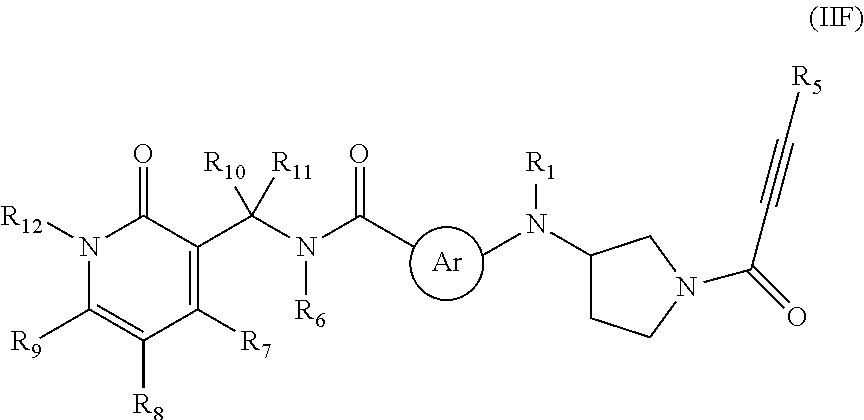
| TABLE 1 | ||
| com- | ||
| pound | structure | name |
| 1 |
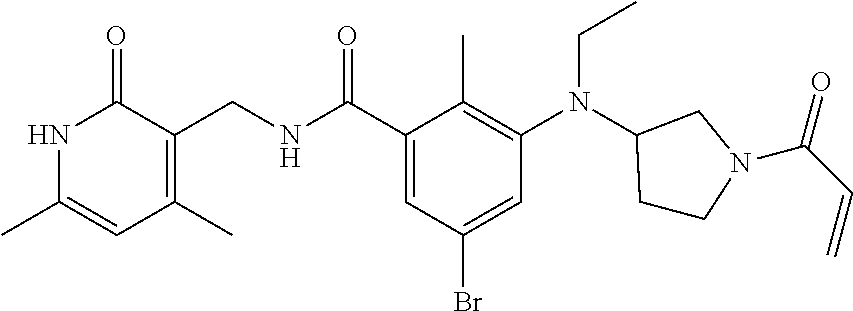 |
3-[(1-acryloyl-pyrrolidin-3-yl)-ethyl-amino]-5- bromo-N-(4,6-dimethyl-2-oxo-1,2-dihydro- pyridin-3-ylmethyl)-2-methyl-benzamide |
| 2 |
 |
3-[(1-acryloyl-pyrrolidin-3-y1)-ethyl-amino]- fluoro-N-(4,6-dimethyl-2-oxo-1,2-dihydro- pyridin-3-ylmethyl)-2-methyl-benzamide |
| 3 |
 |
3-[(1-acryloyl-pyrrolidin-3-y1)-ethyl-amino]-5- chloro-N-(4,6-dimethyl-2-oxo-1,2-dihydro- pyridin-3-ylmethyl)-2-methyl-benzamide |
| 4 |
 |
3-[(1-acryloyl-pyrrolidin-3-yl)-ethyl-amino]- N-(4,6-dimethyl-2-oxo-1,2-dihydro-pyridin-3- ylmethyl)-2-methyl-benzamide |
| 5 |
 |
3-[(1-acryloyl-pyrrolidin-3-yl)-ethyl-amino]-2,5- dibromo-N-(4,6-dimethyl-2-oxo-1,2-dihydro- pyridin-3-ylmethyl)-benzamide |
| 6 |
 |
3-[(1-acryloyl-piperidin-4-yl)-ethyl-amino]-5- bromo-N-(4,6-dimethyl-2-oxo-1,2-dihydro- pyridin-3-ylmethyl)-2-methyl-benzamide |
| 7 |
 |
3-[(1-acryloyl-azetidin-3-yl)-ethyl-amino]-5- bromo-N-(4,6-dimethyl-2-oxo-1,2-dihydro- pyridin-3-ylmethyl)-2-methyl-benzamide |
| 8 |
 |
3-(4-acryloyl-piperazin-l-y1)-5-bromo-N-(4,6- dimethyl-2-oxo-1,2-dihydro-pyridin-3- ylmethyl)-2-methyl-benzamide |
| 9 |
 |
3-[(1-acryloyl-pyrrolidin-3-yl)-butyl-amino]- 5-bromo-N-(4,6-dimethyl-2-oxo-1,2-dihydro- pyridin-3-ylmethyl)-2-methyl-benzamide |
| 10 |
 |
3-[(1-acryloyl-pyrrolidin-3-y1)-methyl-amino]- 5-bromo-N-(4,6-dimethyl-2-oxo-1,2-dihydro- pyridin-3-ylmethyl)-2-methyl-benzamide |
| 11 |
 |
3-[(1-acryloyl-pyrrolidin-3-yl)-ethyl-amino]- N-(4,6-dimethyl-2-oxo-1,2-dihydro-pyridin-3- ylmethyl)-2-methyl-5-[-(4-methyl-piperazin- 1-yl)-pyridin-3-ylamino]-benzamide |
| 12 |
 |
3-[(1-acryloyl-pyrrolidin-3-y1)-ethyl-amino]- N-(4,6-dimethyl-2-oxo-1,2-dihydro-pyridine- 3-ylmethyl)-2-methyl-5-[4-(morpholin-4- ylmethyl)-phenylamino]-benzamide |
| 13 |
 |
3-[(1-acryloyl-pyrrolidin-3-yl)-ethyl-amino]-5- (4-methyl-piperazin-1-yl)-N-(4,6-dimethyl- 2-oxo-1,2-dihydro-pyridin-3-ylmethyl)-2- methyl-benzamide |
| 14 |
 |
5-bromo-3-{[1-(4-dimethylamino-but-2-enoyl)- pyrrolidin-3-yl]-ethyl-amino}-N-(4,6-dimethyl- 2-oxo-1,2-dihydro-pyridin-3-ylmethyl)-2- methyl-benzamide |
| 15 |
 |
5-bromo-3-{1-(1-oxo-but-2-ynyl)-pyrrolidin- 3-yl]-ethyl-amino}-N-(4,6-dimethyl-2-oxo-1,2- dihydro-pyridin-3-ylmethyl)-2-methyl- benzamide |
| 16 |
 |
3-[(1-acryloyl-pyrrolidin-3-yl)-ethyl-amino]-5- methoxy-N-(4,6-dimethyl-2-oxo-1,2-dihydrogen- pyridin-3-ylmethyl)-2-methyl-benzamide |
| 17 |
 |
N-(4,6-dimethyl-2-oxo-1,2-dihydro-pyridin-3- ylmethyl)-5-[(1-acryloyl-pyrrolidin-3-yl)-ethyl- yl-amino]-4′-hydroxymethyl-4-methyl-biphenyl- 3-carboxamide |
| 18 |
 |
N-(4,6-dimethyl-2-oxo-1,2-dihydro-pyridin-3- ylmethyl)-5-[(1-acryloyl-pyrrolidin-3-yl)-ethyl- amino]-4′-(piperidin-1-ylmethyl)-4-methyl- biphenyl-3-carboxamide |
| 19 |
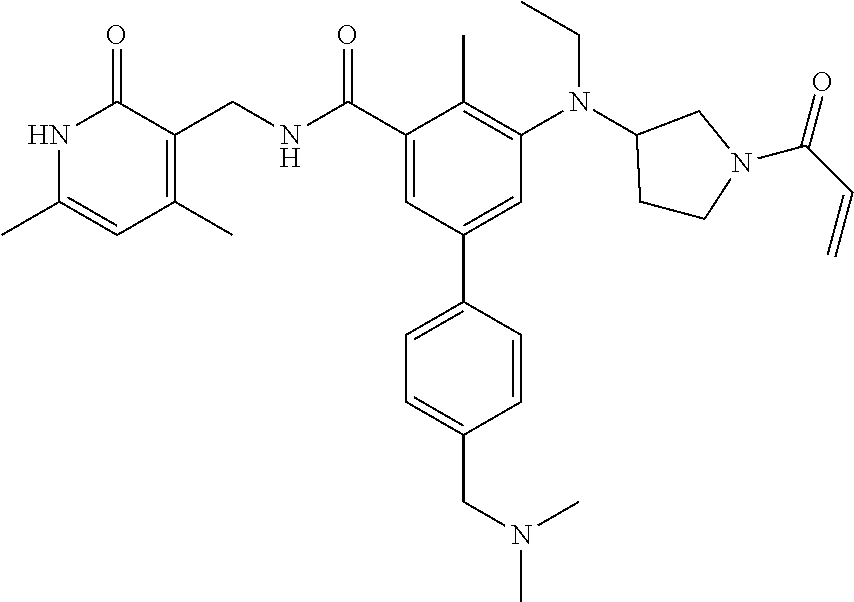 |
N-(4,6-dimethyl-2-oxo-1,2-dihydro-pyridin-3- ylmethyl)-5-[(1-acryloyl-pyrrolidin-3-yl)-ethyl- amino]-4′-(dimethylaminomethyl)-4-methyl- biphenyl-3-carboxamide |
| 20 |
 |
N-(4,6-dimethyl-2-oxo-1,2-dihydro-pyridin-3- ylmethyl)-5-[(1-acryloyl-pyrrolidin-3-yl)-ethyl- amino]-4′-(morpholin-4-ylmethyl)-4-methyl- biphenyl-3-carboxamide |
| 21 |
 |
N-(4,6-dimethyl-2-oxo-1,2-dihydro-pyridin-3- ylmethyl)-5-[(1-acryloyl-pyrrolidin-3-yl)-ethyl- amino]-3′-chloro-4′-(morpholin-4-ylmethyl)- 4-methyl-biphenyl-3-carboxamide |
| 22 |
 |
N-(4,6-dimethyl-2-oxo-1,2-dihydro-pyridin-3- ylmethyl)-5-[(1-acryloyl-pyrrolidin-3-yl)-ethyl- yl-amino]-3′-methoxy-4′-(morpholin-4-ylmethyl)- 4-methyl-biphenyl-3-carboxamide |
| 23 |
 |
N-(4,6-dimethyl-2-oxo-1,2-dihydro-pyridin-3- ylmethyl)-5-[(1-acryloyl-pyrrolidin-3-yl)-ethyl- amino]-3′-fluoro-4′-(morpholin-4-ylmethyl)- 4-methyl-biphenyl-3-carboxamide |
| 24 |
 |
N-(4,6-dimethyl-2-oxo-1,2-dihydro-pyridin-3- ylmethyl)-5-[(1-acryloyl-pyrrolidin-3-yl)-ethyl- amino]-4′-(morpholin-4-yl)-4-methyl-biphenyl- 3-carboxamide |
| 25 |
 |
N-(4,6-dimethyl-2-oxo-1,2-dihydro-pyridin-3- ylmethyl)-5-[(1-acryloyl-pyrrolidin-3-yl)-ethyl- amino]-4′-(4-methyl-piperazin-1-yl)-4-methyl- biphenyl-3-carboxamide |
| 26 |
 |
N-(4,6-dimethyl-2-oxo-1,2-dihydro-pyridin-3- ylmethyl)-2-methyl-3-[(1-acryloyl-pyrrolidin- 3-yl)-ethyl-amino]-5-(6-ethoxy-pyrimidin-4- yl)-benzamide |
| 27 |
 |
N-(4,6-dimethyl-2-oxo-1,2-dihydro-pyridin-3- ylmethyl)-2-methyl-3-[(1-acryloyl-pyrrolidin- 3-yl)-ethyl-amino]-5-(6-ethoxy-pyrimidin-4- yl)-benzamide |
| 28 |
 |
N-(4,6-dimethyl-2-oxo-1,2-dihydro-pyridin-3- ylmethyl)-5-[(1-acryloyl-pyrrolidin-3-yl)-ethyl- amino]-4-methyl-thiophene-3-carboxamide |
| 29 |
 |
N-(4,6-dimethyl-2-oxo-1,2-dihydro-pyridin-3- ylmethyl)-5-[(1-acryloyl-pyrrolidin-3-yl)-ethyl- amino]-4-methyl-4′-(pyrrolidin-1-ylmethyl)- [1,1'-biphenyl]-3-carboxamide |
| 30 |
 |
N-(4,6-dimethyl-2-oxo-1,2-dihydro-pyridin-3- ylmethyl)-5-[(1-acryloyl-pyrrolidin-3-yl)-ethyl- amino]-4-methyl-3′-(morpholin-4-yl)-methyl- [1,1′-biphenyl]-3-carboxamide |
| 31 |
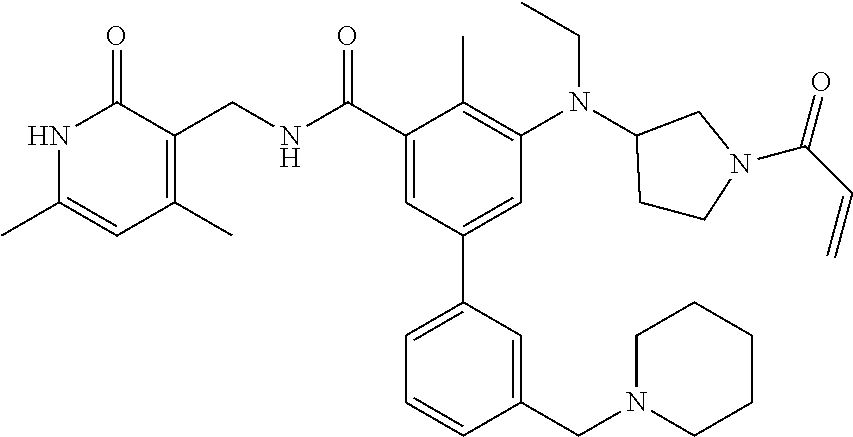 |
N-(4,6-dimethyl-2-oxo-1,2-dihydro-pyridin-3- ylmethyl)-5-[(1-acryloyl-pyrrolidin-3-yl)-ethyl- amino]-4-methyl-3′-(piperidin-1-ylmethyl)- [1,1′-biphenyl]-3-carboxamide |
| 32 |
 |
N-(4,6-dimethyl-2-oxo-l,2-dihydro-pyridin-3- ylmethyl)-5-[(1-acryloyl-pyrrolidin-3-yl)-ethyl- amino]-4-methyl-4′-(4-hydroxypiperidin-1- ylmethyl)-[1,1′-biphenyl]-3-carboxamide |
| 33 |
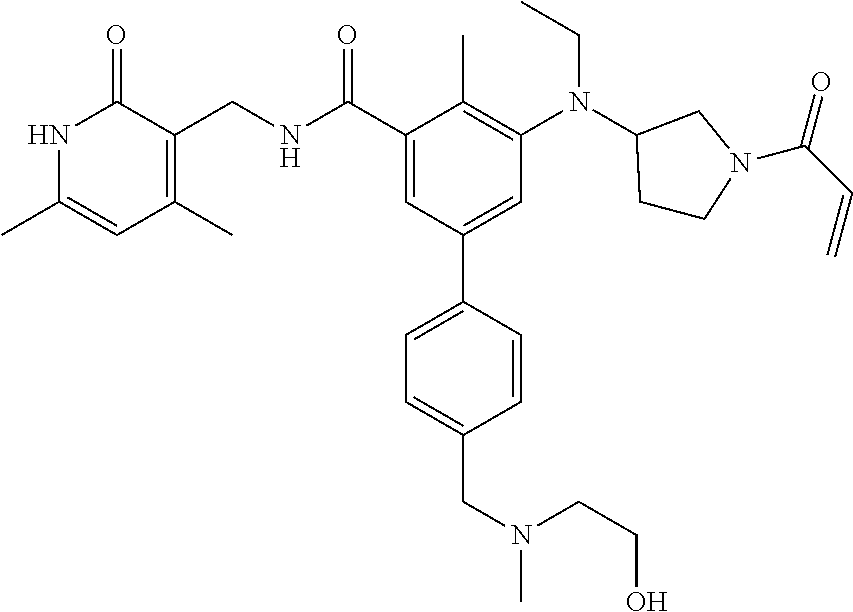 |
N-(4,6-dimethyl-2-oxo-1,2-dihydro-pyridin-3- ylmethyl)-5-[(1-acryloyl-pyrrolidin-3-yl)-ethyl- amino]-4-methyl-4′-{[(2-hydroxyethyl)-methyl- amino]-methyl}-[1,1′-biphenyl]-3-carboxamide |
| 34 |
 |
N-(4,6-dimethyl-2-oxo-1,2-dihydro-pyridin-3- -ylmethyl)-5-[(1-acryloyl-piperidin-4-yl)-ethyl- amino]-4-methyl-4′-(piperidin-1-ylmethyl)- [1,1′-biphenyl]-3-carboxamide |
| 35 |
 |
N-(4,6-dimethyl-2-oxo-1,2-dihydro-pyridin-3- ylmethyl)-5-[(1-acryloyl-piperidin-4-yl)-ethyl- amino]-4-methyl-4′-(morpholin-4-ylmethyl)- [1,1′-biphenyl]-3-carboxamide |
| 36 |
 |
N-(4,6-dimethyl-2-oxo-1,2-dihydro-pyridin-3- ylmethyl)-2-methyl-3-[(1-acryloyl-pyrrolidin- 3-yl)-ethyl-amino]-5-[6-(morpholin-4-yl)- pyrimidin-4-yl]-benzamide |
| 37 |
 |
N-(4,6-dimethyl-2-oxo-1,2-dihydro-pyridin-3- ylmethyl)-3-[(1-acryloyl-pyrrolidin-3-yl)-ethyl- amino]-2-methyl-5-[2-(morpholin-4-yl)- pyrimidin-4-yl]-benzamide |
| 38 |
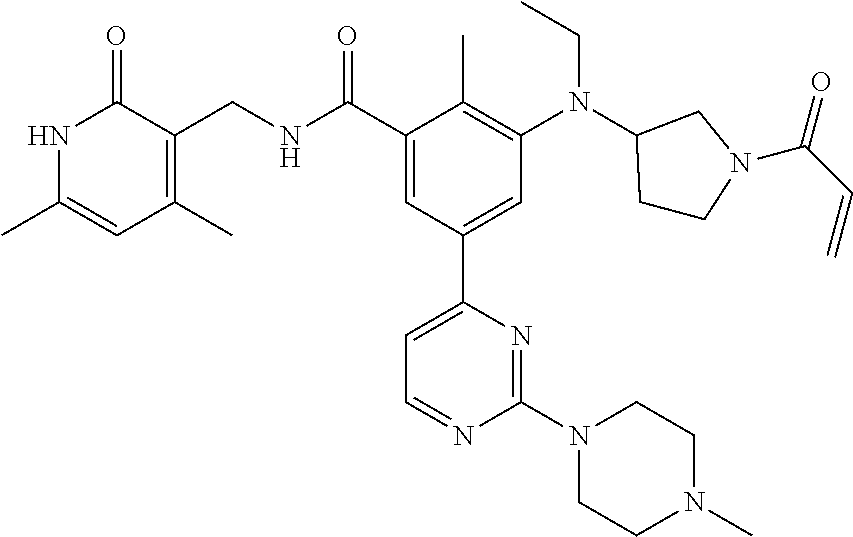 |
N-(4,6-dimethyl-2-oxo-1,2-dihydro-pyridin-3- ylmethyl)-3-[(1-acryloyl-pyrrolidin-3-yl)-ethyl- amino]-2-methyl-5-[2-(4-methyl-piperazin- 1-yl)-pyrimidin-4-yl]-benzamide |
| 39 |
 |
N-(4,6-dimethyl-2-oxo-1,2-dihydro-pyridin-3- ylmethyl)-5-[(1-acryloyl-pyrrolidin-3-yl)-ethyl- amino]-4-methyl-4′-(morpholin-4-ylformyl)- [1,1′-biphenyl]-3-carboxamide |
| 40 |
 |
N-(4,6-dimethyl-2-oxo-1,2-dihydro-pyridin-3- ylmethyl)-5-[(1-acryloyl-pyrrolidin-3-yl)-ethyl- amino]-4-methyl-3′-(morpholin-4-ylformyl)- [1,1′-biphenyl]-3-carboxamide |
| 41 |
 |
N-(4,6-dimethyl-2-oxo-1,2-dihydro-pyridin-3- ylmethyl)-5-[(1-acryloyl-pyrrolidin-3-yl)-ethyl- amino] -4-methyl-4′-(4-methyl-piperazin-1- ylformyl)-[1,1′-biphenyl]-3-carboxamide |
| 42 |
 |
N-(4,6-dimethyl-2-oxo-1,2-dihydro-pyridin-3- ylmethyl)-5-[(1-acryloyl-pyrrolidin-3-yl)-ethyl- amino]-4-methyl-3′-(4-methyl-piperazin-1- ylformyl)-[1,1′-biphenyl] -3-carboxamide |
| 43 |
 |
N-(4,6-dimethyl-2-oxo-1,2-dihydro-pyridin-3- ylmethyl)-5-[(1-acryloyl-pyrrolidin-3-yl)-ethyl- amino]-4′-(morpholin-4-ylformyl)-3′-chloro- 4-methyl-[1,1′-biphenyl]-3-carboxamide |
| 44 |
 |
N-(4,6-dimethyl-2-oxo-1,2-dihydro-pyridin-3- ylmethyl)-5-[(1-acryloyl-pyrrolidin-3-yl)-ethyl- amino] -4′-(4-methyl-piperazin-1-ylformyl)- 3′-chloro-4-methyl-[1,1′-biphenyl]-3- carboxamide |
| 45 |
 |
N-(4,6-dimethyl-2-oxo-1,2-dihydro-pyridin-3- ylmethyl)-5-[(1-acryloyl-pyrrolidin-3-yl)- ethyl-amino]-4-methyl-4′-(morpholin-4- ylsulfonyl)-[1,1′-biphenyl]-3-carboxamide |
| 46 |
 |
N-(4,6-dimethyl-2-oxo-1,2-dihydro-pyridin-3- ylmethyl)-5-[(1-acryloyl-pyrrolidin-3-yl)- ethyl-amino]-4-methyl-4′-(4-methyl-piperazin-1- ylsulfonyl)-[1,1′-biphenyl]-3-carboxamide |
| 47 |
 |
N-(4,6-dimethyl-2-oxo-1,2-dihydro-pyridin-3- ylmethyl)-5-[(1-acryloyl-pyrrolidin-3-yl)- ethyl-amino]-4-methyl-4′- (2-dimethylaminoethoxy)- [1,1′-biphenyl]-3-carboxamide |
| 48 |
 |
N-(4,6-dimethyl-2-oxo-1,2-dihydro-pyridin-3- ylmethyl)-5-[(1-acryloyl-pyrrolidin-3-yl)-ethyl- amino]-4-methyl-4′-[2-(morpholin-4-yl)- ethoxy] -[1,1′-biphenyl]-3-carboxamide |
| 49 |
 |
N-(4,6-dimethyl-2-oxo-1,2-dihydro-pyridin-3- ylmethyl)-5-{3-[(1-acryloyl-pyrrolidin-3-yl)- ethyl-amino]-5-[(4,6-dimethyl-2-oxo-1,2-dihydro- pyridin-3-ylmethyl)-carbamoyl]-4-methyl- phenyl}-thiophene[3,2-b]-thiophene-2- carboxamide |
| 50 |
 |
N-(2-hydroxyethyl)-N-methyl-5-{3-[(1- acryloyl-piperidin-4-yl)-ethyl-amino]- 5-(4,6-dimethyl- 2-oxo-1,2-dihydro-pyridin-3-ylmethyl)- carbamoyl]- 4-methyl-phenyl}-thiopheno[3,2-b] thiophene-2-carboxamide |
| 51 |
 |
N-(4,6-dimethyl-2-oxo-1,2-dihydro-pyridin-3- ylmethyl)-3-[(1-acryloyl-pyrrolidin-3-yl)- ethyl-amino]-2-methyl-5-[3-(morpholin-4-yl)- propyn-1-yl] -benzamide |
| 52 |
 |
N-(4,6-dimethyl-2-oxo-1,2-dihydro-pyridin-3- ylmelhyl)-3-[(1-acryloyl-pyrrolidin-3-yl)-ethyl- amino]-2-methyl-5-[6-(morpholin-4-yl)-pyridin- 3-yl]-benzamide |
| 53 |
 |
N-(4,6-dimethyl-2-oxo-1,2-dihydro-pyridin- 3-ylmethyl)-3-[(1-acryloyl-pyrrolidin-3-yl)- ethyl-amino]-2-methyl-5-[6-(4- methylpiperazin- 1-yl)-pyridin-3-yl]-benzamide |
| 54 |
 |
N-(4,6-dimethyl-2-oxo-1,2-dihydro-pyridin-3- ylmethyl)-3-[(1-acryloyl-pyrrolidin-3-yl)-ethyl- amino]-2-methyl-5-(1-methyl-1H-pyrazol- 4-yl)-benzamide |
| 55 |
 |
N-(4,6-dimethyl-2-oxo-1,2-dihydro-pyridin-3- ylmethyl)-5-[(1-acryloyl-pyrrolidin-3-yl)-ethyl- amino]-4,3′-dimethyl-[1,1′-biphenyl]-3- carboxamide |
| 56 |
 |
Ethyl 3′-[(4,6-dimethyl-2-oxo-1,2-dihydro-pyridin-3- ylmethyl)-formyl]-5′-[(1-acryloyl-pyrrolidin- 3-yl)-ethyl-amino]-4′-methyl-[1,1′-biphenyl]- 4-carboxylate |
| 57 |
 |
3′-[(4,6-dimethyl-2-oxo-1,2-dihydro-pyridin-3- ylmethyl)-formyl]-5′-[(1-acryloyl-pyrrolidin- 3-yl)-ethyl-amino]-4′-methyl-[1,1-biphenyl]- 4-carboxylic acid |
| 58 |
 |
3-{[2-(acryloyl-methyl-amino)-ethyl]-ethyl- amino}-5-bromo-N-(4,6-dimethyl-2-oxo-1,2- dihydro-pyridin-3-ylmethyl)-2-methyl-benzamide |
| 59 |
 |
N-(4,6-dimethyl-2-oxo-1,2-dihydro-pyridin-3- ylmethvl)-3-[(1-acryloyl-pyrrolidin-3-yl)- (2,2,2-trifluoroethyl)-amino]-2-methyl-5- bromobenzamide |
| 60 |
 |
N-(4,6-dimethyl-2-oxo-1,2-dihydro-pyridin-3- ylmethyl)-3-[(1-acryloyl-pyrrolidin-3-yl)-ethyl- amino]-5-bromo-4-fluoro-2-methyl-benzamide |
| 61 |
 |
N-(4,6-dimethyl-2-oxo-1,2-dihydro-pyridin-3- ylmethyl)-3-[(1-acryloyl-piperidin-4-yl)-ethyl- amino]-5-bromo-4-fluoro-2-methyl-benzamide |
| 62 |
 |
N-(4,6-dimethyl-2-oxo-1,2-dihydro-pyridin-3- ylmethyl)-5-[(l-acryloyl-piperidin-4-yl)-ethyl- amino]-3′-fluoro-4-methyl-4′-(morpholin-4- ylmethyl)-[1,1′-biphenyl]-3-carboxamide |
| 63 |
 |
N-(4,6-dimethyl-2-oxo-1,2-dihydro-pyridin-3- ylmethyl)-5-[(1-acryloyl-piperidin-4-yl)-ethyl- amino]-4-methyl-4′-(4,4-difluoro-piperidin- 1-ylmethyl)-[1,1′-biphenyl]-3-carboxamide |
| 64 |
 |
N-(4,6-dimethyl-2-oxo-1,2-dihydro-pyridin-3- ylmethyl)-5-[(1-acryloyl-piperidin-4-yl)-ethyl- amino]-4-methyl-4′-(4-acetyl-piperazin-1-yl methyl)-[1,1′-biphenyl]-3-carboxamide |
| 65 |
 |
N-(4,6-dimethyl-2-oxo-1,2-dihydro-pyridin-3- -ylmethyl)-5-[(1-acryloyl-piperidin-4-yl)-ethyl- amino]-4-methyl-4′-(4-methoxypiperidin-1- ylmethyl)-[1,1′-biphenyl]-3-carboxamide |
| 66 |
 |
N-(4,6-dimethyl-2-oxo-1,2-dihydro-pyridin-3- ylmethyl)-5-[(1-acryloyl-piperidin-4-yl)-ethyl- amino]-4-methyl-4′-(4-dimethylamino-piperidin- 1-ylmethyl)-[1,1′-biphenyl]-3-carboxamide |
| 67 |
 |
N-(4,6-dimethyl-2-oxo-1,2-dihydro-pyridin-3- ylmethyl)-5-[(1-acryloyl-piperidin-4-yl)-ethyl- amino]-4-methyl-4′-(4-methylhomopiperazin- 1-ylmethyl)-[1,1′-biphenyl]-3-carboxamide |
| 68 |
 |
N-(4,6-dimethyl-2-oxo-1,2-dihydro-pyridin-3- ylmethyl)-5-[(1-acryloyl-piperidin-4-yl)-ethyl- amino]-4-methyl-4′-(3-oxopiperin-1-ylmethyl)- [1,1-biphenyl]-3-carboxamide |
| 69 |
 |
N-(4,6-dimethyl-2-oxo-1,2-dihydro-pyridin-3- ylmethyl)-5-[(1-acryloyl-piperidin-4-yl)-ethyl- amino]-4-methyl-4′-(4-methylpiperazin-1-yl methyl)-[1,1′-biphenyl]-3-carboxamide |
| 70 |
 |
N-(4,6-dimethyl-2-oxo-1,2-dihydro-pvridin-3- ylmethyl)-5-[(1-acryloyl-piperidin-4-yl)-ethyl- amino]-4-methyl-3′-(morpholin-4-ylmethyl)- [1,1′-biphenyl]-3-carboxamide |
| 71 |
 |
N-(4,6-dimethyl-2-oxo-1,2-dihydro-pyridin-3- ylmethyl)-5-[(1-acryloyl-piperidin-4-yl)-ethyl- amino]-3′-chloro-4-methyl-4′-(morpholin-4- ylmethyl)-[1,1′-biphenyl]-3-carboxamide |
| 72 |
 |
N-(4,6-dimethyl-2-oxo-1,2-dihydro-pyridin-3- ylmethyl)-5-[(1-acryloyl-piperidin-4-yl)-ethyl- amino]-4-methyl-3′-(piperidin-1-ylmethyl)- [1,1′-biphenyl]-3-carboxamide |
| 73 |
 |
N-(4,6-dimethyl-2-oxo-1,2-dihydro-pyridin-3- ylmethyl)-5-[(1-acryloyl-piperidin-4-yl)-ethyl- amino]-4-methyl-3′-(4-methylpiperazin-1-yl methyl)-[1,1′-biphenyl]-3-carboxamide |
| 74 |
 |
N-(4,6-dimethyl-2-oxo-1,2-dihydro-pyridin-3- ylmethyl)-5-[(1-acryloyl-piperidin-4-yl)-ethy1- amino]-4-methyl-3′-(4-acetylpiperazin-1-yl methyl)-[1,1′-biphenyl]-3-carboxamide |
| 75 |
 |
N-(4,6-dimethyl-2-oxo-1,2-dihydro-pyridin-3- -ylmethyl)-5-[(1-acryloyl-piperidin-4-yl)-ethyl- amino]-4-methyl-3′-(4-methylhomopiperazin- 1-ylmethyl)-[1,1′-biphenyl]-3-carboxamide |
| 76 |
 |
N-(4,6-dimethyl-2-oxo-1,2-dihydro-pyridin-3- ylmethyl)-5-[(1-acryloyl-piperidin-4-yl)-ethyl- amino]-4-methyl-4′-(3-methoxy-1-azetidinyl methyl)-[1,1′-biphenyl]-3-carboxamide |
| 77 |
 |
N-(4,6-dimethyl-2-oxo-1,2-dihydro-pyridin-3- ylmethyl)-5-[(1-acryloyl-piperidin-4-yl)-ethyl- amino]-4-methyl-4′-[4-(2-methoxyethyloxy)- piperidin-1-ylmethyl]-[1,1′-biphenyl]-3- carboxamide |
| 78 |
 |
N-(4,6-dimethyl-2-oxo-1,2-dihydro-pyridin-3- ylmethyl)-5-[(1-acryloyl-piperidin-4-yl)-ethyl- amino]-4-methyl-4′-(2-oxa-7-aza-spiro[3.5] dec-7-ylmethyl)-[1,1′-biphenyl]-3-carboxamide |
| 79 |
 |
N-(4,6-dimethyl-2-oxo-1,2-dihydro-pyridin-3- ylmethyl)-5-bromo-3-{ethyl-[1-(4-morpholin- 4-yl-but-2-enoyl)-piperidin-4-yl]-amino}-2- methyl-benzamide |
| 80 |
 |
N-(4,6-dimethyl-2-oxo-1,2-dihydro-pyridin-3- ylmethy l)-5-[(1-acryloyl-piperidin-4-yl)-ethyl- amino]-4-methyl-3′-[4-(morpholin-4-yl)- piperazin-1-ylmethyl]-biphenyl-3-carboxamide |
| 81 |
 |
N-(4,6-dimethyl-2-oxo-1,2-dihydro-pyridin-3- ylmethvl)-5-[(1-acryloyl-piperidin-4-yl)-ethyl- amino]-4-methyl-4′-[4-(morpholin-4-yl)- piperazin-1-ylmethyl]-[1,1′-biphenyl]-3- carboxamide |
| 82 |
 |
N-(4,6-dimethyl-2-oxo-1,2-dihydro-pyridin-3- ylmethyl)-5-[(1-acryloyl-piperidin-4-yl)-ethyl- amino]-4-methyl-3′-(4-methoxypiperidin-1- ylmethyl)-[1,1′-biphenyl]-3-carboxamide |
| 83 |
 |
N-(4,6-dimethyl-2-oxo-1,2-dihydro-pyridin-3- ylmethyl)-5-[(1-acryloyl-piperidin-4-yl)-ethyl- amino]-4-methyl-4′-(4-oxo-piperidin-1-ylmethyl)- [1,1′-biphenyl]-3-carboxamide |
| 84 |
 |
N-(4,6-dimethyl-2-oxo-1,2-dihydro-pyridin-3- ylmethvl)-5-[(1-acryloyl-piperidin-4-yl)-ethyl- amino]-4-methyl-4′-(4-hydroxypiperidin-1- ylmethyl)-[1,1′-biphenyl]-3-carboxamide |
| 85 |
 |
N-(4,6-dimethyl-2-oxo-1,2-dihydro-pyridin-3- ylmethyl)-5-[(1-acryloyl-piperidin-4-yl)-ethyl- amino]-4-methyl-4′-(3-isopropoxy-1- azetidinylmethyl)-[1,1′-biphenyl]-3-carboxamide |
| 86 |
 |
N-(4,6-dimethyl-2-oxo-1,2-dihydro-pyridin-3- ylmethyl)-5-[(1-acryloyl-piperidin-4-yl)-ethyl- amino]-3′-chloro-4-methyl-4′-[4-(morpholin- 4-yl)-piperidin-1-ylmethyl]-[1,1′-biphenyl]- 3-carboxamide |
| 87 |
 |
N-(4,6-dimethyl-2-oxo-1,2-dihydro-pyridin-3- ylmethyl)-5-[(1-acryloyl-piperidin-4-yl)-ethyl- amino] -4-methyl-4′-(l -oxa-8-aza-spiro[4.5] decane-8-ylmethyl)-[1,1′-biphenyl]-3- carboxamide |
| 88 |
 |
N-(4,6-dimethyl-2-oxo-1,2-dihydro-pyridin-3- ylmethyl)-5-[(1-acryloyl-piperidin-4-yl)-ethyl- amino]-4-methyl-4′-(4-ethoxypiperidin-1-yl methyl)-[1,1′-biphenyl]-3-carboxamide |
| 89 |
 |
N-(4,6-dimethyl-2-oxo-1,2-dihydro-pyridin-3- ylmethyl)-5-[(1-acryloyl-piperidin-4-yl)-ethyl- amino]-4-methyl-4′-[4-(tetrahydropyran-4-yl)- piperazin-1-ylmethyl]-[1,1′-biphenyl]-3- carboxamide |
| 90 |
 |
N-(4,6-dimethyl-2-oxo-1,2-dihydro-pyridin-3- ylmethyl)-5-[(1-acryloyl-piperidin-4-yl)-ethyl- amino]-3′-chloro-4-methyl-4′-(4- methoxypiperidin-4-ylmethyl)-[1,1′-biphenyl]-3- carboxamide |
| 91 |
 |
N-(4,6-dimethyl-2-oxo-1,2-dihydro-pyridin-3- ylmethyl)-5-[(1-acryloyl-piperidin-4-yl)-ethyl- amino]-3′-chloro-4-methyl-4′-(3- methoxypiperidin-4-ylmethyl)-[1,1′-biphenyl]-3- carboxamide |
| 92 |
 |
N-(4,6-dimethyl-2-oxo-1,2-dihydro-pyridin-3- ylmethyl)-5-[(1-acryloyl-piperidin-4-yl)-ethyl- amino]-4-methyl-4′-(3-methoxypiperidin-4- ylmethyl)-[1,1′-biphenyl]-3-carboxamide |
| 93 |
 |
N-(4,6-dimethyl-2-oxo-1,2-dihydro-pyridin-3- ylmethyl)-5-[(1-acryloyl-piperidin-4-yl)-ethyl- amino]-3′-fluoro-4-methyl-4′-(3- methoxypiperidin-4-ylmethyl)-[1,1′-biphenyl]-3- carboxamide |
| 94 |
 |
N-(4,6-dimethyl-2-oxo-1,2-dihydro-pyridin-3- ylmethyl)-5-[(1-acryloyl-piperidin-4-yl)-ethyl- amino]-3′,4-dimethyl-4′-(3-methoxypiperidin- 4-ylmethyl)-[1,1′-biphenyl]-3- carboxamideboxamide |
| 95 |
 |
N-(4,6-dimethyl-2-oxo-1,2-dihydro-pyridin-3- ylmethyl)-5-[(1-acryloyl-piperidin-3-yl)-ethyl- amino]-4-methyl-4′-(4-methoxypiperidin-1- ylmethyl)-[1,1′-biphenyl]-3-carboxamide |
| 96 |
 |
5-((1-(2-cyanoacetyl)piperidin-4-yl)(ethyl)amino)- N-((4,6-dimethyl-2-oxo-1,2-dihydropyridin- 3-yl)methyl)-4-methyl-4′-(morpholin-4-yl methyl)biphenyl-3-carboxamide |


can be read as


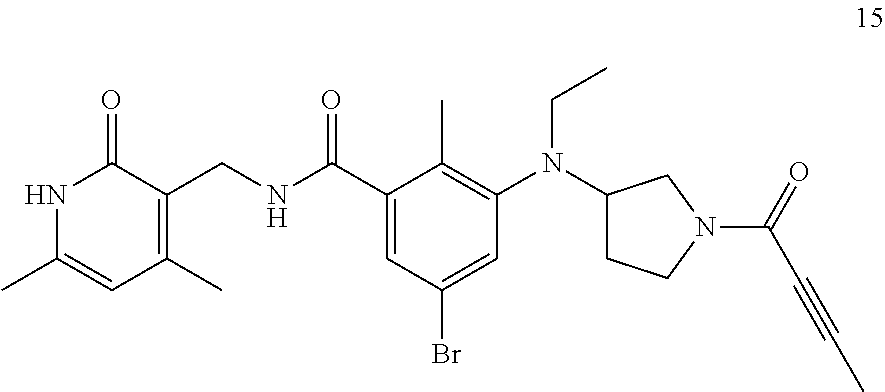


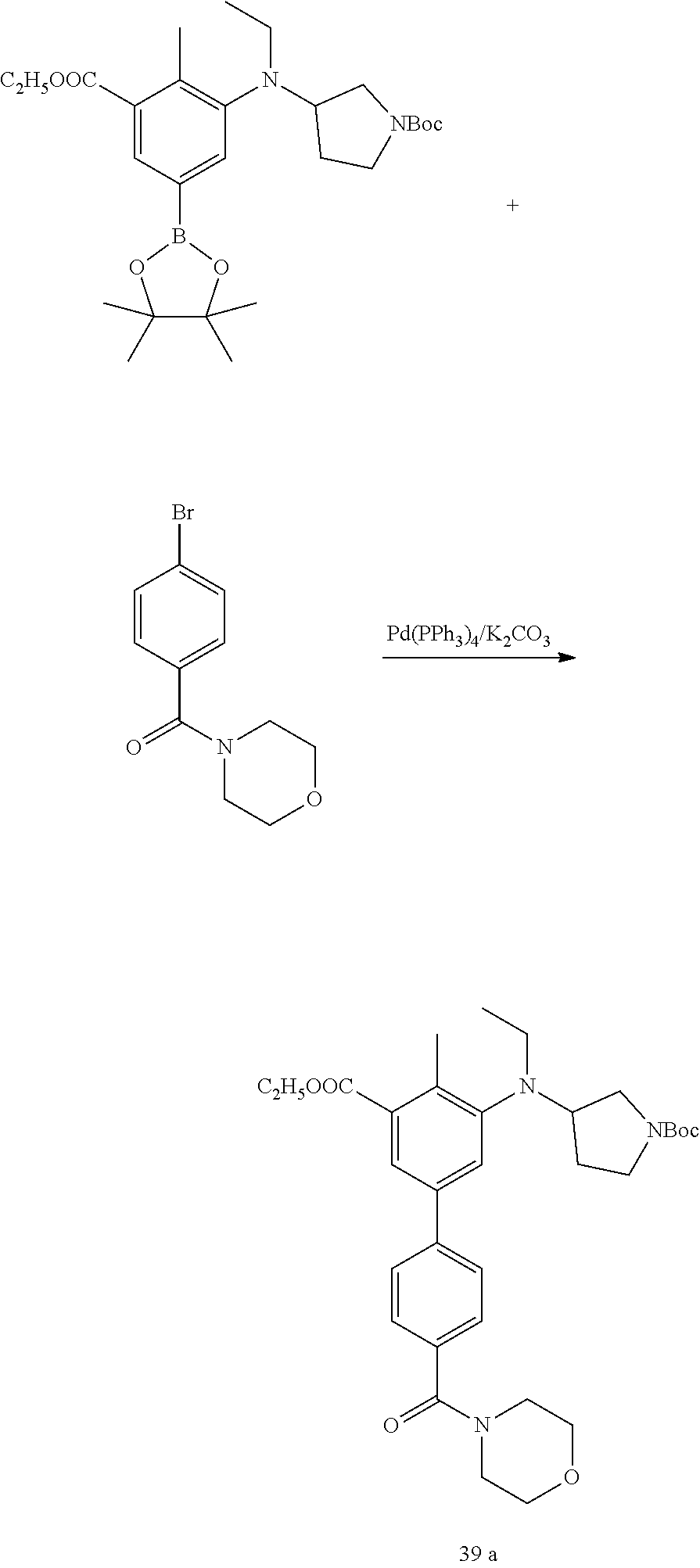


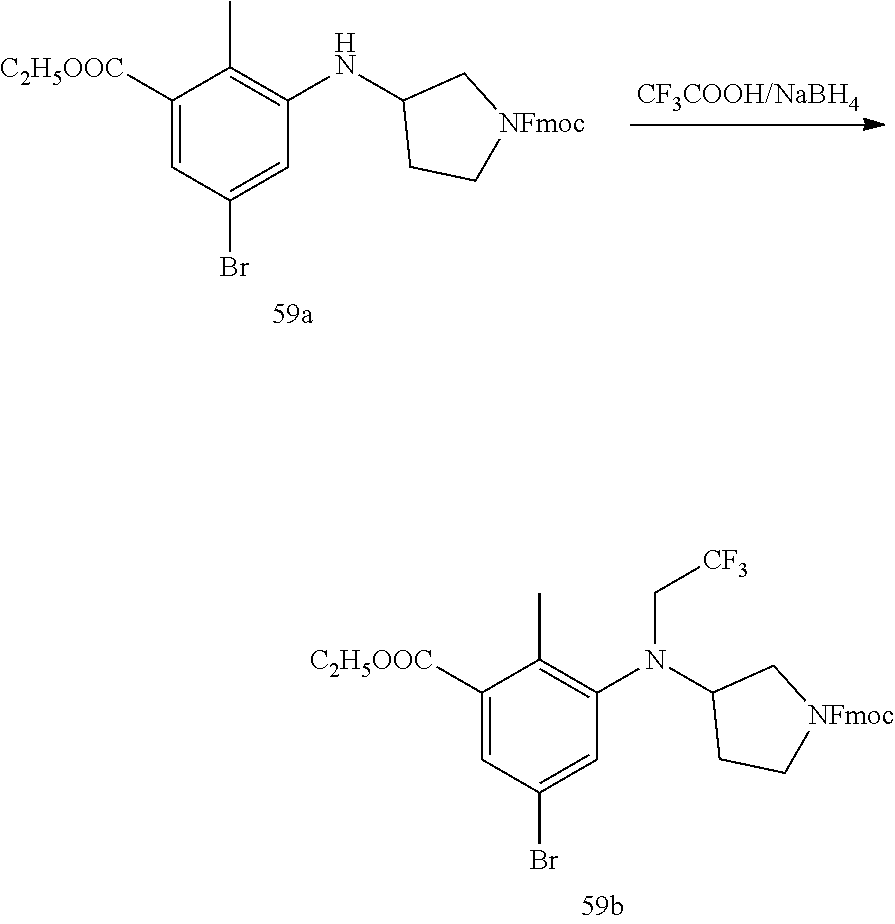


Cell Growth Rate (%)=100*(T−T 0)/(C−T 0)
T=Optical density of drug-treated cell wells−Optical density of blank control wells; T0=Optical density of cell wells before drug treatment−Optical density of blank control wells; C=Optical density of solvent control wells−Optical density of blank control wells.
| TABLE 2 | |
| GI50(nM) | |
| (*****: <1 nM; ****: 1 nM~<10 nM; ***: | |
| 10 nM~<100 nM; **: 100 nM~<1000 nM; *: >1000 nM) | |
| Pfeiffer | Karpas-422 | SU-DHL-8 | |
| (EZH2 A677G) | (EZH2 Y641N) | (EZH2 WT) | |
| Drug treatment | Drug treatment | Drug treatment | |
| Compounds | for 10 days | for 6 days | for 6 days |
| EPZ-6438 | **** | *** | * |
| 1 | **** | *** | * |
| 2 | *** | *** | * |
| 3 | **** | *** | * |
| 6 | **** | *** | * |
| 9 | *** | * | * |
| 10 | *** | * | * |
| 15 | **** | *** | * |
| 16 | *** | ** | * |
| 18 | **** | *** | * |
| 19 | *** | ** | * |
| 20 | **** | ** | * |
| 21 | **** | ** | * |
| 23 | **** | *** | * |
| 24 | **** | ** | * |
| 30 | **** | *** | * |
| 31 | **** | *** | * |
| 34 | **** | *** | * |
| 35 | **** | *** | * |
| 48 | *** | ** | * |
| 51 | **** | *** | * |
| 52 | **** | *** | * |
| 53 | **** | *** | * |
| 62 | **** | *** | * |
| 65 | ***** | *** | * |
| 70 | **** | *** | * |
| 71 | **** | *** | * |
| 75 | **** | *** | * |
| 76 | **** | *** | * |
| 77 | ***** | *** | * |
| 81 | **** | *** | * |
| 87 | ***** | *** | * |
| 88 | ***** | *** | * |
| 89 | ***** | *** | * |
Determination standard: TGI (%): TGI−1−T/C (%).
T/C%=T RTV /C RTV*100%
TRTV: mean RTV of the treatment group; CRTV: mean RTV of solvent control group; RTV=Vt/V0, V0 was the tumor volume of the animal when grouping, Vt was the tumor volume of the animal after treatment. Statistical analysis: all test results were defined as mean tumor volume±SEM (mean standard error). Tumor volume data of 27 days after the start of treatment were selected for statistical analysis among different groups, and independent sample T test was used to compare whether there were significant differences in tumor volume between the treatment group and the control group. All data were analyzed using SPSS 18.0. P<0.05 was considered as significant difference.
| TABLE 3 |
| Changes of tumor volume (mm3) in mice over treatment time |
| Time | Compound 34 | Compound 35 | |
| (After the start of | The solvent | group | group |
| treatment) | control group | (200 mg/kg) | (200 mg/kg) |
| Day 0 | 134 ± 10 | 135 ± 10 | 134 ± 9 |
| Day 3 | 320 ± 24 | 298 ± 25 | 324 ± 38 |
| Day 7 | 522 ± 81 | 439 ± 48 | 681 ± 72 |
| Day 10 | 630 ± 74 | 441 ± 56 | 635 ± 88 |
| Day 14 | 995 ± 112 | 381 ± 39 | 710 ± 87 |
| Day 17 | 1394 ± 143 | 472 ± 100 | 751 ± 135 |
| Day 21 | 1631 ± 146 | 477 ± 158 | 801 ± 152 |
| Day 24 | 1783 ± 163 | 570 ± 154 | 1029 ± 193 |
| Day 27 | 1869 ± 178 | 538 ± 199 | 1116 ± 196 |
| TABLE 4 |
| TGI and T/C values of each groups on the 27th day after the start of treatment |
| Tumor | ||||||
| volume | Tumor volume | |||||
| mm3 ( |
mm3 ( |
|||||
| 0 day after the | 27 days after | P value | ||||
| start of | the start of | RTV | TGI | T/C | (Compared to the | |
| Groups | treatment | treatment | ( |
(%) | (%) | control group) |
| The solvent | 134 ± 10 | 1869 ± 178 | 14.2 ± 1.3 | — | — | — |
| control group | ||||||
| Compound 34 | 135 ± 10 | 538 ± 199 | 4.7 ± 2.3 | 67.1 | 32.9 | 0.005 |
| group | ||||||
| (200 mg/kg) | ||||||
| Compound 35 | 134 ± 9 | 1116 ± 196 | 8.2 ± 1.1 | 42.3 | 57.7 | 0.006 |
| group | ||||||
| (200 mg/kg) | ||||||
| TABLE 5 |
| Tumor weights of each groups |
| Tumor weight | ||||
| (mg) ( |
P value | |||
| 27 days after | (Compared to | |||
| the start of | T/C | the control | ||
| Groups | treatment | TGI | (%) | group) |
| The solvent control group | 1130 ± 174 | — | — | — |
| Compound 34 group | 264 ± 113 | 76.6 | 23.4 | 0.002 |
| (200 mg/kg) | ||||
| Compound 35 group | 580 ± 99 | 48.7 | 51.3 | 0.021 |
| (200 mg/kg) | ||||
| TABLE 6 |
| Irreversible inhibition of compound 34 on the in vitro |
| growth of Pfeiffer cells |
| Drug | Pfeiffer cells growth rate (%) | |
| concentration | (10 days) |
| Compound | (nM) | Continuous | Washout |
| Vehical | — | 100% | 100% |
| Compound | 25 | 0% | 0% |
| 34 | 50 | 0% | 0% |
| 100 | 0% | 0% | |
| EPZ-6438 | 25 | 0% | 92% |
| TABLE 7 |
| Results of the bioavailability of the present compound in rats |
| Compound 34 | Compound 35 | |
| Solvent | Methanesulfonic acid | Methanesulfonic acid |
| aqueous solution | aqueous solution | |
| IV | 5 mg/kg | 5 mg/kg |
| PO | 100 mg/kg | 100 mg/kg |
| SD rats | 3 (iv), 3 (po) | 3 (iv), 3 (po) |
| Blood | 0 min, 2 min, | 0 min, 2 min, |
| sampling | 5 min, 15 min, | 5 min, 15 min, |
| time | 30 min, 1 h, | 30 min, 1 h, |
| 2 h, 4 h, 6 h, 8 h, 24 h | 2 h, 4 h, 6 h, 8 h, 24 h | |
| Bioavailability | 48.8% | 39.1% |
Claims (17)


Applications Claiming Priority (5)
| Application Number | Priority Date | Filing Date | Title |
|---|---|---|---|
| CN201710061026 | 2017-01-25 | ||
| CN201710061026.0 | 2017-01-25 | ||
| CN201710345609 | 2017-05-16 | ||
| CN201710345609.6 | 2017-05-16 | ||
| PCT/CN2018/073946 WO2018137639A1 (en) | 2017-01-25 | 2018-01-24 | Histone methyltransferase ezh2 inhibitor, preparation method and pharmaceutical use thereof |
Publications (2)
| Publication Number | Publication Date |
|---|---|
| US20190345139A1 US20190345139A1 (en) | 2019-11-14 |
| US11214561B2 true US11214561B2 (en) | 2022-01-04 |
Family
ID=62978081
Family Applications (1)
| Application Number | Title | Priority Date | Filing Date |
|---|---|---|---|
| US16/478,472 Expired - Fee Related US11214561B2 (en) | 2017-01-25 | 2018-01-24 | Histone methyltransferase EZH2 inhibitor, preparation method and pharmaceutical use thereof |
Country Status (3)
| Country | Link |
|---|---|
| US (1) | US11214561B2 (en) |
| CN (1) | CN110191879A (en) |
| WO (1) | WO2018137639A1 (en) |
Families Citing this family (18)
| Publication number | Priority date | Publication date | Assignee | Title |
|---|---|---|---|---|
| US11001552B2 (en) | 2017-07-18 | 2021-05-11 | Lonza Ltd | Method for preparation of 5-fluoro-2-methyl-3-nitrobenzoic acid and its methyl ester |
| WO2020192652A1 (en) * | 2019-03-25 | 2020-10-01 | 上海华汇拓医药科技有限公司 | Preparation method for amide compounds and use thereof in medical field |
| WO2021129629A1 (en) * | 2019-12-23 | 2021-07-01 | 四川海思科制药有限公司 | Zeste enhancer homologue 2 inhibitor and use thereof |
| WO2021249305A1 (en) * | 2020-06-08 | 2021-12-16 | 南京明德新药研发有限公司 | Biphenyl compound |
| TW202508595A (en) | 2023-05-04 | 2025-03-01 | 美商銳新醫藥公司 | Combination therapy for a ras related disease or disorder |
| US20250049810A1 (en) | 2023-08-07 | 2025-02-13 | Revolution Medicines, Inc. | Methods of treating a ras protein-related disease or disorder |
| AU2024360465A1 (en) | 2023-10-12 | 2026-04-09 | Revolution Medicines, Inc. | Macrocyclic ras inhibitors |
| WO2025171296A1 (en) | 2024-02-09 | 2025-08-14 | Revolution Medicines, Inc. | Ras inhibitors |
| TW202547461A (en) | 2024-05-17 | 2025-12-16 | 美商銳新醫藥公司 | Ras inhibitors |
| WO2025255438A1 (en) | 2024-06-07 | 2025-12-11 | Revolution Medicines, Inc. | Methods of treating a ras protein-related disease or disorder |
| WO2025265060A1 (en) | 2024-06-21 | 2025-12-26 | Revolution Medicines, Inc. | Therapeutic compositions and methods for managing treatment-related effects |
| WO2026006747A1 (en) | 2024-06-28 | 2026-01-02 | Revolution Medicines, Inc. | Ras inhibitors |
| WO2026015790A1 (en) | 2024-07-12 | 2026-01-15 | Revolution Medicines, Inc. | Methods of treating a ras related disease or disorder |
| WO2026015801A1 (en) | 2024-07-12 | 2026-01-15 | Revolution Medicines, Inc. | Methods of treating a ras related disease or disorder |
| WO2026015796A1 (en) | 2024-07-12 | 2026-01-15 | Revolution Medicines, Inc. | Methods of treating a ras related disease or disorder |
| WO2026015825A1 (en) | 2024-07-12 | 2026-01-15 | Revolution Medicines, Inc. | Use of ras inhibitor for treating pancreatic cancer |
| WO2026050446A1 (en) | 2024-08-29 | 2026-03-05 | Revolution Medicines, Inc. | Ras inhibitors |
| WO2026072904A2 (en) | 2024-09-26 | 2026-04-02 | Revolution Medicines, Inc. | Compositions and methods for treating lung cancer |
Citations (8)
| Publication number | Priority date | Publication date | Assignee | Title |
|---|---|---|---|---|
| WO2012142504A1 (en) | 2011-04-13 | 2012-10-18 | Epizyme, Inc. | Aryl-or heteroaryl-substituted benzene compounds |
| WO2013155464A1 (en) | 2012-04-13 | 2013-10-17 | Epizyme, Inc. | Combination therapy for treating cancer |
| US8765792B2 (en) * | 2010-12-01 | 2014-07-01 | Glaxosmithkline Llc | Indoles |
| CN104039956A (en) | 2011-11-04 | 2014-09-10 | 葛兰素史密斯克莱知识产权(第2号)有限公司 | Method of treatment |
| US20150313906A1 (en) * | 2012-12-19 | 2015-11-05 | Glaxosmithkline Llc | Combination |
| US9394283B2 (en) * | 2012-04-13 | 2016-07-19 | Epizyme, Inc. | Salt form of a human histone methyltransferase EZH2 inhibitor |
| WO2016172199A1 (en) | 2015-04-20 | 2016-10-27 | Epizyme, Inc. | Combination therapy for treating cancer |
| US20160332969A1 (en) | 2011-04-13 | 2016-11-17 | Epizyme, Inc. | Substituted benzene compounds |
Family Cites Families (1)
| Publication number | Priority date | Publication date | Assignee | Title |
|---|---|---|---|---|
| US8989009B2 (en) * | 2011-04-29 | 2015-03-24 | Futurewei Technologies, Inc. | Port and priority based flow control mechanism for lossless ethernet |
-
2018
- 2018-01-24 WO PCT/CN2018/073946 patent/WO2018137639A1/en not_active Ceased
- 2018-01-24 US US16/478,472 patent/US11214561B2/en not_active Expired - Fee Related
- 2018-01-24 CN CN201880004761.0A patent/CN110191879A/en active Pending
Patent Citations (9)
| Publication number | Priority date | Publication date | Assignee | Title |
|---|---|---|---|---|
| US8765792B2 (en) * | 2010-12-01 | 2014-07-01 | Glaxosmithkline Llc | Indoles |
| WO2012142504A1 (en) | 2011-04-13 | 2012-10-18 | Epizyme, Inc. | Aryl-or heteroaryl-substituted benzene compounds |
| US20160332969A1 (en) | 2011-04-13 | 2016-11-17 | Epizyme, Inc. | Substituted benzene compounds |
| CN104039956A (en) | 2011-11-04 | 2014-09-10 | 葛兰素史密斯克莱知识产权(第2号)有限公司 | Method of treatment |
| WO2013155464A1 (en) | 2012-04-13 | 2013-10-17 | Epizyme, Inc. | Combination therapy for treating cancer |
| CN104768555A (en) | 2012-04-13 | 2015-07-08 | Epizyme股份有限公司 | Combination Therapies for the Treatment of Cancer |
| US9394283B2 (en) * | 2012-04-13 | 2016-07-19 | Epizyme, Inc. | Salt form of a human histone methyltransferase EZH2 inhibitor |
| US20150313906A1 (en) * | 2012-12-19 | 2015-11-05 | Glaxosmithkline Llc | Combination |
| WO2016172199A1 (en) | 2015-04-20 | 2016-10-27 | Epizyme, Inc. | Combination therapy for treating cancer |
Non-Patent Citations (14)
| Title |
|---|
| Bellouze, Mol Neurodeg, vol. 11(43), 2016, 1-20. (Year: 2016). * |
| Bitler, Benjamin G. et al., "Synthetic lethality by targeting EZH2 methyltransferase activity in ARID1A-mutated cancers", NatMed, 21:231-238 (2015). |
| Kawano, PLOS ONE, Jul. 8, 2016, 1-22. (Year: 2016). * |
| Kishner, Canadian J PHysiology and hparmacology, Feb. 1999, vol. 77, pp. 79-88. (Year: 1999). * |
| Knutson, Sarah K. et al., "A selective inhibitor of EZH2 blocks H3K27 methylation and kills mutant lymphoma cells", Nat Chem Biol, 8(11):8-90-6 (2012). |
| Knutson, Sarah K. et al., "Selective Inhibition of EZH2 by EPZ-6438 Leads to Potent Antitumor Activity in EZH2-Mutant Non-Hodgkin Lymphoma", Mol Cancer Ther, 13(4)842-854 (2014). |
| Luo, Stroke, vol. 51, 2020, 3320-3331.' (Year: 2020). * |
| Majer, Christina R. et al., "A687V EZH2 is a gain-of-function mutation found in lymphoma patients", FEBS Lett., 586 (19):3448-3451 (2012). |
| Malhotra, J Neuroinflamm, vol. 15(296), pp. 1336.1339, 2018. (Year: 2018). * |
| McCabe, Michael T. et al., "EZH2 inhibition as a therapeutic strategy for lymphoma with EZH2-activating mutations", Nature, 492(7427):108-112 (2012). |
| McCabe, Michael T. et al., "Mutation of A677 in histone methyltransferase EZH2 in human B-cell lymphoma promotes hypertrimethylation of histone H3 on lysine 27 (H3K27)", Proc Natl Acad Sci USA, 109(8):2989-2994 (2012). |
| Morin, Ryan D. et al., "Somatic mutations altering EZH2 (Tyr641) in follicular and diffuse large B-cell lymphomas of germinal-center origin", Nature Genetics, 42:181-185 (2010). |
| Ott, Heidi M. et al., "A687V F7H2 is a Driver of Histone H3 Lysine 27 (H3K27) Hypertrimethylation", Mol Cancer Ther, 13(12):3062-3073 (2014). |
| Zhang, TOxicology and Applied Pharmacology, vol. 304, 42-47, 2016. (Year: 2016). * |
Also Published As
| Publication number | Publication date |
|---|---|
| CN110191879A (en) | 2019-08-30 |
| US20190345139A1 (en) | 2019-11-14 |
| WO2018137639A1 (en) | 2018-08-02 |
Similar Documents
| Publication | Publication Date | Title |
|---|---|---|
| US11214561B2 (en) | Histone methyltransferase EZH2 inhibitor, preparation method and pharmaceutical use thereof | |
| US9187489B2 (en) | Imidazo[1,2-b]pyridazine derivatives as kinase inhibitors | |
| JP6934261B2 (en) | N- (azaaryl) cyclolactam-1-carboxamide derivative, its production method and application | |
| KR102057366B1 (en) | Substituted benzene compounds | |
| US11352352B2 (en) | Aminopyrimidine compound, preparation method therefor and use thereof | |
| EP3842425B1 (en) | Novel quinoline derivative inhibitor | |
| US20230106583A1 (en) | Heteroaryl compounds | |
| US10023593B2 (en) | ALK kinase inhibitor, and preparation method and uses thereof | |
| US20220347187A1 (en) | Heterocyclic compounds as kinase inhibitors | |
| KR20150112953A (en) | Teatrahydro- and dihydro-isoquinoline prmt5 inhibitors and uses thereof | |
| US9353107B2 (en) | 3-(pyrazolyl)-1H-pyrrolo[2,3-b]pyridine derivatives as kinase inhibitors | |
| US20190071416A1 (en) | Compounds for treatment of cancer and epigenetics | |
| WO2020224652A1 (en) | Ubiquitin-specific protease inhibitors, and preparation method therefor and application thereof | |
| US11077101B1 (en) | Compounds and methods of use | |
| US20210101881A1 (en) | Pyrimidine compound, preparation method thereof and medical use thereof | |
| TW201706272A (en) | Bicyclic compounds | |
| US20170145016A1 (en) | Novel triazolopyrimidinone or triazolopyridinone derivatives, and use thereof | |
| US20240174634A1 (en) | Aldehyde Dehydrogenase Inhibitors and Their Therapeutic Use | |
| US20190374526A1 (en) | Substituted Heterocyclic Compounds as Inhibitors of PRDM9 | |
| JP7021405B2 (en) | Isocitrate dehydrogenase (IDH) inhibitor | |
| US20240083908A1 (en) | Tetrahydrothienopyrimidinesulfonamide compounds | |
| KR102947064B1 (en) | pharmaceutical compounds | |
| JP2022551180A (en) | isocitrate dehydrogenase (IDH) inhibitors | |
| US20240051946A1 (en) | Targeted protein degradation of parp14 for use in therapy | |
| HK40005907A (en) | Histone methyltransferase ezh2 inhibitor, preparation method and pharmaceutical use thereof |
Legal Events
| Date | Code | Title | Description |
|---|---|---|---|
| FEPP | Fee payment procedure |
Free format text: ENTITY STATUS SET TO UNDISCOUNTED (ORIGINAL EVENT CODE: BIG.); ENTITY STATUS OF PATENT OWNER: SMALL ENTITY |
|
| AS | Assignment |
Owner name: ANCUREALL PHARMACEUTICAL (SHANGHAI) CO., LTD., CHINA Free format text: ASSIGNMENT OF ASSIGNORS INTEREST;ASSIGNORS:SI, JUTONG;WANG, GUAN;JIANG, MEIFENG;AND OTHERS;REEL/FRAME:049826/0162 Effective date: 20190702 Owner name: ANCUREALL PHARMACEUTICAL (SHANGHAI) CO., LTD., CHI Free format text: ASSIGNMENT OF ASSIGNORS INTEREST;ASSIGNORS:SI, JUTONG;WANG, GUAN;JIANG, MEIFENG;AND OTHERS;REEL/FRAME:049826/0162 Effective date: 20190702 |
|
| FEPP | Fee payment procedure |
Free format text: ENTITY STATUS SET TO SMALL (ORIGINAL EVENT CODE: SMAL); ENTITY STATUS OF PATENT OWNER: SMALL ENTITY |
|
| STPP | Information on status: patent application and granting procedure in general |
Free format text: DOCKETED NEW CASE - READY FOR EXAMINATION |
|
| STPP | Information on status: patent application and granting procedure in general |
Free format text: NON FINAL ACTION MAILED |
|
| STPP | Information on status: patent application and granting procedure in general |
Free format text: RESPONSE TO NON-FINAL OFFICE ACTION ENTERED AND FORWARDED TO EXAMINER |
|
| STPP | Information on status: patent application and granting procedure in general |
Free format text: RESPONSE TO NON-FINAL OFFICE ACTION ENTERED AND FORWARDED TO EXAMINER |
|
| STPP | Information on status: patent application and granting procedure in general |
Free format text: FINAL REJECTION MAILED |
|
| STPP | Information on status: patent application and granting procedure in general |
Free format text: RESPONSE AFTER FINAL ACTION FORWARDED TO EXAMINER |
|
| STPP | Information on status: patent application and granting procedure in general |
Free format text: NOTICE OF ALLOWANCE MAILED -- APPLICATION RECEIVED IN OFFICE OF PUBLICATIONS |
|
| STPP | Information on status: patent application and granting procedure in general |
Free format text: PUBLICATIONS -- ISSUE FEE PAYMENT RECEIVED |
|
| STPP | Information on status: patent application and granting procedure in general |
Free format text: PUBLICATIONS -- ISSUE FEE PAYMENT VERIFIED |
|
| STPP | Information on status: patent application and granting procedure in general |
Free format text: AWAITING TC RESP, ISSUE FEE PAYMENT VERIFIED |
|
| STPP | Information on status: patent application and granting procedure in general |
Free format text: RESPONSE AFTER FINAL ACTION FORWARDED TO EXAMINER |
|
| STPP | Information on status: patent application and granting procedure in general |
Free format text: RESPONSE AFTER FINAL ACTION FORWARDED TO EXAMINER |
|
| STPP | Information on status: patent application and granting procedure in general |
Free format text: EX PARTE QUAYLE ACTION MAILED |
|
| STPP | Information on status: patent application and granting procedure in general |
Free format text: RESPONSE TO EX PARTE QUAYLE ACTION ENTERED AND FORWARDED TO EXAMINER |
|
| STPP | Information on status: patent application and granting procedure in general |
Free format text: NOTICE OF ALLOWANCE MAILED -- APPLICATION RECEIVED IN OFFICE OF PUBLICATIONS |
|
| STPP | Information on status: patent application and granting procedure in general |
Free format text: NOTICE OF ALLOWANCE MAILED -- APPLICATION RECEIVED IN OFFICE OF PUBLICATIONS |
|
| STPP | Information on status: patent application and granting procedure in general |
Free format text: PUBLICATIONS -- ISSUE FEE PAYMENT VERIFIED |
|
| STCF | Information on status: patent grant |
Free format text: PATENTED CASE |
|
| FEPP | Fee payment procedure |
Free format text: MAINTENANCE FEE REMINDER MAILED (ORIGINAL EVENT CODE: REM.); ENTITY STATUS OF PATENT OWNER: SMALL ENTITY |
|
| LAPS | Lapse for failure to pay maintenance fees |
Free format text: PATENT EXPIRED FOR FAILURE TO PAY MAINTENANCE FEES (ORIGINAL EVENT CODE: EXP.); ENTITY STATUS OF PATENT OWNER: SMALL ENTITY |
|
| STCH | Information on status: patent discontinuation |
Free format text: PATENT EXPIRED DUE TO NONPAYMENT OF MAINTENANCE FEES UNDER 37 CFR 1.362 |
|
| FP | Lapsed due to failure to pay maintenance fee |
Effective date: 20260104 |